EP3218322B1 - Baustoff zur abschirmung elektromagnetischer wellen, verfahren zu seiner herstellung sowie dessen verwendung - Google Patents
Baustoff zur abschirmung elektromagnetischer wellen, verfahren zu seiner herstellung sowie dessen verwendung Download PDFInfo
- Publication number
- EP3218322B1 EP3218322B1 EP15798356.0A EP15798356A EP3218322B1 EP 3218322 B1 EP3218322 B1 EP 3218322B1 EP 15798356 A EP15798356 A EP 15798356A EP 3218322 B1 EP3218322 B1 EP 3218322B1
- Authority
- EP
- European Patent Office
- Prior art keywords
- building material
- electro
- furnace slag
- electromagnetic waves
- shielding
- Prior art date
- Legal status (The legal status is an assumption and is not a legal conclusion. Google has not performed a legal analysis and makes no representation as to the accuracy of the status listed.)
- Active
Links
Images


Classifications
-
- C—CHEMISTRY; METALLURGY
- C04—CEMENTS; CONCRETE; ARTIFICIAL STONE; CERAMICS; REFRACTORIES
- C04B—LIME, MAGNESIA; SLAG; CEMENTS; COMPOSITIONS THEREOF, e.g. MORTARS, CONCRETE OR LIKE BUILDING MATERIALS; ARTIFICIAL STONE; CERAMICS; REFRACTORIES; TREATMENT OF NATURAL STONE
- C04B28/00—Compositions of mortars, concrete or artificial stone, containing inorganic binders or the reaction product of an inorganic and an organic binder, e.g. polycarboxylate cements
- C04B28/02—Compositions of mortars, concrete or artificial stone, containing inorganic binders or the reaction product of an inorganic and an organic binder, e.g. polycarboxylate cements containing hydraulic cements other than calcium sulfates
- C04B28/04—Portland cements
-
- C—CHEMISTRY; METALLURGY
- C04—CEMENTS; CONCRETE; ARTIFICIAL STONE; CERAMICS; REFRACTORIES
- C04B—LIME, MAGNESIA; SLAG; CEMENTS; COMPOSITIONS THEREOF, e.g. MORTARS, CONCRETE OR LIKE BUILDING MATERIALS; ARTIFICIAL STONE; CERAMICS; REFRACTORIES; TREATMENT OF NATURAL STONE
- C04B18/00—Use of agglomerated or waste materials or refuse as fillers for mortars, concrete or artificial stone; Treatment of agglomerated or waste materials or refuse, specially adapted to enhance their filling properties in mortars, concrete or artificial stone
- C04B18/04—Waste materials; Refuse
- C04B18/14—Waste materials; Refuse from metallurgical processes
-
- C—CHEMISTRY; METALLURGY
- C04—CEMENTS; CONCRETE; ARTIFICIAL STONE; CERAMICS; REFRACTORIES
- C04B—LIME, MAGNESIA; SLAG; CEMENTS; COMPOSITIONS THEREOF, e.g. MORTARS, CONCRETE OR LIKE BUILDING MATERIALS; ARTIFICIAL STONE; CERAMICS; REFRACTORIES; TREATMENT OF NATURAL STONE
- C04B18/00—Use of agglomerated or waste materials or refuse as fillers for mortars, concrete or artificial stone; Treatment of agglomerated or waste materials or refuse, specially adapted to enhance their filling properties in mortars, concrete or artificial stone
- C04B18/04—Waste materials; Refuse
- C04B18/14—Waste materials; Refuse from metallurgical processes
- C04B18/141—Slags
- C04B18/142—Steelmaking slags, converter slags
-
- C—CHEMISTRY; METALLURGY
- C04—CEMENTS; CONCRETE; ARTIFICIAL STONE; CERAMICS; REFRACTORIES
- C04B—LIME, MAGNESIA; SLAG; CEMENTS; COMPOSITIONS THEREOF, e.g. MORTARS, CONCRETE OR LIKE BUILDING MATERIALS; ARTIFICIAL STONE; CERAMICS; REFRACTORIES; TREATMENT OF NATURAL STONE
- C04B5/00—Treatment of metallurgical slag ; Artificial stone from molten metallurgical slag
-
- C—CHEMISTRY; METALLURGY
- C04—CEMENTS; CONCRETE; ARTIFICIAL STONE; CERAMICS; REFRACTORIES
- C04B—LIME, MAGNESIA; SLAG; CEMENTS; COMPOSITIONS THEREOF, e.g. MORTARS, CONCRETE OR LIKE BUILDING MATERIALS; ARTIFICIAL STONE; CERAMICS; REFRACTORIES; TREATMENT OF NATURAL STONE
- C04B2111/00—Mortars, concrete or artificial stone or mixtures to prepare them, characterised by specific function, property or use
- C04B2111/00241—Physical properties of the materials not provided for elsewhere in C04B2111/00
- C04B2111/00258—Electromagnetic wave absorbing or shielding materials
-
- Y—GENERAL TAGGING OF NEW TECHNOLOGICAL DEVELOPMENTS; GENERAL TAGGING OF CROSS-SECTIONAL TECHNOLOGIES SPANNING OVER SEVERAL SECTIONS OF THE IPC; TECHNICAL SUBJECTS COVERED BY FORMER USPC CROSS-REFERENCE ART COLLECTIONS [XRACs] AND DIGESTS
- Y02—TECHNOLOGIES OR APPLICATIONS FOR MITIGATION OR ADAPTATION AGAINST CLIMATE CHANGE
- Y02W—CLIMATE CHANGE MITIGATION TECHNOLOGIES RELATED TO WASTEWATER TREATMENT OR WASTE MANAGEMENT
- Y02W30/00—Technologies for solid waste management
- Y02W30/50—Reuse, recycling or recovery technologies
- Y02W30/91—Use of waste materials as fillers for mortars or concrete
Definitions
- the present invention relates to a building material for shielding electromagnetic waves through predominant absorption of the electromagnetic waves, the building material containing additives containing iron oxide and mineral binders.
- the aggregates are preferably based on iron oxide-containing waste products from the steel industry and modified ferrites.
- the building material is used in a wide variety of applications to absorb high-frequency electromagnetic waves.
- the invention further relates to a method for producing such a building material and for its use, in particular for coating building parts.
- the well-known carbon fiber shielding plaster contains carbon fibers to achieve shielding and has a shielding effect of 99.5% with a layer thickness of 1.5 cm, which is largely due to reflection.
- the La Vita protective board is a plasterboard that differs from the usual designs in that it has a conductive coating on the back. It is shown to have a shielding effect of 92%, which is also essentially based on the reflection of electromagnetic waves.
- the shielding effect of sheet copper and other solid metal layers is comparatively good. However, here too, the electromagnetic waves are almost completely reflected from these surfaces.
- the costs and effort for such shielding solutions, especially with rising raw material prices, are hardly justifiable.
- the shielding systems listed above and currently proposed or used for rooms or buildings achieve their shielding attenuation only by reflecting the incident electromagnetic waves.
- An absorption of the electromagnetic waves within shielding systems with good electrical conductivity is only guaranteed to a small extent and is even limited to a typical frequency range of less than 1 GHz.
- rooms, systems and devices must be shielded from pure metal For safety reasons, qualified personnel can implement equipotential bonding through earthing and / or protection against accidental contact.
- JP 2001-352194 Another method for the production of material for shielding attenuation of ionizing and electromagnetic radiation is presented.
- liquid electric furnace slag is transferred to an additional smelter at 1500 ° C., in which, at 1350 ° C., with the addition of additives containing Mg, Cr, Mn, Fe, Co, Cu, Zn, Ba, and blowing in oxygen, the Melting takes place in order to obtain spinel ferrites as the main phase from existing iron compounds.
- the melt is then rapidly cooled and crushed.
- the thermal treatment of the electric furnace slag serves to increase its permeability, the radiation shielding and the attenuation of electromagnetic radiation.
- the high process temperatures and the need for an additional melter will have a very detrimental effect on the product price.
- the JP 2006 222105 A shows the production of ferritic materials from electric furnace slag, copper slag or dust from the electric furnace process. From the electric furnace slag etc. a granulate with a size of 2.5 mm is produced, which is then heated, stirred and subjected to rapid cooling in an oxygen-rich atmosphere. This increases the Fe 2 O 3 and Fe 3 O 4 proportions.
- the substances obtained in this way can be used as additives in plastics, rubber, concrete, ceramics and the like. ⁇ . Introduced to obtain materials for electromagnetic heating or electromagnetic shielding.
- the manufacturing process is directly linked to the steelworks process, which requires corresponding investments in the steelworks.
- the AT 004 618 U1 describes a process for the production of a building material on the basis of mill scale, blast furnace dust and their sludge as well as other metal oxide / metal-containing dusts, sludges and greetings or similar waste materials from the metalworking industry, which can only be dumped at high costs due to increasingly stringent environmental regulations.
- a mixture of mill scale, clay and framework silicate is poured into molds and fired at a minimum of 800 ° C. The fire of the entire building material mixture is used for the thermal treatment to solidify the molded body made from it. The thermodynamic equilibrium of this component is not changed by the fire.
- the object of the present invention is therefore to overcome the disadvantages of the state of the art and to provide a building material and a method for its production with which the shielding or electromagnetic damping of the electromagnetic waves is mainly low-reflection through absorption over a wide frequency range can be realized.
- the new building material should be able to be applied to parts of the building such as walls, ceilings and floors and be stable over the long term, should not adversely affect the physical and ecological properties (strength, permeability, insulation, pollution) and should be easy and inexpensive to manufacture.
- this object is achieved with a building material according to claim 1, a method according to claim 7 and a use of the building material according to claim 10.
- Advantageous embodiments of the solution according to the invention are specified in the subclaims.
- the invention is based initially on the knowledge that in order to improve electromagnetic shielding, above all the absorption behavior of the building material to be used must be increased. It was found that this succeeds according to the invention by minimizing the proportions of FeO and Fe 2 O 3 in waste materials from the metallurgical industry and increasing the Fe 3 O 4 proportions for this. For this purpose, a possibility is given to maintain these material changes under oxidizing conditions so that the processes are simple and inexpensive. The necessary chemical reductions take place within the material system.
- the building material according to the invention contains aggregates containing iron oxide and mineral binders.
- the iron oxide-containing aggregates are formed by electric furnace slag (EOS), which is thermally treated (modified) before being mixed with the binder by cooling the electric furnace slag withdrawn from the electric furnace and then reheating it, namely in the temperature range between 200 ° C and 700 ° C , for one specified period and under oxidizing conditions (in air).
- EOS electric furnace slag
- the thermally modified electric furnace slag has a particle size fraction with a particle size range from 0 to 8 mm and a particle size fraction with a particle size range from 0 to 0.125 mm.
- the method according to the present invention is based on the standard process running in the metallurgical industry, in which the waste products first cool under oxidizing conditions. This is followed by size reduction, sieving and division into fractions. The subsequent thermal treatment of the fractions under oxidizing conditions is essential.
- the invention surprisingly achieves a significant increase in the proportion of Fe 3 O 4 in the aggregate through renewed thermal treatment under oxidizing conditions, followed by the highly absorbent properties of the building material according to the invention are based.
- the inventive thermal treatment of the electric furnace slag ensures that ferritic compounds are formed, the slag partially disintegrates into grain sizes below 8 mm and free basic components are bound.
- the electromagnetic shielding that can be achieved in this way has a completely new quality compared to the previously known building materials, whose shielding behavior is primarily based on the reflection of the electromagnetic waves.
- the method according to the invention comprises the following steps for this purpose: First of all, a waste product containing iron oxide is cooled, namely electric furnace slag withdrawn from an electric furnace. This is followed by reheating the waste product in air for a predetermined time to a predetermined temperature, which is 200-700 ° C. for electric furnace slag. Finally, the thermally treated waste product and mineral binders are mixed to form a homogeneous mixture, which is provided as a building material.
- grain fractions with a particle size range of 0 to 4 mm and 0 to 8 mm are separated from the cooled electric furnace slag by classification, and a grain fraction with a particle size range of 0 to 0.125 mm is produced by fine comminution.
- An advantageous embodiment is characterized in that titanium-doped barium hexaferrite, iron oxide and / or metal fibers are mixed with the processed electric furnace slag and the mineral binders.
- the titanium-doped barium hexaferrite powder is preferably synthesized using a glass crystallization technique, the titanium being added to the raw material mixture in the form of TiO 2 as part of the required Fe 2 O 3 .
- the raw material mixture is melted at temperatures between 1250 ° C and 1350 ° C, then rapidly cooled, tempered at temperatures up to 840 ° C, and finally the glassy matrix is dissolved away.
- This aggregate is processed granulometrically, and then the mineral and / or organic binders, the metal fibers and / or the additives are added.
- the building material according to the invention can preferably be used for plaster layers or mounting plates for electromagnetic shielding of buildings or parts of buildings.
- the use of this building material leads to electromagnetic shielding through predominant absorption.
- suitable binders and additives are added to dispersed, electromagnetically absorbing iron oxide-containing aggregates from waste from the steel industry, which are additionally modified or synthesized, so that a building material mixture is created that can be produced using mixing techniques customary in the building materials industry and applied to parts of the building using adapted application techniques. It can also be used to manufacture and cure entire mounting plates.
- the material modification of the aggregates causes an increase in the loss-determining Fe 2+ / Fe 3+ phases contained.
- Appropriate thermal treatment of iron oxide-containing starting materials and the substitution of Fe 2+ / Fe 3+ components with Ti 4+ in hexaferritic starting materials and a granulometric adjustment of the starting materials by sieving and / or comminution and / or agglomeration and / or controlled crystal growth can according to the invention, the additives can be adapted to specific applications.
- Cement is primarily used as a binding agent. Cement reacts with water to form insoluble, stable compounds. These compounds, the calcium silicate hydrates, form fine needle-shaped crystals, which interlock with each other and so quickly form a framework that contains the electromagnetically absorbing aggregates and thus lead to high strengths analogous to cement mortar or concrete.
- additives are added to achieve ideal wetting behavior, rapid redispersibility and thus excellent rheology and to build up a network structure between the inorganic components in the wet mortar or concrete mixture prevents the product from slipping off the wall during processing.
- Such building material mixtures can be applied to parts of the building in different layer thicknesses and can be processed at temperatures of 5-30 ° C.
- the starting materials for the additives according to the invention are materials of different origins and different properties (density, particle size, chemical composition, electromagnetic properties).
- materials of different origins and different properties density, particle size, chemical composition, electromagnetic properties.
- waste materials containing iron oxide (slag, dust), natural and technical iron oxides / ferrites which are adapted to the building material mixture and the application by sieving and / or comminution and / or agglomeration and thermal treatment, and on the other hand to new, with the Glass crystallization uses tailor-made synthesized Ti-doped barium hexaferrites.
- the possible temperature range for the thermal treatment of EOS slag depends on the composition, particle size and residence time and is 200-700 ° C.
- the Ti-doped barium hexaferrite powder is in an X-ray amorphous, barium borate-containing glass matrix, which is formed by melting at temperatures between 1250 ° C and 1350 ° C of the raw material mixture of the composition (mol%) 40 BaO + (27-X) Fe 2 O 3 + X TiO 2 + 33 B 2 O 3 and subsequent rapid cooling is synthesized by controlled nucleation and crystal growth, and then the glassy matrix is dissolved away. It is important that the melt does not initially crystallize when it cools. A rotating double roller is used for sufficient rapid cooling, in whose gap the melt is quenched.
- the powder formed after crystallization contains, depending on the melt doping X and the crystallization conditions (oxygen partial pressure, heating rate, temperature and holding time), a significantly larger proportion of submicroscale, monocrystalline, ferrimagnetic barium hexaferrite particles of the type BaFe 12-x Ti x O 19 doped with Ti 4+ and a small amount - max. up to 1 M-%
- Submicroscale, monocrystalline, dielectric barium titanate of the type BaTi 6 O 13 The X-ray diffraction pattern of the submicroscale, phase-pure barium hexaferrite powder after the dissolution process is in Fig. 3 shown.
- the X-ray amorphous melt is to be treated by tempering above the transformation temperature and below the melting temperature in an atmosphere whose oxygen partial pressure is sufficiently reduced with an inert gas, for example nitrogen.
- the required proportion of the dielectric phase in the powder is obtained when the melt doping X is between 5 and 10 mol%.
- the powders or particles synthesized in this way have optimal electromagnetic absorption properties, which are based on the superposition of 2 absorption effects due to the presence of a dielectric and ferrimagnetic phase. This is also confirmed by the microwave heating measurement taken in Fig. 4 is shown.
- These powders also have the particular advantage of high corrosion resistance in solvents, alkalis and weak acids.
- strong organic and inorganic acids such as oxalic, hydrochloric, sulfuric or hydrofluoric acid, the resistance depends on the temperature, the concentration and the attack time.
- MeO-Fe 2 O 3 -TiO 2 -B 2 O 3 or MeO-Fe 2 O 3 -TiO 2 -SiO 2 whereby for Me preferably Ba 2+ , Sr 2+ or Ca 2+ stands. But then you need the melt composition and the crystallization conditions are adjusted accordingly.
- Suitable layers can be applied to walls, ceilings and floors in order to create shielding layers for electromagnetic waves in an existing structure.
- thermally modified electric furnace slag is used as an additive in the plaster layer.
- This slag is cooled in two phases. In the first phase, after removal from the electric furnace, it is stored in the air up to a temperature of 1000 ° C - 1200 ° C. The slag is then suddenly cooled in a water bath. This is advantageous because ferritic compounds that are favorable for shielding are formed, the slag partially breaks down into grain sizes below 8 mm and free basic components are bound.
- the grain fractions 0-4.0 mm and 0-8.0 mm are separated from the slag by classification.
- a grain size fraction of 0-0.125 mm is produced by fine grinding.
- the recipe components are processed into a homogeneous mixture with intensive mixers and made available for the spray mortar technology.
- intensive mixers for certain applications, the addition of doped barium hexaferrite and / or fine-grain iron oxide with a corresponding reduction in the electric furnace slag is useful.
- the plaster mortar mixture is applied with an addition of water of 130 ml / kg with a plastering machine in a dense phase process in a layer thickness of 40 mm.
- the plaster technology is characterized by the fact that the plaster mortar with aggregates with a density of approx. 3.9 kg / dm 3 can only be conveyed through mechanical and magnetic activation. After curing, the following structural parameters are achieved: Prism compressive strength 20 N / mm 2 Flexural strength 4.5 N / mm 2 Bulk density 2.6 kg / dm 3
- the evaluation of the electromagnetic shielding effect is carried out according to the "transmission free space" method on test plates (500x500x40) mm 3 in the frequency range 1 to 10 GHz ( Fig. 5 ).
- a transmitting antenna acts on the material sample with plane electromagnetic waves.
- Part of the radiated power (P1) is reflected by the sample and measured as an S11 parameter.
- Part of the radiated power penetrates the sample and is measured with the receiving antenna as an S21 parameter (P2).
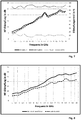
- Fig. 6 is the typical attenuation curve of a test plate (500x500x40) mm 3 in the frequency range 1 to 10 GHz, which is shown from the above-mentioned building material mixture, which only contains thermally modified electric furnace slag. Approx. 85% of the shielding attenuation is determined in the entire frequency range by the absorbing portion of the electric furnace slag (EOS). Since the losses are frequency-dependent, a continuous increase in the attenuation can be observed.
- EOS electric furnace slag
- a proportion of metal fibers made of ferritic steel was added to the building material mixture: Electric furnace slag 0 - 8.0 mm 48 M-% Electric furnace slag 0 - 0.125 mm 28 M-% Metal fibers 4 M-% Cement CEM I 42.5 R (including additives) 20 M-%
- Fig. 7 shows a typical attenuation curve of a test plate which was produced from this building material mixture, which contains electric furnace slag and steel fibers. With increasing frequency, the proportion of the absorbing effect increases. From around 3 GHz, around 90% of the incident energy is absorbed. The shielding effect in the lower frequency range is essentially determined by the reflective portion of the steel fibers.
- the surface structuring of a building material board also has an influence on the reflected portion of the incident high-frequency wave or on the resulting angle of incidence in the case of irradiation deviating from 90 °. It has a noticeable share for structure depths greater than 1/10 of the wavelength. At 1 GHz, depths of 30 mm must therefore be used. At 10 GHz, 3 mm is enough.
- Fig. 8 shows a typical attenuation curve for test panels made from building material mixtures containing untreated electric furnace slag or thermally modified electric furnace slag.
- the thermal modification causes an increase in attenuation of up to 7 dB (approx. 30%) over the entire frequency curve compared to the untreated electric furnace slag.
- Further components of the mixture such as iron oxide, barium hexaferrite and metal fibers, can be added.
- the mixture mixed with water is pressed into plates measuring 400 mm x 400 mm x 40 mm and transported to the curing chamber by means of a stacking unit. After hardening, the panels are made available for further use via a destacking device.
- the concrete technical parameters of the panels are listed below: Prism compressive strength 30 N / mm 2 modulus of elasticity 20000 N / mm 2 Dry bulk density 2.8 kg / dm 3
- Metal fibers made of ferritic and / or martensitic steel increase the shielding attenuation effect at lower frequencies depending on their mass fraction, but lead to an increase in the reflective fraction.
- the building material mixtures according to the invention can primarily be used for shielding measurement and test laboratories, for medical applications (MRT, EEG), for eavesdropping and radiation protection (Tempest according to BSI and NATO specifications), for mobile phone-free areas, for zones with high lightning protection requirements, for the Protection against electromagnetic and nuclear electromagnetic pulse and HPM as well as for military applications.
- MRT medical applications
- EEG eavesdropping and radiation protection
- HPM high lightning protection requirements
Landscapes
- Chemical & Material Sciences (AREA)
- Engineering & Computer Science (AREA)
- Ceramic Engineering (AREA)
- Materials Engineering (AREA)
- Structural Engineering (AREA)
- Organic Chemistry (AREA)
- Environmental & Geological Engineering (AREA)
- Civil Engineering (AREA)
- Chemical Kinetics & Catalysis (AREA)
- Inorganic Chemistry (AREA)
- Shielding Devices Or Components To Electric Or Magnetic Fields (AREA)
- Building Environments (AREA)
Priority Applications (1)
| Application Number | Priority Date | Filing Date | Title |
|---|---|---|---|
| PL15798356T PL3218322T3 (pl) | 2014-11-13 | 2015-11-12 | Materiał budowlany do ekranowania fal elektromagnetycznych, sposób jego wytwarzania oraz jego zastosowanie |
Applications Claiming Priority (2)
| Application Number | Priority Date | Filing Date | Title |
|---|---|---|---|
| DE102014017049.7A DE102014017049A1 (de) | 2014-11-13 | 2014-11-13 | Baustoff zur Abschirmung von elektromagnetischen Wellen durch Absorption, Verfahren zu seiner Herstellung sowie dessen Verwendung |
| PCT/EP2015/076385 WO2016075213A1 (de) | 2014-11-13 | 2015-11-12 | Baustoff zur abschirmung elektromagnetischer wellen, verfahren zu seiner herstellung sowie dessen verwendung |
Publications (2)
| Publication Number | Publication Date |
|---|---|
| EP3218322A1 EP3218322A1 (de) | 2017-09-20 |
| EP3218322B1 true EP3218322B1 (de) | 2020-10-28 |
Family
ID=54697544
Family Applications (1)
| Application Number | Title | Priority Date | Filing Date |
|---|---|---|---|
| EP15798356.0A Active EP3218322B1 (de) | 2014-11-13 | 2015-11-12 | Baustoff zur abschirmung elektromagnetischer wellen, verfahren zu seiner herstellung sowie dessen verwendung |
Country Status (8)
| Country | Link |
|---|---|
| EP (1) | EP3218322B1 (da) |
| DE (1) | DE102014017049A1 (da) |
| DK (1) | DK3218322T3 (da) |
| ES (1) | ES2842280T3 (da) |
| HU (1) | HUE053144T2 (da) |
| PL (1) | PL3218322T3 (da) |
| PT (1) | PT3218322T (da) |
| WO (1) | WO2016075213A1 (da) |
Families Citing this family (3)
| Publication number | Priority date | Publication date | Assignee | Title |
|---|---|---|---|---|
| DE102018221369A1 (de) | 2018-12-11 | 2020-06-18 | Contitech Luftfedersysteme Gmbh | Absorptionsvorrichtung, geeignet zum Absorbieren elektromagnetischer Wellen vorbestimmter Frequenz |
| DE102018221366A1 (de) | 2018-12-11 | 2020-06-18 | Contitech Luftfedersysteme Gmbh | Absorptionsvorrichtung, geeignet zum Absorbieren elektromagnetischer Wellen vorbestimmter Frequenz |
| EP3744701A1 (de) * | 2019-05-28 | 2020-12-02 | Sika Technology Ag | Leitfähiger mörtel |
Family Cites Families (8)
| Publication number | Priority date | Publication date | Assignee | Title |
|---|---|---|---|---|
| JPS61238901A (ja) * | 1985-04-15 | 1986-10-24 | Kawasaki Steel Corp | 強磁性粉末 |
| KR930009342B1 (ko) * | 1990-11-30 | 1993-09-28 | 쌍용양회공업 주식회사 | 고강도 무수축 그라우트 조성물 |
| DE19800868C2 (de) * | 1998-01-13 | 2000-06-21 | Sicowa Verfahrenstech | Verwendung eines vergießfähigen Mörtels |
| JP2001352194A (ja) | 2000-06-08 | 2001-12-21 | Hoshino Sansho:Kk | 透磁性、放射線遮蔽性および電磁波遮蔽性材料の製造方法 |
| AT4618U1 (de) * | 2001-04-02 | 2001-09-25 | Buzetzki Eduard | Verfahren zur verfestigung von walzenzunder |
| JP4451328B2 (ja) | 2005-02-08 | 2010-04-14 | 株式会社星野産商 | フェライト含有充填材の製造方法、電磁波加熱材料、電磁波遮蔽材料 |
| DE102008056469B4 (de) | 2008-11-04 | 2010-08-05 | Bauhaus-Universität Weimar F.A. Finger - Institut für Baustoffkunde | Verwendung einer Baustoffmischung und Baustoffmischung |
| CN101525224B (zh) | 2009-03-27 | 2012-07-04 | 重庆大学 | 高铁粉煤灰水泥基复合建筑吸波材料及其制备方法 |
-
2014
- 2014-11-13 DE DE102014017049.7A patent/DE102014017049A1/de not_active Withdrawn
-
2015
- 2015-11-12 WO PCT/EP2015/076385 patent/WO2016075213A1/de not_active Ceased
- 2015-11-12 PT PT157983560T patent/PT3218322T/pt unknown
- 2015-11-12 ES ES15798356T patent/ES2842280T3/es active Active
- 2015-11-12 EP EP15798356.0A patent/EP3218322B1/de active Active
- 2015-11-12 HU HUE15798356A patent/HUE053144T2/hu unknown
- 2015-11-12 PL PL15798356T patent/PL3218322T3/pl unknown
- 2015-11-12 DK DK15798356.0T patent/DK3218322T3/da active
Non-Patent Citations (1)
| Title |
|---|
| None * |
Also Published As
| Publication number | Publication date |
|---|---|
| HUE053144T2 (hu) | 2021-06-28 |
| ES2842280T3 (es) | 2021-07-13 |
| DK3218322T3 (da) | 2021-01-18 |
| EP3218322A1 (de) | 2017-09-20 |
| PT3218322T (pt) | 2021-01-12 |
| DE102014017049A1 (de) | 2016-05-19 |
| WO2016075213A1 (de) | 2016-05-19 |
| PL3218322T3 (pl) | 2021-07-05 |
Similar Documents
| Publication | Publication Date | Title |
|---|---|---|
| DE2636134C3 (de) | Verfahren und Vorrichtung zum Sintern elektrisch nichtleitender feuerfester Stoffe | |
| DE69012523T2 (de) | Hydraulische Zusammensetzungen und hochfeste Verbundmaterialien. | |
| EP3218322B1 (de) | Baustoff zur abschirmung elektromagnetischer wellen, verfahren zu seiner herstellung sowie dessen verwendung | |
| EP1749805A1 (de) | Gipsbaustoffe mit erhöhter Wärmeleitfähigkeit und Abschirmung gegen elektromagnetische Strahlen. | |
| DE2819085A1 (de) | Verfahren zur endlagerreifen, umweltfreundlichen verfestigung von hoch- und mittelradioaktiven und/oder actiniden enthaltenden, waessrigen abfallkonzentraten oder von in wasser aufgeschlaemmten, feinkoernigen festen abfaellen | |
| EP1986978A2 (de) | Grobkeramischer feuerfester versatz sowie feuerfestes erzeugnis daraus | |
| EP3568380A1 (de) | Baustoffmischung zur abschirmung elektromagnetischer strahlung | |
| EP0661240B1 (de) | Schaumglasgranulat und Verfahren zu seiner Herstellung | |
| DE2255501A1 (de) | Expansive zementadditive | |
| EP2164818A2 (de) | Keramische brandschutzplatte und verfahren zu deren herstellung | |
| DE4342996C2 (de) | Verfahren zur Herstellung von Schaumglasgranulat | |
| EP0946453B1 (de) | Bauelemente sowie verfahren zu ihrer herstellung und deren verwendung | |
| EP1247785B1 (de) | Resistorkörner für feuerfeste Formkörper und Verfahren zu ihrer Herstellung | |
| DE102008056469B4 (de) | Verwendung einer Baustoffmischung und Baustoffmischung | |
| DE19653807A1 (de) | Mineralischer Dämmkörper, insbesondere Schall- oder Wärmedämmplatte und Verfahren zu dessen Herstellung | |
| DE3105596C2 (de) | Verfahren zur Herstellung eines Formteils und seine Verwendung | |
| DE3886912T2 (de) | Zement enthaltende keramische Gegenstände und Verfahren zu ihrer Herstellung. | |
| EP1277526A1 (de) | Verfahren zur thermischen Behandlung von Asbestzementprodukten | |
| DE69306247T2 (de) | Betonbauprodukte | |
| DE3346120C2 (de) | Geblähter Perlit | |
| DE102016112039A1 (de) | Platte, insbesondere Abdeckplatte für Metallschmelzen, sowie Verfahren zur Herstellung der Platte und deren Verwendung | |
| EP2998281A1 (de) | Feuerfester keramischer Versatz sowie ein feuerfestes keramisches Erzeugnis | |
| DE102011102649B4 (de) | Feuerfestes Regeneratwerkstoff-Granulat, Verfahren zu seiner Herstellung sowie dessen Verwendung | |
| DE102019220085A1 (de) | Versatz zur Herstellung eines grobkeramischen feuerfesten basischen Erzeugnisses, derartiges Erzeugnis sowie Verfahren zu seiner Herstellung, Zustellung eines Industrieofens und Industrieofen | |
| DE19833407C1 (de) | Verfahren zur Herstellung von zementfreien Formkörpern und danach hergestellte Formkörper |
Legal Events
| Date | Code | Title | Description |
|---|---|---|---|
| STAA | Information on the status of an ep patent application or granted ep patent |
Free format text: STATUS: THE INTERNATIONAL PUBLICATION HAS BEEN MADE |
|
| PUAI | Public reference made under article 153(3) epc to a published international application that has entered the european phase |
Free format text: ORIGINAL CODE: 0009012 |
|
| STAA | Information on the status of an ep patent application or granted ep patent |
Free format text: STATUS: REQUEST FOR EXAMINATION WAS MADE |
|
| 17P | Request for examination filed |
Effective date: 20170613 |
|
| AK | Designated contracting states |
Kind code of ref document: A1 Designated state(s): AL AT BE BG CH CY CZ DE DK EE ES FI FR GB GR HR HU IE IS IT LI LT LU LV MC MK MT NL NO PL PT RO RS SE SI SK SM TR |
|
| AX | Request for extension of the european patent |
Extension state: BA ME |
|
| DAV | Request for validation of the european patent (deleted) | ||
| DAX | Request for extension of the european patent (deleted) | ||
| STAA | Information on the status of an ep patent application or granted ep patent |
Free format text: STATUS: EXAMINATION IS IN PROGRESS |
|
| 17Q | First examination report despatched |
Effective date: 20180315 |
|
| RAP1 | Party data changed (applicant data changed or rights of an application transferred) |
Owner name: CE-SYS ENGINEERING GMBH |
|
| GRAP | Despatch of communication of intention to grant a patent |
Free format text: ORIGINAL CODE: EPIDOSNIGR1 |
|
| STAA | Information on the status of an ep patent application or granted ep patent |
Free format text: STATUS: GRANT OF PATENT IS INTENDED |
|
| INTG | Intention to grant announced |
Effective date: 20200626 |
|
| RAP1 | Party data changed (applicant data changed or rights of an application transferred) |
Owner name: CE-SYS PRODUCTS GMBH |
|
| GRAS | Grant fee paid |
Free format text: ORIGINAL CODE: EPIDOSNIGR3 |
|
| GRAA | (expected) grant |
Free format text: ORIGINAL CODE: 0009210 |
|
| STAA | Information on the status of an ep patent application or granted ep patent |
Free format text: STATUS: THE PATENT HAS BEEN GRANTED |
|
| AK | Designated contracting states |
Kind code of ref document: B1 Designated state(s): AL AT BE BG CH CY CZ DE DK EE ES FI FR GB GR HR HU IE IS IT LI LT LU LV MC MK MT NL NO PL PT RO RS SE SI SK SM TR |
|
| REG | Reference to a national code |
Ref country code: GB Ref legal event code: FG4D Free format text: NOT ENGLISH |
|
| REG | Reference to a national code |
Ref country code: CH Ref legal event code: EP |
|
| REG | Reference to a national code |
Ref country code: DE Ref legal event code: R096 Ref document number: 502015013722 Country of ref document: DE |
|
| REG | Reference to a national code |
Ref country code: AT Ref legal event code: REF Ref document number: 1328048 Country of ref document: AT Kind code of ref document: T Effective date: 20201115 |
|
| REG | Reference to a national code |
Ref country code: IE Ref legal event code: FG4D Free format text: LANGUAGE OF EP DOCUMENT: GERMAN |
|
| REG | Reference to a national code |
Ref country code: PT Ref legal event code: SC4A Ref document number: 3218322 Country of ref document: PT Date of ref document: 20210112 Kind code of ref document: T Free format text: AVAILABILITY OF NATIONAL TRANSLATION Effective date: 20210105 |
|
| REG | Reference to a national code |
Ref country code: DK Ref legal event code: T3 Effective date: 20210115 |
|
| REG | Reference to a national code |
Ref country code: FI Ref legal event code: FGE |
|
| REG | Reference to a national code |
Ref country code: CH Ref legal event code: NV Representative=s name: FREI PATENTANWALTSBUERO AG, CH |
|
| REG | Reference to a national code |
Ref country code: SE Ref legal event code: TRGR |
|
| REG | Reference to a national code |
Ref country code: NL Ref legal event code: FP |
|
| REG | Reference to a national code |
Ref country code: SK Ref legal event code: T3 Ref document number: E 36150 Country of ref document: SK |
|
| REG | Reference to a national code |
Ref country code: NO Ref legal event code: T2 Effective date: 20201028 |
|
| PG25 | Lapsed in a contracting state [announced via postgrant information from national office to epo] |
Ref country code: GR Free format text: LAPSE BECAUSE OF FAILURE TO SUBMIT A TRANSLATION OF THE DESCRIPTION OR TO PAY THE FEE WITHIN THE PRESCRIBED TIME-LIMIT Effective date: 20210129 Ref country code: RS Free format text: LAPSE BECAUSE OF FAILURE TO SUBMIT A TRANSLATION OF THE DESCRIPTION OR TO PAY THE FEE WITHIN THE PRESCRIBED TIME-LIMIT Effective date: 20201028 |
|
| REG | Reference to a national code |
Ref country code: LT Ref legal event code: MG4D |
|
| PG25 | Lapsed in a contracting state [announced via postgrant information from national office to epo] |
Ref country code: BG Free format text: LAPSE BECAUSE OF FAILURE TO SUBMIT A TRANSLATION OF THE DESCRIPTION OR TO PAY THE FEE WITHIN THE PRESCRIBED TIME-LIMIT Effective date: 20210128 Ref country code: LV Free format text: LAPSE BECAUSE OF FAILURE TO SUBMIT A TRANSLATION OF THE DESCRIPTION OR TO PAY THE FEE WITHIN THE PRESCRIBED TIME-LIMIT Effective date: 20201028 Ref country code: IS Free format text: LAPSE BECAUSE OF FAILURE TO SUBMIT A TRANSLATION OF THE DESCRIPTION OR TO PAY THE FEE WITHIN THE PRESCRIBED TIME-LIMIT Effective date: 20210228 |
|
| REG | Reference to a national code |
Ref country code: HU Ref legal event code: AG4A Ref document number: E053144 Country of ref document: HU |
|
| PG25 | Lapsed in a contracting state [announced via postgrant information from national office to epo] |
Ref country code: HR Free format text: LAPSE BECAUSE OF FAILURE TO SUBMIT A TRANSLATION OF THE DESCRIPTION OR TO PAY THE FEE WITHIN THE PRESCRIBED TIME-LIMIT Effective date: 20201028 |
|
| REG | Reference to a national code |
Ref country code: ES Ref legal event code: FG2A Ref document number: 2842280 Country of ref document: ES Kind code of ref document: T3 Effective date: 20210713 |
|
| REG | Reference to a national code |
Ref country code: DE Ref legal event code: R097 Ref document number: 502015013722 Country of ref document: DE |
|
| PG25 | Lapsed in a contracting state [announced via postgrant information from national office to epo] |
Ref country code: LT Free format text: LAPSE BECAUSE OF FAILURE TO SUBMIT A TRANSLATION OF THE DESCRIPTION OR TO PAY THE FEE WITHIN THE PRESCRIBED TIME-LIMIT Effective date: 20201028 Ref country code: MC Free format text: LAPSE BECAUSE OF FAILURE TO SUBMIT A TRANSLATION OF THE DESCRIPTION OR TO PAY THE FEE WITHIN THE PRESCRIBED TIME-LIMIT Effective date: 20201028 Ref country code: RO Free format text: LAPSE BECAUSE OF FAILURE TO SUBMIT A TRANSLATION OF THE DESCRIPTION OR TO PAY THE FEE WITHIN THE PRESCRIBED TIME-LIMIT Effective date: 20201028 Ref country code: EE Free format text: LAPSE BECAUSE OF FAILURE TO SUBMIT A TRANSLATION OF THE DESCRIPTION OR TO PAY THE FEE WITHIN THE PRESCRIBED TIME-LIMIT Effective date: 20201028 Ref country code: SM Free format text: LAPSE BECAUSE OF FAILURE TO SUBMIT A TRANSLATION OF THE DESCRIPTION OR TO PAY THE FEE WITHIN THE PRESCRIBED TIME-LIMIT Effective date: 20201028 |
|
| PLBE | No opposition filed within time limit |
Free format text: ORIGINAL CODE: 0009261 |
|
| STAA | Information on the status of an ep patent application or granted ep patent |
Free format text: STATUS: NO OPPOSITION FILED WITHIN TIME LIMIT |
|
| 26N | No opposition filed |
Effective date: 20210729 |
|
| PG25 | Lapsed in a contracting state [announced via postgrant information from national office to epo] |
Ref country code: AL Free format text: LAPSE BECAUSE OF FAILURE TO SUBMIT A TRANSLATION OF THE DESCRIPTION OR TO PAY THE FEE WITHIN THE PRESCRIBED TIME-LIMIT Effective date: 20201028 |
|
| PG25 | Lapsed in a contracting state [announced via postgrant information from national office to epo] |
Ref country code: SI Free format text: LAPSE BECAUSE OF FAILURE TO SUBMIT A TRANSLATION OF THE DESCRIPTION OR TO PAY THE FEE WITHIN THE PRESCRIBED TIME-LIMIT Effective date: 20201028 |
|
| PG25 | Lapsed in a contracting state [announced via postgrant information from national office to epo] |
Ref country code: IS Free format text: LAPSE BECAUSE OF FAILURE TO SUBMIT A TRANSLATION OF THE DESCRIPTION OR TO PAY THE FEE WITHIN THE PRESCRIBED TIME-LIMIT Effective date: 20210228 Ref country code: TR Free format text: LAPSE BECAUSE OF FAILURE TO SUBMIT A TRANSLATION OF THE DESCRIPTION OR TO PAY THE FEE WITHIN THE PRESCRIBED TIME-LIMIT Effective date: 20201028 Ref country code: MT Free format text: LAPSE BECAUSE OF FAILURE TO SUBMIT A TRANSLATION OF THE DESCRIPTION OR TO PAY THE FEE WITHIN THE PRESCRIBED TIME-LIMIT Effective date: 20201028 Ref country code: CY Free format text: LAPSE BECAUSE OF FAILURE TO SUBMIT A TRANSLATION OF THE DESCRIPTION OR TO PAY THE FEE WITHIN THE PRESCRIBED TIME-LIMIT Effective date: 20201028 |
|
| PG25 | Lapsed in a contracting state [announced via postgrant information from national office to epo] |
Ref country code: MK Free format text: LAPSE BECAUSE OF FAILURE TO SUBMIT A TRANSLATION OF THE DESCRIPTION OR TO PAY THE FEE WITHIN THE PRESCRIBED TIME-LIMIT Effective date: 20201028 |
|
| PGFP | Annual fee paid to national office [announced via postgrant information from national office to epo] |
Ref country code: PT Payment date: 20231026 Year of fee payment: 9 Ref country code: IE Payment date: 20231117 Year of fee payment: 9 Ref country code: HU Payment date: 20231110 Year of fee payment: 9 |
|
| REG | Reference to a national code |
Ref country code: DE Ref legal event code: R084 Ref document number: 502015013722 Country of ref document: DE |
|
| PG25 | Lapsed in a contracting state [announced via postgrant information from national office to epo] |
Ref country code: PT Free format text: LAPSE BECAUSE OF NON-PAYMENT OF DUE FEES Effective date: 20250512 |
|
| PG25 | Lapsed in a contracting state [announced via postgrant information from national office to epo] |
Ref country code: HU Free format text: LAPSE BECAUSE OF NON-PAYMENT OF DUE FEES Effective date: 20241113 |
|
| PG25 | Lapsed in a contracting state [announced via postgrant information from national office to epo] |
Ref country code: IE Free format text: LAPSE BECAUSE OF NON-PAYMENT OF DUE FEES Effective date: 20241112 |
|
| REG | Reference to a national code |
Ref country code: CH Ref legal event code: U11 Free format text: ST27 STATUS EVENT CODE: U-0-0-U10-U11 (AS PROVIDED BY THE NATIONAL OFFICE) Effective date: 20251201 |
|
| PGFP | Annual fee paid to national office [announced via postgrant information from national office to epo] |
Ref country code: LU Payment date: 20251118 Year of fee payment: 11 Ref country code: NL Payment date: 20251119 Year of fee payment: 11 |
|
| PGFP | Annual fee paid to national office [announced via postgrant information from national office to epo] |
Ref country code: DE Payment date: 20251023 Year of fee payment: 11 |
|
| PGFP | Annual fee paid to national office [announced via postgrant information from national office to epo] |
Ref country code: GB Payment date: 20251120 Year of fee payment: 11 |
|
| PGFP | Annual fee paid to national office [announced via postgrant information from national office to epo] |
Ref country code: NO Payment date: 20251118 Year of fee payment: 11 |
|
| PGFP | Annual fee paid to national office [announced via postgrant information from national office to epo] |
Ref country code: AT Payment date: 20251117 Year of fee payment: 11 |
|
| PGFP | Annual fee paid to national office [announced via postgrant information from national office to epo] |
Ref country code: IT Payment date: 20251128 Year of fee payment: 11 Ref country code: FI Payment date: 20251118 Year of fee payment: 11 Ref country code: DK Payment date: 20251119 Year of fee payment: 11 |
|
| PGFP | Annual fee paid to national office [announced via postgrant information from national office to epo] |
Ref country code: FR Payment date: 20251120 Year of fee payment: 11 |
|
| PGFP | Annual fee paid to national office [announced via postgrant information from national office to epo] |
Ref country code: BE Payment date: 20251118 Year of fee payment: 11 |
|
| PGFP | Annual fee paid to national office [announced via postgrant information from national office to epo] |
Ref country code: SE Payment date: 20251119 Year of fee payment: 11 Ref country code: CH Payment date: 20251201 Year of fee payment: 11 |
|
| PGFP | Annual fee paid to national office [announced via postgrant information from national office to epo] |
Ref country code: CZ Payment date: 20251030 Year of fee payment: 11 |
|
| PGFP | Annual fee paid to national office [announced via postgrant information from national office to epo] |
Ref country code: PL Payment date: 20251023 Year of fee payment: 11 |
|
| PGFP | Annual fee paid to national office [announced via postgrant information from national office to epo] |
Ref country code: SK Payment date: 20251031 Year of fee payment: 11 |
|
| PGFP | Annual fee paid to national office [announced via postgrant information from national office to epo] |
Ref country code: ES Payment date: 20251216 Year of fee payment: 11 |