EP3218332B1 - Système de purification de traceur tep - Google Patents
Système de purification de traceur tep Download PDFInfo
- Publication number
- EP3218332B1 EP3218332B1 EP15794180.8A EP15794180A EP3218332B1 EP 3218332 B1 EP3218332 B1 EP 3218332B1 EP 15794180 A EP15794180 A EP 15794180A EP 3218332 B1 EP3218332 B1 EP 3218332B1
- Authority
- EP
- European Patent Office
- Prior art keywords
- column
- batch
- spe column
- reversed
- phase
- Prior art date
- Legal status (The legal status is an assumption and is not a legal conclusion. Google has not performed a legal analysis and makes no representation as to the accuracy of the status listed.)
- Active
Links
Images


Classifications
-
- C—CHEMISTRY; METALLURGY
- C07—ORGANIC CHEMISTRY
- C07B—GENERAL METHODS OF ORGANIC CHEMISTRY; APPARATUS THEREFOR
- C07B59/00—Introduction of isotopes of elements into organic compounds ; Labelled organic compounds per se
- C07B59/005—Sugars; Derivatives thereof; Nucleosides; Nucleotides; Nucleic acids
-
- C—CHEMISTRY; METALLURGY
- C07—ORGANIC CHEMISTRY
- C07B—GENERAL METHODS OF ORGANIC CHEMISTRY; APPARATUS THEREFOR
- C07B59/00—Introduction of isotopes of elements into organic compounds ; Labelled organic compounds per se
-
- A—HUMAN NECESSITIES
- A61—MEDICAL OR VETERINARY SCIENCE; HYGIENE
- A61K—PREPARATIONS FOR MEDICAL, DENTAL OR TOILETRY PURPOSES
- A61K51/00—Preparations containing radioactive substances for use in therapy or testing in vivo
- A61K51/02—Preparations containing radioactive substances for use in therapy or testing in vivo characterised by the carrier, i.e. characterised by the agent or material covalently linked or complexing the radioactive nucleus
- A61K51/04—Organic compounds
-
- B—PERFORMING OPERATIONS; TRANSPORTING
- B01—PHYSICAL OR CHEMICAL PROCESSES OR APPARATUS IN GENERAL
- B01D—SEPARATION
- B01D15/00—Separating processes involving the treatment of liquids with solid sorbents; Apparatus therefor
- B01D15/08—Selective adsorption, e.g. chromatography
- B01D15/10—Selective adsorption, e.g. chromatography characterised by constructional or operational features
- B01D15/18—Selective adsorption, e.g. chromatography characterised by constructional or operational features relating to flow patterns
- B01D15/1864—Selective adsorption, e.g. chromatography characterised by constructional or operational features relating to flow patterns using two or more columns
- B01D15/1871—Selective adsorption, e.g. chromatography characterised by constructional or operational features relating to flow patterns using two or more columns placed in series
-
- B—PERFORMING OPERATIONS; TRANSPORTING
- B01—PHYSICAL OR CHEMICAL PROCESSES OR APPARATUS IN GENERAL
- B01D—SEPARATION
- B01D15/00—Separating processes involving the treatment of liquids with solid sorbents; Apparatus therefor
- B01D15/08—Selective adsorption, e.g. chromatography
- B01D15/26—Selective adsorption, e.g. chromatography characterised by the separation mechanism
- B01D15/32—Bonded phase chromatography
- B01D15/322—Normal bonded phase
-
- B—PERFORMING OPERATIONS; TRANSPORTING
- B01—PHYSICAL OR CHEMICAL PROCESSES OR APPARATUS IN GENERAL
- B01D—SEPARATION
- B01D15/00—Separating processes involving the treatment of liquids with solid sorbents; Apparatus therefor
- B01D15/08—Selective adsorption, e.g. chromatography
- B01D15/26—Selective adsorption, e.g. chromatography characterised by the separation mechanism
- B01D15/32—Bonded phase chromatography
- B01D15/325—Reversed phase
-
- B—PERFORMING OPERATIONS; TRANSPORTING
- B01—PHYSICAL OR CHEMICAL PROCESSES OR APPARATUS IN GENERAL
- B01D—SEPARATION
- B01D15/00—Separating processes involving the treatment of liquids with solid sorbents; Apparatus therefor
- B01D15/08—Selective adsorption, e.g. chromatography
- B01D15/26—Selective adsorption, e.g. chromatography characterised by the separation mechanism
- B01D15/36—Selective adsorption, e.g. chromatography characterised by the separation mechanism involving ionic interaction, e.g. ion-exchange, ion-pair, ion-suppression or ion-exclusion
- B01D15/361—Ion-exchange
- B01D15/363—Anion-exchange
-
- C—CHEMISTRY; METALLURGY
- C07—ORGANIC CHEMISTRY
- C07H—SUGARS; DERIVATIVES THEREOF; NUCLEOSIDES; NUCLEOTIDES; NUCLEIC ACIDS
- C07H5/00—Compounds containing saccharide radicals in which the hetero bonds to oxygen have been replaced by the same number of hetero bonds to halogen, nitrogen, sulfur, selenium, or tellurium
- C07H5/02—Compounds containing saccharide radicals in which the hetero bonds to oxygen have been replaced by the same number of hetero bonds to halogen, nitrogen, sulfur, selenium, or tellurium to halogen
-
- C—CHEMISTRY; METALLURGY
- C07—ORGANIC CHEMISTRY
- C07B—GENERAL METHODS OF ORGANIC CHEMISTRY; APPARATUS THEREFOR
- C07B2200/00—Indexing scheme relating to specific properties of organic compounds
- C07B2200/05—Isotopically modified compounds, e.g. labelled
Definitions
- the present invention concerns devices and methods for the automated synthesis of [ 18 F]-labelled compounds, in particular those suitable for use as in vivo imaging agents for positron emission tomography (PET).
- PET positron emission tomography
- the focus of the present invention is for the automated synthesis of more than one batch of an [ 18 F]-labelled compound using just one disposable cassette and in particular a novel system for purification of an [ 18 F]-labelled compound following the labelling reaction.
- Radiolabelled compounds for use as in vivo imaging agents are currently typically prepared by means of an automated synthesis apparatus (alternatively "radiosynthesizer”).
- automated synthesis apparatuses are commercially available from a range of suppliers, including: GE Healthcare; CTI Inc.; Ion Beam Applications S.A. (Chemin du Cyclotron 3, B-1348 Louvain-La-Neuve, Belgium); Raytest (Germany) and Bioscan (USA).
- the radiochemistry takes place in a "cassette” or “cartridge” designed to fit removably and interchangeably onto the apparatus, in such a way that mechanical movement of moving parts of the apparatus controls the operation of the cassette.
- Suitable cassettes may be provided as a kit of parts that is assembled onto the apparatus in a number of steps, or may be provided as a single piece that is attached in a single step, thereby reducing the risk of human error.
- the single piece arrangement is generally a disposable single use cassette which comprises all the reagents, reaction vessels and apparatus necessary to carry out the preparation of a given batch of radiopharmaceutical.
- the commercially-available GE Healthcare FASTlabTM cassette is an example of a disposable single piece type of cassette pre-loaded with reagents comprising a linear array of valves, each linked to a port where reagents or vials can be attached.
- Each valve has a male-female joint which interfaces with a corresponding moving arm of the automated synthesis apparatus. External rotation of the arm thus controls the opening or closing of the valve when the cassette is attached to the apparatus.
- Additional moving parts of the apparatus are designed to clip onto syringe plunger tips, and thus raise or depress syringe barrels.
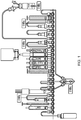
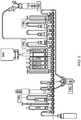
- the FASTlabTM cassette has 25 identical 3-way valves in a linear array, examples of which are shown in Figures 1 and 2 .
- Figure 1 is a schematic drawing of the commercially-available FDG Phosphate FASTlabTM cassette
- Figure 2 the commercially-available FDG Citrate FASTlabTM cassette.
- the 18 F-labelled mannose triflate ( 18 F-fluoro-tetraacetyl-glucose, FTAG) is trapped and so separated from 18 F fluorides on an environmental tC18 SPE column at position 18 via tubing at position 17 to undergo hydrolysis with NaOH (from the vial at position 14, marked "NaOH")) to remove acetyl protecting groups.
- the resulting hydrolyzed basic solution is then neutralized in the syringe placed at position 24 with phosphoric acid in the case of phosphate configuration ( Figure 1 ) or hydrochloric acid present in a citrate buffer in the case of citrate configuration ( Figure 2 ).
- positions on the FASTlabTM cassette are free in the case of each of the known [ 18 F]FDG cassettes illustrated in Figures 1 and 2 , i.e. positions 9 and 10. Caps are placed on the valves at these positions.
- a typical [ 18 F]FDG production site produces a minimum of 2 batches of [ 18 F]FDG a day.
- the FASTlabTM cassette, transfer line and the shadow from the waste bottle after completion of a batch it is impossible for safety reasons to carry out back to back runs of the above-described process on the same apparatus.
- To produce a second batch of [ 18 F]FDG on the same day using this process it is necessary to have a second apparatus in a second hot cell.
- WO 2011/044406 A2 describes the synthesis of [ 18 F]-flutemetamol, which includes purification by passing the crude labelled compound through a first reverse phase SPE cartridge, followed by a normal phase SPE cartridge and then by a second reverse phase SPE cartridge. Similarly to [ 18 F]FDG, production of a second batch on the same day using the cassette described in WO 2011/044406 A2 would require a separate radiosynthesiser in another hot cell.
- WO2015071288 describes a FASTlabTM cassette for the synthesis of two batches of [ 18 F]FDG.
- Figure 3 illustrates this cassette and although quite good yields are reported for each [ 18 F]FDG batch and there is quite good trapping and elution of the incoming activity, the present inventors have found problems with this configuration.
- contamination of the manifold with enriched water is possible because of the pathway taken for enriched water recovery to the right of the manifold for the second batch. This presents a risk for the second labelling reaction.
- the Oasis HLB purification column is directly connected to the alumina column so that there is no way to properly clean the Oasis HLB after the first batch because of the risk of contaminating the alumina column with organic solvent.
- the present invention provides a system (1) for purifying two consecutive batches of a reaction mixture comprising an 18 F-labelled compound wherein said system comprises:
- the present invention provides a single-use cassette (11) for preparing two consecutive batches of an [ 18 F]-labelled compound wherein said cassette comprises:
- the present invention provides a method for purifying a first batch and a second batch of a reaction mixture comprising an 18 F-labelled compound wherein said method comprises:
- the present invention provides a method for the production of a first batch and a second batch of an 18 F-labelled compound wherein said method comprises:
- the present invention provides a non-transitory storage medium comprising computer readable program code, wherein execution of the computer readable program code causes a processor to carry out the steps of the method of the invention as defined hereinabove.
- the present invention permits good yields for the production of two batches of [ 18 F]-labelled compound.
- ethanol can be used in the conditioning of SPE columns, in the cleaning steps between first and second batches, and can be used as a radiostabilizer if desired.
- the reversed-phase column used for purification in the system of the present invention can be rinsed between runs with ethanol and water independently of the alumina column such that there is a negligible amount of KryptofixTM 222 in the both batches of [ 18 F]labelled compound, thereby providing an advantage over WO2015071288 where the second batch has a higher concentration.
- Example 2 there was no release of extractables from the alumina column due to the fact that the alumina columns are not washed with water before use with the exemplary system of the present invention. There was therefore no impact on the quality of the product obtained from both batches and two consecutive batches of [ 18 F]-FDG having similar chemical and radiochemical profiles were obtained from one single-use cassette of the invention. This is important for [ 18 F]-FDG and other [ 18 F]-labelled PET tracers where defined pharmacopoeial parameters need to be met.
- the term " purifying" as used herein may be taken to mean a process to obtain substantially pure 18 F-labelled compound.
- substantially refers to the complete or nearly complete extent or degree of an action, characteristic, property, state, structure, item, or result.
- substantially pure can be taken to mean completely pure 18 F-labelled compound, which would be ideal, but also 18 F-labelled compound that is sufficiently pure to be suitable for use as a PET tracer.
- suitable for use as a PET tracer means that the substantially pure 18 F-labelled compound is suitable for intravenous administration to a mammalian subject followed by PET imaging to obtain one or more clinically-useful images of the location and/or distribution of the 18 F-labelled compound.
- 18 F-labelled compound is a chemical compound that comprises an 18 F atom.
- Non-limiting examples of 18 F-labelled compounds include [ 18 F]fluorodeoxyglucose ([ 18 F]FDG), [ 18 F]Fluoromisonidazole ([ 18 F]FMISO), [ 18 F]fluorothymidine ([ 18 F]FLT), [ 18 F]Fluoroazomycin arabinofuranoside ([ 18 F]FAZA), [ 18 F]Fluoroethyl-choline ([ 18 F]FECH), [ 18 F]fluorocyclobutane-1-carboxylic acid ([ 18 F]FACBC), [ 18 F]-flumanezil ([ 18 F]FMZ), [ 18 F]-tyrosine, [ 18 F]-altanaserine, 4-[ 18 F]-fluoro-3-iodobenzyl guanidine ([ 18 F]-FIBG), meta -[ 18 F]fluorobenzyl
- the 18 F-labelled compound is selected from [ 18 F]FDG, [ 18 F]FMISO, [ 18 F]FLT and [ 18 F]FACBC. In another embodiment of the present invention the 18 F-labelled compound is [ 18 F]FDG.
- first batch and second batch represent two separate consecutive syntheses of 18 F-labelled compound produced on the same cassette, the second batch being produced only after production of the first batch has been completed, i.e. the product has been collected in the product collection vial.
- batch is used to refer variously to the final 18 F-labelled product and to the reaction mixture prior to obtaining the final 18 F-labelled product. It is intended that the two batches can be produced on the same day and without need to open the hot cell in which the cassette and automated synthesiser are present.
- cassette is meant a piece of apparatus designed to fit removably and interchangeably onto an automated synthesis apparatus, in such a way that mechanical movement of moving parts of the synthesizer controls the operation of the cassette from outside the cassette, i.e. externally.
- Suitable cassettes comprise a linear array of valves, each linked to a port where reagents or vials can be attached, by either needle puncture of an inverted septum-sealed vial, or by gas-tight, marrying joints.
- each valve is a 3-way valve.
- each valve is a stopcock valve comprising a rotatable stopcock.
- Each valve has a male-female joint which interfaces with a corresponding moving arm of the automated synthesis apparatus.
- the cassette is versatile, typically having several positions where reagents can be attached, and several suitable for attachment of syringe vials of reagents or chromatography columns.
- the cassette always comprises a reaction vessel, generally configured such that 3 or more ports of the cassette are connected thereto to permit transfer of reagents or solvents from various ports on the cassette.
- Cassettes need to be designed to be suitable for radiopharmaceutical manufacture and are therefore manufactured from materials which are of pharmaceutical grade as well as resistant to radiolysis.
- the single-use cassette is a FASTlabTM cassette, i.e. one which is suitable for use with a FASTlabTM automated synthesis apparatus.
- cassette of the present invention means that the cassette is intended to be used once prior to disposal for the production of two batches of an 18 F-labelled compound.
- automated synthesis apparatus an automated module based on the principle of unit operations as described by Satyamurthy et al (1999 Clin Positr Imag; 2(5): 233-253 ).
- unit operations means that complex processes are reduced to a series of simple operations or reactions, which can be applied to a range of materials.
- Such automated synthesis apparatuses are preferred for the method of the present invention especially when a radiopharmaceutical composition is desired. They are commercially available from a range of suppliers (Satyamurthy et al, above), including: GE Healthcare; CTI Inc; Ion Beam Applications S.A.
- Automated synthesis apparatuses are designed to be employed in a suitably configured radioactive work cell, or " hot cell ", which provides suitable radiation shielding to protect the operator from potential radiation dose, as well as ventilation to remove chemical and/or radioactive vapours.
- a cassette the automated synthesis apparatus has the flexibility to make a variety of different radiopharmaceuticals with minimal risk of cross-contamination, by simply changing the cassette.
- This approach also has the advantages of simplified set-up hence reduced risk of operator error, improved GMP (good manufacturing practice) compliance, multi-tracer capability, rapid change between production runs, pre-run automated diagnostic checking of the cassette and reagents, automated barcode cross-check of chemical reagents vs the synthesis to be carried out, reagent traceability, single-use and hence no risk of cross-contamination, tamper and abuse resistance.
- reaction mixture comprising an 18 F-labelled compound referred to in the system of the present invention is the solution obtained directly following labelling of a precursor compound with 18 F, i.e. before removal of any protecting groups and before any purification steps.
- labelling used in connection with labelling a precursor compound with 18 F such that 18 F becomes covalently bound to said precursor compound. Said labelling is often carried out by adding reactive [ 18 F]fluoride to a solution of the precursor compound in a reaction vessel and elevating the temperature, e.g. to around 100-150°C for a short duration of around 2-10 minutes.
- a “ precursor compound" is to be understood herein as a non-radioactive derivative of a radio labelled compound, designed so that chemical reaction with a convenient chemical form of the detectable label occurs site-specifically in the minimum number of steps (ideally a single step) to give the desired radiolabelled compound.
- Such precursor compounds are synthetic and can conveniently be obtained in good chemical purity.
- a number of precursor compounds are well known to be suitable for the synthesis of 18 F-labelled compounds, as taught for example in Chapter 7 of "Handbook of Radiopharmaceuticals: Radiochemistry and Applications” (2003 John Wiley & Sons Ltd., Wench & Redvanly, Eds .).
- protecting group refers to a group which inhibits or suppresses undesirable chemical reactions, but which is designed to be sufficiently reactive that it may be cleaved from the functional group in question to obtain the desired product under mild enough conditions that do not modify the rest of the molecule.
- Protecting groups are well known to those skilled in the art and are described in 'Protective Groups in Organic Synthesis', Theorodora W. Greene and Peter G. M. Wuts, (Fourth Edition, John Wiley & Sons, 2007 ).
- solid phase extraction refers to a sample preparation process by which compounds in a solution are separated from each other based on their respective affinities for a solid (the " solid phase “, or “ stationary phase ”) through which the sample is passed and the solvent (the “ mobile phase “ or “ liquid phase ”) in which they are dissolved.
- the result is that a compound of interest is either retained on the solid phase or in the mobile phase.
- the portion that passes through the solid phase is collected or discarded, depending on whether it contains the compound of interest. If the portion retained on the stationary phase includes the compound of interest, it can then be removed from the stationary phase for collection in an additional step, in which the stationary phase is rinsed with another solution known as an " eluent ".
- SPE is suitably carried out using an " SPE column” (also often referred to as an " SPE cartridge "), which is readily available commercially and is typically in the form of a syringe-shaped column packed with solid phase.
- SPE column also often referred to as an " SPE cartridge”
- solid phase are based on silica that has been bonded to a specific functional group, e.g. hydrocarbon chains of variable length (suitable for reversed-phase SPE), quaternary ammonium or amino groups (suitable for anion exchange), and sulfonic acid or carboxyl groups (suitable for cation exchange).
- Reversed-phase SPE makes use of a nonpolar modified solid phase and a polar mobile phase. Compounds are retained by hydrophobic interactions and eluted using a non-polar elution solvent to disrupt the forces that bind the compound to the solid phase.
- Non-limiting examples of reversed-phase SPE columns include those wherein the chemistry is selected from octadecyl (C18 or tC18), octyl (C8), cyano (CN), diol, hydrophilic modified styrene polymer (HLB e.g. Oasis® HLB from Waters), polymeric poly(divinylbenzene-vinylpyrrolidone) (e.g.
- Porapak® RDX resin available from Waters and NH 2 SPE columns.
- chemistry in the context of SPE columns refers to the surface groups that interact with the solution being purified and typically an SPE column is referred to by its chemistry, e.g. a SPE column with C18 chemistry is referred to as a "C18 column".
- the chemistry of the reversed-phase SPE column is a tC18 column or a HLB column.
- the reversed-phase SPE column is a tC18 column.
- the tC18 column is an environmental tC18 column, sometimes referred to as a long tC18 column or a tC18 plus column.
- Normal-phase SPE makes use of a polar modified solid phase and a non-polar mobile phase. Compounds are retained by hydrophilic interactions and eluted using a solvent that is more polar than the original mobile phase to disrupt the binding mechanism.
- Non-limiting examples of normal-phase SPE columns include alumina, diol and silica SPE columns.
- Anion exchange SPE utilises electrostatic attraction of charged group on compound to a charged group on the sorbent's surface and can be used for compounds that are charged in solution.
- the primary retention mechanism of the compound is based mainly on the electrostatic attraction of the charged functional group on the compound to the charged group that is bonded to the silica surface.
- a solution having a pH that neutralizes either the compound's functional group or the functional group on the sorbent surface is used to elute the compound of interest.
- a non-limiting example of an anion exchange SPE column is a quaternary ammonium anion exchange (QMA) SPE column.
- eluent used hereinabove in connection with SPE generally is also specifically used in connection with the single-use cassette of the present invention to refer to the eluent used to elute 18 F-fluoride trapped on the anion exchange column.
- 18 F-fluoride suitable for use in the synthesis of an 18 F-labelled compound is normally obtained as an aqueous solution from the nuclear reaction 18 O(p,n) 18 F.
- water is typically removed from 18 F-fluoride prior to the reaction, and fluorination reactions are carried out using anhydrous reaction solvents ( Aigbirhio et al 1995 J Fluor Chem; 70: 279-87 ).
- a further step that is used to improve the reactivity of 18 F-fluoride for radio fluorination reactions is to add a cationic counterion prior to the removal of water.
- This cationic counterion is dissolved in an organic-aqueous solution and this solution is used as an eluent for eluting 18 F-fluoride from an anion exchange column on which the 18 F-fluoride has been trapped.
- the counterion should possess sufficient solubility within the anhydrous reaction solvent to maintain the solubility of the 18 F-fluoride.
- counterions that are typically used include large but soft metal ions such as rubidium or caesium, potassium complexed with a cryptand such as KryptofixTM 222, or tetraalkylammonium salts, wherein potassium complexed with a cryptand such as KryptofixTM 222, or tetraalkylammonium salts are preferred.
- KryptofixTM 222 (or K222) refers herein to a commercially-available preparation of the compound 4,7,13,16,21,24-Hexaoxa-1,10-diazabicyclo[8.8.8]hexacosane.
- An " SPE column for deprotection" in the context of the present invention is an SPE column having a solid phase on which a precursor compound having protecting groups is retained following the 18 F-labelling reaction in order to remove the protecting groups and obtain the desired 18 F-labelled compound.
- the SPE column for deprotection is a reversed-phase SPE column as defined herein.
- first end and second end are used in the context of the two ends of an SPE column.
- first end is proximal to the common pathway and the second end is distal to the common pathway.
- a suitable valve is a 3-way valve having three ports and means to put any two of the three associated ports in fluid communication with each other while fluidly isolating the third port.
- a suitable valve is a stopcock valve comprising a rotatable stopcock.
- common pathway is to be understood to be a fluid pathway to which the other components of the system or of single-use cassette of the present invention are selectively fluidly connected.
- the common pathway is a linear fluid pathway.
- the common pathway is made from a rigid pharmaceutical grade polymeric material that is resistant to radiation.
- suitable such materials include polypropylene, polyethylene, polysulfone and Ultem®.
- said common pathway is made from polypropylene or polyethylene.
- the " product collection vial” is suitably a clinical grade syringe or a container which is provided with a seal which is suitable for single or multiple puncturing with a hypodermic needle (e.g. a crimped-on septum seal closure) whilst maintaining sterile integrity.
- Suitable containers comprise a sealed vessel which permits maintenance of sterile integrity and/or radioactive safety, whilst permitting addition and withdrawal of solutions by syringe.
- a preferred such container is a septum-sealed vial, wherein the gas-tight closure is crimped on with an overseal (typically of aluminium).
- Such containers have the additional advantage that the closure can withstand vacuum if desired e.g. to change the headspace gas or degas solutions.
- reaction vessel in the context of the present invention is a container selectively fluidly connected to the common pathway of the single-use cassette of the invention in order that the reactants and reagents required for the synthesis can be sent to the reaction vessel and the product(s) removed in an appropriate order.
- the reaction vessel has an internal volume suitable for containing the reactants and reagents and is made from pharmaceutical grade materials resistant to radiation.
- means for cleaning refers to a source of reagent selectively fluidly connected to the component to be cleaned.
- the selective fluid connection suitably comprises a valve and length of flexible tubing.
- Suitable reagents for cleaning include ethanol and acetonitrile, aqueous solutions thereof, and water.
- cleaning in the context of the present invention refers to the process of passing a suitable amount of one or more reagents through a component to be cleaned in order to render it suitable for use in preparation of the second batch of 18 F-labelled compound.
- reagent vial is taken to mean a vial containing one of the reagents for use in the production of the 18 F-labelled compound.
- a typical reagent vial is made from a rigid pharmaceutical grade polymer resistant to radiation.
- Suitable reagents contained in said reagent vials include ethanol, acetonitrile, deprotecting agent and buffer.
- said deprotecting agent is selected from HCl, NaOH and H 3 PO 4 .
- said deprotecting agent is NaOH.
- said buffer is based on a weak acid, for example selected from citrate, phosphate, acetate and ascorbate.
- the single-use cassette comprises a reagent vial containing ethanol, one containing acetonitrile, another containing NaOH and another containing a buffer based on a weak acid selected from citrate or phosphate.
- sufficient as used in the context of eluent and precursor compound for the two consecutive batches means a suitable amount thereof to ensure that two batches of the 18 F-labelled compound can be obtained. Generally this amount is a little more than the exact amount required.
- passing refers to the act of allowing a reactant, reagent or reaction solution to flow through a particular component by the selective opening of valves.
- eluting refers to passing a solution through an SPE column with the aim to release a compound or compounds of interest that has or have been bound to the solid phase.
- partially purified refers to where in the reaction solution comprising the 18 F-labelled compound of interest has been subjected to a purification step but is not yet substantially pure, where the term "substantially pure is defined hereinabove.
- steps (v) and (xi) of the method of the present invention said passing in each case is directly from said normal-phase SPE column to said product collection vial.
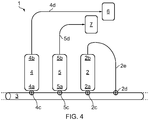
- Non-limiting examples of embodiments of the present invention are illustrated in Figures 4 and 5 .
- Figure 4 illustrates an exemplary system of the present invention and shows a reversed-phase SPE column (2) with a first end (2a) proximal to a common pathway (3) and a second end (2b) distal to the common pathway (3).
- the first end (2a) of the reversed-phase SPE column (2) is selectively fluidly connected to the common pathway (3) by means of a valve (2c).
- the second end (2b) of the reversed-phase SPE column (2) is selectively fluidly connected to the common pathway (3) by means of a valve (2d) and a length of flexible tubing (2e).
- first (4) and second (5) normal-phase SPE columns each having respective first (4a, 5a) and second (4b, 5b) ends.
- the respective first ends (4a, 5a) of the first (4) and second (50 normal-phase SPE columns are selectively fluidly connected to the common pathway (3) by means of respective valves (4c, 5c).
- the respective second ends (4b, 5b) of the first (4) and second (50 normal-phase SPE columns are fluidly connected to respective product collection vials (6, 7) by means of respective lengths of flexible tubing (4d, 5d).
- FIG. 5 illustrates an exemplary single-use cassette of the present invention, suitable for the production of two sequential batches of [ 18 F]-FDG. All components are selectively fluidly connected to a common pathway 13 by means of a linear series of identical 3-way valves (e.g. 12c, 12d, 14c, 15c, 18c, 18d, 21c, 22c, 23c, 24c, 25c, 27c, 28c, 29c, 31c).
- Each valve is a stopcock valve comprising a rotatable stopcock.
- Each valve is linked to a port where a component is attached and has a male-female joint which interfaces with a corresponding moving arm of the automated synthesis apparatus which controls the opening or closing of the valve when the cassette is attached to the apparatus.
- Production of a first batch of [ 18 F]-FDG using the cassette of Figure 5 is initiated when [ 18 F]-fluoride produced by a 18 O(p,n) 18 F - reaction enters the cassette via vial 28 and travels along common pathway 13 to QMA 18 via valves 28c and 18d and tubing 18e.
- the 18 F - is retained by an ion-exchange reaction and 18 O-water is allowed to flow through the common pathway 13 of the cassette via valves 18c and 29c to be recovered in vial 29.
- 18 F-fluoride retained on QMA 18 is then eluted with eluent (acetonitrile solution of KryptofixTM 222 and potassium carbonate) from vial 21 withdrawn in syringe 31 and into the reaction vessel 20a.
- eluent acetonitrile solution of KryptofixTM 222 and potassium carbonate
- Water is evaporated and mannose triflate precursor 22 is added to the reaction vessel 20a.
- the 18 F-labelled mannose triflate 18 F-fluoro-tetraacetyl-glucose, FTAG
- the resulting hydrolyzed basic solution is then neutralized in the syringe 32 with buffer 25.
- Cleaning of the tC18 environmental 27a and the tC18 12 is carried out with ethanol (from vial 23) and water (from water bag 30) before starting production of a second batch of [ 18 F]-FDG.
- the second batch production proceeds via the same steps as above described for the first batch, except that QMA SPE 19 and alumina SPE 15 are used.
- the amount of KryptofixTM 222 in the final product was determined by spotting the sample on a TLC plate which is impregnated by a revealing solution of iodoplatinate (0,5 g of Chloroplatinic acid hexa-hydrated: H 2 PtCl 6 .6H 2 O (!highly hygroscopic!), 9 g of potassium iodide: KI, 200 mL of distilled water) and comparing this with standard solutions of KryptofixTM 222 1, 5, 10, 50 and 100 ppm). Colour intensity of the obtained stains is proportional to the amount of KryptofixTM 222 present in the solution.
- the amount of ethanol in the final product was determined by injecting the sample into a chromatography system called gas chromatography (VARIAN CP-3800, including auto-sampler, column inlet, column oven and flame ionization detector).
- gas chromatography VARIAN CP-3800, including auto-sampler, column inlet, column oven and flame ionization detector.
- the concentration of the chemical elements was analysed by ICP-MS (Inductively Coupled Plasma Mass Spectrometry) and cold impurities were analysed by IC (ionic chromatography).
Landscapes
- Chemical & Material Sciences (AREA)
- Organic Chemistry (AREA)
- Health & Medical Sciences (AREA)
- Analytical Chemistry (AREA)
- Chemical Kinetics & Catalysis (AREA)
- Life Sciences & Earth Sciences (AREA)
- General Health & Medical Sciences (AREA)
- Biochemistry (AREA)
- Molecular Biology (AREA)
- Engineering & Computer Science (AREA)
- Biotechnology (AREA)
- Genetics & Genomics (AREA)
- Proteomics, Peptides & Aminoacids (AREA)
- Physics & Mathematics (AREA)
- Medicinal Chemistry (AREA)
- Optics & Photonics (AREA)
- Pharmacology & Pharmacy (AREA)
- Epidemiology (AREA)
- Animal Behavior & Ethology (AREA)
- Public Health (AREA)
- Veterinary Medicine (AREA)
- Medicines Containing Antibodies Or Antigens For Use As Internal Diagnostic Agents (AREA)
- Organic Low-Molecular-Weight Compounds And Preparation Thereof (AREA)
- Saccharide Compounds (AREA)
- Nitrogen Condensed Heterocyclic Rings (AREA)
Claims (15)
- Système (1) de purification de deux groupes consécutifs d'un mélange réactionnel comprenant un composé marqué au 18F dans lequel ledit système comprend :(i) une colonne d'extraction en phase solide (SPE) en phase inversée (2) ayant une première extrémité (2a) et une seconde extrémité (2b), dans laquelle chacune de ladite première extrémité (2a) et de ladite seconde extrémité (2b) est raccordée fluidiquement de manière sélective à une voie commune (3) ; et,(ii) des première (4) et seconde (5) colonnes de SPE en phase normale, chacune ayant une première extrémité (4a, 5a) raccordée fluidiquement de manière sélective à ladite voie commune (3) et une seconde extrémité (4b, 5b) raccordée fluidiquement à un flacon de collecte de produit (6, 7).
- Système (1) selon la revendication 1, dans lequel les propriétés chimiques de ladite colonne de SPE en phase inversée (2) sont sélectionnées parmi l'octadécyle (C18 ou tC18), l'octyle (C8), le cyano (CN), le diol, le polymère de styrène modifié hydrophile (HLB), le poly(divinylbenzène-vinylpyrrolidone) polymérique et le NH2, et sont de préférence une colonne tC18 ou une colonne HLB, le plus préférentiellement une colonne tC18.
- Système (1) selon la revendication 1 ou la revendication 2, dans lequel chacune desdites première (4) et seconde (5) colonnes de SPE en phase normale est une colonne de SPE d'alumine.
- Système (1) selon l'une quelconque des revendications 1 à 3, qui est une partie d'une cassette à usage unique (11) pour la synthèse dudit composé marqué au 18F.
- Système (1) selon l'une quelconque des revendications 1 à 4, dans lequel ledit composé marqué au 18F est sélectionné parmi le [18F]fluorodésoxyglucose ([18F]FDG), le [18F]fluoromisonidazole ([18F]FMISO), le [18F]fluorothymidine ([18F]FLT), le [18F]fluoroazomycine arabinofuranoside ([18F]FAZA), le [18F]fluoroéthylecholine ([18F]FECH), le [18F]fluorocyclobutane-1-acide carboxylique ([18F]FACBC), le [18F]-flumazénil ([18F]FMZ), le [18F]-tyrosine, le [18F]-altanaserine, le 4-[18F]-fluoro-3-iodobenzyl guanidine ([18F]-FIBG), le meta-[18F]fluorobenzylguanidine ([18F]-mFBG) et le [18F]-5-fluorouracile, et est de préférence sélectionné parmi le [18F]FDG, le [18F]FMISO, le [18F]FLT et le [18F]FACBC.
- Cassette à usage unique (11) pour préparer deux groupes consécutifs d'un composé marqué au [18F] dans lequel ladite cassette comprend :(a) une colonne de SPE en phase inversée (12) ayant une première extrémité (12a) et une seconde extrémité (12b), dans laquelle chacune de ladite première extrémité (12a) et de ladite seconde extrémité (12b) est raccordée fluidiquement de manière sélective à une voie commune (13), et un moyen (12c) de nettoyage de ladite colonne de SPE ; et,(b) des première (14) et seconde (15) colonnes de SPE en phase normale, chacune ayant une première extrémité (14a, 15a) raccordée fluidiquement de manière sélective à ladite voie commune (13) et une seconde extrémité (14b, 15b) raccordée fluidiquement à un flacon de collecte de produit (16, 17) ;(c) deux colonnes de SPE d'échange d'anion (18, 19) ;(d) une cuve de réaction (20a) et un moyen (20b) de nettoyage de ladite cuve de réaction ;(e) un flacon (21) contenant suffisamment d'éluant pour lesdits deux groupes consécutifs ;(f) un flacon (22) contenant suffisamment de composé précurseur pour lesdits deux groupes consécutifs ;(g) des flacons réactifs (23, 24, 25, 26) contenant chacun un réactif particulier en quantité suffisante pour lesdits deux groupes consécutifs ;(h) une colonne de SPE (27a) pour la déprotection et un moyen (27b) de nettoyage de ladite colonne de SPE ;
et dans laquelle :ledit composé marqué au 18F est tel que défini selon la revendication 1 ou la revendication 5 ;ladite colonne de SPE en phase inversée (12) est telle que définie selon la revendication 1 ou la revendication 2 ; et,lesdites première (14) et seconde (15) colonnes de SPE en phase normale sont telles que définies dans la revendication 1 ou la revendication 3. - Cassette à usage unique (11) selon la revendication 6, dans laquelle chacun desdits moyens (12c, 20b, 27b) de nettoyage comprend une source d'eau stérile et/ou une source d'un solvant organique raccordée fluidiquement de manière sélective respectivement à ladite colonne de SPE en phase inversée (12), à ladite cuve de réaction (20a) et à ladite colonne de SPE (27a) pour la déprotection.
- Cassette à usage unique (11) selon la revendication 6 ou la revendication 7, dans laquelle ledit éluant comprend un contre-ion cationique dissous dans une solution aqueuse organique dans laquelle ledit contre-ion cationique est de préférence sélectionné parmi le rubidium, le césium, le potassium complexé avec un cryptand et un sel de tétraalkylammonium, et est le plus préférentiellement le potassium complexé avec un cryptand dans lequel ledit cryptand est de préférence le 4,7,13,16,21,24-Hexaoxa-1,10-diazabicyclo[8.8.8]hexacosane (Kryptofix™ 222).
- Cassette à usage unique (11) selon l'une quelconque des revendications 6 à 8, dans laquelle lesdits flacons réactifs (23, 24, 25, 26) comprennent un flacon contenant de l'éthanol, un flacon contenant de l'acétonitrile, un flacon contenant un agent de déprotection, de préférence sélectionné parmi le HCl, le NaOH et le H3PO4, et un flacon contenant un tampon, de préférence un acide faible qui est de préférence sélectionné parmi le citrate, le phosphate, l'acétate et l'ascorbate.
- Cassette à usage unique (11) selon l'une quelconque des revendications 6 à 9, dans laquelle ladite colonne de SPE pour la déprotection (27a) est une colonne de SPE en phase inversée, de préférence une colonne tC18 et le plus préférentiellement une colonne tC18 environnementale.
- Procédé de purification d'un premier groupe et d'un second groupe d'un mélange réactionnel comprenant un composé marqué au 18F dans lequel ledit procédé comprend :(I) le passage dudit premier groupe dudit mélange réactionnel à travers une colonne de SPE en phase inversée (2) ;(II) l'élution de ladite colonne de SPE en phase inversée (2) pour obtenir un premier groupe partiellement purifié dudit mélange réactionnel ;(III) le passage dudit premier groupe partiellement purifié dudit mélange réactionnel à travers une première colonne de SPE en phase normale (4) ;(IV) l'élution de ladite première colonne de SPE en phase normale (4) pour obtenir un premier groupe purifié dudit mélange réactionnel ;(V) le passage dudit premier groupe purifié dudit mélange réactionnel dans un flacon de collecte de produit ;(VI) le nettoyage de ladite colonne de SPE en phase inversée (2) ; et,(VII) le passage dudit second groupe dudit mélange réactionnel à travers ladite colonne de SPE en phase inversée (2) nettoyée ;(VIII) l'élution de ladite colonne de SPE en phase inversée (2) pour obtenir un second groupe partiellement purifié dudit mélange réactionnel ;(IX) le passage dudit second groupe partiellement purifié dudit mélange réactionnel à travers une seconde colonne de SPE en phase normale (5) ;(X) l'élution de ladite seconde colonne de SPE en phase normale (5) pour obtenir un second groupe purifié dudit mélange réactionnel ;(XI) le passage dudit second groupe purifié dudit mélange réactionnel dans un flacon de collecte de produit ;
et dans lequel :ledit composé marqué au 18F est tel que défini selon la revendication 1 ou la revendication 5 ;ladite colonne de SPE en phase inversée (12) est telle que définie selon la revendication 1 ou la revendication 2 ; et,lesdites première (4) et seconde (5) colonnes de SPE en phase normale sont telles que définies dans la revendication 1 ou la revendication 3. - Procédé selon la revendication 11, dans lequel les étapes (I) à (XI) sont effectuées en séquence.
- Procédé selon la revendication 11 ou 12, dans lequel, pour les étapes (V) et (XI), ledit passage dans chaque cas est directement depuis ladite colonne de SPE en phase normale audit flacon de collecte de produit.
- Procédé de production d'un premier groupe et d'un second groupe d'un composé marqué au 18F dans lequel ledit procédé comprend :(A) le marquage d'une première aliquote d'un composé précurseur avec du 18F-fluorure ;(B) la déprotection facultative du produit marqué en 18F de l'étape (A) sur une colonne de SPE en phase inversée ;(C) l'exécution des étapes 1 à VI telles que définies selon la revendication 33 sur le mélange réactionnel comprenant un composé marqué au 18F obtenu des étapes (A) et (B) ;(D) le nettoyage de la/des colonne(s) de SPE en phase inversée ;(E) le marquage d'une seconde aliquote d'un composé précurseur avec du 18F-fluorure ;(F) la déprotection facultative du produit marqué en 18F de l'étape (D) sur une colonne de SPE en phase inversée ;(G) l'exécution des étapes VII à XI telles que définies selon la revendication 33 sur le mélange réactionnel comprenant un composé marqué au 18F obtenu des étapes (E) et (F) ;
et dans lequel ledit composé marqué au 18F est tel que défini selon la revendication 1 ou la revendication 5. - Support de stockage non transitoire comprenant un code de programme lisible par ordinateur, dans lequel l'exécution du code de programme lisible par ordinateur amène un processeur à effectuer les étapes du procédé selon la revendication 11 ou la revendication 14.
Applications Claiming Priority (2)
| Application Number | Priority Date | Filing Date | Title |
|---|---|---|---|
| GBGB1420093.5A GB201420093D0 (en) | 2014-11-12 | 2014-11-12 | Pet tracer purification system |
| PCT/EP2015/076481 WO2016075261A1 (fr) | 2014-11-12 | 2015-11-12 | Système de purification de traceur tep |
Publications (2)
| Publication Number | Publication Date |
|---|---|
| EP3218332A1 EP3218332A1 (fr) | 2017-09-20 |
| EP3218332B1 true EP3218332B1 (fr) | 2019-09-04 |
Family
ID=52118356
Family Applications (1)
| Application Number | Title | Priority Date | Filing Date |
|---|---|---|---|
| EP15794180.8A Active EP3218332B1 (fr) | 2014-11-12 | 2015-11-12 | Système de purification de traceur tep |
Country Status (8)
| Country | Link |
|---|---|
| US (1) | US10662125B2 (fr) |
| EP (1) | EP3218332B1 (fr) |
| JP (1) | JP6726665B2 (fr) |
| KR (1) | KR102155932B1 (fr) |
| CN (1) | CN107108393B (fr) |
| GB (1) | GB201420093D0 (fr) |
| IL (1) | IL251833B (fr) |
| WO (1) | WO2016075261A1 (fr) |
Families Citing this family (4)
| Publication number | Priority date | Publication date | Assignee | Title |
|---|---|---|---|---|
| GB201621864D0 (en) | 2016-12-21 | 2017-02-01 | Ge Healthcare Ltd | Solid phase conditioning |
| GB201915206D0 (en) | 2019-10-21 | 2019-12-04 | Ge Healthcare Ltd | Use of cyclodextrins as a radiostabilizer |
| GB201919016D0 (en) * | 2019-12-20 | 2020-02-05 | Ge Healthcare Ltd | Apparatus and method for solid phase extraction |
| CN114700006B (zh) * | 2022-06-07 | 2023-03-24 | 北京先通国际医药科技股份有限公司 | 一种液体组合物的生产设备及其制备方法和用途 |
Family Cites Families (11)
| Publication number | Priority date | Publication date | Assignee | Title |
|---|---|---|---|---|
| WO2010072342A2 (fr) * | 2008-12-22 | 2010-07-01 | Bayer Schering Pharma Aktiengesellschaft | Procédé de synthèse de composé marqué par radionuclide |
| JP2010270068A (ja) | 2009-05-22 | 2010-12-02 | Nihon Medi Physics Co Ltd | 化合物または薬剤の製造システムおよびその要素技術 |
| DK2509637T3 (en) * | 2009-10-08 | 2016-10-10 | Ge Healthcare Ltd | Purification process |
| US10639608B2 (en) * | 2010-04-08 | 2020-05-05 | Siemens Medical Solutions Usa, Inc. | System, device and method for preparing tracers and transferring materials during radiosynthesis |
| US20120108858A1 (en) * | 2010-10-28 | 2012-05-03 | Maxim Kiselev | Method and device for manufacturing of radiopharmaceuticals |
| CN103370747A (zh) | 2010-12-17 | 2013-10-23 | 通用电气健康护理有限公司 | 防护套环 |
| JP6014674B2 (ja) | 2011-09-30 | 2016-10-25 | ジーイー・ヘルスケア・リミテッド | 合成装置診断用カセットシミュレータ |
| GB201120586D0 (en) * | 2011-11-30 | 2012-01-11 | Ge Healthcare Ltd | Solid phase extraction neutralisation |
| DE102012205072A1 (de) | 2012-03-29 | 2013-10-02 | Osram Gmbh | Halbleiterlampe mit kühlkörper |
| IL235650B (en) | 2013-11-13 | 2019-10-31 | Ge Healthcare Ltd | Dual play tape |
| GB201411571D0 (en) * | 2014-06-30 | 2014-08-13 | Ge Healthcare Ltd | Radiolabelling method |
-
2014
- 2014-11-12 GB GBGB1420093.5A patent/GB201420093D0/en not_active Ceased
-
2015
- 2015-11-12 JP JP2017522903A patent/JP6726665B2/ja active Active
- 2015-11-12 WO PCT/EP2015/076481 patent/WO2016075261A1/fr not_active Ceased
- 2015-11-12 EP EP15794180.8A patent/EP3218332B1/fr active Active
- 2015-11-12 CN CN201580061375.1A patent/CN107108393B/zh active Active
- 2015-11-12 US US15/526,245 patent/US10662125B2/en active Active
- 2015-11-12 KR KR1020177012364A patent/KR102155932B1/ko active Active
-
2017
- 2017-04-20 IL IL251833A patent/IL251833B/en active IP Right Grant
Non-Patent Citations (1)
| Title |
|---|
| None * |
Also Published As
| Publication number | Publication date |
|---|---|
| IL251833B (en) | 2020-10-29 |
| KR20170084071A (ko) | 2017-07-19 |
| CN107108393B (zh) | 2021-05-25 |
| EP3218332A1 (fr) | 2017-09-20 |
| GB201420093D0 (en) | 2014-12-24 |
| JP6726665B2 (ja) | 2020-07-22 |
| CN107108393A (zh) | 2017-08-29 |
| IL251833A0 (en) | 2017-06-29 |
| KR102155932B1 (ko) | 2020-09-15 |
| US10662125B2 (en) | 2020-05-26 |
| US20170313632A1 (en) | 2017-11-02 |
| WO2016075261A1 (fr) | 2016-05-19 |
| JP2017537075A (ja) | 2017-12-14 |
Similar Documents
| Publication | Publication Date | Title |
|---|---|---|
| EP3068747B1 (fr) | Cassette à double traitement pour la synthèse de composés marqués par 18f | |
| EP3218333B1 (fr) | Agencement de piégeage de fluorure | |
| EP2509637B1 (fr) | Procédé de purification | |
| EP3218332B1 (fr) | Système de purification de traceur tep | |
| KR102109225B1 (ko) | 18f-플루시클로빈의 제조 | |
| US12208372B2 (en) | Solid phase conditioning | |
| EP2978456B1 (fr) | Procédé pour radiomarquer | |
| EP3058575B1 (fr) | Système d'évaporation fermé | |
| EP4529536A1 (fr) | Production automatisée de [18f]fspg conforme à la cgmp pour examen clinique |
Legal Events
| Date | Code | Title | Description |
|---|---|---|---|
| STAA | Information on the status of an ep patent application or granted ep patent |
Free format text: STATUS: THE INTERNATIONAL PUBLICATION HAS BEEN MADE |
|
| PUAI | Public reference made under article 153(3) epc to a published international application that has entered the european phase |
Free format text: ORIGINAL CODE: 0009012 |
|
| STAA | Information on the status of an ep patent application or granted ep patent |
Free format text: STATUS: REQUEST FOR EXAMINATION WAS MADE |
|
| 17P | Request for examination filed |
Effective date: 20170421 |
|
| AK | Designated contracting states |
Kind code of ref document: A1 Designated state(s): AL AT BE BG CH CY CZ DE DK EE ES FI FR GB GR HR HU IE IS IT LI LT LU LV MC MK MT NL NO PL PT RO RS SE SI SK SM TR |
|
| AX | Request for extension of the european patent |
Extension state: BA ME |
|
| DAV | Request for validation of the european patent (deleted) | ||
| DAX | Request for extension of the european patent (deleted) | ||
| RAP1 | Party data changed (applicant data changed or rights of an application transferred) |
Owner name: GE HEALTHCARE LIMITED |
|
| STAA | Information on the status of an ep patent application or granted ep patent |
Free format text: STATUS: EXAMINATION IS IN PROGRESS |
|
| 17Q | First examination report despatched |
Effective date: 20180523 |
|
| GRAP | Despatch of communication of intention to grant a patent |
Free format text: ORIGINAL CODE: EPIDOSNIGR1 |
|
| STAA | Information on the status of an ep patent application or granted ep patent |
Free format text: STATUS: GRANT OF PATENT IS INTENDED |
|
| RIC1 | Information provided on ipc code assigned before grant |
Ipc: C07H 5/02 20060101ALI20190305BHEP Ipc: B01D 15/36 20060101ALI20190305BHEP Ipc: C07B 59/00 20060101AFI20190305BHEP Ipc: B01D 15/32 20060101ALI20190305BHEP Ipc: B01D 15/18 20060101ALI20190305BHEP |
|
| INTG | Intention to grant announced |
Effective date: 20190327 |
|
| GRAS | Grant fee paid |
Free format text: ORIGINAL CODE: EPIDOSNIGR3 |
|
| GRAA | (expected) grant |
Free format text: ORIGINAL CODE: 0009210 |
|
| STAA | Information on the status of an ep patent application or granted ep patent |
Free format text: STATUS: THE PATENT HAS BEEN GRANTED |
|
| AK | Designated contracting states |
Kind code of ref document: B1 Designated state(s): AL AT BE BG CH CY CZ DE DK EE ES FI FR GB GR HR HU IE IS IT LI LT LU LV MC MK MT NL NO PL PT RO RS SE SI SK SM TR |
|
| REG | Reference to a national code |
Ref country code: GB Ref legal event code: FG4D |
|
| REG | Reference to a national code |
Ref country code: CH Ref legal event code: EP |
|
| REG | Reference to a national code |
Ref country code: AT Ref legal event code: REF Ref document number: 1175103 Country of ref document: AT Kind code of ref document: T Effective date: 20190915 |
|
| REG | Reference to a national code |
Ref country code: DE Ref legal event code: R096 Ref document number: 602015037307 Country of ref document: DE |
|
| REG | Reference to a national code |
Ref country code: IE Ref legal event code: FG4D |
|
| REG | Reference to a national code |
Ref country code: SE Ref legal event code: TRGR |
|
| REG | Reference to a national code |
Ref country code: NO Ref legal event code: T2 Effective date: 20190904 |
|
| REG | Reference to a national code |
Ref country code: NL Ref legal event code: MP Effective date: 20190904 |
|
| REG | Reference to a national code |
Ref country code: LT Ref legal event code: MG4D |
|
| PG25 | Lapsed in a contracting state [announced via postgrant information from national office to epo] |
Ref country code: BG Free format text: LAPSE BECAUSE OF FAILURE TO SUBMIT A TRANSLATION OF THE DESCRIPTION OR TO PAY THE FEE WITHIN THE PRESCRIBED TIME-LIMIT Effective date: 20191204 Ref country code: HR Free format text: LAPSE BECAUSE OF FAILURE TO SUBMIT A TRANSLATION OF THE DESCRIPTION OR TO PAY THE FEE WITHIN THE PRESCRIBED TIME-LIMIT Effective date: 20190904 Ref country code: LT Free format text: LAPSE BECAUSE OF FAILURE TO SUBMIT A TRANSLATION OF THE DESCRIPTION OR TO PAY THE FEE WITHIN THE PRESCRIBED TIME-LIMIT Effective date: 20190904 Ref country code: FI Free format text: LAPSE BECAUSE OF FAILURE TO SUBMIT A TRANSLATION OF THE DESCRIPTION OR TO PAY THE FEE WITHIN THE PRESCRIBED TIME-LIMIT Effective date: 20190904 |
|
| PG25 | Lapsed in a contracting state [announced via postgrant information from national office to epo] |
Ref country code: AL Free format text: LAPSE BECAUSE OF FAILURE TO SUBMIT A TRANSLATION OF THE DESCRIPTION OR TO PAY THE FEE WITHIN THE PRESCRIBED TIME-LIMIT Effective date: 20190904 Ref country code: GR Free format text: LAPSE BECAUSE OF FAILURE TO SUBMIT A TRANSLATION OF THE DESCRIPTION OR TO PAY THE FEE WITHIN THE PRESCRIBED TIME-LIMIT Effective date: 20191205 Ref country code: RS Free format text: LAPSE BECAUSE OF FAILURE TO SUBMIT A TRANSLATION OF THE DESCRIPTION OR TO PAY THE FEE WITHIN THE PRESCRIBED TIME-LIMIT Effective date: 20190904 Ref country code: LV Free format text: LAPSE BECAUSE OF FAILURE TO SUBMIT A TRANSLATION OF THE DESCRIPTION OR TO PAY THE FEE WITHIN THE PRESCRIBED TIME-LIMIT Effective date: 20190904 Ref country code: ES Free format text: LAPSE BECAUSE OF FAILURE TO SUBMIT A TRANSLATION OF THE DESCRIPTION OR TO PAY THE FEE WITHIN THE PRESCRIBED TIME-LIMIT Effective date: 20190904 |
|
| REG | Reference to a national code |
Ref country code: AT Ref legal event code: MK05 Ref document number: 1175103 Country of ref document: AT Kind code of ref document: T Effective date: 20190904 |
|
| PG25 | Lapsed in a contracting state [announced via postgrant information from national office to epo] |
Ref country code: PL Free format text: LAPSE BECAUSE OF FAILURE TO SUBMIT A TRANSLATION OF THE DESCRIPTION OR TO PAY THE FEE WITHIN THE PRESCRIBED TIME-LIMIT Effective date: 20190904 Ref country code: EE Free format text: LAPSE BECAUSE OF FAILURE TO SUBMIT A TRANSLATION OF THE DESCRIPTION OR TO PAY THE FEE WITHIN THE PRESCRIBED TIME-LIMIT Effective date: 20190904 Ref country code: AT Free format text: LAPSE BECAUSE OF FAILURE TO SUBMIT A TRANSLATION OF THE DESCRIPTION OR TO PAY THE FEE WITHIN THE PRESCRIBED TIME-LIMIT Effective date: 20190904 Ref country code: PT Free format text: LAPSE BECAUSE OF FAILURE TO SUBMIT A TRANSLATION OF THE DESCRIPTION OR TO PAY THE FEE WITHIN THE PRESCRIBED TIME-LIMIT Effective date: 20200106 Ref country code: NL Free format text: LAPSE BECAUSE OF FAILURE TO SUBMIT A TRANSLATION OF THE DESCRIPTION OR TO PAY THE FEE WITHIN THE PRESCRIBED TIME-LIMIT Effective date: 20190904 Ref country code: RO Free format text: LAPSE BECAUSE OF FAILURE TO SUBMIT A TRANSLATION OF THE DESCRIPTION OR TO PAY THE FEE WITHIN THE PRESCRIBED TIME-LIMIT Effective date: 20190904 Ref country code: IT Free format text: LAPSE BECAUSE OF FAILURE TO SUBMIT A TRANSLATION OF THE DESCRIPTION OR TO PAY THE FEE WITHIN THE PRESCRIBED TIME-LIMIT Effective date: 20190904 |
|
| PG25 | Lapsed in a contracting state [announced via postgrant information from national office to epo] |
Ref country code: CZ Free format text: LAPSE BECAUSE OF FAILURE TO SUBMIT A TRANSLATION OF THE DESCRIPTION OR TO PAY THE FEE WITHIN THE PRESCRIBED TIME-LIMIT Effective date: 20190904 Ref country code: SK Free format text: LAPSE BECAUSE OF FAILURE TO SUBMIT A TRANSLATION OF THE DESCRIPTION OR TO PAY THE FEE WITHIN THE PRESCRIBED TIME-LIMIT Effective date: 20190904 Ref country code: SM Free format text: LAPSE BECAUSE OF FAILURE TO SUBMIT A TRANSLATION OF THE DESCRIPTION OR TO PAY THE FEE WITHIN THE PRESCRIBED TIME-LIMIT Effective date: 20190904 Ref country code: IS Free format text: LAPSE BECAUSE OF FAILURE TO SUBMIT A TRANSLATION OF THE DESCRIPTION OR TO PAY THE FEE WITHIN THE PRESCRIBED TIME-LIMIT Effective date: 20200224 |
|
| REG | Reference to a national code |
Ref country code: DE Ref legal event code: R097 Ref document number: 602015037307 Country of ref document: DE |
|
| REG | Reference to a national code |
Ref country code: CH Ref legal event code: PL |
|
| PLBE | No opposition filed within time limit |
Free format text: ORIGINAL CODE: 0009261 |
|
| STAA | Information on the status of an ep patent application or granted ep patent |
Free format text: STATUS: NO OPPOSITION FILED WITHIN TIME LIMIT |
|
| PG2D | Information on lapse in contracting state deleted |
Ref country code: IS |
|
| PG25 | Lapsed in a contracting state [announced via postgrant information from national office to epo] |
Ref country code: DK Free format text: LAPSE BECAUSE OF FAILURE TO SUBMIT A TRANSLATION OF THE DESCRIPTION OR TO PAY THE FEE WITHIN THE PRESCRIBED TIME-LIMIT Effective date: 20190904 Ref country code: LI Free format text: LAPSE BECAUSE OF NON-PAYMENT OF DUE FEES Effective date: 20191130 Ref country code: CH Free format text: LAPSE BECAUSE OF NON-PAYMENT OF DUE FEES Effective date: 20191130 Ref country code: LU Free format text: LAPSE BECAUSE OF NON-PAYMENT OF DUE FEES Effective date: 20191112 Ref country code: MC Free format text: LAPSE BECAUSE OF FAILURE TO SUBMIT A TRANSLATION OF THE DESCRIPTION OR TO PAY THE FEE WITHIN THE PRESCRIBED TIME-LIMIT Effective date: 20190904 Ref country code: IS Free format text: LAPSE BECAUSE OF FAILURE TO SUBMIT A TRANSLATION OF THE DESCRIPTION OR TO PAY THE FEE WITHIN THE PRESCRIBED TIME-LIMIT Effective date: 20200105 |
|
| 26N | No opposition filed |
Effective date: 20200605 |
|
| REG | Reference to a national code |
Ref country code: BE Ref legal event code: MM Effective date: 20191130 |
|
| PG25 | Lapsed in a contracting state [announced via postgrant information from national office to epo] |
Ref country code: SI Free format text: LAPSE BECAUSE OF FAILURE TO SUBMIT A TRANSLATION OF THE DESCRIPTION OR TO PAY THE FEE WITHIN THE PRESCRIBED TIME-LIMIT Effective date: 20190904 |
|
| PG25 | Lapsed in a contracting state [announced via postgrant information from national office to epo] |
Ref country code: IE Free format text: LAPSE BECAUSE OF NON-PAYMENT OF DUE FEES Effective date: 20191112 |
|
| PG25 | Lapsed in a contracting state [announced via postgrant information from national office to epo] |
Ref country code: BE Free format text: LAPSE BECAUSE OF NON-PAYMENT OF DUE FEES Effective date: 20191130 |
|
| PG25 | Lapsed in a contracting state [announced via postgrant information from national office to epo] |
Ref country code: CY Free format text: LAPSE BECAUSE OF FAILURE TO SUBMIT A TRANSLATION OF THE DESCRIPTION OR TO PAY THE FEE WITHIN THE PRESCRIBED TIME-LIMIT Effective date: 20190904 |
|
| PG25 | Lapsed in a contracting state [announced via postgrant information from national office to epo] |
Ref country code: HU Free format text: LAPSE BECAUSE OF FAILURE TO SUBMIT A TRANSLATION OF THE DESCRIPTION OR TO PAY THE FEE WITHIN THE PRESCRIBED TIME-LIMIT; INVALID AB INITIO Effective date: 20151112 Ref country code: MT Free format text: LAPSE BECAUSE OF FAILURE TO SUBMIT A TRANSLATION OF THE DESCRIPTION OR TO PAY THE FEE WITHIN THE PRESCRIBED TIME-LIMIT Effective date: 20190904 |
|
| PG25 | Lapsed in a contracting state [announced via postgrant information from national office to epo] |
Ref country code: TR Free format text: LAPSE BECAUSE OF FAILURE TO SUBMIT A TRANSLATION OF THE DESCRIPTION OR TO PAY THE FEE WITHIN THE PRESCRIBED TIME-LIMIT Effective date: 20190904 |
|
| PG25 | Lapsed in a contracting state [announced via postgrant information from national office to epo] |
Ref country code: MK Free format text: LAPSE BECAUSE OF FAILURE TO SUBMIT A TRANSLATION OF THE DESCRIPTION OR TO PAY THE FEE WITHIN THE PRESCRIBED TIME-LIMIT Effective date: 20190904 |
|
| P01 | Opt-out of the competence of the unified patent court (upc) registered |
Effective date: 20230529 |
|
| PGFP | Annual fee paid to national office [announced via postgrant information from national office to epo] |
Ref country code: DE Payment date: 20251022 Year of fee payment: 11 |
|
| PGFP | Annual fee paid to national office [announced via postgrant information from national office to epo] |
Ref country code: GB Payment date: 20251023 Year of fee payment: 11 |
|
| PGFP | Annual fee paid to national office [announced via postgrant information from national office to epo] |
Ref country code: NO Payment date: 20251024 Year of fee payment: 11 |
|
| PGFP | Annual fee paid to national office [announced via postgrant information from national office to epo] |
Ref country code: FR Payment date: 20251022 Year of fee payment: 11 |
|
| PGFP | Annual fee paid to national office [announced via postgrant information from national office to epo] |
Ref country code: SE Payment date: 20251022 Year of fee payment: 11 |