EP3219920A1 - Composant pour un moteur à turbine avec un trou de film - Google Patents
Composant pour un moteur à turbine avec un trou de film Download PDFInfo
- Publication number
- EP3219920A1 EP3219920A1 EP17161186.6A EP17161186A EP3219920A1 EP 3219920 A1 EP3219920 A1 EP 3219920A1 EP 17161186 A EP17161186 A EP 17161186A EP 3219920 A1 EP3219920 A1 EP 3219920A1
- Authority
- EP
- European Patent Office
- Prior art keywords
- engine
- component
- inner dimension
- hole
- predetermined inner
- Prior art date
- Legal status (The legal status is an assumption and is not a legal conclusion. Google has not performed a legal analysis and makes no representation as to the accuracy of the status listed.)
- Withdrawn
Links
- 238000000576 coating method Methods 0.000 claims abstract description 23
- 238000000034 method Methods 0.000 claims abstract description 23
- 239000011248 coating agent Substances 0.000 claims abstract description 22
- 239000000567 combustion gas Substances 0.000 claims description 24
- 239000012809 cooling fluid Substances 0.000 claims description 20
- 238000011144 upstream manufacturing Methods 0.000 claims description 5
- 238000004519 manufacturing process Methods 0.000 claims description 4
- 238000001816 cooling Methods 0.000 description 22
- 239000000758 substrate Substances 0.000 description 17
- 239000003570 air Substances 0.000 description 11
- 239000007789 gas Substances 0.000 description 7
- 239000012720 thermal barrier coating Substances 0.000 description 6
- 239000012530 fluid Substances 0.000 description 5
- 238000003754 machining Methods 0.000 description 5
- 230000003068 static effect Effects 0.000 description 5
- 239000012080 ambient air Substances 0.000 description 4
- 238000002485 combustion reaction Methods 0.000 description 4
- 229910000601 superalloy Inorganic materials 0.000 description 4
- XEEYBQQBJWHFJM-UHFFFAOYSA-N Iron Chemical compound [Fe] XEEYBQQBJWHFJM-UHFFFAOYSA-N 0.000 description 2
- PXHVJJICTQNCMI-UHFFFAOYSA-N Nickel Chemical compound [Ni] PXHVJJICTQNCMI-UHFFFAOYSA-N 0.000 description 2
- 238000005266 casting Methods 0.000 description 2
- 239000000919 ceramic Substances 0.000 description 2
- 238000004891 communication Methods 0.000 description 2
- 238000010586 diagram Methods 0.000 description 2
- 239000000284 extract Substances 0.000 description 2
- 229910052751 metal Inorganic materials 0.000 description 2
- 239000002184 metal Substances 0.000 description 2
- 229910000831 Steel Inorganic materials 0.000 description 1
- 229910001069 Ti alloy Inorganic materials 0.000 description 1
- RTAQQCXQSZGOHL-UHFFFAOYSA-N Titanium Chemical compound [Ti] RTAQQCXQSZGOHL-UHFFFAOYSA-N 0.000 description 1
- 230000000712 assembly Effects 0.000 description 1
- 238000000429 assembly Methods 0.000 description 1
- 230000004888 barrier function Effects 0.000 description 1
- 230000015572 biosynthetic process Effects 0.000 description 1
- 230000000740 bleeding effect Effects 0.000 description 1
- 239000011153 ceramic matrix composite Substances 0.000 description 1
- 239000010941 cobalt Substances 0.000 description 1
- 229910017052 cobalt Inorganic materials 0.000 description 1
- GUTLYIVDDKVIGB-UHFFFAOYSA-N cobalt atom Chemical compound [Co] GUTLYIVDDKVIGB-UHFFFAOYSA-N 0.000 description 1
- 150000001875 compounds Chemical class 0.000 description 1
- 239000013078 crystal Substances 0.000 description 1
- 238000013461 design Methods 0.000 description 1
- KZHJGOXRZJKJNY-UHFFFAOYSA-N dioxosilane;oxo(oxoalumanyloxy)alumane Chemical compound O=[Si]=O.O=[Si]=O.O=[Al]O[Al]=O.O=[Al]O[Al]=O.O=[Al]O[Al]=O KZHJGOXRZJKJNY-UHFFFAOYSA-N 0.000 description 1
- 238000007599 discharging Methods 0.000 description 1
- 230000007613 environmental effect Effects 0.000 description 1
- 239000000446 fuel Substances 0.000 description 1
- 238000009413 insulation Methods 0.000 description 1
- 229910052742 iron Inorganic materials 0.000 description 1
- 239000000463 material Substances 0.000 description 1
- 238000005259 measurement Methods 0.000 description 1
- 150000002739 metals Chemical class 0.000 description 1
- 229910052863 mullite Inorganic materials 0.000 description 1
- 229910052759 nickel Inorganic materials 0.000 description 1
- 239000003870 refractory metal Substances 0.000 description 1
- 238000000926 separation method Methods 0.000 description 1
- 239000010959 steel Substances 0.000 description 1
- 238000012360 testing method Methods 0.000 description 1
- 230000003685 thermal hair damage Effects 0.000 description 1
- 239000010936 titanium Substances 0.000 description 1
- 230000007704 transition Effects 0.000 description 1
Images

Classifications
-
- F—MECHANICAL ENGINEERING; LIGHTING; HEATING; WEAPONS; BLASTING
- F01—MACHINES OR ENGINES IN GENERAL; ENGINE PLANTS IN GENERAL; STEAM ENGINES
- F01D—NON-POSITIVE DISPLACEMENT MACHINES OR ENGINES, e.g. STEAM TURBINES
- F01D5/00—Blades; Blade-carrying members; Heating, heat-insulating, cooling or antivibration means on the blades or the members
- F01D5/12—Blades
- F01D5/14—Form or construction
- F01D5/18—Hollow blades, i.e. blades with cooling or heating channels or cavities; Heating, heat-insulating or cooling means on blades
- F01D5/186—Film cooling
-
- F—MECHANICAL ENGINEERING; LIGHTING; HEATING; WEAPONS; BLASTING
- F01—MACHINES OR ENGINES IN GENERAL; ENGINE PLANTS IN GENERAL; STEAM ENGINES
- F01D—NON-POSITIVE DISPLACEMENT MACHINES OR ENGINES, e.g. STEAM TURBINES
- F01D25/00—Component parts, details, or accessories, not provided for in, or of interest apart from, other groups
- F01D25/08—Cooling; Heating; Heat-insulation
- F01D25/12—Cooling
-
- F—MECHANICAL ENGINEERING; LIGHTING; HEATING; WEAPONS; BLASTING
- F01—MACHINES OR ENGINES IN GENERAL; ENGINE PLANTS IN GENERAL; STEAM ENGINES
- F01D—NON-POSITIVE DISPLACEMENT MACHINES OR ENGINES, e.g. STEAM TURBINES
- F01D25/00—Component parts, details, or accessories, not provided for in, or of interest apart from, other groups
- F01D25/08—Cooling; Heating; Heat-insulation
- F01D25/14—Casings modified therefor
-
- F—MECHANICAL ENGINEERING; LIGHTING; HEATING; WEAPONS; BLASTING
- F01—MACHINES OR ENGINES IN GENERAL; ENGINE PLANTS IN GENERAL; STEAM ENGINES
- F01D—NON-POSITIVE DISPLACEMENT MACHINES OR ENGINES, e.g. STEAM TURBINES
- F01D5/00—Blades; Blade-carrying members; Heating, heat-insulating, cooling or antivibration means on the blades or the members
- F01D5/12—Blades
- F01D5/28—Selecting particular materials; Particular measures relating thereto; Measures against erosion or corrosion
- F01D5/288—Protective coatings for blades
-
- F—MECHANICAL ENGINEERING; LIGHTING; HEATING; WEAPONS; BLASTING
- F01—MACHINES OR ENGINES IN GENERAL; ENGINE PLANTS IN GENERAL; STEAM ENGINES
- F01D—NON-POSITIVE DISPLACEMENT MACHINES OR ENGINES, e.g. STEAM TURBINES
- F01D9/00—Stators
- F01D9/02—Nozzles; Nozzle boxes; Stator blades; Guide conduits, e.g. individual nozzles
-
- F—MECHANICAL ENGINEERING; LIGHTING; HEATING; WEAPONS; BLASTING
- F01—MACHINES OR ENGINES IN GENERAL; ENGINE PLANTS IN GENERAL; STEAM ENGINES
- F01D—NON-POSITIVE DISPLACEMENT MACHINES OR ENGINES, e.g. STEAM TURBINES
- F01D9/00—Stators
- F01D9/02—Nozzles; Nozzle boxes; Stator blades; Guide conduits, e.g. individual nozzles
- F01D9/04—Nozzles; Nozzle boxes; Stator blades; Guide conduits, e.g. individual nozzles forming ring or sector
- F01D9/041—Nozzles; Nozzle boxes; Stator blades; Guide conduits, e.g. individual nozzles forming ring or sector using blades
-
- F—MECHANICAL ENGINEERING; LIGHTING; HEATING; WEAPONS; BLASTING
- F23—COMBUSTION APPARATUS; COMBUSTION PROCESSES
- F23R—GENERATING COMBUSTION PRODUCTS OF HIGH PRESSURE OR HIGH VELOCITY, e.g. GAS-TURBINE COMBUSTION CHAMBERS
- F23R3/00—Continuous combustion chambers using liquid or gaseous fuel
- F23R3/002—Wall structures
-
- F—MECHANICAL ENGINEERING; LIGHTING; HEATING; WEAPONS; BLASTING
- F23—COMBUSTION APPARATUS; COMBUSTION PROCESSES
- F23R—GENERATING COMBUSTION PRODUCTS OF HIGH PRESSURE OR HIGH VELOCITY, e.g. GAS-TURBINE COMBUSTION CHAMBERS
- F23R3/00—Continuous combustion chambers using liquid or gaseous fuel
- F23R3/42—Continuous combustion chambers using liquid or gaseous fuel characterised by the arrangement or form of the flame tubes or combustion chambers
- F23R3/58—Cyclone or vortex type combustion chambers
-
- F—MECHANICAL ENGINEERING; LIGHTING; HEATING; WEAPONS; BLASTING
- F05—INDEXING SCHEMES RELATING TO ENGINES OR PUMPS IN VARIOUS SUBCLASSES OF CLASSES F01-F04
- F05D—INDEXING SCHEME FOR ASPECTS RELATING TO NON-POSITIVE-DISPLACEMENT MACHINES OR ENGINES, GAS-TURBINES OR JET-PROPULSION PLANTS
- F05D2220/00—Application
- F05D2220/30—Application in turbines
-
- F—MECHANICAL ENGINEERING; LIGHTING; HEATING; WEAPONS; BLASTING
- F05—INDEXING SCHEMES RELATING TO ENGINES OR PUMPS IN VARIOUS SUBCLASSES OF CLASSES F01-F04
- F05D—INDEXING SCHEME FOR ASPECTS RELATING TO NON-POSITIVE-DISPLACEMENT MACHINES OR ENGINES, GAS-TURBINES OR JET-PROPULSION PLANTS
- F05D2230/00—Manufacture
- F05D2230/10—Manufacture by removing material
- F05D2230/12—Manufacture by removing material by spark erosion methods
-
- F—MECHANICAL ENGINEERING; LIGHTING; HEATING; WEAPONS; BLASTING
- F05—INDEXING SCHEMES RELATING TO ENGINES OR PUMPS IN VARIOUS SUBCLASSES OF CLASSES F01-F04
- F05D—INDEXING SCHEME FOR ASPECTS RELATING TO NON-POSITIVE-DISPLACEMENT MACHINES OR ENGINES, GAS-TURBINES OR JET-PROPULSION PLANTS
- F05D2230/00—Manufacture
- F05D2230/10—Manufacture by removing material
- F05D2230/13—Manufacture by removing material using lasers
-
- F—MECHANICAL ENGINEERING; LIGHTING; HEATING; WEAPONS; BLASTING
- F05—INDEXING SCHEMES RELATING TO ENGINES OR PUMPS IN VARIOUS SUBCLASSES OF CLASSES F01-F04
- F05D—INDEXING SCHEME FOR ASPECTS RELATING TO NON-POSITIVE-DISPLACEMENT MACHINES OR ENGINES, GAS-TURBINES OR JET-PROPULSION PLANTS
- F05D2230/00—Manufacture
- F05D2230/20—Manufacture essentially without removing material
- F05D2230/21—Manufacture essentially without removing material by casting
-
- F—MECHANICAL ENGINEERING; LIGHTING; HEATING; WEAPONS; BLASTING
- F05—INDEXING SCHEMES RELATING TO ENGINES OR PUMPS IN VARIOUS SUBCLASSES OF CLASSES F01-F04
- F05D—INDEXING SCHEME FOR ASPECTS RELATING TO NON-POSITIVE-DISPLACEMENT MACHINES OR ENGINES, GAS-TURBINES OR JET-PROPULSION PLANTS
- F05D2230/00—Manufacture
- F05D2230/30—Manufacture with deposition of material
-
- F—MECHANICAL ENGINEERING; LIGHTING; HEATING; WEAPONS; BLASTING
- F05—INDEXING SCHEMES RELATING TO ENGINES OR PUMPS IN VARIOUS SUBCLASSES OF CLASSES F01-F04
- F05D—INDEXING SCHEME FOR ASPECTS RELATING TO NON-POSITIVE-DISPLACEMENT MACHINES OR ENGINES, GAS-TURBINES OR JET-PROPULSION PLANTS
- F05D2230/00—Manufacture
- F05D2230/90—Coating; Surface treatment
-
- F—MECHANICAL ENGINEERING; LIGHTING; HEATING; WEAPONS; BLASTING
- F05—INDEXING SCHEMES RELATING TO ENGINES OR PUMPS IN VARIOUS SUBCLASSES OF CLASSES F01-F04
- F05D—INDEXING SCHEME FOR ASPECTS RELATING TO NON-POSITIVE-DISPLACEMENT MACHINES OR ENGINES, GAS-TURBINES OR JET-PROPULSION PLANTS
- F05D2240/00—Components
- F05D2240/35—Combustors or associated equipment
-
- F—MECHANICAL ENGINEERING; LIGHTING; HEATING; WEAPONS; BLASTING
- F05—INDEXING SCHEMES RELATING TO ENGINES OR PUMPS IN VARIOUS SUBCLASSES OF CLASSES F01-F04
- F05D—INDEXING SCHEME FOR ASPECTS RELATING TO NON-POSITIVE-DISPLACEMENT MACHINES OR ENGINES, GAS-TURBINES OR JET-PROPULSION PLANTS
- F05D2250/00—Geometry
- F05D2250/10—Two-dimensional
- F05D2250/14—Two-dimensional elliptical
- F05D2250/141—Two-dimensional elliptical circular
-
- F—MECHANICAL ENGINEERING; LIGHTING; HEATING; WEAPONS; BLASTING
- F05—INDEXING SCHEMES RELATING TO ENGINES OR PUMPS IN VARIOUS SUBCLASSES OF CLASSES F01-F04
- F05D—INDEXING SCHEME FOR ASPECTS RELATING TO NON-POSITIVE-DISPLACEMENT MACHINES OR ENGINES, GAS-TURBINES OR JET-PROPULSION PLANTS
- F05D2250/00—Geometry
- F05D2250/70—Shape
- F05D2250/75—Shape given by its similarity to a letter, e.g. T-shaped
-
- F—MECHANICAL ENGINEERING; LIGHTING; HEATING; WEAPONS; BLASTING
- F05—INDEXING SCHEMES RELATING TO ENGINES OR PUMPS IN VARIOUS SUBCLASSES OF CLASSES F01-F04
- F05D—INDEXING SCHEME FOR ASPECTS RELATING TO NON-POSITIVE-DISPLACEMENT MACHINES OR ENGINES, GAS-TURBINES OR JET-PROPULSION PLANTS
- F05D2260/00—Function
- F05D2260/20—Heat transfer, e.g. cooling
- F05D2260/202—Heat transfer, e.g. cooling by film cooling
-
- F—MECHANICAL ENGINEERING; LIGHTING; HEATING; WEAPONS; BLASTING
- F05—INDEXING SCHEMES RELATING TO ENGINES OR PUMPS IN VARIOUS SUBCLASSES OF CLASSES F01-F04
- F05D—INDEXING SCHEME FOR ASPECTS RELATING TO NON-POSITIVE-DISPLACEMENT MACHINES OR ENGINES, GAS-TURBINES OR JET-PROPULSION PLANTS
- F05D2300/00—Materials; Properties thereof
- F05D2300/60—Properties or characteristics given to material by treatment or manufacturing
- F05D2300/603—Composites; e.g. fibre-reinforced
- F05D2300/6033—Ceramic matrix composites [CMC]
-
- F—MECHANICAL ENGINEERING; LIGHTING; HEATING; WEAPONS; BLASTING
- F23—COMBUSTION APPARATUS; COMBUSTION PROCESSES
- F23R—GENERATING COMBUSTION PRODUCTS OF HIGH PRESSURE OR HIGH VELOCITY, e.g. GAS-TURBINE COMBUSTION CHAMBERS
- F23R2900/00—Special features of, or arrangements for continuous combustion chambers; Combustion processes therefor
- F23R2900/03042—Film cooled combustion chamber walls or domes
-
- Y—GENERAL TAGGING OF NEW TECHNOLOGICAL DEVELOPMENTS; GENERAL TAGGING OF CROSS-SECTIONAL TECHNOLOGIES SPANNING OVER SEVERAL SECTIONS OF THE IPC; TECHNICAL SUBJECTS COVERED BY FORMER USPC CROSS-REFERENCE ART COLLECTIONS [XRACs] AND DIGESTS
- Y02—TECHNOLOGIES OR APPLICATIONS FOR MITIGATION OR ADAPTATION AGAINST CLIMATE CHANGE
- Y02T—CLIMATE CHANGE MITIGATION TECHNOLOGIES RELATED TO TRANSPORTATION
- Y02T50/00—Aeronautics or air transport
- Y02T50/60—Efficient propulsion technologies, e.g. for aircraft
Definitions
- Turbine engines and particularly gas or combustion turbine engines, are rotary engines that extract energy from a flow of combusted gases passing through the engine onto a multitude of rotating turbine blades.
- Engine efficiency increases with temperature of combustion gases.
- the combustion gases heat the various components along their flow path, which in turn requires cooling thereof to achieve a long engine lifetime.
- the hot gas path components are cooled by bleeding air from the compressor. This cooling process reduces engine efficiency, as the bled air is not used in the combustion process.
- Turbine engine cooling art is mature and includes numerous patents for various aspects of cooling circuits and features in the various hot gas path components.
- the combustor includes radially outer and inner liners, which require cooling during operation.
- Turbine nozzles include hollow vanes supported between outer and inner bands, which also require cooling.
- Turbine rotor blades are hollow and typically include cooling circuits therein, with the blades being surrounded by turbine shrouds, which also require cooling.
- the hot combustion gases are discharged through an exhaust which may also be lined, and suitably cooled.
- a typical film cooling hole is a cylindrical bore inclined at a shallow angle through the heated wall for discharging a film of cooling air along the external surface of the wall to provide thermal insulation against the flow from hot combustion gases during operation.
- the film is discharged at a shallow angle over the wall outer surface to minimize the likelihood of undesirable blow-off, which would lead to flow separation and a loss of the film cooling effectiveness.
- a coating such as a thermal barrier coating can be placed on portions of the film cooling hole to prevent thermal damage due to high temperatures.
- a method of making a film hole of a predetermined inner dimension in a component of a turbine engine comprising: forming a hole in the component with the hole having an layup portion providing the hole with an inner dimension greater than the predetermined inner dimension, applying a coating to the component such that the coating fills in the layup portion leaving the hole with a dimension equivalent to the predetermined inner dimension.
- an engine component for a turbine engine which generates a hot combustion gas flow, and provides a cooling fluid flow, comprising: a wall separating the hot combustion gas flow from the cooling fluid flow and having a hot surface along with the hot combustion gas flows in a hot flow path and a cooled surface facing the cooling fluid flow, and at least one film hole comprising a predetermined inner dimension portion and a layup portion adjacent the predetermined inner dimension portion, and a coating filling the layup portion.
- the described embodiments of the present invention are directed to the formation of a hole such as a film hole in an engine component such as an airfoil.
- a hole such as a film hole in an engine component such as an airfoil.
- the present invention will be described with respect to the turbine for an aircraft turbine engine. It will be understood, however, that the invention is not so limited and may have general applicability within an engine, including compressors, as well as in non-aircraft applications, such as other mobile applications and non-mobile industrial, commercial, and residential applications.
- radial refers to a dimension extending between a center longitudinal axis of the engine and an outer engine circumference.
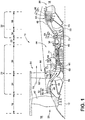
- Figure 1 is a schematic cross-sectional diagram of a turbine engine 10 for an aircraft.
- the engine 10 has a generally longitudinally extending axis or centerline 12 extending forward 14 to aft 16.
- the engine 10 includes, in downstream serial flow relationship, a fan section 18 including a fan 20, a compressor section 22 including a booster or low pressure (LP) compressor 24 and a high pressure (HP) compressor 26, a combustion section 28 including a combustor 30, a turbine section 32 including a HP turbine 34, and a LP turbine 36, and an exhaust section 38.
- LP booster or low pressure
- HP high pressure
- the fan section 18 includes a fan casing 40 surrounding the fan 20.
- the fan 20 includes a plurality of fan blades 42 disposed radially about the centerline 12.
- the HP compressor 26, the combustor 30, and the HP turbine 34 form a core 44 of the engine 10, which generates combustion gases.
- the core 44 is surrounded by core casing 46, which can be coupled with the fan casing 40.
- a LP shaft or spool 50 which is disposed coaxially about the centerline 12 of the engine 10 within the larger diameter annular HP spool 48, drivingly connects the LP turbine 36 to the LP compressor 24 and fan 20.
- the LP compressor 24 and the HP compressor 26 respectively include a plurality of compressor stages 52, 54, in which a set of compressor blades 56, 58 rotate relative to a corresponding set of static compressor vanes 60, 62 (also called a nozzle) to compress or pressurize the stream of fluid passing through the stage.
- a single compressor stage 52, 54 multiple compressor blades 56, 58 can be provided in a ring and can extend radially outwardly relative to the centerline 12, from a blade platform to a blade tip, while the corresponding static compressor vanes 60, 62 are positioned upstream of and adjacent to the rotating blades 56, 58. It is noted that the number of blades, vanes, and compressor stages shown in Figure 1 were selected for illustrative purposes only, and that other numbers are possible.
- the blades 56, 58 for a stage of the compressor can be mounted to a disk 59, which is mounted to the corresponding one of the HP and LP spools 48, 50, with each stage having its own disk 59, 61.
- the vanes 60, 62 for a stage of the compressor can be mounted to the core casing 46 in a circumferential arrangement.
- the HP turbine 34 and the LP turbine 36 respectively include a plurality of turbine stages 64, 66, in which a set of turbine blades 68, 70 are rotated relative to a corresponding set of static turbine vanes 72, 74 (also called a nozzle) to extract energy from the stream of fluid passing through the stage.
- multiple turbine vanes 72, 74 can be provided in a ring and can extend radially outwardly relative to the centerline 12, while the corresponding rotating blades 68, 70 are positioned downstream of and adjacent to the static turbine vanes 72, 74 and can also extend radially outwardly relative to the centerline 12, from a blade platform to a blade tip. It is noted that the number of blades, vanes, and turbine stages shown in Figure 1 were selected for illustrative purposes only, and that other numbers are possible.
- the blades 68, 70 for a stage of the turbine can be mounted to a disk 71, which is mounted to the corresponding one of the HP and LP spools 48, 50, with each stage having its own disk 71, 73.
- the vanes 72, 74 for a stage of the compressor can be mounted to the core casing 46 in a circumferential arrangement.
- the portions of the engine 10 mounted to and rotating with either or both of the spools 48, 50 are also referred to individually or collectively as a rotor 53.
- the stationary portions of the engine 10 including portions mounted to the core casing 46 are also referred to individually or collectively as a stator 63.
- the airflow exiting the fan section 18 is split such that a portion of the airflow is channeled into the LP compressor 24, which then supplies pressurized ambient air 76 to the HP compressor 26, which further pressurizes the ambient air.
- the pressurized air 76 from the HP compressor 26 is mixed with fuel in the combustor 30 and ignited, thereby generating combustion gases. Some work is extracted from these gases by the HP turbine 34, which drives the HP compressor 26.
- the combustion gases are discharged into the LP turbine 36, which extracts additional work to drive the LP compressor 24, and the exhaust gas is ultimately discharged from the engine 10 via the exhaust section 38.
- the driving of the LP turbine 36 drives the LP spool 50 to rotate the fan 20 and the LP compressor 24.
- a remaining portion of the airflow 78 bypasses the LP compressor 24 and engine core 44 and exits the engine assembly 10 through a stationary vane row, and more particularly an outlet guide vane assembly 80, comprising a plurality of airfoil guide vanes 82, at the fan exhaust side 84. More specifically, a circumferential row of radially extending airfoil guide vanes 82 are utilized adjacent the fan section 18 to exert some directional control of the airflow 78.
- the ambient air supplied by the fan 20 can bypass the engine core 44 and be used for cooling of portions, especially hot portions, of the engine 10, and/or used to cool or power other aspects of the aircraft.
- the hot portions of the engine are normally the combustor 30 and components downstream of the combustor 30, especially the turbine section 32, with the HP turbine 34 being the hottest portion as it is directly downstream of the combustion section 28.
- Other sources of cooling fluid can be, but is not limited to, fluid discharged from the LP compressor 24 or the HP compressor 26. This fluid can be bleed air 77 which can include air drawn from the LP or HP compressors 24, 26 that bypasses the combustor 30 as cooling sources for the turbine section 32. This is a common engine configuration, not meant to be limiting.
- FIG 2 is a side section view of the combustor 30 and HP turbine 34 of the engine 10 from Figure 1 .
- the combustor 30 includes a deflector 75 and a combustor liner 79.
- Adjacent to the turbine blade 68 of the turbine 34 in the axial direction are sets of radially-spaced, static turbine vanes 72, with adjacent vanes 72 forming nozzles therebetween. The nozzles turn combustion gas to better flow into the rotating blades so that the maximum energy may be extracted by the turbine 34.
- a cooling fluid flow C passes through the vanes 72 to cool the vanes 72 as a hot combustion gas flow H passes along the exterior of the vanes 72.
- a shroud assembly 81 is adjacent to the rotating blade 68 to minimize flow loss in the turbine 34. Similar shroud assemblies can also be associated with the LP turbine 36, the LP compressor 24, or the HP compressor 26.
- One or more of the engine components of the engine 10 includes a film-cooled substrate in which a film cooling hole, or film hole, of an embodiment disclosed further herein may be provided.
- a film cooling hole, or film hole of an embodiment disclosed further herein may be provided.
- the engine component having a film-cooled substrate can include the blades 68, 70, vanes or nozzles 72, 74, combustor deflector 75, combustor liner 79, or shroud assembly 81, described in Figures 1-2 .
- Other non-limiting examples where film cooling is used include turbine transition ducts and exhaust nozzles.
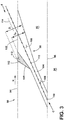
- FIG 3 is a schematic, sectional view of a hole 88, illustrated as a film hole, located in the turbine engine 10.
- the hole 88 is located in an engine component 90, such as a leading edge for an airfoil, comprising a substrate 92 separating a hot combustion gas flow H from a cooling fluid flow C.
- the cooling air can be ambient air supplied by the fan 20 which bypasses the engine core 44, air from the LP compressor 24, or air from the HP compressor 26.
- the engine component 90 includes a substrate 92 having a hot surface 94 facing the hot combustion gas flow H and a cool surface 96 facing the cooling fluid C.
- the substrate 92 may form a wall of the engine component 90 that can be an exterior or interior wall of the engine component 90.
- the first engine component 90 can define at least one interior cavity 98 comprising the cool surface 96.
- the hot surface 94 may be an exterior surface of the engine component 90. In the case of a turbine engine, the hot surface 94 may be exposed to gases having temperatures in the range of 1000 °C to 2000 °C.
- Suitable materials for the substrate 92 include, but are not limited to, steel, refractory metals such as titanium, or superalloys based on nickel, cobalt, or iron, and ceramic matrix composites.
- the superalloys can include those in equi-axed, directionally solidified, and single crystal structures.
- the engine component 90 further includes one or more film hole(s) 88 extending through the substrate 92 that provide fluid communication between the interior cavity 98 and the hot surface 94 of the engine component 90.
- the cooling fluid flow C is supplied to the interior cavity 98 and out of the hole 88 to create a thin layer or film of cool air on the hot surface 94, protecting it from the hot combustion gas flow H. While only one hole 88 is shown in Figure 3 , it is understood that the engine component 90 may be provided with multiple film holes 88, which be arranged in any desired configuration on the engine component 90.
- the substrate 92 is shown as being generally planar, it is understood that that the substrate 92 may be curved for many engine components. However, the curvature of the substrate 92 may be slight in comparison to the size of the hole 88, and so for the purposes of discussion and illustration, the substrate 92 is shown as planar. Whether the substrate 92 is planar or curved local to the hole 88, the hot and cool surfaces 94, 96 may be parallel to each other as shown herein, or may lie in non-parallel planes.
- the hole 88 can have an inlet 100 provided on the cool surface 96 of the substrate 92, an outlet region comprising an outlet 102 provided on the hot surface 94, and a film hole passage 104 connecting the inlet 100 and the outlet 102.
- the film hole passage 104 can include a metering section 106 having a circular cross section for metering of the mass flow rate of the cooling fluid flow C, and a diffusing section 108 in which the cooling fluid C is expanded to form a lower momentum cooling film on the hot surface 94.
- the diffusing section 108 is downstream of the metering section 106 with respect to the direction of cooling fluid flow C through the film hole passage 104.
- the diffusing section 108 may be in serial flow communication with the metering section 106.
- the metering section 106 can be provided at or near the inlet 100, while the diffusing section 108 can be defined at or near the outlet 102. In most implementations, the diffusing section 108 defines the outlet 102.
- the cooling fluid flow C through the film hole passage 104 is along the longitudinal axis of the film hole passage 104, also referred to herein as the centerline 110, which passes through the geometric center of the cross-sectional area of the metering section 106.
- the hole 88 can be inclined in a downstream direction of cooling fluid flow C through the film hole passage 104 such that the centerline 110 is non-orthogonal to the hot and cool surfaces 94, 96.
- the hole 88 may have a centerline 110 that is orthogonal to one or both of the hot and cool surfaces 94, 96 in the localized area of the substrate 92 through which the centerline 110 passes.
- the centerline 110 of the hole 88 may not be oriented in the direction of the hot combustion gas flow H, such that the vector of the cooling fluid flow C differs from that of the hot combustion gas flow H.
- a film hole that has a compound angle defines a cooling flow vector that differs from the hot combustion gas flow vector not only in cross sectional view, but also in the top-down view looking at the hot surface 94.
- the diffusing section 108 can comprise a conical section 109.
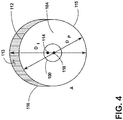
- a layup portion 112 extends along the conical section 109 closest to the hot surface 94 and is defined by an inner dimension D I having a centerline 114 offset from the centerline 110. In this way, when viewed from the outlet 102, the inner dimension D I encompasses an area 113 asymmetrical to the centerline 110. While illustrated closest to the hot surface 94, the layup portion 112 can be at any orientation relative to the hot surface, for example but not limited to the opposite side or encompassing the entire conical section 109.
- a predetermined inner dimension D P and the layup portion 112 together collectively define the asymmetrical area 113.
- the predetermined inner dimension D P is symmetrical around the centerline 110 to form, for example, a circle 115.
- the layup portion 112 can be provided on a portion of the hole so as to form a crescent portion 116 adjacent the circle. While a circle is shown as an example cross-sectional profile, it will be understood by those skilled in the art that other cross-sectional profiles can be employed without departing from the scope of this invention.
- the size of the hole 88 can be generalized as having a dimension, and the expression of that dimension as a diameter herein shall not be construed as limiting the scope of this invention.
- the hole can have a circular or non-circular cross-section.
- the dimension is the inner diameter of the circle.
- the dimension may be characterized as an effective diameter or dimension (measured or calculated), which need not be the diameter is a technical sense, even if the dimension is referred to as a diameter.
- the dimension can be the major/minor axis or some other effective dimension, any of which can be referred to as a diameter.
- the layup portion 112 can vary in depth and extent of arc section comprising the crescent portion 116 depending on factors such as coating thickness, coating application methods, hole size, etc.
- the arc section need not be a circular arc section.
- a method of making the film hole 88 includes forming the hole 88 in the engine component 90 by plunging an electro-discharge tool to form the metering section through the wall thickness, then plunging a second tool or orientation to form the layup portion having the layup portion 112 that provides the hole 88 with the inner dimension D I which is greater than the predetermined inner dimension D P .
- the layup portion 112 forming an area where a coating is applied to the component 90 such that the coating fills in the layup portion leaving the hole with a diameter equivalent to the predetermined inner dimension D P .
- the coating can be applied in one or multiple layers depending on the method of application.
- the coating can be a thermal barrier coating (TBC) which includes the superalloy substrate already described along with a metallic bond coat, thermally grown oxide, and one or more ceramic topcoats.
- TBC thermal barrier coating
- an environmental barrier coating is a multi-layer stack-up of coatings, for example but not limited to an air plasma TBC and mullite.
- Other methods for forming the film hole include but are not limited to machining via electrode, 3-D printing, SLA, machining via a laser, or by casting in.
- thermal barrier coating impact the laydown portion of the conical region which is the region opposite of the layup portion described herein. Placing thermal barrier coating on the layup portion optimizes aerodynamic flow in the film hole by maintaining the laydown portion geometry as intended. Testing done with the final aerodynamic shape using the method described quantified the benefits discussed herein.
Landscapes
- Engineering & Computer Science (AREA)
- Mechanical Engineering (AREA)
- General Engineering & Computer Science (AREA)
- Chemical & Material Sciences (AREA)
- Combustion & Propulsion (AREA)
- Materials Engineering (AREA)
- Turbine Rotor Nozzle Sealing (AREA)
- Structures Of Non-Positive Displacement Pumps (AREA)
Applications Claiming Priority (1)
| Application Number | Priority Date | Filing Date | Title |
|---|---|---|---|
| US15/073,687 US10443395B2 (en) | 2016-03-18 | 2016-03-18 | Component for a turbine engine with a film hole |
Publications (1)
| Publication Number | Publication Date |
|---|---|
| EP3219920A1 true EP3219920A1 (fr) | 2017-09-20 |
Family
ID=58347233
Family Applications (1)
| Application Number | Title | Priority Date | Filing Date |
|---|---|---|---|
| EP17161186.6A Withdrawn EP3219920A1 (fr) | 2016-03-18 | 2017-03-15 | Composant pour un moteur à turbine avec un trou de film |
Country Status (5)
| Country | Link |
|---|---|
| US (2) | US10443395B2 (fr) |
| EP (1) | EP3219920A1 (fr) |
| JP (1) | JP2017172583A (fr) |
| CN (1) | CN107201920A (fr) |
| CA (1) | CA2960359A1 (fr) |
Cited By (1)
| Publication number | Priority date | Publication date | Assignee | Title |
|---|---|---|---|---|
| CN112983561A (zh) * | 2021-05-11 | 2021-06-18 | 中国航发四川燃气涡轮研究院 | 梅花型气膜孔和形成方法、涡轮叶片和形成方法、燃气机 |
Families Citing this family (5)
| Publication number | Priority date | Publication date | Assignee | Title |
|---|---|---|---|---|
| US11359494B2 (en) * | 2019-08-06 | 2022-06-14 | General Electric Company | Engine component with cooling hole |
| US11585224B2 (en) * | 2020-08-07 | 2023-02-21 | General Electric Company | Gas turbine engines and methods associated therewith |
| US12006837B2 (en) * | 2022-01-28 | 2024-06-11 | Rtx Corporation | Ceramic matrix composite article and method of making the same |
| CN114893255B (zh) * | 2022-05-12 | 2023-05-05 | 中国航发四川燃气涡轮研究院 | 月牙型气膜孔结构和形成方法、涡轮叶片及其加工方法 |
| JP2025117176A (ja) * | 2024-01-30 | 2025-08-12 | 本田技研工業株式会社 | 壁部材及びその製造方法 |
Citations (3)
| Publication number | Priority date | Publication date | Assignee | Title |
|---|---|---|---|---|
| CA2282010A1 (fr) * | 1998-09-10 | 2000-03-10 | Abb Research Ltd. | Trou de refroidissement pelliculaire et methode de realisation |
| US20140161585A1 (en) * | 2012-12-10 | 2014-06-12 | General Electric Company | Turbo-machine component and method |
| EP2937513A2 (fr) * | 2014-04-25 | 2015-10-28 | United Technologies Corporation | Procédé de manufacture d'un composant et composant associé |
Family Cites Families (17)
| Publication number | Priority date | Publication date | Assignee | Title |
|---|---|---|---|---|
| US4819325A (en) * | 1987-06-01 | 1989-04-11 | Technical Manufacturing Systems, Inc. | Method of forming electro-discharge machining electrode |
| GB2227965B (en) | 1988-10-12 | 1993-02-10 | Rolls Royce Plc | Apparatus for drilling a shaped hole in a workpiece |
| US6744010B1 (en) | 1991-08-22 | 2004-06-01 | United Technologies Corporation | Laser drilled holes for film cooling |
| US5771577A (en) * | 1996-05-17 | 1998-06-30 | General Electric Company | Method for making a fluid cooled article with protective coating |
| US6042879A (en) | 1997-07-02 | 2000-03-28 | United Technologies Corporation | Method for preparing an apertured article to be recoated |
| US6050777A (en) | 1997-12-17 | 2000-04-18 | United Technologies Corporation | Apparatus and method for cooling an airfoil for a gas turbine engine |
| DE50214917D1 (de) | 2001-07-11 | 2011-04-07 | Alstom Technology Ltd | Verfahren zur Beschichtung eines Hochtemperatur-beständigen Bauteils mit einer thermischen Schutzschicht und Hochtemperatur-beständiges Bauteil |
| DE10143153A1 (de) | 2001-09-03 | 2003-03-20 | Rolls Royce Deutschland | Turbinenschaufel für eine Gasturbine mit zumindest einer Kühlungsausnehmung |
| US6663919B2 (en) | 2002-03-01 | 2003-12-16 | General Electric Company | Process of removing a coating deposit from a through-hole in a component and component processed thereby |
| US6881439B2 (en) | 2002-12-04 | 2005-04-19 | General Electric Company | Aluminide coating process |
| US20050220618A1 (en) | 2004-03-31 | 2005-10-06 | General Electric Company | Counter-bored film-cooling holes and related method |
| US7216485B2 (en) | 2004-09-03 | 2007-05-15 | General Electric Company | Adjusting airflow in turbine component by depositing overlay metallic coating |
| US8257809B2 (en) | 2007-03-08 | 2012-09-04 | Siemens Energy, Inc. | CMC wall structure with integral cooling channels |
| EP2213759A1 (fr) | 2009-01-08 | 2010-08-04 | Siemens Aktiengesellschaft | Procédé de revêtement d'un composant à trous de refroidissement par film et composant |
| US8672613B2 (en) | 2010-08-31 | 2014-03-18 | General Electric Company | Components with conformal curved film holes and methods of manufacture |
| CH706107A1 (de) * | 2012-02-17 | 2013-08-30 | Alstom Technology Ltd | Bauteil für eine thermische Maschine, insbesondere eine Gasturbine. |
| US10472972B2 (en) * | 2015-12-01 | 2019-11-12 | General Electric Company | Thermal management of CMC articles having film holes |
-
2016
- 2016-03-18 US US15/073,687 patent/US10443395B2/en active Active
-
2017
- 2017-03-09 CA CA2960359A patent/CA2960359A1/fr not_active Abandoned
- 2017-03-09 JP JP2017044487A patent/JP2017172583A/ja active Pending
- 2017-03-15 EP EP17161186.6A patent/EP3219920A1/fr not_active Withdrawn
- 2017-03-17 CN CN201710160127.3A patent/CN107201920A/zh active Pending
-
2019
- 2019-08-19 US US16/544,184 patent/US20200141247A1/en not_active Abandoned
Patent Citations (3)
| Publication number | Priority date | Publication date | Assignee | Title |
|---|---|---|---|---|
| CA2282010A1 (fr) * | 1998-09-10 | 2000-03-10 | Abb Research Ltd. | Trou de refroidissement pelliculaire et methode de realisation |
| US20140161585A1 (en) * | 2012-12-10 | 2014-06-12 | General Electric Company | Turbo-machine component and method |
| EP2937513A2 (fr) * | 2014-04-25 | 2015-10-28 | United Technologies Corporation | Procédé de manufacture d'un composant et composant associé |
Cited By (2)
| Publication number | Priority date | Publication date | Assignee | Title |
|---|---|---|---|---|
| CN112983561A (zh) * | 2021-05-11 | 2021-06-18 | 中国航发四川燃气涡轮研究院 | 梅花型气膜孔和形成方法、涡轮叶片和形成方法、燃气机 |
| CN112983561B (zh) * | 2021-05-11 | 2021-08-03 | 中国航发四川燃气涡轮研究院 | 梅花型气膜孔和形成方法、涡轮叶片和形成方法、燃气机 |
Also Published As
| Publication number | Publication date |
|---|---|
| CN107201920A (zh) | 2017-09-26 |
| US20170268346A1 (en) | 2017-09-21 |
| JP2017172583A (ja) | 2017-09-28 |
| US10443395B2 (en) | 2019-10-15 |
| CA2960359A1 (fr) | 2017-09-18 |
| US20200141247A1 (en) | 2020-05-07 |
Similar Documents
| Publication | Publication Date | Title |
|---|---|---|
| US20200141247A1 (en) | Component for a turbine engine with a film hole | |
| US11448076B2 (en) | Engine component with cooling hole | |
| CN102434287B (zh) | 具有膜式冷却孔的构件及其制造方法 | |
| US11156099B2 (en) | Turbine engine airfoil with a modified leading edge | |
| US10767489B2 (en) | Component for a turbine engine with a hole | |
| US20190085705A1 (en) | Component for a turbine engine with a film-hole | |
| US11773729B2 (en) | Component for a gas turbine engine with a film hole | |
| EP3255248A1 (fr) | Composant pour un moteur à turbine | |
| US20200024951A1 (en) | Component for a turbine engine with a cooling hole | |
| US10502067B2 (en) | Dual-fed airfoil tip | |
| EP3061911A1 (fr) | Composant de moteur | |
| US11927110B2 (en) | Component for a turbine engine with a cooling hole | |
| EP3173586A1 (fr) | Composant de moteur à refroidissement par film fluide | |
| EP3211314A1 (fr) | Composants pour moteur à turbine à gaz et procédé associé de refroidissement | |
| US11391161B2 (en) | Component for a turbine engine with a cooling hole | |
| US10760431B2 (en) | Component for a turbine engine with a cooling hole | |
| US20180051568A1 (en) | Engine component with porous holes | |
| EP2952682A1 (fr) | Aube pour moteur à turbine à gaz avec une plate-forme refroidie |
Legal Events
| Date | Code | Title | Description |
|---|---|---|---|
| PUAI | Public reference made under article 153(3) epc to a published international application that has entered the european phase |
Free format text: ORIGINAL CODE: 0009012 |
|
| AK | Designated contracting states |
Kind code of ref document: A1 Designated state(s): AL AT BE BG CH CY CZ DE DK EE ES FI FR GB GR HR HU IE IS IT LI LT LU LV MC MK MT NL NO PL PT RO RS SE SI SK SM TR |
|
| AX | Request for extension of the european patent |
Extension state: BA ME |
|
| STAA | Information on the status of an ep patent application or granted ep patent |
Free format text: STATUS: THE APPLICATION IS DEEMED TO BE WITHDRAWN |
|
| 18D | Application deemed to be withdrawn |
Effective date: 20180321 |