EP3220194B1 - Vorrichtung zur beeinflussung des lichts bei fotoaufnahmen - Google Patents
Vorrichtung zur beeinflussung des lichts bei fotoaufnahmen Download PDFInfo
- Publication number
- EP3220194B1 EP3220194B1 EP16001610.1A EP16001610A EP3220194B1 EP 3220194 B1 EP3220194 B1 EP 3220194B1 EP 16001610 A EP16001610 A EP 16001610A EP 3220194 B1 EP3220194 B1 EP 3220194B1
- Authority
- EP
- European Patent Office
- Prior art keywords
- rod
- covering
- tube
- spreader
- support frame
- Prior art date
- Legal status (The legal status is an assumption and is not a legal conclusion. Google has not performed a legal analysis and makes no representation as to the accuracy of the status listed.)
- Active
Links
Images


Classifications
-
- G—PHYSICS
- G03—PHOTOGRAPHY; CINEMATOGRAPHY; ANALOGOUS TECHNIQUES USING WAVES OTHER THAN OPTICAL WAVES; ELECTROGRAPHY; HOLOGRAPHY
- G03B—APPARATUS OR ARRANGEMENTS FOR TAKING PHOTOGRAPHS OR FOR PROJECTING OR VIEWING THEM; APPARATUS OR ARRANGEMENTS EMPLOYING ANALOGOUS TECHNIQUES USING WAVES OTHER THAN OPTICAL WAVES; ACCESSORIES THEREFOR
- G03B15/00—Special procedures for taking photographs; Apparatus therefor
- G03B15/02—Illuminating scene
- G03B15/06—Special arrangements of screening, diffusing, or reflecting devices, e.g. in studio
Definitions
- the invention relates to a device for influencing the light when taking photos according to the independent claim.
- the available light is important for illuminating the object or person to be photographed.
- Well-lit objects are depicted in more detail on the picture.
- clouds can obscure the sun and natural obstacles (such as trees or hills) can adversely affect the light.
- a flat fabric is arranged on a support frame.
- the material of the clothing can be selected according to the function (reflective, translucent or lichtfilternd).
- Known fabrics are made of a flexible material and formed on the edge with a circumferentially sewn loop. In the circumferential loop, a part of the support frame is so arranged so that he spreads the fabric flat.
- Known support frames are made of aluminum tubes.
- the encircling aluminum tubes are nested and can be connected to increase the dimensional stability with one or more cross tubes.
- the cross tubes have the same circumference as the circumferential tubes and are connected by means of connecting elements by means of T-shaped brackets with the peripheral tubes, wherein the T-shaped brackets are screwed together.
- US 2012/0170278 A1 describes a reflector which is clamped on two rods which are connected by means of three transverse struts. These cross struts are connected with split pins and clamp with the tension rods.
- CN 2017 65 419 U shows a similar device in which the tension rods must be inserted through an opening.
- the US 2001/0009513 A1 shows a reflector in which the tension rods are connected by means of a single transverse bar.
- US 2013/0272687 A1 shows a reflector which is mounted on a frame and a cross bar which is attached to the frame with clamps serves as a handle.
- the invention relates to a device for influencing the light when taking photographs (for example, image recordings or film recordings) with a support frame and with a flat covering.
- the support frame includes a first tie rod attached to a first end portion of the fabric and a second tie rod attached to a second end portion of the fabric opposite the first end.
- the support frame further comprises at least one spreader bar with end-side receiving pieces each having concave receiving surfaces for receiving the outer surface of each of a tensioning rod, and wherein the at least one spreader rod is formed with its length in such a way clamped state to hold the first tension rod and the second tension rod against the tensioned string.
- the spreader bar is formed with its receiving pieces so as to receive the lateral outer surface of the first and second tie rod in the tensioned state of the fabric.
- the concave receiving surfaces on the receiving pieces are advantageously formed semicircular (and arched towards the center of the expansion rod).
- a width B-B of the clothing corresponds at most to the distance between the receiving surfaces of the at least one expansion rod.
- the width can be selected according to this distance in order to tension the clothing against the elasticity of the spreader bar.
- the fabric is at least partially elastically formed in a width B-B between the first tie rod and the second tie rod.
- the width B-B of the fabric in the untensioned state of the fabric is shorter than the distance between the receiving surfaces of the at least one spreader bar. In this way, the fabric can be stretched against the elasticity of the fabric itself on the spreader.
- the covering in the width BB between the first tensioning rod and the second tensioning rod comprises a first elastic outer portion, subsequently a middle portion and subsequently a second elastic outer portion.
- the elastic outer portions leave it open for the central portion to use a material that is elastic or not.
- the outer sections are about 10 cm wide and made of an elastic textile.
- the outer sections comprise the end portions with which the fabric is attached to the respective tie rod.
- the middle section comprises a recess.
- the recess has a corresponding position and size (5x10 cm) that a person holding the device in his hand can see through.
- the fabric comprises a releasable closure between the first elastic outer portion and the middle portion and between the second elastic outer portion and the middle portion.
- a zipper for separating the outer portion and central portion may be provided which extends along the entire length A-A of the fabric.
- the central portion can be easily replaced according to its desired function or the corresponding material.
- the central portion comprises at least one dimensionally stable element.
- each dimensionally stable element is a plastic batten which extends along the entire length A-A of the middle section.
- the first batten is disposed in the central portion adjacent to the releasable closure between the first elastic outer portion and the middle portion.
- the second batten is disposed in the central portion adjacent to the releasable closure between the second elastic outer portion and the central portion.
- the dimensionally stable element allows easy connection by means of zipper, since the middle section is so well positioned.
- the at least one expansion rod preferably comprises a tube made of a carbon fiber material.
- a tube made of a carbon fiber material. This is advantageously a tube with a diameter of 2 cm to 10 cm, in particular 4 cm to 8 cm, with a hollow cross-section.
- the tube of carbon fiber material is formed from a first tube part and a second tube part.
- the first tube part comprises a (fixedly connected thereto and projecting out of this) inner tube whose circumference is selected such that the second tube part on the inner tube (positive fit) can be plugged to the first tube part with the second tube part to connect with each other.
- the pipe parts may have inclined abutment surfaces to prevent them from twisting in the assembled state.
- the support frame comprises a first spreader bar and a second spreader bar.
- the support frame can be made stable even with larger frame widths.
- two spreader bars allow easy carrying with two hands.
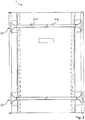
- Fig. 1 1 shows a device 1 for influencing the light in photographs with a support frame and with a flat covering 4.
- the support frame comprises a first tension rod 21, which is fastened to a first end portion of the fabric 4, and a second tension rod 22, which at a second, the first opposite, end portion of the fabric 4 is fixed.
- the fabric 4 is formed elastically in sections BB in the width BB between the first tension rod 21 and the second tension rod 22 (inner edge) by a first elastic outer portion 41, an inelastic middle portion 43 and then a second elastic outer portion 42 is arranged.
- the outer portion 41, 42 is about 10 cm in the present example wide and from the end portion, which is formed by a peripheral bead of the fabric to distinguish.
- a zipper 44 is arranged along the length AA.
- the central portion 43 can be replaced according to its function as a reflector, diffuser or light filter to use the device variable.
- the device 1 has a first and a second spreader bar 3, which at both ends each have a receiving piece with a semicircular receiving surface (see Fig. 3 ), which are designed to receive the outer surface of the first and second tensioning rods 21, 22 in the tensioned state of the fabric 4.
- the device 1 can be disassembled during outdoor photo shoots, transported and built quickly on site.
- the fabric is spread out and between the first tension rod 21 and the second tension rod 22, the two spreader bars 3 are clamped in succession.
- the fabric 4 is formed elastically in a width BB between the first tension rod 21 and the second tension rod 22, the Sp Dahlstäbe 3 can be clamped against the elasticity of the fabric 4.
- dimensionally stable plastic slats 45 Adjacent to the zipper 44 dimensionally stable plastic slats 45 are incorporated in the central portion 43, which extend along the entire length A-A. In addition, a recess 46 is arranged to look through in the middle of the fabric 4.
- the device 1 comprises a first spreader rod 31 and a second spreader rod 32 with a tube (middle part) of carbon fiber material.
- the tube consists of a first tube part 311 and a second tube part 312.
- the first tube part 312 comprises an inner tube (not shown) whose circumference is selected such that the second (hollow) tube parts 312 can be plugged onto the inner tube.
- the first pipe part 311 can be connected to the second pipe part 312 or disassembled and transported.
- The is particularly for larger dimensions of the device 1 of advantage.
- the abutting ends of the first pipe part 311 and a second pipe part 312 are cut off obliquely. Thus, twisting in the connected position of the two parts 311 and 312 can be avoided.
- the sectional view according to Fig. 3 shows, as discussed below, the formation of the receiving surfaces well. You can see the end-side receiving pieces each with semicircular receiving surfaces 321, 322, the shape of the outer contour of the round clamping rods 21, 22 corresponds. In the assembled state of the device, the clamping rods 21, 22 respectively in the receiving surfaces 321, 322 and are clamped against them. The tension rods are connected to a Endwulst 47 of the fabric.
- the fabric 4 shows a first elastic outer portion 41, an inelastic middle portion 43 and then a second elastic outer portion 42.
- the middle portion 43 is interchangeable by means of zippers.
- the central portion 43 can be replaced according to its function as a reflector, diffuser or light filter to use the device variable.
- the outer sections 41, 42 are made elastic, so that the width of the fabric is slightly shorter than the distance between the receiving surfaces 321, 322.
- the Sp Dro 3 can be clamped against the elasticity of the fabric 4 to build the device on site with a few simple steps.
Landscapes
- Physics & Mathematics (AREA)
- General Physics & Mathematics (AREA)
- Professional, Industrial, Or Sporting Protective Garments (AREA)
- Housing For Livestock And Birds (AREA)
- Catching Or Destruction (AREA)
- Prostheses (AREA)
- Endoscopes (AREA)
- Cultivation Of Plants (AREA)
- Agricultural Chemicals And Associated Chemicals (AREA)
Description
- Die Erfindung betrifft eine Vorrichtung zur Beeinflussung des Lichts bei Fotoaufnahmen gemäß dem unabhängigen Anspruch.
- Bei Fotoaufnahmen ist das zur Verfügung stehende Licht zur Beleuchtung des zu fotografierenden Objekts bzw. einer Person wichtig. Gleiches gilt natürlich auch für Filmaufnahmen. Gut ausgeleuchtete Gegenstände werden auf dem Bild detailreicher abgebildet. Insbesondere bei Fotoaufnahmen im Freien ergibt sich das Problem, dass das zur Verfügung stehende Licht ungleichmäßig verteilt ist. So können Wolken die Sonne verdecken und natürliche Hindernisse (z.B. Bäume oder Hügel) das Licht ungünstig beeinflussen.
- Es ist bekannt zur Ausleuchtung bei Fotoshootings das natürliche oder künstliche Licht mittels Reflektoren auf die fotografierte Person zu leiten, mittels Diffusoren zu zerstreuen oder mittels Filter hinsichtlich seiner spektralen Anteile zu optimieren.
- Dazu wird eine flächige Bespannung an einem Tragrahmen angeordnet. Das Material der Bespannung kann entsprechend der Funktion (reflektierend, lichtdurchlässig oder lichtfilternd) gewählt werden. Bekannte Bespannungen sind aus einem flexiblen Material und am Rand mit einer umlaufend vernähten Schlaufe ausgebildet. In der umlaufenden Schlaufe wird ein Teil des Tragrahmens so angeordnet, dass er die Bespannung flächig auseinanderhält. Bekannte Tragrahmen sind aus Aluminiumrohren hergestellt. Die umlaufenden Aluminiumrohre sind ineinandergesteckt und können zur Erhöhung der Formstabilität mit einem oder mehreren Querrohren verbunden sein. Die Querrohre haben denselben Umfang wie die umlaufenden Rohre und werden über Verbindungselemente mittels T-förmigen Klammern mit den umlaufenden Rohren verbunden, wobei die T-förmigen Klammern miteinander verschraubt werden.
-
US 2012/0170278 A1 beschreibt einen Reflektor welcher auf zwei Stäben aufgespannt ist welche mittels drei Querstreben verbunden sind. Diese Querstreben sind mit Splinten und schellen mit den Spannstäben verbunden.CN 2017 65 419 U zeigt eine ähnliche Vorrichtung bei welcher die Spannstäbe durch eine Öffnung gesteckt werden müssen. DieUS 2001/0009513 A1 zeigt einen Reflektor bei dem die Spannstäbe mittels eines einzigen Querstabes verbunden sind.US 2013/0272687 A1 zeigt einen Reflektor der auf einen Rahmen aufgespannt ist und ein Querstab welcher mit Schellen an dem Rahmen befestigt ist dient dabei als Haltegriff. - Dabei ergibt sich das Problem, dass bei Fotoshootings zum Beispiel im Freien der zerlegte Rahmen zum jeweiligen Ort transportiert und dort erst aufgebaut werden muss. Das Aufbauen ist schon aufgrund der Art der Befestigung der Querrohre an den umlaufenden Rohren aufwendig. Insbesondere müssen dabei separate Befestigungselemente wie Schrauben verwendet werden, die üblicherweise an mehreren Stellen nacheinander verschraubt werden.
- Es ist die Aufgabe der Erfindung, eine Vorrichtung zur Beeinflussung des Lichts bei Fotoaufnahmen bereitzustellen, mit der die Nachteile im Stand der Technik überwunden werden und die sich insbesondere schnell aufbauen und leicht handhaben lässt.
- Die Erfindung betrifft eine Vorrichtung zur Beeinflussung des Lichts bei Fotoaufnahmen (z.B. Bildaufnahmen oder Filmaufnahmen) mit einem Tragerahmen und mit einer flächigen Bespannung. Der Tragerahmen umfasst einen ersten Spannstab, der an einem ersten Endabschnitt der Bespannung befestigt ist, und einen zweiten Spannstab, der an einem zweiten, dem ersten gegenüberliegenden, Endabschnitt der Bespannung befestigt ist. Der Tragerahmen umfasst ferner mindestens einen Spreizstab mit endseitigen Aufnahmestücken mit jeweils konkaven Aufnahmeflächen zur Aufnahmen der Außenfläche jeweils eines Spannstabs, und wobei der mindestens eine Spreizstab mit seiner Länge derart ausgebildet ist, um im aufgespannten Zustand den ersten Spannstab und den zweiten Spannstab gegen die aufgespannte Bespannung zu halten.
- Der Spreizstab ist mit seinen Aufnahmestücken derart ausgebildet, um die seitliche Außenfläche des ersten und zweiten Spannstabs im gespannten Zustand der Bespannung aufzunehmen. Bei runden (rohrförmigen) Spannstäben sind die konkaven Aufnahmeflächen an dem Aufnahmestücken vorteilhafterweise halbrund ausgeformt (und zur Mitte des Spreizstabs hin gewölbt). So kann die Vorrichtung bei Fotoshootings im Freien einfach zerlegt, transportiert und vor Ort schnell aufgebaut werden. Die Konstruktion macht die Verwendung von zusätzlichen Befestigungselementen, wie Schrauben, überflüssig. Dazu wird die Bespannung ausgebreitet und zwischen den ersten Spannstab und den zweiten Spannstab der Spreizstab eingelegt (bzw. eingespannt gegen die Elastizität des Spreizstabs selbst oder gegen die Elastizität der Bespannung). Eine Breite B-B der Bespannung (von Innenkante Spannstab zu Innenkante des anderen Spannstabs) entspricht dabei höchstens dem Abstand zwischen den Aufnahmeflächen des mindestens einen Spreizstabs. Vorteilhafterweise kann die Breite entsprechend diesem Abstand gewählt werden, um die Bespannung gegen die Elastizität des Spreizstabs zu spannen.
- Gemäß einem bevorzugten Aspekt ist die Bespannung in einer Breite B-B zwischen dem ersten Spannstab und dem zweiten Spannstab zumindest abschnittsweise elastisch ausgebildet. Bevorzugt ist die Breite B-B der Bespannung im ungespannten Zustand der Bespannung kürzer, als der Abstand zwischen den Aufnahmeflächen des mindestens einen Spreizstabs. Auf diese Weise kann die Bespannung gegen die Elastizität der Bespannung selbst auf den Spreizstab gespannt werden.
- Vorteilhafterweise umfasst die Bespannung in der Breite B-B zwischen dem ersten Spannstab und dem zweiten Spannstab einen ersten elastischen Außenabschnitt, daran anschließend einen Mittelabschnitt und daran anschließend einen zweiten elastischen Außenabschnitt. Die elastischen Außenabschnitte lassen es offen für den Mittelabschnitt ein Material zu verwenden, das elastisch ist oder nicht. Bevorzugt sind die Außenabschnitte ca. 10 cm breit und aus einem elastischen Textil gebildet. Die Außenabschnitte umfassen die Endabschnitte mit denen die Bespannung am jeweiligen Spannstab befestigt ist.
- Gemäß einem vorteilhaften Aspekt umfasst der Mittelabschnitt eine Ausnehmung. Die Ausnehmung weist eine entsprechende Position und Größe (5x10 cm) auf, dass eine Person, die die Vorrichtung in der Hand hält, durchschauen kann.
- Besonders bevorzugt umfasst die Bespannung einen lösbaren Verschluss jeweils zwischen dem ersten elastischen Außenabschnitt und dem Mittelabschnitt sowie zwischen dem zweiten elastischen Außenabschnitt und dem Mittelabschnitt. Dazu kann ein Reisverschluss zum Trennen von Außenabschnitt und Mittelabschnitt vorgesehen sein, der entlang der gesamten Länge A-A der Bespannung verläuft. So kann der Mittelabschnitt entsprechend seiner gewünschten Funktion bzw. des entsprechenden Materials einfach ausgetauscht werden.
- Ferner bevorzugt umfasst der Mittelabschnitt mindestens ein formsteifes Element. Vorteilhafterweise ist jedes formsteife Element eine Kunststofflatte, die sich entlang der gesamten Länge A-A des Mittelabschnitts erstreckt. Die erste Latte ist im Mittelabschnitt benachbart zum lösbaren Verschluss zwischen dem ersten elastischen Außenabschnitt und dem Mittelabschnitt angeordnet. Die zweite Latte ist im Mittelabschnitt benachbart zum lösbaren Verschluss zwischen dem zweiten elastischen Außenabschnitt und dem Mittelabschnitt angeordnet. Das formsteife Element erlaubt ein einfaches Verbinden mittels Reisverschluss, da der Mittelabschnitt so gut positionierbar ist.
- Weiterhin bevorzugt umfasst der mindestens eine Spreizstab ein Rohr aus einem Kohlefasermaterial. Das ist vorteilhafterweise ein Rohr mit einem Durchmesser von 2 cm bis 10 cm, insbesondere 4 cm bis 8 cm, mit einem hohlem Querschnitt.
- Ein bevorzugter Aspekt sieht vor, dass das Rohr aus Kohlefasermaterial aus einem ersten Rohrteil und einem zweiten Rohrteil gebildet ist. Der erste Rohrteil umfasst ein (fest damit verbundenes und aus diesem herausstehendes) Innenrohr, dessen Umfang derart gewählt ist, dass das zweite Rohrteil auf das Innenrohr (formschlüssig) aufsteckbar ist, um das erste Rohrteil mit dem zweiten Rohrteil miteinander zu verbinden. So lässt sich der Spreizstab zum Transport zerlegen. Die Rohrteile können schräg abgeschnittene Anlageflächen haben, um zu vermeiden, dass diese sich im zusammengebauten Zustand verdrehen.
- Besonders bevorzugt umfasst der Tragrahmen einen ersten Spreizstab und einen zweiten Spreizstab. So kann der Tragrahmen auch bei größeren Rahmenbreiten stabil ausgeführt werden. Außerdem erlauben zwei Spreizstäbe ein leichtes Tragen mit zwei Händen.
- Im Folgenden wird die Erfindung anhand der in den beigefügten Zeichnungen dargestellten Beispiele näher erläutert.
- Es zeigen:
- Fig. 1
- eine Vorderansicht eines Ausführungsbeispiels einer erfindungsgemäßen Vorrichtung;
- Fig. 2
- eine Rückansicht der Vorrichtung aus
Fig. 1 ; und - Fig. 3
- eine Schnittansicht der Vorrichtung aus
Fig. 1 und2 . -
Fig. 1 zeigt eine Vorrichtung 1 zur Beeinflussung des Lichts bei Fotoaufnahmen mit einem Tragerahmen und mit einer flächigen Bespannung 4. Der Tragerahmen umfasst einen ersten Spannstab 21, der an einem ersten Endabschnitt der Bespannung 4 befestigt ist, und einen zweiten Spannstab 22, der an einem zweiten, dem ersten gegenüberliegenden, Endabschnitt der Bespannung 4 befestigt ist. - Die Bespannung 4 ist in der Breite B-B zwischen dem ersten Spannstab 21 und dem zweiten Spannstab 22 (jeweils Innenkante) abschnittsweise elastisch ausgebildet, indem an einem ersten elastischen Außenabschnitt 41 sich ein unelastischer Mittelabschnitt 43 und daran anschließend ein zweiter elastischer Außenabschnitt 42 angeordnet ist. Der Außenabschnitt 41, 42 ist im vorliegenden Beispiel ca. 10 cm breit und von dem Endabschnitt, der durch eine Randwulst der Bespannung gebildet wird, zu unterschieden. Zwischen dem ersten elastischen Außenabschnitt 41 und dem Mittelabschnitt 43 sowie zwischen dem zweiten elastischen Außenabschnitt 42 und dem Mittelabschnitt 43 ist ein Reisverschluss 44 entlang der Länge A-A angeordnet. So kann der Mittelabschnitt 43 entsprechend seiner Funktion als Reflektor, Diffusor oder Lichtfilter ausgetauscht werden, um die Vorrichtung variabel einzusetzen.
- Die Vorrichtung 1 weist einen ersten und einen zweiten Spreizstab 3 auf, die an beiden Enden jeweils ein Aufnahmestück mit einer halbrunden Aufnahmefläche haben (siehe
Fig. 3 ), welche derart ausgebildet sind, um die Außenfläche des ersten und zweiten Spannstabs 21, 22 im gespannten Zustand der Bespannung 4 aufzunehmen. So kann die Vorrichtung 1 bei Fotoshootings im Freien zerlegt, transportiert und vor Ort schnell aufgebaut werden. Dazu wird die Bespannung ausgebreitet und zwischen dem ersten Spannstab 21 und dem zweiten Spannstab 22 die beiden Spreizstäbe 3 nacheinander eingeklemmt. Indem die Bespannung 4 in einer Breite B-B zwischen dem ersten Spannstab 21 und dem zweiten Spannstab 22 elastisch ausgebildet ist, können die Spreizstäbe 3 gegen die Elastizität der Bespannung 4 eingespannt werden. - Jeweils benachbart zum Reisverschluss 44 sind formsteife Kunststofflatten 45 im Mittelabschnitt 43 eingearbeitet, die sich entlang der gesamten Länge A-A erstrecken. Außerdem ist in der Mitte der Bespannung 4 eine Ausnehmung 46 zum Durchschauen angeordnet.
- In
Fig. 2 ist die Rückseite der Vorrichtung ausFig. 1 zu sehen. Die Vorrichtung 1 umfasst einen ersten Spreizstab 31 und einen zweiten Spreizstab 32 mit einem Rohr(-mittelteil) aus Kohlefasermaterial. Das Rohr besteht aus einem ersten Rohrteil 311 und einem zweiten Rohrteil 312. Der erste Rohrteil 312 umfasst ein Innenrohr (nicht gezeigt), dessen Umfang derart gewählt ist, dass das zweite (hohle) Rohrteile 312 auf das Innenrohr aufsteckbar sind. So kann das erste Rohrteil 311 mit dem zweiten Rohrteil 312 verbunden werden bzw. zerlegt und transportiert werden. Das ist insbesondere bei größeren Abmessungen für die Vorrichtung 1 von Vorteil. Die aneinanderliegenden Enden des ersten Rohrteils 311 und einem zweiten Rohrteils 312 sind schräg abgeschnitten. So kann ein Verdrehen in der verbundenen Position der beiden Teile 311 und 312 vermieden werden. - Die Schnittansicht gemäß
Fig. 3 zeigt, wie im Folgenden diskutiert, die Ausbildung der Aufnahmeflächen gut. Zu sehen sind die endseitigen Aufnahmestücke jeweils mit halbrunden Aufnahmeflächen 321, 322, deren Form der Außenkontur der runden Spannstäbe 21, 22 entspricht. Im aufgebauten Zustand der Vorrichtung liegen die Spannstäbe 21, 22 jeweils in den Aufnahmeflächen 321, 322 bzw. sind gegen diese gespannt. Die Spannstäbe sind mit einer Endwulst 47 der Bespannung verbunden. - Die Bespannung 4 zeigt einen ersten elastischen Außenabschnitt 41, einen unelastischen Mittelabschnitt 43 und daran anschließend einen zweiten elastischen Außenabschnitt 42. Der Mittelabschnitt 43 ist mittels Reisverschlüssen austauschbar. So kann der Mittelabschnitt 43 entsprechend seiner Funktion als Reflektor, Diffusor oder Lichtfilter ausgetauscht werden, um die Vorrichtung variabel einzusetzen.
- Im vorliegenden Fall sind die Außenabschnitte 41, 42 elastisch ausgeführt, so dass die Breite der Bespannung leicht kürzer als der Abstand zwischen den Aufnahmeflächen 321, 322 ist. So kann der Spreizstab 3 gegen die Elastizität der Bespannung 4 eingespannt werden, um die Vorrichtung vor Ort mit wenigen Handgriffen aufzubauen.
Claims (10)
- Vorrichtung zur Beeinflussung des Lichts bei Fotoaufnahmen mit einem Tragerahmen und mit einer flächigen Bespannung (4), welcher Tragerahmen einen ersten Spannstab (21), der an einem ersten Endabschnitt der Bespannung (4) befestigt ist, und einen zweiten Spannstab (22), der an einem zweiten, dem ersten gegenüberliegenden, Endabschnitt der Bespannung (4) befestigt ist, umfasst, und wobei der Tragerahmen ferner mindestens einen Spreizstab (3) mit endseitigen Aufnahmestücken (31, 32) mit jeweils konkaven Aufnahmeflächen (322, 321) zur Aufnahmen der Außenfläche jeweils eines Spannstabs (21, 22) umfasst, und wobei der mindestens eine Spreizstab (3) mit seiner Länge derart ausgebildet ist, um im aufgespannten Zustand den ersten Spannstab (21) und den zweiten Spannstab (22) gegen die aufgespannte Bespannung (4) zu halten, dadurch gekennzeichnet, dass die konkaven Aufnahmeflächen (321, 322) halbrund und zur Mitte des Spreizstabes hin gewölbt ausgebildet sind.
- Vorrichtung nach Anspruch 1, wobei die Bespannung (4) in einer Breite (B-B) zwischen dem ersten Spannstab (21) und dem zweiten Spannstab (22) zumindest abschnittsweise elastisch ausgebildet ist, und wobei die Breite (B-B) der Bespannung (4) im ungespannten Zustand der Bespannung (4) kürzer ist, als der Abstand zwischen den Aufnahmeflächen (321, 322) des mindestens einen Spreizstabs (3).
- Vorrichtung nach Anspruch 1 oder 2, wobei die Bespannung (4) in der Breite (B-B) zwischen dem ersten Spannstab (21) und dem zweiten Spannstab (22) einen ersten elastischen Außenabschnitt (41), daran anschließend einen Mittelabschnitt (43) und daran anschließend einen zweiten elastischen Außenabschnitt (42) umfasst.
- Vorrichtung nach Anspruch 3, wobei die Bespannung (4) einen lösbaren Verschluss (44) jeweils zwischen dem ersten elastischen Außenabschnitt (41) und dem Mittelabschnitt (43) sowie zwischen dem zweiten elastischen Außenabschnitt (42) und dem Mittelabschnitt (43) umfasst.
- Vorrichtung nach einem der vorangehenden Ansprüche, wobei der Mittelabschnitt (43) eine Ausnehmung (46) umfasst.
- Vorrichtung nach einem der vorangehenden Ansprüche, wobei der Mittelabschnitt (43) mindestens ein formsteifes Element (45) umfasst.
- Vorrichtung nach Anspruch 6, wobei jedes formsteife Element (45) eine Kunststofflatte ist, und wobei zwei Kunststofflatten entlang der Länge (A-A) in einem Randbereich des Mittelabschnitts (43) angeordnet sind.
- Vorrichtung nach einem der vorangehenden Ansprüche, wobei der mindestens eine Spreizstab (3) ein Rohr aus einem Kohlefasermaterial umfasst.
- Vorrichtung nach Anspruch 8, wobei das Rohr einen ersten Rohrteil (311) und einen zweiten Rohrteil (312) umfasst, und wobei der erste Rohrteil (312) ein Innenrohr umfasst, dessen Umfang derart gewählt ist, dass das zweite Rohrteil (312) auf das Innenrohr aufsteckbar ist, um das erste Rohrteil (311) mit dem zweiten Rohrteil (312) miteinander zu verbinden.
- Vorrichtung nach einem der vorangehenden Ansprüche, wobei der Tragrahmen einen ersten Spreizstab (31) und einen zweiten Spreizstab (32) umfasst.
Applications Claiming Priority (1)
| Application Number | Priority Date | Filing Date | Title |
|---|---|---|---|
| DE202016101460.3U DE202016101460U1 (de) | 2016-03-16 | 2016-03-16 | Vorrichtung zur Beeinflussung des Lichts bei Fotoaufnahmen |
Publications (2)
| Publication Number | Publication Date |
|---|---|
| EP3220194A1 EP3220194A1 (de) | 2017-09-20 |
| EP3220194B1 true EP3220194B1 (de) | 2019-07-17 |
Family
ID=55753375
Family Applications (1)
| Application Number | Title | Priority Date | Filing Date |
|---|---|---|---|
| EP16001610.1A Active EP3220194B1 (de) | 2016-03-16 | 2016-07-22 | Vorrichtung zur beeinflussung des lichts bei fotoaufnahmen |
Country Status (6)
| Country | Link |
|---|---|
| US (1) | US10401707B2 (de) |
| EP (1) | EP3220194B1 (de) |
| CN (1) | CN206178317U (de) |
| AU (1) | AU2016101247A4 (de) |
| CA (1) | CA2959382C (de) |
| DE (1) | DE202016101460U1 (de) |
Family Cites Families (16)
| Publication number | Priority date | Publication date | Assignee | Title |
|---|---|---|---|---|
| US3670747A (en) * | 1970-12-31 | 1972-06-20 | Kellwood Co | Tent with permanently attached fly |
| IT994166B (it) * | 1973-08-27 | 1975-10-20 | R Gozzano | Schermo riflettore a luce diffusa per la ripresa di fotografie o si mili |
| US4462631A (en) * | 1982-03-24 | 1984-07-31 | Expandable Van Tops Ltd. | Expandable van top tent assembly |
| US5122940A (en) * | 1990-01-26 | 1992-06-16 | Wiegand Gregory P | Banklight and method of uniform diffuse lighting |
| FR2739711B1 (fr) * | 1995-10-09 | 1997-10-31 | Profil Ind | Dispositif demontable pour presenter une affiche |
| DE20000923U1 (de) * | 2000-01-20 | 2000-03-30 | Geller, Wolfgang Peter, 21376 Garlstorf | Transportabler Lichtreflektor oder -diffusor |
| US6605483B2 (en) * | 2000-04-27 | 2003-08-12 | Add-Vision, Inc. | Screen printing light-emitting polymer patterned devices |
| US6502718B2 (en) * | 2001-03-19 | 2003-01-07 | Innovative Product Achievements, Inc. | Garment dispensing and receiving apparatus having a removable cartridge body and a flexible dispensing door |
| WO2004114259A2 (en) * | 2003-06-23 | 2004-12-29 | Simon Richard Daniel | Display device having an extendible screen |
| DE202009010894U1 (de) * | 2009-08-19 | 2009-12-24 | Geller, Wolfgang Peter | Transportabler Lichtmanipulator |
| US20110211174A1 (en) * | 2010-02-26 | 2011-09-01 | Terry Curtis | Portable Shadow Screen Kit |
| US9135171B2 (en) * | 2010-07-13 | 2015-09-15 | Vmware, Inc. | Method for improving save and restore performance in virtual machine systems |
| CN201765419U (zh) * | 2010-08-27 | 2011-03-16 | 赵中辉 | 组合式便携反光板 |
| KR101282152B1 (ko) * | 2012-04-16 | 2013-07-04 | (주)현대포멕스 | 사진, 동영상 촬영을 위한 반사판 및 배경용 프레임 세트 |
| DE102014104924A1 (de) * | 2014-04-07 | 2015-10-08 | Sumolight Gmbh | Selbstaufspannende Lichtformvorrichtung und Anordnung |
| US9348198B1 (en) * | 2015-02-19 | 2016-05-24 | Leonard Adams | Mirrored photographing system |
-
2016
- 2016-03-16 DE DE202016101460.3U patent/DE202016101460U1/de not_active Expired - Lifetime
- 2016-07-22 EP EP16001610.1A patent/EP3220194B1/de active Active
- 2016-07-25 AU AU2016101247A patent/AU2016101247A4/en not_active Expired
- 2016-08-01 US US15/225,634 patent/US10401707B2/en active Active
- 2016-08-01 CN CN201620835796.7U patent/CN206178317U/zh active Active
-
2017
- 2017-02-27 CA CA2959382A patent/CA2959382C/en active Active
Non-Patent Citations (1)
| Title |
|---|
| None * |
Also Published As
| Publication number | Publication date |
|---|---|
| DE202016101460U1 (de) | 2016-03-29 |
| AU2016101247A4 (en) | 2016-09-22 |
| EP3220194A1 (de) | 2017-09-20 |
| US20170269458A1 (en) | 2017-09-21 |
| US10401707B2 (en) | 2019-09-03 |
| CA2959382A1 (en) | 2017-09-16 |
| CN206178317U (zh) | 2017-05-17 |
| CA2959382C (en) | 2023-10-31 |
Similar Documents
| Publication | Publication Date | Title |
|---|---|---|
| EP0233438B1 (de) | Aufspannvorrichtung für flächenhafte Reproduktionen | |
| DE69805240T2 (de) | Vorrichtung zum Anstellen von Anzeigen mit entfaltbaren Struktur | |
| CH615577A5 (de) | ||
| DE2758290A1 (de) | Sportgeraet | |
| DE202009010094U1 (de) | Licht-Richtgitter und Softbox | |
| EP2171545B1 (de) | Diffusor zum lösbaren befestigen an einem reflektorschirm oder dergleichen | |
| EP2209045B1 (de) | Transportabler faltbarer Lichtgestalter für photographische und filmische Aufnahmen | |
| EP3220194B1 (de) | Vorrichtung zur beeinflussung des lichts bei fotoaufnahmen | |
| DE112014005239T5 (de) | Fotografische Hintergrundanordnung | |
| DE202004012216U1 (de) | Raffrolloanordnung | |
| DE20000923U1 (de) | Transportabler Lichtreflektor oder -diffusor | |
| DE102015110176A1 (de) | Rahmenelement für einen Spannrahmen | |
| EP1285614A1 (de) | Vorrichtung zum Halten oder Verzieren von flächigem Gut, insbesondere Vorhänge | |
| DE102004002676A1 (de) | Dreifach gefalteter bzw. geklappter Schirm | |
| DE2452384A1 (de) | Verstellbare beleuchtungsvorrichtung | |
| DE202021101403U1 (de) | Insektenschutzvorrichtung | |
| DE19618352A1 (de) | Vorrichtung zur Streckung des Penis | |
| DE202008009899U1 (de) | Schutzdach für Trampolin, insbesondere Trampolin mit Sicherheitsnetz | |
| EP1166256B1 (de) | Präsentationssystem | |
| DE10346912B3 (de) | Faltenband-Vorrichtung | |
| DE202005015318U1 (de) | Sonnenschirm-Zelt | |
| CH274484A (de) | Zerlegbares Sitz- und Liegemöbel. | |
| DE102005042589B4 (de) | Spannbandbefestigung von Spindellagergehäuse an Ringspinnmaschinen | |
| DE173016C (de) | ||
| DE557961C (de) | Lampenschirm mit Gewebebespannung |
Legal Events
| Date | Code | Title | Description |
|---|---|---|---|
| PUAI | Public reference made under article 153(3) epc to a published international application that has entered the european phase |
Free format text: ORIGINAL CODE: 0009012 |
|
| STAA | Information on the status of an ep patent application or granted ep patent |
Free format text: STATUS: THE APPLICATION HAS BEEN PUBLISHED |
|
| AK | Designated contracting states |
Kind code of ref document: A1 Designated state(s): AL AT BE BG CH CY CZ DE DK EE ES FI FR GB GR HR HU IE IS IT LI LT LU LV MC MK MT NL NO PL PT RO RS SE SI SK SM TR |
|
| AX | Request for extension of the european patent |
Extension state: BA ME |
|
| STAA | Information on the status of an ep patent application or granted ep patent |
Free format text: STATUS: REQUEST FOR EXAMINATION WAS MADE |
|
| 17P | Request for examination filed |
Effective date: 20180312 |
|
| RBV | Designated contracting states (corrected) |
Designated state(s): AL AT BE BG CH CY CZ DE DK EE ES FI FR GB GR HR HU IE IS IT LI LT LU LV MC MK MT NL NO PL PT RO RS SE SI SK SM TR |
|
| GRAP | Despatch of communication of intention to grant a patent |
Free format text: ORIGINAL CODE: EPIDOSNIGR1 |
|
| STAA | Information on the status of an ep patent application or granted ep patent |
Free format text: STATUS: GRANT OF PATENT IS INTENDED |
|
| INTG | Intention to grant announced |
Effective date: 20190205 |
|
| GRAS | Grant fee paid |
Free format text: ORIGINAL CODE: EPIDOSNIGR3 |
|
| GRAA | (expected) grant |
Free format text: ORIGINAL CODE: 0009210 |
|
| STAA | Information on the status of an ep patent application or granted ep patent |
Free format text: STATUS: THE PATENT HAS BEEN GRANTED |
|
| AK | Designated contracting states |
Kind code of ref document: B1 Designated state(s): AL AT BE BG CH CY CZ DE DK EE ES FI FR GB GR HR HU IE IS IT LI LT LU LV MC MK MT NL NO PL PT RO RS SE SI SK SM TR |
|
| REG | Reference to a national code |
Ref country code: GB Ref legal event code: FG4D Free format text: NOT ENGLISH |
|
| REG | Reference to a national code |
Ref country code: CH Ref legal event code: EP |
|
| REG | Reference to a national code |
Ref country code: IE Ref legal event code: FG4D Free format text: LANGUAGE OF EP DOCUMENT: GERMAN |
|
| REG | Reference to a national code |
Ref country code: DE Ref legal event code: R096 Ref document number: 502016005533 Country of ref document: DE |
|
| REG | Reference to a national code |
Ref country code: AT Ref legal event code: REF Ref document number: 1156397 Country of ref document: AT Kind code of ref document: T Effective date: 20190815 |
|
| REG | Reference to a national code |
Ref country code: CH Ref legal event code: NV Representative=s name: BOHEST AG, CH |
|
| RAP2 | Party data changed (patent owner data changed or rights of a patent transferred) |
Owner name: CARBON SYSTEM VERWALTUNGS GMBH |
|
| REG | Reference to a national code |
Ref country code: NL Ref legal event code: MP Effective date: 20190717 |
|
| REG | Reference to a national code |
Ref country code: LT Ref legal event code: MG4D |
|
| PG25 | Lapsed in a contracting state [announced via postgrant information from national office to epo] |
Ref country code: NO Free format text: LAPSE BECAUSE OF FAILURE TO SUBMIT A TRANSLATION OF THE DESCRIPTION OR TO PAY THE FEE WITHIN THE PRESCRIBED TIME-LIMIT Effective date: 20191017 Ref country code: BG Free format text: LAPSE BECAUSE OF FAILURE TO SUBMIT A TRANSLATION OF THE DESCRIPTION OR TO PAY THE FEE WITHIN THE PRESCRIBED TIME-LIMIT Effective date: 20191017 Ref country code: NL Free format text: LAPSE BECAUSE OF FAILURE TO SUBMIT A TRANSLATION OF THE DESCRIPTION OR TO PAY THE FEE WITHIN THE PRESCRIBED TIME-LIMIT Effective date: 20190717 Ref country code: LT Free format text: LAPSE BECAUSE OF FAILURE TO SUBMIT A TRANSLATION OF THE DESCRIPTION OR TO PAY THE FEE WITHIN THE PRESCRIBED TIME-LIMIT Effective date: 20190717 Ref country code: PT Free format text: LAPSE BECAUSE OF FAILURE TO SUBMIT A TRANSLATION OF THE DESCRIPTION OR TO PAY THE FEE WITHIN THE PRESCRIBED TIME-LIMIT Effective date: 20191118 Ref country code: FI Free format text: LAPSE BECAUSE OF FAILURE TO SUBMIT A TRANSLATION OF THE DESCRIPTION OR TO PAY THE FEE WITHIN THE PRESCRIBED TIME-LIMIT Effective date: 20190717 Ref country code: HR Free format text: LAPSE BECAUSE OF FAILURE TO SUBMIT A TRANSLATION OF THE DESCRIPTION OR TO PAY THE FEE WITHIN THE PRESCRIBED TIME-LIMIT Effective date: 20190717 Ref country code: SE Free format text: LAPSE BECAUSE OF FAILURE TO SUBMIT A TRANSLATION OF THE DESCRIPTION OR TO PAY THE FEE WITHIN THE PRESCRIBED TIME-LIMIT Effective date: 20190717 |
|
| PG25 | Lapsed in a contracting state [announced via postgrant information from national office to epo] |
Ref country code: ES Free format text: LAPSE BECAUSE OF FAILURE TO SUBMIT A TRANSLATION OF THE DESCRIPTION OR TO PAY THE FEE WITHIN THE PRESCRIBED TIME-LIMIT Effective date: 20190717 Ref country code: GR Free format text: LAPSE BECAUSE OF FAILURE TO SUBMIT A TRANSLATION OF THE DESCRIPTION OR TO PAY THE FEE WITHIN THE PRESCRIBED TIME-LIMIT Effective date: 20191018 Ref country code: AL Free format text: LAPSE BECAUSE OF FAILURE TO SUBMIT A TRANSLATION OF THE DESCRIPTION OR TO PAY THE FEE WITHIN THE PRESCRIBED TIME-LIMIT Effective date: 20190717 Ref country code: LV Free format text: LAPSE BECAUSE OF FAILURE TO SUBMIT A TRANSLATION OF THE DESCRIPTION OR TO PAY THE FEE WITHIN THE PRESCRIBED TIME-LIMIT Effective date: 20190717 Ref country code: RS Free format text: LAPSE BECAUSE OF FAILURE TO SUBMIT A TRANSLATION OF THE DESCRIPTION OR TO PAY THE FEE WITHIN THE PRESCRIBED TIME-LIMIT Effective date: 20190717 Ref country code: IS Free format text: LAPSE BECAUSE OF FAILURE TO SUBMIT A TRANSLATION OF THE DESCRIPTION OR TO PAY THE FEE WITHIN THE PRESCRIBED TIME-LIMIT Effective date: 20191117 |
|
| PG25 | Lapsed in a contracting state [announced via postgrant information from national office to epo] |
Ref country code: TR Free format text: LAPSE BECAUSE OF FAILURE TO SUBMIT A TRANSLATION OF THE DESCRIPTION OR TO PAY THE FEE WITHIN THE PRESCRIBED TIME-LIMIT Effective date: 20190717 |
|
| REG | Reference to a national code |
Ref country code: BE Ref legal event code: MM Effective date: 20190731 |
|
| PG25 | Lapsed in a contracting state [announced via postgrant information from national office to epo] |
Ref country code: IT Free format text: LAPSE BECAUSE OF FAILURE TO SUBMIT A TRANSLATION OF THE DESCRIPTION OR TO PAY THE FEE WITHIN THE PRESCRIBED TIME-LIMIT Effective date: 20190717 Ref country code: DK Free format text: LAPSE BECAUSE OF FAILURE TO SUBMIT A TRANSLATION OF THE DESCRIPTION OR TO PAY THE FEE WITHIN THE PRESCRIBED TIME-LIMIT Effective date: 20190717 Ref country code: PL Free format text: LAPSE BECAUSE OF FAILURE TO SUBMIT A TRANSLATION OF THE DESCRIPTION OR TO PAY THE FEE WITHIN THE PRESCRIBED TIME-LIMIT Effective date: 20190717 Ref country code: EE Free format text: LAPSE BECAUSE OF FAILURE TO SUBMIT A TRANSLATION OF THE DESCRIPTION OR TO PAY THE FEE WITHIN THE PRESCRIBED TIME-LIMIT Effective date: 20190717 Ref country code: RO Free format text: LAPSE BECAUSE OF FAILURE TO SUBMIT A TRANSLATION OF THE DESCRIPTION OR TO PAY THE FEE WITHIN THE PRESCRIBED TIME-LIMIT Effective date: 20190717 |
|
| PG25 | Lapsed in a contracting state [announced via postgrant information from national office to epo] |
Ref country code: MC Free format text: LAPSE BECAUSE OF FAILURE TO SUBMIT A TRANSLATION OF THE DESCRIPTION OR TO PAY THE FEE WITHIN THE PRESCRIBED TIME-LIMIT Effective date: 20190717 Ref country code: IS Free format text: LAPSE BECAUSE OF FAILURE TO SUBMIT A TRANSLATION OF THE DESCRIPTION OR TO PAY THE FEE WITHIN THE PRESCRIBED TIME-LIMIT Effective date: 20200224 Ref country code: CZ Free format text: LAPSE BECAUSE OF FAILURE TO SUBMIT A TRANSLATION OF THE DESCRIPTION OR TO PAY THE FEE WITHIN THE PRESCRIBED TIME-LIMIT Effective date: 20190717 Ref country code: SK Free format text: LAPSE BECAUSE OF FAILURE TO SUBMIT A TRANSLATION OF THE DESCRIPTION OR TO PAY THE FEE WITHIN THE PRESCRIBED TIME-LIMIT Effective date: 20190717 Ref country code: SM Free format text: LAPSE BECAUSE OF FAILURE TO SUBMIT A TRANSLATION OF THE DESCRIPTION OR TO PAY THE FEE WITHIN THE PRESCRIBED TIME-LIMIT Effective date: 20190717 Ref country code: BE Free format text: LAPSE BECAUSE OF NON-PAYMENT OF DUE FEES Effective date: 20190731 Ref country code: LU Free format text: LAPSE BECAUSE OF NON-PAYMENT OF DUE FEES Effective date: 20190722 |
|
| REG | Reference to a national code |
Ref country code: DE Ref legal event code: R097 Ref document number: 502016005533 Country of ref document: DE |
|
| PLBE | No opposition filed within time limit |
Free format text: ORIGINAL CODE: 0009261 |
|
| STAA | Information on the status of an ep patent application or granted ep patent |
Free format text: STATUS: NO OPPOSITION FILED WITHIN TIME LIMIT |
|
| PG2D | Information on lapse in contracting state deleted |
Ref country code: IS |
|
| PG25 | Lapsed in a contracting state [announced via postgrant information from national office to epo] |
Ref country code: IE Free format text: LAPSE BECAUSE OF NON-PAYMENT OF DUE FEES Effective date: 20190722 |
|
| 26N | No opposition filed |
Effective date: 20200603 |
|
| PG25 | Lapsed in a contracting state [announced via postgrant information from national office to epo] |
Ref country code: SI Free format text: LAPSE BECAUSE OF FAILURE TO SUBMIT A TRANSLATION OF THE DESCRIPTION OR TO PAY THE FEE WITHIN THE PRESCRIBED TIME-LIMIT Effective date: 20190717 |
|
| PG25 | Lapsed in a contracting state [announced via postgrant information from national office to epo] |
Ref country code: CY Free format text: LAPSE BECAUSE OF FAILURE TO SUBMIT A TRANSLATION OF THE DESCRIPTION OR TO PAY THE FEE WITHIN THE PRESCRIBED TIME-LIMIT Effective date: 20190717 |
|
| PG25 | Lapsed in a contracting state [announced via postgrant information from national office to epo] |
Ref country code: HU Free format text: LAPSE BECAUSE OF FAILURE TO SUBMIT A TRANSLATION OF THE DESCRIPTION OR TO PAY THE FEE WITHIN THE PRESCRIBED TIME-LIMIT; INVALID AB INITIO Effective date: 20160722 Ref country code: MT Free format text: LAPSE BECAUSE OF FAILURE TO SUBMIT A TRANSLATION OF THE DESCRIPTION OR TO PAY THE FEE WITHIN THE PRESCRIBED TIME-LIMIT Effective date: 20190717 |
|
| PG25 | Lapsed in a contracting state [announced via postgrant information from national office to epo] |
Ref country code: MK Free format text: LAPSE BECAUSE OF FAILURE TO SUBMIT A TRANSLATION OF THE DESCRIPTION OR TO PAY THE FEE WITHIN THE PRESCRIBED TIME-LIMIT Effective date: 20190717 |
|
| P01 | Opt-out of the competence of the unified patent court (upc) registered |
Effective date: 20230607 |
|
| PGFP | Annual fee paid to national office [announced via postgrant information from national office to epo] |
Ref country code: DE Payment date: 20240719 Year of fee payment: 9 |
|
| PGFP | Annual fee paid to national office [announced via postgrant information from national office to epo] |
Ref country code: GB Payment date: 20240725 Year of fee payment: 9 |
|
| PGFP | Annual fee paid to national office [announced via postgrant information from national office to epo] |
Ref country code: FR Payment date: 20240730 Year of fee payment: 9 |
|
| PGFP | Annual fee paid to national office [announced via postgrant information from national office to epo] |
Ref country code: CH Payment date: 20240801 Year of fee payment: 9 |
|
| PGFP | Annual fee paid to national office [announced via postgrant information from national office to epo] |
Ref country code: AT Payment date: 20240722 Year of fee payment: 9 |
|
| REG | Reference to a national code |
Ref country code: DE Ref legal event code: R119 Ref document number: 502016005533 Country of ref document: DE |
|
| REG | Reference to a national code |
Ref country code: CH Ref legal event code: H13 Free format text: ST27 STATUS EVENT CODE: U-0-0-H10-H13 (AS PROVIDED BY THE NATIONAL OFFICE) Effective date: 20260224 |
|
| REG | Reference to a national code |
Ref country code: AT Ref legal event code: MM01 Ref document number: 1156397 Country of ref document: AT Kind code of ref document: T Effective date: 20250722 |
|
| GBPC | Gb: european patent ceased through non-payment of renewal fee |
Effective date: 20250722 |
|
| PG25 | Lapsed in a contracting state [announced via postgrant information from national office to epo] |
Ref country code: GB Free format text: LAPSE BECAUSE OF NON-PAYMENT OF DUE FEES Effective date: 20250722 |
|
| PG25 | Lapsed in a contracting state [announced via postgrant information from national office to epo] |
Ref country code: DE Free format text: LAPSE BECAUSE OF NON-PAYMENT OF DUE FEES Effective date: 20260203 |
|
| PG25 | Lapsed in a contracting state [announced via postgrant information from national office to epo] |
Ref country code: AT Free format text: LAPSE BECAUSE OF NON-PAYMENT OF DUE FEES Effective date: 20250722 |
|
| PG25 | Lapsed in a contracting state [announced via postgrant information from national office to epo] |
Ref country code: FR Free format text: LAPSE BECAUSE OF NON-PAYMENT OF DUE FEES Effective date: 20250731 |
|
| PG25 | Lapsed in a contracting state [announced via postgrant information from national office to epo] |
Ref country code: CH Free format text: LAPSE BECAUSE OF NON-PAYMENT OF DUE FEES Effective date: 20250731 |