EP3220367A1 - System und verfahren zur tonbasierten überwachung - Google Patents
System und verfahren zur tonbasierten überwachung Download PDFInfo
- Publication number
- EP3220367A1 EP3220367A1 EP17160362.4A EP17160362A EP3220367A1 EP 3220367 A1 EP3220367 A1 EP 3220367A1 EP 17160362 A EP17160362 A EP 17160362A EP 3220367 A1 EP3220367 A1 EP 3220367A1
- Authority
- EP
- European Patent Office
- Prior art keywords
- sound
- event
- rule
- data
- sensors
- Prior art date
- Legal status (The legal status is an assumption and is not a legal conclusion. Google has not performed a legal analysis and makes no representation as to the accuracy of the status listed.)
- Ceased
Links
Images


Classifications
-
- G—PHYSICS
- G08—SIGNALLING
- G08B—SIGNALLING SYSTEMS, e.g. PERSONAL CALLING SYSTEMS; ORDER TELEGRAPHS; ALARM SYSTEMS
- G08B13/00—Burglar, theft or intruder alarms
- G08B13/16—Actuation by interference with mechanical vibrations in air or other fluid
- G08B13/1654—Actuation by interference with mechanical vibrations in air or other fluid using passive vibration detection systems
- G08B13/1672—Actuation by interference with mechanical vibrations in air or other fluid using passive vibration detection systems using sonic detecting means, e.g. a microphone operating in the audio frequency range
-
- G—PHYSICS
- G06—COMPUTING OR CALCULATING; COUNTING
- G06N—COMPUTING ARRANGEMENTS BASED ON SPECIFIC COMPUTATIONAL MODELS
- G06N5/00—Computing arrangements using knowledge-based models
- G06N5/02—Knowledge representation; Symbolic representation
- G06N5/022—Knowledge engineering; Knowledge acquisition
-
- G—PHYSICS
- G06—COMPUTING OR CALCULATING; COUNTING
- G06N—COMPUTING ARRANGEMENTS BASED ON SPECIFIC COMPUTATIONAL MODELS
- G06N5/00—Computing arrangements using knowledge-based models
- G06N5/02—Knowledge representation; Symbolic representation
- G06N5/022—Knowledge engineering; Knowledge acquisition
- G06N5/025—Extracting rules from data
-
- G—PHYSICS
- G08—SIGNALLING
- G08B—SIGNALLING SYSTEMS, e.g. PERSONAL CALLING SYSTEMS; ORDER TELEGRAPHS; ALARM SYSTEMS
- G08B21/00—Alarms responsive to a single specified undesired or abnormal condition and not otherwise provided for
- G08B21/02—Alarms for ensuring the safety of persons
-
- G—PHYSICS
- G08—SIGNALLING
- G08B—SIGNALLING SYSTEMS, e.g. PERSONAL CALLING SYSTEMS; ORDER TELEGRAPHS; ALARM SYSTEMS
- G08B21/00—Alarms responsive to a single specified undesired or abnormal condition and not otherwise provided for
- G08B21/02—Alarms for ensuring the safety of persons
- G08B21/04—Alarms for ensuring the safety of persons responsive to non-activity, e.g. of elderly persons
- G08B21/0407—Alarms for ensuring the safety of persons responsive to non-activity, e.g. of elderly persons based on behaviour analysis
- G08B21/0423—Alarms for ensuring the safety of persons responsive to non-activity, e.g. of elderly persons based on behaviour analysis detecting deviation from an expected pattern of behaviour or schedule
-
- G—PHYSICS
- G08—SIGNALLING
- G08B—SIGNALLING SYSTEMS, e.g. PERSONAL CALLING SYSTEMS; ORDER TELEGRAPHS; ALARM SYSTEMS
- G08B21/00—Alarms responsive to a single specified undesired or abnormal condition and not otherwise provided for
- G08B21/02—Alarms for ensuring the safety of persons
- G08B21/04—Alarms for ensuring the safety of persons responsive to non-activity, e.g. of elderly persons
- G08B21/0438—Sensor means for detecting
-
- G—PHYSICS
- G08—SIGNALLING
- G08B—SIGNALLING SYSTEMS, e.g. PERSONAL CALLING SYSTEMS; ORDER TELEGRAPHS; ALARM SYSTEMS
- G08B21/00—Alarms responsive to a single specified undesired or abnormal condition and not otherwise provided for
- G08B21/02—Alarms for ensuring the safety of persons
- G08B21/04—Alarms for ensuring the safety of persons responsive to non-activity, e.g. of elderly persons
- G08B21/0438—Sensor means for detecting
- G08B21/0469—Presence detectors to detect unsafe condition, e.g. infrared sensor, microphone
-
- G—PHYSICS
- G08—SIGNALLING
- G08B—SIGNALLING SYSTEMS, e.g. PERSONAL CALLING SYSTEMS; ORDER TELEGRAPHS; ALARM SYSTEMS
- G08B25/00—Alarm systems in which the location of the alarm condition is signalled to a central station, e.g. fire or police telegraphic systems
- G08B25/001—Alarm cancelling procedures or alarm forwarding decisions, e.g. based on absence of alarm confirmation
-
- G—PHYSICS
- G08—SIGNALLING
- G08B—SIGNALLING SYSTEMS, e.g. PERSONAL CALLING SYSTEMS; ORDER TELEGRAPHS; ALARM SYSTEMS
- G08B29/00—Checking or monitoring of signalling or alarm systems; Prevention or correction of operating errors, e.g. preventing unauthorised operation
- G08B29/18—Prevention or correction of operating errors
- G08B29/185—Signal analysis techniques for reducing or preventing false alarms or for enhancing the reliability of the system
- G08B29/186—Fuzzy logic; neural networks
-
- G—PHYSICS
- G08—SIGNALLING
- G08B—SIGNALLING SYSTEMS, e.g. PERSONAL CALLING SYSTEMS; ORDER TELEGRAPHS; ALARM SYSTEMS
- G08B3/00—Audible signalling systems, e.g. audible personal calling systems
- G08B3/10—Audible signalling systems, e.g. audible personal calling systems using electric transmission; using electromagnetic transmission
-
- G—PHYSICS
- G08—SIGNALLING
- G08B—SIGNALLING SYSTEMS, e.g. PERSONAL CALLING SYSTEMS; ORDER TELEGRAPHS; ALARM SYSTEMS
- G08B21/00—Alarms responsive to a single specified undesired or abnormal condition and not otherwise provided for
- G08B21/02—Alarms for ensuring the safety of persons
- G08B21/04—Alarms for ensuring the safety of persons responsive to non-activity, e.g. of elderly persons
- G08B21/0407—Alarms for ensuring the safety of persons responsive to non-activity, e.g. of elderly persons based on behaviour analysis
- G08B21/0415—Alarms for ensuring the safety of persons responsive to non-activity, e.g. of elderly persons based on behaviour analysis detecting absence of activity per se
Definitions
- the embodiments herein generally relate to a system and method for surveillance, and more particularly, to a system and method for surveillance of an environment by sensing and analysing sound signals in the ambience.
- Audio based methods are an alternate technique that can be used to monitor environments to improve safety and security with reliability.
- audio based methods can provide invaluable support to the surveillance efforts.
- Another benefit is relatively lower cost in setting up an audio based infrastructure.
- One technique describes a system and method to record recurring sounds in an ambient environment, and these sounds are compared with sounds pre-captured in a reference database. For instance, sounds that co-respond to a regular routine in a day - such as opening and closing of doors, sound of water boiling, movement of people at a particular time and so on. Count of sound occurrences are maintained and any deviation from a pre-defined threshold is marked as an abnormal, for instance if kettle boils at 7 am instead of 6:30 am, if the door opening sound is less than a pre-defined frequency. Visual information such as an output from a video camera for the environment are used to co-relate any detected abnormality.
- Yet another known method is to survey sounds emanating from a target environment, and capture these to create a preparatory database, wherein these are further studied by operators who will use the system.
- the method further describes how an operator will mark a sound heard in a real scenario and also signals the type of scenario. For instance, sound of glass breaking, or a gun shot in the audio and marked as a deviation.
- a spectral analysis is performed for the location where the sound is heard and this is compared with similar sounds recorded in the preparatory database to identify events.
- the process comprises identification of similar sounds and performing a match operation in a reference database before marking it as a definite abnormality.
- the context may mean, time, position or setting of the observation, pre-existing knowledge such as train schedules in a train station, class schedules in a school, etc. Identification of an event should also be determined through self-learning processes configured in the system.
- an embodiment herein provides a computer implemented system for determining an event in an ambient environment.
- the computer implemented system comprising of a receiver (206) to receive input signals from a configured sensor network, a frame analyser (208) to create and compare sound frames for predefined time intervals from input signals received by the receiver, a context builder (210) to associate contextual information to sound frames, a rule builder (212) to process temporal sound frames with inputs from the frame analyser and context builder and determine an event, an alert generator (216) to flag an event and generate alerts, an action logger (214) to capture event related data; and a central server (218) to store sound signatures of events, related contextual information for continual learning of the said system.
- the receiver (206) is further configured to receive a sound signals from a network of sensors.
- the sound signals are received from a combination of fixed and mobile sensors.
- system further comprises a frame analyzer (208) to generate sound frames and incorporate knowledge data to further compare adjacent sound frames to detect uncharacteristic sound or an event.
- system further comprises a context builder (210) to store a plurality of context data, which is further a subset of knowledge data that is input to the frame analyzer (208) to determine uncharacteristic sound.
- the system further comprises a rule builder (212) to create rule data that are applied to the context data to further determine if an uncharacteristic sound detected by the frame analyser (208) can be flagged as an event.
- the rule data is input to the rule builder (212), which further comprises location data, event priority, time data and sound attribute to further determine if an uncharacteristic sound detected by the frame analyser (208) can be flagged as an event.
- the system further comprises an alert generator (216) to generate alerts through a plurality of communication means to authorities to alert of any event in the environment.
- the system also comprises an action logger (214) to record the time, location and priority of an event. Further, the action logger (214) also records the sound frame in which uncharacteristic sound was detected, and said time, location, priority and sound data is recorded as an event and stored in the Central Server (218).
- a computer implemented method for determining a sound signature of an ambient environment comprising receiving, by a receiver (206), sound data from a plurality of sensors configured to be in a network; creating and analysing sound frames, by a frame analyser (208) for signals received by the receiver (206) ; creating a rule data, by a rule builder (212) to be a part of contextual data set; associating a contextual data set, by a context builder (210) to the sound frames to determine an event; generating an alert, by an alert generator to flag an event; recording details of an event, by an event logger to record time, location, type and priority of an event for continuous learning; and storing sound signature, by a central server (218) for continual learning.
- the step of creating and analysing sound frames comprises comparing adjacent sound frames and association of at least one contextual data to determine an event.
- the step of creating a rule data further comprises creating a rule consisting elements of time, location, priority and a sound attribute, which will be associated with contextual data set.
- the step of generating an alert by an Alert Generator comprises usage of a communication means to notify authorities of an event along with its description, time, location and priority. Additionally, the step of recording details if an event by an event logger comprises storage of time, location, type, priority and sound frame of an event for continuous learning.
- any block diagram herein represent conceptual views of illustrative devices embodying the principles of the present subject matter.
- any flow charts, flow diagrams, state transition diagrams, pseudo code, and the like represent various processes which may be substantially represented in computer readable medium and so executed by a computing device or processor, whether or not such computing device or processor is explicitly shown.
- FIGS. 1 through 4 where similar reference characters denote corresponding features consistently throughout the figures, there are shown preferred embodiments and these embodiments are described in the context of the following exemplary device and method.
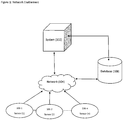
- Figure 1 illustrates network enablement of the system (102) determine an uncharacteristic sound associated with an activity in an ambient environment.
- the system (102) is connected to a network (104) to facilitate multiple communications within a wide variety of networks and protocol types, including wired networks, for example, LAN, cable, etc., and wireless networks, such as WLAN, cellular, or satellite to a configured network of sensors.
- wired networks for example, LAN, cable, etc.
- wireless networks such as WLAN, cellular, or satellite to a configured network of sensors.
- Figure 2 illustrates various modules of the system (102) to determine an uncharacteristic sound. Sound-based surveillance and its embodiment described herein directly reports patterns through a learning method.
- the system includes one or more processors, communication interface or input/output (I/O) interface, and memory or one or more internal data storage devices (not shown) operatively coupled to the one or more processors.
- the one or more processors can be implemented as one or more microprocessors, microcomputers, microcontrollers, digital signal processors, central processing units, state machines, logic circuitries, and/or any devices that manipulate signals based on operational instructions.
- the processor(s) is configured to fetch and execute computer-readable instructions stored in the memory.
- system can be implemented in a variety of computing systems, such as a laptop computer, a desktop computer, a notebook, a workstation, a mainframe computer, a server, a network server, cloud, handheld device, wearable device and the like.
- the I/O interface can include a variety of software and hardware interfaces, for example, a web interface, a graphical user interface, and the like and in an embodiment, the I/O interface can include one or more ports for connecting a number of devices to one another or to another server.
- the memory may include any computer-readable medium known in the art including, for example, volatile memory, such as static random access memory (SRAM) and dynamic random access memory (DRAM), and/or non-volatile memory, such as read only memory (ROM), erasable programmable ROM, flash memories, hard disks, optical disks, and magnetic tapes.
- volatile memory such as static random access memory (SRAM) and dynamic random access memory (DRAM)
- non-volatile memory such as read only memory (ROM), erasable programmable ROM, flash memories, hard disks, optical disks, and magnetic tapes.
- ROM read only memory
- erasable programmable ROM erasable programmable ROM
- flash memories hard disks, optical disks, and magnetic tapes.
- hard disks hard disks
- optical disks optical disks
- magnetic tapes magnetic tapes
- the system (102) as illustrated in Figure 2 comprises a plurality of modules that determine an event through data processing.
- the receiver (206) receives input signals from the ambience through a configuration of networked sensors. Sensors may be attached to non-moving asset or a location or alternately could be attached to a moving asset. Location data may be gathered in absolute terms like GPS or could be inferred approximately based on the sounds transmitted from different sensors.
- a frame analyser (208) generates sound frames for a defined time interval (t). The generated frames are processed to identify events.
- a context builder (210) comprises data elements - time data, location data - which is GPS data and a knowledge component- these data elements stored in the central server (218) are used for continuous learning in the system, with one of the objectives being to reduce false positives.
- the context builder (216) provides the knowledge component which is the contextual information relevant at that point in time for the ambient environment to determine the event.
- An action logger (214) records data pertaining to an alert event.
- An alert generator (218), on receiving indication of an event generates an alert communication to external devices and systems.
- the Receiver (206) receives an input signal.
- the input signal received by the Receiver (206) comprises sound signal received from a configured sensor network and location data - latitude/longitude data from a GPS to indicate or construct a relative map of the area under surveillance.
- an area could be that of a school and a relative map generated could be of classrooms, libraries, dining area, and playground and so on.
- the Receiver (206) receives signals from a plurality of sensors (shown in Figure 1) that are configured to be in a network.
- sensors can be fixed or mobile. Fixed sensors are affixed to a particular location in the ambient area. In an embodiment, fixed sensors are placed in classrooms, libraries, cafeterias and so on. Mobile sensors are present with the subject, for instance a wearable - in an embodiment, a mobile sensor can be worn by the school staff or students to capture ambient sound. It is pertinent to note that for mobile sensor configuration, location information can change and this is constantly updated by the system. In an embodiment, wherein a system is used in a school environment, sensors are placed in fixed locations - classrooms, common areas etc.
- mobile (wireless) sensors are fixed on student ID cards, or personal wearable objects such as watches and every student and staff also wears a sensor.
- the movement of a school staff wearing a sensor may be tracked to confirm to the prescribed schedule by the Central Server (218).
- a sensor map is created by the receiver (206) and stored in the central server (218).
- the sensor map indicates for compartmentalized areas of the ambient environment, and the sensors that are active for a given area in an ambient environment.
- the active sensors for an area are marked as a cluster of sensors in the sensor map generated by the receiver (206).
- the sensor map indicates a cluster of sensors placed at different areas of a school such as a playground, library, assembly area, laboratory, classrooms, washrooms, staff rooms.
- the sensor map indicates the number and identities of fixed and mobile sensors that are present for a given area in the ambient environment.
- sensors- both mobile and fixed are labelled for identification of location within the premises. For instance, students of class 1 will have sensors that indicate that they belong to a dynamic group for class 1.
- One of the objectives of sensor placements and clusters is to determine and monitor their location.
- both fixed and mobile sensors receive inputs from the location inside the school. For instance, some students of class 1 and class 2 could be aggregated because they learn the same elective subject.
- the sensor map will indicate movement of sensors from Class 1 and movement of sensors from Class 2 to a new location within the school premises which is to be monitored.
- the central server (218) will receive sound inputs from all the sensors of types fixed and mobile to enable the monitoring of their contexts.
- the receiver (206) collates inputs from the mobile sensors and fixed sensors and creates the sensor map.
- the inputs received from all sensors are also stored in the central server (218). If a group of mobile sensors are located close to a fixed sensor, then the sound received or rather processed frames will be strongly correlated. In an embodiment, if a class is in progress, mobile sensors worn by students and the fixed sensor placed in the classroom will transmit similar sound signals, which is analysed by the frame analyser (208).
- the monitoring of mobile sensors can be activated and de-activated by the central server (218) as they come into or go out of the monitored zone and this will be reflected in the sensor map.
- a monitored zone is an area within the environment that is being monitored for occurrence of an event.
- a library or the bus parking lot can be a monitored zone.
- a sensor can be configured to switch off once a child leaves the school bus. Sensor activation and de-activation helps in monitoring only sensors that are present in a monitored zone. In a different embodiment, if one or two sensors from a cluster of mobile sensors do not show signs of activity, it could signal an event or be a cause for concern.
- the sound signals from a cluster of sensors are received by the receiver (206) and further transmitted as sound input to a frame analyzer (208) for frame analysis and comparison.
- the frame analyser (208) creates sound frames of the captured sound signals over a time period t(k).
- the sound frames are coupled with location data, and context data from the context builder (210) - collectively termed as knowledge data set ( ⁇ ).
- Temporal signal x(t) is analysed across a time period t(k) into distinct overlapping time frames F.
- Each frame comprises temporal sound signal and knowledge data (K) - (location data and contextual data).
- FIG. 4 which comprises sound data received by the receiver (206) analysed by the frame analyser (208) to compare adjacent frames.
- the frame analyser (208) compares sound frames.
- a set of adjacent frames are compared - in this embodiment, (F1, F2, F3) is compared with (F2, F3, F4),... (Fn-1, Fn, Fn+1).
- Deviations between sound frames are recorded in the central server (218) and high deviations observed between successive frames, signals the possibility of an event, which is marked at time interval t (k).
- frame analysis comprises generating sound frames for time t(k) from the sound signals for a frame comprising frame data.
- frame data comprises various attributes of the sound signal in association with a knowledge data.
- knowledge data further comprises contextual data and location data.
- Location data is derived from the sensor map, generated by the Receiver (206). Referring to Figure 4 , frames are created for time t(k), and these frames are compared for an overlapping time between two adjacent frames to determine in sound attributed being processed.
- the frame analyser (208) observes attributes of sound signals - Zero crossing rate (ZCR), Energy, pitch, formant, Linear Prediction Coefficients (LPC), Linear Prediction Cepstrum Coefficients (LPCC), Mel-Frequency Cepstrum Coefficients (MFCCs) + delta MFCC + delta-delta-MFCC, Perceptual Linear Prediction Cepstral Coefficients (PLPCC) harmonic cepstral coefficients (HCC), and perceptual harmonic cepstral coefficients (PHCC)
- knowledge data (K) comprising a knowledge data set ( ⁇ ) is collated from the context builder (210).
- the context builder (210) further comprises a rule builder (212) to create rules that are used to correlate with the knowledge data set ( ⁇ ) and the deviation in sound signal analysed by the frame analyzer (208).
- the Rule builder (212) creates a rule set that is superimposed on the output of the frame analyzer (208).
- the Rule builder (212) comprises rules that can be defined based on the attributes of activity of the cluster of sensors, time of the day, location, schedule information and sound signal attributes. In addition, a priority can be set to defined levels such as Low, Medium, High or Emergency so that an event is flagged.
- the rule builder (212) is used to create a supervised learning model to determine an event.
- a combination of rules can be applied. In an embodiment, if there are multiple rules that can be applied for location, for instance a playground and time between 3 pm and 5 pm, all those rules are part of the context to determine the probability of occurrence of an event.
- a rule could be configured to indicate that an area such as a playground, where students of class 8 have play time and the time of day is noon, then any deviation in sound signal can be marked as low priority and not an abnormal event, as it has been observed that this is play time.
- a rule could be configured such that for art class, if students from one sensor cluster move to another sensor cluster, then priority can be low because of schedule information - students from different classes will come together for the class.
- a rule could be configured such that there is a deviation in sound signal for the bus parking area after 5 pm, priority accorded for the event should be high, as there could be chances that a school child is left behind and attention from school is required.
- a rule could be created such that for any Saturday or Sunday or school holiday, priority should be very high for any deviation in sound signal. Rules created are observed over time, and these rules can be modified or edited based on patterns observed.
- step 308 the knowledge data set ( ⁇ ) is applied along with rules from the rule builder (212) and contextual data. If there is a sudden change in sound signal - for instance, increase in amplitude, change in emotion, sound of breaking etc., should be a cause of alarm. It is critical to determine when an uncharacteristic sound is heard in these environments and how quickly can these be identified and an alert can be issued.
- contextual knowledge can comprise schedule for a school, and various classes, and a schedule for a student/faculty or administrators. Schedule can be obtained from a central server (218) that is managed by the school administration.
- the schedule for Class 8 is first obtained from the central server (218), and applicable rules from the rule builder (212) are applied.
- the sound deviation observed is not marked as an event.
- location is cafeteria time is between 12 pm and 2 pm, and if sound deviation is for time more than 30 secs priority is high for uncharacteristic sound signature.
- a sound deviation for long time duration indicates probability of a possible accident/incident.
- a mobile sensor attached to a student
- an event alarm can be triggered triggered.
- an event is flagged by the alert generator (214).
- the alert generator (214) invokes communication means such as a pager, mobile phone to an authority. In the present embodiment, the alert generator (214) will invoke communication means to inform the school administration.
- the distinct sound deviation observed by the frame analyser (208) is recorded and stored in the central server (218) as an event signature, along with supporting knowledge data set of the ambience - time, location, priority.
- a type of event is also added as a descriptor. In an embodiment, type of event could be accident in cafeteria, child left behind and so son.
- These frame with sound deviation and supporting knowledge data set is recorded in the action logger (214). These details form a repository of elements that are critical to continuous learning of the system.
- context data knowledge data - comprising time, location and priority accorded to the event is recorded in the central server (218) for continual learning.
- the detection of an event is also co-related with the rule that is applied by the Rule builder (212).
- the system maps events to the rules applied from the rule builder (212). Priority of event and type of event data is abstracted for the event detected. This mapping enables the system to perform continuous learning. In yet another embodiment, mapping of event to rules, priority aids the system to identify an event. For instance, if a deviation in sound is detected by the frame analyzer (208) after feature extraction of sound signal, location data and knowledge data is determined to be library, and sensor map determines 2 active sensors in the area after time 3 pm, the system can automatically mark the event as an event that is to be investigated. This judgement from the system is triggered as a result of multiple rule applications from the rule builder (212).
- analysis of sound signals to determine an event can be determined with the help of context sensitive data for an environment.
- Frame analysis for a different sound frames are performed to detect deviation and the observed deviation is further co-related with context data.
- the hardware device can be any kind of device which can be programmed including e.g. any kind of computer like a server or a personal computer, or the like, or any combination thereof.
- the device may also include means which could be e.g. hardware means like e.g. an application-specific integrated circuit (ASIC), a field-programmable gate array (FPGA), or a combination of hardware and software means, e.g.
- ASIC application-specific integrated circuit
- FPGA field-programmable gate array
- the means can include both hardware means and software means.
- the method embodiments described herein could be implemented in hardware and software.
- the system may also include software means.
- the system of the present disclosure may be implemented on different hardware devices, e.g. using a plurality of CPUs.
- the embodiments herein can comprise hardware and software elements.
- the embodiments that are implemented in software include but are not limited to, firmware, resident software, microcode, etc.
- the functions performed by various modules comprising the device of the present disclosure and described herein may be implemented in other modules or combinations of other modules.
- a computer-usable or computer readable medium can be any apparatus that can comprise, store, communicate, propagate, or transport the program for use by or in connection with the instruction execution system, apparatus, or device.
- the various modules described herein may be implemented as software and/or hardware modules and may be stored in any type of non-transitory computer readable medium or other storage device.
- Some non-limiting examples of non-transitory computer-readable media include CDs, DVDs, BLU-RAY, flash memory, and hard disk drives.
Landscapes
- Physics & Mathematics (AREA)
- Engineering & Computer Science (AREA)
- General Physics & Mathematics (AREA)
- Business, Economics & Management (AREA)
- Emergency Management (AREA)
- Health & Medical Sciences (AREA)
- General Health & Medical Sciences (AREA)
- Gerontology & Geriatric Medicine (AREA)
- Theoretical Computer Science (AREA)
- General Engineering & Computer Science (AREA)
- Artificial Intelligence (AREA)
- Evolutionary Computation (AREA)
- Mathematical Physics (AREA)
- Software Systems (AREA)
- Computational Linguistics (AREA)
- Data Mining & Analysis (AREA)
- Computing Systems (AREA)
- Human Computer Interaction (AREA)
- Multimedia (AREA)
- Psychiatry (AREA)
- Social Psychology (AREA)
- Automation & Control Theory (AREA)
- Fuzzy Systems (AREA)
- Computer Security & Cryptography (AREA)
- Psychology (AREA)
- Electromagnetism (AREA)
- Alarm Systems (AREA)
Applications Claiming Priority (1)
| Application Number | Priority Date | Filing Date | Title |
|---|---|---|---|
| IN201621008860 | 2016-03-14 |
Publications (1)
| Publication Number | Publication Date |
|---|---|
| EP3220367A1 true EP3220367A1 (de) | 2017-09-20 |
Family
ID=58448289
Family Applications (1)
| Application Number | Title | Priority Date | Filing Date |
|---|---|---|---|
| EP17160362.4A Ceased EP3220367A1 (de) | 2016-03-14 | 2017-03-10 | System und verfahren zur tonbasierten überwachung |
Country Status (3)
| Country | Link |
|---|---|
| US (1) | US10163313B2 (de) |
| EP (1) | EP3220367A1 (de) |
| SG (1) | SG10201702008QA (de) |
Cited By (3)
| Publication number | Priority date | Publication date | Assignee | Title |
|---|---|---|---|---|
| GB2581222A (en) * | 2019-02-05 | 2020-08-12 | Ford Global Tech Llc | Protecting property |
| CN113689663A (zh) * | 2021-08-05 | 2021-11-23 | 浙江晨逸新声物联科技有限公司 | 一种用于监控婴幼儿突发事件的系统以及方法 |
| CN114024872A (zh) * | 2020-07-17 | 2022-02-08 | 北京奇虎科技有限公司 | 语音语义平台异常报警方法、设备、存储介质及装置 |
Families Citing this family (7)
| Publication number | Priority date | Publication date | Assignee | Title |
|---|---|---|---|---|
| US11100918B2 (en) * | 2018-08-27 | 2021-08-24 | American Family Mutual Insurance Company, S.I. | Event sensing system |
| US11270572B2 (en) * | 2019-09-13 | 2022-03-08 | Veebar Tech | System and method for alerting a user to the presence of environmental sounds |
| TWI712944B (zh) * | 2019-11-28 | 2020-12-11 | 睿捷國際股份有限公司 | 利用聲音監控設備之方法 |
| US11804126B2 (en) | 2020-02-24 | 2023-10-31 | Intrado Life & Safety, Inc. | Determining emergency severity and response strategy |
| JP2022007313A (ja) * | 2020-06-26 | 2022-01-13 | ルネサスエレクトロニクス株式会社 | 時系列センサデータ処理装置および時系列センサデータ処理方法 |
| US20220067090A1 (en) * | 2020-08-28 | 2022-03-03 | Comcast Cable Communications, Llc | Systems, methods, and apparatuses for intelligent audio event detection |
| CN114398442B (zh) * | 2022-01-25 | 2023-09-19 | 中国电子科技集团公司第十研究所 | 一种基于数据驱动的情报处理系统 |
Citations (3)
| Publication number | Priority date | Publication date | Assignee | Title |
|---|---|---|---|---|
| US20100090834A1 (en) * | 2008-10-13 | 2010-04-15 | Sandisk Il Ltd. | Wearable device for adaptively recording signals |
| US20120262294A1 (en) * | 2009-10-13 | 2012-10-18 | Commissariat A L'energie Atomique Et Aux Energies Alternatives | Facility and method for monitoring a defined, predetermined area using at least one acoustic sensor |
| WO2016032464A1 (en) * | 2014-08-27 | 2016-03-03 | Leeo, Inc. | Portal-security detection mechanism |
Family Cites Families (17)
| Publication number | Priority date | Publication date | Assignee | Title |
|---|---|---|---|---|
| US6400996B1 (en) * | 1999-02-01 | 2002-06-04 | Steven M. Hoffberg | Adaptive pattern recognition based control system and method |
| US7006881B1 (en) * | 1991-12-23 | 2006-02-28 | Steven Hoffberg | Media recording device with remote graphic user interface |
| US7035877B2 (en) * | 2001-12-28 | 2006-04-25 | Kimberly-Clark Worldwide, Inc. | Quality management and intelligent manufacturing with labels and smart tags in event-based product manufacturing |
| FR2854483B1 (fr) * | 2003-05-02 | 2005-12-09 | Miriad Technologies | Procede d'identification de sons specifiques |
| US20050254440A1 (en) * | 2004-05-05 | 2005-11-17 | Sorrell John D | Private multimedia network |
| US7825813B2 (en) * | 2006-07-25 | 2010-11-02 | Intelehealth, Inc | Identifying activity in an area utilizing sound detection and comparison |
| US8275611B2 (en) * | 2007-01-18 | 2012-09-25 | Stmicroelectronics Asia Pacific Pte., Ltd. | Adaptive noise suppression for digital speech signals |
| US20090248411A1 (en) * | 2008-03-28 | 2009-10-01 | Alon Konchitsky | Front-End Noise Reduction for Speech Recognition Engine |
| ES2678415T3 (es) * | 2008-08-05 | 2018-08-10 | Fraunhofer-Gesellschaft zur Förderung der angewandten Forschung e.V. | Aparato y procedimiento para procesamiento y señal de audio para mejora de habla mediante el uso de una extracción de característica |
| US8560313B2 (en) * | 2010-05-13 | 2013-10-15 | General Motors Llc | Transient noise rejection for speech recognition |
| US8731936B2 (en) * | 2011-05-26 | 2014-05-20 | Microsoft Corporation | Energy-efficient unobtrusive identification of a speaker |
| US10546481B2 (en) * | 2011-07-12 | 2020-01-28 | Cerner Innovation, Inc. | Method for determining whether an individual leaves a prescribed virtual perimeter |
| CN102881284B (zh) | 2012-09-03 | 2014-07-09 | 江苏大学 | 非特定人语音情感识别方法及系统 |
| US20140198098A1 (en) * | 2013-01-16 | 2014-07-17 | Tae Joo | Experience Enhancement Environment |
| US9852342B2 (en) * | 2013-02-07 | 2017-12-26 | Iomniscient Pty Ltd | Surveillance system |
| US20170124834A1 (en) * | 2014-06-06 | 2017-05-04 | Maher Pedersoli | Systems and methods for secure collection of surveillance data |
| US9852620B1 (en) * | 2014-09-19 | 2017-12-26 | Thomas John Hoeft | System and method for detecting sound and performing an action on the detected sound |
-
2017
- 2017-03-10 EP EP17160362.4A patent/EP3220367A1/de not_active Ceased
- 2017-03-13 US US15/457,747 patent/US10163313B2/en active Active
- 2017-03-13 SG SG10201702008QA patent/SG10201702008QA/en unknown
Patent Citations (3)
| Publication number | Priority date | Publication date | Assignee | Title |
|---|---|---|---|---|
| US20100090834A1 (en) * | 2008-10-13 | 2010-04-15 | Sandisk Il Ltd. | Wearable device for adaptively recording signals |
| US20120262294A1 (en) * | 2009-10-13 | 2012-10-18 | Commissariat A L'energie Atomique Et Aux Energies Alternatives | Facility and method for monitoring a defined, predetermined area using at least one acoustic sensor |
| WO2016032464A1 (en) * | 2014-08-27 | 2016-03-03 | Leeo, Inc. | Portal-security detection mechanism |
Cited By (4)
| Publication number | Priority date | Publication date | Assignee | Title |
|---|---|---|---|---|
| GB2581222A (en) * | 2019-02-05 | 2020-08-12 | Ford Global Tech Llc | Protecting property |
| GB2581222B (en) * | 2019-02-05 | 2021-03-03 | Ford Global Tech Llc | Protecting property |
| CN114024872A (zh) * | 2020-07-17 | 2022-02-08 | 北京奇虎科技有限公司 | 语音语义平台异常报警方法、设备、存储介质及装置 |
| CN113689663A (zh) * | 2021-08-05 | 2021-11-23 | 浙江晨逸新声物联科技有限公司 | 一种用于监控婴幼儿突发事件的系统以及方法 |
Also Published As
| Publication number | Publication date |
|---|---|
| SG10201702008QA (en) | 2017-10-30 |
| US10163313B2 (en) | 2018-12-25 |
| US20180225939A1 (en) | 2018-08-09 |
Similar Documents
| Publication | Publication Date | Title |
|---|---|---|
| US10163313B2 (en) | System and method for sound based surveillance | |
| CN118072255B (zh) | 一种智慧园区多源数据动态监控和实时分析系统及方法 | |
| Böse et al. | CISN ShakeAlert: An earthquake early warning demonstration system for California | |
| JP5422859B2 (ja) | 監視装置および不審行動検出方法 | |
| US9142106B2 (en) | Tailgating detection | |
| CN104166780B (zh) | 用于记录和处理数据的移动装置和计算机实现方法 | |
| US20230358890A1 (en) | Individual identification and tracking via combined video and lidar systems | |
| CN110910606B (zh) | 一种基于目标跟踪的儿童防走失方法和系统 | |
| US11164438B2 (en) | Systems and methods for detecting anomalies in geographic areas | |
| di Bella et al. | Smart Security: Integrated systems for security policies in urban environments | |
| Schauer et al. | Conceptual framework for hybrid situational awareness in critical port infrastructures | |
| CN116670697A (zh) | 用于雨林非法采伐的利用传感器融合的动态声学签名系统 | |
| US20230104767A1 (en) | Health and safety management system | |
| KR102855269B1 (ko) | 설명가능 트랜스포머 기반의 산업안전 인스펙션 보고서 자동 생성 장치 및 방법 | |
| Hite et al. | Automated vehicle detection in a nuclear facility using low-frequency acoustic sensors | |
| Gorodnichy et al. | Recognizing people and their activities in surveillance video: technology state of readiness and roadmap | |
| Tsanaullailla et al. | Smart Surveillance in Retail Stores: Detection, Classification, and Documentation of Suspicious Behavior Utilizing YOLOv11 and XGBoost | |
| Isles et al. | BeAwareOfYourAct: A Framework for Behavioural Action Detection in Workplace through Deep Learning Analysis and Augmented Action Pattern Recognition | |
| EP4715633A1 (de) | Bilderkennung auf basis von signaturanalyse | |
| Heck | 'The duty to prevent' | |
| US12567316B1 (en) | Security systems and methods for detecting anomalous events using sensors | |
| Younis | An Immersive Digital Twin Framework for Intelligent Spatially Grounded Anomaly Detection in Smart Homes. | |
| TR2025017665A2 (tr) | İş güvenli̇ği̇ni̇ sağlamaya yarayan bi̇r yöntem ve si̇stem | |
| Saradopoulos et al. | Audio surveillance for self-aware environments | |
| Nawaz et al. | Social sensing in the field: challenges in detecting social interactions in construction sites |
Legal Events
| Date | Code | Title | Description |
|---|---|---|---|
| PUAI | Public reference made under article 153(3) epc to a published international application that has entered the european phase |
Free format text: ORIGINAL CODE: 0009012 |
|
| STAA | Information on the status of an ep patent application or granted ep patent |
Free format text: STATUS: THE APPLICATION HAS BEEN PUBLISHED |
|
| AK | Designated contracting states |
Kind code of ref document: A1 Designated state(s): AL AT BE BG CH CY CZ DE DK EE ES FI FR GB GR HR HU IE IS IT LI LT LU LV MC MK MT NL NO PL PT RO RS SE SI SK SM TR |
|
| AX | Request for extension of the european patent |
Extension state: BA ME |
|
| STAA | Information on the status of an ep patent application or granted ep patent |
Free format text: STATUS: REQUEST FOR EXAMINATION WAS MADE |
|
| 17P | Request for examination filed |
Effective date: 20180312 |
|
| RBV | Designated contracting states (corrected) |
Designated state(s): AL AT BE BG CH CY CZ DE DK EE ES FI FR GB GR HR HU IE IS IT LI LT LU LV MC MK MT NL NO PL PT RO RS SE SI SK SM TR |
|
| STAA | Information on the status of an ep patent application or granted ep patent |
Free format text: STATUS: EXAMINATION IS IN PROGRESS |
|
| 17Q | First examination report despatched |
Effective date: 20190201 |
|
| STAA | Information on the status of an ep patent application or granted ep patent |
Free format text: STATUS: THE APPLICATION HAS BEEN REFUSED |
|
| 18R | Application refused |
Effective date: 20240719 |