EP3223790B1 - Mittel zum färben von keratinischen fasern, enthaltend mindestens einen dimeren, dikationischen azofarbstoff mit speziellem substitutionsmuster - Google Patents
Mittel zum färben von keratinischen fasern, enthaltend mindestens einen dimeren, dikationischen azofarbstoff mit speziellem substitutionsmuster Download PDFInfo
- Publication number
- EP3223790B1 EP3223790B1 EP15784308.7A EP15784308A EP3223790B1 EP 3223790 B1 EP3223790 B1 EP 3223790B1 EP 15784308 A EP15784308 A EP 15784308A EP 3223790 B1 EP3223790 B1 EP 3223790B1
- Authority
- EP
- European Patent Office
- Prior art keywords
- methyl
- amino
- diazen
- ium
- phenyl
- Prior art date
- Legal status (The legal status is an assumption and is not a legal conclusion. Google has not performed a legal analysis and makes no representation as to the accuracy of the status listed.)
- Active
Links
- 0 *c1c(*)[n]c*1* Chemical compound *c1c(*)[n]c*1* 0.000 description 12
- BHLWJBVEPMHGBH-UOALMSBLSA-N CCN(CCCN(CC)c(cc1C)ccc1/N=N\c1ncc[s]1)c(cc1)cc(C)c1/N=N\c1ncc[s]1 Chemical compound CCN(CCCN(CC)c(cc1C)ccc1/N=N\c1ncc[s]1)c(cc1)cc(C)c1/N=N\c1ncc[s]1 BHLWJBVEPMHGBH-UOALMSBLSA-N 0.000 description 1
- VCTSNFUJBQNIMN-UHFFFAOYSA-N [N-]=[NH+]c1ncc[s]1 Chemical compound [N-]=[NH+]c1ncc[s]1 VCTSNFUJBQNIMN-UHFFFAOYSA-N 0.000 description 1
Classifications
-
- A—HUMAN NECESSITIES
- A61—MEDICAL OR VETERINARY SCIENCE; HYGIENE
- A61K—PREPARATIONS FOR MEDICAL, DENTAL OR TOILETRY PURPOSES
- A61K8/00—Cosmetics or similar toiletry preparations
- A61K8/18—Cosmetics or similar toiletry preparations characterised by the composition
- A61K8/30—Cosmetics or similar toiletry preparations characterised by the composition containing organic compounds
- A61K8/49—Cosmetics or similar toiletry preparations characterised by the composition containing organic compounds containing heterocyclic compounds
-
- A—HUMAN NECESSITIES
- A61—MEDICAL OR VETERINARY SCIENCE; HYGIENE
- A61K—PREPARATIONS FOR MEDICAL, DENTAL OR TOILETRY PURPOSES
- A61K8/00—Cosmetics or similar toiletry preparations
- A61K8/18—Cosmetics or similar toiletry preparations characterised by the composition
- A61K8/19—Cosmetics or similar toiletry preparations characterised by the composition containing inorganic ingredients
- A61K8/22—Peroxides; Oxygen; Ozone
-
- A—HUMAN NECESSITIES
- A61—MEDICAL OR VETERINARY SCIENCE; HYGIENE
- A61K—PREPARATIONS FOR MEDICAL, DENTAL OR TOILETRY PURPOSES
- A61K8/00—Cosmetics or similar toiletry preparations
- A61K8/18—Cosmetics or similar toiletry preparations characterised by the composition
- A61K8/30—Cosmetics or similar toiletry preparations characterised by the composition containing organic compounds
- A61K8/49—Cosmetics or similar toiletry preparations characterised by the composition containing organic compounds containing heterocyclic compounds
- A61K8/494—Cosmetics or similar toiletry preparations characterised by the composition containing organic compounds containing heterocyclic compounds with more than one nitrogen as the only hetero atom
- A61K8/4946—Imidazoles or their condensed derivatives, e.g. benzimidazoles
-
- A—HUMAN NECESSITIES
- A61—MEDICAL OR VETERINARY SCIENCE; HYGIENE
- A61K—PREPARATIONS FOR MEDICAL, DENTAL OR TOILETRY PURPOSES
- A61K8/00—Cosmetics or similar toiletry preparations
- A61K8/18—Cosmetics or similar toiletry preparations characterised by the composition
- A61K8/30—Cosmetics or similar toiletry preparations characterised by the composition containing organic compounds
- A61K8/49—Cosmetics or similar toiletry preparations characterised by the composition containing organic compounds containing heterocyclic compounds
- A61K8/494—Cosmetics or similar toiletry preparations characterised by the composition containing organic compounds containing heterocyclic compounds with more than one nitrogen as the only hetero atom
- A61K8/496—Triazoles or their condensed derivatives, e.g. benzotriazoles
-
- A—HUMAN NECESSITIES
- A61—MEDICAL OR VETERINARY SCIENCE; HYGIENE
- A61Q—SPECIFIC USE OF COSMETICS OR SIMILAR TOILETRY PREPARATIONS
- A61Q5/00—Preparations for care of the hair
- A61Q5/06—Preparations for styling the hair, e.g. by temporary shaping or colouring
- A61Q5/065—Preparations for temporary colouring the hair, e.g. direct dyes
-
- A—HUMAN NECESSITIES
- A61—MEDICAL OR VETERINARY SCIENCE; HYGIENE
- A61Q—SPECIFIC USE OF COSMETICS OR SIMILAR TOILETRY PREPARATIONS
- A61Q5/00—Preparations for care of the hair
- A61Q5/08—Preparations for bleaching the hair
-
- C—CHEMISTRY; METALLURGY
- C09—DYES; PAINTS; POLISHES; NATURAL RESINS; ADHESIVES; COMPOSITIONS NOT OTHERWISE PROVIDED FOR; APPLICATIONS OF MATERIALS NOT OTHERWISE PROVIDED FOR
- C09B—ORGANIC DYES OR CLOSELY-RELATED COMPOUNDS FOR PRODUCING DYES, e.g. PIGMENTS; MORDANTS; LAKES
- C09B31/00—Disazo and polyazo dyes of the type A->B->C, A->B->C->D, or the like, prepared by diazotising and coupling
- C09B31/02—Disazo dyes
- C09B31/12—Disazo dyes from other coupling components "C"
- C09B31/14—Heterocyclic components
-
- C—CHEMISTRY; METALLURGY
- C09—DYES; PAINTS; POLISHES; NATURAL RESINS; ADHESIVES; COMPOSITIONS NOT OTHERWISE PROVIDED FOR; APPLICATIONS OF MATERIALS NOT OTHERWISE PROVIDED FOR
- C09B—ORGANIC DYES OR CLOSELY-RELATED COMPOUNDS FOR PRODUCING DYES, e.g. PIGMENTS; MORDANTS; LAKES
- C09B44/00—Azo dyes containing onium groups
- C09B44/10—Azo dyes containing onium groups containing cyclammonium groups attached to an azo group by a carbon atom of the ring system
- C09B44/14—1,2-Diazoles or hydrogenated 1,2-diazoles ; Pyrazolium; Indazolium
-
- C—CHEMISTRY; METALLURGY
- C09—DYES; PAINTS; POLISHES; NATURAL RESINS; ADHESIVES; COMPOSITIONS NOT OTHERWISE PROVIDED FOR; APPLICATIONS OF MATERIALS NOT OTHERWISE PROVIDED FOR
- C09B—ORGANIC DYES OR CLOSELY-RELATED COMPOUNDS FOR PRODUCING DYES, e.g. PIGMENTS; MORDANTS; LAKES
- C09B44/00—Azo dyes containing onium groups
- C09B44/10—Azo dyes containing onium groups containing cyclammonium groups attached to an azo group by a carbon atom of the ring system
- C09B44/16—1,3-Diazoles or hydrogenated 1,3-diazoles ; (Benz)imidazolium
-
- C—CHEMISTRY; METALLURGY
- C09—DYES; PAINTS; POLISHES; NATURAL RESINS; ADHESIVES; COMPOSITIONS NOT OTHERWISE PROVIDED FOR; APPLICATIONS OF MATERIALS NOT OTHERWISE PROVIDED FOR
- C09B—ORGANIC DYES OR CLOSELY-RELATED COMPOUNDS FOR PRODUCING DYES, e.g. PIGMENTS; MORDANTS; LAKES
- C09B44/00—Azo dyes containing onium groups
- C09B44/10—Azo dyes containing onium groups containing cyclammonium groups attached to an azo group by a carbon atom of the ring system
- C09B44/18—Azo dyes containing onium groups containing cyclammonium groups attached to an azo group by a carbon atom of the ring system having three nitrogen atoms as the only ring hetero atoms
-
- C—CHEMISTRY; METALLURGY
- C09—DYES; PAINTS; POLISHES; NATURAL RESINS; ADHESIVES; COMPOSITIONS NOT OTHERWISE PROVIDED FOR; APPLICATIONS OF MATERIALS NOT OTHERWISE PROVIDED FOR
- C09B—ORGANIC DYES OR CLOSELY-RELATED COMPOUNDS FOR PRODUCING DYES, e.g. PIGMENTS; MORDANTS; LAKES
- C09B44/00—Azo dyes containing onium groups
- C09B44/10—Azo dyes containing onium groups containing cyclammonium groups attached to an azo group by a carbon atom of the ring system
- C09B44/20—Thiazoles or hydrogenated thiazoles
-
- A—HUMAN NECESSITIES
- A61—MEDICAL OR VETERINARY SCIENCE; HYGIENE
- A61K—PREPARATIONS FOR MEDICAL, DENTAL OR TOILETRY PURPOSES
- A61K2800/00—Properties of cosmetic compositions or active ingredients thereof or formulation aids used therein and process related aspects
- A61K2800/40—Chemical, physico-chemical or functional or structural properties of particular ingredients
- A61K2800/42—Colour properties
- A61K2800/43—Pigments; Dyes
- A61K2800/432—Direct dyes
- A61K2800/4322—Direct dyes in preparations for temporarily coloring the hair further containing an oxidizing agent
Definitions
- compositions for dyeing keratin fibers, in particular human hair which (a) contain at least one dimeric, dicationic azo dye of a special formula (I).
- Either direct dyes or oxidation dyes are generally used for dyeing keratin fibers. With oxidation dyes intensive dyeings can be achieved with good fastness properties, but the development of the color is generally done under the influence of oxidizing agents such. B. H 2 O 2 , which in some cases can result in damage to the fiber. Furthermore, some oxidation dye precursors or certain mixtures of oxidation dye precursors can have a sensitizing effect on people with sensitive skin. Direct dyes are applied under gentler conditions. However, their disadvantage lies in the fact that the dyeings often have inadequate fastness properties.
- the expert uses direct dyes of different dye classes.
- the substantive dyes known from the prior art belong, for example, to the class of nitro dyes, anthraquinone dyes, azo dyes, triarylmethane dyes or methine dyes. All of these dye classes should meet a certain requirement profile for use in the cosmetics sector.
- Direct dyes should deliver an intense dyeing result and have the best possible fastness properties.
- the color result obtained with direct dyes should be influenced as little as possible by environmental influences, i.e. for example, the dyes should have good wash fastness, light fastness and rub fastness. Chemical influences to which the keratin fibers may be exposed after the dyeing process (such as perms) should change the color result as little as possible.
- the direct dyes should, if possible, also be compatible with the oxidizing agents (such as hydrogen peroxide and / or persulfates) commonly used in bleaching processes.
- oxidizing agents such as hydrogen peroxide and / or persulfates
- Cationic dyes are often characterized by a particularly high affinity for keratin fibers, which can be attributed to the interactions of the positive charges of the dyes with negatively charged structural components of the keratin fibers. Therefore, particularly intensive colorations can often be achieved with cationic dyes.
- Monomeric cationic azo dyes well known from the prior art are, for example, the representatives Basic Orange 31 (alternative name: 2 - [(4-aminophenyl) azo] -1, 3-dimethyl-1 H-imidazolium chloride, CAS number 97404-02-9 ) and Basic Red 51 (alternative name: 2 - [((4-dimethylamino) phenyl) azo] -1,3-dimethyl-1H-imidazolium chloride, CAS number 77061-58-6 ).
- US2004 / 200009 discloses dimeric dicationic substantive dyes.
- the object of the present application is therefore to provide colorants for keratin fibers, in particular human hair, which have good application properties in terms of color depth and fastness properties, such as, in particular, fastness to light, rubbing and washing, as well as fastness to welding and cold waves.
- the substantive dyes should have a high stability against hydrogen peroxide and other oxidizing agents and should not lose their positive fastness and dyeing properties. In addition, bright and intense colorations should be achieved.
- the aforementioned dyes should also be particularly well compatible with the cationic azo dyes Basic Orange 31 and Basic Red 51.
- Keratin fibers, keratin fibers or keratin fibers are to be understood as furs, wool, feathers and in particular human hair. Although the agents according to the invention are primarily suitable for lightening keratin fibers, there is in principle nothing to prevent their use in other areas.
- color change of keratin fibers used according to the invention encompasses any form of color change of the fibers.
- Color changes which have a lighter color result compared to the starting color, such as coloring bleaching, are explicitly included according to the invention.
- a coloring bleaching means the simultaneous lightening and coloring of the keratin fibers, which can be achieved by the simultaneous use of oxidizing agent and dye in the coloring agent.
- the agents according to the invention contain the substantive dyes of the formula (I) in a cosmetic carrier.
- This cosmetic carrier is preferably aqueous, alcoholic or aqueous alcoholic.
- such carriers are, for example, creams, emulsions, gels or also surfactant-containing foaming solutions, such as shampoos, foam aerosols or other preparations which are suitable for use on the hair.
- a powdery or tablet-like formulation for storage This is then before use in an aqueous solvent or with organic solvents or with mixtures of water and organic solvents to obtain the Application mixture mixed.
- an aqueous carrier contains at least 40% by weight, in particular at least 50% by weight, of water.
- aqueous-alcoholic carriers are understood to mean water-containing compositions containing 3 to 70% by weight of a C 1 -C 4 alcohol, in particular ethanol or isopropanol.
- the agents according to the invention can additionally contain further organic solvents, such as 4-methoxybutanol, ethyl diglycol, 1,2-propylene glycol, n-propanol, n-butanol, n-butylene glycol, glycerol, diethylene glycol monoethyl ether, and diethylene glycol mono-n-butyl ether. All water-soluble organic solvents are preferred.
- Preferred agents according to the invention are characterized in that they additionally contain a non-aqueous solvent, preferred agents according to the invention containing the solvent in a concentration of 0.1 to 30% by weight, preferably in a concentration of 1 to 20% by weight, very particularly preferably in a concentration of 2 to 10 wt .-%, each based on the agent.
- the agents according to the invention contain at least one direct dye of formula (I).
- the substituents R1 to R10 of the compounds of the formula (I) are explained by way of example below:
- Examples of a C 1 -C 6 -alkyl group are the groups methyl, ethyl, propyl, isopropyl, n-butyl, s-butyl and t-butyl, n-pentyl and n-hexyl.
- Propyl, ethyl and methyl are preferred alkyl radicals.
- Examples of a C 2 -C 6 alkenyl group are vinyl, allyl, but-2-enyl, but-3-enyl and isobutenyl, preferred C 2 -C 6 alkenyl radicals are vinyl and allyl.
- Halogen atoms are selected from the group consisting of chlorine, bromine, fluorine and / or iodine, with chlorine and bromine being particularly preferred.
- the methoxy, the ethoxy and the propoxy group can be mentioned as examples of a C 1 -C 6 alkoxy group.
- a nitro group is to be understood as a group -NO 2 .
- Each direct dye of formula (I) carries two cationic, heterocyclic end groups Het 1 and Het 2, which are selected independently of one another from the groupings of formulas (II) to (VII)
- Formula (II) represents a cationic thiazolium end group.
- Formula (III) represents a cationic imidazolium end group.
- Formula (IV) represents a cationic 1,2,4-triazolium end group.
- Formula (V) represents a cationic 1,3,4-thiadiazolium end group.
- Formula (VI) represents a cationic 1,2,4-thiadiazolium end group.
- Formula (VII) represents a cationic pyrazolium end group.
- heterocyclic end groups Het 1 and Het 2 can be the same or different in the dyes of the formula (I). Purer colorations are obtained when Het 1 and Het 2 are the same in a dye of formula (I).
- the absorption spectrum of the dye and therefore also the color of the dye can be influenced.
- Het 1 and Het 2 stand for heterocyclic end groups of the formula (II).
- Het 1 and Het 2 are selected from the heterocyclic end groups of the formulas (III) and / or (IV).
- dyes of the formula (I) in which Het 1 and Het 2 stand for a group selected from the formulas (II), (III) or (IV) can be used to produce particularly pure and luminous shades.
- the agent (a) according to the invention contains at least one substantive dye of the general formula (I) in which Het1, Het2 independently of one another represent one of the structures (II), (III) or (IV).
- an agent according to the invention is characterized in that it (a) contains at least one substantive dye of the general formula (I) in which Het1, Het2 independently of one another each represent one of the structures (II), (III) or (IV),
- radicals R1 to R4 indicate the substituents on the two phenyl rings of the substantive dye of the formula (I).
- R1 and R3 here can independently of one another stand for a C 1 -C 6 -alkyl group, or for a C 1 -C 6 -alkoxy group.
- R1 and R3 in the dye of the formula (I) can be the same or different. However, it is preferred if R1 and R3 are the same in each dye of formula (I).
- the radicals R2 and R4 both represent a hydrogen atom. Surprisingly, it has been found that the presence of at least one substituent on each of the two phenyl rings of a dye of the formula (I) has a very substantial influence on the oxidation stability of the dye.
- the oxidation stability of a dye could be increased from the general structure of formula (I) by introducing at least one substituent on each of the two phenyl rings of the dye. For this reason, neither R1 and R3 can represent a hydrogen atom.
- R1 and R3 independently of one another represent a C 1 -C 6 alkyl group.
- R2 and R4 both represent a hydrogen atom.
- the substantive dyes of the general formula (I) also carry the radicals R5 and R6.
- R5 and R6 can independently represent a hydrogen atom, a C 1 -C 6 alkyl group or a C 2 -C 6 alkenyl group. It is particularly preferred if R5 and R6 independently of one another represent hydrogen or a C 1 -C 6 alkyl group, in particular a methyl group or an ethyl group.
- R5 and R6 can be the same or different, it is preferred if R5 and R6 are the same.
- heterocyclic end groups Het 1 and Het 2 of the formulas (II) to (VII) carry the radicals R7, R8, R9 and / or R10.
- the residues R7 and R10 are each bound to a nitrogen atom of the heterocycles Het 1 and Het 2.
- the radicals R7 and R10 can each independently represent a C 1 -C 6 -alkyl group or a C 2 -C 6 -alkenyl group. It is preferred if R7 and R10 each independently represent a methyl group or an ethyl group.
- the radicals R8 and R9 can each independently represent a hydrogen atom, a C 1 -C 6 -alkyl group, a halogen atom from the group chlorine, bromine, fluorine or iodine, a C 1 -C 6 -alkoxy group or a nitro group. It is preferred if R8 and R9 both represent a hydrogen atom.
- the two positions marked with an asterisk each represent the link positions to the two N atoms of the formula (I).
- the connecting group Q which links the two individual chromophores to one another, has a chain length of at least 3 atoms.
- n in formula (VIII) stands for an integer of at least 3.
- the connecting group Q of formula (VIII) accordingly comprises at least 3 carbon atoms (ie this is a group with a minimum length of -CH 2 -CH 2 -CH 2 -).
- the dyes of the formula (I) according to the invention are dimeric azo dyes which have a double positive charge.
- the two positive charges are neutralized by the anionic counterions X.
- the dicationic organic part is responsible for the coloring of the keratin fibers.
- the counterions X only serve to maintain electroneutrality, so that the exact nature of the counterions X is none for achieving the desired color result plays an important role. Since the dye is used in a cosmetic product, the counterions X must be physiologically compatible. In this context, physiologically compatible means suitable for use in cosmetic products (ie for use on human hair and skin).
- X is physiologically compatible anions, preferably from the group chloride, bromide, iodide, methyl sulfate, methyl sulfonate, p-toluenesulfonate, acetate, hydrogen sulfate, 1 ⁇ 2 sulfate or 1 ⁇ 2 tetrachlorozincate.
- Chloride is understood to mean an anion Cl - .
- Bromide means an anion Br - .
- An iodide is understood to be an anion J - .
- Methyl sulfate means an anion H 3 COSO 4 - .
- Methyl sulfonate means an anion H 3 CSO 3 - .
- P-Toluenesulfonate is understood to mean an anion H 3 C (C 6 H 4 ) SO 3 - .
- Acetate means an anion H 3 CCOO - .
- Hydrogen sulfate is understood to mean an anion HSO 4 - .
- 1 ⁇ 2 sulfate is understood to mean half an equivalent of the double negatively charged anion SO 4 2- .
- 1 ⁇ 2 tetrachlorozincate is understood to mean half an equivalent of the double negatively charged anion ZnCl 4 2- .
- the dicationic dye of the formula (I) is neutralized by an SO 4 2- ion or by a ZnCl 4 2- ion.
- the aforementioned compounds are dicationic dimeric dyes, the organic dication being X-neutralized by two anions.
- the anions X- is a physiologically acceptable anion, preferably from the group consisting of chloride, bromide, iodide, methyl sulfate, methyl sulfonate, p-toluenesulfonate, acetate, hydrogen sulfate, 1 ⁇ 2 sulfate or 1 ⁇ 2 tetrachlorozincate.
- the agents according to the invention for changing the color of keratinic fibers preferably contain the direct dye or dyes of the formula (I) in a total amount of from 0.01 to 4.5% by weight, preferably from 0.05 to 2.8% by weight, more preferably from 0.1 to 2.2% by weight and particularly preferably from 0.2 to 1.2% by weight.
- the quantity in percent by weight relates to the total amount of all compounds of the formula (I) contained in the composition, which is related to the total weight of the composition.
- an agent according to the invention for dyeing keratin fibers is therefore characterized in that - based on the total weight of the agent - it contains one or more substantive dyes (a) of the formula (I) in a total amount of 0.01 to 4 , 5% by weight, preferably from 0.05 to 2.8% by weight, more preferably from 0.1 to 2.2% by weight and particularly preferably from 0.2 to 1.2% by weight contains.
- the dyes of the general formula (I) can be prepared, for example, by a process as described in WO 2002/100369 A2 is described.
- the starting material 2-aminothiazole in concentrated sulfuric acid can be converted into the diazonium ion with nitrosylsulfuric acid:
- the starting material N, N'-diethyl-N, N'-bis (3-methylphenyl) -1,3-propanediamine used in the azo coupling reaction and the compounds analogous thereto can be prepared, for example, as described in US 4,562,249 has been described.
- the neutral dimeric dye formed in the azo coupling reaction can then finally be double quaternized with quaternizing agents.
- the quaternization reaction is preferably carried out in a polar aprotic solvent (such as DMSO, DMF etc.).
- suitable quaternizing agents are dimethyl sulfate, methyl bromide or p-toluenesulfonate.
- a central task of the present application was the provision of colorants with direct dyes, which have a high oxidation stability and thus enable the strong lightening and coloring of keratin fibers at the same time.
- the substantive dyes of the formula (I) were particularly stable against a mixture of hydrogen peroxide and persulfates.
- the agents according to the invention therefore additionally contain hydrogen peroxide in a further preferred embodiment.
- hydrogen peroxide itself is used as an aqueous solution.
- concentration of a hydrogen peroxide solution in the agent according to the invention is determined on the one hand by the legal requirements and on the other hand by the desired effect; 6 to 12% by weight solutions in water are preferably used.
- Preferred ready-to-use agents of the first subject matter of the invention are characterized in that, based on the total weight of the ready-to-use agent, they are 0.5 to 12.5% by weight, particularly preferably 2.5 to 10% by weight and in particular 4.0 up to 9.0% by weight of hydrogen peroxide, each based on the total weight of the composition.
- an agent according to the invention is characterized in that it is - based on the total weight of the agent - 0.5 to 12.5% by weight, preferably 2.5 to 10% by weight and in particular 4.0 contains up to 9.0% by weight of hydrogen peroxide.
- the agent can also contain at least one peroxo salt.
- peroxo salts are preferred, inorganic peroxo compounds selected from the group consisting of ammonium peroxodisulfate, alkali metal peroxodisulfates, ammonium peroxomonosulfate, alkali metal peroxomonosulfates, alkali metal peroxodiphosphates and alkaline earth metal peroxides.
- Peroxodisulfates in particular ammonium peroxodisulfate, potassium peroxodisulfate and sodium peroxodisulfate, are particularly preferred.
- an agent according to the invention is characterized in that it contains at least one persulfate from the group consisting of ammonium peroxodisulfate, potassium peroxodisulfate and sodium peroxodisulfate.
- Ammonium peroxodisulfate is a compound of the formula (NH 4 ) 2 S 2 O 8 .
- Potassium peroxodisulfate is a compound of the formula K 2 S 2 O 8 .
- Sodium peroxodisulfate is a compound of the formula Na 2 S 2 O 8 .
- the persulfates are each in an amount of 0.5 to 20% by weight, preferably 1 to 12.5% by weight, particularly preferably 2.5 to 10% by weight and in particular 3 to 6% by weight, based on the total weight of the ready-to-use agent, contained in the agent according to the invention.
- an agent according to the invention is characterized in that, based on the total weight of the agent, one or more persulfates from the group consisting of ammonium peroxodisulfate, potassium peroxodisulfate and sodium peroxodisulfate in a total amount of 0.5 to 20% by weight, preferably contains from 1.0 to 12.5% by weight, more preferably from 2.5 to 10% by weight and particularly preferably from 3.0 to 6.0% by weight.
- the substantive dyes of the general formula (I) according to the invention have proven to be particularly stable with respect to certain mixtures of ammonium peroxodisulfate, potassium peroxodisulfate and sodium peroxodisulfate.
- the color-changing agent according to the invention can contain further bleaching power enhancers to enhance the bleaching effect, such as, for example, tetraacetylethylene diamine (TAED), 1,5-diacetyl-2,4-dioxohexahydro-1,3,5-triazine (DADHT), tetraacetylglycoluril (TAGU), N-nonanoylsuccinimide (NOSI), n-nonanoyl- or isononanoyloxybenzenesulfonate (n- or i-NOBS), phthalic anhydride, triacetin, ethylene glycol diacetate and 2,5-diacetoxy-2,5-dihydrofuran as well as carbonate salts or bicarbonate salts, especially ammonium bicarbonate, ammonium carbonate, sodium hydrogen carbonate Disodium carbonate, potassium hydrogen carbonate, dipotassium carbonate and calcium carbonate, and nitrogen-containing, heterocyclic
- At least one SiO 2 compound such as silica or silicates, in particular water glasses, can additionally be added to the composition according to the invention.
- the SiO 2 compounds in amounts of 0.05% by weight to 15% by weight, particularly preferably in amounts of 0.15% by weight to 10% by weight and very particularly preferably in amounts of 0.2% by weight to 5% by weight, based in each case on the anhydrous composition according to the invention.
- the quantities given in each case reflect the content of the SiO 2 compounds (without their water content) in the compositions.
- the agents according to the invention contain, in addition to the compound of the formula (I), at least one further direct dye.
- at least one further direct dye By combining it with other cationic direct dyes, the range of shades that can be achieved can be expanded and the coloring properties can be further improved.
- an agent according to the invention is therefore characterized in that it contains at least one SiO 2 compound from the group of silicas, silicates, water glasses and / or alkali metal metasilicates.
- the agent according to the invention for changing the color of keratin fibers can additionally also contain at least one further direct dye.
- Direct dyes can be divided into anionic, cationic and nonionic direct dyes.
- the substantive dyes are preferably selected from the cationic substantive dyes, since these are well compatible with the dyes of the general formula (I).
- an agent according to the invention is characterized in that it additionally contains at least one further direct cationic dye which is different from the dyes of the formula (I).
- cationic dyes are understood to mean dyes which carry at least one positive charge.
- One or more dyes from the group Basic Yellow 87, Basic Orange 31, Basic Red 51, Basic Violet 2 and Cationic Blue 347 have proven to be particularly well compatible.
- the dyes of the formula (I) are particularly well compatible with the cationic azo dyes Basic Orange 31 and Basic Red 51.
- a dye of the formula (I) with Basic Orange 31 and / or Basice Red 51 it is possible - apart from purely yellow shades - Shades are generated in the entire color spectrum.
- an agent according to the invention is characterized in that it additionally contains Basic Orange 31 and / or Basic Red 51.
- the agent according to the invention can additionally contain at least one nonionic direct dye.
- This can be selected from the group HC Yellow 2, HC Yellow 4, HC Yellow 5, HC Yellow 6, HC Yellow 12, HC Orange 1, Disperse Orange 3, HC Red 1, HC Red 3, HC Red 7, HC Red 10, HC Red 11, HC Red 13, HC Red BN, HC Blue 2, HC Blue 11, HC Blue 12, Disperse Blue 3, HC Violet 1, Disperse Violet 1, Disperse Violet 4 , Disperse Black 9, 1,4-diamino-2-nitrobenzene, 2-amino-4-nitrophenol, 1,4-bis (2-hydroxyethyl) amino-2-nitrobenzene, 3-nitro-4- (2- hydroxyethyl) aminophenol, 2- (2-hydroxyethyl) amino-4,6-dinitrophenol, 4 - [(2-hydroxyethyl) amino] -3-nitro-1-methylbenzene, 1-amino-4- (2-hydroxyethyl) amino -5-chloro-2-nitrobenzen
- anionic direct dyes may also be present, which are marketed under the international names or trade names Acid Yellow 1, Yellow 10, Acid Yellow 23, Acid Yellow 36, Acid Orange 7, Acid Red 33, Acid Red 52, Pigment Red 57: 1, Acid Blue 7, Acid Green 50, Acid Violet 43, Acid Black 1, Acid Black 52, Bromophenol Blue and Tetrabromophenol Blue are known.
- the agents according to the invention can also be used together with oxidation coloring agents.
- Such oxidation colorants additionally contain at least one oxidation dye intermediate, preferably at least one oxidation dye intermediate of the developer type and at least one oxidation dye intermediate of the coupler type.
- Particularly suitable oxidation dye precursors of the developer type are selected from at least one compound from the group formed from p-phenylenediamine, p-toluenediamine, 2- (2-hydroxyethyl) -p-phenylenediamine, 2- (1,2-dihydroxyethyl ) -p-phenylenediamine, N, N-bis- (2-hydroxyethyl) -p-phenylenediamine, 2-methoxymethyl-p-phenylenediamine, N- (4-amino-3-methylphenyl) -N- [3- (1H- imidazol-1-yl) propyl] amine, N, N'-bis (2-hydroxyethyl) -N, N'-bis (4-aminophenyl) -1,3-diamino-propan-2-ol, bis- (2-hydroxy-5-aminophenyl) methane, 1,3-bis (2,5-diaminophenoxy) propan
- Particularly suitable oxidation dye precursors of the coupler type are selected from the group consisting of 3-aminophenol, 5-amino-2-methylphenol, 3-amino-2-chloro-6-methylphenol, 2-hydroxy-4-aminophenoxyethanol, 5- Amino-4-chloro-2-methylphenol, 5- (2-hydroxyethyl) amino-2-methylphenol, 2,4-dichloro-3-aminophenol, 2-aminophenol, 3-phenylenediamine, 2- (2,4-diaminophenoxy ) ethanol, 1,3-bis (2,4-diaminophenoxy) propane, 1-methoxy-2-amino-4- (2-hydroxyethylamino) benzene, 1,3-bis (2,4-diaminophenyl) propane, 2, 6-bis (2'-hydroxyethylamino) -1-methylbenzene, 2 - ( ⁇ 3 - [(2-hydroxyethyl) amino] -4-methoxy-5-methylphenyl ⁇ amino
- the additional substantive dyes, developer components and coupler components are preferably used in each case in a proportion of 0.0001 to 5.0% by weight, preferably 0.001 to 3.5% by weight, in each case based on the ready-to-use agent.
- Developer components and coupler components are generally used in approximately molar amounts to one another. If molar use has also proven to be expedient, a certain excess of individual oxidation dye precursors is not disadvantageous, so that developer components and coupler components in a molar ratio of 1 to 0.5 to 1 to 3, in particular 1 to 1 to 1 to 2 , can stand.
- the colorants can furthermore contain additional active ingredients, auxiliaries and additives in order to improve the coloring performance and to set further desired properties of the compositions.
- the ready-to-use colorants are preferably provided as a liquid preparation and therefore a surface-active substance is additionally added to the compositions, such surface-active substances being referred to as surfactants or emulsifiers, depending on the field of application: they are preferably composed of anionic, cationic, zwitterionic, amphoteric and nonionic surfactants and emulsifiers selected.
- Agents preferred according to the invention are characterized in that the agent additionally contains at least one anionic surfactant.
- Preferred anionic surfactants are fatty acids, alkyl sulfates, alkyl ether sulfates and ether carboxylic acids with 10 to 20 carbon atoms in the alkyl group and up to 16 glycol ether groups in the molecule.
- the anionic surfactants are used in proportions of 0.1 to 45% by weight, preferably 1 to 30% by weight and very particularly preferably 1 to 15% by weight, based on the total amount of the ready-to-use agent.
- Agents preferred according to the invention are characterized in that the agent additionally contains at least one zwitterionic surfactant.
- Preferred zwitterionic surfactants are betaines, N-alkyl-N, N-dimethylammonium glycinate, N-acylaminopropyl-N, N-dimethylammonium glycinate, and 2-alkyl-3-carboxymethyl-3-hydroxyethyl-imidazoline.
- a preferred zwitterionic surfactant is known under the INCI name Cocamidopropyl Betaine.
- Agents preferred according to the invention are characterized in that the agent additionally contains at least one amphoteric surfactant.
- Preferred amphoteric surfactants are N-alkyl glycines, N-alkyl propionic acids, N-alkylaminobutyric acids, N-alkyliminodipropionic acids, N-hydroxyethyl-N-alkylamidopropylglycine, N-alkyltaurine, N-alkylsarcosine, 2-alkylaminopropionic acid and alkylaminoacetic acid.
- Particularly preferred amphoteric surfactants are N-cocoalkylaminopropionate, as cocoacylaminoethylaminopropionate and C 12 -C 18 acyl sarcosine.
- compositions contain further, non-ionic, surface-active substances.
- Preferred nonionic surfactants are alkyl polyglycosides and alkylene oxide adducts with fatty alcohols and fatty acids, each with 2 to 30 moles of ethylene oxide per mole of fatty alcohol or fatty acid. Preparations with excellent properties are also obtained if they contain fatty acid esters of ethoxylated glycerol as nonionic surfactants.
- the nonionic, zwitterionic or amphoteric surfactants are used in proportions of 0.1 to 45% by weight, preferably 1 to 30% by weight and very particularly preferably 1 to 15% by weight, based on the total amount of the ready-to-use agents.
- Agents suitable according to the invention can also contain cationic surfactants of the quaternary ammonium compound, esterquat and amidoamine type.
- Preferred quaternary ammonium compounds are ammonium halides and the imidazolium compounds known under the INCI names Quaternium-27 and Quaternium-83.
- Further cationic surfactants which can be used according to the invention are the quaternized protein hydrolyzates.
- a compound from the amidoamine which is particularly suitable according to the invention is stearamidopropyldimethylamine, which is commercially available under the name Tegoamid® S 18.
- Preferred esterquats are quaternized ester salts of fatty acids with triethanolamine, quaternized ester salts of fatty acids with diethanolalkylamines and quaternized ester salts of fatty acids with 1,2-dihydroxypropyldialkylamines.
- the cationic surfactants are preferably present in the agents used according to the invention in proportions of 0.05 to 10% by weight, based on the total agent.
- the ready-to-use colorants can contain other auxiliaries and additives. It has proven to be advantageous if the composition contains at least one thickener. There are no fundamental restrictions with regard to these thickeners. Both organic and purely inorganic thickeners can be used.
- Dyeing processes on keratin fibers usually take place in an alkaline environment. To protect the keratin fibers and the skin as much as possible, setting a too high pH is not desirable. It is therefore preferred if the pH of the ready-to-use agent is between 7 and 11, in particular between 8 and 10.5.
- the pH values in the sense of the present invention are pH values which were measured at a temperature of 22 ° C.
- the alkalizing agents which can be used according to the invention to set the preferred pH can be selected from the group consisting of ammonia, alkanolamines, basic amino acids, and inorganic alkalizing agents such as (earth) alkali metal hydroxides, (earth) alkali metal metasilicates, (earth) alkali metal phosphates and (Earth) alkali metal hydrogen phosphates can be selected.
- Preferred inorganic alkalizing agents are magnesium carbonate, sodium hydroxide, potassium hydroxide, sodium silicate and sodium metasilicate.
- Organic alkalizing agents which can be used according to the invention are preferably selected from monoethanolamine, 2-amino-2-methylpropanol and triethanolamine.
- the basic amino acids which can be used as the alkalizing agent according to the invention are preferably selected from the group formed from arginine, lysine, ornithine and histidine, particularly preferably arginine.
- agents preferred according to the invention are further characterized in that they additionally contain an organic alkalizing agent.
- An embodiment of the first subject of the invention is characterized in that the agent additionally contains at least one alkalizing agent, which is selected from the group formed from ammonia, alkanolamines and basic amino acids, in particular from ammonia, monoethanolamine and arginine or its compatible salts.
- the colorants in particular if they additionally contain hydrogen peroxide, contain at least one stabilizer or complexing agent.
- Particularly preferred stabilizers are phenacetin, alkali benzoates (sodium benzoate) and salicylic acid.
- All complexing agents of the prior art can be used.
- Complexing agents preferred according to the invention are nitrogen-containing polycarboxylic acids, in particular EDTA and EDDS, and phosphonates, in particular 1-hydroxyethane-1,1-diphosphonate (HEDP) and / or ethylenediaminetetramethylenephosphonate (EDTMP) and / or diethylenetriaminepentamethylenephosphonate (DTPMP) or their sodium salts.
- HEDP 1-hydroxyethane-1,1-diphosphonate
- EDTMP ethylenediaminetetramethylenephosphonate
- DTPMP diethylenetriaminepentamethylenephosphonate
- the agents according to the invention can contain further active ingredients, auxiliaries and additives, such as, for example, nonionic polymers such as, for example, vinylpyrrolidinone / vinyl acrylate copolymers, polyvinylpyrrolidinone, vinylpyrrolidinone / vinyl acetate copolymers, polyethylene glycols and polysiloxanes; additional silicones such as volatile or non-volatile, straight-chain, branched or cyclic, cross-linked or non-crosslinked polyalkylsiloxanes (such as dimethicone or cyclomethicone), polyarylsiloxanes and / or polyalkylarylsiloxanes, in particular polysiloxanes with organofunctional groups, such as substituted or unsubstituted amines (amodimethicones), carboxyl, alkoxy and / or hydroxyl groups (dimethicone polypropylene), linine -Polyoxyalkylene (B) block copo
- the additional active substances and auxiliaries are preferably used in the agents according to the invention in amounts of 0.0001 to 25% by weight, in particular 0.0005 to 15% by weight, based on the total weight of the application mixture.
- the agents of the first subject matter of the invention can be used in processes for dyeing and also in processes for bleaching or lightening and dyeing human hair at the same time.
- the agents according to the invention can be formulated as one-component agents or as multi-component agents such as two-component agents or three-component agents and used accordingly.
- a separation into multi-component systems is particularly useful where incompatibilities of the ingredients are to be expected or feared; in such systems, the agent to be used is produced by the consumer by mixing the component directly before use.
- the agent according to the invention for changing the color of keratin fibers is always understood to be the agent ready for use.
- the agent according to the invention is made available to the user in the form of a one-component agent, the ready-to-use agent does not have to be produced first, but can be taken directly from the container in which it was assembled and applied to the keratin fibers.
- bleaching agents are usually two-component products in which an oxidant-containing component (A1) is mixed with an (alkalizing) agent (A2) shortly before use and this ready-to-use mixture is applied to the hair.
- the agent according to the invention is the ready-to-use agent which was produced shortly before use by mixing (A1) and (A2).
- the substantive dyes of the general formula (I) can be compounded in component (A1) (i.e. together with the oxidizing agent) or in component (A2) (together with the alkalizing agent).
- the heat can be supplied by an external heat source, such as warm air from a warm air blower, and also, in particular when lightening hair on the living subject, by the body temperature of the subject. In the latter case, the treated area is usually covered with a hood.
- An exposure phase at room temperature is also according to the invention.
- the temperature during the exposure time is between 20 ° C and 40 ° C, in particular between 25 ° C and 38 ° C.
- the remaining dye preparation is washed out with water or a cleaning agent Rinsed hair.
- commercially available shampoo can serve as the cleaning agent, it being possible in particular to dispense with the cleaning agent and to rinse it out with water if the lightening agent has a strong surfactant-containing carrier.
- Direct draw 1 3-methyl-2- (2- ⁇ 3-methyl-4- [ethyl ( ⁇ 3- [ethyl ( ⁇ 2-methyl-4- [2- (3-methyl-1,3-thiazole-3 -ium-2-yl) diazen-1-yl] phenyl ⁇ ) amino] propyl ⁇ ) amino] phenyl ⁇ diazen-1-yl) -1,3-thiazol-3-ium di (methyl sulfate)
- the dye DZ 1 was synthesized by a method as described in the documents WO 2002/100369 A2 and US 4,562,249 is described.
- Direct puller 2 3-methyl-2- (2- ⁇ 4- [methyl ( ⁇ 3- [methyl ( ⁇ 4- [2- (3-methyl-1,3-thiazol-3-ium-2-yl) diazene -1-yl] phenyl ⁇ ) amino] propyl ⁇ ) aminolphenyl ⁇ diazen-1-yl) -1,3-thiazol-3-ium, di (methyl sulfate)
- the dye DZ 2 was synthesized by a method as described in the documents WO 2002/100369 A2 and US 3291788 is described.
- the starting materials used were 2-aminothiazole and N, N'-dimethyl-N, N'-diphenyl-propane-1,3-diamine (azo coupling reaction in aqueous, sulfuric acid solution with nitrosylsulfuric acid).
- the neutral dye formed in this azo coupling reaction was then quaternized (for example with the quaternizing agent dimethyl sulfate in a polar, aprotic solvent such as dimethylformamide or dimethyl sulfoxide).
- Direct draw 3 5- [2- (4 - ⁇ [3 - ( ⁇ 4- [2- (1,4-dimethyl-1H-1,2,4-triazol-4-ium-5-yl) diazen-1 -yl] phenyl ⁇ (methyl) amino) propyl] (methyl) amino ⁇ phenyl) diazen-1-yl] -1,4-dimethyl-1H-1, 2,4-triazol-4-ium di (methyl sulfate)
- DZ 3 dye was synthesized by a method as described in the document WO 2002/100369 A2 is described.
- the direct dyes DZ1, DZ2 and DZ3 were each pre-dissolved in a little water and mixed with the remaining formulation components.
- the following developer emulsion was prepared (total amount 36 g) Developer emulsion Sodium hydroxide 0.2 Etidronic acid 0.5 Sodium laureth sulfate 0.7 Acrylate polymer 4.3 Hydrogen peroxide (50% solution) 8.0 water 22.0 g
- Each of the color creams E, V1 and V2 was mixed in a weight ratio of 1: 1: 1 with the developer emulsion and with the bleaching powder.
Landscapes
- Health & Medical Sciences (AREA)
- Life Sciences & Earth Sciences (AREA)
- Veterinary Medicine (AREA)
- Animal Behavior & Ethology (AREA)
- General Health & Medical Sciences (AREA)
- Public Health (AREA)
- Birds (AREA)
- Epidemiology (AREA)
- Chemical & Material Sciences (AREA)
- Organic Chemistry (AREA)
- Emergency Medicine (AREA)
- Inorganic Chemistry (AREA)
- Cosmetics (AREA)
- Plural Heterocyclic Compounds (AREA)
Description
- Die vorliegende Erfindung betrifft Mittel zum Färben von keratinischen Fasern, insbesondere menschlichen Haaren, die (a) mindestens einen dimeren, dikationischen Azofarbstoff einer speziellen Formel (I) enthalten.
- Für das Färben von keratinischen Fasern kommen im allgemeinen entweder direktziehende Farbstoffe oder Oxidationsfarbstoffe zur Anwendung. Mit Oxidationsfarbstoffen lassen sich zwar intensive Färbungen mit guten Echtheitseigenschaften erzielen, die Entwicklung der Farbe geschieht jedoch im allgemeinen unter dem Einfluss von Oxidationsmitteln wie z. B. H2O2, was in einigen Fällen Schädigungen der Faser zur Folge haben kann. Des Weiteren können einige Oxidationsfarbstoffvorprodukte bzw. bestimmte Mischungen von Oxidationsfarbstoffvorprodukten bei Personen mit empfindlicher Haut sensibilisierend wirken. Direktziehende Farbstoffe werden unter schonenderen Bedingungen appliziert. Ihr Nachteil liegt jedoch darin, dass die Färbungen häufig nur über unzureichende Echtheitseigenschaften verfügen.
- Abhängig vom gewünschten Farbergebnis setzt der Fachmann direktziehende Farbstoffe unterschiedlicher Farbstoffklassen ein. Die aus dem Stand der Technik bekannten direktziehenden Farbstoffe gehören beispielsweise zur Klasse der Nitrofarbstoffe, der Anthrachinonfarbstoffe, der Azofarbstoffe, der Triarylmethanfarbstoffe oder der Methinfarbstoffe. Alle diese Farbstoffklassen sollten für die Anwendung im Kosmetikbereich ein bestimmtes Anforderungsprofil erfüllen. So sollten direktziehende Farbstoffe ein intensives Färbeergebnis liefern und möglichst gute Echtheitseigenschaften besitzen. Durch Umwelteinflüsse sollte das mit direktziehenden Farbstoffen erhaltene Farbergebnis möglichst wenig beeinflusst werden, d.h. die Farbstoffe sollten beispielsweise eine gute Waschechtheit, Lichtechtheit und Reibechtheit besitzen. Auch chemische Einflüsse, welchen die keratinischen Fasern nach dem Färbeprozess ausgesetzt sein können (wie beispielsweise Dauerwellen), sollten das Farbergebnis möglichst wenig verändern.
- Um gleichzeitig mit der Färbung auch eine Aufhellung zu erreichen, sollten die direktziehenden Farbstoffe nach Möglichkeit auch mit den bei Blondierverfahren üblicherweise eingesetzten Oxidationsmitteln (wie z.B. Wasserstoffperoxid und/oder Persulfate) kompatibel sein.
- Für die starke Aufhellung von dunklen Haaren wird nicht nur Wasserstoffperoxid allein, sondern eine Kombination aus Wasserstoffperoxid und Persulfaten (z.B. Ammoniumpersulfat, Kaliumpersulfat und/oder Natriumpersulfat) eingesetzt. Soll also dunkles Haar in einem Schritt stark aufgehellt und gleichzeitig in einem leuchtenden Farbton gefärbt werden, ist der Einsatz einer Mischung aus Wasserstoffperoxid, Persulfaten und einem direktziehenden Farbstoff von Vorteil. Obwohl dem Fachmann zum Färben von Haaren viele intensiv färbende direktziehende Farbstoffe bekannt sind, so kennt er doch nur eine sehr begrenzte Auswahl an Farbstoffen, die die starken oxidativen Bedingungen, wie sie eine Mischung der oben genannten Oxidationsmittel darstellt, ohne Zersetzung überstehen. Zudem weisen die aus dem Stand der Technik bekannten oxidationsstabilen Farbstoffe im Hinblick auf ihre übrigen Echtheitseigenschaften gravierende Nachteile auf.
- Für das gleichzeitige Färben und starke Aufhellen von Haaren besteht damit nach wie vor ein Bedarf an Farbstoffen mit hoher Stabilität gegenüber starken Oxidationsmitteln. Auch unter diesen extremen Anwendungsbedingungen sollen diese Farbstoffe ihre positiven Echtheits- und Färbeeigenschaften nicht verlieren.
- Es hat sich gezeigt, dass leuchtende und intensive Färbungen insbesondere mit kationischen direktziehenden Farbstoffen erzeugt werden können. Kationische Farbstoffe zeichnen sich oft durch eine besonders hohe Affinität zu Keratinfasern aus, was auf die Wechselwirkungen der positiven Ladungen der Farbstoffe mit negativ geladenen Strukturbestandteilen der keratinischen Fasern zurückgeführt werden kann. Daher lassen sich mit kationischen Farbstoffen oftmals besonders intensive Färbungen erzielen.
- Aus dem Stand der Technik hinlänglich bekannte monomere kationische Azofarbstoffe sind beispielsweise die Vertreter Basic Orange 31 (Alternativname: 2-[(4-Aminophenyl)azo]-1 ,3-dimethyl-1 H-imidazolium chloride, CAS-Nr. 97404-02-9) und Basic Red 51 (Alternativname: 2-[((4-Dimethylamino)phenyl)azo]-1,3-dimethyl-1H-imidazolium chlorid, CAS-Nr. 77061-58-6).
US2004/200009 offenbart dimere dikationische direktziehende Farbstoffe. - Beide Farbstoffe färben keratinischen Fasern mit herausragender Farbintensität in orange bis roten Nuancenbereich. Es besteht weiterhin auch noch Bedarf an direktziehenden Farbstoffen, welche mit diesen beiden Farbstoffen in optimaler Weise kompatibel sind.
- Aufgabe der vorliegenden Anmeldung ist es daher, Färbemittel für keratinische Fasern, insbesondere menschliche Haare, bereitzustellen, die hinsichtlich der Farbtiefe und der Echtheitseigenschaften, wie insbesondere Licht-, Reib- und Waschechtheit sowie Schweiß- und Kaltwellechtheit, gute anwendungstechnische Eigenschaften besitzen. Im Falle der gleichzeitigen Anwendung mit Oxidationsfarbstoffen und/oder Oxidationsmitteln sollen die direktziehenden Farbstoffe eine hohe Stabilität gegen Wasserstoffperoxid und andere Oxidationsmittel aufweisen und ihre positiven Echtheits- und Färbeeigenschaften nicht verlieren. Zudem sollten möglichst leuchtende und intensive Färbungen erzielt werden.
- Darüber hinaus sollen die vorgenannten Farbstoffe auch besonders gut mit den kationischen Azofarbstoffen Basic Orange 31 und Basic Red 51 kompatibel sein.
- Es konnte nun gefunden werden, dass die Anwendung von dimeren dikationischen Azofarbstoffen der allgemeinen Formel (I) auf keratinischen Fasern zu intensiven und leuchtenden Färbungen führt. Überraschenderweise zeichneten sich die direktziehenden Farbstoffe der allgemeinen Formel (I) auch durch eine hohe Stabilität gegenüber Oxidationsmitteln aus. Auf diesem Wege wurde durch den gleichzeitigen Einsatz von mindestens einem Farbstoff der Formel (I), Wasserstoffperoxid und einem Persulfatsalz die simultane Aufhellung (Bleiche) und Färbung möglich.
- Ein erster Gegenstand der vorliegenden Erfindung ist ein Mittel zur Farbveränderung von keratinischen Fasern, insbesondere menschlichen Haaren, enthaltend in einem kosmetischen Träger (a) mindestens einen direktziehenden Farbstoff der Formel (I),

- Het1, Het2
- unabhängig voneinander für eine der Strukturen (II), (III), (IV), (V), (VI) oder (VII) stehen,


- R1, R3
- unabhängig voneinander für eine C1-C6-Alkylgruppe, oder für eine C1-C6-Alkoxygruppe stehen,
- R2, R4
- beide für ein Wasserstoffatom, stehen,
- R5, R6
- unabhängig voneinander für ein Wasserstoffatom, eine C1-C6-Alkylgruppe oder für eine C2-C6-Alkenylgruppe stehen,
- Q
- für eine Gruppierung der Formel (VIII) steht,
*-(CH2)n-* (VIII)
- n
- für eine ganze Zahl von 3 bis 6 steht,
- R7, R10
- jeweils unabhängig voneinander für eine C1-C6-Alkylgruppe oder für eine C2-C6-Alkenylgruppe stehen,
- R8, R9
- jeweils unabhängig voneinander für ein Wasserstoffatom, eine C1-C6-Alkyl-gruppe, ein Halogenatom aus der Gruppe Chlor, Brom, Fluor oder Jod, für eine C1-C6-Alkoxygruppe oder für eine Nitrogruppe stehen,
- X-
- für ein physiologisch verträgliches Anion, bevorzugt aus der Gruppe Chlorid, Bromid, lodid, Methylsulfat, Methylsulfonat, p-Toluolsulfonat, Acetat, Hydrogensulfat, ½ Sulfat oder ½ Tetrachlorozinkat, steht.
- Unter keratinischen Fasern, keratinhaltigen Fasern oder Keratinfasern sind Pelze, Wolle, Federn und insbesondere menschliche Haare zu verstehen. Obwohl die erfindungsgemäßen Mittel in erster Linie zum Aufhellen von Keratinfasern geeignet sind, steht prinzipiell einer Verwendung auch auf anderen Gebieten nichts entgegen.
- Der erfindungsgemäß verwendete Begriff "Farbveränderung von Keratinfasern" umfasst jedwede Form der Farbveränderung der Fasern. Umfasst sind insbesondere die unter den Begriffen Tönung, Blondierung, Mattierung, oxidativer Färbung, semipermanenter Färbung, permanenter Färbung sowie temporärer Färbung umfassten Farbveränderungen. Explizit mit umfasst sind erfindungsgemäß Farbveränderungen, die ein helleres Farbergebnis im Vergleich zur Ausgangsfarbe aufweisen, wie beispielsweise färbende Blondierungen. Unter einer färbenden Blondierung wird die simultane Aufhellung und Färbung der keratinischen Fasern verstanden, die durch den gleichzeitigen Einsatz von Oxidationsmittel und Farbstoff im Färbänderungsmittel erzielt werden kann.
- Die erfindungsgemäßen Mittel enthalten die direktziehenden Farbstoffe der Formel (I) in einem kosmetischen Träger. Dieser kosmetische Träger ist bevorzugt wässrig, alkoholisch oder wässrigalkoholisch. Zum Zwecke der Haarbehandlung sind solche Träger beispielsweise Cremes, Emulsionen, Gele oder auch tensidhaltige schäumende Lösungen, wie beispielsweise Shampoos, Schaumaerosole oder andere Zubereitungen, die für die Anwendung auf dem Haar geeignet sind. Es ist aber auch möglich, zur Lagerung eine pulverförmige oder auch tablettenförmige Formulierung bereitzustellen. Diese wird dann vor der Anwendung in einem wässrigen Lösungsmittel oder mit organischen Lösungsmitteln bzw. mit Gemischen aus Wasser und organischen Lösungsmitteln unter Erhalt der Anwendungsmischung vermengt. Ein wässriger Träger enthält im Sinne der Erfindung mindestens 40 Gew.-%, insbesondere mindestens 50 Gew.-% Wasser. Unter wässrig-alkoholischen Trägern sind im Sinne der vorliegenden Erfindung wasserhaltige Zusammensetzungen, enthaltend 3 bis 70 Gew.-% eines C1-C4-Alkohols, insbesondere Ethanol bzw. Isopropanol, zu verstehen. Die erfindungsgemäßen Mittel können zusätzlich weitere organische Lösungsmittel, wie beispielsweise 4-Methoxybutanol, Ethyldiglykol, 1,2-Propylenglykol, n-Propanol, n-Butanol, n-Butylenglykol, Glycerin, Diethylenglykolmonoethylether, und Diethylenglykolmono-n-butylether, enthalten. Bevorzugt sind dabei alle wasserlöslichen organischen Lösungsmittel. Bevorzugte erfindungsgemäße Mittel sind dadurch gekennzeichnet, dass sie zusätzlich ein nichtwässriges Lösungsmittel enthalten, wobei bevorzugte erfindungsgemäße Mittel das Lösungsmittel in einer Konzentration von 0,1 bis 30 Gew.-%, bevorzugt in einer Konzentration von 1 bis 20 Gew.-%, ganz besonders bevorzugt in einer Konzentration von 2 bis 10 Gew.-%, jeweils bezogen auf das Mittel, enthalten.
- Als wesentlichen Inhaltsstoff (a) enthalten die erfindungsgemäßen Mittel mindestens einen direktziehenden Farbstoff der Formel (I).
- Die Substituenten R1 bis R10 der Verbindungen der Formel (I) sind nachstehend beispielhaft erläutert: Beispiele für eine C1-C6-Alkylgruppe sind die Gruppen Methyl, Ethyl, Propyl, Isopropyl, n-Butyl, s-Butyl und t-Butyl, n-Pentyl und n-Hexyl. Propyl, Ethyl und Methyl sind bevorzugte Alkylreste. Beispiele für eine C2-C6-Alkenylgruppe sind Vinyl, Allyl, But-2-enyl, But-3-enyl sowie Isobutenyl, bevorzugte C2-C6-Alkenylreste sind Vinyl und Allyl. Halogenatome sind ausgewählt aus der Gruppe Chlor, Brom, Fluor und/oder Jod, hierbei sind Chlor und Brom besonders bevorzugt. Beispielhaft für eine C1-C6-Alkoxygruppe können die Methoxy-, die Ethoxy- und die Propoxygruppe genannt werden. Unter einer Nitrogruppe ist eine Gruppierung -NO2 zu verstehen.
- Jeder direktziehende Farbstoff der Formel (I) trägt zwei kationische, heterozyklische Endgruppen Het 1 und Het 2, die unabhängig voneinander aus den Gruppierungen der Formeln (II) bis (VII) ausgewählt sind


- Formel (II) stellt eine kationische Thiazoliumendgruppe dar.
- Formel (III) stellt eine kationische Imidazoliumendgruppe dar.
- Formel (IV) stellt eine kationische, 1,2,4-Triazoliumendgruppe dar.
- Formel (V) stellt eine kationische 1,3,4-Thiadiazoliumendgruppe dar.
- Formel (VI) stellt eine kationische 1,2,4-Thiadiazoliumendgruppe dar.
- Formel (VII) stellt eine kationische Pyrazoliumendgruppe dar.
- In den Formeln (II) bis (VII) ist jeweils eine Position mit einem Stern markiert, welche jeweils die Verknüpfungsstelle der heterozyklischen Endgruppe Het 1 bzw. Het 2 mit der Azo-Gruppe in der Formel (I) angibt.
- Die heterozyklischen Endgruppen Het 1 und Het 2 können in den Farbstoffen der Formel (I) gleich oder verschieden sein. Reinere Färbungen werden erhalten, wenn Het 1 und Het 2 in einem Farbstoff der Formel (I) gleich sind.
- Durch die Auswahl verschiedener Endgruppen Het 1 und Het 2 kann das Absorptionsspektrum des Farbstoffes und demnach auch die Färbung des Farbstoffes beeinflusst werden.
- Wenn intensive Färbungen im Violettbereich oder Blauviolettbereich gewünscht werden, ist es von Vorteil, wenn Het 1 und Het 2 für heterozyklische Endgruppen der Formel (II) stehen.
- Sollen brillante Färbungen im Rotbereich erzielt werden, ist es hingegen bevorzugt, wenn Het 1 und Het 2 aus den heterozyklischen Endgruppen der Formeln (III) und/oder (IV) ausgewählt werden.
- Darüberhinaus lassen sich mit Farbstoffen der Formel (I), bei welchen Het 1 und Het 2 für eine Gruppe ausgewählt aus den Formeln (II), (III) oder (IV) steht, besonders reine und leuchtende Farbtöne erzeugen. Aus diesem Grund ist es besonders bevorzugt, wenn das erfindungsgemäße Mittel (a) mindestens einen direktziehenden Farbstoff der allgemeinen Formel (I) enthält, in der
Het1, Het2 unabhängig voneinander für eine der Strukturen (II), (III) oder (IV) stehen.
- In einer besonders bevorzugten Ausführungsform ist ein erfindungsgemäßes Mittel dadurch gekennzeichnet, dass es (a) mindestens einen direktziehenden Farbstoff der allgemeinen Formel (I) enthält, in der
Het1, Het2 unabhängig voneinander jeweils für eine der Strukturen (II), (III) oder (IV) stehen,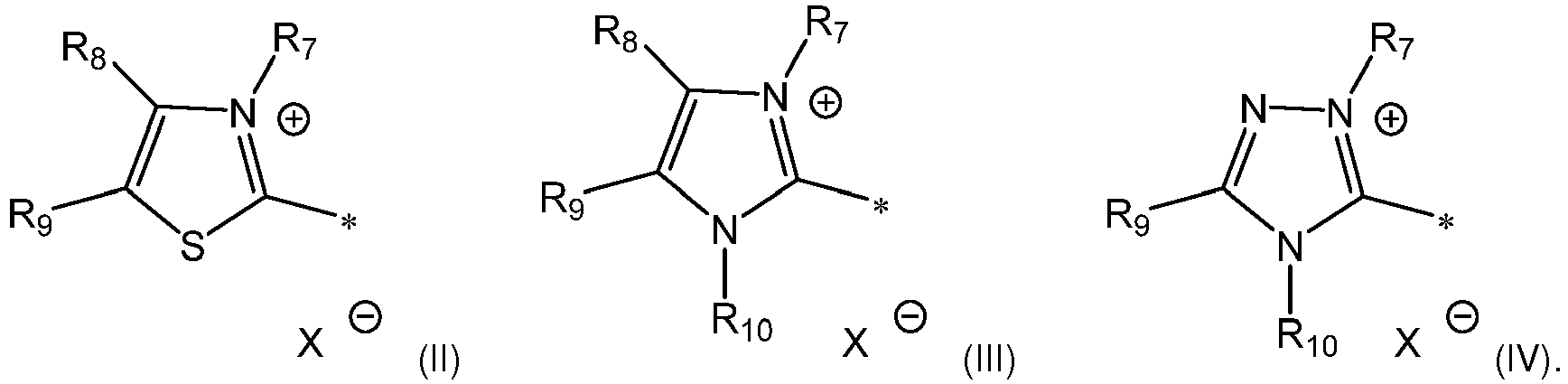
- Die Reste R1 bis R4 geben die Substituenten an den beiden Phenylringen des direktziehenden Farbstoffes der Formel (I) an.
- Hierbei können R1 und R3 unabhängig voneinander für eine C1-C6-Alkylgruppe, oder für eine C1-C6-Alkoxygruppe stehen. Prinzipiell können R1 und R3 in dem Farbstoff der Formel (I) gleich oder verschieden sein. Es ist jedoch bevorzugt wenn R1 und R3 in jedem Farbstoff der Formel (I) gleich sind.
- Die Reste R2 und R4 stehen beide für ein Wasserstoffatom. Überraschenderweise hat sich herausgestellt, dass die Anwesenheit von mindestens einem Substituenten an jedem der beiden Phenylringe eines Farbstoffes der Formel (I) ganz wesentlichen Einfluss die Oxidationsstabilität des Farbstoffes nimmt.
- Wird ein dimerer Azofarbstoff vom prinzipiellen Aufbau der Formel (I), der jedoch am Phenylring unsubstituiert ist (mit R1 bis R4 gleich Wasserstoff), in Kombination mit Wasserstoffperoxid und Persulfatsalzen auf Keratinfasern ausgefärbt, so können die Keratinfasern nur in blassen Nuancen gefärbt werden.
- Wird für die aufhellende Färbung jedoch ein erfindungsgemäßer Farbstoff der Formel (I) (mit R1 und R3 ungleich Wasserstoff) in Kombination mit Wasserstoffperoxid und Persulfatsalzen eingesetzt, so ist die Intensität des Farbergebnisses deutlich intensiver.
- Mit anderen Worten konnte die Oxidationsstabilität eines Farbstoffes vom allgemeinen Aufbau der Formel (I) durch Einführung von mindestens einem Substituenten an jedem der beiden Phenylringe des Farbstoffes erhöht werden. Aus diesem Grund kann keiner der beiden Reste R1 und R3 für ein Wasserstoffatom stehen.
- Eine besonders gute Erhöhung der Oxidationsstabilität konnte bei Farbstoffen der allgemeinen Formel (I) beobachtet werden, bei welchen die Reste R1 und R3 unabhängig voneinander für eine C1-C6-Alkylgruppe oder für eine C1-C6-Alkoxygruppe stehen.
- Ganz besonders bevorzugt ist es, wenn R1 und R3 unabhängig voneinander für eine C1-C6-Alkylgruppe stehen.
- Weiterhin ist es ganz besonders bevorzugt, wenn R2 und R4 beide für ein Wasserstoffatom stehen.
- In einer weiteren besonders bevorzugten Ausführungsform ist ein erfindungsgemäßes Mittel deshalb dadurch gekennzeichnet, dass es (a) mindestens einen direktziehenden Farbstoff der allgemeinen Formel (I) enthält, in der
- R1, R3
- unabhängig voneinander für eine C1-C6-Alkylgruppeoder für eine C1-C6-Alkoxygruppe stehen,
- R2, R4
- beide für ein Wasserstoffatom stehen.
- Weiterhin tragen die direktziehenden Farbstoffe der allgemeinen Formel (I) die Reste R5 und R6. R5 und R6 können unabhängig voneinander für ein Wasserstoffatom, eine C1-C6-Alkylgruppe oder für eine C2-C6-Alkenylgruppe stehen. Besonders bevorzugt ist es, wenn R5 und R6 unabhängig voneinander für Wasserstoff oder für eine C1-C6-Alkylgruppe, insbesondere für eine Methylgruppe oder für eine Ethylgruppe, stehen. R5 und R6 können gleich oder verschieden sein, bevorzugt ist es, wenn R5 und R6 gleich sind.
- In einer besonders bevorzugten Ausführungsform ist ein erfindungsgemäßes Mittel deshalb dadurch gekennzeichnet, dass es (a) mindestens einen direktziehenden Farbstoff der allgemeinen Formel (I) enthält, in der
- R5, R6
- unabhängig voneinander für Wasserstoff oder für eine C1-C6-Alkylgruppe stehen.
- Die heterozyklischen Endgruppen Het 1 und Het 2 der Formeln (II) bis (VII) tragen die Reste R7, R8, R9 und/oder R10.
- Die Reste R7 und R10 sind jeweils an ein Stickstoffatom der Heterozyklen Het 1 und Het 2 gebunden. Hierbei können die Reste R7 und R10 jeweils unabhängig voneinander für eine C1-C6-Alkylgruppe oder für eine C2-C6-Alkenylgruppe stehen. Es ist bevorzugt, wenn R7 und R10 jeweils unabhängig voneinander für eine Methylgruppe oder eine Ethylgruppe stehen.
- Die Reste R8 und R9 können jeweils unabhängig voneinander für ein Wasserstoffatom, eine C1-C6-Alkylgruppe, ein Halogenatom aus der Gruppe Chlor, Brom, Fluor oder Jod, für eine C1-C6-Alkoxygruppe oder für eine Nitrogruppe stehen. Es ist bevorzugt, wenn R8 und R9 beide für ein Wasserstoffatom stehen.
- In einer weiteren besonders bevorzugten Ausführungsform ist ein erfindungsgemäßes Mittel deshalb dadurch gekennzeichnet, dass es (a) mindestens einen direktziehenden Farbstoff der allgemeinen Formel (I) enthält, in der
- R7, R10
- jeweils unabhängig voneinander für eine Methylgruppe oder eine Ethylgruppe stehen,
- R8, R9
- für ein Wasserstoffatom stehen.
- Bei der Gruppierung Q handelt es sich um eine strukturelle Einheit, welche die beiden einfach positiv geladenen Chromophore des Farbstoffs zum dikationischen Dimer verknüpft. Q steht für eine Gruppierung der Formel (VIII),
* -(CH2)n-* (VIII)
- n
- für eine ganze Zahl von 3 bis 6 steht,
- Die beiden mit einem Stern markierten Positionen stellen hierbei jeweils die Verknüpfungspositionen zu den beiden N-Atomen der Formel (I) dar.
- Überraschenderweise hat es sich für die Erzielung eines intensiven Farbergebnisses als grundsätzlich wichtig und erfindungswesentlich herausgestellt, dass die verbindende Gruppierung Q, welche die beiden einzelnen Chromophore miteinander verknüpft, eine Kettenlänge von mindestens 3 Atomen aufweist.
- Aus diesem Grund steht n in der Formel (VIII) für eine ganze Zahl von mindestens 3. Die verbindende Gruppierung Q der Formel (VIII) umfasst demnach mindestens 3 C-Atome (d.h. hierbei handelt es sich um eine Gruppierung mit der Mindestlänge von -CH2-CH2-CH2-).
- Im Rahmen von Vergleichsversuchen hat sich herausgestellt, dass dimere Azofarbstoffe des prinzipiellen Typs der Formel (I), die jedoch eine nicht erfindungsgemäße Linker-Gruppe Q mit einer Länge von nur 2 C-Atomen besitzen, ein extrem schlechtes Farbaufzugsvermögen auf die Keratinfasern besitzen.
- Während mit den erfindungsgemäßen Farbstoffen der Formel (I) intensive Färbungen erzielt werden konnten, führten Färbungen mit analogen dimeren Farbstoffen, die über eine kürzere Gruppierung Q mit einer Kettenlänge von nur 2 C-Atomen verknüpft sind, zu praktisch überhaupt keinem Farbaufzug auf den keratinischen Fasern.
- Ohne auf eine Theorie beschränkt zu sein, könnte möglicherweise eine mit der kurzen Linker-Kette Q verbundene starre Geometrie und hierdurch bedingt eine ungünstige räumliche Konformation des Farbstoffes die Diffusion der kurzkettigen dimeren Farbstoffe in die keratinische Faser hinein verschlechtern.
- In einer ganz besonders bevorzugten Ausführungsform ist ein erfindungsgemäßes Mittel dadurch gekennzeichnet, dass es (a) mindestens einen direktziehenden Farbstoff der allgemeinen Formel (I) enthält, in der
- Q
- für eine Gruppierung der Formel (VIII) steht, *-(CH2)n-* (VIII)
- und n
- für eine ganze Zahl von 3 bis 6 steht.
- In einer explizit ganz besonders bevorzugten Ausführungsform ist ein erfindungsgemäßes Mittel dadurch gekennzeichnet, dass es (a) mindestens einen direktziehenden Farbstoff der allgemeinen Formel (I) enthält, in der
- Q
- für eine Gruppierung der Formel (VIII) steht, *-(CH2)n-* (VIII)
- und n
- für die Zahl 3 steht.
- Bei den erfindungsgemäßen Farbstoffen der Formel (I) handelt es sich um dimere Azofarbstoffe, die zweifach positiv geladen sind. Die beiden positiven Ladungen werden durch die anionischen Gegenionen X neutralisiert. Hierbei ist der dikationische organische Teil für die Färbung der Keratinfasern verantwortlich. Die Gegenionen X dienen lediglich der Wahrung der Elektroneutralität, so dass die genaue Natur der Gegenionen X für die Erzielung des gewünschten Farbergebnisses keine wesentliche Rolle spielt. Da der Farbstoff in einem kosmetischen Mittel eingesetzt wird, müssen die Gegenionen X physiologisch verträglich sein. Physiologisch verträglich bedeutet in diesem Zusammenhang zum Einsatz im kosmetischen Mittel (d.h. zur Anwendung auf dem menschlichen Haar und der menschlichen Haut) geeignet. Bei X handelt es sich um physiologisch verträgliche Anionen, bevorzugt aus der Gruppe Chlorid, Bromid, lodid, Methylsulfat, Methylsulfonat, p-Toluolsulfonat, Acetat, Hydrogensulfat, ½ Sulfat oder ½ Tetrachlorozinkat.
- Unter Chlorid wird ein Anion Cl- verstanden. Unter Bromid wird ein Anion Br- verstanden. Unter lodid wird ein Anion J- verstanden. Unter Methylsulfat wird ein Anion H3COSO4 - verstanden.
- Unter Methylsulfonat wird ein Anion H3CSO3 - verstanden. Unter p-Toluolsulfonat wird ein Anion H3C(C6H4)SO3 - verstanden. Unter Acetat wird ein Anion H3CCOO- verstanden. Unter Hydrogensulfat wird ein Anion HSO4 - verstanden.
- Unter ½ Sulfat wird ein halbes Äquivalent des doppelt negativ geladenen Anions SO4 2- verstanden. Unter ½ Tetrachlorozinkat wird ein halbes Äquivalent des doppelt negativ geladenen Anions ZnCl4 2-verstanden. Bei Sulfat und Tetrachlorozinkat ist es demzufolge ebenfalls möglich und auch erfindungsgemäß, wenn der dikationische Farbstoff der Formel (I) durch ein SO4 2- Ion bzw. durch ein ZnCl4 2- Ion neutralisiert wird.
- Zusammenfassend sind ganz besonders bevorzugte Mittel zur Farbveränderung von keratinischen Fasern dadurch gekennzeichnet, dass sie in einem kosmetischen Träger (a) mindestens einen direktziehenden Farbstoff der Formel (la) enthalten,

- Het 1
- für eine der Strukturen (II), (III) oder (IV) steht,
- R1
- für eine C1-C6-Alkylgruppe für eine C1-C6-Alkoxygruppe steht,
- R2
- für Wasserstoff steht
- R5
- für Wasserstoff oder für eine C1-C6-Alkylgruppesteht
- Q
- für eine Gruppierung der Formel (VIII) steht,
*-(CH2)n-* (VIII)
- n
- für eine ganze Zahl von 3 bis 6 steht,
- R7, R10
- unabhängig voneinander für eine C1-C6-Alkylgruppe stehen,
- R8, R9
- für Wasserstoff stehen,
- X-
- für ein physiologisch verträgliches Anion, bevorzugt aus der Gruppe Chlorid, Bromid, lodid, Methylsulfat, Methylsulfonat, p-Toluolsulfonat, Acetat, Hydrogensulfat, ½ Sulfat oder ½ Tetrachlorozinkat steht.
- In einer weiteren bevorzugten Ausführungsform ist ein Mittel zum Färben von keratinischen Fasern dadurch gekennzeichnet, dass es mindestens eine Verbindung der allgemeinen Formel (I) enthält, die ausgewählt ist aus
- Salzen des 3-Methyl-2-[2-(3-methyl-4-{[3-({2-methyl-4-[2-(3-methyl-1,3-thiazol-3-ium-2-yl)diazen-1-yl]phenyl}amino)propyl]amino}phenyl)diazen-1-yl]-1,3-thiazol-3-iums

- Salzen des 3-Methyl-2-[2-(2-methyl-4-{[3-({3-methyl-4-[2-(3-methyl-1,3-thiazol-3-ium-2-yl)diazen-1-yl]phenyl}amino)propyl]amino}phenyl)diazen-1-yl]-1,3-thiazol-3-iums

- Salzen des 3-Methyl-2-[2-(3-methyl-4-{[4-({2-methyl-4-[2-(3-methyl-1,3-thiazol-3-ium-2-yl)diazen-1-yl]phenyl}amino)butyl]amino}phenyl)diazen-1-yl]-1 ,3-thiazol-3-iums

- Salzen des 3-Methyl-2-[2-(2-methyl-4-{[4-({3-methyl-4-[2-(3-methyl-1,3-thiazol-3-ium-2-yl)diazen-1-yl]phenyl}amino)butyl]amino}phenyl)diazen-1-yl]-1 ,3-thiazol-3-iums

- Salzen des 3-Methyl-2-[2-(3-methyl-4-{[5-({2-methyl-4-[2-(3-methyl-1,3-thiazol-3-ium-2-yl)diazen-1-yl]phenyl}amino)pentyl]amino}phenyl)diazen-1-yl]-1,3-thiazol-3-iums

- Salzen des 3-Methyl-2-[2-(2-methyl-4-{[5-({3-methyl-4-[2-(3-methyl-1,3-thiazol-3-ium-2-yl)diazen-1-yl]phenyl}amino)pentyl]amino}phenyl)diazen-1-yl]-1,3-thiazol-3-iums

- Salzen des 3-Methyl-2-(2-{3-methyl-4-[methyl({3-[methyl({2-methyl-4-[2-(3-methyl-1,3-thiazol-3-ium-2-yl)diazen-1-yl]phenyl})amino]propyl})amino]phenyl}diazen-1-yl)-1,3-thiazol-3-iums

- Salzen des 3-Methyl-2-(2-{3-methyl-4-[ethyl({3-[ethyl({2-methyl-4-[2-(3-methyl-1,3-thiazol-3-ium-2-yl)diazen-1-yl]phenyl})amino]propyl})amino]phenyl}diazen-1-yl)-1,3-thiazol-3-iums

- Salzen des 3-Methyl-2-(2-{2-methyl-4-[methyl({3-[methyl({3-methyl-4-[2-(3-methyl-1,3-thiazol-3-ium-2-yl)diazen-1-yl]phenyl})amino]propyl})amino]phenyl}diazen-1-yl)-1,3-thiazol-3-iums

- Salzen des 3-Methyl-2-(2-{2-methyl-4-[ethyl({3-[ethyl({3-methyl-4-[2-(3-methyl-1,3-thiazol-3-ium-2-yl)diazen-1-yl]phenyl})amino]propyl})amino]phenyl}diazen-1-yl)-1,3-thiazol-3-iums

- Salzen des 3-Methyl-2-(2-{3-methyl-4-[methyl({4-[methyl({2-methyl-4-[2-(3-methyl-1,3-thiazol-3-ium-2-yl)diazen-1-yl]phenyl})amino]butyl})amino]phenyl}diazen-1-yl)-1,3-thiazol-3-iums

- Salzen des 3-Methyl-2-(2-{2-methyl-4-[methyl({4-[methyl({3-methyl-4-[2-(3-methyl-1,3-thiazol-3-ium-2-yl)diazen-1-yl]phenyl})amino]butyl})amino]phenyl}diazen-1-yl)-1,3-thiazol-3-iums

- Salzen des 3-Methyl-2-(2-{3-methyl-4-[methyl({5-[methyl({2-methyl-4-[2-(3-methyl-1,3-thiazol-3-ium-2-yl)diazen-1-yl]phenyl})amino]pentyl})amino]phenyl}diazen-1-yl)-1,3-thiazol-3-iums
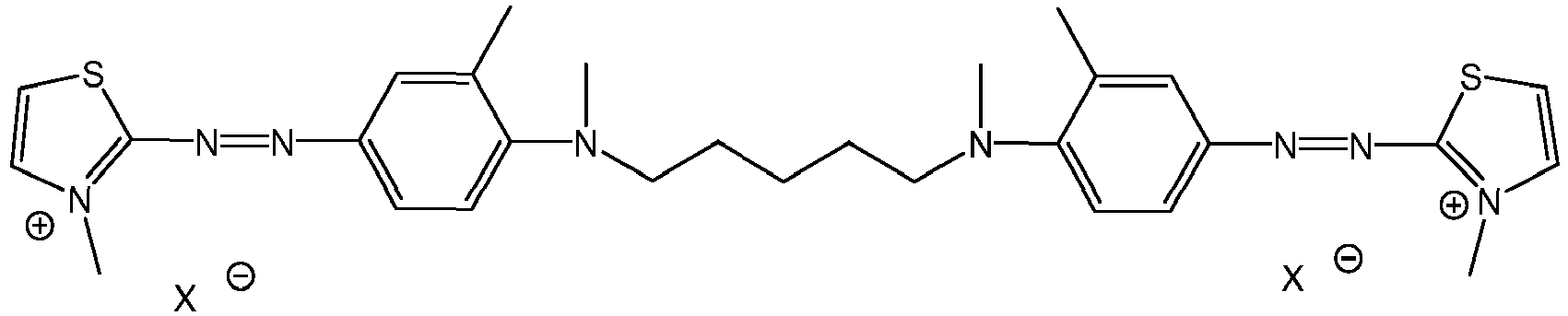
- Salzen des 3-Methyl-2-(2-{2-methyl-4-[methyl({5-[methyl({3-methyl-4-[2-(3-methyl-1,3-thiazol-3-ium-2-yl)diazen-1-yl]phenyl})amino]pentyl})amino]phenyl}diazen-1-yl)-1,3-thiazol-3-iums

- Salzen des 2-[2-(3-Methoxy-4-{[3-({2-methoxy-4-[2-(3-methyl-1,3-thiazol-3-ium-2-yl)diazen-1-yl]phenyl}amino)propyl]amino}phenyl)diazen-1-yl]-3-methyl-1,3-thiazol-3-iums

- Salzen des 2-[2-(2-Methoxy-4-{[3-({3-methoxy-4-[2-(3-methyl-1,3-thiazol-3-ium-2-yl)diazen-1-yl]phenyl}amino)propyl]amino}phenyl)diazen-1-yl]-3-methyl-1,3-thiazol-3-iums

- Salzen des 2-[2-(3-Methoxy-4-{[4-({2-methoxy-4-[2-(3-methyl-1,3-thiazol-3-ium-2-yl)diazen-1-yl]phenyl}amino)butyl]amino}phenyl)diazen-1-yl]-3-methyl-1,3-thiazol-3-iums

- Salzen des 2-[2-(2-Methoxy-4-{[4-({3-methoxy-4-[2-(3-methyl-1,3-thiazol-3-ium-2-yl)diazen-1-yl]phenyl}amino)butyl]amino}phenyl)diazen-1-yl]-3-methyl-1,3-thiazol-3-iums

- Salzen des 2-[2-(3-Methoxy-4-{[5-({2-methoxy-4-[2-(3-methyl-1,3-thiazol-3-ium-2-yl)diazen-1-yl]phenyl}amino)pentyl]amino}phenyl)diazen-1-yl]-3-methyl-1,3-thiazol-3-iums

- Salzen des 2-[2-(2-Methoxy-4-{[5-({3-methoxy-4-[2-(3-methyl-1,3-thiazol-3-ium-2-yl)diazen-1-yl]phenyl}amino)pentyl]amino}phenyl)diazen-1-yl]-3-methyl-1,3-thiazol-3-iums

- Salzen des 2-[2-(3-Methoxy-4-{[3-({2-methoxy-4-[2-(3-methyl-1,3-thiazol-3-ium-2-yl)diazen-1-yl]phenyl}(methyl)amino)propyl](methyl)amino}phenyl)diazen-1-yl]-3-methyl-1,3-thiazol-3-iums

- Salzen des 2-[2-(2-Methoxy-4-{[3-({3-methoxy-4-[2-(3-methyl-1,3-thiazol-3-ium-2-yl)diazen-1-yl]phenyl}(methyl)amino)propyl](methyl)amino}phenyl)diazen-1-yl]-3-methyl-1,3-thiazol-3-iums

- Salzen des 2-[2-(3-Methoxy-4-{[4-({2-methoxy-4-[2-(3-methyl-1,3-thiazol-3-ium-2-yl)diazen-1-yl]phenyl}(methyl)amino)butyl](methyl)amino}phenyl)diazen-1-yl]-3-methyl-1,3-thiazol-3-iums

- Salzen des 2-[2-(2-Methoxy-4-{[4-({3-methoxy-4-[2-(3-methyl-1,3-thiazol-3-ium-2-yl)diazen-1-yl]phenyl}(methyl)amino)butyl](methyl)amino}phenyl)diazen-1-yl]-3-methyl-1,3-thiazol-3-iums

- Salzen des 2-[2-(3-Methoxy-4-{[5-({2-methoxy-4-[2-(3-methyl-1,3-thiazol-3-ium-2-yl)diazen-1-yl]phenyl}(methyl)amino)pentyl](methyl)amino}phenyl)diazen-1-yl]-3-methyl-1,3-thiazol-3-iums

- Salzen des 2-[2-(2-Methoxy-4-{[5-({3-methoxy-4-[2-(3-methyl-1,3-thiazol-3-ium-2-yl)diazen-1-yl]phenyl}(methyl)amino)pentyl](methyl)amino}phenyl)diazen-1-yl]-3-methyl-1,3-thiazol-3-iums

- Salzen des 5-[2-(4-{[3-({4-[2-(1,4-Dimethyl-1H-1,2,4-triazol-4-ium-5-yl)diazen-1-yl]-2-methylphenyl}amino)propyl]amino}-3-methylphenyl)diazen-1-yl]-1,4-dimethyl-1H-1,2,4-triazol-4-iums

- Salzen des 5-[2-(4-{[3-({4-[2-(1,4-Dimethyl-1 H-1,2,4-triazol-4-ium-5-yl)diazen-1-yl]-3-methylphenyl}amino)propyl]amino}-2-methylphenyl)diazen-1-yl]-1,4-dimethyl-1H-1,2,4-triazol-4-iums

- Salzen des 5-[2-(4-{[4-({4-[2-(1,4-Dimethyl-1 H-1,2,4-triazol-4-ium-5-yl)diazen-1-yl]-2-methylphenyl}amino)butyl]amino}-3-methylphenyl)diazen-1-yl]-1,4-dimethyl-1H-1,2,4-triazol-4-iums

- Salzen des 5-[2-(4-{[4-({4-[2-(1,4-Dimethyl-1 H-1,2,4-triazol-4-ium-5-yl)diazen-1-yl]-3-methylphenyl}amino)butyl]amino}-2-methylphenyl)diazen-1-yl]-1,4-dimethyl-1H-1,2,4-triazol-4-iums

- Salzen des 5-[2-(4-{[5-({4-[2-(1,4-Dimethyl-1H-1,2,4-triazol-4-ium-5-yl)diazen-1-yl]-2-methylphenyl}amino)pentyl]amino}-3-methylphenyl)diazen-1-yl]-1,4-dimethyl-1H-1,2,4-triazol-4-iums

- Salzen des 5-[2-(4-{[5-({4-[2-(1,4-Dimethyl-1H-1,2,4-triazol-4-ium-5-yl)diazen-1-yl]-3-methylphenyl}amino)pentyl]amino}-2-methylphenyl)diazen-1-yl]-1,4-dimethyl-1H-1,2,4-triazol-4-iums

- Salzen des 5-[2-(4-{[3-({4-[2-(1,4-Dimethyl-1H-1,2,4-triazol-4-ium-5-yl)diazen-1-yl]-2-methylphenyl}(methyl)amino)propyl](methyl)amino}-3-methylphenyl)diazen-1-yl]-1,4-dimethyl-1H-1,2,4-triazol-4-iums

- Salzen des 5-[2-(4-{[3-({4-[2-(1,4-Dimethyl-1H-1,2,4-triazol-4-ium-5-yl)diazen-1-yl]-3-methylphenyl}(methyl)amino)propyl](methyl)aminol-2-methylphenyl)diazen-1-yl]-1,4-dimethyl-1H-1,2,4-triazol-4-iums

- Salzen des 5-[2-(4-{[4-({4-[2-(1,4-Dimethyl-1H-1,2,4-triazol-4-ium-5-yl)diazen-1-yl]-2-methylphenyl}(methyl)amino)butyl](methyl)amino}-3-methylphenyl)diazen-1-yl]-1,4-dimethyl-1H-1,2,4-triazol-4-iums

- Salzen des 5-[2-(4-{[4-({4-[2-(1,4-Dimethyl-1H-1,2,4-triazol-4-ium-5-yl)diazen-1-yl]-3-methylphenyl}(methyl)amino)butyl](methyl)amino}-2-methylphenyl)diazen-1-yl]-1,4-dimethyl-1H-1,2,4-triazol-4-iums

- Salzen des 5-[2-(4-{[5-({4-[2-(1,4-Dimethyl-1H-1,2,4-triazol-4-ium-5-yl)diazen-1-yl]-2-methylphenyl}(methyl)amino)pentyl](methyl)amino}-3-methylphenyl)diazen-1-yl]-1,4-dimethyl-1H-1,2,4-triazol-4-iums
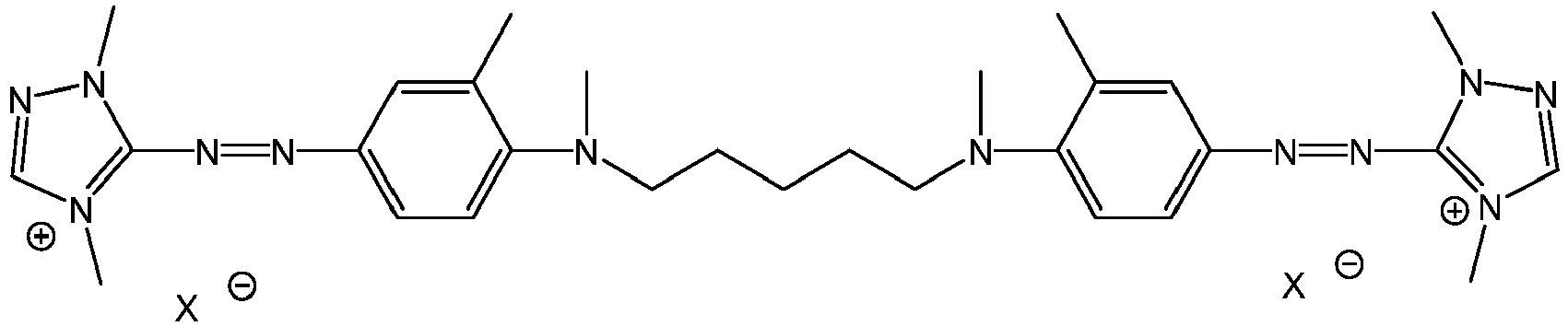
- Salzen des 5-[2-(4-{[5-({4-[2-(1,4-Dimethyl-1H-1,2,4-triazol-4-ium-5-yl)diazen-1-yl]-3-methylphenyl}(methyl)amino)pentyl](methyl)amino}-2-methylphenyl)diazen-1-yl]-1,4-dimethyl-1H-1,2,4-triazol-4-iums

- Salzen des 5-[2-(4-{[3-({4-[2-(1,4-Dimethyl-1H-1,2,4-triazol-4-ium-5-yl)diazen-1-yl]-2-methoxyphenyl}amino)propyl]amino}-3-methoxyphenyl)diazen-1-yl]-1,4-dimethyl-1H-1,2,4-triazol-4-iums

- Salzen des 5-[2-(4-{[3-({4-[2-(1,4-Dimethyl-1H-1,2,4-triazol-4-ium-5-yl)diazen-1-yl]-3-methoxyphenyl}amino)propyl]amino}-2-methoxyphenyl)diazen-1-yl]-1,4-dimethyl-1H-1,2,4-triazol-4-iums

- Salzen des 5-[2-(4-{[4-({4-[2-(1,4-Dimethyl-1H-1,2,4-triazol-4-ium-5-yl)diazen-1-yl]-2-methoxyphenyl}amino)butyl]amino}-3-methoxyphenyl)diazen-1-yl]-1,4-dimethyl-1H-1 ,2,4-triazol-4-iums

- Salzen des 5-[2-(4-{[4-({4-[2-(1,4-Dimethyl-1H-1,2,4-triazol-4-ium-5-yl)diazen-1-yl]-3-methoxyphenyl}amino)butyl]amino}-2-methoxyphenyl)diazen-1-yl]-1,4-dimethyl-1H-1,2,4-triazol-4-iums

- Salzen des 5-[2-(4-{[5-({4-[2-(1,4-Dimethyl-1 H-1,2,4-triazol-4-ium-5-yl)diazen-1-yl]-2-methoxyphenyl}amino)pentyl]amino}-3-methoxyphenyl)diazen-1-yl]-1,4-dimethyl-1H-1,2,4-triazol-4-iums

- Salzen des 5-[2-(4-{[5-({4-[2-(1,4-Dimethyl-1 H-1,2,4-triazol-4-ium-5-yl)diazen-1-yl]-3-methoxyphenyl}amino)pentyl]amino}-2-methoxyphenyl)diazen-1-yl]-1,4-dimethyl-1H-1,2,4-triazol-4-iums

- Salzen des 5-[2-(4-{[3-({4-[2-(1,4-Dimethyl-1H-1,2,4-triazol-4-ium-5-yl)diazen-1-yl]-2-methoxyphenyl}(methyl)amino)propyl](methyl)amino}-3-methoxyphenyl)diazen-1-yl]-1,4-dimethyl-1H-1,2,4-triazol-4-iums

- Salzen des 5-[2-(4-{[3-({4-[2-(1,4-Dimethyl-1H-1,2,4-triazol-4-ium-5-yl)diazen-1-yl]-3-methoxyphenyl}(methyl)amino)propyl](methyl)amino}-2-methoxyphenyl)diazen-1-yl]-1,4-dimethyl-1H-1,2,4-triazol-4-iums

- Salzen des 5-[2-(4-{[4-({4-[2-(1,4-Dimethyl-1H-1,2,4-triazol-4-ium-5-yl)diazen-1-yl]-2-methoxyphenyl}(methyl)amino)butyl](methyl)amino}-3-methoxyphenyl)diazen-1-yl]-1,4-dimethyl-1H-1,2,4-triazol-4-iums

- Salzen des 5-[2-(4-{[4-({4-[2-(1,4-Dimethyl-1H-1,2,4-triazol-4-ium-5-yl)diazen-1-yl]-3-methoxyphenyl}(methyl)amino)butyl](methyl)amino}-2-methoxyphenyl)diazen-1-yl]-1,4-dimethyl-1H-1,2,4-triazol-4-iums
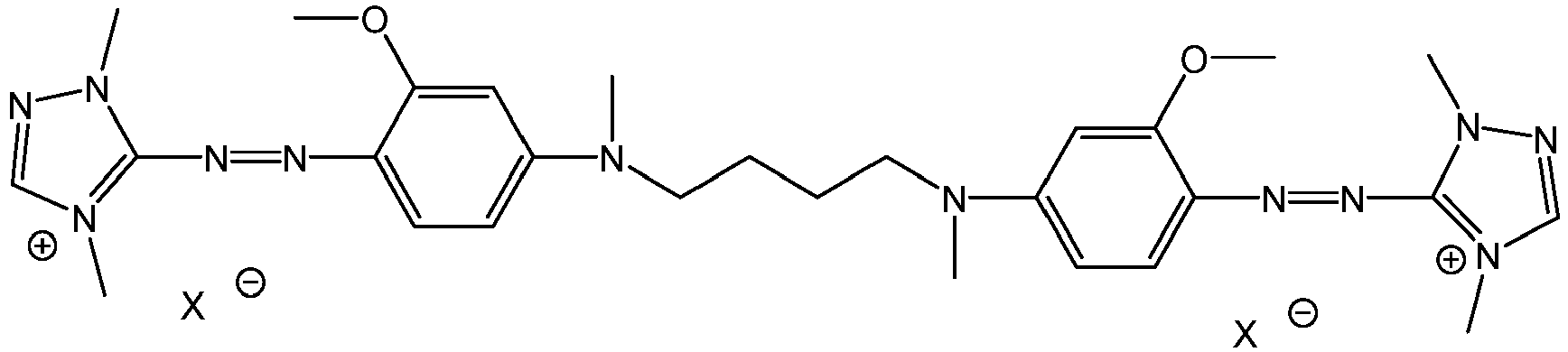
- Salzen des 5-[2-(4-{[5-({4-[2-(1,4-Dimethyl-1H-1,2,4-triazol-4-ium-5-yl)diazen-1-yl]-2-methoxyphenyl}(methyl)amino)pentyl](methyl)amino}-3-methoxyphenyl)diazen-1-yl]-1,4-dimethyl-1H-1,2,4-triazol-4-iums

- Salzen des 5-[2-(4-{[5-({4-[2-(1,4-Dimethyl-1H-1,2,4-triazol-4-ium-5-yl)diazen-1-yl]-3-methoxyphenyl}(methyl)amino)pentyl](methyl)amino}-2-methoxyphenyl)diazen-1-yl]-1,4-dimethyl-1H-1,2,4-triazol-4-iums

- Bei den vorgenannten Verbindungen handelt es sich um dikationische dimere Farbstoffe, wobei das organische Dikation durch zwei Anionen X- neutralisiert wird. Bei den Anionen X- handelt es sich um ein physiologisch verträgliches Anion, bevorzugt aus der Gruppe aus Chlorid, Bromid, lodid, Methylsulfat, Methylsulfonat, p-Toluolsulfonat, Acetat, Hydrogensulfat, ½ Sulfat oder ½ Tetrachlorozinkat.
- Im Rahmen der zu dieser Erfindung führenden Arbeiten hat sich herausgestellt, dass mit den direktziehenden Farbstoffen (a) der Formel (I) besonders dann ganz besonders intensive und oxidationsstabile Färbungen erzielt werden konnten, wenn
- Het1, Het2
- unabhängig voneinander für eine der Strukturen (II), (III) oder (IV) stehen.
- R1, R3
- beide für eine Methylgruppe stehen
- R2, R4
- beide für ein Wasserstoffatom stehen.
- R5, R6
- unabhängig voneinander für Wasserstoff oder für eine C1-C6-Alkylgruppe stehen.
- R7, R10
- beide für eine Methylgruppe stehen
- R8, R9
- beide für ein Wasserstoffatom stehen.
- Q
- für eine Gruppierung der Formel (VIII) steht,
*-(CH2)n-* (VIII)
- und n
- für die Zahl 3 oder 4 steht.
- Explizit ganz besonders bevorzugt sind daher erfindungsgemäße Mittel zum Färben von keratinischen Fasern, welche mindestens einen Farbstoff (a) der Formel (I) enthalten, der ausgewählt ist aus der Gruppe aus
- Salzen des 3-Methyl-2-[2-(3-methyl-4-{[3-({2-methyl-4-[2-(3-methyl-1,3-thiazol-3-ium-2-yl)diazen-1-yl]phenyl}amino)propyl]amino}phenyl)diazen-1-yl]-1,3-thiazol-3-iums
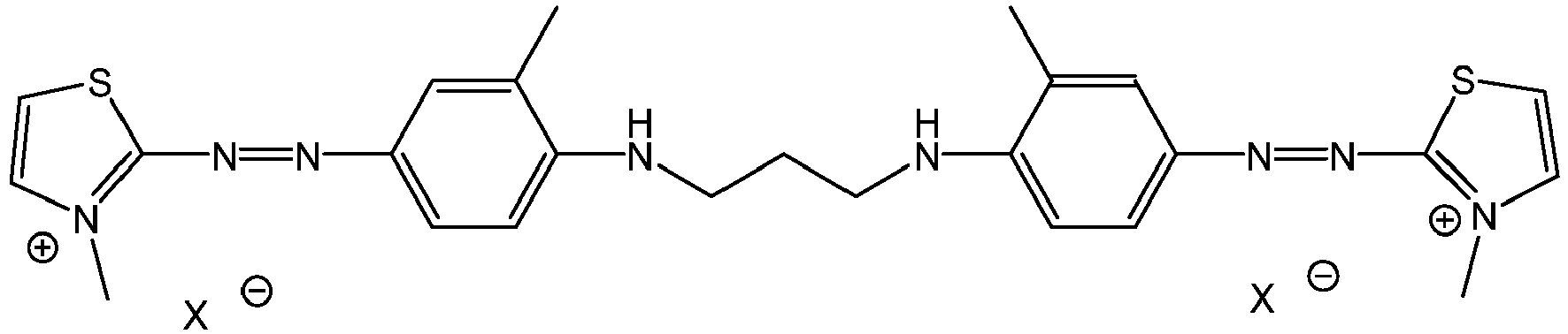
- Salzen des 3-Methyl-2-[2-(2-methyl-4-{[3-({3-methyl-4-[2-(3-methyl-1,3-thiazol-3-ium-2-yl)diazen-1-yl]phenyl}amino)propyl]amino}phenyl)diazen-1-yl]-1,3-thiazol-3-iums
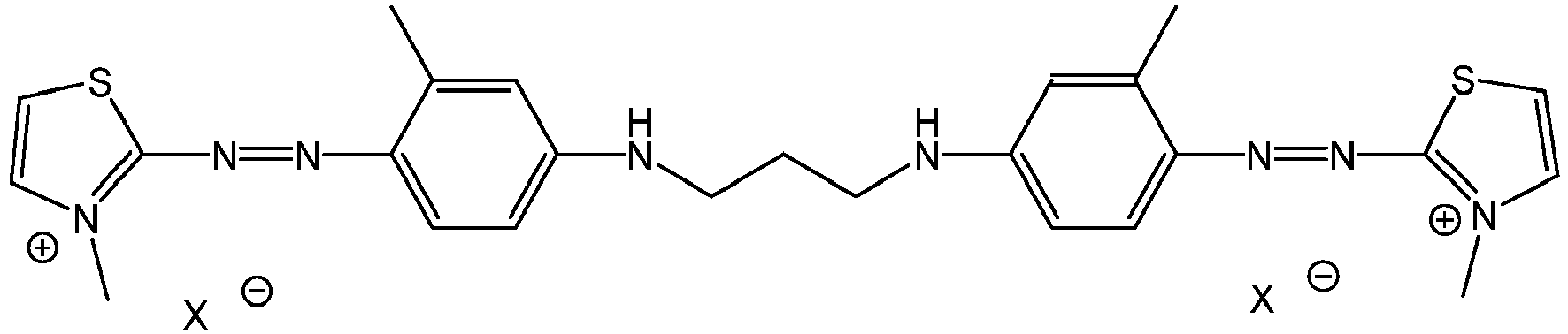
- Salzen des 3-Methyl-2-[2-(3-methyl-4-{[4-({2-methyl-4-[2-(3-methyl-1,3-thiazol-3-ium-2-yl)diazen-1-yl]phenyl}amino)butyl]amino}phenyl)diazen-1-yl]-1 ,3-thiazol-3-iums

- Salzen des 3-Methyl-2-[2-(2-methyl-4-{[4-({3-methyl-4-[2-(3-methyl-1,3-thiazol-3-ium-2-yl)diazen-1-yl]phenyl}amino)butyl]amino}phenyl)diazen-1-yl]-1 ,3-thiazol-3-iums

- Salzen des 3-Methyl-2-(2-{3-methyl-4-[methyl({3-[methyl({2-methyl-4-[2-(3-methyl-1,3-thiazol-3-ium-2-yl)diazen-1-yl]phenyl})amino]propyl})amino]phenyl}diazen-1-yl)-1,3-thiazol-3-iums

- Salzen des 3-Methyl-2-(2-{2-methyl-4-[methyl({3-[methyl({3-methyl-4-[2-(3-methyl-1,3-thiazol-3-ium-2-yl)diazen-1-yl]phenyl})amino]propyl})amino]phenyl}diazen-1-yl)-1,3-thiazol-3-iums

- Salzen des 3-Methyl-2-(2-{3-methyl-4-[methyl({4-[methyl({2-methyl-4-[2-(3-methyl-1,3-thiazol-3-ium-2-yl)diazen-1-yl]phenyl})amino]butyl})amino]phenyl}diazen-1-yl)-1,3-thiazol-3-iums

- Salzen des 3-Methyl-2-(2-{2-methyl-4-[methyl({4-[methyl({3-methyl-4-[2-(3-methyl-1,3-thiazol-3-ium-2-yl)diazen-1-yl]phenyl})amino]butyl})amino]phenyl}diazen-1-yl)-1,3-thiazol-3-iums

- Salzen des 3-Methyl-2-(2-{3-methyl-4-[ethyl({3-[ethyl({2-methyl-4-[2-(3-methyl-1,3-thiazol-3-ium-2-yl)diazen-1-yl]phenyl})amino]propyl})amino]phenyl}diazen-1-yl)-1,3-thiazol-3-iums
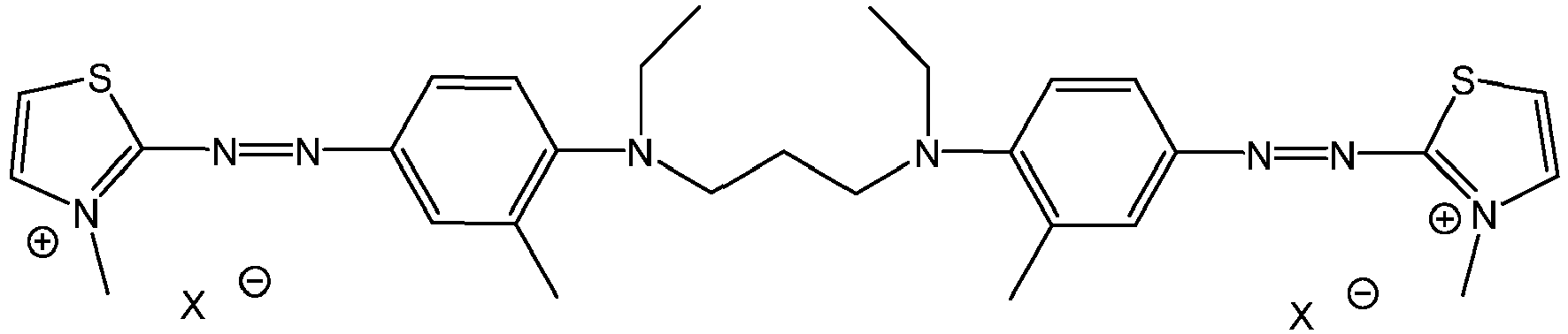
- Salzen des 3-Methyl-2-(2-{2-methyl-4-[ethyl({3-[ethyl({3-methyl-4-[2-(3-methyl-1,3-thiazol-3-ium-2-yl)diazen-1-yl]phenyl})amino]propyl})amino]phenyl}diazen-1-yl)-1,3-thiazol-3-iums
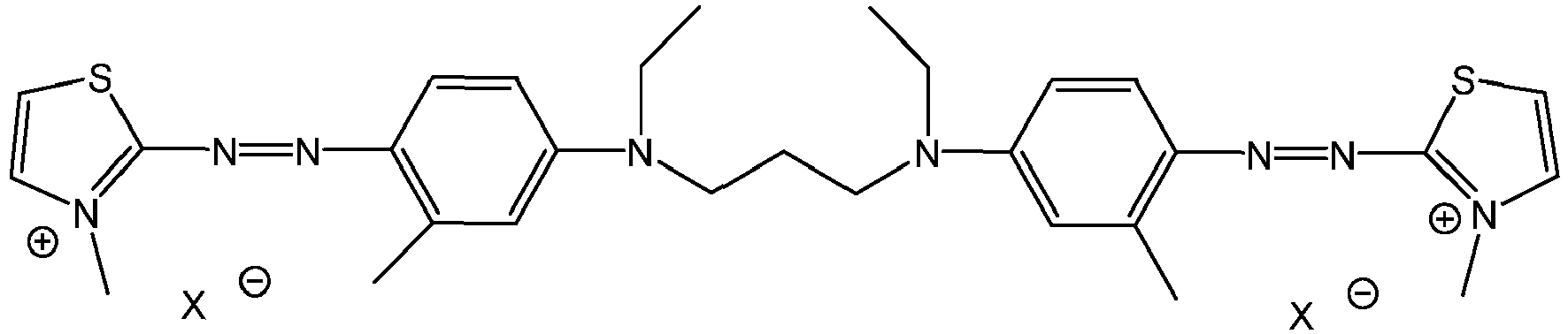
- Salzen des 5-[2-(4-{[3-({4-[2-(1,4-Dimethyl-1H-1,2,4-triazol-4-ium-5-yl)diazen-1-yl]-2-methylphenyl}amino)propyl]amino}-3-methylphenyl)diazen-1-yl]-1,4-dimethyl-1H-1,2,4-triazol-4-iums

- Salzen des 5-[2-(4-{[3-({4-[2-(1,4-Dimethyl-1H-1,2,4-triazol-4-ium-5-yl)diazen-1-yl]-3-methylphenyl}amino)propyl]amino}-2-methylphenyl)diazen-1-yl]-1,4-dimethyl-1H-1,2,4-triazol-4-iums

- Salzen des 5-[2-(4-{[4-({4-[2-(1,4-Dimethyl-1H-1,2,4-triazol-4-ium-5-yl)diazen-1-yl]-2-methylphenyl}amino)butyl]amino}-3-methylphenyl)diazen-1-yl]-1,4-dimethyl-1H-1,2,4-triazol-4-iums

- Salzen des 5-[2-(4-{[4-({4-[2-(1,4-Dimethyl-1H-1,2,4-triazol-4-ium-5-yl)diazen-1-yl]-3-methylphenyl}amino)butyl]amino}-2-methylphenyl)diazen-1-yl]-1,4-dimethyl-1H-1,2,4-triazol-4-iums

- Salzen des 5-[2-(4-{[3-({4-[2-(1,4-Dimethyl-1H-1,2,4-triazol-4-ium-5-yl)diazen-1-yl]-2-methylphenyl}(methyl)amino)propyl](methyl)aminol-3-methylphenyl)diazen-1-yl]-1,4-dimethyl-1H-1,2,4-triazol-4-iums

- Salzen des 5-[2-(4-{[3-({4-[2-(1,4-Dimethyl-1H-1,2,4-triazol-4-ium-5-yl)diazen-1-yl]-3-methylphenyl}(methyl)amino)propyl](methyl)amino}-2-methylphenyl)diazen-1-yl]-1,4-dimethyl-1H-1,2,4-triazol-4-iums

- Salzen des 5-[2-(4-{[4-({4-[2-(1,4-Dimethyl-1 H-1,2,4-triazol-4-ium-5-yl)diazen-1-yl]-2-methylphenyl}(methyl)amino)butyl](methyl)amino}-3-methylphenyl)diazen-1-yl]-1,4-dimethyl-1H-1,2,4-triazol-4-iums

- Salzen des 5-[2-(4-{[4-({4-[2-(1,4-Dimethyl-1H-1,2,4-triazol-4-ium-5-yl)diazen-1-yl]-3-methylphenyl}(methyl)amino)butyl](methyl)aminol-2-methylphenyl)diazen-1-yl]-1,4-dimethyl-1H-1,2,4-triazol-4-iums

- In einer bevorzugten Ausführungsform ist ein erfindungsgemäßes Mittel zum Färben von keratinischen Fasern dadurch gekennzeichnet, dass es als Farbstoff der Formel (a) mindestens eine Verbindung enthält, die ausgewählt ist aus der Gruppe aus
- 3-Methyl-2-[2-(3-methyl-4-{[3-({2-methyl-4-[2-(3-methyl-1,3-thiazol-3-ium-2-yl)diazen-1-yl]phenyl}amino)propyl]amino}phenyl)diazen-1-yl]-1,3-thiazol-3-ium Dichlorid
- 3-Methyl-2-[2-(3-methyl-4-{[3-({2-methyl-4-[2-(3-methyl-1,3-thiazol-3-ium-2-yl)diazen-1-yl]phenyl}amino)propyl]amino}phenyl)diazen-1-yl]-1,3-thiazol-3-ium Dibromid
- 3-Methyl-2-[2-(3-methyl-4-{[3-({2-methyl-4-[2-(3-methyl-1,3-thiazol-3-ium-2-yl)diazen-1-yl]phenyl}amino)propyl]amino}phenyl)diazen-1-yl]-1,3-thiazol-3-ium Sulfat
- 3-Methyl-2-[2-(3-methyl-4-{[3-({2-methyl-4-[2-(3-methyl-1,3-thiazol-3-ium-2-yl)diazen-1-yl]phenyl}amino)propyl]amino}phenyl)diazen-1-yl]-1,3-thiazol-3-ium Di(toluolsulfonat)
- 3-Methyl-2-[2-(3-methyl-4-{[3-({2-methyl-4-[2-(3-methyl-1,3-thiazol-3-ium-2-yl)diazen-1-yl]phenyl}amino)propyl]amino}phenyl)diazen-1-yl]-1,3-thiazol-3-ium Di(methylsulfat)
- 3-Methyl-2-[2-(3-methyl-4-{[3-({2-methyl-4-[2-(3-methyl-1,3-thiazol-3-ium-2-yl)diazen-1-yl]phenyl}amino)propyl]amino}phenyl)diazen-1-yl]-1,3-thiazol-3-ium Tetrachlorozinkat
- 3-Methyl-2-[2-(2-methyl-4-{[3-({3-methyl-4-[2-(3-methyl-1,3-thiazol-3-ium-2-yl)diazen-1-yl]phenyl}amino)propyl]amino}phenyl)diazen-1-yl]-1,3-thiazol-3-ium Dichlorid
- 3-Methyl-2-[2-(2-methyl-4-{[3-({3-methyl-4-[2-(3-methyl-1,3-thiazol-3-ium-2-yl)diazen-1-yl]phenyl}amino)propyl]amino}phenyl)diazen-1-yl]-1,3-thiazol-3-ium Dibromid
- 3-Methyl-2-[2-(2-methyl-4-{[3-({3-methyl-4-[2-(3-methyl-1,3-thiazol-3-ium-2-yl)diazen-1-yl]phenyl}amino)propyl]amino}phenyl)diazen-1-yl]-1,3-thiazol-3-ium Sulfat
- 3-Methyl-2-[2-(2-methyl-4-{[3-({3-methyl-4-[2-(3-methyl-1,3-thiazol-3-ium-2-yl)diazen-1-yl]phenyl}amino)propyl]amino}phenyl)diazen-1-yl]-1,3-thiazol-3-ium Di(toluolsulfonat)
- 3-Methyl-2-[2-(2-methyl-4-{[3-({3-methyl-4-[2-(3-methyl-1,3-thiazol-3-ium-2-yl)diazen-1-yl]phenyl}amino)propyl]amino}phenyl)diazen-1-yl]-1,3-thiazol-3-ium Di(methylsulfat)
- 3-Methyl-2-[2-(2-methyl-4-{[3-({3-methyl-4-[2-(3-methyl-1,3-thiazol-3-ium-2-yl)diazen-1-yl]phenyl}amino)propyl]amino}phenyl)diazen-1-yl]-1,3-thiazol-3-ium Tetrachlorozinkat
- 3-Methyl-2-(2-{3-methyl-4-[methyl({3-[methyl({2-methyl-4-[2-(3-methyl-1,3-thiazol-3-ium-2-yl)diazen-1-yl]phenyl})amino]propyl})amino]phenyl}diazen-1-yl)-1,3-thiazol-3-ium Dichlorid
- 3-Methyl-2-(2-{3-methyl-4-[methyl({3-[methyl({2-methyl-4-[2-(3-methyl-1,3-thiazol-3-ium-2-yl)diazen-1-yl]phenyl})amino]propyl})amino]phenyl}diazen-1-yl)-1,3-thiazol-3-ium Dibromid
- 3-Methyl-2-(2-{3-methyl-4-[methyl({3-[methyl({2-methyl-4-[2-(3-methyl-1,3-thiazol-3-ium-2-yl)diazen-1-yl]phenyl})amino]propyl})amino]phenyl}diazen-1-yl)-1,3-thiazol-3-ium Sulfat
- 3-Methyl-2-(2-{3-methyl-4-[methyl({3-[methyl({2-methyl-4-[2-(3-methyl-1,3-thiazol-3-ium-2-yl)diazen-1-yl]phenyl})amino]propyl})amino]phenyl}diazen-1-yl)-1,3-thiazol-3-ium Di(toluolsulfonat)
- 3-Methyl-2-(2-{3-methyl-4-[methyl({3-[methyl({2-methyl-4-[2-(3-methyl-1,3-thiazol-3-ium-2-yl)diazen-1-yl]phenyl})amino]propyl})amino]phenyl}diazen-1-yl)-1,3-thiazol-3-ium Di(methylsulfat)
- 3-Methyl-2-(2-{3-methyl-4-[methyl({3-[methyl({2-methyl-4-[2-(3-methyl-1,3-thiazol-3-ium-2-yl)diazen-1-yl]phenyl})amino]propyl})amino]phenyl}diazen-1-yl)-1,3-thiazol-3-ium Tetrachlorozinkat
- 3-Methyl-2-(2-{2-methyl-4-[methyl({3-[methyl({3-methyl-4-[2-(3-methyl-1,3-thiazol-3-ium-2-yl)diazen-1-yl]phenyl})amino]propyl})amino]phenyl}diazen-1-yl)-1,3-thiazol-3-ium Dichlorid
- 3-Methyl-2-(2-{2-methyl-4-[methyl({3-[methyl({3-methyl-4-[2-(3-methyl-1,3-thiazol-3-ium-2-yl)diazen-1-yl]phenyl})amino]propyl})amino]phenyl}diazen-1-yl)-1,3-thiazol-3-ium Dibromid
- 3-Methyl-2-(2-{2-methyl-4-[methyl({3-[methyl({3-methyl-4-[2-(3-methyl-1,3-thiazol-3-ium-2-yl)diazen-1-yl]phenyl})amino]propyl})amino]phenyl}diazen-1-yl)-1,3-thiazol-3-ium Sulfat
- 3-Methyl-2-(2-{2-methyl-4-[methyl({3-[methyl({3-methyl-4-[2-(3-methyl-1,3-thiazol-3-ium-2-yl)diazen-1-yl]phenyl})amino]propyl})amino]phenyl}diazen-1-yl)-1,3-thiazol-3-ium Di(toluolsulfonat)
- 3-Methyl-2-(2-{2-methyl-4-[methyl({3-[methyl({3-methyl-4-[2-(3-methyl-1,3-thiazol-3-ium-2-yl)diazen-1-yl]phenyl})amino]propyl})amino]phenyl}diazen-1-yl)-1,3-thiazol-3-ium Di(methylsulfat)
- 3-Methyl-2-(2-{2-methyl-4-[methyl({3-[methyl({3-methyl-4-[2-(3-methyl-1,3-thiazol-3-ium-2-yl)diazen-1-yl]phenyl})amino]propyl})amino]phenyl}diazen-1-yl)-1,3-thiazol-3-ium Tetrachlorozinkat
- 5-[2-(4-{[3-({4-[2-(1,4-Dimethyl-1H-1,2,4-triazol-4-ium-5-yl)diazen-1-yl]-2-methylphenyl}amino)propyl]amino}-3-methylphenyl)diazen-1-yl]-1,4-dimethyl-1H-1,2,4-triazol-4-ium Dichlorid
- 5-[2-(4-{[3-({4-[2-(1,4-Dimethyl-1H-1,2,4-triazol-4-ium-5-yl)diazen-1-yl]-2-methylphenyl}amino)propyl]amino}-3-methylphenyl)diazen-1-yl]-1,4-dimethyl-1H-1,2,4-triazol-4-ium Dibromid
- 5-[2-(4-{[3-({4-[2-(1,4-Dimethyl-1H-1,2,4-triazol-4-ium-5-yl)diazen-1-yl]-2-methylphenyl}amino)propyl]amino}-3-methylphenyl)diazen-1-yl]-1,4-dimethyl-1H-1,2,4-triazol-4-ium Sulfat
- 5-[2-(4-{[3-({4-[2-(1,4-Dimethyl-1H-1,2,4-triazol-4-ium-5-yl)diazen-1-yl]-2-methylphenyl}amino)propyl]amino}-3-methylphenyl)diazen-1-yl]-1,4-dimethyl-1H-1,2,4-triazol-4-ium Di(toluolsulfonat)
- 5-[2-(4-{[3-({4-[2-(1,4-Dimethyl-1H-1,2,4-triazol-4-ium-5-yl)diazen-1-yl]-2-methylphenyl}amino)propyl]amino}-3-methylphenyl)diazen-1-yl]-1,4-dimethyl-1H-1,2,4-triazol-4-ium Di(methylsulfat)
- 5-[2-(4-{[3-({4-[2-(1,4-Dimethyl-1H-1,2,4-triazol-4-ium-5-yl)diazen-1-yl]-2-methylphenyl}amino)propyl]amino}-3-methylphenyl)diazen-1-yl]-1,4-dimethyl-1H-1,2,4-triazol-4-ium Tetrachlorozinkat
- 5-[2-(4-{[3-({4-[2-(1,4-Dimethyl-1H-1,2,4-triazol-4-ium-5-yl)diazen-1-yl]-3-methylphenyl}amino)propyl]amino}-2-methylphenyl)diazen-1-yl]-1,4-dimethyl-1H-1,2,4-triazol-4-ium Dichlorid
- 5-[2-(4-{[3-({4-[2-(1,4-Dimethyl-1H-1,2,4-triazol-4-ium-5-yl)diazen-1-yl]-3-methylphenyl}amino)propyl]amino}-2-methylphenyl)diazen-1-yl]-1,4-dimethyl-1H-1,2,4-triazol-4-ium Dibromid
- 5-[2-(4-{[3-({4-[2-(1,4-Dimethyl-1H-1,2,4-triazol-4-ium-5-yl)diazen-1-yl]-3-methylphenyl}amino)propyl]amino}-2-methylphenyl)diazen-1-yl]-1,4-dimethyl-1H-1,2,4-triazol-4-ium Sulfat
- 5-[2-(4-{[3-({4-[2-(1,4-Dimethyl-1H-1,2,4-triazol-4-ium-5-yl)diazen-1-yl]-3-methylphenyl}amino)propyl]amino}-2-methylphenyl)diazen-1-yl]-1,4-dimethyl-1H-1,2,4-triazol-4-ium Di(toluolsulfonat)
- 5-[2-(4-{[3-({4-[2-(1,4-Dimethyl-1H-1,2,4-triazol-4-ium-5-yl)diazen-1-yl]-3-methylphenyl}amino)propyl]amino}-2-methylphenyl)diazen-1-yl]-1,4-dimethyl-1H-1,2,4-triazol-4-ium Di(methylsulfat)
- 5-[2-(4-{[3-({4-[2-(1,4-Dimethyl-1H-1,2,4-triazol-4-ium-5-yl)diazen-1-yl]-3-methylphenyl}amino)propyl]amino}-2-methylphenyl)diazen-1-yl]-1,4-dimethyl-1H-1,2,4-triazol-4-ium Tetrachlorozinkat
- 5-[2-(4-{[3-({4-[2-(1,4-Dimethyl-1H-1,2,4-triazol-4-ium-5-yl)diazen-1-yl]-2-methylphenyl}(methyl)amino)propyl](methyl)amino}-3-methylphenyl)diazen-1-yl]-1,4-dimethyl-1H-1,2,4-triazol-4-ium Dichlorid
- 5-[2-(4-{[3-({4-[2-(1,4-Dimethyl-1H-1,2,4-triazol-4-ium-5-yl)diazen-1-yl]-2-methylphenyl}(methyl)amino)propyl](methyl)amino}-3-methylphenyl)diazen-1-yl]-1,4-dimethyl-1H-1,2,4-triazol-4-ium Dibromid
- 5-[2-(4-{[3-({4-[2-(1,4-Dimethyl-1H-1,2,4-triazol-4-ium-5-yl)diazen-1-yl]-2-methylphenyl}(methyl)amino)propyl](methyl)amino}-3-methylphenyl)diazen-1-yl]-1,4-dimethyl-1H-1,2,4-triazol-4-ium Sulfat
- 5-[2-(4-{[3-({4-[2-(1,4-Dimethyl-1H-1,2,4-triazol-4-ium-5-yl)diazen-1-yl]-2-methylphenyl}(methyl)amino)propyl](methyl)amino}-3-methylphenyl)diazen-1-yl]-1,4-dimethyl-1H-1,2,4-triazol-4-ium Di(toluosulfonat)
- 5-[2-(4-{[3-({4-[2-(1,4-Dimethyl-1H-1,2,4-triazol-4-ium-5-yl)diazen-1-yl]-2-methylphenyl}(methyl)amino)propyl](methyl)amino}-3-methylphenyl)diazen-1-yl]-1,4-dimethyl-1H-1,2,4-triazol-4-ium Di(methylsulfat)
- 5-[2-(4-{[3-({4-[2-(1,4-Dimethyl-1H-1,2,4-triazol-4-ium-5-yl)diazen-1-yl]-2-methylphenyl}(methyl)amino)propyl](methyl)amino}-3-methylphenyl)diazen-1-yl]-1,4-dimethyl-1H-1,2,4-triazol-4-ium Tetrachlorozinkat
- 5-[2-(4-{[3-({4-[2-(1,4-Dimethyl-1H-1,2,4-triazol-4-ium-5-yl)diazen-1-yl]-3-methylphenyl}(methyl)amino)propyl](methyl)amino}-2-methylphenyl)diazen-1-yl]-1,4-dimethyl-1H-1,2,4-triazol-4-ium Dichlorid
- 5-[2-(4-{[3-({4-[2-(1,4-Dimethyl-1H-1,2,4-triazol-4-ium-5-yl)diazen-1-yl]-3-methylphenyl}(methyl)amino)propyl](methyl)amino}-2-methylphenyl)diazen-1-yl]-1,4-dimethyl-1H-1,2,4-triazol-4-ium Dibromid
- 5-[2-(4-{[3-({4-[2-(1,4-Dimethyl-1H-1,2,4-triazol-4-ium-5-yl)diazen-1-yl]-3-methylphenyl}(methyl)amino)propyl](methyl)amino}-2-methylphenyl)diazen-1-yl]-1,4-dimethyl-1H-1,2,4-triazol-4-ium Sulfat
- 5-[2-(4-{[3-({4-[2-(1,4-Dimethyl-1H-1,2,4-triazol-4-ium-5-yl)diazen-1-yl]-3-methylphenyl}(methyl)amino)propyl](methyl)amino}-2-methylphenyl)diazen-1-yl]-1,4-dimethyl-1H-1,2,4-triazol-4-ium Di(toluolsulfonat)
- 5-[2-(4-{[3-({4-[2-(1,4-Dimethyl-1H-1,2,4-triazol-4-ium-5-yl)diazen-1-yl]-3-methylphenyl}(methyl)amino)propyl](methyl)amino}-2-methylphenyl)diazen-1-yl]-1,4-dimethyl-1H-1,2,4-triazol-4-ium Di(methylsulfat)
- 5-[2-(4-{[3-({4-[2-(1,4-Dimethyl-1H-1,2,4-triazol-4-ium-5-yl)diazen-1-yl]-3-methylphenyl}(methyl)amino)propyl](methyl)amino}-2-methylphenyl)diazen-1-yl]-1,4-dimethyl-1H-1,2,4-triazol-4-ium Tetrachlorozinkat
- In einer explizit ganz besonder bevorzugten Ausführungsform ist ein erfindungsgemäßes Mittel zum Färben von keratinischen Fasern dadurch gekennzeichnet, dass es als Farbstoff der Formel (a) mindestens eine Verbindung enthält, die ausgewählt ist aus der Gruppe aus
- 3-Methyl-2-(2-{3-methyl-4-[ethyl({3-[ethyl({2-methyl-4-[2-(3-methyl-1,3-thiazol-3-ium-2-yl)diazen-1-yl]phenyl})amino]propyl})amino]phenyl}diazen-1-yl)-1,3-thiazol-3-ium

- 3-Methyl-2-(2-{3-methyl-4-[ethyl({3-[ethyl({2-methyl-4-[2-(3-methyl-1,3-thiazol-3-ium-2-yl)diazen-1-yl]phenyl})amino]propyl})amino]phenyl}diazen-1-yl)-1,3-thiazol-3-ium Dichlorid
- 3-Methyl-2-(2-{3-methyl-4-[ethyl({3-[ethyl({2-methyl-4-[2-(3-methyl-1,3-thiazol-3-ium-2-yl)diazen-1-yl]phenyl})amino]propyl})amino]phenyl}diazen-1-yl)-1,3-thiazol-3-ium Dibromid
- 3-Methyl-2-(2-{3-methyl-4-[ethyl({3-[ethyl({2-methyl-4-[2-(3-methyl-1,3-thiazol-3-ium-2-yl)diazen-1-yl]phenyl})amino]propyl})amino]phenyl}diazen-1-yl)-1,3-thiazol-3-ium Sulfat
- 3-Methyl-2-(2-{3-methyl-4-[ethyl({3-[ethyl({2-methyl-4-[2-(3-methyl-1,3-thiazol-3-ium-2-yl)diazen-1-yl]phenyl})amino]propyl})amino]phenyl}diazen-1-yl)-1,3-thiazol-3-ium Di(toluolsulfonat)
- 3-Methyl-2-(2-{3-methyl-4-[ethyl({3-[ethyl({2-methyl-4-[2-(3-methyl-1,3-thiazol-3-ium-2-yl)diazen-1-yl]phenyl})amino]propyl})amino]phenyl}diazen-1-yl)-1,3-thiazol-3-ium Di(methylsulfat)
- 3-Methyl-2-(2-{3-methyl-4-[ethyl({3-[ethyl({2-methyl-4-[2-(3-methyl-1,3-thiazol-3-ium-2-yl)diazen-1-yl]phenyl})amino]propyl})amino]phenyl}diazen-1-yl)-1,3-thiazol-3-ium Tetrachlorozinkat

- 3-Methyl-2-(2-{2-methyl-4-[ethyl({3-[ethyl({3-methyl-4-[2-(3-methyl-1,3-thiazol-3-ium-2-yl)diazen-1-yl]phenyl})amino]propyl})amino]phenyl}diazen-1-yl)-1,3-thiazol-3-ium Dichlorid
- 3-Methyl-2-(2-{2-methyl-4-[ethyl({3-[ethyl({3-methyl-4-[2-(3-methyl-1,3-thiazol-3-ium-2-yl)diazen-1-yl]phenyl})amino]propyl})amino]phenyl}diazen-1-yl)-1,3-thiazol-3-ium Dibromid
- 3-Methyl-2-(2-{2-methyl-4-[ethyl({3-[ethyl({3-methyl-4-[2-(3-methyl-1,3-thiazol-3-ium-2-yl)diazen-1-yl]phenyl})amino]propyl})amino]phenyl}diazen-1-yl)-1,3-thiazol-3-ium Sulfat
- 3-Methyl-2-(2-{2-methyl-4-[ethyl({3-[ethyl({3-methyl-4-[2-(3-methyl-1,3-thiazol-3-ium-2-yl)diazen-1-yl]phenyl})amino]propyl})amino]phenyl}diazen-1-yl)-1,3-thiazol-3-ium Di(toluolsulfonat)
- 3-Methyl-2-(2-{2-methyl-4-[ethyl({3-[ethyl({3-methyl-4-[2-(3-methyl-1,3-thiazol-3-ium-2-yl)diazen-1-yl]phenyl})amino]propyl})amino]phenyl}diazen-1-yl)-1,3-thiazol-3-ium Di(methylsulfat)
- 3-Methyl-2-(2-{2-methyl-4-[ethyl({3-[ethyl({3-methyl-4-[2-(3-methyl-1,3-thiazol-3-ium-2-yl)diazen-1-yl]phenyl})amino]propyl})amino]phenyl}diazen-1-yl)-1,3-thiazol-3-ium Tetrachlorozinkat
- Die erfindungsgemäßen Mittel zur Farbveränderung von keratinischen Fasern enthalten den oder die direktziehenden Farbstoffe der Formel (I) vorzugsweise in einer Gesamtmenge von 0,01 bis 4,5 Gew.-%, bevorzugt von 0,05 bis 2,8 Gew.-%, weiter bevorzugt von 0,1 bis 2,2 Gew.-% und besonders bevorzugt von 0,2 bis 1,2 Gew.-%. Die Mengenangabe in Gewichtsprozent bezieht sich hierbei auf die Gesamtmenge aller im Mittel enthaltenen Verbindungen der Formel (I), die zum Gesamtgewicht des Mittels in Relation gesetzt wird.
- In einer weiteren bevorzugten Ausführungsform ist ein erfindungsgemäßes Mittel zum Färben von keratinischen Fasern daher dadurch gekennzeichnet, dass es - bezogen auf das Gesamtgewicht des Mittels - einen oder mehrere direktziehende Farbstoffe (a) der Formel (I) in einer Gesamtmenge von 0,01 bis 4,5 Gew.-%, bevorzugt von 0,05 bis 2,8 Gew.-%, weiter bevorzugt von 0,1 bis 2,2 Gew.-% und besonders bevorzugt von 0,2 bis 1,2 Gew.-% enthält.
- Die Farbstoffe der allgemeinen Formel (I) können beispielsweise nach einem Verfahren hergestellt werden, wie es in
WO 2002/100369 A2 beschrieben ist. - So kann beispielsweise das Edukt 2-Aminothiazol in konzentrierter Schwefelsäure mit Nitrosylschwefelsäure in das Diazoniumion überführt werden:

- Das reaktive Diazoniumion geht dann mit dimeren Anilin-Derivaten eine doppelte Azokupplungsreaktion ein:

- Das in der Azokupplungsreaktion eingesetzte Edukt N,N'Diethyl-N,N'-bis(3-methylphenyl)-1,3-propandiamin und die hierzu analogen Verbindungen können beispielsweise hergestellt werden, wie es in
US 4 562 249 beschrieben wurde. - Der in der Azokupplungsreaktion entstehende neutrale dimere Farbstoff kann dann schließlich mit Quaternierungsmitteln doppelt quaterniert werden. Die Quaternierungsreaktion wird bevorzugt in einem polaren aprotischen Lösungsmittel (wie beispielsweise DMSO, DMF etc.) durchgeführt. Als Quaternierungsmittel kommen zum Beispiel Dimethylsulfat, Methylbromid oder p-Toluolsulfonat in Frage.
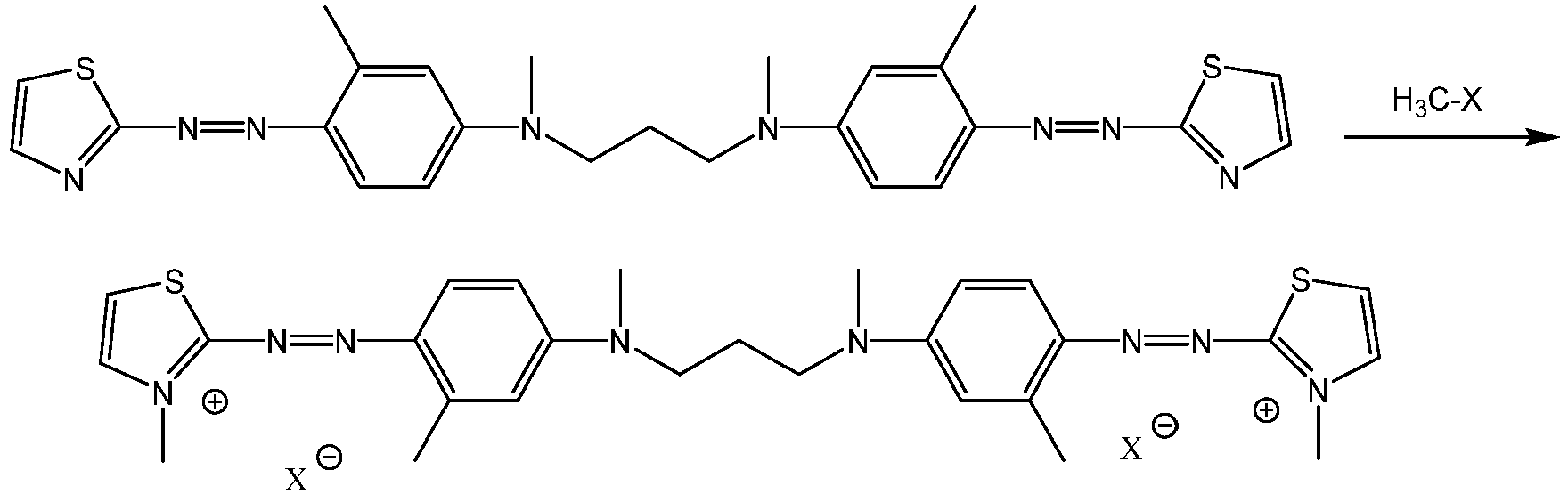
- Eine zentrale Aufgabenstellung der vorliegenden Anmeldung lag in der Bereitstellung von Färbemitteln mit direktziehenden Farbstoffen, welche eine hohe Oxidationsstabilität besitzen damit die gleichzeitige starke Aufhellung und Färbung von keratinischen Fasern ermöglichen. Überraschenderweise zeigten die direktziehenden Farbstoffe der Formel (I) eine besonders hohe Stabilität gegenüber einem Gemisch aus Wasserstoffperoxid und Persulfaten. Um die simultane Färbung und Aufhellung zu ermöglichen, enthalten die erfindungsgemäßen Mittel daher in einer weiteren bevorzugten Ausführungsform zusätzlich Wasserstoffperoxid.
- In einer bevorzugten Ausführungsform wird Wasserstoffperoxid selbst als wässrige Lösung verwendet. Die Konzentration einer Wasserstoffperoxid-Lösung im erfindungsgemäßen Mittel wird einerseits von den gesetzlichen Vorgaben und andererseits von dem gewünschten Effekt bestimmt; vorzugsweise werden 6 bis 12 Gew.-%ige Lösungen in Wasser verwendet. Erfindungsgemäß bevorzugte anwendungsbereite Mittel des ersten Erfindungsgegenstands sind dadurch gekennzeichnet, dass sie, bezogen auf das Gesamtgewicht des anwendungsbereiten Mittels, 0,5 bis 12,5 Gew.-%, besonders bevorzugt 2,5 bis 10 Gew.-% und insbesondere 4,0 bis 9,0 Gew.-% Wasserstoffperoxid, jeweils bezogen auf das Gesamtgewicht des Mittels, enthalten.
- In einer weiteren besonders bevorzugten Ausführungsform ist ein erfindungsgemäßes Mittel dadurch gekennzeichnet, dass es - bezogen auf das Gesamtgewicht des Mittels - 0,5 bis 12,5 Gew.-%, bevorzugt 2,5 bis 10 Gew.-% und insbesondere 4,0 bis 9,0 Gew.-% Wasserstoffperoxid enthält.
- Zur Erzielung einer verstärkten Aufhell- und Bleichwirkung kann das Mittel weiterhin mindestens ein Peroxo-Salz enthalten. Geeignete Peroxo-Salze sind anorganische Peroxoverbindungen, bevorzugt ausgewählt aus der Gruppe, gebildet aus Ammoniumperoxodisulfat, Alkalimetallperoxodisulfaten, Ammoniumperoxomonosulfat, Alkalimetallperoxomonosulfaten, Alkalimetallperoxodiphosphaten und Erdalkalimetallperoxiden. Besonders bevorzuge sind Peroxodisulfate, insbesondere Ammoniumperoxodisulfat, Kaliumperoxodisulfat und Natriumperoxodisulfat.
- In einer weiteren besonders bevorzugten Ausführungsform ist ein erfindungsgemäßes Mittel dadurch gekennzeichnet, dass es mindestens ein Persulfat aus der Gruppe Ammoniumperoxodisulfat, Kaliumperoxodisulfat und Natriumperoxodisulfat enthält.
- Bei Ammoniumperoxodisulfat handelt es sich um eine Verbindung der Formel (NH4)2S2O8. Bei Kaliumperoxodisulfat handelt es sich um eine Verbindung der Formel K2S2O8. Bei Natrjiumperoxodisulfat handelt es sich um eine Verbindung der Formel Na2S2O8.
- Die Persulfate sind jeweils in einer Menge von 0,5 bis 20 Gew.-%, vorzugsweise 1 bis 12,5 Gew.-%, besonders bevorzugt 2,5 bis 10 Gew.-% und insbesondere 3 bis 6 Gew.-%, bezogen auf das Gesamtgewicht des anwendungsbereiten Mittels, in dem erfindungsgemäßen Mittel enthalten.
- In einer weiteren besonders bevorzugten Ausführungsform ist ein erfindungsgemäßes Mittel dadurch gekennzeichnet, dass es - bezogen auf das Gesamtgewicht des Mittels - ein oder mehrere Persulfate aus der Gruppe Ammoniumperoxodisulfat, Kaliumperoxodisulfat und Natriumperoxodisulfat in einer Gesamtmenge von 0,5 bis 20 Gew.-%, vorzugsweise von 1,0 bis 12,5 Gew.-%, weiter bevorzugt von 2,5 bis 10 Gew.-% und besonders bevorzugt von 3,0 bis 6,0 Gew.-% enthält.
- Die erfindungsgemäßen direktziehenden Farbstoffe der allgemeinen Formel (I) haben sich gegenüber bestimmten Gemischen aus Ammoniumperoxodisulfat, Kaliumperoxodisulfat und Natriumperoxodisulfat als besonders stabil erwiesen.
- In einer weiteren besonders bevorzugten Ausführungsform ist ein erfindungsgemäßes Mittel dadurch gekennzeichnet,, dass es - bezogen auf das Gesamtgewicht des Mittels -
- 0,2 bis 13,5 Gew.-%, bevorzugt 0,5 bis 1,5 Gew.-%, Ammoniumperoxodisulfat
- 0,5 bis 4,5 Gew.-%, bevorzugt 1,5 bis 2,5 Gew.-%, Kaliumperoxodisulfat und
- 0,2 bis 1,8 Gew.-%, bevorzugt 0,4 bis 0,8 Gew.-%, Natriumperoxodisulfat enthält.
- Das erfindungsgemäße Farbänderungsmittel kann zur Verstärkung der Blondierwirkung weitere Bleichkraftverstärker enthalten, wie beispielsweise Tetraacetylethylendiamin (TAED), 1,5-Diacetyl-2,4-dioxohexahydro-1,3,5-triazin (DADHT), Tetraacetylglykoluril (TAGU), N-Nonanoylsuccinimid (NOSI), n-Nonanoyl- oder Isononanoyloxybenzolsulfonat (n- bzw. i-NOBS), Phthalsäureanhydrid, Triacetin, Ethylenglykoldiacetat und 2,5-Diacetoxy-2,5-dihydrofuran sowie Carbonatsalze bzw. Hydrogencarbonatsalze, insbesondere Ammoniumhydrogencarbonat, Ammoniumcarbonat, Natriumhydrogencarbonat, Dinatriumcarbonat, Kaliumhydrogencarbonat, Dikaliumcarbonat und Calciumcarbonat, und stickstoffhaltige, heterocyclische Bleichkraftverstärker, wie 4-Acetyl-1-methylpyridinium-p-toluolsulfonat, 2-Acetyl-1-methylpyridinium-p-toluolsulfonat, sowie N-Methyl-3,4-dihydroisochinolinium-p-toluolsulfonat.
- Zur weiteren Steigerung der Aufhellung kann der erfindungsgemäßen Zusammensetzung zusätzlich mindestens eine SiO2-Verbindung, wie Kieselsäure oder Silicate, insbesondere Wassergläser, zugesetzt sein. Es kann erfindungsgemäß bevorzugt sein, die SiO2-Verbindungen in Mengen von 0,05 Gew.-% bis 15 Gew.-%, besonders bevorzugt in Mengen von 0,15 Gew.-% bis 10 Gew.-% und ganz besonders bevorzugt in Mengen von 0,2 Gew.-% bis 5 Gew.-%, jeweils bezogen auf die erfindungsgemäße wasserfreie Zusammensetzung, einzusetzen. Die Mengenangaben geben dabei jeweils den Gehalt der SiO2-Verbindungen (ohne deren Wasseranteil) in den Mitteln wieder.
- n einer weiteren bevorzugten Ausführungsform enthalten die erfindungsgemäßen Mittel neben der Verbindung der Formel (I) zusätzlich mindestens einen weiteren direktziehenden Farbstoff. Durch die Kombination mit weiteren kationischen direktziehenden Farbstoffen lässt sich das erzielbare Nuancenspektrum erweitern, und die Färbeeigenschaften lassen sich noch weiter verbessern.
- In einer weiteren ganz besonders bevorzugten Ausführungsform ist ein erfindungsgemäßes Mittel daher dadurch gekennzeichnet, dass es mindestens eine Si02-Verbindung aus der Gruppe der Kieselsäuren, der Silikate, der Wassergläser und/oder der Alkalimetallmetasilikate enthält.
- Zur weiteren Nuancierung kann das erfindungsgemäße Mittel zur Farbveränderung von keratinischen Fasern zusätzlich auch noch mindestens einen weiteren direktziehenden Farbstoff enthalten. Direktziehende Farbstoffe können in anionische, kationische und nichtionische direktziehende Farbstoffe unterteilt werden.
- Die direktziehenden Farbstoffe sind vorzugsweise ausgewählt aus den kationischen direktziehenden Farbstoffen, da diese mit den Farbstoffen der allgemeinen Formel (I) gut kompatibel sind.
- In einer weiteren besonders bevorzugten Ausführungsform ist ein erfindungsgemäßes Mittel dadurch gekennzeichnet, dass es zusätzlich mindestens einen weiteren kationischen direktziehenden Farbstoff enthält, der von den Farbstoffen der Formel (I) verschieden ist.
- Unter kationischen Farbstoffen werden in diesem Zusammenhang Farbstoffe verstanden, die mindestens eine positive Ladung tragen.
- Als besonders gut kompatibel haben sich ein oder mehrere Farbstoffe aus der Gruppe Basic Yellow 87, Basic Orange 31, Basic Red 51, Basic Violet 2 und Cationic Blue 347 erwiesen.
- Ganz besonders gut kompatibel sind die Farbstoffe der Formel (I) mit den kationischen Azofarbstoffen Basic Orange 31 und Basic Red 51. Durch Kombination eines Farbstoffes der Formel (I) mit Basic Orange 31 und/oder Basice Red 51 können - außer rein gelben Nuancen - Nuancen im gesamten Farbspektrum erzeugt werden.
- In einer weiteren besonders bevorzugten Ausführungsform ist ein erfindungsgemäßes Mittel dadurch gekennzeichnet, dass es zusätzlich Basic Orange 31 und/oder Basic Red 51 enthält.
- Das erfindungsgemäße Mittel kann aber auch zusätzlich mindestens einen nichtionischen direktziehenden Farbstoff enthalten. Dieser kann ausgewählt sein aus der Gruppe HC Yellow 2, HC Yellow 4, HC Yellow 5, HC Yellow 6, HC Yellow 12, HC Orange 1, Disperse Orange 3, HC Red 1, HC Red 3, HC Red 7,HC Red 10, HC Red 11, HC Red 13, HC Red BN, HC Blue 2, HC Blue 11, HC Blue 12, Disperse Blue 3, HC Violet 1, Disperse Violet 1, Disperse Violet 4, Disperse Black 9, 1,4-Diamino-2-nitrobenzol, 2-Amino-4-nitrophenol, 1,4-Bis-(2-hydroxyethyl)-amino-2-nitrobenzol, 3-Nitro-4-(2-hydroxyethyl)aminophenol, 2-(2-Hydroxyethyl)amino-4,6-dinitrophenol, 4-[(2-Hydroxyethyl)amino]-3-nitro-1-methylbenzol, 1-Amino-4-(2-hydroxyethyl)amino-5-chlor-2-nitrobenzol, 4-Amino-3-nitrophenol, 1-(2'-Ureidoethyl)amino-4-nitrobenzol, 2-[(4-Amino-2-nitrophenyl)amino]benzoesäure, 4-[(3-Hydroxypropyl)amino]-3-nitrophenol, 4-Nitro-o-phenylendiamin, 6-Nitro-1,2,3,4-tetrahydrochinoxalin, 2-Hydroxy-1,4-naphthochinon, Pikraminsäure und deren Salze, 2-Amino-6-chloro-4-nitrophenol, 4-Ethyl-amino-3-nitrobenzoesäure und 2-Chlor-6-ethylamino-4-nitrophenol.
- Zusätzlich können auch anionische direktziehende Farbstoffe enthalten sein, die unter den internationalen Bezeichnungen bzw. Handelsnamen Acid Yellow 1, Yellow 10, Acid Yellow 23, Acid Yellow 36, Acid Orange 7, Acid Red 33, Acid Red 52, Pigment Red 57:1, Acid Blue 7, Acid Green 50, Acid Violet 43, Acid Black 1, Acid Black 52, Bromphenolblau und Tetrabromphenolblau bekannten sind. Die erfindungsgemäßen Mittel können weiterhin auch zusammen mit Oxidationsfärbemitteln eingesetzt werden. Solche Oxidationsfärbemittel enthalten zusätzlich mindestens ein Oxidationsfarbstoffvorprodukt, bevorzugt zumindest ein Oxidationsfarbstoffvorprodukt vom Entwickler-Typ und mindestens ein Oxidationsfarbstoffvorprodukt vom Kuppler-Typ. Besonders geeignete Oxidationsfarbstoffvorprodukte vom Entwickler-Typ sind dabei ausgewählt aus mindestens einer Verbindung aus der Gruppe, die gebildet wird aus p-Phenylendiamin, p-Toluylendiamin, 2-(2-Hydroxyethyl)-p-phenylendiamin, 2-(1,2-Dihydroxyethyl)-p-phenylendiamin, N,N-Bis-(2-hydroxyethyl)-p-phenylendiamin, 2-Methoxymethyl-p-phenylendiamin, N-(4-Amino-3-methylphenyl)-N-[3-(1H-imidazol-1-yl)propyl]amin, N,N'-Bis-(2-hydroxyethyl)-N,N'-bis-(4-aminophenyl)-1,3-diamino-propan-2-ol, Bis-(2-hydroxy-5-aminophenyl)-methan, 1,3-Bis-(2,5-diaminophenoxy)propan-2-ol, N,N'-Bis-(4-aminophenyl)-1,4-diazacycloheptan, 1,10-Bis-(2,5-diaminophenyl)-1,4,7,10-tetraoxadecan, p-Aminophenol, 4-Amino-3-methylphenol, 4-Amino-2-aminomethylphenol, 4-Amino-2-(1,2-dihydroxyethyl)phenol, 4-Amino-2-(diethylaminomethyl)-phenol, 4,5-Diamino-1-(2-hydroxyethyl)pyrazol, 2,4,5,6-Tetraaminopyrimidin, 4-Hydroxy-2,5,6-triaminopyrimidin, 2-Hydroxy-4,5,6-triaminopyrimidin, 2,3-Diamino-6,7-dihydro-1H,5H-pyrazolo[1,2-a]pyrazol-1-on sowie deren physiologisch verträglichen Salzen.
- Besonders geeignete Oxidationsfarbstoffvorprodukte vom Kuppler-Typ sind dabei ausgewählt aus der Gruppe, gebildet aus 3-Aminophenol, 5-Amino-2-methylphenol, 3-Amino-2-chlor-6-methylphenol, 2-Hydroxy-4-aminophenoxyethanol, 5-Amino-4-chlor-2-methylphenol, 5-(2-Hydroxyethyl)-amino-2-methylphenol, 2,4-Dichlor-3-aminophenol, 2-Aminophenol, 3-Phenylendiamin, 2-(2,4-Diaminophenoxy)ethanol, 1,3-Bis(2,4-diaminophenoxy)propan, 1-Methoxy-2-amino-4-(2-hydroxyethylamino)benzol, 1,3-Bis(2,4-diaminophenyl)propan, 2,6-Bis(2'-hydroxyethylamino)-1-methylbenzol, 2-({3-[(2-Hydroxyethyl)amino]-4-methoxy-5-methylphenyl}amino)ethanol, 2-({3-[(2-Hydroxyethyl)amino]-2-methoxy-5-methylphenyl}amino)ethanol, 2-({3-[(2-Hydroxyethyl)amino]-4,5-dimethylphenyl}amino)ethanol, 2-[3-Morpholin-4-ylphenyl)amino]ethanol, 3-Amino-4-(2-methoxyethoxy)-5-methylphenylamin, 1-Amino-3-bis-(2-hydroxyethyl)aminobenzol, Resorcin, 2-Methylresorcin, 4-Chlorresorcin, 1,2,4-Trihydroxybenzol, 2-Amino-3-hydroxypyridin, 3-Amino-2-methylamino-6-methoxypyridin, 2,6-Dihydroxy-3,4-dimethylpyridin, 3,5-Diamino-2,6-dimethoxypyridin, 1-Phenyl-3-methylpyrazol-5-on, 1-Naphthol, 1,5-Dihydroxynaphthalin, 2,7-Dihydroxynaphthalin, 1,7-Dihydroxynaphthalin, 1,8-Dihydroxynaphthalin, 4-Hydroxyindol, 6-Hydroxyindol, 7-Hydroxyindol, 4-Hydroxyindolin, 6-Hydroxyindolin, 7-Hydroxyindolin oder Gemischen dieser Verbindungen oder deren physiologisch verträglichen Salzen.
- Die zusätzlichen direktziehenden Farbstoffe, Entwicklerkomponenten und Kupplerkomponenten werden bevorzugt jeweils in einem Anteil von 0,0001 bis 5,0 Gew.-%, vorzugsweise 0,001 bis 3,5 Gew.-%, jeweils bezogen auf das anwendungsbereite Mittel, verwendet. Dabei werden Entwicklerkomponenten und Kupplerkomponenten im Allgemeinen in etwa molaren Mengen zueinander eingesetzt. Wenn sich auch der molare Einsatz als zweckmäßig erwiesen hat, so ist ein gewisser Überschuss einzelner Oxidationsfarbstoffvorprodukte nicht nachteilig, so dass Entwicklerkomponenten und Kupplerkomponenten in einem Mol-Verhältnis von 1 zu 0,5 bis 1 zu 3, insbesondere 1 zu 1 bis 1 zu 2, stehen können.
- Die Färbemittel können weiterhin zusätzliche Wirk-, Hilfs- und Zusatzstoffe enthalten, um die Färbeleistung zu verbessern und weitere gewünschte Eigenschaften der Mittel einzustellen.
- Vorzugsweise werden die anwendungsbereiten Färbemittel als flüssige Zubereitung bereitgestellt und den Mitteln daher zusätzlich eine oberflächenaktive Substanz zugesetzt, wobei solche oberflächenaktive Substanzen je nach Anwendungsgebiet als Tenside oder als Emulgatoren bezeichnet werden: Sie sind bevorzugt aus anionischen, kationischen, zwitterionischen, amphoteren und nichtionischen Tensiden und Emulgatoren ausgewählt.
- Erfindungsgemäß bevorzugte Mittel sind dadurch gekennzeichnet, dass das Mittel zusätzlich mindestens ein anionisches Tensid enthält. Bevorzugte anionische Tenside sind Fettsäuren, Alkylsulfate, Alkylethersulfate und Ethercarbonsäuren mit 10 bis 20 C-Atomen in der Alkylgruppe und bis zu 16 Glykolethergruppen im Molekül. Die anionischen Tenside werden in Anteilen von 0,1 bis 45 Gew.%, bevorzugt 1 bis 30 Gew.% und ganz besonders bevorzugt von 1 bis 15 Gew.%, bezogen auf die Gesamtmenge des anwendungsbereiten Mittels, eingesetzt.
- Erfindungsgemäß bevorzugte Mittel sind dadurch gekennzeichnet, dass das Mittel zusätzlich mindestens ein zwitterionisches Tensid enthält. Bevorzugte zwitterionische Tenside sind Betaine, N-Alkyl-N,N-dimethylammonium-glycinate, N-Acyl-aminopropyl-N,N-dimethylammoniumglycinate, und 2-Alkyl-3-carboxymethyl-3-hydroxyethyl-imidazoline. Ein bevorzugtes zwitterionisches Tensid ist unter der INCI-Bezeichnung Cocamidopropyl Betaine bekannt.
- Erfindungsgemäß bevorzugte Mittel sind dadurch gekennzeichnet, dass das Mittel zusätzlich mindestens ein amphoteres Tensid enthält. Bevorzugte amphotere Tenside sind N-Alkylglycine, N-Alkylpropionsäuren, N-Alkylaminobuttersäuren, N-Alkyliminodipropionsäuren, N-Hydroxyethyl-N-alkylamidopropylglycine, N-Alkyltaurine, N-Alkylsarcosine, 2-Alkylaminopropionsäuren und Alkylaminoessigsäuren. Besonders bevorzugte amphotere Tenside sind N-Kokosalkylaminopropionat, as Kokosacylaminoethylaminopropionat und C12-C18-Acylsarcosin.
- Weiterhin hat es sich als vorteilhaft erwiesen, wenn die Mittel weitere, nichtionogene grenzflächenaktive Stoffe, enthalten. Bevorzugte nichtionische Tenside sind Alkylpolyglykoside sowie Alkylenoxid-Anlagerungsprodukte an Fettalkohole und Fettsäuren mit jeweils 2 bis 30 Mol Ethylenoxid pro Mol Fettalkohol bzw. Fettsäure erwiesen. Zubereitungen mit hervorragenden Eigenschaften werden ebenfalls erhalten, wenn sie als nichtionische Tenside Fettsäureester von ethoxyliertem Glycerin enthalten.
- Die nichtionischen, zwitterionischen oder amphoteren Tenside werden in Anteilen von 0,1 bis 45 Gew.%, bevorzugt 1 bis 30 Gew.% und ganz besonders bevorzugt von 1 bis 15 Gew.%, bezogen auf die Gesamtmenge der anwendungsbereiten Mittel, eingesetzt.
- Erfindungsgemäß geeignete Mittel können auch kationische Tenside vom Typ der quartären Ammoniumverbindungen, der Esterquats und der Amidoamine enthalten. Bevorzugte quaternäre Ammoniumverbindungen sind Ammoniumhalogenide sowie die unter den INCI-Bezeichnungen Quaternium-27 und Quaternium-83 bekannten Imidazolium-Verbindungen. Weitere erfindungsgemäß verwendbare kationische Tenside stellen die quaternisierten Proteinhydrolysate dar. Eine erfindungsgemäß besonders geeignete Verbindung aus der Amidoamine stellt das unter der Bezeichnung Tegoamid® S 18 im Handel erhältliche Stearamidopropyl-dimethylamin dar. Bevorzugte Esterquats sind quaternierte Estersalze von Fettsäuren mit Triethanolamin, quaternierte Estersalze von Fettsäuren mit Diethanolalkylaminen und quaternierten Estersalzen von Fettsäuren mit 1,2-Dihydroxypropyldialkylaminen. Die kationischen Tenside sind in den erfindungsgemäß verwendeten Mitteln bevorzugt in Anteilen von 0,05 bis 10 Gew.-%, bezogen auf das gesamte Mittel, enthalten.
- Die anwendungsbereiten Färbemittel können weitere Hilfs- und Zusatzstoffe enthalten. So hat es sich als vorteilhaft erwiesen, wenn die Mittel mindestens ein Verdickungsmittel enthält. Bezüglich dieser Verdickungsmittel bestehen keine prinzipiellen Einschränkungen. Es können sowohl organische als auch rein anorganische Verdickungsmittel zum Einsatz kommen.
- Geeignete Verdickungsmittel sind
- anionische, synthetische Polymere;
- kationische, synthetische Polymere;
- natürlich vorkommende Verdickungsmittel, wie nichtionische Guargums, Skleroglucangums oder Xanthangums, Gummi arabicum, Ghatti-Gummi, Karaya-Gummi, Tragant-Gummi, Carrageen-Gummi, Agar-Agar, Johannisbrotkernmehl, Pektine, Alginate, Stärke-Fraktionen und Derivate wie Amylose, Amylopektin und Dextrine, sowie Cellulosederivate, wie beispielsweise Methylcellulose, Carboxyalkylcellulosen und Hydroxyalkylcellulosen;
- nichtionische, vollsynthetische Polymere, wie Polyvinylalkohol oder Polyvinylpyrrolidinon; sowie
- anorganische Verdickungsmittel, insbesondere Schichtsilikate wie beispielsweise Bentonit, besonders Smektite, wie Montmorillonit oder Hectorit.
- Färbeprozesse auf Keratinfasern laufen üblicherweise im alkalischen Milieu ab. Um die Keratinfasern und auch die Haut so weit wie möglich zu schonen, ist die Einstellung eines zu hohen pH-Wertes jedoch nicht wünschenswert. Daher ist es bevorzugt, wenn der pH-Wert des anwendungsbereiten Mittels zwischen 7 und 11, insbesondere zwischen 8 und 10,5, liegt. Bei den pH-Werten im Sinne der vorliegenden Erfindung handelt es sich um pH-Werte, die bei einer Temperatur von 22 °C gemessen wurden.
- Die zur Einstellung des bevorzugten pH-Wertes erfindungsgemäß verwendbaren Alkalisierungsmittel können aus der Gruppe, die gebildet wird aus Ammoniak, Alkanolaminen, basischen Aminosäuren, sowie anorganischen Alkalisierungsmitteln wie (Erd-)Alkalimetallhydroxiden, (Erd-)-Alkalimetallmetasilikaten, (Erd-)Alkalimetallphosphaten und (Erd-)Alkalimetallhydrogenphosphaten, ausgewählt werden. Bevorzugte anorganische Alkalisierungsmittel sind Magnesiumcarbonat, Natriumhydroxid, Kaliumhydroxid, Natriumsilicat und Natriummetasilicat. Erfindungsgemäß einsetzbare, organische Alkalisierungsmittel werden bevorzugt ausgewählt aus Monoethanolamin, 2-Amino-2-methylpropanol und Triethanolamin. Die als erfindungsgemäßes Alkalisierungsmittel einsetzbaren basischen Aminosäuren werden bevorzugt ausgewählt aus der Gruppe, die gebildet wird aus Arginin, Lysin, Ornithin und Histidin, besonders bevorzugt Arginin. Es hat sich aber im Rahmen der Untersuchungen zur vorliegenden Erfindung herausgestellt, dass weiterhin erfindungsgemäß bevorzugte Mittel dadurch gekennzeichnet sind, dass sie zusätzlich ein organisches Alkalisierungsmittel enthalten. Eine Ausführungsform des ersten Erfindungsgegenstands ist dadurch gekennzeichnet, dass das Mittel zusätzlich mindestens ein Alkalisierungsmittel enthält, welches ausgewählt ist aus der Gruppe, die gebildet wird aus Ammoniak, Alkanolaminen und basischen Aminosäuren, insbesondere aus Ammoniak, Monoethanolamin und Arginin oder seinen verträglichen Salzen.
- Weiterhin hat es sich als vorteilhaft erweisen, wenn die Färbemittel, insbesondere wenn sie zusätzlich Wasserstoffperoxid enthalten, mindestens einen Stabilisator oder Komplexbildner enthalten. Besonders bevorzugte Stabilisatoren sind Phenacetin, Alkalibenzoate (Natriumbenzoat) und Salicylsäure. Weiterhin können alle Komplexbildner des Standes der Technik eingesetzt werden. Erfindungsgemäß bevorzugte Komplexbildner sind stickstoffhaltigen Polycarbonsäuren, insbesondere EDTA und EDDS, und Phosphonate, insbesondere 1-Hydroxyethan-1,1-diphosphonat (HEDP) und/oder Ethylendiamintetramethylenphosphonat (EDTMP) und/oder Diethylentriaminpentamethylenphosphonat (DTPMP) bzw. deren Natriumsalze.
- Ferner können die erfindungsgemäßen Mittel weitere Wirk-, Hilfs- und Zusatzstoffe enthalten, wie beispielsweise nichtionische Polymere wie beispielsweise Vinylpyrrolidinon/Vinylacrylat-Copolymere, Polyvinylpyrrolidinon, Vinylpyrrolidinon/Vinylacetat-Copolymere, Polyethylenglykole und Polysiloxane; zusätzliche Silikone wie flüchtige oder nicht flüchtige, geradkettige, verzweigte oder cyclische, vernetzte oder nicht vernetzte Polyalkylsiloxane (wie Dimethicone oder Cyclomethicone), Polyarylsiloxane und/oder Polyalkylarylsiloxane, insbesondere Polysiloxane mit organofunktionelle Gruppen, wie substituierten oder unsubstituierten Aminen (Amodimethicone), Carboxyl-, Alkoxy- und/oder Hydroxylgruppen (Dimethiconcopolyole), lineare Polysiloxan(A)-Polyoxyalkylen(B)-Blockcopolymere, gepfropften Silikonpolymere; kationische Polymere wie quaternisierte Celluloseether, Polysiloxane mit quaternären Gruppen, Dimethyldiallylammoniumchlorid-Polymere, Acrylamid-Dimethyldiallylammoniumchlorid-Copolymere, mit Diethylsulfat quaternierte Dimethylamino-ethylmethacrylat-Vinylpyrrolidinon-Copolymere, Vinylpyrrolidinon-Imidazolinium-methochlorid-Copolymere und quaternierter Polyvinylalkohol; zwitterionische und amphotere Polymere; anionische Polymere wie beispielsweise Polyacrylsäuren oder vernetzte Polyacrylsäuren; Strukturanten wie Glucose, Maleinsäure und Milchsäure, haarkonditionierende Verbindungen wie Phospholipide, beispielsweise Lecitin und Kephaline; Parfümöle, Dimethylisosorbid und Cyclodextrine; faserstrukturverbessernde Wirkstoffe, insbesondere Mono-, Di- und Oligosaccharide wie beispielsweise Glucose, Galactose, Fructose, Fruchtzucker und Lactose; Farbstoffe zum Anfärben des Mittels; Antischuppenwirkstoffe wie Piroctone Olamine, Zink Omadine und Climbazol; Aminosäuren und Oligopeptide; Proteinhydrolysate auf tierischer und/oder pflanzlicher Basis, sowie in Form ihrer Fettsäure-Kondensationsprodukte oder gegebenenfalls anionisch oder kationisch modifizierten Derivate; pflanzliche Öle; Lichtschutzmittel und UV-Blocker; Wirkstoffe wie Panthenol, Pantothensäure, Pantolacton, Allantoin, Pyrrolidinoncarbonsäuren und deren Salze sowie Bisabolol; Polyphenole, insbesondere Hydroxyzimtsäuren, 6,7-Dihydroxycumarine, Hydroxybenzoesäuren, Catechine, Tannine, Leukoanthocyanidine, Anthocyanidine, Flavanone, Flavone und Flavonole; Ceramide oder Pseudoceramide; Vitamine, Provitamine und Vitaminvorstufen; Pflanzenextrakte; Fette und Wachse wie Fettalkohole, Bienenwachs, Montanwachs und Paraffine; Quell- und Penetrationsstoffe wie Glycerin, Propylenglykolmonoethylether, Carbonate, Hydrogencarbonate, Guanidine, Harnstoffe sowie primäre, sekundäre und tertiäre Phosphate; Trübungsmittel wie Latex, Styrol/PVP- und Styrol/Acrylamid-Copolymere; Perlglanzmittel wie Ethylenglykolmono- und - distearat sowie PEG-3-distearat; Pigmente sowie Treibmittel wie Propan-Butan-Gemische, N2O, Dimethylether, CO2 und Luft.
- Die Auswahl dieser weiteren Stoffe wird der Fachmann gemäß der gewünschten Eigenschaften der Mittel treffen. Bezüglich weiterer fakultativer Komponenten sowie der eingesetzten Mengen dieser Komponenten wird ausdrücklich auf die dem Fachmann bekannten einschlägigen Handbücher verwiesen. Die zusätzlichen Wirk- und Hilfsstoffe werden in den erfindungsgemäßen Mitteln bevorzugt in Mengen von jeweils 0,0001 bis 25 Gew.-%, insbesondere von 0,0005 bis 15 Gew.-%, bezogen auf das Gesamtgewicht der Anwendungsmischung, eingesetzt.
- Die Mittel des ersten Erfindungsgegenstands können in Verfahren zum Färben und auch in Verfahren zum gleichzeitigen Blondieren bzw. Aufhellen und Färben menschlicher Haare genutzt werden.
- Die erfindungsgemäßen Mittel können als Einkomponentenmittel oder als Mehrkomponentenmittel wie Zweikomponenten Mittel oder Dreikomponentenmittel formuliert und entsprechend angewendet werden. Eine Auftrennung in Mehrkomponentensysteme bietet sich insbesondere dort an, wo Inkompatibilitäten der Inhaltsstoffe zu erwarten oder zu befürchten sind; das einzusetzende Mittel wird bei solchen Systemen vom Verbraucher direkt vor der Anwendung durch Vermischen der Komponente hergestellt.
- Unter dem erfindungsgemäßen Mittel zur Farbveränderung von keratinischen Fasern wird immer das anwendungsbereite Mittel verstanden.
- Wird das erfindungsgemäße Mittel dem Anwender in Form eines Einkomponenten-Mittels zur Verfügung gestellt, dann muss das anwendungsbereite Mittel nicht erst hergestellt werden, sondern kann direkt aus dem Behältnis, in dem es konfektioniert wurde, entnommen und auf die keratinischen Fasern appliziert werden.
- Bei Blondiermitteln handelt es sich jedoch üblicherweise um Zweikomponentenprodukte, bei welchen eine oxidationsmittelhaltige Komponente (A1) kurz vor der Anwendung mit einem (Alkalisierungs-)Mittel (A2) vermischt und diese anwendungsbereite Mischung auf die Haare aufgetragen wird.
- In diesem Fall handelt es sich bei dem erfindungsgemäßen Mittel um das anwendungsbereite Mittel, welches kurz vor der Anwendung durch Vermischen von (A1) und (A2) hergestellt wurde.
- Hierbei können die direktziehenden Farbstoffe der allgemeinen Formel (I) in der Komponente (A1) (d.h. zusammen mit dem Oxidationsmittel) oder aber in der Komponente (A2) (zusammen mit dem Alkalisierungsmittel) konfektioniert werden.
- Es ist ebenfalls möglich und erfindungsgemäß, wenn das anwendungsbereite Mittel kurz vor der Anwendung auf den menschlichen Haaren durch Vermischen von 3 Komponenten hergestellt wird, wobei
- die Komponente (A1) mindestens einen direktziehenden Farbstoff der allgemeinen Formel (I) und mindestens ein Alkalisierungsmittel
- die Komponente (A2) mindestens ein erstes Oxidationsmittel (z.B. Wasserstoffperoxid) und
- die Komponente (A3) mindestens ein zweites Oxidationsmittel (z.B. ein oder mehrere Poroxodisulfatsalze) enthält.
- Während der Einwirkzeit der Mittel auf der Faser kann es vorteilhaft sein, den Aufhellvorgang oder Mattiervorgang durch Wärmezufuhr zu unterstützen. Die Wärmezufuhr kann durch eine externe Wärmequelle, wie z.B. warme Luft eines Warmluftgebläses, als auch, insbesondere bei einer Haaraufhellung am lebenden Probanden, durch die Körpertemperatur des Probanden erfolgen. Bei letzterer Möglichkeit wird üblicherweise die behandelte Partie mit einer Haube abgedeckt. Eine Einwirkphase bei Raumtemperatur ist ebenfalls erfindungsgemäß. Insbesondere liegt die Temperatur während der Einwirkzeit zwischen 20 °C und 40 °C, insbesondere zwischen 25 °C und 38 °C. Nach Ende der Einwirkzeit wird die verbleibende Färbezubereitung mit Wasser oder einem Reinigungsmittel aus dem Haar gespült. Als Reinigungsmittel kann dabei insbesondere handelsübliches Shampoo dienen, wobei insbesondere dann auf das Reinigungsmittel verzichtet werden kann und der Ausspülvorgang mit Wasser erfolgen kann, wenn das Aufhellmittel einen stark tensidhaltigen Träger besitzt.
- Bezüglich weiterer bevorzugter Ausführungsformen der erfindungsgemäßen Verwendung und Verfahren gilt mutatis mutandis das zu den erfindungsgemäßen Mitteln Gesagte.
- Der Farbstoff DZ 1 wurde nach einem Verfahren synthetisiert, wie es in den Dokumenten
WO 2002/100369 A2 undUS 4 562 249 beschrieben ist. -

- Der Farbstoff DZ 2 wurde nach einem Verfahren synthetisiert, wie es in den Dokumenten
WO 2002/100369 A2 undUS 3291788 beschrieben ist. - Als Edukte wurden 2-Aminothiazol und N,N'-Dimethyl-N,N'-diphenyl-propan-1,3-diamin eingesetzt (Azokupplungsreaktion in wässriger, schwefelsauerer Lösung mit Nitrosylschwefelsäure). Der in dieser Azokupplungsreaktion entstehende neutrale Farbstoff wurde im Anschluss daran quaterniert (beispielsweise mit dem Quaternierungsmittel Dimethylsulfat in einem polaren, aprotischen Lösungsmittel wie Dimethylformamid oder Dimethylsulfoxid).
-

- Der Farbstoff DZ 3 wurde nach einem Verfahren synthetisiert, wie es in dem Dokument
WO 2002/100369 A2 beschrieben ist. -

- Es wurden die folgenden Färbecremes hergestellt (alle Angaben in Gew.-%, Aktivsubstanz)
Farbcreme E V1 V2 Cetearylalkohol 3,5 3,5 3,5 C12-C18 Fettalkohole 0,9 0,9 0,9 Ceteareth-20 0,1 0,1 0,1 Quaternium-87 1,0 1,0 1,0 Natrium Laurethsulfat 1,9 1,9 1,9 Ammoniumsulfat 0,2 0,2 0,23 Etidronsäure 0,1 0,1 0,1 Ammoniumhydroxid 0,1 0,1 0,1 Natriumsilikat 0,2 0,2 0,2 Ammoniak (25 %ige wässrige Lösung) 2,5 2,5 2,5 DZ1 (erfindungsgemäß) 0,7 -- --- DZ 2 (Vergleich) --- 0,7 --- DZ 3 (Vergleich) --- --- 0,7 Wasser ad 100 ad 100 ad 100 - Die direktziehenden Farbstoffe DZ1, DZ2 und DZ3 wurden jeweils in wenig Wasser vorgelöst und mit den restlichen Formulierungsbestandteilen vermischt.
- Es wurde die folgende Entwickleremulsion hergestellt (Gesamtmenge 36 g)
Entwickleremulsion Natriumhydroxid 0,2 Etidronsäure 0,5 Natriumlaurethsulfat 0,7 Acrylat Compolymer 4,3 Wasserstoffperoxid (50 %ige Lösung) 8,0 Wasser 22,0 g - Es wurde das folgende Blondierpulver hergestellt (Gesamtmenge 13,6 g)
Entwickleremulsion Ammoniumpersulfat 1,8 Kalumpersulfat 5,8 Natriumpersulfat 2,1 Natriumsilikat 3,8 Dinatrium EDTA 0,1 - Jede der Farbcremes E, V1 und V2 wurde im Gewichtsverhältnis 1:1:1 mit der Entwickleremulsion und mit dem Blondierpulver vermischt.
- Jeweils 1,8 g der Färbecreme wurden auf eine ca. 6 cm lange Strähne Menschenhaares (Kerling Euronaturhaar,80 % ergraut) aufgetragen und dort 30 Minuten bei 30 °C belassen. Nach Beendigung der Einwirkzeit wurde das Haar ausgespült, mit einem üblichen Haarwaschmittel gewaschen und anschließend getrocknet. Nach dem Trocknen wurden die Färbung und die Farbintensität der Strähnen visuell unter der Tageslichtlampe beurteilt.
Formulierung pH-Wert Farbnuance Farbintensität E1 DZ1 (erfindungsgemäß) 9,5 tiefviolett ++++ V1 DZ 2 (Vergleich) 9,5 blass violett + V2 DZ 3 (Vergleich) 9,5 blass rosa ++ Farbintensität: + = schlecht +++ = mittel +++++ = sehr gut


Claims (13)
- Mittel zur Farbveränderung von keratinischen Fasern, insbesondere menschlichen Haaren, enthaltend in einem kosmetischen Träger(a) mindestens einen direktziehenden Farbstoff der Formel (I),
 Het1, Het2 unabhängig voneinander für eine der Strukturen (II), (III), (IV), (V), (VI) oder (VII) stehen,
 R1, R3 unabhängig voneinander für eine C1-C6-Alkylgruppe oder für eine C1-C6-Alkoxygruppe stehen,R2, R4 beide für ein Wasserstoffatom, stehen,R5, R6 unabhängig voneinander für ein Wasserstoffatom, eine C1-C6-Alkylgruppe oder für eine C2-C6-Alkenylgruppe stehen,Q für eine Gruppierung der Formel (VIII) steht,
*-(CH2)n-* VIII
n für eine ganze Zahl von 3 bis 6 steht,R7, R10 jeweils unabhängig voneinander für eine C1-C6-Alkylgruppe oder für eine C2-C6-Alkenylgruppe stehen,R8, R9 jeweils unabhängig voneinander für ein Wasserstoffatom, eine C1-C6-Alkylgruppe, ein Halogenatom aus der Gruppe Chlor, Brom, Fluor oder Jod, für eine C1-C6-Alkoxygruppe oder für eine Nitrogruppe stehen,X- für ein physiologisch verträgliches Anion, bevorzugt aus der Gruppe Chlorid, Bromid, lodid, Methylsulfat, Methylsulfonat, p-Toluolsulfonat, Acetat, Hydrogensulfat, ½ Sulfat oder ½ Tetrachlorozinkat, steht. - Mittel nach Anspruch 1, dadurch gekennzeichnet, dass es (a) mindestens einen direktziehenden Farbstoff der allgemeinen Formel (I) enthält, in derHet1, Het2 unabhängig voneinander jeweils für eine der Strukturen (II), (III) oder (IV) stehen

- Mittel nach einem der Ansprüche 1 bis 2, dadurch gekennzeichnet, dass es (a) mindestens einen direktziehenden Farbstoff der allgemeinen Formel (I) enthält, in derR5, R6 unabhängig voneinander für Wasserstoff oder für eine C1-C6-Alkylgruppe stehen.
- Mittel nach einem der Ansprüche 1 bis 4 3, dadurch gekennzeichnet, dass es (a) mindestens einen direktziehenden Farbstoff der allgemeinen Formel (I) enthält, in derR7, R10 jeweils unabhängig voneinander für eine Methylgruppe oder eine Ethylgruppe stehen,R8, R9 für ein Wasserstoffatom stehen.
*-(CH2)n- *
- Mittel nach einem der Ansprüche 1 bis 4, dadurch gekennzeichnet, dass es (a) mindestens einen direktziehenden Farbstoff der allgemeinen Formel (I) enthält, der ausgewählt ist aus- Salzen des 3-Methyl-2-[2-(3-methyl-4-{[3-({2-methyl-4-[2-(3-methyl-1,3-thiazol-3-ium-2-yl)diazen-1-yl]phenyl}amino)propyl]amino}phenyl)diazen-1-yl]-1,3-thiazol-3-iums- Salzen des 3-Methyl-2-[2-(2-methyl-4-{[3-({3-methyl-4-[2-(3-methyl-1,3-thiazol-3-ium-2-yl)diazen-1-yl]phenyl}amino)propyl]amino}phenyl)diazen-1-yl]-1,3-thiazol-3-iums- Salzen des 3-Methyl-2-[2-(3-methyl-4-{[4-({2-methyl-4-[2-(3-methyl-1,3-thiazol-3-ium-2-yl)diazen-1-yl]phenyl}amino)butyl]amino}phenyl)diazen-1-yl]-1,3-thiazol-3-iums- Salzen des 3-Methyl-2-[2-(2-methyl-4-{[4-({3-methyl-4-[2-(3-methyl-1,3-thiazol-3-ium-2-yl)diazen-1-yl]phenyl}amino)butyl]amino}phenyl)diazen-1-yl]-1,3-thiazol-3-iums- Salzen des 3-Methyl-2-[2-(3-methyl-4-{[5-({2-methyl-4-[2-(3-methyl-1,3-thiazol-3-ium-2-yl)diazen-1-yl]phenyl}amino)pentyl]amino}phenyl)diazen-1-yl]-1,3-thiazol-3-iums- Salzen des 3-Methyl-2-[2-(2-methyl-4-{[5-({3-methyl-4-[2-(3-methyl-1,3-thiazol-3-ium-2-yl)diazen-1-yl]phenyl}amino)pentyl]amino}phenyl)diazen-1-yl]-1,3-thiazol-3-iums- Salzen des 3-Methyl-2-(2-{3-methyl-4-[methyl({3-[methyl({2-methyl-4-[2-(3-methyl-1,3-thiazol-3-ium-2-yl)diazen-1-yl]phenyl})amino]propyl})amino]phenyl}diazen-1-yl)-1,3-thiazol-3-iums- Salzen des 3-Methyl-2-(2-{3-methyl-4-[ethyl({3-[ethyl({2-methyl-4-[2-(3-methyl-1,3-thiazol-3-ium-2-yl)diazen-1-yl]phenyl})amino]propyl})amino]phenyl}diazen-1-yl)-1,3-thiazol-3-iums- Salzen des 3-Methyl-2-(2-{2-methyl-4-[methyl({3-[methyl({3-methyl-4-[2-(3-methyl-1,3-thiazol-3-ium-2-yl)diazen-1-yl]phenyl})amino]propyl})amino]phenyl}diazen-1-yl)-1,3-thiazol-3-iums- Salzen des 3-Methyl-2-(2-{2-methyl-4-[ethyl({3-[ethyl({3-methyl-4-[2-(3-methyl-1,3-thiazol-3-ium-2-yl)diazen-1-yl]phenyl})amino]propyl})amino]phenyl}diazen-1-yl)-1,3-thiazol-3-iums- Salzen des 3-Methyl-2-(2-{3-methyl-4-[methyl({4-[methyl({2-methyl-4-[2-(3-methyl-1,3-thiazol-3-ium-2-yl)diazen-1-yl]phenyl})amino]butyl})amino]phenyl}diazen-1-yl)-1,3-thiazol-3-iums- Salzen des 3-Methyl-2-(2-{2-methyl-4-[methyl({4-[methyl({3-methyl-4-[2-(3-methyl-1,3-thiazol-3-ium-2-yl)diazen-1-yl]phenyl})amino]butyl})amino]phenyl}diazen-1-yl)-1,3-thiazol-3-iums- Salzen des 3-Methyl-2-(2-{3-methyl-4-[methyl({5-[methyl({2-methyl-4-[2-(3-methyl-1,3-thiazol-3-ium-2-yl)diazen-1-yl]phenyl})amino]pentyl})amino]phenyl}diazen-1-yl)-1,3-thiazol-3-iums- Salzen des 3-Methyl-2-(2-{2-methyl-4-[methyl({5-[methyl({3-methyl-4-[2-(3-methyl-1,3-thiazol-3-ium-2-yl)diazen-1-yl]phenyl})amino]pentyl})amino]phenyl}diazen-1-yl)-1,3-thiazol-3-iums- Salzen des 2-[2-(3-Methoxy-4-{[3-({2-methoxy-4-[2-(3-methyl-1,3-thiazol-3-ium-2-yl)diazen-1-yl]phenyl}amino)propyl]amino}phenyl)diazen-1-yl]-3-methyl-1,3-thiazol-3-iums- Salzen des 2-[2-(2-Methoxy-4-{[3-({3-methoxy-4-[2-(3-methyl-1,3-thiazol-3-ium-2-yl)diazen-1-yl]phenyl}amino)propyl]amino}phenyl)diazen-1-yl]-3-methyl-1,3-thiazol-3-iums- Salzen des 2-[2-(3-Methoxy-4-{[4-({2-methoxy-4-[2-(3-methyl-1,3-thiazol-3-ium-2-yl)diazen-1-yl]phenyl}amino)butyl]amino}phenyl)diazen-1-yl]-3-methyl-1,3-thiazol-3-iums- Salzen des 2-[2-(2-Methoxy-4-{[4-({3-methoxy-4-[2-(3-methyl-1,3-thiazol-3-ium-2-yl)diazen-1-yl]phenyl}amino)butyl]amino}phenyl)diazen-1-yl]-3-methyl-1,3-thiazol-3-iums- Salzen des 2-[2-(3-Methoxy-4-{[5-({2-methoxy-4-[2-(3-methyl-1,3-thiazol-3-ium-2-yl)diazen-1-yl]phenyl}amino)pentyl]amino}phenyl)diazen-1-yl]-3-methyl-1,3-thiazol-3-iums- Salzen des 2-[2-(2-Methoxy-4-{[5-({3-methoxy-4-[2-(3-methyl-1,3-thiazol-3-ium-2-yl)diazen-1-yl]phenyl}amino)pentyl]amino}phenyl)diazen-1-yl]-3-methyl-1,3-thiazol-3-iums- Salzen des 2-[2-(3-Methoxy-4-{[3-({2-methoxy-4-[2-(3-methyl-1,3-thiazol-3-ium-2-yl)diazen-1-yl]phenyl}(methyl)amino)propyl](methyl)amino}phenyl)diazen-1-yl]-3-methyl-1,3-thiazol-3-iums- Salzen des 2-[2-(2-Methoxy-4-{[3-({3-methoxy-4-[2-(3-methyl-1,3-thiazol-3-ium-2-yl)diazen-1-yl]phenyl}(methyl)amino)propyl](methyl)amino}phenyl)diazen-1-yl]-3-methyl-1,3-thiazol-3-iums- Salzen des 2-[2-(3-Methoxy-4-{[4-({2-methoxy-4-[2-(3-methyl-1,3-thiazol-3-ium-2-yl)diazen-1-yl]phenyl}(methyl)amino)butyl](methyl)amino}phenyl)diazen-1-yl]-3-methyl-1,3-thiazol-3-iums- Salzen des 2-[2-(2-Methoxy-4-{[4-({3-methoxy-4-[2-(3-methyl-1,3-thiazol-3-ium-2-yl)diazen-1-yl]phenyl}(methyl)amino)butyl](methyl)amino}phenyl)diazen-1-yl]-3-methyl-1,3-thiazol-3-iums- Salzen des 2-[2-(3-Methoxy-4-{[5-({2-methoxy-4-[2-(3-methyl-1,3-thiazol-3-ium-2-yl)diazen-1-yl]phenyl}(methyl)amino)pentyl](methyl)amino}phenyl)diazen-1-yl]-3-methyl-1,3-thiazol-3-iums- Salzen des 2-[2-(2-Methoxy-4-{[5-({3-methoxy-4-[2-(3-methyl-1,3-thiazol-3-ium-2-yl)diazen-1-yl]phenyl}(methyl)amino)pentyl](methyl)amino}phenyl)diazen-1-yl]-3-methyl-1,3-thiazol-3-iums- Salzen des 5-[2-(4-{[3-({4-[2-(1,4-Dimethyl-1H-1,2,4-triazol-4-ium-5-yl)diazen-1-yl]-2-methylphenyl}amino)propyl]amino}-3-methylphenyl)diazen-1-yl]-1,4-dimethyl-1H-1,2,4-triazol-4-iums- Salzen des 5-[2-(4-{[3-({4-[2-(1,4-Dimethyl-1H-1,2,4-triazol-4-ium-5-yl)diazen-1-yl]-3-methylphenyl}amino)propyl]amino}-2-methylphenyl)diazen-1-yl]-1,4-dimethyl-1H-1,2,4-triazol-4-iums- Salzen des 5-[2-(4-{[4-({4-[2-(1,4-Dimethyl-1H-1,2,4-triazol-4-ium-5-yl)diazen-1-y]-2-methylphenyllamino)butyl]aminol-3-methylphenyl)diazen-1-yl]-1,4-dimethyl-1H-1,2,4-triazol-4-iums- Salzen des 5-[2-(4-{[4-({4-[2-(1,4-Dimethyl-1H-1,2,4-triazol-4-ium-5-yl)diazen-1-yl]-3-methylphenyl}amino)butyl]amino}-2-methylphenyl)diazen-1-yl]-1,4-dimethyl-1H-1,2,4-triazol-4-iums- Salzen des 5-[2-(4-{[5-({4-[2-(1,4-Dimethyl-1H-1,2,4-triazol-4-ium-5-yl)diazen-1-yl]-2-methylphenyl}amino)pentyl]amino}-3-methylphenyl)diazen-1-yl]-1,4-dimethyl-1H-1,2,4-triazol-4-iums- Salzen des 5-[2-(4-{[5-({4-[2-(1,4-Dimethyl-1H-1,2,4-triazol-4-ium-5-yl)diazen-1-yl]-3-methylphenyl)amino)pentyl]amino)-2-methylphenyl)diazen-1-yl]-1,4-dimethyl-1H-1,2,4-triazol-4-iums- Salzen des 5-[2-(4-{[3-({4-[2-(1,4-Dimethyl-1H-1,2,4-triazol-4-ium-5-yl)diazen-1-yl]-2-methylphenyl}(methyl)amino)propyl](methyl)amino}-3-methylphenyl)diazen-1-yl]-1,4-dimethyl-1H-1,2,4-triazol-4-iums- Salzen des 5-[2-(4-{[3-({4-[2-(1,4-Dimethyl-1H-1,2,4-triazol-4-ium-5-yl)diazen-1-yl]-3-methylphenyl}(methyl)amino)propyl](methyl)amino}-2-methylphenyl)diazen-1-yl]-1,4-dimethyl-1H-1,2,4-triazol-4-iums- Salzen des 5-[2-(4-{[4-({4-[2-(1,4-Dimethyl-1H-1,2,4-triazol-4-ium-5-yl)diazen-1-yl]-2-methylphenyl}(methyl)amino)butyl](methyl)amino}-3-methylphenyl)diazen-1-yl]-1,4-dimethyl-1H-1,2,4-triazol-4-iums- Salzen des 5-[2-(4-{[4-({4-[2-(1,4-Dimethyl-1H-1,2,4-triazol-4-ium-5-yl)diazen-1-yl]-3-methylphenyl}(methyl)amino)butyl](methyl)amino}-2-methylphenyl)diazen-1-yl]-1,4-dimethyl-1H-1,2,4-triazol-4-iums- Salzen des 5-[2-(4-{[5-({4-[2-(1,4-Dimethyl-1H-1,2,4-triazol-4-ium-5-yl)diazen-1-yl]-2-methylphenyl}(methyl)amino)pentyl](methyl)amino}-3-methylphenyl)diazen-1-yl]-1,4-dimethyl-1H-1,2,4-triazol-4-iums- Salzen des 5-[2-(4-{[5-({4-[2-(1,4-Dimethyl-1H-1,2,4-triazol-4-ium-5-yl)diazen-1-yl]-3-methylphenyl}(methyl)amino)pentyl](methyl)amino}-2-methylphenyl)diazen-1-yl]-1,4-dimethyl-1H-1,2,4-triazol-4-iums- Salzen des 5-[2-(4-{[3-({4-[2-(1,4-Dimethyl-1H-1,2,4-triazol-4-ium-5-yl)diazen-1-yl]-2-methoxyphenyl}amino)propyl]amino}-3-methoxyphenyl)diazen-1-yl]-1,4-dimethyl-1H-1,2,4-triazol-4-iums- Salzen des 5-[2-(4-{[3-({4-[2-(1,4-Dimethyl-1H-1,2,4-triazol-4-ium-5-yl)diazen-1-yl]-3-methoxyphenyl}amino)propyl]amino}-2-methoxyphenyl)diazen-1-yl]-1,4-dimethyl-1H-1,2,4-triazol-4-iums- Salzen des 5-[2-(4-{[4-({4-[2-(1,4-Dimethyl-1H-1,2,4-triazol-4-ium-5-yl)diazen-1-yl]-2-methoxyphenyl}amino)butyl]amino}-3-methoxyphenyl)diazen-1-yl]-1,4-dimethyl-1H-1,2,4-triazol-4-iums- Salzen des 5-[2-(4-{[4-({4-[2-(1,4-Dimethyl-1H-1,2,4-triazol-4-ium-5-yl)diazen-1-yl]-3-methoxyphenyl}amino)butyl]amino}-2-methoxyphenyl)diazen-1-yl]-1,4-dimethyl-1H-1,2,4-triazol-4-iums- Salzen des 5-[2-(4-{[5-({4-[2-(1,4-Dimethyl-1H-1,2,4-triazol-4-ium-5-yl)diazen-1-yl]-2-methoxyphenyl}amino)pentyl]amino}-3-methoxyphenyl)diazen-1-yl]-1,4-dimethyl-1H-1,2,4-triazol-4-iums- Salzen des 5-[2-(4-{[5-({4-[2-(1,4-Dimethyl-1H-1,2,4-triazol-4-ium-5-yl)diazen-1-yl]-3-methoxyphenyl}amino)pentyl]amino}-2-methoxyphenyl)diazen-1-yl]-1,4-dimethyl-1H-1,2,4-triazol-4-iums- Salzen des 5-[2-(4-{[3-({4-[2-(1,4-Dimethyl-1H-1,2,4-triazol-4-ium-5-yl)diazen-1-yl]-2-methoxyphenyl}(methyl)amino)propyl](methyl)amino}-3-methoxyphenyl)diazen-1-yl]-1,4-dimethyl-1H-1,2,4-triazol-4-iums- Salzen des 5-[2-(4-{[3-({4-[2-(1,4-Dimethyl-1H-1,2,4-triazol-4-ium-5-yl)diazen-1-yl]-3-methoxyphenyl}(methyl)amino)propyl](methyl)amino}-2-methoxyphenyl)diazen-1-yl]-1,4-dimethyl-1H-1,2,4-triazol-4-iums- Salzen des 5-[2-(4-{[4-({4-[2-(1,4-Dimethyl-1H-1,2,4-triazol-4-ium-5-yl)diazen-1-yl]-2-methoxyphenyl}(methyl)amino)butyl](methyl)amino}-3-methoxyphenyl)diazen-1-yl]-1,4-dimethyl-1H-1,2,4-triazol-4-iums- Salzen des 5-[2-(4-{[4-({4-[2-(1,4-Dimethyl-1H-1,2,4-triazol-4-ium-5-yl)diazen-1-yl]-3-methoxyphenyl}(methyl)amino)butyl](methyl)amino}-2-methoxyphenyl)diazen-1-yl]-1,4-dimethyl-1H-1,2,4-triazol-4-iums- Salzen des 5-[2-(4-{[5-({4-[2-(1,4-Dimethyl-1H-1,2,4-triazol-4-ium-5-yl)diazen-1-yl]-2-methoxyphenyl}(methyl)amino)pentyl](methyl)amino}-3-methoxyphenyl)diazen-1-yl]-1,4-dimethyl-1H-1,2,4-triazol-4-iums- Salzen des 5-[2-(4-{[5-({4-[2-(1,4-Dimethyl-1H-1,2,4-triazol-4-ium-5-yl)diazen-1-yl]-3-methoxyphenyl}(methyl)amino)pentyl](methyl)amino}-2-methoxyphenyl)diazen-1-yl]-1,4-dimethyl-1H-1,2,4-triazol-4-iums
- Mittel nach einem der Ansprüche 1 bis 5, dadurch gekennzeichnet, dass es - bezogen auf das Gesamtgewicht des Mittels - einen oder mehrere direktziehende Farbstoffe (a) der Formel (I) in einer Gesamtmenge von 0,01 bis 4,5 Gew.-%, bevorzugt von 0,05 bis 2,8 Gew.-%, weiter bevorzugt von 0,1 bis 2,2 Gew.-% und besonders bevorzugt von 0,2 bis 1,2 Gew.-% enthält.
- Mittel nach einem der Ansprüche 1 bis 6, dadurch gekennzeichnet, dass es - bezogen auf das Gesamtgewicht des Mittels - 0,5 bis 12,5 Gew.-%, bevorzugt 2,5 bis 10 Gew.-% und insbesondere 4,0 bis 9,0 Gew.-% Wasserstoffperoxid enthält.
- Mittel nach einem der Ansprüche 1 bis 7, dadurch gekennzeichnet, dass es mindestens ein Persulfat aus der Gruppe Ammoniumperoxodisulfat, Kaliumperoxodisulfat und Natriumperoxodisulfat enthält.
- Mittel nach einem der Ansprüche 1 bis 8, dadurch gekennzeichnet, dass es - bezogen auf das Gesamtgewicht des Mittels - ein oder mehrere Persulfate aus der Gruppe Ammoniumperoxodisulfat, Kaliumperoxodisulfat und Natriumperoxodisulfat in einer Gesamtmenge von 0,5 bis 20 Gew.-%, vorzugsweise von 1,0 bis 12,5 Gew.-%, weiter bevorzugt von 2,5 bis 10 Gew.-% und besonders bevorzugt von 3,0 bis 6,0 Gew.-% enthält.
- Mittel nach einem der Ansprüche 1 bis 9, dadurch gekenneichnet, dass es - bezogen auf das Gesamtgewicht des Mittels -- 0,2 bis 13,5 Gew.-%, bevorzugt 0,5 bis 1,5 Gew.-%, Ammoniumperoxodisulfat- 0,5 bis 4,5 Gew.-%, bevorzugt 1,5 bis 2,5 Gew.-%, Kaliumperoxodisulfat und- 0,2 bis 1,8 Gew.-%, bevorzugt 0,4 bis 0,8 Gew.-%, Natriumperoxodisulfat enthält.
- Mittel nach einem der Ansprüche 1 bis 10, dadurch gekennzeichnet, dass es mindestens eine SiO2-Verbindung aus der Gruppe der Kieselsäuren, der Silikate, der Wassergläser und/oder der Alkalimetallmetasilikate enthält.
- Mittel nach einem der Ansprüche 1 bis 11, dadurch gekennzeichnet, dass es zusätzlich mindestens einen weiteren kationischen direktziehenden Farbstoff enthält, der von den Farbstoffen der Formel (I) verschieden ist.
- Mittel nach einem der Ansprüche 1 bis 12, dadurch gekennzeichnet, dass es zusätzlich Basic Orange 31 und/oder Basic Red 51 enthält.
Applications Claiming Priority (2)
| Application Number | Priority Date | Filing Date | Title |
|---|---|---|---|
| DE102014223936.2A DE102014223936A1 (de) | 2014-11-25 | 2014-11-25 | Mittel zum Färben von keratinischen Fasern, enthaltend mindestens einen dimeren, dikationischen Azofarbstoff mit speziellem Substitutionsmuster |
| PCT/EP2015/073779 WO2016083015A1 (de) | 2014-11-25 | 2015-10-14 | Mittel zum färben von keratinischen fasern, enthaltend mindestens einen dimeren, dikationischen azofarbstoff mit speziellem substitutionsmuster |
Publications (2)
| Publication Number | Publication Date |
|---|---|
| EP3223790A1 EP3223790A1 (de) | 2017-10-04 |
| EP3223790B1 true EP3223790B1 (de) | 2020-05-27 |
Family
ID=54345472
Family Applications (1)
| Application Number | Title | Priority Date | Filing Date |
|---|---|---|---|
| EP15784308.7A Active EP3223790B1 (de) | 2014-11-25 | 2015-10-14 | Mittel zum färben von keratinischen fasern, enthaltend mindestens einen dimeren, dikationischen azofarbstoff mit speziellem substitutionsmuster |
Country Status (4)
| Country | Link |
|---|---|
| US (1) | US10406089B2 (de) |
| EP (1) | EP3223790B1 (de) |
| DE (1) | DE102014223936A1 (de) |
| WO (1) | WO2016083015A1 (de) |
Families Citing this family (1)
| Publication number | Priority date | Publication date | Assignee | Title |
|---|---|---|---|---|
| CN113698532B (zh) * | 2021-08-20 | 2023-02-10 | 西北师范大学 | 可穿戴传感器用多功能聚合物双阳离子水凝胶的制备方法 |
Family Cites Families (24)
| Publication number | Priority date | Publication date | Assignee | Title |
|---|---|---|---|---|
| DE1157324B (de) | 1959-10-29 | 1963-11-14 | Basf Ag | Verfahren zur Herstellung basischer Azofarbstoffe |
| US3291788A (en) | 1965-09-27 | 1966-12-13 | Mitsubishi Chem Ind | Cationic triazole disazo dyestuffs |
| GB1186753A (en) | 1966-07-16 | 1970-04-02 | Sumitomo Chemical Co | New Basic Disazo Dyes and a process for their preparation |
| GB1189753A (en) | 1968-03-05 | 1970-04-29 | William Harrison | Improvements relating to Weighing Apparatus. |
| DE2822912A1 (de) | 1978-05-26 | 1979-11-29 | Hoechst Ag | Verfahren zur verbesserung des weissgrades von polymeren und mischpolymeren des acrylnitrils, insbesondere beim verspinnen aus der spinnmasse |
| US4607071A (en) * | 1978-05-26 | 1986-08-19 | Hoechst Aktiengesellschaft | Process for spin-dyeing of acid-modified polymers of copolymers of acrylonitrile using rapid-fixing di-quaternary cationic dyes |
| EP0038296B1 (de) | 1980-03-31 | 1984-05-09 | Ciba-Geigy Ag | Disazoverbindungen |
| DE3026948A1 (de) | 1980-07-16 | 1982-02-11 | Hoechst Ag, 6000 Frankfurt | Verfahren zum faerben von fasergut aus nassgesponnenen acrylnitril-polymerisaten im gelzustand |
| DE4128490A1 (de) | 1991-08-28 | 1993-03-04 | Bitterfeld Wolfen Chemie | Neue kationische thiazolazofarbstoffe |
| DE4129926C1 (de) | 1991-09-09 | 1992-07-23 | Kao Corporation Gmbh, 4000 Duesseldorf, De | |
| FR2741798B1 (fr) | 1995-12-01 | 1998-01-09 | Oreal | Composition de teinture eclaircissante pour fibres keratiniques comprenant un colorant direct specifique |
| GB2328954B (en) | 1997-09-04 | 2002-01-09 | Henkel Kommandigesellschaft Au | The use of esterquats as emulsifiers for the production of formulations for coloring keratin fibers |
| FR2780881B1 (fr) | 1998-07-09 | 2001-08-10 | Oreal | Composition de teinture pour fibres keratiniques avec un colorant direct cationique et un polymere epaississant |
| FR2825622B1 (fr) * | 2001-06-11 | 2007-06-29 | Oreal | Composition pour la teinture des fibres keratiniques comprenant un colorant diazoique dicationique particulier |
| FR2825623B1 (fr) | 2001-06-12 | 2005-04-08 | Oreal | Composition de teinture des fibres keratiniques humaines avec des colorants d'oxydation et des composes dicationiques |
| WO2003032937A1 (en) * | 2001-10-10 | 2003-04-24 | Ciba Specialty Chemicals Holding Inc. | Method of dyeing keratin-containing fibres |
| EP1483334B1 (de) * | 2002-03-11 | 2007-07-04 | Ciba SC Holding AG | Verfahren zum austausch der anionen kationischer farbstoffe |
| US7101406B2 (en) | 2002-12-13 | 2006-09-05 | L'oreal | Dyeing composition comprising a cationic tertiary para-phenylenediamine and a heterocyclic cationic direct dye, methods and uses |
| DE602005017330D1 (de) | 2004-05-28 | 2009-12-10 | Oreal | Verwendung von polykationischen Azofarbstoffen zur Färbung von Keratinfasern |
| FR2915681B1 (fr) * | 2007-05-04 | 2009-07-10 | Oreal | Traitement de fibres keratiniques colorees avec une composition comprenant au moins un tensioactif alkylpolyglucoside |
| EP2532347A1 (de) * | 2011-06-10 | 2012-12-12 | KPSS-Kao Professional Salon Services GmbH | Färbemittelzusammensetzung |
| US8540782B2 (en) | 2011-06-24 | 2013-09-24 | L'oreal | Emulsion dyeing composition containing at least one quarternary amine, at least one nonionic surfactant and at least one carboxylic acid and method of using the same |
| DE102012202818A1 (de) | 2011-11-08 | 2013-05-08 | Henkel Ag & Co. Kgaa | Anionische Azofarbstoffe zum Färben von keratinhaltigen Fasern |
| DE102012223803A1 (de) * | 2012-12-19 | 2014-06-26 | Henkel Ag & Co. Kgaa | Haarschonendes Oxidationsfärbemittel mit ölhaltiger Oxidationsmittelzusammensetzung |
-
2014
- 2014-11-25 DE DE102014223936.2A patent/DE102014223936A1/de not_active Withdrawn
-
2015
- 2015-10-14 WO PCT/EP2015/073779 patent/WO2016083015A1/de not_active Ceased
- 2015-10-14 EP EP15784308.7A patent/EP3223790B1/de active Active
- 2015-10-14 US US15/528,529 patent/US10406089B2/en active Active
Non-Patent Citations (1)
| Title |
|---|
| None * |
Also Published As
| Publication number | Publication date |
|---|---|
| US20170266093A1 (en) | 2017-09-21 |
| US10406089B2 (en) | 2019-09-10 |
| DE102014223936A1 (de) | 2016-05-25 |
| EP3223790A1 (de) | 2017-10-04 |
| WO2016083015A1 (de) | 2016-06-02 |
Similar Documents
| Publication | Publication Date | Title |
|---|---|---|
| EP2776001B1 (de) | Anionische azofarbstoffe zum färben von keratinhaltigen fasern | |
| EP2825150A1 (de) | Mittel zum färben und/oder mattieren von keratinhaltigen fasern enthaltend neuartige 1,4-diaminoanthrachinonfarbstoffe | |
| EP3223787B1 (de) | Mittel zum färben von keratinischen fasern, enthaltend mindestens einen dimeren, dikationischen azofarbstoff und mindestens ein nichtionisches tensid | |
| EP3223790B1 (de) | Mittel zum färben von keratinischen fasern, enthaltend mindestens einen dimeren, dikationischen azofarbstoff mit speziellem substitutionsmuster | |
| DE102014215485A1 (de) | "Neue Oxidationsfarbstoffvorprodukte vom Typ der Oxy-, Thio- und Aza-Bisbenzene" | |
| EP3223789A1 (de) | Mittel zur farbveränderung von keratinischen fasern, enthaltend mindestens einen kationischen azofarbstoff mit zwei heterozyklischen gruppen | |
| EP3223788B1 (de) | Mittel zur farbveränderung von keratinischen fasern, enthaltend mindestens einen dimeren, ringvergbrückten azofarbstoff | |
| EP3223782B1 (de) | Mittel zum färben von keratinischen fasern, enthaltend mindestens einen dimeren, dikationischen azofarbstoff und mindestens ein anionisches und/oder kationisches tensid | |
| EP2776000B1 (de) | Zwitterionische azofarbstoffe zum färben von keratinhaltigen fasern | |
| DE102011079970A1 (de) | Anthrachinonfarbstoffe zum Färben von keratinhaltigen Fasern | |
| EP3223786B1 (de) | Mittel zum färben von keratinischen fasern, enthaltend mindestens einen dimeren, dikationischen azofarbstoff und mindestens ein anionisches tensid | |
| DE102011079644A1 (de) | Kationische Nitrofarbstoffe zum Färben von keratinhaltigen Fasern | |
| DE102011079745A1 (de) | Kationische Azofarbstoffe zum Färben von keratinhaltigen Fasern | |
| DE102012223534A1 (de) | Mittel zum gleichzeitigen Pflegen und Färben von keratinischen Fasern, enthaltend neuartige 1,4-Diaminoanthrachinonfarbstoffe und kationische Tenside | |
| DE102014215483A1 (de) | "Neue Oxidationsfarbstoffvorprodukte vom Typ der Oxy-, Thio- und Aza-Bisbenzene" | |
| DE102010061941A1 (de) | Phthalocyanin-Farbstoffe zum Färben von keratinhaltigen Fasern | |
| DE102011082916A1 (de) | Kationische, tricyclische Azofarbstoffe zum Färben von keratinhaltigen Fasern | |
| DE102011086727A1 (de) | Kationische trimere Nitrofarbstoffe zum Färben von keratinhaltigen Fasern | |
| DE102014215484A1 (de) | "Neue Oxidationsfarbstoffvorprodukte vom Typ der Oxy-, Thio- und Aza-Bisbenzene" | |
| DE102010062029A1 (de) | Neuartige Azo-Farbstoffe zum Färben von keratinhaltigen Fasern | |
| DE102011087908A1 (de) | Ringverbrückte Anthrachinonfarbstoffe zum Färben von keratinhaltigen Fasern | |
| WO2013092092A2 (de) | Färbemittel mit kationischen direktziehenden farbstoffen und lecithine |
Legal Events
| Date | Code | Title | Description |
|---|---|---|---|
| STAA | Information on the status of an ep patent application or granted ep patent |
Free format text: STATUS: THE INTERNATIONAL PUBLICATION HAS BEEN MADE |
|
| PUAI | Public reference made under article 153(3) epc to a published international application that has entered the european phase |
Free format text: ORIGINAL CODE: 0009012 |
|
| STAA | Information on the status of an ep patent application or granted ep patent |
Free format text: STATUS: REQUEST FOR EXAMINATION WAS MADE |
|
| 17P | Request for examination filed |
Effective date: 20170509 |
|
| AK | Designated contracting states |
Kind code of ref document: A1 Designated state(s): AL AT BE BG CH CY CZ DE DK EE ES FI FR GB GR HR HU IE IS IT LI LT LU LV MC MK MT NL NO PL PT RO RS SE SI SK SM TR |
|
| AX | Request for extension of the european patent |
Extension state: BA ME |
|
| DAV | Request for validation of the european patent (deleted) | ||
| DAX | Request for extension of the european patent (deleted) | ||
| GRAP | Despatch of communication of intention to grant a patent |
Free format text: ORIGINAL CODE: EPIDOSNIGR1 |
|
| STAA | Information on the status of an ep patent application or granted ep patent |
Free format text: STATUS: GRANT OF PATENT IS INTENDED |
|
| INTG | Intention to grant announced |
Effective date: 20200113 |
|
| GRAS | Grant fee paid |
Free format text: ORIGINAL CODE: EPIDOSNIGR3 |
|
| GRAA | (expected) grant |
Free format text: ORIGINAL CODE: 0009210 |
|
| STAA | Information on the status of an ep patent application or granted ep patent |
Free format text: STATUS: THE PATENT HAS BEEN GRANTED |
|
| AK | Designated contracting states |
Kind code of ref document: B1 Designated state(s): AL AT BE BG CH CY CZ DE DK EE ES FI FR GB GR HR HU IE IS IT LI LT LU LV MC MK MT NL NO PL PT RO RS SE SI SK SM TR |
|
| REG | Reference to a national code |
Ref country code: GB Ref legal event code: FG4D Free format text: NOT ENGLISH |
|
| REG | Reference to a national code |
Ref country code: CH Ref legal event code: EP |
|
| REG | Reference to a national code |
Ref country code: DE Ref legal event code: R096 Ref document number: 502015012676 Country of ref document: DE |
|
| REG | Reference to a national code |
Ref country code: AT Ref legal event code: REF Ref document number: 1273795 Country of ref document: AT Kind code of ref document: T Effective date: 20200615 |
|
| REG | Reference to a national code |
Ref country code: LT Ref legal event code: MG4D |
|
| PG25 | Lapsed in a contracting state [announced via postgrant information from national office to epo] |
Ref country code: SE Free format text: LAPSE BECAUSE OF FAILURE TO SUBMIT A TRANSLATION OF THE DESCRIPTION OR TO PAY THE FEE WITHIN THE PRESCRIBED TIME-LIMIT Effective date: 20200527 Ref country code: PT Free format text: LAPSE BECAUSE OF FAILURE TO SUBMIT A TRANSLATION OF THE DESCRIPTION OR TO PAY THE FEE WITHIN THE PRESCRIBED TIME-LIMIT Effective date: 20200928 Ref country code: NO Free format text: LAPSE BECAUSE OF FAILURE TO SUBMIT A TRANSLATION OF THE DESCRIPTION OR TO PAY THE FEE WITHIN THE PRESCRIBED TIME-LIMIT Effective date: 20200827 Ref country code: FI Free format text: LAPSE BECAUSE OF FAILURE TO SUBMIT A TRANSLATION OF THE DESCRIPTION OR TO PAY THE FEE WITHIN THE PRESCRIBED TIME-LIMIT Effective date: 20200527 Ref country code: LT Free format text: LAPSE BECAUSE OF FAILURE TO SUBMIT A TRANSLATION OF THE DESCRIPTION OR TO PAY THE FEE WITHIN THE PRESCRIBED TIME-LIMIT Effective date: 20200527 Ref country code: IS Free format text: LAPSE BECAUSE OF FAILURE TO SUBMIT A TRANSLATION OF THE DESCRIPTION OR TO PAY THE FEE WITHIN THE PRESCRIBED TIME-LIMIT Effective date: 20200927 Ref country code: GR Free format text: LAPSE BECAUSE OF FAILURE TO SUBMIT A TRANSLATION OF THE DESCRIPTION OR TO PAY THE FEE WITHIN THE PRESCRIBED TIME-LIMIT Effective date: 20200828 |
|
| REG | Reference to a national code |
Ref country code: NL Ref legal event code: MP Effective date: 20200527 |
|
| PG25 | Lapsed in a contracting state [announced via postgrant information from national office to epo] |
Ref country code: RS Free format text: LAPSE BECAUSE OF FAILURE TO SUBMIT A TRANSLATION OF THE DESCRIPTION OR TO PAY THE FEE WITHIN THE PRESCRIBED TIME-LIMIT Effective date: 20200527 Ref country code: BG Free format text: LAPSE BECAUSE OF FAILURE TO SUBMIT A TRANSLATION OF THE DESCRIPTION OR TO PAY THE FEE WITHIN THE PRESCRIBED TIME-LIMIT Effective date: 20200827 Ref country code: LV Free format text: LAPSE BECAUSE OF FAILURE TO SUBMIT A TRANSLATION OF THE DESCRIPTION OR TO PAY THE FEE WITHIN THE PRESCRIBED TIME-LIMIT Effective date: 20200527 Ref country code: HR Free format text: LAPSE BECAUSE OF FAILURE TO SUBMIT A TRANSLATION OF THE DESCRIPTION OR TO PAY THE FEE WITHIN THE PRESCRIBED TIME-LIMIT Effective date: 20200527 |
|
| PG25 | Lapsed in a contracting state [announced via postgrant information from national office to epo] |
Ref country code: NL Free format text: LAPSE BECAUSE OF FAILURE TO SUBMIT A TRANSLATION OF THE DESCRIPTION OR TO PAY THE FEE WITHIN THE PRESCRIBED TIME-LIMIT Effective date: 20200527 Ref country code: AL Free format text: LAPSE BECAUSE OF FAILURE TO SUBMIT A TRANSLATION OF THE DESCRIPTION OR TO PAY THE FEE WITHIN THE PRESCRIBED TIME-LIMIT Effective date: 20200527 |
|
| PG25 | Lapsed in a contracting state [announced via postgrant information from national office to epo] |
Ref country code: IT Free format text: LAPSE BECAUSE OF FAILURE TO SUBMIT A TRANSLATION OF THE DESCRIPTION OR TO PAY THE FEE WITHIN THE PRESCRIBED TIME-LIMIT Effective date: 20200527 Ref country code: EE Free format text: LAPSE BECAUSE OF FAILURE TO SUBMIT A TRANSLATION OF THE DESCRIPTION OR TO PAY THE FEE WITHIN THE PRESCRIBED TIME-LIMIT Effective date: 20200527 Ref country code: CZ Free format text: LAPSE BECAUSE OF FAILURE TO SUBMIT A TRANSLATION OF THE DESCRIPTION OR TO PAY THE FEE WITHIN THE PRESCRIBED TIME-LIMIT Effective date: 20200527 Ref country code: SM Free format text: LAPSE BECAUSE OF FAILURE TO SUBMIT A TRANSLATION OF THE DESCRIPTION OR TO PAY THE FEE WITHIN THE PRESCRIBED TIME-LIMIT Effective date: 20200527 Ref country code: RO Free format text: LAPSE BECAUSE OF FAILURE TO SUBMIT A TRANSLATION OF THE DESCRIPTION OR TO PAY THE FEE WITHIN THE PRESCRIBED TIME-LIMIT Effective date: 20200527 Ref country code: ES Free format text: LAPSE BECAUSE OF FAILURE TO SUBMIT A TRANSLATION OF THE DESCRIPTION OR TO PAY THE FEE WITHIN THE PRESCRIBED TIME-LIMIT Effective date: 20200527 Ref country code: DK Free format text: LAPSE BECAUSE OF FAILURE TO SUBMIT A TRANSLATION OF THE DESCRIPTION OR TO PAY THE FEE WITHIN THE PRESCRIBED TIME-LIMIT Effective date: 20200527 |
|
| PG25 | Lapsed in a contracting state [announced via postgrant information from national office to epo] |
Ref country code: PL Free format text: LAPSE BECAUSE OF FAILURE TO SUBMIT A TRANSLATION OF THE DESCRIPTION OR TO PAY THE FEE WITHIN THE PRESCRIBED TIME-LIMIT Effective date: 20200527 Ref country code: SK Free format text: LAPSE BECAUSE OF FAILURE TO SUBMIT A TRANSLATION OF THE DESCRIPTION OR TO PAY THE FEE WITHIN THE PRESCRIBED TIME-LIMIT Effective date: 20200527 |
|
| REG | Reference to a national code |
Ref country code: DE Ref legal event code: R097 Ref document number: 502015012676 Country of ref document: DE |
|
| PLBE | No opposition filed within time limit |
Free format text: ORIGINAL CODE: 0009261 |
|
| STAA | Information on the status of an ep patent application or granted ep patent |
Free format text: STATUS: NO OPPOSITION FILED WITHIN TIME LIMIT |
|
| 26N | No opposition filed |
Effective date: 20210302 |
|
| PG25 | Lapsed in a contracting state [announced via postgrant information from national office to epo] |
Ref country code: SI Free format text: LAPSE BECAUSE OF FAILURE TO SUBMIT A TRANSLATION OF THE DESCRIPTION OR TO PAY THE FEE WITHIN THE PRESCRIBED TIME-LIMIT Effective date: 20200527 |
|
| REG | Reference to a national code |
Ref country code: CH Ref legal event code: PL |
|
| PG25 | Lapsed in a contracting state [announced via postgrant information from national office to epo] |
Ref country code: LU Free format text: LAPSE BECAUSE OF NON-PAYMENT OF DUE FEES Effective date: 20201014 Ref country code: MC Free format text: LAPSE BECAUSE OF FAILURE TO SUBMIT A TRANSLATION OF THE DESCRIPTION OR TO PAY THE FEE WITHIN THE PRESCRIBED TIME-LIMIT Effective date: 20200527 |
|
| REG | Reference to a national code |
Ref country code: BE Ref legal event code: MM Effective date: 20201031 |
|
| PG25 | Lapsed in a contracting state [announced via postgrant information from national office to epo] |
Ref country code: CH Free format text: LAPSE BECAUSE OF NON-PAYMENT OF DUE FEES Effective date: 20201031 Ref country code: BE Free format text: LAPSE BECAUSE OF NON-PAYMENT OF DUE FEES Effective date: 20201031 Ref country code: LI Free format text: LAPSE BECAUSE OF NON-PAYMENT OF DUE FEES Effective date: 20201031 |
|
| REG | Reference to a national code |
Ref country code: DE Ref legal event code: R084 Ref document number: 502015012676 Country of ref document: DE |
|
| PG25 | Lapsed in a contracting state [announced via postgrant information from national office to epo] |
Ref country code: IE Free format text: LAPSE BECAUSE OF NON-PAYMENT OF DUE FEES Effective date: 20201014 |
|
| REG | Reference to a national code |
Ref country code: AT Ref legal event code: MM01 Ref document number: 1273795 Country of ref document: AT Kind code of ref document: T Effective date: 20201014 |
|
| PG25 | Lapsed in a contracting state [announced via postgrant information from national office to epo] |
Ref country code: AT Free format text: LAPSE BECAUSE OF NON-PAYMENT OF DUE FEES Effective date: 20201014 |
|
| PG25 | Lapsed in a contracting state [announced via postgrant information from national office to epo] |
Ref country code: TR Free format text: LAPSE BECAUSE OF FAILURE TO SUBMIT A TRANSLATION OF THE DESCRIPTION OR TO PAY THE FEE WITHIN THE PRESCRIBED TIME-LIMIT Effective date: 20200527 Ref country code: MT Free format text: LAPSE BECAUSE OF FAILURE TO SUBMIT A TRANSLATION OF THE DESCRIPTION OR TO PAY THE FEE WITHIN THE PRESCRIBED TIME-LIMIT Effective date: 20200527 Ref country code: CY Free format text: LAPSE BECAUSE OF FAILURE TO SUBMIT A TRANSLATION OF THE DESCRIPTION OR TO PAY THE FEE WITHIN THE PRESCRIBED TIME-LIMIT Effective date: 20200527 |
|
| PG25 | Lapsed in a contracting state [announced via postgrant information from national office to epo] |
Ref country code: MK Free format text: LAPSE BECAUSE OF FAILURE TO SUBMIT A TRANSLATION OF THE DESCRIPTION OR TO PAY THE FEE WITHIN THE PRESCRIBED TIME-LIMIT Effective date: 20200527 |
|
| P01 | Opt-out of the competence of the unified patent court (upc) registered |
Effective date: 20230530 |
|
| PGFP | Annual fee paid to national office [announced via postgrant information from national office to epo] |
Ref country code: GB Payment date: 20231020 Year of fee payment: 9 |
|
| PGFP | Annual fee paid to national office [announced via postgrant information from national office to epo] |
Ref country code: FR Payment date: 20231026 Year of fee payment: 9 Ref country code: DE Payment date: 20231020 Year of fee payment: 9 |
|
| REG | Reference to a national code |
Ref country code: DE Ref legal event code: R119 Ref document number: 502015012676 Country of ref document: DE |
|
| GBPC | Gb: european patent ceased through non-payment of renewal fee |
Effective date: 20241014 |
|
| PG25 | Lapsed in a contracting state [announced via postgrant information from national office to epo] |
Ref country code: DE Free format text: LAPSE BECAUSE OF NON-PAYMENT OF DUE FEES Effective date: 20250501 |
|
| PG25 | Lapsed in a contracting state [announced via postgrant information from national office to epo] |
Ref country code: GB Free format text: LAPSE BECAUSE OF NON-PAYMENT OF DUE FEES Effective date: 20241014 |
|
| PG25 | Lapsed in a contracting state [announced via postgrant information from national office to epo] |
Ref country code: FR Free format text: LAPSE BECAUSE OF NON-PAYMENT OF DUE FEES Effective date: 20241031 |