EP3224757B1 - Rahmenwerk für vorrichtungsinternen datenschutz für intelligente brillen und intelligente uhren - Google Patents
Rahmenwerk für vorrichtungsinternen datenschutz für intelligente brillen und intelligente uhren Download PDFInfo
- Publication number
- EP3224757B1 EP3224757B1 EP14828169.4A EP14828169A EP3224757B1 EP 3224757 B1 EP3224757 B1 EP 3224757B1 EP 14828169 A EP14828169 A EP 14828169A EP 3224757 B1 EP3224757 B1 EP 3224757B1
- Authority
- EP
- European Patent Office
- Prior art keywords
- image
- layer
- framework
- face
- camera
- Prior art date
- Legal status (The legal status is an assumption and is not a legal conclusion. Google has not performed a legal analysis and makes no representation as to the accuracy of the status listed.)
- Active
Links
Images



Classifications
-
- G—PHYSICS
- G06—COMPUTING OR CALCULATING; COUNTING
- G06F—ELECTRIC DIGITAL DATA PROCESSING
- G06F21/00—Security arrangements for protecting computers, components thereof, programs or data against unauthorised activity
- G06F21/60—Protecting data
- G06F21/62—Protecting access to data via a platform, e.g. using keys or access control rules
- G06F21/6218—Protecting access to data via a platform, e.g. using keys or access control rules to a system of files or objects, e.g. local or distributed file system or database
- G06F21/6245—Protecting personal data, e.g. for financial or medical purposes
-
- G—PHYSICS
- G06—COMPUTING OR CALCULATING; COUNTING
- G06F—ELECTRIC DIGITAL DATA PROCESSING
- G06F21/00—Security arrangements for protecting computers, components thereof, programs or data against unauthorised activity
- G06F21/60—Protecting data
- G06F21/62—Protecting access to data via a platform, e.g. using keys or access control rules
- G06F21/6218—Protecting access to data via a platform, e.g. using keys or access control rules to a system of files or objects, e.g. local or distributed file system or database
- G06F21/6245—Protecting personal data, e.g. for financial or medical purposes
- G06F21/6254—Protecting personal data, e.g. for financial or medical purposes by anonymising data, e.g. decorrelating personal data from the owner's identification
-
- G—PHYSICS
- G06—COMPUTING OR CALCULATING; COUNTING
- G06F—ELECTRIC DIGITAL DATA PROCESSING
- G06F21/00—Security arrangements for protecting computers, components thereof, programs or data against unauthorised activity
- G06F21/60—Protecting data
- G06F21/62—Protecting access to data via a platform, e.g. using keys or access control rules
- G06F21/6218—Protecting access to data via a platform, e.g. using keys or access control rules to a system of files or objects, e.g. local or distributed file system or database
- G06F21/6281—Protecting access to data via a platform, e.g. using keys or access control rules to a system of files or objects, e.g. local or distributed file system or database at program execution time, where the protection is within the operating system
Definitions
- the present invention generally relates to a framework for privacy in smart devices like smart glasses or smart watches.
- the present invention relates to a method of providing a framework to ensure privacy of people which are detected by a camera, preferably a digital camera of a smart device.
- the framework of the present invention can be provided by a system and/or a method which guarantees that privacy of people on photos taken by the camera of the smart device is preserved, preferably by using in-device techniques.
- the framework is implemented as software and/or hardware in the smart device.
- Smart glasses are wearable computing devices in the form of computerized eyeglasses, which typically comprise an optical head-mounted display (OHMD). Due to latest developments in wearable technology modern smart glasses typically possess enhanced data processing functionality similar to a smart phone or tablet and are able to run sophisticated applications (in the following also called apps). These devices can also include special features such as augmented reality overlay, GPS and mapping capability.
- OHMD optical head-mounted display
- smartwatch or smart watch
- PDA personal digital assistant
- smartwatches run mobile apps and a number of models run a mobile operating system.
- Such devices may include features such as a camera, cell phone, touch screen, GPS navigation, Map display, etc.
- a main feature regarding this aspect is the camera used in these smart glasses. Since the smart glass is controlled by the wearer, the wearer can control when photos or videos are taken, i.e., a wearer would typically not necessarily ask for permission from those around the wearer. Even though every user of a mobile phone or smartphone can also take photos and videos, in most cases it is easy to recognize when the user is taking a photo or a video, because the user has typically to hold up the smartphone. Due to size and nature of the smart glasses, however, it is a lot harder (if not impossible) to recognize when a wearer is taking a photo or a video with a smart glass.
- face recognition capabilities can be easily integrated into smart glasses.
- photos and videos of people from the on-device camera of the smart glass can be identified with facial recognition software.
- the wearer of the smart glass could be presented with the person's Facebook profile, Twitter feed or other internet search results linked to his/her profile. Individuals typically do not expect such an automated link with their internet data if they move in public, they have an expectation of anonymity.
- the "Google GlassTM” is known in the art.
- the device is capable of recording audio, video, and photos.
- This device can also use GPS (Global Positioning System) for location-tracking and directions.
- the device is further capable of handling computational tasks as it is also equipped with processor chip and GPU.
- an application application to take pictures surreptitiously by winking.
- all data recorded by the smart glass including photos, videos, audio, location data, and user data, can be stored in a cloud server, e.g., on Google's cloud servers.
- Present smart glass can connect to the Internet via Wi-Fi, or tether to the user's smartphone.
- the smart glass can record audio and/or video.
- figure 1 shows a normal scenario which occurs when a person with a smart glass moves in public. The plurality of people believes that they are almost anonymous in the public. In this situation, however, once a glass wearer takes pictures or videos of people around him/her, he/she can perform face recognition and identify the persons around him/her.
- US 2012/0177248 discloses a computer which alters at least one recognizable metric or text in a digitally-encoded photographic image by operating an alteration algorithm in response to user input data while preserving an overall aesthetic quality of the image and obscuring an identity of at least one individual or geographic location appearing in the image.
- an in-device automated privacy framework for a smart device such as smart glasses or smart watches.
- the present invention is not restricted to these particular types of smart devices.
- the present invention can also be implemented in smart phones, mobile phones, webcams, action cams etc..
- a goal of the present invention is to protect the privacy of individuals while preserving sufficient information.
- the present invention preferably focuses on the camera feature of the device.
- the framework of the present invention preferably comprises the feature of a human detection in images from an on-device camera. Furthermore, based on a result from detection, robust tracking algorithm is preferably used, as any error in tracking will typically increase the chances of recognition. In addition, after detection and tracking, the framework further comprises an intelligent de-identification.
- the framework of the present invention will provide balance between privacy and utility.
- the framework of the present invention is preferably intelligent to preserve privacy while keeping functionality of camera and sufficient information in the image or video.
- de-identification is an important feature of the present framework.
- De-identification preferably maintains balance between utility and privacy.
- Utility is a function of amount of features or information in the image.
- face de-identification will factorize the face parts into identity and non-identity factors using a generative multi-factor model. De-identification is applied on combined factorized data then de-identified images are reconstructed from this data.
- the framework will preferably reside inside the smart device and will preferably be automated to ensure firewall against any kind of privacy breaching attempt.
- Most advance smart glasses have slimmed down yet adequate operating systems, usually these are software stacks running on mature kernels.
- the program or framework of the present invention is preferably located at an abstraction layer near the operating system kernel, wherein said layer near the operating system kernel is not manipulatable/accessible by applications programmed by application developers.
- the exact location of the framework of the present invention could slightly vary depending on architecture of the operating system.
- Google Glass has android operating system running in its core.
- it should exist in libraries layer of android software stacks.
- the present invention is preferably composed of highly independent modules.
- modules and their sequence are defined for the reference although framework is also capable of working with different modules set and sequence.
- the present invention relates to a method for preserving the privacy of persons detected by a camera of a smart glass or smart watch, the method comprising at least one of the following steps: taking at least one image of a face by means of the camera of the smart glass/smart watch, detecting a face in the image taken by the camera, generating a state signal if a face is detected in the image, tracking identity features of the detected face in case a state signal is generated; and de-identifying identity features in the taken image.
- the method is implemented as a framework or program which is located at a layer near the operating system layer or the kernel, wherein said layer near the operating system layer is preferably not manipulatable/accessible by applications programmed by application developers.
- Fig. 3a frameworks for developers are given in the Application Framework (iii).
- Fig. 3b such frameworks for developers are given in the cocoa touch layer (iii).
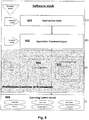
- the framework of the present invention should reside below the layer which contains the application frameworks for developers, e.g., below Application Framework (iii) in Fig. 3a and below the cocoa touch layer (iii) in Fig. 3b .
- the framework of the present invention should preferably reside below layer (iii) and above layer (i).
- the framework of the present invention should preferably reside in layer (ii) in Fig. 3a and preferably in the Media Service (ii') in Fig. 3b .
- abstraction layer is well known in software models, e.g., the OSI 7-layer model for computer network protocols, the OpenGL graphics drawing library, and the byte stream input/output (I/O) model originated by Unix and adopted by MS-DOS, Linux, and most other modern operating systems.
- Fig. 3 shows an example of individual software components in different abstraction layers of a device operated by Android.
- Android is an operating system based on the Linux kernel with a user interface based on direct manipulation, designed primarily for touchscreen mobile devices such as smartphones and tablet computers, using touch inputs, that loosely correspond to real-world actions, like swiping, tapping, pinching, and reverse pinching to manipulate on-screen objects, and a virtual keyboard.
- touch inputs that loosely correspond to real-world actions, like swiping, tapping, pinching, and reverse pinching to manipulate on-screen objects, and a virtual keyboard.
- it has been used in televisions, games consoles, digital cameras, and other electronics.
- the framework is implemented as a service which is preferably located in a layer near the operating system layer or the kernel. This layer is preferably not prune to hacking/manipulation by applications developers.
- a preferred location or implementation for the framework is preferably (directly) after the layers which are not accessible to developers and/or in a layer which is not accessible by a developer.
- developers can write code to access services (camera, speaker, call log) for their applications.
- the framework of the present invention should preferably be located below iii) but above i).
- Fig. 3a shows the Linux based kernel (Operating System Kernel) at 505 or layer (i). This layer (i) contains kernel or core os elements of operating system.
- the middleware level includes Virtual Machine and Libraries.
- Fig. 3a shows the Virtual Machine at 503 and Libraries at 504.
- This "middleware level" is layer (ii) in Fig. 3a .
- the Virtual Machine includes Core Libraries, which allow each application to run in its own process.
- the Libraries are used by various components of the Android system, such as Media Libraries, 3D libraries, and etc.
- the Libraries 504 include services and libraries like OpenGL ES (graphics framework) and SQLite (data base library).
- This layer (ii) contains services and libraries of the operating system.
- FIG. 3a shows the Application Framework at 502 or layer (iii).
- the Application Framework is offering developers the ability to build rich and innovative applications. Developers are free to take advantage of the device hardware, access location information, run background services, set alarms, add notifications to the status bar, and much, much more.
- This layer (iii) contains development frameworks of the operating system.
- the Applications are located at 501.
- FIG. 3b shows the architecture of iOS, i.e., the operation system which is currently used in Apple smart devices.
- the Cocoa Touch layer (iii) provides the fundamental infrastructure used by application.
- the Foundation framework provides development support for collections, file management, network operations, and more.
- This layer contains development frameworks of operating system.
- the abstraction layers of the operating system comprise an iv) application layer, e.g., applications 501 in Fig. 3a and Application (iv) in Fig. 3b .
- iOS Like the Application Framework (iii) in Android, iOS also provides a similar layer, namely the Cocoa Touch which is a UI (user interface) framework for building software programs to run on the iOS operating system (for the iPhone, iPod Touch, and iPad) from Apple Inc. Cocoa Touch provides an abstraction layer (iii) of iOS.
- the Cocoa Touch layer provides the fundamental infrastructure used by an application. For example, the Foundation framework provides development support for collections, file management, network operations, and more. This layer contains development frameworks of the operating system.
- the (iii) application framework or application framework layer is located, e.g., application framework 502 in Fig. 3a and (iii) Media Services (ii') and Core Services (ii) in Fig. 3b are located.
- the Core Services and the Media layers of iOS contain libraries, services and frameworks like SQLite, OpenGL ES, Location manager etc.
- This layer contains services and libraries of operating system (see Fig. 3b ).
- the layer (i) directly communicates with the hardware (see e.g. Fig. 3b ).
- This layer is called core (kernel), e.g., the operating system kernel 505 in Fig. 3a and the Core OS Fig. 3b .
- core OS e.g., the operating system kernel 505 in Fig. 3a and the Core OS Fig. 3b .
- the Core OS acts as an abstraction layer between the hardware and the rest of the software stack. This layer contains kernel or core OS element of operating system.
- operating systems of sophisticated smart glasses comprise an operating system kernel (e.g. core OS) and a hardware abstraction layer (see e.g. "Hardware” in Fig. 3 ).
- This hardware abstraction layer manages hardware resources and provides interface for hardware components like camera, microphone and speaker etc. This layers are the lowest layers in the abstraction layer model.
- Fig. 5 usually layers until services (see layers (iv) and (iii); 501 and 502) are accessible to developers. Therefore layers after services, e.g., layers (ii') and (ii) are not prune to manipulation/ hacking.
- layers (ii') and (ii) are not prune to manipulation/ hacking.
- the framework should be inside kernel layer (e.g. layer (i)). However, it can be located anywhere between services and kernel layer.
- the framework according to the present invention is preferably not an "application” and therefore does not require SDK (software development kit) of the operating system.
- SDK software development kit
- the framework can preferably be implemented directly in the kernel using languages like C and C++.
- the framework can also use functions of library like OpenGL.
- the framework of the present invention does not necessarily require to be a separate abstraction layer. Since it is preferably related to only one hardware feature that is preferably the camera it is possible that the framework resides within current abstraction layers of the operating system.
- the method preferably works in an idle state if no face is detected in the image and no state signal is generated, such that the tracking step is not performed.
- the above mentioned step of tracking identity features preferably tracks movement of detected faces and/or extracts features of the faces like pose, expression and/or shape.
- the step of de-identification is a method of preferably removing facial identification information from the image while keeping as much as possible information.
- de-identification There are a plurality of de-identification known in the art which may be implemented in the method or framework according to the present invention.
- the de-identification step divides input data into identity and non-identity factors, wherein de-identification is preferably performed on identity factors by taking average of k inputs.
- the present invention also relates to a system for preserving the privacy of persons detected by a camera of a smart glass or smart watch, the system comprising: a camera module for taking at least one image of a face by means of the camera of the smart glass, a detection module for detecting a face in the image taken by the camera, a state module for generating a state signal if a face is detected in the image, a tracking module for tracking identity features of the detected face in case a state signal is generated; and a de-identification module for de-identifying identity features in the taken image.
- the detection module, state module, tracking module and/or de-identification module are preferably located on a layer directly above the operating system kernel and below an application framework layer in the smart glass.
- the present invention relates to a computer program comprising computer executable program code adapted to be executed to implement the method of the present invention when being executed.
- framework can relate to a set of methods and a system.
- video is not restricted to moving visua images but also relates to single visual images (photos).
- a preferred heterogeneous framework can be used which exploits face de-identification.
- a de-identification can be applied to improve privacy concerns and increase trust on technology.
- the preferred framework according to the present invention can do the following: 1) preserve the privacy of the users around the device; 2) keep the quality images and videos of places by staying in idle state if a person is not detected in the image; and/or 3) keep decent utility of the device by de-identifying only identity factors in images.
- Figure 2 illustrates components of a smart glass (also called “device” in the present specification) according to a preferred embodiment of the present invention.
- the device preferably comprises at least one of the following features: a memory (not shown), a memory controller 202, a processor (CPU) 203, a peripheral interface 204, RF circuitry 205, audio circuitry 207, a speaker 213, a microphone 210, an input output subsystem 208, a Liquid Crystal on Silicon projection display 211, a camera 212, software components 201 and other input or control devices 209. These components preferably communicate over one or more communication buses or signal lines.
- the device can be any smart glasses and it should be appreciated that the illustrated device is only one preferred example for smart glasses and the device according to the present invention may have more or fewer components as shown in Fig. 2 .
- the various components shown in Fig. 2 may be implemented in hardware and/or software.
- Figure 3a gives a detailed overview of preferred software components of a device of the present invention.
- the software components include at least one of the following components: operating system kernel 505, core libraries 504, a virtual machine (run time libraries) 503, an application framework 502 and one or more applications 501.
- operating system kernel 505 core libraries 504, a virtual machine (run time libraries) 503, an application framework 502 and one or more applications 501.
- core libraries 504 core libraries 504
- a virtual machine (run time libraries) 503 an application framework 502
- application framework 502 application framework
- the device according to the present invention is not restricted to the shown components, i.e., more or less software components can be used in other embodiments of the present invention.
- the operating system kernel 505 preferably comprises various software components and drivers for controlling and managing general system tasks (e.g. memory management, storage device control, power management, security settings etc.) and facilitates communication between various software and hardware components.
- the operating system kernel 505 may comprise: a display driver, a WiFi driver, a camera driver, a power management, a memory driver and/or other drivers.
- kernel 505 there are preferably core libraries 504. These libraries preferably comprise instructions which tell the device how to handle different kind of data. These core libraries may comprise a plurality of modules like open-source Web browser engine, SQLite database which is a useful repository for storage and sharing of application data, libraries to play and record audio and/or video, SSL libraries responsible for Internet security etc.
- a virtual machine and/or runtime libraries 503 may exist on the next layer.
- This layer preferably enables each application to run in its own process with its own instance of virtual machine.
- This design of virtual machines is preferred to ensure that individual applications are independent from other applications.
- This construction with virtual machines further provides the preferred advantage in case an application crashes. By this construction it can be easily ensured that the remaining applications are not affected by any other applications running on the device, i.e., a crashed application does preferably not influence the other running applications.
- the next layer is the application framework 502.
- This layer includes the programs that manage the device's basic functions like resource allocation, switching between processes or programs and keeping track of the device's physical location, etc.
- application developers have full access to the application framework 502. This allows developers to take advantage of processing capabilities and support features when building an application.
- the application framework can be seen as a set of basic tools which can be used by a developer for building more complex tools or applications.
- the next illustrated layer in Fig. 3a is the application layer 501.
- This layer comprises applications like camera app, calculator, image gallery etc.
- applications apps
- a user of the device interact only with applications (apps) of this layer.
- FIG. 4 shows the main components of a camera module as implemented in a smart glass according to the present invention.
- a camera module of the device according to the present invention includes an optical lens 401, images sensor technology 402, image signal processor 403 and driver 404.
- the lens 401 is preferably configured for taking high resolution photos and/or record high definition videos.
- the image and/or video sensor 402 converts an optical image into an electronic signal. Most digital devices use either a CCD image sensor or a CMOS sensor. Both types of sensor accomplish the same task of capturing light and converting it into electrical signals.
- An image processor 403 is preferably a specialized digital signal processor used for image. Often it is a system on a chip with multi-processor / multi-core processor architecture. Furthermore, when taking videos one additional component, often called video encoder, may additionally be uses.
- Driver 404 preferably provides an interface or bridge between the hardware chips and software libraries.
- an I/O subsystem has a voice module 210 which comprises, for example, a microphone and/or a power full voice controller.
- the voice module 210 provides an input interface between the user and the device.
- the voice module 210 receives voice signals (acoustic signals) from the user and converts these acoustic signals into electrical signals.
- the voice signals could be commands which enable users to control and navigate through different features (such as menus, camera etc.) of the device.
- a user of the Google Glass can say commands like "okay glass take picture" to take pictures with the device's camera.
- the device may additionally contain a motion module 209 for activating and deactivating different functions.
- This module 209 preferably comprises a motion detection sensor, such as a gyro sensor or an accelerometer sensor. This module can be used to translate user motion into commands used to control device.
- Some embodiments also use camera module 212 as an input interface.
- the device projection screen superimposes augmented reality content in front of a user, wherein input is created by touching particular section of the content.
- a camera module picks the users "virtual touching” and converts it into an input signal.
- the present invention provides an automated in-device privacy framework for smart glasses.
- a smart glass is provided with a module which is presented inside the smart glass to ensure privacy of people detected by the camera of the smart glass.
- the term "in-device” should be interpreted as a component which is already build in the device and is preferably not manipulateable by software installed afterward (apps) on the device. Due to this "in-device” implementation, privacy of people recognized by the camera of the device can be ensured.
- location is preferably not the physical location, rather the location or arrangement in picture of software components or software layers as illustrated in Figs. 3 , 5 and 6 . Still in other words, location means the level at which the framework is located and the corresponding interfaces.
- the location of the framework is dependent on the architecture of the operating system used inside the smart glass.
- most of the operating systems in smart glasses are software stacks, which have some degree of similarity in their architecture.
- Figure 5 represent one preferred location of the framework in case of a smart glass which has android operating system.
- Figure 5 shows accessibility level of application developers with respect to operating system layers. Applications developers usually can access application framework layer of the device.
- Figure 5 also shows that the location of the framework according to the present invention should preferably be close to the operating system kernel. According to a further preferred embodiment it can be located just next to camera driver. This location will allow the framework to work in automated way and preferably hides it from hacking attempts of developers. In other words, it is preferred that the framework runs automatically at a layer which is not manipulable by a user.
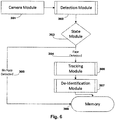
- the framework of the present invention is preferably composed of four main components, which are shown in figure 6 .
- the user of the device uses any input method explained before, to turn the camera module for taking images.
- the framework receives direct input from the camera module 301, wherein this input can be images and/or videos. After following some steps, the framework transforms inputs into privacy preserved output. However it can be seen that privacy is highly concerned about removing the chance of recognizing a person in input (image or video) through any current technology.
- the framework preferably works in two states.
- state module 303 will keep the framework in an idle state. In other words, no state signal will be generated. According to a further implementation, a state signal is present but is "false” or 0 (zero).
- state module 303 will send an input to other components. In other words, a state signal will be generated. According to a further implementation, a "true” state signal or a "1" will be generated indicating that a face is detected.
- Tracking 306 will then be applied on the detected face.
- Preferably output of detection 302 will become input of the tracking 306.
- de-identification module 307 will remove identification information from the image.
- - face detection 302 should preferably meet the criteria necessary for success given limited computational and computer memory.
- the system should operate rapidly and with sufficiently high performance in terms of true /false positive detection rate. This is a challenge since a typical search area is preferably the entire view of the camera which is often as large as 800 by 550 pixels.
- Current algorithms meet this challenge and can perform real time detection. For example, some embodiments use multiscale and/or multicue search strategy, which permits the entire field of view to be searched at the considerably higher search speed.
- Multiscale search algorithms initially search for faces in low resolution and switch to high resolution only when the search indicates head like shape.
- Multicue methods search for easily detected face cues in the start. For example presence of face in the field of view often create discontinuities in color domains of image or video. Multicue search for these discontinuities and further examine only those areas where discontinuity exists.
- Other methods can be used by other embodiments.
- state module 303 of the framework controls the working state of the framework.
- the state module 303 works with detection module 302. If a person or face is detected 304 in the image, state module will activate other components of the framework by transferring the output from the camera module (images or videos) to the framework; preferably a state signal is "true”. However, if no face is detected (step 305) by detection module 302, state module 303 will keep other components of framework idle by not sending input to them; preferably the state signal is "false”. Thus, state module 303 can save limited battery and computational power.
- Tracking 306 is preferably efficient and robust such that the tracking preferably determines the face position, size and pose.
- this module creates a feature mask of the detected face.
- a feature mask is a set of parameters to characterize identity, movement, state, pose expression etc.
- AAM Active Appearance Modeling
- AAM Active Appearance Modeling
- the algorithm uses comparison with this model to estimate features of faces (pose, expression, shape etc.) in new images.
- tracking module 306 is preferably dependent on results of detection module 302. In some embodiments, tracking 306 uses a result of detection 302 as an initial approximation to reduce the scanning area of the image. It should also be noted that if more than one face is detected 302 in the image, tracking module 306 will keep track for each face in the image.
- De-identification means removal of identifying information from the images or videos, prior to sharing of data.
- the goal of this module is to protect identity and preserver utility, e.g. the ability to recognize gender or facial expressions from the de-identified images.
- data utility is a function, which associates each image one. It is preferably assumed that for each face image the correct class is known. Examples of image classes include facial expressions ⁇ neutral, smile ⁇ , gender ⁇ male, female ⁇ , and eye status ⁇ open, closed ⁇ .
- Identity features 803 include position and shape of eyes, nose, and lips etc.
- Nonidentity features 803 include pose, illumination, facial expressions.
- Current segmentation techniques can be applied for this purpose.
- Further methods apply de-identification 804, by taking average of identity feature sets of k images. Average identity feature set of k images is combined with each image's non- identity set to reconstruct 805 de-identified images.
Landscapes
- Engineering & Computer Science (AREA)
- Theoretical Computer Science (AREA)
- Health & Medical Sciences (AREA)
- Bioethics (AREA)
- General Health & Medical Sciences (AREA)
- Computer Hardware Design (AREA)
- Databases & Information Systems (AREA)
- Computer Security & Cryptography (AREA)
- Software Systems (AREA)
- Physics & Mathematics (AREA)
- General Engineering & Computer Science (AREA)
- General Physics & Mathematics (AREA)
- Medical Informatics (AREA)
- Studio Devices (AREA)
- User Interface Of Digital Computer (AREA)
Claims (9)
- Verfahren zum Wahren des Datenschutzes von Personen, die durch eine Kamera einer intelligenten Vorrichtung, wie einer intelligenten Brille erkannt werden, wobei das Verfahren die Schritte aufweist:Aufnehmen mindestens eines Bildes eines Gesichts mittels der Kamera der intelligenten Vorrichtung,Erkennen eines Gesichts in dem durch die Kamera aufgenommenen Bild,Erzeugen eines Zustandssignals, wenn ein Gesicht im Bild erkannt wird (304),Verfolgen von Identitätsmerkmalen des erkannten Gesichts, falls ein Zustandssignal erzeugt wird; undAnonymisieren von Identitätsmerkmalen im aufgenommenen Bild durch Entfernen von Gesichtsidentifikationsinformationen aus dem Bild,wobei das Verfahren als ein Programm oder Programmiergerüst implementiert wird, das auf einer Schicht direkt über dem Betriebssystemkern (i) und unter einer Anwendungsprogrammiergerüstschicht in der intelligenten Vorrichtung angeordnet ist, wobei die erstgenannte Schicht nicht durch Anwendungen manipulierbar/erreichbar ist, die durch Anwendungsentwickler programmiert werden.
- Verfahren nach Anspruch 1, wobei das Verfahren als ein Programm oder Programmiergerüst implementiert wird, das angeordnet ist:a) in den Bibliotheken und einer virtuellen Maschinenschicht in einem Android-Betriebssystem, oderb) in der Medienschicht in einem iOS-Betriebssystem.
- Verfahren nach einem der vorhergehenden Ansprüche, wobei das Verfahren in einem Leerlaufzustand arbeitet, wenn kein Gesicht in dem Bild erkannt wird (305) und kein Zustandssignal erzeugt wird, so dass der Verfolgungsschritt nicht ausgeführt wird.
- Verfahren nach einem der vorhergehenden Ansprüche, wobei der Schritt des Verfolgens von Identitätsmerkmalen eine Bewegung von erkannten Gesichtern verfolgt und/oder Merkmale der Gesichter wie die Haltung, den Ausdruck und/oder die Form extrahiert.
- Verfahren nach einem der vorhergehenden Ansprüche, wobei der Anonymisierungsschritt eine übermäßige Verpixelung und/oder Verschwommenheit des Bildes vermeidet, so dass das Bild für Freunde nützlich bleibt.
- Verfahren nach einem der vorhergehenden Ansprüche, wobei der Anonymisierungsschritt Eingangsdaten in Identitäts- und Nicht-Identitätsfaktoren unterteilt.
- System zum Wahren des Datenschutzes von Personen, die durch eine Kamera einer intelligenten Vorrichtung, wie einer intelligenten Brille erkannt werden, wobei das System aufweist:ein Kameramodul (301) zum Aufnehmen mindestens eines Bildes eines Gesichts mittels der Kamera der intelligenten Vorrichtung,ein Erkennungsmodul (302) zum Erkennen eines Gesichts in dem durch die Kamera aufgenommenen Bild,ein Zustandsmodul (303) zum Erzeugen eines Zustandssignals, wenn ein Gesicht in dem Bild erkannt wird (304),ein Verfolgungsmodul (306) zum Verfolgen von Identitätsmerkmalen des erkannten Gesichts, falls ein Zustandssignal erzeugt wird; undein Anonymisierungsmodul (307) zum Anonymisieren von Identitätsmerkmalen im aufgenommenen Bild durch Entfernen von Gesichtsidentifikationsinformationen aus dem Bild,wobei das Erkennungsmodul (302), das Zustandsmodul (303), das Verfolgungsmodul (306) und das Anonymisierungsmodul (307) auf einer Schicht direkt über dem Betriebssystemkern und unter einer Anwendungsprogrammiergerüstschicht in der intelligenten Vorrichtung angeordnet sind, wobei die erstgenannte Schicht nicht durch Anwendungen manipulierbar/erreichbar ist, die durch Anwendungsentwickler programmiert werden.
- System nach Anspruch 7, wobei das Verfahren als ein Programm oder Programmiergerüst implementiert wird, das angeordnet ist:a) in den Bibliotheken und einer virtuellen Maschinenschicht in einem Android-Betriebssystem, oderb) in der Medienschicht in einem iOS-Betriebssystem.
- Computerprogramm, das einen computerausführbaren Programmcode aufweist, der eingerichtet ist, ausgeführt zu werden, um das Verfahren nach einem der vorhergehenden Verfahrensansprüche 1 bis 6 zu implementieren, wenn es ausgeführt wird.
Applications Claiming Priority (1)
| Application Number | Priority Date | Filing Date | Title |
|---|---|---|---|
| PCT/EP2014/079460 WO2016107651A1 (en) | 2014-12-30 | 2014-12-30 | In-device privacy framework for smart glasses and smart watches |
Publications (2)
| Publication Number | Publication Date |
|---|---|
| EP3224757A1 EP3224757A1 (de) | 2017-10-04 |
| EP3224757B1 true EP3224757B1 (de) | 2020-07-15 |
Family
ID=52391911
Family Applications (1)
| Application Number | Title | Priority Date | Filing Date |
|---|---|---|---|
| EP14828169.4A Active EP3224757B1 (de) | 2014-12-30 | 2014-12-30 | Rahmenwerk für vorrichtungsinternen datenschutz für intelligente brillen und intelligente uhren |
Country Status (3)
| Country | Link |
|---|---|
| EP (1) | EP3224757B1 (de) |
| ES (1) | ES2813876T3 (de) |
| WO (1) | WO2016107651A1 (de) |
Families Citing this family (9)
| Publication number | Priority date | Publication date | Assignee | Title |
|---|---|---|---|---|
| IL252657A0 (en) | 2017-06-04 | 2017-08-31 | De Identification Ltd | System and method for preventing image recognition |
| US11954191B2 (en) | 2018-09-05 | 2024-04-09 | De-Identification Ltd. | System and method for performing identity authentication based on de-identified data |
| WO2021033183A1 (en) | 2019-08-19 | 2021-02-25 | De-Identification Ltd. | System and method for anonymization of a face in an image |
| IL270116A (en) | 2019-10-23 | 2021-04-29 | De Identification Ltd | System and method for protection and detection of adversarial attacks against a classifier |
| EP4078449A4 (de) | 2019-12-16 | 2024-01-03 | De-Identification Ltd. | System und verfahren zur rekonstruktion von flächen aus anonymisierten medien mittels neuronaler netzwerkbasierter steganografie |
| US11526626B2 (en) | 2020-07-10 | 2022-12-13 | De-Identification Ltd. | Facial anonymization with consistent facial attribute preservation in video |
| US11461948B2 (en) | 2020-07-15 | 2022-10-04 | De-Identification Ltd. | System and method for voice driven lip syncing and head reenactment |
| US11436781B2 (en) | 2020-07-15 | 2022-09-06 | De-Identification Ltd. | System and method for artificial neural-network based animation with three-dimensional rendering |
| US11276214B2 (en) | 2020-07-15 | 2022-03-15 | De-Ideniification Ltd. | System and a method for artificial neural-network based animation |
Family Cites Families (4)
| Publication number | Priority date | Publication date | Assignee | Title |
|---|---|---|---|---|
| US8610787B2 (en) * | 2007-06-22 | 2013-12-17 | Panasonic Corporation | Camera device including privacy protection method |
| US8744119B2 (en) * | 2011-01-12 | 2014-06-03 | Gary S. Shuster | Graphic data alteration to enhance online privacy |
| JP2014078910A (ja) * | 2012-10-12 | 2014-05-01 | Sony Corp | 画像処理装置、画像処理システム、画像処理方法、及びプログラム |
| JP2014085796A (ja) * | 2012-10-23 | 2014-05-12 | Sony Corp | 情報処理装置およびプログラム |
-
2014
- 2014-12-30 EP EP14828169.4A patent/EP3224757B1/de active Active
- 2014-12-30 ES ES14828169T patent/ES2813876T3/es active Active
- 2014-12-30 WO PCT/EP2014/079460 patent/WO2016107651A1/en not_active Ceased
Non-Patent Citations (1)
| Title |
|---|
| None * |
Also Published As
| Publication number | Publication date |
|---|---|
| ES2813876T3 (es) | 2021-03-25 |
| EP3224757A1 (de) | 2017-10-04 |
| WO2016107651A1 (en) | 2016-07-07 |
Similar Documents
| Publication | Publication Date | Title |
|---|---|---|
| EP3224757B1 (de) | Rahmenwerk für vorrichtungsinternen datenschutz für intelligente brillen und intelligente uhren | |
| EP3692461B1 (de) | Entfernen von persönlich identifizierbaren daten vor der übertragung von einer vorrichtung | |
| US12347052B2 (en) | Virtual content generation | |
| EP4189460B1 (de) | Private steuerschnittstellen für erweiterte realität | |
| US10740617B2 (en) | Protection and recovery of identities in surveillance camera environments | |
| KR102929848B1 (ko) | 손 제스처 인터랙션으로 혼합 현실 환경에서 카메라의 포커스를 설정하는 기술 | |
| EP3465680B1 (de) | Automatische tondämpfung bei immersiven anzeigevorrichtungen | |
| EP3084683B1 (de) | Verarbeitungsverteilung zur bildgebungsverarbeitung | |
| US10841534B2 (en) | Real-world awareness for virtual reality | |
| JP2024503881A (ja) | コンテキストアウェアエクステンデッドリアリティシステム | |
| US9743040B1 (en) | Systems and methods for facilitating eye contact during video conferences | |
| EP3776331B1 (de) | Erkennen von massnahmen zur verhinderung der erkennung | |
| US20240045942A1 (en) | Systems and methods for using occluded 3d objects for mixed reality captcha | |
| CN111783146A (zh) | 基于隐私保护的图像处理方法、装置和电子设备 | |
| CN120982062A (zh) | 防止图像中的恶意攻击 | |
| US11010980B2 (en) | Augmented interface distraction reduction | |
| WO2016180460A1 (en) | In-device privacy control mechanism for wearable smart devices | |
| US10444938B1 (en) | Systems and methods for customizing user icons | |
| JP7542413B2 (ja) | リモートワーク情報保護システム | |
| CN114648315A (zh) | 虚拟面试的方法、装置、设备及存储介质 | |
| TW202439245A (zh) | 延展實境內容的顯示方法 | |
| KR20260039501A (ko) | 향상된 잠금 해제 방식을 제공하기 위한 웨어러블 장치 및 그 제어 방법 | |
| WO2026064163A1 (en) | Attention decoding to enable visual breakthrough | |
| JP2025100227A (ja) | 情報処理装置、眼鏡型デバイス、プログラム、及び情報処理方法 | |
| CN121039603A (zh) | 使用物理约束的抖动估计 |
Legal Events
| Date | Code | Title | Description |
|---|---|---|---|
| STAA | Information on the status of an ep patent application or granted ep patent |
Free format text: STATUS: THE INTERNATIONAL PUBLICATION HAS BEEN MADE |
|
| PUAI | Public reference made under article 153(3) epc to a published international application that has entered the european phase |
Free format text: ORIGINAL CODE: 0009012 |
|
| STAA | Information on the status of an ep patent application or granted ep patent |
Free format text: STATUS: REQUEST FOR EXAMINATION WAS MADE |
|
| 17P | Request for examination filed |
Effective date: 20170510 |
|
| AK | Designated contracting states |
Kind code of ref document: A1 Designated state(s): AL AT BE BG CH CY CZ DE DK EE ES FI FR GB GR HR HU IE IS IT LI LT LU LV MC MK MT NL NO PL PT RO RS SE SI SK SM TR |
|
| AX | Request for extension of the european patent |
Extension state: BA ME |
|
| DAX | Request for extension of the european patent (deleted) | ||
| STAA | Information on the status of an ep patent application or granted ep patent |
Free format text: STATUS: EXAMINATION IS IN PROGRESS |
|
| 17Q | First examination report despatched |
Effective date: 20190624 |
|
| GRAP | Despatch of communication of intention to grant a patent |
Free format text: ORIGINAL CODE: EPIDOSNIGR1 |
|
| STAA | Information on the status of an ep patent application or granted ep patent |
Free format text: STATUS: GRANT OF PATENT IS INTENDED |
|
| INTG | Intention to grant announced |
Effective date: 20200217 |
|
| GRAS | Grant fee paid |
Free format text: ORIGINAL CODE: EPIDOSNIGR3 |
|
| GRAA | (expected) grant |
Free format text: ORIGINAL CODE: 0009210 |
|
| STAA | Information on the status of an ep patent application or granted ep patent |
Free format text: STATUS: THE PATENT HAS BEEN GRANTED |
|
| AK | Designated contracting states |
Kind code of ref document: B1 Designated state(s): AL AT BE BG CH CY CZ DE DK EE ES FI FR GB GR HR HU IE IS IT LI LT LU LV MC MK MT NL NO PL PT RO RS SE SI SK SM TR |
|
| REG | Reference to a national code |
Ref country code: GB Ref legal event code: FG4D Ref country code: CH Ref legal event code: EP |
|
| REG | Reference to a national code |
Ref country code: IE Ref legal event code: FG4D |
|
| REG | Reference to a national code |
Ref country code: DE Ref legal event code: R096 Ref document number: 602014067824 Country of ref document: DE |
|
| REG | Reference to a national code |
Ref country code: AT Ref legal event code: REF Ref document number: 1291816 Country of ref document: AT Kind code of ref document: T Effective date: 20200815 |
|
| REG | Reference to a national code |
Ref country code: NL Ref legal event code: FP |
|
| REG | Reference to a national code |
Ref country code: LT Ref legal event code: MG4D |
|
| REG | Reference to a national code |
Ref country code: AT Ref legal event code: MK05 Ref document number: 1291816 Country of ref document: AT Kind code of ref document: T Effective date: 20200715 |
|
| PG25 | Lapsed in a contracting state [announced via postgrant information from national office to epo] |
Ref country code: LT Free format text: LAPSE BECAUSE OF FAILURE TO SUBMIT A TRANSLATION OF THE DESCRIPTION OR TO PAY THE FEE WITHIN THE PRESCRIBED TIME-LIMIT Effective date: 20200715 Ref country code: PT Free format text: LAPSE BECAUSE OF FAILURE TO SUBMIT A TRANSLATION OF THE DESCRIPTION OR TO PAY THE FEE WITHIN THE PRESCRIBED TIME-LIMIT Effective date: 20201116 Ref country code: HR Free format text: LAPSE BECAUSE OF FAILURE TO SUBMIT A TRANSLATION OF THE DESCRIPTION OR TO PAY THE FEE WITHIN THE PRESCRIBED TIME-LIMIT Effective date: 20200715 Ref country code: SE Free format text: LAPSE BECAUSE OF FAILURE TO SUBMIT A TRANSLATION OF THE DESCRIPTION OR TO PAY THE FEE WITHIN THE PRESCRIBED TIME-LIMIT Effective date: 20200715 Ref country code: BG Free format text: LAPSE BECAUSE OF FAILURE TO SUBMIT A TRANSLATION OF THE DESCRIPTION OR TO PAY THE FEE WITHIN THE PRESCRIBED TIME-LIMIT Effective date: 20201015 Ref country code: NO Free format text: LAPSE BECAUSE OF FAILURE TO SUBMIT A TRANSLATION OF THE DESCRIPTION OR TO PAY THE FEE WITHIN THE PRESCRIBED TIME-LIMIT Effective date: 20201015 Ref country code: GR Free format text: LAPSE BECAUSE OF FAILURE TO SUBMIT A TRANSLATION OF THE DESCRIPTION OR TO PAY THE FEE WITHIN THE PRESCRIBED TIME-LIMIT Effective date: 20201016 Ref country code: AT Free format text: LAPSE BECAUSE OF FAILURE TO SUBMIT A TRANSLATION OF THE DESCRIPTION OR TO PAY THE FEE WITHIN THE PRESCRIBED TIME-LIMIT Effective date: 20200715 Ref country code: FI Free format text: LAPSE BECAUSE OF FAILURE TO SUBMIT A TRANSLATION OF THE DESCRIPTION OR TO PAY THE FEE WITHIN THE PRESCRIBED TIME-LIMIT Effective date: 20200715 |
|
| PG25 | Lapsed in a contracting state [announced via postgrant information from national office to epo] |
Ref country code: IS Free format text: LAPSE BECAUSE OF FAILURE TO SUBMIT A TRANSLATION OF THE DESCRIPTION OR TO PAY THE FEE WITHIN THE PRESCRIBED TIME-LIMIT Effective date: 20201115 Ref country code: PL Free format text: LAPSE BECAUSE OF FAILURE TO SUBMIT A TRANSLATION OF THE DESCRIPTION OR TO PAY THE FEE WITHIN THE PRESCRIBED TIME-LIMIT Effective date: 20200715 Ref country code: LV Free format text: LAPSE BECAUSE OF FAILURE TO SUBMIT A TRANSLATION OF THE DESCRIPTION OR TO PAY THE FEE WITHIN THE PRESCRIBED TIME-LIMIT Effective date: 20200715 Ref country code: RS Free format text: LAPSE BECAUSE OF FAILURE TO SUBMIT A TRANSLATION OF THE DESCRIPTION OR TO PAY THE FEE WITHIN THE PRESCRIBED TIME-LIMIT Effective date: 20200715 |
|
| REG | Reference to a national code |
Ref country code: ES Ref legal event code: FG2A Ref document number: 2813876 Country of ref document: ES Kind code of ref document: T3 Effective date: 20210325 |
|
| REG | Reference to a national code |
Ref country code: DE Ref legal event code: R097 Ref document number: 602014067824 Country of ref document: DE |
|
| PG25 | Lapsed in a contracting state [announced via postgrant information from national office to epo] |
Ref country code: EE Free format text: LAPSE BECAUSE OF FAILURE TO SUBMIT A TRANSLATION OF THE DESCRIPTION OR TO PAY THE FEE WITHIN THE PRESCRIBED TIME-LIMIT Effective date: 20200715 Ref country code: SM Free format text: LAPSE BECAUSE OF FAILURE TO SUBMIT A TRANSLATION OF THE DESCRIPTION OR TO PAY THE FEE WITHIN THE PRESCRIBED TIME-LIMIT Effective date: 20200715 Ref country code: RO Free format text: LAPSE BECAUSE OF FAILURE TO SUBMIT A TRANSLATION OF THE DESCRIPTION OR TO PAY THE FEE WITHIN THE PRESCRIBED TIME-LIMIT Effective date: 20200715 Ref country code: CZ Free format text: LAPSE BECAUSE OF FAILURE TO SUBMIT A TRANSLATION OF THE DESCRIPTION OR TO PAY THE FEE WITHIN THE PRESCRIBED TIME-LIMIT Effective date: 20200715 Ref country code: DK Free format text: LAPSE BECAUSE OF FAILURE TO SUBMIT A TRANSLATION OF THE DESCRIPTION OR TO PAY THE FEE WITHIN THE PRESCRIBED TIME-LIMIT Effective date: 20200715 Ref country code: IT Free format text: LAPSE BECAUSE OF FAILURE TO SUBMIT A TRANSLATION OF THE DESCRIPTION OR TO PAY THE FEE WITHIN THE PRESCRIBED TIME-LIMIT Effective date: 20200715 |
|
| PLBE | No opposition filed within time limit |
Free format text: ORIGINAL CODE: 0009261 |
|
| STAA | Information on the status of an ep patent application or granted ep patent |
Free format text: STATUS: NO OPPOSITION FILED WITHIN TIME LIMIT |
|
| PG25 | Lapsed in a contracting state [announced via postgrant information from national office to epo] |
Ref country code: AL Free format text: LAPSE BECAUSE OF FAILURE TO SUBMIT A TRANSLATION OF THE DESCRIPTION OR TO PAY THE FEE WITHIN THE PRESCRIBED TIME-LIMIT Effective date: 20200715 |
|
| 26N | No opposition filed |
Effective date: 20210416 |
|
| PG25 | Lapsed in a contracting state [announced via postgrant information from national office to epo] |
Ref country code: SK Free format text: LAPSE BECAUSE OF FAILURE TO SUBMIT A TRANSLATION OF THE DESCRIPTION OR TO PAY THE FEE WITHIN THE PRESCRIBED TIME-LIMIT Effective date: 20200715 |
|
| REG | Reference to a national code |
Ref country code: CH Ref legal event code: PL |
|
| PG25 | Lapsed in a contracting state [announced via postgrant information from national office to epo] |
Ref country code: MC Free format text: LAPSE BECAUSE OF FAILURE TO SUBMIT A TRANSLATION OF THE DESCRIPTION OR TO PAY THE FEE WITHIN THE PRESCRIBED TIME-LIMIT Effective date: 20200715 Ref country code: SI Free format text: LAPSE BECAUSE OF FAILURE TO SUBMIT A TRANSLATION OF THE DESCRIPTION OR TO PAY THE FEE WITHIN THE PRESCRIBED TIME-LIMIT Effective date: 20200715 |
|
| REG | Reference to a national code |
Ref country code: BE Ref legal event code: MM Effective date: 20201231 |
|
| PG25 | Lapsed in a contracting state [announced via postgrant information from national office to epo] |
Ref country code: LU Free format text: LAPSE BECAUSE OF NON-PAYMENT OF DUE FEES Effective date: 20201230 Ref country code: IE Free format text: LAPSE BECAUSE OF NON-PAYMENT OF DUE FEES Effective date: 20201230 |
|
| PG25 | Lapsed in a contracting state [announced via postgrant information from national office to epo] |
Ref country code: CH Free format text: LAPSE BECAUSE OF NON-PAYMENT OF DUE FEES Effective date: 20201231 Ref country code: LI Free format text: LAPSE BECAUSE OF NON-PAYMENT OF DUE FEES Effective date: 20201231 |
|
| PG25 | Lapsed in a contracting state [announced via postgrant information from national office to epo] |
Ref country code: TR Free format text: LAPSE BECAUSE OF FAILURE TO SUBMIT A TRANSLATION OF THE DESCRIPTION OR TO PAY THE FEE WITHIN THE PRESCRIBED TIME-LIMIT Effective date: 20200715 Ref country code: MT Free format text: LAPSE BECAUSE OF FAILURE TO SUBMIT A TRANSLATION OF THE DESCRIPTION OR TO PAY THE FEE WITHIN THE PRESCRIBED TIME-LIMIT Effective date: 20200715 Ref country code: CY Free format text: LAPSE BECAUSE OF FAILURE TO SUBMIT A TRANSLATION OF THE DESCRIPTION OR TO PAY THE FEE WITHIN THE PRESCRIBED TIME-LIMIT Effective date: 20200715 |
|
| PG25 | Lapsed in a contracting state [announced via postgrant information from national office to epo] |
Ref country code: MK Free format text: LAPSE BECAUSE OF FAILURE TO SUBMIT A TRANSLATION OF THE DESCRIPTION OR TO PAY THE FEE WITHIN THE PRESCRIBED TIME-LIMIT Effective date: 20200715 |
|
| PG25 | Lapsed in a contracting state [announced via postgrant information from national office to epo] |
Ref country code: BE Free format text: LAPSE BECAUSE OF NON-PAYMENT OF DUE FEES Effective date: 20201231 |
|
| PGFP | Annual fee paid to national office [announced via postgrant information from national office to epo] |
Ref country code: GB Payment date: 20251218 Year of fee payment: 12 |
|
| PGFP | Annual fee paid to national office [announced via postgrant information from national office to epo] |
Ref country code: FR Payment date: 20251218 Year of fee payment: 12 Ref country code: NL Payment date: 20251217 Year of fee payment: 12 |
|
| PGFP | Annual fee paid to national office [announced via postgrant information from national office to epo] |
Ref country code: ES Payment date: 20260119 Year of fee payment: 12 |
|
| PGFP | Annual fee paid to national office [announced via postgrant information from national office to epo] |
Ref country code: DE Payment date: 20251222 Year of fee payment: 12 |