EP3225779A1 - Outil d'extraction - Google Patents
Outil d'extraction Download PDFInfo
- Publication number
- EP3225779A1 EP3225779A1 EP17162084.2A EP17162084A EP3225779A1 EP 3225779 A1 EP3225779 A1 EP 3225779A1 EP 17162084 A EP17162084 A EP 17162084A EP 3225779 A1 EP3225779 A1 EP 3225779A1
- Authority
- EP
- European Patent Office
- Prior art keywords
- tool
- component
- force
- turbomachine
- connection portion
- Prior art date
- Legal status (The legal status is an assumption and is not a legal conclusion. Google has not performed a legal analysis and makes no representation as to the accuracy of the status listed.)
- Granted
Links
Images





Classifications
-
- B—PERFORMING OPERATIONS; TRANSPORTING
- B25—HAND TOOLS; PORTABLE POWER-DRIVEN TOOLS; MANIPULATORS
- B25B—TOOLS OR BENCH DEVICES NOT OTHERWISE PROVIDED FOR, FOR FASTENING, CONNECTING, DISENGAGING OR HOLDING
- B25B27/00—Hand tools, specially adapted for fitting together or separating parts or objects whether or not involving some deformation, not otherwise provided for
- B25B27/0028—Tools for removing or installing seals
-
- F—MECHANICAL ENGINEERING; LIGHTING; HEATING; WEAPONS; BLASTING
- F01—MACHINES OR ENGINES IN GENERAL; ENGINE PLANTS IN GENERAL; STEAM ENGINES
- F01D—NON-POSITIVE DISPLACEMENT MACHINES OR ENGINES, e.g. STEAM TURBINES
- F01D5/00—Blades; Blade-carrying members; Heating, heat-insulating, cooling or antivibration means on the blades or the members
- F01D5/005—Repairing methods or devices
-
- B—PERFORMING OPERATIONS; TRANSPORTING
- B25—HAND TOOLS; PORTABLE POWER-DRIVEN TOOLS; MANIPULATORS
- B25B—TOOLS OR BENCH DEVICES NOT OTHERWISE PROVIDED FOR, FOR FASTENING, CONNECTING, DISENGAGING OR HOLDING
- B25B27/00—Hand tools, specially adapted for fitting together or separating parts or objects whether or not involving some deformation, not otherwise provided for
-
- B—PERFORMING OPERATIONS; TRANSPORTING
- B25—HAND TOOLS; PORTABLE POWER-DRIVEN TOOLS; MANIPULATORS
- B25B—TOOLS OR BENCH DEVICES NOT OTHERWISE PROVIDED FOR, FOR FASTENING, CONNECTING, DISENGAGING OR HOLDING
- B25B27/00—Hand tools, specially adapted for fitting together or separating parts or objects whether or not involving some deformation, not otherwise provided for
- B25B27/02—Hand tools, specially adapted for fitting together or separating parts or objects whether or not involving some deformation, not otherwise provided for for connecting objects by press fit or detaching same
-
- F—MECHANICAL ENGINEERING; LIGHTING; HEATING; WEAPONS; BLASTING
- F01—MACHINES OR ENGINES IN GENERAL; ENGINE PLANTS IN GENERAL; STEAM ENGINES
- F01D—NON-POSITIVE DISPLACEMENT MACHINES OR ENGINES, e.g. STEAM TURBINES
- F01D11/00—Preventing or minimising internal leakage of working-fluid, e.g. between stages
- F01D11/001—Preventing or minimising internal leakage of working-fluid, e.g. between stages for sealing space between stator blade and rotor
-
- F—MECHANICAL ENGINEERING; LIGHTING; HEATING; WEAPONS; BLASTING
- F01—MACHINES OR ENGINES IN GENERAL; ENGINE PLANTS IN GENERAL; STEAM ENGINES
- F01D—NON-POSITIVE DISPLACEMENT MACHINES OR ENGINES, e.g. STEAM TURBINES
- F01D11/00—Preventing or minimising internal leakage of working-fluid, e.g. between stages
- F01D11/005—Sealing means between non relatively rotating elements
-
- F—MECHANICAL ENGINEERING; LIGHTING; HEATING; WEAPONS; BLASTING
- F01—MACHINES OR ENGINES IN GENERAL; ENGINE PLANTS IN GENERAL; STEAM ENGINES
- F01D—NON-POSITIVE DISPLACEMENT MACHINES OR ENGINES, e.g. STEAM TURBINES
- F01D25/00—Component parts, details, or accessories, not provided for in, or of interest apart from, other groups
- F01D25/28—Supporting or mounting arrangements, e.g. for turbine casing
- F01D25/285—Temporary support structures, e.g. for testing, assembling, installing, repairing; Assembly methods using such structures
-
- F—MECHANICAL ENGINEERING; LIGHTING; HEATING; WEAPONS; BLASTING
- F01—MACHINES OR ENGINES IN GENERAL; ENGINE PLANTS IN GENERAL; STEAM ENGINES
- F01D—NON-POSITIVE DISPLACEMENT MACHINES OR ENGINES, e.g. STEAM TURBINES
- F01D5/00—Blades; Blade-carrying members; Heating, heat-insulating, cooling or antivibration means on the blades or the members
- F01D5/30—Fixing blades to rotors; Blade roots ; Blade spacers
- F01D5/3007—Fixing blades to rotors; Blade roots ; Blade spacers of axial insertion type
-
- F—MECHANICAL ENGINEERING; LIGHTING; HEATING; WEAPONS; BLASTING
- F01—MACHINES OR ENGINES IN GENERAL; ENGINE PLANTS IN GENERAL; STEAM ENGINES
- F01D—NON-POSITIVE DISPLACEMENT MACHINES OR ENGINES, e.g. STEAM TURBINES
- F01D5/00—Blades; Blade-carrying members; Heating, heat-insulating, cooling or antivibration means on the blades or the members
- F01D5/30—Fixing blades to rotors; Blade roots ; Blade spacers
- F01D5/3007—Fixing blades to rotors; Blade roots ; Blade spacers of axial insertion type
- F01D5/3015—Fixing blades to rotors; Blade roots ; Blade spacers of axial insertion type with side plates
-
- F—MECHANICAL ENGINEERING; LIGHTING; HEATING; WEAPONS; BLASTING
- F05—INDEXING SCHEMES RELATING TO ENGINES OR PUMPS IN VARIOUS SUBCLASSES OF CLASSES F01-F04
- F05D—INDEXING SCHEME FOR ASPECTS RELATING TO NON-POSITIVE-DISPLACEMENT MACHINES OR ENGINES, GAS-TURBINES OR JET-PROPULSION PLANTS
- F05D2230/00—Manufacture
- F05D2230/70—Disassembly methods
Definitions
- the present disclosure relates generally to a tool for removing a component from a turbomachine.
- Industrial and power generation turbomachines include a casing that houses a turbine.
- the turbine includes a plurality of rotor blades, or buckets, positioned along a gas flow path through the turbine, the blades supported by a number of turbine rotor wheels.
- the rotor blades and wheels define a plurality of turbine stages.
- Turbomachines also include one or more combustors that generate hot gases.
- the hot gasses may pass through a transition piece toward the plurality of turbine stages.
- gases at a lower temperature flow from a compressor toward a wheelspace of the turbine. The lower temperature gases provide cooling for the rotor wheels as well as other internal components of the turbine.
- the turbine In order to prevent hot gases from entering the wheelspace, the turbine includes near flow path seals arranged between adjacent rotor wheels or rotor blades.
- the near flow path seals may be configured to fit closely adjacent the rotor wheels or rotor blades to reduce the leakage of hot gasses from the gas path into the wheelspace.
- each of the rotor blades for a given stage in the turbine are attached to the respective rotor wheel using a dovetail assembly-i.e., the base of the rotor blade has a shape that is complementary to a slot in the rotor wheel-allowing the dovetail end of the rotor blade to slide into the dovetail slot in the rotor wheel and be held in position during operation of the turbine.
- the near flow path seals may be attached at their base to rotor wheels using a similar dovetail assembly. Such a construction can ensure proper alignment of the rotor blades and near flow path seals during operation of the turbomachine. However, once all of the near flow path seals are installed for a given seal member rotor, the base of the seals may not be easily accessible.
- each dovetail slot in the near flow path seal rotor wheel may include a C-shaped seal in the root for sealing the slot.
- the C-shaped seal necessitates applying a high force to the near flow path seal to remove it from the dovetail slot.
- the removal of near flow path seals is currently carried out in three ways. In later stages of the turbomachine, space is sufficient to allow installation and use of a hydraulic operated removal system (such as disclosed in US patent application serial number 14/277,232, filed May 14, 2014 , and currently pending).
- a tool for removing a component of a turbomachine comprising: a body including a connection portion configured to engage the component; and a force section connected to the body and configured to transfer a force to the connection portion of the body in a direction at an acute angle relative to a longitudinal axis of a dovetail slot of a rotor wheel of the turbomachine.
- a method for removing a component of a turbomachine comprising: positioning a tool near an outer circumference of a rotor wheel of the turbomachine such that a connection portion of the tool contacts the component; and applying a force to the component of the turbomachine using the tool by applying the force to a force section of the tool, the force being transferred from the force section to the connection portion at an acute angle relative to a longitudinal axis of a dovetail slot of the rotor wheel of the turbomachine.
- an assembly for removing a component in a turbomachine comprising: a first rotor wheel, the component being slidably coupled to the first rotor wheel; a second rotor wheel positioned adjacent to the first rotor wheel, the second rotor wheel defining a slot; and a removal tool including: a body including a connection portion configured to contact the component; and a force section connected to the body and configured to transfer a force to the connection portion of the body in a direction at an acute angle relative to a longitudinal axis of the slot of the second rotor wheel of the turbomachine.
- Turbomachine 2 constructed in accordance with an exemplary embodiment of the present disclosure is generally provided.
- Turbomachine 2 includes a compressor portion 4 operatively connected to a turbine portion 6.
- a combustor assembly 8 is fluidly connected to compressor portion 4 and turbine portion 6.
- Combustor assembly 8 may be formed from a plurality of circumferentially spaced combustors, one of which is indicated at 10. It should be appreciated, however, that in other exemplary embodiments, combustor assembly 8 may include any other suitable arrangement of combustors 10.
- Compressor portion 4 is also linked to turbine portion 6 through a common compressor/turbine shaft 12. With this arrangement, compressor portion 4 delivers compressed air to combustor assembly 8. The compressed air may mix with a combustible fluid to form a combustible mixture. The combustible mixture may then be combusted in combustor assembly 8 to form products of combustion that are delivered to turbine portion 6 through a transition piece (not shown). The products of combustion expand through turbine portion 6 to power, for example, a generator, a pump, an aircraft or the like (also not shown).
- turbine portion 6 includes first, second, third, and fourth stages 20, 21, 22 and 23 that define a gas path 18.
- First stage 20 includes a plurality of first stage stators 30, or nozzles, and a plurality of circumferentially arranged first stage rotor blades 32, or buckets, mounted to a first stage rotor wheel 34.
- second stage 21 includes a plurality of second stage stators 37 and a plurality of circumferentially arranged second stage rotor blades 39 mounted to a second stage rotor wheel 41.
- third stage 22 includes a plurality of third stage stators 44 and a plurality of circumferentially arranged third stage rotor blades 46 mounted to a third stage rotor wheel 48.
- fourth stage 23 includes a plurality of fourth stage stators 51and a plurality of circumferentially arranged fourth stage rotor blades 54 mounted to a fourth stage rotor wheel 55.
- rotor blades 32 are mounted to the respective rotor wheel 34 using a dovetail assembly. More particularly, rotor blade 32 includes a dovetail member 33 at a first end of rotor blade 32 and rotor wheel 34 defines a dovetail slot 35 ( FIG. 5 ). Dovetail member 33 has a shape that is complementary to dovetail slot 35, such that rotor blade 32 may be mounted to or removed from rotor wheel 34 by sliding dovetail member 33 of rotor blade 32 generally along an axial direction A T of turbomachine 2 into dovetail slot 35 or out of dovetail slot 35. Second, third, and fourth stage rotor blades 39, 46, and 54 are similarly mounted to rotor wheels 41, 48, and 55, respectively.
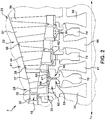
- Turbine portion 6 also includes a plurality of near flow path seal members 60, 62, and 64 arranged between adjacent ones of first, second, third, and fourth stages 20, 21, 22, 23 of turbine portion 6.
- Near flow path seal members 60, 62, 64 are mounted to seal member rotor wheels 70, 72, and 74 and are configured to prevent an exchange of gases between gas path 18 and a wheelspace 59, 65 of turbomachine 2. More particularly, as indicated in FIG. 2 , near flow path seal members 60 are circumferentially arranged between first stage 20 and second stage 21 of turbine portion 6, near flow path seal members 62 are circumferentially arranged between second stage 21 and third stage 22 of turbine portion 6, and near flow path seal members 64 are circumferentially arranged between third stage 22 and fourth stage 23 of turbine portion 6.
- near flow path seal members 60 are mounted to seal member rotor wheel 70 using a dovetail assembly. More particularly, near flow path seal member 60 includes a dovetail member 61 at a first end 66 of seal member 60, and rotor wheel 70 defines a dovetail slot 71 (see also FIG. 5 ). Dovetail member 61 has a shape that is complementary to dovetail slot 71, such that near flow path seal member 60 may be installed or removed by sliding dovetail member 61 of near flow path seal member 60 generally along the axial direction A T ( FIG. 1 ) of turbomachine 2 into dovetail slot 71 or out of dovetail slot 71.
- Each sliding dovetail member 61 may also include a C-shaped seal 69 thereon to provide additional sealing of sliding dovetail member 61 in dovetail slot 71 and inhibit easy sliding of sliding dovetail member 61.
- near flow path seal members 60 define a stem 67 extending from first end 66 to an outer sealing portion 68 that prevents the exchange of gasses.
- Near flow path seal members 62 and 64 are similarly mounted to seal member rotor wheels 72 and 74 ( FIG. 2 ), respectively.
- turbine portion 6 may only include three stages, i.e., three stages of rotor blades and rotor wheels, with two sets of near flow path seals positioned therebetween.
- first end 66 of seals 60 When removing near flow path seals 60, it may generally be preferable to apply a force directly to first end 66 of seals 60 so as to minimize any moment created on stem 67.
- first and second stage rotor wheels 34, 41 FIG. 2
- an exemplary tool 100 is provided, constructed in accordance with an exemplary embodiment of the present disclosure. As will be explained in greater detail with reference to FIGS.
- tool 100 is configured to assist a user in exerting a force on near flow path seals 60, in contrast to conventional tools, in a variety of angles, including but also not limited to a linear direction aligned with dovetail slot 35 in rotor wheel 34. In this fashion, tool 100 allows reliable removal of near flow path seals 60 and minimizes any damage to near flow path seals 60 and adjacent structure during removal.
- FIGS. 5-10 exemplary tool 100 of FIG. 4 is shown positioned in various non-sliding engagement positions relative to a dovetail slot 35 defined in first stage rotor wheel 34.
- tool 100 is positioned outwardly of an outer circumference of rotor wheel 34.
- Tool 100 is also shown attached to near flow path seal 60 positioned between first and second stages 20, 21 of turbine section 6.
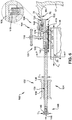
- FIG. 5 provides a perspective view of tool 100 aligned in a radial plane but not parallel to an longitudinal axis of dovetail slot 35; FIG.
- FIG. 6 provides a cross-sectional view along a longitudinal axis A A of tool 100 with tool aligned in a radial plane and parallel to a longitudinal axis of dovetail 35 (and an outer circumference of rotor wheel 34);
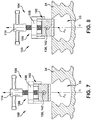
- FIG. 7 provides a cross-sectional view of tool 100 along line 7-7 in FIG. 6 showing tool 100 radially outside of but aligned with a radial plane R of dovetail slot 35 and extending parallel to a longitudinal axis of dovetail slot 35 (into and out of page);
- FIG. 8 provides a cross-sectional view of tool 100 similar to FIG.
- FIG. 9 provides a perspective plan view of tool 100 with the tool radially outside of and unaligned with a radial plane or a longitudinal axis of dovetail slot 35; and FIG. 10 shows a cross-sectional view of tool 100 similar to FIGS. 7 and 8 but in the position shown in FIG. 9 .
- Tool 100 generally includes a body 102 and a force section 132.
- tool 100 does not include a portion that aligns it, or slidingly engages it, to dovetail slot 35.
- body 102 is circumferentially sized, i.e., in a direction about rotor wheel 34, to either not fit into dovetail slot 35, or to readily move into and out of dovetail slot 35. Accordingly, when body 102 is positioned within dovetail slot 35, body 102 of tool 100 may only move in a direction generally parallel to the longitudinal axis A A body 102. However, body 102 may also be positioned at a large number of positions radially outward of dovetail slot 35 that allows body 102, and the force applied thereto and to seal 60, to be applied along a variety of directions, easing removal.
- Body 102 of tool 100 additionally includes a connection portion 104 configured to contact the component, i.e., engage the component.
- connection portion 104 comprises a clamp 106 configured to removably attach tool 100 to near flow path seal 60.
- Clamp 106 includes a top member 108 and a bottom member 110, the bottom member 110 including, as shown in FIG. 4 , a pad 116 and a back stop 118 mounted therein.
- bottom member 110 is made as removably attached to body 102, e.g., by way of a threaded fastener 170 extending through an opening 172 in a bottom 174 of body 102 and threadably engaged in a threaded opening 176 in bottom member 110.
- body 102 and bottom member 110 may be coupled in a variety of other manners, e.g., bottom member could be slid into body 102 and held in position by a detent, etc.
- clamp 106 includes a pin 112 extending through a midpoint of top member 110 to form a hinge and a screw 114 for tightening clamp 106 into a closed position, as shown in FIGS. 5 and 6 .
- a spring member 119 is provided to bias clamp 106 towards an open position.
- Clamp 106 defines an upper clamping surface 120 and a lower clamping surface 122 (see particularly FIG. 6 ).
- Upper and lower clamping surfaces 120, 122 are each defined at an angle relative to longitudinal axis A A of body 102, such that when clamp 106 is in a closed position, i.e., attached to near flow path seal 60, upper clamping surface 120 is substantially flush with an outer surface 75 of near flow path seal 60 and lower clamping surface 122 is substantially flush with an inner surface 76 of near flow path seal 60.
- Such a construction may assist in minimizing any damage to the near flow path seals during removal by minimizing the moment created on the stem 67 during removal.
- tool 100 may have any other suitable design for body 102, connection portion 104, or both. Additionally or alternatively, the connection portion 104 may have any other design suitable for contacting the component, or attaching body 102 of tool 100 to the component. Furthermore, although the exemplary tool 100 is shown positioned radially outside of slot 35 defined in first stage rotor wheel 34 and attached to near flow path seal 60, in other exemplary embodiments of the present disclosure, tool 100 may be configured to be positioned relative to a dovetail slot defined by the second, third, or fourth stage rotor wheels 41, 48, or 55.
- connection portion 104 of tool 100 may also be designed to attach tool 100 to any of the adjacent near flow path seals 62 or 64 at an appropriate angle such that the any damage to the near flow path seals is minimized during removal.
- a set of clamps 106 may be provided, each clamp for selective coupling to body 102, e.g., using threaded fastener 170, and having a different sized clamping area between upper clamping surface 120 and lower clamping surface 122 than other clamps in the set of clamps.
- the exemplary tool 100 further includes a force section 132 connected to body 102.
- Force section 132 is configured to transfer a force to connection portion 104 of body 102 in a direction dictated by a direction of body 102 and/or rod 136 relative to, for example, dovetail slot 35.
- the direction may be at an acute angle relative to a longitudinal axis A D of dovetail slot 35 of rotor wheel 34 of turbomachine 2. That is, the direction need not be aligned with a longitudinal axis of dovetail slot 35, which is aligned with an axis of turbomachine 2.
- force section 132 comprises a slide hammer 134 attached to a rear end 130 of body 102.
- Slide hammer 134 includes a rod 136 attached to rear end 130 and defines a diameter D R and a longitudinal axis A R ( FIG. 6 ).
- the longitudinal axis A R of slide hammer 134 is substantially parallel to the longitudinal axis A A of body 102.
- rod 136 is attached to body 102 using a double threaded bolt 142 extending into body 102 and into rod 136.
- Slide hammer 134 additionally includes a handle 138 defining a through hole 139, wherein rod 136 extends through the through hole 139 of handle 138.
- the shape of through hole 139 is complementary to the shape of rod 136, such that handle 138 may move freely along the longitudinal axis A R of rod 136.
- slide hammer 134 includes a stopper 140 positioned at a distal end 146 of rod 136. Stopper 140 defines a diameter D S that is greater than the diameter D R of rod 136 and through hole 139, such that stopper 140 prevents handle 138 from sliding off rod 136. Stopper 140 is attached to rod 136 using, for example, a bolt 144, or other mechanism such as welding.
- Such a construction may allow a user to generate a force by quickly transitioning handle 138 between a first position 150 adjacent to rear end 130 of body 102 (as shown in FIG. 5 in solid lines) and a second position 152 adjacent to stopper 140 (as shown in FIG. 5 in dotted lines). More particularly, a user may generate a force by moving handle 138 from first position 150 to second position 152, hitting stopper 140 with handle 138. When handle 138 contacts stopper 140, a force will be transferred from stopper 140 to rod 136, and from rod 136 to body 102 of tool 100. Such a force will be a pulling force in a direction away from connection portion 104 of body 102 and away from near flow path seal 60.
- the direction of the force may take a variety of forms as illustrated in FIGS. 5-10 , e.g., substantially parallel to a longitudinal axis A D (into page, FIGS. 6 and 7 only) of dovetail slot 35 or at a variety of acute angles.
- FIGS. 5-7 show an angle of body 102 and rod 136 aligned in a radial plane R ( FIGS. 6-7 only) of dovetail slot 35.
- FIG. 6 shows an angle where body and rod 136 are aligned with radial plane R of dovetail slot 35 and are substantially longitudinally aligned with an axis A D of dovetail slot 35 of rotor wheel 34, i.e., such that the force would be applied parallel to dovetail slot 35.
- FIGS. 5 and 7 show body 102 and rod 136 extending in a radial plane aligned with radial axis R of dovetail slot 35 but angled radially inward relative to dovetail slot 35 at an acute angle relative to longitudinal axis A D of slot 35 (and turbomachine 2).
- portions of rod 136 and/or body 102 may extend partially into dovetail slot 35.
- FIGS. 9 and 10 show rod 136 and body 102 at an acute angle relative to longitudinal axis A D of dovetail slot 35.
- the acute angle is relative to radial plane R, i.e., body 102 and/or rod 136 are not radially aligned with dovetail slot 35 and may or may not be angled radially inward (or outward) relative to dovetail slot 35.
- the acute angles presented are only illustrative, and tool 100 may be placed at any angle relative to dovetail slot 35 and/or seal 60 to apply a force to the seal.
- acute angling relative to longitudinal axis A D of slot 35 within radial plane R and laterally relative to radial plane R have been illustrated separately, it is emphasized that the direction applied may be a combination of various acute angles illustrated.
- the tool 100 may include any other suitable force section 132.
- force section 132 may simply be a notch extending from body 102 of tool 100 configured to receive a force from an external source, such as a hammer or peening gun operated by a user, and transfer such force to body 102 of tool 100.
- rod 136 may take alternative forms.
- rod 136 may include a set of rods, each rod for selectively coupling to body 102 and having a different length than other rods in the set of rods.
- Stopper 140 may also take alternative forms.
- stopper 140 may include a coupling 182 configured to couple a portion 184 of a linear actuator 186.
- Coupling 182 may include a face of stopper 140 upon which portion 184 can engage, or any other structure for coupling to a linear actuator 186.
- Linear actuator 186 may include any form of coupling 188 on a distal end thereof to temporarily but fixedly couple or engage to a part of turbomachine 2 ( FIG. 2 ) upon which the force to be applied to the component can be applied.
- Linear actuator 186 can take any now known or later developed linear actuator such as but not limited to a hydraulic ram, pneumatic ram, motorized worm gear, etc.
- tool 100 is shown exerting a pulling force on near flow path seal 60 towards a forward end of turbomachine 2, in other exemplary embodiments of the present disclosure, tool 100 may be configured to exert a pulling force on near flow path seal 60 towards an aft end of turbomachine 2.
- tool 100 in combination with a first rotor wheel, i.e., the first near flow path seal rotor wheel 70, and a second rotor wheel positioned adjacent to rotor wheel 70, i.e., first stage rotor wheel 34, may include an assembly for removing a component, or near flow path seal 60, in turbomachine 2.
- the method may include positioning tool 100 near an outer circumference of rotor wheel 34, such that connection portion 104 of tool 100 contacts a near flow path seal 60, i.e., component.
- Rotor wheel 34 is positioned in turbine portion 6 of the turbomachine.
- positioning may include resting the tool on a portion of rotor wheel 34 or holding it suspended radially outward thereof.
- the method may also include attaching tool 100 to near flow path seal 60 using connection portion 104 of the tool.
- connection portion 104 of the tool may include clamp 106, and attaching the tool to the near flow path seal may include attaching the clamp to the near flow path seal.
- the method may further include applying a force to force section 132 of tool 100, such that the force is transferred from the force section to the connection portion.
- Portion(s) of tool 100 may interact with dovetail slot 35 defined in rotor wheel 34 such that the force is transferred to connection portion 104 in a direction substantially parallel to a longitudinal axis of dovetail slot 35.
- tool 100 may be radially outward of dovetail slot 35 and positioned at any angle to ease removal of seal 60 from its dovetail slot.
- the force applied to force section 104 may be applied using slide hammer 134, or a linear actuator 186.
- the method may further include sliding handle 138 of slide hammer 134 away from body 102 of tool 100 until the handle hits stopper 140.
- Such a step may allow slide hammer 134 to exert a pulling force on tool 100 in a direction away from the component, or near flow path seal 60.
- the force can alternatively be applied to stopper 144 by linear actuator 186.
- the exemplary method may further include applying the force to the component, or near flow path seal.
- applying the force to the component may include transferring the force applied to force section 132 to body 102 of tool 100, or more particularly, transferring the force to connection portion 104 of the body of the tool in any desired angle selected by a user in positioning tool 100.
- the force may then be applied to the component.
- Such a process may allow for removal of the near flow path seal by pulling it out of the dovetail slot defined in the rotor wheel while minimizing any damage to the near flow path seal.
Landscapes
- Engineering & Computer Science (AREA)
- Mechanical Engineering (AREA)
- General Engineering & Computer Science (AREA)
- Turbine Rotor Nozzle Sealing (AREA)
Applications Claiming Priority (1)
| Application Number | Priority Date | Filing Date | Title |
|---|---|---|---|
| US15/082,151 US10265838B2 (en) | 2016-03-28 | 2016-03-28 | Removal tool |
Publications (2)
| Publication Number | Publication Date |
|---|---|
| EP3225779A1 true EP3225779A1 (fr) | 2017-10-04 |
| EP3225779B1 EP3225779B1 (fr) | 2021-08-18 |
Family
ID=58398102
Family Applications (1)
| Application Number | Title | Priority Date | Filing Date |
|---|---|---|---|
| EP17162084.2A Active EP3225779B1 (fr) | 2016-03-28 | 2017-03-21 | Outil d'extraction |
Country Status (4)
| Country | Link |
|---|---|
| US (1) | US10265838B2 (fr) |
| EP (1) | EP3225779B1 (fr) |
| KR (1) | KR102312779B1 (fr) |
| CN (1) | CN107234580B (fr) |
Cited By (1)
| Publication number | Priority date | Publication date | Assignee | Title |
|---|---|---|---|---|
| EP4491848A1 (fr) * | 2023-07-05 | 2025-01-15 | General Electric Technology GmbH | Outil de séparation et procédé pour segments d'aube directrice de turbines à gaz |
Families Citing this family (8)
| Publication number | Priority date | Publication date | Assignee | Title |
|---|---|---|---|---|
| US10273814B2 (en) | 2016-01-05 | 2019-04-30 | General Electric Company | Tool and method for installing turbomachine component |
| FR3049306B1 (fr) * | 2016-03-24 | 2018-03-23 | Snecma Mexico, S.A. De C.V. | Outil d'extraction de cales dans une turbomachine |
| CN109129327B (zh) * | 2018-10-26 | 2023-05-12 | 中冶赛迪工程技术股份有限公司 | 一种抛丸器叶片拆装工具及拆装方法 |
| US11428104B2 (en) | 2019-07-29 | 2022-08-30 | Pratt & Whitney Canada Corp. | Partition arrangement for gas turbine engine and method |
| JP7458230B2 (ja) * | 2020-04-03 | 2024-03-29 | 三菱重工業株式会社 | 翼根ばねの組付け及び抜き取り用治具並びに翼根ばねの組付け及び抜き取り方法 |
| CN114619396A (zh) * | 2020-12-11 | 2022-06-14 | 中国航发商用航空发动机有限责任公司 | 装拆工具 |
| CN114762926B (zh) * | 2021-01-13 | 2023-08-04 | 中国航发商用航空发动机有限责任公司 | 涡轮叶片拆卸工具及方法 |
| CN117773832A (zh) * | 2023-12-29 | 2024-03-29 | 中国航天空气动力技术研究院 | 一种无人机螺旋桨桨叶拆卸专用工装 |
Citations (2)
| Publication number | Priority date | Publication date | Assignee | Title |
|---|---|---|---|---|
| US20150218948A1 (en) * | 2014-02-06 | 2015-08-06 | Siemens Energy, Inc. | Turbine engine blade removal apparatus and method |
| US20150260043A1 (en) | 2014-03-12 | 2015-09-17 | General Electric Company | Removal device |
Family Cites Families (15)
| Publication number | Priority date | Publication date | Assignee | Title |
|---|---|---|---|---|
| US3673668A (en) | 1970-08-31 | 1972-07-04 | Ind Solvers Inc | Vane ejector tool |
| US4096614A (en) | 1975-09-02 | 1978-06-27 | General Electric Company | Method and apparatus for removing stator vanes |
| US4078290A (en) | 1976-11-08 | 1978-03-14 | Nasa | Stator rotor tools |
| JPS56109668A (en) * | 1980-02-06 | 1981-08-31 | Okawara Mfg | Rotaty drum type tablet coating device |
| US4335493A (en) | 1980-05-02 | 1982-06-22 | Shivers Jr Norman E | Cutting tooth extractor for stump cutting and digging apparatuses |
| US5181440A (en) | 1991-12-27 | 1993-01-26 | Jagt Clarence D | Tool for measuring the travel of a vehicle brake rod |
| DE10020229A1 (de) | 2000-04-25 | 2001-10-31 | Alstom Power Nv | Verfahren und Vorrichtung zur Demontage einer Turbinenschaufel |
| DE502004011310D1 (de) | 2004-07-09 | 2010-08-05 | Siemens Ag | Vorrichtung zum Ausbauen von Schaufeln einer Turbine oder eines Verdichters |
| US8677591B2 (en) | 2008-04-28 | 2014-03-25 | General Electric Company | Methods and system for disassembling a machine |
| US8117727B2 (en) | 2008-09-24 | 2012-02-21 | General Electric Company | Apparatus and method for removing gas turbine compressor stator vane segments with rotor in place |
| US7934302B2 (en) | 2008-12-31 | 2011-05-03 | General Electric Company | Apparatus and method for removing compressor blades |
| JP2011104662A (ja) * | 2009-11-12 | 2011-06-02 | Tohnichi Mfg Co Ltd | プライヤ |
| US8864453B2 (en) | 2012-01-20 | 2014-10-21 | General Electric Company | Near flow path seal for a turbomachine |
| US9429041B2 (en) | 2014-05-14 | 2016-08-30 | General Electric Company | Turbomachine component displacement apparatus and method of use |
| US10273814B2 (en) | 2016-01-05 | 2019-04-30 | General Electric Company | Tool and method for installing turbomachine component |
-
2016
- 2016-03-28 US US15/082,151 patent/US10265838B2/en active Active
-
2017
- 2017-03-21 EP EP17162084.2A patent/EP3225779B1/fr active Active
- 2017-03-28 CN CN201710193288.2A patent/CN107234580B/zh active Active
- 2017-03-28 KR KR1020170039222A patent/KR102312779B1/ko active Active
Patent Citations (2)
| Publication number | Priority date | Publication date | Assignee | Title |
|---|---|---|---|---|
| US20150218948A1 (en) * | 2014-02-06 | 2015-08-06 | Siemens Energy, Inc. | Turbine engine blade removal apparatus and method |
| US20150260043A1 (en) | 2014-03-12 | 2015-09-17 | General Electric Company | Removal device |
Cited By (1)
| Publication number | Priority date | Publication date | Assignee | Title |
|---|---|---|---|---|
| EP4491848A1 (fr) * | 2023-07-05 | 2025-01-15 | General Electric Technology GmbH | Outil de séparation et procédé pour segments d'aube directrice de turbines à gaz |
Also Published As
| Publication number | Publication date |
|---|---|
| CN107234580B (zh) | 2021-03-23 |
| KR20170113328A (ko) | 2017-10-12 |
| US20170274510A1 (en) | 2017-09-28 |
| EP3225779B1 (fr) | 2021-08-18 |
| US10265838B2 (en) | 2019-04-23 |
| CN107234580A (zh) | 2017-10-10 |
| KR102312779B1 (ko) | 2021-10-18 |
Similar Documents
| Publication | Publication Date | Title |
|---|---|---|
| EP3225779B1 (fr) | Outil d'extraction | |
| US9677428B2 (en) | Removal device | |
| JP6180000B2 (ja) | セラミックマトリックス複合材料製シュラウドハンガアセンブリのための方法及びシステム | |
| JP6067283B2 (ja) | ロータを修正するためのシステム及び方法 | |
| CN104763478B (zh) | 锁定间隔组件 | |
| JP7034665B2 (ja) | タービンブレード基部でのタービンブレードの取付けまたは取外し | |
| CN101905454A (zh) | 移除或安装燃烧衬里的方法和装置 | |
| EP3327250A1 (fr) | Installation ou dépose d'aube de turbine à l'embase de l'aube de turbine | |
| US10704421B2 (en) | Combustion liner tool | |
| CN102794739A (zh) | 用于从燃气轮机壳体移除销的工具 | |
| CN108223024B (zh) | 涡轮叶片至转子轮的转移 | |
| JP2011137447A (ja) | 連結式タービンバケットを取付けるための固定治具及び方法 | |
| JP2016130516A (ja) | タービン動翼を取り付けるための固定治具および方法 | |
| US10125611B2 (en) | System and method for in situ repair of turbine blades of gas turbine engines | |
| JP2017520738A (ja) | 燃焼ライナの補修方法及び装置 | |
| JP6205058B2 (ja) | タービンシュラウドブロック取り外し装置 | |
| CN108361733B (zh) | 燃烧筒维护设备及方法 | |
| EP4198266A1 (fr) | Carénage d'extrémité d'aube de turbine à gaz | |
| KR102658098B1 (ko) | 호스 연결 시스템 |
Legal Events
| Date | Code | Title | Description |
|---|---|---|---|
| PUAI | Public reference made under article 153(3) epc to a published international application that has entered the european phase |
Free format text: ORIGINAL CODE: 0009012 |
|
| STAA | Information on the status of an ep patent application or granted ep patent |
Free format text: STATUS: THE APPLICATION HAS BEEN PUBLISHED |
|
| AK | Designated contracting states |
Kind code of ref document: A1 Designated state(s): AL AT BE BG CH CY CZ DE DK EE ES FI FR GB GR HR HU IE IS IT LI LT LU LV MC MK MT NL NO PL PT RO RS SE SI SK SM TR |
|
| AX | Request for extension of the european patent |
Extension state: BA ME |
|
| STAA | Information on the status of an ep patent application or granted ep patent |
Free format text: STATUS: REQUEST FOR EXAMINATION WAS MADE |
|
| 17P | Request for examination filed |
Effective date: 20180404 |
|
| RBV | Designated contracting states (corrected) |
Designated state(s): AL AT BE BG CH CY CZ DE DK EE ES FI FR GB GR HR HU IE IS IT LI LT LU LV MC MK MT NL NO PL PT RO RS SE SI SK SM TR |
|
| GRAP | Despatch of communication of intention to grant a patent |
Free format text: ORIGINAL CODE: EPIDOSNIGR1 |
|
| STAA | Information on the status of an ep patent application or granted ep patent |
Free format text: STATUS: GRANT OF PATENT IS INTENDED |
|
| INTG | Intention to grant announced |
Effective date: 20210319 |
|
| GRAS | Grant fee paid |
Free format text: ORIGINAL CODE: EPIDOSNIGR3 |
|
| GRAA | (expected) grant |
Free format text: ORIGINAL CODE: 0009210 |
|
| STAA | Information on the status of an ep patent application or granted ep patent |
Free format text: STATUS: THE PATENT HAS BEEN GRANTED |
|
| AK | Designated contracting states |
Kind code of ref document: B1 Designated state(s): AL AT BE BG CH CY CZ DE DK EE ES FI FR GB GR HR HU IE IS IT LI LT LU LV MC MK MT NL NO PL PT RO RS SE SI SK SM TR |
|
| REG | Reference to a national code |
Ref country code: GB Ref legal event code: FG4D |
|
| REG | Reference to a national code |
Ref country code: CH Ref legal event code: EP |
|
| REG | Reference to a national code |
Ref country code: DE Ref legal event code: R096 Ref document number: 602017044129 Country of ref document: DE |
|
| REG | Reference to a national code |
Ref country code: IE Ref legal event code: FG4D Ref country code: AT Ref legal event code: REF Ref document number: 1421814 Country of ref document: AT Kind code of ref document: T Effective date: 20210915 |
|
| REG | Reference to a national code |
Ref country code: NL Ref legal event code: FP |
|
| REG | Reference to a national code |
Ref country code: LT Ref legal event code: MG9D |
|
| REG | Reference to a national code |
Ref country code: AT Ref legal event code: MK05 Ref document number: 1421814 Country of ref document: AT Kind code of ref document: T Effective date: 20210818 |
|
| PG25 | Lapsed in a contracting state [announced via postgrant information from national office to epo] |
Ref country code: SE Free format text: LAPSE BECAUSE OF FAILURE TO SUBMIT A TRANSLATION OF THE DESCRIPTION OR TO PAY THE FEE WITHIN THE PRESCRIBED TIME-LIMIT Effective date: 20210818 Ref country code: RS Free format text: LAPSE BECAUSE OF FAILURE TO SUBMIT A TRANSLATION OF THE DESCRIPTION OR TO PAY THE FEE WITHIN THE PRESCRIBED TIME-LIMIT Effective date: 20210818 Ref country code: NO Free format text: LAPSE BECAUSE OF FAILURE TO SUBMIT A TRANSLATION OF THE DESCRIPTION OR TO PAY THE FEE WITHIN THE PRESCRIBED TIME-LIMIT Effective date: 20211118 Ref country code: PT Free format text: LAPSE BECAUSE OF FAILURE TO SUBMIT A TRANSLATION OF THE DESCRIPTION OR TO PAY THE FEE WITHIN THE PRESCRIBED TIME-LIMIT Effective date: 20211220 Ref country code: FI Free format text: LAPSE BECAUSE OF FAILURE TO SUBMIT A TRANSLATION OF THE DESCRIPTION OR TO PAY THE FEE WITHIN THE PRESCRIBED TIME-LIMIT Effective date: 20210818 Ref country code: ES Free format text: LAPSE BECAUSE OF FAILURE TO SUBMIT A TRANSLATION OF THE DESCRIPTION OR TO PAY THE FEE WITHIN THE PRESCRIBED TIME-LIMIT Effective date: 20210818 Ref country code: HR Free format text: LAPSE BECAUSE OF FAILURE TO SUBMIT A TRANSLATION OF THE DESCRIPTION OR TO PAY THE FEE WITHIN THE PRESCRIBED TIME-LIMIT Effective date: 20210818 Ref country code: BG Free format text: LAPSE BECAUSE OF FAILURE TO SUBMIT A TRANSLATION OF THE DESCRIPTION OR TO PAY THE FEE WITHIN THE PRESCRIBED TIME-LIMIT Effective date: 20211118 Ref country code: AT Free format text: LAPSE BECAUSE OF FAILURE TO SUBMIT A TRANSLATION OF THE DESCRIPTION OR TO PAY THE FEE WITHIN THE PRESCRIBED TIME-LIMIT Effective date: 20210818 Ref country code: LT Free format text: LAPSE BECAUSE OF FAILURE TO SUBMIT A TRANSLATION OF THE DESCRIPTION OR TO PAY THE FEE WITHIN THE PRESCRIBED TIME-LIMIT Effective date: 20210818 |
|
| PG25 | Lapsed in a contracting state [announced via postgrant information from national office to epo] |
Ref country code: PL Free format text: LAPSE BECAUSE OF FAILURE TO SUBMIT A TRANSLATION OF THE DESCRIPTION OR TO PAY THE FEE WITHIN THE PRESCRIBED TIME-LIMIT Effective date: 20210818 Ref country code: LV Free format text: LAPSE BECAUSE OF FAILURE TO SUBMIT A TRANSLATION OF THE DESCRIPTION OR TO PAY THE FEE WITHIN THE PRESCRIBED TIME-LIMIT Effective date: 20210818 Ref country code: GR Free format text: LAPSE BECAUSE OF FAILURE TO SUBMIT A TRANSLATION OF THE DESCRIPTION OR TO PAY THE FEE WITHIN THE PRESCRIBED TIME-LIMIT Effective date: 20211119 |
|
| PG25 | Lapsed in a contracting state [announced via postgrant information from national office to epo] |
Ref country code: DK Free format text: LAPSE BECAUSE OF FAILURE TO SUBMIT A TRANSLATION OF THE DESCRIPTION OR TO PAY THE FEE WITHIN THE PRESCRIBED TIME-LIMIT Effective date: 20210818 |
|
| REG | Reference to a national code |
Ref country code: DE Ref legal event code: R097 Ref document number: 602017044129 Country of ref document: DE |
|
| PG25 | Lapsed in a contracting state [announced via postgrant information from national office to epo] |
Ref country code: SM Free format text: LAPSE BECAUSE OF FAILURE TO SUBMIT A TRANSLATION OF THE DESCRIPTION OR TO PAY THE FEE WITHIN THE PRESCRIBED TIME-LIMIT Effective date: 20210818 Ref country code: SK Free format text: LAPSE BECAUSE OF FAILURE TO SUBMIT A TRANSLATION OF THE DESCRIPTION OR TO PAY THE FEE WITHIN THE PRESCRIBED TIME-LIMIT Effective date: 20210818 Ref country code: RO Free format text: LAPSE BECAUSE OF FAILURE TO SUBMIT A TRANSLATION OF THE DESCRIPTION OR TO PAY THE FEE WITHIN THE PRESCRIBED TIME-LIMIT Effective date: 20210818 Ref country code: EE Free format text: LAPSE BECAUSE OF FAILURE TO SUBMIT A TRANSLATION OF THE DESCRIPTION OR TO PAY THE FEE WITHIN THE PRESCRIBED TIME-LIMIT Effective date: 20210818 Ref country code: CZ Free format text: LAPSE BECAUSE OF FAILURE TO SUBMIT A TRANSLATION OF THE DESCRIPTION OR TO PAY THE FEE WITHIN THE PRESCRIBED TIME-LIMIT Effective date: 20210818 Ref country code: AL Free format text: LAPSE BECAUSE OF FAILURE TO SUBMIT A TRANSLATION OF THE DESCRIPTION OR TO PAY THE FEE WITHIN THE PRESCRIBED TIME-LIMIT Effective date: 20210818 |
|
| PLBE | No opposition filed within time limit |
Free format text: ORIGINAL CODE: 0009261 |
|
| STAA | Information on the status of an ep patent application or granted ep patent |
Free format text: STATUS: NO OPPOSITION FILED WITHIN TIME LIMIT |
|
| 26N | No opposition filed |
Effective date: 20220519 |
|
| PG25 | Lapsed in a contracting state [announced via postgrant information from national office to epo] |
Ref country code: SI Free format text: LAPSE BECAUSE OF FAILURE TO SUBMIT A TRANSLATION OF THE DESCRIPTION OR TO PAY THE FEE WITHIN THE PRESCRIBED TIME-LIMIT Effective date: 20210818 |
|
| PG25 | Lapsed in a contracting state [announced via postgrant information from national office to epo] |
Ref country code: MC Free format text: LAPSE BECAUSE OF FAILURE TO SUBMIT A TRANSLATION OF THE DESCRIPTION OR TO PAY THE FEE WITHIN THE PRESCRIBED TIME-LIMIT Effective date: 20210818 |
|
| REG | Reference to a national code |
Ref country code: CH Ref legal event code: PL |
|
| REG | Reference to a national code |
Ref country code: BE Ref legal event code: MM Effective date: 20220331 |
|
| PG25 | Lapsed in a contracting state [announced via postgrant information from national office to epo] |
Ref country code: LU Free format text: LAPSE BECAUSE OF NON-PAYMENT OF DUE FEES Effective date: 20220321 Ref country code: LI Free format text: LAPSE BECAUSE OF NON-PAYMENT OF DUE FEES Effective date: 20220331 Ref country code: IE Free format text: LAPSE BECAUSE OF NON-PAYMENT OF DUE FEES Effective date: 20220321 Ref country code: CH Free format text: LAPSE BECAUSE OF NON-PAYMENT OF DUE FEES Effective date: 20220331 |
|
| PG25 | Lapsed in a contracting state [announced via postgrant information from national office to epo] |
Ref country code: BE Free format text: LAPSE BECAUSE OF NON-PAYMENT OF DUE FEES Effective date: 20220331 |
|
| REG | Reference to a national code |
Ref country code: DE Ref legal event code: R081 Ref document number: 602017044129 Country of ref document: DE Owner name: GENERAL ELECTRIC TECHNOLOGY GMBH, CH Free format text: FORMER OWNER: GENERAL ELECTRIC COMPANY, SCHENECTADY, NY, US |
|
| REG | Reference to a national code |
Ref country code: GB Ref legal event code: 732E Free format text: REGISTERED BETWEEN 20240222 AND 20240228 |
|
| PG25 | Lapsed in a contracting state [announced via postgrant information from national office to epo] |
Ref country code: HU Free format text: LAPSE BECAUSE OF FAILURE TO SUBMIT A TRANSLATION OF THE DESCRIPTION OR TO PAY THE FEE WITHIN THE PRESCRIBED TIME-LIMIT; INVALID AB INITIO Effective date: 20170321 |
|
| REG | Reference to a national code |
Ref country code: NL Ref legal event code: PD Owner name: GENERAL ELECTRIC TECHNOLOGY GMBH; CH Free format text: DETAILS ASSIGNMENT: CHANGE OF OWNER(S), ASSIGNMENT; FORMER OWNER NAME: GENERAL ELECTRIC COMPANY Effective date: 20240410 |
|
| PG25 | Lapsed in a contracting state [announced via postgrant information from national office to epo] |
Ref country code: MK Free format text: LAPSE BECAUSE OF FAILURE TO SUBMIT A TRANSLATION OF THE DESCRIPTION OR TO PAY THE FEE WITHIN THE PRESCRIBED TIME-LIMIT Effective date: 20210818 Ref country code: CY Free format text: LAPSE BECAUSE OF FAILURE TO SUBMIT A TRANSLATION OF THE DESCRIPTION OR TO PAY THE FEE WITHIN THE PRESCRIBED TIME-LIMIT Effective date: 20210818 |
|
| PG25 | Lapsed in a contracting state [announced via postgrant information from national office to epo] |
Ref country code: TR Free format text: LAPSE BECAUSE OF FAILURE TO SUBMIT A TRANSLATION OF THE DESCRIPTION OR TO PAY THE FEE WITHIN THE PRESCRIBED TIME-LIMIT Effective date: 20210818 |
|
| PG25 | Lapsed in a contracting state [announced via postgrant information from national office to epo] |
Ref country code: MT Free format text: LAPSE BECAUSE OF FAILURE TO SUBMIT A TRANSLATION OF THE DESCRIPTION OR TO PAY THE FEE WITHIN THE PRESCRIBED TIME-LIMIT Effective date: 20210818 |
|
| PGFP | Annual fee paid to national office [announced via postgrant information from national office to epo] |
Ref country code: NL Payment date: 20260219 Year of fee payment: 10 |
|
| PGFP | Annual fee paid to national office [announced via postgrant information from national office to epo] |
Ref country code: GB Payment date: 20260219 Year of fee payment: 10 |
|
| PGFP | Annual fee paid to national office [announced via postgrant information from national office to epo] |
Ref country code: DE Payment date: 20260219 Year of fee payment: 10 |
|
| PGFP | Annual fee paid to national office [announced via postgrant information from national office to epo] |
Ref country code: IT Payment date: 20260219 Year of fee payment: 10 |
|
| PGFP | Annual fee paid to national office [announced via postgrant information from national office to epo] |
Ref country code: FR Payment date: 20260219 Year of fee payment: 10 |