EP3228152B1 - Procédé réalisé par un noeud de réseau local sans fil (wlan) dans un réseau de communication sans fil intégré, pour appliquer une sécurité aux données de trafic reçues - Google Patents
Procédé réalisé par un noeud de réseau local sans fil (wlan) dans un réseau de communication sans fil intégré, pour appliquer une sécurité aux données de trafic reçues Download PDFInfo
- Publication number
- EP3228152B1 EP3228152B1 EP14907560.8A EP14907560A EP3228152B1 EP 3228152 B1 EP3228152 B1 EP 3228152B1 EP 14907560 A EP14907560 A EP 14907560A EP 3228152 B1 EP3228152 B1 EP 3228152B1
- Authority
- EP
- European Patent Office
- Prior art keywords
- wlan
- traffic data
- data signal
- security
- security protocol
- Prior art date
- Legal status (The legal status is an assumption and is not a legal conclusion. Google has not performed a legal analysis and makes no representation as to the accuracy of the status listed.)
- Active
Links
Images






Classifications
-
- H—ELECTRICITY
- H04—ELECTRIC COMMUNICATION TECHNIQUE
- H04L—TRANSMISSION OF DIGITAL INFORMATION, e.g. TELEGRAPHIC COMMUNICATION
- H04L63/00—Network architectures or network communication protocols for network security
- H04L63/20—Network architectures or network communication protocols for network security for managing network security; network security policies in general
-
- H—ELECTRICITY
- H04—ELECTRIC COMMUNICATION TECHNIQUE
- H04L—TRANSMISSION OF DIGITAL INFORMATION, e.g. TELEGRAPHIC COMMUNICATION
- H04L41/00—Arrangements for maintenance, administration or management of data switching networks, e.g. of packet switching networks
- H04L41/08—Configuration management of networks or network elements
- H04L41/0803—Configuration setting
- H04L41/0823—Configuration setting characterised by the purposes of a change of settings, e.g. optimising configuration for enhancing reliability
- H04L41/0836—Configuration setting characterised by the purposes of a change of settings, e.g. optimising configuration for enhancing reliability to enhance reliability, e.g. reduce downtime
-
- H—ELECTRICITY
- H04—ELECTRIC COMMUNICATION TECHNIQUE
- H04W—WIRELESS COMMUNICATION NETWORKS
- H04W12/00—Security arrangements; Authentication; Protecting privacy or anonymity
- H04W12/03—Protecting confidentiality, e.g. by encryption
- H04W12/033—Protecting confidentiality, e.g. by encryption of the user plane, e.g. user's traffic
-
- H—ELECTRICITY
- H04—ELECTRIC COMMUNICATION TECHNIQUE
- H04W—WIRELESS COMMUNICATION NETWORKS
- H04W12/00—Security arrangements; Authentication; Protecting privacy or anonymity
- H04W12/06—Authentication
- H04W12/069—Authentication using certificates or pre-shared keys
-
- H—ELECTRICITY
- H04—ELECTRIC COMMUNICATION TECHNIQUE
- H04W—WIRELESS COMMUNICATION NETWORKS
- H04W12/00—Security arrangements; Authentication; Protecting privacy or anonymity
- H04W12/08—Access security
- H04W12/084—Access security using delegated authorisation, e.g. open authorisation [OAuth] protocol
-
- H—ELECTRICITY
- H04—ELECTRIC COMMUNICATION TECHNIQUE
- H04W—WIRELESS COMMUNICATION NETWORKS
- H04W84/00—Network topologies
- H04W84/02—Hierarchically pre-organised networks, e.g. paging networks, cellular networks, WLAN [Wireless Local Area Network] or WLL [Wireless Local Loop]
- H04W84/10—Small scale networks; Flat hierarchical networks
- H04W84/12—WLAN [Wireless Local Area Networks]
-
- H—ELECTRICITY
- H04—ELECTRIC COMMUNICATION TECHNIQUE
- H04W—WIRELESS COMMUNICATION NETWORKS
- H04W88/00—Devices specially adapted for wireless communication networks, e.g. terminals, base stations or access point devices
- H04W88/02—Terminal devices
- H04W88/06—Terminal devices adapted for operation in multiple networks or having at least two operational modes, e.g. multi-mode terminals
-
- H—ELECTRICITY
- H04—ELECTRIC COMMUNICATION TECHNIQUE
- H04W—WIRELESS COMMUNICATION NETWORKS
- H04W88/00—Devices specially adapted for wireless communication networks, e.g. terminals, base stations or access point devices
- H04W88/08—Access point devices
- H04W88/10—Access point devices adapted for operation in multiple networks, e.g. multi-mode access points
Definitions
- the embodiments of the present invention relate to a Wireless Local Area Network (WLAN) node, a wireless device and to methods therein, and in particular to how they relate to being adapted for use in an integrated wireless communications network comprising, for example, a WLAN and a cellular communications network.
- WLAN Wireless Local Area Network
- Wireless Local Area Networks WLAN and Wi-Fi being used interchangeably in the remainder of this document
- WLAN and Wi-Fi being used interchangeably in the remainder of this document
- Wi-Fi-if-coverage is used to refer to the aforementioned strategy of selecting a Wi-Fi network whenever such a network is detected.
- connection manager is software on a user device that is in charge of managing the network connections of the terminal, taking into account user preferences, operator preferences, network conditions, and so on.
- a drawback of the Wi-Fi-if-coverage strategy is that no consideration is made of expected user experience, except those considered in a user equipment implemented proprietary solution, and this can lead to a user equipment being handed over from a high data rate mobile network connection to a low data rate Wi-Fi connection.
- the operating system of a user equipment, or some high level software is intelligent enough to make the offload decisions only when the signal level on the Wi-Fi is considerably better than the mobile network link, there can still be limitations on the backhaul of the Wi-Fi Access Point (AP) that may end up being a bottleneck.
- AP Wi-Fi Access Point
- Wi-Fi-if-coverage strategy Another drawback of the Wi-Fi-if-coverage strategy is that no consideration is made of the respective load conditions in the mobile network and Wi-Fi network. As such, a user equipment might still be offloaded to a Wi-Fi access point that is serving several user equipment, while the mobile network (e.g. LTE), to which it was previously connected to, is rather unloaded.
- LTE mobile network
- the Wi-Fi-if-coverage strategy can lead to interruptions of on-going services, for example due to the change of IP address when a user equipment switches to the Wi-Fi network.
- VoIP Voice over IP
- a user who started a Voice over IP (VoIP) call while connected to a mobile network is likely to experience a call drop when arriving home and the user equipment switches to the Wi-Fi network automatically.
- some applications for example Spotify®, are intelligent enough to handle this and survive the change of IP address, the majority of current applications cannot. This can place a burden on application developers if they have to ensure service continuity.
- Wi-Fi-if-coverage strategy is that no consideration about the mobility of the user equipment is made. Due to this, a fast moving user equipment can end up being offloaded to a Wi-Fi access point for a short duration, just to be handed back over to the mobile network. This is a particular problem in scenarios such as cafes with open Wi-Fi, where a user walking by or even driving by the cafe might be affected by this. Such ping pong between the Wi-Fi and mobile networks can cause service interruptions as well as generate considerable unnecessary signaling (e.g. towards authentication servers).
- Wi-Fi has been subject to increased interest from cellular network operators, not only as an extension to fixed broadband access, but also in connection with using the Wi-Fi technology as an extension, or alternative to cellular radio access network technologies to handle the always increasing wireless bandwidth demands.
- a WLAN node such as an access point, has limitations when handling traffic data from a user equipment that comprises both WLAN type traffic data (such as local breakout traffic) and cellular type traffic data (such as aggregation traffic).
- WLAN type traffic data such as local breakout traffic
- cellular type traffic data such as aggregation traffic
- EP3195642 discloses internetworking and integration of different radio access network.
- US 2014213219 discloses apparatus and methods for hybrid access to a core network.
- a wireless local area network, WLAN, node adapted to be comprised in an integrated wireless communications network comprising a WLAN and a cellular communications network.
- the WLAN node comprises a receiving module adapted to receive traffic data signals from a wireless device.
- the WLAN node comprises a security module adapted to process the received traffic data signals and apply a first security protocol to a first WLAN traffic data signal received from the wireless device and a second security protocol to a second WLAN traffic data signal received from the wireless device.
- the WLAN node further comprises a routing module adapted to route the first WLAN traffic data signal to a node of the cellular communications network and route the second WLAN traffic data signal relating to local breakout traffic to a node of the WLAN.
- the security module is adapted to concurrently process the first WLAN traffic data signal and second WLAN traffic data signal from the same wireless device, and the routing module is adapted to concurrently route the first WLAN traffic data signal and the second WLAN traffic data signal to their respective nodes by using different frequencies for the first WLAN traffic data signal and the second WLAN traffic data signal.
- a method in a wireless local area network, WLAN, node adapted to be comprised in an integrated wireless communications network comprising a WLAN and a cellular communications network comprises the steps of receiving traffic data signals from a wireless device; processing the received traffic data signals and applying a first security protocol to a first WLAN traffic data signal received from the wireless device and a second security protocol to a second WLAN traffic data signal received from the wireless device; and routing the first WLAN traffic data signal to a node of the cellular communications network and routing the second WLAN traffic data signal relating to local breakout traffic to a node of the WLAN, wherein the first WLAN traffic data signal and the second WLAN traffic data signal are processed concurrently to apply the first and second security protocols, and routed concurrently to their respective nodes, by using different frequencies for the first WLAN traffic data signal and the second WLAN traffic data signal.
- a wireless device comprising a communication module adapted to communicate traffic data signals with a wireless local area network, WLAN, node, wherein the traffic data signals comprise a first WLAN traffic data signal corresponding to traffic for a cellular communications network, and a second WLAN traffic data signal for local breakout traffic of a WLAN.
- the communication module is adapted to: communicate a first WLAN traffic data signal using a first security protocol; and communicate a second WLAN traffic data signal using a second security protocol concurrently with the first WLAN traffic data signal by using different frequencies for the first WLAN traffic data signal and the second WLAN traffic data signal.
- a method in a wireless device comprises the steps of communicating traffic data signals with a wireless local area network, WLAN, node, wherein the traffic data signals comprise a first WLAN traffic data signal corresponding to traffic for a cellular communications network, and a second WLAN traffic data signal for local breakout traffic of a WLAN; wherein the first WLAN traffic data signal is communicated using a first security protocol, and the second WLAN traffic data signal communicated using a second security protocol concurrently with the first WLAN traffic data signal by using different frequencies for the first WLAN traffic data signal and the second WLAN traffic data signal.
- Wi-Fi has recently been subject to increased interest from cellular network operators, not only as an extension to fixed broadband access, but also in connection with using the Wi-Fi technology as an extension, or alternative to cellular radio access network technologies to handle the always increasing wireless bandwidth demands.
- the term "operator-controlled Wi-Fi" points to a Wi-Fi deployment that on some level is integrated with an existing cellular network operator, and where the 3GPP radio access networks and the Wi-Fi wireless network access may even be connected to the same core network and provide the same services.
- Wi-Fi offload is commonly used and points towards the notion of cellular network operators seeking to offload traffic from their cellular networks to Wi-Fi, for example during peak traffic times, and in situations when the cellular network, for one reason or another, needs to be off-loaded, for example to provide a requested quality of service, to maximize bandwidth or simply for coverage.
- Radio Access Network (RAN) level integration is also being proposed.
- 3GPP is currently working on specifying a feature/mechanism for WLAN/3GPP Radio interworking which improves operator control with respect to how a user equipment performs access selection and traffic steering between 3GPP and WLANs belonging to the operator or its partners.
- the RAN provides assistance parameters that assist a user equipment with the access selection.
- the RAN assistance information is composed of three main components, namely threshold values, an offloading preference indicator (OPI) and WLAN identifiers.
- OPI offloading preference indicator
- a user equipment is also provided with RAN rules or policies that make use of these assistance parameters.
- the threshold values can be used, for example, for metrics such as 3GPP signal related metrics, for example: Reference Signal Received Power (RSRP), Reference Signal Received Quality (RSRQ), Received Signal Code Power (RSCP), Energy per chip over the Noise (EcNo), and/or WLAN signal related metrics such as Received Channel Power Indicator (RCPI), Received Signal Strength Indicator (RSSI), WLAN load/utilization, WLAN backhaul load/capacity, and so on.
- 3GPP signal related metrics for example: Reference Signal Received Power (RSRP), Reference Signal Received Quality (RSRQ), Received Signal Code Power (RSCP), Energy per chip over the Noise (EcNo), and/or WLAN signal related metrics such as Received Channel Power Indicator (RCPI), Received Signal Strength Indicator (RSSI), WLAN load/utilization, WLAN backhaul load/capacity, and so on.
- a RAN rule that uses the threshold value could be that a user equipment should connect to a WLAN if the RSRP is below the signaled RSRP threshold, while at the same time the WLAN RCPI is above the signaled RCPI threshold (it is also discussed that the RAN should provide thresholds for when the user equipment should steer traffic back from WLAN to 3GPP).
- the RAN rules/policies are expected to be specified in a 3GPP specification such as TS 36.304 v12.0.0 and/or TS 36.331 v12.1.0.
- the terminal With a mechanism such as the above, it might not be wanted, or maybe not even feasible, that the terminal considers any WLAN when deciding where to steer traffic. For example, it may not be feasible that the terminal uses this mechanism to decide to steer traffic to a WLAN which does not belong to the operator. Hence it has been proposed that the RAN should also indicate to the terminal which WLANs the mechanism should be applied for, by sending WLAN identifiers.
- the RAN may also provide additional parameters which are used in Access Network Discovery and Selection Function (ANDSF) policies.
- One proposed parameter is the offloading preference indicator (OPI).
- OPI offloading preference indicator
- One possibility for OPI is that it is compared to a threshold in the ANDSF policy to trigger different actions.
- Another possibility is that OPI is used as a pointer to point, and select, different parts of the ANDSF policy which would then be used by the terminal.
- the RAN assistance parameters i.e. thresholds, WLAN identifiers, OPI
- the RAN assistance parameters may be provided with dedicated signaling and/or broadcast signaling.
- Dedicated parameters can only be sent to the terminal when having a valid Radio Resource Control, RRC, connection to the 3GPP RAN.
- RRC Radio Resource Control
- a terminal which has received dedicated parameters applies dedicated parameters; otherwise the terminal applies the broadcast parameters. If no RRC connection is established between the terminal and the RAN, the terminal cannot receive dedicated parameters.
- ANDSF should be enhanced for release-12 to use the thresholds and OPI parameters that are communicated by the RAN to the user equipment, and that if enhanced ANDSF policies are provided to the user equipment, the user equipment will use the ANDSF policies instead of the RAN rules/policies (i.e. ANDSF has precedence).
- 3GPP release-13 there has been a growing interest in realizing even tighter integration/aggregation between 3GPP and WLAN (for example, in a similar way as carrier aggregation between multiple carriers in 3GPP, where the WLAN is used just as another carrier).
- Such an aggregation is expected to make it possible for a more optimal aggregation opportunity as compared to Multipath Transmission Control Protocol, MPTCP, as the aggregation is performed at a lower layer and as such the scheduling and flow control of the data on the WLAN and 3GPP links can be controlled by considering dynamic radio network conditions.
- MPTCP Multipath Transmission Control Protocol
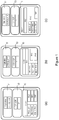
- Figures 1(a), 1(b) and 1(c) illustrate different levels of integration or aggregation between a cellular communications network (such as 3GPP) and WLAN, and in particular three different protocol options of aggregation at the Packet Data Convergence Protocol (PDCP), Radio Link Control (RLC) and Medium Access Control, MAC, levels, respectively.
- PDCP Packet Data Convergence Protocol
- RLC Radio Link Control
- MAC Medium Access Control
- Figures 1(a), 1(b) and 1(c) show the main principles for these three examples of aggregation levels, although additional functionality may be needed.
- an additional protocol layer may be used between the PDCP layer and the 802.2 Logical Link Control, LLC, layer to convey information about the user equipment and the radio bearer the traffic is associated with.
- Figures 1(a), 1(b) and 1(c) show the protocol stack at a UE or an integrated/co-located eNB-WLAN access point station.
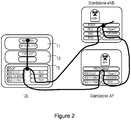
- the protocol stack for supporting aggregation may be different, as the LLC frames have to be relayed towards a standalone eNB in such a scenario.
- Figure 2 is an example illustrating this for the case of PDCP level aggregation.
- the forwarding can be performed via normal TCP/IP protocol stack.
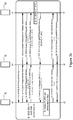
- Figures 3(a) , 3(b) and 3(c) illustrate an example of user equipment attachment and authentication procedures in a WLAN.
- the authentication procedure for a user equipment (UE) or station (STA) 30 connecting to a WLAN access point (AP) 40 that employs Robust Security Network, RSN, authentication is depicted in Figures 3(a) , 3(b) and 3(c) .
- the authentication procedure comprises the following steps.
- WLAN network nodes e.g. Access Points 40
- aggregation traffic for example, being traffic that forms part of traffic intended for a cellular network
- local breakout traffic for example, being traffic that is for use in the WLAN
- WLAN systems used for access aggregation with 3GPP may not use WLAN security mechanisms (including authentication and data integrity protection), but instead rely on the security features provided by higher layer 3GPP protocols (e.g., PDCP) for the aggregation traffic.
- higher layer 3GPP protocols e.g., PDCP
- the WLAN system routes non-aggregation local breakout traffic (e.g., to the Internet), which also needs to be secured.
- the embodiments of the present invention provide a single WLAN access point that supports a first type of traffic routing to a first node (for example non-protected traffic routing to an aggregator, for example an eNB of a cellular network, while at the same time supporting a second type of traffic routing to a second node, (for example protected local breakout traffic routing for the same wireless device).
- a first type of traffic routing to a first node for example non-protected traffic routing to an aggregator, for example an eNB of a cellular network
- a second type of traffic routing to a second node for example protected local breakout traffic routing for the same wireless device.
- FIG. 4 shows an example of a wireless local area network, WLAN, node 400 according to an embodiment of the present invention.
- the WLAN node 400 is adapted to be comprised in an integrated wireless communications network comprising a WLAN and a cellular communications network.
- the WLAN node 400 comprises a receiving module 401, a security module 403 and a routing module 405.
- the receiving module 401 is adapted to receive traffic data signals from a wireless device.
- the security module 403 is adapted to process the received traffic data signals and apply a first security protocol to a first traffic data signal received from the wireless device and a second security protocol to a second traffic data signal received from the wireless device.
- the routing module 405 is adapted to route the first traffic data signal to a node of the cellular communications network and route the second traffic data signal to a node of the WLAN.
- this enables the WLAN node 400 to handle both types of traffic simultaneously with the same wireless device.
- different security levels e.g. different security levels, or no security for 3GPP network traffic and security for local WLAN traffic
- the WLAN node can employ no security (or OSA) for traffic that is routed towards a 3GPP aggregator node (e.g., an eNB, i.e. because this traffic already has its own in-build encryption) and at the same time use security for traffic that is intended for local breakout (e.g., the WLAN node can be a part of a Robust Security Network, RSN for the local breakout traffic).
- a 3GPP aggregator node e.g., an eNB, i.e. because this traffic already has its own in-build encryption
- RSN Robust Security Network
- the security module 403 is adapted to concurrently process the first traffic data signal and second traffic data signal from the same wireless device
- the routing module 405 is adapted to concurrently route the first traffic data signal and the second traffic data signal to their respective nodes.
- concurrently it is meant that the WLAN node 400 is able to handle at least first and second traffic data signals at the same time with the same wireless device, and wherein the at least first and second traffic data signals are protected using different security or protection mechanisms.
- the references to concurrently do not necessarily require the processing to be carried out exactly in parallel or simultaneously, but include being able to process the different types of traffic data signals in an interleaved manner during a communication session between a wireless device and a WLAN node. In an example where a WLAN node 400 is able to handle at least first and second traffic data signals simultaneously with the same wireless device, this may involve, for example, using different frequencies for the different traffic types, such that the transmission of both traffic types is in parallel.
- the first security protocol comprises a security mechanism which is different to the security mechanism of the second security protocol.
- the first security protocol comprises a security mechanism which has a lower level of security than the second security protocol, or vice versa.
- the first security protocol comprises a level of encryption that is lower than a level of encryption of the second security protocol, or vice versa,
- the first security protocol comprises a level of authentication which is lower than the level of authentication of the second security protocol, or vice versa.
- the first security protocol may comprise an Open System Authentication, OSA, security protocol.
- the first security protocol comprises no additional security over and above a security protocol already provided in a received first traffic data signal.
- the security module 403 is able to process that first traffic data signal without adding any further form of protection or security, and route the first traffic data signal to a node of a cellular network, e.g. an aggregation node.
- the second security protocol comprises a Robust Secure Network, RSN, security protocol.
- an embodiment of the invention includes the option to derive the security associations from two different authentication protocol runs (potentially using separate credentials for the authentication).
- the security module 403 is further adapted to advertise the concurrent authentication capabilities of the WLAN node to other nodes or devices.
- a WLAN node 400 such as an Access Point
- the security module 403 is adapted to advertise that it supports Robust Secure Network, RSN, authentication as the form of second security protocol for the second traffic data signals being routed to a node of the WLAN, and unencrypted communication as the first security protocol for the first traffic data signals being routed to a node of the cellular communications network.
- RSN Robust Secure Network
- the security module 403 is adapted to advertise that it supports Robust Secure Network, RSN, authentication as the form of second security protocol for the second traffic data signals being routed to a node of the WLAN, and unencrypted communication as the first security protocol for the first traffic data signals being routed to a node of the cellular communications network.
- RSN Robust Secure Network
- a WLAN node 400 can therefore advertise that it supports two authentication types, for example by advertising the RSN Element (RSNE) when it is part of a RSN, and besides this also advertising that it supports exchange of unencrypted aggregation traffic.
- RSNE RSN Element
- the security module 403 may be adapted to advertise its first security protocol capability and/or second security protocol capability using, for example, an information element comprising an Aggregation Security Element, ASG.
- the security module 403 is adapted to advertise its first security protocol capability and/or second security protocol capability using a modified Robust Secure Network element, RSNE.
- the security module 403 is adapted to advertise its first security protocol capability and/or second security protocol capability using an information element provided within a data frame, or a beacon signal, or a probe request response signal, or an authentication request/response signal, or a vendor specific information element.
- an ASE can be specified, for example, as an IEEE 802.11 Information Element or as a vendor specific element (if for example it is defined in organizations outside of IEEE, e.g., the Wi-Fi Alliance, WFA).
- FIG. 5 shows a method in a wireless local area network, WLAN, node according to another embodiment of the present invention, the WLAN node being adapted to be comprised in an integrated wireless communications network comprising a WLAN and a cellular communications network.
- the method comprises receiving traffic data signals from a wireless device, step 501.
- the received traffic data signals are processed, and a first security protocol applied to a first traffic data signal received from the wireless device and a second security protocol applied to a second traffic data signal received from the wireless device, step 503.
- the first traffic data signal is routed to a node of the cellular communications network and the second traffic data signal routed to a node of the WLAN, step 505.
- the first traffic data signal and the second traffic data signal are processed concurrently to apply the first and second security protocols, and routed concurrently to their respective nodes.
- concurrently it is meant that the WLAN node is able to handle at least first and second traffic data signals at the same time with the same wireless device, and wherein the at least first and second traffic data signals are protected using different security or protection mechanisms.
- the references to concurrently do not necessarily require the processing to be carried out in parallel or simultaneously, but include being able to process the different types of traffic data signals in an interleaved manner during a communication session between a wireless device and a WLAN node.
- the method may comprise the step of advertising concurrent authentication capabilities of the WLAN node to other nodes or devices.
- FIG. 6 shows a wireless device 300 according to an embodiment of the present invention.
- the wireless device 300 comprises a communication module 301 adapted to communicate traffic data signals with a wireless local area network, WLAN, node.
- the communication module 301 is adapted to communicate a first traffic data signal using a first security protocol, and communicate a second traffic data signal using a second security protocol.
- the wireless device 300 is adapted to communicate first and second traffic data signals with the same WLAN node concurrently, the first and second traffic data signals having different security protocols.
- the communication module 301 may be adapted to communicate the first traffic data signal using a first security protocol which comprises non-encrypted communication, and communicate the second traffic data signal using a second security protocol which comprises a Robust Secure Network, RSN, authentication procedure.
- a first security protocol which comprises non-encrypted communication
- a second security protocol which comprises a Robust Secure Network, RSN, authentication procedure.
- the wireless device may associate with a WLAN node using RSN authentication only, and send only cellular or 3GPP data (e.g. aggregation frames) without over-the-air-encryption, such that there is no need to change the existing standard, i.e. since the wireless device only uses RSN with a WLAN node. Further details of such an embodiment will be described later in connection with Figures 9a and 9b .
- the communication module 301 is adapted to communicate the first traffic data signal using a first security protocol which comprises Open System Authentication, OSA, and communicate the second traffic data signal using a second security protocol which comprises a Robust Secure Network, RSN, authentication procedure.
- OSA Open System Authentication
- RSN Robust Secure Network
- a wireless device is able to authenticate with a WLAN node using several different authentication mechanisms concurrently.
- OSA is used for traffic which is ultimately forwarded by a WLAN node (Access Point) to a 3GPP node
- RSN for traffic which is ultimately forwarded by an Access Point to a local WLAN node. Further details of this embodiment will be described further below in relation to Figure 9c .
- the communication module 301 may be adapted to communicate the first and second traffic data signals using the first and second security protocols, in response to previously receiving an advertisement from the WLAN node, indicating the capability of the WLAN node to receive the first and second traffic data signals having different security protocols.
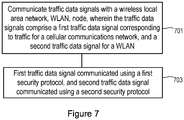
- FIG. 7 shows a method in a wireless device, according to another embodiment of the present invention.
- the method comprises communicating traffic data signals with a wireless local area network, WLAN, node, wherein the traffic data signals comprise a first traffic data signal corresponding to traffic for a cellular communications network, and a second traffic data signal for a WLAN, step 701.
- the first traffic data signal is communicated using a first security protocol
- the second traffic data signal communicated using a second security protocol, step 703.
- the method comprises the steps of communicating the first traffic data signal using a first security protocol which comprises non-encrypted communication, step 801, and communicating the second traffic data signal using a second security protocol which comprises a Robust Secure Network, RSN, authentication procedure, step 803. Further details of such an embodiment will be described later in connection with Figures 9a and 9b .
- the method comprises communicating the first traffic data signal using a first security protocol which comprises Open System Authentication, OSA, step 805, and communicating the second traffic data signal using a second security protocol which comprises a Robust Secure Network, RSN, authentication procedure, step 807. Further details of this embodiment will be described further below in relation to Figure 9c .
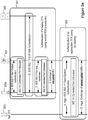
- Figure 9a shows an example message flow for the authentication of a legacy wireless device 300a and an aggregation wireless device 300b. It is noted that, to simplify the flow-chart in Figure 9a , the aggregation wireless device 300b is not shown running any local break out traffic flows. In this case, the WLAN node 400 will need to be able to make a difference between a legacy wireless device 300a and an aggregation wireless device 300b (whereby a wireless device will need to report its aggregation capabilities to the WLAN node 400, for example as described in PCT/SE2014/51262 by the present Applicant).
- the exchange of message flows bounded by the dotted box 901 relate to those of authentication with a legacy wireless device 300a using, for example, normal RSN procedures, while the exchange of message flows bounded by dotted box 903 relate to authentication of an aggregation wireless device 300b, whereby aggregation traffic is exchanged between the WLAN node 400 and the aggregation wireless device 300b using, for example, no security.
- the aggregation device 300b is also be able to communicate with the WLAN node 400 using a different security protocol, for example RSN authentication, as will be described further in Figures 9b and 9c .
- this expands on the message flows of the aggregation wireless device 300b of Figure 9a , and shows an example of message flows corresponding to the option described above in Figure 8a , i.e. whereby a wireless device 300 associates to a WLAN node (e.g. AP) using just one security protocol, for example RSN authentication, and then sends only the first traffic data signal flows, for example cellular type traffic, such as aggregation frames, without over-the-air encryption.
- the message flows labeled 905 correspond to the wireless device 300b setting up a security protocol with the WLAN node 400, for example setting up an RSN authentication.
- local breakout traffic is exchanged using this security protocol, such that encrypted local breakout traffic is exchanged between the wireless device 300b and the WLAN node 400.
- aggregation traffic is exchanged in unencrypted mode, e.g. since no encryption is required because the aggregation traffic already has its own in-built security mechanism.
- Figure 9c shows an example according to another embodiment, corresponding to the embodiment described above in Figure 8b .
- This embodiment supports two (or more) different concurrent authentications between a single WLAN node 400 and a single wireless device or user equipment (station) 300b, for example a WLAN node that supports both OSA and RSN simultaneously. Therefore, a wireless device 300b can authenticate and associate to said WLAN node using either security mechanism, or in the case where they are aggregating wireless devices, both security mechanisms simultaneously.
- the message flows labeled 905 correspond to the wireless device 300b setting up a first security protocol with the WLAN node 400, for example setting up an RSN authentication
- the message flows 907 correspond to the wireless device 300b setting up a second security protocol with the WLAN node 400, for example setting up OSA.
- a wireless device is provided with the option of authenticating to a WLAN node (AP) using several different authentication mechanisms concurrently, e.g. one OSA and one RSN.
- the scenario is similar to the one in Figure 9b , but the process flow is different.
- the wireless device 300b will use two different authentications simultaneously - one for the local breakout traffic and one for the aggregation traffic.
- This option may be implemented in IEEE 802.11 standards, by allowing for one wireless device 300 to have multiple concurrent authentications to the same WLAN node or access point.
- the WLAN node is adapted to maintain two different state machines, one for each type of traffic.
- the WLAN node can advertise the requirement for a wireless device to complete two or more authentications, for example in the ASE as mentioned above.
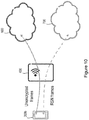
- FIG. 10 shows an example of a network comprising a WLAN node 400 (such as an access point) and a wireless device 300 according to embodiments described herein.
- the WLAN node 400 is able to still provide secure communication to legacy wireless devices as usual, for example by using a second security protocol, such as RSN frames in the example, for local breakout traffic, for example WLAN traffic which is being routed to the Internet 700.
- a second security protocol such as RSN frames in the example
- local breakout traffic for example WLAN traffic which is being routed to the Internet 700.
- aggregation wireless devices 300b that send aggregation traffic
- This option illustrated in the example of Figure 10 has no impact on legacy wireless devices, since they will observe the WLAN node 400 as a normal RSN WLAN node.
- two different traffic types that a wireless station has, for example aggregation traffic and local breakout traffic, are treated differently when it comes to security.
- An embodiment provides a method of operating a WLAN access point capable of maintaining a first and a second protection mechanism with a wireless device.
- a method comprises announcing which protection mechanisms are supported by the WLAN access point, protecting a first type of traffic received from the device using the first protection mechanism, protecting a second type of traffic received from the device using the second protection mechanism, and forwarding the first type of traffic to a 3GPP aggregation function.
- a computer program comprising instructions which, when executed on at least one processor, causes the at least one processor to carry out the method according to any one of the embodiments described above, and as defined in the appended claims.
- a carrier comprising such a computer program, wherein the carrier is one of an electronic signal, optical signal, radio signal or computer readable storage medium.
- the embodiments described can overcome a problem whereby a WLAN AP has to provide capabilities and route traffic for two different purposes: one for the 3GPP aggregation and one for the local break out (e.g., Internet traffic or access to a home or enterprise network). Since the 3GPP aggregation traffic is secured by higher player protocols (i.e., the PDCP) no security (or lower form of security) is needed over the WLAN air interface for the traffic that is routed towards the 3GPP aggregator (the traffic between the WLAN AP and the 3GPP aggregator could be protected by, e.g., IPsec to ensure that only traffic from authorized APs are allowed to reach the 3GPP aggregator).
- the 3GPP aggregation traffic is secured by higher player protocols (i.e., the PDCP)
- no security or lower form of security
- the WLAN AP can be configured to use OSA for authentication for these flows.
- a WLAN AP is able to separate between which flows are aggregation flows.
- the local breakout traffic is not protected by 3GPP security, and hence the WLAN AP is able to provide security for this traffic over the air interface.
- the first traffic data signal is described as comprising at least part of an aggregation signal for a cellular communications network, and the second traffic data signal described as comprising a local breakout signal of the WLAN. It is noted, however, that the first and second traffic data signals may comprise any form of different traffic signals.
- the embodiments of the present invention allow the same user equipment, wireless device or station to run some flows as aggregation flows and other flows as local break out flows, i.e. simultaneously from the same user equipment.
- the embodiments describe a mechanism which allows a WLAN access node, or an Access Point (AP) to provide different security mechanisms for different traffic flows from the same user equipment or wireless device.
- the AP can employ no security (or OSA) for traffic that is routed towards a 3GPP aggregator node (e.g., an eNB) and at the same time use security for traffic that is intended for local breakout (e.g., the AP can be a part of a Robust Security Network, RSN for the local breakout traffic).
- the embodiments of the present invention therefore provide a technical solution, which enables a network node, such as a WLAN access point, to allow for multiple different authentications simultaneously towards a single user equipment or station or wireless device.
- a network node such as a WLAN access point
- a wireless device may support several authentications to the same WLAN node or access point simultaneously: It should be noted that the above-mentioned embodiments illustrate rather than limit the invention, and that those skilled in the art will be able to design many alternative embodiments without departing from the scope of the appended claims.
- the word “comprising” does not exclude the presence of elements or steps other than those listed in a claim, "a” or “an” does not exclude a plurality, and a single processor or other unit may fulfil the functions of several units recited in the claims. Any reference signs in the claims shall not be construed so as to limit their scope.
Landscapes
- Engineering & Computer Science (AREA)
- Computer Security & Cryptography (AREA)
- Computer Networks & Wireless Communication (AREA)
- Signal Processing (AREA)
- Computer Hardware Design (AREA)
- Computing Systems (AREA)
- General Engineering & Computer Science (AREA)
- Mobile Radio Communication Systems (AREA)
Claims (21)
- Nœud de réseau local sans fil, WLAN, (400) apte à être compris dans un réseau de communication sans fil intégré comprenant un WLAN et un réseau de communication cellulaire, le nœud WLAN (400) comprenant :un module de réception (401) apte à recevoir des signaux de données de trafic en provenance d'un dispositif sans fil ;un module de sécurité (403) apte à traiter les signaux de données de trafic reçus et à appliquer un premier protocole de sécurité à un premier signal de données de trafic WLAN reçu en provenance du dispositif sans fil et un deuxième protocole de sécurité à un deuxième signal de données de trafic WLAN reçu en provenance du dispositif sans fil ; etun module d'acheminement (405) apte à acheminer le premier signal de données de trafic WLAN jusqu'à un nœud du réseau de communication cellulaire et à acheminer le deuxième signal de données de trafic WLAN relatif à un trafic de pointe local jusqu'à un nœud du WLAN, dans lequel le module de sécurité est apte à traiter simultanément le premier signal de données de trafic WLAN et le deuxième signal de données de trafic WLAN depuis le même dispositif sans fil, et le module d'acheminement (405) est apte à acheminer simultanément le premier signal de données de trafic WLAN et le deuxième signal de données de trafic WLAN jusqu'à leurs nœuds respectifs en utilisant différentes fréquences pour le premier signal de données de trafic WLAN et le deuxième signal de données de trafic WLAN.
- Nœud WLAN selon la revendication 1, dans lequel :le premier protocole de sécurité comprend un mécanisme de sécurité qui est différent du mécanisme de sécurité du deuxième protocole de sécurité ; oule premier protocole de sécurité comprend un mécanisme de sécurité qui a un niveau de sécurité inférieur à celui du deuxième protocole de sécurité, ou vice versa ; oule premier protocole de sécurité comprend un niveau de chiffrement qui est inférieur à un niveau de chiffrement du deuxième protocole de sécurité, ou vice versa ; oule premier protocole de sécurité comprend un niveau d'authentification qui est inférieur au niveau d'authentification du deuxième protocole de sécurité, ou vice versa.
- Nœud WLAN (400) selon l'une quelconque des revendications précédentes, dans lequel le premier protocole de sécurité comprend un protocole de sécurité d'authentification de système ouvert, OSA.
- Nœud WLAN (400) selon l'une quelconque des revendications 1 et 2, dans lequel le premier protocole de sécurité ne comprend pas de sécurité supplémentaire au-dessus d'un protocole de sécurité déjà fourni dans un premier signal de données de trafic WLAN reçu.
- Nœud WLAN (400) selon l'une quelconque des revendications précédentes, dans lequel le deuxième protocole de sécurité comprend un protocole de sécurité de réseau sécurisé robuste, RSN.
- Nœud WLAN (400) selon l'une quelconque des revendications précédentes, dans lequel le module de sécurité (403) est en outre apte à annoncer des capacités d'authentification simultanées du nœud WLAN à d'autres nœuds ou dispositifs.
- Nœud WLAN (400) selon la revendication 6, dans lequel le module de sécurité (403) est apte à annoncer qu'il prend en charge :une authentification de réseau sécurisé robuste, RSN, sous la forme d'un deuxième protocole de sécurité pour les deuxièmes signaux de données de trafic WLAN qui sont acheminés jusqu'à un nœud du WLAN ; etune communication non chiffrée en tant que le premier protocole de sécurité pour les premiers signaux de données de trafic WLAN qui sont acheminés jusqu'à un nœud du réseau de communication cellulaire.
- Nœud WLAN (400) selon l'une quelconque des revendications 6 et 7, dans lequel le module de sécurité (403) est apte à annoncer sa capacité de premier protocole de sécurité et/ou sa capacité de deuxième protocole de sécurité en utilisant :un élément d'information comprenant un élément de sécurité d'agrégation, ASG ; ouun élément de réseau sécurisé robuste, RSNE, modifié.
- Nœud WLAN (400) selon la revendication 8, dans lequel le module de sécurité (403) est apte à annoncer sa capacité de premier protocole de sécurité et/ou sa capacité de deuxième protocole de sécurité en utilisant :un élément d'informations fourni à l'intérieur d'une trame de données, ou un signal de balise, ou un signal de réponse de demande de sonde, ou un signal de demande/réponse d'authentification ; ouun élément d'information spécifique au fournisseur.
- Nœud WLAN (400) selon l'une quelconque des revendications précédentes, dans lequel le premier signal de données de trafic WLAN comprend au moins une partie d'un signal d'agrégation pour un réseau de communication cellulaire.
- Procédé dans un nœud de réseau local sans fil, WLAN, apte à être compris dans un réseau de communication sans fil intégré comprenant un WLAN et un réseau de communication cellulaire, le procédé comprenant :la réception de signaux de données de trafic en provenance d'un dispositif sans fil (étape 501) ;le traitement des signaux de données de trafic reçus et l'application d'un premier protocole de sécurité à un premier signal de données de trafic WLAN reçu en provenance du dispositif sans fil et d'un deuxième protocole de sécurité à un deuxième signal de données de trafic WLAN reçu en provenance du dispositif sans fil (étape 503) ; etl'acheminement du premier signal de données de trafic WLAN jusqu'à un nœud du réseau de communication cellulaire et l'acheminement du deuxième signal de données de trafic WLAN relatif à un trafic de pointe local jusqu'à un nœud du WLAN (étape 505), dans lequel le premier signal de données de trafic WLAN et le deuxième signal de données de trafic WLAN sont traités simultanément pour appliquer les premier et deuxième protocoles de sécurité, et sont acheminés simultanément jusqu'à leurs nœuds respectifs en utilisant différentes fréquences pour le premier signal de données de trafic WLAN et le deuxième signal de données de trafic WLAN.
- Procédé selon la revendication 11, comprenant en outre l'étape de l'annonce de capacités d'authentification du nœud WLAN à d'autres nœuds ou dispositifs.
- Dispositif sans fil (500) comprenant :
un module de communication (501) apte à communiquer des signaux de données de trafic avec un nœud de réseau local sans fil, WLAN, dans lequel les signaux de données de trafic comprennent un premier signal de données de trafic WLAN correspondant à un trafic pour un réseau de communication cellulaire, et un deuxième signal de données de trafic WLAN pour un trafic de pointe local d'un WLAN, dans lequel le module de communication est apte à :
communiquer un premier signal de données de trafic WLAN en utilisant un premier protocole de sécurité ; et communiquer un deuxième signal de données de trafic WLAN en utilisant un deuxième protocole de sécurité simultanément avec le premier signal de données de trafic WLAN en utilisant différentes fréquences pour le premier signal de données de trafic WLAN et le deuxième signal de données de trafic WLAN. - Dispositif sans fil (500) selon la revendication 13, dans lequel le module de communication (501) est apte à :communiquer le premier signal de données de trafic WLAN en utilisant un premier protocole de sécurité qui comprend une communication non chiffrée ; etcommuniquer le deuxième signal de données de trafic WLAN en utilisant un deuxième protocole de sécurité qui comprend une procédure d'authentification de réseau sécurisé robuste, RSN.
- Dispositif sans fil (500) selon la revendication 13, dans lequel le module de communication (501) est apte à :communiquer le premier signal de données de trafic WLAN en utilisant un premier protocole de sécurité qui comprend une authentification de système ouvert, OSA ; etcommuniquer le deuxième signal de données de trafic WLAN en utilisant un deuxième protocole de sécurité qui comprend une procédure d'authentification de réseau sécurisé robuste, RSN.
- Dispositif sans fil (500) selon l'une quelconque des revendications 13 à 15, dans lequel le module de communication (501) est apte à communiquer les premier et deuxième signaux de données de trafic WLAN en utilisant les premier et deuxième protocoles de sécurité, en réponse à la réception préalable d'une annonce en provenance du nœud WLAN, indiquant la capacité du nœud WLAN à recevoir les premier et deuxième signaux de données de trafic WLAN ayant différents protocoles de sécurité.
- Procédé dans un dispositif sans fil, le procédé comprenant :la communication de signaux de données de trafic avec un nœud de réseau local sans fil, WLAN, dans lequel les signaux de données de trafic comprennent un premier signal de données de trafic WLAN correspondant à un trafic pour un réseau de communication cellulaire, et un deuxième signal de données de trafic WLAN pour un trafic de pointe local d'un WLAN (étape 701) ;dans lequel le premier signal de données de trafic WLAN est communiqué en utilisant un premier protocole de sécurité, et le deuxième signal de données de trafic WLAN est communiqué en utilisant un deuxième protocole de sécurité (étape 703) simultanément avec le premier signal de données de trafic WLAN en utilisant différentes fréquences pour le premier signal de données de trafic WLAN et le deuxième signal de données de trafic WLAN.
- Procédé selon la revendication 17, comprenant les étapes de :la communication du premier signal de données de trafic WLAN en utilisant un premier protocole de sécurité qui comprend une communication non chiffrée (étape 801), et la communication du deuxième signal de données de trafic WLAN en utilisant un deuxième protocole de sécurité qui comprend une procédure d'authentification de réseau sécurisé robuste, RSN, (étape 803) ; oula communication du premier signal de données de trafic WLAN en utilisant un premier protocole de sécurité qui comprend une authentification de système ouvert, OSA, (étape 805), et la communication du deuxième signal de données de trafic WLAN en utilisant un deuxième protocole de sécurité qui comprend une procédure d'authentification de réseau sécurisé robuste, RSN, (étape 807).
- Programme informatique comprenant des instructions qui, lorsqu'elles sont exécutées sur au moins un processeur, amènent l'au moins un processeur à effectuer le procédé selon l'une quelconque des revendications 11 et 12.
- Programme informatique comprenant des instructions qui, lorsqu'elles sont exécutées sur au moins un processeur, amènent l'au moins un processeur à effectuer le procédé selon l'une quelconque des revendications 17 et 18.
- Porteuse comprenant le programme informatique selon la revendication 19 ou 20, dans laquelle la porteuse est l'un d'un signal électronique, d'un signal optique, d'un signal radio ou d'un support de mémorisation lisible par ordinateur.
Applications Claiming Priority (1)
| Application Number | Priority Date | Filing Date | Title |
|---|---|---|---|
| PCT/SE2014/051447 WO2016089265A1 (fr) | 2014-12-04 | 2014-12-04 | Procédé réalisé par un nœud de réseau local sans fil (wlan) dans un réseau de communication sans fil intégré, pour appliquer une sécurité aux données de trafic reçues |
Publications (3)
| Publication Number | Publication Date |
|---|---|
| EP3228152A1 EP3228152A1 (fr) | 2017-10-11 |
| EP3228152A4 EP3228152A4 (fr) | 2018-07-11 |
| EP3228152B1 true EP3228152B1 (fr) | 2019-11-20 |
Family
ID=56092083
Family Applications (1)
| Application Number | Title | Priority Date | Filing Date |
|---|---|---|---|
| EP14907560.8A Active EP3228152B1 (fr) | 2014-12-04 | 2014-12-04 | Procédé réalisé par un noeud de réseau local sans fil (wlan) dans un réseau de communication sans fil intégré, pour appliquer une sécurité aux données de trafic reçues |
Country Status (4)
| Country | Link |
|---|---|
| US (1) | US20170331688A1 (fr) |
| EP (1) | EP3228152B1 (fr) |
| CN (1) | CN107211488B (fr) |
| WO (1) | WO2016089265A1 (fr) |
Families Citing this family (5)
| Publication number | Priority date | Publication date | Assignee | Title |
|---|---|---|---|---|
| US10278068B2 (en) * | 2015-07-17 | 2019-04-30 | Htc Corporation | Device and method of handling cellular-wireless local area network aggregation |
| US10791093B2 (en) * | 2016-04-29 | 2020-09-29 | Avago Technologies International Sales Pte. Limited | Home network traffic isolation |
| WO2018000303A1 (fr) * | 2016-06-30 | 2018-01-04 | 北京小米移动软件有限公司 | Procédé et dispositif de transmission de données, équipement utilisateur et station de base |
| WO2020181039A1 (fr) * | 2019-03-06 | 2020-09-10 | XCOM Labs, Inc. | Architecture de dérivation locale |
| US12368705B2 (en) * | 2022-04-13 | 2025-07-22 | Webshare Software Company | Proxy direct connect |
Citations (2)
| Publication number | Priority date | Publication date | Assignee | Title |
|---|---|---|---|---|
| WO2008070251A2 (fr) * | 2006-09-25 | 2008-06-12 | Qualcomm Incorporated | Procédé et appareil ayant un chiffrement nul pour des paquets de signalisation et multimédias entre une station mobile et une passerelle sécurisée |
| US20130216043A1 (en) * | 2012-02-17 | 2013-08-22 | Nokia Corporation | Security Solution For Integrating a WiFi Radio Interface in LTE Access Network |
Family Cites Families (19)
| Publication number | Priority date | Publication date | Assignee | Title |
|---|---|---|---|---|
| JP3570310B2 (ja) * | 1999-10-05 | 2004-09-29 | 日本電気株式会社 | 無線lanシステムにおける認証方法と認証装置 |
| WO2009151452A1 (fr) * | 2008-06-12 | 2009-12-17 | Hewlett-Packard Development Company, L.P. | Point d'accès wlan de téléphone cellulaire |
| US20100020746A1 (en) * | 2008-07-28 | 2010-01-28 | Texas Instruments Incorporated | Advertisement of multiple security profiles in wireless local area networks |
| CN101394281A (zh) * | 2008-09-27 | 2009-03-25 | 上海交通大学 | 基于无线局域网的无线网状网络接入安全认证方法 |
| US9008314B2 (en) * | 2008-11-18 | 2015-04-14 | Verizon Patent And Licensing Inc. | Secure wireless communications |
| CN102045714B (zh) * | 2009-10-10 | 2013-07-10 | 上海贝尔股份有限公司 | 提供3gpp网络与无线局域网互通安全的方法和装置 |
| CN102771147B (zh) * | 2010-02-25 | 2016-01-20 | 美国博通公司 | 用于4GWiMAX/LTE-WiFi/BT共存时域法的方法及系统 |
| CN102625346B (zh) * | 2011-01-31 | 2015-04-15 | 电信科学技术研究院 | 一种长期演进局域网lte-lan系统和接入设备及终端 |
| GB2495550A (en) * | 2011-10-14 | 2013-04-17 | Ubiquisys Ltd | An access point that can be used to establish connections with UE devices using both cellular and wifi air interfaces |
| WO2014025829A2 (fr) * | 2012-08-06 | 2014-02-13 | Rambus Inc. | Systèmes et procédés de connexion à des services locaux à partir de réseaux wan et lan |
| US8891420B2 (en) * | 2012-09-14 | 2014-11-18 | Fujitsu Limited | Fusion of cellular and non-cellular communications |
| TWI492656B (zh) * | 2012-12-25 | 2015-07-11 | 廣達電腦股份有限公司 | 無線存取點 |
| CN103906056B (zh) * | 2012-12-26 | 2018-01-09 | 中国电信股份有限公司 | 混合组网下统一认证方法及系统 |
| US9603192B2 (en) * | 2013-01-16 | 2017-03-21 | Ncore Communications, Inc. | Methods and apparatus for hybrid access to a core network |
| US9277495B2 (en) * | 2013-03-05 | 2016-03-01 | Futurewei Technologies, Inc. | System and method for adaptive access network query protocol (ANQP) element provisioning |
| US9474067B2 (en) * | 2013-03-26 | 2016-10-18 | Qualcomm Incorporated | WLAN uplink scheduler for LTE-WLAN aggregation |
| US9426649B2 (en) * | 2014-01-30 | 2016-08-23 | Intel IP Corporation | Apparatus, system and method of securing communications of a user equipment (UE) in a wireless local area network |
| US9609566B2 (en) * | 2014-06-03 | 2017-03-28 | Intel Corporation | Radio resource control (RRC) protocol for integrated WLAN/3GPP radio access technologies |
| US11412376B2 (en) * | 2014-09-05 | 2022-08-09 | Telefonaktiebolaget L M Ericsson (Publ) | Interworking and integration of different radio access networks |
-
2014
- 2014-12-04 CN CN201480084614.0A patent/CN107211488B/zh active Active
- 2014-12-04 EP EP14907560.8A patent/EP3228152B1/fr active Active
- 2014-12-04 WO PCT/SE2014/051447 patent/WO2016089265A1/fr not_active Ceased
- 2014-12-04 US US15/531,239 patent/US20170331688A1/en not_active Abandoned
Patent Citations (2)
| Publication number | Priority date | Publication date | Assignee | Title |
|---|---|---|---|---|
| WO2008070251A2 (fr) * | 2006-09-25 | 2008-06-12 | Qualcomm Incorporated | Procédé et appareil ayant un chiffrement nul pour des paquets de signalisation et multimédias entre une station mobile et une passerelle sécurisée |
| US20130216043A1 (en) * | 2012-02-17 | 2013-08-22 | Nokia Corporation | Security Solution For Integrating a WiFi Radio Interface in LTE Access Network |
Also Published As
| Publication number | Publication date |
|---|---|
| EP3228152A4 (fr) | 2018-07-11 |
| WO2016089265A1 (fr) | 2016-06-09 |
| US20170331688A1 (en) | 2017-11-16 |
| CN107211488A (zh) | 2017-09-26 |
| EP3228152A1 (fr) | 2017-10-11 |
| CN107211488B (zh) | 2021-02-23 |
Similar Documents
| Publication | Publication Date | Title |
|---|---|---|
| US11412376B2 (en) | Interworking and integration of different radio access networks | |
| US12166897B2 (en) | Authentication mechanism for 5G technologies | |
| US10659370B2 (en) | Wireless local area network (WLAN) node, a wireless device, and methods therein | |
| US11140725B2 (en) | Wireless communications involving a fast initial link setup, FILS, discovery frame for network signaling | |
| US20250280295A1 (en) | A method of joining a communication network | |
| US10356670B2 (en) | Deriving a WLAN security context from a WWAN security context | |
| US20180184428A1 (en) | Associating and securitizing distributed multi-band link aggregation devices | |
| EP3175639B1 (fr) | Authentication durant un transfer intercellulaire entre deux réseaux différents de communication sans fil | |
| Tang et al. | WiMAX security and quality of service: an end-to-end perspective | |
| JP2017538345A (ja) | 方法、装置およびシステム | |
| EP3228152B1 (fr) | Procédé réalisé par un noeud de réseau local sans fil (wlan) dans un réseau de communication sans fil intégré, pour appliquer une sécurité aux données de trafic reçues | |
| WO2024145946A1 (fr) | Appareil, procédé, et programme informatique | |
| EP3046362B1 (fr) | Procédé de distribution, station de base et équipement d'utilisateur | |
| Namal et al. | Lightweight authentication and key management on 802.11 with Elliptic Curve Cryptography | |
| WO2016015750A1 (fr) | Authentification dans un réseau de communication | |
| WO2025178996A1 (fr) | Iot ambiant et remédiation d'attaque dos et ddos | |
| Elmubark et al. | New methods for TVWS database protocol |
Legal Events
| Date | Code | Title | Description |
|---|---|---|---|
| STAA | Information on the status of an ep patent application or granted ep patent |
Free format text: STATUS: THE INTERNATIONAL PUBLICATION HAS BEEN MADE |
|
| PUAI | Public reference made under article 153(3) epc to a published international application that has entered the european phase |
Free format text: ORIGINAL CODE: 0009012 |
|
| STAA | Information on the status of an ep patent application or granted ep patent |
Free format text: STATUS: REQUEST FOR EXAMINATION WAS MADE |
|
| 17P | Request for examination filed |
Effective date: 20170523 |
|
| AK | Designated contracting states |
Kind code of ref document: A1 Designated state(s): AL AT BE BG CH CY CZ DE DK EE ES FI FR GB GR HR HU IE IS IT LI LT LU LV MC MK MT NL NO PL PT RO RS SE SI SK SM TR |
|
| AX | Request for extension of the european patent |
Extension state: BA ME |
|
| DAX | Request for extension of the european patent (deleted) | ||
| A4 | Supplementary search report drawn up and despatched |
Effective date: 20180611 |
|
| RIC1 | Information provided on ipc code assigned before grant |
Ipc: H04W 12/08 20090101ALI20180605BHEP Ipc: H04L 29/06 20060101ALI20180605BHEP Ipc: H04W 88/06 20090101ALI20180605BHEP Ipc: H04W 12/00 20090101ALI20180605BHEP Ipc: H04W 84/12 20090101ALI20180605BHEP Ipc: H04W 92/02 20090101ALI20180605BHEP Ipc: H04L 12/24 20060101ALI20180605BHEP Ipc: H04W 12/02 20090101ALI20180605BHEP Ipc: H04W 12/06 20090101ALI20180605BHEP Ipc: H04W 88/10 20090101AFI20180605BHEP |
|
| STAA | Information on the status of an ep patent application or granted ep patent |
Free format text: STATUS: EXAMINATION IS IN PROGRESS |
|
| 17Q | First examination report despatched |
Effective date: 20190131 |
|
| GRAP | Despatch of communication of intention to grant a patent |
Free format text: ORIGINAL CODE: EPIDOSNIGR1 |
|
| STAA | Information on the status of an ep patent application or granted ep patent |
Free format text: STATUS: GRANT OF PATENT IS INTENDED |
|
| INTG | Intention to grant announced |
Effective date: 20190812 |
|
| GRAS | Grant fee paid |
Free format text: ORIGINAL CODE: EPIDOSNIGR3 |
|
| GRAA | (expected) grant |
Free format text: ORIGINAL CODE: 0009210 |
|
| STAA | Information on the status of an ep patent application or granted ep patent |
Free format text: STATUS: THE PATENT HAS BEEN GRANTED |
|
| AK | Designated contracting states |
Kind code of ref document: B1 Designated state(s): AL AT BE BG CH CY CZ DE DK EE ES FI FR GB GR HR HU IE IS IT LI LT LU LV MC MK MT NL NO PL PT RO RS SE SI SK SM TR |
|
| REG | Reference to a national code |
Ref country code: GB Ref legal event code: FG4D |
|
| REG | Reference to a national code |
Ref country code: CH Ref legal event code: EP |
|
| REG | Reference to a national code |
Ref country code: IE Ref legal event code: FG4D |
|
| REG | Reference to a national code |
Ref country code: DE Ref legal event code: R096 Ref document number: 602014057336 Country of ref document: DE |
|
| REG | Reference to a national code |
Ref country code: AT Ref legal event code: REF Ref document number: 1205665 Country of ref document: AT Kind code of ref document: T Effective date: 20191215 |
|
| REG | Reference to a national code |
Ref country code: NL Ref legal event code: MP Effective date: 20191120 |
|
| REG | Reference to a national code |
Ref country code: LT Ref legal event code: MG4D |
|
| PG25 | Lapsed in a contracting state [announced via postgrant information from national office to epo] |
Ref country code: BG Free format text: LAPSE BECAUSE OF FAILURE TO SUBMIT A TRANSLATION OF THE DESCRIPTION OR TO PAY THE FEE WITHIN THE PRESCRIBED TIME-LIMIT Effective date: 20200220 Ref country code: FI Free format text: LAPSE BECAUSE OF FAILURE TO SUBMIT A TRANSLATION OF THE DESCRIPTION OR TO PAY THE FEE WITHIN THE PRESCRIBED TIME-LIMIT Effective date: 20191120 Ref country code: NL Free format text: LAPSE BECAUSE OF FAILURE TO SUBMIT A TRANSLATION OF THE DESCRIPTION OR TO PAY THE FEE WITHIN THE PRESCRIBED TIME-LIMIT Effective date: 20191120 Ref country code: SE Free format text: LAPSE BECAUSE OF FAILURE TO SUBMIT A TRANSLATION OF THE DESCRIPTION OR TO PAY THE FEE WITHIN THE PRESCRIBED TIME-LIMIT Effective date: 20191120 Ref country code: LV Free format text: LAPSE BECAUSE OF FAILURE TO SUBMIT A TRANSLATION OF THE DESCRIPTION OR TO PAY THE FEE WITHIN THE PRESCRIBED TIME-LIMIT Effective date: 20191120 Ref country code: NO Free format text: LAPSE BECAUSE OF FAILURE TO SUBMIT A TRANSLATION OF THE DESCRIPTION OR TO PAY THE FEE WITHIN THE PRESCRIBED TIME-LIMIT Effective date: 20200220 Ref country code: LT Free format text: LAPSE BECAUSE OF FAILURE TO SUBMIT A TRANSLATION OF THE DESCRIPTION OR TO PAY THE FEE WITHIN THE PRESCRIBED TIME-LIMIT Effective date: 20191120 Ref country code: GR Free format text: LAPSE BECAUSE OF FAILURE TO SUBMIT A TRANSLATION OF THE DESCRIPTION OR TO PAY THE FEE WITHIN THE PRESCRIBED TIME-LIMIT Effective date: 20200221 |
|
| PG25 | Lapsed in a contracting state [announced via postgrant information from national office to epo] |
Ref country code: IS Free format text: LAPSE BECAUSE OF FAILURE TO SUBMIT A TRANSLATION OF THE DESCRIPTION OR TO PAY THE FEE WITHIN THE PRESCRIBED TIME-LIMIT Effective date: 20200320 Ref country code: HR Free format text: LAPSE BECAUSE OF FAILURE TO SUBMIT A TRANSLATION OF THE DESCRIPTION OR TO PAY THE FEE WITHIN THE PRESCRIBED TIME-LIMIT Effective date: 20191120 Ref country code: RS Free format text: LAPSE BECAUSE OF FAILURE TO SUBMIT A TRANSLATION OF THE DESCRIPTION OR TO PAY THE FEE WITHIN THE PRESCRIBED TIME-LIMIT Effective date: 20191120 |
|
| PG25 | Lapsed in a contracting state [announced via postgrant information from national office to epo] |
Ref country code: AL Free format text: LAPSE BECAUSE OF FAILURE TO SUBMIT A TRANSLATION OF THE DESCRIPTION OR TO PAY THE FEE WITHIN THE PRESCRIBED TIME-LIMIT Effective date: 20191120 |
|
| PG25 | Lapsed in a contracting state [announced via postgrant information from national office to epo] |
Ref country code: DK Free format text: LAPSE BECAUSE OF FAILURE TO SUBMIT A TRANSLATION OF THE DESCRIPTION OR TO PAY THE FEE WITHIN THE PRESCRIBED TIME-LIMIT Effective date: 20191120 Ref country code: PT Free format text: LAPSE BECAUSE OF FAILURE TO SUBMIT A TRANSLATION OF THE DESCRIPTION OR TO PAY THE FEE WITHIN THE PRESCRIBED TIME-LIMIT Effective date: 20200412 Ref country code: EE Free format text: LAPSE BECAUSE OF FAILURE TO SUBMIT A TRANSLATION OF THE DESCRIPTION OR TO PAY THE FEE WITHIN THE PRESCRIBED TIME-LIMIT Effective date: 20191120 Ref country code: ES Free format text: LAPSE BECAUSE OF FAILURE TO SUBMIT A TRANSLATION OF THE DESCRIPTION OR TO PAY THE FEE WITHIN THE PRESCRIBED TIME-LIMIT Effective date: 20191120 Ref country code: RO Free format text: LAPSE BECAUSE OF FAILURE TO SUBMIT A TRANSLATION OF THE DESCRIPTION OR TO PAY THE FEE WITHIN THE PRESCRIBED TIME-LIMIT Effective date: 20191120 Ref country code: CZ Free format text: LAPSE BECAUSE OF FAILURE TO SUBMIT A TRANSLATION OF THE DESCRIPTION OR TO PAY THE FEE WITHIN THE PRESCRIBED TIME-LIMIT Effective date: 20191120 |
|
| REG | Reference to a national code |
Ref country code: CH Ref legal event code: PL |
|
| REG | Reference to a national code |
Ref country code: AT Ref legal event code: MK05 Ref document number: 1205665 Country of ref document: AT Kind code of ref document: T Effective date: 20191120 |
|
| REG | Reference to a national code |
Ref country code: DE Ref legal event code: R097 Ref document number: 602014057336 Country of ref document: DE |
|
| REG | Reference to a national code |
Ref country code: BE Ref legal event code: MM Effective date: 20191231 |
|
| PG25 | Lapsed in a contracting state [announced via postgrant information from national office to epo] |
Ref country code: SM Free format text: LAPSE BECAUSE OF FAILURE TO SUBMIT A TRANSLATION OF THE DESCRIPTION OR TO PAY THE FEE WITHIN THE PRESCRIBED TIME-LIMIT Effective date: 20191120 Ref country code: SK Free format text: LAPSE BECAUSE OF FAILURE TO SUBMIT A TRANSLATION OF THE DESCRIPTION OR TO PAY THE FEE WITHIN THE PRESCRIBED TIME-LIMIT Effective date: 20191120 Ref country code: MC Free format text: LAPSE BECAUSE OF FAILURE TO SUBMIT A TRANSLATION OF THE DESCRIPTION OR TO PAY THE FEE WITHIN THE PRESCRIBED TIME-LIMIT Effective date: 20191120 |
|
| PLBE | No opposition filed within time limit |
Free format text: ORIGINAL CODE: 0009261 |
|
| STAA | Information on the status of an ep patent application or granted ep patent |
Free format text: STATUS: NO OPPOSITION FILED WITHIN TIME LIMIT |
|
| 26N | No opposition filed |
Effective date: 20200821 |
|
| PG25 | Lapsed in a contracting state [announced via postgrant information from national office to epo] |
Ref country code: LU Free format text: LAPSE BECAUSE OF NON-PAYMENT OF DUE FEES Effective date: 20191204 Ref country code: IE Free format text: LAPSE BECAUSE OF NON-PAYMENT OF DUE FEES Effective date: 20191204 |
|
| PG25 | Lapsed in a contracting state [announced via postgrant information from national office to epo] |
Ref country code: CH Free format text: LAPSE BECAUSE OF NON-PAYMENT OF DUE FEES Effective date: 20191231 Ref country code: BE Free format text: LAPSE BECAUSE OF NON-PAYMENT OF DUE FEES Effective date: 20191231 Ref country code: SI Free format text: LAPSE BECAUSE OF FAILURE TO SUBMIT A TRANSLATION OF THE DESCRIPTION OR TO PAY THE FEE WITHIN THE PRESCRIBED TIME-LIMIT Effective date: 20191120 Ref country code: AT Free format text: LAPSE BECAUSE OF FAILURE TO SUBMIT A TRANSLATION OF THE DESCRIPTION OR TO PAY THE FEE WITHIN THE PRESCRIBED TIME-LIMIT Effective date: 20191120 Ref country code: LI Free format text: LAPSE BECAUSE OF NON-PAYMENT OF DUE FEES Effective date: 20191231 Ref country code: PL Free format text: LAPSE BECAUSE OF FAILURE TO SUBMIT A TRANSLATION OF THE DESCRIPTION OR TO PAY THE FEE WITHIN THE PRESCRIBED TIME-LIMIT Effective date: 20191120 |
|
| PG25 | Lapsed in a contracting state [announced via postgrant information from national office to epo] |
Ref country code: IT Free format text: LAPSE BECAUSE OF FAILURE TO SUBMIT A TRANSLATION OF THE DESCRIPTION OR TO PAY THE FEE WITHIN THE PRESCRIBED TIME-LIMIT Effective date: 20191120 |
|
| PG25 | Lapsed in a contracting state [announced via postgrant information from national office to epo] |
Ref country code: CY Free format text: LAPSE BECAUSE OF FAILURE TO SUBMIT A TRANSLATION OF THE DESCRIPTION OR TO PAY THE FEE WITHIN THE PRESCRIBED TIME-LIMIT Effective date: 20191120 |
|
| PG25 | Lapsed in a contracting state [announced via postgrant information from national office to epo] |
Ref country code: HU Free format text: LAPSE BECAUSE OF FAILURE TO SUBMIT A TRANSLATION OF THE DESCRIPTION OR TO PAY THE FEE WITHIN THE PRESCRIBED TIME-LIMIT; INVALID AB INITIO Effective date: 20141204 Ref country code: MT Free format text: LAPSE BECAUSE OF FAILURE TO SUBMIT A TRANSLATION OF THE DESCRIPTION OR TO PAY THE FEE WITHIN THE PRESCRIBED TIME-LIMIT Effective date: 20191120 |
|
| PG25 | Lapsed in a contracting state [announced via postgrant information from national office to epo] |
Ref country code: TR Free format text: LAPSE BECAUSE OF FAILURE TO SUBMIT A TRANSLATION OF THE DESCRIPTION OR TO PAY THE FEE WITHIN THE PRESCRIBED TIME-LIMIT Effective date: 20191120 |
|
| PG25 | Lapsed in a contracting state [announced via postgrant information from national office to epo] |
Ref country code: MK Free format text: LAPSE BECAUSE OF FAILURE TO SUBMIT A TRANSLATION OF THE DESCRIPTION OR TO PAY THE FEE WITHIN THE PRESCRIBED TIME-LIMIT Effective date: 20191120 |
|
| PGFP | Annual fee paid to national office [announced via postgrant information from national office to epo] |
Ref country code: GB Payment date: 20251229 Year of fee payment: 12 |
|
| PGFP | Annual fee paid to national office [announced via postgrant information from national office to epo] |
Ref country code: FR Payment date: 20251226 Year of fee payment: 12 |
|
| PGFP | Annual fee paid to national office [announced via postgrant information from national office to epo] |
Ref country code: DE Payment date: 20251229 Year of fee payment: 12 |