EP3228385A1 - Catalyseur de reformage à la vapeur pour gaz contenant des hydrocarbures, appareil de production d'hydrogène, et procédé de production d'hydrogène - Google Patents
Catalyseur de reformage à la vapeur pour gaz contenant des hydrocarbures, appareil de production d'hydrogène, et procédé de production d'hydrogène Download PDFInfo
- Publication number
- EP3228385A1 EP3228385A1 EP15866346.8A EP15866346A EP3228385A1 EP 3228385 A1 EP3228385 A1 EP 3228385A1 EP 15866346 A EP15866346 A EP 15866346A EP 3228385 A1 EP3228385 A1 EP 3228385A1
- Authority
- EP
- European Patent Office
- Prior art keywords
- weight
- parts
- steam reforming
- metal
- reforming catalyst
- Prior art date
- Legal status (The legal status is an assumption and is not a legal conclusion. Google has not performed a legal analysis and makes no representation as to the accuracy of the status listed.)
- Withdrawn
Links
Images


Classifications
-
- C—CHEMISTRY; METALLURGY
- C01—INORGANIC CHEMISTRY
- C01B—NON-METALLIC ELEMENTS; COMPOUNDS THEREOF; METALLOIDS OR COMPOUNDS THEREOF NOT COVERED BY SUBCLASS C01C
- C01B3/00—Hydrogen; Gaseous mixtures containing hydrogen; Separation of hydrogen from mixtures containing it; Purification of hydrogen; Reversible storage of hydrogen
- C01B3/02—Production of hydrogen; Production of gaseous mixtures containing hydrogen
- C01B3/32—Production of hydrogen; Production of gaseous mixtures containing hydrogen by reaction of gaseous or liquid organic compounds with gasifying agents, e.g. water, carbon dioxide or air
- C01B3/34—Production of hydrogen; Production of gaseous mixtures containing hydrogen by reaction of gaseous or liquid organic compounds with gasifying agents, e.g. water, carbon dioxide or air by reaction of hydrocarbons with gasifying agents
- C01B3/38—Production of hydrogen; Production of gaseous mixtures containing hydrogen by reaction of gaseous or liquid organic compounds with gasifying agents, e.g. water, carbon dioxide or air by reaction of hydrocarbons with gasifying agents using catalysts
- C01B3/40—Production of hydrogen; Production of gaseous mixtures containing hydrogen by reaction of gaseous or liquid organic compounds with gasifying agents, e.g. water, carbon dioxide or air by reaction of hydrocarbons with gasifying agents using catalysts characterised by the catalyst
-
- B—PERFORMING OPERATIONS; TRANSPORTING
- B01—PHYSICAL OR CHEMICAL PROCESSES OR APPARATUS IN GENERAL
- B01J—CHEMICAL OR PHYSICAL PROCESSES, e.g. CATALYSIS OR COLLOID CHEMISTRY; THEIR RELEVANT APPARATUS
- B01J23/00—Catalysts comprising metals or metal oxides or hydroxides, not provided for in group B01J21/00
- B01J23/10—Catalysts comprising metals or metal oxides or hydroxides, not provided for in group B01J21/00 of rare earths
-
- B—PERFORMING OPERATIONS; TRANSPORTING
- B01—PHYSICAL OR CHEMICAL PROCESSES OR APPARATUS IN GENERAL
- B01J—CHEMICAL OR PHYSICAL PROCESSES, e.g. CATALYSIS OR COLLOID CHEMISTRY; THEIR RELEVANT APPARATUS
- B01J23/00—Catalysts comprising metals or metal oxides or hydroxides, not provided for in group B01J21/00
- B01J23/38—Catalysts comprising metals or metal oxides or hydroxides, not provided for in group B01J21/00 of noble metals
- B01J23/40—Catalysts comprising metals or metal oxides or hydroxides, not provided for in group B01J21/00 of noble metals of the platinum group metals
- B01J23/42—Platinum
-
- B—PERFORMING OPERATIONS; TRANSPORTING
- B01—PHYSICAL OR CHEMICAL PROCESSES OR APPARATUS IN GENERAL
- B01J—CHEMICAL OR PHYSICAL PROCESSES, e.g. CATALYSIS OR COLLOID CHEMISTRY; THEIR RELEVANT APPARATUS
- B01J23/00—Catalysts comprising metals or metal oxides or hydroxides, not provided for in group B01J21/00
- B01J23/38—Catalysts comprising metals or metal oxides or hydroxides, not provided for in group B01J21/00 of noble metals
- B01J23/40—Catalysts comprising metals or metal oxides or hydroxides, not provided for in group B01J21/00 of noble metals of the platinum group metals
- B01J23/46—Ruthenium, rhodium, osmium or iridium
-
- B—PERFORMING OPERATIONS; TRANSPORTING
- B01—PHYSICAL OR CHEMICAL PROCESSES OR APPARATUS IN GENERAL
- B01J—CHEMICAL OR PHYSICAL PROCESSES, e.g. CATALYSIS OR COLLOID CHEMISTRY; THEIR RELEVANT APPARATUS
- B01J23/00—Catalysts comprising metals or metal oxides or hydroxides, not provided for in group B01J21/00
- B01J23/38—Catalysts comprising metals or metal oxides or hydroxides, not provided for in group B01J21/00 of noble metals
- B01J23/40—Catalysts comprising metals or metal oxides or hydroxides, not provided for in group B01J21/00 of noble metals of the platinum group metals
- B01J23/46—Ruthenium, rhodium, osmium or iridium
- B01J23/464—Rhodium
-
- B—PERFORMING OPERATIONS; TRANSPORTING
- B01—PHYSICAL OR CHEMICAL PROCESSES OR APPARATUS IN GENERAL
- B01J—CHEMICAL OR PHYSICAL PROCESSES, e.g. CATALYSIS OR COLLOID CHEMISTRY; THEIR RELEVANT APPARATUS
- B01J23/00—Catalysts comprising metals or metal oxides or hydroxides, not provided for in group B01J21/00
- B01J23/38—Catalysts comprising metals or metal oxides or hydroxides, not provided for in group B01J21/00 of noble metals
- B01J23/54—Catalysts comprising metals or metal oxides or hydroxides, not provided for in group B01J21/00 of noble metals combined with metals, oxides or hydroxides provided for in groups B01J23/02 - B01J23/36
- B01J23/56—Platinum group metals
- B01J23/63—Platinum group metals with rare earths or actinides
-
- B—PERFORMING OPERATIONS; TRANSPORTING
- B01—PHYSICAL OR CHEMICAL PROCESSES OR APPARATUS IN GENERAL
- B01J—CHEMICAL OR PHYSICAL PROCESSES, e.g. CATALYSIS OR COLLOID CHEMISTRY; THEIR RELEVANT APPARATUS
- B01J35/00—Catalysts, in general, characterised by their form or physical properties
- B01J35/19—Catalysts containing parts with different compositions
-
- B—PERFORMING OPERATIONS; TRANSPORTING
- B01—PHYSICAL OR CHEMICAL PROCESSES OR APPARATUS IN GENERAL
- B01J—CHEMICAL OR PHYSICAL PROCESSES, e.g. CATALYSIS OR COLLOID CHEMISTRY; THEIR RELEVANT APPARATUS
- B01J35/00—Catalysts, in general, characterised by their form or physical properties
- B01J35/30—Catalysts, in general, characterised by their form or physical properties characterised by their physical properties
- B01J35/391—Physical properties of the active metal ingredient
- B01J35/394—Metal dispersion value, e.g. percentage or fraction
-
- B—PERFORMING OPERATIONS; TRANSPORTING
- B01—PHYSICAL OR CHEMICAL PROCESSES OR APPARATUS IN GENERAL
- B01J—CHEMICAL OR PHYSICAL PROCESSES, e.g. CATALYSIS OR COLLOID CHEMISTRY; THEIR RELEVANT APPARATUS
- B01J37/00—Processes, in general, for preparing catalysts; Processes, in general, for activation of catalysts
- B01J37/02—Impregnation, coating or precipitation
- B01J37/0201—Impregnation
-
- B—PERFORMING OPERATIONS; TRANSPORTING
- B01—PHYSICAL OR CHEMICAL PROCESSES OR APPARATUS IN GENERAL
- B01J—CHEMICAL OR PHYSICAL PROCESSES, e.g. CATALYSIS OR COLLOID CHEMISTRY; THEIR RELEVANT APPARATUS
- B01J37/00—Processes, in general, for preparing catalysts; Processes, in general, for activation of catalysts
- B01J37/02—Impregnation, coating or precipitation
- B01J37/0201—Impregnation
- B01J37/0207—Pretreatment of the support
-
- H—ELECTRICITY
- H01—ELECTRIC ELEMENTS
- H01M—PROCESSES OR MEANS, e.g. BATTERIES, FOR THE DIRECT CONVERSION OF CHEMICAL ENERGY INTO ELECTRICAL ENERGY
- H01M8/00—Fuel cells; Manufacture thereof
- H01M8/06—Combination of fuel cells with means for production of reactants or for treatment of residues
-
- B—PERFORMING OPERATIONS; TRANSPORTING
- B01—PHYSICAL OR CHEMICAL PROCESSES OR APPARATUS IN GENERAL
- B01J—CHEMICAL OR PHYSICAL PROCESSES, e.g. CATALYSIS OR COLLOID CHEMISTRY; THEIR RELEVANT APPARATUS
- B01J21/00—Catalysts comprising the elements, oxides, or hydroxides of magnesium, boron, aluminium, carbon, silicon, titanium, zirconium, or hafnium
- B01J21/02—Boron or aluminium; Oxides or hydroxides thereof
- B01J21/04—Alumina
-
- B—PERFORMING OPERATIONS; TRANSPORTING
- B01—PHYSICAL OR CHEMICAL PROCESSES OR APPARATUS IN GENERAL
- B01J—CHEMICAL OR PHYSICAL PROCESSES, e.g. CATALYSIS OR COLLOID CHEMISTRY; THEIR RELEVANT APPARATUS
- B01J2235/00—Indexing scheme associated with group B01J35/00, related to the analysis techniques used to determine the catalysts form or properties
- B01J2235/15—X-ray diffraction
-
- B—PERFORMING OPERATIONS; TRANSPORTING
- B01—PHYSICAL OR CHEMICAL PROCESSES OR APPARATUS IN GENERAL
- B01J—CHEMICAL OR PHYSICAL PROCESSES, e.g. CATALYSIS OR COLLOID CHEMISTRY; THEIR RELEVANT APPARATUS
- B01J35/00—Catalysts, in general, characterised by their form or physical properties
- B01J35/30—Catalysts, in general, characterised by their form or physical properties characterised by their physical properties
-
- C—CHEMISTRY; METALLURGY
- C01—INORGANIC CHEMISTRY
- C01B—NON-METALLIC ELEMENTS; COMPOUNDS THEREOF; METALLOIDS OR COMPOUNDS THEREOF NOT COVERED BY SUBCLASS C01C
- C01B2203/00—Integrated processes for the production of hydrogen or synthesis gas
- C01B2203/02—Processes for making hydrogen or synthesis gas
- C01B2203/0205—Processes for making hydrogen or synthesis gas containing a reforming step
- C01B2203/0227—Processes for making hydrogen or synthesis gas containing a reforming step containing a catalytic reforming step
- C01B2203/0233—Processes for making hydrogen or synthesis gas containing a reforming step containing a catalytic reforming step the reforming step being a steam reforming step
-
- C—CHEMISTRY; METALLURGY
- C01—INORGANIC CHEMISTRY
- C01B—NON-METALLIC ELEMENTS; COMPOUNDS THEREOF; METALLOIDS OR COMPOUNDS THEREOF NOT COVERED BY SUBCLASS C01C
- C01B2203/00—Integrated processes for the production of hydrogen or synthesis gas
- C01B2203/06—Integration with other chemical processes
- C01B2203/066—Integration with other chemical processes with fuel cells
- C01B2203/067—Integration with other chemical processes with fuel cells the reforming process taking place in the fuel cell
-
- C—CHEMISTRY; METALLURGY
- C01—INORGANIC CHEMISTRY
- C01B—NON-METALLIC ELEMENTS; COMPOUNDS THEREOF; METALLOIDS OR COMPOUNDS THEREOF NOT COVERED BY SUBCLASS C01C
- C01B2203/00—Integrated processes for the production of hydrogen or synthesis gas
- C01B2203/10—Catalysts for performing the hydrogen forming reactions
- C01B2203/1041—Composition of the catalyst
- C01B2203/1047—Group VIII metal catalysts
-
- C—CHEMISTRY; METALLURGY
- C01—INORGANIC CHEMISTRY
- C01B—NON-METALLIC ELEMENTS; COMPOUNDS THEREOF; METALLOIDS OR COMPOUNDS THEREOF NOT COVERED BY SUBCLASS C01C
- C01B2203/00—Integrated processes for the production of hydrogen or synthesis gas
- C01B2203/10—Catalysts for performing the hydrogen forming reactions
- C01B2203/1041—Composition of the catalyst
- C01B2203/1047—Group VIII metal catalysts
- C01B2203/1064—Platinum group metal catalysts
-
- C—CHEMISTRY; METALLURGY
- C01—INORGANIC CHEMISTRY
- C01B—NON-METALLIC ELEMENTS; COMPOUNDS THEREOF; METALLOIDS OR COMPOUNDS THEREOF NOT COVERED BY SUBCLASS C01C
- C01B2203/00—Integrated processes for the production of hydrogen or synthesis gas
- C01B2203/10—Catalysts for performing the hydrogen forming reactions
- C01B2203/1041—Composition of the catalyst
- C01B2203/1047—Group VIII metal catalysts
- C01B2203/1064—Platinum group metal catalysts
- C01B2203/107—Platinum catalysts
-
- C—CHEMISTRY; METALLURGY
- C01—INORGANIC CHEMISTRY
- C01B—NON-METALLIC ELEMENTS; COMPOUNDS THEREOF; METALLOIDS OR COMPOUNDS THEREOF NOT COVERED BY SUBCLASS C01C
- C01B2203/00—Integrated processes for the production of hydrogen or synthesis gas
- C01B2203/10—Catalysts for performing the hydrogen forming reactions
- C01B2203/1041—Composition of the catalyst
- C01B2203/1082—Composition of support materials
-
- C—CHEMISTRY; METALLURGY
- C01—INORGANIC CHEMISTRY
- C01B—NON-METALLIC ELEMENTS; COMPOUNDS THEREOF; METALLOIDS OR COMPOUNDS THEREOF NOT COVERED BY SUBCLASS C01C
- C01B2203/00—Integrated processes for the production of hydrogen or synthesis gas
- C01B2203/12—Feeding the process for making hydrogen or synthesis gas
- C01B2203/1258—Pre-treatment of the feed
- C01B2203/1264—Catalytic pre-treatment of the feed
- C01B2203/127—Catalytic desulfurisation
-
- H—ELECTRICITY
- H01—ELECTRIC ELEMENTS
- H01M—PROCESSES OR MEANS, e.g. BATTERIES, FOR THE DIRECT CONVERSION OF CHEMICAL ENERGY INTO ELECTRICAL ENERGY
- H01M8/00—Fuel cells; Manufacture thereof
- H01M8/06—Combination of fuel cells with means for production of reactants or for treatment of residues
- H01M8/0606—Combination of fuel cells with means for production of reactants or for treatment of residues with means for production of gaseous reactants
- H01M8/0612—Combination of fuel cells with means for production of reactants or for treatment of residues with means for production of gaseous reactants from carbon-containing material
- H01M8/0618—Reforming processes, e.g. autothermal, partial oxidation or steam reforming
-
- H—ELECTRICITY
- H01—ELECTRIC ELEMENTS
- H01M—PROCESSES OR MEANS, e.g. BATTERIES, FOR THE DIRECT CONVERSION OF CHEMICAL ENERGY INTO ELECTRICAL ENERGY
- H01M8/00—Fuel cells; Manufacture thereof
- H01M8/06—Combination of fuel cells with means for production of reactants or for treatment of residues
- H01M8/0662—Treatment of gaseous reactants or gaseous residues, e.g. cleaning
- H01M8/0675—Removal of sulfur
-
- Y—GENERAL TAGGING OF NEW TECHNOLOGICAL DEVELOPMENTS; GENERAL TAGGING OF CROSS-SECTIONAL TECHNOLOGIES SPANNING OVER SEVERAL SECTIONS OF THE IPC; TECHNICAL SUBJECTS COVERED BY FORMER USPC CROSS-REFERENCE ART COLLECTIONS [XRACs] AND DIGESTS
- Y02—TECHNOLOGIES OR APPLICATIONS FOR MITIGATION OR ADAPTATION AGAINST CLIMATE CHANGE
- Y02E—REDUCTION OF GREENHOUSE GAS [GHG] EMISSIONS, RELATED TO ENERGY GENERATION, TRANSMISSION OR DISTRIBUTION
- Y02E60/00—Enabling technologies; Technologies with a potential or indirect contribution to GHG emissions mitigation
- Y02E60/30—Hydrogen technology
- Y02E60/50—Fuel cells
-
- Y—GENERAL TAGGING OF NEW TECHNOLOGICAL DEVELOPMENTS; GENERAL TAGGING OF CROSS-SECTIONAL TECHNOLOGIES SPANNING OVER SEVERAL SECTIONS OF THE IPC; TECHNICAL SUBJECTS COVERED BY FORMER USPC CROSS-REFERENCE ART COLLECTIONS [XRACs] AND DIGESTS
- Y02—TECHNOLOGIES OR APPLICATIONS FOR MITIGATION OR ADAPTATION AGAINST CLIMATE CHANGE
- Y02P—CLIMATE CHANGE MITIGATION TECHNOLOGIES IN THE PRODUCTION OR PROCESSING OF GOODS
- Y02P20/00—Technologies relating to chemical industry
- Y02P20/50—Improvements relating to the production of bulk chemicals
- Y02P20/52—Improvements relating to the production of bulk chemicals using catalysts, e.g. selective catalysts
Definitions
- the present invention relates to a steam reforming catalyst for reacting a hydrocarbon-containing gas to be converted into a hydrogen-containing reformed gas by means of steam reforming.
- the present invention relates to a steam reforming catalyst suitable for a hydrocarbon gas desulfurized through a desulfurization apparatus, preferably a super higher-order desulfurization apparatus or an ordinary temperature desulfurization apparatus, wherein the catalyst demonstrates a sufficient conversion ratio, and even if a feed gas containing a sulfur compound or nitrogen is used, when it is combined with an appropriate desulfurization treatment, the catalyst has a high stability and can maintain high activity even after being reacted for a long time, and can also inhibit the generation of ammonia, and the catalyst further allows a reduction in catalyst production costs.
- the present invention also relates to an apparatus for producing hydrogen and a method for producing hydrogen, using the above-described catalyst.
- a fuel cell is an energy technology that utilizes hydrogen, and can convert hydrogen and oxygen into electrical energy through an electrochemical reaction between them, without causing any direct emission of carbon dioxide, which is one of the causes of global warming.
- feedstocks have been considered as hydrogen sources for fuel cells, such as natural gas, liquid fuels, petroleum-based hydrocarbons, and biomass-derived feedstocks.
- Hydrocarbon feedstock typically contains a sulfur compound.
- a sulfur compound may be naturally present, or can be artificially added as an odorant from a safety standpoint; in either case, however, the sulfur compound is adsorbed on a catalytic active metal, which causes the catalytic activity to decrease.
- the important goals for the required performance in a steam reforming catalyst and a system using the catalyst are as follows: 1) high conversion ratio; 2) minimal adverse effect of the sulfur component, nitrogen gas or the like in the feedstock; 3) less carbon deposition during the reaction; and 4) less degradation in performance even after a long reaction time.
- 5) low catalyst production costs is an essential requirement for the widespread use of hydrogen energy.
- an expensive platinum-group element has been typically used as an active metal of such a steam reforming catalyst, and the proportion of the active metal in catalyst production costs is large; therefore, reducing the loading amount of the active metal is an extremely important issue for saving costs.
- the long-term stability no general target value is known as the time required varies depending on the use or usage conditions.
- the fuel cell is usually continuously operated throughout the night; thus, a catalyst lifetime of at least 1 year is required, and generally, a long-term stability of 10 years (approximately 90,000 hours when converted to hours) or longer is desired.
- Ru ruthenium
- a carrier such as alumina
- Ni nickel
- Pt platinum
- the catalyst of Patent Literature 3 has low activity as will be shown in Comparative Example 5 below (corresponding to the catalyst disclosed in Patent Literature 3); moreover, although the catalyst can suppress the generation of ammonia, when a sulfur compound-containing hydrocarbon gas is used, the activity of the catalyst decreases due to sulfur poisoning of the catalyst. This is believed to occur because Pt readily adsorbs sulfur. That is, in conventional Rh-based catalysts, the use of Rh alone causes the generation of ammonia; however, the addition of Pt to prevent this has the problem of a trade-off relationship in that the activity tends to decrease due to sulfur poisoning.
- a catalyst has been proposed in which a Rh-based metal is supported on an ⁇ -alumina carrier modified with cerium (Ce) and an alkaline earth metal, as a catalyst that can solve the aforementioned problem in the Rh system, and can be used without a desulfurization step (Patent Literature 4).
- a system containing Rh as a single component as the active metal is shown (Example 1, for example), using LP gas containing 5 ppm of sulfur compound. This system, however, is not preferable in terms of ammonia generation, although it is resistant to sulfur poisoning.
- Example 3 of Patent Literature 4 also illustrates an alloy system having a loading amount of 1.5% of Rh and a loading amount of 0.5 wt% of Pt, relative to the weight of the carrier.
- a high Rh loading amount is not practical for putting hydrogen fuel into widespread use, because, even if it is effective in reducing the influence of sulfur poisoning, it increases the production costs markedly.
- a catalyst for steam reforming of hydrocarbons has not been heretofore obtained which gives a high conversion ratio, is minimally affected by a sulfur compound, nitrogen gas or the like contained in a hydrocarbon feedstock, has less carbon deposition during the reaction, and exhibits practically stable performance even over a long time, i.e. 10 years (approximately 90,000 hours when converted to hours) or longer. Furthermore, even in combination with a desulfurizer, a catalyst that is low enough in price to put into general widespread use cannot be provided under the actual circumstances.
- An object of the present invention is to provide a reforming catalyst that gives a high ratio of conversion into hydrogen gas and has a long-term stability while inhibiting the generation of ammonia or carbon deposition, in the steam reforming reaction for obtaining hydrogen gas from a hydrocarbon-based gas in the presence of steam.
- Another object of the present invention is to provide a steam reforming catalyst that can suppress the generation of ammonia, and maintain sufficiently high reactivity, while achieving a reduction in price by reducing the necessary amount of expensive platinum-group element.
- a further object of the present invention is to provide a reforming catalyst that is combined with an appropriate desulfurization treatment by a suitable desulfurizer, preferably a super higher-order desulfurizer or an ordinary temperature desulfurizer, thereby achieving both long-term stability and a reduction in costs attributed to a reduction in the loading amount of active metal, and provide an apparatus for producing hydrogen including a desulfurizer as described above and a reformer in which the catalyst of the present invention is mounted.
- the present invention relates to the following:
- the steam reforming catalyst of the present invention is for steam reforming a hydrocarbon-containing gas, in particular, a desulfurized hydrocarbon-containing gas. Furthermore, the steam reforming catalyst of the present invention is one in which a catalytic active metal is further supported on a modified carrier obtained by modifying an ⁇ -alumina carrier with a promoter, preferably on a modified carrier obtained by modifying the ⁇ -alumina carrier through impregnation with the promoter (that is, on the ⁇ -alumina carrier having the promoter supported thereon).
- the present invention relates to a steam reforming catalyst comprising active metals supported on an ⁇ -alumina carrier, wherein the active metals comprise 0.1 to 0.3 parts by weight of rhodium (Rh) based on the content of the metal, relative to 100 parts by weight of an ⁇ -alumina carrier, and 0.01 to 0.3 parts by weight of platinum (Pt) based on the content of the metal, relative to 100 parts by weight of the ⁇ -alumina carrier, and the ⁇ -alumina carrier is modified with a promoter containing 1 to 10 parts by weight of cerium (Ce) based on the content of the metal, relative to 100 parts by weight of the ⁇ -alumina carrier, preferably modified through impregnation with said promoter, and wherein said catalyst is for steam reforming a desulfurized hydrocarbon-containing gas.
- the active metals comprise 0.1 to 0.3 parts by weight of rhodium (Rh) based on the content of the metal, relative to 100 parts by weight of an ⁇ -alumina carrier,
- ⁇ -alumina is used as the carrier.
- alumina having the ⁇ -form crystal structure alumina having a crystal structure such as ⁇ - or ⁇ -form is known.
- ⁇ -form alumina is low in cost since it is generally widely used, and also has a high physical strength at high temperatures.
- ⁇ -alumina is particularly preferable as the carrier for the catalyst used in a continuous reaction at high temperatures for a long time, as with the intended steam reforming catalyst of the present invention.
- a commercial product is available as the ⁇ -alumina, and ⁇ -alumina having a purity of 90% or more, preferably a purity of 99% or more, can be used as the carrier for the catalyst of the present invention.
- the ⁇ -alumina carrier preferably has the following surface characteristics.
- the ⁇ -alumina carrier preferably has a specific surface area of 2 to 7 m 2 /g, as measured using the nitrogen gas adsorption method (BET method).
- BET method nitrogen gas adsorption method
- the ⁇ -alumina carrier described above also preferably has a mean pore size of 100 to 500 nm, as measured using the mercury intrusion method. When the mean pore size is within this range, particularly satisfactory reactivity can be achieved.
- the ⁇ -alumina carrier preferably has a pore volume of 0.35 to 0.95 ml/g, as measured using the mercury intrusion method.
- the pore volume is 0.35 ml/g or more, the reactivity and stability are particularly satisfactory, and when the pore volume is 0.95 ml/g or less, a particularly satisfactory physical strength of the catalyst is achieved.
- the ⁇ -alumina carrier in any form can be used, such as spherical, oval, annular, rod-shaped, particulate, honeycomb-shaped, and other forms, without being particularly limited thereto.
- the ⁇ -alumina carrier is modified with a promoter (hereinafter also referred to as the "modifier") (preferably modified through impregnation with the promoter), wherein the promoter contains Ce.
- the promoter is Ce. That is, in the above-described catalyst of the present invention, Ce as the modifying element is supported on the ⁇ -alumina carrier. It was found in the present invention that Ce has the activity-assisting effect of increasing the steam reforming activity, and thus, the activity of the reforming catalyst is improved by using a modified carrier in which the ⁇ -alumina carrier is modified with Ce, and preferably a modified carrier obtainable by impregnating the ⁇ -alumina carrier with Ce.
- the modification with Ce can be accomplished by, for example, soaking ⁇ -alumina in an aqueous solution of a Ce salt such as its nitrate salt, and recovering the resulting product from the solution, followed by drying and calcining it, as will be described in the Examples below.
- Ce is supported on the ⁇ -alumina carrier.
- Ce is supported in the form of an oxide (cerium oxide) on the ⁇ -alumina carrier.
- the loading amount of Ce in the modified carrier obtained as described above is, for example, 1.0 parts by weight or more and 10 parts by weight or less, calculated as metal weight, relative to 100 parts by weight of the ⁇ -alumina carrier. More preferably, the loading amount of Ce is 1.5 parts by weight or more and 6 parts by weight or less, for example, 2 parts by weight or more and 5 parts by weight or less. If the loading amount of Ce is less than 1 part by weight, the reactivity will decrease, and if the loading amount of Ce is over 10 parts by weight, an increase in costs will be incurred, and there will be a greater decrease in the stability of the catalyst.
- the promoter contains Ce only as the metal component. That is, in this case, Ce is the only metal that is used to modify the ⁇ -alumina carrier, preferably is the only metal with which the ⁇ -alumina carrier is impregnated.
- the promoter described above contains at least one other rare-earth elements in addition to Ce. That is, in this embodiment, the ⁇ -alumina carrier is modified by adding, to the promoter described above, the rare-earth elements other than Ce, typically second and third rare-earth elements. In this case also, the modification can be accomplished as described above (that is, for example, ⁇ -alumina is soaked in an aqueous solution of a Ce salt such as its nitrate salt and salts of other rare-earth elements, and then dried and calcined), and through this modification, Ce and the other rare-earth elements are supported on the ⁇ -alumina carrier.
- a Ce salt such as its nitrate salt and salts of other rare-earth elements
- the other rare-earth elements in the form of oxides are supported on the ⁇ -alumina carrier.
- the promoter only contains Ce and the other rare-earth elements as metal components, i.e. Ce and the rare-earth elements described above are the only metals used in this case to modify the ⁇ -alumina carrier and they are preferably the only metals with which the ⁇ -alumina carrier is impregnated.
- This modification of the ⁇ -alumina carrier with the promoter containing Ce and the rare-earth elements other than Ce is mainly to improve the stability, and through this effect, degradation of the catalyst due to the steam reforming reaction can be prevented, and the activity can be simultaneously improved (activity-assisting effect).
- rare-earth elements other than Ce preferably second and third rare-earth elements, to be used in combination with Ce
- one or more elements that are appropriately selected from a group consisting of lanthanum (La), yttrium (Y), scandium (Sc), neodymium (Nd), samarium (Sm), gadolinium (Gd) and terbium (Tb) can be used.
- La (lanthanum) and Y (yttrium) are particularly preferable.
- La and/or Y is preferably used as the rare-earth elements other than cerium described above, because they are excellent in the formation of a solid solution described below, and a combination of La and Y is particularly preferably used.
- the promoter described above is composed of Ce, La and Y.
- the promoter only contains the combination of Ce, La and Y as the metal components. That is, in this case, Ce, La and Y are the only metals to be used to modify the ⁇ -alumina carrier, preferably also the only metals with which the ⁇ -alumina carrier is impregnated, and through this modification (preferably by means of impregnation), Ce, La and Y are supported on the ⁇ -alumina carrier.
- the loading amount of a rare-earth element other than Ce in the modified ⁇ -alumina carrier (when a plurality of rare-earth elements other than cerium is used, the total loading amount of the rare-earth elements) can be, for example, 0.6 to 15 parts by weight calculated as metal weight, relative to 100 parts by weight of the ⁇ -alumina carrier, and preferably 1 to 10 parts by weight, more preferably 2 to 7 parts by weight, and particularly preferably 4 to 6 parts by weight.
- the loading amount of the rare-earth element other than Ce is 1.0 parts by weight or more, a noticeable improvement in the stability of the catalyst is achieved, and when the loading amount is less than 10 parts by weight, the solid solution described above is particularly suitably formed.
- the loading amount of La in the catalyst of the present invention is preferably 0.4 parts by weight or more and 10 parts by weight or less based on the content of the metal, relative to 100 parts by weight of the ⁇ -alumina carrier, and is more preferably 0.5 parts by weight or more and 6 parts by weight or less, still more preferably 1 part by weight or more and 4.0 parts by weight or less, and particularly preferably 2.5 parts by weight to 3.5 parts by weight.
- the stability of the catalyst does not decrease, and there is significant improvement in the activity, particularly when the loading amount of La is 0.4 parts by weight or more.
- the loading amount of La is 10 parts by weight or less, a particularly suitable solid solution is formed, and it is unlikely that the stability will decrease.
- the loading amount of Y in the catalyst of the present invention is 0.2 parts by weight or more and 5 parts by weight or less based on the content of the metal, relative to 100 parts by weight of the ⁇ -alumina carrier, and is more preferably 0.5 parts by weight or more and 4 parts by weight or less, and particularly preferably 1 part by weight or more and 3.0 parts by weight or less, or 1.5 parts by weight or more and 2.5 parts by weight or less.
- the loading amount of Y is 5.0 parts by weight or less, a particularly suitable solid solution is formed, and it is unlikely that the stability will decrease.
- the activity and stability of the catalyst can be improved by using Ce in combination with rare-earth elements other than Ce, particularly preferably lanthanum and yttrium.
- Ce rare-earth elements other than Ce
- One reason why the combination of these components, particularly preferably the combination of Ce with La and Y, improves the activity and stability of the catalyst is considered to be its contribution to the formation of a solid solution.
- the mechanism is therefore considered to involve inhibiting a decrease in metal surface area due to sintering, and inhibiting carbon deposition.
- the steam reforming catalyst of the present invention is substantially free of alkaline earth metal, or contains an alkaline earth metal in an amount of less than 0.1 parts by weight based on the content of the metal, relative to 100 parts by weight of the ⁇ -alumina carrier.
- the content of the alkaline earth metal is less than 0.1 parts by weight, interference with the formation of a solid solution between Ce and other rare-earth elements, which may decrease stability, can be prevented.
- the catalytic active metals in the catalyst of the present invention include Rh and Pt.
- the active metals are composed of Rh and Pt, and is an alloy of Rh and Pt, for example.
- the loading amount of Rh in the reforming catalyst of the present invention is 0.1 to 0.3 parts by weight, and preferably 0.1 parts by weight or more and less than 0.3 parts by weight, based on the content of the metal, relative to 100 parts by weight of the ⁇ -alumina carrier. If the Rh loading amount is less than 0.1 parts by weight, the activity will decrease, and if the Rh loading amount is over 0.3 parts by weight, the catalytic activity shows a tendency toward saturation, and thus, there is no advantage commensurate with the increase in catalyst production costs.
- Rh can be supported in an amount of between 0.1 and 0.2 parts by weight, for example, 0.1 to 0.15 parts by weight, based on the content of the metal, relative to 100 parts by weight of the ⁇ -alumina carrier.
- the loading amount of Pt in the reforming catalyst of the present invention is 0.01 to 0.3 parts by weight, and preferably 0.01 parts by weight or more and less than 0.3 parts by weight, based on the content of the metal, relative to 100 parts by weight of the ⁇ -alumina carrier. If the Pt loading amount is less than 0.01 parts by weight, ammonia is likely to be generated, and if the Pt loading amount is over 0.3 parts by weight, adverse effects will occur, such as decreased activity, or decreased stability due to the adsorption of a sulfur component. An increase in the amount of Pt also causes an increase in catalyst production costs, and thus, is not preferable.
- the Pt loading amount can be, for example, 0.01 parts by weight or more and less than 0.2 parts by weight, or 0.02 parts by weight or more and less than 0.15 parts by weight, or 0.03 parts by weight or more and less than 0.1 parts by weight.
- the total amount of the active metal contained in the steam reforming catalyst of the present invention is 0.11 to 0.6 parts by weight based on the content of the metal, relative to 100 parts by weight of the ⁇ -alumina carrier.
- the total content of the active metal is 0.11 parts by weight or more and less than 0.30 parts by weight, for example, 0.11 parts by weight or more and less than 0.25 parts by weight, based on the content of the metal, relative to 100 parts by weight of the ⁇ -alumina carrier. If the total content of the active metal is excessively low, the activity tends to decrease, and the production stability is likely to also decrease because the minute amount of the metal needs to be evenly dispersed. If the total content of the active metal is over 0.6 parts by weight, the catalyst production costs will increase due to the high cost of Pt or Rh, which is likely to become an obstacle to the widespread use of the system for producing hydrogen.
- Rh is preferably loaded into the active metals at a composition of 40 wt% or more and 95 wt% or less, and more preferably at a composition of 65 wt% or more and 90 wt% or less, based on the total weight of the active metals.
- the active metals of the reforming catalyst of the present invention may contain a metal other than Rh and Pt, as long as the effects of the present invention are not lost.
- metals include platinum-group elements and transition-metal elements, such as Ru and Co (cobalt), for example.
- the active metals contain a metal other than Rh and Pt
- the amount of such a metal is preferably small, i.e. less than 10 parts by weight, more preferably less than 5 parts by weight, and particularly preferably less than 1 part by weight, based on the total weight of the active metal.
- the active metal is preferably substantially free of metal other than Rh and Pt.
- the active metals are substantially free of Ni, or contain Ni in an amount less than 1 part by weight, preferably less than 0.5 parts by weight, more preferably less than 0.2 parts by weight, and particularly preferably less than 0.1 parts by weight, based on the content of the metal, relative to 100 parts by weight of the ⁇ -alumina carrier.
- the steam reforming catalyst can have a metal dispersion degree of 35% or more, and preferably has a metal dispersion degree of 40% or more, and more preferably 45% or more or 50% or more, as measured using the carbon monoxide pulse chemisorption method.
- the steam reforming catalyst of the present invention can be produced using the method described below, for example.
- the case where the promoter is a combination of Ce, La and Y will be described as a representative example of the method for preparing the steam reforming catalyst; however, the steam reforming catalyst of the present invention can be similarly produced in other cases such as, for example, where Ce only is used as the promoter, or where a combination of Ce with either La or Y is used as the promoter.
- the reforming catalyst described above is obtained by modifying an ⁇ -alumina carrier by loading Ce, La, and Y thereon, and then loading Rh and Pt on the modified alumina carrier.
- ⁇ -alumina carrier As the method for loading these components on ⁇ -alumina, common methods such as impregnation and pore-filling can be adopted. Loading may be performed either successively or simultaneously.
- the pore-filling method is a technique for loading a metal on a carrier by measuring in advance the pore volume of the carrier, and impregnating the carrier with an equivalent volume of a metal salt solution.
- Ce, La and Y can each be used e.g. in the form of a compound, and their respective chloride, nitrate, sulfate, acetate, acetoacetate or the like can be used as the compound of each of Ce, La and Y.
- Drying is performed after Ce, La and Y are loaded on the ⁇ -alumina carrier.
- the drying step can be carried out by heat drying or vacuum drying.
- One exemplary method involves drying the resulting carrier in an air atmosphere, or in an inert gas atmosphere such as nitrogen or argon, at a temperature of 100°C or higher, for a time period of 2 hours or longer.
- the carrier can be subjected to a calcination step.
- the ⁇ -alumina carrier having Ce, La and Y supported thereon is preferably calcined at a temperature of 600°C or higher.
- Ce, La and Y can be sufficiently immobilized onto the alumina.
- the calcination atmosphere is preferably an air atmosphere, and the air flow rate is not particularly restricted.
- the calcination time is preferably 2 hours or longer to sufficiently immobilize Ce, La and Y onto the alumina.
- Rh and Pt are loaded as active metals on the modified ⁇ -alumina carrier obtained as above, and the resulting carrier is dried, and optionally are subjected to a reduction treatment, metal-immobilization treatment and/or calcination, thereby obtaining a reforming catalyst.
- the method for loading the active metals common methods such as impregnation and pore-filling can be adopted, for example.
- a solution of compounds of the active metals dissolved in a solvent of water, ethanol or acetone can be used.
- the compound of each of the active metals the respective chloride, nitrate, sulfate, acetate or acetoacetate, for example, can be used.
- Loading may be performed once, twice or more.
- the carrier having the active metals supported thereon can be subjected to a drying step. The drying step can be carried out by heat drying or vacuum drying.
- One exemplary method involves drying said carrier in an air atmosphere, or an inert gas atmosphere such as nitrogen or argon, at a temperature of 100°C or higher, for 2 hours or longer.
- methods of reduction treatment include vapor-phase reduction and liquid-phase reduction, in a hydrogen atmosphere.
- the active metals can be sufficiently immobilized onto the carrier at 400°C or higher and 800°C or lower.
- the calcination time is preferably 2 hours or longer.
- the present invention relates to a method for preparing the steam reforming catalyst described above, comprising:
- the present invention relates to the above-described preparing method wherein the promoter further contains 0.60 to 15 parts by weight of a rare-earth element other than Ce based on the content of the metal, relative to 100 parts by weight of the ⁇ -alumina carrier.
- a hydrocarbon-containing gas can be reformed to produce hydrogen gas.
- hydrogen gas typically, a reformed gas containing hydrogen and carbon monoxide
- a hydrocarbon-containing gas and steam can be produced by contacting the reforming catalyst with a hydrocarbon-containing gas and steam.
- the reformed gas containing carbon monoxide and hydrogen can be achieved by reacting a hydrogen-producing feedstock containing a hydrocarbon gas with steam, without replacing the catalyst, in a steam reformer (a steam reforming reactor including the reformer) for 1 year or longer (approximately 9,000 hours or more when converted to hours) cumulatively, preferably for 10 years or longer (approximately 90,000 hours or more when converted to hours) cumulatively, in the presence of the reforming catalyst described above.
- a steam reformer a steam reforming reactor including the reformer
- the phrase "1 year or longer cumulatively” means that the period determined by summing up the cumulative times during which the steam reformer (or the steam reforming reactor including the reformer) is operated is 1 year or more.
- a flow-through fixed bed reactor or a fluidized bed reactor for example, can be used.
- the shape of the reactor can be appropriately selected; for example, a cylindrical or plate-like reactor is used.
- hydrocarbon-containing gases for example, lower hydrocarbons such as methane, ethane, propane, butane and naphtha, for example, can be used as hydrocarbon-containing gases serving as feedstocks, and additionally, so-called shale gas can be used. Kerosene, for example, can also be used in gasified form. Particularly preferably, however, methane is used as the hydrocarbon-containing gas.
- the hydrocarbon-containing gas may contain nitrogen.
- the nitrogen content in the hydrocarbon-containing gas serving as the feedstock can be 0.5 to 30% based on the total amount of the hydrocarbon-containing gas, and is preferably less than 20%, more preferably less than 10%, and particularly preferably less than 5%.
- the hydrocarbon-containing gas serving as the feedstock typically contains sulfur compounds such as mercaptan. These sulfur compounds poison the steam reforming catalyst. Therefore, in the present invention, the hydrocarbon-containing gas is desulfurized before being subjected to the steam reforming treatment using the reforming catalyst.
- modes of desulfurization generally include hydrodesulfurization, ordinary temperature desulfurization using a zeolite or the like, and super higher-order desulfurization using a Cu-Zn-based or Cu-Zn-Al-based desulfurizing agent.
- the hydrodesulfurization mode can remove sulfur to approximately 0.1 ppm
- ordinary temperature desulfurization can remove sulfur to about several ppb
- the super higher-order desulfurization mode can remove sulfur to a level of 0.1 ppb.
- any mode of desulfurization can be selected and used in accordance with the sulfur concentration or other characteristics of the feed gas; however, the ordinary temperature desulfurization or super higher-order desulfurization mode is particularly preferable.
- desulfurizing agents for ordinary temperature desulfurization include, in addition to the silver-zeolite-based adsorbent described in Patent Literature 5 described above, copper-zeolite-based adsorbents (for example, HyProGen® GS-23; Clariant Catalysts K.K.) and adsorbents composed of a composite oxide of copper oxide and manganese oxide (for example, HyProGen® GS-6; Clariant Catalysts K.K.).
- copper-zeolite-based adsorbents for example, HyProGen® GS-23; Clariant Catalysts K.K.
- adsorbents composed of a composite oxide of copper oxide and manganese oxide for example, HyProGen® GS-6; Clariant Catalysts K.K.
- the ordinary temperature desulfurization mode or super higher-order desulfurization mode which exhibits high desulfurization performance, and has long-term desulfurization performance of approximately 10 years because of a recent improvement, is optimal for preventing degradation due to sulfur, and achieving an extended catalyst lifetime, for the steam reforming catalyst according to the present invention.
- the hydrocarbon-containing gas serving as the feedstock has been desulfurized using an appropriate desulfurization treatment, and has been preferably desulfurized using the ordinary temperature desulfurization or super higher-order desulfurization method.
- the sulfur concentration of the hydrocarbon-containing gas thus desulfurized is preferably less than 0.1 ppm, more preferably less than 10 ppb, still more preferably less than 1 ppb, and particularly preferably less than 0.1 ppb, or at an undetectable level.
- the hydrocarbon-containing gas can be desulfurized with a desulfurizer placed upstream the steam reformer.
- hydrocarbons supplied through a supply passage from a fuel tank or the like are either directly, or after being gasified by heating, as required, introduced into the desulfurizer to remove a sulfur component, which is preferably an ordinary temperature desulfurizer or super higher-order desulfurizer.
- a hydrocarbon-containing gas desulfurized with high precision through a zeolite-based desulfurizing agent or a Cu-Zn-based desulfurizing agent (or a Cu-Zn-Al-based desulfurizing agent) within the desulfurizer can be obtained, and this hydrocarbon-containing gas can be used for the steam reforming using the catalyst described above.
- the hydrocarbon-containing gas desulfurized with high precision is introduced into the steam reformer filled with the catalyst, which is connected downstream, to perform the steam reforming treatment.
- the reaction temperature can be 500 to 1,200°C, and preferably 550 to 1,000°C
- the reaction pressure can be 1 to 40 kg/cm 2 , and preferably 5 to 30 kg/cm 2 .
- the gas hourly space velocity (GHSV) in the case where the reaction is performed using the fixed bed mode is preferably 500 to 20,000 hr -1 , and more preferably 1,000 to 15,000 hr -1 .
- the proportion of steam used relative to the hydrocarbon-containing gas which is expressed as the steam/carbon ratio (S/C)
- S/C may be 0.5 to 5 moles, preferably 1 to 3 moles, and more preferably 2 to 2.7 moles of steam, per mole of carbon (calculated as methane) in the hydrocarbon-containing gas.
- the method for producing hydrogen described above is particularly suitable to produce hydrogen to be supplied to fuel cells, without being limited thereto, and the hydrogen produced is also used in the form of an aqueous gas as various chemical-reaction feedstocks, and is also suitable to be used as a feed gas for the hydrogen reduction reaction, for example.
- ⁇ -alumina was impregnated with an aqueous solution of the respective nitrates of Ce, La, and Y as modifiers.
- the nitrates were dissolved in water so that the loading amounts of Ce, La and Y became 5.0 parts by weight, 3.0 parts by weight and 1.5 parts by weight, respectively, each calculated as the weight of the metal, relative to 100 parts by weight of ⁇ -alumina, and ⁇ -alumina was impregnated with the aqueous solution thus obtained.
- the resulting product was subsequently dried at 100°C for 2 hours, and then calcined at 600°C for 2 hours, thereby obtaining a modified carrier.
- This modified carrier was impregnated with Rh nitrate and di-nitro di-ammine platinum so that the loading amounts of Rh and Pt became 0.15 parts by weight and 0.20 parts by weight, respectively, each based on the content of the metal, relative to 100 parts by weight of the ⁇ -alumina carrier, and the resulting carrier was dried at 100°C for 2 hours and then calcined in an air atmosphere at 600°C for 2 hours, thereby obtaining a reforming catalyst.
- the conversion was calculated as the amount of hydrogen produced (the number of moles)/the amount of feed gas supplied (the number of moles of methane CH 4 ).
- the part(s) by weight was calculated based on the content of the metal.
- a reforming catalyst was obtained as in Example 1, except that impregnation with Rh nitrate and di-nitro di-ammine platinum was conducted so that the loading amounts of Rh and Pt became 0.15 parts by weight and 0.05 parts by weight, respectively, each based on the content of the metal, relative to 100 parts by weight of the ⁇ -alumina carrier.
- the loading amounts (part(s) by weight) relative to 100 parts by weight of the ⁇ -alumina carrier, etc. in the catalyst thus obtained are shown in Table 2.
- Reforming catalysts were obtained by the same method as in Example 1, except that the impregnation was carried out so that the loading amounts (part(s) by weight) of each of Ce, La, Y, Rh and Pt, based on the content of the metal, relative to 100 parts by weight of ⁇ -alumina, were the values of Examples 3 to 8 shown in Table 2.
- a reforming catalyst of Comparative Example 1 was obtained as in Example 1, except that the catalyst was made not to contain Ce supported on it, and impregnation with La and Y was conducted so that the loading amounts of La and Y became 3.0 parts by weight and 2.0 parts by weight, respectively, each based on the content of the metal, relative to 100 parts by weight of ⁇ -alumina.
- a reforming catalyst of Comparative Example 2 was obtained as in Example 1, except that the catalyst was made not contain Ce, La and Y supported on it, and also not contain Pt supported on it, and the loading amount of Rh was changed to 0.2 parts by weight based on the content of the metal, relative to 100 parts by weight of ⁇ -alumina.
- a reforming catalyst of Comparative Example 3 was obtained as in Comparative Example 2, except that the loading amount of Rh was changed to 0.1 parts by weight based on the content of the metal, relative to 100 parts by weight of ⁇ -alumina.
- a reforming catalyst of Comparative Example 4 was obtained as in Comparative Example 2, except that the loading amount of Rh was changed to 0.08 parts by weight, and the loading amount of Pt was changed to 0.12 parts by weight, each based on the content of the metal, relative to 100 parts by weight of ⁇ -alumina.
- a reforming catalyst of Comparative Example 5 was obtained as in Comparative Example 2, except that the loading amount of Rh was changed to 0.15 parts by weight, and the loading amount of Pt was changed to 0.25 parts by weight, each based on the content of the metal, relative to 100 parts by weight of ⁇ -alumina.
- Reforming reaction tests were performed using the catalyst samples of Examples 1 to 8 and the catalyst samples of Comparative Examples 1 to 5.
- a fixed-type reactor was filled with a predetermined amount of the catalyst; subsequently, a feed gas (purity: 99.9%, methane CH 4 ) desulfurized by a super higher-order desulfurization apparatus was introduced into the reactor, and the conditions of pressure, temperature and gas hourly space velocity were adjusted.
- the amount of hydrogen as the product, the amount of remaining methane and the amount of ammonia produced were measured by gas chromatography, and the conversion of methane and the concentration of ammonia were determined.
- the conditions for the steam reforming reaction tests were as shown in "Test Conditions 1" in Table 1. The test results are shown in Table 2.
- Example 2 5.0 3.0 1.5 0.15 0.05 0.20 75 53.0 54.6 N.D.
- Example 3 5.0 3.0 1.5 0.20 0.02 0.22 91 52.4 54.8 N.D.
- Example 4 1.5 3.0 1.5 0.15 0.20 0.35 43 50.3 - N.D.
- Example 5 3.0 3.0 1.5 0.15 0.20 0.35 43 49.6 - N.D.
- Example 6 5.0 3.0 1.5 0.30 0.30 0.60 50 52.0 43.2 N.D.
- Example 7 4.0 0 0 0.10 0.15 0.25 40 45.2 41.9 N.D.
- Example 8 4.0 0 0 0.15 0.20 0.35 43 46.3 45.6 N.D. Comparative Example 1 0 3.0 2.0 0.15 0.20 0.35 43 42.9 - N.D.
- Comparative Example 2 0 0 0 0.20 0 0.20 100 - - 12 Comparative Example 3 0 0 0 0.10 0 0.10 100 - - 7 Comparative Example 4 0 0 0 0.08 0.12 0.20 40 33.0 31.5 N.D. Comparative Example 5 0 0 0 0.15 0.25 0.40 38 38.0 23.2 N.D.
- Table 2 also shows metal dispersion degree measured using the carbon monoxide pulse chemisorption method.
- Metal dispersion degrees were measured in accordance with the method described below. Values of metal dispersion degree were calculated based on [the amount of adsorbed CO (moles)/the amount of the active metals (moles)] (%). Carbon monoxide gas is adsorbed only onto metals, and hence, the dispersion degree is considered to be a measure of the proportion of the active metals exposed on the surface to the total active metals.
- the carbon monoxide pulse chemisorption method a technique for determining the active surface area of a noble metal, by utilizing the property of carbon monoxide to be chemically adsorbed onto the noble metal. This method involves introducing CO-pulses to measure the amount of adsorption. Prior to the measurement, the noble metal is reduced with hydrogen, and, using a TCD (Thermal Conductivity Detector), changes in gas concentration at the sample outlet are measured and integrated to determine the amount of adsorption.
- TCD Thermal Conductivity Detector
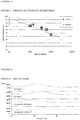
- Example 1 shows a slight decrease in the conversion from the initial period to approximately 1,000 hours, it becomes very stable in activity thereafter, and maintains 70% of the activity even after 5,000 to 10,000 hours lapsed.
- the catalyst of Example 2 shows a similar deactivation ratio until 5,000 hours, and is thus found to have a stability comparable to that of Example 1.
- the catalyst of Example 8 not containing La or Y shows a decrease in activity to 83.1% at 2,215 hours, whereas the catalyst of Example 2 containing La and Y still maintains a higher activity, i.e. 84.1%, even at about 3,400 hours. This shows that La and Y improved the deactivation ratio, that is, increase the long-term stability (Table 3).
- both the catalysts of Examples 1 and 2 maintain high activities, i.e. 70% or more compared to the initial activity, even after being reacted for 10,000 hours.
- the catalysts are estimated to possess stability as high as 10 years (approximately 90,000 hours) or longer.
- visual observation of each of the samples of Examples 1 and 2 after a lapse of 6,000 hours in the stability test revealed that the catalyst surface underwent only some change in color, and its whiteness still remained sufficient.
- Example 10 To study the mechanism of the effects of La and Y shown in Example 10, the catalyst samples of Examples 1 and 7 were subjected to X-ray diffraction measurement.
- the X-ray diffraction measurement was performed using an X-ray diffractometer from PANalytical. A glass sample cell was filled with each of the samples, and the measurement was performed by the 2 ⁇ - ⁇ reflection method, using Cu-K ⁇ (1.5406 ⁇ ) as the X-ray source.
- samples in which La or Y only was supported on the ⁇ -alumina carrier (each used as the sample of Comparative Example 6 or the sample of Comparative Example 7) were prepared, and subjected to the measurement simultaneously (Table 4, Figure 6 ).
- Example 1 shows a peak position different from the peak position of the sample of Example 7 (Ce)
- these samples have a substantially equal half-width. It was therefore understood that in the sample of Example 1, the three components, Ce, La and Y, form a single solid solution, rather than being individually present in separate crystal forms (increase in half-width). Therefore, the effects of La and Y (stability and activity improvements) described above (Example 1) are considered to be largely attributed to the effect of the formation of the solid solution.
Landscapes
- Chemical & Material Sciences (AREA)
- Chemical Kinetics & Catalysis (AREA)
- Organic Chemistry (AREA)
- Engineering & Computer Science (AREA)
- Materials Engineering (AREA)
- Health & Medical Sciences (AREA)
- Inorganic Chemistry (AREA)
- Combustion & Propulsion (AREA)
- General Health & Medical Sciences (AREA)
- Sustainable Energy (AREA)
- General Chemical & Material Sciences (AREA)
- Electrochemistry (AREA)
- Life Sciences & Earth Sciences (AREA)
- Sustainable Development (AREA)
- Manufacturing & Machinery (AREA)
- Catalysts (AREA)
- Hydrogen, Water And Hydrids (AREA)
- Fuel Cell (AREA)
Applications Claiming Priority (2)
| Application Number | Priority Date | Filing Date | Title |
|---|---|---|---|
| JP2014243004A JP6541339B2 (ja) | 2014-12-01 | 2014-12-01 | 炭化水素含有ガスの水蒸気改質触媒、水素製造装置、及び水素製造方法 |
| PCT/JP2015/005200 WO2016088290A1 (fr) | 2014-12-01 | 2015-10-14 | Catalyseur de reformage à la vapeur pour gaz contenant des hydrocarbures, appareil de production d'hydrogène, et procédé de production d'hydrogène |
Publications (2)
| Publication Number | Publication Date |
|---|---|
| EP3228385A1 true EP3228385A1 (fr) | 2017-10-11 |
| EP3228385A4 EP3228385A4 (fr) | 2018-07-25 |
Family
ID=56091260
Family Applications (1)
| Application Number | Title | Priority Date | Filing Date |
|---|---|---|---|
| EP15866346.8A Withdrawn EP3228385A4 (fr) | 2014-12-01 | 2015-10-14 | Catalyseur de reformage à la vapeur pour gaz contenant des hydrocarbures, appareil de production d'hydrogène, et procédé de production d'hydrogène |
Country Status (6)
| Country | Link |
|---|---|
| US (1) | US10259709B2 (fr) |
| EP (1) | EP3228385A4 (fr) |
| JP (1) | JP6541339B2 (fr) |
| KR (1) | KR102110019B1 (fr) |
| CN (1) | CN106999916A (fr) |
| WO (1) | WO2016088290A1 (fr) |
Cited By (1)
| Publication number | Priority date | Publication date | Assignee | Title |
|---|---|---|---|---|
| DK182145B1 (en) * | 2021-02-08 | 2025-09-09 | Petroleo Brasileiro Sa Petrobras | Catalysts, process for obtaining and steam pre-reforming process of hydrocarbons |
Families Citing this family (9)
| Publication number | Priority date | Publication date | Assignee | Title |
|---|---|---|---|---|
| US10293333B2 (en) | 2013-12-20 | 2019-05-21 | Clariant Produkte (Deutschland) Gmbh | Catalyst containing phosphorus for converting oxygenates into olefins |
| MY202301A (en) * | 2017-09-06 | 2024-04-23 | Shell Int Research | Process for the preparation of syngas |
| TWI787491B (zh) * | 2018-03-30 | 2022-12-21 | 日商大阪瓦斯股份有限公司 | 燃料電池裝置及燃料電池裝置之運作方法 |
| WO2019225715A1 (fr) * | 2018-05-23 | 2019-11-28 | 田中貴金属工業株式会社 | Catalyseur de reformage à la vapeur |
| IL288444B2 (en) * | 2019-05-28 | 2025-03-01 | Enerkem Inc | Vapor phase methanol carbonylation catalyst |
| WO2021111784A1 (fr) * | 2019-12-06 | 2021-06-10 | 株式会社村田製作所 | Catalyseur de reformage d'hydrocarbures et dispositif de reformage d'hydrocarbures |
| JPWO2022158473A1 (fr) * | 2021-01-20 | 2022-07-28 | ||
| JP2022112020A (ja) * | 2021-01-20 | 2022-08-01 | エヌ・イーケムキャット株式会社 | 燃料改質触媒、燃料改質方法および燃料改質装置 |
| CN114011424B (zh) * | 2021-11-26 | 2024-04-16 | 北京理工大学 | 一种复合载体催化剂、制备方法及应用 |
Family Cites Families (23)
| Publication number | Priority date | Publication date | Assignee | Title |
|---|---|---|---|---|
| DK165815C (da) | 1990-09-10 | 1993-06-21 | Bent Mogensen | Artikulator til brug ved dentalt modelarbejde samt apparat til brug ved justering af artikulatoren |
| WO2000033244A2 (fr) * | 1998-11-27 | 2000-06-08 | Synaptics (Uk) Limited | Capteur de position |
| DE60128016T2 (de) * | 2000-02-01 | 2007-12-27 | Tokyo Gas Co. Ltd. | Verfahren zur Entfernung von Schwefelverbindungen aus Brenngasen |
| US6875410B2 (en) * | 2000-02-01 | 2005-04-05 | Tokyo Gas Co., Ltd. | Adsorbent for removing sulfur compounds from fuel gases and removal method |
| JP4026700B2 (ja) | 2000-08-25 | 2007-12-26 | 東京瓦斯株式会社 | 燃料ガス中の硫黄化合物除去用吸着剤 |
| US7122170B2 (en) * | 2000-07-25 | 2006-10-17 | Conocophillips Company | Catalysts for SPOC™ enhanced synthesis gas production |
| JP4115092B2 (ja) | 2000-10-05 | 2008-07-09 | 三洋電機株式会社 | 燃料改質装置 |
| EP1894622B1 (fr) * | 2001-03-29 | 2012-03-14 | Idemitsu Kosan Co., Ltd. | Procédé pour réformer un hydrocarbure |
| DE10157155A1 (de) * | 2001-11-22 | 2003-06-12 | Omg Ag & Co Kg | Verfahren zur katalytischen autothermen Dampfreformierung von höheren Alkoholen, insbesondere Ethanol |
| JP3999557B2 (ja) * | 2002-04-30 | 2007-10-31 | 株式会社日本触媒 | 炭化水素の部分酸化用触媒及び該触媒を用いた水素含有ガスの製造方法 |
| US7767619B2 (en) * | 2004-07-09 | 2010-08-03 | Sud-Chemie Inc. | Promoted calcium-aluminate supported catalysts for synthesis gas generation |
| CN101500706A (zh) * | 2006-06-28 | 2009-08-05 | 新日本石油株式会社 | 蒸汽重整用催化剂、制氢装置和燃料电池系统 |
| KR100835981B1 (ko) | 2006-07-31 | 2008-06-09 | (주)동영디엔에스 | 온라인 디지털 시네마광고 처리 시스템 |
| US8349289B2 (en) * | 2007-03-05 | 2013-01-08 | Regents Of The University Of Minnesota | Reactive flash volatilization of fluid fuels |
| US20090108238A1 (en) | 2007-10-31 | 2009-04-30 | Sud-Chemie Inc. | Catalyst for reforming hydrocarbons |
| JP4773418B2 (ja) | 2007-12-20 | 2011-09-14 | コスモ石油株式会社 | 炭化水素からの水素製造用触媒の製造方法、該製造方法により製造された触媒、及び該触媒を用いた水素製造方法 |
| JP5378148B2 (ja) * | 2009-10-22 | 2013-12-25 | Jx日鉱日石エネルギー株式会社 | 改質用触媒、改質装置および水素製造装置 |
| JP5603120B2 (ja) | 2010-03-30 | 2014-10-08 | Jx日鉱日石エネルギー株式会社 | 水蒸気改質用触媒、水素製造装置及び燃料電池システム |
| GB201102502D0 (en) * | 2011-02-14 | 2011-03-30 | Johnson Matthey Plc | Catalysts for use in reforming processes |
| JP5831934B2 (ja) * | 2011-11-11 | 2015-12-09 | 田中貴金属工業株式会社 | 水蒸気改質触媒 |
| KR101504532B1 (ko) * | 2012-03-09 | 2015-03-24 | 주식회사 윈텔 | 플라즈마 처리 방법 및 기판 처리 장치 |
| JP5759922B2 (ja) * | 2012-03-29 | 2015-08-05 | Jx日鉱日石エネルギー株式会社 | 水素の製造方法 |
| JP6293416B2 (ja) * | 2013-03-07 | 2018-03-14 | 大阪瓦斯株式会社 | 炭化水素化合物類のオートサーマル改質方法 |
-
2014
- 2014-12-01 JP JP2014243004A patent/JP6541339B2/ja not_active Expired - Fee Related
-
2015
- 2015-10-14 WO PCT/JP2015/005200 patent/WO2016088290A1/fr not_active Ceased
- 2015-10-14 EP EP15866346.8A patent/EP3228385A4/fr not_active Withdrawn
- 2015-10-14 KR KR1020177013708A patent/KR102110019B1/ko not_active Expired - Fee Related
- 2015-10-14 US US15/529,862 patent/US10259709B2/en active Active
- 2015-10-14 CN CN201580065214.XA patent/CN106999916A/zh active Pending
Cited By (1)
| Publication number | Priority date | Publication date | Assignee | Title |
|---|---|---|---|---|
| DK182145B1 (en) * | 2021-02-08 | 2025-09-09 | Petroleo Brasileiro Sa Petrobras | Catalysts, process for obtaining and steam pre-reforming process of hydrocarbons |
Also Published As
| Publication number | Publication date |
|---|---|
| KR102110019B1 (ko) | 2020-05-13 |
| JP2016104467A (ja) | 2016-06-09 |
| US10259709B2 (en) | 2019-04-16 |
| CN106999916A (zh) | 2017-08-01 |
| JP6541339B2 (ja) | 2019-07-10 |
| KR20170093127A (ko) | 2017-08-14 |
| WO2016088290A1 (fr) | 2016-06-09 |
| EP3228385A4 (fr) | 2018-07-25 |
| US20170267523A1 (en) | 2017-09-21 |
Similar Documents
| Publication | Publication Date | Title |
|---|---|---|
| US10259709B2 (en) | Steam reforming catalyst for hydrocarbon-containing gas, apparatus for producing hydrogen, and method for producing hydrogen | |
| Ramos et al. | Hydrogen production from ethanol steam reforming on M/CeO2/YSZ (M= Ru, Pd, Ag) nanocomposites | |
| Cheekatamarla et al. | Reforming catalysts for hydrogen generation in fuel cell applications | |
| KR20070076439A (ko) | 수증기 개질용 촉매의 다공질 담체, 수증기 개질용 촉매 및반응 혼합 가스의 제조 방법 | |
| EP1380341B1 (fr) | Procede catalytique de reformage d'hydrocarbures mettant en oeuvre ledit catalyseur | |
| JP5666777B2 (ja) | 一酸化炭素転換用触媒およびそれを用いた一酸化炭素変成方法 | |
| Chen et al. | Perovskite La–St–Fe–O (St= Ca, Sr) supported nickel catalysts for steam reforming of ethanol: The effect of the A site substitution | |
| Le et al. | The impact of Ce‐Zr addition on nickel dispersion and catalytic behavior for CO2 methanation of Ni/AC catalyst at low temperature | |
| Cheephat et al. | Partial oxidation of methane over monometallic and bimetallic Ni-, Rh-, Re-based catalysts: Effects of Re addition, co-fed reactants and catalyst support | |
| US7067453B1 (en) | Hydrocarbon fuel reforming catalyst and use thereof | |
| EP1338335A1 (fr) | Catalyseur de reformage pour hydrocarbures et procede de reformage correspondant | |
| JP5354142B2 (ja) | 水蒸気改質用触媒及び反応混合ガスの製造方法 | |
| EP2924002A1 (fr) | Procédé d'exploitation de réacteur hts à faible rapport molaire h/c | |
| KR100612956B1 (ko) | 고성능 수성가스 전환 반응용 촉매와 이의 제조방법 | |
| US9387470B2 (en) | Sulfur-tolerant and carbon-resistant catalysts | |
| Phuong et al. | Effect of V2O5 promoter on characteristics and performance of NiO/CeO2 catalyst in methane bi-reforming | |
| CN101300706B (zh) | 碳氧化物的加氢方法和催化剂 | |
| Wang et al. | Effect of catalyst properties on selectivity in CO 2 methanation with coupling pathway of RWGS and CO methanation | |
| CA2593413C (fr) | Catalyseur de reformage de combustible hydrocarbone et utilisation connexe | |
| Xu et al. | The exquisite inserting way: Pd and perovskite on the preferential oxidation of CO or H2 | |
| CA2548912A1 (fr) | Catalyseur de reformage | |
| KR102123871B1 (ko) | 스팀 개질을 위한 시스템 및 방법 | |
| WO2007015620A1 (fr) | Catalyseur de reformage a la vapeur a base de ni sans traitement de prereduction | |
| JP5446060B2 (ja) | ハニカム用多孔質体材料、多孔質体材料混合物、ハニカム担持用懸濁液、触媒体、及び該触媒体を用いた混合反応ガスの製造方法 | |
| JP5788352B2 (ja) | 水素製造用改質触媒、該触媒を用いた水素製造装置及び燃料電池システム |
Legal Events
| Date | Code | Title | Description |
|---|---|---|---|
| STAA | Information on the status of an ep patent application or granted ep patent |
Free format text: STATUS: THE INTERNATIONAL PUBLICATION HAS BEEN MADE |
|
| PUAI | Public reference made under article 153(3) epc to a published international application that has entered the european phase |
Free format text: ORIGINAL CODE: 0009012 |
|
| STAA | Information on the status of an ep patent application or granted ep patent |
Free format text: STATUS: REQUEST FOR EXAMINATION WAS MADE |
|
| 17P | Request for examination filed |
Effective date: 20170517 |
|
| AK | Designated contracting states |
Kind code of ref document: A1 Designated state(s): AL AT BE BG CH CY CZ DE DK EE ES FI FR GB GR HR HU IE IS IT LI LT LU LV MC MK MT NL NO PL PT RO RS SE SI SK SM TR |
|
| AX | Request for extension of the european patent |
Extension state: BA ME |
|
| DAV | Request for validation of the european patent (deleted) | ||
| DAX | Request for extension of the european patent (deleted) | ||
| A4 | Supplementary search report drawn up and despatched |
Effective date: 20180627 |
|
| RIC1 | Information provided on ipc code assigned before grant |
Ipc: B01J 23/63 20060101AFI20180620BHEP Ipc: C01B 3/40 20060101ALI20180620BHEP Ipc: H01M 8/06 20160101ALI20180620BHEP |
|
| STAA | Information on the status of an ep patent application or granted ep patent |
Free format text: STATUS: EXAMINATION IS IN PROGRESS |
|
| 17Q | First examination report despatched |
Effective date: 20201007 |
|
| STAA | Information on the status of an ep patent application or granted ep patent |
Free format text: STATUS: THE APPLICATION IS DEEMED TO BE WITHDRAWN |
|
| 18D | Application deemed to be withdrawn |
Effective date: 20250501 |