EP3228496A2 - Véhicule de distribution et procédé de livraison d'envois dans différents endroits suivant un itinéraire de distribution - Google Patents
Véhicule de distribution et procédé de livraison d'envois dans différents endroits suivant un itinéraire de distribution Download PDFInfo
- Publication number
- EP3228496A2 EP3228496A2 EP17163038.7A EP17163038A EP3228496A2 EP 3228496 A2 EP3228496 A2 EP 3228496A2 EP 17163038 A EP17163038 A EP 17163038A EP 3228496 A2 EP3228496 A2 EP 3228496A2
- Authority
- EP
- European Patent Office
- Prior art keywords
- shelves
- shelf
- delivery vehicle
- shelving system
- removal
- Prior art date
- Legal status (The legal status is an assumption and is not a legal conclusion. Google has not performed a legal analysis and makes no representation as to the accuracy of the status listed.)
- Granted
Links
Images




Classifications
-
- B—PERFORMING OPERATIONS; TRANSPORTING
- B60—VEHICLES IN GENERAL
- B60P—VEHICLES ADAPTED FOR LOAD TRANSPORTATION OR TO TRANSPORT, TO CARRY, OR TO COMPRISE SPECIAL LOADS OR OBJECTS
- B60P3/00—Vehicles adapted to transport, to carry or to comprise special loads or objects
- B60P3/007—Vehicles adapted to transport, to carry or to comprise special loads or objects for delivery of small articles, e.g. milk, frozen articles
-
- B—PERFORMING OPERATIONS; TRANSPORTING
- B60—VEHICLES IN GENERAL
- B60P—VEHICLES ADAPTED FOR LOAD TRANSPORTATION OR TO TRANSPORT, TO CARRY, OR TO COMPRISE SPECIAL LOADS OR OBJECTS
- B60P3/00—Vehicles adapted to transport, to carry or to comprise special loads or objects
-
- B—PERFORMING OPERATIONS; TRANSPORTING
- B65—CONVEYING; PACKING; STORING; HANDLING THIN OR FILAMENTARY MATERIAL
- B65G—TRANSPORT OR STORAGE DEVICES, e.g. CONVEYORS FOR LOADING OR TIPPING, SHOP CONVEYOR SYSTEMS OR PNEUMATIC TUBE CONVEYORS
- B65G1/00—Storing articles, individually or in orderly arrangement, in warehouses or magazines
- B65G1/02—Storage devices
- B65G1/04—Storage devices mechanical
- B65G1/0485—Check-in, check-out devices
-
- B—PERFORMING OPERATIONS; TRANSPORTING
- B60—VEHICLES IN GENERAL
- B60P—VEHICLES ADAPTED FOR LOAD TRANSPORTATION OR TO TRANSPORT, TO CARRY, OR TO COMPRISE SPECIAL LOADS OR OBJECTS
- B60P7/00—Securing or covering of load on vehicles
- B60P7/06—Securing of load
- B60P7/135—Securing or supporting by load bracing means
-
- B—PERFORMING OPERATIONS; TRANSPORTING
- B62—LAND VEHICLES FOR TRAVELLING OTHERWISE THAN ON RAILS
- B62D—MOTOR VEHICLES; TRAILERS
- B62D33/00—Superstructures for load-carrying vehicles
- B62D33/04—Enclosed load compartments ; Frameworks for movable panels, tarpaulins or side curtains
-
- B—PERFORMING OPERATIONS; TRANSPORTING
- B65—CONVEYING; PACKING; STORING; HANDLING THIN OR FILAMENTARY MATERIAL
- B65G—TRANSPORT OR STORAGE DEVICES, e.g. CONVEYORS FOR LOADING OR TIPPING, SHOP CONVEYOR SYSTEMS OR PNEUMATIC TUBE CONVEYORS
- B65G1/00—Storing articles, individually or in orderly arrangement, in warehouses or magazines
- B65G1/02—Storage devices
- B65G1/04—Storage devices mechanical
- B65G1/137—Storage devices mechanical with arrangements or automatic control means for selecting which articles are to be removed
- B65G1/1373—Storage devices mechanical with arrangements or automatic control means for selecting which articles are to be removed for fulfilling orders in warehouses
- B65G1/1378—Storage devices mechanical with arrangements or automatic control means for selecting which articles are to be removed for fulfilling orders in warehouses the orders being assembled on fixed commissioning areas remote from the storage areas
-
- G—PHYSICS
- G06—COMPUTING OR CALCULATING; COUNTING
- G06Q—INFORMATION AND COMMUNICATION TECHNOLOGY [ICT] SPECIALLY ADAPTED FOR ADMINISTRATIVE, COMMERCIAL, FINANCIAL, MANAGERIAL OR SUPERVISORY PURPOSES; SYSTEMS OR METHODS SPECIALLY ADAPTED FOR ADMINISTRATIVE, COMMERCIAL, FINANCIAL, MANAGERIAL OR SUPERVISORY PURPOSES, NOT OTHERWISE PROVIDED FOR
- G06Q10/00—Administration; Management
- G06Q10/08—Logistics, e.g. warehousing, loading or distribution; Inventory or stock management
-
- G—PHYSICS
- G06—COMPUTING OR CALCULATING; COUNTING
- G06Q—INFORMATION AND COMMUNICATION TECHNOLOGY [ICT] SPECIALLY ADAPTED FOR ADMINISTRATIVE, COMMERCIAL, FINANCIAL, MANAGERIAL OR SUPERVISORY PURPOSES; SYSTEMS OR METHODS SPECIALLY ADAPTED FOR ADMINISTRATIVE, COMMERCIAL, FINANCIAL, MANAGERIAL OR SUPERVISORY PURPOSES, NOT OTHERWISE PROVIDED FOR
- G06Q10/00—Administration; Management
- G06Q10/08—Logistics, e.g. warehousing, loading or distribution; Inventory or stock management
- G06Q10/083—Shipping
- G06Q10/0832—Special goods or special handling procedures, e.g. handling of hazardous or fragile goods
-
- G—PHYSICS
- G06—COMPUTING OR CALCULATING; COUNTING
- G06Q—INFORMATION AND COMMUNICATION TECHNOLOGY [ICT] SPECIALLY ADAPTED FOR ADMINISTRATIVE, COMMERCIAL, FINANCIAL, MANAGERIAL OR SUPERVISORY PURPOSES; SYSTEMS OR METHODS SPECIALLY ADAPTED FOR ADMINISTRATIVE, COMMERCIAL, FINANCIAL, MANAGERIAL OR SUPERVISORY PURPOSES, NOT OTHERWISE PROVIDED FOR
- G06Q10/00—Administration; Management
- G06Q10/08—Logistics, e.g. warehousing, loading or distribution; Inventory or stock management
- G06Q10/083—Shipping
- G06Q10/0835—Relationships between shipper or supplier and carriers
-
- G—PHYSICS
- G06—COMPUTING OR CALCULATING; COUNTING
- G06Q—INFORMATION AND COMMUNICATION TECHNOLOGY [ICT] SPECIALLY ADAPTED FOR ADMINISTRATIVE, COMMERCIAL, FINANCIAL, MANAGERIAL OR SUPERVISORY PURPOSES; SYSTEMS OR METHODS SPECIALLY ADAPTED FOR ADMINISTRATIVE, COMMERCIAL, FINANCIAL, MANAGERIAL OR SUPERVISORY PURPOSES, NOT OTHERWISE PROVIDED FOR
- G06Q10/00—Administration; Management
- G06Q10/08—Logistics, e.g. warehousing, loading or distribution; Inventory or stock management
- G06Q10/083—Shipping
- G06Q10/08355—Routing methods
Definitions
- the invention relates to a delivery vehicle for delivering consignments at different locations along a delivery route, with a loading space comprising a shelving system for consignments having shelves. Furthermore, the invention relates to a method for delivering consignments at different locations along a delivery route with a corresponding delivery vehicle.
- the type of delivery vehicles also depends on the type of shipments that are to be delivered or delivered along the delivery route. As a rule, the delivery route leads via public road traffic. It is therefore preferable not to the so-called factory traffic, so the goods transport within a factory and / or company. For this purpose, very special delivery vehicles are typically used, which are not suitable for transport over longer distances and regularly not for very different shipments.
- shipments basically mean different objects which can preferably be transported at manageable expense.
- the consignments can be present as general cargo.
- everyday items such as consumables or food in question as well as technical items and equipment.
- the mail items are mail items that can be called postal items.
- the shipments are letter items, parcels and / or flyers.
- Package parcels also include parcels, while flyers can also be leaflets, brochures and magazines.
- a letter can be next to a letter and a postcard. Parcel shipments and other shipments were in many cases repackaged goods, with the consignment then comprising the packaging and the goods packed therein.
- the parcels can be stowed in a racking system of a loading space of the delivery vehicle.
- the items are taken from the shelves of the rack system and delivered or delivered.
- Most of the shelves are provided on both sides of the delivery vehicle and separated by a central gear, so that the driver of the delivery vehicle can take the shipments from the shelves.
- the central aisle of the cargo space between the side shelves for example, for a robot or any other transport system that removes the items from the shelves for delivery.
- the space provided by the shelves for receiving broadcasts is basically limited. This is due in particular to the available size of the loading space of the delivery vehicle and also to the space required for manual or mechanical loading and unloading of the shelving system. Therefore, if necessary, the size of the hold, the size of the shipments and the length of the delivery routes are matched.
- a delivery vehicle has to travel several delivery routes in succession in order to be able to deliver or deliver all shipments. After each journey, the delivery vehicle must again approach a distribution center or a warehouse for the shipments, for example warehouses, in order to receive further shipments there and store them in the racking system.
- the return to the distribution center or warehouse is as well as the repeated loading of the delivery vehicle with an increased amount of time and therefore associated with an increased cost.
- the mailings are typically individually loaded one by one in an arrangement and / or order related to the subsequent delivery route, so that the mailings along the delivery route are easier and more reliable to unload.
- the invention has for its object to design the delivery vehicle and the method respectively of the type mentioned above and described in more detail above and further develop that time and costs for the delivery or delivery of items along a delivery route can be saved.
- the shelving system is designed to accommodate shelves in a plurality of storage positions for holding the shelves and in at least one removal position for the removal of shipments from the shelves and that the shelving system at least one adjusting device for adjusting, in particular moving, the shelves of the shelving system each between a plurality of storage positions and the at least one removal position.
- the invention has recognized that the available cargo space of the delivery vehicle can be used more efficiently by the adjustable shelves, without disproportionately complicating the loading of consignments and the delivery or delivery of consignments.
- This is based on the idea not to mount the racks of a delivery vehicle stationary, as has been the case so far, but to include the shelves in the loading space of the delivery vehicle adjustable in a shelving system.
- the adjustability of the shelves makes it possible to provide a larger portion of the cargo space with shelves, since not all shelves must be accessible at the same time.
- the shelves to which access is desired can still be adjusted in at least one removal position in which the shelves are accessible. So there is always an unhindered access to each shelf, only not at the same time, but only after a corresponding adjustment of the shelves in the shelving system.
- the shelf In order to deliver a shipment from a shelf easily, the shelf is therefore initially from one of several storage positions that serve the space-saving provision of the shelves, in a removal position adjusted, in which the removal of the shipment from the shelf can be done manually or by means of a removal device.
- a removal position adjusted, in which the removal of the shipment from the shelf can be done manually or by means of a removal device.
- an adjustment of the shelving system is provided. However, the adjustment also allows the adjustment of shelves from one storage position to another storage position.
- the adjusting device is therefore in particular a device which allows the total adjustment.
- the adjustment can then include other facilities that are necessary but not sufficient for the adjustment of the shelves.
- the adjusting device can therefore basically be formed in very different ways, which is why the adjusting device can be understood in particular as a kind of umbrella term for the components required for adjusting the shelves and, if necessary, also for the optional components for adjusting the shelves.
- a storage position can be cleared to adjust the shelf with the next to be taken out shipment in this storage position.
- the shelf can be adjusted from this storage position either directly in the removal position or initially in another storage position.
- This storage position can in turn be released first by adjusting other shelves.
- the shifting of the next to be removed consignment having shelves can therefore, if necessary, take place gradually over several storage positions away in the removal position, if necessary, several more shelves must be adjusted to release the respective storage position or the respective storage positions.
- the at least one further shelf but if necessary, other shelves can be adjusted to release the removal position for the shelf with the next to be taken out shipment.
- next program to be recorded is already provided on a shelf that is already located in the at least one removal position.
- An adjustment of shelves before removing the corresponding shipment can then be omitted.
- the better utilization of the cargo space is paid for by the effort for adjusting the shelves. Overall, however, this effort is justified.
- the shelves may preferably be arranged in the sense of a sliding puzzles and be moved.
- a sliding puzzle often consists of 15 similar puzzle pieces, which are arranged on 16 fields of a grid.
- the grid has edge lengths that correspond to the length or width of 4 puzzle pieces.
- a field thus remains free and thus forms a "hole” or a blank space in the puzzle.
- An adjoining puzzle piece can be moved to the free space or space by a longitudinal or transverse displacement relative to the grid.
- the task is now typically to put the puzzle pieces in a specific order by moving the puzzle pieces within the grid, such as to bring the puzzle pieces marked with the numbers from 1 to 15 in an ascending order. For this, the puzzle pieces are square with the same edge lengths.
- a blank is formed at another location in the grid, which can then be used to move at least one other puzzle piece.
- step by step at least one puzzle piece can be moved to the desired position in the grid.
- the principle of the sliding puzzle is not limited to the use of a 4 x 4 grid, the use of 15 puzzle pieces and / or square puzzle pieces.
- more than one empty space can be provided on the shelf. So it can be ensured that each shelf can be easily adjusted in the at least one removal position. But it can also contribute to a shortening of the cycle time, so the time required to move a particular shelf of the shelving system in the at least one removal position.
- For the adjustment of shelves is basically more space, the more vacancies or unoccupied storage locations are provided in the shelving system.
- a removal position is sufficient, from which all shipments can be successively removed from the shelves. If necessary, however, several removal positions can be provided.
- the removal positions can be provided at different locations of the cargo space, for example, to be able to easily remove shipments on both sides of the cargo space and / or on the back of shelves. Then it makes sense, when the removal positions are spaced by storage positions in order to make better use of the available cargo space can.
- several dispensing positions can also be arranged next to one another. Then, not several shelves must be successively adjusted in a removal position to remove the desired items from the shelving system.
- the adjustment can be done in a simple and thus preferred manner by moving the shelves. Then, for example, the shelves can stand up on the loading floor of the load compartment and do not have to be held completely by the shelving system. To be able to be easily moved, the shelves can have rollers or balls. A shift is basically easy to implement, because the shelves then preferably only have to be moved in one plane.
- the storage positions of the shelving system in mutually parallel and vertical rows arranged. These rows can be required in the longitudinal direction of the delivery vehicle and transverse thereto. On the one hand this allows a good utilization of the loading space of the delivery vehicle and on the other hand a slight adjustability of the shelves.
- the shelves then have to be moved, for example, only in two directions in order to move the shelf with the next to be taken out shipment in the removal position. These two directions are then the directions of, in particular crossed, rows of storage positions or shelves, which extend in a preferred manner in the longitudinal direction of the delivery vehicle and transversely thereto.
- the corresponding rows, in particular the rows of storage positions or shelves arranged in the transverse direction of the delivery vehicle may if required be very short and comprise only two storage positions or shelves. Longer rows are also possible.
- the sum of the storage positions and the removal positions should be greater than the number of shelves of the shelving system. It may be sufficient depending on the arrangement of the storage positions and the removal positions a free storage position or removal position. If necessary, but at least two positions must remain free, the corresponding positions storage positions and / or removal positions may be, depending on the arrangement of the shelves in the rack system. If only a small number of shipments on the delivery route must be taken and at the same time no or only a few items on the delivery route to the shelving system to be taken, it is appropriate to leave a larger number of storage positions and / or removal positions to the adjustment of the simplify existing shelves and speed up cycle times. In the preferred embodiment of the shelving system with a single removal position, therefore, at most as many shelves as storage positions can be provided. Fewer shelves are possible, but lead to a less well-utilized cargo space of the delivery vehicle.
- the shelves In order to use the shelves as flexible as possible, the shelves, for example, not to have to load depending on the order of delivery or delivery of the shipments with the broadcasts, it is expedient if it allows the adjustment, at least one shelf in each storage position of the shelving system to adjust.
- the advantage mentioned is all the more important for more shelves.
- each shelf of the shelf system can be adjusted by means of the adjustment either in each of the storage positions, in particular moved, can.
- the shelving system can be adjusted in the at least one removal position. If several removal positions are provided, it is preferred if the shelves, in particular all shelves, at least in a removal position, for reasons of greater flexibility, in particular in all removal positions, can be adjusted.
- the adjustment of the shelves in the shelving system is simplified, for example, in that the adjusting device has a guide device, preferably comprising a rail system, for guiding the shelves in the shelving system between several storage positions and the removal position.
- the shelves are thus guided in and / or along the guide devices or the corresponding rail system.
- the degrees of freedom when adjusting the shelves are clearly specified.
- the shelves can also by means of rollers, in particular corresponding roller carriage on or in the guide device be guided, which reduces the force required for the adjustment and increases the reliability of adjustment. This is possible in a particularly simple manner when the rollers or roller carriages are guided along rails.
- the shelves can also roll along the loading floor of the cargo compartment by means of rollers.
- the shelves are preferably adjusted in mutually perpendicular directions, in particular to be shifted, and ball elements may be provided on the undersides of the shelves, which oppose a direction change no significant resistance, as in the case of roles by a possibly required rotation of the rollers can.
- the adjusting device may comprise a transport device for transporting the shelves from one storage position to another storage position and from a storage position to the removal position.
- the transport device then transports, for example, always the shelves in one step in one direction, as is appropriate for the adjustment of a shelf in the at least one removal position.
- the transport device does not have to transport each shelf individually.
- the transporting device can also adjust a number of shelves together. For example, a shelf can be moved over the transport device in one direction, together with the shelves, which seen in this direction adjacent to the transported shelf. These are then pushed by the actually transported shelf, especially pushed in front of the actually transported shelf.
- the transport of certain shelves is preferably also along the guide device.
- the transport device should allow the adjustment of each particular shelves independently of other shelves and be designed to be simple and space-saving. This is possible by the transport device, approximately positively engages, at least one to be adjusted shelf.
- the transport device may comprise at least one arm which is driven by a drive. Of the Drive of the transport device may have at least one linear drive, in particular a plurality of them. These are simple and allow a defined movement. Different movements can therefore be achieved by different drives, in particular linear drives.
- the adjustment of the shelves is preferably done in a predetermined manner, which may be dependent on which shelf contains the next to be delivered program.
- the adjustment, in particular the shifting, of the shelves by means of the adjusting device therefore preferably follows controlled by a control device.
- the control device preferably controls both the adjustment of the shelf with the next to be taken to the removal position removal and the adjustment of the other shelves, which must be adjusted for the adjustment of the shelf with the next to be removed shipment in the removal position, at least insofar as this is required.
- the control device has suitable information about which programs are recorded on which shelves and in which position in the shelving the consignments associated shelves are to move the correct shelf in the removal position.
- the information about the arrangement of the shelves in the rack system can, if necessary, be detected via at least one sensor provided.
- the sensor may be, for example, an optical sensor and / or different codes, such as bar codes, detect the shelves.
- this can also be dispensed with if the control device is communicated via sensors or otherwise the positions of the individual shelves in the shelving system at least in a starting position. This can be done, for example, before the start of the delivery route and after loading the delivery vehicle with shipments. If the shelves are subsequently adjusted, in particular in the manner specified by the control device, the control device can determine based on the movements of the shelves, starting from the position of the shelves in the starting position where the individual shelves are currently in the shelving system.
- the handling of the shelving system becomes easier when the shelves each have multiple segments for receiving broadcasts. These segments may be arranged one above the other in the sense of shelves for the sake of simplicity. In principle, it is preferred in this context if the shelves are loaded on the various segments which are to be delivered to the same location along the delivery route or to places traveled in succession along the delivery route. This avoids unnecessary adjustment of the shelves. So that the programs do not accidentally slip off the shelves or from the segments, the programs can be held, for example, simply but effectively positively by the segments.
- the shelves may have carrier elements for receiving the items. It is particularly simple when the carrier elements are designed as boxes.
- the items can be held, for example, positively in the support member and the support member, for example, positively held on the shelf.
- the size and shape of the broadcasts play no role as long as the broadcasts can be picked up by the carrier elements, which is why the carrier elements should not be chosen too small.
- the carrier elements By using the carrier elements, these can be removed from the shelves in a defined, preferably always the same way, with the consignments, in particular without taking account of the type and size of the consignments.
- This handling of the shipments is then independent of the type or form of the shipments and thus easy and reliable to achieve.
- a further simplification can be achieved if the items are delivered or delivered in the carrier elements. This, too, is then essentially independent of the type and form of the shipments and thus very reliably possible.
- support elements allows, for example, a simple loading of the shelves with good use of the available space. If, for example, a very high broadcast is to be recorded, there may be as many Carrier elements are omitted, that the shipment can be added to the shelf. After the delivery of the shipment, a plurality of support elements with lower shipments can be arranged on top of each other again at the appropriate point on the shelf, if necessary again.
- a dynamic packing of the shelves One speaks in this connection also of a dynamic packing of the shelves.
- the removal and, if necessary, the delivery or delivery of the items can also be simplified in that a corresponding removal device for removing a shipment, in particular a support member, is provided from the located in the removal position shelf. This then requires no human intervention and can thus be used for autonomous removal of shipments from the shelves.
- a removal device comprising a robot arm is particularly suitable.
- the removal device can be used in addition to the pure removal of the shipments for the delivery, delivery and / or delivery of the shipments outside of the delivery vehicle. This also favors an autonomous operation of the delivery vehicle. Also in this context, the reliability is increased if the removal device does not handle the shipment directly, but the carrier element having the shipment.
- the consignment is transferred to a shelf located in the removal position. Again, this is preferably done for the reasons mentioned together with a carrier element that carries the appropriate shipment. It is also conceivable that an empty support element is taken without shipment and transferred to a shelf, such as in exchange for a carrier element, which is delivered together with a consignment or delivered. Thus, the carrier elements do not accumulate along the delivery route.
- a shelf in the at least one removal position may be associated with a locking device. This is useful, for example, if a shelf is arranged in the at least one removal position while the delivery vehicle is in motion. To ensure that all shelves are reliably locked during travel of the delivery vehicle, so that it does not have to be trusted that individual shelves are held by locked other shelves, it makes sense if all shelves a locking device is assigned.
- the shelves can be locked, for example, on the adjusting and / or the guide device. Alternatively or additionally, however, the shelves can also be locked on the loading floor of the loading space.
- the loading floor may have corresponding recesses or elevations.
- the shelves can also be pressed without such aids frictionally against the loading floor. If necessary, this is achieved by wedging the shelves between the loading floor and the adjusting device, in particular the guide device.
- How many terminal shelves should be locked depends, if necessary, on the design of the guide device. In a direction in which a shelf can not adjust as a result of the guide device, there is no need for locking. Thus, it is not necessary to lock the terminal shelves of each row of shelves, especially if an adjustment of the shelves in the direction of the corresponding row already made other reasons is prevented. However, it is by no means necessary and may not be desirable that the shelves are locked during the journey of the delivery vehicle. It may be preferred for the purpose of saving time that the adjustment of the shelves is at least partially already while driving. Thus, for example, it is achieved that the shelf with the consignment to be taken next can already be adjusted during the journey of the delivery vehicle into the at least one removal position or at least in the vicinity of the removal position.
- the loading of the delivery vehicle with items to be delivered or delivered along the delivery route can be accelerated if the shelves are already provided outside the delivery vehicle, especially in a distribution center, a warehouse, especially warehouses, or the like with the broadcasts. This can happen even before the arrival of the delivery vehicle, whereby the loading is further accelerated.
- the delivery vehicle can then also record the shelves with the shipments very quickly. This is much faster possible, as if the items would have to be loaded individually by hand.
- the shelves can be easily and quickly included in the shelving system, the shelving system at least one receiving device for receiving, in particular provided with programs, shelves. This may be, for example, a special area of the adjusting device or the guide device, via which targeted shelves can be accommodated.
- the shelving system may have a dispenser.
- shipments can be unloaded that could not be delivered or were not delivered.
- the dispenser can be designed as well as the receiving device or as has been previously exemplified for the receiving device. It is particularly simple if the receiving device and the delivery device are one and the same device. In that case it may not be possible to dispense and store shelves independently of each other at the same time. However, this can then, if necessary, be achieved by equipping the shelving system with at least two different receiving / dispensing devices.
- At least certain shelves are adjusted one after the other in different directions with the aid of the adjusting device, wherein the adjustment preferably takes place stepwise.
- the shelf with the next to be taken out shipment at all or at least particularly easy and fast brought into the removal position, ie displaced or moved.
- the adjustment of the shelves in different directions allows the appropriate use of shelving systems with a high number of storage positions and / or with many rows of shelves or storage positions. Simple and convenient for the utilization of the cargo space, it is when the shelves adjusted with the adjustment both longitudinally and transversely to the delivery vehicle, in particular moved, are.
- the adjustment, in particular the shifting, of the at least one shelf in the rack system can preferably be effected in such a way that at least one storage position is released, which has previously been occupied or occupied by a rack.
- space for moving at least one shelf in the desired direction namely in particular in the direction of the shared storage position, created.
- the shelf, which thereby enters the previously released storage position may preferably be the shelf with the consignment to be taken next. However, this does not have to be the case, for example if the shelf to be removed next has a shelf together with the free storage position Shelf is moved or if the moving shelves other than the shelf to be removed has the space for a subsequent shift of the shelf with the next to be taken out shipment.
- the adjustment takes place step by step, thereby releasing in each case stepwise storage locations and at the same time releasing previously released storage locations.
- the adjustment steps of the shelves described above must be repeated repeatedly to adjust the desired shelf step by step to the at least one removal position or as needed to adjust to a storage position, from which the shelf can then be adjusted directly to the desired removal position.
- control device can then, depending on at least the arrangement of the shelf with the next to be taken out shipment, but in particular of the arrangement of all shelves in the rack system, a convenient sequence of stepwise adjustment of shelves for adjusting the next containing the program to be removed containing shelf determine in the removal position.
- which of these sequences is particularly short or involves many very simple and / or quick to carry out shifting steps is not necessarily obvious in advance.
- the control device can thus determine, for example based on certain heuristics or rules, a suitable sequence of shift steps. However, the control device can also at least theoretically go through at least some of the possible sequences and compare them with one another, so that they are particularly short or to propose a particularly fast sequence of shift steps. The control device then preferably specifies the sequence of shift steps recognized as preferred. Thus, the adjustment is performed by the adjusting device according to the specification of the control device.
- the loading of the delivery vehicle can be done very quickly and the loading of the shelves before the arrival of the delivery vehicle at the place where the consignments to be delivered are kept, ie in a distribution center, in a warehouse or the like, can take place before the Departing the delivery route taken with the shipments shelves included in the shelf system of the delivery vehicle, so be taken over by the delivery vehicle.
- shelves of the shelving system can be dispensed prior to the departure of the delivery route, so for example to the distribution center or the warehouse.
- space is created, if necessary, to accommodate already loaded with shipments shelves. In this way, but also recorded during the departure of the Zustelloute for other deliveries broadcasts can be delivered easily and quickly.
- the corresponding shipments are transported further according to the destination and, if necessary, for the purpose of delivery returned to a shelf of a shelf system of a corresponding delivery vehicle.
- the removal of shipments can be simplified and / or accelerated if a removal device is used for this purpose.
- This allows, for example, the autonomous delivery or delivery of shipments.
- the removal device is equipped with a robot arm.
- the robot arm can then remove a shipment from the shelf, which is arranged in the associated removal position.
- the removal device in particular the robot arm, a consignment having a carrier element from the in the Take removal position arranged shelf.
- the support elements of the shelves preferably have uniform and / or standardized sizes, which simplifies the handling of the support elements.
- the support elements can thus be basically rectangular. But there are also support elements with a square or other cross-sectional shape conceivable.
- the removal device can receive a shipment from the outside based on the delivery vehicle and transferred to the arranged in the removal position shelf. This too can be simplified if the item is carried by a carrier element.
- the removal device can therefore also take on consignments, which makes an additional consignment takeover unnecessary. If desired, however, if necessary, a consignment transfer device can also be provided.
- the broadcasts can, in principle, be provided in different ways outside the delivery vehicle. If necessary, the items or the carrier elements by hand, so manually passed. However, the items or carrier elements can also be removed from shelves provided outside the delivery vehicle, which are preferably similar to the shelves of the shelving system. However, the items can also be held in special mailboxes, such as mailboxes or parcel boxes, and, if necessary, removed therefrom by means of the removal device.
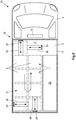
- a delivery vehicle 1 is shown for delivering or delivering consignments 2 with a loading space 3 and a driver's cab 4.
- a driver is not mandatory.
- the delivery vehicle 1 can also be designed for the autonomous departure of a delivery route.
- the driver's cab 4 is then used only in exceptional situations to guide the delivery vehicle 1 by a driver, such as in the event of a fault or a special traffic situation.
- a shelving system 5 is provided with several shelves 6, the shelves 6 are each arranged in a storage position L.
- the shelving system 5 still provides a removal position E, in which, however, no shelf 6 is provided.
- the robot arm 8 is designed so that it can engage at different heights in the respective shelf 6 in order to remove the provided at different heights in the shelves 6 broadcasts 2 can.
- the consignments 2 can also be moved by the robot arm 8 through a closable opening 9 of the hold 3 to the outside on the delivery vehicle 1 and delivered there, delivered or delivered. This can basically be done in different ways, but is not shown here.
- the shelves 6 are provided in the rack system 5 via an adjusting 10 adjustable.
- the adjusting device 10 includes in particular the components of the shelving system 5, which together allow the adjustment of the shelves 6, so for example, the components that are sufficient for the adjustment of the shelves.
- the adjusting device 10 which is shown and which is preferred in this respect has a guide device 11 comprising a rail system 12.
- the rail system 12 may have downwardly open C-rails 13 in which guide elements 14 of the shelves 6 are guided.
- the guide elements 14 may be wider than the lower opening of the C-rails 13.
- the guide elements 14 are held like sliding blocks in the rail system 12.
- the guide elements 14 of the illustrated and insofar preferred shelf system 5 are disc-shaped or cylindrical. In principle, however, the guide elements 14 could also have a rectangular or square cross section in a plane defined by the guide device 14. So that the adjustment is possible without great effort, the Guiding elements 14 of the shelves 6 be guided over rollers in the rails 13.
- the guide elements 14 are dimensioned so that the shelf 6 can be adjusted both along the aligned in the longitudinal direction of the delivery vehicle 1 rails 13 of the guide device 11 and along the transverse to the delivery vehicle 1 aligned rails 13. The adjustment of the shelves 6 is controlled by the integrated into the delivery vehicle 1 control device 15.
- a receiving / dispensing device 16 for receiving, in particular with programs 2, shelves 6 and / or for dispensing, if necessary, consignments 2, shelves 6 of the shelving system 5.
- the recording / dispensing device 16 and thus the guide means 11 can be opened to receive guide elements 14 of shelves 6 in the rails 13 or to remove from the rails 13.
- the receptacle / dispenser 16 may also be closed to prevent inadvertent slipping out of shelves 6 from the shelving system 5 via the receptacle / dispenser 16 or snagging of shelves 6 of the shelving system 5 in the receptacle / dispenser 16 ,
- a transport device with a plurality of drives which effects the adjustment of the shelves 6 in the shelving system 5, is embedded in the loading floor 17 of the loading space 3.
- the transport device is in the schematic plan view of Fig. 1 not shown.
- a transport device could also be provided above the shelves 6, which could be connected, for example, to the adjusting device 10 or to the guide device 11.
- a further option would be to couple the transport device to the shelves 6, so that the shelves 6 have separate drives that could attack the shelves 6, for example, on the loading floor 17 or the guide device 11.
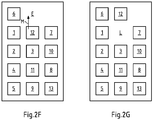
- the loading space 3 of the delivery vehicle 1 is off Fig. 1 with the numbered from 1 to 12 shelves 6 of the shelving system 5 in a very schematic view shown in different positions along a sequence of adjustment steps for adjusting the shelf No. 12 in the removal position E.
- the shelves 6 are shown in a starting position.
- the shelves no. 6-8 are moved forward in the direction of the removal position E.
- the loading position L is left to the left of the shelf no. 12, which is adjusted in the direction indicated by the arrow B adjustment step to the left in the free storage position L, so that at the original position of the shelf no. 12, a free storage position L is formed.
- FIG Fig. 1 the loading space 3 of the delivery vehicle 1 is off Fig. 1 with the numbered from 1 to 12 shelves 6 of the shelving system 5 in a very schematic view shown in different positions along a sequence of adjustment steps for adjusting the shelf No. 12 in the removal position E.
- the shelves 6 are shown in a starting position.
- the shelves no. 6-8 are moved forward in the direction of the removal
- the shelf no. 11 along the arrow C in the now empty storage position L and the shelf no. 8 along the arrow D in the thereby released storage position L at the previous position of the shelf No. 11 is adjusted.
- the shelf no. 12 according to the arrow E a further step forward in the direction of the removal position E are adjusted.
- the shelf no. 11 is now moved along the arrow F to the left to the previous position of the shelf No. 12.
- FIG Fig. 2D Now the shelves no.
- a consignment 2 provided on a segment of the shelf No. 12 can be removed from the shelf 6 by the removal device and be moved outward onto the delivery vehicle 1.
- the consignment 2 can now be delivered or delivered at the designated location along the delivery route.
- a preferred option is the insertion of the shipment 2 in a designated box, such as a mailbox, a parcel box or a packing station.
- the item 2 can also be received by a person or delivered from the removal device 7 to a shelf 6 outside the delivery vehicle 1. The exact nature of the transfer plays in the present case only a minor role and is therefore not described in detail.
- the above-described adjustment of the shelf No. 12 in the removal position E is quite expensive. Thus, it requires a rather complex adjustment device 5, in particular a complex guide device 11.
- the illustrated and so far preferred guide device 11 has a whole series of rails 11, which are all interconnected. This requires a whole series of tees and intersections.
- a very complicated transport device is required if necessary. This must namely ensure that each shelf 6 of the shelving system 5 can be moved as needed individually in two, three or four directions, depending on which position the shelf 6 is in the shelving system 5. Two directions may, for example, opposite to each other, for example on a straight rail piece, or extend over corner, such as in a corner of the guide device 11.
- a shelf on a tee typically in three directions and on a Crossing typically be adjusted in four directions.
- the corresponding expenditure on equipment allows a very flexible adjustment of the shelves 6 and / or the inclusion of very many shelves 6 in the shelving system 5, which can still be adjusted very quickly in the at least one removal position E.
- the shelves 6 can be adjusted at least in an almost optimal manner, since the shelving system 5 provides a great many degrees of freedom for adjusting the shelves 6 in the shelving system 5.
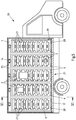
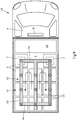
- Easier is the adjustment when the storage positions L according to the in the Fig. 3 shown delivery vehicle 20 are arranged only in rows of two, in particular in the event that just as many shelves 6 are added to the shelving system 21 as storage positions L are present. Then the shelves 6 can be moved in a circle or along a rectangle until the desired shelf 6 has arrived in the removal position E.
- the adjustment of the shelves 6 is easier and the shelves 6 when adjusting on a closed circular path, which must not be circular, are guided, it also requires only a simpler adjustment 22 and a simpler guide device 23.
- Das in der Fig. 3 illustrated and so far preferred rail system 24 of the guide device 23 is then without T-pieces and intersections. Accordingly, significantly fewer transverse rails 25 are required for connecting the longitudinally extending rails 25.
- the guide device 23 has only two rails 25 extending in the longitudinal direction and two rails 25 connecting these rails 25 transversely to each other at both longitudinal ends.
- the loader space 3 is only partially filled by the shelving system 21. This could, for example, be changed simply by using wider shelves 6 while retaining the adjustment device 22 in principle.
- shelf system 21 is instead of the shelf system 21 further storage space 26 for Shipments 2 created that can not be efficiently included in the shelves 6, for example, because the programs 2, for example, very large and / or very small.
- the illustrated and so far preferred delivery vehicle 20 in particular letter items are stored in the additional storage space 26. However, this is not necessarily the case.
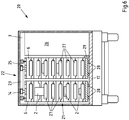
- Fig. 5 is the delivery vehicle 20 according to Fig. 3 in a sectional view along a sectional plane in the longitudinal direction of the delivery vehicle 20 and in the Fig. 6 shown in a sectional view from behind along a sectional plane transverse to the delivery vehicle 20.
- the shelves 6 of the illustrated and insofar preferred shelf system 21 have different height over their height segments in the sense of shelves, wherein in the segments support elements 27 are added. Due to the positive connection, the carrier elements 27 are held at the appropriate height and in the longitudinal and transverse directions of the delivery vehicle 20 on the shelf 6. At some points of the shelves 6 support elements 27 may be missing in order to provide a higher shipment 2 on the respectively underlying support elements 27.
- the support elements 27 When the shelf 6 is in the removal position, the support elements 27 can be lifted slightly by the removal device 7, in particular by means of a robot arm 8, and pulled out of the shelf 6. Subsequently, the delivery of the carrier element 27 together with the item 2 takes place to the outside in order to effect the delivery of the item 2. The carrier element 27 is left behind, if necessary, or pushed back into the shelf 6 after the delivery of the item 2. Carrier elements 27 provided with consignments 2 outside the delivery vehicle 20 can also be transferred into the delivery vehicle 20 with the aid of the removal device 7 and introduced into the shelves 6.
- the in the Fig. 5 and 6 illustrated shelves 6 have at the bottom rotatable balls or rollers 28 with which the shelves 6 can be moved in the longitudinal direction and in the transverse direction relative to the delivery vehicle 20 on the loading floor 17.
- the shelves 6 are driven in the illustrated and so far preferred shelf system 21 by a possibly partially in the loading floor 17th arranged transport device.
- the transport device In the Fig. 5 and 6 are arranged by the transport device only above the loading floor 17 arranged arms 29, the form-fitting attack on the adjacent shelves 6 and can move them.
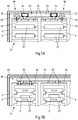
- FIG. 7A-B is another detail of the shelving system 21 according to the Fig. 6 shown, according to Fig. 7A in a view from behind and according to Fig. 7B in a side view.
- a part of the rails 25 of the guide device 23 is shown in a section.
- the rails 25 have a downwardly open C-profile, in which the guide elements 14 of the shelves 6 are held.
- the guide elements 14 are wider than the lower opening of the C-rails 25.
- the guide elements 14 may, if necessary, be guided by rollers in the C-rails 25, wherein the rollers may be provided on the guide elements 14 and roll on running surfaces of the C-rails 25 ,
- the shelf system 21 also has a locking device 30 associated with the guide device 23 for locking the shelves 6 in the shelf system 21, for example while the delivery vehicle 20 is moving.
- the arresting device 30 comprises shafts 32 driven by a drive 31, on which a series of radially projecting finger elements 33 are arranged.
- the shafts 32 can be rotated about their longitudinal axes, wherein the finger elements 33 can be pivoted from a downwardly facing locking position in a side-facing release position and back.
- the finger elements 33 of the locking device 30 do not obstruct the adjustment of the shelves 6.
- the finger elements 33 engage in a form-fitting manner in a frame 34 of the shelf 6 arranged thereunder.
- the finger elements 33 of the locking device 30 and the frame 34 of the shelves 6 then form a positive fit that holds the shelves 6 in position.
- Other locking devices are conceivable, however.
- finger elements 33 it would also be possible to provide cam elements which are then not pivoted like the finger elements, but rather via a toothed wheel or toothed rack a rotation of the shaft 32 can be moved up and down. In the lower position, the cam elements can frictionally engage the shelf 6 provided underneath and / or positively engage in the provided below shelf 6 or a corresponding frame 34 of the shelf.
- Fig. 8 is the transport device 35 of the delivery vehicle 20 according to Fig. 3 for adjusting the shelves 6 of the shelving system 21 along the guide means 23 shown.
- the shelves 6 are adjusted only along a closed rectangular path in the counterclockwise direction, which is indicated by the arrow.
- only one storage position L or the one removal position E is unoccupied in the illustrated and insofar preferred shelf system 21.
- a drive unit 36 with a drive and a laterally adjustable arm 29 for lateral engagement with a shelf 6 is provided at the rear left.
- the drive unit 36 can move the corresponding shelf 6 from the storage position L in the left rear to the storage position L right rear.
- Rear right is a drive unit 36 is provided with a longitudinally adjustable arm 29 to adjust a shelf 6 from the rear right storage position L in the storage position L lying in front.
- the arranged in front of this shelf 6 shelves 6 are thereby pushed forward, and also to a storage position L.
- These are the adjacent shelves 6 of the illustrated and so far preferred shelving system 21 at least substantially to each other, so that in a simple manner several shelves. 6 can be adjusted together via a single drive unit 36.
- the transport unit 36 on the left front again serves to move a shelf 6 provided there to a position to the left, to which the transport unit 36 has a right arranged with a shelf 6 in contact arm 29.
- the drive unit 36 left front For adjusting shelves 6 of the left row of shelves 6 in the longitudinal direction of the delivery vehicle 20 by about a shelf width is used the drive unit 36 left front, which can also attack with an arm 29 on the shelf 6 front left. With this shelf 6, the other arranged in the left row of shelves 6 6 shelves are moved backwards, which is why the shelves 6 at least substantially abut each other in this direction.
- a delivery vehicle 40 is shown with a shelving system 41 that a compromise between the shelving systems 5,21 of the delivery vehicles 1,20 according to Fig. 1 and 3 shown.
- the shelf system 41 has a guide device 42 with three parallel rails 43 in the longitudinal direction. The longitudinal ends of the rails 43 are connected by transversely to the delivery vehicle 40 extending rails 44.
- the guide device 42 thus forms two parallel closed circular paths, which in turn need not be circular, but in the present case are rectangular.
- either the shelves 6 of the left circular path are adjusted along the circular path or it will be the shelves 6 of the right circular path along the right circular path adjusted, as symbolized by the arrows.
- the removal device E is arranged in front of the shelving system 41, which is not mandatory.
- the removal device 45 may also have a robot arm 8 to remove the support elements 27 of the shelves 6 from the shelves 6.
Landscapes
- Engineering & Computer Science (AREA)
- Business, Economics & Management (AREA)
- Economics (AREA)
- Tourism & Hospitality (AREA)
- General Business, Economics & Management (AREA)
- Human Resources & Organizations (AREA)
- Marketing (AREA)
- Operations Research (AREA)
- Quality & Reliability (AREA)
- Strategic Management (AREA)
- Development Economics (AREA)
- Physics & Mathematics (AREA)
- Entrepreneurship & Innovation (AREA)
- General Physics & Mathematics (AREA)
- Theoretical Computer Science (AREA)
- Mechanical Engineering (AREA)
- Transportation (AREA)
- Health & Medical Sciences (AREA)
- Public Health (AREA)
- Chemical & Material Sciences (AREA)
- Combustion & Propulsion (AREA)
- Warehouses Or Storage Devices (AREA)
Applications Claiming Priority (1)
| Application Number | Priority Date | Filing Date | Title |
|---|---|---|---|
| DE102016106456.4A DE102016106456A1 (de) | 2016-04-08 | 2016-04-08 | Zustellfahrzeug und Verfahren zum Abliefern von Sendungen an unterschiedlichen Orten entlang einer Zustellroute |
Publications (4)
| Publication Number | Publication Date |
|---|---|
| EP3228496A2 true EP3228496A2 (fr) | 2017-10-11 |
| EP3228496A3 EP3228496A3 (fr) | 2017-10-18 |
| EP3228496B1 EP3228496B1 (fr) | 2023-06-07 |
| EP3228496C0 EP3228496C0 (fr) | 2023-06-07 |
Family
ID=58428180
Family Applications (1)
| Application Number | Title | Priority Date | Filing Date |
|---|---|---|---|
| EP17163038.7A Active EP3228496B1 (fr) | 2016-04-08 | 2017-03-27 | Véhicule de distribution et procédé de livraison d'envois dans différents endroits suivant un itinéraire de distribution |
Country Status (4)
| Country | Link |
|---|---|
| US (1) | US20170291766A1 (fr) |
| EP (1) | EP3228496B1 (fr) |
| CN (1) | CN107264376B (fr) |
| DE (1) | DE102016106456A1 (fr) |
Cited By (12)
| Publication number | Priority date | Publication date | Assignee | Title |
|---|---|---|---|---|
| WO2019037921A1 (fr) * | 2017-08-22 | 2019-02-28 | Daimler Ag | Rayonnage mobile pour un véhicule, véhicule comprenant ledit rayonnage mobile, procédé pour faire fonctionner un véhicule pourvu dudit rayonnage mobile ainsi que dispositif de commande |
| WO2019226470A1 (fr) * | 2018-05-22 | 2019-11-28 | Uber Technologies, Inc. | Systèmes de livraison automatisés pour véhicules autonomes |
| WO2020148022A1 (fr) * | 2019-01-16 | 2020-07-23 | Volkswagen Aktiengesellschaft | Système logistique pour la livraison de marchandises avec un véhicule, procédé d'exploitation d'un système logistique, et véhicule |
| WO2021137925A1 (fr) * | 2019-12-31 | 2021-07-08 | United Parcel Service Of America, Inc. | Système de distribution d'actif amélioré |
| WO2022093559A1 (fr) * | 2020-10-28 | 2022-05-05 | United Parcel Service Of America, Inc. | Localisation, identification et déplacement d'objets de manière automatisée ou semi-automatisée y compris pendant le transit |
| WO2022093560A1 (fr) * | 2020-10-28 | 2022-05-05 | United Parcel Service Of America, Inc. | Localisation, identification et déplacement d'objets de manière automatisée ou semi-automatisée y compris pendant le transit |
| US11345269B2 (en) * | 2016-09-07 | 2022-05-31 | Pickdelso Oy | Trailer and arrangement for delivery of products |
| EP4303156A1 (fr) * | 2022-07-05 | 2024-01-10 | Volvo Truck Corporation | Système de manutention de conteneurs pour un véhicule de transport |
| US12026663B1 (en) * | 2021-09-10 | 2024-07-02 | Amazon Technologies, Inc. | Automated sequencing and dispensing in final segment of delivery |
| EP4454944A1 (fr) * | 2023-04-25 | 2024-10-30 | Renault s.a.s | Système de stockage de colis destinés à la livraison |
| FR3148193A1 (fr) * | 2023-04-25 | 2024-11-01 | Renault S.A.S. | véhicule comprenant un dispositif de distribution d’un colis à livrer |
| US12321889B2 (en) | 2020-10-28 | 2025-06-03 | United Parcel Service Of America, Inc. | Locating, identifying, and shifting objects in automated or semi-automated fashion including during transit |
Families Citing this family (50)
| Publication number | Priority date | Publication date | Assignee | Title |
|---|---|---|---|---|
| US10414344B1 (en) * | 2016-09-01 | 2019-09-17 | Apple Inc. | Securable storage compartments |
| WO2019068076A1 (fr) | 2017-09-29 | 2019-04-04 | United Parcel Service Of America, Inc. | Identification, analyse et atténuation prédictive d'endommagement de colis |
| US10934093B2 (en) * | 2017-11-14 | 2021-03-02 | United Parcel Service Of America, Inc | Automated package transport vehicle |
| CN109984484B (zh) * | 2017-12-29 | 2023-09-05 | 长沙行深智能科技有限公司 | 一种具有限位组件的智能终端柜及智慧物流车 |
| GB2568768A (en) * | 2018-01-08 | 2019-05-29 | Daimler Ag | Method and device for delivering packages by means of a transport vehicle |
| DE102018100447B4 (de) * | 2018-01-10 | 2020-03-19 | Deutsche Post Ag | Lieferfahrzeug zum Beliefern eines Sendungskastens mit Sendungen und Sendungskasten zum Aufnehmen, Speichern und Wiederabgeben von Sendungen |
| DE102018102127A1 (de) * | 2018-01-31 | 2019-08-01 | Deutsche Post Ag | Modularer Transportroboter und Transportrobotersystem |
| US10843333B2 (en) | 2018-03-05 | 2020-11-24 | Berkshire Grey, Inc. | Systems and methods for processing objects, including automated re-circulating processing stations |
| DE102018105778C5 (de) * | 2018-03-13 | 2025-02-13 | iPOSiCAR UG (haftungsbeschränkt) | Verfahren zum Ausliefern von Waren mittels eines Lieferfahrzeugs sowie eine mobile Verteilervorrichtung |
| US11027420B2 (en) * | 2018-03-14 | 2021-06-08 | Fedex Corporate Services, Inc. | Modular cargo storage apparatus for use on a base platform of a modular autonomous bot apparatus that transports an item being shipped |
| DE102018111153A1 (de) * | 2018-05-09 | 2019-11-14 | Deutsche Post Ag | Transportwagen für Sendungen und Verfahren zum Betrieb des Transportwagens |
| CN108437878B (zh) * | 2018-05-14 | 2023-11-10 | 安吉智能物联技术有限公司 | 一种车载华容道式自动立体库 |
| WO2020047494A1 (fr) * | 2018-08-31 | 2020-03-05 | United Parcel Service Of America, Inc. | Systèmes, procédés et appareils pour le déplacement et le rayonnage de structures de stockage et des colis sur celles-ci |
| US11487300B2 (en) | 2018-09-13 | 2022-11-01 | Toyota Motor Engineering & Manufacturing North America, Inc. | Home improvement store autonomous workhorse |
| DE102018007522B3 (de) * | 2018-09-21 | 2019-10-24 | Daimler Ag | Transportfahrzeug mit einem Ladesystem |
| JP6608023B1 (ja) * | 2018-10-18 | 2019-11-20 | 株式会社Paltac | 宅配商品自動トラック積込荷下ろしシステム |
| US11282326B2 (en) * | 2018-11-02 | 2022-03-22 | Pepsico, Inc. | Table vending machine |
| JP7317489B2 (ja) * | 2018-11-14 | 2023-07-31 | トヨタ自動車株式会社 | 運搬システム |
| WO2020120566A1 (fr) * | 2018-12-11 | 2020-06-18 | Marel Iceland Ehf. | Système de gestion d'aliments |
| CN109435814A (zh) * | 2018-12-27 | 2019-03-08 | 安吉智能物联技术有限公司 | 一种智能物流车 |
| JP7304535B2 (ja) | 2019-02-14 | 2023-07-07 | パナソニックIpマネジメント株式会社 | 車両制御装置、車両制御方法及びプログラム |
| US11866224B2 (en) | 2019-06-24 | 2024-01-09 | Berkshire Grey Operating Company, Inc. | Systems and methods for providing shipping of orders in an order fulfillment center |
| JP7207258B2 (ja) * | 2019-10-16 | 2023-01-18 | トヨタ自動車株式会社 | 物品搬送システム、物品搬送ロボット、および、収容箱 |
| DE102020203083B4 (de) | 2020-03-11 | 2021-09-30 | Ford Global Technologies, Llc | Lieferwagen |
| WO2021234710A1 (fr) * | 2020-05-21 | 2021-11-25 | Convaze Ltd | Unité de distribution d'articles |
| CN111845960A (zh) * | 2020-06-19 | 2020-10-30 | 珠海广通汽车有限公司 | 货厢、货厢的控制方法、控制装置与计算机可读存储介质 |
| DE102020118167A1 (de) * | 2020-07-09 | 2022-01-13 | Deutsche Post Ag | Zustellfahrzeug mit einem mobilen Aufsatz |
| CN112093347B (zh) * | 2020-08-19 | 2022-04-01 | 广西中烟工业有限责任公司 | 一种循环货位存储方法 |
| EP3974251B1 (fr) * | 2020-09-25 | 2023-11-29 | Jungheinrich Aktiengesellschaft | Véhicule de livraison |
| JP7354980B2 (ja) * | 2020-09-29 | 2023-10-03 | トヨタ自動車株式会社 | 配送用車両及び配送用車両制御システム |
| WO2022094015A1 (fr) * | 2020-10-28 | 2022-05-05 | Helgesen Industries, Inc. | Unité de stockage et de distribution de paquets |
| DE102020214160A1 (de) | 2020-11-11 | 2022-05-12 | Ford Global Technologies, Llc | Verfahren zur Lagerung von Postpaketen |
| NO346564B1 (en) * | 2021-02-26 | 2022-10-10 | Wheel Me As | Mobile storage system handling storage devices on a floor area |
| EP4052962B1 (fr) * | 2021-03-03 | 2023-07-26 | Jungheinrich Aktiengesellschaft | Agencement d'étagère |
| US11724633B2 (en) * | 2021-05-18 | 2023-08-15 | Ford Global Technologies, Llc | Package sorting systems and methods of use |
| US20220396192A1 (en) * | 2021-06-15 | 2022-12-15 | Bell And Howell, Llc | Automated storage and retrieval systems and methods |
| US12576770B2 (en) | 2021-08-17 | 2026-03-17 | United Parcel Service Of America, Inc. | Systems, methods, and apparatuses for loading, shifting, and staging objects in automated or semi-automated fashion |
| US20230057578A1 (en) | 2021-08-17 | 2023-02-23 | United Parcel Service Of America, Inc. | Systems, methods, and apparatuses for loading, shifting, and staging objects in automated or semi-automated fashion |
| DE102021121606A1 (de) | 2021-08-20 | 2023-02-23 | Ford Global Technologies Llc | Auslieferung von mit Postsendungen bestückten mobilen Schließfachschränken und Abholung von leeren mobilen Schließfachschränken |
| US11731170B2 (en) * | 2021-09-30 | 2023-08-22 | Ford Global Technologies, Llc | Systems and methods for delivery vehicle reconfigurable on-board package sorting |
| EP4190632B1 (fr) * | 2021-12-02 | 2024-07-17 | Ford Global Technologies, LLC | Système de rayonnage pour un véhicule utilitaire et procédé d'équilibrage latéral et de chargement d'un véhicule utilitaire |
| EP4190633B1 (fr) * | 2021-12-02 | 2024-07-17 | Ford Global Technologies, LLC | Système de rayonnage pour un véhicule utilitaire et véhicule utilitaire |
| DE102021133322A1 (de) * | 2021-12-15 | 2023-06-15 | Ford Global Technologies, Llc | Automobil mit Regal im Laderaum |
| DE102022106931A1 (de) | 2022-03-24 | 2023-09-28 | Ford Global Technologies Llc | Transportsystem |
| JP7655269B2 (ja) * | 2022-05-02 | 2025-04-02 | トヨタ自動車株式会社 | 車載荷役システム、スタッカ、および、荷物の受け渡し方法 |
| US12473149B1 (en) * | 2022-05-13 | 2025-11-18 | Amazon Technologies, Inc. | Automated mobile sortation and delivery systems and methods |
| US12570198B2 (en) * | 2022-08-16 | 2026-03-10 | Lear Corporation | In vehicle cargo storage unit conveyor system |
| DE102022125465A1 (de) * | 2022-10-04 | 2024-04-04 | Ford Global Technologies Llc | Regalsystem und Verfahren zum Betreiben eines Regals |
| US20250074286A1 (en) * | 2023-09-01 | 2025-03-06 | Ford Global Technologies, Llc | Systems and methods for automated loading and unloading for delivery vehicles |
| WO2025159735A1 (fr) * | 2024-01-22 | 2025-07-31 | Candelario David M | Système de récupération et de livraison d'objets sous la forme d'un camion laitier moderne (mmt) |
Family Cites Families (9)
| Publication number | Priority date | Publication date | Assignee | Title |
|---|---|---|---|---|
| US1970955A (en) * | 1932-07-29 | 1934-08-21 | Ehrlich William | Delivery wagon |
| US3999671A (en) * | 1975-02-24 | 1976-12-28 | Lutz David E | Article handling system |
| DE19809291A1 (de) * | 1998-03-05 | 1999-09-09 | Unterberg | Fahrzeug, insbesondere Transportfahrzeug zur Aufnahme von Gegenständen |
| NL1015889C2 (nl) * | 2000-08-08 | 2002-02-12 | Asbreuk Johannes Hermanus J | Magazijnsysteem. |
| DE102006025876A1 (de) * | 2006-06-02 | 2007-12-06 | Siegler, Adrian | Lagersystem |
| FR2983441B1 (fr) * | 2011-12-02 | 2014-06-06 | Roland Robert | Systeme de rangement comprenant une enceinte et un ensemble de bacs mobiles dans l'enceinte, et vehicule equipe d'un tel systeme de rangement. |
| AT512339B1 (de) * | 2011-12-21 | 2015-10-15 | Tgw Logistics Group Gmbh | Regallagersystem und verfahren zum betreiben desselben |
| DE102015117241B4 (de) * | 2015-10-09 | 2018-11-15 | Deutsche Post Ag | Ansteuerung einer Förderanlage |
| US20170305669A1 (en) * | 2016-04-26 | 2017-10-26 | Semtek Corporation Co., Ltd. | High-efficiency storage system |
-
2016
- 2016-04-08 DE DE102016106456.4A patent/DE102016106456A1/de active Pending
-
2017
- 2017-03-27 EP EP17163038.7A patent/EP3228496B1/fr active Active
- 2017-04-07 US US15/481,617 patent/US20170291766A1/en active Pending
- 2017-04-07 CN CN201710223786.7A patent/CN107264376B/zh active Active
Non-Patent Citations (1)
| Title |
|---|
| None |
Cited By (21)
| Publication number | Priority date | Publication date | Assignee | Title |
|---|---|---|---|---|
| US11345269B2 (en) * | 2016-09-07 | 2022-05-31 | Pickdelso Oy | Trailer and arrangement for delivery of products |
| WO2019037921A1 (fr) * | 2017-08-22 | 2019-02-28 | Daimler Ag | Rayonnage mobile pour un véhicule, véhicule comprenant ledit rayonnage mobile, procédé pour faire fonctionner un véhicule pourvu dudit rayonnage mobile ainsi que dispositif de commande |
| WO2019226470A1 (fr) * | 2018-05-22 | 2019-11-28 | Uber Technologies, Inc. | Systèmes de livraison automatisés pour véhicules autonomes |
| US12005826B2 (en) | 2018-05-22 | 2024-06-11 | Uatc, Llc | Automated delivery systems for autonomous vehicles |
| US11447055B2 (en) | 2018-05-22 | 2022-09-20 | Uatc, Llc | Automated delivery systems for autonomous vehicles |
| WO2020148022A1 (fr) * | 2019-01-16 | 2020-07-23 | Volkswagen Aktiengesellschaft | Système logistique pour la livraison de marchandises avec un véhicule, procédé d'exploitation d'un système logistique, et véhicule |
| US12361365B2 (en) | 2019-01-16 | 2025-07-15 | Volkswagen Aktiengesellschaft | Logistics system for shipping items by means of a vehicle, method for operating a logistics system, and vehicle |
| WO2021137925A1 (fr) * | 2019-12-31 | 2021-07-08 | United Parcel Service Of America, Inc. | Système de distribution d'actif amélioré |
| US11829136B2 (en) | 2019-12-31 | 2023-11-28 | United Parcel Service Of America, Inc. | Asset delivery system |
| US11887048B2 (en) | 2020-10-28 | 2024-01-30 | United Parcel Service Of America, Inc. | Locating, identifying, and shifting objects in automated or semi-automated fashion including during transit |
| US11978012B2 (en) | 2020-10-28 | 2024-05-07 | United Parcel Service Of America, Inc. | Locating, identifying, and shifting objects in automated or semi-automated fashion including during transit |
| WO2022093560A1 (fr) * | 2020-10-28 | 2022-05-05 | United Parcel Service Of America, Inc. | Localisation, identification et déplacement d'objets de manière automatisée ou semi-automatisée y compris pendant le transit |
| EP4520690A1 (fr) * | 2020-10-28 | 2025-03-12 | United Parcel Service Of America, Inc. | Localisation, identification et déplacement d'objets de manière automatisée ou semi-automatisée y compris pendant le transit |
| US12321889B2 (en) | 2020-10-28 | 2025-06-03 | United Parcel Service Of America, Inc. | Locating, identifying, and shifting objects in automated or semi-automated fashion including during transit |
| WO2022093559A1 (fr) * | 2020-10-28 | 2022-05-05 | United Parcel Service Of America, Inc. | Localisation, identification et déplacement d'objets de manière automatisée ou semi-automatisée y compris pendant le transit |
| US12493854B2 (en) | 2020-10-28 | 2025-12-09 | United Parcel Service Of America, Inc. | Locating, identifying, and shifting objects in automated or semi-automated fashion including during transit |
| US12026663B1 (en) * | 2021-09-10 | 2024-07-02 | Amazon Technologies, Inc. | Automated sequencing and dispensing in final segment of delivery |
| EP4303156A1 (fr) * | 2022-07-05 | 2024-01-10 | Volvo Truck Corporation | Système de manutention de conteneurs pour un véhicule de transport |
| EP4454944A1 (fr) * | 2023-04-25 | 2024-10-30 | Renault s.a.s | Système de stockage de colis destinés à la livraison |
| FR3148231A1 (fr) * | 2023-04-25 | 2024-11-01 | Renault S.A.S. | système de stockage de colis destinés à la livraison |
| FR3148193A1 (fr) * | 2023-04-25 | 2024-11-01 | Renault S.A.S. | véhicule comprenant un dispositif de distribution d’un colis à livrer |
Also Published As
| Publication number | Publication date |
|---|---|
| DE102016106456A1 (de) | 2017-10-12 |
| CN107264376A (zh) | 2017-10-20 |
| EP3228496B1 (fr) | 2023-06-07 |
| EP3228496A3 (fr) | 2017-10-18 |
| CN107264376B (zh) | 2021-10-08 |
| US20170291766A1 (en) | 2017-10-12 |
| EP3228496C0 (fr) | 2023-06-07 |
Similar Documents
| Publication | Publication Date | Title |
|---|---|---|
| EP3228496A2 (fr) | Véhicule de distribution et procédé de livraison d'envois dans différents endroits suivant un itinéraire de distribution | |
| EP3254893B1 (fr) | Véhicule de livraison et procédé de livraison d'envois à différents endroits le long d'un itinéraire | |
| EP2307296B1 (fr) | Accumulateur d'expédition modulable avec fonction de tri intégrée | |
| EP0847939B1 (fr) | Dispositif et procédé pour rassembler et préparer des marchandises en détail | |
| EP2297005B2 (fr) | Système de stockage et procédé pour le faire fonctionner | |
| EP2102080B1 (fr) | Procédé et dispositif de préparation de marchandises, système de gestion des stocks et utilisation d'au moins un véhicule de transport autonome | |
| DE102018100447B4 (de) | Lieferfahrzeug zum Beliefern eines Sendungskastens mit Sendungen und Sendungskasten zum Aufnehmen, Speichern und Wiederabgeben von Sendungen | |
| WO2003011722A1 (fr) | Procede et installation pour preparer des commandes a l'aide d'un rayonnage et d'un gerbeur associe | |
| EP2855282B1 (fr) | Procédé et appareil pour transférer des articles à partir de stations de distribution vers des stations de réception | |
| DE20112328U1 (de) | Kommissionieranlage mit einem Behälterregal und zugeordnetem Regalbediengerät | |
| DE102009038124A1 (de) | Lager- und Kommissioniersystem mit einem universell einsetzbaren Winkelladungsträger | |
| WO2018045403A1 (fr) | Système de stockage automatisé servant au transport de supports de charge tournés dans la direction de déplacement | |
| DE19953812A1 (de) | Verfahren und Vorrichtung zum Kommissionieren | |
| WO2012162715A1 (fr) | Moyen de chargement, dispositif de réception de charge et système automatique de stockage pour lesdits moyen et dispositif | |
| EP1818283B1 (fr) | Procédé de stockage de marchandises au détail dans un entrepôt de marchandises au détail automatisé | |
| DE19719651A1 (de) | Verfahren und Vorrichtung zum Kommissionieren | |
| EP2158143B1 (fr) | Transstockeur pour charger, décharger et préparer des marchandises et système de stockage comprenant au moins un tel transstockeur | |
| DE102014206590A1 (de) | Logistiksystem und Verfahren zur Übergabe und/oder Übernahme von Waren zwischen einem Fahrzeug und einem Warenlager | |
| EP2687463A1 (fr) | Système de stockage et procédé de distribution automatique d'unités d'emballage | |
| DE102023115855B4 (de) | Lagerlift mit automatischer Beladung und Entladung durch ein Fahrzeug | |
| EP2602213B1 (fr) | Préparation des commandes combinée avec véhicules de préparation des commandes et un dispositif de palettisation pour stockage | |
| EP2163492B1 (fr) | Entrepôt combiné | |
| EP3208003B1 (fr) | Dispositif de tri comprenant des destinations ajustables ez procédé utilisant un tel dispositif | |
| DE2131179A1 (de) | Einrichtung zur Lagerung und Befoerderung von auf Paletten angeordneten Guetern u.dgl.sowie Verfahren zur Lagerung von Paletten od.dgl. |
Legal Events
| Date | Code | Title | Description |
|---|---|---|---|
| PUAI | Public reference made under article 153(3) epc to a published international application that has entered the european phase |
Free format text: ORIGINAL CODE: 0009012 |
|
| STAA | Information on the status of an ep patent application or granted ep patent |
Free format text: STATUS: THE APPLICATION HAS BEEN PUBLISHED |
|
| PUAL | Search report despatched |
Free format text: ORIGINAL CODE: 0009013 |
|
| AK | Designated contracting states |
Kind code of ref document: A2 Designated state(s): AL AT BE BG CH CY CZ DE DK EE ES FI FR GB GR HR HU IE IS IT LI LT LU LV MC MK MT NL NO PL PT RO RS SE SI SK SM TR |
|
| AX | Request for extension of the european patent |
Extension state: BA ME |
|
| AK | Designated contracting states |
Kind code of ref document: A3 Designated state(s): AL AT BE BG CH CY CZ DE DK EE ES FI FR GB GR HR HU IE IS IT LI LT LU LV MC MK MT NL NO PL PT RO RS SE SI SK SM TR |
|
| AX | Request for extension of the european patent |
Extension state: BA ME |
|
| RIC1 | Information provided on ipc code assigned before grant |
Ipc: B65G 1/133 20060101ALI20170913BHEP Ipc: B60P 3/00 20060101AFI20170913BHEP |
|
| STAA | Information on the status of an ep patent application or granted ep patent |
Free format text: STATUS: REQUEST FOR EXAMINATION WAS MADE |
|
| 17P | Request for examination filed |
Effective date: 20180418 |
|
| RBV | Designated contracting states (corrected) |
Designated state(s): AL AT BE BG CH CY CZ DE DK EE ES FI FR GB GR HR HU IE IS IT LI LT LU LV MC MK MT NL NO PL PT RO RS SE SI SK SM TR |
|
| STAA | Information on the status of an ep patent application or granted ep patent |
Free format text: STATUS: EXAMINATION IS IN PROGRESS |
|
| 17Q | First examination report despatched |
Effective date: 20190703 |
|
| RAP1 | Party data changed (applicant data changed or rights of an application transferred) |
Owner name: STREETSCOOTER GMBH |
|
| RIC1 | Information provided on ipc code assigned before grant |
Ipc: G06Q 10/08 20120101ALI20221011BHEP Ipc: B65G 1/133 20060101ALI20221011BHEP Ipc: B60P 3/00 20060101AFI20221011BHEP |
|
| GRAP | Despatch of communication of intention to grant a patent |
Free format text: ORIGINAL CODE: EPIDOSNIGR1 |
|
| STAA | Information on the status of an ep patent application or granted ep patent |
Free format text: STATUS: GRANT OF PATENT IS INTENDED |
|
| INTG | Intention to grant announced |
Effective date: 20221222 |
|
| GRAS | Grant fee paid |
Free format text: ORIGINAL CODE: EPIDOSNIGR3 |
|
| GRAA | (expected) grant |
Free format text: ORIGINAL CODE: 0009210 |
|
| STAA | Information on the status of an ep patent application or granted ep patent |
Free format text: STATUS: THE PATENT HAS BEEN GRANTED |
|
| AK | Designated contracting states |
Kind code of ref document: B1 Designated state(s): AL AT BE BG CH CY CZ DE DK EE ES FI FR GB GR HR HU IE IS IT LI LT LU LV MC MK MT NL NO PL PT RO RS SE SI SK SM TR |
|
| REG | Reference to a national code |
Ref country code: GB Ref legal event code: FG4D Free format text: NOT ENGLISH |
|
| REG | Reference to a national code |
Ref country code: CH Ref legal event code: EP Ref country code: AT Ref legal event code: REF Ref document number: 1574044 Country of ref document: AT Kind code of ref document: T Effective date: 20230615 |
|
| REG | Reference to a national code |
Ref country code: DE Ref legal event code: R096 Ref document number: 502017014789 Country of ref document: DE |
|
| U01 | Request for unitary effect filed |
Effective date: 20230706 |
|
| U07 | Unitary effect registered |
Designated state(s): AT BE BG DE DK EE FI FR IT LT LU LV MT NL PT SE SI Effective date: 20230719 |
|
| REG | Reference to a national code |
Ref country code: LT Ref legal event code: MG9D |
|
| PG25 | Lapsed in a contracting state [announced via postgrant information from national office to epo] |
Ref country code: NO Free format text: LAPSE BECAUSE OF FAILURE TO SUBMIT A TRANSLATION OF THE DESCRIPTION OR TO PAY THE FEE WITHIN THE PRESCRIBED TIME-LIMIT Effective date: 20230907 Ref country code: ES Free format text: LAPSE BECAUSE OF FAILURE TO SUBMIT A TRANSLATION OF THE DESCRIPTION OR TO PAY THE FEE WITHIN THE PRESCRIBED TIME-LIMIT Effective date: 20230607 |
|
| PG25 | Lapsed in a contracting state [announced via postgrant information from national office to epo] |
Ref country code: RS Free format text: LAPSE BECAUSE OF FAILURE TO SUBMIT A TRANSLATION OF THE DESCRIPTION OR TO PAY THE FEE WITHIN THE PRESCRIBED TIME-LIMIT Effective date: 20230607 Ref country code: HR Free format text: LAPSE BECAUSE OF FAILURE TO SUBMIT A TRANSLATION OF THE DESCRIPTION OR TO PAY THE FEE WITHIN THE PRESCRIBED TIME-LIMIT Effective date: 20230607 Ref country code: GR Free format text: LAPSE BECAUSE OF FAILURE TO SUBMIT A TRANSLATION OF THE DESCRIPTION OR TO PAY THE FEE WITHIN THE PRESCRIBED TIME-LIMIT Effective date: 20230908 |
|
| PG25 | Lapsed in a contracting state [announced via postgrant information from national office to epo] |
Ref country code: SK Free format text: LAPSE BECAUSE OF FAILURE TO SUBMIT A TRANSLATION OF THE DESCRIPTION OR TO PAY THE FEE WITHIN THE PRESCRIBED TIME-LIMIT Effective date: 20230607 |
|
| PG25 | Lapsed in a contracting state [announced via postgrant information from national office to epo] |
Ref country code: IS Free format text: LAPSE BECAUSE OF FAILURE TO SUBMIT A TRANSLATION OF THE DESCRIPTION OR TO PAY THE FEE WITHIN THE PRESCRIBED TIME-LIMIT Effective date: 20231007 |
|
| PG25 | Lapsed in a contracting state [announced via postgrant information from national office to epo] |
Ref country code: SM Free format text: LAPSE BECAUSE OF FAILURE TO SUBMIT A TRANSLATION OF THE DESCRIPTION OR TO PAY THE FEE WITHIN THE PRESCRIBED TIME-LIMIT Effective date: 20230607 Ref country code: SK Free format text: LAPSE BECAUSE OF FAILURE TO SUBMIT A TRANSLATION OF THE DESCRIPTION OR TO PAY THE FEE WITHIN THE PRESCRIBED TIME-LIMIT Effective date: 20230607 Ref country code: RO Free format text: LAPSE BECAUSE OF FAILURE TO SUBMIT A TRANSLATION OF THE DESCRIPTION OR TO PAY THE FEE WITHIN THE PRESCRIBED TIME-LIMIT Effective date: 20230607 Ref country code: IS Free format text: LAPSE BECAUSE OF FAILURE TO SUBMIT A TRANSLATION OF THE DESCRIPTION OR TO PAY THE FEE WITHIN THE PRESCRIBED TIME-LIMIT Effective date: 20231007 Ref country code: CZ Free format text: LAPSE BECAUSE OF FAILURE TO SUBMIT A TRANSLATION OF THE DESCRIPTION OR TO PAY THE FEE WITHIN THE PRESCRIBED TIME-LIMIT Effective date: 20230607 |
|
| PG25 | Lapsed in a contracting state [announced via postgrant information from national office to epo] |
Ref country code: PL Free format text: LAPSE BECAUSE OF FAILURE TO SUBMIT A TRANSLATION OF THE DESCRIPTION OR TO PAY THE FEE WITHIN THE PRESCRIBED TIME-LIMIT Effective date: 20230607 |
|
| REG | Reference to a national code |
Ref country code: DE Ref legal event code: R097 Ref document number: 502017014789 Country of ref document: DE |
|
| PLBE | No opposition filed within time limit |
Free format text: ORIGINAL CODE: 0009261 |
|
| STAA | Information on the status of an ep patent application or granted ep patent |
Free format text: STATUS: NO OPPOSITION FILED WITHIN TIME LIMIT |
|
| U20 | Renewal fee for the european patent with unitary effect paid |
Year of fee payment: 8 Effective date: 20240321 |
|
| 26N | No opposition filed |
Effective date: 20240308 |
|
| REG | Reference to a national code |
Ref country code: CH Ref legal event code: PL |
|
| PG25 | Lapsed in a contracting state [announced via postgrant information from national office to epo] |
Ref country code: MC Free format text: LAPSE BECAUSE OF FAILURE TO SUBMIT A TRANSLATION OF THE DESCRIPTION OR TO PAY THE FEE WITHIN THE PRESCRIBED TIME-LIMIT Effective date: 20230607 |
|
| PG25 | Lapsed in a contracting state [announced via postgrant information from national office to epo] |
Ref country code: MC Free format text: LAPSE BECAUSE OF FAILURE TO SUBMIT A TRANSLATION OF THE DESCRIPTION OR TO PAY THE FEE WITHIN THE PRESCRIBED TIME-LIMIT Effective date: 20230607 |
|
| PG25 | Lapsed in a contracting state [announced via postgrant information from national office to epo] |
Ref country code: IE Free format text: LAPSE BECAUSE OF NON-PAYMENT OF DUE FEES Effective date: 20240327 |
|
| PG25 | Lapsed in a contracting state [announced via postgrant information from national office to epo] |
Ref country code: IE Free format text: LAPSE BECAUSE OF NON-PAYMENT OF DUE FEES Effective date: 20240327 Ref country code: CH Free format text: LAPSE BECAUSE OF NON-PAYMENT OF DUE FEES Effective date: 20240331 |
|
| PGFP | Annual fee paid to national office [announced via postgrant information from national office to epo] |
Ref country code: GB Payment date: 20250326 Year of fee payment: 9 |
|
| U20 | Renewal fee for the european patent with unitary effect paid |
Year of fee payment: 9 Effective date: 20250325 |
|
| PG25 | Lapsed in a contracting state [announced via postgrant information from national office to epo] |
Ref country code: CY Free format text: LAPSE BECAUSE OF FAILURE TO SUBMIT A TRANSLATION OF THE DESCRIPTION OR TO PAY THE FEE WITHIN THE PRESCRIBED TIME-LIMIT; INVALID AB INITIO Effective date: 20170327 |
|
| PG25 | Lapsed in a contracting state [announced via postgrant information from national office to epo] |
Ref country code: HU Free format text: LAPSE BECAUSE OF FAILURE TO SUBMIT A TRANSLATION OF THE DESCRIPTION OR TO PAY THE FEE WITHIN THE PRESCRIBED TIME-LIMIT; INVALID AB INITIO Effective date: 20170327 |
|
| PG25 | Lapsed in a contracting state [announced via postgrant information from national office to epo] |
Ref country code: TR Free format text: LAPSE BECAUSE OF FAILURE TO SUBMIT A TRANSLATION OF THE DESCRIPTION OR TO PAY THE FEE WITHIN THE PRESCRIBED TIME-LIMIT Effective date: 20230607 |