EP3228698A1 - Hocheffiziente ethanolfermentierungsbakterien - Google Patents
Hocheffiziente ethanolfermentierungsbakterien Download PDFInfo
- Publication number
- EP3228698A1 EP3228698A1 EP14907566.5A EP14907566A EP3228698A1 EP 3228698 A1 EP3228698 A1 EP 3228698A1 EP 14907566 A EP14907566 A EP 14907566A EP 3228698 A1 EP3228698 A1 EP 3228698A1
- Authority
- EP
- European Patent Office
- Prior art keywords
- ethanol
- gene
- xylose
- strain
- highly efficient
- Prior art date
- Legal status (The legal status is an assumption and is not a legal conclusion. Google has not performed a legal analysis and makes no representation as to the accuracy of the status listed.)
- Granted
Links
Images

Classifications
-
- C—CHEMISTRY; METALLURGY
- C12—BIOCHEMISTRY; BEER; SPIRITS; WINE; VINEGAR; MICROBIOLOGY; ENZYMOLOGY; MUTATION OR GENETIC ENGINEERING
- C12N—MICROORGANISMS OR ENZYMES; COMPOSITIONS THEREOF; PROPAGATING, PRESERVING, OR MAINTAINING MICROORGANISMS; MUTATION OR GENETIC ENGINEERING; CULTURE MEDIA
- C12N1/00—Microorganisms; Compositions thereof; Processes of propagating, maintaining or preserving microorganisms or compositions thereof; Processes of preparing or isolating a composition containing a microorganism; Culture media therefor
- C12N1/14—Fungi; Culture media therefor
- C12N1/145—Fungi isolates
-
- C—CHEMISTRY; METALLURGY
- C12—BIOCHEMISTRY; BEER; SPIRITS; WINE; VINEGAR; MICROBIOLOGY; ENZYMOLOGY; MUTATION OR GENETIC ENGINEERING
- C12P—FERMENTATION OR ENZYME-USING PROCESSES TO SYNTHESISE A DESIRED CHEMICAL COMPOUND OR COMPOSITION OR TO SEPARATE OPTICAL ISOMERS FROM A RACEMIC MIXTURE
- C12P7/00—Preparation of oxygen-containing organic compounds
- C12P7/02—Preparation of oxygen-containing organic compounds containing a hydroxy group
- C12P7/04—Preparation of oxygen-containing organic compounds containing a hydroxy group acyclic
- C12P7/06—Ethanol, i.e. non-beverage
-
- C—CHEMISTRY; METALLURGY
- C12—BIOCHEMISTRY; BEER; SPIRITS; WINE; VINEGAR; MICROBIOLOGY; ENZYMOLOGY; MUTATION OR GENETIC ENGINEERING
- C12N—MICROORGANISMS OR ENZYMES; COMPOSITIONS THEREOF; PROPAGATING, PRESERVING, OR MAINTAINING MICROORGANISMS; MUTATION OR GENETIC ENGINEERING; CULTURE MEDIA
- C12N1/00—Microorganisms; Compositions thereof; Processes of propagating, maintaining or preserving microorganisms or compositions thereof; Processes of preparing or isolating a composition containing a microorganism; Culture media therefor
- C12N1/14—Fungi; Culture media therefor
- C12N1/16—Yeasts; Culture media therefor
- C12N1/165—Yeast isolates
-
- C—CHEMISTRY; METALLURGY
- C12—BIOCHEMISTRY; BEER; SPIRITS; WINE; VINEGAR; MICROBIOLOGY; ENZYMOLOGY; MUTATION OR GENETIC ENGINEERING
- C12N—MICROORGANISMS OR ENZYMES; COMPOSITIONS THEREOF; PROPAGATING, PRESERVING, OR MAINTAINING MICROORGANISMS; MUTATION OR GENETIC ENGINEERING; CULTURE MEDIA
- C12N15/00—Mutation or genetic engineering; DNA or RNA concerning genetic engineering, vectors, e.g. plasmids, or their isolation, preparation or purification; Use of hosts therefor
- C12N15/01—Preparation of mutants without inserting foreign genetic material therein; Screening processes therefor
-
- C—CHEMISTRY; METALLURGY
- C12—BIOCHEMISTRY; BEER; SPIRITS; WINE; VINEGAR; MICROBIOLOGY; ENZYMOLOGY; MUTATION OR GENETIC ENGINEERING
- C12N—MICROORGANISMS OR ENZYMES; COMPOSITIONS THEREOF; PROPAGATING, PRESERVING, OR MAINTAINING MICROORGANISMS; MUTATION OR GENETIC ENGINEERING; CULTURE MEDIA
- C12N15/00—Mutation or genetic engineering; DNA or RNA concerning genetic engineering, vectors, e.g. plasmids, or their isolation, preparation or purification; Use of hosts therefor
- C12N15/02—Preparation of hybrid cells by fusion of two or more cells, e.g. protoplast fusion
- C12N15/04—Fungi
-
- C—CHEMISTRY; METALLURGY
- C12—BIOCHEMISTRY; BEER; SPIRITS; WINE; VINEGAR; MICROBIOLOGY; ENZYMOLOGY; MUTATION OR GENETIC ENGINEERING
- C12N—MICROORGANISMS OR ENZYMES; COMPOSITIONS THEREOF; PROPAGATING, PRESERVING, OR MAINTAINING MICROORGANISMS; MUTATION OR GENETIC ENGINEERING; CULTURE MEDIA
- C12N15/00—Mutation or genetic engineering; DNA or RNA concerning genetic engineering, vectors, e.g. plasmids, or their isolation, preparation or purification; Use of hosts therefor
- C12N15/09—Recombinant DNA-technology
- C12N15/87—Introduction of foreign genetic material using processes not otherwise provided for, e.g. co-transformation
- C12N15/90—Stable introduction of foreign DNA into chromosome
- C12N15/902—Stable introduction of foreign DNA into chromosome using homologous recombination
- C12N15/905—Stable introduction of foreign DNA into chromosome using homologous recombination in yeast
-
- C—CHEMISTRY; METALLURGY
- C12—BIOCHEMISTRY; BEER; SPIRITS; WINE; VINEGAR; MICROBIOLOGY; ENZYMOLOGY; MUTATION OR GENETIC ENGINEERING
- C12N—MICROORGANISMS OR ENZYMES; COMPOSITIONS THEREOF; PROPAGATING, PRESERVING, OR MAINTAINING MICROORGANISMS; MUTATION OR GENETIC ENGINEERING; CULTURE MEDIA
- C12N1/00—Microorganisms; Compositions thereof; Processes of propagating, maintaining or preserving microorganisms or compositions thereof; Processes of preparing or isolating a composition containing a microorganism; Culture media therefor
- C12N1/14—Fungi; Culture media therefor
- C12N1/16—Yeasts; Culture media therefor
-
- C—CHEMISTRY; METALLURGY
- C12—BIOCHEMISTRY; BEER; SPIRITS; WINE; VINEGAR; MICROBIOLOGY; ENZYMOLOGY; MUTATION OR GENETIC ENGINEERING
- C12N—MICROORGANISMS OR ENZYMES; COMPOSITIONS THEREOF; PROPAGATING, PRESERVING, OR MAINTAINING MICROORGANISMS; MUTATION OR GENETIC ENGINEERING; CULTURE MEDIA
- C12N15/00—Mutation or genetic engineering; DNA or RNA concerning genetic engineering, vectors, e.g. plasmids, or their isolation, preparation or purification; Use of hosts therefor
- C12N15/09—Recombinant DNA-technology
-
- C—CHEMISTRY; METALLURGY
- C12—BIOCHEMISTRY; BEER; SPIRITS; WINE; VINEGAR; MICROBIOLOGY; ENZYMOLOGY; MUTATION OR GENETIC ENGINEERING
- C12R—INDEXING SCHEME ASSOCIATED WITH SUBCLASSES C12C - C12Q, RELATING TO MICROORGANISMS
- C12R2001/00—Microorganisms ; Processes using microorganisms
- C12R2001/645—Fungi ; Processes using fungi
-
- C—CHEMISTRY; METALLURGY
- C12—BIOCHEMISTRY; BEER; SPIRITS; WINE; VINEGAR; MICROBIOLOGY; ENZYMOLOGY; MUTATION OR GENETIC ENGINEERING
- C12R—INDEXING SCHEME ASSOCIATED WITH SUBCLASSES C12C - C12Q, RELATING TO MICROORGANISMS
- C12R2001/00—Microorganisms ; Processes using microorganisms
- C12R2001/645—Fungi ; Processes using fungi
- C12R2001/84—Pichia
-
- Y—GENERAL TAGGING OF NEW TECHNOLOGICAL DEVELOPMENTS; GENERAL TAGGING OF CROSS-SECTIONAL TECHNOLOGIES SPANNING OVER SEVERAL SECTIONS OF THE IPC; TECHNICAL SUBJECTS COVERED BY FORMER USPC CROSS-REFERENCE ART COLLECTIONS [XRACs] AND DIGESTS
- Y02—TECHNOLOGIES OR APPLICATIONS FOR MITIGATION OR ADAPTATION AGAINST CLIMATE CHANGE
- Y02E—REDUCTION OF GREENHOUSE GAS [GHG] EMISSIONS, RELATED TO ENERGY GENERATION, TRANSMISSION OR DISTRIBUTION
- Y02E50/00—Technologies for the production of fuel of non-fossil origin
- Y02E50/10—Biofuels, e.g. bio-diesel
Definitions
- the present invention relates to a yeast for fermenting a saccharified solution in bioethanol production using lignocellulosic biomass.
- the present invention relates to a yeast capable of effectively producing ethanol from pentose (which may be, hereinafter, referred to as C5 sugar) and hexose (which may be, hereinafter, referred to as C6 sugar) in bioethanol production using lignocellulosic biomass.
- pentose which may be, hereinafter, referred to as C5 sugar
- hexose which may be, hereinafter, referred to as C6 sugar
- Bioethanol is expected to be a renewable resource that is produced by biomass. Moreover, since carbon dioxide that is produced by combustion of bioethanol is carbon neutral, increased use of bioethanol is considered to suppress increase of carbon dioxide, which is a main cause of the global warming.
- Bioethanol is obtained by fermenting biomass and distilling and purifying ethanol. It is necessary to produce much alcohol from saccharified solutions for increasing the yield of bioethanol. Since the yeasts generally used in the process of bioethanol production cannot convert pentose such as xylose and arabinose into alcohol, only hexose has been used as raw materials for fermentation.
- Typical biomass is reported to contain 35-45% of cellulose, 25-40% of hemicellulose, and 15-30% of lignin, though the contents vary according to raw materials. Therefore, use of hemicellulose, which mainly contains the pentose xylose, but not only cellulose, which is a polymer of hexose, as a substrate should lead to effective ethanol production.
- Xylose is reported to be the second abundant sugar in biomass next to glucose and it is an important object in bioethanol production to use pentose effectively.
- Patent Literature 1 discloses an invention involving converting xylose (C5 sugar) into xylulose by introducing a gene having the xylose transporter activity into a host cell to incorporate it in the pentose phosphate pathway of the glycolysis and use it for fermentation.
- Patent Literature 2 discloses a technique for producing alcohol with yeast provided with an arabinose transporter. This involves incorporation of arabinose (C5 sugar) via arabitol and xylulose in the pentose phosphate pathway in the glycolysis to use it for fermentation, similar to the invention of Patent Literature 1.
- Non Patent Literature 1 discloses provision of xylose utilization ability by incorporating a xylose utilization gene derived from Escherichia coli in Zymomonas.
- Non Patent Literature 2 describes production of ethanol from xylose by yeast in the genus Pichia.
- Patent Literature 1 involves introducing a protein having the xylose transporter activity derived from Candida guilliermondii into Saccharomyces cerevisiae as a host. Accordingly, a foreign gene would be introduced.
- the invention of Patent Literature 2 is also an invention involving introduction of a gene from a species different from the host, although the transporter gene is different.
- Non Patent Literature 1 also involves introduction of a xylose utilization gene.
- the technical concept thereof is different from Patent Literature 1 and 2 described above, but they are similar in that a foreign gene is introduced.
- Patent Literature 1 and 2 and Non Patent Literature 1 requires adopting a containment measure to comply with so-called the Cartagena Act enforced in Japan to implement "the Cartagena Protocol on Biosafety to the Convention on Biological Diversity" adopted in the United Nations. Accordingly, producing ethanol with such a yeast is disadvantageous in cost because it requires facilities to guarantee biosafety.
- Non Patent Literature 2 use of yeast in the genus Pichia by the technique described in Non Patent Literature 2 does not result in a much higher efficiency of ethanol production because of the low xylose availability in the wild-type Pichia yeast.
- An object of the present invention is to obtain a high efficient ethanol-fermentative yeast having a highly efficient ethanol production without introducing a foreign gene.
- a highly efficient ethanol-fermentative yeast according to the present invention features a fermentative yeast effectively producing ethanol from pentose and hexose and being deposited to NITE Patent Microorganisms Depositary under the accession number NITE BP-01963.
- the wild-type Meyerozyma guilliermondii has a xylose utilization ability in addition to glucose utilization ability. However, it does not have sufficient ability to utilize xylose for the bioethanol production.
- the highly efficient ethanol-fermentative yeast according to the present invention (which may be, hereinafter, also referred to as strain BP-01963) is a yeast in which self-cloned transaldolase gene, alcohol dehydrogenase gene, and pyruvate decarboxylase gene are introduced into a fermentative yeast (accession number: NITE BP-01962, which may be, hereinafter, also referred to as strain BP-01962) obtained by performing strain improvement of a parent strain of Meyerozyma guilliermondii and selecting a yeast having a high xylose utilization efficiency.
- transaldolase The aforementioned transaldolase, alcohol dehydrogenase, and pyruvate decarboxylase genes are all from of Meyerozyma guilliermondii.
- the aforementioned transaldolase gene is an enzyme in the pentose phosphate pathway and the enhancement of the gene is predicted to facilitate the utilization of xylose.
- the aforementioned alcohol dehydrogenase gene produces ethanol from acetaldehyde.
- the pyruvate decarboxylase gene decarboxylates pyruvic acid and produces acetaldehyde and CO 2 .
- the highly efficient ethanol-fermentative yeast according to the present invention can have ethanol production efficiency higher than the parent strain without introducing a foreign gene.
- the wild type of the Ascomycete yeast Meyerozyma guilliermondii includes xylose utilization ability in addition to glucose utilization ability. However, the ability thereof to utilize xylose is not considered to be sufficient for the bioethanol production. Therefore a highly efficient ethanol-fermentative yeast according to the embodiment is a yeast in which a self-cloned transaldolase gene (hereinafter, referred to as TAL gene), a self-cloned alcohol dehydrogenase gene (hereinafter, referred to as ADH gene), and a self-cloned pyruvate decarboxylase gene (hereinafter, referred to as PDC gene) were introduced into a fermentative yeast (accession number: NITE BP-01962) obtained by performing habituation using the strain N of the Ascomycete yeast Meyerozyma guilliermondii as a parent strain in culture in a medium in which a mutagen is added to an enzymatically saccharified liquid derived
- Examples of the aforementioned enzymatically saccharified liquid derived from rice straw treated with ammonia include the one obtained as follows. Rice straw from Kumagaya-shi, Saitama, Japan was pretreated by immersing it in an equal amount of a 25 mass% ammonium solution at a temperature of 80°C for 3 hours and then ammonia was evapolated. Next, after pH adjustment, a saccharification enzyme (manufactured by Meiji Seika Pharma Co., Ltd., trade name: Acremonium cellulase) was added to the pretreated rice straw and enzymatic saccharification was conducted with maintaining temperature at 50°C for 72 hours to obtain a slurry containing an enzymatically saccharified liquid.
- a saccharification enzyme manufactured by Meiji Seika Pharma Co., Ltd., trade name: Acremonium cellulase
- the enzymatically saccharified liquid derived from rice straw treated with ammonia contains, for example, 3-15 mass% of glucose and 1-10 mass% of xylose.
- mutagens examples include ethylating agents such as N-ethyl-N-nitrosourea (ENU) and ethyl methanesulfonate (EMS), base analogs such as 5-bromo-2'-deoxyuridine (BrdU), and nitroso compounds such as nitroamine and nitrosoguanidine.
- ethylating agents such as N-ethyl-N-nitrosourea (ENU) and ethyl methanesulfonate (EMS)
- base analogs such as 5-bromo-2'-deoxyuridine (BrdU)
- nitroso compounds such as nitroamine and nitrosoguanidine.
- the strain BP-01962 is a mutant strain obtained by habituation of the aforementioned parent strain in culture in the aforementioned medium in which a mutagen is added to an enzymatically saccharified liquid derived from rice straw treated with ammonia and repeated selection of yeasts growing in the medium. Therefore, the strain BP-01962 has improved xylose utilization and ethanol fermentation performance in comparison with the wild type strain or the strain N of Meyerozyma guilliermondii without introducing a foreign gene.
- the highly efficient ethanol-fermentative yeast according to the embodiment in which the self-cloned TAL, ADH, and PDC genes are introduced into the strain BP-01962 has been deposited to NITE Patent Microorganisms Depositary (#122, 2-5-8 Kazusakamatari, Kisarazu-shi, Chiba 292-0818, Japan), National Institute of Technology and Evaluation (Independent Administrative Institution) by the present applicant.
- the accession date is November 19, 2014 and the accession number is NITE BP-01963.
- the TAL, ADH, and PDC genes are all from Meyerozyma guilliermondii. Therefore, the introduction of these self-cloned genes into the strain BP-01962 involves no introduction of a foreign gene.
- the strain BP-01963 has further improved xylose utilization and ethanol fermentation performance in comparison with the strain BP-01962 or the strain N without introducing a foreign gene.
- the introduction of self-cloned TAL, ADH, and PDC genes into the strain BP-01963 can be conducted, for example, as follows.
- the promoter of xylose reductase, transaldolase + terminator may be preferably used because transaldolase is considered to work efficiently when using the promoter of xylose reductase that functions in the xylose utilization.
- the xylose reductase promoter was amplified with the following primers of SEQ ID NO: 1 and SEQ ID NO: 2 and the transaldolase gene and the terminator region are amplified with the following primers of SEQ ID NOs: 3 and 4.
- the promoter of GAPDH and alcohol dehydrogenase + terminator may be preferably used. Since the GAPDH is a strong promoter that functions in glycolysis, it is considered to be an efficient promoter for use as a promoter of alcohol dehydrogenase, which is an enzyme in glycolysis. Alcohol dehydrogenase produces NAD+ when it is NADH-dependent as well as serves to convert acetaldehyde into ethanol. Therefore, it serves to enhance the effect of NAD+-dependent xylitol dehydrogenase.
- the GAPDH promoter was amplified with the primers of the following SEQ ID NO: 5 and SEQ ID NO: 6 and the alcohol dehydrogenase gene and terminator region were amplified with the primers of the following SEQ ID NOs: 7 and 8.
- the PDC gene was enhanced by replacing the promoter of the PDC gene with the promoter of GAPDH.
- the replacement was performed by the homologous recombination with a DNA fragment obtained by introducing the promoter of GAPDH amplified with the primers of SEQ ID NO: 5 and SEQ ID NO: 6 between the sequences set forth in SEQ ID NO: 9 and SEQ ID NO: 10.
- the sequence set forth in SEQ ID NO: 9 corresponds to the terminal end of the PDC gene promoter and the sequence set forth in SEQ ID NO: 10 corresponds to the starting end of the PDC gene.
- strains obtained by this method comprise an introduced gene, they belong to a category to be treated as a non-modified yeast under the Cartagena Act because it is self-cloned.
- the enzymatically saccharified liquid derived from corn stover treated with dilute sulphuric acid used was obtained as follows. At first, corn stover from Iowa, the United States was pretreated by immersing it in 3.7 mass% sulfuric acid of twice the volume of the corn stover at temperature of 170°C for 10 minutes and then returning the temperature to room temperature.
- an NaOH aqueous solution was added to adjust pH thereof to pH 4 and then a saccharification enzyme (manufactured by Meiji Seika Pharma Co., Ltd., trade name: Acremonium cellulase) was added and enzymatic saccharification was conducted with maintaining temperature at 50°C for 72 hours to obtain a slurry containing an enzymatically saccharified liquid.
- a saccharification enzyme manufactured by Meiji Seika Pharma Co., Ltd., trade name: Acremonium cellulase
- solid-liquid separation of the slurry was conducted by centrifugation and pH of the collected liquid was adjusted to pH 6 with an NaOH aqueous solution; the resultant liquid was used as the aforementioned enzymatically saccharified liquid derived from corn stover treated with dilute sulphuric acid.
- the enzymatically saccharified liquid derived from corn stover treated with dilute sulphuric acid comprises, for example, 3-15 mass% of glucose and 1-10 mass% of x
- an enzymatically saccharified liquid derived from corn stover treated with 15 mass% dilute sulphuric acid was used as a medium.
- a liquid culture of the strain BP-01963 was added to the medium to an OD 600 of 2.0 and cultured at a temperature of 30°C for 100 hours.
- the enzymatically saccharified liquid derived from corn stover treated with dilute sulphuric acid contained 45 g/L of glucose and 38 g/L of xylose and pH thereof was pH 6.
- the medium was collected and the concentration of ethanol was measured by GC-FID (manufactured by GL Sciences Inc., trade name: GC390B) and the fermentation yield was calculated by the following equation (1). The result is shown in FIG. 1 .
- Fermentation yield produced ethanol concentration / glucose concentration + xylose concentration / 0.5114
- glucose concentration and the xylose concentration are the initial concentrations before the onset of culture
- an enzymatically saccharified liquid derived from corn stover treated with 20 mass% dilute sulphuric acid was used as a medium.
- a liquid culture of the strain BP-01962 was added to the medium to an OD 600 of 0.5 and cultured at a temperature of 30°C for 100 hours.
- the enzymatically saccharified liquid derived from corn stover treated with dilute sulphuric acid contained 64 g/L of glucose and 48 g/L of xylose and pH thereof was pH 6.
- the medium was collected and the concentration of ethanol was measured by GC-FID (manufactured by GL Sciences Inc., trade name: GC390B) and the fermentation yield was calculated by the equation (1). The result is shown in FIG. 1 .
- an enzymatically saccharified liquid derived from corn stover treated with 26 mass% dilute sulphuric acid was used as a medium.
- a liquid culture of the strain N of Meyerozyma guilliermondii was added to the medium to an OD 600 of 0.5 and cultured at a temperature of 30°C for 100 hours.
- the enzymatically saccharified liquid derived from corn stover treated with dilute sulphuric acid contained 64 g/L of glucose and 48 g/L of xylose and pH thereof was pH 6.
- the medium was collected and the concentration of ethanol was measured by GC-FID (manufactured by GL Sciences Inc., trade name: GC390B) and the fermentation yield was calculated by the equation (1). The result is shown in FIG. 1 .
- the strain BP-01963 comprises the ethanol fermentation performance superior to the strains BP-01962 and N with the lower concentration of the enzymatically saccharified liquid derived from corn stover treated with dilute sulphuric acid than that used for the strain N.
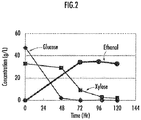
- an enzymatically saccharified liquid derived from rice straw treated with 26 mass% ammonia was used as a medium.
- a liquid culture of the strain BP-01963 was added to the medium to an OD 600 of 2.0 and cultured at a temperature of 30°C for 120 hours.
- the enzymatically saccharified liquid derived from rice straw treated with ammonia contained 73.8 g/L of glucose and 28.3 g/L of xylose and pH thereof was pH 6.
- the medium was collected at predetermined time points and the concentration of xylose was measured by HPLC (manufactured by Tosoh Corporation, trade name: LC-8020) and the concentration of ethanol by GC-FID (manufactured by GL Sciences Inc., trade name: GC390B). The result is shown in FIG. 2 .
Landscapes
- Life Sciences & Earth Sciences (AREA)
- Health & Medical Sciences (AREA)
- Engineering & Computer Science (AREA)
- Genetics & Genomics (AREA)
- Chemical & Material Sciences (AREA)
- Organic Chemistry (AREA)
- Wood Science & Technology (AREA)
- Zoology (AREA)
- Bioinformatics & Cheminformatics (AREA)
- Biotechnology (AREA)
- General Engineering & Computer Science (AREA)
- Biomedical Technology (AREA)
- General Health & Medical Sciences (AREA)
- Microbiology (AREA)
- Biochemistry (AREA)
- Mycology (AREA)
- Molecular Biology (AREA)
- Plant Pathology (AREA)
- Physics & Mathematics (AREA)
- Biophysics (AREA)
- Tropical Medicine & Parasitology (AREA)
- Botany (AREA)
- Medicinal Chemistry (AREA)
- Virology (AREA)
- Chemical Kinetics & Catalysis (AREA)
- Cell Biology (AREA)
- General Chemical & Material Sciences (AREA)
- Micro-Organisms Or Cultivation Processes Thereof (AREA)
- Preparation Of Compounds By Using Micro-Organisms (AREA)
Applications Claiming Priority (1)
| Application Number | Priority Date | Filing Date | Title |
|---|---|---|---|
| PCT/JP2014/082332 WO2016088275A1 (ja) | 2014-12-05 | 2014-12-05 | 高効率エタノール発酵菌 |
Publications (3)
| Publication Number | Publication Date |
|---|---|
| EP3228698A1 true EP3228698A1 (de) | 2017-10-11 |
| EP3228698A4 EP3228698A4 (de) | 2018-05-23 |
| EP3228698B1 EP3228698B1 (de) | 2019-08-14 |
Family
ID=56091246
Family Applications (1)
| Application Number | Title | Priority Date | Filing Date |
|---|---|---|---|
| EP14907566.5A Not-in-force EP3228698B1 (de) | 2014-12-05 | 2014-12-05 | Hocheffiziente ethanolfermentierungsbakterien |
Country Status (6)
| Country | Link |
|---|---|
| US (1) | US10059965B2 (de) |
| EP (1) | EP3228698B1 (de) |
| JP (1) | JP6145583B2 (de) |
| CN (1) | CN107429219B (de) |
| BR (1) | BR112017010660A2 (de) |
| WO (1) | WO2016088275A1 (de) |
Families Citing this family (2)
| Publication number | Priority date | Publication date | Assignee | Title |
|---|---|---|---|---|
| BR112017011495A2 (pt) * | 2014-12-05 | 2018-04-10 | Honda Motor Co Ltd | levedura fermentativa em etanol altamente eficiente e seu uso |
| JP7365770B2 (ja) * | 2019-01-28 | 2023-10-20 | Eneos株式会社 | キシリトールの蓄積を抑制した酵母 |
Family Cites Families (7)
| Publication number | Priority date | Publication date | Assignee | Title |
|---|---|---|---|---|
| CN1065915C (zh) * | 1991-03-18 | 2001-05-16 | 佛罗里达大学 | 通过重组宿主生产乙醇 |
| WO2007143245A2 (en) | 2006-06-01 | 2007-12-13 | Midwest Research Institute | An l-arabinose fermenting yeast |
| JP5321320B2 (ja) * | 2009-07-27 | 2013-10-23 | 株式会社豊田中央研究所 | 発酵能力が向上された酵母及びその利用 |
| JP5804327B2 (ja) * | 2009-11-30 | 2015-11-04 | 国立大学法人神戸大学 | バイオマスからのエタノールの生産方法 |
| JP2011193788A (ja) * | 2010-03-19 | 2011-10-06 | Toyota Central R&D Labs Inc | 発酵能力が向上された酵母及びその利用 |
| JP2012170422A (ja) | 2011-02-23 | 2012-09-10 | Kyoto Institute Of Technology | キシローストランスポーター活性を有する新規タンパク質および当該タンパク質をコードするポリヌクレオチド、並びにそれらの利用 |
| US9890398B2 (en) * | 2011-10-24 | 2018-02-13 | Toyota Jidosha Kabushiki Kaisha | Method for producing ethanol using recombinant yeast |
-
2014
- 2014-12-05 EP EP14907566.5A patent/EP3228698B1/de not_active Not-in-force
- 2014-12-05 US US15/532,814 patent/US10059965B2/en not_active Expired - Fee Related
- 2014-12-05 JP JP2016562191A patent/JP6145583B2/ja not_active Expired - Fee Related
- 2014-12-05 WO PCT/JP2014/082332 patent/WO2016088275A1/ja not_active Ceased
- 2014-12-05 CN CN201480083840.7A patent/CN107429219B/zh not_active Expired - Fee Related
- 2014-12-05 BR BR112017010660A patent/BR112017010660A2/pt not_active Application Discontinuation
Also Published As
| Publication number | Publication date |
|---|---|
| JPWO2016088275A1 (ja) | 2017-05-25 |
| US20170369906A1 (en) | 2017-12-28 |
| CN107429219B (zh) | 2020-08-25 |
| CN107429219A (zh) | 2017-12-01 |
| WO2016088275A1 (ja) | 2016-06-09 |
| US10059965B2 (en) | 2018-08-28 |
| EP3228698A4 (de) | 2018-05-23 |
| EP3228698B1 (de) | 2019-08-14 |
| JP6145583B2 (ja) | 2017-06-14 |
| BR112017010660A2 (pt) | 2017-12-26 |
Similar Documents
| Publication | Publication Date | Title |
|---|---|---|
| BR112015019777B1 (pt) | Método para produzir etanol com o uso de saccharomyces cerevisiae recombinante | |
| EP3228697B1 (de) | Hocheffiziente ethanolfermentierungsbakterien | |
| EP3228698B1 (de) | Hocheffiziente ethanolfermentierungsbakterien | |
| CN103180451B (zh) | 使用重组酵母的乙醇的制造方法 | |
| EP3228700B1 (de) | Hocheffiziente ethanolfermentierungsbakterien | |
| EP3228699B1 (de) | Hocheffiziente ethanolfermentierungsbakterien | |
| US10125379B2 (en) | Highly efficient ethanol-fermentative yeast | |
| US20160122784A1 (en) | Recombinant yeast and method for producing ethanol using the same | |
| JP6249391B2 (ja) | キシロースを高温で発酵する方法 |
Legal Events
| Date | Code | Title | Description |
|---|---|---|---|
| STAA | Information on the status of an ep patent application or granted ep patent |
Free format text: STATUS: THE INTERNATIONAL PUBLICATION HAS BEEN MADE |
|
| PUAI | Public reference made under article 153(3) epc to a published international application that has entered the european phase |
Free format text: ORIGINAL CODE: 0009012 |
|
| STAA | Information on the status of an ep patent application or granted ep patent |
Free format text: STATUS: REQUEST FOR EXAMINATION WAS MADE |
|
| 17P | Request for examination filed |
Effective date: 20170503 |
|
| AK | Designated contracting states |
Kind code of ref document: A1 Designated state(s): AL AT BE BG CH CY CZ DE DK EE ES FI FR GB GR HR HU IE IS IT LI LT LU LV MC MK MT NL NO PL PT RO RS SE SI SK SM TR |
|
| AX | Request for extension of the european patent |
Extension state: BA ME |
|
| DAX | Request for extension of the european patent (deleted) | ||
| A4 | Supplementary search report drawn up and despatched |
Effective date: 20180424 |
|
| RIC1 | Information provided on ipc code assigned before grant |
Ipc: C12R 1/84 20060101ALI20180418BHEP Ipc: C12N 15/09 20060101ALI20180418BHEP Ipc: C12P 7/06 20060101ALI20180418BHEP Ipc: C12N 1/15 20060101AFI20180418BHEP |
|
| GRAP | Despatch of communication of intention to grant a patent |
Free format text: ORIGINAL CODE: EPIDOSNIGR1 |
|
| STAA | Information on the status of an ep patent application or granted ep patent |
Free format text: STATUS: GRANT OF PATENT IS INTENDED |
|
| INTG | Intention to grant announced |
Effective date: 20190327 |
|
| GRAS | Grant fee paid |
Free format text: ORIGINAL CODE: EPIDOSNIGR3 |
|
| GRAA | (expected) grant |
Free format text: ORIGINAL CODE: 0009210 |
|
| STAA | Information on the status of an ep patent application or granted ep patent |
Free format text: STATUS: THE PATENT HAS BEEN GRANTED |
|
| AK | Designated contracting states |
Kind code of ref document: B1 Designated state(s): AL AT BE BG CH CY CZ DE DK EE ES FI FR GB GR HR HU IE IS IT LI LT LU LV MC MK MT NL NO PL PT RO RS SE SI SK SM TR |
|
| REG | Reference to a national code |
Ref country code: GB Ref legal event code: FG4D |
|
| REG | Reference to a national code |
Ref country code: CH Ref legal event code: EP Ref country code: AT Ref legal event code: REF Ref document number: 1167047 Country of ref document: AT Kind code of ref document: T Effective date: 20190815 |
|
| REG | Reference to a national code |
Ref country code: IE Ref legal event code: FG4D |
|
| REG | Reference to a national code |
Ref country code: DE Ref legal event code: R096 Ref document number: 602014051994 Country of ref document: DE |
|
| REG | Reference to a national code |
Ref country code: NL Ref legal event code: MP Effective date: 20190814 |
|
| REG | Reference to a national code |
Ref country code: LT Ref legal event code: MG4D |
|
| PG25 | Lapsed in a contracting state [announced via postgrant information from national office to epo] |
Ref country code: FI Free format text: LAPSE BECAUSE OF FAILURE TO SUBMIT A TRANSLATION OF THE DESCRIPTION OR TO PAY THE FEE WITHIN THE PRESCRIBED TIME-LIMIT Effective date: 20190814 Ref country code: LT Free format text: LAPSE BECAUSE OF FAILURE TO SUBMIT A TRANSLATION OF THE DESCRIPTION OR TO PAY THE FEE WITHIN THE PRESCRIBED TIME-LIMIT Effective date: 20190814 Ref country code: NL Free format text: LAPSE BECAUSE OF FAILURE TO SUBMIT A TRANSLATION OF THE DESCRIPTION OR TO PAY THE FEE WITHIN THE PRESCRIBED TIME-LIMIT Effective date: 20190814 Ref country code: BG Free format text: LAPSE BECAUSE OF FAILURE TO SUBMIT A TRANSLATION OF THE DESCRIPTION OR TO PAY THE FEE WITHIN THE PRESCRIBED TIME-LIMIT Effective date: 20191114 Ref country code: PT Free format text: LAPSE BECAUSE OF FAILURE TO SUBMIT A TRANSLATION OF THE DESCRIPTION OR TO PAY THE FEE WITHIN THE PRESCRIBED TIME-LIMIT Effective date: 20191216 Ref country code: NO Free format text: LAPSE BECAUSE OF FAILURE TO SUBMIT A TRANSLATION OF THE DESCRIPTION OR TO PAY THE FEE WITHIN THE PRESCRIBED TIME-LIMIT Effective date: 20191114 Ref country code: HR Free format text: LAPSE BECAUSE OF FAILURE TO SUBMIT A TRANSLATION OF THE DESCRIPTION OR TO PAY THE FEE WITHIN THE PRESCRIBED TIME-LIMIT Effective date: 20190814 Ref country code: SE Free format text: LAPSE BECAUSE OF FAILURE TO SUBMIT A TRANSLATION OF THE DESCRIPTION OR TO PAY THE FEE WITHIN THE PRESCRIBED TIME-LIMIT Effective date: 20190814 |
|
| REG | Reference to a national code |
Ref country code: AT Ref legal event code: MK05 Ref document number: 1167047 Country of ref document: AT Kind code of ref document: T Effective date: 20190814 |
|
| PG25 | Lapsed in a contracting state [announced via postgrant information from national office to epo] |
Ref country code: RS Free format text: LAPSE BECAUSE OF FAILURE TO SUBMIT A TRANSLATION OF THE DESCRIPTION OR TO PAY THE FEE WITHIN THE PRESCRIBED TIME-LIMIT Effective date: 20190814 Ref country code: IS Free format text: LAPSE BECAUSE OF FAILURE TO SUBMIT A TRANSLATION OF THE DESCRIPTION OR TO PAY THE FEE WITHIN THE PRESCRIBED TIME-LIMIT Effective date: 20191214 Ref country code: ES Free format text: LAPSE BECAUSE OF FAILURE TO SUBMIT A TRANSLATION OF THE DESCRIPTION OR TO PAY THE FEE WITHIN THE PRESCRIBED TIME-LIMIT Effective date: 20190814 Ref country code: GR Free format text: LAPSE BECAUSE OF FAILURE TO SUBMIT A TRANSLATION OF THE DESCRIPTION OR TO PAY THE FEE WITHIN THE PRESCRIBED TIME-LIMIT Effective date: 20191115 Ref country code: LV Free format text: LAPSE BECAUSE OF FAILURE TO SUBMIT A TRANSLATION OF THE DESCRIPTION OR TO PAY THE FEE WITHIN THE PRESCRIBED TIME-LIMIT Effective date: 20190814 Ref country code: AL Free format text: LAPSE BECAUSE OF FAILURE TO SUBMIT A TRANSLATION OF THE DESCRIPTION OR TO PAY THE FEE WITHIN THE PRESCRIBED TIME-LIMIT Effective date: 20190814 |
|
| PG25 | Lapsed in a contracting state [announced via postgrant information from national office to epo] |
Ref country code: TR Free format text: LAPSE BECAUSE OF FAILURE TO SUBMIT A TRANSLATION OF THE DESCRIPTION OR TO PAY THE FEE WITHIN THE PRESCRIBED TIME-LIMIT Effective date: 20190814 |
|
| PG25 | Lapsed in a contracting state [announced via postgrant information from national office to epo] |
Ref country code: EE Free format text: LAPSE BECAUSE OF FAILURE TO SUBMIT A TRANSLATION OF THE DESCRIPTION OR TO PAY THE FEE WITHIN THE PRESCRIBED TIME-LIMIT Effective date: 20190814 Ref country code: PL Free format text: LAPSE BECAUSE OF FAILURE TO SUBMIT A TRANSLATION OF THE DESCRIPTION OR TO PAY THE FEE WITHIN THE PRESCRIBED TIME-LIMIT Effective date: 20190814 Ref country code: IT Free format text: LAPSE BECAUSE OF FAILURE TO SUBMIT A TRANSLATION OF THE DESCRIPTION OR TO PAY THE FEE WITHIN THE PRESCRIBED TIME-LIMIT Effective date: 20190814 Ref country code: AT Free format text: LAPSE BECAUSE OF FAILURE TO SUBMIT A TRANSLATION OF THE DESCRIPTION OR TO PAY THE FEE WITHIN THE PRESCRIBED TIME-LIMIT Effective date: 20190814 Ref country code: DK Free format text: LAPSE BECAUSE OF FAILURE TO SUBMIT A TRANSLATION OF THE DESCRIPTION OR TO PAY THE FEE WITHIN THE PRESCRIBED TIME-LIMIT Effective date: 20190814 Ref country code: RO Free format text: LAPSE BECAUSE OF FAILURE TO SUBMIT A TRANSLATION OF THE DESCRIPTION OR TO PAY THE FEE WITHIN THE PRESCRIBED TIME-LIMIT Effective date: 20190814 |
|
| PG25 | Lapsed in a contracting state [announced via postgrant information from national office to epo] |
Ref country code: SK Free format text: LAPSE BECAUSE OF FAILURE TO SUBMIT A TRANSLATION OF THE DESCRIPTION OR TO PAY THE FEE WITHIN THE PRESCRIBED TIME-LIMIT Effective date: 20190814 Ref country code: CZ Free format text: LAPSE BECAUSE OF FAILURE TO SUBMIT A TRANSLATION OF THE DESCRIPTION OR TO PAY THE FEE WITHIN THE PRESCRIBED TIME-LIMIT Effective date: 20190814 Ref country code: IS Free format text: LAPSE BECAUSE OF FAILURE TO SUBMIT A TRANSLATION OF THE DESCRIPTION OR TO PAY THE FEE WITHIN THE PRESCRIBED TIME-LIMIT Effective date: 20200224 Ref country code: SM Free format text: LAPSE BECAUSE OF FAILURE TO SUBMIT A TRANSLATION OF THE DESCRIPTION OR TO PAY THE FEE WITHIN THE PRESCRIBED TIME-LIMIT Effective date: 20190814 |
|
| REG | Reference to a national code |
Ref country code: DE Ref legal event code: R097 Ref document number: 602014051994 Country of ref document: DE |
|
| PLBE | No opposition filed within time limit |
Free format text: ORIGINAL CODE: 0009261 |
|
| STAA | Information on the status of an ep patent application or granted ep patent |
Free format text: STATUS: NO OPPOSITION FILED WITHIN TIME LIMIT |
|
| PG2D | Information on lapse in contracting state deleted |
Ref country code: IS |
|
| REG | Reference to a national code |
Ref country code: CH Ref legal event code: PL |
|
| 26N | No opposition filed |
Effective date: 20200603 |
|
| REG | Reference to a national code |
Ref country code: BE Ref legal event code: MM Effective date: 20191231 |
|
| PG25 | Lapsed in a contracting state [announced via postgrant information from national office to epo] |
Ref country code: MC Free format text: LAPSE BECAUSE OF FAILURE TO SUBMIT A TRANSLATION OF THE DESCRIPTION OR TO PAY THE FEE WITHIN THE PRESCRIBED TIME-LIMIT Effective date: 20190814 Ref country code: SI Free format text: LAPSE BECAUSE OF FAILURE TO SUBMIT A TRANSLATION OF THE DESCRIPTION OR TO PAY THE FEE WITHIN THE PRESCRIBED TIME-LIMIT Effective date: 20190814 |
|
| GBPC | Gb: european patent ceased through non-payment of renewal fee |
Effective date: 20191205 |
|
| PG25 | Lapsed in a contracting state [announced via postgrant information from national office to epo] |
Ref country code: IE Free format text: LAPSE BECAUSE OF NON-PAYMENT OF DUE FEES Effective date: 20191205 Ref country code: LU Free format text: LAPSE BECAUSE OF NON-PAYMENT OF DUE FEES Effective date: 20191205 Ref country code: GB Free format text: LAPSE BECAUSE OF NON-PAYMENT OF DUE FEES Effective date: 20191205 |
|
| PG25 | Lapsed in a contracting state [announced via postgrant information from national office to epo] |
Ref country code: BE Free format text: LAPSE BECAUSE OF NON-PAYMENT OF DUE FEES Effective date: 20191231 Ref country code: CH Free format text: LAPSE BECAUSE OF NON-PAYMENT OF DUE FEES Effective date: 20191231 Ref country code: LI Free format text: LAPSE BECAUSE OF NON-PAYMENT OF DUE FEES Effective date: 20191231 |
|
| PG25 | Lapsed in a contracting state [announced via postgrant information from national office to epo] |
Ref country code: CY Free format text: LAPSE BECAUSE OF FAILURE TO SUBMIT A TRANSLATION OF THE DESCRIPTION OR TO PAY THE FEE WITHIN THE PRESCRIBED TIME-LIMIT Effective date: 20190814 |
|
| PG25 | Lapsed in a contracting state [announced via postgrant information from national office to epo] |
Ref country code: MT Free format text: LAPSE BECAUSE OF FAILURE TO SUBMIT A TRANSLATION OF THE DESCRIPTION OR TO PAY THE FEE WITHIN THE PRESCRIBED TIME-LIMIT Effective date: 20190814 Ref country code: HU Free format text: LAPSE BECAUSE OF FAILURE TO SUBMIT A TRANSLATION OF THE DESCRIPTION OR TO PAY THE FEE WITHIN THE PRESCRIBED TIME-LIMIT; INVALID AB INITIO Effective date: 20141205 |
|
| PGFP | Annual fee paid to national office [announced via postgrant information from national office to epo] |
Ref country code: DE Payment date: 20211012 Year of fee payment: 8 Ref country code: FR Payment date: 20211109 Year of fee payment: 8 |
|
| PG25 | Lapsed in a contracting state [announced via postgrant information from national office to epo] |
Ref country code: MK Free format text: LAPSE BECAUSE OF FAILURE TO SUBMIT A TRANSLATION OF THE DESCRIPTION OR TO PAY THE FEE WITHIN THE PRESCRIBED TIME-LIMIT Effective date: 20190814 |
|
| REG | Reference to a national code |
Ref country code: DE Ref legal event code: R119 Ref document number: 602014051994 Country of ref document: DE |
|
| PG25 | Lapsed in a contracting state [announced via postgrant information from national office to epo] |
Ref country code: DE Free format text: LAPSE BECAUSE OF NON-PAYMENT OF DUE FEES Effective date: 20230701 |
|
| PG25 | Lapsed in a contracting state [announced via postgrant information from national office to epo] |
Ref country code: FR Free format text: LAPSE BECAUSE OF NON-PAYMENT OF DUE FEES Effective date: 20221231 |