EP3230860B1 - Technologien zur effizienten synchronisation von barrieren mit work-stealing-unterstützung - Google Patents
Technologien zur effizienten synchronisation von barrieren mit work-stealing-unterstützung Download PDFInfo
- Publication number
- EP3230860B1 EP3230860B1 EP15866755.0A EP15866755A EP3230860B1 EP 3230860 B1 EP3230860 B1 EP 3230860B1 EP 15866755 A EP15866755 A EP 15866755A EP 3230860 B1 EP3230860 B1 EP 3230860B1
- Authority
- EP
- European Patent Office
- Prior art keywords
- thread
- task
- flag
- response
- team
- Prior art date
- Legal status (The legal status is an assumption and is not a legal conclusion. Google has not performed a legal analysis and makes no representation as to the accuracy of the status listed.)
- Active
Links
Images



Classifications
-
- G—PHYSICS
- G06—COMPUTING OR CALCULATING; COUNTING
- G06F—ELECTRIC DIGITAL DATA PROCESSING
- G06F9/00—Arrangements for program control, e.g. control units
- G06F9/06—Arrangements for program control, e.g. control units using stored programs, i.e. using an internal store of processing equipment to receive or retain programs
- G06F9/46—Multiprogramming arrangements
- G06F9/52—Program synchronisation; Mutual exclusion, e.g. by means of semaphores
- G06F9/522—Barrier synchronisation
-
- G—PHYSICS
- G06—COMPUTING OR CALCULATING; COUNTING
- G06F—ELECTRIC DIGITAL DATA PROCESSING
- G06F9/00—Arrangements for program control, e.g. control units
- G06F9/06—Arrangements for program control, e.g. control units using stored programs, i.e. using an internal store of processing equipment to receive or retain programs
- G06F9/46—Multiprogramming arrangements
- G06F9/48—Program initiating; Program switching, e.g. by interrupt
-
- G—PHYSICS
- G06—COMPUTING OR CALCULATING; COUNTING
- G06F—ELECTRIC DIGITAL DATA PROCESSING
- G06F9/00—Arrangements for program control, e.g. control units
- G06F9/06—Arrangements for program control, e.g. control units using stored programs, i.e. using an internal store of processing equipment to receive or retain programs
- G06F9/30—Arrangements for executing machine instructions, e.g. instruction decode
-
- G—PHYSICS
- G06—COMPUTING OR CALCULATING; COUNTING
- G06F—ELECTRIC DIGITAL DATA PROCESSING
- G06F9/00—Arrangements for program control, e.g. control units
- G06F9/06—Arrangements for program control, e.g. control units using stored programs, i.e. using an internal store of processing equipment to receive or retain programs
- G06F9/46—Multiprogramming arrangements
- G06F9/48—Program initiating; Program switching, e.g. by interrupt
- G06F9/4806—Task transfer initiation or dispatching
- G06F9/4843—Task transfer initiation or dispatching by program, e.g. task dispatcher, supervisor, operating system
- G06F9/485—Task life-cycle, e.g. stopping, restarting, resuming execution
- G06F9/4856—Task life-cycle, e.g. stopping, restarting, resuming execution resumption being on a different machine, e.g. task migration, virtual machine migration
Definitions
- OpenMP is a popular application programming interface (API) for shared-memory parallel programming.
- API application programming interface
- OpenMP specifies a synchronization barrier feature, which may be used to coordinate multiple threads executing in a thread team. In general, all threads of the thread team must reach the barrier before execution of the program may proceed.
- OpenMP also specifies a tasking system, in which threads may create and execute tasks. All tasks must be completed before the threads may exit a synchronization barrier. Thus, tasks are often executed while threads are waiting in synchronization barriers.
- OpenMP implementations use "work-stealing,” in which a thread may "steal" tasks to execute from another thread; that is, a thread may claim a task from another thread and run the task to completion.
- OpenMP synchronization barriers are typically implemented as tree or linear barriers.
- tree barriers have a relatively longer critical path compared to non-tree barriers such as dissemination barriers.
- US 2012/304178 A1 discusses concurrent reduction optimizations for thieving schedulers including a thieving worker thread operable take a task from a first worker thread's task dequeue, the thieving worker thread and the first worker thread having same synchronization point in a program at which the thieving worker thread and the first worker thread can resume their operations.
- Nanjegowda Ramachandra Et Al "Scalability Evaluation of Barrier Algorithms for OpenMp " discusses eliminating barrier contentions to free up threads or improve work stealing. For example, as the number of threads in parallel regions steadily grows, and the memory hierarchies in the cores and parallel machines become more complex, the scalability of the implementation becomes increasingly important. OpenMP implement at ions should provide a choice of barrier implementations for different environments and architectures with complex memory hierarchies and interconnect topologies.
- references in the specification to "one embodiment,” “an embodiment,” “an illustrative embodiment,” etc., indicate that the embodiment described may include a particular feature, structure, or characteristic, but every embodiment may or may not necessarily include that particular feature, structure, or characteristic. Moreover, such phrases are not necessarily referring to the same embodiment. Further, when a particular feature, structure, or characteristic is described in connection with an embodiment, it is submitted that it is within the knowledge of one skilled in the art to effect such feature, structure, or characteristic in connection with other embodiments whether or not explicitly described.
- items included in a list in the form of "at least one A, B, and C” can mean (A); (B); (C); (A and B); (A and C); (B and C); or (A, B, and C).
- items listed in the form of "at least one of A, B, or C” can mean (A); (B); (C); (A and B); (A and C); (B and C); or (A, B, and C).
- the disclosed embodiments may be implemented, in some cases, in hardware, firmware, software, or any combination thereof.
- the disclosed embodiments may also be implemented as instructions carried by or stored on a transitory or non-transitory machine-readable (e.g., computer-readable) storage medium, which may be read and executed by one or more processors.
- a machine-readable storage medium may be embodied as any storage device, mechanism, or other physical structure for storing or transmitting information in a form readable by a machine (e.g., a volatile or non-volatile memory, a media disc, or other media device).
- an illustrative computing device 100 for efficient synchronization barriers with work stealing includes a processor 120, an I/O subsystem 122, a memory 124, and a data storage device 126.
- the computing device 100 is configured to execute a number of tasks by a group of threads organized into a thread team. Each thread is associated with a corresponding task queue and a Boolean flag. After completing all of its pending tasks, a thread may enter a synchronization barrier. Before entering the barrier, the thread atomically exchanges its flag value with false and stores the original flag value in a thread-local temporary flag variable.
- the active thread may steal a task from another thread (the "victim" thread), set the flag of the victim thread to true, and execute the victim task (i.e., the task stolen from the victim thread) to completion. Execution of the victim task may cause more tasks to be added to the active thread's queue.
- the computing device 100 performs a logical-OR reduction operation over the temporary flag variables of each of the threads to generate a reduction value.
- the reduction value indicates whether any of the threads in the thread team had their corresponding flags set to true prior to entering the barrier. In other words, the reduction value indicates whether any of the threads had a task stolen (i.e., was a victim thread) prior to entering the barrier. If the reduction value is true, the computing device 100 causes all of the threads to retry the synchronization barrier. If the reduction value is false, the computing device 100 allows all of the threads to continue execution.
- the computing device 100 may allow a non-tree barrier such as a dissemination barrier to be used compatibly with OpenMP tasking semantics.
- Non-tree barriers may improve performance compared to tree barriers.
- a computing device 100 as described herein including an Intel® Xeon PhiTM coprocessor may achieve synchronization barrier performance that is about twice as fast as conventional tree barriers.
- the techniques disclosed herein may be used for any concurrent execution environment including distributed computing environments.
- the computing device 100 may be embodied as any type of device capable of efficient execution of synchronization barriers with work stealing and otherwise performing the functions described herein.
- the computing device 100 may be embodied as, without limitation, a computer, a desktop computer, a workstation, a server computer, a distributed computing system, a multiprocessor system, a laptop computer, a notebook computer, a tablet computer, a smartphone, a mobile computing device, a wearable computing device, a consumer electronic device, a smart appliance, and/or any other computing device capable of efficient execution of synchronization barriers.
- the illustrative computing device 100 includes the processor 120, the I/O subsystem 122, the memory 124, and the data storage device 126.
- the computing device 100 may include other or additional components, such as those commonly found in a computer (e.g., various input/output devices), in other embodiments. Additionally, in some embodiments, one or more of the illustrative components may be incorporated in, or otherwise form a portion of, another component. For example, the memory 124, or portions thereof, may be incorporated in the processor 120 in some embodiments.
- the processor 120 may be embodied as any type of processor capable of performing the functions described herein.
- the processor 120 may be embodied as a single or multi-core processor(s), coprocessor(s), digital signal processor, microcontroller, or other processor or processing/controlling circuit.
- the memory 124 may be embodied as any type of volatile or non-volatile memory or data storage capable of performing the functions described herein. In operation, the memory 124 may store various data and software used during operation of the computing device 100 such operating systems, applications, programs, libraries, and drivers.
- the memory 124 is communicatively coupled to the processor 120 via the I/O subsystem 122, which may be embodied as circuitry and/or components to facilitate input/output operations with the processor 120, the memory 124, and other components of the computing device 100.
- the I/O subsystem 122 may be embodied as, or otherwise include, memory controller hubs, input/output control hubs, firmware devices, communication links (i.e., point-to-point links, bus links, wires, cables, light guides, printed circuit board traces, etc.) and/or other components and subsystems to facilitate the input/output operations.
- the I/O subsystem 122 may form a portion of a system-on-a-chip (SoC) and be incorporated, along with the processor 120, the memory 124, and other components of the computing device 100, on a single integrated circuit chip.
- SoC system-on-a-chip
- the data storage device 126 may be embodied as any type of device or devices configured for short-term or long-term storage of data such as, for example, memory devices and circuits, memory cards, hard disk drives, solid-state drives, or other data storage devices.
- the computing device 100 may also include a communication subsystem 128, which may be embodied as any communication circuit, device, or collection thereof, capable of enabling communications between the computing device 100 and other remote devices over a computer network (not shown).
- the communication subsystem 128 may be configured to use any one or more communication technology (e.g., wired or wireless communications) and associated protocols (e.g., Ethernet, Bluetooth®, Wi-Fi®, WiMAX, etc.) to effect such communication.
- the computing device 100 establishes an environment 200 during operation.
- the illustrative embodiment 200 includes a transactional barrier module 202, a basic barrier module 204, a reduction module 206, a task execution module 208, a task stealing module 210, and a threading module 212.
- the various modules of the environment 200 may be embodied as hardware, firmware, software, or a combination thereof.
- the various modules, logic, and other components of the environment 200 may form a portion of, or otherwise be established by, the processor 120 or other hardware components of the computing device 100.
- one or more of the modules of the environment 200 may be embodied as a circuit (e.g., a synchronization barrier circuit, a reduction circuit, etc.).
- the threading module 212 is configured to create, execute, and otherwise manage a thread team 214 and one or more threads 216.
- the thread team 214 may be embodied as a collection of threads 216 that may be used to execute a particular group of tasks or other computing problem.
- Each of the threads 216 may be embodied as an operating system thread, managed executable thread, application thread, worker thread, lightweight thread, or other executable program.
- the threads 216 may share a common memory space but may also access thread-local storage, private variables, or other data that is not shared by multiple threads 216.
- Each thread 216 maintains a task queue 218 and a flag 220.
- the task queue 218 includes a list of executable tasks to be performed by the thread 216.
- each thread 216 may execute tasks from its own task queue 218, or may steal tasks from the task queue 218 of a different thread 216 and execute the stolen tasks.
- the flag 220 includes a Boolean value (e.g., true or false) that may be set if another thread 216 has stolen a task from the task queue 218.
- a distinct task queue 218 and/or flag 220 may be stored for each thread 216, for example in a thread control structure or in thread-local storage.
- the illustrative embodiment 200 includes a single thread team 214 having two threads 216a, 216b, it should be understood that in some embodiments the environment 200 may include multiple thread teams 214, and each thread team 214 may have multiple threads 216.
- the transactional barrier module 202 is configured to atomically exchange the flag 220 of the thread 216 with false and store the original value of the flag 220 in a thread-local temporary flag variable.
- the transactional barrier module 202 is configured to enter a basic synchronization barrier after exchanging the flag 220 and storing the temporary flag variable, using the basic barrier module 204.
- the reduction module 206 generates a reduction value over the temporary flag variables of all of the threads 216 of the thread team 214.
- the transactional barrier module 202 is further configured to determine whether the reduction value is true and, if true, cause the thread 216 to retry exchanging the flag 220 and re-entering the basic synchronization barrier. That is, if the reduction value is true, transactional barrier module 202 is configured to repeat atomically exchanging the flag 220 of the thread 216 with false and storing the original value of the flag 220 in a thread-local temporary flag variable.
- the reduction module 206 is configured to perform a logical "OR" reduction over the temporary flag variables of each of the threads 216 of the thread team 214 during execution of the basic synchronization barrier. In other words, reduction module 206 is configured to perform a logical OR operation on all of the locally stored flag values for each thread 216 and distribute the resulting reduction value to each of the threads 216.
- the reduction module 206 may use any algorithm for performing the reduction, including performing a non-tree based algorithm such as a dissemination barrier algorithm or a K-radix barrier algorithm.
- the task execution module 208 is configured to pop tasks from the task queue 218 of a thread 216 and run those tasks to completion. The task execution module 208 may pop the first task from the task queue 218 or otherwise schedule tasks from the task queue 218.
- the task execution module 208 is also configured to determine whether the task queue 218 is empty prior to entering the synchronization barrier, and to enter the synchronization barrier in response to determining the task queue 218 is empty.
- the task execution module 208 is configured to leave the transactional barrier after exiting the basic synchronization barrier if the reduction value is false (i.e., if no further tasks were stolen from any threads 216 of the thread team 214).
- the task stealing module 210 is configured to atomically steal a task from a victim thread 216 when a thread 216 is waiting in the synchronization barrier, and to set the flag 220 of the victim thread 216 to true in response to stealing the task. In some embodiments, as an optimization the task stealing module 210 may only set the flag 220 of the victim thread 216 to true if the flag 220 of the active thread 216 is not true (e.g., false). The task stealing module 210 may identify the victim thread 216 randomly, determine whether the task queue 218 of the victim thread 216 is empty, and, if not empty, pop a task from the task queue 218 of the victim thread 216. The task stealing module 210 may execute the victim task to completion, and after completing the victim task, execute any tasks that have been added to the task queue 218 of the active thread 216.
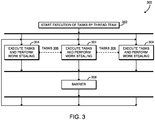
- the computing device 100 may execute a method 300 for parallel task execution and work stealing.
- the method 300 begins in block 302, in which the computing device 100 starts execution of a group of tasks by the thread team 214. Execution of the tasks may be started, for example, by a master thread or other control entity of the computing device 100. After starting execution of tasks, the method 300 proceeds in parallel to the blocks 304.
- the computing device 100 executes tasks in parallel using the threads 216 and performs work stealing.
- each of the threads 216 may execute tasks from its task queue 218 in parallel with the other threads 216.
- the illustrative method 300 shows three blocks 304, executed in parallel by three threads 216. Of course, other embodiments may include fewer or additional blocks 304 executed by corresponding threads 216.
- tasks 306 may be transferred between the threads 216 during execution of the blocks 304. For example, a thread 216a may steal a task from the task queue 218 of a different thread 216b and then execute that stolen task.
- each thread 216 may enter the synchronization barrier 308 after it has completed executing all of the tasks in its task queue 218.
- the threads 216 wait within the transactional synchronization barrier 308 until all of the tasks to be executed by the thread team 214 have been run to completion.
- threads 216 waiting in the synchronization barrier 308 may steal tasks 306 from threads 216 that are still executing within the blocks 304.
- the method 300 loops back to the blocks 304 to continue executing tasks in parallel and performing work stealing.
- the computing device 100 may execute a method 400 for executing a synchronization barrier.
- An instance of the method 400 may be executed by each of the threads 216 of the thread team 214, for example during execution of the method 300 of FIG. 3 .
- the method 400 begins in block 402, in which the computing device 100, in a thread 216a, pops a task from the task queue 218 of the thread 216a.
- the task queue 218 may be embodied as any queue, doubly-ended queue, list, array, buffer, or other data structure used to store tasks to be executed by the thread 216a.
- the task queue 218 may be stored in thread-local storage or other storage associated with the thread 216a. In some embodiments, the task queue 218 may be accessible to other threads 216.
- the computing device 100 runs the task to completion using the thread 216a. After completing the task, in block 406, the computing device 100 determines whether the task queue 218 of the thread 216a is empty. If not, the method 400 loops back to block 402 to continue executing tasks from the task queue 218. If the task queue 218 is empty, the method 400 advances to block 408.
- the computing device 100 uses the thread 216a, exchanges the flag 220 with the Boolean "false" value and locally stores the previous value of the flag 220.
- the previous value of the flag 220 may be stored in a private variable of the thread 216a or otherwise stored in thread-local storage of the thread 216a.
- the computing device 100 may exchange and locally store the flag value using one or more atomic operations.
- the computing device 100 may instead use non-atomic operations protected by a lock on the task queue 218 or other synchronization mechanism.
- the computing device 100 enters a basic synchronization barrier using the thread 216a.
- the basic synchronization barrier may be embodied as any type of synchronization barrier, including a tree barrier, a linear barrier, or a non-tree barrier such as a dissemination barrier.
- the basic synchronization barrier may be embodied as a K-radix synchronization barrier such as the barrier described in the co-pending U.S. patent application serial no. XX/XXX,XXX, entitled "Technologies for Fast Synchronization Barriers for Many-Core Processing.”
- the computing device 100 performs a logical "OR" reduction operation over the locally stored flag value.
- the computing device 100 performs a logical OR operation on all of the locally stored flag values for each thread 216 and distributes the resulting reduction value to each of the threads 216.
- the reduction value is indicative of whether any of the threads 216 had a task stolen prior to entering the synchronization barrier. In other words, the reduction value is true if the flag 220 of any of the threads 216 was true prior to the corresponding thread 216 entering the synchronization barrier.
- the computing device 100 may steal one or more tasks from another thread 216b (the "victim" thread 216b) and set the flag 220 of the victim thread 216b to true.
- the work-stealing process is further described below in connection with FIG. 5 .
- the computing device 100 in the thread 216a exits the basic synchronization barrier.
- the thread 216a may exit the synchronization barrier in response to all other threads 216 of the thread team 214 entering the synchronization barrier.
- the reduction value may be determined upon exiting the synchronization barrier.
- the computing device 100 in the thread 216a determines the reduction value, which is the result of the reduce-all logical OR operation described above in connection with block 412. As described above, if true, then one or more tasks were stolen from a thread 216 prior to that thread 216 entering the synchronization barrier and thus those tasks may still be in flight. In block 420, the computing device 100 determines whether the reduction value is true or false. If true, the method 400 loops back to block 408 to retry exchanging the flag 220 and then entering the barrier. If the reduction value is false, then the method 400 is completed. In other words, the computing device 100 determines whether the synchronization barrier completes without any tasks being stolen from a thread 216 and, if not, retries the synchronization barrier. Thus, the synchronization barrier operation performed by the computing device 100 during execution of the method 400 may be known as a transactional synchronization barrier or a transactional barrier.
- the computing device 100 may execute a method 500 for work stealing.
- the method 500 may be executed by the computing device 100 using a thread 216a while the thread 216a is waiting within a synchronization barrier, as described above in connection with block 414 of FIG. 4 .
- the method 500 begins in block 502, in which the computing device 100, in the thread 216a, determines whether to exit the basic synchronization barrier. As described above in connection with block 416 of FIG. 4 , the thread 216a may exit the synchronization barrier in response to all other threads 216 of the thread team 214 entering the synchronization barrier. If the computing device 100 determines to exit the synchronization barrier, the method 500 is completed. If the computing device 100 determines not to exit the synchronization barrier (i.e., the thread 216a is waiting within the synchronization barrier), the method 500 advances to block 504.
- the computing device 100 determines a random victim thread 216b. For example, the computing device 100 may randomly select a thread identifier or otherwise randomly select the victim thread 216b from the threads 216 of the thread team 214.
- the computing device 100 using the thread 216a determines whether the task queue 218 of the victim thread 216b is empty. If empty, the method 500 loops back to block 504 to select another victim thread 216b. If the task queue 218 of the victim thread 216b is not empty, the method 500 advances to block 508.
- the computing device 100 performs operations atomically in the thread 216a.
- the computing device 100 performs the operations described below in connection with blocks 510-512 atomically.
- the computing device 100 may, for example, execute one or more atomic instructions or other atomic operations.
- the computing device 100 may instead use non-atomic operations protected by a lock on the task queue 218 of the victim thread 216b or other synchronization mechanism.
- the computing device 100 in the thread 216a pops a task from the task queue 218 of the victim thread 216b. In some embodiments, after popping the task, the method 500 may proceed to block 512. In embodiments that do not include the block 512, the method 500 may proceed directly to block 514, described below.
- the computing device 100 in the thread 216a determines whether the flag 220 of the thread 216a is true. If true, then the method 500 exits the atomic operation of the block 508 and proceeds to block 516, described below. If the flag 220 is false, the method 500 proceeds to the block 514, in which the computing device 100 in the thread 216a sets the flag 220 of the victim thread 216b to true.
- Checking whether the flag 220 is true in block 512 may improve performance by skipping the block 514 when it is not needed; if the flag 220 is already true, then the thread 216a can determine that the logical-OR reduction will return true without accessing the flag 220 of another thread 216b.
- the computing device 100 in the thread 216a runs the victim task to completion. That is, the computing device 100 executes the task popped from the task queue 218 of the victim thread 216b to completion.
- the computing device 100 in the thread 216a determines whether the task queue 218 of the thread 216a is empty. As described above in connection with block 406 of FIG. 4 , each thread 216 determines that its task queue 218 is empty prior to entering the synchronization barrier. However, during execution of the victim task in connection with block 516, one or more new tasks may have been created and added to the task queue 218 of the thread 216a. Thus, the thread 216a checks its own task queue 218 to determine whether any additional tasks have been added. If the task queue 218 is empty, the method 500 loops back to block 504 to continue performing work stealing. If the task queue 218 is not empty, the method 500 advances to block 520.
- the computing device 100 in the thread 216a pops a task from its task queue 218.
- the computing device 100 in the thread 216a runs the task to completion. After completing the task, the method 500 loops back to block 518 to continue executing any tasks in the task queue 218 of the thread 216a.
Landscapes
- Engineering & Computer Science (AREA)
- Software Systems (AREA)
- Theoretical Computer Science (AREA)
- Physics & Mathematics (AREA)
- General Engineering & Computer Science (AREA)
- General Physics & Mathematics (AREA)
- Debugging And Monitoring (AREA)
- Multi Processors (AREA)
Claims (11)
- Computervorrichtung (100) für mehrfädige (Multithread-) Ausführung, wobei die Computervorrichtung umfasst:ein Transaktionsbarrieremodul (202) zum:Austauschen, durch einen ersten Programmfaden (Thread) (216) einer Thread-Gruppe (214), der von der Computervorrichtung ausgeführt wird, eines Wertes eines "Aufgabe gestohlen" (Task Stolen) -Kennzeichners des ersten Threads mit "falsch" (false) und Speichern des Wertes des "Aufgabe gestohlen"-Kennzeichners in einem temporären Kennzeichner des ersten Threads, wobei der temporäre Kennzeichner lokal dem ersten Thread zugehörig ist; undEintreten (410), durch den ersten Thread nach dem Austauschen des Wertes des "Aufgabe gestohlen"-Kennzeichners, in eine Synchronisationsbarriere;ein Reduktionsmodul (206), um zu bestimmen, durch den ersten Thread, ob irgendein temporärer Kennzeichner von mehreren temporären Kennzeichnern der Thread-Gruppe bei Eintritt in die Synchronisationsbarriere "wahr" (true) war, wobei die Thread-Gruppe (214) mehrere Threads einschließlich den ersten Thread umfasst;wobei das Transaktionsbarrieremodul (202) ferner vorgesehen ist zum:Wiederholen, durch den ersten Thread, des Austauschens des Wertes des "Aufgabe gestohlen"-Kennzeichners in Reaktion auf eine Bestimmung, dass irgendein temporärer Kennzeichner der mehreren temporären Kennzeichner "wahr" war; undWarten, durch den ersten Thread, dass andere Threads der Thread-Gruppe in die Synchronisationsbarriere eintreten, in Reaktion auf das Eintreten in die Synchronisationsbarriere; undein Aufgabendiebstahl (Task Stealing)-Modul (210) zum:Stehlen, durch den ersten Thread (216), einer Aufgabe aus einem zweiten Thread (216) der Thread-Gruppe in Reaktion auf das Warten, dass die anderen Threads der Thread-Gruppe in die Synchronisationsbarriere eintreten; undSetzen, durch den ersten Thread, eines "Aufgabe gestohlen"-Kennzeichners des zweiten Threads auf "wahr" in Reaktion auf das Stehlen der Aufgabe.
- Computervorrichtung nach Anspruch 1, wobei das Bestimmen, ob irgendein temporärer Kennzeichner der mehreren temporären Kennzeichner der Thread-Gruppe "wahr" war, umfasst, in Reaktion auf das Eintreten in die Synchronisationsbarriere, eine logische ODER-Reduktionsoperation über die mehreren temporären Kennzeichner der Thread-Gruppe durchzuführen, um einen Reduktionswert für jeden Thread der Thread-Gruppe bereitzustellen.
- Computervorrichtung nach Anspruch 1, wobei das Austauschen des Wertes des "Aufgabe gestohlen"-Kennzeichners des ersten Threads mit "falsch" und Speichern des Wertes des "Aufgabe gestohlen"-Kennzeichners im temporären Kennzeichner umfasst, atomisch den Wert des "Aufgabe gestohlen"-Kennzeichners des ersten Threads mit "falsch" auszutauschen und den Wert des "Aufgabe gestohlen"-Kennzeichners im temporären Kennzeichner zu speichern.
- Computervorrichtung nach Anspruch 1, wobei das Stehlen der Aufgabe und Setzen des "Aufgabe gestohlen"-Kennzeichners des zweiten Threads umfasst, atomisch die Aufgabe zu stehlen und den "Aufgabe gestohlen"-Kennzeichner des zweiten Threads zu setzen.
- Computervorrichtung nach Anspruch 1, wobei das Stehlen der Aufgabe umfasst:Identifizieren des zweiten Threads der Thread-Gruppe; undAufklappen der Aufgabe aus einer Aufgabenwarteschlange des zweiten Threads;wobei das Aufklappen der Aufgabe und Setzen des "Aufgabe gestohlen"-Kennzeichners des zweiten Threads umfasst, atomisch die Aufgabe aufzuklappen und den "Aufgabe gestohlen"-Kennzeichner des zweiten Threads zu setzen.
- Computervorrichtung nach Anspruch 1, wobei das Stehlen der Aufgabe ferner umfasst:Ausführen, durch den ersten Thread, der Aufgabe bis zur Fertigstellung in Reaktion auf das Aufklappen der Aufgabe;Bestimmen, durch den ersten Thread, ob eine Aufgabenwarteschlange des ersten Threads leer ist, in Reaktion auf die Ausführung der Aufgabe bis zur Fertigstellung;Aufklappen, durch den ersten Thread, einer zweiten Aufgabe aus der Aufgabenwarteschlange in Reaktion auf eine Bestimmung, dass die Aufgabenwarteschlange nicht leer ist; undAusführen, durch den ersten Thread, der zweiten Aufgabe bis zur Fertigstellung in Reaktion auf das Aufklappen der zweiten Aufgabe.
- Computervorrichtung nach Anspruch 1, wobei das Aufgabendiebstahlmodul ferner vorgesehen ist zum:Bestimmen, durch den ersten Thread, ob der temporäre Kennzeichner des ersten Threads gleich "falsch" ist, in Reaktion auf das Stehlen der Aufgabe aus dem zweiten Thread;wobei das Setzen des "Aufgabe gestohlen"-Kennzeichners des zweiten Threads auf "wahr" ferner umfasst, den "Aufgabe gestohlen"-Kennzeichner des zweiten Threads auf "wahr" zu setzen, in Reaktion auf eine Bestimmung, dass der temporäre Kennzeichner gleich "falsch" ist.
- Verfahren für mehrfädige (Multithread-) Ausführung, wobei das Verfahren umfasst:Austauschen, durch einen ersten Programmfaden (Thread) einer Thread-Gruppe (214), der von einer Computervorrichtung ausgeführt wird, eines Wertes eines "Aufgabe gestohlen" (Task Stolen) -Kennzeichners des ersten Threads mit "falsch" (false) und Speichern des Wertes des "Aufgabe gestohlen"-Kennzeichners in einem temporären Kennzeichner des ersten Threads, wobei der temporäre Kennzeichner lokal dem ersten Thread zugehörig ist;Eintreten, durch den ersten Thread nach dem Austauschen des Wertes des "Aufgabe gestohlen"-Kennzeichners, in eine Synchronisationsbarriere;Bestimmen, durch den ersten Thread, ob irgendein temporärer Kennzeichner von mehreren temporären Kennzeichnern der Thread-Gruppe bei Eintritt in die Synchronisationsbarriere "wahr" (true) war, wobei die Thread-Gruppe mehrere Threads einschließlich den ersten Thread umfasst;Wiederholen, durch den ersten Thread, des Austauschens des Wertes des "Aufgabe gestohlen"-Kennzeichners in Reaktion auf das Bestimmen, dass irgendein temporärer Kennzeichner der mehreren temporären Kennzeichner "wahr" war;Warten, durch den ersten Thread, dass andere Threads der Thread-Gruppe in die Synchronisationsbarriere eintreten, in Reaktion auf das Eintreten in die Synchronisationsbarriere;Stehlen, durch den ersten Thread, einer Aufgabe aus einem zweiten Thread der Thread-Gruppe in Reaktion auf das Warten, dass die anderen Threads der Thread-Gruppe in die Synchronisationsbarriere eintreten; undSetzen, durch den ersten Thread, eines "Aufgabe gestohlen"-Kennzeichners des zweiten Threads auf "wahr" in Reaktion auf das Stehlen der Aufgabe.
- Verfahren nach Anspruch 8, wobei das Bestimmen, ob irgendein temporärer Kennzeichner der mehreren temporären Kennzeichner der Thread-Gruppe "wahr" war, umfasst, in Reaktion auf das Eintreten in die Synchronisationsbarriere, eine logische ODER-Reduktionsoperation über die mehreren temporären Kennzeichner der Thread-Gruppe durchzuführen, um einen Reduktionswert für jeden Thread der Thread-Gruppe bereitzustellen.
- Verfahren nach Anspruch 8, wobei das Stehlen der Aufgabe ferner umfasst:Ausführen, durch den ersten Thread, der Aufgabe bis zur Fertigstellung in Reaktion auf das Aufklappen der Aufgabe;Bestimmen, durch den ersten Thread, ob eine Aufgabenwarteschlange des ersten Threads leer ist, in Reaktion auf das Ausführen der Aufgabe bis zur Fertigstellung;Aufklappen, durch den ersten Thread, einer zweiten Aufgabe aus der Aufgabenwarteschlange, in Reaktion auf eine Bestimmung, dass die Aufgabenwarteschlange nicht leer ist; undAusführen, durch den ersten Thread, der zweiten Aufgabe bis zur Fertigstellung in Reaktion auf das Aufklappen der zweiten Aufgabe.
- Ein oder mehrere maschinenlesbare Speichermedien, die mehrere darauf gespeicherte Befehle umfassen, die in Reaktion auf die Ausführung bewirken, dass eine Computervorrichtung das Verfahren nach einem der Ansprüche 8-10 durchführt.
Applications Claiming Priority (2)
| Application Number | Priority Date | Filing Date | Title |
|---|---|---|---|
| US14/568,831 US9348658B1 (en) | 2014-12-12 | 2014-12-12 | Technologies for efficient synchronization barriers with work stealing support |
| PCT/US2015/060149 WO2016094016A1 (en) | 2014-12-12 | 2015-11-11 | Technologies for efficient synchronization barriers with work stealing support |
Publications (3)
| Publication Number | Publication Date |
|---|---|
| EP3230860A1 EP3230860A1 (de) | 2017-10-18 |
| EP3230860A4 EP3230860A4 (de) | 2018-08-15 |
| EP3230860B1 true EP3230860B1 (de) | 2019-10-09 |
Family
ID=55969692
Family Applications (1)
| Application Number | Title | Priority Date | Filing Date |
|---|---|---|---|
| EP15866755.0A Active EP3230860B1 (de) | 2014-12-12 | 2015-11-11 | Technologien zur effizienten synchronisation von barrieren mit work-stealing-unterstützung |
Country Status (5)
| Country | Link |
|---|---|
| US (1) | US9348658B1 (de) |
| EP (1) | EP3230860B1 (de) |
| JP (1) | JP7030514B2 (de) |
| CN (1) | CN107250984B (de) |
| WO (1) | WO2016094016A1 (de) |
Cited By (1)
| Publication number | Priority date | Publication date | Assignee | Title |
|---|---|---|---|---|
| US20230305853A1 (en) * | 2022-03-25 | 2023-09-28 | Nvidia Corporation | Application programming interface to perform operation with reusable thread |
Families Citing this family (11)
| Publication number | Priority date | Publication date | Assignee | Title |
|---|---|---|---|---|
| US10860378B2 (en) * | 2015-07-01 | 2020-12-08 | Oracle International Corporation | System and method for association aware executor service in a distributed computing environment |
| US10318355B2 (en) * | 2017-01-24 | 2019-06-11 | Oracle International Corporation | Distributed graph processing system featuring interactive remote control mechanism including task cancellation |
| GB2569269B (en) * | 2017-10-20 | 2020-07-15 | Graphcore Ltd | Synchronization in a multi-tile processing arrangement |
| US10977087B2 (en) | 2018-08-07 | 2021-04-13 | International Business Machines Corporation | Steal one-process many work-stealing |
| US10725817B2 (en) * | 2018-11-09 | 2020-07-28 | International Business Machines Corporation | Reducing spin count in work-stealing for copying garbage collection based on average object references |
| US11327793B2 (en) * | 2020-02-18 | 2022-05-10 | International Business Machines Corporation | Garbage collection work stealing mechanism |
| US11461130B2 (en) | 2020-05-26 | 2022-10-04 | Oracle International Corporation | Methodology for fast and seamless task cancelation and error handling in distributed processing of large graph data |
| KR102231050B1 (ko) * | 2020-07-08 | 2021-03-23 | 한영산업주식회사 | 신발 보강재용 부직포 |
| US11645200B2 (en) * | 2020-11-24 | 2023-05-09 | International Business Machines Corporation | Reducing load balancing work stealing |
| CN115543343B (zh) * | 2022-11-28 | 2023-04-07 | 北京大学 | 变量跨线程操作方法及装置 |
| CN116339944B (zh) * | 2023-03-14 | 2024-05-17 | 海光信息技术股份有限公司 | 任务处理方法、芯片、多芯片模块、电子设备和存储介质 |
Family Cites Families (12)
| Publication number | Priority date | Publication date | Assignee | Title |
|---|---|---|---|---|
| US6823351B1 (en) * | 2000-05-15 | 2004-11-23 | Sun Microsystems, Inc. | Work-stealing queues for parallel garbage collection |
| US6651158B2 (en) * | 2001-06-22 | 2003-11-18 | Intel Corporation | Determination of approaching instruction starvation of threads based on a plurality of conditions |
| US7512950B1 (en) * | 2003-08-14 | 2009-03-31 | Sun Microsystems, Inc. | Barrier synchronization object for multi-threaded applications |
| US7945911B1 (en) * | 2005-06-03 | 2011-05-17 | Oracle America, Inc. | Barrier synchronization method and apparatus for work-stealing threads |
| US20070143755A1 (en) * | 2005-12-16 | 2007-06-21 | Intel Corporation | Speculative execution past a barrier |
| US7865778B2 (en) * | 2007-02-20 | 2011-01-04 | International Business Machines Corporation | Method and system for detecting synchronization errors in programs |
| US8065681B2 (en) * | 2007-10-12 | 2011-11-22 | International Business Machines Corporation | Generic shared memory barrier |
| US8832712B2 (en) * | 2009-09-09 | 2014-09-09 | Ati Technologies Ulc | System and method for synchronizing threads using shared memory having different buffer portions for local and remote cores in a multi-processor system |
| US8954986B2 (en) * | 2010-12-17 | 2015-02-10 | Intel Corporation | Systems and methods for data-parallel processing |
| US20120304178A1 (en) * | 2011-05-24 | 2012-11-29 | International Business Machines Corporation | Concurrent reduction optimizations for thieving schedulers |
| US8910178B2 (en) * | 2011-08-10 | 2014-12-09 | International Business Machines Corporation | Performing a global barrier operation in a parallel computer |
| JP5994601B2 (ja) * | 2012-11-27 | 2016-09-21 | 富士通株式会社 | 並列計算機、並列計算機の制御プログラム及び並列計算機の制御方法 |
-
2014
- 2014-12-12 US US14/568,831 patent/US9348658B1/en not_active Expired - Fee Related
-
2015
- 2015-11-11 WO PCT/US2015/060149 patent/WO2016094016A1/en not_active Ceased
- 2015-11-11 JP JP2017526531A patent/JP7030514B2/ja active Active
- 2015-11-11 CN CN201580061987.0A patent/CN107250984B/zh active Active
- 2015-11-11 EP EP15866755.0A patent/EP3230860B1/de active Active
Non-Patent Citations (1)
| Title |
|---|
| None * |
Cited By (1)
| Publication number | Priority date | Publication date | Assignee | Title |
|---|---|---|---|---|
| US20230305853A1 (en) * | 2022-03-25 | 2023-09-28 | Nvidia Corporation | Application programming interface to perform operation with reusable thread |
Also Published As
| Publication number | Publication date |
|---|---|
| US9348658B1 (en) | 2016-05-24 |
| EP3230860A1 (de) | 2017-10-18 |
| WO2016094016A1 (en) | 2016-06-16 |
| CN107250984A (zh) | 2017-10-13 |
| JP7030514B2 (ja) | 2022-03-07 |
| US20160170812A1 (en) | 2016-06-16 |
| EP3230860A4 (de) | 2018-08-15 |
| CN107250984B (zh) | 2020-09-29 |
| JP2017537393A (ja) | 2017-12-14 |
Similar Documents
| Publication | Publication Date | Title |
|---|---|---|
| US9348658B1 (en) | Technologies for efficient synchronization barriers with work stealing support | |
| EP3230861B1 (de) | Technologien für schnelle synchronisationsbarrieren für mehrkernige verarbeitung | |
| EP3242210B1 (de) | Arbeitsdiebstahl in heterogenen computersystemen | |
| CN108139946B (zh) | 用于在冲突存在时进行有效任务调度的方法 | |
| CN113835901B (zh) | 读锁操作方法、写锁操作方法及系统 | |
| US8868604B2 (en) | Methods and apparatus for implementing Semi-distributed Lock Management | |
| CN114930292B (zh) | 协作式工作窃取调度器 | |
| US11294737B2 (en) | Self-managed lock access | |
| WO2019041824A1 (zh) | 任务调度方法及服务器 | |
| US10579413B2 (en) | Efficient task scheduling using a locking mechanism | |
| US9740525B2 (en) | Scaling priority queue for task scheduling | |
| US8661175B2 (en) | Multiprocessor synchronization using region locks | |
| US20120311607A1 (en) | Deterministic parallelization through atomic task computation | |
| US20170039095A1 (en) | Switching a Locking Mode of an Object in a Multi-Thread Program | |
| CN104252386B (zh) | 数据更新的加锁方法和设备 | |
| CN114490123A (zh) | 一种任务处理方法、装置及电子设备和存储介质 | |
| JP2012150583A5 (de) | ||
| US9582340B2 (en) | File lock | |
| CN109002286A (zh) | 基于同步编程的数据异步处理方法及装置 | |
| CN104156260B (zh) | 一种基于任务窃取的并发队列访问控制系统 | |
| US9250976B2 (en) | Tiered locking of resources | |
| CN109508240B (zh) | 用于非均匀存储器访问的可缩放自旋锁 | |
| US11301304B2 (en) | Method and apparatus for managing kernel services in multi-core system |
Legal Events
| Date | Code | Title | Description |
|---|---|---|---|
| STAA | Information on the status of an ep patent application or granted ep patent |
Free format text: STATUS: THE INTERNATIONAL PUBLICATION HAS BEEN MADE |
|
| PUAI | Public reference made under article 153(3) epc to a published international application that has entered the european phase |
Free format text: ORIGINAL CODE: 0009012 |
|
| STAA | Information on the status of an ep patent application or granted ep patent |
Free format text: STATUS: REQUEST FOR EXAMINATION WAS MADE |
|
| 17P | Request for examination filed |
Effective date: 20170510 |
|
| AK | Designated contracting states |
Kind code of ref document: A1 Designated state(s): AL AT BE BG CH CY CZ DE DK EE ES FI FR GB GR HR HU IE IS IT LI LT LU LV MC MK MT NL NO PL PT RO RS SE SI SK SM TR |
|
| AX | Request for extension of the european patent |
Extension state: BA ME |
|
| DAV | Request for validation of the european patent (deleted) | ||
| DAX | Request for extension of the european patent (deleted) | ||
| A4 | Supplementary search report drawn up and despatched |
Effective date: 20180718 |
|
| RIC1 | Information provided on ipc code assigned before grant |
Ipc: G06F 9/30 20060101ALI20180712BHEP Ipc: G06F 9/52 20060101ALI20180712BHEP Ipc: G06F 9/48 20060101AFI20180712BHEP |
|
| GRAP | Despatch of communication of intention to grant a patent |
Free format text: ORIGINAL CODE: EPIDOSNIGR1 |
|
| STAA | Information on the status of an ep patent application or granted ep patent |
Free format text: STATUS: GRANT OF PATENT IS INTENDED |
|
| INTG | Intention to grant announced |
Effective date: 20190424 |
|
| GRAS | Grant fee paid |
Free format text: ORIGINAL CODE: EPIDOSNIGR3 |
|
| GRAA | (expected) grant |
Free format text: ORIGINAL CODE: 0009210 |
|
| STAA | Information on the status of an ep patent application or granted ep patent |
Free format text: STATUS: THE PATENT HAS BEEN GRANTED |
|
| AK | Designated contracting states |
Kind code of ref document: B1 Designated state(s): AL AT BE BG CH CY CZ DE DK EE ES FI FR GB GR HR HU IE IS IT LI LT LU LV MC MK MT NL NO PL PT RO RS SE SI SK SM TR |
|
| REG | Reference to a national code |
Ref country code: GB Ref legal event code: FG4D |
|
| REG | Reference to a national code |
Ref country code: CH Ref legal event code: EP |
|
| REG | Reference to a national code |
Ref country code: IE Ref legal event code: FG4D |
|
| REG | Reference to a national code |
Ref country code: DE Ref legal event code: R096 Ref document number: 602015039694 Country of ref document: DE |
|
| REG | Reference to a national code |
Ref country code: AT Ref legal event code: REF Ref document number: 1189612 Country of ref document: AT Kind code of ref document: T Effective date: 20191115 |
|
| REG | Reference to a national code |
Ref country code: NL Ref legal event code: FP |
|
| REG | Reference to a national code |
Ref country code: LT Ref legal event code: MG4D |
|
| REG | Reference to a national code |
Ref country code: AT Ref legal event code: MK05 Ref document number: 1189612 Country of ref document: AT Kind code of ref document: T Effective date: 20191009 |
|
| PG25 | Lapsed in a contracting state [announced via postgrant information from national office to epo] |
Ref country code: NO Free format text: LAPSE BECAUSE OF FAILURE TO SUBMIT A TRANSLATION OF THE DESCRIPTION OR TO PAY THE FEE WITHIN THE PRESCRIBED TIME-LIMIT Effective date: 20200109 Ref country code: PL Free format text: LAPSE BECAUSE OF FAILURE TO SUBMIT A TRANSLATION OF THE DESCRIPTION OR TO PAY THE FEE WITHIN THE PRESCRIBED TIME-LIMIT Effective date: 20191009 Ref country code: FI Free format text: LAPSE BECAUSE OF FAILURE TO SUBMIT A TRANSLATION OF THE DESCRIPTION OR TO PAY THE FEE WITHIN THE PRESCRIBED TIME-LIMIT Effective date: 20191009 Ref country code: BG Free format text: LAPSE BECAUSE OF FAILURE TO SUBMIT A TRANSLATION OF THE DESCRIPTION OR TO PAY THE FEE WITHIN THE PRESCRIBED TIME-LIMIT Effective date: 20200109 Ref country code: LT Free format text: LAPSE BECAUSE OF FAILURE TO SUBMIT A TRANSLATION OF THE DESCRIPTION OR TO PAY THE FEE WITHIN THE PRESCRIBED TIME-LIMIT Effective date: 20191009 Ref country code: SE Free format text: LAPSE BECAUSE OF FAILURE TO SUBMIT A TRANSLATION OF THE DESCRIPTION OR TO PAY THE FEE WITHIN THE PRESCRIBED TIME-LIMIT Effective date: 20191009 Ref country code: LV Free format text: LAPSE BECAUSE OF FAILURE TO SUBMIT A TRANSLATION OF THE DESCRIPTION OR TO PAY THE FEE WITHIN THE PRESCRIBED TIME-LIMIT Effective date: 20191009 Ref country code: PT Free format text: LAPSE BECAUSE OF FAILURE TO SUBMIT A TRANSLATION OF THE DESCRIPTION OR TO PAY THE FEE WITHIN THE PRESCRIBED TIME-LIMIT Effective date: 20200210 Ref country code: ES Free format text: LAPSE BECAUSE OF FAILURE TO SUBMIT A TRANSLATION OF THE DESCRIPTION OR TO PAY THE FEE WITHIN THE PRESCRIBED TIME-LIMIT Effective date: 20191009 Ref country code: GR Free format text: LAPSE BECAUSE OF FAILURE TO SUBMIT A TRANSLATION OF THE DESCRIPTION OR TO PAY THE FEE WITHIN THE PRESCRIBED TIME-LIMIT Effective date: 20200110 Ref country code: AT Free format text: LAPSE BECAUSE OF FAILURE TO SUBMIT A TRANSLATION OF THE DESCRIPTION OR TO PAY THE FEE WITHIN THE PRESCRIBED TIME-LIMIT Effective date: 20191009 |
|
| PG25 | Lapsed in a contracting state [announced via postgrant information from national office to epo] |
Ref country code: IS Free format text: LAPSE BECAUSE OF FAILURE TO SUBMIT A TRANSLATION OF THE DESCRIPTION OR TO PAY THE FEE WITHIN THE PRESCRIBED TIME-LIMIT Effective date: 20200224 Ref country code: HR Free format text: LAPSE BECAUSE OF FAILURE TO SUBMIT A TRANSLATION OF THE DESCRIPTION OR TO PAY THE FEE WITHIN THE PRESCRIBED TIME-LIMIT Effective date: 20191009 Ref country code: RS Free format text: LAPSE BECAUSE OF FAILURE TO SUBMIT A TRANSLATION OF THE DESCRIPTION OR TO PAY THE FEE WITHIN THE PRESCRIBED TIME-LIMIT Effective date: 20191009 |
|
| PG25 | Lapsed in a contracting state [announced via postgrant information from national office to epo] |
Ref country code: AL Free format text: LAPSE BECAUSE OF FAILURE TO SUBMIT A TRANSLATION OF THE DESCRIPTION OR TO PAY THE FEE WITHIN THE PRESCRIBED TIME-LIMIT Effective date: 20191009 |
|
| REG | Reference to a national code |
Ref country code: CH Ref legal event code: PL |
|
| REG | Reference to a national code |
Ref country code: DE Ref legal event code: R097 Ref document number: 602015039694 Country of ref document: DE |
|
| PG2D | Information on lapse in contracting state deleted |
Ref country code: IS |
|
| PG25 | Lapsed in a contracting state [announced via postgrant information from national office to epo] |
Ref country code: MC Free format text: LAPSE BECAUSE OF FAILURE TO SUBMIT A TRANSLATION OF THE DESCRIPTION OR TO PAY THE FEE WITHIN THE PRESCRIBED TIME-LIMIT Effective date: 20191009 Ref country code: CZ Free format text: LAPSE BECAUSE OF FAILURE TO SUBMIT A TRANSLATION OF THE DESCRIPTION OR TO PAY THE FEE WITHIN THE PRESCRIBED TIME-LIMIT Effective date: 20191009 Ref country code: DK Free format text: LAPSE BECAUSE OF FAILURE TO SUBMIT A TRANSLATION OF THE DESCRIPTION OR TO PAY THE FEE WITHIN THE PRESCRIBED TIME-LIMIT Effective date: 20191009 Ref country code: LI Free format text: LAPSE BECAUSE OF NON-PAYMENT OF DUE FEES Effective date: 20191130 Ref country code: EE Free format text: LAPSE BECAUSE OF FAILURE TO SUBMIT A TRANSLATION OF THE DESCRIPTION OR TO PAY THE FEE WITHIN THE PRESCRIBED TIME-LIMIT Effective date: 20191009 Ref country code: CH Free format text: LAPSE BECAUSE OF NON-PAYMENT OF DUE FEES Effective date: 20191130 Ref country code: LU Free format text: LAPSE BECAUSE OF NON-PAYMENT OF DUE FEES Effective date: 20191111 Ref country code: RO Free format text: LAPSE BECAUSE OF FAILURE TO SUBMIT A TRANSLATION OF THE DESCRIPTION OR TO PAY THE FEE WITHIN THE PRESCRIBED TIME-LIMIT Effective date: 20191009 Ref country code: IS Free format text: LAPSE BECAUSE OF FAILURE TO SUBMIT A TRANSLATION OF THE DESCRIPTION OR TO PAY THE FEE WITHIN THE PRESCRIBED TIME-LIMIT Effective date: 20200209 |
|
| PLBE | No opposition filed within time limit |
Free format text: ORIGINAL CODE: 0009261 |
|
| STAA | Information on the status of an ep patent application or granted ep patent |
Free format text: STATUS: NO OPPOSITION FILED WITHIN TIME LIMIT |
|
| REG | Reference to a national code |
Ref country code: BE Ref legal event code: MM Effective date: 20191130 |
|
| PG25 | Lapsed in a contracting state [announced via postgrant information from national office to epo] |
Ref country code: IT Free format text: LAPSE BECAUSE OF FAILURE TO SUBMIT A TRANSLATION OF THE DESCRIPTION OR TO PAY THE FEE WITHIN THE PRESCRIBED TIME-LIMIT Effective date: 20191009 Ref country code: SM Free format text: LAPSE BECAUSE OF FAILURE TO SUBMIT A TRANSLATION OF THE DESCRIPTION OR TO PAY THE FEE WITHIN THE PRESCRIBED TIME-LIMIT Effective date: 20191009 Ref country code: SK Free format text: LAPSE BECAUSE OF FAILURE TO SUBMIT A TRANSLATION OF THE DESCRIPTION OR TO PAY THE FEE WITHIN THE PRESCRIBED TIME-LIMIT Effective date: 20191009 |
|
| 26N | No opposition filed |
Effective date: 20200710 |
|
| PG25 | Lapsed in a contracting state [announced via postgrant information from national office to epo] |
Ref country code: IE Free format text: LAPSE BECAUSE OF NON-PAYMENT OF DUE FEES Effective date: 20191111 |
|
| PGFP | Annual fee paid to national office [announced via postgrant information from national office to epo] |
Ref country code: GB Payment date: 20200925 Year of fee payment: 6 Ref country code: FR Payment date: 20200924 Year of fee payment: 6 |
|
| PG25 | Lapsed in a contracting state [announced via postgrant information from national office to epo] |
Ref country code: BE Free format text: LAPSE BECAUSE OF NON-PAYMENT OF DUE FEES Effective date: 20191130 Ref country code: SI Free format text: LAPSE BECAUSE OF FAILURE TO SUBMIT A TRANSLATION OF THE DESCRIPTION OR TO PAY THE FEE WITHIN THE PRESCRIBED TIME-LIMIT Effective date: 20191009 |
|
| PG25 | Lapsed in a contracting state [announced via postgrant information from national office to epo] |
Ref country code: CY Free format text: LAPSE BECAUSE OF FAILURE TO SUBMIT A TRANSLATION OF THE DESCRIPTION OR TO PAY THE FEE WITHIN THE PRESCRIBED TIME-LIMIT Effective date: 20191009 |
|
| PG25 | Lapsed in a contracting state [announced via postgrant information from national office to epo] |
Ref country code: HU Free format text: LAPSE BECAUSE OF FAILURE TO SUBMIT A TRANSLATION OF THE DESCRIPTION OR TO PAY THE FEE WITHIN THE PRESCRIBED TIME-LIMIT; INVALID AB INITIO Effective date: 20151111 Ref country code: MT Free format text: LAPSE BECAUSE OF FAILURE TO SUBMIT A TRANSLATION OF THE DESCRIPTION OR TO PAY THE FEE WITHIN THE PRESCRIBED TIME-LIMIT Effective date: 20191009 |
|
| PG25 | Lapsed in a contracting state [announced via postgrant information from national office to epo] |
Ref country code: TR Free format text: LAPSE BECAUSE OF FAILURE TO SUBMIT A TRANSLATION OF THE DESCRIPTION OR TO PAY THE FEE WITHIN THE PRESCRIBED TIME-LIMIT Effective date: 20191009 |
|
| PG25 | Lapsed in a contracting state [announced via postgrant information from national office to epo] |
Ref country code: MK Free format text: LAPSE BECAUSE OF FAILURE TO SUBMIT A TRANSLATION OF THE DESCRIPTION OR TO PAY THE FEE WITHIN THE PRESCRIBED TIME-LIMIT Effective date: 20191009 |
|
| GBPC | Gb: european patent ceased through non-payment of renewal fee |
Effective date: 20211111 |
|
| PG25 | Lapsed in a contracting state [announced via postgrant information from national office to epo] |
Ref country code: GB Free format text: LAPSE BECAUSE OF NON-PAYMENT OF DUE FEES Effective date: 20211111 |
|
| PG25 | Lapsed in a contracting state [announced via postgrant information from national office to epo] |
Ref country code: FR Free format text: LAPSE BECAUSE OF NON-PAYMENT OF DUE FEES Effective date: 20211130 |
|
| P01 | Opt-out of the competence of the unified patent court (upc) registered |
Effective date: 20230518 |
|
| PGFP | Annual fee paid to national office [announced via postgrant information from national office to epo] |
Ref country code: NL Payment date: 20251024 Year of fee payment: 11 |
|
| PGFP | Annual fee paid to national office [announced via postgrant information from national office to epo] |
Ref country code: DE Payment date: 20250923 Year of fee payment: 11 |