EP3231413A1 - Composition dentaire - Google Patents
Composition dentaire Download PDFInfo
- Publication number
- EP3231413A1 EP3231413A1 EP16164674.0A EP16164674A EP3231413A1 EP 3231413 A1 EP3231413 A1 EP 3231413A1 EP 16164674 A EP16164674 A EP 16164674A EP 3231413 A1 EP3231413 A1 EP 3231413A1
- Authority
- EP
- European Patent Office
- Prior art keywords
- group
- groups
- compound
- iii
- formula
- Prior art date
- Legal status (The legal status is an assumption and is not a legal conclusion. Google has not performed a legal analysis and makes no representation as to the accuracy of the status listed.)
- Granted
Links
- 0 C(C1)C2*1CCC2 Chemical compound C(C1)C2*1CCC2 0.000 description 3
- GZKARCGCVGAAHR-AKGZTFGVSA-N CC(C1)[C@@H]1C=N Chemical compound CC(C1)[C@@H]1C=N GZKARCGCVGAAHR-AKGZTFGVSA-N 0.000 description 1
- ZLCSFXXPPANWQY-UHFFFAOYSA-N CCc1cc(C)ccc1 Chemical compound CCc1cc(C)ccc1 ZLCSFXXPPANWQY-UHFFFAOYSA-N 0.000 description 1
- XLCBROMESWLMFE-UHFFFAOYSA-N C[N](C)(C)ON=O Chemical compound C[N](C)(C)ON=O XLCBROMESWLMFE-UHFFFAOYSA-N 0.000 description 1
- YXALYBMHAYZKAP-UHFFFAOYSA-N O=C(C1CC2OC2CC1)OCC1CC2OC2CC1 Chemical compound O=C(C1CC2OC2CC1)OCC1CC2OC2CC1 YXALYBMHAYZKAP-UHFFFAOYSA-N 0.000 description 1
Images







Classifications
-
- A—HUMAN NECESSITIES
- A61—MEDICAL OR VETERINARY SCIENCE; HYGIENE
- A61K—PREPARATIONS FOR MEDICAL, DENTAL OR TOILETRY PURPOSES
- A61K6/00—Preparations for dentistry
- A61K6/60—Preparations for dentistry comprising organic or organo-metallic additives
- A61K6/62—Photochemical radical initiators
-
- A—HUMAN NECESSITIES
- A61—MEDICAL OR VETERINARY SCIENCE; HYGIENE
- A61K—PREPARATIONS FOR MEDICAL, DENTAL OR TOILETRY PURPOSES
- A61K6/00—Preparations for dentistry
- A61K6/50—Preparations specially adapted for dental root treatment
- A61K6/54—Filling; Sealing
-
- A—HUMAN NECESSITIES
- A61—MEDICAL OR VETERINARY SCIENCE; HYGIENE
- A61K—PREPARATIONS FOR MEDICAL, DENTAL OR TOILETRY PURPOSES
- A61K6/00—Preparations for dentistry
- A61K6/80—Preparations for artificial teeth, for filling teeth or for capping teeth
- A61K6/884—Preparations for artificial teeth, for filling teeth or for capping teeth comprising natural or synthetic resins
- A61K6/887—Compounds obtained by reactions only involving carbon-to-carbon unsaturated bonds
-
- A—HUMAN NECESSITIES
- A61—MEDICAL OR VETERINARY SCIENCE; HYGIENE
- A61K—PREPARATIONS FOR MEDICAL, DENTAL OR TOILETRY PURPOSES
- A61K6/00—Preparations for dentistry
- A61K6/80—Preparations for artificial teeth, for filling teeth or for capping teeth
- A61K6/884—Preparations for artificial teeth, for filling teeth or for capping teeth comprising natural or synthetic resins
- A61K6/887—Compounds obtained by reactions only involving carbon-to-carbon unsaturated bonds
- A61K6/889—Polycarboxylate cements; Glass ionomer cements
Definitions
- the present invention relates to a dental composition
- a dental composition comprising a specific homogeneous phase comprising a monomer or a combination of monomers so that radically polymerizable carbon-carbon double bonds and cationically polymerizable groups are present in the homogeneous phase.
- the dental composition further comprises a specific initiator system for initiating radical polymerization and cationic polymerization.
- the restoration of teeth commonly involves a light curable dental composition containing free-radically polymerizable compounds.
- Light curing of a dental composition involves a photoinitiator system generating free radicals upon exposure to visible light. Free radicals may be typically produced by either of two pathways:
- a photoinitiator is required to provide high quantum yields for the conversion of radiation to radicals given the interaction of the radiation with other components of the dental composition. Even with a good quantum yield the conversion of the polymerizable groups in a polymerization of a conventional dental composition is only about 70 percent.
- the mechanical strength of the polymerized dental composition is, therefore, less than optimal and unreacted monomers may leach out of the the polymerized dental composition.
- the leaching problem may lead to a toxicological problem.
- multifunctional monomers are frequently used which are more likely to be included in the polymer network.
- photoinitiators are required to have a high acid resistance, solubility, thermal stability, and storage stability when incorporated into a dental composition.
- the initiator system has a critical influence on the quality of the dental material.
- camphor quinone optionally in combination with a tertiary amine, or 2,4,6-trimethylbenzoylphenyl phosphinate (Irgacure ® TPO) are frequently used as a photoinitiator system.
- a tertiary amine or 2,4,6-trimethylbenzoylphenyl phosphinate (Irgacure ® TPO)
- Irgacure ® TPO 2,4,6-trimethylbenzoylphenyl phosphinate
- the use of aromatic amines gives rise to toxicological concerns.
- the light activating the photoinitiator system has a sufficiently long wavelength in order to avoid damage of soft tissue during polymerization of the dental composition in the mouth of the patient. Accordingly, the photoinitiator system is required to contain a chromophoric group efficiently absorbing light of the desired wavelength in a range of from 400 to 800 nm.
- a chromophoric group efficiently absorbing light of the desired wavelength in a range of from 400 to 800 nm.
- an increase of the absorption coefficient of the photoinitiator system increases the coloration of the photoinitiator system and thereby the coloration of the dental composition before light curing. Accordingly, it is necessary that the chromophoric groups are efficiently destroyed during polymerization so that the coloration of the initiator system disappears in the polymerized dental composition by the so-called "photo-bleaching".
- a destruction of the chromophoric groups during polymerization may also be useful in increasing the depth of cure of the dental composition since activating light is not shielded from unpolymerized layers of the dental composition by the photoinitiator system present in polymerized layers covering the unpolymerized layers.
- Cationically polymerizable groups may also be present in a dental composition.
- Dental compositions comprising a combination of compounds having free-radically polymerizable groups and compound(s) having cationically polymerizable groups are known to form a so-called "interpenetrating polymer network" (IPN).
- IPPN interpenetrating polymer network
- An IPN includes two or more polymers which are at least partially interlaced on a molecular scale but not covalently bonded to each other and cannot be separated unless chemical bonds are broken. The formation of an IPN allows to adjust both chemical and mechanical properties of the cured dental composition.
- WO 2015/157329 A1 discloses a dental composition capable of forming an IPN, which dental composition comprises: (1) at least one cationically reactive compound; (2) at least one cationic photoinitiator in the form of a iodonium salt (3) at least one compound which is: an organic monomer, oligomer or polymer, said compound comprising at least one reactive oxirane, oxetane, or alkenyl ether; (4) at least one compound which is: an organic monomer, oligomer or polymer, said compound comprising at least one reactive acrylate; and (5) at least one free radical initiator in the from of an aromatic ketone or a diketone such a camphor quinone; and (6) at least one compound which is: an organic monomer, oligomer or polymer, said compound comprising at least one reactive acrylate or methacrylate and at least one oxirane, oxetane, or alkeny
- EP 1 905 415 A1 and EP 2 103 297 A1 discloses dental compositions comprising a polymerizable binder which comprises a radically polymerizing monomer and/or a cationically polymerizing monomer, and a photoinitiator containing an acylgermanium compound.
- the present invention provides a dental composition
- a dental composition comprising
- the present invention is based on the recognition that a dental composition comprising the specific combination of homogeneous phase (a) and the initiator system (b) provides reduced polymerisation shrinkage and stress, and at the same time a higher degree of conversion leading to superior mechanical properties upon curing.
- the radical polymerization and cationic polymerisation in the presence of initiator system (b) do not interfer with each other. Rather, the effects of the present invention are attained by a polymerization wherein free radical polymerization proceeds at a fast rate and cationic polymerization proceeds at a slower rate, whereby polymerisation shrinkage and stress can significantly be reduced.
- a high polymerization efficiciency provides cured dental compositions comprising hardly any unpolymerized compounds.
- the present dental composition provides good esthetic effects, since undesired discoloration upon irradiation is effectively prevented. Accordingly, a relatively large amount of the dental composition can be photocured with reduced exposure to radiation. Due to the high efficiency of the initiator system (b), the presence of oxygen is not a serious detriment during photocuring of a dental composition according to the present invention.
- the homogenous phase comprises monomer combinations (i) and (ii), (i) and (iii), (ii) and (iii), or (i), (ii) and (iii), interpenetrating polymer networks (IPNs) are provided.
- IPNs interpenetrating polymer networks
- polymerisation shrinkage and stress can be reduced by a polymerization wherein free radical polymerization proceeds at a fast rate and cationic polymerization proceeds at a slower rate, whereby polymerisation shrinkage and stress can significantly be reduced.
- homogeneous phase means that monomer combinations (i) and (ii), (i) and (iii), (ii) and (iii), or (i), (ii) and (iii), or monomer(s) (iii) are present in a single phase without detectable phase boundaries within the single phase.
- interpenetrating polymer network means that two or more polymers are at least partially interlaced on a molecular scale, but not covalently bonded to each other and cannot be separated unless chemical bonds are broken.
- a mixture of two or more pre-formed polymers does not represent an IPN. If the two or more polymers of the IPN are formed of compounds having two or more polymerizable groups, then the IPN is according to the official IUPAC definition: "a polymer comprising two ormore networks which are at least partially interlaced on a molecular scale, but not covalently bonded to each other and cannot be separated unless chemical bonds are broken".
- the IPN is, according to the IUPAC definition, a so-called “semi-interpentrating polymer network (SIPN): "a polymer comprising on or more networks and one or more linear or branched polymer(s) characterized by the penetration on a molecular scale of at least one of the networks by at least some of the linear of branched macromolecules".
- SIPN semi-interpentrating polymer network
- IPN includes the IPNs and SIPNs according to IUPAC definition, but also two or more linear or branchend polymers which are at least partially interlaced on a molecular scale, but not covalently bonded to each other, and which cannot be separated unless chemical bonds are broken.
- polymerization and “polymerizable” relates to the combining or the capability to combine by covalent bonding of a large number of smaller molecules, such as monomers, to form larger molecules, that is, macromolecules or polymers.
- the monomers may be combined to form only linear macromolecules or they may be combined to form three-dimensional macromolecules, commonly referred to as crosslinked polymers.
- monomers having at least two functional groups form crosslinked polymers also known as networks.
- the amount of multifunctional monomers may be reduced or the leaching problem may be alleviated.
- curing and “photocuring” mean the polymerization of functional monomers, oligomers or even polymers, to a polymer network, specifically an IPN.
- photocurable and “curable” refer to a dental composition that will polymerize into a polymer network when irradiated for example with actinic radiation such as ultraviolet (UV), visible, or infrared radiation.
- actinic radiation such as ultraviolet (UV), visible, or infrared radiation.
- quantum yield is used herein to indicate the efficiency of a photochemical process. More particularly, quantum yield is a measure of the probability of the excitation of a particular molecule after absorption of a light quantum. The term expresses the number of photochemical events per photon absorbed.
- Actinic radiation is any electromagnetic radiation that is capable of producing photochemical action and can have a wavelength of at least 150 nm and up to and including 1250 nm, and typically at least 300 nm and up to and including 750 nm.
- coinitiator refers to a molecule that produces a chemical change in another molecule such as an initiator of formulae (I) to (IV).
- the coinitiator may be for example be selected from the group consisting of a compound having a Si-H or Ge-H bond, an electron donor, a carbazole compound, and a photoinitiator other than any one of compound of formula (I) to (IV).
- electron donor means a compound capable of contributing electrons in a photochemical process. Suitable examples include organic compounds having heteroatoms with electron lone pairs, for example amine compounds.
- the present invention relates to a dental composition.
- the dental composition may be a dental restorative or dental prosthetic composition. More preferably, the dental composition is selected from the group consisting of a dental adhesive composition, a bonding agent, a pit and fissure sealant, a dental desensitizing composition, a pulp capping composition, a dental composite, a flowable dental composite, a dental glass ionomer cement, a dental cement, resin modified glass ionomers, or a dental root canal sealer composition.
- the dental composition may be cured by irradiation of actinic radiation.
- the dental composition comprises (a) a homogeneous phase comprising monomer combinations (i) and (ii), (i) and (iii), (ii) and (iii), or (i), (ii) and (iii), or comprising monomer (iii), wherein
- the radically polymerizable carbon-carbon double bonds and cationically polymerizable groups are not particularly limited.
- radically polymerizable carbon-carbon double bonds are selected from carbon-carbon double bonds of (meth)acryloyl group(s) and a (meth)acrylamide group, preferably (meth)acryloyl group(s).
- the cationically polymerizable groups are selected from epoxide groups, oxetane groups, vinyl ether groups, aziridine groups, and azetidine groups, preferably from epoxide groups, vinyl ether groups and oxetane groups, most preferably from epoxide groups and vinyl ether groups.
- the compound(s) (i) having one or more radically polymerizable carbon-carbon double bonds are not particularly limited. However, preferably, their radically polymerizable carbon-carbon double bonds are selected from carbon-carbon double bonds of a (meth)acryloyl group and a (meth)acrylamide group.
- Suitable examples of compounds (i) may be selected from the group consisting of (meth)acrylates, amides of acrylic or methacrylic acid, urethane acrylates or methacrylates, and polyol acrylates or methacrylates.
- (Meth)acrylates may be preferably selected from compounds of the following formulae (A), (B) and (C):
- the linear C 1-18 or branched C 3-18 alkyl group may e.g. be methyl, ethyl, n-propyl, i-propyl, n-butyl, isobutyl, tert-butyl, sec-butyl, pentyl or hexyl.
- the C 1-18 alkyl group or C 2-18 alkenyl group may e.g.
- an aryl group may, for example, be a phenyl group or a naphthyl group, and a C 3-14 heteroaryl group may contain 1 to 3 heteroatoms selected from nitrogen, oxygen and sulfur.
- divalent organic residue may contain at least one of " means that the groups which may be contained in the divalent organic residue are incorporated in the divalent organic residue by means of covalent bonding.
- groups which may be contained in the divalent organic residue are incorporated in the divalent organic residue by means of covalent bonding.
- two aryl groups in the form of phenyl and two heteroatoms in the form of oxygen are incorporated into the divalent organic residue of R 22 .
- R 20 , R* 20 , R** 20 and R*** 20 independently represent a hydrogen atom, a linear C 1-6 or branched C 3-16 alkyl group which may be substituted by a C 3-6 cycloalkyl group, a C 6-14 aryl or C 3-14 heteroaryl group, a C 3-6 cycloalkyl group which may be substituted by a C 1-16 alkyl group, a C 6-14 aryl or C 3-14 heteroaryl group, a C 6-14 aryl or C 3-14 heteroaryl group.
- R 20 , R* 20 , R** 20 and R*** 20 independently represent a hydrogen atom, a linear C 1-8 or branched C 3-8 alkyl group which may be substituted by a C 4-6 cycloalkyl group, a C 6-10 aryl or C 4-10 heteroaryl group, a C 4-6 cycloalkyl group which may be substituted by a C 1-6 alkyl group, a C 6-10 aryl or C 4-10 heteroaryl group or a C 6-10 aryl group.
- R 20 , R* 20 , R** 20 and R*** 20 independently represent a hydrogen atom, a linear C 1-4 or branched C 3 or C 4 alkyl group which may be substituted by a cyclohexyl group or a phenyl group, or a cyclohexyl group which may be substituted by a C 1-4 alkyl group.
- R 20 , R* 20 , R** 20 and R*** 20 independently represent a hydrogen atom or a linear C 1-4 or branched C 3 or C 4 alkyl group.
- R 21 represents a hydrogen atom, a linear C 1-16 or branched C 3-16 alkyl group or C 2-16 alkenyl group which may be substituted by a C 3-6 cycloalkyl group, a C 6-14 aryl or C 3-14 heteroaryl group, a C 3-6 cycloalkyl group which may be substituted by a C 1-16 alkyl group, a C 6-14 aryl or C 3-14 heteroaryl group, a C 6-14 aryl or C 3-14 heteroaryl group.
- R 21 represents a hydrogen atom, a linear C 1-10 or branched C 3-10 alkyl or C 2-10 alkenyl group group which may be substituted by a C 4-6 cycloalkyl group, a C 6-10 aryl or C 4-10 heteroaryl group, a C 4-6 cycloalkyl group which may be substituted by a C 1-6 alkyl group, a C 6-10 aryl or C 4-10 heteroaryl group or a C 6-10 aryl group.
- R 21 represents is a hydrogen atom, a linear C 1-10 or branched C 3-10 alkyl group or linear C 2-10 or branched C 3-10 alkenyl group which may be substituted by a cyclohexyl group or a phenyl group, or a cyclohexyl group which may be substituted by a C 1-4 alkyl group.
- R 21 represents an unsubstituted C 1-10 alkyl group or C 2-10 alkenyl group, still even more preferably an unsubstituted C 2-6 alkyl group or C 3-6 alkenyl group, and most preferably an ethyl group or an allyl group.
- the (meth)acrylate compounds of formulae (A), (B) and (C) may be selected from the group consisting of methyl acrylate, methyl methacrylate, ethyl acrylate, ethyl methacrylate, propyl acrylate, propyl methacrylate, isopropyl acrylate, isopropyl methacrylate, 2-hydroxyethyl acrylate, 2-hydroxyethyl methacrylate (HEMA), hydroxypropyl acrylate, hydroxypropyl methacrylate, tetrahydrofurfuryl acrylate, tetrahydrofurfuryl methacrylate, glycidyl acrylate, glycidyl methacrylate, bisphenol A glycerolate dimethacrylat ("bis-GMA", CAS-No.
- glycerol mono-and di- acrylate such as 1,3-glycerol dimethacrylate (GDM), glycerol mono-and dimethacrylate, ethyleneglycol diacrylate, ethyleneglycol dimethacrylate, polyethyleneglycol diacrylate (where the number of repeating ethylene oxide units vary from 2 to 30), polyethyleneglycol dimethacrylate (where the number of repeating ethylene oxide units vary from 2 to 30 especially triethylene glycol dimethacrylate (“TEGDMA”), neopentyl glycol diacrylate, neopentylglycol dimethacrylate, trimethylolpropane triacrylate, trimethylol propane trimethacrylate, mono-, di-, tri-, and tetra- acrylates and methacrylates of pentaerythritol and dipentaerythritol, 1,3-butanediol diacrylate, 1,3-
- a compound of formula (B) is selected from the group consisting of:
- Particular preferred mono- or bis- or (meth)acrylamides and poly[(meth) acrylamides] have the following formulae (D), (E) and (F): wherein R 24 R* 24 , R** 24 , R*** 24 have the same meaning as R 20 R* 20 , R** 20 , R*** 20 defined above for formulae (A), (B) and (C), R 25 , R* 25 independently represent a residue having the same meaning as R 21 defined above for formula (A), and R 27 and m' have the same meaning as R 23 and m defined above for formula (C).
- the phrase "divalent organic residue may contain at least one of " has an analogous meaning as defined above for R 22 of compound of formula (B).
- R 25 and R 25 * may cooperatively form a ring in which R 25 and R 25 * are linked by a C-C bond or a functional group selected from the group consisting of an ether group, a thioether group, an amine group and an amide group.
- Preferred methacrylamides according to formulae (D), (E), (F) have the following formulae:
- Preferred acrylamides according to formulae (D), (E), (F) have the following formulae:
- Compounds having a (meth)acryloyl group or a (meth)acrylamide group also preferably be selected from phosphoric acid ester group containing polymerizable compounds having at least one polymerizable double bond preferably have the following formula (G): wherein the moieties Y independent from each other represent a hydrogen atom or a moiety of the following formulae (Y*), (Y**) or (Y***): wherein
- compounds having a (meth)acryloyl group or a (meth)acrylamide group may also be selected from phosphonic acid group containing polymerizable acidic compounds of the following formula (H): wherein the moiety Y 1 represents a moiety of the following formulae (Y 1 **) or (Y 1 ***):
- compounds (i) having one or more radically polymerizable carbon-carbon double bonds may be selected from the hydrolysis stable polyfunctional polymerizable monomers disclosed in EP 2 705 827 and EP 2 727 576 .
- Particularly preferred compounds (i) having one or more radically polymerizabel carbon-carbon double bonds are selected from the compounds of formulae (A), (B), (C), (G), (H), more preferably from the compound of formulae (A), (B), (C), and most preferably from compounds of formula (B).
- the compound(s) (ii) having one or more cationically polymerizable groups are not particularly limited. However, preferably, their cationically polymerizable groups are selected from epoxide groups, oxetane groups, vinyl ether groups, aziridine groups, and azetidine groups, more preferably from epoxide groups, oxetane groups and vinyl ether groups, and most preferably from epoxide groups and vinyl ether groups.
- a compound having one or more cationically polymerizable groups in the form of an epoxide and/or oxetane group may be preferably selected from the compounds of the formulae (J), (K), (L): , wherein
- R 28 , R 30 and R 28* , R 30* independently may cooperatively form a ring in which R 28 , R 30 and R 28* , R 30* are linked by a C-C bond or a functional group selected from the group consisting of an ether group, a thioether group, an amine group and an amide group.
- R 28 , R 30 and R 28* , R 30* are linked by a C-C bond and form, together with the C-C bond located between R 28 , R 30 and R 28* , R 30* a 3 to 8 membered ring, preferably a 5 to 7 membered ring, most preferably a C 6 ring.
- the phrase "divalent organic residue may contain at least one of " has an analogous meaning as defined above for R 22 of compound of formula (B).
- Het is oxygen
- R 28 and R 29 independently represent a linear C 1-8 or branched or cyclic C 3-8 alkyl group which may be substituted with one or more -OH groups. More preferably, in formula (J), Het is oxygen, R 28 and R 29 independently represent a linear C 1-8 alkyl group which may be substituted with one or more -OH groups, and R 30 and R 31 represent hydrogen atoms, wherein A is preferably a methylene (-CH 2 -) group.
- A is a single bond
- Het is oxygen
- R 28 , R 30 and R 28* , R 30* independently cooperatively form a ring in which R 28 , R 30 and R 28* , R 30* are linked by a C-C bond
- compounds of formulae (J) and (K) are selected from the group consisting of:
- a compound having one or more cationically polymerizable groups in the form of a vinyl ether group may be preferably selected from the compounds of the formulae (M), (N), (O):
- R 34 has the same meaning as R 21 defined above for formula (A) or may alternatively represent a monovalent substituted or unsubstituted C 2 to C 45 mono-, di-, or polyether residue having from 1 to 14 oxygen atoms
- R 35 has the same meaning as R 22 defined above for formula (B)
- R 36 and m"' have the same meaning as R 23 and m' as defined above for formula (C).
- Particularly preferred compounds (ii) having one or more cationically polymerizable groups are selected from the compounds of formulae (J), (K), (M) and (N), more preferably from the compounds of formulae (K), (M) and (N).
- Compound (iii) is not particularly limited. However, preferably, in compound (iii), the radically polymerizable carbon-carbon bonds are selected from (meth)acryloyl group(s) and (meth)acrylamide group(s), and the cationically polimerizable groups are selected from epoxide groups, oxetane groups, vinyl ether groups, aziridine groups, and azetidine groups.
- the radically polymerizable carbon-carbon bond(s) is/are (meth)acrylamide group(s), and the cationically polymerizable groups are selected from vinyl ether groups, epoxide groups and oxetane groups.
- the cationically polymerizable group(s) is/are vinyl ether group(s) and/or epoxide group(s).
- a compound (iii) having a combination of one or more radically polymerizable carbon-carbon double bonds and one or more cationically polymerizable group(s) may preferably be selected from the compounds of formula (P):
- R 37 and R 39 may cooperatively form a ring as defined above for R 28 and R 30 of formulae (G) and (H).
- the radically polymerizable carbon-carbon bond(s) is/are (meth)acrylamide group(s), and the cationically polymerizable groups are vinyl ether groups.
- R 40 is a hydrogen atom
- R 40* is a linear or branched or cyclic C 3-8 alkyl group
- a particularly preferred compound of formula (P) is 2-vinyloxyethoxyethyl methacrylate (VEEM) having the following structural formula:
- the dental composition comprises (a) a homogeneous phase comprising monomer combinations (i) and (ii), (i) and (iii), (ii) and (iii), or (i), (ii) and (iii), most preferably monomer combinations (i) and (ii), (i) and (iii), or (i), (ii) and (iii).
- the homogeneous phase (a) comprises one or more compound(s) (i) and/or (ii) having two or more polymerizable carbon-carbon double bonds or cationically polymerizable groups, and/or one or more compound(s) (iii) having one or more polymerizable carbon-carbon double bonds and one or more cationically polymerizable groups.
- This provides for the formation of a crosslinked polymer network .
- the formation of a crosslinked polymer network is advantageous, since it imparts additional dimensional/mechanical stability to the IPN formed.
- the homogeneous phase (a) comprises compound(s) (i) having two or more radically polymerizable carbon-carbon bonds selected from the group consisting of compounds of formulae (B) and (E), and/or compound(s) (ii) having having two or more cationically polymerizable groups selected from the group consisting of compounds of formulae (K) and (O), and/or compound(s) (iii) having one or more polymerizable carbon-carbon double bonds and one or more cationically polymerizable groups.
- the homogeneous phase (a) comprising compound(s) (i)
- the homogeneous phase (a) contains components (i), (ii) and (iii) in a weight ratio (i)/((ii) + (iii)) of from 0.1 to 10.
- the dental composition further comprises an initiator system (b) comprising (iv) a radical polymerization initiator, which is a compound of the following formula (I): wherein
- the dental composition may comprise one or more compound(s) of formula (I).
- compounds of formula (I) represent radical polymerization initiators which are particularly suitable for polymerizing the compounds having one or more radically polymerizable carbon-carbon double bond(s).
- compounds of formula (I) With compounds of formula (I), a high polymerization efficiency was attained, and no coloration problems occurred, or in a polymerization system comprising a conventional photoinitiator such as camphor quinone, coloration may efficiently be suppressed.
- compounds of formula (I) have a light absorption within the wavelength range typically applied in dental application, they are compatible with the ingredients of dental compositions and besides, they are considered physiologically harmless.
- substituted means that R 1 , R 2 , R 3 , R 4 and R' may be substituted by a substituent selected from the group consisting of halogen atoms, a nitro group, a cyano group, a hydroxy group, an amino group, C 1-6 alkyl groups, C 1-6 alkoxy groups and a -NR x R y group wherein R x and R y independently from each other represent a C 1-6 alkyl group.
- halogen atoms can be fluorine, chlorine, bromine and iodine.
- the C 1-16 alkyl groups are, for example, methyl, ethyl, n-propyl, isopropyl and n-butyl.
- Illustrative of the C 1-6 alkoxy groups are, for example, methoxy, ethoxy and propoxy.
- the alkyl moieties in these substituents may be linear, branched or cyclic.
- the substituent is selected from a chlorine atom, a nitro group, a C 1-4 alkoxy group and a -NR x R y group wherein R x and R y independently from each other represent a C 1-4 alkyl group.
- R 1 , R 2 and R 3 are substituted, then it is preferred that they are substituted with 1 to 3 substituents, more preferably with 1 substituent.
- moieties R 1 , R 2 and R 3 may be defined as follows:
- the hydrocarbyl group may be an alkyl group, a cycloalkyl group, a cycloalkylalkyl group, an arylalkyl group or an aryl group.
- An alkyl group may be linear C 1-20 or branched C 3-20 alkyl group, typically a linear C 1-8 or branched C 3-8 alkyl group.
- Examples for C 1-16 alkyl groups can include linear or branched alkyl groups having 1 to 6 carbon atoms, preferably 1 to 4 carbon atoms, for example, methyl, ethyl, n-propyl, isopropyl, n-butyl, isobutyl, sec-butyl, tert-butyl, n-pentyl, isopentyl and n-hexyl.
- a cycloalkyl group may be a C 3-20 cycloalkyl group, typically a C 3-8 cycloalkyl group.
- Examples of the cycloalkyl group can include those having 3 to 6 carbon atoms, for example, cyclopropyl, cyclobutyl, cyclopentyl and cyclohexyl.
- a cycloalkylalkyl group may have 4 to 20 carbon atoms and may include a combination of a linear or branched alkyl group having 1 to 6 carbon atoms and a cycloalkyl group having 3 to 14 carbon atoms.
- Examples of the cycloalkylalkyl(-) group can for example, include methylcyclopropyl(-) methylcyclobutyl(-), methylcyclopentyl(-), methylcyclohexyl(-), ethylcyclopropyl(-), ethylcyclobutyl(-), ethylcyclopentyl(-), ethylcyclohexyl(-), propylcyclopropyl(-), propylcyclobutyl(-), propylcyclopentyl(-), propylcyclohexyl(-).
- An arylalkyl(-) group may be a C 7-20 arylalkyl(-) group, typically a combination of a linear or branched alkyl group having 1 to 6 carbon atoms and an aryl(-) group having 6 to 10 carbon atoms.
- Specific examples of an arylalkyl(-) group are a benzyl(-) group or a phenylethyl(-) group.
- An aryl group can include aryl groups having 6 to 10 carbon atoms. Examples of the aryl group are phenyl and naphtyl.
- Compound of formula (I) may contain one or two hydrocarbylcarbonyl groups, that is either one of R 1 or R 2 is a hydrocarbylcarbonyl group, or both R 1 and R 2 are hydrocarbylcarbonyl groups.
- compound of formula (I) contains one hydrocarbylcarbonyl group.
- the hydrocarbylcarbonyl group is an arylcarbonyl group, more preferably a benzoyl group.
- R 1 and R 2 are independently selected from the group consisting of alinear C 1-6 or branched C 3-6 alkyl group, and a phenyl or benzoyl group which may optionally be substituted by one to three substitutents selected from halogen atoms, a nitro group, a C 1-4 alkoxy group and a -NR x R y group wherein R x and R y independently from each other represent a C 1-4 alkyl group, and R 3 is a linear or branched C 3-6 alkyl group or a phenyl group.
- R 1 and R 2 are independently selected from the group consisting of a linear C 1-4 or branched C 3 or C 4 alkyl group, and a phenyl or benzoyl group which may optionally be substituted with one substituent selected from the group consisting of selected from a halogen atom, a nitro group, a C 1-4 alkoxy group and a -NR x R y group wherein R x and R y independently from each other represent a C 1-4 alkyl group, and R 3 is a linear C 1-4 or branched C 3 or C 4 alkyl group.
- R 4 represents a group of the following formula (V): wherein R
- each of the hydrocarbyl and hydrocarbylcarbonyl groups has the same meaning as defined for R 1 , R 2 and R 3 and is independently selected therefrom.
- R' has the same meaning as defined for R 3 and is independently selected therefrom.
- R 4 represents a hydrogen atom.
- the initiator system further comprises a sensitizer compound.
- the sensitizer compound is preferably an alpha-diketone sensitizer compound having a light absorption maximum in the range from 300 to 500 nm.
- the alpha-diketone sensitizer is capable of absorbing visible light and forming a photoexcitation complex with a hydrogen donating compound of formula (I).
- the alpha-diketone photoinitiator compound may be selected from camphorquinone, 1,2-diphenylethane-1,2-dione (benzil), 1,2-cyclohexanedione, 2,3-pentanedione, 2,3-hexanedione, 3,4-hexanedione, 2,3-heptanedione, 3,4-heptanedione glyoxal, biacetyl, 3,3,6,6-tetramethylcyclohexanedione, 3,3,7,7-tetramethyl- 1,2-cycloheptanedione, 3,3,8,8-tetramethyl-1,2-cyclooctanedione; 3,3,18,18-tetramethyl-1,2-cyclooctadecanedione; dipivaloyl; furil, hydroxybenzil, 2,3-butanedione, 2,3-octanedione, 4,5-oct
- R may be also be a substituted or unsubstituted hydrocarbyl group, wherein the hydrocarbyl group has the same meaning as defined above for R 3 and is independently selected therefrom.
- M is Si.
- compounds of formula (I) wherein R represents a group of formula (VII) wherein X is a bond, an oxygen atom or a NR' group, and R* represents a substituted or unsubstituted hydrocarbyl group may have the following structural formulae:
- compound of formula (I) is tert-butyl (tert-butyldimethylsilyl)glyoxylate) (DKSi).
- the compound of the formula (I) may be a known compound which is commercially available or a may be prepared according to published procedures.
- the compound of formula (I) wherein M is Si and R represents a substituted or unsubstituted hydrocarbyl group may for example be readily prepared by means of a one.
- compound of formula (I) is selected from the group consisting of: step Pd-catalyzed reaction with a disilane as described e.g. by Yamamoto K. et al., J. Tetrahedron Lett., 1980, vol. 21, pages 1653 to 1656 :
- the compound of formula (I) wherein R represents a group of formula (VII) in which X is an oxygen atom and R* represents a hydrocarbyl group may for example be prepared by a three-step synthesis as described by Nicewicz D.A. et al. in Org. Synth., 2008, 85, pages 278 to 286 .
- an acetoacetate is converted to an azide compound, which is then reacted with a trihydrocarbylsilyltrifluoromethane-sulfonate to obtain a trihydrocarbylsilyldiazoacetate, which is finally reacted with potassium peroxymonosulfate to arrive at the target compound:
- reaction is exemplary depicted for obtaining a compound of formula (I) wherein R* of group (VII) represents a hydrocarbyl group in the form of tert-butyl. It is understood that R* can be varied by applying an acetoacetate other than tert-butyl acetoacetate.
- compounds of formula (I) wherein M is Si, R represents a group of formula (VII) and X represents an oxygen atom may be prepared by a single-pot three-component coupling reaction of a silylglyoxylate, a terminal alkyne and an aldehyde in the presence of Znl 2 and Et 3 N as described by Nicewicz D.A. in J. Am. Chem. Soc., 2005, 127 (17), pages 6170 to 6171 . Further syntheses of silylglyoxylate compounds are described e.g. by Boyce G.R. et al. in J. Org. Chem., 2012, 77 (10), pages 4503 to 4515 and Boyce G.R. et al. in Org. Lett., 2012, 14 (2), pages 652 to 655 .
- All compounds of formula (I) comprise a moiety having the following structural formula: wherein M, R 1 , R 2 and R 3 are defined as above, in which the carbonyl group derives from R 4 representing the group of formula (V).
- the aforementioned moiety represents an acylsilane or acylgermane group.
- the bond between M and the acyl group may be cleaved, whereby a silyl/germanyl and an acyl radical is formed as a polymerization initiating structure, but in competition to the cleavage into to radicals, a carbene structure might be formed:
- the initiator system according to (b) further comprises a cationic polymerization initiator, which is a compound selected from the following formulae (II), (III) and (IV): wherein
- R 5 and R 6 , R 7 , R 8 , R 9 , R 10 , R 11 , 12 and R 13 represent an aryl group, preferably a C 6-10 aryl group.
- the aryl group is a phenyl group.
- the aryl group may be substituted by one or more linear C 1-6 or branched C 3-6 , linear C 1-6 or branched C 3-6 alkoxy groups, aromatic groups such as aryl groups or aryloxy groups, alicyclic groups having 3 to 6 carbon atoms, halogen atoms, hydroxyl groups, or amino groups.
- R 10 , R 11 , R 12 , R 13 may also represent alkyl group(s).
- Preferred alkyl group(s) is/are linear C 1-6 or branched C 3-6 alkyl groups which may be substituted by one or more aromatic groups, alicyclic groups having 3 to 6 carbon atoms, halogen atoms, hydroxyl groups or amino groups.
- An alicyclic group may be a group having 3 to 6 carbon atoms which may be substituted by one or more aromatic groups, alkyl groups, halogen atoms, hydroxyl groups or amino groups.
- the iodonium compound of formula (II) is selected from the group consisting of (4-methylphenyl)[4-(2-methylpropyl) phenyl] iodonium hexafluoroantimonate, include (4-methylphenyl)[4-(2-methylpropyl) phenyl] iodonium tetrafluoroborate, diphenyliodonium (DPI) tetrafluoroborate, di(4-methylphenyl)iodonium (Me2-DPI) tetrafluoroborate, phenyl-4-methylphenyliodonium tetrafluoroborate, di(4-heptylphenyl)iodonium tetrafluoroborate, di(3-nitrophenyl)iodonium hexafluorophosphate, di(4-chlorophenyl)iodonium hexafluorophosphate, di(naph
- Particularly preferred iodonium compounds of formula (II) include diphenyliodonium (DPI) hexafluorophosphate, di(4-methylphenyl)iodonium (Me2-DPI) hexafluorophosphate, diaryliodonium hexafluoroantimonate, (4-methylphenyl)[4-(2-methylpropyl) phenyl] iodonium hexafluoroantimonate, (4-methylphenyl)[4-(2-methylpropyl)phenyl]iodonium hexafluorophosphate (Irgacure ® 250, commercial product available from BASF SE), (4-methylphenyl)[4-(2-methylpropyl) phenyl] iodonium tetrafluoroborate, 4-octyloxyphenyl phenyliodonium hexafluoroantimonate, 4-(2-hydroxytetradecyloxypheny
- the iodonium compound of formula (II) is DPI hexafluorophosphate and/or 4-isopropyl-4'-methyldiphenyliodonium tetrakis(pentafluorophenyl) borate (PI 2074).
- aryl groups of R 7 , R 8 and R 9 may be linked with each other via an alkylene, oxygen- or thio-ether bond.
- a preferred sulfonium compound of the formula (III) is S-(phenyl)thianthrenium hexafluorophosphate of the following formula:
- R 10 , R 11 , R 12 and R 13 independently represent aliphatic groups.
- Particularly preferred phosphonium compounds of formula (IV) are tetrakis-(hydroxymethyl)-phosphonium (THP) salt or a tetrakis-(hydroxymethyl)-phosphonium hydroxide (THPOH) salt, wherein the anion A - is selected from the group consisting of formate, acetate, phosphate, sulphate, fluoride, chloride, bromide and iodide.
- the anion may be an anion selected from halogenides such as chloride, bromide and iodide, hexafluorophosphate, tetrafluoroborate, tetraphenylborate, hexafluoroantimonate, trifluoromethylsulfonate, formate, acetate, phosphate, sulphate, fluoride.
- halogenides such as chloride, bromide and iodide, hexafluorophosphate, tetrafluoroborate, tetraphenylborate, hexafluoroantimonate, trifluoromethylsulfonate, formate, acetate, phosphate, sulphate, fluoride.
- the initiators system (b) may optionally comprise (vi) a coinitiator.
- the coinitiator may be at least one selected from the group consisting of a compound having a Si-H or Ge-H bond, electron donors, a carbazole compound and photoinitiators other than any one of compounds of formulae (I) to (IV).
- coinitiator compounds having a Si-H or Ge-H bond are trihydrocarbylsilanes or trihydrocarbylgermanes in which the three hydrocarbylgroups have the same meaning as defined for R 1 , R 2 and R 3 .
- the compound having a Si-H or Ge-H bond is triphenylsilicium hydride (Ph 3 SiH), triphenylgermanium hydride (Ph 3 GeH) and tris(trimethylsilyl)silane ((TMS) 3 SiH), most preferably Ph 3 GeH and (TMS) 3 SiH.
- Coinitiator compounds in the form of an electron donor may include, for example, amines, amides, ethers, thioethers, ureas, thioureas, ferrocene, sulfinic acids and their salts, salts of ferrocyanide, ascorbic acid and its salts, dithiocarbamic acid and its salts, salts of xanthates, salts of ethylene diamine tetraacetic acid and salts of tetraphenylboronic acid.
- Particularly preferred donors contain an electron donor atom such as a nitrogen, oxygen, phosphorus, or sulfur atom, and an abstractable hydrogen atom bonded to a carbon or silicon atom alpha to the electron donor atom.
- Particularly preferred amine compounds are tertiary amines selected from the group consisting of triethanolamine, 4-N,N-dimethylaminobenzonitrile, methyl N,N-dimethylaminobenzoate, ethyl N,N-dimethylaminobenzoate, N,N-dimethylaminoethyl methacrylate and isoamyl 4-N,N-dimethylaminobenzoate, N,N-dimethylaniline, N,N-dimethyltoluidine, N,N-diethanoltoluidine, dimethylaminoanisole, 1 or 2-dimethylaminonaphthalene.
- the tertiary amine is selected from the group consisting of triethanolamine, methyl 4-N,N-dimethylaminobenzoate, ethyl 4-N,N-dimethylaminobenzoate, 4-N,N-dimethylaminoethyl methacrylate and isoamyl 4-N,N-dimethylaminobenzoate.
- Carbazole compounds may also be used as coinitiator compounds. It is known for example from J.
- N-Vinylcarbazole An Additive for Free Radical Promoted Cationic Polymerization upon Visible Light
- ACS Macro Lett, 1, pages 802-806, 2012 that N-vinylcarbazole may be used as a powerful additive for the cationic photopolymerization of epoxy monomers.
- N-vinylcarbazole is relatively toxic.
- the present inventors searched for a carbazole compound which is physiologically harmless, and which improves cationic polymerization of both cationically polymerizable monomers and monomer blends for IPN synthesis, for example a blend of cationically polymerizable monomers and radically polymerizable monomers, such as methacrylate/epoxy or methacrylate/vinylether blends.
- a carbazole compound which is physiologically harmless, and which improves cationic polymerization of both cationically polymerizable monomers and monomer blends for IPN synthesis
- a blend of cationically polymerizable monomers and radically polymerizable monomers such as methacrylate/epoxy or methacrylate/vinylether blends.
- CARET may convert aryl radicals (Ar • ) generated from the photoinitiator/iodonium salt interaction in an initiator system such as CQ/DPI or DKSi/DPI, to the cationic species CARET (-H) + that seems very efficient to initiate a cationic polymerization. Since aryl radicals are not initiating species for cationic polymerization, this Ar • ⁇ CARET (-H) + conversion explains the better performance of the initiator system (c) when a carbazole compound such as CARET is added as coinitiator. Further, from the above proposed mechanism, it appears that the carbazole compound requires hydrogen donating properties for rendering possible donation of a hydrogen to the radical Ar • .
- the carbazole compound having hydrogen donating properties is 9H-carbazole-9-ethanol (CARET).
- the coinitiator may also be a photoinitiator other than compounds of formulae (I) to (IV).
- a photoinitiator may for example be added to improve the matching of the emission spectrum of dental LED with the absorption of the photo-initiating system.
- compound of formula (I) does not or not sufficiently absorb light within the range of 450 to 500 nm, as in case when R 4 in formula (I) is a hydrogen atom, it is preferred, and in case when R 4 is a hydrogen atom, it is essential to add a sensitizer having a good absorption within this range.
- a sensitizer (vi) in the form of a photoinitiator other than any one of compounds of formulae (I) to (IV) may be of a Norrish type I or type II photoinitiator.
- the Norrish type I photoinitiator may be selected from the group consisting of a triazine derivate, 2,4-6-trimethylbenzoyl-diphenylphosphine oxide (Irgacure ® TPO), 2,4-6-trimethylbenzoyl-diphenylphosphinate (Irgacure ® TPO-L, TPO-L), bis(2,4-6-trimethylbenzoyl)-phenylphosphineoxide (Irgacure ® BAPO-X).
- a triazine derivate 2,4-6-trimethylbenzoyl-diphenylphosphine oxide
- Irgacure ® TPO-L, TPO-L 2,4-6-trimethylbenzoyl-diphenylphosphinate
- bis(2,4-6-trimethylbenzoyl)-phenylphosphineoxide Irgacure ® BAPO-X
- the Norrish type I photoinitiator is a triazine derivative, preferably tris(trihaloalkyl)-triazine, more preferably tris(trihalomethyl)-triazine, even more preferably tris(trichloromethyl)-triazine and in particular 2,4,6-tris(trichloromethyl)-1,3,5-triazine.
- Typical Norrish type II photoinitiators are e.g a 1,2-diketone or a 1,3 diketone.
- suitable 1,2-diketones are camphor quinone, benzil, 2,2'- 3 3'- and 4,4'-dihydroxylbenzil, 2,3-butanedione, 2,3-pentanedione, 2,3-hexanedione, 3,4-hexanedione, 2,3-heptanedione, 3,4-heptanedione, 2,3-octanedione, 4,5-octanedionefuril, biacetyl, 1,2-cyclohexanedione, 1,2-naphthaquinone, and acenaphthaquinone.
- suitable 1,3-diketones are dibenzoyl methane, benzoyl acetone and acetyl propionyl methane.
- the sensitizer is a Norrish type II photoinitiator, more preferably a 1,2-diketone, most preferably camphorquinone.
- the matching of the absorption of initiator system comprising the compound of formula (I) with the emission spectrum of an irradiation source may be improved compared to a conventional initiator system based on a conventional Norrish type I or II photoinitiator.
- an initiator system comprising (iv) a compound of formula (I) and an optional coinitiator (vi) together with (v) a compound selected of formulae (II), (II) and (IV) may provide for a synergistic effect, in particular in the case where the initiator system comprises a iodonium salt of formula (II).
- the initiator system (b) comprises a compound of formula (II).
- the initiator system (b) comprises:
- the initiator system (b) comprises
- an initiator system comprising components (iv), (v) and (vi) is particularly suitable for polymerizing relatively thin films of up to 0.1 mm, such as adhesive films, as well as for relative thick samples having a thickness of about 1 to 2 mm or more, such as fillings and prosthetics.
- an initiator system comprising components (iv), (v) and (vi) provides for good bleaching, that is, colorless polymers are obtained.
- camphor quinone (CQ) is used as additional coinitiator, for the initiator system comprising components (iv), (v) and (vi), the aforementioned effects may significantly improve compared to a conventional initiator system consisting of camphor quinone (CQ) as polymerisation initiator in combination with components (v) and (vi).
- the initiator system may optionally further comprise
- the aromatic tertiary phosphine compounds of formula (VIII) may provide for both an advantageous efficiency in terms of a higher polymerisation rate and a higher final conversion rate compared to a dental composition comprising a initiator system without an aromatic tertiary phosphine compound of formula (VIII).
- the polymeriation rate may be adjusted within a range which still provides for corrections when applying the dental composition to a patient's tooth or when forming a prosthesis.
- photopolymerization may be achieved at a higher polymerisation and conversion rate, owing to the present initiator system, undesired side reaction resulting e.g. in discoloration of the cured dental composition bay be effectively suppressed.
- moieties Z, R 14 , Ar, R 15 , L, Z, Z' may be defined as follows:
- the monovalent hydrocarbyl group may be an alkyl group, a cycloalkyl group, a cycloalkylalkyl group, an arylalkyl group or an aryl group.
- Ar represents a substituted or unsubstituted aryl or heteroaryl group.
- An aryl group may be selected from a phenyl group, a naphtyl group, a tolyl group, a xylyl group, and a styryl group.
- a heteroaryl group may be a pyridyl group.
- L is a substituted or unsubstituted divalent hydrocarbyl group which may contain a linkage selected from an ether linkage, a thioether linkage, an ester linkage, an amide linkage, and a urethane linkage.
- the divalent hydrocarbyl group may be an alkyldiyl group, a cycloalkyldiyl group, a cycloalkylalkyl-diyl group, an arylalkyl-diyl group or an aryldiyl group.
- a valency may be bonded to each of the cycloalkyl moiety or the alkyl moiety, or both valencies may be bonded to either the cycloalkyl moiety or the alkyl moiety.
- a arylalkyl-diyl group each of the aryl moiety or the alkyl moiety may be monovalent respectively, or either the aryl moiety or the alkyl moiety is divalent, while the other moiety is nonvalent.
- each of the cycloalkyl moiety or the alkyl moiety may be monovalent respectively, or either the cycloalkyl moiety or the alkyl moiety is divalent, while the other moiety is nonvalent.
- An alkyl(diyl) group may be linear C 1-20 or branched C 3-20 alkyl(diyl) group, typically a C 1-8 alkyl(diyl) group.
- Examples for a C 1-6 alkyl(diyl) group can include linear or branched alkyl(diyl) groups having 1 to 6 carbon atoms, preferably 1 to 4 carbon atoms, for example, methyl(diyl), ethyl(diyl), n-propyl(diyl), isopropyl(diyl), n-butyl(diyl), isobutyl(diyl), sec-butyl(diyl), tert-butyl(diyl), n-pentyl(diyl), isopentyl(diyl) and n-hexyl(diyl).
- a cycloalkyl(diyl) group may be a C 3-20 cycloalkyl(diyl) group.
- Examples of the cycloalkyl(diyl) group can include those having 3 to 14 carbon atoms, for example, cyclopropyl(diyl), cyclobutyl(diyl), cyclopentyl(diyl) and cyclohexyl(diyl).
- a cycloalkylalkyl(diyl) group can include those having 4 to 20 carbon atoms.
- a cycloalkylalkyl(-diyl) group can include a combination of a linear or branched alkyl(diyl) group having 1 to 6 carbon atoms and a cycloalkyl(diyl) group having 3 to 14 carbon atoms.
- An arylalkyl(-diyl) group may be a C 7-20 arylalkyl(-diyl) group, typically a combination of a linear or branched alkyl(diyl) group having 1 to 6 carbon atoms and an aryl(-diyl) group having 6 to 10 carbon atoms.
- Specific examples of an arylalkyl(-diyl) group are a benzyl(-diyl) group or a phenylethyl(-diyl) group.
- An aryl(diyl) group can include aryl(diyl) groups having 6 to 10 carbon atoms. Examples of the aryl(diyl) group are phenyl(diyl) and naphtyl(diyl).
- Aryl(diyl) groups may contain 1 to 3 substituents. Examples of such substituents can include halogen atoms, a cyano group, a hydroxy group, an amino group, C 1-6 alkyl groups and C 1-6 alkoxy groups.
- substituents can include fluorine, chlorine, bromine and iodine.
- the C 1-4 alkyl(diyl) groups are, for example, methyl(diyl), ethyl(diyl), n-propyl(diyl), isopropyl(diyl) and n-butyl(diyl).
- Illustrative of the C 1-4 alkoxy(diyl) groups are, for example, methoxy(diyl), ethoxy(diyl) and propoxy(diyl).
- the alkyl(diyl) moieties in these substituents may be linear, branched or cyclic.
- the C 1-8 alkyl(diyl) group and the C 3-14 cycloalkyl(diyl) group may optionally be substituted by one or more members of the group selected from a C 1-4 alkyl group, C 1-4 alkoxy group, a phenyl group, and a hydroxy group.
- Examples for a C 1-4 alkyl group can include linear or branched alkyl groups having 1 to 4 carbon atoms, for example, methyl, ethyl, n-propyl, isopropyl, n-butyl, isobutyl, sec-butyl, tert-butyl.
- Examples for an C 1-4 alkoxy group can include linear or branched alkoxy groups having 1 to 4 carbon atoms, for example, methoxy, ethoxy, n-propoxy, isopropoxy, n-butoxy, isobutoxy, sec-butoxy, and tert-butoxy.
- any of the hydrocarbyl group may be substituted by on or more groups selected from halogen atoms, a cyano group, an amino group or a hydroxy group. Accordingly, in the hydrocarbyl groups some or all hydrogen atoms are replaced by halogen atoms (e.g., fluoro, bromo, chloro), for example, halo-substituted alkyl groups such as chloromethyl, chloropropyl, bromoethyl and trifluoropropyl, and cyanoethyl.
- halogen atoms e.g., fluoro, bromo, chloro
- R 15 and Ar independently are aromatic hydrocarbyl groups selected from a phenyl group, a naphtyl group, a tolyl group, a xylyl group, and a styryl group.
- R 14 is a C 1-6 alkyl group or a C 1-6 alkenyl group, which groups may be substituted by one or more groups selected from a hydroxyl group, an amino group, a - NR 16 R 17 group (wherein R 16 and R 17 , which may be the same or different, are selected from C 1-6 alkyl groups), a carboxyl group, and a group having a polymerizable double bond.
- the group having a polymerizable double bond may be vinyl group, an allyl group, a (meth)acryloyloxy group or a (meth) acryloylamido group.
- the aromatic phosphine compound is a compound of formula (VIII) wherein Z is a group of the following formula (V'):
- the compound of formula (I) is triphenyl phosphine (TPP) or 4-(diphenylphosphino)styrene (DPPS), more preferably 4-(diphenylphosphino)styrene (DPPS).
- TPP triphenyl phosphine
- DPPS 4-(diphenylphosphino)styrene
- DPPS 4-(diphenylphosphino)styrene
- the present initiator system is not only advantageous for relatively thin films of up to 0.1 mm such as adhesive films, but also particularly suitable for polymerizing relative thick samples of a dental composition having a thickness of about 1 to 2 mm or more, such as fillings and prosthetics.
- the initiator system comprises components (iv), (v), (vi) and (vii) in a molar ratio ((iv): (v) : (vi): (vii)) of 1 : (0.1 to 3.0): (0.1 to 3.0): (0.0 to 3.0), more preferably 1 : (0.1 to 2.0): (0.1 to 2.0): (0.0 to 2.0), even more preferably 1 : (0.2 to 1.0): (0.2 to 1.0): (0.0 to 1.0).
- the dental composition contains 0.1 to 5 percent by weight of the initiator system.
- the dental compositions of the present invention may further comprise stabilizer(s), solvent(s), curing indicator(s), radiopacifier(s) and/or particulate filler(s) such as pigments, e.g. for coloring.
- the dental composition may comprise one or more stabilizer(s).
- the stabilizer may be a conventional stabilizer selected from the group consisting of hydroquinone, hydroquinone monomethylether, tert-butyl-hydroquinone, tert-butylhydroxyanisol, propyl gallate and 2,6-di-tert-butyl-p-cresol. From these conventional stabilizers, 2,6-di-tert-butyl-p-cresol is preferred.
- the stabilizer is a compound of the following formula (X) and/or (XI): wherein
- the class of stabilizers of formula (X) and/or (XI) provides for full or at least substantial avoidance of discoloration upon storage and/or during photocuring.
- this class of stabilizers provides for a surprising stabilizing effect in an acidic aqueous mixture so that a dental composition having a pH of less than 7 may be provided which has no or substantially no discoloration upon storage and an excellent storage stability due to an improved resistance against premature polymerization.
- the stabilizer is a compound of the following formulae (Xa), (Xb) or (Xla): wherein R ' , R “ , R “' , R # , R ## and R ### , which may be the same or different, independently represent a methyl or an ethyl group. It is particularly preferred that the stabilizer of formulae (Xa), (Xb) or (Xla) is a compound of the following formulae: preferably DTBHQ.
- Discoloration upon storage and/or during photocuring may be determined according to ISO 7491:2000(en).
- the dental composition according to the invention may contain the stabilizer in an amount of 0.001 to 1 percent by weight, preferably 0.005 to 0.8 percent by weight based on the total weight of the composition.
- amount of the stabilizer is below the above indicated lower limit of 0.001
- storage stability of the dental composition might be insufficient, since the amount of stabilizer is too small to provide a stabilizing effect.
- the amount of stabilizer is above the maximum threshold of 1 percent by weight, then the applicability of the dental composition might be negatively affected, since higher amounts of stabilizer may disturb or even substantially prevent intended polymerisation curing of the dental composition during application.
- Suitable solvents may be selected from water, alcohols such as methanol, ethanol, propanol (n-, i-), butanol (n-, iso-, tert.-), ketones such as acetone or the like.
- the dental composition of the present invention may preferably comprise 5 to 75 percent by weight based on the total weight of the composition of a solvent.
- Suitable particulate fillers may be selected from fillers currently used in dental compositions.
- the filler should be finely divided and preferably has a maximum particle diameter less than about 100 ⁇ m and an average particle diameter less than about 10 ⁇ m. Most preferably, the filler has an average particle diameter of less than 1 ⁇ m.
- the filler may have a unimodal or polymodal (e.g., bimodal) particle size distribution.
- the filler can be an inorganic material. It can also be a crosslinked organic material that is insoluble in the polymerizable resin, and is optionally filled with inorganic filler.
- the filler can be radioopaque.
- suitable particulate inorganic fillers are naturally-occurring or synthetic materials such as quartz, nitrides such as silicon nitride, glasses derived from, for example Ce, Sb, Sn, Zr, Sr, Ba and Al, colloidal silica, feldspar, borosilicate glass, kaolin, talc, titania, and zinc glass, and submicron silica particles such as pyrogenic silicas.
- the particulate filler may also be a filler obtainable by a process for the preparation of composite filler particles, comprising:
- the dental composition of the present invention may preferably comprise 0.1 to 85 percent by weight based on the total weight of the composition of particulate filler.
- the dental compositions of the present invention may further containpreservatives, pigments, free radical scavengers, reactive and nonreactive diluents, coupling agents to enhance reactivity of fillers, rheology modifiers, and surfactants.
- Suitable preservatives may be selected from reducing agents such as vitamin C, inorganic sulfides and polysulfides and the like.
- the dental composition according to the invention comprises
- the title compound was prepared according to the general procedure using 1.05 g 4-Chlorobenzoyl chloride (6 mmol), 0.054 g dichloro( ⁇ 3 -allyl)dipalladium(II) (0.3 mmol), 0.1 g Triethylphosphit (0.6 mmol) and 0.96 g Hexametyldisilan (6.6 mmol).
- the crude product was purified by column chromatography with ethyl acetate / n-Hexane (10:1) to afford 0.215 g (17%) of the acylsilane as clear yellow oil.
- the title compound was prepared according to the general procedure using 1.05 g 3-Chlorobenzoyl chloride (3 mmol), 0.027 g dichloro( ⁇ 3 -allyl)dipalladium(II) (0.15 mmol), 0.05 g Triethylphosphit (0.3 mmol) and 0.48 g Hexametyldisilan (3.3 mmol).
- the crude product was purified by column chromatography with ethyl acetate / n-Hexane (10:1) to afford 0.220 (17%) of the acylsilane as clear yellow oil.
- the title compound was prepared according to the general procedure using 0.56 g 4-Nitrobenzoyl chloride (3 mmol), 0.027 g dichloro( ⁇ 3 -allyl)dipalladium(II) (0.15 mmol), 0.05 g Triethylphosphit (0.3 mmol) and 0.48 g Hexametyldisilan (3.3 mmol).
- the crude product was purified by column chromatography with ethyl acetate / n-Hexane (10:1) to afford 0.13 g (19.5%) of the acylsilane as clear yellow oil.
- the title compound was prepared according to the general procedure using 0.56 g 4-Nitrobenzoyl chloride (3 mmol), 0.027 g dichloro( ⁇ 3 -allyl)dipalladium(II) (0.15 mmol), 0.05 g Triethylphosphit (0.3 mmol) and 0.48 g Hexametyldisilan (3.3 mmol).
- the crude product was purified by column chromatography with ethyl acetate / n-Hexane (10:1) to afford 0.3 g (22%) of the acylsilane as a yellow solid.
- a dental blue LED centered at 477 nm (Dentsply SmartLite Focus; ⁇ 80 mW cm -2 at the surface of the irradiated sample) was used for the irradiation of the samples.
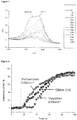
- the emission spectrum of Dentsply SmartLite Focus is given in Figure 1 .
- the photosensitive formulations were deposited on a BaF 2 pellet under air or in laminate (25 ⁇ m thick) for irradiation with the LED light.
- the evolution of the double bond content of Bis-GMA, TEGDMA or UDMA was continuously followed by real time FTIR spectroscopy (JASCO FTIR 4100) at about 1630 cm -1 .
- the evolution of the Ge-H content in the Ph 3 GeH based formulations can be also followed at 2030 cm -1 .
- the polymerization was evaluated under air in the near infrared range following the band at 6160 cm -1 and the procedure presented just above.
- Comparative Example 1 cationic polymerization of vinylethers, epoxys and oxetanes in the presence of the initiator systems DKSi/DPI, DKSi/Ph 3 GeH/DPI, CQ/Ph 3 GeH/DPI, CQ/DPI, CARET/DPI and CQ/CARET/DPI
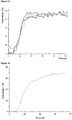
- the initiator systems DKSi/DPI and CQ/Ph 3 GeH/DPI were found very efficient to initiate the cationic polymerization of DVE-3, as can be gathered from Figures 2 and 3 ) with high final conversions (> 80 %) upon a SmartLight Focus LED. Tack free polymers were obtained. As DVE-3 is not able to homopolymerize by radical polymerization, the excellent polymerization profiles obtained here clearly show that the new proposed systems are excellent to initiate the cationic polymerization of DVE-3.
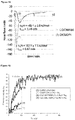
- the initiator systems DKSi/Ph 3 GeH/DPI, CQ/Ph 3 GeH/DPI and DKSi/Pl2074 were also found very efficient to initiate the cationic polymerization of epoxy monomer EPOX, as can be gathered from Figures 4A to C and Figure 5 with high final conversions (> 60 %) upon a SmartLight Focus LED and under air.
- the presence of Ph 3 GeH can also improve the polymerization efficiency, as can be gathered from Figure 5 when comparing curves (1) and (2).
- the initiator system CQ/CARET/DPI was tested with 2%/1.2%/1.5% w/w and 2%/2.4%/1.5% w/w. As can be gathered from Figure 16 , this initiator system turned out to be very efficient to initiate the cationic polymerization of the epoxy monomer EPOX, while the initiator systems CQ/DPI and CARET/DPI provided relatively poor conversions of epoxy functions of only about 5 to 15 %.
- Comparative Example 1 shows that the polymerization of epoxy-, epoxy-silicone- and vinylether- -functions can be readily initiated in presence of an initiator system having different contents of tert-butyl (tert-butyldimethylsilyl)glyoxylate) (DKSi)/diphenyl iodonium hexafluorophosphate (DPI).
- DKSi tert-butyldimethylsilyl)glyoxylate
- DPI diphenyl iodonium hexafluorophosphate
- hybrid polymerization of a homogeneous phase (a) comprising monomer combinations (i) and (ii), (i) and (iii), or (i), (ii) and (iii) of the dental composition according to claim 1 were tested in the presence of different initiator systems (b).
- CQ camphor quinone
- the CQ based systems required the presence of iodonium salt and germanium hydride (R 3 GeH) or a silane (R 3 SiH), i.e. the reference systems were CQ/R 3 GeH/DPI or CQ/R 3 SiH/DPI.
- the DKSi/DPI system was able to initiate both radical and cationic polymerizations, and therefore it was used for the synthesis of interpenetrating polymer networks (IPNs) through the polymerization of a compound having radically polymerizable groups (e.g. methacrylate)/compound having cationically polymerizable group(s) (e.g. vinylether) blend.
- IPNs interpenetrating polymer networks
- a compound having radically polymerizable groups e.g. methacrylate
- compound having cationically polymerizable group(s) e.g. vinylether
- Examples are provided here with the polymerization of a UDMA/DVE-3 blend shown in Figure 6 , BisGMA/DVE-3 blend shown in Figures 7 and 8 and UDMA/DEGDVE (or DEGVE or DVE-3) upon 300 mW/cm 2 shown in Figure 9 .
- Methacrylate final conversions in different matrix polymerization of pure methacrylates (UDMA or BisGMA) versus a methacrylate/vinylether blend (UDMA/DVE-3 or BisGMA/DVE-3) in the presence initiator system DKSi/DPI (2%/1.5% w/w) upon the exposure to the dental blue LED centered at 477 nm (SmartLite Focus).
- Initiator system UDMA UDMA/DVE-3 (60%/40%) BisGMA BisGMA/DVE-3 (50/50 %) DKSi/DPI (2%/1.5% w/w) 72 ⁇ 100 65 92
- Example 2 and Comparative Example 2 DKSi/(TMS) 3 SiH (or Ph 3 GeH)/DPI and reference initiator system CQ/(TMS) 3 SiH (or Ph 3 GeH)/DPI for the hybrid polymerization of methacrylate/vinylether blends
- DKSi/DPI (2%/1.5% w/w) 40 DKSi/DPI/Ph 3 GeH (2%/1%/1.5% w/w) 35 DKSi/DPI/(TMS) 3 SiH (2%/1%/1.5% w/w) 35 CQ/DPI (2%/2% w/w) (comparative example 2) >100 CQ/DPI/Ph 3 GeH (2%/2%/2% w/w) 45 CQ/DPI/(TMS) 3 SiH (2%/2%/2% w/w) 50
- the CQ/Ph 3 GeH/DPI system was able to initiate both radical and cationic polymerizations and used for the synthesis of interpenetrating polymer networks (IPNs) through the polymerization of a blend of compound(s) having radically polymerizable group(s) and compound having cationically polymerizable group(s).
- IPNs interpenetrating polymer networks
- the polymerization of the BisGMA/TEGDMA/EPOX blend was found to be sequential, i.e. the radical polymerization starts first, and the cationic polymerization starts only after an inhibition period.
- a clear conversion of the epoxy group was found, as can be gathered from Figure 10 .
- the monitoring of the conversion of the functional groups before and after polymerization in thin samples of about 20 ⁇ m by means of IR spectroscopy is shown for the epoxy functions in Figure 11A , for the methacrylate functions in Figure 11B and for the Ge hydride functions in Figure 11C .
- Example 4 and Example 5 DKSi/Pl2074 and reference initiator system CQ/Ph 3 GeH/DPI (or PI2074) for the hybrid polymerization of methacrylate/EPOX-Si blends
- DKSi/PI2074 was found to respresent an efficient initiating systems for the hybrid polymerization of methacrylate/EPOX-Si blends, as can be gathered from Table 2 above. Further, the reference initiator system CQ/Ph 3 GeH/DPI (or Pl2074) was tested
- Example 6 DKSI/DPI for the hybrid polymerization of the methacrylate/divinylether blend UDMA/GDM/DEGDVE
- the flexural strength measured for the polymerized blend was 81.7 ⁇ 8.4 MPa, and the E-modulus was 1973 ⁇ 78 MPa.
- Example 9 DKSi/PI2074 for the hybrid polymerization of methacrylate/ monomer compound having radically polymerizable methacrylate and cationically polymerizable divinyether group/divinylether blend UDMA/GDM/VEEM/DEGDVE
- Example 10 CQ/Ph 3 GeH/PI2074 for the hybrid polymerization of methacrylate/epoxy blend UDMA/EPOX-Si
- CQ/CARET/PI2074 was found to respresent an efficient initiating systems for the hybrid polymerization of methacrylate/EPOX-Si blends, as can be gathered from Table 2 above.
- Example 11 DKSi/PI2074/CARET for the hybrid polymerization of methacrylate/ monomer compound having radically polymerizable methacrylate and cationically polymerizable divinyether group blend UDMA /VEEM
- the DKSi/PI2074/CARET system was able to initiate both radical and cationic polymerizations, and therefore it was used for the synthesis of interpenetrating polymer networks (IPNs) through the polymerization of a blend of a compound having radically polymerizable groups, such as methacrylate, and a compound having both cationically polymerizable group(s) (e.g. vinylether) and radically polymerizable groups (e.g. methacrylate). Examples are provided here with the polymerization of a UDMA/VEEM blend shown in Figures 18 and 19 .
- the polymerization was found to be rather sequential, that is, the radical polymerization started first, and the cationic polymerization started after a short inhibition period, as can be gathered from Figure 18 . Furthermore, as can be gathered from Figure 19 , the already good conversion of vinylether groups (VE) obtained with the initiator system DKSi/PI2074 were significantly further improved by adding CARET to the initiator system.
- VE vinylether groups
- an initiator system comprising a radical polymerization initiator of formula (I) and a cationic polymerization initiator of formula (II) is surprisingly suitable for a hybrid polymerization of a homogenous phase (a) comprising monomer combinations (i) and (ii), (i) and (iii), or (i), (ii) and (iii), wherein
Landscapes
- Health & Medical Sciences (AREA)
- Oral & Maxillofacial Surgery (AREA)
- Life Sciences & Earth Sciences (AREA)
- Epidemiology (AREA)
- Animal Behavior & Ethology (AREA)
- General Health & Medical Sciences (AREA)
- Public Health (AREA)
- Veterinary Medicine (AREA)
- Plastic & Reconstructive Surgery (AREA)
- Biophysics (AREA)
- Dental Preparations (AREA)
- Chemical & Material Sciences (AREA)
- Chemical Kinetics & Catalysis (AREA)
- Medicinal Chemistry (AREA)
- Polymers & Plastics (AREA)
- Organic Chemistry (AREA)
Priority Applications (7)
| Application Number | Priority Date | Filing Date | Title |
|---|---|---|---|
| EP16164674.0A EP3231413B1 (fr) | 2016-04-11 | 2016-04-11 | Composition dentaire |
| US16/092,658 US11166883B2 (en) | 2016-04-11 | 2017-04-07 | Dental composition |
| CA3011777A CA3011777C (fr) | 2016-04-11 | 2017-04-07 | Composition dentaire comprenant un systeme amorceur pour amorcer une polymerisation radicalaire et une polymerisation cationique |
| AU2017249668A AU2017249668B2 (en) | 2016-04-11 | 2017-04-07 | Dental composition |
| JP2018544908A JP6916198B2 (ja) | 2016-04-11 | 2017-04-07 | 歯科用組成物 |
| CN201780011259.8A CN108697587B (zh) | 2016-04-11 | 2017-04-07 | 牙科用组合物 |
| PCT/EP2017/058452 WO2017178383A1 (fr) | 2016-04-11 | 2017-04-07 | Composition dentaire |
Applications Claiming Priority (1)
| Application Number | Priority Date | Filing Date | Title |
|---|---|---|---|
| EP16164674.0A EP3231413B1 (fr) | 2016-04-11 | 2016-04-11 | Composition dentaire |
Publications (2)
| Publication Number | Publication Date |
|---|---|
| EP3231413A1 true EP3231413A1 (fr) | 2017-10-18 |
| EP3231413B1 EP3231413B1 (fr) | 2025-03-19 |
Family
ID=55745610
Family Applications (1)
| Application Number | Title | Priority Date | Filing Date |
|---|---|---|---|
| EP16164674.0A Active EP3231413B1 (fr) | 2016-04-11 | 2016-04-11 | Composition dentaire |
Country Status (7)
| Country | Link |
|---|---|
| US (1) | US11166883B2 (fr) |
| EP (1) | EP3231413B1 (fr) |
| JP (1) | JP6916198B2 (fr) |
| CN (1) | CN108697587B (fr) |
| AU (1) | AU2017249668B2 (fr) |
| CA (1) | CA3011777C (fr) |
| WO (1) | WO2017178383A1 (fr) |
Cited By (7)
| Publication number | Priority date | Publication date | Assignee | Title |
|---|---|---|---|---|
| EP3536304A1 (fr) | 2018-03-07 | 2019-09-11 | Dentsply DeTrey GmbH | Matériau d'empreinte dentaire |
| EP3536305A1 (fr) * | 2018-03-07 | 2019-09-11 | Dentsply DeTrey GmbH | Matériau d'empreinte dentaire |
| WO2019222586A1 (fr) | 2018-05-18 | 2019-11-21 | Dentsply Sirona Inc. | Matériau à empreinte dentaire photodurcissable à base de macromonomère |
| EP3632401A1 (fr) | 2018-10-01 | 2020-04-08 | Dentsply Sirona Inc. | Matériau d'empreinte dentaire photopolymérisable à base de macromonomère |
| EP3653194A1 (fr) | 2018-11-15 | 2020-05-20 | Dentsply DeTrey GmbH | Coinitiateurs bifonctionnels et polyfonctionnels dans des compositions dentaires |
| EP3725287A1 (fr) * | 2019-04-18 | 2020-10-21 | Dentsply DeTrey GmbH | Composition dentaire à durcissement redox |
| US11879078B2 (en) * | 2018-10-03 | 2024-01-23 | 3M Innovative Properties Company | Curable precursor of a structural adhesive composition |
Families Citing this family (4)
| Publication number | Priority date | Publication date | Assignee | Title |
|---|---|---|---|---|
| EP3359119B1 (fr) * | 2015-10-08 | 2021-12-29 | Dentsply DeTrey GmbH | Composition dentaire |
| WO2019123260A2 (fr) | 2017-12-19 | 2019-06-27 | 3M Innovative Properties Company | Composition à plusieurs parties ayant une viscosité à plusieurs stades avant durcissement |
| JP7809267B2 (ja) * | 2021-08-10 | 2026-02-02 | 株式会社トクヤマデンタル | 光カチオン硬化性組成物 |
| EP4680181A1 (fr) | 2023-03-13 | 2026-01-21 | Pro3Dure Medical Gmbh | Mélange, polymère, polymère dentaire pour impression 3d et produit médical associé |
Citations (9)
| Publication number | Priority date | Publication date | Assignee | Title |
|---|---|---|---|---|
| EP1548021A1 (fr) | 2003-12-23 | 2005-06-29 | DENTSPLY DETREY GmbH | Composition d'adhésif dentaire en une partie d'auto-gravure et d'auto-mordenage |
| EP1905415A1 (fr) | 2006-09-27 | 2008-04-02 | Ivoclar Ag | Compositions polymérisable avec acyl-germanium comme amorceurs |
| EP2103297A1 (fr) | 2008-03-20 | 2009-09-23 | Ivoclar Vivadent AG | Composition polymérisable contenant des initiateurs comprenant plusieurs atomes de Germanium |
| EP2604247A1 (fr) | 2011-12-15 | 2013-06-19 | Dentsply DeTrey GmbH | Particules de charge composite et procédé de préparation associé |
| EP2705827A1 (fr) | 2012-09-11 | 2014-03-12 | DENTSPLY DETREY GmbH | Composition dentaire |
| EP2727576A1 (fr) | 2012-11-05 | 2014-05-07 | DENTSPLY DETREY GmbH | Composition dentaire |
| WO2015067815A1 (fr) * | 2013-11-11 | 2015-05-14 | Dentsply Detrey Gmbh | Composition dentaire |
| EP2923689A1 (fr) * | 2014-03-27 | 2015-09-30 | DENTSPLY DETREY GmbH | Composition dentaire |
| WO2015157329A1 (fr) | 2014-04-07 | 2015-10-15 | The Board Of Regents Of The University Of Texas System | Compositions de résine de restauration, et procédés d'utilisation |
Family Cites Families (3)
| Publication number | Priority date | Publication date | Assignee | Title |
|---|---|---|---|---|
| US6306926B1 (en) * | 1998-10-07 | 2001-10-23 | 3M Innovative Properties Company | Radiopaque cationically polymerizable compositions comprising a radiopacifying filler, and method for polymerizing same |
| EP3359119B1 (fr) * | 2015-10-08 | 2021-12-29 | Dentsply DeTrey GmbH | Composition dentaire |
| US10322097B2 (en) * | 2015-11-05 | 2019-06-18 | Macau University Of Science And Technology | Treatment of subjects with multidrug-resistant cancer |
-
2016
- 2016-04-11 EP EP16164674.0A patent/EP3231413B1/fr active Active
-
2017
- 2017-04-07 JP JP2018544908A patent/JP6916198B2/ja active Active
- 2017-04-07 AU AU2017249668A patent/AU2017249668B2/en active Active
- 2017-04-07 WO PCT/EP2017/058452 patent/WO2017178383A1/fr not_active Ceased
- 2017-04-07 CN CN201780011259.8A patent/CN108697587B/zh active Active
- 2017-04-07 US US16/092,658 patent/US11166883B2/en active Active
- 2017-04-07 CA CA3011777A patent/CA3011777C/fr active Active
Patent Citations (10)
| Publication number | Priority date | Publication date | Assignee | Title |
|---|---|---|---|---|
| EP1548021A1 (fr) | 2003-12-23 | 2005-06-29 | DENTSPLY DETREY GmbH | Composition d'adhésif dentaire en une partie d'auto-gravure et d'auto-mordenage |
| EP1905415A1 (fr) | 2006-09-27 | 2008-04-02 | Ivoclar Ag | Compositions polymérisable avec acyl-germanium comme amorceurs |
| EP2103297A1 (fr) | 2008-03-20 | 2009-09-23 | Ivoclar Vivadent AG | Composition polymérisable contenant des initiateurs comprenant plusieurs atomes de Germanium |
| US20090239967A1 (en) * | 2008-03-20 | 2009-09-24 | Ivoclar Vivadent Ag | Polymerizable compositions with initiators containing several ge atoms |
| EP2604247A1 (fr) | 2011-12-15 | 2013-06-19 | Dentsply DeTrey GmbH | Particules de charge composite et procédé de préparation associé |
| EP2705827A1 (fr) | 2012-09-11 | 2014-03-12 | DENTSPLY DETREY GmbH | Composition dentaire |
| EP2727576A1 (fr) | 2012-11-05 | 2014-05-07 | DENTSPLY DETREY GmbH | Composition dentaire |
| WO2015067815A1 (fr) * | 2013-11-11 | 2015-05-14 | Dentsply Detrey Gmbh | Composition dentaire |
| EP2923689A1 (fr) * | 2014-03-27 | 2015-09-30 | DENTSPLY DETREY GmbH | Composition dentaire |
| WO2015157329A1 (fr) | 2014-04-07 | 2015-10-15 | The Board Of Regents Of The University Of Texas System | Compositions de résine de restauration, et procédés d'utilisation |
Non-Patent Citations (9)
| Title |
|---|
| BOYCE G.R. ET AL., J. ORG. CHEM., vol. 77, no. 10, 2012, pages 4503 - 4515 |
| BOYCE G.R. ET AL., ORG. LETT., vol. 14, no. 2, 2012, pages 652 - 655 |
| EI-ROZ, M. ET AL., CURRENT TRENDS IN POLYMER SCIENCE, vol. 15, 2011, pages 1 - 13 |
| J. LALEVEE ET AL.: "N-Vinylcarbazole: An Additive for Free Radical Promoted Cationic Polymerization upon Visible Light", ACS MACRO LETT, vol. 1, 2012, pages 802 - 806 |
| MOSZNER N ET AL: "Benzoyl germanium derivatives as novel visible light photoinitiators for dental materials", DENTAL MATERIALS, ELSEVIER, AMSTERDAM, NL, vol. 24, no. 7, 1 July 2008 (2008-07-01), pages 901 - 907, XP022671145, ISSN: 0109-5641, [retrieved on 20071221], DOI: 10.1016/J.DENTAL.2007.11.004 * |
| NICEWICZ D.A. ET AL., ORG. SYNTH., vol. 85, 2008, pages 278 - 286 |
| NICEWICZ D.A., J. AM. CHEM. SOC., vol. 127, no. 17, 2005, pages 6170 - 6171 |
| YAMAMOTO K. ET AL., J. TETRAHEDRON LETT., vol. 21, 1980, pages 1653 - 1656 |
| YAMAMOTO, K.; SUZUKI, S.; TSUJI, J., TETRAHEDRON LETT., vol. 21, 1980, pages 1653 |
Cited By (25)
| Publication number | Priority date | Publication date | Assignee | Title |
|---|---|---|---|---|
| CN111989080A (zh) * | 2018-03-07 | 2020-11-24 | 登特斯普伊德特雷有限公司 | 牙科印模材料 |
| EP3536305A1 (fr) * | 2018-03-07 | 2019-09-11 | Dentsply DeTrey GmbH | Matériau d'empreinte dentaire |
| WO2019170811A1 (fr) | 2018-03-07 | 2019-09-12 | Dentsply Detrey Gmbh | Matériau pour empreinte dentaire |
| WO2019170812A1 (fr) * | 2018-03-07 | 2019-09-12 | Dentsply Detrey Gmbh | Matériau d'empreinte dentaire |
| US11925697B2 (en) * | 2018-03-07 | 2024-03-12 | Dentsply Sirona Inc. | Dental impression material |
| EP3536304A1 (fr) | 2018-03-07 | 2019-09-11 | Dentsply DeTrey GmbH | Matériau d'empreinte dentaire |
| AU2019229644B2 (en) * | 2018-03-07 | 2022-07-07 | Dentsply Detrey Gmbh | Dental impression material |
| JP2021517122A (ja) * | 2018-03-07 | 2021-07-15 | デンツプライ デトレイ ゲー.エム.ベー.ハー. | 歯科用印象材料 |
| US20210106503A1 (en) * | 2018-03-07 | 2021-04-15 | Dentsply Sirona Inc. | Dental impression material |
| US11446215B2 (en) | 2018-05-18 | 2022-09-20 | Dentsply Sirona Inc. | Macromonomer based light-curable dental impression material |
| WO2019222599A1 (fr) | 2018-05-18 | 2019-11-21 | Dentsply Sirona Inc. | Matériau d'empreinte dentaire photodurcissable à base de macromonomère |
| WO2019222586A1 (fr) | 2018-05-18 | 2019-11-21 | Dentsply Sirona Inc. | Matériau à empreinte dentaire photodurcissable à base de macromonomère |
| CN112166159A (zh) * | 2018-05-18 | 2021-01-01 | 登士柏希罗纳有限公司 | 基于大分子单体的可光固化性牙科印模材料 |
| EP3794075B1 (fr) * | 2018-05-18 | 2023-08-02 | DENTSPLY SIRONA Inc. | Matériau d'impression dentaire durcissable par la lumière à base de macromonomères |
| US11110039B2 (en) | 2018-05-18 | 2021-09-07 | Dentsply Sirona Inc. | Macromonomer based light-curable dental impression material |
| CN112166159B (zh) * | 2018-05-18 | 2022-10-21 | 登士柏希罗纳有限公司 | 基于大分子单体的可光固化性牙科印模材料 |
| EP3632401A1 (fr) | 2018-10-01 | 2020-04-08 | Dentsply Sirona Inc. | Matériau d'empreinte dentaire photopolymérisable à base de macromonomère |
| US11879078B2 (en) * | 2018-10-03 | 2024-01-23 | 3M Innovative Properties Company | Curable precursor of a structural adhesive composition |
| WO2020099518A1 (fr) | 2018-11-15 | 2020-05-22 | Dentsply Detrey Gmbh | Co-initiateurs bifonctionnels et polyfonctionnels dans des compositions dentaires |
| EP3653194A1 (fr) | 2018-11-15 | 2020-05-20 | Dentsply DeTrey GmbH | Coinitiateurs bifonctionnels et polyfonctionnels dans des compositions dentaires |
| CN114072122A (zh) * | 2019-04-18 | 2022-02-18 | 登士柏德特里有限公司 | 氧化还原固化牙科组合物 |
| AU2020259134B2 (en) * | 2019-04-18 | 2023-03-09 | Dentsply Detrey Gmbh | Redox curing dental composition |
| CN114072122B (zh) * | 2019-04-18 | 2023-11-03 | 登士柏德特里有限公司 | 氧化还原固化牙科组合物 |
| WO2020212574A1 (fr) * | 2019-04-18 | 2020-10-22 | Dentsply Detrey Gmbh | Composition dentaire à durcissement redox |
| EP3725287A1 (fr) * | 2019-04-18 | 2020-10-21 | Dentsply DeTrey GmbH | Composition dentaire à durcissement redox |
Also Published As
| Publication number | Publication date |
|---|---|
| US11166883B2 (en) | 2021-11-09 |
| US20190117522A1 (en) | 2019-04-25 |
| CA3011777A1 (fr) | 2017-10-19 |
| AU2017249668B2 (en) | 2020-11-26 |
| CA3011777C (fr) | 2022-08-16 |
| JP2019510747A (ja) | 2019-04-18 |
| CN108697587A (zh) | 2018-10-23 |
| AU2017249668A1 (en) | 2018-07-19 |
| CN108697587B (zh) | 2022-06-17 |
| EP3231413B1 (fr) | 2025-03-19 |
| WO2017178383A1 (fr) | 2017-10-19 |
| JP6916198B2 (ja) | 2021-08-11 |
Similar Documents
| Publication | Publication Date | Title |
|---|---|---|
| EP3231413B1 (fr) | Composition dentaire | |
| EP3359118B1 (fr) | Composition dentaire | |
| EP3277248B1 (fr) | Composition dentaire | |
| EP3359119B1 (fr) | Composition dentaire | |
| EP3246001B1 (fr) | Composition dentaire | |
| EP3470048A1 (fr) | Composition dentaire photodurcissable | |
| EP3075372A1 (fr) | Composition dentaire | |
| HK1261689B (en) | Dental composition | |
| HK1261689A1 (en) | Dental composition | |
| HK1249021B (zh) | 牙科组合物 | |
| HK1256500B (en) | Dental composition |
Legal Events
| Date | Code | Title | Description |
|---|---|---|---|
| PUAI | Public reference made under article 153(3) epc to a published international application that has entered the european phase |
Free format text: ORIGINAL CODE: 0009012 |
|
| STAA | Information on the status of an ep patent application or granted ep patent |
Free format text: STATUS: THE APPLICATION HAS BEEN PUBLISHED |
|
| AK | Designated contracting states |
Kind code of ref document: A1 Designated state(s): AL AT BE BG CH CY CZ DE DK EE ES FI FR GB GR HR HU IE IS IT LI LT LU LV MC MK MT NL NO PL PT RO RS SE SI SK SM TR |
|
| AX | Request for extension of the european patent |
Extension state: BA ME |
|
| STAA | Information on the status of an ep patent application or granted ep patent |
Free format text: STATUS: REQUEST FOR EXAMINATION WAS MADE |
|
| 17P | Request for examination filed |
Effective date: 20180417 |
|
| RBV | Designated contracting states (corrected) |
Designated state(s): AL AT BE BG CH CY CZ DE DK EE ES FI FR GB GR HR HU IE IS IT LI LT LU LV MC MK MT NL NO PL PT RO RS SE SI SK SM TR |
|
| STAA | Information on the status of an ep patent application or granted ep patent |
Free format text: STATUS: EXAMINATION IS IN PROGRESS |
|
| 17Q | First examination report despatched |
Effective date: 20191213 |
|
| P01 | Opt-out of the competence of the unified patent court (upc) registered |
Effective date: 20230524 |
|
| REG | Reference to a national code |
Ref country code: DE Ref legal event code: R079 Free format text: PREVIOUS MAIN CLASS: A61K0006087000 Ref country code: DE Ref legal event code: R079 Ref document number: 602016091584 Country of ref document: DE Free format text: PREVIOUS MAIN CLASS: A61K0006087000 Ipc: A61K0006540000 |
|
| GRAP | Despatch of communication of intention to grant a patent |
Free format text: ORIGINAL CODE: EPIDOSNIGR1 |
|
| STAA | Information on the status of an ep patent application or granted ep patent |
Free format text: STATUS: GRANT OF PATENT IS INTENDED |
|
| RIC1 | Information provided on ipc code assigned before grant |
Ipc: A61K 6/889 20200101ALI20240904BHEP Ipc: A61K 6/887 20200101ALI20240904BHEP Ipc: A61K 6/62 20200101ALI20240904BHEP Ipc: A61K 6/54 20200101AFI20240904BHEP |
|
| INTG | Intention to grant announced |
Effective date: 20241008 |
|
| GRAS | Grant fee paid |
Free format text: ORIGINAL CODE: EPIDOSNIGR3 |
|
| GRAA | (expected) grant |
Free format text: ORIGINAL CODE: 0009210 |
|
| STAA | Information on the status of an ep patent application or granted ep patent |
Free format text: STATUS: THE PATENT HAS BEEN GRANTED |
|
| AK | Designated contracting states |
Kind code of ref document: B1 Designated state(s): AL AT BE BG CH CY CZ DE DK EE ES FI FR GB GR HR HU IE IS IT LI LT LU LV MC MK MT NL NO PL PT RO RS SE SI SK SM TR |
|
| REG | Reference to a national code |
Ref country code: GB Ref legal event code: FG4D |
|
| REG | Reference to a national code |
Ref country code: CH Ref legal event code: EP |
|
| REG | Reference to a national code |
Ref country code: IE Ref legal event code: FG4D |
|
| REG | Reference to a national code |
Ref country code: DE Ref legal event code: R096 Ref document number: 602016091584 Country of ref document: DE |
|
| PG25 | Lapsed in a contracting state [announced via postgrant information from national office to epo] |
Ref country code: RS Free format text: LAPSE BECAUSE OF FAILURE TO SUBMIT A TRANSLATION OF THE DESCRIPTION OR TO PAY THE FEE WITHIN THE PRESCRIBED TIME-LIMIT Effective date: 20250619 |
|
| PG25 | Lapsed in a contracting state [announced via postgrant information from national office to epo] |
Ref country code: FI Free format text: LAPSE BECAUSE OF FAILURE TO SUBMIT A TRANSLATION OF THE DESCRIPTION OR TO PAY THE FEE WITHIN THE PRESCRIBED TIME-LIMIT Effective date: 20250319 |
|
| PGFP | Annual fee paid to national office [announced via postgrant information from national office to epo] |
Ref country code: DE Payment date: 20250422 Year of fee payment: 10 |
|
| REG | Reference to a national code |
Ref country code: LT Ref legal event code: MG9D |
|
| PG25 | Lapsed in a contracting state [announced via postgrant information from national office to epo] |
Ref country code: NO Free format text: LAPSE BECAUSE OF FAILURE TO SUBMIT A TRANSLATION OF THE DESCRIPTION OR TO PAY THE FEE WITHIN THE PRESCRIBED TIME-LIMIT Effective date: 20250619 |
|
| PG25 | Lapsed in a contracting state [announced via postgrant information from national office to epo] |
Ref country code: HR Free format text: LAPSE BECAUSE OF FAILURE TO SUBMIT A TRANSLATION OF THE DESCRIPTION OR TO PAY THE FEE WITHIN THE PRESCRIBED TIME-LIMIT Effective date: 20250319 |
|
| PG25 | Lapsed in a contracting state [announced via postgrant information from national office to epo] |
Ref country code: LV Free format text: LAPSE BECAUSE OF FAILURE TO SUBMIT A TRANSLATION OF THE DESCRIPTION OR TO PAY THE FEE WITHIN THE PRESCRIBED TIME-LIMIT Effective date: 20250319 |
|
| PG25 | Lapsed in a contracting state [announced via postgrant information from national office to epo] |
Ref country code: GR Free format text: LAPSE BECAUSE OF FAILURE TO SUBMIT A TRANSLATION OF THE DESCRIPTION OR TO PAY THE FEE WITHIN THE PRESCRIBED TIME-LIMIT Effective date: 20250620 Ref country code: BG Free format text: LAPSE BECAUSE OF FAILURE TO SUBMIT A TRANSLATION OF THE DESCRIPTION OR TO PAY THE FEE WITHIN THE PRESCRIBED TIME-LIMIT Effective date: 20250319 |
|
| REG | Reference to a national code |
Ref country code: NL Ref legal event code: MP Effective date: 20250319 |
|
| REG | Reference to a national code |
Ref country code: AT Ref legal event code: MK05 Ref document number: 1776363 Country of ref document: AT Kind code of ref document: T Effective date: 20250319 |
|
| PG25 | Lapsed in a contracting state [announced via postgrant information from national office to epo] |
Ref country code: NL Free format text: LAPSE BECAUSE OF FAILURE TO SUBMIT A TRANSLATION OF THE DESCRIPTION OR TO PAY THE FEE WITHIN THE PRESCRIBED TIME-LIMIT Effective date: 20250319 |
|
| PG25 | Lapsed in a contracting state [announced via postgrant information from national office to epo] |
Ref country code: SE Free format text: LAPSE BECAUSE OF FAILURE TO SUBMIT A TRANSLATION OF THE DESCRIPTION OR TO PAY THE FEE WITHIN THE PRESCRIBED TIME-LIMIT Effective date: 20250319 |
|
| PG25 | Lapsed in a contracting state [announced via postgrant information from national office to epo] |
Ref country code: SM Free format text: LAPSE BECAUSE OF FAILURE TO SUBMIT A TRANSLATION OF THE DESCRIPTION OR TO PAY THE FEE WITHIN THE PRESCRIBED TIME-LIMIT Effective date: 20250319 |
|
| PG25 | Lapsed in a contracting state [announced via postgrant information from national office to epo] |
Ref country code: ES Free format text: LAPSE BECAUSE OF FAILURE TO SUBMIT A TRANSLATION OF THE DESCRIPTION OR TO PAY THE FEE WITHIN THE PRESCRIBED TIME-LIMIT Effective date: 20250319 Ref country code: PT Free format text: LAPSE BECAUSE OF FAILURE TO SUBMIT A TRANSLATION OF THE DESCRIPTION OR TO PAY THE FEE WITHIN THE PRESCRIBED TIME-LIMIT Effective date: 20250721 |
|
| PG25 | Lapsed in a contracting state [announced via postgrant information from national office to epo] |
Ref country code: IT Free format text: LAPSE BECAUSE OF FAILURE TO SUBMIT A TRANSLATION OF THE DESCRIPTION OR TO PAY THE FEE WITHIN THE PRESCRIBED TIME-LIMIT Effective date: 20250319 Ref country code: PL Free format text: LAPSE BECAUSE OF FAILURE TO SUBMIT A TRANSLATION OF THE DESCRIPTION OR TO PAY THE FEE WITHIN THE PRESCRIBED TIME-LIMIT Effective date: 20250319 |
|
| PG25 | Lapsed in a contracting state [announced via postgrant information from national office to epo] |
Ref country code: AT Free format text: LAPSE BECAUSE OF FAILURE TO SUBMIT A TRANSLATION OF THE DESCRIPTION OR TO PAY THE FEE WITHIN THE PRESCRIBED TIME-LIMIT Effective date: 20250319 |
|
| PG25 | Lapsed in a contracting state [announced via postgrant information from national office to epo] |
Ref country code: CZ Free format text: LAPSE BECAUSE OF FAILURE TO SUBMIT A TRANSLATION OF THE DESCRIPTION OR TO PAY THE FEE WITHIN THE PRESCRIBED TIME-LIMIT Effective date: 20250319 Ref country code: EE Free format text: LAPSE BECAUSE OF FAILURE TO SUBMIT A TRANSLATION OF THE DESCRIPTION OR TO PAY THE FEE WITHIN THE PRESCRIBED TIME-LIMIT Effective date: 20250319 |
|
| PG25 | Lapsed in a contracting state [announced via postgrant information from national office to epo] |
Ref country code: RO Free format text: LAPSE BECAUSE OF FAILURE TO SUBMIT A TRANSLATION OF THE DESCRIPTION OR TO PAY THE FEE WITHIN THE PRESCRIBED TIME-LIMIT Effective date: 20250319 |
|
| PG25 | Lapsed in a contracting state [announced via postgrant information from national office to epo] |
Ref country code: SK Free format text: LAPSE BECAUSE OF FAILURE TO SUBMIT A TRANSLATION OF THE DESCRIPTION OR TO PAY THE FEE WITHIN THE PRESCRIBED TIME-LIMIT Effective date: 20250319 |
|
| PG25 | Lapsed in a contracting state [announced via postgrant information from national office to epo] |
Ref country code: IS Free format text: LAPSE BECAUSE OF FAILURE TO SUBMIT A TRANSLATION OF THE DESCRIPTION OR TO PAY THE FEE WITHIN THE PRESCRIBED TIME-LIMIT Effective date: 20250719 |
|
| REG | Reference to a national code |
Ref country code: CH Ref legal event code: H13 Free format text: ST27 STATUS EVENT CODE: U-0-0-H10-H13 (AS PROVIDED BY THE NATIONAL OFFICE) Effective date: 20251125 |
|
| PG25 | Lapsed in a contracting state [announced via postgrant information from national office to epo] |
Ref country code: LU Free format text: LAPSE BECAUSE OF NON-PAYMENT OF DUE FEES Effective date: 20250411 |
|
| PG25 | Lapsed in a contracting state [announced via postgrant information from national office to epo] |
Ref country code: MC Free format text: LAPSE BECAUSE OF FAILURE TO SUBMIT A TRANSLATION OF THE DESCRIPTION OR TO PAY THE FEE WITHIN THE PRESCRIBED TIME-LIMIT Effective date: 20250319 |
|
| REG | Reference to a national code |
Ref country code: DE Ref legal event code: R097 Ref document number: 602016091584 Country of ref document: DE |
|
| REG | Reference to a national code |
Ref country code: BE Ref legal event code: MM Effective date: 20250430 |
|
| PG25 | Lapsed in a contracting state [announced via postgrant information from national office to epo] |
Ref country code: DK Free format text: LAPSE BECAUSE OF FAILURE TO SUBMIT A TRANSLATION OF THE DESCRIPTION OR TO PAY THE FEE WITHIN THE PRESCRIBED TIME-LIMIT Effective date: 20250319 |
|
| PG25 | Lapsed in a contracting state [announced via postgrant information from national office to epo] |
Ref country code: BE Free format text: LAPSE BECAUSE OF NON-PAYMENT OF DUE FEES Effective date: 20250430 |
|
| PG25 | Lapsed in a contracting state [announced via postgrant information from national office to epo] |
Ref country code: CH Free format text: LAPSE BECAUSE OF NON-PAYMENT OF DUE FEES Effective date: 20250430 |
|
| PLBE | No opposition filed within time limit |
Free format text: ORIGINAL CODE: 0009261 |
|
| STAA | Information on the status of an ep patent application or granted ep patent |
Free format text: STATUS: NO OPPOSITION FILED WITHIN TIME LIMIT |
|
| REG | Reference to a national code |
Ref country code: CH Ref legal event code: L10 Free format text: ST27 STATUS EVENT CODE: U-0-0-L10-L00 (AS PROVIDED BY THE NATIONAL OFFICE) Effective date: 20260128 |
|
| 26N | No opposition filed |
Effective date: 20251222 |
|
| PGFP | Annual fee paid to national office [announced via postgrant information from national office to epo] |
Ref country code: GB Payment date: 20260319 Year of fee payment: 11 |
|
| PG25 | Lapsed in a contracting state [announced via postgrant information from national office to epo] |
Ref country code: IE Free format text: LAPSE BECAUSE OF NON-PAYMENT OF DUE FEES Effective date: 20250411 |
|
| PGFP | Annual fee paid to national office [announced via postgrant information from national office to epo] |
Ref country code: FR Payment date: 20260320 Year of fee payment: 11 |