EP3232131B1 - Klimatisierungssystem - Google Patents
Klimatisierungssystem Download PDFInfo
- Publication number
- EP3232131B1 EP3232131B1 EP15866383.1A EP15866383A EP3232131B1 EP 3232131 B1 EP3232131 B1 EP 3232131B1 EP 15866383 A EP15866383 A EP 15866383A EP 3232131 B1 EP3232131 B1 EP 3232131B1
- Authority
- EP
- European Patent Office
- Prior art keywords
- user
- sensitivity
- room
- unit
- basis
- Prior art date
- Legal status (The legal status is an assumption and is not a legal conclusion. Google has not performed a legal analysis and makes no representation as to the accuracy of the status listed.)
- Active
Links
Images





Classifications
-
- F—MECHANICAL ENGINEERING; LIGHTING; HEATING; WEAPONS; BLASTING
- F24—HEATING; RANGES; VENTILATING
- F24F—AIR-CONDITIONING; AIR-HUMIDIFICATION; VENTILATION; USE OF AIR CURRENTS FOR SCREENING
- F24F11/00—Control or safety arrangements
- F24F11/30—Control or safety arrangements for purposes related to the operation of the system, e.g. for safety or monitoring
-
- F—MECHANICAL ENGINEERING; LIGHTING; HEATING; WEAPONS; BLASTING
- F24—HEATING; RANGES; VENTILATING
- F24F—AIR-CONDITIONING; AIR-HUMIDIFICATION; VENTILATION; USE OF AIR CURRENTS FOR SCREENING
- F24F11/00—Control or safety arrangements
- F24F11/62—Control or safety arrangements characterised by the type of control or by internal processing, e.g. using fuzzy logic, adaptive control or estimation of values
-
- F—MECHANICAL ENGINEERING; LIGHTING; HEATING; WEAPONS; BLASTING
- F24—HEATING; RANGES; VENTILATING
- F24F—AIR-CONDITIONING; AIR-HUMIDIFICATION; VENTILATION; USE OF AIR CURRENTS FOR SCREENING
- F24F11/00—Control or safety arrangements
- F24F11/89—Arrangement or mounting of control or safety devices
-
- G—PHYSICS
- G06—COMPUTING OR CALCULATING; COUNTING
- G06F—ELECTRIC DIGITAL DATA PROCESSING
- G06F40/00—Handling natural language data
- G06F40/30—Semantic analysis
-
- G—PHYSICS
- G06—COMPUTING OR CALCULATING; COUNTING
- G06T—IMAGE DATA PROCESSING OR GENERATION, IN GENERAL
- G06T7/00—Image analysis
- G06T7/70—Determining position or orientation of objects or cameras
-
- G—PHYSICS
- G10—MUSICAL INSTRUMENTS; ACOUSTICS
- G10L—SPEECH ANALYSIS TECHNIQUES OR SPEECH SYNTHESIS; SPEECH RECOGNITION; SPEECH OR VOICE PROCESSING TECHNIQUES; SPEECH OR AUDIO CODING OR DECODING
- G10L15/00—Speech recognition
- G10L15/08—Speech classification or search
-
- G—PHYSICS
- G10—MUSICAL INSTRUMENTS; ACOUSTICS
- G10L—SPEECH ANALYSIS TECHNIQUES OR SPEECH SYNTHESIS; SPEECH RECOGNITION; SPEECH OR VOICE PROCESSING TECHNIQUES; SPEECH OR AUDIO CODING OR DECODING
- G10L15/00—Speech recognition
- G10L15/22—Procedures used during a speech recognition process, e.g. man-machine dialogue
-
- G—PHYSICS
- G10—MUSICAL INSTRUMENTS; ACOUSTICS
- G10L—SPEECH ANALYSIS TECHNIQUES OR SPEECH SYNTHESIS; SPEECH RECOGNITION; SPEECH OR VOICE PROCESSING TECHNIQUES; SPEECH OR AUDIO CODING OR DECODING
- G10L15/00—Speech recognition
- G10L15/26—Speech to text systems
-
- G—PHYSICS
- G10—MUSICAL INSTRUMENTS; ACOUSTICS
- G10L—SPEECH ANALYSIS TECHNIQUES OR SPEECH SYNTHESIS; SPEECH RECOGNITION; SPEECH OR VOICE PROCESSING TECHNIQUES; SPEECH OR AUDIO CODING OR DECODING
- G10L15/00—Speech recognition
- G10L15/28—Constructional details of speech recognition systems
-
- H—ELECTRICITY
- H04—ELECTRIC COMMUNICATION TECHNIQUE
- H04N—PICTORIAL COMMUNICATION, e.g. TELEVISION
- H04N7/00—Television systems
- H04N7/18—Closed-circuit television [CCTV] systems, i.e. systems in which the video signal is not broadcast
- H04N7/183—Closed-circuit television [CCTV] systems, i.e. systems in which the video signal is not broadcast for receiving images from a single remote source
-
- F—MECHANICAL ENGINEERING; LIGHTING; HEATING; WEAPONS; BLASTING
- F24—HEATING; RANGES; VENTILATING
- F24F—AIR-CONDITIONING; AIR-HUMIDIFICATION; VENTILATION; USE OF AIR CURRENTS FOR SCREENING
- F24F11/00—Control or safety arrangements
- F24F11/62—Control or safety arrangements characterised by the type of control or by internal processing, e.g. using fuzzy logic, adaptive control or estimation of values
- F24F11/63—Electronic processing
- F24F11/64—Electronic processing using pre-stored data
-
- F—MECHANICAL ENGINEERING; LIGHTING; HEATING; WEAPONS; BLASTING
- F24—HEATING; RANGES; VENTILATING
- F24F—AIR-CONDITIONING; AIR-HUMIDIFICATION; VENTILATION; USE OF AIR CURRENTS FOR SCREENING
- F24F2110/00—Control inputs relating to air properties
- F24F2110/10—Temperature
-
- F—MECHANICAL ENGINEERING; LIGHTING; HEATING; WEAPONS; BLASTING
- F24—HEATING; RANGES; VENTILATING
- F24F—AIR-CONDITIONING; AIR-HUMIDIFICATION; VENTILATION; USE OF AIR CURRENTS FOR SCREENING
- F24F2120/00—Control inputs relating to users or occupants
- F24F2120/10—Occupancy
-
- F—MECHANICAL ENGINEERING; LIGHTING; HEATING; WEAPONS; BLASTING
- F24—HEATING; RANGES; VENTILATING
- F24F—AIR-CONDITIONING; AIR-HUMIDIFICATION; VENTILATION; USE OF AIR CURRENTS FOR SCREENING
- F24F2120/00—Control inputs relating to users or occupants
- F24F2120/10—Occupancy
- F24F2120/12—Position of occupants
-
- F—MECHANICAL ENGINEERING; LIGHTING; HEATING; WEAPONS; BLASTING
- F24—HEATING; RANGES; VENTILATING
- F24F—AIR-CONDITIONING; AIR-HUMIDIFICATION; VENTILATION; USE OF AIR CURRENTS FOR SCREENING
- F24F2130/00—Control inputs relating to environmental factors not covered by group F24F2110/00
- F24F2130/40—Noise
-
- G—PHYSICS
- G10—MUSICAL INSTRUMENTS; ACOUSTICS
- G10L—SPEECH ANALYSIS TECHNIQUES OR SPEECH SYNTHESIS; SPEECH RECOGNITION; SPEECH OR VOICE PROCESSING TECHNIQUES; SPEECH OR AUDIO CODING OR DECODING
- G10L15/00—Speech recognition
- G10L15/08—Speech classification or search
- G10L2015/088—Word spotting
-
- G—PHYSICS
- G10—MUSICAL INSTRUMENTS; ACOUSTICS
- G10L—SPEECH ANALYSIS TECHNIQUES OR SPEECH SYNTHESIS; SPEECH RECOGNITION; SPEECH OR VOICE PROCESSING TECHNIQUES; SPEECH OR AUDIO CODING OR DECODING
- G10L15/00—Speech recognition
- G10L15/22—Procedures used during a speech recognition process, e.g. man-machine dialogue
- G10L2015/223—Execution procedure of a spoken command
Definitions
- the present invention relates to an air conditioning system provided with a voice recognition function.
- Patent Literature 1 discloses a technology that, on the basis of emphasizers included in a character string input as speech, recognizes the level of sensitivity expressed by a user and then adjusts the environment of the room accordingly.
- Patent Literature 1 Japanese Patent Application Laid-open No. 2003-185221
- an emphasized word may be vocalized from these devices.
- an air conditioning system may erroneously recognize that emphasized word vocalized from the device as an emphasized word vocalized by a user.
- the air conditioning system may operate to adjust the environment inside the room differently from a user's requested environment.
- the present invention has been achieved to solve the above problems, and an objective of the present invention is to provide an air conditioning system that can recognize a user's sensitivity on the basis of the user's voice so as to be able to operate to adjust the environment inside a room to the user's requested environment.
- the present invention it is possible to adjust the environment inside a room to user's requested environment by recognizing a user's sensitivity.
- FIG. 1 is a diagram illustrating an air conditioning system 100 according to a first embodiment, which is not an embodiment of the invention but forms the basis for the invention.
- the air conditioning system 100 includes an indoor device 1, an outdoor device 2 that is connected to the indoor device 1, and a remote controller 3 that remotely operates the indoor device 1.
- the indoor device 1 includes a processor 11; a memory 12; an input-output interface circuit 13A that communicates data with the outdoor device 2; an input-output interface circuit 13B that communicates data with the remote controller 3; an operation device 14 that includes an operation switch or an operation button to be operated by the user; a microphone 15 to which the user's voice is input; and an adjustment device 10 that adjusts the environment inside a room.
- the adjustment device 10 includes a temperature adjustment device 16 that adjusts the temperature of air to be delivered to the inside of the room; an air-flow adjustment device 17 that adjusts the flow rate of air to be delivered to the inside of the room; an air-direction adjustment device 18 that adjusts the direction of air to be delivered to the inside of the room; and a deodorizing device 19 that is capable of deodorizing the inside of the room.
- the outdoor device 2 includes a processor 21, a memory 22, and an input-output interface circuit 23 that communicates data with the indoor device 1.
- the remote controller 3 includes a processor 31; a memory 32; an input-output interface circuit 33 that communicates data with the indoor device 1; an operation device 34 that includes an operation switch or an operation button operated by a user; and a microphone 35 to which the user's voice is input.
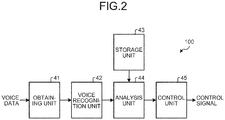
- FIG. 2 is a block diagram illustrating the air conditioning system 100.
- FIG. 3 is a block diagram illustrating the indoor device 1.
- the air conditioning system 100 includes an obtaining unit 41 that obtains the user's voice data; a voice recognition unit 42 that generates character-string data on the basis of the voice data; a storage unit 43 that stores therein a search table having standard keywords that indicate aspects of the environment inside a room to which users are sensitive and derivative keywords related to the same aspect as the standard keyword that also indicate different levels of sensitivity that users have; an analysis unit 44 that determines the type of user's sensitivity and the sensitivity level on the basis of the character-string data and the search table; and a control unit 45 that outputs a control signal to the adjustment device 10 in the indoor device 1, the adjustment device 10 adjusting the environment inside the room on the basis of the type of sensitivity and the sensitivity level, which are determined by the analysis unit 44.
- the obtaining unit 41 is provided in the remote controller 3.
- the voice recognition unit 42, the storage unit 43, the analysis unit 44, and the control unit 45 are provided in the indoor device 1.
- the obtaining unit 41 includes the microphone 35 provided in the remote controller 3.
- the processor 11 in the indoor device 1 includes the voice recognition unit 42, the analysis unit 44, and the control unit 45.
- the memory 12 in the indoor device 1 includes the storage unit 43.
- the obtaining unit 41 obtains a user's voice data and sends the voice data to the voice recognition unit 42 in the indoor device 1.
- the input-output interface circuit 33 in the remote controller 3 and the input-output interface circuit 13B in the indoor device 1 can wirelessly communicate with each other.
- User's voice data obtained by the obtaining unit 41 in the remote controller 3 is transmitted wirelessly to the voice recognition unit 42.
- the voice recognition unit 42 generates character-string data showing a character string that corresponds to the voice data obtained by the obtaining unit 41.
- the voice recognition unit 42 includes a voice analysis unit 421 and a voice-recognition-dictionary storage unit 422. Voice data from the obtaining unit 41 is supplied to the voice analysis unit 421. By using a dictionary stored in the voice-recognition-dictionary storage unit 422, the voice analysis unit 421 generates character-string data corresponding to the voice data and outputs the character-string data to the analysis unit 44.
- the analysis unit 44 includes a sensitivity determination unit 441 that extracts a keyword indicating a user's sensitivity to the environment inside a room from the character-string data generated by the voice recognition unit 42 and that determines the type of user's sensitivity and the sensitivity level on the basis of the extracted keyword; and a sensitivity-data output unit 442 that outputs sensitivity data showing the type of user's sensitivity and the sensitivity level, which are determined by the sensitivity determination unit 441, to the control unit 45.
- a sensitivity determination unit 441 that extracts a keyword indicating a user's sensitivity to the environment inside a room from the character-string data generated by the voice recognition unit 42 and that determines the type of user's sensitivity and the sensitivity level on the basis of the extracted keyword
- a sensitivity-data output unit 442 that outputs sensitivity data showing the type of user's sensitivity and the sensitivity level, which are determined by the sensitivity determination unit 441, to the control unit 45.
- the sensitivity determination unit 441 collates the character-string data generated by the voice recognition unit 42 with the search table stored in the storage unit 43, and extracts a keyword indicating user's sensitivity to the environment inside the room.
- the keyword indicating user's sensitivity is registered in advance.
- FIG. 4 is a diagram illustrating a search table stored in the storage unit 43.
- a keyword indicating user's sensitivity to the environment inside a room
- a plurality of standard keywords “atsui (hot)", “samui (cold)", and “kusai (smelly)” are registered.
- a derivative keyword derived from the standard keyword a plurality of keywords are registered.
- a derivative keyword derived from the standard keyword “atsui”, “atsu (shortened pronunciation)”, “atsu-ui (elongated pronunciation)”, “atsui, atsui (repeated pronunciation)", and “atsui ⁇ atsui (again pronounced after a lapse of time” are registered.
- “Atsu”, “samu”, and “kusa” are derivative keywords in which the ending of the standard keyword is not pronounced.
- “Atsu-ui”, “samu-ui”, and “kusa-ai” are derivative keywords in which a long sound is used in the standard keyword.
- “Atsui, atsui”, “samui, samui”, and “kusai, kusai” are derivative keywords in which the standard keywords are repeated twice or more.
- “Atsui ⁇ atsui”, “samui ⁇ samui”, and “kusai ⁇ kusai” are derivative keywords in which the standard keywords are pronounced and then are pronounced again after a lapse of some time.
- the standard keyword and its derivative keywords have the same initial sound, which therefore indicate the same type of sensitivity.
- the standard keyword “atsui”, and the derivative keywords derived from this standard keyword, "atsu”, “atsu-ui”, “atsui, atsui”, and “atsui ⁇ atsui” all have the same initial sound “a”.
- these keywords all indicate the same type of sensitivity "atsui”.
- the keywords “samui”, “samu”, “samu-ui”, “samui, samui”, and “samui ⁇ samui” all have the same initial sound "sa".
- Keywords that indicate the same type of sensitivity are categorized into different sensitivity levels in advance.
- Level categorization is performed on the basis of a user's statistical data. "Atsui” is categorized into five levels. For example, in a condition where a user pronounces "atsui”, in many cases, the user feels “yaya atsui (it is slightly hot)” and “yaya sagetai (desires to slightly decrease)” the temperature inside a room. In a condition where a user pronounces "atsu”, in many cases, the user feels “sukoshi atsui (it is a little hot)” and “sukoshi sagetai (desires to decrease a little bit)” the temperature inside a room.
- sensitivity level categorization is merely an example.
- a character string that is used as the basis of the level categorization is set appropriately according to the basis of a user's statistical data.
- the user's sensitivity level 5 indicates a sensitivity level at which a user desires to change the environment inside a room most significantly.
- the user's sensitivity level 4 indicates a sensitivity level at which a user desires to change the environment inside a room less significantly than the level 5.
- the user's sensitivity level 3 indicates a sensitivity level at which a user desires to change the environment inside a room less significantly than the level 4.
- the user's sensitivity level 2 indicates a sensitivity level at which a user desires to change the environment inside a room less significantly than the level 3.
- the user's sensitivity level 1 indicates a sensitivity level at which a user desires to change the environment inside a room less significantly than the level 2.
- the number of types of sensitivity registered in advance is not limited to three, and can be one or two, or can be four or more.
- the sensitivity levels registered in advance may not be categorized into five levels, but may be categorized into two, three, or four levels, or into six or more levels.
- the sensitivity determination unit 441 collates character-string data generated in the voice recognition unit 42 with a search table stored in the storage unit 43, and identifies a keyword that is closest to the character-string data. For example, when the character-string data is determined to be "atsui ⁇ atsui", the sensitivity determination unit 441 determines that the type of user's sensitivity is "atsui”, and the sensitivity level is "level 5".
- the sensitivity-data output unit 442 When the sensitivity determination unit 441 determines that the type of user's sensitivity is "atsui”, and the sensitivity level is "level 5", the sensitivity-data output unit 442 outputs sensitivity data to the control unit 45. This output sensitivity data indicates that the type of user's sensitivity is "atsui” and the sensitivity level is "level 5".
- the control unit 45 includes a control-signal generation unit 451 that generates a control signal to be output to the adjustment device 10. On the basis of the type of a user's sensitivity and the sensitivity level determined by the analysis unit 44, the control unit 45 outputs a control signal to at least one of the temperature adjustment device 16, the air-flow adjustment device 17, the air-direction adjustment device 18, and the deodorizing device 19, each of which is one of the adjustment devices 10 in the indoor device 1, in order to adjust the environment inside a room to user's requested environment.
- FIG. 5 is a flowchart illustrating the operation of the air conditioning system 100.
- the obtaining unit 41 obtains the user's voice data (Step S101).
- the voice data is transmitted to the voice recognition unit 42.
- the voice recognition unit 42 recognizes the voice data and generates character-string data on the basis of the voice data (Step S102) .
- the character-string data is transmitted to the analysis unit 44.
- the analysis unit 44 collates the character-string data with a search table (Step S103). On the basis of the character-string data and the search table, the analysis unit 44 determines the type and level of the user's sensitivity (Step S104).
- the control unit 45 On the basis of the type of user's sensitivity and the sensitivity level which are determined by the analysis unit 44, the control unit 45 outputs a control signal to at least one of the temperature adjustment device 16, the air-flow adjustment device 17, the air-direction adjustment device 18, and the deodorizing device 19, each of which is the adjustment device 10 that adjusts the environment inside a room (Step S105). For example, when the type of user's sensitivity is "atsui" and the sensitivity level is "level 5", the control unit 45 outputs a control signal to the temperature adjustment device 16 and the air-flow adjustment device 17 to set the indoor device 1 to a quick cooling mode.
- control unit 45 When the type of user's sensitivity is "kusai”, and the sensitivity level is "level 3", the control unit 45 outputs a control signal to the deodorizing device 19 to set the indoor device 1 to a deodorizing mode.
- a search table including a standard keyword that indicates the type of sensitivity and derivative keywords that indicate the same type of sensitivity as the standard keyword while also indicating different sensitivity levels is used to determine the type of sensitivity and the sensitivity level on the basis of voice data spoken (pronounced) by a user. Therefore, it is possible to prevent voice recognition processing from becoming more complicated; recognize user's sensitivity on the basis of the voice data; and adjust the environment inside a room to user's requested environment.
- the standard keyword and its derivative keywords have the same initial sound. Therefore, it is easy to categorize the types of sensitivity and the number of registered keywords can be minimized.
- emphasized words which include adverbs or exclamations such as “kanari (pretty)”, “sugoku (very)”, “totemo (much)”, “mecha-kucha (extraordinary)”, “mecha (much)”, and “choh (very)", are not used for determination of a user's sensitivity. Even when there is a device that produces a sound inside a room and an emphasized word is vocalized from the device, the emphasized word is not used for determination of a user's sensitivity. Therefore, the air conditioning system 100 can adjust the environment inside a room to a user's requested environment.
- the obtaining unit 41 that obtains a user's voice is provided in the remote controller 3. This can reduce the distance between the user and the obtaining unit 41. Therefore, even when the user's voice volume is low, the obtaining unit 41 can still obtain voice data.
- FIG. 6 is a block diagram illustrating an air conditioning system 100A according to a second embodiment, which is not an embodiment of the invention but helpful for understanding the invention.
- the air conditioning system 100A has a configuration in which the air conditioning system 100 of the first embodiment is further provided with a room-temperature sensor 51 that detects the temperature inside a room and is further provided with a temperature determination unit 46 that determines whether the temperature inside the room is a predetermined comfortable temperature on the basis of the detection result from the room-temperature sensor 51.
- the processor 11 in the indoor device 1 includes the temperature determination unit 46.
- the room-temperature sensor 51 is provided in the indoor device 1.
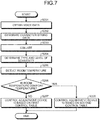
- FIG. 7 is a flowchart illustrating an operation of the air conditioning system 100A.
- the obtaining unit 41 obtains a user's voice data (Step S201).
- the voice recognition unit 42 generates character-string data on the basis of the voice data (Step S202).
- the analysis unit 44 collates the character-string data with a search table stored in the storage unit 43 (Step S203). On the basis of the character-string data and the search table, the analysis unit 44 determines the type and level of a user's sensitivity (Step S204).
- the room-temperature sensor 51 detects the room temperature (Step S205). A detection result from the room-temperature sensor 51 is output to the temperature determination unit 46. On the basis of the detection result from the room-temperature sensor 51, the temperature determination unit 46 determines whether the temperature inside the room is a predetermined comfortable temperature (Step S206).
- the comfortable temperature is equal to or higher than 22[°C] and equal to or lower than 26[°C].
- the control unit 45 controls the adjustment device 10 according to a first control table that represents a relation between the type and level of sensitivity and a control signal for controlling the adjustment device 10 (Step S207).
- a first control table that represents a relation between the type and level of sensitivity and a control signal for controlling the adjustment device 10
- the control unit 45 controls the adjustment device 10 according to a second control table that is different from the first control table (Step S208).
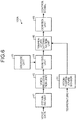
- FIG. 8 is a diagram illustrating the first control table and the second control table that are stored in the storage unit 43.
- Each of the first control table and the second control table represents a relation between the type and level of sensitivity and an output pattern of a control signal to be output to at least one of the temperature adjustment device 16, the air-flow adjustment device 17, the air-direction adjustment device 18, and the deodorizing device 19, each of which is one the adjustment devices 10 in the indoor device 1.
- the control unit 45 outputs a control signal in a predetermined A5 pattern. If the temperature inside the room is a comfortable temperature, the type of sensitivity is "atsui", and the sensitivity level is "level 5", then the control unit 45 outputs a control signal in a B5 pattern that is different from the A5 pattern.
- the control unit 45 determines that the reason of the voice expressing uncomfortableness is because the room temperature is not a comfort temperature and outputs a control signal in the A5 pattern.
- the A5 pattern is an output pattern of a control signal for adjusting the room temperature to a comfort temperature.
- the control unit 45 determines that the reason of the voice expressing uncomfortableness is because of the user's condition, and outputs a control signal in the B5 pattern. For example, in a state where the user's body temperature temporarily rises after exercising or taking a bath, the user may emit a voice "atsui ⁇ atsui" expressing uncomfortableness even though the room temperature is a comfort temperature.
- the B5 pattern is an output pattern for a control signal for quickly cooling the room only for a short time.
- a user emits a voice "samui ⁇ samui” expressing uncomfortableness while the temperature determination unit 46 determines that the room temperature is a comfort temperature then the control unit 45 determines that the reason of the voice expressing uncomfortableness is because of the user's condition, and outputs a control signal in a B10 pattern.
- the B10 pattern is an output pattern of a control signal for quickly heating the room only for a short time.
- a pattern for controlling the adjustment device 10 is selected on the basis of a detection result from the room-temperature sensor 51 whether the room temperature is a comfort temperature is determined, and on the basis of a determination result. Therefore the environment inside a room can be adjusted to a comfort environment according to an assumed condition of a user.
- FIG. 9 is a block diagram illustrating an air conditioning system 100B according to a third embodiment.
- the air conditioning system 100B has a configuration in which the air conditioning system 100 of the first embodiment is further provided with the room-temperature sensor 51 that detects the temperature inside a room; a body-temperature sensor 52 that detects the user's body temperature; and a first correction unit 47 that corrects a sensitivity level determined by the analysis unit 44 on the basis of the detection results from the room-temperature sensor 51 and the body-temperature sensor 52.
- the processor 11 in the indoor device 1 includes the first correction unit 47.
- the room-temperature sensor 51 is provided in the indoor device 1.
- the body-temperature sensor 52 is a noncontact body-temperature sensor that includes a thermopile provided in the indoor device 1 and that detects the user's body temperature in a noncontact manner.
- the body-temperature sensor 52 includes the thermopile functions as a human sensor that detects the position of a user relative to the indoor device 1 inside a room.
- the control unit 45 controls the adjustment device 10 on the basis of the type of sensitivity determined by the analysis unit 44 and on the basis of the sensitivity level corrected by the first correction unit 47.
- FIG. 10 is a flowchart illustrating an operation of the air conditioning system 100B.
- the obtaining unit 41 obtains voice data (Step S301).
- the voice recognition unit 42 generates character-string data (Step S302).
- the analysis unit 44 collates the character-string data with a search table (Step S303) and determines the type and level of user's sensitivity on the basis of the character-string data and the search table (Step S304).
- the room-temperature sensor 51 detects the room temperature (Step S305).
- the body-temperature sensor 52 detects the user's body temperature (Step S306).
- the body-temperature sensor 52 detects the position of a user inside a room (Step S307).
- Detection results from the room-temperature sensor 51 and the body-temperature sensor 52 are output to the first correction unit 47.
- the first correction unit 47 obtains room-temperature data showing the room temperature from the room-temperature sensor 51 and obtains body-temperature data showing the user's body temperature from the room-temperature sensor 51.
- the first correction unit 47 compares the room temperature with the body temperature (Step S308).
- the first correction unit 47 corrects the sensitivity level determined by the analysis unit 44 on the basis of the detection results from the room-temperature sensor 51 and the body-temperature sensor 52 (Step S309).
- the first correction unit 47 determines that the sensitivity level is higher.
- the first correction unit 47 changes the sensitivity level output from the analysis unit 44 by one level.
- the first correction unit 47 changes the sensitivity level output from the analysis unit 44 by two levels.
- the first threshold and the second threshold are predetermined values.
- the analysis unit 44 determines that the type of sensitivity is "atsui” and that the sensitivity level is "level 3".
- the first correction unit 47 determines that the user's sensitivity level is "level 4" although the user has emitted a voice "atsu-ui”, and then it corrects the sensitivity level from "level 3" to "level 4".
- the first correction unit 47 determines that the user's sensitivity level is "level 5" although the user has emitted a voice "atsu-ui", and then it corrects the sensitivity level from "level 3" to "level 5".
- the detection result from the body-temperature sensor 52 is output to the control unit 45.
- the control unit 45 identifies the user position inside a room on the basis of the detection result from the body-temperature sensor 52, and it determines the space where the environment is to be adjusted inside the room (Step S310).
- the control unit 45 outputs a control signal for controlling the adjustment device 10 on the basis of the type of sensitivity determined by the analysis unit 44, and it corrected by the first correction unit 47 on the basis of the sensitivity level (Step S311).
- the control unit 45 in a case where the analysis unit 44 determines that the type of sensitivity is "atsui" and that the sensitivity level is "level 3", when the body temperature is higher relative to the room temperature within the range where the difference is equal to or greater than the first threshold and less than the second threshold, the control unit 45 outputs a control signal not in an A3 pattern but in an A4 pattern.
- the control unit 45 outputs a control signal for locally adjusting the environment in the space determined at Step S310.
- the control unit 45 outputs a control signal to the air-direction adjustment device 18 to adjust the direction of air to be delivered to the inside of the room.
- the air-direction adjustment device 18 delivers air to the determined space to execute spot air-conditioning control.
- the sensitivity-level estimation accuracy can be improved.
- the position of a user is identified so as to determine the space where spot air-conditioning control is to be executed inside a room. Therefore, even when there are two or more persons inside the room, a space for a target user can be made comfortable. Further, by executing the spot air-conditioning control, energy consumption can be reduced.
- FIG. 11 is a block diagram illustrating an air conditioning system 100C according to a fourth embodiment.
- the air-conditioning system 100C has a configuration in which the air conditioning system 100B of the third embodiment uses a body-temperature sensor 53 that is provided on a user, which is as a body-temperature sensor that detects the user's body temperature.
- the body-temperature sensor 53 is a contact body-temperature sensor that is in contact with a user.
- the indoor device 1 includes a communication unit 48 that wirelessly communicates with the body-temperature sensor 53.
- the body-temperature sensor 53 wirelessly transmits body-temperature data indicating the user's body temperature to the communication unit 48.
- the body-temperature sensor 53 is in contact with a user and wirelessly transmits position data indicating the user position to the communication unit 48.
- the body-temperature sensor 53 transmits the user-position data to the communication unit 48.
- the user's body-temperature data obtained by the communication unit 48 is output to the first correction unit 47.
- the first correction unit 47 corrects the sensitivity level determined by the analysis unit 44 on the basis of the detection results from the room-temperature sensor 51 and the body-temperature sensor 53.
- the control unit 45 controls the adjustment device 10 on the basis of the type of sensitivity determined by the analysis unit 44 and on the basis of the sensitivity level corrected by the first correction unit 47.
- the user-position data obtained by the communication unit 48 is output to the control unit 45.
- the control unit 45 On the basis of the detection result from the body-temperature sensor 53 received by the communication unit 48, the control unit 45 identifies the user position inside a room, determines the space where the environment is to be adjusted, and then executes spot air-conditioning control.
- the air conditioning system 100C can execute comfort-air-conditioning control.
- FIG. 12 is a block diagram illustrating an air conditioning system 100D according to a fifth embodiment.
- the air conditioning system 100D includes the obtaining unit 41, the voice recognition unit 42, the storage unit 43, the analysis unit 44, and the control unit 45.
- the air conditioning system 100D includes a camera 54 that obtains user-image data, and a second correction unit 49 that corrects the sensitivity level determined by the analysis unit 44 on the basis of the image data obtained by the camera 54.
- the processor 11 in the indoor device 1 includes the second correction unit 49.
- the camera 54 is provided in the indoor device 1.
- the second correction unit 49 can process the image data and can detect the user position relative to the indoor device 1 inside a room. Further, the second correction unit 49 can process the image data and detect the user's motion.
- the second correction unit 49 holds a motion-pattern table that represents a relation between the type and level of user's sensitivity and a motion pattern shown by the user.
- a motion pattern shown by the user can be acquired from statistical data.
- a motion pattern that corresponds to the level of how cold a user feels can be acquired from the statistical data.
- the user's motion pattern differs between a case where the user feels that it is cold at level 1 and a case where the user feels that it is cold at level 5. The same is in the cases when a user feels that it is hot and when a user feels that it smells bad.
- the second correction unit 49 collates the user's motion pattern derived from the user-image data obtained by the camera 54 with the motion-pattern table, and it acquires the type and level of user's sensitivity from the image data.
- FIG. 13 is a flowchart illustrating an operation of the air conditioning system 100D.
- the obtaining unit 41 obtains voice data (Step S401).
- the voice recognition unit 42 generates character-string data (Step S402).
- the analysis unit 44 collates the character-string data with a search table (Step S403), and it determines the type and level of user's sensitivity on the basis of the character-string data and the search table (Step S404).
- the camera 54 obtains user-image data (Step S405).
- the image data obtained by the camera 54 is output to the second correction unit 49.
- the second correction unit 49 obtains the user-image data. On the basis of the image data and the motion-pattern table, the second correction unit 49 corrects the sensitivity level determined by the analysis unit 44 (Step S406) .
- the sensitivity level is "level 3".
- the second correction unit 49 corrects the sensitivity level from "level 3" to "level 4".
- the image data obtained by the camera 54 is output to the control unit 45.
- the control unit 45 identifies the user position inside a room on the basis of the image data obtained by the camera 54, and it determines the space where the environment is to be adjusted inside the room (Step S407).
- the control unit 45 outputs a control signal for controlling the adjustment device 10 on the basis of the type of sensitivity determined by the analysis unit 44 and on the basis of the sensitivity level corrected by the second correction unit 49 (Step S408).
- the control unit 45 outputs a control signal for locally adjusting the environment in the space determined at Step S407. On the basis of the control signal, the air-direction adjustment device 18 sends air to the determined space so as to execute spot air-conditioning control.
- the type and level of user's sensitivity expressed by the user's motion can be acquired.
- the user's sensitivity can be identified accurately and it can be improved in the comfort-air-conditioning control.
- the position of a user can be identified on the basis of image data obtained by the camera 54 to determine the space where spot air-conditioning control is to be executed inside a room. Therefore, even when there are two or more persons inside a room, a space comfortable for a target user can be suitably created. Furthermore, by executing the spot air-conditioning control, energy consumption can be reduced.
- the obtaining unit 41 that obtains user's voice data may include the microphone 15 provided in the indoor device 1. Further, the processor 31 in the remote controller 3 may include the voice recognition unit 42, the storage unit 43, and the analysis unit 44. Furthermore, the sensitivity data indicating the type and level of user's sensitivity, which are determined by the analysis unit 44 in the remote controller 3, may be wirelessly transmitted to the control unit 45 in the indoor device 1.
Landscapes
- Engineering & Computer Science (AREA)
- Physics & Mathematics (AREA)
- Multimedia (AREA)
- Computational Linguistics (AREA)
- Health & Medical Sciences (AREA)
- Audiology, Speech & Language Pathology (AREA)
- General Engineering & Computer Science (AREA)
- Human Computer Interaction (AREA)
- Acoustics & Sound (AREA)
- Chemical & Material Sciences (AREA)
- Combustion & Propulsion (AREA)
- Mechanical Engineering (AREA)
- Signal Processing (AREA)
- Theoretical Computer Science (AREA)
- General Physics & Mathematics (AREA)
- Fuzzy Systems (AREA)
- Mathematical Physics (AREA)
- Computer Vision & Pattern Recognition (AREA)
- General Health & Medical Sciences (AREA)
- Artificial Intelligence (AREA)
- Air Conditioning Control Device (AREA)
Claims (8)
- Klimaanlagensystem, umfassend:eine Beschaffungseinheit (41), die Sprachdaten eines Benutzers beschafft;eine Spracherkennungseinheit (42), die Zeichenfolgedaten auf Grundlage der Sprachdaten erzeugt;eine Speichereinheit (43), die eine Suchtabelle speichert, aufweisendein Standardschlüsselwort, das einen Typ von Sensibilität gegenüber einer Umgebung in einem Raum anzeigt undAbleitungsschlüsselwörter, die jeweils den gleichen Typ der Sensibilität wie das Standardschlüsselwort anzeigen, während sie unterschiedliche Stufen der Sensibilität anzeigen;eine Analyseeinheit (44), die einen Typ und eine Stufe der Sensibilität des Benutzers auf Grundlage der Zeichenfolgedaten und der Suchtabelle bestimmt;eine Steuereinheit (45), die ein Steuersignal an eine Anpassungseinrichtung (10) in einer Inneneinrichtung ausgibt, wobei die Anpassungseinrichtung (10) eine Umgebung in einem Raum auf Grundlage des durch die Analyseeinheit (44) bestimmten Typs und Stufe der Sensibilität anpasst;einen Raumtemperatursensor (51), der die Temperatur im Raum erfasst; dadurch gekennzeichnet, dass das System ferner umfasst:einen Körpertemperatursensor (51, 52, 53), der die Körpertemperatur des Benutzers erfasst; undeine erste Korrektureinheit (47), die die Stufe der Sensibilität auf Grundlage der Erfassungsergebnisse von dem Raumtemperatursensor (51) und dem Körpertemperatursensor (51, 52, 53) korrigiert, wobeidie Steuereinheit (45) die Anpassungseinrichtung (10) auf Grundlage des Typs der Sensibilität und der durch die erste Korrektureinheit (47) korrigierten Stufe der Sensibilität steuert.
- Klimaanlagensystem nach Anspruch 1, wobei
der Körpertemperatursensor (51, 52, 53) die Körpertemperatur des Benutzers auf kontaktlose Weise erfasst, und
die Steuereinheit (45)eine Position des Benutzers im Raum auf Grundlage eines Erfassungsergebnisses von dem Körpertemperatursensor (51, 52, 53) identifiziert, undeinen Bereich bestimmt, für den eine Umgebung angepasst werden soll. - Klimaanlagensystem nach Anspruch 1, wobei
der Körpertemperatursensor (51, 52, 53) am Benutzer befestigt ist, das Klimaanlagensystem eine Kommunikationseinheit (48) umfasst, die drahtlos mit dem Körpertemperatursensor (51, 52, 53) kommuniziert,
und
die Steuereinheit (45)eine Position des Benutzers im Raum auf Grundlage eines Erfassungsergebnisses von dem Körpertemperatursensor (51, 52, 53) identifiziert, das über die Kommunikationseinheit empfangen wird, undeinen Bereich bestimmt, für den eine Umgebung angepasst werden soll. - Klimaanlagensystem nach Anspruch 1, umfassend einen Menschsensor, der eine Position des Benutzers im Raum erfasst, wobei
die Steuereinheit (45) einen Bereich bestimmt, für den eine Umgebung auf Grundlage eines Erfassungsergebnisses von dem Menschsensor angepasst werden soll. - Klimaanlagensystem nach Anspruch 4, wobei
der Menschsensor eine Körpertemperatur des Benutzers auf kontaktlose Weise erfasst. - Klimaanlagensystem nach einem der Ansprüche 1 bis 5, umfassend:eine Kamera, die Bilddaten des Benutzers beschafft; undeine zweite Korrektureinheit (49), die die Stufe der Sensibilität auf Grundlage der durch die Kamera beschafften Bilddaten korrigiert, wobeidie Steuereinheit (45) die Anpassungseinrichtung (10) auf Grundlage des Typs der Sensibilität und der durch die zweite Korrektureinheit (49) korrigierten Stufe der Sensibilität steuert.
- Klimaanlagensystem nach Anspruch 6, wobei
die Steuereinheit (45)eine Position des Benutzers im Raum auf Grundlage der durch die Kamera beschafften Bilddaten identifiziert, undeinen Bereich bestimmt, für den eine Umgebung angepasst werden soll. - Klimaanlagensystem nach einem der Ansprüche 1 bis 7, umfassend eine Fernsteuerung, die die Inneneinrichtung aus der Ferne betreibt, wobei
die Beschaffungseinheit (41) in der Fernsteuerung vorgesehen ist.
Applications Claiming Priority (1)
| Application Number | Priority Date | Filing Date | Title |
|---|---|---|---|
| PCT/JP2015/060668 WO2016157537A1 (ja) | 2015-04-03 | 2015-04-03 | 空気調和システム |
Publications (3)
| Publication Number | Publication Date |
|---|---|
| EP3232131A1 EP3232131A1 (de) | 2017-10-18 |
| EP3232131A4 EP3232131A4 (de) | 2018-05-16 |
| EP3232131B1 true EP3232131B1 (de) | 2020-05-06 |
Family
ID=57005464
Family Applications (1)
| Application Number | Title | Priority Date | Filing Date |
|---|---|---|---|
| EP15866383.1A Active EP3232131B1 (de) | 2015-04-03 | 2015-04-03 | Klimatisierungssystem |
Country Status (5)
| Country | Link |
|---|---|
| US (1) | US10132519B2 (de) |
| EP (1) | EP3232131B1 (de) |
| JP (1) | JP6305636B2 (de) |
| CN (1) | CN108307649B (de) |
| WO (1) | WO2016157537A1 (de) |
Families Citing this family (22)
| Publication number | Priority date | Publication date | Assignee | Title |
|---|---|---|---|---|
| JP6505514B2 (ja) * | 2015-06-10 | 2019-04-24 | パナソニック株式会社 | 空気調和機、センサシステムおよびその温冷感推定方法 |
| CN106440279A (zh) * | 2016-10-28 | 2017-02-22 | 安徽南国机电科技发展有限公司 | 一种语音控制的家庭空调控制系统 |
| CN106369773A (zh) * | 2016-11-15 | 2017-02-01 | 北京小米移动软件有限公司 | 空调控制送风的方法及装置 |
| EP4040289B1 (de) * | 2017-07-14 | 2023-09-20 | Daikin Industries, Ltd. | Gerätesteuerungssystem |
| CN107274899B (zh) * | 2017-07-20 | 2020-08-04 | 广东美的制冷设备有限公司 | 空调器语音控制方法、装置、空调器及可读存储介质 |
| CN107449109B (zh) * | 2017-07-20 | 2020-05-22 | 广东美的制冷设备有限公司 | 空调器语音控制方法、装置、空调器及可读存储介质 |
| CN109410929A (zh) * | 2017-08-17 | 2019-03-01 | 上海擎感智能科技有限公司 | 车辆部件控制方法及装置、计算机可读存储介质、终端 |
| JP6985922B2 (ja) * | 2017-12-20 | 2021-12-22 | ヤフー株式会社 | 情報処理装置、情報処理方法および情報処理プログラム |
| KR102176369B1 (ko) * | 2018-04-18 | 2020-11-09 | 엘지전자 주식회사 | 공기조화기 및 이를 포함하는 공기조화시스템 |
| US10958466B2 (en) * | 2018-05-03 | 2021-03-23 | Plantronics, Inc. | Environmental control systems utilizing user monitoring |
| US10845081B2 (en) | 2018-05-16 | 2020-11-24 | Johnson Controls Technology Company | Building management HVAC control using user voice feedback |
| CN108759034A (zh) * | 2018-08-01 | 2018-11-06 | 珠海格力电器股份有限公司 | 一种语音接收装置及一种空调 |
| TWI689830B (zh) * | 2018-12-11 | 2020-04-01 | 中華電信股份有限公司 | 基於語音控制設備的方法及控制終端設備 |
| JP2020141235A (ja) * | 2019-02-27 | 2020-09-03 | パナソニックIpマネジメント株式会社 | 機器制御システム、機器制御方法及びプログラム |
| JP7172827B2 (ja) * | 2019-04-17 | 2022-11-16 | トヨタ自動車株式会社 | 温度環境調整システム、温度嗜好推定システム及び温度嗜好推定プログラム |
| CN110500737B (zh) * | 2019-07-22 | 2021-02-02 | 青岛海信日立空调系统有限公司 | 一种家用电器的语音控制方法、语音控制器及空调器 |
| CN110500736B (zh) * | 2019-07-22 | 2021-02-23 | 青岛海信日立空调系统有限公司 | 一种家用电器的语音控制方法、语音控制器和空调器 |
| CN110491379B (zh) * | 2019-07-22 | 2021-11-26 | 青岛海信日立空调系统有限公司 | 一种家用电器的语音控制方法、语音控制器和空调器 |
| CN112413835B (zh) * | 2019-08-20 | 2022-04-12 | 广东美的制冷设备有限公司 | 空调系统及其空调控制方法、控制装置和可读存储介质 |
| JP6947205B2 (ja) * | 2019-08-26 | 2021-10-13 | ダイキン工業株式会社 | 空気調和システム、および、空気調和システムを用いた情報提供方法 |
| CN111380189B (zh) * | 2020-03-27 | 2021-05-04 | 四川虹美智能科技有限公司 | 智能空调控制方法及智能空调 |
| CN115727504B (zh) * | 2021-08-31 | 2025-11-25 | 佛山市顺德区美的电子科技有限公司 | 空调控制方法、装置、空调及可读存储介质 |
Family Cites Families (24)
| Publication number | Priority date | Publication date | Assignee | Title |
|---|---|---|---|---|
| JPH07139777A (ja) * | 1993-11-19 | 1995-05-30 | Fujitsu General Ltd | 空気調和機 |
| JPH0922296A (ja) | 1995-07-05 | 1997-01-21 | Sanyo Electric Co Ltd | 感性情報入力処理装置及びその処理方法 |
| JPH11119791A (ja) | 1997-10-20 | 1999-04-30 | Hitachi Ltd | 音声感情認識システムおよび方法 |
| US6125341A (en) * | 1997-12-19 | 2000-09-26 | Nortel Networks Corporation | Speech recognition system and method |
| JP2000074465A (ja) * | 1998-08-26 | 2000-03-14 | Sanyo Electric Co Ltd | 遠隔操作装置及び空気調和機 |
| JP4085500B2 (ja) * | 1999-01-29 | 2008-05-14 | 株式会社エクォス・リサーチ | 車両状況把握装置、エージェント装置、および、車両制御装置 |
| JP3842497B2 (ja) * | 1999-10-22 | 2006-11-08 | アルパイン株式会社 | 音声処理装置 |
| JP3811646B2 (ja) | 2001-12-21 | 2006-08-23 | アルゼ株式会社 | 空調調整システム及び空調調整方法 |
| JP3920812B2 (ja) * | 2003-05-27 | 2007-05-30 | 株式会社東芝 | コミュニケーション支援装置、支援方法、及び支援プログラム |
| WO2005061249A1 (ja) * | 2003-12-05 | 2005-07-07 | Kabushikikaisha Kenwood | エアコン制御装置及びエアコン制御方法 |
| US8265939B2 (en) * | 2005-08-31 | 2012-09-11 | Nuance Communications, Inc. | Hierarchical methods and apparatus for extracting user intent from spoken utterances |
| JP2007132616A (ja) * | 2005-11-11 | 2007-05-31 | Matsushita Electric Ind Co Ltd | 空気調和システム |
| JP5325855B2 (ja) * | 2010-09-06 | 2013-10-23 | 日立アプライアンス株式会社 | 空気調和機 |
| JP5851737B2 (ja) * | 2011-07-04 | 2016-02-03 | 大和ハウス工業株式会社 | 室内環境制御システム及び室内環境制御方法 |
| US10223710B2 (en) * | 2013-01-04 | 2019-03-05 | Visa International Service Association | Wearable intelligent vision device apparatuses, methods and systems |
| JP6025091B2 (ja) * | 2012-03-29 | 2016-11-16 | パナソニックIpマネジメント株式会社 | 機器制御装置、機器制御システムおよびプログラム |
| JP2014043961A (ja) * | 2012-08-24 | 2014-03-13 | Toshiba Corp | 空気調和機 |
| US20140163957A1 (en) * | 2012-12-10 | 2014-06-12 | Rawllin International Inc. | Multimedia message having portions of media content based on interpretive meaning |
| JP6111499B2 (ja) * | 2013-02-13 | 2017-04-12 | パナソニックIpマネジメント株式会社 | 空気調和システム、指示装置 |
| CN104110770B (zh) * | 2013-06-28 | 2016-12-28 | 广东美的制冷设备有限公司 | 空调及其声控遥控器和声控遥控器的语音控制与提示方法 |
| JP6150057B2 (ja) * | 2013-07-30 | 2017-06-21 | 日本電気株式会社 | 電力制御装置、方法及びプログラム、並びに優先度決定装置、方法及びプログラム |
| JP6236303B2 (ja) * | 2013-11-26 | 2017-11-22 | 株式会社デンソーアイティーラボラトリ | 制御装置、制御方法およびプログラム |
| CN204116902U (zh) * | 2014-02-10 | 2015-01-21 | 美的集团股份有限公司 | 对家用电器语音控制的语音控制端及控制终端 |
| CN105096935B (zh) * | 2014-05-06 | 2019-08-09 | 阿里巴巴集团控股有限公司 | 一种语音输入方法、装置和系统 |
-
2015
- 2015-04-03 WO PCT/JP2015/060668 patent/WO2016157537A1/ja not_active Ceased
- 2015-04-03 JP JP2017509136A patent/JP6305636B2/ja active Active
- 2015-04-03 EP EP15866383.1A patent/EP3232131B1/de active Active
- 2015-04-03 US US15/560,337 patent/US10132519B2/en active Active
- 2015-04-03 CN CN201580078477.4A patent/CN108307649B/zh active Active
Non-Patent Citations (1)
| Title |
|---|
| None * |
Also Published As
| Publication number | Publication date |
|---|---|
| US20180073761A1 (en) | 2018-03-15 |
| JP6305636B2 (ja) | 2018-04-04 |
| CN108307649A (zh) | 2018-07-20 |
| WO2016157537A1 (ja) | 2016-10-06 |
| EP3232131A1 (de) | 2017-10-18 |
| EP3232131A4 (de) | 2018-05-16 |
| CN108307649B (zh) | 2020-06-30 |
| US10132519B2 (en) | 2018-11-20 |
| JPWO2016157537A1 (ja) | 2017-07-27 |
Similar Documents
| Publication | Publication Date | Title |
|---|---|---|
| EP3232131B1 (de) | Klimatisierungssystem | |
| KR102794623B1 (ko) | 인공 지능 기기 및 인공 지능 기기의 동작 방법 | |
| CN114127665B (zh) | 多模态用户界面 | |
| KR102293063B1 (ko) | 사용자 정의 가능한 웨이크업 음성 명령 | |
| KR102934130B1 (ko) | 다른 기기의 동작을 제어할 수 있는 인공 지능 기기 및 그의 동작 방법 | |
| US10777193B2 (en) | System and device for selecting speech recognition model | |
| EP4036710B1 (de) | Klimatisierungsverwaltungssystem | |
| EP3754650A1 (de) | Ortsabhängiges spracherkennungssystem durch sprachbefehl | |
| US20170289582A1 (en) | Device control method and electric device | |
| US9418653B2 (en) | Operation assisting method and operation assisting device | |
| JP6866715B2 (ja) | 情報処理装置、感情認識方法、及び、プログラム | |
| CN108592316B (zh) | 空调器的控制方法、空调器和计算机可读存储介质 | |
| KR102563817B1 (ko) | 사용자 음성 입력 처리 방법 및 이를 지원하는 전자 장치 | |
| US11749271B2 (en) | Method for controlling external device based on voice and electronic device thereof | |
| WO2017083178A1 (en) | Adaptive user presence awareness for smart devices | |
| JP2018207169A (ja) | 機器制御装置及び機器制御方法 | |
| KR102093851B1 (ko) | 인공지능에 기반하여 음성 인식의 민감도를 환경에 적응적으로 변화시키는 방법 및 이를 구현하는 장치 | |
| EP4004911B1 (de) | Ausdruck der aufmerksamkeit eines multimodalen intelligenten audiogerätesystems | |
| EP3654170B1 (de) | Elektronische vorrichtung und wifi-verbindungsverfahren dafür | |
| CN101847020A (zh) | 一种温度控制系统及方法 | |
| US12555576B2 (en) | Artificial intelligence apparatus and method for controlling the same | |
| CN111306716A (zh) | 空调器及其控制方法 | |
| KR20220013157A (ko) | 전자 장치 및 이의 제어 방법 | |
| US20230045458A1 (en) | Information processing apparatus and information processing method |
Legal Events
| Date | Code | Title | Description |
|---|---|---|---|
| PUAI | Public reference made under article 153(3) epc to a published international application that has entered the european phase |
Free format text: ORIGINAL CODE: 0009012 |
|
| STAA | Information on the status of an ep patent application or granted ep patent |
Free format text: STATUS: REQUEST FOR EXAMINATION WAS MADE |
|
| 17P | Request for examination filed |
Effective date: 20160615 |
|
| AK | Designated contracting states |
Kind code of ref document: A1 Designated state(s): AL AT BE BG CH CY CZ DE DK EE ES FI FR GB GR HR HU IE IS IT LI LT LU LV MC MK MT NL NO PL PT RO RS SE SI SK SM TR |
|
| AX | Request for extension of the european patent |
Extension state: BA ME |
|
| RIC1 | Information provided on ipc code assigned before grant |
Ipc: F24F 11/30 20180101AFI20180326BHEP Ipc: F24F 11/62 20180101ALI20180326BHEP Ipc: F24F 120/12 20180101ALI20180326BHEP |
|
| A4 | Supplementary search report drawn up and despatched |
Effective date: 20180413 |
|
| RIC1 | Information provided on ipc code assigned before grant |
Ipc: F24F 110/10 20180101ALI20180409BHEP Ipc: F24F 120/12 20180101ALI20180409BHEP Ipc: F24F 11/62 20180101ALI20180409BHEP Ipc: F24F 120/10 20180101ALI20180409BHEP Ipc: F24F 130/40 20180101ALI20180409BHEP Ipc: F24F 11/30 20180101AFI20180409BHEP |
|
| DAV | Request for validation of the european patent (deleted) | ||
| DAX | Request for extension of the european patent (deleted) | ||
| REG | Reference to a national code |
Ref country code: DE Ref legal event code: R079 Ref document number: 602015052532 Country of ref document: DE Free format text: PREVIOUS MAIN CLASS: F24F0011020000 Ipc: F24F0011300000 |
|
| GRAP | Despatch of communication of intention to grant a patent |
Free format text: ORIGINAL CODE: EPIDOSNIGR1 |
|
| STAA | Information on the status of an ep patent application or granted ep patent |
Free format text: STATUS: GRANT OF PATENT IS INTENDED |
|
| RIC1 | Information provided on ipc code assigned before grant |
Ipc: F24F 11/30 20180101AFI20191010BHEP Ipc: F24F 130/40 20180101ALI20191010BHEP Ipc: F24F 120/10 20180101ALI20191010BHEP Ipc: F24F 120/12 20180101ALI20191010BHEP Ipc: F24F 11/62 20180101ALI20191010BHEP Ipc: F24F 110/10 20180101ALI20191010BHEP |
|
| INTG | Intention to grant announced |
Effective date: 20191112 |
|
| GRAS | Grant fee paid |
Free format text: ORIGINAL CODE: EPIDOSNIGR3 |
|
| GRAA | (expected) grant |
Free format text: ORIGINAL CODE: 0009210 |
|
| STAA | Information on the status of an ep patent application or granted ep patent |
Free format text: STATUS: THE PATENT HAS BEEN GRANTED |
|
| AK | Designated contracting states |
Kind code of ref document: B1 Designated state(s): AL AT BE BG CH CY CZ DE DK EE ES FI FR GB GR HR HU IE IS IT LI LT LU LV MC MK MT NL NO PL PT RO RS SE SI SK SM TR |
|
| REG | Reference to a national code |
Ref country code: GB Ref legal event code: FG4D |
|
| REG | Reference to a national code |
Ref country code: CH Ref legal event code: EP Ref country code: AT Ref legal event code: REF Ref document number: 1267398 Country of ref document: AT Kind code of ref document: T Effective date: 20200515 |
|
| REG | Reference to a national code |
Ref country code: IE Ref legal event code: FG4D |
|
| REG | Reference to a national code |
Ref country code: DE Ref legal event code: R096 Ref document number: 602015052532 Country of ref document: DE |
|
| REG | Reference to a national code |
Ref country code: LT Ref legal event code: MG4D |
|
| REG | Reference to a national code |
Ref country code: NL Ref legal event code: MP Effective date: 20200506 |
|
| PG25 | Lapsed in a contracting state [announced via postgrant information from national office to epo] |
Ref country code: LT Free format text: LAPSE BECAUSE OF FAILURE TO SUBMIT A TRANSLATION OF THE DESCRIPTION OR TO PAY THE FEE WITHIN THE PRESCRIBED TIME-LIMIT Effective date: 20200506 Ref country code: PT Free format text: LAPSE BECAUSE OF FAILURE TO SUBMIT A TRANSLATION OF THE DESCRIPTION OR TO PAY THE FEE WITHIN THE PRESCRIBED TIME-LIMIT Effective date: 20200907 Ref country code: FI Free format text: LAPSE BECAUSE OF FAILURE TO SUBMIT A TRANSLATION OF THE DESCRIPTION OR TO PAY THE FEE WITHIN THE PRESCRIBED TIME-LIMIT Effective date: 20200506 Ref country code: NO Free format text: LAPSE BECAUSE OF FAILURE TO SUBMIT A TRANSLATION OF THE DESCRIPTION OR TO PAY THE FEE WITHIN THE PRESCRIBED TIME-LIMIT Effective date: 20200806 Ref country code: GR Free format text: LAPSE BECAUSE OF FAILURE TO SUBMIT A TRANSLATION OF THE DESCRIPTION OR TO PAY THE FEE WITHIN THE PRESCRIBED TIME-LIMIT Effective date: 20200807 Ref country code: SE Free format text: LAPSE BECAUSE OF FAILURE TO SUBMIT A TRANSLATION OF THE DESCRIPTION OR TO PAY THE FEE WITHIN THE PRESCRIBED TIME-LIMIT Effective date: 20200506 Ref country code: IS Free format text: LAPSE BECAUSE OF FAILURE TO SUBMIT A TRANSLATION OF THE DESCRIPTION OR TO PAY THE FEE WITHIN THE PRESCRIBED TIME-LIMIT Effective date: 20200906 |
|
| PG25 | Lapsed in a contracting state [announced via postgrant information from national office to epo] |
Ref country code: LV Free format text: LAPSE BECAUSE OF FAILURE TO SUBMIT A TRANSLATION OF THE DESCRIPTION OR TO PAY THE FEE WITHIN THE PRESCRIBED TIME-LIMIT Effective date: 20200506 Ref country code: RS Free format text: LAPSE BECAUSE OF FAILURE TO SUBMIT A TRANSLATION OF THE DESCRIPTION OR TO PAY THE FEE WITHIN THE PRESCRIBED TIME-LIMIT Effective date: 20200506 Ref country code: HR Free format text: LAPSE BECAUSE OF FAILURE TO SUBMIT A TRANSLATION OF THE DESCRIPTION OR TO PAY THE FEE WITHIN THE PRESCRIBED TIME-LIMIT Effective date: 20200506 Ref country code: BG Free format text: LAPSE BECAUSE OF FAILURE TO SUBMIT A TRANSLATION OF THE DESCRIPTION OR TO PAY THE FEE WITHIN THE PRESCRIBED TIME-LIMIT Effective date: 20200806 |
|
| REG | Reference to a national code |
Ref country code: AT Ref legal event code: MK05 Ref document number: 1267398 Country of ref document: AT Kind code of ref document: T Effective date: 20200506 |
|
| PG25 | Lapsed in a contracting state [announced via postgrant information from national office to epo] |
Ref country code: AL Free format text: LAPSE BECAUSE OF FAILURE TO SUBMIT A TRANSLATION OF THE DESCRIPTION OR TO PAY THE FEE WITHIN THE PRESCRIBED TIME-LIMIT Effective date: 20200506 Ref country code: NL Free format text: LAPSE BECAUSE OF FAILURE TO SUBMIT A TRANSLATION OF THE DESCRIPTION OR TO PAY THE FEE WITHIN THE PRESCRIBED TIME-LIMIT Effective date: 20200506 |
|
| PG25 | Lapsed in a contracting state [announced via postgrant information from national office to epo] |
Ref country code: IT Free format text: LAPSE BECAUSE OF FAILURE TO SUBMIT A TRANSLATION OF THE DESCRIPTION OR TO PAY THE FEE WITHIN THE PRESCRIBED TIME-LIMIT Effective date: 20200506 Ref country code: ES Free format text: LAPSE BECAUSE OF FAILURE TO SUBMIT A TRANSLATION OF THE DESCRIPTION OR TO PAY THE FEE WITHIN THE PRESCRIBED TIME-LIMIT Effective date: 20200506 Ref country code: RO Free format text: LAPSE BECAUSE OF FAILURE TO SUBMIT A TRANSLATION OF THE DESCRIPTION OR TO PAY THE FEE WITHIN THE PRESCRIBED TIME-LIMIT Effective date: 20200506 Ref country code: CZ Free format text: LAPSE BECAUSE OF FAILURE TO SUBMIT A TRANSLATION OF THE DESCRIPTION OR TO PAY THE FEE WITHIN THE PRESCRIBED TIME-LIMIT Effective date: 20200506 Ref country code: DK Free format text: LAPSE BECAUSE OF FAILURE TO SUBMIT A TRANSLATION OF THE DESCRIPTION OR TO PAY THE FEE WITHIN THE PRESCRIBED TIME-LIMIT Effective date: 20200506 Ref country code: SM Free format text: LAPSE BECAUSE OF FAILURE TO SUBMIT A TRANSLATION OF THE DESCRIPTION OR TO PAY THE FEE WITHIN THE PRESCRIBED TIME-LIMIT Effective date: 20200506 Ref country code: EE Free format text: LAPSE BECAUSE OF FAILURE TO SUBMIT A TRANSLATION OF THE DESCRIPTION OR TO PAY THE FEE WITHIN THE PRESCRIBED TIME-LIMIT Effective date: 20200506 Ref country code: AT Free format text: LAPSE BECAUSE OF FAILURE TO SUBMIT A TRANSLATION OF THE DESCRIPTION OR TO PAY THE FEE WITHIN THE PRESCRIBED TIME-LIMIT Effective date: 20200506 |
|
| REG | Reference to a national code |
Ref country code: DE Ref legal event code: R097 Ref document number: 602015052532 Country of ref document: DE |
|
| PG25 | Lapsed in a contracting state [announced via postgrant information from national office to epo] |
Ref country code: SK Free format text: LAPSE BECAUSE OF FAILURE TO SUBMIT A TRANSLATION OF THE DESCRIPTION OR TO PAY THE FEE WITHIN THE PRESCRIBED TIME-LIMIT Effective date: 20200506 Ref country code: PL Free format text: LAPSE BECAUSE OF FAILURE TO SUBMIT A TRANSLATION OF THE DESCRIPTION OR TO PAY THE FEE WITHIN THE PRESCRIBED TIME-LIMIT Effective date: 20200506 |
|
| PLBE | No opposition filed within time limit |
Free format text: ORIGINAL CODE: 0009261 |
|
| STAA | Information on the status of an ep patent application or granted ep patent |
Free format text: STATUS: NO OPPOSITION FILED WITHIN TIME LIMIT |
|
| 26N | No opposition filed |
Effective date: 20210209 |
|
| PG25 | Lapsed in a contracting state [announced via postgrant information from national office to epo] |
Ref country code: SI Free format text: LAPSE BECAUSE OF FAILURE TO SUBMIT A TRANSLATION OF THE DESCRIPTION OR TO PAY THE FEE WITHIN THE PRESCRIBED TIME-LIMIT Effective date: 20200506 |
|
| PG25 | Lapsed in a contracting state [announced via postgrant information from national office to epo] |
Ref country code: MC Free format text: LAPSE BECAUSE OF FAILURE TO SUBMIT A TRANSLATION OF THE DESCRIPTION OR TO PAY THE FEE WITHIN THE PRESCRIBED TIME-LIMIT Effective date: 20200506 |
|
| PG25 | Lapsed in a contracting state [announced via postgrant information from national office to epo] |
Ref country code: LU Free format text: LAPSE BECAUSE OF NON-PAYMENT OF DUE FEES Effective date: 20210403 |
|
| REG | Reference to a national code |
Ref country code: BE Ref legal event code: MM Effective date: 20210430 |
|
| PG25 | Lapsed in a contracting state [announced via postgrant information from national office to epo] |
Ref country code: FR Free format text: LAPSE BECAUSE OF NON-PAYMENT OF DUE FEES Effective date: 20210430 Ref country code: CH Free format text: LAPSE BECAUSE OF NON-PAYMENT OF DUE FEES Effective date: 20210430 Ref country code: LI Free format text: LAPSE BECAUSE OF NON-PAYMENT OF DUE FEES Effective date: 20210430 |
|
| PG25 | Lapsed in a contracting state [announced via postgrant information from national office to epo] |
Ref country code: IE Free format text: LAPSE BECAUSE OF NON-PAYMENT OF DUE FEES Effective date: 20210403 |
|
| PG25 | Lapsed in a contracting state [announced via postgrant information from national office to epo] |
Ref country code: BE Free format text: LAPSE BECAUSE OF NON-PAYMENT OF DUE FEES Effective date: 20210430 |
|
| PG25 | Lapsed in a contracting state [announced via postgrant information from national office to epo] |
Ref country code: HU Free format text: LAPSE BECAUSE OF FAILURE TO SUBMIT A TRANSLATION OF THE DESCRIPTION OR TO PAY THE FEE WITHIN THE PRESCRIBED TIME-LIMIT; INVALID AB INITIO Effective date: 20150403 |
|
| P01 | Opt-out of the competence of the unified patent court (upc) registered |
Effective date: 20230512 |
|
| PG25 | Lapsed in a contracting state [announced via postgrant information from national office to epo] |
Ref country code: CY Free format text: LAPSE BECAUSE OF FAILURE TO SUBMIT A TRANSLATION OF THE DESCRIPTION OR TO PAY THE FEE WITHIN THE PRESCRIBED TIME-LIMIT Effective date: 20200506 |
|
| PG25 | Lapsed in a contracting state [announced via postgrant information from national office to epo] |
Ref country code: MK Free format text: LAPSE BECAUSE OF FAILURE TO SUBMIT A TRANSLATION OF THE DESCRIPTION OR TO PAY THE FEE WITHIN THE PRESCRIBED TIME-LIMIT Effective date: 20200506 |
|
| PGFP | Annual fee paid to national office [announced via postgrant information from national office to epo] |
Ref country code: GB Payment date: 20240229 Year of fee payment: 10 |
|
| PG25 | Lapsed in a contracting state [announced via postgrant information from national office to epo] |
Ref country code: TR Free format text: LAPSE BECAUSE OF FAILURE TO SUBMIT A TRANSLATION OF THE DESCRIPTION OR TO PAY THE FEE WITHIN THE PRESCRIBED TIME-LIMIT Effective date: 20200506 |
|
| PG25 | Lapsed in a contracting state [announced via postgrant information from national office to epo] |
Ref country code: MT Free format text: LAPSE BECAUSE OF FAILURE TO SUBMIT A TRANSLATION OF THE DESCRIPTION OR TO PAY THE FEE WITHIN THE PRESCRIBED TIME-LIMIT Effective date: 20200506 |
|
| PGFP | Annual fee paid to national office [announced via postgrant information from national office to epo] |
Ref country code: DE Payment date: 20250305 Year of fee payment: 11 |
|
| GBPC | Gb: european patent ceased through non-payment of renewal fee |
Effective date: 20250403 |
|
| PG25 | Lapsed in a contracting state [announced via postgrant information from national office to epo] |
Ref country code: GB Free format text: LAPSE BECAUSE OF NON-PAYMENT OF DUE FEES Effective date: 20250403 |