EP3232629B1 - Digitales frontend-system für einen funksender und ein verfahren dafür - Google Patents
Digitales frontend-system für einen funksender und ein verfahren dafür Download PDFInfo
- Publication number
- EP3232629B1 EP3232629B1 EP16165331.6A EP16165331A EP3232629B1 EP 3232629 B1 EP3232629 B1 EP 3232629B1 EP 16165331 A EP16165331 A EP 16165331A EP 3232629 B1 EP3232629 B1 EP 3232629B1
- Authority
- EP
- European Patent Office
- Prior art keywords
- digital
- signals
- rotation
- signal
- radio device
- Prior art date
- Legal status (The legal status is an assumption and is not a legal conclusion. Google has not performed a legal analysis and makes no representation as to the accuracy of the status listed.)
- Active
Links
Images


Classifications
-
- H—ELECTRICITY
- H04—ELECTRIC COMMUNICATION TECHNIQUE
- H04L—TRANSMISSION OF DIGITAL INFORMATION, e.g. TELEGRAPHIC COMMUNICATION
- H04L27/00—Modulated-carrier systems
- H04L27/32—Carrier systems characterised by combinations of two or more of the types covered by groups H04L27/02, H04L27/10, H04L27/18 or H04L27/26
- H04L27/34—Amplitude- and phase-modulated carrier systems, e.g. quadrature-amplitude modulated carrier systems
- H04L27/36—Modulator circuits; Transmitter circuits
- H04L27/361—Modulation using a single or unspecified number of carriers, e.g. with separate stages of phase and amplitude modulation
Definitions
- the present disclosure relates to radio transmitters and more specifically to a digital frontend system for polar radio transmitters.
- the power amplifier (PA) is usually the most power hungry block in a wideband radio device, which typically operates at mm-wave frequency range, e.g. IEEE802.11ad standard at 60GHz.
- phased array antennas are typically employed to overcome the high signal losses at this frequency range.
- the cost of the analog frontend systems increases in proportion to the number of antenna paths. This will drastically increase the power consumption, especially the share of the most power hungry PA. Improving the power efficiency of a radio transmitter is therefore critical in reducing the power cost of the wideband radio transmitters, which for example, are applied for high data rate short-range portable applications that require minimal power consumption for longer battery lifetime and high data rate backhaul systems that transmit with high output powers for longer range communication.
- the radio employing a polar architecture is an interesting solution that allows the PA to operate in saturation without the need for duplicating the signal path or using power combiners.
- the quadrature, I and Q, signals are converted to a phase (PH) and an amplitude (AM) signals, wherein the PH signal is used as input for the PA and AM is applied to the PA through a separate modulation path.
- the conversion of quadrature to polar signals is typically done in radio frequency (RF) domain, wherein the amplitude (AM) signal is extracted from the RF modulated signal by an amplitude detection circuit, such as an envelope detector, operating at RF frequency.
- the phase signal is extracted by an RF limiter circuit, which introduces extra nonlinearity and bandwidth limitations.
- the phase signal is then fed to the input of the PA, while the amplitude signal is used to modulate the supply voltage of the PA.
- RF radio frequency
- amplitude detection circuit such as an envelope detector
- DSP digital signal processor
- CORDIC digital signal processor
- US 2013/0022150 A1 document discloses a communication transmitter including a combination modulator and a baseband processor configured to generate amplitude, angle, in-phase and quadrature signals.
- the combination modulator is configured to modulate in the quadrature domain or in the polar domain depending on an output power level of the transmitter and/or the type of modulation scheme being used.
- the present disclosure aims at providing a power and area efficient digital frontend system for a polar transmitter device.
- the invention is specified in the independent claims, with further embodiments provided in the dependent claims.
- the present disclosure relates to a digital frontend system for a radio device comprising: a digital filter arranged for receiving digital quadrature signals and for outputting filtered quadrature signals; a conversion circuit arranged for receiving said filtered quadrature signals and for performing a rectangular to polar conversion of said filtered quadrature signals and for outputting a plurality of polar signals, characterized in that said plurality of polar signals comprise an amplitude signal and quadrature phase signals.
- the conversion circuit comprises a vectoring-mode CORDIC processor and a rotation-mode CORDIC processor and each of them comprising 2 computational columns.
- the vectoring-mode CORDIC processor is arranged for receiving said filtered quadrature signals, and, for outputting said amplitude signal and a signal indicating a direction of rotation, d i .
- the rotation-mode CORDIC processor is arranged for rotating an unit vector signal controlled by said signal indicative for a direction of rotation, d i , and, for outputting said quadrature phase signals.
- each computation column of each CORDIC processor comprises a plurality of computational circuits connected in series via a latch logic gate, thus forming a pipeline architecture, wherein each computation circuit is arranged to borrow computation time of a maximum of a half cycle of a clock signal.
- the latch logic gates form a data pipeline, wherein each latch logic gate is being arranged for receiving said clock signal for activating its operation and wherein each subsequent latch logic gate is arranged to be activated at an opposite signal level of said clock signal.
- the digital frontend system may further comprise a sampling circuit connected at the input of said digital filter and arranged for sampling said digital quadrature signals with an oversampling factor of 4 or more, and wherein the digital filter may comprise a set of first order FIR filters and a set of second-order FIR filters.
- the digital frontend system may further comprise a pre-distortion circuit arranged for pre-distorting said amplitude signal and said quadrature phase signals, and for outputting pre-distorted amplitude signal and pre-distorted quadrature phase signals.
- the present disclosure relates to a method for a digital frontend system for a radio device, the method comprising the steps of: filtering digital quadrature signals and converting said filtered digital quadrature signals into a plurality of a plurality of polar signals, characterized in that, said plurality of polar signals comprise an amplitude signal and quadrature phase signals.
- the filtering is performed using a set of carry-save addition operations followed by a vectoring-merging operation. Additionally, the step of converting is performed iteratively, wherein the computation of each iteration is arrange to borrow computation time of a maximum of a half cycle of a clock signal.
- the method may further comprise a step of pre-distorting the amplitude signal and the quadrature signal to account for AM-AM and AM-PM distortions cause by the analog frontend system of the radio transmitter.
- the pre-distortion may be implemented using carry-save addition operations followed by a vector-merging operation.
- the present disclosure relates to a radio device comprising a digital frontend system according to the present disclosure.
- the radio device may comprise a set of second order low-pass filters each arranged for filtering one of analog quadrature phase signals.
- the present disclosure relates to a communication network comprising a radio device according to the present disclosure.
- top, bottom, over, under and the like in the description and the claims are used for descriptive purposes and not necessarily for describing relative positions. The terms so used are interchangeable under appropriate circumstances and the embodiments of the disclosure described herein can operate in other orientations than described or illustrated herein.
- the present disclosure relates to a digital frontend system for a polar radio transmitter device. It capitalizes on the concept of expanding the polar implementation of the overall transmitter architecture into the digital domain as well, rather than only in analog domain.
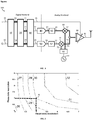
- FIG.1 illustrates a polar radio transmitter 100, comprising a digital frontend and an analog frontend systems.
- the digital frontend system comprises a digital filter 10, a conversion circuit 20 and a pre-distortion circuit 30.
- the digital filter is arranged to receive at its input a digital quadrature signal, i.e. an I and Q signals, 11,12, and to output a filtered quadrature signals 13,14.
- the filtered signal 13,14 are then fed to a conversion circuit 20 arranged for converting the baseband signal into a polar signal, i.e. into an AM signal 21, i.e. A(t), and quadrature PH signals 22,23, i.e. phase signals sin( ⁇ (t)) and cos( ⁇ (t)).
- the amplitude and the quadrature phase signals are then fed to the analog frontend system of the radio transmitter 100 via the pre-distortion circuit 30.
- the pre-distortion circuit 30 is arranged to pre-distort the polar signals to account for AM-AM and AM-PM distortions and to output pre-distorted amplitude 31 and phase signals 32,33.
- AM-AM and AM-PM distortions are caused by variations in the voltage gain and the voltage-dependent capacitance of the active devices in an integrated circuit (IC).
- IC integrated circuit
- the pre-distortion circuit 30 thus in essence accounts for these variations in the amplitude signal 21 and the quadrature phase signals 22,23 introduced by the active devices in the IC.
- the pre-distorted polar signals 31,32,33 are then fed to the analog frontend system as described below.
- Each respective PH signal 32,33 is converted to an analog PH signal 41,51 by a digital-to-analog converter (DAC) 40,50 followed by a low-pass filter 42,52.
- the analog frontend comprises a plurality of mixers 60,70, each arranged to receive a respective analog PH signal 43,53 and a local oscillator signal 61,71, and to generate a respective up-converted, to radio frequency, PH signals 62,72.
- the up-converted PH signals 62,72 are then summed and fed to the input of the power amplifier (PA) 90.
- the PA 90 comprises a number of amplifying unit cells connected in parallel.
- phase signals 62,72 are fed as input signals to the respective amplifying unit cells, while the pre-distorted amplitude signal 31 is used to directly control the operation of the PA by switching ON or OFF respective unit cells. As a result, by switching on, or by increasing the operational unit cells, the power of the signal at the output of the PA is controlled.
- the quadrature signal 11,12 has to be first sampled by a sampling circuit (not shown in the figures) and then digitally filtered by a digital filter 10. This is required as the transformation from quadrature signals to polar signals is non-linear and thus broadens the frequency spectrum.
- EVM error vector magnitude
- the quadrature signals 11,12 need to be first oversampled and then filtered before their conversion. The overall effect of the oversampling and the filtering shifts the first residual image-at a frequency offset equal to the sampling frequency of the sampling circuit.
- an oversampling factor (OSF) of at least 6 is required to move the first residual image out of the RF band of IEEE802.11ad standard, which spans from 57 GHz to 66 GHz, and to meet the spectrum mask requirements.
- OSF oversampling factor
- a sampling circuit is provided at the input of the digital filter 10 and is arranged for sampling the digital quadrature signals 11,12 with an oversampling factor (OSF) of 4 or more.
- OSF oversampling factor
- a filtering combination of a digital filter 10 and a second-order low-pass analog filter 42,52 in the phase path is proposed.
- the proposed filter combination allows the usage of OSF of 4 to suppress the residual image below the spectrum mask. It has been found out that the passband width and filter order of the analog filter exhibit design tradeoff between the output EVM and residual image rejection ratio. That is, wider passband or smaller filter order keeps more significant signals in the transmission output, which leads to a better EVM. However, the residual image is less suppressed which may violate the spectrum mask requirements.
- FIG.2 presents simulation results for the EVM in terms of converted AM and PH (21,22,23) quantization accuracies (define by the number of bits representing the signal) with 1.) OSF of 4, 2.) input I/Q signals (11,12) of 7 bits, and 3.) 2 GHz passband width of 2 nd -order analog Butterworth filter.
- the function of the digital filter 10 is to shape the frequency spectrum of the quadrature signals so that the signal at the output of the filter is compliant with the spectrum mask requirements.
- FIG.3 depicts the spectrum of the signal at the output of an example implementation of a digital filter 10 designed for wideband applications.
- the digital filter comprises three Cascaded Integrator-Comb (CIC) four-tap filters, of which the overall transfer function is shown in FIG.4 .
- CIC Cascaded Integrator-Comb
- Such filter implementation requires 9 adders and 10 multipliers, each operating at 7.04 Gsps, which is a very complex implementation having a high area footprint and high power consumption.
- FIG.5(a) shows an exemplary implementation of the digital filter 10, according to the present disclosure, comprising a set of second-order FIR filters 101,102 and a set of first-order FIR filters 103,104 respectively.
- Each FIR filter is arranged to receive the oversampled digital quadrature signals 11,12 and output a filtered quadrature signals.
- four sets of filtered quadrature signals are provided at the output of the digital filter 10, which are then processed further in the digital frontend circuit in four separate signal paths.
- the combination of the FIR filters is equivalent to a poly-phase representation of three CIC four-tap filters shown in FIG.3 .
- the transfer function of each of the FIR filter can be decomposed into a combination of two operations, i.e. an addition and a multiplication.
- the multiplication can be further simplified to multiplications with binary values, the latter can be implemented in digital domain simply with left shift operations.
- the digital filter 10 can be implemented with a simple circuit comprising only of summation and left shift circuits which significantly reduces the area and power footprint of the digital frontend system.
- Each FIR filter 101,102,103,104 is can be thus implemented using two pipelined computation circuits, i.e. the first computation circuit performing the carry-save addition and the second computation circuit implementing the vector-merging adder.
- the output signals of the poly-phase FIR filters are then fed to the conversion circuit 20 and then to the pre-distortion circuit 30.
- the signal paths are recombined, for example, as shown in FIG.5(b) .
- the implementation of the digital filter thus defines the number of signal paths of the digital frontend system.
- the function of the conversion circuit 20 is to convert the filtered quadrature signal 13,14 into an amplitude signal 21 and quadrature phase signals 22,23.
- the conversion equation involves multiple complex computations, such as square root, trigonometric and division computations. Power-efficient implementation of these complex computations is thus highly challenging as well.
- COordinate Rotation Digital Computer processor
- the CORDIC processor is an iterative arithmetic processor, which can perform very efficiently transcendental functions, such as trigonometric, multiplication operations and other complex operations.
- the CORDIC processor can efficiently reduce the implementation complexity as it uses simple operations such as additions, bit-shifts and lookup tables (LUTs) instead of hardware multipliers.
- the CORDIC processor is operated in a vectoring mode.
- a conventional CORDIC processor requires three calculation columns for the polar conversion.
- FIG.6 illustrates an exemplary block diagram of a conversion circuit 20 according to the present disclosure, comprising two CORDIC processors operating in parallel, the working principle of which is shown in FIG.7 .
- the first CORDIC processor 201 operates in vectoring mode and is arranged to receive at its inputs the filtered quadrature signals 13,14 and to output an amplitude signal 21.
- the second CORDIC processor 202 operates in a rotation mode and is arranged to receive at its input pre-determined signals, a logical '1' and logical '0' signals, representing an unit vector with (1,0) spherical coordinates.
- Each CORDIC processor operates in an iterative manner and performs a number of rotations of the signal at its input with pre-determined angles of rotation ⁇ .
- FIG.8 shows a more detailed scheme of the conversion circuit.
- the conversion circuit comprises in total four computation columns, the first 2 columns forming the vectoring-mode CORDIC 201 and the last two columns the rotation-mode CORDIC 202.
- Each computation column is characterized with a pipeline architecture, where the different pipeline stages are defined by the sequential logic circuits (e.g. a latch logic circuit) connecting the different stages to one another.
- Each computation column of the first CORDIC 201 i.e. the first two computation columns
- the direction of the rotation is defined by the most significant bit, d i , of the imaginary component, y i , of the rotated input vector sample.
- the first computation circuit rotates each respective sample 13,14 with the same direction of rotation, d 0 , the second computation circuit with a direction of rotation d 1 , and so on.
- the vectoring-mode CORDIC comprises a folding circuit and six computation circuits connected to one another by a sequential logic circuit, such as a latch logic circuit.
- Each computation column of the second CORDIC 202 (i.e. the last two computation columns) comprises the same number of computation circuits as the vectoring-mode CORDIC 201, followed by an unfolding circuit arranged to unfold the resulting quadrature PH signals 22,23 to the correct domain. For example, if in the vectoring-mode CORDIC the input samples where folded from the second domain to the first domain, then in the rotation-mode CORDIC the output sample are unfolded from the first domain back to the second domain.
- Each computation circuit is arranged to perform a single rotation of its respective input signal with the same pre-determined rotation angle ⁇ i as in the vectoring-mode CORDIC 201.
- the angle of rotation ⁇ in each respective computation circuit in both CORDIC processors 201,202 at the same pipeline stage is the same, however, the direction of the rotation is opposite.
- the rotation-mode CORDIC rotates the unit vector with the same angle ⁇ but in an opposite direction.
- the vectoring-mode CORDIC will calculate a vector having (A, 0) spherical coordinates, while the rotation-mode CORDIC will calculate a vector with (sin ⁇ , cos ⁇ ) spherical coordinates.
- FIG.9 shows an exemplary implementation of a pre-distortion circuit 30 according to the present disclosure.
- a pre-distortion circuit is necessary in case the PA's linearity is not sufficient enough.
- the PA can operate in saturation mode, which allows for high power efficiency, the PA may suffer from AM-AM and AM-PM nonlinearities. These nonlinearities cause spectral re-growth and devastate the constellation diagram.
- the pre-distortion circuit 30 comprises of a set of multipliers 301,302 each arranged to receive at one of its input one of the quadrature phase signals 22,23 and at its other input a pre-distortion signal having a value of ⁇ (t).
- the pre-distortion signal is derived from a look-up table (LUT) 303 based on the value of the AM signal 21.
- the value of the amplitude signal 21 is used as a single index to derive from the LUT two pre-distortion signals, the first one being a pre-distortion value for the phase signals 22,23, i.e.
- ⁇ (t) ⁇ (t)
- a second one being a pre-distortion value for the AM signal 21, ⁇ A(t).
- the two pre-distortion signals share the same LUT entry. For example, for an entry with a given index, an 8-bit signal is derived, where the first 5 bits represent the ⁇ (t) and the last 3 bits represent the ⁇ A(t).
- the pre-distorted AM signal 31 is created by summing the AM signal 21 with the value ⁇ A derived from the LUT.
- the pre-distorted PH signals 32,33 are created by operating on respective PH signal and the value ⁇ (t) derived from the LUT, as shown in the figure.
- the LUT 303 is indexed by the input amplitude A(t) signal 21. This is possible since the AM-AM and AM-PM responses of the PA depend only on the amplitude of the signal at its input.
- the pre-distortion circuit 30 computes the desired amplitude, A'(t), and quadrature phase, sin( ⁇ '(t)) and cos( ⁇ '(t)), outputs.
- the entries in the LUT can be limited to store the values of ⁇ (t) and ⁇ A ( t ).
- the LUT contains 32 entries indexed by the input AM 21, with each entry containing 3 bits for distortion amplitude ⁇ A and 5 bits for ⁇ (t).
- the pre-distorted AM signal 31 is created by summing the AM signal 21 with the value ⁇ A, while the pre-distorted PH signals 32,33 are computed using the distortion phase ⁇ (t) and as detailed in equation (3).
- the pre-distortion circuit 30 may be provided with a supply voltage lower than the supply voltage applied to the other circuits of the digital frontend system. This allows to further reduce the power consumption. Additionally, the power supply to the pre-distortion circuit can be dynamically shut down when the PA in the polar transmitter offers sufficient linearity.
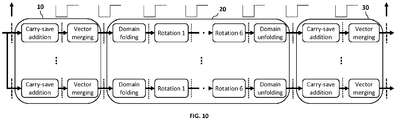
- FIG.10 shows an overall scheme of the pipeline architecture of the digital front-end system according to the present disclosure.
- the digital front-end system comprises four signal paths and each characterized with a pipeline architecture.
- the number of the signal paths is defined by the implementation of the digital filter 10.
- Each stage of the pipeline is connected to the subsequent one via a sequential logic.
- level-triggered latches are chosen to realize the internal sequential logics.
- the location of the latch gates in the respective signal paths is indicated with a dotted vertical lines.
- the adjacent latch elements are triggered at opposite levels of the clock signal.
- the first latch in the pipeline is triggered at a low level of the clock signal, while the second latch is triggered at a high level of the clock signal.
- the proposed latch scheme operation allows for realizing a time borrowing approach. That is, the data from a computation stage can depart from a latch on the rising or falling edge of the clock signal, but does not have to set up until falling or rising edge of the clock signal on the receiving latch.
- a computation stage in the pipeline is a complex circuit and comprises complex logic elements, such as a CORDIC computation circuit, and the computation stage cannot performs its computation in one half clock cycle it can borrow time from the next half clock cycle or computation stage.
- Time borrowing can accumulate across computation stage. The advantage of the time borrowing principle is twofold and is especially beneficial for a high-speed frontend system fabricated on deeply-scaled (28 nm) CMOS technology.
- the opportunistic time borrowing principle allows to account for process and environmental variations. Due to such variations, even if the pipeline is carefully equalized at design time, the delay of each computation stage can vary in the fabricated chip, the effect of which becomes even more severe with technology scaling. In the digital frontend system time borrowing allows for a slower computation stage to opportunistically borrow time from faster ones, which as a result allows for averaging out some of the variations.
- the time borrowing principle allows for a shorter design time because the stage-balancing can automatically take place as changes to the pipeline architecture can be avoided, for example changes as explicitly moving computation and or logic elements from one stage to another becomes unnecessary. This is especially beneficial for timing convergence for the example of a high-throughput wideband application, e.g., 1.76Gsps for 802.11ad, pipeline with each stage under the timing constraint of a half clock cycle (3.52GHz). Synthesis results show that, with allowed lOps time borrowing for each stage, the timing can easily converge.
Landscapes
- Engineering & Computer Science (AREA)
- Computer Networks & Wireless Communication (AREA)
- Signal Processing (AREA)
- Digital Transmission Methods That Use Modulated Carrier Waves (AREA)
Claims (14)
- Digitales Frontend-System für ein Funkgerät (100), umfassend:ein digitales Filter (10), das dafür eingerichtet ist, digitale Quadratursignale (11, 12) zu empfangen, und dafür, die digitalen Quadratursignale (11, 12) zu filtern, und dafür, gefilterte Quadratursignale (13, 14) auszugeben;eine Umwandlungsschaltung (20), die dafür eingerichtet ist, die gefilterten Quadratursignale (13, 14) zu empfangen, und dafür, eine Umwandlung der gefilterten Quadratursignale (13, 14) von rechteckig nach polar durchzuführen, und dafür, eine Vielzahl von polaren Signalen (21, 22, 23) auszugeben,wobei die Vielzahl von polaren Signalen ein Amplitudensignal (21) und Quadraturphasensignale (22, 23) umfasst, und dadurch gekennzeichnet, dass die Umwandlungsschaltung (20) einen Vektorisierungsmodus-Koordinatendrehungs-Digitalcomputer- (CORDIC) Prozessor (201) und einen Drehungsmodus-CORDIC-Prozessor (202) umfasst, und jeder derselben zwei Rechenspalten umfasst, wobei jede Rechenspalte jedes CORDIC-Prozessors eine Vielzahl von Rechenschaltungen umfasst, die über eine jeweilige Vielzahl von sequentiellen Logikschaltungen in Reihe geschaltet sind, wobei die Drehung von jeder aus der Vielzahl von Rechenschaltungen des Drehungsmodus-CORDIC-Prozessors auf Ausgangssignalen von jeder aus der Vielzahl von Rechenschaltungen des Vektorisierungsmodus-CORDIC-Prozessors basiert, und wobei die Ausgangssignale Informationen umfassen, die eine Drehrichtung anzeigen.
- Digitales Frontend-System für ein Funkgerät (100) nach Anspruch 1, wobei der Vektorisierungsmodus-CORDIC-Prozessor dafür eingerichtet ist, die gefilterten Quadratursignale (13, 14) zu empfangen, und dafür, das Amplitudensignal (21) und ein Signal auszugeben, das eine Drehrichtung (di) anzeigt.
- Digitales Frontend-System für ein Funkgerät (100) nach Anspruch 2, wobei der Drehungsmodus-CORDIC-Prozessor dafür eingerichtet ist, ein Einheitsvektorsignal, das von dem Signal, welches eine Drehrichtung (di) anzeigt, gesteuert wird, zu drehen, und dafür, die Quadraturphasensignale (22, 23) auszugeben.
- Digitales Frontend-System für ein Funkgerät (100) nach einem der vorstehenden Ansprüche, wobei die sequentielle Logikschaltung ein Verriegelungslogikgatter ist, und wobei jede Rechenschaltung dazu eingerichtet ist, Rechenzeit von maximal einem halben Zyklus eines Taktsignals zu leihen.
- Digitales Frontend-System für ein Funkgerät (100) nach einem der vorstehenden Ansprüche, wobei die Vielzahl von Verriegelungslogikgattern eine Datenpipeline bildet, wobei jedes Verriegelungslogikgatter dafür eingerichtet ist, das Taktsignal zum Aktivieren seines Betriebs zu empfangen, und wobei jedes nachfolgende Verriegelungslogikgatter bei einem entgegengesetzten Signalpegel des Taktsignals aktiviert wird.
- Digitales Frontend-System für ein Funkgerät (100) nach einem der vorstehenden Ansprüche, weiter eine Abtastschaltung umfassend, die mit einem Eingang des digitalen Filters (10) verbunden und dafür eingerichtet ist, die digitalen Quadratursignale (11, 12) mit einem Überabtastungsfaktor von 4 oder mehr abzutasten.
- Digitales Frontend-System für ein Funkgerät (100) nach einem der vorstehenden Ansprüche, wobei das digitale Filter (10) einen Satz FIR-Filter (103, 104) erster Ordnung, und einen Satz FIR-Filter (101, 102) zweiter Ordnung umfasst.
- Digitales Frontend-System für ein Funkgerät (100) nach einem der vorstehenden Ansprüche, weiter eine Vorverzerrungsschaltung (30) umfassend, die dafür eingerichtet ist, das Amplitudensignal (21) und die Quadraturphasensignale (22, 23) vorzuverzerren, und dafür, vorverzerrtes Amplitudensignal (31) und vorverzerrte Quadraturphasensignale (32, 33) auszugeben.
- Verfahren für ein digitales Frontend-System für ein Funkgerät (100), das die Schritte umfasst des:Filterns von digitalen Quadratursignalen (11, 12) und Bereitstellens von gefilterten digitalen Quadratursignalen (13, 14), und Umwandelns, über eine Umwandlungsschaltung (20), der gefilterten digitalen Quadratursignale (13, 14) in eine Vielzahl von polaren Signalen (21, 22, 23),wobei die Vielzahl von polaren Signalen ein Amplitudensignal (21) und Quadraturphasensignale (22, 23) umfasst, dadurch gekennzeichnet, dass das Umwandeln über die Umwandlungsschaltung (20) über die Schritte des Vektorisierens und Drehens über einen Vektorisierungsmodus-Koordinatendrehungs-Digitalcomputer- (CORDIC) Prozessor (201) und einen Drehungsmodus-CORDIC-Prozessor (202) durchgeführt wird, und jeder derselben zwei Rechenspalten umfasst, wobei jede Rechenspalte jedes CORDIC-Prozessors eine Vielzahl von Rechenschaltungen umfasst, die über eine jeweilige Vielzahl von sequentiellen Logikschaltungen in Reihe geschaltet sind, wobei das Drehen derart durchgeführt wird, dass die Drehung von jeder aus der Vielzahl von Rechenschaltungen des Drehungsmodus-CORDIC-Prozessors auf Ausgangssignalen von jeder aus der Vielzahl von Rechenschaltungen des Vektorisierungsmodus-CORDIC-Prozessors basiert, und wobei die Ausgangssignale Informationen umfassen, die eine Drehrichtung anzeigen.
- Verfahren für ein digitales Frontend-System für ein Funkgerät (100) nach Anspruch 9, wobei das Filtern unter Verwendung eines Satzes Carry-Save-Additionsoperationen, gefolgt von einer Vektorkombinationsoperation durchgeführt wird.
- Verfahren für ein digitales Frontend-System für ein Funkgerät (100) nach Anspruch 9 oder 10, wobei die Umwandlung iterativ durchgeführt wird, wobei eine Berechnung jeder Iteration so eingerichtet ist, dass sie Rechenzeit von maximal einem halben Zyklus eines Taktsignals leiht.
- Funkgerät (100), das ein analoges Frontend-System und ein digitales Frontend-System nach einem der Ansprüche 1 bis 8 umfasst, wobei das analoge Frontend-System einen Satz Digital-/Analog-Wandler (40, 50) umfasst, die dafür eingerichtet sind, ein digitales Quadraturphasensignale (22, 23) in ein analoges Quadraturphasensignale (51) umzuwandeln.
- Funkgerät (100) nach Anspruch 12, weiter einen Satz analoger Tiefpassfilter (42, 52) zweiter Ordnung umfassend, die jedes dafür eingerichtet sind, eines der analogen Quadraturphasensignale (41, 52) zu filtern.
- Kommunikationsnetz, das ein Funkgerät (100) nach einem der Ansprüche 12 bis 13 umfasst.
Priority Applications (1)
| Application Number | Priority Date | Filing Date | Title |
|---|---|---|---|
| EP16165331.6A EP3232629B1 (de) | 2016-04-14 | 2016-04-14 | Digitales frontend-system für einen funksender und ein verfahren dafür |
Applications Claiming Priority (1)
| Application Number | Priority Date | Filing Date | Title |
|---|---|---|---|
| EP16165331.6A EP3232629B1 (de) | 2016-04-14 | 2016-04-14 | Digitales frontend-system für einen funksender und ein verfahren dafür |
Publications (2)
| Publication Number | Publication Date |
|---|---|
| EP3232629A1 EP3232629A1 (de) | 2017-10-18 |
| EP3232629B1 true EP3232629B1 (de) | 2019-06-12 |
Family
ID=55759498
Family Applications (1)
| Application Number | Title | Priority Date | Filing Date |
|---|---|---|---|
| EP16165331.6A Active EP3232629B1 (de) | 2016-04-14 | 2016-04-14 | Digitales frontend-system für einen funksender und ein verfahren dafür |
Country Status (1)
| Country | Link |
|---|---|
| EP (1) | EP3232629B1 (de) |
Family Cites Families (1)
| Publication number | Priority date | Publication date | Assignee | Title |
|---|---|---|---|---|
| US8811533B2 (en) * | 2011-07-20 | 2014-08-19 | Earl W. McCune, Jr. | Communications transmitter having high-efficiency combination modulator |
-
2016
- 2016-04-14 EP EP16165331.6A patent/EP3232629B1/de active Active
Non-Patent Citations (1)
| Title |
|---|
| None * |
Also Published As
| Publication number | Publication date |
|---|---|
| EP3232629A1 (de) | 2017-10-18 |
Similar Documents
| Publication | Publication Date | Title |
|---|---|---|
| EP2497188B1 (de) | Digitaler affiner transformationsmodulierter leistungsverstärker für die drahtlose kommunikation | |
| US9252712B2 (en) | Hardware-efficient signal-component separator for outphasing power amplifiers | |
| Wood | System-level design considerations for digital pre-distortion of wireless base station transmitters | |
| Vankka et al. | Direct digital synthesizers: theory, design and applications | |
| US8411788B2 (en) | Digital transmitters for wireless communication | |
| EP3219063B1 (de) | System und verfahren zur erzeugung eines mehrbandsignals | |
| CN102752247B (zh) | 射频传输装置、无线通信装置及产生射频信号的方法 | |
| Standaert et al. | A 390-GHz outphasing transmitter in 28-nm CMOS | |
| US20190207565A1 (en) | Rf-dac based phase modulator | |
| US20120269291A1 (en) | Rf transmitter, integrated circuit device, wireless communication unit and method therefor | |
| Shen et al. | A wideband IQ-mapping direct-digital RF modulator for 5G transmitters | |
| CN103812450B (zh) | 数字正交传送器与其操作方法 | |
| US9825654B2 (en) | Digital frontend system for a radio transmitter and a method thereof | |
| LaRocca et al. | A 64QAM 94GHz CMOS transmitter SoC with digitally-assisted power amplifiers and thru-silicon waveguide power combiners | |
| US12355400B2 (en) | Switched capacitor based harmonic rejection mixer with the clocks having two different duty cycles | |
| EP3232629B1 (de) | Digitales frontend-system für einen funksender und ein verfahren dafür | |
| Li et al. | < 30 mW rectangular-to-polar conversion processor in 802.11 ad polar transmitter | |
| US12500617B2 (en) | Method of applying an activation scheme to a digitally controlled segmented RF power transmitter | |
| Vankka et al. | A CORDIC-based multicarrier QAM modulator | |
| US12562762B2 (en) | Digital transmitter featuring a 50%-LO signed phase mapper | |
| Li et al. | Energy-efficient digital front-end processor for 60 GHz polar transmitter | |
| Jung et al. | A CMOS low-power digital polar modulator system integration for WCDMA transmitter | |
| Sanaa et al. | Design of a mixed-signal cartesian feedback loop for a low power zero-if wcdma transmitter | |
| US12328103B2 (en) | Local oscillator clock shaping for pre-distortion | |
| CN119324746B (zh) | 一种低成本太赫兹高阶qam信号直接调制发射机及其方法 |
Legal Events
| Date | Code | Title | Description |
|---|---|---|---|
| PUAI | Public reference made under article 153(3) epc to a published international application that has entered the european phase |
Free format text: ORIGINAL CODE: 0009012 |
|
| STAA | Information on the status of an ep patent application or granted ep patent |
Free format text: STATUS: THE APPLICATION HAS BEEN PUBLISHED |
|
| AK | Designated contracting states |
Kind code of ref document: A1 Designated state(s): AL AT BE BG CH CY CZ DE DK EE ES FI FR GB GR HR HU IE IS IT LI LT LU LV MC MK MT NL NO PL PT RO RS SE SI SK SM TR |
|
| AX | Request for extension of the european patent |
Extension state: BA ME |
|
| STAA | Information on the status of an ep patent application or granted ep patent |
Free format text: STATUS: REQUEST FOR EXAMINATION WAS MADE |
|
| 17P | Request for examination filed |
Effective date: 20180416 |
|
| RBV | Designated contracting states (corrected) |
Designated state(s): AL AT BE BG CH CY CZ DE DK EE ES FI FR GB GR HR HU IE IS IT LI LT LU LV MC MK MT NL NO PL PT RO RS SE SI SK SM TR |
|
| GRAP | Despatch of communication of intention to grant a patent |
Free format text: ORIGINAL CODE: EPIDOSNIGR1 |
|
| STAA | Information on the status of an ep patent application or granted ep patent |
Free format text: STATUS: GRANT OF PATENT IS INTENDED |
|
| INTG | Intention to grant announced |
Effective date: 20190201 |
|
| GRAS | Grant fee paid |
Free format text: ORIGINAL CODE: EPIDOSNIGR3 |
|
| GRAA | (expected) grant |
Free format text: ORIGINAL CODE: 0009210 |
|
| STAA | Information on the status of an ep patent application or granted ep patent |
Free format text: STATUS: THE PATENT HAS BEEN GRANTED |
|
| AK | Designated contracting states |
Kind code of ref document: B1 Designated state(s): AL AT BE BG CH CY CZ DE DK EE ES FI FR GB GR HR HU IE IS IT LI LT LU LV MC MK MT NL NO PL PT RO RS SE SI SK SM TR |
|
| REG | Reference to a national code |
Ref country code: GB Ref legal event code: FG4D |
|
| REG | Reference to a national code |
Ref country code: CH Ref legal event code: EP |
|
| REG | Reference to a national code |
Ref country code: AT Ref legal event code: REF Ref document number: 1144040 Country of ref document: AT Kind code of ref document: T Effective date: 20190615 |
|
| REG | Reference to a national code |
Ref country code: DE Ref legal event code: R096 Ref document number: 602016015025 Country of ref document: DE |
|
| REG | Reference to a national code |
Ref country code: IE Ref legal event code: FG4D |
|
| REG | Reference to a national code |
Ref country code: NL Ref legal event code: MP Effective date: 20190612 |
|
| REG | Reference to a national code |
Ref country code: LT Ref legal event code: MG4D |
|
| PG25 | Lapsed in a contracting state [announced via postgrant information from national office to epo] |
Ref country code: FI Free format text: LAPSE BECAUSE OF FAILURE TO SUBMIT A TRANSLATION OF THE DESCRIPTION OR TO PAY THE FEE WITHIN THE PRESCRIBED TIME-LIMIT Effective date: 20190612 Ref country code: SE Free format text: LAPSE BECAUSE OF FAILURE TO SUBMIT A TRANSLATION OF THE DESCRIPTION OR TO PAY THE FEE WITHIN THE PRESCRIBED TIME-LIMIT Effective date: 20190612 Ref country code: LT Free format text: LAPSE BECAUSE OF FAILURE TO SUBMIT A TRANSLATION OF THE DESCRIPTION OR TO PAY THE FEE WITHIN THE PRESCRIBED TIME-LIMIT Effective date: 20190612 Ref country code: HR Free format text: LAPSE BECAUSE OF FAILURE TO SUBMIT A TRANSLATION OF THE DESCRIPTION OR TO PAY THE FEE WITHIN THE PRESCRIBED TIME-LIMIT Effective date: 20190612 Ref country code: AL Free format text: LAPSE BECAUSE OF FAILURE TO SUBMIT A TRANSLATION OF THE DESCRIPTION OR TO PAY THE FEE WITHIN THE PRESCRIBED TIME-LIMIT Effective date: 20190612 Ref country code: NO Free format text: LAPSE BECAUSE OF FAILURE TO SUBMIT A TRANSLATION OF THE DESCRIPTION OR TO PAY THE FEE WITHIN THE PRESCRIBED TIME-LIMIT Effective date: 20190912 |
|
| PG25 | Lapsed in a contracting state [announced via postgrant information from national office to epo] |
Ref country code: LV Free format text: LAPSE BECAUSE OF FAILURE TO SUBMIT A TRANSLATION OF THE DESCRIPTION OR TO PAY THE FEE WITHIN THE PRESCRIBED TIME-LIMIT Effective date: 20190612 Ref country code: GR Free format text: LAPSE BECAUSE OF FAILURE TO SUBMIT A TRANSLATION OF THE DESCRIPTION OR TO PAY THE FEE WITHIN THE PRESCRIBED TIME-LIMIT Effective date: 20190913 Ref country code: RS Free format text: LAPSE BECAUSE OF FAILURE TO SUBMIT A TRANSLATION OF THE DESCRIPTION OR TO PAY THE FEE WITHIN THE PRESCRIBED TIME-LIMIT Effective date: 20190612 Ref country code: BG Free format text: LAPSE BECAUSE OF FAILURE TO SUBMIT A TRANSLATION OF THE DESCRIPTION OR TO PAY THE FEE WITHIN THE PRESCRIBED TIME-LIMIT Effective date: 20190912 |
|
| REG | Reference to a national code |
Ref country code: AT Ref legal event code: MK05 Ref document number: 1144040 Country of ref document: AT Kind code of ref document: T Effective date: 20190612 |
|
| PG25 | Lapsed in a contracting state [announced via postgrant information from national office to epo] |
Ref country code: RO Free format text: LAPSE BECAUSE OF FAILURE TO SUBMIT A TRANSLATION OF THE DESCRIPTION OR TO PAY THE FEE WITHIN THE PRESCRIBED TIME-LIMIT Effective date: 20190612 Ref country code: SK Free format text: LAPSE BECAUSE OF FAILURE TO SUBMIT A TRANSLATION OF THE DESCRIPTION OR TO PAY THE FEE WITHIN THE PRESCRIBED TIME-LIMIT Effective date: 20190612 Ref country code: PT Free format text: LAPSE BECAUSE OF FAILURE TO SUBMIT A TRANSLATION OF THE DESCRIPTION OR TO PAY THE FEE WITHIN THE PRESCRIBED TIME-LIMIT Effective date: 20191014 Ref country code: CZ Free format text: LAPSE BECAUSE OF FAILURE TO SUBMIT A TRANSLATION OF THE DESCRIPTION OR TO PAY THE FEE WITHIN THE PRESCRIBED TIME-LIMIT Effective date: 20190612 Ref country code: AT Free format text: LAPSE BECAUSE OF FAILURE TO SUBMIT A TRANSLATION OF THE DESCRIPTION OR TO PAY THE FEE WITHIN THE PRESCRIBED TIME-LIMIT Effective date: 20190612 Ref country code: NL Free format text: LAPSE BECAUSE OF FAILURE TO SUBMIT A TRANSLATION OF THE DESCRIPTION OR TO PAY THE FEE WITHIN THE PRESCRIBED TIME-LIMIT Effective date: 20190612 Ref country code: EE Free format text: LAPSE BECAUSE OF FAILURE TO SUBMIT A TRANSLATION OF THE DESCRIPTION OR TO PAY THE FEE WITHIN THE PRESCRIBED TIME-LIMIT Effective date: 20190612 |
|
| PG25 | Lapsed in a contracting state [announced via postgrant information from national office to epo] |
Ref country code: IT Free format text: LAPSE BECAUSE OF FAILURE TO SUBMIT A TRANSLATION OF THE DESCRIPTION OR TO PAY THE FEE WITHIN THE PRESCRIBED TIME-LIMIT Effective date: 20190612 Ref country code: SM Free format text: LAPSE BECAUSE OF FAILURE TO SUBMIT A TRANSLATION OF THE DESCRIPTION OR TO PAY THE FEE WITHIN THE PRESCRIBED TIME-LIMIT Effective date: 20190612 Ref country code: IS Free format text: LAPSE BECAUSE OF FAILURE TO SUBMIT A TRANSLATION OF THE DESCRIPTION OR TO PAY THE FEE WITHIN THE PRESCRIBED TIME-LIMIT Effective date: 20191012 Ref country code: ES Free format text: LAPSE BECAUSE OF FAILURE TO SUBMIT A TRANSLATION OF THE DESCRIPTION OR TO PAY THE FEE WITHIN THE PRESCRIBED TIME-LIMIT Effective date: 20190612 |
|
| REG | Reference to a national code |
Ref country code: DE Ref legal event code: R097 Ref document number: 602016015025 Country of ref document: DE |
|
| PG25 | Lapsed in a contracting state [announced via postgrant information from national office to epo] |
Ref country code: TR Free format text: LAPSE BECAUSE OF FAILURE TO SUBMIT A TRANSLATION OF THE DESCRIPTION OR TO PAY THE FEE WITHIN THE PRESCRIBED TIME-LIMIT Effective date: 20190612 |
|
| PLBE | No opposition filed within time limit |
Free format text: ORIGINAL CODE: 0009261 |
|
| STAA | Information on the status of an ep patent application or granted ep patent |
Free format text: STATUS: NO OPPOSITION FILED WITHIN TIME LIMIT |
|
| PG25 | Lapsed in a contracting state [announced via postgrant information from national office to epo] |
Ref country code: DK Free format text: LAPSE BECAUSE OF FAILURE TO SUBMIT A TRANSLATION OF THE DESCRIPTION OR TO PAY THE FEE WITHIN THE PRESCRIBED TIME-LIMIT Effective date: 20190612 Ref country code: PL Free format text: LAPSE BECAUSE OF FAILURE TO SUBMIT A TRANSLATION OF THE DESCRIPTION OR TO PAY THE FEE WITHIN THE PRESCRIBED TIME-LIMIT Effective date: 20190612 |
|
| 26N | No opposition filed |
Effective date: 20200313 |
|
| PG25 | Lapsed in a contracting state [announced via postgrant information from national office to epo] |
Ref country code: SI Free format text: LAPSE BECAUSE OF FAILURE TO SUBMIT A TRANSLATION OF THE DESCRIPTION OR TO PAY THE FEE WITHIN THE PRESCRIBED TIME-LIMIT Effective date: 20190612 Ref country code: IS Free format text: LAPSE BECAUSE OF FAILURE TO SUBMIT A TRANSLATION OF THE DESCRIPTION OR TO PAY THE FEE WITHIN THE PRESCRIBED TIME-LIMIT Effective date: 20200224 |
|
| PG2D | Information on lapse in contracting state deleted |
Ref country code: IS |
|
| PG25 | Lapsed in a contracting state [announced via postgrant information from national office to epo] |
Ref country code: MC Free format text: LAPSE BECAUSE OF FAILURE TO SUBMIT A TRANSLATION OF THE DESCRIPTION OR TO PAY THE FEE WITHIN THE PRESCRIBED TIME-LIMIT Effective date: 20190612 |
|
| REG | Reference to a national code |
Ref country code: CH Ref legal event code: PL |
|
| PG25 | Lapsed in a contracting state [announced via postgrant information from national office to epo] |
Ref country code: LI Free format text: LAPSE BECAUSE OF NON-PAYMENT OF DUE FEES Effective date: 20200430 Ref country code: CH Free format text: LAPSE BECAUSE OF NON-PAYMENT OF DUE FEES Effective date: 20200430 Ref country code: LU Free format text: LAPSE BECAUSE OF NON-PAYMENT OF DUE FEES Effective date: 20200414 |
|
| REG | Reference to a national code |
Ref country code: BE Ref legal event code: MM Effective date: 20200430 |
|
| PG25 | Lapsed in a contracting state [announced via postgrant information from national office to epo] |
Ref country code: BE Free format text: LAPSE BECAUSE OF NON-PAYMENT OF DUE FEES Effective date: 20200430 |
|
| PG25 | Lapsed in a contracting state [announced via postgrant information from national office to epo] |
Ref country code: IE Free format text: LAPSE BECAUSE OF NON-PAYMENT OF DUE FEES Effective date: 20200414 |
|
| PGFP | Annual fee paid to national office [announced via postgrant information from national office to epo] |
Ref country code: FR Payment date: 20210323 Year of fee payment: 6 |
|
| PGFP | Annual fee paid to national office [announced via postgrant information from national office to epo] |
Ref country code: GB Payment date: 20210324 Year of fee payment: 6 |
|
| PGFP | Annual fee paid to national office [announced via postgrant information from national office to epo] |
Ref country code: DE Payment date: 20210323 Year of fee payment: 6 |
|
| PG25 | Lapsed in a contracting state [announced via postgrant information from national office to epo] |
Ref country code: MT Free format text: LAPSE BECAUSE OF FAILURE TO SUBMIT A TRANSLATION OF THE DESCRIPTION OR TO PAY THE FEE WITHIN THE PRESCRIBED TIME-LIMIT Effective date: 20190612 Ref country code: CY Free format text: LAPSE BECAUSE OF FAILURE TO SUBMIT A TRANSLATION OF THE DESCRIPTION OR TO PAY THE FEE WITHIN THE PRESCRIBED TIME-LIMIT Effective date: 20190612 |
|
| PG25 | Lapsed in a contracting state [announced via postgrant information from national office to epo] |
Ref country code: MK Free format text: LAPSE BECAUSE OF FAILURE TO SUBMIT A TRANSLATION OF THE DESCRIPTION OR TO PAY THE FEE WITHIN THE PRESCRIBED TIME-LIMIT Effective date: 20190612 |
|
| REG | Reference to a national code |
Ref country code: DE Ref legal event code: R119 Ref document number: 602016015025 Country of ref document: DE |
|
| GBPC | Gb: european patent ceased through non-payment of renewal fee |
Effective date: 20220414 |
|
| PG25 | Lapsed in a contracting state [announced via postgrant information from national office to epo] |
Ref country code: GB Free format text: LAPSE BECAUSE OF NON-PAYMENT OF DUE FEES Effective date: 20220414 Ref country code: FR Free format text: LAPSE BECAUSE OF NON-PAYMENT OF DUE FEES Effective date: 20220430 Ref country code: DE Free format text: LAPSE BECAUSE OF NON-PAYMENT OF DUE FEES Effective date: 20221103 |