EP3233420B2 - Gasunterstütztes bodenausblasverfahren für blasformungsanwendungen - Google Patents
Gasunterstütztes bodenausblasverfahren für blasformungsanwendungen Download PDFInfo
- Publication number
- EP3233420B2 EP3233420B2 EP15870967.5A EP15870967A EP3233420B2 EP 3233420 B2 EP3233420 B2 EP 3233420B2 EP 15870967 A EP15870967 A EP 15870967A EP 3233420 B2 EP3233420 B2 EP 3233420B2
- Authority
- EP
- European Patent Office
- Prior art keywords
- base
- blow
- gas
- orifices
- container
- Prior art date
- Legal status (The legal status is an assumption and is not a legal conclusion. Google has not performed a legal analysis and makes no representation as to the accuracy of the status listed.)
- Active
Links
Images

Classifications
-
- B—PERFORMING OPERATIONS; TRANSPORTING
- B29—WORKING OF PLASTICS; WORKING OF SUBSTANCES IN A PLASTIC STATE IN GENERAL
- B29C—SHAPING OR JOINING OF PLASTICS; SHAPING OF MATERIAL IN A PLASTIC STATE, NOT OTHERWISE PROVIDED FOR; AFTER-TREATMENT OF THE SHAPED PRODUCTS, e.g. REPAIRING
- B29C49/00—Blow-moulding, i.e. blowing a preform or parison to a desired shape within a mould; Apparatus therefor
- B29C49/22—Blow-moulding, i.e. blowing a preform or parison to a desired shape within a mould; Apparatus therefor using multilayered preforms or parisons
-
- B—PERFORMING OPERATIONS; TRANSPORTING
- B29—WORKING OF PLASTICS; WORKING OF SUBSTANCES IN A PLASTIC STATE IN GENERAL
- B29C—SHAPING OR JOINING OF PLASTICS; SHAPING OF MATERIAL IN A PLASTIC STATE, NOT OTHERWISE PROVIDED FOR; AFTER-TREATMENT OF THE SHAPED PRODUCTS, e.g. REPAIRING
- B29C49/00—Blow-moulding, i.e. blowing a preform or parison to a desired shape within a mould; Apparatus therefor
- B29C49/42—Component parts, details or accessories; Auxiliary operations
- B29C49/46—Component parts, details or accessories; Auxiliary operations characterised by using particular environment or blow fluids other than air
-
- B—PERFORMING OPERATIONS; TRANSPORTING
- B29—WORKING OF PLASTICS; WORKING OF SUBSTANCES IN A PLASTIC STATE IN GENERAL
- B29C—SHAPING OR JOINING OF PLASTICS; SHAPING OF MATERIAL IN A PLASTIC STATE, NOT OTHERWISE PROVIDED FOR; AFTER-TREATMENT OF THE SHAPED PRODUCTS, e.g. REPAIRING
- B29C49/00—Blow-moulding, i.e. blowing a preform or parison to a desired shape within a mould; Apparatus therefor
- B29C49/42—Component parts, details or accessories; Auxiliary operations
- B29C49/64—Heating or cooling preforms, parisons or blown articles
- B29C49/66—Cooling by refrigerant introduced into the blown article
-
- B—PERFORMING OPERATIONS; TRANSPORTING
- B29—WORKING OF PLASTICS; WORKING OF SUBSTANCES IN A PLASTIC STATE IN GENERAL
- B29C—SHAPING OR JOINING OF PLASTICS; SHAPING OF MATERIAL IN A PLASTIC STATE, NOT OTHERWISE PROVIDED FOR; AFTER-TREATMENT OF THE SHAPED PRODUCTS, e.g. REPAIRING
- B29C49/00—Blow-moulding, i.e. blowing a preform or parison to a desired shape within a mould; Apparatus therefor
- B29C49/42—Component parts, details or accessories; Auxiliary operations
- B29C49/70—Removing or ejecting blown articles from the mould
-
- B—PERFORMING OPERATIONS; TRANSPORTING
- B29—WORKING OF PLASTICS; WORKING OF SUBSTANCES IN A PLASTIC STATE IN GENERAL
- B29C—SHAPING OR JOINING OF PLASTICS; SHAPING OF MATERIAL IN A PLASTIC STATE, NOT OTHERWISE PROVIDED FOR; AFTER-TREATMENT OF THE SHAPED PRODUCTS, e.g. REPAIRING
- B29C49/00—Blow-moulding, i.e. blowing a preform or parison to a desired shape within a mould; Apparatus therefor
- B29C49/42—Component parts, details or accessories; Auxiliary operations
- B29C49/46—Component parts, details or accessories; Auxiliary operations characterised by using particular environment or blow fluids other than air
- B29C2049/4602—Blowing fluids
- B29C2049/4605—Blowing fluids containing an inert gas, e.g. helium
- B29C2049/4608—Nitrogen
-
- B—PERFORMING OPERATIONS; TRANSPORTING
- B29—WORKING OF PLASTICS; WORKING OF SUBSTANCES IN A PLASTIC STATE IN GENERAL
- B29C—SHAPING OR JOINING OF PLASTICS; SHAPING OF MATERIAL IN A PLASTIC STATE, NOT OTHERWISE PROVIDED FOR; AFTER-TREATMENT OF THE SHAPED PRODUCTS, e.g. REPAIRING
- B29C49/00—Blow-moulding, i.e. blowing a preform or parison to a desired shape within a mould; Apparatus therefor
- B29C49/42—Component parts, details or accessories; Auxiliary operations
- B29C49/46—Component parts, details or accessories; Auxiliary operations characterised by using particular environment or blow fluids other than air
- B29C2049/4602—Blowing fluids
- B29C2049/4641—Blowing fluids being a cooled gas, i.e. gas with a temperature lower than ambient temperature
-
- B—PERFORMING OPERATIONS; TRANSPORTING
- B29—WORKING OF PLASTICS; WORKING OF SUBSTANCES IN A PLASTIC STATE IN GENERAL
- B29C—SHAPING OR JOINING OF PLASTICS; SHAPING OF MATERIAL IN A PLASTIC STATE, NOT OTHERWISE PROVIDED FOR; AFTER-TREATMENT OF THE SHAPED PRODUCTS, e.g. REPAIRING
- B29C49/00—Blow-moulding, i.e. blowing a preform or parison to a desired shape within a mould; Apparatus therefor
- B29C49/42—Component parts, details or accessories; Auxiliary operations
- B29C49/58—Blowing means
- B29C2049/5855—Blowing means for injecting additional medium during the blowing operation, e.g. cooling medium
-
- B—PERFORMING OPERATIONS; TRANSPORTING
- B29—WORKING OF PLASTICS; WORKING OF SUBSTANCES IN A PLASTIC STATE IN GENERAL
- B29C—SHAPING OR JOINING OF PLASTICS; SHAPING OF MATERIAL IN A PLASTIC STATE, NOT OTHERWISE PROVIDED FOR; AFTER-TREATMENT OF THE SHAPED PRODUCTS, e.g. REPAIRING
- B29C49/00—Blow-moulding, i.e. blowing a preform or parison to a desired shape within a mould; Apparatus therefor
- B29C49/42—Component parts, details or accessories; Auxiliary operations
- B29C49/58—Blowing means
- B29C2049/5889—Blowing means being cooled
-
- B—PERFORMING OPERATIONS; TRANSPORTING
- B29—WORKING OF PLASTICS; WORKING OF SUBSTANCES IN A PLASTIC STATE IN GENERAL
- B29C—SHAPING OR JOINING OF PLASTICS; SHAPING OF MATERIAL IN A PLASTIC STATE, NOT OTHERWISE PROVIDED FOR; AFTER-TREATMENT OF THE SHAPED PRODUCTS, e.g. REPAIRING
- B29C49/00—Blow-moulding, i.e. blowing a preform or parison to a desired shape within a mould; Apparatus therefor
- B29C49/42—Component parts, details or accessories; Auxiliary operations
- B29C49/64—Heating or cooling preforms, parisons or blown articles
- B29C49/6604—Thermal conditioning of the blown article
- B29C2049/6606—Cooling the article
- B29C2049/6607—Flushing blown articles
-
- B—PERFORMING OPERATIONS; TRANSPORTING
- B29—WORKING OF PLASTICS; WORKING OF SUBSTANCES IN A PLASTIC STATE IN GENERAL
- B29C—SHAPING OR JOINING OF PLASTICS; SHAPING OF MATERIAL IN A PLASTIC STATE, NOT OTHERWISE PROVIDED FOR; AFTER-TREATMENT OF THE SHAPED PRODUCTS, e.g. REPAIRING
- B29C49/00—Blow-moulding, i.e. blowing a preform or parison to a desired shape within a mould; Apparatus therefor
- B29C49/42—Component parts, details or accessories; Auxiliary operations
- B29C49/64—Heating or cooling preforms, parisons or blown articles
- B29C49/6604—Thermal conditioning of the blown article
- B29C2049/6606—Cooling the article
- B29C2049/6653—Cooling the article the medium being other than cooled air
-
- B—PERFORMING OPERATIONS; TRANSPORTING
- B29—WORKING OF PLASTICS; WORKING OF SUBSTANCES IN A PLASTIC STATE IN GENERAL
- B29C—SHAPING OR JOINING OF PLASTICS; SHAPING OF MATERIAL IN A PLASTIC STATE, NOT OTHERWISE PROVIDED FOR; AFTER-TREATMENT OF THE SHAPED PRODUCTS, e.g. REPAIRING
- B29C49/00—Blow-moulding, i.e. blowing a preform or parison to a desired shape within a mould; Apparatus therefor
- B29C49/42—Component parts, details or accessories; Auxiliary operations
- B29C49/64—Heating or cooling preforms, parisons or blown articles
- B29C49/6604—Thermal conditioning of the blown article
- B29C2049/6606—Cooling the article
- B29C2049/6676—Cooling the article the medium being oriented towards special areas of the blown article
- B29C2049/6692—Bottom area
-
- B—PERFORMING OPERATIONS; TRANSPORTING
- B29—WORKING OF PLASTICS; WORKING OF SUBSTANCES IN A PLASTIC STATE IN GENERAL
- B29C—SHAPING OR JOINING OF PLASTICS; SHAPING OF MATERIAL IN A PLASTIC STATE, NOT OTHERWISE PROVIDED FOR; AFTER-TREATMENT OF THE SHAPED PRODUCTS, e.g. REPAIRING
- B29C49/00—Blow-moulding, i.e. blowing a preform or parison to a desired shape within a mould; Apparatus therefor
- B29C49/42—Component parts, details or accessories; Auxiliary operations
- B29C49/70—Removing or ejecting blown articles from the mould
- B29C2049/701—Ejecting means
- B29C2049/702—Air pressure
-
- B—PERFORMING OPERATIONS; TRANSPORTING
- B29—WORKING OF PLASTICS; WORKING OF SUBSTANCES IN A PLASTIC STATE IN GENERAL
- B29C—SHAPING OR JOINING OF PLASTICS; SHAPING OF MATERIAL IN A PLASTIC STATE, NOT OTHERWISE PROVIDED FOR; AFTER-TREATMENT OF THE SHAPED PRODUCTS, e.g. REPAIRING
- B29C49/00—Blow-moulding, i.e. blowing a preform or parison to a desired shape within a mould; Apparatus therefor
- B29C49/42—Component parts, details or accessories; Auxiliary operations
- B29C49/58—Blowing means
-
- B—PERFORMING OPERATIONS; TRANSPORTING
- B29—WORKING OF PLASTICS; WORKING OF SUBSTANCES IN A PLASTIC STATE IN GENERAL
- B29K—INDEXING SCHEME ASSOCIATED WITH SUBCLASSES B29B, B29C OR B29D, RELATING TO MOULDING MATERIALS OR TO MATERIALS FOR MOULDS, REINFORCEMENTS, FILLERS OR PREFORMED PARTS, e.g. INSERTS
- B29K2023/00—Use of polyalkenes or derivatives thereof as moulding material
- B29K2023/04—Polymers of ethylene
- B29K2023/06—PE, i.e. polyethylene
-
- B—PERFORMING OPERATIONS; TRANSPORTING
- B29—WORKING OF PLASTICS; WORKING OF SUBSTANCES IN A PLASTIC STATE IN GENERAL
- B29K—INDEXING SCHEME ASSOCIATED WITH SUBCLASSES B29B, B29C OR B29D, RELATING TO MOULDING MATERIALS OR TO MATERIALS FOR MOULDS, REINFORCEMENTS, FILLERS OR PREFORMED PARTS, e.g. INSERTS
- B29K2067/00—Use of polyesters or derivatives thereof, as moulding material
- B29K2067/003—PET, i.e. poylethylene terephthalate
Definitions
- PET Polyethylene terephthalate or "PET" polymers and co-polymers are widely used to manufacture bottles for beverages such as water, juices, carbonated soft drinks (CSD), and the like, because they generally possess good mechanical and gas barrier properties.
- Such bottles are conventionally prepared using a stretch blow molding process. Stretch blow molding first involves injecting the PET resin into a perform injection mold designed according to the desired final bottle shape and size and the PET polymer properties. The preform is subsequently stretch blow molded in which the heated perform is both blown and stretched into the final container shape using compressed air and an axial stretching rod.
- One significant step in the stretch blow molding process is the removal of the final container from the mold. It is generally preferable to cool the blown container to a certain extent to assist in the extraction and to help maintain the integrity of the bottle during the removal process. Sufficiently cooling and removing the container from the mold can be difficult, particularly during high speed stretch blow molding operations. If removal conditions are not precise, the bottles can exhibit a substantial reduction in base clearance during high speed blow molding, particularly for stand-alone (non-combi / bloc) blow molding machines.
- the invention provides a method of manufacturing a polymer container as set out in claim 1.
- the present disclosure provides, among other things, an air-assisted (or generally, gas-assisted) base blow off system and apparatus within the base blow mold for use in the method of the invention as a means to cool the blown bottle base before evacuation of the bottle from the mold.
- the present method reduces, minimizes, or eliminates the need to have any post-mold cooling.
- the present gas-assisted base blow off system, method, and apparatus are particularly useful for CSD applications, but have found utility in blow molding and stretch blow molding operations for water, juice, and other bottles and containers.
- the gas-assisted base blow off system and method described in this disclosure will be an air-assisted system and method for in-mold cooling.
- the term "air-assisted” will be used as a general term for any gas-assisted method, unless the context requires otherwise.
- specialty applications of this process can use nitrogen or any other suitable gas, to achieve a specific result such as minimizing oxidation of the hot blow molded bottle and the like.
- the disclosure provides for a gas-assisted including air-assisted base blow off method as claimed and apparatus for use in the claimed method to cool a blown bottle base before bottle evacuation from the blow mold.
- This method addresses the problem of reduction in base clearance in bottles such as CSD and water bottles, especially during high speed blow molding for stand-alone (non-combi / bloc) blow molding machines.
- base clearance as designed Vs as blown
- the proposed method allows for cooling the base much earlier within the base mold and eliminates the need to post mold cooling.
- "High speed” in this context is generally used to describe a process that generates about 1800 bottles per mold per hour or higher.
- the gas-assisted base blow off method is effected by introducing a pressurized gas such as air in the base blow mold before bottle evacuation / ejection from the mold.
- the pressurized gas used in the gas-assisted base blow off method has been unexpectedly discovered to improve the base clearance, which in turn improves the Environmental Stress Crack Resistance (ESCR) and the Thermal Stability of the bottle when produced according to the method.
- the pressurized gas cools the blown bottle base before bottle evacuation from the blow mold.
- the problems of how to release a non-hot fill application bottle from a mold in a manner that prevents the significant drop in base clearance during fabrication have been addressed by focusing on post mold cooling Vs in a mold cooling method. This prior approach has not completely resolved the problems of drop in base clearance.
- the disclosed method addresses this problem with the benefit of improved Environmental Stress Crack Resistance (ESCR) as well as improved Thermal stability.
- FIG. 1 provides an illustration in cross section of one aspect of this disclosure, showing the general concept of using pressurized gas (air) to cool down the base before bottle extraction from the blow mold is carried out.
- pressurized gas air
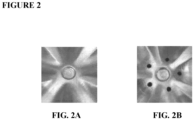
- FIG. 2 illustrates the following aspects of the disclosure:
- the disclosed base blow off method is effected by introducing a pressurized gas such as air in the base blow mold before bottle evacuation / ejection from the mold.
- a pressurized gas such as air
- the pressurized gas (air) is about 6.5-7.5 bar. Pressurized gas at 7 bar works well. Gas (air) at these pressures have been discovered to cool a blown bottle base before bottle evacuation from the blow mold.
- the disclosed base blow off method can be effected by introducing a pressurized gas in the base blow mold to achieve various gas flow rates as needed, and measured, for example, after bottle evacuation. While not intending to be bound by any particular theory, it is estimated that the air flow rates (standard cubic feet per minute) after bottle evacuation will be approximately that shown in Table 1. Table 1. Calculated air flow rates (20°C) after bottle evacuation, as a function of orifice diameter. Calculation Pressure (bar) Flow Rate, 0.1 mm Dia. Orifice (Scfm) Flow Rate, 3 mm Dia. Orifice (Scfm) A 2 0.0025 2.29 B 7 0.0041 3.71 C 16 0.006 5.43
- FIG. 2B where an embodiment of a blow molding base is shown with the gas blow off feature provided by the five (5) gas orifices or holes nearest the center of the base.
- the gas orifices provide the cooling assistance with pressured gas within the gas mold, much earlier than conventional methods, which can reduce or eliminate the need for any post mold cooling.
- the gas orifices can have a diameter of about 0.1 mm to about 3.0 mm.
- orifices can have a diameter of about 0.2 mm to about 2.0 mm, a diameter of about 0.2 mm to about 2.0 mm, or a diameter of about 0.5 mm to about 1.5 mm.
- Orifices having a diameter of about 1 mm also work well.
- suitable gas orifices can have a diameter of about 0.1 mm, about 0.2 mm, about 0.3 mm, about 0.4 mm, about 0.5 mm, about 0.6 mm, about 0.7 mm, about 0.8 mm, about 0.9 mm, about 1.0 mm, about 1.1 mm, about 1.2 mm, about 1.3 mm, about 1.4 mm, about 1.5 mm, about 1.6 mm, about 1.7 mm, about 1.8 mm, about 1.9 mm, about 2.0 mm, about 2.1 mm, about 2.2 mm, about 2.3 mm, about 2.4 mm, about 2.5 mm, about 2.6 mm, about 2.7 mm, about 2.8 mm, about 2.9 mm, or about 3.0 mm.
- the orifices can have an average diameter of from about 0.1 mm to about 3.0 mm.
- FIG. 2B illustrates an embodiment of a blow molding base with the positioning of the gas orifices or holes being equidistant from the center of the base.
- the location of the gas orifices of the blow molding base can be from about 2 mm to about 15 mm from the center of the base.
- the gas orifices can located at about 2 mm from the center of the blow molding base.
- the gas orifices can located at about 3 mm, about 4 mm, about 5 mm, about 6 mm, about 7 mm, about 8 mm, about 9 mm, about 10 mm, about 11 mm, about 12 mm, about 13 mm, about 14 mm, or about 1.5 mm from the center of the blow molding base.
- each orifice is not required to be round.
- any shape of an opening can be used, including any shape hole, vent, slit, or perforation, or any combination thereof.
- the orifice can be round, oval, triangular, square, rectangular, or generally any polygonal shape.
- a certain gas e.g. air
- the number of gas orifices in the blow mold base will typically range from 2 to 20. Typically, though not always, the minimum number of gas orifices will be the same as the number of petals in a petaloid base blow mold. In the example of FIG. 2B , there are 5 orifices shown, but in the base design of FIG. 2B , even 2, 3, or 4 orifices would work. Further, the number of orifices can be any number, limited only by the area of the blow mold base and the need for a particular gas flow.
- the number of gas orifices in the blow mold base can be 2, 3, 4, 5, 6, 7, 8, 9, 10, 11, 12, 13, 14, 15, 16, 17 ,18, 19, or 20, or even more, as needed to achieve the desired performance from a particular base mold.
- the number of gas orifices in the blow mold base can range between any of these numbers.
- the Environmental Stress Crack Resistance (ESCR) of the bottle has been found to improve (see, for example, ASTM D883).
- the ESCR of a bottle made according to this disclosure with gas-assisted base blow off can show an improvement in ESCR of about 5%, about 10%, about 15%, about 20%, about 25%, about 30%, about 35%, about 40%, about 45%, or about 50%. Stress cracks are generally thought to initiate at microscopic imperfections and propagate through the crystalline regions of the polymer structure. It has been unexpectedly discovered that using the same polymer and same blow molding conditions except for the presence or absence of the gas-assisted base blow off, can show the improvements in ESCR as set out herein.
- the various embodiments of this invention can be made with blow molding, the various methods of which are well known to the skilled person.
- the blow molding process comprises a preform reheat stretch blow molding process, as understood by the skilled person.
- the preform can be placed in a blow molding apparatus having an upper mold section which engages the neck finish, a middle mold section having an interior cavity forming the shape of the container side wall, and a lower mold section having an upper surface forming the outwardly concave dome portion of the container base. It is this dome portion of the container base in which the gas orifices are situated, as illustrated in the Figures.
- the base material is PET copolymer that is used in accordance with a conventional reheat stretch blow mold process.
- the injection-molded preform is first reheated to a temperature suitable for stretching and orientation (e.g., 80° to 130° C), placed in the blow mold, and an axial stretch rod is then inserted into the open upper end and moved downwardly to axially stretch the preform.
- a temperature suitable for stretching and orientation e.g. 80° to 130° C
- an expansion gas is introduced into the interior of the preform to radially expand the shoulder, sidewall and base forming portions outwardly into contact with the interior surfaces of mold sections.
- the resulting blown container has the same neck finish with outer threads and lowermost neck flange as the preform.
- blow molding base with the gas (air) blow off feature provided by the gas orifices (openings, vents, holes, perforations, or slits) that provide the cooling with pressured gas such as air plumbed through the base blow mold through the gas orifices.
- the particular polymers used in fabricating the containers and bottles according to this disclosure are generally thermoplastic polymers.
- the disclosed method includes the steps of providing preform for a container, stretch blow molding the preform, and cooling and removing the container from the blow mold by a gas-assisted base blow off using pressurized gas.
- this disclosure provides in one aspect a method for making a polymer container, the method comprising:
- the preform can be made from a variety of thermoplastic polymers, and in embodiments, the thermoplastic polymer can comprise or can be one or more polyesters. In some preferred embodiments, the thermoplastic polymer is or includes a polyethylene terephthalate copolymer.
- the thermoplastic polymer used in the preform can include various additives, if desired, for example, colorants, UV blockers, lubricants, slip agents, processing aids, oxidative stabilizers, thermal stabilizers, creep control agents, gas barrier additives, and the like, including any appropriate combinations thereof.
- useful polyesters are those suitable for packaging carbonated or non-carbonated beverages and/or oxygen-sensitive beverages or food products.
- suitable polyesters include PET copolymers, polyethylene naphthalate (PEN), polyethylene isophthalate, glycol modified amorphous PET copolymer, (commercially known as PETG), diacid modified amorphous PET, and the like.
- PET copolymers are particularly useful because they are used in many container applications.
- PET copolymers refers to those compositions that comprise a diol component having repeat units from ethylene glycol and a diacid component having repeat units from terephthalic acid.
- the PET copolymer has less than about 20% diacid component modification and/or less than 10% diol component modification, based on 100 mole % diacid component and 100 mole % diol component.
- a multi-layer preform also may be used.
- suitable preforms could comprise a 2-, 3-, 4-, or 5-layer, or generally any multi-layer structure, as understood by the person of ordinary skill.
- the different layers are distinguished by different polymer composition, different polymer properties, different additives, and generally differences in the chemical and physical properties.
- a 3-layer preform structure can be used in which the middle layer can comprise a barrier layer or can include a gas barrier additive, and the product-contacting layer and the external layer can be polyester layers.
- the container is a bottle and in another aspect, the container is a bottle suitable for carbonated soft drink (CSD) packaging.
- the bottle is generally cylindrical and includes a neck finish with outer threads, disposed between the open ended mouth and a capping flange.
- the container can further comprise an overmolded layer comprises an overmolding material.
- the packaged beverage includes a container body having an outer surface and an interior space, wherein the container body is formed by the stretch blow molding method disclosed herein using a thermoplastic polymer preform, and a beverage is disposed in the interior space of the container.
- the beverage can be any beverage such as water, juice, carbonated soft drinks, and the like.
- the disclosed methods and apparatus are adapted for making containers for packaging applications in the carbonated and non-carbonated soft drink industry and the food industry.
- a common manufacturing method for forming these containers includes injection molding the container preforms, followed by making the containers from the preforms in single stage or two stage blow molding manufacturing systems.
- Such methods are well known to those skilled in the art, and examples of possible preform and container structures are disclosed, for example, in U.S. Patent No. 5,888,598 .
- Such methods may be readily adapted to accommodate the presence of the base with air (or gas) blow off, and the water and air (or gas) circuit base with air (or gas) blow off.
- commercial equipment including the features according to this disclosure are encompassed herein.
- base clearance or “clearance” is used to describe the distance from the center of the base in the preform gate area to the standing surface.
- Base clearance after thermal stability is the clearance after the bottle has been pressurized and has been subjected to the thermal stability test.
- base clearance after thermal stability is determined by pressurizing the bottle under conditions of high temperature and high humidity for 24 hours, and measuring the base clearance after the 24 hour period.
- high speed operation to describe a blow molding or stretch blow molding process generally refers to a process that generates about 1800 bottles per mold per hour or higher, including when the operation is a blow molding of non-hot fill bottles.
- a projectile includes a single projectile such as a slug, as well as any combination of more than one projectile, such as multiple pellets of shot of any size or combination of sizes.
- reference to “a projectile” includes multiple particles of a chemical composition or mixture of compositions that constitutes a projectile, and the like.
- compositions and methods are described in terms of “comprising” various components or steps, the compositions and methods can also “consist essentially of” or “consist of” the various components or steps.
- Applicants reserve the right to proviso out or exclude any individual members of any such group, including any sub-ranges or combinations of sub-ranges within the group, if for any reason Applicants choose to claim less than the full measure of the disclosure, for example, to account for a reference that Applicants are unaware of at the time of the filing of the application.
- Values or ranges may be expressed herein as “about”, from “about” one particular value, and/or to “about” another particular value. When such values or ranges are expressed, other embodiments disclosed include the specific value recited, from the one particular value, and/or to the other particular value. Similarly, when values are expressed as approximations, by use of the antecedent “about,” it will be understood that the particular value forms another embodiment. It will be further understood that there are a number of values disclosed therein, and that each value is also herein disclosed as “about” that particular value in addition to the value itself. In another aspect, use of the term “about” means ⁇ 20% of the stated value, ⁇ 15% of the stated value, ⁇ 10% of the stated value, ⁇ 5% of the stated value, or ⁇ 3% of the stated value.
Landscapes
- Engineering & Computer Science (AREA)
- Manufacturing & Machinery (AREA)
- Mechanical Engineering (AREA)
- Physics & Mathematics (AREA)
- Thermal Sciences (AREA)
- Blow-Moulding Or Thermoforming Of Plastics Or The Like (AREA)
Claims (15)
- Verfahren zur Herstellung eines Polymerbehälters, bei dem man:a) einen Vorformling bereitstellt, wobei der Vorformling ein thermoplastisches Polymer umfasst;b) den Vorformling bei einer Temperatur, die zum Erweichen des thermoplastischen Polymers ausreichend ist, in einer Blasform zur Bildung eines Behälters streckblasformt, wobei der Boden der Blasform zwei oder mehr Öffnungen im gleichen Abstand vom Mittelpunkt des Blasformbodens zum Eintritt von Gas in die Blasform aufweist; undc) unter Druck stehendes Gas durch die zwei oder mehr Öffnungen in den Blasformboden einbringt, das zur Kühlung des Behälterbodens vor der Entnahme des Behälters ausreichend ist, und anschließend den Behälter aus der Blasform entnimmt; wobei das unter Druck stehende Gas mit einem Druck von 6,5 - 7,5 bar bereitgestellt wird.
- Verfahren nach Anspruch 1, wobei der Boden der Blasform 3, 4, 5, 6, 7 oder 8 Öffnungen zum Eintritt von Gas in die Blasform aufweist.
- Verfahren nach Anspruch 1 oder 2, wobei es sich bei dem unter Druck stehenden Gas um Luft oder Stickstoff handelt.
- Verfahren nach Anspruch 1, 2 oder 3, wobei das unter Druck stehende Gas mit einem Druck von etwa 7 bar bereitgestellt wird.
- Verfahren nach einem der vorhergehenden Ansprüche, wobei die zwei oder mehr Öffnungen einen Durchmesser oder einen durchschnittlichen Durchmesser von etwa 0,1 mm bis etwa 3,0 mm aufweisen.
- Verfahren nach einem der vorhergehenden Ansprüche, wobei die zwei oder mehr Öffnungen des Blasformbodens etwa 2 mm bis etwa 15 mm vom Mittelpunkt des Bodens entfernt sein können.
- Verfahren nach einem der vorhergehenden Ansprüche, wobei die zwei oder mehr Öffnungen rund sind.
- Verfahren nach einem der vorhergehenden Ansprüche, wobei es sich bei dem Blasformboden um einen Boden mit Ausbuchtungen handelt und die Anzahl der Öffnungen in dem Blasformboden gleich der Anzahl der Ausbuchtungen in einem Boden mit Ausbuchtungen ist.
- Verfahren nach einem der vorhergehenden Ansprüche, wobei das thermoplastische Polymer aus Polyethylenterephthalat (PET), Polyethylennaphthalat (PEN), Polyethylenisophthalat, mit Glykol modifizierten amorphen PET-Copolymeren (PETG) und mit Disäuren modifiziertem amorphen PET ausgewählt ist.
- Verfahren nach einem der vorhergehenden Ansprüche, wobei der Vorformling eine mehrschichtige Struktur umfasst.
- Verfahren nach einem der vorhergehenden Ansprüche, wobei es sich bei dem Vorformling um einen spritzgegossenen thermoplastischen Vorformling handelt.
- Verfahren nach einem der vorhergehenden Ansprüche, wobei das Verfahren mit einer ausreichend hohen Geschwindigkeit wiederholt wird, sodass etwa 1800 Flaschen je Form je Stunde oder mehr erzeugt werden können.
- Verfahren nach einem der vorhergehenden Ansprüche, wobei durch das Verfahren eine Flasche hergestellt wurde, die eine verbesserte Spannungsrissbeständigkeit (Environmental Stress Crack Resistance, ESCR) von mindestens etwa 10 % im Vergleich zu einer entsprechenden Flasche, die ohne das Einbringen von unter Druck stehendem Gas durch die mindestens eine Öffnung des Blasformbodens hergestellt wurde, aufweist.
- Verfahren nach einem der vorhergehenden Ansprüche, wobei es sich bei dem Behälter um eine Flasche handelt, die für ein mit Kohlensäure versetztes Erfrischungsgetränk (Carbonated Soft Drink, CSD) geeignet ist.
- Verfahren nach einem der vorhergehenden Ansprüche, ferner umfassend den Schritt des
d) Befüllens des Polymerbehälters mit einem Getränk.
Applications Claiming Priority (2)
| Application Number | Priority Date | Filing Date | Title |
|---|---|---|---|
| US201462094498P | 2014-12-19 | 2014-12-19 | |
| PCT/US2015/066050 WO2016100484A1 (en) | 2014-12-19 | 2015-12-16 | Gas-assisted base blow off methods for blow molding applications |
Publications (4)
| Publication Number | Publication Date |
|---|---|
| EP3233420A1 EP3233420A1 (de) | 2017-10-25 |
| EP3233420A4 EP3233420A4 (de) | 2018-09-26 |
| EP3233420B1 EP3233420B1 (de) | 2021-07-21 |
| EP3233420B2 true EP3233420B2 (de) | 2024-05-29 |
Family
ID=56127526
Family Applications (1)
| Application Number | Title | Priority Date | Filing Date |
|---|---|---|---|
| EP15870967.5A Active EP3233420B2 (de) | 2014-12-19 | 2015-12-16 | Gasunterstütztes bodenausblasverfahren für blasformungsanwendungen |
Country Status (3)
| Country | Link |
|---|---|
| US (1) | US10875230B2 (de) |
| EP (1) | EP3233420B2 (de) |
| WO (1) | WO2016100484A1 (de) |
Families Citing this family (1)
| Publication number | Priority date | Publication date | Assignee | Title |
|---|---|---|---|---|
| DE102018214531A1 (de) * | 2018-08-28 | 2020-03-05 | Krones Ag | Behälterbehandlungsanlage und -verfahren zur Herstellung von Kunststoffbehältern |
Citations (2)
| Publication number | Priority date | Publication date | Assignee | Title |
|---|---|---|---|---|
| US5785921A (en) † | 1993-12-30 | 1998-07-28 | Sidel | Method and an istallation for manufacturing thermoplastic receptacles, in particular bottles |
| WO2015134429A1 (en) † | 2014-03-03 | 2015-09-11 | Amcor Limited | Machine component facilitating mold base movement |
Family Cites Families (14)
| Publication number | Priority date | Publication date | Assignee | Title |
|---|---|---|---|---|
| US3474497A (en) * | 1967-03-03 | 1969-10-28 | American Packaging Corp | Die for forming thermoplastic film |
| JPS60189418A (ja) | 1984-03-09 | 1985-09-26 | Toyo Seikan Kaisha Ltd | 耐熱性ポリエステルボトルの製造法 |
| DD270494A5 (de) | 1987-02-12 | 1989-08-02 | ���������`��������������@����@�K@��Kk�� | Vorrichtung zum herstellen eines kunststoff-hohlkoerpers mit durch blasen geformtem koerperteil |
| JPS6471709A (en) * | 1987-09-11 | 1989-03-16 | Toyo Seikan Kaisha Ltd | Parison for orientation molding |
| JP3200617B2 (ja) | 1992-07-20 | 2001-08-20 | 株式会社吉野工業所 | 合成樹脂製耐圧壜体の成形方法および冷却装置 |
| US5888598A (en) | 1996-07-23 | 1999-03-30 | The Coca-Cola Company | Preform and bottle using pet/pen blends and copolymers |
| JPH11348107A (ja) | 1998-06-09 | 1999-12-21 | Toyo Seikan Kaisha Ltd | 二軸延伸ブロー成形容器の製造方法 |
| JP3577996B2 (ja) * | 1999-06-02 | 2004-10-20 | 東洋製罐株式会社 | 二軸延伸ブロー成形容器の製造方法及びその装置 |
| ITPN20010009A1 (it) * | 2001-02-07 | 2002-08-07 | Sipa Spa | Procedimento per la produzione di contenitori in pet con bocca fuoricentro |
| US20050073077A1 (en) * | 2003-09-09 | 2005-04-07 | Whitley Kenneth W. | Use of air assist to eject roller bottle with deep punt |
| ES2315910T3 (es) | 2005-07-28 | 2009-04-01 | Sidel Participations | Molde para una maquina de moldeo por soplado de recipientes, que comprende una parte inferior del molde ranurada. |
| FR2939072B1 (fr) * | 2008-12-03 | 2011-01-21 | Sidel Participations | Formage des recipients mettant en oeuvre un insert de boxage ventile |
| FR2945469B1 (fr) | 2009-05-14 | 2011-06-10 | Sidel Participations | Support de moule pour fond boxe |
| ES2637713T3 (es) | 2012-01-05 | 2017-10-16 | Amcor Limited | Método y aparato de moldeo para aplicar presión positiva a un recipiente moldeado |
-
2015
- 2015-12-16 EP EP15870967.5A patent/EP3233420B2/de active Active
- 2015-12-16 US US15/536,928 patent/US10875230B2/en active Active
- 2015-12-16 WO PCT/US2015/066050 patent/WO2016100484A1/en not_active Ceased
Patent Citations (2)
| Publication number | Priority date | Publication date | Assignee | Title |
|---|---|---|---|---|
| US5785921A (en) † | 1993-12-30 | 1998-07-28 | Sidel | Method and an istallation for manufacturing thermoplastic receptacles, in particular bottles |
| WO2015134429A1 (en) † | 2014-03-03 | 2015-09-11 | Amcor Limited | Machine component facilitating mold base movement |
Also Published As
| Publication number | Publication date |
|---|---|
| US10875230B2 (en) | 2020-12-29 |
| US20180050482A1 (en) | 2018-02-22 |
| EP3233420A4 (de) | 2018-09-26 |
| WO2016100484A1 (en) | 2016-06-23 |
| EP3233420A1 (de) | 2017-10-25 |
| EP3233420B1 (de) | 2021-07-21 |
Similar Documents
| Publication | Publication Date | Title |
|---|---|---|
| CN101115606B (zh) | 用于通过拉伸吹塑来成型容器的方法以及由此成型的容器 | |
| US10737822B2 (en) | Container and method of manufacture | |
| CN100553939C (zh) | 耐热聚酯容器及其制造方法 | |
| US8980390B2 (en) | Synthetic resin bottle and process for manufacturing the same | |
| US7572493B2 (en) | Low IV pet based copolymer preform with enhanced mechanical properties and cycle time, container made therewith and methods | |
| EP1688234A2 (de) | Verfahren zur Herstellung eines Behälters durch Streckblasformen und dadurch hergestellter Behälter | |
| KR101422308B1 (ko) | 박육 2축 연신 폴리에스테르병 | |
| JP4840367B2 (ja) | 二軸延伸ポリエステルボトルの製造方法 | |
| US8828308B2 (en) | Hydroblow preform design | |
| WO2008115980A1 (en) | Injection stretch blow molded polylactide bottle and process for making same | |
| JP4292918B2 (ja) | プラスチックボトル容器用プリフォーム | |
| EP3233420B1 (de) | Gasunterstütztes bodenausblasverfahren für blasformungsanwendungen | |
| RU2479425C2 (ru) | Модифицированные системы горячих литниковых каналов для инжекционно-выдувного формования | |
| US20040173950A1 (en) | Method of manufacturing bottled formed mainly of polyethylene terephthalate resin | |
| US7316798B2 (en) | Biaxial orientation blow molding process | |
| JPS63185620A (ja) | 熱固定されたポリエステル延伸成形容器の製法 | |
| EP3476756B1 (de) | Streckblasgeformter polyesterbehälter und herstellungsverfahren dafür | |
| JP2018083630A (ja) | ポリエステル製延伸ブロー成形容器及びその製造方法 | |
| JPH11348107A (ja) | 二軸延伸ブロー成形容器の製造方法 | |
| KR20010065787A (ko) | 열고정 폴리에스터 연신 성형 용기의 제조 방법 | |
| KR20020054044A (ko) | 2축 연신 블로우 성형 병 제조 방법 | |
| JP2018024134A (ja) | 合成樹脂製容器の製造方法 | |
| WO2018003790A1 (ja) | ポリエステル製延伸ブロー成形容器及びその製造方法 |
Legal Events
| Date | Code | Title | Description |
|---|---|---|---|
| STAA | Information on the status of an ep patent application or granted ep patent |
Free format text: STATUS: THE INTERNATIONAL PUBLICATION HAS BEEN MADE |
|
| PUAI | Public reference made under article 153(3) epc to a published international application that has entered the european phase |
Free format text: ORIGINAL CODE: 0009012 |
|
| STAA | Information on the status of an ep patent application or granted ep patent |
Free format text: STATUS: REQUEST FOR EXAMINATION WAS MADE |
|
| 17P | Request for examination filed |
Effective date: 20170719 |
|
| AK | Designated contracting states |
Kind code of ref document: A1 Designated state(s): AL AT BE BG CH CY CZ DE DK EE ES FI FR GB GR HR HU IE IS IT LI LT LU LV MC MK MT NL NO PL PT RO RS SE SI SK SM TR |
|
| AX | Request for extension of the european patent |
Extension state: BA ME |
|
| DAV | Request for validation of the european patent (deleted) | ||
| DAX | Request for extension of the european patent (deleted) | ||
| A4 | Supplementary search report drawn up and despatched |
Effective date: 20180827 |
|
| RIC1 | Information provided on ipc code assigned before grant |
Ipc: B65D 85/72 20060101ALI20180821BHEP Ipc: B29C 49/22 20060101ALN20180821BHEP Ipc: B29C 49/66 20060101ALN20180821BHEP Ipc: B29K 67/00 20060101ALN20180821BHEP Ipc: B29C 49/58 20060101ALN20180821BHEP Ipc: B29D 99/00 20100101ALI20180821BHEP Ipc: B65D 1/02 20060101ALI20180821BHEP Ipc: B29C 49/70 20060101ALI20180821BHEP Ipc: B29C 49/46 20060101AFI20180821BHEP |
|
| GRAP | Despatch of communication of intention to grant a patent |
Free format text: ORIGINAL CODE: EPIDOSNIGR1 |
|
| STAA | Information on the status of an ep patent application or granted ep patent |
Free format text: STATUS: GRANT OF PATENT IS INTENDED |
|
| RIC1 | Information provided on ipc code assigned before grant |
Ipc: B29C 49/70 20060101ALI20200818BHEP Ipc: B29C 49/58 20060101ALN20200818BHEP Ipc: B29K 67/00 20060101ALN20200818BHEP Ipc: B29C 49/46 20060101AFI20200818BHEP Ipc: B29C 49/66 20060101ALN20200818BHEP Ipc: B65D 1/02 20060101ALI20200818BHEP Ipc: B29C 49/22 20060101ALN20200818BHEP Ipc: B29D 99/00 20100101ALI20200818BHEP Ipc: B65D 85/72 20060101ALI20200818BHEP |
|
| INTG | Intention to grant announced |
Effective date: 20200901 |
|
| GRAJ | Information related to disapproval of communication of intention to grant by the applicant or resumption of examination proceedings by the epo deleted |
Free format text: ORIGINAL CODE: EPIDOSDIGR1 |
|
| STAA | Information on the status of an ep patent application or granted ep patent |
Free format text: STATUS: REQUEST FOR EXAMINATION WAS MADE |
|
| GRAP | Despatch of communication of intention to grant a patent |
Free format text: ORIGINAL CODE: EPIDOSNIGR1 |
|
| STAA | Information on the status of an ep patent application or granted ep patent |
Free format text: STATUS: GRANT OF PATENT IS INTENDED |
|
| INTC | Intention to grant announced (deleted) | ||
| RIC1 | Information provided on ipc code assigned before grant |
Ipc: B29D 99/00 20100101ALI20210114BHEP Ipc: B29C 49/70 20060101ALI20210114BHEP Ipc: B29C 49/22 20060101ALN20210114BHEP Ipc: B65D 85/72 20060101ALI20210114BHEP Ipc: B29C 49/66 20060101ALN20210114BHEP Ipc: B29C 49/58 20060101ALN20210114BHEP Ipc: B29C 49/46 20060101AFI20210114BHEP Ipc: B29K 67/00 20060101ALN20210114BHEP Ipc: B65D 1/02 20060101ALI20210114BHEP |
|
| INTG | Intention to grant announced |
Effective date: 20210212 |
|
| GRAS | Grant fee paid |
Free format text: ORIGINAL CODE: EPIDOSNIGR3 |
|
| GRAA | (expected) grant |
Free format text: ORIGINAL CODE: 0009210 |
|
| STAA | Information on the status of an ep patent application or granted ep patent |
Free format text: STATUS: THE PATENT HAS BEEN GRANTED |
|
| AK | Designated contracting states |
Kind code of ref document: B1 Designated state(s): AL AT BE BG CH CY CZ DE DK EE ES FI FR GB GR HR HU IE IS IT LI LT LU LV MC MK MT NL NO PL PT RO RS SE SI SK SM TR |
|
| REG | Reference to a national code |
Ref country code: GB Ref legal event code: FG4D |
|
| REG | Reference to a national code |
Ref country code: CH Ref legal event code: EP |
|
| REG | Reference to a national code |
Ref country code: DE Ref legal event code: R096 Ref document number: 602015071581 Country of ref document: DE |
|
| REG | Reference to a national code |
Ref country code: AT Ref legal event code: REF Ref document number: 1412204 Country of ref document: AT Kind code of ref document: T Effective date: 20210815 |
|
| REG | Reference to a national code |
Ref country code: IE Ref legal event code: FG4D |
|
| REG | Reference to a national code |
Ref country code: LT Ref legal event code: MG9D |
|
| REG | Reference to a national code |
Ref country code: NL Ref legal event code: MP Effective date: 20210721 |
|
| REG | Reference to a national code |
Ref country code: AT Ref legal event code: MK05 Ref document number: 1412204 Country of ref document: AT Kind code of ref document: T Effective date: 20210721 |
|
| PG25 | Lapsed in a contracting state [announced via postgrant information from national office to epo] |
Ref country code: LT Free format text: LAPSE BECAUSE OF FAILURE TO SUBMIT A TRANSLATION OF THE DESCRIPTION OR TO PAY THE FEE WITHIN THE PRESCRIBED TIME-LIMIT Effective date: 20210721 Ref country code: BG Free format text: LAPSE BECAUSE OF FAILURE TO SUBMIT A TRANSLATION OF THE DESCRIPTION OR TO PAY THE FEE WITHIN THE PRESCRIBED TIME-LIMIT Effective date: 20211021 Ref country code: AT Free format text: LAPSE BECAUSE OF FAILURE TO SUBMIT A TRANSLATION OF THE DESCRIPTION OR TO PAY THE FEE WITHIN THE PRESCRIBED TIME-LIMIT Effective date: 20210721 Ref country code: NL Free format text: LAPSE BECAUSE OF FAILURE TO SUBMIT A TRANSLATION OF THE DESCRIPTION OR TO PAY THE FEE WITHIN THE PRESCRIBED TIME-LIMIT Effective date: 20210721 Ref country code: NO Free format text: LAPSE BECAUSE OF FAILURE TO SUBMIT A TRANSLATION OF THE DESCRIPTION OR TO PAY THE FEE WITHIN THE PRESCRIBED TIME-LIMIT Effective date: 20211021 Ref country code: PT Free format text: LAPSE BECAUSE OF FAILURE TO SUBMIT A TRANSLATION OF THE DESCRIPTION OR TO PAY THE FEE WITHIN THE PRESCRIBED TIME-LIMIT Effective date: 20211122 Ref country code: FI Free format text: LAPSE BECAUSE OF FAILURE TO SUBMIT A TRANSLATION OF THE DESCRIPTION OR TO PAY THE FEE WITHIN THE PRESCRIBED TIME-LIMIT Effective date: 20210721 Ref country code: ES Free format text: LAPSE BECAUSE OF FAILURE TO SUBMIT A TRANSLATION OF THE DESCRIPTION OR TO PAY THE FEE WITHIN THE PRESCRIBED TIME-LIMIT Effective date: 20210721 Ref country code: HR Free format text: LAPSE BECAUSE OF FAILURE TO SUBMIT A TRANSLATION OF THE DESCRIPTION OR TO PAY THE FEE WITHIN THE PRESCRIBED TIME-LIMIT Effective date: 20210721 Ref country code: RS Free format text: LAPSE BECAUSE OF FAILURE TO SUBMIT A TRANSLATION OF THE DESCRIPTION OR TO PAY THE FEE WITHIN THE PRESCRIBED TIME-LIMIT Effective date: 20210721 Ref country code: SE Free format text: LAPSE BECAUSE OF FAILURE TO SUBMIT A TRANSLATION OF THE DESCRIPTION OR TO PAY THE FEE WITHIN THE PRESCRIBED TIME-LIMIT Effective date: 20210721 |
|
| PG25 | Lapsed in a contracting state [announced via postgrant information from national office to epo] |
Ref country code: PL Free format text: LAPSE BECAUSE OF FAILURE TO SUBMIT A TRANSLATION OF THE DESCRIPTION OR TO PAY THE FEE WITHIN THE PRESCRIBED TIME-LIMIT Effective date: 20210721 Ref country code: LV Free format text: LAPSE BECAUSE OF FAILURE TO SUBMIT A TRANSLATION OF THE DESCRIPTION OR TO PAY THE FEE WITHIN THE PRESCRIBED TIME-LIMIT Effective date: 20210721 Ref country code: GR Free format text: LAPSE BECAUSE OF FAILURE TO SUBMIT A TRANSLATION OF THE DESCRIPTION OR TO PAY THE FEE WITHIN THE PRESCRIBED TIME-LIMIT Effective date: 20211022 |
|
| REG | Reference to a national code |
Ref country code: DE Ref legal event code: R026 Ref document number: 602015071581 Country of ref document: DE |
|
| PG25 | Lapsed in a contracting state [announced via postgrant information from national office to epo] |
Ref country code: DK Free format text: LAPSE BECAUSE OF FAILURE TO SUBMIT A TRANSLATION OF THE DESCRIPTION OR TO PAY THE FEE WITHIN THE PRESCRIBED TIME-LIMIT Effective date: 20210721 |
|
| PLBI | Opposition filed |
Free format text: ORIGINAL CODE: 0009260 |
|
| PLAX | Notice of opposition and request to file observation + time limit sent |
Free format text: ORIGINAL CODE: EPIDOSNOBS2 |
|
| 26 | Opposition filed |
Opponent name: KRONES AG Effective date: 20220421 |
|
| PG25 | Lapsed in a contracting state [announced via postgrant information from national office to epo] |
Ref country code: SM Free format text: LAPSE BECAUSE OF FAILURE TO SUBMIT A TRANSLATION OF THE DESCRIPTION OR TO PAY THE FEE WITHIN THE PRESCRIBED TIME-LIMIT Effective date: 20210721 Ref country code: SK Free format text: LAPSE BECAUSE OF FAILURE TO SUBMIT A TRANSLATION OF THE DESCRIPTION OR TO PAY THE FEE WITHIN THE PRESCRIBED TIME-LIMIT Effective date: 20210721 Ref country code: RO Free format text: LAPSE BECAUSE OF FAILURE TO SUBMIT A TRANSLATION OF THE DESCRIPTION OR TO PAY THE FEE WITHIN THE PRESCRIBED TIME-LIMIT Effective date: 20210721 Ref country code: EE Free format text: LAPSE BECAUSE OF FAILURE TO SUBMIT A TRANSLATION OF THE DESCRIPTION OR TO PAY THE FEE WITHIN THE PRESCRIBED TIME-LIMIT Effective date: 20210721 Ref country code: CZ Free format text: LAPSE BECAUSE OF FAILURE TO SUBMIT A TRANSLATION OF THE DESCRIPTION OR TO PAY THE FEE WITHIN THE PRESCRIBED TIME-LIMIT Effective date: 20210721 Ref country code: AL Free format text: LAPSE BECAUSE OF FAILURE TO SUBMIT A TRANSLATION OF THE DESCRIPTION OR TO PAY THE FEE WITHIN THE PRESCRIBED TIME-LIMIT Effective date: 20210721 |
|
| PG25 | Lapsed in a contracting state [announced via postgrant information from national office to epo] |
Ref country code: MC Free format text: LAPSE BECAUSE OF FAILURE TO SUBMIT A TRANSLATION OF THE DESCRIPTION OR TO PAY THE FEE WITHIN THE PRESCRIBED TIME-LIMIT Effective date: 20210721 Ref country code: IT Free format text: LAPSE BECAUSE OF FAILURE TO SUBMIT A TRANSLATION OF THE DESCRIPTION OR TO PAY THE FEE WITHIN THE PRESCRIBED TIME-LIMIT Effective date: 20210721 |
|
| REG | Reference to a national code |
Ref country code: CH Ref legal event code: PL |
|
| PLBB | Reply of patent proprietor to notice(s) of opposition received |
Free format text: ORIGINAL CODE: EPIDOSNOBS3 |
|
| REG | Reference to a national code |
Ref country code: BE Ref legal event code: MM Effective date: 20211231 |
|
| PG25 | Lapsed in a contracting state [announced via postgrant information from national office to epo] |
Ref country code: LU Free format text: LAPSE BECAUSE OF NON-PAYMENT OF DUE FEES Effective date: 20211216 Ref country code: IE Free format text: LAPSE BECAUSE OF NON-PAYMENT OF DUE FEES Effective date: 20211216 |
|
| PG25 | Lapsed in a contracting state [announced via postgrant information from national office to epo] |
Ref country code: BE Free format text: LAPSE BECAUSE OF NON-PAYMENT OF DUE FEES Effective date: 20211231 |
|
| PG25 | Lapsed in a contracting state [announced via postgrant information from national office to epo] |
Ref country code: LI Free format text: LAPSE BECAUSE OF NON-PAYMENT OF DUE FEES Effective date: 20211231 Ref country code: CH Free format text: LAPSE BECAUSE OF NON-PAYMENT OF DUE FEES Effective date: 20211231 |
|
| PLBP | Opposition withdrawn |
Free format text: ORIGINAL CODE: 0009264 |
|
| PG25 | Lapsed in a contracting state [announced via postgrant information from national office to epo] |
Ref country code: HU Free format text: LAPSE BECAUSE OF FAILURE TO SUBMIT A TRANSLATION OF THE DESCRIPTION OR TO PAY THE FEE WITHIN THE PRESCRIBED TIME-LIMIT; INVALID AB INITIO Effective date: 20151216 |
|
| PG25 | Lapsed in a contracting state [announced via postgrant information from national office to epo] |
Ref country code: CY Free format text: LAPSE BECAUSE OF FAILURE TO SUBMIT A TRANSLATION OF THE DESCRIPTION OR TO PAY THE FEE WITHIN THE PRESCRIBED TIME-LIMIT Effective date: 20210721 |
|
| P01 | Opt-out of the competence of the unified patent court (upc) registered |
Effective date: 20230526 |
|
| PGFP | Annual fee paid to national office [announced via postgrant information from national office to epo] |
Ref country code: GB Payment date: 20231124 Year of fee payment: 9 |
|
| PGFP | Annual fee paid to national office [announced via postgrant information from national office to epo] |
Ref country code: FR Payment date: 20231122 Year of fee payment: 9 Ref country code: DE Payment date: 20231121 Year of fee payment: 9 |
|
| PUAH | Patent maintained in amended form |
Free format text: ORIGINAL CODE: 0009272 |
|
| STAA | Information on the status of an ep patent application or granted ep patent |
Free format text: STATUS: PATENT MAINTAINED AS AMENDED |
|
| PG25 | Lapsed in a contracting state [announced via postgrant information from national office to epo] |
Ref country code: MK Free format text: LAPSE BECAUSE OF FAILURE TO SUBMIT A TRANSLATION OF THE DESCRIPTION OR TO PAY THE FEE WITHIN THE PRESCRIBED TIME-LIMIT Effective date: 20210721 |
|
| 27A | Patent maintained in amended form |
Effective date: 20240529 |
|
| AK | Designated contracting states |
Kind code of ref document: B2 Designated state(s): AL AT BE BG CH CY CZ DE DK EE ES FI FR GB GR HR HU IE IS IT LI LT LU LV MC MK MT NL NO PL PT RO RS SE SI SK SM TR |
|
| REG | Reference to a national code |
Ref country code: DE Ref legal event code: R102 Ref document number: 602015071581 Country of ref document: DE |
|
| PG25 | Lapsed in a contracting state [announced via postgrant information from national office to epo] |
Ref country code: TR Free format text: LAPSE BECAUSE OF FAILURE TO SUBMIT A TRANSLATION OF THE DESCRIPTION OR TO PAY THE FEE WITHIN THE PRESCRIBED TIME-LIMIT Effective date: 20210721 |
|
| PG25 | Lapsed in a contracting state [announced via postgrant information from national office to epo] |
Ref country code: MT Free format text: LAPSE BECAUSE OF FAILURE TO SUBMIT A TRANSLATION OF THE DESCRIPTION OR TO PAY THE FEE WITHIN THE PRESCRIBED TIME-LIMIT Effective date: 20210721 |
|
| REG | Reference to a national code |
Ref country code: DE Ref legal event code: R119 Ref document number: 602015071581 Country of ref document: DE |
|
| GBPC | Gb: european patent ceased through non-payment of renewal fee |
Effective date: 20241216 |
|
| PG25 | Lapsed in a contracting state [announced via postgrant information from national office to epo] |
Ref country code: DE Free format text: LAPSE BECAUSE OF NON-PAYMENT OF DUE FEES Effective date: 20250701 |
|
| PG25 | Lapsed in a contracting state [announced via postgrant information from national office to epo] |
Ref country code: GB Free format text: LAPSE BECAUSE OF NON-PAYMENT OF DUE FEES Effective date: 20241216 |
|
| PG25 | Lapsed in a contracting state [announced via postgrant information from national office to epo] |
Ref country code: FR Free format text: LAPSE BECAUSE OF NON-PAYMENT OF DUE FEES Effective date: 20241231 |