EP3234038B1 - Composition d'encre - Google Patents
Composition d'encre Download PDFInfo
- Publication number
- EP3234038B1 EP3234038B1 EP15813410.6A EP15813410A EP3234038B1 EP 3234038 B1 EP3234038 B1 EP 3234038B1 EP 15813410 A EP15813410 A EP 15813410A EP 3234038 B1 EP3234038 B1 EP 3234038B1
- Authority
- EP
- European Patent Office
- Prior art keywords
- compound
- radiation
- ink composition
- functional group
- reactant
- Prior art date
- Legal status (The legal status is an assumption and is not a legal conclusion. Google has not performed a legal analysis and makes no representation as to the accuracy of the status listed.)
- Active
Links
Images

Classifications
-
- C—CHEMISTRY; METALLURGY
- C09—DYES; PAINTS; POLISHES; NATURAL RESINS; ADHESIVES; COMPOSITIONS NOT OTHERWISE PROVIDED FOR; APPLICATIONS OF MATERIALS NOT OTHERWISE PROVIDED FOR
- C09D—COATING COMPOSITIONS, e.g. PAINTS, VARNISHES OR LACQUERS; FILLING PASTES; CHEMICAL PAINT OR INK REMOVERS; INKS; CORRECTING FLUIDS; WOODSTAINS; PASTES OR SOLIDS FOR COLOURING OR PRINTING; USE OF MATERIALS THEREFOR
- C09D11/00—Inks
- C09D11/02—Printing inks
- C09D11/10—Printing inks based on artificial resins
- C09D11/101—Inks specially adapted for printing processes involving curing by wave energy or particle radiation, e.g. with UV-curing following the printing
-
- B—PERFORMING OPERATIONS; TRANSPORTING
- B41—PRINTING; LINING MACHINES; TYPEWRITERS; STAMPS
- B41J—TYPEWRITERS; SELECTIVE PRINTING MECHANISMS, i.e. MECHANISMS PRINTING OTHERWISE THAN FROM A FORME; CORRECTION OF TYPOGRAPHICAL ERRORS
- B41J11/00—Devices or arrangements of selective printing mechanisms, e.g. ink-jet printers or thermal printers, for supporting or handling copy material in sheet or web form
- B41J11/0015—Devices or arrangements of selective printing mechanisms, e.g. ink-jet printers or thermal printers, for supporting or handling copy material in sheet or web form for treating before, during or after printing or for uniform coating or laminating the copy material before or after printing
- B41J11/002—Curing or drying the ink on the copy materials, e.g. by heating or irradiating
- B41J11/0021—Curing or drying the ink on the copy materials, e.g. by heating or irradiating using irradiation
- B41J11/00214—Curing or drying the ink on the copy materials, e.g. by heating or irradiating using irradiation using UV radiation
-
- B—PERFORMING OPERATIONS; TRANSPORTING
- B41—PRINTING; LINING MACHINES; TYPEWRITERS; STAMPS
- B41J—TYPEWRITERS; SELECTIVE PRINTING MECHANISMS, i.e. MECHANISMS PRINTING OTHERWISE THAN FROM A FORME; CORRECTION OF TYPOGRAPHICAL ERRORS
- B41J2/00—Typewriters or selective printing mechanisms characterised by the printing or marking process for which they are designed
- B41J2/005—Typewriters or selective printing mechanisms characterised by the printing or marking process for which they are designed characterised by bringing liquid or particles selectively into contact with a printing material
- B41J2/01—Ink jet
-
- C—CHEMISTRY; METALLURGY
- C09—DYES; PAINTS; POLISHES; NATURAL RESINS; ADHESIVES; COMPOSITIONS NOT OTHERWISE PROVIDED FOR; APPLICATIONS OF MATERIALS NOT OTHERWISE PROVIDED FOR
- C09D—COATING COMPOSITIONS, e.g. PAINTS, VARNISHES OR LACQUERS; FILLING PASTES; CHEMICAL PAINT OR INK REMOVERS; INKS; CORRECTING FLUIDS; WOODSTAINS; PASTES OR SOLIDS FOR COLOURING OR PRINTING; USE OF MATERIALS THEREFOR
- C09D11/00—Inks
- C09D11/02—Printing inks
- C09D11/03—Printing inks characterised by features other than the chemical nature of the binder
-
- C—CHEMISTRY; METALLURGY
- C09—DYES; PAINTS; POLISHES; NATURAL RESINS; ADHESIVES; COMPOSITIONS NOT OTHERWISE PROVIDED FOR; APPLICATIONS OF MATERIALS NOT OTHERWISE PROVIDED FOR
- C09D—COATING COMPOSITIONS, e.g. PAINTS, VARNISHES OR LACQUERS; FILLING PASTES; CHEMICAL PAINT OR INK REMOVERS; INKS; CORRECTING FLUIDS; WOODSTAINS; PASTES OR SOLIDS FOR COLOURING OR PRINTING; USE OF MATERIALS THEREFOR
- C09D11/00—Inks
- C09D11/02—Printing inks
- C09D11/10—Printing inks based on artificial resins
- C09D11/106—Printing inks based on artificial resins containing macromolecular compounds obtained by reactions only involving carbon-to-carbon unsaturated bonds
- C09D11/107—Printing inks based on artificial resins containing macromolecular compounds obtained by reactions only involving carbon-to-carbon unsaturated bonds from unsaturated acids or derivatives thereof
-
- C—CHEMISTRY; METALLURGY
- C09—DYES; PAINTS; POLISHES; NATURAL RESINS; ADHESIVES; COMPOSITIONS NOT OTHERWISE PROVIDED FOR; APPLICATIONS OF MATERIALS NOT OTHERWISE PROVIDED FOR
- C09D—COATING COMPOSITIONS, e.g. PAINTS, VARNISHES OR LACQUERS; FILLING PASTES; CHEMICAL PAINT OR INK REMOVERS; INKS; CORRECTING FLUIDS; WOODSTAINS; PASTES OR SOLIDS FOR COLOURING OR PRINTING; USE OF MATERIALS THEREFOR
- C09D11/00—Inks
- C09D11/30—Inkjet printing inks
-
- C—CHEMISTRY; METALLURGY
- C09—DYES; PAINTS; POLISHES; NATURAL RESINS; ADHESIVES; COMPOSITIONS NOT OTHERWISE PROVIDED FOR; APPLICATIONS OF MATERIALS NOT OTHERWISE PROVIDED FOR
- C09D—COATING COMPOSITIONS, e.g. PAINTS, VARNISHES OR LACQUERS; FILLING PASTES; CHEMICAL PAINT OR INK REMOVERS; INKS; CORRECTING FLUIDS; WOODSTAINS; PASTES OR SOLIDS FOR COLOURING OR PRINTING; USE OF MATERIALS THEREFOR
- C09D11/00—Inks
- C09D11/30—Inkjet printing inks
- C09D11/32—Inkjet printing inks characterised by colouring agents
- C09D11/324—Inkjet printing inks characterised by colouring agents containing carbon black
- C09D11/326—Inkjet printing inks characterised by colouring agents containing carbon black characterised by the pigment dispersant
-
- C—CHEMISTRY; METALLURGY
- C09—DYES; PAINTS; POLISHES; NATURAL RESINS; ADHESIVES; COMPOSITIONS NOT OTHERWISE PROVIDED FOR; APPLICATIONS OF MATERIALS NOT OTHERWISE PROVIDED FOR
- C09D—COATING COMPOSITIONS, e.g. PAINTS, VARNISHES OR LACQUERS; FILLING PASTES; CHEMICAL PAINT OR INK REMOVERS; INKS; CORRECTING FLUIDS; WOODSTAINS; PASTES OR SOLIDS FOR COLOURING OR PRINTING; USE OF MATERIALS THEREFOR
- C09D11/00—Inks
- C09D11/30—Inkjet printing inks
- C09D11/34—Hot-melt inks
-
- C—CHEMISTRY; METALLURGY
- C09—DYES; PAINTS; POLISHES; NATURAL RESINS; ADHESIVES; COMPOSITIONS NOT OTHERWISE PROVIDED FOR; APPLICATIONS OF MATERIALS NOT OTHERWISE PROVIDED FOR
- C09D—COATING COMPOSITIONS, e.g. PAINTS, VARNISHES OR LACQUERS; FILLING PASTES; CHEMICAL PAINT OR INK REMOVERS; INKS; CORRECTING FLUIDS; WOODSTAINS; PASTES OR SOLIDS FOR COLOURING OR PRINTING; USE OF MATERIALS THEREFOR
- C09D11/00—Inks
- C09D11/30—Inkjet printing inks
- C09D11/38—Inkjet printing inks characterised by non-macromolecular additives other than solvents, pigments or dyes
Definitions
- the present invention relates to an ink composition.
- the present invention further relates to a method for preparing an ink composition.
- the present invention relates to a method for applying an image onto a recording medium.
- Radiation-curable inkjet ink compositions are known in the art. These ink compositions comprise one or more radiation curable components.
- a special class of radiation curable inkjet ink compositions are phase change radiation curable inkjet ink compositions. These inks are fluid at elevated temperature and become solid -even if not yet cured- at lower temperatures. These inks are typically jetted at elevated temperatures. Phase change inks may become solid or semi -solid upon cooling down on a recording medium, e.g. a sheet of paper. As a result, spread of a droplet of ink on the recording medium may be decreased and color bleeding may be prevented.
- An example of a phase change radiation curable inkjet ink is a gelling radiation curable inkjet ink.
- Gelling radiation curable inkjet ink compositions typically comprise a gellant.
- Gellants are also known in the art as gelling agents or thickeners.
- Examples of gellants used in gelling radiation curable inkjet ink compositions are waxes, such as natural waxes and long chain carboxylic acids, and ketones.
- EP 2565044 discloses a method for applying an image onto a recording medium employing actinic energy curable ink comprising a gelling agent.
- EP 2679640 discloses an active ray-curable inkjet ink comprising a gelling agent and an active ray-curable composition.
- US 2013/035428 discloses a phase change ink composition.
- the gelling behavior influences the behavior of the ink droplets on the recording medium.
- the behavior of the droplets may influence the visual appearance of the print.
- the object of the invention is achieved in a radiation-curable inkjet ink composition
- a radiation-curable inkjet ink composition comprising a radiation curable component
- the radiation-curable inkjet ink composition further comprising a first and a second ester compound, the first and the second ester compounds being gelling agents
- the radiation curable inkjet ink composition may comprise a radiation curable medium.
- the radiation curable medium may comprise at least one radiation curable component.
- a radiation curable component is a component that may react (e.g. polymerize) under influence of suitable radiation, such as electromagnetic radiation, e.g. ultraviolet (UV) radiation.
- suitable radiation such as electromagnetic radiation, e.g. ultraviolet (UV) radiation.
- radiation curable components are epoxides and (meth)acrylates.
- (Meth-)acrylates may comprise one or more reactive groups for forming an acrylate polymer.
- the radiation curable medium may comprise one type of radiation curable compound or alternatively, the radiation curable medium may comprise a mixture of radiation curable compounds.
- the radiation curable medium may further comprise at least one inhibitor.
- An inhibitor is a component that prevent (inhibits) unwanted polymerization of the radiation curable compound.
- Inhibitors may be added to the radiation curable inkjet ink composition to increase the shelf life of the ink composition.
- the radiation curable medium may further comprise at least one photo initiator.
- a photo initiator is a component that improves the efficiency of curing; i.e. increases the polymerization rate when the ink composition is irradiated with suitable radiation, such as UV radiation.
- the radiation curable medium may further comprise a solvent, such as water or an organic solvent.
- the solvent may be added to the radiation curable medium to tune ink properties, such as viscosity.
- the radiation curable medium may comprise surfactants, antibacterial components and anti-fungi components.
- the radiation curable inkjet ink composition may further comprise a colorant, such as a pigment, a dye or a mixture thereof. Further, the radiation curable inkjet ink composition may comprise a mixture of dyes and/or a mixture of pigments.
- the colorant may provide the ink composition with a predetermined color.
- the radiation curable inkjet ink composition may further comprise a first ester compound.
- the first ester compound consists essentially of a condensation product of a first reactant and a second reactant, wherein the first reactant is a compound A comprising at least 3 first functional groups, and wherein the second reactant comprises at least one compound B, wherein the at least one compound B comprises a second functional group, wherein the first functional group is a hydroxyl functional group and the second functional group is a carboxylic acid functional group.
- the first ester compound may consist essentially of a condensation product of a first reactant and a second reactant, wherein the first reactant is a compound A comprising at least 3 hydroxyl functional group functional groups and wherein the second reactant comprises at least one compound B, wherein the at least one compound B comprises a carboxylic functional group.
- the ester compound may consist essentially of a condensation product of a first reactant and a second reactant, wherein the first reactant is a compound A comprising at least 3 carboxylic acid functional groups and wherein the second reactant comprises at least one compound B, wherein the at least one compound B comprises a hydroxyl functional group.
- compound B comprises only one second group.
- the compound B preferably comprises only one carboxylic acid group.
- the first ester compound formed by reacting the first reactant and the second reactant may be a nonlinear ester compound.
- the first ester compound may comprise at least three ester groups.
- the ester compound may provide the radiation curable inkjet ink composition with gelling properties.
- the radiation curable inkjet ink composition may further comprise a second ester compound.
- the second ester compound consists essentially of a condensation product of a first reactant and a second reactant, wherein the first reactant is a compound A' comprising at least 2 first functional groups, and wherein the second reactant comprises at least one compound B', wherein the at least one compound B' comprises a second functional group, wherein the first functional group is a hydroxyl functional group and the second functional group is a carboxylic acid functional group.
- the second ester compound may consist essentially of a condensation product of a first reactant and a second reactant, wherein the first reactant is a compound A' comprising at least 2 hydroxyl functional group functional groups and wherein the second reactant comprises at least one compound B', wherein the at least one compound B' comprises a carboxylic functional group.
- the ester compound may consist essentially of a condensation product of a first reactant and a second reactant, wherein the first reactant is a compound A' comprising at least 2 carboxylic acid functional groups and wherein the second reactant comprises at least one compound B', wherein the at least one compound B comprises a hydroxyl functional group.
- compound B' comprises only one second group.
- the compound B' preferably comprises only one carboxylic acid group.
- the second ester compound may comprise at least two ester groups.
- the second ester compound may provide the radiation curable inkjet ink composition with gelling properties.
- the compound B and compound B' may be the same or may be different. Preferably, compound B is different from compound B'.
- Compounds according to formula I are suitable to form ester compounds in accordance with the present invention.
- the properties of the ester compound may be influenced by the choice of the functional group R.
- the nature of the R group may for example influence the melting point of the ester compound and the rate of diffusion of the ester compound in the inkjet ink composition.
- R may be an alkyl group, an aryl group or an alkylarylgroup. When the functional group R comprises an aromatic unit, then pi-pi-interaction may occur.
- Pi-pi interaction may assist in forming the intermolecular network upon cooling of the ink composition comprising the ester compound, which may be beneficial for the increase in viscosity of the ink composition when cooling down.
- the functional group R may be a group comprising 5-40 carbon atoms, preferably 10-25. When the functional group R comprises less than 5 carbon atoms, the ester compound may not show gelling behavior at printing conditions. When the functional group R comprises more than 40 carbon atoms, then the ester compound may not be fluid at jetting conditions, which may hamper the jetting of the inkjet ink composition.
- the ester compound may comprise only one type of functional group R. Alternatively, the ester compound may comprise a plurality of different R functional groups.
- the first ester compound may be different from the second ester compound.
- the first ester compound and the second ester compound may be used as a gelling agent in a radiation-curable inkjet ink composition.
- the type of gellant used in a radiation curable inkjet ink composition may have an influence on the gelling behavior of the ink.
- the temperature at which gelling starts and the speed of gelling may be influenced by the nature of the gellant. It is desired to tune the gelling behavior of the ink composition to the printing process such that optimum gelling behavior (and print quality) is obtained. It was found that tuning of the gelling behavior can be achieved by using two ester compounds as gelling agent, wherein the first and second ester compounds are different from one another, but wherein the molecular structure of the first and second ester compound is similar, i.e.
- ester compounds are compounds in accordance with the present invention.
- the viscosity of the ink at a certain temperature and the temperature at which gelling takes place (gelling temperature) of the ink can be tuned by using a first ester compound and a second ester compound in accordance with the present invention. In this way, spreading of an ink droplet on a recording medium after jetting can be controlled, which allows to prepare images having e.g. high gloss and do not show a visible swath boundary.
- the first ester compound consists essentially of a condensation product of a first reactant and x equivalents of a second reactant, wherein the first reactant is a compound A comprising x first functional groups, wherein x ⁇ 3 and wherein the second reactant comprises at least one compound B, wherein the at least one compound B comprises a second functional group, wherein the first functional group is a hydroxyl functional group and the second functional group is a carboxylic acid functional group, and the second ester compound consists essentially of a condensation product of a first reactant and y equivalents of a second reactant, wherein the first reactant is a compound A' comprising at least y first functional groups, wherein y ⁇ 2 and wherein the second reactant comprises at least one compound B', wherein the at least one compound B' comprises a second functional group, wherein the first functional group is a hydroxyl functional group and the second functional group is a carboxylic acid functional group. All reactive groups of compounds A and A' may be converted into
- the second ester compound consists essentially of a condensation product of a first reactant and a second reactant, wherein the first reactant is a compound A' comprising at least 3 first functional groups.
- the first ester compound may comprise at least four esters groups.
- the second ester compound formed by reacting the first reactant and the second reactant may be a nonlinear ester compound.
- the second ester compound may comprise at least three ester groups.
- the first ester compound and the second ester compound may be present in a total amount of 0.5 wt% - 15 wt% based on the total weight of the radiation-curable inkjet ink composition.
- the ester compound may present in an amount of 1.5 wt% - 10.0 wt% based on the total weight of the radiation-curable inkjet ink composition, more preferably from 4.0 wt% - 8.0 wt%.
- the ink composition comprises less than 0.5 wt% of the ester compound, based on the total weight of the radiation-curable inkjet ink composition, then the increase in viscosity of the ink after printing on the recording medium may be insufficient to prevent color bleeding.
- the first ester compound may be present in an amount of 5 wt% - 2000 wt% based on the amount of the second ester compound.
- the first ester compound may be present in an amount of 10 wt% - 1000 wt% based on the amount of the second ester compound.
- the molecular structure of the first ester compound and the second ester compound may be similar. Without wanting to be bound to any theory, it is believed that the similar, but not identical molecular structures of the first and second ester compound, respectively, may allow to tune the phase change behavior of the radiation curable ink composition.
- the first and second ester compound may be fluid and may be dissolved in an ink composition.
- a radiation curable ink composition comprising the first and the second ester compound may be jetted at high temperatures.
- the viscosity of the ink may increase.
- droplets of the ink composition are applied onto a recording medium, the temperature of the ink may decrease and consequently, the viscosity of the ink may decrease.
- This viscosity increase may result in pinning of the ink droplets.
- the temperature at which the viscosity increase takes place may be tuned by suitably selecting the first ester compound and the second ester compound. Further, the temperature at which the viscosity increase takes place may be tuned by selecting the amount and ratio of the first ester compound and the second ester compound.
- using an ink composition comprising two gelling agents may allow optimizing the gelling behavior of the ink composition with regard to the print process parameters.
- An ink composition comprising a first ester compound and a second ester compound may show more than one viscosity increase; i.e. such ink composition may have two different gelling temperatures; a lower and a higher gelling temperature. However, these lower and higher gelling temperatures may be different from the gelling temperatures of an ink composition that comprises the first ester compound, but not the second ester compound or an ink composition that comprises the second ester compound, but not the first ester compound.
- the compounds A and A' are selected from the group consisting of pentaerythritol, cyclodextrine, glycerol, dipentaerythritol, 2-(hydroxymethyl)-2-methylpropane-1,3-diol, 2-ethyl-2-(hydroxymethyl)propane-1,3-diol, 2-(hydroxymethyl)propane-1,3-diol, trimethylolethane, trimethylolpropane, trimethylolbutane and trimethylolpentane.
- These compounds are compounds comprising at least 3 hydroxyl functional groups. When reacted with a carboxylic acid, ester compounds can be formed.
- Esters obtainable by reacting a carboxylic ester with a compound A or compound A' selected from the above listed group may be esters having a branched structure (i.e. non-linear esters). Without wanting to be bound to any theory, it is believed that a branched structure may decrease the tendency of the ester compound to crystallize when cooling down. Hence, ester compound obtainable from the above mentioned polyalcohol components may not crystallize when cooling down. This may improve the gloss of a print made with an ink composition comprising such ester compound.
- Methods for synthesizing ester compounds starting from a compound comprising a plurality of hydroxyl functional groups and a compound comprising a carboxylic acid group are known in the art.
- the compound A and compound A' may be the same or may be different. Preferably, compound A is different from compound A'.
- compound A may be different from compound A' and/or compound B may be different from compound B'.
- the compound B and the compound B' are fatty acids.
- Fatty acids are suitable for forming esters, when reacted with a compound comprising a hydroxyl functional group.
- the fatty acids may be saturated or non-saturated fatty acids.
- Non-saturated fatty acids may be monounsaturated fatty acids or polyunsaturated fatty acids.
- Non-saturated fatty acids comprise an alkene functional group.
- the alkene functional group may react and the ester compound may be incorporated in the network formed by the radiation-curable component.
- no so-called blooming of the ink may occur.
- Blooming is an unwanted phenomenon that may occur in ink composition, such as radiation-curable ink composition comprising a gelling agent.
- a gelling agent present in the ink may cool down and may solidify, thereby forming a three-dimensional network that increases the viscosity of the ink.
- the gelling agent may migrate to the surface of the ink layer, which may result in matt print appearance.
- the phenomenon of decreased gloss due to migration of the gelling agent is known as "blooming".
- the first ester compound is a fatty acid ester of pentaerythritol.
- Ester compounds of pentaerythritol may be suitable used as a gelling agent in a radiation-curable ink composition.
- the first ester compound is pentaerythritoltetrastearate.
- Pentaerythritoltetrastearate is an ester obtainable by reacting pentaerythritol and stearic acid.
- Stearic acid CH 3 (CH 2 ) 16 COOH
- the second ester compound is a fatty acid ester of glycerol.
- Ester compounds of glycerol may be suitable used as a gelling agent in a radiation-curable ink composition.
- the second ester compound is glyceroltristearate.
- Glyceroltristearate is an ester obtainable by reacting glycerol and stearic acid.
- Stearic acid (CH 3 (CH 2 ) 16 COOH) is a fatty acid.
- the radiation curable component is an acrylate having two or more acrylate functional groups.
- An acrylate may undergo a polymerization reaction when irradiated by suitable radiation, such as UV radiation.
- suitable radiation such as UV radiation.
- a polyacrylate polymer may be formed when an inkjet ink composition comprising an acrylate is cured, thereby hardening the ink.
- An acrylate molecule having two or more acrylate functional groups may react with two or more other acrylate molecules and hence, a polymeric network may be formed. Examples of acrylates having two or more acrylate functional groups are known in the art.
- the ink composition further comprises a monofunctional acrylate. Presence of a monofunctional acrylate may improve the hardness and flexibility of the ink layer after curing.
- a method for preparing a radiation-curable inkjet ink composition comprising the steps of:
- a method for applying an image onto a recording medium comprising the steps of:
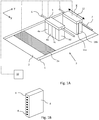
- Fig. 1A shows an ink jet printing assembly 3.
- the ink jet printing assembly 3 comprises supporting means for supporting an image receiving medium 2.
- the supporting means are shown in Fig. 1A as a flat surface 1, but alternatively, the supporting means may be a platen, for example a rotatable drum that is rotatable around an axis.
- the supporting means may be optionally provided with suction holes for holding the image receiving medium in a fixed position with respect to the supporting means.
- the ink jet printing assembly 3 comprises print heads 4a - 4d, mounted on a scanning print carriage 5.
- the scanning print carriage 5 is guided by suitable guiding means 6 to move in reciprocation in the main scanning direction X.
- Each print head 4a - 4d comprises an orifice surface 9, which orifice surface 9 is provided with at least one orifice 8, as is shown in Fig. 1B .
- the print heads 4a - 4d are configured to eject droplets of marking material onto the image receiving medium 2.
- the image receiving medium 2 may be a medium in web or in sheet form and may be composed of e.g. paper, cardboard, label stock, coated paper, plastic or textile. Alternatively, the image receiving medium 2 may also be an intermediate member, endless or not. Examples of endless members, which may be moved cyclically, are a belt or a drum. The image receiving medium 2 is moved in the sub-scanning direction Y over the flat surface 1 along four print heads 4a - 4d provided with a fluid marking material.
- the image receiving medium 2, as depicted in Fig. 1A is locally heated or cooled in the temperature control region 2a.
- temperature control means such as heating and/or cooling means may be provided to control the temperature of the receiving medium 2.
- the temperature control means may be integrated in the supporting means for supporting an image receiving medium 2.
- the temperature control means may be electrical temperature control means.
- the temperature control means may use a cooling and/or heating liquid to control the temperature of the image receiving medium 2.
- the temperature control means may further comprise a sensor (not shown) for monitoring the temperature of the image receiving medium 2.
- a scanning print carriage 5 carries the four print heads 4a - 4d and may be moved in reciprocation in the main scanning direction X parallel to the platen 1, such as to enable scanning of the image receiving medium 2 in the main scanning direction X. Only four print heads 4a - 4d are depicted for demonstrating the invention. In practice an arbitrary number of print heads may be employed. In any case, at least one print head 4a - 4d per color of marking material is placed on the scanning print carriage 5. For example, for a black-and-white printer, at least one print head 4a - 4d, usually containing black marking material is present. Alternatively, a black-and-white printer may comprise a white marking material, which is to be applied on a black image-receiving medium 2.
- At least one print head 4a - 4d for each of the colors usually black, cyan, magenta and yellow is present.
- black marking material is used more frequently in comparison to differently colored marking material. Therefore, more print heads 4a - 4d containing black marking material may be provided on the scanning print carriage 5 compared to print heads 4a - 4d containing marking material in any of the other colors.
- the print head 4a - 4d containing black marking material may be larger than any of the print heads 4a - 4d, containing a differently colored marking material.
- the carriage 5 is guided by guiding means 6.
- These guiding means 6 may be a rod as depicted in Fig. 1A . Although only one rod 6 is depicted in Fig. 1A , a plurality of rods may be used to guide the carriage 5 carrying the print heads 4.
- the rod may be driven by suitable driving means (not shown).
- the carriage 5 may be guided by other guiding means, such as an arm being able to move the carriage 5.
- Another alternative is to move the image receiving material 2 in the main scanning direction X.
- Each print head 4a - 4d comprises an orifice surface 9 having at least one orifice 8, in fluid communication with a pressure chamber containing fluid marking material provided in the print head 4a - 4d.
- a number of orifices 8 are arranged in a single linear array parallel to the sub-scanning direction Y, as is shown in Fig. 1B .
- the nozzles may be arranged in the main scanning direction X.
- Eight orifices 8 per print head 4a - 4d are depicted in Fig. 1B , however obviously in a practical embodiment several hundreds of orifices 8 may be provided per print head 4a - 4d, optionally arranged in multiple arrays. As depicted in Fig.
- the respective print heads 4a - 4d are placed parallel to each other.
- the print heads 4a - 4d may be placed such that corresponding orifices 8 of the respective print heads 4a - 4d are positioned in-line in the main scanning direction X.
- a line of image dots in the main scanning direction X may be formed by selectively activating up to four orifices 8, each of them being part of a different print head 4a - 4d.
- This parallel positioning of the print heads 4a - 4d with corresponding in-line placement of the orifices 8 is advantageous to increase productivity and/or improve print quality.
- multiple print heads 4a - 4d may be placed on the print carriage adjacent to each other such that the orifices 8 of the respective print heads 4a - 4d are positioned in a staggered configuration instead of in-line. For instance, this may be done to increase the print resolution or to enlarge the effective print area, which may be addressed in a single scan in the main scanning direction X.
- the image dots are formed by ejecting droplets of marking material from the orifices 8.
- the ink jet printing assembly 3 may further comprise curing means 11a, 11b. As shown in Fig.
- a scanning print carriage 12 carries the two curing means 11a, 11b and may be moved in reciprocation in the main scanning direction X parallel to the platen 1, such as to enable scanning of the image receiving medium 2 in the main scanning direction X.
- more than two curing means may be applied. It is also possible to apply page-wide curing means. If page-wide curing means are provided, then it may not be necessary to move the curing means in reciprocation in the main scanning direction X.
- the first curing means 11a may emit a first beam of UV radiation, the first beam having a first intensity.
- the first curing means 11a may be configured to provide the radiation for the pre-curing step.
- the second curing means 11b may emit a second beam of radiation, the second beam of radiation having a second intensity.
- the second curing means 11b may be configured to provide the radiation for the post-curing step.
- the carriage 12 is guided by guiding means 7.
- These guiding means 7 may be a rod as depicted in Fig. 1A . Although only one rod 7 is depicted in Fig. 1A , a plurality of rods may be used to guide the carriage 12 carrying the print heads 11.
- the rod 7 may be driven by suitable driving means (not shown). Alternatively, the carriage 12 may be guided by other guiding means, such as an arm being able to move the carriage 12.
- the curing means may be energy sources, such as actinic radiation sources, accelerated particle sources or heaters.
- actinic radiation sources are UV radiation sources or visible light sources. UV radiation sources are preferred, because they are particularly suited to cure UV curable inks by inducing a polymerization reaction in such inks.
- suitable sources of such radiation are lamps, such as mercury lamps, xenon lamps, carbon arc lamps, tungsten filaments lamps, light emitting diodes (LED's) and lasers.
- the first curing means 11a and the second curing means 11b are positioned parallel to one another in the sub scanning direction Y.
- the first curing means 11a and the second curing means 11b may be the same type of energy source or may be different type of energy source.
- the wavelength of the radiated emitted by the two respective curing means 11a, 11b may differ or may be the same.
- the first and second curing means are depicted as distinct devices. However, alternatively, only one source of UV radiation emitting a spectrum of radiation may be used, together with at least two distinct filters. Each filter may absorb a part of the spectrum, thereby providing two beams of radiation, each one having intensity different from the other.
- the flat surface 1, the temperature control means, the carriage 5, the print heads 4a - 4d, the carriage 12 and the first and second curing means 11a, 11b are controlled by suitable controlling means 10.
- SR 9003 (propoxylated neopentyl glycol diacrylate) was obtained from Sartomer. Pentaerythritoltetrastearate was obtained from NOF. Glyceroltristearate was obtained from Sigma-Aldrich. All chemicals were used as received.
- the viscosity is measured using an Anton Paar MCR 301 rheometer, with flat plate geometry. The viscosity is measured at shear rates ( ⁇ ) of 100 s -1 .
- the ink compositions were provided to the rheometer at a temperature of 70°C. The ink compositions were kept at a constant temperature for 5 minutes, before the ink compositions started to cool down. During the viscosity measurements, the ink compositions were cooled down with a rate of 4°C per minute starting at a temperature of 70°C. The measurement was stopped when a temperature of 10°C was reached.
- ink compositions were prepared.
- the ink compositions were prepared by adding gelling agent to a radiation curable medium, wherein the radiation curable medium consists of SR 9003 as radiation-curable monomer and mixing the components.
- the amount of gelling agent and of the radiation curable medium is shown in table 1.
- Ink compositions Ex 1 , Ex 2 and Ex 3 are ink compositions according to the present invention.
- Ink composition Ex 1, Ex 2 and Ex 3 comprise pentaerythritoltetrastearate as a gelling agent and further comprise glyceroltristearate as a gelling agent.
- Comparative ink compositions CE 1 and CE 2 were also prepared analogously; ink composition CE 1 comprises pentaerythritoltetrastearate as a gelling agent, ink composition CE 2 comprises glyceroltristearate as a gelling agent.
- Table 1 Ink compositions Ink compositions SR 9003 (gr) pentaerythritoltetrastearate (gr) glyceroltristearate (gr) Ex 1 50 0.75 0.75 Ex 2 50 0.75 0.50 Ex 3 50 0.75 0.25 CE 1 50 0.75 0 CE 2 50 0 0.75
- the viscosity of each one of the ink compositions CE 1 , CE 2 , Ex 1 , Ex 2 and Ex 3 was measured as a function of temperature in a temperature range of 10°C - 70°C.
- the viscosity of the five ink compositions as a function of temperature is shown in Figure 2 .
- Comparative ink composition CE 1 shows one big increase in viscosity, in particular at around 40°C.
- comparative ink composition CE 2 shows only one big change in viscosity, which is around 21 °C.
- both comparative ink compositions show a change in viscosity.
- the ink composition according to the present invention Ex 1 shows two changes in viscosity; one at about 38°C and one at about 30°C.
- the ink composition according to the present invention Ex 2 shows two changes in viscosity; one at about 39°C and one at about 26°C.
- the ink composition according to the present invention Ex 3 also shows two changes in viscosity; one at about 40°C and one at about 21 °C.
- Gelling ink compositions are typically jetted at elevated temperatures. At the elevated temperature, the gelling ink compositions are in a liquid state; their viscosity is sufficiently low to be jetted. All five ink compositions shown in the examples and comparative examples are suitable to be jetted at elevated temperatures; their viscosity is 20 mPa.s or lower at temperatures from 45°C to 70°C.
- the viscosity of the ink composition typically increases due to gelling of the ink droplets.
- the gelling temperature (the temperature at which a first viscosity increase takes place upon cooling down of the ink) differs for the ink compositions shown in Figure 2 .
- the ink compositions according to the present invention Ex 1 , Ex 2 and Ex 3 have a gelling temperature in the range of 38°C - 40°C; the ink composition CE 1 has a gelling temperature of 40°C and ink composition CE 2 has a gelling temperature of 21 °C.
- an ink composition according to the present invention i.e. an ink composition comprising two gelling agents, allows tuning the gelling temperature of the ink composition.
- an ink composition according to the present invention comprising two gelling agents in accordance with the present invention may allow tuning of the gelling properties of a radiation-curable ink composition.
- plurality is defined as two or more than two.
- another is defined as at least a second or more.
- the terms including and/or having, as used herein, are defined as comprising (i.e., open language).
- coupled is defined as connected, although not necessarily directly.
Landscapes
- Chemical & Material Sciences (AREA)
- Wood Science & Technology (AREA)
- Life Sciences & Earth Sciences (AREA)
- Engineering & Computer Science (AREA)
- Materials Engineering (AREA)
- Organic Chemistry (AREA)
- Chemical Kinetics & Catalysis (AREA)
- General Chemical & Material Sciences (AREA)
- Health & Medical Sciences (AREA)
- General Health & Medical Sciences (AREA)
- Toxicology (AREA)
- Inks, Pencil-Leads, Or Crayons (AREA)
- Ink Jet (AREA)
- Ink Jet Recording Methods And Recording Media Thereof (AREA)
- Polymerisation Methods In General (AREA)
Claims (12)
- Composition d'encre pour jet d'encre durcissable sous rayonnement comprenant un composant durcissable sous rayonnement, la composition d'encre pour jet d'encre durcissable sous rayonnement comprenant en outre un premier et un second composé d'ester, les premier et second composés d'ester étant des agents gélifiants• le premier composé d'ester étant essentiellement constitué d'un produit de condensation d'un premier réactif et d'un second réactif, dans laquelle le premier réactif est un composé A comprenant au moins 3 premiers groupes fonctionnels, et dans laquelle le second réactif comprend au moins un composé B, dans laquelle l'au moins un composé B comprend un second groupe fonctionnel, dans laquelle le premier groupe fonctionnel est un groupe fonctionnel hydroxyle et le second groupe fonctionnel est un groupe fonctionnel acide carboxylique,• le second composé d'ester étant essentiellement constitué d'un produit de condensation d'un premier réactif et d'un second réactif, dans laquelle le premier réactif est un composé A' comprenant au moins 2 premiers groupes fonctionnels, et dans laquelle le second réactif comprend au moins un composé B', dans laquelle l'au moins un composé B' comprend un second groupe fonctionnel, dans laquelle le premier groupe fonctionnel est un groupe fonctionnel hydroxyle et le second groupe fonctionnel est un groupe fonctionnel acide carboxylique,dans laquelle le composé B et le composé B' sont des composés selon la formule I ;
formule I : R-C(O)OH ;
dans laquelle R est un groupe alkyle, un groupe aryle ou un groupe alkylaryle, dans laquelle R est un groupe ayant 5 à 30 atomes de carbone, et
dans laquelle le premier composé d'ester est différent du second composé d'ester. - Composition d'encre pour jet d'encre durcissable sous rayonnement selon la revendication 1, dans laquelle le composé A' comprend au moins 3 premiers groupes fonctionnels.
- Composition d'encre pour jet d'encre durcissable sous rayonnement selon la revendication 2, dans laquelle le composé A et le composé A' sont sélectionnés dans le groupe constitué du pentaérythritol, d'une cyclodextrine, du glycérol, du dipentaérythritol, du 2-(hydroxyméthyl)-2-méthylpropane-1,3-diol, du 2-éthyl-2-(hydroxyméthyl)propane-1,3-diol, du 2-(hydroxyméthyl)propane-1,3-diol, du triméthyloléthane, du triméthylolpropane, du triméthylolbutane et du triméthylolpentane.
- Composition d'encre pour jet d'encre durcissable sous rayonnement selon l'une quelconque des revendications précédentes, dans laquelle le composé B et le composé B' sont des acides gras.
- Composition d'encre pour jet d'encre durcissable sous rayonnement selon les revendications 3 et 4, dans laquelle le premier composé d'ester est un ester d'acide gras de pentaérythritol.
- Composition d'encre pour jet d'encre durcissable sous rayonnement selon la revendication 5, dans laquelle le premier composé d'ester est le tétrastéarate de pentaérythritol.
- Composition d'encre pour jet d'encre durcissable sous rayonnement selon l'une quelconque des revendications précédentes, dans laquelle le second composé d'ester est un ester d'acide gras de glycérol.
- Composition d'encre pour jet d'encre durcissable sous rayonnement selon la revendication 7, dans laquelle le second composé d'ester est le tristéarate de glycérol.
- Composition d'encre pour jet d'encre durcissable sous rayonnement selon l'une quelconque des revendications précédentes, dans laquelle le composant durcissable sous rayonnement est un acrylate ayant deux ou plus de deux groupes fonctionnels acrylate.
- Composition d'encre pour jet d'encre durcissable sous rayonnement selon la revendication 9, dans laquelle la composition d'encre comprend en outre un acrylate monofonctionnel.
- Procédé pour préparer une composition d'encre pour jet d'encre durcissable sous rayonnement selon les revendications 1 à 10, le procédé comprenant les étapes suivantes :• la fourniture d'un composant durcissable sous rayonnement ;• la fourniture d'un premier composé d'ester, le premier composé d'ester étant un agent gélifiant, le composé d'ester étant essentiellement constitué d'un produit de condensation d'un premier réactif et d'un second réactif, dans lequel le premier réactif est un composé A comprenant au moins 3 premiers groupes fonctionnels, et dans lequel le second réactif comprend au moins un composé B, dans lequel l'au moins un composé B comprend un second groupe fonctionnel, dans lequel le premier groupe fonctionnel est un groupe fonctionnel hydroxyle et le second groupe fonctionnel est un groupe fonctionnel acide carboxylique ;• la fourniture d'un second composé d'ester, le second composé d'ester étant un agent gélifiant, le second composé d'ester étant essentiellement constitué d'un produit de condensation d'un premier réactif et d'un second réactif, dans lequel le premier réactif est un composé A' comprenant au moins 2 premiers groupes fonctionnels, et dans lequel le second réactif comprend au moins un composé B', dans lequel l'au moins un composé B' comprend un second groupe fonctionnel, dans lequel le premier groupe fonctionnel est un groupe fonctionnel hydroxyle et le second groupe fonctionnel est un groupe fonctionnel acide carboxylique ;
dans lequel le composé B et le composé B' sont des composés selon la formule I ;
formule I : R-C(O)OH ;
dans lequel R est un groupe alkyle, un groupe aryle ou un groupe alkylaryle, dans lequel R est un groupe ayant 5 à 30 atomes de carbone, et• le mélange du composant durcissable sous rayonnement et du composé d'ester. - Procédé pour appliquer une image sur un support d'enregistrement, le procédé comprenant les étapes suivantes :a. la projection de gouttelettes d'une composition d'encre pour jet d'encre durcissable sous rayonnement selon l'une quelconque des revendications 1 à 10 sur le support d'enregistrement ;b. le durcissement de la composition d'encre pour jet d'encre durcissable sous rayonnement par l'irradiation de la composition d'encre au moyen d'un rayonnement UV.
Applications Claiming Priority (3)
| Application Number | Priority Date | Filing Date | Title |
|---|---|---|---|
| EP14198894 | 2014-12-18 | ||
| EP15171059 | 2015-06-08 | ||
| PCT/EP2015/080284 WO2016097180A1 (fr) | 2014-12-18 | 2015-12-17 | Composition d'encre |
Publications (2)
| Publication Number | Publication Date |
|---|---|
| EP3234038A1 EP3234038A1 (fr) | 2017-10-25 |
| EP3234038B1 true EP3234038B1 (fr) | 2019-07-31 |
Family
ID=54848558
Family Applications (2)
| Application Number | Title | Priority Date | Filing Date |
|---|---|---|---|
| EP15808174.5A Active EP3234037B8 (fr) | 2014-12-18 | 2015-12-10 | Composition d'encre |
| EP15813410.6A Active EP3234038B1 (fr) | 2014-12-18 | 2015-12-17 | Composition d'encre |
Family Applications Before (1)
| Application Number | Title | Priority Date | Filing Date |
|---|---|---|---|
| EP15808174.5A Active EP3234037B8 (fr) | 2014-12-18 | 2015-12-10 | Composition d'encre |
Country Status (10)
| Country | Link |
|---|---|
| US (2) | US10259958B2 (fr) |
| EP (2) | EP3234037B8 (fr) |
| JP (2) | JP6712271B2 (fr) |
| KR (1) | KR102463651B1 (fr) |
| CN (1) | CN107001827B (fr) |
| AU (1) | AU2015366567B2 (fr) |
| CA (1) | CA2965747C (fr) |
| ES (1) | ES2784341T3 (fr) |
| SG (1) | SG11201704517SA (fr) |
| WO (2) | WO2016096603A1 (fr) |
Families Citing this family (10)
| Publication number | Priority date | Publication date | Assignee | Title |
|---|---|---|---|---|
| EP3249020B1 (fr) * | 2016-05-26 | 2020-08-26 | Canon Production Printing Holding B.V. | Composition d'encre pour jet d'encre |
| JP6740918B2 (ja) * | 2017-01-27 | 2020-08-19 | コニカミノルタ株式会社 | 画像形成方法 |
| EP3447097B1 (fr) * | 2017-08-24 | 2021-05-12 | Canon Production Printing Holding B.V. | Composition d'encre pour jet d'encre durcissable par rayonnement |
| CN111100498B (zh) * | 2019-12-16 | 2021-10-26 | 珠海格力电器股份有限公司 | 一种uv-led固化油墨及其应用 |
| JP7740251B2 (ja) | 2020-09-18 | 2025-09-17 | コニカミノルタ株式会社 | 硬化性組成物、ソルダーレジスト用インク及びプリント回路基板 |
| US12077675B2 (en) | 2021-12-20 | 2024-09-03 | Canon Production Printing Holding B.V. | Print method |
| EP4382305A1 (fr) * | 2022-12-05 | 2024-06-12 | Canon Production Printing Holding B.V. | Impression à jet d'encre de structures haptiques |
| EP4442434A1 (fr) | 2023-04-07 | 2024-10-09 | Canon Production Printing Holding B.V. | Impression à jet d'encre de structures tridimensionnelles |
| EP4530080A1 (fr) | 2023-09-28 | 2025-04-02 | Canon Production Printing Holding B.V. | Impression à jet d'encre de structures surélevées |
| EP4606871A1 (fr) * | 2024-02-23 | 2025-08-27 | Canon Production Printing Holding B.V. | Composition d'encre pour jet d'encre durcissable par rayonnement |
Family Cites Families (13)
| Publication number | Priority date | Publication date | Assignee | Title |
|---|---|---|---|---|
| AU2006203245A1 (en) * | 2005-09-01 | 2007-03-15 | Oce-Technologies B.V. | A method for printing a substrate with radiation curable ink, and an ink suitable for application in the said method |
| US7683102B2 (en) * | 2006-04-28 | 2010-03-23 | Xerox Corporation | Vehicles for ink compositions |
| JP5500168B2 (ja) * | 2009-04-28 | 2014-05-21 | コニカミノルタ株式会社 | 活性光線硬化型インクジェット用インクおよびインクジェット画像形成方法 |
| JP5630009B2 (ja) * | 2009-12-04 | 2014-11-26 | コニカミノルタ株式会社 | 活性光線硬化型インクジェット用インクおよびインクジェット記録方法 |
| US8481609B2 (en) * | 2011-08-02 | 2013-07-09 | Xerox Corporation | Phase change inks containing oxazoline compounds and polyterpene resins |
| US8507584B2 (en) | 2010-04-22 | 2013-08-13 | Xerox Corporation | Phase change inks containing amide gellant compounds with aromatic end groups |
| JP5594360B2 (ja) * | 2010-04-28 | 2014-09-24 | コニカミノルタ株式会社 | 印刷物製造方法 |
| JP5747312B2 (ja) * | 2011-02-24 | 2015-07-15 | コニカミノルタ株式会社 | 活性光線硬化型インクジェットインク及び画像形成方法 |
| JP5807606B2 (ja) * | 2012-04-13 | 2015-11-10 | コニカミノルタ株式会社 | 活性光線硬化型インクジェットインク、およびインクジェット記録方法 |
| CA2915406C (fr) * | 2013-07-03 | 2019-11-12 | Rosenberger Hochfrequenztechnik Gmbh & Co. Kg | Boitier de puce sans substrat ayant des fils a revetements dielectrique et metallique et son procede de fabrication |
| WO2016002834A1 (fr) * | 2014-07-02 | 2016-01-07 | コニカミノルタ株式会社 | Encre pour jet d'encre durcissable sous l'effet d'une lumière active, et procédé de formation d'image |
| JP6222030B2 (ja) * | 2014-09-30 | 2017-11-01 | コニカミノルタ株式会社 | 活性光線硬化型インクジェットインクおよび画像形成方法 |
| US9777091B2 (en) * | 2014-12-12 | 2017-10-03 | Ricoh Company, Ltd. | Copolymer, ink, and ink container |
-
2015
- 2015-12-10 KR KR1020177017822A patent/KR102463651B1/ko active Active
- 2015-12-10 SG SG11201704517SA patent/SG11201704517SA/en unknown
- 2015-12-10 CA CA2965747A patent/CA2965747C/fr active Active
- 2015-12-10 CN CN201580067246.3A patent/CN107001827B/zh active Active
- 2015-12-10 ES ES15808174T patent/ES2784341T3/es active Active
- 2015-12-10 EP EP15808174.5A patent/EP3234037B8/fr active Active
- 2015-12-10 WO PCT/EP2015/079260 patent/WO2016096603A1/fr not_active Ceased
- 2015-12-10 AU AU2015366567A patent/AU2015366567B2/en active Active
- 2015-12-10 JP JP2017530007A patent/JP6712271B2/ja active Active
- 2015-12-17 JP JP2017528185A patent/JP6689271B2/ja active Active
- 2015-12-17 WO PCT/EP2015/080284 patent/WO2016097180A1/fr not_active Ceased
- 2015-12-17 EP EP15813410.6A patent/EP3234038B1/fr active Active
-
2017
- 2017-06-05 US US15/613,886 patent/US10259958B2/en active Active
- 2017-06-09 US US15/618,679 patent/US10308825B2/en active Active
Non-Patent Citations (1)
| Title |
|---|
| None * |
Also Published As
| Publication number | Publication date |
|---|---|
| JP2018506594A (ja) | 2018-03-08 |
| WO2016097180A1 (fr) | 2016-06-23 |
| ES2784341T3 (es) | 2020-09-24 |
| AU2015366567B2 (en) | 2019-04-04 |
| JP6689271B2 (ja) | 2020-04-28 |
| KR102463651B1 (ko) | 2022-11-03 |
| EP3234037B1 (fr) | 2020-02-12 |
| CN107001827A (zh) | 2017-08-01 |
| EP3234037B8 (fr) | 2020-04-08 |
| AU2015366567A1 (en) | 2017-05-18 |
| CA2965747A1 (fr) | 2016-06-23 |
| WO2016096603A1 (fr) | 2016-06-23 |
| CA2965747C (fr) | 2024-01-16 |
| SG11201704517SA (en) | 2017-07-28 |
| CN107001827B (zh) | 2020-11-10 |
| EP3234037A1 (fr) | 2017-10-25 |
| US20170275481A1 (en) | 2017-09-28 |
| US10259958B2 (en) | 2019-04-16 |
| US20170267882A1 (en) | 2017-09-21 |
| KR20170097065A (ko) | 2017-08-25 |
| US10308825B2 (en) | 2019-06-04 |
| JP6712271B2 (ja) | 2020-06-17 |
| JP2018506596A (ja) | 2018-03-08 |
| EP3234038A1 (fr) | 2017-10-25 |
Similar Documents
| Publication | Publication Date | Title |
|---|---|---|
| EP3234038B1 (fr) | Composition d'encre | |
| EP3225666B1 (fr) | Composition d'encre pour jet d'encre durcissable par rayonnement | |
| JP2024133484A (ja) | 印刷するための方法 | |
| US20180355197A1 (en) | Radiation-curable inkjet ink composition | |
| EP3249020B1 (fr) | Composition d'encre pour jet d'encre | |
| EP3216836B1 (fr) | Composition d'encre pour jet d'encre durcissable par rayonnement | |
| EP3447097B1 (fr) | Composition d'encre pour jet d'encre durcissable par rayonnement | |
| EP3517582B1 (fr) | Composition d'encre pour jet d'encre durcissable par rayonnement | |
| EP3677651B1 (fr) | Composition d'encre pour jet d'encre durcissable par rayonnement | |
| EP3613815B1 (fr) | Composition d'encre durcissable par radiation | |
| EP3608374B1 (fr) | Composition d'encre durcissable par radiation |
Legal Events
| Date | Code | Title | Description |
|---|---|---|---|
| STAA | Information on the status of an ep patent application or granted ep patent |
Free format text: STATUS: THE INTERNATIONAL PUBLICATION HAS BEEN MADE |
|
| PUAI | Public reference made under article 153(3) epc to a published international application that has entered the european phase |
Free format text: ORIGINAL CODE: 0009012 |
|
| STAA | Information on the status of an ep patent application or granted ep patent |
Free format text: STATUS: REQUEST FOR EXAMINATION WAS MADE |
|
| 17P | Request for examination filed |
Effective date: 20170718 |
|
| AK | Designated contracting states |
Kind code of ref document: A1 Designated state(s): AL AT BE BG CH CY CZ DE DK EE ES FI FR GB GR HR HU IE IS IT LI LT LU LV MC MK MT NL NO PL PT RO RS SE SI SK SM TR |
|
| AX | Request for extension of the european patent |
Extension state: BA ME |
|
| DAV | Request for validation of the european patent (deleted) | ||
| DAX | Request for extension of the european patent (deleted) | ||
| STAA | Information on the status of an ep patent application or granted ep patent |
Free format text: STATUS: EXAMINATION IS IN PROGRESS |
|
| 17Q | First examination report despatched |
Effective date: 20180813 |
|
| GRAP | Despatch of communication of intention to grant a patent |
Free format text: ORIGINAL CODE: EPIDOSNIGR1 |
|
| STAA | Information on the status of an ep patent application or granted ep patent |
Free format text: STATUS: GRANT OF PATENT IS INTENDED |
|
| INTG | Intention to grant announced |
Effective date: 20190320 |
|
| GRAS | Grant fee paid |
Free format text: ORIGINAL CODE: EPIDOSNIGR3 |
|
| GRAA | (expected) grant |
Free format text: ORIGINAL CODE: 0009210 |
|
| STAA | Information on the status of an ep patent application or granted ep patent |
Free format text: STATUS: THE PATENT HAS BEEN GRANTED |
|
| AK | Designated contracting states |
Kind code of ref document: B1 Designated state(s): AL AT BE BG CH CY CZ DE DK EE ES FI FR GB GR HR HU IE IS IT LI LT LU LV MC MK MT NL NO PL PT RO RS SE SI SK SM TR |
|
| REG | Reference to a national code |
Ref country code: CH Ref legal event code: EP Ref country code: GB Ref legal event code: FG4D |
|
| REG | Reference to a national code |
Ref country code: AT Ref legal event code: REF Ref document number: 1160862 Country of ref document: AT Kind code of ref document: T Effective date: 20190815 |
|
| REG | Reference to a national code |
Ref country code: IE Ref legal event code: FG4D Ref country code: NL Ref legal event code: FP |
|
| REG | Reference to a national code |
Ref country code: DE Ref legal event code: R096 Ref document number: 602015034933 Country of ref document: DE |
|
| REG | Reference to a national code |
Ref country code: LT Ref legal event code: MG4D |
|
| REG | Reference to a national code |
Ref country code: AT Ref legal event code: MK05 Ref document number: 1160862 Country of ref document: AT Kind code of ref document: T Effective date: 20190731 |
|
| PG25 | Lapsed in a contracting state [announced via postgrant information from national office to epo] |
Ref country code: AT Free format text: LAPSE BECAUSE OF FAILURE TO SUBMIT A TRANSLATION OF THE DESCRIPTION OR TO PAY THE FEE WITHIN THE PRESCRIBED TIME-LIMIT Effective date: 20190731 Ref country code: SE Free format text: LAPSE BECAUSE OF FAILURE TO SUBMIT A TRANSLATION OF THE DESCRIPTION OR TO PAY THE FEE WITHIN THE PRESCRIBED TIME-LIMIT Effective date: 20190731 Ref country code: BG Free format text: LAPSE BECAUSE OF FAILURE TO SUBMIT A TRANSLATION OF THE DESCRIPTION OR TO PAY THE FEE WITHIN THE PRESCRIBED TIME-LIMIT Effective date: 20191031 Ref country code: HR Free format text: LAPSE BECAUSE OF FAILURE TO SUBMIT A TRANSLATION OF THE DESCRIPTION OR TO PAY THE FEE WITHIN THE PRESCRIBED TIME-LIMIT Effective date: 20190731 Ref country code: LT Free format text: LAPSE BECAUSE OF FAILURE TO SUBMIT A TRANSLATION OF THE DESCRIPTION OR TO PAY THE FEE WITHIN THE PRESCRIBED TIME-LIMIT Effective date: 20190731 Ref country code: NO Free format text: LAPSE BECAUSE OF FAILURE TO SUBMIT A TRANSLATION OF THE DESCRIPTION OR TO PAY THE FEE WITHIN THE PRESCRIBED TIME-LIMIT Effective date: 20191031 Ref country code: FI Free format text: LAPSE BECAUSE OF FAILURE TO SUBMIT A TRANSLATION OF THE DESCRIPTION OR TO PAY THE FEE WITHIN THE PRESCRIBED TIME-LIMIT Effective date: 20190731 Ref country code: PT Free format text: LAPSE BECAUSE OF FAILURE TO SUBMIT A TRANSLATION OF THE DESCRIPTION OR TO PAY THE FEE WITHIN THE PRESCRIBED TIME-LIMIT Effective date: 20191202 |
|
| PG25 | Lapsed in a contracting state [announced via postgrant information from national office to epo] |
Ref country code: LV Free format text: LAPSE BECAUSE OF FAILURE TO SUBMIT A TRANSLATION OF THE DESCRIPTION OR TO PAY THE FEE WITHIN THE PRESCRIBED TIME-LIMIT Effective date: 20190731 Ref country code: AL Free format text: LAPSE BECAUSE OF FAILURE TO SUBMIT A TRANSLATION OF THE DESCRIPTION OR TO PAY THE FEE WITHIN THE PRESCRIBED TIME-LIMIT Effective date: 20190731 Ref country code: GR Free format text: LAPSE BECAUSE OF FAILURE TO SUBMIT A TRANSLATION OF THE DESCRIPTION OR TO PAY THE FEE WITHIN THE PRESCRIBED TIME-LIMIT Effective date: 20191101 Ref country code: ES Free format text: LAPSE BECAUSE OF FAILURE TO SUBMIT A TRANSLATION OF THE DESCRIPTION OR TO PAY THE FEE WITHIN THE PRESCRIBED TIME-LIMIT Effective date: 20190731 Ref country code: RS Free format text: LAPSE BECAUSE OF FAILURE TO SUBMIT A TRANSLATION OF THE DESCRIPTION OR TO PAY THE FEE WITHIN THE PRESCRIBED TIME-LIMIT Effective date: 20190731 |
|
| PG25 | Lapsed in a contracting state [announced via postgrant information from national office to epo] |
Ref country code: TR Free format text: LAPSE BECAUSE OF FAILURE TO SUBMIT A TRANSLATION OF THE DESCRIPTION OR TO PAY THE FEE WITHIN THE PRESCRIBED TIME-LIMIT Effective date: 20190731 |
|
| PG25 | Lapsed in a contracting state [announced via postgrant information from national office to epo] |
Ref country code: PL Free format text: LAPSE BECAUSE OF FAILURE TO SUBMIT A TRANSLATION OF THE DESCRIPTION OR TO PAY THE FEE WITHIN THE PRESCRIBED TIME-LIMIT Effective date: 20190731 Ref country code: RO Free format text: LAPSE BECAUSE OF FAILURE TO SUBMIT A TRANSLATION OF THE DESCRIPTION OR TO PAY THE FEE WITHIN THE PRESCRIBED TIME-LIMIT Effective date: 20190731 Ref country code: IT Free format text: LAPSE BECAUSE OF FAILURE TO SUBMIT A TRANSLATION OF THE DESCRIPTION OR TO PAY THE FEE WITHIN THE PRESCRIBED TIME-LIMIT Effective date: 20190731 Ref country code: EE Free format text: LAPSE BECAUSE OF FAILURE TO SUBMIT A TRANSLATION OF THE DESCRIPTION OR TO PAY THE FEE WITHIN THE PRESCRIBED TIME-LIMIT Effective date: 20190731 Ref country code: DK Free format text: LAPSE BECAUSE OF FAILURE TO SUBMIT A TRANSLATION OF THE DESCRIPTION OR TO PAY THE FEE WITHIN THE PRESCRIBED TIME-LIMIT Effective date: 20190731 |
|
| PG25 | Lapsed in a contracting state [announced via postgrant information from national office to epo] |
Ref country code: SM Free format text: LAPSE BECAUSE OF FAILURE TO SUBMIT A TRANSLATION OF THE DESCRIPTION OR TO PAY THE FEE WITHIN THE PRESCRIBED TIME-LIMIT Effective date: 20190731 Ref country code: CZ Free format text: LAPSE BECAUSE OF FAILURE TO SUBMIT A TRANSLATION OF THE DESCRIPTION OR TO PAY THE FEE WITHIN THE PRESCRIBED TIME-LIMIT Effective date: 20190731 Ref country code: SK Free format text: LAPSE BECAUSE OF FAILURE TO SUBMIT A TRANSLATION OF THE DESCRIPTION OR TO PAY THE FEE WITHIN THE PRESCRIBED TIME-LIMIT Effective date: 20190731 Ref country code: IS Free format text: LAPSE BECAUSE OF FAILURE TO SUBMIT A TRANSLATION OF THE DESCRIPTION OR TO PAY THE FEE WITHIN THE PRESCRIBED TIME-LIMIT Effective date: 20200224 |
|
| REG | Reference to a national code |
Ref country code: DE Ref legal event code: R097 Ref document number: 602015034933 Country of ref document: DE |
|
| PLBE | No opposition filed within time limit |
Free format text: ORIGINAL CODE: 0009261 |
|
| STAA | Information on the status of an ep patent application or granted ep patent |
Free format text: STATUS: NO OPPOSITION FILED WITHIN TIME LIMIT |
|
| PG2D | Information on lapse in contracting state deleted |
Ref country code: IS |
|
| PG25 | Lapsed in a contracting state [announced via postgrant information from national office to epo] |
Ref country code: IS Free format text: LAPSE BECAUSE OF FAILURE TO SUBMIT A TRANSLATION OF THE DESCRIPTION OR TO PAY THE FEE WITHIN THE PRESCRIBED TIME-LIMIT Effective date: 20191030 |
|
| REG | Reference to a national code |
Ref country code: CH Ref legal event code: PL |
|
| 26N | No opposition filed |
Effective date: 20200603 |
|
| REG | Reference to a national code |
Ref country code: BE Ref legal event code: MM Effective date: 20191231 |
|
| PG25 | Lapsed in a contracting state [announced via postgrant information from national office to epo] |
Ref country code: MC Free format text: LAPSE BECAUSE OF FAILURE TO SUBMIT A TRANSLATION OF THE DESCRIPTION OR TO PAY THE FEE WITHIN THE PRESCRIBED TIME-LIMIT Effective date: 20190731 Ref country code: SI Free format text: LAPSE BECAUSE OF FAILURE TO SUBMIT A TRANSLATION OF THE DESCRIPTION OR TO PAY THE FEE WITHIN THE PRESCRIBED TIME-LIMIT Effective date: 20190731 |
|
| PG25 | Lapsed in a contracting state [announced via postgrant information from national office to epo] |
Ref country code: IE Free format text: LAPSE BECAUSE OF NON-PAYMENT OF DUE FEES Effective date: 20191217 Ref country code: LU Free format text: LAPSE BECAUSE OF NON-PAYMENT OF DUE FEES Effective date: 20191217 |
|
| PG25 | Lapsed in a contracting state [announced via postgrant information from national office to epo] |
Ref country code: CH Free format text: LAPSE BECAUSE OF NON-PAYMENT OF DUE FEES Effective date: 20191231 Ref country code: BE Free format text: LAPSE BECAUSE OF NON-PAYMENT OF DUE FEES Effective date: 20191231 Ref country code: LI Free format text: LAPSE BECAUSE OF NON-PAYMENT OF DUE FEES Effective date: 20191231 |
|
| PG25 | Lapsed in a contracting state [announced via postgrant information from national office to epo] |
Ref country code: CY Free format text: LAPSE BECAUSE OF FAILURE TO SUBMIT A TRANSLATION OF THE DESCRIPTION OR TO PAY THE FEE WITHIN THE PRESCRIBED TIME-LIMIT Effective date: 20190731 |
|
| PG25 | Lapsed in a contracting state [announced via postgrant information from national office to epo] |
Ref country code: MT Free format text: LAPSE BECAUSE OF FAILURE TO SUBMIT A TRANSLATION OF THE DESCRIPTION OR TO PAY THE FEE WITHIN THE PRESCRIBED TIME-LIMIT Effective date: 20190731 Ref country code: HU Free format text: LAPSE BECAUSE OF FAILURE TO SUBMIT A TRANSLATION OF THE DESCRIPTION OR TO PAY THE FEE WITHIN THE PRESCRIBED TIME-LIMIT; INVALID AB INITIO Effective date: 20151217 |
|
| PG25 | Lapsed in a contracting state [announced via postgrant information from national office to epo] |
Ref country code: MK Free format text: LAPSE BECAUSE OF FAILURE TO SUBMIT A TRANSLATION OF THE DESCRIPTION OR TO PAY THE FEE WITHIN THE PRESCRIBED TIME-LIMIT Effective date: 20190731 |
|
| P01 | Opt-out of the competence of the unified patent court (upc) registered |
Effective date: 20230525 |
|
| PGFP | Annual fee paid to national office [announced via postgrant information from national office to epo] |
Ref country code: NL Payment date: 20251125 Year of fee payment: 11 |
|
| PGFP | Annual fee paid to national office [announced via postgrant information from national office to epo] |
Ref country code: DE Payment date: 20251211 Year of fee payment: 11 |
|
| PGFP | Annual fee paid to national office [announced via postgrant information from national office to epo] |
Ref country code: GB Payment date: 20251219 Year of fee payment: 11 |
|
| PGFP | Annual fee paid to national office [announced via postgrant information from national office to epo] |
Ref country code: FR Payment date: 20251229 Year of fee payment: 11 |