EP3236409B1 - System for predicting residual lifespan of fire-damaged concrete structure and method therefor - Google Patents
System for predicting residual lifespan of fire-damaged concrete structure and method therefor Download PDFInfo
- Publication number
- EP3236409B1 EP3236409B1 EP15870195.3A EP15870195A EP3236409B1 EP 3236409 B1 EP3236409 B1 EP 3236409B1 EP 15870195 A EP15870195 A EP 15870195A EP 3236409 B1 EP3236409 B1 EP 3236409B1
- Authority
- EP
- European Patent Office
- Prior art keywords
- fire
- concrete structure
- data
- sample
- temperature
- Prior art date
- Legal status (The legal status is an assumption and is not a legal conclusion. Google has not performed a legal analysis and makes no representation as to the accuracy of the status listed.)
- Active
Links
Images



Classifications
-
- G—PHYSICS
- G06—COMPUTING OR CALCULATING; COUNTING
- G06Q—INFORMATION AND COMMUNICATION TECHNOLOGY [ICT] SPECIALLY ADAPTED FOR ADMINISTRATIVE, COMMERCIAL, FINANCIAL, MANAGERIAL OR SUPERVISORY PURPOSES; SYSTEMS OR METHODS SPECIALLY ADAPTED FOR ADMINISTRATIVE, COMMERCIAL, FINANCIAL, MANAGERIAL OR SUPERVISORY PURPOSES, NOT OTHERWISE PROVIDED FOR
- G06Q10/00—Administration; Management
- G06Q10/04—Forecasting or optimisation specially adapted for administrative or management purposes, e.g. linear programming or "cutting stock problem"
-
- G—PHYSICS
- G01—MEASURING; TESTING
- G01N—INVESTIGATING OR ANALYSING MATERIALS BY DETERMINING THEIR CHEMICAL OR PHYSICAL PROPERTIES
- G01N33/00—Investigating or analysing materials by specific methods not covered by groups G01N1/00 - G01N31/00
- G01N33/38—Concrete; Lime; Mortar; Gypsum; Bricks; Ceramics; Glass
- G01N33/383—Concrete or cement
-
- G—PHYSICS
- G06—COMPUTING OR CALCULATING; COUNTING
- G06F—ELECTRIC DIGITAL DATA PROCESSING
- G06F16/00—Information retrieval; Database structures therefor; File system structures therefor
- G06F16/20—Information retrieval; Database structures therefor; File system structures therefor of structured data, e.g. relational data
- G06F16/24—Querying
- G06F16/245—Query processing
- G06F16/2452—Query translation
- G06F16/24528—Standardisation; Simplification
-
- G—PHYSICS
- G06—COMPUTING OR CALCULATING; COUNTING
- G06F—ELECTRIC DIGITAL DATA PROCESSING
- G06F16/00—Information retrieval; Database structures therefor; File system structures therefor
- G06F16/20—Information retrieval; Database structures therefor; File system structures therefor of structured data, e.g. relational data
- G06F16/24—Querying
- G06F16/245—Query processing
- G06F16/2455—Query execution
- G06F16/24553—Query execution of query operations
-
- G—PHYSICS
- G06—COMPUTING OR CALCULATING; COUNTING
- G06Q—INFORMATION AND COMMUNICATION TECHNOLOGY [ICT] SPECIALLY ADAPTED FOR ADMINISTRATIVE, COMMERCIAL, FINANCIAL, MANAGERIAL OR SUPERVISORY PURPOSES; SYSTEMS OR METHODS SPECIALLY ADAPTED FOR ADMINISTRATIVE, COMMERCIAL, FINANCIAL, MANAGERIAL OR SUPERVISORY PURPOSES, NOT OTHERWISE PROVIDED FOR
- G06Q50/00—Information and communication technology [ICT] specially adapted for implementation of business processes of specific business sectors, e.g. utilities or tourism
- G06Q50/08—Construction
-
- G—PHYSICS
- G06—COMPUTING OR CALCULATING; COUNTING
- G06Q—INFORMATION AND COMMUNICATION TECHNOLOGY [ICT] SPECIALLY ADAPTED FOR ADMINISTRATIVE, COMMERCIAL, FINANCIAL, MANAGERIAL OR SUPERVISORY PURPOSES; SYSTEMS OR METHODS SPECIALLY ADAPTED FOR ADMINISTRATIVE, COMMERCIAL, FINANCIAL, MANAGERIAL OR SUPERVISORY PURPOSES, NOT OTHERWISE PROVIDED FOR
- G06Q50/00—Information and communication technology [ICT] specially adapted for implementation of business processes of specific business sectors, e.g. utilities or tourism
- G06Q50/10—Services
-
- G—PHYSICS
- G06—COMPUTING OR CALCULATING; COUNTING
- G06Q—INFORMATION AND COMMUNICATION TECHNOLOGY [ICT] SPECIALLY ADAPTED FOR ADMINISTRATIVE, COMMERCIAL, FINANCIAL, MANAGERIAL OR SUPERVISORY PURPOSES; SYSTEMS OR METHODS SPECIALLY ADAPTED FOR ADMINISTRATIVE, COMMERCIAL, FINANCIAL, MANAGERIAL OR SUPERVISORY PURPOSES, NOT OTHERWISE PROVIDED FOR
- G06Q50/00—Information and communication technology [ICT] specially adapted for implementation of business processes of specific business sectors, e.g. utilities or tourism
- G06Q50/10—Services
- G06Q50/26—Government or public services
-
- B—PERFORMING OPERATIONS; TRANSPORTING
- B28—WORKING CEMENT, CLAY, OR STONE
- B28B—SHAPING CLAY OR OTHER CERAMIC COMPOSITIONS; SHAPING SLAG; SHAPING MIXTURES CONTAINING CEMENTITIOUS MATERIAL, e.g. PLASTER
- B28B11/00—Apparatus or processes for treating or working the shaped or preshaped articles
- B28B11/24—Apparatus or processes for treating or working the shaped or preshaped articles for curing, setting or hardening
- B28B11/245—Curing concrete articles
Definitions
- the present invention relates to predicting a residual lifespan of a fire-damaged concrete structure, and more particularly, to a system and a method for collecting a very small amount of a sample from a fire-damaged concrete structure and performing a chemical analysis thereon to predict a residual lifespan of the fire-damaged concrete structure, and predicting the residual lifespan of the fire-damaged concrete structure by performing a comparative analysis of sample data with data pre-stored in a standardized database (DB) constructed through experiments.
- DB standardized database
- a hardened cement body has a large amount of chemically-bonded water in addition to free water, and when the hardened body is exposed to 100 °C or higher, free water existing in capillary pores thereof evaporates, and a volume expansion of 1,300 times or more occurs. Also, an internal structure of a paste is loosened, which leads to an increase in pore volume and the development of cracks.
- the hardened cement body becomes structurally very dangerous. Subsequently, when the concrete is heated at about 1200 °C or higher for a long time, the concrete melts from a surface of the structure.
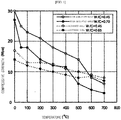
- FIG. 1 is a diagram exemplifying compressive strength of a concrete structure being lowered with an increase in temperature during a fire.
- cement hydrates in concrete of the concrete structure undergo a chemical change in accordance to an increase in heating temperature, and a cement paste and an aggregate show contrary behaviors, that is, shrinkage and expansion, respectively, at temperatures up to about 600 °C.
- a cement paste and an aggregate show contrary behaviors, that is, shrinkage and expansion, respectively, at temperatures up to about 600 °C.
- the degree of degradation varies according to types, proportions, material ages, etc. of used materials and exhibits a tendency shown in FIG. 1 .
- solidity is barely degraded up to 300 °C, but becomes 50 % or less above 500 °C.
- solidity may be degraded to be in a range of about 60 % to 80 % of room-temperature compressive strength. Accordingly, it can be seen that compressive strength of concrete is noticeably degraded when the concrete is heated to a high temperature by a fire. Also, it can be seen that an elastic modulus is lowered by heat and is almost halved at 500 °C. This is because concrete lose elasticity and gradually becomes plastic when the concrete is heated to a high temperature.
- Such a change in microstructure can be identified from a pore distribution or pore structure characteristics using a gas adsorption method of adsorbing nitrogen onto a concrete structure at nitrogen's boiling point (-195.8 °C) to measure a pore structure thereof.
- the present invention is directed to providing a system and method for predicting a residual lifespan of a fire-damaged concrete structure which are capable of acquiring sample data by performing a chemical analysis on a sample of a fire-damaged concrete structure, and rapidly predicting a residual lifespan of the fire-damaged concrete structure by comparing the acquired sample data with data pre-stored in a standardized database (DB).
- DB standardized database
- the present invention is directed to providing a system and method for predicting a residual lifespan of a fire-damaged concrete structure which are capable of accurately and scientifically assessing a level of fire damage to a fire-damaged concrete structure so that the fire-damaged concrete structure can be appropriately repaired and reinforced.
- One aspect of the present invention provides a system according to independent claim 1 for predicting a residual lifespan of a fire-damaged concrete structure, the system including: a fire-damaged concrete structure sample collected from a fire-damaged concrete structure and processed into a specimen for chemical analysis; a concrete structure residual lifespan prediction unit configured to diagnose fire damage to the fire-damaged concrete structure by comparing sample data with data pre-stored in a standardized database (DB), and assess a residual lifespan of the fire-damaged concrete structure; and the standardized DB constructed by storing data pre-acquired through an experiment, wherein the standardized DB standardizes and stores experimental data acquired through precise experimentation employing a fire-damaged concrete structure diagnosis device.
- DB standardized database
- the fire-damaged concrete structure diagnosis device may make a total of 20 measurements by making one measurement every time a heating temperature of a concrete structure specimen increases by 50 °C, and then store each piece of data to construct the standardized DB.
- XRD x-ray diffraction
- BET Brunauer-Emmett-Teller
- accelerated carbonation analysis test the fire-damaged concrete structure diagnosis device may make a total of 20 measurements by making one measurement every time a heating temperature of a concrete structure specimen increases by 50 °C, and then store each piece of data to construct the standardized DB.
- the fire-damaged concrete structure sample may be collected by drilling into the concrete structure to a target point using a mobile core drill, precisely processed, and then finely ground using an agate mortar set to be processed into the specimen for chemical analysis.
- the concrete structure residual lifespan prediction unit comprises: a chemical analysis unit configured to acquire the sample data by performing a chemical analysis on the fire-damaged concrete structure sample processed into the specimen for chemical analysis; a data analysis unit configured to separately predict a fire damage temperature, a pore structure, and a carbonation depth by comparing the sample data acquired by the chemical analysis unit with the data pre-stored in the standardized DB; and a fire damage diagnosis and residual lifespan assessment unit configured to diagnose fire damage of the fire-damaged concrete structure sample according to the fire damage temperature, the pore structure, and the carbonation depth analyzed by the data analysis unit and assess the residual lifespan.
- the data analysis unit comprises: a fire damage temperature prediction unit configured to predict the fire damage temperature by comparing the sample data acquired by the chemical analysis unit with damaging temperature data pre-stored in the standardized DB; a pore structure prediction unit configured to predict temperature-specific pore structures by comparing the sample data acquired by the chemical analysis unit with temperature-specific pore structure data pre-stored in the standardized DB; and a carbonation depth prediction unit configured to predict a carbonation depth by comparing the sample data acquired by the chemical analysis unit with pore structure-specific carbonation depth data pre-stored in the standardized DB.
- the standardized DB may include: a damaging temperature DB configured to store real-time chemical property change data in accordance with a fire damage temperature and acquired through an XRD analysis of the fire-damaged concrete structure; a temperature-specific pore structure DB configured to store pore structure characteristic change data in accordance with a fire damage temperature and acquired through a Brunauer-Emmett-Teller (BET) analysis of the fire-damaged concrete structure; and a pore structure-specific carbonation depth DB configured to store carbonation depth data in accordance with a change in pore structure and acquired through a carbonation analysis of the fire-damaged concrete structure.
- BET Brunauer-Emmett-Teller
- Another aspect of the present invention provides a method according to independent claim 5 for predicting a residual lifespan of a fire-damaged concrete structure, the method including: a) collecting a sample from a fire-damaged concrete structure and precisely cutting the sample; b) performing a chemical analysis on the precisely cut sample; c) comparing sample data obtained by performing the chemical analysis with data stored in a pre-constructed standardized DB; d) separately predicting a fire damage temperature, a pore structure, and a carbonation depth corresponding to the sample data from the standardized DB; and e) diagnosing fire damage to the fire-damaged concrete structure and assessing a residual lifespan thereof according to the fire damage temperature, the pore structure, and the carbonation depth, wherein the standardized DB standardizes and stores experimental data acquired through precise experimentation employing a fire-damaged concrete structure diagnosis device.
- DB standardized database
- the present invention it is possible to accurately and scientifically assess a level of fire damage to a fire-damaged concrete structure so that the fire-damaged concrete structure can be appropriately repaired and reinforced. Accordingly, a residual lifespan of the fire-damaged concrete structure is predicted, and the concrete structure is managed in consideration of appropriate repair and reinforcement times so that performance of the concrete structure can be improved.
- FIG. 2 is a diagram showing a configuration of a system for predicting a residual lifespan of a fire-damaged concrete structure according to an exemplary embodiment of the present invention
- FIG. 3 is a diagram exemplifying a standardized database (DB) constructed by a system for predicting a residual lifespan of a fire-damaged concrete structure according to an exemplary embodiment of the present invention.
- DB standardized database
- a system for predicting a residual lifespan of a fire-damaged concrete structure generally includes a fire-damaged concrete structure sample 100, a concrete structure residual lifespan prediction unit 200, a standardized DB 300, and a fire-damaged concrete structure diagnosis device 400, and the concrete structure residual lifespan prediction unit 200 includes a chemical analysis unit 210, a data analysis unit 220, and a fire damage diagnosis and residual lifespan assessment unit 230.
- the fire-damaged concrete structure sample 100 is collected from a fire-damaged concrete structure by, for example, drilling into the concrete structure to a target point using a mobile core drill, and is precisely processed.
- the sample 100 may have various sizes, and a preferable size is a diameter of 10 mm ⁇ a length of 40 mm.
- the collected fire-damaged concrete structure sample 100 is precisely cut using a laser cutter or the like.
- the collected fire-damaged concrete structure sample 100 may be cut into various sizes, and a total of four samples may be prepared according to depths by cutting the fire-damaged concrete structure by 10 mm each time.
- Each of the four fire-damaged concrete structure samples 100 is finely ground using an agate mortar set or the like to be processed into a specimen for chemical analysis.
- the agate mortar set refers to a hand mill which is made from agate and used to break a solid mineral specimen in a laboratory.
- the concrete structure residual lifespan prediction unit 200 acquires sample data by performing a chemical analysis on the fire-damaged concrete structure samples 100 which have been processed into specimens for chemical analysis, and separately predicts a fire damage temperature, a pore structure, and a carbonation depth by comparing the acquired sample data with data pre-stored in the standardized DB 300 to diagnose fire damage to the fire-damaged concrete structure samples 100 and assess a residual lifespan thereof.
- the chemical analysis unit 210 of the concrete structure residual lifespan prediction unit 200 performs a chemical analysis on the fire-damaged concrete structure samples 100 which have been processed into the specimens for chemical analysis and acquires sample data.
- the data analysis unit 220 of the concrete structure residual lifespan prediction unit 200 compares the sample data acquired by the chemical analysis unit 210 with the data pre-stored in the standardized DB 300 to separately predict a fire damage temperature, a pore structure, and a carbonation depth.
- the data analysis unit 220 comprises a fire damage temperature prediction unit 221, a pore structure prediction unit 222, and a carbonation depth prediction unit 223.
- the fire damage temperature prediction unit 221 of the data analysis unit 220 compares the sample data acquired by the chemical analysis unit 210 with data pre-stored in a damaging temperature DB 310 of the standardized DB 300 and predicts the fire damage temperature.
- the pore structure prediction unit 222 of the data analysis unit 220 compares the sample data with data pre-stored in a temperature-specific pore structure DB 320 of the standardized DB 300 and predicts temperature-specific pore structures.
- the carbonation depth prediction unit 223 of the data analysis unit 220 compares the sample data with data pre-stored in a pore structure-specific carbonation depth DB 330 of the standardized DB 300 and predicts the carbonation depth.
- the fire damage diagnosis and residual lifespan assessment unit 230 of the concrete structure residual lifespan prediction unit 200 diagnoses fire damage to the fire-damaged concrete structure samples 100 and assesses a residual lifespan according to the fire damage temperature, the pore structures, and the carbonation depth analyzed by the data analysis unit 220.
- the standardized DB 300 standardizes and stores experimental data acquired through precise experimentation employing the fire-damaged concrete structure diagnosis device 400, and the experimental data is used as comparative data for the sample data acquired by the chemical analysis unit 210. Such a data comparison method is similar to, for example, a method of finding an element name using existing data when analyzing an unknown element.
- the standardized DB 300 according to an exemplary embodiment of the present invention includes the damaging temperature DB 310, the temperature-specific pore structure DB 320, and the pore structure-specific carbonation depth DB 330.
- the damaging temperature DB 310 of the standardized DB 300 stores real-time chemical property change data according to a fire damage temperature acquired through a chemical analysis, such as an x-ray diffraction (XRD) analysis or the like, of the fire-damaged concrete structure.
- a chemical analysis such as an x-ray diffraction (XRD) analysis or the like
- the temperature-specific pore structure DB 320 of the standardized DB 300 stores pore structure characteristic change data according to a fire damage temperature acquired through a pore volume analysis device, such as a Brunauer-Emmett-Teller (BET) analysis or the like, of the fire-damaged concrete structure.
- a pore volume analysis device such as a Brunauer-Emmett-Teller (BET) analysis or the like
- the pore structure-specific carbonation depth DB 330 of the standardized DB 300 stores carbonation depth data according to a change in pore structure acquired through an accelerated carbonation analysis of the fire-damaged concrete structure.
- the fire-damaged concrete structure diagnosis device 400 may make a total of 20 measurements by making one measurement every time a heating temperature of a concrete structure specimen increases by 50 °C, and then store each piece of data to construct the standardized DB 300.
- the specimen is heated from 20 °C to 1000 °C, and results are analyzed and stored.
- an XRD device, a BET device, and an accelerated carbonation test device used to analyze a chemical property change, a pore structure characteristic change, and a carbonation depth change are arbitrary examples of analysis equipment, and the analyses may be performed by other equipment.
- the chemical property change may be analyzed by inductively coupled plasma, and a pore structure characteristic may be analyzed by porosimetry.
- the fire-damaged concrete structure diagnosis device 400 may perform the XRD analysis, the BET analysis, and the accelerated carbonation analysis and store data acquired therefrom in the standardized DB 300, and the standardized DB 300 may be provided in common to a plurality of terminals with which the system for predicting a residual lifespan of a fire-damaged concrete structure according to an exemplary embodiment of the present invention is constructed through a web, a digital card, or the like.
- the standardized DB 300 may be constructed by analyzing all types of mixing condition-specific ready-mixed concrete commonly used in Korea as described above, and it is possible to provide information for predicting residual lifespans of most fire-damaged Korean building structures through the standardized DB 300.
- a first concrete mix residual lifespan prediction unit 200a may predict a residual lifespan of a fire-damaged concrete structure with respect to a first concrete mix sample 100a
- a second concrete mix residual lifespan prediction unit 200b may predict a residual lifespan of the fire-damaged concrete structure with respect to a second concrete mix sample 100b
- an N th concrete mix residual lifespan prediction unit 200n may predict a residual lifespan of the fire-damaged concrete structure with respect to an N th concrete mix sample 100n.
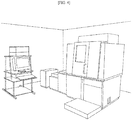
- FIG. 4 is a diagram exemplifying an XRD analysis device for chemical analysis in a system for predicting a residual lifespan of a fire-damaged concrete structure according to an exemplary embodiment of the present invention
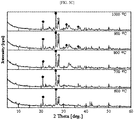
- FIGS. 5A to 5C are diagrams exemplifying XRD analysis results for a concrete structure.
- the system for predicting a residual lifespan of a fire-damaged concrete structure performs a chemical analysis on a fire-damaged concrete structure using an XRD analysis device as shown in FIG. 4 .
- an XRD analysis is a method of emitting x rays toward a surface of a concrete structure sample and then qualitatively and quantitatively identifying chemical constituents of the specimen by analyzing refraction angles of reflected x rays, and in the method, the concrete structure sample is milled into fine powder and chemically analyzed to identify chemical element symbols representing chemical constituents of the powdered sample.
- a reaction product analysis based on such XRD is an analysis method for easily identifying reaction products of minerals constituting all materials with no chemical analysis and is performed to estimate physical properties of a concrete structure and determine a reason for an abnormality in the physical properties of the concrete structure.
- FIG. 5A is a diagram illustrating main peak indicators of hydration products and reaction products
- FIGS. 5B and 5C show XRD analysis results of a reference specimen of a concrete structure.
- concrete hydration involves calcium oxide reacting with water to form calcium hydroxide, and Calcium Silicate Hydrate (CSH) gel, Calcium Hydroxide (CH), and Calcium Silicate (CS) are main components of cement.
- CSH Calcium Silicate Hydrate
- CH Calcium Hydroxide
- CS Calcium Silicate
- results of heating a specimen of a ferroconcrete structure having no fire damage, which is a reference specimen, to a range of 100 °C to 1,000 °C in an electric furnace are shown in FIGS. 5B and 5C .
- Ca(OH) 2 existed at up to 400 °C. However, at 600 °C or above, a CH component mostly disappeared while a CaO component appeared and an amount thereof increased with the increase in temperature. This is because, as a temperature of concrete increases during a fire, calcium hydroxide is decomposed and calcite (CaCO 3 ) is decomposed into CaO.
- the above-described fire-damaged concrete structure diagnosis device 400 makes a total of 20 measurements by making one measurement every time the heating temperature of the concrete structure specimen increases by 50 °C, and then stores each piece of data to construct the damaging temperature DB 310 of the standardized DB 300.
- a manufactured specimen is milled into fine powder and then subjected to an XRD analysis. In this way, reaction products of concrete are qualitatively analyzed, and how much and into which materials cement hydrates are changed by a high temperature is quantitatively analyzed so that it can be seen how concrete reacts according to temperatures of a fire and what kinds of products are generated.
- a concrete structure sample is inserted into a sample tube, and then nitrogen gas is injected into the sample tube so that the nitrogen gas is adsorbed onto the specimen and desorbed therefrom, and a pore size distribution may be measured in this way.
- nitrogen gas is injected into the sample tube so that the nitrogen gas is adsorbed onto the specimen and desorbed therefrom, and a pore size distribution may be measured in this way.
- Such a BET analysis is used to measure pores with a relatively small radius.
- a BET analysis method developed by Brunauer, Emmett, and Teller is typically used to measure a surface area of a porous adsorbate.
- Such a BET analysis method is a measurement method of identifying a monolayer adsorption point using a sorption isotherm and getting a surface area of a sample from the monolayer adsorption point.
- Such a BET analysis method is given as Equation 1 below by extending Langmuir's monolayer adsorption theory to a multi-layer adsorption theory using three assumptions, that is, (a) surface energy is uniform, (b) there are no interactions between adsorbed molecules, and (c) all adsorption temperatures of two or more layers are the same.
- ⁇ denotes an adsorption amount under equilibrium pressure
- ⁇ m denotes a monolayer adsorption amount
- P denotes an adsorption equilibrium pressure
- P 0 denotes a saturated vapor pressure
- P / P 0 denotes a relative pressure
- C is given as C : e (q 1 -q t )/ RT .
- a specific surface area S may be calculated using molecule-occupied sectional area adsorption (the area of nitrogen is 0.162 nm 2 ) as shown in Equation 2 below.
- S m 2 / g 4.35 v m cm 3 / g
- Such nitrogen gas adsorption for measuring a pore structure of a concrete structure is based on a principle that since the relative pressure P / P 0 increases when gas is adsorbed onto a solid surface up to the saturated vapor pressure P 0 , a monolayer further forms a multilayer, and capillary condensation as well as adsorption takes place in pores.
- a cell in which a concrete structure specimen is inserted is covered with a heating bag and subjected to vacuum drawing for preprocessing, liquid nitrogen is inserted in a dewar, and a small amount of adsorption gas is introduced into the specimen cell in stages.
- a dewar filled with liquid nitrogen is placed on the specimen cell to cool the cell, introduced nitrogen gas is physically adsorbed.
- property values of a pore structure determined by such a nitrogen gas adsorption measurement may indicate the specific surface area S, a pore structure, and a pore distribution.
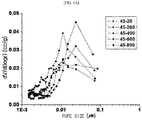
- FIG. 6A is a diagram showing a pore distribution of pore size according to a heating temperature, and shows a distribution of pores having sizes of about 0.001 ⁇ m to about 0.1 ⁇ m according to an exposure temperature condition of a concrete structure using the aforementioned nitrogen gas adsorption.
- a pore volume of fine pores of 0.01 ⁇ m or less is reduced while a pore volume of pores of 0.01 ⁇ m or more increases.
- an overall tendency indicates that a pore volume is reduced in accordance with an increase in heating temperature within a range of the pore size (about 0.001 ⁇ m to about 0.1 ⁇ m) measured by the nitrogen gas adsorption.
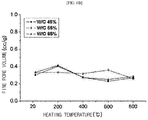
- FIG. 6B is a diagram showing a fine pore ratio according to a water-to-cement (W/C) change and a heating temperature condition, and shows a pore volume of fine pores of 0.1 ⁇ m or less which can be measured by nitrogen adsorption.
- the pores of 0.1 ⁇ m or less are very fine pores, and thus do not have a significant influence on an overall pore volume of concrete.
- the above-described fire-damaged concrete structure diagnosis device 400 may make a total of 20 measurements by making one measurement every time a heating temperature of a concrete structure specimen increases by 50 °C, and then store each piece of data to construct the temperature-specific pore structure DB 320 of the standardized DB 300.
- an accelerated carbonation analysis is a method of inserting a sample into a chamber, introducing highly concentrated carbon dioxide into the chamber to promote a reaction, and then measuring a reaction depth between the introduced carbon dioxide and calcium hydroxide existing in the sample by cutting the sample. Using such a measured value, it is possible to determine a penetration depth of carbon dioxide and predict a durability life of concrete, that is, a residual lifespan of a fire-damaged concrete structure.
- cement which is a main material of ferroconcrete
- reinforcement bars existing in concrete are not corroded in a general environment.
- reinforcement bars in a concrete structure may be placed in a corrosive environment, i.e., carbonated by carbon dioxide in the air.
- output of carbon monoxide and dioxide is increasing in accordance with the recent growth of cities, and carbonation of major buildings is being accelerated thereby.
- a pore volume of concrete is closely related to a penetration rate of carbon dioxide, and thus works as the most crucial factor for determining a residual lifespan of a concrete structure.
- Reinforcement bars in concrete are covered with an oxide passivation film in an environment with a pH of 11 or more, and thus are not corroded even when there is oxygen in the concrete.
- the reinforcement bars are corroded.
- a time for carbonation to reach the reinforcement bars is clearly in proportion to a pore volume of the concrete.
- a rate of reaching the reinforcement bars increases.
- a pore volume increases with an increase in W/C.
- a pore volume increases exponentially when concrete is put in a special situation, such as a fire, and a durability life of concrete is shortened due to carbonation.
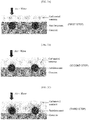
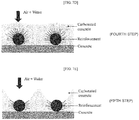
- FIGs. 7A-7E are diagrams illustrating performance degradation of concrete caused by carbonation.
- a s shown in FIG. 7A in a first carbonation step, there is almost no change in materials and strength and there are only small cracks caused by drying shrinkage.
- a s shown in FIG. 7B in a second carbonation step, inflation pressure is generated in concrete due to rust generation and cracks are generated.
- FIG. 7C in a third carbonation step, cement above reinforcement bars begin to expand and cracks extend to a surface of the concrete. Therefore, air and water penetration becomes severe and causes other deterioration, such as freezing damage and the like, and it is possible to see rusty water.
- FIG. 7A-7E are diagrams illustrating performance degradation of concrete caused by carbonation.
- FIG. 7A in a first carbonation step, there is almost no change in materials and strength and there are only small cracks caused by drying shrinkage.
- a s shown in FIG. 7B in a second carbonation step, inflation pressure is generated in concrete due to rust generation
- Such concrete carbonation begins with an outer portion of concrete exposed to carbon dioxide and gradually proceeds.
- carbon dioxide should be diffused through pores included in a concrete surface which has already been carbonated, and thus a carbonation rate is gradually reduced.
- a carbonation depth increases in proportion to the square root of time. This is related to an interaction between carbon dioxide and a pore system, and a carbonation depth C can be expressed as shown in Equation 3 below.
- C A t
- the concrete carbonation rate is in proportion to the square root of time or in a like form.
- M D - C.
- a time for a carbonation depth of a concrete structure to reach reinforcement bars thereof may be a durability life of the structure with respect to carbonation, and it is possible to obtain a residual lifespan of the structure by excluding a measurement time.
- a limit state function can be expressed by Equation 4.
- M x t D x t ⁇ C x t
- M (x, t) denotes a limit state with respect to carbonation
- D (x, t) denotes a carbonation depth
- C (x, t) denotes a cover thickness
- carbonation depth data obtained through precise safety diagnosis of a concrete structure may be considered to be a probability distribution of each section, it is possible to calculate probabilistic characteristic values, such as an average, a standard deviation, etc., of each of the sections by analyzing measured section-specific carbonation depth data.
- a distribution cover thickness value may also be considered to be a random variable in the same section due to errors in design and construction, it is possible to calculate an average and a standard deviation by analyzing measured cover thickness data.
- FIG. 8A is a diagram showing probability distributions of the carbonation depth C and the cover thickness D
- FIG. 8B is a diagram showing a probability distribution of a limit state function M with respect to carbonation.
- each curve denotes a probability density function.
- the limit state function M with respect to carbonation also becomes a normal distribution.
- an average and a standard deviation of the limit state function are respectively given by Equations 5 and 6 below.
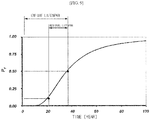
- a cumulative distribution function of 0 or less that is, p f
- p f a probability that a carbonation depth increases to a cover thickness and reaches reinforcement bars.
- p f is a value calculated by probabilistically approaching a distribution of a cover thickness as well as a carbonation depth, or a progress tendency of carbonation. Therefore, a total lifespan and a residual lifespan of a structure based on such a residual lifespan assessment model are obtained through statistical inference.
- FIG. 9 is a diagram exemplifying a residual lifespan of a concrete structure in a limit state, and a limit of p f may have a range of 0 to 1. For example, to obtain a conservative assessment value, a time for p f to become 0.5 may be a residual lifespan of a concrete structure as shown in FIG. 9 .
- the above-described fire-damaged concrete structure diagnosis device 400 makes a total of 20 measurements by making one measurement every time a heating temperature of a concrete structure specimen increases by 50 °C, and then stores each piece of data to construct the pore structure-specific carbonation depth DB 330 of the standardized DB 300.
- the present invention it is possible to acquire sample data by performing a chemical analysis on a sample of a fire-damaged concrete structure, and to rapidly predict a residual lifespan of the fire-damaged concrete structure by comparing the acquired sample data with data pre-stored in a standardized DB.
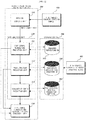
- FIG. 10 is an operational flowchart illustrating a method of predicting a residual lifespan of a fire-damaged concrete structure according to an exemplary embodiment of the present invention.
- the method of predicting a residual lifespan of a fire-damaged concrete structure first involves collecting the sample 100 from a fire-damaged concrete structure and precisely cutting the sample 100 (S110).
- the sample 100 is collected by drilling into the concrete structure to a target point using a mobile core drill, is precisely processed, and then is finely ground using an agate mortar set to be processed into a specimen for chemical analysis.
- the sample data on which the chemical analysis is performed is compared with the pre-constructed standardized DB 300 (S130).
- the standardized DB 300 standardizes experimental data acquired through precise experimentation employing the fire-damaged concrete structure diagnosis device 400 and stores the standardized experimental data.
- the fire-damaged concrete structure diagnosis device 400 makes a total of 20 measurements by making one measurement every time a heating temperature of the concrete structure specimen increases by 50 °C, and then stores each piece of data to construct the standardized DB 300.
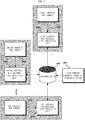
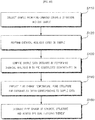
- FIG. 11 is a detailed operational flowchart illustrating a method of predicting a residual lifespan of a fire-damaged concrete structure according to an exemplary embodiment of the present invention.
- the method of predicting a residual lifespan of a fire-damaged concrete structure first involves collecting the sample 100 from a fire-damaged concrete structure (S201). Specifically, a sample of the fire-damaged concrete structure is collected in an inward direction from a surface thereof. For example, the concrete structure is drilled to a target point using a mobile core drill.
- the sample 100 may have various sizes, and a preferable size is a diameter of 10 mm ⁇ a length of 40 mm.
- the collected sample 100 is precisely cut using a laser cutter or the like (S202).
- the collected sample 100 may be cut in various sizes, and a total of four samples may be prepared according to depths by cutting the fire-damaged concrete structure by 10 mm each time.
- each of the four samples 100 is processed into samples for chemical analysis (S203). Specifically, each of the four samples 100 is processed into a specimen for chemical analysis. At this time, each of the four samples 100 is finely ground using an agate mortar set or the like.
- the agate mortar set refers to a hand mill which is made from agate and used to break a solid mineral specimen in a laboratory.
- data of the chemically-analyzed samples 100 is compared with data stored in the damaging temperature DB 310 in the standardized DB 300 to predict fire damage temperatures thereof (S205).
- the data of the chemically-analyzed samples 100 and the data stored in the damaging temperature DB 310 are compared to find temperatures in data of the chemically-analyzed samples 100 which coincide with the data obtained from the damaging temperature DB 310 so that fire damage temperatures of the samples 100 is predicted.
- pore structures corresponding to the predicted fire damage temperatures are predicted from the temperature-specific pore structure DB 320 in the standardized DB 300 (S206).
- pore structures at the predicted fire damage temperatures which coincide with data obtained from the temperature-specific pore structure DB 320 are found to predict pore structures of the samples 100.
- carbonation depths corresponding to the predicted pore structures are predicted from the pore structure-specific carbonation depth DB 330 in the standardized DB 300 (S207). In other words, carbonation depths of the predicted pore structures which coincide with data obtained from the pore structure-specific carbonation depth DB 330 are found.
- fire damage to the concrete structure is diagnosed and a residual lifespan thereof is assessed (S208). Since those of ordinary skill in the art should appreciate that it is possible to diagnose the fire damage and assess the residual lifespan according to a change in chemical components, a change in pore structures, and a progress of carbonation, a detailed description thereof will be omitted.
- each of the damaging temperature DB 310, the temperature-specific pore structure DB 320, and the pore structure-specific carbonation depth DB 330 in the standardized DB 300 can easily manage information on a change in chemical components, a change in pore structures, and a progress of carbonation according to a change in a temperature of a fire-damaged concrete structure.
- using data matching analysis it is possible to extract data which coincides with data measured through external experimentation and rapidly predict a fire damage temperature, a change in pore volume, and a change in residual lifespan of a fire-damaged concrete structure.
Landscapes
- Engineering & Computer Science (AREA)
- Business, Economics & Management (AREA)
- Theoretical Computer Science (AREA)
- General Physics & Mathematics (AREA)
- Physics & Mathematics (AREA)
- Health & Medical Sciences (AREA)
- Tourism & Hospitality (AREA)
- General Health & Medical Sciences (AREA)
- Economics (AREA)
- Human Resources & Organizations (AREA)
- Strategic Management (AREA)
- General Business, Economics & Management (AREA)
- Marketing (AREA)
- Primary Health Care (AREA)
- Chemical & Material Sciences (AREA)
- Life Sciences & Earth Sciences (AREA)
- Computational Linguistics (AREA)
- Data Mining & Analysis (AREA)
- Databases & Information Systems (AREA)
- General Engineering & Computer Science (AREA)
- Analytical Chemistry (AREA)
- Ceramic Engineering (AREA)
- Immunology (AREA)
- Pathology (AREA)
- Biochemistry (AREA)
- Medicinal Chemistry (AREA)
- Food Science & Technology (AREA)
- Development Economics (AREA)
- Educational Administration (AREA)
- Game Theory and Decision Science (AREA)
- Entrepreneurship & Innovation (AREA)
- Operations Research (AREA)
- Quality & Reliability (AREA)
- Testing Resistance To Weather, Investigating Materials By Mechanical Methods (AREA)
- Analysing Materials By The Use Of Radiation (AREA)
Applications Claiming Priority (2)
| Application Number | Priority Date | Filing Date | Title |
|---|---|---|---|
| KR1020140184431A KR101554165B1 (ko) | 2014-12-19 | 2014-12-19 | 화재손상 콘크리트 구조물의 잔존수명 예측 시스템 및 그 방법 |
| PCT/KR2015/011402 WO2016099027A1 (ko) | 2014-12-19 | 2015-10-28 | 화재손상 콘크리트 구조물의 잔존수명 예측 시스템 및 그 방법 |
Publications (3)
| Publication Number | Publication Date |
|---|---|
| EP3236409A1 EP3236409A1 (en) | 2017-10-25 |
| EP3236409A4 EP3236409A4 (en) | 2018-08-15 |
| EP3236409B1 true EP3236409B1 (en) | 2019-07-31 |
Family
ID=54248633
Family Applications (1)
| Application Number | Title | Priority Date | Filing Date |
|---|---|---|---|
| EP15870195.3A Active EP3236409B1 (en) | 2014-12-19 | 2015-10-28 | System for predicting residual lifespan of fire-damaged concrete structure and method therefor |
Country Status (6)
| Country | Link |
|---|---|
| US (1) | US10495625B2 (da) |
| EP (1) | EP3236409B1 (da) |
| KR (1) | KR101554165B1 (da) |
| CN (1) | CN107111793B (da) |
| DK (1) | DK3236409T3 (da) |
| WO (1) | WO2016099027A1 (da) |
Cited By (1)
| Publication number | Priority date | Publication date | Assignee | Title |
|---|---|---|---|---|
| EP4276674A4 (en) * | 2020-12-21 | 2025-02-12 | Korea Institute Of Civil Engineering And Building Technology | Deep-learning-based concrete structure deterioration assessment system and method therefor |
Families Citing this family (21)
| Publication number | Priority date | Publication date | Assignee | Title |
|---|---|---|---|---|
| KR102020268B1 (ko) | 2017-09-04 | 2019-09-10 | 대구대학교 산학협력단 | 화재 노출온도 감지장치와 이를 이용한 구조물손상 정도 및 영역 추정방법 |
| CN107941645B (zh) * | 2017-12-15 | 2020-04-14 | 东南大学 | 一种测定粉煤灰、硅灰、水泥三相复合体系中各物质反应程度的方法 |
| CN108920865A (zh) * | 2018-07-20 | 2018-11-30 | 广东工业大学 | 一种损伤混凝土结构修复方法、系统及设备和存储介质 |
| CN108918583A (zh) * | 2018-07-23 | 2018-11-30 | 广东工业大学 | 一种用于火灾后混凝土的修复方法、装置及存储介质 |
| KR102187176B1 (ko) * | 2019-01-28 | 2020-12-04 | 강원대학교산학협력단 | 기후 변화 및 균열을 고려한 철근콘크리트 유효수명 제공 방법 및 이를 기록한 매체 |
| KR102107098B1 (ko) | 2019-09-25 | 2020-05-28 | 한국건설기술연구원 | 화재손상 콘크리트 구조물의 물리적 복구 시스템 및 그 방법 |
| KR102256239B1 (ko) | 2019-09-25 | 2021-05-27 | 한국건설기술연구원 | 딥러닝-기반 화재손상 콘크리트 구조물의 열확산경로 예측 시스템 및 그 방법 |
| CN110627437A (zh) * | 2019-09-27 | 2019-12-31 | 赵之祯 | 一种修缮文物建筑的混凝土配方体系及其使用方法 |
| CN111077065B (zh) * | 2019-12-30 | 2022-10-18 | 广东交科检测有限公司 | 一种通过芯样分组抗压测量高温后混凝土受损深度的方法 |
| CN111488698B (zh) * | 2020-04-21 | 2023-04-07 | 浙江水利水电学院 | 一种硬化混凝土热膨胀系数的多尺度预测方法 |
| CN111898318B (zh) * | 2020-08-04 | 2024-12-31 | 西安建筑科技大学 | 一种工业建筑混凝土碳化深度预测方法 |
| JP7834289B2 (ja) * | 2020-12-03 | 2026-03-24 | 株式会社フジタ | コンクリートへの二酸化炭素の固定方法、およびコンクリートを含むコンクリート構造体 |
| CN112444534B (zh) * | 2020-12-11 | 2021-12-28 | 中国地质大学(北京) | 一种快速测算石质文物过火温度的方法 |
| KR102210418B1 (ko) | 2020-12-18 | 2021-02-02 | 한국건설기술연구원 | 화재손상 콘크리트 구조물의 잔존응력분포 예측 시스템 및 그 방법 |
| US12306169B2 (en) * | 2022-06-14 | 2025-05-20 | Halliburton Energy Services, Inc. | Method to tailor cement composition to withstand carbon dioxide injection loads |
| CN115186515B (zh) * | 2022-08-26 | 2023-07-04 | 中国长江三峡集团有限公司 | 一种混凝土排水管道剩余寿命预测方法及装置 |
| KR102586791B1 (ko) | 2022-10-05 | 2023-10-10 | 주식회사 평안화재복구 | 화재손상 콘크리트 구조물 복구시스템 |
| CN116384214A (zh) * | 2022-12-28 | 2023-07-04 | 中铁大桥科学研究院有限公司 | 火灾温度场的计算方法、装置、设备及可读存储介质 |
| KR102992429B1 (ko) * | 2023-05-09 | 2026-07-22 | 한국건설기술연구원 | 강구조 건축/시설물의 화재손상 조사/진단 시스템 및 이를 이용한 화재손상 조사/진단 방법 |
| CN117932263B (zh) * | 2024-01-22 | 2024-08-23 | 四川沿江宜金高速公路有限公司 | 一种基于混凝土侵蚀下的混凝土寿命预测方法 |
| CN119692780B (zh) * | 2024-12-19 | 2025-09-05 | 河北省建筑科学研究院有限公司 | 一种建筑物安全性能评估方法及系统 |
Family Cites Families (24)
| Publication number | Priority date | Publication date | Assignee | Title |
|---|---|---|---|---|
| CA2349153C (en) * | 2001-05-24 | 2007-08-14 | Jacques Marchand | Method for modeling the transport of ions in hydrated cement systems |
| US6860932B2 (en) * | 2002-09-12 | 2005-03-01 | Yoshiki Oshida | Dental and medical cement |
| JP2005227065A (ja) | 2004-02-12 | 2005-08-25 | Hitachi Ltd | 構造物の推定寿命表示方法、寿命分布作成方法、画像表示装置 |
| KR20060017666A (ko) * | 2005-11-30 | 2006-02-24 | 김영래 | 구조물의 피로측정에 따른 잔여수명 진단장치 및 그 방법 |
| KR100631485B1 (ko) | 2006-03-27 | 2006-10-09 | 세기하이테크건설 주식회사 | 콘크리트 구조물 및 강 구조물의 내구성 증대 및 중성화와염해방지를 위한 속경화 피막 형성 공법 |
| KR100835848B1 (ko) | 2006-04-19 | 2008-06-05 | 한국시설안전공단 | 열화 콘크리트 및 시공 중 숏크리트의 강도 분석방법 |
| KR100894084B1 (ko) | 2007-10-12 | 2009-04-21 | 연세대학교 산학협력단 | 콘크리트 조성 판별방법 |
| KR100929416B1 (ko) * | 2007-10-15 | 2009-12-03 | 삼성물산 주식회사 | 고강도 콘크리트 부재의 내화성능 평가 시스템 |
| JP2010032318A (ja) * | 2008-07-28 | 2010-02-12 | Clion Co Ltd | 軽量気泡コンクリートパネルの劣化診断方法 |
| CN201387424Y (zh) * | 2009-04-23 | 2010-01-20 | 中南林业科技大学 | 混凝土火灾损伤特性智能超声测试装置 |
| KR101128455B1 (ko) | 2010-08-13 | 2012-03-23 | 한국건설기술연구원 | 후광산란법을 이용한 콘크리트의 수화도 측정방법 |
| EP2693186A4 (en) * | 2011-03-31 | 2014-11-26 | Nat Univ Corp Yokohama Nat Uni | WATER SUPPLY TEST METHOD AND WATER SUPPLY TEST DEVICE FOR A CONCRETE SURFACE |
| US20130131999A1 (en) | 2011-11-23 | 2013-05-23 | King Saud University | Method for predicting chloride-induced corrosion |
| JP5323290B1 (ja) * | 2012-05-30 | 2013-10-23 | 太平洋セメント株式会社 | セメントの品質または製造条件の予測方法 |
| JP6042111B2 (ja) | 2012-06-25 | 2016-12-14 | 大和ハウス工業株式会社 | 建物の劣化診断方法および診断システム |
| KR101263371B1 (ko) * | 2012-09-28 | 2013-05-21 | 한국건설기술연구원 | 콘크리트 구조부재의 내화성능 설계 방법 및 콘크리트 구조부재 |
| US9638652B2 (en) * | 2013-01-30 | 2017-05-02 | Giatec Scientific Inc. | Electrical methods and systems for concrete testing |
| BR112015018518A2 (pt) * | 2013-02-04 | 2017-07-18 | Coldcrete Inc | sistema e método para aplicar dióxido de carbono durante a produção de concreto |
| CA2839056C (en) | 2013-03-01 | 2016-10-11 | Simco Technologies Inc. | Method and system for planning maintenance activities for concrete structures |
| US20160107939A1 (en) * | 2014-04-09 | 2016-04-21 | Carboncure Technologies Inc. | Methods and compositions for concrete production |
| US9388072B2 (en) * | 2013-06-25 | 2016-07-12 | Carboncure Technologies Inc. | Methods and compositions for concrete production |
| US20150193881A1 (en) * | 2014-01-03 | 2015-07-09 | BuildFax | Computer-implemented method for determining roof age of a structure |
| CN103938883A (zh) * | 2014-03-13 | 2014-07-23 | 华南理工大学 | 混凝土结构高温火灾后的再碱化修复方法 |
| US20160075603A1 (en) * | 2014-09-16 | 2016-03-17 | Arizona Science And Technology Enterprises, Llc | Binder Compositions and Method of Synthesis |
-
2014
- 2014-12-19 KR KR1020140184431A patent/KR101554165B1/ko active Active
-
2015
- 2015-10-28 US US15/537,435 patent/US10495625B2/en active Active
- 2015-10-28 DK DK15870195.3T patent/DK3236409T3/da active
- 2015-10-28 CN CN201580068902.1A patent/CN107111793B/zh active Active
- 2015-10-28 EP EP15870195.3A patent/EP3236409B1/en active Active
- 2015-10-28 WO PCT/KR2015/011402 patent/WO2016099027A1/ko not_active Ceased
Non-Patent Citations (1)
| Title |
|---|
| None * |
Cited By (1)
| Publication number | Priority date | Publication date | Assignee | Title |
|---|---|---|---|---|
| EP4276674A4 (en) * | 2020-12-21 | 2025-02-12 | Korea Institute Of Civil Engineering And Building Technology | Deep-learning-based concrete structure deterioration assessment system and method therefor |
Also Published As
| Publication number | Publication date |
|---|---|
| DK3236409T3 (da) | 2019-08-12 |
| US10495625B2 (en) | 2019-12-03 |
| KR101554165B1 (ko) | 2015-09-21 |
| CN107111793B (zh) | 2021-08-17 |
| US20170350872A1 (en) | 2017-12-07 |
| EP3236409A4 (en) | 2018-08-15 |
| CN107111793A (zh) | 2017-08-29 |
| EP3236409A1 (en) | 2017-10-25 |
| WO2016099027A1 (ko) | 2016-06-23 |
Similar Documents
| Publication | Publication Date | Title |
|---|---|---|
| US10495625B2 (en) | System for predicting residual service life of fire-damaged concrete structures and method for the same | |
| EP4276674A1 (en) | Deep-learning-based concrete structure deterioration assessment system and method therefor | |
| Jiang et al. | Influence of chloride salt type on threshold level of reinforcement corrosion in simulated concrete pore solutions | |
| Paul et al. | Crack formation and chloride induced corrosion in reinforced strain hardening cement-based composite (R/SHCC) | |
| Breysse | Deterioration processes in reinforced concrete: An overview | |
| Bautista et al. | Corrugated stainless steels embedded in carbonated mortars with and without chlorides: 9-Year corrosion results | |
| KR102256239B1 (ko) | 딥러닝-기반 화재손상 콘크리트 구조물의 열확산경로 예측 시스템 및 그 방법 | |
| Santa et al. | Atmospheric deterioration of ceramic building materials and future trends in the field: a review | |
| Iffat et al. | An experiment on durability test (RCPT) of concrete according to ASTM standard method using low-cost equipments | |
| Živica | Acidic attack of cement based materials–a review Part 3: research and test methods | |
| Ba Ragaa | Long-term durability testing of concrete in low and intermediate level waste repositories | |
| Dudi et al. | Assessment of carbonation and corrosion in a 50-year-old reinforced concrete building | |
| Seo et al. | Uncertainty-based on-site carbonation depth estimation of underground concrete structures using portable Raman spectrometer | |
| Ghirmay | Asbestos cement pipe condition assessment and remaining service life prediction | |
| Duchesne et al. | Study of the deterioration of concrete incorporating sulfide-bearing aggregates | |
| Woyciechowski et al. | Chemical corrosion of concrete tank in sewage treatment plant as the cause of failure | |
| Ikotun | Effects of concrete quality and cover depth on carbonation-induced reinforcement corrosion and initiation of concrete cover cracking in reinforced concrete structures | |
| Gopinath | Concrete carbonation prediction for varying environmental exposure conditions | |
| Oršanić | Chemo-hygro-thermo-mechanical model for simulation of corrosion induced damage in reinforced concrete | |
| Bungey | Assessment of concrete in bridge structures | |
| Jiménez et al. | Improvement of Corrosion Related Durability of Steel Reinforcement in a Novel Concrete Formulation | |
| Mamun | The Fractal Nature of Cement-Based Systems Under Sustained Elevated Temperatures | |
| Berkas et al. | Damage-reliability approach for fatigue crack propagation in MDPE gas pipe | |
| Alhede | Novel approaches for monitoring effects of steel corrosion in reinforced concrete | |
| Thapa | Microstructural Assessment of Concrete Deterioration due to Alkali Silica Reaction and Freezing and Thawing Reaction |
Legal Events
| Date | Code | Title | Description |
|---|---|---|---|
| STAA | Information on the status of an ep patent application or granted ep patent |
Free format text: STATUS: THE INTERNATIONAL PUBLICATION HAS BEEN MADE |
|
| PUAI | Public reference made under article 153(3) epc to a published international application that has entered the european phase |
Free format text: ORIGINAL CODE: 0009012 |
|
| STAA | Information on the status of an ep patent application or granted ep patent |
Free format text: STATUS: REQUEST FOR EXAMINATION WAS MADE |
|
| 17P | Request for examination filed |
Effective date: 20170706 |
|
| AK | Designated contracting states |
Kind code of ref document: A1 Designated state(s): AL AT BE BG CH CY CZ DE DK EE ES FI FR GB GR HR HU IE IS IT LI LT LU LV MC MK MT NL NO PL PT RO RS SE SI SK SM TR |
|
| AX | Request for extension of the european patent |
Extension state: BA ME |
|
| DAV | Request for validation of the european patent (deleted) | ||
| DAX | Request for extension of the european patent (deleted) | ||
| A4 | Supplementary search report drawn up and despatched |
Effective date: 20180716 |
|
| RIC1 | Information provided on ipc code assigned before grant |
Ipc: G06Q 50/08 20120101ALI20180710BHEP Ipc: G06Q 50/10 20120101AFI20180710BHEP |
|
| GRAP | Despatch of communication of intention to grant a patent |
Free format text: ORIGINAL CODE: EPIDOSNIGR1 |
|
| STAA | Information on the status of an ep patent application or granted ep patent |
Free format text: STATUS: GRANT OF PATENT IS INTENDED |
|
| INTG | Intention to grant announced |
Effective date: 20190308 |
|
| GRAS | Grant fee paid |
Free format text: ORIGINAL CODE: EPIDOSNIGR3 |
|
| GRAA | (expected) grant |
Free format text: ORIGINAL CODE: 0009210 |
|
| STAA | Information on the status of an ep patent application or granted ep patent |
Free format text: STATUS: THE PATENT HAS BEEN GRANTED |
|
| AK | Designated contracting states |
Kind code of ref document: B1 Designated state(s): AL AT BE BG CH CY CZ DE DK EE ES FI FR GB GR HR HU IE IS IT LI LT LU LV MC MK MT NL NO PL PT RO RS SE SI SK SM TR |
|
| REG | Reference to a national code |
Ref country code: CH Ref legal event code: EP Ref country code: GB Ref legal event code: FG4D |
|
| REG | Reference to a national code |
Ref country code: DK Ref legal event code: T3 Effective date: 20190807 |
|
| REG | Reference to a national code |
Ref country code: AT Ref legal event code: REF Ref document number: 1161710 Country of ref document: AT Kind code of ref document: T Effective date: 20190815 |
|
| REG | Reference to a national code |
Ref country code: IE Ref legal event code: FG4D |
|
| REG | Reference to a national code |
Ref country code: DE Ref legal event code: R096 Ref document number: 602015035024 Country of ref document: DE |
|
| REG | Reference to a national code |
Ref country code: NO Ref legal event code: T2 Effective date: 20190731 |
|
| REG | Reference to a national code |
Ref country code: NL Ref legal event code: MP Effective date: 20190731 |
|
| REG | Reference to a national code |
Ref country code: LT Ref legal event code: MG4D |
|
| REG | Reference to a national code |
Ref country code: AT Ref legal event code: MK05 Ref document number: 1161710 Country of ref document: AT Kind code of ref document: T Effective date: 20190731 |
|
| PG25 | Lapsed in a contracting state [announced via postgrant information from national office to epo] |
Ref country code: FI Free format text: LAPSE BECAUSE OF FAILURE TO SUBMIT A TRANSLATION OF THE DESCRIPTION OR TO PAY THE FEE WITHIN THE PRESCRIBED TIME-LIMIT Effective date: 20190731 Ref country code: PT Free format text: LAPSE BECAUSE OF FAILURE TO SUBMIT A TRANSLATION OF THE DESCRIPTION OR TO PAY THE FEE WITHIN THE PRESCRIBED TIME-LIMIT Effective date: 20191202 Ref country code: AT Free format text: LAPSE BECAUSE OF FAILURE TO SUBMIT A TRANSLATION OF THE DESCRIPTION OR TO PAY THE FEE WITHIN THE PRESCRIBED TIME-LIMIT Effective date: 20190731 Ref country code: BG Free format text: LAPSE BECAUSE OF FAILURE TO SUBMIT A TRANSLATION OF THE DESCRIPTION OR TO PAY THE FEE WITHIN THE PRESCRIBED TIME-LIMIT Effective date: 20191031 Ref country code: SE Free format text: LAPSE BECAUSE OF FAILURE TO SUBMIT A TRANSLATION OF THE DESCRIPTION OR TO PAY THE FEE WITHIN THE PRESCRIBED TIME-LIMIT Effective date: 20190731 Ref country code: NL Free format text: LAPSE BECAUSE OF FAILURE TO SUBMIT A TRANSLATION OF THE DESCRIPTION OR TO PAY THE FEE WITHIN THE PRESCRIBED TIME-LIMIT Effective date: 20190731 Ref country code: LT Free format text: LAPSE BECAUSE OF FAILURE TO SUBMIT A TRANSLATION OF THE DESCRIPTION OR TO PAY THE FEE WITHIN THE PRESCRIBED TIME-LIMIT Effective date: 20190731 Ref country code: HR Free format text: LAPSE BECAUSE OF FAILURE TO SUBMIT A TRANSLATION OF THE DESCRIPTION OR TO PAY THE FEE WITHIN THE PRESCRIBED TIME-LIMIT Effective date: 20190731 |
|
| PG25 | Lapsed in a contracting state [announced via postgrant information from national office to epo] |
Ref country code: AL Free format text: LAPSE BECAUSE OF FAILURE TO SUBMIT A TRANSLATION OF THE DESCRIPTION OR TO PAY THE FEE WITHIN THE PRESCRIBED TIME-LIMIT Effective date: 20190731 Ref country code: RS Free format text: LAPSE BECAUSE OF FAILURE TO SUBMIT A TRANSLATION OF THE DESCRIPTION OR TO PAY THE FEE WITHIN THE PRESCRIBED TIME-LIMIT Effective date: 20190731 Ref country code: LV Free format text: LAPSE BECAUSE OF FAILURE TO SUBMIT A TRANSLATION OF THE DESCRIPTION OR TO PAY THE FEE WITHIN THE PRESCRIBED TIME-LIMIT Effective date: 20190731 Ref country code: GR Free format text: LAPSE BECAUSE OF FAILURE TO SUBMIT A TRANSLATION OF THE DESCRIPTION OR TO PAY THE FEE WITHIN THE PRESCRIBED TIME-LIMIT Effective date: 20191101 Ref country code: ES Free format text: LAPSE BECAUSE OF FAILURE TO SUBMIT A TRANSLATION OF THE DESCRIPTION OR TO PAY THE FEE WITHIN THE PRESCRIBED TIME-LIMIT Effective date: 20190731 |
|
| PG25 | Lapsed in a contracting state [announced via postgrant information from national office to epo] |
Ref country code: TR Free format text: LAPSE BECAUSE OF FAILURE TO SUBMIT A TRANSLATION OF THE DESCRIPTION OR TO PAY THE FEE WITHIN THE PRESCRIBED TIME-LIMIT Effective date: 20190731 |
|
| PG25 | Lapsed in a contracting state [announced via postgrant information from national office to epo] |
Ref country code: EE Free format text: LAPSE BECAUSE OF FAILURE TO SUBMIT A TRANSLATION OF THE DESCRIPTION OR TO PAY THE FEE WITHIN THE PRESCRIBED TIME-LIMIT Effective date: 20190731 Ref country code: PL Free format text: LAPSE BECAUSE OF FAILURE TO SUBMIT A TRANSLATION OF THE DESCRIPTION OR TO PAY THE FEE WITHIN THE PRESCRIBED TIME-LIMIT Effective date: 20190731 Ref country code: IT Free format text: LAPSE BECAUSE OF FAILURE TO SUBMIT A TRANSLATION OF THE DESCRIPTION OR TO PAY THE FEE WITHIN THE PRESCRIBED TIME-LIMIT Effective date: 20190731 Ref country code: RO Free format text: LAPSE BECAUSE OF FAILURE TO SUBMIT A TRANSLATION OF THE DESCRIPTION OR TO PAY THE FEE WITHIN THE PRESCRIBED TIME-LIMIT Effective date: 20190731 |
|
| REG | Reference to a national code |
Ref country code: DE Ref legal event code: R119 Ref document number: 602015035024 Country of ref document: DE |
|
| PG25 | Lapsed in a contracting state [announced via postgrant information from national office to epo] |
Ref country code: SK Free format text: LAPSE BECAUSE OF FAILURE TO SUBMIT A TRANSLATION OF THE DESCRIPTION OR TO PAY THE FEE WITHIN THE PRESCRIBED TIME-LIMIT Effective date: 20190731 Ref country code: CZ Free format text: LAPSE BECAUSE OF FAILURE TO SUBMIT A TRANSLATION OF THE DESCRIPTION OR TO PAY THE FEE WITHIN THE PRESCRIBED TIME-LIMIT Effective date: 20190731 Ref country code: MC Free format text: LAPSE BECAUSE OF FAILURE TO SUBMIT A TRANSLATION OF THE DESCRIPTION OR TO PAY THE FEE WITHIN THE PRESCRIBED TIME-LIMIT Effective date: 20190731 Ref country code: IS Free format text: LAPSE BECAUSE OF FAILURE TO SUBMIT A TRANSLATION OF THE DESCRIPTION OR TO PAY THE FEE WITHIN THE PRESCRIBED TIME-LIMIT Effective date: 20200224 Ref country code: SM Free format text: LAPSE BECAUSE OF FAILURE TO SUBMIT A TRANSLATION OF THE DESCRIPTION OR TO PAY THE FEE WITHIN THE PRESCRIBED TIME-LIMIT Effective date: 20190731 |
|
| REG | Reference to a national code |
Ref country code: CH Ref legal event code: PL |
|
| PLBE | No opposition filed within time limit |
Free format text: ORIGINAL CODE: 0009261 |
|
| STAA | Information on the status of an ep patent application or granted ep patent |
Free format text: STATUS: NO OPPOSITION FILED WITHIN TIME LIMIT |
|
| PG2D | Information on lapse in contracting state deleted |
Ref country code: IS |
|
| PG25 | Lapsed in a contracting state [announced via postgrant information from national office to epo] |
Ref country code: CH Free format text: LAPSE BECAUSE OF NON-PAYMENT OF DUE FEES Effective date: 20191031 Ref country code: DE Free format text: LAPSE BECAUSE OF NON-PAYMENT OF DUE FEES Effective date: 20200501 Ref country code: LU Free format text: LAPSE BECAUSE OF NON-PAYMENT OF DUE FEES Effective date: 20191028 Ref country code: LI Free format text: LAPSE BECAUSE OF NON-PAYMENT OF DUE FEES Effective date: 20191031 Ref country code: IS Free format text: LAPSE BECAUSE OF FAILURE TO SUBMIT A TRANSLATION OF THE DESCRIPTION OR TO PAY THE FEE WITHIN THE PRESCRIBED TIME-LIMIT Effective date: 20191030 |
|
| 26N | No opposition filed |
Effective date: 20200603 |
|
| REG | Reference to a national code |
Ref country code: BE Ref legal event code: MM Effective date: 20191031 |
|
| PG25 | Lapsed in a contracting state [announced via postgrant information from national office to epo] |
Ref country code: SI Free format text: LAPSE BECAUSE OF FAILURE TO SUBMIT A TRANSLATION OF THE DESCRIPTION OR TO PAY THE FEE WITHIN THE PRESCRIBED TIME-LIMIT Effective date: 20190731 Ref country code: BE Free format text: LAPSE BECAUSE OF NON-PAYMENT OF DUE FEES Effective date: 20191031 |
|
| PG25 | Lapsed in a contracting state [announced via postgrant information from national office to epo] |
Ref country code: FR Free format text: LAPSE BECAUSE OF NON-PAYMENT OF DUE FEES Effective date: 20191031 Ref country code: IE Free format text: LAPSE BECAUSE OF NON-PAYMENT OF DUE FEES Effective date: 20191028 |
|
| PG25 | Lapsed in a contracting state [announced via postgrant information from national office to epo] |
Ref country code: CY Free format text: LAPSE BECAUSE OF FAILURE TO SUBMIT A TRANSLATION OF THE DESCRIPTION OR TO PAY THE FEE WITHIN THE PRESCRIBED TIME-LIMIT Effective date: 20190731 |
|
| PG25 | Lapsed in a contracting state [announced via postgrant information from national office to epo] |
Ref country code: HU Free format text: LAPSE BECAUSE OF FAILURE TO SUBMIT A TRANSLATION OF THE DESCRIPTION OR TO PAY THE FEE WITHIN THE PRESCRIBED TIME-LIMIT; INVALID AB INITIO Effective date: 20151028 Ref country code: MT Free format text: LAPSE BECAUSE OF FAILURE TO SUBMIT A TRANSLATION OF THE DESCRIPTION OR TO PAY THE FEE WITHIN THE PRESCRIBED TIME-LIMIT Effective date: 20190731 |
|
| PG25 | Lapsed in a contracting state [announced via postgrant information from national office to epo] |
Ref country code: MK Free format text: LAPSE BECAUSE OF FAILURE TO SUBMIT A TRANSLATION OF THE DESCRIPTION OR TO PAY THE FEE WITHIN THE PRESCRIBED TIME-LIMIT Effective date: 20190731 |
|
| PGFP | Annual fee paid to national office [announced via postgrant information from national office to epo] |
Ref country code: DK Payment date: 20250924 Year of fee payment: 11 |
|
| PGFP | Annual fee paid to national office [announced via postgrant information from national office to epo] |
Ref country code: NO Payment date: 20250925 Year of fee payment: 11 |
|
| PGFP | Annual fee paid to national office [announced via postgrant information from national office to epo] |
Ref country code: GB Payment date: 20250922 Year of fee payment: 11 |