EP3237493B1 - Compositions de paek/ppsu/pes - Google Patents
Compositions de paek/ppsu/pes Download PDFInfo
- Publication number
- EP3237493B1 EP3237493B1 EP15816147.1A EP15816147A EP3237493B1 EP 3237493 B1 EP3237493 B1 EP 3237493B1 EP 15816147 A EP15816147 A EP 15816147A EP 3237493 B1 EP3237493 B1 EP 3237493B1
- Authority
- EP
- European Patent Office
- Prior art keywords
- polymer
- composition
- recurring units
- paek
- pes
- Prior art date
- Legal status (The legal status is an assumption and is not a legal conclusion. Google has not performed a legal analysis and makes no representation as to the accuracy of the status listed.)
- Active
Links
- 0 CC(CC1*)=CC=C1Oc(cc1)ccc1C(c(cc1)ccc1OC)=O Chemical compound CC(CC1*)=CC=C1Oc(cc1)ccc1C(c(cc1)ccc1OC)=O 0.000 description 1
- VSRPYHIIEUMERM-UHFFFAOYSA-N CC1(C)C=CC(C(c2ccc(C)cc2)=O)=C(C)C=C1 Chemical compound CC1(C)C=CC(C(c2ccc(C)cc2)=O)=C(C)C=C1 VSRPYHIIEUMERM-UHFFFAOYSA-N 0.000 description 1
- KZTYYGOKRVBIMI-UHFFFAOYSA-N O=S(c1ccccc1)(c1ccccc1)=O Chemical compound O=S(c1ccccc1)(c1ccccc1)=O KZTYYGOKRVBIMI-UHFFFAOYSA-N 0.000 description 1
Classifications
-
- C—CHEMISTRY; METALLURGY
- C08—ORGANIC MACROMOLECULAR COMPOUNDS; THEIR PREPARATION OR CHEMICAL WORKING-UP; COMPOSITIONS BASED THEREON
- C08G—MACROMOLECULAR COMPOUNDS OBTAINED OTHERWISE THAN BY REACTIONS ONLY INVOLVING UNSATURATED CARBON-TO-CARBON BONDS
- C08G75/00—Macromolecular compounds obtained by reactions forming a linkage containing sulfur with or without nitrogen, oxygen, or carbon in the main chain of the macromolecule
-
- C—CHEMISTRY; METALLURGY
- C08—ORGANIC MACROMOLECULAR COMPOUNDS; THEIR PREPARATION OR CHEMICAL WORKING-UP; COMPOSITIONS BASED THEREON
- C08L—COMPOSITIONS OF MACROMOLECULAR COMPOUNDS
- C08L71/00—Compositions of polyethers obtained by reactions forming an ether link in the main chain; Compositions of derivatives of such polymers
- C08L71/08—Polyethers derived from hydroxy compounds or from their metallic derivatives
- C08L71/10—Polyethers derived from hydroxy compounds or from their metallic derivatives from phenols
- C08L71/12—Polyphenylene oxides
-
- C—CHEMISTRY; METALLURGY
- C08—ORGANIC MACROMOLECULAR COMPOUNDS; THEIR PREPARATION OR CHEMICAL WORKING-UP; COMPOSITIONS BASED THEREON
- C08G—MACROMOLECULAR COMPOUNDS OBTAINED OTHERWISE THAN BY REACTIONS ONLY INVOLVING UNSATURATED CARBON-TO-CARBON BONDS
- C08G65/00—Macromolecular compounds obtained by reactions forming an ether link in the main chain of the macromolecule
-
- C—CHEMISTRY; METALLURGY
- C08—ORGANIC MACROMOLECULAR COMPOUNDS; THEIR PREPARATION OR CHEMICAL WORKING-UP; COMPOSITIONS BASED THEREON
- C08K—Use of inorganic or non-macromolecular organic substances as compounding ingredients
- C08K3/00—Use of inorganic substances as compounding ingredients
- C08K3/40—Glass
-
- C—CHEMISTRY; METALLURGY
- C08—ORGANIC MACROMOLECULAR COMPOUNDS; THEIR PREPARATION OR CHEMICAL WORKING-UP; COMPOSITIONS BASED THEREON
- C08K—Use of inorganic or non-macromolecular organic substances as compounding ingredients
- C08K7/00—Use of ingredients characterised by shape
- C08K7/02—Fibres or whiskers
- C08K7/04—Fibres or whiskers inorganic
- C08K7/14—Glass
-
- C—CHEMISTRY; METALLURGY
- C08—ORGANIC MACROMOLECULAR COMPOUNDS; THEIR PREPARATION OR CHEMICAL WORKING-UP; COMPOSITIONS BASED THEREON
- C08L—COMPOSITIONS OF MACROMOLECULAR COMPOUNDS
- C08L71/00—Compositions of polyethers obtained by reactions forming an ether link in the main chain; Compositions of derivatives of such polymers
-
- C—CHEMISTRY; METALLURGY
- C08—ORGANIC MACROMOLECULAR COMPOUNDS; THEIR PREPARATION OR CHEMICAL WORKING-UP; COMPOSITIONS BASED THEREON
- C08L—COMPOSITIONS OF MACROMOLECULAR COMPOUNDS
- C08L71/00—Compositions of polyethers obtained by reactions forming an ether link in the main chain; Compositions of derivatives of such polymers
- C08L71/08—Polyethers derived from hydroxy compounds or from their metallic derivatives
-
- C—CHEMISTRY; METALLURGY
- C08—ORGANIC MACROMOLECULAR COMPOUNDS; THEIR PREPARATION OR CHEMICAL WORKING-UP; COMPOSITIONS BASED THEREON
- C08L—COMPOSITIONS OF MACROMOLECULAR COMPOUNDS
- C08L81/00—Compositions of macromolecular compounds obtained by reactions forming in the main chain of the macromolecule a linkage containing sulfur with or without nitrogen, oxygen or carbon only; Compositions of polysulfones; Compositions of derivatives of such polymers
-
- C—CHEMISTRY; METALLURGY
- C08—ORGANIC MACROMOLECULAR COMPOUNDS; THEIR PREPARATION OR CHEMICAL WORKING-UP; COMPOSITIONS BASED THEREON
- C08L—COMPOSITIONS OF MACROMOLECULAR COMPOUNDS
- C08L81/00—Compositions of macromolecular compounds obtained by reactions forming in the main chain of the macromolecule a linkage containing sulfur with or without nitrogen, oxygen or carbon only; Compositions of polysulfones; Compositions of derivatives of such polymers
- C08L81/06—Polysulfones; Polyethersulfones
-
- C—CHEMISTRY; METALLURGY
- C08—ORGANIC MACROMOLECULAR COMPOUNDS; THEIR PREPARATION OR CHEMICAL WORKING-UP; COMPOSITIONS BASED THEREON
- C08G—MACROMOLECULAR COMPOUNDS OBTAINED OTHERWISE THAN BY REACTIONS ONLY INVOLVING UNSATURATED CARBON-TO-CARBON BONDS
- C08G2650/00—Macromolecular compounds obtained by reactions forming an ether link in the main chain of the macromolecule
- C08G2650/28—Macromolecular compounds obtained by reactions forming an ether link in the main chain of the macromolecule characterised by the polymer type
- C08G2650/38—Macromolecular compounds obtained by reactions forming an ether link in the main chain of the macromolecule characterised by the polymer type containing oxygen in addition to the ether group
- C08G2650/40—Macromolecular compounds obtained by reactions forming an ether link in the main chain of the macromolecule characterised by the polymer type containing oxygen in addition to the ether group containing ketone groups, e.g. polyarylethylketones, PEEK or PEK
-
- C—CHEMISTRY; METALLURGY
- C08—ORGANIC MACROMOLECULAR COMPOUNDS; THEIR PREPARATION OR CHEMICAL WORKING-UP; COMPOSITIONS BASED THEREON
- C08G—MACROMOLECULAR COMPOUNDS OBTAINED OTHERWISE THAN BY REACTIONS ONLY INVOLVING UNSATURATED CARBON-TO-CARBON BONDS
- C08G65/00—Macromolecular compounds obtained by reactions forming an ether link in the main chain of the macromolecule
- C08G65/34—Macromolecular compounds obtained by reactions forming an ether link in the main chain of the macromolecule from hydroxy compounds or their metallic derivatives
- C08G65/38—Macromolecular compounds obtained by reactions forming an ether link in the main chain of the macromolecule from hydroxy compounds or their metallic derivatives derived from phenols
- C08G65/40—Macromolecular compounds obtained by reactions forming an ether link in the main chain of the macromolecule from hydroxy compounds or their metallic derivatives derived from phenols from phenols (I) and other compounds (II), e.g. OH-Ar-OH + X-Ar-X, where X is halogen atom, i.e. leaving group
- C08G65/4012—Other compound (II) containing a ketone group, e.g. X-Ar-C(=O)-Ar-X for polyetherketones
-
- C—CHEMISTRY; METALLURGY
- C08—ORGANIC MACROMOLECULAR COMPOUNDS; THEIR PREPARATION OR CHEMICAL WORKING-UP; COMPOSITIONS BASED THEREON
- C08L—COMPOSITIONS OF MACROMOLECULAR COMPOUNDS
- C08L2205/00—Polymer mixtures characterised by other features
- C08L2205/03—Polymer mixtures characterised by other features containing three or more polymers in a blend
Definitions
- the present invention relates to high performance polyarylether polymer compositions and articles made there from.
- the present invention relates to a composition comprising at least one poly(aryletherketone) (PAEK), at least one polyphenylsulfone (PPSU), at least one polyethersulfone (PES) polymer, and at least one reinforcing filler.
- PAEK poly(aryletherketone)
- PPSU polyphenylsulfone
- PES polyethersulfone
- compositions comprising from 1 to 90 wt % of a PAEK polymer, from 1 to 25 wt % of a PPSU polymer, from 1 to 90 wt % of a PI polymer and from 0 to 50 wt % of at least one reinforcing filler, wherein polymer PI can be either a PAESHT or a PESU having a melt flow rate advantageously equal to or higher than 4 g/10 min and advantageously at most 100 g/10 min when measured according to ASTM D1238.
- WO 2013/092628 discloses a polymer composition (C) comprising at least one PAEK, at least one PPSU, at least one PSU and glass fibers.
- the PSU is defined at pages 8 and 9 of WO 2013/092628 as a polysulfone having at least 50% by moles of recurring units (Rb):
- WO 2013/092492 relates to mobile devices comprising at least one structural part made of a polymer composition comprising at least one PAEK, at least one aromatic sulfone polymer and at least one reinforcing filler.
- the aromatic sulfone polymer is defined as a polymer comprising at least 50% moles of recurring units of formula (RSP), wherein among the meanings of RSP, recurring units of formula (j) and (jjj) are explicitly mentioned:
- WO 2008/116939 discloses a polymer mixture comprising at least one PAEK, at least one poly(arylene sulphide) (PAS) and between 0 to 25 wt % of a thermoplastic mixture that can comprise at least one poly(biphenyl ether sulfone) (corresponding to the PPSU of the present invention), and/or at least one poly(ether imide), and/or at least one poly(ether imide sulfone).
- PAEK poly(arylene sulphide)
- thermoplastic mixture that can comprise at least one poly(biphenyl ether sulfone) (corresponding to the PPSU of the present invention), and/or at least one poly(ether imide), and/or at least one poly(ether imide sulfone).
- WO 2008/116939 discloses a single example of a composition comprising PES, that is comparative example 3 (CE3) in Table 1: a composition comprising PEEK, PPS and the PES Radel® A-301 NT, which has a melt flow rate ranging from 25 to 35 when measured according to according to ASTM D1238.
- PAEK low melt viscosity poly(aryletherketone)
- composition (C) including :
- more than 50 % moles of recurring units of the (PAEK) polymer are recurring units (R PAEK ) selected from formulae (J'-A) to (J'-O) herein below : and
- the (PAEK) polymer is preferably present in an amount ranging from 35 to 75 wt. %, based on the total weight of the composition (C).
- the (PAEK) polymer is polyetheretherketone (PEEK).
- the (PPSU) polymer is preferably present in an amount ranging from 4 to 10 wt. %, based on the total weight of the polymer composition (C).
- R PES recurring units of formula (D) :
- the PES polymer may be present in an amount ranging from 25 to 70 wt. %, based on the total weight of the composition (C), preferably in an amount ranging from 25 to 60 wt. % based on the total weight of the composition (C).
- the reinforcing filler may be a glass fiber filler and may be present in an amount less than or equal to 40 wt. %, based on the total weight of the polymer composition (C).
- the glass fiber is an S-glass fiber.
- the composition may exhibit at least one of a tensile breaking strength measured according to ASTM D638 of greater than or equal to about 30,000 psi(0.207 GPa), a tensile elongation at break measured according to ASTM D638 of greater than or equal to about 2.6 %, a notched Izod impact resistance measured according to ASTM D256 of greater than or equal to about 1.9 ft-lb/in, and a no notch Izod impact resistance measured according to ASTM D4812 of greater than or equal to about 21 ft-lb/in.
- Exemplary embodiments include a process for manufacturing the polymer composition (C) including mixing the at least one (PAEK) polymer, the at least one (PPSU) polymer, the at least one PES polymer, the at least one reinforcing filler, and optionally at least one other ingredient (I).
- Exemplary embodiments also include an article including the polymer composition (C) as described herein.
- composition (C) comprising :
- the respective phenylene moieties may independently have 1,2-, 1,4- or 1,3- linkages to the other moieties different from R' in the recurring unit.
- said phenylene moieties have 1,3- or 1,4- linkages, more preferably they have 1,4- linkage.
- j' is preferably at each occurrence zero, such that the phenylene moieties have no other substituents than those enabling linkage in the main chain of the polymer.
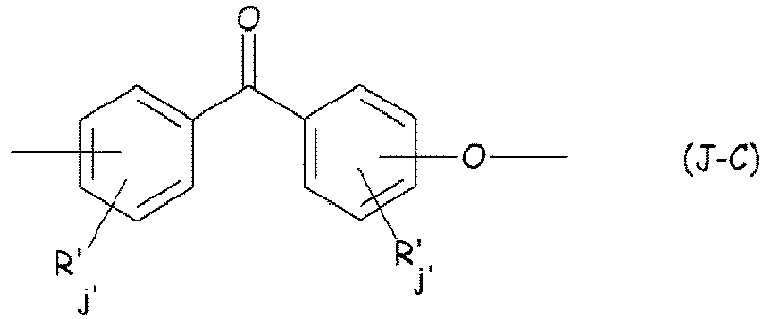
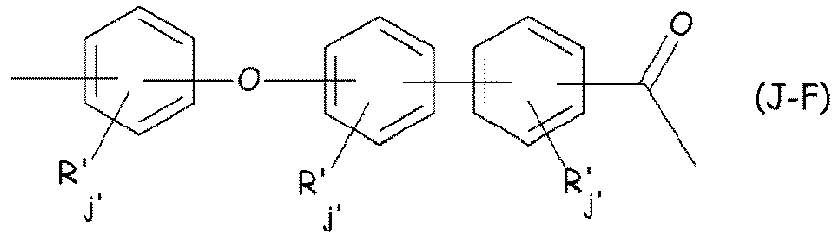
- Preferred recurring units (R PAEK ) are thus selected from those of formulae (J'-A) to (J'-O) :
- (R PAEK ) are chosen from :
- recurring units preferably more than 60 % by moles, more preferably more than 80 % by moles, still more preferably more than 90 % by moles of the recurring units are recurring units (R PAEK ), as above detailed.
- substantially all recurring units of the (PAEK) polymer are recurring units (R PAEK ), as detailed above; chain defects, or very minor amounts of other units might be present, it being understood that these latter do not substantially modify the properties of the (PAEK) polymer.
- the (PAEK) polymer may be notably a homopolymer, a random, alternating or block copolymer.
- the (PAEK) polymer may notably include (i) recurring units (R PAEK ) of at least two different formulae chosen from formulae (J-A) to (J-O), or (ii) recurring units (R PAEK ) of one or more formulae (J-A) to (J-O) and recurring units (R* PAEK ) different from recurring units (R PAEK ).
- the (PAEK) polymer may be a polyetheretherketone polymer [(PEEK) polymer].
- the (PAEK) polymer may be a polyetherketoneketone polymer [(PEKK) polymer], a polyetherketone polymer [(PEK) polymer], a polyetheretherketoneketone polymer [(PEEKK) polymer] or a polyetherketoneetherketoneketone polymer [(PEKEKK) polymer].
- the (PAEK) polymer may also be a blend including at least two different (PAEK) polymers chosen from (PEKK) polymers, (PEEK) polymers, (PEK) polymers, (PEEKK) polymers and (PEKEKK) polymers, as above detailed.
- (PEEK) polymer is intended to denote any polymer of which more than 50 % by moles of the recurring units are recurring units (R PAEK ) of Formula J'-A.
- more than 75 % by moles, preferably more than 85 % by moles, preferably more than 95 % by moles, preferably more than 99 % by moles of the recurring units of the (PEEK) polymer are recurring units of formula J'-A.
- Most preferably all or essentially all of the recurring units of the (PEEK) polymer are recurring units of formula J'-A.
- (PEKK) polymer is intended to denote any polymer of which more than 50 % by moles of the recurring units are recurring units (R PAEK ) of formula J'-B.
- more than 75 % by moles, preferably more than 85 % by moles, preferably more than 95 % by moles, preferably more than 99 % by moles of the recurring units of the (PEKK) polymer are recurring units of formula J'-B. Most preferably all the recurring units of the (PEKK) polymer are recurring units of formula J'-B.
- (PEK) polymer is intended to denote any polymer of which more than 50 % by moles of the recurring units are recurring units (R PAEK ) of formula J'-C.
- more than 75 % by moles, preferably more than 85 % by moles, preferably more than 95 % by moles, preferably more than 99 % by moles of the recurring units of the (PEK) polymer are recurring units of formula J'-C. Most preferably all the recurring units of the (PEK) polymer are recurring units of formula J'-C.
- (PEKEKK) polymer is intended to denote any polymer of which more than 50 % by moles of the recurring units are recurring units (R PAEK ) of formula J'-L.
- more than 75 % by moles, preferably more than 85 % by moles, preferably more than 95 % by moles, preferably more than 99 % by moles of the recurring units of the (PEKEKK) polymer are recurring units of formula J'-L. Most preferably all the recurring units of the (PEKEKK) polymer are recurring units of formula J'-L.
- the (PAEK) polymer is a (PEEK) homopolymer, i.e. a polymer of which substantially all the recurring units of the (PEEK) polymer are recurring units of formula J'-A, wherein chain defects, or very minor amounts of other units might be present, being understood that these latter do not substantially modify the properties of the (PEEK) homopolymer.
- a (PEEK) homopolymer i.e. a polymer of which substantially all the recurring units of the (PEEK) polymer are recurring units of formula J'-A, wherein chain defects, or very minor amounts of other units might be present, being understood that these latter do not substantially modify the properties of the (PEEK) homopolymer.
- IV intrinsic viscosity
- the (PAEK) polymer for example PEEK, may have a melt viscosity as high as 0.25 kPa-s, but preferably lower than 0.20 kPa-s and most preferably less than 0.18 kPa-s at 400°C and a shear rate of 1000 s -1 , as measured using a capillary rheometer in accordance with ASTM D3835.
- the (PAEK) polymer for example PEEK, may have a melt viscosity as low as 0.05 kPa-s. under the above-described conditions.
- the (PAEK) polymer for example PEEK, may have a melt viscosity at 400°C and a shear rate of 1000 s -1 , as measured using a capillary rheometer in accordance with ASTM D3835, ranging from 0.05 kPa-s to 0.25 kPa-s, preferably from 0.06 kPa-s to 0.20 kPa-s, preferably from 0.07 kPa-s to 0.18 kPa-s, preferably from 0.08 kPa-s to 0.15 kPa-s.
- a Kayeness Galaxy V Rheometer (Model 8052 DM) may be used.
- Non limitative examples of suitable commercially available (PAEK) polymers include KETASPIRE® polyetheretherketone commercially available from Solvay Specialty Polymers USA, LLC.
- the (PAEK) polymer can be prepared by any method known in the art for the manufacture of poly(aryl ether ketone)s.
- Polyetheretherketone homopolymers are commercially available notably from Solvay Specialty Polymers USA, LLC as KETASPIRE® and GATONE® poly(etheretherketone)s.
- the weight percent of the (PAEK) polymer in the composition (C) is preferably at least 10 wt. %, preferably of at least 20 wt. %, more preferably of at least 30 wt. %, more preferably of at least 35 wt. %, more preferably of at least 40 wt. %, based on the total weight of the composition (C).
- the weight percent of the polymer (PAEK) in the composition (C) is preferably at most 85 wt. %, more preferably of at most 80 wt. %, more preferably of at most 75 wt. %, more preferably of at most 70 wt. %, based on the total weight of the composition (C).
- the composition (C) comprises the (PAEK) polymer in an amount ranging from 35 to 75 wt. %, preferably 35 to 65 wt. %, preferably 35 to 55 wt. %, preferably 35 to 45 wt. %, preferably 35 to 40 wt. %, preferably 37 to 39 wt. %, preferably about 38 wt. %, based on the total weight of the composition (C).
- the polymer composition (C) comprises at least one (PPSU) polymer.
- the (PPSU) polymer may be notably a homopolymer, or a copolymer such as a random or a block copolymer.
- the (PPSU) polymer is a copolymer, its recurring units are advantageously a mix of recurring units (R PPSU ) of formula (A) and of recurring units (R PPSU *), different from recurring units (R PPSU ), such as notably recurring units of formula (D), (E) or (F) represented hereafter : and mixtures thereof.
- the (PPSU) polymer can also be a blend of the previously described homopolymer and copolymers.
- RADEL® R PPSU from Solvay Specialty Polymers USA, L.L.C. is an example of a commercially available polyphenylsulfone homopolymer.
- PPSU polymers
- PPSU polymers
- the (PPSU) polymer preferably has a melt flow rate (MFR) greater than or equal to 5 g/10 min at 365°C and under a load of 5.0 kg, preferably greater than or equal to 10 g/10 min at 365°C and under a load of 5.0 kg, more preferably greater than or equal to 14 g/10 min at 365°C and under a load of 5.0 kg, as measured in accordance with ASTM method D1238; to measure said melt flow rate, a Tinius Olsen Extrusion Plastometer melt flow test apparatus may be used.
- MFR melt flow rate
- melt flow rate of the (PPSU) polymer is not critical and may be selected by a person skilled in the art.
- the (PPSU) polymer may have a melt flow rate of at most 100 g/10 min, preferably at most 60 g/10 min, more preferably at most 40 g/10 min, when measured in accordance with ASTM method D1238 at 365°C and under a load of 5.0 kg.
- the composition (C) may comprise a (PPSU) polymer having a melt flow rate ranging from 5 g/10 min to 60 g/10 min, preferably 10 g/10 min to 60 g/10 min, preferably 20 g/10 min to 60 g/10 min, preferably 20 g/10 min to 40 g/10 min, measured as described above.
- a (PPSU) polymer having a melt flow rate ranging from 5 g/10 min to 60 g/10 min, preferably 10 g/10 min to 60 g/10 min, preferably 20 g/10 min to 60 g/10 min, preferably 20 g/10 min to 40 g/10 min, measured as described above.
- the (PPSU) polymer weight average molecular weight may range from 20,000 to 100,000 grams per mole (g/mol) as determined by gel permeation chromatography using ASTM D5296 with polystyrene standards. In some embodiments the PPSU polymer weight average molecular weight ranges from 40,000 to 80,000 grams per mole (g/mol).
- the (PPSU) polymer may be present in an amount of at least 2 wt. %, preferably at least 3 wt. %, more preferably at least 4 wt. %, even more preferably at least 5 wt. %, based on the total weight of the polymer composition (C).
- the (PPSU) polymer may also be present in an amount of at most 25 wt. %, preferably at most 20 wt. %, more preferably at most 15 wt. %, still more preferably at most 10 wt. %, based on the total weight of the polymer composition (C).
- the (PPSU) polymer is present in an amount ranging from 2 to 20 wt. %, preferably from 3 to 15 wt. %, preferably from 3 to 10 wt. %, preferably from 3 to 7 wt. %, preferably from 4 to 6 wt. %, based on the total weight of the polymer composition (C). Most preferably, the amount of the PPSU polymer is 5 %.
- R PES recurring units of formula (C), as detailed above.
- R PES Preferred recurring units
- more than 75 % by moles, preferably more than 85 % by moles, preferably more than 95 % by moles, preferably more than 99 % by moles of the recurring units of the (PES) polymer are recurring units of formula (C).
- the (PES) polymer may be a homopolymer or a copolymer such as a random or a block copolymer.
- its recurring units are preferably a mix of recurring units (R PES ) of Formula (D) and of recurring units (R PES *).
- R PES * recurring units of Formulae (L), (M) and (Q) below :
- R PES * Specific recurring units can be selected from those of formula (A), (E) and (F) below : and mixtures thereof.
- the (PES) polymer can also be a blend of the previously described homopolymer and copolymer.
- PES polystyrene-maleic anhydride copolymer
- VERADEL® PES sold by Solvay Specialty Polymers USA, L.L.C.
- the (PES) polymer may have a melt flow rate (MFR) at 380°C and under a load of 2.16 kg according to ASTM D1238 of greater than 35 g/10 min, preferably greater than or equal to 40 g/10 min, preferably greater than or equal to 45 g/10 min, preferably greater than or equal to 50 g/10 min, preferably greater than or equal to 55 g/10 min, preferably greater than or equal to 60 g/10 min, preferably greater than or equal to 65 g/10 min, preferably greater than or equal to 70 g/10 min, preferably greater than or equal to 75 g/10 min, preferably greater than or equal to 80 g/10 min.
- MFR melt flow rate
- a Tinius Olsen Extrusion Plastometer melt flow test apparatus may be used.
- melt flow rate of the (PES) polymer is not critical and may be selected by one of skill in the art. It is nevertheless understood that the (PES) polymer may possesses a melt flow rate of preferably at most 80 g/10 min, when measured in accordance with ASTM method D1238 at 380°C and under a load of 2.16 kg.
- the VERADEL® PES weight average molecular weight may range from 20,000 to 100,000 grams per mole (g/mol) as determined by gel permeation chromatography using ASTM D5296 with polystyrene standards. In some embodiments the VERADEL® PES weight average molecular weight may range from 40,000 to 80,000 grams per mole (g/mol).
- the weight percent of the (PES) polymer in the composition (C) is preferably at least 10 wt. %, preferably of at least 20 wt. %, more preferably of at least 30 wt. %, based on the total weight of the composition (C). It is further understood the weight percent of the (PES) polymer in the composition (C) will generally be of at most 85 wt. %, more preferably of at most 80 wt. %, more preferably of at most 75 wt. %, more preferably of at most 70 wt. %, based on the total weight of the composition (C).
- the weight percent of the (PES) polymer in the composition (C) preferably ranges from 1 to 90 wt. %, preferably from 5 to 80 wt. %, preferably from 10 to 70 wt. %, preferably from 15 to 60 wt. %, preferably from 20 to 50 wt. %, preferably from 25 to 40 wt. %, preferably from 25 to 35 wt. %, preferably from 25 to 30 wt. %, preferably from 26 to 28 wt. %. Most preferably, the weight percent of the (PES) polymer is 27 wt. %.
- a large selection of reinforcing fillers may be added to the composition (C). They are preferably selected from fibrous and particulate fillers.
- a fibrous reinforcing filler is considered herein to be a material having length, width and thickness, wherein the average length is significantly larger than both the width and thickness.
- such a material has an aspect ratio, defined as the average ratio between the length and the smallest of the width and thickness of at least 5.
- the aspect ratio of the reinforcing fibers is at least 10, more preferably at least 20, still more preferably at least 50.
- the reinforcing filler is selected from mineral fillers, such as notably talc, mica, titanium dioxide, kaolin, calcium carbonate, calcium silicate, magnesium carbonate); glass fiber; carbon fibers such as notably graphitic carbon fibers (some of them having possibly a graphite content of greater than 99 %), amorphous carbon fibers, pitch-based carbon fibers (some of them having possibly a graphite content of greater than 99 %), PAN-based carbon fibers; synthetic polymeric fiber; aramid fiber; aluminum fiber; aluminum silicate fibers; oxide of metals of such aluminum fibers; titanium fiber; magnesium fiber; boron carbide fibers; rock wool fiber; steel fiber; asbestos; wollastonite; silicon carbide fibers; boron fibers, graphene, carbon nanotubes (CNT) and the like.
- mineral fillers such as notably talc, mica, titanium dioxide, kaolin, calcium carbonate, calcium silicate, magnesium carbonate
- glass fiber such as notably graphitic carbon fibers (some
- the filler is a fibrous filler.
- the fibrous filler is glass fibers.
- the fibrous filler is a continuous fibrous filler.
- One or more fillers may be used.
- the filler is non-fibrous.
- Glass fibers are silica-based glass compounds that contain several metal oxides which can be tailored to create different types of glass.
- the main oxide is silica in the form of silica sand; the other oxides such as calcium, sodium and aluminum are incorporated to reduce the melting temperature and impede crystallization.
- Glass fibers may have a round cross-section or a non-circular cross-section (so called "flat glass fibers"), including oval, elliptical or rectangular.
- the glass fibers may be added as endless fibers or as chopped glass fibers.
- the glass fibers have generally an equivalent diameter of 5 to 20 preferably of 5 to 15 ⁇ m and more preferably of 5 to 10 ⁇ m.
- All glass fiber types such as A, C, D, E, M, S, R, T glass fibers (as described in chapter 5.2.3, pages 43-48 of Additives for Plastics Handbook, 2nd ed, John Murphy ), or any mixtures thereof or mixtures thereof may be used.
- R, S and T glass fibers are high modulus glass fibers that have typically an elastic modulus of at least 76, preferably at least 78, more preferably at least 80, and most preferably at least 82 GPa as measured according to ASTM D2343.
- R, S and T glass fibers are well known in the art. They are notably described in Fiberglass and Glass Technology, Wallenberger, Frederick T.; Bingham, Paul A. (Eds.), 2010, XIV, chapter 5, pages 197 - 225 .
- R, S and T glass fibers are composed essentially of oxides of silicon, aluminium and magnesium. In particular, those glass fibers comprise typically from 62-75 wt. % of SiO 2 , from 16-28 wt. % of Al 2 O 3 and from 5-14 wt. % of MgO. To the contrary of the regular E-glass fibers widely used in polymer compositions, R, S and T glass fibers comprise less than 10 wt. % of CaO.
- the fibrous filler in particular the glass fiber, is formulated with a high temperature sizing.
- a high temperature sizing provided superior interfacial adhesion with polymers that require generally to be processed at high temperatures, like (PEEK), (PEKK) and (PPSU) polymers.
- the glass fiber may have a non-circular cross section and an elastic modulus of at least 76 GPa as measured according to ASTM C1557-03.
- the glass fibers may have a non-circular cross section (so called "flat glass fibers"), including oval, elliptical or rectangular.
- the fibrous filler in particular the glass fibers, may have a cross-sectional longest diameter of at least 15 ⁇ m, preferably at least 20 ⁇ m, more preferably at least 22 ⁇ m, still more preferably at least 25 ⁇ m. It is advantageously of at most 40 ⁇ m, preferably at most 35 ⁇ m, more preferably at most 32 ⁇ m, still more preferably at most 30 ⁇ m. Excellent results were obtained when the cross-sectional longest diameter was in the range of 15 to 35 preferably of 20 to 30 ⁇ m and more preferably of 25 to 29 ⁇ m.
- the fibrous filler in particular the glass fibers may have a cross-sectional shortest diameter of at least 4 ⁇ m, preferably at least 5 ⁇ m, more preferably at least 6 ⁇ m, still more preferably at least 7 ⁇ m. It is advantageously of at most 25 um, preferably at most 20 um, more preferably at most 17 ⁇ m, still more preferably at most 15 ⁇ m. Excellent results were obtained when the cross-sectional shortest diameter was in the range of 5 to 20 preferably of 5 to 15 ⁇ m and more preferably of 7 to 11 ⁇ m.
- the fibrous filler in particular the glass fibers may have an aspect ratio of at least 2, preferably at least 2.2, more preferably at least 2.4, still more preferably at least 3.
- the aspect ratio is defined as a ratio of the longest diameter in the cross-section of the glass fiber to the shortest diameter thereof.
- the aspect ratio of the glass fibers is of at most 8, preferably at most 6, more preferably of at most 4. Excellent results were obtained when said ratio was of from 2 to 6, and preferably, from 2.2 to 4.
- the shape of the cross-section of the glass fiber, its length, its cross-sectional diameter and its aspect ratio can be easily determined using optical microscopy.
- the aspect ratio of the fiber cross-section may be determined using an Euromex optical microscope and an image analysis software (Image Focus 2.5) by measuring the largest (width) and smallest (height) dimensions of the fiber cross-section and dividing the first number by the second number.
- the glass fibers may have an elastic modulus of at least 76 GPa as measured according to ASTM C1557-03, preferably at least 78, more preferably at least 80, even more preferably at least 82 and most preferably at least 84 GPa, as measured according to ASTM C1557-03.
- the glass fibers of the polymer composition (C) have a tensile strength of at least 3.5 GPa as measured according to ASTM C1557-03, preferably at least 3.6, more preferably at least 3.7, even more preferably at least 3.8 and most preferably at least 3.9 GPa, as measured according to ASTM C1557-03.
- Glass is a silica-based glass compound that contain several metal oxides which can be tailored to create different types of glasses.
- the main oxide is silica in the form of silica sand ; the other oxides such as calcium, sodium and aluminum are incorporated to reduce the melting temperature and impede crystallization.
- the glass fiber derived therefrom exhibit a high elastic modulus.
- those glass fibers comprise typically from 55-75 wt. % of SiO 2 , from 16-28 wt.
- the high modulus glass fibers comprise less than 5 wt. % of B 2 O 3 , preferably less than 1 wt. %.
- the glass fiber may be manufactured by well known techniques such as the one described in US 4,698,083 using a glass composition featuring a high loading of Al 2 O 3 , typically from 16-28 wt. % of Al 2 O 3 , based on the total weight of the glass composition.
- the glass fiber may be coated with a predetermined material on a surface thereof in order to tailor reaction with the polymer(s) and other ingredients of the polymer composition (C) and improve the polymer/glass bonding.
- the coating material may change the performance of a glass fiber-reinforced polymer composition.
- the reinforcing filler in the polymer composition (C) is a carbon fiber.
- carbon fiber is intended to include graphitized, partially graphitized and ungraphitized carbon reinforcing fibers or a mixture thereof.
- fiber means a fundamental form of solid (often crystalline) characterized by relative high tenacity and a high ratio of length to diameter.
- graphitized intends to denote carbon fibers obtained by high temperature pyrolysis (over 2000°C) of carbon fibers, wherein the carbon atoms place in a way similar to the graphite structure.
- Carbon fibers useful for the present invention can advantageously be obtained by heat treatment and pyrolysis of different polymer precursors such as, for example, rayon, polyacrylonitrile (PAN), aromatic polyamide or phenolic resin; carbon fibers useful for the present invention may also be obtained from pitchy materials.
- polymer precursors such as, for example, rayon, polyacrylonitrile (PAN), aromatic polyamide or phenolic resin
- carbon fibers useful for the present invention may also be obtained from pitchy materials.
- Carbon fibers useful for the present invention are preferably chosen from the group composed of PAN-based carbon fibers (PAN-CF), pitch based carbon fibers, graphitized pitch-based carbon fibers, and mixtures thereof.
- PAN-CF PAN-based carbon fibers
- pitch based carbon fibers PAN-CF
- graphitized pitch-based carbon fibers PAN-CF
- PAN-based carbon fibers have advantageously a diameter of between 3 to 20 ⁇ m, preferably from 4 to 15 ⁇ m, more preferably from 5 to 10 ⁇ m, most preferably from 6 to 8 ⁇ m. Good results were obtained with PAN-based carbon fibers (PAN-CF) having a diameter of 7 ⁇ m.
- the PAN-CF maybe of any length.
- the length of PAN-CF is at least 50 ⁇ m.
- Graphitized pitch-based carbon fibers are readily available from commercial sources containing at least about 50 % weight graphitic carbon, greater than about 75 % weight graphitic carbon, and up to substantially 100 % graphitic carbon.
- Highly graphitic carbon fiber particularly suitable for use in the practice of this invention may be further characterized as highly conductive, and such fiber is generally used having a modulus of about 80 to about 120 million pounds per square inch, i.e., million lbs/in 2 (MSI).
- MSI million pounds per square inch
- the highly graphitic carbon fiber has a modulus of about 85 to about 120 MSI, and in other certain embodiments about 100 to about 115 MSI.
- the pitch-based-CF has advantageously a diameter between 5 to 20 ⁇ m, preferably from 7 to 15 ⁇ m, more preferably from 8 to 12 ⁇ m.
- the pitch-based-CF may be of any length.
- the pitch-based-CF has advantageously a length from 1 ⁇ m to 1 cm, preferably from 1 ⁇ m to 1 mm, more preferably from 5 ⁇ m to 500 ⁇ m and still more preferably from 50 to 150 ⁇ m.
- Carbon fiber may be employed as chopped carbon fiber or in a particulate form such as may be obtained by milling or comminuting the fiber.
- Comminuted graphitized pitch-based carbon fiber suitable for use in the practice of the invention may be obtained from commercial sources including from Cytec Carbon Fibers as ThermalGraph DKD X and CKD X grades of pitch-based carbon fiber and Mitsubishi Carbon Fibers as Dialead carbon fibers.
- Chopped PAN-based carbon fibers preferably used in the present invention may be obtained from commercial sources.
- the reinforcing filler is preferably present in the polymer composition (C), in an amount of at least 5 wt. %, preferably at least 10 wt. %, more preferably at least 15 wt. %, based on the total weight of the polymer composition (C).
- the reinforcing filler is also preferably present in an amount of at most 45 wt. %, more preferably at most 40 wt. %, still more preferably at most 30 wt. %, based on the total weight of the polymer composition (C).
- the amount of the reinforcing filler ranges from 0.1 wt. % to 50 wt. %, preferably from 5 wt. % to 45 wt. %, preferably from 10 wt. % to 40 wt. %, preferably from 15 wt. % to 35 wt. %, preferably from 20 wt. % to 35 wt. %, preferably from 25 wt. % to 35 wt. %, preferably from 28 wt. % to 32 wt. %.
- the amount of the reinforcing filler is 30 wt. % of the polymer composition (C).
- the polymer composition (C) may further optionally comprise other ingredients (I) such as a colorant such as notably a dye and/or a pigment such as notably titanium dioxide, zinc sulfide and zinc oxide, ultraviolet light stabilizers, heat stabilizers, antioxidants such as notably organic phosphites and phosphonites, acid scavengers, processing aids, nucleating agents, internal lubricants and/or external lubricants, flame retardants, a smoke-suppressing agents, an anti-static agents, anti-blocking agents, and/or conductivity additives such as carbon black and carbon nanofibrils.
- a colorant such as notably a dye and/or a pigment such as notably titanium dioxide, zinc sulfide and zinc oxide
- ultraviolet light stabilizers heat stabilizers
- antioxidants such as notably organic phosphites and phosphonites
- acid scavengers processing aids, nucleating agents, internal lubricants and/or external lubric
- the polymer composition (C) may also further comprise other polymers different from the (PAEK) polymer, (PPSU) polymer and the (PES) polymer, as detailed above.
- the polymer composition (C) may further comprise polymers such as polyetherimides, polycarbonates, polyphenylenes, polyesters and polyphenylene sulfides. Their addition can be useful notably when the composition (C) must meet certain particular requirements, as needed by certain special end uses.
- their total weight is preferably less than 20 %, preferably less than 10 %, more preferably less than 5 % and even more preferably less than 2 %.
- composition (C) of the invention preferably consists essentially of the (PAEK) polymer, as detailed above, the (PPSU) polymer, as detailed above, the (PES) polymer, as detailed above, the reinforcing filler, as detailed above, and optionally, other ingredients (I), as detailed above.
- composition consisting essentially of' as used herein is intended to denote that any additional ingredient different from the (PAEK) polymer, as detailed above, the (PPSU) polymer, as detailed above, the (PES) polymer, as detailed above, the reinforcing filler, as detailed above, and optionally, other ingredients (I) is present in an amount of at most 1 % by weight, based on the total weight of the composition (C).
- composition (C) comprises or consists essentially of:
- the composition (C) exhibits a tensile breaking strength measured according to ASTM D638 of greater than or equal to about 30,000 psi (0.207 GPa), preferably greater than or equal to about 30,500 psi, preferably greater than or equal to about 31,000 psi, preferably greater than or equal to about 31,500 psi.
- the composition (C) exhibits a tensile elongation at break measured according to ASTM D638 of greater than or equal to about 2.6 %, preferably greater than or equal to about 2.7 %.
- the composition (C) exhibits a notched Izod impact resistance measured according to ASTM D256 of greater than or equal to about (101.7 J/m) 1.9 ft-lb/in, preferably greater than or equal to about 2.0 ft-lb/in (10.7 J/m), preferably greater than or equal to about ft-lb/in(112.4 J/m).
- the composition (C) exhibits a no notch Izod impact resistance measured according to ASTM D4812 of greater than or equal to about 21 ft-lb/in (1124.4 J/m), preferably greater than or equal to about 22 ft-lb/in (1177.95 J/m), preferably greater than or equal to about 23 ft-lb/in(1231.49 J/m).
- compositions exhibiting any combination of the physical, chemical, and mechanical properties described herein are contemplated and within the scope of the present disclosure.
- composition (C) can be prepared by a variety of methods involving intimate admixing of the polymer materials with any optional ingredient, as detailed above, desired in the formulation, for example by melt mixing or a combination of dry blending and melt mixing.
- dry blending of the (PAEK) polymer, as detailed above, the (PPSU) polymer, as detailed above, the (PES) polymer, as detailed above, the reinforcing filler, as detailed above, and optionally, other ingredients (I) is carried out by using high intensity mixers, such as notably Henschel-type mixers and ribbon mixers.
- Such a powder mixture may comprise the (PAEK) polymer, as detailed above, the (PPSU) polymer, as detailed above, the (PES) polymer, as detailed above, the reinforcing filler, as detailed above, and optionally, other ingredients (I) in the weight ratios as described above.
- Exemplary compositions are suitable for manufacturing finished articles by melt fabrication processes such as injection molding or extrusion, or can be a concentrated mixture to be used as masterbatch and diluted in further amounts of the (PAEK) polymer, as detailed above, the (PPSU) polymer, as detailed above, the (PES) polymer, as detailed above, the reinforcing filler, as detailed above, and optionally, other ingredients (I) in subsequent processing steps.
- melt compounding can be effected on the powder mixture as above detailed, or preferably directly on the (PAEK) polymer, as detailed above, the (PPSU) polymer, as detailed above, the (PES) polymer, as detailed above, the reinforcing filler, as detailed above, and optionally, other ingredients (I).
- melt compounding devices such as co-rotating and counter-rotating extruders, single screw extruders, co-kneaders, disc-pack processors and various other types of extrusion equipment can be used.
- extruders more preferably twin screw extruders can be used.
- composition (C) may be used to form strand extrudates which may not be ductile. Such strand extrudates can be chopped by means e.g. of a rotating cutting knife after cooling on a conveyer with, for example, water spray.
- composition (C) which may be present in the form of pellets or beads can then be further used for the manufacture of articles.
- Exemplary embodiments also include articles comprising the above described polymer composition (C).
- the articles may be made from the polymer composition (C) using any suitable melt-processing method.
- they may be made by injection molding or extrusion molding.
- the polymer composition (C) may be well suited for the manufacture of articles useful in a wide variety of end uses.
- Non limitative examples of articles according to the present invention are :
- the article includes at least one wall or section with a thickness of less than 7 mm, preferably less than 5 mm, preferably less than 3mm.
- the PAEK used in the examples was KetaSpire® PEEK having melt viscosities ranging from 0.07 to 0.15 kPa-s, available from Solvay Specialty Polymers USA., LLC.
- the melt viscosity was measured by capillary rheometer at a temperature of 400°C and a shear rate of 1000 s -1 .
- the PAES grade used in the examples was Veradel® 3600 PES, a high flowing/low viscosity grade of PES available from Solvay Specialty Polymers USA, LLC, having a melt flow rate when measured at 380°C and under a load of 2.16 kg in the range 65-85 g/10 min using the ASTM D1238 melt flow rate test. This grade of PES is particularly suitable for injection molding.
- Two comparative examples (6 and 7) shown in Table 3 were prepared with Veradel® PES grades A-301 NT and A-201 NT, respectively, which are grades with nominal melt flows ranging from 25 to 35 and 15 to 25 g/10 min, respectively, when measured at 380°C and under a piston load of 2.16 kg.
- the PPSU grade used in some of the formulations was Radel® R-5900 NT PPSU, which is available from Solvay Specialty Polymers USA, LLC. This is a high flowing grade of PPSU having a melt flow rate ranging from 26 to 36 according to ASTM D1238 under the test conditions of 365°C and 5.0 kg weight.
- the reinforcement used in all the examples was chopped glass fiber of the following grades :
- the polymer blends of the examples and comparative examples were prepared by first tumble blending pellets and/or powders of the resins and additives to be blended, other than the glass fiber, at the desired compositional ratios for about 20 minutes, followed by melt compounding using either a 26 mm diameter Coperion ZSK-26 co-rotating partially intermeshing twin screw extruder having an L/D ratio of 48:1, or a Berstorff 25 mm twin screw co-rotating partially intermeshing extruder having eight barrel sections and an L/D ratio of 40:1.
- the barrel sections 2 through 12 and the die were heated to set point temperatures as follows :
- the resins and additives other than fiberglass were fed at barrel section 1 using a gravimetric feeder at throughput rates in the range 6-13-kg/hr while the glass fiber was fed to the extruder at barrel section 7 (ZSK) and 5 (Berstorff) at a nominal throughput rate 30 % of the total throughput rate.
- the extruder was operated at screw speeds in the range 180-200 RPM.
- a single-hole die was used for all the compounds and the molten polymer strand exiting the die was cooled in a water trough and then cut in a pelletizer to form pellets approximately 3.0 mm in length by 2.7 mm in diameter.
- Injection molding was performed with the example formulations to produce 3.2 mm (0.125 in) thick ASTM tensile and flexural specimens for mechanical property testing.
- Type I tensile ASTM specimens and 5 in x 0.5 in x 0.125 in flexural specimens were injection molded using PEEK injection molding guidelines provided by the supplier.
- melt viscosity was measured at a temperature of 400°C and at shear rates ranging from 100 to 10000 1/s. For the purpose of comparison between different materials, the melt viscosity at the intermediate shear rate of 1000 1/s was used.
- the formulations of the examples and comparative examples are shown in Tables 1-3.
- the examples and comparative examples all contained 30 % chopped glass fiber and were either PEEK with glass fiber or blends of PEEK with one or more PAES.
- Zinc oxide was optionally used at low level (0.1 %) in some of the formulations of the examples or comparative examples.
- Zinc sulfide was also used at 3.0 phr in most formulations as a pigment.
- the mechanical properties and melt viscosities of the examples and comparative examples are also shown in Tables 1-3.
- the data in the tables above illustrate that the formulations including a combination of PEEK, a PES having a melt flow greater than 35 g/10 min, and a small weight % of PPSU exhibit an unexpected combination of high mechanical properties along with very high melt flow characteristics (low melt viscosity).
- the data is presented in three logical groupings in Tables 1-3.
- Each of the example tables presents formulations utilizing a different type/grade of glass fiber. Because the glass fiber type may have a significant impact on mechanical properties, the examples are compared to comparative examples using the same glass fiber in each set of examples.
- Example 1 a comparison is shown between glass fiber reinforced PEEK (Comp. Ex. 1), a glass fiber reinforced blend of PEEK with high flow PES (Comp. Ex. 2), and a third formulation, prepared according to the invention - wherein a combination of PEEK, high flow PES and a small proportion ofPPSU are used in the polymer portion of the formulation. All three formulations are 30 % glass fiber reinforced.
- the mechanical properties of Example 1 show higher strength, higher elongation at break, and higher impact resistance than the blend where PPSU was not added to the formulation.
- Example 1 exhibited tensile strength that is even higher than that of 30 % glass fiber reinforced PEEK, which is surprising given the expectation that 30 % glass fiber reinforced PES would be significantly lower in tensile strength than 30 % glass fiber reinforced PEEK.
- the formulation of Example 1 also exhibits a lower viscosity than the viscosity of 30 % glass fiber reinforced PEEK while offering a higher tensile strength and higher notched and unnotched impact resistance.
- Example 2 illustrates that when the same glass fiber reinforced blend formulations were prepared with a high flow PES having a melt flow rate greater than 35 g/10 min (Examples 2 and 3), higher mechanical properties were unexpectedly achieved, including strength, elongation at break, and impact resistance relative to the same formulations prepared using PES polymer component having melt flow rates lower than or equal to 35 g/10 min.
- Example 2 used a PES having melt flow rate in the 65-85 g/10 min range.
- Comparative Examples 3 and 4 were the same formulation as Example 2 except that they used PESs having melt flow rates of 25-35 g/10 min and 15-25 g/10 min, respectively.
- the impact resistance (notched and unnotched Izod) advantage of Example 2 over Comparative Examples 3 and 4 is particularly surprising considering that higher impact resistance behavior is typically expected from higher molecular weight ( i.e. lower melt flow rate) polymer ingredients in such formulations.
- Table 3 shows a comparison of a PEEK/high flow PES/PPSU/glass fiber formulation with a PEEK/glass fiber formulation.
- flat or ribbon-like glass fiber was used.
- the blend of Example 4 showed superior properties as well as lower viscosities relative to the glass fiber reinforced PEEK of Comparative Example 5.
- the viscosity of the formulation of Example 4 is also lower than that of Comparative Example 5, consistent with the comparison between Example 1 and Comparative Example 1.
- Polymers exhibiting a combination of exceptionally high mechanical properties coupled with very high flow rates may be useful in the fabrication of high strength and high toughness thin parts with reduced weight that are also easy to produce by injection molding (because of the very low viscosity). Such polymers may also exhibit excellent mechanical robustness and light weight for ease of portability (for example, for mobile electronics parts) or reduced fuel consumption (for example, in aerospace or commercial transport applications).
- round filament S glass is preferred as shown in Examples 2 and 3
- flat glass fiber is preferred as shown in Example 4.
Landscapes
- Chemical & Material Sciences (AREA)
- Health & Medical Sciences (AREA)
- Chemical Kinetics & Catalysis (AREA)
- Medicinal Chemistry (AREA)
- Polymers & Plastics (AREA)
- Organic Chemistry (AREA)
- Compositions Of Macromolecular Compounds (AREA)
- Reinforced Plastic Materials (AREA)
Claims (14)
- Composition [composition (C)], comprenant :- de 1 à 90% en poids (% en poids) d'au moins une poly(aryl éther cétone) [polymère (PAEK)], où plus de 50% molaire des motifs récurrents dudit polymère (PAEK) sont des motifs récurrents (RPAEK) comprenant un groupement Ar-C(O)-Ar',
où
Ar et Ar', qui sont identiques ou différents l'un de l'autre, sont des groupements aromatiques, et
les motifs récurrents (RPAEK) sont choisis parmi les groupements de formules (J-A) à (J-O) :







 - chacun parmi R', qui sont identiques ou différents les uns des autres, est choisi parmi un halogène, un groupement alkyle, alcényle, alcynyle, aryle, éther, thioéther, acide carboxylique, ester, amide, imide, un sulfonate de métal alcalin ou alcalino-terreux, un sulfonate d'alkyle, un phosphonate de métal alcalin ou alcalino-terreux, un phosphonate d'alkyle, une amine, et un ammonium quaternaire, et- j vaut zéro ou est un nombre entier allant de 1 à 4 ;- de 1 à 25% en poids d'au moins un polymère de polyphénylsulfone [polymère (PPSU)], où plus de 50% molaire des motifs récurrents dudit polymère (PPSU) sont des motifs récurrents (RPPSU) de formule (A) :
 - de 1 à 90% en poids d'au moins un polymère de polyéthersulfone [polymère (PES)], où plus de 50% molaire des motifs récurrents du polymère (PES) sont des motifs récurrents (RPES) choisis indépendamment parmi des motifs de formule (C) :
 - chacun parmi R', qui sont identiques ou différents les uns des autres, est choisi parmi un halogène, un groupement alkyle, alcényle, alcynyle, aryle, éther, thioéther, acide carboxylique, ester, amide, imide, un sulfonate de métal alcalin ou alcalino-terreux, un sulfonate d'alkyle, un phosphonate de métal alcalin ou alcalino-terreux, un phosphonate d'alkyle, une amine, et un ammonium quaternaire ; et- chacun parmi j', qui sont identiques ou différents les uns des autres, est choisi parmi 0, 1, 2, 3 ou 4 ; et- de 0,1 à 50% en poids d'au moins une charge renforçante ;
où
tous les % en poids sont basés sur le poids total de la composition (C), et
le polymère PES possède un indice de fluidité (MFR) à une température de 380°C et sous une charge de 2,16 kg, selon ASTM D1238, allant de 65 g/10 min à 85 g/10 min. - Composition (C) selon la revendication 1, dans laquelle plus de 50% molaire des motifs récurrents du polymère (PAEK) sont des motifs récurrents (RPAEK) choisis parmi les formules (J'-A) à (J'-O) ci-après :






- Composition (C) selon l'une quelconque des revendications 1 ou 2, dans laquelle le polymère (PAEK) est présent selon une quantité allant de 35 à 75% en poids, sur la base du poids total de la composition (C).
- Composition (C) selon l'une quelconque des revendications 1 à 3, dans laquelle le polymère (PPSU) est présent selon une quantité allant de 4 à 10% en poids, sur la base du poids total de la composition de polymère (C).
- Composition (C) selon l'une quelconque des revendications 1 à 4, dans laquelle plus de 50% molaire des motifs récurrents (RPES) sont des motifs récurrents de formule (D) :

- Composition (C) selon l'une quelconque des revendications 1 à 5, dans laquelle le polymère PES est présent selon une quantité allant de 25 à 70% en poids, préférablement de 25 à 60% en poids, sur la base du poids total de la composition (C).
- Composition (C) selon l'une quelconque des revendications 1 à 6, dans laquelle la charge renforçante est une charge en fibre de verre, et est présente selon une quantité inférieure ou égale à 40% en poids, sur la base du poids total de la composition de polymère (C).
- Composition selon la revendication 7, dans laquelle la fibre de verre possède une section transversale circulaire et un module élastique d'au moins 76 GPa, tel que mesuré selon ASTM C1557-03.
- Composition selon la revendication 7, dans laquelle la fibre de verre possède une section transversale non circulaire et un module élastique d'au moins 76 GPa, tel que mesuré selon ASTM C1557-03.
- Composition selon l'une quelconque des revendications 1 à 9, dans laquelle le polymère (PAEK) est la polyétheréthercétone (PEEK).
- Composition selon l'une quelconque des revendications 1 à 10, ladite composition présentant au moins l'un(e) parmi :a) une résistance à la rupture par traction, mesurée selon ASTM D638, supérieure ou égale à environ 30 000 psi (0,207 GPa) ;b) un allongement en traction à la rupture, mesurée selon ASTM D638, supérieur ou égal à environ 2,6% ;c) une résistance au choc Izod d'éprouvette entaillée, mesurée selon ASTM D256, supérieure ou égale à environ 1,9 pied-livre/pouce (101,7 J/m) ; etd) une résistance au choc Izod d'éprouvette non entaillée, mesurée selon ASTM D4812, supérieure ou égale à environ 21 pied-livres/pouce (1124,4 J/m).
- Procédé de fabrication de la composition de polymère (C) selon l'une quelconque des revendications 1 à 11, comprenant le mélange :- du au moins un polymère (PAEK),- du au moins un polymère (PPSU),- du au moins un polymère PES, et- de la au moins une charge renforçante.
- Procédé selon la revendication 12, dans lequel ledit mélange comporte le mélange d'au moins un autre ingrédient (I).
- Article, comprenant la composition de polymère (C) selon l'une quelconque des revendications 1 à 11.
Applications Claiming Priority (2)
| Application Number | Priority Date | Filing Date | Title |
|---|---|---|---|
| US201462095532P | 2014-12-22 | 2014-12-22 | |
| PCT/EP2015/080332 WO2016102330A1 (fr) | 2014-12-22 | 2015-12-17 | Compositions de paek/ppsu/pes |
Publications (2)
| Publication Number | Publication Date |
|---|---|
| EP3237493A1 EP3237493A1 (fr) | 2017-11-01 |
| EP3237493B1 true EP3237493B1 (fr) | 2020-04-29 |
Family
ID=55022461
Family Applications (1)
| Application Number | Title | Priority Date | Filing Date |
|---|---|---|---|
| EP15816147.1A Active EP3237493B1 (fr) | 2014-12-22 | 2015-12-17 | Compositions de paek/ppsu/pes |
Country Status (5)
| Country | Link |
|---|---|
| US (1) | US10683415B2 (fr) |
| EP (1) | EP3237493B1 (fr) |
| JP (1) | JP6916738B2 (fr) |
| CN (1) | CN107250216B (fr) |
| WO (1) | WO2016102330A1 (fr) |
Families Citing this family (24)
| Publication number | Priority date | Publication date | Assignee | Title |
|---|---|---|---|---|
| EP3298071B1 (fr) * | 2015-05-21 | 2024-09-04 | Solvay Specialty Polymers USA, LLC. | Compositions de poly(aryléthercétone) |
| EP3380543A1 (fr) * | 2015-09-18 | 2018-10-03 | Victrex Manufacturing Limited | Matériaux polymères |
| US11352480B2 (en) | 2016-03-18 | 2022-06-07 | Ticona Llc | Polyaryletherketone composition |
| CN108250668A (zh) * | 2016-12-28 | 2018-07-06 | 东丽先端材料研究开发(中国)有限公司 | 金属接合用树脂组合物及其与金属接合成型品和制造方法 |
| US20200384681A1 (en) * | 2017-04-24 | 2020-12-10 | Solvay Specialty Polymers Usa, Llc | Method of making a three-dimensional object using ppsu |
| WO2018197156A1 (fr) * | 2017-04-24 | 2018-11-01 | Solvay Specialty Polymers Usa, Llc | Méthode de fabrication d'un objet tridimensionnel utilisant du ppsu |
| WO2018224246A1 (fr) * | 2017-06-07 | 2018-12-13 | Solvay Specialty Polymers Usa, Llc | Procédé pour la préparation de particules de polymères aromatiques, particules pouvant être obtenues par ledit procédé et leurs utilisations |
| CN110730709B (zh) | 2017-06-07 | 2022-03-22 | 索尔维特殊聚合物美国有限责任公司 | 芳香族聚合物颗粒及其制备方法和用途 |
| WO2018234116A1 (fr) * | 2017-06-20 | 2018-12-27 | Solvay Specialty Polymers Usa, Llc | Structures stratifiées |
| US20200231807A1 (en) * | 2017-08-02 | 2020-07-23 | Solvay Specialty Polymers Usa, Llc | High flow polymer compositions |
| JP2020535237A (ja) * | 2017-08-02 | 2020-12-03 | ソルベイ スペシャルティ ポリマーズ ユーエスエー, エルエルシー | 低誘電平坦ガラス繊維を含有する強化熱可塑性ポリマー組成物及び相当する物品 |
| WO2019042949A1 (fr) | 2017-08-28 | 2019-03-07 | Solvay Specialty Polymers Usa, Llc | Composition polymère à base de verre comprenant une poly(aryléthersulfone), une poly(aryléthercétone), au moins un poly(phénylène sulfure) et des fibres de verre |
| WO2019042948A1 (fr) | 2017-08-28 | 2019-03-07 | Solvay Specialty Polymers Usa, Llc | Composition de polymère chargé de verre comprenant une poly (aryl éther sulfone), une poly (aryl éther cétone), au moins un poly (sulfure de phénylène) et des fibres de verre |
| US20210054186A1 (en) * | 2018-04-12 | 2021-02-25 | Solvay Specialty Polymers Usa, Llc | Method for manufacturing a three-dimensional object using a nitride |
| EP3640376A1 (fr) * | 2018-10-17 | 2020-04-22 | Evonik Operations GmbH | Polyéther aromatique étiré |
| US11938688B2 (en) * | 2018-12-18 | 2024-03-26 | Resonac Corporation | Laminate, printed wiring board, semiconductor package, and method for manufacturing laminate |
| WO2021021274A1 (fr) | 2019-07-29 | 2021-02-04 | Bridgestone Americas Tire Operations, Llc | Mélanges polymères stables à la température destinés à être utilisés dans des pneus non pneumatiques |
| JP7361195B2 (ja) | 2019-07-29 | 2023-10-13 | ブリヂストン アメリカズ タイヤ オペレーションズ、 エルエルシー | 非空気圧タイヤで使用するための温度安定性ポリマーブレンド |
| US20230250230A1 (en) | 2020-06-22 | 2023-08-10 | Solvay Specialty Polymers Usa, Llc | Reinforced paek compositions comprising recylced carbon fibers |
| JP7476698B2 (ja) * | 2020-07-15 | 2024-05-01 | 東洋紡株式会社 | ポリイミドフィルム、ポリイミドフィルムと無機基板の積層体、フレキシブル電子デバイス |
| CN112552685A (zh) * | 2020-11-16 | 2021-03-26 | 珠海万通特种工程塑料有限公司 | 一种聚醚砜组合物及其制备方法和应用 |
| EP4416224A1 (fr) * | 2021-10-11 | 2024-08-21 | Solvay Specialty Polymers USA, LLC | Tube de transfert de chaleur ignifugé |
| WO2024082077A1 (fr) * | 2022-10-17 | 2024-04-25 | Solvay Specialty Polymers Usa, Llc | Composition polymère appropriée pour des applications de décharge électrostatique |
| CN118003719B (zh) * | 2024-03-11 | 2025-11-07 | 上海华芯晟新材料有限公司 | 一种聚苯硫醚基覆铜板及其制备方法 |
Family Cites Families (5)
| Publication number | Priority date | Publication date | Assignee | Title |
|---|---|---|---|---|
| DE3667779D1 (de) | 1985-03-23 | 1990-02-01 | Nitto Boseki Co Ltd | Glasspinnfaden und verfahren zu seiner herstellung. |
| EP2142600B1 (fr) * | 2007-04-23 | 2014-07-23 | Solvay Specialty Polymers USA, LLC. | Mélanges polymères thermoplastiques et applications associées |
| JP6339020B2 (ja) * | 2011-12-21 | 2018-06-06 | ソルベイ スペシャルティ ポリマーズ ユーエスエー, エルエルシー | 携帯電子装置用の高性能ポリマー組成物 |
| WO2013092628A1 (fr) | 2011-12-21 | 2013-06-27 | Solvay Specialty Polymers Usa, Llc | Composition de polymère de sulfone à haute performance |
| EP2738219A1 (fr) | 2012-11-28 | 2014-06-04 | Solvay Specialty Polymers USA, LLC. | Compositions PAEK/PAES |
-
2015
- 2015-12-17 US US15/538,321 patent/US10683415B2/en active Active
- 2015-12-17 JP JP2017551001A patent/JP6916738B2/ja active Active
- 2015-12-17 EP EP15816147.1A patent/EP3237493B1/fr active Active
- 2015-12-17 CN CN201580076735.5A patent/CN107250216B/zh active Active
- 2015-12-17 WO PCT/EP2015/080332 patent/WO2016102330A1/fr not_active Ceased
Non-Patent Citations (1)
| Title |
|---|
| None * |
Also Published As
| Publication number | Publication date |
|---|---|
| WO2016102330A1 (fr) | 2016-06-30 |
| JP6916738B2 (ja) | 2021-08-11 |
| US20180002524A1 (en) | 2018-01-04 |
| EP3237493A1 (fr) | 2017-11-01 |
| JP2018501390A (ja) | 2018-01-18 |
| US10683415B2 (en) | 2020-06-16 |
| CN107250216A (zh) | 2017-10-13 |
| CN107250216B (zh) | 2023-04-14 |
Similar Documents
| Publication | Publication Date | Title |
|---|---|---|
| EP3237493B1 (fr) | Compositions de paek/ppsu/pes | |
| EP2943535B1 (fr) | Compositions de paek / paes | |
| EP2794759B1 (fr) | Composition de polymère de sulfone à haute performance | |
| KR101424828B1 (ko) | 신규한 중합체 조성물 | |
| US10703907B2 (en) | Reinforced compositions | |
| US20200332121A1 (en) | Reinforced compositions | |
| EP1884538A1 (fr) | Nouvelle composition de polymère | |
| HK1123060B (en) | New polymer composition |
Legal Events
| Date | Code | Title | Description |
|---|---|---|---|
| STAA | Information on the status of an ep patent application or granted ep patent |
Free format text: STATUS: THE INTERNATIONAL PUBLICATION HAS BEEN MADE |
|
| PUAI | Public reference made under article 153(3) epc to a published international application that has entered the european phase |
Free format text: ORIGINAL CODE: 0009012 |
|
| STAA | Information on the status of an ep patent application or granted ep patent |
Free format text: STATUS: REQUEST FOR EXAMINATION WAS MADE |
|
| 17P | Request for examination filed |
Effective date: 20170724 |
|
| AK | Designated contracting states |
Kind code of ref document: A1 Designated state(s): AL AT BE BG CH CY CZ DE DK EE ES FI FR GB GR HR HU IE IS IT LI LT LU LV MC MK MT NL NO PL PT RO RS SE SI SK SM TR |
|
| AX | Request for extension of the european patent |
Extension state: BA ME |
|
| R17P | Request for examination filed (corrected) |
Effective date: 20170724 |
|
| RBV | Designated contracting states (corrected) |
Designated state(s): AL AT BE BG CH CY CZ DE DK EE ES FI FR GB GR HR HU IE IS IT LI LT LU LV MC MK MT NL NO PL PT RO RS SE SI SK SM TR |
|
| DAV | Request for validation of the european patent (deleted) | ||
| DAX | Request for extension of the european patent (deleted) | ||
| STAA | Information on the status of an ep patent application or granted ep patent |
Free format text: STATUS: EXAMINATION IS IN PROGRESS |
|
| 17Q | First examination report despatched |
Effective date: 20190308 |
|
| GRAP | Despatch of communication of intention to grant a patent |
Free format text: ORIGINAL CODE: EPIDOSNIGR1 |
|
| STAA | Information on the status of an ep patent application or granted ep patent |
Free format text: STATUS: GRANT OF PATENT IS INTENDED |
|
| INTG | Intention to grant announced |
Effective date: 20191129 |
|
| GRAS | Grant fee paid |
Free format text: ORIGINAL CODE: EPIDOSNIGR3 |
|
| GRAA | (expected) grant |
Free format text: ORIGINAL CODE: 0009210 |
|
| STAA | Information on the status of an ep patent application or granted ep patent |
Free format text: STATUS: THE PATENT HAS BEEN GRANTED |
|
| AK | Designated contracting states |
Kind code of ref document: B1 Designated state(s): AL AT BE BG CH CY CZ DE DK EE ES FI FR GB GR HR HU IE IS IT LI LT LU LV MC MK MT NL NO PL PT RO RS SE SI SK SM TR |
|
| REG | Reference to a national code |
Ref country code: GB Ref legal event code: FG4D |
|
| REG | Reference to a national code |
Ref country code: CH Ref legal event code: EP |
|
| REG | Reference to a national code |
Ref country code: DE Ref legal event code: R096 Ref document number: 602015051791 Country of ref document: DE |
|
| REG | Reference to a national code |
Ref country code: AT Ref legal event code: REF Ref document number: 1263194 Country of ref document: AT Kind code of ref document: T Effective date: 20200515 |
|
| REG | Reference to a national code |
Ref country code: IE Ref legal event code: FG4D |
|
| REG | Reference to a national code |
Ref country code: NL Ref legal event code: FP |
|
| REG | Reference to a national code |
Ref country code: LT Ref legal event code: MG4D |
|
| PG25 | Lapsed in a contracting state [announced via postgrant information from national office to epo] |
Ref country code: IS Free format text: LAPSE BECAUSE OF FAILURE TO SUBMIT A TRANSLATION OF THE DESCRIPTION OR TO PAY THE FEE WITHIN THE PRESCRIBED TIME-LIMIT Effective date: 20200829 Ref country code: SE Free format text: LAPSE BECAUSE OF FAILURE TO SUBMIT A TRANSLATION OF THE DESCRIPTION OR TO PAY THE FEE WITHIN THE PRESCRIBED TIME-LIMIT Effective date: 20200429 Ref country code: NO Free format text: LAPSE BECAUSE OF FAILURE TO SUBMIT A TRANSLATION OF THE DESCRIPTION OR TO PAY THE FEE WITHIN THE PRESCRIBED TIME-LIMIT Effective date: 20200729 Ref country code: PT Free format text: LAPSE BECAUSE OF FAILURE TO SUBMIT A TRANSLATION OF THE DESCRIPTION OR TO PAY THE FEE WITHIN THE PRESCRIBED TIME-LIMIT Effective date: 20200831 Ref country code: FI Free format text: LAPSE BECAUSE OF FAILURE TO SUBMIT A TRANSLATION OF THE DESCRIPTION OR TO PAY THE FEE WITHIN THE PRESCRIBED TIME-LIMIT Effective date: 20200429 Ref country code: LT Free format text: LAPSE BECAUSE OF FAILURE TO SUBMIT A TRANSLATION OF THE DESCRIPTION OR TO PAY THE FEE WITHIN THE PRESCRIBED TIME-LIMIT Effective date: 20200429 Ref country code: GR Free format text: LAPSE BECAUSE OF FAILURE TO SUBMIT A TRANSLATION OF THE DESCRIPTION OR TO PAY THE FEE WITHIN THE PRESCRIBED TIME-LIMIT Effective date: 20200730 |
|
| REG | Reference to a national code |
Ref country code: AT Ref legal event code: MK05 Ref document number: 1263194 Country of ref document: AT Kind code of ref document: T Effective date: 20200429 |
|
| PG25 | Lapsed in a contracting state [announced via postgrant information from national office to epo] |
Ref country code: LV Free format text: LAPSE BECAUSE OF FAILURE TO SUBMIT A TRANSLATION OF THE DESCRIPTION OR TO PAY THE FEE WITHIN THE PRESCRIBED TIME-LIMIT Effective date: 20200429 Ref country code: RS Free format text: LAPSE BECAUSE OF FAILURE TO SUBMIT A TRANSLATION OF THE DESCRIPTION OR TO PAY THE FEE WITHIN THE PRESCRIBED TIME-LIMIT Effective date: 20200429 Ref country code: HR Free format text: LAPSE BECAUSE OF FAILURE TO SUBMIT A TRANSLATION OF THE DESCRIPTION OR TO PAY THE FEE WITHIN THE PRESCRIBED TIME-LIMIT Effective date: 20200429 Ref country code: BG Free format text: LAPSE BECAUSE OF FAILURE TO SUBMIT A TRANSLATION OF THE DESCRIPTION OR TO PAY THE FEE WITHIN THE PRESCRIBED TIME-LIMIT Effective date: 20200729 |
|
| PG25 | Lapsed in a contracting state [announced via postgrant information from national office to epo] |
Ref country code: AL Free format text: LAPSE BECAUSE OF FAILURE TO SUBMIT A TRANSLATION OF THE DESCRIPTION OR TO PAY THE FEE WITHIN THE PRESCRIBED TIME-LIMIT Effective date: 20200429 |
|
| PG25 | Lapsed in a contracting state [announced via postgrant information from national office to epo] |
Ref country code: SM Free format text: LAPSE BECAUSE OF FAILURE TO SUBMIT A TRANSLATION OF THE DESCRIPTION OR TO PAY THE FEE WITHIN THE PRESCRIBED TIME-LIMIT Effective date: 20200429 Ref country code: EE Free format text: LAPSE BECAUSE OF FAILURE TO SUBMIT A TRANSLATION OF THE DESCRIPTION OR TO PAY THE FEE WITHIN THE PRESCRIBED TIME-LIMIT Effective date: 20200429 Ref country code: DK Free format text: LAPSE BECAUSE OF FAILURE TO SUBMIT A TRANSLATION OF THE DESCRIPTION OR TO PAY THE FEE WITHIN THE PRESCRIBED TIME-LIMIT Effective date: 20200429 Ref country code: AT Free format text: LAPSE BECAUSE OF FAILURE TO SUBMIT A TRANSLATION OF THE DESCRIPTION OR TO PAY THE FEE WITHIN THE PRESCRIBED TIME-LIMIT Effective date: 20200429 Ref country code: CZ Free format text: LAPSE BECAUSE OF FAILURE TO SUBMIT A TRANSLATION OF THE DESCRIPTION OR TO PAY THE FEE WITHIN THE PRESCRIBED TIME-LIMIT Effective date: 20200429 Ref country code: ES Free format text: LAPSE BECAUSE OF FAILURE TO SUBMIT A TRANSLATION OF THE DESCRIPTION OR TO PAY THE FEE WITHIN THE PRESCRIBED TIME-LIMIT Effective date: 20200429 Ref country code: RO Free format text: LAPSE BECAUSE OF FAILURE TO SUBMIT A TRANSLATION OF THE DESCRIPTION OR TO PAY THE FEE WITHIN THE PRESCRIBED TIME-LIMIT Effective date: 20200429 |
|
| REG | Reference to a national code |
Ref country code: DE Ref legal event code: R097 Ref document number: 602015051791 Country of ref document: DE |
|
| PG25 | Lapsed in a contracting state [announced via postgrant information from national office to epo] |
Ref country code: PL Free format text: LAPSE BECAUSE OF FAILURE TO SUBMIT A TRANSLATION OF THE DESCRIPTION OR TO PAY THE FEE WITHIN THE PRESCRIBED TIME-LIMIT Effective date: 20200429 Ref country code: SK Free format text: LAPSE BECAUSE OF FAILURE TO SUBMIT A TRANSLATION OF THE DESCRIPTION OR TO PAY THE FEE WITHIN THE PRESCRIBED TIME-LIMIT Effective date: 20200429 |
|
| PLBE | No opposition filed within time limit |
Free format text: ORIGINAL CODE: 0009261 |
|
| STAA | Information on the status of an ep patent application or granted ep patent |
Free format text: STATUS: NO OPPOSITION FILED WITHIN TIME LIMIT |
|
| 26N | No opposition filed |
Effective date: 20210201 |
|
| PG25 | Lapsed in a contracting state [announced via postgrant information from national office to epo] |
Ref country code: SI Free format text: LAPSE BECAUSE OF FAILURE TO SUBMIT A TRANSLATION OF THE DESCRIPTION OR TO PAY THE FEE WITHIN THE PRESCRIBED TIME-LIMIT Effective date: 20200429 |
|
| REG | Reference to a national code |
Ref country code: CH Ref legal event code: PL |
|
| PG25 | Lapsed in a contracting state [announced via postgrant information from national office to epo] |
Ref country code: MC Free format text: LAPSE BECAUSE OF FAILURE TO SUBMIT A TRANSLATION OF THE DESCRIPTION OR TO PAY THE FEE WITHIN THE PRESCRIBED TIME-LIMIT Effective date: 20200429 |
|
| REG | Reference to a national code |
Ref country code: BE Ref legal event code: MM Effective date: 20201231 |
|
| PG25 | Lapsed in a contracting state [announced via postgrant information from national office to epo] |
Ref country code: LU Free format text: LAPSE BECAUSE OF NON-PAYMENT OF DUE FEES Effective date: 20201217 Ref country code: IE Free format text: LAPSE BECAUSE OF NON-PAYMENT OF DUE FEES Effective date: 20201217 |
|
| PG25 | Lapsed in a contracting state [announced via postgrant information from national office to epo] |
Ref country code: LI Free format text: LAPSE BECAUSE OF NON-PAYMENT OF DUE FEES Effective date: 20201231 Ref country code: CH Free format text: LAPSE BECAUSE OF NON-PAYMENT OF DUE FEES Effective date: 20201231 |
|
| PG25 | Lapsed in a contracting state [announced via postgrant information from national office to epo] |
Ref country code: TR Free format text: LAPSE BECAUSE OF FAILURE TO SUBMIT A TRANSLATION OF THE DESCRIPTION OR TO PAY THE FEE WITHIN THE PRESCRIBED TIME-LIMIT Effective date: 20200429 Ref country code: MT Free format text: LAPSE BECAUSE OF FAILURE TO SUBMIT A TRANSLATION OF THE DESCRIPTION OR TO PAY THE FEE WITHIN THE PRESCRIBED TIME-LIMIT Effective date: 20200429 Ref country code: CY Free format text: LAPSE BECAUSE OF FAILURE TO SUBMIT A TRANSLATION OF THE DESCRIPTION OR TO PAY THE FEE WITHIN THE PRESCRIBED TIME-LIMIT Effective date: 20200429 |
|
| PG25 | Lapsed in a contracting state [announced via postgrant information from national office to epo] |
Ref country code: MK Free format text: LAPSE BECAUSE OF FAILURE TO SUBMIT A TRANSLATION OF THE DESCRIPTION OR TO PAY THE FEE WITHIN THE PRESCRIBED TIME-LIMIT Effective date: 20200429 |
|
| PG25 | Lapsed in a contracting state [announced via postgrant information from national office to epo] |
Ref country code: BE Free format text: LAPSE BECAUSE OF NON-PAYMENT OF DUE FEES Effective date: 20201231 |
|
| P01 | Opt-out of the competence of the unified patent court (upc) registered |
Effective date: 20230624 |
|
| PGFP | Annual fee paid to national office [announced via postgrant information from national office to epo] |
Ref country code: NL Payment date: 20251112 Year of fee payment: 11 |
|
| PGFP | Annual fee paid to national office [announced via postgrant information from national office to epo] |
Ref country code: DE Payment date: 20251104 Year of fee payment: 11 |
|
| PGFP | Annual fee paid to national office [announced via postgrant information from national office to epo] |
Ref country code: GB Payment date: 20251030 Year of fee payment: 11 |
|
| PGFP | Annual fee paid to national office [announced via postgrant information from national office to epo] |
Ref country code: IT Payment date: 20251121 Year of fee payment: 11 |
|
| PGFP | Annual fee paid to national office [announced via postgrant information from national office to epo] |
Ref country code: FR Payment date: 20251117 Year of fee payment: 11 |