EP3238377B1 - Îlots de maillage - Google Patents
Îlots de maillage Download PDFInfo
- Publication number
- EP3238377B1 EP3238377B1 EP15823333.8A EP15823333A EP3238377B1 EP 3238377 B1 EP3238377 B1 EP 3238377B1 EP 15823333 A EP15823333 A EP 15823333A EP 3238377 B1 EP3238377 B1 EP 3238377B1
- Authority
- EP
- European Patent Office
- Prior art keywords
- network
- mesh
- network device
- island
- hybrid
- Prior art date
- Legal status (The legal status is an assumption and is not a legal conclusion. Google has not performed a legal analysis and makes no representation as to the accuracy of the status listed.)
- Active
Links
Images




Classifications
-
- H—ELECTRICITY
- H04—ELECTRIC COMMUNICATION TECHNIQUE
- H04L—TRANSMISSION OF DIGITAL INFORMATION, e.g. TELEGRAPHIC COMMUNICATION
- H04L12/00—Data switching networks
- H04L12/28—Data switching networks characterised by path configuration, e.g. LAN [Local Area Networks] or WAN [Wide Area Networks]
- H04L12/40—Bus networks
- H04L12/403—Bus networks with centralised control, e.g. polling
-
- H—ELECTRICITY
- H04—ELECTRIC COMMUNICATION TECHNIQUE
- H04L—TRANSMISSION OF DIGITAL INFORMATION, e.g. TELEGRAPHIC COMMUNICATION
- H04L45/00—Routing or path finding of packets in data switching networks
- H04L45/12—Shortest path evaluation
- H04L45/125—Shortest path evaluation based on throughput or bandwidth
-
- H—ELECTRICITY
- H04—ELECTRIC COMMUNICATION TECHNIQUE
- H04L—TRANSMISSION OF DIGITAL INFORMATION, e.g. TELEGRAPHIC COMMUNICATION
- H04L41/00—Arrangements for maintenance, administration or management of data switching networks, e.g. of packet switching networks
- H04L41/08—Configuration management of networks or network elements
- H04L41/0803—Configuration setting
- H04L41/0823—Configuration setting characterised by the purposes of a change of settings, e.g. optimising configuration for enhancing reliability
-
- H—ELECTRICITY
- H04—ELECTRIC COMMUNICATION TECHNIQUE
- H04L—TRANSMISSION OF DIGITAL INFORMATION, e.g. TELEGRAPHIC COMMUNICATION
- H04L41/00—Arrangements for maintenance, administration or management of data switching networks, e.g. of packet switching networks
- H04L41/08—Configuration management of networks or network elements
- H04L41/0803—Configuration setting
- H04L41/0823—Configuration setting characterised by the purposes of a change of settings, e.g. optimising configuration for enhancing reliability
- H04L41/083—Configuration setting characterised by the purposes of a change of settings, e.g. optimising configuration for enhancing reliability for increasing network speed
-
- H—ELECTRICITY
- H04—ELECTRIC COMMUNICATION TECHNIQUE
- H04L—TRANSMISSION OF DIGITAL INFORMATION, e.g. TELEGRAPHIC COMMUNICATION
- H04L41/00—Arrangements for maintenance, administration or management of data switching networks, e.g. of packet switching networks
- H04L41/08—Configuration management of networks or network elements
- H04L41/0866—Checking the configuration
- H04L41/0873—Checking configuration conflicts between network elements
-
- H—ELECTRICITY
- H04—ELECTRIC COMMUNICATION TECHNIQUE
- H04L—TRANSMISSION OF DIGITAL INFORMATION, e.g. TELEGRAPHIC COMMUNICATION
- H04L43/00—Arrangements for monitoring or testing data switching networks
- H04L43/08—Monitoring or testing based on specific metrics, e.g. QoS, energy consumption or environmental parameters
- H04L43/0876—Network utilisation, e.g. volume of load or congestion level
-
- H—ELECTRICITY
- H04—ELECTRIC COMMUNICATION TECHNIQUE
- H04L—TRANSMISSION OF DIGITAL INFORMATION, e.g. TELEGRAPHIC COMMUNICATION
- H04L45/00—Routing or path finding of packets in data switching networks
- H04L45/20—Hop count for routing purposes, e.g. TTL
-
- H—ELECTRICITY
- H04—ELECTRIC COMMUNICATION TECHNIQUE
- H04L—TRANSMISSION OF DIGITAL INFORMATION, e.g. TELEGRAPHIC COMMUNICATION
- H04L45/00—Routing or path finding of packets in data switching networks
- H04L45/38—Flow based routing
-
- H—ELECTRICITY
- H04—ELECTRIC COMMUNICATION TECHNIQUE
- H04W—WIRELESS COMMUNICATION NETWORKS
- H04W16/00—Network planning, e.g. coverage or traffic planning tools; Network deployment, e.g. resource partitioning or cells structures
- H04W16/18—Network planning tools
- H04W16/20—Network planning tools for indoor coverage or short range network deployment
-
- H—ELECTRICITY
- H04—ELECTRIC COMMUNICATION TECHNIQUE
- H04L—TRANSMISSION OF DIGITAL INFORMATION, e.g. TELEGRAPHIC COMMUNICATION
- H04L43/00—Arrangements for monitoring or testing data switching networks
- H04L43/08—Monitoring or testing based on specific metrics, e.g. QoS, energy consumption or environmental parameters
- H04L43/0876—Network utilisation, e.g. volume of load or congestion level
- H04L43/0882—Utilisation of link capacity
-
- H—ELECTRICITY
- H04—ELECTRIC COMMUNICATION TECHNIQUE
- H04L—TRANSMISSION OF DIGITAL INFORMATION, e.g. TELEGRAPHIC COMMUNICATION
- H04L43/00—Arrangements for monitoring or testing data switching networks
- H04L43/08—Monitoring or testing based on specific metrics, e.g. QoS, energy consumption or environmental parameters
- H04L43/0876—Network utilisation, e.g. volume of load or congestion level
- H04L43/0888—Throughput
-
- H—ELECTRICITY
- H04—ELECTRIC COMMUNICATION TECHNIQUE
- H04L—TRANSMISSION OF DIGITAL INFORMATION, e.g. TELEGRAPHIC COMMUNICATION
- H04L43/00—Arrangements for monitoring or testing data switching networks
- H04L43/08—Monitoring or testing based on specific metrics, e.g. QoS, energy consumption or environmental parameters
- H04L43/0876—Network utilisation, e.g. volume of load or congestion level
- H04L43/0894—Packet rate
-
- H—ELECTRICITY
- H04—ELECTRIC COMMUNICATION TECHNIQUE
- H04W—WIRELESS COMMUNICATION NETWORKS
- H04W40/00—Communication routing or communication path finding
- H04W40/02—Communication route or path selection, e.g. power-based or shortest path routing
- H04W40/12—Communication route or path selection, e.g. power-based or shortest path routing based on transmission quality or channel quality
-
- H—ELECTRICITY
- H04—ELECTRIC COMMUNICATION TECHNIQUE
- H04W—WIRELESS COMMUNICATION NETWORKS
- H04W84/00—Network topologies
- H04W84/18—Self-organising networks, e.g. ad-hoc networks or sensor networks
-
- H—ELECTRICITY
- H04—ELECTRIC COMMUNICATION TECHNIQUE
- H04W—WIRELESS COMMUNICATION NETWORKS
- H04W88/00—Devices specially adapted for wireless communication networks, e.g. terminals, base stations or access point devices
- H04W88/08—Access point devices
- H04W88/10—Access point devices adapted for operation in multiple networks, e.g. multi-mode access points
-
- Y—GENERAL TAGGING OF NEW TECHNOLOGICAL DEVELOPMENTS; GENERAL TAGGING OF CROSS-SECTIONAL TECHNOLOGIES SPANNING OVER SEVERAL SECTIONS OF THE IPC; TECHNICAL SUBJECTS COVERED BY FORMER USPC CROSS-REFERENCE ART COLLECTIONS [XRACs] AND DIGESTS
- Y02—TECHNOLOGIES OR APPLICATIONS FOR MITIGATION OR ADAPTATION AGAINST CLIMATE CHANGE
- Y02D—CLIMATE CHANGE MITIGATION TECHNOLOGIES IN INFORMATION AND COMMUNICATION TECHNOLOGIES [ICT], I.E. INFORMATION AND COMMUNICATION TECHNOLOGIES AIMING AT THE REDUCTION OF THEIR OWN ENERGY USE
- Y02D30/00—Reducing energy consumption in communication networks
- Y02D30/70—Reducing energy consumption in communication networks in wireless communication networks
Definitions
- the present invention generally relates to wireless networking and, more particularly, but not exclusively, to a wireless mesh network where nodes may communicate via different communication standards such as IEEE 802.11 a/b/g/n/ac or IEEE 802.15.4 or Bluetooth standards, as well as power line communication (PLC) standards such as IEEE P1901 or HomePlug AV or G.hn (G.9960), Ethernet networks where nodes may communicate via different communication standards such as IEEE 802.3, and multimedia over coaxial alliance (MoCA) networks where nodes may communicate via different communication standards such as MoCA 1.1 or MoCA 2.0.
- PLC power line communication
- Ethernet such as IEEE P1901 or HomePlug AV or G.hn (G.9960
- Ethernet networks such as IEEE 802.3
- MoCA multimedia over coaxial alliance
- a wireless network consists of at least an access point (AP) and a station (STA) that is connected to this AP via its wireless interface.
- AP access point
- STA station
- One of the major issues a wireless network with a single AP encounters is the limited wireless coverage area.
- wireless coverage can be increased by using a higher transmit power and/or employing lower modulation and coding schemes to improve transmitted signals' susceptibility to noise, fading and path-loss, there is still a physical limit for the coverage of a single AP due to not only regulations that restrict power emission but also physical capabilities of transceiver hardware.
- Wireless networks such as Wi-Fi networks, rely on carrier sense multiple access (CSMA) type of channel access, which means that each node first listens to, and then accesses the medium when no one is using it.
- CSMA carrier sense multiple access
- this kind of shared media as the number of users that share the common medium is increased, per node utilization of the medium is degraded.
- a network with two nodes e.g., an AP and a STA
- a network with three nodes e.g., an AP and two STAs.
- STA can access the medium when it demands, thus utilizing the capacity alone, in the latter network, the two STAs have to share the medium between each other, since these two STAs cannot use the medium simultaneously.
- protocol overhead is a result of the MAC mechanisms, such as control messaging for virtual carrier sensing, that are used to prevent collisions, i.e., unintended simultaneous transmissions by different nodes in the same carrier sense range.
- This invention proposes a topology control method for communication networks consisting of communication devices, wherein each device may have multiple, or a combination of, or all of Wi-Fi, PLC, Ethernet, MoCA, Bluetooth, ZigBee, etc. interfaces.
- the method described in this document controls the network topology such that the combined capacity of all available physical media can be utilized for maximized end-to-end throughput in the network, while Quality of Service (QoS) requirement per flow is satisfied.
- QoS Quality of Service
- the proposed invention builds on the fact that nodes, specifically Access Points (APs), Video Bridges (VBs), Set-top Boxes (STBs) can have multiple network interfaces, such as, but not limited to, multiple Wi-Fi interfaces (2.4 GHz and 5 GHz), PLC interfaces, MoCA interfaces, Ethernet interfaces, etc.
- the proposed invention makes smart use of all possible communication interfaces available at nodes in the network to provide a self-configuring, self-maintaining, easy-to-use, high-speed hybrid media mesh network.
- Each communication device in the Hybrid Media Mesh Network may have more than one radio for Wi-Fi communication, such that one or multiple radios provide access to wireless clients such as laptops, tablets and smartphones, while at the same time these communication devices use the same or the remaining (i.e., not used for serving clients) radios for the communication over a hybrid media mesh; thus, the coverage area of the wireless network is maximized by using the hybrid mesh network infrastructure as a backbone.
- the proposed method consists of a mesh network partitioning method with topology control algorithm, channel selection and channel re-entry method, as well as a bottleneck discovery method.
- HyMN Hybrid Mesh Network
- a mesh network is capable of forming active physical wireless links between each AP in the network. Making use of these mesh links, traffic can be routed from the source node to the sink node by using any combination of these links. This way, mesh networks are able to route traffic within the network such that the end-to-end throughput can be maximized. Furthermore, wireless mesh networks can be configured to select routes which consider and optimize various different criteria, such as end-to-end delay, end-to-end jitter, total network throughput, etc.
- APs are provided with other forms of communication interfaces beside Ethernet and single band wireless communication, such as dual-band concurrent wireless communication, power line communication (PLC), Multimedia over Coaxial (MoCa), 60 GHz transceivers, etc.
- PLC power line communication
- MoCa Multimedia over Coaxial
- 60 GHz transceivers etc.
- networking using inter-AP mesh connectivity on each interface can be provided, and as well as intra-AP interface connectivity between available interfaces on the AP.
- hybrid mesh networks play a significant role, as they can enable multiple orthogonal, i.e., independent and non-overlapping, interfaces simultaneously. Note that two interfaces are called orthogonal, as understood by the skilled person, if they use completely independent transmission media, thus providing simultaneous communication at both interfaces without one interface interfering with the communication in the other interface. Utilizing a plurality of interfaces concurrently to route multiple flows in the network can boost the network throughput considerably.
- a mesh islands method is developed from the fact that, if the connectivity of the network can be maintained, while QoS requirements are satisfied, then the network can be partitioned into subsets that have at least one common communication interface, and at least one orthogonal communication interface. Partitioning the network into subsets, called mesh islands, that employ orthogonal communication media can improve the throughput performance significantly.
- a subset of the mesh network which has at least one orthogonal interface to other subsets in the mesh network, and at the same time, which is connected to the other subsets of the mesh network through one or more common interfaces, is called a "mesh island”.
- a mesh island comprises as a minimum a mesh AP, and clients (stations) that are connected to the mesh AP.
- the common interface(s) among the mesh nodes can be Wi-Fi, PLC, Ethernet or MoCA, and the network can be partitioned on a different interface.
- Ethernet and/or PLC can be employed as the common mesh interface that connects the mesh islands, while different non-overlapping, non-interfering, channels of a Wi-Fi 5 GHz interface are used to create orthogonal media for the mesh islands.
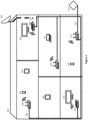
- Figure 1 shows an example network that may comprise any combination of STBs, APs, a gateway, smart phones, laptop computers, smart TVs and VBs.
- a satellite connection is brought to a home network via one of the STBs deployed in the home.
- An Internet connection is brought to the home network via a gateway.
- Video content is delivered to the clients in the home network via VBs.
- HyMN capable nodes specifically, STBs, APs and VBs, preferably have multiple network interfaces, such as multiple Wi-Fi interfaces (through multiple radios), PLC interfaces, MoCA interfaces, and/or Ethernet interfaces.
- 117 is a gateway (GW), and 115 is an AP with at least two network interfaces, such as, but not limited to, Wi-Fi with multiple radios, PLC and or Ethernet.
- 109 is a VB with at least one network interface, such as, but not limited to, Wi-Fi with single or multiple radios, PLC and/or Ethernet.
- 114 and 105 are smart phones with one or more wireless network interfaces, such as, but not limited to, 2.4 GHz and/or 5 GHz Wi-Fi, or multiple radios.
- 103 is a power line to which PLC interfaces are connected.
- 107 is a smart TV with at least one network interface.
- 108 is a STB with multiple network interfaces, such as, but not limited to, Wi-Fi with multiple radios and/or PLC. 108 has a satellite link.
- 106 and 109 are tablet computers with at least one wireless network interface, such as, but not limited to, 2.4 GHz and/or 5 GHz Wi-Fi, or multiple radios.
- 111 is a laptop computer with at least one network interface, such as, but not limited to, Ethernet, and Wi-Fi with multiple radios.
- 102 is a satellite link.
- 116 is Ethernet.
- 118 is coaxial satellite data cable.
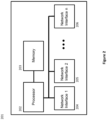
- Figure 2 depicts a hybrid mesh network mesh island method capable node.
- one or more subsets of mesh nodes of Figure 1 can be formed in distinct Wi-Fi channels, while connectivity of the entire mesh network is satisfied.
- 104 and 108 can form a mesh island in Wi-Fi 5GHz band
- 110, 112 and 115 form another mesh island.
- These two mesh islands operate in separate, distinct Wi-Fi 5GHz channels, while the network connectivity is assured via the other interfaces, such as but not limited to other Wi-Fi interfaces, Ethernet, PLC and/or MoCA.
- the network throughput can be significantly improved by concurrent utilization of Wi-Fi links, by leveraging the proposed mesh islands method.
- each AP gathers local information, in terms of (i) clear channel assessment (CCA) of each Wi-Fi channel, (ii) the actual amount of Wi-Fi traffic carried through this AP, (iii) the estimated capacity of each mesh link going out and coming into this AP.
- CCA clear channel assessment
- Each mesh AP distributes its local measurements to the other APs in the mesh network via periodic information announcements. These periodic announcements can be unicast or broadcast through all available interfaces to reach all APs within the mesh network. The reason behind sending the information from all available interfaces is to prevent packet losses, and to disseminate the full-network state information to all mesh APs, whether they do, or do not, share all the interfaces with the other APs in the network. This way, a mesh AP, say node X, that only has PLC capability will have Wi-Fi information of the other APs in the network, and likewise, the other nodes know that node X has only PLC capability, but no Wi-Fi capability.
- Each AP maintains a table as depicted in Figure 9 . Assuming that Figure 9 depicts the Channel Information Table maintained by AP-1. AP-1 gathers the measurement data for each channel via periodic channel scans. The period of these channel scans is a configurable parameter, which depends on the traffic on the AP.
- channel scans are carried out in periodic "scan epochs", in which all APs in the mesh network, or in case there are multiple mesh islands in the mesh network then all APs in a mesh island, perform channel scan. All APs in the mesh network (or in the mesh island, if the mesh network is composed of mesh islands) halt their transmissions during scan epoch, by freezing the transmit queues for the duration of scan epoch. All APs continue their transmissions right after the end of the scan epoch.
- the length of the scan epoch is a configurable parameter, and it depends on the number of channels to be scanned, total time spent for scanning a channel, and time spent to switch to channel for scanning.
- a master node is defined as the mesh AP that has the highest bridge MAC address.
- a master node is the mesh AP, which is directly connected to a GW that is the dynamic host configuration protocol (DHCP) server.
- DHCP dynamic host configuration protocol
- the master node denotes the number of announcement messages until the start of the scan epoch.
- the number of announcement messages between scan epochs designate the time interval between the scan epochs.
- the interval between the scan epochs is a configurable parameter that designates how often scanning should be carried out.
- the scan epoch interval is determined as 1s, and periodic announcement messages are sent every 200ms, then after every 5 announcement messages a scan epoch begins. Specifically, at every announcement message the master node indicates the number of remaining announcement messages until the start of the scan epoch.
- APs can scan one or multiple channels with various bandwidths.
- the information on the channels to be scanned, and the information on the bandwidth of these channels is provided by the master node in the periodic announcement message.
- APs scan a single 80 MHz channel in a scan epoch.
- the number of scanned channels, and the bandwidth of these channels are configurable parameters the values of which are decided based on the channel load. For example, APs can scan a single 80 MHz channel in one epoch, and scan 4 different 80MHz channels in 4 consecutive scan epochs to scan all available channels in the entire 5 GHz band.
- Measurements, i.e., scans, of APs need not be fully synchronized, that is to say, it is not required to have all APs scan the same channels exactly at the same time.
- each AP scans the designated channels within the same scan epoch.
- Scan epoch not only provides a means of synchronization among the APs to start the scan process at overlapping time instances, thus having the APs get almost the same snapshot of the channel, but also provides a period of no transmission from within the mesh network, thus eliminating any bias on the channel measurements due to the traffic carried by the mesh network in the very instance of channel scanning.
- the scan results, i.e., measurements by AP-i, in channel j are stored in an array m i,j .
- m i,j comprises CCA measurement, i.e., the percentage of idle times that can be utilized.
- background noise in dBm
- a function of CCA and background noise can be used as a means to obtain a composite scan result.
- CCA provides information on the availability of a channel
- information gathered via background noise is useful for selecting a channel that can provide a better signal-to-noise-ratio (SNR).
- the CCA results range from 0 to 100: 0 means there is no idle time, whereas 100 corresponds to a completely idle channel.
- the first sample, 80 represents that according to AP-i channel j is measured to be idle 80% of the time.
- the number of rows in m i,j is equal to the number of channel measurement samples.
- APs store measurement samples taken within the last predetermined, but configurable, period of time. In one embodiment of the invention, this predetermined time is determined as 1 hour.
- Each mesh AP distributes its channel measurements to the other APs in the mesh network via periodic broadcast messages.
- each AP distributes the processed version of the scan results, called m i,j , it obtained since its latest announcement.
- the goal of processing the scan results is to obtain meaningful minimal information that can represent the channel quality from the perspective of the measuring node. This way the amount of information being exchanged is reduced.
- m i,j can be obtained by taking a moving average of the latest n samples, where n is a configurable parameter.
- m i,j can be obtained by applying a filter over the last n samples, such as a median filter.
- more complex filters (functions) can be applied on the raw measurement data, m i,j , to obtain m i,j .
- the mesh partitioning method makes use of a channel selection mechanism, which takes into account the measurements of all APs that constitute the mesh network.
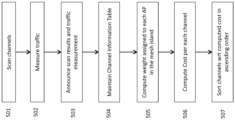
- Figure 5 depicts the flow chart of an example channel selection method that can be used with the proposed invention.
- the measurement array, namely m i,j , of each AP in the mesh network is weighted with a variable w i,j .
- the weight assigned to AP-i is a function of the total Wi-Fi traffic on AP-i.
- these weighted measurements are used to compute a cost metric for each channel.
- the cost of operating at a channel is computed by weighting the measurements of each AP by a variable determined by the amount of traffic carried on that AP.
- the weight can be determined based on other parameters, such as but not limited to link capacity in terms of bits-per-second.
- T i d ⁇ k ⁇ W 5 x k d + ⁇ k ⁇ W 5 y k d , where W 5 designates a Wi-Fi 5 GHz interface.
- the total amount of traffic carried on an interface can be obtained by observing receive and transmit packet counters of that specific Wi-Fi interface's driver.
- d is a configurable parameter, which can be changed during run-time. If d (in seconds) is small, then the most recent traffic is accounted for. However, if d is large, then traffic in a wide time horizon is taken into account.
- x k (d) and y k (d) can be more complex functions of x, y and d .
- Each AP e.g. AP-i, computes T i (d), and announces this information together with its measurement information, m i,j .
- the announcement messages are periodic and are disseminated through all available interfaces.
- the period of announcement messages is set equal to or multiple of beacon interval. In one embodiment, announcement messages are sent every 500ms.
- An AP that has received announcement messages from the other APs in the mesh network have a complete Channel Information Table as depicted in Figure 9 .
- weight assigned to AP-j is defined as the ratio of the total Wi-Fi traffic on AP-j and the total Wi-Fi traffic on the mesh network.
- cost assigned to channel j is obtained via calculating the weighted average of measurements from every AP in the mesh network, as follows in Equation 6 :
- cost assigned to channel j is the maximum cost among all APs in the mesh network, as follows in Equation 7 :
- C j ⁇ max w k m ⁇ k , j
- channels are sorted in ascending order of their costs.
- the best channel is the one that provides the minimum cost among others, i.e., the best channel is the first channel in the sorted list, second best channel is the second in the list, and so on.
- m i,k is a positive number
- w k is ratio of two positive numbers; thus, w k m k,j is always positive.
- a cost function that is inversely proportional to channel quality, i.e., m k,j , w k m k,j is multiplied by -1.
- the weight assigned to each AP can be a function of traffic, whereas in further embodiments, single or a plurality of parameters such as, link capacity (in terms of bits per second) and/or airtime utilization per link can be employed for weighting.
- Table 1 An example channel information table, Table 1, and cost calculation according to the embodiment given in paragraph 43 is shown below for 2 APs and 2 possible channels: Table 1 AP/Channel w i Channel 1 Channel 2 m i,1 C 1 m i,2 C 2 AP-1 0.75 60 -45 50 -37.5 AP-2 0.25 90 -22.5 50 -12.5 Cost -22.5 -12.5
- the best channel i.e., the channel with the least cost is found as Channel 1
- the second best channel is found as Channel 2.
- Each AP maintains the same table, and thus, computes the same best channel list. This is a result of the fact that each AP shares its local information, in terms of channel measurements, and weight information, with all other APs in the mesh network.
- Each AP in the mesh network maintains the best channel list, and updates this list as new information on channel state traffic is received.
- the APs do not switch channels unless a channel switch message is received.
- a master node is selected among the mesh APs to decide, to announce and to actuate the channel switch. Using a master node to trigger channel switch, not only prevents possible overlapping channel switch announcements by multiple APs, but also provides a synchronous channel switch within the mesh network.
- the master node can be the node that is directly connected to the gateway; or in further embodiments, AP that has the biggest Wi-Fi 5GHz MAC address or the AP that runs dynamic host configuration protocol (DHCP) can be selected as the master node.
- DHCP dynamic host configuration protocol
- the goal of mesh partitioning is to maximize the total traffic that can be delivered within the mesh network.
- a typical Wi-Fi mesh network given that all nodes must use the same Wi-Fi channel, due to a lack of extra interface(s) that can provide connectivity within the network, selecting a single best channel maximizes the Wi-Fi throughput in the mesh network.
- full network connectivity can be provided by means of other media, other than the specific Wi-Fi interface, such as another Wi-Fi interface, Ethernet, PLC or MoCA, separate Wi-Fi mesh islands, which use distinct Wi-Fi channels, can be created within the mesh network.
- the distinct Wi-Fi channels employed by the mesh islands are chosen from the best channel list.
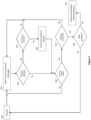
- Figure 6 depicts a flow chart for the mesh network partitioning method.
- a hysteresis is applied while deciding on whether to partition the network or not. That is to say, the network topology is not changed unless the network cost that would be obtained by the new topology is lower than the current network cost by at least a certain margin.
- cost is in terms of throughput, and this margin is defined as a percentage of the current network throughput.
- a routing and route cost calculation is summarized below:
- a Hybrid Mesh Network node estimates the cost of communicating with a neighbor over each possible physical interface via which it can communicate with the neighbor.
- the cost of transmitting over a link is the estimated duration for which the communication medium is used; this quantity is inversely proportional to the available bandwidth or throughput on a communication link. The greater the throughput on a link, the lower becomes the cost on this link.
- this cost not only reflects the cost of the transmitting node, but it also reflects the cost incurred on the network while the transmitter transmits (i.e., the cost incurred on the other nodes in the network that are in the same "collision domain" with the transmitter).
- the communication device updates its estimation of its link costs when triggered by the receipt of a route request (RREQ) packet, or when it needs to send an RREQ.
- the Hybrid Mesh Network node may only refresh its estimate of link costs periodically, or refresh periodically in addition to when triggered.
- the cost of transmitting over a route is a function of the costs incurred on each communication medium that is used along the route.
- the read' gives a function of the total cost along a route.
- the cost of a route between source node S and destination node D is represented as C S,D . If there are M different collision domains in the mesh network, the cost of a route between source node S and destination node D is represented as in Equation 8 :
- C S , D read ′ total cost from S to D in collision domain 1 total cost from S to D in collision domain 2 . . . total cost from S to D in collision domain M
- the cost of the links along the route that are in the same collision domain are aggregated via a function +' that substitutes the straightforward addition; this is because the links in these media interfere with each other when used simultaneously, therefore they need to be used exclusively, thereby causing addition of link costs.
- the cost of the links on the same path are combined via a max() operation, as links in this medium bottleneck each other.
- read' in equation in paragraph [60] is the max() operation; it gives the maximum of the costs incurred in different communication media used along the route between source and destination. In other words, cost of the route deduces to the cost incurred in the bottleneck communication medium used along the route.
- the comparison operation is used in this example of routing in a Hybrid Mesh Network, in comparing two cost metrics.
- This operator takes in two metrics and outputs the one that is "smaller".
- ⁇ ' reduces to ⁇ ; in a further embodiment of the proposed invention, if the "smallness" of a metric is defined in another way, ⁇ ' operator may perform the corresponding comparison.
- the tie is broken by comparing the sum of the costs incurred on all available communication media when the corresponding routes are used.
- PLC links A-B: 50, A-C:50, A-D:65, B-C:55, B-E:60, C-D:50, C-E:50, D-E:55,
- Wi-Fi 5 GHz links A*B: 10, A*C:90, A*D:94, B*C:82, B ⁇ E:95, C ⁇ D:30, C*E:30, D*E:20.
- the best route between nodes A and E is found by computing and comparing all route alternatives which are obtained via exchange of route request (RREQ) and route reply (RREP) messages.
- RREQ route request
- RREP route reply
- routing in a Hybrid Mesh Network uses the Wi-Fi to reach from A to B, and utilizes PLC to deliver from B to E.
- Wi-Fi links 303, 306, 309, 310 are weak, and they will slow down the entire network when they are used.
- Every AP in the mesh network carries out the following steps, based on the information exchanged through periodic announcements between the mesh APs.
- the partition announcement message consists of the list of IDs of APs in each mesh island and the respective Wi-Fi channel to be used by the designated mesh islands.
- the announcement message includes the following information: [ ⁇ A,B ⁇ , 36 ⁇ , ⁇ C, D, E ⁇ , 100 ⁇ ], which should be interpreted as ⁇ A,B ⁇ forms a mesh island in channel 36, and ⁇ C, D,E ⁇ forms another mesh island in channel 100.
- partition requests from all APs are received by the master node, and the master node has already announced a partition request itself, it checks the validity of the received proposed new topology by recalculating the costs. If the requests match, then the master node broadcasts a partition announcement message.
- master node If the master node does not agree with the received requested topology, then the master node deduces that the mesh nodes do not have the same set of information on the network state. This problem may arise due to a link cost, which is not updated, and/or which is not distributed in the network.
- master node In order to have an up-to-date network state information, master node triggers network state discovery for gathering link state information ( Figure 6 : 607) by broadcasting a discover network state message.
- a node When a node receives a partition announcement message ( Figure 8 ) from the master node, it has any traffic on the interfaces -if there are any interfaces to switch- that are announced to be canceled, the AP switches the traffic on these interfaces to alternative interfaces. That is to say, if the mesh node has active link operating on the channel that is to be switched, for example this link can be an inter mesh island link when the channel is switched, then before switching the channel the mesh node transfers the traffic on the active link to the alternative interface. This way, the Wi-Fi links across different mesh islands are replaced with alternative high-speed interfaces before creating the mesh islands.
- 303 and 306 are such links, and thus, 406 and 407, respectively, replaces these links.
- the AP switches to the Wi-Fi channel as indicated in the partition announcement message.
- the example network will be partitioned into two mesh islands as depicted in Figure 4 .
- the resulting mesh islands are 401 and 402.
- Each mesh island uses a distinct Wi-Fi 5GHz channel, which is found by best channel selection method. Since these two mesh islands operate in two distinct Wi-Fi channels, meaning that the intra mesh island Wi-Fi communication is concurrent, the Wi-Fi capacity is significantly increased (almost doubled).
- inter mesh island communication i.e., the communication between these two separate mesh islands, 401 and 402, is carried out through the PLC links, 405, 406, 407, 408, that bind 401 and 402.
- Mesh network partitioning is carried out as described in the above steps and as shown in flow charts provided in Figure 6 , Figure 7 and Figure 8 .
- Link rate information is gathered for each possible interface, 601. For the interfaces where multiple channels are available, such as Wi-Fi interfaces, link rate information is gathered for each possible channel. Link information for Wi-Fi is gathered as depicted in flow chart provided in Figure 5 . In one embodiment of the invention, the link rate information is in terms of the link capacity in terms of bits per second, which designate the throughput that can be achieved on that link.
- a mesh node When a mesh node receives channel switch announcement, it operates as depicted in flow chart given in Figure 8 .
Landscapes
- Engineering & Computer Science (AREA)
- Computer Networks & Wireless Communication (AREA)
- Signal Processing (AREA)
- Environmental & Geological Engineering (AREA)
- Mobile Radio Communication Systems (AREA)
Claims (14)
- Dispositif de réseau (201) fonctionnant avec un réseau maillé hybride ayant un ensemble de dispositifs de réseaux et de clients, le réseau maillé hybride étant partitionable en un ou plusieurs sous-ensembles d'ilots, le dispositif de réseau comprenant :- un processeur (202), une mémoire (203), une première interface réseau (204) pour former une interface de maillage commun qui permet la connexion entre les sous-ensembles ilot maillé du réseau maillé hybride et une seconde interface réseau (205) pour permettre la communication par de multiples canaux dans un sous-ensemble d'ilots maillés, la première interface réseau (204) et la seconde interface réseau (205) pouvant être chacune adressée indépendamment et adaptée pour permettre des chemins de communication multiples simultanément avec le réseau maillé, dispositif de réseau (201) configuré pour :* déterminer les caractéristiques de communication d'un ou plusieurs chemins de communication multiple, fondées sur des messages d'annonce reçus d'autres dispositifs de réseau faisant partie du réseau, les messages d'annonce comprenant des informations de trafic et des résultats de balayage,* calculer le trafic distribuable de bout en bout par un ou plusieurs des chemins de communication multiples en se fondant sur les caractéristiques de communication déterminées pour un ou plusieurs sous-ensembles d'ilots du réseau maillé hybride, pour déterminer une topologie de réseau maillé hybride assurant un trafic augmenté, délivré de bout en bout et,* partitionner le réseau maillé hybride en deux ou plusieurs sous-ensembles d'ilots maillés et ayant une interface maillée commune en fonction de la topologie déterminée du réseau maillé hybride de façon que la communication dans chacun des deux ou plusieurs sous-ensembles d'ilots maillés se fasse par des canaux sans fil différents, qui ne se chevauchent pas, augmentant le trafic délivré de bout en bout dans le réseau maillé hybride.
- Dispositif de réseau (201) selon la revendication précédente,
dans lequel
le dispositif de réseau (201) est configuré pour déterminer au moins une information locale concernant les caractéristiques de communication des chemins de communication multiples, en se fondant au moins sur le volume de trafic ou la capacité évaluée du chemin. - Dispositif de réseau (201) selon la revendication 2,
dans lequel
le dispositif de réseau (201) est configuré pour déterminer l'information locale concernant les caractéristiques de communication des chemins de communication multiples au cours d'un balayage de canal effectué par le dispositif de réseau dans une période de balayage. - Dispositif de réseau (201) selon l'une quelconque des revendications précédentes, adapté pour distribuer périodiquement des caractéristiques de communication mesurées et recevoir périodiquement des caractéristiques de communication mesurées d'autres dispositifs de réseau dans le réseau maillé hybride.
- Dispositif de réseau selon la revendication 4,
dans lequel
une information de caractéristiques de communications reçues et distribuées le plus récemment est enregistrée localement dans la mémoire (203) du dispositif de réseau. - Dispositif de réseau selon la revendication 4,
dans lequel
la période de balayage est commencée par la réception d'un signal d'un nœud-maître du réseau maillé hybride, de préférence, le mode maître est un point d'accès maillé qui a la plus élevée des adresses de pont MAC dans le réseau maillé hybride ou un point d'accès maillé qui est relié directement à une passerelle GW qui est le serveur de protocole de configuration dynamique des hôtes (DHCP) de préférence le dispositif réseau émet les résultats de balayage traitésm i,j du balayage de canal effectué dans la période de balayage, et de manière préférentiellement les résultats de balayage traitém i,j, du balayage de canal sont fondés une moyenne mobile des n derniers échantillons, n étant un paramètre configurable et de manière encore plus préférentielle,m i,j s'obtient en appliquant un filtre au dernier n échantillon comme médian. - Dispositif de réseau (201) selon l'une quelconque des revendications précédentes,
dans lequel
au moins l'une des interfaces du premier réseau (204) et du second réseau (205) fournissent des canaux multiples, de préférence dans lequel le partitionnement du réseau maillé hybride en deux ou plus de sous-ensembles d'ilots maillés est déterminé en se fondant sur un mécanisme qui tient compte des caractéristiques de communication locales de tous les dispositifs réseau dans le réseau maillé hybride et de manière plus préférentielle, dans lequel le mécanisme pondère chaque canal pour obtenir une métrique de coûts fondée sur le trafic total de chaque dispositif réseau dans le réseau maillé hybride, de préférence la pondération est fondée sur au moins l'un des éléments : trafic, capacité de liaison (telle que bits par seconde) et utilisation du temps aérien et de manière encore plus préférentielle, le volume de trafic passant par une interface de communication du dispositif réseau (i) pour une durée de (d) secondes se calcule par la formule suivante :

- Dispositif de réseau (201) selon la revendication 7,
caractérisé en ce qu'il calcule le poids d'un point d'accès AP-j fondé sur l'information de trafic collectée par tous les points d'accès AP et en admettant qu'il y a N points d'accès AP dans le réseau maillé, comme suit :

le coût attribué au canal i se calcule comme suit :
- Dispositif de réseau (201) selon l'une quelconque des revendications précédentes,
dans lequel
le dispositif de réseau (201) crée un ensemble de toutes les partitions possibles de réseau et pour chacune des partitions possibles de réseau il détermine le meilleur canal pour chaque sous-ensemble d'ilots maillés de deux ou plus de sous-ensembles d'ilots maillés, et d'une manière préférentielle, le dispositif de réseau (201) est déterminé si le meilleur canal pour chaque sous-ensemble d'ilots maillés parmi deux ou plusieurs sous-ensembles d'ilots maillés est le même que pour le meilleur canal pour l'autre sous-ensemble d'ilots maillés de deux ou plusieurs sous-ensembles d'ilots maillés et s'ils sont les mêmes, le sous-ensemble ilot maillé ayant le coût le plus bas, reçoit le meilleur canal et l'autre sous-ensemble d'ilots maillés se voit attribuer le canal le meilleur suivant et de façon plus préférentielle, on détermine toutes les paires de destinations sources possibles et on attribue les coûts et de façon encore plus préférentielle, les coûts attribués sont traités pour déterminer le coût minimum et/ou le coût maximum et/ou le coût réseau total et/ou le coût moyen et/ou la variance de coût dans le réseau maillé hybride et de manière encore plus préférentielle, le dispositif de réseau (201) détermine le meilleur canal pour chaque sous-ensemble d'ilots maillés pour calculer la capacité de bout à bout de toutes les combinaisons de trajet à travers le réseau maillé et en choisissant le trajet le plus efficace. - Dispositif de réseau (201) selon l'une quelconque des revendications précédentes,
dans lequel
le dispositif de réseau (201) partitionne le réseau maillé hybride en deux ou plus de sous-ensembles d'ilots maillés pour augmenter le trafic total qui peut être distribué dans le réseau maillé hybride, la requête de partitions totale étant annoncée au réseau maillé hybride par une émission large ou par une émission unique de la requête de partitions. - Dispositif de réseau (201) selon l'une quelconque des revendications précédentes,
dans lequel
on applique de l'hystérésis tout en décidant comment partitionner le réseau. - Dispositif de réseau (201) selon l'une quelconque des revendications précédentes,
adapté pour recevoir une instruction d'un dispositif réseau maître dans le réseau maillé hybride pour partitionner le réseau maillé hybride selon les instructions. - Dispositif de réseau (201) selon la revendication 12,
qui, lorsqu'il reçoit l'instruction qu'il a un lien actif sur un canal qui sera commuté et si le lien est un lien suivant pour l'interface de maillage entre les ilots, lorsque le canal est commuté, alors avant de commuter le canal, le dispositif réseau transfère le trafic sur le lien actif vers une variante d'interface. - Procédé de gestion d'un réseau maillé hybride qui peut être cloisonné en un ou plusieurs d'ilots maillés, le réseau maillé hybride comprenant un dispositif de réseau (201) avec un processeur, une mémoire, une première interface réseau adressable indépendamment, pour former une interface de maillage commune qui permet la connexion entre les sous-ensembles d'ilots maillés du réseau maillé hybride et une seconde interface réseau adressable indépendamment, pour permettre la communication sur des canaux multiples dans un sous-ensemble d'ilots maillés, la première interface réseau et la seconde interface réseau étant adaptées pour ouvrir des chemins de communication multiples, simultanément dans le réseau maillé hybride,
le procédé consistant dans le dispositif réseau (201) à fonctionner avec un réseau maillé hybride ayant un ensemble de dispositifs de réseau et de dispositifs client :- déterminer les caractéristiques de communication d'un ou plusieurs chemins de communication multiple dans le réseau maillé hybride en se fondant sur l'information dans les messages d'annonce reçus d'autres dispositifs de réseau dans le réseau, les messages d'annonce comprenant une information de trafic et des résultats de balayage d'un ou plusieurs sous-ensembles d'ilots maillés du réseau maillé hybride pour déterminer une topologie de réseau maillé hybride pour augmenter le trafic distribué de bout en bout ;- calculer le trafic distribué de bout en bout sur un ou plusieurs chemins de communication multiples en se fondant sur les caractéristiques de communication déterminées et,- partitionner le réseau maillé hybride en deux ou plusieurs sous-ensembles d'ilots maillés ayant une interface maillée commune en fonction de la topologie déterminée du réseau maillé hybride de façon que la communication dans chacun des deux ou plusieurs d'ilots maillés se fasse, sans fil, sur des canaux différents qui ne se chevauchent pas, tout en augmentant le trafic distribué de bout en bout dans le réseau maillé hybride.
Priority Applications (1)
| Application Number | Priority Date | Filing Date | Title |
|---|---|---|---|
| EP22201294.0A EP4138361B1 (fr) | 2014-12-24 | 2015-12-22 | Îlots de maillage |
Applications Claiming Priority (3)
| Application Number | Priority Date | Filing Date | Title |
|---|---|---|---|
| US201462096604P | 2014-12-24 | 2014-12-24 | |
| GB1501169.5A GB2529736B (en) | 2014-12-24 | 2015-01-23 | Mesh islands |
| PCT/EP2015/080948 WO2016102550A1 (fr) | 2014-12-24 | 2015-12-22 | Îlots de maillage |
Related Child Applications (2)
| Application Number | Title | Priority Date | Filing Date |
|---|---|---|---|
| EP22201294.0A Division-Into EP4138361B1 (fr) | 2014-12-24 | 2015-12-22 | Îlots de maillage |
| EP22201294.0A Division EP4138361B1 (fr) | 2014-12-24 | 2015-12-22 | Îlots de maillage |
Publications (3)
| Publication Number | Publication Date |
|---|---|
| EP3238377A1 EP3238377A1 (fr) | 2017-11-01 |
| EP3238377B1 true EP3238377B1 (fr) | 2023-06-21 |
| EP3238377C0 EP3238377C0 (fr) | 2023-06-21 |
Family
ID=52673861
Family Applications (2)
| Application Number | Title | Priority Date | Filing Date |
|---|---|---|---|
| EP22201294.0A Active EP4138361B1 (fr) | 2014-12-24 | 2015-12-22 | Îlots de maillage |
| EP15823333.8A Active EP3238377B1 (fr) | 2014-12-24 | 2015-12-22 | Îlots de maillage |
Family Applications Before (1)
| Application Number | Title | Priority Date | Filing Date |
|---|---|---|---|
| EP22201294.0A Active EP4138361B1 (fr) | 2014-12-24 | 2015-12-22 | Îlots de maillage |
Country Status (4)
| Country | Link |
|---|---|
| US (2) | US10356629B2 (fr) |
| EP (2) | EP4138361B1 (fr) |
| GB (2) | GB2529736B (fr) |
| WO (1) | WO2016102550A1 (fr) |
Families Citing this family (17)
| Publication number | Priority date | Publication date | Assignee | Title |
|---|---|---|---|---|
| KR20160124518A (ko) * | 2015-04-20 | 2016-10-28 | 삼성전자주식회사 | 전자 장치의 통신 방법 및 장치 |
| US9967884B2 (en) * | 2015-11-10 | 2018-05-08 | Netgear, Inc. | Dedicated backhaul for whole home coverage |
| US20170195218A1 (en) * | 2015-12-30 | 2017-07-06 | Qualcomm Incorporated | Routing in a hybrid network |
| US10356681B2 (en) | 2016-09-21 | 2019-07-16 | Netgear, Inc. | Client roaming in a distributed multi-band wireless networking system |
| FR3059503B1 (fr) | 2016-11-30 | 2019-05-17 | Sagemcom Energy & Telecom Sas | Compteur electrique comportant une interface par courants porteurs en ligne et au moins une interface radio frequence |
| CN113347651B (zh) | 2017-01-20 | 2024-11-22 | 无线通信与技术公司 | 利用通用网关节点设置网状网络的系统和方法 |
| WO2018138577A1 (fr) | 2017-01-25 | 2018-08-02 | Airties Kablosuz Iletisim Sanayi Ve Dis Ticaret A.S. | Topologies d'îlots et routage dans des réseaux maillés hybrides |
| US10542408B2 (en) * | 2017-03-25 | 2020-01-21 | ARRIS Enterprises, LLC | Technique for establishing a mesh network |
| US10448434B1 (en) | 2017-06-27 | 2019-10-15 | Vivint, Inc. | Dedicated wireless network for security and automation system |
| US10834659B2 (en) * | 2018-03-05 | 2020-11-10 | Phazr, Inc. | Link aggregation for mesh networks |
| WO2020176525A1 (fr) * | 2019-02-25 | 2020-09-03 | Emory University | Systèmes, dispositifs et procédés pour la formation autonome de réseaux sans fil |
| US11510191B2 (en) * | 2020-03-10 | 2022-11-22 | Cisco Technology, Inc. | Decentralized radio resource allocation using a distributed cache |
| CN115529668B (zh) * | 2022-02-28 | 2023-07-21 | 荣耀终端有限公司 | 一种信道选择方法、电子设备及存储介质 |
| US20240045885A1 (en) * | 2022-08-05 | 2024-02-08 | International Business Machines Corporation | Direct access method of bypassing partition overhead in massively parallel processing (mpp) environment |
| US12439326B2 (en) * | 2022-08-19 | 2025-10-07 | Charter Communications Operating, Llc | Client assisted off-channel scan |
| CN117715141B (zh) * | 2023-05-09 | 2024-11-08 | 荣耀终端有限公司 | 基于自组网的链路选择方法、路由器、系统及存储介质 |
| US12563446B2 (en) * | 2024-02-08 | 2026-02-24 | Cisco Technology, Inc. | Weighted load balancing for multi-link operation |
Family Cites Families (29)
| Publication number | Priority date | Publication date | Assignee | Title |
|---|---|---|---|---|
| US8599822B2 (en) * | 2005-03-23 | 2013-12-03 | Cisco Technology, Inc. | Slot-based transmission synchronization mechanism in wireless mesh networks |
| TWI323110B (en) * | 2005-07-30 | 2010-04-01 | Firetide Inc | System and method for a shared access network |
| US7580399B2 (en) * | 2005-09-14 | 2009-08-25 | Cisco Technology, Inc. | Automatic partitioning of wireless access points into overlay and underlay networks |
| US7668173B2 (en) * | 2005-12-01 | 2010-02-23 | Azalea Networks | Method and system for an adaptive wireless routing protocol in a mesh network |
| US7773542B2 (en) * | 2007-05-21 | 2010-08-10 | Arrowspan, Inc. | Dual radio wireless mesh network access point |
| EP2238758A4 (fr) * | 2008-01-24 | 2013-12-18 | Micropower Technologies Inc | Systèmes de distribution de vidéo utilisant des caméras sans fil |
| CN102119558B (zh) * | 2008-08-05 | 2015-04-29 | 日本电气株式会社 | 路径控制系统、路径控制装置、路径控制方法和程序 |
| JP4679616B2 (ja) * | 2008-08-19 | 2011-04-27 | 株式会社バッファロー | 無線lan中継装置、無線lan中継方法およびコンピュータプログラム |
| US8619673B2 (en) * | 2009-07-08 | 2013-12-31 | Mediatek Inc. | Preamble partition and cell identification procedure in wireless communication systems |
| US10033779B2 (en) * | 2009-07-08 | 2018-07-24 | Dejero Labs Inc. | Multipath data streaming over multiple wireless networks |
| CN101997796B (zh) * | 2009-08-27 | 2013-11-06 | 华为技术有限公司 | 一种消除多载波调制系统中混叠噪声的方法、装置和系统 |
| US10123268B2 (en) * | 2010-06-04 | 2018-11-06 | Board Of Regents, The University Of Texas System | Wireless communication methods, systems, and computer program products |
| WO2012154751A1 (fr) * | 2011-05-08 | 2012-11-15 | Infinetics Technologies, Inc. | Réseau de commutation à base flexible |
| US8750110B2 (en) * | 2011-06-17 | 2014-06-10 | Qualcomm Incorporated | Automatic path selection for hybrid communication networks |
| US8451733B2 (en) * | 2011-08-08 | 2013-05-28 | Amtran Technology Co., Ltd | Methods of optimizing scanning parameters for a plurality of channels in a wireless band |
| US8953574B2 (en) * | 2011-11-28 | 2015-02-10 | Qualcomm Incorporated | Wireless bridging in a hybrid communication network |
| US8924763B2 (en) * | 2011-12-15 | 2014-12-30 | International Business Machines Corporation | Synchronizing compute node time bases in a parallel computer |
| US20180091356A1 (en) * | 2012-02-21 | 2018-03-29 | Google Inc. | Combinatorial internet bandwidth |
| US9112728B2 (en) * | 2012-05-31 | 2015-08-18 | Broadcom Corporation | Implementing control planes for hybrid networks |
| MX342768B (es) * | 2012-07-02 | 2016-10-11 | Intel Corp | Transmisión y recepción simultáneas. |
| WO2014008104A1 (fr) * | 2012-07-02 | 2014-01-09 | Intel Corporation | Émission et réception simultanées |
| US9059869B2 (en) * | 2012-10-09 | 2015-06-16 | Qualcomm Incorporated | Interface selection in a hybrid communication device |
| US10382992B2 (en) * | 2013-02-07 | 2019-08-13 | Idac Holdings, Inc. | Interference measurements and management in directional mesh networks |
| US9184998B2 (en) * | 2013-03-14 | 2015-11-10 | Qualcomm Incorporated | Distributed path update in hybrid networks |
| US20140269691A1 (en) * | 2013-03-14 | 2014-09-18 | Qualcomm Incorporated | Distributed path selection in hybrid networks |
| US9216985B2 (en) * | 2013-03-28 | 2015-12-22 | Scifluor Life Sciences, Inc. | 3-aryl-2-((arylamino)methyl)quinazolin-4-(3H)-ones |
| US9432990B2 (en) | 2013-08-23 | 2016-08-30 | Airties Kablosuz Iletisim San. Ve Dis Tic. A.S. | Hybrid mesh network |
| KR20150086900A (ko) * | 2014-01-21 | 2015-07-29 | 한국전자통신연구원 | 성형망-그물망의 하이브리드 운용을 위한 vsat 시스템 및 그의 제어 방법 |
| EP3657882B1 (fr) * | 2014-06-09 | 2023-04-26 | Commscope Technologies LLC | Réseaux d'accès radio utilisant plusieurs unités à distance |
-
2015
- 2015-01-23 GB GB1501169.5A patent/GB2529736B/en active Active
- 2015-01-23 GB GB1716888.1A patent/GB2557433B/en active Active
- 2015-12-22 EP EP22201294.0A patent/EP4138361B1/fr active Active
- 2015-12-22 WO PCT/EP2015/080948 patent/WO2016102550A1/fr not_active Ceased
- 2015-12-22 EP EP15823333.8A patent/EP3238377B1/fr active Active
- 2015-12-23 US US14/757,422 patent/US10356629B2/en active Active
-
2019
- 2019-06-04 US US16/430,636 patent/US10708787B2/en active Active
Also Published As
| Publication number | Publication date |
|---|---|
| US20160192203A1 (en) | 2016-06-30 |
| EP3238377C0 (fr) | 2023-06-21 |
| US10708787B2 (en) | 2020-07-07 |
| GB201716888D0 (en) | 2017-11-29 |
| EP3238377A1 (fr) | 2017-11-01 |
| US10356629B2 (en) | 2019-07-16 |
| GB201501169D0 (en) | 2015-03-11 |
| GB2557433A (en) | 2018-06-20 |
| GB2529736A (en) | 2016-03-02 |
| EP4138361C0 (fr) | 2025-08-13 |
| GB2557433B (en) | 2019-05-01 |
| GB2529736B (en) | 2017-11-22 |
| EP4138361B1 (fr) | 2025-08-13 |
| US20190289473A1 (en) | 2019-09-19 |
| EP4138361A1 (fr) | 2023-02-22 |
| WO2016102550A1 (fr) | 2016-06-30 |
Similar Documents
| Publication | Publication Date | Title |
|---|---|---|
| US10708787B2 (en) | Mesh islands | |
| US9155019B2 (en) | Combining bandwidth aware routing with channel selection and switching in a multi-hop wireless home network | |
| US8594033B2 (en) | Frequency band coordination method and radio communication apparatus in cognitive radio system | |
| US7917149B2 (en) | System and method for reusing wireless resources in a wireless network | |
| EP2840860B1 (fr) | Réseau maillé hybride | |
| US20100254312A1 (en) | Dynamically transformed channel set routing | |
| EP2564628B1 (fr) | Coexistence de multiples réseaux sans fil | |
| WO2003084146A1 (fr) | Systeme, appareil et procede de communication mobile sans fil en association avec un support reseau ad hoc mobile | |
| KR20100127779A (ko) | 무선 멀티-홉 메시 네트워크에서 공동의 결합, 라우팅과 속도 할당 | |
| EP2248387A2 (fr) | Procédés et systèmes pour l internet mobile, large bande, acheminable | |
| US10462844B2 (en) | Dynamic packet relay apparatus and method for sensor network | |
| Fazio et al. | A new channel assignment scheme for interference-aware routing in vehicular networks | |
| JP5252978B2 (ja) | 経路制御方法、通信システムおよび通信装置 | |
| Han et al. | Adaptive network segmentation and channel allocation in large-scale V2X communication networks | |
| US20150172953A1 (en) | Mobile infrastructure assisted ad-hoc network | |
| Annese et al. | Seamless connectivity and routing in vehicular networks with infrastructure | |
| Skondras et al. | A survey on medium access control schemes for 5G vehicular cloud computing systems | |
| Soleimani et al. | D2D scheme for vehicular safety applications in LTE advanced network | |
| Raza et al. | Wideband communications through drone-assisted cognitive radio VANETs using SURF channel selection | |
| Kim et al. | Efficient interference-aware channel allocation in multi-radio wireless mesh networks | |
| US11601915B2 (en) | V2X communication apparatus and multi-channel transmission method thereof | |
| Kim et al. | Cross‐layer scheduling for multi‐users in cognitive multi‐radio mesh networks | |
| Yang et al. | Admission control for wireless mesh networks based on active neighbor bandwidth reservations | |
| Nassiri et al. | Molecular MAC for multichannel wireless mesh networks | |
| Kumar et al. | Simulation Performance Evaluation of QoS Routing Protocol for Adhoc Networks Using Directional Communication |
Legal Events
| Date | Code | Title | Description |
|---|---|---|---|
| STAA | Information on the status of an ep patent application or granted ep patent |
Free format text: STATUS: THE INTERNATIONAL PUBLICATION HAS BEEN MADE |
|
| PUAI | Public reference made under article 153(3) epc to a published international application that has entered the european phase |
Free format text: ORIGINAL CODE: 0009012 |
|
| STAA | Information on the status of an ep patent application or granted ep patent |
Free format text: STATUS: REQUEST FOR EXAMINATION WAS MADE |
|
| 17P | Request for examination filed |
Effective date: 20170718 |
|
| AK | Designated contracting states |
Kind code of ref document: A1 Designated state(s): AL AT BE BG CH CY CZ DE DK EE ES FI FR GB GR HR HU IE IS IT LI LT LU LV MC MK MT NL NO PL PT RO RS SE SI SK SM TR |
|
| AX | Request for extension of the european patent |
Extension state: BA ME |
|
| DAV | Request for validation of the european patent (deleted) | ||
| DAX | Request for extension of the european patent (deleted) | ||
| STAA | Information on the status of an ep patent application or granted ep patent |
Free format text: STATUS: EXAMINATION IS IN PROGRESS |
|
| 17Q | First examination report despatched |
Effective date: 20191120 |
|
| RAP1 | Party data changed (applicant data changed or rights of an application transferred) |
Owner name: AIRTIES KABLOSUZ ILETISIM SAN. VE DIS TIC. A.S. |
|
| REG | Reference to a national code |
Ref country code: DE Ref legal event code: R079 Ref document number: 602015084284 Country of ref document: DE Free format text: PREVIOUS MAIN CLASS: H04L0012240000 Ipc: H04L0041083000 |
|
| GRAP | Despatch of communication of intention to grant a patent |
Free format text: ORIGINAL CODE: EPIDOSNIGR1 |
|
| STAA | Information on the status of an ep patent application or granted ep patent |
Free format text: STATUS: GRANT OF PATENT IS INTENDED |
|
| RIC1 | Information provided on ipc code assigned before grant |
Ipc: H04W 88/10 20090101ALN20221205BHEP Ipc: H04W 40/12 20090101ALN20221205BHEP Ipc: H04W 84/18 20090101ALN20221205BHEP Ipc: H04L 43/0894 20220101ALN20221205BHEP Ipc: H04L 43/0882 20220101ALN20221205BHEP Ipc: H04L 12/403 20060101ALI20221205BHEP Ipc: H04L 43/0888 20220101ALI20221205BHEP Ipc: H04L 43/0876 20220101ALI20221205BHEP Ipc: H04L 41/083 20220101AFI20221205BHEP |
|
| INTG | Intention to grant announced |
Effective date: 20230103 |
|
| RIN1 | Information on inventor provided before grant (corrected) |
Inventor name: TASKIN, METIN ISMAIL Inventor name: SOYAK, EREN Inventor name: GOKTURK, MUHARREM SARPER |
|
| GRAS | Grant fee paid |
Free format text: ORIGINAL CODE: EPIDOSNIGR3 |
|
| GRAA | (expected) grant |
Free format text: ORIGINAL CODE: 0009210 |
|
| STAA | Information on the status of an ep patent application or granted ep patent |
Free format text: STATUS: THE PATENT HAS BEEN GRANTED |
|
| AK | Designated contracting states |
Kind code of ref document: B1 Designated state(s): AL AT BE BG CH CY CZ DE DK EE ES FI FR GB GR HR HU IE IS IT LI LT LU LV MC MK MT NL NO PL PT RO RS SE SI SK SM TR |
|
| RAP1 | Party data changed (applicant data changed or rights of an application transferred) |
Owner name: AIRTIES S.A.S. |
|
| REG | Reference to a national code |
Ref country code: CH Ref legal event code: EP |
|
| REG | Reference to a national code |
Ref country code: DE Ref legal event code: R096 Ref document number: 602015084284 Country of ref document: DE |
|
| REG | Reference to a national code |
Ref country code: AT Ref legal event code: REF Ref document number: 1581720 Country of ref document: AT Kind code of ref document: T Effective date: 20230715 |
|
| REG | Reference to a national code |
Ref country code: IE Ref legal event code: FG4D |
|
| U01 | Request for unitary effect filed |
Effective date: 20230712 |
|
| U07 | Unitary effect registered |
Designated state(s): AT BE BG DE DK EE FI FR IT LT LU LV MT NL PT SE SI Effective date: 20230721 |
|
| REG | Reference to a national code |
Ref country code: LT Ref legal event code: MG9D |
|
| PG25 | Lapsed in a contracting state [announced via postgrant information from national office to epo] |
Ref country code: NO Free format text: LAPSE BECAUSE OF FAILURE TO SUBMIT A TRANSLATION OF THE DESCRIPTION OR TO PAY THE FEE WITHIN THE PRESCRIBED TIME-LIMIT Effective date: 20230921 |
|
| PG25 | Lapsed in a contracting state [announced via postgrant information from national office to epo] |
Ref country code: RS Free format text: LAPSE BECAUSE OF FAILURE TO SUBMIT A TRANSLATION OF THE DESCRIPTION OR TO PAY THE FEE WITHIN THE PRESCRIBED TIME-LIMIT Effective date: 20230621 Ref country code: HR Free format text: LAPSE BECAUSE OF FAILURE TO SUBMIT A TRANSLATION OF THE DESCRIPTION OR TO PAY THE FEE WITHIN THE PRESCRIBED TIME-LIMIT Effective date: 20230621 Ref country code: GR Free format text: LAPSE BECAUSE OF FAILURE TO SUBMIT A TRANSLATION OF THE DESCRIPTION OR TO PAY THE FEE WITHIN THE PRESCRIBED TIME-LIMIT Effective date: 20230922 |
|
| PG25 | Lapsed in a contracting state [announced via postgrant information from national office to epo] |
Ref country code: SK Free format text: LAPSE BECAUSE OF FAILURE TO SUBMIT A TRANSLATION OF THE DESCRIPTION OR TO PAY THE FEE WITHIN THE PRESCRIBED TIME-LIMIT Effective date: 20230621 |
|
| U20 | Renewal fee for the european patent with unitary effect paid |
Year of fee payment: 9 Effective date: 20231214 |
|
| PG25 | Lapsed in a contracting state [announced via postgrant information from national office to epo] |
Ref country code: ES Free format text: LAPSE BECAUSE OF FAILURE TO SUBMIT A TRANSLATION OF THE DESCRIPTION OR TO PAY THE FEE WITHIN THE PRESCRIBED TIME-LIMIT Effective date: 20230621 |
|
| PG25 | Lapsed in a contracting state [announced via postgrant information from national office to epo] |
Ref country code: IS Free format text: LAPSE BECAUSE OF FAILURE TO SUBMIT A TRANSLATION OF THE DESCRIPTION OR TO PAY THE FEE WITHIN THE PRESCRIBED TIME-LIMIT Effective date: 20231021 |
|
| PG25 | Lapsed in a contracting state [announced via postgrant information from national office to epo] |
Ref country code: SM Free format text: LAPSE BECAUSE OF FAILURE TO SUBMIT A TRANSLATION OF THE DESCRIPTION OR TO PAY THE FEE WITHIN THE PRESCRIBED TIME-LIMIT Effective date: 20230621 Ref country code: SK Free format text: LAPSE BECAUSE OF FAILURE TO SUBMIT A TRANSLATION OF THE DESCRIPTION OR TO PAY THE FEE WITHIN THE PRESCRIBED TIME-LIMIT Effective date: 20230621 Ref country code: RO Free format text: LAPSE BECAUSE OF FAILURE TO SUBMIT A TRANSLATION OF THE DESCRIPTION OR TO PAY THE FEE WITHIN THE PRESCRIBED TIME-LIMIT Effective date: 20230621 Ref country code: IS Free format text: LAPSE BECAUSE OF FAILURE TO SUBMIT A TRANSLATION OF THE DESCRIPTION OR TO PAY THE FEE WITHIN THE PRESCRIBED TIME-LIMIT Effective date: 20231021 Ref country code: ES Free format text: LAPSE BECAUSE OF FAILURE TO SUBMIT A TRANSLATION OF THE DESCRIPTION OR TO PAY THE FEE WITHIN THE PRESCRIBED TIME-LIMIT Effective date: 20230621 Ref country code: CZ Free format text: LAPSE BECAUSE OF FAILURE TO SUBMIT A TRANSLATION OF THE DESCRIPTION OR TO PAY THE FEE WITHIN THE PRESCRIBED TIME-LIMIT Effective date: 20230621 |
|
| PG25 | Lapsed in a contracting state [announced via postgrant information from national office to epo] |
Ref country code: PL Free format text: LAPSE BECAUSE OF FAILURE TO SUBMIT A TRANSLATION OF THE DESCRIPTION OR TO PAY THE FEE WITHIN THE PRESCRIBED TIME-LIMIT Effective date: 20230621 |
|
| U1N | Appointed representative for the unitary patent procedure changed after the registration of the unitary effect |
Representative=s name: WITHERS & ROGERS; GB |
|
| REG | Reference to a national code |
Ref country code: DE Ref legal event code: R097 Ref document number: 602015084284 Country of ref document: DE |
|
| PLBE | No opposition filed within time limit |
Free format text: ORIGINAL CODE: 0009261 |
|
| STAA | Information on the status of an ep patent application or granted ep patent |
Free format text: STATUS: NO OPPOSITION FILED WITHIN TIME LIMIT |
|
| 26N | No opposition filed |
Effective date: 20240322 |
|
| U1N | Appointed representative for the unitary patent procedure changed after the registration of the unitary effect |
Representative=s name: PELLEGRINI, MARIE CLAUDE; FR |
|
| REG | Reference to a national code |
Ref country code: CH Ref legal event code: PL |
|
| PG25 | Lapsed in a contracting state [announced via postgrant information from national office to epo] |
Ref country code: MC Free format text: LAPSE BECAUSE OF FAILURE TO SUBMIT A TRANSLATION OF THE DESCRIPTION OR TO PAY THE FEE WITHIN THE PRESCRIBED TIME-LIMIT Effective date: 20230621 |
|
| PG25 | Lapsed in a contracting state [announced via postgrant information from national office to epo] |
Ref country code: MC Free format text: LAPSE BECAUSE OF FAILURE TO SUBMIT A TRANSLATION OF THE DESCRIPTION OR TO PAY THE FEE WITHIN THE PRESCRIBED TIME-LIMIT Effective date: 20230621 |
|
| REG | Reference to a national code |
Ref country code: IE Ref legal event code: MM4A |
|
| PG25 | Lapsed in a contracting state [announced via postgrant information from national office to epo] |
Ref country code: IE Free format text: LAPSE BECAUSE OF NON-PAYMENT OF DUE FEES Effective date: 20231222 |
|
| PG25 | Lapsed in a contracting state [announced via postgrant information from national office to epo] |
Ref country code: CH Free format text: LAPSE BECAUSE OF NON-PAYMENT OF DUE FEES Effective date: 20231231 |
|
| PG25 | Lapsed in a contracting state [announced via postgrant information from national office to epo] |
Ref country code: IE Free format text: LAPSE BECAUSE OF NON-PAYMENT OF DUE FEES Effective date: 20231222 Ref country code: CH Free format text: LAPSE BECAUSE OF NON-PAYMENT OF DUE FEES Effective date: 20231231 |
|
| U20 | Renewal fee for the european patent with unitary effect paid |
Year of fee payment: 10 Effective date: 20241213 |
|
| PG25 | Lapsed in a contracting state [announced via postgrant information from national office to epo] |
Ref country code: CY Free format text: LAPSE BECAUSE OF FAILURE TO SUBMIT A TRANSLATION OF THE DESCRIPTION OR TO PAY THE FEE WITHIN THE PRESCRIBED TIME-LIMIT; INVALID AB INITIO Effective date: 20151222 |
|
| PG25 | Lapsed in a contracting state [announced via postgrant information from national office to epo] |
Ref country code: HU Free format text: LAPSE BECAUSE OF FAILURE TO SUBMIT A TRANSLATION OF THE DESCRIPTION OR TO PAY THE FEE WITHIN THE PRESCRIBED TIME-LIMIT; INVALID AB INITIO Effective date: 20151222 |
|
| PGFP | Annual fee paid to national office [announced via postgrant information from national office to epo] |
Ref country code: GB Payment date: 20251216 Year of fee payment: 11 |
|
| PGFP | Annual fee paid to national office [announced via postgrant information from national office to epo] |
Ref country code: TR Payment date: 20251212 Year of fee payment: 11 |
|
| U20 | Renewal fee for the european patent with unitary effect paid |
Year of fee payment: 11 Effective date: 20251216 |