EP3239155A1 - Lithium enthaltende crystalline form, pharmazeutische zusammensetzungen davon, verfahren deren herstellung sowie deren verwendung zur behandlung von depressive erkrankungen. - Google Patents
Lithium enthaltende crystalline form, pharmazeutische zusammensetzungen davon, verfahren deren herstellung sowie deren verwendung zur behandlung von depressive erkrankungen. Download PDFInfo
- Publication number
- EP3239155A1 EP3239155A1 EP16167817.2A EP16167817A EP3239155A1 EP 3239155 A1 EP3239155 A1 EP 3239155A1 EP 16167817 A EP16167817 A EP 16167817A EP 3239155 A1 EP3239155 A1 EP 3239155A1
- Authority
- EP
- European Patent Office
- Prior art keywords
- acid
- crystal form
- lithium
- stable crystal
- present
- Prior art date
- Legal status (The legal status is an assumption and is not a legal conclusion. Google has not performed a legal analysis and makes no representation as to the accuracy of the status listed.)
- Withdrawn
Links
Images



Classifications
-
- C—CHEMISTRY; METALLURGY
- C07—ORGANIC CHEMISTRY
- C07F—ACYCLIC, CARBOCYCLIC OR HETEROCYCLIC COMPOUNDS CONTAINING ELEMENTS OTHER THAN CARBON, HYDROGEN, HALOGEN, OXYGEN, NITROGEN, SULFUR, SELENIUM OR TELLURIUM
- C07F1/00—Compounds containing elements of Groups 1 or 11 of the Periodic Table
- C07F1/005—Compounds containing elements of Groups 1 or 11 of the Periodic Table without C-Metal linkages
-
- A—HUMAN NECESSITIES
- A61—MEDICAL OR VETERINARY SCIENCE; HYGIENE
- A61K—PREPARATIONS FOR MEDICAL, DENTAL OR TOILETRY PURPOSES
- A61K33/00—Medicinal preparations containing inorganic active ingredients
-
- A—HUMAN NECESSITIES
- A61—MEDICAL OR VETERINARY SCIENCE; HYGIENE
- A61P—SPECIFIC THERAPEUTIC ACTIVITY OF CHEMICAL COMPOUNDS OR MEDICINAL PREPARATIONS
- A61P25/00—Drugs for disorders of the nervous system
- A61P25/24—Antidepressants
-
- C—CHEMISTRY; METALLURGY
- C07—ORGANIC CHEMISTRY
- C07D—HETEROCYCLIC COMPOUNDS
- C07D207/00—Heterocyclic compounds containing five-membered rings not condensed with other rings, with one nitrogen atom as the only ring hetero atom
- C07D207/02—Heterocyclic compounds containing five-membered rings not condensed with other rings, with one nitrogen atom as the only ring hetero atom with only hydrogen or carbon atoms directly attached to the ring nitrogen atom
- C07D207/04—Heterocyclic compounds containing five-membered rings not condensed with other rings, with one nitrogen atom as the only ring hetero atom with only hydrogen or carbon atoms directly attached to the ring nitrogen atom having no double bonds between ring members or between ring members and non-ring members
- C07D207/10—Heterocyclic compounds containing five-membered rings not condensed with other rings, with one nitrogen atom as the only ring hetero atom with only hydrogen or carbon atoms directly attached to the ring nitrogen atom having no double bonds between ring members or between ring members and non-ring members with hetero atoms or with carbon atoms having three bonds to hetero atoms with at the most one bond to halogen, e.g. ester or nitrile radicals, directly attached to ring carbon atoms
- C07D207/16—Carbon atoms having three bonds to hetero atoms with at the most one bond to halogen, e.g. ester or nitrile radicals
-
- C—CHEMISTRY; METALLURGY
- C07—ORGANIC CHEMISTRY
- C07D—HETEROCYCLIC COMPOUNDS
- C07D213/00—Heterocyclic compounds containing six-membered rings, not condensed with other rings, with one nitrogen atom as the only ring hetero atom and three or more double bonds between ring members or between ring members and non-ring members
- C07D213/02—Heterocyclic compounds containing six-membered rings, not condensed with other rings, with one nitrogen atom as the only ring hetero atom and three or more double bonds between ring members or between ring members and non-ring members having three double bonds between ring members or between ring members and non-ring members
- C07D213/04—Heterocyclic compounds containing six-membered rings, not condensed with other rings, with one nitrogen atom as the only ring hetero atom and three or more double bonds between ring members or between ring members and non-ring members having three double bonds between ring members or between ring members and non-ring members having no bond between the ring nitrogen atom and a non-ring member or having only hydrogen or carbon atoms directly attached to the ring nitrogen atom
- C07D213/60—Heterocyclic compounds containing six-membered rings, not condensed with other rings, with one nitrogen atom as the only ring hetero atom and three or more double bonds between ring members or between ring members and non-ring members having three double bonds between ring members or between ring members and non-ring members having no bond between the ring nitrogen atom and a non-ring member or having only hydrogen or carbon atoms directly attached to the ring nitrogen atom with hetero atoms or with carbon atoms having three bonds to hetero atoms with at the most one bond to halogen, e.g. ester or nitrile radicals, directly attached to ring carbon atoms
- C07D213/78—Carbon atoms having three bonds to hetero atoms, with at the most one bond to halogen, e.g. ester or nitrile radicals
- C07D213/81—Amides; Imides
-
- C—CHEMISTRY; METALLURGY
- C07—ORGANIC CHEMISTRY
- C07B—GENERAL METHODS OF ORGANIC CHEMISTRY; APPARATUS THEREFOR
- C07B2200/00—Indexing scheme relating to specific properties of organic compounds
- C07B2200/13—Crystalline forms, e.g. polymorphs
Definitions
- the present invention relates to pharmaceutical compositions comprising lithium salts and methods and uses relating thereto.
- Lithium compounds are used as a psychiatric medication for the treatment of depressive diseases, for example major depressive disorder and bipolar disorder.
- SSRIs serotonin re-uptake inhibitors
- Lithium has much lower risk of suicidality.
- current lithium treatments have significant side effects, including lithium toxicity.
- the risk of toxicity means that blood monitoring is essential. This, along with other unpleasant side effects such as increased thirst, increased urination and shakiness, reduce compliance and many patients find lithium therapy intolerable.
- Lithium is currently provided as a drug substance in the form of lithium carbonate or lithium citrate. However these compounds have a narrow therapeutic window. It would be desirable to find an alternative therapeutic source of lithium having reduced toxicity and fewer side effects.
- the site of action for lithium is in the brain and thus the drug needs to cross the blood-brain barrier.
- the provision of a drug substance that represents an alternative source of lithium may effect the rate at which lithium enters the brain and/or the mechanism by which it crosses the blood-brain barrier. This could provide an improved therapeutic window.
- the stability of the active ingredients is essential. Many drug substances deteriorate during distribution and storage especially in hot and humid conditions. Any drug substance to be used in pharmaceutical preparation must be air and moisture stable. Maintaining the crystal form of the drug substance is also of importance as the crystal form can influence the physicochemical properties, for example solubility, melting point and hygroscopicity.
- WO 2014/172650 describes the preparation of organic anion lithium ionic cocrystal compounds comprising an organic acid and a neutral organic molecule.
- Various cocrystals, cocrystals solvates and cocrystals hydrates are described. However the stability of these compounds is not discussed.
- a stable crystal form comprising lithium ions and the conjugate base of an organic acid which is in the form of anhydrous coordination polymer.
- the present invention relates to crystal forms comprising lithium and the conjugate base of an organic acid.
- crystal form we mean to refer to a material which has a repeating arrangement of ions and optionally molecules in 3 dimensions.
- Stable crystal forms of the present invention are in the form of an anhydrous coordination polymer.
- anhydrous we mean that there are no water molecules present in the crystal forms of the present invention.
- a bound form e.g. as an aqua complex
- an unbound form e.g. as a stoichiometric or non-stoichiometric hydrated crystal structure.
- the crystal forms of the present invention are coordination polymers.
- a coordination polymer is a coordination compound with repeating coordination entities extending in 1, 2 or 3 dimensions.
- the coordination polymers of the present invention contain lithium cationic centres linked by organic ligands.
- the crystal forms of the present invention are not formed of discrete molecules or ions but comprise an extended structure in the form of a polymer, with repeating units.
- the coordination polymer of the present invention includes repeating units in at least two dimensions. More preferably the coordination polymer of the present invention include units which repeat in three dimensions.
- the crystal forms of the present invention comprise lithium cations and the conjugate base of the organic acid will be present as an anion.
- the crystal forms of the present invention further includes one or more additional molecules or ions, as further described herein.
- the crystal forms of the present invention typically include one or more repeating units, which are linked to form the coordination polymer.
- the repeating unit of the coordination polymer preferably may contain one or more lithium ions.
- each repeating unit contains one or two lithium ions.
- the crystal forms of the present invention comprises the conjugate base of an organic acid.
- the organic acid may be a carboxylic acid or a sulfonic acid.
- the organic acid is a carboxylic acid.
- Suitable carboxylic acids include monocarboxylic acids, dicarboxylic acids and polycarboxylic acids.
- the conjugate base of an organic acid RCOOH is the carboxylate residue RCOO - .
- the conjugate base of a monocarboxylic acid includes a single carboxylate group COO -
- the conjugate base of a dicarboxylic acid includes two carboxylate groups COO - , etc.
- each repeating unit of the coordination polymer suitably includes one lithium ion per carboxylate residue COO - .
- salts of dicarboxylic acids will include two lithium ions etc.
- the repeating unit of the coordination polymer may include the conjugate base of a single organic acid molecule or the conjugate base of two or more organic acid molecules.
- each may be the residue of the same or a different organic acid.
- each repeating unit In embodiments in which the conjugate base of more than one organic acid molecule is included in each repeating unit these are preferably the same as each other.
- the unit cell of the crystal form may include two or more units of the same acid in different orientations within the crystal, i.e. the acid units are in distinct crystallographic environments.
- Suitable organic acids for inclusion in the crystal forms of the present invention include p-toluenesulfonic acid, malic acid, maleic acid, lactic acid, camphorsulfonic acid, salicylic acid, oxalic acid, fumaric acid, cinnamic acid, citric acid, methane sulfonic acid, succinic acid, benzoic acid, hydroxybenzoic acids and methoxybenzoic acids.
- the organic acid is a carboxylic acid.
- the carboxylic acid is selected from aromatic carboxylic acids and/or dicarboxylic acid.
- carboxylic acid is an aromatic carboxylic acid this is preferably an optionally substituted benzoic acid.
- aromatic acids include benzoic acid, hydroxy substituted benzoic acids and alkoxy, especially methoxy, substituted benzoic acids.
- Suitable dicarboxylic acids include fumaric acid, succinic acid, malic acid, oxalic acid and citric acid.
- Preferred dicarboxylic acids include fumaric acid, succinic acid and oxalic acid.
- the crystal forms of the present invention comprise lithium ions and the conjugate base of one or more acids selected from dicarboxylic acids and aromatic carboxylic acids.
- the crystal forms of the present invention preferably comprise lithium ions and the conjugate base of one or more acids selected from dicarboxylic acids and optionally substituted benzoic acids.
- the crystal forms of the present invention comprise lithium ions and the conjugate base of one or more acids selected from fumaric acid, succinic acid, oxalic acid, benzoic acid, 2-methoxybenzoic acid, 3-methoxybenzoic acid, 4-methoxybenzoic acid, 4-hydroxybenzoic acid and salicylic acid.
- acids selected from fumaric acid, succinic acid, oxalic acid, benzoic acid, 2-methoxybenzoic acid, 3-methoxybenzoic acid, 4-methoxybenzoic acid, 4-hydroxybenzoic acid and salicylic acid.
- the crystal forms of the present invention may include one or more further molecules or ions. These are suitably molecules or ions that are incorporated into and form part of the crystal form. Preferably the one or more additional molecules or ions are charge-neutral overall. Thus in some embodiments the crystal form may further comprise an additional cation and an additional anion with balanced charges. In some embodiments the crystal form may comprise an additional zwitterionic molecule. In some embodiments the crystal form includes an additional neutral molecule.
- the one or more additional molecules and/or ions present in the crystal form is an electron pair donor.
- Suitable additional molecules/ions that may be incorporated in the crystal form include amino acids, nicotinamide, isonicotinamide, imidazole, urea, 4-hydroxyproline, sarcosine, oxalic acid and lactic acid.
- Preferred additional molecules that may be incorporated in the crystal forms of the present invention include amino acids and amides.
- Especially preferred additional molecules include isonicotinamide, L-proline and 4-hydroxyproline.
- the crystal forms of the present invention are coordination polymers.
- the crystal forms include lithium ions and one or more ligands. At least one ligand is an organic molecule. Further ligands include neutral molecules. At least one type of ligand in each crystal form is coordinated to at least two different lithium ions.
- the stable crystal form of the present invention comprises lithium cations, fumarate anions and isonicotinamide molecules, suitably in a molar ratio of 2:1:2.
- the stable crystal form of the present invention comprises lithium cations, succinate anions and isonicotinamide molecules, suitably in molar ratio of 2:1:2.
- the stable crystal form of the present invention comprises lithium cations, 4-methoxybenzoate anions and L-proline molecules, suitably in a molar ratio of 1:1:1.
- the stable crystal form of the present invention comprises lithium cations, 2-methoxybenzoate anions and L-proline molecules, suitably in a molar ratio of 1:1:1.
- the stable crystal form of the present invention comprises lithium cations , 3-methoxybenzoate anions and L-proline molecules, suitably in a molar ratio of 1:1:1.
- the stable crystal form of the present invention comprises lithium cations, benzoate anions and L-proline molecules, suitably in a molar ratio of 1:1:1.
- the stable crystal form of the present invention comprises lithium cations, salicylate anions and 4-hydroxyproline molecules, suitably in a molar ratio of 1:1:1.
- the stable crystal form of the present invention comprises lithium cations, salicylate anions and L-proline molecules, suitably in a molar ratio of 1:1:1.
- the stable crystal form of the present invention comprises lithium cations and 4-hydroxybenzoate anions, suitably in a molar ratio of 1:1.
- the stable crystal form of the present invention comprises lithium cations and 4-methoxybenzoate anions, suitably in a molar ratio of 1:1.
- the stable crystal form of the present invention comprises lithium cations and fumarate anions, suitably in a molar ratio of 2:1.
- the stable crystal form of the present invention comprises lithium cations and succinate anions, suitably in a molar ratio of 2:1.
- the stable crystal form of the present invention comprises lithium cations and oxalate anions, suitably in a molar ratio of 2:1.
- the stable crystal form of the present invention comprises lithium cations and benzoate anoins, suitably in a molar ratio of 1:1.
- the crystal forms of the present invention are in the form of coordination polymers rather than discrete molecular complexes or complex ions.
- the crystal forms are not hydrates or aqua complexes: they are anhydrous.
- lithium salts of organic acids which are in the form of anhydrous coordination polymers are in general much more stable to stresses such as humidity and heat than salts which are in the form of molecular complexes or which include one or more water molecules in the crystal forms (i.e. hydrates or aqua complexes).
- the present invention relates to stable crystal forms.
- the stable crystal forms of the present invention are suitably stable in the presence of air and water. As such they are suitably for use in drug products.
- the crystal forms of the present invention are suitably not deliquescent.
- crystal forms of the present invention do not degrade under standard atmospheric conditions upon storage for up to 24 hours.
- the crystal forms of the present invention do not degrade under standard atmospheric conditions upon storage for up to one week, preferably up to one month, more preferably up to three months, most preferably up to six months.
- compositions are stable under the warm humid conditions commonly found in tropical climates around the world.
- crystal forms of the present invention are stable under such conditions.
- the crystal forms of the present invention do not degrade on exposure to an atmosphere of 75% relative humidity at a temperature of 40 oC after a period of one week, preferably after a period of one month, suitably after a period of two months, for example after a period of six months.
- the crystal form suitably does not noticeably (i.e. to the naked eye) change in appearance.
- it does not change colour.
- it retains a crystalline appearance.
- the crystal form does not decrease in weight.
- it increases in weight by less than 10% during the specified period, preferably by less than 5%, more preferably by less than 2%, preferably less than 1%, more preferably less than 0.1 %.
- a crystal form which does not degrade retains its crystalline integrity.
- the crystal form suitably remains substantially identical and no water or other molecules are incorporated into the crystal form.
- the weight of the crystal forms does not change.
- the powder X-ray diffraction pattern of a crystal form that is stable does not significantly change over the specified period.
- the 2theta value varies by less than 0.2°.
- a method of preparing a crystal form of the first aspect comprising admixing a source of lithium ions and an organic acid in the presence of a solvent and allowing the solvent to evaporate.
- the method of the second aspect suitably involves admixing the one or more neutral molecules with the source of lithium ions and the organic acid in the presence of a solvent.
- a preferred source of lithium ions is lithium hydroxide.
- the lithium hydroxide is suitably added in an approximately 1:1 molar equivalent per mole of protons provided by the acid.
- Suitable solvents for use in preparing the stable crystal forms of the invention include water, acetic acid, acetone, acetonitrile, anisole, 1-butanol, 2-butanol, butyl acetate, tert-butylmethyl ether, chloroform, dimethylformamide, dimethylsulfoxide, 1,4-dioxane, ethanol, ethyl acetate, ethyl ether, ethyl formate, formic acid, heptane, isobutyl acetate, isopropyl acetate, methyl acetate, 3-methyl-1-butanol, methylethyl ketone, methylisobutyl ketone, 2-methyl-1-propanol, pentane, 1-pentanol, methanol, 1-propanol, 2-propanol, propyl acetate, tetrahydrofuran and toluene.
- the solvent is water.
- the method of the second aspect involves administering the source of lithium ions and the organic acid in the presence of a solvent.
- the source of lithium ions and the organic acids are dissolved in the solvent.
- reaction mixture may be heated to aid dissolution.
- reaction mixture may be stirred.
- reaction mixture may be sonicated. The time for which the mixture is heated, stirred or sonicated may be adjusted as appropriate and the selection of suitable conditions and reaction times is within the competence of the skilled person.
- the source of lithium ions and the organic acid may be ground together in the presence of a very small amount of solvent in a process known as solvent-drop grinding or liquid-assisted grinding. Such methods are known to the person skilled in the art.
- crystal forms of the present invention are particularly suitable for use in pharmaceutical preparations, especially for the treatment of a depressive disease.
- a pharmaceutical composition comprising a crystal form of the first aspect.
- the pharmaceutical composition may be any suitable form. Preferably it is in the form of a solid, for example a powder, capsule, tablet or lozenge. It may suitably be provided in unit dose form, for example in a sachet. It may also be provided in semisolid form or as an emulsion or suspension.
- composition of the third aspect may consist essentially of the crystal form of the first aspect or may contain one or more other additional ingredients.
- the composition may include a pharmaceutically acceptable carrier. Examples of suitable pharmaceutically acceptable carriers will be known to the person skilled in the art.
- composition may further comprise one or more additional pharmaceutically acceptable excipients, such as fillers, binders, lubricants, flavours, preservatives, colourings, disintegrants, suspending agents, stabilizing agents and coatings.
- additional pharmaceutically acceptable excipients such as fillers, binders, lubricants, flavours, preservatives, colourings, disintegrants, suspending agents, stabilizing agents and coatings. Examples of such components are known to the person skilled in the art.
- a method of preparing a pharmaceutical composition of the third aspect comprising preparing a crystal form according to the method of the second aspect and optionally admixing the crystal form with one or more additional pharmaceutically acceptable ingredients.
- Suitable additional pharmaceutically acceptable ingredients include carriers and other excipients. Suitable such ingredients are known to the person skilled in the art.
- a stable crystal form of the first aspect for use in therapy is provided.
- the fifth aspect provides a stable crystal form of the first aspect for use in the treatment of a depressive disease.
- the invention may suitably provide a pharmaceutical composition comprising a crystal form of the first aspect for use in the treatment of a depressive disease.
- a method of treating a mental illness comprising administering to a patient a pharmaceutical composition of the third aspect.
- the mental illness may be selected from biopolar disorder, bipolar depression, depression, schizophrenia, eating disorders (anorexia and bulimia) and headache and aggressive behaviour in people with attention deficit hyperactivity disorder.
- the mental illness is a depressive disease.
- the depressive disease is major depressive disorder or bipolar disorder.
- the depressive disease is bipolar disease.
- crystal structures were determined from data collected using a Bruker D8 Quest Diffractometer Photon 100 CMOS Detector and either a sealed Mo K ⁇ 1 tube or Cu K ⁇ 1 micro focus tube.
- the material is an anhydrous coordination polymer.
- Each lithium cation is tetrahedrally coordinated to oxygen and bridged by four carboxylate moieties (from two L-proline molecules and two 2-methoxybenzoate anions) forming a square grid network.
- Method 1 Single crystals: 203 mg (1.59 mmol) of lithium fumarate (previously synthesized from grinding 415 mg (17.33 mmol) of lithium hydroxide with 1.01 x 10 3 mg (8.66 mmol) fumaric acid with 900 microL of water by hand for ⁇ 10 min.) and 190 mg of isonicotinamide were dissolved in ca. 2 mL of 80 oC water. The solution was kept at 80 oC in a sealed vial without stirring for approximately 1 hour. After ca. 1 hour the vial was removed from the 80 oC water bath and allowed to cool. After ⁇ 1 day the lid was removed from the vial and the water was allowed to evaporate. Within five days small crystals began to form. Larger crystals grew within 20 days.
- Method 2 Grinding: 96.0 mg (4.01 mmol) of lithium hydroxide, 233 mg (2.01 mmol) of fumaric acid and 489 mg (4.01 mmol) of isonicotinamde were ground together with ca. 1 mL of DI H2O. The wet mass was ground in a mortar and pestle until dry. To facilitate drying of the solid, the mortar was placed on a warm hotplate until the solid was almost dry.
- the crystal form ( Fig. 2 ) is a 2D coordination polymer with 4-methoxybenzoate anions coordinating to lithium cations.
- the material is an anhydrous coordination polymer.
- Lithium hydroxide (34.6 mg, 1.44 mmol) and 4-methoxybenzoic acid (100 mg, 0.657 mmol) were dissolved in 1 mL of deionised water. The solution was left on a hot plate at ca. 45 oC for ca. 1 h. After ca. 1h the solution was left to slowly evaporate a room temperature. After one day colourless plate-like crystals were obtained.
- the molecules crystallize as a 2D coordinate polymer with the 4-methoxybenzoates coordinating to lithiums. Lithium coordinates to four oxygen atoms forming a sheet of lithium 4-methoxybenzoates. The 4-methoxybenzoates are extended above and below the lithium-oxygen interactions, generating a bilayer like structure.
- the material is an anhydrous coordination polymer and the asymmetric unit and crystal packing are shown in Figures 3A and 3B .
- Lithium hydroxide (34.6 mg, 1.44 mmol) and 4-hydroxybenzoic acid (100 mg, 0.724 mmol) were dissolved in ca. 1 mL of deionised water. The solution was left on a hot plate at ca. 45 oC for ca. 1h. After 1h the solution was left to slowly evaporate a room temperature. After one day colourless plate-like crystals were obtained.
- Lithium cations and 4-hydroxybenzoate anions crystallize as a 2D coordinate polymer, packing as sheets of 4-hydroxybenzoate coordinated to lithium.
- the coordinated lithium-oxygen moieties form a sheet sustained by three different ring motifs containing either 4, 6 or 8 atoms, respectively.
- the material is an anhydrous coordination polymer and the asymmetric unit and crystal packing are shown in Figures 4A and 4B .
- Each lithium cation is tetrahedrally coordinated and bridged by four carboxylate moieties (from two L-prolines and two 4-methoxybenzoate anions) to form square grid networks.
- the crystal exists as anhydrous coordination polymer and the asymmetric unit and crystal packing are shown in Figures 5A and 5B .
- L-proline (72.8 mg, 0.632 mmol) and lithium 3-methoxybenzoate (100 mg, 0.632 mmol) were dissolved in ca. 1 mL of deionised water. The solution was left for ca. 1 h on a hot plate at 65 oC. The solution was then left to slowly evaporate at room temperature for two days. Colourless plate-like crystals were obtained within two days.
- Each lithium cation exhibits tetrahedral coordination and bridged by four carboxylate moieties (from two L-prolines and two 3-methoxybenzoate anions) to form square grids.
- the crystal form is an anhydrous coordination polymer and the asymmetric unit and crystal packing are shown in Figures 6A and 6B .
- Method 1 Single crystal: 210 mg (1.62 mmol) of lithium succinate (previously synthesized from grinding 406 mg (17.0 mmol) of lithium hydroxide with 1.01 x 10 3 mg (8.53 mmol) of succinic acid with 500 ⁇ L of water by hand for ⁇ 10 min. then left to dry overnight) and 33.0 mg (0.270 mmol) of isonicotinamide were sonicated in a warm bath until dissolved in ca. 0.7 mL of water. The solution was kept at room temperature and allowed to evaporate. Single crystals grew within four days.
- Method 2 Grinding: 96.0 mg (4.01 mmol) of lithium hydroxide, 237 mg (2.01 mmol) of succinic acid and 489 mg (4.01 mmol) of isonicotinamide were ground together with 900 microL of DI H2O. The wet mass was ground in a mortar and pestle until dry. To facilitate drying of the solid, the mortar was placed on a warm hotplate until the solid was almost dry.
- Lithium is tetrahedrally coordinated to succinate anions and isonicotinamide molecules.
- Lithium coordinated to succinate generates 6-membered lithium-carboxylate rings.
- the lithium-carboxylate rings connect to form chains. These chains are linked by succinate to form sheets.
- the nitrogen of isonicotinamide also coordinates to lithium and extends perpendicular to the sheet resulting in interdigitation of isonicotinamides of neighboring sheets.
- there are three independent isonicotinamide molecules in the asymmetric unit however, in the structure solved at 273K there is only one isonicotinamide in the asymmetric unit.
- Lithium hydroxide (70.9 mg, 2.96 mmol) and adenine (200 mg, 1.48 mmol) were dissolved in ca. 2 mL of a 50:50 mixture of deionised water and ethanol. The solution was left to sonicate for 1 hour at 65 °C. The clear solution was then left to slowly evaporate at room temperature. Yellow block-like crystals were obtained overnight.
- the lithium cation coordinates to nitrogen on the purine ring and to three oxygens from neighbouring water molecules achieving tetrahedral coordination.
- the coordination of three water molecules to the lithium limits the ability for lithium to generate a coordination network and thus produces a discrete compound.
- the discrete compound consisting of one adeninate, one lithium cation and three waters, interacts with adjacent compounds through O-H ⁇ N hydrogen bonds. Neighbouring compounds propagate along a 2 1 screw parallel to the b-axis.
- Lithium hydroxide (47.9 mg, 2.00 mmol), nicotinic acid (98% pure, used as received from Aldrich, 246 mg, 2.00 mmol) and sarcosine (98% pure, used as received from Aldrich, 275 mg, 3.09 mmol) were dissolved in ca. 3 mL of deionised water. It was maintained on the hot plate until crystals emerged from the hot solution. Colorless needles were collected from the hot solution and used for further analysis.
- the resultant crystals were characterized by single crystal X-ray crystallography. Each lithium cation is bridged by carboxylates of sarcosine molecules to form 1 D chain. The tetrahedral coordination of lithium cation is achieved by coordination of two carboxylates from sarcosine, one carboxylate of nicotinate and one water molecule.
- Lithium hydroxide (240 mg, 10.0 mol) and pyridoxine (1.69 x 10 3 mg, 9.99 mol) were dissolved in 4 mL of deionised water and placed on a hotplate until crystals emerged from the hot solution. Colorless needles were harvested from the hot solution and used for further analysis.
- Crystals of [Li(pyridoxinate)(water)] n were characterized by single crystal X-ray crystallography, powder X-ray diffraction and TGA.
- Each lithium cation is coordinated to one deprotonated hydroxyl group, two hydroxyl groups (from two different pyridoxinates) and one water molecule to achieve tetrahedral coordination.
- the pyridoxinates thus bridge the lithium cations through the lithium-hydroxyl interactions, generating a chain along the crystallographic c-axis.
- the chains are connected through water-pyridoxinate O-H...N hydrogen bonds, forming a hydrogen bonded sheet.
- Each lithium cation is coordinated to one hydrogen oxalate anion and one oxalate dianion generating a complex anion.
- Two complex anions are connected by lithium-oxygen coordination bonds supporting square pyramidal coordination of lithium.
- Imidazole cations are present in the lattice, balancing the charge and interacting with the complex anion through N-H...O charge assisted hydrogen bonds.
- the crystal lattice also contains oxalic acid which interacts with the complex anion through O-H...O hydrogen bonds.
- the stability of these compounds under warm humid conditions was assessed as follows: The crystalline material was stored at 40 oC in an atmosphere of 75% relative humidity.
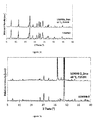
- figure 7A shows the initial PXRD pattern of compound 1 (of the invention, lower trace) and the pattern after 2 months at 75% relative humidity and 40°C (upper trace). These appear substantially identical.
- Figure 7B shows the initial pattern of compound 11 (comparative, initial spectrum lower trace). It can be seen that the pattern obtained after 2 months at 75% relative humidity and 40 oC (upper trace) in this case is different.
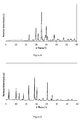
- Figure 8 shows the PXRD pattern of compound 2; figure 9 shows the PXRD pattern of compound 5; figure 10 shows the PXRD pattern of compound 6; and figure 11 shows the PXRD pattern of compound 7.
Landscapes
- Chemical & Material Sciences (AREA)
- Organic Chemistry (AREA)
- Health & Medical Sciences (AREA)
- Medicinal Chemistry (AREA)
- Veterinary Medicine (AREA)
- Public Health (AREA)
- General Health & Medical Sciences (AREA)
- Animal Behavior & Ethology (AREA)
- Life Sciences & Earth Sciences (AREA)
- Pharmacology & Pharmacy (AREA)
- Neurology (AREA)
- Engineering & Computer Science (AREA)
- Nuclear Medicine, Radiotherapy & Molecular Imaging (AREA)
- Chemical Kinetics & Catalysis (AREA)
- Neurosurgery (AREA)
- Biomedical Technology (AREA)
- Bioinformatics & Cheminformatics (AREA)
- General Chemical & Material Sciences (AREA)
- Psychiatry (AREA)
- Pain & Pain Management (AREA)
- Inorganic Chemistry (AREA)
- Epidemiology (AREA)
- Pharmaceuticals Containing Other Organic And Inorganic Compounds (AREA)
- Medicinal Preparation (AREA)
Priority Applications (5)
| Application Number | Priority Date | Filing Date | Title |
|---|---|---|---|
| EP16167817.2A EP3239155A1 (de) | 2016-04-29 | 2016-04-29 | Lithium enthaltende crystalline form, pharmazeutische zusammensetzungen davon, verfahren deren herstellung sowie deren verwendung zur behandlung von depressive erkrankungen. |
| EP17720482.3A EP3430018B1 (de) | 2016-04-29 | 2017-04-28 | Lithium enthaltende crystalline form, pharmazeutische zusammensetzungen davon, verfahren deren herstellung sowie deren verwendung zur behandlung von depressiven erkrankungen. |
| US16/097,444 US20190382419A1 (en) | 2016-04-29 | 2017-04-28 | Crystal form comprising lithium ions, pharmaceutical compositions thereof, methods for preparation and their uses for the treatment of depressive disease |
| PCT/EP2017/060221 WO2017186924A1 (en) | 2016-04-29 | 2017-04-28 | Crystal form comprising lithium ions, pharmaceutical compositions thereof, methods for preparation and their uses for the treatment of depressive disease |
| US18/190,060 US12234248B2 (en) | 2016-04-29 | 2023-03-24 | Co-crystal compounds comprising lithium ions and isonicotinamide |
Applications Claiming Priority (1)
| Application Number | Priority Date | Filing Date | Title |
|---|---|---|---|
| EP16167817.2A EP3239155A1 (de) | 2016-04-29 | 2016-04-29 | Lithium enthaltende crystalline form, pharmazeutische zusammensetzungen davon, verfahren deren herstellung sowie deren verwendung zur behandlung von depressive erkrankungen. |
Publications (1)
| Publication Number | Publication Date |
|---|---|
| EP3239155A1 true EP3239155A1 (de) | 2017-11-01 |
Family
ID=56068650
Family Applications (2)
| Application Number | Title | Priority Date | Filing Date |
|---|---|---|---|
| EP16167817.2A Withdrawn EP3239155A1 (de) | 2016-04-29 | 2016-04-29 | Lithium enthaltende crystalline form, pharmazeutische zusammensetzungen davon, verfahren deren herstellung sowie deren verwendung zur behandlung von depressive erkrankungen. |
| EP17720482.3A Active EP3430018B1 (de) | 2016-04-29 | 2017-04-28 | Lithium enthaltende crystalline form, pharmazeutische zusammensetzungen davon, verfahren deren herstellung sowie deren verwendung zur behandlung von depressiven erkrankungen. |
Family Applications After (1)
| Application Number | Title | Priority Date | Filing Date |
|---|---|---|---|
| EP17720482.3A Active EP3430018B1 (de) | 2016-04-29 | 2017-04-28 | Lithium enthaltende crystalline form, pharmazeutische zusammensetzungen davon, verfahren deren herstellung sowie deren verwendung zur behandlung von depressiven erkrankungen. |
Country Status (3)
| Country | Link |
|---|---|
| US (2) | US20190382419A1 (de) |
| EP (2) | EP3239155A1 (de) |
| WO (1) | WO2017186924A1 (de) |
Families Citing this family (3)
| Publication number | Priority date | Publication date | Assignee | Title |
|---|---|---|---|---|
| CN112472697A (zh) * | 2020-12-09 | 2021-03-12 | 安域生物制药(杭州)有限公司 | 一种有机酸锂-l-脯氨酸盐的制备工艺 |
| CN116924957A (zh) * | 2023-07-27 | 2023-10-24 | 安域生物科技(杭州)有限公司 | 一种异丁酸锂-l-脯氨酸盐新晶型及其制备方法和应用 |
| CN119954639B (zh) * | 2025-02-07 | 2025-12-26 | 武汉中科先进材料科技有限公司 | 一种有机补锂剂及其制备方法和在正极材料中的应用 |
Citations (2)
| Publication number | Priority date | Publication date | Assignee | Title |
|---|---|---|---|---|
| WO2012129568A2 (en) * | 2011-03-24 | 2012-09-27 | University Of South Florida | Lithium compositions |
| WO2014172650A1 (en) | 2013-04-19 | 2014-10-23 | University Of South Florida | Organic anion lithium ionic cocrystal compounds and compositions |
Family Cites Families (3)
| Publication number | Priority date | Publication date | Assignee | Title |
|---|---|---|---|---|
| US7091357B2 (en) | 2001-12-26 | 2006-08-15 | University Of Kentucky Research Foundation | Chain-modified pyridino-N substituted nicotine compounds for use in the treatment of CNS pathologies |
| DE102005056564B4 (de) | 2005-11-25 | 2009-11-12 | Gkss-Forschungszentrum Geesthacht Gmbh | Polymerelektrolytmembran mit Koordinationspolymer, Verfahren zu seiner Herstellung sowie Verwendung in einer Brennstoffzelle |
| US20090209604A1 (en) | 2008-02-14 | 2009-08-20 | Jerry Zhang | Topical combination therapy for treating acne |
-
2016
- 2016-04-29 EP EP16167817.2A patent/EP3239155A1/de not_active Withdrawn
-
2017
- 2017-04-28 US US16/097,444 patent/US20190382419A1/en not_active Abandoned
- 2017-04-28 EP EP17720482.3A patent/EP3430018B1/de active Active
- 2017-04-28 WO PCT/EP2017/060221 patent/WO2017186924A1/en not_active Ceased
-
2023
- 2023-03-24 US US18/190,060 patent/US12234248B2/en active Active
Patent Citations (2)
| Publication number | Priority date | Publication date | Assignee | Title |
|---|---|---|---|---|
| WO2012129568A2 (en) * | 2011-03-24 | 2012-09-27 | University Of South Florida | Lithium compositions |
| WO2014172650A1 (en) | 2013-04-19 | 2014-10-23 | University Of South Florida | Organic anion lithium ionic cocrystal compounds and compositions |
Non-Patent Citations (1)
| Title |
|---|
| ADAM J SMITH ET AL: "Improving lithium therapeutics by crystal engineering of novel ionic cocrystals", MOLECULAR PHARMACEUTICS, ACS PUBLICATIONS, USA, vol. 10, no. 12, 2 December 2013 (2013-12-02), pages 4728 - 4738, XP002727756, ISSN: 1543-8392, [retrieved on 20131105], DOI: 10.1021/MP400571A * |
Also Published As
| Publication number | Publication date |
|---|---|
| WO2017186924A1 (en) | 2017-11-02 |
| EP3430018B1 (de) | 2023-04-05 |
| US12234248B2 (en) | 2025-02-25 |
| EP3430018A1 (de) | 2019-01-23 |
| US20230234972A1 (en) | 2023-07-27 |
| US20190382419A1 (en) | 2019-12-19 |
Similar Documents
| Publication | Publication Date | Title |
|---|---|---|
| US12234248B2 (en) | Co-crystal compounds comprising lithium ions and isonicotinamide | |
| Liu et al. | Pharmaceutical salts/cocrystals of enoxacin with dicarboxylic acids: Enhancing in vitro antibacterial activity of enoxacin by improving the solubility and permeability | |
| Žegarac et al. | A sildenafil cocrystal based on acetylsalicylic acid exhibits an enhanced intrinsic dissolution rate | |
| ES2456142T3 (es) | Composiciones químicas y métodos para elaborarlas | |
| USRE41209E1 (en) | Platinum complexes | |
| ES2460919T3 (es) | Formas polimórficas de p-hidroxibenzoato de (2S)-(4E)-N-metil-5-[3-(5-isopropoxipiridin)il]-4-penten-2-amonio para el tratamiento de trastornos del sistema nervioso central | |
| ES2910003T3 (es) | Compuestos y composiciones de cocristal iónico de litio de anión orgánico | |
| EP2688575B1 (de) | Lithiumzusammensetzungen | |
| MXPA05009564A (es) | Sales de bases debiles. | |
| US8148563B2 (en) | Chemical compositions and methods of making them | |
| Jin et al. | Crystal Engineering of Ionic Cocrystals Sustained by the Phenol–Phenolate Supramolecular Heterosynthon | |
| JP2021508338A (ja) | セスキテルペン誘導体の結晶形、およびその調製方法と用途 | |
| WO2011036676A8 (en) | Stable cocrystals of temozolomide | |
| EP2688563B1 (de) | Galliumkomplexe, pharmazeutische zusammensetzungen und anwendungsverfahren | |
| CN109790125A (zh) | 四氢异喹啉κ阿片拮抗剂 | |
| EP1780207B1 (de) | Kristallines Esomeprazol-Strontiumhydrat, Verfahren zu seiner Herstellung und dieses enthaltende pharmazeutische Zusammensetzung | |
| EP2334188A1 (de) | Zusammensetzung und verfahren für den entwurf und die entwicklung von metalloenzymhemmern | |
| TW201400459A (zh) | N-((s)-2,3-二羥基-丙基)-3-(2-氟-4-碘-苯基胺基)-異菸鹼醯胺之固態形式 | |
| EP3851108B1 (de) | Arzneimittel auf der basis von borat und dessen verwendung | |
| KR20130029673A (ko) | 신규한 4핵 아렌-루테늄 화합물 및 이를 유효성분으로 함유하는 암의 예방 또는 치료용 약학 조성물 | |
| CA2570795A1 (en) | Process for the preparation of crystal modifications for use in the preparation of esomeprazole sodium salt | |
| Soldevila-Sanmartin et al. | Solvent-controlled formation of monomeric and dimeric species containing Cu (II) acetate and 4-phenylpyridine | |
| AU2008264866A1 (en) | Platinum (IV) complexes | |
| WO2000058310A1 (en) | Zolpidem salts | |
| CN101209994A (zh) | 选择性m4受体拮抗剂及其医药用途 |
Legal Events
| Date | Code | Title | Description |
|---|---|---|---|
| PUAI | Public reference made under article 153(3) epc to a published international application that has entered the european phase |
Free format text: ORIGINAL CODE: 0009012 |
|
| STAA | Information on the status of an ep patent application or granted ep patent |
Free format text: STATUS: THE APPLICATION HAS BEEN PUBLISHED |
|
| AK | Designated contracting states |
Kind code of ref document: A1 Designated state(s): AL AT BE BG CH CY CZ DE DK EE ES FI FR GB GR HR HU IE IS IT LI LT LU LV MC MK MT NL NO PL PT RO RS SE SI SK SM TR |
|
| AX | Request for extension of the european patent |
Extension state: BA ME |
|
| STAA | Information on the status of an ep patent application or granted ep patent |
Free format text: STATUS: THE APPLICATION IS DEEMED TO BE WITHDRAWN |
|
| 18D | Application deemed to be withdrawn |
Effective date: 20180503 |