EP3239193A1 - Wasserunlösliche anionenaustauschermaterialien - Google Patents
Wasserunlösliche anionenaustauschermaterialien Download PDFInfo
- Publication number
- EP3239193A1 EP3239193A1 EP17166043.4A EP17166043A EP3239193A1 EP 3239193 A1 EP3239193 A1 EP 3239193A1 EP 17166043 A EP17166043 A EP 17166043A EP 3239193 A1 EP3239193 A1 EP 3239193A1
- Authority
- EP
- European Patent Office
- Prior art keywords
- chloride
- water
- anion exchange
- insoluble
- diallyl
- Prior art date
- Legal status (The legal status is an assumption and is not a legal conclusion. Google has not performed a legal analysis and makes no representation as to the accuracy of the status listed.)
- Pending
Links
- 0 CCC(C)(*)C*(C)N Chemical compound CCC(C)(*)C*(C)N 0.000 description 2
Classifications
-
- C—CHEMISTRY; METALLURGY
- C08—ORGANIC MACROMOLECULAR COMPOUNDS; THEIR PREPARATION OR CHEMICAL WORKING-UP; COMPOSITIONS BASED THEREON
- C08G—MACROMOLECULAR COMPOUNDS OBTAINED OTHERWISE THAN BY REACTIONS ONLY INVOLVING UNSATURATED CARBON-TO-CARBON BONDS
- C08G81/00—Macromolecular compounds obtained by interreacting polymers in the absence of monomers, e.g. block polymers
- C08G81/02—Macromolecular compounds obtained by interreacting polymers in the absence of monomers, e.g. block polymers at least one of the polymers being obtained by reactions involving only carbon-to-carbon unsaturated bonds
- C08G81/024—Block or graft polymers containing sequences of polymers of C08C or C08F and of polymers of C08G
-
- B—PERFORMING OPERATIONS; TRANSPORTING
- B01—PHYSICAL OR CHEMICAL PROCESSES OR APPARATUS IN GENERAL
- B01J—CHEMICAL OR PHYSICAL PROCESSES, e.g. CATALYSIS OR COLLOID CHEMISTRY; THEIR RELEVANT APPARATUS
- B01J41/00—Anion exchange; Use of material as anion exchangers; Treatment of material for improving the anion exchange properties
- B01J41/08—Use of material as anion exchangers; Treatment of material for improving the anion exchange properties
- B01J41/12—Macromolecular compounds
-
- A—HUMAN NECESSITIES
- A61—MEDICAL OR VETERINARY SCIENCE; HYGIENE
- A61K—PREPARATIONS FOR MEDICAL, DENTAL OR TOILETRY PURPOSES
- A61K31/00—Medicinal preparations containing organic active ingredients
- A61K31/74—Synthetic polymeric materials
- A61K31/785—Polymers containing nitrogen
-
- C—CHEMISTRY; METALLURGY
- C08—ORGANIC MACROMOLECULAR COMPOUNDS; THEIR PREPARATION OR CHEMICAL WORKING-UP; COMPOSITIONS BASED THEREON
- C08F—MACROMOLECULAR COMPOUNDS OBTAINED BY REACTIONS ONLY INVOLVING CARBON-TO-CARBON UNSATURATED BONDS
- C08F126/00—Homopolymers of compounds having one or more unsaturated aliphatic radicals, each having only one carbon-to-carbon double bond, and at least one being terminated by a single or double bond to nitrogen or by a heterocyclic ring containing nitrogen
- C08F126/06—Homopolymers of compounds having one or more unsaturated aliphatic radicals, each having only one carbon-to-carbon double bond, and at least one being terminated by a single or double bond to nitrogen or by a heterocyclic ring containing nitrogen by a heterocyclic ring containing nitrogen
-
- C—CHEMISTRY; METALLURGY
- C08—ORGANIC MACROMOLECULAR COMPOUNDS; THEIR PREPARATION OR CHEMICAL WORKING-UP; COMPOSITIONS BASED THEREON
- C08F—MACROMOLECULAR COMPOUNDS OBTAINED BY REACTIONS ONLY INVOLVING CARBON-TO-CARBON UNSATURATED BONDS
- C08F126/00—Homopolymers of compounds having one or more unsaturated aliphatic radicals, each having only one carbon-to-carbon double bond, and at least one being terminated by a single or double bond to nitrogen or by a heterocyclic ring containing nitrogen
- C08F126/06—Homopolymers of compounds having one or more unsaturated aliphatic radicals, each having only one carbon-to-carbon double bond, and at least one being terminated by a single or double bond to nitrogen or by a heterocyclic ring containing nitrogen by a heterocyclic ring containing nitrogen
- C08F126/08—N-Vinyl-pyrrolidine
-
- C—CHEMISTRY; METALLURGY
- C08—ORGANIC MACROMOLECULAR COMPOUNDS; THEIR PREPARATION OR CHEMICAL WORKING-UP; COMPOSITIONS BASED THEREON
- C08F—MACROMOLECULAR COMPOUNDS OBTAINED BY REACTIONS ONLY INVOLVING CARBON-TO-CARBON UNSATURATED BONDS
- C08F22/00—Homopolymers and copolymers of compounds having one or more unsaturated aliphatic radicals each having only one carbon-to-carbon double bond, and at least one being terminated by a carboxyl radical and containing at least one other carboxyl radical in the molecule; Salts, anhydrides, esters, amides, imides or nitriles thereof
- C08F22/02—Acids; Metal salts or ammonium salts thereof, e.g. maleic acid or itaconic acid
-
- C—CHEMISTRY; METALLURGY
- C08—ORGANIC MACROMOLECULAR COMPOUNDS; THEIR PREPARATION OR CHEMICAL WORKING-UP; COMPOSITIONS BASED THEREON
- C08F—MACROMOLECULAR COMPOUNDS OBTAINED BY REACTIONS ONLY INVOLVING CARBON-TO-CARBON UNSATURATED BONDS
- C08F226/00—Copolymers of compounds having one or more unsaturated aliphatic radicals, each having only one carbon-to-carbon double bond, and at least one being terminated by a single or double bond to nitrogen or by a heterocyclic ring containing nitrogen
- C08F226/06—Copolymers of compounds having one or more unsaturated aliphatic radicals, each having only one carbon-to-carbon double bond, and at least one being terminated by a single or double bond to nitrogen or by a heterocyclic ring containing nitrogen by a heterocyclic ring containing nitrogen
-
- C—CHEMISTRY; METALLURGY
- C08—ORGANIC MACROMOLECULAR COMPOUNDS; THEIR PREPARATION OR CHEMICAL WORKING-UP; COMPOSITIONS BASED THEREON
- C08F—MACROMOLECULAR COMPOUNDS OBTAINED BY REACTIONS ONLY INVOLVING CARBON-TO-CARBON UNSATURATED BONDS
- C08F26/00—Homopolymers and copolymers of compounds having one or more unsaturated aliphatic radicals, each having only one carbon-to-carbon double bond, and at least one being terminated by a single or double bond to nitrogen or by a heterocyclic ring containing nitrogen
- C08F26/06—Homopolymers and copolymers of compounds having one or more unsaturated aliphatic radicals, each having only one carbon-to-carbon double bond, and at least one being terminated by a single or double bond to nitrogen or by a heterocyclic ring containing nitrogen by a heterocyclic ring containing nitrogen
-
- C—CHEMISTRY; METALLURGY
- C08—ORGANIC MACROMOLECULAR COMPOUNDS; THEIR PREPARATION OR CHEMICAL WORKING-UP; COMPOSITIONS BASED THEREON
- C08G—MACROMOLECULAR COMPOUNDS OBTAINED OTHERWISE THAN BY REACTIONS ONLY INVOLVING UNSATURATED CARBON-TO-CARBON BONDS
- C08G73/00—Macromolecular compounds obtained by reactions forming a linkage containing nitrogen with or without oxygen or carbon in the main chain of the macromolecule, not provided for in groups C08G12/00 - C08G71/00
-
- C—CHEMISTRY; METALLURGY
- C08—ORGANIC MACROMOLECULAR COMPOUNDS; THEIR PREPARATION OR CHEMICAL WORKING-UP; COMPOSITIONS BASED THEREON
- C08G—MACROMOLECULAR COMPOUNDS OBTAINED OTHERWISE THAN BY REACTIONS ONLY INVOLVING UNSATURATED CARBON-TO-CARBON BONDS
- C08G75/00—Macromolecular compounds obtained by reactions forming a linkage containing sulfur with or without nitrogen, oxygen, or carbon in the main chain of the macromolecule
- C08G75/20—Polysulfones
- C08G75/23—Polyethersulfones
-
- C—CHEMISTRY; METALLURGY
- C08—ORGANIC MACROMOLECULAR COMPOUNDS; THEIR PREPARATION OR CHEMICAL WORKING-UP; COMPOSITIONS BASED THEREON
- C08G—MACROMOLECULAR COMPOUNDS OBTAINED OTHERWISE THAN BY REACTIONS ONLY INVOLVING UNSATURATED CARBON-TO-CARBON BONDS
- C08G85/00—General processes for preparing compounds provided for in this subclass
- C08G85/004—Modification of polymers by chemical after-treatment
-
- C—CHEMISTRY; METALLURGY
- C08—ORGANIC MACROMOLECULAR COMPOUNDS; THEIR PREPARATION OR CHEMICAL WORKING-UP; COMPOSITIONS BASED THEREON
- C08J—WORKING-UP; GENERAL PROCESSES OF COMPOUNDING; AFTER-TREATMENT NOT COVERED BY SUBCLASSES C08B, C08C, C08F, C08G or C08H
- C08J5/00—Manufacture of articles or shaped materials containing macromolecular substances
- C08J5/20—Manufacture of shaped structures of ion-exchange resins
- C08J5/22—Films, membranes or diaphragms
- C08J5/2206—Films, membranes or diaphragms based on organic and/or inorganic macromolecular compounds
- C08J5/2218—Synthetic macromolecular compounds
- C08J5/2231—Synthetic macromolecular compounds based on macromolecular compounds obtained by reactions involving unsaturated carbon-to-carbon bonds
- C08J5/2243—Synthetic macromolecular compounds based on macromolecular compounds obtained by reactions involving unsaturated carbon-to-carbon bonds obtained by introduction of active groups capable of ion-exchange into compounds of the type C08J5/2231
-
- C—CHEMISTRY; METALLURGY
- C08—ORGANIC MACROMOLECULAR COMPOUNDS; THEIR PREPARATION OR CHEMICAL WORKING-UP; COMPOSITIONS BASED THEREON
- C08J—WORKING-UP; GENERAL PROCESSES OF COMPOUNDING; AFTER-TREATMENT NOT COVERED BY SUBCLASSES C08B, C08C, C08F, C08G or C08H
- C08J5/00—Manufacture of articles or shaped materials containing macromolecular substances
- C08J5/20—Manufacture of shaped structures of ion-exchange resins
- C08J5/22—Films, membranes or diaphragms
- C08J5/2206—Films, membranes or diaphragms based on organic and/or inorganic macromolecular compounds
- C08J5/2218—Synthetic macromolecular compounds
- C08J5/2256—Synthetic macromolecular compounds based on macromolecular compounds obtained by reactions other than those involving carbon-to-carbon bonds, e.g. obtained by polycondensation
-
- C—CHEMISTRY; METALLURGY
- C08—ORGANIC MACROMOLECULAR COMPOUNDS; THEIR PREPARATION OR CHEMICAL WORKING-UP; COMPOSITIONS BASED THEREON
- C08L—COMPOSITIONS OF MACROMOLECULAR COMPOUNDS
- C08L101/00—Compositions of unspecified macromolecular compounds
- C08L101/02—Compositions of unspecified macromolecular compounds characterised by the presence of specified groups, e.g. terminal or pendant functional groups
- C08L101/025—Compositions of unspecified macromolecular compounds characterised by the presence of specified groups, e.g. terminal or pendant functional groups containing nitrogen atoms
-
- C—CHEMISTRY; METALLURGY
- C08—ORGANIC MACROMOLECULAR COMPOUNDS; THEIR PREPARATION OR CHEMICAL WORKING-UP; COMPOSITIONS BASED THEREON
- C08L—COMPOSITIONS OF MACROMOLECULAR COMPOUNDS
- C08L101/00—Compositions of unspecified macromolecular compounds
- C08L101/02—Compositions of unspecified macromolecular compounds characterised by the presence of specified groups, e.g. terminal or pendant functional groups
- C08L101/04—Compositions of unspecified macromolecular compounds characterised by the presence of specified groups, e.g. terminal or pendant functional groups containing halogen atoms
-
- C—CHEMISTRY; METALLURGY
- C08—ORGANIC MACROMOLECULAR COMPOUNDS; THEIR PREPARATION OR CHEMICAL WORKING-UP; COMPOSITIONS BASED THEREON
- C08L—COMPOSITIONS OF MACROMOLECULAR COMPOUNDS
- C08L101/00—Compositions of unspecified macromolecular compounds
- C08L101/12—Compositions of unspecified macromolecular compounds characterised by physical features, e.g. anisotropy, viscosity or electrical conductivity
-
- C—CHEMISTRY; METALLURGY
- C02—TREATMENT OF WATER, WASTE WATER, SEWAGE, OR SLUDGE
- C02F—TREATMENT OF WATER, WASTE WATER, SEWAGE, OR SLUDGE
- C02F1/00—Treatment of water, waste water, or sewage
- C02F1/42—Treatment of water, waste water, or sewage by ion-exchange
-
- C—CHEMISTRY; METALLURGY
- C08—ORGANIC MACROMOLECULAR COMPOUNDS; THEIR PREPARATION OR CHEMICAL WORKING-UP; COMPOSITIONS BASED THEREON
- C08F—MACROMOLECULAR COMPOUNDS OBTAINED BY REACTIONS ONLY INVOLVING CARBON-TO-CARBON UNSATURATED BONDS
- C08F10/00—Homopolymers and copolymers of unsaturated aliphatic hydrocarbons having only one carbon-to-carbon double bond
- C08F10/02—Ethene
-
- C—CHEMISTRY; METALLURGY
- C08—ORGANIC MACROMOLECULAR COMPOUNDS; THEIR PREPARATION OR CHEMICAL WORKING-UP; COMPOSITIONS BASED THEREON
- C08F—MACROMOLECULAR COMPOUNDS OBTAINED BY REACTIONS ONLY INVOLVING CARBON-TO-CARBON UNSATURATED BONDS
- C08F12/00—Homopolymers and copolymers of compounds having one or more unsaturated aliphatic radicals, each having only one carbon-to-carbon double bond, and at least one being terminated by an aromatic carbocyclic ring
- C08F12/02—Monomers containing only one unsaturated aliphatic radical
- C08F12/04—Monomers containing only one unsaturated aliphatic radical containing one ring
- C08F12/06—Hydrocarbons
- C08F12/08—Styrene
-
- C—CHEMISTRY; METALLURGY
- C08—ORGANIC MACROMOLECULAR COMPOUNDS; THEIR PREPARATION OR CHEMICAL WORKING-UP; COMPOSITIONS BASED THEREON
- C08F—MACROMOLECULAR COMPOUNDS OBTAINED BY REACTIONS ONLY INVOLVING CARBON-TO-CARBON UNSATURATED BONDS
- C08F14/00—Homopolymers and copolymers of compounds having one or more unsaturated aliphatic radicals, each having only one carbon-to-carbon double bond, and at least one being terminated by a halogen
- C08F14/18—Monomers containing fluorine
- C08F14/26—Tetrafluoroethene
-
- Y—GENERAL TAGGING OF NEW TECHNOLOGICAL DEVELOPMENTS; GENERAL TAGGING OF CROSS-SECTIONAL TECHNOLOGIES SPANNING OVER SEVERAL SECTIONS OF THE IPC; TECHNICAL SUBJECTS COVERED BY FORMER USPC CROSS-REFERENCE ART COLLECTIONS [XRACs] AND DIGESTS
- Y02—TECHNOLOGIES OR APPLICATIONS FOR MITIGATION OR ADAPTATION AGAINST CLIMATE CHANGE
- Y02E—REDUCTION OF GREENHOUSE GAS [GHG] EMISSIONS, RELATED TO ENERGY GENERATION, TRANSMISSION OR DISTRIBUTION
- Y02E60/00—Enabling technologies; Technologies with a potential or indirect contribution to GHG emissions mitigation
- Y02E60/30—Hydrogen technology
- Y02E60/50—Fuel cells
Definitions
- the present invention relates to the field of polymer chemistry and relates to water-insoluble anion exchange materials, such as for anion exchange membranes or as anion exchange resins for water treatment, in catalysts, for electrochemical processes, such as electrodialysis or electrodeionization, or in energy conversion systems, such as fuel cells and reverse electrodialysis, or Energy storage systems, such as redox flow batteries can be used.
- water-insoluble anion exchange materials such as for anion exchange membranes or as anion exchange resins for water treatment
- electrochemical processes such as electrodialysis or electrodeionization
- energy conversion systems such as fuel cells and reverse electrodialysis
- Energy storage systems such as redox flow batteries
- anion exchange resins are crosslinked polystyrene having a benzyltrimethylammonium group as a functional group. Operating temperatures between 35 ° C. and not more than 60 ° C. are specified for the use of such anion exchange resins in the OH form (data sheet Amberjet 9000 OH, data sheet DOWEX Marathon A, data sheet DOWEC Marathon 2, Dow Chemical Company).
- Aromatic anion exchange membranes based on polyethersulfones with N-spirocyclic ammonium groups are characterized by Pham and Jannasch, ACS Macro Letters 4 (2015) 1370-1375 known.
- the spirocyclic anion exchange groups are condensed on a phenyl ring and contain benzylic methylene groups. Stability studies on these anion exchange membranes in 1M sodium hydroxide solution have shown partial degradation after 168 h already at 40 ° C.
- a copolymer of chlorotrifluoroethylene and diallyldimethylammonium chloride is used by Valade et al. as binder material for alkaline fuel cells (J. Polym. Sci.: Part A: Polym. Chem. 47, 2009, 2043-2205 ).
- a disadvantage of this compound is that it can not be used as a membrane material due to their low ion exchange capacity.
- An anion exchange membrane based on a blend of poly (diallyldimethylammonium chloride) and polyvinyl alcohol is characterized by Qiao et al. known (J. Power Sources 237, 2013, 1-4 ). To reduce water absorption, the material was crosslinked with glutaraldehyde. The ion exchange capacity of the membrane then remained stable after an initial loss of 55% of the capacity within 375 hours in 8N potassium hydroxide.
- N, N-Diallylpyrrolidiniumbromid are by de Vynck et al. (Macromol Rapid Commun. 18, 1997, 149-156 ).
- a disadvantage of the known solutions for anion exchange materials is that they are not sufficiently stable at temperatures above 50 ° C., in particular in an alkaline environment, and with regard to their water insolubility.
- the object of the invention is to provide water-insoluble anion exchange materials which have improved water insolubility with simultaneously improved alkali and temperature stability, in particular at temperatures above 50 ° C.
- the point of attachment is XN, N-diallylpiperidinium ether or N, N-diallylpyrrolidinium ether or N, N-diallylaminoethyl ether or methacrylamide ethyl ether or methacrylic acid ester or methacrylic acid hydroxypropyl ether or xylylene ether or phenylene ether sulfone.
- anion exchange groups C according to formulas V to VIII are crosslinked via crosslinking sites V and K is a bonding site X to which the water-insoluble polymer B is coupled via covalent chemical bonds.
- a further advantageous embodiment is that the water-insoluble polymer B is connected via ionic bonds with the anion exchange groups C according to the general formulas I to VIII.
- the end groups Z are alkylthioethers or arylthioethers or benzylthioethers.
- the water-insoluble, temperature-stable and alkali-stable polymer B is polyethersulfone or polythioethersulfone or polysulfone or polyphenylene or polyphenylene ether or polyphenylene sulfide or poly (perfluoroethylene propylene) or polytetrafluoroethylene poly (ethylene tetrafluoroethylene) or perfluoroalkoxy polymers or polystyrene or polyethylene or polypropylene or a sulfonated and / or carboxylated and / or phosphonated polymer of the polyethersulfone or polysulfone type or polyphenylene or polyphenylene ether or polyphenylene sulfide or poly (perfluoroethylene propylene) or polytetrafluoroethylene poly (ethylene tetrafluoroethylene) or perfluoroalkoxy polymers or polystyrene or polyethylene or polypropylene.
- the comonomer A is styrene and / or ⁇ -methylstyrene and / or N-vinylcarbazole and / or methacrylic ester and / or N-vinylpyrrolidone and / or N, N-diallylacrylamide and / or N, N-diallylacrylsulfonamide and / or or diallyl ether and / or 1,2-diallylbenzene and / or diallyl sulfide and / or chlorotrifluoroethylene and / or tetrafluoroethylene and / or hexafluoropropylene and / or 1,2-divinylbenzene.
- crosslinking point V is tetraallylammonium chloride or tetraalkylallylammonium chloride or diallyl-dialkylallylammonium chloride or 1,4-divinylbenzene or divinylsulfone or divinylsulfide or divinylsulfoxide or divinyl ether or diacrylamide or dimethacrylamide or N, N, N ', N'-tetraallyl-4,4 '- Trimethylenedipiperidininium chloride or N, N, N ', N'-tetraalkylallyl-4,4'-trimethylenedipiperidinium chloride or N, N-diallyl-, N', N'-dialkylallyl-4,4'-trimethylenedipiperidinium chloride or N-allyl-N, N ' , N'-trialkylallyl-4,4'-trimethylenedipiperidinium chloride or N, N, N'-
- N-diallyl and / or N, N-dialkylallyl compounds and / or N-allyl-N-alkylallyl compounds of secondary aliphatic or aromatic or cycloaliphatic amines such as, for example, diallyldimethylammonium chloride
- R 1 is nitrogen
- R 2 and / or R 3 is a methyl radical and / or hydrogen.
- R 4 and R 5 is an alkyl radical and is advantageously a methyl or ethyl radical.
- R 6 -R 9 are hydrogen.
- the water-insoluble anion exchange materials according to the invention have a linearly polymerized and / or branched and / or crosslinked structure.
- the anion exchanger groups C may be polymerized with one another and / or with compounds both linearly and / or branched and / or three-dimensionally crosslinked. This means that if only structural units according to the general formulas I to IV are present, they can be coupled only in a linear manner in a chemically and / or branched manner. Branched connections of the Anion exchange groups should be linearly polymerized compounds having side chains which are substantially non-chemically coupled to each other.
- the structural units according to the general formulas I to VIII are in each case coupled with water-insoluble, advantageously aromatic or aliphatic and inert conditions, polymers B, the anion exchanger groups C at least at one end of the polymers B via the junction X and / or K, when K is equal to X, are coupled.
- the other end of the polymer chain forms the end group Z or K, which is a temperature and alkali stable compound, advantageously a low molecular weight aromatic or aliphatic, in-use inert compound.
- the anion exchanger groups C are chemically coupled to one another via the crosslinking sites V, ie crosslinked, with K being present at the respective ends of the polymer chains, also on possible side groups, coupled as end groups Z, which are a temperature-stable and alkali-stable compound, advantageously a low molecular weight aromatic or aliphatic, inert under use conditions compound.
- At least one K is a junction X coupled to water-insoluble, advantageously aromatic or aliphatic and inert polymers B, wherein at least one K is an end group Z which is not is present coupled with water-insoluble, advantageously aromatic or aliphatic and inert under use conditions, polymers B.
- K connecting sites X which are coupled with polymers B which are insoluble in water, advantageously aromatic or aliphatic and inert under conditions of use are not coupled with water-insoluble, advantageously aromatic or aliphatic and inert polymers B, when K is an end group Z. however, this is not coupled with polymer B.
- alkylthioethers or arylthioethers or benzylthioethers it is possible advantageously for alkylthioethers or arylthioethers or benzylthioethers to be present.
- the point of attachment X may advantageously be N, N-diallylpiperidinium ether or N, N, diallylpyrrolidinium ether or N, N-diallylaminoethyl ether or methacrylamide ethyl ether or methacrylic acid ester or methacrylic acid hydroxypropyl ether or xylylene ether or phenylene sulfone ether.
- junction X one, several or all junctions X are coupled to their respective partner via covalent chemical bonds.
- the vast majority of X-junctions are coupled to their partners via covalent chemical bonds.
- the coupling between the anion exchange groups C according to the general formulas I to VIII and the water-insoluble polymer B can also be effected via ionic bonds between the anion exchange groups C and acidic groups of the polymers B.
- the crosslinking point V is advantageously tetraallylammonium chloride or tetraalkylallylammonium chloride or diallyl-dialkylallylammonium chloride or 1,4-divinylbenzene or divinylsulfone or divinylsulfide or divinylsulfoxide or divinyl ether or diacrylamide or dimethacrylamide or N, N, N ', N'-tetraallyl-4,4'-trimethylenedipiperidinium chloride or N, N, N ', N'-tetraalkylallyl-4,4'-trimethylenedipiperidininium chloride or N, N-diallyl-N', N'-dialkylallyl-4,4'-trimethylenedipiperidininium chloride or N-allyl-N, N ', N' T rialkylallyl-4,4'-trimethylenedipiperidinium chloride or N, N, N'-triallyl-N
- the water-insoluble polymer B which is advantageously also temperature and / or alkali stable, is advantageously polyethersulfone or polysulfone or polyphenylene or polyphenylene ether or polyphenylene sulfide or poly (perfluoroethylene propylene) or polytetrafluoroethylene poly (ethylene tetrafluoroethylene) or perfluoroalkoxy polymers or polystyrene or polyethylene or polypropylene.
- the comonomer A is styrene and / or ⁇ -methylstyrene and / or N-vinylcarbazole and / or methacrylic ester and / or N-vinylpyrrolidone and / or N, N-diallylacrylamide and / or N, N-diallylacrylsulfonamide and / or diallyl ether and / or 1,2-diallylbenzene and / or diallyl sulfide and / or chlorotrifluoroethylene and / or tetrafluoroethylene and / or hexafluoropropylene and / or 1,2-divinylbenzene.
- the comonomer A is advantageously present for the spatial separation of charge-carrying groups.
- R 1 is nitrogen
- R 6 to R 9 are hydrogen
- R 2 and / or R 3 is hydrogen or a methyl radical
- R 4 and / or R 5 is a methyl or ethyl radical.
- the water-insoluble anion exchange materials according to the invention are achieved in that the nitrogen or phosphorus-containing anion exchange groups C of the water-insoluble anion exchange materials according to the invention in the cyclic (heterocyclic) or spirocyclic Compounds of the structural units are included according to at least one of the general formulas I to VIII.
- ⁇ -type hydrogen atoms may be substituted to the positively charged atom of the anion exchange groups C in the structural units of any one of general formulas I to VIII by alkyl or aryl groups.
- the improved alkali and temperature stability of the water-insoluble materials of the invention enables the development of new fields of application or improved efficiency of known applications.
- the water-insoluble anion exchange materials of the present invention can be used for anion exchange membranes or so-called anion exchange resins.
- the anion exchange membranes consist essentially but at least predominantly of linear anion exchange groups C, which are constituents of the structural units according to at least one of the general formulas I to IV.
- Anionic exchange resins consist essentially but at least predominantly of crosslinked anion exchange groups C, which are part of the structural units according to at least one of the general formulas V to VIII.
- Another advantageous property of the water-insoluble anion exchange materials according to the invention is their lack of odor.
- the water-insoluble anion exchange materials of the invention are prepared by cyclopolymerization.
- the monomers used for the preparation of the anion exchange groups are CN, N-diallyl and / or N, N-dialkylallyl compounds and / or N-allyl-N-alkylallyl compounds of secondary aliphatic or aromatic or cycloaliphatic amines, for example diallyldimethylammonium chloride, diallylpiperidinium chloride, Diallylpyrrolidinium chloride, allyl-methallyldimethylammonium chloride, allyl-methallylpiperidinium chloride, allyl-methallylpyrrolidinium chloride, dimethallyl-dimethylammonium chloride, dimethallylpiperidinium chloride, dimethallylpyrrolidinium chloride, diallyl-3,4-dimethylpyrrolidinium chloride, diallyl-3,3,4,4-tetramethylpyrrolidinium chloride, diallyl-3,5-dimethylpiperidinium chloride, Di
- P, P-diallyl and / or P P-dialkylallyl compounds and / or P-allyl-P-alkylallyl compounds of secondary aliphatic or aromatic or cycloaliphatic phosphines can be used, such as diallyldimethylphosphine chloride, diallyl diphenylphosphonium chloride.
- diallyldimethylphosphine chloride diallyl diphenylphosphonium chloride.
- ammonium chlorides or phosphonium chlorides and the corresponding bromides or iodides can be used.
- the water-insoluble anion exchange materials according to the invention have a significantly higher temperature stability, especially under alkaline conditions, compared to materials of comparable membranes according to the prior art.
- the anion exchange materials according to the invention can be used without problem in the existing application areas for such materials and thus lead to the improvement of the efficiency of these processes.
- the improved properties may also open up new fields of application for the materials according to the invention.
- the water-insoluble polymer B is first prepared. For this purpose, 52 mmol of 4,4'-difluorodiphylsulfone and 50 mmol of 4,4'-bis-trimethylsiloxydiphenylsulfone are dissolved in 50 ml of N-methylpyrrolidone (NMP) and subsequently admixed with 75 mmol of potassium carbonate. This mixture is stirred for 16 h at 175 ° C under an argon atmosphere. Subsequently, the temperature is raised to 190 ° C. for 2 hours and a further 100 mg of 4,4'-difluorodiphenylsulfone are added.
- NMP N-methylpyrrolidone
- reaction product is precipitated in 1000 ml of ethanol with the addition of 5 ml of 37% hydrochloric acid. This product is filtered off with suction and washed with 250 ml of ethanol for 5 h at 50 ° C, filtered off with suction and dried at 100 ° C in a vacuum.
- the final product is a fluorine-terminated polyethersulfone (Polymer B) having a molecular weight M n , determined by 1 H-NMR spectroscopy, of 11,000 g / mol and contains no OH end groups.
- junctions X on the polymer B 2 mmol of polyethersulfone and 4 mmol of 4-hydroxypiperidine are dissolved in 50 ml of NMP and combined with 6 mmol of potassium carbonate. This mixture is stirred for 16 h at 175 ° C and the intermediate then precipitated with 500 ml of ethanol. The resulting polymer is stirred for 5 h at 50 ° C in ethanol, filtered off and dried in vacuo at 100 ° C.
- the final product is a piperidine-terminated polyethersulfone.
- the yield is 90%.
- Complete conversion of the fluoro end groups with 4-hydroxypiperidine was detected by 1 H NMR spectroscopy.
- 0.5 mmol of this piperidine-terminated polyethersulfone are dissolved in 25 ml of dimethyl sulfoxide (DMSO) and mixed with 4 mmol of potassium carbonate and heated to 75 ° C. Over a period of 30 minutes, 4 mmol of allyl chloride dissolved in 10 ml of DMSO are added dropwise to the reaction mixture. After the allyl chloride dissolved in DMSO has been completely added, the mixture is stirred for 24 h at 90 ° C.
- DMSO dimethyl sulfoxide
- diallylpiperidinium-terminated polyethersulfone precipitated with the compound X in ethanol, stirred in fresh ethanol at 50 ° C and finally filtered off. The product is dried in vacuo at 50 ° C. The yield is 85%. Complete formation of the terminal quaternary ammonium salts was determined by 1 H NMR spectroscopy.
- the reaction solution is heated to 90 ° C and mixed with 4 mol% of AIBN, stirred for 24 h at 90 ° C under an argon atmosphere. After cooling, the resulting polyethersulfone-poly (azoniaspiro [4,4] nonane block polymer is treated with thiophenol in the presence of copper (I) salt to saturate the terminal double bonds, followed by precipitation in water
- the composition which was determined by means of 1 H-NMR spectroscopy, corresponds to the monomer composition according to the formula II. The yield is 95%.
- a membrane is prepared from the polyethersulfone-poly (azoniaspiro [4,4] nonane block polymer thus prepared) by dissolving 0.5 g of polyethersulfone-poly (azoniaspiro [4,4] nonane block polymer in 10 ml of N-methylpyrrolidone. filtered and placed in a 7 cm diameter Petri dish The solvent N-methylpyrrolidone is added in vacuo for 2 h Room temperature, then for 2 h at 40 ° C, for a further 2 h at 60 ° C and then removed for 24 h at 100 ° C. The resulting membrane is dissolved with water from the Petri dish, washed in water at 70 ° C for 4 h and finally dried in vacuo at 50 ° C to constant weight.
- the membrane material polyethersulfone-poly (anoniaspiro [4,4] nonane) block copolymer is characterized in terms of its temperature stability.
- 0.5 g of the polyethersulfone-poly (anoniaspiro [4,4] nonane) block copolymer are initially stored for 24 hours in 2M sodium hydroxide solution in order to convert the anion exchanger material into the OH form.
- the membrane is placed in 5 ml of 2N sodium hydroxide solution, the vessel is melted off and the contents are kept at a temperature of 120 ° C. for 168 h. After cooling, the vessel is opened and the anion exchanger material washed with water and then stored for 24 h in 1M sodium chloride solution. The sample is washed again with water and dried in vacuo at 50 ° C to constant weight.
- the water-insoluble polymer B with K which is a compound X, according to Example 1 is prepared first.
- DPO 2,4,6-trimethylbenzoyldiphenylphosphine oxide
- This solution is placed in a 7 cm diameter Petri dish, which is covered with a quartz glass disc, and irradiated for 10 min with UV light with a wavelength of 254 nm (power 8 W) at room temperature. Subsequently, the solvent is removed in vacuo at a temperature of 100 to 120 ° C.
- the anion exchange material is washed with water and treated with thiophenol in the presence of copper (I) salt to saturate the terminal double bonds.
- the anion exchange membrane is again thoroughly washed with water and dried in vacuo to constant weight.
- the membrane has a thickness of 100 ⁇ m (dry), an ion exchange capacity of 3.35 mmol / g, a water absorption at 80 ° C. of 100% and a hydroxide ion conductivity (80 ° C., 95% relative humidity) of 90 mS / cm on.
- the membrane material is characterized in terms of its temperature stability. For this purpose, 0.5 g of the membrane are first stored for 24 hours in 2M sodium hydroxide solution in order to convert the anion exchange material into the OH form. Subsequently, the membrane is placed in 5 ml of 2N sodium hydroxide solution, the vessel is melted off and the contents are kept at a temperature of 120 ° C. for 168 h. After cooling, the vessel is opened and the anion exchanger material washed with water and then stored for 24 h in 1 M sodium chloride solution. The sample is washed again with water and dried in vacuo at 50 ° C to constant weight.
Landscapes
- Chemical & Material Sciences (AREA)
- Health & Medical Sciences (AREA)
- Chemical Kinetics & Catalysis (AREA)
- Organic Chemistry (AREA)
- Medicinal Chemistry (AREA)
- Polymers & Plastics (AREA)
- Manufacturing & Machinery (AREA)
- Engineering & Computer Science (AREA)
- Inorganic Chemistry (AREA)
- Materials Engineering (AREA)
- Pharmacology & Pharmacy (AREA)
- Public Health (AREA)
- Veterinary Medicine (AREA)
- General Health & Medical Sciences (AREA)
- Animal Behavior & Ethology (AREA)
- Epidemiology (AREA)
- Life Sciences & Earth Sciences (AREA)
- General Chemical & Material Sciences (AREA)
- Manufacture Of Macromolecular Shaped Articles (AREA)
- Addition Polymer Or Copolymer, Post-Treatments, Or Chemical Modifications (AREA)
- Macromonomer-Based Addition Polymer (AREA)
- Graft Or Block Polymers (AREA)
- Polyethers (AREA)
Abstract
Die vorliegende Erfindung bezieht sich auf das Gebiet der Polymerchemie und betrifft wasserunlösliche Anionenaustauschermaterialien, wie sie beispielsweise für Anionenaustauschermembranen oder als Anionenaustauscherharze zum Einsatz kommen können. Die Aufgabe der Erfindung besteht in der Angabe von wasserunlöslichen Anionenaustauschermaterialien, die eine verbesserte Wasserunlöslichkeit aufweisen. Gelöst wird die Aufgabe durch wasserunlösliche Anionenaustauschermaterialien, mindestens bestehend aus miteinander linear polymerisierten und/oder verzweigten und/oder vernetzten Anionenaustauschergruppen C, die Bestandteil der Struktureinheiten gemäß mindestens einer der allgemeinen Formeln I bis VIII
sind.
Description
- Die vorliegende Erfindung bezieht sich auf das Gebiet der Polymerchemie und betrifft wasserunlösliche Anionenaustauschermaterialien, wie sie beispielsweise für Anionenaustauschermembranen oder als Anionenaustauscherharze zur Wasseraufbereitung, in Katalysatoren, für elektrochemische Prozesse, wie Elektrodialyse oder Elektrodeionisation, oder in Energiewandlersystemen, wie Brennstoffzellen und Reverse-Elektrodialyse, oder Energiespeichersystemen, wie Redox-Flow-Batterien, zum Einsatz kommen können.
- Es sind zahlreiche Anionenaustauschermaterialien bekannt.
- Beispielsweise bestehen bekannte Anionenaustauscherharze aus vernetztem Polystyrol, die eine Benzyltrimethylammoniumgruppe als funktionelle Gruppe aufweisen. Für den Einsatz derartiger Anionenaustauscherharze in der OH-Form werden Betriebstemperaturen zwischen 35°C und maximal 60°C angegeben (Datenblatt Amberjet 9000 OH; Datenblatt DOWEX Marathon A; Datenblatt DOWEC Marathon 2; Dow Chemical Company).
- Die Temperaturstabilität unterschiedlicher niedermolekularer quaternärer Ammoniumsalze in 6N NaOH bei 160°C wurde von Marino und Kreuer (ChemSusChem 8, 2015, 513-523) untersucht. Dabei wurde herausgefunden, dass die spirocyclische Verbindung Azonia-spiro[5.5]undecan unter den Testbedingungen die höchste Stabilität aufweist.
- Aromatische Anionenaustauschermembranen auf der Basis von Polyethersulfonen mit N-spirocyclischen Ammoniumgruppen sind durch Pham und Jannasch, ACS Macro Letters 4 (2015) 1370-1375 bekannt. Die spirocyclischen Anionenaustauschergruppen sind dabei an einen Phenylring kondensiert und enthalten benzylische Methylengruppen.
Stabilitätsuntersuchungen an diesen Anionenaustauschermembranen in 1M Natronlauge haben einen teilweisen Abbau nach 168 h bereits bei 40°C gezeigt. - Gemäß Hellwinkel und Seifert weist Bis-2,2'-Biphenylenammoniumiodid eine hohe Thermostabilität in einem alkalischen Medium, wie 20-%ige Natronlauge, bei Siedetemperatur auf. Die Synthese dieser Verbindung ist jedoch sehr aufwändig und ihre Verwendung als Material für Anionenaustauschermembranen ist daher wirtschaftlich nicht sinnvoll (Liebigs Ann. Chem. 762 (1972) 29-54).
- Ein Copolymer aus Chlortrifluorethylen und Diallyldimethylammoniumchlorid wird von Valade et al. als Bindermaterial für alkalische Brennstoffzellen angegeben (J. Polym. Sci.: Part A: Polym. Chem. 47, 2009, 2043-2205).
Nachteilig an dieser Verbindung ist, dass sie aufgrund ihrer geringen lonenaustauscherkapazität nicht als Membranmaterial eingesetzt werden kann. - Eine Anionenaustauschermembran auf der Basis eines Blends aus Poly(diallyldimethylammoniumchlorid) und Polyvinylalkohol ist durch Qiao et al. bekannt (J. Power Sources 237, 2013, 1-4). Zur Verringerung der Wasseraufnahme wurde das Material mit Glutaraldehyd vernetzt. Die lonenaustauscherkapazität der Membran blieb nach einem anfänglichen Verlust von 55 % der Kapazität innerhalb von 375 Stunden in 8N Kalilauge dann stabil.
- Die Polymerisation und die Struktur von N,N-Diallylpyrrolidiniumbromid sind durch de Vynck et al. bekannt (Macromol. Rapid Commun. 18, 1997, 149-156).
- Ein Nachteil der bekannten Lösungen für Anionenaustauschermaterialien ist, dass diese bei Temperaturen über 50 °C, insbesondere in einer alkalischen Umgebung, und hinsichtlich ihrer Wasserunlöslichkeit noch nicht ausreichend stabil sind.
- Die Aufgabe der Erfindung besteht in der Angabe von wasserunlöslichen Anionenaustauschermaterialien, die eine verbesserte Wasserunlöslichkeit bei gleichzeitig verbesserter Alkali- und Temperaturstabilität, insbesondere bei Temperaturen über 50 °C, aufweisen.
- Die Aufgabe wird durch die in den Ansprüchen angegebene Erfindung gelöst. Vorteilhafte Ausgestaltungen sind Gegenstand der Unteransprüche.
- Die wasserunlöslichen Anionenaustauschermaterialien bestehen mindestens aus miteinander linear polymerisierten und/oder verzweigten und/oder vernetzten Anionenaustauschergruppen C, die Bestandteil der Struktureinheiten gemäß mindestens einer der allgemeinen Formeln I bis VIII


- R1 Stickstoff und/oder Phosphor
- R2 - R9 Substituenten, wobei
- ∘ R2 und R3 Wasserstoff sind oder, im Falle dass mindestens ein Rest R2 und R3 ungleich Wasserstoff ist, dann R2 und/oder R3 ein Alkylrest oder Arylrest ist, und,
- ∘ R4 und R5 jeweils ein Alkyl- und/oder Arylrest ist, und
- ∘ R6 - R9 Wasserstoff sind, oder im Falle dass mindestens ein Rest R6 bis R9 ungleich Wasserstoff ist, dann diese Reste R6 bis R9 ein Alkylrest oder Arylrest ist, und
- Z eine Endgruppe ist, und
- X eine Verbindungsstelle ist, und
- V eine Vernetzungsstelle ist, und
- K eine Endgruppe Z oder eine Verbindungsstelle X ist, und
- D nichts ist oder mindestens eine Methylengruppe oder Sauerstoff oder Schwefel ist, und
- B ein wasserunlösliches temperaturstabiles und alkalistabiles Polymer ist, und
- A ein Comonomer ist, das keine funktionelle Gruppe aufweist, und
- 2 ≤ n ≤ 100 ist, und
- m = 0 oder 1 ist, und
- 1 ≤ o ≤ 100 ist, und
- 50 mol% ≤ x ≤ 99 mol% und y= (100 mol% -x) ist, und
- 10 mol% ≤ w ≤ 100 mol% und (n + w) = 100mol% ist,
- im Falle von K mindestens eine Endgruppe Z und mindestens eine Verbindungsstelle X vorhanden sind, und
- die Anionenaustauschergruppen C als Bestandteil der Struktureinheiten gemäß den allgemeinen Formeln I bis IV über eine, mehrere oder alle Verbindungsstellen X an ein wasserunlösliches Polymer B gekoppelt sind und im Wesentlichen alle Endgruppen Z eine temperatur- und alkalistabile Verbindung sind,
und/oder - die Anionenaustauschergruppe C als Bestandteil der Struktureinheiten gemäß den allgemeinen Formeln V bis VIII über die Vernetzungsstelle V miteinander vernetzt sind, und im Wesentlichen alle Endgruppen Z eine temperatur- und alkalistabile Verbindung sind und alle K, die eine Verbindungsstelle X sind, mit einem wasserunlöslichen Polymer B über kovalente chemische Bindungen gekoppelt sind,
und/oder - die Anionenaustauschergruppe C und das wasserunlösliche Polymer B über eine oder mehrere ionische Bindungen verbunden sind.
- Vorteilhafterweise sind mindestens zwei Anionaustauschergruppen C gemäß der Formel I-IV mit einem wasserunlöslichen Polymer B über eine Verbindungsstelle X über kovalente chemische Bindungen miteinander gekoppelt und/oder die Anionenaustauschergruppen C sind über ionische Bindungen mit dem wasserunlöslichen Polymer B verbunden und die Endgruppen Z sind temperaturstabile und alkalistabile Verbindungen.
- Weiterhin vorteilhafterweise ist die Verbindungsstelle X N,N-Diallylpiperidiniumether oder N,N-Diallylpyrrolidiniumether oder N,N-Diallylaminoethylether oder Methacrylamidethylether oder Methacrylsäureester oder Methacrylsäurehydroxypropylether oder Xylylenether oder Phenylenethersulfon.
- Ebenfalls vorteilhafterweise sind Anionenaustauschergruppen C gemäß den Formeln V bis VIII über Vernetzungsstellen V vernetzt und K ist eine Verbindungsstelle X, an die das wasserunlösliche Polymer B über kovalente chemische Bindungen gekoppelt ist.
- Eine weitere vorteilhafte Ausführung ist, dass das wasserunlösliche Polymer B über ionische Bindungen mit den Anionenaustauschergruppen C gemäß den allgemeinen Formeln I bis VIII verbunden ist.
- Und auch vorteilhafterweise sind die Endgruppen Z Alkylthioether oder Arylthioether oder Benzylthioether.
- Vorteilhaft ist es auch, wenn das wasserunlösliche, temperaturstabile und alkalistabile Polymer B Polyethersulfon oder Polythioethersulfon oder Polysulfon oder Polyphenylen oder Polyphenylenether oder Polyphenylensulfid oder Poly(perfluorethylenpropylen) oder Polytetrafluorethylen Poly(ethylentetrafluorethylen) oder Perfluoralkoxypolymere oder Polystyrol oder Polyethylen oder Polypropylen oder ein sulfoniertes und/oder carboxyliertes und/oder phosphoniertes Polymer des Typs Polyethersulfon oder Polysulfon oder Polyphenylen oder Polyphenylenether oder Polyphenylensulfid oder Poly(perfluorethylenpropylen) oder Polytetrafluorethylen Poly(ethylen-tetrafluorethylen) oder Perfluoralkoxypolymere oder Polystyrol oder Polyethylen oder Polypropylen ist.
- Auch vorteilhaft ist es, wenn das Comonomer A Styrol und/oder α-Methylstyrol und/oder N-Vinylcarbazol und/oder Methacrylester und/oder N-Vinylpyrrolidon und/oder N,N-Diallylacrylamid und/oder N,N-Diallylacrylsulfonamid und/oder Diallylether und/oder 1,2-Diallylbenzol und/oder Diallylsulfid und/oder Chlortrifluorethylen und/oder Tetrafluorethylen und/oder Hexafluorpropylen und/oder 1,2-Divinylbenzol ist.
- Ebenfalls vorteilhaft ist es, wenn die Vernetzungsstelle V Tetraallylammoniumchlorid oder Tetraalkylallylammoniumchlorid oder Diallyl-Dialkylallylammoniumchlorid oder 1,4-Divinylbenzol oder Divinylsulfon oder Divinylsulfid oder Divinylsulfoxid oder Divinylether oder Diacrylamid oder Dimethacrylamid oder N,N,N',N'-Tetraallyl-4,4'- Trimethylendipiperidininiumchlorid oder N,N,N',N'-Tetraalkylallyl-4,4'- Trimethylendipiperidiniumchlorid oder N,N-Diallyl-,N',N'Dialkylallyl-4,4'- Trimethylendipiperidiniumchlorid oder N-Allyl-N,N',N'Trialkylallyl-4,4'- Trimethylendipiperidiniumchlorid oder N,N,N'-Triallyl-N'-Alkylallyl-4,4'- Trimethylendipiperidiniumchlorid oder N,N,N',N'-Tetraallylpiperaziniumchlorid oder N,N,N',N'-Tetraalkylallylpiperaziniumchlorid oder N,N-Diallyl-N',N'Dialkylallylpiperaziniumchlorid oder N-Allyl-N,N',N'Trialkylallylpiperaziniumchlorid oder N,N,N'-Triallyl-N'-Alkylallylpiperaziniumchlorid und/oder ein Bromid und/oder ein Jodid dieser Verbindungen ist.
- Weiterhin vorteilhaft ist es, wenn als Monomere für die Herstellung der Anionenaustauschergruppen C N,N-Diallyl- und/oder N,N-Dialkylallylverbindungen und/oder N-Allyl-N-Alkylallyl-Verbindungen sekundärer aliphatischer oder aromatischer oder cycloaliphatischer Amine, wie beispielsweise Diallyldimethylammoniumchlorid, Diallylpiperidiniumchlorid, Diallylpyrrolidiniumchlorid, Allyl-Methallyldimethylammoniumchlorid, Allyl-Methallylpiperidiniumchlorid, Allyl-Methallylpyrrolidiniumchlorid, Dimethallyldimethylammoniumchlorid, Dimethallylpiperidiniumchlorid, Dimethyallylpyrrolidiniumchlorid, Diallyl-3,4-Dimethylpyrrolidiniumchlorid, Diallyl-3,3,4,4-Tetramethylpyrrolidiniumchlorid, Diallyl-3,5-Dimethylpiperidiniumchlorid, Diallyl-3,3,5,5-Tetramethylpiperidiniumchlorid, Diallyl-Diphenylammoniumchlorid P,P-Diallyl- und/oder P,P-Dialkylallylverbindungen und/oder P-Allyl-P-Alkylallyl-Verbindungen sekundärer aliphatischer oder aromatischer oder cycloaliphatischer Phosphine, wie beispielsweise Diallyldimethylphophiumchlorid, Diallyldiphenylphosphoniumchlorid und/oder ein Bromid und/oder ein Jodid dieser Verbindungen eingesetzt sind.
- Von Vorteil ist es auch, wenn R1 Stickstoff ist.
- Auch von Vorteil ist es, wenn R2 und/oder R3 ein Methylrest und/oder Wasserstoff ist.
- Ebenfalls von Vorteil ist es, wenn R4 und R5 ein Alkylrest ist und vorteilhaft ein Methyl- oder Ethylrest ist.
- Weiterhin von Vorteil ist es, wenn R6 - R9 Wasserstoff sind.
- Und auch von Vorteil ist es, wenn 10 ≤ n ≤ 50 ist.
- Vorteilhaft ist es auch, wenn 2 ≤ o ≤ 10 ist.
- Mit der vorliegenden Erfindung ist es erstmals möglich, wasserunlösliche Materialien für Anionenaustauschermembranen anzugeben, die eine verbesserte Alkali- und Temperaturstabilität, insbesondere bei Temperaturen über 50 °C, aufweisen.
- Erreicht wird dies durch wasserunlösliche Anionenaustauschermaterialien, mindestens bestehend aus miteinander linear polymerisierten und/oder verzweigten und/oder vernetzten Anionenaustauschergruppen C, die Bestandteil der Struktureinheiten gemäß mindestens einer der allgemeinen Formeln I bis VIII


- R1 Stickstoff und/oder Phosphor
- R2 - R9 Substituenten, wobei
- R2 und R3 Wasserstoff sind oder im Falle, dass mindestens ein Rest R2 und R3 ungleich Wasserstoff ist, dann R2 und/oder R3 ein Alkylrest oder Arylrest ist, und,
- R4 und R5 jeweils ein Alkyl- und/oder Arylrest ist, und
- R6 - R9 Wasserstoff sind oder im Falle, dass mindestens ein Rest R6 bis R9 ungleich Wasserstoff ist, dann diese R6 bis R9 ein Alkylrest oder Arylrest ist,
- Z eine Endgruppe ist, und
- X eine Verbindungsstelle ist, und
- V eine Vernetzungsstelle ist, und
- K eine Endgruppe Z oder eine Verbindungsstelle X ist, und
- D nichts ist oder mindestens eine Methylengruppe oder Sauerstoff oder Schwefel ist, und
- B ein wasserunlösliches Polymer ist, und
- A ein Comonomer ist, das keine funktionelle Gruppe aufweist, und
- 2 ≤ n ≤ 100 ist, und
- m = 0 oder 1 ist, und
- 1 ≤ o ≤ 100 ist, und
- 50 mol% ≤ x ≤ 99 mol% und y= (100 mol% -x) ist, und
- 10 mol% ≤ w ≤ 100 mol% und (n + w) = 100mol% ist..
- Erfindungswesentlich ist, dass
- im Falle von K mindestens eine Endgruppe Z und mindestens eine Verbindungsstelle X vorhanden sind, und
- die Anionenaustauschergruppen C als Bestandteil der Struktureinheiten gemäß den allgemeinen Formeln I bis IV über eine, mehrere oder alle Verbindungsstellen X an ein wasserunlösliches Polymer B gekoppelt sind und im Wesentlichen alle Endgruppen Z eine temperatur- und alkalistabile Verbindung sind,
und/oder - die Anionenaustauschergruppe C als Bestandteil der Struktureinheiten gemäß den allgemeinen Formeln V bis VIII über die Vernetzungsstelle V miteinander vernetzt sind, und im Wesentlichen alle Endgruppen Z eine temperatur- und alkalistabile Verbindung sind und alle K, die eine Verbindungsstelle X sind, mit einem wasserunlöslichen Polymer B über kovalente chemische Bindungen gekoppelt sind,
und/oder - die Anionenaustauschergruppen C und das wasserunlösliche Polymer B über eine oder mehrere ionische Bindungen verbunden sind.
- Damit weisen die erfindungsgemäßen wasserunlöslichen Anionenaustauschermaterialien eine linear polymerisierte und/oder verzweigte und/oder vernetzte Struktur auf.
- Dabei können die Anionenaustauschergruppen C untereinander und/oder mit Verbindungen sowohl nur linear polymerisiert sein und/oder verzweigt und/oder auch dreidimensional vernetzt, vorliegen. Dies bedeutet, dass, wenn nur Struktureinheiten gemäß den allgemeinen Formeln I bis IV vorliegen, diese nur linear chemisch und/oder verzweigt gekoppelt vorliegen können. Verzweigte Verbindungen der Anionenaustauschergruppen sollen linear polymerisierte Verbindungen mit Seitenketten sein, die untereinander im Wesentlichen nicht chemisch gekoppelt vorliegen.
Im Falle, dass Struktureinheiten gemäß den allgemeinen Formeln V bis VIII vorliegen, liegen zwar, in Abhängigkeit von der Länge der eingesetzten Struktureinheiten, auch lineare Teile in den Struktureinheiten vor, die auch verzweigt sein können, aber an den Vernetzungspunkten sind die Struktureinheiten gemäß den allgemeinen Formeln V bis VIII immer dreidimensional chemisch gekoppelt und damit vernetzt - Die Struktureinheiten gemäß den allgemeinen Formeln I bis VIII sind in jedem Fall mit wasserunlöslichen, vorteilhafterweise aromatischen oder aliphatischen und unter Einsatzbedingungen inerten, Polymeren B gekoppelt, wobei die Anionenaustauschergruppen C mindestens an einem Ende der Polymere B über die Verbindungsstelle X und/oder über K, wenn K gleich X ist, gekoppelt sind. Das andere Ende der Polymerkette bildet die Endgruppe Z oder K, die eine temperatur-und alkalistabile Verbindung, vorteilhafterweise eine niedermolekulare aromatische oder aliphatische, unter Einsatzbedingungen inerte Verbindung, ist.
- Bei den Struktureinheiten gemäß den allgemeinen Formeln V bis VIII sind die Anionenaustauschergruppen C über die Vernetzungsstellen V miteinander dreidimensional chemisch gekoppelt, also vernetzt, wobei im Wesentlichen an den jeweiligen Enden der Polymerketten, auch an möglichen Seitengruppen, K als Endgruppen Z gekoppelt vorliegen, die eine temperaturstabile und alkalistabile Verbindung, vorteilhafterweise eine niedermolekulare aromatische oder aliphatische, unter Einsatzbedingungen inerte Verbindung ist.
Im Falle der Struktureinheiten gemäß den allgemeinen Formeln V bis VIII sind erfindungsgemäß mindestens ein K eine Verbindungsstelle X, die mit wasserunlöslichen, vorteilhafterweise aromatischen oder aliphatischen und unter Einsatzbedingungen inerten, Polymeren B gekoppelt sind, wobei gleichzeitig mindestens ein K eine Endgruppe Z darstellt, die nicht mit wasserunlöslichen, vorteilhafterweise aromatischen oder aliphatischen und unter Einsatzbedingungen inerten, Polymeren B gekoppelt vorliegt. - Vorteilhafterweise sind mehr K Verbindungsstellen X, die mit wasserunlöslichen, vorteilhafterweise aromatischen oder aliphatischen und unter Einsatzbedingungen inerten, Polymeren B gekoppelt sind, als nicht mit wasserunlöslichen, vorteilhafterweise aromatischen oder aliphatischen und unter Einsatzbedingungen inerten, Polymeren B gekoppelte K. Wenn K eine Endgruppe Z ist, ist diese jedoch nicht mit Polymer B gekoppelt.
- Als Endgruppen Z können vorteilhafterweise Alkylthioether oder Arylthioether oder Benzylthioether vorhanden sein.
- Die Verbindungsstelle X kann vorteilhafterweise N,N-Diallylpiperidiniumether oder N,N,Diallylpyrrolidiniumether oder N,N-Diallylaminoethylether oder Methacrylamidethylether oder Methacrylsäureester oder Methacrylsäurehydroxypropylether oder Xylylenether oder Phenylensulfonether sein.
- Bei der Verbindungsstelle X sind eine, mehrere oder alle Verbindungsstellen X mit ihrem jeweiligen Partner über kovalente chemische Bindungen gekoppelt. Vorteilhafterweise ist die überwiegende Menge an Verbindungsstellen X mit ihren Partnern über kovalente chemische Bindungen gekoppelt.
- In den erfindungsgemäßen Anionenaustauschermaterialien kann die Kopplung zwischen den Anionenaustauschergruppen C gemäß der allgemeinen Formeln I bis VIII und dem wasserunlöslichen Polymer B auch über ionische Bindungen zwischen den Anionenaustauschergruppen C und sauren Gruppen der Polymere B erfolgen.
- Die Vernetzungsstelle V ist vorteilhafterweise Tetraallylammoniumchlorid oder Tetraalkylallylammoniumchlorid oder Diallyl-Dialkylallylammoniumchlorid oder 1,4-Divinylbenzol oder Divinylsulfon oder Divinylsulfid oder Divinylsulfoxid oder Divinylether oder Diacrylamid oder Dimethacrylamid oder N,N,N',N'-Tetraallyl-4,4'-Trimethylendipiperidiniumchlorid oder N,N,N',N'-Tetraalkylallyl-4,4'- Trimethylendipiperidininiumchlorid oder N,N-Diallyl-N',N'Dialkylallyl-4,4'- Trimethylendipiperidininiumchlorid oder N-Allyl-N,N',N'T rialkylallyl-4,4'- Trimethylendipiperidininiumchlorid oder N,N,N'-Triallyl-N'-Alkylallyl- Trimethylendipiperidiniumchlorid oder N,N,N',N'-Tetraallylpiperazininiumchlorid oder N,N,N',N'-Tetraalkylallylpiperazininiumchlorid oder N,N-Diallyl-N',N'Dialkylallylpiperazininiumchlorid oder N-Allyl-N,N',N'Trialkylallylpiperazininiumchlorid oder N,N,N'-Triallyl-N'-Alkylallylpiperazininiumchlorid. An Stelle der oben genannten Ammoniumchloride können auch deren Bromide oder Jodide eingesetzt werden.
- Im Falle, dass D nichts und/oder m = 0 sind, bedeutet dies im Rahmen der vorliegenden Erfindung, dass das cyclische Strukturelement der Anionenaustauschergruppe C ein Fünfring ist.
- Das wasserunlösliche Polymer B, welches vorteilhafterweise auch temperatur-und/oder alkalistabil ist, ist vorteilhafterweise Polyethersulfon oder Polysulfon oder Polyphenylen oder Polyphenylenether oder Polyphenylensulfid oder Poly(perfluorethylenpropylen) oder Polytetrafluorethylen Poly(ethylentetrafluorethylen) oder Perfluoralkoxypolymere oder Polystyrol oder Polyethylen oder Polypropylen.
- Ebenfalls vorteilhafterweise ist das Comonomer A Styrol und/oder α-Methylstyrol und/oder N-Vinylcarbazol und/oder Methacrylester und/oder N-Vinylpyrrolidon und/oder N,N-Diallylacrylamid und/oder N,N-Diallylacrylsulfonamid und/oder Diallylether und/oder 1,2-Diallylbenzol und/oder Diallylsulfid und/oder Chlortrifluorethylen und/oder Tetrafluorethylen und/oder Hexafluorpropylen und/oder 1,2-Divinylbenzol ist.
Das Comonomer A ist dabei vorteilhafterweise zur räumlichen Trennung von ladungstragenden Gruppen vorhanden. - Vorteilhafterweise sind R1 Stickstoff, R6 bis R9 Wasserstoff, R2 und/oder R3 Wasserstoff oder ein Methylrest, und R4 und/oder R5 ein Methyl- oder Ethylrest.
- Die erfindungsgemäßen wasserunlöslichen Anionenaustauschermaterialien werden dadurch erreicht, dass die Stickstoff- oder Phosphorenthaltenden Anionenaustauschergruppen C der erfindungsgemäßen wasserunlöslichen Anionenaustauschermaterialien in die cyclische (heterocyclische) oder spirocyclische Verbindungen der Struktureinheiten gemäß mindestens einer der allgemeinen Formeln I bis VIII eingebunden sind.
Zusätzlich können β-ständige Wasserstoffatome zum positiv geladenen Atom der Anionenaustauschergruppen C in den Struktureinheiten gemäß mindestens einer der allgemeinen Formeln I bis VIII durch Alkyl- oder Arylreste substituiert sein.
Durch die Einbindung der Anionenaustauschergruppen C in die Struktureinheiten gemäß mindestens einer der allgemeinen Formeln I bis VIII als Segmente in linearen Blockcopolymeren, die auch durch polymerisierte Seitenketten eine bürstenartige (brushlike) Form aufweisen, oder durch Herstellung von dreidimensional vernetzten Polymeren daraus und dem Vorhandensein von Endgruppen Z (in den Formeln V bis VIII K = Z) und der Kopplung über Verbindungsstellen X (in den Formeln V bis VIII K = X) mit wasserunlöslichen Polymeren B liegen die erfindungsgemäßen wasserunlöslichen Anionenaustauschermaterialien vor.
Die verbesserte Alkali- und Temperaturstabilität der erfindungsgemäßen wasserunlöslichen Materialien ermöglicht die Erschließung neuer Anwendungsfelder oder eine verbesserte Effizienz bekannter Anwendungen. - Die erfindungsgemäßen wasserunlöslichen Anionenaustauschermaterialien können für Anionenaustauschermembranen oder sogenannten Anionenaustauscherharzen eingesetzt werden. Dabei bestehen die Anionenaustauschermembranen im Wesentlichen, aber mindestens überwiegend aus linearen Anionenaustauschergruppen C, die Bestandteil der Struktureinheiten gemäß mindestens einer der allgemeinen Formeln I bis IV sind. Anionenaustauscherharze bestehen im Wesentlichen, aber mindestens überwiegend aus vernetzten Anionenaustauschergruppen C, die Bestandteil der Struktureinheiten gemäß mindestens einer der allgemeinen Formeln V bis VIII sind.
- Eine weitere vorteilhafte Eigenschaft der erfindungsgemäßen wasserunlöslichen Anionenaustauschermaterialien ist deren Geruchlosigkeit.
- Die erfindungsgemäßen wasserunlöslichen Anionenaustauschermaterialien werden durch Cyclopolymerisation hergestellt.
- Vorteilhafterweise werden als Monomere für die Herstellung der Anionenaustauschergruppen C N,N-Diallyl- und/oder N,N-Dialkylallylverbindungen und/oder N-Allyl-N-Alkylallyl-Verbindungen sekundärer aliphatischer oder aromatischer oder cycloaliphatischer Amine eingesetzt, wie beispielsweise Diallyldimethylammoniumchlorid, Diallylpiperidiniumchlorid, Diallylpyrrolidiniumchlorid, Allyl-Methallyldimethylammoniumchlorid, Allyl-Methallylpiperidiniumchlorid, Allyl-Methallylpyrrolidiniumchlorid, Dimethallyl-dimethylammoniumchlorid, Dimethallylpiperidiniumchlorid, Dimethallylpyrrolidiniumchlorid, Diallyl-3,4-Dimethylpyrrolidiniumchlorid, Diallyl-3,3,4,4-Tetramethylpyrrolidiniumchlorid, Diallyl-3,5-Dimethylpiperidiniumchlorid, Diallyl-3,3,5,5-Tetramethylpiperidiniumchlorid, Diallyl-Diphenylammoniumchlorid. Ebenfalls vorteilhafterweise können als solche Monomere P,P-Diallyl- und/oder P,P-Dialkylallylverbindungen und/oder P-Allyl-P-Alkylallyl-Verbindungen sekundärer aliphatischer oder aromatischer oder cycloaliphatischer Phosphine eingesetzt werden, wie beispielsweise Diallyldimethylphophiumchlorid, Diallyldiphenylphosphoniumchlorid. An Stelle der Ammoniumchloride oder Phosphoniumchloride können auch die entsprechenden Bromide oder Jodide eingesetzt werden.
- Die erfindungsgemäßen wasserunlöslichen Anionenaustauschermaterialien weisen eine deutlich höhere Temperaturstabilität, insbesondere unter alkalischen Bedingungen auf, gegenüber Materialien von vergleichbaren Membranen nach dem Stand der Technik. Damit können die erfindungsgemäßen Anionenaustauschermaterialien in den bestehenden Anwendungsbereichen für solche Materialien problemlos eingesetzt werden und so zur Verbesserung der Effizienz dieser Verfahren führen. Durch die verbesserten Eigenschaften können sich auch neue Anwendungsgebiete für die erfindungsgemäßen Materialien eröffnen.
- Nachfolgend wird die Erfindung an zwei Ausführungsbeispielen näher erläutert.
- Zur Herstellung der Anionenaustauschermembran wird zuerst das wasserunlösliche Polymer B hergestellt. Dazu werden 52 mmol 4,4'-Difluordiphylsulfon und 50 mmol 4,4'-Bis-Trimethylsiloxydiphenylsulfon in 50 ml N-Methylpyrrolidon (NMP) gelöst und nachfolgend mit 75 mmol Kaliumcarbonat versetzt. Diese Mischung wird für 16 h bei 175°C unter Argonatmosphäre gerührt. Anschließend wird die Temperatur für 2 Stunden auf 190°C erhöht und weitere 100 mg 4,4'-Difluordiphenylsulfon zugegeben. Nach dem Abkühlen wird das Reaktionsprodukt in 1000 ml Ethanol unter Zusatz von 5 ml 37 %-iger Salzsäure gefällt. Dieses Produkt wird abgesaugt und mit 250 ml Ethanol für 5 h bei 50 °C gewaschen, abgesaugt und bei 100 °C im Vakuum getrocknet. Das Endprodukt ist ein Fluor-terminiertes Polyethersulfon- (Polymer B) mit einem Molekulargewicht Mn, ermittelt durch 1H-NMR-Spektroskopie, von 11.000 g/mol und enthält keine OH-Endgruppen.

- Zur Herstellung der Verbindungsstellen X an dem Polymer B gemäß der nachfolgend dargestellten Reaktion werden 2 mmol Polyethersulfon und 4 mmol 4-Hydroxypiperidin in 50 ml NMP gelöst und mit 6 mmol Kaliumcarbonat versetzt. Dieser Ansatz wird für 16 h bei 175°C gerührt und das Zwischenprodukt anschließend mit 500 ml Ethanol gefällt. Das dabei erhaltene Polymer wird für 5 h bei 50 °C in Ethanol gerührt, abfiltriert und im Vakuum bei 100 °C getrocknet.
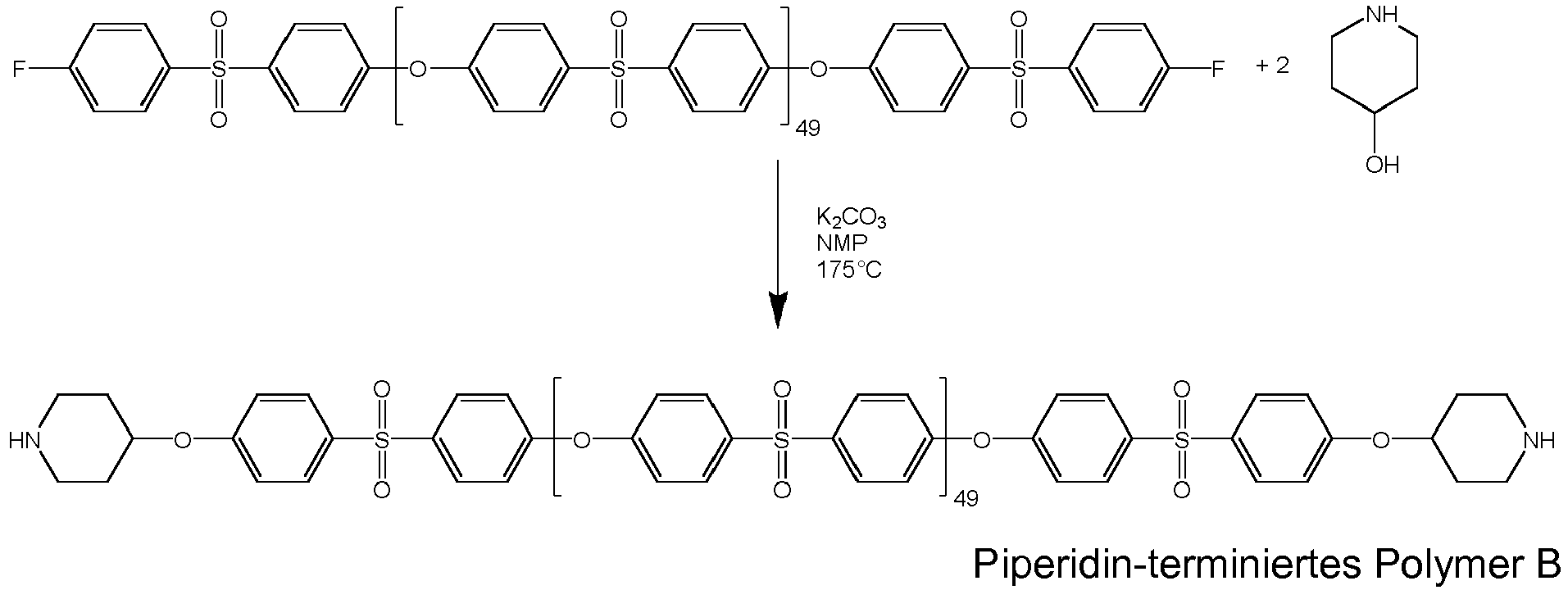
- Das Endprodukt ist ein Piperidin-terminiertes Polyethersulfon. Die Ausbeute beträgt 90 %. Die vollständige Umsetzung der Fluor-Endgruppen mit 4-Hydroxypiperidin wurde durch 1H-NMR-Spektroskopie nachgewiesen.
0,5 mmol dieses Piperidin-terminierten Polyethersulfons werden in 25 ml Dimethylsulfoxid (DMSO) gelöst und mit 4 mmol Kaliumcarbonat versetzt und auf 75 °C erhitzt. Über einen Zeitraum von 30 min werden 4 mmol Allylchlorid, gelöst in 10 ml DMSO, zu der Reaktionsmischung getropft. Nachdem das in DMSO gelöste Allylchlorid vollständig zugegeben wurde, wird die Mischung für 24 h bei 90 °C gerührt. Nach dem Abkühlen wird das mit der Verbindungsstelle X Diallylpiperidinium-terminierte Polyethersulfon in Ethanol gefällt, in frischem Ethanol bei 50 °C gerührt und abschließend abfiltriert. Das Produkt wird im Vakuum bei 50 °C getrocknet. Die Ausbeute beträgt 85 %. Die vollständige Bildung der terminalen quaternären Ammoniumsalze wurde durch 1H-NMR-Spektroskopie ermittelt.
- Danach werden zur Herstellung der Verbindung mit mehreren Anionenaustauschergruppen C, gemäß der Struktureinheit nach der allgemeinen Formel II, 0,1 mmol des Diallylpiperidinium-terminierten Polyethersulfons (Polymer B mit Verknüpfungsstellen X) und 4 mmol N,N-Diallylpyrrolidiniumchlorid (Anionenaustauschergruppe C gemäß Formel II, hergestellt analog der Vorschrift nach de Vynck et al. Macromol. Rapid Commun. 18, 1997, 149-156) in 50 ml DMSO gelöst und durch vier Gefrier-Auftauzyklen von gelöstem Sauerstoff befreit. Die Reaktionslösung wird auf 90 °C erwärmt und mit 4 mol-% AIBN versetzt, 24 h bei 90 °C unter Argonatmosphäre gerührt. Nach dem Abkühlen wird das entstandene Polyethersulfon-Poly(azoniaspiro[4,4]nonan-Blockpolymer zur Absättigung der endständigen Doppelbindungen mit Thiophenol in Gegenwart von Kupfer(I)salz behandelt und anschließend in Wasser gefällt. Bei der Reaktion möglicherweise entstandenes Homopolymer wird durch Extraktion mit Wasser in einer Soxhlett-Apparatur entfernt. Die Zusammensetzung, die mittels 1H-NMR-Spektroskopie ermittelt wurde, entspricht der Monomerzusammensetzung gemäß der Formel II. Die Ausbeute beträgt 95 %.

- Anschließend wird aus dem so hergestellten Polyethersulfon-Poly(azoniaspiro[4,4]nonan-Blockpolymer eine Membran hergestellt. Dazu werden 0,5 g Polyethersulfon-Poly(azoniaspiro[4,4]nonan-Blockpolymer in 10 ml N-Methylpyrrolidon gelöst, filtriert und in eine Petrischale mit 7 cm Durchmesser gegeben. Das Lösungsmittel N-Methylpyrrolidon wird im Vakuum für 2 h bei Raumtemperatur, anschließend für 2 h bei 40 °C, weitere 2 h bei 60 °C und dann für 24 h bei 100°C entfernt. Die resultierende Membran wird mit Wasser aus der Petrischale gelöst, in Wasser bei 70°C für 4 h gewaschen und abschließend im Vakuum bei 50 °C zur Gewichtskonstanz getrocknet.
- Die Membran aus Polyethersulfon-Poly(azoniaspiro[4,4]nonan)-Blockcopolymer weist eine Dicke (trocken) = 70 µm, eine lonenaustauscherkapazität = 1,30 mmol/g, eine Wasseraufnahme bei 80 °C = 65 % und eine Hydroxidionenleitfähigkeit (80 °C, 95 % rel. Feuchte) = 70 mS/cm auf.
- Das Membranmaterial Polyethersulfon-Poly(anoniaspiro[4,4]nonan)-Blockcopolymer wird bezüglich seiner Temperaturstabilität charakterisiert. Dazu werden 0,5 g der Membran aus Polyethersulfon-Poly(anoniaspiro[4,4]nonan)-Blockcopolymer zunächst für 24 Stunden in 2M Natronlauge gelagert, um das Anionenaustauschermaterial in die OH-Form zu überführen. Anschließend wird die Membran in 5 ml 2N Natronlauge gegeben, das Gefäß abgeschmolzen und der Inhalt 168 h bei einer Temperatur von 120°C gehalten. Nach dem Abkühlen wird das Gefäß geöffnet und das Anionenaustauschermaterial mit Wasser gewaschen und anschließend 24 h in 1M Natriumchloridlösung gelagert. Die Probe wird nochmals mit Wasser gewaschen und im Vakuum bei 50 °C bis zur Gewichtskonstanz getrocknet.
- Das Membranmaterial zeigte dabei folgende Ergebnisse, wobei die Werte jeweils vor und nach der Bestimmung der Temperaturstabilität ermittelt wurden:
- Masse
vor Test = 0,5 g, nach Test = 0,49 g,
lonenaustauscherkapazität
vor Test = 1,30 mmol/g, nach Test = 1,29 mmol/g, - Hydroxidionenleitfähigkeit (80 °C, 95 % rel. Feuchte)
vor Test = 70 mS/cm, nach Test = 69 mS/cm. - Die Unterschiede der Ergebnisse liegen im Fehlerbereich des jeweiligen Messverfahrens
- Zur Herstellung der Anionenaustauschermembran wird zuerst das wasserunlösliche Polymer B mit K, die eine Verbindungsstelle X darstellt, gemäß Beispiel 1 hergestellt. Es wird eine Lösung von 0,1 mmol Polymer B, 10 mmol N,N-Diallylpiperidiniumchlorid und 2 mmol N,N,N,N-Tetraalyllammoniumchlorid als Vernetzungsstelle V und 0,1 mmol 2,4,6-Trimethylbenzoyldiphenylphosphinoxid (DPO) als UV-Initiator, in 10 mL Dimethylsulfoxid gelöst und sorgfältig entgast. Diese Lösung wird in eine Petrischale mit 7 cm Durchmesser gegeben, die mit einer Quarzglasscheibe abgedeckt wird, und für 10 min mit UV-Licht mit einer Wellenlänge von 254 nm (Leistung 8 W) bei Raumtemperatur bestrahlt. Anschließend wird das Lösungsmittel im Vakuum bei einer Temperatur von 100 bis 120 °C entfernt. Das Anionenaustauschermaterial wird mit Wasser gewaschen und zur Absättigung der endständigen Doppelbindungen mit Thiophenol in Gegenwart von Kupfer(I)salz behandelt. Die Anionenaustauschermembran wird nochmals gründlich mit Wasser gewaschen und im Vakuum bis zur Gewichtskonstanz getrocknet. Die Membran weist eine Dicke von 100 µm (trocken), eine lonenaustauscherkapazität von 3,35 mmol/g, eine Wasseraufnahme bei 80°C von 100% und eine Hydroxydionenleitfähigkeit (80°C, 95% rel. Feuchte) von 90 mS/cm auf.

- Das Membranmaterial wird bezüglich seiner Temperaturstabilität charakterisiert. Dazu werden 0,5 g der Membran zunächst für 24 Stunden in 2M Natronlauge gelagert, um das Anionenaustauschermaterial in die OH-Form zu überführen. Anschließend wird die Membran in 5 ml 2N Natronlauge gegeben, das Gefäß abgeschmolzen und der Inhalt 168 h bei einer Temperatur von 120°C gehalten. Nach dem Abkühlen wird das Gefäß geöffnet und das Anionenaustauschermaterial mit Wasser gewaschen und anschließend 24 h in 1 M Natriumchloridlösung gelagert. Die Probe wird nochmals mit Wasser gewaschen und im Vakuum bei 50 °C bis zur Gewichtskonstanz getrocknet.
- Das Membranmaterial zeigte dabei folgende Ergebnisse, wobei die Werte jeweils vor und nach der Bestimmung der Temperaturstabilität ermittelt wurden:
- Masse
vor Test = 0,5 g, nach Test = 0,49 g, - lonenaustauscherkapazität
vor Test = 3,35 mmol/g, nach Test = 3,32 mmol/g, - Hydroxidionenleitfähigkeit (80 °C, 95 % rel. Feuchte)
vor Test = 90 mS/cm, nach Test = 88 mS/cm.
Claims (15)
- Wasserunlösliche Anionenaustauschermaterialien, mindestens bestehend aus miteinander linear polymerisierten und/oder verzweigten und/oder vernetzten Anionenaustauschergruppen C, die Bestandteil der Struktureinheiten gemäß mindestens einer der allgemeinen Formeln I bis VIII


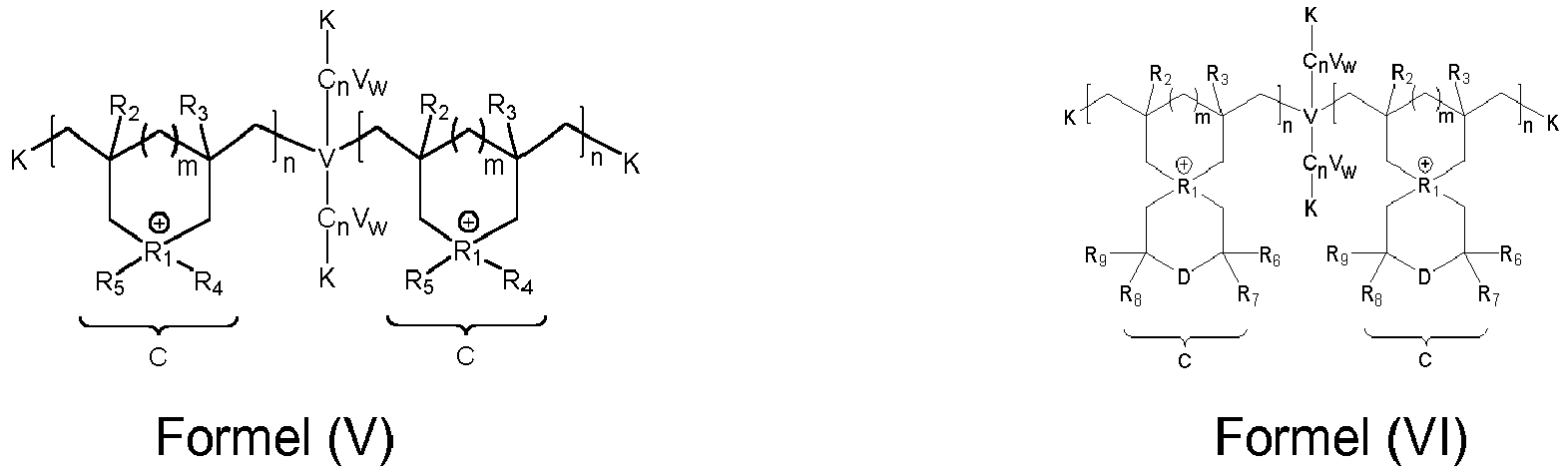
 - R1 Stickstoff und/oder Phosphor- R2 - R9 Substituenten, wobei∘ R2 und R3 Wasserstoff sind oder, im Falle dass mindestens ein Rest R2 und R3 ungleich Wasserstoff ist, dann R2 und/oder R3 ein Alkylrest oder Arylrest ist, und,∘ R4 und R5 jeweils ein Alkyl- und/oder Arylrest ist, und∘ R6 - R9 Wasserstoff sind, oder im Falle dass mindestens ein Rest R6 bis R9 ungleich Wasserstoff ist, dann diese Reste R6 bis R9 ein Alkylrest oder Arylrest ist, und- Z eine Endgruppe ist, und- X eine Verbindungsstelle ist, und- V eine Vernetzungsstelle ist, und- K eine Endgruppe Z oder eine Verbindungsstelle X ist, und- D nichts ist oder mindestens eine Methylengruppe oder Sauerstoff oder Schwefel ist, und- B ein wasserunlösliches temperaturstabiles und alkalistabiles Polymer ist, und- A ein Comonomer ist, das keine funktionelle Gruppe aufweist, und- 2 ≤n ≤ 100 ist, und- m = 0 oder 1 ist, und- 1 ≤ o ≤ 100 ist, und- 50 mol% ≤ x ≤ 99 mol% und y = (100 mol% -x) ist, und- 10 mol% ≤ w ≤ 100 mol% und (n + w) = 100mol% ist,wobei- im Falle von K mindestens eine Endgruppe Z und mindestens eine Verbindungsstelle X vorhanden sind, und- die Anionenaustauschergruppen C als Bestandteil der Struktureinheiten gemäß den allgemeinen Formeln I bis IV über eine, mehrere oder alle Verbindungsstellen X an ein wasserunlösliches Polymer B gekoppelt sind und im Wesentlichen alle Endgruppen Z eine temperatur- und alkalistabile Verbindung sind,
und/oder- die Anionenaustauschergruppe C als Bestandteil der Struktureinheiten gemäß den allgemeinen Formeln V bis VIII über die Vernetzungsstelle V miteinander vernetzt sind, und im Wesentlichen alle Endgruppen Z eine temperatur- und alkalistabile Verbindung sind und alle K, die eine Verbindungsstelle X sind, mit einem wasserunlöslichen Polymer B über kovalente chemische Bindungen gekoppelt sind,
und/oder- die Anionenaustauschergruppe C und das wasserunlöslichen Polymer B über eine oder mehrere ionische Bindungen verbunden sind. - Wasserunlösliche Anionenaustauschermaterialien nach Anspruch 1, bei denen mindestens zwei Anionenaustauschergruppen C gemäß der Formel I-IV mit einem wasserunlöslichen Polymer B über eine Verbindungsstelle X über kovalente chemische Bindungen miteinander gekoppelt sind und/oder die Anionenaustauschergruppen C über ionische Bindungen mit dem wasserunlöslichen Polymer B verbunden sind und die Endgruppen Z temperaturstabile und alkalistabile Verbindungen sind.
- Wasserunlösliche Anionenaustauschermaterialien nach Anspruch 1, bei denen die Verbindungsstelle X N,N-Diallylpiperidiniumether oder N,N-Diallylpyrrolidiniumether oder N,N-Diallylaminoethylether oder Methacrylamidethylether oder Methacrylsäureester oder Methacrylsäurehydroxypropylether oder Xylylenether oder Phenylenethersulfon ist.
- Wasserunlösliche Anionenaustauschermaterialien nach Anspruch 1, bei denen Anionaustauschergruppen C gemäß der Formel V-VIII über Vernetzungsstellen V vernetzt sind und K eine Verbindungsstelle X ist, an die das wasserunlösliche Polymer B über kovalente chemische Bindungen gekoppelt ist.
- Wasserunlösliche Anionenaustauschermaterialien nach Anspruch 1, bei denen die Endgruppen Z Alkylthioether oder Arylthioether oder Benzylthioether sind.
- Wasserunlösliche Anionenaustauschermaterialien nach Anspruch 1, bei denen das wasserunlösliche, temperaturstabile und alkalistabile Polymer B Polyethersulfon oder Polysulfon oder Polythioethersulfon oder Polyphenylen oder Polyphenylenether oder Polyphenylensulfid oder Poly(perfluorethylenpropylen) oder Polytetrafluorethylen Poly(ethylen-tetrafluorethylen) oder Perfluoralkoxypolymere oder Polystyrol oder Polyethylen oder Polypropylen oder ein sulfoniertes und/oder carboxyliertes und/oder phosphoniertes Polymer des Typs Polyethersulfon oder Polysulfon oder Polyphenylen oder Polyphenylenether oder Polyphenylensulfid oder Poly(perfluorethylenpropylen) oder Polytetrafluorethylen Poly(ethylentetrafluorethylen) oder Perfluoralkoxypolymere oder Polystyrol oder Polyethylen oder Polypropylen ist.
- Wasserunlösliche Anionenaustauschermaterialien nach Anspruch 1, bei denen das Comonomer A Styrol und/oder α-Methylstyrol und/oder N-Vinylcarbazol und/oder Methacrylester und/oder N-Vinylpyrrolidon und/oder N,N-Diallylacrylamid und/oder N,N-Diallylacrylsulfonamid und/oder Diallylether und/oder 1,2-Diallylbenzol und/oder Diallylsulfid und/oder Chlortrifluorethylen und/oder Tetrafluorethylen und/oder Hexafluorpropylen und/oder 1,2-Divinylbenzol ist.
- Wasserunlösliche Anionenaustauschermaterialien nach Anspruch 1, bei denen die Vernetzungsstelle V Tetraallylammoniumchlorid oder Tetraalkylallylammoniumchlorid oder Diallyl-Dialkylallylammoniumchlorid oder 1,4-Divinylbenzol oder Divinylsulfon oder Divinylsulfid oder Divinylsulfoxid oder Divinylether oder Diacrylamid oder Dimethacrylamid oder N,N,N',N'-Tetraallyl-4,4'-Trimethylendipiperidininiumchlorid oder N,N,N',N'-Tetraalkylallyl-4,4'-Trimethylendipiperidiniumchlorid oder N,N-Diallyl-,N',N'Dialkylallyl-4,4'-Trimethylendipiperidiniumchlorid oder N-Allyl-N,N',N'Trialkylallyl-4,4'-Trimethylendipiperidiniumchlorid oder N,N,N'-Triallyl-N'-Alkylallyl-4,4'-Trimethylendipiperidiniumchlorid oder N,N,N',N'-Tetraallylpiperaziniumchlorid oder N,N,N',N'-Tetraalkylallylpiperaziniumchlorid oder N,N-Diallyl-N',N'Dialkylallylpiperaziniumchlorid oder N-Allyl-N,N',N'Trialkylallylpiperaziniumchlorid oder N,N,N'-Triallyl-N'-Alkylallylpiperaziniumchlorid und/oder ein Bromid und/oder ein Jodid dieser Verbindungen ist.
- Wasserunlösliche Anionenaustauschermaterialien nach Anspruch 1, bei denen als Monomere für die Herstellung der Anionenaustauschergruppen C N,N-Diallyl-und/oder N,N-Dialkylallylverbindungen und/oder N-Allyl-N-Alkylallyl-Verbindungen sekundärer aliphatischer oder aromatischer oder cycloaliphatischer Amine, wie beispielsweise Diallyldimethylammoniumchlorid, Diallylpiperidiniumchlorid, Diallylpyrrolidiniumchlorid, Allyl-Methallyldimethylammoniumchlorid, Allyl-Methallylpiperidiniumchlorid, Allyl-Methallylpyrrolidiniumchlorid, Dimethallyldimethylammoniumchlorid, Dimethallylpiperidiniumchlorid, Dimethyallylpyrrolidiniumchlorid, Diallyl-3,4-Dimethylpyrrolidiniumchlorid, Diallyl-3,3,4,4-Tetramethylpyrrolidiniumchlorid, Diallyl-3,5-Dimethylpiperidiniumchlorid, Diallyl-3,3,5,5-Tetramethylpiperidiniumchlorid, Diallyl-Diphenylammoniumchlorid P,P-Diallyl- und/oder P,P-Dialkylallylverbindungen und/oder P-Allyl-P-Alkylallyl-Verbindungen sekundärer aliphatischer oder aromatischer oder cycloaliphatischer Phosphine, wie beispielsweise Diallyldimethylphophiumchlorid, Diallyldiphenylphosphoniumchlorid und/oder ein Bromid und/oder ein Jodid dieser Verbindungen eingesetzt sind.
- Wasserunlösliche Anionenaustauschermaterialien nach Anspruch 1, bei denen R1 Stickstoff ist.
- Wasserunlösliche Anionenaustauschermaterialien nach Anspruch 1, bei denen R2 und/oder R3 ein Methylrest und/oder Wasserstoff ist.
- Wasserunlösliche Anionenaustauschermaterialien nach Anspruch 1, bei denen R4 und R5 ein Alkylrest ist und vorteilhaft ein Methyl- oder Ethylrest ist.
- Wasserunlösliche Anionenaustauschermaterialien nach Anspruch 1, bei denen R6 - R9 Wasserstoff sind.
- Wasserunlösliche Anionenaustauschermaterialien nach Anspruch 1, bei denen 10 ≤ n ≤ 50 ist.
- Wasserunlösliche Anionenaustauschermaterialien nach Anspruch 1, bei denen 2 ≤ o ≤ 10 ist.
Applications Claiming Priority (1)
| Application Number | Priority Date | Filing Date | Title |
|---|---|---|---|
| DE102016207128 | 2016-04-27 |
Publications (1)
| Publication Number | Publication Date |
|---|---|
| EP3239193A1 true EP3239193A1 (de) | 2017-11-01 |
Family
ID=58664457
Family Applications (1)
| Application Number | Title | Priority Date | Filing Date |
|---|---|---|---|
| EP17166043.4A Pending EP3239193A1 (de) | 2016-04-27 | 2017-04-11 | Wasserunlösliche anionenaustauschermaterialien |
Country Status (5)
| Country | Link |
|---|---|
| US (1) | US10046319B2 (de) |
| EP (1) | EP3239193A1 (de) |
| JP (2) | JP7242160B2 (de) |
| KR (1) | KR102035116B1 (de) |
| DE (1) | DE102017206213A1 (de) |
Cited By (1)
| Publication number | Priority date | Publication date | Assignee | Title |
|---|---|---|---|---|
| CN108976554A (zh) * | 2018-06-29 | 2018-12-11 | 广西金盛科技发展有限公司 | Hdpe加筋双壁波纹管 |
Families Citing this family (9)
| Publication number | Priority date | Publication date | Assignee | Title |
|---|---|---|---|---|
| CA3019209A1 (en) * | 2016-03-28 | 2017-10-05 | University Of Delaware | Poly(aryl piperidinium) polymers for use as hydroxide exchange membranes and ionomers |
| DE102017206213A1 (de) | 2016-04-27 | 2017-11-02 | Leibniz-Institut Für Polymerforschung Dresden E.V. | Wasserunlösliche Anionenaustauschermaterialien |
| US20190060842A1 (en) * | 2017-08-22 | 2019-02-28 | Daniel M. Knauss | Functionalized poly(diallylpiperidinium) and its copolymers for use in ion conducting applications |
| JP7532253B2 (ja) * | 2017-09-28 | 2024-08-13 | ユニバーシティー オブ デラウェア | アニオン交換膜およびアイオノマーとして使用するための安定なカチオン性ペンダント基を有するものを含むポリ(アリールピペリジニウム)ポリマー |
| CN108641108B (zh) * | 2018-04-27 | 2020-07-14 | 常州大学 | 一种梳状长链型聚苯醚阴离子交换膜及其制备方法 |
| CN109289556B (zh) * | 2018-08-27 | 2021-06-08 | 浙江工业大学 | 一种利用tmdp交联的阴离子交换膜的制备方法 |
| EP3946939B1 (de) | 2019-03-28 | 2025-07-09 | University of Delaware | Polymere mit stabilen kationischen seitengruppen zur verwendung als anionenaustauschermembranen |
| PL3770201T3 (pl) * | 2019-07-22 | 2023-09-25 | Evonik Operations Gmbh | Membrana polimerowa przewodząca aniony |
| CN116425959A (zh) * | 2023-04-13 | 2023-07-14 | 中国华能集团清洁能源技术研究院有限公司 | 阴离子交换聚合物、阴离子交换膜及其制备方法和应用 |
Citations (5)
| Publication number | Priority date | Publication date | Assignee | Title |
|---|---|---|---|---|
| FR1494438A (fr) * | 1965-09-23 | 1967-09-08 | Calgon Corp | Copolymères solubles dans l'eau |
| WO2000032656A2 (en) * | 1998-12-01 | 2000-06-08 | Geltex Pharmaceuticals, Inc. | Polymers containing spirobicyclic ammonium moieties and use thereof |
| US20020028887A1 (en) * | 2000-06-16 | 2002-03-07 | Yoshiaki Hirano | Crosslinked polymer, method for manufacturing it and use thereof |
| US20100006511A1 (en) * | 2008-07-11 | 2010-01-14 | Walterick Jr Gerald C | Treatment additives and methods for treating an aqueous medium |
| WO2015088464A1 (en) * | 2013-12-13 | 2015-06-18 | Bicak Tugrul Cem | Synthesis of pure diallyl morpholinium monomers in high yields and using antibacterial effect of their spiro polymers |
Family Cites Families (5)
| Publication number | Priority date | Publication date | Assignee | Title |
|---|---|---|---|---|
| US7807755B2 (en) | 2004-05-12 | 2010-10-05 | Commonwealth Scientific And Industrial Research Organisation | Method for removing sulfur-containing end groups |
| KR20110101131A (ko) * | 2008-11-14 | 2011-09-15 | 가부시끼가이샤 도꾸야마 | 음이온 교환막 및 그 제조 방법 |
| JP5223661B2 (ja) | 2008-12-25 | 2013-06-26 | 東レ株式会社 | ポリウレタン付繊維シート状物の製造方法 |
| CN106463740B (zh) | 2014-06-13 | 2019-07-30 | 日东电工株式会社 | 阴离子交换型电解质膜、具备该电解质膜的燃料电池用的膜-电极接合体以及燃料电池 |
| DE102017206213A1 (de) | 2016-04-27 | 2017-11-02 | Leibniz-Institut Für Polymerforschung Dresden E.V. | Wasserunlösliche Anionenaustauschermaterialien |
-
2017
- 2017-04-11 DE DE102017206213.4A patent/DE102017206213A1/de active Pending
- 2017-04-11 EP EP17166043.4A patent/EP3239193A1/de active Pending
- 2017-04-26 KR KR1020170053706A patent/KR102035116B1/ko active Active
- 2017-04-26 JP JP2017087117A patent/JP7242160B2/ja active Active
- 2017-04-26 US US15/497,759 patent/US10046319B2/en active Active
-
2022
- 2022-12-15 JP JP2022200406A patent/JP7611888B2/ja active Active
Patent Citations (5)
| Publication number | Priority date | Publication date | Assignee | Title |
|---|---|---|---|---|
| FR1494438A (fr) * | 1965-09-23 | 1967-09-08 | Calgon Corp | Copolymères solubles dans l'eau |
| WO2000032656A2 (en) * | 1998-12-01 | 2000-06-08 | Geltex Pharmaceuticals, Inc. | Polymers containing spirobicyclic ammonium moieties and use thereof |
| US20020028887A1 (en) * | 2000-06-16 | 2002-03-07 | Yoshiaki Hirano | Crosslinked polymer, method for manufacturing it and use thereof |
| US20100006511A1 (en) * | 2008-07-11 | 2010-01-14 | Walterick Jr Gerald C | Treatment additives and methods for treating an aqueous medium |
| WO2015088464A1 (en) * | 2013-12-13 | 2015-06-18 | Bicak Tugrul Cem | Synthesis of pure diallyl morpholinium monomers in high yields and using antibacterial effect of their spiro polymers |
Non-Patent Citations (18)
| Title |
|---|
| BICAK N ET AL: "Synthesis and polymerization of N,N-diallyl morpholinium bromide", EUROPEAN POLYMER JOURNAL, PERGAMON PRESS LTD. OXFORD, GB, vol. 36, no. 4, 1 April 2000 (2000-04-01), pages 703 - 710, XP027211717, ISSN: 0014-3057, [retrieved on 20000401] * |
| CHEMSUSCHEM, vol. 8, 2015, pages 513 - 523 |
| GEORGE B. BUTLER ET AL: "Preparation and Polymerization of Unsaturated Quaternary Ammonium Compounds", JOURNAL OF THE AMERICAN CHEMICAL SOCIETY, vol. 71, no. 9, 1 September 1949 (1949-09-01), US, pages 3120 - 3122, XP055397898, ISSN: 0002-7863, DOI: 10.1021/ja01177a053 * |
| GUANG-JIA WANG ET AL: "Non-cross-linked and cross-linked poly(alkylmethyldiallylammonium halides): synthesis and aggregation behavior", JOURNAL OF PHYSICAL ORGANIC CHEMISTRY., vol. 11, no. 5, 1 May 1998 (1998-05-01), GB, pages 305 - 320, XP055397572, ISSN: 0894-3230, DOI: 10.1002/(SICI)1099-1395(199805)11:5<305::AID-POC8>3.0.CO;2-K * |
| J. POLYM. SCI.: PART A: POLYM. CHEM, vol. 47, 2009, pages 2043 - 2205 |
| J. POWER SOURCES, vol. 237, 2013, pages 1 - 4 |
| JOEL S. OLSSON ET AL: "Poly( N , N -diallylazacycloalkane)s for Anion-Exchange Membranes Functionalized with N -Spirocyclic Quaternary Ammonium Cations", MACROMOLECULES, vol. 50, no. 7, 11 April 2017 (2017-04-11), Washington DC United States, pages 2784 - 2793, XP055397219, ISSN: 0024-9297, DOI: 10.1021/acs.macromol.7b00168 * |
| LIEBIGS ANN. CHEM., vol. 762, 1972, pages 29 - 54 |
| M. HAHN ET AL: "Synthese, Charakterisierung und Symplexbildung von Polyampholyten aus unges?ttigten Discarbons?ure- und Allylaminderivaten. 1. Mitteilung: Synthese und Charakterisierung von Copolymeren aus Maleins?re und Allylaminderivaten", ACTA POLYMERICA, vol. 40, no. 1, 1 January 1989 (1989-01-01), DE, pages 36 - 43, XP055397544, ISSN: 0323-7648, DOI: 10.1002/actp.1989.010400108 * |
| MACROMOL. RAPID COMMUN., vol. 18, 1997, pages 149 - 156 |
| PHAM; JANNASCH, ACS MACRO LETTERS, vol. 4, 2015, pages 1370 - 1375 |
| SHAIKH A. ALI ET AL: "Synthesis and solution properties of amphiphilic cyclopolymers and terpolymers of 4-methoxycarbonyl-1,1-diallylpiperidinium chloride, diallyloctadecylammonium chloride, and sulfur dioxide", JOURNAL OF APPLIED POLYMER SCIENCE, vol. 118, no. 5, 5 December 2010 (2010-12-05), US, pages 2951 - 2958, XP055397432, ISSN: 0021-8995, DOI: 10.1002/app.32653 * |
| SHAIKH A. ALI ET AL: "Synthesis and viscosity of hydrophobically modified polymers containing dendritic segments", JOURNAL OF APPLIED POLYMER SCIENCE, vol. 109, no. 3, 5 August 2008 (2008-08-05), US, pages 1781 - 1792, XP055397485, ISSN: 0021-8995, DOI: 10.1002/app.28232 * |
| THANH HUONG PHAM ET AL: "Aromatic Polymers Incorporating Bis- N -spirocyclic Quaternary Ammonium Moieties for Anion-Exchange Membranes", ACS MACRO LETTERS, vol. 4, no. 12, 15 December 2015 (2015-12-15), pages 1370 - 1375, XP055397217, ISSN: 2161-1653, DOI: 10.1021/acsmacrolett.5b00690 * |
| THANH HUONG PHAM ET AL: "N -Spirocyclic Quaternary Ammonium Ionenes for Anion-Exchange Membranes", JOURNAL OF THE AMERICAN CHEMICAL SOCIETY, vol. 139, no. 8, 16 March 2017 (2017-03-16), pages 2888 - 2891, XP055397218, ISSN: 0002-7863, DOI: 10.1021/jacs.6b12944 * |
| VYNCK DE V ET AL: "SYNTHESIS AND POLYMERIZATION OF N,N-DIALLYLPYRROLIDINIUM BROMIDE", MACROMOLECULAR RAPID COMMUNICATIONS,, vol. 18, no. 2, 1 February 1997 (1997-02-01), pages 149 - 156, XP000684266, ISSN: 1022-1336, DOI: 10.1002/MARC.1997.030180212 * |
| VYNCK ET AL., MACROMOL. RAPID COMMUN, vol. 18, 1997, pages 149 - 156 |
| YIHUA CHANG ET AL: "Water-soluble copolymers: 57. Amphiphilic cyclocopolymers of diallylalkoxybenzyl- rnethylammonium chloride and diallyl- dimethylarnmonium chloride", 1 January 1994 (1994-01-01), XP055088860, Retrieved from the Internet <URL:http://www.sciencedirect.com/science/article/pii/0032386194909164/pdf?md5=7ab6cb295f3b8ebc0344331b84e16dce&pid=1-s2.0-0032386194909164-main.pdf> [retrieved on 20131118], DOI: 10.1016/0032-3861(94)90916-4 * |
Cited By (1)
| Publication number | Priority date | Publication date | Assignee | Title |
|---|---|---|---|---|
| CN108976554A (zh) * | 2018-06-29 | 2018-12-11 | 广西金盛科技发展有限公司 | Hdpe加筋双壁波纹管 |
Also Published As
| Publication number | Publication date |
|---|---|
| JP2023027293A (ja) | 2023-03-01 |
| JP7611888B2 (ja) | 2025-01-10 |
| KR20170122675A (ko) | 2017-11-06 |
| JP2017222839A (ja) | 2017-12-21 |
| KR102035116B1 (ko) | 2019-10-22 |
| US10046319B2 (en) | 2018-08-14 |
| JP7242160B2 (ja) | 2023-03-20 |
| US20170326540A1 (en) | 2017-11-16 |
| DE102017206213A1 (de) | 2017-11-02 |
Similar Documents
| Publication | Publication Date | Title |
|---|---|---|
| EP3239193A1 (de) | Wasserunlösliche anionenaustauschermaterialien | |
| DE102009020181B4 (de) | Sulfonierte Perfluorcyclobutanblockcopolymere und protonenleitende Polymermembranen | |
| DE102009020232B4 (de) | Sulfonierte Polyperfluorcyclobutan-Polyphenylen-Polymere für PEM-Brennstoffzellenanwendungen | |
| DE102009020231B4 (de) | Neue Protonenaustauschmembranen für Brennstoffzellenanwendungen | |
| DE60214166T2 (de) | Polymerelektrolyt für eine brennstoffzelle des festpolymertyps und brennstoffzelle | |
| DE69933129T2 (de) | Ionenaustauschpolymere | |
| DE69610322T2 (de) | Substituierte trifluorostyrol copolymere | |
| DE102009020129A1 (de) | Protonenleitende Polymerelektrolyte und Brennstoffzellen | |
| DE102009020175A1 (de) | Aus Mischungen von PFSA und sulfonierten PFCB-Polymeren zusammengesetzte Polyelektrolytmembranen | |
| DE4422158A1 (de) | Homogene Polymerlegierungen auf der Basis von sulfonierten, aromatischen Polyetherketonen | |
| DE102010034937A1 (de) | Polyelektrolyt-Membranen, bestehend aus Poly(Perfluorcyclobutanen) mit anhängigen Perfluorsulfonsäuregruppen und Mischungen mit Poly(Vinylidenfluorid) | |
| DE102010041224A1 (de) | Neuartiges amphiphiles Block-Copolymer, Verfahren zum Herstellen desselben und Polymer-Elektrolyt-Membran, in welche dieses eingesetzt wird | |
| DE102022120196A1 (de) | Seitenkettenfunktionalisierte Polystyrole als Membranmaterialien für alkalische Wasserelektrolyseure, Brennstoffzellen und Flow-Batterien | |
| WO2000051716A1 (de) | Sulfonierte aromatische polymere, membran enthaltend diese polymeren, verfahren zu deren herstellung und deren verwendung | |
| WO2002077068A2 (de) | Sulfoniertes polyetherketonketon | |
| DE60014713T2 (de) | Membranen aus Pfropfpolymeren und Ionenaustauschmenbranen daraus | |
| WO2003060011A2 (de) | Modifizierte kovalent vernetzte polymere | |
| DE112010005036T5 (de) | Polyarylen-Ionomermembranen | |
| EP0852071A2 (de) | Polymere festkörperelektrolyte auf basis funktionalisierter copoly(m-phenylen)e | |
| DE102008043935A1 (de) | Polymere MEA fpr eine Brennstoffzelle | |
| DE60213433T2 (de) | Ionenleitende polymerzusammensetzungen | |
| DE102017113976B4 (de) | Blockcopolymer und verfahren zum herstellen eines blockcopolymers | |
| DE112004003007T5 (de) | Sulfoniertes Polymer, umfassend einen hydrophoben Block des Nitriltyps, und Festpolymerelektrolyt | |
| DE602004008754T2 (de) | Ionenleitfähige polymermaterialien | |
| DE102011016350B4 (de) | Kombination von Hauptketten- und Seitenketten-Sulfonierungvon PFCB-6F-Hochtemperatur-Brennstoffzellmembranen |
Legal Events
| Date | Code | Title | Description |
|---|---|---|---|
| PUAI | Public reference made under article 153(3) epc to a published international application that has entered the european phase |
Free format text: ORIGINAL CODE: 0009012 |
|
| STAA | Information on the status of an ep patent application or granted ep patent |
Free format text: STATUS: REQUEST FOR EXAMINATION WAS MADE |
|
| 17P | Request for examination filed |
Effective date: 20170419 |
|
| AK | Designated contracting states |
Kind code of ref document: A1 Designated state(s): AL AT BE BG CH CY CZ DE DK EE ES FI FR GB GR HR HU IE IS IT LI LT LU LV MC MK MT NL NO PL PT RO RS SE SI SK SM TR |
|
| AX | Request for extension of the european patent |
Extension state: BA ME |
|
| STAA | Information on the status of an ep patent application or granted ep patent |
Free format text: STATUS: EXAMINATION IS IN PROGRESS |
|
| 17Q | First examination report despatched |
Effective date: 20190306 |