EP3240324A1 - Anschlussverfahren einer nutzerausrüstung an eine basisstation eines telekommunikationssystems - Google Patents
Anschlussverfahren einer nutzerausrüstung an eine basisstation eines telekommunikationssystems Download PDFInfo
- Publication number
- EP3240324A1 EP3240324A1 EP17168112.5A EP17168112A EP3240324A1 EP 3240324 A1 EP3240324 A1 EP 3240324A1 EP 17168112 A EP17168112 A EP 17168112A EP 3240324 A1 EP3240324 A1 EP 3240324A1
- Authority
- EP
- European Patent Office
- Prior art keywords
- base station
- user equipment
- identifier
- attachment
- module
- Prior art date
- Legal status (The legal status is an assumption and is not a legal conclusion. Google has not performed a legal analysis and makes no representation as to the accuracy of the status listed.)
- Withdrawn
Links
- 238000000034 method Methods 0.000 title claims abstract description 34
- 238000004891 communication Methods 0.000 claims description 96
- 238000007726 management method Methods 0.000 claims description 61
- 238000004590 computer program Methods 0.000 claims description 5
- 238000012790 confirmation Methods 0.000 claims description 5
- 238000013500 data storage Methods 0.000 claims 1
- 238000013523 data management Methods 0.000 description 6
- 230000001413 cellular effect Effects 0.000 description 4
- 238000013468 resource allocation Methods 0.000 description 2
- 238000012546 transfer Methods 0.000 description 2
- 238000013475 authorization Methods 0.000 description 1
- 230000005540 biological transmission Effects 0.000 description 1
- 230000007774 longterm Effects 0.000 description 1
- 238000001228 spectrum Methods 0.000 description 1
Images


Classifications
-
- H—ELECTRICITY
- H04—ELECTRIC COMMUNICATION TECHNIQUE
- H04W—WIRELESS COMMUNICATION NETWORKS
- H04W12/00—Security arrangements; Authentication; Protecting privacy or anonymity
- H04W12/06—Authentication
-
- H—ELECTRICITY
- H04—ELECTRIC COMMUNICATION TECHNIQUE
- H04W—WIRELESS COMMUNICATION NETWORKS
- H04W24/00—Supervisory, monitoring or testing arrangements
- H04W24/02—Arrangements for optimising operational condition
-
- H—ELECTRICITY
- H04—ELECTRIC COMMUNICATION TECHNIQUE
- H04W—WIRELESS COMMUNICATION NETWORKS
- H04W48/00—Access restriction; Network selection; Access point selection
- H04W48/18—Selecting a network or a communication service
-
- H—ELECTRICITY
- H04—ELECTRIC COMMUNICATION TECHNIQUE
- H04W—WIRELESS COMMUNICATION NETWORKS
- H04W60/00—Affiliation to network, e.g. registration; Terminating affiliation with the network, e.g. de-registration
-
- H—ELECTRICITY
- H04—ELECTRIC COMMUNICATION TECHNIQUE
- H04W—WIRELESS COMMUNICATION NETWORKS
- H04W8/00—Network data management
- H04W8/02—Processing of mobility data, e.g. registration information at HLR [Home Location Register] or VLR [Visitor Location Register]; Transfer of mobility data, e.g. between HLR, VLR or external networks
Definitions
- the present invention relates to the field of telecommunications and relates more particularly to a method of attaching a user equipment to a base station of a telecommunications system and a user equipment, a base station, a telecommunications system comprising such user equipment and such a base station, and a computer program.
- Private mobile radiocommunications (PMR) networks are used by security services professionals (armed forces, police, ambulances, firefighters, etc.), building companies and public works companies, for example. Of the industry. Such networks are closed networks using dedicated resources, i.e. only a group of predetermined user equipment can use these resources to communicate with each other.
- the narrow-band PMR networks use a plurality of narrow width dedicated frequency bands and may be, for example, Tetra, Tetrapol or P25 type PMR networks known to those skilled in the art.
- Narrow-band PMR networks are limited in bandwidth because of the limited number of available frequency resources, and thus only allow the transmission of voice or low-rate data. By way of example, it is not possible to transmit a video communication between two user equipments through such a network.
- a telecommunications system operating in narrow frequency bands, used in particular in military applications, comprising a plurality of mobile base stations to each of which is attached a plurality of mobile user equipment.
- Each user equipment is associated only with one and only one predetermined base station so as to form with it an autonomous mobile cell.
- Each autonomous cell thus constitutes an independent band-narrow PMR network, for example using separate frequency bands to communicate.
- a user equipment associated with a first base station may connect to a second base station to communicate in an emergency or if the first base station with which it is associated is connected by a communication link temporary direct with the second base station.
- Broadband PMR networks use at least one wide band of frequencies in which the signals of a plurality of narrow width dedicated frequency bands are frequency modulated so as to spread their spectrum over at least a portion of the width of the band. wide band.
- Such a modulation makes it possible to exchange data at high data rates, for example greater than 1 Mb / s, in particular to communicate by video or to send data files.
- Such broadband networks may, for example, be "Universal Mobile Terrestrial Communication" (UMTS) or "Long Term Evolution” (LTE) networks defined within the framework of the third generation partnership project. 3GPP, better known as 3GPP (Third Generation Partnership Project in English).
- the user equipment In broadband communication networks, for example of the 3GPP LTE type, the user equipment is not associated with a predetermined base station and can be attached to any base station of the network. Thus, when user equipment wishes to attach to a base station to communicate, it sends an attachment request, via one of the base stations, to a resource allocation entity located in the base station. network which then selects the most suitable base station for the user equipment to establish a communication, for example the base station whose signal received by the user equipment is the most powerful or the station of base that has the largest number of bandwidth resources available.
- a user equipment to a base station as it is defined today in broadband networks such as, for example, 3GPP LTE networks, is therefore not compatible with a system.
- autonomous-cell telecommunications systems operating in narrow frequency bands as previously presented since in such a system, a user equipment must attach to the base station with which it is associated while in a broadband network a user equipment attaches a base station which is selected by a resource allocation entity located in the network.
- the invention firstly relates to a method of attaching a user equipment, preferably mobile, to a first base station of a broadband telecommunications system, said method being remarkable in that, the first base station comprising a first mobility management module identified by a first identifier, the method comprises a step of receiving an attachment request, sent by said user equipment, comprising a second identifier of a mobility management module and, when the second identifier is identical to the first identifier, a step of attachment of the user equipment to the first base station.
- attachment and “attachment” is meant that the user equipment is allowed to connect to the first base station to communicate application data.
- application data is meant data exchanged in the context of an application such as, for example, a communication application by voice, video, file exchange application etc.
- a base station is associated with one or a plurality of predetermined user facilities that are allowed to attach to said base station using an identifier corresponding to the identifier of its mobility management module.
- a user equipment is associated with one and only one base station, i.e. a user equipment sends only attachment requests including the station identifier. basis to which it was previously associated.
- Each base station and its associated user equipment or equipment thus constitute an autonomous cell, preferably mobile, the base station being able to connect to another base station via a direct communication link or via a broadband telecommunications network.
- the attachment step comprises an authentication of the user equipment.
- the attachment of the user equipment to the first base station is denied when the second identifier is different from the first identifier.
- attachment of the user equipment to the first base station is allowed when the second identifier is different from the first identifier and the first base station is connected via a communication link. , preferably an Internet Protocol (IP) type communication link known to those skilled in the art, to a second base station comprising a second mobility management module identified by a third identifier, identical to the second identifier.
- IP Internet Protocol
- the attachment step may comprise a sub-step of authorization of access and / or authentication of the user equipment with the second mobility management module.
- the attachment request further includes information on the nature of the attachment request, urgent or non-urgent, and the attachment of the user equipment to the first station.
- Basic is allowed when the second identifier is different from the first identifier and the attachment request is of an urgent nature.
- the urgent nature of the request indicates that the user equipment must attach to the first base station even though it is not associated with said first base station (but at another base station) and it is therefore not allowed to attach to the first base station when the nature of the request for attachment is non-urgent.
- Such an emergency may occur, for example, when the user equipment needs to establish an emergency call while it is not in the cellular coverage of the base station to which it is is associated and is in the cellular coverage of the first base station.
- the base station is preferably a mobile base station but may also be a fixed base station.
- the method comprises a preliminary step of selecting an operating mode from an autonomous mobile cell operating mode for which the method as presented above is implemented, or a mode of operation in a wide telecommunications network.
- a band in which the first base station is connected via said network to a plurality of base stations, for example fixed stations, and allows any user equipment to attach, for example depending on its proximity or band resources available.
- This last mode of network operation corresponds, for example, to the operation of a 3GPP UMTE or public LTE network (commercial i.e.).
- the telecommunications network is preferably a 3GPP network of UMTS, LTE, LTE-Advanced or later type.
- the invention also relates to a method of attaching a user equipment, preferably mobile, to a base station of a broadband telecommunications system, said method being remarkable in that, said base station comprising a mobility management module, the method comprises a step of sending, by said user equipment, an attachment request comprising an identifier of said mobility management module so as to attach the equipment of user at the base station.
- the method comprises a generation step on the part of the user equipment of a request comprising at least one information on the non-urgent or urgent nature of the communication, a sending step on the part of the user. the user equipment of said request to the base station and a step of receiving a return message sent by the base station, said return message indicating that the attachment is made when the communication is urgent or comprising confirmation information the state of attachment when the communication is non-urgent.
- the invention also relates to a user equipment comprising a radio communication unit, configured to communicate with a communication module radio of a base station of a broadband telecommunications system, and an attachment unit, configured to generate a base station attachment request including a second identifier of a mobility management module and to send it to said base station, via the radio communication unit, for the purpose of attaching the user equipment to the base station.
- a radio communication unit configured to communicate with a communication module radio of a base station of a broadband telecommunications system
- an attachment unit configured to generate a base station attachment request including a second identifier of a mobility management module and to send it to said base station, via the radio communication unit, for the purpose of attaching the user equipment to the base station.
- the user equipment comprises an application unit configured to exchange application data with an application module of a base station.
- the invention also relates to a base station of a broadband telecommunications system, said base station being remarkable in that it comprises a mobility management module identified by a first identifier and a configured radio communication module. for receiving, from a user equipment, an attachment request comprising a second identifier of a mobility management module, the mobility management module being configured for, when the second identifier is identical to the first identifier , attach the user equipment to the base station.
- the communication module of the base station is advantageously an eNodeB.
- the base station comprises a user data module, connected to the mobility management module, configured to store and manage data associated with user equipment so as to authorize or not their attachment to the base station.
- the base station further comprises a servant gateway module, a network gateway module and / or an application module, said servant gateway module being configured to route, that is to say directing data packets between the data packet gateway module and the radio communication module, said data packet gateway module being configured to communicate data packets with an entity external to the base station via a communication link, said application module being configured to exchange application data with an application unit of a user equipment.
- the invention also relates to a system comprising at least one user equipment as presented above and at least one base station as presented above.
- the invention also relates to a computer program comprising instructions for implementing the method of the invention implemented by a base station when the program is executed by at least one processor.
- the invention also relates to a computer program comprising instructions for implementing the method of the invention implemented by a base station when the program is executed by at least one processor.
- the system according to the invention is described below as part of a 3GPP LTE network infrastructure. This is not however limiting the scope of the present invention insofar as the invention can be applied to any type of adapted telecommunications network such as, for example, a UMTS 3GPP network, an LTE-Advanced network, or even a GPRS or GSM type network.
- a UMTS 3GPP network such as, for example, a UMTS 3GPP network, an LTE-Advanced network, or even a GPRS or GSM type network.
- the figure 1 illustrates an embodiment of the telecommunications system 1 according to the invention.
- the system 1 comprises a first mobile cell 10A, a second mobile cell 10B, a third mobile cell 10C1, a fourth mobile cell 10C2 and a fifth fixed cell 10D (illustrated by FIG. figure2 ), all belonging to the same network identified by a network identifier (Public Land Mobile Network Identifier in English).
- a network identifier Public Land Mobile Network Identifier in English.
- the first mobile cell 10A comprises a first mobile base station 12A to which is attached a first plurality of mobile user equipment 14A.
- the second mobile cell 10B comprises a second mobile base station 12B to which is attached a second plurality of mobile user equipment 14B.
- the first mobile cell 10A and the second mobile cell 10B are autonomous mobile cells which operate independently of one another and which can, for example, move respectively in a direction FA and in a direction FB.
- the third mobile cell 10C1 comprises a third mobile base station 12C1 to which is attached a third plurality of mobile user equipment 14C1 and the fourth mobile cell 10C2 comprises a fourth mobile base station 10C2 to which is attached a fourth plurality of 14C2 mobile user equipment.
- the third base station 12C1 and the fourth base station 10C2 are connected by a communication link L1, for example of the IP type, so that a user equipment of the third plurality of user equipment 14C1 can be connected. to attach to the fourth base station 12C2 to communicate with the third mobile cell 10C1 via the communication link L1 and / or that a user equipment of the fourth plurality of user equipment 14C2 can attach to the third base station 12C1 for communicating with the fourth mobile cell 10C2 via the communication link L1.
- the third mobile cell 10C1 and the fourth cell 10C2 mobile units are autonomous mobile cells which operate independently of one another while being coupled, via the communication link L1, and which can, for example, move together in an FC direction.
- the fifth cell 10D, fixed, illustrated in the figure 2 comprises a fifth station of the fifth fixed cell 10D, illustrated in FIG.
- figure 2 includes a fifth fixed base station 12D to which the first plurality of user equipment 14A, the second plurality of user equipment 14B, the third plurality of user equipment 14C1 and or the fourth plurality of user equipment 14C2, for example when in the cellular coverage of the fifth fixed base station 10D and the first mobile base station 10A, the second base station 10B mobile, the third mobile base station 10C1 and / or the fourth mobile base station 10C2 are deactivated.
- the first base station 12A, the second base station 12B, the third base station 12C1 and the fourth base station 12C2 may be mounted on mobile vehicles while the fifth base station 12D may be mounted on a building or a temporary structure.
- the first base station 12A, the second base station 12B, the third base station 12C1 and the fourth base station 12C2 are described functionally hereinafter with reference to a base station 12 illustrated in FIG. figure 3 .
- the user equipment 14A, 14B, 14C1 and 14C2 are described functionally hereinafter with reference to a user equipment 14 illustrated in FIG. figure 4 .
- FIG 3 schematically illustrates an embodiment of a base station 12 according to the invention.
- a base station 12 is in the form of a node comprising a radio communication module 50, a mobility management module 60, a user data module 65, a serving gateway module 70, network gateway module for data packets 80 and an application module 90.
- the radio communication module 50 constitutes an entity known as "eNodeB" in the 3GPP LTE terminology.
- the radio communication module 50 is configured to enable one or a plurality of application data communications between the application module 90 and one or a plurality of user equipment 14 attached to the base station 12.
- the radio communication module 50 is further configured to receive an attachment request to the base station 12, sent by a user equipment 14.
- the mobility management module 60 of a base station 12 is characterized by a first identifier, unique and unique to it, so that only the user equipment 14 which has knowledge of this first identifier can request to be attached. at this base station 12.
- the mobility management module 60 is configured to manage the mobility of a user equipment 14 according to the mobility management function defined in the 3GPP standards under the name of "MME" (Mobile Management Entity) known to the user. skilled person.
- MME Mobile Management Entity
- the mobility management entity MME 60 is configured to establish and control LTE transport links ("LTE Bearers") between the radio communication module 50, the serving gateway module 70, the gateway module of network for data packets 80 and user equipment 14 for communicating application data packets between the user equipment (s) 14 attached to the base station 12 and the application module 90.
- LTE Bearers LTE transport links
- the MME mobility management entity 60 controls the communications of the user equipment 14 between the radio communication module 50 and the serving gateway module 70.
- the mobility management module 60 is configured to allow the attachment of a user equipment 14 to the base station 12 when a second identifier, sent in an attachment request by said equipment of user 14 to said base station 12 via the radio communication module 50, corresponds to a first identifier of the mobility management module 60 of the base station 12.
- the mobility management module 60 makes it possible, in particular, to authenticate a user equipment 14: indirectly, with the user data management module 65 during a first attachment request sent by a piece of equipment. 14, or directly, for a user equipment 14 already attached to the base station 12.
- the user data module 65 is configured to store and manage data associated with the user equipment 14 authorized to attach to the base station 12 via the radio communication module 50 and the management module.
- mobility 60 according to the user database function defined in the 3GPP standards under the name "HSS" (Home Subscriber Server) known to those skilled in the art.
- HSS Home Subscriber Server
- the data of the user data module 65 enables the mobility management module 60, from a second identifier, received from a user equipment 14 in an attachment request, to authorize, or not to the attachment of said user equipment 14 to the base station 12.
- the data of the user data module 65 may, for example, be authentication keys, information on the rights of the user equipment, etc.
- the gateway module 70 is configured to route, that is to say, route, data packets between the data packet network gateway module 80 and the radio communication module 50 according to the routing function defined in the 3GPP standards under the name of "SGW” (Serving Gateway) known to those skilled in the art.
- SGW Serving Gateway
- the data packet network gateway module 80 is an access point configured to communicate data packets with the application module 90 via a communication link, for example of the Internet Protocol (IP) type, according to the routing function. defined in 3GPP standards under the name of "PGW" (Packet Data Network Gateway or PGW) known to those skilled in the art.
- IP Internet Protocol
- the application module 90 is configured to manage applications, for example of the "push-to-talk" voice communication or video communication type, known to those skilled in the art, used by the user equipment 14, in particular by communicating application data with said user equipment 14.
- the third mobile base station 12C1 is connected to the fourth mobile base station 12C2 via a communication link L1.
- This communication link L1 may be an IP-IP communication link made at the application level above the data packet network gateway modules 80 of the third base station 12C1 and the fourth base station 12C2.
- This communication link L1 can also be a communication link between the data packet network gateway module 80 of the third base station 12C1 and the servant gateway module 70 of the fourth base station 12C2 or a link of communication between the data packet network gateway module 80 of the fourth base station 12C2 and the serving gateway module 70 of the third base station 12C1 (interface S5 of the 3GPP LTE standard).
- this communication link L1 is a communication link between, on the one hand, the radio communication module 50 of the third base station 12C1 and, on the other hand, the mobility management module 60 and the gateway module 70 of the fourth base station 12C2 or a communication link between, on the one hand, the radio communication module 50 of the fourth base station 12C2 and, on the other hand, the management module of the mobility 60 and the gateway module 70 of the third base station 12C1 (3GPP LTE interface S1).
- the radio communication module 50 of the third base station 12C1 (respectively of the fourth base station 12C2) can thus advantageously access both the mobility management module 60 of the third base station 12C1 and of the fourth base station 12C2 (respectively of the fourth base station 12C2 and the third base station 12C1) to verify that the first identifier provided by a user equipment 14 corresponds to a mobility management module 60 which is accessible to him.
- the figure 4 schematically illustrates a user equipment 14 according to the invention.
- Such user equipment 14 comprises a radio communication unit 100, an attachment unit 110 to a base station 12 and an application unit 120.
- the radio communication unit 100 is configured to communicate, on an eUTRAN radio interface defined in the LTE standard, with the radio communication module 50 of a base station 12.
- the attachment unit 110 is configured to generate an attachment request to a base station 12 and send it, via the radio communication unit 100, for the purpose of attaching the equipment
- This attachment unit 110 may be, for example, implemented by the Radio Resource Control (RRC) in the 3GPP terminology.
- RRC Radio Resource Control
- the application unit 120 is configured to manage applications, for example, type voice communication "push-to-talk" or video communication, known to the man of the business, in particular by communicating application data with a base station 12.
- the method according to the invention may comprise a preliminary step of selecting an operating mode from an autonomous mobile cell operating mode or a wideband telecommunications network operating mode.
- a first base station is connected via said network to a plurality of base stations, for example fixed, and allows any user equipment to attach, for example to depending on its proximity or available bandwidth resources.
- This last mode of network operation corresponds, for example, to the standard operation of a public or commercial 3GPP UMTS or LTE network as defined in the 3GPP standard, mainly in the TS 36.300 specification (eUTRAN overall description - Stage2). ), as well as in specification TS23.401 (GPRS enhancement for eUtran).
- the broadband telecommunications network is preferably a 3GPP network of UMTS, LTE, LTE-Advanced or later type.
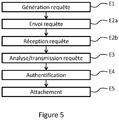
- the figure 5 illustrates a mode of implementation of the method according to the invention by a base station 12A of an autonomous cell 10A (with reference to the figure 1 ) not coupled to another cell and in the case of non-urgent communication.
- the mobility management module 60 of said base station 12A is identified by a first identifier.
- the attachment unit 110 of the user equipment 14A generates an attachment request comprising a second identifier of a mobility management module for attachment to the base station 12A.
- the attachment request thus generated is sent, in a step E2a, by the radio communication unit 100 of the user equipment 14A to the radio communication module 50 of the base station 12A which receives it in a step E2b .
- the radio communication module 50 analyzes the second identifier and transmits the attachment request to the mobility management module 60 of the base station 12A when the second identifier is identical to the first identifier in a step E3.
- the mobility management module 60 then allows the authentication, in a step E4, of the user equipment 14A in order to allow it to attach to the base station 12A in a step E5.
- the mobility management module 60 relays the attachment request of the user equipment 14A to the user data management module 65 which then performs the authentication.
- the user equipment 14A (which is transparent for the mobility management module 60 and the radio communication module 50) in a manner known to those skilled in the art. If this first authentication has been successful, then the mobility management module 60 receives derived keys from the user data management module 65 which will be used for future communications with the user equipment 14A. Thus, each time the user equipment 14A connects or attaches to the network later, the mobility management module 60 itself performs the authentication (which is transparent for the radio communication module 50). in a manner known to those skilled in the art.
- the radio communication module 50 receives from the mobility management module 60 a temporary key valid only for the time of communication with the user equipment 14A. Upon receipt of this key, the exchanges between the user equipment 14A and the radio communication module 50 are encrypted and "honest". If on each of these attempts of authentication, there is a failure, the user equipment 14A is either rejected from the network (authentication case rejected at the level of the user data management module 65), or is invited to re-authenticate with the user data management module 65 (failure case with the mobility management module 60 or the radio communication module 50).
- the confirmation of attachment of the user equipment is carried out in the following way (see 3GPP TS 23.401 ⁇ 5.3.2.1, figure 5.3.2.1-1): after having sent an attachment request (" attach request "see step 1) and once the identity management, authentication, and ciphering procedures have been performed, the user equipment receives an acceptance message (" attach accept "see step 18). Finally the user equipment confirms its attachment by sending a confirmation message ("attach complete” see step 22).
- the attachment request may be the "RRC Connection Complete” request defined in the "RRC Connection Establishment” procedure described in 3GPP TS36.331 in which the value of the "registeredMME" field was filled in with the identifier of the mobility management module 60 of the reference base station 12 of the user equipment 14.
- the mobility management module 60 Upon initial attachment of a user equipment 14 to a base station 12, the mobility management module 60 generates and sends a temporary mobile subscriber identity called System Network Evolution - Temporary Mobile Subscriber (S-TMSI). Evolution) in the 3GPP standard that allows user equipment to remain attached to base station 12 even if it does not communicate with it.
- S-TMSI System Network Evolution - Temporary Mobile Subscriber
- the module of the management of the mobility 60 denies the user equipment 14 to attach to the base station 12 except in two particular cases.
- a first case relates to an emergency call and a second case corresponds to the case where two base stations are coupled ("bounding cells" in English).
- any user equipment 14 In the case of emergency communication, any user equipment 14 must be able to attach to any base station 12 in order to communicate. In other words, a user equipment 14 must be able to communicate via a base station 12 for which it does not know the identifier of the mobility management module 60.
- the attachment unit 110 of the user equipment In an emergency, the attachment unit 110 of the user equipment generates an attachment request comprising information on the urgent nature of the communication to be established and transmits it to the radio communication unit 100.
- the radio communication unit 100 then sends said attachment request to the radio communication module 50 of the base station or stations in whose coverage it is located.
- the radio communication module 50 transmits the attachment request to the mobility management module 60 which thus receives the information on the urgent nature of the communication to be established (for example the "establishment cause” field of a request "RRC Connection Request "defined in the 3GPP standard) and authorizes the attachment of user equipment 14 to base station 12.
- FIG. 1 This example is illustrated by the figure 1 in which a first base station 12C1, comprising a first mobility management module 60 identified by a first identifier, is connected via a direct communication link L1, for example of the type Internet Protocol (IP), to a second base station 12C2 comprising a second mobility management module 60 identified by a third identifier.
- IP Internet Protocol
- the attachment unit 110 of a user equipment 14C2 located in the cellular cover of the second base station 12C2 generates in a step E1 an attachment request comprising a second identifier in order to attach to the first base station 12C1.
- the attachment request thus generated is then sent, in a step E2, by the radio communication unit 100 of the user equipment 14C2 to the radio communication module 50 of the second base station 12C2.
- the radio communication module 50 of the second base station 12C2 analyzes the second identifier and compares it to the third identifier.
- the radio communication module 50 of the second base station 12C2 compares it with the first identifier of the mobility management module 60 of the first base station 12C1 because it is connected to the second base station 12C2 and that the mobility management module 60 of the first base station 12C1 is thus accessible via the communication link L1.
- the mobility management module 60 of the second base station 12C2 authenticates the user equipment 14C2 with the user data module 65 of the first base station 12C1 via the data module.
- serving gateway 70 and the data packet network gateway module 80 of the second base station 12C2 the IP communication link and the serving gateway module 70 and the data packet network gateway module 80 of the first 12C1 base station to allow the attachment of the user equipment 14C2 to the second base station 12C2 so that it can communicate via the second base station 12C2, the IP communication link and the first station base 12C1, for example with another user equipment 14C1 attached to the first base station 12C1.
- the base stations 12A, 12B, 12C1 and 12C2 When the base stations 12A, 12B, 12C1 and 12C2 are deactivated, it may be provided to attach the user equipment 14A, 14B, 14C1 and 14C2 attached thereto to a common base station 12D fixed in this example , of a common cell 10D illustrated in the figure 2 .
- Attachment of the user equipment 14A, 14B, 14C1 and 14C2 is accomplished by carrying out attachment transfer of their reference base station 12A, 12B, 12C1 and 12C2 to the common base station 12D.
- Such a transfer (handover in English language) is defined in the 3GPP standards and is therefore known to those skilled in the art.
- Such a case can occur, for example, when mobile base stations are mounted on vehicles and the vehicles return to a regrouping point (camp) to refuel.
- camp regrouping point
Landscapes
- Engineering & Computer Science (AREA)
- Computer Networks & Wireless Communication (AREA)
- Signal Processing (AREA)
- Computer Security & Cryptography (AREA)
- Databases & Information Systems (AREA)
- Mobile Radio Communication Systems (AREA)
Applications Claiming Priority (1)
| Application Number | Priority Date | Filing Date | Title |
|---|---|---|---|
| FR1653722A FR3050898B1 (fr) | 2016-04-27 | 2016-04-27 | Procede d'attachement d'un equipement d'utilisateur a une station de base d'un systeme de telecommunications |
Publications (1)
| Publication Number | Publication Date |
|---|---|
| EP3240324A1 true EP3240324A1 (de) | 2017-11-01 |
Family
ID=56943621
Family Applications (1)
| Application Number | Title | Priority Date | Filing Date |
|---|---|---|---|
| EP17168112.5A Withdrawn EP3240324A1 (de) | 2016-04-27 | 2017-04-26 | Anschlussverfahren einer nutzerausrüstung an eine basisstation eines telekommunikationssystems |
Country Status (3)
| Country | Link |
|---|---|
| US (1) | US20170318552A1 (de) |
| EP (1) | EP3240324A1 (de) |
| FR (1) | FR3050898B1 (de) |
Citations (4)
| Publication number | Priority date | Publication date | Assignee | Title |
|---|---|---|---|---|
| US20120094627A1 (en) * | 2009-04-17 | 2012-04-19 | Samsung Electronics Co., Ltd. | Emergency call service providing method and system thereof |
| US20130012165A1 (en) * | 2011-07-08 | 2013-01-10 | Motorola Solutions, Inc. | Method and apparatus for attaching a wireless device to a foreign 3gpp wireless domain using alternative authentication mechanisms |
| EP2763496A1 (de) * | 2011-09-30 | 2014-08-06 | Nec Corporation | Kommunikationssystem, -verfahren und -vorrichtung |
| US20150334615A1 (en) * | 2014-05-19 | 2015-11-19 | Cisco Technology, Inc. | System and method for identifying a subscriber in a network environment |
Family Cites Families (1)
| Publication number | Priority date | Publication date | Assignee | Title |
|---|---|---|---|---|
| US9686647B2 (en) * | 2012-01-17 | 2017-06-20 | Comcast Cable Communications, Llc | Mobile WiFi network |
-
2016
- 2016-04-27 FR FR1653722A patent/FR3050898B1/fr active Active
-
2017
- 2017-04-26 EP EP17168112.5A patent/EP3240324A1/de not_active Withdrawn
- 2017-04-27 US US15/498,879 patent/US20170318552A1/en not_active Abandoned
Patent Citations (4)
| Publication number | Priority date | Publication date | Assignee | Title |
|---|---|---|---|---|
| US20120094627A1 (en) * | 2009-04-17 | 2012-04-19 | Samsung Electronics Co., Ltd. | Emergency call service providing method and system thereof |
| US20130012165A1 (en) * | 2011-07-08 | 2013-01-10 | Motorola Solutions, Inc. | Method and apparatus for attaching a wireless device to a foreign 3gpp wireless domain using alternative authentication mechanisms |
| EP2763496A1 (de) * | 2011-09-30 | 2014-08-06 | Nec Corporation | Kommunikationssystem, -verfahren und -vorrichtung |
| US20150334615A1 (en) * | 2014-05-19 | 2015-11-19 | Cisco Technology, Inc. | System and method for identifying a subscriber in a network environment |
Non-Patent Citations (2)
| Title |
|---|
| "3rd Generation Partnership Project; Technical Specification Group Radio Access Network; Evolved Universal Terrestrial Radio Access (E-UTRA); Radio Resource Control (RRC); Protocol specification (Release 13)", 3GPP STANDARD; 3GPP TS 36.331, 3RD GENERATION PARTNERSHIP PROJECT (3GPP), MOBILE COMPETENCE CENTRE ; 650, ROUTE DES LUCIOLES ; F-06921 SOPHIA-ANTIPOLIS CEDEX ; FRANCE, vol. RAN WG2, no. V13.1.0, 1 April 2016 (2016-04-01), pages 1 - 551, XP051088537 * |
| "3rd Generation Partnership Project; Technical Specification Group Services and System Aspects; General Packet Radio Service (GPRS) enhancements for Evolved Universal Terrestrial Radio Access Network (E-UTRAN) access (Release 13)", 26 April 2016 (2016-04-26), XP051115842, Retrieved from the Internet <URL:http://www.3gpp.org/ftp/tsg_sa/WG2_Arch/Latest_SA2_Specs/DRAFT_INTERIM/Archive/> [retrieved on 20160426] * |
Also Published As
| Publication number | Publication date |
|---|---|
| FR3050898B1 (fr) | 2018-05-25 |
| US20170318552A1 (en) | 2017-11-02 |
| FR3050898A1 (fr) | 2017-11-03 |
Similar Documents
| Publication | Publication Date | Title |
|---|---|---|
| US11690005B2 (en) | Network slice for visited network | |
| US10462828B2 (en) | Policy and billing services in a cloud-based access solution for enterprise deployments | |
| EP1041737B1 (de) | Knoten und Station an Bord eines Fahrzeuges zur Verbindungsaufnahme mit einem Fahrzeuginsassen | |
| EP3771161B1 (de) | Auswahl einer instanziierung eines teilnetzes für die uplink-paketübertragung | |
| FR2764154A1 (fr) | Dispositif permettant de fournir des services de facturation a un groupe mobile d'utilisateurs d'un systeme de telecommunications | |
| FR2842055A1 (fr) | Procede pour controler l'acces a un systeme cellulaire de radiocommunication a travers un reseau local sans fil, et organe de controle pour la mise en oeuvre du procede | |
| FR2814030A1 (fr) | Procede et dispositif de connexion d'un terminal a plusieurs reseaux de telecommunications | |
| EP1524798A1 (de) | Drahtloses Netzwerk für die Leitung von der Zuweisung von einem Frequenzband dass zur Übertragung von Prioritätenbitten von einer Verbindungseinrichtung reserviert wurde | |
| US20240276213A1 (en) | Security for store and forward service via satellite access | |
| EP3440859A1 (de) | Verfahren zur registrierung eines mobilen endgeräts in einem mobilkommunikationsnetzwerk | |
| CN118138100A (zh) | 通信方法及装置 | |
| EP2625925A1 (de) | Verfahren zur identifizierung eines host-netzwerkes eines benutzerendgerätes aus mindestens zwei eine funkkommunikationsinfrastruktur bildenden netzwerken | |
| FR2970829A1 (fr) | Procede d'attachement d'un terminal utilisateur a un reseau de paquets | |
| EP2438735A1 (de) | VERFAHREN ZUM BERECHNEN EINER ERSTEN KENNUNG EINES SICHEREN ELEMENTS EINES MOBILEN ENDGERÄTS GEMÄß EINER ZWEITEN KENNUNG DES SICHEREN ELEMENTS | |
| FR3037762A1 (fr) | Terminal et procede d'activation d'une pile protocolaire | |
| EP3772844A1 (de) | Interoperabilitätsvorrichtung zum verbinden mehrerer kommunikationsnetze, entsprechendes system und verfahren | |
| EP3240324A1 (de) | Anschlussverfahren einer nutzerausrüstung an eine basisstation eines telekommunikationssystems | |
| EP3366069B1 (de) | Hybrider residential gateway | |
| EP2982149A1 (de) | Verfahren zum transport von positionsinformationen über eine authentifizierung | |
| EP1944992A1 (de) | Abschlusssystem für Anrufe an Mobilnummern über IP ohne Mitwirkung des Mobilfunknetzes | |
| EP3675542A1 (de) | Steuerungsvorrichtung und -verfahren der gegenseitigen authentifizierung für die direkte kommunikation zwischen mobilen strukturen eines mobilfunksystems | |
| US12483973B2 (en) | Method and system for reachability of services specific to one specific network access over a different network access and system thereof | |
| EP3777309A1 (de) | Orchestratorvorrichtung in zellularem telekommunikationssystem | |
| FR2981235A1 (fr) | Procede d'attachement entre au moins un reseau mobile et un reseau distant | |
| CN119865867A (zh) | 非陆地网络(ntn)接入中的本地路由 |
Legal Events
| Date | Code | Title | Description |
|---|---|---|---|
| PUAI | Public reference made under article 153(3) epc to a published international application that has entered the european phase |
Free format text: ORIGINAL CODE: 0009012 |
|
| AK | Designated contracting states |
Kind code of ref document: A1 Designated state(s): AL AT BE BG CH CY CZ DE DK EE ES FI FR GB GR HR HU IE IS IT LI LT LU LV MC MK MT NL NO PL PT RO RS SE SI SK SM TR |
|
| AX | Request for extension of the european patent |
Extension state: BA ME |
|
| 17P | Request for examination filed |
Effective date: 20180430 |
|
| RBV | Designated contracting states (corrected) |
Designated state(s): AL AT BE BG CH CY CZ DE DK EE ES FI FR GB GR HR HU IE IS IT LI LT LU LV MC MK MT NL NO PL PT RO RS SE SI SK SM TR |
|
| 17Q | First examination report despatched |
Effective date: 20190222 |
|
| STAA | Information on the status of an ep patent application or granted ep patent |
Free format text: STATUS: THE APPLICATION IS DEEMED TO BE WITHDRAWN |
|
| 18D | Application deemed to be withdrawn |
Effective date: 20190905 |