EP3240432B1 - Flüssiges espressokonzentrat - Google Patents
Flüssiges espressokonzentrat Download PDFInfo
- Publication number
- EP3240432B1 EP3240432B1 EP15837227.6A EP15837227A EP3240432B1 EP 3240432 B1 EP3240432 B1 EP 3240432B1 EP 15837227 A EP15837227 A EP 15837227A EP 3240432 B1 EP3240432 B1 EP 3240432B1
- Authority
- EP
- European Patent Office
- Prior art keywords
- coffee
- extraction
- primary
- extract
- markers
- Prior art date
- Legal status (The legal status is an assumption and is not a legal conclusion. Google has not performed a legal analysis and makes no representation as to the accuracy of the status listed.)
- Active
Links
- RIVFDVXUYLJBPZ-UHFFFAOYSA-N C=[O]C(CC(CC1C2)(C2=O)OC(CCc(cc2[O]=C)ccc2[O]=C)=O)C1[O]=C Chemical compound C=[O]C(CC(CC1C2)(C2=O)OC(CCc(cc2[O]=C)ccc2[O]=C)=O)C1[O]=C RIVFDVXUYLJBPZ-UHFFFAOYSA-N 0.000 description 1
Images

Classifications
-
- A—HUMAN NECESSITIES
- A23—FOODS OR FOODSTUFFS; TREATMENT THEREOF, NOT COVERED BY OTHER CLASSES
- A23F—COFFEE; TEA; THEIR SUBSTITUTES; MANUFACTURE, PREPARATION, OR INFUSION THEREOF
- A23F5/00—Coffee; Coffee substitutes; Preparations thereof
- A23F5/04—Methods of roasting coffee
-
- A—HUMAN NECESSITIES
- A23—FOODS OR FOODSTUFFS; TREATMENT THEREOF, NOT COVERED BY OTHER CLASSES
- A23F—COFFEE; TEA; THEIR SUBSTITUTES; MANUFACTURE, PREPARATION, OR INFUSION THEREOF
- A23F5/00—Coffee; Coffee substitutes; Preparations thereof
- A23F5/24—Extraction of coffee; Coffee extracts; Making instant coffee
- A23F5/243—Liquid, semi-liquid or non-dried semi-solid coffee extract preparations; Coffee gels; Liquid coffee in solid capsules
-
- A—HUMAN NECESSITIES
- A23—FOODS OR FOODSTUFFS; TREATMENT THEREOF, NOT COVERED BY OTHER CLASSES
- A23F—COFFEE; TEA; THEIR SUBSTITUTES; MANUFACTURE, PREPARATION, OR INFUSION THEREOF
- A23F5/00—Coffee; Coffee substitutes; Preparations thereof
- A23F5/04—Methods of roasting coffee
- A23F5/06—Methods of roasting coffee of roasting extracted coffee ; Caramelisation of coffee extract
-
- A—HUMAN NECESSITIES
- A23—FOODS OR FOODSTUFFS; TREATMENT THEREOF, NOT COVERED BY OTHER CLASSES
- A23F—COFFEE; TEA; THEIR SUBSTITUTES; MANUFACTURE, PREPARATION, OR INFUSION THEREOF
- A23F5/00—Coffee; Coffee substitutes; Preparations thereof
- A23F5/24—Extraction of coffee; Coffee extracts; Making instant coffee
-
- A—HUMAN NECESSITIES
- A23—FOODS OR FOODSTUFFS; TREATMENT THEREOF, NOT COVERED BY OTHER CLASSES
- A23F—COFFEE; TEA; THEIR SUBSTITUTES; MANUFACTURE, PREPARATION, OR INFUSION THEREOF
- A23F5/00—Coffee; Coffee substitutes; Preparations thereof
- A23F5/24—Extraction of coffee; Coffee extracts; Making instant coffee
- A23F5/26—Extraction of water soluble constituents
-
- A—HUMAN NECESSITIES
- A23—FOODS OR FOODSTUFFS; TREATMENT THEREOF, NOT COVERED BY OTHER CLASSES
- A23F—COFFEE; TEA; THEIR SUBSTITUTES; MANUFACTURE, PREPARATION, OR INFUSION THEREOF
- A23F5/00—Coffee; Coffee substitutes; Preparations thereof
- A23F5/24—Extraction of coffee; Coffee extracts; Making instant coffee
- A23F5/28—Drying or concentrating coffee extract
- A23F5/285—Drying or concentrating coffee extract by evaporation, e.g. drying in thin layers or foam drying
-
- A—HUMAN NECESSITIES
- A23—FOODS OR FOODSTUFFS; TREATMENT THEREOF, NOT COVERED BY OTHER CLASSES
- A23V—INDEXING SCHEME RELATING TO FOODS, FOODSTUFFS OR NON-ALCOHOLIC BEVERAGES AND LACTIC OR PROPIONIC ACID BACTERIA USED IN FOODSTUFFS OR FOOD PREPARATION
- A23V2002/00—Food compositions, function of food ingredients or processes for food or foodstuffs
-
- A—HUMAN NECESSITIES
- A23—FOODS OR FOODSTUFFS; TREATMENT THEREOF, NOT COVERED BY OTHER CLASSES
- A23V—INDEXING SCHEME RELATING TO FOODS, FOODSTUFFS OR NON-ALCOHOLIC BEVERAGES AND LACTIC OR PROPIONIC ACID BACTERIA USED IN FOODSTUFFS OR FOOD PREPARATION
- A23V2300/00—Processes
- A23V2300/50—Concentrating, enriching or enhancing in functional factors
Definitions
- the invention is in the field of coffee concentrates.
- the invention relates to a coffee concentrate with improved sensorial characteristics which matches more closely to an espresso based coffee brew of a bean to cup espresso machine for preparation of e.g. ristretto, espresso or lungo and/or milk based drinks e.g. cappuccino or latte macchiato.
- Coffee concentrates are increasingly in demand for commercial and/or industrial purposes.
- a typical area of use of such liquid coffee concentrates is in coffee dispensing machines. Many of such machines do not operate by freshly preparing a coffee extract, but by adding hot water to a form of an industrially manufactured coffee extract. Thus, such machines dispense coffee either by reconstitution from soluble coffee particles, or by dilution of coffee concentrates.
- coffee concentrate has a given meaning in the art, as referring to aqueous concentrates, having a dry solid matter content of from 15% to 55% by weight (which dry solid matter is present in the concentrate largely as liquid-soluble solids). These concentrates are sometimes also denoted as “liquid coffee concentrates.” This refers to the state, generally at ambient temperature, in which the concentrates are used in practice (as flowable, preferably pumpable liquids). In many events, the stable storage of such concentrates requires cooling, and more typically freezing. Therefore, coffee concentrates which are used in liquid form, are frequently also indicated to be frozen liquid coffee concentrates.
- the terms "coffee concentrate” and “liquid coffee concentrate” are used interchangeably, and these terms include coffee concentrates in a liquid form as well as in a frozen form.
- a continuing challenge in providing coffee from machines, as mentioned above, that operate on the basis of coffee that is not freshly extracted, is to make coffee that bears a sufficient resemblance, particularly in respect of aroma, to freshly extracted coffee.
- This challenge is even more pronounced in the event of dispensing coffee of the espresso type.
- Espresso is a type of coffee drink that is traditionally brewed by forcing pressurized water of approximately 95 °C through a coffee bed of finely ground beans. Due to this specific type of processing a specific kind of coffee drink results, having a typical flavor that cannot be just attributed to using specific beans, blends of beans, and/or roasting level. To produce a coffee having a recognizable espresso flavor, such as taste and/or aroma, without freshly using the specific espresso brewing process, is notoriously difficult.
- Typical developments in making dispensing machines for espresso-type coffee drinks are devoted to machines operating by freshly making an espresso brew, e.g. from roast and ground coffee for use in such machines.
- espresso that can be just obtained from a dispensing machine that does not itself apply an extraction process, but which just operates on the basis of diluting a pre-existing, e.g., industrially prepared, liquid coffee concentrate.
- a liquid coffee concentrate suitable to make an espresso type of coffee is not available in the art.
- a background reference on making liquid coffee concentrates is WO 2007/043873 .
- a process is described wherein roast and ground coffee is subjected to a dual extraction, whereby a secondary extraction is carried out at a higher temperature than the primary extraction.
- the method as disclosed e.g. involving aroma recovery and high water to coffee ratio's, is suitable for preparing liquid concentrates having an improved coffee flavor/aroma.
- the method as disclosed does not result in an espresso-type of coffee concentrate.
- US 4, 277,509 A1 pertains to the primary extraction of ground roasted coffee.
- the coffee is first extracted with an amount of aqueous extraction liquid sufficient to extract substantially all of the dry soluble solids form the coffee.
- the coffee is extracted with an aqueous extraction liquid to extract hydrophobic flavor components.
- the hydrophobic flavor components are removed from the resulting extract by stripping and recovered as a concentrated aqueous solution.
- liquid coffee concentrate that is suitable for providing an espresso-type of coffee brew. It is further desired to provide such a liquid coffee concentrate in an economically viable process.
- a particular desire is to provide a liquid coffee concentrate with improved sensorial characteristics.
- the invention pertains to a coffee concentrate comprising 15% to 55% dry solid matter, characterized by having a flavor profile represented by the presence of 1-caffeoylquinic acid lactone (1-CQL), dimethyl disulfide, furfuryl alcohol, 1-(acetyloxy) 2-propanone, 2-heptanone, and 4-ethylguaiacol, wherein the calculated Yprocess model value based on Partial Least Squares Discriminant Analyses of said markers, as defined in this description, is higher than 0.5.
- 1-caffeoylquinic acid lactone (1-CQL)
- dimethyl disulfide dimethyl disulfide
- furfuryl alcohol 1-(acetyloxy) 2-propanone
- 2-heptanone 2-heptanone
- 4-ethylguaiacol 4-ethylguaiacol
- the invention is based on the judicious insight that a liquid espresso concentrate can be made by a process involving a primary and a secondary extraction, whereby the primary extraction is conducted in a way so as to improve flavor/aroma extraction, and whereby the total extraction is conducted in a consciously reduced total extraction yield.
- the latter is reflected in the ratio of first primary draw-off extraction yield and total extraction yield.
- the former is reflected in the Fourier mass transfer number, which is further detailed later in this description.
- coffee concentrates of the invention initially ground roasted coffee beans are provided.
- the main coffee species used are washed and unwashed Arabica beans and Robusta beans. Typically, mixtures of both can be used. These beans can be recognized as having a specified geographical origin, such as Colombia, Brazil or Indonesia.
- the degree of roasting can be determined in various ways.
- One method is to determine the color of the roast coffee beans.
- a method known to the skilled person is based on Dr. Lange colorimeters.
- the degree of roast is such as to satisfy a value for a Dr. Lange color measurement of 32 to 54.
- a higher value indicates a lighter degree of roast.
- a value at the low end of the range is be suitable for a strong espresso appearance, whilst a value at the high end of the range is more commensurate with an espresso of the type known as "lungo" (which, if freshly brewed, is made with a higher amount of water than a traditional espresso).
- the degree of roasting can also be determined with reference to the weight loss as a result of roasting (whereby roasting at higher temperatures and/or longer roasting times will result in a higher weight loss).
- preferred values for roasting degrees in accordance with the invention are of from 13.0 wt.% to 18.5 wt.% for Arabica coffees, and of from 16.0 wt.% to 20 wt.% for Robusta coffee.
- the desired character of the liquid coffee concentrate of the invention is believed to benefit from applying coffee grounds of a relatively small grinding size on an industrial scale.
- the roast and ground coffee beans subjected to the extraction process are of a size such as to satisfy a Martin diameter minimal value of from 0.5 to 3 mm.
- the Martin diameter is the length of the area bisector of an irregular object in a specified measuring direction. It is determined by a CAMSIZER® P4 measuring system, which is based on the Dynamic Image Analysis principle. Hereby the bulk material (the particle sizes of which are to be determined) falls between light source and cameras. Each particle is detected by the cameras and is then digitalized and processed by a connected computer.
- the Martin diameter X Ma is determined in 32 directions.
- the Martin diameter of 1 particle is the minimal value of the series of measured X Ma over all directions.
- the average particle size thereby used is the aforementioned calculated average value of the distribution of a series of measured Martin diameters (minimal value). In other words, different particles have different Martin diameters (minimal value), and thus the average of these minimal values is a useful parameter.
- a preferred range is from at least 0.8 mm, such as at least 1.0 mm, such as at least 1.2 mm, to below 2 mm, such as below 1.9 mm, such as below 1.8 mm.
- the size range is 1.1 to 1.9 mm, preferably 1.6 to 1.8 mm.
- the size of the grounds can be predetermined by means of the settings of the grinder, particularly with reference to the distance between 2 rollers.
- a single or multiple stage grinder can be used.
- the ground size is controlled by means of Camsizer-type particle size measurement device as mentioned above.
- the roast and ground coffee beans are extracted with water.
- water applies to any aqueous liquid customarily used in making coffee extracts. This can be, e.g., regular tap water, sodium softened water, cation and anion demineralized water or aqueous condensates from evaporators (during de-watering of coffee extracts) or mixtures thereof.
- a first extraction step of a method of preparing coffee concentrates according to the invention comprises subjecting the ground roasted coffee beans to a primary extraction. This extraction can be carried out in an extraction section comprising one or more conventional extraction cells or percolators.
- the term "primary extraction” in the art of coffee extraction has a specific meaning of physical extraction.
- water is used of a temperature below 120°C, typically between 70°C and 120°C, preferably between 85°C and 95°C.
- the coffee is extracted in a fixed bed cell or percolator in up-flow or down flow or according to the counter current extraction principle.
- Per cycle as a rule, a primary water to coffee bean weight ratio is used between 2.8 and 15, preferably between 3 and 10, most preferably between approximately 4.0 and 8.0.
- a cycle mostly takes up between 10 and 60 minutes.
- the cycle time is defined as the time between the moment of connecting a percolator with fresh into the primary extraction section and the moment until the primary extraction section is reloaded by a new percolator filled with fresh roast and ground coffee.
- the primary extraction is done so as to obtain a first primary extract with a draw-off factor of at most 2, preferably at most 1.5. More preferably, the draw-off factor is at most 1, and even more preferably at most 0.7.
- draw-off factor is understood to mean the ratio of the mass of the extract and the mass of the dry roasted and ground coffee in the primary extraction section. In practice, this draw-off factor is determined by a compromise between, on the one side, a sufficient degree of extraction of coffee solubles and aroma in the first primary extract, and, on the other side, a lowest possible volume of the first primary extract.
- the primary draw-off factor which can be applied for that matter depends upon: the applied coarseness or degree of grinding of the roasted coffee beans, the extraction cell and, in particular, the number of percolators connected in series, the applied water-to-coffee ratio, the applied cycle time, the applied feed water temperature and the desired concentration of the end product and the like.
- the water to coffee ratio in primary extraction is preferably in a range of from 4 to 15, preferably below 10, and more preferably of from 4 to 8.
- the extract is drawn off in two stages. I.e., the primary extract is split (fractionated) during tapping, so as to generate a first (highly aromatic) and a second primary draw off.
- the primary extraction defined as above with reference to steps (b) and (c) comprises obtaining a first primary extract with a draw-off factor of at most 2, and drawing off a second primary extract after said first primary extract.
- this primary extraction i.e., the combined steps of obtaining the first and second primary extracts, is conducted under such conditions as to satisfy a mass transfer Fourier number of at least 0.35 (which is based on the applied: average coffee ground size (average minimum Martin diameter) and coffee residence time in the primary extraction section and applied extraction temperature which has impact on the intra particle diffusion coefficient) as further defined hereinafter.
- the partial extracted ground roasted coffee beans from the primary extraction are further subjected to a secondary extraction.
- a secondary extraction includes among others a thermal hydrolysis of the partial extracted ground roasted coffee particles. Thereby components generated during a thermal hydrolysis which are soluble in water will be extracted from the coffee. Secondary extraction is not limited to components generated by thermal hydrolysis. Typically also a further amount pre-existing (primary, but not yet extracted) soluble components will become extracted in secondary extraction.
- the secondary extract is prepared through a secondary extraction with water or an aqueous liquid in a secondary extraction section comprising one or more extraction cells in series.
- a secondary extraction section comprising one or more extraction cells in series.
- the ground coffee beans are subjected to an extraction at a higher extraction temperature than in the event of primary extraction, as a rule at a feed water temperature between 120°C -220°C.
- the first fraction of a secondary extract from the secondary extraction is optionally fed to the primary extraction cell as extraction liquid.
- the remaining extract, the second fraction of secondary extract, obtained from the secondary extraction is combined with the second primary extract, optionally after the evaporation step.
- the primary and secondary extractions can be carried out in customary extraction cells.
- both the primary and the secondary extraction are carried out in a percolator or in percolators placed in series.
- the secondary extraction is advantageously carried out in at least 2, and preferably at least 4 series-connected percolators.
- the number of percolators used in the primary extraction section is at least 0.5 which means that during 50% of the cycle time 1 percolator is connected in the primary extraction section.
- at least 1 or 2 percolators are connected in the primary extraction section. Based on the coffee residence time derived from the size of the coffee grounds and the mass transfer Fourier number, the skilled person will be able to define a suitable number of percolators based on a chosen cycle time.
- the first primary extract is of very high sensorial quality and is highly concentrated; preferably, it is directly cooled to maximally 25°C, but more preferably to maximally 10°C, such as 0°C, and most preferably to -2°C.
- the primary extract is kept under an inert gas atmosphere, for instance a nitrogen atmosphere.
- a method for preparing coffee concentrates according to the invention further involves subjecting the second primary extract and the secondary extract to evaporation so as to obtain a concentrated extract.
- the evaporation can be conducted separately for both of the extracts, after which the concentrated extracts are combined.
- the second primary extract and the secondary extract are combined first, and then evaporated.
- the second draw of the primary extract is concentrated, usually together with the secondary extract, to a content of dry solid matter between 30 and 75%, more preferably between 35 and 65%, highly preferably between 40 and 60%.
- the concentrated extract obtained from the second primary extract and the secondary extract is combined with the first primary extract, so as to obtain a liquid coffee concentrate.
- water can be added so as to adjust the dry solid matter content, so as to obtain a coffee concentrate having a dry solid matter content of from 15 wt.% to 55 wt.%.
- roasting degree of roast (Dr. Lange) of from 32 (darker) to 54 (lighter); roasting loss ranging from 13 (lighter) to 20 (darker); roasting time: ranging from 7.5 minutes to 15 minutes, preferably 8-10 minutes.
- Coffee rather than lungo
- a roast degree for arabica's of more than 15% roasting loss is preferred.
- Coffee extraction average coffee ground size (Martin diameter minimal value) ranging from 0.5 mm to 3.0 mm, preferably 1.4 mm to 1.9 mm.
- Total extraction yield for coffee solubles (Y_TE) ranging from 25% to 45%, preferably of from 30% to 35%.
- First primary drawn soluble solids yield (Y-PE1) ranging from 7.5% to 25% preferably of from 10% to 20%.
- Rate of Y_PE1 to Y_TE ranging from 0.15 to 1.0, preferably of from 0.20 to 0.60, more preferably of from 0.30 to 0.40.
- Fourier number for primary extraction preferably ranging from 0,35 to 3.0, more preferably of from 0.5 to 1.5, most preferably from 0.5-1.0.
- Aroma recovery optional partial aroma recovery from second primary extract by means of steam stripping: ranging from 0 to 60%; preferably (if done) 20% to 40%.
- Dry matter content of concentrate after evaporation of coffee extracts ranging from 30% to 75%, preferably 40% to 60%.
- the final dry solid matter content of the coffee concentrates according to the invention ranges from 15 wt.% to 55% wt.%, preferably from 25 wt.% to 35 wt.%.
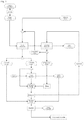
- FIG. 1 An embodiment of the process of the invention is depicted in a flow scheme in Fig. 1 . It will be understood that the invention is not limited to the specific scheme shown.
- the primary extraction is conducted in such a way as to satisfy a mass transfer Fourier number of at least 0.35, preferably 0.35 to 3.0; and the ratio of the yield obtained in the first primary extract to the yield obtained in the total extraction of from 0.20 to 0.60 and preferable 0.3 to 0.4
- N Fo D . t / Rp 2
- N Fo Fourier number for intra particle mass transfer t contact time for mass transfer (s); this is given by the residence time of the ground coffee in the primary extraction section; Rp average particle radius (m); this is derived from the average Martin diameter minimal value, said value divided by 2; D intra-particle diffusion coefficient for solutes within a coffee matrix (m 2 /s).
- the value for D is typically 2.10 -10 m 2 /s for extraction at 95°C. The value will be lower or higher at, respectively, lower or higher extraction temperatures.
- the applied Fourier mass transfer number is a dimensionless measure for the degree of extraction of coffee solubles from the coffee matrix
- the skilled person once apprised of the range to be set for the Fourier mass transfer number, will be able without undue burden to adjust the process parameters accordingly.
- the limits given for the N Fo value directly guide the skilled person as to applying the corresponding restrictions on the combinations of applied coffee ground size (average Martin diameter minimum value), the coffee residence time in primary extraction section and the intra-particle diffusion coefficient depends on the applied extraction temperature.
- the skilled person will understand that, in a process of extracting coffee, adjustments to one process parameter may have an impact on another process parameter. Therefore, the present disclosure provides a technical measure based on setting a combination of process parameters, rather than individually setting these process parameters separately.
- Tables 4, 5, and 6 These tables provide, for three sets of extraction conditions, the Fourier mass transfer number for a variety of combinations of the particle size (horizontal axis, i.e. the columns of the scheme, indicated as the average of the Martin diameter minimum value) and the residence time of the ground coffee in the primary extraction section (vertical axis, i.e., the rows of the table, indicated in minutes).
- the residence time is first converted to seconds, which is the applicable time unit in the above formula (I).
- Table 1 Condition Table 4 Table 5 Table 6 Temperature (°C) 70 80 95 Activation energy (kJ/mol) 36.3 36.3 36.3 Diffusion coefficient (m2/s) 1.23E-10 1.45E-10 2.00E-10
- extraction yield as used in the context of a process such as extraction, actually refers to the ratio of the amount of soluble coffee solids extracted from the roasted coffee divided by the amount of roasted coffee which is extracted , and that a skilled person is normally capable to set (which is different from a yield in, e.g., a chemical synthesis process, wherein the term generally refers to a result to be achieved).
- the extraction yield is defined as the percentage of: mass of soluble coffee solids extracted per mass unit of dry roasted coffees. This is calculated according to the formula (III) below, with the following input:
- the desirable aroma of the coffee concentrates according to the invention is surprisingly reflected in espresso aroma markers exhibited in the product obtainable with the method of the invention.
- This set consists of one marker identifiable and quantified by LCMS (Liquid Chromatography - Mass Spectrometry), and five markers identifiable by GCMS (Gas Chromatography - Mass Spectrometry).
- the LCMS-identifiable marker is 1-caffeoylquinic acid lactone (1-CQL).
- a structure of 1-CQL is given in Formula (IV) below.
- the GCMS-identifiable markers are dimethyl disulfide, furfuryl alcohol, 1-(acetyloxy) 2-propanone, 2-heptanone, and 4-ethylguaiacol.
- the aroma profile according to the invention is characterized quantitatively as follows.
- a 115 gram coffee brew is prepared by weighing of a specified amount of chilled coffee concentrates of 6 ⁇ 1 °C in a small Schott flask which is diluted with hot water of 85 ⁇ 1 °C to a soluble solids content of exactly 1.6%. After hot water addition the Schott flask is closed immediately and is cooled down immediately in an ice-water bath. The cooled coffee brew is homogenised by gently shaking. The coffee brew is stored before analysis in a refrigerator at 8 ⁇ 1 °C .
- Coffee caffeoyl quinic acid lactones are known as sensory active compounds associated with a mild and a pleasant bitter coffee taste.
- the coffee lactones were detected and identified by using high performance liquid chromatography (HPLC) coupled to both Photo Diode Array (PDA) detection and a high resolution quadrupole time-of-flight mass spectrometry (MS). All HPLC-PDA-MS components were from Waters Chromatography B.V. (Etten-Leur, The Netherlands). The retention time on the used column and solvent system conditions see matches with the presence of caffeoylquinic acid lactones, see De Vos et al., 2007, Nature Protocols 2, 778-791 .
- Metabolomics 8: 691-703 it could be confirmed to be a caffeoylquinic acid lactone by the quasimolecular ion [M-H]- at m/z 335.0774, and the characteristic fragments at m/z 135.045, 161.024 and 179.035.
- the occurrence of the fragment at m/z 173.0455 with an elemental composition of C 7 H 9 O 5 is well in line with the quinicacid lactone fragment of formula (IX) and is very likely when the caffeic acid moiety is connected to the 1-position of quinicacid lactone due to easy cleavage of this moiety from the of the 1-Caffeoyl Quinic Acid (1-CQA, accurate m/z [M-H]- of 335.0774).
- Distinct mass fragments of distinct (1-CQL) 1-caffeoyl quinic acid lactone present in liquid coffees The relative high abundance of the m/z 173.0455 in the MS/MS spectra points to a 1-caffeoylquinic acid lactone . The easy cleavage of this lactone moiety is well in line with a 1-CQA.
- the MS/MS fragments observed are in accordance with Jaiswal et al. Food Research International 2014, 61, 214-227
- the absorbance of a 100 fold dilution of this stock solution i.e., read against water as a blank, at 324 nm (A 324 ) was 0.437.
- the actual concentration of this CGA solution was 23.75 ⁇ M.
- the purity of the stock solution was 84.16%.
- the stock solution was subsequently diluted into MilliQ towards concentrations ranging from 0 to 50 ⁇ g/ml.
- Injection of the highest concentration into the HPLC-PDA-MS system resulted in a large peak eluting at 14.4 minutes, corresponding to 3-CGA ( Moco S, et al. , 2006. Plant Physiology 141, 1205-18 ), as well as a minor peak eluting at 17.6 minutes corresponding to 4-CGA (Moco et al., 2006); other PDA or MS peaks were not detected.
- the 1-CQL content is at least 510 mg, in another interesting embodiment, the 1-CQL content is at least 590 mg per kg of dry solid matter.
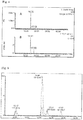
- Fig. 4 is an HPLC-PDA-TOF MS chromatogram of a 5 ⁇ l injection of the chlorogenic acid standard solution at a concentration of 50 ⁇ g/ml, to check the purity of the calibration solution used in the quantification of (1-CQL).
- BPI Base-peak intensity
- the difference in retention times between both detectors for the same compound peak (0.065 min) is due to their physical distance within the analytical system.
- the main peak eluting at 14.35 minutes of retention corresponds to 3-CGA; the area of the isomer 4-CGA, eluting at 17.52 min, is 3.4% of the area of 3-CGA.
- Fig. 5 is an HPLC-TOF MS chromatogram (ESI negative mode) of the chlorogenic acid standard at a concentration 10 ⁇ g/ml water, showing 4 chromatographic peaks.
- Their accurate mass of m/z 353.08, i.e. caffeoyl-quinic acids (blue line) and their (in-source) fragment of m/z 191.05, i.e. quinic acid fragment (red line) indicate that all these 4 peaks are chlorogenic acid isomers.
- Coffee volatiles in the coffee headspace were analysed by solid phase micro-extraction (SPME) coupled to gas chromatography/mass spectrometry (GC/MS), essentially as described in Tikunov et al. 2005 Plant Physiology 139, 1125 - 1137 .
- SPME solid phase micro-extraction
- GC/MS gas chromatography/mass spectrometry
- coffee volatiles present in the vial headspace were automatically extracted with a 65 ⁇ m polydimethylsiloxane-divinylbenzene SPME fiber (Supelco, USA) for 20 min under continuous agitation at 50 °C, using a CombiPal auto-sampler (CTC Instruments).
- the SPME fiber was inserted into the injection port of the GC (Fisons 8000, Fisons Instruments) and compounds were desorbed from the fiber at 250°C for 1 min and separated on a capillary HP-5 column (50 m ⁇ 0.32 mm, film thickness 1.05 ⁇ m; Hewlett Packard) with helium (37 kPa) as carrier gas.
- the GC oven was programmed for 2 min at 45 °C, followed by a linear increase of 5 °C /min to 250 °C which temperature was held for 5 min. Total run time, including oven cooling, was 60 min.
- Mass spectra of volatile compounds were generated at 70 eV and recorded in the 35 to 400 mass over charge (m/z) range by an MD800 electron impact MS (Fisons Instruments).
- Chromatographic and mass spectral data were extracted in a nontargeted manner ( Tikunov et al, 2005, Plant Physiology 139, 1125 - 1137 ) using Metalign software, which is freely downloadable from www.metalign.nl .
- Extracted mass signals derived from the same compound were clustered into so-called reconstructed metabolites, using MSClust software ( www.metalign.nl ), according to their similarities in both chromatographic behaviour and variation across samples, as described in ( Tikunov Y. M. et al., 2012, Metabolomics 8, 714-718 ). A total of 368 clusters were thus obtained. Intensity values of each cluster was averaged over the two replicates per coffee sample.
- the clusters were then submitted to a Partial Least Squares Discriminant Analyses (PLS-DA) after log10-transformation and unit variance scaling of their intensity signals, using. the Unscrambler X version 10.3 software from CAMO, Nedre Vollgate 8, Oslo, Norway. The most important discriminative compounds were selected using regression coefficient P-values. The putative identity of each compound selected was manually checked using a high match for both their mass spectrum (match factor >800) and retention index ( ⁇ 20 units difference) from compounds reported in the NIST08 library as well as in an in-house library of volatile compounds. This resulted in the aforementioned set of 5 discriminative GCMS markers.
- PLS-DA Partial Least Squares Discriminant Analyses
- the PLS model Yprocess is based on 5 identified GCMS markers and 1 quantified LCMS marker 1-CQL, in the Yprocess model each GCMS marker is measured as a peak height per ml of 1.6%wt brew.
- the invention pertains to a coffee concentrate comprising 15% to 55% dry solid matter, characterized by having a flavor profile represented the presence of 1-CQL, dimethyl disulfide, furfuryl alcohol, 1-(acetyloxy) 2-propanone, 2-heptanone, and 4-ethylguaiacol, wherein the Yprocess value based on Partial Least Squares Discriminant Analyses of said markers, as defined below, is higher than 0,5, more preferably 0.55, most preferably 0.6.
- the measured GCMS peak heights in a specific product are strongly depending on the GCMS equipment used for analyses, but the mutual relationships between peak heights of selected GCMS markers in a specific coffee will not change by using other GCMS equipment. Therefore, preferably a PLS model Yprocess is applied that is independent of GCMS equipment used.
- the 5 selected GCMS markers can be quantified expressed as a mass concentration of a specific GCMS marker per kg dry matter coffee. After quantification of all selected 5 GCMS markers the regression coefficients can be recalculated.
- regression coefficient B0 due to equipment impact, but no impact of coffees
- regression coefficient B1 due to equipment impact, but no impact of coffees
- regression coefficient B5 due to equipment impact, but no impact of coffees
- Compounds were dissolved in ethanol at stock solutions of 5 mg/ml and further diluted into ethanol into 5 working solutions, including the ethanol blanc (concentration of 0), at a concentration range of: dimethyl disulfide 0-1000 ng/ml, furfuryl alcohol 0-7500 ng/ml, 1-(acetoxy)2-propanone 0-1000 ng/ml, 2-heptanone 0-1000 ng/ml and 4-ethylguaiacol 0-15000 ng/ml ethanol.
- GCMS peak areas obtained were integrated using the Quan Browser module of the Xcalibur software (Thermo). The following masses were selected for peak integration: dimethyl disulfide mz 94, furfuryl alcohol mz 98, 1-(acetoxy)2-propanone mz 43, 2-heptanone mz 58 and 4-ethylguaiacol mz 122. Linear calibration curves of standards (R 2 > 0.97) were calculated from their concentration series added to the reference coffee, after correcting for the ethanol blanc of this reference coffee. The levels of marker compounds in the coffees were subsequently calculated and expressed in ng per ml reference coffee brew or calculated to mg per kg soluble coffee solids.
- the reference coffee was prepared at a concentration of 1.6% dry matter per ml brew, by dissolving 0.64 gram dry coffee powder in 39.36 gram of water at 85°C;
- Reference coffee were granules of a spray dried agglomerated instant coffee Douwe Egberts 1753 Continental Classic Rich Roast (Douwe Egberts Professional UK). This instant coffee is used for calibration of concentration of 5 GC MS markers.
- Instant coffee is manufactured by: extraction of a light roasted (degree of roast color value 55 Dr. Lange or 101 Colorette and time of roast 5:30 min) coarse ground 100% Robusta coffee (4.0 mm) coarse with an extraction yield of 51%. Extraction conditions: 5.5 percolators in series, cycle time of 27 minutes, draw-off rate is 4.0 kg/kg, feed water temperature is 165°C, position of in-between cooler between 1 st and 2 nd percolator (1 st percolator is percolator with fresh roasted ground coffee).
- the C 1-6 in the equation is the concentration of the respective compounds (1) to (6) in mg / kg soluble coffee solids.
- the above-described coffee concentrate of the invention as obtainable by the process according to the invention as described hereinbefore, which comprises 15% to 55% dry solid matter, can thus equally be characterized by having a flavor profile represented the presence of 1-CQL, dimethyl disulfide, furfuryl alcohol, 1-(acetyloxy) 2-propanone, 2-heptanone, and 4-ethylguaiacol, wherein the Zprocess value based on Partial Least Squares Discriminant Analyses of said markers, as defined below, is higher than 0,5, more preferably higher than 0.55, most preferably higher than 0.6. Still more preferably this value is higher than 0.65.
- the afore-described quantification of the defined 5 GCMS aroma markers present in the flavor profile of said coffee concentrate also allows characterizing the inherent total of these aroma components.
- this summation value is preferably greater than 3000 mg aroma/kg s.s., such as greater than 3150 mg aroma/kg s.s., such as greater than 3300 mg aroma/kg s.s., such as greater than 3450 mg aroma/kg s.s., such a greater than 3600 mg aroma/kg s.s.
- the cells were loaded for 100% with ground coffee, no wetting of the ground coffee was applied before extraction.
- a primary extraction was carried out counter currently with sodium desoftened water, wherein the feed water was introduced into the percolator in flow-up with a feed temperature of 95°C .
- the residence time of the coffee in the primary extraction section was 53 minutes and a water-to-coffee rate was applied of 6.0 with a back pressure of 2 Bar during air and coffee gas displacement from the percolator and after gas release the back pressure was raised to 4 Bar during collecting the primary draw-off from the percolator.
- the mass transfer Fourier number of the primary extraction was 0.70.
- the primary extract was fractionated in a first primary draw-off with a draw-off rate of 0.60.
- a high aromatic first primary draw-off was obtained with a soluble solids content of 19.1% and cooled down below 25°C before storage in a weighing tank.
- the first primary draw-off was cooled down below 6°C during discharge of weighing tank.
- the residual low aromatic primary extract was collected in a storage tank as a second primary draw-off with a soluble solids content of 5.2% by weight and cooled down below 25°C before storage in a weighing tank.
- the partial extracted coffee grounds were subjected to a high temperature extraction in the secondary section of the diffusion battery. Condensate from the evaporator was recycled as feed water for the secondary extraction, the feed water was introduced into the percolator with a temperature of 158°C. The coffee residence time in the secondary section of the partial extracted coffee grounds was 145 minutes and a secondary draw-off was applied of 5.0 with a back pressure of 6 Bar. The soluble solids content of secondary draw-off was low 2.3% by weight. After extraction the spent coffee was discharged for energy recovery. The total extraction yield of the roast ground coffee was 32%.
- Aroma is recovered from the second primary draw-off by means of atmospheric counter current steam stripping at 100°C. Just 25% of all second primary draw-offs is subjected to aroma-recovery in a column with static internals .
- the aroma laden steam is condensed in a 1 stage condenser at 6°C.
- the recovered aroma concentrate is mixed with the first primary draw-off.
- the second primary extract is mixed with the second secondary draw-off to a mass balanced based on the actual extraction yields which results into a soluble solids content of 3.4%wt.
- This mixture is de-watered by means of evaporation to final soluble solids content of 48% by weight..
- the evaporator effluent is cooled down to 20°C.
- the high aroma primary extract including recovered aroma is mixed in-line immediately after evaporation with the low aromatic coffee concentrate effluent from the evaporator.
- a final coffee concentrate is obtained of soluble solids content of at least 30% by weight which cooled down to 6°C.
- Insoluble coffee particles present in the final coffee concentrate are separated. After clarification final product is packed in a Bag in Box Packaging (BiB) with a gear pump as disclosed e.g. in WO 2014/003570 . Coffee BiB's are frozen in freezing tunnels to a maximal temperature of - 18 °C .
- the coffee concentrates were assessed by a panel of randomly selected consumers.
- coffee concentrates are manufactured, with the specific settings outlined in Table 3 below.
- the coffee blend used 60 wt.% washed Arabica; 40% unwashed Arabica.
- the 1-CQL content is 559 mg per kg of dry solid matter for the liquid concentrate obtained according to Example 2A and 622 mg per kg of dry solid matter for the liquid concentrate obtained according to Example 2B.
- a coffee concentrate was made in accordance with the teaching in WO 2007/043873 , with a coffee blend almost identical to that of Example 2 (65 wt.% washed Arabica; 35% unwashed Arabica), and the specific settings outlined in Table 3 below.
- the size of the coffee grounds (Martin diameter minimal value as defined in the description) was 3.6 mm.
- the mass transfer Fourier number was 0.20.
- the ratio of the yield obtained in the first primary extraction to the yield obtained in the total extraction was 13.9.
- the 1-CQL content is 375 mg per kg of dry solid matter for the obtained liquid concentrate.
- the calculated Yprocess model value based on Partial Least Squares Discriminant Analyses of the six identified flavor markers, as defined in this description, is 0.329.
- Table 3 Example settings 2A 2B 3 (prior art) Degree of roast (Dr.
Landscapes
- Life Sciences & Earth Sciences (AREA)
- Chemical & Material Sciences (AREA)
- Engineering & Computer Science (AREA)
- Food Science & Technology (AREA)
- Polymers & Plastics (AREA)
- Tea And Coffee (AREA)
Claims (3)
- Kaffeekonzentrat, das 15 % bis 55 % trockene Feststoffe umfasst, dadurch gekennzeichnet, dass es ein Geschmacksprofil aufweist, das durch das Vorhandensein von 1-Kaffeoylchinasäurelacton (1-CQL), Dimethyldisulfid, Furfurylalkohol, 1-(Acetyloxy)-2-propanon, 2-Heptanon und 4-Ethylguaiacol dargestellt wird, wobei der berechnete Y-Prozess- oder Z-Prozess-Modellwert basierend auf Partial-Least-Squares-Diskriminanzanalysen der Marker, wie in dieser Beschreibung definiert, größer ist als 0,5, vorzugsweise 0,55, am meisten bevorzugt 0,6.
- Kaffeekonzentrat nach Anspruch 1, 1-CQL in einer Menge von mindestens 450 mg, vorzugsweise mindestens 510 mg, mehr bevorzugt mindestens 590 mg Chlorogensäureäquivalenten pro kg trockenem Feststoff umfassend.
- Kaffeekonzentrat nach Anspruch 1 oder 2, wobei die Summe der Konzentrationen, in mg Aroma/kg lösliche Kaffeefeststoffe, des Aromamarkers Dimethyldisulfid, des Furfurylalkohols, des 1-(Acetlyoxy)-2-propanons, des 2-Heptanons und des 4-Ethylguaiacols, quantifiziert gemäß dem in der Beschreibung definierten Verfahren, größer ist als 2850 mg/kg lösliche Feststoffe (s.s.), vorzugsweise mehr als 3000 mg/kg s.s.
Priority Applications (1)
| Application Number | Priority Date | Filing Date | Title |
|---|---|---|---|
| PL15837227T PL3240432T3 (pl) | 2015-01-02 | 2015-12-28 | Ciekły koncentrat kawy espresso |
Applications Claiming Priority (2)
| Application Number | Priority Date | Filing Date | Title |
|---|---|---|---|
| EP15150046 | 2015-01-02 | ||
| PCT/NL2015/050913 WO2016108688A1 (en) | 2015-01-02 | 2015-12-28 | Liquid espresso concentrate |
Publications (2)
| Publication Number | Publication Date |
|---|---|
| EP3240432A1 EP3240432A1 (de) | 2017-11-08 |
| EP3240432B1 true EP3240432B1 (de) | 2019-06-19 |
Family
ID=52130187
Family Applications (1)
| Application Number | Title | Priority Date | Filing Date |
|---|---|---|---|
| EP15837227.6A Active EP3240432B1 (de) | 2015-01-02 | 2015-12-28 | Flüssiges espressokonzentrat |
Country Status (15)
| Country | Link |
|---|---|
| US (1) | US9968110B2 (de) |
| EP (1) | EP3240432B1 (de) |
| JP (1) | JP6920992B2 (de) |
| KR (2) | KR20250021643A (de) |
| CN (1) | CN107404896B (de) |
| AU (1) | AU2015372676B2 (de) |
| BR (1) | BR112017014298B1 (de) |
| CA (1) | CA2972747C (de) |
| ES (1) | ES2740777T3 (de) |
| MX (1) | MX377045B (de) |
| PL (1) | PL3240432T3 (de) |
| RU (1) | RU2731286C2 (de) |
| SG (1) | SG11201705427WA (de) |
| UA (1) | UA122679C2 (de) |
| WO (1) | WO2016108688A1 (de) |
Families Citing this family (4)
| Publication number | Priority date | Publication date | Assignee | Title |
|---|---|---|---|---|
| PL3240433T3 (pl) * | 2015-01-02 | 2019-09-30 | Koninklijke Douwe Egberts B.V. | Ciekły koncentrat kawy espresso |
| CN108003027B (zh) * | 2017-12-25 | 2021-07-06 | 北京微医智慧信息技术有限责任公司 | 1-o-咖啡酰奎宁酸、其衍生物、制备方法及其用途 |
| GB2574850B (en) * | 2018-06-20 | 2022-12-14 | Douwe Egberts Bv | Method of beverage extraction and apparatus therefor |
| US11805786B2 (en) | 2018-11-29 | 2023-11-07 | Suntory Holdings Limited | Method for producing coffee extract liquid |
Family Cites Families (12)
| Publication number | Priority date | Publication date | Assignee | Title |
|---|---|---|---|---|
| US2420615A (en) * | 1944-03-16 | 1947-05-13 | Harry Sachs | Manufacture of concentrated coffee extract |
| US3821434A (en) * | 1970-07-01 | 1974-06-28 | Niro Atomizer As | Method for producing a coffee concentrate |
| US3810766A (en) * | 1972-04-03 | 1974-05-14 | Gen Foods Corp | Method of extracting roasted coffee |
| NL191402C (nl) * | 1977-10-06 | 1995-07-17 | Sara Lee De Nv | Werkwijze voor de primaire extractie van gemalen gebrande koffie. |
| JPS58220653A (ja) * | 1982-06-17 | 1983-12-22 | Ajinomoto General Food Kk | コ−ヒ−エキスの製造方法 |
| DE4038526A1 (de) * | 1990-12-03 | 1992-06-04 | Jacobs Suchard Ag | Verfahren zur herstellung von loeslichem kaffee |
| NL1030178C2 (nl) * | 2005-10-12 | 2007-04-13 | Sara Lee De Nv | Werkwijze voor het bereiden van een koffie-extract, alsmede het daarmee te verkrijgen extract. |
| BRPI1011878B1 (pt) * | 2009-04-28 | 2019-07-30 | Kao Corporation | Processo para produzir uma solução de extrato de café concentrado |
| RU2738277C2 (ru) * | 2011-08-01 | 2020-12-11 | Конинклейке Дауве Егбертс Б.В. | Жидкий концентрат кофе |
| ES2715606T3 (es) | 2012-06-29 | 2019-06-05 | Douwe Egberts Bv | Sistema para la detección automatizada en máquinas dispensadoras de bebidas |
| BR112015018591B8 (pt) * | 2013-02-05 | 2021-09-14 | Douwe Egberts Bv | Processo para a produção de um concentrado de café líquido, e, concentrado de café líquido |
| PL3240433T3 (pl) * | 2015-01-02 | 2019-09-30 | Koninklijke Douwe Egberts B.V. | Ciekły koncentrat kawy espresso |
-
2015
- 2015-12-28 MX MX2017008806A patent/MX377045B/es active IP Right Grant
- 2015-12-28 ES ES15837227T patent/ES2740777T3/es active Active
- 2015-12-28 BR BR112017014298-8A patent/BR112017014298B1/pt active IP Right Grant
- 2015-12-28 UA UAA201707698A patent/UA122679C2/uk unknown
- 2015-12-28 KR KR1020257003278A patent/KR20250021643A/ko active Pending
- 2015-12-28 WO PCT/NL2015/050913 patent/WO2016108688A1/en not_active Ceased
- 2015-12-28 JP JP2017535336A patent/JP6920992B2/ja active Active
- 2015-12-28 SG SG11201705427WA patent/SG11201705427WA/en unknown
- 2015-12-28 CA CA2972747A patent/CA2972747C/en active Active
- 2015-12-28 PL PL15837227T patent/PL3240432T3/pl unknown
- 2015-12-28 EP EP15837227.6A patent/EP3240432B1/de active Active
- 2015-12-28 CN CN201580077339.4A patent/CN107404896B/zh active Active
- 2015-12-28 RU RU2017127269A patent/RU2731286C2/ru active
- 2015-12-28 KR KR1020177021517A patent/KR20170101984A/ko not_active Ceased
- 2015-12-28 AU AU2015372676A patent/AU2015372676B2/en active Active
-
2017
- 2017-06-30 US US15/639,716 patent/US9968110B2/en active Active
Non-Patent Citations (1)
| Title |
|---|
| None * |
Also Published As
| Publication number | Publication date |
|---|---|
| ES2740777T3 (es) | 2020-02-06 |
| RU2731286C2 (ru) | 2020-09-01 |
| MX2017008806A (es) | 2017-10-19 |
| EP3240432A1 (de) | 2017-11-08 |
| KR20250021643A (ko) | 2025-02-13 |
| JP2018500040A (ja) | 2018-01-11 |
| JP6920992B2 (ja) | 2021-08-18 |
| UA122679C2 (uk) | 2020-12-28 |
| BR112017014298A2 (pt) | 2018-03-06 |
| AU2015372676A1 (en) | 2017-07-20 |
| KR20170101984A (ko) | 2017-09-06 |
| US9968110B2 (en) | 2018-05-15 |
| CA2972747A1 (en) | 2016-07-07 |
| SG11201705427WA (en) | 2017-08-30 |
| US20170295815A1 (en) | 2017-10-19 |
| MX377045B (es) | 2025-03-07 |
| AU2015372676B2 (en) | 2020-04-30 |
| PL3240432T3 (pl) | 2020-02-28 |
| RU2017127269A (ru) | 2019-02-04 |
| CA2972747C (en) | 2022-07-19 |
| BR112017014298B1 (pt) | 2021-11-16 |
| WO2016108688A1 (en) | 2016-07-07 |
| CN107404896B (zh) | 2021-10-01 |
| CN107404896A (zh) | 2017-11-28 |
| RU2017127269A3 (de) | 2019-07-17 |
Similar Documents
| Publication | Publication Date | Title |
|---|---|---|
| US10034486B2 (en) | Liquid espresso concentrate and method for preparing same | |
| RU2587626C2 (ru) | Концентрированная кофейная композиция | |
| JP6259016B2 (ja) | コーヒー抽出液の製造方法 | |
| EP3228195B1 (de) | Geröstete kaffeebohnen | |
| EP3028577B1 (de) | Konzentrierter kaffeeextrakt | |
| US9968110B2 (en) | Liquid espresso concentrate | |
| WO2020138232A1 (ja) | コーヒー抽出液 |
Legal Events
| Date | Code | Title | Description |
|---|---|---|---|
| STAA | Information on the status of an ep patent application or granted ep patent |
Free format text: STATUS: THE INTERNATIONAL PUBLICATION HAS BEEN MADE |
|
| PUAI | Public reference made under article 153(3) epc to a published international application that has entered the european phase |
Free format text: ORIGINAL CODE: 0009012 |
|
| STAA | Information on the status of an ep patent application or granted ep patent |
Free format text: STATUS: REQUEST FOR EXAMINATION WAS MADE |
|
| 17P | Request for examination filed |
Effective date: 20170725 |
|
| AK | Designated contracting states |
Kind code of ref document: A1 Designated state(s): AL AT BE BG CH CY CZ DE DK EE ES FI FR GB GR HR HU IE IS IT LI LT LU LV MC MK MT NL NO PL PT RO RS SE SI SK SM TR |
|
| AX | Request for extension of the european patent |
Extension state: BA ME |
|
| DAV | Request for validation of the european patent (deleted) | ||
| DAX | Request for extension of the european patent (deleted) | ||
| STAA | Information on the status of an ep patent application or granted ep patent |
Free format text: STATUS: EXAMINATION IS IN PROGRESS |
|
| 17Q | First examination report despatched |
Effective date: 20180509 |
|
| GRAP | Despatch of communication of intention to grant a patent |
Free format text: ORIGINAL CODE: EPIDOSNIGR1 |
|
| STAA | Information on the status of an ep patent application or granted ep patent |
Free format text: STATUS: GRANT OF PATENT IS INTENDED |
|
| INTG | Intention to grant announced |
Effective date: 20181219 |
|
| GRAJ | Information related to disapproval of communication of intention to grant by the applicant or resumption of examination proceedings by the epo deleted |
Free format text: ORIGINAL CODE: EPIDOSDIGR1 |
|
| STAA | Information on the status of an ep patent application or granted ep patent |
Free format text: STATUS: EXAMINATION IS IN PROGRESS |
|
| GRAR | Information related to intention to grant a patent recorded |
Free format text: ORIGINAL CODE: EPIDOSNIGR71 |
|
| GRAS | Grant fee paid |
Free format text: ORIGINAL CODE: EPIDOSNIGR3 |
|
| STAA | Information on the status of an ep patent application or granted ep patent |
Free format text: STATUS: GRANT OF PATENT IS INTENDED |
|
| GRAA | (expected) grant |
Free format text: ORIGINAL CODE: 0009210 |
|
| STAA | Information on the status of an ep patent application or granted ep patent |
Free format text: STATUS: THE PATENT HAS BEEN GRANTED |
|
| INTC | Intention to grant announced (deleted) | ||
| AK | Designated contracting states |
Kind code of ref document: B1 Designated state(s): AL AT BE BG CH CY CZ DE DK EE ES FI FR GB GR HR HU IE IS IT LI LT LU LV MC MK MT NL NO PL PT RO RS SE SI SK SM TR |
|
| INTG | Intention to grant announced |
Effective date: 20190514 |
|
| REG | Reference to a national code |
Ref country code: GB Ref legal event code: FG4D |
|
| REG | Reference to a national code |
Ref country code: CH Ref legal event code: EP |
|
| REG | Reference to a national code |
Ref country code: IE Ref legal event code: FG4D |
|
| REG | Reference to a national code |
Ref country code: AT Ref legal event code: REF Ref document number: 1144336 Country of ref document: AT Kind code of ref document: T Effective date: 20190715 |
|
| REG | Reference to a national code |
Ref country code: DE Ref legal event code: R096 Ref document number: 602015032441 Country of ref document: DE |
|
| REG | Reference to a national code |
Ref country code: NL Ref legal event code: FP |
|
| PG25 | Lapsed in a contracting state [announced via postgrant information from national office to epo] |
Ref country code: NO Free format text: LAPSE BECAUSE OF FAILURE TO SUBMIT A TRANSLATION OF THE DESCRIPTION OR TO PAY THE FEE WITHIN THE PRESCRIBED TIME-LIMIT Effective date: 20190919 Ref country code: LT Free format text: LAPSE BECAUSE OF FAILURE TO SUBMIT A TRANSLATION OF THE DESCRIPTION OR TO PAY THE FEE WITHIN THE PRESCRIBED TIME-LIMIT Effective date: 20190619 Ref country code: FI Free format text: LAPSE BECAUSE OF FAILURE TO SUBMIT A TRANSLATION OF THE DESCRIPTION OR TO PAY THE FEE WITHIN THE PRESCRIBED TIME-LIMIT Effective date: 20190619 Ref country code: AL Free format text: LAPSE BECAUSE OF FAILURE TO SUBMIT A TRANSLATION OF THE DESCRIPTION OR TO PAY THE FEE WITHIN THE PRESCRIBED TIME-LIMIT Effective date: 20190619 Ref country code: SE Free format text: LAPSE BECAUSE OF FAILURE TO SUBMIT A TRANSLATION OF THE DESCRIPTION OR TO PAY THE FEE WITHIN THE PRESCRIBED TIME-LIMIT Effective date: 20190619 Ref country code: HR Free format text: LAPSE BECAUSE OF FAILURE TO SUBMIT A TRANSLATION OF THE DESCRIPTION OR TO PAY THE FEE WITHIN THE PRESCRIBED TIME-LIMIT Effective date: 20190619 |
|
| REG | Reference to a national code |
Ref country code: LT Ref legal event code: MG4D |
|
| PG25 | Lapsed in a contracting state [announced via postgrant information from national office to epo] |
Ref country code: LV Free format text: LAPSE BECAUSE OF FAILURE TO SUBMIT A TRANSLATION OF THE DESCRIPTION OR TO PAY THE FEE WITHIN THE PRESCRIBED TIME-LIMIT Effective date: 20190619 Ref country code: GR Free format text: LAPSE BECAUSE OF FAILURE TO SUBMIT A TRANSLATION OF THE DESCRIPTION OR TO PAY THE FEE WITHIN THE PRESCRIBED TIME-LIMIT Effective date: 20190920 Ref country code: BG Free format text: LAPSE BECAUSE OF FAILURE TO SUBMIT A TRANSLATION OF THE DESCRIPTION OR TO PAY THE FEE WITHIN THE PRESCRIBED TIME-LIMIT Effective date: 20190919 Ref country code: RS Free format text: LAPSE BECAUSE OF FAILURE TO SUBMIT A TRANSLATION OF THE DESCRIPTION OR TO PAY THE FEE WITHIN THE PRESCRIBED TIME-LIMIT Effective date: 20190619 |
|
| REG | Reference to a national code |
Ref country code: AT Ref legal event code: MK05 Ref document number: 1144336 Country of ref document: AT Kind code of ref document: T Effective date: 20190619 |
|
| PG25 | Lapsed in a contracting state [announced via postgrant information from national office to epo] |
Ref country code: PT Free format text: LAPSE BECAUSE OF FAILURE TO SUBMIT A TRANSLATION OF THE DESCRIPTION OR TO PAY THE FEE WITHIN THE PRESCRIBED TIME-LIMIT Effective date: 20191021 Ref country code: EE Free format text: LAPSE BECAUSE OF FAILURE TO SUBMIT A TRANSLATION OF THE DESCRIPTION OR TO PAY THE FEE WITHIN THE PRESCRIBED TIME-LIMIT Effective date: 20190619 Ref country code: CZ Free format text: LAPSE BECAUSE OF FAILURE TO SUBMIT A TRANSLATION OF THE DESCRIPTION OR TO PAY THE FEE WITHIN THE PRESCRIBED TIME-LIMIT Effective date: 20190619 Ref country code: RO Free format text: LAPSE BECAUSE OF FAILURE TO SUBMIT A TRANSLATION OF THE DESCRIPTION OR TO PAY THE FEE WITHIN THE PRESCRIBED TIME-LIMIT Effective date: 20190619 Ref country code: AT Free format text: LAPSE BECAUSE OF FAILURE TO SUBMIT A TRANSLATION OF THE DESCRIPTION OR TO PAY THE FEE WITHIN THE PRESCRIBED TIME-LIMIT Effective date: 20190619 Ref country code: SK Free format text: LAPSE BECAUSE OF FAILURE TO SUBMIT A TRANSLATION OF THE DESCRIPTION OR TO PAY THE FEE WITHIN THE PRESCRIBED TIME-LIMIT Effective date: 20190619 |
|
| REG | Reference to a national code |
Ref country code: ES Ref legal event code: FG2A Ref document number: 2740777 Country of ref document: ES Kind code of ref document: T3 Effective date: 20200206 |
|
| PG25 | Lapsed in a contracting state [announced via postgrant information from national office to epo] |
Ref country code: SM Free format text: LAPSE BECAUSE OF FAILURE TO SUBMIT A TRANSLATION OF THE DESCRIPTION OR TO PAY THE FEE WITHIN THE PRESCRIBED TIME-LIMIT Effective date: 20190619 Ref country code: IS Free format text: LAPSE BECAUSE OF FAILURE TO SUBMIT A TRANSLATION OF THE DESCRIPTION OR TO PAY THE FEE WITHIN THE PRESCRIBED TIME-LIMIT Effective date: 20191019 Ref country code: IT Free format text: LAPSE BECAUSE OF FAILURE TO SUBMIT A TRANSLATION OF THE DESCRIPTION OR TO PAY THE FEE WITHIN THE PRESCRIBED TIME-LIMIT Effective date: 20190619 |
|
| PG25 | Lapsed in a contracting state [announced via postgrant information from national office to epo] |
Ref country code: TR Free format text: LAPSE BECAUSE OF FAILURE TO SUBMIT A TRANSLATION OF THE DESCRIPTION OR TO PAY THE FEE WITHIN THE PRESCRIBED TIME-LIMIT Effective date: 20190619 |
|
| PG25 | Lapsed in a contracting state [announced via postgrant information from national office to epo] |
Ref country code: DK Free format text: LAPSE BECAUSE OF FAILURE TO SUBMIT A TRANSLATION OF THE DESCRIPTION OR TO PAY THE FEE WITHIN THE PRESCRIBED TIME-LIMIT Effective date: 20190619 |
|
| PG25 | Lapsed in a contracting state [announced via postgrant information from national office to epo] |
Ref country code: IS Free format text: LAPSE BECAUSE OF FAILURE TO SUBMIT A TRANSLATION OF THE DESCRIPTION OR TO PAY THE FEE WITHIN THE PRESCRIBED TIME-LIMIT Effective date: 20200224 |
|
| REG | Reference to a national code |
Ref country code: DE Ref legal event code: R097 Ref document number: 602015032441 Country of ref document: DE |
|
| PLBE | No opposition filed within time limit |
Free format text: ORIGINAL CODE: 0009261 |
|
| STAA | Information on the status of an ep patent application or granted ep patent |
Free format text: STATUS: NO OPPOSITION FILED WITHIN TIME LIMIT |
|
| PG2D | Information on lapse in contracting state deleted |
Ref country code: IS |
|
| 26N | No opposition filed |
Effective date: 20200603 |
|
| REG | Reference to a national code |
Ref country code: BE Ref legal event code: MM Effective date: 20191231 |
|
| PG25 | Lapsed in a contracting state [announced via postgrant information from national office to epo] |
Ref country code: SI Free format text: LAPSE BECAUSE OF FAILURE TO SUBMIT A TRANSLATION OF THE DESCRIPTION OR TO PAY THE FEE WITHIN THE PRESCRIBED TIME-LIMIT Effective date: 20190619 Ref country code: MC Free format text: LAPSE BECAUSE OF FAILURE TO SUBMIT A TRANSLATION OF THE DESCRIPTION OR TO PAY THE FEE WITHIN THE PRESCRIBED TIME-LIMIT Effective date: 20190619 |
|
| PG25 | Lapsed in a contracting state [announced via postgrant information from national office to epo] |
Ref country code: IE Free format text: LAPSE BECAUSE OF NON-PAYMENT OF DUE FEES Effective date: 20191228 Ref country code: LU Free format text: LAPSE BECAUSE OF NON-PAYMENT OF DUE FEES Effective date: 20191228 |
|
| PG25 | Lapsed in a contracting state [announced via postgrant information from national office to epo] |
Ref country code: BE Free format text: LAPSE BECAUSE OF NON-PAYMENT OF DUE FEES Effective date: 20191231 |
|
| PG25 | Lapsed in a contracting state [announced via postgrant information from national office to epo] |
Ref country code: CY Free format text: LAPSE BECAUSE OF FAILURE TO SUBMIT A TRANSLATION OF THE DESCRIPTION OR TO PAY THE FEE WITHIN THE PRESCRIBED TIME-LIMIT Effective date: 20190619 |
|
| PG25 | Lapsed in a contracting state [announced via postgrant information from national office to epo] |
Ref country code: MT Free format text: LAPSE BECAUSE OF FAILURE TO SUBMIT A TRANSLATION OF THE DESCRIPTION OR TO PAY THE FEE WITHIN THE PRESCRIBED TIME-LIMIT Effective date: 20190619 Ref country code: HU Free format text: LAPSE BECAUSE OF FAILURE TO SUBMIT A TRANSLATION OF THE DESCRIPTION OR TO PAY THE FEE WITHIN THE PRESCRIBED TIME-LIMIT; INVALID AB INITIO Effective date: 20151228 |
|
| PG25 | Lapsed in a contracting state [announced via postgrant information from national office to epo] |
Ref country code: MK Free format text: LAPSE BECAUSE OF FAILURE TO SUBMIT A TRANSLATION OF THE DESCRIPTION OR TO PAY THE FEE WITHIN THE PRESCRIBED TIME-LIMIT Effective date: 20190619 |
|
| P01 | Opt-out of the competence of the unified patent court (upc) registered |
Effective date: 20230505 |
|
| PGFP | Annual fee paid to national office [announced via postgrant information from national office to epo] |
Ref country code: CH Payment date: 20250108 Year of fee payment: 10 |
|
| REG | Reference to a national code |
Ref country code: CH Ref legal event code: U11 Free format text: ST27 STATUS EVENT CODE: U-0-0-U10-U11 (AS PROVIDED BY THE NATIONAL OFFICE) Effective date: 20260101 |
|
| PGFP | Annual fee paid to national office [announced via postgrant information from national office to epo] |
Ref country code: GB Payment date: 20251229 Year of fee payment: 11 |
|
| PGFP | Annual fee paid to national office [announced via postgrant information from national office to epo] |
Ref country code: NL Payment date: 20251226 Year of fee payment: 11 Ref country code: FR Payment date: 20251226 Year of fee payment: 11 |
|
| PGFP | Annual fee paid to national office [announced via postgrant information from national office to epo] |
Ref country code: PL Payment date: 20251216 Year of fee payment: 11 |
|
| PGFP | Annual fee paid to national office [announced via postgrant information from national office to epo] |
Ref country code: ES Payment date: 20260102 Year of fee payment: 11 |
|
| PGFP | Annual fee paid to national office [announced via postgrant information from national office to epo] |
Ref country code: DE Payment date: 20251229 Year of fee payment: 11 |