EP3240433B1 - Concentré expresso liquide - Google Patents
Concentré expresso liquide Download PDFInfo
- Publication number
- EP3240433B1 EP3240433B1 EP15839076.5A EP15839076A EP3240433B1 EP 3240433 B1 EP3240433 B1 EP 3240433B1 EP 15839076 A EP15839076 A EP 15839076A EP 3240433 B1 EP3240433 B1 EP 3240433B1
- Authority
- EP
- European Patent Office
- Prior art keywords
- primary
- coffee
- extraction
- extract
- concentrate
- Prior art date
- Legal status (The legal status is an assumption and is not a legal conclusion. Google has not performed a legal analysis and makes no representation as to the accuracy of the status listed.)
- Active
Links
Images


Classifications
-
- A—HUMAN NECESSITIES
- A23—FOODS OR FOODSTUFFS; TREATMENT THEREOF, NOT COVERED BY OTHER CLASSES
- A23F—COFFEE; TEA; THEIR SUBSTITUTES; MANUFACTURE, PREPARATION, OR INFUSION THEREOF
- A23F5/00—Coffee; Coffee substitutes; Preparations thereof
- A23F5/24—Extraction of coffee; Coffee extracts; Making instant coffee
- A23F5/243—Liquid, semi-liquid or non-dried semi-solid coffee extract preparations; Coffee gels; Liquid coffee in solid capsules
-
- A—HUMAN NECESSITIES
- A23—FOODS OR FOODSTUFFS; TREATMENT THEREOF, NOT COVERED BY OTHER CLASSES
- A23F—COFFEE; TEA; THEIR SUBSTITUTES; MANUFACTURE, PREPARATION, OR INFUSION THEREOF
- A23F5/00—Coffee; Coffee substitutes; Preparations thereof
- A23F5/04—Methods of roasting coffee
-
- A—HUMAN NECESSITIES
- A23—FOODS OR FOODSTUFFS; TREATMENT THEREOF, NOT COVERED BY OTHER CLASSES
- A23F—COFFEE; TEA; THEIR SUBSTITUTES; MANUFACTURE, PREPARATION, OR INFUSION THEREOF
- A23F5/00—Coffee; Coffee substitutes; Preparations thereof
- A23F5/10—Treating roasted coffee; Preparations produced thereby
- A23F5/12—Agglomerating, flaking or tabletting
-
- A—HUMAN NECESSITIES
- A23—FOODS OR FOODSTUFFS; TREATMENT THEREOF, NOT COVERED BY OTHER CLASSES
- A23F—COFFEE; TEA; THEIR SUBSTITUTES; MANUFACTURE, PREPARATION, OR INFUSION THEREOF
- A23F5/00—Coffee; Coffee substitutes; Preparations thereof
- A23F5/24—Extraction of coffee; Coffee extracts; Making instant coffee
-
- A—HUMAN NECESSITIES
- A23—FOODS OR FOODSTUFFS; TREATMENT THEREOF, NOT COVERED BY OTHER CLASSES
- A23F—COFFEE; TEA; THEIR SUBSTITUTES; MANUFACTURE, PREPARATION, OR INFUSION THEREOF
- A23F5/00—Coffee; Coffee substitutes; Preparations thereof
- A23F5/24—Extraction of coffee; Coffee extracts; Making instant coffee
- A23F5/26—Extraction of water soluble constituents
-
- A—HUMAN NECESSITIES
- A23—FOODS OR FOODSTUFFS; TREATMENT THEREOF, NOT COVERED BY OTHER CLASSES
- A23F—COFFEE; TEA; THEIR SUBSTITUTES; MANUFACTURE, PREPARATION, OR INFUSION THEREOF
- A23F5/00—Coffee; Coffee substitutes; Preparations thereof
- A23F5/24—Extraction of coffee; Coffee extracts; Making instant coffee
- A23F5/28—Drying or concentrating coffee extract
- A23F5/285—Drying or concentrating coffee extract by evaporation, e.g. drying in thin layers or foam drying
Definitions
- the invention is in the field of coffee concentrates.
- the invention relates to a method for preparing a concentrated coffee extract (hereinafter: coffee concentrate). More specifically, the invention relates to a coffee concentrate with improved sensorial characteristics which matches more closely to an espresso based coffee brew of a bean to cup espresso machine for preparation of e.g. ristretto, espresso or lungo and/or milk based drinks e.g. cappuccino or latte macchiato.
- Coffee concentrates are increasingly in demand for commercial and/or industrial purposes.
- a typical area of use of such liquid coffee concentrates is in coffee dispensing machines. Many of such machines do not operate by freshly preparing a coffee extract, but by adding hot water to a form of an industrially manufactured coffee extract. Thus, such machines dispense coffee either by reconstitution from soluble coffee particles, or by dilution of coffee concentrates.
- coffee concentrate has a given meaning in the art, as referring to aqueous concentrates, having a dry solid matter content of from 15% to 55% by weight (which dry solid matter is present in the concentrate largely as liquid-soluble solids). These concentrates are sometimes also denoted as “liquid coffee concentrates.” This refers to the state, generally at ambient temperature, in which the concentrates are used in practice (as flowable, preferably pumpable liquids). In many events, the stable storage of such concentrates requires cooling, and more typically freezing. Therefore, coffee concentrates which are used in liquid form, are frequently also indicated to be frozen liquid coffee concentrates.
- the terms "coffee concentrate” and “liquid coffee concentrate” are used interchangeably, and these terms include coffee concentrates in a liquid form as well as in a frozen form.
- a continuing challenge in providing coffee from machines, as mentioned above, that operate on the basis of coffee that is not freshly extracted, is to make coffee that bears a sufficient resemblance, particularly in respect of aroma, to freshly extracted coffee.
- This challenge is even more pronounced in the event of dispensing coffee of the espresso type.
- Espresso is a type of coffee drink that is traditionally brewed by forcing pressurized water of approximately 95°C through a coffee bed of finely ground beans. Due to this specific type of processing a specific kind of coffee drink results, having a typical flavor that cannot be just attributed to using specific beans, blends of beans, and/or roasting level. To produce a coffee having a recognizable espresso flavor, such as taste and/or aroma, without freshly using the specific espresso brewing process, is notoriously difficult.
- Typical developments in making dispensing machines for espresso-type coffee drinks are devoted to machines operating by freshly making an espresso brew, e.g. from roast and ground coffee for use in such machines.
- espresso that can be just obtained from a dispensing machine that does not itself apply an extraction process, but which just operates on the basis of diluting a pre-existing, e.g., industrially prepared, liquid coffee concentrate.
- a liquid coffee concentrate suitable to make an espresso type of coffee is not available in the art.
- a background reference on making liquid coffee concentrates is WO 2007/043873 .
- a process is described wherein roast and ground coffee is subjected to a dual extraction, whereby a secondary extraction is carried out at a higher temperature than the primary extraction.
- the method as disclosed e.g. involving aroma recovery and high water to coffee ratio's, is suitable for preparing liquid concentrates having an improved coffee flavor/aroma.
- the method as disclosed does not result in an espresso-type of coffee concentrate.
- US 4, 277,509 A1 pertains to the primary extraction of ground roasted coffee.
- the coffee is first extracted with an amount of aqueous extraction liquid sufficient to extract substantially all of the dry soluble solids form the coffee.
- the coffee is extracted with an aqueous extraction liquid to extract hydrophobic flavor components.
- the hydrophobic flavor components are removed from the resulting extract by stripping and recovered as a concentrated aqueous solution.
- liquid coffee concentrate that is suitable for providing an espresso-type of coffee brew. It is further desired to provide such a liquid coffee concentrate in an economically viable process.
- a particular desire is to provide a liquid coffee concentrate with improved sensorial characteristics.
- the invention presents, in one aspect, a method for preparing a coffee concentrate comprising the steps of:
- the invention pertains to a coffee concentrate comprising 15% to 55% dry solid matter, characterized by comprising 1-caffeoylquinic acid lactone (1-CQL) in an amount of at least 450 mg chlorogenic acid equivalents per kg of dry solid matter.
- the invention is based on the judicious insight that a liquid espresso concentrate can be made by a process involving a primary and a secondary extraction, whereby the primary extraction is conducted in a way so as to improve flavor/aroma extraction, and whereby the total extraction is conducted in a consciously reduced total extraction yield.
- the latter is reflected in the ratio of first primary draw-offextraction yield and total extraction yield.
- the former is reflected in the Fourier mass transfer number, which is further detailed later in this description.
- initially ground roasted coffee beans are provided.
- the main coffee species used are washed and unwashed Arabica beans and Robusta beans. Typically, mixtures of both can be used. These beans can be recognized as having a specified geographical origin, such as Colombia, Brazil, or Indonesia.
- the degree of roasting can be determined in various ways.
- One method is to determine the color of the roast coffee beans.
- a method known to the skilled person is based on Dr. Lange colorimeters.
- the degree of roast is such as to satisfy a value for a Dr. Lange color measurement of 32 to 54.
- a higher value indicates a lighter degree of roast.
- a value at the low end of the range is be suitable for a strong espresso appearance, whilst a value at the high end of the range is more commensurate with an espresso of the type known as "lungo" (which, if freshly brewed, is made with a higher amount of water than a traditional espresso).
- the degree of roasting can also be determined with reference to the weight loss as a result of roasting (whereby roasting at higher temperatures and/or longer roasting times will result in a higher weight loss).
- preferred values for roasting degrees in accordance with the invention are of from 13.0 wt.% to 18.5 wt.% for Arabica coffees, and of from 16.0 wt.% to 20 wt.% for Robusta coffee.
- the desired character of the liquid coffee concentrate of the invention is believed to benefit from applying coffee grounds of a relatively small grinding size on an industrial scale.
- the roast and ground coffee beans subjected to the extraction process of the invention are of a size such as to satisfy a Martin diameter minimal value of from 0.5 to 3 mm.
- the Martin diameter is the length of the area bisector of an irregular object in a specified measuring direction. It is determined by a CAMSIZER® P4 measuring system, which is based on the Dynamic Image Analysis principle. Hereby the bulk material (the particle sizes of which are to be determined) falls between light source and cameras. Each particle is detected by the cameras and is then digitalized and processed by a connected computer.
- the Martin diameter X Ma is determined in 32 directions.
- the Martin diameter minimal value is the minimum of X Ma over all directions.
- a preferred range is from at least 0.8 mm, such as at least 1.0 mm, such as at least 1.2 mm, to below 2 mm, such as below 1.9 mm, such as below 1.8 mm.
- the size range is 1.1 to 1.9 mm, preferably 1.6 to 1.8 mm.
- the size of the grounds can be predetermined by means of the settings of the grinder, particularly with reference to the distance between 2 rollers.
- a single or multiple stage grinder can be used.
- the ground size is controlled by means of Camsizer-type particle size measurement device as mentioned above.
- the roast and ground coffee beans are extracted with water.
- water applies to any aqueous liquid customarily used in making coffee extracts. This can be, e.g., regular tap water, sodium softened water, cation and anion demineralized water or aqueous condensates from evaporators (during de-watering of coffee extracts)or mixtures thereof.
- a first extraction step of the method of the invention comprises subjecting the ground roasted coffee beans to a primary extraction.
- This extraction can be carried out in an extraction section comprising one or more conventional extraction cells or percolators.
- the term "primary extraction” in the art of coffee extraction has a specific meaning of physical extraction.
- water is used of a temperature below 120°C, typically between 70°C and 120°C, preferably between 85°C and 95°C.
- the coffee is extracted in a fixed bed cell or percolator in up-flow or down flow or according to the counter current extraction principle.
- Per cycle as a rule, a primary water to coffee bean weight ratio is used between 2.8 and 15, preferably between 3 and 10, most preferably between approximately 4.0 and 8.0.
- a cycle mostly takes up between 10 and 60 minutes.
- the cycle time is defined as the time between the moment of connecting a percolator with fresh into the primary extraction section and the moment until the primary extraction section is reloaded by a new percolator filled with fresh roast and ground coffee.
- the primary extraction is done so as to obtain a first primary extract with a draw-off factor of at most 2, preferably at most 1.5. More preferably, the draw-off factor is at most 1, and even more preferably at most 0.7.
- draw-off factor is understood to mean the ratio of the mass of the extract and the mass of the dry roasted and ground coffee in the primary extraction section. In practice, this draw-off factor is determined by a compromise between, on the one side, a sufficient degree of extraction of coffee solubles and aroma in the first primary extract, and, on the other side, a lowest possible volume of the first primary extract.
- the primary draw-off factor which can be applied for that matter depends upon: the applied coarseness or degree of grinding of the roasted coffee beans, the extraction cell and, in particular, the number of percolators connected in series, the applied water-to-coffee ratio, the applied cycle time, the applied feed water temperature and the desired concentration of the end product and the like.
- the water to coffee ratio in primary extraction is preferably in a range of from 4 to 15, preferably below 10, and more preferably of from 4 to 8.
- the primary extraction is drawn off in two stages. I.e., the primary extract is split (fractionated) upon tapping, so as to generate a first and a second primary draw off.
- the partial extracted ground roasted coffee beans from the primary extraction are further subjected to a secondary extraction.
- a secondary extraction includes among others a thermal hydrolysis of the partial extracted ground roasted coffee particles. Thereby components generated during a thermal hydrolysis which are soluble in water will be extracted from the coffee. Secondary extraction is not limited to components generated by thermal hydrolysis. Typically also a further amount pre-existing (primary, but not yet extracted) soluble components will become extracted in secondary extraction.
- the secondary extract is prepared through a secondary extraction with water or an aqueous liquid in a secondary extraction section comprising one or more extraction cells in series.
- a secondary extraction section comprising one or more extraction cells in series.
- the ground coffee beans are subjected to an extraction at a higher extraction temperature than in the event of primary extraction, as a rule at a feed water temperature between 120°C -220°C.
- the first fraction of a secondary extract from the secondary extraction is optionally fed to the primary extraction cell as extraction liquid.
- the remaining extract, the second fraction of secondary extract, obtained from the secondary extraction is combined with the second primary extract, optionally after the evaporation step.
- the primary and secondary extractions can be carried out in customary extraction cells.
- both the primary and the secondary extraction are carried out in a percolator or in percolators placed in series.
- the secondary extraction is advantageously carried out in at least 2, and preferably at least 4 series-connected percolators.
- the number of percolators used in the primary extraction section is at least 0.5 which means that during 50% of the cycle time 1 percolator is connected in the primary extraction section.
- at least 1 or 2 percolators are connected in the primary extraction section. Based on the coffee residence time derived from the size of the coffee grounds and the mass transfer Fourier number, the skilled person will be able to define a suitable number of percolators based on a chosen cycle time.
- the first primary extract is of very high sensorial quality and is highly concentrated; preferably, it is directly cooled to maximally 25°C, but more preferably to maximally 10°C, such as 0°C, and most preferably to -2°C.
- the primary extract is kept under an inert gas atmosphere, for instance a nitrogen atmosphere.
- the invention further involves subjecting the second primary extract and the secondary extract to evaporation so as to obtain a concentrated extract.
- the evaporation can be conducted separately for both of the extracts, after which the concentrated extracts are combined.
- the second primary extract and the secondary extract are combined first, and then evaporated.
- the second draw of the primary extract is concentrated, usually together with the secondary extract, to a content of dry solid matter between 30 and 75%, more preferably between 35 and 65%, highly preferably between 40 and 60%.
- the concentrated extract obtained from the second primary extract and the secondary extract is combined with the first primary extract, so as to obtain a liquid coffee concentrate.
- water can be added so as to adjust the dry solid matter content, so as to obtain a coffee concentrate having a dry solid matter content of from 15 wt.% to 55 wt.%.
- roasting degree of roast (Dr. Lange) of from 32 (darker) to 54 (lighter); roasting loss ranging from 13 (lighter) to 20 (darker); roasting time: ranging from 7.5 minutes to 15 minutes, preferably 8-10 minutes.
- Coffee rather than lungo
- a roast degree for arabica's of more than 15% roasting loss is preferred.
- Coffee extraction average coffee ground size (Martin diameter minimal value) ranging from 0.5 mm to 3.0 mm, preferably 1.4 mm to 1.9 mm.
- Total extraction yield for coffee solubles (Y_TE) ranging from 25% to 45%, preferably of from 30% to 35%.
- First primary drawn soluble solids yield (Y-PE1) ranging from 7.5% to 25% preferably of from 10% to 20%.
- Rate of Y_PE1 to Y_TE ranging from 0.15 to 1.0, preferably of from 0.20 to 0.60, more preferably of from 0.30 to 0.40.
- Fourier number for primary extraction preferably ranging from 0,35 to 3.0, more preferably of from 0.5 to 1.5, most preferably from 0.5-1.0.
- Aroma recovery optional partial aroma recovery from second primary extract by means of steam stripping: ranging from 0 to 60%; preferably (if done) 20% to 40%.
- Dry matter content of concentrate after evaporation of coffee extracts ranging from 30% to 75%, preferably 40% to 60%.
- the final dry solid matter content of the coffee concentrates obtainable with the method according to the invention ranges from 15 wt.% to 55% wt.%, preferably from 25 wt.% to 35 wt.%.
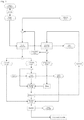
- FIG. 1 An embodiment of the process of the invention is depicted in a flow scheme in Fig. 1 . It will be understood that the invention is not limited to the specific scheme shown.
- an additional measure is taken so as to obtain a liquid coffee concentrate having an espresso character.
- the primary extraction is conducted in such a way as to satisfy a mass transfer Fourier number of at least 0.35, preferably 0.35 to 3.0; and the ratio of the yield obtained in the first primary extract to the yield obtained in the total extraction of from 0.20 to 0.60 and preferable 0.3 to 0.4
- N Fo D . t / Rp 2
- the applied Fourier mass transfer number is a dimensionless measure for the degree of extraction of coffee solubles from the coffee matrix
- another technical measure according to the invention is to conduct the full extraction so as to reduce the total extraction yield. This is reflected in the ratio of the yield obtained in the first primary extraction to the yield obtained in the total extraction, which is set to be of from 0.15 to 1.0, preferably 0.20 to 0.60. This relatively high ratio goes against the regular practice in the art.
- the extraction yield is defined as the percentage of: mass of soluble coffee solids extracted per mass unit of dry roasted coffees. This is measured according to the formula (III) below, with the following input:
- the desirable aroma of the coffee concentrates according to the invention is surprisingly reflected in espresso aroma markers exhibited in the product obtainable with the method of the invention.
- a 115 gram coffee brew is prepared by weighing of a specified amount of chilled coffee concentrates of 6 ⁇ 1°C in a small Schott flask which is diluted with hot water of 85 ⁇ 1°C to a soluble solids content of exactly 1.6%. After hot water addition the Schott flask is closed immediately and is cooled down immediately in an ice-water bath. The cooled coffee brew is homogenised by gently shaking. The coffee brew is stored before analysis in a refrigerator at 8 ⁇ 1°C.
- Coffee caffeoyl quinic acid lactones are known as sensory active compounds associated with a mild and a pleasant bitter coffee taste.
- the coffee lactones were detected and identified by using high performance liquid chromatography (HPLC) coupled to both Photo Diode Array (PDA) detection and a high resolution quadrupole time-of-flight mass spectrometry (MS). All HPLC-PDA-MS components were from Waters Chromatography B.V. (Etten-Leur, The Netherlands). The retention time on the used column and solvent system conditions see matches with the presence of caffeoylquinic acid lactones, see De Vos et al., 2007, Nature Protocols 2, 778-791 .
- Metabolomics 8: 691-703 it could be confirmed to be a caffeoylquinic acid lactone by the quasimolecular ion [M-H] - at m/z 335.0774, and the characteristic fragments at m/z 135.045, 161.024 and 179.035.
- Distinct mass fragments of distinct (1-CQL) 1-caffeoyl quinic acid lactone present in liquid coffees The relative high abundance of the m/z 173.0455 in the MS/MS spectra points to a 1-caffeoylquinic acid lactone . The easy cleavage of this lactone moiety is well in line with a 1-CQA.
- the MS/MS fragments observed are in accordance with Jaiswal et al. Food Research International 2014, 61, 214-227
- Coffee brews were prepared as mentioned above. Each coffee brew was filtered over a 0.45 ⁇ m teflon filter. All HPLC-PDA chromatographic conditions, including HPLC, column type and temperature, and eluent gradient are as described in (LIT1); a Synapt G1 QTOF MS (Waters, Etten-Leur, the Netherlands) in negative electrospray ionization mode was used detecting masses in a mass over charge (m/z) range of 90 - 1500. As the absorbance spectrum of (1-CQL) is similar to that of chlorogenic acid ( Fig.2 ), chlorogenic acid was used as a standard to quantify the level of 1-CQL.
- the absorbance of a 100 fold dilution of this stock solution i.e., read against water as a blank, at 324 nm (A 324 ) was 0.437.
- Using its molar absorption coefficient of 18,400 M -1 .cm -1 Trogu et al, 1984. The Analyst, 109, 263-266 ), the actual concentration of this CGA solution was 23.75 ⁇ M.
- the purity of the stock solution was 84.16%.
- the stock solution was subsequently diluted into MilliQ towards concentrations ranging from 0 to 50 ⁇ g/ml.
- Injection of the highest concentration into the HPLC-PDA-MS system resulted in a large peak eluting at 14.4 minutes, corresponding to 3-CGA ( Moco S, et al. , 2006. Plant Physiology 141, 1205-18 ), as well as a minor peak eluting at 17.6 minutes corresponding to 4-CGA (Moco et al., 2006); other PDA or MS peaks were not detected.
- the invention also pertains to a coffee concentrate, comprising 15% to 55% dry solid matter, characterized by having a flavor profile represented by a 1-caffeoylquinic acid lactone (1-CQL) content of at least 450 mg) chlorogenic acid equivalents per kg of dry solid matter.
- the 1-CQL is thereby quantified as described above.
- the 1-CQL content is at least 510 mg, in another interesting embodiment, the 1-CQL content is at least 590 mg per kg of dry solid matter.
- Fig. 4 is an HPLC-PDA-TOF MS chromatogram of a 5 ⁇ l injection of the chlorogenic acid standard solution at a concentration of 50 ⁇ g/ml, to check the purity of the calibration solution used in the quantification of (1-CQL).
- BPI Base-peak intensity
- the difference in retention times between both detectors for the same compound peak (0.065 min) is due to their physical distance within the analytical system.
- the main peak eluting at 14.35 minutes of retention corresponds to 3-CGA; the area of the isomer 4-CGA, eluting at 17.52 min, is 3.4% of the area of 3-CGA.
- Fig. 5 is an HPLC-TOF MS chromatogram (ESI negative mode) of the chlorogenic acid standard at a concentration 10 ⁇ g/ml water, showing 4 chromatographic peaks.
- Their accurate mass of m/z 353.08, i.e. caffeoyl-quinic acids (blue line) and their (in-source) fragment of m/z 191.05, i.e. quinic acid fragment (red line) indicate that all these 4 peaks are chlorogenic acid isomers.
- the principle of the invention is demonstrated on industrial scale in a diffusion battery of a series of fixed bed coffee extractors.
- a coffee blend composed of 60% washed Arabica coffees and 40% unwashed Arabica Coffees have been roasted in a batch roaster in 9:00 minutes with a decreasing roast air temperature.
- a degree of roast has been applied which resulted in a roast loss of 16.5% by weight.
- the moisture content of roasted coffee beans was 2.9%wt by weight.
- the cells were loaded for 100% with ground coffee, no wetting of the ground coffee was applied before extraction.
- a primary extraction was carried out counter currently with sodium desoftened water, wherein the feed water was introduced into the percolator in flow-up with a feed temperature of 95oC .
- the residence time of the coffee in the primary extraction section was 53 minutes and a water-to-coffee rate was applied of 6.0 with a back pressure of 2 Bar during air and coffee gas displacement from the percolator and after gas release the back pressure was raised to 4 Bar during collecting the primary draw-off from the percolator.
- the mass transfer Fourier number of the primary extraction was 0.70.
- the primary extract was fractionated in a first primary draw-off with a draw-off rate of 0.60.
- a high aromatic first primary draw-off was obtained with a soluble solids content of 19.1% and cooled down below 25oC before storage in a weighing tank.
- the first primary draw-off was cooled down below 6oC during discharge of weighing tank.
- the residual low aromatic primary extract was collected in a storage tank as a second primary draw-off with a soluble solids content of 5.2% by weight and cooled down below 25oC before storage in a weighing tank.
- the partial extracted coffee grounds were subjected to a high temperature extraction in the secondary section of the diffusion battery. Condensate from the evaporator was recycled as feed water for the secondary extraction, the feed water was introduced into the percolator with a temperature of 158oC. The coffee residence time in the secondary section of the partial extracted coffee grounds was 145 minutes and a secondary draw-off was applied of 5.0 with a back pressure of 6 Bar. The soluble solids content of secondary draw-off was low 2.3% by weight. After extraction the spent coffee was discharged for energy recovery. The total extraction yield of the roast ground coffee was 32%.
- Aroma is recovered from the second primary draw-off by means of atmospheric counter current steam stripping at 100oC. Just 25% of all second primary draw-offs is subjected to aroma-recovery in a column with static internals .
- the aroma laden steam is condensed in a 1 stage condenser at 6oC.
- the recovered aroma concentrate is mixed with the first primary draw-off.
- the second primary extract is mixed with the second secondary draw-off to a mass balanced based on the actual extraction yields which results into a soluble solids content of 3.4%wt.
- This mixture is de-watered by means of evaporation to final soluble solids content of 48% by weight..
- the evaporator effluent is cooled down to 20oC.
- the high aroma primary extract including recovered aroma is mixed in-line immediately after evaporation with the low aromatic coffee concentrate effluent from the evaporator.
- a final coffee concentrate is obtained of soluble solids content of at least 30% by weight which cooled down to 6oC.
- Insoluble coffee particles present in the final coffee concentrate are separated. After clarification final product is packed in a Bag in Box Packaging (BiB) with a gear pump as disclosed e.g. in WO 2014/003570 . Coffee BiB's are frozen in freezing tunnels to a maximal temperature of - 18°C. The coffee concentrates were assessed by a panel of randomly selected consumers. The panel assessment:
- Example settings 2A 2B Degree of roast (Dr. Lange) 38.1 43 Time of roast (min) 9.00 9.00 Particle size (Martin diameter minimal value, mm) 1.9 1.9 Cycle time (min) 28.65 28.87 Primary extraction (PE) - feed temperature (°C) 94.2 94.7 - coffee residence time (min) 52.4 52.8 - water to coffee rate (kg/kg) 6.0 6.0 - feed water Sodium softened Sodium softened - Fourier mass transfer Number 0.70 0.70 - 1st primary draw-off(kg/kg) 0.62 0.60 - PE1 dry matter content (% solids) 17.1 18.8 - PE1 yield (%) 10.7 11.2 - 2nd primay draw-off (kg/kg) 2.1 2.2 - PE2 dry matter content (%) 5.6 4.9 - PE2 yield (%) 11.7
- a coffee concentrate was made in accordance with the teaching in WO 2007/043873 .
- the size of the coffee grounds (Martin diameter minimal value as defined in the description) was 3.6 mm.
- the mass transfer Fourier number was 0.20.
- the ratio of the yield obtained in the first primary extraction to the yield obtained in the total extraction was 13.9.
- the 1-CQL content is 375 mg per kg of dry solid matter for the obtained liquid concentrate.
Landscapes
- Life Sciences & Earth Sciences (AREA)
- Chemical & Material Sciences (AREA)
- Engineering & Computer Science (AREA)
- Food Science & Technology (AREA)
- Polymers & Plastics (AREA)
- Tea And Coffee (AREA)
Claims (15)
- Procédé de préparation d'un concentré de café comprenant les étapes consistant à :- fournir des grains de café torréfiés moulus ayant une valeur minimale de diamètre moyen de Martin allant de 0,5 à 3 mm ;- soumettre les grains de café torréfiés moulus à une extraction primaire avec de l'eau, ladite extraction primaire comprenant l'obtention d'un premier extrait primaire avec un facteur de soutirage d'au plus 2, et le soutirage d'un deuxième extrait primaire après ledit premier extrait primaire ;- soumettre les grains de café torréfiés moulus primitivement extraits à une extraction secondaire avec de l'eau, de façon à obtenir un extrait secondaire ;- soumettre le deuxième extrait primaire et l'extrait secondaire à une évaporation de façon à obtenir un extrait concentré ayant une teneur en matière solide sèche allant de 30 % en poids à 75 % en poids ;- combiner l'extrait concentré avec le premier extrait primaire ;- éventuellement ajouter de l'eau ;de façon à obtenir un concentré de café liquide ayant une teneur en matières solides sèches allant de 15 % en poids à 55 % en poids, dans lequel l'extraction primaire est effectuée dans des conditions telles qu'elles satisfont un nombre de Fourier de transfert de masse d'au moins 0,35 ; et dans lequel le rapport du rendement d'extraction du premier soutirage primaire au rendement d'extraction obtenu dans toutes les sections d'extraction est dans une plage allant de 0,15 à 1,0.
- Procédé selon la revendication 1, dans lequel la valeur minimale de diamètre de Martin des grains de café torréfiés moulus est inférieure à 2,0 mm.
- Procédé selon la revendication 2, dans lequel la valeur minimale de diamètre moyen de Martin des grains de café torréfiés moulus va de 1,4 à 1,9 mm, de préférence 1,6 à 1,8 mm.
- Procédé selon l'une quelconque des revendications précédentes, dans lequel les grains de café ont un degré de torréfaction correspondant à une perte de torréfaction de 13 % à 20 %.
- Procédé selon l'une quelconque des revendications précédentes, dans lequel les grains de café torréfiés sont fournis par torréfaction pendant un temps allant de 7,5 minutes à 15 minutes, de préférence de 8 à 10 minutes.
- Procédé selon l'une quelconque des revendications précédentes, dans lequel le rendement total d'extraction (Y_TE) va de 25 % à 45 %, de préférence de 30 % à 35 %.
- Procédé selon l'une quelconque des revendications précédentes, dans lequel le rendement en premiers solides solubles soutirés primaires (Y-PE1) va de 7,5 % à 25 % de préférence de 10 % à 20 %.
- Procédé selon l'une quelconque des revendications précédentes, dans lequel le taux de Y_PE1 à Y_TE va de 0,20 à 0,60, de préférence de 0,30 à 0,40.
- Procédé selon l'une quelconque des revendications précédentes, dans lequel le nombre de Fourier pour l'extraction primaire va de 0,5 à 1,5, de préférence de 0,5 à 1,0.
- Procédé selon l'une quelconque des revendications précédentes, dans lequel un arôme est récupéré au moyen d'une épuration à la vapeur à partir du deuxième soutirage primaire, une récupération partielle d'arôme est appliquée de 0 % à 60 % de la quantité totale du deuxième soutirage primaire, de préférence une récupération d'arôme est appliquée de 20 % à 40 %, et le distillat d'arôme récupéré est ajouté au concentré de café après évaporation.
- Procédé selon l'une quelconque des revendications précédentes, dans lequel la teneur en matière sèche du concentré après évaporation va de 40 % de teneur en solides à 60 % de teneur en solides.
- Procédé selon l'une quelconque des revendications précédentes, dans lequel le rapport pondéral de l'eau primaire au grain de café dans l'étape d'extraction primaire est compris entre 2,8 et 15, de préférence entre 3 et 10, le plus préférablement entre 4,0 et 8,0.
- Procédé selon l'une quelconque des revendications précédentes, dans lequel l'extraction primaire est effectuée en utilisant, en tant que fluide d'extraction de l'eau à une température comprise entre 70 °C et 120 °C, de préférence entre 85 °C et 95 °C.
- Procédé selon l'une quelconque des revendications précédentes, dans lequel la teneur finale en solides des concentrés de café obtenus va de 25 % en poids à 35 % en poids.
- Concentré de café comprenant 15 % à 55 % de matière solide sèche, caractérisé en ce qu'il comprend de la lactone d'acide 1-cafféoylquinique (1-CQL) en une quantité d'au moins 450 mg d'équivalents d'acide chlorogénique par kg de matière solide sèche, de préférence au moins 510 mg, plus préférablement au moins 590 mg.
Priority Applications (1)
| Application Number | Priority Date | Filing Date | Title |
|---|---|---|---|
| PL15839076T PL3240433T3 (pl) | 2015-01-02 | 2015-12-28 | Ciekły koncentrat kawy espresso |
Applications Claiming Priority (2)
| Application Number | Priority Date | Filing Date | Title |
|---|---|---|---|
| EP15150052 | 2015-01-02 | ||
| PCT/NL2015/050912 WO2016108687A1 (fr) | 2015-01-02 | 2015-12-28 | Concentré d'expresso liquide |
Publications (2)
| Publication Number | Publication Date |
|---|---|
| EP3240433A1 EP3240433A1 (fr) | 2017-11-08 |
| EP3240433B1 true EP3240433B1 (fr) | 2019-04-17 |
Family
ID=52130189
Family Applications (1)
| Application Number | Title | Priority Date | Filing Date |
|---|---|---|---|
| EP15839076.5A Active EP3240433B1 (fr) | 2015-01-02 | 2015-12-28 | Concentré expresso liquide |
Country Status (15)
| Country | Link |
|---|---|
| US (1) | US10034486B2 (fr) |
| EP (1) | EP3240433B1 (fr) |
| JP (1) | JP6991064B2 (fr) |
| KR (1) | KR102732662B1 (fr) |
| CN (1) | CN107404895B (fr) |
| AU (1) | AU2015372675B2 (fr) |
| BR (1) | BR112017014297B1 (fr) |
| CA (1) | CA2972711C (fr) |
| ES (1) | ES2732486T3 (fr) |
| MX (1) | MX377046B (fr) |
| PL (1) | PL3240433T3 (fr) |
| RU (1) | RU2731281C2 (fr) |
| SG (1) | SG11201705407PA (fr) |
| UA (1) | UA122678C2 (fr) |
| WO (1) | WO2016108687A1 (fr) |
Families Citing this family (6)
| Publication number | Priority date | Publication date | Assignee | Title |
|---|---|---|---|---|
| MX377045B (es) * | 2015-01-02 | 2025-03-07 | Douwe Egberts Bv | Concentrado de expreso líquido. |
| JP7108681B2 (ja) | 2017-08-11 | 2022-07-28 | アモーレパシフィック コーポレーション | (r)‐n‐[1‐(3,5‐ジフルオロ‐4‐メタンスルホニルアミノ‐フェニル)‐エチル]‐3‐(2‐プロピル‐6‐トリフルオロメチル‐ピリジン‐3‐イル)‐アクリルアミドを含む医薬組成物 |
| US11154157B2 (en) | 2017-08-18 | 2021-10-26 | Starbucks Corporation | Extraction cell |
| US11805786B2 (en) * | 2018-11-29 | 2023-11-07 | Suntory Holdings Limited | Method for producing coffee extract liquid |
| US11533930B2 (en) * | 2020-02-18 | 2022-12-27 | S&D Coffee, Inc. | Method of producing a flash brewed coffee concentrate |
| US12557938B2 (en) | 2022-09-30 | 2026-02-24 | Midea Group Co., Ltd. | Drip coffee maker with two dimensional brew selection interface |
Family Cites Families (14)
| Publication number | Priority date | Publication date | Assignee | Title |
|---|---|---|---|---|
| US2420615A (en) * | 1944-03-16 | 1947-05-13 | Harry Sachs | Manufacture of concentrated coffee extract |
| US3821434A (en) * | 1970-07-01 | 1974-06-28 | Niro Atomizer As | Method for producing a coffee concentrate |
| US3810766A (en) * | 1972-04-03 | 1974-05-14 | Gen Foods Corp | Method of extracting roasted coffee |
| NL191402C (nl) * | 1977-10-06 | 1995-07-17 | Sara Lee De Nv | Werkwijze voor de primaire extractie van gemalen gebrande koffie. |
| JPS58220653A (ja) * | 1982-06-17 | 1983-12-22 | Ajinomoto General Food Kk | コ−ヒ−エキスの製造方法 |
| DE4038526A1 (de) | 1990-12-03 | 1992-06-04 | Jacobs Suchard Ag | Verfahren zur herstellung von loeslichem kaffee |
| US20030099752A1 (en) * | 2001-10-19 | 2003-05-29 | The Procter & Gamble Co. | Liquid coffee concentrates |
| NL1030178C2 (nl) | 2005-10-12 | 2007-04-13 | Sara Lee De Nv | Werkwijze voor het bereiden van een koffie-extract, alsmede het daarmee te verkrijgen extract. |
| BRPI1011878B1 (pt) * | 2009-04-28 | 2019-07-30 | Kao Corporation | Processo para produzir uma solução de extrato de café concentrado |
| RU2738277C2 (ru) * | 2011-08-01 | 2020-12-11 | Конинклейке Дауве Егбертс Б.В. | Жидкий концентрат кофе |
| ES2715606T3 (es) | 2012-06-29 | 2019-06-05 | Douwe Egberts Bv | Sistema para la detección automatizada en máquinas dispensadoras de bebidas |
| JP5358742B1 (ja) * | 2013-01-31 | 2013-12-04 | 株式会社 伊藤園 | コーヒー飲料及び容器詰コーヒー飲料、並びに容器詰コーヒー飲料の製造方法及び容器詰コーヒー飲料の呈味改善方法 |
| BR112015018591B8 (pt) * | 2013-02-05 | 2021-09-14 | Douwe Egberts Bv | Processo para a produção de um concentrado de café líquido, e, concentrado de café líquido |
| MX377045B (es) | 2015-01-02 | 2025-03-07 | Douwe Egberts Bv | Concentrado de expreso líquido. |
-
2015
- 2015-12-28 PL PL15839076T patent/PL3240433T3/pl unknown
- 2015-12-28 AU AU2015372675A patent/AU2015372675B2/en active Active
- 2015-12-28 RU RU2017127270A patent/RU2731281C2/ru active
- 2015-12-28 ES ES15839076T patent/ES2732486T3/es active Active
- 2015-12-28 CN CN201580077334.1A patent/CN107404895B/zh active Active
- 2015-12-28 JP JP2017535326A patent/JP6991064B2/ja active Active
- 2015-12-28 MX MX2017008805A patent/MX377046B/es active IP Right Grant
- 2015-12-28 WO PCT/NL2015/050912 patent/WO2016108687A1/fr not_active Ceased
- 2015-12-28 CA CA2972711A patent/CA2972711C/fr active Active
- 2015-12-28 SG SG11201705407PA patent/SG11201705407PA/en unknown
- 2015-12-28 BR BR112017014297-0A patent/BR112017014297B1/pt active IP Right Grant
- 2015-12-28 UA UAA201707697A patent/UA122678C2/uk unknown
- 2015-12-28 EP EP15839076.5A patent/EP3240433B1/fr active Active
- 2015-12-28 KR KR1020177021363A patent/KR102732662B1/ko active Active
-
2017
- 2017-06-30 US US15/639,688 patent/US10034486B2/en active Active
Non-Patent Citations (1)
| Title |
|---|
| None * |
Also Published As
| Publication number | Publication date |
|---|---|
| CN107404895B (zh) | 2021-07-20 |
| KR20170102316A (ko) | 2017-09-08 |
| WO2016108687A1 (fr) | 2016-07-07 |
| CN107404895A (zh) | 2017-11-28 |
| EP3240433A1 (fr) | 2017-11-08 |
| AU2015372675A1 (en) | 2017-07-20 |
| CA2972711A1 (fr) | 2016-07-07 |
| RU2017127270A3 (fr) | 2019-07-17 |
| UA122678C2 (uk) | 2020-12-28 |
| CA2972711C (fr) | 2022-07-19 |
| KR102732662B1 (ko) | 2024-11-21 |
| RU2731281C2 (ru) | 2020-09-01 |
| JP2018500039A (ja) | 2018-01-11 |
| BR112017014297B1 (pt) | 2021-11-16 |
| MX377046B (es) | 2025-03-07 |
| US10034486B2 (en) | 2018-07-31 |
| US20170295814A1 (en) | 2017-10-19 |
| JP6991064B2 (ja) | 2022-01-12 |
| AU2015372675B2 (en) | 2020-04-30 |
| MX2017008805A (es) | 2017-10-19 |
| SG11201705407PA (en) | 2017-07-28 |
| PL3240433T3 (pl) | 2019-09-30 |
| ES2732486T3 (es) | 2019-11-22 |
| BR112017014297A2 (pt) | 2018-03-06 |
| RU2017127270A (ru) | 2019-02-04 |
Similar Documents
| Publication | Publication Date | Title |
|---|---|---|
| US10034486B2 (en) | Liquid espresso concentrate and method for preparing same | |
| US8840948B2 (en) | Concentrated coffee composition and method of producing same | |
| US9968110B2 (en) | Liquid espresso concentrate | |
| US20170332655A1 (en) | Roasted coffee beans | |
| WO2014104070A1 (fr) | Procédé de production de grains de café torréfiés | |
| WO2022230798A1 (fr) | Grains de café torréfiés, extrait de café et leur procédé de production | |
| JP6719193B2 (ja) | 焙煎コーヒー豆の製造方法 | |
| JP6572003B2 (ja) | 希釈用コーヒー組成物の製造方法 | |
| JP6484439B2 (ja) | 焙煎コーヒー豆の製造方法 |
Legal Events
| Date | Code | Title | Description |
|---|---|---|---|
| STAA | Information on the status of an ep patent application or granted ep patent |
Free format text: STATUS: THE INTERNATIONAL PUBLICATION HAS BEEN MADE |
|
| PUAI | Public reference made under article 153(3) epc to a published international application that has entered the european phase |
Free format text: ORIGINAL CODE: 0009012 |
|
| STAA | Information on the status of an ep patent application or granted ep patent |
Free format text: STATUS: REQUEST FOR EXAMINATION WAS MADE |
|
| 17P | Request for examination filed |
Effective date: 20170725 |
|
| AK | Designated contracting states |
Kind code of ref document: A1 Designated state(s): AL AT BE BG CH CY CZ DE DK EE ES FI FR GB GR HR HU IE IS IT LI LT LU LV MC MK MT NL NO PL PT RO RS SE SI SK SM TR |
|
| AX | Request for extension of the european patent |
Extension state: BA ME |
|
| DAV | Request for validation of the european patent (deleted) | ||
| DAX | Request for extension of the european patent (deleted) | ||
| STAA | Information on the status of an ep patent application or granted ep patent |
Free format text: STATUS: EXAMINATION IS IN PROGRESS |
|
| 17Q | First examination report despatched |
Effective date: 20180509 |
|
| GRAP | Despatch of communication of intention to grant a patent |
Free format text: ORIGINAL CODE: EPIDOSNIGR1 |
|
| STAA | Information on the status of an ep patent application or granted ep patent |
Free format text: STATUS: GRANT OF PATENT IS INTENDED |
|
| INTG | Intention to grant announced |
Effective date: 20181105 |
|
| GRAS | Grant fee paid |
Free format text: ORIGINAL CODE: EPIDOSNIGR3 |
|
| GRAA | (expected) grant |
Free format text: ORIGINAL CODE: 0009210 |
|
| STAA | Information on the status of an ep patent application or granted ep patent |
Free format text: STATUS: THE PATENT HAS BEEN GRANTED |
|
| AK | Designated contracting states |
Kind code of ref document: B1 Designated state(s): AL AT BE BG CH CY CZ DE DK EE ES FI FR GB GR HR HU IE IS IT LI LT LU LV MC MK MT NL NO PL PT RO RS SE SI SK SM TR |
|
| REG | Reference to a national code |
Ref country code: GB Ref legal event code: FG4D |
|
| REG | Reference to a national code |
Ref country code: CH Ref legal event code: EP |
|
| REG | Reference to a national code |
Ref country code: AT Ref legal event code: REF Ref document number: 1120565 Country of ref document: AT Kind code of ref document: T Effective date: 20190515 Ref country code: IE Ref legal event code: FG4D |
|
| REG | Reference to a national code |
Ref country code: DE Ref legal event code: R096 Ref document number: 602015028638 Country of ref document: DE |
|
| REG | Reference to a national code |
Ref country code: NL Ref legal event code: FP |
|
| REG | Reference to a national code |
Ref country code: LT Ref legal event code: MG4D |
|
| PG25 | Lapsed in a contracting state [announced via postgrant information from national office to epo] |
Ref country code: LT Free format text: LAPSE BECAUSE OF FAILURE TO SUBMIT A TRANSLATION OF THE DESCRIPTION OR TO PAY THE FEE WITHIN THE PRESCRIBED TIME-LIMIT Effective date: 20190417 Ref country code: SE Free format text: LAPSE BECAUSE OF FAILURE TO SUBMIT A TRANSLATION OF THE DESCRIPTION OR TO PAY THE FEE WITHIN THE PRESCRIBED TIME-LIMIT Effective date: 20190417 Ref country code: FI Free format text: LAPSE BECAUSE OF FAILURE TO SUBMIT A TRANSLATION OF THE DESCRIPTION OR TO PAY THE FEE WITHIN THE PRESCRIBED TIME-LIMIT Effective date: 20190417 Ref country code: AL Free format text: LAPSE BECAUSE OF FAILURE TO SUBMIT A TRANSLATION OF THE DESCRIPTION OR TO PAY THE FEE WITHIN THE PRESCRIBED TIME-LIMIT Effective date: 20190417 Ref country code: PT Free format text: LAPSE BECAUSE OF FAILURE TO SUBMIT A TRANSLATION OF THE DESCRIPTION OR TO PAY THE FEE WITHIN THE PRESCRIBED TIME-LIMIT Effective date: 20190817 Ref country code: NO Free format text: LAPSE BECAUSE OF FAILURE TO SUBMIT A TRANSLATION OF THE DESCRIPTION OR TO PAY THE FEE WITHIN THE PRESCRIBED TIME-LIMIT Effective date: 20190717 Ref country code: HR Free format text: LAPSE BECAUSE OF FAILURE TO SUBMIT A TRANSLATION OF THE DESCRIPTION OR TO PAY THE FEE WITHIN THE PRESCRIBED TIME-LIMIT Effective date: 20190417 |
|
| REG | Reference to a national code |
Ref country code: ES Ref legal event code: FG2A Ref document number: 2732486 Country of ref document: ES Kind code of ref document: T3 Effective date: 20191122 |
|
| PG25 | Lapsed in a contracting state [announced via postgrant information from national office to epo] |
Ref country code: BG Free format text: LAPSE BECAUSE OF FAILURE TO SUBMIT A TRANSLATION OF THE DESCRIPTION OR TO PAY THE FEE WITHIN THE PRESCRIBED TIME-LIMIT Effective date: 20190717 Ref country code: GR Free format text: LAPSE BECAUSE OF FAILURE TO SUBMIT A TRANSLATION OF THE DESCRIPTION OR TO PAY THE FEE WITHIN THE PRESCRIBED TIME-LIMIT Effective date: 20190718 Ref country code: LV Free format text: LAPSE BECAUSE OF FAILURE TO SUBMIT A TRANSLATION OF THE DESCRIPTION OR TO PAY THE FEE WITHIN THE PRESCRIBED TIME-LIMIT Effective date: 20190417 Ref country code: RS Free format text: LAPSE BECAUSE OF FAILURE TO SUBMIT A TRANSLATION OF THE DESCRIPTION OR TO PAY THE FEE WITHIN THE PRESCRIBED TIME-LIMIT Effective date: 20190417 |
|
| REG | Reference to a national code |
Ref country code: AT Ref legal event code: MK05 Ref document number: 1120565 Country of ref document: AT Kind code of ref document: T Effective date: 20190417 |
|
| PG25 | Lapsed in a contracting state [announced via postgrant information from national office to epo] |
Ref country code: IS Free format text: LAPSE BECAUSE OF FAILURE TO SUBMIT A TRANSLATION OF THE DESCRIPTION OR TO PAY THE FEE WITHIN THE PRESCRIBED TIME-LIMIT Effective date: 20190817 |
|
| REG | Reference to a national code |
Ref country code: DE Ref legal event code: R097 Ref document number: 602015028638 Country of ref document: DE |
|
| PG25 | Lapsed in a contracting state [announced via postgrant information from national office to epo] |
Ref country code: EE Free format text: LAPSE BECAUSE OF FAILURE TO SUBMIT A TRANSLATION OF THE DESCRIPTION OR TO PAY THE FEE WITHIN THE PRESCRIBED TIME-LIMIT Effective date: 20190417 Ref country code: DK Free format text: LAPSE BECAUSE OF FAILURE TO SUBMIT A TRANSLATION OF THE DESCRIPTION OR TO PAY THE FEE WITHIN THE PRESCRIBED TIME-LIMIT Effective date: 20190417 Ref country code: RO Free format text: LAPSE BECAUSE OF FAILURE TO SUBMIT A TRANSLATION OF THE DESCRIPTION OR TO PAY THE FEE WITHIN THE PRESCRIBED TIME-LIMIT Effective date: 20190417 Ref country code: CZ Free format text: LAPSE BECAUSE OF FAILURE TO SUBMIT A TRANSLATION OF THE DESCRIPTION OR TO PAY THE FEE WITHIN THE PRESCRIBED TIME-LIMIT Effective date: 20190417 Ref country code: AT Free format text: LAPSE BECAUSE OF FAILURE TO SUBMIT A TRANSLATION OF THE DESCRIPTION OR TO PAY THE FEE WITHIN THE PRESCRIBED TIME-LIMIT Effective date: 20190417 Ref country code: SK Free format text: LAPSE BECAUSE OF FAILURE TO SUBMIT A TRANSLATION OF THE DESCRIPTION OR TO PAY THE FEE WITHIN THE PRESCRIBED TIME-LIMIT Effective date: 20190417 |
|
| PLBE | No opposition filed within time limit |
Free format text: ORIGINAL CODE: 0009261 |
|
| STAA | Information on the status of an ep patent application or granted ep patent |
Free format text: STATUS: NO OPPOSITION FILED WITHIN TIME LIMIT |
|
| PG25 | Lapsed in a contracting state [announced via postgrant information from national office to epo] |
Ref country code: IT Free format text: LAPSE BECAUSE OF FAILURE TO SUBMIT A TRANSLATION OF THE DESCRIPTION OR TO PAY THE FEE WITHIN THE PRESCRIBED TIME-LIMIT Effective date: 20190417 Ref country code: SM Free format text: LAPSE BECAUSE OF FAILURE TO SUBMIT A TRANSLATION OF THE DESCRIPTION OR TO PAY THE FEE WITHIN THE PRESCRIBED TIME-LIMIT Effective date: 20190417 |
|
| 26N | No opposition filed |
Effective date: 20200120 |
|
| PG25 | Lapsed in a contracting state [announced via postgrant information from national office to epo] |
Ref country code: TR Free format text: LAPSE BECAUSE OF FAILURE TO SUBMIT A TRANSLATION OF THE DESCRIPTION OR TO PAY THE FEE WITHIN THE PRESCRIBED TIME-LIMIT Effective date: 20190417 |
|
| PG25 | Lapsed in a contracting state [announced via postgrant information from national office to epo] |
Ref country code: SI Free format text: LAPSE BECAUSE OF FAILURE TO SUBMIT A TRANSLATION OF THE DESCRIPTION OR TO PAY THE FEE WITHIN THE PRESCRIBED TIME-LIMIT Effective date: 20190417 |
|
| REG | Reference to a national code |
Ref country code: BE Ref legal event code: MM Effective date: 20191231 |
|
| PG25 | Lapsed in a contracting state [announced via postgrant information from national office to epo] |
Ref country code: MC Free format text: LAPSE BECAUSE OF FAILURE TO SUBMIT A TRANSLATION OF THE DESCRIPTION OR TO PAY THE FEE WITHIN THE PRESCRIBED TIME-LIMIT Effective date: 20190417 |
|
| PG25 | Lapsed in a contracting state [announced via postgrant information from national office to epo] |
Ref country code: LU Free format text: LAPSE BECAUSE OF NON-PAYMENT OF DUE FEES Effective date: 20191228 Ref country code: IE Free format text: LAPSE BECAUSE OF NON-PAYMENT OF DUE FEES Effective date: 20191228 |
|
| PG25 | Lapsed in a contracting state [announced via postgrant information from national office to epo] |
Ref country code: BE Free format text: LAPSE BECAUSE OF NON-PAYMENT OF DUE FEES Effective date: 20191231 |
|
| PG25 | Lapsed in a contracting state [announced via postgrant information from national office to epo] |
Ref country code: CY Free format text: LAPSE BECAUSE OF FAILURE TO SUBMIT A TRANSLATION OF THE DESCRIPTION OR TO PAY THE FEE WITHIN THE PRESCRIBED TIME-LIMIT Effective date: 20190417 |
|
| PG25 | Lapsed in a contracting state [announced via postgrant information from national office to epo] |
Ref country code: HU Free format text: LAPSE BECAUSE OF FAILURE TO SUBMIT A TRANSLATION OF THE DESCRIPTION OR TO PAY THE FEE WITHIN THE PRESCRIBED TIME-LIMIT; INVALID AB INITIO Effective date: 20151228 Ref country code: MT Free format text: LAPSE BECAUSE OF FAILURE TO SUBMIT A TRANSLATION OF THE DESCRIPTION OR TO PAY THE FEE WITHIN THE PRESCRIBED TIME-LIMIT Effective date: 20190417 |
|
| PG25 | Lapsed in a contracting state [announced via postgrant information from national office to epo] |
Ref country code: MK Free format text: LAPSE BECAUSE OF FAILURE TO SUBMIT A TRANSLATION OF THE DESCRIPTION OR TO PAY THE FEE WITHIN THE PRESCRIBED TIME-LIMIT Effective date: 20190417 |
|
| P01 | Opt-out of the competence of the unified patent court (upc) registered |
Effective date: 20230505 |
|
| PGFP | Annual fee paid to national office [announced via postgrant information from national office to epo] |
Ref country code: CH Payment date: 20250109 Year of fee payment: 10 |
|
| REG | Reference to a national code |
Ref country code: CH Ref legal event code: U11 Free format text: ST27 STATUS EVENT CODE: U-0-0-U10-U11 (AS PROVIDED BY THE NATIONAL OFFICE) Effective date: 20260101 |
|
| PGFP | Annual fee paid to national office [announced via postgrant information from national office to epo] |
Ref country code: GB Payment date: 20251229 Year of fee payment: 11 |
|
| PGFP | Annual fee paid to national office [announced via postgrant information from national office to epo] |
Ref country code: NL Payment date: 20251226 Year of fee payment: 11 Ref country code: FR Payment date: 20251226 Year of fee payment: 11 |
|
| PGFP | Annual fee paid to national office [announced via postgrant information from national office to epo] |
Ref country code: PL Payment date: 20251202 Year of fee payment: 11 |
|
| PGFP | Annual fee paid to national office [announced via postgrant information from national office to epo] |
Ref country code: ES Payment date: 20260102 Year of fee payment: 11 |
|
| PGFP | Annual fee paid to national office [announced via postgrant information from national office to epo] |
Ref country code: DE Payment date: 20251229 Year of fee payment: 11 |