EP3240921B1 - System zur auswahl von maschenbildenden instrumenten für textilmaschinen - Google Patents
System zur auswahl von maschenbildenden instrumenten für textilmaschinen Download PDFInfo
- Publication number
- EP3240921B1 EP3240921B1 EP15837109.6A EP15837109A EP3240921B1 EP 3240921 B1 EP3240921 B1 EP 3240921B1 EP 15837109 A EP15837109 A EP 15837109A EP 3240921 B1 EP3240921 B1 EP 3240921B1
- Authority
- EP
- European Patent Office
- Prior art keywords
- selection
- heel
- rotating cylinder
- needles
- elastic element
- Prior art date
- Legal status (The legal status is an assumption and is not a legal conclusion. Google has not performed a legal analysis and makes no representation as to the accuracy of the status listed.)
- Active
Links
Images


Classifications
-
- D—TEXTILES; PAPER
- D04—BRAIDING; LACE-MAKING; KNITTING; TRIMMINGS; NON-WOVEN FABRICS
- D04B—KNITTING
- D04B15/00—Details of, or auxiliary devices incorporated in, weft knitting machines, restricted to machines of this kind
- D04B15/66—Devices for determining or controlling patterns ; Program-control arrangements
- D04B15/68—Devices for determining or controlling patterns ; Program-control arrangements characterised by the knitting instruments used
- D04B15/78—Electrical devices
-
- D—TEXTILES; PAPER
- D04—BRAIDING; LACE-MAKING; KNITTING; TRIMMINGS; NON-WOVEN FABRICS
- D04B—KNITTING
- D04B15/00—Details of, or auxiliary devices incorporated in, weft knitting machines, restricted to machines of this kind
- D04B15/32—Cam systems or assemblies for operating knitting instruments
- D04B15/322—Cam systems or assemblies for operating knitting instruments in circular knitting machines with needle cylinder and dial
-
- D—TEXTILES; PAPER
- D04—BRAIDING; LACE-MAKING; KNITTING; TRIMMINGS; NON-WOVEN FABRICS
- D04B—KNITTING
- D04B9/00—Circular knitting machines with independently-movable needles
- D04B9/26—Circular knitting machines with independently-movable needles for producing patterned fabrics
Definitions
- the present invention relates to a system for selecting the stitch-forming organs for textile machines and, more particularly, for circular knitting machines.
- the known textile machines such as the circular knitting machines or the rectilinear looms, have a plurality of needles which are selected to be moved vertically according to an automatic operating procedure whose commands are saved in a memory, so as to obtain a certain design on the fabric.
- selection devices operating by means of control channels (or technical ways, which are made by special cams directly on the heel of said needles) and other selection devices operating through additional mechanisms (jacquard) are used.
- the needles When a four-channel selection is employed, the needles have four levels of the heel, so that at each level corresponds one channel; a given needle, when comes to a stitch-forming system, makes a mesh, a bushing or a bridle, depending on whether the channel corresponding to its heel has, respectively, a meshing cam, a tufting cam or a cam that holds the needle in a non-working position (bridle); the weaving arises from the placement of the heels on said needles and from the arrangement of the cams in correspondence of the single systems of the machine.
- the selection heels can also be provided on a tab which is separated from the needle (a sub-needle) and the needle, in turn, has an its own heel, which is necessary for its lowering.
- a known jacquard selection system for circular knitting machines provides for a lift-up sub-needle, placed at the bottom of each needle with an intermediate heel, which may be located at different levels, for operating the selection, an upper heel for providing the lowering and a lower heel for controlling the upward motion.
- a selection lever can be controlled for having an inside or outside position, so that, when said lever is in outside position, all said sub-needles that have the selection heel on a same level remain in a vertical position and their lower heel rises on a control cam, while the corresponding needle is brought in a meshing position (the so-called technical two-way selection, with the needles in a working position and in a non-working position).
- the fabric design therefore arises from the arrangement of the selection heels of said sub-needles and from the position of the selection levers at each level and the development of the design along the length direction is related to the possibility to change the position of the selection levers when each revolution of the machine's cylinder is completed.
- jacquard selection systems have limited dimensions of the drawing pattern, but an extension to the whole circumference of the circular machine can be obtained with electronic control systems, according to which a sub-needle is placed under each needle and housed inside a first channel adjacent to the cylinder of the circular machine; said sub-needle is positioned with the heel placed inside a second channel and its position is controlled by a control magnet with a a spring, which acts as an actuator of the electrical pulses.
- the selection process is a technical two-way selection and the dimensions of the drawing pattern becomes, therefore, virtually unlimited, since at the passage of each needle it is possible to change the state of the magnets (one for each drop of the machine); said possibilities depend on the control system and therefore the dimensions of the drawing pattern depend on the memory of the electronic control unit.
- Circular knitting machines with single or double needle bed are also known (the so-called technical three-way machines), in which the needles are selected by means of guiding and coupling devices; in particular, the needles and the sub-needles of the circular machine are housed and move vertically within a plurality of slots, which are provided on the circumference of a rotating cylinder and which are longitudinally arranged with respect to said cylinder and parallel one to each other.
- a selector having one or more selection teeth or heels is usually provided below each needle and sub-needle, so that said heels are configured to contact the levers of an actuator and said selector and its related sub-needle are pressed against the inside walls of the rotating cylinder and the heel of the sub-needle is released from the raising cam (non-working position).
- each needle is moved vertically by said sub-needles (jacks), so as to make a bushing and to make (or not) each stitching point; the design of the fabric is achieved either by controlling the vertical movement of the needles (i.e. by forming a bushing and by taking the thread to make the stitching point) and allowing the advancement of the machine to a subsequent processing stage (dropping or feeding stage) without taking the thread (technical two-way selection).
- Circular knitting machines with more technical ways are also known; they are able to work fabrics of different texture and are equipped with a plurality of yarn feeding stations and of top or sliver or carding tape feeding stations, wherein the needles are forced to rotate integrally to a rotating cylinder and are free to move vertically, i.e. in a direction which is parallel to the rotation axis of the cylinder.
- the machine can be equipped with a plurality of yarn and/or carding tape or top feeding stations, which are equally far one from each other, in a radial direction and along the circumference of the cylinder provided with the needles, and each station is positioned so as to feed the suitable yarn and/or the suitable threads to the needles during their rotation together with the cylinder.
- each station includes, respectively, the yarn feeding device and a known carding machine for feeding the carding tape or top; furthermore, each yarn feeding device comprises a yarn guide which is placed next to the angular position of the needles, in order to feed yarn to said needles.
- the cylinder is provided with grooves, where the respective needles move, and said needles are actuated by a plurality of cams and control means for meshing at least one thread brought by a set of feeding devices of the circular knitting machine.
- a programmable software management apparatus is provided so as to update the status of each lever of an actuator, as well as during first predetermined time intervals corresponding to angular positions existing between a first prefixed number of stitch-forming elements and during second time intervals corresponding to intermediate angular positions comprised between 1 and the first prefixed number of stitch-forming elements, wherein the first number of stitch-forming elements is equal to the number of levers of said actuator.
- the angular positions are determined by the shape of each lever of the actuator and said actuator allows to move and engage at least one lever, so as to channel needles or groups of needles along a specific technical way in order to make different types of knitting; in particular, the needles are made with suitable shaped sub-needles and are moved so that some needles are able to raise upward with respect to other needles in order to take one or more threads and/or to remove or keep a bushing.
- the above mentioned known selection systems have, in addition to problems of coupling between a needle and the other, a considerable overall size and, in particular, the longitudinal and vertical dimensions of the system do not allow the compatibility with the dimensions of a mechanical system with four heels and four tracks, as well as affect the accessibility to the area of the needles by an operator; as a consequence, the system is very expensive and a special processing is needed for making the whole selection system.
- a system for selecting the stitch-forming organs of a textile machine, in particular of a circular knitting machine, having the technical features of the preamble of the enclosed claim 1 is known for example from EP0496133A1 .
- An object of the present invention is therefore to provide a system for selecting the stitch-forming organs of a textile machine, in particular of a circular knitting machine, which obviates the above mentioned drawbacks and, in particular, which has an overall size extremely low, with respect to the prior art, thus allowing compatibility with the dimensions of height and width of a mechanical system with four heels and four cam tracks.
- Another object of the present invention is to provide a system for selecting the stitch-forming organs of a textile machine, in particular of a circular knitting machine, which allows to reduce the total costs, with respect to the prior art, thanks to the saving of material and thanks to the saving of special processes that are needed for making a known selection system.
- a further object of the present invention is to provide a system for selecting the stitch-forming organs of a textile machine, in particular of a circular knitting machine, which allows to improve the accessibility to the area of the needles by an operator.
- the use of only two flat elements, such as a needle and an elastic jack, which has six different positions of the selection heels, allows to reduce the vertical dimensions of the system, thus allowing the compatibility with the dimensions of a mechanical system with four heels and four cam tracks.
- the reduction of the overall height of the system thus allows a reduction of costs, thanks to the savings in material and machining operations that are needed for making the system; furthermore, the reduction of vertical dimensions improves the accessibility to the area of the needles by an operator.
- cams with a double depth reduces the width overall dimensions of the selection system so as to make the system compatible with the dimensions of the mechanical selection systems, which have about 3 drops every inch of diameter, with respect to the 2.4 falls every inch of diameter of the selection systems which are currently available; therefore, the productivity of the machine increases by 25% at a given speed of rotation, with respect to the prior art.
- the above feature also contributes to the width reduction of the selection system and allows to realize 3 drops for each inch of diameter.
- Another advantage of the invention is constituted by the fact that the dimensional compatibility, both in height and in width, allows to make conversion kit for changing the mechanical systems into electronic selection systems for all known mechanical machines which are now used for jersey and/or interlock machining or for other simple fixed combinations, thus allowing to lower the related costs and to widen the machining to be performed, thus speeding up any change of processing.
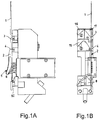
- the system for selecting the stitch-formation organs which is the object of the invention, comprises a plurality of needles 1, each equipped with a lower heel 3 and coupled with an elastic selection element (jack) 5, which includes a central portion 2, an upper heel 4 and a lower heel 5C; the needles 1, together with the respective elastic selection elements 5, are integral with the rotating cylinder of the knitting machine and rotate with said cylinder.
- an elastic selection element jack
- the elastic element 5 is inserted into a suitable channel of the rotating cylinder and can slide vertically, the upper heel 4 of the elastic element 5 is inserted in the cam 15, while the heel 5C may comes out from the seat of the rotating cylinder thanks to the elastic thrust of the spring placed inside the selection element or jack 5.
- the cam 8 which is fixed to the support 12 and to the the base of the machine, allows to press the selection element 5, so that, during rotation of the machine's cylinder, the cam 8 engages the lower heel 5C by pushing the elastic selection element 5 inside the cylinder and by pressing the spring.
- the area 20, shown in detail in the enclosed figure 3 is the selection area and corresponds to the area of contact between the cam 8 mounted on the support 12 and the cams 9 (raising cam) and 10 (draining cam) which are mounted on the adjacent support 12; as provided in the known circular knitting machines, the supports 12 of the cams 8, 9 and 10 surrounds the rotating cylinder of the machine so that the cams mounted on said cylinder are able to guide the selection elements and the needles at each position of the cylinder.
- the lower heel 5C of the selection element (selector or jack) 5 is disengaged from the cam 8 and therefore the spring of the selector 5 is able to push the lower heel 5C towards the outside of the machine's cylinder; in this area, the tilting of the selector 5, which takes place by means of the spring effect, is checked by the selection system composed by the actuator 13, which has some movable selection levers 14, and by the heels or teeth 6 of the selection jack 5.
- Each movable selection lever 14 of the actuator 13 is able to rotate with respect to its own pin, since it is actuated by a known piezo-ceramic or magnetic element.
- each selection jack 5 may have two or more selection teeth 6 of different length.
- the cams 9, 10 have two different depths with respect to the machine's cylinder, so as to allow the rising of the needle 1 in a position of "retained” points, as well as to allow the lowering of the needle 1 in a non-working or “out of work” position of said needles 1 (with release of the spring of said elastic selection element 5).
- the cam 9 allows to rise both the selector or jack 5 and the needle 1 by means of the heel 5C, up to the height of a "retained” point (the thread is taken without releasing the previously knitted point), while the cam 10 allows to rise the selector 5 and, consequently, the needle 1, by means of the lower heel 5C, up to the height corresponding to a working position of the needle 1 (the thread is taken and the knitted point which is already stitched is released).
- the jack or elastic selector 5 is pushed by the spring in a position which is completely outside the machine's cylinder and therefore the lower heel 5C turns towards a position such that, at a subsequent rotation of the cylinder, said heel 5C will engage the working cam 11 (the rising cam at a "mesh-working" position), so as to drive vertically the jack 5 and consequently the needle 1 up to the working position of the needle 1.
- the elastic jack 5 may goes out from the machine's cylinder until the lever 14 is able to stop the upper heel 4; therefore, the upper heel 4 cannot go out completely from the cylinder, but only for a portion so as to engage, during the rotation of the machine's cylinder, the rising cam 9 for making the retained point.
- the elastic jack 5 cannot go outside the cylinder and the spring of the jack 5 is maintained pressed; therefore, during the rotation of the machine's cylinder, the lower heel 5C cannot engage any of the cams 9 and 11 and thus cannot raise vertically. Consequently, also the needle 1 does not rise and therefore remain in a state of non-working or "out of work" (no thread is taken and the point previously knitted is maintained).
- the function of the guiding cam 15 of the elastic jack 5 in the area 15B limits the vertical rising of the upper heel 4 of the jack 5, so as to prevent to push the needle 1 at a not proper height, while the same cam 15 in the area 15A allow to take all the upper heels 4 of the elastic selection jacks 5 (coupled with the needles 1) to a same vertical height, before moving towards the new selection area 20.
- the selection jacks 5 When the selection jacks 5 are in the area 21 (the area where a compression of said jacks 5 starts), they are all released (the spring is released) and, therefore, all the lower heels 5C are outside the machine's cylinder, even if at different heights.
- the upper contrast cam 16 limits the vertical rising of the heel 3 of the needle 1, when said heel 3 is subjected to the thrust and acceleration of the jack 5, while the stitch formation cam 17, which is adjustable in height by sliding the key 18, brings down the needles 1, by driving the heels 3 up to a lower regulating stitching point.
- the use of the rising cams 9 and 11 having different depths allows, through the partially or completely coming out of the lower heel 5C, the selection elastic element (jack) 5 and the needle 1 to travel two different rising paths corresponding to the positions of "retained stitches” and "working position”; specifically, the double depth allows the lower heel 5C to travel three different paths starting from the same point.
- an elastic selection jack 5 with heels (an upper heel 4 and a lower heel 5C) having different length causes the persistence of the lower heel 5C inside the machine's cylinder or the exit of said lower heel 5C at two different positions, namely together with the cam 9 and with the cam 11; this allows to select three different paths at the same point.
- a selection actuator 13 with small and flat selection levers 14 allows a quick change of state of said levers 14, which, in a working position, act as shutters for a complete or partial exit of said selelection elastic element 5; furthermore, the selection levers 14 are mechanically pressed also supporting high forces and this allows to strengthen the spring of the jack 5 and to make faster, with respect to the prior art, the exit of the lower heel 5C (which is carried out in less space).
Landscapes
- Engineering & Computer Science (AREA)
- Textile Engineering (AREA)
- Knitting Machines (AREA)
Claims (7)
- System zur Auswahl maschenbildender Elemente für Textilmaschinen, insbesondere für Rundstrickmaschinen, umfassend eine Vielzahl von Nadeln (1), die in einem Drehzylinder der Textilmaschine integriert sind und die mit dem Zylinder drehen, und eine Vielzahl geformter Nocken (8, 9, 10, 11), die an entsprechenden Halterungen (12) montiert sind, die den Drehzylinder umgeben und ausgestaltet sind, die Nadeln (1) in jeder Position des Drehzylinders zu führen, wobei jede der Nadeln (1) mit einem elastischen Auswahlelement (5) gekoppelt ist, das in einen entsprechenden Kanal oder Sitz des Drehzylinders eingesetzt ist, wobei das elastische Element (5) auch einen elastischen Mittelabschnitt (2) und mindestens eine obere Ferse (4), die in einer Führungsnocke (15) eingesetzt werden kann, die an einer entsprechenden Halterung montiert ist, die den Drehzylinder umgibt, und eine untere Ferse (5C), die in dem Sitz des Drehzylinders aufgenommen ist, aufweist, und das aufgrund der Wirkung der mindestens einen ersten geformten Nocke (8) in einer vertikalen Richtung gleitet oder welches aufgrund der Wirkung des elastischen Mittelabschnitts (2) des elastischen Auswahlelements (5) radial von dem Sitz des Drehzylinders gelöst ist, wenn die untere Ferse (5C) von der ersten geformten Nocke (8) gelöst ist, wobei das elastische Auswahlelement (5) mit zwei oder mehr Zähnen (6) bereitgestellt ist, die zwischen der mindestens einen oberen Ferse (4) und der unteren Ferse (5C) platziert sind, und wobei ein Stellglied (13) ausgestaltet ist, eine Kippbewegung des elastischen Auswahlelements (5) zu steuern, wobei das Stellglied (13) einige Auswahlhebel (14) aufweist, die jeweils in Bezug auf ihren eigenen Stift beweglich und drehbar sind, so dass jeder der Auswahlhebel (14) imstande ist, mit einem oder mehreren der Zähne (6) des elastischen Auswahlelements (5) in Kontakt zu gelangen, dadurch gekennzeichnet, dass mindestens zwei der geformten Nocken (9, 11) unterschiedliche Tiefen in Bezug auf den Drehzylinder der Maschine aufweisen und die oberen und unteren Fersen (4, 5C) unterschiedliche Längen aufweisen, um so eine Bewegung der Nadeln (1) nach oben bzw. nach unten durch das teilweise oder vollständige Herauskommen der unteren Ferse (5C) zu erlauben, sodass die elastischen Auswahlelemente (5) und die Nadeln (1) in einer Nicht-Arbeitsposition platziert sind oder sich auf zwei unterschiedlichen ansteigenden Pfaden entsprechend den Strickpositionen des Garns bewegen, ohne die vorherigen Maschenpunkte freizugeben, und die Nadeln (1) in einer Arbeitsposition platziert werden, in der die Nadeln (1) das Garn durch Freigeben der vorherigen Maschenpunkte stricken, wobei die untere Ferse (5C) sich somit ausgehend von demselben Punkt über drei verschiedene Pfade bewegt.
- System nach Anspruch 1, dadurch gekennzeichnet, dass wenn die Auswahlhebel (14) des Stellglieds (13) in einer Position platziert sind, in der sie mit den Zähnen (6) des elastischen Auswahlelements (5) nicht in Kontakt sind, das elastische Auswahlelement (5) extern in Bezug auf den Drehzylinder der Maschine angeschoben wird und die untere Ferse (5C) in eine derartige Position gebracht wird, dass bei einer anschließenden Drehung des Zylinders die untere Ferse (5C) mit mindestens einer der geformten Nocken (11) in Eingriff steht, wodurch das elastische Auswahlelement (5) in einer vertikalen Richtung ansteigt und die Nadel (1) in der Arbeitsposition platziert.
- System nach Anspruch 1, dadurch gekennzeichnet, dass, wenn mindestens einer der Auswahlhebel (14) des Stellglieds (13) mit der mindestens einen oberen Ferse (4) des elastischen Auswahlelements (5) in Kontakt gelangt, das elastische Auswahlelement (5) imstande ist, aus dem Drehzylinder der Maschine herauszukommen, bis der Auswahlhebel (14) die mindestens eine obere Ferse (4) stoppt, wobei die mindestens eine obere Ferse (4) daher imstande ist, nur teilweise aus dem Drehzylinder herauszukommen, wodurch der Schritt zum Stricken des Garns, ohne die vorherigen Maschenpunkte freizugeben, ausgeführt wird.
- System nach Anspruch 1, dadurch gekennzeichnet, dass, wenn mindestens einer der Auswahlhebel (14) mit der unteren Ferse (5C) in Kontakt gelangt, das elastische Auswahlelement (5) nicht imstande ist, aus dem Drehzylinder der Maschine herauszukommen, und während der Drehung des Zylinders die untere Ferse (5C) und die Nadel (1) nicht imstande sind, in der vertikalen Richtung zu steigen, wodurch die Nadel (1) in der Nicht-Arbeitsposition gehalten wird.
- System nach Anspruch 1, dadurch gekennzeichnet, dass die Führungsnocke (15) so geformt ist, dass sie die Bewegung der mindestens einen oberen Ferse (4) des elastischen Auswahlelements (5) in der vertikalen Richtung begrenzt, um die Nadel (1) zu einer gegebenen Höhe zu schieben und um die oberen Fersen (4) der elastischen Auswahlelemente (5), während einer Drehung des Zylinders und wenn die elastischen Auswahlelemente (5) in einer ersten Auswahlzone (20) des Drehzylinders platziert sind, auf eine selbe Höhe zu bringen.
- System nach Anspruch 1, dadurch gekennzeichnet, dass, wenn die elastischen Auswahlelemente (5) in einer ersten Kompressionszone (21) des Drehzylinders platziert sind, die elastischen Auswahlelemente (5) in einem freigegebenen Zustand platziert sind und die unteren Fersen (5C) außerhalb des Zylinders der Maschine bei unterschiedlichen Höhen platziert sind.
- System nach mindestens einem der vorstehenden Ansprüche, dadurch gekennzeichnet, dass eine Gegennocke (16) ausgestaltet ist, die vertikale Bewegung der Nadel (1) zu begrenzen, während eine Maschenbildungsnocke (17), die höheneinstellbar ist, erlaubt, die Nadeln (1) durch Führen der mindestens einen oberen Ferse (3) nach oben zu einem unteren Mascheneinstellungspunkts nach unten zu bringen.
Applications Claiming Priority (2)
| Application Number | Priority Date | Filing Date | Title |
|---|---|---|---|
| ITVI20140338 | 2014-12-31 | ||
| PCT/IT2015/000295 WO2016108254A1 (en) | 2014-12-31 | 2015-12-07 | System for selecting the stitch forming organs for textile machines |
Publications (2)
| Publication Number | Publication Date |
|---|---|
| EP3240921A1 EP3240921A1 (de) | 2017-11-08 |
| EP3240921B1 true EP3240921B1 (de) | 2020-05-06 |
Family
ID=52597215
Family Applications (1)
| Application Number | Title | Priority Date | Filing Date |
|---|---|---|---|
| EP15837109.6A Active EP3240921B1 (de) | 2014-12-31 | 2015-12-07 | System zur auswahl von maschenbildenden instrumenten für textilmaschinen |
Country Status (3)
| Country | Link |
|---|---|
| EP (1) | EP3240921B1 (de) |
| CN (1) | CN107407021B (de) |
| WO (1) | WO2016108254A1 (de) |
Families Citing this family (2)
| Publication number | Priority date | Publication date | Assignee | Title |
|---|---|---|---|---|
| CN113215716B (zh) * | 2021-03-23 | 2022-12-06 | 福建华峰新材料有限公司 | 一种改进的三角、纬编机及其制备平纹仿提花面料的方法 |
| CN114575026B (zh) * | 2022-03-02 | 2023-11-03 | 浙江诸暨一丰针纺科技有限公司 | 一种织袜机多色绣花单路成圈和双路成圈转换结构和方法 |
Family Cites Families (9)
| Publication number | Priority date | Publication date | Assignee | Title |
|---|---|---|---|---|
| IT1202457B (it) * | 1987-02-02 | 1989-02-09 | Orizio Paolo Spa | Macchina circolare da maglieria universale a due cilindri e piu' cadute |
| ES2003000A6 (es) * | 1987-03-17 | 1988-10-01 | Jumberca Sa | Sistema de seleccion de agujas en una maquina circular de genero de punto |
| IT1244342B (it) * | 1990-12-21 | 1994-07-08 | Savio Spa | Procedimento e dispositivo per la selezione degli aghi con vincoli a molle deformabili in una macchina circolare da maglieria |
| ITBO940161A1 (it) * | 1994-04-15 | 1995-10-15 | Matec Srl | Dispositivo di selezione per selettore elastico per aghi in macchina tessile circolare |
| JP4213544B2 (ja) * | 2003-09-03 | 2009-01-21 | 株式会社福原精機製作所 | 丸編機における選針装置並びに方法及びこれに用いるアクチュエータ |
| CN100494539C (zh) * | 2005-07-29 | 2009-06-03 | 冯加林 | 具有多段压针密度的织针和含有三针踵挺针片的辅针组合装置 |
| CN2923760Y (zh) * | 2006-06-15 | 2007-07-18 | 宁波红旗马纺织机械科技有限公司 | 电脑针织横机单针选针装置 |
| CN202187152U (zh) * | 2011-07-18 | 2012-04-11 | 石狮市宝翔针织机械有限公司 | 一种电子提花针织圆纬机的三角机构 |
| CN203295759U (zh) * | 2013-05-21 | 2013-11-20 | 泉州隆硕纺织机械科技有限公司 | 一种电脑提花机的疏密三角 |
-
2015
- 2015-12-07 WO PCT/IT2015/000295 patent/WO2016108254A1/en not_active Ceased
- 2015-12-07 EP EP15837109.6A patent/EP3240921B1/de active Active
- 2015-12-07 CN CN201580071702.1A patent/CN107407021B/zh not_active Expired - Fee Related
Non-Patent Citations (1)
| Title |
|---|
| None * |
Also Published As
| Publication number | Publication date |
|---|---|
| EP3240921A1 (de) | 2017-11-08 |
| WO2016108254A1 (en) | 2016-07-07 |
| CN107407021A (zh) | 2017-11-28 |
| CN107407021B (zh) | 2019-05-17 |
Similar Documents
| Publication | Publication Date | Title |
|---|---|---|
| US4510775A (en) | Flat knitting machine capable of changing stitch density | |
| US4539825A (en) | Device selecting the needles on the dial plate of either single or multiple feed, single cylinder circular knitting machines for the manufacture of ribbed fabric | |
| WO2016108254A1 (en) | System for selecting the stitch forming organs for textile machines | |
| US1927016A (en) | Knitting machine | |
| US4879884A (en) | Universal double-cylinder, multi-yarn-feed circular knitting machine | |
| EP3819414B1 (de) | Nadelauswahlvorrichtung und verfahren für zungennadelkettenwirkmaschine | |
| US4662192A (en) | Flat knitting machine | |
| US6145349A (en) | Method and equipment for Jacquard selection in a textile machine | |
| EP3165652B1 (de) | Strickverfahren und rundstrickmaschine | |
| CN102108597B (zh) | 在针织机中选择针盘的针的方法和用于实施该方法的针盘 | |
| US3370443A (en) | Straight bar knitting machine with electromagnetic selection | |
| JP4628063B2 (ja) | 靴下類用の円形編機におけるシンカ選択装置 | |
| KR101036862B1 (ko) | 편성 타이밍 전환 장치를 갖춘 환편기 | |
| EP1620591B1 (de) | Rundstrickmaschine, vorzugsweise mit mittlerem durchmesser, mit verbesserter nadelauswahl | |
| CN101165252B (zh) | 具有送纱切换装置的圆织机 | |
| US3426550A (en) | Slide latch needle selector arrangement | |
| US3292395A (en) | Straight bar knitting machines | |
| US3566618A (en) | Individual needle control means for circular warp knitting machines | |
| US2310070A (en) | Knitting machine and method | |
| US3457734A (en) | Knitting machines | |
| US4604877A (en) | Needle selection device for knitting machines | |
| US3224226A (en) | Needle selection device | |
| US10612169B2 (en) | Knitting mechanism for circular knitting machine and the circular knitting machine | |
| US4516412A (en) | Cambox for a flat knitting machine | |
| US6886370B2 (en) | System for selecting the stitch forming elements for textile machines |
Legal Events
| Date | Code | Title | Description |
|---|---|---|---|
| STAA | Information on the status of an ep patent application or granted ep patent |
Free format text: STATUS: THE INTERNATIONAL PUBLICATION HAS BEEN MADE |
|
| PUAI | Public reference made under article 153(3) epc to a published international application that has entered the european phase |
Free format text: ORIGINAL CODE: 0009012 |
|
| STAA | Information on the status of an ep patent application or granted ep patent |
Free format text: STATUS: REQUEST FOR EXAMINATION WAS MADE |
|
| 17P | Request for examination filed |
Effective date: 20170717 |
|
| AK | Designated contracting states |
Kind code of ref document: A1 Designated state(s): AL AT BE BG CH CY CZ DE DK EE ES FI FR GB GR HR HU IE IS IT LI LT LU LV MC MK MT NL NO PL PT RO RS SE SI SK SM TR |
|
| AX | Request for extension of the european patent |
Extension state: BA ME |
|
| DAV | Request for validation of the european patent (deleted) | ||
| DAX | Request for extension of the european patent (deleted) | ||
| GRAP | Despatch of communication of intention to grant a patent |
Free format text: ORIGINAL CODE: EPIDOSNIGR1 |
|
| STAA | Information on the status of an ep patent application or granted ep patent |
Free format text: STATUS: GRANT OF PATENT IS INTENDED |
|
| INTG | Intention to grant announced |
Effective date: 20191206 |
|
| GRAS | Grant fee paid |
Free format text: ORIGINAL CODE: EPIDOSNIGR3 |
|
| GRAA | (expected) grant |
Free format text: ORIGINAL CODE: 0009210 |
|
| STAA | Information on the status of an ep patent application or granted ep patent |
Free format text: STATUS: THE PATENT HAS BEEN GRANTED |
|
| AK | Designated contracting states |
Kind code of ref document: B1 Designated state(s): AL AT BE BG CH CY CZ DE DK EE ES FI FR GB GR HR HU IE IS IT LI LT LU LV MC MK MT NL NO PL PT RO RS SE SI SK SM TR |
|
| REG | Reference to a national code |
Ref country code: GB Ref legal event code: FG4D |
|
| REG | Reference to a national code |
Ref country code: AT Ref legal event code: REF Ref document number: 1266891 Country of ref document: AT Kind code of ref document: T Effective date: 20200515 Ref country code: CH Ref legal event code: EP |
|
| REG | Reference to a national code |
Ref country code: IE Ref legal event code: FG4D |
|
| REG | Reference to a national code |
Ref country code: DE Ref legal event code: R096 Ref document number: 602015052464 Country of ref document: DE |
|
| REG | Reference to a national code |
Ref country code: LT Ref legal event code: MG4D |
|
| REG | Reference to a national code |
Ref country code: NL Ref legal event code: MP Effective date: 20200506 |
|
| PG25 | Lapsed in a contracting state [announced via postgrant information from national office to epo] |
Ref country code: FI Free format text: LAPSE BECAUSE OF FAILURE TO SUBMIT A TRANSLATION OF THE DESCRIPTION OR TO PAY THE FEE WITHIN THE PRESCRIBED TIME-LIMIT Effective date: 20200506 Ref country code: PT Free format text: LAPSE BECAUSE OF FAILURE TO SUBMIT A TRANSLATION OF THE DESCRIPTION OR TO PAY THE FEE WITHIN THE PRESCRIBED TIME-LIMIT Effective date: 20200907 Ref country code: IS Free format text: LAPSE BECAUSE OF FAILURE TO SUBMIT A TRANSLATION OF THE DESCRIPTION OR TO PAY THE FEE WITHIN THE PRESCRIBED TIME-LIMIT Effective date: 20200906 Ref country code: GR Free format text: LAPSE BECAUSE OF FAILURE TO SUBMIT A TRANSLATION OF THE DESCRIPTION OR TO PAY THE FEE WITHIN THE PRESCRIBED TIME-LIMIT Effective date: 20200807 Ref country code: NO Free format text: LAPSE BECAUSE OF FAILURE TO SUBMIT A TRANSLATION OF THE DESCRIPTION OR TO PAY THE FEE WITHIN THE PRESCRIBED TIME-LIMIT Effective date: 20200806 Ref country code: LT Free format text: LAPSE BECAUSE OF FAILURE TO SUBMIT A TRANSLATION OF THE DESCRIPTION OR TO PAY THE FEE WITHIN THE PRESCRIBED TIME-LIMIT Effective date: 20200506 Ref country code: SE Free format text: LAPSE BECAUSE OF FAILURE TO SUBMIT A TRANSLATION OF THE DESCRIPTION OR TO PAY THE FEE WITHIN THE PRESCRIBED TIME-LIMIT Effective date: 20200506 |
|
| PG25 | Lapsed in a contracting state [announced via postgrant information from national office to epo] |
Ref country code: RS Free format text: LAPSE BECAUSE OF FAILURE TO SUBMIT A TRANSLATION OF THE DESCRIPTION OR TO PAY THE FEE WITHIN THE PRESCRIBED TIME-LIMIT Effective date: 20200506 Ref country code: BG Free format text: LAPSE BECAUSE OF FAILURE TO SUBMIT A TRANSLATION OF THE DESCRIPTION OR TO PAY THE FEE WITHIN THE PRESCRIBED TIME-LIMIT Effective date: 20200806 Ref country code: HR Free format text: LAPSE BECAUSE OF FAILURE TO SUBMIT A TRANSLATION OF THE DESCRIPTION OR TO PAY THE FEE WITHIN THE PRESCRIBED TIME-LIMIT Effective date: 20200506 Ref country code: LV Free format text: LAPSE BECAUSE OF FAILURE TO SUBMIT A TRANSLATION OF THE DESCRIPTION OR TO PAY THE FEE WITHIN THE PRESCRIBED TIME-LIMIT Effective date: 20200506 |
|
| REG | Reference to a national code |
Ref country code: AT Ref legal event code: MK05 Ref document number: 1266891 Country of ref document: AT Kind code of ref document: T Effective date: 20200506 |
|
| PG25 | Lapsed in a contracting state [announced via postgrant information from national office to epo] |
Ref country code: AL Free format text: LAPSE BECAUSE OF FAILURE TO SUBMIT A TRANSLATION OF THE DESCRIPTION OR TO PAY THE FEE WITHIN THE PRESCRIBED TIME-LIMIT Effective date: 20200506 Ref country code: NL Free format text: LAPSE BECAUSE OF FAILURE TO SUBMIT A TRANSLATION OF THE DESCRIPTION OR TO PAY THE FEE WITHIN THE PRESCRIBED TIME-LIMIT Effective date: 20200506 |
|
| PG25 | Lapsed in a contracting state [announced via postgrant information from national office to epo] |
Ref country code: EE Free format text: LAPSE BECAUSE OF FAILURE TO SUBMIT A TRANSLATION OF THE DESCRIPTION OR TO PAY THE FEE WITHIN THE PRESCRIBED TIME-LIMIT Effective date: 20200506 Ref country code: SM Free format text: LAPSE BECAUSE OF FAILURE TO SUBMIT A TRANSLATION OF THE DESCRIPTION OR TO PAY THE FEE WITHIN THE PRESCRIBED TIME-LIMIT Effective date: 20200506 Ref country code: DK Free format text: LAPSE BECAUSE OF FAILURE TO SUBMIT A TRANSLATION OF THE DESCRIPTION OR TO PAY THE FEE WITHIN THE PRESCRIBED TIME-LIMIT Effective date: 20200506 Ref country code: ES Free format text: LAPSE BECAUSE OF FAILURE TO SUBMIT A TRANSLATION OF THE DESCRIPTION OR TO PAY THE FEE WITHIN THE PRESCRIBED TIME-LIMIT Effective date: 20200506 Ref country code: AT Free format text: LAPSE BECAUSE OF FAILURE TO SUBMIT A TRANSLATION OF THE DESCRIPTION OR TO PAY THE FEE WITHIN THE PRESCRIBED TIME-LIMIT Effective date: 20200506 Ref country code: CZ Free format text: LAPSE BECAUSE OF FAILURE TO SUBMIT A TRANSLATION OF THE DESCRIPTION OR TO PAY THE FEE WITHIN THE PRESCRIBED TIME-LIMIT Effective date: 20200506 Ref country code: RO Free format text: LAPSE BECAUSE OF FAILURE TO SUBMIT A TRANSLATION OF THE DESCRIPTION OR TO PAY THE FEE WITHIN THE PRESCRIBED TIME-LIMIT Effective date: 20200506 |
|
| REG | Reference to a national code |
Ref country code: DE Ref legal event code: R097 Ref document number: 602015052464 Country of ref document: DE |
|
| PG25 | Lapsed in a contracting state [announced via postgrant information from national office to epo] |
Ref country code: PL Free format text: LAPSE BECAUSE OF FAILURE TO SUBMIT A TRANSLATION OF THE DESCRIPTION OR TO PAY THE FEE WITHIN THE PRESCRIBED TIME-LIMIT Effective date: 20200506 Ref country code: SK Free format text: LAPSE BECAUSE OF FAILURE TO SUBMIT A TRANSLATION OF THE DESCRIPTION OR TO PAY THE FEE WITHIN THE PRESCRIBED TIME-LIMIT Effective date: 20200506 |
|
| PLBE | No opposition filed within time limit |
Free format text: ORIGINAL CODE: 0009261 |
|
| STAA | Information on the status of an ep patent application or granted ep patent |
Free format text: STATUS: NO OPPOSITION FILED WITHIN TIME LIMIT |
|
| 26N | No opposition filed |
Effective date: 20210209 |
|
| PG25 | Lapsed in a contracting state [announced via postgrant information from national office to epo] |
Ref country code: SI Free format text: LAPSE BECAUSE OF FAILURE TO SUBMIT A TRANSLATION OF THE DESCRIPTION OR TO PAY THE FEE WITHIN THE PRESCRIBED TIME-LIMIT Effective date: 20200506 |
|
| REG | Reference to a national code |
Ref country code: CH Ref legal event code: PL |
|
| GBPC | Gb: european patent ceased through non-payment of renewal fee |
Effective date: 20201207 |
|
| PG25 | Lapsed in a contracting state [announced via postgrant information from national office to epo] |
Ref country code: MC Free format text: LAPSE BECAUSE OF FAILURE TO SUBMIT A TRANSLATION OF THE DESCRIPTION OR TO PAY THE FEE WITHIN THE PRESCRIBED TIME-LIMIT Effective date: 20200506 |
|
| REG | Reference to a national code |
Ref country code: BE Ref legal event code: MM Effective date: 20201231 |
|
| PG25 | Lapsed in a contracting state [announced via postgrant information from national office to epo] |
Ref country code: IE Free format text: LAPSE BECAUSE OF NON-PAYMENT OF DUE FEES Effective date: 20201207 Ref country code: LU Free format text: LAPSE BECAUSE OF NON-PAYMENT OF DUE FEES Effective date: 20201207 |
|
| PG25 | Lapsed in a contracting state [announced via postgrant information from national office to epo] |
Ref country code: CH Free format text: LAPSE BECAUSE OF NON-PAYMENT OF DUE FEES Effective date: 20201231 Ref country code: LI Free format text: LAPSE BECAUSE OF NON-PAYMENT OF DUE FEES Effective date: 20201231 Ref country code: GB Free format text: LAPSE BECAUSE OF NON-PAYMENT OF DUE FEES Effective date: 20201207 |
|
| PGFP | Annual fee paid to national office [announced via postgrant information from national office to epo] |
Ref country code: FR Payment date: 20211109 Year of fee payment: 7 |
|
| PG25 | Lapsed in a contracting state [announced via postgrant information from national office to epo] |
Ref country code: TR Free format text: LAPSE BECAUSE OF FAILURE TO SUBMIT A TRANSLATION OF THE DESCRIPTION OR TO PAY THE FEE WITHIN THE PRESCRIBED TIME-LIMIT Effective date: 20200506 Ref country code: MT Free format text: LAPSE BECAUSE OF FAILURE TO SUBMIT A TRANSLATION OF THE DESCRIPTION OR TO PAY THE FEE WITHIN THE PRESCRIBED TIME-LIMIT Effective date: 20200506 Ref country code: CY Free format text: LAPSE BECAUSE OF FAILURE TO SUBMIT A TRANSLATION OF THE DESCRIPTION OR TO PAY THE FEE WITHIN THE PRESCRIBED TIME-LIMIT Effective date: 20200506 |
|
| PG25 | Lapsed in a contracting state [announced via postgrant information from national office to epo] |
Ref country code: MK Free format text: LAPSE BECAUSE OF FAILURE TO SUBMIT A TRANSLATION OF THE DESCRIPTION OR TO PAY THE FEE WITHIN THE PRESCRIBED TIME-LIMIT Effective date: 20200506 |
|
| PG25 | Lapsed in a contracting state [announced via postgrant information from national office to epo] |
Ref country code: BE Free format text: LAPSE BECAUSE OF NON-PAYMENT OF DUE FEES Effective date: 20201231 |
|
| PGFP | Annual fee paid to national office [announced via postgrant information from national office to epo] |
Ref country code: IT Payment date: 20230331 Year of fee payment: 8 Ref country code: DE Payment date: 20230404 Year of fee payment: 8 |
|
| PG25 | Lapsed in a contracting state [announced via postgrant information from national office to epo] |
Ref country code: FR Free format text: LAPSE BECAUSE OF NON-PAYMENT OF DUE FEES Effective date: 20221231 |
|
| REG | Reference to a national code |
Ref country code: DE Ref legal event code: R119 Ref document number: 602015052464 Country of ref document: DE |
|
| PG25 | Lapsed in a contracting state [announced via postgrant information from national office to epo] |
Ref country code: DE Free format text: LAPSE BECAUSE OF NON-PAYMENT OF DUE FEES Effective date: 20240702 |
|
| PG25 | Lapsed in a contracting state [announced via postgrant information from national office to epo] |
Ref country code: DE Free format text: LAPSE BECAUSE OF NON-PAYMENT OF DUE FEES Effective date: 20240702 |
|
| PG25 | Lapsed in a contracting state [announced via postgrant information from national office to epo] |
Ref country code: IT Free format text: LAPSE BECAUSE OF NON-PAYMENT OF DUE FEES Effective date: 20231207 |
|
| PG25 | Lapsed in a contracting state [announced via postgrant information from national office to epo] |
Ref country code: IS Free format text: LAPSE BECAUSE OF NON-PAYMENT OF DUE FEES Effective date: 20200906 |