EP3241853A1 - Elastomere polymere mit thioether-modifiziertem rückgrat - Google Patents
Elastomere polymere mit thioether-modifiziertem rückgrat Download PDFInfo
- Publication number
- EP3241853A1 EP3241853A1 EP16168280.2A EP16168280A EP3241853A1 EP 3241853 A1 EP3241853 A1 EP 3241853A1 EP 16168280 A EP16168280 A EP 16168280A EP 3241853 A1 EP3241853 A1 EP 3241853A1
- Authority
- EP
- European Patent Office
- Prior art keywords
- alkyl
- polymer
- aralkyl
- independently selected
- aryl
- Prior art date
- Legal status (The legal status is an assumption and is not a legal conclusion. Google has not performed a legal analysis and makes no representation as to the accuracy of the status listed.)
- Withdrawn
Links
- 229920000642 polymer Polymers 0.000 title claims abstract description 173
- 150000003568 thioethers Chemical class 0.000 title 1
- 239000000203 mixture Substances 0.000 claims abstract description 61
- 150000001875 compounds Chemical class 0.000 claims abstract description 40
- 125000000217 alkyl group Chemical group 0.000 claims abstract description 35
- 125000003118 aryl group Chemical group 0.000 claims abstract description 26
- 150000001993 dienes Chemical class 0.000 claims abstract description 26
- 239000003999 initiator Substances 0.000 claims abstract description 26
- 125000003710 aryl alkyl group Chemical group 0.000 claims abstract description 23
- 229920002554 vinyl polymer Polymers 0.000 claims abstract description 19
- 229910052799 carbon Inorganic materials 0.000 claims abstract description 18
- 229910052739 hydrogen Inorganic materials 0.000 claims abstract description 18
- -1 vinyl aromatic compounds Chemical class 0.000 claims abstract description 18
- 229910052717 sulfur Inorganic materials 0.000 claims abstract description 15
- 238000000034 method Methods 0.000 claims abstract description 14
- 150000001983 dialkylethers Chemical class 0.000 claims abstract description 12
- 238000004519 manufacturing process Methods 0.000 claims abstract description 11
- 238000010539 anionic addition polymerization reaction Methods 0.000 claims abstract description 8
- 125000000129 anionic group Chemical group 0.000 claims abstract description 7
- 125000004434 sulfur atom Chemical group 0.000 claims abstract description 6
- PPBRXRYQALVLMV-UHFFFAOYSA-N Styrene Chemical compound C=CC1=CC=CC=C1 PPBRXRYQALVLMV-UHFFFAOYSA-N 0.000 claims description 41
- 238000006116 polymerization reaction Methods 0.000 claims description 33
- 239000000178 monomer Substances 0.000 claims description 23
- KAKZBPTYRLMSJV-UHFFFAOYSA-N Butadiene Chemical group C=CC=C KAKZBPTYRLMSJV-UHFFFAOYSA-N 0.000 claims description 20
- 239000000945 filler Substances 0.000 claims description 12
- 239000002904 solvent Substances 0.000 claims description 11
- 238000002360 preparation method Methods 0.000 claims description 9
- 239000003921 oil Substances 0.000 claims description 8
- 239000003381 stabilizer Substances 0.000 claims description 5
- SDJHPPZKZZWAKF-UHFFFAOYSA-N 2,3-dimethylbuta-1,3-diene Chemical compound CC(=C)C(C)=C SDJHPPZKZZWAKF-UHFFFAOYSA-N 0.000 claims description 4
- CJSBUWDGPXGFGA-UHFFFAOYSA-N 4-methylpenta-1,3-diene Chemical compound CC(C)=CC=C CJSBUWDGPXGFGA-UHFFFAOYSA-N 0.000 claims description 4
- ZSWFCLXCOIISFI-UHFFFAOYSA-N cyclopentadiene Chemical compound C1C=CC=C1 ZSWFCLXCOIISFI-UHFFFAOYSA-N 0.000 claims description 4
- 150000002978 peroxides Chemical group 0.000 claims description 4
- 229920003023 plastic Polymers 0.000 claims description 4
- 239000004033 plastic Substances 0.000 claims description 4
- 230000000379 polymerizing effect Effects 0.000 claims description 4
- 230000002787 reinforcement Effects 0.000 claims description 4
- 239000012528 membrane Substances 0.000 claims description 3
- RRKODOZNUZCUBN-CCAGOZQPSA-N (1z,3z)-cycloocta-1,3-diene Chemical compound C1CC\C=C/C=C\C1 RRKODOZNUZCUBN-CCAGOZQPSA-N 0.000 claims description 2
- APPOKADJQUIAHP-GGWOSOGESA-N (2e,4e)-hexa-2,4-diene Chemical compound C\C=C\C=C\C APPOKADJQUIAHP-GGWOSOGESA-N 0.000 claims description 2
- OGQVROWWFUXRST-FNORWQNLSA-N (3e)-hepta-1,3-diene Chemical compound CCC\C=C\C=C OGQVROWWFUXRST-FNORWQNLSA-N 0.000 claims description 2
- AHAREKHAZNPPMI-AATRIKPKSA-N (3e)-hexa-1,3-diene Chemical compound CC\C=C\C=C AHAREKHAZNPPMI-AATRIKPKSA-N 0.000 claims description 2
- PMJHHCWVYXUKFD-SNAWJCMRSA-N (E)-1,3-pentadiene Chemical compound C\C=C\C=C PMJHHCWVYXUKFD-SNAWJCMRSA-N 0.000 claims description 2
- MYRTYDVEIRVNKP-UHFFFAOYSA-N 1,2-Divinylbenzene Chemical compound C=CC1=CC=CC=C1C=C MYRTYDVEIRVNKP-UHFFFAOYSA-N 0.000 claims description 2
- CORMBJOFDGICKF-UHFFFAOYSA-N 1,3,5-trimethoxy 2-vinyl benzene Natural products COC1=CC(OC)=C(C=C)C(OC)=C1 CORMBJOFDGICKF-UHFFFAOYSA-N 0.000 claims description 2
- QTYUSOHYEPOHLV-FNORWQNLSA-N 1,3-Octadiene Chemical compound CCCC\C=C\C=C QTYUSOHYEPOHLV-FNORWQNLSA-N 0.000 claims description 2
- PRJNEUBECVAVAG-UHFFFAOYSA-N 1,3-bis(ethenyl)benzene Chemical compound C=CC1=CC=CC(C=C)=C1 PRJNEUBECVAVAG-UHFFFAOYSA-N 0.000 claims description 2
- WEERVPDNCOGWJF-UHFFFAOYSA-N 1,4-bis(ethenyl)benzene Chemical compound C=CC1=CC=C(C=C)C=C1 WEERVPDNCOGWJF-UHFFFAOYSA-N 0.000 claims description 2
- OUSXYCTXXLYBGJ-UHFFFAOYSA-N 1-ethenyl-2,4-di(propan-2-yl)benzene Chemical compound CC(C)C1=CC=C(C=C)C(C(C)C)=C1 OUSXYCTXXLYBGJ-UHFFFAOYSA-N 0.000 claims description 2
- OEVVKKAVYQFQNV-UHFFFAOYSA-N 1-ethenyl-2,4-dimethylbenzene Chemical compound CC1=CC=C(C=C)C(C)=C1 OEVVKKAVYQFQNV-UHFFFAOYSA-N 0.000 claims description 2
- NVZWEEGUWXZOKI-UHFFFAOYSA-N 1-ethenyl-2-methylbenzene Chemical compound CC1=CC=CC=C1C=C NVZWEEGUWXZOKI-UHFFFAOYSA-N 0.000 claims description 2
- JZHGRUMIRATHIU-UHFFFAOYSA-N 1-ethenyl-3-methylbenzene Chemical compound CC1=CC=CC(C=C)=C1 JZHGRUMIRATHIU-UHFFFAOYSA-N 0.000 claims description 2
- QEDJMOONZLUIMC-UHFFFAOYSA-N 1-tert-butyl-4-ethenylbenzene Chemical compound CC(C)(C)C1=CC=C(C=C)C=C1 QEDJMOONZLUIMC-UHFFFAOYSA-N 0.000 claims description 2
- TYENDWOHUUAIJH-UHFFFAOYSA-N 2-[(4-ethenylphenyl)methoxy]-n,n-dimethylethanamine Chemical compound CN(C)CCOCC1=CC=C(C=C)C=C1 TYENDWOHUUAIJH-UHFFFAOYSA-N 0.000 claims description 2
- PDELBHCVXBSVPJ-UHFFFAOYSA-N 2-ethenyl-1,3,5-trimethylbenzene Chemical compound CC1=CC(C)=C(C=C)C(C)=C1 PDELBHCVXBSVPJ-UHFFFAOYSA-N 0.000 claims description 2
- KGIGUEBEKRSTEW-UHFFFAOYSA-N 2-vinylpyridine Chemical compound C=CC1=CC=CC=N1 KGIGUEBEKRSTEW-UHFFFAOYSA-N 0.000 claims description 2
- JLBJTVDPSNHSKJ-UHFFFAOYSA-N 4-Methylstyrene Chemical compound CC1=CC=C(C=C)C=C1 JLBJTVDPSNHSKJ-UHFFFAOYSA-N 0.000 claims description 2
- PJANXHGTPQOBST-VAWYXSNFSA-N Stilbene Natural products C=1C=CC=CC=1/C=C/C1=CC=CC=C1 PJANXHGTPQOBST-VAWYXSNFSA-N 0.000 claims description 2
- 239000002318 adhesion promoter Substances 0.000 claims description 2
- XYLMUPLGERFSHI-UHFFFAOYSA-N alpha-Methylstyrene Chemical compound CC(=C)C1=CC=CC=C1 XYLMUPLGERFSHI-UHFFFAOYSA-N 0.000 claims description 2
- 239000003153 chemical reaction reagent Substances 0.000 claims description 2
- UBHHTPOLMACCDD-UHFFFAOYSA-N n,n-dimethyl-4-phenylbut-3-en-1-amine Chemical compound CN(C)CCC=CC1=CC=CC=C1 UBHHTPOLMACCDD-UHFFFAOYSA-N 0.000 claims description 2
- DZRKBPWATCKLKY-UHFFFAOYSA-N n-benzyl-n-methylprop-2-en-1-amine Chemical compound C=CCN(C)CC1=CC=CC=C1 DZRKBPWATCKLKY-UHFFFAOYSA-N 0.000 claims description 2
- PMJHHCWVYXUKFD-UHFFFAOYSA-N piperylene Natural products CC=CC=C PMJHHCWVYXUKFD-UHFFFAOYSA-N 0.000 claims description 2
- PJANXHGTPQOBST-UHFFFAOYSA-N stilbene Chemical compound C=1C=CC=CC=1C=CC1=CC=CC=C1 PJANXHGTPQOBST-UHFFFAOYSA-N 0.000 claims description 2
- 235000021286 stilbenes Nutrition 0.000 claims description 2
- 150000003440 styrenes Chemical class 0.000 claims description 2
- FXRQXYSJYZPGJZ-UHFFFAOYSA-N 2-[(2-methylpropan-2-yl)oxy]ethenylbenzene Chemical compound CC(C)(C)OC=CC1=CC=CC=C1 FXRQXYSJYZPGJZ-UHFFFAOYSA-N 0.000 claims 1
- BYDROKITEOVIPQ-UHFFFAOYSA-N buta-1,3-diene;2-methylbuta-1,3-diene Chemical compound C=CC=C.CC(=C)C=C.CC(=C)C=C BYDROKITEOVIPQ-UHFFFAOYSA-N 0.000 claims 1
- 238000005034 decoration Methods 0.000 claims 1
- 239000000546 pharmaceutical excipient Substances 0.000 claims 1
- 150000003254 radicals Chemical class 0.000 abstract description 13
- 229920001971 elastomer Polymers 0.000 description 35
- 239000005060 rubber Substances 0.000 description 35
- VYPSYNLAJGMNEJ-UHFFFAOYSA-N Silicium dioxide Chemical compound O=[Si]=O VYPSYNLAJGMNEJ-UHFFFAOYSA-N 0.000 description 16
- 230000000052 comparative effect Effects 0.000 description 16
- 238000012986 modification Methods 0.000 description 15
- 230000004048 modification Effects 0.000 description 15
- 238000005299 abrasion Methods 0.000 description 13
- 238000005096 rolling process Methods 0.000 description 13
- RTZKZFJDLAIYFH-UHFFFAOYSA-N Diethyl ether Chemical compound CCOCC RTZKZFJDLAIYFH-UHFFFAOYSA-N 0.000 description 12
- 239000003607 modifier Substances 0.000 description 12
- NINIDFKCEFEMDL-UHFFFAOYSA-N Sulfur Chemical compound [S] NINIDFKCEFEMDL-UHFFFAOYSA-N 0.000 description 10
- 238000006243 chemical reaction Methods 0.000 description 10
- OKKJLVBELUTLKV-UHFFFAOYSA-N Methanol Chemical compound OC OKKJLVBELUTLKV-UHFFFAOYSA-N 0.000 description 9
- XLOMVQKBTHCTTD-UHFFFAOYSA-N Zinc monoxide Chemical compound [Zn]=O XLOMVQKBTHCTTD-UHFFFAOYSA-N 0.000 description 9
- 239000000377 silicon dioxide Substances 0.000 description 9
- 239000011593 sulfur Substances 0.000 description 9
- MZRVEZGGRBJDDB-UHFFFAOYSA-N N-Butyllithium Chemical compound [Li]CCCC MZRVEZGGRBJDDB-UHFFFAOYSA-N 0.000 description 8
- 239000003795 chemical substances by application Substances 0.000 description 8
- SRZXCOWFGPICGA-UHFFFAOYSA-N 1,6-Hexanedithiol Chemical compound SCCCCCCS SRZXCOWFGPICGA-UHFFFAOYSA-N 0.000 description 7
- CBXRMKZFYQISIV-UHFFFAOYSA-N 1-n,1-n,1-n',1-n',2-n,2-n,2-n',2-n'-octamethylethene-1,1,2,2-tetramine Chemical compound CN(C)C(N(C)C)=C(N(C)C)N(C)C CBXRMKZFYQISIV-UHFFFAOYSA-N 0.000 description 6
- 239000006229 carbon black Substances 0.000 description 6
- 125000002887 hydroxy group Chemical group [H]O* 0.000 description 6
- 229910000077 silane Inorganic materials 0.000 description 6
- 239000000243 solution Substances 0.000 description 6
- OKTJSMMVPCPJKN-UHFFFAOYSA-N Carbon Chemical compound [C] OKTJSMMVPCPJKN-UHFFFAOYSA-N 0.000 description 5
- BLRPTPMANUNPDV-UHFFFAOYSA-N Silane Chemical compound [SiH4] BLRPTPMANUNPDV-UHFFFAOYSA-N 0.000 description 5
- 125000003178 carboxy group Chemical group [H]OC(*)=O 0.000 description 5
- IJGRMHOSHXDMSA-UHFFFAOYSA-N Atomic nitrogen Chemical compound N#N IJGRMHOSHXDMSA-UHFFFAOYSA-N 0.000 description 4
- XDTMQSROBMDMFD-UHFFFAOYSA-N Cyclohexane Chemical compound C1CCCCC1 XDTMQSROBMDMFD-UHFFFAOYSA-N 0.000 description 4
- 239000003963 antioxidant agent Substances 0.000 description 4
- 238000007334 copolymerization reaction Methods 0.000 description 4
- 229920003244 diene elastomer Polymers 0.000 description 4
- 125000000524 functional group Chemical group 0.000 description 4
- 229920005669 high impact polystyrene Polymers 0.000 description 4
- 239000004797 high-impact polystyrene Substances 0.000 description 4
- 125000000391 vinyl group Chemical group [H]C([*])=C([H])[H] 0.000 description 4
- 238000004073 vulcanization Methods 0.000 description 4
- BFSVOASYOCHEOV-UHFFFAOYSA-N 2-diethylaminoethanol Chemical compound CCN(CC)CCO BFSVOASYOCHEOV-UHFFFAOYSA-N 0.000 description 3
- GAODDBNJCKQQDY-UHFFFAOYSA-N 2-methyl-4,6-bis(octylsulfanylmethyl)phenol Chemical compound CCCCCCCCSCC1=CC(C)=C(O)C(CSCCCCCCCC)=C1 GAODDBNJCKQQDY-UHFFFAOYSA-N 0.000 description 3
- UHOVQNZJYSORNB-UHFFFAOYSA-N Benzene Chemical compound C1=CC=CC=C1 UHOVQNZJYSORNB-UHFFFAOYSA-N 0.000 description 3
- KWYHDKDOAIKMQN-UHFFFAOYSA-N N,N,N',N'-tetramethylethylenediamine Chemical compound CN(C)CCN(C)C KWYHDKDOAIKMQN-UHFFFAOYSA-N 0.000 description 3
- 235000021355 Stearic acid Nutrition 0.000 description 3
- YXFVVABEGXRONW-UHFFFAOYSA-N Toluene Chemical compound CC1=CC=CC=C1 YXFVVABEGXRONW-UHFFFAOYSA-N 0.000 description 3
- ZMANZCXQSJIPKH-UHFFFAOYSA-N Triethylamine Chemical compound CCN(CC)CC ZMANZCXQSJIPKH-UHFFFAOYSA-N 0.000 description 3
- 230000003712 anti-aging effect Effects 0.000 description 3
- 238000010528 free radical solution polymerization reaction Methods 0.000 description 3
- VNWKTOKETHGBQD-UHFFFAOYSA-N methane Chemical compound C VNWKTOKETHGBQD-UHFFFAOYSA-N 0.000 description 3
- VLKZOEOYAKHREP-UHFFFAOYSA-N n-Hexane Chemical compound CCCCCC VLKZOEOYAKHREP-UHFFFAOYSA-N 0.000 description 3
- OFBQJSOFQDEBGM-UHFFFAOYSA-N n-pentane Natural products CCCCC OFBQJSOFQDEBGM-UHFFFAOYSA-N 0.000 description 3
- 229910052757 nitrogen Inorganic materials 0.000 description 3
- QIQXTHQIDYTFRH-UHFFFAOYSA-N octadecanoic acid Chemical compound CCCCCCCCCCCCCCCCCC(O)=O QIQXTHQIDYTFRH-UHFFFAOYSA-N 0.000 description 3
- OQCDKBAXFALNLD-UHFFFAOYSA-N octadecanoic acid Natural products CCCCCCCC(C)CCCCCCCCC(O)=O OQCDKBAXFALNLD-UHFFFAOYSA-N 0.000 description 3
- 230000000704 physical effect Effects 0.000 description 3
- 239000011541 reaction mixture Substances 0.000 description 3
- 239000008117 stearic acid Substances 0.000 description 3
- 238000012360 testing method Methods 0.000 description 3
- BSYVTEYKTMYBMK-UHFFFAOYSA-N tetrahydrofurfuryl alcohol Chemical class OCC1CCCO1 BSYVTEYKTMYBMK-UHFFFAOYSA-N 0.000 description 3
- 239000003039 volatile agent Substances 0.000 description 3
- XLYOFNOQVPJJNP-UHFFFAOYSA-N water Substances O XLYOFNOQVPJJNP-UHFFFAOYSA-N 0.000 description 3
- 239000011787 zinc oxide Substances 0.000 description 3
- WGACMNAUEGCUHG-VYBOCCTBSA-N (2s)-2-[[(2s)-2-[[(2s)-2-acetamidopropanoyl]amino]propanoyl]amino]-n-[(2s)-6-amino-1-[[(2s)-1-[(2s)-2-[[(2s)-1-[[(2s)-5-amino-1-[[(2s)-1-[[(2s)-1-[[(2s)-6-amino-1-[[(2s)-1-amino-3-(4-hydroxyphenyl)-1-oxopropan-2-yl]amino]-1-oxohexan-2-yl]amino]-3-hydroxy- Chemical compound CC(=O)N[C@@H](C)C(=O)N[C@@H](C)C(=O)N[C@@H](CCC(N)=O)C(=O)N[C@@H](CCCCN)C(=O)N[C@@H](CCCN=C(N)N)C(=O)N1CCC[C@H]1C(=O)N[C@@H](CO)C(=O)N[C@@H](CCC(N)=O)C(=O)N[C@@H](CCCN=C(N)N)C(=O)N[C@@H](CO)C(=O)N[C@@H](CCCCN)C(=O)N[C@H](C(N)=O)CC1=CC=C(O)C=C1 WGACMNAUEGCUHG-VYBOCCTBSA-N 0.000 description 2
- 125000004209 (C1-C8) alkyl group Chemical group 0.000 description 2
- DURPTKYDGMDSBL-UHFFFAOYSA-N 1-butoxybutane Chemical compound CCCCOCCCC DURPTKYDGMDSBL-UHFFFAOYSA-N 0.000 description 2
- SOGAXMICEFXMKE-UHFFFAOYSA-N Butylmethacrylate Chemical compound CCCCOC(=O)C(C)=C SOGAXMICEFXMKE-UHFFFAOYSA-N 0.000 description 2
- VTYYLEPIZMXCLO-UHFFFAOYSA-L Calcium carbonate Chemical compound [Ca+2].[O-]C([O-])=O VTYYLEPIZMXCLO-UHFFFAOYSA-L 0.000 description 2
- LCGLNKUTAGEVQW-UHFFFAOYSA-N Dimethyl ether Chemical compound COC LCGLNKUTAGEVQW-UHFFFAOYSA-N 0.000 description 2
- LFQSCWFLJHTTHZ-UHFFFAOYSA-N Ethanol Chemical compound CCO LFQSCWFLJHTTHZ-UHFFFAOYSA-N 0.000 description 2
- YNQLUTRBYVCPMQ-UHFFFAOYSA-N Ethylbenzene Chemical compound CCC1=CC=CC=C1 YNQLUTRBYVCPMQ-UHFFFAOYSA-N 0.000 description 2
- RRHGJUQNOFWUDK-UHFFFAOYSA-N Isoprene Chemical compound CC(=C)C=C RRHGJUQNOFWUDK-UHFFFAOYSA-N 0.000 description 2
- KFZMGEQAYNKOFK-UHFFFAOYSA-N Isopropanol Chemical compound CC(C)O KFZMGEQAYNKOFK-UHFFFAOYSA-N 0.000 description 2
- YIVJZNGAASQVEM-UHFFFAOYSA-N Lauroyl peroxide Chemical compound CCCCCCCCCCCC(=O)OOC(=O)CCCCCCCCCCC YIVJZNGAASQVEM-UHFFFAOYSA-N 0.000 description 2
- 239000002879 Lewis base Substances 0.000 description 2
- BAPJBEWLBFYGME-UHFFFAOYSA-N Methyl acrylate Chemical compound COC(=O)C=C BAPJBEWLBFYGME-UHFFFAOYSA-N 0.000 description 2
- IMNFDUFMRHMDMM-UHFFFAOYSA-N N-Heptane Chemical compound CCCCCCC IMNFDUFMRHMDMM-UHFFFAOYSA-N 0.000 description 2
- 239000005062 Polybutadiene Substances 0.000 description 2
- ATUOYWHBWRKTHZ-UHFFFAOYSA-N Propane Chemical compound CCC ATUOYWHBWRKTHZ-UHFFFAOYSA-N 0.000 description 2
- QQONPFPTGQHPMA-UHFFFAOYSA-N Propene Chemical compound CC=C QQONPFPTGQHPMA-UHFFFAOYSA-N 0.000 description 2
- XBDQKXXYIPTUBI-UHFFFAOYSA-M Propionate Chemical compound CCC([O-])=O XBDQKXXYIPTUBI-UHFFFAOYSA-M 0.000 description 2
- JUJWROOIHBZHMG-UHFFFAOYSA-N Pyridine Chemical compound C1=CC=NC=C1 JUJWROOIHBZHMG-UHFFFAOYSA-N 0.000 description 2
- 229910000831 Steel Inorganic materials 0.000 description 2
- WYURNTSHIVDZCO-UHFFFAOYSA-N Tetrahydrofuran Chemical compound C1CCOC1 WYURNTSHIVDZCO-UHFFFAOYSA-N 0.000 description 2
- YEHYAPARHOIBPK-UHFFFAOYSA-N [Li]C(C)(CCCC)c1cccc(c1)C([Li])(C)CCCC Chemical compound [Li]C(C)(CCCC)c1cccc(c1)C([Li])(C)CCCC YEHYAPARHOIBPK-UHFFFAOYSA-N 0.000 description 2
- NIXOWILDQLNWCW-UHFFFAOYSA-N acrylic acid group Chemical group C(C=C)(=O)O NIXOWILDQLNWCW-UHFFFAOYSA-N 0.000 description 2
- 150000008360 acrylonitriles Chemical class 0.000 description 2
- 150000001298 alcohols Chemical class 0.000 description 2
- 150000001412 amines Chemical class 0.000 description 2
- 150000001491 aromatic compounds Chemical class 0.000 description 2
- 239000002041 carbon nanotube Substances 0.000 description 2
- 125000002915 carbonyl group Chemical group [*:2]C([*:1])=O 0.000 description 2
- 229920001577 copolymer Polymers 0.000 description 2
- 238000004132 cross linking Methods 0.000 description 2
- 238000013016 damping Methods 0.000 description 2
- 230000006866 deterioration Effects 0.000 description 2
- 238000009826 distribution Methods 0.000 description 2
- 229940035423 ethyl ether Drugs 0.000 description 2
- 239000004744 fabric Substances 0.000 description 2
- 239000000835 fiber Substances 0.000 description 2
- 238000004817 gas chromatography Methods 0.000 description 2
- 229910021389 graphene Inorganic materials 0.000 description 2
- 150000007527 lewis bases Chemical class 0.000 description 2
- DLEDOFVPSDKWEF-UHFFFAOYSA-N lithium butane Chemical compound [Li+].CCC[CH2-] DLEDOFVPSDKWEF-UHFFFAOYSA-N 0.000 description 2
- WGOPGODQLGJZGL-UHFFFAOYSA-N lithium;butane Chemical compound [Li+].CC[CH-]C WGOPGODQLGJZGL-UHFFFAOYSA-N 0.000 description 2
- 108010074544 myelin peptide amide-12 Proteins 0.000 description 2
- 239000012454 non-polar solvent Substances 0.000 description 2
- 239000012074 organic phase Substances 0.000 description 2
- 239000012071 phase Substances 0.000 description 2
- 229920002857 polybutadiene Polymers 0.000 description 2
- 229920001228 polyisocyanate Polymers 0.000 description 2
- 239000005056 polyisocyanate Substances 0.000 description 2
- 238000000746 purification Methods 0.000 description 2
- JPPLPDOXWBVPCW-UHFFFAOYSA-N s-(3-triethoxysilylpropyl) octanethioate Chemical compound CCCCCCCC(=O)SCCC[Si](OCC)(OCC)OCC JPPLPDOXWBVPCW-UHFFFAOYSA-N 0.000 description 2
- 239000002002 slurry Substances 0.000 description 2
- 239000010959 steel Substances 0.000 description 2
- 239000000126 substance Substances 0.000 description 2
- TXDNPSYEJHXKMK-UHFFFAOYSA-N sulfanylsilane Chemical compound S[SiH3] TXDNPSYEJHXKMK-UHFFFAOYSA-N 0.000 description 2
- 238000010626 work up procedure Methods 0.000 description 2
- NALFRYPTRXKZPN-UHFFFAOYSA-N 1,1-bis(tert-butylperoxy)-3,3,5-trimethylcyclohexane Chemical compound CC1CC(C)(C)CC(OOC(C)(C)C)(OOC(C)(C)C)C1 NALFRYPTRXKZPN-UHFFFAOYSA-N 0.000 description 1
- LZDKZFUFMNSQCJ-UHFFFAOYSA-N 1,2-diethoxyethane Chemical compound CCOCCOCC LZDKZFUFMNSQCJ-UHFFFAOYSA-N 0.000 description 1
- VPBZZPOGZPKYKX-UHFFFAOYSA-N 1,2-diethoxypropane Chemical compound CCOCC(C)OCC VPBZZPOGZPKYKX-UHFFFAOYSA-N 0.000 description 1
- LEEANUDEDHYDTG-UHFFFAOYSA-N 1,2-dimethoxypropane Chemical compound COCC(C)OC LEEANUDEDHYDTG-UHFFFAOYSA-N 0.000 description 1
- GDXHBFHOEYVPED-UHFFFAOYSA-N 1-(2-butoxyethoxy)butane Chemical compound CCCCOCCOCCCC GDXHBFHOEYVPED-UHFFFAOYSA-N 0.000 description 1
- QMGJMGFZLXYHCR-UHFFFAOYSA-N 1-(2-butoxypropoxy)butane Chemical compound CCCCOCC(C)OCCCC QMGJMGFZLXYHCR-UHFFFAOYSA-N 0.000 description 1
- VXNZUUAINFGPBY-UHFFFAOYSA-N 1-Butene Chemical compound CCC=C VXNZUUAINFGPBY-UHFFFAOYSA-N 0.000 description 1
- 238000001644 13C nuclear magnetic resonance spectroscopy Methods 0.000 description 1
- 238000005160 1H NMR spectroscopy Methods 0.000 description 1
- KGRVJHAUYBGFFP-UHFFFAOYSA-N 2,2'-Methylenebis(4-methyl-6-tert-butylphenol) Chemical compound CC(C)(C)C1=CC(C)=CC(CC=2C(=C(C=C(C)C=2)C(C)(C)C)O)=C1O KGRVJHAUYBGFFP-UHFFFAOYSA-N 0.000 description 1
- DXCHWXWXYPEZKM-UHFFFAOYSA-N 2,4-ditert-butyl-6-[1-(3,5-ditert-butyl-2-hydroxyphenyl)ethyl]phenol Chemical compound C=1C(C(C)(C)C)=CC(C(C)(C)C)=C(O)C=1C(C)C1=CC(C(C)(C)C)=CC(C(C)(C)C)=C1O DXCHWXWXYPEZKM-UHFFFAOYSA-N 0.000 description 1
- OZAIFHULBGXAKX-UHFFFAOYSA-N 2-(2-cyanopropan-2-yldiazenyl)-2-methylpropanenitrile Chemical group N#CC(C)(C)N=NC(C)(C)C#N OZAIFHULBGXAKX-UHFFFAOYSA-N 0.000 description 1
- SMZOUWXMTYCWNB-UHFFFAOYSA-N 2-(2-methoxy-5-methylphenyl)ethanamine Chemical compound COC1=CC=C(C)C=C1CCN SMZOUWXMTYCWNB-UHFFFAOYSA-N 0.000 description 1
- XMNIXWIUMCBBBL-UHFFFAOYSA-N 2-(2-phenylpropan-2-ylperoxy)propan-2-ylbenzene Chemical compound C=1C=CC=CC=1C(C)(C)OOC(C)(C)C1=CC=CC=C1 XMNIXWIUMCBBBL-UHFFFAOYSA-N 0.000 description 1
- YFEXZJKJPFNYKB-UHFFFAOYSA-N 2-(oxolan-2-yloxy)oxolane Chemical compound C1CCOC1OC1OCCC1 YFEXZJKJPFNYKB-UHFFFAOYSA-N 0.000 description 1
- HXLLCROMVONRRO-UHFFFAOYSA-N 2-butoxyethenylbenzene Chemical compound CCCCOC=CC1=CC=CC=C1 HXLLCROMVONRRO-UHFFFAOYSA-N 0.000 description 1
- MATDIXOGHXOZDW-UHFFFAOYSA-N 2-butoxyoxolane Chemical compound CCCCOC1CCCO1 MATDIXOGHXOZDW-UHFFFAOYSA-N 0.000 description 1
- JQYYUWHWGCJWTN-UHFFFAOYSA-N 2-ethoxyoxolane Chemical compound CCOC1CCCO1 JQYYUWHWGCJWTN-UHFFFAOYSA-N 0.000 description 1
- GDQKLNXQGUDPKS-UHFFFAOYSA-N 2-hexoxyoxolane Chemical compound CCCCCCOC1CCCO1 GDQKLNXQGUDPKS-UHFFFAOYSA-N 0.000 description 1
- OKAMTPRCXVGTND-UHFFFAOYSA-N 2-methoxyoxolane Chemical compound COC1CCCO1 OKAMTPRCXVGTND-UHFFFAOYSA-N 0.000 description 1
- OHNPPRNQKABHPI-UHFFFAOYSA-N 2-propoxyoxolane Chemical compound CCCOC1CCCO1 OHNPPRNQKABHPI-UHFFFAOYSA-N 0.000 description 1
- DXIJHCSGLOHNES-UHFFFAOYSA-N 3,3-dimethylbut-1-enylbenzene Chemical compound CC(C)(C)C=CC1=CC=CC=C1 DXIJHCSGLOHNES-UHFFFAOYSA-N 0.000 description 1
- VSAWBBYYMBQKIK-UHFFFAOYSA-N 4-[[3,5-bis[(3,5-ditert-butyl-4-hydroxyphenyl)methyl]-2,4,6-trimethylphenyl]methyl]-2,6-ditert-butylphenol Chemical compound CC1=C(CC=2C=C(C(O)=C(C=2)C(C)(C)C)C(C)(C)C)C(C)=C(CC=2C=C(C(O)=C(C=2)C(C)(C)C)C(C)(C)C)C(C)=C1CC1=CC(C(C)(C)C)=C(O)C(C(C)(C)C)=C1 VSAWBBYYMBQKIK-UHFFFAOYSA-N 0.000 description 1
- ZVVFVKJZNVSANF-UHFFFAOYSA-N 6-[3-(3,5-ditert-butyl-4-hydroxyphenyl)propanoyloxy]hexyl 3-(3,5-ditert-butyl-4-hydroxyphenyl)propanoate Chemical compound CC(C)(C)C1=C(O)C(C(C)(C)C)=CC(CCC(=O)OCCCCCCOC(=O)CCC=2C=C(C(O)=C(C=2)C(C)(C)C)C(C)(C)C)=C1 ZVVFVKJZNVSANF-UHFFFAOYSA-N 0.000 description 1
- NLHHRLWOUZZQLW-UHFFFAOYSA-N Acrylonitrile Chemical compound C=CC#N NLHHRLWOUZZQLW-UHFFFAOYSA-N 0.000 description 1
- 239000004342 Benzoyl peroxide Substances 0.000 description 1
- OMPJBNCRMGITSC-UHFFFAOYSA-N Benzoylperoxide Chemical compound C=1C=CC=CC=1C(=O)OOC(=O)C1=CC=CC=C1 OMPJBNCRMGITSC-UHFFFAOYSA-N 0.000 description 1
- NLZUEZXRPGMBCV-UHFFFAOYSA-N Butylhydroxytoluene Chemical compound CC1=CC(C(C)(C)C)=C(O)C(C(C)(C)C)=C1 NLZUEZXRPGMBCV-UHFFFAOYSA-N 0.000 description 1
- KJQMOGOKAYDMOR-UHFFFAOYSA-N CC(=C)C=C.CC(=C)C=C Chemical compound CC(=C)C=C.CC(=C)C=C KJQMOGOKAYDMOR-UHFFFAOYSA-N 0.000 description 1
- 229920000049 Carbon (fiber) Polymers 0.000 description 1
- 239000004215 Carbon black (E152) Substances 0.000 description 1
- 239000004971 Cross linker Substances 0.000 description 1
- BWGNESOTFCXPMA-UHFFFAOYSA-N Dihydrogen disulfide Chemical compound SS BWGNESOTFCXPMA-UHFFFAOYSA-N 0.000 description 1
- RWSOTUBLDIXVET-UHFFFAOYSA-N Dihydrogen sulfide Chemical class S RWSOTUBLDIXVET-UHFFFAOYSA-N 0.000 description 1
- XTHFKEDIFFGKHM-UHFFFAOYSA-N Dimethoxyethane Chemical compound COCCOC XTHFKEDIFFGKHM-UHFFFAOYSA-N 0.000 description 1
- MYMOFIZGZYHOMD-UHFFFAOYSA-N Dioxygen Chemical compound O=O MYMOFIZGZYHOMD-UHFFFAOYSA-N 0.000 description 1
- JIGUQPWFLRLWPJ-UHFFFAOYSA-N Ethyl acrylate Chemical compound CCOC(=O)C=C JIGUQPWFLRLWPJ-UHFFFAOYSA-N 0.000 description 1
- LSDPWZHWYPCBBB-UHFFFAOYSA-N Methanethiol Chemical compound SC LSDPWZHWYPCBBB-UHFFFAOYSA-N 0.000 description 1
- VVQNEPGJFQJSBK-UHFFFAOYSA-N Methyl methacrylate Chemical compound COC(=O)C(C)=C VVQNEPGJFQJSBK-UHFFFAOYSA-N 0.000 description 1
- BZLVMXJERCGZMT-UHFFFAOYSA-N Methyl tert-butyl ether Chemical compound COC(C)(C)C BZLVMXJERCGZMT-UHFFFAOYSA-N 0.000 description 1
- CTQNGGLPUBDAKN-UHFFFAOYSA-N O-Xylene Chemical compound CC1=CC=CC=C1C CTQNGGLPUBDAKN-UHFFFAOYSA-N 0.000 description 1
- CBENFWSGALASAD-UHFFFAOYSA-N Ozone Chemical compound [O-][O+]=O CBENFWSGALASAD-UHFFFAOYSA-N 0.000 description 1
- 239000004793 Polystyrene Substances 0.000 description 1
- PMZURENOXWZQFD-UHFFFAOYSA-L Sodium Sulfate Chemical compound [Na+].[Na+].[O-]S([O-])(=O)=O PMZURENOXWZQFD-UHFFFAOYSA-L 0.000 description 1
- 229920002472 Starch Polymers 0.000 description 1
- STLLXWLDRUVCHL-UHFFFAOYSA-N [2-[1-[2-hydroxy-3,5-bis(2-methylbutan-2-yl)phenyl]ethyl]-4,6-bis(2-methylbutan-2-yl)phenyl] prop-2-enoate Chemical compound CCC(C)(C)C1=CC(C(C)(C)CC)=CC(C(C)C=2C(=C(C=C(C=2)C(C)(C)CC)C(C)(C)CC)OC(=O)C=C)=C1O STLLXWLDRUVCHL-UHFFFAOYSA-N 0.000 description 1
- IORUEKDKNHHQAL-UHFFFAOYSA-N [2-tert-butyl-6-[(3-tert-butyl-2-hydroxy-5-methylphenyl)methyl]-4-methylphenyl] prop-2-enoate Chemical compound CC(C)(C)C1=CC(C)=CC(CC=2C(=C(C=C(C)C=2)C(C)(C)C)OC(=O)C=C)=C1O IORUEKDKNHHQAL-UHFFFAOYSA-N 0.000 description 1
- SZBONJUVGZYEBI-UHFFFAOYSA-N [Li]C(C)(C)C1=CC(=CC=C1)C([Li])(C)C Chemical compound [Li]C(C)(C)C1=CC(=CC=C1)C([Li])(C)C SZBONJUVGZYEBI-UHFFFAOYSA-N 0.000 description 1
- BZEZSORUWZUMNU-UHFFFAOYSA-N [Li]CCCC[Li] Chemical compound [Li]CCCC[Li] BZEZSORUWZUMNU-UHFFFAOYSA-N 0.000 description 1
- 150000001252 acrylic acid derivatives Chemical class 0.000 description 1
- 239000000853 adhesive Substances 0.000 description 1
- 230000001070 adhesive effect Effects 0.000 description 1
- 230000032683 aging Effects 0.000 description 1
- 125000001931 aliphatic group Chemical group 0.000 description 1
- 229920006318 anionic polymer Polymers 0.000 description 1
- 230000003078 antioxidant effect Effects 0.000 description 1
- 239000008346 aqueous phase Substances 0.000 description 1
- 239000003849 aromatic solvent Substances 0.000 description 1
- 235000019400 benzoyl peroxide Nutrition 0.000 description 1
- 230000015572 biosynthetic process Effects 0.000 description 1
- 229920001400 block copolymer Polymers 0.000 description 1
- 239000001273 butane Substances 0.000 description 1
- IAQRGUVFOMOMEM-UHFFFAOYSA-N butene Natural products CC=CC IAQRGUVFOMOMEM-UHFFFAOYSA-N 0.000 description 1
- CQEYYJKEWSMYFG-UHFFFAOYSA-N butyl acrylate Chemical compound CCCCOC(=O)C=C CQEYYJKEWSMYFG-UHFFFAOYSA-N 0.000 description 1
- 235000010354 butylated hydroxytoluene Nutrition 0.000 description 1
- 229910000019 calcium carbonate Inorganic materials 0.000 description 1
- 239000004917 carbon fiber Substances 0.000 description 1
- 229910021393 carbon nanotube Inorganic materials 0.000 description 1
- 230000015556 catabolic process Effects 0.000 description 1
- 239000000470 constituent Substances 0.000 description 1
- 229920006037 cross link polymer Polymers 0.000 description 1
- 230000003247 decreasing effect Effects 0.000 description 1
- 238000006731 degradation reaction Methods 0.000 description 1
- 230000002542 deteriorative effect Effects 0.000 description 1
- LSXWFXONGKSEMY-UHFFFAOYSA-N di-tert-butyl peroxide Chemical compound CC(C)(C)OOC(C)(C)C LSXWFXONGKSEMY-UHFFFAOYSA-N 0.000 description 1
- SBZXBUIDTXKZTM-UHFFFAOYSA-N diglyme Chemical compound COCCOCCOC SBZXBUIDTXKZTM-UHFFFAOYSA-N 0.000 description 1
- 229910001882 dioxygen Inorganic materials 0.000 description 1
- 238000004821 distillation Methods 0.000 description 1
- 150000002019 disulfides Chemical class 0.000 description 1
- 238000005516 engineering process Methods 0.000 description 1
- 150000002170 ethers Chemical class 0.000 description 1
- SUPCQIBBMFXVTL-UHFFFAOYSA-N ethyl 2-methylprop-2-enoate Chemical compound CCOC(=O)C(C)=C SUPCQIBBMFXVTL-UHFFFAOYSA-N 0.000 description 1
- 125000000219 ethylidene group Chemical group [H]C(=[*])C([H])([H])[H] 0.000 description 1
- BLHLJVCOVBYQQS-UHFFFAOYSA-N ethyllithium Chemical compound [Li]CC BLHLJVCOVBYQQS-UHFFFAOYSA-N 0.000 description 1
- 238000002474 experimental method Methods 0.000 description 1
- 238000000605 extraction Methods 0.000 description 1
- 238000005227 gel permeation chromatography Methods 0.000 description 1
- 239000011521 glass Substances 0.000 description 1
- 229910002804 graphite Inorganic materials 0.000 description 1
- 239000010439 graphite Substances 0.000 description 1
- 238000010438 heat treatment Methods 0.000 description 1
- JISVIRFOSOKJIU-UHFFFAOYSA-N hexylidene Chemical group [CH2+]CCCC[CH-] JISVIRFOSOKJIU-UHFFFAOYSA-N 0.000 description 1
- 229930195733 hydrocarbon Natural products 0.000 description 1
- 150000002430 hydrocarbons Chemical class 0.000 description 1
- 125000004435 hydrogen atom Chemical group [H]* 0.000 description 1
- 239000012535 impurity Substances 0.000 description 1
- 239000011256 inorganic filler Substances 0.000 description 1
- 229910003475 inorganic filler Inorganic materials 0.000 description 1
- 125000000959 isobutyl group Chemical group [H]C([H])([H])C([H])(C([H])([H])[H])C([H])([H])* 0.000 description 1
- 125000001449 isopropyl group Chemical group [H]C([H])([H])C([H])(*)C([H])([H])[H] 0.000 description 1
- 229920005610 lignin Polymers 0.000 description 1
- UBJFKNSINUCEAL-UHFFFAOYSA-N lithium;2-methylpropane Chemical compound [Li+].C[C-](C)C UBJFKNSINUCEAL-UHFFFAOYSA-N 0.000 description 1
- CETVQRFGPOGIQJ-UHFFFAOYSA-N lithium;hexane Chemical compound [Li+].CCCCC[CH2-] CETVQRFGPOGIQJ-UHFFFAOYSA-N 0.000 description 1
- XBEREOHJDYAKDA-UHFFFAOYSA-N lithium;propane Chemical compound [Li+].CC[CH2-] XBEREOHJDYAKDA-UHFFFAOYSA-N 0.000 description 1
- ZLNQQNXFFQJAID-UHFFFAOYSA-L magnesium carbonate Chemical compound [Mg+2].[O-]C([O-])=O ZLNQQNXFFQJAID-UHFFFAOYSA-L 0.000 description 1
- 239000001095 magnesium carbonate Substances 0.000 description 1
- 229910000021 magnesium carbonate Inorganic materials 0.000 description 1
- 239000000463 material Substances 0.000 description 1
- 238000011326 mechanical measurement Methods 0.000 description 1
- 150000002734 metacrylic acid derivatives Chemical class 0.000 description 1
- 238000002156 mixing Methods 0.000 description 1
- IJDNQMDRQITEOD-UHFFFAOYSA-N n-butane Chemical compound CCCC IJDNQMDRQITEOD-UHFFFAOYSA-N 0.000 description 1
- 125000004108 n-butyl group Chemical group [H]C([H])([H])C([H])([H])C([H])([H])C([H])([H])* 0.000 description 1
- 125000004123 n-propyl group Chemical group [H]C([H])([H])C([H])([H])C([H])([H])* 0.000 description 1
- 150000002825 nitriles Chemical class 0.000 description 1
- TVMXDCGIABBOFY-UHFFFAOYSA-N octane Chemical compound CCCCCCCC TVMXDCGIABBOFY-UHFFFAOYSA-N 0.000 description 1
- 150000007524 organic acids Chemical class 0.000 description 1
- 235000005985 organic acids Nutrition 0.000 description 1
- 239000003960 organic solvent Substances 0.000 description 1
- 150000002900 organolithium compounds Chemical class 0.000 description 1
- 150000002902 organometallic compounds Chemical class 0.000 description 1
- YNOGYQAEJGADFJ-UHFFFAOYSA-N oxolan-2-ylmethanamine Chemical compound NCC1CCCO1 YNOGYQAEJGADFJ-UHFFFAOYSA-N 0.000 description 1
- 238000005949 ozonolysis reaction Methods 0.000 description 1
- NFHFRUOZVGFOOS-UHFFFAOYSA-N palladium;triphenylphosphane Chemical compound [Pd].C1=CC=CC=C1P(C=1C=CC=CC=1)C1=CC=CC=C1.C1=CC=CC=C1P(C=1C=CC=CC=1)C1=CC=CC=C1.C1=CC=CC=C1P(C=1C=CC=CC=1)C1=CC=CC=C1.C1=CC=CC=C1P(C=1C=CC=CC=1)C1=CC=CC=C1 NFHFRUOZVGFOOS-UHFFFAOYSA-N 0.000 description 1
- 239000002245 particle Substances 0.000 description 1
- LGOPTUPXVVNJFH-UHFFFAOYSA-N pentadecanethioic s-acid Chemical compound CCCCCCCCCCCCCCC(O)=S LGOPTUPXVVNJFH-UHFFFAOYSA-N 0.000 description 1
- YWAKXRMUMFPDSH-UHFFFAOYSA-N pentene Chemical compound CCCC=C YWAKXRMUMFPDSH-UHFFFAOYSA-N 0.000 description 1
- PNJWIWWMYCMZRO-UHFFFAOYSA-N pent‐4‐en‐2‐one Natural products CC(=O)CC=C PNJWIWWMYCMZRO-UHFFFAOYSA-N 0.000 description 1
- 150000002989 phenols Chemical class 0.000 description 1
- NHKJPPKXDNZFBJ-UHFFFAOYSA-N phenyllithium Chemical compound [Li]C1=CC=CC=C1 NHKJPPKXDNZFBJ-UHFFFAOYSA-N 0.000 description 1
- 229910052615 phyllosilicate Inorganic materials 0.000 description 1
- 229920000647 polyepoxide Polymers 0.000 description 1
- 229920002223 polystyrene Polymers 0.000 description 1
- 239000001294 propane Substances 0.000 description 1
- NHARPDSAXCBDDR-UHFFFAOYSA-N propyl 2-methylprop-2-enoate Chemical compound CCCOC(=O)C(C)=C NHARPDSAXCBDDR-UHFFFAOYSA-N 0.000 description 1
- PNXMTCDJUBJHQJ-UHFFFAOYSA-N propyl prop-2-enoate Chemical compound CCCOC(=O)C=C PNXMTCDJUBJHQJ-UHFFFAOYSA-N 0.000 description 1
- OSFBJERFMQCEQY-UHFFFAOYSA-N propylidene Chemical group [CH]CC OSFBJERFMQCEQY-UHFFFAOYSA-N 0.000 description 1
- UMJSCPRVCHMLSP-UHFFFAOYSA-N pyridine Natural products COC1=CC=CN=C1 UMJSCPRVCHMLSP-UHFFFAOYSA-N 0.000 description 1
- 229920005604 random copolymer Polymers 0.000 description 1
- 238000010992 reflux Methods 0.000 description 1
- 239000012744 reinforcing agent Substances 0.000 description 1
- 150000003839 salts Chemical class 0.000 description 1
- 229920006395 saturated elastomer Polymers 0.000 description 1
- 238000000926 separation method Methods 0.000 description 1
- 229910052938 sodium sulfate Inorganic materials 0.000 description 1
- 235000011152 sodium sulphate Nutrition 0.000 description 1
- 239000011877 solvent mixture Substances 0.000 description 1
- 239000008107 starch Substances 0.000 description 1
- 235000019698 starch Nutrition 0.000 description 1
- 125000003011 styrenyl group Chemical group [H]\C(*)=C(/[H])C1=C([H])C([H])=C([H])C([H])=C1[H] 0.000 description 1
- 238000010059 sulfur vulcanization Methods 0.000 description 1
- 239000000725 suspension Substances 0.000 description 1
- 238000003786 synthesis reaction Methods 0.000 description 1
- 125000000999 tert-butyl group Chemical group [H]C([H])([H])C(*)(C([H])([H])[H])C([H])([H])[H] 0.000 description 1
- BCNZYOJHNLTNEZ-UHFFFAOYSA-N tert-butyldimethylsilyl chloride Chemical compound CC(C)(C)[Si](C)(C)Cl BCNZYOJHNLTNEZ-UHFFFAOYSA-N 0.000 description 1
- 150000003512 tertiary amines Chemical class 0.000 description 1
- 238000010998 test method Methods 0.000 description 1
- YLQBMQCUIZJEEH-UHFFFAOYSA-N tetrahydrofuran Natural products C=1C=COC=1 YLQBMQCUIZJEEH-UHFFFAOYSA-N 0.000 description 1
- 150000007970 thio esters Chemical class 0.000 description 1
- 125000000101 thioether group Chemical group 0.000 description 1
- 150000003573 thiols Chemical class 0.000 description 1
- 238000004448 titration Methods 0.000 description 1
- 238000007738 vacuum evaporation Methods 0.000 description 1
- ABDKAPXRBAPSQN-UHFFFAOYSA-N veratrole Chemical compound COC1=CC=CC=C1OC ABDKAPXRBAPSQN-UHFFFAOYSA-N 0.000 description 1
- 239000004636 vulcanized rubber Substances 0.000 description 1
- 239000008096 xylene Substances 0.000 description 1
Classifications
-
- C—CHEMISTRY; METALLURGY
- C08—ORGANIC MACROMOLECULAR COMPOUNDS; THEIR PREPARATION OR CHEMICAL WORKING-UP; COMPOSITIONS BASED THEREON
- C08L—COMPOSITIONS OF MACROMOLECULAR COMPOUNDS
- C08L15/00—Compositions of rubber derivatives
-
- C—CHEMISTRY; METALLURGY
- C08—ORGANIC MACROMOLECULAR COMPOUNDS; THEIR PREPARATION OR CHEMICAL WORKING-UP; COMPOSITIONS BASED THEREON
- C08C—TREATMENT OR CHEMICAL MODIFICATION OF RUBBERS
- C08C19/00—Chemical modification of rubber
- C08C19/20—Incorporating sulfur atoms into the molecule
-
- C—CHEMISTRY; METALLURGY
- C08—ORGANIC MACROMOLECULAR COMPOUNDS; THEIR PREPARATION OR CHEMICAL WORKING-UP; COMPOSITIONS BASED THEREON
- C08K—Use of inorganic or non-macromolecular organic substances as compounding ingredients
- C08K3/00—Use of inorganic substances as compounding ingredients
- C08K3/02—Elements
- C08K3/04—Carbon
-
- C—CHEMISTRY; METALLURGY
- C08—ORGANIC MACROMOLECULAR COMPOUNDS; THEIR PREPARATION OR CHEMICAL WORKING-UP; COMPOSITIONS BASED THEREON
- C08K—Use of inorganic or non-macromolecular organic substances as compounding ingredients
- C08K3/00—Use of inorganic substances as compounding ingredients
- C08K3/34—Silicon-containing compounds
- C08K3/36—Silica
-
- C—CHEMISTRY; METALLURGY
- C08—ORGANIC MACROMOLECULAR COMPOUNDS; THEIR PREPARATION OR CHEMICAL WORKING-UP; COMPOSITIONS BASED THEREON
- C08K—Use of inorganic or non-macromolecular organic substances as compounding ingredients
- C08K5/00—Use of organic ingredients
- C08K5/0008—Organic ingredients according to more than one of the "one dot" groups of C08K5/01 - C08K5/59
- C08K5/0016—Plasticisers
-
- C—CHEMISTRY; METALLURGY
- C08—ORGANIC MACROMOLECULAR COMPOUNDS; THEIR PREPARATION OR CHEMICAL WORKING-UP; COMPOSITIONS BASED THEREON
- C08K—Use of inorganic or non-macromolecular organic substances as compounding ingredients
- C08K5/00—Use of organic ingredients
- C08K5/0008—Organic ingredients according to more than one of the "one dot" groups of C08K5/01 - C08K5/59
- C08K5/005—Stabilisers against oxidation, heat, light, ozone
-
- C—CHEMISTRY; METALLURGY
- C08—ORGANIC MACROMOLECULAR COMPOUNDS; THEIR PREPARATION OR CHEMICAL WORKING-UP; COMPOSITIONS BASED THEREON
- C08L—COMPOSITIONS OF MACROMOLECULAR COMPOUNDS
- C08L2201/00—Properties
- C08L2201/08—Stabilised against heat, light or radiation or oxydation
-
- C—CHEMISTRY; METALLURGY
- C08—ORGANIC MACROMOLECULAR COMPOUNDS; THEIR PREPARATION OR CHEMICAL WORKING-UP; COMPOSITIONS BASED THEREON
- C08L—COMPOSITIONS OF MACROMOLECULAR COMPOUNDS
- C08L2205/00—Polymer mixtures characterised by other features
- C08L2205/03—Polymer mixtures characterised by other features containing three or more polymers in a blend
-
- C—CHEMISTRY; METALLURGY
- C08—ORGANIC MACROMOLECULAR COMPOUNDS; THEIR PREPARATION OR CHEMICAL WORKING-UP; COMPOSITIONS BASED THEREON
- C08L—COMPOSITIONS OF MACROMOLECULAR COMPOUNDS
- C08L2205/00—Polymer mixtures characterised by other features
- C08L2205/06—Polymer mixtures characterised by other features having improved processability or containing aids for moulding methods
-
- C—CHEMISTRY; METALLURGY
- C08—ORGANIC MACROMOLECULAR COMPOUNDS; THEIR PREPARATION OR CHEMICAL WORKING-UP; COMPOSITIONS BASED THEREON
- C08L—COMPOSITIONS OF MACROMOLECULAR COMPOUNDS
- C08L2207/00—Properties characterising the ingredient of the composition
- C08L2207/32—Properties characterising the ingredient of the composition containing low molecular weight liquid component
- C08L2207/322—Liquid component is processing oil
Definitions
- the present invention relates to novel elastomeric polymers, especially those substituted on the polymer backbone with one or more thioether groups.
- the invention further relates to a process for the preparation of the polymers according to the invention, to an unvulcanized polymer composition which comprises at least the polymer according to the invention and to the use of the polymer composition for the production of specific (vulcanized) rubber products.
- the crosslinking of the polymer chains in an unvulcanized (uncrosslinked) rubber composition results in a three-dimensional, wide-meshed network such that the crosslinked rubber becomes stiffer and more resistant to tearing, depending on the crosslink density tear propagation.
- the vulcanization process with sulfur leads to sulfur bridges.
- the length of the sulfur bridges depends on the ratio of sulfur to accelerator, using between conventional networks (sulfur / accelerator ratio 10: 1 to 2: 1), semi-efficient networks (2: 1 to 1: 2) and efficient networks (1: 2 to 1:10).
- WO 2008/076875 A1 describes a composition consisting of a) an uncrosslinked elastomeric polymer and b) a sulfidic modifier.
- Crosslinked rubber mixtures according to WO 2008/076875 A1 should have a lower rolling resistance in the presence of silica fillers.
- EP 1 101 789 A1 describes rubber blends containing at least one rubber made by polymerizing diolefins and optionally vinylaromatic monomers and introducing hydroxyl and / or carboxyl groups.
- the rubber has a total content of 0.05 to 5 wt .-% of bound hydroxyl and / or carboxyl groups or corresponding salts.
- the Rubber compounds further contain a compound which can undergo a crosslinking reaction with the hydroxyl and / or carboxyl groups of the rubber. This compound is a sulfur-free crosslinker selected from polyisocyanates, polyuretdiones, blocked polyisocyanates or polyepoxides.
- the rubber mixtures should have high thermal and mechanical strength, high wet skid resistance, low rolling resistance and high abrasion resistance and are therefore particularly suitable for tire applications.
- US 2002/0045699 A1 describes a rubber obtainable from diolefins which has a content of from 0.1 to 40% by weight of nonpolar, saturated, linear side chains, which are bonded to the main chain via a sulfur atom.
- the rubber may contain from 0.1 to 2% by weight of hydroxyl and / or carboxyl groups. Rubber mixtures or their vulcanizates containing the rubber should have improved abrasion properties, reduced tear propagation and improved dynamic damping.
- US 2006/0089445 A1 describes a process for preparing a grafted diene rubber having functional groups along the polymer chains.
- the process comprises a free radical grafting reaction of a mercaptan with the diene rubber, which is carried out in solution or solvent-free.
- the grafting reaction is carried out in the presence of a radical initiator.
- the method involves the addition of an antioxidant prior to the grafting reaction.
- the mercaptan compound contains one of the following functional groups: hydroxyl, carbonyl, ether, amine, nitrile and silane.
- the process should result in a lower viscosity increase in the grafting reaction, and the resulting gums in silica-filled vulcanizates should have a lower hysteresis loss.
- US 2015/0299367 A1 describes a process for the radical grafting onto a diene elastomer which comprises the following steps: a) dissolving at least one diene elastomer and at least one thiol in a solvent mixture consisting of at least one polar and at least one nonpolar solvent, b) heating the homogeneous one obtained in a) Mix to the temperature for the grafting reaction and c) adding a free radical initiator.
- the process is expected to provide higher yields for the grafting reaction compared to the reaction in nonpolar solvents.
- an object of the present invention to provide an elastomeric polymer having advantageous performance characteristics, especially when used in the manufacture of automotive pneumatic tires, particularly in terms of rolling resistance, wet skid resistance and strength properties.
- cross-linked (vulcanized) rubber compositions made on the basis of a specific modified elastomeric polymer result in reduced rolling resistance in a motor vehicle pneumatic tire, while other mechanical properties, especially wet skid resistance and strength properties, remain substantially unimpaired or even improved are compared with a crosslinked rubber composition based on the unmodified elastomeric polymer.
- the advantageous properties were observed especially when a polymer composition containing both the elastomeric polymer of the invention and one or more inorganic fillers was crosslinked (vulcanized).
- the vulcanized rubber blends containing the elastomeric polymer of the invention and carbon black or silica as reinforcing agents have a reduced crosslink density compared to rubber blends containing the unmodified elastomeric polymer.
- the invention provides an unvulcanized (uncrosslinked) polymer composition
- an unvulcanized (uncrosslinked) polymer composition comprising the elastomeric polymer according to the first aspect of the invention and one or more components selected from (i) components resulting as a result of the polymerization to obtain the polymer chain P can be obtained or added to the polymerization, and (ii) components which remain after removal of solvent from the polymerization.
- the invention provides the use of the uncured polymer composition of the third aspect of the invention for the manufacture of (i) footwear, (ii) golf balls, (iii) membranes which contain no reinforcements (e.g., fibers or fabrics), (iv) Adhesion promoters, (v) modified plastics (for example polybutadiene / modified acrylonitrile / styrene copolymers (ABS) and high impact polystyrene (polybutadiene-modified polystyrene, HIPS) and (vi) films which are not intended for automobile or airplane interiors ,
- ABS polybutadiene / modified acrylonitrile / styrene copolymers
- HIPS high impact polystyrene
- films which are not intended for automobile or airplane interiors
- the elastomeric polymer of the first aspect of the present invention is generally represented by Formula 1 as indicated above.
- the polymer chain P which is contained in the polymer according to the invention is obtainable by anionic polymerization of at least one conjugated diene and optionally one or more vinylaromatic compounds, usually in the presence of an initiator. After termination of the polymerization, the polymer chain P is reacted in the presence of a radical initiator with a compound of formula 2. As a result, the backbone of the polymer chain is modified by at least one group of the formula -SR 1 -SR 2 . According to the invention, a polymer chain is modified by up to 200 groups of the formula -SR 1 -SR 2 on the polymer backbone.
- the modification of the backbone of the polymer thereby means a modification of a repeating unit (monomer unit) of the polymer chain, which is not a terminal (terminal) repeating unit and wherein the repeating unit is derived from a conjugated diene.
- the modification of the backbone of a polymer chain from the monomer units M 1 to M 1000 corresponds to a modification of one or more of the monomer units M 2 to M 999 .
- a modification of the monomer units M 1 and / or M 1000 in the sense of the present invention is not a modification of the backbone of the polymer chain but a modification of the polymer chain end (chain end modification).
- a repeating unit may be modified with at most one group of the formula -SR 1 -SR 2 .
- the chain ends of the polymer chain P may be optionally, completely or partially, modified by functional groups.
- Chain end-modifying groups, their production in a polymer during the polymerization, for example by functional initiators, and / or their attachment to the chain end of a polymer produced by anionic polymerization are known to the person skilled in the art and are described, for example, in US Pat WO 2014/040640 . WO 2014/040639 . WO2015 / 010710 . WHERE 2015/086039 and WO 2015/055252 as well as in the European Patent Application No. 15 181 760.8 described here by reference.
- the optional chain end modification of the polymer chain P can also be effected by a group -SR 1 -SR 2 , but this group (s) are then not taken into account in determining the parameter value n in formula 1.
- Exemplary conjugated dienes useful in preparing the polymer chain P include 1,3-butadiene, 2- (C 1 -C 5 alkyl) -1,3-butadiene, especially isoprene (2-methyl-1,3 butadiene), 2,3-dimethyl-1,3-butadiene, 1,3-pentadiene, 2,4-hexadiene, 1,3-hexadiene, 1,3-heptadiene, 1,3-octadiene, 2-methyl 2,4-pentadiene, cyclopentadiene and 1,3-cyclooctadiene.
- a mixture of two or more conjugated dienes may be used.
- Preferred conjugated dienes include 1,3-butadiene and isoprene. In one embodiment, the conjugated diene is 1,3-butadiene.
- the at least one conjugated diene is used to prepare the polymer chain P preferably in a total amount of 30 to 100% by weight based on the total amount of monomers.
- the vinyl aromatic compound optionally used to prepare the polymer chain P includes monovinyl aromatic compounds, that is, compounds having only one vinyl group bonded to an aromatic group, and di-, tri-, etc. vinyl aromatic compounds having two or more vinyl groups bonded to an aromatic group.
- Exemplary vinyl aromatic compounds which may optionally be used with the at least one diene to make the polymer chain P include styrene, C 1 -C 4 alkyl substituted styrene, especially 2-methylstyrene, 3-methylstyrene, 4-methylstyrene, 2 , 4-dimethylstyrene, 2,4,6-trimethylstyrene, ⁇ -methylstyrene, 2,4-diisopropylstyrene and 4-tert-butylstyrene, stilbene, vinylbenzyl-dimethylamine, (4-vinylbenzyl) dimethylaminoethyl ether, N, N-dimethylaminoethyl
- butoxystyrene, vinylpyridine and divinylaromatic compounds in particular 1,2-divinylbenzene, 1,3-divinylbenzene and 1,4-divinylbenzene. A mixture of two or more of them may be used.
- a preferred vinyl aromatic compound is a monovinyl aromatic compound, more preferably styrene.
- the vinyl aromatic compounds may generally be used in a total amount of up to 70% by weight, in particular 5 to 70% by weight, preferably up to 60% by weight and even more preferably up to 50% by weight, based on the total amount of monomers, with the proviso that di-, tri- and higher vinyl aromatic compounds in a total amount of not more than 1 wt .-%, based on the total amount of monomers.
- styrene typically provides from 5 to 70 weight percent, preferably from 5 to 60 weight percent and most preferably from 5 to 50 weight percent of the styrene Total amount of monomers.
- An amount of less than 5 weight percent styrene can result in a decreased balance of rolling resistance, wet skid resistance, and abrasion resistance, as well as reduced mechanical strength properties, while an amount greater than 70 weight percent results in increased hysteresis losses can.
- comonomers than the conjugated diene and the vinyl aromatic compound can be used in the preparation of polymer chain P and include acrylic monomers such as acrylonitrile, acrylates, e.g. Acrylic acid, methyl acrylate, ethyl acrylate, propyl acrylate and butyl acrylate, and methacrylates, e.g. Methyl methacrylate, ethyl methacrylate, propyl methacrylate and butyl methacrylate.
- the total amount of the monomers other than the conjugated diene and the vinyl aromatic compound is preferably not larger than 10% by weight, more preferably not larger than 5% by weight of all the monomers. In a particularly preferred embodiment, no other comonomers are used in addition to the conjugated diene and optionally the vinyl aromatic compound.
- the polymer chain P is obtainable by random copolymerization of 1,3-butadiene as conjugated diene with styrene as the vinyl aromatic compound, preferably styrene in an amount of 5 to 70 wt .-% is used.
- the polymer chain P may be a random or block copolymer.
- the polymer chain P may also have polymer sections of different microstructures each having a statistical styrene distribution.
- styrene repeating units Preferably, 40% by weight or more of the styrene repeating units are incorporated one by one in the polymer chain, and 10% by weight or less are "blocks" of eight or more styrene units sequentially incorporated. A polymer outside these limits can lead to increased hysteresis losses.
- the length of the sequentially incorporated vinyl aromatic units, including the styrene repeating units, can be determined by an ozonolysis gel permeation chromatography method by Tanaka et al. (Polymer, Vol. 22, 1721-1723 (1981 )).
- the polymerization of the at least one conjugated diene and optionally one or more vinylaromatic compounds to obtain the polymer chain P is usually carried out in the presence of one or more initiators.
- Suitable initiators include organometallic compounds, especially organolithium compounds, for example ethyllithium, propyllithium, n-butyllithium, sec-butyllithium, tert-butyllithium, phenyllithium, hexyllithium, 1,4-dilithio-n-butane, 1,3-di (2-lithio 2-hexyl) benzene and 1,3-di (2-lithio-2-hexyl) benzene and 1,3-di (2-lithio-2-propyl) benzene.
- the amount of the initiator is selected based on the amount of monomer to be polymerized and the target molecular weight of the polymer chain P.
- the total amount of initiator is typically 0.05 to 20 mmol, preferably 0.1 to 10 mmol to 100 g of monomers (total amount of polymerizable monomers).
- a polar coordinator compound may be added to adjust the microstructure of the conjugated diene moiety, ie, the content of vinyl bonds, or the composition distribution of any vinyl aromatic compound in the polymer chain P. Two or more polar coordinator compounds can be used simultaneously.
- Polar coordinator compounds are generally Lewis bases, and suitable exemplary Lewis bases include: ether compounds such as diethyl ether, di-n-butyl ether, ethylene glycol diethyl ether, ethylene glycol dibutyl ether, diethylene glycol dimethyl ether, propylene glycol dimethyl ether, propylene glycol diethyl ether, propylene glycol dibutyl ether, (C 1 -C 8 alkyl) tetrahydrofuryl ether (Including Methyltetrahydrofurylether, Ethyltetrahydrofurylether, Propyltetrahydrofurylether, Butyltetrahydrofurylether, Hexyltetrahydrofurylether and Octyltetrahydrofurylether), Tetrahydrofuran, 2,2- (Bistetrahydrofurfuryl) propane, Bistetrahydrofurfurylformal, Methylether of the Tetrahydrofurfurylalko
- the polar coordinator compound is typically added in a molar ratio of polar coordinator compound to initiator compound of 0.012: 1 to 10: 1, preferably 0.1: 1 to 8: 1, and more preferably 0.25: 1 to about 6: 1.
- the polymerization process used to prepare the polymer chain is preferably carried out as a solution polymerization in which the polymer formed is substantially soluble in the reaction mixture or as slurry / three-phase (slurry) polymerization in which the polymer formed is substantially insoluble in the reaction mixture.
- the polymer chain P is obtained in a solution polymerization.
- the solvent used is conventionally a hydrocarbon which does not deactivate the initiator, the coordinator compound or the active polymer chain. Two or more solvents can be used in combination. Exemplary solvents include aliphatic and aromatic solvents.
- Solution polymerization is usually carried out at a pressure of not more than 10 MPa (absolute), preferably in a temperature range of 0 to 120 ° C.
- the polymerization can be carried out batchwise, continuously or semicontinuously.
- R 1 is independently selected from C 1 -C 11 alkyl, C 6 -C 11 aryl, C 7 -C 11 aralkyl and C 2 -C 11 dialkyl ether, preferably from C 1 -C 11 alkyl and more preferably from C 1 -C 8 alkyl.
- Selected examples of R 1 are ethylidene [- (CH 2 ) 2 -], propylidene [- (CH 2 ) 3 -] and hexylidene [- (CH 2 ) 6 -].
- R 2 is independently selected from H, C 1 -C 11 alkyl, C 6 -C 11 aryl, C 7 -C 11 aralkyl, C 2 -C 11 dialkyl ether and -SiR 3 R 4 R 5 wherein R 3 , R 4 and R 5 are independently selected from H, C 1 -C 16 alkyl, C 6 -C 16 aryl and C 7 -C 16 aralkyl.
- R 2 is preferably independently selected from H and -SiR 3 R 4 R 5 , wherein R 3 , R 4 and R 5 are independently selected from H, C 1 -C 16 alkyl, C 6 -C 16 aryl and C 7 C 16 aralkyl.
- R 2 are -SiMe 3 , -SiEt 3 , -SiPr 3 , -SiBu 3 , -SiMe 2 Et, -SiMe 2 Pr, -SiMe 2 Bu, -SiMe 2 (C 6 H 13 ) and -SiMe 2 (C 8 H 17 ), where Pr is n-propyl or i-propyl and Bu is n-butyl, t-butyl or i-butyl.
- Selected examples of the substructure -SR 1 -SR 2 in formula 1 and formula 2 are -S- (CH 2 ) 2 -S-SiMe 3 , -S- (CH 2 ) 2 -S-SiMe 2 Et, -S- (CH 2 ) 2 -S-SiMe 2 Pr, -S- (CH 2 ) 2 -S-SiMe 2 Bu, -S- (CH 2 ) 2 -S-SiEt 3 , -S- (CH 2 ) 3 - S-SiMe 3 , -S- (CH 2 ) 3 -S-SiMe 2 Et, -S- (CH 2 ) 3 -S-SiMe 2 Pr, -S- (CH 2 ) 3 -S-SiMe 2 Bu, -S- (CH 2 ) 3 -S-SiEt 3 , -S- (CH 2 ) 6 -S-SiMe 3 ,
- Step (i) of the process corresponds to the preparation of the polymer chain P described above, and for details and conditions and preferred embodiments, reference is made to the preparation of the polymer chain P described above.
- step (ii) The anionic polymerization of step (i) and thus the obtained anionic living polymer chain is stopped in a step (ii).
- Chain termination can be accomplished in a conventionally known manner by means of a proton source or a functional reagent.
- a chain termination agent contains at least one active hydrogen atom capable of reacting with and protonating the anionic polymer chain end.
- a single or two or more chain stoppers in combination may be used.
- Suitable chain stopper agents include water (steam), alcohols, amines, mercaptans, and organic acids, preferably alcohols, and more preferably C 1 -C 4 alcohols, preferably methanol and ethanol, and most preferably methanol.
- the chain end may also be used modifying compounds are used to modify the polymer chain at the chain ends.
- Corresponding compounds are known to those skilled in the art, and it is exemplified in the disclosure of the above-mentioned documents WO 2014/040640 . WO 2014/040639 . WO 2015/086039 and WO 2015/055252 directed.
- step (ii) After the chain termination in step (ii), the polymer which has been deactivated at the chain ends is reacted with a compound of the formula 2 in the presence of a radical initiator. The reaction results in modification of the backbone of the polymer chain and thus to an elastomeric polymer of formula 1.
- the modification in step (iii) is typically carried out directly after step (ii).
- the solvent may be removed and / or replaced before the modification in step (iii) is performed.
- the amount of the compound (s) of the formula 2 added in step (iii) depends on the length of the polymer chain P and the desired index n in formula 1. Typically, this amount is 0.01-10 wt .-% based on the total amount of all monomers, preferably 0.025-7.5 wt .-% and particularly preferably 0.05-5 wt .-%.
- the free radical initiator is typically added in an amount of 1-25 mol%, preferably 2-20 mol%, based on the amount of compound (s) of formula 2.
- the reaction in step (iii) is generally carried out at a temperature of 50-180 ° C, preferably at 60-150 ° C.
- the radical initiator used in step (iii) may be selected, for example, from peroxides, azo initiators and photoinitiators, and two or more free radical initiators may be used in combination.
- a peroxide is used as the radical initiator, for example lauroyl peroxide, dicumyl peroxide, benzoyl peroxide, tert-butyl peroxide or 1,1-di (tert-butylperoxy) -3,3,5-trimethylcyclohexane.
- An example of an azo initiator is 2,2'-azobis (2-methylpropionitrile).
- the unvulcanized polymer composition according to the third aspect of the present invention comprises the elastomeric polymer according to the first aspect of the invention and one or more components selected from (i) components obtained as a result of polymerization for obtaining the polymer chain P or added to the polymerization , and (ii) components remaining after removal of solvent from the polymerization.
- the unvulcanized (uncrosslinked) polymer composition is typically obtained by conventional work-up of the reaction mixture obtained in step (iii). Work-up means the removal of solvent by distillation or vacuum evaporation.
- Components obtained as a result of the polymerization to obtain the polymer chain P or added for polymerization include, in particular, entrainer oils, stabilizers, fillers, and other polymers.
- the elastomeric polymer of the formula 1 according to the invention is preferably at least 15% by weight, more preferably at least 30% by weight and even more preferably at least 45% by weight, based on the total amount of polymer in the composition.
- the remaining amount of polymer not according to the invention is composed of the other polymers not according to the invention which are formed or added during the polymerization.
- oils may be added to the elastomeric polymer before or after step (iii), preferably after step (iii).
- Examples and a classification of oils are in WO 2009/148932 and US 2005/0159513 which are both introduced here by reference.
- the polymer composition may contain oils in a total amount of 0 to 70 phr, preferably 0.1 to 60 phr, and more preferably 0.1 to 50 phr.
- One or more stabilizers may optionally be added to the elastomeric polymer before or after step (iii), preferably after step (iii), to prevent degradation of the elastomeric polymer by molecular oxygen.
- Antioxidants based on sterically hindered phenols such as 2,6-di-tert-butyl-4-methylphenol, 6,6'-methylenebis (2-tert-butyl-4-methylphenol), isooctyl-3- (3,5 di-tert-butyl-4-hydroxyphenyl) propionates, hexamethylenebis [3- (3,5-di-tert-butyl-4-hydroxyphenyl) propionate], octadecyl-3- (3,5-di-tert-butyl) butyl-4-hydroxyphenyl) propionate, isotridecyl-3- (3,5-di-tert-butyl-4-hydroxyphenyl) propionate, 1,3,5
- One or more fillers may be added to the polymer during anionic polymerization (i), after the anionic polymerization (i) and before the polymerization termination (ii), after the polymerization termination (ii) and before reacting (iii) the polymer with the A compound of formula 2, and / or after reacting (iii) the polymer with the compound of formula 2, preferably after reacting (iii) the polymer with the compound of formula 2.
- suitable fillers include carbon black (including conductive carbon black), carbon nanotubes (CNTs) (including discrete CNTs, hollow carbon fibers (HCF) and modified CNTs bearing one or more functional groups such as hydroxyl, carboxyl and carbonyl), graphite , Graphene (including discrete graphene platelets), silica, carbon-silica two-phase filler, clays (phyllosilicates, including blahnanoton earths and organic clays), calcium carbonate, magnesium carbonate, lignin, amorphous fillers such as glass particle-based fillers, starch-based fillers, and combinations thereof. Further examples of suitable fillers are disclosed in US Pat WO 2009/148932 described here by reference.
- Fillers may be used in the polymer composition in amounts known to those skilled in the art.
- carbon black may typically be used in an amount of 2 to 100 parts by weight, or 5 to 100 parts by weight, or 10 to 100 parts by weight, or 10 to 95 parts by weight per 100 parts by weight of the total polymer content.
- polymers as part of the polymer composition of the invention are polymers which are formed in the polymerization process but do not constitute an elastomeric polymer according to formula 1 of the invention.
- the elastomeric polymer of formula 1 according to the first aspect of the invention and the corresponding unvulcanized polymer composition of the third aspect of the invention can be used advantageously in the manufacture of (i) footwear, (ii) golf balls, (iii) membranes which contain no reinforcements (iv ) Adhesives, (v) modified plastics and (vi) films which are not intended for automotive or aircraft interiors.
- the reinforcements mentioned under (iii) are, for example, fibers and fabrics.
- the modified plastics mentioned under (v) are, for example. Polybutadiene / modified acrylonitrile / styrene copolymers (ABS) and high impact polystyrene (HIPS).
- Room temperature as used herein means a temperature of about 20-25 ° C or, when measuring a particular parameter, 20 ° C.
- 1,6-hexanedithiol (12.7 g, 84.2 mmol) was dissolved in 300 mL tert-butyl methyl ether and n-BuLi (30.0 g mL, 92.5 mmol, 20 wt% in cyclohexane) added dropwise. The mixture was stirred for 2 h at room temperature and tert-butyldimethylchlorosilane was added (12.6 g, 83.7 mmol). After refluxing the mixture overnight, it was mixed with water. The organic phase was separated and washed twice with water. The collected aqueous phases were combined and washed with diethyl ether.
- the copolymerization was carried out in a 40 L steel jacketed reactor which was purged with nitrogen prior to addition of the organic solvent, monomers, polar coordinator compound, initiator compound and other components.
- the following components were added in the order given: cyclohexane solvent (18,560 g); Butadiene monomer (1,777 g), styrene monomer (448 g) and tetramethylethylenediamine (TMEDA, 1.0 g), and the mixture was heated to 40 ° C, followed by titration with n-butyllithium to remove traces of moisture or other impurities , n-BuLi (17.6 mmol) was added to the polymerization reactor to start the polymerization reaction.
- the Polymerization was conducted for 20 minutes while the polymerization temperature was allowed to rise to not higher than 70 ° C. Then, butadiene (1.202 g) and styrene (91 g) were added as monomers over 55 minutes. The polymerization was carried out for another 20 minutes, followed by the addition of 63 g of butadiene monomer. After 20 minutes, the polymerization was stopped by the addition of methanol (one equivalent based on the initiator). To the polymer solution 0.25 wt .-% IRGANOX 1520, based on the total monomer weight, was added as a stabilizer. This mixture was stirred for 10 minutes. The resulting polymer solution was then stripped with steam for one hour to remove solvents and other volatiles and dried in an oven at 70 ° C for 30 minutes and then an additional three days at room temperature.
- the copolymerization of 1,3-butadiene and styrene was carried out analogously to the preparation of the comparative polymer V.
- the backbone modification was carried out in a double-walled 10 L steel reactor, which was first purged with nitrogen before the comparative polymer V (4000 g) was added, followed by the addition of cyclohexane (2000 g) and the backbone modifier BM1 (7.7 g, 29.1 mmol).
- the mixture was heated to 95 ° C and lauroyl peroxide solution in cyclohexane was added in 4 portions every 30 minutes (1.13 / 0.86 / 0.57 / 0.28 mmol, total 2.84 mmol).
- the polymer solution was cooled to room temperature and 1.2 g of IRGANOX 1520 was added. A GC analysis of the unreacted remindgratmodifikator BM1 exhibited a grafting yield of 60%.
- the modified polymer solution was then stripped with steam for one hour to remove solvents and other volatiles and dried in an oven at 70 ° C for 30 minutes and then an additional three days at room temperature.
- the quantities given are parts by weight based on 100 parts by weight of total rubber (phr) or based on 100 parts by weight of silica (phf).
- Mixture preparation was carried out under standard conditions in two stages in a laboratory tangential mixer.
- the rubber mixtures E1, E2 and E4 contain 90 phr of the polymer A according to the invention (formula 1).
- the comparative polymer V was used which, compared to polymer A, has a comparable molecular weight, a comparable vinyl content and a comparable styrene content.
- the comparative polymer is unmodified and not a coupled polymer.
- the rubber mixture V2 was adjusted to the same hardness at 70 ° C. with a larger amount of vulcanization agents (accelerator and sulfur) as E1 and is therefore the same hardness reference.
- the rubber composition E3 according to the invention comprises the polymer A 'which, after modification, is purified from the polymer A by purification, i. Separation of possibly remaining modifier BM1, was obtained.
- the rubber mixture E2, E3 and E4 according to the invention containing filler as compared to the respective comparative mixtures V3 and V4 show an improvement in the trade-off between rolling resistance and wet grip, which is due to the greater differences of the two indicators rebound resilience at 70 ° C. (FIG. Rolling resistance) and room temperature (wet grip) is recognizable.
- the purification of the polymer following subsequent modification (E3 with purified modified polymer A 'vs. E2 with modified polymer A) does not appear to have a significant influence on the improvement of the target conflict between rolling resistance and wet grip.
- the abrasion behavior of E2 and E4 is opposite to the respective comparative blends at an acceptable level, while E3 containing the purified polymer A surprisingly shows' good abrasion behavior.
- the rubber composition according to the invention in particular by the use in the tread, to further improve the conflict of goals of rolling resistance and wet grip behavior on the basis of the prior art without the abrasion resistance deteriorating.
- the polymer A is already modified according to formula I) before it is mixed into the rubber mixture together with the other mixture constituents, and not unmodified polymer and modifier are added separately to the rubber mixture.
Landscapes
- Chemical & Material Sciences (AREA)
- Health & Medical Sciences (AREA)
- Chemical Kinetics & Catalysis (AREA)
- Medicinal Chemistry (AREA)
- Polymers & Plastics (AREA)
- Organic Chemistry (AREA)
- General Chemical & Material Sciences (AREA)
- Addition Polymer Or Copolymer, Post-Treatments, Or Chemical Modifications (AREA)
- Compositions Of Macromolecular Compounds (AREA)
Abstract
Description
- Die vorliegende Erfindung betrifft neue elastomere Polymere, insbesondere solche, die am Polymerrückgrat mit einer oder mehreren Thioethergruppen substituiert sind. Die Erfindung betrifft ferner ein Verfahren zur Herstellung der erfindungsgemäßen Polymere, eine unvulkanisierte Polymerzusammensetzung, die zumindest das erfindungsgemäße Polymer enthält, sowie die Verwendung der Polymerzusammensetzung zur Herstellung spezieller (vulkanisierter) Kautschukerzeugnisse.
- Die Vernetzung der Polymerketten in einer unvulkanisierten (unvernetzten) Kautschukmischung (d.h. einer unvulkanisierten (unvernetzten) elastomeren Polymerzusammensetzung) mittels eines Vulkanisationssystems führt zu einem dreidimensionalen, weitmaschigen Netzwerk, so dass der vernetzte Kautschuk in Abhängigkeit von der Vernetzungsdichte steifer und reißbeständiger wird, insbesondere beständiger gegen Weiterreißen. Der Vulkanisationsprozess mit Schwefel führt zu Schwefelbrücken. Die Länge der Schwefelbrücken hängt vom Verhältnis von Schwefel zu Beschleuniger ab, wobei man zwischen herkömmlichen Netzwerken (Schwefel/Beschleuniger-Verhältnis 10:1 bis 2:1), semieffizienten Netzwerken (2:1 bis 1:2) und effizienten Netzwerken (1:2 bis 1:10) unterscheidet.
- Die herkömmliche Schwefelvulkanisation erzeugt vernetzte Polymerketten mit einer Vielzahl freier Kettenenden. Bei der Verformung des Kautschuks absorbieren die freien Polymerenden Energie und wandeln sie in kinetische Energie um, was zu Dämpfung und einer Verschlechterung des Rollwiderstands in Luftreifenanwendungen führt.
-
WO 2008/076875 A1 beschreibt eine Zusammensetzung, bestehend aus a) einem unvernetzten elastomeren Polymer und b) einem sulfidischen Modifikator. Vernetzte Kautschukmischungen gemäßWO 2008/076875 A1 sollen in Gegenwart von Kieselsäurefüllstoffen einen niedrigeren Rollwiderstand aufweisen. -
EP 1 101 789 A1 beschreibt Kautschukmischungen, die mindestens einen Kautschuk enthalten, der durch Polymerisation von Diolefinen und optional vinylaromatischen Monomeren sowie Einführung von Hydroxyl- und/oder Carboxylgruppen hergestellt wurde. Der Kautschuk weist einen Gesamtgehalt von 0,05 bis 5 Gew.-% an gebundenen Hydroxyl- und/oder Carboxylgruppen oder entsprechenden Salzen auf. Die Kautschukmischungen enthalten weiterhin eine Verbindung, die mit den Hydroxyl- und/oder Carboxylgruppen des Kautschuks eine Vernetzungsreaktion eingehen kann. Diese Verbindung ist ein schwefelfreier Vernetzer, ausgewählt aus Polyisocyanaten, Polyuretdionen, blockierten Polyisocyanaten oder Polyepoxiden. Die Kautschukmischungen sollen eine hohe thermische sowie mechanische Belastbarkeit, eine hohe Naßrutschfestigkeit, einen geringen Rollwiderstand und eine hohe Abriebfestigkeit aufweisen und sich deshalb insbesondere für Reifenanwendungen eignen. -
US 2002/0045699 A1 beschreibt einen aus Diolefinen erhältlichen Kautschuk, der einen Gehalt von 0,1 bis 40 Gew.-% an unpolaren, gesättigten, linearen Seitenketten aufweist, die über ein Schwefelatom an die Hauptkette gebunden sind. Der Kautschuk kann 0,1 bis 2 Gew.-% an Hydroxyl- und/oder Carboxylgruppen enthalten. Kautschukmischungen beziehungsweise deren Vulkanisate, die den Kautschuk enthalten, sollen verbesserte Abriebeigenschaften, verringertes Weiterreißen sowie eine verbesserte dynamische Dämpfung aufweisen. -
US 2006/0089445 A1 beschreibt ein Verfahren zur Herstellung eines gepfropften Dienkautschuks mit funktionellen Gruppen entlang der Polymerketten. Das Verfahren umfasst eine radikalische Aufpfropfungsreaktion eines Mercaptans mit dem Dienkautschuk, die in Lösung oder lösungsmittelfrei durchgeführt wird. Die Aufpfropfungsreaktion wird in der Gegenwart eines Radikalstarters durchgeführt. Weiterhin beinhaltet das Verfahren die Zugabe eines Antioxidans vor der Aufpfropfungsreaktion. Die Mercaptanverbindung enthält eine der folgenden funktionellen Gruppen: Hydroxyl, Carbonyl, Ether, Amin, Nitril und Silan. Das Verfahren soll zu einem geringeren Viskositätsanstieg bei der Aufpropfungsreaktion führen, und die erhaltenen Kautschuke in kieselsäuregefüllten Vulkanisaten sollen einen geringeren Hystereseverlust aufweisen. -
US 2015/0299367 A1 beschreibt ein Verfahren für die radikalische Aufpfropfung an ein Dienelastomer, das die folgenden Schritte umfasst: a) Lösen mindestens eines Dienelastomers und mindestens eines Thiols in einem Lösungsmittelgemisch bestehend aus mindestens einem polaren und mindestens einem unpolaren Lösungsmittel, b) Aufheizen des in a) erhaltenen homogenen Gemisches auf die Temperatur für die Aufpfropfungsreaktion und c) Zugeben eines Radikalstarters. Das Verfahren soll höhere Ausbeuten für die Aufpfropfungsreaktion im Vergleich zur Reaktion in unpolaren Lösungsmitteln liefern. - Vor dem oben beschriebenen Hintergrund ist es eine Aufgabe der vorliegenden Erfindung, ein elastomeres Polymer bereitzustellen, dass vorteilhafte Anwendungseigenschaften aufweist, speziell bei Verwendung in der Herstellung von Kraftfahrzeugluftreifen, insbesondere in Bezug auf Rollwiderstand, Nassrutschfestigkeit und Festigkeitseigenschaften.
- Erfindungsgemäß wurde festgestellt, dass vernetzte (vulkanisierte) Kautschukzusammensetzungen, die auf Basis eines speziellen modifizierten, elastomeren Polymers hergestellt werden, in einem Kraftfahrzeugluftreifen zu einem verminderten Rollwiderstand führen, während andere mechanische Eigenschaften, speziell die Nassrutschfestigkeit und Festigkeitseigenschaften, im Wesentlichen unbeeinträchtigt bleiben oder sogar verbessert sind, im Vergleich mit einer vernetzten Kautschukzusammensetzung auf Basis des unmodifizierten elastomeren Polymers. Die vorteilhaften Eigenschaften wurden insbesondere dann beobachtet, wenn eine Polymerzusammensetzung, die sowohl das elastomere Polymer der Erfindung als auch einen oder mehrere anorganische Füllstoffe enthält, vernetzt (vulkanisiert) wurde. Darüber hinaus wurde festgestellt, dass die vulkanisierten Kautschukmischungen, die das elastomere Polymer der Erfindung und Ruß oder Kieselsäure als Verstärkungsmittel enthalten, eine reduzierte Vernetzungsdichte im Vergleich mit Kautschukmischungen aufweisen, die das unmodifizierte elastomere Polymer enthalten.
- In einem ersten Aspekt stellt die Erfindung ein elastomeres Polymer der folgenden Formel 1 bereit:
P-(S-R1-S-R2) n Formel 1
worin - S ein Schwefelatom ist,
- P eine Polymerkette ist, die erhältlich ist durch anionische Polymerisation wenigstens eines konjugierten Diens und gegebenenfalls einer oder mehrerer vinylaromatischer Verbindungen und die gegebenenfalls kettenendmodifiziert ist,
- R1 unabhängig ausgewählt ist aus C1-C11-Alkyl, C6-C11-Aryl, C7-C11-Aralkyl und C2-C11-Dialkylether, bevorzugt C1-C11-Alkyl, besonders bevorzugt C1-C8-Alkyl,
- R2 unabhängig ausgewählt ist aus H, C1-C11-Alkyl, C6-C11-Aryl, C7-C11-Aralkyl, C2-C11-Dialkylether und -SiR3R4R5 ist, worin R3, R4 und R5 unabhängig ausgewählt sind aus H, C1-C16-Alkyl, C6-C16-Aryl und C7-C16-Aralkyl, und R2 bevorzugt unabhängig ausgewählt ist aus H und -SiR3R4R5, worin R3, R4 und R5 unabhängig ausgewählt sind aus H, C1-C16-Alkyl, C6-C16-Aryl und C7-C16-Aralkyl, und
- n eine ganze Zahl ist, ausgewählt aus 1-200, bevorzugt 1 bis 100, besonders bevorzugt 1 bis 50,
- wobei die Gruppe(n) -S-R1-S-R2 an das Rückgrat der Polymerkette P gebunden sind.
- In einem zweiten Aspekt stellt die Erfindung ein Verfahren zur Herstellung des elastomeren Polymers der Formel 1 gemäß dem ersten Aspekt der Erfindung bereit, wobei das Verfahren die folgenden Schritte umfasst:
- (i) anionisches Polymerisieren wenigstens eines konjugierten Diens und gegebenenfalls einer oder mehrerer vinylaromatischer Verbindungen zum Erhalt einer anionischen lebenden Polymerkette,
- (ii) Abbrechen der Polymerisation und
- (iii) Umsetzen der Polymerkette mit einer Verbindung der folgenden Formel 2 in Gegenwart eines Radikalstarters:
HS-R1-S-R2 Formel 2
worin- S ein Schwefelatom ist,
- R1 unabhängig ausgewählt ist aus C1-C11-Alkyl, C6-C11-Aryl, C7-C11-Aralkyl und C2-C11-Dialkylether, bevorzugt C4-C11-Alkyl, besonders bevorzugt C1-C8-Alkyl, und
- R2 unabhängig ausgewählt ist aus H, C1-C11-Alkyl, C6-C11-Aryl, C7-C11-Aralkyl, C2-C11-Dialkylether und -SiR3R4R5 ist, worin R3, R4 und R5 unabhängig ausgewählt sind aus H, C1-C16-Alkyl, C6-C16-Aryl und C7-C16-Aralkyl, und R2 bevorzugt unabhängig ausgewählt ist aus H und -SiR3R4R5, worin R3, R4 und R5 unabhängig ausgewählt sind aus H, C1-C16-Alkyl, C6-C16-Aryl und C7-C16-Aralkyl.
- In einem dritten Aspekt stellt die Erfindung eine unvulkanisierte (unvernetzte) Polymerzusammensetzung bereit, die das elastomere Polymer gemäß dem ersten Aspekt der Erfindung sowie eine oder mehrere Komponenten umfasst, die ausgewählt sind aus (i) Komponenten, die als Ergebnis der Polymerisation zum Erhalt der Polymerkette P erhalten werden oder zu der Polymerisation hinzugegeben werden, und (ii) Komponenten, die nach Entfernung von Lösungsmittel aus der Polymerisation zurückbleiben.
- In einem vierten Aspekt stellt die Erfindung die Verwendung der unvulkanisierten Polymerzusammensetzung des dritten Aspekts der Erfindung zur Herstellung von (i) Schuhwerk, (ii) Golfbällen, (iii) Membranen, die keine Verstärkungen enthalten (bspw. Fasern oder Gewebe), (iv) Haftvermittlern, (v) modifizierten Kunststoffen (bspw. Polybutadien/modifiziertes Acrylnitril/Styrol-Copolymere (ABS) und hochschlagfestes Polystyrol (Polybutadien-modifiziertes Polystyrol, HIPS) und (vi) Folien, die nicht für die Automobil- oder Flugzeuginnenausstattung bestimmt sind, bereit.
- Das elastomere Polymer des ersten Aspekts der vorliegenden Erfindung wird allgemein durch Formel 1 wie oben angegeben dargestellt.
- Die Polymerkette P, die im erfindungsgemäßen Polymer enthalten ist, ist erhältlich durch anionische Polymerisation wenigstens eines konjugierten Diens und gegebenenfalls einer oder mehrerer vinylaromatischer Verbindungen, gewöhnlich in Gegenwart eines Initiators. Nach Abbruch der Polymerisation wird die Polymerkette P in Gegenwart eines Radikalstarters mit einer Verbindung der Formel 2 umgesetzt. Dadurch wird das Rückgrat der Polymerkette durch mindestens eine Gruppe der Formel -S-R1-S-R2 modifiziert. Erfindungsgemäß wird eine Polymerkette durch bis zu 200 Gruppen der Formel -S-R1-S-R2 am Polymerrückgrat modifiziert. Die Modifizierung des Rückgrats des Polymers bedeutet dabei eine Modifizierung einer Wiederholeinheit (Monomereinheit) der Polymerkette, die nicht eine terminale (endständige) Wiederholeinheit ist und wobei sich die Wiederholeinheit aus einem konjugierten Dien ableitet. Beispielsweise entspricht die Modifizierung des Rückgrats einer Polymerkette aus den Monomereinheiten M1 bis M1000 einer Modifizierung an einem oder mehreren der Monomereinheiten M2 bis M999. Eine Modifizierung an den Monomereinheiten M1 und/oder M1000 ist im Sinne der vorliegenden Erfindung keine Modifizierung des Rückgrats der Polymerkette, sondern eine Modifizierung des Polymerkettenendes (Kettenendmodifizierung). Eine Wiederholeinheit kann mit maximal einer Gruppe der Formel -S-R1-S-R2 modifiziert sein.
- Die Kettenenden der Polymerkette P können optional, vollständig oder teilweise, durch funktionelle Gruppen modifiziert sein. Kettenendmodifizierende Gruppen, deren Erzeugung in einem Polymer während der Polymerisation, bspw. durch funktionale Initiatoren, und/oder deren Anbindung an das Kettenende eines durch anionische Polymerisation hergestellten Polymers sind dem Fachmann bekannt und werden beispielsweise in
WO 2014/040640 ,WO 2014/040639 ,WO2015/010710 ,WO 2015/086039 undWO 2015/055252 sowie in derEuropäischen Patentanmeldung Nr. 15 181 760.8 - Exemplarische konjugierte Diene, die zur Herstellung der Polymerkette P geeignet sind, schließen ein: 1,3-Butadien, 2-(C1-C5-Alkyl)-1,3-butadien, insbesondere Isopren (2-Methyl-1,3-butadien), 2,3-Dimethyl-1,3-butadien, 1,3-Pentadien, 2,4-Hexadien, 1,3-Hexadien, 1,3-Heptadien, 1,3-Octadien, 2-Methyl-2,4-pentadien, Cyclopentadien und 1,3-Cyclooctadien. Eine Mischung aus zwei oder mehreren konjugierten Dienen kann verwendet werden. Bevorzugte konjugierte Diene schließen ein: 1,3-Butadien und Isopren. In einer Ausführungsform ist das konjugierte Dien 1,3-Butadien.
- Das wenigstens eine konjugierte Dien wird zur Herstellung der Polymerkette P vorzugsweise in einer Gesamtmenge von 30 bis 100 Gew.-%, bezogen auf die Gesamtmenge an Monomeren, verwendet.
- Die optional zur Herstellung der Polymerkette P verwendete vinylaromatische Verbindung schließt monovinylaromatische Verbindungen, d.h. Verbindungen mit nur einer an eine aromatische Gruppe gebundenen Vinylgruppe, und di-, tri- etc. vinylaromatische Verbindungen ein, die zwei oder mehr an eine aromatische Gruppe gebundene Vinylgruppen aufweisen. Exemplarische vinylaromatische Verbindungen, die optional mit dem wenigstens einen Dien zur Herstellung der Polymerkette P verwendet werden können, schließen ein: Styrol, C1-C4-Alkyl-substituiertes Styrol, insbesondere 2-Methylstyrol, 3-Methylstyrol, 4-Methylstyrol, 2,4-Dimethylstyrol, 2,4,6-Trimethylstyrol, α-Methylstyrol, 2,4-Diisopropylstyrol und 4-tert-Butylstyrol, Stilben, Vinylbenzyl-dimethylamin, (4-Vinylbenzyl)dimethylaminoethylether, N,N-Dimethylaminoethylstyrol, tert-Butoxystyrol, Vinylpyridin sowie divinylaromatische Verbindungen, insbesondere 1,2-Divinylbenzol, 1,3-Divinylbenzol und 1,4-Divinylbenzol. Eine Mischung aus zwei oder mehreren davon kann verwendet werden. Eine bevorzugt verwendete vinylaromatische Verbindung ist eine monovinylaromatische Verbindung, besonders bevorzugt Styrol.
- Die vinylaromatischen Verbindungen können generell in einer Gesamtmenge von bis zu 70 Gew.-% verwendet werden, insbesondere 5 bis 70 Gew.-%, vorzugsweise bis zu 60 Gew.-% und noch mehr bevorzugt bis zu 50 Gew.-%, bezogen auf die Gesamtmenge an Monomeren, mit der Maßgabe, dass di-, tri- und höhervinylaromatische Verbindungen in einer Gesamtmenge von nicht mehr als 1 Gew.-% verwendet werden, bezogen auf die Gesamtmenge an Monomeren. Obwohl es keine allgemeinen Beschränkungen hinsichtlich des Anteils an Styrol gibt, der zur Herstellung der Polymerkette verwendet wird, stellt Styrol typischerweise 5 bis 70 Gew.-%, vorzugsweise 5 bis 60 Gew.-% und besonders bevorzugt 5 bis 50 Gew.-% der Gesamtmenge an Monomeren dar. Eine Menge von weniger als 5 Gew.-% Styrol kann zu einem verschlechterten Gleichgewicht von Rollwiderstand, Nassrutschfestigkeit und Abriebbeständigkeit sowie zu reduzierten mechanischen Festigkeitseigenschaften führen, während eine Menge von mehr als 70 Gew.-% erhöhte Hystereseverluste zur Folge haben kann.
- Andere Comonomere als das konjugierte Dien und die vinylaromatische Verbindung können in der Herstellung der Polymerkette P verwendet werden und schließen Acrylmonomere wie Acrylnitril, Acrylate, z.B. Acrylsäure, Methylacrylat, Ethylacrylat, Propylacrylat und Butylacrylat, und Methacrylate, z.B. Methylmethacrylat, Ethylmethacrylat, Propylmethacrylat und Butylmethacrylat, ein. Die Gesamtmenge an anderen Monomeren als das konjugierte Dien und die vinylaromatische Verbindung ist vorzugsweise nicht größer als 10 Gew.-%, besonders bevorzugt nicht größer als 5 Gew.-% aller Monomere. In einer besonders bevorzugten Ausführungsform werden neben dem konjugierten Dien und ggf. der vinylaromatischen Verbindung keine anderen Comonomere verwendet.
- In einer besonders bevorzugten Ausführungsform ist die Polymerkette P erhältlich durch statistische Copolymerisation von 1,3-Butadien als konjugiertes Dien mit Styrol als vinylaromatischer Verbindung, wobei vorzugsweise Styrol in einer Menge von 5 bis 70 Gew.-% verwendet wird.
- Die Polymerkette P kann ein statistisches oder Block-Copolymer sein. Die Polymerkette P kann auch Polymerabschnitte unterschiedlicher Mikrostrukturen mit jeweils statistischer Styrolverteilung aufweisen.
- Vorzugsweise 40 Gew.-% oder mehr der Styrol-Wiederholeinheiten sind einzeln in der Polymerkette eingebaut, und 10 Gew.-% oder weniger sind "Blöcke" von acht oder mehr Styroleinheiten, die aufeinanderfolgend eingebaut sind. Ein Polymer außerhalb dieser Grenzen kann zu erhöhten Hystereseverlusten führen. Die Länge der aufeinanderfolgend eingebauten vinylaromatischen Einheiten, inkl. der Styrol-Wiederholeinheiten, kann durch ein Ozonolyse-Gelpermeationschromatographieverfahren bestimmt werden, das von Tanaka et al. entwickelt wurde (Polymer, Vol. 22, 1721-1723 (1981)).
- Die Polymerisation des wenigstens einen konjugierten Diens und ggf. einer oder mehrerer vinylaromatischer Verbindungen zum Erhalt der Polymerkette P wird gewöhnlich in Gegenwart eines oder mehrerer Initiatoren durchgeführt. Geeignete Initiatoren schließen Organometallverbindungen ein, speziell Organolithiumverbindungen, bspw. Ethyllithium, Propyllithium, n-Butyllithium, sek-Butyllithium, tert-Butyllithium, Phenyllithium, Hexyllithium, 1,4-Dilithio-n-butan, 1,3-Di(2-lithio-2-hexyl)benzol und 1,3-Di(2-lithio-2-hexyl)benzol und 1,3-Di(2-lithio-2-propyl)benzol. Darunter sind n-Butyllithium und sek-Butyllithium bevorzugt. Die Menge des Initiators wird auf Basis der zu polymerisierenden Monomermenge und des Zielmolekulargewichts der Polymerkette P gewählt. Die Gesamtmenge an Initiator beträgt typischerweise 0,05 bis 20 mmol, vorzugsweise 0,1 bis 10 mmol auf 100 g Monomere (Gesamtmenge an polymerisierbaren Monomeren).
- Zur Monomermischung oder Polymerisationsreaktion kann weiterhin eine polare Koordinatorverbindung hinzugegeben werden, um die Mikrostruktur des konjugierten Dienanteils, d.h. den Gehalt an Vinylbindungen, oder die Zusammensetzungsverteilung einer ggf. vorhandenen vinylaromatischen Verbindung in der Polymerkette P einzustellen. Es können zwei oder mehr polare Koordinatorverbindungen gleichzeitig verwendet werden. Polare Koordinatorverbindungen sind generell Lewis-Basen, und geeignete exemplarische Lewis-Basen schließen ein: Etherverbindungen wie beispielsweise Diethylether, Di-n-butylether, Ethylenglykoldiethylether, Ethylenglykoldibutylether, Diethylenglykoldimethylether, Propylenglykoldimethylether, Propylenglykoldiethylether, Propylenglykoldibutylether, (C1-C8-Alkyl)tetrahydrofurylether (inkl. Methyltetrahydrofurylether, Ethyltetrahydrofurylether, Propyltetrahydrofurylether, Butyltetrahydrofurylether, Hexyltetrahydrofurylether und Octyltetrahydrofurylether), Tetrahydrofuran, 2,2-(Bistetrahydrofurfuryl)propan, Bistetrahydrofurfurylformal, Methylether des Tetrahydrofurfurylalkohols, Ethylether des Tetrahydrofurfurylalkohols, Butylether des Tetrahydrofurfurylalkohols, α-Methoxytetrahydrofuran, Dimethoxybenzol und Dimethoxyethan, sowie tertiäre Amine wie Triethylamin, Pyridin, N,N,N',N'-Tetramethylethylendiamin, Dipiperidinoethan, Methylether des N,N-Diethyl-ethanolamins, Ethylether des N,N-Diethylethanolamin, N,N-Diethylethanolamin und Dimethyl-N,N-tetrahydrofurfurylamin. Beispiele für bevorzugte polare Koordinatorverbindungen werden in
WO 2009/148932 beschrieben, das hier durch Verweis eingeführt wird. - Die polare Koordinatorverbindung wird typischerweise in einem Molverhältnis von polarer Koordinatorverbindung zu Initiatorverbindung von 0,012:1 bis 10:1, vorzugsweise 0,1:1 bis 8:1 und besonders bevorzugt 0,25:1 bis ca. 6:1 hinzugegeben.
- Das zur Herstellung der Polymerkette verwendete Polymerisationsverfahren wird vorzugsweise als Lösungspolymerisation durchgeführt, in der das gebildete Polymer im Wesentlichen löslich in der Reaktionsmischung ist, oder als Suspensions/Dreiphasen(Slurry-)polymerisation, in der das gebildete Polymer im Wesentlichen unlöslich in der Reaktionsmischung ist. Vorzugsweise wird die Polymerkette P in einer Lösungspolymerisation erhalten. Als Lösungsmittel wird in herkömmlicher Weise ein Kohlenwasserstoff verwendet, der den Initiator, die Koordinatorverbindung oder die aktive Polymerkette nicht deaktiviert. Zwei oder mehr Lösungsmittel können in Kombination verwendet werden. Exemplarische Lösungsmittel schließen aliphatische und aromatische Lösungsmittel ein. Spezielle Beispiele sind (einschließlich aller Konstitutionsisomere): Propan, Butan, Pentan, Hexan, Heptan, Octan, Buten, Propen, Penten, Benzol, Toluol, Ethylbenzol und Xylol. Lösungspolymerisation wird üblicherweise bei einem Druck von nicht mehr als 10 MPa (absolut), vorzugsweise in einem Temperaturbereich von 0 bis 120°C durchgeführt. Die Polymerisation kann diskontinuierlich, kontinuierlich oder halbkontinuierlich durchgeführt werden.
- Im elastomeren Polymer der Formel 1 ist R1 unabhängig ausgewählt aus C1-C11-Alkyl, C6-C11-Aryl, C7-C11-Aralkyl und C2-C11-Dialkylether, bevorzugt aus C1-C11-Alkyl und besonders bevorzugt aus C1-C8-Alkyl. Ausgewählte Beipspiele für R1 sind Ethyliden [-(CH2)2-], Propyliden [-(CH2)3-] und Hexyliden [-(CH2)6-].
- R2 ist unabhängig ausgewählt aus H, C1-C11-Alkyl, C6-C11-Aryl, C7-C11-Aralkyl, C2-C11-Dialkylether und -SiR3R4R5 ist, worin R3, R4 und R5 unabhängig ausgewählt sind aus H, C1-C16-Alkyl, C6-C16-Aryl und C7-C16-Aralkyl. R2 ist bevorzugt unabhängig ausgewählt aus H und -SiR3R4R5, worin R3, R4 und R5 unabhängig ausgewählt sind aus H, C1-C16-Alkyl, C6-C16-Aryl und C7-C16-Aralkyl. Ausgewählte Beispiele für R2 sind -SiMe3, -SiEt3, -SiPr3, -SiBu3, -SiMe2Et, -SiMe2Pr, -SiMe2Bu, -SiMe2(C6H13) und -SiMe2(C8H17), wobei Pr für n-Propyl oder i-Propyl steht und Bu für n-Butyl, t-Butyl oder i-Butyl steht.
- Ausgewählte Beispiele für die Teilstruktur -S-R1-S-R2 in Formel 1 und Formel 2 sind -S-(CH2)2-S-SiMe3, -S-(CH2)2-S-SiMe2Et, -S-(CH2)2-S-SiMe2Pr, -S-(CH2)2-S-SiMe2Bu, -S-(CH2)2-S-SiEt3, -S-(CH2)3-S-SiMe3, -S-(CH2)3-S-SiMe2Et, -S-(CH2)3-S-SiMe2Pr, -S-(CH2)3-S-SiMe2Bu, -S-(CH2)3-S-SiEt3, -S-(CH2)6-S-SiMe3, -S-(CH2)6-S-SiMe2Et, -S-(CH2)6-S-SiMe2Pr, -S-(CH2)6-S-SiMe2Bu und -S-(CH2)6-S-SiEt3.
n eine ganze Zahl ist, ausgewählt aus 1-200, bevorzugt 1 bis 100, besonders bevorzugt 1 bis 50. - Allgemein wird das elastomere Polymer der Formel 1 gemäß dem ersten Aspekt der Erfindung durch ein Verfahren hergestellt, dass die folgenden Schritte umfasst (zweiter Aspekt der Erfindung):
- (i) anionisches Polymerisieren wenigstens eines konjugierten Diens und gegebenenfalls einer oder mehrerer vinylaromatischer Verbindungen zum Erhalt einer anionischen lebenden Polymerkette,
- (ii) Abbrechen der Polymerisation und
- (iii) Umsetzen der Polymerkette mit einer Verbindung der folgenden Formel 2 in Gegenwart eines Radikalstarters:
HS-R1-S-R2 Formel 2
worin S, R1 und R2, in allgemeinen und bevorzugten Ausführungsformen und Kombinationen daraus, wie für Formel 1 definiert sind. - Schritt (i) des Verfahrens entspricht der oben beschriebenen Herstellung der Polymerkette P, und für Einzelheiten und Bedingungen sowie bevorzugte Ausführungsformen wird auf die oben beschriebene Herstellung der Polymerkette P verwiesen.
- Die anionische Polymerisation des Schrittes (i) und damit die erhaltene anionische lebende Polymerkette wird in einem Schritt (ii) abgebrochen. Dieser Polymerisations-bzw. Kettenabbruch kann in herkömmlich bekannter Weise mittels einer Protonenquelle oder eines funktionellen Reagens erfolgen. Ein Mittel zum Kettenabbruch enthält zumindest ein aktives Wasserstoffatom, das mit dem anionischen Polymerkettenende reagieren kann und dieses protoniert. Ein einzelnes oder zwei oder mehr Kettenabbruchmittel in Kombination können verwendet werden. Geeignete Kettenabbruchmittel schließen Wasser (Wasserdampf), Alkohole, Amine, Mercaptane und organische Säuren ein, bevorzugt Alkohole und besonders bevorzugt C1-C4-Alkohole, bevorzugt Methanol und Ethanol und besonders bevorzugt Methanol. Anstelle von oder zusammen mit dem Kettenabbruchmittel können auch ein oder mehrere, das Kettenende modifizierende Verbindungen eingesetzt werden, um die Polymerkette an den Kettenenden zu modifizieren. Entsprechende Verbindungen sind dem Fachmann aus dem Stand der Technik bekannt, und es wird exemplarisch auf die Offenbarung der bereits oben genannten Dokumente
WO 2014/040640 ,WO 2014/040639 ,WO 2015/086039 undWO 2015/055252 verwiesen. - Nach dem Kettenabbruch in Schritt (ii) wird das erhaltene, an den Kettenenden deaktivierte Polymer mit einer Verbindung der Formel 2 in Gegenwart eines Radikalstarters umgesetzt. Die Reaktion führt zur Modifizierung des Rückgrats der Polymerkette und damit zu einem elastomeren Polymer der Formel 1. Die Modifizierung in Schritt (iii) wird typischerweise direkt nach Schritt (ii) durchgeführt. Optional kann jedoch nach dem Schritt (ii) das Lösungsmittel entfernt und/oder ausgetauscht werden, bevor die Modifizierung in Schritt (iii) durchgeführt wird.
- Die Menge der in Schritt (iii) zugesetzten Verbindung(en) der Formel 2 hängt von der Länge der Polymerkette P und dem gewünschten Index n in Formel 1 ab. Typischerweise beträgt diese Menge 0,01-10 Gew.-% bezogen auf die Gesamtmenge aller Monomere, vorzugsweise 0,025-7,5 Gew.-% und besonders bevorzugt 0,05-5 Gew.-%.
- Der Radikalstarter wird typischerweise in einer Menge von 1-25 mol%, vorzugsweise 2-20 mol% zugesetzt, bezogen auf die Menge der eingesetzten Verbindung(en) der Formel 2. Die Reaktion in Schritt (iii) wird im Allgemeinen bei einer Temperatur von 50-180°C, vorzugsweise bei 60-150°C durchgeführt.
- Der in Schritt (iii) verwendete Radikalstarter kann beispielsweise aus Peroxiden, Azoinitiatoren und Photoinitiatoren ausgewählt werden, und zwei oder mehrere Radikalstarter können in Kombination eingesetzt werden. Bevorzugt wird ein Peroxid als Radikalstarter verwendet, bspw. Lauroylperoxid, Dicumylperoxid, Benzoylperoxid, tert-Butylperoxid oder 1,1-Di(tert.-butylperoxy)-3,3,5-trimethylcyclohexan. Ein Beispiel für einen Azoinitiator ist 2,2'-Azobis(2-methylpropionitril).
- Die unvulkanisierte Polymerzusammensetzung gemäß dem dritten Aspekt der vorliegenden Erfindung umfasst das elastomere Polymer gemäß dem ersten Aspekt der Erfindung und eine oder mehrere Komponenten ausgewählt aus (i) Komponenten, die als Ergebnis der Polymerisation zum Erhalt der Polymerkette P erhalten werden oder zu der Polymerisation hinzugegeben werden, und (ii) Komponenten, die nach Entfernung von Lösungsmittel aus der Polymerisation zurückbleiben.
- Die unvulkanisierte (unvernetzte) Polymerzusammensetzung wird typischerweise durch herkömmliche Aufarbeitung der im Schritt (iii) erhaltenen Reaktionsmischung erhalten. Aufarbeitung bedeutet die Entfernung von Lösungsmittel durch Destillation oder Vakuumverdampfung.
- Komponenten, die als Ergebnis der Polymerisation zum Erhalt der Polymerkette P erhalten werden oder zur der Polymerisation hinzugegeben werden, schließen insbesondere Verstrecker-Öle, Stabilisatoren, Füllstoffe und weitere Polymere ein. In der Polymerzusammensetzung ist das erfindungsgemäße elastomere Polymer der Formel 1 vorzugsweise zu mindestens 15 Gew.%, besonders bevorzugt mindestens 30 Gew.% und noch mehr bevorzugt mindestens 45 Gew.% enthalten, bezogen auf die gesamte Polymermenge in der Zusammensetzung. Die verbleibende Menge an nicht erfindungsgemäßem Polymer setzt sich zusammen aus den weiteren, nicht erfindungsgemäßen Polymeren, die in der Polymerisation entstehen oder hinzugegeben werden.
- Ein oder mehrere Öle können zum elastomeren Polymer vor oder nach Schritt (iii), vorzugsweise nach Schritt (iii), hinzugegeben werden. Beispiele und eine Klassifizierung von Ölen werden in
WO 2009/148932 undUS 2005/0159513 angegeben, die hier beide durch Verweis eingeführt werden. Die Polymerzusammensetzung kann Öle in einer Gesamtmenge von 0 bis 70 phr, vorzugsweise 0,1 bis 60 phr und besonders bevorzugt 0,1 bis 50 phr enthalten. - Ein oder mehrere Stabilisatoren ("Antioxidantien") können optional zum elastomeren Polymer vor oder nach Schritt (iii), vorzugsweise nach Schritt (iii), hinzugegeben werden, um den Abbau der elastomeren Polymers durch molekularen Sauerstoff zu verhindern. Antioxidantien auf Basis von sterisch gehinderten Phenolen wie 2,6-Di-tert-butyl-4-methylphenol, 6,6'-Methylen-bis(2-tert-butyl-4-methylphenol), Isooctyl-3-(3,5-di-tert-butyl-4-hydroxyphenyl)propionate, Hexamethylenbis[3-(3,5-di-tert-butyl-4-hydroxy-phenyl)propionat], Octadecyl-3-(3,5-di-tert-butyl-4-hydroxyphenyl)propionat, Isotridecyl-3-(3,5-di-tert-butyl-4-hydroxyphenyl)propionat, 1,3,5-Trimethyl-2,4,6-tris(3,5-di-tert-butyl-4-hydroxybenzyl)benzol, 2,2'-Ethyliden-bis-(4,6-di-tert-butylphenol), Tetrakis-[methylen-3-(3,5-di-tert-butyl-4-hydroxyphenyl)propionat]methan, 2-[1-(2-Hydroxy-3,5-di-tert-pentylphenyl)ethyl]-4,6-di-tert-pentylphenylacrylat und 2-tert-Butyl-6-(3-tert-butyl-2-hydroxy-5-methylbenzyl)-4-methylphenylacrylat, und Antioxidantien auf Basis von Thioestern wie 4,6-Bis(octylthiomethyl)-o-cresol und Pentaerythrityl-tetrakis(3-laurylthiopropionat) werden typischerweise verwendet. Weitere Beispiele für geeignete Stabilisatoren werden beschrieben in Röthemeyer-Sommer, Kautschuk Technologie, 2. Aufl., (Hanser Verlag, 2006) 340-344, mit weiteren Verweisen.
- Ein oder mehrere Füllstoffe können dem Polymer hinzugegeben werden, während der anionischen Polymerisation (i), nach der anionischen Polymerisation (i) und vor dem Polymerisationsabbruch (ii), nach dem Polymerisationsabbruch (ii) und vor dem Umsetzen (iii) des Polymers mit der Verbindung der Formel 2, und/oder nach dem Umsetzen (iii) des Polymers mit der Verbindung der Formel 2, vorzugsweise nach dem Umsetzen (iii) des Polymers mit der Verbindung der Formel 2.
- Beispiele für geeignete Füllstoffe schließen ein: Ruß (inkl. leitfähigem Ruß), Kohlenstoffnanoröhren (CNT) (inkl. diskreten CNTs, hohlen Kohlenstofffasern (HCF) und modifizierten CNTs, die ein oder mehrere funktionelle Gruppen wie Hydroxyl, Carboxyl und Carbonyl tragen), Graphit, Graphen (inkl. diskreten Graphenplättchen), Kieselsäure, Kohlenstoff-Kieselsäure-Zweiphasenfüllstoff, Tonerden (Schichtsilikate, inkl. Blähnanotonerden und organischen Tonerden), Calciumcarbonat, Magnesiumcarbonat, Lignin, amorphe Füllstoffe wie Füllstoffe auf Glaspartikelbasis, Füllstoffe auf Stärkebasis und Kombinationen daraus. Weitere Beispiele für geeignete Füllstoffe werden in
WO 2009/148932 beschrieben, das hier durch Verweis eingeführt wird. Füllstoffe können in dem Fachmann geläufigen Mengen in der Polymerzusammensetzung eingesetzt werden. Beispielsweise kann Ruß typischerweise in eine Menge von 2 bis 100 Gew.teilen, oder 5 bis 100 Gew.teilen, oder 10 bis 100 Gew.teilen, oder 10 bis 95 Gew.teilen auf 100 Gew.teile des gesamten Polymergehalts verwendet werden. - Weitere Polymere als Teil der Polymerzusammensetzung der Erfindung sind Polymere, die im Polymerisationsprozess gebildet werden, aber kein elastomeres Polymer gemäß Formel 1 der Erfindung darstellen.
- Das elastomere Polymer der Formel 1 gemäß dem ersten Aspekt der Erfindung und die entsprechende unvulkanisierte Polymerzusammensetzung des dritten Aspekts der Erfindung können vorteilhaft in der Herstellung von (i) Schuhwerk, (ii) Golfbällen, (iii) Membranen, die keine Verstärkungen enthalten, (iv) Haftvermittlern, (v) modifizierten Kunststoffen und (vi) Folien, die nicht für die Automobil- oder Flugzeuginnenausstattung bestimmt sind, verwendet werden. Die unter (iii) genannten Verstärkungen sind bspw. Fasern und Gewebe. Die unter (v) genannten modifizierten Kunststoffe sind bspw. Polybutadien/modifiziertes Acrylnitril/Styrol-Copolymere (ABS) und hochschlagzähes Polystyrol (HIPS).
- "Raumtemperatur" (RT) wie hier verwendet bezeichnet eine Temperatur von etwa 20-25°C oder, bei Messung eines speziellen Parameters, von 20°C.
- 1,6-Hexanedithiol (12,7 g, 84,2 mmol) wurde in 300 mL tert-Butylmethylether gelöst, und n-BuLi (30,0 g mL, 92,5 mmol, 20 Gew.-% in Cyclohexan) wurde hinzugetropft. Die Mischung wurde für 2 h bei Raumtemperatur gerührt, und tert-Butyldimethylchlorsilan wurde hinzugegeben (12,6 g, 83,7 mmol). Nach Refluxieren der Mischung über Nacht wurde sie mit Wasser versetzt. Die organische Phase wurde abgetrennt und zweimal mit Wasser gewaschen. Die gesammelten wässrigen Phasen wurden vereinigt und mit Diethylether gewaschen. Die gesammelten und vereinigten organischen Phasen wurden mit Natriumsulfat getrocknet, und die flüchtigen Bestandteile wurden im Vakuum entfernt. Der Rückstand wurde fraktioniert destilliert, unter Erhalt einer Ausbeute von 64% an BM1, Siedepunkt 105°C bei 0,2 mbar. 1H-NMR (400 Hz, C6D6, 298 K): δ = 0,21 (s, 6H, Si(CH3 )2); 0,99 (s, 9H, C(CH 3)3); 1,15-1,05 (m, 3H, CH 2 / SH); 1,23-1,15 (m, 2H, CH 2); 1,29 (qu, 2H, CH 2); 1,50 (qu, 2H, CH 2); 2,12 (q, 2H, CH 2-SH); 2,40 (t, 2H, CH 2-S-Si); 13C-NMR (101 Hz, C6D6, 298 K): δ = -3,09 (CH3), 19,50 (CH2), 24,90 (CH2), 26,91 (CH3), 27,04 (CH2), 28,43 (CH2), 28,67 (CH2), 33,63 (CH2), 34,53 (CH2).

- Die Copolymerisation wurde in einem doppelwandigen 40 L-Stahlreaktor durchgeführt, der vor der Zugabe des organischen Lösungsmittels, der Monomere, der polaren Koordinatorverbindung, der Initiatorverbindung und anderer Komponenten mit Stickstoff gespült wurde. Die folgenden Komponenten wurden in der angegebenen Reihenfolge hinzugegeben: Cyclohexan-Lösungsmittel (18.560 g); Butadien-Monomer (1.777 g), Styrol-Monomer (448 g) und Tetramethylethylendiamin (TMEDA, 1,0 g), und die Mischung wurde auf 40°C erhitzt, gefolgt von Titration mit n-Butyllithium zur Entfernung von Feuchtigkeitsspuren oder anderen Verunreinigungen. n-BuLi (17,6 mmol) wurde zum Starten der Polymerisationsreaktion in den Polymerisationsreaktor hinzugegeben. Die Polymerisation wurde für 20 Minuten durchgeführt, wobei die Polymerisationstemperatur auf nicht mehr als 70°C ansteigen gelassen wurde. Dann wurden Butadien (1.202 g) und Styrol (91 g) als Monomere über 55 min hinweg hinzugegeben. Die Polymerisation wurde für weitere 20 Minuten durchgeführt, gefolgt von der Zugabe von 63 g Butadien-Monomer. Nach 20 Minuten wurde die Polymerisation durch Zugabe von Methanol abgebrochen (ein Äquivalent auf Basis des Initiators). Zur Polymerlösung wurde 0,25 Gew.-% IRGANOX 1520, bezogen auf das Monomer-Gesamtgewicht, als Stabilisator hinzugegeben. Diese Mischung wurde für 10 Minuten gerührt. Die resultierende Polymerlösung wurde dann mit Wasserdampf für eine Stunde gestrippt, um Lösungsmittel und andere flüchtige Stoffe zu entfernen, und in einem Ofen bei 70°C für 30 Minuten und dann zusätzliche für drei Tage bei Raumtemperatur getrocknet.
- Zunächst wurde die Copolymerisation von 1,3-Butadien und Styrol analog der Herstellung des Vergleichspolymers V durchgeführt. Die Rückgrat-Modifizierung wurde in einem doppelwandigen 10 L-Stahlreaktor durchgeführt, der zunächst mit Stickstoff gespült wurde, bevor das Vergleichspolymer V (4.000 g) hinzugegeben wurde, gefolgt von der Zugabe von Cyclohexan (2.000 g) und dem Rückgratmodifikator BM1 (7,7 g, 29,1 mmol). Die Mischung wurde auf 95°C erhitzt, und Lauroylperoxidlösung in Cyclohexan wurde in 4 Portionen alle 30 Minuten (1,13/0,86/0,57/0,28 mmol, insgesamt 2,84 mmol) hinzugegeben. Die Polymerlösung wurde auf Raumtemperatur abgekühlt, und 1,2 g IRGANOX 1520 wurden hinzugegeben. Eine GC-Analyse des nicht umgesetzten Rückgratmodifikator BM1 zeigte eine Pfropfausbeute von 60%. Die modifizierte Polymerlösung wurde dann mit Wasserdampf für eine Stunde gestrippt, um Lösungsmittel und andere flüchtige Stoffe zu entfernen, und in einem Ofen bei 70°C für 30 Minuten und dann zusätzliche für drei Tage bei Raumtemperatur getrocknet.
- Polymer A (94 g) wurde in einer Schneidmühle zerkleinert und die erhaltenen Kautschukkrümel in Isopropanol (800 g) suspendiert. Die Suspension wurde für 8 Stunden refluxiert und die Kautschukkrümel abgetrennt und getrocknet. Eine GC Analyse zeigte, dass 90% des enthaltenen Rückgratmodifikator BM1 entfernt wurden.
Tabelle 1. Analytische Daten zum Vergleichspolymer V und Polymer A Mw [g/mol] Mn [g/mol] Mooney viscosity Vinyl content [Gew%] Styrene content [Gew%] Tg [°C] Vergleichspolymer V 334417 303967 35,3 29,2 15,1 -60,6 Polymer A 476469 358682 66,2 29,6 14,7 -60,7 - Die Erfindung soll nun anhand von Vergleichs- und Ausführungsbeispielen, die in den Tabellen 4 bis 6 zusammengefasst sind, näher erläutert werden. Die mit "E" gekennzeichneten Mischungen sind hierbei erfindungsgemäße Mischungen, während es sich bei den mit "V" gekennzeichneten Mischungen um Vergleichsmischungen handelt.
- Bei sämtlichen in der Tabelle enthaltenen Mischungsbeispielen sind die angegebenen Mengenangaben Gewichtsteile, die auf 100 Gewichtsteile Gesamtkautschuk bezogen sind (phr) oder auf 100 Gewichtsteile Kieselsäure bezogen sind (phf).
- Die Mischungsherstellung erfolgte unter üblichen Bedingungen in zwei Stufen in einem Labortangentialmischer.
- Die Kautschukmischungen E1, E2 und E4 enthalten 90 phr des erfindungsgemäßen Polymers A (Formel 1). Bei den Kautschukmischungen V1, V3 und V4 wurde anstelle des Polymers A gemäß Formel 1 das Vergleichspolymer V verwendet, das im Vergleich zu Polymer A ein vergleichbares Molekulargewicht, einen vergleichbaren Vinyl-Gehalt und einen vergleichbaren Styrol-Gehalt aufweist. Das Vergleichspolymer ist nicht modifiziert und kein gekoppeltes Polymer.
- Die Kautschukmischung V2 wurde mit einer größeren Menge an Vulkanisationsagenzien (Beschleuniger und Schwefel) auf die gleiche Härte bei 70 °C eingestellt wie E1 und ist somit die härtegleiche Referenz.
- Die erfindungsgemäße Kautschukmischung E3 enthält das Polymer A', das nach erfolgter Modifikation aus dem Polymer A durch Aufreinigung, d.h. Abtrennung von ggf. restlichem Modifikator BM1, erhalten wurde.
- Aus sämtlichen Mischungen wurden Prüfkörper durch Vulkanisation hergestellt und mit diesen Prüfkörpern für die Kautschukindustrie typische Materialeigenschaften bestimmt. Für die oben beschriebenen Tests an Prüfkörpern wurden folgende Testverfahren angewandt:
- Shore-A-Härte (Einheit Shore A, abgekürzt ShA) bei Raumtemperatur (RT) und bei 70 °C gemäß DIN 53 505
- Rückprallelastizität (abgekürzt Rückprall) bei Raumtemperatur (RT) und 70°C gemäß DIN 53 512
- Spannungswerte bei 50%, 100%, 200%, 300 % Dehnung (Modul 50, Modul 100, Modul 200 bzw. Modul 300) bei Raumtemperatur (RT) gemäß DIN 53 504
- Zugfestigkeit und Bruchdehnung bei Raumtemperatur gemäß DIN 53 504
- Abrieb bei Raumtemperatur gemäß DIN53 516 bzw. DIN/ISO 4649
- Maximaler Verlustfaktor tan δ (max) aus dynamisch-mechanischer Messung gemäß DIN 53 513 (Temperaturdurchlauf, "temperature sweep")
- Gegenüber der härtegleichen Referenz V2 zeigt die erfindungsgemäße Kautschukmischung E1 ein deutlich verbessertes Abriebverhalten.
- Wie Tabelle 5 zu entnehmen ist, zeigen die erfindungsgemäßen Kautschukmischung E2, E3 und E4 enthaltend Kieselsäure als Füllstoff gegenüber den jeweiligen Vergleichsmischungen V3 und V4 eine Verbesserung im Zielkonflikt aus Rollwiderstand und Nassgriff, was an den größeren Differenzen der beiden Indikatoren Rückprallelastizität bei 70 °C (Rollwiderstand) und Raumtemperatur (Nassgriff) erkennbar ist. Hierbei scheint die Aufreinigung des Polymers nacherfolgter Modifikation (E3 mit gereinigtem modifiziertem Polymer A' vs. E2 mit modifiziertem Polymer A) keinen signifikanten Einfluss auf die Verbesserung des Zielkonfliktes aus Rollwiderstand und Nassgriff zu haben. Das Abriebverhalten von E2 und E4 liegt gegenüber den jeweiligen Vergleichsmischungen auf einem akzeptablen Niveau, während E3 enthaltend das gereinigte Polymer A' überraschenderweise ein gutes Abriebverhalten zeigt.
- Somit ist es mit der erfindungsgemäßen Kautschukmischung möglich, insbesondere durch den Einsatz im Laufstreifen, den Zielkonflikt aus Rollwiderstand und Nassgriffverhalten auf Basis des Standes der Technik weiter zu verbessern ohne dass sich die Abriebfestigkeit verschlechtert.
- Wie Tabelle 6 zu entnehmen ist, wird weder mit 1,6-Hexandithiol (V6 oder V7 versus V5 sowie V9 versus V8) noch mit dem doppelt geschütztem 1,6-Hexandithiol (V10 versus V8), welche als Modifikatoren dem Vergleichspolymer V beim Mischen der Kautschukmischung zugesetzt werden und nicht vorher an das Polymer geknüpft sind, die Verbesserungen beobachtet. Hier verschlechtern sich entweder die Differenzen der Rückprallelastizitäten sowie der Tangens Delta oder bleiben auf einem ähnlichen Niveau unter Verschlechterung des Abriebverhaltens.
- Es ist also erfindungswesentlich, dass das Polymer A bereits gemäß Formel I) modifiziert ist, bevor es in die Kautschukmischung zusammen mit den anderen Mischungsbestandteilen eingemischt wird, und nicht unmodifiziertes Polymer und Modifikator separat der Kautschukmischung zugegeben werden.
| Bestandteil | Einheit | V1 | V2 | E1 |
| NR TSR | phr | 10 | 10 | 10 |
| Vergleichspolymer V | phr | 90 | 90 | - |
| Polymer A | phr | - | - | 90 |
| Ruß N339 | phr | 85 | 85 | 85 |
| Öl TDAE | phr | 45 | 45 | 45 |
| Alterungsschutzmittel a) | phr | 4 | 4 | 4 |
| Stearinsäure | phr | 2,5 | 2,5 | 2,5 |
| Zinkoxid | phr | 2,5 | 2,5 | 2,5 |
| Beschleuniger CBS | phr | 6,4 | 9,6 | 6,4 |
| Schwefel | phr | 0,64 | 0,96 | 0,64 |
| Physikalische Eigenschaften | ||||
| Shore-Härte bei RT | Shore A | 65 | 68 | 66 |
| Shore-Härte bei 70 °C | Shore A | 60,4 | 64 | 64 |
| Rückprallelastizität bei RT | % | 31 | 31,8 | 37,8 |
| Rückprallelastizität bei 70 °C | % | 45,8 | 49,1 | 55,3 |
| Diff. Rückpr. (70 °C- RT) | 14,8 | 17,3 | 17,5 | |
| Modul 50 | MPa | 1,4 | 1,7 | 1,8 |
| Modul 100 | MPa | 2,5 | 3,5 | 4,2 |
| Zugfestigkeit | MPa | 11,7 | 11,7 | 11,3 |
| Bruchdehnung | % | 342 | 265 | 206 |
| Tan δ (max) | 0,259 | 0,243 | 0,188 | |
| Abrieb | mm3 | 94 | 129 | 92 |
| Bestandteil | Einheit | V3 | E2 | E3 | V4 | E4 |
| NR TSR | phr | 10 | 10 | 10 | 10 | 10 |
| Vergleichspolymer V | phr | 90 | - | - | 90 | - |
| Polymer A | phr | - | 90 | - | - | 90 |
| Polymer A' | phr | - | - | 90 | - | - |
| Kieselsäure b) | phr | 95 | 95 | 95 | 95 | 95 |
| Silan c) | phf | 7,2 | 7,2 | 7,2 | - | - |
| Silan d) | phf | - | - | - | 8,1 | 8,1 |
| ÖI TDAE | phr | 35 | 35 | 35 | 35 | 35 |
| Alterungschutzmittel a) | phr | 4 | 4 | 4 | 4 | 4 |
| Stearinsäure | phr | 2,5 | 2,5 | 2,5 | 2,5 | 2,5 |
| Zinkoxid | phr | 2,5 | 2,5 | 2,5 | 2,5 | 2,5 |
| DPG | phr | 2,0 | 2,0 | 2,0 | 2,0 | 2,0 |
| CBS | phr | 6,4 | 6,4 | 6,4 | 6,4 | 6,4 |
| Schwefel | phr | 0,64 | 0,64 | 0,64 | 0,64 | 0,64 |
| Physikalische Eigenschaften | ||||||
| Härte RT | Shore A | 74,2 | 73,9 | 76 | 74,2 | 73,9 |
| Härte 70 °C | Shore A | 69,6 | 70,6 | 72,2 | 69,6 | 70,6 |
| Rückpr. RT | % | 36,9 | 41 | 40,5 | 36,9 | 41 |
| Rückpr. 70 °C | % | 47,4 | 55,9 | 54,6 | 47,4 | 55,9 |
| Diff. Rückpr. | 10,5 | 14,9 | 14,1 | 10,5 | 14,9 | |
| Modul 50 | MPa | 1,8 | 2,1 | 2,1 | 1,8 | 2,1 |
| Modul 100 | MPa | 2,9 | 4,2 | 4 | 2,9 | 4,2 |
| Modul 200 | MPa | 5,6 | 10 | 10,1 | 5,6 | 10 |
| Zugfestigkeit | MPa | 16,4 | 15 | 18 | 16,4 | 15 |
| Bruchdehnung | % | 506 | 296 | 329 | 506 | 296 |
| Tan d (max) | 0,212 | 0,167 | 0,174 | 0,212 | 0,167 | |
| Abrieb | mm3 | 61 | 77 | 58 | 61 | 77 |
| Bestandteil | Einheit | V5 | V6 | V7 | V8 | V9 | V10 |
| NR TSR | phr | 10 | 10 | 10 | 10 | 10 | 10 |
| Vergleichspolymer V | phr | 90 | 90 | 90 | 90 | 90 | 90 |
| Modifikator e) | phr | - | 0,85 | 3,0 | - | 3,0 | - |
| Modifikator f) | phr | - | - | - | - | - | 7,75 |
| Ruß N339 | phr | - | - | - | 85 | 85 | 85 |
| Kieselsäure b) | phr | 95 | 95 | 95 | - | - | - |
| Silan c) | phf | 7,2 | 7,2 | 7,2 | - | - | - |
| ÖI TDAE | phr | 35 | 35 | 35 | 45 | 45 | 45 |
| Alterungsschutz a) | phr | 4 | 4 | 4 | 4 | 4 | 4 |
| Stearinsäure | phr | 2,5 | 2,5 | 2,5 | 2,5 | 2,5 | 2,5 |
| Zinkoxid | phr | 2,5 | 2,5 | 2,5 | 2,5 | 2,5 | 2,5 |
| DPG | phr | 2,0 | 2,0 | 2,0 | - | - | - |
| CBS | phr | 6,4 | 6,4 | 6,4 | 6,4 | 6,4 | 6,4 |
| Schwefel | phr | 0,64 | 0,64 | 0,64 | 0,64 | 0,64 | 0,64 |
| Physikalische Eigenschaften | |||||||
| Härte RT | Shore A | 74,1 | 75,8 | 73,4 | 64 | 60 | 56 |
| Härte 70 °C | Shore A | 69,6 | 71,0 | 68,2 | 59 | 55 | 49 |
| Rückpr. RT | % | 18,0 | 17,8 | 18,5 | 18 | 19 | 20 |
| Rückpr.70 °C | % | 46,5 | 48,0 | 47,6 | 37 | 40 | 35 |
| Diff. Rückpr. | 28,5 | 30,2 | 29,1 | 19 | 21 | 15 | |
| Modul 50 | MPa | 2,0 | 2,2 | 1,8 | - | - | - |
| Modul 100 | MPa | 3,7 | 3,9 | 3,1 | 2,09 | 1,90 | 1,24 |
| Modul 200 | MPa | 7,3 | 7,7 | 6,1 | 5,63 | 5,17 | 2,79 |
| Zugfestigkeit | MPa | 12 | 11 | 12 | 14,4 | 14,3 | 12,9 |
| Bruchdehnung | % | 318 | 288 | 368 | 412 | 459 | 627 |
| Tan d (max) | 0,196 | 0,195 | 0,206 | 0,272 | 0,268 | 0,299 | |
| Abrieb | mm3 | 175 | 135 | 146 | 181 | 211 | 312 |
| Verwendete Substanzen: a) Alterungsschutzmittel: Ozonschutzwachs und 6PPD b) Kieselsäure: VN3, Fa. Evonik c) Silan: S2-Silan, 75 Gew.-% Disulfide, beispielsweise Si 266®, Evonik Industries AG d) geblocktes Mercaptosilan NXT, 3-(Octanoylthio)-1-propyltriethoxysilan, Fa. Momentive e) Modifikator: 1,6-Hexandithiol f) Modifikator: doppelt geschütztes 1,6-Hexandithiol: |
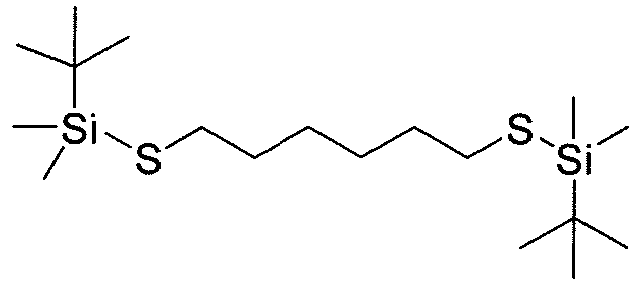
Claims (13)
- Elastomeres Polymer der folgenden Formel 1:
P-(-S-R1-S-R2) n Formel 1
worinS ein Schwefelatom ist,P eine Polymerkette ist, die erhältlich ist durch anionische Polymerisation wenigstens eines konjugierten Diens und gegebenenfalls einer oder mehrerer vinylaromatischer Verbindungen und die gegebenenfalls kettenendmodifiziert ist,R1 unabhängig ausgewählt ist aus C1-C11-Alkyl, C6-C11-Aryl, C7-C11-Aralkyl und C2-C11-Dialkylether, bevorzugt C1-C11-Alkyl, besonders bevorzugt C1-C8-Alkyl,R2 unabhängig ausgewählt ist aus H, C1-C11-Alkyl, C6-C11-Aryl, C7-C11-Aralkyl, C2-C11-Dialkylether und -SiR3R4R5 ist, worin R3, R4 und R5 unabhängig ausgewählt sind aus H, C1-C16-Alkyl, C6-C16-Aryl) und C7-C16-Aralkyl, und R2 bevorzugt unabhängig ausgewählt ist aus H und -SiR3R4R5, worin R3, R4 und R5 unabhängig ausgewählt sind aus H, C1-C16-Alkyl, C6-C16-Aryl und C7-C16-Aralkyl, undn eine ganze Zahl ist, ausgewählt aus 1-200, bevorzugt 1 bis 100, besonders bevorzugt 1 bis 50,wobei die Gruppe(n) -S-R1-S-R2 an das Rückgrat der Polymerkette P gebunden sind. - Elastomeres Polymer gemäß Anspruch 1, worin das wenigstens eine konjugierte Dien ausgewählt ist aus 1,3-Butadien, 2-(C1-C5-Alkyl)-1,3-butadien, insbesondere Isopren (2-Methyl-1,3-butadien), 2,3-Dimethyl-1,3-butadien, 1,3-Pentadien, 2,4-Hexadien, 1,3-Hexadien, 1,3-Heptadien, 1,3-Octadien, 2-Methyl-2,4-pentadien, Cyclopentadien und 1,3-Cyclooctadien.
- Elastomeres Polymer gemäß Anspruch 2, worin das konjugierte Dien 1,3-Butadien ist.
- Elastomeres Polymer gemäß einem oder mehreren der Ansprüche 1 bis 3, worin das wenigstens eine konjugierte Dien in einer Gesamtmenge von 30 bis 100 Gew.-%, bezogen auf die Gesamtmenge an Monomeren, verwendet wird.
- Elastomeres Polymer gemäß einem oder mehreren der Ansprüche 1 bis 4, worin die vinylaromatische Verbindung ausgewählt ist aus Styrol, C1-C4-Alkyl-substituiertem Styrol, insbesondere 2-Methylstyrol, 3-Methylstyrol, 4-Methylstyrol, 2,4-Dimethylstyrol, 2,4,6-Trimethylstyrol, α-Methylstyrol, 2,4-Diisopropylstyrol und 4-tert-Butylstyrol, Stilben, Vinylbenzyldimethylamin, (4-Vinylbenzyl)dimethylaminoethylether, N,N-Dimethylamino-ethylstyrol, tert-Butoxystyrol, Vinylpyridin sowie divinylaromatischen Verbindungen, insbesondere 1,2-Divinylbenzol, 1,3-Divinylbenzol und 1,4-Divinylbenzol, und einer Mischung aus zwei oder mehreren davon.
- Elastomeres Polymer gemäß Anspruch 5, worin die vinylaromatische Verbindung Styrol ist.
- Elastomeres Polymer gemäß einem oder mehreren der Ansprüche 1 bis 6, worin die eine oder mehreren vinylaromatischen Verbindungen in einer Gesamtmenge von 5 bis 70 Gew.-%, bezogen auf die Gesamtmenge an Monomeren, verwendet werden, mit der Maßgabe, dass di-, tri- und höher-vinylaromatische Verbindungen in einer Gesamtmenge von 1 Gew.-% oder weniger verwendet werden, bezogen auf die Gesamtmenge an Monomeren.
- Verfahren zur Herstellung des elastomeren Polymers der Formel 1 wie in einem der Ansprüche 1 bis 7 definiert, umfassend die folgenden Schritte:(i) anionisches Polymerisieren wenigstens eines konjugierten Diens und gegebenenfalls einer oder mehrerer vinylaromatischer Verbindungen zum Erhalt einer anionischen lebenden Polymerkette,(ii) Abbrechen der Polymerisation und(iii) Umsetzen der Polymerkette mit einer Verbindung der folgenden Formel 2 in Gegenwart eines Radikalstarters:
HS-R1S-R2 Formel 2
worinS ein Schwefelatom ist,R1 unabhängig ausgewählt ist aus C1-C11-Alkyl, C6-C11-Aryl, C7-C11-Aralkyl und C2-C11-Dialkylether, bevorzugt C1-C11-Alkyl, besonders bevorzugt C1-C8-Alkyl, undR2 unabhängig ausgewählt ist aus H, C1-C11-Alkyl, C6-C11-Aryl, C7-C11-Aralkyl, C2-C11-Dialkylether und -SiR3R4R5 ist, worin R3, R4 und R5 unabhängig ausgewählt sind aus H, C1-C16-Alkyl, C6-C16-Aryl und C7-C16-Aralkyl, und R2 bevorzugt unabhängig ausgewählt ist aus H und -SiR3R4R5, worin R3, R4 und R5 unabhängig ausgewählt sind aus H, C1-C16-Alkyl, C6-C16-Aryl und C7-C16-Aralkyl. - Verfahren gemäß Anspruch 8, worin das Abbrechen der Polymerisation in Schritt (ii) das Umsetzen der anionischen lebenden Polymerkette mit einer Protonenquelle oder einem funktionellen Reagens umfasst.
- Verfahren gemäß Anspruch 8 oder 9, worin der Radikalstarter ausgewählt ist aus Peroxiden, Azoinitiatoren und Photoinitiatoren, insbesondere Peroxiden.
- Unvulkanisierte Polymerzusammensetzung, umfassend das elastomere Polymer gemäß einem der Ansprüche 1 bis 7 und eine oder mehrere Komponenten ausgewählt aus (i) Komponenten, die als Ergebnis der Polymerisation zum Erhalt der Polymerkette P erhalten werden oder zu der Polymerisation hinzugegeben werden, und (ii) Komponenten, die nach Entfernung von Lösungsmittel aus der Polymerisation zurückbleiben.
- Unvulkanisierte Polymerzusammensetzung gemäß Anspruch 11, die eine oder mehrere Komponenten umfasst, die ausgewählt sind aus Verstrecker-Ölen, Stabilisatoren, Füllstoffen und weiteren Polymeren.
- Verwendung der unvulkanisierten Polymerzusammensetzung gemäß Anspruch 11 oder 12 zur Herstellung von (i) Schuhwerk, (ii) Golfbällen, (iii) Membranen, die keine Verstärkungen enthalten, (iv) Haftvermittlern, (v) modifizierten Kunststoffen und (vi) Folien, die nicht für die Automobil- oder Flugzeuginnenausstattung bestimmt sind.
Priority Applications (3)
| Application Number | Priority Date | Filing Date | Title |
|---|---|---|---|
| EP16168280.2A EP3241853A1 (de) | 2016-05-04 | 2016-05-04 | Elastomere polymere mit thioether-modifiziertem rückgrat |
| PCT/EP2017/060504 WO2017191174A1 (de) | 2016-05-04 | 2017-05-03 | Elastomere polymere mit thioether-modifiziertem rückgrat |
| US16/095,199 US20200002516A1 (en) | 2016-05-04 | 2017-05-03 | Elastomeric polymers having a thioether-modified backbone |
Applications Claiming Priority (1)
| Application Number | Priority Date | Filing Date | Title |
|---|---|---|---|
| EP16168280.2A EP3241853A1 (de) | 2016-05-04 | 2016-05-04 | Elastomere polymere mit thioether-modifiziertem rückgrat |
Publications (1)
| Publication Number | Publication Date |
|---|---|
| EP3241853A1 true EP3241853A1 (de) | 2017-11-08 |
Family
ID=56112812
Family Applications (1)
| Application Number | Title | Priority Date | Filing Date |
|---|---|---|---|
| EP16168280.2A Withdrawn EP3241853A1 (de) | 2016-05-04 | 2016-05-04 | Elastomere polymere mit thioether-modifiziertem rückgrat |
Country Status (3)
| Country | Link |
|---|---|
| US (1) | US20200002516A1 (de) |
| EP (1) | EP3241853A1 (de) |
| WO (1) | WO2017191174A1 (de) |
Cited By (1)
| Publication number | Priority date | Publication date | Assignee | Title |
|---|---|---|---|---|
| WO2022262914A1 (de) * | 2021-06-18 | 2022-12-22 | Continental Reifen Deutschland Gmbh | Kautschukmischung und reifen |
Citations (17)
| Publication number | Priority date | Publication date | Assignee | Title |
|---|---|---|---|---|
| EP1101789A1 (de) | 1999-11-22 | 2001-05-23 | Bayer Ag | Kautschukmischungen aus hydroxyl- und carboxylgruppenhaltigen Dienkautschuken und schwefelfreien Vernetzern |
| EP1123940A1 (de) * | 2000-01-28 | 2001-08-16 | Bayer Ag | Verfahren zur Herstellung eines Copolymerisats auf der Basis von vinylaromatischen Verbindungen und kojugierten Dienen |
| US20020045699A1 (en) | 1999-12-20 | 2002-04-18 | Thomas Scholl | Solution rubbers having nonpolar side groups |
| US20050159513A1 (en) | 2004-01-19 | 2005-07-21 | Henning Steven K. | Oil extended rubber and composition containing low PCA oil |
| US20060089445A1 (en) | 2003-04-29 | 2006-04-27 | Michelin Recherche Et Technique S.A. | Process for obtaining a grafted elastomer having functional groups along the chain and a rubber composition |
| WO2008076875A1 (en) | 2006-12-19 | 2008-06-26 | Dow Global Technologies Inc. | Sulfide modified elastomeric polymers |
| WO2009148932A1 (en) | 2008-06-06 | 2009-12-10 | Dow Global Technologies Inc. | Modified elastomeric polymers |
| EP2639245A1 (de) * | 2012-03-14 | 2013-09-18 | The Goodyear Tire & Rubber Company | Kautschukzusammensetzung und Luftreifen |
| JP2013224391A (ja) * | 2012-04-23 | 2013-10-31 | Sumitomo Rubber Ind Ltd | サイドウォール又はベーストレッド用ゴム組成物、並びに空気入りタイヤ |
| WO2014040640A1 (en) | 2012-09-14 | 2014-03-20 | Styron Europe Gmbh | Amino silane-modified polymers |
| WO2014040639A1 (en) | 2012-09-14 | 2014-03-20 | Styron Europe Gmbh | Silane sulfide modified elastomeric polymers |
| WO2015010710A1 (en) | 2013-07-22 | 2015-01-29 | Styron Europe Gmbh | Polymerisation initiators |
| US20150087768A1 (en) * | 2013-09-23 | 2015-03-26 | Styron Europe Gmbh | Elastomeric Polymer Compositions |
| WO2015055252A1 (en) | 2013-10-18 | 2015-04-23 | Trinseo Europe Gmbh | Vinylsilanes for use in functionalized elastomeric polymers |
| WO2015086039A1 (en) | 2013-12-09 | 2015-06-18 | Trinseo Europe Gmbh | Silane modified elastomeric polymers |
| DE102014202749A1 (de) * | 2014-02-14 | 2015-08-20 | Continental Reifen Deutschland Gmbh | Schwefelvernetzbare Kautschukmischung und Fahrzeugreifen |
| US20150299367A1 (en) | 2012-12-20 | 2015-10-22 | Michelin Recherche Et Technique, S.A. | Process for radical grafting of a diene elastomer |
-
2016
- 2016-05-04 EP EP16168280.2A patent/EP3241853A1/de not_active Withdrawn
-
2017
- 2017-05-03 US US16/095,199 patent/US20200002516A1/en not_active Abandoned
- 2017-05-03 WO PCT/EP2017/060504 patent/WO2017191174A1/de not_active Ceased
Patent Citations (17)
| Publication number | Priority date | Publication date | Assignee | Title |
|---|---|---|---|---|
| EP1101789A1 (de) | 1999-11-22 | 2001-05-23 | Bayer Ag | Kautschukmischungen aus hydroxyl- und carboxylgruppenhaltigen Dienkautschuken und schwefelfreien Vernetzern |
| US20020045699A1 (en) | 1999-12-20 | 2002-04-18 | Thomas Scholl | Solution rubbers having nonpolar side groups |
| EP1123940A1 (de) * | 2000-01-28 | 2001-08-16 | Bayer Ag | Verfahren zur Herstellung eines Copolymerisats auf der Basis von vinylaromatischen Verbindungen und kojugierten Dienen |
| US20060089445A1 (en) | 2003-04-29 | 2006-04-27 | Michelin Recherche Et Technique S.A. | Process for obtaining a grafted elastomer having functional groups along the chain and a rubber composition |
| US20050159513A1 (en) | 2004-01-19 | 2005-07-21 | Henning Steven K. | Oil extended rubber and composition containing low PCA oil |
| WO2008076875A1 (en) | 2006-12-19 | 2008-06-26 | Dow Global Technologies Inc. | Sulfide modified elastomeric polymers |
| WO2009148932A1 (en) | 2008-06-06 | 2009-12-10 | Dow Global Technologies Inc. | Modified elastomeric polymers |
| EP2639245A1 (de) * | 2012-03-14 | 2013-09-18 | The Goodyear Tire & Rubber Company | Kautschukzusammensetzung und Luftreifen |
| JP2013224391A (ja) * | 2012-04-23 | 2013-10-31 | Sumitomo Rubber Ind Ltd | サイドウォール又はベーストレッド用ゴム組成物、並びに空気入りタイヤ |
| WO2014040640A1 (en) | 2012-09-14 | 2014-03-20 | Styron Europe Gmbh | Amino silane-modified polymers |
| WO2014040639A1 (en) | 2012-09-14 | 2014-03-20 | Styron Europe Gmbh | Silane sulfide modified elastomeric polymers |
| US20150299367A1 (en) | 2012-12-20 | 2015-10-22 | Michelin Recherche Et Technique, S.A. | Process for radical grafting of a diene elastomer |
| WO2015010710A1 (en) | 2013-07-22 | 2015-01-29 | Styron Europe Gmbh | Polymerisation initiators |
| US20150087768A1 (en) * | 2013-09-23 | 2015-03-26 | Styron Europe Gmbh | Elastomeric Polymer Compositions |
| WO2015055252A1 (en) | 2013-10-18 | 2015-04-23 | Trinseo Europe Gmbh | Vinylsilanes for use in functionalized elastomeric polymers |
| WO2015086039A1 (en) | 2013-12-09 | 2015-06-18 | Trinseo Europe Gmbh | Silane modified elastomeric polymers |
| DE102014202749A1 (de) * | 2014-02-14 | 2015-08-20 | Continental Reifen Deutschland Gmbh | Schwefelvernetzbare Kautschukmischung und Fahrzeugreifen |
Non-Patent Citations (3)
| Title |
|---|
| DATABASE WPI Week 201379, Derwent World Patents Index; AN 2013-S76759, XP002762159 * |
| POLYMER, vol. 22, 1981, pages 1721 - 1723 |
| RÖTHEMEYER-SOMMER,: "Röthemeyer-Sommer, Kautschuk Technologie, 2. Aufl.,", 2006, HANSER VERLAG, pages: 340 - 344 |
Cited By (1)
| Publication number | Priority date | Publication date | Assignee | Title |
|---|---|---|---|---|
| WO2022262914A1 (de) * | 2021-06-18 | 2022-12-22 | Continental Reifen Deutschland Gmbh | Kautschukmischung und reifen |
Also Published As
| Publication number | Publication date |
|---|---|
| US20200002516A1 (en) | 2020-01-02 |
| WO2017191174A1 (de) | 2017-11-09 |
Similar Documents
| Publication | Publication Date | Title |
|---|---|---|
| EP1000971B1 (de) | Carboxylgruppen-haltige Lösungskautschuke enthaltende Kautschukmischungen | |
| DE69119125T3 (de) | Luftreifen | |
| DE69119736T2 (de) | Zinnhaltige Elastomere und Produkte mit reduzierten Hysteresiseigenschaften | |
| DE69606746T2 (de) | Hochleistungsmischung für Reifenlaufflächen | |
| DE69701334T2 (de) | Reifenlauffläche welche 3,4-Polyisopren-Kautschuk enthält | |
| DE69907369T2 (de) | Polymodale Zusammensetzung mit Diolefin-Vinylaromat-Kautschuk | |
| DE69312891T2 (de) | Verfahren zur Herstellung von Dienpolymerisaten und die hierbei erhaltene Kautschuckmischungen | |
| WO2009034001A1 (de) | Funktionalisierte hochvinyl-dienkautschuke | |
| EP2847242B1 (de) | Allylaminhaltige,carbinolterminierte polymere | |
| EP2640753A1 (de) | Silanhaltige carbinolterminierte polymere | |
| EP2177374A1 (de) | Kautschukmischungen mit funktionalisierten Dienkautschuken und Mikrogelen, ein Verfahren zur Herstellung und deren Verwendung | |
| EP2337802A1 (de) | Funktionalisierte dienkautschuke | |
| WO2013167411A1 (de) | Aminhaltige,carbinolterminierte polymere | |
| WO2014173707A1 (de) | Cold flow reduzierte polymere mit gutem verarbeitungsverhalten | |
| WO2010084114A1 (de) | Silanhaltige kautschukmischungen mit gegebenenfalls funktionalisierten dienkautschuken und mikrogelen, ein verfahren zur herstellung und deren verwendung | |
| DE112008001673B4 (de) | Schwefelhaltiger konjugierter Diolefin-Copolymerkautschuk und diesen umfassende Kautschukzusammensetzung | |
| WO2012065902A1 (de) | Etherhaltige carbinolterminierte polymere | |
| DE112015003646B9 (de) | Kautschukzusammensetzung, vulkanisiertes Produkt und Verwendung des vulkanisierten Produkts in einem Luftreifen | |
| DE112013005848T5 (de) | Mit terminaler Borinsäuregruppe modifiziertes Polymer, Verfahren zur Herstellung desselben und Kautschukzusammensetzung, die dasselbe enthält | |
| DE69619902T2 (de) | Katalysatorsystem zur Herstellung von Kautschukpolymeren | |
| EP3452518B1 (de) | Kautschukmischung, vulkanisat der kautschukmischung und fahrzeugreifen | |
| DE69212530T2 (de) | Pfropfcopolymere aus halogeniertem Butylkautschuk | |
| DE10009909A1 (de) | Kautschuke mit Polyether-Seitengruppen | |
| EP1341822A1 (de) | Polyether/diolefin-kautschuke enthaltende kautschukmischungen und deren verwendung zur herstellung von insbesondere rollwiderstandsarmen reifen | |
| EP2640785A1 (de) | Trialkylsilyloxy-terminierte polymere |
Legal Events
| Date | Code | Title | Description |
|---|---|---|---|
| PUAI | Public reference made under article 153(3) epc to a published international application that has entered the european phase |
Free format text: ORIGINAL CODE: 0009012 |
|
| AK | Designated contracting states |
Kind code of ref document: A1 Designated state(s): AL AT BE BG CH CY CZ DE DK EE ES FI FR GB GR HR HU IE IS IT LI LT LU LV MC MK MT NL NO PL PT RO RS SE SI SK SM TR |
|
| AX | Request for extension of the european patent |
Extension state: BA ME |
|
| 17P | Request for examination filed |
Effective date: 20180425 |
|
| RBV | Designated contracting states (corrected) |
Designated state(s): AL AT BE BG CH CY CZ DE DK EE ES FI FR GB GR HR HU IE IS IT LI LT LU LV MC MK MT NL NO PL PT RO RS SE SI SK SM TR |
|
| 17Q | First examination report despatched |
Effective date: 20181025 |
|
| STAA | Information on the status of an ep patent application or granted ep patent |
Free format text: STATUS: THE APPLICATION HAS BEEN WITHDRAWN |
|
| 18W | Application withdrawn |
Effective date: 20181221 |