EP3242438A1 - Verfahren zur synchronisation von konversationen von gruppennachrichtendiensten in mesh-netzwerken - Google Patents
Verfahren zur synchronisation von konversationen von gruppennachrichtendiensten in mesh-netzwerken Download PDFInfo
- Publication number
- EP3242438A1 EP3242438A1 EP16382201.8A EP16382201A EP3242438A1 EP 3242438 A1 EP3242438 A1 EP 3242438A1 EP 16382201 A EP16382201 A EP 16382201A EP 3242438 A1 EP3242438 A1 EP 3242438A1
- Authority
- EP
- European Patent Office
- Prior art keywords
- group
- server
- information
- group server
- timestamp
- Prior art date
- Legal status (The legal status is an assumption and is not a legal conclusion. Google has not performed a legal analysis and makes no representation as to the accuracy of the status listed.)
- Withdrawn
Links
- 238000000034 method Methods 0.000 title claims abstract description 25
- 230000001360 synchronised effect Effects 0.000 claims abstract description 33
- 238000012384 transportation and delivery Methods 0.000 claims description 16
- 238000001914 filtration Methods 0.000 claims 1
- HEFNNWSXXWATRW-UHFFFAOYSA-N Ibuprofen Chemical compound CC(C)CC1=CC=C(C(C)C(O)=O)C=C1 HEFNNWSXXWATRW-UHFFFAOYSA-N 0.000 description 37
- 238000010586 diagram Methods 0.000 description 4
- 241000880493 Leptailurus serval Species 0.000 description 1
- ILVGMCVCQBJPSH-WDSKDSINSA-N Ser-Val Chemical compound CC(C)[C@@H](C(O)=O)NC(=O)[C@@H](N)CO ILVGMCVCQBJPSH-WDSKDSINSA-N 0.000 description 1
- 230000001413 cellular effect Effects 0.000 description 1
- 230000000295 complement effect Effects 0.000 description 1
- 238000009795 derivation Methods 0.000 description 1
- 230000000694 effects Effects 0.000 description 1
- 230000006855 networking Effects 0.000 description 1
- 238000004806 packaging method and process Methods 0.000 description 1
Images

Classifications
-
- H—ELECTRICITY
- H04—ELECTRIC COMMUNICATION TECHNIQUE
- H04L—TRANSMISSION OF DIGITAL INFORMATION, e.g. TELEGRAPHIC COMMUNICATION
- H04L12/00—Data switching networks
- H04L12/02—Details
- H04L12/16—Arrangements for providing special services to substations
- H04L12/18—Arrangements for providing special services to substations for broadcast or conference, e.g. multicast
- H04L12/1854—Arrangements for providing special services to substations for broadcast or conference, e.g. multicast with non-centralised forwarding system, e.g. chaincast
-
- H—ELECTRICITY
- H04—ELECTRIC COMMUNICATION TECHNIQUE
- H04L—TRANSMISSION OF DIGITAL INFORMATION, e.g. TELEGRAPHIC COMMUNICATION
- H04L12/00—Data switching networks
- H04L12/02—Details
- H04L12/16—Arrangements for providing special services to substations
- H04L12/18—Arrangements for providing special services to substations for broadcast or conference, e.g. multicast
- H04L12/1813—Arrangements for providing special services to substations for broadcast or conference, e.g. multicast for computer conferences, e.g. chat rooms
- H04L12/1831—Tracking arrangements for later retrieval, e.g. recording contents, participants activities or behavior, network status
-
- H—ELECTRICITY
- H04—ELECTRIC COMMUNICATION TECHNIQUE
- H04L—TRANSMISSION OF DIGITAL INFORMATION, e.g. TELEGRAPHIC COMMUNICATION
- H04L12/00—Data switching networks
- H04L12/02—Details
- H04L12/16—Arrangements for providing special services to substations
- H04L12/18—Arrangements for providing special services to substations for broadcast or conference, e.g. multicast
- H04L12/1813—Arrangements for providing special services to substations for broadcast or conference, e.g. multicast for computer conferences, e.g. chat rooms
- H04L12/1822—Conducting the conference, e.g. admission, detection, selection or grouping of participants, correlating users to one or more conference sessions, prioritising transmission
-
- H—ELECTRICITY
- H04—ELECTRIC COMMUNICATION TECHNIQUE
- H04L—TRANSMISSION OF DIGITAL INFORMATION, e.g. TELEGRAPHIC COMMUNICATION
- H04L12/00—Data switching networks
- H04L12/02—Details
- H04L12/16—Arrangements for providing special services to substations
- H04L12/18—Arrangements for providing special services to substations for broadcast or conference, e.g. multicast
- H04L12/1813—Arrangements for providing special services to substations for broadcast or conference, e.g. multicast for computer conferences, e.g. chat rooms
- H04L12/1827—Network arrangements for conference optimisation or adaptation
-
- H—ELECTRICITY
- H04—ELECTRIC COMMUNICATION TECHNIQUE
- H04L—TRANSMISSION OF DIGITAL INFORMATION, e.g. TELEGRAPHIC COMMUNICATION
- H04L51/00—User-to-user messaging in packet-switching networks, transmitted according to store-and-forward or real-time protocols, e.g. e-mail
- H04L51/52—User-to-user messaging in packet-switching networks, transmitted according to store-and-forward or real-time protocols, e.g. e-mail for supporting social networking services
Definitions
- the present invention has its application within the telecommunication sector, especially, deals with the field of providing group messaging services (e.g., WhatsApp, Facebook Messenger, Telegram, Line, Wechat,). More particularly, the present invention refers to a method for syncronizing group conversations occurring in disconnected mesh networks.
- group messaging services e.g., WhatsApp, Facebook Messenger, Telegram, Line, Wechat.
- AirChat is an anonymous wireless communications and connectivity tool that makes communication and connectivity possible in situations where the Internet is locally disabled, censored or out of service or in areas were cellular and Internet are not available, such as at sea or in mountainous areas.
- Anther examples are FireChat and The Serval Mesh, which enable chat over mesh networks, as well as routing to the internet. Apple multi-peer connectivity allows for mesh networks between iPhones.
- Firechat Public Chatrooms only work under a server-based approach, that is, messages sent to a public chatroom cannot be distributed directly to other users via the mesh network bust just can be distributed through the server.
- Users can be members of groups on a group server (e.g. WhatsApp), and when the user's terminal device is connected to the messaging server, every message sent to the group is received by the whole group.
- a server based group can synchronize individuals when they re-connect, but has no way of allowing disconnected members to communicate with each other, even if they are in close proximity to one another.
- Mesh networks can be created in isolated locations, e.g. sparsely inhabited, underground, etc. While mesh networking messaging already exists, it is not an extension of server based group messaging, but rather a standalone way of communication. In mesh networks it is possible to have n-way conversations. When one or more of the group members is on the mesh but not on the internet, normally other users that are not connected to the same mesh network could not be able to send them messages, receive delivery notifications or receive messages from them.
- chats over mesh do not ensure universal distribution of the messages as they can only reach to users that are connected to the same mesh network.
- chats through a group server over the Internet ensures distribution to all recipients with an Internet access, but cannot reach to users that are not connected to the Internet but just to a mesh network.
- server based group communication and mesh based group communications are never connected: once a user's terminal device cannot connect directly to a group server, it cannot communicate with the group members. Having mesh communications allows talking to mesh members, but there is no connection between the server-based group and the mesh group, and definitely no synchronization or message sharing between the two.
- the present invention solves the aforementioned problem and overcomes previously explained state-of-art work limitations by providing members of a group conversation, defined in a group server, with means for:
- Messages from the group server are synchronized to mesh connected group members, messages sent over mesh are synchronized to the group server, and delivery notifications can also be synchronized both ways.
- a member Once a member connects to the group server, he/she can view the messages which were delivered while he/she was connected to the mesh but not to the group server, or vice versa. In addition, the member can view which messages were delivered and to whom while he/she was not connected to the mesh or the group server or both.
- group members are network users belonging to a group conversation defined in a group server of a group messaging service.
- the present invention allows group members to continue the communication over the mesh, and bidirectionally synchronize group server and mesh whenever possible, either in real-time through a relay or post fact through store-and-forward.
- the group server e.g. via the internet
- his/her terminal device acts as a relay.
- a method for syncronizing conversations of group messaging services in mesh networks comprises the following steps:
- this first group member before the first group member sends information to the other group members, this first group member can filter out the information received from the group server by a first timestamp, generation timestamp, which indicates time of generation of said information. Additionally, the first group member can take into account said generation timestamp in order to discard the information generated over a configurable period of time, which can be given or requested to/by the network, and so said information is not sent later on by the first group member.
- the method further comprises:
- the method further comprises:
- Another aspect of the present invention refers to a group server of a group messagins service (e.g., a Whatsapp server) which implements the above described method for syncronizing conversations of group messaging services in mesh networks.
- a group messagins service e.g., a Whatsapp server
- a mobile terminal device e.g., a smartphone, tablet, laptop, .
- a mobile terminal device for implementing the above described method for syncronizing conversations of group messaging services in mesh networks.
- a posible embodiment of the invention is a method for synchronizing conversations in a group A of a group messaging service.
- the members of the group we use the names Alice, Bob and Carol.
- a basic assumption is that group members can be auto-discovered on a mesh network.
- Alice and Bob are members of the group A whose users' devices are connected through a mesh network. If a message is sent to the group when only Alice and Bob are on the mesh, the message can be forwarded by Alice to the group server as soon as she connects. The message can be forwarded to the group server when Alice is still connected to the mesh, or it can happen after Alice disconnects from the mesh and reconnects to the group server. If Alice is connected to the group server and the mesh simultaneously, her device can act as a relay and forward device of the message to the server as soon as she gets it. If Alice received a message while she was connected to the group server and disconnected from the mesh, the next time she could connect to the mesh she could forward the message to the mesh.
- she can relay the messages as soon as she gets them.
- Alice sends a time indication (timestamp) for the message received from the group server that arrived at the group server the later.
- the other mesh members can notify Alice of any group server originated message that have arrived at the group server after the indicated time and which they are aware of, and any mesh originated message, from any mesh, which had not been synchronized with the server at that time.
- messages from those conversations that are older than a specific time period, e.g. 24 hours (this time period is an example, which can either be configurable or requested by Alice), may not be sent to Alice, as they may be no longer relevant.
- Alice could in turn send to the mesh the messages that arrived at the group server in the time period, since the mesh was synced with the server for the last time and since the time when Alice synced with the server (if this happened later), plus any message that Alice received through any mesh and that had not reached the group server. Also in this case an expiry time, e.g. 24 hours, may be set to messages, so that older, no longer relevant, messages are not exchanged.
- the server can send all messages that it has received since the last time Alice synchronized with the server for which a delivery notice from Alice has not been received previously.
- the group server may not send messages that are older than a specific time period, e.g. 24 hours, as these messages may be considered no longer relevant for the user.
- Alice in turn sends to the server all messages that she has received through any mesh since its last synchronization with the server, with exception of those that had reached the server and thus had arrived to Alice from the server through other members of the mesh.
- it is important to track the status of each message specifically whether the message has reached the server or not.
- each client that synchronizes can bring messages from one or more mesh networks. For each of those mesh networks the client could be only partially synchronized. Full server update can only be achieved if all mesh activity is stopped and all clients synchronize with the server, this situation might never happen.
- messages can be synchronized in bulk by packaging a bunch of messages in single BLOB (Binary Large Object) and unpacking it on the receiving side.
- BLOB Binary Large Object
- delivery notifications can also be synchronized between mesh and group server.
- the requirement here is that each member receives all the delivery notifications for all the messages.
- Another type of information that can be synchronized is presence information, such as when the last time the user was seen at.
- location information can be synchronized so that last location of each member as known to the group server is shared with the mesh group members.
- the group server provides identifiers (IDs) for any message sent to it directly by a group member: the ID is returned by the group server when it ACKs the message, then passed to other group members from the group server. If a message is sent first over mesh, the originator member provides the ID and it is marked as mesh originated. This ID needs to be a UUID (Universally Unique ID) so that message IDs are not mixed up.
- IDs identifiers
- Another approach consists of having messages with two identifiers:
- Another important part is the ability of the mesh group members to be notified when the mesh gets connected through one or more relays and when it gets disconnected.
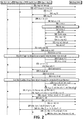
- FIGs. 1 and 2 are flow charts which depict a typical exchange of messages according to the teachings of this invention.
- a virtual element called “mesh” is depicted as if it were a bus on which any mesh member can broadcast information.
- the details of how messages are actually broadcast over a mesh, i.e. relayed from member to member, are out of scope of this invention. Instead of repeating messages unnecessarily in the Figures, i.e. when more than one mesh member needs a specific message, all informative messages are broadcast.
- Alice, Bob, Carol and David are names used to refer to users and the messages shown in the flow charts of FIGs. 1-2 are exchanged between these users' devices and through the mesh network or the group server.
- FIG. 1 depicts a sample flow diagram when a user connects to a mesh network, specifically the user Carol (13) connects to a mesh network (14) which has two users, Alice (11) and Bob (12) previously connected.
- References 11, 12 and 13 refers actually to users' devices (e.g., mobile phones or tablets).
- Steps 101-106 depict the process by which users Alice (11) and Bob (12) exchange messases through the mesh network (14). Firstly, Alice (11) sends Bob (12) a message with ID "m1" (102). Bob (12) acknowledges receiving "m1" (103) and acknowledges reading "m1" (104). Then Alice (11) sends Bob (12) another message with ID "m2" (105) and Bob (12) acknowledges receiving "m2" (106).
- Carol (13) joins the mesh and broadcasts a discovery request for group A members (107).
- Bob (12) sends Carol (13) his authenticated identity (108), Carol validates it and acknowledges it (109).
- Alice (11) sends Carol (13) her authenticated identity (110), Carol (13) validates it and acknowledges it (111).
- Alice (11), Bob (12) and Carol (13) are connected (112) through group A over the mesh (14).
- Carol (13) broadcasts a request to the rest of the users connected to the mesh for updates (113).
- Alice (11) and Bob (12) send the list of messages they got on the mesh (114, 115).
- Carol (13) asks Alice (11) for messages m1 & m2 (116).
- Alice (11) provides each with indication of who read / received it (117, 119) and Carol (13) acknowledges its reception (118, 120). Then Carol (13) broadcasts the message IDs she got before joining the mesh (14), namely "m3" and "m4" (121). Alice (11) and Bob (12) ask Carol (13) for the messages they don't have (122, 123). Carol (13) broadcasts message "m3", together with information on the members of the group that have received /read them (124). Alice (11) and Bob (12) acknowledge the reception of "m3" (125, 126). Carol (13) broadcasts message "m4", together with information on the members of the group that have received/read them (127). Alice (11) and Bob (12) acknowledge the reception of "m3” (128, 129). Alice (11) reads message "m4" and notifies (130) the mesh (14). Then mesh members (11, 12, 13) are in sync, all members (11, 12, 13) have the same messages and know who received each of them (131).
- Figure 2 depicts a sample flow diagram when a user connects to a group server, specifically the user David (24) connects to the group server (25) which already has other three users connected: Alice (21), Bob (22) and Carol (23). References 21, 22 and 23 refers actually to users' devices.
- Alice (21) sends a message (201) to the Group Server (25).
- the Group Server (25) acknowledges the reception and provides a message ID, "m10" (202).
- the Group Server (25) sends message "m10" (203, 204) recently received from Alice (21) to the rest of the members of the group connected to the Group Server, i.e. Bob (22) and Carol (23).
- the Group Server (25) sends message "m 10" to David (24) together with the information that Bob has received it(215). David (25) acknowledges the reception of message "m10” (216). Then the Group Server (25) informs that David (24) has received "m10” (217, 218, 219) to the rest of the members (21, 22, 23), Alice, Bob and Carol. Then David (24) updates the Group Server (25) about deliveries he knows from the mesh, namely about Elain and Fred having received message "m2" (220, 221), and the Group Server (25) distributes this information (222, 223, 224) to the rest of the members connected, Alice (21), Bob (22) and Carol (23) and they acknowledge the reception of this information (225, 226, 227).
- the proposed embodiments can be implemented as a collection of software elements, hardware elements, firmware elements, or any suitable combination of them.
Landscapes
- Engineering & Computer Science (AREA)
- Computer Networks & Wireless Communication (AREA)
- Signal Processing (AREA)
- General Engineering & Computer Science (AREA)
- Multimedia (AREA)
- Information Transfer Between Computers (AREA)
Priority Applications (1)
| Application Number | Priority Date | Filing Date | Title |
|---|---|---|---|
| EP16382201.8A EP3242438A1 (de) | 2016-05-06 | 2016-05-06 | Verfahren zur synchronisation von konversationen von gruppennachrichtendiensten in mesh-netzwerken |
Applications Claiming Priority (1)
| Application Number | Priority Date | Filing Date | Title |
|---|---|---|---|
| EP16382201.8A EP3242438A1 (de) | 2016-05-06 | 2016-05-06 | Verfahren zur synchronisation von konversationen von gruppennachrichtendiensten in mesh-netzwerken |
Publications (1)
| Publication Number | Publication Date |
|---|---|
| EP3242438A1 true EP3242438A1 (de) | 2017-11-08 |
Family
ID=56072281
Family Applications (1)
| Application Number | Title | Priority Date | Filing Date |
|---|---|---|---|
| EP16382201.8A Withdrawn EP3242438A1 (de) | 2016-05-06 | 2016-05-06 | Verfahren zur synchronisation von konversationen von gruppennachrichtendiensten in mesh-netzwerken |
Country Status (1)
| Country | Link |
|---|---|
| EP (1) | EP3242438A1 (de) |
Cited By (1)
| Publication number | Priority date | Publication date | Assignee | Title |
|---|---|---|---|---|
| CN113381923A (zh) * | 2021-05-17 | 2021-09-10 | 中企链信(北京)科技有限公司 | 一种ios平台协同办公的即时通讯方法 |
Citations (4)
| Publication number | Priority date | Publication date | Assignee | Title |
|---|---|---|---|---|
| US6594693B1 (en) * | 1998-02-10 | 2003-07-15 | Nitin A. Borwankar | Method and apparatus for a structured, synchronized conversation using electronic messages over a computer network |
| US20050239486A1 (en) * | 2004-04-05 | 2005-10-27 | D Avello Robert F | Methods and systems for controlling communications in an ad hoc communication network |
| US20090003558A1 (en) * | 2007-06-28 | 2009-01-01 | Rebelvox, Llc | Telecommunication and multimedia management method and apparatus |
| US20130103765A1 (en) * | 2011-10-19 | 2013-04-25 | Matthew Nicholas Papakipos | Social Ad Hoc Networking Protocol and Presentation Layer |
-
2016
- 2016-05-06 EP EP16382201.8A patent/EP3242438A1/de not_active Withdrawn
Patent Citations (4)
| Publication number | Priority date | Publication date | Assignee | Title |
|---|---|---|---|---|
| US6594693B1 (en) * | 1998-02-10 | 2003-07-15 | Nitin A. Borwankar | Method and apparatus for a structured, synchronized conversation using electronic messages over a computer network |
| US20050239486A1 (en) * | 2004-04-05 | 2005-10-27 | D Avello Robert F | Methods and systems for controlling communications in an ad hoc communication network |
| US20090003558A1 (en) * | 2007-06-28 | 2009-01-01 | Rebelvox, Llc | Telecommunication and multimedia management method and apparatus |
| US20130103765A1 (en) * | 2011-10-19 | 2013-04-25 | Matthew Nicholas Papakipos | Social Ad Hoc Networking Protocol and Presentation Layer |
Cited By (1)
| Publication number | Priority date | Publication date | Assignee | Title |
|---|---|---|---|---|
| CN113381923A (zh) * | 2021-05-17 | 2021-09-10 | 中企链信(北京)科技有限公司 | 一种ios平台协同办公的即时通讯方法 |
Similar Documents
| Publication | Publication Date | Title |
|---|---|---|
| US8924593B2 (en) | Apparatus and method for communication services network | |
| FI121359B (fi) | Järjestelmä ja menetelmä viestintäviestiin vastaamiseksi äänitetyllä vastauksella | |
| FI121358B (fi) | Järjestelmä ja menetelmä viestintäviestin välittämiseksi edelleen automaattisesti | |
| ES2281783T3 (es) | Gestion de mensajes. | |
| US8601070B2 (en) | Method and apparatus for individualizing nicknames in message | |
| CA2726887C (en) | Method, apparatus, system, and article of manufacture for reliable low-bandwidth information delivery across mixed-mode unicast and multicast networks | |
| JP5653535B2 (ja) | 通信装置およびアドホックネットワークシステム | |
| CN103634195A (zh) | 通讯方法及装置 | |
| CN102347916B (zh) | 一种网关、跨社区群组信息处理系统及方法 | |
| CN108111401B (zh) | 一种跨即时通信系统的建群方法 | |
| BRPI0414387B1 (pt) | Método para criar uma solução de transmissão não-hierarquizada de mensagens sem utilizar um servidor de transmissão instantânea de mensagens | |
| CN105119800A (zh) | 一种共享导航信息的通讯方法及系统 | |
| CN103368818B (zh) | 一种即时消息发送的方法 | |
| US10631225B2 (en) | Device within a wireless peer-to-peer network, wireless communication system and control method | |
| JP5836183B2 (ja) | 無線通信システム、無線通信装置および基準装置 | |
| WO2013156980A1 (en) | Group sms messaging | |
| CN116846959A (zh) | 一种基于mqtt协议的消息收发方法及装置 | |
| TW201036380A (en) | First relay server and second relay server | |
| CN101647008A (zh) | 通信系统 | |
| US20150172381A1 (en) | Synchronized collaborative user interface | |
| EP3242438A1 (de) | Verfahren zur synchronisation von konversationen von gruppennachrichtendiensten in mesh-netzwerken | |
| CN101883322A (zh) | 向群组发送大消息模式融合ip消息的方法和系统 | |
| JP2011082655A (ja) | メールシステム、端末およびメール送信方法 | |
| Ito et al. | A novel communication mode selection technique for DTN over MANET architecture | |
| US20100185738A1 (en) | Information processing terminal, server, and presence distribution system |
Legal Events
| Date | Code | Title | Description |
|---|---|---|---|
| PUAI | Public reference made under article 153(3) epc to a published international application that has entered the european phase |
Free format text: ORIGINAL CODE: 0009012 |
|
| STAA | Information on the status of an ep patent application or granted ep patent |
Free format text: STATUS: THE APPLICATION HAS BEEN PUBLISHED |
|
| AK | Designated contracting states |
Kind code of ref document: A1 Designated state(s): AL AT BE BG CH CY CZ DE DK EE ES FI FR GB GR HR HU IE IS IT LI LT LU LV MC MK MT NL NO PL PT RO RS SE SI SK SM TR |
|
| AX | Request for extension of the european patent |
Extension state: BA ME |
|
| STAA | Information on the status of an ep patent application or granted ep patent |
Free format text: STATUS: THE APPLICATION IS DEEMED TO BE WITHDRAWN |
|
| 18D | Application deemed to be withdrawn |
Effective date: 20180509 |