EP3243358B1 - Netzwerkknoten, drahtlose vorrichtung und verfahren darin zur auswahl eines kommunikationsmodus in einem drahtloskommunikationsnetzwerk - Google Patents
Netzwerkknoten, drahtlose vorrichtung und verfahren darin zur auswahl eines kommunikationsmodus in einem drahtloskommunikationsnetzwerk Download PDFInfo
- Publication number
- EP3243358B1 EP3243358B1 EP15703119.6A EP15703119A EP3243358B1 EP 3243358 B1 EP3243358 B1 EP 3243358B1 EP 15703119 A EP15703119 A EP 15703119A EP 3243358 B1 EP3243358 B1 EP 3243358B1
- Authority
- EP
- European Patent Office
- Prior art keywords
- wireless device
- communication
- communication mode
- network node
- capability
- Prior art date
- Legal status (The legal status is an assumption and is not a legal conclusion. Google has not performed a legal analysis and makes no representation as to the accuracy of the status listed.)
- Not-in-force
Links
- 238000004891 communication Methods 0.000 title claims description 491
- 238000000034 method Methods 0.000 title claims description 53
- 230000010267 cellular communication Effects 0.000 claims description 27
- 230000015654 memory Effects 0.000 claims description 19
- 230000000116 mitigating effect Effects 0.000 claims description 9
- 230000001413 cellular effect Effects 0.000 description 46
- 230000009471 action Effects 0.000 description 35
- 238000004590 computer program Methods 0.000 description 12
- 230000005540 biological transmission Effects 0.000 description 8
- 238000012545 processing Methods 0.000 description 8
- 238000005259 measurement Methods 0.000 description 7
- 238000013468 resource allocation Methods 0.000 description 7
- 230000011664 signaling Effects 0.000 description 7
- 238000010586 diagram Methods 0.000 description 6
- 230000006870 function Effects 0.000 description 6
- 230000008901 benefit Effects 0.000 description 5
- 238000001228 spectrum Methods 0.000 description 5
- 230000003287 optical effect Effects 0.000 description 4
- 239000000969 carrier Substances 0.000 description 3
- 238000010295 mobile communication Methods 0.000 description 3
- 241001025261 Neoraja caerulea Species 0.000 description 2
- 238000005516 engineering process Methods 0.000 description 2
- 238000005562 fading Methods 0.000 description 2
- 230000000977 initiatory effect Effects 0.000 description 2
- 230000007774 longterm Effects 0.000 description 2
- 238000007726 management method Methods 0.000 description 2
- 230000006855 networking Effects 0.000 description 2
- 230000000737 periodic effect Effects 0.000 description 2
- 241000760358 Enodes Species 0.000 description 1
- 101150071746 Pbsn gene Proteins 0.000 description 1
- 230000008859 change Effects 0.000 description 1
- 230000000593 degrading effect Effects 0.000 description 1
- 238000011161 development Methods 0.000 description 1
- 230000018109 developmental process Effects 0.000 description 1
- 230000000694 effects Effects 0.000 description 1
- 230000002349 favourable effect Effects 0.000 description 1
- 238000002955 isolation Methods 0.000 description 1
- 238000007639 printing Methods 0.000 description 1
- 230000004044 response Effects 0.000 description 1
Images

Classifications
-
- H—ELECTRICITY
- H04—ELECTRIC COMMUNICATION TECHNIQUE
- H04W—WIRELESS COMMUNICATION NETWORKS
- H04W92/00—Interfaces specially adapted for wireless communication networks
- H04W92/16—Interfaces between hierarchically similar devices
- H04W92/18—Interfaces between hierarchically similar devices between terminal devices
-
- H—ELECTRICITY
- H04—ELECTRIC COMMUNICATION TECHNIQUE
- H04W—WIRELESS COMMUNICATION NETWORKS
- H04W76/00—Connection management
- H04W76/10—Connection setup
- H04W76/14—Direct-mode setup
-
- H—ELECTRICITY
- H04—ELECTRIC COMMUNICATION TECHNIQUE
- H04W—WIRELESS COMMUNICATION NETWORKS
- H04W4/00—Services specially adapted for wireless communication networks; Facilities therefor
- H04W4/70—Services for machine-to-machine communication [M2M] or machine type communication [MTC]
-
- H—ELECTRICITY
- H04—ELECTRIC COMMUNICATION TECHNIQUE
- H04W—WIRELESS COMMUNICATION NETWORKS
- H04W8/00—Network data management
- H04W8/005—Discovery of network devices, e.g. terminals
-
- H—ELECTRICITY
- H04—ELECTRIC COMMUNICATION TECHNIQUE
- H04W—WIRELESS COMMUNICATION NETWORKS
- H04W28/00—Network traffic management; Network resource management
- H04W28/16—Central resource management; Negotiation of resources or communication parameters, e.g. negotiating bandwidth or QoS [Quality of Service]
- H04W28/18—Negotiating wireless communication parameters
Definitions
- Embodiments herein relate to modes of communication in a wireless communications network.
- embodiments herein relate to a network node and method therein for selecting a communication mode in a wireless communications network, and to a wireless device and method therein for selecting a communication mode for a communication with a second wireless device in a wireless communications network.
- wireless devices also known as mobile stations, terminals, and/or User Equipments, UEs
- communicate via a Radio Access Network, RAN with one or more core networks.
- the RAN covers a geographical area which is divided into cells, with each cell being served by a base station, e.g. a radio base station, RBS, or network node, which in some networks may also be called, for example, a "NodeB", "eNodeB", “eNB” or Access Point, AP.
- a cell is a geographical area where radio coverage is provided by the radio base station at a base station site or an antenna site in case the antenna and the radio base station are not collocated.
- One radio base station may, however, serve one or more cells.
- the base stations communicate over the air interface which may also be called radio interface operating on radio frequencies with the wireless devices within range of the base stations.
- a Universal Mobile Telecommunications System, UMTS is a third generation mobile communication system, which evolved from the second generation, 2G, Global System for Mobile Communications, GSM.
- the UMTS terrestrial radio access network, UTRAN is essentially a RAN using wideband code division multiple access, WCDMA, and/or High Speed Packet Access, HSPA, for user equipments.
- WCDMA wideband code division multiple access
- HSPA High Speed Packet Access
- 3GPP Third Generation Partnership Project
- telecommunications suppliers propose and agree upon standards for third generation networks and UTRAN specifically, and investigate enhanced data rate and radio capacity.
- the RAN as e.g.
- UMTS UMTS
- a controller node such as a radio network controller, RNC, or a base station controller, BSC, which supervises and coordinates various activities of the plural base stations connected thereto.
- RNCs are typically connected to one or more core networks.
- the Evolved Packet System comprises the Evolved Universal Terrestrial Radio Access Network, E-UTRAN, also known as the Long Term Evolution, LTE, radio access, and the Evolved Packet Core, EPC, also known as System Architecture Evolution, SAE, core network.
- E-UTRAN/LTE is a variant of a 3GPP radio access technology wherein the radio base station nodes are directly connected to the EPC core network rather than to RNCs.
- the functions of a RNC are distributed between the radio base stations nodes, e.g. eNodeBs in LTE, and the core network.
- the Radio Access Network, RAN of an EPS has an essentially flat architecture comprising radio base station nodes without reporting to RNCs.
- Network controlled Device-to-Device, D2D, communication facilitates direct communication between wireless devices utilizing the cellular spectrum of the wireless communication network.
- the wireless communication network may dynamically switch the communication mode between two communicating wireless devices.
- the wireless communication network may use control signaling to switch the communication mode for two wireless devices in a cell between regular cellular communication, i.e. a cellular mode in which the two wireless devices are communicating via a network node, and direct communication, i.e. a D2D mode in which the two wireless devices are communicating directly with each other.
- the wireless communication network may also configure the characteristics of the cellular or D2D bearer and allocate/reallocate cellular resources used for the cellular or D2D bearers.
- the purpose of having the MS controlled by the wireless communication network is to ensure high radio resource utilization, manage QoS and at the same time protect the cellular layer from interference caused by D2D communication between wireless devices.
- wireless communication networks are designed on the premise of Half Duplex, HD, communication that does not allow simultaneous transmission and reception of radio signals on the same frequency channel.
- Examples on HD transmission and reception schemes comprise, for example, HD Frequency-Division Duplexing, HD FDD, and HD Time-Division Duplexing, HD TDD. These schemes enable separating the transmitted and received signals at a radio transceiver either in frequency or in time or in both.
- Full Duplex, FD communication enables simultaneous transmission and reception of radio signals. For FD TDD, this may even take place on the same carrier frequency. However, for FD FDD, the transmission and reception of radio signals take place on different carrier frequencies.
- US 2013/0254277 A1 disclose a wireless communication network which allows an initiation of a D2D communication, using HD or FD communication, based on the range between the D2D pair of wireless devices. However, it does not disclose how a wireless communication network should control the D2D communication in order to take full advantage of the D2D pair of wireless device capable of FD communication in the wireless communication network, such as, for example, how to perform mode selection, MS.
- US 2013/0254277 A1 discloses a method of controlling communications between first and second user equipments (UEs) by a base station in a network.
- KLAUS DOPPLER "Mode Selection for device-to-device communication underlaying an LTE-Advanced Network", wireless communications and networking conference (WCNC), 2010 IEEE, PISCATAWAY, NJ, USA, 18 April 2010 (2010-04-18), pages 1-6 , discloses a D2D mode selection model, for optimal resource sharing, by considering the interference situation and the operational state of the cellular network (i.e., single cell or multi cell scenario).
- the D2D modes, according to D2 includes a reuse mode, dedicated mode (ded), and cellular mode (cell).
- US 2014/0274066 A1 discloses a method in which the communication network enables a first UE connected to first radio network node to switch to a D2D capable radio network node for initiating a D2D communication with a second UE, wherein the first radio network node does not have D2D capability.
- KIM SANGHOON "Full duplex device to device communication in cellular networks" 2014 International conference on computing, networking and communications (ICNC), IEEE, 3 February 2014, pages 721-725 , discloses a full duplex device to perform the D2D communication in cellular networks.
- WO 2013/176589 A1 discloses a method in a network node for assisting a first user equipment in interference mitigation.
- the object is achieved by a method performed by a network node for selecting a communication mode in a wireless communications network, the method comprising obtaining information about a first and a second wireless device in the wireless communications network indicating that the first and the second wireless device are capable of communicating using any one of a set of at least three communication modes comprising at least a cellular communication mode, a Device-to-Device, D2D, half-duplex communication mode, and a D2D full-duplex communication mode; selecting, from the set of at least three communication modes, the D2D full-duplex communication mode as the communication mode for the communication between the first and second wireless devices when: at least one criterion on the capability of the first and second wireless device associated with the D2D full-duplex communication mode is met, and wherein the capability of the first and second wireless device associated with the D2D full-duplex communication mode is a path loss or signal strength value for a D2D communication between the first and second wireless device, and wherein
- the object is achieved by a network node for selecting a communication mode in a wireless communications network, the network node comprising a processor configured to obtain information about a first and a second wireless device in the wireless communications network indicating that the first and the second wireless device are capable of communicating using any one of a set of at least three communication modes comprising at least a cellular communication mode, a Device-to-Device, D2D, half-duplex communication mode, and a D2D full-duplex communication mode, and to select, from the set of at least three communication modes, the D2D full-duplex communication mode as the communication mode for the communication between the first and second wireless devices when: at least one criterion on the capability of the first and second wireless device associated with the D2D full-duplex communication mode is met and wherein the capability of the first and second wireless device associated with the D2D full-duplex communication mode is a path loss or signal strength value for a D2D communication between the first and second wireless device, and
- the object is achieved by a method performed by a first wireless device for selecting a communication mode for a communication with a second wireless device in a wireless communications network, the method comprising obtaining information indicating that the second wireless device is capable of communicating using any one of a set of at least three communication modes comprising at least a cellular communication mode, a Device-to-Device, D2D, half-duplex communication mode, and a D2D full-duplex communication mode; selecting, from the set of at least three communication modes, the D2D full-duplex communication mode as the communication mode for the communication between the first and second wireless devices when at least one criterion on the capability of the first and second wireless device associated with the D2D full-duplex communication mode is met and wherein the capability of the first and second wireless device associated with the D2D full-duplex communication mode is a path loss or signal strength value for a D2D communication between the first and second wireless device, and wherein one of the at least one criterion
- the object is achieved by a first wireless device for selecting a communication mode for a communication with a second wireless device in a wireless communications network, the first wireless device comprising a processor configured to obtain information indicating that the second wireless device is capable of communicating using any one of a set of at least three communication modes comprising at least a cellular communication mode, a Device-to-Device, D2D, half-duplex communication mode, and a D2D full-duplex communication mode, select, from the set of at least three communication modes, the D2D full-duplex communication mode as the communication mode for the communication between the first and second wireless devices when at least one criterion on the capability of the first and second wireless device associated with the D2D full-duplex communication mode is met and wherein the capability of the first and second wireless device associated with the D2D full-duplex communication mode is a path loss or signal strength value for a D2D communication between the first and second wireless device and wherein one of the at least one criterion
- the wireless communications network is enabled to take full advantage of the FD capability of wireless devices and thereby achieving higher resource utilization as compared to traditional MS techniques. Hence, the utilization of wireless devices capable of FD communication in a wireless communications network is improved.
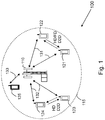
- FIG 1 shows an example of a wireless communications network 100 in which embodiments herein may be implemented.
- the wireless communications network 100 may be any radio communication system, such as, LTE-Advanced, Wideband Code-Division Multiple Access (WCDMA), Global System for Mobile communications/Enhanced Data rate for GSM Evolution (GSM/EDGE), Worldwide Interoperability for Microwave Access (WiMax), Ultra Mobile Broadband (UMB) or GSM network, or other cellular network or system.
- the wireless communications system 100 comprises the network node 110.
- the network node 110 may a radio network node, such as, e.g. eNB, eNodeB, or a Home Node B, a Home eNode B, femto Base Station (BS), pico BS, a radio access point (AP) or any other network unit capable to serve wireless devices in the wireless communications system 100.
- the network node 110 may also be e.g. a radio base station, a base station controller, a relay node, a repeater, an access point, a radio access point, a Remote Radio Unit (RRU) or a Remote Radio Head (RRH).
- the network node 110 comprises one or more antennas for wireless radio communication with wireless devices located within their coverage range; that is, the network node 110 may use one or more of its antennas to provide radio coverage within a cell 115.
- a cell may be seen as a geographical area where radio coverage is provided by radio base station equipment at a base station site or at remote locations by Remote Radio Units (RRU).
- the cell definition may also incorporate frequency bands and radio access technology used for transmissions, which means that two different cells may cover the same geographical area but using different frequency bands.
- Each cell is identified by an identity within the local radio area, which is broadcast in the cell. Another identity identifying each cell uniquely in the whole radio communication network 100 may also be broadcasted in the cell.
- the network node 110 communicates over the air or radio interface operating on radio frequencies with the wireless devices within range of the network node 110.
- a first and a second wireless device 121, 122 are located within the cell 115.
- the first and second wireless devices 121, 122 are configured to communicate within the radio communications network 100 via the network node 110 over a radio link 131 when present in the cell 101 served by the network node 110, i.e. perform conventional cellular communication.
- the first and second wireless devices 121, 122 are wireless device capable of performing both half-duplex, HD, D2D communication and/or full duplex, FD, D2D communication.
- a third and a fourth wireless device 123, 124 are located within the cell 115.
- the third and fourth wireless devices 123, 124 are configured to communicate within the radio communications network 100 via the network node 110 over a radio link 132 when present in the cell 101 served by the network node 110, i.e. perform conventional cellular communication.
- the third and fourth wireless devices 123, 124 are wireless device capable of performing half-duplex, HD, D2D communication.
- a fifth wireless device 125 is located within the cell 115.
- the fifth wireless device 125 is configured to communicate within the radio communications network 100 via the network node 110 over a radio link 133 when present in the cell 101 served by the network node 110, i.e. perform conventional cellular communication.
- the fifth wireless device 125 is not capable of performing D2D communication.
- the first, second, third, fourth and fifth wireless devices 121-125 may e.g. be any kind of wireless device such as a mobile phone, a cellular phone, a Personal Digital Assistant (PDA), a smart phone, a tablet, a sensor equipped with a wireless device, Laptop-Mounted Equipment (LME) (e.g. USB), Laptop-Embedded Equipment (LEE), Machine-Type-Communication (MTC) device, a wireless device with D2D capability, Customer Premises Equipment (CPE), USB dongle, etc.
- LME Laptop-Mounted Equipment
- LEE Laptop-Embedded Equipment
- MTC Machine-Type-Communication
- CPE Customer Premises Equipment
- USB dongle etc.
- this issue is addressed by a new MS technique which selects between the at least three communication modes, i.e. a cellular mode, a D2D HD mode and D2D FD mode based on whether one or more criterion is met, such as, e.g. path loss, system load, power consumption of the wireless devices, available cellular spectrum, etc.
- This enables a periodic communication mode selection decision to be made for or by non-capable, HD capable and FD capable D2D wireless devices such that FD D2D capable wireless devices may fully utilize their FD communication mode capabilities depending on their relative geometry, location, power consumption, capability, etc., and also depending on the current network load situation.
- This ensures an improved selection of communication modes in terms of required cellular resources for the D2D bearer and to protect the cellular layer from D2D interference, while also taking into account the preferences and capabilities of the wireless devices for local communication.
- the embodiments described herein demonstrates how the MS may be performed by a network node or autonomously by a wireless device, e.g. when given permission by the network node.
- a wireless device may recommend one or more communication modes to a network node, which a network node may take into consideration when selecting the communication mode in its MS for the wireless devices.
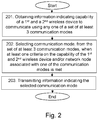
- Example of embodiments of a method performed by a network node 110 for selecting a communication mode in a wireless communications network 100 will now be described with reference to the flowchart depicted in Figure 2 .
- FIG. 2 illustrates an example of actions or operations which may be taken by the network node 110.
- a centralized network node in the radio communications network 100 e.g. a core network node, such as, a radio network controller, a Radio Resource Management, RRM, server, an Application Server, AS, node, a Policy Control Function, PCRF, node, a Mobility Management Entity, MME, node, an Operations Support System, OSS, node or the like.
- the centralized network node may also be e.g. an eNB controlling distributed Remote Radio Units, RRUs, via e.g. a Common Public Radio Interface, CPRI, or an eNB controlling radio heads over an active Distributed Antenna System, DAS, network.
- the method comprises the following actions.
- the network node 110 first obtains information about the first and the second wireless device 121, 122 in the wireless communications network 100 indicating that the first and the second wireless device 121, 122 are capable of communicating using any one of a set of at least three communication modes comprising at least a cellular communication mode, a D2D HD communication mode, and a D2D FD communication mode.
- the network node 110 may obtain the information by receiving it from the first and/or the second wireless device 121, 122. For example, the network node 110 may receive a recommended communication mode from one of the first and the second wireless device 121, 122. In this case, the network node 110 may select a communication mode which is determined by the network node 110 or the communication mode which is recommended by one of the first and second wireless device 121, 122 in Action 202. According to one example, if the communication mode obtained from the first and/or the second wireless device 121, 122 do not match a communication mode determined by the network node 110, the network node 110 may select the communication mode determined by the network node 110.
- the network node 110 may obtain the information by receiving it from another network node in the wireless communications network 100 (not shown), or by retrieving it from historical data or stored information in the network node 110.
- the network node 110 selects from the set of at least three communication modes, one of the communication modes for a communication between the first and second wireless devices 121, 122 when at least one criterion on a capability of the first and second wireless device 121 associated with one of the communication modes is met, and/or at least one criterion on an operational capability of the network node 110 associated with one of the communication modes is met.
- This basically means that the network control performed by the network node 110 of D2D related measurement reporting and D2D bearer establishment are extended such that the network node 110 may select a communication mode out of the following communication modes: a cellular mode, a D2D HD mode, and a D2D FD mode.
- this set of communication modes may comprise more than the above three possible communication modes depending on, for example, the duplexing mode used by the wireless communications network for traditional cellular communication, available carrier frequencies, the current load situation and resource utilization on cellular UL and DL resources, device capabilities, etc., as further described below.
- a first example of MS performed by the network node 110 comprises switching between three communication modes: a cellular mode, a D2D HD-TDD mode using carrier frequency f1, and a D2D FD mode using carrier frequency f2.
- f1 f2 or f1 ⁇ f2.
- a second example of MS performed by the network node 110 comprises switching between three communication modes: a cellular mode, a D2D HD-FDD mode using frequency carriers f1 and f2, and a D2D FD mode using frequency carrier f3.
- a third example of MS performed by the network node 110 comprises switching between four communication modes: a cellular mode, a D2D HD-TDD mode using frequency carrier f1, a D2D HD-FDD mode using frequency carriers f2 and f3, and a D2D FD mode using frequency carrier f4.
- a cellular mode a D2D HD-TDD mode using frequency carrier f1
- a D2D HD-FDD mode using frequency carriers f2 and f3
- a D2D FD mode using frequency carrier f4.
- a fourth example of MS performed by the network node 110 comprises switching between five communication modes: a cellular mode, a D2D HD-TDD using UL frequency carrier f1 which may be used for UL cellular communication, a D2D HD-TDD using DL frequency carrier f2 which may be used for DL cellular communication, a D2D FD mode using UL frequency carrier f3 which may be used for UL cellular communication, or a D2D FD mode using DL frequency carrier f4 which may be used for DL cellular communication.
- the network node 110 may select the D2D FD communication mode as the communication mode for the communication between the first and second wireless devices 121, 122 when at least one criterion on the capability of the first and second wireless device 121, 122 associated with the D2D FD communication mode is met. This allows the network node 110 to determine when to use the D2D FD communication mode based on the available capabilities of the first and second wireless device 121, 122.
- a capability of the first and second wireless device 121, 122 associated with the D2D FD communication mode may be a self-interference mitigation capability of the first and second wireless device 121, 122.
- one of the at least one criterion is met when both the first and second wireless device 121, 122 have a self-interference mitigation capability which enables a D2D FD communication mode. This further allows the network node 110 to determine when to use the D2D FD communication mode based on a specific capability of the first and second wireless device 121, 122.
- a capability of the first and second wireless device 121, 122 associated with the D2D FD communication mode may be a path loss or signal strength value for a D2D communication between the first and second wireless device 121, 122.
- one of the at least one criterion is met when the path loss or signal strength value is above a determined threshold value.
- a determined threshold value e.g. a reference signal received power (RSRP) value or a geometry factor
- the network node 100 may select one of the D2D communication modes. This may e.g. be performed when the first and second wireless device 121, 122 is not too close to a network node 110, i.e. when the path loss or signal strength value towards the network node 110 is above a threshold.
- the network node 110 may further select between D2D mode with dedicated (non-overlapping with resources used for cellular communication) or overlapping resources (i.e. overlapping with resources used for cellular communication) causing intra-cell interference between D2D and cellular links in the wireless communications network 100.
- the network node 100 may select the D2D FD mode for the D2D communication between the first and second wireless device 121, 122.
- a capability of the first and second wireless device 121, 122 associated with the D2D FD communication mode may be a path loss or signal strength value towards the network node 110. In this case, one of the at least one criterion is met when the path loss or signal strength value is above a determined threshold value.
- a capability of the first and second wireless device 121, 122 associated with the D2D FD communication mode may be a value indicative of the distance between the first and second wireless device 121, 122. In this case, one of the at least one criterion is met when the path loss or signal strength value is above a determined threshold value.
- the information about the location of a wireless device with respect to network node 110 and/or with respect other D2D capable wireless devices may also be used by the network node 110 for determining the appropriate mode for a D2D capable wireless device.
- the location of a wireless device may be particularly used to handle situations in which the wireless devices communicating using D2D communication move with high velocity such that their locations with respect to each other changes significantly over time.
- the location of a wireless device may be determined by the wireless device and/or by the network node 100, using e.g. a positioning server or node, by using available positioning methods, such as, e.g. GNSS, A-GNSS, enhanced cell-ID, OTDOA, etc.
- a first and second wireless device 121, 122 which are close to each other, e.g. 10-20 meters, may be selected and configured to operate using a D2D HD mode or a D2D FD mode.
- the network node 110 may select and configure the first wireless device 121 for cellular mode.
- a capability of the first and second wireless device 121, 122 associated with the D2D FD communication mode may be one or more values indicative of the remaining battery power level of the first and/or second wireless device 121, 122.
- one of the at least one criterion is met when the one or more values indicative of the remaining battery power level is above a determined threshold value.
- a determined threshold such as, e.g. 20% or less of a maximum level
- the network node 110 may select either D2D HD or D2D FD modes provided that the D2D pairs are also close to each either.
- the network node 110 may also select the communication mode that leads to lower power consumption in case the battery life or power of the first and/or second wireless device 121, 122 is below a determined threshold. For example, in cases when one of the first and second wireless device 121, 122 is very close to the network node 110 but far from the other wireless device, then the network node 110 may even select cellular mode.
- a capability of the first and second wireless device 121, 122 associated with the D2D FD communication mode may be a communication mode which is recommended by at least the first wireless device 121 for the communication between the first and second wireless devices 121, 122.
- one of the at least one criterion is met when the recommended communication mode is the D2D FD communication mode. This may, for example, be performed when the network node 110 obtained information in Action 201 by receiving it from the first and/or the second wireless device 121, 122, where this information comprise a communication mode which is recommended by at least the first wireless device 121.
- the network node 110 may also select the D2D FD communication mode as the communication mode for the communication between the first and second wireless devices 121, 122 when at least one criterion on the operational capability of the network node 110 associated with the D2D FD communication mode is met. This allows the network node 110 to determine when to use the D2D FD communication mode based on the available capabilities of the network node 110.
- an operational capability of the network node 110 associated with the D2D FD communication mode is the number of carrier frequencies available for D2D communication. In this case, one of the at least one criterion is met when the number of carrier frequencies available for D2D communication is above a determined threshold value. If the available spectrum is limited, for example, when only one carrier frequency is available for D2D communication, then the network node 110 may select a cellular mode or a D2D HD-TDD mode.
- network node 110 may use D2D HD-FDD mode for some D2D capable wireless devices and/or D2D FD for some D2D capable wireless devices This is because for a D2D FD communication mode typically separate carrier frequencies would be needed.
- the network node 110 may prefer to select either a D2D HD-TDD mode, a D2D HD-FDD mode or D2D FD mode, but avoid selecting a cellular mode for the communication between the first and second wireless device 121, 122.
- the network node 110 may select D2D HD-TDD on the uplink cellular carrier frequency. Further, when there are enough resources available, the network node 110 may select separate resources to be assigned for the D2D bearers between the first and second wireless device 121, 122 to avoid intra-cell interference, particularly at high loads, such as, e.g. higher experienced interference in uplink and/or downlink. For example, at high load, a D2D communication with low power in a D2D FD communication mode, the network node 110 may reuse cellular resources or operate on separate carrier frequencies if available.
- an operational capability of the network node 110 associated with the D2D FD communication mode is the number of D2D communications handled by network node 110.
- one of the at least one criterion is met when the number of D2D communications handled by network node 110 is above a determined threshold value.
- a determined threshold such as, e.g. more than 80 D2D capable wireless devices
- the network node 110 may use either a D2D HD-FDD or a D2D FD mode for several of the D2D capable wireless devices, e.g. at least 70% of the D2D capable wireless devices.
- Table 1 above shows an example of a MS table that the network node 110 may use to make MS and resource allocation decisions, i.e. select the communication mode.
- the signaling messages described for the different capabilities of the network node 110 and the first and second wireless device 121, 122 may be used to provide the network node 110 with the necessary input data to make proper MS and continuously re-evaluate the most suitable communication mode as the first and second wireless device 121, 122 move around and/or change their service requirements and/or the radio environment changes.
- the network node 110 may here also determine to use overlapping or non-overlapping cellular transmission resources for the communication between the first and second wireless device 121, 122 in the D2D FD communication mode based on the amount of traffic and/or system load in the network node 110.
- the network node 110 transmits information about the selected communication mode for the communication between the first and second wireless devices 121, 122 to at least one of the first and second wireless device 121.
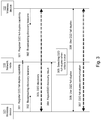
- Figure 3 shows a signalling diagram describing embodiments of the above described method in terms of signaling messages.
- the first and second wireless device 121, 122 may register their duplexing capabilities, which may include parameters, such as, D2D FD specific parameters, e.g. self- interference suppressing capability, maximum transmit power in D2D FD mode, and supported Modulation and Coding Schemes, MCS, in D2D FD mode.
- D2D FD specific parameters e.g. self- interference suppressing capability, maximum transmit power in D2D FD mode, and supported Modulation and Coding Schemes, MCS, in D2D FD mode.
- MCS Modulation and Coding Schemes
- the first and second wireless device 121, 122 may use D2D neighbour discovery procedures to discover other wireless devices in their neighbourhood.
- the existing techniques for broadcasting discovery beacon signals may be extended to comprise information or indication about the D2D FD capability of the beaconing device.
- the beacon signal may, as conventional, comprise information about the device identity, provided or desired services, etc., according to existing techniques.
- the first and second wireless device 121, 122 may exchange other pieces of information by including such information in their continued broadcasting. For example, when the second wireless device 121 detects the beacon of the first wireless device 121, the second wireless device 121 may discover that the first wireless device 121 is in a list of known wireless devices with which the second wireless device 121 has detected and/or communicated with before, e.g. a so-called buddy list, or that the first wireless device 121 offers a service that the second wireless device 121 wishes to use.
- a so-called buddy list e.g. a so-called buddy list
- the second wireless device 121 may modify its beacon signal to provide specific feedback (indication) on its own identity, service interest and also its capabilities, including duplexing (e.g. information regarding D2D FD communication mode capability) or multiple antennas, modulation and coding scheme (MCS) or Quality of Service (QoS) capabilities.
- the first and second wireless device 121, 122 may also use the detected beacons signals to form estimates of their path loss and channel conditions.
- At least one of the first and second wireless devices 121, 122 reports the results of the discovery procedure to the network node 110, e.g. its serving base station. This may be performed after establishing a Radio Resource Control, RRC, connection using existing techniques.
- This discovery report may include information about the peer wireless device's identity, capabilities and information about large scale fading (i.e. path loss) measurements.
- first wireless device 121 may indicate that the second wireless device 121 is in its close proximity and that the second wireless device 121 offers a service, such as, e.g. printing or file server service, which the first wireless device 121 wants to use. This is described in Action 201 in reference to Figure 2 .
- the network node 110 may then use this signalled information as input to its initial mode selection (MS) and resource allocation (RA) decision.
- MS mode selection
- RA resource allocation
- the purpose of this initial MS and RA decision is to enable the first and second wireless device 121, 122 to establish a D2D bearer if the conditions for a direct D2D communication mode are favourable, but also to protect the cellular layer from excessive D2D interference and ensure proper QoS for the first and second wireless device 121, 122 while maintaining high radio resource utilization. This is described in Action 202 in reference to Figure 2 .
- This MS and RA decision is then communicated to the first and second wireless device 121, 122 using, for example, RRC signaling. This is described in Action 203 in reference to Figure 2 .
- radio resources are transmit power, maximum allowed or transmit power, physical channels, radio or frequency channels etc.
- physical channels are time-frequency resources, such as, physical resource blocks, PRBs, resource elements, REs, time slots, subframes, symbols, frames, etc.
- radio channels are sub-carriers, carrier frequency, or set of carrier frequencies over which radio resources, such as, physical channels, are transmitted with certain transmit power level.
- the first and second wireless device 121, 122 may periodically broadcast reference signals that, in general, are different from the D2D discovery beacons in terms of broadcast information, employed MCS, transmit power levels, periodicity and used time-frequency resources.
- the purpose of the reference signals is to enable the peer device to measure and report on the D2D radio measurement, such as, for example, path loss or geometry values (e.g. large scale fading), similarly to the purpose of cellular reference signals transmitted by the network node 110.
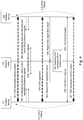
- the first and second wireless device 121, 122 may thus continuously measure on both cellular and D2D specific reference signals, while the network node 110 may makes a MS decision on a coarse time scale, such as, about every 500-1000ms, taking into account capability of the first and second wireless device 121, 122 in terms of supported modes and based on one or more criterion. This is further shown by Actions 401-408 in Figure 4 corresponding to the Actions 301-307 in Figure 3 .
- the first and second wireless device 121, 122 may periodically exchange service related information, such as, e.g. experienced QoS information, or other information that may affect the best communication mode between the first and second wireless device 121, 122. For example, if the first wireless device 121 experiences degrading QoS, it may indicate to the second wireless device 122 that its preferred communication mode is a D2D HD mode rather than a D2D FD mode.
- service related information such as, e.g. experienced QoS information, or other information that may affect the best communication mode between the first and second wireless device 121, 122.
- the first wireless device 121 experiences degrading QoS, it may indicate to the second wireless device 122 that its preferred communication mode is a D2D HD mode rather than a D2D FD mode.
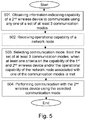
- FIG. 5 is an illustrated example of actions or operations which may be taken by the first wireless device 121.
- the method comprises the following actions.
- the first wireless device 121 obtains information indicating that the second wireless device 122 is capable of communicating using any one of a set of at least three communication modes comprising at least a cellular communication mode, a D2D HD communication mode, and a D2D FD communication mode.
- this may be performed by receiving the information from the second wireless device 122. Alternatively, this may be performed by receiving the information from a network node 110, or by retrieving the information stored in the memory of the first wireless device 121.
- the first wireless device 121 selects, from the set of at least three communication modes, one of the communication modes for the communication with the second wireless device 122 when at least one criterion on a capability of the first and second wireless device 121 associated with one of the communication modes is met, and/or at least one criterion on an operational capability of a network node 110 serving the first wireless device 121 in the wireless communications network 100 associated with one of the communication modes is met.
- This basically means that the control of D2D related measurement reporting and D2D bearer establishment are extended such that the first wireless device 121 may select a communication mode out of the following communication modes: a cellular mode, a D2D HD mode, and a D2D FD mode.
- this set of communication modes may comprise more than the above three possible communication modes depending on, for example, the duplexing mode used by the wireless communications network for traditional cellular communication, available carrier frequencies, the current load situation and resource utilization on cellular UL and DL resources, device capabilities, etc., as described above in reference to the embodiments of the network node 110 in Action 202.
- This further allows the first wireless device 121 to determine when to use the D2D FD communication mode based on the available capabilities of the first and second wireless device 121, 122 and/or the available capabilities of the network node 110.
- the first wireless device 121 may select the D2D FD communication mode as the communication mode for the communication between the first and second wireless devices 121, 122 when at least one criterion on the capability of the first and second wireless device 121 associated with the D2D FD communication mode is met. This further allows the first wireless device 121 to determine when to use the D2D FD communication mode based on a specific capability of the first and second wireless device 121, 122.
- a capability of the first and second wireless device (121) associated with the D2D FD communication mode may be a self-interference mitigation capability of the first and second wireless device 121, 122. In this case, one of the at least one criterion is met when both the first and second wireless device 121, 122 have a self-interference mitigation capability which enables a D2D FD communication mode.
- a capability of the first and second wireless device 121 associated with the D2D FD communication mode may be a path loss or signal strength value for a D2D communication between the first and second wireless device 121, 122. In this case, one of the at least one criterion is met when the path loss or signal strength value is above a determined threshold value.
- a capability of the first and second wireless device 121 associated with the D2D FD communication mode may be a path loss or signal strength value towards the network node 110. In this case, one of the at least one criterion is met when the path loss or signal strength value is above a determined threshold value. In some embodiments, a capability of the first and second wireless device 121 associated with the D2D FD communication mode may be a value indicative of the distance between the first and second wireless device 121, 122. In this case, one of the at least one criterion is met when the path loss or signal strength value is above a determined threshold value.
- a capability of the first and second wireless device 121 associated with the D2D FD communication mode may be one or more values indicative of the remaining battery power level of the first and/or second wireless device 121, 122. In this case, one of the at least one criterion is met when the one or more values indicative of the remaining battery power level is above a determined threshold value.
- the first wireless device 121 may also receive one or more operational capabilities from a network node 110 serving at least the first wireless device 121 in the wireless communications network 100.
- the wireless device 121 may select the D2D FD communication mode as the communication mode for the communication between the first and second wireless devices 121, 122 when at least one criterion on the operational capability of the network node 110 associated with the D2D FD communication mode is met.
- an operational capability of the network node 110 associated with the D2D FD communication mode may be the number of carrier frequencies available for D2D communication. In this case, one of the at least one criterion is met when the number of carrier frequencies available for D2D communication is above a determined threshold value.
- an operational capability of the network node 110 associated with the D2D FD communication mode may be the number of D2D communications handled by network node 110. In this case, one of the at least one criterion is met when the number of D2D communications handled by network node 110 is above a determined threshold value.
- the first wireless device 121 may also transmit to the network node 110 serving at least the first wireless device 121 in the wireless communications network 100, information indicating that the first and the second wireless device 121, 122 are capable of communicating using any one of a set of at least three communication modes comprising at least a cellular communication mode, a D2D HD communication mode, and a D2D FD communication mode.
- the first wireless device 121 may simply inform the network node 110 about the capabilities of the first and second wireless device 121, 122.
- the first wireless device 121 may further transmit, to the network node 110 serving at least the first wireless device 121 in the wireless communications network 100, information indicating that one of the communication modes in the set of at least three communication modes has been selected.
- This may be a recommended communication mode that has been selected by the first wireless device 121 for the communication with the second wireless device 122; that is, for example, based on periodic measurements and mode negotiation, the first and second wireless device 121, 122 may agree on a mutually preferred communication mode and, optionally, some associated parameters, e.g. used transmit power level, target SINR level, etc.
- the first wireless device 121 and/or the second wireless device 122 may then report this agreed communication mode as a recommendation to the network node 110.
- the first and second wireless device 121, 122 may choose to send recommendations only when the recommended communication mode is different from the currently ongoing communication mode. Then, the first wireless device 121 may receive, from the network node 110, information indicating that one of the communication modes in the set of at least three communication modes has been selected for the communication with the second wireless device 122. After the reception, the first wireless device 121 may determine a communication mode for the communication with the second wireless device 122 based on the communication mode selected by the first wireless device 121 and the information about the selected communication mode received from the network node 110.
- the first wireless device 121 may further receive, from the network node 110 serving the first wireless device 121 in the wireless communication network 100, information indicating that the first wireless device 121 is allowed to determine the communication mode for the communication with the second wireless device 122.
- the network node 110 may delegate the mode selection decision to the first wireless device 121.
- the network node 110 may further delegate this task to the first wireless device 121 for certain time period or duration and under certain conditions, such as, e.g. when the battery power of the first wireless device 121 is below a threshold.
- the first wireless device 121 may only be allowed to execute MS if explicitly allowed or configured by the network node 110.
- the first wireless device 121 may use one or more criterion above to select an appropriate mode.
- the network node 110 may also provide the first wireless device 121 with parameters and/or thresholds associated with the criterion, such as, e.g. current system load information.
- the first wireless device 121 may be allowed to autonomously select one of the communication modes based on the implementation in the first wireless device 121 or one of the criterion as described above.
- the first wireless device 121 may thus be allowed by the network node 110 to operate using the autonomously selected communication mode.
- the first wireless device 121 may use any pre-defined or configured set of criterion to select any of the pre-defined modes or configured set of communication modes.
- the network node 110 may also pre-configure the first wireless device 121 with two or more communication modes, wherein at least one is the D2D FD mode, out of which the first wireless device 121 is allowed to autonomously select the communication mode in the MS and use it for the D2D operation with the second wireless device 122.
- the first wireless device 121 may further transmit, to a network node 110 serving at least the first wireless device 121 in the wireless communications network 100, information indicating that the D2D FD communication mode has been selected by the first wireless device 121. This may be a recommended communication mode that has been selected by the first wireless device 121 for the communication with the second wireless device 122.
- the first wireless device 121 may also determine and recommend more than one mode, such as, e.g. two different communication modes, e.g. D2D FD and D2D HD-FDD.
- the first wireless device may also indicate a recommendation level for each communication mode in case it recommends two or more communication modes.
- the first wireless device 121 may receive, from the network node 110, information indicating the D2D FD communication mode has been selected by the network node 110 for the communication with the second wireless device 122. Thus, here, it may eventually be the network node 110 that actually periodically determines the communication mode for the first and second wireless device 121, 122 based on e.g. the signalled measurement data from the first and second wireless device 121, 122, recommended, or preferred, communication modes by the first and second wireless device 121, 122, and/or associated parameters.
- the wireless device 121 performs the communication with the second wireless device 122 using the selected communication mode.
- the network node 110 may comprise the following arrangement depicted in Figure 6 .
- Figure 6 shows a schematic block diagram of embodiments of the network node 110.
- the network node 110 may comprise a transmitting module 601, a receiving module 602, and a processor 610.
- the transmitting module 610 may also be referred to as transmitter or transmitting unit, while the receiving module 602 may also be referred to as a receiver or receiving unit.
- the processor 610 may also be referred to as processing module, processing unit or processing circuitry, and may control the transmitting module 601 and the receiving module 602.
- the processor 610 may said to comprise one or more of the transmitting module 601 and the receiving module 602, and/or perform the function thereof as described below.
- the processor 610 is configured to obtain information about a first and a second wireless device 121, 122 in the wireless communications network 100 indicating that the first and the second wireless device 121, 122 are capable of communicating using any one of a set of at least three communication modes comprising at least a cellular communication mode, a D2D HD communication mode, and a D2D FD communication mode, and to select, from the set of at least three communication modes, one of the communication modes for a communication between the first and second wireless devices 121, 122 when at least one criterion on a capability of the first and second wireless device 121 associated with one of the communication modes is met, and/or at least one criterion on an operational capability of the network node 110 associated with one of the communication modes is met.
- the transmitting module 601 is configured to transmit information about the selected communication mode for the communication between the first and second wireless devices 121, 122 to at least one of the first and second wireless devices 121, 122.
- the processor 610 is further configured to obtain the information by retrieving the information about the first and second wireless device 121, 122 from historical data or stored information in the network node 110.
- the receiving module 602 may be configured to receive the information about the first and second wireless device 121, 122 from the first and/or the second wireless device 121, 122 and/or receive the information about the first and second wireless device 121, 122 from another network node in the wireless communications network 100.
- the processor 610 is further configured to select the D2D FD communication mode as the communication mode for the communication between the first and second wireless devices 121, 122 when at least one criterion on the capability of the first and second wireless device 121, 122 associated with the D2D FD communication mode is met.
- the criterion on the capability of the first and second wireless device 121, 122 referred to here are described in the corresponding method above.
- the processor 610 is further configured to select the D2D FD communication mode as the communication mode for the communication between the first and second wireless devices 121, 122 when at least one criterion on the operational capability of the network node 110 associated with the D2D FD communication mode is met.
- the criterion on the operational capability of the network node 110 referred to here are described in the corresponding method above.
- the processor 610 is further configured to determine to use overlapping or non-overlapping cellular transmission resources for the communication between the first and second wireless device 121, 122 in the D2D full-duplex communication mode based on the amount of traffic and/or system load in the network node 110.
- the embodiments for selecting a communication mode in a wireless communications network 100 may be implemented through one or more processors, such as, e.g. the processor 610 in the network node 110 depicted in Figure 6 , together with computer program code for performing the functions and actions of the embodiments herein.
- the program code mentioned above may also be provided as a computer program product, for instance in the form of a data carrier carrying computer program code or code means for performing the embodiments herein when being loaded into the processor 610 in the network node 110.
- the computer program code may e.g. be provided as pure program code in the network node 110 or on a server and downloaded to the network node 110.
- the carrier may be one of an electronic signal, optical signal, radio signal, or computer readable storage medium, such as, e.g. electronic memories like a RAM, a ROM, a Flash memory, a magnetic tape, a CD-ROM, a DVD, a Blueray disc, etc.
- the network node 110 may further comprise a memory 620, which may be referred to or comprise one or more memory modules or units.
- the memory 620 may be arranged to be used to store executable instructions and data to perform the methods described herein when being executed in the processor 610 of the network node 110.
- the processor 610 and the memory 620 described above may refer to a combination of analog and digital circuits, and/or one or more processors configured with software and/or firmware, e.g. stored in the memory 620, that when executed by the one or more processors, such as, the processor 610, cause the one or more processors to perform the method as described above.
- the processor 610 and the memory 620 may also be referred to as processing means.
- processors may be included in a single application-specific integrated circuit (ASIC), or several processors and various digital hardware may be distributed among several separate components, whether individually packaged or assembled into a system-on-a-chip (SoC).
- ASIC application-specific integrated circuit
- SoC system-on-a-chip
- some embodiments may comprise a computer program product, comprising instructions which, when executed on at least one processor, e.g. the processor 610, cause the at least one processor to carry out the method for selecting a communication mode in a wireless communications network 100. Also, some embodiments may further comprise a carrier containing said computer program product, wherein the carrier is one of an electronic signal, optical signal, radio signal, or computer readable storage medium.
- the first wireless device 121 may comprise the following arrangement depicted in Figure 7 .
- Figure 7 shows a schematic block diagram of embodiments of the first wireless device 121.
- the first wireless device 121 may comprise a receiving module 701, a transmitting module 702, and a processor 710.
- the transmitting module 710 may also be referred to as transmitter or transmitting unit, while the receiving module 702 may also be referred to as a receiver or receiving unit.
- the processor 710 may also be referred to as processing module, processing unit or processing circuitry, and may control the transmitting module 701 and the receiving module 702.
- the processor 710 may comprise one or more of the transmitting module 701 and the receiving module 702, and/or perform the function thereof as described below.
- the processor 710 is configured to obtain information indicating that the second wireless device 122 is capable of communicating using any one of a set of at least three communication modes comprising at least a cellular communication mode, a D2D HD communication mode, and a D2D FD communication mode. In some embodiments, this may be performed by the receiver 701 being configured to receive the information from the second wireless device 122. Alternatively, this may be performed by the receiver 701 being configured to receive the information from a network node 110, or by retrieve the information stored in the memory of the first wireless device 121.
- the processor 710 is also configured to select, from the set of at least three communication modes, one of the communication modes for the communication with the second wireless device 122 when at least one criterion on a capability of the first and second wireless device 121 associated with one of the communication modes is met, and/or at least one criterion on an operational capability of a network node 110 serving the first wireless device 121 in the wireless communications network 100 associated with one of the communication modes is met.
- the processor 710 is also configured to perform the communication with the second wireless device 122 using the selected communication mode.
- the processor 710 may be further configured to select the D2D full-duplex communication mode as the communication mode for the communication between the first and second wireless devices 121, 122 when at least one criterion on the capability of the first and second wireless device 121 associated with the D2D full-duplex communication mode is met.
- the criterion on the capability of the first and second wireless device 121, 122 referred to here are described in the corresponding method above.
- the receiver 701 may be further configured to receive one or more operational capabilities from a network node 110 serving at least the first wireless device 121 in the wireless communications network 100.
- the processor 710 may be further configured to select the D2D full-duplex communication mode as the communication mode for the communication between the first and second wireless devices 121, 122 when at least one criterion on the operational capability of the network node 110 associated with the D2D full-duplex communication mode is met.
- the criterion on the operational capability of the network node 110 referred to here are described in the corresponding method above.
- the transmitter 702 may be configured to transmit, to a network node 110 serving at least the first wireless device 121 in the wireless communications network 100, information indicating that the first and the second wireless device 121, 122 are capable of communicating using any one of a set of at least three communication modes comprising at least a cellular communication mode, a D2D half-duplex communication mode, and a D2D full-duplex communication mode.
- the transmitter 702 may be further configured to transmit to a network node 110 serving at least the first wireless device 121 in the wireless communications network 100, information indicating that one of the communication modes in the set of at least three communication modes has been selected.
- the receiver 701 may be further configured to receive from the network node 110, information indicating that one of the communication modes in the set of at least three communication modes has been selected for the communication with the second wireless device 122.
- the processor 710 may be further configured to determine a communication mode for the communication with the second wireless device 122 based on the communication mode selected by the first wireless device 121 and the information about the selected communication mode received from the network node 110.
- the receiver 701 may be further configured to receive, from a network node 110 serving the first wireless device 121 in the wireless communication network 100, information indicating that the first wireless device 121 is allowed to determine a communication mode.
- the transmitter 702 may be further configured to transmit to a network node 110 serving at least the first wireless device 121 in the wireless communications network 100, information indicating that the D2D FD communication mode has been selected by the first wireless device 121, whereby the receiver 701 may be further configured to receive, from the network node 110, information indicating that the D2D FD communication mode has been selected by the network node 110 for the communication with the second wireless device 122.
- the embodiments for selecting a communication mode for a communication with a second wireless device 122 in a wireless communications network 100 may be implemented through one or more processors, such as, e.g. the processor 710 in the first wireless device 121 depicted in Figure 7 , together with computer program code for performing the functions and actions of the embodiments herein.
- the program code mentioned above may also be provided as a computer program product, for instance in the form of a data carrier carrying computer program code or code means for performing the embodiments herein when being loaded into the processor 710 in the first wireless device 121.
- the computer program code may e.g. be provided as pure program code in the first wireless device 121 or on a server and downloaded to the first wireless device 121.
- the carrier may be one of an electronic signal, optical signal, radio signal, or computer readable storage medium, such as, e.g. electronic memories like a RAM, a ROM, a Flash memory, a magnetic tape, a CD-ROM, a DVD, a Blue-ray disc, etc.
- computer readable storage medium such as, e.g. electronic memories like a RAM, a ROM, a Flash memory, a magnetic tape, a CD-ROM, a DVD, a Blue-ray disc, etc.
- the first wireless device 121 may further comprise a memory 720, which may be referred to or comprise one or more memory modules or units.
- the memory 720 may be arranged to be used to store executable instructions and data to perform the methods described herein when being executed in the processor 710 of the first wireless device 121.
- the processor 710 and the memory 720 described above may refer to a combination of analog and digital circuits, and/or one or more processors configured with software and/or firmware, e.g. stored in the memory 720, that when executed by the one or more processors, such as, the processor 710, cause the one or more processors to perform the method as described above.
- the processor 710 and the memory 720 may also be referred to as processing means.
- processors may be included in a single application-specific integrated circuit (ASIC), or several processors and various digital hardware may be distributed among several separate components, whether individually packaged or assembled into a system-on-a-chip (SoC).
- ASIC application-specific integrated circuit
- SoC system-on-a-chip
- some embodiments may comprise a computer program product, comprising instructions which, when executed on at least one processor, e.g. the processor 710, cause the at least one processor to carry out the method for selecting a communication mode for a communication with a second wireless device 122 in a wireless communications network 100.
- some embodiments may further comprise a carrier containing said computer program product, wherein the carrier is one of an electronic signal, optical signal, radio signal, or computer readable storage medium.
Landscapes
- Engineering & Computer Science (AREA)
- Computer Networks & Wireless Communication (AREA)
- Signal Processing (AREA)
- Databases & Information Systems (AREA)
- Mobile Radio Communication Systems (AREA)
Claims (11)
- Verfahren, das von einem Netzwerkknoten (110) durchgeführt wird, zum Auswählen eines Kommunikationsmodus in einem drahtlosen Kommunikationsnetzwerk (100), wobei das Verfahren umfasst
Erhalten (201) von Informationen über eine erste und eine zweite drahtlose Vorrichtung (121, 122) in dem drahtlosen Kommunikationsnetzwerk (100), die anzeigen, dass die erste und die zweite drahtlose Vorrichtung (121, 122) in der Lage sind, unter Verwendung eines beliebigen aus einem Satz von wenigstens drei Kommunikationsmodi zu kommunizieren, die wenigstens einen zellularen Kommunikationsmodus, einen Vorrichtung-zu-Vorrichtung- (D2D-) Halbduplex-Kommunikationsmodus und einen D2D-Vollduplex-Kommunikationsmodus umfassen;
Auswählen (202) aus dem Satz von wenigstens drei Kommunikationsmodi, des D2D-Vollduplex-Kommunikationsmodus als den Kommunikationsmodus für die Kommunikation zwischen der ersten und der zweiten drahtlosen Vorrichtung (121, 122), wenn:wenigstens ein Kriterium bezüglich der Fähigkeit der ersten und der zweiten drahtlosen Vorrichtung (121), die dem D2D-Vollduplex-Kommunikationsmodus zugeordnet ist, erfüllt ist, und wobei die Fähigkeit der ersten und der zweiten drahtlosen Vorrichtung (121), die dem D2D-Vollduplex-Kommunikationsmodus zugeordnet ist, ein Pfadverlust- oder Signalstärkewert für eine D2D-Kommunikation zwischen der ersten und der zweiten drahtlosen Vorrichtung (121, 122) ist, und wobei eines des wenigstens einen Kriteriums bezüglich der Fähigkeit der ersten und der zweiten drahtlosen Vorrichtung erfüllt ist, wenn der Pfadverlust- oder Signalstärkewert über einem bestimmten Schwellenwert liegt, und wenn wenigstens ein Kriterium bezüglich der Betriebsfähigkeit des dem D2D-FD-Kommunikationsmodus zugeordneten Netzwerkknotens erfüllt ist, wobei die Betriebsfähigkeit des dem D2D-FD-Kommunikationsmodus zugeordneten Netzwerkknotens eine Anzahl von für die D2D-Kommunikation verfügbaren Trägerfrequenzen ist, und wobei eines des wenigstens einen Kriteriums bezüglich der Betriebsfähigkeit des Netzwerkknotens erfüllt ist, wenn die Anzahl der für die D2D-Kommunikation verfügbaren Trägerfrequenzen über einem bestimmten Schwellenwert liegt; undÜbertragen (203) von Informationen über den ausgewählten Kommunikationsmodus für die Kommunikation zwischen der ersten und der zweiten drahtlosen Vorrichtung (121, 122) an wenigstens eine der ersten und der zweiten drahtlosen Vorrichtung (121, 122) . - Verfahren nach Anspruch 1, wobei das Erhalten (201) durch eines oder mehrere durchgeführt wird: Empfangen der Informationen über die erste und die zweite drahtlose Vorrichtung (121, 122) von der ersten und/oder der zweiten drahtlosen Vorrichtung (121, 122), Empfangen der Informationen über die erste und die zweite drahtlose Vorrichtung (121, 122) von einem anderen Netzwerkknoten in dem drahtlosen Kommunikationsnetzwerk (100), und Abrufen der Informationen über die erste und die zweite drahtlose Vorrichtung (121, 122) aus historischen Daten oder gespeicherten Informationen in dem Netzwerkknoten (110).
- Verfahren nach Anspruch 1, wobei die Fähigkeit der ersten und der zweiten drahtlosen Vorrichtung (121), die dem D2D-Vollduplex-Kommunikationsmodus zugeordnet sind, eine Selbstinterferenzminderungsfähigkeit der ersten und der zweiten drahtlosen Vorrichtung (121, 122) ist, und wobei eines des wenigstens einen Kriteriums erfüllt ist, wenn sowohl die erste als auch die zweite drahtlose Vorrichtung (121, 122) eine Selbstinterferenzminderungsfähigkeit aufweisen, die einen D2D-Vollduplex-Kommunikationsmodus ermöglicht.
- Verfahren nach Anspruch 3, wobei die Fähigkeit der ersten und der zweiten drahtlosen Vorrichtung (121), die dem D2D-Vollduplex-Kommunikationsmodus zugeordnet ist, ein Pfadverlust-oder Signalstärkewert für eine D2D-Kommunikation zwischen der ersten und der zweiten drahtlosen Vorrichtung (121, 122) ist, und wobei eines des wenigstens einen Kriteriums erfüllt ist, wenn der Pfadverlust- oder Signalstärkewert über einem bestimmten Schwellenwert liegt.
- Verfahren nach Anspruch 1, wobei die Fähigkeit der ersten und der zweiten drahtlosen Vorrichtung (121), die dem D2D-Vollduplex-Kommunikationsmodus zugeordnet ist, ein Wert ist, der den Abstand zwischen der ersten und der zweiten drahtlosen Vorrichtung (121, 122) anzeigt, und wobei eines des wenigstens einen Kriteriums erfüllt ist, wenn der Wert, der den Abstand anzeigt, unter einem bestimmten Schwellenwert liegt.
- Netzwerkknoten (110) zum Auswählen eines Kommunikationsmodus in einem drahtlosen Kommunikationsnetzwerk (100), wobei der Netzwerkknoten (110) umfasst
einen Prozessor (610), der konfiguriert ist, um Informationen über eine erste und eine zweite drahtlose Vorrichtung (121, 122) in dem drahtlosen Kommunikationsnetzwerk (100) zu erhalten, die anzeigen, dass die erste und die zweite drahtlose Vorrichtung (121, 122) in der Lage sind, unter Verwendung eines beliebigen aus einem Satz von wenigstens drei Kommunikationsmodi zu kommunizieren, die wenigstens einen zellularen Kommunikationsmodus, einen Vorrichtung-zu-Vorrichtung- (D2D-) Halbduplex-Kommunikationsmodus und einen D2D-Vollduplex-Kommunikationsmodus umfassen und aus dem Satz von wenigstens drei Kommunikationsmodi den D2D-Vollduplex-Kommunikationsmodus als den Kommunikationsmodus für die Kommunikation zwischen der ersten und der zweiten drahtlosen Vorrichtung (121, 122) auszuwählen, wenn:wenigstens ein Kriterium bezüglich der Fähigkeit der ersten und der zweiten drahtlosen Vorrichtung (121), die dem D2D-Vollduplex-Kommunikationsmodus zugeordnet ist, erfüllt ist, und wobei die Fähigkeit der ersten und der zweiten drahtlosen Vorrichtung (121), die dem D2D-Vollduplex-Kommunikationsmodus zugeordnet ist, ein Pfadverlust- oder Signalstärkewert für eine D2D-Kommunikation zwischen der ersten und der zweiten drahtlosen Vorrichtung (121, 122) ist, und wobei eines des wenigstens einen Kriteriums bezüglich der Fähigkeit der ersten und der zweiten drahtlosen Vorrichtung erfüllt ist, wenn der Pfadverlust- oder Signalstärkewert über einem bestimmten Schwellenwert liegt, undwenn wenigstens ein Kriterium bezüglich der Betriebsfähigkeit des dem D2D-FD-Kommunikationsmodus zugeordneten Netzwerkknotens erfüllt ist, wobei die Betriebsfähigkeit des dem D2D-FD-Kommunikationsmodus zugeordneten Netzwerkknotens eine Anzahl von für die D2D-Kommunikation verfügbaren Trägerfrequenzen ist, und wobei eines des wenigstens einen Kriteriums bezüglich der Betriebsfähigkeit des Netzwerkknotens erfüllt ist, wenn die Anzahl der für die D2D-Kommunikation verfügbaren Trägerfrequenzen über einem bestimmten Schwellenwert liegt; undeinen Sender (601), der konfiguriert ist, um Informationen über den ausgewählten Kommunikationsmodus für die Kommunikation zwischen der ersten und der zweiten drahtlosen Vorrichtung (121, 122) an wenigstens eine der ersten und der zweiten drahtlosen Vorrichtung (121, 122) zu übertragen. - Verfahren, das von einer ersten drahtlosen Vorrichtung (121) ausgeführt wird, zum Auswählen eines Kommunikationsmodus für eine Kommunikation mit einer zweiten drahtlosen Vorrichtung (122) in einem drahtlosen Kommunikationsnetzwerk (100), wobei das Verfahren umfasst
Erhalten (501) von Informationen, die anzeigen, dass die zweite drahtlose Vorrichtung (122) in der Lage ist, unter Verwendung eines beliebigen aus einem Satz von wenigstens drei Kommunikationsmodi zu kommunizieren, die wenigstens einen zellularen Kommunikationsmodus, einen Vorrichtung-zu-Vorrichtung- (D2D-) Halbduplex-Kommunikationsmodus und einen D2D-Vollduplex-Kommunikationsmodus umfassen;
Auswählen (503) aus dem Satz von wenigstens drei Kommunikationsmodi, des D2D-Vollduplex-Kommunikationsmodus als den Kommunikationsmodus für die Kommunikation zwischen der ersten und der zweiten drahtlosen Vorrichtung (121, 122), wenn:wenigstens ein Kriterium bezüglich der Fähigkeit der ersten und der zweiten drahtlosen Vorrichtung (121), die dem D2D-Vollduplex-Kommunikationsmodus zugeordnet ist, erfüllt ist, und wobei die Fähigkeit der ersten und der zweiten drahtlosen Vorrichtung (121), die dem D2D-Vollduplex-Kommunikationsmodus zugeordnet ist, ein Pfadverlust- oder Signalstärkewert für eine D2D-Kommunikation zwischen der ersten und der zweiten drahtlosen Vorrichtung (121, 122) ist, und wobei eines des wenigstens einen Kriteriums bezüglich der Fähigkeit der ersten und der zweiten drahtlosen Vorrichtung erfüllt ist, wenn der Pfadverlust- oder Signalstärkewert über einem bestimmten Schwellenwert liegt, und wenn wenigstens ein Kriterium bezüglich der Betriebsfähigkeit des dem D2D-FD-Kommunikationsmodus zugeordneten Netzwerkknotens erfüllt ist, wobei die Betriebsfähigkeit des dem D2D-FD-Kommunikationsmodus zugeordneten Netzwerkknotens eine Anzahl von für die D2D-Kommunikation verfügbaren Trägerfrequenzen ist, und wobei eines des wenigstens einen Kriteriums bezüglich der Betriebsfähigkeit des Netzwerkknotens erfüllt ist, wenn die Anzahl der für die D2D-Kommunikation verfügbaren Trägerfrequenzen über einem bestimmten Schwellenwert liegt; undDurchführen (504) der Kommunikation mit der zweiten drahtlosen Vorrichtung (122) unter Verwendung des ausgewählten Kommunikationsmodus. - Verfahren nach Anspruch 7, wobei das Erhalten (501) ferner eines oder mehrere umfasst: Empfangen der Informationen von der zweiten drahtlosen Vorrichtung (122); Empfangen der Informationen von einem Netzwerkknoten (110); und Abrufen der in dem Speicher der ersten drahtlosen Vorrichtung gespeicherten Informationen (121).
- Verfahren nach Anspruch 7, wobei die Fähigkeit der ersten und der zweiten drahtlosen Vorrichtung (121), die dem D2D-Vollduplex-Kommunikationsmodus zugeordnet ist, eine Selbstinterferenzminderungsfähigkeit der ersten und der zweiten drahtlosen Vorrichtung (121, 122) ist, und wobei eines des wenigstens einen Kriteriums erfüllt ist, wenn sowohl die erste als auch die zweite drahtlose Vorrichtung (121, 122) eine Selbstinterferenzminderungsfähigkeit aufweisen, die einen D2D-Vollduplex-Kommunikationsmodus ermöglicht.
- Verfahren nach Anspruch 7, wobei die Fähigkeit der ersten und der zweiten drahtlosen Vorrichtung (121), die dem D2D-Vollduplex-Kommunikationsmodus zugeordnet ist, ein Pfadverlust-oder Signalstärkewert in Richtung des Netzwerkknotens (110) ist, und wobei eines des wenigstens einen Kriteriums erfüllt ist, wenn der Pfadverlust- oder Signalstärkewert über einem bestimmten Schwellenwert liegt.
- Erste drahtlose Vorrichtung (121) zum Auswählen eines Kommunikationsmodus für eine Kommunikation mit einer zweiten drahtlosen Vorrichtung (122) in einem drahtlosen Kommunikationsnetzwerk (100), wobei die erste drahtlose Vorrichtung (121) umfasst
einen Prozessor (710), der konfiguriert ist, um Informationen zu erhalten, die anzeigen, dass die zweite drahtlose Vorrichtung (122) in der Lage ist, unter Verwendung eines beliebigen aus einem Satz von wenigstens drei Kommunikationsmodi zu kommunizieren, die wenigstens einen zellularen Kommunikationsmodus, einen Vorrichtung-zu-Vorrichtung- (D2D-) Halbduplex-Kommunikationsmodus und einen D2D-Vollduplex-Kommunikationsmodus umfassen, um aus dem Satz von wenigstens drei Kommunikationsmodi den D2D-Vollduplex-Kommunikationsmodus als den Kommunikationsmodus für die Kommunikation zwischen der ersten und der zweiten drahtlosen Vorrichtung (121, 122) auszuwählen, wenn:wenigstens ein Kriterium bezüglich der Fähigkeit der ersten und der zweiten drahtlosen Vorrichtung (121), die dem D2D-Vollduplex-Kommunikationsmodus zugeordnet ist, erfüllt ist, und wobei die Fähigkeit der ersten und der zweiten drahtlosen Vorrichtung (121), die dem D2D-Vollduplex-Kommunikationsmodus zugeordnet ist, ein Pfadverlust- oder Signalstärkewert für eine D2D-Kommunikation zwischen der ersten und der zweiten drahtlosen Vorrichtung (121, 122) ist, und wobei eines des wenigstens einen Kriteriums bezüglich der Fähigkeit der ersten und der zweiten drahtlosen Vorrichtung erfüllt ist, wenn der Pfadverlust- oder Signalstärkewert über einem bestimmten Schwellenwert liegt, und wenn wenigstens ein Kriterium bezüglich der Betriebsfähigkeit des dem D2D-FD-Kommunikationsmodus zugeordneten Netzwerkknotens erfüllt ist, wobei die Betriebsfähigkeit des dem D2D-FD-Kommunikationsmodus zugeordneten Netzwerkknotens eine Anzahl von für die D2D-Kommunikation verfügbaren Trägerfrequenzen ist, und wobei eines des wenigstens einen Kriteriums bezüglich der Betriebsfähigkeit des Netzwerkknotens erfüllt ist, wenn die Anzahl der für die D2D-Kommunikation verfügbaren Trägerfrequenzen über einem bestimmten Schwellenwert liegt; unddie Kommunikation mit der zweiten drahtlosen Vorrichtung unter Verwendung des ausgewählten Kommunikationsmodus durchzuführen.
Applications Claiming Priority (1)
| Application Number | Priority Date | Filing Date | Title |
|---|---|---|---|
| PCT/SE2015/050006 WO2016111638A1 (en) | 2015-01-08 | 2015-01-08 | A network node, a wireless device and methods therein for selecting a communication mode in a wireless communications network |
Publications (2)
| Publication Number | Publication Date |
|---|---|
| EP3243358A1 EP3243358A1 (de) | 2017-11-15 |
| EP3243358B1 true EP3243358B1 (de) | 2020-06-24 |
Family
ID=52462377
Family Applications (1)
| Application Number | Title | Priority Date | Filing Date |
|---|---|---|---|
| EP15703119.6A Not-in-force EP3243358B1 (de) | 2015-01-08 | 2015-01-08 | Netzwerkknoten, drahtlose vorrichtung und verfahren darin zur auswahl eines kommunikationsmodus in einem drahtloskommunikationsnetzwerk |
Country Status (4)
| Country | Link |
|---|---|
| US (1) | US10327282B2 (de) |
| EP (1) | EP3243358B1 (de) |
| CN (1) | CN107113902B (de) |
| WO (1) | WO2016111638A1 (de) |
Families Citing this family (41)
| Publication number | Priority date | Publication date | Assignee | Title |
|---|---|---|---|---|
| JP6721506B2 (ja) * | 2013-12-18 | 2020-07-15 | アイディーエーシー ホールディングス インコーポレイテッド | 全二重無線システムにおける干渉管理のための方法、装置、およびシステム |
| WO2016186419A1 (ko) * | 2015-05-16 | 2016-11-24 | 엘지전자 주식회사 | 무선 통신 시스템에서 단말에 의해 수행되는 d2d 동작 방법 및 상기 방법을 이용하는 단말 |
| CN112533180B (zh) * | 2015-08-31 | 2024-03-26 | 华为技术有限公司 | 一种设备到设备d2d业务传输方法、装置及设备 |
| CN107113863B (zh) * | 2015-09-29 | 2020-05-19 | 华为技术有限公司 | 确定数据传输方案的方法和设备 |
| CN108476130B (zh) * | 2016-01-15 | 2021-10-22 | 索尼集团公司 | 控制无线电通信的方法和用于无线通信系统的用户设备 |
| US10728727B2 (en) * | 2016-03-04 | 2020-07-28 | Lenovo Enterprise Solutions (Singapore) Pte. Ltd. | Systems and methods for reducing interference in wireless communication among computing devices |
| KR20170142407A (ko) * | 2016-06-17 | 2017-12-28 | 삼성전자주식회사 | 단말간 직접 통신을 수행하는 통신 장치 및 그 동작 방법 |
| US10341081B2 (en) * | 2016-07-22 | 2019-07-02 | Apple Inc. | User equipment that autonomously selects between full and half duplex operations |
| US10142137B2 (en) | 2017-03-02 | 2018-11-27 | Micron Technology, Inc. | Wireless devices and systems including examples of full duplex transmission |
| CN107182116B (zh) * | 2017-06-20 | 2019-12-10 | 北京邮电大学 | 全双工蜂窝移动通信系统中基于功率分配的干扰控制方法 |
| US11941516B2 (en) | 2017-08-31 | 2024-03-26 | Micron Technology, Inc. | Cooperative learning neural networks and systems |
| US10554375B2 (en) | 2017-09-11 | 2020-02-04 | Micron Technology, Inc. | Full duplex device-to-device cooperative communication |
| US11258575B2 (en) * | 2017-11-09 | 2022-02-22 | Qualcomm Incorporated | Duplexing modes based on beam configurations for wireless communications |
| EP3703270B1 (de) * | 2017-11-24 | 2024-01-24 | Huawei Technologies Co., Ltd. | Uplink-signalübertragungsverfahren, basisstation und system |
| US11044129B2 (en) * | 2017-12-21 | 2021-06-22 | Qualcomm Incorporated | Hierarchical communication for device-to-device communications |
| US11206050B2 (en) | 2018-02-06 | 2021-12-21 | Micron Technology, Inc. | Self interference noise cancellation to support multiple frequency bands |
| EP3550763B1 (de) * | 2018-04-06 | 2020-11-18 | Nokia Solutions and Networks Oy | Verfahren und vorrichtung zur konfiguration eines betriebsmodus einer entfernten sende-/empfangseinheit |
| CN108770015B (zh) * | 2018-05-29 | 2021-03-23 | 清华大学 | 通信系统传输方式的选择方法及装置 |
| US11496970B2 (en) * | 2019-03-06 | 2022-11-08 | Qualcomm Incorporated | Support of high pathloss mode |
| FR3095097B1 (fr) * | 2019-04-09 | 2021-04-23 | Orange | Procédé et dispositif de contrôle d’un mode de transmission de données utilisé par un véhicule pour communiquer |
| FR3095096A1 (fr) | 2019-04-09 | 2020-10-16 | Orange | Procédé et dispositif de contrôle d’un mode de transmission de données utilisé par un véhicule pour communiquer |
| US12335926B2 (en) | 2019-04-17 | 2025-06-17 | Qualcomm Incorporated | Beam management for high-pathloss mode operations |
| US11477747B2 (en) | 2019-04-17 | 2022-10-18 | Qualcomm Incorporated | Synchronization signal periodicity adjustment |
| US11510071B2 (en) | 2019-04-17 | 2022-11-22 | Qualcomm Incorporated | Beam direction selection for high pathloss mode operations |
| US11438808B2 (en) | 2019-04-17 | 2022-09-06 | Qualcomm Incorporated | Acknowledgment messaging for resource reservations |
| US11445408B2 (en) | 2019-04-17 | 2022-09-13 | Qualcomm Incorporated | High pathloss mode multiplexing |
| US11463964B2 (en) | 2019-04-17 | 2022-10-04 | Qualcomm Incorporated | Communication configuration for high pathloss operations |
| CN110049472A (zh) * | 2019-04-18 | 2019-07-23 | 深圳大学 | 基于双工d2d通信的蜂窝通信系统及其通信模式选择方法 |
| TWI715017B (zh) * | 2019-04-23 | 2021-01-01 | 瑞昱半導體股份有限公司 | 無線連線設定傳遞方法 |
| WO2021023725A1 (en) * | 2019-08-06 | 2021-02-11 | Signify Holding B.V. | Communication technology selection for radio frequency based sensing |
| US10979097B2 (en) | 2019-09-05 | 2021-04-13 | Micron Technology, Inc. | Wireless devices and systems including examples of full duplex transmission using neural networks or recurrent neural networks |
| CN111065163B (zh) * | 2020-01-17 | 2023-02-10 | 深圳大学 | 一种蜂窝网络资源分配方法、装置及系统 |
| US11258473B2 (en) | 2020-04-14 | 2022-02-22 | Micron Technology, Inc. | Self interference noise cancellation to support multiple frequency bands with neural networks or recurrent neural networks |
| US11764936B2 (en) * | 2020-07-06 | 2023-09-19 | Qualcomm Incorporated | Intelligent switching between duplexing modes in wireless communication |
| US11929776B2 (en) | 2021-01-22 | 2024-03-12 | Qualcomm Incorporated | Method and system for switching between half duplex and full duplex in multi-TRP systems |
| US12549324B2 (en) * | 2021-09-23 | 2026-02-10 | Qualcomm Incorporated | Configuration common signaling for full duplex operation |
| US20230091873A1 (en) * | 2021-09-23 | 2023-03-23 | Qualcomm Incorporated | Full-duplex cell indication for full-duplex operation |
| US12445215B2 (en) * | 2021-11-05 | 2025-10-14 | Qualcomm Incorporated | Reference signal configuration for measuring cross-link interference in a full duplex environment |
| US12185348B2 (en) | 2022-03-14 | 2024-12-31 | Qualcomm Incorporated | Sidelink interference cancellation |
| WO2024016179A1 (zh) * | 2022-07-19 | 2024-01-25 | Oppo广东移动通信有限公司 | 路径选择方法及装置、设备、存储介质 |
| WO2025174292A1 (en) * | 2024-02-16 | 2025-08-21 | Telefonaktiebolaget Lm Ericsson (Publ) | User equipment (ue)-to-ue interference avoidance and mitigation |
Citations (1)
| Publication number | Priority date | Publication date | Assignee | Title |
|---|---|---|---|---|
| WO2013176589A1 (en) * | 2012-05-22 | 2013-11-28 | Telefonaktiebolaget L M Ericsson (Publ) | Method and arrangement for interference mitigation |
Family Cites Families (14)
| Publication number | Priority date | Publication date | Assignee | Title |
|---|---|---|---|---|
| US7310517B2 (en) * | 2002-04-03 | 2007-12-18 | Ricoh Company, Ltd. | Techniques for archiving audio information communicated between members of a group |
| US9900779B2 (en) * | 2008-12-30 | 2018-02-20 | Qualcomm Incorporated | Centralized control of peer-to-peer communication |
| EP2472987B1 (de) * | 2009-08-21 | 2019-01-23 | BlackBerry Limited | Verfahren und Netzwerkknoten für geräteübergreifende Kommunikationen in einem mobilen Netzwerk |
| CN102948089B (zh) | 2010-05-25 | 2016-01-20 | 爱立信(中国)通信有限公司 | 无线通信网络中的方法和装置 |
| US8837331B2 (en) * | 2011-02-02 | 2014-09-16 | Qualcomm Incorporated | Duplexer bypass |
| MX2014004270A (es) | 2011-10-14 | 2014-05-28 | Ericsson Telefon Ab L M | Un equipo de usuario y un nodo de red de radio, y metodos en los mismos para comunicacion de dispositivo a dispositivo. |
| US9019849B2 (en) * | 2011-11-07 | 2015-04-28 | Telefonaktiebolaget L M Ericsson (Publ) | Dynamic space division duplex (SDD) wireless communications with multiple antennas using self-interference cancellation |
| GB2497937B (en) | 2011-12-22 | 2017-02-01 | Sca Ipla Holdings Inc | Telecommunications apparatus and methods |
| CN103209415B (zh) * | 2012-01-16 | 2017-08-04 | 华为技术有限公司 | 全双工干扰处理方法和装置 |
| US20130254277A1 (en) * | 2012-03-21 | 2013-09-26 | Alcatel-Lucent Usa Inc. | Methods And Networks For Device To Device Communication |
| EP2961234A4 (de) * | 2013-02-19 | 2016-10-12 | Kyocera Corp | Mobilkommunikationssystem, benutzerendgeräte und basisstationen |
| US9419777B2 (en) * | 2013-07-15 | 2016-08-16 | Zte Corporation | Full duplex operation in a wireless network |
| US9775186B2 (en) * | 2014-08-08 | 2017-09-26 | Innovative Technology Lab Co., Ltd. | Apparatus and method for transmitting D2D data based on resource pattern |
| WO2016106604A1 (zh) * | 2014-12-30 | 2016-07-07 | 华为技术有限公司 | 一种传输信号的方法和设备 |
-
2015
- 2015-01-08 EP EP15703119.6A patent/EP3243358B1/de not_active Not-in-force
- 2015-01-08 CN CN201580072781.8A patent/CN107113902B/zh not_active Expired - Fee Related
- 2015-01-08 WO PCT/SE2015/050006 patent/WO2016111638A1/en not_active Ceased
- 2015-01-08 US US15/541,915 patent/US10327282B2/en not_active Expired - Fee Related
Patent Citations (1)
| Publication number | Priority date | Publication date | Assignee | Title |
|---|---|---|---|---|
| WO2013176589A1 (en) * | 2012-05-22 | 2013-11-28 | Telefonaktiebolaget L M Ericsson (Publ) | Method and arrangement for interference mitigation |
Also Published As
| Publication number | Publication date |
|---|---|
| WO2016111638A1 (en) | 2016-07-14 |
| EP3243358A1 (de) | 2017-11-15 |
| CN107113902A (zh) | 2017-08-29 |
| CN107113902B (zh) | 2021-05-11 |
| US10327282B2 (en) | 2019-06-18 |
| US20180007724A1 (en) | 2018-01-04 |
Similar Documents
| Publication | Publication Date | Title |
|---|---|---|
| EP3243358B1 (de) | Netzwerkknoten, drahtlose vorrichtung und verfahren darin zur auswahl eines kommunikationsmodus in einem drahtloskommunikationsnetzwerk | |
| US9332474B2 (en) | Signaling support for multi sector deployment in cellular communications | |
| US12185145B2 (en) | Methods and network nodes for configuring almost blank subframe transmission patterns and corresponding measurement patterns for reducing intercell interference in an heterogeneous cellular radio communication system | |
| US9961646B2 (en) | Devices and method using transmit power control and scheduling for LTE unlicensed band operation | |
| US9363678B2 (en) | Wireless communication system | |
| EP3241386B1 (de) | Netzinitiierte entdeckungs- und pfadauswahlverfahren für multihop-ue-relais netzwerke | |
| CN106465167B (zh) | 用于在无线电通信网络中启用设备到设备(d2d)通信的用户设备、网络节点以及其中的方法 | |
| US10512010B2 (en) | Method and apparatus for changing base station in wireless communication system | |
| KR20160012736A (ko) | 무선통신 시스템에서 적응적 플로우 제어 방법 및 장치 | |
| WO2018011777A1 (ja) | 通信システム、基地局装置、通信端末装置および通信方法 | |
| US11172414B2 (en) | Coordinated cell determining method and network device | |
| US11096076B2 (en) | Prioritized cell identification and measurement method | |
| US10869214B2 (en) | Wireless communication device and a method therein for reporting signal quality measurements | |
| EP2603987B1 (de) | Vorrichtung und verfahren zum übertragen und empfangen von signalen in einem mobilen kommunikationssystem | |
| US9577777B2 (en) | Method and apparatus for controlling inter-cellular interference in HetNet system | |
| WO2025231866A1 (en) | Method and apparatus for interference measurement in communication network | |
| WO2022211688A1 (en) | Radio network node and method performed in a communication network | |
| HK1241644A1 (en) | Devices and method using transmit power control and scheduling for lte unlicensed band operation | |
| HK1241644B (zh) | 使用用於lte非授权频带操作的传输功率控制和调度的设备和方法 |
Legal Events
| Date | Code | Title | Description |
|---|---|---|---|
| STAA | Information on the status of an ep patent application or granted ep patent |
Free format text: STATUS: THE INTERNATIONAL PUBLICATION HAS BEEN MADE |
|
| PUAI | Public reference made under article 153(3) epc to a published international application that has entered the european phase |
Free format text: ORIGINAL CODE: 0009012 |
|
| STAA | Information on the status of an ep patent application or granted ep patent |
Free format text: STATUS: REQUEST FOR EXAMINATION WAS MADE |
|
| 17P | Request for examination filed |
Effective date: 20170807 |
|
| AK | Designated contracting states |
Kind code of ref document: A1 Designated state(s): AL AT BE BG CH CY CZ DE DK EE ES FI FR GB GR HR HU IE IS IT LI LT LU LV MC MK MT NL NO PL PT RO RS SE SI SK SM TR |
|
| AX | Request for extension of the european patent |
Extension state: BA ME |
|
| DAX | Request for extension of the european patent (deleted) | ||
| STAA | Information on the status of an ep patent application or granted ep patent |
Free format text: STATUS: EXAMINATION IS IN PROGRESS |
|
| 17Q | First examination report despatched |
Effective date: 20190424 |
|
| REG | Reference to a national code |
Ref country code: DE Ref legal event code: R079 Ref document number: 602015054654 Country of ref document: DE Free format text: PREVIOUS MAIN CLASS: H04W0076020000 Ipc: H04W0076140000 |
|
| GRAP | Despatch of communication of intention to grant a patent |
Free format text: ORIGINAL CODE: EPIDOSNIGR1 |
|
| STAA | Information on the status of an ep patent application or granted ep patent |
Free format text: STATUS: GRANT OF PATENT IS INTENDED |
|
| RIC1 | Information provided on ipc code assigned before grant |
Ipc: H04W 76/14 20180101AFI20200402BHEP |
|
| INTG | Intention to grant announced |
Effective date: 20200416 |
|
| GRAS | Grant fee paid |
Free format text: ORIGINAL CODE: EPIDOSNIGR3 |
|
| GRAA | (expected) grant |
Free format text: ORIGINAL CODE: 0009210 |
|
| STAA | Information on the status of an ep patent application or granted ep patent |
Free format text: STATUS: THE PATENT HAS BEEN GRANTED |
|
| AK | Designated contracting states |
Kind code of ref document: B1 Designated state(s): AL AT BE BG CH CY CZ DE DK EE ES FI FR GB GR HR HU IE IS IT LI LT LU LV MC MK MT NL NO PL PT RO RS SE SI SK SM TR |
|
| REG | Reference to a national code |
Ref country code: GB Ref legal event code: FG4D |
|
| REG | Reference to a national code |
Ref country code: CH Ref legal event code: EP |
|
| REG | Reference to a national code |
Ref country code: DE Ref legal event code: R096 Ref document number: 602015054654 Country of ref document: DE |
|
| REG | Reference to a national code |
Ref country code: AT Ref legal event code: REF Ref document number: 1285197 Country of ref document: AT Kind code of ref document: T Effective date: 20200715 |
|
| REG | Reference to a national code |
Ref country code: IE Ref legal event code: FG4D |
|
| PG25 | Lapsed in a contracting state [announced via postgrant information from national office to epo] |
Ref country code: LT Free format text: LAPSE BECAUSE OF FAILURE TO SUBMIT A TRANSLATION OF THE DESCRIPTION OR TO PAY THE FEE WITHIN THE PRESCRIBED TIME-LIMIT Effective date: 20200624 Ref country code: GR Free format text: LAPSE BECAUSE OF FAILURE TO SUBMIT A TRANSLATION OF THE DESCRIPTION OR TO PAY THE FEE WITHIN THE PRESCRIBED TIME-LIMIT Effective date: 20200925 Ref country code: NO Free format text: LAPSE BECAUSE OF FAILURE TO SUBMIT A TRANSLATION OF THE DESCRIPTION OR TO PAY THE FEE WITHIN THE PRESCRIBED TIME-LIMIT Effective date: 20200924 Ref country code: FI Free format text: LAPSE BECAUSE OF FAILURE TO SUBMIT A TRANSLATION OF THE DESCRIPTION OR TO PAY THE FEE WITHIN THE PRESCRIBED TIME-LIMIT Effective date: 20200624 Ref country code: SE Free format text: LAPSE BECAUSE OF FAILURE TO SUBMIT A TRANSLATION OF THE DESCRIPTION OR TO PAY THE FEE WITHIN THE PRESCRIBED TIME-LIMIT Effective date: 20200624 |
|
| REG | Reference to a national code |
Ref country code: LT Ref legal event code: MG4D |
|
| PG25 | Lapsed in a contracting state [announced via postgrant information from national office to epo] |
Ref country code: HR Free format text: LAPSE BECAUSE OF FAILURE TO SUBMIT A TRANSLATION OF THE DESCRIPTION OR TO PAY THE FEE WITHIN THE PRESCRIBED TIME-LIMIT Effective date: 20200624 Ref country code: BG Free format text: LAPSE BECAUSE OF FAILURE TO SUBMIT A TRANSLATION OF THE DESCRIPTION OR TO PAY THE FEE WITHIN THE PRESCRIBED TIME-LIMIT Effective date: 20200924 Ref country code: RS Free format text: LAPSE BECAUSE OF FAILURE TO SUBMIT A TRANSLATION OF THE DESCRIPTION OR TO PAY THE FEE WITHIN THE PRESCRIBED TIME-LIMIT Effective date: 20200624 Ref country code: LV Free format text: LAPSE BECAUSE OF FAILURE TO SUBMIT A TRANSLATION OF THE DESCRIPTION OR TO PAY THE FEE WITHIN THE PRESCRIBED TIME-LIMIT Effective date: 20200624 |
|
| REG | Reference to a national code |
Ref country code: NL Ref legal event code: MP Effective date: 20200624 |
|
| REG | Reference to a national code |
Ref country code: AT Ref legal event code: MK05 Ref document number: 1285197 Country of ref document: AT Kind code of ref document: T Effective date: 20200624 |
|
| PG25 | Lapsed in a contracting state [announced via postgrant information from national office to epo] |
Ref country code: AL Free format text: LAPSE BECAUSE OF FAILURE TO SUBMIT A TRANSLATION OF THE DESCRIPTION OR TO PAY THE FEE WITHIN THE PRESCRIBED TIME-LIMIT Effective date: 20200624 Ref country code: NL Free format text: LAPSE BECAUSE OF FAILURE TO SUBMIT A TRANSLATION OF THE DESCRIPTION OR TO PAY THE FEE WITHIN THE PRESCRIBED TIME-LIMIT Effective date: 20200624 |
|
| PG25 | Lapsed in a contracting state [announced via postgrant information from national office to epo] |
Ref country code: ES Free format text: LAPSE BECAUSE OF FAILURE TO SUBMIT A TRANSLATION OF THE DESCRIPTION OR TO PAY THE FEE WITHIN THE PRESCRIBED TIME-LIMIT Effective date: 20200624 Ref country code: PT Free format text: LAPSE BECAUSE OF FAILURE TO SUBMIT A TRANSLATION OF THE DESCRIPTION OR TO PAY THE FEE WITHIN THE PRESCRIBED TIME-LIMIT Effective date: 20201026 Ref country code: AT Free format text: LAPSE BECAUSE OF FAILURE TO SUBMIT A TRANSLATION OF THE DESCRIPTION OR TO PAY THE FEE WITHIN THE PRESCRIBED TIME-LIMIT Effective date: 20200624 Ref country code: SM Free format text: LAPSE BECAUSE OF FAILURE TO SUBMIT A TRANSLATION OF THE DESCRIPTION OR TO PAY THE FEE WITHIN THE PRESCRIBED TIME-LIMIT Effective date: 20200624 Ref country code: CZ Free format text: LAPSE BECAUSE OF FAILURE TO SUBMIT A TRANSLATION OF THE DESCRIPTION OR TO PAY THE FEE WITHIN THE PRESCRIBED TIME-LIMIT Effective date: 20200624 Ref country code: IT Free format text: LAPSE BECAUSE OF FAILURE TO SUBMIT A TRANSLATION OF THE DESCRIPTION OR TO PAY THE FEE WITHIN THE PRESCRIBED TIME-LIMIT Effective date: 20200624 Ref country code: RO Free format text: LAPSE BECAUSE OF FAILURE TO SUBMIT A TRANSLATION OF THE DESCRIPTION OR TO PAY THE FEE WITHIN THE PRESCRIBED TIME-LIMIT Effective date: 20200624 |
|
| PG25 | Lapsed in a contracting state [announced via postgrant information from national office to epo] |
Ref country code: IS Free format text: LAPSE BECAUSE OF FAILURE TO SUBMIT A TRANSLATION OF THE DESCRIPTION OR TO PAY THE FEE WITHIN THE PRESCRIBED TIME-LIMIT Effective date: 20201024 Ref country code: PL Free format text: LAPSE BECAUSE OF FAILURE TO SUBMIT A TRANSLATION OF THE DESCRIPTION OR TO PAY THE FEE WITHIN THE PRESCRIBED TIME-LIMIT Effective date: 20200624 Ref country code: SK Free format text: LAPSE BECAUSE OF FAILURE TO SUBMIT A TRANSLATION OF THE DESCRIPTION OR TO PAY THE FEE WITHIN THE PRESCRIBED TIME-LIMIT Effective date: 20200624 |
|
| REG | Reference to a national code |
Ref country code: DE Ref legal event code: R097 Ref document number: 602015054654 Country of ref document: DE |
|
| PG25 | Lapsed in a contracting state [announced via postgrant information from national office to epo] |
Ref country code: DK Free format text: LAPSE BECAUSE OF FAILURE TO SUBMIT A TRANSLATION OF THE DESCRIPTION OR TO PAY THE FEE WITHIN THE PRESCRIBED TIME-LIMIT Effective date: 20200624 |
|
| PGFP | Annual fee paid to national office [announced via postgrant information from national office to epo] |
Ref country code: FR Payment date: 20210125 Year of fee payment: 7 |
|
| PLBE | No opposition filed within time limit |
Free format text: ORIGINAL CODE: 0009261 |
|
| STAA | Information on the status of an ep patent application or granted ep patent |
Free format text: STATUS: NO OPPOSITION FILED WITHIN TIME LIMIT |
|
| PGFP | Annual fee paid to national office [announced via postgrant information from national office to epo] |
Ref country code: DE Payment date: 20210127 Year of fee payment: 7 Ref country code: GB Payment date: 20210128 Year of fee payment: 7 |
|
| 26N | No opposition filed |
Effective date: 20210325 |
|
| PG25 | Lapsed in a contracting state [announced via postgrant information from national office to epo] |
Ref country code: SI Free format text: LAPSE BECAUSE OF FAILURE TO SUBMIT A TRANSLATION OF THE DESCRIPTION OR TO PAY THE FEE WITHIN THE PRESCRIBED TIME-LIMIT Effective date: 20200624 Ref country code: MC Free format text: LAPSE BECAUSE OF FAILURE TO SUBMIT A TRANSLATION OF THE DESCRIPTION OR TO PAY THE FEE WITHIN THE PRESCRIBED TIME-LIMIT Effective date: 20200624 |
|
| REG | Reference to a national code |
Ref country code: CH Ref legal event code: PL |
|
| PG25 | Lapsed in a contracting state [announced via postgrant information from national office to epo] |
Ref country code: LU Free format text: LAPSE BECAUSE OF NON-PAYMENT OF DUE FEES Effective date: 20210108 |
|
| REG | Reference to a national code |
Ref country code: BE Ref legal event code: MM Effective date: 20210131 |
|
| PG25 | Lapsed in a contracting state [announced via postgrant information from national office to epo] |
Ref country code: CH Free format text: LAPSE BECAUSE OF NON-PAYMENT OF DUE FEES Effective date: 20210131 Ref country code: LI Free format text: LAPSE BECAUSE OF NON-PAYMENT OF DUE FEES Effective date: 20210131 |
|
| PG25 | Lapsed in a contracting state [announced via postgrant information from national office to epo] |
Ref country code: IE Free format text: LAPSE BECAUSE OF NON-PAYMENT OF DUE FEES Effective date: 20210108 |
|
| PG25 | Lapsed in a contracting state [announced via postgrant information from national office to epo] |
Ref country code: BE Free format text: LAPSE BECAUSE OF NON-PAYMENT OF DUE FEES Effective date: 20210131 |
|
| REG | Reference to a national code |
Ref country code: DE Ref legal event code: R119 Ref document number: 602015054654 Country of ref document: DE |
|
| GBPC | Gb: european patent ceased through non-payment of renewal fee |
Effective date: 20220108 |
|
| PG25 | Lapsed in a contracting state [announced via postgrant information from national office to epo] |
Ref country code: GB Free format text: LAPSE BECAUSE OF NON-PAYMENT OF DUE FEES Effective date: 20220108 Ref country code: DE Free format text: LAPSE BECAUSE OF NON-PAYMENT OF DUE FEES Effective date: 20220802 |
|
| PG25 | Lapsed in a contracting state [announced via postgrant information from national office to epo] |
Ref country code: FR Free format text: LAPSE BECAUSE OF NON-PAYMENT OF DUE FEES Effective date: 20220131 |
|
| PG25 | Lapsed in a contracting state [announced via postgrant information from national office to epo] |
Ref country code: HU Free format text: LAPSE BECAUSE OF FAILURE TO SUBMIT A TRANSLATION OF THE DESCRIPTION OR TO PAY THE FEE WITHIN THE PRESCRIBED TIME-LIMIT; INVALID AB INITIO Effective date: 20150108 Ref country code: EE Free format text: LAPSE BECAUSE OF FAILURE TO SUBMIT A TRANSLATION OF THE DESCRIPTION OR TO PAY THE FEE WITHIN THE PRESCRIBED TIME-LIMIT Effective date: 20200624 |
|
| PG25 | Lapsed in a contracting state [announced via postgrant information from national office to epo] |
Ref country code: CY Free format text: LAPSE BECAUSE OF FAILURE TO SUBMIT A TRANSLATION OF THE DESCRIPTION OR TO PAY THE FEE WITHIN THE PRESCRIBED TIME-LIMIT Effective date: 20200624 |
|
| PG25 | Lapsed in a contracting state [announced via postgrant information from national office to epo] |
Ref country code: MK Free format text: LAPSE BECAUSE OF FAILURE TO SUBMIT A TRANSLATION OF THE DESCRIPTION OR TO PAY THE FEE WITHIN THE PRESCRIBED TIME-LIMIT Effective date: 20200624 |
|
| PG25 | Lapsed in a contracting state [announced via postgrant information from national office to epo] |
Ref country code: TR Free format text: LAPSE BECAUSE OF FAILURE TO SUBMIT A TRANSLATION OF THE DESCRIPTION OR TO PAY THE FEE WITHIN THE PRESCRIBED TIME-LIMIT Effective date: 20200624 |
|
| PG25 | Lapsed in a contracting state [announced via postgrant information from national office to epo] |
Ref country code: MT Free format text: LAPSE BECAUSE OF FAILURE TO SUBMIT A TRANSLATION OF THE DESCRIPTION OR TO PAY THE FEE WITHIN THE PRESCRIBED TIME-LIMIT Effective date: 20200624 |