EP3243414A1 - Vorrichtung und verfahren zum nachweis von ressourcennutzung in einem spender, spender und system und verfahren zur überwachung von ressourcennutzung in mindestens einem spender - Google Patents
Vorrichtung und verfahren zum nachweis von ressourcennutzung in einem spender, spender und system und verfahren zur überwachung von ressourcennutzung in mindestens einem spender Download PDFInfo
- Publication number
- EP3243414A1 EP3243414A1 EP16168690.2A EP16168690A EP3243414A1 EP 3243414 A1 EP3243414 A1 EP 3243414A1 EP 16168690 A EP16168690 A EP 16168690A EP 3243414 A1 EP3243414 A1 EP 3243414A1
- Authority
- EP
- European Patent Office
- Prior art keywords
- dispenser
- resource
- sensor
- resource usage
- detecting
- Prior art date
- Legal status (The legal status is an assumption and is not a legal conclusion. Google has not performed a legal analysis and makes no representation as to the accuracy of the status listed.)
- Withdrawn
Links
Images



Classifications
-
- A—HUMAN NECESSITIES
- A47—FURNITURE; DOMESTIC ARTICLES OR APPLIANCES; COFFEE MILLS; SPICE MILLS; SUCTION CLEANERS IN GENERAL
- A47K—SANITARY EQUIPMENT; ACCESSORIES THEREFOR, e.g. TOILET ACCESSORIES
- A47K5/00—Holders or dispensers for soap, toothpaste or the like
- A47K5/06—Dispensers for soap
- A47K5/12—Dispensers for soap for liquid or pasty soap
- A47K5/1217—Electrical control means for the dispensing mechanism
Definitions
- the invention relates to an arrangement for detecting resource usage in a dispenser, in particular in a washroom dispenser, a dispenser for dispensing a resource, in particular a washroom dispenser, and a method for detecting resource usage in a dispenser, in particular in a washroom dispenser. Further, the invention relates to a system and a method for monitoring resource usage in at least one dispenser, in particular in at least one washroom dispenser.
- Dispensers, sensors, and methods for detecting and monitoring resource usage in a dispenser, in particular in a washroom dispenser are known, for example, from WO 2015/086055 A1 , WO 2015/010143 A1 , WO 2015/165731 A1 , WO 2014/035307 A1 , WO 2014/027030 A2 , WO 2013/016748 A1 , WO 2013/016747 A1 , WO 2013/113129 A1 , WO 2006/065514 A1 , WO 2006/065515 A2 or WO 2005/065509 A1 .
- an arrangement for detecting resource usage in a dispenser comprising a sensor for detecting resource usage having an emitter and a receiver of radiation adapted to detect the absence of a resource by receiving via the receiver radiation emitted by the emitter, a counter adapted to count portions of the resource dispensed by the dispenser, and a control unit adapted to adjust counter data depending on a signal received from the sensor for detecting resource usage.
- the arrangement according to the invention is suitable for detecting resource usage in a dispenser, in particular in a washroom dispenser.
- the resource of which the usage can be detected can be a washroom product, in particular a washroom hygiene product, such as cleansing agent, like soap, disinfecting agent, moisturizing lotion, fragrance, or the like.
- the resource can be provided as a fluid, like liquid or gas, or as a foam or gel, for example.
- the dispenser is suitable for dispensing a resource, in particular a washroom product, preferably in discrete portions.
- the dispenser can be a dispenser for dispensing washroom hygiene products, which is wall-mounted and/or integrated into washroom furniture.
- the dispenser can be integrated in a self-cleaning toilet for dispensing a cleansing and/or disinfecting agent, for example.
- the amount of resource dispensed in a single discrete portion is known and/or can be predetermined and/or is dependent on the kind of resource used and/or can be adjusted.
- a resource which is impermeable to radiation, at least to a certain extent and in particular to radiation as further detail below.
- a container containing the resource is permeable to radiation, at least to a certain extent and/or in the area in which detection takes place, and in particular to radiation as further detail below.
- the detection principle according to the invention is based on the principle to detect the presence of resource when the receiver does not receive radiation emitted by the emitter (due to the presence of resource between the emitter and the receiver) and to detect the absence of a resource when the receiver does receive radiation emitted by the emitter (due to the absence of resource between the emitter and the receiver).
- the container of the resource preferably is permeable to radiation, as described above. Therefore, a container not containing resource in the area of detection (i.e. in the detection path between the emitter and receiver of radiation), preferably will not prevent the receiver from receiving radiation emitted by the emitter.
- the detection principle can also be described as a photoelectric barrier, which detects the absence of resource when radiation is received and the presence of resource (or an obstacle), when the receiver does not receive radiation emitted by the emitter.
- the sensor is further adapted to generate a signal depending on the detection of the presence and/or absence of resource.
- the arrangement further comprises a counter, which is adapted to count portions, preferably discrete portions, of the resource dispensed by the dispenser.
- the dispenser comprises a dispensing mechanism, which can be activated via an actuation element and/or in a contactless way.
- the dispenser can comprise a dispensing mechanism, which can be activated by a user via an activation element, like a lever, in order to dispense a portion of the resource.
- the dispenser can comprise a contactless or hands-free dispensing mechanism.
- the dispensing mechanism can be activated by the detection of a user via a proximity sensor and then dispense a portion of the resource.
- the dispensing mechanism comprises a drive, for example an electric drive, to dispense a portion of the resource.
- the counter can be adapted to work with a dispensing mechanism, which is activated by the user, and/or with a hands-free dispensing mechanism.
- the counter can be adapted to increase the counter data each time the dispensing mechanism is activated (via an activation element and/or via the drive).
- the arrangement further comprises a control unit is adapted to adjust counter data depending on a signal received from the sensor for detecting resource usage.
- An adjustment of counter data can be, for example, a correction of the number of portions counted and/or and overwriting of the number of portions counted with a predetermined value, preferably a number of portions corresponding to the signal received from the sensor.
- the position of the sensor in relation to a resource container or resource supply is known.
- the resource level corresponding to the position of the sensor is known.
- the remaining amount of resource is known and/or can be estimated, once the sensor has changed from detecting the presence of resource to detecting the absence of resource.
- the remaining amount of portions of resource is known.
- the control unit is adapted to correct and/or overwrite the counter data with the amount or number of portions corresponding to the remaining amount or number of portions, when the sensor has changed from detecting the presence of resource to detecting the absence of resource.
- control unit being adapted to correct and/or overwrite the counter data is that during operation of the dispenser, the counter data can be or become inaccurate.
- the amount dispensed by the dispensing mechanism can vary. For example, not the whole predetermined amount of resource is dispensed in a portion, but only a part of the portion gets dispensed. This can happen, for example, when foam has formed in an otherwise liquid soap. Therefore, dispensers which detect the usage of a resource by counting dispensed portions only, can lead to inaccurate or unreliable indications of the remaining amount of resource in the dispenser and/or the remaining amount or number of portions to be dispensed.
- a more accurate and more reliable detection of usage of the resource is possible.
- a further advantage of the arrangement according to the invention is that, in particular in case the position of the sensor in relation to the resource container and/or the resource level at the position of the sensor is known, the number of portions dispensed to reach the resource level corresponding to the sensor position, can be determined.
- a new detection cycle is started.
- the counter data is set to a predetermined value, preferably zero portions.
- the predetermined value corresponds to a reference and/or target value. Further preferably, the predetermined value depends on the kind of resource and/or the kind of resource container provided.
- the correct and/or desired resource is present in the dispenser or whether the counter data indicates that a different resource is present in the container.
- characteristic lines for different resources and/or different resource containers are available in the control unit and or an external communication unit, in order to allow for a comparison of the counter data with the target value.
- Such a check or verification of the kind of resource used can be particularly preferred in areas, where the provision of a certain resource is prescribed. For example, when a certain dispenser is meant to dispense a disinfecting agent, but the counter data indicates that moisturizing lotion is provided instead, a warning signal can be generated.
- the arrangement can comprise two or more sensors, which preferably are arranged at different positions, such that their positions correspond to different resource levels.
- a first sensor corresponding to a higher resource level can primarily be used to detect which resource and/or which resource containers is provided (by a comparison of the counter data with a target value)
- the second sensor corresponding to a lower resource level can primarily be used to correct and/or overwrite the counter data with a reference value corresponding to the lower resource level in order to (re)calibrate the counter data and to have an accurate and reliable estimate for the remaining resource in order to reliably and accurately estimate when the dispenser will be empty.
- control unit is adapted to set the counter data to a predetermined value depending on a signal for detection of the absence of resource received from the sensor for detecting resource usage.
- the predetermined value corresponds to a reference and/or target value.
- the predetermined value corresponds to an amount or number of portions of resource remaining at a resource level corresponding to the sensor position.
- control unit is adapted to send an alarm signal when the counter data exceeds a predetermined value and no signal for detection of the absence of resource has been received from the sensor for detecting resource usage. Further preferably, the control unit is adapted to send an alarm signal when the counter data exceeds and/or falls below a predetermined value when a signal for detection of the absence of resource has been received from the sensor for detecting resource usage.
- the predetermined value corresponds to a reference and/or target value.
- this may be an indication that another resource than the one for which the predetermined value had been chosen, is present.
- the predetermined value can correspond to a value range. In this way, small deviations from the predetermined value will not result in an alarm signal.
- the emitter and/or the receiver of radiation are arranged on a support structure and/or are covered with layer comprising or consisting of material permeable to radiation.
- the support structure and or the layer consists of or contains a thermoplastic polymer, in particular polycarbonate.
- the arrangement is adapted to detect the exchange of a resource container in the dispenser.
- the exchange of a resource container and/or a resource supply in the dispenser is detected when the sensor detects the presence of resource after it had detected the absence of resource.
- the senor is periodically deactivated, in particular to save energy consumption.
- the sensor is deactivated after having detected the absence of resource.
- the sensor can remain deactivated, for example, after the detection of the absence of resource and/or until a predetermined number of portions has been dispensed.
- the sensor can be manually activated when the resource container or resource supply is exchanged. It can also be preferred that the sensor is operated with a longer pulse interval after having detected the absence of resource. Then, as soon as the sensor detects the presence of a resource (corresponding to the exchange of the resource container or resource supply), it can be preferred that the sensor is operated with a shorter pulse interval.
- the senor can be deactivated or operated with a longer pulse interval in the beginning of a detection cycle until a predetermined number of portions has been dispensed.
- the predetermined number of portions is lower than the target number of portions corresponding to the amount of resource between the full level and the level corresponding to the sensor position.
- the emitter and the receiver of radiation each are arranged on a single support element, in particular on one circuit board, preferably a printed circuit board.
- the control unit is arranged on another support element than the emitter and the receiver of radiation or the control unit is arranged on the same support element with the emitter or the receiver of radiation.
- the emitter and the receiver each are arranged on a single support element, and the control unit is arranged on the same support element as one of the emitter or the receiver.
- the emitter and the receiver are produced on a single support element, possibly together with the control unit, wherein the single support element is then separated into two or more support elements during manufacture.
- the support element is a printed circuit board, which can be separated at one or more predetermined breaking points, for example.
- the emitter and the receiver of radiation are adapted to emit and detect electromagnetic radiation and/or acoustic radiation, in particular visible light and/or ultrasound. Further, it is preferred that the emitter and the receiver of radiation are adapted to emit and detect pulsed radiation.
- the pulse length can be a predetermined interval, for example a constant or varying interval.
- the interval can have a duration of several minutes or several hours.
- the interval can be chosen such that a predetermined number of pulses is emitted per minute or per hour.
- the time between pulses is as least one minute, preferably at least 2 minutes, or at least 5 minutes, or at least 10 minutes, in order to reduce energy consumption.
- the emitter is a radiation emitting element, preferably a light emitting diode (LEDs).
- the receiver is formed by a phototransistor.
- the phototransistor is operated in reverse direction.
- the emitter and receiver can be realized as a photoelectric barrier.
- control unit is adapted to communicate with an external communication unit in a bidirectional way, preferably in a wireless way.
- information about resource usage can be transmitted from the sensor and/or the counter and/or the arrangement to the external communication unit.
- information, such as software updates can be transmitted from the external communication unit to the sensor and/or the counter and/or the arrangement.
- the external communication unit is adapted and arranged to communicate, preferably in a bidirectional way, with a plurality of sensors and/or a plurality of counters and/or a plurality of arrangements and/or a plurality of dispensers.
- the wireless communication can be realized by a Bluetooth connection between the external communication unit and the sensor and/or the counter and/or the arrangement.
- the external communication unit is adapted and arranged to communicate, preferably in a wireless way, such as Bluetooth, to a backend unit, in particular in order to exchange client specific and/or process related information.
- a system to detect resource usage further comprises mobile devices like tablets or smart phones, which can receive and/or send information from and/or to the sensor and/or the counter and/or the arrangement, for example via a backend unit and/or the external communication unit.
- the senor is adapted to be removably installed within a dispenser and/or to be installed within a dispenser as a retrofit.
- This embodiment has the advantage that existing dispensers can be used with the sensor.
- the counter is adapted to be removably installed within a dispenser and/or to be installed within a dispenser as a retrofit.
- the arrangement is adapted to be removably installed within a dispenser and/or to be installed within a dispenser as a retrofit. It can be particularly preferred that the arrangement is adapted to be inserted into a dispenser containing already a control unit and by connecting the arrangement to this dispenser control unit.
- the senor is adapted to be installed tool-free within a dispenser and/or to be positioned within a dispenser via form-fit and/or a snap-fit connection and/or a plug connection.
- This embodiment provides for a particularly easy and cost efficient way to mount the sensor in or on a dispenser.
- the counter is adapted to be installed tool-free within a dispenser and/or to be positioned within a dispenser via form-fit and/or a snap-fit connection and/or a plug connection.
- the arrangement is adapted to be installed tool-free within a dispenser and/or to be positioned within a dispenser via form-fit and/or a snap-fit connection and/or a plug connection.
- the senor and/or the counter and/or the arrangement is adapted for energy supply via batteries. This provides for an independent and easy provision of energy.
- the control unit is adapted to detect the charge of batteries used in the sensor and preferably to send information about the charge of batteries to an external communication unit.
- the control unit preferably is adapted to record data about resource usage, preferably in multiple detection cycles, and preferably store the data and/or send the dater to an external communication unit.
- a dispenser for dispensing a resource in particular a washroom dispenser, comprising an exchangeable resource container, an arrangement for detecting resource usage in a dispenser as described herein, wherein the sensor for detecting resource usage is arranged to detect the absence of resource in the resource container, preferably in a lower third of the resource container in its operable position.
- a position of the sensor in a lower third of the resource container is preferred since accuracy and reliability can be enhanced when the adjustment of the counter data depending on the sensor signal is done close to the end of the detection cycle.
- the dispenser comprises a dispensing opening, and a buffer reservoir arranged between the resource container and the dispensing opening.
- Preferred dispensers can have a buffer reservoir, which is filled with resource.
- resource contained in the buffer reservoir can still be dispensed even if (for short time) no resource container or only an empty resource container is present in the dispenser.
- the predetermined value of portions remaining in the dispenser when a resource level is reached corresponding to the position of the sensor, is taken into account.
- the sensor is arranged above the buffer reservoir in its operable position.
- This embodiment has the advantage, that resource spilled at the connection between the resource container and the buffer reservoir when the resource container is exchanged, preferably does not interfere with the sensor, in particular the imager and receiver of radiation.
- a system for monitoring resource usage in at least one dispenser comprising at least one dispenser as described herein and at least one external communication unit.
- a method for detecting resource usage in a dispenser comprising preferably providing an arrangement for detecting resource usage in a dispenser as described herein, detecting the absence of resource by receiving via a receiver radiation emitted by an emitter with a sensor for detecting resource usage; counting portions of the resource dispensed by the dispenser in a counter, adjusting counter data depending on a signal received from the sensor.
- a method for monitoring resource usage in at least one dispenser comprising detecting the presence of a resource via at least one dispenser as described herein and transmitting information about the resource usage to at least one external communication unit.
- a washroom dispenser 1 namely a soap dispenser for the resource liquid or foam soap, is shown.
- the dispenser 1 comprises an arrangement 2 for detecting resource usage in the dispenser 1.
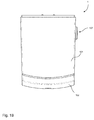
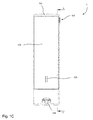
- the arrangement 2 is shown in more detail in figures 1E , 1F and 2 .
- the dispenser 1 comprises a housing 101 with a front cover 102 and a back wall 103.
- the housing 101 can be closed, as shown in the figures or it can be opened (not depicted. In the closed position, the housing 101 can be locked with lock 107.
- An inspection window 105 is provided in the front cover 102.
- a bottle of soap 3 is provided as a resource container.
- the back wall 103 comprises two support arms 113. Between the support arms 113, and electric drive 150, provided with energy by a battery pack 151, is positioned. Connected to the electric drive 150 is a dispensing mechanism 120 with a dispense opening 106.
- the dispensing mechanism 120 preferably is a hands-free mechanism detecting the presence of a user with a proximity sensor. Between the dispensing mechanism 120 and the resource container three a tougher reservoir 110 is provided. An opening of the resource container three can be connected with an opening 111 of the buffer reservoir 110.
- an arrangement 2 is releasably positioned, as can be seen in particular in figures 1E , 1F , and 2 .
- Arrangement 2 is suitable for retrofitting existing dispensers 1.
- Arrangement 2 comprises a sensor 200 and a counter 21.
- Sensor 200 comprises a printed circuit board 210 comprising the control unit and two printed circuit boards 220, 221, each comprising one of the emitter and the receiver.
- the two circuit boards 220, 221 are positioned in a sensor housing 230.
- the position of the sensor 200, in particular the position of the emitter and the receiver, is such that the sensor is arranged to detect the absence of resource in a lower third of the resource container 3 in operable position.
- the counter With each activation of electric drive 150, the counter, preferably also positioned on printed circuit board 210, is incremented. Further, as long as resource in resource container three has a high resource level, the sensor two will detect the presence of resource, since resource present in resource container three will prevent radiation emitted from the matter to be received by the receiver. When resource is further dispensed in portions by the dispensing mechanism 120 activated by the electric drive 150, the resource level in resource container 3 will sink. When the resource level passes the position of sensor 200, the sensor 200 will detect the absence of resource, since the radiation emitted by the emitter will be received by the receiver through the empty container 3 at the position of the sensor 200.
- the amount of portions of resource in the resource container 3 corresponding to the amount of resources present in resource container 3 below the resource level corresponding to the position of sensor 200 is known and preferably set as a predetermined value.
- the control unit adjusts the counter data accordingly, preferably to the predetermined value.
- the predetermined value also takes into account the amount of portions of resource buffered in the buffer reservoir 110.
- a signal indicating that the resource level corresponding to the position of the sensor 200 has been reached is generated and for the preferably send to an external communication unit.
- a warning signal can be generated.
- the exchange of resource container 3 can be detected, for example, when after the sensor 200 has detected the absence of resource later again detects the presence of resource.
- the senor 200 in particular the control unit, is adapted to keep the time and/or to provide timestamps.
- the arrangement 2 communicates with an external communication unit in order to transmit information about resource usage and/or to receive software updates and/or client specific information.
- the arrangement 20 and the dispenser 1 have several advantages. By providing an arrangement 2 suitable for retrofit, existing dispensers 1 can be reused. Since the arrangement 2 is adapted for bidirectional communication with an external communication unit, information about resource usage can be transmitted from the sensor and information, for example software updates, can be received by the sensor 200. Further, the combination of the counter 21 and the sensor 200 leads to a very reliable and accurate detection of resource usage. Additionally, the arrangement 2 is adapted such that energy consumption is particularly low. This is further enhanced in case the radiation is pulsed.
Landscapes
- Health & Medical Sciences (AREA)
- Public Health (AREA)
- Details Of Rigid Or Semi-Rigid Containers (AREA)
Priority Applications (5)
| Application Number | Priority Date | Filing Date | Title |
|---|---|---|---|
| EP16168690.2A EP3243414A1 (de) | 2016-05-09 | 2016-05-09 | Vorrichtung und verfahren zum nachweis von ressourcennutzung in einem spender, spender und system und verfahren zur überwachung von ressourcennutzung in mindestens einem spender |
| EP17169776.6A EP3241470B1 (de) | 2016-05-06 | 2017-05-05 | Vorrichtung und verfahren zum nachweis von ressourcennutzung in einem spender, spender und system und verfahren zur überwachung von ressourcennutzung in mindestens einem spender |
| PL17169776T PL3241470T3 (pl) | 2016-05-06 | 2017-05-05 | Sposób i układ do wykrywania zużycia zasobu w dozowniku, dozownik oraz system i sposób monitorowania zużycia zasobu w co najmniej jednym dozowniku |
| DK17169776.6T DK3241470T3 (da) | 2016-05-06 | 2017-05-05 | Indretning og fremgangsmåde til detektering af resourseforbrug i en dispenser, dispenser, system og fremgangsmåde til at monitorere resourseforbrug i mindst én dispenser |
| CN201710317949.8A CN107411621B (zh) | 2016-05-06 | 2017-05-08 | 分配器及检测/监控其中的资源使用的装置、方法和系统 |
Applications Claiming Priority (1)
| Application Number | Priority Date | Filing Date | Title |
|---|---|---|---|
| EP16168690.2A EP3243414A1 (de) | 2016-05-09 | 2016-05-09 | Vorrichtung und verfahren zum nachweis von ressourcennutzung in einem spender, spender und system und verfahren zur überwachung von ressourcennutzung in mindestens einem spender |
Publications (1)
| Publication Number | Publication Date |
|---|---|
| EP3243414A1 true EP3243414A1 (de) | 2017-11-15 |
Family
ID=55967091
Family Applications (1)
| Application Number | Title | Priority Date | Filing Date |
|---|---|---|---|
| EP16168690.2A Withdrawn EP3243414A1 (de) | 2016-05-06 | 2016-05-09 | Vorrichtung und verfahren zum nachweis von ressourcennutzung in einem spender, spender und system und verfahren zur überwachung von ressourcennutzung in mindestens einem spender |
Country Status (1)
| Country | Link |
|---|---|
| EP (1) | EP3243414A1 (de) |
Cited By (2)
| Publication number | Priority date | Publication date | Assignee | Title |
|---|---|---|---|---|
| US11744413B2 (en) | 2021-10-07 | 2023-09-05 | Deb Ip Limited | Dispenser assembly |
| US12628990B2 (en) | 2023-08-23 | 2026-05-19 | Deb Ip Limited | Dispenser assembly |
Citations (16)
| Publication number | Priority date | Publication date | Assignee | Title |
|---|---|---|---|---|
| US4331262A (en) * | 1978-04-07 | 1982-05-25 | New Brunswick Scientific Co., Inc. | Calibratable automatic fluid dispenser |
| WO2005065509A1 (en) | 2003-12-31 | 2005-07-21 | Kimberly-Clark Worldwide, Inc. | System and method for measuring, monitoring and controlling washroom dispensers and products |
| WO2006065515A2 (en) | 2004-12-17 | 2006-06-22 | Kimberly-Clark Worldwide, Inc. | Apparatus for dispensing and identifying product in washrooms |
| WO2006065514A1 (en) | 2004-12-17 | 2006-06-22 | Kimberly-Clark Worldwide, Inc. | System and method for measuring and monitoring overflow or wetness conditions in a washroom |
| US20120112914A1 (en) * | 2010-11-08 | 2012-05-10 | Gojo Industries, Inc, | Hygiene compliance module |
| WO2013016747A1 (de) | 2011-08-02 | 2013-02-07 | Hans Georg Hagleitner | Netzwerk zur datenkommunikation mit wenigstens einer dosiervorrichtung |
| WO2013016748A1 (de) | 2011-08-02 | 2013-02-07 | Hans Georg Hagleitner | Netzwerk zur optischen datenkommunikation für eine dosiervorrichtung |
| US20130119083A1 (en) * | 2009-02-27 | 2013-05-16 | Heiner Ophardt | Ozone foam dispenser |
| WO2013113129A1 (de) | 2012-02-03 | 2013-08-08 | Cws-Boco Supply Ag | Handtuchspender mit mitteln zur datenerfassung und -übertragung |
| WO2014027030A2 (en) | 2012-08-14 | 2014-02-20 | Berendsen A/S | A hygiene behaviour support system |
| WO2014035307A1 (en) | 2012-08-31 | 2014-03-06 | Sca Hygiene Products Ab | A data collection and monitoring system and method |
| WO2015010143A1 (de) | 2013-07-22 | 2015-01-29 | Hans Georg Hagleitner | Messvorrichtung zur erfassung wenigstens eines parameters einer flüssigkeit |
| AU2014227493A1 (en) * | 2013-09-23 | 2015-04-09 | Kcrown Australia Pty Ltd | Washroom monitoring and consumable supply management system |
| WO2015086055A1 (en) | 2013-12-11 | 2015-06-18 | Sca Hygiene Products Ab | Method of determining resource usage information for a facility, data collection device, data collection system and data collection method |
| WO2015165731A1 (de) | 2014-04-30 | 2015-11-05 | Hans Georg Hagleitner | System mit zumindest einer basisstation und mit der basisstation über funk verbindbaren geräten |
| US20150366411A1 (en) * | 2014-06-18 | 2015-12-24 | Simplehuman, Llc | Domestic appliance communication system |
-
2016
- 2016-05-09 EP EP16168690.2A patent/EP3243414A1/de not_active Withdrawn
Patent Citations (16)
| Publication number | Priority date | Publication date | Assignee | Title |
|---|---|---|---|---|
| US4331262A (en) * | 1978-04-07 | 1982-05-25 | New Brunswick Scientific Co., Inc. | Calibratable automatic fluid dispenser |
| WO2005065509A1 (en) | 2003-12-31 | 2005-07-21 | Kimberly-Clark Worldwide, Inc. | System and method for measuring, monitoring and controlling washroom dispensers and products |
| WO2006065515A2 (en) | 2004-12-17 | 2006-06-22 | Kimberly-Clark Worldwide, Inc. | Apparatus for dispensing and identifying product in washrooms |
| WO2006065514A1 (en) | 2004-12-17 | 2006-06-22 | Kimberly-Clark Worldwide, Inc. | System and method for measuring and monitoring overflow or wetness conditions in a washroom |
| US20130119083A1 (en) * | 2009-02-27 | 2013-05-16 | Heiner Ophardt | Ozone foam dispenser |
| US20120112914A1 (en) * | 2010-11-08 | 2012-05-10 | Gojo Industries, Inc, | Hygiene compliance module |
| WO2013016747A1 (de) | 2011-08-02 | 2013-02-07 | Hans Georg Hagleitner | Netzwerk zur datenkommunikation mit wenigstens einer dosiervorrichtung |
| WO2013016748A1 (de) | 2011-08-02 | 2013-02-07 | Hans Georg Hagleitner | Netzwerk zur optischen datenkommunikation für eine dosiervorrichtung |
| WO2013113129A1 (de) | 2012-02-03 | 2013-08-08 | Cws-Boco Supply Ag | Handtuchspender mit mitteln zur datenerfassung und -übertragung |
| WO2014027030A2 (en) | 2012-08-14 | 2014-02-20 | Berendsen A/S | A hygiene behaviour support system |
| WO2014035307A1 (en) | 2012-08-31 | 2014-03-06 | Sca Hygiene Products Ab | A data collection and monitoring system and method |
| WO2015010143A1 (de) | 2013-07-22 | 2015-01-29 | Hans Georg Hagleitner | Messvorrichtung zur erfassung wenigstens eines parameters einer flüssigkeit |
| AU2014227493A1 (en) * | 2013-09-23 | 2015-04-09 | Kcrown Australia Pty Ltd | Washroom monitoring and consumable supply management system |
| WO2015086055A1 (en) | 2013-12-11 | 2015-06-18 | Sca Hygiene Products Ab | Method of determining resource usage information for a facility, data collection device, data collection system and data collection method |
| WO2015165731A1 (de) | 2014-04-30 | 2015-11-05 | Hans Georg Hagleitner | System mit zumindest einer basisstation und mit der basisstation über funk verbindbaren geräten |
| US20150366411A1 (en) * | 2014-06-18 | 2015-12-24 | Simplehuman, Llc | Domestic appliance communication system |
Cited By (2)
| Publication number | Priority date | Publication date | Assignee | Title |
|---|---|---|---|---|
| US11744413B2 (en) | 2021-10-07 | 2023-09-05 | Deb Ip Limited | Dispenser assembly |
| US12628990B2 (en) | 2023-08-23 | 2026-05-19 | Deb Ip Limited | Dispenser assembly |
Similar Documents
| Publication | Publication Date | Title |
|---|---|---|
| EP2123201B1 (de) | Automatischer Getränkespender mit verbesserter Abgabevorrichtung | |
| US11131575B2 (en) | Method and apparatus for calibrating remaining doses of product in a refillable dispenser | |
| EP3515857B1 (de) | Universeller spendermonitor | |
| US10278550B2 (en) | Fluid dispenser with time of flight proximity sensor | |
| JP2018512272A (ja) | 手の大きさに基づいた吐出装置の吐出 | |
| US10974951B2 (en) | Systems and methods for monitoring and controlling dispenser fluid refill | |
| JP2007525258A5 (de) | ||
| EP3241470B1 (de) | Vorrichtung und verfahren zum nachweis von ressourcennutzung in einem spender, spender und system und verfahren zur überwachung von ressourcennutzung in mindestens einem spender | |
| JP7465809B2 (ja) | 液体製品分配装置の使用を補助する装置 | |
| CN115697154A (zh) | 包括分配器和可更换液体容器的分配器系统 | |
| CN115697155B (zh) | 包括可更换的液体容器的分配器 | |
| EP1832210B1 (de) | Detektionsvorrichtung, insbesondere für Getränkeautomaten, und mit einer Detektionsvorrichtung ausgestatteter Getränkeautomat | |
| EP3243415A1 (de) | Sensor und verfahren zur erkennung der ressourcennutzung in einem spender, spender und system und verfahren zur überwachung der ressourcennutzung in einem spender | |
| HK1241241A (en) | Arrangement and method for detecting resource usage in a dispenser, dispenser, and system and method for monitoring resource usage in at least one dispenser | |
| HK1241241A1 (en) | Arrangement and method for detecting resource usage in a dispenser, dispenser, and system and method for monitoring resource usage in at least one dispenser | |
| HK1241241B (en) | Arrangement and method for detecting resource usage in a dispenser, dispenser, and system and method for monitoring resource usage in at least one dispenser | |
| US12458181B2 (en) | Insert module in a dispenser | |
| EP3241472B1 (de) | Sensor und verfahren zur erkennung der ressourcennutzung in einem spender, spender und system und verfahren zur überwachung der ressourcennutzung in einem spender | |
| US12238466B1 (en) | Automated restroom dispenser assembly | |
| HK1240794A (en) | Sensor and method for detecting resource usage in a dispenser, dispenser, and system and method for monitoring resource usage in a dispenser | |
| HK1240794A1 (en) | Sensor and method for detecting resource usage in a dispenser, dispenser, and system and method for monitoring resource usage in a dispenser | |
| HK1240794B (en) | Sensor and method for detecting resource usage in a dispenser, dispenser, and system and method for monitoring resource usage in a dispenser | |
| HK40083394A (en) | A dispenser system comprising a dispenser and a replaceable liquid container | |
| CA3147758A1 (en) | Systems and methods for increased accuracy for tracking hygiene compliance |
Legal Events
| Date | Code | Title | Description |
|---|---|---|---|
| PUAI | Public reference made under article 153(3) epc to a published international application that has entered the european phase |
Free format text: ORIGINAL CODE: 0009012 |
|
| AK | Designated contracting states |
Kind code of ref document: A1 Designated state(s): AL AT BE BG CH CY CZ DE DK EE ES FI FR GB GR HR HU IE IS IT LI LT LU LV MC MK MT NL NO PL PT RO RS SE SI SK SM TR |
|
| AX | Request for extension of the european patent |
Extension state: BA ME |
|
| STAA | Information on the status of an ep patent application or granted ep patent |
Free format text: STATUS: THE APPLICATION IS DEEMED TO BE WITHDRAWN |
|
| 18D | Application deemed to be withdrawn |
Effective date: 20180516 |