EP3243922A1 - Acier résistant à la chaleur à base d'austénite, et composant de turbine - Google Patents
Acier résistant à la chaleur à base d'austénite, et composant de turbine Download PDFInfo
- Publication number
- EP3243922A1 EP3243922A1 EP16734989.3A EP16734989A EP3243922A1 EP 3243922 A1 EP3243922 A1 EP 3243922A1 EP 16734989 A EP16734989 A EP 16734989A EP 3243922 A1 EP3243922 A1 EP 3243922A1
- Authority
- EP
- European Patent Office
- Prior art keywords
- resistant steel
- heat resistant
- austenitic heat
- mass
- turbine
- Prior art date
- Legal status (The legal status is an assumption and is not a legal conclusion. Google has not performed a legal analysis and makes no representation as to the accuracy of the status listed.)
- Withdrawn
Links
- 229910000831 Steel Inorganic materials 0.000 title claims abstract description 72
- 239000010959 steel Substances 0.000 title claims abstract description 72
- 229910001566 austenite Inorganic materials 0.000 title description 5
- 239000012535 impurity Substances 0.000 claims abstract description 7
- 238000012360 testing method Methods 0.000 description 22
- 239000000203 mixture Substances 0.000 description 17
- PXHVJJICTQNCMI-UHFFFAOYSA-N nickel Substances [Ni] PXHVJJICTQNCMI-UHFFFAOYSA-N 0.000 description 15
- 238000004519 manufacturing process Methods 0.000 description 14
- 239000011651 chromium Substances 0.000 description 12
- 229910052751 metal Inorganic materials 0.000 description 12
- 239000002184 metal Substances 0.000 description 12
- 239000010955 niobium Substances 0.000 description 11
- 230000000694 effects Effects 0.000 description 10
- 238000010438 heat treatment Methods 0.000 description 10
- 238000001556 precipitation Methods 0.000 description 10
- 230000032683 aging Effects 0.000 description 9
- 239000000243 solution Substances 0.000 description 9
- 239000010936 titanium Substances 0.000 description 9
- 239000000463 material Substances 0.000 description 8
- 238000010248 power generation Methods 0.000 description 8
- 239000006104 solid solution Substances 0.000 description 8
- 238000005728 strengthening Methods 0.000 description 8
- 238000001816 cooling Methods 0.000 description 7
- 230000006698 induction Effects 0.000 description 7
- 238000000034 method Methods 0.000 description 7
- 238000003466 welding Methods 0.000 description 7
- 239000012530 fluid Substances 0.000 description 6
- CURLTUGMZLYLDI-UHFFFAOYSA-N Carbon dioxide Chemical compound O=C=O CURLTUGMZLYLDI-UHFFFAOYSA-N 0.000 description 5
- 239000000126 substance Substances 0.000 description 5
- 229910002092 carbon dioxide Inorganic materials 0.000 description 4
- 239000011572 manganese Substances 0.000 description 4
- 238000005259 measurement Methods 0.000 description 4
- 229910052758 niobium Inorganic materials 0.000 description 4
- 229910045601 alloy Inorganic materials 0.000 description 3
- 239000000956 alloy Substances 0.000 description 3
- 229910052782 aluminium Inorganic materials 0.000 description 3
- 229910052796 boron Inorganic materials 0.000 description 3
- 229910052799 carbon Inorganic materials 0.000 description 3
- 229910052804 chromium Inorganic materials 0.000 description 3
- 230000007547 defect Effects 0.000 description 3
- 239000007789 gas Substances 0.000 description 3
- 229910052748 manganese Inorganic materials 0.000 description 3
- 229910052757 nitrogen Inorganic materials 0.000 description 3
- 229910052710 silicon Inorganic materials 0.000 description 3
- 229910052717 sulfur Inorganic materials 0.000 description 3
- 229910052719 titanium Inorganic materials 0.000 description 3
- 229910052720 vanadium Inorganic materials 0.000 description 3
- IJGRMHOSHXDMSA-UHFFFAOYSA-N Atomic nitrogen Chemical compound N#N IJGRMHOSHXDMSA-UHFFFAOYSA-N 0.000 description 2
- VVTSZOCINPYFDP-UHFFFAOYSA-N [O].[Ar] Chemical compound [O].[Ar] VVTSZOCINPYFDP-UHFFFAOYSA-N 0.000 description 2
- 230000001133 acceleration Effects 0.000 description 2
- 238000005266 casting Methods 0.000 description 2
- 239000013078 crystal Substances 0.000 description 2
- 238000011156 evaluation Methods 0.000 description 2
- 238000005242 forging Methods 0.000 description 2
- 238000009415 formwork Methods 0.000 description 2
- 229910000765 intermetallic Inorganic materials 0.000 description 2
- 238000002844 melting Methods 0.000 description 2
- 230000008018 melting Effects 0.000 description 2
- 229910052698 phosphorus Inorganic materials 0.000 description 2
- 230000000717 retained effect Effects 0.000 description 2
- 230000035945 sensitivity Effects 0.000 description 2
- 230000035882 stress Effects 0.000 description 2
- ZOXJGFHDIHLPTG-UHFFFAOYSA-N Boron Chemical compound [B] ZOXJGFHDIHLPTG-UHFFFAOYSA-N 0.000 description 1
- OKTJSMMVPCPJKN-UHFFFAOYSA-N Carbon Chemical compound [C] OKTJSMMVPCPJKN-UHFFFAOYSA-N 0.000 description 1
- VYZAMTAEIAYCRO-UHFFFAOYSA-N Chromium Chemical compound [Cr] VYZAMTAEIAYCRO-UHFFFAOYSA-N 0.000 description 1
- PWHULOQIROXLJO-UHFFFAOYSA-N Manganese Chemical compound [Mn] PWHULOQIROXLJO-UHFFFAOYSA-N 0.000 description 1
- OAICVXFJPJFONN-UHFFFAOYSA-N Phosphorus Chemical compound [P] OAICVXFJPJFONN-UHFFFAOYSA-N 0.000 description 1
- NINIDFKCEFEMDL-UHFFFAOYSA-N Sulfur Chemical compound [S] NINIDFKCEFEMDL-UHFFFAOYSA-N 0.000 description 1
- RTAQQCXQSZGOHL-UHFFFAOYSA-N Titanium Chemical compound [Ti] RTAQQCXQSZGOHL-UHFFFAOYSA-N 0.000 description 1
- XAGFODPZIPBFFR-UHFFFAOYSA-N aluminium Chemical compound [Al] XAGFODPZIPBFFR-UHFFFAOYSA-N 0.000 description 1
- 238000005452 bending Methods 0.000 description 1
- 230000015572 biosynthetic process Effects 0.000 description 1
- 239000001569 carbon dioxide Substances 0.000 description 1
- 238000009750 centrifugal casting Methods 0.000 description 1
- 239000010941 cobalt Substances 0.000 description 1
- 229910017052 cobalt Inorganic materials 0.000 description 1
- GUTLYIVDDKVIGB-UHFFFAOYSA-N cobalt atom Chemical compound [Co] GUTLYIVDDKVIGB-UHFFFAOYSA-N 0.000 description 1
- 230000000052 comparative effect Effects 0.000 description 1
- 239000000470 constituent Substances 0.000 description 1
- 238000011161 development Methods 0.000 description 1
- 230000018109 developmental process Effects 0.000 description 1
- 238000013213 extrapolation Methods 0.000 description 1
- 238000005098 hot rolling Methods 0.000 description 1
- 238000012986 modification Methods 0.000 description 1
- 230000004048 modification Effects 0.000 description 1
- 229910052759 nickel Inorganic materials 0.000 description 1
- GUCVJGMIXFAOAE-UHFFFAOYSA-N niobium atom Chemical compound [Nb] GUCVJGMIXFAOAE-UHFFFAOYSA-N 0.000 description 1
- 150000004767 nitrides Chemical class 0.000 description 1
- 239000002245 particle Substances 0.000 description 1
- 238000013001 point bending Methods 0.000 description 1
- 230000001376 precipitating effect Effects 0.000 description 1
- 239000002994 raw material Substances 0.000 description 1
- 230000001105 regulatory effect Effects 0.000 description 1
- 238000005096 rolling process Methods 0.000 description 1
- 238000005204 segregation Methods 0.000 description 1
- 239000010703 silicon Substances 0.000 description 1
- 238000006467 substitution reaction Methods 0.000 description 1
- 239000011593 sulfur Substances 0.000 description 1
- 229910052715 tantalum Inorganic materials 0.000 description 1
- 230000008646 thermal stress Effects 0.000 description 1
- GPPXJZIENCGNKB-UHFFFAOYSA-N vanadium Chemical compound [V]#[V] GPPXJZIENCGNKB-UHFFFAOYSA-N 0.000 description 1
- XLYOFNOQVPJJNP-UHFFFAOYSA-N water Substances O XLYOFNOQVPJJNP-UHFFFAOYSA-N 0.000 description 1
Images
Classifications
-
- C—CHEMISTRY; METALLURGY
- C22—METALLURGY; FERROUS OR NON-FERROUS ALLOYS; TREATMENT OF ALLOYS OR NON-FERROUS METALS
- C22C—ALLOYS
- C22C38/00—Ferrous alloys, e.g. steel alloys
- C22C38/18—Ferrous alloys, e.g. steel alloys containing chromium
- C22C38/32—Ferrous alloys, e.g. steel alloys containing chromium with boron
-
- C—CHEMISTRY; METALLURGY
- C22—METALLURGY; FERROUS OR NON-FERROUS ALLOYS; TREATMENT OF ALLOYS OR NON-FERROUS METALS
- C22C—ALLOYS
- C22C19/00—Alloys based on nickel or cobalt
- C22C19/03—Alloys based on nickel or cobalt based on nickel
- C22C19/05—Alloys based on nickel or cobalt based on nickel with chromium
- C22C19/058—Alloys based on nickel or cobalt based on nickel with chromium without Mo and W
-
- C—CHEMISTRY; METALLURGY
- C22—METALLURGY; FERROUS OR NON-FERROUS ALLOYS; TREATMENT OF ALLOYS OR NON-FERROUS METALS
- C22C—ALLOYS
- C22C38/00—Ferrous alloys, e.g. steel alloys
-
- C—CHEMISTRY; METALLURGY
- C22—METALLURGY; FERROUS OR NON-FERROUS ALLOYS; TREATMENT OF ALLOYS OR NON-FERROUS METALS
- C22C—ALLOYS
- C22C38/00—Ferrous alloys, e.g. steel alloys
- C22C38/004—Very low carbon steels, i.e. having a carbon content of less than 0,01%
-
- C—CHEMISTRY; METALLURGY
- C22—METALLURGY; FERROUS OR NON-FERROUS ALLOYS; TREATMENT OF ALLOYS OR NON-FERROUS METALS
- C22C—ALLOYS
- C22C38/00—Ferrous alloys, e.g. steel alloys
- C22C38/06—Ferrous alloys, e.g. steel alloys containing aluminium
-
- C—CHEMISTRY; METALLURGY
- C22—METALLURGY; FERROUS OR NON-FERROUS ALLOYS; TREATMENT OF ALLOYS OR NON-FERROUS METALS
- C22C—ALLOYS
- C22C38/00—Ferrous alloys, e.g. steel alloys
- C22C38/10—Ferrous alloys, e.g. steel alloys containing cobalt
- C22C38/105—Ferrous alloys, e.g. steel alloys containing cobalt containing Co and Ni
-
- C—CHEMISTRY; METALLURGY
- C22—METALLURGY; FERROUS OR NON-FERROUS ALLOYS; TREATMENT OF ALLOYS OR NON-FERROUS METALS
- C22C—ALLOYS
- C22C38/00—Ferrous alloys, e.g. steel alloys
- C22C38/18—Ferrous alloys, e.g. steel alloys containing chromium
- C22C38/24—Ferrous alloys, e.g. steel alloys containing chromium with vanadium
-
- C—CHEMISTRY; METALLURGY
- C22—METALLURGY; FERROUS OR NON-FERROUS ALLOYS; TREATMENT OF ALLOYS OR NON-FERROUS METALS
- C22C—ALLOYS
- C22C38/00—Ferrous alloys, e.g. steel alloys
- C22C38/18—Ferrous alloys, e.g. steel alloys containing chromium
- C22C38/26—Ferrous alloys, e.g. steel alloys containing chromium with niobium or tantalum
-
- C—CHEMISTRY; METALLURGY
- C22—METALLURGY; FERROUS OR NON-FERROUS ALLOYS; TREATMENT OF ALLOYS OR NON-FERROUS METALS
- C22C—ALLOYS
- C22C38/00—Ferrous alloys, e.g. steel alloys
- C22C38/18—Ferrous alloys, e.g. steel alloys containing chromium
- C22C38/28—Ferrous alloys, e.g. steel alloys containing chromium with titanium or zirconium
-
- C—CHEMISTRY; METALLURGY
- C22—METALLURGY; FERROUS OR NON-FERROUS ALLOYS; TREATMENT OF ALLOYS OR NON-FERROUS METALS
- C22C—ALLOYS
- C22C38/00—Ferrous alloys, e.g. steel alloys
- C22C38/18—Ferrous alloys, e.g. steel alloys containing chromium
- C22C38/30—Ferrous alloys, e.g. steel alloys containing chromium with cobalt
-
- C—CHEMISTRY; METALLURGY
- C22—METALLURGY; FERROUS OR NON-FERROUS ALLOYS; TREATMENT OF ALLOYS OR NON-FERROUS METALS
- C22C—ALLOYS
- C22C38/00—Ferrous alloys, e.g. steel alloys
- C22C38/18—Ferrous alloys, e.g. steel alloys containing chromium
- C22C38/40—Ferrous alloys, e.g. steel alloys containing chromium with nickel
-
- C—CHEMISTRY; METALLURGY
- C22—METALLURGY; FERROUS OR NON-FERROUS ALLOYS; TREATMENT OF ALLOYS OR NON-FERROUS METALS
- C22C—ALLOYS
- C22C38/00—Ferrous alloys, e.g. steel alloys
- C22C38/18—Ferrous alloys, e.g. steel alloys containing chromium
- C22C38/40—Ferrous alloys, e.g. steel alloys containing chromium with nickel
- C22C38/46—Ferrous alloys, e.g. steel alloys containing chromium with nickel with vanadium
-
- C—CHEMISTRY; METALLURGY
- C22—METALLURGY; FERROUS OR NON-FERROUS ALLOYS; TREATMENT OF ALLOYS OR NON-FERROUS METALS
- C22C—ALLOYS
- C22C38/00—Ferrous alloys, e.g. steel alloys
- C22C38/18—Ferrous alloys, e.g. steel alloys containing chromium
- C22C38/40—Ferrous alloys, e.g. steel alloys containing chromium with nickel
- C22C38/48—Ferrous alloys, e.g. steel alloys containing chromium with nickel with niobium or tantalum
-
- C—CHEMISTRY; METALLURGY
- C22—METALLURGY; FERROUS OR NON-FERROUS ALLOYS; TREATMENT OF ALLOYS OR NON-FERROUS METALS
- C22C—ALLOYS
- C22C38/00—Ferrous alloys, e.g. steel alloys
- C22C38/18—Ferrous alloys, e.g. steel alloys containing chromium
- C22C38/40—Ferrous alloys, e.g. steel alloys containing chromium with nickel
- C22C38/50—Ferrous alloys, e.g. steel alloys containing chromium with nickel with titanium or zirconium
-
- C—CHEMISTRY; METALLURGY
- C22—METALLURGY; FERROUS OR NON-FERROUS ALLOYS; TREATMENT OF ALLOYS OR NON-FERROUS METALS
- C22C—ALLOYS
- C22C38/00—Ferrous alloys, e.g. steel alloys
- C22C38/18—Ferrous alloys, e.g. steel alloys containing chromium
- C22C38/40—Ferrous alloys, e.g. steel alloys containing chromium with nickel
- C22C38/52—Ferrous alloys, e.g. steel alloys containing chromium with nickel with cobalt
-
- C—CHEMISTRY; METALLURGY
- C22—METALLURGY; FERROUS OR NON-FERROUS ALLOYS; TREATMENT OF ALLOYS OR NON-FERROUS METALS
- C22C—ALLOYS
- C22C38/00—Ferrous alloys, e.g. steel alloys
- C22C38/18—Ferrous alloys, e.g. steel alloys containing chromium
- C22C38/40—Ferrous alloys, e.g. steel alloys containing chromium with nickel
- C22C38/54—Ferrous alloys, e.g. steel alloys containing chromium with nickel with boron
-
- F—MECHANICAL ENGINEERING; LIGHTING; HEATING; WEAPONS; BLASTING
- F01—MACHINES OR ENGINES IN GENERAL; ENGINE PLANTS IN GENERAL; STEAM ENGINES
- F01D—NON-POSITIVE DISPLACEMENT MACHINES OR ENGINES, e.g. STEAM TURBINES
- F01D25/00—Component parts, details, or accessories, not provided for in, or of interest apart from, other groups
-
- F—MECHANICAL ENGINEERING; LIGHTING; HEATING; WEAPONS; BLASTING
- F01—MACHINES OR ENGINES IN GENERAL; ENGINE PLANTS IN GENERAL; STEAM ENGINES
- F01D—NON-POSITIVE DISPLACEMENT MACHINES OR ENGINES, e.g. STEAM TURBINES
- F01D25/00—Component parts, details, or accessories, not provided for in, or of interest apart from, other groups
- F01D25/005—Selecting particular materials
-
- F—MECHANICAL ENGINEERING; LIGHTING; HEATING; WEAPONS; BLASTING
- F01—MACHINES OR ENGINES IN GENERAL; ENGINE PLANTS IN GENERAL; STEAM ENGINES
- F01D—NON-POSITIVE DISPLACEMENT MACHINES OR ENGINES, e.g. STEAM TURBINES
- F01D5/00—Blades; Blade-carrying members; Heating, heat-insulating, cooling or antivibration means on the blades or the members
- F01D5/12—Blades
- F01D5/28—Selecting particular materials; Particular measures relating thereto; Measures against erosion or corrosion
-
- F—MECHANICAL ENGINEERING; LIGHTING; HEATING; WEAPONS; BLASTING
- F01—MACHINES OR ENGINES IN GENERAL; ENGINE PLANTS IN GENERAL; STEAM ENGINES
- F01D—NON-POSITIVE DISPLACEMENT MACHINES OR ENGINES, e.g. STEAM TURBINES
- F01D9/00—Stators
- F01D9/02—Nozzles; Nozzle boxes; Stator blades; Guide conduits, e.g. individual nozzles
-
- F—MECHANICAL ENGINEERING; LIGHTING; HEATING; WEAPONS; BLASTING
- F01—MACHINES OR ENGINES IN GENERAL; ENGINE PLANTS IN GENERAL; STEAM ENGINES
- F01D—NON-POSITIVE DISPLACEMENT MACHINES OR ENGINES, e.g. STEAM TURBINES
- F01D9/00—Stators
- F01D9/02—Nozzles; Nozzle boxes; Stator blades; Guide conduits, e.g. individual nozzles
- F01D9/04—Nozzles; Nozzle boxes; Stator blades; Guide conduits, e.g. individual nozzles forming ring or sector
- F01D9/041—Nozzles; Nozzle boxes; Stator blades; Guide conduits, e.g. individual nozzles forming ring or sector using blades
-
- F—MECHANICAL ENGINEERING; LIGHTING; HEATING; WEAPONS; BLASTING
- F02—COMBUSTION ENGINES; HOT-GAS OR COMBUSTION-PRODUCT ENGINE PLANTS
- F02C—GAS-TURBINE PLANTS; AIR INTAKES FOR JET-PROPULSION PLANTS; CONTROLLING FUEL SUPPLY IN AIR-BREATHING JET-PROPULSION PLANTS
- F02C7/00—Features, components parts, details or accessories, not provided for in, or of interest apart form groups F02C1/00 - F02C6/00; Air intakes for jet-propulsion plants
-
- C—CHEMISTRY; METALLURGY
- C21—METALLURGY OF IRON
- C21D—MODIFYING THE PHYSICAL STRUCTURE OF FERROUS METALS; GENERAL DEVICES FOR HEAT TREATMENT OF FERROUS OR NON-FERROUS METALS OR ALLOYS; MAKING METAL MALLEABLE, e.g. BY DECARBURISATION OR TEMPERING
- C21D2211/00—Microstructure comprising significant phases
- C21D2211/001—Austenite
-
- C—CHEMISTRY; METALLURGY
- C22—METALLURGY; FERROUS OR NON-FERROUS ALLOYS; TREATMENT OF ALLOYS OR NON-FERROUS METALS
- C22C—ALLOYS
- C22C30/00—Alloys containing less than 50% by weight of each constituent
-
- F—MECHANICAL ENGINEERING; LIGHTING; HEATING; WEAPONS; BLASTING
- F05—INDEXING SCHEMES RELATING TO ENGINES OR PUMPS IN VARIOUS SUBCLASSES OF CLASSES F01-F04
- F05D—INDEXING SCHEME FOR ASPECTS RELATING TO NON-POSITIVE-DISPLACEMENT MACHINES OR ENGINES, GAS-TURBINES OR JET-PROPULSION PLANTS
- F05D2220/00—Application
- F05D2220/30—Application in turbines
-
- F—MECHANICAL ENGINEERING; LIGHTING; HEATING; WEAPONS; BLASTING
- F05—INDEXING SCHEMES RELATING TO ENGINES OR PUMPS IN VARIOUS SUBCLASSES OF CLASSES F01-F04
- F05D—INDEXING SCHEME FOR ASPECTS RELATING TO NON-POSITIVE-DISPLACEMENT MACHINES OR ENGINES, GAS-TURBINES OR JET-PROPULSION PLANTS
- F05D2300/00—Materials; Properties thereof
- F05D2300/10—Metals, alloys or intermetallic compounds
- F05D2300/17—Alloys
- F05D2300/171—Steel alloys
Definitions
- Embodiments described herein generally relate to austenitic heat resistant steel and a turbine component.
- ferritic heat resistant steel or the like has been used for turbine components exposed to the temperature at approximately 600°C.
- the turbine components exposed to the high-temperature working fluid are constituted by austenitic heat resistant steel, an Ni-based alloy, a Co-based alloy, and so on.
- a service temperature of the austenitic heat resistant steel is higher than the ferritic heat resistant steel for approximately 50°C, and a material cost of the austenitic heat resistant steel is approximately one-third of the Ni-based alloy. Accordingly, it is possible to suppress a manufacturing cost and to enable high efficiency by using the austenitic heat resistant steel.
- the austenitic heat resistant steel has a characteristic where a linear expansion coefficient is high, and there is a problem that repeated thermal stress due to start/stop operation is excessively generated when the austenitic heat resistant steel is considered to be applied to a valve and an inner casing of a steam turbine. Besides, it is known that crack sensitivity of the austenitic heat resistant steel at a welding time is high, and manufacturing defects are easy to occur when the valve and the inner casing are manufactured by welding. In publicly known austenitic heat resistant steel such as Alloy286, improvement in high-temperature creep strength is attempted by using an intermetallic compound as a precipitation strengthening phase. However, there is not proposed heat resistant steel securing excellent weldability while having a low linear expansion coefficient.
- Patent Reference 1 JP-A 2011-195880
- Thermal expansion characteristics and weldability of a material are important factors in designing a high-temperature structural material.
- a problem to be solved by the present invention is to provide austenitic heat resistant steel and a turbine component capable of securing excellent weldability while having a low linear expansion coefficient.
- Austenitic heat resistant steel contains: in mass, Ni: 24 to 50%, Cr: 5 to 13%, Co: 0.1 to 12%, Nb: 0.1 to 5%, V: 0.1 to 0.5%, Ti: 1.90 to 2.35%, Al: 0.01 to 0.30%, B: 0.001 to 0.01%, C: 0.001 to 0.1%, with the balance being Fe and inevitable impurities.
- the austenitic heat resistant steel and the turbine component capable of securing the excellent weldability while having the low linear expansion coefficient.
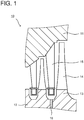
- Fig. 1 is a sectional view illustrating an example of a turbine where austenitic heat resistant steel of the embodiment is applied.
- the present inventors found that it is possible to obtain a material with a low linear expansion coefficient and sufficient weldability by adding Ni and reducing an Al amount to a minimum in conventional austenitic heat resistant steel.
- the conventional austenitic heat resistant steel is strengthened by precipitating a ⁇ ' phase to a base material by adding Al.
- the precipitation of the ⁇ ' phase may simultaneously cause intercrystalline cracks due to acceleration of a strength difference between a grain inside and a grain boundary when molten metal of welding, casting, and the like is solidified. Therefore, the present inventors found that it is possible to suppress the precipitation of the ⁇ ' phase and to suppress the crack sensitivity by reducing Al being a main constituent element of the ⁇ ' phase to the minimum to suppress the occurrence of the cracks. Further, the present inventors found that the linear expansion coefficient is reduced by adding Ni, and it is possible to simultaneously suppress lowering of strength resulting from the reduction in Al by enabling solid-solution strengthening.
- the austenitic heat resistant steel according to the embodiment contains: in mass, Ni: 24 to 50%, Cr: 5 to 13%, Co: 0.1 to 12%, Nb: 0.1 to 5%, V: 0.1 to 0.5%, Ti: 1.90 to 2.35%, Al: 0.01 to 0.30%, B: 0.001 to 0.01%, C: 0.001 to 0.1%, with the balance being Fe and inevitable impurities.
- the inevitable impurities in the austenitic heat resistant steel of the embodiment there can be cited, for example, N, Si, Mn, P, S, and so on.
- an average linear expansion coefficient of the austenitic heat resistant steel of the embodiment in temperatures from a room temperature to 700°C is 18 ⁇ 10 -6 /K or less.
- the average linear expansion coefficient can be found by the following expression (1) by using a length (L 0 ) at a room temperature (T 0 ) and a length (L) at a predetermined temperature (T) in the same test piece.
- Average linear expansion coefficient L ⁇ L 0 / T ⁇ T 0 / L 0
- the austenitic heat resistant steel with high linear expansion coefficient when used in, for example, a power generation plant, a lifetime and performance of the power generation plant may be interfered.
- the austenitic heat resistant steel as stated above when used for a turbine component, thermal fatigue excessively occurs due to expansion at a startup time and shrinkage at a stop time of the power generation plant, and there is a possibility that the turbine component is damaged in early stage. Therefore, it is preferable to set the average linear expansion coefficient of the austenitic heat resistant steel at the temperature from the room temperature to 700°C to 18 ⁇ 10 -6 /K or less so as to avoid the above-stated problem.
- a reason why a regulated temperature of each of the average linear expansion coefficient and a creep rupture elongation is set to 700°C is because a temperature zone where the austenitic heat resistant steel of the embodiment is used is approximately 700°C at the maximum.
- the austenitic heat resistant steel of the embodiment is desired not to have defects such as cracks at the welding time. It is proper to manufacture a welded joint using the austenitic heat resistant steel of the embodiment as a welded metal and to check presence/absence of crack occurrences by a side bend test so as to evaluate the defects at the welding time.
- the austenitic heat resistant steel of the embodiment is suitable as a material constituting the turbine component whose temperature at an operation time becomes 650°C or more, further approximately 700°C.
- a turbine casing, a rotor blade, a stator blade, a turbine rotor, a screwing member, a pipe, a valve, and so on as the turbine components.
- bolts, nuts, and so on to fix various kinds of components in the turbine casing and the turbine, as the screwing member.
- a pipe which is provided at a power generation turbine plant or the like, and through which high-temperature and high-pressure working fluid passes, and the like, as the pipe.
- Every portion of the above-stated turbine components may be constituted by the austenitic heat resistant steel of the embodiment.
- a part of the portion of the turbine components whose temperature becomes 650°C or more may be constituted by the austenitic heat resistant steel of the embodiment.
- the austenitic heat resistant steel of the embodiment has high-temperature strength equivalent to the conventional austenitic heat resistant steel, the low linear expansion coefficient and excellent weldability compared to the conventional austenitic heat resistant steel. Accordingly, the turbine components manufactured by using the austenitic heat resistant steel of the embodiment also have similar characteristics as the austenitic heat resistant steel of the embodiment, and have high reliability.
- the above-stated austenitic heat resistant steel and turbine components of the embodiment can be applied to power generation turbines such as, for example, a steam turbine, a gas turbine, and a CO 2 turbine.
- power generation turbines such as, for example, a steam turbine, a gas turbine, and a CO 2 turbine.
- Fig. 1 illustrates an example of a turbine.
- a turbine 10 includes, for example, a casing 11, a turbine rotor 12, a turbine disk 13, a rotor blade 14, and a stator blade 15.
- the turbine rotor 12 is provided inside the casing 11 so as to penetrate the casing 11.
- the turbine rotor 12 and the turbine disk 13 are welded to be bonded by a welded part 16.
- the turbine 10 may be one which does not have one of the turbine rotor 12 or the turbine disk 13, or one in which a plurality of turbine rotors 12 and turbine disks 13 are combined.
- a plurality of rotor blades 14 are implanted at a periphery of each turbine rotor 12 and turbine disk 13.
- the stator blade 15 is disposed in front of the rotor blade 14.
- the stator blade 15 is supported by the casing 11.
- One turbine stage is formed by the rotor blade 14 and the stator blade 15.
- Ni is solid-solved in an Fe parent phase, and brings about solid-solution strengthening of the parent phase and lowering of the linear expansion coefficient. These effects are exerted when an Ni content is 24% or more. Besides, when the Ni content is 50% or less, increasing in a manufacturing cost and lowering of processability are suppressed. Accordingly, the Ni content was set to 24 to 50%.
- the Ni content is more preferably 34 to 45%, further preferably 38 to 45%, and the most preferably 38 to 41%.
- Cr is solid-solved in the Fe parent phase, and brings about the solid-solution strengthening of the parent phase and the lowering of the linear expansion coefficient. Besides, Cr increases a solid-solution temperature of the ⁇ ' phase, and therefore, precipitation of the ⁇ ' phase is accelerated. These effects are exerted when a Cr content is 5% or more. Besides, when the Cr content is 13% or less, a stable austenite structure is obtained, and precipitation of a ⁇ phase is suppressed. Accordingly, the Cr content was set to 5 to 13%. The Cr content is more preferably 6 to 10%, and further preferably 6 to 8%.
- Co is solid-solved in the Fe parent phase, and brings about the solid-solution strengthening of the parent phase and the lowering of the linear expansion coefficient. These effects are exerted when a Co content is 0.1% or more. Besides, when the Co content is 12% or less, increasing in the manufacturing cost and lowering of proof strength are suppressed. Accordingly, the Co content was set to 0.1 to 12%.
- the Co content is more preferably 0.1 to 6%, and further preferably 0.1 to 4%.
- Nb is solid-solved in the Fe parent phase, and brings about the solid-solution strengthening of the parent phase and the lowering of the linear expansion coefficient. Besides, Nb forms and stabilizes the ⁇ ' phase. These effects are exerted when an Nb content is 0.1% or more. Besides, when the Nb content is 5% or less, increasing in the manufacturing cost and precipitation of a ⁇ (Ni 3 (Nb, Ta)) phase (an intermetallic compound) are suppressed. Accordingly, the Nb content was set to 0.1 to 5%. The Nb content is more preferably 0.1 to 3%, and further preferably 0.1 to 2%.
- V is solid-solved in the Fe parent phase, and brings about the lowering of the linear expansion coefficient. These effects are exerted when a V content is 0.1% or more. Besides, when the V content is 0.5% or less, the stable austenite structure can be obtained, and precipitation of the ⁇ phase is suppressed. Accordingly, the V content was set to 0.1 to 0.5%.
- the V content is more preferably 0.1 to 0.4%, and further preferably 0.1 to 0.3%.
- Ti forms the ⁇ ' phase to increase strength.
- a Ti content is 1.90% or more, acceleration of the precipitation of the ⁇ ' phase is enabled.
- the Ti content is 2.35% or less, the stable austenite structure can be obtained, the increasing in the linear expansion coefficient is suppressed, and lowering of ductility caused by formation of carbide and nitride is suppressed. Accordingly, the Ti content was set to 1.90 to 2.35%.
- Al forms the ⁇ ' phase to increase the strength, but the ⁇ ' phase is excessively precipitated to lower the weldability resulting from the addition of Al. Accordingly, an Al content was set to 0.01 to 0.30%.
- the Al content is more preferably 0.01 to 0.20%, and further preferably 0.01 to 0.10%.
- B is solid-solved in the Fe parent phase, and in particular, grain boundary segregation occurs to bring about grain boundary strengthening. Besides, there is an effect in B to suppress precipitation of an ⁇ phase when a lot of Ti is contained. These effects are exerted when a B content is 0.001% or more. Besides, when the B content is 0.01% or less, lowering of a melting point of the parent phase is suppressed, and lowering of hot workability is suppressed. Accordingly, the B content was set to 0.001 to 0.01%. The B content is more preferably 0.004 to 0.006%.
- C forms carbide with Cr or is solid-solved in the parent phase, and brings about the solid-solution strengthening of the parent phase.
- a C content is less than 0.001%, the above-stated effect is not sufficiently exerted.
- the C content exceeds 0.1 %, the austenite structure becomes unstable, and the high-temperature strength is lowered because carbide is excessively coarsened. Accordingly, the C content was set to 0.001 to 0.1%.
- the C content is more preferably 0.01 to 0.08%, and further preferably 0.01 to 0.05%.
- N nitrogen
- Si silicon
- Mn manganese
- P phosphor
- S sulfur
- Si, Mn, P and S are classified into inevitable impurities in the austenitic heat resistant steel of the embodiment. Remaining contents of these inevitable impurities are preferably approximated to "0" (zero)% as much as possible.
- the austenitic heat resistant steel of the embodiment is manufactured as, for example, described below.
- composition components composing the austenitic heat resistant steel are, for example, vacuum induction melted (VIM), then a molten metal is poured into a predetermined formwork to form an ingot.
- VIP vacuum induction melted
- a solution heat treatment (solid-solution heat treatment) and an aging treatment are performed for the ingot to manufacture the austenitic heat resistant steel.
- the turbine casing being the turbine component is manufactured as, for example, described below.
- the composition components composing the austenitic heat resistant steel are, for example, vacuum induction melted (VIM), then the molten metal is poured into a formwork to form into a shape of the turbine casing, and casting is performed in the air to manufacture a structure.
- the turbine casing is manufactured by performing the solution heat treatment and the aging treatment for the structure.
- composition components composing the austenitic heat resistant steel may be, for example, electric furnace melted (EF) and argon-oxygen decarburized (AOD) to be the molten metal.
- EF electric furnace melted
- AOD argon-oxygen decarburized
- the rotor blade, the stator blade, the turbine rotor, the screwing member, the valve being the turbine components are manufactured as, for example, described below.
- the composition components composing the austenitic heat resistant steel of the embodiment are, for example, vacuum induction melted (VIM), electroslag remelted (ESR), poured into a predetermined pattern in a reduced pressure atmosphere to manufacture an ingot.
- the ingot is disposed in a pattern corresponding to each shape of the turbine component to perform forging process such as rolling.
- the rotor blade, the stator blade, the turbine rotor, and the screwing member are manufactured by performing the solution heat treatment, the aging treatment, and so on.
- composition components composing the austenitic heat resistant steel may be, for example, vacuum induction melted (VIM), and vacuum arc remelted (VAR) to be the molten metal.
- the composition components composing the austenitic heat resistant steel may be, for example, vacuum induction melted (VIM), electroslag remelted (ESR), and vacuum arc remelted (VAR) to be the molten metal.
- the pipe being the turbine component is manufactured as, for example, described below.
- the composition components composing the austenitic heat resistant steel is vacuum induction melted (VIM) to be the molten metal, or is electric furnace melted (EF) and argon-oxygen decarburized (AOD) to be the molten metal, and the molten metal is poured into a cylindrical pattern while it is rotated in high-speed.
- the molten metal is pressurized by using a centrifugal force of the rotation to manufacture a pipe-shaped structure (a centrifugal casting method).
- the solution heat treatment and the aging treatment are performed for the structure to manufacture the pipe.
- the solution heat treatment is performed to remove working strain, regulate particle sizes, and enable a ⁇ single phase.
- a treatment object member is retained at a temperature of 885 to 995°C for a predetermined time, and thereafter, it is rapidly cooled to the room temperature.
- the above-stated effects are obtained at the temperature of 885°C or more. Besides, excessive coarsening of crystal grains is suppressed at the temperature of 995°C or less.
- the rapid cooling is performed by, for example, water cooling, forced air cooling, and so on.
- the aging treatment is performed to precipitate the ⁇ ' phase in the crystal grains, and to supply the high-temperature strength.
- the treatment object member is retained at a temperature of 700 to 760°C for a predetermined time, and thereafter, it is rapidly cooled to the room temperature.
- the ⁇ ' phase is sufficiently precipitated at the temperature of 700°C or more. Besides, reduction in a precipitation density due to early coarsening of the ⁇ ' phase is suppressed at the temperature of 760°C or less.
- the cooling is performed by, for example, natural cooling or the like in the air.
- Table 1 illustrates chemical compositions of a sample 1 to a sample 12 used for evaluation. Note that the sample 1 to the sample 9 are each the austenitic heat resistant steel in a chemical composition range of the embodiment, and the sample 10 to the sample 12 are each the austenitic heat resistant steel out of the chemical composition range of the embodiment, and are comparative examples.
- Measurement of the average linear expansion coefficient, a creep rupture test, and a bending test of a welded joint are performed for the austenitic heat resistant steel of each of the sample 1 to the sample 12.
- test piece used for each test is manufactured as described below.
- Raw materials necessary for obtaining composition components composing the austenitic heat resistant steel of each of the sample 1 to the sample 12 respectively having the chemical compositions illustrated in Table 1 were melted by a vacuum induction melting furnace, to manufacture ingots each are 2 kg in weight. Each ingot was formed into a plate-shaped member by hot-rolling.
- the solution heat treatment was performed for the obtained plate-shaped member. In the solution heat treatment, it was heated at a temperature of 940°C for 30 minutes, and thereafter, it was rapidly cooled to the room temperature by the forced air cooling. Subsequently, the aging treatment was performed for the plate-shaped member. In the aging treatment, it was heated at a temperature of 760°C for 16 hours, and thereafter, it was cooled to the room temperature by the natural cooling in the air.
- test piece used for each test was obtained from the plate-shaped member such that a stress axis was in parallel with an extend forging direction.
- the measurement of the average linear expansion coefficient was performed for the test piece of each sample based on JIS Z 2285.
- the creep rupture test was performed for the test piece of each sample based on JIS Z 2271.
- 700°C/100,000 hours creep rupture strength was found. Note that the 700°C/100,000 hours creep rupture strength was found by extrapolation by means of a Larson-Miller method based on a test result obtained by performing a test for a rupture time of approximately 1000 hours in a range where a test temperature was set to 700 to 800°C and a test stress was set to 200 to 400 MPa.
- hot-drawing process was performed for the ingot with the weight of 2 kg of each of the sample 1 to the sample 12 to process into a welding wire with ⁇ 1 mm.
- Two pieces of plate materials each with a size of 30 mm ⁇ 60 mm ⁇ 150 mm having the same composition with the wire of each composition were beveling processed, and the welded joint is manufactured by butt-welding the same materials.
- a side bend test piece in 80 mm ⁇ 30 mm ⁇ 3 mm was obtained from the manufactured welded joint such that a welded metal part positions at a center. In the test, the test piece was bent by a three-point bending until an angle became 90 degrees, and presence/absence of openings due to cracks was checked.
- the average linear expansion coefficient of the sample 10 being the conventional austenitic heat resistant steel is 18 ⁇ 10 -6 /K or more.
- the average linear expansion coefficient is 18 ⁇ 10 -6 /K or less.
- the creep rupture strength is the same degree as those of the sample 10 to the sample 12. Besides, in the side bend test of each of the sample 11 and the sample 12, the crack occurrences are recognized. On the other hand, in each of the sample 1 to the sample 9, the crack occurrences by the side bend test are not recognized. Further, the creep rupture strength of the sample 10 is 70 MPa or less. On the other hand, in each of the sample 1 to the sample 9, the creep rupture strength is 70 MPa or more.
Landscapes
- Chemical & Material Sciences (AREA)
- Engineering & Computer Science (AREA)
- Mechanical Engineering (AREA)
- Materials Engineering (AREA)
- Metallurgy (AREA)
- Organic Chemistry (AREA)
- General Engineering & Computer Science (AREA)
- Combustion & Propulsion (AREA)
- Turbine Rotor Nozzle Sealing (AREA)
- Heat Treatment Of Articles (AREA)
Applications Claiming Priority (2)
| Application Number | Priority Date | Filing Date | Title |
|---|---|---|---|
| JP2015001910 | 2015-01-07 | ||
| PCT/JP2016/000048 WO2016111249A1 (fr) | 2015-01-07 | 2016-01-07 | Acier résistant à la chaleur à base d'austénite, et composant de turbine |
Publications (2)
| Publication Number | Publication Date |
|---|---|
| EP3243922A1 true EP3243922A1 (fr) | 2017-11-15 |
| EP3243922A4 EP3243922A4 (fr) | 2018-06-13 |
Family
ID=56355940
Family Applications (1)
| Application Number | Title | Priority Date | Filing Date |
|---|---|---|---|
| EP16734989.3A Withdrawn EP3243922A4 (fr) | 2015-01-07 | 2016-01-07 | Acier résistant à la chaleur à base d'austénite, et composant de turbine |
Country Status (5)
| Country | Link |
|---|---|
| US (1) | US10415123B2 (fr) |
| EP (1) | EP3243922A4 (fr) |
| JP (1) | JPWO2016111249A1 (fr) |
| CN (1) | CN107208210A (fr) |
| WO (1) | WO2016111249A1 (fr) |
Families Citing this family (2)
| Publication number | Priority date | Publication date | Assignee | Title |
|---|---|---|---|---|
| JP6688598B2 (ja) * | 2015-11-11 | 2020-04-28 | 三菱日立パワーシステムズ株式会社 | オーステナイト鋼およびそれを用いたオーステナイト鋼鋳造品 |
| JP7288374B2 (ja) * | 2019-09-12 | 2023-06-07 | 株式会社東芝 | 蒸気タービン |
Family Cites Families (7)
| Publication number | Priority date | Publication date | Assignee | Title |
|---|---|---|---|---|
| JPS55100948A (en) * | 1979-01-23 | 1980-08-01 | Huntington Alloys | Heattresisting lowwexpanding alloy |
| JP4310664B1 (ja) * | 2008-01-25 | 2009-08-12 | 住友金属工業株式会社 | 溶接材料および溶接継手構造体 |
| CN102086496B (zh) * | 2009-12-02 | 2014-05-14 | 中国科学院金属研究所 | 一种Fe-Ni基沉淀强化型奥氏体合金及其制备方法 |
| JP2011195880A (ja) | 2010-03-19 | 2011-10-06 | Sumitomo Metal Ind Ltd | オーステナイト系ステンレス鋼 |
| JP5932622B2 (ja) * | 2012-11-30 | 2016-06-08 | 株式会社東芝 | オーステナイト系耐熱鋼およびタービン部品 |
| JP2015086432A (ja) * | 2013-10-30 | 2015-05-07 | 株式会社東芝 | オーステナイト系耐熱鋼およびタービン部品 |
| JP6173956B2 (ja) * | 2014-03-25 | 2017-08-02 | 株式会社東芝 | オーステナイト系耐熱鋼およびタービン部品 |
-
2016
- 2016-01-07 JP JP2016568365A patent/JPWO2016111249A1/ja active Pending
- 2016-01-07 CN CN201680004988.6A patent/CN107208210A/zh active Pending
- 2016-01-07 WO PCT/JP2016/000048 patent/WO2016111249A1/fr not_active Ceased
- 2016-01-07 EP EP16734989.3A patent/EP3243922A4/fr not_active Withdrawn
-
2017
- 2017-07-07 US US15/643,876 patent/US10415123B2/en active Active
Also Published As
| Publication number | Publication date |
|---|---|
| CN107208210A (zh) | 2017-09-26 |
| JPWO2016111249A1 (ja) | 2017-11-02 |
| WO2016111249A1 (fr) | 2016-07-14 |
| US20170314106A1 (en) | 2017-11-02 |
| EP3243922A4 (fr) | 2018-06-13 |
| US10415123B2 (en) | 2019-09-17 |
Similar Documents
| Publication | Publication Date | Title |
|---|---|---|
| JP5562825B2 (ja) | 耐熱鋳鋼、耐熱鋳鋼の製造方法、蒸気タービンの鋳造部品および蒸気タービンの鋳造部品の製造方法 | |
| US8491838B2 (en) | Low thermal expansion Ni-base superalloy | |
| EP2612937B1 (fr) | Alliage forgé à base de nickel, élément de turbine à gaz utilisant cet alliage et turbine à gaz utilisant ledit élément | |
| JP5127749B2 (ja) | 蒸気タービンのタービンロータ用Ni基合金およびそれを用いた蒸気タービンのタービンロータ | |
| JP5995158B2 (ja) | Ni基超耐熱合金 | |
| US20090074584A1 (en) | Nickel-based alloy for turbine rotor of steam turbine and turbine rotor of steam turbine | |
| US8956471B2 (en) | Nickel based alloy for forging | |
| CN104342585A (zh) | 锻造用Ni基合金、其制造方法及涡轮机部件 | |
| JP5165008B2 (ja) | Ni基鍛造合金と、それを用いた蒸気タービンプラント用部品 | |
| JP4261562B2 (ja) | 高温強度と高温延性の優れたNi−Fe基鍛造超合金とその製造法および蒸気タービンロータ | |
| JP2009280858A (ja) | Ni基鋳造合金およびそれを材料とする蒸気タービン用鋳造部品 | |
| JP2012092378A (ja) | 蒸気タービンの鍛造用Ni基合金および蒸気タービンの鍛造部品 | |
| JP5525961B2 (ja) | 蒸気タービンの鍛造部品用Ni基合金および蒸気タービンの鍛造部品 | |
| US10415123B2 (en) | Austenitic heat resistant steel and turbine component | |
| JP5633883B2 (ja) | 蒸気タービン用鍛造合金、それを用いた蒸気タービンロータ | |
| JP5932622B2 (ja) | オーステナイト系耐熱鋼およびタービン部品 | |
| US8828313B2 (en) | Ni-base alloy for turbine rotor of steam turbine and turbine rotor of steam turbine | |
| JP6173822B2 (ja) | オーステナイト系耐熱鋼およびタービン部品 | |
| JP2015086432A (ja) | オーステナイト系耐熱鋼およびタービン部品 | |
| JP6173956B2 (ja) | オーステナイト系耐熱鋼およびタービン部品 | |
| JP5981251B2 (ja) | 鍛造用Ni基合金および鍛造部品 | |
| JP2014005528A (ja) | Ni基耐熱合金およびタービン用部品 | |
| JP2017155264A (ja) | オーステナイト系耐熱鋼およびタービン部品 | |
| WO2016142963A1 (fr) | Acier austénitique résistant à la chaleur et composant de turbine | |
| US20090257865A1 (en) | Ni-base alloy for turbine rotor of steam turbine and turbine rotor of steam turbine |
Legal Events
| Date | Code | Title | Description |
|---|---|---|---|
| STAA | Information on the status of an ep patent application or granted ep patent |
Free format text: STATUS: THE INTERNATIONAL PUBLICATION HAS BEEN MADE |
|
| PUAI | Public reference made under article 153(3) epc to a published international application that has entered the european phase |
Free format text: ORIGINAL CODE: 0009012 |
|
| STAA | Information on the status of an ep patent application or granted ep patent |
Free format text: STATUS: REQUEST FOR EXAMINATION WAS MADE |
|
| 17P | Request for examination filed |
Effective date: 20170724 |
|
| AK | Designated contracting states |
Kind code of ref document: A1 Designated state(s): AL AT BE BG CH CY CZ DE DK EE ES FI FR GB GR HR HU IE IS IT LI LT LU LV MC MK MT NL NO PL PT RO RS SE SI SK SM TR |
|
| AX | Request for extension of the european patent |
Extension state: BA ME |
|
| DAV | Request for validation of the european patent (deleted) | ||
| DAX | Request for extension of the european patent (deleted) | ||
| RIC1 | Information provided on ipc code assigned before grant |
Ipc: C22C 38/50 20060101ALI20180503BHEP Ipc: F01D 5/28 20060101ALI20180503BHEP Ipc: C22C 38/06 20060101ALI20180503BHEP Ipc: C22C 38/54 20060101ALI20180503BHEP Ipc: C22C 38/48 20060101ALI20180503BHEP Ipc: C22C 38/10 20060101ALI20180503BHEP Ipc: C22C 19/00 20060101ALI20180503BHEP Ipc: C22C 38/40 20060101ALI20180503BHEP Ipc: C22C 38/52 20060101ALI20180503BHEP Ipc: F02C 7/00 20060101ALI20180503BHEP Ipc: C22C 38/00 20060101AFI20180503BHEP Ipc: F01D 25/00 20060101ALI20180503BHEP Ipc: C22C 19/05 20060101ALI20180503BHEP Ipc: C22C 38/46 20060101ALI20180503BHEP Ipc: F01D 9/04 20060101ALI20180503BHEP Ipc: F01D 9/02 20060101ALI20180503BHEP Ipc: C22C 30/00 20060101ALI20180503BHEP |
|
| A4 | Supplementary search report drawn up and despatched |
Effective date: 20180514 |
|
| STAA | Information on the status of an ep patent application or granted ep patent |
Free format text: STATUS: THE APPLICATION IS DEEMED TO BE WITHDRAWN |
|
| 18D | Application deemed to be withdrawn |
Effective date: 20181212 |