EP3244585A1 - Appareil et procédé de combinaison de couches de signaux de type ldm - Google Patents
Appareil et procédé de combinaison de couches de signaux de type ldm Download PDFInfo
- Publication number
- EP3244585A1 EP3244585A1 EP16305557.7A EP16305557A EP3244585A1 EP 3244585 A1 EP3244585 A1 EP 3244585A1 EP 16305557 A EP16305557 A EP 16305557A EP 3244585 A1 EP3244585 A1 EP 3244585A1
- Authority
- EP
- European Patent Office
- Prior art keywords
- layered
- physical layer
- layer
- enhanced
- layer pipe
- Prior art date
- Legal status (The legal status is an assumption and is not a legal conclusion. Google has not performed a legal analysis and makes no representation as to the accuracy of the status listed.)
- Withdrawn
Links
- 238000000034 method Methods 0.000 title claims description 23
- 239000010410 layer Substances 0.000 claims abstract description 151
- 239000012792 core layer Substances 0.000 claims abstract description 59
- 230000005540 biological transmission Effects 0.000 claims abstract description 17
- 230000011664 signaling Effects 0.000 claims description 21
- 238000000605 extraction Methods 0.000 claims description 7
- 238000004590 computer program Methods 0.000 claims description 3
- 230000006870 function Effects 0.000 description 23
- 238000004891 communication Methods 0.000 description 9
- 230000008569 process Effects 0.000 description 9
- 238000010586 diagram Methods 0.000 description 8
- 238000002347 injection Methods 0.000 description 8
- 239000007924 injection Substances 0.000 description 8
- 230000015654 memory Effects 0.000 description 8
- 238000009432 framing Methods 0.000 description 6
- 239000000969 carrier Substances 0.000 description 5
- 238000012986 modification Methods 0.000 description 5
- 230000004048 modification Effects 0.000 description 5
- 238000006243 chemical reaction Methods 0.000 description 4
- 238000012937 correction Methods 0.000 description 4
- 238000005516 engineering process Methods 0.000 description 4
- 239000000284 extract Substances 0.000 description 3
- 238000012545 processing Methods 0.000 description 3
- 101100352418 Caenorhabditis elegans plp-1 gene Proteins 0.000 description 2
- 230000006735 deficit Effects 0.000 description 2
- 230000003111 delayed effect Effects 0.000 description 2
- 238000013507 mapping Methods 0.000 description 2
- 208000033937 musculocontractural type Ehlers-Danlos syndrome Diseases 0.000 description 2
- 101000982010 Homo sapiens Myelin proteolipid protein Proteins 0.000 description 1
- 101001126414 Homo sapiens Proteolipid protein 2 Proteins 0.000 description 1
- 101001129124 Mannheimia haemolytica Outer membrane lipoprotein 1 Proteins 0.000 description 1
- 101001129122 Mannheimia haemolytica Outer membrane lipoprotein 2 Proteins 0.000 description 1
- 102100026784 Myelin proteolipid protein Human genes 0.000 description 1
- 101000761187 Odontomachus monticola U-poneritoxin(01)-Om1a Proteins 0.000 description 1
- 101000642171 Odontomachus monticola U-poneritoxin(01)-Om2a Proteins 0.000 description 1
- 102100030486 Proteolipid protein 2 Human genes 0.000 description 1
- 230000003321 amplification Effects 0.000 description 1
- 230000001413 cellular effect Effects 0.000 description 1
- 230000006835 compression Effects 0.000 description 1
- 238000007906 compression Methods 0.000 description 1
- 238000013461 design Methods 0.000 description 1
- 238000001514 detection method Methods 0.000 description 1
- 230000000694 effects Effects 0.000 description 1
- 238000005562 fading Methods 0.000 description 1
- 238000001914 filtration Methods 0.000 description 1
- 230000003993 interaction Effects 0.000 description 1
- 238000003199 nucleic acid amplification method Methods 0.000 description 1
- 238000011084 recovery Methods 0.000 description 1
- 230000003595 spectral effect Effects 0.000 description 1
- 230000007704 transition Effects 0.000 description 1
Images


Classifications
-
- H—ELECTRICITY
- H04—ELECTRIC COMMUNICATION TECHNIQUE
- H04L—TRANSMISSION OF DIGITAL INFORMATION, e.g. TELEGRAPHIC COMMUNICATION
- H04L27/00—Modulated-carrier systems
- H04L27/26—Systems using multi-frequency codes
- H04L27/2601—Multicarrier modulation systems
- H04L27/2697—Multicarrier modulation systems in combination with other modulation techniques
-
- H—ELECTRICITY
- H04—ELECTRIC COMMUNICATION TECHNIQUE
- H04L—TRANSMISSION OF DIGITAL INFORMATION, e.g. TELEGRAPHIC COMMUNICATION
- H04L27/00—Modulated-carrier systems
- H04L27/26—Systems using multi-frequency codes
- H04L27/2601—Multicarrier modulation systems
- H04L27/2626—Arrangements specific to the transmitter only
-
- H—ELECTRICITY
- H04—ELECTRIC COMMUNICATION TECHNIQUE
- H04L—TRANSMISSION OF DIGITAL INFORMATION, e.g. TELEGRAPHIC COMMUNICATION
- H04L27/00—Modulated-carrier systems
- H04L27/26—Systems using multi-frequency codes
- H04L27/2601—Multicarrier modulation systems
- H04L27/2647—Arrangements specific to the receiver only
Definitions
- the present principles generally relate to communication systems and methods, and in particular to combing one or more core and enhanced physical layer pipes in layered divisional multiplexing (LDM) for use in digital television systems.
- LDM layered divisional multiplexing
- ATSC 3.0 Advanced Television Systems Committee
- ATSC A/53 which comprises an 8-VSB (8 level, Vestigial Sideband) modulation system.
- ATSC 3.0 is expected to emerge within the next decade and it intends to support delivery to fixed devices of content with video resolutions up to Ultra High Definition 3840 x2160 at 60 frames per second (fps).
- the intention of the system is to also support delivery to portable, handheld and vehicular devices of content with video resolution up to High Definition 1920x1080 at 60 fps.
- the system is also expected to support lower video resolutions and frame rates.
- OFDM is a method of encoding digital data on multiple carrier frequencies.
- the sub-carrier frequencies are chosen so that the sub-carriers are orthogonal to each other, meaning that cross-talk between the subchannels is eliminated and inter-carrier guard bands are not required.
- the orthogonality allows for efficient modulator and demodulator implementation using the fast Fourier transform (FFT) algorithm on the receiver side, and inverse FFT on the transmitter side.
- the size of the FFT identifies the number of carriers in the OFDM modulation system. Frequency selective channels are characterized either by their delay spread or coherence bandwidth.
- a single fade or interference can cause the whole link to fail, but in multi-carrier systems, like OFDM, only a few of the total sub carriers will be affected. This way, multipath fading can be easily eliminated in OFDM, with simpler equalization techniques than in single carrier systems.
- DVB-T2 uses the same error correction coding as used in DVB-S2 and DVB-C2: low density parity check (LDPC) coding combined with Bose-Chaudhuri-Hocquengham (BCH) coding, offering a very robust signal.
- LDPC low density parity check
- BCH Bose-Chaudhuri-Hocquengham
- the number of carriers, guard interval sizes and pilot signals can be adjusted, so that the overheads can be optimized for any target transmission channel.
- DVB-T2 offers more robustness, flexibility and at least 50% more efficiency than any other digital television system. It supports SD, HD, UHD, mobile TV, or any combination thereof.
- DVB-SI is specifically used for metadata, or Service Information (SI).
- SI Service Information
- the standard allows for metadata or auxiliary service information to accompany broadcast signals and is intended to assist the receiver/decoder and viewers to navigate through the growing array of digital services on offer.
- DVB-SI channel acquisition and tuning information are specified.
- Event Information Table (EIT) is used as a means of communicating program (“event") information.
- the EIT can be used to give information such as the program title, start time, duration, a description and parental rating. It is also possible to classify programs using what are known as "content descriptors", identifying the content from a set of categories and subcategories.
- DVB-SI is similar to the exiting ATSC Program System Information Protocol (PSIP) standards which are used to carry metadata or auxiliary service information for the existing ATSC digital television service.
- PSIP Program System Information Protocol
- the current DVB-T2 system also contains a feature called physical layer pipes (PLP), which represent different services or virtual channels within the data stream of one physical channel (or spectral band).
- PLP physical layer pipes
- a DVB-T2 signal may contain multiple PLPs. This feature allows for differing types of data to be sent with differing data rates and amounts of error correction.
- the DVB-SI information maps the PLPs to their content. For example, the DVB-SI may describe which PLP contains a program video and which other PLP contains a program audio. The PLP terminology and concept is likely to be used in some forms in ATSC 3.0.
- one ATSC 3.0 candidate standard intends to introduce a new technology called layered division multiplexing (LDM).
- LDM is a constellation superposition technology that combines multiple data streams at different power levels, possibly with different modulation and channel coding schemes before transmission in one RF channel.
- a core layer and an enhanced layer are combined using layered division multiplexing.
- the core layer uses an equal or more robust modulation-code rate combination than the enhanced layer.
- an exemplary apparatus comprising: a first bit interleaved and coded modulation unit configured to provide a core layer with at least one physical layer pipe; a second bit interleaved and coded modulation unit configured to provide an enhanced layer with at least one physical layer pipe; a layered division multiplexing injector configured to combine the core layer and the enhanced layer for providing a layered division multiplexed signal; and a time interleaver configured to time interleave the layer division multiplexed signal to provide a time interleaved signal for transmission; wherein the apparatus further comprising a layered divisional multiplexing frame builder unit configured to form a layered division multiplexing frame before the time interleaving of the layered division multiplexed signal by the time interleaver for grouping the at least one physical layer pipe of the core layer with at least one corresponding physical layer pipe of the enhanced layer.
- a method comprising: providing, via a first bit interleaved and coded modulation unit, a core layer with at least one physical layer pipe; providing, via a second bit interleaved and coded modulation unit, an enhanced layer with at least one physical layer pipe; combing, via a layered division multiplexing injector, the core layer and the enhanced layer to provide a layered division multiplexed signal; and time interleaving, via a time interleaver, the layer division multiplexed signal to provide a time interleaved signal for transmission; wherein the method further comprising forming, via a layered divisional multiplexing frame builder unit, a layered division multiplexing frame before the time interleaving of the layered division multiplexed signal by the time interleaver for grouping the at least one physical layer pipe of the core layer with at least one corresponding physical layer pipe of the enhanced layer.
- a computer program product stored in a non-transitory computer-readable storage medium comprising computer-executable instructions for: providing a core layer with at least one physical layer pipe; providing an enhanced layer with at least one physical layer pipe; combing the core layer and the enhanced layer to provide a layered division multiplexed signal; and time interleaving the layer division multiplexed signal to provide a time interleaved signal for transmission; wherein the instructions further comprising forming a layered division multiplexing frame before the time interleaving of the layered division multiplexed signal by the time interleaver for grouping the at least one physical layer pipe of the core layer with at least one corresponding physical layer pipe of the enhanced layer.
- an apparatus comprising: an OFDM and equalization unit configured to provide an OFDM decoded and equalized baseband data stream; a frame extraction unit configured to extract from the baseband data stream, before time de-interleaving, a layered divisional multiplexing frame, wherein the layered divisional multiplexing frame is for grouping the at least one physical layer pipe of a core layer with at least one corresponding physical layer pipe of an enhanced layer in the layered divisional multiplexing frame, and the layered divisional multiplexing frame is formed at a transmitter before the time interleaving by a time interleaver at the transmitter.
- the present principles relate to communication systems and methods, and in particular to combing one or more core and enhanced physical layer pipes in layered divisional multiplexing (LDM) for use in digital television systems.
- LDM layered divisional multiplexing
- processor or “controller” should not be construed to refer exclusively to hardware capable of executing software, and may implicitly include, without limitation, digital signal processor (“DSP”) hardware, read-only memory (“ROM”) for storing software, random access memory (“RAM”), and non-volatile storage.
- DSP digital signal processor
- ROM read-only memory
- RAM random access memory
- any switches shown in the figures are conceptual only. Their function may be carried out through the operation of program logic, through dedicated logic, through the interaction of program control and dedicated logic, or even manually, the particular technique being selectable by the implementer as more specifically understood from the context.
- any element expressed as a means for performing a specified function is intended to encompass any way of performing that function including, for example, a) a combination of circuit elements that performs that function or b) software in any form, including, therefore, firmware, microcode or the like, combined with appropriate circuitry for executing that software to perform the function.
- the present principles as defined by such claims reside in the fact that the functionalities provided by the various recited means are combined and brought together in the manner which the claims call for. It is thus regarded that any means that can provide those functionalities are equivalent to those shown herein.
- such phrasing is intended to encompass the selection of the first listed option (A) only, or the selection of the second listed option (B) only, or the selection of the third listed option (C) only, or the selection of the first and the second listed options (A and B) only, or the selection of the first and third listed options (A and C) only, or the selection of the second and third listed options (B and C) only, or the selection of all three options (A and B and C).
- This may be extended, as readily apparent by one of ordinary skill in this and related arts, for as many items listed.
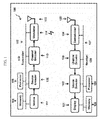
- Fig. 1 shows a simplified block diagram 100 of a general digital communication system applicable to the digital broadcasting channel, independent of the modulation system and system architecture.
- the transmitter device 110 includes the following components:
- the inverse functions of the transmitter are performed, including the following components:
- the exemplary transmitter 110 may also comprise a processor 119 for processing various data and for controlling various functions and components 111-117 of the transmitter 110.
- the processor 119 communicates with and controls the various functions and components of the transmitter 110 via a control bus 117 as shown in Fig. 1 .
- the exemplary receiver 120 in Fig. 1 may also comprise a processor 129 for processing various data and for controlling various functions and components 121-127 of the receiver 120.
- the processor 129 communicates with and controls the various functions and components of the receiver 120 via a control bus 127 as shown in Fig. 1 .
- a respective memory 116 and 126 may be provided for each of the transmitter 110 and receiver 120 as shown in Fig. 1 .
- the memory 116 and memory 126 which may represent both a transitory memory such as RAM, and a non-transitory memory such as a ROM, a hard drive, a CD drive, a Blu-ray drive, and/or a flash memory, are for processing and storing different files and information as necessary, including computer program products and software (e.g., as represented by the flow chart diagram of Fig. 6 , as to be discussed below), webpages, user interface information, various databases, and etc., as needed.
- computer program products and software e.g., as represented by the flow chart diagram of Fig. 6 , as to be discussed below
- processors 119, 129, memories 116 and 126, and control bus 117 and 127 shown in Fig. 1 may not be needed (e.g., as represented by the dashed lines and dashed enclosures), depending on the particular implementation of hardware, software and the combination thereof, as is well known in the art.
- a person skilled in the art will also appreciate that a source encoder 112 and a channel encoder 113, although common in general communications systems, may not be needed for a system according to the present principles.
- a source decoder 122 and a channel decoder 123 although common in general communications systems, also may not be needed for a system according to the present principles.
- a receiving device may include, but is not limited to: a television, a set-top box, a computer, a mobile phone, an automobile receiver and a tablet.
- demodulation 124 is first performed to acquire the signaling data at a signaling data detector and set the receiver parameters accordingly. If the signaling data was channel encoded at the transmitter (at channel encoder 113), the signaling data detector must reside inside or after the channel decoder 123; otherwise, it can reside inside or after the demodulator 124. After the signaling data is recovered, the receiver extracts the various parameters contained in the signaling data to set its various modes of operation associated with its various data related blocks (including but not limited to modulation, e.g., constellation size, FFT size; FEC; interleaving; data distribution within the frame, including the various physical layer pipe (PLP) sizes and other parameters; etc.). The parameters are then sent to the various blocks in order for demodulation and decoding to be performed on the video, audio and other ancillary data.
- modulation e.g., constellation size, FFT size; FEC; interleaving; data distribution within the frame, including the various physical layer pipe (PLP) sizes and other parameters; etc.
- a generic system source 111 and source encoder 112 which is implemented to support, e.g. DVB-T2, or the proposed ATSC 3.0 may provide e.g., one or more MPEG-2 transport stream(s), and/or one or more ATSC 3.0 link layer protocol (ALP) packets, and/or one or more generic streams.
- An input pre-processor (not shown) may be used and may include a service splitter or de-multiplexer for transport streams (TS) for separating the services into the system inputs, which are one or more logical data streams. These are then carried in individual physical layer pipes (PLPs). This feature allows for differing types of data to be sent with differing data rates and amounts of error correction.
- the DVB-SI information may describe which PLP contains a program video and which other PLP contains a program audio.
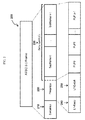
- Fig. 2 shows a frame structure 200 of a proposed ATSC 3.0 system.
- the ATSC 3.0 frame 200 is composed of a bootstrap 210 and a preamble 220, followed by the data symbols 230.
- the data symbols 230 may contain one or more subframes.
- the one or more subframes may have one or more PLPs, representing different services: PLP0, PLP1, PLP2, and etc.
- the preamble 220 includes metadata signaling information L1-Basic 240 and L1-Detail 250 for the system. These signaling fields consist of a plurality of signaling parameters which define the system, including modulation parameters, FEC parameters, frame size, and etc.
- the LDM is a constellation superposition technology that combines multiple data streams at different power levels, most likely with different modulation and channel coding schemes before transmission in one physical radio frequency (RF) channel.
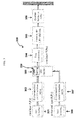
- FIG. 3 An exemplary block diagram of a proposed ATSC 3.0 LDM transmitter 300 is shown in Fig. 3 and is to be further described below (including the modification according to the present principles).
- the two layers are named a core layer as represented by element 301 in Fig. 3 , and an enhanced layer as represented by element 308 of Fig. 3 .
- Each of these layers is subject to bit-interleaved and code modulation (BICM) by a respective bit interleaved and code modulation unit or block 302 and 307 as shown in Fig. 3 .
- BICM bit-interleaved and code modulation
- the proposed two-layer ATSC 3.0 LDM system combines the two BICM layers at unit or block 303 before the time interleaving at unit or block 304 as shown in Fig. 3 and as to be described in more detail below.
- Each BICM layer consisting of an encoded sequence modulated to a constellation is also known as a physical layer pipe (PLP), although in this context it is referred to as a layer, since each layer may comprise of one or more PLPs as to be further described below.
- the two layers are named core and enhanced layers as mentioned above.
- the core layer uses an equal or more robust modulation-code rate combination than the enhanced layer.
- the core and enhanced layers are then combined in an LDM injection block 303 as shown in Fig. 3 .
- the injection level of the enhanced layer signal relative to the core layer signal is a transmission parameter which enables distribution of transmission power between the two layers. By varying the injection level at block 303, the transmission robustness of each layer can be changed, providing an additional method apart from the choice of modulation and code rate parameters.
- the LDM layer with which a PLP is associated is intended to be indicated by a dedicated field L1D_plp_layer in the L1-Detail signaling structure of ATSC 3.0, also as to be described in
- the time interleaving function at block 304 and the frame builder function at block 305 are performed after the LDM injection function at block 303 as shown in Fig. 3 .
- the time interleaving unit or block 304 separates adjacent PLP data cells to provide time diversity and to improve the robustness of the transmitted information in mobile reception environment.
- the frame builder cell multiplexing unit or block 305 performs the cells multiplexing and mapping of the PLPs' cells to the data OFDM sub-carriers of each ATSC 3.0 subframe.
- the time interleaving and the cell multiplexing functions as shown in element 305 of Fig. 3 are to be performed based on the core layer PLPs.
- the enhanced layer PLP(s) then follow(s) the time interleaving and cell multiplexing of the core layer PLP(s).
- the cells multiplexing are intended to be signaled in the so called L1-Detail signaling structure with 2 fields.
- the starting position of a PLP L1D_plp_start shall be the index of the OFDM data subcarrier assigned to hold the first data cell value of the PLP.
- the length of a PLP L1D_plp_size indicates the total number of data cells contained by the PLP for the current subframe. The starting position and length of every PLP present in a subframe are signaled, regardless of whether or not LDM is used.
- FIG. 4 An exemplary block diagram of a proposed ATSC 3.0 LDM receiver 400 which is capable of decoding the two-layer signal comprising a core and an enhanced layer of PLPs is shown in Fig. 4 .
- an ATSC 3.0 signal is received and tuned to by a digital tuner 401 in the exemplary ATCS 3.0 receiver 400 as shown in Fig. 4 .
- the tuned signal is then A/D converted by an A/D converter 402 and then processed by an OFDM and equalization unit or block 403 to recover the baseband data stream.
- the present ATSC 3.0 proposal as shown in Fig.
- the frame extraction unit or block 404 extracts the baseband data cells of the core layer PLPs using the information provided in the L1-Detail signaling fields L1D_plp_start and L1D_plp_size, as described above in connection with the exemplary transmitter 300.
- the data cells are then time de-interleaved using the time de-interleaving unit or block 405.
- the LDM decoding is then performed after the time de-interleaving is performed at block 405.
- the LDM decoding is performed by units or blocks 406-410 of the receiver 400 shown in Fig. 4 .
- the forward error correction (FEC) decoding of the core layer PLP(s) is performed at core layer FEC decoder 410 of Fig. 4 .
- the decoded data and FEC of the core layer PLPs are then remapped to the cells in unit or block 408 of Fig. 4 , inversely as to what had been performed in the BICM transmitter block 302 of Fig. 3 .
- the core layers PLP remapped cells from block 408 are subtracted from the time de-interleaved and delayed output (delayed by block 406) at unit or block 407 to obtain the enhanced layer PLP cells which are then decoded by the enhanced layer FEC decoder 409 as shown in Fig. 4 .
- the present inventors recognize that problems exist in the current 2015 ATSC 3.0 working draft as described above that will need to be improved and/or solved in order for the proposed LDM system to work properly.
- the present inventors recognize that although Section 7.2.7.4 of the above mentioned ATSC 3.0 Physical layer 2015 working draft shows and allows for several examples of the proposed LDM system with one or more PLP(s) in the core layer and one or more PLP(s) in the enhanced layer, the proposed working draft ATSC 3.0 receiver has no information to know which PLP(s) in the core layer it shall decode in order to retrieve the corresponding cells of the respective enhanced layer PLP(s).
- the present inventors have recognized that there is currently no field explicitly defined in the proposed ATSC 3.0 L1-Details signaling structure to indicate the relationship between the PLPs in the core layer and the corresponding PLPs in the enhanced layer in the proposed LDM system.
- the present inventors have also recognized that although there exists a L1-Detail structure which has a field named L1D_plp_start that is set by the frame builder unit or block 305 in Fig. 3 , this information cannot be given to the receiver to derive information for the enhanced layer PLP since the time interleaving function at block 304 is performed between the LDM injection unit or block 303 and the frame builder cell multiplexing unit or block 305.
- time interleaver block 304 integrally mixes the core layer cells with the associated enhanced layer cells, it will be impossible to know the start index of the enhanced layer PLPs.
- the present inventors also have recognized that although the above mentioned 2015 ATSC 3.0 physical layer working draft introduces an implicit index called time interleaver groups (TI_group), this index is not carried in the L1-Detail signaling structure and thus is not used to recover the enhanced layer PLPs.
- TI_group time interleaver groups
- the present inventors propose creating a LDM frame before the time interleaving at the transmitter.
- the LDM framing would group together the core and the enhanced layer PLPs which are LDM multiplexed.
- the LDM framing allows the receiver to know which PLPs in the core Layer shall be decoded to retrieve the data in the corresponding enhanced Layer PLPs.
- the core and enhanced layer PLPs are combined by the LDM injection block.
- the LDM frames can then be processed as proposed by the 2015 working draft such as by the functions of the time interleaving 304, frame builder cell multiplexing 305, and OFDM waveform generation 306 as shown in Fig. 3 , as described before.
- the LDM framing may be performed by an exemplary LDM frame forming unit or block 350 as shown in Fig. 3 .
- the LDM framing function may be a part of the LDM injection function at unit or block 303 as shown in Fig. 3 .
- the LDM frame forming unit or block may be a separate unit from the LDM injection unit (not shown).
- the LDM framing according to the present principles is to be performed before the time interleaving function at block 304 in Fig. 3 as described above.
- the corresponding LDM framing information is then encoded and conveyed to the ATSC receiver using dedicated fields in the ATSC 3.0 L1-Detail signaling structure: L1D_LDM_group_id, L1D_plp_start and L1D_plp_size.
- the L1D_LDM_group_id field is an identifier associated to each PLP. All PLPs having the same LDM group identifier L1D_LDM_group_id are in the same LDM frame. This would allow grouping together all the core and enhanced layer PLPs which are combined by LDM.
- the receiver can know which core layer PLPs must be decoded to receive the enhanced layer PLPs.
- the core layer PLPs belonging to one LDM frame shall be concatenated in order to form a continuous frame. So, the total length of a LDM frame is the sum of all the length of the core layer PLPs in the LDM frame.
- the L1D_plp_start field would have a new meaning for the PLP in the enhanced layer.
- the L1D_plp_start indicates the offset of first cells of the current PLP from the beginning of the first cell of the first core layer PLP within the same LDM group. In other word, it is the distance in number of cells between the start of the first core layer PLP and the start of current enhanced layer PLP.
- the L1D_plp_size field would also have a new meaning for the PLP in the enhanced layer.
- the L1_D_plp size would indicate the length of the current PLP.
- L1_D_plp_size and L1D_plp_start are computed before the time interleaving of the core layer PLPs.
- the LDM frame 500 comprises a L1D_LDM_group_id field 501 which is an identifier associated to each PLP in the LDM frame. All PLPs having the same LDM group identifier L1D_LDM_group_id are in the same LDM frame 500.
- the exemplary LDM frame also comprises two exemplary core layer PLPs, PLP 0 502-0 and PLP 1 502-1. Each of these core layer PLPs also has a corresponding enhanced layer PLP, PLP 3 502-3 and PLP 4 502-4 respectively.
- L1D_plp_start_4 504 for the enhanced layer PLP 4 502-4 indicates the offset (PLP 4 offset) of the first cell of the current PLP 4 502-4 from the beginning of the first cell of the first core layer PLP 0 502-0 within the same LDM frame 500.
- L1D_plp_size_4 505 indicates the length of the current enhanced layer PLP 4 502-4.
- the receiver will have to decode the core layer PLP 0 502-0 and PLP 1 502-1 to get the data in the corresponding enhanced layer PLP 3 502-3 and PLP 4 502-4.
- the total length of all PLPs in the enhanced layer may be lower than, e.g., a fixed length of an exemplary LDM frame according to one exemplary aspect of the present principles.
- the unused cells in the enhanced layer may be filled with zero padding, as shown in 506 of Fig. 5 .
- the above proposed modifications to the 2015 ATSC 3.0 working draft would allow the proposed receiver to easily retrieve the PLPs in the enhanced layer with minimum modification.
- the only modification would be to modify frame extraction unit or block 404 shown in Fig. 4 to also be able to recognize and process the LDM frame according to the accompanying metadata as described above.
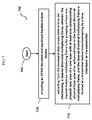
- Fig. 6 illustrates an exemplary process 600 according to the present principles.
- the exemplary process 600 starts at step 605.
- a core layer with at least one physical layer pipe is provided.
- an enhanced layer with at least one physical layer pipe is provided.
- the core layer and the enhanced layer are combined to provide a layered division multiplexed signal.
- the layer division multiplexed signal is time interleaved to provide a time interleaved signal for transmission.
- a layered division multiplexing frame is formed before the time interleaving of the layered division multiplexed signal by the time interleaver at step 625 for grouping the at least one physical layer pipe of the core layer with at least one corresponding physical layer pipe of the enhanced layer.
- Fig. 7 illustrates another exemplary process 700 according to the present principles.
- the exemplary process 700 starts at step 705.
- an OFDM decoded and equalized baseband data stream is provided.
- the exemplary method extracts from the baseband data stream before time deinterleaving, via, e.g., a frame extraction unit, a layered divisional multiplexing frame.
- the layered divisional multiplexing frame is for grouping the at least one physical layer pipe of a core layer with at least one corresponding physical layer pipe of an enhanced layer in the layered divisional multiplexing frame, and the layered divisional multiplexing frame is formed at the transmitter before the time interleaving by the time interleaver at the transmitter.
- the present principles may apply to other multi-carrier modulation systems besides OFDM, e.g., discrete multi-tone (DMT) and to other types of single-carrier or multi-carrier pre-existing or legacy systems besides 8-VSB, e.g., single carrier QAM modulation.
- DMT discrete multi-tone
- 8-VSB single carrier QAM modulation
- the present principles are applicable to other types of communications systems, e.g., Wireless-Fidelity (Wi-Fi), cellular, cable, satellite, etc.
- Wi-Fi Wireless-Fidelity
- the inventive concept is also applicable to stationary or mobile receivers. It is therefore to be understood that numerous modifications may be made to the illustrative embodiments and that other arrangements may be devised without departing from the scope of the present principles.
Landscapes
- Engineering & Computer Science (AREA)
- Computer Networks & Wireless Communication (AREA)
- Signal Processing (AREA)
- Error Detection And Correction (AREA)
Priority Applications (1)
| Application Number | Priority Date | Filing Date | Title |
|---|---|---|---|
| EP16305557.7A EP3244585A1 (fr) | 2016-05-12 | 2016-05-12 | Appareil et procédé de combinaison de couches de signaux de type ldm |
Applications Claiming Priority (1)
| Application Number | Priority Date | Filing Date | Title |
|---|---|---|---|
| EP16305557.7A EP3244585A1 (fr) | 2016-05-12 | 2016-05-12 | Appareil et procédé de combinaison de couches de signaux de type ldm |
Publications (1)
| Publication Number | Publication Date |
|---|---|
| EP3244585A1 true EP3244585A1 (fr) | 2017-11-15 |
Family
ID=56550812
Family Applications (1)
| Application Number | Title | Priority Date | Filing Date |
|---|---|---|---|
| EP16305557.7A Withdrawn EP3244585A1 (fr) | 2016-05-12 | 2016-05-12 | Appareil et procédé de combinaison de couches de signaux de type ldm |
Country Status (1)
| Country | Link |
|---|---|
| EP (1) | EP3244585A1 (fr) |
Cited By (1)
| Publication number | Priority date | Publication date | Assignee | Title |
|---|---|---|---|---|
| CN113747102A (zh) * | 2021-08-31 | 2021-12-03 | 百果园技术(新加坡)有限公司 | 视频通话处理方法、装置、设备及存储介质 |
-
2016
- 2016-05-12 EP EP16305557.7A patent/EP3244585A1/fr not_active Withdrawn
Non-Patent Citations (2)
| Title |
|---|
| FAY LUKE ET AL: "An Overview of the ATSC 3.0 Physical Layer Specification", IEEE TRANSACTIONS ON BROADCASTING, vol. 62, no. 1, 1 March 2016 (2016-03-01), NJ, US, pages 159 - 171, XP011608948, ISSN: 0018-9316, [retrieved on 20160304], DOI: 10.1109/TBC.2015.2505417 * |
| ZHANG LIANG ET AL: "Layered-Division-Multiplexing: Theory and Practice", IEEE TRANSACTIONS ON BROADCASTING, vol. 62, no. 1, 1 March 2016 (2016-03-01), NJ, US, pages 216 - 232, XP011608943, ISSN: 0018-9316, [retrieved on 20160304], DOI: 10.1109/TBC.2015.2505408 * |
Cited By (2)
| Publication number | Priority date | Publication date | Assignee | Title |
|---|---|---|---|---|
| CN113747102A (zh) * | 2021-08-31 | 2021-12-03 | 百果园技术(新加坡)有限公司 | 视频通话处理方法、装置、设备及存储介质 |
| CN113747102B (zh) * | 2021-08-31 | 2024-04-26 | 百果园技术(新加坡)有限公司 | 视频通话处理方法、装置、设备及存储介质 |
Similar Documents
| Publication | Publication Date | Title |
|---|---|---|
| US10951370B2 (en) | Demapping apparatus and method for reception of data in a multi-carrier broadcast system | |
| EP3036847B1 (fr) | Tuyau de couche physique système pour un système de télévision numérique | |
| US9450799B2 (en) | Apparatus for transmitting and receiving a signal and method of transmitting and receiving a signal | |
| KR102476060B1 (ko) | 컨볼루션 인터리빙을 포함하는 송신기 및 수신기와 대응하는 방법들 | |
| RU2483448C2 (ru) | Сигнализация физического и канального уровней в символах преамбулы цифрового телевизионного вещания | |
| EP2234317B1 (fr) | Appareil et procédé pour la transmission et la réception d'un signal OFDM | |
| US9264272B2 (en) | Demapping apparatus and method for reception of data in a multi-carrier broadcast system | |
| US20110274211A1 (en) | Apparatus for transmitting and receiving a signal and method of transmitting and receiving a signal | |
| US20140105328A1 (en) | Apparatus for transmitting and receiving a signal and method of transmitting and receiving a signal | |
| US20160173812A1 (en) | Apparatus for transmitting broadcast signals, apparatus for receiving broadcast signals, method for transmitting broadcast signals and method for receiving broadcast signals | |
| US9674020B2 (en) | Transmitting apparatus, receiving apparatus, and controlling methods thereof | |
| KR20110095353A (ko) | 적어도 2개의 fec 프레임 헤더를 포함하는 fec 프레임을 이용하여 디지털 정보를 송수신하기 위한 방법 및 장치 | |
| KR102364907B1 (ko) | 디지털 텔레비전 시스템을 위한 낮은 인접 채널 간섭 모드 | |
| EP3244585A1 (fr) | Appareil et procédé de combinaison de couches de signaux de type ldm | |
| KR102206538B1 (ko) | 송신 장치, 수신 장치 및 그 제어 방법 | |
| CN106063210B (zh) | 发送设备、接收设备及其控制方法 | |
| WO2015026547A1 (fr) | Mode à faible brouillage par le canal adjacent pour un système de télévision numérique |
Legal Events
| Date | Code | Title | Description |
|---|---|---|---|
| PUAI | Public reference made under article 153(3) epc to a published international application that has entered the european phase |
Free format text: ORIGINAL CODE: 0009012 |
|
| AK | Designated contracting states |
Kind code of ref document: A1 Designated state(s): AL AT BE BG CH CY CZ DE DK EE ES FI FR GB GR HR HU IE IS IT LI LT LU LV MC MK MT NL NO PL PT RO RS SE SI SK SM TR |
|
| AX | Request for extension of the european patent |
Extension state: BA ME |
|
| STAA | Information on the status of an ep patent application or granted ep patent |
Free format text: STATUS: THE APPLICATION IS DEEMED TO BE WITHDRAWN |
|
| 18D | Application deemed to be withdrawn |
Effective date: 20180516 |