EP3244596B1 - Système de communication et de commande multifonctionnel avec une interface utilisateur tangible - Google Patents
Système de communication et de commande multifonctionnel avec une interface utilisateur tangible Download PDFInfo
- Publication number
- EP3244596B1 EP3244596B1 EP16168670.4A EP16168670A EP3244596B1 EP 3244596 B1 EP3244596 B1 EP 3244596B1 EP 16168670 A EP16168670 A EP 16168670A EP 3244596 B1 EP3244596 B1 EP 3244596B1
- Authority
- EP
- European Patent Office
- Prior art keywords
- mcd
- communication
- execution
- tui
- task
- Prior art date
- Legal status (The legal status is an assumption and is not a legal conclusion. Google has not performed a legal analysis and makes no representation as to the accuracy of the status listed.)
- Active
Links
Images









Classifications
-
- H—ELECTRICITY
- H04—ELECTRIC COMMUNICATION TECHNIQUE
- H04M—TELEPHONIC COMMUNICATION
- H04M1/00—Substation equipment, e.g. for use by subscribers
- H04M1/02—Constructional features of telephone sets
- H04M1/04—Supports for telephone transmitters or receivers
-
- H—ELECTRICITY
- H02—GENERATION; CONVERSION OR DISTRIBUTION OF ELECTRIC POWER
- H02J—ELECTRIC POWER NETWORKS; CIRCUIT ARRANGEMENTS OR SYSTEMS FOR SUPPLYING OR DISTRIBUTING ELECTRIC POWER; SYSTEMS FOR STORING ELECTRIC ENERGY
- H02J50/00—Circuit arrangements or systems for wireless supply or distribution of electric power
- H02J50/10—Circuit arrangements or systems for wireless supply or distribution of electric power using inductive coupling
-
- H—ELECTRICITY
- H02—GENERATION; CONVERSION OR DISTRIBUTION OF ELECTRIC POWER
- H02J—ELECTRIC POWER NETWORKS; CIRCUIT ARRANGEMENTS OR SYSTEMS FOR SUPPLYING OR DISTRIBUTING ELECTRIC POWER; SYSTEMS FOR STORING ELECTRIC ENERGY
- H02J7/00—Circuit arrangements for charging or discharging batteries or for supplying loads from batteries
- H02J7/34—Parallel operation in networks using both storage and other DC sources, e.g. providing buffering
- H02J7/342—The other DC source being a battery actively interacting with the first one, i.e. battery to battery charging
-
- H—ELECTRICITY
- H02—GENERATION; CONVERSION OR DISTRIBUTION OF ELECTRIC POWER
- H02J—ELECTRIC POWER NETWORKS; CIRCUIT ARRANGEMENTS OR SYSTEMS FOR SUPPLYING OR DISTRIBUTING ELECTRIC POWER; SYSTEMS FOR STORING ELECTRIC ENERGY
- H02J7/00—Circuit arrangements for charging or discharging batteries or for supplying loads from batteries
- H02J7/70—Circuit arrangements for charging or discharging batteries or for supplying loads from batteries characterised by the mechanical construction
- H02J7/731—Circuit arrangements for charging or discharging batteries or for supplying loads from batteries characterised by the mechanical construction specially adapted for holding portable devices containing batteries
-
- H—ELECTRICITY
- H04—ELECTRIC COMMUNICATION TECHNIQUE
- H04M—TELEPHONIC COMMUNICATION
- H04M1/00—Substation equipment, e.g. for use by subscribers
- H04M1/72—Mobile telephones; Cordless telephones, i.e. devices for establishing wireless links to base stations without route selection
- H04M1/724—User interfaces specially adapted for cordless or mobile telephones
- H04M1/72475—User interfaces specially adapted for cordless or mobile telephones specially adapted for disabled users
-
- H—ELECTRICITY
- H04—ELECTRIC COMMUNICATION TECHNIQUE
- H04M—TELEPHONIC COMMUNICATION
- H04M1/00—Substation equipment, e.g. for use by subscribers
- H04M1/72—Mobile telephones; Cordless telephones, i.e. devices for establishing wireless links to base stations without route selection
- H04M1/724—User interfaces specially adapted for cordless or mobile telephones
- H04M1/72403—User interfaces specially adapted for cordless or mobile telephones with means for local support of applications that increase the functionality
- H04M1/72418—User interfaces specially adapted for cordless or mobile telephones with means for local support of applications that increase the functionality for supporting emergency services
-
- H—ELECTRICITY
- H04—ELECTRIC COMMUNICATION TECHNIQUE
- H04M—TELEPHONIC COMMUNICATION
- H04M2250/00—Details of telephonic subscriber devices
- H04M2250/04—Details of telephonic subscriber devices including near field communication means, e.g. RFID
Definitions
- This invention falls in the telecommunication and assistive technology sectors. Specifically, the invention makes a mobile communications device and its features accessible to users that perceive digital and physical user interfaces and navigation as complicated, whilst offering further home assistive elements for the benefit of both the user and their carer(s).
- US20130203348A1 includes using NFC for locking and unlocking devices or doors for prevention of unauthorised use.
- US8929811B2 analyses the NFC tag header information to install and execute an application or retrieve an application list so as to control the operations only via the tag information.
- an application launching table and preset device identification are used for launching preset application in mobile terminal.
- WO 2012159673A1 retrieves data from an NFC tag in order to provide user assistance information.
- US8988194B2 includes the controlling of an electronic device using a different external device.
- WO2011103684A1 the performing of different mobile operations with spaced apart NFC sensors based on timing and sequence in which sensors communicated with the device, and in WO2014091441A1 , mobile functions are controlled via mobile movement and interaction with a NFC sensor.
- NFC signals are send and received to modify settings and initiate the function of a wireless terminal.
- WO2007129253A1 an emergency call sensing apparatus is described and in WO2014202826A1 an apparatus for wireless charging using proximity indications through NFC is detailed.
- Aforementioned patents are focused on a single issue and have not taken into consideration various limitations in respect to a particular social group.
- CN 204463142 U uses images for device function control, is an NFC based education entertainment system, where pictures are used to label each NFC chip function. No special considerations were made in the presentation and grouping of the images, nor is there a dedicated system to execute the said images.
- US8768318B2 is using a tangible user interface and communication device for multiple external object control, is a docking station for an enhanced user interface for mobile devices, and where video or audio signals are transmitted through the interface.
- US2012139690A1 describes a method for operating a computing device , as for example a smart phone, comprising reading the value of a tag using proximity-based radio and selecting and running an application based on the value of that tag.
- US2012139690A1 describes a context dependent computing device.
- the value read from a tag provides an indication of the desired operation. For example, when the device is near a tag that contains information about launching a telephone calling application to call a specific number the device could launch a telephone calling application.
- This is certainly a useful feature for helping groups of people such as the elderly to call their loved ones for example . Nevertheless, it is far from providing a complete system that caters for the communication needs of the elderly or other people that needs assistance. For these groups of people, a fixed reference point, the utilisation of habits, and the monitoring of various conditions that can indicate a problem are important parameters for a successful implementation and for serving their needs .
- the present invention is different from prior art by dedicating its functionality on the elimination of any perceived user interface complications and grouping numerous functions together on a clearly labelled tangible user interface for an intuitive lifestyle improvement to the user(s) and carer(s).
- the present invention is a system that offers various communicative, notification, entertainment and house control features, that addresses the issues mentioned above, while at the same time eliminating the perceived complexity in physical and digital interface navigation.
- the present invention also helps in forming habits, such as placing the MCD on a specific spot, acknowledging that habits are very important for this user group.
- the invention is directed to the subject-matter of the independent claims.
- Advantageous embodiments are set out in the dependent claims.
- the present invention is a communication and control system adapted to execute multiple tasks, communicative, notification, entertainment and house control comprising of a Mobile Communications Device (MCD) and a Tangible User Interface (TUI) for the user that perceives physical and digital navigations in modern devices to be too complicated, and their potential carers, who are either family, friends or employed professionals and are responsible for their well-being.
- MCD Mobile Communications Device
- TTI Tangible User Interface
- the TUI may be in the form of a light, portable base, encasing a wireless charging unit connected with a wire to an internal battery pack, with an additional extendable wire for charging the said battery pack, with NFC tags arranged on the top surface of the TUI, on top of which are images of persons or tasks, covered by a protective layer.
- the wireless charging unit allows the user to place the MCD on the TUI's allocated charging spot, for the wireless powering of the MCD to take place.
- the images are arranged according to some grouping that are related to the aforementioned system functions, and correspond to the NFC tags positioned underneath them, which in turn allow the execution of tasks when the MCD is in close proximity.
- the TUI may also comprise of a tablet device's cover, wherein said cover NFC tags are positioned on its inner surface, and a tablet device.
- the utilization of the tablet device's display and its visual interface, allows for the easy and remote updating of the icons or images that correspond to different tasks and the complete reconfiguration of such tasks.
- the MCD may be in the form of a smartphone device, comprising of a wireless interface that allows Near Field Communications to take place, operated by a custom user interface. This allows the user to operate the communication and control system without having to press any buttons or a touchscreen. This is possible by placing the MCD in close proximity to an NFC tag located on the TUI, represented visually by an image or icon of a person or a task, and the MCD extracts the tag information of the said NFC tag. If the task conditions are satisfied, the task is executed.
- All tasks are ended by placing the MCD on the allocated charging spot on the TUI, which returns the MCD back to idle mode as well.
- the user is expected to place the MCD on the charging spot when the MCD is not being utilized.
- Communication tasks include incoming and outgoing calls, as well as video messages and live video calling.
- Notification tasks include of emergency notification procedures that may be executed manually or automatically, or any type of informative notification.
- Entertainment tasks allow the playback of locally stored and/or online music and video playlists, as well as photo album displays on the MCD's display.
- House Control tasks include communication between the MCD and other devices. Such devices may comprise of household devices, lights or medical devices, and communicate with the MCD wirelessly. This type of communication is enabled only when the MCD is positioned at the home position on the TUI or when the MCD is placed in proximity to icons on the TUI that represent communication with specific household devices in order to execute house control tasks.
- the communication and control system and its task execution data that is contained within the NFC tags on its TUI, may be managed through the communication with a central server.
- the central server communicates with the MCD to update tag information.
- the communication and control system also monitors that the MCD is placed on the home position whenever it is not utilized. If the MCD remains away from the home position on the TUI for more than a predefined period of time, the MCD alerts the user or carer so that the MCD may be placed back onto the home position
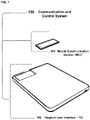
- FIG.1 One embodiment of the communication and control system (100) is shown in FIG.1 where its main components are a mobile communications device (101), in short MCD (101), with a wireless interface for performing near field communications, in short NFC, and a tangible user interface (102), in short TUI (102), for performing wireless communication.
- a mobile communications device 101
- short MCD 101
- wireless interface for performing near field communications
- short NFC short NFC
- 102 tangible user interface
- TUI short TUI
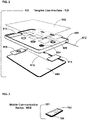
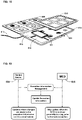
- the TUI (102) has a set of images or icons (606) related to persons or tasks, a set of NFC tags (604) corresponding to each of said images, and means for wirelessly charging (608) the MCD (101) by placing the MCD on a charging spot (614) on the TUI, as shown in FIG.2 .
- the charging spot has a charging connection (612) and an NFC tag (604).
- the MCD (101) is a smartphone device (700) with a custom user interface application (702) installed, as shown in FIG.3
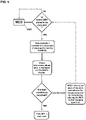
- the communication and control system (100) operation is the following: the MCD is placed in close proximity to one of the images or icons (606) on the TUI, thus acquiring tag information (200) of a tag (604) associated with said image. Said tag information is related to at least one application (202) for execution by the MCD. The tag information is converted into execution information (204), which includes application identity information (206) and data information (208). Based on the extracted application identity information (206) at least one application (202) is executed, followed by the execution of an associated task (201).
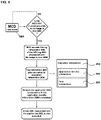
- Said task (201) involves a sequence of steps performed by the MCD, as shown in FIG.5 , wherein the execution of the task is ended by placing the MCD on the charging spot (614) of the TUI as shown in FIG.6 .
- the execution of a task (201) by the MCD follows a sequence of steps, as shown in FIG.5 : displaying visual information about task to be performed, checking that conditions associated with the task are satisfied, and executing the task. Said task is ended by placing the MCD onto the charging spot (614) of the TUI.
- the user (104) is expected to place the MCD on the charging spot (614) of the TUI when no tasks are to be performed, in which case the MCD goes into idle mode, as shown in FIG.6 .
- the MCD when the MCD remains away from the charging spot on the TUI for more than a predefined period of time, the MCD alerts the user or the carer (106) so that the user or the carer may place the MCD onto the charging spot as shown in FIG.20 .
- execution information (204) associated with tags (604) on the TUI and the corresponding images (606) of those tags is managed through communication with a central server (110), as shown in FIG.19 .
- the server may communicate with the MCD to update tag information every time that tag information is changed on the server.
- an update may take place at regular intervals as the MCD is placed near a tag prior to the execution of a task.
- an update occurs on the server and an image associated with the update is located on the TUI as a physical printed image, that image is expected to be changed manually by the user or preferably the carer(s), to correspond to the tag information change.
- tasks (201) are grouped into the following categories: communication (300), notification (400), entertainment (900), house control (500), and home position (800), as shown in FIG.7 .
- the tasks and their categories are represented on the MCD using images or icons (606).
- Said home position is the charging spot (614), wherein placing the MCD onto the home position puts the MCD into idle mode.
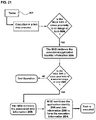
- a task can be initiated based on task execution information (204) retrieved in two steps, as shown in FIG.21 .
- the user (104) places the MCD onto a first icon or image (606) on the TUI corresponding to a first tag (604), and the MCD retrieves the application identity information (206) of the said execution information (204).
- the user places the MCD onto a second icon or image on the TUI corresponding to a second tag, and wherein the MCD retrieves the data information (208) of the said execution information (204).
- the corresponding application and task are executed using the corresponding data information.
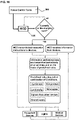
- Tasks (201) related to notification (400), for example an emergency procedure may be executed manually (402), as shown in FIG.13 , or automatically (404), as shown in FIG.14 .
- Manual execution (402) is achieved when the user places the MCD in close proximity to the icon representing emergency
- automatic execution (404) is achieved when a set of conditions are detected by the MCD, while the MCD is at the home position on the TUI.
- the MCD retrieves an ordered list of telephone numbers, each corresponding to a carer, and places a call to the first number. If the carer corresponding to the first number does not respond after a predetermined time interval, the next number in the ordered list is called until one carer answers the MCD call. Upon response by a carer the MCD is switched into loudspeaker mode.
- carers are notified by SMS about the emergency, wherein the SMS message provides information about the conditions that triggered the emergency procedure with a time and date.
- carers are also notified by SMS that the emergency procedure has been terminated with an SMS message that provides information on the cause of termination and the time.
- the automatic execution (404) of the emergency procedure may be triggered by checking a combination of conditions in predefined rules while the MCD is on the TUI home position. These rules define task execution information (204) according to the combination of conditions.
- the combination of conditions depends on signals from the MCD, which may include time lapse, sensed luminosity level, sensed temperature levels, sound levels and signals from other devices. These devices may be in the form of medical devices that record the vital signs of the user or devices that monitor the home environment, like an air quality sensor.
- Tasks (201) related to notification (400), like the emergency procedure may be terminated by placing the MCD onto the charging spot, as shown in FIG6 .
- Said task termination procedure includes displaying a message or image on the MCD to the effect that emergency task will be terminated and sending SMS messages to the list of carers informing them of the termination of the emergency task.
- the SMS message may include information about the time of onset of the emergency task, the time of termination of emergency task, and data collected by sensors on the MCD. Once SMS messages are sent the task is terminated and the MCD returns to idle mode.
- the communication and control system may be used to carry out tasks related to communication, for example accepting incoming calls, video messaging, or placing audio or video calls.
- the user can accept incoming phone calls (302) by picking up the MCD from the home position on the TUI as shown in FIG.8 .
- Picking the MCD up displays the image of the person calling on the MCD's display, if there is an image associated with the caller's number, dictates the name of the person calling, if a name is associated with the caller's number, and answers the call when a signal is received from the MCD's proximity sensor indicating that the MCD has been placed close to the user's ear.
- the call is terminated when the MCD is placed onto the home position of the TUI.
- the user can initiate audio or video communication by placing the MCD near the image (606) representing the person to be contacted. Behind each icon or image there is an NFC tag (604), which the MCD uses to extract execution information related to communication tasks.
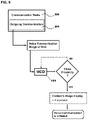
- Icons or images with corresponding tags can initiate outgoing communication tasks (304) when the MCD is in close proximity to those, as shown in FIG.9 and FIG.10 .
- the user places the MCD over an image or icon that corresponds to voice communication with a specific agent to initiate a telephone calling task to that agent.
- the said agent may be a physical person, an institution, a call centre or a virtual agent. In the case of the call centre or the virtual agent, these may serve the purpose of assisting the user to socially engage and converse when other options are unavailable to the user.
- the MCD displays the image of the agent that is being called, if there is an image associated with the caller's number.
- the user places the MCD over an image or icon that corresponds to live video communication with a specific person to initiate a live video calling task to that person.
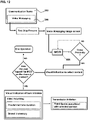
- the user can initiate video messaging (306) in a one-step process or a two-step process.
- the one step process is shown in FIG. 11 . This is achieved by placing the MCD over an image or icon that corresponds to a contact within the video messaging subcategory thus initiating a video messaging task towards the selected contact.
- the video messaging task involves the following steps: (a) provides indication to the user that video recording is about to start, (b) recording device on the MCD starts recording for a predefined period, (c) upon lapse of said period the recording is stored in memory and is ready to be transmitted to a third device (d) transmission is initiated after a predefined period, unless the task is interrupted by the user lifting the MCD away from the corresponding image or icon.
- the two step process is shown in FIG.12 . It is achieved by placing the MCD onto the video messaging icon on the TUI, which corresponds to a video messaging tag and respective task. Once the video messaging task is initiated, the user is prompted to select which contact they wish to send the video message to. Once the contact is selected by placing the MCD on the appropriate image on the TUI, the video recording device on the MCD starts recording for a predefined period. When the period lapses, the recording is stored in memory and is then transmitted to a third device, if no other interruptions are detected by the MCD
- the communication and control system may be used to carry out tasks related to house control (500), as shown in FIG.15 and FIG.16 .
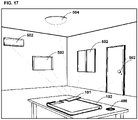
- the system (100) can be used to communicate wirelessly with other devices in its proximity while the MCD is placed on the home position on the TUI, for example household devices (502), lights (504), or medical devices (406) as shown in FIG17 .
- the communication between other devices and the MCD is bidirectional, where the MCD may be receiving information from said devices or the MCD may be transmitting task execution instructions to said other devices. Such communication is enabled when the MCD is positioned at the home position on the TUI.
- communication may be initiated by the user by placing the MCD in proximity to images or icons in House control category on the TUI, as shown in FIG.15 . Icons in the house control category may represent communication with specific household devices for executing corresponding house control tasks, as shown in FIG.17 .
- Said communication takes place only when the MCD is on the home position of the TUI and may be initiated periodically, at set times, or on the basis of predefined rules.
- These rules may include a combination of conditions such as time lapse, luminosity, temperature, sound level.
- Each rule defines execution information (204) according to the combination of said conditions.
- the communication and control system may be used to carry out tasks related to entertainment (900), as shown in FIG.22 .
- the user can playback locally stored and/or online music and video playlists on the MCD's display, or on another display that the MCD wirelessly transmits to, when the MCD is placed in close proximity to the icons that correspond to said playback.
- these playlists may be remotely customized by the carers as well.
- the MCD may also download photos that have been remotely uploaded by contacts, to the MCD's internal memory.
- Photo albums that are locally stored or have been remotely uploaded, may be displayed when the MCD is placed in close proximity to the icon that corresponds to the photo playback.
- Entertainment tasks may be executed manually or automatically.
- Manual execution may be carried out by the user when the MCD is in close proximity to the icon representing an entertainment task, such as listening to music or watching videos from customized pre-created playlists.
- Automatic execution which is shown in FIG.23 , may be carried out when a set of conditions is detected by the MCD, when said MCD is located on the TUI's home position.
- the set of conditions may include the detection of a remote change in a pre-existing playlist or additions to a photo album, in which case the user is notified of the changes and, if such a preference has been pre-configured, the playlists or photo albums may be displayed automatically or the user may be asked how to proceed with the changes.
- the TUI (102) shown in FIG.2 includes a light portable board (600), with NFC tags (604) positioned on the surface of the base and arranged according to some grouping, and a top transparent layer (602) allowing the correct positioning of icons and images (606) corresponding to said NFC tags.
- the light portable board (600) encases a wireless charging unit (608) for charging the MCD (101), an internal battery (610) for providing power to said wireless charging unit and a charging interface (612) for charging said battery.
- a wireless interface on the TUI (102) is used for communications with a wireless interface on the MCD (101). Said communication may be used to report battery status information of the TUI 's internal battery (610) or charging interface (612) to the MCD.
- the TUI (102) shown in FIG.18 includes a cover (618) of a tablet device (616) with NFC tags positioned on the surface of the cover that is in contact with the back surface of the tablet, i.e. the surface opposite to the tablet display surface.
- the tags are arranged according to some grouping.
- the display of the tablet device (616) is arranged to always display icons or images corresponding to different tasks at the exact position as the position of the NFC tags on the tablet cover, allowing the correct execution of tasks corresponding to said NFC tags.
- Using of the display of the tablet as a visual interface for the indication of tasks enables easy and remote updating of icons or images corresponding to different tasks and complete reconfiguration of such tasks.
- the cover (618) encases a wireless charging unit, located underneath the charging spot (614) for charging the MCD (101), a battery (610) for providing power to said wireless charging unit and a charging interface (612) for charging said battery.
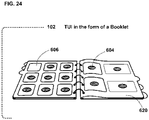
- the Tangible User Interface comprises of a booklet (620) of multiple pages, wherein each page comprises of a set of images related to persons or tasks (606) and a set of NFC tags (604) corresponding to each of said images, which can be seen in FIG.24 .
- the booklet may be utilized when the storage of more contacts may be needed or when more services may be required by the user and there is no space on the TUI that comprises of a light portable board. Consequently, system functionality can be customized to each user 's lifestyle needs.
- the booklet may be in the form of a combination of durable, laminated, light pages that may be easily accessed and flipped by the user.
Landscapes
- Engineering & Computer Science (AREA)
- Power Engineering (AREA)
- Computer Networks & Wireless Communication (AREA)
- Signal Processing (AREA)
- Human Computer Interaction (AREA)
- Telephone Function (AREA)
Claims (21)
- Système de communication et de commande (100) comprenant : un dispositif de communication mobile, MCD, (101) comprenant une interface sans fil conçue pour réaliser des communications en champ proche et une interface utilisateur tangible, TUI, (102) conçue pour réaliser une communication sans fil,ladite TUI (102) comprenant un ensemble d'images se rapportant à des personnes ou des tâches, un ensemble d'étiquettes NFC (604) correspondant à chacune desdites images et un moyen de chargement sans fil du MCD (101),dans lequel, ledit système est conçu pour fonctionner de telle sorte que lorsque le MCD (101) est placé à proximité immédiate d'une des images sur la TUI (102), le MCD (101) acquiert des informations d'étiquette d'une étiquette associée à ladite image des images, dans lequel lesdites informations d'étiquette se rapportent à au moins une application pour exécution par le MCD (101), lorsque le MCD (101) est conçu pour convertir les informations d'étiquette en informations d'exécution, pour extraire des informations d'identité d'application et des informations de données à partir des informations d'exécution, pour exécuter au moins une application associée aux informations d'identité d'application, et pour lancer l'exécution d'une tâche destinée à l'exécution de l'au moins une application, dans lequel ladite tâche implique une séquence d'étapes réalisées par le MCD (101),dans lequel le moyen de chargement sans fil du MCD (101) comprend un point de charge sur la TUI (102) conçu pour le placement du MCD (101) et comprenant une connexion de charge et une étiquette NFC (604), et en ce que le système est conçu de telle sorte que l'exécution d'une ou plusieurs desdites tâches est terminée en plaçant le MCD (101) sur le point de charge.
- Système de communication et de commande (100) selon la revendication 1 dans lequel lesdites tâches comprennent des tâches de notification conçues à la fois pour une exécution manuelle et automatique, dans lequel une exécution manuelle des tâches de notification est obtenue lorsque le MCD (101) est placé à proximité immédiate d'une icône représentant cette tâche de notification, et une exécution automatique est obtenue lorsqu'un ensemble de conditions sont détectées par le MCD (101) tandis que ledit MCD (101) se trouve au niveau du point de charge de la TUI (102).
- Système de communication et de commande (100) selon la revendication 2, dans lequel pour lesdites tâches de notification l'exécution automatique est réalisée sur la base de règles prédéfinies, lesdites règles comprenant une combinaison de conditions comprenant un ou plusieurs laps de temps, ou changements de signaux recueillis par le MCD (101), ou des signaux qui peuvent être obtenus à partir d'autres dispositifs, et dans lequel lesdites règles définissent des informations d'exécution en fonction de la combinaison desdites conditions.
- Système de communication et de commande (100) selon l'une quelconque des revendications précédentes, conçu pour répondre aux appels entrants lors de la prise du MCD (101) depuis le point de charge, dans lequel la prise du MCD (101) lance une procédure comprenant l'affichage de l'image de la personne appelant s'il y a une image associée au numéro de l'appelant, la dictée du nom de la personne appelant si un nom est associé au numéro de l'appelant, et la réponse à l'appel lorsqu'un signal est reçu à partir d'un capteur de proximité du MCD (101) indiquant que le MCD (101) a été placé à proximité d'une oreille d'un utilisateur, et conçu en outre pour mettre fin à l'appel lorsque le MCD (101) est placé sur le point de charge de la TUI (102).
- Système de communication et de commande (100) selon l'une quelconque des revendications précédentes, dans lequel le système est conçu pour une communication avec d'autres dispositifs à proximité du système, lesdits autres dispositifs comprenant un ou plusieurs parmi des dispositifs ménagers, des dispositifs de divertissement, des dispositifs domotiques, des dispositifs de soins personnels et des dispositifs médicaux, dans lequel le système est conçu pour une communication sans fil entre lesdits dispositifs et le MCD (101), ladite communication sans fil comprenant le MCD (101) recevant des informations à partir desdits dispositifs ou du MCD (101) transmettant des instructions d'exécution de tâche auxdits autres dispositifs, et dans lequel une telle communication est activée lorsque le MCD (101) est positionné au niveau du point de charge sur la TUI (102) ou lorsque le MCD (101) est placé à proximité d'icônes sur la TUI (102) représentant une communication avec des dispositifs spécifiques pour l'exécution des tâches de commande respectives.
- Système de communication et de commande (100) selon l'une quelconque des revendications précédentes, dans lequel le système est conçu pour gérer des informations d'exécution associées à des étiquettes sur la TUI (102) et les images correspondantes de ces étiquettes par l'intermédiaire d'une communication avec un serveur central, dans lequel le MCD (101) est conçu pour communiquer avec le serveur central pour obtenir une mise à jour d'informations d'exécution, dans lequel ladite mise à jour est conçue pour se produire après un changement d'informations d'exécution sur le serveur central, ou à intervalles réguliers sur le placement du MCD (101) près d'une étiquette avant l'exécution d'une tâche.
- Système de communication et de commande (100) selon l'une quelconque des revendications précédentes, dans lequel l'interface utilisateur tangible, TUI, (102) comprend une base portable légère, des étiquettes NFC (604) positionnées sur la surface de la base, une unité de charge sans fil pour charger un dispositif de communication mobile, MCD (101), une batterie pour fournir de l'énergie à ladite unité de charge sans fil, une interface de charge pour charger ladite batterie, et une couche supérieure, ladite couche supérieure permettant un positionnement correct d'icônes et d'images correspondant auxdites étiquettes NFC (604).
- Système de communication et de commande (100) selon l'une quelconque des revendications 1 à 6, dans lequel l'interface utilisateur tangible, TUI, (102) comprend un dispositif de recouvrement de tablette, et dans lequel le système de communication et de commande comprend en outre un dispositif de tablette programmé de manière appropriée, dans lequel ledit dispositif de recouvrement comprend des étiquettes NFC (604) positionnées sur une surface du dispositif de recouvrement et configurées pour entrer en contact avec une surface arrière du dispositif de tablette étant la surface opposée à une surface d'affichage de tablette, une unité de charge sans fil pour charger un dispositif de communication mobile, MCD (101), une batterie pour fournir de l'énergie à ladite unité de charge sans fil, une interface de charge pour charger ladite batterie, et dans lequel l'affichage du dispositif de tablette est disposé pour toujours afficher des icônes ou des images correspondant à des tâches différentes au niveau d'une position correspondant à une position des étiquettes NFC (604) pour ces tâches sur le dispositif de recouvrement de la tablette, ce qui permet ainsi l'exécution correcte de tâches correspondant auxdites étiquettes NFC (604), en utilisant ainsi l'affichage de la tablette en tant qu'interface visuelle pour l'indication de tâches.
- Système de communication et de commande (100) selon l'une quelconque des revendications 1 à 6, dans lequel l'interface utilisateur tangible, TUI, (102) comprend un livret à multiples pages, dans lequel chaque page comprend un ensemble d'images se rapportant à des personnes ou des tâches et un ensemble d'étiquettes NFC (604) correspondant à chacune desdites images.
- Procédé d'exécution de tâches à l'aide d'un système de communication et de commande (100) selon l'une quelconque des revendications 1 à 8,
le procédé comprenant le placement du MCD (101) à proximité immédiate de l'une des images, l'acquisition d'informations d'étiquette d'une étiquette associée à l'une des images sur la TUI (102), dans lequel lesdites informations d'étiquette se rapportent à au moins une application pour exécution par le MCD (101), la conversion des informations d'étiquette en informations d'exécution, l'extraction d'informations d'identité d'application et des informations de données à partir des informations d'exécution, l'exécution d'au moins une application associée aux informations d'identité d'application, et le lancement de l'exécution d'une tâche associée à l'exécution de l'au moins une application, dans lequel ladite tâche implique une séquence d'étapes réalisées par le MCD (101) et la fin de l'exécution d'une ou plusieurs desdites tâches en plaçant le MCD (101) sur le point de charge de la TUI (102). - Procédé selon la revendication 10 dans lequel lesdites tâches comprennent des tâches de notification, le procédé comprenant en outre l'exécution d'une tâche soit manuellement soit automatiquement, une exécution manuelle comprenant le placement du MCD (101) à proximité immédiate de l'icône représentant une notification, et l'exécution automatique comprend la détection d'un ensemble de conditions par le MCD (101) pour déclencher une exécution automatique pendant que ledit MCD (101) se trouve au niveau du point de charge sur la TUI (102).
- Procédé selon la revendication 11, dans lequel ladite tâche de notification est une tâche d'urgence et dans lequel l'exécution manuelle ou automatique de la tâche d'urgence comprend l'appel d'une séquence de numéros de téléphone actuels, chaque numéro de téléphone correspondant à un aidant, ladite séquence ayant un ordre de priorité, de telle sorte que si un numéro actuel dans la séquence ne répond pas après un intervalle de temps prédéterminé, un numéro suivant est appelé jusqu'à ce qu'un numéro réponde, et dans lequel, lors de la réponse par un aidant, le MCD (101) est commuté en mode haut-parleur.
- Procédé selon la revendication 12, dans lequel, dans le cadre d'une procédure d'urgence établie par la tâche d'urgence, les aidants sont notifiés par SMS sur l'urgence, dans lequel le message SMS fournit des informations concernant les conditions qui ont déclenché la procédure d'urgence avec une heure et une date, et dans lequel, lors de la fin de la procédure d'urgence, les aidants sont également notifiés par SMS de la fin de la procédure d'urgence par un message SMS qui fournit des informations sur la cause de la fin et du temps.
- Procédé selon la revendication 13, dans lequel les messages SMS comprennent des informations concernant le temps de début de la tâche d'urgence, le temps de fin de la tâche d'urgence, et des données recueillies par le MCD (101), comprenant un ou plusieurs parmi la luminosité, le changement dans les données de gyroscope MCD (101), la température, le niveau sonore, les données recueillies à partir de dispositifs médicaux qui enregistrent les signes vitaux de l'utilisateur ou un capteur de qualité d'air.
- Procédé selon la revendication 11, comprenant en outre, lors de la réalisation d'une exécution automatique, la réalisation de l'exécution automatique sur la base de règles prédéfinies, lesdites règles comprenant une combinaison de conditions comprenant un ou plusieurs laps de temps, des changements de signaux recueillis par le MCD (101), ou l'obtention de signaux à partir d'autres dispositifs, et dans lequel lesdites règles définissent des informations d'exécution en fonction de la combinaison desdites conditions.
- Procédé selon la revendication 10, comprenant la réponse des appels entrants lors de la prise en charge du MCD (101) à partir de la tâche de charge, en affichant une image d'un appelant s'il y a une image associée au numéro de l'appelant, la dictée d'un nom de l'appelant si un nom est associé au numéro de l'appelant, et la réponse à l'appel lorsqu'un signal est reçu à partir d'un capteur de proximité du MCD (101) pour indiquer que le MCD (101) est à proximité d'une oreille d'un utilisateur, et la fin de l'appel lorsque le MCD (101) est placé sur le point de charge de la TUI (102).
- Procédé selon la revendication 10, comprenant en outre le lancement d'une tâche en récupérant des informations d'exécution de tâche en deux étapes, dans lequel à la première étape le MCD (101) est placé sur une première icône ou image sur la TUI (102) correspondant à une première étiquette, lorsque le MCD (101) récupère des informations d'identité d'application desdites informations d'exécution à l'aide de la première étiquette, et dans lequel à la seconde étape le MCD (101) est placé sur une seconde icône ou image sur la TUI (102) correspondant à une seconde étiquette, et dans lequel le MCD (101) récupère des informations de données desdites informations d'exécution à l'aide de la seconde étiquette.
- Procédé selon la revendication 10, le procédé comprenant le lancement de la communication audio ou vidéo lors du placement du MCD (101) à proximité d'images ou d'icônes représentant un agent à contacter, dans lequel derrière lesdites icônes ou images se trouvent des étiquettes NFC (604) contenant des informations d'exécution de tâche, et dans lequel lesdites icônes ou images comprennent des icônes ou des images pour un appel téléphonique en direct, pour un appel vidéo en direct, ou pour un message vidéo enregistré pour chacune des personnes qui pourraient être contactées, et dans lequel le placement du MCD (101) sur une image ou une icône qui correspond à une communication vocale avec un agent spécifique lance une tâche d'appel téléphonique à cette personne, le placement du MCD (101) sur une image ou icône qui correspond à la communication vidéo en direct lance une tâche d'appel vidéo en direct à cette personne, et le placement du MCD (101) sur une image ou icône qui correspond au message vidéo lance une tâche de message vidéo vers une personne spécifique, ladite tâche de message vidéo à une personne spécifique comprend l'étape de fourniture d'indication qui indique que l'enregistrement vidéo va commencer, le dispositif d'enregistrement sur le MCD (101) commence l'enregistrement pour une période prédéfinie, lors de l'expiration de ladite période l'enregistrement est stocké en mémoire et est prêt à être transmis à un troisième dispositif, ladite transmission est lancée après une période de temps prédéterminée sauf si la tâche est interrompue par le soulèvement du MCD (101) à l'écart de l'image ou icône correspondante.
- Procédé selon la revendication 10, le procédé comprenant en outre le MCD (101) en communication sans fil avec d'autres dispositifs à proximité du système, lesdits autres dispositifs comprenant un ou plusieurs parmi des dispositifs ménagers, des dispositifs de divertissement, des dispositifs domotiques, des dispositifs de soins personnels et des dispositifs médicaux, ladite communication comprenant le MCD (101) recevant des informations à partir desdits autres dispositifs ou le MCD (101) transmettant des instructions d'exécution de tâche auxdits autres dispositifs, et dans lequel une telle communication est activée lorsque le MCD (101) est positionné au niveau du point de charge sur la TUI (102) ou lorsque le MCD (101) est placé à proximité d'icônes sur la TUI (102) représentant une communication avec des dispositifs spécifiques pour l'exécution des tâches de commande respectives.
- Procédé selon la revendication 19, comprenant en outre le lancement de ladite communication soit périodiquement, à des instants définis, soit sur la base de règles prédéfinies, lesdites règles comprenant une combinaison de conditions comprenant un ou plusieurs parmi un laps de temps, une luminosité, une température, un niveau sonore, et dans lequel lesdites règles définissent des informations d'exécution en fonction de la combinaison desdites conditions, et dans lequel ladite communication a lieu uniquement lorsque le MCD (101) se trouve sur le point de charge de la TUI (102).
- Procédé selon la revendication 10, comprenant en outre le fait que lorsque le dispositif de communication mobile, MCD (101), reste à l'écart du point de charge sur la TUI (102) pendant plus d'une période de temps prédéfinie, le MCD (101) alerte un utilisateur ou un aidant pour replacer le MCD (101) sur le point de charge.
Priority Applications (1)
| Application Number | Priority Date | Filing Date | Title |
|---|---|---|---|
| EP16168670.4A EP3244596B1 (fr) | 2016-05-09 | 2016-05-09 | Système de communication et de commande multifonctionnel avec une interface utilisateur tangible |
Applications Claiming Priority (1)
| Application Number | Priority Date | Filing Date | Title |
|---|---|---|---|
| EP16168670.4A EP3244596B1 (fr) | 2016-05-09 | 2016-05-09 | Système de communication et de commande multifonctionnel avec une interface utilisateur tangible |
Publications (2)
| Publication Number | Publication Date |
|---|---|
| EP3244596A1 EP3244596A1 (fr) | 2017-11-15 |
| EP3244596B1 true EP3244596B1 (fr) | 2022-12-21 |
Family
ID=56008485
Family Applications (1)
| Application Number | Title | Priority Date | Filing Date |
|---|---|---|---|
| EP16168670.4A Active EP3244596B1 (fr) | 2016-05-09 | 2016-05-09 | Système de communication et de commande multifonctionnel avec une interface utilisateur tangible |
Country Status (1)
| Country | Link |
|---|---|
| EP (1) | EP3244596B1 (fr) |
Families Citing this family (2)
| Publication number | Priority date | Publication date | Assignee | Title |
|---|---|---|---|---|
| DE202020101791U1 (de) * | 2020-04-02 | 2021-07-05 | Tiger Media Deutschland Gmbh | Kommunikationsvorrichtung, insbesondere für Kinder, und System mit einer solchen Kommunikationsvorrichtung |
| CN112968990B (zh) * | 2021-02-25 | 2022-04-29 | 立芯科技股份有限公司 | 一种儿童通讯辅助设备 |
Family Cites Families (14)
| Publication number | Priority date | Publication date | Assignee | Title |
|---|---|---|---|---|
| EP1872564B1 (fr) | 2005-04-19 | 2010-05-05 | Nokia Corporation | Procede, dispositif et systeme de commande de l'introduction d'une application dans un dispositif de terminal mobile |
| US20100048164A1 (en) | 2006-05-04 | 2010-02-25 | Karim Boutihane | Emergency call system using nfc technology |
| US8422944B2 (en) | 2008-08-12 | 2013-04-16 | Sony Corporation | Personal function pad |
| US8208906B2 (en) | 2008-12-03 | 2012-06-26 | Verizon Patent And Licensing Inc. | Enhanced interface for mobile phone |
| KR101678395B1 (ko) | 2009-09-22 | 2016-11-22 | 삼성전자 주식회사 | 외부 디바이스를 이용한 전자기기 제어 방법 및 그의 시스템 |
| EP2364006B1 (fr) | 2010-02-26 | 2013-06-19 | Research In Motion Limited | Système de communication de champ proche (NFC) fournissant des opérations de dispositif de communication sans fil mobile basées sur la synchronisation et la séquence de la communication du capteur de nfc et procédés apparentés |
| EP2600485A4 (fr) * | 2010-07-27 | 2014-05-21 | Rodriguez Guillermo Amen | Système de communication |
| US20120139690A1 (en) * | 2010-12-06 | 2012-06-07 | Microsoft Corporation | Context dependent computer operation |
| WO2012159673A1 (fr) | 2011-05-25 | 2012-11-29 | Sony Ericsson Mobile Communication Ab | Support nfc pour l'assistance à l'utilisateur |
| KR101372667B1 (ko) | 2011-08-24 | 2014-03-11 | 주식회사 팬택 | 응용 프로그램 자동 실행 시스템 및 방법 |
| KR20130089394A (ko) | 2012-02-02 | 2013-08-12 | 삼성전자주식회사 | 엔에프씨 전자 장치 및 그 운용 방법 |
| ITTO20121070A1 (it) | 2012-12-13 | 2014-06-14 | Istituto Superiore Mario Boella Sul Le Tecnologie | Sistema di comunicazione senza fili a corto raggio comprendente un sensore a corto raggio di comunicazione e un terminale mobile avente funzionalita' migliorate, e relativo metodo |
| US9913080B2 (en) | 2013-06-20 | 2018-03-06 | Nokia Technologies Oy | Method and apparatus for automatic wireless data transfer |
| CN204463142U (zh) | 2015-01-08 | 2015-07-08 | 王蕾 | 一种基于nfc的科教娱乐系统 |
-
2016
- 2016-05-09 EP EP16168670.4A patent/EP3244596B1/fr active Active
Also Published As
| Publication number | Publication date |
|---|---|
| EP3244596A1 (fr) | 2017-11-15 |
Similar Documents
| Publication | Publication Date | Title |
|---|---|---|
| US9020476B2 (en) | System and method for remote care and monitoring using a mobile device | |
| JP6286105B2 (ja) | クラウドカードの送信方法、装置、プログラム及び記録媒体 | |
| US10075578B2 (en) | System and method of providing voice-message call service | |
| EP3035738B1 (fr) | Procédé de connexion d'un appareil à un réseau et dispositif corréspondent | |
| CN110471639A (zh) | 显示方法及相关装置 | |
| US20170163781A1 (en) | User interface for contacts management and communication | |
| CN104915278A (zh) | 应用的控制方法及装置 | |
| CN110720085A (zh) | 语音通信方法 | |
| JP6496805B2 (ja) | WiFi信号アイコンの展示方法、装置、移動端末、プログラム、及び記録媒体 | |
| KR20150110060A (ko) | 연락처를 표시하는 방법 및 이를 구현하는 전자장치 | |
| CN108337382A (zh) | 用于移动通信设备的用户可选择环境 | |
| CN113170019A (zh) | 一种基于应用的来电显示方法和终端设备 | |
| EP2981054B1 (fr) | Procédé, appareil et terminal pour le transfert d'appel | |
| EP3319304B1 (fr) | Procédé de commande de terminal et dispositif accessoire | |
| EP2219360A1 (fr) | Dispositif électronique portable | |
| EP3244596A1 (fr) | Système de communication et de commande multifonctionnel avec une interface utilisateur tangible | |
| KR101782275B1 (ko) | 상태 통지 방법 및 장치 | |
| CN105530363A (zh) | 勿扰模式的控制方法及装置 | |
| CN104168377A (zh) | 通话方法及装置 | |
| TWI579757B (zh) | 通信終端機、顯示控制方法及程式 | |
| US20140179294A1 (en) | Electronic device and method for transferring communication session | |
| EP2632127B1 (fr) | Procédé et appareil relatifs à la présentation des identifiants d'appels entrants | |
| JP2020149577A (ja) | 通知処理装置、制御方法、プログラム、及びシステム | |
| CN113741767A (zh) | 一种深入阅读的方法及通信终端 | |
| US10958778B1 (en) | Contact system for a computing platform |
Legal Events
| Date | Code | Title | Description |
|---|---|---|---|
| PUAI | Public reference made under article 153(3) epc to a published international application that has entered the european phase |
Free format text: ORIGINAL CODE: 0009012 |
|
| STAA | Information on the status of an ep patent application or granted ep patent |
Free format text: STATUS: THE APPLICATION HAS BEEN PUBLISHED |
|
| AK | Designated contracting states |
Kind code of ref document: A1 Designated state(s): AL AT BE BG CH CY CZ DE DK EE ES FI FR GB GR HR HU IE IS IT LI LT LU LV MC MK MT NL NO PL PT RO RS SE SI SK SM TR |
|
| AX | Request for extension of the european patent |
Extension state: BA ME |
|
| STAA | Information on the status of an ep patent application or granted ep patent |
Free format text: STATUS: REQUEST FOR EXAMINATION WAS MADE |
|
| 17P | Request for examination filed |
Effective date: 20180509 |
|
| RBV | Designated contracting states (corrected) |
Designated state(s): AL AT BE BG CH CY CZ DE DK EE ES FI FR GB GR HR HU IE IS IT LI LT LU LV MC MK MT NL NO PL PT RO RS SE SI SK SM TR |
|
| STAA | Information on the status of an ep patent application or granted ep patent |
Free format text: STATUS: EXAMINATION IS IN PROGRESS |
|
| 17Q | First examination report despatched |
Effective date: 20191219 |
|
| REG | Reference to a national code |
Ref country code: DE Ref legal event code: R079 Ref document number: 602016076980 Country of ref document: DE Free format text: PREVIOUS MAIN CLASS: H04M0001725000 Ipc: H04M0001040000 |
|
| GRAP | Despatch of communication of intention to grant a patent |
Free format text: ORIGINAL CODE: EPIDOSNIGR1 |
|
| STAA | Information on the status of an ep patent application or granted ep patent |
Free format text: STATUS: GRANT OF PATENT IS INTENDED |
|
| RIC1 | Information provided on ipc code assigned before grant |
Ipc: H02J 50/10 20160101ALI20220614BHEP Ipc: H02J 7/34 20060101ALI20220614BHEP Ipc: H02J 7/00 20060101ALI20220614BHEP Ipc: H04M 1/72475 20210101ALI20220614BHEP Ipc: H04M 1/04 20060101AFI20220614BHEP |
|
| INTG | Intention to grant announced |
Effective date: 20220714 |
|
| GRAS | Grant fee paid |
Free format text: ORIGINAL CODE: EPIDOSNIGR3 |
|
| GRAA | (expected) grant |
Free format text: ORIGINAL CODE: 0009210 |
|
| STAA | Information on the status of an ep patent application or granted ep patent |
Free format text: STATUS: THE PATENT HAS BEEN GRANTED |
|
| AK | Designated contracting states |
Kind code of ref document: B1 Designated state(s): AL AT BE BG CH CY CZ DE DK EE ES FI FR GB GR HR HU IE IS IT LI LT LU LV MC MK MT NL NO PL PT RO RS SE SI SK SM TR |
|
| REG | Reference to a national code |
Ref country code: GB Ref legal event code: FG4D |
|
| REG | Reference to a national code |
Ref country code: DE Ref legal event code: R096 Ref document number: 602016076980 Country of ref document: DE |
|
| REG | Reference to a national code |
Ref country code: CH Ref legal event code: EP |
|
| REG | Reference to a national code |
Ref country code: AT Ref legal event code: REF Ref document number: 1539730 Country of ref document: AT Kind code of ref document: T Effective date: 20230115 |
|
| REG | Reference to a national code |
Ref country code: IE Ref legal event code: FG4D |
|
| REG | Reference to a national code |
Ref country code: LT Ref legal event code: MG9D |
|
| REG | Reference to a national code |
Ref country code: NL Ref legal event code: MP Effective date: 20221221 |
|
| PG25 | Lapsed in a contracting state [announced via postgrant information from national office to epo] |
Ref country code: SE Free format text: LAPSE BECAUSE OF FAILURE TO SUBMIT A TRANSLATION OF THE DESCRIPTION OR TO PAY THE FEE WITHIN THE PRESCRIBED TIME-LIMIT Effective date: 20221221 Ref country code: NO Free format text: LAPSE BECAUSE OF FAILURE TO SUBMIT A TRANSLATION OF THE DESCRIPTION OR TO PAY THE FEE WITHIN THE PRESCRIBED TIME-LIMIT Effective date: 20230321 Ref country code: LT Free format text: LAPSE BECAUSE OF FAILURE TO SUBMIT A TRANSLATION OF THE DESCRIPTION OR TO PAY THE FEE WITHIN THE PRESCRIBED TIME-LIMIT Effective date: 20221221 Ref country code: FI Free format text: LAPSE BECAUSE OF FAILURE TO SUBMIT A TRANSLATION OF THE DESCRIPTION OR TO PAY THE FEE WITHIN THE PRESCRIBED TIME-LIMIT Effective date: 20221221 |
|
| REG | Reference to a national code |
Ref country code: AT Ref legal event code: MK05 Ref document number: 1539730 Country of ref document: AT Kind code of ref document: T Effective date: 20221221 |
|
| PG25 | Lapsed in a contracting state [announced via postgrant information from national office to epo] |
Ref country code: RS Free format text: LAPSE BECAUSE OF FAILURE TO SUBMIT A TRANSLATION OF THE DESCRIPTION OR TO PAY THE FEE WITHIN THE PRESCRIBED TIME-LIMIT Effective date: 20221221 Ref country code: LV Free format text: LAPSE BECAUSE OF FAILURE TO SUBMIT A TRANSLATION OF THE DESCRIPTION OR TO PAY THE FEE WITHIN THE PRESCRIBED TIME-LIMIT Effective date: 20221221 Ref country code: HR Free format text: LAPSE BECAUSE OF FAILURE TO SUBMIT A TRANSLATION OF THE DESCRIPTION OR TO PAY THE FEE WITHIN THE PRESCRIBED TIME-LIMIT Effective date: 20221221 Ref country code: GR Free format text: LAPSE BECAUSE OF FAILURE TO SUBMIT A TRANSLATION OF THE DESCRIPTION OR TO PAY THE FEE WITHIN THE PRESCRIBED TIME-LIMIT Effective date: 20230322 |
|
| PG25 | Lapsed in a contracting state [announced via postgrant information from national office to epo] |
Ref country code: NL Free format text: LAPSE BECAUSE OF FAILURE TO SUBMIT A TRANSLATION OF THE DESCRIPTION OR TO PAY THE FEE WITHIN THE PRESCRIBED TIME-LIMIT Effective date: 20221221 |
|
| PG25 | Lapsed in a contracting state [announced via postgrant information from national office to epo] |
Ref country code: SM Free format text: LAPSE BECAUSE OF FAILURE TO SUBMIT A TRANSLATION OF THE DESCRIPTION OR TO PAY THE FEE WITHIN THE PRESCRIBED TIME-LIMIT Effective date: 20221221 Ref country code: RO Free format text: LAPSE BECAUSE OF FAILURE TO SUBMIT A TRANSLATION OF THE DESCRIPTION OR TO PAY THE FEE WITHIN THE PRESCRIBED TIME-LIMIT Effective date: 20221221 Ref country code: PT Free format text: LAPSE BECAUSE OF FAILURE TO SUBMIT A TRANSLATION OF THE DESCRIPTION OR TO PAY THE FEE WITHIN THE PRESCRIBED TIME-LIMIT Effective date: 20230421 Ref country code: ES Free format text: LAPSE BECAUSE OF FAILURE TO SUBMIT A TRANSLATION OF THE DESCRIPTION OR TO PAY THE FEE WITHIN THE PRESCRIBED TIME-LIMIT Effective date: 20221221 Ref country code: EE Free format text: LAPSE BECAUSE OF FAILURE TO SUBMIT A TRANSLATION OF THE DESCRIPTION OR TO PAY THE FEE WITHIN THE PRESCRIBED TIME-LIMIT Effective date: 20221221 Ref country code: CZ Free format text: LAPSE BECAUSE OF FAILURE TO SUBMIT A TRANSLATION OF THE DESCRIPTION OR TO PAY THE FEE WITHIN THE PRESCRIBED TIME-LIMIT Effective date: 20221221 Ref country code: AT Free format text: LAPSE BECAUSE OF FAILURE TO SUBMIT A TRANSLATION OF THE DESCRIPTION OR TO PAY THE FEE WITHIN THE PRESCRIBED TIME-LIMIT Effective date: 20221221 |
|
| PG25 | Lapsed in a contracting state [announced via postgrant information from national office to epo] |
Ref country code: SK Free format text: LAPSE BECAUSE OF FAILURE TO SUBMIT A TRANSLATION OF THE DESCRIPTION OR TO PAY THE FEE WITHIN THE PRESCRIBED TIME-LIMIT Effective date: 20221221 Ref country code: PL Free format text: LAPSE BECAUSE OF FAILURE TO SUBMIT A TRANSLATION OF THE DESCRIPTION OR TO PAY THE FEE WITHIN THE PRESCRIBED TIME-LIMIT Effective date: 20221221 Ref country code: IS Free format text: LAPSE BECAUSE OF FAILURE TO SUBMIT A TRANSLATION OF THE DESCRIPTION OR TO PAY THE FEE WITHIN THE PRESCRIBED TIME-LIMIT Effective date: 20230421 Ref country code: AL Free format text: LAPSE BECAUSE OF FAILURE TO SUBMIT A TRANSLATION OF THE DESCRIPTION OR TO PAY THE FEE WITHIN THE PRESCRIBED TIME-LIMIT Effective date: 20221221 |
|
| REG | Reference to a national code |
Ref country code: DE Ref legal event code: R097 Ref document number: 602016076980 Country of ref document: DE |
|
| PLBE | No opposition filed within time limit |
Free format text: ORIGINAL CODE: 0009261 |
|
| STAA | Information on the status of an ep patent application or granted ep patent |
Free format text: STATUS: NO OPPOSITION FILED WITHIN TIME LIMIT |
|
| PG25 | Lapsed in a contracting state [announced via postgrant information from national office to epo] |
Ref country code: DK Free format text: LAPSE BECAUSE OF FAILURE TO SUBMIT A TRANSLATION OF THE DESCRIPTION OR TO PAY THE FEE WITHIN THE PRESCRIBED TIME-LIMIT Effective date: 20221221 |
|
| 26N | No opposition filed |
Effective date: 20230922 |
|
| REG | Reference to a national code |
Ref country code: CH Ref legal event code: PL |
|
| PG25 | Lapsed in a contracting state [announced via postgrant information from national office to epo] |
Ref country code: MC Free format text: LAPSE BECAUSE OF FAILURE TO SUBMIT A TRANSLATION OF THE DESCRIPTION OR TO PAY THE FEE WITHIN THE PRESCRIBED TIME-LIMIT Effective date: 20221221 |
|
| REG | Reference to a national code |
Ref country code: BE Ref legal event code: MM Effective date: 20230531 |
|
| PG25 | Lapsed in a contracting state [announced via postgrant information from national office to epo] |
Ref country code: SI Free format text: LAPSE BECAUSE OF FAILURE TO SUBMIT A TRANSLATION OF THE DESCRIPTION OR TO PAY THE FEE WITHIN THE PRESCRIBED TIME-LIMIT Effective date: 20221221 Ref country code: MC Free format text: LAPSE BECAUSE OF FAILURE TO SUBMIT A TRANSLATION OF THE DESCRIPTION OR TO PAY THE FEE WITHIN THE PRESCRIBED TIME-LIMIT Effective date: 20221221 Ref country code: LU Free format text: LAPSE BECAUSE OF NON-PAYMENT OF DUE FEES Effective date: 20230509 Ref country code: LI Free format text: LAPSE BECAUSE OF NON-PAYMENT OF DUE FEES Effective date: 20230531 Ref country code: CH Free format text: LAPSE BECAUSE OF NON-PAYMENT OF DUE FEES Effective date: 20230531 |
|
| REG | Reference to a national code |
Ref country code: IE Ref legal event code: MM4A |
|
| PG25 | Lapsed in a contracting state [announced via postgrant information from national office to epo] |
Ref country code: IE Free format text: LAPSE BECAUSE OF NON-PAYMENT OF DUE FEES Effective date: 20230509 |
|
| PG25 | Lapsed in a contracting state [announced via postgrant information from national office to epo] |
Ref country code: IE Free format text: LAPSE BECAUSE OF NON-PAYMENT OF DUE FEES Effective date: 20230509 |
|
| PG25 | Lapsed in a contracting state [announced via postgrant information from national office to epo] |
Ref country code: IT Free format text: LAPSE BECAUSE OF FAILURE TO SUBMIT A TRANSLATION OF THE DESCRIPTION OR TO PAY THE FEE WITHIN THE PRESCRIBED TIME-LIMIT Effective date: 20221221 Ref country code: BE Free format text: LAPSE BECAUSE OF NON-PAYMENT OF DUE FEES Effective date: 20230531 |
|
| PG25 | Lapsed in a contracting state [announced via postgrant information from national office to epo] |
Ref country code: BG Free format text: LAPSE BECAUSE OF FAILURE TO SUBMIT A TRANSLATION OF THE DESCRIPTION OR TO PAY THE FEE WITHIN THE PRESCRIBED TIME-LIMIT Effective date: 20221221 |
|
| PG25 | Lapsed in a contracting state [announced via postgrant information from national office to epo] |
Ref country code: BG Free format text: LAPSE BECAUSE OF FAILURE TO SUBMIT A TRANSLATION OF THE DESCRIPTION OR TO PAY THE FEE WITHIN THE PRESCRIBED TIME-LIMIT Effective date: 20221221 |
|
| PGFP | Annual fee paid to national office [announced via postgrant information from national office to epo] |
Ref country code: DE Payment date: 20250528 Year of fee payment: 10 |
|
| PGFP | Annual fee paid to national office [announced via postgrant information from national office to epo] |
Ref country code: GB Payment date: 20250529 Year of fee payment: 10 |
|
| PGFP | Annual fee paid to national office [announced via postgrant information from national office to epo] |
Ref country code: FR Payment date: 20250527 Year of fee payment: 10 |
|
| PG25 | Lapsed in a contracting state [announced via postgrant information from national office to epo] |
Ref country code: CY Free format text: LAPSE BECAUSE OF FAILURE TO SUBMIT A TRANSLATION OF THE DESCRIPTION OR TO PAY THE FEE WITHIN THE PRESCRIBED TIME-LIMIT; INVALID AB INITIO Effective date: 20160509 |
|
| PG25 | Lapsed in a contracting state [announced via postgrant information from national office to epo] |
Ref country code: HU Free format text: LAPSE BECAUSE OF FAILURE TO SUBMIT A TRANSLATION OF THE DESCRIPTION OR TO PAY THE FEE WITHIN THE PRESCRIBED TIME-LIMIT; INVALID AB INITIO Effective date: 20160509 |
|
| PG25 | Lapsed in a contracting state [announced via postgrant information from national office to epo] |
Ref country code: TR Free format text: LAPSE BECAUSE OF FAILURE TO SUBMIT A TRANSLATION OF THE DESCRIPTION OR TO PAY THE FEE WITHIN THE PRESCRIBED TIME-LIMIT Effective date: 20221221 |