EP3244643B1 - Endgerätevorrichtung, netzwerkvorrichtung und gruppenkommunikationsverfahren - Google Patents
Endgerätevorrichtung, netzwerkvorrichtung und gruppenkommunikationsverfahren Download PDFInfo
- Publication number
- EP3244643B1 EP3244643B1 EP15879359.6A EP15879359A EP3244643B1 EP 3244643 B1 EP3244643 B1 EP 3244643B1 EP 15879359 A EP15879359 A EP 15879359A EP 3244643 B1 EP3244643 B1 EP 3244643B1
- Authority
- EP
- European Patent Office
- Prior art keywords
- message
- group service
- terminal device
- group
- sending
- Prior art date
- Legal status (The legal status is an assumption and is not a legal conclusion. Google has not performed a legal analysis and makes no representation as to the accuracy of the status listed.)
- Active
Links
Images




Classifications
-
- H—ELECTRICITY
- H04—ELECTRIC COMMUNICATION TECHNIQUE
- H04W—WIRELESS COMMUNICATION NETWORKS
- H04W4/00—Services specially adapted for wireless communication networks; Facilities therefor
- H04W4/06—Selective distribution of broadcast services, e.g. multimedia broadcast multicast service [MBMS]; Services to user groups; One-way selective calling services
- H04W4/08—User group management
-
- H—ELECTRICITY
- H04—ELECTRIC COMMUNICATION TECHNIQUE
- H04W—WIRELESS COMMUNICATION NETWORKS
- H04W4/00—Services specially adapted for wireless communication networks; Facilities therefor
- H04W4/06—Selective distribution of broadcast services, e.g. multimedia broadcast multicast service [MBMS]; Services to user groups; One-way selective calling services
-
- H—ELECTRICITY
- H04—ELECTRIC COMMUNICATION TECHNIQUE
- H04W—WIRELESS COMMUNICATION NETWORKS
- H04W88/00—Devices specially adapted for wireless communication networks, e.g. terminals, base stations or access point devices
- H04W88/02—Terminal devices
- H04W88/022—Selective call receivers
- H04W88/023—Selective call receivers with message or information receiving capability
Definitions
- Embodiments of the present invention relate to the field of mobile communications, and in particular, to a terminal device, a network device, and group communication methods.
- Group communication refers to a mechanism for mutual communication between a group of UEs. During group communication, only one UE in a group of UEs is allowed to speak, and the other UEs receive voice content of the speaking UE over a downlink.
- group communication is usually implemented by using a group communications server. Each UE in a group of UEs establishes a signaling connection and a voice connection to a group server, so as to implement group communication.
- the group communications server authorizes, by using signaling, a UE to speak, and transmits downlink voices of the speaking UE to the other UEs in the group.
- the UE When a UE needs to speak, the UE requests the group communications server for the floor by using Session Initiation Protocol (English: Session Initiation Protocol, SIP for short) signaling. Only after the group communications server gives the floor to the UE, the speaking UE can send voices to the other UEs in the group. Similarly, the group communications server instructs, by using SIP signaling, the other UEs in the group to start to listen to the talk.
- Session Initiation Protocol English: Session Initiation Protocol, SIP for short
- the simplest implementation manner is to implement group communication by using a same processing manner as that for normal voice communication. That is, each UE on an access network side requires a separate downlink voice channel for transmitting a voice message. Such a processing manner requires each UE to separately send a same voice message. Consequently, radio resources are wasted.
- US 2012236776 A1 discloses that transfer of Multimedia Broadcast/Multicast Services (MBMS) over a Single Frequency Network (MBSFN) service and idle mode unicast service for a mobile entity from a source base station to a target base station may be managed by a base station or mobile entity of a cellular wireless communications system (WCS).
- MBMS Multimedia Broadcast/Multicast Services
- WCS cellular wireless communications system
- Operations related to the transfer may include obtaining an MBMS status of the mobile entity, and/or obtaining MBMS support information for the base station.
- a network entity may facilitate MBMS discovery by a mobile entity, by transmitting a data element to the mobile entity including service identifiers mapped to corresponding cell identifiers to indicate respective MBMS services to be broadcast in an WCS area on adjacent cells identified by respective ones of the cell identifiers.; The MBMS services may be broadcast within the WCS area using the adjacent cells previously indicated in the data element.
- US 2014286222 A1 discloses a method of supporting group communication over LTE MBMS.
- a UE first establishes a unicast Evolved Packet Service (EPS) bearer in an LTE network for group communication.
- EPS Evolved Packet Service
- the UE belongs to a communication group having a communication group ID.
- the UE receives access information from the network for monitoring downlink (DL) multicast traffic of the DL group communication based on a multicast decision.
- the UE is then ready for monitoring a MBMS bearer for receiving the DL multicast traffic.
- the multicast MBMS bearer is associated with TMGI, and wherein the TMGI is associated with the communication group ID.
- the present invention provides a terminal device of claim 1, a network device of claim 5, and group communication methods of claims 8 and 11, to implement group communication. Further embodiments of the invention are defined by the dependent claims.
- a terminal device including: a first receiving module, the first receiving module being configured to receive a first message sent by a network device, where the first message includes at least one group service identifier, and one group service identifier corresponds to one group service; and a second receiving module, the second receiving module being configured to receive, according to the first message received by the first receiving module, a first group service corresponding to a first group service identifier of the terminal device.
- the terminal device includes: a third receiving module, the third receiving module being configured to receive configuration information of the first message, so that the first receiving module of the terminal device receives the first message according to the configuration information of the first message, where the configuration information of the first message received by the third receiving module includes at least one of the following information: a time pattern that is used by the network device to send the first message, a first RNTI, and a modulation and coding scheme of the first message.
- the time pattern that is used by the network device to send the first message and that is received by the third receiving module includes at least one of the following information: a change period of the first message, a repetition coefficient for sending the first message, and a time offset of the first message.
- the first receiving module includes a first receiving unit, where when the configuration information received by the third receiving module includes the first RNTI, the first receiving unit is configured to receive first downlink control information according to the first RNTI, so as to receive the first message according to the first downlink control information; or when the configuration information received by the third receiving module does not include the first RNTI, the first receiving unit is configured to receive the first downlink control information according to the first default RNTI, so as to receive the first message according to the first downlink control information.
- the second receiving module when the at least one group service identifier includes the first group service identifier of the terminal device, the second receiving module is configured to receive the first group service according to the first message received by the first receiving module.
- the first message received by the first receiving module further includes at least one of the following information: a period for sending the first message by the network device, a change period of the first message, a time offset of each group service corresponding to the at least one group service identifier, a second RNTI, and a logical channel number of each group service.
- the second receiving module includes a second receiving unit, where when the first message includes the second RNTI, the second receiving unit is configured to receive second downlink control information according to the second RNTI, so as to receive the first group service according to the second downlink control information; or when the first message does not include the second RNTI, the second receiving unit is configured to receive the second downlink control information according to a second default RNTI, so as to receive the first group service according to the second downlink control information.
- the second receiving module further includes a third receiving unit, the third receiving unit being configured to: receive a MAC PDU according to the second downlink control information received by the second receiving unit; and when the first message received by the first receiving module includes the logical channel number of each group service, receive, according to a logical channel number of the first group service received by the first receiving module, a MAC SDU of the first group service received by the second receiving module; or when the first message received by the first receiving module does not include the logical channel number of each group service, receive, according to the first group service identifier, a MAC SDU of the first group service received by the second receiving module.
- the MAC PDU received by the second receiving module carries a MAC CE, to indicate that the first group service ends.
- the terminal device further includes: a determining module, the determining module being configured to determine, according to change indication information, that the first message received by the first receiving module is changed, where the change indication information includes: indication information that indicates that the first message is changed and that is carried in a paging message; or indication information that indicates that the first message is changed and that is carried in an SIB1 message; or indication information that indicates that the first message is changed and that is carried in the first downlink control information, when the second receiving module receives the first downlink control information.
- the change indication information includes: indication information that indicates that the first message is changed and that is carried in a paging message; or indication information that indicates that the first message is changed and that is carried in an SIB1 message; or indication information that indicates that the first message is changed and that is carried in the first downlink control information, when the second receiving module receives the first downlink control information.
- the first receiving module is further configured to: if the terminal device does not store the first message, receive the first message at a moment at which the network device sends the multicast control information; and if the terminal device already stores the multicast control information and determines that the first message is changed, receive a changed first message at a moment at which the network device sends the changed first message, so as to receive a changed first group service according to the changed first message.
- a network device including: a first sending module, the first sending module being configured to send a first message to a terminal device, where the first message includes at least one group service identifier, and one group service identifier corresponds to one group service; and a second sending module, the second sending module being configured to send a group service corresponding to the at least one group service identifier to the terminal device.
- the network device further includes a third sending module, the third sending module being configured to: send configuration information of the first message, so that the terminal device receives the first message according to the configuration information of the first message, where the configuration information of the first message includes at least one of the following information: a time pattern for sending the first message, a first RNTI, and a modulation and coding scheme of the first message.
- the time pattern for sending the first message by the third sending module includes at least one of the following information: a change period of the first message, a repetition coefficient for sending the first message, and a time offset of the first message.
- the first message sent by the first sending module further includes at least one of the following information: a period for sending the first message, a change period of the first message, a time offset of each group service in the at least one group service, a second RNTI, and a logical channel number of each group service.
- the first sending module is further configured to: send indication information indicating that the first message is changed to the terminal device, including: sending a paging message carrying the indication information to the terminal device; or sending an SIB1 message carrying the indication information to the terminal device; or sending first downlink control information carrying the indication information to the terminal device.
- a group communication method including: receiving, by a terminal device, a first message sent by a network device, where the first message includes at least one group service identifier, and one group service identifier corresponds to one group service; and receiving, by the terminal device according to the first message, a first group service corresponding to a first group service identifier of the terminal device.
- the method includes: receiving, by the terminal device, configuration information of the first message, so as to receive the first message according to the configuration information of the first message, where the configuration information of the first message includes at least one of the following information: a time pattern that is used by the network device to send the first message, a first RNTI, and a modulation and coding scheme of the first message.
- the time pattern that is used by the network device to send the first message includes at least one of the following information: a change period of the first message, a repetition coefficient for sending the first message, and a time offset of the first message.
- the receiving, by the terminal device, configuration information of the first message, so as to receive the first message according to the configuration information of the first message includes: when the configuration information includes the first RNTI, receiving, by the terminal device, first downlink control information according to the first RNTI, so as to receive the first message according to the first downlink control information; or when the configuration information does not include the first RNTI, receiving, by the terminal device, the first downlink control information according to a first default RNTI, so as to receive the first message according to the downlink control information.
- the terminal device when the at least one group service identifier includes the first group service identifier of the terminal device, the terminal device receives the first group service according to the first message.
- the first message further includes at least one of the following information: a period for sending the first message by the network device, a change period of the first message, a time offset of each group service in the at least one group service, a second RNTI, and a logical channel number of each group service.
- the receiving, by the terminal device according to the first message, a first group service corresponding to a first group service identifier of the terminal device includes: when the first message includes the second RNTI, receiving, by the terminal device, second downlink control information according to the second RNTI, so as to receive the first group service according to the second downlink control information; or when the first message does not include the second RNTI, receiving, by the terminal device, the second downlink control information according to a second default RNTI, so as to receive the first group service according to the second downlink control information.
- the receiving, by the terminal device according to the first message, a first group service corresponding to a first group service identifier of the terminal device includes: receiving, by the terminal device, a MAC PDU according to the second downlink control information; and when the first message includes the logical channel number of each group service, receiving, by the terminal device, a MAC SDU of the first group service according to a logical channel number of the first group service in the logical channel number of each group service; or when the first message does not include the logical channel number of each group service, receiving, by the terminal device, a MAC SDU of the first group service according to the first group service identifier.
- the MAC PDU carries a MAC CE, to indicate that the first group service ends.
- the method further includes: determining, by the terminal device according to change indication information, that the first message is changed, where the change indication information includes: indication information that indicates that the first message is changed and that is carried in a paging message; or indication information that indicates that the first message is changed and that is carried in an SIB1 message; or indication information that indicates that the first message is changed and that is carried in the first downlink control information, when the terminal device receives the first downlink control information.
- the receiving, by a terminal device, a first message sent by a network device includes: if the terminal device does not store the first message, receiving the first message at a moment at which the network device sends the multicast control information; and if the terminal device already stores the multicast control information and determines that the first message is changed, receiving a changed first message at a moment at which the network device sends the changed first message, so as to receive a changed first group service according to the changed first message.
- a group communication method including: sending a first message to a terminal device, where the first message includes at least one group service identifier, and one group service identifier corresponds to one group service; and sending the at least one group service to the terminal device.
- the method further includes: sending configuration information of the first message, so that the terminal device receives the first message according to the configuration information of the first message, where the configuration information of the first message includes at least one of the following information: a time pattern for sending the first message, a first RNTI, and a modulation and coding scheme of the first message.
- the time pattern for sending the first message includes at least one of the following information: a change period of the first message, a repetition coefficient for sending the first message, and a time offset of the first message.
- the first message further includes at least one of the following information: a period for sending the first message, a change period of the first message, a time offset of each group service corresponding to the at least one group service identifier, a second RNTI, and a logical channel number of each group service.
- the method further includes: sending indication information indicating that the first message is changed to the terminal device, including: sending a paging message carrying the indication information to the terminal device; or sending an SIB1 message carrying the indication information to the terminal device; or sending first downlink control information carrying the indication information to the terminal device.
- a terminal device receives a first message that is sent by a network device and that includes a group service identifier of each group service sent by the network device, so that the terminal device can receive, according to the received first message, a group service sent by the network device. Therefore, implementations of the present invention provide a method for implementing group communication, a terminal device, and a network device. In this way, not only point-to-multipoint group communication in a single cell can be implemented, but also one group service can be sent by using only one share of resources to all terminal devices that need to receive the group service, thereby reducing a waste of radio resources.
- receiving configuration of each group service can further be modified by using a unified configuration message, thereby implementing dynamic, flexible, and efficient group service configuration and transmission.
- a terminal equipment may be user equipment (English: User Equipment, UE for short), a customer premise equipment (English: Customer Premise Equipment, CPE for short), a mobile station (English: Mobile Station, MS for short), a mobile terminal (English: Mobile Terminal), or the like.
- the terminal equipment may communicate with one or more core networks by using a radio access network (English: Radio Access Network, RAN for short).
- the terminal equipment may be a mobile phone (or referred to as a "cellular" phone), or a computer with a mobile terminal.
- the terminal equipment may be a portable, pocket-sized, handheld, computer built-in, or in-vehicle mobile apparatus, and it exchanges voice and/or data with the radio access network.
- the present invention is not limited thereto.
- UE is used as an example in the following embodiments.
- the network device may be a base station, an enhanced base station, a cell, a relay, or the like.
- the base station may be an evolved Node B (English: Evolutional Node B, eNB or e-NodeB for short) in LTE, and is not limited in the present invention.
- eNB Evolutional Node B
- e-NodeB evolved Node B
- system and “network” may be used interchangeably in this specification.
- network may be used interchangeably in this specification.
- the term “and/or” in this specification describes only an association relationship for describing associated objects and represents that three relationships may exist. For example, A and/or B may represent the following three cases: Only A exists, both A and B exist, and only B exists.
- character “/” in this specification generally indicates an "or" relationship between the associated objects.
- FIG. 1 is a schematic block diagram of a terminal device 100 according to an embodiment of the present invention. As shown in FIG. 1 , the terminal device 100 includes a first receiving module 110 and a second receiving module 120.
- the first receiving module 110 is configured to receive a first message sent by a network device.
- the first message includes at least one group service identifier, and one group service identifier corresponds to one group service.
- the second receiving module 120 is configured to receive, according to the first message received by the first receiving module 110, a first group service corresponding to a first group service identifier of the terminal device 100.
- the first message sent by the network device may include a group service identifier list.
- the group service identifier list includes a group service identifier of at least one group service to be sent by the network device.
- the group service identifier list may include one or more group service identifiers, and one group service identifier corresponds to one group service.
- the first message may be an independent broadcast message, or may be carried in a form of specific information in another broadcast message.
- the first message may be a multicast control channel (English: Multicast Control Channel, MCCH for short) message, a group configuration message, a multicast control message, or a multicast configuration message, and the present invention is not limited thereto.
- the group service identifier list may be a temporary mobile group identity (English: Temporary Mobile Group Identity, TMGI for short) list including a TMGI corresponding to the at least one group service, and the present invention is not limited thereto.
- the first group service identifier of the terminal device 100 refers to a group service identifier of interest to or a group service identifier subscribed to by the terminal device 100. Specifically, the terminal device 100 obtains, from a user service description (English: user service description, USD for short), the group service identifier of interest or the subscribed group service identifier.
- the terminal device distinguishes and identifies, according to a group service identifier in the first message, a group service needing to be received. In this way, the terminal device receives a group service intended to be received.
- a terminal device receives a first message that is sent by a network device and that includes a group service identifier of each group service sent by the network device, so that the terminal device can receive, according to the received first message, a group service sent by the network device. Therefore, implementations of the present invention provide a method for implementing group communication, a terminal device, and a network device. In this way, not only point-to-multipoint group communication in a single cell can be implemented, but also one group service can be sent by using only one share of resources to all terminal devices that need to receive the group service, thereby reducing a waste of radio resources.
- receiving configuration of each group service can further be modified by using a unified configuration message, thereby implementing dynamic, flexible, and efficient group service configuration and transmission.
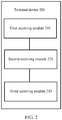
- FIG. 2 is a schematic block diagram of a terminal device 200 according to an embodiment of the present invention.
- the terminal device 200 includes a first receiving module 210, a second receiving module 220, and a third receiving module 230.
- the first receiving module 210 is configured to receive a first message sent by a network device.
- the first message includes at least one group service identifier, and one group service identifier corresponds to one group service.
- the second receiving module 220 is configured to receive, according to the first message received by the first receiving module 210, a first group service corresponding to a first group service identifier of the terminal device 200.
- the third receiving module 230 is configured to receive configuration information of the first message, so that the first receiving module of the terminal device receives the first message according to the configuration information of the first message.
- the configuration information of the first message received by the third receiving module includes at least one of the following information: a time pattern that is used by the network device to send the first message, a modulation and coding scheme of the first message, and a first RNTI.
- the modulation and coding scheme of the first message may be specifically as follows: For example, a modulation scheme of the first message is quadrature phase shift keying (English: Quadrature Phase Shift Keying, QPSK for short), and a coding scheme is 1/3 coding; or a modulation scheme of the first message is QPSK, and a coding scheme is 1/2 coding. It should be understood that other coding or modulation schemes may also be used, and the present invention is not limited thereto.
- the first RNTI refers to an RNTI used by the network device to schedule and send the first message.
- the time pattern that is used by the network device to send the first message and that is received by the third receiving module includes at least one of the following information: a change period of the first message, a repetition coefficient for sending the first message, and a time offset of the first message.
- the change period T' of the first message is used to instruct the terminal device to receive, after determining that the first message is changed, a changed first message sent by the network device, after the change period T' has elapsed.
- the period T' may be 20 ms, 50 ms, 100 ms, 500 ms, or the like.
- a quantity of repetition times for sending the first message represents a number of times the first message is repeatedly sent within one change period T', and for example, may be specifically 2, 4, 6, 8, or the like.
- the time offset of the first message is, for example, 0 ms, 1 ms, 2 ms, 3 ms, or the like.
- the time offset of the first message is a fixed value of, for example, 0 or 1. It should also be understood that the values listed above are merely examples, other possible values of the change period T' all fall within the protection scope of the present invention, and the present invention is not limited thereto.
- the first receiving module further includes a first receiving unit.
- the first receiving unit When the configuration information received by the third receiving module includes the first RNTI, the first receiving unit is configured to receive first downlink control information according to the first RNTI. When the configuration information received by the third receiving module does not include the first RNTI, the first receiving unit is configured to receive first downlink control information according to a first default RNTI. Specifically, if the configuration information includes the first RNTI, the terminal device parses the first downlink control information according to an RNTI corresponding to the first group service in the first RNTI, so as to receive the first message according to the first downlink control information. If the first message does not include the first RNTI, the terminal device receives the first downlink control information according to the first default RNTI.
- the first downlink control information is downlink control information used to schedule the first message.
- the first default RNTI is a default RNTI used by the network device to schedule and send the first message.
- the first default RNTI may be FFF4, FFFC, or the like, and the present invention is not limited thereto.
- a terminal device receives a first message that is sent by a network device and that includes a group service identifier of each group service sent by the network device, so that the terminal device can receive, according to the received first message, a group service sent by the network device. Therefore, implementations of the present invention provide a method for implementing group communication, a terminal device, and a network device. In this way, not only point-to-multipoint group communication in a single cell can be implemented, but also one group service can be sent by using only one share of resources to all terminal devices that need to receive the group service, thereby reducing a waste of radio resources.
- receiving configuration of each group service can further be modified by using a unified configuration message, thereby implementing dynamic, flexible, and efficient group service configuration and transmission.
- the second receiving module of the terminal device is configured to receive the first group service according to the first message received by the first receiving module.
- the terminal device when the group service identifier list sent by the network device does not include a group service identifier of the terminal device, the terminal device does not receive group service data sent by the network device, and only when the group service identifier list sent by the network device includes a group service identifier of the terminal device, the terminal device receives group service data that is sent by the network device and that corresponds to the group service identifier of the terminal device.
- group services to be sent by the network device are group service A, group service B, and group service C
- the group service identifier list includes three group service identifiers A, B, and C. Three group service identifiers A, B, and D may be marked in advance for the terminal device according to a requirement of the terminal device. In this case, the terminal device receives only service A and service B that are sent by a network side device, and cannot receive service C.
- the first message received by the first receiving module further includes at least one of the following information: a period for sending the first message by the network device, a change period of the first message, a time offset of each group service corresponding to the at least one group service identifier, a logical channel number of each group service, and a second radio network temporary identifier (English: Radio Network Temporary Identifier, RNTI for short).
- the period T for sending the first message by the network device represents frequency at which the first message is used to send a message. Specifically, the period T may be 20 ms, 50 ms, 100 ms, 500 ms, or the like.
- the period T' is used to instruct the terminal device to receive, after determining that the first message is changed, a changed first message sent by the network device, after the change period T' has elapsed.
- the period T' may be 20 ms, 50 ms, 100 ms, 500 ms, or the like.
- the logical channel number of each group service that is sent by the network device is used to represent a logical channel used by the group service.
- the logical channel number may be represented by 12 bits, for example, 000000000001, or by 5 bits, for example, 00001, or by any bit quantity ranging from 6 to 13.
- the bit quantity used may be a length preset by a network, or a length indicated by the first message.
- the second RNTI refers to an RNTI used to schedule the group service sent by the network device. It should be understood that the second RNTI may refer to one RNTI used to schedule multiple group services, or may refer to different RNTIs used to schedule multiple group services. That is, each group service has a corresponding RNTI, and each RNTI may correspond to one or more group services, and the present invention is not limited thereto. It should also be understood that the values listed above are merely examples, other possible values of the period T or T' all fall within the protection scope of the present invention, and the present invention is not limited thereto.
- the second receiving module of the terminal device includes a second receiving unit.
- the second receiving unit is configured to receive second downlink control information (English: Downlink Control Information, DCI for short) according to the second RNTI.
- the second receiving unit is configured to receive second downlink control information according to a second default RNTI.
- the terminal device parses the second downlink control information according to an RNTI corresponding to the first group service in the second RNTI, so as to receive the first group service according to the second downlink control information. If the first message does not include the second RNTI, the terminal device receives the second downlink control information according to the second default RNTI.
- the second downlink control information is downlink control information used to schedule group service data sent by the network device.
- the second default RNTI is a default RNTI used to schedule the group service sent by the network device.
- the second default RNTI may be FFF4, FFFC, or the like, and the present invention is not limited thereto.
- the receiving second downlink control information according to the second RNTI or a second default RNTI is: parsing, at a scheduling time corresponding to the first group service, the second downlink control information that is scrambled with the RNTI of the first group service.
- the scheduling time of the first group service is a moment that is obtained by performing a modulo operation on the period T by using a sum of a system frame number* 10 and a subframe index of the first group service and that is equal to the time offset corresponding to the first group service.
- the second receiving module further includes a third receiving unit, the third receiving unit being configured to: receive, according to the second downlink control information received by the second receiving unit, a Media Access Control packet data unit (English: Media Access Control Packet Data Unit, MAC PDU for short) received by the second receiving module; and when the first message received by the first receiving module includes the logical channel number of each group service in the at least one group service, obtain, according to a logical channel number of the first group service in the at least one group service received by the second receiving unit, a Media Access Control service data unit (English: Media Access Control Service Data Unit, MAC SDU for short) received by the second receiving module; or when the first message received by the first receiving module does not include the logical channel number of each group service in the at least one group service, obtain, according to the first group service identifier, a MAC SDU of the first group service received by the second receiving module.
- the MAC PDU refers to a packet data unit including a
- a corresponding channel A can be found by using the channel number A corresponding to group service A, the channel number B corresponding to group service B and channel C corresponding to group service C, and a MAC SDU received by the second receiving module is obtained.
- group services A, B, and C all obtain, according to their group service identifiers and by using a channel allocated to an entire group service, a MAC SDU that corresponds to the group service and that is received by the second receiving module.
- the MAC PDU received by the second receiving module carries a Media Access Control (English: Media Access Control Element, MAC CE for short), to indicate that the first group service ends.
- the MAC PDU including the MAC CE indicating that the service ends may be sent once, or may be repeatedly sent multiple times, for example, three times or five times, so as to improve receiving reliability of the terminal device.
- a specific implementation manner may be that the MAC CE includes a group service identifier or a logical channel number of a group service sent by the terminal device, and when the terminal device receives a MAC CE including a particular group service identifier or logical channel number, it is considered that the service ends.
- a specific implementation manner may be that when the MAC CE does not include a group service identifier or a logical channel number corresponding to a group service sent by the terminal device, it is considered that all group services included in the MAC PDU that includes the MAC CE indicating that the service ends end.
- the numerals mentioned in this embodiment of the present invention are merely examples.
- the MAC CE is a MAC control unit indicating that the at least one group service ends, and the present invention is not limited thereto.
- the terminal device further includes: a determining module.
- the determining module is configured to determine, according to a change indication message, that the first message received by the first receiving module is changed.
- the change indication information includes: indication information that indicates that the first message is changed and that is carried in a paging message; or indication information that indicates that the first message is changed and that is carried in a system information block 1 (English: System Information Block 1, SIB1 for short); or indication information that indicates that the first message is changed and that is carried in the first downlink control information, when the second receiving module receives the first downlink control information.
- the change indication message of the first message that is carried in the SIB1 message or the indication information that indicates that the first message is changed and that is carried in the downlink control information of the first message may be specifically a label value, whose length may be 4 bits, 5 bits, or the like.
- the downlink control information may be in a format such as 1/1A/1C.
- the terminal device compares a stored label value with the label value in the change indication message of the first message that is carried in the SIB1 message or the indication information that indicates that the first message is changed and that is carried in the downlink control information of the first message. If they are different, it is considered that the first message is changed. It should be understood that the length values of the foregoing representation value are merely examples, and the present invention is not limited thereto.
- the first receiving module is further configured to: if the terminal device does not store the first message, receive the first message at a moment at which the network device sends multicast control information; and if the terminal device already stores the multicast control information and determines that the first message is changed, receive a changed first message at a moment at which the network device sends the changed first message, so as to receive a changed first group service according to the changed first message. If the terminal device does not store the first message, the terminal device needs to attempt to receive the first message at each first message sending moment, until one first message is correctly received.
- the terminal device may obtain the first message sending moment by using an SIB1 message, or obtain the first message sending moment from the configuration information of the first message scheduled by the downlink control information, so as to attempt to receive the first message at the first message sending moment. If the terminal device already stores the first message, when determining that the first message is changed, the terminal device needs to start to receive a changed first message after the change period T' has elapsed, so as to receive the first group service according to the changed first message.
- the network device when the network device sends the first message for a quantity of times that equals to the repetition coefficient in one change period T', different redundancy versions may be used each time the first message is sent.
- the terminal device can correctly receive the first message by combining multiple first messages, thereby improving reliability of a user in receiving the first message.
- the first message is sent in N consecutive subframes starting from a subframe corresponding to each first message scheduling moment.
- the first messages sent in the subframes may be the same, or different redundancy versions may be used.
- the terminal device can correctly receive the first message by combining multiple first messages, thereby improving reliability of a user in receiving the first message.
- a terminal device receives a first message that is sent by a network device and that includes a group service identifier of each group service sent by the network device, so that the terminal device can receive, according to the received first message, a group service sent by the network device. Therefore, implementations of the present invention provide a method for implementing group communication, a terminal device, and a network device. In this way, not only point-to-multipoint group communication in a single cell can be implemented, but also one group service can be sent by using only one share of resources to all terminal devices that need to receive the group service, thereby reducing a waste of radio resources.
- receiving configuration of each group service can further be modified by using a unified configuration message, thereby implementing dynamic, flexible, and efficient group service configuration and transmission.
- the terminal device according to the embodiments of the present invention is described in detail above with reference to FIG. 1 and FIG. 2 .
- a network device according to the embodiments of the present invention is described in detail below with reference to FIG. 3 and FIG. 4 .
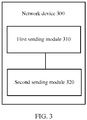
- FIG. 3 is a schematic block diagram of a network device according to an embodiment of the present invention. As shown in FIG. 3 , the network device includes a first sending module 310 and a second sending module 320.
- the first sending module 310 is configured to send a first message to a terminal device.
- the first message includes at least one group service identifier, and one group service identifier corresponds to one group service.
- the second sending module 320 is configured to send a group service corresponding to the at least one group service identifier to the terminal device.
- the first message sent by the first sending module 310 of the network device may include a group service identifier list.
- the group service identifier list includes a group service identifier of at least one group service to be sent by the network device.
- the group service identifier list may include one or more group service identifiers, and one group service identifier corresponds to one group service.
- the first message may be an independent broadcast message, or may be carried in a form of specific information in another broadcast message.
- the first message may be an MCCH message or a group configuration message, and the present invention is not limited thereto.
- the group service identifier list may be a TMGI list including a TMGI corresponding to the at least one group service, and the present invention is not limited thereto.
- the group service sent by the second sending module 320 of the network device is group services corresponding to one or more group service identifiers included in the group service identifier list.
- One group service identifier corresponds to one group service.
- a terminal device receives a first message that is sent by a network device and that includes a group service identifier of each group service sent by the network device, so that the terminal device can receive, according to the received first message, a group service sent by the network device. Therefore, implementations of the present invention provide a method for implementing group communication, a terminal device, and a network device. In this way, not only point-to-multipoint group communication in a single cell can be implemented, but also one group service can be sent by using only one share of resources to all terminal devices that need to receive the group service, thereby reducing a waste of radio resources.
- receiving configuration of each group service can further be modified by using a unified configuration message, thereby implementing dynamic, flexible, and efficient group service configuration and transmission.
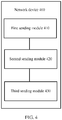
- FIG. 4 is a schematic block diagram of a network device according to another embodiment of the present invention.
- the network device includes a first sending module 410, a second sending module 420, and a third sending module 430.
- the first sending module 410 is configured to send a first message to a terminal device.
- the first message includes at least one group service identifier, and one group service identifier corresponds to one group service.
- the second sending module 420 is configured to send a group service corresponding to the at least one group service identifier to the terminal device.
- the third sending module 430 is configured to send configuration information of the first message, so that the terminal device receives the first message according to the configuration information of the first message.
- the configuration information of the first message includes at least one of the following information: a time pattern for sending the first message, a modulation and coding scheme of the first message, and a first RNTI.
- the modulation and coding scheme of the first message may be specifically as follows: For example, a modulation scheme of the first message is quadrature phase shift keying (English: Quadrature Phase Shift Keying, QPSK for short), and a coding scheme is 1/3 coding; or a modulation scheme of the first message is QPSK, and a coding scheme is 1/2 coding. It should be understood that other coding or modulation schemes may also be used, and the present invention is not limited thereto.
- the first RNTI refers to an RNTI used by the network device to schedule and send the first message.
- the time pattern for sending the first message by the third sending module includes at least one of the following information: a change period of the first message, a repetition coefficient for sending the first message, and a time offset of the first message.
- the change period T' of the first message is used to instruct the terminal device to receive, after determining that the first message is changed, a changed first message sent by the network device, after the change period T' has elapsed.
- the period T' may be 20 ms, 50 ms, 100 ms, 500 ms, or the like.
- a quantity of repetition times for sending the first message represents a number of times the first message is repeatedly sent within one change period T', and for example, may be specifically 2, 4, 6, 8, or the like.
- the time offset of the first message is, for example, 0 ms, 1 ms, 2 ms, 3 ms, or the like.
- the time offset of the first message is a fixed value of, for example, 0 or 1. It should also be understood that the values listed above are merely examples, other possible values of the change period T' all fall within the protection scope of the present invention, and the present invention is not limited thereto.
- the first message sent by the first sending module further includes at least one of the following information: a period for sending the first message, a change period of the first message, a time offset of each group service in the at least one group service, a logical channel number of each group service, and a second RNTI.
- the period T for sending the first message by the network device represents frequency at which the first message is used to send a message. Specifically, the period T may be 20 ms, 50 ms, 100 ms, 500 ms, or the like.
- the period T' is used to instruct the terminal device to receive, after determining that the first message is changed, a changed first message sent by the network device, after the change period T' has elapsed.
- the period T' may be 20 ms, 50 ms, 100 ms, 500 ms, or the like.
- the logical channel number of each group service that is sent by the network device is used to represent a logical channel used by the group service.
- the second RNTI refers to an RNTI used to schedule the group service sent by the network device. It should be understood that the second RNTI may refer to one RNTI used to schedule multiple group services, or may refer to different RNTIs used to schedule multiple group services.
- each group service has a corresponding RNTI
- each RNTI may correspond to one or more group services, and the present invention is not limited thereto. It should also be understood that the values listed above are merely examples, other possible values of the period T or T' all fall within the protection scope of the present invention, and the present invention is not limited thereto.
- the first sending module is further configured to: send indication information indicating that the first message is changed to the terminal device, including: sending a paging message carrying the indication information to the terminal device; or sending an SIB1 message carrying the indication information to the terminal device; or sending first downlink control information carrying the indication information to the terminal device.
- the change indication message of the first message that is carried in the SIB1 message or the indication information that indicates that the first message is changed and that is carried in the first downlink control information may be specifically a label value, whose length may be 4 bits, 5 bits, or the like.
- the downlink control information may be in a format such as 1/1A/1C.
- the terminal device compares a stored label value with the label value in the change indication message of the first message that is carried in the SIB1 message or the indication information that indicates that the first message is changed and that is carried in the first downlink control information. If they are different, it is considered that the first message is changed. It should be understood that the length values of the foregoing representation value are merely examples, and the present invention is not limited thereto.
- the network device when the network device sends the first message for a quantity of times that equals to the repetition coefficient in one change period T', different redundancy versions may be used each time the first message is sent.
- the terminal device can correctly receive the first message by combining multiple first messages, thereby improving reliability of a user in receiving the first message.
- the first message is sent in N consecutive subframes starting from a subframe corresponding to each first message scheduling moment.
- the first messages sent in the subframes may be the same, or different redundancy versions may be used.
- the terminal device can correctly receive the first message by combining multiple first messages, thereby improving reliability of a user in receiving the first message.
- a terminal device receives a first message that is sent by a network device and that includes a group service identifier of each group service sent by the network device, so that the terminal device can receive, according to the received first message, a group service sent by the network device. Therefore, implementations of the present invention provide a method for implementing group communication, a terminal device, and a network device. In this way, not only point-to-multipoint group communication in a single cell can be implemented, but also one group service can be sent by using only one share of resources to all terminal devices that need to receive the group service, thereby reducing a waste of radio resources.
- receiving configuration of each group service can further be modified by using a unified configuration message, thereby implementing dynamic, flexible, and efficient group service configuration and transmission.
- FIG. 1 to FIG. 4 describes in detail the network device and the terminal device.
- a schematic flowchart of a group communication method according to an embodiment of the present invention is described below with reference to FIG. 5 and FIG. 6 .
- FIG. 5 is a schematic flowchart of a group communication method according to an embodiment of the present invention. Procedures in the method 500 may be separately executed and implemented by corresponding parts of the terminal device 100 or the terminal device 200 according to the embodiments of the present invention. For brevity, details are not described herein again. As shown in FIG. 5 , the method 500 includes the following steps:
- the first message sent by the network device may include a group service identifier list.
- the group service identifier list includes a group service identifier of at least one group service to be sent by the network device.
- the group service identifier list may include one or more group service identifiers, and one group service identifier corresponds to one group service.
- the first message may be an independent broadcast message, or may be carried in a form of specific information in another broadcast message.
- the first message may be a multicast control channel (English: Multicast Control Channel, MCCH for short) message or a multicast configuration message, and the present invention is not limited thereto.
- the group service identifier list may be a temporary mobile group identity (English: Temporary Mobile Group Identity, TMGI for short) list including a TMGI corresponding to the at least one group service, and the present invention is not limited thereto.
- the first group service identifier of the terminal device 100 refers to a group service identifier of interest to or a group service identifier subscribed to by the terminal device 100. Specifically, the terminal device 100 obtains, from a user service description (English: user service description, USD for short), the group service identifier of interest or the subscribed group service identifier.
- step S520 the terminal device distinguishes and identifies, according to a group service identifier in the first message, a group service needing to be received. In this way, the terminal device receives a group service intended to be received.
- a terminal device receives a first message that is sent by a network device and that includes a group service identifier of each group service sent by the network device, so that the terminal device can receive, according to the received first message, a group service sent by the network device. Therefore, implementations of the present invention provide a method for implementing group communication, a terminal device, and a network device. In this way, not only point-to-multipoint group communication in a single cell can be implemented, but also one group service can be sent by using only one share of resources to all terminal devices that need to receive the group service, thereby reducing a waste of radio resources.
- receiving configuration of each group service can further be modified by using a unified configuration message, thereby implementing dynamic, flexible, and efficient group service configuration and transmission.
- the terminal device receives configuration information of the first message, so as to receive the first message according to the configuration information of the first message.
- the configuration information of the first message includes at least one of the following information: a time pattern that is used by the network device to send the first message, a modulation and coding scheme of the first message, and a first RNTI.
- the modulation and coding scheme of the first message may be specifically as follows: For example, a modulation scheme of the first message is quadrature phase shift keying (English: Quadrature Phase Shift Keying, QPSK for short), and a coding scheme is 1/3 coding; or a modulation scheme of the first message is QPSK, and a coding scheme is 1/2 coding. It should be understood that other coding or modulation schemes may also be used, and the present invention is not limited thereto.
- the first RNTI refers to an RNTI used by the network device to schedule and send the first message.
- the time pattern that is used by the network device to send the first message includes at least one of the following information: a change period of the first message, a repetition coefficient for sending the first message, and a time offset of the first message.
- the change period T' of the first message is used to instruct the terminal device to receive, after determining that the first message is changed, a changed first message sent by the network device, after the change period T' has elapsed.
- the period T' may be 20 ms, 50 ms, 100 ms, 500 ms, or the like.
- a quantity of repetition times for sending the first message represents a number of times the first message is repeatedly sent within one change period T', and for example, may be specifically 2, 4, 6, 8, or the like.
- the time offset of the first message is, for example, 0 ms, 1 ms, 2 ms, 3 ms, or the like.
- the time offset of the first message is a fixed value of, for example, 0 or 1. It should also be understood that the values listed above are merely examples, other possible values of the change period T' all fall within the protection scope of the present invention, and the present invention is not limited thereto.
- the receiving, by the terminal device, configuration information of the first message, so as to receive the first message according to the configuration information of the first message includes: when the configuration information includes the first RNTI, receiving, by the terminal device, first downlink control information according to the first RNTI; or when the configuration information does not include the first RNTI, receiving, by the terminal device, first downlink control information according to a first default RNTI.
- the terminal device parses the first downlink control information according to an RNTI corresponding to the first group service in the first RNTI, so as to receive the first message according to the first downlink control information.
- the terminal device receives the first downlink control information according to the first default RNTI.
- the first default RNTI is a default RNTI used by the network device to schedule and send the first message.
- the first default RNTI may be FFF4, FFFC, or the like, and the present invention is not limited thereto.
- a terminal device receives a first message that is sent by a network device and that includes a group service identifier of each group service sent by the network device, so that the terminal device can receive, according to the received first message, a group service sent by the network device. Therefore, implementations of the present invention provide a method for implementing group communication, a terminal device, and a network device. In this way, not only point-to-multipoint group communication in a single cell can be implemented, but also one group service can be sent by using only one share of resources to all terminal devices that need to receive the group service, thereby reducing a waste of radio resources.
- receiving configuration of each group service can further be modified by using a unified configuration message, thereby implementing dynamic, flexible, and efficient group service configuration and transmission.
- step S520 when the at least one group service identifier sent by the network device includes the first group service identifier of the terminal device, the second receiving module of the terminal device is configured to receive the first group service according to the first message received by the first receiving module.
- the terminal device when the group service identifier list sent by the network device does not include a group service identifier of the terminal device, the terminal device does not receive group service data sent by the network device, and only when the group service identifier list sent by the network device includes a group service identifier of the terminal device, the terminal device receives group service data that is sent by the network device and that corresponds to the group service identifier of the terminal device.
- group services to be sent by the network device are group service A, group service B, and group service C
- the group service identifier list includes three group service identifiers A, B, and C. Three group service identifiers A, B, and D may be marked in advance for the terminal device according to a requirement of the terminal device. In this case, the terminal device receives only service A and service B that are sent by a network side device, and cannot receive service C.
- the first message further includes at least one of the following information: a period for sending the first message by the network device, a change period of the first message, a time offset of each group service corresponding to the at least one group service identifier, a logical channel number of each group service, and a second RNTI.
- the period T for sending the first message by the network device represents frequency at which the first message is used to send a message. Specifically, the period T may be 20 ms, 50 ms, 100 ms, 500 ms, or the like.
- the period T' is used to instruct the terminal device to receive, after determining that the first message is changed, a changed first message sent by the network device, after the change period T' has elapsed.
- the period T' may be 20 ms, 50 ms, 100 ms, 500 ms, or the like.
- the logical channel number of each group service that is sent by the network device is used to represent a logical channel used by the group service.
- the logical channel number may be represented by 12 bits, for example, 000000000001, or by 5 bits, for example, 00001, or by any bit quantity ranging from 6 to 13.
- the bit quantity used may be a length preset by a network, or a length indicated by the first message.
- the second RNTI refers to an RNTI used to schedule the group service sent by the network device. It should be understood that the second RNTI may refer to one RNTI used to schedule multiple group services, or may refer to different RNTIs used to schedule multiple group services. That is, each group service has a corresponding RNTI, and each RNTI may correspond to one or more group services, and the present invention is not limited thereto. It should also be understood that the values listed above are merely examples, other possible values of the period T or T' all fall within the protection scope of the present invention, and the present invention is not limited thereto.
- step S520 the receiving, by the terminal device according to the first message, a first group service corresponding to a first group service identifier of the terminal device includes: when the first message includes the second RNTI, receiving, by the terminal device, second downlink control information according to the second RNTI; or when the first message does not include the second RNTI, receiving, by the terminal device, second downlink control information according to a second default RNTI.
- the terminal device parses the second downlink control information according to an RNTI corresponding to the first group service in the second RNTI, so as to receive the first group service according to the second downlink control information. If the first message does not include the second RNTI, the terminal device receives the second downlink control information according to the second default RNTI.
- the second default RNTI is a default RNTI used to schedule the group service sent by the network device.
- the second default RNTI may be FFF4, FFFC, or the like, and the present invention is not limited thereto.
- the receiving second downlink control information according to the second RNTI or a second default RNTI is: parsing, at a scheduling time corresponding to the first group service, the second downlink control information that is scrambled with the RNTI of the first group service.
- the scheduling time of the first group service is a moment that is obtained by performing a modulo operation on the period T by using a sum of a system frame number* 10 and a subframe index of the first group service and that is equal to the time offset corresponding to the first group service.
- step S520 the receiving, by the terminal device according to the first message, a first group service corresponding to a first group service identifier of the terminal device includes: receiving, by the terminal device, a MAC PDU according to the second downlink control information; and when the first message includes the logical channel number of each group service, receiving, by the terminal device according to a logical channel number of the first group service in the logical channel number of each group service, a MAC SDU sent by the network device; or when the first message does not include the logical channel number of each group service, receiving, by the terminal device, a MAC SDU of the first group service according to the first group service identifier.
- a corresponding channel A can be found by using the channel number A corresponding to group service A, the channel number B corresponding to group service B and channel C corresponding to group service C, and a MAC SDU received by the second receiving module is obtained.
- group services A, B, and C all obtain, according to their group service identifiers and by using a channel allocated to an entire group service, a MAC SDU that corresponds to the group service and that is received by the second receiving module.
- the MAC PDU carries a MAC CE, to indicate that the first group service ends.
- the MAC PDU including the MAC CE indicating that the service ends may be sent once, or may be repeatedly sent multiple times, for example, three times or five times, so as to improve receiving reliability of the terminal device.
- a specific implementation manner may be that the MAC CE includes a group service identifier or a logical channel number of a group service sent by the terminal device, and when the terminal device receives a MAC CE including a particular group service identifier or logical channel number, it is considered that the service ends.
- a specific implementation manner may be that when the MAC CE does not include a group service identifier or a logical channel number corresponding to a group service sent by the terminal device, it is considered that all group services included in the MAC PDU that includes the MAC CE indicating that the service ends end. It should be understood that the numerals mentioned in this embodiment of the present invention are merely examples, and the present invention is not limited thereto.
- the terminal device determines, according to change indication information, that the first message is changed.
- the change indication information includes: indication information that indicates that the first message is changed and that is carried in a paging message; or indication information that indicates that the first message is changed and that is carried in SIB1; or indication information that indicates that the first message is changed and that is carried in the first downlink control information, when the terminal device receives the first downlink control information.
- the change indication message of the first message that is carried in the SIB 1 message or the indication information that indicates that the first message is changed and that is carried in the first downlink control information may be specifically a label value, whose length may be 4 bits, 5 bits, or the like.
- the downlink control information may be in a format such as 1/1A/1C. Further, the terminal device compares a stored label value with the label value in the change indication message of the first message that is carried in the SIB1 message or the indication information that indicates that the first message is changed and that is carried in the downlink control information of the first message. If they are different, it is considered that the first message is changed. It should be understood that the length values of the foregoing representation value are merely examples, and the present invention is not limited thereto.
- the receiving, by a terminal device, a first message sent by a network device includes: if the terminal device does not store the first message, receiving the first message at a moment at which the network device sends multicast control information; and if the terminal device already stores the multicast control information and determines that the first message is changed, receiving a changed first message at a moment at which the network device sends the changed first message, so as to receive a changed first group service according to the changed first message. If the terminal device does not store the first message, the terminal device needs to attempt to receive the first message at each first message sending moment, until one first message is correctly received.
- the terminal device may obtain the first message sending moment by using an SIB1 message, or obtain the first message sending moment from the configuration information of the first message scheduled by the downlink control information, so as to attempt to receive the first message at the first message sending moment. If the terminal device already stores the first message, when determining that the first message is changed, the terminal device needs to start to receive a changed first message after the change period T' has elapsed, so as to receive the first group service according to the changed first message.
- the network device when the network device sends the first message for a quantity of times that equals to the repetition coefficient in one change period T', different redundancy versions may be used each time the first message is sent.
- the terminal device can correctly receive the first message by combining multiple first messages, thereby improving reliability of a user in receiving the first message.
- the first message is sent in N consecutive subframes starting from a subframe corresponding to each first message scheduling moment.
- the first messages sent in the subframes may be the same, or different redundancy versions may be used.
- the terminal device can correctly receive the first message by combining multiple first messages, thereby improving reliability of a user in receiving the first message.
- a terminal device receives a first message that is sent by a network device and that includes a group service identifier of each group service sent by the network device, so that the terminal device can receive, according to the received first message, a group service sent by the network device. Therefore, implementations of the present invention provide a method for implementing group communication, a terminal device, and a network device. In this way, not only point-to-multipoint group communication in a single cell can be implemented, but also one group service can be sent by using only one share of resources to all terminal devices that need to receive the group service, thereby reducing a waste of radio resources.
- receiving configuration of each group service can further be modified by using a unified configuration message, thereby implementing dynamic, flexible, and efficient group service configuration and transmission.
- FIG. 6 is a schematic flowchart of a group communication method according to another embodiment of the present invention. Procedures in the method 600 may be separately executed and implemented by corresponding parts of the terminal device 300 or the terminal device 400 according to the embodiments of the present invention. For brevity, details are not described herein again. As shown in FIG. 6 , the method 600 includes the following steps:
- the first message sent by the network device may include a group service identifier list.
- the group service identifier list includes a group service identifier of at least one group service to be sent by the network device.
- the group service identifier list may include one or more group service identifiers, and one group service identifier corresponds to one group service.
- the first message may be an independent broadcast message, or may be carried in a form of specific information in another broadcast message.
- the first message may be an MCCH message or a group configuration message, and the present invention is not limited thereto.
- the group service identifier list may be a TMGI list including a TMGI corresponding to the at least one group service, and the present invention is not limited thereto.
- the group service sent by the network device is group services corresponding to one or more group service identifiers included in the group service identifier list.
- One group service identifier corresponds to one group service.
- a terminal device receives a first message that is sent by a network device and that includes a group service identifier of each group service sent by the network device, so that the terminal device can receive, according to the received first message, a group service sent by the network device. Therefore, implementations of the present invention provide a method for implementing group communication, a terminal device, and a network device. In this way, not only point-to-multipoint group communication in a single cell can be implemented, but also one group service can be sent by using only one share of resources to all terminal devices that need to receive the group service, thereby reducing a waste of radio resources.
- receiving configuration of each group service can further be modified by using a unified configuration message, thereby implementing dynamic, flexible, and efficient group service configuration and transmission.
- step S610 configuration information of the first message is sent, so that the terminal device receives the first message according to the configuration information of the first message.
- the configuration information of the first message includes at least one of the following information: a time pattern for sending the first message, a modulation and coding scheme of the first message, and a first RNTI.
- the modulation and coding scheme of the first message may be specifically as follows: For example, a modulation scheme of the first message is quadrature phase shift keying (English: Quadrature Phase Shift Keying, QPSK for short), and a coding scheme is 1/3 coding; or a modulation scheme of the first message is QPSK, and a coding scheme is 1/2 coding. It should be understood that other coding or modulation schemes may also be used, and the present invention is not limited thereto.
- the first RNTI refers to an RNTI used by the network device to schedule and send the first message.
- the time pattern for sending the first message includes at least one of the following information: a change period of the first message, a repetition coefficient of the first message, and a time offset of the first message.
- the change period T' of the first message is used to instruct the terminal device to receive, after determining that the first message is changed, a changed first message sent by the network device, after the change period T' has elapsed.
- the period T' may be 20 ms, 50 ms, 100 ms, 500 ms, or the like.
- a quantity of repetition times for sending the first message represents a number of times the first message is repeatedly sent within one change period T', and for example, may be specifically 2, 4, 6, 8, or the like.
- the time offset of the first message is, for example, 0 ms, 1 ms, 2 ms, 3 ms, or the like.
- the time offset of the first message is a fixed value of, for example, 0 or 1. It should also be understood that the values listed above are merely examples, other possible values of the change period T' all fall within the protection scope of the present invention, and the present invention is not limited thereto.
- the first message further includes at least one of the following information: a period for sending the first message, a change period of the first message, a time offset of each group service corresponding to the at least one group service identifier, a logical channel number of each group service, and a second RNTI.
- the period T for sending the first message by the network device represents frequency at which the first message is used to send a message. Specifically, the period T may be 20 ms, 50 ms, 100 ms, 500 ms, or the like.
- the period T' is used to instruct the terminal device to receive, after determining that the first message is changed, a changed first message sent by the network device, after the change period T' has elapsed.
- the period T' may be 20 ms, 50 ms, 100 ms, 500 ms, or the like.
- the logical channel number of each group service that is sent by the network device is used to represent a logical channel used by the group service.
- the second RNTI refers to an RNTI used to schedule the group service sent by the network device. It should be understood that the second RNTI may refer to one RNTI used to schedule multiple group services, or may refer to different RNTIs used to schedule multiple group services.
- each group service has a corresponding RNTI
- each RNTI may correspond to one or more group services, and the present invention is not limited thereto. It should also be understood that the values listed above are merely examples, other possible values of the period T or T' all fall within the protection scope of the present invention, and the present invention is not limited thereto.
- S610 further includes: sending a paging message carrying the indication information to the terminal device; or sending an SIB1 message carrying the indication information to the terminal device; or sending second downlink control information carrying the indication information to the terminal device.
- the change indication message of the first message that is carried in the SIB1 message or the indication information that indicates that the first message is changed and that is carried in the second downlink control information may be specifically a label value, whose length may be 4 bits, 5 bits, or the like.
- the downlink control information may be in a format such as 1/1A/1C.
- the terminal device compares a stored label value with the label value in the change indication message of the first message that is carried in the SIB1 message or the indication information that indicates that the first message is changed and that is carried in the downlink control information of the first message. If they are different, it is considered that the first message is changed. It should be understood that the length values of the foregoing representation value are merely examples, and the present invention is not limited thereto.
- the network device when the network device sends the first message for a quantity of times that equals to the repetition coefficient in one change period T', different redundancy versions may be used each time the first message is sent.
- the terminal device can correctly receive the first message by combining multiple first messages, thereby improving reliability of a user in receiving the first message.
- the first message is sent in N consecutive subframes starting from a subframe corresponding to each first message scheduling moment.
- the first messages sent in the subframes may be the same, or different redundancy versions may be used.
- the terminal device can correctly receive the first message by combining multiple first messages, thereby improving reliability of a user in receiving the first message.
- a terminal device receives a first message that is sent by a network device and that includes a group service identifier of each group service sent by the network device, so that the terminal device can receive, according to the received first message, a group service sent by the network device. Therefore, implementations of the present invention provide a method for implementing group communication, a terminal device, and a network device. In this way, not only point-to-multipoint group communication in a single cell can be implemented, but also one group service can be sent by using only one share of resources to all terminal devices that need to receive the group service, thereby reducing a waste of radio resources.
- receiving configuration of each group service can further be modified by using a unified configuration message, thereby implementing dynamic, flexible, and efficient group service configuration and transmission.
- FIG. 7 is a schematic flowchart of a group communication method according to still another embodiment of the present invention. As shown in FIG. 7 , the method includes the following steps:
- the first message sent by the network device includes at least one group service identifier, and one group service identifier corresponds to one group service.
- step S703 the network device sends a group service corresponding to the at least one group service identifier to the terminal device.
- step S704 the terminal device receives, according to the first message, a first group service corresponding to a first group service identifier of the terminal device.
- step S704 when the at least one group service identifier sent by the network device includes the first group service identifier of the terminal device, the second receiving module of the terminal device is configured to receive the first group service according to the first message received by the first receiving module.
- the first message further includes at least one of the following information: a period for sending the first message by the network device, a change period of the first message, a time offset of each group service corresponding to the at least one group service identifier, a logical channel number of each group service, and a second RNTI.
- step S704 the receiving, by the terminal device according to the first message, a first group service corresponding to a first group service identifier of the terminal device includes: when the first message includes the second RNTI, receiving, by the terminal device, second downlink control information according to the second RNTI; or when the first message does not include the second RNTI, receiving, by the terminal device, second downlink control information according to a second default RNTI.
- step S704 the receiving, by the terminal device according to the first message, a first group service corresponding to a first group service identifier of the terminal device includes: when the first message includes the logical channel number of each group service corresponding to the at least one group service identifier, receiving, by the terminal device, a MAC PDU according to the second downlink control information; and obtaining, by the terminal device, a MAC SDU of the first group service according to a logical channel number of the first group service in the logical channel number of each group service.
- the MAC PDU carries a MAC CE, to indicate that the first group service ends.
- the terminal device determines, according to change indication information, that the first message is changed.
- the change indication information includes: indication information that indicates that the first message is changed and that is carried in a paging message; or indication information that indicates that the first message is changed and that is carried in SIB1; or indication information that indicates that the first message is changed and that is carried in the first downlink control information, when the terminal device receives the first downlink control information.
- the network device sends, to the terminal device, indication information indicating that the first message is changed, including: sending a paging message carrying the indication information to the terminal device; or sending an SIB1 message carrying the indication information to the terminal device; or sending first downlink control information carrying the indication information to the terminal device.
- the receiving, by a terminal device, a first message sent by a network device includes: if the terminal device does not store the first message, receiving the first message at a moment at which the network device sends multicast control information; and if the terminal device already stores the multicast control information and determines that the first message is changed, receiving a changed first message at a moment at which the network device sends the changed first message, so as to receive a changed first group service according to the changed first message.
- a terminal device receives a first message that is sent by a network device and that includes a group service identifier of each group service sent by the network device, so that the terminal device can receive, according to the received first message, a group service sent by the network device. Therefore, implementations of the present invention provide a method for implementing group communication, a terminal device, and a network device. In this way, not only point-to-multipoint group communication in a single cell can be implemented, but also one group service can be sent by using only one share of resources to all terminal devices that need to receive the group service, thereby reducing a waste of radio resources.
- receiving configuration of each group service can further be modified by using a unified configuration message, thereby implementing dynamic, flexible, and efficient group service configuration and transmission.
- FIG. 8 is a schematic flowchart of a group communication method according to still another embodiment of the present invention. As shown in FIG. 7 , the method includes the following steps:
- step S801 the network device sends the configuration information of the first message, to instruct the terminal device to receive the first message according to the configuration information of the first message.
- the configuration information of the first message includes at least one of the following information: a time pattern that is used by the network device to send the first message, a modulation and coding scheme of the first message, and a first RNTI.
- the time pattern that is used by the network device to send the first message includes at least one of the following information: a change period of the first message, a repetition coefficient for sending the first message, and a time offset of the first message.
- the first message sent by the network device further includes at least one of the following information: a period for sending the first message, a change period of the first message, a time offset of each group service corresponding to at least one group service identifier, a logical channel number of each group service, and a second RNTI.
- step S804 the receiving, by the terminal device, configuration information of the first message, so as to receive the first message according to the configuration information of the first message includes: when the configuration information includes the first RNTI, receiving, by the terminal device, first downlink control information according to the first RNTI; or when the configuration information does not include the first RNTI, receiving, by the terminal device, first downlink control information according to a first default RNTI.
- step S805 the network device sends a group service corresponding to the at least one group service identifier to the terminal device.
- step S806 when the at least one group service identifier sent by the network device includes a first group service identifier of the terminal device, the second receiving module of the terminal device is configured to receive a first group service according to the first message received by the first receiving module.
- the first message sent by the network device further includes at least one of the following information: a period for sending the first message by the network device, a change period of the first message, a time offset of each group service corresponding to the at least one group service identifier, a logical channel number of each group service, and a second RNTI.
- step S806 the receiving, by the terminal device according to the first message, a first group service corresponding to a first group service identifier of the terminal device includes: when the first message includes the second RNTI, receiving, by the terminal device, second downlink control information according to the second RNTI; or when the first message does not include the second RNTI, receiving, by the terminal device, second downlink control information according to a second default RNTI.
- step S806 the receiving, by the terminal device according to the first message, a first group service corresponding to a first group service identifier of the terminal device includes: when the first message includes the logical channel number of each group service corresponding to the at least one group service identifier, receiving, by the terminal device, a MAC PDU according to the second downlink control information; and obtaining, by the terminal device, a MAC SDU of the first group service according to a logical channel number of the first group service in the logical channel number of each group service.
- the MAC PDU carries a MAC CE, to indicate that the first group service ends.
- the terminal device determines, according to change indication information, that the first message is changed.
- the change indication information includes: indication information that indicates that the first message is changed and that is carried in a paging message; or indication information that indicates that the first message is changed and that is carried in SIB1; or indication information that indicates that the first message is changed and that is carried in the first downlink control information, when the terminal device receives the first downlink control information.
- the network device sends, to the terminal device, indication information indicating that the first message is changed, including: sending a paging message carrying the indication information to the terminal device; or sending an SIB1 message carrying the indication information to the terminal device; or sending first downlink control information carrying the indication information to the terminal device.
- the receiving, by a terminal device, a first message sent by a network device includes: if the terminal device does not store the first message, receiving the first message at a moment at which the network device sends multicast control information; and if the terminal device already stores the multicast control information and determines that the first message is changed, receiving a changed first message at a moment at which the network device sends the changed first message, so as to receive a changed first group service according to the changed first message.
- a terminal device receives a first message that is sent by a network device and that includes a group service identifier of each group service sent by the network device, so that the terminal device can receive, according to the received first message, a group service sent by the network device. Therefore, implementations of the present invention provide a method for implementing group communication, a terminal device, and a network device. In this way, not only point-to-multipoint group communication in a single cell can be implemented, but also one group service can be sent by using only one share of resources to all terminal devices that need to receive the group service, thereby reducing a waste of radio resources.
- receiving configuration of each group service can further be modified by using a unified configuration message, thereby implementing dynamic, flexible, and efficient group service configuration and transmission.
- FIG. 9 is a schematic block diagram of a terminal device according to another embodiment of the present invention.
- the apparatus 900 includes a processor 910, a memory 920, a bus system 930, and a receiver 940.
- the processor 910, the memory 920, and the receiver 940 are connected by the bus 930.
- the memory is configured to store an instruction.
- the processor 910 is configured to execute the instruction stored in the memory 920, and control the receiver 840 to receive information.
- the receiver 940 may be configured to receive a first message sent by a network device.
- the first message includes at least one group service identifier, and one group service identifier corresponds to one group service.
- the receiver 940 is further configured to receive, according to the first message, a first group service corresponding to a first group service identifier of the terminal device.
- the receiver 940 is configured to receive configuration information of the first message, so as to receive the first message according to the configuration information of the first message.
- the configuration information of the first message includes at least one of the following information: a time pattern that is used by the network device to send the first message, a modulation and coding scheme of the first message, and a first RNTI.
- the time pattern, received by the receiver 940, for sending the first message includes at least one of the following information: a change period of the first message, a repetition coefficient for sending the first message, and a time offset of the first message.
- the receiver 940 is further configured to: when the configuration information includes the first RNTI, receive first downlink control information according to the first RNTI; or when the configuration information does not include the first RNTI, receive first downlink control information according to a first default RNTI.
- the receiver 940 is further configured to: when the at least one group service identifier includes the first group service identifier of the terminal device, the terminal device receives the first group service according to the first message.
- the first message received by the receiver 940 further includes at least one of the following information: a period for sending the first message by the network device, a change period of the first message, a time offset of each group service corresponding to the at least one group service identifier, a logical channel number of each group service, and a second RNTI.
- the receiver 940 is further configured to: when the first message includes the second RNTI, the terminal device receives second downlink control information according to the second RNTI; or when the first message does not include the second RNTI, the terminal device receives downlink control information of each group service according to a second default RNTI.
- the receiver 940 is further configured to: when the first message includes the second RNTI, receive second downlink control information according to the second RNTI, so as to receive the first group service according to the second downlink control information; or when the first message does not include the second RNTI, the terminal device receives second downlink control information according to a second default RNTI, so as to receive the first group service according to the second downlink control information.
- the receiver 940 is further configured to: receive a MAC PDU according to the second downlink control information; and when the first message includes the logical channel number of each group service, the terminal device receives, according to a logical channel number of the first group service in the logical channel number of each group service, a MAC SDU of the first group service; or when the first message does not include the logical channel number of each group service, the terminal device receives, according to the first group service identifier, a MAC SDU of the first group service.
- the processor 910 is configured to determine, according to change indication information, that the first message is changed.
- the change indication information includes: indication information that indicates that the first message is changed and that is carried in a paging message; or indication information that indicates that the first message is changed and that is carried in an SIB1 message; or indication information that indicates that the first message is changed and that is carried in the first downlink control information, when the terminal device receives the first downlink control information.
- the receiver 940 is further configured to: if the terminal device does not store the first message, receive the first message at a moment at which the network device sends multicast control information; and if the terminal device already stores the multicast control information and determines that the first message is changed, receive a changed first message at a moment at which the network device sends the changed first message, so as to receive a changed first group service according to the changed first message.
- a terminal device receives a first message that is sent by a network device and that includes a group service identifier of each group service sent by the network device, so that the terminal device can receive, according to the received first message, a group service sent by the network device. Therefore, implementations of the present invention provide a method for implementing group communication, a terminal device, and a network device. In this way, not only point-to-multipoint group communication in a single cell can be implemented, but also one group service can be sent by using only one share of resources to all terminal devices that need to receive the group service, thereby reducing a waste of radio resources.
- receiving configuration of each group service can further be modified by using a unified configuration message, thereby implementing dynamic, flexible, and efficient group service configuration and transmission.
- FIG. 10 is a schematic block diagram of a network device according to another embodiment of the present invention.
- the apparatus 1000 includes a processor 1100, a memory 1200, a bus system 1300, and a transmitter 1400.
- the processor 1100, the memory 1200, and the transmitter 1400 are connected by the bus 1300.
- the memory is configured to store an instruction.
- the processor 1100 is configured to execute the instruction stored in the memory 1200, and control the transmitter 1400 to receive information.
- the transmitter 1400 may be configured to receive a first message sent by a network device.
- the first message includes at least one group service identifier, and one group service identifier corresponds to one group service.
- the transmitter 1400 is further configured to send a group service corresponding to the at least one group service identifier to the terminal device.
- the transmitter 1400 is configured to send configuration information of the first message, so that the terminal device receives the first message according to the configuration information of the first message.
- the configuration information of the first message includes at least one of the following information: a time pattern for sending the first message, a first RNTI manner, and a modulation and coding scheme of the first message.
- the time pattern used by the transmitter 1400 to send the first message includes at least one of the following information: a change period of the first message, a repetition coefficient of the first message, and a time offset of the first message.
- the first message sent by the transmitter 1400 further includes at least one of the following information: a period for sending the first message, a change period of the first message, a time offset of each group service corresponding to the at least one group service identifier, a second RNTI, and a logical channel number of each group service.
- the transmitter 1400 is configured to send indication information indicating that the first message is changed to the terminal device, including: sending a paging message carrying the indication information to the terminal device; or sending an SIB1 message carrying the indication information to the terminal device; or sending first downlink control information carrying the indication information to the terminal device.
- a terminal device receives a first message that is sent by a network device and that includes a group service identifier of each group service sent by the network device, so that the terminal device can receive, according to the received first message, a group service sent by the network device. Therefore, implementations of the present invention provide a method for implementing group communication, a terminal device, and a network device. In this way, not only point-to-multipoint group communication in a single cell can be implemented, but also one group service can be sent by using only one share of resources to all terminal devices that need to receive the group service, thereby reducing a waste of radio resources.
- receiving configuration of each group service can further be modified by using a unified configuration message, thereby implementing dynamic, flexible, and efficient group service configuration and transmission.
- the processing module may be implemented by at least one processor.
- the processor may be a central processing unit (Central Processing Unit, CPU), or may be another general-purpose processor, digital signal processor (DSP), application-specific integrated circuit (ASIC), field-programmable gate array (FPGA), or another programmable logic device, independent gate or transistor logic device, independent hardware component, or the like.
- the sending module may be implemented by a transmitter, or may be implemented by a transceiver.
- the network device and the user equipment may further include parts such as a receiver and a memory.
- the memory may include a read-only memory and a random access memory, and provide instructions and data to the processor.
- a part of the memory may further include a non-volatile random access memory.
- the memory may further store device type information.
- the processor invokes instruction code of the memory to control other modules of the network device and the user equipment in the embodiments of the present invention to perform the foregoing operations.
- sequence numbers of the foregoing processes do not mean execution sequences in various embodiments of the present invention.
- the execution sequences of the processes should be determined according to functions and internal logic of the processes, and should not be construed as any limitation on the implementation processes of the embodiments of the present invention.
- system and “network” may be used interchangeably in this specification.
- network may be used interchangeably in this specification.
- the term “and/or” in this specification describes only an association relationship for describing associated objects and represents that three relationships may exist. For example, A and/or B may represent the following three cases: Only A exists, both A and B exist, and only B exists.
- the character “/” in this specification generally indicates an “or” relationship between the associated objects.
- B corresponding to A indicates that B is associated with A, and B may be determined according to A.
- determining A according to B does not mean that B is determined according to A only; that is, B may also be determined according to A and/or other information.
- the disclosed system, apparatus, and method may be implemented in other manners.
- the described apparatus embodiment is merely an example.
- the unit division is merely logical function division and may be other division in actual implementation.
- a plurality of units or components may be combined or integrated into another system, or some features may be ignored or not performed.
- the displayed or discussed mutual couplings or direct couplings or communication connections may be implemented by using some interfaces.
- the indirect couplings or communication connections between the apparatuses or units may be implemented in electronic, mechanical, or other forms.
- the units described as separate parts may or may not be physically separate, and parts displayed as units may or may not be physical units, may be located in one position, or may be distributed on a plurality of network units. Some or all of the units may be selected according to actual needs to achieve the objectives of the solutions of the embodiments.
- functional units in the embodiments of the present invention may be integrated into one processing unit, or each of the units may exist alone physically, or two or more units are integrated into one unit.
- the integrated unit When the integrated unit is implemented in the form of a software functional unit and sold or used as an independent product, the integrated unit may be stored in a computer-readable storage medium. Based on such an understanding, the technical solutions of the present invention essentially, or the part contributing to the prior art, or some of the technical solutions may be implemented in a form of a software product.
- the software product is stored in a storage medium, and includes several instructions for instructing a computer device (which may be a personal computer, a server, or a network device) to perform all or some of the steps of the methods described in the embodiments of the present invention.
- the foregoing storage medium includes: any medium that can store program code, such as a USB flash drive, a removable hard disk, a read-only memory (Read-Only Memory, ROM), a random access memory (Random Access Memory, RAM), a magnetic disk, or an optical disc.
- program code such as a USB flash drive, a removable hard disk, a read-only memory (Read-Only Memory, ROM), a random access memory (Random Access Memory, RAM), a magnetic disk, or an optical disc.
Landscapes
- Engineering & Computer Science (AREA)
- Computer Networks & Wireless Communication (AREA)
- Signal Processing (AREA)
- Multimedia (AREA)
- Mobile Radio Communication Systems (AREA)
- Telephone Function (AREA)
- Telephonic Communication Services (AREA)
Claims (13)
- Endgerätevorrichtung (100, 200) für eine Gruppenkommunikation, die Folgendes umfasst:ein erstes Empfangsmodul (110, 210), wobei das erste Empfangsmodul (110, 210) dazu ausgelegt ist, eine erste Nachricht, die von einer Netzwerkvorrichtung gesendet wurde, zu empfangen, wobei die erste Nachricht mindestens eine Gruppendienstkennung beinhaltet und eine Gruppendienstkennung einem Gruppendienst entspricht; undein zweites Empfangsmodul (120, 220), wobei das zweite Empfangsmodul (120, 220) dazu ausgelegt ist, einen ersten Gruppendienst, der einer ersten Gruppendienstkennung der Endgerätevorrichtung entspricht, gemäß der ersten Nachricht, die vom ersten Empfangsmodul empfangen wurde, zu empfangen, wobei die erste Gruppendienstkennung der Endgerätevorrichtung eine Gruppendienstkennung ist, die für die Endgerätevorrichtung von Interesse ist, oder eine Gruppendienstkennung, die von dieser abonniert wurde;wobei die mindestens eine Gruppendienstkennung mindestens einem Gruppendienst entspricht, der von der Netzwerkvorrichtung zu übertragen ist;wobei das zweite Empfangsmodul (120, 220) dazu ausgelegt ist, den ersten Gruppendienst gemäß der ersten Nachricht, die vom ersten Empfangsmodul empfangen wurde, nur zu empfangen, wenn die mindestens eine Gruppendienstkennung die erste Gruppendienstkennung der Endgerätevorrichtung umfasst;dadurch gekennzeichnet, dass die Endgerätevorrichtung Folgendes umfasst:ein drittes Empfangsmodul (230), wobei das dritte Empfangsmodul (230) dazu ausgelegt ist, Auslegungsinformationen der ersten Nachricht zu empfangen, um das erste Empfangsmodul (110, 210) anzuweisen, die erste Nachricht gemäß den Auslegungsinformationen der ersten Nachricht zu empfangen, wobeidie Auslegungsinformationen der ersten Nachricht, die vom dritten Empfangsmodul (230) empfangen wurden, mindestens eine der folgenden Informationen umfassen: ein Zeitmuster, das von der Netzwerkvorrichtung verwendet wird, um die erste Nachricht zu senden, und ein Modulations- und Codierschema der ersten Nachricht.
- Endgerätevorrichtung nach Anspruch 1, wobei das Zeitmuster, das von der Netzwerkvorrichtung verwendet wird, um die erste Nachricht zu senden, und das vom dritten Empfangsmodul (230) empfangen wird, mindestens eine der folgenden Informationen umfasst:
eine Änderungsperiode der ersten Nachricht, einen Wiederholungskoeffizienten zum Senden der ersten Nachricht und einen Zeitversatz der ersten Nachricht. - Endgerätevorrichtung nach Anspruch 2 oder 3, wobei das zweite Empfangsmodul (120, 220) eine zweite Empfangseinheit umfasst, wobei
wenn die erste Nachricht eine zweite temporäre Funknetzwerkkennung, RNTI, umfasst, die zweite Empfangseinheit dazu ausgelegt ist, zweite Downlinksteuerinformationen gemäß der zweiten RNTI zu empfangen, um den ersten Gruppendienst gemäß den zweiten Downlinksteuerinformationen zu empfangen; oder
wenn die erste Nachricht die zweite RNTI nicht umfasst, die zweite Empfangseinheit dazu ausgelegt ist, die zweiten Downlinksteuerinformationen gemäß einer zweiten Standard-RNTI zu empfangen, um den ersten Gruppendienst gemäß den zweiten Downlinksteuerinformationen zu empfangen. - Endgerätevorrichtung nach einem der Ansprüche 1 bis 3, wobei die Endgerätevorrichtung ferner Folgendes umfasst:
ein Bestimmungsmodul, wobei das Bestimmungsmodul dazu ausgelegt ist, gemäß Änderungsanzeigeinformationen zu bestimmen, dass die erste Nachricht, die vom ersten Empfangsmodul (110, 210) empfangen wurde, geändert wurde, wobei die Änderungsanzeigeinformationen Folgendes umfassen:Anzeigeinformationen, die anzeigen, dass die erste Nachricht geändert wurde, und die in einer Pagingnachricht enthalten sind; oderAnzeigeinformationen, die anzeigen, dass die erste Nachricht geändert wurde, und die in einer Systeminformationsblock(SIB1)-Nachricht enthalten sind; oderAnzeigeinformationen, die anzeigen, dass die erste Nachricht geändert wurde, und die in den ersten Downlinksteuerinformationen enthalten sind, wenn das zweite Empfangsmodul (120, 220) die ersten Downlinksteuerinformationen empfängt. - Netzwerkvorrichtung (300, 400) für eine Gruppenkommunikation, die Folgendes umfasst:ein erstes Sendemodul (310, 410), wobei das erste Sendemodul (310, 410) dazu ausgelegt ist, eine erste Nachricht an eine Endgerätevorrichtung zu senden, wobei die erste Nachricht mindestens eine Gruppendienstkennung beinhaltet und eine Gruppendienstkennung einem Gruppendienst entspricht; undein zweites Sendemodul (320, 420), wobei das zweite Sendemodul (320, 420) dazu ausgelegt ist, einen Gruppendienst, der der mindestens einen Gruppendienstkennung entspricht, an die Endgerätevorrichtung zu senden;wobei die mindestens eine Gruppendienstkennung mindestens einem Gruppendienst entspricht, der von der Netzwerkvorrichtung zu übertragen ist;dadurch gekennzeichnet, dassdie Netzwerkvorrichtung ferner ein drittes Sendemodul (430) umfasst, wobei das dritte Sendemodul zu Folgendem ausgelegt ist:
Senden von Auslegungsinformationen der ersten Nachricht, um die Endgerätevorrichtung anzuweisen, die erste Nachricht gemäß den Auslegungsinformationen der ersten Nachricht zu empfangen, wobei die Auslegungsinformationen der ersten Nachricht mindestens eine der folgenden Informationen umfassen: ein Zeitmuster zum Senden der ersten Nachricht und ein Modulations- und Codierschema der ersten Nachricht. - Netzwerkvorrichtung nach Anspruch 5, wobei die erste Nachricht, die vom ersten Sendemodul (310, 410) gesendet wird, ferner mindestens eine der folgenden Informationen umfasst:
eine Periode zum Senden der ersten Nachricht, eine Änderungsperiode der ersten Nachricht, einen Zeitversatz jedes Gruppendienstes in dem mindestens einen Gruppendienst, eine zweite temporäre Funknetzwerkkennung, RNTI, und eine logische Kanalnummer jedes Gruppendienstes. - Netzwerkvorrichtung nach Anspruch 6 oder 7, wobei das erste Sendemodul (310, 410) ferner zu Folgendem ausgelegt ist:
Senden von Anzeigeinformationen, die anzeigen, dass die erste Nachricht geändert wurde, an die Endgerätevorrichtung, Folgendes umfassend:Senden einer Pagingnachricht, die die Anzeigeinformationen enthält, an die Endgerätevorrichtung oderSenden einer Systeminformationsblock(SIB1)-Nachricht, die die Anzeigeinformationen enthält, an die Endgerätevorrichtung oderSenden von ersten Downlinksteuerinformationen, die die Anzeigeinformationen enthalten, an die Endgerätevorrichtung. - Gruppenkommunikationsverfahren, das Folgendes umfasst:Empfangen (510, 702, 804) einer ersten Nachricht, die von einer Netzwerkvorrichtung gesendet wurde, durch eine Endgerätevorrichtung, wobei die erste Nachricht mindestens eine Gruppendienstkennung beinhaltet und eine Gruppendienstkennung einem Gruppendienst entspricht; undEmpfangen (520, 704, 806) eines ersten Gruppendienstes, der einer ersten Gruppendienstkennung der Endgerätevorrichtung entspricht, gemäß der ersten Nachricht durch die Endgerätevorrichtung, wobei die erste Gruppendienstkennung der Endgerätevorrichtung eine Gruppendienstkennung ist, die für die Endgerätevorrichtung von Interesse ist, oder eine Gruppendienstkennung, die von dieser abonniert wurde;wobei die mindestens eine Gruppendienstkennung mindestens einem Gruppendienst entspricht, der von der Netzwerkvorrichtung zu übertragen ist;wobei die Endgerätevorrichtung den ersten Gruppendienst gemäß der ersten Nachricht nur empfängt, wenn die mindestens eine Gruppendienstkennung die erste Gruppendienstkennung der Endgerätevorrichtung umfasst;dadurch gekennzeichnet, dass das Verfahren Folgendes umfasst:
Empfangen (802) von Auslegungsinformationen der ersten Nachricht durch die Endgerätevorrichtung, um die Endgerätevorrichtung anzuweisen, die erste Nachricht gemäß den Auslegungsinformationen der ersten Nachricht zu empfangen, wobei die Auslegungsinformationen der ersten Nachricht mindestens eine der folgenden Informationen umfassen: ein Zeitmuster, das von der Netzwerkvorrichtung verwendet wird, um die erste Nachricht zu senden, und ein Modulations- und Codierschema der ersten Nachricht. - Verfahren nach Anspruch 8, wobei die erste Nachricht ferner mindestens eine der folgenden Informationen umfasst:
eine Periode zum Senden der ersten Nachricht durch die Netzwerkvorrichtung, eine Änderungsperiode der ersten Nachricht, einen Zeitversatz jedes Gruppendienstes, der der mindestens einen Gruppendienstkennung entspricht, eine zweite temporäre Funknetzwerkkennung, RNTI, und eine logische Kanalnummer jedes Gruppendienstes. - Verfahren nach Anspruch 8 oder 9, wobei das Empfangen (520, 704, 806) eines ersten Gruppendienstes, der einer ersten Gruppendienstkennung der Endgerätevorrichtung entspricht, gemäß der ersten Nachricht durch die Endgerätevorrichtung, Folgendes umfasst:wenn die erste Nachricht die zweite RNTI umfasst, Empfangen von zweiten Downlinksteuerinformationen gemäß der zweiten RNTI durch die Endgerätevorrichtung, um den ersten Gruppendienst gemäß den zweiten Downlinksteuerinformationen zu empfangen; oderwenn die erste Nachricht die zweite RNTI nicht umfasst, Empfangen der zweiten Downlinksteuerinformationen gemäß einer zweiten Standard-RNTI durch die Endgerätevorrichtung, um den ersten Gruppendienst gemäß den zweiten Downlinksteuerinformationen zu empfangen.
- Gruppenkommunikationsverfahren, das Folgendes umfasst:Senden (610, 701, 803) einer ersten Nachricht an eine Endgerätevorrichtung, wobei die erste Nachricht mindestens eine Gruppendienstkennung beinhaltet und eine Gruppendienstkennung einem Gruppendienst entspricht; undSenden (620, 703, 805) eines Gruppendienstes, der der mindestens einen Gruppendienstkennung entspricht, an die Endgerätevorrichtung;wobei die mindestens eine Gruppendienstkennung mindestens einem Gruppendienst entspricht, der von der Netzwerkvorrichtung zu übertragen ist;dadurch gekennzeichnet, dass das Verfahren ferner Folgendes umfasst:
Senden (801) von Auslegungsinformationen der ersten Nachricht, um die Endgerätevorrichtung anzuweisen, die erste Nachricht gemäß den Auslegungsinformationen der ersten Nachricht zu empfangen, wobei die Auslegungsinformationen der ersten Nachricht mindestens eine der folgenden Informationen umfassen: ein Zeitmuster zum Senden der ersten Nachricht und ein Modulations- und Codierschema der ersten Nachricht. - Verfahren nach Anspruch 11, wobei die erste Nachricht ferner mindestens eine der folgenden Informationen umfasst:
eine Periode zum Senden der ersten Nachricht, eine Änderungsperiode der ersten Nachricht, einen Zeitversatz jedes Gruppendienstes, der der mindestens einen Gruppendienstkennung entspricht, eine zweite temporäre Funknetzwerkkennung, RNTI, und eine logische Kanalnummer jedes Gruppendienstes. - Verfahren nach Anspruch 11 oder 12, wobei das Verfahren ferner Folgendes umfasst:
Senden von Anzeigeinformationen, die anzeigen, dass die erste Nachricht geändert wurde, an die Endgerätevorrichtung, Folgendes umfassend:Senden einer Pagingnachricht, die die Anzeigeinformationen enthält, an die Endgerätevorrichtung oderSenden einer Systeminformationsblock(SIB1)-Nachricht, die die Anzeigeinformationen enthält, an die Endgerätevorrichtung oderSenden von ersten Downlinksteuerinformationen, die die Anzeigeinformationen enthalten, an die Endgerätevorrichtung.
Applications Claiming Priority (1)
| Application Number | Priority Date | Filing Date | Title |
|---|---|---|---|
| PCT/CN2015/071763 WO2016119148A1 (zh) | 2015-01-28 | 2015-01-28 | 终端设备、网络设备和组通信的方法 |
Publications (3)
| Publication Number | Publication Date |
|---|---|
| EP3244643A1 EP3244643A1 (de) | 2017-11-15 |
| EP3244643A4 EP3244643A4 (de) | 2017-11-15 |
| EP3244643B1 true EP3244643B1 (de) | 2020-02-26 |
Family
ID=56542148
Family Applications (1)
| Application Number | Title | Priority Date | Filing Date |
|---|---|---|---|
| EP15879359.6A Active EP3244643B1 (de) | 2015-01-28 | 2015-01-28 | Endgerätevorrichtung, netzwerkvorrichtung und gruppenkommunikationsverfahren |
Country Status (7)
| Country | Link |
|---|---|
| US (2) | US10271181B2 (de) |
| EP (1) | EP3244643B1 (de) |
| JP (1) | JP6472889B2 (de) |
| CN (2) | CN112203237B (de) |
| BR (1) | BR112017016002B1 (de) |
| ES (1) | ES2788903T3 (de) |
| WO (1) | WO2016119148A1 (de) |
Families Citing this family (5)
| Publication number | Priority date | Publication date | Assignee | Title |
|---|---|---|---|---|
| US10542409B2 (en) * | 2016-10-07 | 2020-01-21 | Qualcomm Incorporated | Access for group call services through a broadcast channel |
| JP6930107B2 (ja) | 2017-01-06 | 2021-09-01 | ソニーグループ株式会社 | 基地局装置、端末装置、方法及び記録媒体 |
| WO2019061354A1 (zh) * | 2017-09-29 | 2019-04-04 | Oppo广东移动通信有限公司 | 无线通信方法和设备 |
| CN110809286B (zh) * | 2018-08-06 | 2022-02-18 | 中国移动通信有限公司研究院 | 数据调度及传输方法、网络设备、终端和计算机存储介质 |
| CN111836361B (zh) * | 2019-08-12 | 2022-06-17 | 维沃移动通信有限公司 | 数据接收方法、发送方法、终端及网络设备 |
Family Cites Families (32)
| Publication number | Priority date | Publication date | Assignee | Title |
|---|---|---|---|---|
| ATE416587T1 (de) * | 2004-05-21 | 2008-12-15 | Actix Ltd | System und verfahren zum orten mobiler einrichtungen |
| DE602006013416D1 (de) * | 2005-02-07 | 2010-05-20 | Lg Electronics Inc | Übertragung von steuerungsdaten entsprechend der gruppierung von diensten in einem mobilen kommunikationssystem |
| CN101282567B (zh) * | 2007-04-03 | 2011-09-21 | 中兴通讯股份有限公司 | 一种支持多种多址接入的系统 |
| CN101483811B (zh) * | 2008-01-08 | 2010-12-08 | 大唐移动通信设备有限公司 | 一种多媒体广播组播业务的寻呼方法和系统 |
| CN101568071B (zh) * | 2008-04-21 | 2012-05-23 | 电信科学技术研究院 | 多媒体广播业务的寻呼方法、装置及系统 |
| US20110038299A1 (en) * | 2008-04-22 | 2011-02-17 | Yasuo Sugawara | Communication apparatus, communication method |
| CN101771942B (zh) * | 2008-12-26 | 2014-04-30 | 华为技术有限公司 | 多媒体广播组播业务分组的方法,设备及系统 |
| CN101453698B (zh) * | 2008-12-30 | 2011-02-09 | 中国科学院计算技术研究所 | 一种支持mbms服务的寻呼方法 |
| CN102648625B (zh) * | 2009-09-23 | 2014-08-20 | 华为技术有限公司 | 广播业务分组的实现方法、装置和系统 |
| CN102036175B (zh) * | 2009-09-29 | 2014-10-22 | 中兴通讯股份有限公司 | 一种mbms寻呼指示信息的传输方法及网络侧设备 |
| CN102035795B (zh) * | 2009-09-30 | 2014-07-02 | 中兴通讯股份有限公司 | 多媒体广播多播业务通知消息的传输方法、装置和系统 |
| KR101823475B1 (ko) * | 2010-02-09 | 2018-01-30 | 엘지전자 주식회사 | Mtc 기기가 사용되는 이동통신시스템에서 메시지 송수신 방법 및 이를 위한 장치 |
| EP2553963B1 (de) * | 2010-04-02 | 2020-07-22 | InterDigital Patent Holdings, Inc. | Verfahren und vorrichtung zur kommunikationsunterstützung über einen relaisknoten |
| CN103238359B (zh) * | 2010-12-03 | 2016-08-24 | Lg电子株式会社 | 用于发送和接收多播业务的m2m装置和基站以及用于发送和接收多播业务的方法 |
| CN103493400B (zh) * | 2011-02-23 | 2016-06-01 | Lg电子株式会社 | 在无线通信系统中通过机器对机器(m2m)装置发送和接收多播数据相关信息的方法及其设备 |
| US9173192B2 (en) * | 2011-03-17 | 2015-10-27 | Qualcomm Incorporated | Target cell selection for multimedia broadcast multicast service continuity |
| WO2012148443A1 (en) * | 2011-04-29 | 2012-11-01 | Intel Corporation | System and method of rank adaptation in mimo communication system |
| WO2012153971A2 (ko) | 2011-05-08 | 2012-11-15 | 엘지전자 주식회사 | 무선접속시스템에서 m2m 기기들에 멀티캐스트 데이터를 전송하는 방법 및 장치 |
| EP2716101A1 (de) * | 2011-05-23 | 2014-04-09 | InterDigital Patent Holdings, Inc. | Vorrichtung und verfahren für die übergabe einer drahtlosen sende-/empfangseinheit (wtru) einer gruppe |
| US20140200014A1 (en) * | 2011-07-25 | 2014-07-17 | Nec Corporation | Mobile station apparatus, control apparatus, base station apparatus, method implemented therein, and computer readable medium |
| US10334660B2 (en) * | 2011-08-10 | 2019-06-25 | Nokia Solutions And Networks Oy | Signalling about on-going and starting broadcast-service sessions on other frequency carriers |
| CN104186010B (zh) * | 2012-03-16 | 2018-09-21 | 交互数字专利控股公司 | 无线系统中的随机接入过程 |
| CN103378939B (zh) * | 2012-04-28 | 2016-09-28 | 电信科学技术研究院 | 一种下行数据传输方法及装置 |
| US9385856B2 (en) * | 2012-05-10 | 2016-07-05 | Samsung Electronics Co., Ltd | Method and apparatus for transmitting and receiving frame configuration information in TDD wireless communication system |
| CN103491643B (zh) * | 2012-06-12 | 2018-03-27 | 电信科学技术研究院 | 组通信连接的建立方法和设备 |
| CN103517422A (zh) * | 2012-06-20 | 2014-01-15 | 中兴通讯股份有限公司 | Tdd上下行配置的更新方法及装置 |
| CN104412626B (zh) * | 2012-07-13 | 2018-09-07 | 诺基亚通信公司 | 基于订户群组的小区广播 |
| US20140036861A1 (en) * | 2012-08-03 | 2014-02-06 | Institute For Information Industry | High-power base station and low-power base station for use in hererogeneous network and transmission methods thereof |
| US20140177506A1 (en) * | 2012-12-20 | 2014-06-26 | Motorola Solutions, Inc. | Method and apparatus for identifying a multimedia broadcast/multicast service (mbms) area in a wireless communication system |
| US9445243B2 (en) * | 2013-03-22 | 2016-09-13 | Mediatek Inc. | Service continuity for group communication over LTE eMBMS |
| WO2014161200A1 (en) * | 2013-04-04 | 2014-10-09 | Qualcomm Incorporated | Service continuity with embms support on nct |
| US10694496B2 (en) * | 2014-11-07 | 2020-06-23 | Samsung Electronics Co., Ltd. | Method and apparatus for transmitting group message to user equipment (UE) |
-
2015
- 2015-01-28 EP EP15879359.6A patent/EP3244643B1/de active Active
- 2015-01-28 WO PCT/CN2015/071763 patent/WO2016119148A1/zh not_active Ceased
- 2015-01-28 ES ES15879359T patent/ES2788903T3/es active Active
- 2015-01-28 JP JP2017539630A patent/JP6472889B2/ja active Active
- 2015-01-28 CN CN202010917566.6A patent/CN112203237B/zh active Active
- 2015-01-28 CN CN201580068024.3A patent/CN107005817B/zh active Active
- 2015-01-28 BR BR112017016002-1A patent/BR112017016002B1/pt active IP Right Grant
-
2017
- 2017-07-28 US US15/663,162 patent/US10271181B2/en active Active
-
2019
- 2019-03-08 US US16/296,819 patent/US10547985B2/en active Active
Non-Patent Citations (1)
| Title |
|---|
| None * |
Also Published As
| Publication number | Publication date |
|---|---|
| US20170332214A1 (en) | 2017-11-16 |
| US10271181B2 (en) | 2019-04-23 |
| CN112203237A (zh) | 2021-01-08 |
| CN107005817B (zh) | 2020-09-18 |
| EP3244643A1 (de) | 2017-11-15 |
| JP2018505610A (ja) | 2018-02-22 |
| BR112017016002A2 (pt) | 2018-03-20 |
| ES2788903T3 (es) | 2020-10-23 |
| CN107005817A (zh) | 2017-08-01 |
| WO2016119148A1 (zh) | 2016-08-04 |
| CN112203237B (zh) | 2023-12-15 |
| US10547985B2 (en) | 2020-01-28 |
| BR112017016002B1 (pt) | 2023-11-21 |
| JP6472889B2 (ja) | 2019-02-20 |
| US20190239034A1 (en) | 2019-08-01 |
| EP3244643A4 (de) | 2017-11-15 |
Similar Documents
| Publication | Publication Date | Title |
|---|---|---|
| EP3509329B1 (de) | Verfahren und system zum senden eines multicast-dienstes | |
| US7747235B2 (en) | Method and apparatus providing a plurality of services via one channel in mobile communication system | |
| US10158980B2 (en) | Method, device and system for maintaining continuity of group communication service | |
| US10547985B2 (en) | Terminal device, network device, and group communication method | |
| JP5461681B2 (ja) | マルチメディアブロードキャスト/マルチキャストサービス制御シグナリングの伝送方法および伝送システム | |
| CN102036171B (zh) | 一种子帧标识信息的传输方法及系统 | |
| CN112135331B (zh) | 传输信息的方法和装置 | |
| EP3324666B1 (de) | Sc-mcch-ressourcenkonfigurationsverfahren und -vorrichtung | |
| WO2008114883A1 (en) | Multimedia broadcast and multicast service notification in long term evolution | |
| CN1954523A (zh) | 在无线通信系统内通知控制信息的方法 | |
| CN103636241A (zh) | 群组寻呼方法、基站及用户设备 | |
| CN102624490A (zh) | 信息传输方法、装置、系统及用户设备 | |
| KR20090100282A (ko) | 이동통신 시스템에서의 호출 메시지를 사용해서 재해경보 메시지를 수신하는 방법 | |
| CN101909246A (zh) | 处理多媒体广播与群播服务的动态调度信息的方法及装置 | |
| CN109964508A (zh) | 在fembms系统中传送和获得系统信息的方法、网络节点和无线设备 | |
| WO2021129838A1 (zh) | 数据传输方法、基站及核心网网元 | |
| CN105264852B (zh) | 新载波类型小区的业务处理方法、装置及通信系统 | |
| CN107889217B (zh) | 业务会话发送、接收方法、装置及系统 | |
| CN107005988A (zh) | 多播业务、专用业务发送、接收方法和装置 | |
| KR20090100281A (ko) | 이동통신 시스템에서의 재해경보 메시지를 수신하는 방법 | |
| CN102164347B (zh) | Mcch修改通知及修改通知发送配置信息的发送方法及设备 | |
| US12446111B2 (en) | MBS processing method, communication apparatus and storage medium | |
| CN114339901B (zh) | 业务切换、指示及装置、存储介质、基站、终端 | |
| EP4120703A1 (de) | Übertragungskanalwechselverfahren, zugangsnetzwerkvorrichtung und kernnetzwerk | |
| CN104956697B (zh) | Mbms信息传输方法、用户设备和网络侧设备 |
Legal Events
| Date | Code | Title | Description |
|---|---|---|---|
| STAA | Information on the status of an ep patent application or granted ep patent |
Free format text: STATUS: THE INTERNATIONAL PUBLICATION HAS BEEN MADE |
|
| PUAI | Public reference made under article 153(3) epc to a published international application that has entered the european phase |
Free format text: ORIGINAL CODE: 0009012 |
|
| STAA | Information on the status of an ep patent application or granted ep patent |
Free format text: STATUS: REQUEST FOR EXAMINATION WAS MADE |
|
| 17P | Request for examination filed |
Effective date: 20170807 |
|
| A4 | Supplementary search report drawn up and despatched |
Effective date: 20171012 |
|
| AK | Designated contracting states |
Kind code of ref document: A1 Designated state(s): AL AT BE BG CH CY CZ DE DK EE ES FI FR GB GR HR HU IE IS IT LI LT LU LV MC MK MT NL NO PL PT RO RS SE SI SK SM TR |
|
| AX | Request for extension of the european patent |
Extension state: BA ME |
|
| DAX | Request for extension of the european patent (deleted) | ||
| STAA | Information on the status of an ep patent application or granted ep patent |
Free format text: STATUS: EXAMINATION IS IN PROGRESS |
|
| 17Q | First examination report despatched |
Effective date: 20180611 |
|
| GRAP | Despatch of communication of intention to grant a patent |
Free format text: ORIGINAL CODE: EPIDOSNIGR1 |
|
| STAA | Information on the status of an ep patent application or granted ep patent |
Free format text: STATUS: GRANT OF PATENT IS INTENDED |
|
| RIC1 | Information provided on ipc code assigned before grant |
Ipc: H04W 88/02 20090101ALI20190805BHEP Ipc: H04W 4/06 20090101AFI20190805BHEP Ipc: H04W 4/08 20090101ALI20190805BHEP |
|
| INTG | Intention to grant announced |
Effective date: 20190829 |
|
| GRAS | Grant fee paid |
Free format text: ORIGINAL CODE: EPIDOSNIGR3 |
|
| GRAA | (expected) grant |
Free format text: ORIGINAL CODE: 0009210 |
|
| STAA | Information on the status of an ep patent application or granted ep patent |
Free format text: STATUS: THE PATENT HAS BEEN GRANTED |
|
| AK | Designated contracting states |
Kind code of ref document: B1 Designated state(s): AL AT BE BG CH CY CZ DE DK EE ES FI FR GB GR HR HU IE IS IT LI LT LU LV MC MK MT NL NO PL PT RO RS SE SI SK SM TR |
|
| REG | Reference to a national code |
Ref country code: GB Ref legal event code: FG4D |
|
| REG | Reference to a national code |
Ref country code: CH Ref legal event code: EP |
|
| REG | Reference to a national code |
Ref country code: AT Ref legal event code: REF Ref document number: 1239160 Country of ref document: AT Kind code of ref document: T Effective date: 20200315 |
|
| REG | Reference to a national code |
Ref country code: IE Ref legal event code: FG4D |
|
| REG | Reference to a national code |
Ref country code: DE Ref legal event code: R096 Ref document number: 602015047943 Country of ref document: DE |
|
| PG25 | Lapsed in a contracting state [announced via postgrant information from national office to epo] |
Ref country code: RS Free format text: LAPSE BECAUSE OF FAILURE TO SUBMIT A TRANSLATION OF THE DESCRIPTION OR TO PAY THE FEE WITHIN THE PRESCRIBED TIME-LIMIT Effective date: 20200226 Ref country code: FI Free format text: LAPSE BECAUSE OF FAILURE TO SUBMIT A TRANSLATION OF THE DESCRIPTION OR TO PAY THE FEE WITHIN THE PRESCRIBED TIME-LIMIT Effective date: 20200226 Ref country code: NO Free format text: LAPSE BECAUSE OF FAILURE TO SUBMIT A TRANSLATION OF THE DESCRIPTION OR TO PAY THE FEE WITHIN THE PRESCRIBED TIME-LIMIT Effective date: 20200526 |
|
| REG | Reference to a national code |
Ref country code: NL Ref legal event code: MP Effective date: 20200226 |
|
| REG | Reference to a national code |
Ref country code: LT Ref legal event code: MG4D |
|
| PG25 | Lapsed in a contracting state [announced via postgrant information from national office to epo] |
Ref country code: HR Free format text: LAPSE BECAUSE OF FAILURE TO SUBMIT A TRANSLATION OF THE DESCRIPTION OR TO PAY THE FEE WITHIN THE PRESCRIBED TIME-LIMIT Effective date: 20200226 Ref country code: SE Free format text: LAPSE BECAUSE OF FAILURE TO SUBMIT A TRANSLATION OF THE DESCRIPTION OR TO PAY THE FEE WITHIN THE PRESCRIBED TIME-LIMIT Effective date: 20200226 Ref country code: LV Free format text: LAPSE BECAUSE OF FAILURE TO SUBMIT A TRANSLATION OF THE DESCRIPTION OR TO PAY THE FEE WITHIN THE PRESCRIBED TIME-LIMIT Effective date: 20200226 Ref country code: GR Free format text: LAPSE BECAUSE OF FAILURE TO SUBMIT A TRANSLATION OF THE DESCRIPTION OR TO PAY THE FEE WITHIN THE PRESCRIBED TIME-LIMIT Effective date: 20200527 Ref country code: BG Free format text: LAPSE BECAUSE OF FAILURE TO SUBMIT A TRANSLATION OF THE DESCRIPTION OR TO PAY THE FEE WITHIN THE PRESCRIBED TIME-LIMIT Effective date: 20200526 Ref country code: IS Free format text: LAPSE BECAUSE OF FAILURE TO SUBMIT A TRANSLATION OF THE DESCRIPTION OR TO PAY THE FEE WITHIN THE PRESCRIBED TIME-LIMIT Effective date: 20200626 |
|
| PG25 | Lapsed in a contracting state [announced via postgrant information from national office to epo] |
Ref country code: NL Free format text: LAPSE BECAUSE OF FAILURE TO SUBMIT A TRANSLATION OF THE DESCRIPTION OR TO PAY THE FEE WITHIN THE PRESCRIBED TIME-LIMIT Effective date: 20200226 |
|
| REG | Reference to a national code |
Ref country code: ES Ref legal event code: FG2A Ref document number: 2788903 Country of ref document: ES Kind code of ref document: T3 Effective date: 20201023 |
|
| PG25 | Lapsed in a contracting state [announced via postgrant information from national office to epo] |
Ref country code: EE Free format text: LAPSE BECAUSE OF FAILURE TO SUBMIT A TRANSLATION OF THE DESCRIPTION OR TO PAY THE FEE WITHIN THE PRESCRIBED TIME-LIMIT Effective date: 20200226 Ref country code: SM Free format text: LAPSE BECAUSE OF FAILURE TO SUBMIT A TRANSLATION OF THE DESCRIPTION OR TO PAY THE FEE WITHIN THE PRESCRIBED TIME-LIMIT Effective date: 20200226 Ref country code: CZ Free format text: LAPSE BECAUSE OF FAILURE TO SUBMIT A TRANSLATION OF THE DESCRIPTION OR TO PAY THE FEE WITHIN THE PRESCRIBED TIME-LIMIT Effective date: 20200226 Ref country code: SK Free format text: LAPSE BECAUSE OF FAILURE TO SUBMIT A TRANSLATION OF THE DESCRIPTION OR TO PAY THE FEE WITHIN THE PRESCRIBED TIME-LIMIT Effective date: 20200226 Ref country code: RO Free format text: LAPSE BECAUSE OF FAILURE TO SUBMIT A TRANSLATION OF THE DESCRIPTION OR TO PAY THE FEE WITHIN THE PRESCRIBED TIME-LIMIT Effective date: 20200226 Ref country code: LT Free format text: LAPSE BECAUSE OF FAILURE TO SUBMIT A TRANSLATION OF THE DESCRIPTION OR TO PAY THE FEE WITHIN THE PRESCRIBED TIME-LIMIT Effective date: 20200226 Ref country code: PT Free format text: LAPSE BECAUSE OF FAILURE TO SUBMIT A TRANSLATION OF THE DESCRIPTION OR TO PAY THE FEE WITHIN THE PRESCRIBED TIME-LIMIT Effective date: 20200719 Ref country code: DK Free format text: LAPSE BECAUSE OF FAILURE TO SUBMIT A TRANSLATION OF THE DESCRIPTION OR TO PAY THE FEE WITHIN THE PRESCRIBED TIME-LIMIT Effective date: 20200226 |
|
| REG | Reference to a national code |
Ref country code: AT Ref legal event code: MK05 Ref document number: 1239160 Country of ref document: AT Kind code of ref document: T Effective date: 20200226 |
|
| REG | Reference to a national code |
Ref country code: DE Ref legal event code: R097 Ref document number: 602015047943 Country of ref document: DE |
|
| PLBE | No opposition filed within time limit |
Free format text: ORIGINAL CODE: 0009261 |
|
| STAA | Information on the status of an ep patent application or granted ep patent |
Free format text: STATUS: NO OPPOSITION FILED WITHIN TIME LIMIT |
|
| PG25 | Lapsed in a contracting state [announced via postgrant information from national office to epo] |
Ref country code: AT Free format text: LAPSE BECAUSE OF FAILURE TO SUBMIT A TRANSLATION OF THE DESCRIPTION OR TO PAY THE FEE WITHIN THE PRESCRIBED TIME-LIMIT Effective date: 20200226 |
|
| 26N | No opposition filed |
Effective date: 20201127 |
|
| PG25 | Lapsed in a contracting state [announced via postgrant information from national office to epo] |
Ref country code: PL Free format text: LAPSE BECAUSE OF FAILURE TO SUBMIT A TRANSLATION OF THE DESCRIPTION OR TO PAY THE FEE WITHIN THE PRESCRIBED TIME-LIMIT Effective date: 20200226 Ref country code: SI Free format text: LAPSE BECAUSE OF FAILURE TO SUBMIT A TRANSLATION OF THE DESCRIPTION OR TO PAY THE FEE WITHIN THE PRESCRIBED TIME-LIMIT Effective date: 20200226 |
|
| PG25 | Lapsed in a contracting state [announced via postgrant information from national office to epo] |
Ref country code: MC Free format text: LAPSE BECAUSE OF FAILURE TO SUBMIT A TRANSLATION OF THE DESCRIPTION OR TO PAY THE FEE WITHIN THE PRESCRIBED TIME-LIMIT Effective date: 20200226 |
|
| REG | Reference to a national code |
Ref country code: CH Ref legal event code: PL |
|
| PG25 | Lapsed in a contracting state [announced via postgrant information from national office to epo] |
Ref country code: LU Free format text: LAPSE BECAUSE OF NON-PAYMENT OF DUE FEES Effective date: 20210128 |
|
| REG | Reference to a national code |
Ref country code: BE Ref legal event code: MM Effective date: 20210131 |
|
| PG25 | Lapsed in a contracting state [announced via postgrant information from national office to epo] |
Ref country code: FR Free format text: LAPSE BECAUSE OF NON-PAYMENT OF DUE FEES Effective date: 20210131 |
|
| PG25 | Lapsed in a contracting state [announced via postgrant information from national office to epo] |
Ref country code: LI Free format text: LAPSE BECAUSE OF NON-PAYMENT OF DUE FEES Effective date: 20210131 Ref country code: CH Free format text: LAPSE BECAUSE OF NON-PAYMENT OF DUE FEES Effective date: 20210131 |
|
| PG25 | Lapsed in a contracting state [announced via postgrant information from national office to epo] |
Ref country code: IE Free format text: LAPSE BECAUSE OF NON-PAYMENT OF DUE FEES Effective date: 20210128 |
|
| PG25 | Lapsed in a contracting state [announced via postgrant information from national office to epo] |
Ref country code: BE Free format text: LAPSE BECAUSE OF NON-PAYMENT OF DUE FEES Effective date: 20210131 |
|
| PG25 | Lapsed in a contracting state [announced via postgrant information from national office to epo] |
Ref country code: HU Free format text: LAPSE BECAUSE OF FAILURE TO SUBMIT A TRANSLATION OF THE DESCRIPTION OR TO PAY THE FEE WITHIN THE PRESCRIBED TIME-LIMIT; INVALID AB INITIO Effective date: 20150128 |
|
| PG25 | Lapsed in a contracting state [announced via postgrant information from national office to epo] |
Ref country code: CY Free format text: LAPSE BECAUSE OF FAILURE TO SUBMIT A TRANSLATION OF THE DESCRIPTION OR TO PAY THE FEE WITHIN THE PRESCRIBED TIME-LIMIT Effective date: 20200226 |
|
| PG25 | Lapsed in a contracting state [announced via postgrant information from national office to epo] |
Ref country code: MK Free format text: LAPSE BECAUSE OF FAILURE TO SUBMIT A TRANSLATION OF THE DESCRIPTION OR TO PAY THE FEE WITHIN THE PRESCRIBED TIME-LIMIT Effective date: 20200226 |
|
| REG | Reference to a national code |
Ref country code: GB Ref legal event code: 732E Free format text: REGISTERED BETWEEN 20240530 AND 20240605 |
|
| REG | Reference to a national code |
Ref country code: DE Ref legal event code: R081 Ref document number: 602015047943 Country of ref document: DE Owner name: GODO KAISHA IP BRIDGE 1, JP Free format text: FORMER OWNER: HUAWEI TECHNOLOGIES CO., LTD., SHENZHEN, GUANGDONG, CN |
|
| PG25 | Lapsed in a contracting state [announced via postgrant information from national office to epo] |
Ref country code: MT Free format text: LAPSE BECAUSE OF FAILURE TO SUBMIT A TRANSLATION OF THE DESCRIPTION OR TO PAY THE FEE WITHIN THE PRESCRIBED TIME-LIMIT Effective date: 20200226 |
|
| REG | Reference to a national code |
Ref country code: ES Ref legal event code: PC2A Owner name: GODO KAISHA IP BRIDGE 1 Effective date: 20241021 |
|
| PG25 | Lapsed in a contracting state [announced via postgrant information from national office to epo] |
Ref country code: TR Free format text: LAPSE BECAUSE OF FAILURE TO SUBMIT A TRANSLATION OF THE DESCRIPTION OR TO PAY THE FEE WITHIN THE PRESCRIBED TIME-LIMIT Effective date: 20200226 |
|
| PGFP | Annual fee paid to national office [announced via postgrant information from national office to epo] |
Ref country code: GB Payment date: 20260123 Year of fee payment: 12 |
|
| PGFP | Annual fee paid to national office [announced via postgrant information from national office to epo] |
Ref country code: ES Payment date: 20260227 Year of fee payment: 12 |
|
| PGFP | Annual fee paid to national office [announced via postgrant information from national office to epo] |
Ref country code: DE Payment date: 20260121 Year of fee payment: 12 |
|
| PGFP | Annual fee paid to national office [announced via postgrant information from national office to epo] |
Ref country code: IT Payment date: 20260126 Year of fee payment: 12 |