EP3245745B1 - System und verfahren für einen nachrichtenübertragungsalgorithmus - Google Patents
System und verfahren für einen nachrichtenübertragungsalgorithmus Download PDFInfo
- Publication number
- EP3245745B1 EP3245745B1 EP16738014.6A EP16738014A EP3245745B1 EP 3245745 B1 EP3245745 B1 EP 3245745B1 EP 16738014 A EP16738014 A EP 16738014A EP 3245745 B1 EP3245745 B1 EP 3245745B1
- Authority
- EP
- European Patent Office
- Prior art keywords
- codebook
- mpa
- codewords
- probabilities
- processor
- Prior art date
- Legal status (The legal status is an assumption and is not a legal conclusion. Google has not performed a legal analysis and makes no representation as to the accuracy of the status listed.)
- Active
Links
Images






Classifications
-
- H—ELECTRICITY
- H03—ELECTRONIC CIRCUITRY
- H03M—CODING; DECODING; CODE CONVERSION IN GENERAL
- H03M13/00—Coding, decoding or code conversion, for error detection or error correction; Coding theory basic assumptions; Coding bounds; Error probability evaluation methods; Channel models; Simulation or testing of codes
- H03M13/03—Error detection or forward error correction by redundancy in data representation, i.e. code words containing more digits than the source words
- H03M13/05—Error detection or forward error correction by redundancy in data representation, i.e. code words containing more digits than the source words using block codes, i.e. a predetermined number of check bits joined to a predetermined number of information bits
- H03M13/11—Error detection or forward error correction by redundancy in data representation, i.e. code words containing more digits than the source words using block codes, i.e. a predetermined number of check bits joined to a predetermined number of information bits using multiple parity bits
- H03M13/1102—Codes on graphs and decoding on graphs, e.g. low-density parity check [LDPC] codes
- H03M13/1105—Decoding
- H03M13/1111—Soft-decision decoding, e.g. by means of message passing or belief propagation algorithms
- H03M13/1114—Merged schedule message passing algorithm with storage of sums of check-to-bit node messages or sums of bit-to-check node messages, e.g. in order to increase the memory efficiency
-
- H—ELECTRICITY
- H03—ELECTRONIC CIRCUITRY
- H03M—CODING; DECODING; CODE CONVERSION IN GENERAL
- H03M13/00—Coding, decoding or code conversion, for error detection or error correction; Coding theory basic assumptions; Coding bounds; Error probability evaluation methods; Channel models; Simulation or testing of codes
- H03M13/03—Error detection or forward error correction by redundancy in data representation, i.e. code words containing more digits than the source words
- H03M13/05—Error detection or forward error correction by redundancy in data representation, i.e. code words containing more digits than the source words using block codes, i.e. a predetermined number of check bits joined to a predetermined number of information bits
- H03M13/11—Error detection or forward error correction by redundancy in data representation, i.e. code words containing more digits than the source words using block codes, i.e. a predetermined number of check bits joined to a predetermined number of information bits using multiple parity bits
- H03M13/1102—Codes on graphs and decoding on graphs, e.g. low-density parity check [LDPC] codes
- H03M13/1105—Decoding
- H03M13/1111—Soft-decision decoding, e.g. by means of message passing or belief propagation algorithms
-
- H—ELECTRICITY
- H03—ELECTRONIC CIRCUITRY
- H03M—CODING; DECODING; CODE CONVERSION IN GENERAL
- H03M13/00—Coding, decoding or code conversion, for error detection or error correction; Coding theory basic assumptions; Coding bounds; Error probability evaluation methods; Channel models; Simulation or testing of codes
- H03M13/03—Error detection or forward error correction by redundancy in data representation, i.e. code words containing more digits than the source words
- H03M13/05—Error detection or forward error correction by redundancy in data representation, i.e. code words containing more digits than the source words using block codes, i.e. a predetermined number of check bits joined to a predetermined number of information bits
- H03M13/11—Error detection or forward error correction by redundancy in data representation, i.e. code words containing more digits than the source words using block codes, i.e. a predetermined number of check bits joined to a predetermined number of information bits using multiple parity bits
- H03M13/1102—Codes on graphs and decoding on graphs, e.g. low-density parity check [LDPC] codes
-
- H—ELECTRICITY
- H03—ELECTRONIC CIRCUITRY
- H03M—CODING; DECODING; CODE CONVERSION IN GENERAL
- H03M13/00—Coding, decoding or code conversion, for error detection or error correction; Coding theory basic assumptions; Coding bounds; Error probability evaluation methods; Channel models; Simulation or testing of codes
- H03M13/03—Error detection or forward error correction by redundancy in data representation, i.e. code words containing more digits than the source words
- H03M13/05—Error detection or forward error correction by redundancy in data representation, i.e. code words containing more digits than the source words using block codes, i.e. a predetermined number of check bits joined to a predetermined number of information bits
- H03M13/13—Linear codes
- H03M13/15—Cyclic codes, i.e. cyclic shifts of codewords produce other codewords, e.g. codes defined by a generator polynomial, Bose-Chaudhuri-Hocquenghem [BCH] codes
- H03M13/1505—Golay Codes
-
- H—ELECTRICITY
- H03—ELECTRONIC CIRCUITRY
- H03M—CODING; DECODING; CODE CONVERSION IN GENERAL
- H03M13/00—Coding, decoding or code conversion, for error detection or error correction; Coding theory basic assumptions; Coding bounds; Error probability evaluation methods; Channel models; Simulation or testing of codes
- H03M13/03—Error detection or forward error correction by redundancy in data representation, i.e. code words containing more digits than the source words
- H03M13/05—Error detection or forward error correction by redundancy in data representation, i.e. code words containing more digits than the source words using block codes, i.e. a predetermined number of check bits joined to a predetermined number of information bits
- H03M13/13—Linear codes
- H03M13/15—Cyclic codes, i.e. cyclic shifts of codewords produce other codewords, e.g. codes defined by a generator polynomial, Bose-Chaudhuri-Hocquenghem [BCH] codes
- H03M13/151—Cyclic codes, i.e. cyclic shifts of codewords produce other codewords, e.g. codes defined by a generator polynomial, Bose-Chaudhuri-Hocquenghem [BCH] codes using error location or error correction polynomials
- H03M13/152—Bose-Chaudhuri-Hocquenghem [BCH] codes
-
- H—ELECTRICITY
- H03—ELECTRONIC CIRCUITRY
- H03M—CODING; DECODING; CODE CONVERSION IN GENERAL
- H03M13/00—Coding, decoding or code conversion, for error detection or error correction; Coding theory basic assumptions; Coding bounds; Error probability evaluation methods; Channel models; Simulation or testing of codes
- H03M13/03—Error detection or forward error correction by redundancy in data representation, i.e. code words containing more digits than the source words
- H03M13/23—Error detection or forward error correction by redundancy in data representation, i.e. code words containing more digits than the source words using convolutional codes, e.g. unit memory codes
-
- H—ELECTRICITY
- H04—ELECTRIC COMMUNICATION TECHNIQUE
- H04L—TRANSMISSION OF DIGITAL INFORMATION, e.g. TELEGRAPHIC COMMUNICATION
- H04L1/00—Arrangements for detecting or preventing errors in the information received
- H04L1/004—Arrangements for detecting or preventing errors in the information received by using forward error control
- H04L1/0045—Arrangements at the receiver end
- H04L1/0047—Decoding adapted to other signal detection operation
- H04L1/0048—Decoding adapted to other signal detection operation in conjunction with detection of multiuser or interfering signals, e.g. iteration between CDMA or MIMO detector and FEC decoder
-
- H—ELECTRICITY
- H04—ELECTRIC COMMUNICATION TECHNIQUE
- H04L—TRANSMISSION OF DIGITAL INFORMATION, e.g. TELEGRAPHIC COMMUNICATION
- H04L1/00—Arrangements for detecting or preventing errors in the information received
- H04L1/004—Arrangements for detecting or preventing errors in the information received by using forward error control
- H04L1/0056—Systems characterized by the type of code used
- H04L1/0057—Block codes
Definitions
- the present invention relates to a system and method for network and wireless communications, and, in particular, to a system and method for a message passing algorithm.
- Frequency domain non-orthogonal multiple-access techniques may achieve better spectral efficiency than comparable orthogonal multiple-access techniques by virtue of using the same resource to carry portions of two or more different data streams.
- this enhanced throughput generally comes at the expense of increased signal processing complexity at the receiver.
- a receiver may need to iteratively process a received signal to compensate for interference between non-orthogonal transmissions in the received signal, which may consume significant amounts of processing resources, as well as introduce latency into the decoding process. Accordingly, techniques for reducing the processing complexity of iterative non-orthogonal signal processing techniques are desired to improve decoding performance.
- US 8347195B1 relates to systems and methods for enhancing the performance and throughput of a low-density parity check (LDPC) decoder.
- the enhanced performance and throughput may be achieved by detecting and correcting near-codewords before the decoder iterates up to a predetermined number of iterations.
- LDPC low-density parity check
- HASSIBI B ET AL "Iterative Decoding for MIMO Channels Via Modified Sphere Decoding", IEEE TRANSACTIONS ON WIRELESS COMMUNICATIONS, IEEE SERVICE CENTER, PISCATAWAY, NJ, US, (20041101), vol. 3, no. 6 relates to a modification of the Fincke-Pohst (sphere decoding) algorithm to estimate the maximum a posteriori probability of the received symbol sequence.
- the new algorithm solves a nonlinear integer least squares problem and, over a wide range of rates and signal-to-noise ratios, has polynomial-time complexity. Performance of the algorithm, combined with convolutional, turbo, and low-density parity check codes, is demonstrated on several multiantenna channels.
- XIAO KEXIN ET AL "Simplified multiuser detection for SCMA with sum-product algorithm", 2015 INTERNATIONAL CONFERENCE ON WIRELESS COMMUNICATIONS & SIGNAL PROCESSING (WCSP), IEEE, (20151015), doi:10.1109/WCSP.2015.7341328 relates to two improved algorithms which simplify the detection structure and curtail exponent operations quantitatively in logarithm domain.
- a method as defined in the independent claim 1 is provided.
- An apparatus and computer program product for performing this method are also provided.
- SCMA Sparse code multiple access
- the data streams are communicated over different SCMA layers by mapping the data streams to the set of sub-carriers using SCMA codewords (e.g., a spreading sequence) selected from codebooks assigned to the respective SCMA layers.
- SCMA codewords e.g., a spreading sequence
- Each SCMA layer is mapped to a different combination of sub-carrier frequencies in the set of sub-carrier frequencies over which the data streams are collectively transmitted.
- SCMA codewords in a given codebook specify that different combinations of symbols are communicated over the combination of sub-carrier frequencies mapped to the corresponding SCMA layer.
- the codeword is selected based on the bit-encoding of the data stream.
- the relative sparsity of SCMA codewords allow the data streams in a received signal to be distinguished from one another, and ultimately decoded, using an iterative message passing algorithm (MPA).
- MPA iterative message passing algorithm
- an MPA processor evaluates the received signal carrying data streams over a series of iterations. During each iteration, the MPA processor computes codeword probabilities for all codewords in each codebook assigned to the SCMA layers. Each of the codeword probabilities corresponds to a likelihood that a particular codeword in the codebook was transmitted over the corresponding SCMA layer.
- the codeword probabilities associated with one SCMA layer are calculated, in part, based on the codeword probabilities for other SCMA layers.
- the MPA processor is able to iteratively refine the probabilities during each successive iteration until a stop condition is reached, at which point the MPA processor uses the codeword probabilities to calculate log likelihood ratios (LLRs) for bits mapped to the most-probable codeword.
- LLRs log likelihood ratios
- FEC forward error correction
- codeword probabilities are generally computed for all codewords in a codebook during each iteration of MPA processing
- the computational complexity associated with SCMA decoding is heavily influenced by the number of codewords in the corresponding codebooks.
- the number of codewords in a codebook is largely determined by size of the constellation used to modulate the symbols.
- SCMA decoding complexity may be significantly increased when larger constellation sizes are used to achieve higher data rates. Accordingly, techniques for reducing the complexity of SCMA decoding are desired.
- aspects of this disclosure reduce the complexity of SCMA decoding by pruning codebooks to remove unlikely codewords.
- the pruned codebook is then used by the MPA processor to perform one or more iterations of MPA processing, thereby reducing the number codeword probabilities that are calculated for the corresponding SCMA layer.
- the pruned codebook also reduces the computational complexity of calculating codeword probabilities associated with other SCMA layers.
- an MPA processor may typically use codeword probabilities of SCMA layers that are non-orthogonal to a given SCMA layer as an input parameter when computing codeword probabilities for the given SCMA layer.
- pruning codewords from codebooks associated with one SCMA layer may reduce the number of interfering codeword probabilities that are taken into consideration when computing codeword probabilities for another SCMA layer.
- the pruned codebook may be "reset" (e.g., the pruned codewords may be re-inserted) after a final hard-decision for a given set of received samples is made, so that the pruning does not affect evaluation of the next set of samples (e.g., the next set of symbols in a subsequent time-slot).
- codebooks may be pruned based on codeword probabilities or a priori probability (APP) values corresponding to codewords in the codebook.
- an MPA processor prunes a codeword from a codebook when a codeword probability or an APP value associated with the codeword is less than a threshold.
- APP values are computed based on LLRs to further improve the decoding accuracy.
- LLRs are generated during an initial set of iterative computations by an MPA processor.
- the LLRs from an MPA processor are an input to a FEC decoder that produces a second set of LLRs.
- the FEC decoder's LLRs are then fed-back to an APP processor via an outer feedback loop, where they are used to compute APP values.
- the APP values specify likelihoods that SCMA codewords were communicated over a given layer, and are themselves fed-back to the MPA processor, where they are effectively used by the MPA processor as a starting point for computing codeword probabilities during a subsequent round of MPA iterations. In this way, codeword probabilities are iteratively computed based on received signal samples and, during later iterations, APP values in an inner feedback loop. When an inner feedback loop stop condition occurs, the codeword probabilities are used to compute LLRs, which are used to compute APP values in an outer feedback loop.
- the APP values become further refined (e.g., more accurate) during each successive iteration of the outer feedback loop, thereby increasing the accuracy or convergence times of both the codeword probabilities generated during the inner feedback loop and the LLRs computed from the more accurate codeword probabilities.
- codebooks may be pruned based on LLRs corresponding to bit values mapped to codewords in the codebooks.
- a set of LLRs for a given bit typically include a sign bit indicating a binary value of the bit (e.g., a one or a zero) and a set of magnitude bits indicating a confidence level of the sign bit.
- an MPA processor removes a codeword from a codebook when an LLR indicates a different binary value than that mapped to the codeword and has a magnitude that exceeds a threshold.
- the LLR sign bit indicates a different binary value than the codeword when the LLR sign bit indicates a 1 and the codeword maps to 0, or vice versa.
- the threshold used to determine whether a codeword probability, an APP value, or an LLR magnitude warrants pruning may be predefined. For example, a codeword may be removed from a codebook once it is determined that there is at least a certain probability (e.g., ninety percent chance) that the codeword was transmitted in the data stream for a given period.
- the threshold may also be dynamically defined based on the values of other codeword probabilities, APP values, or LLRs associated with the codeword, codebook, layer, or received signal.
- Codeword probabilities, APP values, and LLRs are referred to collectively as "probabilities" throughout this disclosure.
- codeword probabilities and the APP values both correspond to likelihoods that a given codeword was transmitted over a given layer
- codeword probabilities are generated by the MPA processor during an inner-feedback loop based on, amongst other things, samples of the received signal
- APP values are computed by the MPA processor based on LLRs.
- codeword probabilities and APP values are computed by different entities using different techniques (e.g., different objective functions) based on different input information
- FIG. 1 illustrates a schematic representation of a network 100 for communicating data.
- Network 100 includes communications controller 102 having a coverage area 106, a plurality of user equipments (UEs), including UE 104 and UE 105, and backhaul network 108. Two UEs are depicted, but many more may be present.
- Communications controller 102 may be any component (or collection of components) capable of providing wireless access by establishing uplink (dashed line) and downlink (dotted line) connections with UE 104 and UE 105, such as a base station, a NodeB, an enhanced nodeB (eNB), an access point, a picocell, a femtocell, relay node, and other wirelessly enabled devices.
- a base station a NodeB, an enhanced nodeB (eNB), an access point, a picocell, a femtocell, relay node, and other wirelessly enabled devices.
- eNB enhanced nodeB
- a first controller 102 may be responsible for uplink communication with a UE, while a second controller is responsible for downlink communication with the same UE.
- UE 104 and UE 105 may be any component capable of establishing a wireless connection with communications controller 102, such as cell phones, smart phones, tablets, sensors, etc.
- UE 104 and UE 105 are representative of a mobile device that can connect to the mobile network that controller 102 belongs to.
- the term mobile device will be understood to refer to a device that connects to a mobile network, and is not restricted to devices that are themselves mobile.
- Backhaul network 108 may be any component or collection of components that allow data to be exchanged between communications controller 102 and a remote end.
- the network 100 may include various other wireless devices, such as relays, etc.
- Network 100 may use encoding and decoding, for example using turbo codes such as turbo codes, or polar codes.
- SCMA decoders may include MPA processors to perform symbol level decoding, and an FEC decoder to perform bit-level decoding. Some SCMA decoders may further include an APP processor to improve the accuracy of the symbol level decoding.
- FIG. 2 illustrates an embodiment SCMA decoder 200 for decoding received signals carrying SCMA data streams. As shown, the embodiment SCMA decoder 200 includes an MPA processor 222, an APP processor 224, and an FEC decoder 226.
- the MPA processor 222 may include any component, or collection of components, configured to perform iterative MPA processing on samples of a received signal to compute LLRs.
- the FEC decoder 226 may include any component, or collection of components, configured to perform bit-level decoding on the LLRs to obtain decoded bits.
- the APP processor 224 may include any component, or collection of components, configured to predict APP values based on the LLRs.
- the MPA processor 222 performs an initial round of iterative MPA processing on the received signal samples to generate codeword probabilities. Once a condition is reached, the MPA processor 222 computes LLRs based on the codeword probabilities, and then sends the LLRs to the FEC decoder 226.
- the FEC decoder may receive input from a plurality of different MPA processors assigned different related sequences.
- the FEC decoder 226 uses the received LLRs as an input and may perform further processing.
- the FEC decoder 226 outputs a set of LLRs that are then fed back to the APP processor 224, which computes APP values based on the LLRs.
- the APP values are then fed-back to the MPA processor 222, which uses the APP values as an input parameter during a subsequent round of iterative MPA processing.
- the iterative generation of the codeword probabilities by the MPA processor 222 generally entails exchanging messages that include the codewords probabilities between different nodes of the MPA processor. In this way, the exchanging of messages between nodes of the MPA processor 222 forms an inner-feedback loop, while the exchanging of LLRs and APP values between the MPA processor 222, the FEC decoder 226, and the APP processor 224 forms the outer feedback loop.
- FIG. 3 illustrates a diagram of a multi-layer SCMA transmission scheme 300
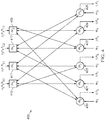
- FIG. 4 illustrates a Tanner graph 400 of an iterative MPA processing technique to decode a signal carrying data streams transmitted according to the multi-layer SCMA transmission scheme 300.
- the multi-layered SCMA transmission scheme 300 assigns the codebooks 350, 351, 352, 353, 354, 355 to the SCMA layers 320, 321, 322, 323, 324, 325, respectively.
- Each of the SCMA layers 320, 321, 322, 323, 324, 325 are mapped to a different combination of sub-carrier frequencies in the set of subcarrier frequencies 310, 311, 312, 313 over which the data streams are communicated.
- the SCMA layer 320 maps to the subcarrier frequencies 311, 313, the SCMA layer 321 maps to the subcarrier frequencies 310, 312, the SCMA layer 322 maps to the subcarrier frequencies 310, 311, the SCMA layer 323 maps to the subcarrier frequencies 312, 313, the SCMA layer 324 maps to the subcarrier frequencies 310, 313, and the SCMA layer 325 maps to the subcarrier frequencies 311, 312.
- two devices e.g. two different UEs
- a receiver may still be able to decode the two messages.
- codewords Based on the codebook or codebooks from the multi-layer SCMA transmission scheme assigned to a given data stream, samples from that data stream are encoded into codewords using the appropriate codebook. In the case of multiple codebooks, i.e., layers, being assigned to a given data stream, the codewords may be summed together prior to transmission. Each codeword within a respective codebook maps a different combination of symbols to the respective combination of sub-carrier frequencies. The data streams are then transmitted over a wireless network to a receiver.
- function nodes (FNs) 410, 411, 412, 413 of an SCMA decoder exchange messages with variable nodes (VNs) 420, 421, 422, 423, 424, 425 of the SCMA decoder in order to iteratively decode data streams of the received signal.
- the FNs 410, 411, 412, 413 are interconnected to the VNs 420, 421, 422, 423, 424, 425 via edges, which are represented by the lines in FIG. 4 .
- the FNs 410, 411, 412, 413 calculate codeword probabilities based on information corresponding the respective sub-carrier frequencies during a first iteration of MPA signal processing.
- This information corresponding to the respective sub-carrier frequencies may include signal samples (y0, y1, y2, y3), channel estimation information (h0, h1, h2, h3), and noise information (N 0, N 1, N 2, N3).
- the FNs 410, 411, 412, 413 then send the codeword probabilities in messages to the respective VNs 420, 421, 422, 423, 424, 425 over the respective edges.
- the VNs 420, 421, 422, 423, 424, 425 may then compute codeword probabilities based on the messages received from FNs 410, 411, 412, 413 as well as APP values (ap0, ap1, ap2, ap3, ap4, ap5).
- APP values ap0, ap1, ap2, ap3, ap4, ap5
- the APP values used by the VNs 420, 421, 422, 423, 424, 425 indicate an equal probability for all of the codewords.
- the VNs 420, 421, 422, 423, 424, 425 may use the APP values provided by the APP processor.
- the VNs 420, 421, 422, 423, 424, 425 send the codeword probabilities in messages to the respective FNs 410, 411, 412, 413 over the respective edges.
- the FNs 410, 411, 412, 413 then use the codeword probabilities in the messages received from the VNs 420, 421, 422, 423, 424, 425 in addition to the information related to their corresponding sub-carrier frequency to compute/update their codeword probabilities.
- the codebooks maintained by the VNs 420, 421, 422, 425 425 may initially include an entire set of the codewords in the codebooks 350, 351, 352, 353, 354, 355 (respectively) used to transmit the data streams over the SCMA layers 350, 351, 352, 353, 354, 355.
- the pruned codebooks maintained by the VNs 420, 422, 425 may contain a sub-set of the codewords (e.g., fewer than all codewords) in the codebooks 350, 352, and 355 (respectively) used to transmit the data streams.
- FIG. 5 illustrates an example of an iteration of a message exchange from the point of view of the FN 411.
- the initial messages from the FNs to the VNs are not depicted.
- the FN 411 first receives messages 510, 512, 515 from the VNs 420, 422, 425 (respectively).
- the messages 510, 512, 515 include codeword probabilities computed by the VNs 420, 422, 425.
- the message 510 includes a set of codeword probabilities for codewords in a codebook maintained by the VN 420
- the message 522 includes a set of codeword probabilities for codewords in a codebook maintained by the VN 422
- the message 515 includes a set of codeword probabilities for codewords in a codebook maintained by the VN 425.
- the FN 411 then generates the messages 520, 522, 525, and sends the messages 520, 522, 525 to the VNs 420, 422, 425.
- the message 520 includes codeword probabilities for the set of codeword probabilities for codewords in the codebook maintained by the VN 420.
- Codeword probabilities in the message 520 are generated as a function of the codeword probabilities in the messages 512, 515 as well as signal samples (y1), channel estimation information (h1), and noise information (N1) corresponding to the sub-carrier frequency 311 assigned to the FN 411.
- the message 522 includes codeword probabilities for the set of codeword probabilities for codewords in the codebook maintained by the VN 422
- the message 525 includes codeword probabilities for the set of codeword probabilities for codewords in the codebook maintained by the VN 425.
- Codeword probabilities in the message 522 are calculated as a function of the codeword probabilities in the messages 510, 515 and the signal samples (y1), channel estimation information (h1), and noise information (N1) corresponding to the sub-carrier frequency 311 assigned to the FN 411.
- Codeword probabilities in the message 525 are calculated as a function of the codeword probabilities in the messages 510, 512 and the signal samples (y1), channel estimation information (h1), and noise information (N1) corresponding to the sub-carrier frequency 311 assigned to the FN 411.
- the number of codewords in the codebooks maintained by the VNs 420, 422, and 425 is directly related to the number of codeword probabilities that are calculated by the FN 411. It should also be appreciated that the number of codewords in the codebook maintained by the VN 420 directly affects the number of interfering codewords that are taken into consideration when generating the messages 522, 525.
- the number of codewords in the codebook maintained by the VN 422 directly affects the number of interfering codewords that are taken into consideration when generating the messages 520, 525
- the number of codewords in the codebook maintained by the VN 425 directly affects the number of interfering codewords that are taken into consideration when generating the messages 520, 522.
- pruning the codebooks maintained by the VNs 420, 422, and 425 may reduce the computational complexity at the FN 411.
- FIG. 6 illustrates an example of iterative message exchange from the point of view of the VN 422.
- the VN 422 receives messages 610, 611 from the FNs 410, 411 respectively.
- the messages 610, 611 include codebook probabilities for codewords in a codebook maintained by the VN 422.
- the codebook probabilities in the message 610 are computed as a function of the signal samples (y0), channel estimation information (h0), and noise information (N0) corresponding to the sub-carrier frequency 310 assigned to the FN 410.
- the codebook probabilities in the message 610 may also be computed as a function of codebook probabilities in messages communicated from the VNs 420, 421 to the FN 410 during a previous iteration.
- the codebook probabilities in the message 611 are computed as a function of the signal samples (y1), channel estimation information (h1), and noise information (N1) corresponding to the sub-carrier frequency 311 assigned to the FN 411. If the depicted iteration is a subsequent iteration (e.g., not the first iteration of the current inner feedback loop), then the codebook probabilities in the message 611 may also be computed as a function of codebook probabilities in messages communicated from the VNs 424, 425 to the FN 411 during a previous iteration.
- the VN 422 Upon reception of the messages 610, 611, the VN 422 computes codebook probabilities for codewords in the codebook maintained by the VN 422, and then sends the codebook probabilities to the FNs 410, 411 via the messages 620, 621.
- the set of codebook probabilities communicated in the message 620 are calculating as a function of information in the message 611 and APP values (ap2) associated with the codebook maintained by the VN 422.
- the set of codebook probabilities communicated in the message 621 are calculating as a function of information in the message 610 and the APP values (ap2) associated with the codebook maintained by the VN 422.
- the number of codewords in the codebook maintained by the VN 422 is directly related to the number of codeword probabilities that are calculated by the VN 422.
- pruning the codebook maintained by the VN 422 may reduce the computational complexity at the VN 422.
- a message passing algorithm may be used for decoding the transmitted data.
- MPA message passing algorithm
- One example of an encoding scheme is a convolutional code. Convolutional codes operate on streams of bits or symbols having an arbitrary length. Convolutional codes may be soft decoded, for example using the Viterbi algorithm or another soft decoding algorithm. A convolutional code which is terminated is also a block code. Terminated convolutional codes include tail-biting and bit-flushing codes.
- Block codes operate on fixed size blocks, or packets, of bits or symbols having a predetermined size. Block codes may be hard-determined in polynomial time to their block length. Block codes include classical block codes and modern block codes.
- Classical block codes include Reed-Solomon coding, Golay coding, Bose Chauduri Hocquengham (BCH) coding, multidimensional parity coding, and Hamming coding.
- Modern block codes include low-density parity check (LDPC) coding.
- LDPC codes are highly efficient linear block codes made from many single parity check (SPC) codes.
- Concatenated codes incorporate both a classical block coding and a convolutional coding.
- Turbo coding is an iterated soft-decoding scheme which combines two or more convolutional codes and an interleaver to produce a block code.
- Rateless Fountain Codes include Luby Transform (LT) codes.
- the code words of an LT code are generated based on k information symbols based on a probability distribution on the numbers 1, ... , k. Each codeword symbol is obtained independently, by first sampling the distribution to obtain a number d, and adding the values of d randomly chosen information symbols.
- Raptor codes are a modified version of LT codes, where the information sequence of k symbols is pre-coded by a high rate block code, and n symbols are used to generate the Raptor codeword symbols as in LT codes.
- Polar codes Another encoding method involves polar codes.
- a polar code is a linear block error correcting code.
- Polar codes can be systematic or non-systematic.
- SCMA is a non-orthogonal multiple access scheme, using sparse codebooks to convey user data symbols.
- SCMA typically requires an advanced receiver that can be implemented with reasonable complexity that is made possible by the sparsity of SCMA codebooks
- An embodiment method of decoding involves an inner MPA which uses feedback information from a soft decoding outer iterative decoder.
- a priori knowledge of the received encoded data fed back by the outer decoder to the inner MPA can be used to reduce the MPA decoding schedule by eliminating highly unlikely possibilities from computations.
- the feedback information may take the form of a priori probabilities or log-likelihood ratios (LLRs).
- LLRs log-likelihood ratios
- the decoding process considers every alphabet entry in the initial set of inner loop iterations.
- the alphabet may be reduced to include only a subset of the alphabet entries, or only one alphabet entry, when the feedback indicates that alphabet entries outside the subset are highly unlikely.
- a subset of an alphabet is determined to be unlikely, leaving another subset, which is evaluated.
- an extreme value is assigned to the likelihood value of that alphabet entry, which is used within a function node update, and another LLR corresponding to the extreme value is assigned to the MPA output for that variable node.
- the complexity of an MPA based decoder for coding schemes such as SCMA, low density signature-orthogonal frequency-division multiplexing (LDS-OFDM), LDPC codes, or another forward error correction (FEC) code, may be used with a priori knowledge of bits being decoded.
- the MPA may use the soft output of the outer decoder. Knowing a priori that certain encoded bits are highly likely to be the correct bits may facilitate assigning a high likelihood value to the known values, and reducing the MPA update schedules to avoid considering unlikely bit values.
- An embodiment reduces the complexity of an inner MPA decoding function using a priori knowledge feedback from a soft decision outer decoder.
- SCMA decoders typically make use of an MPA processor for recovery of the transmitted SCMA codewords.
- the relationship between SCMA codebooks, which spread their codewords across the same resource elements (REs) and subcarriers, along with the MPA used to decode these codewords, may be visualized using a Tanner graph.
- Each Tanner graph node works in isolation, only accessing the messages on its connected edges.
- An edge is the link in the Tanner graph that connects two nodes.
- the messages that are exchanged between FNs and VNs are probabilities that represent a level of belief regarding the possible received codewords.
- the FNs compute messages to send across the edges to their connected VNs.
- each VN computes messages to send across the edges to the connected FNs.
- the FNs receive extrinsic information as input.
- FN 410 receives y0, h0, and N0,0
- FN 411 receives y1, h1, and N0,1
- FN 116 receives y2, h2, and N0,2,
- FN 118 receives y3, h3, and N0,3, where yn is the received signal vector on subcarrier n, hn is the channel estimation for subcarrier n, and N0,n is the noise estimate for subcarrier n.
- the FNs perform calculations, and send messages to their connected VNs.
- the VNs receive information from the connected FNs and use these messages, along with the input ap values to generate messages for the FNs as discussed above. This process can be repeated until a stopping criterion is reached.
- the kth variable node, VNk represents the transmitted SCMA codeword using the codebook ck being recovered in the node.
- VNk is connected to dv FNs.
- the VNs output a vector, where each element represents the LLR of that bit having been 0 when encoded by the transmission SCMA encoder based on ck.
- the messages are refined in each iteration, with information flowing from the different nodes in the MPA.
- the messages passed to FNn are based on the messages from the previous decoder iteration from all other FNs connected to VNk, using the notation: I q k ⁇ c n ⁇
- the messages passed to VNk are based on the messages from the previous decoder iteration from all other VNs connected to FNn, using the notation: I c n ⁇ q k .
- the messages contain extrinsic information, because the sending node computes the messages with information from all connected nodes besides the destination node.
- Standard MPA implementations are computationally expensive.
- the computation of values at the FNs is particularly computationally expensive due to the computationally intensive nature of determining values for each edge.
- SCMA Codeword Division Multiple Access
- four values correspond to possible codewords within the codebook.
- a bit is fixed, half of the possible codewords, or alphabets, may be discarded.
- a new codebook is obtained.
- the decoding schedule in MPA processor 222 is adjusted based on the fixed bits (i.e. based on the new codebook).
- a new cycle with a set of MPA iterations is performed, to obtain a new set of LLRs, which are sent to the FEC. This is repeated until the codeword is decoded.
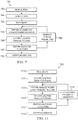
- FIG. 7 illustrates flowchart 740 for an embodiment method of decoding using an MPA.
- a signal is received by a system.
- the received signal corresponds to an encoded that has been transmitted and received by a receiver.
- the received signal is sampled to obtain a sequence of samples.
- a fast Fourier transform (FFT) is performed on the sequence of samples.
- the FFT (which may be implemented as a discrete Fourier transform (DFT)) is used convert the sequence of samples from the time domain to the frequency domain.
- DFT discrete Fourier transform
- An FFT may be used to rapidly compute the transform by factorizing the DFT matrix into a product of sparse factors.
- step 746 decoding is performed using an MPA on the sampled received signal.
- the MPA is done based on the received samples and a decoder codebook, and may take into account other information including channel and noise models.
- the MPA is performed without the use of APP feedback values (as during the first iteration, there have been no APPs generated so all codewords in active the codebooks/layers are considered to be equally likely to have been transmitted).
- the iterative process is repeated until a stopping criterion is met. In some embodiments, a set of stopping criteria may be reached if either a set number of iterations have occurred or until the results sufficiently converge.
- the LLRs may optionally be converted from parallel to serial.
- the MPA completes the inner iterations, it has a set of LLRs available as output.
- These LLRs are typically provided to a FEC processor in series. Those skilled in the art will appreciate that the serialization of the LLRs may not be necessary depending on the design of a FEC processor.
- SISO soft-in soft-out
- a SISO decoder is a type of soft-decision decoder commonly used with error correcting codes. Soft-in refers to the fact that the incoming data may have values between 0 and 1 to indicate reliability. Similarly, soft-out refers to the fact that each bit in the decoded output also takes on a value indicating reliability.
- step 750 a decision on the decoding is made. If the results are found to have sufficient confidence, the decoding process can stop and the decoded bit values are output in step 752. The decoded bit values may be transmitted for use. If the decoding process has not concluded in step 750, a set of LLRs is provided as the input for an a priori probability generation in step 754. The a priori probability values are fed back to the MPA. This is the conclusion of a single outer loop iteration. A subsequent inner loop set of iterations of the MPA is performed in step 746. In subsequent inner loop iterations, codewords may be removed from the alphabet based on the feedback values.
- the alphabet is reduced when some, but not all, of the a priori probability values are extreme. When all of the a priori probability values are extreme, MPA operations related to this VN are not performed, and the LLR values corresponding to the extreme a priori probability values are automatically output. The values for other VNs (which do not have extreme APP or LRR values) are still computed.
- step 746 the APP values from step 154 are used as an initial condition in step 746.
- An APP value indicates the likelihood of a codeword in the alphabet. This information can be used in the iterations, and can also be used to determine that codewords (or groups of codewords) can be removed from the alphabet. In other embodiments, the pruning of the codebook can be based on the LLR output by the FEC.
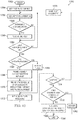
- FIG. 8 illustrates flowchart 860 for an embodiment method of MPA calculation using alphabet reduction. This method may be performed for MPA iterations after the initial iteration.
- the feedback values such as a priori probability values or LLR values.
- the probability values received in step 861 indicate the likelihood of the different bits being either a 0 or a 1.
- An extreme likelihood value in comparison to either a threshold or to the other probability values, indicates a very strong likelihood of a particular value.
- the system determines whether at least one LLR value is extreme.
- an LLR value is extreme it indicates a very high level of certainty for a bit value.
- the a priori probability values are four bits and range from zero to fifteen, where zero indicates that the LLR value is 0 and a fifteen indicates that the LLR value is 1.
- values of 1, 2, 13, and 14 are considered to be extreme values.
- only values of 1 and 14 are considered to be extreme values.
- eight bits are used, and the a priori probability values range from zero to 127.
- the feedback values are identified as being extreme by comparing them to a predefined threshold.
- the feedback value is compared one or more dynamic threshold based on some rule set.
- the feedback value is compared to other feedback values to determine if it is extreme. For example, when the MPA is initialized, the a priori values are set to the same value. This avoids pruning of the alphabet in the first set of iterations. At the end of the first outer iteration, the LLRs from the FEC can be used as feedback values. If there is an identified extreme value, pruning of the alphabet can occur. In another example, if all feedback values are similar, it can be concluded that the feedback does not provide sufficient information to justify prune the alphabet
- step 870 When none of the LLR values are extreme, the system proceeds to step 870 to run the MPA without reducing the alphabet. When at least one a LLR value is extreme, the system proceeds to step 864.
- step 864 the system determines whether all of the LLR values are extreme. When some, but not all, of the LLR values are extreme, the system proceeds to step 866 to perform alphabet reduction. When all of the feedback values are extreme, the system proceeds to step 872.
- step 864 If, in step 864, all LLRs are extreme and are indicative of the same result, the MPA process can be skipped in step 872 and the inner loop ends in step 874.
- the alphabet can be reduced to a subset alphabet based on the extreme feedback values in step 866. Bit values associated with the extreme feedback values are fixed, and only the codewords having bits corresponding to the fixed bits are considered.
- step 868 an updated computation schedule is calculated based on the pruned subset of the alphabet that forms the new alphabet. Only the calculations which use the reduced alphabet are used. Then, the system proceeds to step 870
- step 870 the MPA is performed. If the alphabet has been pruned, only the reduced alphabet is used during the MPA. The MPA is performed iteratively until a stopping point is reached.
- ⁇ ⁇ 1
- ⁇ n y n ⁇ ⁇ i N o ⁇ ,n h n I q a ⁇ c n ⁇ I q b ⁇ c n ⁇ , for i 1, ... , Ickl, where n indicates the FN and k indicates the VN. Also: I c n ⁇ q k indicates the ith message from FN n along the edge to VN k, and I q k ⁇ c n indicates the ith message from VN k along the edge to FN n.
- a bias or scaling may be applied to: ⁇ n y n ⁇ ⁇ i N o , n h n , and to: I c n ⁇ q k ( i ) .
- and ⁇ 1,..,
- a log-MAP max-log-MAP variant is used for the MPA where the messages are comprised of log-likelihood value representations instead of probabilities or likelihoods.
- FIG. 9 illustrates flowchart 980 for an embodiment method of variable node message updating, for example using an LDPC code.
- the variable node determines whether there is only one remaining codeword in the pruned codebook. If there is only one codeword, the method proceeds to step 986.
- the variable node sets the edge message to an appropriate extreme value. When the feedback value is not extreme, the variable node proceeds to step 984.
- the variable node sets updates the edge messages for the parity check nodes normally.
- FIG. 10 illustrates flowchart 1090 for a method at either a parity check node or a function node.
- the node determines whether the pruned codebook associated with the target VN has only 1 codeword. When this condition is satisfied, the process continues to step 1096, an in the alternate proceeds to step 1094.
- the node does not perform an update for the edge associated with the VN with a 1 entry codebook.
- the node updates the edge messages normally.
- FIG. 11 illustrates flowchart 1100 for an embodiment method of decoding using an MPA.
- the method starts with the receipt of LLR values as the feedback values. If these values are received in series an optional step 1104 is performed to ensure that the LLR values are provided to the MPA processor in parallel.
- step 1106 the system performs an MPA decoding process.
- the MPA decoding is performed assuming that all codewords are equally likely.
- APP values are received that provide different initial conditions for the MPA based on the likelihood of different codewords.
- step 1108 LLR values from the MPA decoding are optionally converted from a parallel set of LLRs to serial set LLRs so that they can be transmitted to an FEC processor designed for receipt of a series of LLR values.
- FEC processor designed for receipt of a series of LLR values.
- step 1110 the system performs FEC decoding (e.g. SISO outer FEC decoding) on the LLRs. If stopping conditions for the outer iterative loop have been met, then the system can output the decoded bits in step 1112. If the stopping conditions are not met, then the FEC decoder provides a set of LLRs as output. These LLRs are used both as feedback to the MPA, and in the generation of APP values.
- FEC decoding e.g. SISO outer FEC decoding
- step 1114 the system generates a priori probability values.
- the a priori probability values are fed back to the MPA decoding in step 1106.
- the LLRs from step 210 are also used to prune the codebook based on bit level confidence as described above. This allows some codewords to be removed from the alphabet which reduces the number of calculations in subsequent iterations..
- the decoding process can terminate with step 1112 in which the decoded bits are output.
- FIG. 12 illustrates flowchart 1220 for an embodiment method of performing a turbo MPA.
- the method starts.
- the system receives new signal information.
- the new signal information is a new signal.
- the system runs an iterative MPA. The MPA iterations are performed until stopping conditions are met.
- the iterative MPA generates a set of LLRs as its output which is provided as the input to a FEC process.
- FEC is performed using the LLR values determined in step 1236.
- step 1240 the system determines whether stopping conditions for the iterative outer loop have been met. When stopping conditions have been met, the system proceeds to step 1242 where the decoded bits are output and the process ends at step 1244 When stopping conditions have not been met, the method continues to step 1222.
- step 1222 the LLR values output by the FEC are used to generate a priori probability values.
- the APP values are provided to the MPA in step 1224 where they replace the APP values used in the previous inner loop iterations.
- step 1226 the MPA decoding schedule is updated to prune codewords from the available codebook. Then, the system proceeds to step 1232 to again run the MPA with the reduced alphabet.
- FIG. 13 illustrates flowchart 1350 for an embodiment method of a priori probability processing.
- the method starts.
- the system sets the first VN to be the current VN.
- the system determines new a priori probabilities (APPs) for the current VN.
- the system cycles through the APPs.
- the system determines whether an APP indicates an extremely low likelihood. When the APP does not indicate an extremely low likelihood, the system proceeds to step 1362. On the other hand, when the APP indicates an extremely low likelihood, the system proceeds to step 1360. In step 1360, the APP is flagged as unlikely. Then, the system proceeds to step 1362.
- step 1362 the system determines whether the last APP examined is the last APP for the current APP. When the APP is the last APP for the current VN, the system proceeds to step 1364. On the other hand, when the APP is not the last APP for the current VN, the system proceeds to step 1356 to examine the next APP for the current VN. In step 1364, the system determines whether all APPs in the VN have been flagged. When all APPs in the VN have been flagged, the system proceeds to step 1366. When not all of the APPs in the VN have been flagged, the system proceeds to step 1368.
- step 1366 the system removes all flags. When all of the APPs in the VN are flagged, the flagging of the APPs is not useful, because it is not desirable to prune all of the APPs. Then, the system proceeds to step 1372.
- step 1368 the system prunes unlikely codewords from the alphabet.
- step 1370 the system prunes the MPA schedule of operations to reflect the pruned alphabet of the current VN.
- step 1372 the system initializes VN to FN messages from the current VN.
- step 1374 the system determines whether the current VN is the last VN. When the current VN is not the last VN, the system proceeds to step 1376. On the other hand, when the current VN is the last VN, the system proceeds to step 1378.
- step 1376 the system proceeds to the next VN, and assigns the next VN to be the current VN. Then, the system proceeds to step 1356 do determine the APPs for the next VN.
- step 1378 the system determines whether there is only one remaining codeword per VN. When there is only one remaining codeword per VN, the system proceeds to step 1380. When there is more than one remaining codeword for at least one VN, the system proceeds to step 1382.
- step 1380 the system generates extreme LLR values based on the remaining codewords for each VN output. Then, the system proceeds to step 1384, and the method ends.
- step 1382 the system runs the MPA. Also, the system proceeds to step 1384, and the method ends.
- the MPA may be performed serially or in parallel. Parallel processing is faster. However, alphabet reduction may have a greater impact on speed in a serial implementation. In parallel implementations, the hardware not in use may be powered down to same energy. In some embodiments, the computational complexity is reduced. The reduction in computational complexity may be an exponential reduction in computation, and may lead to a reduction in the time spent and power consumed by the decoding process. Also, an embodiment may strengthen the decoding capabilities, leading to quicker convergence. In an embodiment, the decoder hardware requirements are reduced, along with the decoding latency.
- FIG. 14 illustrates a block diagram of an embodiment processing system 1400 for performing methods described herein, which may be installed in a host device.
- the processing system 1400 includes a processor 1404, a memory 1406, and interfaces 1410-1414, which may (or may not) be arranged as shown in FIG. 14 .
- the processor 1404 may be any component or collection of components adapted to perform computations and other processing related tasks
- the memory 1406 may be any component or collection of components adapted to store programming and instructions for execution by the processor 1404.
- the memory 1406 includes a non-transitory computer readable medium.
- the interfaces 1410, 1412, 1414 may be any component or collection of components that allow the processing system 1400 to communicate with other devices/components and a user.
- one or more of the interfaces 1410, 1412, 1414 may be adapted to communicate data, control, or management messages from the processor 1404 to applications installed on the host device or a remote device.
- one or more of the interfaces 1410, 1412, 1414 may be adapted to allow a user or user device (e.g., personal computer (PC), etc.) to interact/communicate with the processing system 1400.
- the processing system 1400 may include additional components not depicted in FIG. 14 , such as long term storage (e.g., non-volatile memory, etc.).
- the processing system 1400 is included in a network device that is accessing, or part otherwise of, a telecommunications network.
- the processing system 1400 is in a network-side device in a wireless or wireline telecommunications network, such as a base station, a relay station, a scheduler, a controller, a gateway, a router, an applications server, or any other device in the telecommunications network.
- the processing system 1400 is in a user-side device accessing a wireless or wireline telecommunications network, such as a mobile station, a user equipment (UE), a personal computer (PC), a tablet, a wearable communications device (e.g., a smartwatch, etc.), or any other device adapted to access a telecommunications network.
- a wireless or wireline telecommunications network such as a mobile station, a user equipment (UE), a personal computer (PC), a tablet, a wearable communications device (e.g., a smartwatch, etc.), or any other device adapted to access a telecommunications network.
- FIG. 15 illustrates a block diagram of a transceiver 1500 adapted to transmit and receive signaling over a telecommunications network.
- the transceiver 1500 may be installed in a host device. As shown, the transceiver 1500 comprises a network-side interface 1502, a coupler 1504, a transmitter 1506, a receiver 1508, a signal processor 1510, and a device-side interface 1512.
- the network-side interface 1502 may include any component or collection of components adapted to transmit or receive signaling over a wireless or wireline telecommunications network.
- the coupler 1504 may include any component or collection of components adapted to facilitate bi-directional communication over the network-side interface 1502.
- the transmitter 1506 may include any component or collection of components (e.g., up-converter, power amplifier, etc.) adapted to convert a baseband signal into a modulated carrier signal suitable for transmission over the network-side interface 1502.
- the receiver 1508 may include any component or collection of components (e.g., down-converter, low noise amplifier, etc.) adapted to convert a carrier signal received over the network-side interface 1502 into a baseband signal.
- the signal processor 1510 may include any component or collection of components adapted to convert a baseband signal into a data signal suitable for communication over the device-side interface(s) 1512, or vice-versa.
- the device-side interface(s) 1512 may include any component or collection of components adapted to communicate data-signals between the signal processor 1510 and components within the host device (e.g., the processing system 1400, local area network (LAN) ports
- the transceiver 1500 may transmit and receive signaling over any type of communications medium.
- the transceiver 1500 transmits and receives signaling over a wireless medium.
- the transceiver 1500 may be a wireless transceiver adapted to communicate in accordance with a wireless telecommunications protocol, such as a cellular protocol (e.g., long-term evolution (LTE), etc.), a wireless local area network (WLAN) protocol (e.g., Wi-Fi, etc.), or any other type of wireless protocol (e.g., Bluetooth, near field communication (NFC), etc.).
- the network-side interface 1502 comprises one or more antenna/radiating elements.
- the network-side interface 1502 may include a single antenna, multiple separate antennas, or a multi-antenna array configured for multi-layer communication, e.g., single input multiple output (SIMO), multiple input single output (MISO), multiple input multiple output (MIMO), etc.
- the transceiver 1500 transmits and receives signaling over a wireline medium, e.g., twisted-pair cable, coaxial cable, optical fiber, etc.
- Specific processing systems or transceivers may utilize all of the components shown, or only a subset of the components, and levels of integration may vary from device to device.
Landscapes
- Engineering & Computer Science (AREA)
- Physics & Mathematics (AREA)
- Probability & Statistics with Applications (AREA)
- Theoretical Computer Science (AREA)
- Error Detection And Correction (AREA)
- Computer Networks & Wireless Communication (AREA)
- Signal Processing (AREA)
Claims (14)
- Verfahren zum Decodieren von drahtlosen "Sparse Coded Multiple Access"SCMA-Signalen, umfassend:Empfangen einer Folge von Abtastwerten, die für ein von einer Vorrichtung empfangenes Signal repräsentativ sind, durch einen "Message Passing Algorithm" MPA-Prozessor (222);Empfangen oder ansonsten Erzeugen einer oder mehrerer Wahrscheinlichkeiten, die Codewörtern eines Codebuchs zugeordnet sind, das einem Datenstrom im empfangenen Signal zugewiesen sind, wobei die eine oder mehreren Wahrscheinlichkeiten die Likelihood anzeigen, dass ein oder mehrere Codewörter im Codebuch im Datenstrom getragen werden;Entfernen von Codewörtern aus dem Codebuch gemäß den Wahrscheinlichkeiten, deren Likelihood, im Datenstrom übertragen zu werden, kleiner als ein Wahrscheinlichkeitsschwellenwert ist, um ein verkürztes Codebuch zu erhalten, wobei das verkürzte Codebuch das mindestens eine Codewort ausschließt, wobei der Wahrscheinlichkeitsschwellenwert vorgegeben ist oder wobei der Wahrscheinlichkeitsschwellenwert auf den relativen Wahrscheinlichkeiten von Codewörtern in dem Codebuch basiert;Verarbeiten der empfangenen Folge von Abtastwerten gemäß dem verkürzten Codebuch durch den MPA-Prozessor (222), um weiche Entscheidungswerte entsprechend dem empfangenen Signal zu erzeugen; undSenden der weichen Entscheidungswerte an einen "Forwad Error Correction" FEC-Decoder (226).
- Verfahren nach Anspruch 1, wobei das Verarbeiten der empfangenen Folge von Abtastwerten umfasst:
Austausch von "Belief Propagation" Nachrichten für Codewörter, die im verkürzten Codebuch verbleiben, zwischen Knoten des MPA-Prozessors während des Satzes von MPA-Iterationen, ohne Austausch von "Belief Propagation" Nachrichten für das mindestens eine Codewort, das aus dem verkürzten Codebuch ausgeschlossen ist; und Erzeugen der weichen Entscheidungswerte basierend auf der Reihenfolge der Abtastwerte und den ausgetauschten "Belief Propagation" Nachrichten. - Verfahren nach Anspruch 1, wobei die empfangene Wahrscheinlichkeit ein "Log Likelihood Ratio" LLR ist, das ein Vorzeichenbit für ein gegebenes binäres Bit im Datenstrom und einen Satz von Größenbits anzeigt, die einen Vertrauensgrad in die Genauigkeit des Vorzeichenbits anzeigen.
- Verfahren nach Anspruch 3, wobei das LLR von dem FEC-Decoder (226) empfangen wird.
- Verfahren nach Anspruch 1, wobei das Verarbeiten der empfangenen Folge von Abtastwerten gemäß dem verkürzten Codebuch zum Erzeugen von weichen Entscheidungswerten entsprechend dem empfangenen Signal umfasst:Empfangen von Nachrichten, die Codewörtern entsprechen, die im verkürzten Codebuch verbleiben, von variablen Knoten im MPA-Prozessor (222) durch einen Funktionsknoten des MPA-Prozessors (222), ohne von den variablen Knoten Nachrichten zu empfangen, die dem mindestens einen Codewort entsprechen, das aus dem verkürzten Codebuch ausgeschlossen ist; undVerteilen der empfangenen Nachrichten auf die variablen Knoten.
- Verfahren nach Anspruch 1, wobei das Verarbeiten der empfangenen Folge von Abtastwerten gemäß dem verkürzten Codebuch zum Erzeugen von weichen Entscheidungswerten entsprechend dem empfangenen Signal umfasst:Empfangen von Informationen über das empfangene Signal von Funktionsknoten des MPA-Prozessors (222) durch einen variablen Knoten des MPA-Prozessors (222); undBerechnen von Wahrscheinlichkeiten, dass Codewörter, die im verkürzten Codebuch verbleiben, im Datenstrom übertragen wurden, ohne Wahrscheinlichkeiten zu berechnen, dass das mindestens eine aus dem verkürzten Codebuch ausgeschlossene Codewort im Datenstrom übertragen wurde, basierend auf den Informationen.
- Verfahren nach Anspruch 1, wobei der Schritt des Verarbeitens der empfangenen Folge von Abtastwerten das Erzeugen eines Berechnungsplans umfasst, um Operationen auszuschließen, die mit Nachrichten verbunden sind, die sich auf aus dem Alphabet geschnittene Codewörter beziehen.
- Decoder (200) zum Decodieren von drahtlosen "Sparse Code Multiple Access" SCMA-Signalen, wobei der Decoder (220) umfasst:Einen "Forwad Error Correction" FEC-Decoder (226); undeinen "Message Passing Algorithm" MPA-Prozessor (222), der mit dem FEC-Decoder (226) gekoppelt ist, wobei der MPA-Prozessor (222) zum Empfangen einer Folge von Abtastwerten ausgelegt ist, die für ein empfangenes Signal von einer Vorrichtung repräsentativ sind, um eine oder mehrere Wahrscheinlichkeiten zu empfangen oder anderweitig zu erhalten, die Codewörtern eines Codebuchs zugeordnet sind, das einem Datenstrom in dem empfangenen Signal zugewiesen ist, wobei die eine oder die mehreren Wahrscheinlichkeiten die Likelihood anzeigen, dass ein oder mehrere Codewörter im Codebuch im Datenstrom übertragen werden, um gemäß den Wahrscheinlichkeiten alle Codewörter aus dem Codebuch zu entfernen, deren Likelihood, im Datenstrom getragen zu werden, kleiner als ein Wahrscheinlichkeitsschwellenwert ist, um ein verkürztes Codebuch zu erhalten, wobei das verkürzte Codebuch das mindestens eine Codewort ausschließt, um die empfangene Folge von Abtastwerten gemäß dem verkürzten Codebuch zu verarbeiten, um weiche Entscheidungswerte zu erzeugen, die dem empfangenen Signal entsprechen, und um die weichen Entscheidungswerte an den "Forward Error Correction" FEC-Decoder (226) zu senden, wobei der Wahrscheinlichkeitsschwellenwert vorgegeben ist oder wobei der Wahrscheinlichkeitsschwellenwert auf den relativen Wahrscheinlichkeiten von Codewörtern im Codebuch basiert.
- Decoder nach Anspruch 8, wobei die eine oder mehreren Wahrscheinlichkeiten einen Codewort-Wahrscheinlichkeitswert, einen "A Priori Probability" APP-Wert, oder ein "Log Likelihood Ratio" LLR beinhalten.
- Decoder nach Anspruch 9, wobei das LLR ein Vorzeichenbit für ein gegebenes binäres Bit im Datenstrom und einen Satz von Größenbits anzeigt, die einen Vertrauensgrad in der Genauigkeit des Vorzeichenbits anzeigen.
- Decoder nach Anspruch 8, wobei der MPA-Prozessor (222) zum Verarbeiten der empfangenen Folge von Abtastwerten gemäß dem verkürzten Codebuch ausgelegt ist, um weiche Entscheidungswerte zu erzeugen, die dem empfangenen Signal entsprechen durch:Empfangen von Nachrichten, die den im verkürzten Codebuch verbleibenden Codewörtern entsprechen, von variablen Knoten im MPA-Prozessor (222), ohne von den variablen Knoten Nachrichten zu empfangen, die dem mindestens einen Codewort entsprechen, das aus dem verkürzten Codebuch ausgeschlossen ist; undVerteilen der empfangenen Nachrichten auf die variablen Knoten.
- Decoder nach Anspruch 8, wobei der MPA-Prozessor (222) zum Verarbeiten der empfangenen Folge von Abtastwerten gemäß dem verkürzten Codebuch ausgelegt ist, um weiche Entscheidungswerte zu erzeugen, die dem empfangenen Signal entsprechen durch:Empfangen von Informationen über das empfangene Signal von Funktionsknoten des MPA-Prozessors (222); undBerechnen von Wahrscheinlichkeiten, dass Codewörter, die im verkürzten Codebuch verbleiben, im Datenstrom übertragen wurden, ohne Wahrscheinlichkeiten zu berechnen, dass das mindestens eine aus dem verkürzten Codebuch ausgeschlossene Codewort im Datenstrom übertragen wurde basierend auf den Informationen.
- Decoder nach Anspruch 8, wobei der MPA-Prozessor (222) zum Verarbeiten der empfangenen Folge von Abtastwerten durch Erzeugen eines Berechnungsplans ausgelegt ist, um Operationen auszuschließen, die mit Nachrichten verbunden sind, die sich auf aus dem Alphabet beschnittene Codewörter beziehen.
- Computerprogrammprodukt, umfassend ein computerlesbares Speichermedium, das die Programmierung speichert, wobei die Programmierung Anweisungen enthält zum:Empfangen einer Folge von Abtastwerten, die für ein von einer Vorrichtung empfangenes drahtloses "Sparse Code Multiple Access" SCMA-Signal repräsentativ sind, durch einen "Message Passing Algorithm" MPA-Prozessor (222);Empfangen oder ansonsten Erzeugen einer oder mehrerer Wahrscheinlichkeiten, die Codewörtern eines Codebuchs zugeordnet sind, das einem Datenstrom im empfangenen Signal zugewiesen sind, wobei die eine oder mehreren Wahrscheinlichkeiten die Likelihood anzeigen, dass ein oder mehrere Codewörter im Codebuch im Datenstrom getragen werden;Entfernen von Codewörtern aus dem Codebuch gemäß den Wahrscheinlichkeiten, deren Likelihood, im Datenstrom übertragen zu werden, kleiner als ein Wahrscheinlichkeitsschwellenwert ist, um ein verkürztes Codebuch zu erhalten, wobei der Wahrscheinlichkeitsschwellenwert vorgegeben ist oder wobei der Wahrscheinlichkeitsschwellenwert auf den relativen Wahrscheinlichkeiten von Codewörtern in dem Codebuch basiert;Verarbeiten der empfangenen Folge von Abtastwerten gemäß dem verkürzten Codebuch durch den MPA-Prozessor (222), um weiche Entscheidungswerte entsprechend dem empfangenen Signal zu erzeugen; undSenden der weichen Entscheidungswerte an einen "Forward Error Correction" (FEC-Decoder 226).
Applications Claiming Priority (2)
| Application Number | Priority Date | Filing Date | Title |
|---|---|---|---|
| US201562103926P | 2015-01-15 | 2015-01-15 | |
| PCT/US2016/013717 WO2016115531A1 (en) | 2015-01-15 | 2016-01-15 | System and method for a message passing algorithm |
Publications (3)
| Publication Number | Publication Date |
|---|---|
| EP3245745A1 EP3245745A1 (de) | 2017-11-22 |
| EP3245745A4 EP3245745A4 (de) | 2018-02-28 |
| EP3245745B1 true EP3245745B1 (de) | 2019-06-12 |
Family
ID=56406500
Family Applications (1)
| Application Number | Title | Priority Date | Filing Date |
|---|---|---|---|
| EP16738014.6A Active EP3245745B1 (de) | 2015-01-15 | 2016-01-15 | System und verfahren für einen nachrichtenübertragungsalgorithmus |
Country Status (3)
| Country | Link |
|---|---|
| US (1) | US9831895B2 (de) |
| EP (1) | EP3245745B1 (de) |
| WO (1) | WO2016115531A1 (de) |
Families Citing this family (22)
| Publication number | Priority date | Publication date | Assignee | Title |
|---|---|---|---|---|
| WO2016106728A1 (zh) * | 2014-12-31 | 2016-07-07 | 华为技术有限公司 | 数据传输的方法和设备 |
| US9942884B2 (en) * | 2015-05-15 | 2018-04-10 | Nokia Technologies Oy | Efficient uplink data indication techniques for MIMO-OFDMA transmission in WLAN |
| WO2017201704A1 (en) * | 2016-05-26 | 2017-11-30 | Nokia Technologies Oy | Codeword adaptation for non-orthogonal coded access |
| CN107846377B (zh) * | 2016-09-19 | 2021-08-03 | 华为技术有限公司 | 传输数据的方法和装置 |
| CN109906571B (zh) * | 2016-11-04 | 2021-11-05 | 北京易通峰联信息技术有限公司 | 数据传输方法及装置 |
| CN106656419B (zh) * | 2016-12-16 | 2019-11-29 | 西安电子科技大学 | 一种SCMA系统的Max-Log型MPA检测算法的性能补偿方法 |
| US10425824B2 (en) * | 2017-02-13 | 2019-09-24 | Qualcomm Incorporated | Hybrid indication scheme for enhanced mobile broadband and low latency communication multiplexing |
| CN106877980A (zh) * | 2017-03-08 | 2017-06-20 | 北京邮电大学 | 混合稀疏码多址接入方法 |
| CN107707329B (zh) * | 2017-08-28 | 2020-07-28 | 中南民族大学 | 稀疏码多址接入系统及其多用户检测方法 |
| EP3688879B1 (de) * | 2017-09-28 | 2024-06-12 | Fraunhofer-Gesellschaft zur Förderung der angewandten Forschung e.V. | Übertragung von daten durch mehrere benutzer über gemeinsame ressourcen |
| US10904073B2 (en) * | 2017-10-27 | 2021-01-26 | Hewlett Packard Enterprise Development Lp | Reassign standby user anchor controllers |
| KR102038144B1 (ko) * | 2017-11-29 | 2019-10-29 | 한국전자통신연구원 | 이동 통신 시스템에서의 다중 접속 간섭 완화 방법 및 장치 |
| CN110650539B (zh) * | 2018-06-26 | 2021-08-20 | 北京大学 | 一种基于scma的无线通信下行链路资源分配方法 |
| US10862637B2 (en) * | 2018-11-08 | 2020-12-08 | Huawei Technologies Co., Ltd. | Segment based reference signal |
| CN109586848B (zh) * | 2018-12-07 | 2021-05-18 | 南京邮电大学 | Scma系统中一种消息传递解码方法 |
| CN112840663B (zh) * | 2018-12-13 | 2024-05-03 | 深圳市欢太科技有限公司 | 视频编码方法、装置、电子设备及存储介质 |
| CN110113136B (zh) * | 2019-05-16 | 2021-11-16 | 南京邮电大学 | 一种scma系统中的解码方法 |
| KR102326291B1 (ko) * | 2020-08-24 | 2021-11-12 | 영남대학교 산학협력단 | Scma 신호를 다중 사용자에 대해 순차적으로 검출하는 검출 방법 및 장치 |
| CN113746601B (zh) * | 2021-09-06 | 2023-06-06 | 西安邮电大学 | 基于状态位置的scma接收检测方法 |
| WO2023167453A1 (ko) * | 2022-03-04 | 2023-09-07 | 삼성전자 주식회사 | 무선 통신 시스템에서 복호 장치 및 방법 |
| CN114337933B (zh) * | 2022-03-16 | 2022-06-24 | 南昌大学 | 基于scma的高速可见光通信系统及自适应编解码方法 |
| CN115632916A (zh) * | 2022-06-01 | 2023-01-20 | 北京理工大学 | 一种基于列表球形译码的otfs—scma系统低复杂度信号检测方法 |
Family Cites Families (20)
| Publication number | Priority date | Publication date | Assignee | Title |
|---|---|---|---|---|
| US20060013181A1 (en) | 2002-07-31 | 2006-01-19 | Victor Stolpman | Apparatus, and associated method, for allocating communications in a multi-channel communication system |
| US7680201B2 (en) * | 2004-01-26 | 2010-03-16 | Ibiquity Digital Corporation | Forward error correction coding for AM 9kHz and 10kHz in-band on-channel digital audio broadcasting systems |
| WO2006039801A1 (en) * | 2004-10-12 | 2006-04-20 | Nortel Networks Limited | System and method for low density parity check encoding of data |
| US20070179760A1 (en) * | 2006-01-06 | 2007-08-02 | Intel Corporation | Method of determining graph isomorphism in polynomial-time |
| US8060803B2 (en) * | 2006-05-16 | 2011-11-15 | Nokia Corporation | Method, apparatus and computer program product providing soft iterative recursive least squares (RLS) channel estimator |
| US7405678B2 (en) * | 2006-09-25 | 2008-07-29 | International Business Machines Corporation | Method of retrieving data from a storage device using a recovered read-back parameter |
| US20100122143A1 (en) * | 2007-03-27 | 2010-05-13 | Hughes Network Systems, Llc | Method and system for providing low density parity check (ldpc) coding for scrambled coded multiple access (scma) |
| US20090132894A1 (en) * | 2007-11-19 | 2009-05-21 | Seagate Technology Llc | Soft Output Bit Threshold Error Correction |
| US8230294B2 (en) * | 2008-07-30 | 2012-07-24 | Ciena Corporation | Low density parity check (LDPC) decoder using broadcast messaging |
| US8347195B1 (en) * | 2009-01-22 | 2013-01-01 | Marvell International Ltd. | Systems and methods for near-codeword detection and correction on the fly |
| US8392789B2 (en) * | 2009-07-28 | 2013-03-05 | Texas Instruments Incorporated | Method and system for decoding low density parity check codes |
| EP2536029B1 (de) * | 2010-02-10 | 2021-03-31 | Sun Patent Trust | Kommunikationseinrichtung und verfahren dafür |
| US8650459B1 (en) * | 2011-02-16 | 2014-02-11 | Sk Hynix Memory Solutions Inc. | Soft input, soft ouput mappers and demappers for block codes |
| CN104769875B (zh) * | 2012-06-20 | 2018-07-06 | 安华高科技通用Ip(新加坡)公司 | 采用正交频分复用的高频谱效率传输 |
| US9240853B2 (en) * | 2012-11-16 | 2016-01-19 | Huawei Technologies Co., Ltd. | Systems and methods for sparse code multiple access |
| US9191256B2 (en) * | 2012-12-03 | 2015-11-17 | Digital PowerRadio, LLC | Systems and methods for advanced iterative decoding and channel estimation of concatenated coding systems |
| US9166663B2 (en) | 2012-12-14 | 2015-10-20 | Futurewei Technologies, Inc. | System and method for open-loop MIMO communications in a SCMA communications system |
| BR112015022981B8 (pt) | 2013-03-15 | 2022-08-09 | Huawei Tech Co Ltd | Método e componente de rede para detectar transmissões de assinatura de baixa densidade |
| US9509379B2 (en) | 2013-06-17 | 2016-11-29 | Huawei Technologies Co., Ltd. | System and method for designing and using multidimensional constellations |
| EP3148142B1 (de) * | 2014-06-30 | 2018-12-12 | Huawei Technologies Co. Ltd. | Decodierungsverfahren und -vorrichtung |
-
2016
- 2016-01-15 EP EP16738014.6A patent/EP3245745B1/de active Active
- 2016-01-15 US US14/997,297 patent/US9831895B2/en active Active
- 2016-01-15 WO PCT/US2016/013717 patent/WO2016115531A1/en not_active Ceased
Non-Patent Citations (1)
| Title |
|---|
| None * |
Also Published As
| Publication number | Publication date |
|---|---|
| WO2016115531A1 (en) | 2016-07-21 |
| US9831895B2 (en) | 2017-11-28 |
| EP3245745A4 (de) | 2018-02-28 |
| US20160211867A1 (en) | 2016-07-21 |
| EP3245745A1 (de) | 2017-11-22 |
Similar Documents
| Publication | Publication Date | Title |
|---|---|---|
| EP3245745B1 (de) | System und verfahren für einen nachrichtenübertragungsalgorithmus | |
| RU2663708C1 (ru) | Способ и устройство для передачи данных | |
| CN102484799B (zh) | 无线通信系统以及通信方法 | |
| CN108141314B (zh) | 用于确定纠错码系统的特征的方法和装置 | |
| US9312986B2 (en) | Method of transmitting a digital signal for a marc system with a full-duplex relay, a corresponding program product and relay device | |
| US10548158B2 (en) | Message passing algorithm decoder and methods | |
| EP4075672B1 (de) | Vorrichtung und verfahren zur dekodierung eines polarcodes in einem kommunikationssystem | |
| US10411754B2 (en) | Apparatus and method for non-orthogonal transmissions | |
| KR102201073B1 (ko) | 수신기, 복수의 송신기들, 다수의 송신기들로부터 사용자 데이터를 수신하는 방법 및 사용자 데이터를 송신하는 방법 | |
| US10098121B2 (en) | Iterative receiver and methods for decoding uplink wireless communications | |
| Aktas et al. | Practical methods for wireless network coding with multiple unicast transmissions | |
| US10122496B2 (en) | Method for dynamic and selective FD-DSDF transmission of a digital signal for a MARC system with a full-duplex relay, and corresponding program product and relay device | |
| CN105846955B (zh) | 多波束移动卫星通信系统多用户联合迭代检测译码方法 | |
| Meng et al. | Turbo-like iterative multi-user receiver design for 5G non-orthogonal multiple access | |
| Meng et al. | A universal receiver for uplink noma systems | |
| Shirvanimoghaddam et al. | Multiple access analog fountain codes | |
| CN116134735B (zh) | 使用符号软值的编码和解码方案 | |
| Kamila et al. | On the design of LDPC-based raptor codes for single carrier internet of things (SC-IoT) | |
| Dizdar et al. | An uplink non-orthogonal multiple access method based on frozen bit patterns of polar codes | |
| de Barros et al. | Performance of polar codes over generalized correlated fading channels | |
| CN116318179B (zh) | 低密度奇偶校验码编译码多输入多输出系统的检译码方法 | |
| KR101198396B1 (ko) | 다중입력 다중출력 시스템을 위한 복호기 및 복호 방법 | |
| Kim et al. | Distributed LDPC coders in cooperative relay networks | |
| Novak | Design of multiuser and multi-antenna communications systems based on graphical models and soft information | |
| Majumder et al. | Research Article Improved Iterative Decoding of Network-Channel Codes for Multiple-Access Relay Channel |
Legal Events
| Date | Code | Title | Description |
|---|---|---|---|
| STAA | Information on the status of an ep patent application or granted ep patent |
Free format text: STATUS: THE INTERNATIONAL PUBLICATION HAS BEEN MADE |
|
| PUAI | Public reference made under article 153(3) epc to a published international application that has entered the european phase |
Free format text: ORIGINAL CODE: 0009012 |
|
| STAA | Information on the status of an ep patent application or granted ep patent |
Free format text: STATUS: REQUEST FOR EXAMINATION WAS MADE |
|
| 17P | Request for examination filed |
Effective date: 20170728 |
|
| AK | Designated contracting states |
Kind code of ref document: A1 Designated state(s): AL AT BE BG CH CY CZ DE DK EE ES FI FR GB GR HR HU IE IS IT LI LT LU LV MC MK MT NL NO PL PT RO RS SE SI SK SM TR |
|
| AX | Request for extension of the european patent |
Extension state: BA ME |
|
| A4 | Supplementary search report drawn up and despatched |
Effective date: 20180126 |
|
| RIC1 | Information provided on ipc code assigned before grant |
Ipc: H04L 1/00 20060101ALI20180122BHEP Ipc: H04B 7/04 20170101AFI20180122BHEP Ipc: H03M 13/15 20060101ALI20180122BHEP Ipc: H03M 13/23 20060101ALI20180122BHEP Ipc: H03M 13/11 20060101ALI20180122BHEP |
|
| DAV | Request for validation of the european patent (deleted) | ||
| DAX | Request for extension of the european patent (deleted) | ||
| GRAP | Despatch of communication of intention to grant a patent |
Free format text: ORIGINAL CODE: EPIDOSNIGR1 |
|
| STAA | Information on the status of an ep patent application or granted ep patent |
Free format text: STATUS: GRANT OF PATENT IS INTENDED |
|
| RIC1 | Information provided on ipc code assigned before grant |
Ipc: H04B 7/04 20170101AFI20181127BHEP Ipc: H03M 13/23 20060101ALI20181127BHEP Ipc: H03M 13/15 20060101ALI20181127BHEP Ipc: H04L 1/00 20060101ALI20181127BHEP Ipc: H03M 13/11 20060101ALI20181127BHEP |
|
| INTG | Intention to grant announced |
Effective date: 20181219 |
|
| GRAS | Grant fee paid |
Free format text: ORIGINAL CODE: EPIDOSNIGR3 |
|
| GRAA | (expected) grant |
Free format text: ORIGINAL CODE: 0009210 |
|
| STAA | Information on the status of an ep patent application or granted ep patent |
Free format text: STATUS: THE PATENT HAS BEEN GRANTED |
|
| AK | Designated contracting states |
Kind code of ref document: B1 Designated state(s): AL AT BE BG CH CY CZ DE DK EE ES FI FR GB GR HR HU IE IS IT LI LT LU LV MC MK MT NL NO PL PT RO RS SE SI SK SM TR |
|
| REG | Reference to a national code |
Ref country code: GB Ref legal event code: FG4D |
|
| REG | Reference to a national code |
Ref country code: CH Ref legal event code: EP |
|
| REG | Reference to a national code |
Ref country code: AT Ref legal event code: REF Ref document number: 1143932 Country of ref document: AT Kind code of ref document: T Effective date: 20190615 |
|
| REG | Reference to a national code |
Ref country code: DE Ref legal event code: R096 Ref document number: 602016015252 Country of ref document: DE |
|
| REG | Reference to a national code |
Ref country code: IE Ref legal event code: FG4D |
|
| REG | Reference to a national code |
Ref country code: NL Ref legal event code: MP Effective date: 20190612 |
|
| REG | Reference to a national code |
Ref country code: LT Ref legal event code: MG4D |
|
| PG25 | Lapsed in a contracting state [announced via postgrant information from national office to epo] |
Ref country code: LT Free format text: LAPSE BECAUSE OF FAILURE TO SUBMIT A TRANSLATION OF THE DESCRIPTION OR TO PAY THE FEE WITHIN THE PRESCRIBED TIME-LIMIT Effective date: 20190612 Ref country code: HR Free format text: LAPSE BECAUSE OF FAILURE TO SUBMIT A TRANSLATION OF THE DESCRIPTION OR TO PAY THE FEE WITHIN THE PRESCRIBED TIME-LIMIT Effective date: 20190612 Ref country code: FI Free format text: LAPSE BECAUSE OF FAILURE TO SUBMIT A TRANSLATION OF THE DESCRIPTION OR TO PAY THE FEE WITHIN THE PRESCRIBED TIME-LIMIT Effective date: 20190612 Ref country code: AL Free format text: LAPSE BECAUSE OF FAILURE TO SUBMIT A TRANSLATION OF THE DESCRIPTION OR TO PAY THE FEE WITHIN THE PRESCRIBED TIME-LIMIT Effective date: 20190612 Ref country code: SE Free format text: LAPSE BECAUSE OF FAILURE TO SUBMIT A TRANSLATION OF THE DESCRIPTION OR TO PAY THE FEE WITHIN THE PRESCRIBED TIME-LIMIT Effective date: 20190612 Ref country code: NO Free format text: LAPSE BECAUSE OF FAILURE TO SUBMIT A TRANSLATION OF THE DESCRIPTION OR TO PAY THE FEE WITHIN THE PRESCRIBED TIME-LIMIT Effective date: 20190912 |
|
| PG25 | Lapsed in a contracting state [announced via postgrant information from national office to epo] |
Ref country code: GR Free format text: LAPSE BECAUSE OF FAILURE TO SUBMIT A TRANSLATION OF THE DESCRIPTION OR TO PAY THE FEE WITHIN THE PRESCRIBED TIME-LIMIT Effective date: 20190913 Ref country code: BG Free format text: LAPSE BECAUSE OF FAILURE TO SUBMIT A TRANSLATION OF THE DESCRIPTION OR TO PAY THE FEE WITHIN THE PRESCRIBED TIME-LIMIT Effective date: 20190912 Ref country code: RS Free format text: LAPSE BECAUSE OF FAILURE TO SUBMIT A TRANSLATION OF THE DESCRIPTION OR TO PAY THE FEE WITHIN THE PRESCRIBED TIME-LIMIT Effective date: 20190612 Ref country code: LV Free format text: LAPSE BECAUSE OF FAILURE TO SUBMIT A TRANSLATION OF THE DESCRIPTION OR TO PAY THE FEE WITHIN THE PRESCRIBED TIME-LIMIT Effective date: 20190612 |
|
| REG | Reference to a national code |
Ref country code: AT Ref legal event code: MK05 Ref document number: 1143932 Country of ref document: AT Kind code of ref document: T Effective date: 20190612 |
|
| PG25 | Lapsed in a contracting state [announced via postgrant information from national office to epo] |
Ref country code: EE Free format text: LAPSE BECAUSE OF FAILURE TO SUBMIT A TRANSLATION OF THE DESCRIPTION OR TO PAY THE FEE WITHIN THE PRESCRIBED TIME-LIMIT Effective date: 20190612 Ref country code: AT Free format text: LAPSE BECAUSE OF FAILURE TO SUBMIT A TRANSLATION OF THE DESCRIPTION OR TO PAY THE FEE WITHIN THE PRESCRIBED TIME-LIMIT Effective date: 20190612 Ref country code: SK Free format text: LAPSE BECAUSE OF FAILURE TO SUBMIT A TRANSLATION OF THE DESCRIPTION OR TO PAY THE FEE WITHIN THE PRESCRIBED TIME-LIMIT Effective date: 20190612 Ref country code: PT Free format text: LAPSE BECAUSE OF FAILURE TO SUBMIT A TRANSLATION OF THE DESCRIPTION OR TO PAY THE FEE WITHIN THE PRESCRIBED TIME-LIMIT Effective date: 20191014 Ref country code: RO Free format text: LAPSE BECAUSE OF FAILURE TO SUBMIT A TRANSLATION OF THE DESCRIPTION OR TO PAY THE FEE WITHIN THE PRESCRIBED TIME-LIMIT Effective date: 20190612 Ref country code: NL Free format text: LAPSE BECAUSE OF FAILURE TO SUBMIT A TRANSLATION OF THE DESCRIPTION OR TO PAY THE FEE WITHIN THE PRESCRIBED TIME-LIMIT Effective date: 20190612 Ref country code: CZ Free format text: LAPSE BECAUSE OF FAILURE TO SUBMIT A TRANSLATION OF THE DESCRIPTION OR TO PAY THE FEE WITHIN THE PRESCRIBED TIME-LIMIT Effective date: 20190612 |
|
| PG25 | Lapsed in a contracting state [announced via postgrant information from national office to epo] |
Ref country code: SM Free format text: LAPSE BECAUSE OF FAILURE TO SUBMIT A TRANSLATION OF THE DESCRIPTION OR TO PAY THE FEE WITHIN THE PRESCRIBED TIME-LIMIT Effective date: 20190612 Ref country code: IS Free format text: LAPSE BECAUSE OF FAILURE TO SUBMIT A TRANSLATION OF THE DESCRIPTION OR TO PAY THE FEE WITHIN THE PRESCRIBED TIME-LIMIT Effective date: 20191012 Ref country code: ES Free format text: LAPSE BECAUSE OF FAILURE TO SUBMIT A TRANSLATION OF THE DESCRIPTION OR TO PAY THE FEE WITHIN THE PRESCRIBED TIME-LIMIT Effective date: 20190612 Ref country code: IT Free format text: LAPSE BECAUSE OF FAILURE TO SUBMIT A TRANSLATION OF THE DESCRIPTION OR TO PAY THE FEE WITHIN THE PRESCRIBED TIME-LIMIT Effective date: 20190612 |
|
| REG | Reference to a national code |
Ref country code: DE Ref legal event code: R097 Ref document number: 602016015252 Country of ref document: DE |
|
| PG25 | Lapsed in a contracting state [announced via postgrant information from national office to epo] |
Ref country code: TR Free format text: LAPSE BECAUSE OF FAILURE TO SUBMIT A TRANSLATION OF THE DESCRIPTION OR TO PAY THE FEE WITHIN THE PRESCRIBED TIME-LIMIT Effective date: 20190612 |
|
| PLBE | No opposition filed within time limit |
Free format text: ORIGINAL CODE: 0009261 |
|
| STAA | Information on the status of an ep patent application or granted ep patent |
Free format text: STATUS: NO OPPOSITION FILED WITHIN TIME LIMIT |
|
| PG25 | Lapsed in a contracting state [announced via postgrant information from national office to epo] |
Ref country code: DK Free format text: LAPSE BECAUSE OF FAILURE TO SUBMIT A TRANSLATION OF THE DESCRIPTION OR TO PAY THE FEE WITHIN THE PRESCRIBED TIME-LIMIT Effective date: 20190612 Ref country code: PL Free format text: LAPSE BECAUSE OF FAILURE TO SUBMIT A TRANSLATION OF THE DESCRIPTION OR TO PAY THE FEE WITHIN THE PRESCRIBED TIME-LIMIT Effective date: 20190612 |
|
| 26N | No opposition filed |
Effective date: 20200313 |
|
| PG25 | Lapsed in a contracting state [announced via postgrant information from national office to epo] |
Ref country code: IS Free format text: LAPSE BECAUSE OF FAILURE TO SUBMIT A TRANSLATION OF THE DESCRIPTION OR TO PAY THE FEE WITHIN THE PRESCRIBED TIME-LIMIT Effective date: 20200224 Ref country code: SI Free format text: LAPSE BECAUSE OF FAILURE TO SUBMIT A TRANSLATION OF THE DESCRIPTION OR TO PAY THE FEE WITHIN THE PRESCRIBED TIME-LIMIT Effective date: 20190612 |
|
| PG2D | Information on lapse in contracting state deleted |
Ref country code: IS |
|
| PG25 | Lapsed in a contracting state [announced via postgrant information from national office to epo] |
Ref country code: MC Free format text: LAPSE BECAUSE OF FAILURE TO SUBMIT A TRANSLATION OF THE DESCRIPTION OR TO PAY THE FEE WITHIN THE PRESCRIBED TIME-LIMIT Effective date: 20190612 |
|
| REG | Reference to a national code |
Ref country code: CH Ref legal event code: PL |
|
| REG | Reference to a national code |
Ref country code: BE Ref legal event code: MM Effective date: 20200131 |
|
| PG25 | Lapsed in a contracting state [announced via postgrant information from national office to epo] |
Ref country code: LU Free format text: LAPSE BECAUSE OF NON-PAYMENT OF DUE FEES Effective date: 20200115 Ref country code: FR Free format text: LAPSE BECAUSE OF NON-PAYMENT OF DUE FEES Effective date: 20200131 |
|
| PG25 | Lapsed in a contracting state [announced via postgrant information from national office to epo] |
Ref country code: LI Free format text: LAPSE BECAUSE OF NON-PAYMENT OF DUE FEES Effective date: 20200131 Ref country code: CH Free format text: LAPSE BECAUSE OF NON-PAYMENT OF DUE FEES Effective date: 20200131 Ref country code: BE Free format text: LAPSE BECAUSE OF NON-PAYMENT OF DUE FEES Effective date: 20200131 |
|
| PG25 | Lapsed in a contracting state [announced via postgrant information from national office to epo] |
Ref country code: IE Free format text: LAPSE BECAUSE OF NON-PAYMENT OF DUE FEES Effective date: 20200115 |
|
| PG25 | Lapsed in a contracting state [announced via postgrant information from national office to epo] |
Ref country code: MT Free format text: LAPSE BECAUSE OF FAILURE TO SUBMIT A TRANSLATION OF THE DESCRIPTION OR TO PAY THE FEE WITHIN THE PRESCRIBED TIME-LIMIT Effective date: 20190612 Ref country code: CY Free format text: LAPSE BECAUSE OF FAILURE TO SUBMIT A TRANSLATION OF THE DESCRIPTION OR TO PAY THE FEE WITHIN THE PRESCRIBED TIME-LIMIT Effective date: 20190612 |
|
| PG25 | Lapsed in a contracting state [announced via postgrant information from national office to epo] |
Ref country code: MK Free format text: LAPSE BECAUSE OF FAILURE TO SUBMIT A TRANSLATION OF THE DESCRIPTION OR TO PAY THE FEE WITHIN THE PRESCRIBED TIME-LIMIT Effective date: 20190612 |
|
| PGFP | Annual fee paid to national office [announced via postgrant information from national office to epo] |
Ref country code: GB Payment date: 20251204 Year of fee payment: 11 |
|
| PGFP | Annual fee paid to national office [announced via postgrant information from national office to epo] |
Ref country code: DE Payment date: 20251203 Year of fee payment: 11 |