EP3246319B1 - Composé de carbamate pour lutter contre des maladies de plante - Google Patents
Composé de carbamate pour lutter contre des maladies de plante Download PDFInfo
- Publication number
- EP3246319B1 EP3246319B1 EP16737235.8A EP16737235A EP3246319B1 EP 3246319 B1 EP3246319 B1 EP 3246319B1 EP 16737235 A EP16737235 A EP 16737235A EP 3246319 B1 EP3246319 B1 EP 3246319B1
- Authority
- EP
- European Patent Office
- Prior art keywords
- atom
- hydrogen atom
- compound
- halogen
- hydrogen
- Prior art date
- Legal status (The legal status is an assumption and is not a legal conclusion. Google has not performed a legal analysis and makes no representation as to the accuracy of the status listed.)
- Active
Links
Classifications
-
- C—CHEMISTRY; METALLURGY
- C07—ORGANIC CHEMISTRY
- C07D—HETEROCYCLIC COMPOUNDS
- C07D239/00—Heterocyclic compounds containing 1,3-diazine or hydrogenated 1,3-diazine rings
- C07D239/02—Heterocyclic compounds containing 1,3-diazine or hydrogenated 1,3-diazine rings not condensed with other rings
- C07D239/24—Heterocyclic compounds containing 1,3-diazine or hydrogenated 1,3-diazine rings not condensed with other rings having three or more double bonds between ring members or between ring members and non-ring members
- C07D239/28—Heterocyclic compounds containing 1,3-diazine or hydrogenated 1,3-diazine rings not condensed with other rings having three or more double bonds between ring members or between ring members and non-ring members with hetero atoms or with carbon atoms having three bonds to hetero atoms with at the most one bond to halogen, directly attached to ring carbon atoms
- C07D239/30—Halogen atoms or nitro radicals
-
- A—HUMAN NECESSITIES
- A01—AGRICULTURE; FORESTRY; ANIMAL HUSBANDRY; HUNTING; TRAPPING; FISHING
- A01N—PRESERVATION OF BODIES OF HUMANS OR ANIMALS OR PLANTS OR PARTS THEREOF; BIOCIDES, e.g. AS DISINFECTANTS, AS PESTICIDES OR AS HERBICIDES; PEST REPELLANTS OR ATTRACTANTS; PLANT GROWTH REGULATORS
- A01N47/00—Biocides, pest repellants or attractants, or plant growth regulators containing organic compounds containing a carbon atom not being member of a ring and having no bond to a carbon or hydrogen atom, e.g. derivatives of carbonic acid
- A01N47/08—Biocides, pest repellants or attractants, or plant growth regulators containing organic compounds containing a carbon atom not being member of a ring and having no bond to a carbon or hydrogen atom, e.g. derivatives of carbonic acid the carbon atom having one or more single bonds to nitrogen atoms
- A01N47/10—Carbamic acid derivatives, i.e. containing the group —O—CO—N<; Thio analogues thereof
- A01N47/20—N-Aryl derivatives thereof
Definitions
- the present invention relates to carbamate compounds and use thereof.
- a compound represented by the following formula (X): is known as an usable compound having a plant disease controlling effect (see US Patent No. 5824705 ).
- the present invention provides compounds having an excellent effect of controlling plant diseases.
- halogen atoms in the case of two or more halogen atoms, the halogen atoms may be same or different.
- C1-C3 means that the number of the carbon atoms is from 1 to 3, from 3 to 4, and from 1 to 5, respectively.
- the halogen atom is a fluorine atom, a chlorine atom, a bromine atom or an iodine atom.
- the carbamate compounds include:
- the carbamate compounds of the present invention can be produced by the following Production Methods.
- One of the carbamate compounds of the present invention can be produced by reacting a compound represented by formula (A1) (hereinafter referred to as Compound (A1)) with a compound represented by formula (A2) (hereinafter referred to as Compound (A2)) in the presence of a base and a palladium catalyst.
- A1 a compound represented by formula (A1)
- A2 a compound represented by formula (A2)
- X 3 represents a chlorine atom, a bromine atom or an iodine atom
- Z 10 represents a di(C1-C3 alkoxy)boranyl group or a 4,4,5,5-tetramethyl-1,3,2-dioxaboran-2-yl group
- R 1 , R 2 , R 3 , R 4 , R 5 , Z 1 , Z 2 and m have the same meanings as defined above.
- the reaction is usually carried out in a solvent.
- the solvent include hydrocarbons such as hexane, cyclohexane, toluene, and xylene; ethers such as diethyl ether, tetrahydrofuran, 1,4-dioxane, ethylene glycol dimethyl ether, anisole, methyl tert-butyl ether and diisopropyl ether; halogenated hydrocarbons such as chloroform, 1,2-dichloroethane and chlorobenzene; acid amides such as N,N-dimethylformamide, 1,3-dimethyl-2-imidazolidinone and N-methylpyrrolidone; esters such as ethyl acetate and methyl acetate; sulfoxides such as dimethyl sulfoxide; nitriles such as acetonitrile and propionitrile; ketones such as acetone, ethyl methyl ketone and iso
- the palladium catalyst examples include palladium(II) acetate, tetrakis(triphenyphospine)palladium(0), tris(dibenzylideneacetone)-dipalladium(0) and [1,1'-bis(dipheylphosphino)ferrocene]palladium(II) dichloride dichloromethane adduct.
- Examples of the base include alkali metal carbonates such as lithium carbonate, sodium carbonate, potassium carbonate and cesium carbonate; alkali metal hydrogen carbonates such as lithium hydrogen carbonate, sodium hydrogen carbonate, potassium hydrogen carbonate, cesium hydrogen carbonate; alkali metal acetate such as potassium acetate and potassium phosphate tribasic.
- alkali metal carbonates such as lithium carbonate, sodium carbonate, potassium carbonate and cesium carbonate
- alkali metal hydrogen carbonates such as lithium hydrogen carbonate, sodium hydrogen carbonate, potassium hydrogen carbonate, cesium hydrogen carbonate
- alkali metal acetate such as potassium acetate and potassium phosphate tribasic.
- Compound (A2) is used in the proportion of 1 to 10 moles
- the palladium catalyst is used in the proportion of 0.0001 to 1 mole
- the base is used in the proportion of 1 to 10 moles, based on 1 mole of Compound (A1).
- the reaction temperature of the reaction is usually within a range of 0 to 150°C and the reaction time is usually within a range of 0.1 to 24 hours.
- the present compound of the present invention can be isolated by carrying out post-treatment operation such as extracting the reaction mixture by using an organic solvent, drying the organic layer, and condensing the organic layer.
- Another carbamate compound of the present invention can be produced by reacting a compound represented by formula (B1) (hereinafter referred to as Compound (B1)) with methyl chloroformate.
- Compound (B1) a compound represented by formula (B1) (hereinafter referred to as Compound (B1)) with methyl chloroformate.
- R 1 , R 2 , R 3 , R 4 , R 5 , Z 1 , Z 2 and m have the same meanings as defined above.
- the reaction is usually carried out in a solvent.
- the solvent include hydrocarbons, ethers, halogenated hydrocarbons, acid amides, esters, sulfoxides, ketones, nitriles, and water and mixture thereof as described in Production Method A.
- methyl cloroformate is used in the proportion of 1 to 10 moles based on 1 mole of Compound (B1).
- the reaction temperature of the reaction is usually within a range of -20 to 150°C and the reaction time is usually within a range of 0.1 to 24 hours.
- organic bases such as triethylamine, N,N'-diisopropylethylamine and pyridine; bases such as alkali metal carbonate and alkali metal hydrogen carbonate may be added, if necessary, and the base is usually used in the proportion of 0.05 to 5 moles, based on 1 mole of Compound (B1).
- the carbamate compound of the present invention can be isolated by carrying out post-treatment operation such as extracting the reaction mixture by using an organic solvent, drying the organic layer, and condensing the organic layer.
- Compound (A1) can be produced by reacting a compound represented by formula (A3) (hereinafter referred to as Compound (A3)) with a boron compound in the presence of a palladium catalyst in accordance with the Miyaura-Ishiyama Borylation reaction. It can be also referred to Angewandte Chemie, International Edition, 46, 5359-5363 (2007 ). wherein, X 1 represents a chlorine atom, a bromine atom or an iodine atom, and R 1 , R 2 , R 3 , R 4 , R 5 and Z 10 have the same meanings as defined above.
- Compound (A3) can be produced by reacting a compound represented by formula (A4) (hereinafter referred to as Compound (A4)) with methyl chloroformate in the same manner as Production Method B.
- R 1 , R 2 , R 3 , R 4 , R 5 , and X 1 have the same meanings as defined above.
- Compound (A4) can be produced by reacting a compound represented by formula (A5) (hereinafter referred to as Compound (A5)) with a reducing agent in the presence of a catalyst.
- a compound represented by formula (A5) hereinafter referred to as Compound (A5)
- a catalyst wherein, R 1 , R 2 , R 3 , R 4 , R 5 , and X 1 have the same meanings as defined above.
- the reaction is usually carried out in a solvent.
- the solvent include hydrocarbons such as hexane, cyclohexane, toluene, and xylene; ethers such as diethyl ether, tetrahydrofuran, 1,4-dioxane, ethylene glycol dimethyl ether, anisole, methyl tert-butyl ether and diisopropyl ether; halogenated hydrocarbons such as chloroform, 1,2-dichloroethane and chlorobenzene; alcohols such as methanol, ethanol, propanol and butanol; and mixture thereof.
- hydrocarbons such as hexane, cyclohexane, toluene, and xylene
- ethers such as diethyl ether, tetrahydrofuran, 1,4-dioxane, ethylene glycol dimethyl ether, anisole, methyl tert-butyl ether and
- Examples of the reducing agent include potassium borohydride and sodium borohydride.
- Examples of the catalyst include copper(I) chloride, iron powder and palladium.
- the reducing agent is usually used in the proportion of 1 to 10 moles and the catalyst is usually used in the proportion of 0.5 to 10 moles, based on 1 mole of Compound (A5).
- the reaction temperature of the reaction is usually within a range of -20 to 150°C and the reaction time is usually within a range of 0.1 to 24 hours.
- Compound (A4) can be isolated by carrying out post-treatment operation such as extracting the reaction mixture by using an organic solvent, drying the organic layer, and condensing the organic layer.
- Compound (A5) can be produced by reacting a compound represented by formula (A6) (hereinafter referred to as Compound (A6)) with a compound represented by formula (A7) (hereinafter referred to as Compound (A7)) in the presence of a base.
- X 2 represents a leaving group such as a chlorine atom, a bromine atom or an iodine atom, a mesyloxy group and a tosyloxy group
- R 1 , R 2 , R 3 , R 4 , R 5 and X 1 have the same meanings as defined above.
- the reaction can be carried out in accordance with Production Method N of US Patent Application Publication No. 2015/203511 .
- Compound (B1) can be produced by reacting a compound represented by formula (B2) (hereinafter referred to as Compound (B2)) with the reducing agent in the presence of the catalyst in the same manner as Reference Production Method A-3.
- R 1 , R 2 , R 3 , R 4 , R 5 , Z 1 , Z 2 and m have the same meanings as defined above.
- Compound (B2) can be produced by reacting Compound (A7) with a compound represented by formula (B3) (hereinafter referred to as Compound (B3)) in the presence of a base in the same manner as Reference Production Method A-4.
- a compound represented by formula (B3) hereinafter referred to as Compound (B3)
- R 1 , R 2 , R 3 , R 4 , R 5 , X 2 , Z 1 , Z 2 and m have the same meanings as defined above.
- Compound (B3) can be produced by reacting a compound represented by formula (B4) (hereinafter referred to as Compound (B4)) with a protic acid.
- R 11 represents a C1-C5 alkyl group
- R 1 , Z 1 , Z 2 and m have the same meanings as defined above.
- the reaction is usually carried out in a solvent.
- the solvent include alcohols such as methanol, ethanol, propanol and butanol; water; acetic acid, and mixture thereof.
- protic acids examples include hydrochloric acid, hydrobromic acid and sulfuric acid.
- the reaction temperature of the reaction is usually within a range of -20 to 150°C and the reaction time is usually within a range of 0.1 to 100 hours.
- Compound (B3) can be isolated by carrying out post-treatment operation such as extracting the reaction mixture by using an organic solvent, drying the organic layer, and condensing the organic layer.
- Compound (B4) can be produced by reacting a compound represented by formula (B5) (hereinafter referred to as Compound (B5)) with Compound (A2) in the presence of a base and a palladium catalyst in the same manner as Production Method A.
- Z 11 represents a dialkoxyboranyl group, a 4,4,5,5-tetramethyl-1,3,2-dioxaboran-2-yl group or a borono group
- R 1 , R 11 , X 3 , Z 1 , Z 2 and m have the same meanings as defined above.
- Each compound produced in accordance with the above Production Methods and Reference Production Methods can be further purified by known means such as crystallization, recrystallization and chromatography.
- the carbamate compound of the present invention can be use as it is, it is usually used after being mixed with any of solid carriers, liquid carriers, surfactants, and the like, and optionally adding any of auxiliary agents for formulation, such as stickers, dispersers, and stabilizers, to the carbamate compound in order to formulate wettable powders, water dispersible granules, flowables, granules, dry flowables, emulsifiable concentrates, aqueous solutions, oil solutions, smoking agents, aerosols, microcapsules, or the like.
- the carbamate compound of the present invention is usually included in an amount of 0.1 to 99% by weight, preferably 0.2 to 90% by weight.
- the solid carriers include clays (for example, kaolin, diatomaceous earth, synthetic hydrated silicon dioxide, Fubasami clay, bentonite, and acid clay), talcs, pyrophyllite or other inorganic minerals (for example, sericite, quartz powder, sulfur powder, activated charcoal, calcium carbonate, and hydrated silica) in the form of fine powders or particulates, and examples of the liquid carries include water, alcohols, ketones, hydrocarbons, esters, nitriles, ethers, acid amides and halogenated hydrocarbons.
- clays for example, kaolin, diatomaceous earth, synthetic hydrated silicon dioxide, Fubasami clay, bentonite, and acid clay
- talcs for example, sericite, quartz powder, sulfur powder, activated charcoal, calcium carbonate, and hydrated silica
- the liquid carries include water, alcohols, ketones, hydrocarbons, esters, nitriles, ethers, acid amides and halogenated
- surfactants examples include alkyl sulfates, alkyl sulfonates, alkyl aryl sulfonates, alkyl aryl ethers, and polyoxyethylenated compounds thereof, polyoxyethylene glycol ethers, polyhydric alcohol esters, and sugar alcohol derivatives.
- auxiliary agents for formulation examples include sticking agents, dispersing agents and stabilizers, specifically casein, gelatin, polysaccharides (such as starch, gum arabic, cellulose derivatives and alginic acid), lignin derivatives, bentonite, sugars, watersoluble synthetic polymers (such as polyvinyl alcohols, polyvinylpyrrolidones, and polyacrylic acids), PAP (acidic isopropyl phosphate), BHT (2,6-di-tert-butyl-4-methylphenol), BHA (a mixture of 2-tert-butyl-4-methoxyphenol and 3-tert-butyl-4-methoxyphenol), vegetable oils, mineral oils, fatty acids or fatty acid esters thereof, and the like.
- sticking agents such as gelatin, polysaccharides (such as starch, gum arabic, cellulose derivatives and alginic acid), lignin derivatives, bentonite, sugars, watersoluble synthetic polymers (such as polyvinyl alcohols, poly
- the said formulated carbamate compound of the present invention may be diluted with water or the like at the time of application thereof; however, in which case, the formulated carbamate compound may be applied after being mixed with any of spreading agents such as various oils, such as mineral oils and vegetable oils, and surfactants.
- the spreading agents include Nimbus®, Assist®, Aureo®, Iharol®, Silwet L-77®, BreakThru®, Sundance II®, Induce®, Penetrator®, AgriDex®, Lutensol A8®, NP-7®, Triton®, Nufilm®, Emulgator NP7®, Emulad®, TRITON X 45®, AGRAL 90®, AGROTIN®, ARPON®, EnSpray N®, BANOLE®, and the like.
- the method for applying the carbamate compound of the present invention are not particularly limited, and includes, for example, an application to plants such as a foliage application; an application to soil such as seed disinfection; and an application to area for cultivating plants such as a submerged treatment.
- the carbamate compound of the present invention can be used as an agent for controlling the plant diseases in agricultural lands such as fields, paddy fields, lawns and orchards, and can control diseases occurred in the agricultural lands for cultivating the following "plants".
- Crops corn, rice, wheat, barley, rye, oat, sorghum, cotton, soybean, peanut, buckwheat, beet, rapeseed, sunflower, sugar cane, tobacco, and the like;
- Vegetables solanaceous vegetables (for example, eggplant, tomato, pimento, pepper, and potato), cucurbitaceous vegetables (for example, cucumber, pumpkin, zucchini, water melon, and melon), cruciferous vegetables (for example, Japanese radish, white turnip, horseradish, kohlrabi, Chinese cabbage, cabbage, leaf mustard, broccoli, and cauliflower), asteraceous vegetables (for example, burdock, crown daisy, artichoke, and lettuce), liliaceous vegetables (for example, green onion, onion, garlic, and asparagus), ammiaceous vegetables (for example, carrot, parsley, celery, and parsnip), chenopodiaceous vegetables (for example, spinach and Swiss chard), lamiaceous vegetables (for example, Perilla
- Fruits pomaceous fruits (for example, apple, pear, Japanese pear, Chinese quince, and quince), stone fruits (for example, peach, plum, nectarine, Prunus mume, cherry fruit, apricot, and prune), citrus fruits (for example, Citrus unshiu, orange, lemon, lime, and grapefruit), nuts (for example, chestnut, walnuts, hazelnuts, almond, pistachio, cashew nuts, and macadamia nuts), berry fruits (for example, blueberry, cranberry, blackberry, and raspberry), grape, kaki persimmon, olive, Japanese plum, banana, coffee, date palm, coconuts, and the like; Trees other than fruit trees: tea, mulberry, flowering plant, roadside trees (for example, ash, birch, dogwood, Eucalyptus, Ginkgo biloba, lilac, maple, Quercus, poplar, Judas tree, Liquidambar formosana, plane tree, zel
- plants include genetically modified crops.
- Examples of the plant diseases which can be controlled by the present compounds include the plant diseases caused by filamentous fungus, bacteria, virus and the like, and the specific examples are shown below.
- Rice diseases rice blast (Magnaporthe grisea), brown spot (Cochliobolus miyabeanus), sheath blight (Rhizoctonia solani), bakanae disease (Gibberella fujikuroi), and downy mildew (Sclerophthora macrospora); Wheat diseases: powdery mildew (Erysiphe graminis), fusarium blight (Fusarium gaminearum, F. avenaceum, F.
- Thielaviopsis species Thielaviopsis basicola
- Coffee diseases rust (Hemileia vastatrix), leaf spot disease (Cercospora coffeicola); Rapeseed diseases: sclerotinia rot (Sclerotinia sclerotiorum), black spot (Alternaria brassicae), and black leg (Phoma lingam); Sugar cane disease: rust ((Puccinia melanocephela, Puccinia kuehnii), smut (Ustilago scitaminea); Sunflower disease: rust (Puccinia helianthi), downey mildew (Plasmopara halstedii); Citrus diseases: melanose (Diaporthe citri), scab (Elsinoe fawcetti), and fruit rot (Penicillium digitatum, P.
- Phytophthora rot (Phytophthora parasitica, Phytophthora citrophthora); Apple diseases: blossom blight (Monilinia mali), canker (Valsa ceratosperma), powdery mildew (Podosphaera leucotricha), alternaria leaf spot (Alternaria alternata apple pathotype), scab (Venturia inaequalis), and bitter rot (Glomerella cingulata), brown spot (Diplocarpon mali), black rot (Botryosphaeria berengeriana); phytophthora rot (Phytophtora cactorum); Pear diseases: scab (Venturia nashicola, V.
- Seed diseases and early growth disease of various crops are caused by Aspergillus, Penicillium, Fusarium, Gibberella, Tricoderma, Thielaviopsis, Rhizopus, Mucor, Corticium, Phoma, Rhizoctonia and Diplodia.
- Bacterial seedling blight of rice Bacterial spot of cucumber; Bacterial wilt of eggplant; Bacterial canker of Citrus and Bacterial soft rot of Chinese cabbage.
- Virus diseases of various diseases mediated by Polymixa and Olpidium Virus diseases of various diseases mediated by Polymixa and Olpidium.
- 1 H-NMR means a proton nuclear magnetic resonance spectrum, in which tetramethylsilane is used as an internal standard material, and chemical shifts ( ⁇ ) are indicated in ppm.
- the compounds produced in accordance with Reference Production Example 1 and their physical property values will be shown below.
- the compounds represented by formula (aA): have R 21 , R 31 , R 41 and R 51 that are shown in Table 2.
- Table 2 R 21 R 31 R 41 R 51 Intermediate (1A) Me H H H Intermediate (2A) H H H H Intermediate (3A) H Me H H Intermediate (4A) H H Me H Intermediate (5A) H H H Me
- Compounds HA1001-1 to HA1036-50 are the carbamate compounds, wherein E means any one of substituent numbers 1 to 50, as shown below.
- E means any one of substituent numbers 1 to 50, as shown below.
- Me represents a methyl group
- Et represents an ethyl group
- F represents a fluorine atom
- Cl represents a chlorine atom
- Br represent a bromine atom
- I represents an iodine atom
- PYR2 represents a pyrimidine-2-yl group.
- HA1001-20 is the compound represented by the following formula: wherein, substituent number is 20.
- barley cultivar: Mikamo-Golden
- water was added so as to adjust the water dilution to a predetermined concentration (500 ppm), and the adjusted dilution was sprayed over stems and leaves of the barley so that the liquid sufficiently adhered to surfaces of the leaves of the barley. After being sprayed, the plant was air-dried. After 2 days, an aqueous suspension containing spores of barley net blotch fungus (Pyrenophora teres) was sprayed to inoculate the spores.
- a predetermined concentration 500 ppm
- the plant After completion of the inoculation, the plant was left to stand for 3 days in a greenhouse at 23°C in the daytime and 20°C at night under high humidity condition, and was cultivated in a greenhouse for 7 days; and then the area of the lesion was investigated by observing the area of the lesion. As a result, the area of the lesion on the plant treated with the present Compound 1, 3 or 4 were 30% or less than those on untreated plant.
- wheat (cultivar: Shirogane) was sowed and grown in a greenhouse for 9 days.
- water was added so as to adjust the water dilution to a predetermined concentration (500 ppm), and the adjusted dilution was sprayed over stems and leaves of the wheat so that the liquid sufficiently adhered to surfaces of the leaves of the wheat. After being sprayed, the plant was air-dried so as to dry the leaves. After the plant was cultivated at 20°C for 5 days under illumination, and then inoculated by sprinkling with spores of wheat rust fungus (Puccinia recondita).
- the plant was left to stand at 23°C for 1 day under dark and high humidity condition, and cultivated under illumination at 20°C for 8 days, and then the area of the lesion was investigated by observing the area of the lesion. As a result, it was found that the area of the lesion on the plant treated with the present Compound 1, 3 or 4were 30% or less than those on untreated plant.
- water was added so as to adjust the water dilution to a predetermined concentration (500 ppm), and the adjusted dilution was sprayed over stems and leaves of the rice so that the liquid sufficiently adhered to surfaces of the leaves of the rice.
- the plant After being sprayed, the plant was air-dried; and the rice subjected to the spray treatment was placed in contact with rice seedling (cultivar: Nipponbare) infected by rice blast fungus (Magnaporthe grisea), and these two plants were left to stand for 6 days at 24°C in the daytime and 20°C at night under high humidity condition; and then the area of the lesion of the plant was investigated by observing the area of the lesion. As a result, the area of the lesion on the plant treated with the present Compound 1 or 3 were 30% or less than those on untreated plant.
- Plastic pots each were filled with soil, and kidney bean (cultivar: Nagauzura Saitou) and was sowed and grown in a greenhouse for 8 days.
- water was added so as to adjust the water dilution to a predetermined concentration (500 ppm), and the adjusted dilution was sprayed over stems and leaves of the kidney bean so that the liquid sufficiently adhered to surfaces of the leaves of the kidney bean.
- a PDA medium containing hyphae of the kidney bean stem rot fungus (Sclerotinia sclerotiorum) was placed on the leaves of the kidney bean.
- the area of the lesion was investigated by observing the area of the lesion. As a result, the area of the lesion on the plant treated with the present Compound 1, 3 or 4 was 30% or less than those on untreated plant.
- water was added so as to adjust the water dilution to a predetermined concentration (500 ppm), and the adjusted dilution was sprayed over stems and leaves of the wheat so that the liquid sufficiently adhered to surfaces of the leaves of the wheat. After being sprayed, the plant was air-dried. After 4 days, an aqueous suspension containing spores of wheat speckled leaf blotch fungus (Septoria tritici) was sprayed to inoculate the spores.
- the plant After completion of the inoculation, the plant was left to stand at 18°C under high humidity condition for 3 days and left to stand under illumination for 14 to 18 days, and then the area of the lesion was investigated by observing the area of the lesion. As a result, the area of the lesion on the plant treated with the present Compound 1 or 3 were 30% or less than those on untreated plant.
- cucumber cultivar: Sagami Hanjiro
- water was added so as to adjust the water dilution to a predetermined concentration (500 ppm), and the adjusted dilution was sprayed over stems and leaves of the cucumber so that the liquid sufficiently adhered to surfaces of the leaves of the cucumber.
- the plant After being sprayed, the plant was air-dried, and then inoculated by being sprinkled with spores of cucumber powdery mildew fungus (Sphaerotheca fuliginea, a QoI-resistant strain in which, among the genes encoding cytochrome b, the amino acid residue at position 143 of cytochrome b was mutated from glycine to alanine).
- the plant After the inoculation, the plant was cultivated in a greenhouse at 24°C in the daytime and 20°C at night for 8 days, and then the area of the lesion was investigated by observing the area of the lesion. As a result, the area of the lesion on the cucumber treated with the present Compound 1, 2, 3 or 4 were 30% or less than those on untreated plant.
- the carbamate compounds of the present invention are effective at controlling plant diseases, and are useful as active ingredients of the plant disease controlling agents.
Landscapes
- Chemical & Material Sciences (AREA)
- Organic Chemistry (AREA)
- Life Sciences & Earth Sciences (AREA)
- Agronomy & Crop Science (AREA)
- Pest Control & Pesticides (AREA)
- Plant Pathology (AREA)
- Health & Medical Sciences (AREA)
- Engineering & Computer Science (AREA)
- Dentistry (AREA)
- General Health & Medical Sciences (AREA)
- Wood Science & Technology (AREA)
- Zoology (AREA)
- Environmental Sciences (AREA)
- Agricultural Chemicals And Associated Chemicals (AREA)
- Organic Low-Molecular-Weight Compounds And Preparation Thereof (AREA)
Claims (10)
- Composé carbamate représenté par la formule (I) :
 R1 représente un atome d'hydrogène ou un groupe alkyle en C1-C3 ;R2, R3, R4 et R5 représentent chacun indépendamment un atome d'hydrogène, un atome d'halogène, un groupe alkyle en C1-C3 ayant éventuellement un ou plusieurs atomes d'halogène, un groupe cycloalkyle en C3-C4 ayant éventuellement un ou plusieurs atomes d'halogène, ou un groupe alcoxy en C1-C3 ayant éventuellement un ou plusieurs atomes d'halogène ;Z1 représente un atome d'halogène ;Z2 représente un atome d'halogène ou un groupe alkyle en C1-C3 ; etm représente un nombre entier quelconque allant de 0 à 2.
 - Composé carbamate selon la revendication 1, dans lequel R1 est un atome d'hydrogène ; R2, R3, R4 et R5 sont des atomes d'hydrogène ou des groupes méthyle ; Z2 est une groupe méthyle ; et m est égal à 1.
- Composé carbamate selon la revendication 1, dans lequel R1 est un atome d'hydrogène ; R2 est un atome d'hydrogène ou un groupe méthyle ; R3, R4 et R5 sont des atomes d'hydrogène ; Z2 est un groupe méthyle ; et m est égal à 1.
- Composé carbamate selon la revendication 1, dans lequel R1 est un atome d'hydrogène ; R2 est un atome d'hydrogène ou un groupe méthyle ; R3, R4 et R5 sont des atomes d'hydrogène ; Z1 est un atome de fluor ; Z2 est un groupe méthyle ; et m est égal à 1.
- Composé carbamate selon la revendication 1, dans lequel R1 est un atome d'hydrogène ; R2, R3, R4 et R5 sont des atomes d'hydrogène ou des groupes méthyle ; et m est égal à 0.
- Composé carbamate selon la revendication 1, dans lequel R1 est un atome d'hydrogène ; R2 est un atome d'hydrogène ou un groupe méthyle ; R3, R4 et R5 sont des atomes d'hydrogène ; et m est égal à 0.
- Composé carbamate selon la revendication 1, dans lequel R1 est un atome d'hydrogène ; R2 est un atome d'hydrogène ou un groupe méthyle ; R3, R4 et R5 sont des atomes d'hydrogène ; Z1 est un atome de fluor ; et m est égal à 0.
- Agent de lutte contre les maladies des plantes, qui comprend un composé carbamate représenté par la formule (I) :
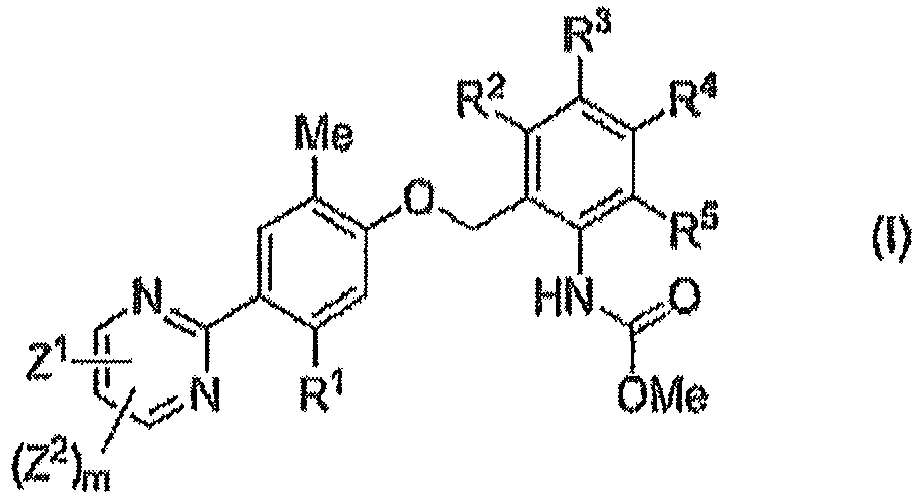 R1 représente un atome d'hydrogène ou un groupe alkyle en C1-C3 ;R2, R3, R4 et R5 représentent chacun indépendamment un atome d'hydrogène, un atome d'halogène, un groupe alkyle en C1-C3 ayant éventuellement un ou plusieurs atomes d'halogène, un groupe cycloalkyle en C3-C4 ayant éventuellement un ou plusieurs atomes d'halogène ou un groupe alcoxy en C1-C3 ayant éventuellement un ou plusieurs atomes d'halogène ;Z1 représente un atome d'halogène ;Z2 représente un atome d'halogène ou un groupe alkyle en C1-C3 ; et m représente un nombre entier quelconque allant de 0 à 2,en tant qu'ingrédient actif.
 - Procédé de lutte contre les maladies des plantes par traitement des plantes ou du sol utilisé pour la culture des plantes avec une quantité efficace d'un composé carbamate représenté par la formule (I) :
 R1 représente un atome d'hydrogène ou un groupe alkyle en C1-C3 ;R2, R3, R4 et R5 représentent chacun indépendamment un atome d'hydrogène, un atome d'halogène, un groupe alkyle en C1-C3 ayant éventuellement un ou plusieurs atomes d'halogène, un groupe cycloalkyle en C3-C4 ayant éventuellement un ou plusieurs atomes d'halogène, ou un groupe alcoxy en C1-C3 ayant éventuellement un ou plusieurs atomes d'halogène ;Z1 représente un atome d'halogène ;Z2 représente un atome d'halogène ou un groupe alkyle en C1-C3 ; etm représente un nombre entier quelconque allant de 0 à 2 .
 - Utilisation d'un composé carbamate représenté par la formule (I) :
 R1 représente un atome d'hydrogène ou un groupe alkyle en C1-C3 ;R2, R3, R4 et R5 représentent chacun indépendamment un atome d'hydrogène, un atome d'halogène, un groupe alkyle en C1-C3 ayant éventuellement un ou plusieurs atomes d'halogène, un groupe cycloalkyle en C3-C4 ayant éventuellement un ou plusieurs atomes d'halogène ou un groupe alcoxy en C1-C3 ayant éventuellement un ou plusieurs atomes d'halogène ;Z1 représente un atome d'halogène ;Z2 représente un atome d'halogène ou un groupe alkyle en C1-C3 ; etm représente un nombre entier quelconque allant de 0 à 2,pour lutter contre les maladies des plantes.
Applications Claiming Priority (2)
| Application Number | Priority Date | Filing Date | Title |
|---|---|---|---|
| JP2015003944 | 2015-01-13 | ||
| PCT/JP2016/050075 WO2016114164A1 (fr) | 2015-01-13 | 2016-01-05 | Composé de carbamate et son utilisation |
Publications (3)
| Publication Number | Publication Date |
|---|---|
| EP3246319A1 EP3246319A1 (fr) | 2017-11-22 |
| EP3246319A4 EP3246319A4 (fr) | 2018-10-03 |
| EP3246319B1 true EP3246319B1 (fr) | 2019-10-23 |
Family
ID=56405711
Family Applications (1)
| Application Number | Title | Priority Date | Filing Date |
|---|---|---|---|
| EP16737235.8A Active EP3246319B1 (fr) | 2015-01-13 | 2016-01-05 | Composé de carbamate pour lutter contre des maladies de plante |
Country Status (6)
| Country | Link |
|---|---|
| US (1) | US10040768B2 (fr) |
| EP (1) | EP3246319B1 (fr) |
| JP (1) | JP6624076B2 (fr) |
| CN (1) | CN107108523B (fr) |
| BR (1) | BR112017014655B1 (fr) |
| WO (1) | WO2016114164A1 (fr) |
Families Citing this family (3)
| Publication number | Priority date | Publication date | Assignee | Title |
|---|---|---|---|---|
| BR112017014679B1 (pt) | 2015-01-13 | 2021-05-04 | Sumitomo Chemical Company, Limited | composto de carbamato, seu uso, agente controlador de doenças de plantas e método para controlar doenças de plantas |
| WO2016114161A1 (fr) | 2015-01-13 | 2016-07-21 | 住友化学株式会社 | Composé carbamate et son utilisation |
| WO2018138692A1 (fr) | 2017-01-30 | 2018-08-02 | Insecticides (India) Limited | Nouveaux composés fongicides de carbamate |
Family Cites Families (12)
| Publication number | Priority date | Publication date | Assignee | Title |
|---|---|---|---|---|
| EP0335519A1 (fr) * | 1988-03-31 | 1989-10-04 | Imperial Chemical Industries Plc | Insecticides |
| DE4124989A1 (de) | 1991-07-27 | 1993-02-04 | Basf Ag | (beta)-substituierte zimtsaeurederivate |
| RU2129118C1 (ru) * | 1992-01-29 | 1999-04-20 | Басф Акциенгезельшафт | Карбаматы, промежуточные продукты, фунгицидная композиция, способ борьбы с грибами |
| DE10135549A1 (de) | 2001-05-15 | 2002-11-21 | Bayer Ag | Heterocyclylphenyl-benzylether |
| JP2004531551A (ja) | 2001-05-15 | 2004-10-14 | バイエル・クロツプサイエンス・アクチエンゲゼルシヤフト | 殺菌剤として使用されるヘテロシクリルフェニルベンジルエーテル |
| WO2015005499A1 (fr) | 2013-07-12 | 2015-01-15 | 住友化学株式会社 | Composé de tétrazolinone et son utilisation |
| US9521848B2 (en) | 2013-07-31 | 2016-12-20 | Sumitomo Chemical Company, Limited | Tetrazolinone compound and use therefor |
| CN103910670B (zh) | 2014-03-11 | 2016-02-17 | 浙江工业大学 | 一种甲氧基氨基甲酸酯类化合物及其制备方法与应用 |
| EP3130584B1 (fr) | 2014-03-28 | 2023-04-26 | Sumitomo Chemical Company, Limited | Composé aromatique et ses utilisations |
| US9788547B2 (en) | 2014-03-28 | 2017-10-17 | Sumitomo Chemical Company, Limited | Aromatic compound and uses thereof |
| BR112017014679B1 (pt) | 2015-01-13 | 2021-05-04 | Sumitomo Chemical Company, Limited | composto de carbamato, seu uso, agente controlador de doenças de plantas e método para controlar doenças de plantas |
| WO2016114161A1 (fr) | 2015-01-13 | 2016-07-21 | 住友化学株式会社 | Composé carbamate et son utilisation |
-
2016
- 2016-01-05 EP EP16737235.8A patent/EP3246319B1/fr active Active
- 2016-01-05 JP JP2016569304A patent/JP6624076B2/ja active Active
- 2016-01-05 CN CN201680005587.2A patent/CN107108523B/zh active Active
- 2016-01-05 BR BR112017014655-0A patent/BR112017014655B1/pt active IP Right Grant
- 2016-01-05 WO PCT/JP2016/050075 patent/WO2016114164A1/fr not_active Ceased
- 2016-01-05 US US15/541,848 patent/US10040768B2/en active Active
Non-Patent Citations (1)
| Title |
|---|
| None * |
Also Published As
| Publication number | Publication date |
|---|---|
| US20180002294A1 (en) | 2018-01-04 |
| CN107108523A (zh) | 2017-08-29 |
| CN107108523B (zh) | 2020-09-18 |
| EP3246319A4 (fr) | 2018-10-03 |
| BR112017014655B1 (pt) | 2021-05-11 |
| EP3246319A1 (fr) | 2017-11-22 |
| US10040768B2 (en) | 2018-08-07 |
| JPWO2016114164A1 (ja) | 2017-10-19 |
| WO2016114164A1 (fr) | 2016-07-21 |
| BR112017014655A2 (pt) | 2018-01-02 |
| JP6624076B2 (ja) | 2019-12-25 |
Similar Documents
| Publication | Publication Date | Title |
|---|---|---|
| US20130131067A1 (en) | Plant disease controlling composition and use thereof | |
| EP3246319B1 (fr) | Composé de carbamate pour lutter contre des maladies de plante | |
| EP3246312B1 (fr) | Composé carbamate et son utilisation | |
| EP3246314B1 (fr) | Composé carbamate et utilisation associée | |
| EP3246318B1 (fr) | Composé de type carbamate et son utilisation | |
| EP3246316B1 (fr) | Composé carbamate et utilisation associée | |
| EP3124476B1 (fr) | Composé tétrazolinone et application associée | |
| EP3504199B1 (fr) | Composés tétrazolinone et leur utilisation | |
| US10053448B2 (en) | Substituted tetrazolinones for controlling plant diseases |
Legal Events
| Date | Code | Title | Description |
|---|---|---|---|
| STAA | Information on the status of an ep patent application or granted ep patent |
Free format text: STATUS: THE INTERNATIONAL PUBLICATION HAS BEEN MADE |
|
| PUAI | Public reference made under article 153(3) epc to a published international application that has entered the european phase |
Free format text: ORIGINAL CODE: 0009012 |
|
| STAA | Information on the status of an ep patent application or granted ep patent |
Free format text: STATUS: REQUEST FOR EXAMINATION WAS MADE |
|
| 17P | Request for examination filed |
Effective date: 20170704 |
|
| AK | Designated contracting states |
Kind code of ref document: A1 Designated state(s): AL AT BE BG CH CY CZ DE DK EE ES FI FR GB GR HR HU IE IS IT LI LT LU LV MC MK MT NL NO PL PT RO RS SE SI SK SM TR |
|
| AX | Request for extension of the european patent |
Extension state: BA ME |
|
| DAV | Request for validation of the european patent (deleted) | ||
| DAX | Request for extension of the european patent (deleted) | ||
| A4 | Supplementary search report drawn up and despatched |
Effective date: 20180830 |
|
| RIC1 | Information provided on ipc code assigned before grant |
Ipc: C07D 239/30 20060101AFI20180824BHEP Ipc: A01N 47/20 20060101ALI20180824BHEP |
|
| GRAP | Despatch of communication of intention to grant a patent |
Free format text: ORIGINAL CODE: EPIDOSNIGR1 |
|
| STAA | Information on the status of an ep patent application or granted ep patent |
Free format text: STATUS: GRANT OF PATENT IS INTENDED |
|
| INTG | Intention to grant announced |
Effective date: 20190515 |
|
| GRAS | Grant fee paid |
Free format text: ORIGINAL CODE: EPIDOSNIGR3 |
|
| GRAA | (expected) grant |
Free format text: ORIGINAL CODE: 0009210 |
|
| STAA | Information on the status of an ep patent application or granted ep patent |
Free format text: STATUS: THE PATENT HAS BEEN GRANTED |
|
| AK | Designated contracting states |
Kind code of ref document: B1 Designated state(s): AL AT BE BG CH CY CZ DE DK EE ES FI FR GB GR HR HU IE IS IT LI LT LU LV MC MK MT NL NO PL PT RO RS SE SI SK SM TR |
|
| REG | Reference to a national code |
Ref country code: GB Ref legal event code: FG4D |
|
| REG | Reference to a national code |
Ref country code: CH Ref legal event code: EP |
|
| REG | Reference to a national code |
Ref country code: IE Ref legal event code: FG4D |
|
| REG | Reference to a national code |
Ref country code: DE Ref legal event code: R096 Ref document number: 602016022937 Country of ref document: DE |
|
| REG | Reference to a national code |
Ref country code: AT Ref legal event code: REF Ref document number: 1193499 Country of ref document: AT Kind code of ref document: T Effective date: 20191115 |
|
| REG | Reference to a national code |
Ref country code: NL Ref legal event code: MP Effective date: 20191023 |
|
| REG | Reference to a national code |
Ref country code: LT Ref legal event code: MG4D |
|
| PG25 | Lapsed in a contracting state [announced via postgrant information from national office to epo] |
Ref country code: NL Free format text: LAPSE BECAUSE OF FAILURE TO SUBMIT A TRANSLATION OF THE DESCRIPTION OR TO PAY THE FEE WITHIN THE PRESCRIBED TIME-LIMIT Effective date: 20191023 Ref country code: PL Free format text: LAPSE BECAUSE OF FAILURE TO SUBMIT A TRANSLATION OF THE DESCRIPTION OR TO PAY THE FEE WITHIN THE PRESCRIBED TIME-LIMIT Effective date: 20191023 Ref country code: GR Free format text: LAPSE BECAUSE OF FAILURE TO SUBMIT A TRANSLATION OF THE DESCRIPTION OR TO PAY THE FEE WITHIN THE PRESCRIBED TIME-LIMIT Effective date: 20200124 Ref country code: SE Free format text: LAPSE BECAUSE OF FAILURE TO SUBMIT A TRANSLATION OF THE DESCRIPTION OR TO PAY THE FEE WITHIN THE PRESCRIBED TIME-LIMIT Effective date: 20191023 Ref country code: NO Free format text: LAPSE BECAUSE OF FAILURE TO SUBMIT A TRANSLATION OF THE DESCRIPTION OR TO PAY THE FEE WITHIN THE PRESCRIBED TIME-LIMIT Effective date: 20200123 Ref country code: LV Free format text: LAPSE BECAUSE OF FAILURE TO SUBMIT A TRANSLATION OF THE DESCRIPTION OR TO PAY THE FEE WITHIN THE PRESCRIBED TIME-LIMIT Effective date: 20191023 Ref country code: LT Free format text: LAPSE BECAUSE OF FAILURE TO SUBMIT A TRANSLATION OF THE DESCRIPTION OR TO PAY THE FEE WITHIN THE PRESCRIBED TIME-LIMIT Effective date: 20191023 Ref country code: FI Free format text: LAPSE BECAUSE OF FAILURE TO SUBMIT A TRANSLATION OF THE DESCRIPTION OR TO PAY THE FEE WITHIN THE PRESCRIBED TIME-LIMIT Effective date: 20191023 Ref country code: PT Free format text: LAPSE BECAUSE OF FAILURE TO SUBMIT A TRANSLATION OF THE DESCRIPTION OR TO PAY THE FEE WITHIN THE PRESCRIBED TIME-LIMIT Effective date: 20200224 Ref country code: BG Free format text: LAPSE BECAUSE OF FAILURE TO SUBMIT A TRANSLATION OF THE DESCRIPTION OR TO PAY THE FEE WITHIN THE PRESCRIBED TIME-LIMIT Effective date: 20200123 |
|
| PG25 | Lapsed in a contracting state [announced via postgrant information from national office to epo] |
Ref country code: RS Free format text: LAPSE BECAUSE OF FAILURE TO SUBMIT A TRANSLATION OF THE DESCRIPTION OR TO PAY THE FEE WITHIN THE PRESCRIBED TIME-LIMIT Effective date: 20191023 Ref country code: IS Free format text: LAPSE BECAUSE OF FAILURE TO SUBMIT A TRANSLATION OF THE DESCRIPTION OR TO PAY THE FEE WITHIN THE PRESCRIBED TIME-LIMIT Effective date: 20200224 Ref country code: HR Free format text: LAPSE BECAUSE OF FAILURE TO SUBMIT A TRANSLATION OF THE DESCRIPTION OR TO PAY THE FEE WITHIN THE PRESCRIBED TIME-LIMIT Effective date: 20191023 |
|
| PG25 | Lapsed in a contracting state [announced via postgrant information from national office to epo] |
Ref country code: AL Free format text: LAPSE BECAUSE OF FAILURE TO SUBMIT A TRANSLATION OF THE DESCRIPTION OR TO PAY THE FEE WITHIN THE PRESCRIBED TIME-LIMIT Effective date: 20191023 |
|
| REG | Reference to a national code |
Ref country code: DE Ref legal event code: R097 Ref document number: 602016022937 Country of ref document: DE |
|
| PG2D | Information on lapse in contracting state deleted |
Ref country code: IS |
|
| PG25 | Lapsed in a contracting state [announced via postgrant information from national office to epo] |
Ref country code: EE Free format text: LAPSE BECAUSE OF FAILURE TO SUBMIT A TRANSLATION OF THE DESCRIPTION OR TO PAY THE FEE WITHIN THE PRESCRIBED TIME-LIMIT Effective date: 20191023 Ref country code: DK Free format text: LAPSE BECAUSE OF FAILURE TO SUBMIT A TRANSLATION OF THE DESCRIPTION OR TO PAY THE FEE WITHIN THE PRESCRIBED TIME-LIMIT Effective date: 20191023 Ref country code: ES Free format text: LAPSE BECAUSE OF FAILURE TO SUBMIT A TRANSLATION OF THE DESCRIPTION OR TO PAY THE FEE WITHIN THE PRESCRIBED TIME-LIMIT Effective date: 20191023 Ref country code: CZ Free format text: LAPSE BECAUSE OF FAILURE TO SUBMIT A TRANSLATION OF THE DESCRIPTION OR TO PAY THE FEE WITHIN THE PRESCRIBED TIME-LIMIT Effective date: 20191023 Ref country code: RO Free format text: LAPSE BECAUSE OF FAILURE TO SUBMIT A TRANSLATION OF THE DESCRIPTION OR TO PAY THE FEE WITHIN THE PRESCRIBED TIME-LIMIT Effective date: 20191023 Ref country code: IS Free format text: LAPSE BECAUSE OF FAILURE TO SUBMIT A TRANSLATION OF THE DESCRIPTION OR TO PAY THE FEE WITHIN THE PRESCRIBED TIME-LIMIT Effective date: 20200223 |
|
| REG | Reference to a national code |
Ref country code: AT Ref legal event code: MK05 Ref document number: 1193499 Country of ref document: AT Kind code of ref document: T Effective date: 20191023 |
|
| PLBE | No opposition filed within time limit |
Free format text: ORIGINAL CODE: 0009261 |
|
| STAA | Information on the status of an ep patent application or granted ep patent |
Free format text: STATUS: NO OPPOSITION FILED WITHIN TIME LIMIT |
|
| PG25 | Lapsed in a contracting state [announced via postgrant information from national office to epo] |
Ref country code: MC Free format text: LAPSE BECAUSE OF FAILURE TO SUBMIT A TRANSLATION OF THE DESCRIPTION OR TO PAY THE FEE WITHIN THE PRESCRIBED TIME-LIMIT Effective date: 20191023 Ref country code: SK Free format text: LAPSE BECAUSE OF FAILURE TO SUBMIT A TRANSLATION OF THE DESCRIPTION OR TO PAY THE FEE WITHIN THE PRESCRIBED TIME-LIMIT Effective date: 20191023 Ref country code: SM Free format text: LAPSE BECAUSE OF FAILURE TO SUBMIT A TRANSLATION OF THE DESCRIPTION OR TO PAY THE FEE WITHIN THE PRESCRIBED TIME-LIMIT Effective date: 20191023 |
|
| REG | Reference to a national code |
Ref country code: CH Ref legal event code: PL |
|
| 26N | No opposition filed |
Effective date: 20200724 |
|
| REG | Reference to a national code |
Ref country code: BE Ref legal event code: MM Effective date: 20200131 |
|
| PG25 | Lapsed in a contracting state [announced via postgrant information from national office to epo] |
Ref country code: LU Free format text: LAPSE BECAUSE OF NON-PAYMENT OF DUE FEES Effective date: 20200105 |
|
| PG25 | Lapsed in a contracting state [announced via postgrant information from national office to epo] |
Ref country code: BE Free format text: LAPSE BECAUSE OF NON-PAYMENT OF DUE FEES Effective date: 20200131 Ref country code: SI Free format text: LAPSE BECAUSE OF FAILURE TO SUBMIT A TRANSLATION OF THE DESCRIPTION OR TO PAY THE FEE WITHIN THE PRESCRIBED TIME-LIMIT Effective date: 20191023 Ref country code: CH Free format text: LAPSE BECAUSE OF NON-PAYMENT OF DUE FEES Effective date: 20200131 Ref country code: LI Free format text: LAPSE BECAUSE OF NON-PAYMENT OF DUE FEES Effective date: 20200131 Ref country code: AT Free format text: LAPSE BECAUSE OF FAILURE TO SUBMIT A TRANSLATION OF THE DESCRIPTION OR TO PAY THE FEE WITHIN THE PRESCRIBED TIME-LIMIT Effective date: 20191023 |
|
| PG25 | Lapsed in a contracting state [announced via postgrant information from national office to epo] |
Ref country code: IE Free format text: LAPSE BECAUSE OF NON-PAYMENT OF DUE FEES Effective date: 20200105 |
|
| PG25 | Lapsed in a contracting state [announced via postgrant information from national office to epo] |
Ref country code: TR Free format text: LAPSE BECAUSE OF FAILURE TO SUBMIT A TRANSLATION OF THE DESCRIPTION OR TO PAY THE FEE WITHIN THE PRESCRIBED TIME-LIMIT Effective date: 20191023 Ref country code: MT Free format text: LAPSE BECAUSE OF FAILURE TO SUBMIT A TRANSLATION OF THE DESCRIPTION OR TO PAY THE FEE WITHIN THE PRESCRIBED TIME-LIMIT Effective date: 20191023 Ref country code: CY Free format text: LAPSE BECAUSE OF FAILURE TO SUBMIT A TRANSLATION OF THE DESCRIPTION OR TO PAY THE FEE WITHIN THE PRESCRIBED TIME-LIMIT Effective date: 20191023 |
|
| PG25 | Lapsed in a contracting state [announced via postgrant information from national office to epo] |
Ref country code: MK Free format text: LAPSE BECAUSE OF FAILURE TO SUBMIT A TRANSLATION OF THE DESCRIPTION OR TO PAY THE FEE WITHIN THE PRESCRIBED TIME-LIMIT Effective date: 20191023 |
|
| P01 | Opt-out of the competence of the unified patent court (upc) registered |
Effective date: 20230516 |
|
| PGFP | Annual fee paid to national office [announced via postgrant information from national office to epo] |
Ref country code: GB Payment date: 20251220 Year of fee payment: 11 |
|
| PGFP | Annual fee paid to national office [announced via postgrant information from national office to epo] |
Ref country code: FR Payment date: 20251217 Year of fee payment: 11 |
|
| PGFP | Annual fee paid to national office [announced via postgrant information from national office to epo] |
Ref country code: DE Payment date: 20251217 Year of fee payment: 11 |
|
| PGFP | Annual fee paid to national office [announced via postgrant information from national office to epo] |
Ref country code: IT Payment date: 20260107 Year of fee payment: 11 |