EP3246431A1 - Artikel mit beschichtung mit glas, sauerstofffänger und metall - Google Patents
Artikel mit beschichtung mit glas, sauerstofffänger und metall Download PDFInfo
- Publication number
- EP3246431A1 EP3246431A1 EP17171899.2A EP17171899A EP3246431A1 EP 3246431 A1 EP3246431 A1 EP 3246431A1 EP 17171899 A EP17171899 A EP 17171899A EP 3246431 A1 EP3246431 A1 EP 3246431A1
- Authority
- EP
- European Patent Office
- Prior art keywords
- coating layer
- metal
- article
- substrate
- silicate glass
- Prior art date
- Legal status (The legal status is an assumption and is not a legal conclusion. Google has not performed a legal analysis and makes no representation as to the accuracy of the status listed.)
- Granted
Links
Images

Classifications
-
- C—CHEMISTRY; METALLURGY
- C23—COATING METALLIC MATERIAL; COATING MATERIAL WITH METALLIC MATERIAL; CHEMICAL SURFACE TREATMENT; DIFFUSION TREATMENT OF METALLIC MATERIAL; COATING BY VACUUM EVAPORATION, BY SPUTTERING, BY ION IMPLANTATION OR BY CHEMICAL VAPOUR DEPOSITION, IN GENERAL; INHIBITING CORROSION OF METALLIC MATERIAL OR INCRUSTATION IN GENERAL
- C23C—COATING METALLIC MATERIAL; COATING MATERIAL WITH METALLIC MATERIAL; SURFACE TREATMENT OF METALLIC MATERIAL BY DIFFUSION INTO THE SURFACE, BY CHEMICAL CONVERSION OR SUBSTITUTION; COATING BY VACUUM EVAPORATION, BY SPUTTERING, BY ION IMPLANTATION OR BY CHEMICAL VAPOUR DEPOSITION, IN GENERAL
- C23C24/00—Coating starting from inorganic powder
- C23C24/08—Coating starting from inorganic powder by application of heat or pressure and heat
-
- C—CHEMISTRY; METALLURGY
- C09—DYES; PAINTS; POLISHES; NATURAL RESINS; ADHESIVES; COMPOSITIONS NOT OTHERWISE PROVIDED FOR; APPLICATIONS OF MATERIALS NOT OTHERWISE PROVIDED FOR
- C09D—COATING COMPOSITIONS, e.g. PAINTS, VARNISHES OR LACQUERS; FILLING PASTES; CHEMICAL PAINT OR INK REMOVERS; INKS; CORRECTING FLUIDS; WOODSTAINS; PASTES OR SOLIDS FOR COLOURING OR PRINTING; USE OF MATERIALS THEREFOR
- C09D5/00—Coating compositions, e.g. paints, varnishes or lacquers, characterised by their physical nature or the effects produced; Filling pastes
- C09D5/08—Anti-corrosive paints
- C09D5/082—Anti-corrosive paints characterised by the anti-corrosive pigment
- C09D5/084—Inorganic compounds
-
- B—PERFORMING OPERATIONS; TRANSPORTING
- B01—PHYSICAL OR CHEMICAL PROCESSES OR APPARATUS IN GENERAL
- B01J—CHEMICAL OR PHYSICAL PROCESSES, e.g. CATALYSIS OR COLLOID CHEMISTRY; THEIR RELEVANT APPARATUS
- B01J20/00—Solid sorbent compositions or filter aid compositions; Sorbents for chromatography; Processes for preparing, regenerating or reactivating thereof
- B01J20/02—Solid sorbent compositions or filter aid compositions; Sorbents for chromatography; Processes for preparing, regenerating or reactivating thereof comprising inorganic material
-
- B—PERFORMING OPERATIONS; TRANSPORTING
- B01—PHYSICAL OR CHEMICAL PROCESSES OR APPARATUS IN GENERAL
- B01J—CHEMICAL OR PHYSICAL PROCESSES, e.g. CATALYSIS OR COLLOID CHEMISTRY; THEIR RELEVANT APPARATUS
- B01J20/00—Solid sorbent compositions or filter aid compositions; Sorbents for chromatography; Processes for preparing, regenerating or reactivating thereof
- B01J20/02—Solid sorbent compositions or filter aid compositions; Sorbents for chromatography; Processes for preparing, regenerating or reactivating thereof comprising inorganic material
- B01J20/0203—Solid sorbent compositions or filter aid compositions; Sorbents for chromatography; Processes for preparing, regenerating or reactivating thereof comprising inorganic material comprising compounds of metals not provided for in B01J20/04
- B01J20/0218—Compounds of Cr, Mo, W
-
- B—PERFORMING OPERATIONS; TRANSPORTING
- B01—PHYSICAL OR CHEMICAL PROCESSES OR APPARATUS IN GENERAL
- B01J—CHEMICAL OR PHYSICAL PROCESSES, e.g. CATALYSIS OR COLLOID CHEMISTRY; THEIR RELEVANT APPARATUS
- B01J20/00—Solid sorbent compositions or filter aid compositions; Sorbents for chromatography; Processes for preparing, regenerating or reactivating thereof
- B01J20/02—Solid sorbent compositions or filter aid compositions; Sorbents for chromatography; Processes for preparing, regenerating or reactivating thereof comprising inorganic material
- B01J20/10—Solid sorbent compositions or filter aid compositions; Sorbents for chromatography; Processes for preparing, regenerating or reactivating thereof comprising inorganic material comprising silica or silicate
-
- C—CHEMISTRY; METALLURGY
- C03—GLASS; MINERAL OR SLAG WOOL
- C03C—CHEMICAL COMPOSITION OF GLASSES, GLAZES OR VITREOUS ENAMELS; SURFACE TREATMENT OF GLASS; SURFACE TREATMENT OF FIBRES OR FILAMENTS MADE FROM GLASS, MINERALS OR SLAGS; JOINING GLASS TO GLASS OR OTHER MATERIALS
- C03C17/00—Surface treatment of glass, not in the form of fibres or filaments, by coating
- C03C17/02—Surface treatment of glass, not in the form of fibres or filaments, by coating with glass
-
- C—CHEMISTRY; METALLURGY
- C04—CEMENTS; CONCRETE; ARTIFICIAL STONE; CERAMICS; REFRACTORIES
- C04B—LIME, MAGNESIA; SLAG; CEMENTS; COMPOSITIONS THEREOF, e.g. MORTARS, CONCRETE OR LIKE BUILDING MATERIALS; ARTIFICIAL STONE; CERAMICS; REFRACTORIES; TREATMENT OF NATURAL STONE
- C04B41/00—After-treatment of mortars, concrete, artificial stone or ceramics; Treatment of natural stone
- C04B41/009—After-treatment of mortars, concrete, artificial stone or ceramics; Treatment of natural stone characterised by the material treated
-
- C—CHEMISTRY; METALLURGY
- C04—CEMENTS; CONCRETE; ARTIFICIAL STONE; CERAMICS; REFRACTORIES
- C04B—LIME, MAGNESIA; SLAG; CEMENTS; COMPOSITIONS THEREOF, e.g. MORTARS, CONCRETE OR LIKE BUILDING MATERIALS; ARTIFICIAL STONE; CERAMICS; REFRACTORIES; TREATMENT OF NATURAL STONE
- C04B41/00—After-treatment of mortars, concrete, artificial stone or ceramics; Treatment of natural stone
- C04B41/45—Coating or impregnating, e.g. injection in masonry, partial coating of green or fired ceramics, organic coating compositions for adhering together two concrete elements
- C04B41/50—Coating or impregnating, e.g. injection in masonry, partial coating of green or fired ceramics, organic coating compositions for adhering together two concrete elements with inorganic materials
- C04B41/5022—Coating or impregnating, e.g. injection in masonry, partial coating of green or fired ceramics, organic coating compositions for adhering together two concrete elements with inorganic materials with vitreous materials
-
- C—CHEMISTRY; METALLURGY
- C04—CEMENTS; CONCRETE; ARTIFICIAL STONE; CERAMICS; REFRACTORIES
- C04B—LIME, MAGNESIA; SLAG; CEMENTS; COMPOSITIONS THEREOF, e.g. MORTARS, CONCRETE OR LIKE BUILDING MATERIALS; ARTIFICIAL STONE; CERAMICS; REFRACTORIES; TREATMENT OF NATURAL STONE
- C04B41/00—After-treatment of mortars, concrete, artificial stone or ceramics; Treatment of natural stone
- C04B41/45—Coating or impregnating, e.g. injection in masonry, partial coating of green or fired ceramics, organic coating compositions for adhering together two concrete elements
- C04B41/52—Multiple coating or impregnating multiple coating or impregnating with the same composition or with compositions only differing in the concentration of the constituents, is classified as single coating or impregnation
-
- C—CHEMISTRY; METALLURGY
- C04—CEMENTS; CONCRETE; ARTIFICIAL STONE; CERAMICS; REFRACTORIES
- C04B—LIME, MAGNESIA; SLAG; CEMENTS; COMPOSITIONS THEREOF, e.g. MORTARS, CONCRETE OR LIKE BUILDING MATERIALS; ARTIFICIAL STONE; CERAMICS; REFRACTORIES; TREATMENT OF NATURAL STONE
- C04B41/00—After-treatment of mortars, concrete, artificial stone or ceramics; Treatment of natural stone
- C04B41/80—After-treatment of mortars, concrete, artificial stone or ceramics; Treatment of natural stone of only ceramics
- C04B41/81—Coating or impregnation
- C04B41/85—Coating or impregnation with inorganic materials
- C04B41/86—Glazes; Cold glazes
-
- C—CHEMISTRY; METALLURGY
- C04—CEMENTS; CONCRETE; ARTIFICIAL STONE; CERAMICS; REFRACTORIES
- C04B—LIME, MAGNESIA; SLAG; CEMENTS; COMPOSITIONS THEREOF, e.g. MORTARS, CONCRETE OR LIKE BUILDING MATERIALS; ARTIFICIAL STONE; CERAMICS; REFRACTORIES; TREATMENT OF NATURAL STONE
- C04B41/00—After-treatment of mortars, concrete, artificial stone or ceramics; Treatment of natural stone
- C04B41/80—After-treatment of mortars, concrete, artificial stone or ceramics; Treatment of natural stone of only ceramics
- C04B41/81—Coating or impregnation
- C04B41/89—Coating or impregnation for obtaining at least two superposed coatings having different compositions
-
- C—CHEMISTRY; METALLURGY
- C23—COATING METALLIC MATERIAL; COATING MATERIAL WITH METALLIC MATERIAL; CHEMICAL SURFACE TREATMENT; DIFFUSION TREATMENT OF METALLIC MATERIAL; COATING BY VACUUM EVAPORATION, BY SPUTTERING, BY ION IMPLANTATION OR BY CHEMICAL VAPOUR DEPOSITION, IN GENERAL; INHIBITING CORROSION OF METALLIC MATERIAL OR INCRUSTATION IN GENERAL
- C23C—COATING METALLIC MATERIAL; COATING MATERIAL WITH METALLIC MATERIAL; SURFACE TREATMENT OF METALLIC MATERIAL BY DIFFUSION INTO THE SURFACE, BY CHEMICAL CONVERSION OR SUBSTITUTION; COATING BY VACUUM EVAPORATION, BY SPUTTERING, BY ION IMPLANTATION OR BY CHEMICAL VAPOUR DEPOSITION, IN GENERAL
- C23C30/00—Coating with metallic material characterised only by the composition of the metallic material, i.e. not characterised by the coating process
-
- F—MECHANICAL ENGINEERING; LIGHTING; HEATING; WEAPONS; BLASTING
- F01—MACHINES OR ENGINES IN GENERAL; ENGINE PLANTS IN GENERAL; STEAM ENGINES
- F01D—NON-POSITIVE DISPLACEMENT MACHINES OR ENGINES, e.g. STEAM TURBINES
- F01D5/00—Blades; Blade-carrying members; Heating, heat-insulating, cooling or antivibration means on the blades or the members
- F01D5/12—Blades
- F01D5/28—Selecting particular materials; Particular measures relating thereto; Measures against erosion or corrosion
- F01D5/288—Protective coatings for blades
-
- F—MECHANICAL ENGINEERING; LIGHTING; HEATING; WEAPONS; BLASTING
- F05—INDEXING SCHEMES RELATING TO ENGINES OR PUMPS IN VARIOUS SUBCLASSES OF CLASSES F01-F04
- F05D—INDEXING SCHEME FOR ASPECTS RELATING TO NON-POSITIVE-DISPLACEMENT MACHINES OR ENGINES, GAS-TURBINES OR JET-PROPULSION PLANTS
- F05D2230/00—Manufacture
- F05D2230/90—Coating; Surface treatment
-
- F—MECHANICAL ENGINEERING; LIGHTING; HEATING; WEAPONS; BLASTING
- F05—INDEXING SCHEMES RELATING TO ENGINES OR PUMPS IN VARIOUS SUBCLASSES OF CLASSES F01-F04
- F05D—INDEXING SCHEME FOR ASPECTS RELATING TO NON-POSITIVE-DISPLACEMENT MACHINES OR ENGINES, GAS-TURBINES OR JET-PROPULSION PLANTS
- F05D2300/00—Materials; Properties thereof
- F05D2300/20—Oxide or non-oxide ceramics
- F05D2300/21—Oxide ceramics
- F05D2300/2102—Glass
Definitions
- Aerospace vehicles, engines, and other devices and machines often operate under severely elevated temperature conditions.
- Components that are exposed to the elevated temperatures can be formed of temperature-resistant metal alloys and ceramic materials.
- temperature-resistant materials such components may remain susceptible to environmental degradation from oxidation, erosion, radiation, or the like.
- Barrier coatings may be used to enhance environmental protection.
- An article according to an example of the present disclosure includes a substrate and at least one coating layer disposed on the substrate.
- the coating layer includes a silicate glass matrix, an oxygen scavenger phase dispersed through the silicate glass matrix, and at least one metal in metallic form.
- the oxygen scavenger phase includes molybdenum disilicide.
- the oxygen scavenger phase includes at least one boride or silicide of an element selected from the group consisting of aluminum, tantalum, tungsten, platinum, nickel, cobalt, vanadium, niobium, rhenium, rhodium, indium, iridium, chromium, titanium, hafnium, zirconium, yttrium, and combinations thereof.
- the at least one metal is selected from the group consisting of copper, aluminum, silver, nickel, and combinations thereof.
- the at least one metal is selected from the group consisting of platinum, silicon, cobalt, niobium, molybdenum, tantalum, tungsten, rhenium, titanium, vanadium, chromium, zirconium, hafnium, ruthenium, rhodium, indium, osmium, iridium, and combinations thereof.
- the at least one coating layer includes a first coating layer and a different, second coating layer that is located between the first coating layer and the substrate.
- the first coating layer includes the silicate glass matrix and the oxygen scavenger phase
- the second coating layer includes the at least one metal.
- the second coating layer includes a matrix.
- the metal is dispersed through the matrix.
- the metal includes multiple different metals.
- the at least one coating layer includes a third coating layer that is located between the second coating layer and the substrate.
- the third coating layer includes silicate glass.
- the second coating layer in addition to the at least one metal phase, includes a reinforcement phase.
- coating layer is, by volume, about 50% to about 90% of the oxygen scavenger phase and has an electrical conductivity of at least 70 Siemens per meter.
- a method for fabricating an article according to an example of the present disclosure includes forming at least one coating layer on a substrate.
- the coating layer includes a silicate glass matrix, an oxygen scavenger phase dispersed through the silicate glass matrix, and at least one metal in metallic form.
- the forming includes applying a slurry to the substrate.
- the slurry includes a liquid carrier and, dispersed in the liquid carrier, a silicate glass for forming the silicate glass matrix, an oxygen scavenger for forming the oxygen scavenger phase, and the at least one metal, followed by drying the slurry to at least remove the liquid carrier, and heat treating the slurry to form at least one coating layer.
- the forming includes forming at least one coating layer to include a first coating layer and a different, second coating layer that is located between the first coating layer and the substrate.
- the first coating layer includes the silicate glass matrix and the oxygen scavenger phase
- the second coating layer includes at least one metal.
- An article according to an example of the present disclosure includes a substrate (e.g., a carbon-containing substrate) and a multi-layer coating disposed on the substrate (e.g., carbon-containing substrate).
- the multi-layer coating includes a first coating layer and a different, second coating layer immediately adjacent the first coating layer between the substrate (e.g., carbon-containing substrate) and the first coating layer.
- the first coating layer includes a silicate glass matrix and molybdenum disilicide and/or an oxygen scavenger phase (e.g., an oxygen scavenger as described herein, preferably one that is or comprises molybdenum disilicide) dispersed through the silicate glass matrix
- the second coating layer includes at least one metal (e.g. as described herein) in metallic form.
- the second coating layer includes a matrix, and at least one metal is dispersed through the matrix.
- the one metal includes multiple different metals.
- the second coating layer consists essentially of at least one metal.
- the multi-layer coating includes a third coating layer that is located immediately adjacent the second coating layer between the second coating layer and the substrate.
- the third coating layer includes silicate glass.
- the second coating layer in addition to at least one metal, includes a reinforcement phase.
- the oxygen scavenger phase includes molybdenum disilicide.
- the oxygen scavenger phase includes at least one boride or silicide of an element selected from the group consisting of aluminum, tantalum, tungsten, platinum, nickel, cobalt, vanadium, niobium, rhenium, rhodium, indium, iridium, chromium, titanium, hafnium, zirconium, yttrium, and combinations thereof.
- the at least one metal is selected from the group consisting of copper, aluminum, silver, nickel, and combinations thereof.
- the at least one metal is selected from the group consisting of platinum, silicon, cobalt, niobium, molybdenum, tantalum, tungsten, rhenium, titanium, vanadium, chromium, zirconium, hafnium, ruthenium, rhodium, indium, osmium, iridium, and combinations thereof.
- Figure 1 schematically illustrates a representative portion of an example article 20.
- the article 20 may be a component, or portion thereof, of an aerospace vehicle, an engine, an electronic device, or other machine or device that is designed to be exposed to relatively severe environments. Such environments may include, but are not limited to, high temperature conditions, oxidation conditions, radiation conditions, or combinations of these conditions.
- the article 20 includes a coating 22 that serves as an environmental barrier to protect an underlying substrate 24 from the environmental conditions.
- the substrate 24 is a high temperature-resistant substrate.
- Example high temperature-resistant substrates can include, but are not limited to, metal substrates, metal alloy substrates, carbon-containing substrates, and glass-based and ceramic-based substrates.
- Metal or metal alloy substrates may include refractory metals and alloys, such as molybdenum-based alloys, nickel-based or cobalt-based superalloys, or intermetallic alloys, including but not limited to metal silicides and aluminides.
- Carbon-containing substrates may include carbon composites that include carbon fibers and/or carbon matrices, silicon carbide composites that include silicon carbide fibers and/or silicon carbide matrices, carbon composites that have silicon carbide surface coatings or silicon carbide conversion coatings, or composites with combinations of carbon and silicon carbide.
- carbon refers to allotropes of carbon, such as but not limited to, graphite.
- Glass-based and ceramic-based substrates may include glass matrix composites, ceramic matrix composites, composites that have ceramic-based fibers, monolithic ceramics, and ultra-high temperature ceramics, such as refractory metal borides and carbides.
- the substrate 24 may generally have good high temperature-resistance, depending on the material, the substrate 24 is potentially susceptible to the environmental conditions described above.
- the coating 22 serves to protect the substrate 24 from at least several types of environmental conditions, which will be described in further detail below.
- the coating 22 is a multi-layer coating that includes a first coating layer 26 and a second coating layer 28.
- the first coating layer 26 is disposed on the substrate 24.
- the second coating layer 28 is between the first coating layer 26 and is immediately adjacent to, and contiguous with, both the first coating layer 26 and the substrate 24.
- additional layers could be provided between the substrate 24 and the second coating layer 28 and/or between the first coating layer 26 and the second coating layer 28.
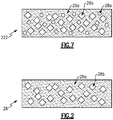
- Figure 2 illustrates a representative portion of the first coating layer 26, which serves as an oxygen barrier to reduce oxygen infiltration into the second coating layer 28 and the substrate 24.
- the first coating layer 26 includes a silicate glass matrix 26a and an oxygen scavenger phase 26b dispersed through the silicate glass matrix 26a.
- the silicate glass matrix 26a may include silicate, or silicate and other elements or compounds.
- the silicate glass matrix 26a includes sodium silicate, borosilicate, aluminosilicate, hafnium silicate, zirconium silicate, or mixtures thereof.
- the oxygen scavenger phase 26b is a material, such as a compound, that preferentially reacts with oxygen to form a stable, non-volatile compound.
- the oxygen scavenger phase 26b includes, but is not limited to, silicides, borides, or combinations thereof of one or more of aluminum, silicon, boron, molybdenum, tantalum, tungsten, platinum, nickel, cobalt, vanadium, niobium, rhenium, rhodium, indium, iridium, chromium, titanium, hafnium, zirconium, or yttrium.
- the oxygen scavenger phase 26b is molybdenum disilicide.
- the oxygen scavenger phase 26b may be dispersed as discrete regions through the silicate glass matrix 26a or dispersed as a partially or fully interconnected network through the silicate glass matrix 26a.
- Figure 3 illustrates a representative portion of the second coating layer 28, which serves as a radiation barrier to at least partially reflect incident radiation, such as infrared radiation, laser radiation, visible light radiation, electromagnetic radiation, or the like.
- the second coating layer 28 includes at least one metal 28a in metallic form.
- metallic form refers to a metallically bonded metal, rather than a metal that is ionically or covalently bonded to non-metal atoms in compounds.
- the metal 28a is copper, aluminum, silver, nickel, platinum, silicon, cobalt, niobium, molybdenum, tantalum, tungsten, rhenium, titanium, vanadium, chromium, zirconium, hafnium, ruthenium, rhodium, indium, osmium, iridium, or a combination thereof.
- the metal 28a includes only a single one of the example metals.
- the metal 28a includes multiple metals of the example metals. The multiple metals may be intermetallic or alloys of the metals. Alternatively or additionally, the multiple metals may be separate and discrete from each other, such as particles of one of the metals and particles of another of the metals.
- the second coating layer 28 is a composite layer and includes the metal 28a dispersed in a glass matrix 28b.
- the second coating layer 28 has, by volume, from about 1% to about 90% of the metal 28a.
- the second coating layer 28 has, by volume, from about 30% or about 60% to about 90% of the metal 28a.
- the glass matrix 28b serves to thermally and environmentally protect the metal 28a from oxidation or other reactions that may reduce the function of the metal 28a as a radiation barrier.
- the glass matrix 28b is selected from the same example compositions as the silicate glass matrix 26a of the first coating layer 26.
- the second coating layer 28 may also include an oxygen scavenger phase as described above.
- the second coating layer 28 excludes a glass matrix and is formed essentially or only of the metal 28a.
- the coating 22 serves as a multi-functional environmental barrier for the substrate 24.
- the first coating layer 26 serves as an oxygen barrier, to protect the second coating layer 28 and the substrate 24 from oxidation. Additionally, the first coating layer 26 may be electrically conductive and thus also serve as an electromagnetic shield to the second coating layer 28 and the substrate 24.
- the oxygen scavenger phase 26b is electrically conductive.
- the first coating layer 26 has, by volume, about 50% to about 80% of the oxygen scavenger phase 26b and has an electrical conductivity of at least 70 Siemens per meter (S/m).
- the remainder of the first coating layer 26 is composed of the silicate glass matrix 26a and, optionally, other constituents.
- the first coating layer 26 has, by volume, about 50% to about 80% of the oxygen scavenger phase 26b, about 1% to about 30% of the silicate glass matrix 26a, and about 1% to about 30% of silica.
- the second coating layer 28 serves to enhance radiation resistance.
- the first coating layer 26 may be transparent or translucent to incident radiation, but the underlying second coating layer 28 at least partially reflects incident radiation to thus further protect the substrate 24.
- Such radiation may include, but is not limited to, infrared radiation, laser radiation, visible light radiation, electromagnetic radiation, and the like.
- the first coating layer 26 enhances durability of the metal 28a by protecting the metal 28a from oxidation, which may otherwise decrease reflectivity of the metal 28a.
- the second coating layer 28 can include additional constituents or additives to further enhance functionality.
- Figure 4 illustrates another example of a second coating layer 128.
- like reference numerals designate like elements where appropriate and reference numerals with the addition of one-hundred or multiples thereof designate modified elements that are understood to incorporate the same features and benefits of the corresponding elements.
- the second coating layer 128 is similar to the second coating layer 28 but additionally includes a reinforcement phase 128c.
- the reinforcement phase is a particulate phase, a platelet phase, a fiber phase, or mixtures thereof that may enhance the strength of the second coating layer 128.
- the reinforcement phase 128c includes carbon nanotubes.
- Figure 5 illustrates another example of an article 120 that is similar to the article 20 but additionally includes a third coating layer 140.
- the third coating layer 140 is located between the second coating layer 28 and the substrate 24 and is immediately adjacent to, and contiguous with, both the second coating layer 28 and the substrate 24.
- additional layers could be provided between the substrate 24 and the third coating layer 140 and/or between the second coating layer 28 and the third coating layer 140.
- the third coating layer 140 includes silicate glass.
- the silicate glass may include silicate, or silicate and other elements or compounds.
- the silicate glass includes sodium silicate, borosilicate, hafnium silicate, zirconium silicate, or mixtures thereof.
- the third coating layer 140 also includes an oxygen scavenger phase.
- the oxygen scavenger phase includes, but is not limited to, silicides, borides, or combinations thereof of one or more of aluminum, silicon, boron, molybdenum, tantalum, tungsten, platinum, nickel, cobalt, vanadium, niobium, rhenium, rhodium, indium, iridium, chromium, titanium, hafnium, zirconium, or yttrium.
- the oxygen scavenger phase is molybdenum disilicide.
- the third coating layer 140 has the same composition as the first coating layer 26.
- Figure 6 illustrates another example of an article 220.
- the silicate glass matrix 26a, the oxygen scavenger phase 26b, and the metal 28a are incorporated into a single coating layer 222.
- the coating layer 222 is immediately adjacent to and contiguous with the substrate 24.
- additional layers could be provided between the substrate 24 and the coating layer 222.
- Figure 7 illustrates a representative portion of the coating layer 222.
- the coating layer includes the silicate glass matrix 26a, the oxygen scavenger phase 26b dispersed in the silicate glass matrix 26a, and the one or more metals 28a also dispersed in the silicate glass matrix 26a.
- the coating layer 222 may be used with any of the other coating layers described herein.
- the coating layer 222 has, by volume, about 50% to about 90% of the oxygen scavenger phase 26b, about 1% to about 30% of the silicate glass matrix 26a, about 1% to about 30% of the metal 28a, and, optionally, a remainder of other additives or constituents such as silica.
- the silica may be used in an amount from about 1% to about 30%.
- the article 20/120/220 can be fabricated by forming at least one coating layer 22/122/222 on the substrate 24, where the at least one coating layer 22/122/222 includes the silicate glass matrix 26a, the oxygen scavenger phase 26b dispersed through the silicate glass matrix 26a, and at least one metal 28a in metallic form.
- the second coating layer 28 is first deposited on the substrate 24.
- the metal 28a can be deposited onto the substrate 24 by a technique such as, but not limited to, physical vapor deposition, chemical vapor deposition, pack cementation, atomic layer deposition, thermal or cold spray processes, cathodic arc deposition, slurry coating, or directed energy methods such as arc, laser, or electron beam deposition using powder or wire feedstock.
- a technique such as, but not limited to, physical vapor deposition, chemical vapor deposition, pack cementation, atomic layer deposition, thermal or cold spray processes, cathodic arc deposition, slurry coating, or directed energy methods such as arc, laser, or electron beam deposition using powder or wire feedstock.
- the second coating layer 28 includes the metal 28a dispersed in the glass matrix 28b
- the second coating layer 28 may be fabricated using a slurry processing technique that is similar to the fabrication of the first coating layer 26, discussed in further detail below or a thermal spray process.
- the first coating layer 26, the third coating layer 140, the coating layer 222, and optionally the second coating layer 28/128, can be fabricated using slurry processing.
- a slurry is prepared or provided that includes a liquid carrier.
- a silicate glass is dispersed in the liquid carrier.
- the silicate glass will form the silicate glass matrix 26a or the glass matrix 28b.
- the slurry may also include an oxygen scavenger for forming the oxygen scavenger phase 26b in the first coating layer 26, the third coating layer 140, or the coating layer 222.
- the slurry is for forming the second coating layer 28 and the second coating layer 28 is not to include any oxygen scavenger phase 26b, the oxygen scavenger is excluded from the slurry.
- the slurry additionally includes the metal or metals 28a, and optionally the reinforcement phase 128c.
- the silicate glass and metal 28a are provided as particulate powders in the carrier liquid.
- the carrier liquid is not particularly limited and may be, but is not limited to, organic liquids.
- the slurry may also include other additives, such as binders and dispersants.
- the slurry is applied to the substrate 24 by, but not limited to, dipping, spraying, brushing, or the like.
- the slurry is dried either through natural evaporation of the liquid carrier at ambient temperature or by exposure to elevated processing temperatures, to remove the liquid carrier.
- the slurry may be heat treated to cure the slurry.
- the curing cross-links the binder to enhance the "green" strength of the intermediate coating.
- An example binder includes colloidal silica.
- the curing may be conducted at a temperature of about 150°C to about 200°C. A typical curing time would be about 15 minutes, but shorter or longer times may also be used.
- additional slurry may be applied to build-up the layer to the desired thickness.
- the slurry i.e., intermediate coating
- an inert cover gas such as argon or helium
- the final coating layers 26, 28/128, 140, and 222 may have an independent thickness of about 50 micrometers to about 200 micrometers.
- the heat treating may be conducted at a temperature of about 1150°C. The selected temperature may vary according to the composition of the silicate glass. A typical heat treating time would be about one hour, but shorter or longer times may also be used.
- the coating layer 26 or 222 is typically the outermost, exposed layer, the examples herein may also include a further topcoat layer over the layer 26 or 222.
- the topcoat layer could be any of the layers described herein or other types of layer, such as but not limited to, oxides, borides, carbides, silicides, silicates, or combinations thereof.
Landscapes
- Chemical & Material Sciences (AREA)
- Engineering & Computer Science (AREA)
- Organic Chemistry (AREA)
- Ceramic Engineering (AREA)
- Materials Engineering (AREA)
- Chemical Kinetics & Catalysis (AREA)
- Inorganic Chemistry (AREA)
- Structural Engineering (AREA)
- Analytical Chemistry (AREA)
- Mechanical Engineering (AREA)
- Metallurgy (AREA)
- Life Sciences & Earth Sciences (AREA)
- General Engineering & Computer Science (AREA)
- Wood Science & Technology (AREA)
- General Chemical & Material Sciences (AREA)
- Geochemistry & Mineralogy (AREA)
- Laminated Bodies (AREA)
Applications Claiming Priority (1)
| Application Number | Priority Date | Filing Date | Title |
|---|---|---|---|
| US15/158,640 US10308818B2 (en) | 2016-05-19 | 2016-05-19 | Article having coating with glass, oxygen scavenger, and metal |
Publications (2)
| Publication Number | Publication Date |
|---|---|
| EP3246431A1 true EP3246431A1 (de) | 2017-11-22 |
| EP3246431B1 EP3246431B1 (de) | 2018-12-26 |
Family
ID=59067449
Family Applications (1)
| Application Number | Title | Priority Date | Filing Date |
|---|---|---|---|
| EP17171899.2A Active EP3246431B1 (de) | 2016-05-19 | 2017-05-19 | Artikel mit beschichtung mit glas, sauerstofffänger und metall |
Country Status (2)
| Country | Link |
|---|---|
| US (1) | US10308818B2 (de) |
| EP (1) | EP3246431B1 (de) |
Cited By (1)
| Publication number | Priority date | Publication date | Assignee | Title |
|---|---|---|---|---|
| EP3842564A1 (de) * | 2019-12-05 | 2021-06-30 | Raytheon Technologies Corporation | Umweltbarrierbeschichtung mit sauerstoff-scavenging-partikeln mit barrier-muschel |
Families Citing this family (9)
| Publication number | Priority date | Publication date | Assignee | Title |
|---|---|---|---|---|
| US11668198B2 (en) | 2018-08-03 | 2023-06-06 | Raytheon Technologies Corporation | Fiber-reinforced self-healing environmental barrier coating |
| US10934220B2 (en) | 2018-08-16 | 2021-03-02 | Raytheon Technologies Corporation | Chemical and topological surface modification to enhance coating adhesion and compatibility |
| US11505506B2 (en) | 2018-08-16 | 2022-11-22 | Raytheon Technologies Corporation | Self-healing environmental barrier coating |
| US11535571B2 (en) | 2018-08-16 | 2022-12-27 | Raytheon Technologies Corporation | Environmental barrier coating for enhanced resistance to attack by molten silicate deposits |
| US12030822B2 (en) * | 2020-04-27 | 2024-07-09 | Rtx Corporation | Environmental barrier coating |
| EP3954806A1 (de) * | 2020-08-14 | 2022-02-16 | Raytheon Technologies Corporation | Umweltbarriereschicht |
| US12104503B2 (en) * | 2020-08-28 | 2024-10-01 | Rtx Corporation | Environmental barrier coating |
| US12227463B2 (en) | 2021-05-07 | 2025-02-18 | Rtx Corporation | Environmental barrier coating and method of forming the same |
| US11661380B2 (en) | 2021-08-06 | 2023-05-30 | Raytheon Technologies Corporation | Multi-environmental barrier coating, processes for coating articles, and their coated articles |
Citations (3)
| Publication number | Priority date | Publication date | Assignee | Title |
|---|---|---|---|---|
| EP1479657A1 (de) * | 2003-05-22 | 2004-11-24 | United Technologies Corporation | Umweltsperrschicht für Substrate auf der Basis von Silizium |
| EP1925694A2 (de) * | 2006-11-21 | 2008-05-28 | United Technologies Corporation | Oxidationsbeständige Beschichtungen, Verfahren zur Beschichtung von Artikeln und beschichtete Artikel |
| US20130157064A1 (en) * | 2011-12-16 | 2013-06-20 | Wisconsin Alumni Research Foundation | Mo-Si-B-BASED COATINGS FOR CERAMIC BASE SUBSTRATES |
Family Cites Families (15)
| Publication number | Priority date | Publication date | Assignee | Title |
|---|---|---|---|---|
| US3027330A (en) * | 1953-04-27 | 1962-03-27 | Kanthal Ab | Heat resisting materials and methods for their manufacture |
| US3503801A (en) * | 1967-11-29 | 1970-03-31 | Trw Inc | Vitreous enamel resistance material and resistor made therefrom |
| US4039997A (en) * | 1973-10-25 | 1977-08-02 | Trw Inc. | Resistance material and resistor made therefrom |
| DE3612568A1 (de) * | 1986-04-15 | 1987-10-29 | Bbc Brown Boveri & Cie | Hochtemperatur-schutzschicht |
| US4889776A (en) | 1987-08-17 | 1989-12-26 | Barson Corporation | Refractory metal composite coated article |
| US5472487A (en) | 1991-01-18 | 1995-12-05 | United Technologies Corporation | Molybdenum disilicide based materials with reduced coefficients of thermal expansion |
| US5693156A (en) | 1993-12-21 | 1997-12-02 | United Technologies Corporation | Oxidation resistant molybdenum alloy |
| US6733907B2 (en) | 1998-03-27 | 2004-05-11 | Siemens Westinghouse Power Corporation | Hybrid ceramic material composed of insulating and structural ceramic layers |
| US6042898A (en) * | 1998-12-15 | 2000-03-28 | United Technologies Corporation | Method for applying improved durability thermal barrier coatings |
| US7005191B2 (en) * | 2003-05-01 | 2006-02-28 | Wisconsin Alumni Research Foundation | Oxidation resistant coatings for ultra high temperature transition metals and transition metal alloys |
| SG128580A1 (en) * | 2005-06-08 | 2007-01-30 | United Technologies Corp | Reduced thermal conductivity thermal barrier coating by electron beam-physical vapor deposition process |
| US20110240911A1 (en) | 2008-10-22 | 2011-10-06 | Sandvik Intellectual Property Ab | Molybdenum silicide composite material |
| US8247085B2 (en) * | 2008-11-21 | 2012-08-21 | General Electric Company | Oxide-forming protective coatings for niobium-based materials |
| US9511572B2 (en) * | 2011-05-25 | 2016-12-06 | Southwest Research Institute | Nanocrystalline interlayer coating for increasing service life of thermal barrier coating on high temperature components |
| DE102012022731A1 (de) * | 2012-11-21 | 2014-05-22 | Epg (Engineered Nanoproducts Germany) Ag | Hochabriebfeste Antikalkschichten mit hoher chemischer Beständigkeit |
-
2016
- 2016-05-19 US US15/158,640 patent/US10308818B2/en active Active
-
2017
- 2017-05-19 EP EP17171899.2A patent/EP3246431B1/de active Active
Patent Citations (3)
| Publication number | Priority date | Publication date | Assignee | Title |
|---|---|---|---|---|
| EP1479657A1 (de) * | 2003-05-22 | 2004-11-24 | United Technologies Corporation | Umweltsperrschicht für Substrate auf der Basis von Silizium |
| EP1925694A2 (de) * | 2006-11-21 | 2008-05-28 | United Technologies Corporation | Oxidationsbeständige Beschichtungen, Verfahren zur Beschichtung von Artikeln und beschichtete Artikel |
| US20130157064A1 (en) * | 2011-12-16 | 2013-06-20 | Wisconsin Alumni Research Foundation | Mo-Si-B-BASED COATINGS FOR CERAMIC BASE SUBSTRATES |
Cited By (2)
| Publication number | Priority date | Publication date | Assignee | Title |
|---|---|---|---|---|
| EP3842564A1 (de) * | 2019-12-05 | 2021-06-30 | Raytheon Technologies Corporation | Umweltbarrierbeschichtung mit sauerstoff-scavenging-partikeln mit barrier-muschel |
| US11692274B2 (en) | 2019-12-05 | 2023-07-04 | Raytheon Technologies Corporation | Environmental barrier coating with oxygen-scavenging particles having barrier shell |
Also Published As
| Publication number | Publication date |
|---|---|
| US10308818B2 (en) | 2019-06-04 |
| US20170335118A1 (en) | 2017-11-23 |
| EP3246431B1 (de) | 2018-12-26 |
Similar Documents
| Publication | Publication Date | Title |
|---|---|---|
| EP3246431B1 (de) | Artikel mit beschichtung mit glas, sauerstofffänger und metall | |
| EP1925694B1 (de) | Verfahren zur oxidationsbeständige Beschichtung von Artikeln und beschichtete Artikel | |
| EP2399883B1 (de) | Artikel mit Verbundstoffbeschichtung | |
| Wu et al. | MoSi2-based oxidation protective coatings for SiC-coated carbon/carbon composites prepared by supersonic plasma spraying | |
| CA2753268C (en) | Anti-erosion coating system for gas turbine components | |
| US4535035A (en) | Oxidation resistant slurry coating for carbon-based materials | |
| US20160281015A1 (en) | Methods for preparing anti-friction coatings | |
| KR860008956A (ko) | 탄화붕소-알루미늄과 탄화붕소-반응성금속 서어멧 | |
| US20170327937A1 (en) | High temperature coating for silicon nitride articles | |
| JP2016003392A (ja) | 傾斜機能金属セラミック複合材料、及びその製造方法 | |
| CN101200801A (zh) | 铌合金高温抗氧化硅化物涂层及其制备方法 | |
| WO2014150465A2 (en) | Composite coatings and methods therefor | |
| CN108048839A (zh) | 一种钨铼热电偶高温抗氧化涂层及其应用 | |
| Zhang et al. | Deposition and oxidation behavior of Mo (Si, Al) 2/MoB layered coatings on TZM alloy | |
| US3031331A (en) | Metal-ceramic laminated skin surface | |
| Sun et al. | ZrSiO4 oxidation protective coating for SiC-coated carbon/carbon composites prepared by supersonic plasma spraying | |
| GB2130244A (en) | Forming coatings by hot isostatic compaction | |
| AU642449B2 (en) | Multi-layer coatings for reinforcements in high temperature composites | |
| US20160160374A1 (en) | Methods of forming an article using electrophoretic deposition, and related article | |
| US10233126B2 (en) | Forming a ceramic matrix composite having a silicide layer | |
| Vetrivendan et al. | Pack cemented silicon carbide interlayer for plasma sprayed yttria over graphite | |
| EP2399882A2 (de) | Verbundstoffpulver | |
| KR980002290A (ko) | 요오드화물을 사용하는 니켈 또는 그의 합금을 수용할 수 있는 금속의 화학증착(cvd) | |
| Ritt et al. | Application of plasma spraying as a precursor in the synthesis of oxidation-resistant coatings | |
| JPH05238856A (ja) | 金属炭化物被膜の形成方法 |
Legal Events
| Date | Code | Title | Description |
|---|---|---|---|
| PUAI | Public reference made under article 153(3) epc to a published international application that has entered the european phase |
Free format text: ORIGINAL CODE: 0009012 |
|
| STAA | Information on the status of an ep patent application or granted ep patent |
Free format text: STATUS: THE APPLICATION HAS BEEN PUBLISHED |
|
| AK | Designated contracting states |
Kind code of ref document: A1 Designated state(s): AL AT BE BG CH CY CZ DE DK EE ES FI FR GB GR HR HU IE IS IT LI LT LU LV MC MK MT NL NO PL PT RO RS SE SI SK SM TR |
|
| AX | Request for extension of the european patent |
Extension state: BA ME |
|
| STAA | Information on the status of an ep patent application or granted ep patent |
Free format text: STATUS: REQUEST FOR EXAMINATION WAS MADE |
|
| 17P | Request for examination filed |
Effective date: 20180521 |
|
| RBV | Designated contracting states (corrected) |
Designated state(s): AL AT BE BG CH CY CZ DE DK EE ES FI FR GB GR HR HU IE IS IT LI LT LU LV MC MK MT NL NO PL PT RO RS SE SI SK SM TR |
|
| GRAP | Despatch of communication of intention to grant a patent |
Free format text: ORIGINAL CODE: EPIDOSNIGR1 |
|
| STAA | Information on the status of an ep patent application or granted ep patent |
Free format text: STATUS: GRANT OF PATENT IS INTENDED |
|
| RIC1 | Information provided on ipc code assigned before grant |
Ipc: C23C 24/08 20060101ALI20180620BHEP Ipc: B01J 20/10 20060101ALI20180620BHEP Ipc: B01J 20/02 20060101ALI20180620BHEP Ipc: C23C 30/00 20060101AFI20180620BHEP |
|
| INTG | Intention to grant announced |
Effective date: 20180719 |
|
| GRAS | Grant fee paid |
Free format text: ORIGINAL CODE: EPIDOSNIGR3 |
|
| GRAA | (expected) grant |
Free format text: ORIGINAL CODE: 0009210 |
|
| STAA | Information on the status of an ep patent application or granted ep patent |
Free format text: STATUS: THE PATENT HAS BEEN GRANTED |
|
| AK | Designated contracting states |
Kind code of ref document: B1 Designated state(s): AL AT BE BG CH CY CZ DE DK EE ES FI FR GB GR HR HU IE IS IT LI LT LU LV MC MK MT NL NO PL PT RO RS SE SI SK SM TR |
|
| REG | Reference to a national code |
Ref country code: GB Ref legal event code: FG4D |
|
| REG | Reference to a national code |
Ref country code: CH Ref legal event code: EP |
|
| REG | Reference to a national code |
Ref country code: AT Ref legal event code: REF Ref document number: 1081540 Country of ref document: AT Kind code of ref document: T Effective date: 20190115 |
|
| REG | Reference to a national code |
Ref country code: DE Ref legal event code: R096 Ref document number: 602017001553 Country of ref document: DE |
|
| REG | Reference to a national code |
Ref country code: IE Ref legal event code: FG4D |
|
| PG25 | Lapsed in a contracting state [announced via postgrant information from national office to epo] |
Ref country code: FI Free format text: LAPSE BECAUSE OF FAILURE TO SUBMIT A TRANSLATION OF THE DESCRIPTION OR TO PAY THE FEE WITHIN THE PRESCRIBED TIME-LIMIT Effective date: 20181226 Ref country code: NO Free format text: LAPSE BECAUSE OF FAILURE TO SUBMIT A TRANSLATION OF THE DESCRIPTION OR TO PAY THE FEE WITHIN THE PRESCRIBED TIME-LIMIT Effective date: 20190326 Ref country code: LV Free format text: LAPSE BECAUSE OF FAILURE TO SUBMIT A TRANSLATION OF THE DESCRIPTION OR TO PAY THE FEE WITHIN THE PRESCRIBED TIME-LIMIT Effective date: 20181226 Ref country code: HR Free format text: LAPSE BECAUSE OF FAILURE TO SUBMIT A TRANSLATION OF THE DESCRIPTION OR TO PAY THE FEE WITHIN THE PRESCRIBED TIME-LIMIT Effective date: 20181226 Ref country code: LT Free format text: LAPSE BECAUSE OF FAILURE TO SUBMIT A TRANSLATION OF THE DESCRIPTION OR TO PAY THE FEE WITHIN THE PRESCRIBED TIME-LIMIT Effective date: 20181226 Ref country code: BG Free format text: LAPSE BECAUSE OF FAILURE TO SUBMIT A TRANSLATION OF THE DESCRIPTION OR TO PAY THE FEE WITHIN THE PRESCRIBED TIME-LIMIT Effective date: 20190326 |
|
| REG | Reference to a national code |
Ref country code: NL Ref legal event code: MP Effective date: 20181226 |
|
| REG | Reference to a national code |
Ref country code: LT Ref legal event code: MG4D |
|
| PG25 | Lapsed in a contracting state [announced via postgrant information from national office to epo] |
Ref country code: AL Free format text: LAPSE BECAUSE OF FAILURE TO SUBMIT A TRANSLATION OF THE DESCRIPTION OR TO PAY THE FEE WITHIN THE PRESCRIBED TIME-LIMIT Effective date: 20181226 Ref country code: GR Free format text: LAPSE BECAUSE OF FAILURE TO SUBMIT A TRANSLATION OF THE DESCRIPTION OR TO PAY THE FEE WITHIN THE PRESCRIBED TIME-LIMIT Effective date: 20190327 Ref country code: SE Free format text: LAPSE BECAUSE OF FAILURE TO SUBMIT A TRANSLATION OF THE DESCRIPTION OR TO PAY THE FEE WITHIN THE PRESCRIBED TIME-LIMIT Effective date: 20181226 Ref country code: RS Free format text: LAPSE BECAUSE OF FAILURE TO SUBMIT A TRANSLATION OF THE DESCRIPTION OR TO PAY THE FEE WITHIN THE PRESCRIBED TIME-LIMIT Effective date: 20181226 |
|
| REG | Reference to a national code |
Ref country code: AT Ref legal event code: MK05 Ref document number: 1081540 Country of ref document: AT Kind code of ref document: T Effective date: 20181226 |
|
| PG25 | Lapsed in a contracting state [announced via postgrant information from national office to epo] |
Ref country code: NL Free format text: LAPSE BECAUSE OF FAILURE TO SUBMIT A TRANSLATION OF THE DESCRIPTION OR TO PAY THE FEE WITHIN THE PRESCRIBED TIME-LIMIT Effective date: 20181226 |
|
| PG25 | Lapsed in a contracting state [announced via postgrant information from national office to epo] |
Ref country code: IT Free format text: LAPSE BECAUSE OF FAILURE TO SUBMIT A TRANSLATION OF THE DESCRIPTION OR TO PAY THE FEE WITHIN THE PRESCRIBED TIME-LIMIT Effective date: 20181226 Ref country code: CZ Free format text: LAPSE BECAUSE OF FAILURE TO SUBMIT A TRANSLATION OF THE DESCRIPTION OR TO PAY THE FEE WITHIN THE PRESCRIBED TIME-LIMIT Effective date: 20181226 Ref country code: PT Free format text: LAPSE BECAUSE OF FAILURE TO SUBMIT A TRANSLATION OF THE DESCRIPTION OR TO PAY THE FEE WITHIN THE PRESCRIBED TIME-LIMIT Effective date: 20190426 Ref country code: ES Free format text: LAPSE BECAUSE OF FAILURE TO SUBMIT A TRANSLATION OF THE DESCRIPTION OR TO PAY THE FEE WITHIN THE PRESCRIBED TIME-LIMIT Effective date: 20181226 Ref country code: PL Free format text: LAPSE BECAUSE OF FAILURE TO SUBMIT A TRANSLATION OF THE DESCRIPTION OR TO PAY THE FEE WITHIN THE PRESCRIBED TIME-LIMIT Effective date: 20181226 |
|
| PG25 | Lapsed in a contracting state [announced via postgrant information from national office to epo] |
Ref country code: EE Free format text: LAPSE BECAUSE OF FAILURE TO SUBMIT A TRANSLATION OF THE DESCRIPTION OR TO PAY THE FEE WITHIN THE PRESCRIBED TIME-LIMIT Effective date: 20181226 Ref country code: SM Free format text: LAPSE BECAUSE OF FAILURE TO SUBMIT A TRANSLATION OF THE DESCRIPTION OR TO PAY THE FEE WITHIN THE PRESCRIBED TIME-LIMIT Effective date: 20181226 Ref country code: SK Free format text: LAPSE BECAUSE OF FAILURE TO SUBMIT A TRANSLATION OF THE DESCRIPTION OR TO PAY THE FEE WITHIN THE PRESCRIBED TIME-LIMIT Effective date: 20181226 Ref country code: RO Free format text: LAPSE BECAUSE OF FAILURE TO SUBMIT A TRANSLATION OF THE DESCRIPTION OR TO PAY THE FEE WITHIN THE PRESCRIBED TIME-LIMIT Effective date: 20181226 Ref country code: IS Free format text: LAPSE BECAUSE OF FAILURE TO SUBMIT A TRANSLATION OF THE DESCRIPTION OR TO PAY THE FEE WITHIN THE PRESCRIBED TIME-LIMIT Effective date: 20190426 |
|
| REG | Reference to a national code |
Ref country code: DE Ref legal event code: R097 Ref document number: 602017001553 Country of ref document: DE |
|
| PG25 | Lapsed in a contracting state [announced via postgrant information from national office to epo] |
Ref country code: AT Free format text: LAPSE BECAUSE OF FAILURE TO SUBMIT A TRANSLATION OF THE DESCRIPTION OR TO PAY THE FEE WITHIN THE PRESCRIBED TIME-LIMIT Effective date: 20181226 Ref country code: DK Free format text: LAPSE BECAUSE OF FAILURE TO SUBMIT A TRANSLATION OF THE DESCRIPTION OR TO PAY THE FEE WITHIN THE PRESCRIBED TIME-LIMIT Effective date: 20181226 |
|
| PLBE | No opposition filed within time limit |
Free format text: ORIGINAL CODE: 0009261 |
|
| STAA | Information on the status of an ep patent application or granted ep patent |
Free format text: STATUS: NO OPPOSITION FILED WITHIN TIME LIMIT |
|
| 26N | No opposition filed |
Effective date: 20190927 |
|
| PG25 | Lapsed in a contracting state [announced via postgrant information from national office to epo] |
Ref country code: MC Free format text: LAPSE BECAUSE OF FAILURE TO SUBMIT A TRANSLATION OF THE DESCRIPTION OR TO PAY THE FEE WITHIN THE PRESCRIBED TIME-LIMIT Effective date: 20181226 |
|
| REG | Reference to a national code |
Ref country code: BE Ref legal event code: MM Effective date: 20190531 |
|
| PG25 | Lapsed in a contracting state [announced via postgrant information from national office to epo] |
Ref country code: LU Free format text: LAPSE BECAUSE OF NON-PAYMENT OF DUE FEES Effective date: 20190519 Ref country code: SI Free format text: LAPSE BECAUSE OF FAILURE TO SUBMIT A TRANSLATION OF THE DESCRIPTION OR TO PAY THE FEE WITHIN THE PRESCRIBED TIME-LIMIT Effective date: 20181226 |
|
| PG25 | Lapsed in a contracting state [announced via postgrant information from national office to epo] |
Ref country code: TR Free format text: LAPSE BECAUSE OF FAILURE TO SUBMIT A TRANSLATION OF THE DESCRIPTION OR TO PAY THE FEE WITHIN THE PRESCRIBED TIME-LIMIT Effective date: 20181226 |
|
| PG25 | Lapsed in a contracting state [announced via postgrant information from national office to epo] |
Ref country code: IE Free format text: LAPSE BECAUSE OF NON-PAYMENT OF DUE FEES Effective date: 20190519 |
|
| PG25 | Lapsed in a contracting state [announced via postgrant information from national office to epo] |
Ref country code: BE Free format text: LAPSE BECAUSE OF NON-PAYMENT OF DUE FEES Effective date: 20190531 |
|
| PG25 | Lapsed in a contracting state [announced via postgrant information from national office to epo] |
Ref country code: CH Free format text: LAPSE BECAUSE OF NON-PAYMENT OF DUE FEES Effective date: 20200531 Ref country code: LI Free format text: LAPSE BECAUSE OF NON-PAYMENT OF DUE FEES Effective date: 20200531 |
|
| PG25 | Lapsed in a contracting state [announced via postgrant information from national office to epo] |
Ref country code: CY Free format text: LAPSE BECAUSE OF FAILURE TO SUBMIT A TRANSLATION OF THE DESCRIPTION OR TO PAY THE FEE WITHIN THE PRESCRIBED TIME-LIMIT Effective date: 20181226 |
|
| PG25 | Lapsed in a contracting state [announced via postgrant information from national office to epo] |
Ref country code: HU Free format text: LAPSE BECAUSE OF FAILURE TO SUBMIT A TRANSLATION OF THE DESCRIPTION OR TO PAY THE FEE WITHIN THE PRESCRIBED TIME-LIMIT; INVALID AB INITIO Effective date: 20170519 Ref country code: MT Free format text: LAPSE BECAUSE OF FAILURE TO SUBMIT A TRANSLATION OF THE DESCRIPTION OR TO PAY THE FEE WITHIN THE PRESCRIBED TIME-LIMIT Effective date: 20181226 |
|
| PG25 | Lapsed in a contracting state [announced via postgrant information from national office to epo] |
Ref country code: MK Free format text: LAPSE BECAUSE OF FAILURE TO SUBMIT A TRANSLATION OF THE DESCRIPTION OR TO PAY THE FEE WITHIN THE PRESCRIBED TIME-LIMIT Effective date: 20181226 |
|
| REG | Reference to a national code |
Ref country code: DE Ref legal event code: R081 Ref document number: 602017001553 Country of ref document: DE Owner name: RAYTHEON TECHNOLOGIES CORPORATION (N.D.GES.D.S, US Free format text: FORMER OWNER: UNITED TECHNOLOGIES CORPORATION, FARMINGTON, CONN., US Ref country code: DE Ref legal event code: R081 Ref document number: 602017001553 Country of ref document: DE Owner name: RTX CORPORATION (N.D.GES.D. STAATES DELAWARE),, US Free format text: FORMER OWNER: UNITED TECHNOLOGIES CORPORATION, FARMINGTON, CONN., US |
|
| P01 | Opt-out of the competence of the unified patent court (upc) registered |
Effective date: 20230520 |
|
| PGFP | Annual fee paid to national office [announced via postgrant information from national office to epo] |
Ref country code: DE Payment date: 20250423 Year of fee payment: 9 |
|
| PGFP | Annual fee paid to national office [announced via postgrant information from national office to epo] |
Ref country code: GB Payment date: 20250423 Year of fee payment: 9 |
|
| PGFP | Annual fee paid to national office [announced via postgrant information from national office to epo] |
Ref country code: FR Payment date: 20250424 Year of fee payment: 9 |
|
| REG | Reference to a national code |
Ref country code: DE Ref legal event code: R081 Ref document number: 602017001553 Country of ref document: DE Owner name: RTX CORPORATION (N.D.GES.D. STAATES DELAWARE),, US Free format text: FORMER OWNER: RAYTHEON TECHNOLOGIES CORPORATION (N.D.GES.D.STAATES DELAWARE), ARLINGTON, VA, US |