EP3246440A1 - Spitzenstrickstoff - Google Patents
Spitzenstrickstoff Download PDFInfo
- Publication number
- EP3246440A1 EP3246440A1 EP16781041.5A EP16781041A EP3246440A1 EP 3246440 A1 EP3246440 A1 EP 3246440A1 EP 16781041 A EP16781041 A EP 16781041A EP 3246440 A1 EP3246440 A1 EP 3246440A1
- Authority
- EP
- European Patent Office
- Prior art keywords
- yarn
- chain stitch
- loop
- knitted lace
- lace fabric
- Prior art date
- Legal status (The legal status is an assumption and is not a legal conclusion. Google has not performed a legal analysis and makes no representation as to the accuracy of the status listed.)
- Withdrawn
Links
Images


Classifications
-
- D—TEXTILES; PAPER
- D04—BRAIDING; LACE-MAKING; KNITTING; TRIMMINGS; NON-WOVEN FABRICS
- D04B—KNITTING
- D04B21/00—Warp knitting processes for the production of fabrics or articles not dependent on the use of particular machines; Fabrics or articles defined by such processes
- D04B21/06—Patterned fabrics or articles
- D04B21/08—Patterned fabrics or articles characterised by thread material
-
- D—TEXTILES; PAPER
- D04—BRAIDING; LACE-MAKING; KNITTING; TRIMMINGS; NON-WOVEN FABRICS
- D04B—KNITTING
- D04B21/00—Warp knitting processes for the production of fabrics or articles not dependent on the use of particular machines; Fabrics or articles defined by such processes
- D04B21/10—Open-work fabrics
- D04B21/12—Open-work fabrics characterised by thread material
-
- D—TEXTILES; PAPER
- D04—BRAIDING; LACE-MAKING; KNITTING; TRIMMINGS; NON-WOVEN FABRICS
- D04B—KNITTING
- D04B21/00—Warp knitting processes for the production of fabrics or articles not dependent on the use of particular machines; Fabrics or articles defined by such processes
- D04B21/14—Fabrics characterised by the incorporation by knitting, in one or more thread, fleece, or fabric layers, of reinforcing, binding, or decorative threads; Fabrics incorporating small auxiliary elements, e.g. for decorative purposes
- D04B21/18—Fabrics characterised by the incorporation by knitting, in one or more thread, fleece, or fabric layers, of reinforcing, binding, or decorative threads; Fabrics incorporating small auxiliary elements, e.g. for decorative purposes incorporating elastic threads
-
- D—TEXTILES; PAPER
- D04—BRAIDING; LACE-MAKING; KNITTING; TRIMMINGS; NON-WOVEN FABRICS
- D04B—KNITTING
- D04B21/00—Warp knitting processes for the production of fabrics or articles not dependent on the use of particular machines; Fabrics or articles defined by such processes
- D04B21/20—Warp knitting processes for the production of fabrics or articles not dependent on the use of particular machines; Fabrics or articles defined by such processes specially adapted for knitting articles of particular configuration
- D04B21/207—Wearing apparel or garment blanks
-
- D—TEXTILES; PAPER
- D10—INDEXING SCHEME ASSOCIATED WITH SUBLASSES OF SECTION D, RELATING TO TEXTILES
- D10B—INDEXING SCHEME ASSOCIATED WITH SUBLASSES OF SECTION D, RELATING TO TEXTILES
- D10B2401/00—Physical properties
- D10B2401/06—Load-responsive characteristics
- D10B2401/061—Load-responsive characteristics elastic
Definitions
- the present invention relates to a knitted lace fabric capable of being preferably used as an elastic fabric or frill for women's underwear.
- Patent Literatures 1 and 2 a typical knitted lace fabric of related art is disclosed in Patent Literatures 1 and 2.
- a chain stitch yarn which is formed of a covering yarn in which a coating yarn is wound around a core yarn and configures a chain stitch structure, and an insertion yarn as an elastic yarn which is woven into the chain stitch structure in a course direction are bonded to each other in a contact portion by means of hot welding so as to prevent fraying in a cut portion.
- an object of the invention is to provide a knitted lace fabric which is satisfactory in beauty and texture.
- the chain stitch yarn and the second insertion yarn may be composite yarns which have a core yarn composed of a single fiber yarn formed of a hot-melt synthetic resin, and a covering yarn composed of a filament yarn formed of a hot-melt synthetic resin whose melting temperature is higher than that of the core yarn.
- the first insertion yarn may be composed of a hot-melt synthetic resin fiber yarn whose melting temperature is higher than that of the core yarn of the chain stitch yarn, and be an elastic yarn whose fineness is 40 deniers or larger and 420 deniers or smaller.
- the chain stitch yarn and the second insertion yarn may be elastic yarns whose fineness is 10 deniers or larger and 280 deniers or smaller.
- a first insertion yarn and a chain stitch yarn are bonded to each other in a plurality of first contact portions, and a second insertion yarn and the chain stitch yarn are bonded to each other in a plurality of second contact portions. Accordingly, powerful tensile strength can be obtained in any direction of a course direction and a wale direction. Regardless of a cutting direction of a knitted lace fabric, fraying occurrence can be prevented. In this manner, a misalignment between the chain stitch yarn and the first insertion yarn, and a misalignment between the chain stitch yarn and the second insertion yarn are prevented. Therefore, it is possible to prevent lattice distortion resulting from the misalignments.
- the chain stitch yarn and the first insertion yarn which are woven into the whole knitted lace fabric are bonded to each other, and the chain stitch yarn and the second insertion yarn are bonded to each other. Accordingly, visual and tactile uniformity can be obtained, and there is no possibility that beauty and texture may be impaired. It is possible to obtain the knitted lace fabric which maintains elastic properties and which is satisfactory in texture.
- the "texture" means a sense of hand touch.
- the satisfactory texture means a sense of flexible hand touch. In this way, it is possible to obtain the highly elastic knitted lace fabric which is satisfactory in beauty and texture.
- the skin is less burdened by preventing a bonded portion of a hot-melt synthetic resin hardened by bonding from coming into direct contact with the skin. Therefore, it is possible to reduce skin troubles.
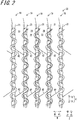
- FIG. 1 is a knitting structure diagram partially illustrating a knitted lace fabric 20 according to an embodiment of the invention.
- FIG. 2 is a knitting structure diagram illustrating the knitted lace fabric 20 by omitting yarns other than a chain stitch yarn 21, and first and second insertion yarns 22 and 23.
- FIGS. 1 and 2 schematically illustrate a knitting structure in order to facilitate understanding.
- each radius of curvature of first loop-shaped portion 24 and a second loop-shaped portion 25 is small, and respective yarns 21, 22, and 23 are in a very close state or in a contact state.
- FIG. 1 is a knitting structure diagram partially illustrating a knitted lace fabric 20 according to an embodiment of the invention.
- FIG. 2 is a knitting structure diagram illustrating the knitted lace fabric 20 by omitting yarns other than a chain stitch yarn 21, and first and second insertion yarns 22 and 23.
- FIGS. 1 and 2 schematically illustrate a knitting structure in order to facilitate understanding.
- the chain stitch yarn 21 is illustrated while being hatched by a leftward-downward oblique line
- the first insertion yarn 23 is illustrated while being hatched by a rightward-downward oblique line.
- FIG. 2 illustrates the respective yarns 21 and 23 while omitting the thicknesses thereof.
- a fabric knitted using the yarns 21 to 23 is referred to as a precursor fabric.
- the knitted lace fabric 20 is obtained by heating the precursor fabric.
- a product manufactured using the knitted lace fabric 20 is referred to as a knitted lace product.
- the knitted lace fabric 20 is a warp knitted fabric, a raschel knitted fabric obtained by raschel knitting, and a stretch knitted fabric which is elastic.
- the knitted lace fabric 20 is knitted using yarns including the chain stitch yarn 21, the second insertion yarn 22, and the first insertion yarn 23.
- the yarns 21 to 23 form a plurality of lattices, and a plurality of through-holes surrounded with the respective lattices are formed therein.
- a lace pattern is formed in this knitted lace fabric 20, depending on a shape and an arrangement of the lattice.
- the knitted lace fabric 20 has a designed portion having a dense yarn volume arranged per unit area and a base portion having a coarse yarn volume arranged per unit area.
- a design and a pattern are formed, depending on a shape and an arrangement of the designed portion and the base portion.
- the knitted lace fabric 20 having these designed patterns is used in order to manufacture a knitted lace product such as women's underwear, for example.
- the knitted lace fabric 20 includes the chain stitch yarn 21 which forms a raschel knitted chain stitch structure 19 having the plurality of loop-shaped portions 24 and 25, the first insertion yarn 23 which is resiliently stretchable and is elastic, the first insertion yarn 23 being woven into the chain stitch structure 19 in a course direction C, thereby the chain stitch structure 19 being given elastic properties in the course direction C, and the second insertion yarn 22 which is resiliently stretchable, the second insertion yarn 22 being alternately wound around the second loop-shaped portions 25 of the chain stitch yarn 21 forming one chain stitch structure 19, and the chain stitch yarn 21 forming the adjacent chain stitch structure 19 in a wale direction W, thereby the chain stitch structures 19 being given elastic properties in the wale direction W.
- the chain stitch yarn 21 may be referred to as a warp yarn or a fabric knitting yarn.
- the first insertion yarn 23 may be referred to as an elastic yarn
- the second insertion yarn 22 may be referred to as a weft yarn.
- the chain stitch yarn 21 and the first insertion yarn 23 are bonded to each other in a plurality of first contact portions 50 by using mutual heat welding properties.
- the chain stitch yarn 21 and the first insertion yarn 23 are bonded to each other in substantially all of the first contact portions 50.
- the chain stitch yarn 21 and the second insertion yarn 22 are bonded to each other in a plurality of second contact portions 55 by using mutual heat welding properties.
- the chain stitch yarn 21 and the second insertion yarn 22 are bonded to each other in substantially all of the second contact portions 55.
- the first loop-shaped portion 24 and the second loop-shaped portion 25 are formed in the chain stitch yarn 21 by means of chain stitch.
- the first loop-shaped portion 24 and the second loop-shaped portion 25 are alternately linked with each other, and are formed in parallel at a plurality of stages in the course direction C.
- the first loop-shaped portion 24 may be referred to as a needle loop
- the second loop-shaped portion 25 may be referred to as a sinker loop.
- the first loop-shaped portion 24 and the second loop-shaped portion 25 are alternately linked with each other, and extend in the course direction C, thereby forming wales.
- the plurality of wales are formed in parallel in the wale direction W, and are linked with each other, thereby forming the chain stitch structure, in other words, a chain stitch structure.
- the chain stitch yarn 21 is appropriately and horizontally stitched, and is linked with the adjacent chain stitch in the wale direction W, thereby forming the chain stitch structure which has a fraying prevention function.
- a portion in which the chain stitch yarn 21 is horizontally stitched is referred to as a run stopper portion 42.
- the first loop-shaped portions 24 are formed in a substantially U-shape, and are arranged in substantially parallel in the predetermined course direction C and the wale direction W orthogonal to the course direction C. In addition, the first loop-shaped portions 24 are open to a front stage C1 in the course direction which serves as one course direction C. The first loop-shaped portions 24 are arranged in a row in parallel in the wale direction W, thereby forming a course. The first loop-shaped portions 24 are arranged in a row in parallel in the course direction C, thereby forming a wale.
- the second loop-shaped portion 25 links the first loop-shaped portions 24 arranged in parallel in the course direction C.
- one second loop-shaped portion 25 is targeted.
- one end portion thereof is linked with an end portion of the first loop-shaped portion 24 at the same stage as the second loop-shaped portion 25.
- the second loop-shaped portion 25, as it runs from one end portion toward the other end portion, is inserted into the first loop-shaped portion 24 at the front stage C1 in the course direction of the second loop-shaped portion 25 from one side to the other side, and extends to the rear stage C2 in the course direction, is inserted into the first loop-shaped portion 24 at the same stage as the second loop-shaped portion 25 from the other side to one side, extends to the rear stage C2 in the course direction, and is linked with an end portion of the first loop-shaped portion 24 at the rear stage C2 in the course direction of the second loop-shaped portion 25.
- the loop-shaped portions 24 and 25 are linked in a chain shape, thereby forming a wale extending in the course direction C.
- the respective insertion yarns such as the second insertion yarn 22 and the first insertion yarn 23 are interposed between the first loop-shaped portion 24 and the second loop-shaped portion 25, thereby being woven into the wale.
- the course direction C is a longitudinal direction of the fabric, and means a longitudinal direction of the lace fabric.
- the wale direction W is a horizontal direction of the fabric, and means a direction orthogonal to the longitudinal direction of the lace fabric.
- the plurality of first loop-shaped portions 24 are arranged in parallel in the course direction C and the wale direction W.
- the plurality of first loop-shaped portions 24 arranged in parallel in the course direction C and the wale direction W are arranged in parallel while being substantially in contact with a predetermined virtual plane. In this case, weaving yarns woven into the chain stitch structure, such as the second insertion yarn 22 and the first insertion yarn 23, are arranged on one side with respect to the virtual plane.
- a direction where the insertion yarns 22 and 23 are arranged with respect to the virtual plane extending along the first loop-shaped portion 24 is referred to as a forward direction Z1, and a direction where the virtual plane is arranged with respect to the insertion yarns 22 and 23 is referred to as a rearward direction Z2.
- a direction away from the sheet surface to the forward side is set to be the forward direction Z1.
- a direction away from the sheet surface to the rearward side is set to be the rearward direction Z2.
- the first loop-shaped portion 24 is hidden by the weaving yarns such as the second insertion yarn 22 and the first insertion yarn 23. Therefore, compared to a surface in the rearward direction Z2, the surface in the forward direction Z1 of the knitted lace fabric 20 has a clearer designed pattern and a clearer lace pattern which are formed in the knitted lace clearer fabric 20.
- the second loop-shaped portion 25 is inserted into the first loop-shaped portion 24 at the front stage C1 in the course direction of the second loop-shaped portion 25 in the forward direction Z1, and is inserted into the first loop-shaped portion 24 at the same stage in the course direction of the second loop-shaped portion 25 in the rearward direction Z2, thereby being linked with the first loop-shaped portion 24 at the rear stage C2 in the course direction.
- the second insertion yarn 22 is a yarn for forming a lace pattern in the chain stitch structure.
- the second insertion yarns 22 are woven into the wales adjacent in the wale direction W, thereby linking two wales adjacent in the wale direction W with each other.
- the second insertion yarn 22 has a horizontally stitched portion extending from one wale to the other wale which wales are adjacent to each other in the wale direction W, and a woven portion of the second insertion yarn woven into the wale.
- a through-hole penetrating in the thickness direction of the fabric is formed in a space surrounded by the two horizontally stitched portions arranged in parallel in the course direction C and the wales linked by the horizontally stitched portion.
- a shape and an arrangement of the through-hole are adjusted.
- a lace pattern shown by the arrangement and the shape of the through-hole can be formed in the knitted lace fabric 20.
- the through-hole surrounded by the horizontally stitched portions and the wales is filled with a design yarn described later, thereby forming a designed pattern.
- the second insertion yarn 22 extends in a region on the forward direction Z1 side of the first loop-shaped portion 24.
- the second insertion yarn 22 is inserted into a preset portion between the first loop-shaped portion 24 and the second loop-shaped portion 25, and extends in the wale direction W.
- the plurality of second insertion yarns 22 are woven into the chain stitch structure, and the second insertion yarns 22 are woven while being arranged in parallel in the wale direction W. The positions where the respective second insertion yarns 22 are woven are appropriately selected depending on a lace pattern formed in the knitted lace fabric 20.
- the first insertion yarn 23 is realized by a yarn having an equal melting point and temperature, compared to the chain stitch yarn 21 and the second insertion yarn 22.
- a yarn is used which partially melts in a heated state during the heating process performed after the lace fabric is knitted.
- the first insertion yarn 23 is used not only to allow the knitted lace fabric 20 to be stretchable, but also to prevent fraying of the chain stitch yarn 21 and the second insertion yarn 22 which constitute the knitted lace fabric 20.
- the first insertion yarn 23 is realized by a naked yarn which is not covered with the covering yarn, that is, a bare yarn.
- the first insertion yarn 23 is realized by a polyurethane elastic yarn whose melting temperature is approximately 200°C or higher and 250°C or lower. In a naturally stretched state, the first insertion yarn 23 is woven into the chain stitch structure.
- a polyurethane core yarn used for the chain stitch yarn 21 and the second insertion yarn 22 has a melting point lower than that of the polyurethane yarn used for the first insertion yarn 23. Accordingly, it is possible to prevent fraying by melting the chain stitch yarn 21 and the second insertion yarn 22 and welding both of these into the first insertion yarn 23.
- the first insertion yarn 23 extends along the wales, and is woven into all of the loop-shaped portions constituting the wales. Therefore, in the chain stitch structure, the first insertion yarn 23 is woven into both the base portion having a coarse yarn volume arranged per unit area and the designed portion having a denser yarn volume arranged per unit area than that of the base portion.
- the knitted lace fabric 20 has the plurality of first insertion yarns 23, and each first insertion yarn 23 is woven into each corresponding wale. In this way, the first insertion yarns 23 are woven into all regions of the chain stitch structure.
- the first insertion yarn 23 extends in a region on the forward direction Z1 side of the first loop-shaped portion 24, and extends in a region on the rearward direction Z2 side of the second loop-shaped portion 25.
- the first insertion yarn 23 follows a zigzag course while running along the corresponding wales in the course direction C.
- the first insertion yarn 23 passes through a portion between the targeted first loop-shaped portion 24 and the second loop-shaped portion 25 from one side W1 to the other side W2 in the wale direction
- the first insertion yarn 23 passes through a portion between the first loop-shaped portion 24 and the second loop-shaped portion 25 at the rear stage C2 in the course direction of the targeted first loop-shaped portion 24 from the other side W2 to one side W1 in the wale direction.
- Every course for this knitting of the first insertion yarn 23 may be realized using another structure different from the above-described structure.
- the first insertion yarn 23 extends in a region on the forward direction Z1 side of the first loop-shaped portion 24, and extends in a region on the rearward direction Z2 side of the knitted lace fabric 20 of the second insertion yarn 22. Therefore, in a region where the first insertion yarn 23 and the second insertion yarn 22 are inserted into a portion between the same first loop-shaped portion 24 and second loop-shaped portion 25, the first insertion yarn 23 is inserted into a portion between the first loop-shaped portion 24 and the second insertion yarn 22. In addition, the second insertion yarn 22 is inserted into a portion between the first insertion yarn 23 and the second loop-shaped portion 25.
- the chain stitch yarn 21 is tensioned in the course direction C, the radii of curvature of the first loop-shaped portion 24 and the second loop-shaped portion 25 decrease.
- the first insertion yarn 23 comes into contact with the second insertion yarn 22 and the first loop-shaped portion 24 while being arranged between the second insertion yarn 22 and the first loop-shaped portion 24.
- the first insertion yarn 23 and the second insertion yarn 22 intersect each other, and pass through the first loop-shaped portion 24 and the second loop-shaped portion 25.
- the first insertion yarn 23 passes through the targeted first loop-shaped portion 24 and the second loop-shaped portion 25 at the same stage in the course direction, from a side where the targeted first loop-shaped portion 24 is linked with the second loop-shaped portion 25 at the front stage C1 in the course direction.
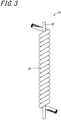
- FIG. 3 is a front view partially illustrating the chain stitch yarn 21 before knitting
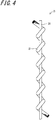
- FIG. 4 is a front view partially illustrating the chain stitch yarn 21 used in knitting the knitted lace fabric 20.
- the chain stitch yarn 21 is a yarn in which a covering yarn 31 is wound around an elastic core yarn 30 in a spiral shape.
- the core yarn 30 is a single fiber yarn (filament yarn) formed of a thermoplastic synthetic resin, and is formed of polyester-based polyurethane, for example.
- the covering yarn 31 is a long fiber yarn (filament yarn) configured to include a plurality of long fibers formed of a synthetic resin, and is formed of polyamide (Brand Name: Nylon), for example.
- the covering yarns 31 come into contact with each other, and the chain stitch yarn 21 is covered with the covering yarns 31 so that the core yarn 30 is not exposed.
- the chain stitch yarn 21 is knitted in a stretched state as illustrated in FIG. 4 by utilizing elastic properties of the core yarn 30. In the stretched state of the chain stitch yarn 21, a spiral gap is formed between the covering yarns 31, and the core yarn 30 is in a state of being exposed from the gap.
- the second insertion yarn 22 is a long fiber yarn (filament yarn) configured to include the core yarn formed of a single fiber yarn formed of a hot-melt synthetic resin and a plurality of long fibers formed of a synthetic resin, and is formed of polyamide (Brand Name: Nylon), rayon, or polyester, for example.
- the first insertion yarn 23 is a yarn called spandex, is a long fiber yarn (filament yarn) formed of an elastic material, and is formed of polyester-based polyurethane, for example.
- Both the core yarn 30 of the chain stitch yarn 21 and the first insertion yarn 23 are formed of polyester-based polyurethane, but are formed of mutually different polyester-based polyurethane.
- the melting temperature of the core yarn 30 is lower than the melting temperature of the first insertion yarn 23 (approximately 200°C to 250°C).
- the melting temperature of the core yarn 30 is approximately 140°C to 190°C, and is lower than the melting temperatures of the covering yarn 31, the second insertion yarn 22, and the first insertion yarn 23.
- the core yarn 30 has thermoplasticity.
- the chain stitch yarn 21 is a yarn including the core yarn 30 formed of a material whose melting temperature is low.
- the melting temperature of the core yarn of the second insertion yarn 22 may be substantially the same as that of the core yarn 30 of the chain stitch yarn 21.
- FIG. 5 is a flowchart illustrating an example of a manufacturing process of the knitted lace fabric 20 according to the present embodiment.
- Step a0 when the preparation of fabric knitting including the selection of each yarn for use in knitting the knitted lace fabric 20, the determination of a designed pattern to be formed in the knitted lace fabric 20, and the design of a fabric for forming a desired knitting structure is completed, the process proceeds to Step a1, and the manufacturing of the knitted lace fabric 20 is started.
- Step a1 which is a fabric knitting process
- a precursor fabric serving as a precursor of the knitted lace fabric 20 is knitted using a raschel knitting machine.
- the knitting machine waves the yarns 21, 22 and 23 such as the first insertion yarn 23 and the second insertion yarn 22, into the chain stitch yarn 21.
- the knitting machine knits the precursor fabric having the same knitting structure as that of the knitted lace fabric 20 illustrated in FIG. 1 .
- the chain stitch yarn 21 and the first insertion yarn 23 are elastic.
- the knitting machine performs a knitting operation.
- a restoring force of the yarns woven in the stretched state shrinks the precursor fabric after knitting. If the elastic properties are maintained until the knitted lace fabric 20 is manufactured, the knitted lace fabric 20 becomes a elastically stretchable knitted lace fabric. If the knitting of the precursor fabric is completed in this way, the process proceeds to Step a2.
- Step a2 which is a dyeing process
- the precursor fabric knitted in Step a1 is dyed, and if dyeing is completed, the process proceeds to Step a3.
- the dyed precursor fabric is heated at a temperature which is equal to or higher than the melting temperature of the core yarn 30 of the chain stitch yarn 21, and which is lower than the melting temperatures of the yarns 22, 23 and 31 other than the core yarn 30.
- the precursor fabric is stretched, and is heated in a state where the chain stitch yarn 21 is stretched as illustrated in FIG. 4 .
- the precursor fabric is heated and melted in a state where the core yarn 30 of the chain stitch yarn 21 is partially exposed.
- the melting temperature of the core yarn of the second insertion yarn 22 may be substantially the same as that of the core yarn 30 of the chain stitch yarn 21.
- these contact portions 50 and 55 have a shape in which the melted core yarn passes through the centermost side of a curved portion, and are places where the bonding possibility is highest.
- the melted core yarn is exposed in a place other than these contact portions 50 and 55, and therefore a bonded portion may be formed when the core yean is set in a state of being in contact with other fibers.
- Both of the core yarn 30 of the chain stitch yarn 21 and the first insertion yarn 23 are formed of polyester-based polyurethane although the types are different. Accordingly, if the core yarn 30 is melted, both of these yarns are easily bonded to each other after heat welding.
- the covering yarn 31 of the chain stitch yarn 21 is formed of polyamide, and is less likely to be bonded to the core yarn 30.
- the core yarn 30 of the chain stitch yarn 21 and the first insertion yarn 23 can be bonded to each other in the first contact portion 50, at a bonding rate of approximately 60% to 90%, in a case of the melt core yarn and the stretchable polyurethane yarn.
- exposed portions of the core yarn 30 are contact with and bonded to each other at a bonding rate of approximately 50% to 80%.
- Step a4 the formed knitted lace fabric 20 is cut (in a case of a wide fabric, the knitted lace fabric 20 is unchanged), and then in Step a5, manufacturing work of the knitted lace fabric 20 is completed.
- Step a2 the precursor fabric is heated, thereby melting the core yarn 30 of the chain stitch yarn 21. Accordingly, elastic properties thereof are impaired, but the first insertion yarn 23 is heated so as not to reach the melting temperature. Accordingly, the elastic properties can be maintained. Therefore, the knitted lace fabric 20 is elastic.
- the elastic first insertion yarn 23 is woven into the chain stitch structure 19, thereby the chain stitch structure being given elastic properties. Accordingly, it is possible to realize the elastic knitted lace fabric.
- the first contact portion 50 between the chain stitch yarn 21 and the first insertion yarn 23 is partially bonded, and the second contact portion 55 between the chain stitch yarns 21 or between the chain stitch yarn 21 and the second insertion yarn 22 is partially bonded to each other. This prevents a misalignment between the chain stitch yarn 21 and the first insertion yarn 23 and a misalignment between the chain stitch yarns 21 or between the chain stitch yarn 21 and the second insertion yarn 22, thereby preventing lattice distortion.
- the chain stitch yarn 21 and the first insertion yarn 23 are bonded to each other and the chain stitch yarn 21 and the second insertion yarn 22 are bonded to each other. Accordingly, a configuration in which partially different yarns are used is not adopted, visual and tactile uniformity can be obtained, and there is no possibility that beauty and texture may be impaired. Furthermore, the chain stitch yarn 21 in which the core yarn 30 is covered with the covering yarn 31 is stretched and bonded in a portion where the core yarn 30 is exposed. Accordingly, there is no possibility that the surface of the covering yarn 31 may be covered with a melted substance of the core yarn 30.
- the covering yarn 31 is composed of a collection of a plurality of single fibers, a flexible and soft touch can be obtained, and satisfactory texture can be maintained.
- the texture means a sense of hand touch.
- the satisfactory texture means a sense of flexible and soft hand touch.
- a heating condition in Step a3 which is the above-described thermal setting process is set to a heating condition which causes the core yarn 30 of the chain stitch yarn 21 to be melted and which prevents a characteristic change including embrittlement of yarns other than the core yarn 30.
- the heating condition in the heating process is set to be the heating condition under which the core yarn 30 is heated at a temperature to such an extent that a form as a yarn can be maintained. In this manner, the melted substance of the core yarn 30 does not appear on the surface of the fabric, and the melted substance of the core yarn 30 can be less likely to come into contact with the skin.
- the heating condition a heating temperature and a heating time are set.
- the minimum melting temperature for melting the core yarn 30 is set to B1, and a time required until the core yarn 30 is softened when heated at the minimum melting temperature is set to D1.
- the minimum characteristic change temperature for changing the characteristic of the yarn other than the core yarn 30 is set to B2, and a time required until the characteristic is changed when the other yarn is heated at the minimum characteristic change temperature is set to D2.
- the heating condition is set to B1 ⁇ B3 ⁇ B2 and D1 ⁇ D3 ⁇ D2.
- B3 is set to be a value closest to B1 as much as possible
- D3 is set to be a value closest to D1 as much as possible
- the elastic yarn which is formed of polyester-based thermoplastic polyurethane and whose fineness shows 10 deniers or larger and 280 deniers or smaller, or preferably 10 deniers or larger and 70 deniers or smaller.
- the core yarn 30 is thermally processed at the heating temperature of 170°C or higher and 195°C or lower and during the heating time of 30 sec or longer and 90 sec or shorter. In this manner, the core yarn 30 is melted, and the characteristic of the remaining yarn can be prevented from being changed.
- fineness of the first insertion yarn 22 is selected from a range of 40 deniers or larger and 420 deniers or smaller.
- the core yarn of the second insertion yarn 21 those which are the same as the core yarn 30 of the chain stitch yarn 21 may be used.
- the heating time is set to be constant
- the heating temperature is set to be lower than 170°C
- bonding strength provided by the melted core yarn 30 becomes weakened.
- the heating temperature exceeds 195°C
- a form as the yarn of the core yarn 30 is less likely to be maintained.
- the characteristic of the yarn other than the core yarn 30 may be changed.
- the core yarn 30 is thinner, a bonded portion becomes smaller as the bonded portion becomes closer to a contact point, thereby improving texture. If the core yarn 30 is thicker, the bonded portion becomes large, thereby impairing texture. In order to thicken the core yarn 30 while maintaining satisfactory texture, it is conceivable to thicken the covering yarn 31. However, the chain stitch yarn 21 is thickened, and translucency of the knitted lace fabric may be impaired. In addition, if the core yarn 30 is thinner, bonding strength decreases. If the core yarn 30 is thicker, bonding strength increases. In addition, depending on the combination of the core yarn 30 and the covering yarn, it is possible to provide fabric texture suitable for an intended use. Furthermore, by setting each yarn itself to be thick or a combination of yarns, it is also possible to improve burst strength.
- the core yarn 30 is a thin yarn whose fineness is smaller than 10 deniers, a problem arises in that strength decreases too much. In a case where the core yarn 30 is a thick yarn whose fineness exceeds 140 deniers, a problem arises in that texture is impaired. If the core yarn 30 is set to have the fineness of 10 deniers or larger and 140 deniers or smaller, the strength is not insufficient, and satisfactory texture can be obtained. From a similar viewpoint, it is preferable that the core yarn 30 has the fineness of 10 deniers or larger and 50 deniers or smaller.
- the knitted lace fabric 20 in the knitted lace fabric 20, the first and second contact portions 50 and 55 are bonded as described above, thereby providing an advantageous effect of preventing fraying progress of the yarn. Therefore, for example, the knitted lace fabric 20 can be cut into an arbitrary shape as in so-called motif-cutting and free-cutting. Therefore, the knitted lace fabric 20 has high elastic properties and form stability in any direction of the wale direction W and the course direction C. It is possible to mold a three-dimensional shape by performing a molding process.
- the knitted lace fabric 20 thus manufactured is subjected to the molding process at the temperature of 180°C during the cutting process in Step a4.
- the knitted lace fabric 20 is cut into an individually processed product, and the manufacturing work is completed in Step a5.
- the first and second contact portions 50 and 55 are bonded as described above, and it is possible to prevent the yarn from fraying. Accordingly, it is possible to adopt a configuration having no run stopper portion 42 or a few run stopper portions 42. According to the configuration having no run stopper portion 42 or a few run stopper portions 42, horizontal stitching of the chain stitch yarn 21 is eliminated or reduced. Therefore, it is possible to achieve improved quality by improving beauty.
Landscapes
- Engineering & Computer Science (AREA)
- Textile Engineering (AREA)
- Knitting Of Fabric (AREA)
- Yarns And Mechanical Finishing Of Yarns Or Ropes (AREA)
Applications Claiming Priority (1)
| Application Number | Priority Date | Filing Date | Title |
|---|---|---|---|
| PCT/JP2016/061621 WO2017175396A1 (ja) | 2016-04-08 | 2016-04-08 | レース編地 |
Publications (2)
| Publication Number | Publication Date |
|---|---|
| EP3246440A1 true EP3246440A1 (de) | 2017-11-22 |
| EP3246440A4 EP3246440A4 (de) | 2018-01-17 |
Family
ID=60000962
Family Applications (1)
| Application Number | Title | Priority Date | Filing Date |
|---|---|---|---|
| EP16781041.5A Withdrawn EP3246440A4 (de) | 2016-04-08 | 2016-04-08 | Spitzenstrickstoff |
Country Status (6)
| Country | Link |
|---|---|
| EP (1) | EP3246440A4 (de) |
| JP (1) | JP6488300B2 (de) |
| KR (1) | KR101849683B1 (de) |
| CN (1) | CN107532350A (de) |
| TW (1) | TWI669425B (de) |
| WO (1) | WO2017175396A1 (de) |
Families Citing this family (10)
| Publication number | Priority date | Publication date | Assignee | Title |
|---|---|---|---|---|
| CN112368435A (zh) * | 2018-08-10 | 2021-02-12 | 株式会社黑田蕾丝 | 蕾丝针织物 |
| TWI725409B (zh) * | 2019-04-03 | 2021-04-21 | 三芳化學工業股份有限公司 | 針織結構及其製法 |
| CN110644131A (zh) * | 2019-10-15 | 2020-01-03 | 桐乡市纳兰经编纺织有限公司 | 一种适用纬向裁剪的特种弹力经编面料及其制备方法 |
| CN111424365B (zh) * | 2020-04-15 | 2024-11-19 | 东莞超盈纺织有限公司 | 一种具有柔软手感且吸湿快干的功能性蕾丝织物 |
| CN111648021B (zh) * | 2020-06-09 | 2025-06-24 | 东莞超盈纺织有限公司 | 一种多变化底纹的蕾丝织物及其制备方法 |
| CN116390840A (zh) * | 2020-09-30 | 2023-07-04 | 日铁化学材料株式会社 | 网状纤维增强复合件、网状针织构造体、网状纤维增强复合件成形用材料和网状纤维增强复合件成形体 |
| JP7572719B2 (ja) * | 2021-03-19 | 2024-10-24 | 株式会社クロダレース | 編レース、及び製造方法 |
| JP7562102B2 (ja) * | 2021-07-28 | 2024-10-07 | 株式会社Yoshita Tex | 編レース |
| JP7602259B2 (ja) * | 2021-07-28 | 2024-12-18 | 株式会社Yoshita Tex | 編レース |
| CN115449966B (zh) * | 2022-09-22 | 2025-03-14 | 福建航港针织品有限公司 | 一种具有随意裁性能的多梳经编织物及其生产方法 |
Family Cites Families (7)
| Publication number | Priority date | Publication date | Assignee | Title |
|---|---|---|---|---|
| EP0653507B2 (de) * | 1993-11-16 | 2004-05-06 | Sakae Lace Co. Ltd. | Gewirkte Spitze und Verfahren zu deren Herstellung |
| JPH09119046A (ja) * | 1995-10-26 | 1997-05-06 | Sakae Lace Kk | レース編物 |
| JP3028043U (ja) * | 1996-02-16 | 1996-08-30 | 日本マイヤー株式会社 | 経編レース地におけるピコット縁飾りのないスカラップの編成構造 |
| JP2008240211A (ja) * | 2007-03-28 | 2008-10-09 | Kuroda Tex Co Ltd | 編レースの製造方法および編レース |
| JP4801002B2 (ja) | 2007-05-08 | 2011-10-26 | 株式会社Yoshita Tex | ラッセルストレッチレース編地および編レース製品 |
| JP5697887B2 (ja) * | 2010-04-02 | 2015-04-08 | 株式会社クロダレース | レース編地および編レース |
| US10077515B2 (en) * | 2013-04-26 | 2018-09-18 | Matsuyama Keori Co., Ltd. | Wrapping net, and manufacturing method for same |
-
2016
- 2016-04-08 WO PCT/JP2016/061621 patent/WO2017175396A1/ja not_active Ceased
- 2016-04-08 CN CN201680001136.1A patent/CN107532350A/zh active Pending
- 2016-04-08 EP EP16781041.5A patent/EP3246440A4/de not_active Withdrawn
- 2016-04-08 KR KR1020167029154A patent/KR101849683B1/ko active Active
- 2016-04-08 JP JP2016534759A patent/JP6488300B2/ja active Active
- 2016-10-06 TW TW105132330A patent/TWI669425B/zh not_active IP Right Cessation
Also Published As
| Publication number | Publication date |
|---|---|
| CN107532350A (zh) | 2018-01-02 |
| EP3246440A4 (de) | 2018-01-17 |
| JPWO2017175396A1 (ja) | 2018-04-12 |
| WO2017175396A1 (ja) | 2017-10-12 |
| JP6488300B2 (ja) | 2019-03-20 |
| TWI669425B (zh) | 2019-08-21 |
| KR20170124949A (ko) | 2017-11-13 |
| TW201736657A (zh) | 2017-10-16 |
| KR101849683B1 (ko) | 2018-04-18 |
Similar Documents
| Publication | Publication Date | Title |
|---|---|---|
| EP3246440A1 (de) | Spitzenstrickstoff | |
| EP2039826B1 (de) | Herstellungsverfahren für ein maschenspitzenband | |
| JP6747738B1 (ja) | 編レース | |
| JP5577445B1 (ja) | 編レースの製造方法および編レース | |
| JP6847340B2 (ja) | 織物及びその製造方法 | |
| EP3396037B1 (de) | Verfahren zur herstellung von raschelspitzenstrickgewebe | |
| JP6732267B1 (ja) | レース地 | |
| CN112368435A (zh) | 蕾丝针织物 | |
| JP7335030B1 (ja) | レース地及びその製造方法 | |
| JP6757951B2 (ja) | 伸縮性経編地及びそれを用いた衣料 | |
| JP2022145035A (ja) | 編レース、及び製造方法 | |
| JP7562102B2 (ja) | 編レース | |
| JP7602259B2 (ja) | 編レース | |
| JP2024083310A (ja) | 編レース、編レース製品、及び編レースの製造方法 | |
| JP2021014653A (ja) | ラッセルレース編地の製造方法 | |
| JP6293965B1 (ja) | 編レース | |
| JP5853057B2 (ja) | 編レースの製造方法 | |
| JP6704158B1 (ja) | ブラジャー用レース地 | |
| JP7530112B2 (ja) | 編レース、衣服、及び編レースの製造方法 | |
| JP7366453B2 (ja) | 立体編地の製造方法 | |
| JP6578314B2 (ja) | レース編地 | |
| JP6535492B2 (ja) | 筒状経編地 | |
| HK1256537B (en) | Method of manufacturing raschel lace knitted fabric |
Legal Events
| Date | Code | Title | Description |
|---|---|---|---|
| PUAI | Public reference made under article 153(3) epc to a published international application that has entered the european phase |
Free format text: ORIGINAL CODE: 0009012 |
|
| AK | Designated contracting states |
Kind code of ref document: A1 Designated state(s): AL AT BE BG CH CY CZ DE DK EE ES FI FR GB GR HR HU IE IS IT LI LT LU LV MC MK MT NL NO PL PT RO RS SE SI SK SM TR |
|
| AX | Request for extension of the european patent |
Extension state: BA ME |
|
| RIN1 | Information on inventor provided before grant (corrected) |
Inventor name: YOSHITA, SHIGEO |
|
| RIN1 | Information on inventor provided before grant (corrected) |
Inventor name: YOSHITA, SHIGEO |
|
| 17P | Request for examination filed |
Effective date: 20171129 |
|
| A4 | Supplementary search report drawn up and despatched |
Effective date: 20171220 |
|
| RIC1 | Information provided on ipc code assigned before grant |
Ipc: D04B 21/10 20060101AFI20171212BHEP Ipc: D04B 21/12 20060101ALI20171212BHEP |
|
| RAV | Requested validation state of the european patent: fee paid |
Extension state: MD Effective date: 20180412 Extension state: MA Effective date: 20180412 |
|
| RAX | Requested extension states of the european patent have changed |
Extension state: BA Payment date: 20180412 Extension state: ME Payment date: 20180412 |
|
| STAA | Information on the status of an ep patent application or granted ep patent |
Free format text: STATUS: EXAMINATION IS IN PROGRESS |
|
| 17Q | First examination report despatched |
Effective date: 20200609 |
|
| STAA | Information on the status of an ep patent application or granted ep patent |
Free format text: STATUS: THE APPLICATION IS DEEMED TO BE WITHDRAWN |
|
| 18D | Application deemed to be withdrawn |
Effective date: 20201020 |