EP3246837A1 - Procédé pour générer des machines virtuelles à usage spécial - Google Patents
Procédé pour générer des machines virtuelles à usage spécial Download PDFInfo
- Publication number
- EP3246837A1 EP3246837A1 EP16170423.4A EP16170423A EP3246837A1 EP 3246837 A1 EP3246837 A1 EP 3246837A1 EP 16170423 A EP16170423 A EP 16170423A EP 3246837 A1 EP3246837 A1 EP 3246837A1
- Authority
- EP
- European Patent Office
- Prior art keywords
- program
- high level
- programming language
- rtsq
- assembly
- Prior art date
- Legal status (The legal status is an assumption and is not a legal conclusion. Google has not performed a legal analysis and makes no representation as to the accuracy of the status listed.)
- Withdrawn
Links
Images
Classifications
-
- G—PHYSICS
- G06—COMPUTING OR CALCULATING; COUNTING
- G06F—ELECTRIC DIGITAL DATA PROCESSING
- G06F8/00—Arrangements for software engineering
- G06F8/30—Creation or generation of source code
- G06F8/37—Compiler construction; Parser generation
-
- G—PHYSICS
- G06—COMPUTING OR CALCULATING; COUNTING
- G06F—ELECTRIC DIGITAL DATA PROCESSING
- G06F21/00—Security arrangements for protecting computers, components thereof, programs or data against unauthorised activity
- G06F21/10—Protecting distributed programs or content, e.g. vending or licensing of copyrighted material ; Digital rights management [DRM]
- G06F21/12—Protecting executable software
- G06F21/14—Protecting executable software against software analysis or reverse engineering, e.g. by obfuscation
Definitions
- the present invention relates to a method of generating a virtual machine to be used for the execution of assembly level programs and to computer program product to implement the invention.
- the invention also pertains to a computer program product comprising instructions to implement the method of the invention and to a computer program product implementing the virtual machine obtained with the invention.
- the invention also relates to a device comprising a computer program product comprising instructions to implement the method of the invention.
- the invention relates at last to a bytecode program as generated by the virtual machine generator and compatible with the generated virtual machine.
- VM Virtual Machines
- VM diversity usually start with one or more hand-written VM designs and then create a new VM by morphing and mixing specific aspects of the input VM architectures. These aspects might include:
- Every modification to the instruction set of the generated VM must also be reflected in the code generator targeting the generated VM.
- the VM generator must not only generate a VM but also a compatible compiler backend that is able to translate some intermediate representation, e.g. LLVM-IR, gcc's GIMPLE, etc., into bytecode for the generated VM.
- some intermediate representation e.g. LLVM-IR, gcc's GIMPLE, etc.
- Another problem is that the burden of complexity mainly rests on the defenders side.
- Creating a capable backend generator can be considered a hard problem, but the resulting VM architectures are still rather fixed in the sense, that the backend generator can only mutate a relatively small number of dimensions, each of them supporting only a relatively small number of choices. This enables significant learning effects on the attacker's side effectively reducing security.
- the present invention aims at increasing security because it prevents or at least slows down learning effects on attacker's side.
- the present invention is defined, in its broadest sense, as a method of generating a virtual machine to be used for the execution of assembly level programs, said method comprising the step of translating a given program formulated in an assembly language into a high level program formulated in a randomly generated, program specific, high level programming language, said method further comprising the generation of an interpreter for the high level programming language, so that the interpreter together with the generated high level program computes the same function as the given assembly level program when executed on its machine.
- the invention works differently of the prior art techniques by not mutating specific aspects of an otherwise fixed target architecture but instead using a given input program to generate a language specification from which the VM and its accepted bytecode can be programmatically derived.
- This approach does not require any backend generation and achieves its diversity by exploiting degrees of freedom during language specification leading to a VM whose bytecode is structurally bound to the input program used for VM generation.
- the invention thus relates to a software that accepts an assembly level program, for example a general purpose one, as input and creates randomly a new special purpose programming language, an interpreter for this language and a program written in this language that is functionally equivalent to the input program.
- the invention can be combined with known prior art diversification on a general purpose assembly level program, the previously diversified assembly level program being the given program as used in the invention. The invention thus results in the production of an application specific VM.
- the invention introduces a high degree of bytecode diversity regarding syntax and semantic while creating a VM that is very specific to its intended program. Thereby most VM operations do not have an individual bytecode encoding, which prevents a traditional disassembly. Also manipulating the bytecode does not allow an attacker to execute arbitrary VM operations individually. This makes it hard to learn the semantics of individual VM operations through probing. Lexers/Parsers generated by flex/bison or similar tools are table driven, which makes them difficult to understand and allow further specialized obfuscations, e.g. const2code, obfuscation techniques for finite state machines.
- the method comprises the following steps to generate the high level programming language, the high level program and the interpreter:
- Such a sequence of steps enables to extract from a given assembly level program, the high level programming language according to the invention and to build the interpreter/parser according to the invention.
- the software generates randomly a formal grammar with parser actions that implement the necessary assembly operations and a matching token stream representing the encoded input program.
- the actual VM is then a parser conforming to the generated grammar.
- the token stream When the token stream is parsed by the generated parser, it also executes as a side effect the input program while performing the parse effectively interpreting the bytecode.
- the grammar is constructed in a way that it can be used as input for a parser generator (e.g. yacc, bison, etc) allowing the automatic generation of the VM.
- a parser generator e.g. yacc, bison, etc
- the VM is in fact a parser for the generated programming language where the parser actions do not build some sort of abstract syntax tree/intermediate representation as parsers usually do but instead execute the assembly level operations of the input program.
- the random token stream is the parser's view of the input. It is a pre-processed version of the raw input, where things like keywords, identifiers etc. have been already recognized, so that the parser does not have to deal with individual characters but sees whole keywords, identifiers, arithmetic operators, etc.
- the tokens are recognized by a lexer (lexical scanner) reading a character stream and identifying the tokens of the high level programming language.
- a lexer for this language might produce the following token steam: KEYWORD_IF - IDENTIFIER - KEYWORD_GT - IDENTIFIER - KEYWORD THEN.
- action spots located more far away from leaf nodes are selected.
- the present invention also relates to computer program product comprising instructions to implement the method of the invention.
- Such compiled executables that implement the VM generator.
- the present invention also relates to a computer program product for interpreting a randomly generated high level programming language that is constructed according to the method of the invention in a way so it expresses a given assembly level program used itself for constructing the high level programming language as used by the interpreter computer program.
- This corresponds to compiled executables implementing the generated VM and bytecode.
- the present invention also relates a device comprising computer program product comprising instructions to implement the method of the invention.
- one or more embodiments comprise the features hereinafter fully described and particularly pointed out in the claims.
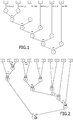
- Figure 1 schematically represents an exemplary sequence of bytecodes in a virtual machine as known in the prior art and the corresponding parse tree from a grammar perspective.
- the input assembly level program is a series of symbolic general purpose operations (ADD, MUL, DIV, LOAD, etc.).
- a VM that directly supports these operations would have a rather simple grammar resulting in a very uniform parse tree as shown on figure 1 .
- the parse tree obtained for a simple assembly level program being a simple sequence ALG of operations for a stack machine: PUSH_1, PUSH_2, ADD, PUSH_3, MUL, RET.
- a traditional VM design maps every operation to a unique opcode and at runtime dispatches the execution to the desired operation via its opcode, e.g. using a big switch statement.
- the bytecode might look like this: T1 T2 T3 T4 T5 T6 as shown on figure 1 .
- every VM-operation is mapped to a unique token and the sequence of tokens (T1, T2, etc.) is thus the actual bytecode.
- the parse tree is shown on figure 1 .
- the grammar rules are numbered from #1 to #7; in curly braces is the action the parser, or interpreter, performs when it substitutes the right side of a rule with the left side, thus when reduction rule is applied. For example, when the parser sees the token T5 on the parse stack, it replaces it with the start symbol S and executes MUL.
- the parser consumes tokens left-to-right, and processes them with its reduction rules.
- the parser accepts the input when all input tokens are consumed and the only symbol left on the parse stack is the start symbol S.
- the parsing log is thus the following:
- the invention changes the above by randomly generating a token stream and a non-uniform parse tree that is then translated into a grammar with carefully placed actions so that the correct assembly level operations are executed in the right order when the randomly generated token stream is parsed by the generated parser/interpreter.
- Figure 2 schematically represents such an exemplary sequence of a randomly generated token stream and a grammar/parse tree that was derived from the randomly generated token stream according to the invention. It is here noted that there is no correspondence between the tokens from figure 1 and figure 2 , these can be completely different.
- the actual byte representation of the tokens can be anything, e.g. keywords like "if” "then”, “else”, or binary opcodes such as 0xAA 0xBEEF etc.
- the input assembly level program ALG is thus still: PUSH_1 PUSH_2 ADD PUSH_3 MUL RET.
- Constructing the grammar as shown in figure 2 starts by a random creation of a sufficiently large token stream RTSq, here T1, T2, T3, T1, T4, T5, T6, T5, T6, T7, T4.
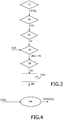
- figure 3 shows a flowchart of the method of the invention.
- a random token sequence RTSq is generated.
- This random token stream RTSq is used as terminals to form a random parse tree RTr in a step S2 by adding the N nodes, which are non-terminals of the parse tree.
- N nodes which are non-terminals of the parse tree.
- inner nodes are non-terminals and the tree's root note is the start symbol S of the finally obtained grammar.
- the obtained random parse tree, where the leaf nodes consist of the token stream, is shown on figure 2 .
- the created parse tree is analyzed. It enables to record place and execution order of the action spots Ai in a step S3, as noted on figure 2 .
- An action spot Ai is the application of a rule executed in the order as the token stream is parsed.
- Action spots Ai are the paths to the nodes shown with reference Ai on figure 2 . The difference is the numbering as the order of the action spots is determined by the structure of the parse tree.
- the trees action spots in their execution order when the parser parses the token stream are: A1, A2, A3, A4, A5, A6, A7, A8, A9.
- Step S4 Operations from the input assembly level code ALG PUSH_1, PUSH_2, ADD, PUSH_3, MUL and RET are then placed in a step S4 at appropriate action spots so that the execution order of the input VM program is preserved. Spots more far away from leaf nodes, i.e. terminals, are preferred, so that not only the terminals but also the non-terminals receive program semantics.
- the parse tree RTr is then translated into a set of grammar rules #X in a step S5.
- rule #3 tells the parser that when it sees at runtime the sequence Non-Terminal N5, Non-Terminal N4 and token T7 on its parse stack, it should replace this sequence with the Non-Terminal N6 and execute PUSH_3.
- This grammar is then feed into a parser generator (bison, yacc, etc.) that generates the parser.
- the generated parser is the VM.
- VMG denotes the parser generator and VM denotes output of the parser generator.
- tokens T1 and T4 appear multiple times in the bytecode, each time carrying a different meaning:
- T2, T3 -> PUSH_1 and T1, T4 -> ADD directly translate to operations from the assembly level program used for bytecode/VM construction.
- the instructions PUSH_1 and ADD have a meaningful disassembly because they only consist of terminal symbols.
- the other parser operations cannot be expressed on their own in the bytecode language but only together with other operations.
- the encoding of the PUSH_2 is T1, T2, T3 which does not only execute PUSH_2 but instead PUSH_1 followed by PUSH_2.
- the encoding of RET incorporates the complete program.
- parser is very specific to its intended program as it does not support executing a single RET or MUL instruction, but only allows these operations in the context of the original program.
- FIG 4 schematically shows the execution of the given program according to the invention.
- the obtained virtual machine VM receives the random token stream RTSq. While parsing the token stream RTSq, the generated parser, which is the VM, executes the parser actions and thus executes ALG, in the figure EXE(ALG).
- An actual implementation receives as input an assembly level program and the implementation of the assembly level operations, typically as C source, and then generates:
- the construction of the high level language are the steps S1 to S5 from figure 3 .
- the parser is then automatically generated from the grammar using existing parser generators, e.g. bison etc.
- the developer wants to hide an algorithm from an attacker's eyes. So the developer does not compile the algorithm into e.g. x86 machine code but instead into bytecode for a VM and also embeds the VM into the program.
- the attacker has deep knowledge about x86 and also has powerful tools to analyze x86 machine code (e.g. IDA Pro).
- IDA Pro powerful tools to analyze x86 machine code
- the attacker analyzes the program with his x86 tools, he just sees the x86 machine instructions of the VM but not the x86 machine instructions of the hidden algorithm because the algorithm is not represented as x86 machine instructions but instead is represented as data which, when interpreted by the VM, computes the algorithm.
- the invention works a bit like a "backwards" compiler: First some random code, the high level program, is generated, then a random grammar is constructed that accepts the just generated code as a valid program and then the semantic is added via the parser actions to the grammar, so that the generated code behaves the same as the input assembly level program.
- the token stream is a program's code. It is a sequence of elementary constructs of the given programming language. What the token stream means is defined by the grammar and the semantics of the programming language.
- the original token stream T1, T2, T3, T4, T5, T6 and the randomly generated token stream are just two programs in two completely different programming languages.
- the programming language of the given original program is for example a general purpose, assembly like language, which means it has a very simple grammar, where every token maps directly to a machine operation, e.g. add, mul, etc.
- the program of the invention is a randomly generated token stream that does not mean anything without the grammar.
- the token stream is a program in a randomly constructed high level programming language. It is a high level language because the tokens do not map directly to machine operations but instead form high-level language constructs (in "normal" programming languages (C, Java, etc.) these high-level constructs are if-statements, for-loops etc.).
- the generated program i.e. the token stream
- the generated program i.e. the token stream
- the generated program i.e. the token stream
- the generated program now adheres to the grammar, it still means nothing, because so far the high-level language constructs do not define any semantics.
- the semantics are added with the parser actions. So with the placed actions, the randomly generated token stream is a program written in a "strange" high level language as defined by the grammar that happens to do the same thing as the assembly level input program.
- Lexer Logical Scanner
- the random generated token stream could be this: T1 T2 T3 T1 T4 T5 T6 T2.
- the individual tokens must be mapped to a byte representation, e.g. one could map them as this:
Landscapes
- Engineering & Computer Science (AREA)
- Software Systems (AREA)
- Theoretical Computer Science (AREA)
- General Engineering & Computer Science (AREA)
- Physics & Mathematics (AREA)
- General Physics & Mathematics (AREA)
- Multimedia (AREA)
- Technology Law (AREA)
- Computer Hardware Design (AREA)
- Computer Security & Cryptography (AREA)
- Devices For Executing Special Programs (AREA)
Priority Applications (2)
| Application Number | Priority Date | Filing Date | Title |
|---|---|---|---|
| EP16170423.4A EP3246837A1 (fr) | 2016-05-19 | 2016-05-19 | Procédé pour générer des machines virtuelles à usage spécial |
| PCT/EP2017/061938 WO2017198757A1 (fr) | 2016-05-19 | 2017-05-18 | Procédé de génération de machines virtuelles spécialisées |
Applications Claiming Priority (1)
| Application Number | Priority Date | Filing Date | Title |
|---|---|---|---|
| EP16170423.4A EP3246837A1 (fr) | 2016-05-19 | 2016-05-19 | Procédé pour générer des machines virtuelles à usage spécial |
Publications (1)
| Publication Number | Publication Date |
|---|---|
| EP3246837A1 true EP3246837A1 (fr) | 2017-11-22 |
Family
ID=56081252
Family Applications (1)
| Application Number | Title | Priority Date | Filing Date |
|---|---|---|---|
| EP16170423.4A Withdrawn EP3246837A1 (fr) | 2016-05-19 | 2016-05-19 | Procédé pour générer des machines virtuelles à usage spécial |
Country Status (2)
| Country | Link |
|---|---|
| EP (1) | EP3246837A1 (fr) |
| WO (1) | WO2017198757A1 (fr) |
Citations (1)
| Publication number | Priority date | Publication date | Assignee | Title |
|---|---|---|---|---|
| WO2008115279A2 (fr) * | 2006-10-27 | 2008-09-25 | Microsoft Corporation | Virtualisation pour inviolabilité diversifiée |
-
2016
- 2016-05-19 EP EP16170423.4A patent/EP3246837A1/fr not_active Withdrawn
-
2017
- 2017-05-18 WO PCT/EP2017/061938 patent/WO2017198757A1/fr not_active Ceased
Patent Citations (1)
| Publication number | Priority date | Publication date | Assignee | Title |
|---|---|---|---|---|
| WO2008115279A2 (fr) * | 2006-10-27 | 2008-09-25 | Microsoft Corporation | Virtualisation pour inviolabilité diversifiée |
Non-Patent Citations (2)
| Title |
|---|
| JOSHUA CAZALAS ET AL: "Probing the Limits of Virtualized Software Protection", 20141209; 20141209 - 20141209, 9 December 2014 (2014-12-09), pages 1 - 11, XP058065652, ISBN: 978-1-60558-637-3, DOI: 10.1145/2689702.2689707 * |
| WANG HUAIJUN ET AL: "NISLVMP: Improved Virtual Machine-Based Software Protection", 2013 NINTH INTERNATIONAL CONFERENCE ON COMPUTATIONAL INTELLIGENCE AND SECURITY, IEEE, 14 December 2013 (2013-12-14), pages 479 - 483, XP032570585, DOI: 10.1109/CIS.2013.107 * |
Also Published As
| Publication number | Publication date |
|---|---|
| WO2017198757A1 (fr) | 2017-11-23 |
Similar Documents
| Publication | Publication Date | Title |
|---|---|---|
| Gazzillo et al. | SuperC: Parsing all of C by taming the preprocessor | |
| Kennedy et al. | Coq: the world's best macro assembler? | |
| Miecznikowski et al. | Decompiling Java using staged encapsulation | |
| US20230367569A1 (en) | Method of generating a representation of a program logic, decompilation apparatus, recompilation system and computer program products | |
| Rahimian et al. | RESource: a framework for online matching of assembly with open source code | |
| US20200012581A1 (en) | Method for Semantic Preserving Transform Mutation Discovery and Vetting | |
| Kusum et al. | Unsupervised translation of programming language-a survey paper | |
| Chlipala | An introduction to programming and proving with dependent types in Coq | |
| Bereczky et al. | Validating formal semantics by property-based cross-testing | |
| EP3246837A1 (fr) | Procédé pour générer des machines virtuelles à usage spécial | |
| Graf | Compiler backend generation using the VADL processor description language | |
| US20080141230A1 (en) | Scope-Constrained Specification Of Features In A Programming Language | |
| Bezzubikov et al. | Automatic dynamic binary translator generation from instruction set description | |
| Klyuchnikov et al. | SPSC: a simple supercompiler in Scala | |
| Korenkov et al. | Declarative target architecture definition for data-driven development toolchain | |
| Shao et al. | A survey of available information recovery of binary programs based on machine learning | |
| Sunitha | Compiler construction | |
| Ben Asher et al. | The effect of unrolling and inlining for Python bytecode optimizations | |
| Cîrstoiu et al. | On Obfuscating JavaScript Code Using Large Language Models | |
| Rus et al. | An algebraic language processing environment | |
| Vu | FROM AUTOMATA TO COMPILER DESIGN | |
| Groote et al. | Compiling higher-level languages | |
| Bilyk | Semantics-Preserving Transformation of Context-Free Grammars into LL (1) Form | |
| Deng¹ et al. | GPT-Based Wasm Instruction Analysis for Program Language Processing | |
| Casinghino et al. | ParTS |
Legal Events
| Date | Code | Title | Description |
|---|---|---|---|
| PUAI | Public reference made under article 153(3) epc to a published international application that has entered the european phase |
Free format text: ORIGINAL CODE: 0009012 |
|
| STAA | Information on the status of an ep patent application or granted ep patent |
Free format text: STATUS: THE APPLICATION HAS BEEN PUBLISHED |
|
| AK | Designated contracting states |
Kind code of ref document: A1 Designated state(s): AL AT BE BG CH CY CZ DE DK EE ES FI FR GB GR HR HU IE IS IT LI LT LU LV MC MK MT NL NO PL PT RO RS SE SI SK SM TR |
|
| AX | Request for extension of the european patent |
Extension state: BA ME |
|
| STAA | Information on the status of an ep patent application or granted ep patent |
Free format text: STATUS: THE APPLICATION IS DEEMED TO BE WITHDRAWN |
|
| 18D | Application deemed to be withdrawn |
Effective date: 20180523 |