EP3246898A1 - Leseverfahren für blinde menschen über ein elektronisches gerät und elektronisches lesegerät für blinde - Google Patents
Leseverfahren für blinde menschen über ein elektronisches gerät und elektronisches lesegerät für blinde Download PDFInfo
- Publication number
- EP3246898A1 EP3246898A1 EP16382223.2A EP16382223A EP3246898A1 EP 3246898 A1 EP3246898 A1 EP 3246898A1 EP 16382223 A EP16382223 A EP 16382223A EP 3246898 A1 EP3246898 A1 EP 3246898A1
- Authority
- EP
- European Patent Office
- Prior art keywords
- activable
- braille
- areas
- columns
- driver
- Prior art date
- Legal status (The legal status is an assumption and is not a legal conclusion. Google has not performed a legal analysis and makes no representation as to the accuracy of the status listed.)
- Withdrawn
Links
Images

Classifications
-
- G—PHYSICS
- G09—EDUCATION; CRYPTOGRAPHY; DISPLAY; ADVERTISING; SEALS
- G09B—EDUCATIONAL OR DEMONSTRATION APPLIANCES; APPLIANCES FOR TEACHING, OR COMMUNICATING WITH, THE BLIND, DEAF OR MUTE; MODELS; PLANETARIA; GLOBES; MAPS; DIAGRAMS
- G09B21/00—Teaching, or communicating with, the blind, deaf or mute
- G09B21/001—Teaching or communicating with blind persons
- G09B21/003—Teaching or communicating with blind persons using tactile presentation of the information, e.g. Braille displays
-
- G—PHYSICS
- G09—EDUCATION; CRYPTOGRAPHY; DISPLAY; ADVERTISING; SEALS
- G09B—EDUCATIONAL OR DEMONSTRATION APPLIANCES; APPLIANCES FOR TEACHING, OR COMMUNICATING WITH, THE BLIND, DEAF OR MUTE; MODELS; PLANETARIA; GLOBES; MAPS; DIAGRAMS
- G09B21/00—Teaching, or communicating with, the blind, deaf or mute
- G09B21/001—Teaching or communicating with blind persons
- G09B21/003—Teaching or communicating with blind persons using tactile presentation of the information, e.g. Braille displays
- G09B21/004—Details of particular tactile cells, e.g. electro-mechanical or mechanical layout
-
- G—PHYSICS
- G06—COMPUTING OR CALCULATING; COUNTING
- G06F—ELECTRIC DIGITAL DATA PROCESSING
- G06F3/00—Input arrangements for transferring data to be processed into a form capable of being handled by the computer; Output arrangements for transferring data from processing unit to output unit, e.g. interface arrangements
- G06F3/01—Input arrangements or combined input and output arrangements for interaction between user and computer
- G06F3/016—Input arrangements with force or tactile feedback as computer generated output to the user
-
- G—PHYSICS
- G06—COMPUTING OR CALCULATING; COUNTING
- G06F—ELECTRIC DIGITAL DATA PROCESSING
- G06F3/00—Input arrangements for transferring data to be processed into a form capable of being handled by the computer; Output arrangements for transferring data from processing unit to output unit, e.g. interface arrangements
- G06F3/01—Input arrangements or combined input and output arrangements for interaction between user and computer
- G06F3/03—Arrangements for converting the position or the displacement of a member into a coded form
- G06F3/041—Digitisers, e.g. for touch screens or touch pads, characterised by the transducing means
-
- G—PHYSICS
- G06—COMPUTING OR CALCULATING; COUNTING
- G06F—ELECTRIC DIGITAL DATA PROCESSING
- G06F3/00—Input arrangements for transferring data to be processed into a form capable of being handled by the computer; Output arrangements for transferring data from processing unit to output unit, e.g. interface arrangements
- G06F3/16—Sound input; Sound output
- G06F3/167—Audio in a user interface, e.g. using voice commands for navigating, audio feedback
Definitions
- the present invention relates to a reading method for the blind for reading by means of an electronic device and to an electronic reading device for the blind.
- the method and device of the present invention allow converting any text document in electronic format and in any language into Braille code, thereby allowing visually impaired people to read.
- patent document KR-B1-101597913 discloses an electronic reading device for the blind including a control module with protrusions in the form of buttons/pins.
- the electronic reading device includes a sensor detecting the touch input of the buttons.
- the control module controls the elevation of the buttons and determines the touch location in the buttons.
- Patent application document US-A1-20120295232 discloses a touch sense device for reading in Braille characters.
- the device includes a series of sensors/keys implementing an electric pulse technology to mimic a Braille dot.
- Each of the mentioned sensors consists of eight dots and is composed of an anode (+) and a cathode (-) with each dot arranged in a two by four matrix portraying a Braille syntax.
- different low-intensity electric currents are passed through different positioned anodes, when touched by a finger a current is delivered to the cathode completing the electrical circuits forming the characters in the form of dot/dots. It therefore relates to a communication device for visually impaired people to read, write, edit and interact in social networks and/or communication media.
- Patent document CN-B-102222430 discloses an electronic reading device for the blind including a display for showing the Braille characters, a valve array, a driving module and a control module.
- the display includes a plurality of dots for showing the Braille characters.
- the valve array comprises a plurality of on/off valves for controlling whether or not said plurality of dots is projected.
- the driving module is responsible for powering the display, and the control module is responsible for turning the corresponding valves on/off by means of a switch tube through a control line based on received electronic data.
- Patent application document US-A-6159013 discloses a portable reading device for the blind with optical sensors capable of processing printed text and recognizing printed characters, as well as software for converting said printed characters into Braille characters, and a touch recognition area which is characterized in that the reading device is formed by a miniature housing fixed as a result of a sleeve over the tip of the blind person's index finger like a thimble.
- the mentioned miniature housing includes an optical sensor array, a touch surface, an electromagnetic unit conceived for displaying in Braille one character at a time as soon as the blind person's finger slides over a printed character; and when said index finger is exactly located over said character; this electromagnetic unit includes six electromagnets intended for reproducing Braille characters and two further electromagnets, for indicating incorrect tracking to the reader; the latter two electromagnets being activated when the blind person moves their finger too far up or down as it runs along a line of text.
- Patent application document DE-A1-102005001064 discloses a device and a method for the direct reading of printed text and direct conversion of the reading text into Braille.
- the device comprises a unit which is inserted on one or more fingers. Said unit recognizes printed text without any data memory or software support by means of using a programmable electronic circuit, particularly a semiconductor circuit, which recognizes the text and converts it through touch elements into Braille text.
- Patent document US-B2-8451240 discloses another portable electronic device having a touch-sensitive display and controllers for said display and a method for providing a tactile feedback in the device.
- the method includes detecting a plurality of characters in the device; detecting a touch by means of the device; determining the next character output; and, in response to determining that the contact is associated with a location in the device, the location of which is associated with the next character, providing a tactile feedback to identify the next character to be shown.
- Patent application documents JP-A-2003150897 , CN-A-101261555 and KR-A-2014008823 also disclose other electronic devices which can be used to read in Braille.
- None of the known background documents discloses a reading method for reading one word at a time or continuously through an electronic reading device in which the sequence of activation and subsequent representation of the characters of the Braille text is performed through a driver by means of uploading a series of data bits that are gradually moved in each of the columns of the electronic device based on an activation signal or bit marking the activation time of the characters.
- the present invention relates to a reading method for blind people via an electronic device, which comprises, like in the known prior art documents, using an electronic device which integrates: a surface with a plurality of activable areas distributed on said surface in a configuration of at least three rows and at least two columns; a processing unit with one or more processors and at least one memory adapted and configured for processing a text file and converting it into Braille text; the mentioned plurality of activable areas which are adapted and configured for implementing an electric pulse technology by means of the generation of an electric potential to mimic a Braille reading dot according to said previously converted Braille text; and a speed controller for controlling the activation speed of the plurality of activable areas.
- the method proposed by the present invention comprises performing the following steps:
- the proposed method repeats the preceding steps b) to d) for all the elements of the succession of elements, gradually replacing the elements that have previously entered at least the first two columns of the electronic device.
- the different characters of coded Braille text that are to be shown run over the surface of the electronic device while the reader or user keeps one or more fingers still over the electronic device.
- the plurality of activable areas is distributed on the surface of the electronic device in a configuration of at least three rows and a number of columns higher than two such that the elements of the succession of elements gradually move from column to column from one end of the surface of the electronic device to the other.
- the electronic device preferably comprises four rows.
- each element corresponds to an X-bit data set, wherein each X-bit data set corresponds to a specific representative character of the Braille text or to a part of said character.
- the mentioned first element of the succession of elements comprises 4 data bits
- the method comprising in step b) uploading each of the 4 data bits corresponding to a specific representative character of the Braille text, or to a part thereof, sequentially into each of the four rows present in the first column of the electronic device based on a clock signal received by the driver.
- the first element of the succession of elements comprises 3 data bits
- the method in step b) uploads each of the 3 data bits corresponding to a specific representative character of the Braille text, or to a part thereof, sequentially into each of the three rows present in the first column of the electronic device based on the clock signal received by the driver.
- step d) of the proposed method is performed when at least the two columns of the electronic device have received two consecutive elements, such that each of the characters is individually perceived.
- step d) is performed when each column of the electronic device receives an element of the series of elements such that the characters of the Braille text are progressively configured along at least the mentioned two columns of the electronic device.
- the proposed method can detect, by means of using a position sensor of the electronic device, the position of at least one finger on the surface of the electronic device, covering one or two of the columns thereof.
- the Braille character generated by the activable areas can be indicated by means of the generation of a sound signal, for example, by means of electroacoustic means of the electronic device such as a loudspeaker.
- the present invention relates to an electronic reading device for the blind which, in addition to the elements known in the state of the art, further includes a driver which together with a processing unit of the electronic device allows implementing the method of the first aspect of the invention.
- the proposed electronic device is preferably a portable autonomous device including a supply battery for that purpose.
- the electronic device can include a position sensor for detecting the position of a finger on the surface of the electronic device and/or a mechanical interface or voice interface, for adjusting the speed controller of the electronic device.
- the electronic device preferably comprises actuators which are implemented in the activable areas of the electronic device.
- the actuators are preferably made with smart materials, such as for example, silicone-type electroactive polymers (EAPs), which change their internal structure through the injection of an electric potential through the electrodes of the actuators, causing the material to deform vertically.
- the actuators can be made of piezoelectric materials.
- any material activable through electrical or light stimuli could also be used for making the actuators.
- the two perspective views of Figs. 1 A and 1 B show a preferred embodiment of the proposed electronic reading device for the blind.
- the proposed electronic device 1 is capable of coding documents, in any format (for example, txt, doc, pdf or any other format) and in any language, into the Braille alphabet.
- the electronic device 1 comprises a surface 10 with a plurality of activable areas 11 distributed on the surface 10 in a configuration of rows N and columns M.
- the electronic device 1 consists of four rows N1...N4 and twelve columns M1...M12. It must be pointed out that the electronic device 1 can include any configuration of activable areas 11 provided that the number of rows is at least three and the number of columns at least two.
- the plurality of activable areas 11 is implemented in the form of actuators.
- the actuators can be made with any material activable through electric or light stimuli, for example, piezoelectric materials or smart materials, such as EAPs.
- the activable areas 11 are adapted and configured for implementing an electric pulse technology by means of the generation of an electric potential to mimic a Braille reading dot according to a Braille text previously processed and converted by a processing unit (including one or more processors and at least one memory) of the electronic device 1.
- the electronic device 1 also includes a speed controller 12, in this embodiment implemented by means of a mechanical interface such as a control wheel, to enable regulating the reading speed, i.e., for controlling the activation speed of the activable areas 11, and navigation push buttons 13 for accessing the different stored documents and/or files.
- the electronic device 1 includes a battery (it can include more than one battery) for self-sufficiency of the electronic device 1. The battery is preferably charged by means of a USB connection.
- the processing unit of the electronic device in this case is operatively connected to the different peripherals of the electronic device 1, i.e., the speed controller 12, the navigation push buttons 13, and an uploading unit 16 for uploading the text files and/or documents to be coded.
- the mentioned uploading unit 16 can integrate a slot for a memory card, such that the memory card uploads the document/documents and/or file/files into the electronic device 1.
- the mentioned uploading unit 16 integrates a USB port for uploading document/documents and/or file/files into the electronic device 1.
- the mentioned uploading unit 16 can even include both the mentioned slot for the memory card and the USB port.
- the text files and/or documents to be coded can be uploaded wirelessly, i.e., by means of a connection of the electronic device 1 (through the processing unit thereof) with a remote server having the mentioned documents and/or files.
- the speed controller 12 is adjusted by means of a voice-activated software interface.
- the reader or user can adjust the speed controller using voice commands.
- both the speed controller 12 and the navigation commands (which are implemented in the embodiment of Fig. 1 in the navigation push buttons 13) are adjusted by means of a voice-activated software interface.
- the electronic device does not include any mechanical interface (control wheel and navigation push buttons) but rather both the control of the speed and the access to different documents and/or files are carried out using voice commands.
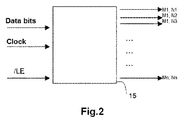
- the electronic device 1 further includes a driver 15, see Fig. 2 , which is at least operatively connected to the processing unit 12.
- the driver 15 communicates the software portion with the hardware portion (the activable areas 11) of the electronic device 1.
- the driver 15 has three input lines and n output lines corresponding to the configuration of rows and columns of the activable areas 11. The three input lines are used for delivering to the driver 15 data corresponding to the character/characters of the Braille text that are to be represented; a clock signal for indicating a data upload into each row N; and an activation signal or bit /LE.
- both the clock signal and the activation signal /LE are generated by the processing unit based on the speed instructions received by the speed controller 12.
- both signals from the processing unit are received by the driver 15.
- the driver 15 also integrates a log (or database) consisting of the Braille characters that must be represented through the activable areas 11 of the electronic device 1.
- the electronic device 1 in any of the described embodiments, can also include a position sensor for detecting the position of one or more fingers of the reader or user on the surface 10 of the electronic device 1.
- the electronic device 1 can include electroacoustic means such as a loudspeaker for (aurally) indicating the Braille character generated by the activable areas 11.
- the driver 15 characteristically provides two different strategies/methodologies for the representation of Braille text: movement mode and single character mode.
- the processing unit sends to the log of the driver 15 the characters coded into Braille to be represented in the form of a succession of elements.
- Each element corresponds to an X-bit data set, and each X-bit data set corresponds to a specific representative character of the Braille text or to a part of said character.
- Each set will have four data bits (one data bit for each row N1...N4 of the electronic device 1 of Fig. 1 ).
- the driver 15 uploads a first element of the succession of elements into the first column M1 of the device.
- This upload of the first element is preferably performed one bit at a time, i.e., in a sequential manner for each row N1...N4, based on the mentioned clock signal received by the driver 15, each bit corresponding to a specific Braille character, or to a part thereof, will be gradually uploaded into each row N1...N4 of the first column M1.
- the driver 15 upon receiving the mentioned activation signal /LE, moves the first element uploaded into the first column M1 to the second column M2, an electric pulse mimicking the Braille reading dot being generated in the activable areas 11 of said first and second columns M1, M2 (or even only of the first column M1, depending on the Braille character that is to be represented).
- the preceding steps i) and ii) are repeated for all the elements of the succession of elements, gradually replacing the elements that have previously entered the first and second columns M1, M2.
- the speed controller 12 allows controlling the reading speed in the electronic device 1.
- This mechanical or voice-activated speed controller 12 will change a value saved beforehand in a position of the memory of the electronic device 1. This value will act in the generation of the clock signal and activation signal /LE by the processing unit.
- the single character mode works in a manner similar to the movement mode for the mentioned steps i), ii), and iii).
- the driver 15 based on the information in its log, uploads a first element of the succession of elements into the first column M1 of the device.
- the driver 15 upon receiving the mentioned activation signal /LE, moves the first element uploaded into the first column M1 to the second column M2, an electric pulse mimicking the Braille reading dot being generated in the activable areas 11 of said first and second columns M1, M2 (or even only of the first column M1, depending on the Braille character that is to be represented).
- the preceding steps i) and ii) are repeated for all the elements of the succession of elements, gradually replacing the elements that have previously entered the first and second columns M1, M2.
- the speed controller 12 gives the value for the generation of the activation signal /LE upon having activated the clock signal twelve times. In this manner, the driver 15 assures that at least the first two columns M1, M2 of the electronic device 1 have the Braille character to be represented.
- this activation signal /LE is preferably generated/implemented by the processing unit, in other non-illustrated embodiments, this activation signal /LE can be directly generated by the speed controller 12.
- the speed controller 12 can be operatively connected with the driver 15 so that this latter unit receives the activation signal /LE directly from the speed controller 12 or the speed controller 12 can be operatively connected with the activable areas 11, for example by means of connections using logic gates, so that the activable areas 11 receive the activation signal /LE directly from the speed controller 12.
Landscapes
- Engineering & Computer Science (AREA)
- Theoretical Computer Science (AREA)
- General Engineering & Computer Science (AREA)
- General Physics & Mathematics (AREA)
- Physics & Mathematics (AREA)
- Audiology, Speech & Language Pathology (AREA)
- General Health & Medical Sciences (AREA)
- Health & Medical Sciences (AREA)
- Business, Economics & Management (AREA)
- Educational Technology (AREA)
- Educational Administration (AREA)
- Human Computer Interaction (AREA)
- User Interface Of Digital Computer (AREA)
- Character Input (AREA)
- Multimedia (AREA)
Priority Applications (6)
| Application Number | Priority Date | Filing Date | Title |
|---|---|---|---|
| EP16382223.2A EP3246898A1 (de) | 2016-05-20 | 2016-05-20 | Leseverfahren für blinde menschen über ein elektronisches gerät und elektronisches lesegerät für blinde |
| UY0001037247A UY37247A (es) | 2016-05-20 | 2017-05-18 | Método de lectura para invidentes mediante un dispositivo electrónico y dispositivo electrónico de lectura para invidentes |
| PCT/IB2017/052925 WO2017199191A1 (en) | 2016-05-20 | 2017-05-18 | A reading method for blind people via an electronic device and electronic reading device for blind people |
| EP17725363.0A EP3459063A1 (de) | 2016-05-20 | 2017-05-18 | Leseverfahren für blinde menschen mittels einer elektronische vorrichtung und elektronische lesevorrichtung für blinde menschen |
| US16/303,186 US20190266917A1 (en) | 2016-05-20 | 2017-05-18 | A reading method for blind people via an electronic device and electronic reading device for blind people |
| ARP170101353A AR108528A1 (es) | 2016-05-20 | 2017-05-19 | Método de lectura para invidentes mediante un dispositivo electrónico y dispositivo electrónico de lectura para invidentes |
Applications Claiming Priority (1)
| Application Number | Priority Date | Filing Date | Title |
|---|---|---|---|
| EP16382223.2A EP3246898A1 (de) | 2016-05-20 | 2016-05-20 | Leseverfahren für blinde menschen über ein elektronisches gerät und elektronisches lesegerät für blinde |
Publications (1)
| Publication Number | Publication Date |
|---|---|
| EP3246898A1 true EP3246898A1 (de) | 2017-11-22 |
Family
ID=56108593
Family Applications (2)
| Application Number | Title | Priority Date | Filing Date |
|---|---|---|---|
| EP16382223.2A Withdrawn EP3246898A1 (de) | 2016-05-20 | 2016-05-20 | Leseverfahren für blinde menschen über ein elektronisches gerät und elektronisches lesegerät für blinde |
| EP17725363.0A Withdrawn EP3459063A1 (de) | 2016-05-20 | 2017-05-18 | Leseverfahren für blinde menschen mittels einer elektronische vorrichtung und elektronische lesevorrichtung für blinde menschen |
Family Applications After (1)
| Application Number | Title | Priority Date | Filing Date |
|---|---|---|---|
| EP17725363.0A Withdrawn EP3459063A1 (de) | 2016-05-20 | 2017-05-18 | Leseverfahren für blinde menschen mittels einer elektronische vorrichtung und elektronische lesevorrichtung für blinde menschen |
Country Status (5)
| Country | Link |
|---|---|
| US (1) | US20190266917A1 (de) |
| EP (2) | EP3246898A1 (de) |
| AR (1) | AR108528A1 (de) |
| UY (1) | UY37247A (de) |
| WO (1) | WO2017199191A1 (de) |
Cited By (1)
| Publication number | Priority date | Publication date | Assignee | Title |
|---|---|---|---|---|
| CN110634358A (zh) * | 2019-09-23 | 2019-12-31 | 京东方科技集团股份有限公司 | 盲文显示面板及其驱动方法、制备方法、盲文显示装置 |
Families Citing this family (3)
| Publication number | Priority date | Publication date | Assignee | Title |
|---|---|---|---|---|
| US11521514B2 (en) * | 2020-05-19 | 2022-12-06 | Prithu Kolar | Refreshable braille display |
| US11640769B2 (en) * | 2020-05-29 | 2023-05-02 | Abenezer Ayana | Modular refreshable braille display system |
| USD1115042S1 (en) * | 2022-10-20 | 2026-02-24 | Ai Guided Limited | Haptic guidance belt |
Citations (13)
| Publication number | Priority date | Publication date | Assignee | Title |
|---|---|---|---|---|
| WO2000022598A1 (en) * | 1998-10-10 | 2000-04-20 | Orbital Research Inc. | Refreshable braille display system |
| US6159013A (en) | 1996-01-19 | 2000-12-12 | Parienti; Raoul | Portable reading device for the blind |
| US6542623B1 (en) * | 1999-09-07 | 2003-04-01 | Shmuel Kahn | Portable braille computer device |
| JP2003150897A (ja) | 2001-08-28 | 2003-05-23 | Shinano Kenshi Co Ltd | 点字読取装置 |
| DE102005001064A1 (de) | 2005-01-07 | 2006-07-20 | Jonas Baumann | Verfahren zum direkten Lesen von gedruckter Schrift für blinde bzw. sehbehinderte Menschen |
| US20080145822A1 (en) * | 2006-12-14 | 2008-06-19 | Verizon Laboratories, Inc. | Apparatus and Method for Presenting and Controllably Scrolling Braille Text |
| CN101261555A (zh) | 2008-04-14 | 2008-09-10 | 华中科技大学 | 计算机盲文手写板 |
| US20120295232A1 (en) | 2011-02-03 | 2012-11-22 | Stephen Sophorn Lim | Touch sense device for the visually impaired |
| US8451240B2 (en) | 2010-06-11 | 2013-05-28 | Research In Motion Limited | Electronic device and method of providing tactile feedback |
| CN102222430B (zh) | 2011-05-16 | 2013-06-05 | 中国科学院电工研究所 | 一种盲用电子书 |
| KR20140008823A (ko) | 2012-07-12 | 2014-01-22 | 삼성전자주식회사 | 점자 입출력 장치 |
| US20150331528A1 (en) * | 2014-05-13 | 2015-11-19 | Lenovo (Singapore) Pte. Ltd. | Tactile interface for visually impaired |
| KR101597913B1 (ko) | 2014-10-30 | 2016-03-03 | 김주윤 | 브레일 디스플레이, 이를 포함하는 전자 기기 및 지독 방향 설정 방법 |
Family Cites Families (2)
| Publication number | Priority date | Publication date | Assignee | Title |
|---|---|---|---|---|
| US8237324B2 (en) * | 2008-12-10 | 2012-08-07 | The Regents Of The University Of California | Bistable electroactive polymers |
| EP2492782A1 (de) * | 2011-02-28 | 2012-08-29 | Research In Motion Limited | Strukturierte Aktivierung von piezoelektrischen Aktuatoren |
-
2016
- 2016-05-20 EP EP16382223.2A patent/EP3246898A1/de not_active Withdrawn
-
2017
- 2017-05-18 WO PCT/IB2017/052925 patent/WO2017199191A1/en not_active Ceased
- 2017-05-18 UY UY0001037247A patent/UY37247A/es not_active Application Discontinuation
- 2017-05-18 US US16/303,186 patent/US20190266917A1/en not_active Abandoned
- 2017-05-18 EP EP17725363.0A patent/EP3459063A1/de not_active Withdrawn
- 2017-05-19 AR ARP170101353A patent/AR108528A1/es unknown
Patent Citations (13)
| Publication number | Priority date | Publication date | Assignee | Title |
|---|---|---|---|---|
| US6159013A (en) | 1996-01-19 | 2000-12-12 | Parienti; Raoul | Portable reading device for the blind |
| WO2000022598A1 (en) * | 1998-10-10 | 2000-04-20 | Orbital Research Inc. | Refreshable braille display system |
| US6542623B1 (en) * | 1999-09-07 | 2003-04-01 | Shmuel Kahn | Portable braille computer device |
| JP2003150897A (ja) | 2001-08-28 | 2003-05-23 | Shinano Kenshi Co Ltd | 点字読取装置 |
| DE102005001064A1 (de) | 2005-01-07 | 2006-07-20 | Jonas Baumann | Verfahren zum direkten Lesen von gedruckter Schrift für blinde bzw. sehbehinderte Menschen |
| US20080145822A1 (en) * | 2006-12-14 | 2008-06-19 | Verizon Laboratories, Inc. | Apparatus and Method for Presenting and Controllably Scrolling Braille Text |
| CN101261555A (zh) | 2008-04-14 | 2008-09-10 | 华中科技大学 | 计算机盲文手写板 |
| US8451240B2 (en) | 2010-06-11 | 2013-05-28 | Research In Motion Limited | Electronic device and method of providing tactile feedback |
| US20120295232A1 (en) | 2011-02-03 | 2012-11-22 | Stephen Sophorn Lim | Touch sense device for the visually impaired |
| CN102222430B (zh) | 2011-05-16 | 2013-06-05 | 中国科学院电工研究所 | 一种盲用电子书 |
| KR20140008823A (ko) | 2012-07-12 | 2014-01-22 | 삼성전자주식회사 | 점자 입출력 장치 |
| US20150331528A1 (en) * | 2014-05-13 | 2015-11-19 | Lenovo (Singapore) Pte. Ltd. | Tactile interface for visually impaired |
| KR101597913B1 (ko) | 2014-10-30 | 2016-03-03 | 김주윤 | 브레일 디스플레이, 이를 포함하는 전자 기기 및 지독 방향 설정 방법 |
Cited By (1)
| Publication number | Priority date | Publication date | Assignee | Title |
|---|---|---|---|---|
| CN110634358A (zh) * | 2019-09-23 | 2019-12-31 | 京东方科技集团股份有限公司 | 盲文显示面板及其驱动方法、制备方法、盲文显示装置 |
Also Published As
| Publication number | Publication date |
|---|---|
| US20190266917A1 (en) | 2019-08-29 |
| UY37247A (es) | 2017-07-31 |
| AR108528A1 (es) | 2018-08-29 |
| EP3459063A1 (de) | 2019-03-27 |
| WO2017199191A1 (en) | 2017-11-23 |
Similar Documents
| Publication | Publication Date | Title |
|---|---|---|
| US20190266917A1 (en) | A reading method for blind people via an electronic device and electronic reading device for blind people | |
| US6417821B1 (en) | Braille computer monitor | |
| US20180217667A1 (en) | Wearable haptic pattern display device for blind person | |
| US20110143321A1 (en) | Portable multifunctional communication and environment aid for the visually handicapped | |
| US9183759B2 (en) | Braille display system and method for operating a refreshable Braille display | |
| US10490102B2 (en) | System and method for braille assistance | |
| AU2022218635B2 (en) | A smart interactive system for braille learning | |
| US20200294419A1 (en) | Device and Method for Receiving and Transmitting Information Using Braille | |
| US20220327960A1 (en) | Method of mechanically translating written text to braille on computer programmed machine using motion haptic stimulation technology | |
| EP2757543A1 (de) | Tragbare elektronische blindenschriftlesevorrichtung | |
| US11854423B1 (en) | Refreshable braille display | |
| Jawasreh et al. | Braille tutorial model using braille fingers puller | |
| US10902744B2 (en) | Braille and/or in auditive Morse code writing device, for users with visual disabilities and/or any motor disorder | |
| Gandhi et al. | Braille cell actuator based teaching system for visually impaired students | |
| EP3705983A1 (de) | Vorrichtung und verfahren zur bidirektionalen mensch-maschine-kommunikation | |
| Kulkarni et al. | Text Detection and Communicator Using Braille for Assistance to Visually Impaired | |
| Shubhom et al. | BRAPTER: Compact braille transput communicator | |
| Raja et al. | Portable refreshable e-braille | |
| US20230419860A1 (en) | Device for mechanically rendering braille using motion haptic stimulation technology | |
| KR101458522B1 (ko) | 점자 출력 장치 및 그 방법 | |
| Bagwari et al. | A hardware model for the helping of speech impaired people | |
| GB2574630A (en) | Reading aid | |
| KR101194078B1 (ko) | 시각장애인을 위한 시각정보 촉각정보 변환 전달 장치 | |
| KR20050080460A (ko) | 한글 입력장치 및 한글 입력방법 | |
| JP2005134886A (ja) | 点字表示装置 |
Legal Events
| Date | Code | Title | Description |
|---|---|---|---|
| PUAI | Public reference made under article 153(3) epc to a published international application that has entered the european phase |
Free format text: ORIGINAL CODE: 0009012 |
|
| AK | Designated contracting states |
Kind code of ref document: A1 Designated state(s): AL AT BE BG CH CY CZ DE DK EE ES FI FR GB GR HR HU IE IS IT LI LT LU LV MC MK MT NL NO PL PT RO RS SE SI SK SM TR |
|
| AX | Request for extension of the european patent |
Extension state: BA ME |
|
| STAA | Information on the status of an ep patent application or granted ep patent |
Free format text: STATUS: THE APPLICATION IS DEEMED TO BE WITHDRAWN |
|
| 18D | Application deemed to be withdrawn |
Effective date: 20180523 |