EP3247724B1 - Protéines de liaison à il-17a - Google Patents
Protéines de liaison à il-17a Download PDFInfo
- Publication number
- EP3247724B1 EP3247724B1 EP16700518.0A EP16700518A EP3247724B1 EP 3247724 B1 EP3247724 B1 EP 3247724B1 EP 16700518 A EP16700518 A EP 16700518A EP 3247724 B1 EP3247724 B1 EP 3247724B1
- Authority
- EP
- European Patent Office
- Prior art keywords
- seq
- sequence
- family
- binding molecule
- domain
- Prior art date
- Legal status (The legal status is an assumption and is not a legal conclusion. Google has not performed a legal analysis and makes no representation as to the accuracy of the status listed.)
- Active
Links
Images












Classifications
-
- C—CHEMISTRY; METALLURGY
- C07—ORGANIC CHEMISTRY
- C07K—PEPTIDES
- C07K16/00—Immunoglobulins [IG], e.g. monoclonal or polyclonal antibodies
- C07K16/18—Immunoglobulins [IG], e.g. monoclonal or polyclonal antibodies against material from animals or humans
- C07K16/24—Immunoglobulins [IG], e.g. monoclonal or polyclonal antibodies against material from animals or humans against cytokines, lymphokines or interferons
- C07K16/244—Interleukins [IL]
-
- A—HUMAN NECESSITIES
- A01—AGRICULTURE; FORESTRY; ANIMAL HUSBANDRY; HUNTING; TRAPPING; FISHING
- A01K—ANIMAL HUSBANDRY; AVICULTURE; APICULTURE; PISCICULTURE; FISHING; REARING OR BREEDING ANIMALS, NOT OTHERWISE PROVIDED FOR; NEW BREEDS OF ANIMALS
- A01K67/00—Rearing or breeding animals, not otherwise provided for; New or modified breeds of animals
- A01K67/027—New or modified breeds of vertebrates
- A01K67/0275—Genetically modified vertebrates, e.g. transgenic
- A01K67/0278—Knock-in vertebrates, e.g. humanised vertebrates
-
- A—HUMAN NECESSITIES
- A61—MEDICAL OR VETERINARY SCIENCE; HYGIENE
- A61K—PREPARATIONS FOR MEDICAL, DENTAL OR TOILETRY PURPOSES
- A61K39/00—Medicinal preparations containing antigens or antibodies
- A61K39/395—Antibodies; Immunoglobulins; Immune serum, e.g. antilymphocytic serum
- A61K39/39533—Antibodies; Immunoglobulins; Immune serum, e.g. antilymphocytic serum against materials from animals
- A61K39/3955—Antibodies; Immunoglobulins; Immune serum, e.g. antilymphocytic serum against materials from animals against proteinaceous materials, e.g. enzymes, hormones, lymphokines
-
- A—HUMAN NECESSITIES
- A61—MEDICAL OR VETERINARY SCIENCE; HYGIENE
- A61P—SPECIFIC THERAPEUTIC ACTIVITY OF CHEMICAL COMPOUNDS OR MEDICINAL PREPARATIONS
- A61P17/00—Drugs for dermatological disorders
- A61P17/06—Antipsoriatics
-
- A—HUMAN NECESSITIES
- A61—MEDICAL OR VETERINARY SCIENCE; HYGIENE
- A61P—SPECIFIC THERAPEUTIC ACTIVITY OF CHEMICAL COMPOUNDS OR MEDICINAL PREPARATIONS
- A61P19/00—Drugs for skeletal disorders
- A61P19/02—Drugs for skeletal disorders for joint disorders, e.g. arthritis, arthrosis
-
- A—HUMAN NECESSITIES
- A61—MEDICAL OR VETERINARY SCIENCE; HYGIENE
- A61P—SPECIFIC THERAPEUTIC ACTIVITY OF CHEMICAL COMPOUNDS OR MEDICINAL PREPARATIONS
- A61P27/00—Drugs for disorders of the senses
- A61P27/02—Ophthalmic agents
-
- A—HUMAN NECESSITIES
- A61—MEDICAL OR VETERINARY SCIENCE; HYGIENE
- A61P—SPECIFIC THERAPEUTIC ACTIVITY OF CHEMICAL COMPOUNDS OR MEDICINAL PREPARATIONS
- A61P29/00—Non-central analgesic, antipyretic or antiinflammatory agents, e.g. antirheumatic agents; Non-steroidal antiinflammatory drugs [NSAID]
-
- A—HUMAN NECESSITIES
- A61—MEDICAL OR VETERINARY SCIENCE; HYGIENE
- A61P—SPECIFIC THERAPEUTIC ACTIVITY OF CHEMICAL COMPOUNDS OR MEDICINAL PREPARATIONS
- A61P31/00—Antiinfectives, i.e. antibiotics, antiseptics, chemotherapeutics
-
- A—HUMAN NECESSITIES
- A61—MEDICAL OR VETERINARY SCIENCE; HYGIENE
- A61P—SPECIFIC THERAPEUTIC ACTIVITY OF CHEMICAL COMPOUNDS OR MEDICINAL PREPARATIONS
- A61P37/00—Drugs for immunological or allergic disorders
- A61P37/02—Immunomodulators
-
- A—HUMAN NECESSITIES
- A61—MEDICAL OR VETERINARY SCIENCE; HYGIENE
- A61P—SPECIFIC THERAPEUTIC ACTIVITY OF CHEMICAL COMPOUNDS OR MEDICINAL PREPARATIONS
- A61P37/00—Drugs for immunological or allergic disorders
- A61P37/02—Immunomodulators
- A61P37/06—Immunosuppressants, e.g. drugs for graft rejection
-
- A—HUMAN NECESSITIES
- A61—MEDICAL OR VETERINARY SCIENCE; HYGIENE
- A61P—SPECIFIC THERAPEUTIC ACTIVITY OF CHEMICAL COMPOUNDS OR MEDICINAL PREPARATIONS
- A61P37/00—Drugs for immunological or allergic disorders
- A61P37/08—Antiallergic agents
-
- C—CHEMISTRY; METALLURGY
- C12—BIOCHEMISTRY; BEER; SPIRITS; WINE; VINEGAR; MICROBIOLOGY; ENZYMOLOGY; MUTATION OR GENETIC ENGINEERING
- C12N—MICROORGANISMS OR ENZYMES; COMPOSITIONS THEREOF; PROPAGATING, PRESERVING, OR MAINTAINING MICROORGANISMS; MUTATION OR GENETIC ENGINEERING; CULTURE MEDIA
- C12N15/00—Mutation or genetic engineering; DNA or RNA concerning genetic engineering, vectors, e.g. plasmids, or their isolation, preparation or purification; Use of hosts therefor
- C12N15/09—Recombinant DNA-technology
- C12N15/63—Introduction of foreign genetic material using vectors; Vectors; Use of hosts therefor; Regulation of expression
-
- G—PHYSICS
- G01—MEASURING; TESTING
- G01N—INVESTIGATING OR ANALYSING MATERIALS BY DETERMINING THEIR CHEMICAL OR PHYSICAL PROPERTIES
- G01N33/00—Investigating or analysing materials by specific methods not covered by groups G01N1/00 - G01N31/00
- G01N33/48—Biological material, e.g. blood, urine; Haemocytometers
- G01N33/50—Chemical analysis of biological material, e.g. blood, urine; Testing involving biospecific ligand binding methods; Immunological testing
- G01N33/68—Chemical analysis of biological material, e.g. blood, urine; Testing involving biospecific ligand binding methods; Immunological testing involving proteins, peptides or amino acids
- G01N33/6863—Cytokines, i.e. immune system proteins modifying a biological response such as cell growth proliferation or differentiation, e.g. TNF, CNF, GM-CSF, lymphotoxin, MIF or their receptors
- G01N33/6869—Interleukin
-
- A—HUMAN NECESSITIES
- A01—AGRICULTURE; FORESTRY; ANIMAL HUSBANDRY; HUNTING; TRAPPING; FISHING
- A01K—ANIMAL HUSBANDRY; AVICULTURE; APICULTURE; PISCICULTURE; FISHING; REARING OR BREEDING ANIMALS, NOT OTHERWISE PROVIDED FOR; NEW BREEDS OF ANIMALS
- A01K2217/00—Genetically modified animals
- A01K2217/07—Animals genetically altered by homologous recombination
- A01K2217/072—Animals genetically altered by homologous recombination maintaining or altering function, i.e. knock in
-
- A—HUMAN NECESSITIES
- A01—AGRICULTURE; FORESTRY; ANIMAL HUSBANDRY; HUNTING; TRAPPING; FISHING
- A01K—ANIMAL HUSBANDRY; AVICULTURE; APICULTURE; PISCICULTURE; FISHING; REARING OR BREEDING ANIMALS, NOT OTHERWISE PROVIDED FOR; NEW BREEDS OF ANIMALS
- A01K2217/00—Genetically modified animals
- A01K2217/07—Animals genetically altered by homologous recombination
- A01K2217/075—Animals genetically altered by homologous recombination inducing loss of function, i.e. knock out
-
- A—HUMAN NECESSITIES
- A01—AGRICULTURE; FORESTRY; ANIMAL HUSBANDRY; HUNTING; TRAPPING; FISHING
- A01K—ANIMAL HUSBANDRY; AVICULTURE; APICULTURE; PISCICULTURE; FISHING; REARING OR BREEDING ANIMALS, NOT OTHERWISE PROVIDED FOR; NEW BREEDS OF ANIMALS
- A01K2217/00—Genetically modified animals
- A01K2217/15—Animals comprising multiple alterations of the genome, by transgenesis or homologous recombination, e.g. obtained by cross-breeding
-
- A—HUMAN NECESSITIES
- A01—AGRICULTURE; FORESTRY; ANIMAL HUSBANDRY; HUNTING; TRAPPING; FISHING
- A01K—ANIMAL HUSBANDRY; AVICULTURE; APICULTURE; PISCICULTURE; FISHING; REARING OR BREEDING ANIMALS, NOT OTHERWISE PROVIDED FOR; NEW BREEDS OF ANIMALS
- A01K2227/00—Animals characterised by species
- A01K2227/10—Mammal
- A01K2227/105—Murine
-
- A—HUMAN NECESSITIES
- A01—AGRICULTURE; FORESTRY; ANIMAL HUSBANDRY; HUNTING; TRAPPING; FISHING
- A01K—ANIMAL HUSBANDRY; AVICULTURE; APICULTURE; PISCICULTURE; FISHING; REARING OR BREEDING ANIMALS, NOT OTHERWISE PROVIDED FOR; NEW BREEDS OF ANIMALS
- A01K2267/00—Animals characterised by purpose
- A01K2267/01—Animal expressing industrially exogenous proteins
-
- A—HUMAN NECESSITIES
- A61—MEDICAL OR VETERINARY SCIENCE; HYGIENE
- A61K—PREPARATIONS FOR MEDICAL, DENTAL OR TOILETRY PURPOSES
- A61K39/00—Medicinal preparations containing antigens or antibodies
- A61K2039/505—Medicinal preparations containing antigens or antibodies comprising antibodies
-
- C—CHEMISTRY; METALLURGY
- C07—ORGANIC CHEMISTRY
- C07K—PEPTIDES
- C07K2317/00—Immunoglobulins specific features
- C07K2317/20—Immunoglobulins specific features characterized by taxonomic origin
- C07K2317/21—Immunoglobulins specific features characterized by taxonomic origin from primates, e.g. man
-
- C—CHEMISTRY; METALLURGY
- C07—ORGANIC CHEMISTRY
- C07K—PEPTIDES
- C07K2317/00—Immunoglobulins specific features
- C07K2317/50—Immunoglobulins specific features characterized by immunoglobulin fragments
- C07K2317/56—Immunoglobulins specific features characterized by immunoglobulin fragments variable (Fv) region, i.e. VH and/or VL
- C07K2317/565—Complementarity determining region [CDR]
-
- C—CHEMISTRY; METALLURGY
- C07—ORGANIC CHEMISTRY
- C07K—PEPTIDES
- C07K2317/00—Immunoglobulins specific features
- C07K2317/50—Immunoglobulins specific features characterized by immunoglobulin fragments
- C07K2317/56—Immunoglobulins specific features characterized by immunoglobulin fragments variable (Fv) region, i.e. VH and/or VL
- C07K2317/569—Single domain, e.g. dAb, sdAb, VHH, VNAR or nanobody®
-
- C—CHEMISTRY; METALLURGY
- C07—ORGANIC CHEMISTRY
- C07K—PEPTIDES
- C07K2317/00—Immunoglobulins specific features
- C07K2317/70—Immunoglobulins specific features characterized by effect upon binding to a cell or to an antigen
- C07K2317/73—Inducing cell death, e.g. apoptosis, necrosis or inhibition of cell proliferation
-
- C—CHEMISTRY; METALLURGY
- C07—ORGANIC CHEMISTRY
- C07K—PEPTIDES
- C07K2317/00—Immunoglobulins specific features
- C07K2317/70—Immunoglobulins specific features characterized by effect upon binding to a cell or to an antigen
- C07K2317/76—Antagonist effect on antigen, e.g. neutralization or inhibition of binding
-
- C—CHEMISTRY; METALLURGY
- C07—ORGANIC CHEMISTRY
- C07K—PEPTIDES
- C07K2317/00—Immunoglobulins specific features
- C07K2317/90—Immunoglobulins specific features characterized by (pharmaco)kinetic aspects or by stability of the immunoglobulin
- C07K2317/92—Affinity (KD), association rate (Ka), dissociation rate (Kd) or EC50 value
-
- G—PHYSICS
- G01—MEASURING; TESTING
- G01N—INVESTIGATING OR ANALYSING MATERIALS BY DETERMINING THEIR CHEMICAL OR PHYSICAL PROPERTIES
- G01N2333/00—Assays involving biological materials from specific organisms or of a specific nature
- G01N2333/435—Assays involving biological materials from specific organisms or of a specific nature from animals; from humans
- G01N2333/52—Assays involving cytokines
- G01N2333/54—Interleukins [IL]
Definitions
- the invention relates to IL-17A binding molecules, and the use of such binding molecule in the treatment of disease.
- Psoriasis is a chronic relapsing and remitting inflammatory skin disease affecting 2-3% of the world's population ( ⁇ 125m sufferers) that causes significant morbidity and decreased quality of life, largely due to clinical flare-ups and disfiguring lesions in visible areas of the skin, systemic manifestations and drug-related side effects.
- the common form of the disease termed 'plaque psoriasis vulgaris', is observed in more than 80% of patients and is characterized by erythematous scaly plaques (typically on elbows, knees, scalp and buttocks) which can vary in size from minimal to the involvement of the entire skin surface.
- psoriasis can be categorised into mild ( ⁇ 3% BSA involvement), moderate (3-10% BSA) and severe (>10% BSA) disease.
- Topical agents such as corticosteroids, vitamin D derivatives, coal tar and topical retinoids are the cornerstone of the initial management of psoriasis and are an important part of the treatment ladder applied to patients across the spectrum of disease severity.
- Patients diagnosed with mild-to-moderate disease are typically prescribed topical agents as monotherapy.
- Patients with severe disease are typically prescribed topical agents as an adjunct to phototherapy or systemic (small molecule) therapies such as methotrexate, cyclosporine or oral retinoids.
- the treatment regime for moderate-to-severe psoriasis also includes antibody-based therapies.
- Phototherapy can be effective, but is inconvenient and associated with a significant risk of skin cancer.
- Small molecule systemic therapies are associated with increased cardiovascular risk; renal dysfunction, leucopenia and thrombocytopenia.
- methotrexate may cause a neutropenia and liver damage and is contraindicated for males and females of reproductive age without due precaution.
- Cyclosporine is a potent immunosuppressant, which has potential adverse effects on the kidneys and blood pressure.
- Acitretin is an oral retinoid that has a range of side effects, and is also contraindicated for females of reproductive age without due precaution ( Nast et al., Arch Dermatol Res (2007) 299:111-138 ).
- the treatment regimen for moderate-to-severe psoriasis also includes antibody-based therapies.
- Approved treatments include adalimumab (Humira ® ), a humanized monoclonal antibody with activity against TNF-alpha( ⁇ ), the TNF- ⁇ inhibitor etanercept (Enbrel ® ), the TNF- ⁇ inhibitor infliximab (Remicade ® ) and most recently ustekinumab (Stelara ® ), a human mAb that targets the common p40 subunit of IL12 and IL23, thereby blocking the signalling of both cytokines.
- Interleukin-17A is a proinflammatory cytokine produced by activated T cells, particularly Th17 cells. High levels of this cytokine are associated with a number of chronic inflammatory diseases.
- Antibodies that bind IL-17A to modulate its activity in inflammatory and autoimmune disorders have been proposed for a variety of conditions, particularly rheumatoid arthritis (as described in WO 2007/149032 , WO 2010/102251 , WO 2008/021156 , WO 2012/156219 and Katrien et al., Arthritis and Rheumatism. 2013; 65:S543 ).
- Other multi-specific dual variable domain-binding proteins that IL-17 and TNF have been proposed to treat chronic inflammatory conditions including psoriasis ( WO 2013/063110 ).
- IL-17 is a target for topical therapy in skin. While psoriasis may have a systemic component in some patients, the disease is primarily one of the skin. IL-17 secreted by Th17 cells acts on epidermal keratinocytes, via IL-17R complexes present on these cells, to initiate a feedback loop of keratinocyte hyper-proliferation and on-going inflammation, thereby generating the psoriatic plaque.
- IL-17A monoclonal antibodies agents in development have been shown to markedly reduce disease severity in patients with moderate-to-severe plaque psoriasis.
- agents include ixekizumab (Eli Lilly) and secukinumab (Novartis), both of which target IL-17A, and brodalumab (Amgen) that binds to and inhibits signalling of IL-17RA and therefore would be expected to block IL1-7 family members that utilize this receptor, including IL-17A, IL-17F, IL-17A/F and possibly IL-17E.
- the preliminary clinical results for IL-17 inhibitors indicate the importance of IL-17A in psoriasis pathophysiology.
- Antibodies have proven themselves to be extremely effective therapeutic agents for treating a large number of different disease indications. In particular, there has been a clear trend towards development of fully human antibodies for therapeutic use over the various alternatives. Due to their size and other physical properties, however, it is currently the case that monoclonal antibodies have to be administered either intravenously (iv) or subcutaneously (sc) and therefore have a high systemic exposure. Thus, although the antibodies can be highly effective, their route of delivery can often be suboptimal, resulting either in antibody binding to target antigen at non-disease locations (potentially compromising the healthy function of normal, non-disease tissue) or resulting in suboptimal PK/PD characteristics. Either outcome may result in a loss of efficacy and/or a compromised safety profile by virtue of the suboptimal route of administration.
- V H fragments are the smallest, most robust portion of an immunoglobulin molecule that retain target specificity and potency. It would therefore be advantageous to deliver V H domains topically on the skin so that they penetrate to therapeutically beneficial locations within the skin to treat disease locally. Any V H that might enter the bloodstream will be cleared rapidly and therefore have little or no systemic exposure thereby minimising potential mechanism-related systemic toxicity.
- the invention is aimed at providing a safe and effective therapy of conditions associated with the IL-17 pathway, in particular for topical treatment of psoriasis.
- references in the description to methods of treatment refer to the compounds, pharmaceutical compositions and medicaments of the present invention for use in a method for treatment of the human (or animal) body by therapy (or for diagnosis).
- the invention relates to an immunoglobulin single heavy chain variable domain antibody capable of binding human IL-17A, comprising a human heavy chain variable immunoglobulin domain (VH) comprising a CDR1 sequence comprising SEQ ID NO. 5, a CDR2 sequence comprising SEQ ID NO. 6 and a CDR3 sequence comprising SEQ ID NO. 7, for use in the treatment of psoriasis or atopic dermatitis, wherein the immunoglobulin single domain antibody is administered topically.
- VH human heavy chain variable immunoglobulin domain
- said VH domain comprises or consists of SEQ ID NO. 8 or a sequence with at least 70%, at least 75%, at least 80%, at least 90% or at least 95% homology to SEQ ID NO. 8.
- the invention comprises a C terminal extension of 1, 2, 3, 4, 5, 6, 7, 8, 9 or 10 amino acid residues.
- said C terminal extension is a single alanine residue.
- the immunoglobulin single domain antibody is obtained or obtainable from a mouse that does not produce any functional endogenous light or heavy chains.
- the antibody is administered as a pharmaceutical composition.
- the single domain antibody or pharmaceutical composition thereof is administered topically to healthy or diseased skin.
- the antibody is encoded by an isolated nucleic acid molecule comprising SEQ ID NO:350.
- Enzymatic reactions and purification techniques are performed according to the manufacturer's specifications, as commonly accomplished in the art or as described herein.
- the nomenclatures used in connection with, and the laboratory procedures and techniques of, analytical chemistry, synthetic organic chemistry, medicinal and pharmaceutical chemistry described herein are those well-known and commonly used in the art. Standard techniques are used for chemical syntheses, chemical analyses, pharmaceutical preparation, formulation, and delivery, and treatment of patients.
- the IL-17 family of cytokines includes six members, IL-17/IL-17A, IL-17B, IL-17C, IL-17D, IL-17E/IL-25, and IL-17F, which are produced by multiple cell types. Members of this family have a highly conserved C-terminus containing a cysteine-knot fold structure. Most IL-17 proteins are secreted as disulfide-linked dimers, with the exception of IL-17B, which is secreted as a non-covalent homodimer.
- IL-17 family cytokines Signaling by IL-17 family cytokines is mediated by members of the IL-17 receptor family, IL-17 R/IL-17 RA, IL-17 B R/IL-17 RB, IL-17 RC, IL-17 RD, and IL-17 RE. Activation of these receptors triggers intracellular pathways that induce the production of pro-inflammatory cytokines and anti-microbial peptides.
- IL-17A, IL-17F, and IL-17A/F are produced primarily by activated T cells and signal through an oligomerized receptor complex consisting of IL-17 RA and IL-17 RC.
- IL-17E activates similar signaling pathways through a receptor complex formed by IL-17 RA and IL-17 B R/IL-17RB. Signaling by IL-17E induces Th2-type immune responses and may be involved in promoting the pathogenesis of asthma. Less is known about the signaling pathways activated by other IL-17 family cytokines. Recent studies suggest that IL-17C is produced primarily by epithelial cells and binds to a receptor complex consisting of IL-17 RA and IL-17 RE.
- IL-17C Autocrine signaling by IL-17C in epithelial cells stimulates the production of anti-microbial peptides and pro-inflammatory cytokines, but like IL-17A, overexpression of IL-17C may contribute to the development of autoimmune diseases. Similar to IL-17E, IL-17B binds to IL-17 B R/IL-17 RB, but the major target cells and effects of IL-17B signaling have not been reported. In addition, the receptor for IL-17D and the ligand for IL-17 RD are currently unknown.
- the invention provides isolated IL-17A binding molecules that are all capable of binding human IL-17A, pharmaceutical compositions and formulations, in particular for topical administration, comprising such binding molecules, as well as isolated nucleic acids encoding such binding molecules, recombinant expression vectors and host cells comprising such nucleic acids for making such binding molecules. Also described herein are methods of using the binding molecules disclosed herein to detect human IL-17A, to inhibit human IL-17A either in vitro or in vivo, and in methods of treating disease. Also described herein are isolated human anti-human IL-17A binding molecules, specifically those comprising, or consisting of, at least one single domain antibody that binds to human IL-17A with high affinity, a slow off rate and high neutralizing capacity.
- the binding molecules are capable of binding specifically to human IL-17A and do not cross react with, or do not show substantial binding to, the members of the human IL-17 family.
- This limited cross-reactivity with human IL-17A homologues exhibited by the binding molecules offers advantages for their therapeutic and/or diagnostic use, as side effects by undesirable cross reactivity are reduced. This also offers advantages in dosing for therapeutic application.
- the binding molecules are capable of binding/are directed to human IL-17A.
- Human IL-17A binding molecule which binds to human IL-17A (Accession number Q16552 (Swiss-Prot) showing the full-length precursor IL-17A including the signal peptide, SEQ ID NO. 465) and/or cynomolgus monkey IL-17 (Uniprot G7P4U9).
- Human IL-17A is a homodimer consisting of two 155 amino acid chains. Each polypeptide chain includes a 23 amino acid N-terminal peptide which is cleaved to produce a mature polypeptide of 132 residues.
- IL-17A binds to and exerts its effects via activation of the IL-17 receptors A and C.
- IL-17 binding molecule IL-17 binding protein
- anti-IL-17 single domain antibody or “anti-IL-17 antibody” all refer to a molecule capable of binding to the human IL-17A antigen.
- IL-17 usually refers to IL-17A, unless otherwise stated or unless the context directs otherwise.
- the binding reaction may be shown by standard methods (qualitative assays) including, for example, a binding assay, competition assay or a bioassay for determining the inhibition of IL-17 binding to its receptor or any kind of binding assays, with reference to a negative control test in which an antibody of unrelated specificity.
- the term "IL-17 binding molecule” includes an IL-17 binding protein or a part thereof that is capable of binding human IL-17A.
- the invention relates to isolated binding molecules capable of binding to human IL-17A comprising a heavy chain variable immunoglobulin domain (V H ) comprising a CDR3 sequence as shown in any of figures 1 to 5 with reference to tables 1 to 5 or a sequence with at least 60%, 70%, 80%, 90%, 95% or more sequence identity thereto.
- the binding molecule comprises a set of CDR1, 2 and 3 sequences selected from the sets of CDR1, 2 and 3 sequences as shown for the any of the clones of any of figures 1 to 5 with reference to tables 1 to 5.
- the binding molecule comprises a V H domain with a set of CDR1, 2 and 3 sequences selected from the sets of CDR1, 2 and 3 sequences as shown for the any of the clones of any of figures 1 to 5 with reference to tables 1 to 5.
- the binding molecule is a heavy chain only antibody.
- the invention in another aspect, relates to an isolated binding molecule comprising at least one immunoglobulin single domain antibody directed against human IL-17A wherein said domain is a V H domain and wherein said IL-17A binding molecule comprises at least one antigen binding site.
- the binding molecule may comprise at least one immunoglobulin single domain antibody directed against human IL-17A wherein said domain is a V H domain comprising a CDR3 sequence as shown in any of figures 1 to 5 with reference to tables 1 to 5 or comprising a CDR3 sequence with at least 60%, 70%, 80%, 90%, 95% or more sequence identity to said CDR sequence.
- said at least one immunoglobulin single domain antibody comprises a set of CDR1, 2 and 3 or a V H domain with a set of CDR1, 2 and 3 sequences selected from the sets of CDR1, 2 and 3 sequences as shown for any of the clones of any of figures 1 to 5 with reference to tables 1 to 5.
- the binding molecule comprises or consists of a V H domain as shown for a clones selected from clones 1.1 to 1.69, 2.1 to 2.9, 3.1 to 3.14, 4.1 or 5.1.
- said sequence homology or identity is at least 60%, 61%, 62%, 63%, 64%, 65%, 66%, 67%, 68%, 69%, 70%, 71%, 72%, 73%, 74%, 75%, 76%, 77%, 78%, 79%, 80%, 81%, 82%, 83%, 84%, 85%, 86%, 87%, 88%, 89%, 90%, 91%, 92%, 93%, 94%, 95%, 96%, 97%, 98% or 99%
- “Homology” generally refers to the percentage of amino acid residues in the candidate sequence that are identical with the residues of the polypeptide with which it is compared, after aligning the sequences and in some examples after introducing gaps, if necessary, to achieve the maximum percent homology, and not considering any conservative substitutions as part of the sequence identity. Neither N- or C-terminal extensions, tags or insertions shall be construed as reducing identity or homology. Methods and computer programs for the alignment are well known.
- antibody broadly refers to any immunoglobulin (Ig) molecule, or antigen binding portion thereof, comprised of four polypeptide chains, two heavy (H) chains and two light (L) chains, or any functional fragment, mutant, variant, or derivation thereof, which retains the essential epitope binding features of an Ig molecule.
- Ig immunoglobulin
- L light
- each heavy chain is comprised of a heavy chain variable region (abbreviated herein as HCVR or V H ) and a heavy chain constant region.
- the heavy chain constant region is comprised of three domains, C H 1, C H 2 and C H 3.
- Each light chain is comprised of a light chain variable region (abbreviated herein as LCVR or V L ) and a light chain constant region.
- the light chain constant region is comprised of one domain, C L .
- the V H and V L regions can be further subdivided into regions of hypervariability, termed complementarity-determining regions (CDR), interspersed with regions that are more conserved, termed framework regions (FR).
- CDR complementarity-determining regions
- FR framework regions
- Each V H and V L is composed of three CDRs and four FRs, arranged from amino-terminus to carboxy terminus in the following order: FR1, CDR1, FR2, CDR2, FR3, CDR3, FR4.
- Immunoglobulin molecules can be of any type (e.g., IgG, IgE, IgM, IgD, IgA and IgY), class (e.g., IgG 1, IgG2, IgG 3, IgG4, IgAl and IgA2) or subclass.
- type e.g., IgG, IgE, IgM, IgD, IgA and IgY
- class e.g., IgG 1, IgG2, IgG 3, IgG4, IgAl and IgA2
- subclass e.g., IgG 1, IgG2, IgG 3, IgG4, IgAl and IgA2
- Isolated binding molecules may comprise or consist of at least one single domain antibody wherein said domain is a V H domain.
- a binding molecules may comprise or consist of at least one immunoglobulin single variable heavy chain domain antibody (sVD, sdAb or ISV) that has a V H domain, but is devoid of V L domains.
- sVD immunoglobulin single variable heavy chain domain antibody
- Single domain antibodies have been described in the art; they are antibodies whose complementary-determining regions are part of a single domain polypeptide, for example a V H domain polypeptide.
- binding molecule may comprise two or more V H domains.
- binding molecules may be monospecific or multispecific, monovalent or multivalent as explained in further detail.
- Binding molecules that comprise a single domain antibody wherein said domain is a V H domain are also termed Humabody ® V H .
- a binding molecule does not comprise a light chain.
- the binding molecule does not comprise heavy chain domains C H 2 and C H 3.
- the binding molecule does not comprise a hinge region and heavy chain domains C H 2 and C H 3.
- the binding molecule does not comprise heavy chain domains C H 1, C H 2, and C H 3.
- the binding molecule does not comprise heavy chain domain C H 1, a hinge region heavy chain domain C H 2 and heavy chain domain C H 3.
- the binding molecule does not comprise a light chain, a heavy chain domain C H 1, a hinge region heavy chain domain C H 2 and heavy chain domain C H 3.
- Each V H domain comprises three CDRs and four FRs, arranged from amino terminus to carboxy terminus in the following order: FR1, CDR1, FR2, CDR2, FR3, CDR3, FR4.
- Modifications to the V H framework may be made to improve binding properties.
- the V H domain may comprise C or N terminal extensions.
- the V H domain may comprises C terminal extensions of from 1 to 10, for example 1, 2, 3, 4, 5, 6, 7, 8, 9 or 10 additional amino acids.
- the V H domain comprises C terminal extensions of from 1 to 12 amino acid residues, for example 1, 2, 3, 4, 5, 6, 7, 8, 9 or 10 additional amino acids of the C H 1 domain.
- said extension comprises at least 1 alanine residue, for example a single alanine residue, a pair of alanine residues or a triplet of alanine residues.
- V H domains may comprise additional C or N terminal residues, for example linker residues and / or His tags, e.g., hexa-His.
- the one or more V H domain is a human V H domain.
- a human V H domain includes a V H domain that is derived from or based on a human V H domain amino acid or nucleic acid sequence.
- the term includes variable heavy chain regions derived from human germline immunoglobulin sequences.
- the term human V H domain includes V H domains that are isolated from transgenic mice expressing human immunoglobulin V genes, in particular in response to an immunisation with an antigen of interest.
- the human V H domains may include amino acid residues not encoded by human germline immunoglobulin sequences (e. g., mutations introduced in vitro, e.g. by random or site-specific mutagenesis, or introduced by somatic mutation in vivo).
- the term "human V H domain” therefore also includes modified human V H sequences.
- the invention provides a binding molecule comprising at least one immunoglobulin single domain antibody capable of binding/directed against IL-17A wherein said domain is a human V H domain and wherein said IL-17A binding molecule comprises at least one antigen binding site.
- the single domain antibody is specifically directed against human IL-17A.
- variable domain refers to immunoglobulin variable domains defined by Kabat et al., Sequences of Immunological Interest, 5th ed., U.S. Dept. Health & Human Services, Washington, D.C. (1991 ). The numbering and positioning of CDR amino acid residues within the variable domains is in accordance with the well-known Kabat numbering convention.
- V H immunoglobulin domain that can bind to human IL-17 with an affinity, a Kon-rate, a Koff rate, KD and/or KA as further described herein.
- the binding molecules may comprise or consist of an amino acid sequence as shown herein and preferred sequences and/or parts thereof, such as CDRs, are defined herein.
- CDR refers to the complementarity determining region within antibody variable sequences. There are three CDRs in each of the variable regions of the heavy chain and the light chain, which are designated CDR1, CDR2 and CDR3, for each of the variable regions.
- CDR set refers to a group of three CDRs that occur in a single variable region capable of binding the antigen. The exact boundaries of these CDRs have been defined differently according to different systems. The system described by Kabat is used herein.
- Kabat numbering “Kabat definitions” and “Kabat labeling” are used interchangeably herein.
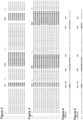
- clone 1.1 is the parent clone for family 1 as shown in Fig. 1
- clone 2.1 is the parent clone for family 2 as shown in Fig. 2
- clone 3.1 is the parent clone for family 3 as shown in Fig. 3
- clone 4.1 is the parent clone for family 4 as shown in Fig. 4
- clone 5.1 is the parent clone for family 5 as shown in Fig. 5 ); each parent molecule having a set of CDR sequences (CDR1, 2 and 3) as shown in Figures 1 , 2, 3, 4 and 5 .
- V H domain sequences show improved affinities to IL-17A and improved potencies in the IL-17 cell-based assay compared to the parent molecule as shown in the examples.
- the invention relates to a binding molecule capable of binding human IL-17A comprising a human V H domain comprising a family-1 or family-1 like sequence.
- the binding molecule comprises or consists of at least one immunoglobulin single domain antibody capable of binding/directed against IL-17A, preferably human IL-17A, wherein said domain is a human V H domain and wherein said IL-17A binding molecule comprises a family-1 or family 1-like sequence.
- immunoglobulin single domain antibody capable of binding/directed against IL-17A, preferably human IL-17A, wherein said domain is a human V H domain and wherein said IL-17A binding molecule comprises a family-1 or family 1-like sequence.
- These include the sequence of the parent clone (clone 1.1, SEQ ID NO. 4) or a part thereof, for example a CDR3 sequence, and sequences of clones that are derived from the parent clone 1.1 through a process of optimization, for example sequences as shown as shown in Figure 1 .
- CDR sequences, or parts thereof and full length V H sequences of clones in family 1 are numbered according to table 1 as shown below. Table 1.
- SEQ ID NOs. of family 1 CDR amino acid sequences and of family 1 full length V H sequences Corresponding sequences are shown in Figure 1.
- Clone CDR1 SEQ ID NO. CDR2 SEQ ID NO. CDR3 SEQ ID NO. Full length V H sequence SEQ ID NO. 1.1 SEQ ID NO. 1 SEQ ID NO. 2 SEQ ID NO. 3 SEQ ID NO. 4 1.2 SEQ ID NO. 5 SEQ ID NO. 6 SEQ ID NO. 7 SEQ ID NO. 8 1.3 SEQ ID NO. 9 SEQ ID NO. 10 SEQ ID NO. 11 SEQ ID NO. 12 1.4 SEQ ID NO. 13 SEQ ID NO. 14 SEQ ID NO. 15 SEQ ID NO. 16 1.5 SEQ ID NO. 17 SEQ ID NO.
- SEQ ID NO. 19 SEQ ID NO. 20 1.6 SEQ ID NO. 21 SEQ ID NO. 22 SEQ ID NO. 23 SEQ ID NO. 24 1.7 SEQ ID NO. 25 SEQ ID NO. 26 SEQ ID NO. 27 SEQ ID NO. 28 1.8 SEQ ID NO. 29 SEQ ID NO. 30 SEQ ID NO. 31 SEQ ID NO. 32 1.9 SEQ ID NO. 33 SEQ ID NO. 34 SEQ ID NO. 35 SEQ ID NO. 36 1.10 SEQ ID NO. 37 SEQ ID NO. 38 SEQ ID NO. 39 SEQ ID NO. 40 1.11 SEQ ID NO. 41 SEQ ID NO. 42 SEQ ID NO. 43 SEQ ID NO. 44 1.12 SEQ ID NO. 45 SEQ ID NO. 46 SEQ ID NO.
- SEQ ID NO. 48 1.13 SEQ ID NO. 49 SEQ ID NO. 50 SEQ ID NO. 51 SEQ ID NO. 52 1.14 SEQ ID NO. 53 SEQ ID NO. 54 SEQ ID NO. 55 SEQ ID NO. 56 1.15 SEQ ID NO. 57 SEQ ID NO. 58 SEQ ID NO. 59 SEQ ID NO. 60 1.16 SEQ ID NO. 61 SEQ ID NO. 62 SEQ ID NO. 63 SEQ ID NO. 64 1.17 SEQ ID NO. 65 SEQ ID NO. 66 SEQ ID NO. 67 SEQ ID NO. 68 1.18 SEQ ID NO. 69 SEQ ID NO. 70 SEQ ID NO. 71 SEQ ID NO. 72 1.19 SEQ ID NO. 73 SEQ ID NO.
- SEQ ID NO. 75 SEQ ID NO. 76 1.20 SEQ ID NO. 77 SEQ ID NO. 78 SEQ ID NO. 79 SEQ ID NO. 80 1.21 SEQ ID NO. 81 SEQ ID NO. 82 SEQ ID NO. 83 SEQ ID NO. 84 1.22 SEQ ID NO. 85 SEQ ID NO. 86 SEQ ID NO. 87 SEQ ID NO. 88 1.23 SEQ ID NO. 89 SEQ ID NO. 90 SEQ ID NO. 91 SEQ ID NO. 92 1.24 SEQ ID NO. 93 SEQ ID NO. 94 SEQ ID NO. 95 SEQ ID NO. 96 1.25 SEQ ID NO. 97 SEQ ID NO. 98 SEQ ID NO. 99 SEQ ID NO.
- SEQ ID NO. 101 SEQ ID NO. 102 SEQ ID NO. 103 SEQ ID NO. 104 1.27 SEQ ID NO. 105 SEQ ID NO. 106 SEQ ID NO. 107 SEQ ID NO. 108 1.28 SEQ ID NO. 109 SEQ ID NO. 110 SEQ ID NO. 111 SEQ ID NO. 112 1.29 SEQ ID NO. 113 SEQ ID NO. 114 SEQ ID NO. 115 SEQ ID NO. 116 1.30 SEQ ID NO. 117 SEQ ID NO. 118 SEQ ID NO. 119 SEQ ID NO. 120 1.31 SEQ ID NO. 121 SEQ ID NO. 122 SEQ ID NO. 123 SEQ ID NO. 124 1.32 SEQ ID NO. 125 SEQ ID NO.
- SEQ ID NO. 126 SEQ ID NO. 127 SEQ ID NO. 128 1.33 SEQ ID NO. 129 SEQ ID NO. 130 SEQ ID NO. 131 SEQ ID NO. 132 1.34 SEQ ID NO. 133 SEQ ID NO. 134 SEQ ID NO. 135 SEQ ID NO. 136 1.35 SEQ ID NO. 137 SEQ ID NO. 138 SEQ ID NO. 139 SEQ ID NO. 140 1.36 SEQ ID NO. 141 SEQ ID NO. 142 SEQ ID NO. 143 SEQ ID NO. 144 1.37 SEQ ID NO. 145 SEQ ID NO. 146 SEQ ID NO. 147 SEQ ID NO. 148 1.38 SEQ ID NO. 149 SEQ ID NO. 150 SEQ ID NO. 151 SEQ ID NO.
- SEQ ID NO. 152 1.39 SEQ ID NO. 153 SEQ ID NO. 154 SEQ ID NO. 155 SEQ ID NO. 156 1.40 SEQ ID NO. 157 SEQ ID NO. 158 SEQ ID NO. 159 SEQ ID NO. 160 1.41 SEQ ID NO. 161 SEQ ID NO. 162 SEQ ID NO. 163 SEQ ID NO. 164 1.42 SEQ ID NO. 165 SEQ ID NO. 166 SEQ ID NO. 167 SEQ ID NO. 168 1.43 SEQ ID NO. 169 SEQ ID NO. 170 SEQ ID NO. 171 SEQ ID NO. 172 1.44 SEQ ID NO. 173 SEQ ID NO. 174 SEQ ID NO. 175 SEQ ID NO. 176 1.45 SEQ ID NO.
- SEQ ID NO. 204 1.52 SEQ ID NO. 205 SEQ ID NO. 206 SEQ ID NO. 207 SEQ ID NO. 208 1.53 SEQ ID NO. 209 SEQ ID NO. 210 SEQ ID NO. 211 SEQ ID NO. 212 1.54 SEQ ID NO. 213 SEQ ID NO. 214 SEQ ID NO. 215 SEQ ID NO. 216 1.55 SEQ ID NO. 217 SEQ ID NO. 218 SEQ ID NO. 219 SEQ ID NO. 220 1.56 SEQ ID NO. 221 SEQ ID NO. 222 SEQ ID NO. 223 SEQ ID NO. 224 1.57 SEQ ID NO. 225 SEQ ID NO. 226 SEQ ID NO. 227 SEQ ID NO.
- SEQ ID NO. 228 1.58 SEQ ID NO. 229 SEQ ID NO. 230 SEQ ID NO. 231 SEQ ID NO. 232 1.59 SEQ ID NO. 233 SEQ ID NO. 234 SEQ ID NO. 235 SEQ ID NO. 236 1.60 SEQ ID NO. 237 SEQ ID NO. 238 SEQ ID NO. 239 SEQ ID NO. 240 1.61 SEQ ID NO. 241 SEQ ID NO. 242 SEQ ID NO. 243 SEQ ID NO. 244 1.62 SEQ ID NO. 245 SEQ ID NO. 246 SEQ ID NO. 247 SEQ ID NO. 248 1.63 SEQ ID NO. 438 SEQ ID NO. 439 SEQ ID NO. 440 SEQ ID NO. 441 1.64 SEQ ID NO.
- SEQ ID NO. 442 SEQ ID NO. 443 SEQ ID NO. 444 SEQ ID NO. 445 1.65 SEQ ID NO. 446 SEQ ID NO. 447 SEQ ID NO. 448 SEQ ID NO. 449 1.66 SEQ ID NO. 450 SEQ ID NO. 451 SEQ ID NO. 452 SEQ ID NO. 453 1.67 SEQ ID NO. 454 SEQ ID NO. 455 SEQ ID NO. 456 SEQ ID NO. 457 1.68 SEQ ID NO. 458 SEQ ID NO. 459 SEQ ID NO. 460 SEQ ID NO. 461 1.69 SEQ ID NO. 462 SEQ ID NO. 463 SEQ ID NO. 464 SEQ ID NO. 466
- Family 1 or family 1-like binding molecule may comprise a human V H domain comprising a CDR3 sequence comprising SEQ ID NO. 3 or a sequence having at least 70%, at least 80%, at least 90%, or at least 95% homology to SEQ ID NO. 3.
- the family 1 or family-1 like binding molecule comprises at least one immunoglobulin single domain antibody directed against IL-17A wherein said domain is a human V H domain and wherein said human V H domain comprises at least one antigen binding site comprising a CDR3 sequence comprising SEQ ID NO. 3 or a sequence having at least 70%, at least 80%, at least 90%, or at least 95% homology to SEQ ID NO. 3.
- homology is at least 90% homology to SEQ ID NO. 3.
- the V H domain comprises a CDR3 sequence comprising or consisting of an amino acid sequence selected from SEQ ID NO. 3, 7, 11, 15, 19, 23, 27, 31, 35, 39, 43, 47, 51, 55, 59, 63, 67, 71, 75, 79, 83, 87, 91, 95, 99, 103, 107, 111, 115, 119, 123, 127, 131, 135, 139, 143, 147, 151, 155, 159, 163, 167, 171, 175, 179, 183, 187, 191, 195, 199, 203, 207, 211, 215, 219, 223, 227, 231, 235, 239, 243 or 247, 440, 444, 448, 452, 456, 460 or 464.
- the family 1 or family 1-like binding molecule comprises at least one antigen binding site comprising CDR1, CDR2 and CDR3, said CDR1 comprising the amino acid sequence SEQ ID NO. 1 or a sequence with at least 70%, at least 80%, at least 90%, or at least 95% homology thereto, said CDR2 comprising the amino acid sequence SEQ ID NO. 2 or a sequence with at least 70%, at least 80%, at least 90%, or at least 95% homology thereto, and said CDR3 comprising the amino acid sequence SEQ ID NO. 3 or a sequence with at least 70%, at least 80%, at least 90%, or at least 95% homology thereto.
- the CDR sequence may be a CDR sequence selected from one of the sequences shown in Figure 1 .
- said CDR1 comprises or consists of the amino acid sequence as shown in SEQ ID NO. 1 or a sequence with at least 80%, 81%, 82%, 83%, 84%, 85%,86%, 87%, 88%, 89%, 90%, 91%, 92%, 93%, 94%, 95%, 96%, 97%, 98%, 99% homology thereto.
- said CDR2 comprises or consists of the amino acid sequence as shown in SEQ ID NO. 2 or a sequence with at least 80%, 81%, 82%, 83%, 84%, 85%, 87%, 88%, 89%, 90%, 91%, 92%, 93%, 94%, 95%, 96%, 97%, 98%, 99% homology thereto.
- said CDR3 comprises or consists of the amino acid sequence as shown in SEQ ID NO. 3 or a sequence with at least 80%, 81%, 82%, 83%, 84%, 85%, 86% 87%, 88%, 89%, 90%, 91%, 92%, 93%, 94%, 95%, 96%, 97%, 98% or 99% homology thereto.
- CDR1 comprises or consists of the amino acid sequence SEQ ID NO. 1, 5, 9, 13, 17, 21, 25, 29, 33, 37, 41, 45, 49, 53, 57, 61, 65, 69, 73, 77, 81, 85, 89, 93, 97, 101, 105, 109, 113, 117, 121,125, 129, 133, 137, 141, 145, 149, 153, 157, 161, 165, 169, 173, 177,181, 185, 189, 193, 197, 201, 205, 209, 213, 217, 221, 225, 229, 233, 237, 241, 245, 438, 442, 446, 450, 454, 458 or 462,
- CDR2 comprises or consists of the amino acid sequence SEQ ID NO.
- CDR1 comprises or consists of the amino acid sequence SEQ ID NO. 1
- CDR2 comprises or consists of the amino acid sequence SEQ ID NO. 2
- CDR3 comprises or consists of the amino acid sequence SEQ ID NO. 3.
- the binding molecule has a combination of CDR1, CDR2 and CDR3 as shown for clones 1.1 to 1.22 in Figure 1 .
- the binding molecule comprises CDR1, 2 and 3 sequences wherein CDR1 is SEQ ID NO. 1, CDR2 is SEQ ID NO. 2 and CDR3 is SEQ ID NO. 3.
- the binding molecule comprises CDR1, 2 and 3 sequences wherein CDR1 is SEQ ID NO. 5, CDR2 is SEQ ID NO. 6 and CDR3 is SEQ ID NO. 7.
- the binding molecule comprises CDR1, 2 and 3 sequences wherein CDR1 is SEQ ID NO. 9, CDR2 is SEQ ID NO. 10 and CDR3 is SEQ ID NO. 11.
- the binding molecule comprises CDR1, 2 and 3 sequences wherein CDR1 is SEQ ID NO. 13, CDR2 is SEQ ID NO. 14 and CDR3 is SEQ ID NO. 15.
- the binding molecule comprises CDR1, 2 and 3 sequences wherein CDR1 is SEQ ID NO. 17, CDR2 is SEQ ID NO. 18 and CDR3 is SEQ ID NO. 19.
- the binding molecule comprises CDR1, 2 and 3 sequences wherein CDR1 is SEQ ID NO. 21, CDR2 is SEQ ID NO.
- the binding molecule comprises CDR1, 2 and 3 sequences wherein CDR1 is SEQ ID NO. 25, CDR2 is SEQ ID NO. 26 and CDR3 is SEQ ID NO. 27.
- the binding molecule comprises CDR1, 2 and 3 sequences wherein CDR1 is SEQ ID NO. 29, CDR2 is SEQ ID NO. 30 and CDR3 is SEQ ID NO. 31.
- the binding molecule comprises CDR1, 2 and 3 sequences wherein CDR1 is SEQ ID NO. 33, CDR2 is SEQ ID NO. 34 and CDR3 is SEQ ID NO. 35.
- the binding molecule comprises CDR1, 2 and 3 sequences wherein CDR1 is SEQ ID NO.
- the binding molecule comprises CDR1, 2 and 3 sequences wherein CDR1 is SEQ ID NO. 45, CDR2 is SEQ ID NO. 46 and CDR3 is SEQ ID NO. 47.
- the binding molecule comprises CDR1, 2 and 3 sequences wherein CDR1 is SEQ ID NO. 49, CDR2 is SEQ ID NO. 50 and CDR3 is SEQ ID NO. 51.
- the binding molecule comprises CDR1, 2 and 3 sequences wherein CDR1 is SEQ ID NO.
- the binding molecule comprises CDR1, 2 and 3 sequences wherein CDR1 is SEQ ID NO. 57, CDR2 is SEQ ID NO. 58 and CDR3 is SEQ ID NO. 59.
- the binding molecule comprises CDR1, 2 and 3 sequences wherein CDR1 is SEQ ID NO. 61, CDR2 is SEQ ID NO. 62 and CDR3 is SEQ ID NO. 63.
- the binding molecule comprises CDR1, 2 and 3 sequences wherein CDR1 is SEQ ID NO. 65, CDR2 is SEQ ID NO. 66 and CDR3 is SEQ ID NO. 67.
- the binding molecule comprises CDR1, 2 and 3 sequences wherein CDR1 is SEQ ID NO. 69, CDR2 is SEQ ID NO. 70 and CDR3 is SEQ ID NO. 71.
- the binding molecule comprises CDR1, 2 and 3 sequences wherein CDR1 is SEQ ID NO. 73, CDR2 is SEQ ID NO. 74 and CDR3 is SEQ ID NO. 75.
- the binding molecule comprises CDR1, 2 and 3 sequences wherein CDR1 is SEQ ID NO. 77, CDR2 is SEQ ID NO. 78 and CDR3 is SEQ ID NO. 79.
- the binding molecule comprises CDR1, 2 and 3 sequences wherein CDR1 is SEQ ID NO.
- CDR2 is SEQ ID NO. 82 and CDR3 is SEQ ID NO. 83.
- the binding molecule comprises CDR1, 2 and 3 sequences wherein CDR1 is SEQ ID NO. 85, CDR2 is SEQ ID NO. 86 and CDR3 is SEQ ID NO. 87.
- the family 1 or family 1-like sequence has a V H domain that comprises or consists of SEQ ID NO. 4 or a sequence with at least 40%, 50%, 60%, 70%, 80%, 81%, 82%, 83%, 84%, 85%, 86%, 87%, 88%, 89%, 90%, 91%, 92%, 93%, 94%, 96%, 97%, 98%, 99% homology thereto.
- homology is at least 70%, 80%, 81%, 82%, 83%, 84%, 85%, 87%, 88%, 89%, 90%, 91%, 92%, 93%, 94%, 95%, 96%, 97%, 98% or 99%.
- CDR sequences of such V H sequences are shown in Figure 1 .
- the V H domain comprises or consists of SEQ ID NO. 4, 8, 12, 16, 20, 24, 28, 32, 36, 40, 44, 48, 52, 56, 60, 64, 68, 72, 76, 80, 84, 88, 92, 96, 100, 104, 108, 112, 116, 120, 124, 128, 132, 136, 140, 144, 148, 152, 156, 160, 164, 168, 172, 176, 180, 184, 188, 192, 196, 200, 204, 208, 212, 216, 220, 224, 228, 232, 236, 240, 244 or 248, 441, 445, 449, 453, 457, 461 or 466.
- the V H domain is selected from one of the sequences above, but comprises one or more amino acid substitutions, for example 1, 2, 3, 4, 5, 6, 7, 8, 9 or 10 amino acid substitutions.
- the one or more amino acid substitution is in one or more of the framework areas.
- the one or more amino acid substitution is in one or more of the CDRs.
- the amino acid substitutions are in the framework and CDR sequences.
- the V H domain comprises or consists of SEQ ID NO. 4 or 8 or a sequence which comprises one or more amino acid substitutions, for example 1, 2, 3, 4, 5, 6, 7, 8, 9 or 10 amino acid substitutions.
- binding molecule comprising or consisting of at least one immunoglobulin single domain antibody directed against IL-17A wherein said domain is a human V H domain and wherein said V H domain comprises or consists of SEQ ID NO. 4, 8, 12, 16, 20, 24, 28, 32, 36, 40, 44, 48, 52, 56, 60, 64, 68, 72, 76, 80, 84, 88, 92, 96, 100, 104, 108, 112, 116, 120, 124, 128, 132, 136, 140, 144, 148, 152, 156, 160, 164, 168, 172, 176, 180, 184, 188, 192, 196, 200, 204, 208, 212, 216, 220, 224, 228, 232, 236, 240, 244, 248, 441, 445, 449, 453, 457, 461 or 466 or a sequence with at least 40%, 50%, 60%, 70%, 80%, 81%, 82%, 83%, 8
- binding molecule comprising or consisting of a V H domain as shown in SEQ ID NO. 4 or a variant thereof which has the following substitutions compared to SEQ ID NO. 4: residue 1 is Q, residue 11 is M or W, residue 13 is L or R, residue 24 is T, residue 33 is G, R, N or Q, residue 50 is, E, K, S, N, G or R, residue 52 is K, E, G, D or R, residue 53 is P, residue 54 is T, residue 57 is Q, E or K, residue 61 is A, residue 62 is S or G, residue 77 is K, and/or residue 13 is Y.
- the family 1 or family 1-like binding molecules preferably have KD, Koff, KA, Kd and IC 50 values as further described herein and as shown in the examples and further set out below.
- KD refers to the "equilibrium dissociation constant” and refers to the value obtained in a titration measurement at equilibrium, or by dividing the dissociation rate constant (Koff) by the association rate constant (Kon).
- KA refers to the affinity constant.
- the association rate constant, the dissociation rate constant and the equilibrium dissociation constant are used to represent the binding affinity of an antibody to an antigen. Methods for determining association and dissociation rate constants are well known in the art. Using fluorescence-based techniques offers high sensitivity and the ability to examine samples in physiological buffers at equilibrium. Other experimental approaches and instruments such as a BlAcore ® (biomolecular interaction analysis) assay can be used.
- a binding molecule capable of binding human IL-17A comprising a human V H domain comprising a family 2 or family-2 like sequence.
- the binding molecule comprises or consists of at least one immunoglobulin single domain antibody directed against IL-17A, preferably human IL-17A, wherein said domain is a human V H domain and wherein said IL-17A binding molecule comprises a family 2 or family 2-like sequence.
- immunoglobulin single domain antibody directed against IL-17A preferably human IL-17A, wherein said domain is a human V H domain and wherein said IL-17A binding molecule comprises a family 2 or family 2-like sequence.
- These include the parent sequence (clone 2.1; SEQ ID NO.252) or a part thereof and sequences of clones that are derived from the parent clone (clone 2.1) or a part thereof, for example a CDR3 sequence, and to V H sequences of clones or parts thereof that are derived from the parent clone 2.1 through a process of optimization, for example as shown in Figure 2 .
- CDR sequences and full length sequences of clones in family 2 are numbered according to table 2 as shown below.
- Table 2. This shows SEQ ID NOs of family 2 CDR sequences and of family 2 full length V H sequences. Corresponding sequences are shown in Figure 2.
- SEQ ID NO. 261 SEQ ID NO. 262 SEQ ID NO. 263 SEQ ID NO. 264 2.5 SEQ ID NO. 265 SEQ ID NO. 266 SEQ ID NO. 267 SEQ ID NO. 268 2.6 SEQ ID NO. 269 SEQ ID NO. 270 SEQ ID NO. 271 SEQ ID NO. 272 2.7 SEQ ID NO. 273 SEQ ID NO. 274 SEQ ID NO. 275 SEQ ID NO. 276 2.8 SEQ ID NO. 277 SEQ ID NO. 278 SEQ ID NO. 279 SEQ ID NO. 280 2.9 SEQ ID NO. 281 SEQ ID NO. 282 SEQ ID NO. 283 SEQ ID NO. 284
- Described herein is a family 2 or family 2-like binding molecule comprising a human V H domain comprising a CDR3 sequence comprising SEQ ID NO. 251 or a sequence having at least 70%, at least 80%, at least 90%, or at least 95% homology to SEQ ID NO. 251.
- the family 2 or family-2 like binding molecule comprises at least one immunoglobulin single domain antibody directed against IL-17A wherein said domain is a human V H domain and wherein said human V H domain comprises at least one antigen binding site comprising a CDR3 sequence comprising SEQ ID NO. 251 or a sequence having at least 70%, at least 80%, at least 90%, or at least 95% homology to SEQ ID NO. 251.
- homology is at least 90%.
- the V H domain comprises or consists of a CDR3 selected from SEQ ID NO. 251, 255, 259, 263, 267, 271, 275, 279 or 283.
- the family 2 or family 2-like sequence comprises a binding molecule comprising or consisting of at least one immunoglobulin single domain antibody directed against IL-17 wherein said domain is a human V H domain and wherein said IL-17 binding molecule comprises at least one antigen binding site comprising CDR1, CDR2 and CDR3, said CDR1 comprises or consists of the amino acid sequence SEQ ID NO. 249 or a sequence with at least 60%, at least 70%, at least 80%, at least 90%, or at least 95% homology thereto, said CDR2 comprises or consists of the amino acid sequence SEQ ID NO.
- CDR3 comprises or consists of the amino acid sequence SEQ ID NO. 251 or a sequence with at least 70%, at least 80%, at least 90%, or at least 95% homology thereto.
- said CDR1 comprises or consists of the amino acid sequence SEQ ID NO. 249 or a sequence with at least 80%, 81%, 82%, 83%, 84%, 85%, 86%, 87%, 88%, 89%, 90%, 91%, 92%, 93%, 94%, 96%, 97%, 98% or 99% homology thereto.
- said CDR2 comprises or consists of the amino acid sequence SEQ ID NO. 250 or a sequence with at least 80%, 81%, 82%, 83%, 84%, 85%, 87%, 88%, 89%, 90%, 91%, 92%, 93%, 94%, 95%, 96%, 97%, 98%, 99% homology thereto.
- said CDR3 comprises or consists of the amino acid sequence SEQ ID NO. 251 or a sequence with at least 80%, 81%, 82%, 83%, 84%, 85%, 86%, 87%, 88%, 89%, 90%, 91%, 92%, 93%, 94%, 95%, 96%, 97%, 98% or 99% homology thereto.
- CDR1 comprises or consists of the amino acid sequence SEQ ID NO. 249, 253, 257, 261, 265, 269, 273, 277 or 281
- CDR2 comprises or consists of the amino acid sequence SEQ ID NO. 250, 254, 258, 262, 266, 270, 274, 278 or 282
- CDR3 comprises or consists of the amino acid sequence SEQ ID NO. 251, 255, 259, 263, 267, 271, 275, 279 or 283.
- the binding molecule comprises CDR1, 2 and 3 sequences wherein CDR1 is SEQ ID NO. 249, CDR2 is SEQ ID NO. 250 and CDR3 is SEQ ID NO. 251.
- the binding molecule comprises CDR1, 2 and 3 sequences wherein CDR1 is SEQ ID NO. 253, CDR2 is SEQ ID NO. 254 and CDR3 is SEQ ID NO. 255.
- the binding molecule comprises CDR1, 2 and 3 sequences wherein CDR1 is SEQ ID NO. 257, CDR2 is SEQ ID NO.
- the binding molecule comprises CDR1, 2 and 3 sequences wherein CDR1 is SEQ ID NO. 261, CDR2 is SEQ ID NO. 262 and CDR3 is SEQ ID NO. 263.
- the binding molecule comprises CDR1, 2 and 3 sequences wherein CDR1 is SEQ ID NO. 265, CDR2 is SEQ ID NO. 266 and CDR3 is SEQ ID NO. 267.
- the binding molecule comprises CDR1, 2 and 3 sequences wherein CDR1 is SEQ ID NO. 269, CDR2 is SEQ ID NO. 270 and CDR3 is SEQ ID NO. 271.
- the binding molecule comprises CDR1, 2 and 3 sequences wherein CDR1 is SEQ ID NO. 273, CDR2 is SEQ ID NO. 274 and CDR3 is SEQ ID NO. 275.
- the binding molecule comprises CDR1, 2 and 3 sequences wherein CDR1 is SEQ ID NO. 277, CDR2 is SEQ ID NO. 278 and CDR3 is SEQ ID NO. 279.
- the binding molecule comprises CDR1, 2 and 3 sequences wherein CDR1 is SEQ ID NO. 281, CDR2 is SEQ ID NO. 282 and CDR3 is SEQ ID NO. 283.
- the family 2 or family 2-like sequence has a V H domain that comprises or consists of SEQ ID NO. 252 or a sequence with at least 40%, 50%, 60%, 70%, 80%, 81%, 82%, 83%, 84%, 85%, 87%, 86%, 88%, 89%, 90%, 91%, 92%, 93%, 94%, 96%, 97%, 98% or 99% homology thereto.
- homology is at least 70%, 80%, 81%, 82%, 83%, 84%, 85%, 87%, 88%, 89%, 90%, 91%, 92%, 93%, 94%, 95%, 96%, 97%, 98% or 99%.
- CDR sequences of such sequences are shown in Figure 2 .
- the V H domain comprises or consists of SEQ ID NO. 252, 256, 260, 264, 268, 272, 276, 280 or 284.
- the family 2 or family 2-like sequence has a V H domain that comprises or consists of SEQ ID NO. 252, 256, 260, 264, 268, 272, 276, 280 or 284, or a sequence with at least 70%, 80%, 81%, 82%, 83%, 84%, 85%, 87%, 88%, 89%, 90%, 91%, 92%, 93%, 94%, 96%, 97%, 98%, 99% homology thereto. CDR sequences of such sequences are listed below.
- the V H domain is selected from one of the sequences above, but comprises one or more amino acid substitutions, for example 1, 2, 3, 4, 5, 6, 7, 8, 9 or 10 amino acid substitutions.
- the one or more amino acid substitution is in one or more of the framework areas.
- the one or more amino acid substitution is in one or more of the CDRs.
- the amino acid substitutions are in the framework and CDR sequences.
- the V H domain comprises or consists of SEQ ID NO. 252 or a sequence which comprises one or more amino acid substitutions, for example 1, 2, 3, 4, 5, 6, 7, 8, 9 or 10 amino acid substitutions.
- the invention relates to a binding molecule comprising or consisting of a V H domain as shown in SEQ ID NO. 252 or a variant thereof which has the following substitutions compared to SEQ ID NO. 252 residue 1 is Q, 31 is A or G, residue is W, residue 43 is A, residue 50 is N, residue 77 is N and/or residue 78 is A.
- the family 2 or family 2-like binding molecules have KD, Koff, KA, Kd and IC 50 values as further described herein and as shown in the examples and further discussed below.
- the invention relates to a binding molecule capable of binding human IL-17A comprising a human V H domain comprising a family 3 or family-3 like sequence.
- the binding molecule comprises or consists of at least one immunoglobulin single domain antibody directed against IL-17, preferably human IL-17, wherein said domain is a human V H domain and wherein said IL-17 binding molecule comprises a family 3 or family 3-like sequence.
- IL-17 immunoglobulin single domain antibody directed against IL-17, preferably human IL-17, wherein said domain is a human V H domain and wherein said IL-17 binding molecule comprises a family 3 or family 3-like sequence.
- SEQ ID NO. 288 sequences of clones that are derived from the parent clone 3.1 or a part thereof, for example a CDR3 sequence
- V H sequences of clones or parts thereof that are derived from the parent clone 3.1 through a process of optimization, for example as shown in Figure 3 .
- CDR sequences and full length sequences of clones in family 3 are numbered according to table 3 as shown below.
- Table 3. This shows SEQ ID NOs of family 3 CDR sequences and of family 3 full length V H sequences that are within the scope of the invention. Corresponding sequences are shown in Figure 3.
- SEQ ID NO. 295 SEQ ID NO. 296 3.4 SEQ ID NO. 297 SEQ ID NO. 298 SEQ ID NO. 299 SEQ ID NO. 300 3.5 SEQ ID NO. 301 SEQ ID NO. 302 SEQ ID NO. 303 SEQ ID NO. 304 3.6 SEQ ID NO. 305 SEQ ID NO. 306 SEQ ID NO. 307 SEQ ID NO. 308 3.7 SEQ ID NO. 309 SEQ ID NO. 310 SEQ ID NO. 311 SEQ ID NO. 312 3.8 SEQ ID NO. 313 SEQ ID NO. 314 SEQ ID NO. 315 SEQ ID NO. 316 3.9 SEQ ID NO. 317 SEQ ID NO. 318 SEQ ID NO. 319 SEQ ID NO.
- the invention relates to a family 3 or family 3-like binding molecule comprises a human V H domain comprising a CDR3 sequence comprising SEQ ID NO. 287 or a sequence having at least 70%, at least 80%, at least 90%, or at least 95% homology to SEQ ID NO. 287.
- the family 3 or family-3 like binding molecule comprises at least one immunoglobulin single domain antibody directed against IL-17A wherein said domain is a human V H domain and wherein said human V H domain comprises at least one antigen binding site comprising a CDR3 sequence comprising SEQ ID NO. 287 or a sequence having at least 70%, at least 80%, at least 90%, or at least 95% homology to SEQ ID NO. 287.
- homology is at least 90%.
- the CDR3 sequence comprises or consists of an amino acid sequence selected from SEQ ID NO. 287, 291, 295, 299, 303, 307, 311, 315, 319, 323, 327, 335 or 339.
- the family 3 or family 3-like sequence comprises a binding molecule comprising or consisting of at least one immunoglobulin single domain antibody directed against IL-17A wherein said domain is a human V H domain and wherein said IL-17A binding molecule comprises at least one antigen binding site comprising CDR1, CDR2 and CDR3, said CDR1 comprises or consists of the amino acid sequence SEQ ID NO. 285 or a sequence with at least 40%, at least 50%, at least 60%, at least 70%, at least 80%, at least 90%, at least 95% homology thereto, said CDR2 comprises or consists of the amino acid sequence SEQ ID NO.
- CDR3 comprises or consists of the amino acid sequence SEQ ID NO. 287 or a sequence with least 70, at least 80%, at least 90%, at least 95% homology thereto.
- said CDR1 comprises or consists of the amino acid sequence SEQ ID NO. 285 or a sequence with at least 80%, 81%, 82%, 83%, 84%, 85%, 86%, 87%, 88%, 89%, 90%, 91%, 92%, 93%, 94%, 96%, 97%, 98% or 99% homology thereto.
- said CDR2 comprises or consists of the amino acid sequence SEQ ID NO. 286 or a sequence with at least 80%, 81%, 82%, 83%, 84%, 85%, 87%, 88%, 89%, 90%, 91%, 92%, 93%, 94%, 95%, 96%, 97%, 98% or 99% homology thereto.
- said CDR3 comprises or consists of the amino acid sequence SEQ ID NO. 287 or a sequence with at least 80%, 81%, 82%, 83%, 84%, 85%, 86%, 87%, 88%, 89%, 90%, 91%, 92%, 93%, 94%, 95%, 96%, 97%, 98% or 99% homology thereto.
- the CDR sequences of the V H domain are as shown for clones 3.1 to 3.14 as in figure 3 or combinations thereof.
- CDR1 comprises or consists of the amino acid sequence SEQ ID NO. 285, 289, 293, 297, 301, 305, 309, 313, 317, 321, 325, 329, 333 or 337
- CDR2 comprises or consists of the amino acid sequence 286, 290, 294, 298, 302, 306, 310, 314, 318, 322, 326, 330, 334 or 338
- CDR3 comprises or consists of the amino acid sequence 287, 291, 295, 299, 303, 307, 311, 315, 319, 323, 327, 335 or 339.
- the invention relates to a V H domain which has combinations of CDR1, CDR2 and CDR3 as shown for 3.1 to 3.14 in Figure 3 .
- the binding molecule comprises CDR1, 2 and 3 sequences wherein CDR1 is SEQ ID NO. 285, CDR2 is SEQ ID NO. 286 and CDR3 is SEQ ID NO. 287.
- the binding molecule comprises CDR1, 2 and 3 sequences wherein CDR1 is SEQ ID NO. 289, CDR2 is SEQ ID NO. 290 and CDR3 is SEQ ID NO. 291.
- the binding molecule comprises CDR1, 2 and 3 sequences wherein CDR1 is SEQ ID NO. 293, CDR2 is SEQ ID NO.
- the binding molecule comprises CDR1, 2 and 3 sequences wherein CDR1 is SEQ ID NO. 297, CDR2 is SEQ ID NO. 298 and CDR3 is SEQ ID NO. 299.
- the binding molecule comprises CDR1, 2 and 3 sequences wherein CDR1 is SEQ ID NO. 301, CDR2 is SEQ ID NO. 302 and CDR3 is SEQ ID NO. 303.
- the binding molecule comprises CDR1, 2 and 3 sequences wherein CDR1 is SEQ ID NO. 305, CDR2 is SEQ ID NO. 306 and CDR3 is SEQ ID NO. 307.
- the binding molecule comprises CDR1, 2 and 3 sequences wherein CDR1 is SEQ ID NO. 309, CDR2 is SEQ ID NO. 310 and CDR3 is SEQ ID NO. 311. In one example, the binding molecule comprises CDR1, 2 and 3 sequences wherein CDR1 is SEQ ID NO. 313, CDR2 is SEQ ID NO. 314 and CDR3 is SEQ ID NO. 315. In one example, the binding molecule comprises CDR1, 2 and 3 sequences wherein CDR1 is SEQ ID NO. 317, CDR2 is SEQ ID NO. 318 and CDR3 is SEQ ID NO. 319. In one example, the binding molecule comprises CDR1, 2 and 3 sequences wherein CDR1 is SEQ ID NO.
- the binding molecule comprises CDR1, 2 and 3 sequences wherein CDR1 is SEQ ID NO. 325, CDR2 is SEQ ID NO. 326 and CDR3 is SEQ ID NO. 327. In one example, the binding molecule comprises CDR1, 2 and 3 sequences wherein CDR1 is SEQ ID NO. 329, CDR2 is SEQ ID NO. 330 and CDR3 is SEQ ID NO. 331. In one example, the binding molecule comprises CDR1, 2 and 3 sequences wherein CDR1 is SEQ ID NO. 333, CDR2 is SEQ ID NO. 334 and CDR3 is SEQ ID NO. 335. In one example, the binding molecule comprises CDR1, 2 and 3 sequences wherein CDR1 is SEQ ID NO. 337, CDR2 is SEQ ID NO. 338 and CDR3 is SEQ ID NO. 339.
- the family 3 or family 3-like sequence has a V H domain that comprises or consists of SEQ ID NO. 288 or a sequence with at least 80%, 81%, 82%, 83%, 84%, 85%, 87%, 88%, 89%, 90%, 91%, 92%, 93%, 94%, 96%, 97%, 98% or 99% homology thereto.
- CDR sequences of such sequences are shown in Figure 3 .
- V H domain comprises or consists of SEQ ID NO. 292, 296, 300, 304, 308, 312, 316, 320, 324, 328, 332, 336 or 340.
- the family 3 or family 3-like sequence has a V H domain that comprises or consists of SEQ ID NO. 288, 292, 296, 300, 304, 308, 312, 316, 320, 324, 328, 332, 336 or 340, or a sequence with at least at least 40%, 50%, 60%, 70%, 80% or 90% homology thereto.
- homology is at least 70%, 80%, 81%, 82%, 83%, 84%, 86%, 85%, 87%, 88%, 89%, 90%, 91%, 92%, 93%, 94%, 96%, 97%, 98% or 99%.
- CDR sequences of such sequences are listed below.
- the V H domain is selected from one of the sequences above, but comprises one or more amino acid substitutions, for example 1, 2, 3, 4, 5, 6, 7, 8, 9 or 10 amino acid substitutions.
- the one or more amino acid substitution is in one or more of the framework areas.
- the one or more amino acid substitution is in one or more of the CDR regions.
- the amino acid substitutions are in the framework and CDR sequences.
- the V H domain comprises or consists of SEQ ID NO. 288 or a sequence which comprises one or more amino acid substitutions, for example 1, 2, 3, 4, 5, 6, 7, 8, 9 or 10 amino acid substitutions.
- a binding molecule comprising or consisting of a V H domain as shown in SEQ ID NO. 288 or a variant thereof which has the following substitutions compared to SEQ ID NO. 288 residue 23 is A, residue 28 is N, residue 29 is A or L, residue 31 is A or D, residue 33 is H, residue 34 is I or L, residue 35 is N, residue 50 is S, residue 52 is K, residue 55 is T, residue 57 is A or T, residue 58 is K, residue 62 is R, residue 63 is E, residue 65 is E, residue 50 is I or T, residue 99 is L, residue 103 is T, Q, residue 104 is R, F or W, residue 105 is Y, S, or D, residue 106 is P or F, residue 107 is H, N or G, residue 108 is D or S and/or residue 110 is Y or A or W.
- the family 3 or family 3-like binding molecules have KD, Koff, KA, Kd and IC 50 values as further described herein and as shown in the examples.
- a binding molecule capable of binding human IL-17A comprising a human V H domain comprising a family 4 or family-4 like sequence.
- the binding molecule comprises or consists of at least one immunoglobulin single domain antibody directed against IL-17A, preferably human IL-17A, wherein said domain is a human V H domain and wherein said IL-17A binding molecule comprises a family 4 or family 4-like sequence.
- IL-17A preferably human IL-17A
- said domain is a human V H domain
- said IL-17A binding molecule comprises a family 4 or family 4-like sequence.
- These include the parent clone sequence (4.1; SEQ ID NO. 288) as shown in Figure 4 or a part thereof, for example a CDR3 sequence, and V H sequences of clones or parts thereof that are derived from the parent clone 4 through a process of optimization, for example as shown in Figure 4 .
- CDR sequences and full length sequences of clones in family 4 are numbered according to table 4 as shown below.
- Table 4 Family 4 CDR sequences and V H sequences. Corresponding sequences are shown in figure 4. Clone CDR1 C
- Described herein is a family 4 or family 4-like binding molecule that comprises a human V H domain comprising a CDR3 sequence comprising SEQ ID NO. 343 or a sequence having at least 70%, at least 80%, at least 90%, or at least 95% homology to SEQ ID NO. 343.
- the family 4 or family-4 like binding molecule comprises at least one immunoglobulin single domain antibody directed against IL-17A wherein said domain is a human V H domain and wherein said human V H domain comprises at least one antigen binding site comprising a CDR3 sequence comprising SEQ ID NO. 343 or a sequence having at least 70%, at least 80%, at least 90%, or at least 95% homology to SEQ ID NO. 343.
- the family 4 or family 4-like sequence comprises a binding molecule comprising or consisting of at least one immunoglobulin single domain antibody directed against IL-17A wherein said domain is a human V H domain and wherein said IL-17A binding molecule comprises at least one antigen binding site comprising hypervariable regions CDR1, CDR2 and CDR3, said CDR1 comprises or consists of the amino acid sequence SEQ ID NO. 341 or a sequence with at least 70%, at least 80%, at least 90%, at least 95% homology thereto, said CDR2 comprises or consists of the amino acid sequence SEQ ID NO.
- CDR3 comprises or consists of the amino acid sequence SEQ ID NO. 343, or a sequence with at least 80%, at least 90% or at least 95% homology thereto.
- said CDR1 comprises or consists of the amino acid sequence SEQ ID NO. 341 or a sequence with at least 80%, 81%, 82%, 83%, 84%, 85%, 87%, 88%, 89%, 90%, 91%, 92%, 93%, 94%, 95%, 96%, 97%, 98% or 99% homology thereto.
- said CDR2 comprises or consists of the amino acid sequence SEQ ID NO. 342 or a sequence with at least 80%, 81%, 82%, 83%, 84%, 85%, 86%, 87%, 88%, 89%, 90%, 91%, 92%, 93%, 94%, 95% 96%, 97%, 98% or 99% homology thereto.
- said CDR3 comprises or consists of the amino acid sequence SEQ ID NO. 343 or a sequence with at least 80%, 81%, 82%, 83%, 84%, 85%, 86% 87%, 88%, 89%, 90%, 91%, 92%, 93%, 94%, 95%, 96%, 97%, 98% or 99% homology thereto.
- the family 4 or family 4-like sequence has a V H domain that comprises or consists of SEQ ID NO. 344 or a sequence with at least 40%, 50%, 60%, 70%, 80%, 81%, 82%, 83%, 84%, 85%, 86%, 87%, 88%, 89%, 90%, 91%, 92%, 93%, 94%, 95%, 96%, 97%, 98% or 99% homology thereto.
- CDR sequences of such sequences are listed below.
- homology is at least 70%, 80%, 81%, 82%, 83%, 84%, 85%, 86%, 87%, 88%, 89%, 90%, 91%, 92%, 93%, 94%, 95%, 96%, 97%, 98% or 99%.
- the V H domain comprises a sequence as shown above, but comprises one or more amino acid substitutions, for example 1, 2, 3, 4, 5, 6, 7, 8, 9 or 10 amino acid substitutions.
- the one or more amino acid substitution is in one or more of the framework areas.
- the one or more amino acid substitution is in one or more of the CDRs.
- the amino acid substitutions are in the framework and CDR sequences.
- the VH domain comprises or consists of SEQ ID NO. 344 or a sequence which comprises one or more amino acid substitutions, for example 1, 2, 3, 4, 5, 6, 7, 8, 9 or 10 amino acid substitutions.
- the family 4 or family 4-like binding molecules have KD, Koff, KA, Kd and IC 50 values as further described herein and as shown in the examples.
- a binding molecule capable of binding human IL-17A comprising a human V H domain comprising a family 5 or family-5 like sequence.
- a binding molecule comprises or consists of at least one immunoglobulin single domain antibody directed against IL-17A, preferably human IL-17A, wherein said domain is a human V H domain and wherein said IL-17 binding 5 or family 5-like sequence.
- IL-17A preferably human IL-17A
- said domain is a human V H domain and wherein said IL-17 binding 5 or family 5-like sequence.
- These include the parent clone sequence (5.1; SEQ ID NO. 348) as shown in Figure 5 or a part thereof and sequences of clones that are can derived from the parent clone 5 or a part thereof, for example a CDR3 sequence, and to V H sequences of clones or parts thereof that are derived from parent clone 5 through a process of optimization, for example as shown in Figure 5 .
- CDR sequences and full length sequences of clones in family 5 are numbered according to table 5 as shown below.
- Table 5 Family 5 CDR sequences and V H sequences. Corresponding sequences are shown in figure 5.
- the family 5 or family 5-like binding molecule comprises a human V H domain comprising a CDR3 sequence comprising SEQ ID NO. 287 or a sequence having at least 70%, at least 80%, at least 90%, or at least 95% homology to SEQ ID NO. 347.
- the family 5 or family-5 like binding molecule comprises at least one immunoglobulin single domain antibody directed against IL-17A wherein said domain is a human V H domain and wherein said human V H domain comprises at least one antigen binding site comprising a CDR3 sequence comprising SEQ ID NO. 347 or a sequence having at least 70%, at least 80%, at least 90%, or at least 95% homology to SEQ ID NO. 287.
- the family 5 or family 5-like sequence comprises a binding molecule comprising or consisting of at least one immunoglobulin single domain antibody directed against IL-17A wherein said domain is a human V H domain and wherein said IL-17A binding molecule comprises at least one antigen binding site comprising hypervariable regions CDR1, CDR2 and CDR3, said CDR1 comprises or consists of the amino acid sequence SEQ ID NO. 345 or a sequence with at least 70%, at least 80%, at least 90%, or at least 95% homology thereto, said CDR2 comprises or consists of the amino acid sequence SEQ ID NO.
- CDR3 comprises or consists of the amino acid sequence SEQ ID NO. 347, or a sequence with at least 70%, at least 80%, at least 90%, or at least 95% homology thereto.
- said CDR1 comprises or consists of the amino acid sequence SEQ ID NO. 345 or a sequence with at least 80%, 81%, 82%, 83%, 84%, 86%, 85%, 87%, 88%, 89%, 90%, 91%, 92%, 93%, 94%, 96%, 97%, 98% or 99% homology thereto.
- said CDR2 comprises or consists of the amino acid sequence SEQ ID NO. 346 or a sequence with at least 80%, 81%, 82%, 83%, 84%, 85%, 86%, 87%, 88%, 89%, 90%, 91%, 92%, 93%, 94%, 95%, 96%, 97%, 98% or 99% homology thereto.
- said CDR3 comprises or consists of the amino acid sequence SEQ ID NO. 347 or a sequence with at least 80%, 81%, 82%, 83%, 84%, 85%, 87%, 88%, 89%, 90%, 91%, 92%, 93%, 94%, 95%, 96%, 97%, 98% or 99% homology thereto.
- the family 5 or family 5-like sequence has a V H domain that comprises or consists of SEQ ID NO. 348 or a sequence with at least 40%, 50%, 60%, 70%, 80% or 90% homology thereto. In one example, homology is at least 70%, 80%, 81%, 82%, 83%, 84%, 85%, 87%, 88%, 89%, 90%, 91%, 92%, 93%, 94%, 96%, 97%, 98% or 99%. CDR sequences of such sequences are listed below.
- the V H domain comprises SEQ ID NO. 348, but comprises one or more amino acid substitutions, for example 1, 2, 3, 4, 5, 6, 7, 8, 9 or 10 amino acid substitutions.
- the one or more amino acid substitution is in one or more of the framework areas.
- the one or more amino acid substitution is in one or more of the CDRs.
- the family 5 or family 5-like binding molecules have KD, Koff, KA, Kd and IC 50 values as further described herein and as shown in the examples.
- a binding molecule may comprises a CDR3 sequence selected from a family 1 or family 1-like, a family 2 or family 2-like, a family 3 or family 3-like, a family 4 or family 4-like or a family 5 or family 5-like CDR3 sequence combined with a CDR1 and/or CDR2 sequence from another family listed herein.
- the binding molecule may comprises a family 1 or family 1-like CDR3 sequence, for example as shown in figure 1 , combined with a CDR1 and/or a CDR2 sequence from one or two other families as shown in Table 2, 3, 4 or 5.
- the binding molecule may comprises a family 2 or family 2-like CDR3 sequence, for example as shown in figure 2 , combined with a CDR1 and/or a CDR2 sequence from one or two other families as shown in Table 1, 3, 4 or 5.
- a family 2 or family 2-like CDR3 sequence for example as shown in figure 2
- a CDR1 and/or a CDR2 sequence from one or two other families as shown in Table 1, 3, 4 or 5.
- Table 1, 3, 4 or 5 Various combinations are possible as would be appreciated by a skilled person.
- the binding molecule may comprises a family 3 or family 3-like CDR3 sequence, for example as shown in figure 3 , combined with a CDR1 and/or a CDR2 sequence from one or two other families as shown in Table 1, 2, 4 or 5.
- a family 3 or family 3-like CDR3 sequence for example as shown in figure 3
- a CDR1 and/or a CDR2 sequence from one or two other families as shown in Table 1, 2, 4 or 5.
- Table 1, 2, 4 or 5 Various combinations are possible as would be appreciated by a skilled person.
- the binding molecule may comprises a family 4 or family 4-like CDR3 sequence, for example as shown in figure 4 , combined with a CDR1 and/or a CDR2 sequence from one or two other families as shown in Table 1, 2, 3, or 5.
- a family 4 or family 4-like CDR3 sequence for example as shown in figure 4
- a CDR1 and/or a CDR2 sequence from one or two other families as shown in Table 1, 2, 3, or 5.
- Table 1, 2, 3, or 5 Various combinations are possible as would be appreciated by a skilled person.
- the binding molecule may comprises a family 5 or family 5-like CDR3 sequence, for example as shown in figure 5 , combined with a CDR1 and/or a CDR2 sequence from one or two other families as shown in Table 1, 2, 3 or 4.
- a family 5 or family 5-like CDR3 sequence for example as shown in figure 5
- a CDR1 and/or a CDR2 sequence from one or two other families as shown in Table 1, 2, 3 or 4.
- Table 1, 2, 3 or 4 Various combinations are possible as would be appreciated by a skilled person.
- a binding molecule described herein may be provided as a fusion protein with one or more additional protein moiety.
- the binding molecule described herein may be provided as a fusion with a second moiety.
- the second moiety may comprise a V H domain that is also specific for human IL-17A thus providing a bivalent binding molecule.
- the binding molecule is biparatopic.
- Biparatopic binding molecules bind to different epitopes. Biparatopic binding molecules can be constructed using methods known art.
- a family 1 or family 1- like binding molecule may be linked to a family 2, 3, 4 or 5 or family 2-, 3-, 4- or 5- like binding molecule.
- a V H as defined for clone 1.2 is connected to another V H from family 2 or family 3, for example to the V H as defined for clone 3.2.
- Two or more V H are connected by a linker, for example a polypeptide linker.
- Described herein are the following biparatopic binding molecules 3.2-2(G 4 S)-1.2, 3.2-6(G 4 S)-1.2, 3.2-4(G 4 S)-1.2.
- a binding molecule comprising SEQ ID No. 430, 432, 434 or 436 and nucleic acids encoding such a binding molecule.
- the second moiety comprises a V H domain or another antibody fragment that is specific for a different antigen to provide a bispecific binding molecule.
- the term "bispecific binding molecule” thus refers to a polypeptide that comprises a binding molecule as described herein which has a binding site that has binding specificity for IL-17A, and a second polypeptide domain which has a binding site that has binding specificity for a second target, i.e., the agent has specificity for two targets.
- the first target and the second target are not the same, i.e. are different targets e.g., proteins, but are both present on a cell.
- a bispecific polypeptide agent as described herein can selectively and specifically bind to a cell that expresses (or displays on its cell surface) the first target and the second target.
- the binding molecule comprises more than two protein moieties.
- a multispecific polypeptide agent as described herein can in addition bind one or more additional targets, i.e., a multispecific polypeptide can bind at least two, at least three, at least four, at least five, at least six, or more targets, wherein the multispecific polypeptide agent has at least two, at least, at least three, at least four, at least five, at least six, or more target binding sites respectively.
- target refers to a biological molecule (e.g., peptide, polypeptide, protein, lipid, carbohydrate) to which a polypeptide domain which has a binding site can selectively bind.
- the target can be, for example, an intracellular target (e.g., an intracellular protein target) or a cell surface target (e.g., a membrane protein, a receptor protein).
- a target is a cell surface target, such as a cell surface protein.
- the first cell surface target and second cell surface target are both present on a cell.
- Multispecific antibodies can be constructed using methods known art.
- the moieties are generally joined by a linker, for example a polypeptide linker.
- a linker for example a polypeptide linker.
- bispecific or multispecific binding molecules can be linked to an antibody Fc region or a fragment thereof, comprising one or both of C H 2 and C H 3 domains, and optionally a hinge region.
- vectors encoding bispecific or multispecific binding molecules linked as a single nucleotide sequence to an Fc region or a fragment thereof can be used to prepare such polypeptides.
- Exemplary second antigen targets include leukocyte receptors, e.g., MHC, CD2, CD3, CD4, CD7, CD8, CD25, CD28, CD4, CD45, CD58, CD80, CD86 or their ligands; TNF, IL-1 IL-15, IL-23, IL-6 or CD20. This list is not limited to the agents mentioned.
- a second (or third, fourth, fifth etc) moiety may serve to prolong the half-life of the binding molecule.
- the second or third moiety may comprise a protein, for example an antibody, or part thereof that binds a serum albumin, e.g., human serum albumin (HSA).
- the second moiety may comprise a V H domain that binds serum albumin, e.g. human serum albumin (HSA).
- the second moiety may comprise a serum albumin, e.g. a human serum albumin (HSA) or a variant thereof such as C34S.
- a binding molecule as described herein comprising a V H domain and an Fc domain or a fragment thereof, e.g., wherein the V H domain is connected to an Fc domain or a fragment thereof.
- the second antigen may be a cluster of differentiation (CD) molecule or a Major Histocompatibility Complex (MHC) Class II molecule.
- nucleic acid encoding a binding member.
- Nucleic acid may include DNA and/or RNA.
- Desdcribed herein is an isolated nucleic acid that codes for a CDR, a set of CDRs, a V H domain or a binding molecule as defined above.
- nucleic acid sequences comprising or consisting of SEQ ID NOs. 349 to 410 which encode V H domains of family 1 wherein said V H domain comprises or consists of SEQ ID NO.
- nucleic acid sequences comprising a sequence, for example SEQ ID NO. 371, which encodes a V H domain of family 2 wherein said V H domain comprises or consists of SEQ ID NO. 252, 256, 260, 264, 268, 272, 276, 280 or 284.
- nucleic acid sequences for example comprising a sequence selected from SEQ ID NO. 372 to 381, which encode V H domains of family 3 wherein said V H domain comprises or consists of SEQ ID NO. 288, 292, 296, 300, 304, 308, 312, 316, 320, 324, 328, 332, 336 or 340.
- nucleic acid sequences for example comprising sequence SEQ ID NO. 380 which encodes V H domains of family 4 wherein said V H domain comprises or consists of SEQ ID NO. 344.
- nucleic acid sequences for example comprising sequence SEQ ID NO. 381 which encodes a V H domain of family 5 wherein said V H domain comprises or consists of SEQ ID NO. 348.
- Nucleic acid may comprise DNA or RNA and may be wholly or partially synthetic or recombinantly produced.
- Reference to a nucleotide sequence as set out herein encompasses a DNA molecule with the specified sequence, and encompasses a RNA molecule with the specified sequence in which U is substituted for T, unless context requires otherwise.
- nucleic acid construct comprising at least one nucleic acid defined above.
- the construct may be in the form of plasmids, vectors, transcription or expression cassettes.
- Described herein is an isolated recombinant host cell comprising one or more nucleic acid constructs as above.
- binding molecules of the invention have certain functional properties as described below.
- binding molecules of the invention block the effects of IL-17A on its target cells and are thus indicated for use in the treatment of IL-17A- mediated diseases, for example as described herein.
- IL-17A-mediated diseases for example as described herein.
- These and other pharmacological activities of the binding molecules of the invention may be demonstrated in standard test methods for example as described in the art: Neutralization of IL-17A dependent production of interleukin-6 by primary human fibroblasts: The production of IL-6 in primary human (dermal) fibroblasts is dependent on IL- 17 ( Hwang SY et al., (2004) Arthritis Res Ther; 6:R120-128 )) and in the examples herein.
- binding members according to the invention neutralize IL-17A with high potency.
- neutralizing thus refers to neutralization of a biological activity of IL-17 when a binding protein specifically binds IL-17. Inhibition of a biological activity of IL-17 by a neutralizing binding protein can be assessed by measuring one or more indicators of IL-17 biological activity well known in the art, as described in the examples.
- neutralisation of IL-17A binding to its receptor may be measured as cellular release of a biological molecule, e.g., MMP13, PGE2 or a cytokine such as IL-6 or IL-8, in a biological assay, since IL-17A binding to its receptor induces cellular release of these molecules, which can be determined using appropriate assays, e.g., in HT1080 cells, chondrocytes or other suitable cell or tissue types.
- a biological molecule e.g., MMP13, PGE2 or a cytokine such as IL-6 or IL-8
- binding members are provided that inhibit IL-17A biological activity by at least 95%, at least 90%, at least 85%, at least 80%, at least 75%, at least 70%, at least 60%, or at least 50% of the activity in absence of the binding member.
- the degree to which a binding member neutralises IL-17A is referred to as its neutralising potency. Potency may be determined or measured using one or more assays known to the skilled person and/or as described or referred to herein. For example, potency may be assayed in:
- Neutralising potency of a binding member as calculated in an assay using IL-17A from a first species may be compared with neutralising potency of the binding member in the same assay using IL-17 from a second species (e.g., cynomolgus), in order to assess the extent of cross-reactivity of the binding member for IL-17 of the two species.
- a first species e.g., human
- a second species e.g., cynomolgus
- IC 50 is the concentration of a binding member that reduces a biological response by 50% of its maximum.
- IC 50 may be calculated by plotting % of maximal biological response as a function of the log of the binding member concentration, and using a software program to fit a sigmoidal function to the data to generate IC 50 values.
- the present disclosure thus relates to a binding molecule comprising at least one V H domain directed against human IL-17A, or comprising or comprising or consisting of at least one immunoglobulin single V H domain antibody, wherein said V H domain has an IC 50 for inhibition of IL-6 production of about 0.2 to about 1000 nM or more, for example 0.2 to 900, 0.2 to 800, 0.2 to 700, 0.2 to 600, 0.2 to 500, 0.2 to 400, 0.2 to 300, 0.2 to 200, 0.2 to 100, 0.2 to 50, 0.2 to 40, 0.2 to 30, 0.2 to 20, 0.2 to 10, 0.2 to 9, 0.2 to 8, 0.2 to 7, 0.2 to 6, 0.2 to 5, 0.2 to 4.0, 0.2 to 3, 0.2 to 2 or 0.2 to 1 when tested as described in the examples, i.e.
- the binding molecules may typically have IC 50 for inhibition of IL-6 production of about 0.2, 0.3, 0.4, 0.5, 0.6, 0.7, 0.8, 0.9, 1.0, 1.1, 1.2, 1.3, 1.4, 1.5, 1.6, 1.7, 1.8, 1.9, 2.0, 2.1, 2.2, 2.3, 2.4, 2.5, 2.6, 2.7, 2.8, 2.9, 3.0, 3.1, 3.2, 3.3, 3.4 3.5, 3. 6, 3.7, 3. 8, 3.9 or 4.0 nM.
- the binding molecules may have an IC 50 for inhibition of IL-6 production of less than about 4 nM, preferably less than about 2 nM assessed by measuring the ability of IL-17 binding VH to inhibit IL-17 induced IL-6 release from the cell line HT1080. This assay measures IL-6 release in response to and a detailed method is given in the examples.
- the binding molecule for example a V H domain, having these binding characteristics may be selected from one of the sequences disclosed herein.
- the V H domain comprises a CDR3 sequence or V H sequence as described herein.
- said IL-17A binding molecule comprises a family 1-like sequence that has an IC 50 for inhibition of IL-6 production of about 0.2 to about 13, for example 0.2 to 4.0 nM when tested as described in the examples, i.e. by measuring the ability of IL-17 binding V H to inhibit IL-17 induced IL-6 release from the cell line HT1080.
- the binding molecules may have an IC 50 for inhibition of IL-6 production of less than about 13, preferably less than about 10, 9, 8, 7, 6, or 4 nM, preferably less than about 2nM.
- the IC 50 is 0.2-2.0 nM, for example 0.2-1.0 nM, for example about 0.4nM.
- the IC 50 is as shown in the examples.
- the family 1 or family 1-like sequence comprises CDR3 sequence SEQ ID NO. 3, or a sequence with at least 80%, 85%, 90%, 95% homology thereto.
- said CDR3 comprises or consists of the amino acid sequence SEQ ID NO. 3 or a sequence with at least 80%, 81%, 82%, 83%, 84%, 85%, 86%, 87%, 88%, 89%, 90%, 91%, 92%, 93%, 94%, 96%, 97%, 98% or 99% homology thereto.
- CDR1 comprises or consists of the amino acid sequence SEQ ID NO. 1, 5, 9, 13, 17, 21, 25, 29, 33, 37, 41, 45, 49, 53, 57, 61, 65, 69, 73, 77, 81, 85, 89, 93, 97, 101, 105, 109, 113, 117, 121 ,125, 129, 133, 137, 141, 145, 149, 153, 157, 161, 165 169, 173, 177, 181, 185, 189, 193, 197, 201, 205, 209, 213, 217, 221, 225, 229, 233, 237, 241,245, 438, 442, 446, 450, 454, 458 or 462,
- CDR2 comprises or consists of the amino acid sequence SEQ ID NO.
- the binding molecule has combinations of CDR1, CDR2 and CDR3 as shown for clones 1.1 to 1.69 in figure 1 . In one example, the binding molecule has a combination of a CDR1, CDR2 and CDR3 as shown for clones 1.1 to 1.22 in figure 1 .
- the family 1 or family 1-like sequence has a V H domain that comprises or consists of SEQ ID NO. 4 or a sequence with at least 40%, 50%, 60%, 70%, 80%, 81%, 82%, 83%, 84%, 86%, 85%, 87%, 88%, 89%, 90%, 91%, 92%, 93%, 94%, 96%, 97%, 98% or 99% homology thereto. Examples are shown in figure 1 .
- the V H domain comprises or consists of SEQ ID NO.
- said IL-17 binding molecule comprises a family 2 or family 2-like sequence.
- said family 2-like has an IC 50 for inhibition of IL-6 production of about 9 nM or less when tested as described in the examples, i.e., by measuring the ability of an IL-17-binding molecule comprising a V H to inhibit IL-17 induced IL-6 release from the cell line HT1080.
- the family 2 or family 2-like sequence comprises CDR3 sequence SEQ ID NO. SEQ ID NO. 251 or a sequence with at least 80%, 85%, 90%, 95% homology thereto.
- said CDR3 comprises or consists of the amino acid sequence SEQ ID NO. 251 or a sequence with at least 80%, 81%, 82%, 83%, 84%, 85%, 86%, 87%, 88%, 89%, 90%, 91%, 92%, 93%, 94%, 95%, 96%, 97%, 98% or 99% homology thereto.
- said CDR1 comprises or consists of the amino acid sequence SEQ ID NO. 249 or a sequence with at least 60%, 70%, 80%, 81%, 82%, 83%, 84%, 85%, 86% 87%, 88%, 89%, 90%, 91%, 92%, 93%, 94%, 95%, 96%, 97%, 98% or 99% homology thereto.
- said CDR2 comprises or consists of the amino acid sequence SEQ ID NO. SEQ ID NO.
- CDR1 comprises or consists of the amino acid sequence SEQ ID NO. 249, 253, 257, 261, 265, 269, 273, 277 or 281
- CDR2 comprises or consists of the amino acid sequence SEQ ID NO. 250, 254, 258, 262, 266, 270, 274, 278 or 282
- CDR3 comprises or consists of the amino acid sequence SEQ ID NO. 251, 255, 259, 263, 267, 271, 275, 279 or 283.
- the binding molecule has a combination of a CDR1, CDR2 and CDR3 as shown for clones 2.1 to 2.9 in Figure 2 .
- the family 2 or family 2-like sequence has a V H domain that comprises or consists of SEQ ID NO. 252 or a sequence with at least 40%, 50%, 60%, 70%, 80%, 81%, 82%, 83%, 84%, 85%, 86%, 87%, 88%, 89%, 90%, 91%, 92%, 93%, 94%, 95%, 96%, 97%, 98% or 99% homology thereto. Examples are shown in table 2.
- the family 2 sequence has a V H domain that comprises or consists of SEQ ID NO. 256, 260, 264, 268, 272, 276, 280 or 284.
- said IL-17A binding molecule comprises a family 3-like sequence that has an IC 50 for inhibition of IL-6 production of about 0.2 to about 1000 nM, for example 0.2 to 200 when tested as described in the examples, i.e. by measuring the ability of an IL-17-binding molecule comprising a V H to inhibit IL-17 induced IL-6 release from the cell line HT1080.
- the binding molecules may have an IC 50 for inhibition of IL-6 production of less than about 200 nM, preferably less than about 100 nM, preferably less than about 10nM assessed by measuring the ability of IL-17 binding V H to inhibit IL-17 induced IL-6 release from the cell line HT1080.
- the IC 50 is 0.2-2.5 nM.
- the family 3 or family 3-like sequence comprises CDR3 sequence SEQ ID NO. 287 or a sequence with at least 60%, 70% 80%, 85%, 90%, 95% homology thereto.
- said CDR3 comprises or consists of the amino acid sequence SEQ ID NO. 287 or a sequence with at least 80%, 81%, 82%, 83%, 84%, 85%, 86%, 87%, 88%, 89%, 90%, 91%, 92%, 93%, 94%, 95%, 96%, 97%, 98% or 99% homology thereto.
- said CDR1 comprises or consists of the amino acid sequence SEQ ID NO. 285 or a sequence with at least 40%, 50%, 60%, 70%, 80%, 81%, 82%, 83%, 84%, 85%, 86%, 87%, 88%, 89%, 90%, 91%, 92%, 93%, 94%, 95% 96%, 97%, 98% or 99% homology thereto.
- said CDR2 comprises or consists of the amino acid sequence SEQ ID NO.
- CDR1 comprises or consists of the amino acid sequence SEQ ID NO. 285, 289, 293, 297, 301, 305, 309, 313, 317, 321, 325, 329, 333 or 337
- CDR2 comprises or consists of the amino acid sequence 286, 290, 294, 298, 302, 306, 310, 314, 318, 322, 326, 330, 334 or 338
- CDR3 comprises or consists of the amino acid sequence 287, 291, 295, 299, 303, 307, 311, 315, 319, 323, 327, 335 or 339.
- the binding molecule has a combination of a CDR1, CDR2 and CDR3 as shown for clones 3.1 to 3.14 in Figure 3 .
- the family 3 or family 3-like sequence has a V H domain that comprises or consists of SEQ ID NO. 288 or a sequence with at least 40%, 50%, 60%, 70%, 80%, 81%, 82%, 83%, 84%, 86%, 85%, 87%, 88%, 89%, 90%, 91%, 92%, 93%, 94%, 95%, 96%, 97%, 98%, 99% homology thereto.
- CDR sequences of such sequences are shown in Figure 3 .
- the V H domain comprises or consists of SEQ ID NO. 292, 296, 300, 304, 308, 312, 316, 320, 324, 328, 332, 336 or 340.
- the present disclosure also relates to a binding molecule comprising at least one immunoglobulin single domain antibody directed against IL-17A wherein said domain is a human V H domain and wherein said IL-17A binding molecule comprises a family 4 or family 4-like sequence.
- the family 4 or family 4-like sequence comprises CDR3 sequence SEQ ID NO. 343, or a sequence with at least 70%, 80%, 85%, 90%, 95% homology thereto.
- said CDR3 comprises or consists of the amino acid sequence SEQ ID NO. 343 or a sequence with at least 80%, 81%, 82%, 83%, 84%, 85%, 86%, 87%, 88%, 89%, 90%, 91%, 92%, 93%, 94%, 95%, 96%, 97%, 98% or 99% homology thereto.
- said CDR1 comprises or consists of the amino acid sequence SEQ ID NO. 341 or a sequence with at least 70%, 80%, 81%, 82%, 83%, 84%, 85%, 86%, 87%, 88%, 89%, 90%, 91%, 92%, 93%, 94%, 95% 96%, 97%, 98% or 99% homology thereto.
- said CDR2 comprises or consists of the amino acid sequence SEQ ID NO. 342 or a sequence with at least 70%, 80%, 81%, 82%, 83%, 84%, 85%, 87%, 88%, 89%, 90%, 91%, 92%, 93%, 94%, 95%, 96%, 97%, 98% or 99% homology thereto.
- the family 4 or family 4-like sequence has a V H domain that comprises or consists of SEQ ID NO. 344 or a sequence with at least 40%, 50%, 60%, 70%, 80%, 81%, 82%, 83%, 84%, 85%, 86%, 87%, 88%, 89%, 90%, 91%, 92%, 93%, 94%, 95%, 96%, 97%, 98% or 99% homology thereto. Examples are shown in figure 4 .
- said IL-17A binding molecule comprises a family 5 or family 5-like sequence.
- the family 5 or family 5-like sequence comprises CDR3 sequence SEQ ID NO. 347, or a sequence with at least 80%, 85%, 90%, 95% homology thereto.
- said CDR3 comprises or consists of the amino acid sequence SEQ ID NO. 347 or a sequence with at least 80%, 81%, 82%, 83%, 84%, 85%, 86%, 87%, 88%, 89%, 90%, 91%, 92%, 93%, 94%, 95%, 96%, 97%, 98% or 99% homology thereto.
- said CDR1 comprises or consists of the amino acid sequence SEQ ID NO. 345 or a sequence with at least 80%, 81%, 82%, 83%, 84%, 85%, 86% 87%, 88%, 89%, 90%, 91%, 92%, 93%, 95%, 94%, 96%, 97%, 98% or 99% homology thereto.
- said CDR2 comprises or consists of the amino acid sequence SEQ ID NO. 346 or a sequence with at least 80%, 81%, 82%, 83%, 84%, 85%, 86%, 87%, 88%, 89%, 90%, 91%, 92%, 93%, 94%, 95%, 96%, 97%, 98% or 99% homology thereto.
- the family 5 or family 5-like sequence has a V H domain that comprises or consists of SEQ ID NO. 348 or a sequence with at least 40%, 50%, 60%, 70%, 80%, 81%, 82%, 83%, 84%, 85%, 86%, 87%, 88%, 89%, 90%, 91%, 92%, 93%, 94%, 95%, 96%, 97%, 98% or 99% homology thereto. Examples are shown in figure 5 .
- binding kinetics and affinity (expressed as the equilibrium dissociation constant, KD) of IL-17A binding molecules of the invention for binding IL-17A may be determined, e.g., using surface plasmon resonance such as BIAcore ® , or KD may be estimated from pA2 analysis.
- KD refers to the "equilibrium dissociation constant” and refers to the value obtained in a titration measurement at equilibrium, or by dividing the dissociation rate constant (Koff) by the association rate constant (Kon).
- Koff dissociation rate constant
- Kon association rate constant
- the binding molecule is a family 1 or family 1-like sequence.
- the family 1 or family 1-like sequence comprises CDR3 sequence SEQ ID NO. 3, or a sequence with at least 80%, 85%, 90%, 95% homology thereto.
- said CDR3 comprises or consists of the amino acid sequence SEQ ID NO. 3 or a sequence with at least 80%, 81%, 82%, 83%, 84%, 85%, 86%, 87%, 88%, 89%, 90%, 91%, 92%, 93%, 94%, 95%, 96%, 97%, 98% or 99% homology thereto.
- CDR1 comprises or consists of the amino acid sequence SEQ ID NO. 1, 5, 9, 13, 17, 21, 25, 29, 33, 37, 41, 45, 49, 53, 57, 61, 65, 69, 73, 77, 81, 85, 89, 93, 97, 101, 105, 109, 113, 117, 121 ,125, 129, 133, 137, 141, 145, 149, 153, 157, 161, 165 169, 173, 177,181, 185, 189, 193, 197, 201, 205, 209, 213, 217, 221, 225, 229, 233, 237, 241,245 438, 442, 446, 450, 454, 458 or 462,
- CDR2 comprises or consists of the amino acid sequence SEQ ID NO.
- the binding molecule has combinations of CDR1, CDR2 and CDR3 as shown for clones 1.1 to 1.62 in Figure 1 . In one example, the binding molecule has combinations of CDR1, CDR2 and CDR3 as shown for clones 1.1 to 1.22 in figure 1 .
- the family 1 or family 1-like sequence has a V H domain that comprises or consists of SEQ ID NO. 4 or a sequence with at least 40%, 50%, 60%, 70%, 80%, 81%, 82%, 83%, 84%, 85%, 86%, 87%, 88%, 89%, 90%, 91%, 92%, 93%, 94%, 95%, 96%, 97%, 98% or 99% homology thereto. Examples are shown in figure 1 .
- VH domain comprises or consists of SEQ ID NO.
- the binding molecule is a family 2 or family 2-like sequence.
- the family 2-like sequence comprises CDR3 sequence SEQ ID NO. 251 or a sequence with at least 80%, 85%, 90%, 95% homology thereto.
- said CDR3 comprises or consists of the amino acid sequence SEQ ID NO. 251 or a sequence with at least 80%, 81%, 82%, 83%, 84%, 85%, 86%, 87%, 88%, 89%, 90%, 91%, 92%, 93%, 94%, 95%, 96%, 97%, 98% or 99% homology thereto.
- said CDR1 comprises or consists of the amino acid sequence SEQ ID NO. 249 or a sequence with at least 60,%, 70%, 80%, 81%, 82%, 83%, 84%, 85%, 86%, 87%, 88%, 89%, 90%, 91%, 92%, 93%, 94%, 95%, 96%, 97%, 98% or 99% homology thereto.
- said CDR2 comprises or consists of the amino acid sequence SEQ ID NO.
- CDR1 comprises or consists of the amino acid sequence SEQ ID NO. 249, 253, 257, 261, 265, 269, 273, 277 or 281
- CDR2 comprises or consists of the amino acid sequence SEQ ID NO. 250, 254, 258, 262, 266, 270, 274, 278 or 282
- CDR3 comprises or consists of the amino acid sequence SEQ ID NO. 251, 255, 259, 263, 267, 271, 275, 279 or 283.
- the binding molecule has a combination of a CDR1, CDR2 and CDR3 as shown for clones 2.1 to 2.9 in Figure 2 .
- the family 2 or family 2-like sequence has a V H domain that comprises or consists of SEQ ID NO. 252 or a sequence with at least 40%, 50%, 60%, 70%, 80%, 81%, 82%, 83%, 84%, 85%, 86%, 87%, 88%, 89%, 90%, 91%, 92%, 93%, 94%, 96%, 95%, 97%, 98%, 99% homology thereto. Examples are shown in table 2.
- the family 2 sequence has a V H domain that comprises or consists of SEQ ID NO. 256, 260, 264, 268, 272, 276, 280 or 284.
- the binding molecule is a family 3-like sequence.
- the family 3 or family 3-like sequence comprises CDR3 sequence SEQ ID NO. 287 or a sequence with at least 60%, 70%, 80%, 85%, 90%, 95% homology thereto.
- said CDR3 comprises or consists of the amino acid sequence SEQ ID NO.: SEQ ID NO. 287 or a sequence with at least 81%, 82%, 83%, 84%, 85%, 86%, 87%, 88%, 89%, 90%, 91%, 92%, 93%, 94%, 95%, 96%, 97%, 98% or 99% homology thereto.
- said CDR1 comprises or consists of the amino acid sequence SEQ ID NO. 285 or a sequence with at least 40%, 50%, 60%, 70%, 80%, 81%, 82%, 83%, 84%, 85%, 86%, 87%, 88%, 89%, 90%, 91%, 92%, 93%, 94%, 95%, 96%, 97%, 98% or 99% homology thereto.
- said CDR2 comprises or consists of the amino acid sequence SEQ ID NO.
- CDR1 comprises or consists of the amino acid sequence SEQ ID NO. 285, 289, 293, 297, 301, 305, 309, 313, 317, 321, 325, 329, 333 or 337
- CDR2 comprises or consists of the amino acid sequence 286, 290, 294, 298, 302, 306, 310, 314, 318, 322, 326, 330, 334 or 338
- CDR3 comprises or consists of the amino acid sequence 287, 291, 295, 299, 303, 307, 311, 315, 319, 323, 327, 335 or 339.
- the binding molecule has combinations of CDR1, CDR2 and CDR3 as shown for clones 3.1 to 3.14 in Figure 3 .
- the family 3 or family 3-like sequence has a V H domain that comprises or consists of SEQ ID NO. 288 or a sequence with at least 40%, 50%, 60%, 70%, 80%, 81%, 82%, 83%, 84%, 85%, 86%, 87%, 88%, 89%, 90%, 91%, 92%, 93%, 94%, 95%, 96%, 97%, 98% or 99% homology thereto.
- CDR sequences of such sequences are shown in Figure 3 .
- V H domain comprises or consists of SEQ ID NO. 292, 296, 300, 304, 308, 312, 316, 320, 324, 328, 332, 336 or 340.
- the binding molecule is a family 4 or family 4-like sequence.
- this comprises CDR3 sequence SEQ ID NO. 343, or a sequence with at least 80%, 85%, 90%, 95% homology thereto.
- said CDR3 comprises or consists of the amino acid sequence SEQ ID NO. 343 or a sequence with at least 80%, 81%, 82%, 83%, 84%, 85%, 86%, 87%, 88%, 89%, 90%, 91%, 92%, 93%, 94%, 95%, 96%, 97%, 98% or 99% homology thereto.
- said CDR1 comprises or consists of the amino acid sequence SEQ ID NO. 341 or a sequence with at least 80%, 81%, 82%, 83%, 84%, 85%, 87%, 88%, 89%, 90%, 91%, 92%, 93%, 94%, 96%, 97%, 98%, 99% homology thereto.
- said CDR2 comprises or consists of the amino acid sequence SEQ ID NO. 342 or a sequence with at least 80%, 81%, 82%, 83%, 84%, 85%, 87%, 88%, 89%, 90%, 91%, 92%, 93%, 94%, 96%, 97%, 98%, 99% homology thereto.
- the family 4 sequence has a V H domain that comprises or consists of SEQ ID NO. 344 or a sequence with at least 40%, 50%, 60%, 70%, 80%, 81%, 82%, 83%, 84%, 85%, 87%, 88%, 89%, 90%, 91%, 92%, 93%, 94%, 96%, 97%, 98%, 99% homology thereto. Examples are shown in figure 4 .
- said IL-17 binding molecule comprises a family 5 or family 5-like sequence.
- the family 5 or family 5-like sequence comprises CDR3 sequence SEQ ID NO. 347, or a sequence with at least 80%, 85%, 90%, 95% homology thereto.
- said CDR3 comprises or consists of the amino acid sequence SEQ ID NO. 347 or a sequence with at least 80%, 81%, 82%, 83%, 84%, 85%, 86%, 87%, 88%, 89%, 90%, 91%, 92%, 93%, 94%, 95%, 96%, 97%, 98% or 99% homology thereto.
- said CDR1 comprises or consists of the amino acid sequence SEQ ID NO. 345 or a sequence with at least 80%, 81%, 82%, 83%, 84%, 85%, 86%, 87%, 88%, 89%, 90%, 91%, 92%, 93%, 94%, 95%, 96%, 97%, 98% or 99% homology thereto.
- said CDR2 comprises or consists of the amino acid sequence SEQ ID NO. 346 or a sequence with at least 80%, 81%, 82%, 83%, 84%, 85%, 86%, 87%, 88%, 89%, 90%, 91%, 92%, 93%, 94%, 95%, 96%, 97%, 98% or 99% homology thereto.
- the family 5 sequence has a V H domain that comprises or consists of SEQ ID NO. 348 or a sequence with at least 40%, 50%, 60%, 70%, 80%, 81%, 82%, 83%, 84%, 85%, 87%, 88%, 89%, 90%, 91%, 92%, 93%, 94%, 96%, 97%, 98%, 99% homology thereto. Examples are shown in figure 5 .
- the binding molecule has a KD as defined above and an IC 50 for inhibition of IL-6 production as defined above.
- V H domain comprising an amino acid product of or derived from a human V H germline sequence, for example a human V H 3-07 or V H 1-02 germline sequence.
- Optimisation techniques known in the art such as display (e.g., ribosome and/or phage display) and / or mutagenesis (e.g., error-prone mutagenesis) can be used.
- Methods for preparing or generating the polypeptides, nucleic acids, host cells, products and compositions described herein using in vitro expression libraries can comprise the steps of:
- the set, collection or library of sequences may be displayed on a phage, phagemid, ribosome or suitable micro-organism (such as yeast), such as to facilitate screening.
- suitable methods, techniques and host organisms for displaying and screening (a set, collection or library of) sequences will be clear to the person skilled in the art (see for example Phage Display of Peptides and Proteins: A Laboratory Manual, Academic Press; 1st edition (October 28, 1996) Brian K. Kay, Jill Winter, John McCafferty ).
- the binding molecule described herein, including V H domains, can be expressed in a transgenic rodent.
- the transgenic rodent for example a mouse, has a reduced capacity to express endogenous antibody genes.
- the rodent has a reduced capacity to express endogenous light and/or heavy chain antibody genes.
- the rodent may therefore comprise additional modifications to disrupt expression of endogenous light and/or heavy chain antibody genes so that no functional light and/or heavy chains are produced.
- Described herein is a method for producing a binding molecule comprising at least one human immunoglobulin single domain antibody capable of binding human IL-17A wherein said domain is a human V H domain said method comprising
- a binding molecule comprising a V H domain obtained or obtainable from a mouse that is not capable of making functional endogenous light or heavy chains, for example through the method described above.
- the rodent is a mouse.
- the mouse may comprise a non-functional lambda light chain locus.
- the mouse does not make a functional endogenous lambda light chain.
- the lambda light chain locus is deleted in part or completely or rendered non-functional through insertion, inversion, a recombination event, gene editing or gene silencing.
- at least the constant region genes C1, C2 and C3 may be rendered non-functional.
- the locus is functionally silenced so that mouse does not make a functional endogenous lambda light chain.
- the mouse may comprise a non-functional kappa light chain locus.
- the mouse does not make a functional endogenous kappa light chain.
- the kappa light chain locus is deleted in part or completely or rendered non-functional through insertion inversion, a recombination event, gene editing or gene silencing.
- the locus is functionally silenced so that the mouse does not make a functional endogenous kappa light chain.
- the mouse having functionally silenced endogenous lambda and kappa L-chain loci may, for example, be made as disclosed in WO 2003/000737 .
- the mouse may comprise a non-functional heavy chain locus.
- the mouse does not make a functional endogenous heavy chain.
- the heavy chain locus is deleted in part or completely or rendered non-functional through insertion inversion, a recombination event, gene editing or gene silencing.
- all 8 endogenous heavy chain constant region immunoglobulin genes are absent in the mouse, or partially absent to the extent that they are non-functional, or genes ⁇ , y3, y1, y2a, y2b and ⁇ are absent and the flanking genes ⁇ and ⁇ are partially absent to the extent that they are rendered non-functional, or genes ⁇ , ⁇ , y3, y1, y2a, y2b and ⁇ are absent and ⁇ is partially absent to the extent that it is rendered non-functional, or ⁇ , y3, y1, y2a, y2b, ⁇ and ⁇ are absent and ⁇ is partially absent to the extent that it is rendered non-functional, or ⁇ , y3, y1, y2a, y2b, ⁇ and ⁇ are absent and ⁇ is partially absent to the extent that it is rendered non-functional.
- the locus is functionally silenced so that mouse does not make a functional endogenous heavy light chain.
- deletion in part is meant that the endogenous locus gene sequence has been deleted or disrupted, for example by an insertion, to the extent that no functional endogenous gene product is encoded by the locus, i.e. that no functional product is expressed from the locus.
- the locus is functionally silenced.
- the mouse comprises a non-functional endogenous heavy chain locus, a non-functional endogenous lambda light chain locus and a non-functional endogenous kappa light chain locus.
- the mouse therefore does not produce any functional endogenous light or heavy chains.
- the mouse is a triple knockout (TKO) mouse.
- YACs The construction and use of YACs is well known in the art (e.g., Bruschi, C.V. and Gjuracic, K. Yeast Artificial Chromosomes, Encyclopaedia of Life Sciences 2002 Macmillan Publishers Ltd, Nature Publishing Group / www.els.n et).
- the YAC may comprise a plethora of human V H , D and J genes in combination with mouse immunoglobulin constant region genes lacking C H 1 domains, mouse enhancer and regulatory regions.
- An example of such a YAC is provided in the example section.
- Transgenic mice can be created according to standard techniques as illustrated in the examples.
- the two most characterised routes for creating transgenic mice are via pronuclear microinjection of genetic material into freshly fertilised oocytes or via the introduction of stably transfected embryonic stem cells into morula or blastocyst stage embryos. Regardless of how the genetic material is introduced, the manipulated embryos are transferred to pseudo-pregnant female recipients where pregnancy continues and candidate transgenic pups are born.
- ES clones can be screened extensively before their use to create a transgenic animal.
- pronuclear microinjection relies on the genetic material integrating to the host genome after its introduction and, generally speaking, the successful incorporation of the transgene cannot be confirmed until after pups are born.
- Transgenic animals can be generated by multiple means including random integration of the construct into the genome, site-specific integration, or homologous recombination.
- tools and techniques that can be used to both drive and select for transgene integration and subsequent modification including the use of drug resistance markers (positive selection), recombinases, recombination-mediated cassette exchange, negative selection techniques, and nucleases to improve the efficiency of recombination. Most of these methods are commonly used in the modification of ES cells. However, some of the techniques may have utility for enhancing transgenesis mediated via pronuclear injection.
- the endogenous mouse immunoglobulin expression is silenced to permit sole use of the introduced transgene for the expression of the heavy-chain only repertoire that can be exploited for drug discovery.
- Genetically-manipulated mice for example TKO mice that are silenced for all endogenous immunoglobulin loci (mouse heavy chain, mouse kappa chain and mouse lambda chain) can be used as described above.
- the transfer of any introduced transgene to this TKO background can be achieved via breeding, (either conventional or with the inclusion of an IVF step to give efficient scaling of the process).
- the oocytes may be derived from TKO donors.
- ES cells from TKO embryos can be derived for use in transgenesis.
- the binding molecule may be conjugated to another moiety. This can be selected from a toxin, enzyme, radioisotope, other detectable label, peptide, protein and chemical moiety of interest.
- the binding molecule may be labelled with a detectable or functional label.
- a label can be any molecule that produces or can be induced to produce a signal, including but not limited to fluorescers, radiolabels, enzymes, chemiluminescers or photosensitizers.
- binding may be detected and/or measured by detecting fluorescence or luminescence, radioactivity, enzyme activity or light absorbance.
- Half-life of the binding molecule can be increased by a chemical modification, especially by PEGylation or linking to a serum albumin, e.g., HAS, or an anti-HAS binding molecule, or by incorporation in a liposome.
- a chemical modification especially by PEGylation or linking to a serum albumin, e.g., HAS, or an anti-HAS binding molecule, or by incorporation in a liposome.
- the binding molecule may be covalently modified.
- covalently modified/covalent modification includes modifications of an antibody and binding molecule, e.g., of a specified sequence; with an organic proteinaceous or non-proteinaceous derivatizing agent, fusions to heterologous polypeptide sequences, and post-translational modifications.
- Covalent modified polypeptides, e.g., of a specified sequence still have the functional properties described herein, for example the ability to bind the human IL-17 or e.g., neutralize IL-6 production of IL-17 induced human dermal fibroblasts by crosslinking.
- Covalent modifications are generally introduced by reacting targeted amino acid residues with an organic derivatizing agent that is capable of reacting with selected sides or terminal residues, or by harnessing mechanisms of post-translational modifications that function in selected recombinant host cells.
- Certain post-translational modifications are the result of the action of recombinant host cells on the expressed polypeptide. Glutaminyl and asparaginyl residues are frequently post-translationally de-amidated to the corresponding glutamyl and aspartyl residues. Alternatively, these residues are deaminated under mildly acidic conditions.
- post-translational modifications include hydroxylation of proline and lysine, phosphorylation of hydroxyl groups of seryl, tyrosine or threonyl residues, methylation of the [alpha]-amino groups of lysine, arginine, and histidine side chains.
- Covalent modifications e.g., include fusion proteins comprising a binding molecule, e.g., of a specified sequence and their amino acid sequence variants, such as immunoadhesins, and N-terminal fusions to heterologous signal sequences.
- a pharmaceutical composition comprising an IL-17A binding molecule and optionally a pharmaceutically acceptable carrier.
- the binding molecule or compositions can be administered by any convenient route and examples of the administration form of the binding molecule or composition include without limitation topical, in particular dermal, parenteral, and intranasal. Parenteral administration includes subcutaneous injections, intravenous, intramuscular, intrasternal injection or infusion techniques. Compositions can take the form of one or more dosage units.
- the composition can be in the form of a liquid, e.g., a solution, emulsion or suspension.
- the liquid can be useful for delivery by injection.
- the liquid compositions can also include one or more of the following: sterile diluents such as water, saline solution, preferably physiological saline, Ringer's solution, isotonic sodium chloride, fixed oils such as synthetic mono or digylcerides, polyethylene glycols, glycerin, or other solvents; antibacterial agents such as benzyl alcohol or methyl paraben; and agents for the adjustment of tonicity such as sodium chloride or dextrose.
- a composition can be enclosed in an ampoule, a disposable syringe or a multiple-dose vial made of glass, plastic or other material.
- administration of the composition or binding molecule of the invention is by topical administration to healthy or diseased skin.
- the binding molecule is capable of penetrating at least the outer layer of the skin and can therefore be delivered dermally or transdermally.
- topical delivery of the the composition or binding molecule to the skin is direct delivery into the skin for local non-systemic exposure.
- topical delivery of the the composition or binding molecule to the skin is direct delivery to the skin to provide systemic exposure following penetration through all layers of the skin.
- the skin that is treated may be diseased or healthy skin.
- the skin disease is psoriasis or atopic dermatitis.
- the surface area to which it is applied is 1%-30% of the body surface area, for example 1%-10% or 1-20%.
- Administration may thus be to 1%, 2%, 3%, 4%, 5%, 6%, 7%, 8%, 9%, 10%, 11%, 12%, 13%, 14%, 15%, 16%, 17%, 18%, 19%, 20%, 21%, 22%, 23%, 24%, 25%, 27%, 26%, 28%, 29% or 30% of body surface area.
- the disease state is mild.
- the disease state is moderate.
- the disease state is severe.
- administration is to areas affected, typically one or more area selected from elbows, knees, palms of hands, scalp, soles of feet, genitals, upper thighs, groin, buttocks, face and torso.
- atopic dermatitis administration is to areas affected, typically one or more area selected from face, forearms and wrists.
- the binding molecule can be directly applied to diseased or healthy skin in the form of cream, lotion, sprays, solution, gel, ointment, paste, plaster, patch, bioadhesive, suspension or the like, and/or may be prepared so as to contain liposomes, micelles, and/or microspheres.
- the binding molecule is directly applied to diseased skin in the form of a liquid (e.g., a spray), plaster, patch or bioadhesive.
- the binding molecule is directly applied to diseased skin in the form of a microemulsion.
- Microemulsions are generally defined as having a droplet diameter within the range of 2-500nm thus allowing effective delivery of actives into the skin. Microemulsions have been proposed for use in enhancing transdermal delivery of a range of compounds. This is described in US2007/0243132 .
- microemulsion refers to a formulation that comprises an oil phase, a water phase and a surfactant, wherein the microemulsion is capable of transdermal delivery of a binding molecule, for example comprising a human V H domain as described herein.
- the microemulsion has a droplet diameter within the range of 2 - 500nm.
- the microemulsion further comprises a co-surfactant, a co-solvent, or a combination thereof.
- the microemulsions may be oil-in-water microemulsion, wherein the surfactant is preferentially soluble in water; water-in-oil microemulsion, wherein the surfactant is mainly in the oil phase; a three-phase microemulsion wherein a surfactant-rich middle phase coexists with water and oil phases; a bicontinuous monophase; a single-phase micellar solution that forms upon addition of a sufficient quantity of amphiphile (surfactant plus alcohol); or a swollen micellar solution.
- the surfactant is preferentially soluble in water
- water-in-oil microemulsion wherein the surfactant is mainly in the oil phase
- a three-phase microemulsion wherein a surfactant-rich middle phase coexists with water and oil phases
- a bicontinuous monophase a single-phase micellar solution that forms upon addition of a sufficient quantity of amphiphile (surfactant plus alcohol); or a swollen micell
- microemulsions may be produced by methods known in the art. In general, microemulsions are produced by emulsifying components under conditions including typically sufficient force or the required temperature to generate the required dispersion level, conductivity, viscosity, percolativity or other dispersion characteristics.
- Microemulsion formation can be assessed using scattering and spectroscopic techniques such as neutron scattering, time-average scattering, quasi-electric light scattering, i.e., high-resolution ultrasonic spectroscopy or photon correlation spectroscopy.
- the partition coefficients of microemulsions may also be measured chromatographically.
- the selection of particular formulations is based on a number of different paradigms depending upon the desired application. Illustrative paradigms include the hydrophilic-lipophilic balance, the phase-inversion temperature, or the cohesive-energy ratio.
- Microemulsions may be formulated using a wide range of immiscible liquids and other additional agents.
- the microemulsion may comprise an oil phase in the range of from 50 to 99% by weight, most preferably from 50 to 90% by weight; a water phase in the range of from 2 and 50% by weight, most preferably from 1 and 50 by weight; from 0.1 to 90% by weight surfactant, preferably from 1 to 90% by weight surfactant.
- the microemulsion may further comprise 0.1 to 90% by weight cosurfactant or cosolvent; preferably 1 to 90% by weight cosurfactant or cosolvent.
- the oil phase may comprise natural oils derived from plants or animals, such as vegetable oils, sunflower oils, coconut oils, almond oils; purified synthetic or natural di or triglycerides (such as Crodamol GTCC ® and Capmul MCM ® ); phospholipids and their derivatives (such as lecithin or lysolecithin); fatty acid esters (such as isopropyl myristate, isopropyl palmitate, ethyl oleate, oleic acid ethyl ester); hydrocarbons (such as hexane, the n-decane through n-octadecane series); and/or glycerolysed fats and oils (such as glyceryl monooleate, glyceryl monocaprylate, glycerol monocaprate, propylene glycol monocaprylate, propyleme glycol monolaurate).
- natural oils derived from plants or animals such as vegetable oils, sunflower oils, coconut oils, almond
- the microemulsion may further comprise solvents or other agents to enhance emulsion formation or stability.
- Other agents may be introduced to provide functions such as pH, ionic content, polymerisation, taste, fragrance, sterility, colour, viscosity etc.
- the binding molecule can be administered together with one or more chemical skin penetration enhancer.
- skin penetration enhancers are set out below.
- the binding molecule is administered using occlusion.
- the binding molecule is administered to healthy or diseased skin together with a chemical skin penetration enhancer and using occlusion.
- the binding molecule is administered to healthy or diseased skin as a microemulsion and using occlusion.
- administration may be improved using non-chemical skin penetration enhancers, for example phonophoresis, sonophoresis, electroporation or using the microneedle technique.
- non-chemical skin penetration enhancers for example phonophoresis, sonophoresis, electroporation or using the microneedle technique.
- This uses small needles (10-200 ⁇ m height and 10-50 ⁇ m width) which are connected with the drug reservoir.
- the microneedle delivery device is applied to the skin surface without reaching the nerve endings of the upper dermis.
- a binding molecule administered as set out above is capable of penetrating at least the outer layer of the skin and thus delivers an effective therapeutic amount of the binding molecule to treat the disease.
- a binding molecule administered as set out herein is capable of penetrating the skin in preferably 6 hours or less, for example 1 hour or less.
- Described herein is a pharmaceutical composition comprising a binding molecule and a skin penetration enhancer that facilitates or improves skin penetration.
- skin penetration enhancer refers to a chemical skin penetration enhancer. Numerous chemical penetration enhancers are known in the art and can be used in the composition.
- alcohols preferably alcohols with up to six carbon atoms, for example ethanol, glycols, for example alcohol diethylene glycol (Transcutol ® ), alkyl-N,N-disubstituted aminoacetates, for example dodecyl-N,N-dimethyl-aminoacetate, esters, for example ethylacetate, Azone ® and derivatives, surfactants, for example sodium dodecyl sulphate, terpenes and terpenoids, for example d-Limonene, fatty acids, for example oleic acid, urea and derivatives, for example 1,3-Diphenyl-urea, pyrrolidones, for example N-Methyl-2-pyrrolidone, and 2-pyrrolidone- 5-carboxylic acid, cyclodextrins, for example betacyclodextrin, sulphoxides, for example dimethyl
- the enhancer is not water.
- the skin penetration enhancers are selected from one or more of Propylene Glycol, Isopropyl Myristate and Azone.
- Preferred penetration enhancers are DMSO, azone, Transcutol ® , isopropyl myristate, oleic acid or combinations thereof, for example as set out in tables 13 and 14 and in the examples.
- the penetration enhancer is not one or more of water, ethanol, polyethylene glycol derivatives, polyoxyethylene derivatives such as polysorbate, a fatty alcohol such as cetyl alcohol, stearyl alcohol, or cerostearyl alcohol, glycerol and propylene glycol.
- the amount of the binding molecule that is effective/active in the treatment of a particular disorder or condition will depend on the nature of the disorder or condition, and can be determined by standard clinical techniques. In addition, in vitro or in vivo assays can optionally be employed to help identify optimal dosage ranges. The precise dose to be employed in the compositions will also depend on the route of administration, and the seriousness of the disease or disorder, and should be decided according to the judgment of the practitioner and each patient's circumstances.
- compositions comprise an effective amount of a binding molecule such that a suitable dosage will be obtained.
- the correct dosage of the compounds will vary according to the particular formulation, the mode of application, and its particular site, host and the disease being treated. Other factors like age, body weight, sex, diet, time of administration, rate of excretion, condition of the host, drug combinations, reaction sensitivities and severity of the disease shall be taken into account. Administration can be carried out continuously or periodically within the maximum tolerated dose.
- this amount is at least about 0.01% of a binding molecule by weight of the composition.
- compositions are prepared so that a parenteral dosage unit contains from about 0.01 % to about 2% by weight.
- the composition can comprise from about typically about 0.1 mg/kg to about 250 mg/kg of the animal's body weight, preferably, between about 0.1 mg/kg and about 20 mg/kg of the animal's body weight, and more preferably about 1 mg/kg to about 10 mg/kg of the animal's body weight.
- compositions can take the form of suitable carriers, such aerosols, sprays, suspensions, or any other form suitable for use.
- suitable pharmaceutical carriers are described in "Remington's Pharmaceutical Sciences” by E. W. Martin.
- Liposomes and micelles can also be used.
- Liposomes are microscopic vesicles having a lipid wall comprising a lipid bilayer, and, in the present context, encapsulate heavy chain only antibody or composition.
- Liposomal preparations herein include cationic (positively charged), anionic (negatively charged), and neutral preparations.
- Cationic liposomes are readily available.
- N[1 - 2,3- dioleyloxy)propyl]-N,N,N-triethyl-ammonium (DOTMA) liposomes are available under the tradename Lipofectin (GIBCO BRL, Grand Island, NY).
- anionic and neutral liposomes are readily available as well or can be easily prepared using readily available materials.
- Such materials include phosphatidyl choline, cholesterol, phosphatidyl ethanolamine, dioleoylphosphatidyl choline (DOPC), dioleoylphosphatidyl glycerol (DOPG), and dioleoylphoshatidyl ethanolamine (DOPE), among others. These materials can also be mixed with DOTMA in appropriate ratios. Methods for making liposomes using these materials are well known in the art.
- Micelles are known in the art as comprised of surfactant molecules arranged so that their polar headgroups form an outer spherical shell, while the hydrophobic, hydrocarbon chains are oriented towards the center of the sphere, forming a core. Micelles form in an aqueous solution containing surfactant at a high enough concentration so that micelles naturally result.
- Surfactants useful for forming micelles include, but are not limited to, potassium laurate, sodium octane sulfonate, sodium decane sulfonate, sodium dodecane sulfonate, sodium lauryl sulfate, docusate sodium, decyltrimethylammonium bromide, dodecyltrimethylammonium bromide, tetradecyltrimethylammonium bromide, tetradecyltrimethyl-ammonium chloride, dodecylammonium chloride, polyoxyl-8 dodecyl ether, polyoxyl-12 dodecyl ether, nonoxynol 10, and nonoxynol 30.
- Microspheres similarly, may be incorporated into the present formulations. Like liposomes and micelles, microspheres essentially encapsulate one or more components of the present formulations. They are generally although not necessarily formed from lipids, preferably charged lipids such as phospholipids. Preparation of lipidic microspheres is well known in the art and described in the pertinent texts and literature.
- compositions can be prepared using methodology well known in the pharmaceutical art.
- a composition intended to be administered by injection can be prepared by combining a binding molecule with water so as to form a solution.
- a surfactant can be added to facilitate the formation of a homogeneous solution or suspension.
- the disclosure furthermore relates to a method for the prevention and/or treatment of a disease comprising administering a binding molecule to a patient, said method comprising administering, to a subject in need thereof, a pharmaceutically active amount of a binding molecule and/or of a pharmaceutical composition. More in particular, described herein is a method for the prevention and/or treatment of a disease selected from the non-limiting group consisting of the diseases and disorders listed herein, said method comprising administering, to a subject in need thereof, a pharmaceutically active amount of a binding molecule or a pharmaceutical composition.
- the immune related diseases that can be treated will be clear to the skilled person based on the disclosure herein, and for example include autoimmune diseases, inflammatory conditions, allergies and allergic conditions, hypersensitivity reactions, severe infections, and organ or tissue transplant rejection.
- the disclosure also relates to a binding molecule for use in the treatment of disease.
- the disclosure also relates to a binding molecule for use in the treatment of a disease, for example autoimmune disease, inflammatory conditions, allergies and allergic conditions, hypersensitivity reactions, severe infections, and organ or tissue transplant rejection.
- the disclosure relates to the use of a binding molecule in the manufacture of a medicament for the treatment of a disease, for example autoimmune disease, inflammatory conditions, allergies and allergic conditions, hypersensitivity reactions, severe infections, and organ or tissue transplant rejection.
- a disease for example autoimmune disease, inflammatory conditions, allergies and allergic conditions, hypersensitivity reactions, severe infections, and organ or tissue transplant rejection.
- the disease may be selected from the following non-limiting list: psoriasis, systemic lupus erythematosis, rheumatoid arthritis, osteoarthritis, juvenile chronic arthritis, spondyloarthropathies, systemic sclerosis, idiopathic inflammatory myopathies, Sjogren's syndrome, systemic vasculitis, sarcoidosis, autoimmune hemolytic anemia, autoimmune thrombocytopenia, thyroiditis, diabetes mellitus, immune-mediated renal disease, demyelinating diseases of the central and peripheral nervous systems such as multiple sclerosis, idiopathic dem
- the binding molecules are also useful for the treatment, prevention, or amelioration of asthma, bronchitis, pneumoconiosis, pulmonary emphysema, and other obstructive or inflammatory diseases of the airways.
- the disease is selected from psoriasis, spondyloarthropathies, uveitis, atopic dermatitis and asthma.
- Antibodies are useful for treating undesirable acute and hyperacute inflammatory reactions which are mediated by IL-17, or involve IL- 17 production, or the promotion of TNF release by IL-17, e.g., acute infections, for example septic shock (e.g., endotoxic shock and adult respiratory distress syndrome), meningitis, pneumonia; and severe burns; and for the treatment of cachexia or wasting syndrome associated with morbid TNF release, consequent to infection, cancer, or organ dysfunction, especially AIDS-related cachexia, e.g., associated with or consequential to HIV infection.
- acute infections for example septic shock (e.g., endotoxic shock and adult respiratory distress syndrome), meningitis, pneumonia; and severe burns
- cachexia or wasting syndrome associated with morbid TNF release, consequent to infection, cancer, or organ dysfunction, especially AIDS-related cachexia, e.g., associated with or consequential to HIV infection.
- the binding molecules are particularly useful for treating diseases of bone metabolism including osteoarthritis, osteoporosis and other inflammatory arthritis, and bone loss in general, including age-related bone loss, and in particular periodontal disease.
- the binding molecule may be administered as the sole active ingredient or in combination with one or more other drug, e.g., an immunosuppressive or immunomodulating agent or other anti-inflammatory agent, e.g., for the treatment or prevention of diseases mentioned above.
- the binding molecule maybe used in combination with immunosuppressive monoclonal antibodies, e.g., monoclonal antibodies to leukocyte receptors, e.g., MHC, CD2, CD3, CD4, CD7, CD8, CD25, CD28, CD40.
- the binding molecule may be administered at the same time or at a different time as the other drug e.g., simultaneously, separately or sequentially.
- the disclosure also relates to methods for diagnosing a disease.
- Exemplary diseases are listed above.
- the disease is psoriasis.
- the method comprises determining the level of IL-17A expression by detecting binding of a binding molecule described herein in a sample and comparing the level of expression of IL-17A in the test sample with the level of expression in a control sample from a non-psoriatic subject or with a standard value or standard value range for a non-psoriatic subject.
- An elevation in IL-17A expression in the test sample relative to the control or standard indicates presence of the disease.
- the disclosure describes a kit containing a binding molecule useful for the treatment of a disease described above and optionally instructions for use.
- the disclosure also relates to detection methods using the binding molecule.
- the human-IL-17A-binding molecules, disclosed herein can be used to detect IL-17A (e.g., in a biological sample, such as serum or plasma), using a conventional immunoassay, such as an enzyme linked immunosorbent assays (ELISA), an radioimmunoassay (RIA) or tissue immunohistochemistry.
- a method for detecting IL-17A in a biological sample comprising contacting a biological sample with a binding molecule, disclosed herein and detecting either the binding molecule bound to IL-17A or unbound binding molecule, to thereby detect IL-17A in the biological sample.
- the binding molecule is directly or indirectly labeled with a detectable substance to facilitate detection of the bound or unbound antibody. Suitable detectable substances include various enzymes, prosthetic groups, fluorescent materials, luminescent materials and radioactive materials.
- human IL-17A can be assayed in biological fluids by a competition immunoassay utilizing IL-17 standards labeled with a detectable substance and an unlabeled human IL-17 binding molecule.
- the biological sample, the labeled IL-17 standards and the human IL-17A binding molecule are combined and the amount of labeled IL-17 standard bound to the unlabeled binding molecule is determined.
- the amount of human IL-17A in the biological sample is inversely proportional to the amount of labeled IL-17 standard bound to the IL-17 binding molecule.
- human IL-17 can also be assayed in biological fluids by a competition immunoassay utilizing IL-17 standards labeled with a detectable substance and an unlabeled human IL-17 binding molecule.
- the binding molecules are capable of neutralizing IL-17 activity, e.g., human IL-17 activity, both in vitro and in vivo.
- binding molecule disclosed herein can be used to inhibit IL-17 activity, e.g., in a cell culture containing IL-17, in human subjects or in other mammalian subjects having IL-17 with which a binding molecule disclosed herein cross-reacts.
- a method for inhibiting or increasing IL-17 activity comprising contacting IL-17 with a binding molecule disclosed herein such that IL-17 activity is inhibited or increased.
- a binding molecule disclosed herein can be added to the culture medium to inhibit IL-17 activity in the culture.
- mice carrying a heavy-chain antibody transgenic locus in germline configuration within a background that is silenced for endogenous heavy and light chain antibody expression were created as previously described ( WO2004/076618 and WO2003/000737 , Ren et al. Genomics, 84, 686, 2004 ; Zou et al., J. Immunol., 170, 1354, 2003 ). Briefly, transgenic mice were derived following pronuclear microinjection of freshly fertilised oocytes with a yeast artificial chromosome (YAC) comprising a plethora of human V H , D and J genes in combination with mouse immunoglobulin constant region genes lacking C H 1 domains, mouse enhancer and regulatory regions.
- YAC yeast artificial chromosome
- Yeast artificial chromosomes are vectors that can be employed for the cloning of very large DNA inserts in yeast. As well as comprising all three cis-acting structural elements essential for behaving like natural yeast chromosomes (an autonomously replicating sequence (ARS), a centromere (CEN) and two telomeres (TEL)), their capacity to accept large DNA inserts enables them to reach the minimum size (150 kb) required for chromosome-like stability and for fidelity of transmission in yeast cells.
- ARS autonomously replicating sequence
- CEN centromere
- TEL telomeres
- the construction and use of YACs is well known in the art (e.g., Bruschi, C.V. and Gjuracic, K. Yeast Artificial Chromosomes, ENCYCLOPEDIA OF LIFE SCIENCES 2002 Macmillan Publishers Ltd, Nature Publishing Group / www.els.n et).
- the YAC used was about 340kb comprises 10 human heavy chain V genes in their natural configuration, human heavy chain D and J genes, a murine Cy1 gene and a murine 3' enhancer gene. It lacks the C H 1 exon.
- the YAC comprised (from 5' to 3'): telomere-yeast TRP1 marker gene-Centromere-10 human V genes- human D genes- human J genes-mouse ⁇ enhancer and switch-mouse Cy1 (C H 1 ⁇ ) gene-mouse 3' enhancer-Hygromycin resistant gene-yeast marker gene HIS3-telomere.
- the transgenic founder mice were back-crossed with animals that lacked endogenous immunoglobulin expression to create the Tg/TKO lines used in the immunisation studies described.
- Recombinant human IL-17A was purchased from Peprotech (Peprotech, cat# AF-200-17).
- recombinant protein was administered to the Tg/TKO. Briefly, mice aged 8 - 12 weeks of age each received a total of 10ug of recombinant protein, emulsified in Complete Freund's Adjuvant and delivered subcutaneously, followed by boosts of 1 - 10ug of recombinant protein, emulsified in Incomplete Freund's Adjuvant, also administered subcutaneously, given at various intervals following the initial priming. A final dose of antigen was administered intraperitoneally, in phosphate buffered saline, in the absence of adjuvant.
- DNA immunisations are often delivered intramuscularly or via a Genegun.
- Transfected cells or membrane preparations from such cells are often, although not exclusively, administered intraperitoneally.
- a solution of 3% skimmed milk powder (Marvel) in PBS was added to the wells and the plate was incubated for at least one hour at room temperature.
- Dilutions of serum in 3% skimmed milk powder/PBS were prepared in polypropylene tubes or plates and incubated for at least one hour at room temperature prior to transfer to the blocked ELISA plate where a further incubation of at least one hour took place. Unbound protein was then washed away using repetitive washes with PBS/Tween ® followed by PBS.
- RNAlater Spleen, inguinal and brachial lymph nodes were collected into RNAlater from each immunised animal. For each animal, 1/3 of the spleen and 4 lymph nodes were processed separately. Initially, the tissues were homogenised; following transfer of tissues to Lysing matrix D bead tubes (MP Bio cat# 116913100), 600 ⁇ l of RLT buffer containing ⁇ -mercaptoethanol (from Qiagen RNeasy ® kit cat# 74104) was added before homogenisation in a MP Bio Fastprep homogeniser (cat # 116004500) using 6m/s 40 seconds cycles. The tubes containing the homogenised tissues were transferred to ice and debris was pelleted by microcentrifugation at 10g for 5 minutes. 400 ⁇ l of the supernatant was removed and used for RT-PCR.
- Lysing matrix D bead tubes MP Bio cat# 116913100
- 600 ⁇ l of RLT buffer containing ⁇ -mercaptoethanol from Qiagen RNeasy ®
- Residues in bold have homology with pUCG3
- RT-PCR reactions were carried out in a thermal cycler using the following conditions; 50°C 20min 94°C 2min 35 cycles of 94°C 15sec 58°C 30sec 68°C 30sec 68°C 5min Hold at 4°C
- V H products amplified for a given family from the 1/3 spleen and each of the 4 lymph nodes were then pooled for purification using Thermo/Fermentas GeneJet PCR purification kit (cat #K0702) which was used according to the Manufacturer's instructions, with the products eluted in 50 ⁇ l of water.
- V H may be cloned into pUCG3, using conventional methods involving restriction enzyme digestions with Ncol and Xhol, ligation and transformation.
- a PCR-based method may be used to construct the V H phagemid libraries. Both of these procedures were used to generate libraries from the amplified V H sequences. The former method is widely used in the art.
- PCR-based method the following procedure was used: A linearised version of pUCG3 was created using PCR; with the following primers:
- the cycling conditions used were 98°C 30 seconds 10 cycles of 98 °C 10 seconds 58 °C 20 seconds 68 °C 2 minutes, 30 seconds 20 cycles of 98 °C 10 seconds 58 °C 20 seconds 68 °C 3 minutes 68°C 5 minutes 4°C hold
- the PCR product (3152bp) was gel purified using Fermentas GeneJet Gel purification kit (cat # K0691), according to the manufacturer's instructions, with final elution in 40 ⁇ l of elution buffer.
- the purified V H RT-PCR products were employed as megaprimers with the linearised pUCG3 to give phagemid products for transformation and library creation, based on the following reactions; Phusion GC 2x mix 25 ⁇ l Linearised pUCG3 700ng V H PCR product 250ng DMSO 1.5 ⁇ l Nuclease-free H 2 O to 50 ⁇ l final volume
- PCR was performed as follows; 98°C 30sec 98°C 10sec 58°C 20sec 72°C 2min 72°C 5min Hold at 10 0 C
- the products of PCR were analysed on a 1% agarose gel.
- the various family V H /phagemid products were purified using Ferment as PCR purification kit (cat #K0702) according to the manufacturer's instructions with the final elution being in 25 ⁇ l H 2 O and used for transformations of TG1 E. coli (Lucigen, Cat: 60502-2) by electroporation using BioRad ® 10 x 1 mm cuvettes (BioRad ® cat # 165-2089, a Eppendorf ® Eporator and pre-warmed recovery medium (Lucigen, proprietary mix). 2 ⁇ l of the purified products were added to 25ul of cells for the electroporation, with up to 10 electroporations being performed for each V H /phagemid product at 1800v.
- Electroporated cells were pooled and recovered in 50ml Falcon tubes incubated for 1 hour at 37°C with shaking at 150rpm. A 10-fold dilution series of an aliquot of the transformations was performed and plated in petri dishes containing 2xTY agar supplemented with 2% (w/v) glucose and 100ug/ml ampicillin. Resulting colonies on these dishes were used to estimate the library size. The remainder of the transformation was plated on large format Bioassay dishes containing 2xTY agar supplemented with 2% (w/v) glucose and 100ug/ml ampicillin. All agar plates were incubated overnight at 30°C.
- clones were picked directly and sequence was determined to give an estimate of the diversity of the library.
- a phage display library with greater than 1e8 recombinants was constructed to fully capture the V H diversity in that mouse.
- the human V H 1-02 scaffold was amplified by PCR (Finnzymes F-531L) as follows: 25ul 2 xPhusion PCR mix; 2.5 ⁇ l V1a/B (10uM); 2.5ul VH3-93/F/C- (10uM); 10ng of plasmid encoding V H 1-02 and dH 2 O to 50 ⁇ l final vaolume. Reactions were then heated to 95°C for 1 minute followed by 30 cycles of PCR: 98°C 10 seconds, 54°C 30 seconds, 72°C 30 seconds. Products of PCR were then analysed by electrophoresis on 1% (w/v) agarose gels followed by staining with ethidium bromide. PCR amplification products were observed at the correct size of approximately 300bp ( Fig. 6A ).
- V H CDR3/B/G- and VHJ/F were synthesised to facilitate PCR amplification of VH-CDR3 plus V H framework 4 sequences from B cell cDNA as follows: 25 ⁇ l 2 xPhusion PCR mix (Finnzymes F-531L); 2.5 ⁇ l VHCDR3/B/G- (10uM); 2.5ul V H J/F (10uM); 3ng cDNA and dH 2 O to 50ul final.
- Human V H -CDR3 PCR products were then assembled with the V H 1-02 scaffold to generate DNA products encoding full length V H binding molecules.
- the V H 1-02 scaffold was assembled with amplified human V H -CDR3 sequences by adding the following: 12.5 ul 2x Phusion PCR mix (Finnzymes F-531 L); 40ng of V H 1-02 PCR product; 10ng of each V H -CDR3 PCR product and dH 2 O to 25ul final. The reaction was then heated to 95°C for 1 minute followed by 8 cycles of PCR: 98°C 10 seconds, 54°C 30 seconds, 72°C 30 seconds. After 8 cycles PCR reactions were then heated at 72°C for 8 minutes followed by holding at 10°C.
- V H products were then amplified from the assembly products by pull-through PCR: 100ul 2x Phusion PCR mix (Finnzymes F-531L); 10ul of oligonucleotide V1a/B (10uM); 10ul of oligonucleotide VHJ/F (10uM); 10ul of V H 1-02 assembly products and dH 2 O to 200ul final volume. Reactions were then heated to 95°C for 1 minute followed by 30 cycles of PCR: 98°C 10 seconds, 54°C 30 seconds, 72°C 30 seconds. After 30 cycles PCR reactions were then heated at 72°C for 8 minutes followed by holding at 10°C.
- PCR products of PCR were then analysed by electrophoresis on 1% (w/v) agarose gels followed by staining with ethidium bromide. Full length V H products were observed at the expected size of approximately 400bp ( Fig. 6C ).
- the PCR products were purified using Fermentas PCR purification columns (K0701) and resuspended in dH 2 O.
- V H products were cloned into phagemid vector pUCG3 by restriction digest and ligation.
- pUCG3 DNA and V H 1-02 pull-through PCR products were digested with Ncol (Fermentas FD0574) and Xhol (Fermentas FD0694) restriction enzymes overnight at 37°C. All digests were heated to 80°C for 5 minutes and then each product purified using Fermentas PCR purification columns (K0701) and finally resuspended in dH 2 O.
- the digested V H products were ligated with similarly digested pUCG3 using NEB T4 DNA ligase (M0202M) following the manufacturer's instructions. Briefly, Ncol/Xhol double-digested pUCG3 DNA and V H products were mixed at a molar ratio of 1:2 and incubated overnight with T4 ligase at 16°C. Following incubation at 70°C for 30 minutes, the products of ligation were purified using using Fermentas PCR purification columns and finally resuspended in dH 2 O.
- NEB T4 DNA ligase M0202M
- TG1 cells (Lucigen 60502-1) following the manufacturer's instructions. Electroporated TG1 cells were plated onto 2xTY agar plates supplemented with ampicillin at 100ug/ml and glucose at 20% (w/v) and incubated overnight at 30°C. Also a dilution series of electroporated TG1 cells were plated to determine the library size which was calculated to be 7.7e9 recombinants.
- phage display selections were performed according to published methods ( Antibody Engineering, Edited by Benny Lo, chapter 8, p161-176, 2004 ). In most cases, phage display combined with a panning approach was used to isolate binding V H domains. However, a variety of different selection methods may be employed including: (a) soluble selections; (b) selections performed under stress, where phage are heated at 70°C for 2 hours prior to selection; and (c) competitive selections, where excess antigen or antigen-reactive V H domains are added as competition to encourage the recovery of high affinity V H domains or to skew selections away from a particular epitope. For the libraries from immunised mice, one round of selection was carried out. However, for the naive libraries 2-3 rounds of selection were performed.
- V H from the different selections were screened in one or more of the following assays to identify specific V H with neutralising properties.
- V H antibodies were identified by phage ELISA following published methods ( Antibody Engineering, Edited by Benny Lo, chapter 8, p161-176, 2004 ). Phage ELISAs were performed against target protein and an unrelated antigen as control. In some cases, purified or crude extracts of V H domains were assayed by ELISA instead of using a phage ELISA. In these cases, bacterial periplasmic extracts or purified V H were used.
- Small-scale bacterial periplasmic extracts were prepared from 1ml cultures, grown in deep well plates. Starter cultures were used to inoculate 96-well deep well plates (Fisher, cat# MPA-600-030X) containing 2XTY broth (Melford, M2130), supplemented with 0.1% (w/v) glucose+ 100ug/ml ampicillin at 37°C with 250rpm shaking. When OD600 had achieved 0.6-1, V H production was induced by adding 100ul of 2XTY, supplemented with IPTG (final concentration 1mM) and ampicillin and the cultures were grown overnight at 30°C with shaking at 250rpm. E. coli were pelleted by centrifugation at 3200rpm for 10 mins and supernatants discarded.
- Cell pellets were resuspended in 30-100 ⁇ l of ice cold extraction buffer (20% (w/v) sucrose, 1mM EDTA & 50mM Tris-HCl pH8.0) by gently pipetting. Cells were incubated on ice for 30 minutes and then centrifuged at 4500rpm for 15 mins at 4°C. Supernatants were transferred to polypropylene plates and used, following incubation in skimmed milk powder/PBS blocking solution, in the ELISA.
- the purified V H were obtained by using the V H C-terminal 6xHIS tag for nickel-agarose affinity chromatographic purification of the periplasmic extracts.
- V H were then eluted from the columns by the addition of 250ul of PBS containing imidazole at a concentration of 250mM.
- Imidazole was then removed from the purified V H preparations by buffer exchange with NAP-5 columns (GE Healthcare, 17-0853-01) and then eluting with 1ml of PBS. Yields of purified V H were estimated spectrophotemetrically and purity was assessed using SDS PAGE.
- the binding ELISA for crude or purified V H was similar to the serum ELISA and phage ELISA, previously described, mostly differing in the final detection steps. Briefly, antigen was immobilised on maxisorb plates (Nunc 443404) by adding 50ul volumes at 0.1 - 1ug/ml in PBS and incubating at 4°C overnight. Following coating, the antigen solution was aspirated and the plates were washed using PBS (prepared from PBS tablets, Oxoid cat no. BR0014G) supplemented with 0.05% Tween ® 20 (sigma P1379), followed by washes with PBS without added Tween ® .
- PBS prepared from PBS tablets, Oxoid cat no. BR0014G
- Tween ® 20 sigma P1379
- a solution of 3% skimmed milk powder (Marvel) in PBS was added to the wells and the plate was incubated for at least one hour at room temperature.
- Dilutions of periplasmic extract or purified V H in 3% skimmed milk powder/PBS were prepared in polypropylene tubes or plates and incubated for at least one hour at room temperature prior to transfer to the blocked ELISA plate where a further incubation of at least one hour took place.
- Unbound protein was then washed away using repetitive washes with PBS/Tween ® followed by PBS.
- a solution of HRP-conjugated anti-His Ab (Miltenyi Biotec, 130-092-785), prepared at 1:1000 dilution in PBS/3% skimmed milk powder was then added to each well and a further incubation at room temperature for at least one hour took place. Unbound detection antibody was removed by repeated washing using PBS/Tween ® and PBS.
- the ELISA was then developed using TMB substrate (Sigma cat. no. T0440) and the reaction was stopped after 10 minutes by the addition of 0.5M H 2 SO 4 solution (Sigma cat. no. 320501). Absorbances were determined by reading at 450nm. Example ELISA data is shown in Figure 8 .
- V H both purified and crude periplasmic extracts, were also tested for their ability to inhibit the interaction of IL-17A with recombinant IL-17RA-Fc.
- Maxisorb 96F well mictrotitre plates were incubated with 50 ⁇ l solution of 2nM IL-17-RA (R & D systems, cat # 177-IR-100) and incubated overnight at 4°C. Following washing of excess coating antigen, as described above, the wells of the plate were incubated with 3%skimmed milk powder /PBS to block non-specific protein interactions.
- V H preparations crude periplasmic extracts or purified V H , or suitable controls, were incubated at room temperature for at least 1 hour with 1nM recombinant IL-17A (Peprotech, cat# AF-200-17) in 3% admire/PBS solution in polypropylene plates or tubes. The mixture was then transferred to the assay plate and incubated for 1 hour at room temperature. Excess protein was removed by washing and bound IL-17A was detected by incubation with biotinylated anti-IL-17A Mab (R & D Systems, cat BAF317) followed by the addition of neutravidin-HRP (Pierce, cat# 31030) and TMB substrate (Sigma, cat# T0440). The TMB reaction was stopped by addition of 0.5M H 2 SO 4 and absorbances were measured at 450nm in a plate reader.
- V H were expressed from phagemid vector and have the following C terminal extension LEGGGS HHHHHH (SEQ ID No. 396).
- IL-17A -binding V H was maintained in exponential growth in MEM with Earles's salts, supplemented with non-essential amino acids, 10% FBS, 2mM L-Glutamine and penicillin/streptomycin and incubated in a humidified incubator at 37°C, 5% CO 2 .
- 50,000 cells/well were seeded into a 96 flat bottomed tissue culture plate and cultured overnight.
- V H Serial dilution of purified V H were prepared and incubated at 37°C for 1 hour with culture medium/PBS supplemented with 10ng/ml IL-17A (Peprotech cat# AF200-17). Following incubation, the V H /IL-17A mixture (or suitable controls) were transferred to the HT1080 cells (from which culture medium had been aspirated) and incubated for a further 5 hours in the CO 2 incubator. The cell culture supernatant was collected and assayed for IL6 using the IL-6 Duoset (R & D Systems, cat# DY206), following manufacturer's instructions.
- Example data illustrating inhibition of IL-17A responses in the cell based assay are shown in Figure 10 .
- V H were expressed from phagemid vector and have the following C terminal extension LEGGGS HHHHHH (SEQ ID No. 396).
- Binding kinetics of anti-IL-17A V H antibodies were measured on a BIAcore ® T200 instrument.
- Recombinant IL-17A (Peprotech AF-200-17) was diluted to 1ug/ml in acetate buffer, pH 5.5 (BIAcore ® , cat# BR-100-52) and coupled to a CM5 Series S chip (cat # BR-1006-68) using amine coupling chemistry (NHS-EDC amine coupling kit, cat # BR-1000-50) and the BIAcore ® immobilization Wizard ® software.
- 100RU of IL-17A was immobilised plus a blank surface (no IL-17A) was also prepared for reference subtraction.
- V H binding kinetics of anti-IL-17A V H antibodies were determined by single-cycle kinetics.
- V H antibodies were prepared in dilution series (typically 1:3 dilution series starting with 100nM V H at the highest concentration), and then injected over the antigen coated surfaces and also a blank surface, starting with the lowest concentration of V H and then working progressively up to the highest concentration.
- V H binding kinetics were then determined from the (blank subtracted) sensorgram traces using 1:1 binding models and BIAevaluation software.
- Example BIAcore ® binding traces are shown in Figure 11 .
- V H were expressed from phagemid vector and have the following C terminal extension LEGGGS HHHHHH (SEQ ID No. 396).
- V H to IL-17A were identified that demonstrated inhibitory properties. These are summarised below in table 8.
- the clones are the parent clones for optimisation. Table 8 Targe t antig en V H Source Family name CDR3 sequence Bioche m IC50 (nM) Cell assa y IC50 (nM) BIAcore ® (Affinity) ka (1/Ms) kd (1/s) KD (M) IL-17A Naive in vitro library Family 3 (clone 3.1) MDRDYYDTS GYFGWFDS SEQ ID No.
- E-03 1.73 E-07 Immunis ed mouse Family 1 (clone 1.1) GEILPLHFDY SEQ ID No. 3 53 13 2.96E+0 5 1.49 E-03 5.0E -09 Family 2 (clone 2.1) ESIFGIPED SEQ ID No. 251 32 8.3 1.22E+0 6 2.47 E-03 2.0E -09 Family 4 (clone 4.1) GDTIFDGAFDI SEQ ID No.343 3140 nd 5856 2.89 E-03 4.93 E-07 Family 5 (clone 5.1) QWPFFDY SEQ ID No. 347 337 nd 3.04E+0 5 5.05 E-02 1.66 E-07
- V H binding affinities of V H isolated from immunised mice.
- Lead V H were aligned with other members of the same lineage to identify somatic hypermutation hot-spots targeted during the immune response ( Figure 9 ).
- the choice of amino acids at these positions formed the basis of a new recombination library approach, and led to the design of new libraries aimed at selecting higher affinity V H with optimal amino acids at each mutation hot-spot.
- clone 1.1 was isolated directly from immunised mouse. This V H was shown to bind IL-17A with high affinity ( Figure 11 ) and shown to block IL-17A binding to receptor. Alignment of clone 1.1 with other members of the same lineage identified a number of amino acid positions that had been mutated during the immune response, and both V H -CDRs and V H -framework regions were affected ( Figure 12 ). This information was then utilised to design a new clone 1.1 recombination library with the aim of identifying a higher affinity variant of clone 1.1.
- Phusion High fidelity PCR master mix with HF buffer (cat # F531L, NEB) was used for the PCR reactions which were set up for each primer pairing as follows: Phusion HF 2x mix 25 ⁇ l Primers (10uM) 1.25 ⁇ l each (pairings as in table) 53F9 plasmid DNA (34ng/ul) 0.5 ⁇ l Nuclease-free H 2 O to 50 ⁇ l final volume
- PCR was performed as follows; 98°C 30sec 98°C 10sec 58°C 20sec 72°C 20sec 72°C 10min Hold at 10 0 C
- PCR was performed as follows; 98°C 30sec 98°C 10sec 58°C 20sec 72°C 20sec
- Blocking buffer was prepared by the addition of 100ul 10 x BPM (10 % BSA, 10 mM MgAc in 10xPBST) to 400ul dilution buffer (5mM reduced glutathione, 5mM oxidised glutathione and 13mM MgAc), containing 10ul heparin stock solution and 1ul S.cerevisae RNA stock solution.
- the reaction was then centrifuged at 14000g for 5mins at 4°C and the supernatant transferred to a pre-chilled 0.5ml siliconised tube for selection.
- biotinylated antigen was added to the mix for a final concentration of 200mM and incubated by mixing on a turntable at 4°C for 2 hours.
- Antigen-bound complexes were recovered from the selection mix by addition of the pre-blocked streptavidin beads, incubating by rotation for 15mins at 4°C, and then bound complexes pulled down using a magnet. Magnetic beads were then washed 5 times with wash buffer, 400ul per wash, incubating up to 30mins at 4°C. A final rapid wash of 400ul ice cold 5mM MgAc was carried out before resuspending the beads in 100ul 5mM MgAc. Elution and purification of RNA from the beads was carried out using a RNeasy ® Minelute kit (Qiagen 74204), adding 350ul buffer RLT to the beads, mixing well, then adding 100% ethanol and mixing well by pipetting.
- RNeasy ® Minelute kit Qiagen 74204
- the beads were then pulled to one side with a magnet and the remaining supernatant was added to the minielute column in a 2ml collection tube, and immediately centrifuged at 8000g for 15sec.
- the column was placed in a new collection tube and the remaining steps from the addition of buffer RPE to the column onwards carried out according to the manufacturer's instructions.
- RNA was converted to cDNA using Revertaid H Minus reverse transciptase (Fermentas EP0451): Eluate 6 ⁇ l CKF/f primer (10uM) 1.6 ⁇ l dNTP (10mM) 2 ⁇ l water 2.9 ⁇ l
- reaction was incubated at 65°C for 5 mins, before transferring to ice for >3mins. 8ul of the following mixture was then added to the mix: 5 x reaction buffer 4 ⁇ l Water 2 ⁇ l Rnasein Plus 1 ⁇ l (Promega, Cat. No. N2611) RevertAid H Minus RT 1 ⁇ l
- the reaction was spilt between 16 PCR tubes of 50 ⁇ l each and the reaction cycled as follows: 94°C 5min 94°C 30sec 59°C 30sec 72°C 1min 72°C 8min Hold at 4 0 C
- PCR products in the range of 700bp were confirmed by gel electrophoresis and the PCR reactions pooled and purified using Wizard ® SV PCR purification columns (Promega A9281). PCR products were used directly to prepare RNA templates for subsequent rounds of selection, as described above.
- V H produced following optimisation of anti-IL-17A V H family 3 (parent clone 3.1 derived from in vitro naive library) V H name CDR3 sequence Biochem IC 50 (nM) Cell assay IC 50 (nM) BIAcore (Affinity) ka (1/Ms) kd (1/s) KD (M) parent Clone 3.1 MDRDYYDTSGYFGWFDS SEQ ID NO. 287 230 >1000 3.427E+04 5.94E-03 1.73E-07 Clone 3.3 MDRDYYDTSGYFGWFDS SEQ ID NO.
- V H show improved affinities to IL-17 and improved potencies in the IL-17 cell based assay due to slower off-rates ( Figure 11 ).
- V H were expressed from phagemid vector and have the following C terminal extension LEGGGS HHHHHH (SEQ ID No.396).
- V H were tested for binding to IL-17A and shown not to cross-react with close relatives such as IL-17C and IL-17F. In addition, binding to species homolog's (murine IL-17A) was also demonstrated ( Figure 13 ). V H were expressed from phagemid vector and have the following C terminal extension LEGGGS HHHHHH (SEQ ID No. 396).
- V H were shown to bind to unique epitopes of IL-17A using a BlAcore ® T200 instrument. Manual sensorgrams were initiated at 30ul/min in HBS buffer and V H injected as appropriate over the IL-17A coupled CM5 chip coupled CM5 chip, plus a blank surface for reference subtraction ( Figure 14 ). V H expressed from phagemid vector and have the following C terminal extension LEGGGS HHHHHH (SEQ ID No. 396).
- V H samples were prepared at 4ug/ml in HBS buffer and then the first V H was injected over the IL-17A coupled surface for 120 seconds. Following binding of the first V H , HBS buffer only was injected over the surface for 60 seconds, following which the second V H was injected for 120 seconds. If the V H competed for the same epitope, then no binding would be observed with the second v antibody. Non-competing V H would both be able to bind simultaneously to the IL-17A coupled surface. Epitope competition data is shown ( Figure 14 ). The surface was regenerated by injecting glycine pH 1.5 for 10 seconds and then the process repeated for different antibody pairs.
- V H Purified V H were subjected to size exclusion chromatography. Briefly, purified V H were analysed using a Waters ® 2795 Separation Module with a Waters ® 2487 Dual ⁇ #absorbance Detector - (Detected at 280nM) and a TSKgel G2000SWXL (TOSOH) column. Samples were injected in 10-50ul volumes and run in mobile phases of either 10% isopropanol / 90% PBS or 100mM Phosphate buffer, pH 6.8, 150mM NaCl at a flow rate of 0.5ml/min - 0.7ml/min. Data were collected for up to 35 minutes and the size of the V H fraction compared with known standards (see Figure 15 ). V H analysed were expressed from phagemid vector and have the following C terminal extension LEGGGS HHHHHH (SEQ ID No. 396).
- V H domain used in the experiments was clone 1.10.2.
- Clone 1.10.2 has a V H sequence as shown in Figure 1 but includes additional C terminal residues (SEQ ID No. 409).
- protein expression was carried out under standard batch mode conditions in rich media in a 25 L fermenter. Expression was driven by an IPTG induced promoter and secreted into the media by an OmpA signal sequence.
- the V H was modified to carry a C-terminal His-tag (6xHis) which was used for purification and detection in subsequent IHC imaging and western blots.
- V H in the fermentation media was clarified by centrifugation and purified using Ni2 + -affinity chromatography followed by protein concentration and a final SEC purification step on Superdex ® 75.
- the V H was buffer exchanged into PBS, pH 7.4 and concentrated to 20mg/ml.
- each disk was cut in half and both halves put into an embedding cassette (Cell Path, #EAD-0107-03A and #EAD-0102-03A).
- the samples were dehydrated by passing them through a series of alcohols (70% and 100% Ethanol (VWR #20821.330), 100% propan-2-ol (Fisher #P/7500/PB17)) and xylene (100% xylene (Fisher #X/0250/PB17)) and subsequently infiltrated with paraffin wax.
- the samples were embedded in paraffin wax, orientated so that the cut edge of each half would be the first exposed tissue. 5 ⁇ m sections of each block were cut onto glass slides.
- a 5 ⁇ m section of the commercially supplied normal human skin (AMSBio #500041022) was also cut. This sample was not frozen prior to fixation. The tissue structure of the previously frozen test samples was compared against this control skin. Sections were stained with haematoxylin and eosin (H&E) using the protocol below to visualise the tissue structure. Images of the skin samples were taken at two magnifications.
- the slides were dipped in Histoclear (Fisher Scientific; H/0468/17) and mounted immediately in DPX mounting medium (Cell Path; SEA-0304-00A)
- Solution 1 3g Haematoxylin (BDH; 340374T) in 20mls of absolute ethanol
- Solution 2 0.3g Sodium Iodate (Sigma S-4007) 1g Citric acid (Fisher Scientific C/6200/53) 50g Chloral Hydrate (Fisher Scientific C/4280/53) 50g Aluminium Potassium Sulphate (Sigma 237086) 850 ml dH 2 O. Reagents were added sequentially, mixed well to ensure all have dissolved. Solution 1 was added to Solution 2 and mixed well. Finally 120 ml of glycerol was added (Fisher Scientific G/0650/17), mixed well and stored in a darkened bottle. The final mix was always filtered immediately prior to use. Scotts' Tap Water: Tap water with 2% MgSO4 (Sigma M7506) and 0.35% NaHCO3 (Sigma S-6297).
- the structure of the epidermis and dermis did not appear to differ significantly between the previously frozen samples and the non-frozen control sample. There was no separation of the epidermis from the dermis and the collagen was observed to be densely packed within the dermis of the frozen samples as in the non-frozen control.
- the penetration experiments used a Bronaugh flow-through diffusion cell system.
- a small disk of dermatomed human skin was clamped between an upper ('donor') chamber and lower ('receiver') chamber (the latter containing a receiver fluid which remains in contact with the underside the skin sample).
- Test formulation containing V H applied to the upper (stratum corneum) surface of the skin was only able to move from the donor chamber into the receiver chamber if it had first entered and then traversed the full thickness of the skin sample.
- the benefit of using the Bronaugh system over other similar apparatus e.g., the Franz cell
- it offers the advantages of continuous perfusion of the underside of the skin sample, with fresh receptor fluid to maintain sink conditions when evaluating drugs penetrating the skin.
- V H One potential clinical indication of interest for a topically applied V H is the treatment of patients with psoriasis. Patients with psoriasis routinely have their plaques treated with a keratolytic agent (e.g., salicylic acid) either as a monotherapy or compounded with other therapies such as topical steroids. Keratolytics assist in removing scale or hyperkeratosis and can facilitate the penetration of other topical agents.
- a keratolytic agent e.g., salicylic acid
- the best way to mimic psoriatic skin pre-treated with a keratolytic agent is to lightly abrade (tape-strip) the skin in order to remove part of the stratum corneum. This was achieved by repeatedly applying and removing pieces of cellophane tape (20-30 times) to the skin in order to compromise the stratum corneum barrier function.
- the in vitro skin penetration study assessed the relative ability of each of the formulations in the table below to facilitate the penetration of V H into intact or tape-stripped skin using Bronaugh flow through cells.
- Tissue Type Dermatomed human skin from a single donor
- Cell Type 54 Flow-Thru diffusion cells (Bronaugh design with 0.9 cm diameter or 0.64 cm2 area)
- Cell Temperature 32°C Receiver Phase (RP): PBS, pH 7.4, with 0.1% (w/v) sodium azide RP Collection Points: 0-6, 6-12, 12-18, and 18-24 hours
- RP Flow Rate 0.25mL/hr.
- Dose Level Infinite dose: 500 mg of formulation per cell Table 14 Test Formulation Number of Bronaugh Cells A: Vehicle 1: PBS 1 B: Vehicle 2: DMSO 1 C: Vehicle 3: Prototype 3 Vehicle 1 D: IgG Control 2 E: C1-VH PBS Control 2 Intact Skin F: C2-VH Microemulsion Control 3 G: C3-VH DMSO Control 2 H: Prototype 1 3 I: Prototype 2 3 J: Prototype 3 3 K: Prototype 4 3 L: Prototype 5 3 Tape-Stripped Skin (TS) M: Vehicle 1: PBS 1 N: Vehicle 2: DMSO 1 O: Vehicle 3: Prototype 3 Vehicle 1 P: IgG Control 2 Q: C1-VH PBS Control 2 R: C2-VH Microemulsion Control 3 S: C3-VH DMSO Control 2 T: Prototype 1 3 U: Prototype 2 3 V: Prototype 3 3 W: Prototype 4 3 X: Prototype 5 3
- Normal Skin The human skin was obtained following elective surgery and was prepared within 24 hours of excision. The prepared tissue was subsequently stored frozen (at minus 20°C) in sealed vacuum packages prior to use. Actual thickness of the dermatomed skin was measured and recorded at time of use at multiple random sites with a snap gauge micrometer in order to determine the range of skin thickness.
- Tape Stripped Skin Samples of the normal skin, prepared as above, was repetitively tape stripped (thirty times) with individual pieces of cellophane tape to compromise the stratum corneum barrier function.
- receiver fluid comprised of PBS, pH 7.4, with 0.1% (w/v) sodium azide.
- Receiver fluid was pumped to flow through each receiver chamber at 0.25ml/hr.
- Receiver phase samples were collected automatically with continuous collection at intervals of six hours. Every 6 hours the automatic fraction collector rotated to align a new 20mL scintillation vial under the cell collecting the next six hours of sample. All samples were collected in pre-weighed scintillation vials, the post-collection weights were taken and the difference recorded as the weight of the receiver phase collected.
- the Bronaugh chambers were disassembled following removal of donor solution without contaminating the receiver fluid with the donor fluid, the skin samples removed from their respective Bronaugh Chambers and each fixed in formalin as described in the pre-study.
- each sample of receiver fluid was prepared at 2 concentrations: (a) neat (50 ⁇ l of receiver fluid plus 10 ⁇ l of 18%Marvel, 6xPBS), and (b) 1:100 dilution (2 ⁇ l receiver fluid plus 198 ⁇ l 3% Marvel/PBS).
- Receiver fluid was sampled at four time points from each Bronaugh cell during the penetration study (at 6hrs, 12hrs, 18hrs and 24hrs). All were tested by ELISA to determine whether or not the V H applied to the top surface (stratum corneum) of the skin had entered and passed through the skin sample. The results of the ELISA are shown in Figure 17 for intact skin and Figure 18 for tape-stripped skin. Where a positive ELISA signal was recorded, variations in the size of the ELISA signal derived from cells containing V H in different formulations indicated that the ability of the different penetration enhancers in each prototype formulation to facilitate the penetration of the V H across the stratum corneum and further into the epidermis and dermis varied.
- V H Two identical or two different anti-IL-17A V H can be joined together in tandem directly or via a protein linker. If the two joined V H s each act on the same epitope of IL17A, the joined V H -V H is termed bivalent. If the joined two V H s each act on different epitopes of IL-1A7, the joined V H -V H is termed biparatopic.
- Standard molecular biology cloning techniques are used to clone the coding DNA sequences of the two V H s and the linker in V H -linker- V H format with C-terminal HIS6 tag into E. coli or yeast (Pichia Pastoris) expression vector.
- Expression and purification of the HIS6 tagged V H -V H products follows standard protein expression and purification methods.
- constructs use clones 1.1, 1.10, 1.2 and 3.2.
- Bivalent 1.10-3(G 4 S)-1.1 linker sequence: GGGGSGGGGSGGGGS (SEQ ID NO. 426)
Landscapes
- Health & Medical Sciences (AREA)
- Life Sciences & Earth Sciences (AREA)
- Chemical & Material Sciences (AREA)
- Immunology (AREA)
- General Health & Medical Sciences (AREA)
- Organic Chemistry (AREA)
- Engineering & Computer Science (AREA)
- Medicinal Chemistry (AREA)
- Veterinary Medicine (AREA)
- Animal Behavior & Ethology (AREA)
- Bioinformatics & Cheminformatics (AREA)
- Public Health (AREA)
- Pharmacology & Pharmacy (AREA)
- Nuclear Medicine, Radiotherapy & Molecular Imaging (AREA)
- Chemical Kinetics & Catalysis (AREA)
- General Chemical & Material Sciences (AREA)
- Molecular Biology (AREA)
- Genetics & Genomics (AREA)
- Biotechnology (AREA)
- Biochemistry (AREA)
- Biomedical Technology (AREA)
- Zoology (AREA)
- Proteomics, Peptides & Aminoacids (AREA)
- Environmental Sciences (AREA)
- Biophysics (AREA)
- Microbiology (AREA)
- Oncology (AREA)
- Pulmonology (AREA)
- Communicable Diseases (AREA)
- Urology & Nephrology (AREA)
- Hematology (AREA)
- Cell Biology (AREA)
- Physics & Mathematics (AREA)
- General Engineering & Computer Science (AREA)
- Wood Science & Technology (AREA)
- Transplantation (AREA)
- Animal Husbandry (AREA)
- Biodiversity & Conservation Biology (AREA)
- Rheumatology (AREA)
- General Physics & Mathematics (AREA)
Claims (7)
- Anticorps à domaine variable de chaîne lourde unique d'immunoglobuline capable de se lier à l'IL-17A humaine, comprenant un domaine d'immunoglobuline variable de chaîne lourde humaine (VH) comprenant une séquence CDR1 comprenant SEQ ID NO. 5, une séquence CDR2 comprenant SEQ ID NO. 6 et une séquence CDR3 comprenant SEQ ID NO. 7, destiné à être utilisé dans le traitement du psoriasis ou de la dermatite atopique, dans lequel l'anticorps à domaine unique d'immunoglobuline est administré de manière topique à une peau malade.
- Anticorps à domaine unique d'immunoglobuline destiné à être utilisé selon la revendication 1, dans lequel ledit domaine VH comprend ou est constitué de SEQ ID NO. 8 ou d'une séquence comportant au moins 70 %, au moins 75 %, au moins 80 %, au moins 90 % ou au moins 95 % d'homologie avec SEQ ID NO. 8.
- Anticorps à domaine unique d'immunoglobuline destiné à être utilisé selon la revendication 2, comprenant une extension C-terminale de 1, 2, 3, 4, 5, 6, 7, 8, 9 ou 10 résidus d'acides aminés.
- Anticorps à domaine unique d'immunoglobuline destiné à être utilisé selon la revendication 3, dans lequel ladite extension C-terminale est un résidu d'alanine unique.
- Anticorps à domaine unique d'immunoglobuline destiné à être utilisé selon une revendication précédente, dans lequel l'anticorps à domaine unique d'immunoglobuline est obtenu ou peut être obtenu à partir d'une souris qui ne produit aucune chaîne légère ou lourde endogène fonctionnelle.
- Anticorps à domaine de chaîne lourde unique d'immunoglobuline destiné à être utilisé selon les revendications 1 à 5, dans lequel l'anticorps est administré sous la forme d'une composition pharmaceutique.
- Anticorps à domaine de chaîne lourde unique d'immunoglobuline destiné à être utilisé selon les revendications 1 à 6, dans lequel l'anticorps est codé par une molécule d'acide nucléique isolée comprenant SEQ ID NO: 350.
Priority Applications (1)
| Application Number | Priority Date | Filing Date | Title |
|---|---|---|---|
| EP25162857.4A EP4556491A3 (fr) | 2015-01-12 | 2016-01-12 | Molecules therapeutiques |
Applications Claiming Priority (2)
| Application Number | Priority Date | Filing Date | Title |
|---|---|---|---|
| GBGB1500463.3A GB201500463D0 (en) | 2015-01-12 | 2015-01-12 | Therapeutic molecules |
| PCT/GB2016/050070 WO2016113557A1 (fr) | 2015-01-12 | 2016-01-12 | Protéines de liaison à il-17a |
Related Child Applications (2)
| Application Number | Title | Priority Date | Filing Date |
|---|---|---|---|
| EP25162857.4A Division EP4556491A3 (fr) | 2015-01-12 | 2016-01-12 | Molecules therapeutiques |
| EP25162857.4A Division-Into EP4556491A3 (fr) | 2015-01-12 | 2016-01-12 | Molecules therapeutiques |
Publications (3)
| Publication Number | Publication Date |
|---|---|
| EP3247724A1 EP3247724A1 (fr) | 2017-11-29 |
| EP3247724B1 true EP3247724B1 (fr) | 2025-03-12 |
| EP3247724B8 EP3247724B8 (fr) | 2025-04-16 |
Family
ID=52597501
Family Applications (2)
| Application Number | Title | Priority Date | Filing Date |
|---|---|---|---|
| EP16700518.0A Active EP3247724B8 (fr) | 2015-01-12 | 2016-01-12 | Protéines de liaison à il-17a |
| EP25162857.4A Pending EP4556491A3 (fr) | 2015-01-12 | 2016-01-12 | Molecules therapeutiques |
Family Applications After (1)
| Application Number | Title | Priority Date | Filing Date |
|---|---|---|---|
| EP25162857.4A Pending EP4556491A3 (fr) | 2015-01-12 | 2016-01-12 | Molecules therapeutiques |
Country Status (7)
| Country | Link |
|---|---|
| US (3) | US10654924B2 (fr) |
| EP (2) | EP3247724B8 (fr) |
| JP (2) | JP6947632B2 (fr) |
| CN (2) | CN107108730B (fr) |
| ES (1) | ES3023709T3 (fr) |
| GB (1) | GB201500463D0 (fr) |
| WO (1) | WO2016113557A1 (fr) |
Families Citing this family (21)
| Publication number | Priority date | Publication date | Assignee | Title |
|---|---|---|---|---|
| GB201612043D0 (en) | 2016-07-11 | 2016-08-24 | Crescendo Biologics Ltd | Composition for treatment of disorders |
| ES2905917T3 (es) * | 2016-09-14 | 2022-04-12 | Beijing Hanmi Pharmaceutical Co Ltd | Anticuerpo que se une específicamente a IL-17A y fragmento funcional del mismo |
| WO2018077893A1 (fr) | 2016-10-24 | 2018-05-03 | Orionis Biosciences Nv | Interféron gamma mutant ciblé et procédés d'utilisation associés |
| KR102642385B1 (ko) | 2017-02-06 | 2024-03-04 | 오리오니스 바이오사이언시스 엔브이 | 표적화된 키메라 단백질 및 이의 용도 |
| CN110573172A (zh) | 2017-02-06 | 2019-12-13 | 奥里尼斯生物科学有限公司 | 靶向的工程化干扰素及其用途 |
| WO2018146074A1 (fr) | 2017-02-07 | 2018-08-16 | Vib Vzw | Protéines chimères bispécifiques ciblées par des cellules immunitaires, et utilisations associées |
| JP7033774B2 (ja) * | 2017-08-25 | 2022-03-11 | 国立大学法人 東京大学 | 抗サイトカイン抗体療法 |
| CN107522783B (zh) * | 2017-09-30 | 2020-07-07 | 华博生物医药技术(上海)有限公司 | 一种抗白介素17a的抗体、其制备方法和应用 |
| KR102877915B1 (ko) | 2018-02-05 | 2025-10-29 | 오리오니스 바이오사이언시즈 인코포레이티드 | 섬유아세포 결합제 및 이의 용도 |
| US12410225B2 (en) | 2018-11-08 | 2025-09-09 | Orionis Biosciences, Inc | Modulation of dendritic cell lineages |
| EP3689907A1 (fr) | 2019-01-31 | 2020-08-05 | Numab Therapeutics AG | Anticorps dirigés contre il-17a et leurs procédés d'utilisation |
| EP4591879A3 (fr) * | 2019-01-31 | 2025-10-22 | Numab Therapeutics AG | Anticorps multispécifiques ayant une spécificité pour tnfa et il-17a, anticorps ciblant il-17a, et leurs procédés d'utilisation |
| JP7773372B2 (ja) | 2019-03-28 | 2025-11-19 | オリオニス バイオサイエンシズ,インコーポレイテッド | 線維芽細胞活性化タンパク質結合物質およびその使用 |
| CA3171906A1 (fr) | 2020-03-16 | 2021-09-23 | University Of Southern California | Nouveaux domaines de liaison a l'antigene et recepteurs d'antigenes synthetiques les incorporant |
| WO2023186174A1 (fr) * | 2022-04-01 | 2023-10-05 | Zai Lab (Shanghai) Co., Ltd. | Formulation topique comprenant une molécule de liaison à l'il-17 et ses utilisations |
| KR20260005198A (ko) * | 2023-04-18 | 2026-01-09 | 문레이크 이뮤노테라퓨틱스 아게 | Il-17 의존성 질환의 바이오마커 기반 치료 및 진단 방법 |
| CN120349412B (zh) * | 2023-12-21 | 2025-10-24 | 北京贝来生物科技有限公司 | 新型抗il-17a单域抗体、制备及其应用 |
| CN117843776B (zh) * | 2023-12-21 | 2024-08-30 | 北京贝来药业有限公司 | 抗体分子、核酸、制药用途及炎性疾病治疗方法 |
| CN117820478B (zh) * | 2023-12-29 | 2024-10-29 | 北京贝来药业有限公司 | 纳米抗体的串联分子及其在疾病治疗中的用途 |
| CN117866905B (zh) * | 2024-03-12 | 2024-06-04 | 北京贝来药业有限公司 | 基于纳米抗体基因修饰的干细胞及其制备方法和产品 |
| CN118001428B (zh) * | 2024-03-12 | 2025-03-28 | 北京贝来生物科技有限公司 | 基因修饰干细胞在il-17靶点相关疾病中的应用 |
Family Cites Families (19)
| Publication number | Priority date | Publication date | Assignee | Title |
|---|---|---|---|---|
| GB0115256D0 (en) | 2001-06-21 | 2001-08-15 | Babraham Inst | Mouse light chain locus |
| US20060034833A1 (en) | 2002-11-08 | 2006-02-16 | Els Beirnaert | Single domain antibodies directed against interferron-gamma and uses therefor |
| US20060034845A1 (en) | 2002-11-08 | 2006-02-16 | Karen Silence | Single domain antibodies directed against tumor necrosis factor alpha and uses therefor |
| GB2398784B (en) | 2003-02-26 | 2005-07-27 | Babraham Inst | Removal and modification of the immunoglobulin constant region gene cluster of a non-human mammal |
| DE602004017726D1 (de) | 2003-06-30 | 2008-12-24 | Domantis Ltd | Pegylierte Single-domain-antikörper (dAb) |
| US20070243132A1 (en) | 2005-12-22 | 2007-10-18 | Apollo Life Sciences Limited | Transdermal delivery of pharmaceutical agents |
| US20110059101A9 (en) | 2006-03-13 | 2011-03-10 | Ablynx N.V. | Amino Acid Sequences Directed Against Il-6 And Polypetides Comprising The Same For The Treatment Of Diseases And Disorders Associated With Il-6 Mediated Signalling |
| EP1867323A1 (fr) | 2006-06-13 | 2007-12-19 | Farmatron Ltd. | Formulations pharmaceutiques avec pénétration améliorée à travers des barrières biologiques |
| TW200815469A (en) | 2006-06-23 | 2008-04-01 | Astrazeneca Ab | Compounds |
| EP2046835B1 (fr) * | 2006-08-11 | 2011-10-26 | Schering Corporation | Anticorps dirigés contre l'il-17a |
| CA2672229A1 (fr) | 2006-12-14 | 2008-06-19 | Actogenix N.V. | Delivrance de molecules de liaison pour induire une immunomodulation |
| US20100122358A1 (en) | 2008-06-06 | 2010-05-13 | Crescendo Biologics Limited | H-Chain-only antibodies |
| TWI541021B (zh) * | 2009-03-05 | 2016-07-11 | 艾伯維有限公司 | Il-17結合蛋白 |
| WO2011161263A1 (fr) | 2010-06-25 | 2011-12-29 | Ablynx Nv | Compositions pharmaceutiques destinées à une administration par voie cutanée |
| CN103119062A (zh) * | 2010-07-16 | 2013-05-22 | 埃博灵克斯股份有限公司 | 修饰的单结构域抗原结合分子及其应用 |
| UA117218C2 (uk) * | 2011-05-05 | 2018-07-10 | Мерк Патент Гмбх | Поліпептид, спрямований проти il-17a, il-17f та/або il17-a/f |
| RU2014121043A (ru) * | 2011-10-24 | 2015-12-10 | Эббви Инк. | Биспецифические иммуносвязывающие средства, направленные против tnf и il-17 |
| WO2014141192A1 (fr) | 2013-03-15 | 2014-09-18 | Erasmus University Medical Center | Génération d'anticorps à chaînes lourdes uniquement |
| DK3209698T4 (da) | 2014-10-22 | 2022-04-04 | Crescendo Biologics Ltd | Transgene mus |
-
2015
- 2015-01-12 GB GBGB1500463.3A patent/GB201500463D0/en not_active Ceased
-
2016
- 2016-01-12 ES ES16700518T patent/ES3023709T3/es active Active
- 2016-01-12 CN CN201680005617.XA patent/CN107108730B/zh active Active
- 2016-01-12 EP EP16700518.0A patent/EP3247724B8/fr active Active
- 2016-01-12 US US15/541,889 patent/US10654924B2/en active Active
- 2016-01-12 EP EP25162857.4A patent/EP4556491A3/fr active Pending
- 2016-01-12 CN CN202111254540.9A patent/CN114057873A/zh active Pending
- 2016-01-12 JP JP2017536818A patent/JP6947632B2/ja active Active
- 2016-01-12 WO PCT/GB2016/050070 patent/WO2016113557A1/fr not_active Ceased
-
2020
- 2020-04-08 US US16/843,474 patent/US11667705B2/en active Active
- 2020-12-17 JP JP2020209160A patent/JP7258006B2/ja active Active
-
2023
- 2023-04-26 US US18/307,760 patent/US20240199731A1/en active Pending
Non-Patent Citations (2)
| Title |
|---|
| MATTHEW ROE: "Superior human single domain VH antibody fragments from a transgenic mouse", BIOPHARMADEALMAKERS, 12 April 2013 (2013-04-12), pages B23, XP055254756, Retrieved from the Internet <URL:http://www.crescendobiologics.com/uploads/news/id11/Nature Biopharma Dealmakers April 2013.pdf> [retrieved on 20160302] * |
| VANHEUSDEN KATRIEN ET AL: "Pre-Clinical Proof-Of-Concept Of ALX-0761, a Nanobody (R) Neutralizing Both IL-17A and F In a Cynomolgus Monkey Collagen Induced Arthritis Model", ARTHRITIS & RHEUMATISM, WILEY INTERSCIENCE, US, vol. 65, 30 September 2013 (2013-09-30), pages S543, XP009511645, ISSN: 0004-3591, Retrieved from the Internet <URL:http://onlinelibrary.wiley.com/journal/10.1002/(ISSN)1529-0131> * |
Also Published As
| Publication number | Publication date |
|---|---|
| JP7258006B2 (ja) | 2023-04-14 |
| WO2016113557A1 (fr) | 2016-07-21 |
| US20180118820A1 (en) | 2018-05-03 |
| JP2018509137A (ja) | 2018-04-05 |
| GB201500463D0 (en) | 2015-02-25 |
| CN107108730B (zh) | 2021-11-16 |
| US20200347127A1 (en) | 2020-11-05 |
| EP4556491A2 (fr) | 2025-05-21 |
| US20240199731A1 (en) | 2024-06-20 |
| CN114057873A (zh) | 2022-02-18 |
| EP3247724A1 (fr) | 2017-11-29 |
| EP3247724B8 (fr) | 2025-04-16 |
| US10654924B2 (en) | 2020-05-19 |
| EP4556491A3 (fr) | 2026-03-18 |
| JP2021052787A (ja) | 2021-04-08 |
| JP6947632B2 (ja) | 2021-10-13 |
| CN107108730A (zh) | 2017-08-29 |
| ES3023709T3 (en) | 2025-06-03 |
| US11667705B2 (en) | 2023-06-06 |
Similar Documents
| Publication | Publication Date | Title |
|---|---|---|
| US20240199731A1 (en) | Il-17a binding proteins | |
| US20180215829A1 (en) | Anti-il-17ra immunoglobulin single heavy variable domain antibodies | |
| CN111356700A (zh) | 受约束的条件性活化的结合蛋白 | |
| US12134643B2 (en) | Compositions for treatment of disorders | |
| US12258394B2 (en) | IL-5 antibody, antigen binding fragment thereof, and medical application therefor | |
| KR20220161362A (ko) | 다중특이적 항체를 작제하기 위한 플랫폼 | |
| CN110872349A (zh) | 结合人il-4r的抗体、其制备方法和用途 | |
| CN118240081A (zh) | 重组抗人ilt7抗体及其应用 | |
| EP3245226B1 (fr) | Procédés de production de molécules thérapeutiques optimisées | |
| HK40069227A (en) | Il-17a binding proteins | |
| CN121399154A (zh) | 双重抑制剂激肽释放酶抗体以及其用途 | |
| CN121311502A (zh) | 激肽释放酶抗体以及其用途 | |
| WO2026059986A1 (fr) | Anticorps de kallicréine et leurs utilisations | |
| WO2026067631A1 (fr) | Nanocorps pour améliorer l'activité de fix et de fixa | |
| AU2024331904A1 (en) | Klk5/7 + il-13 targeting antibodies and uses thereof | |
| CN120225679A (zh) | 靶向多巴胺受体d2的多特异性结合剂及其使用方法 | |
| CN115515637A (zh) | 使用il-20拮抗剂和免疫检查点抑制剂的混合式治疗 |
Legal Events
| Date | Code | Title | Description |
|---|---|---|---|
| STAA | Information on the status of an ep patent application or granted ep patent |
Free format text: STATUS: THE INTERNATIONAL PUBLICATION HAS BEEN MADE |
|
| PUAI | Public reference made under article 153(3) epc to a published international application that has entered the european phase |
Free format text: ORIGINAL CODE: 0009012 |
|
| STAA | Information on the status of an ep patent application or granted ep patent |
Free format text: STATUS: REQUEST FOR EXAMINATION WAS MADE |
|
| 17P | Request for examination filed |
Effective date: 20170814 |
|
| AK | Designated contracting states |
Kind code of ref document: A1 Designated state(s): AL AT BE BG CH CY CZ DE DK EE ES FI FR GB GR HR HU IE IS IT LI LT LU LV MC MK MT NL NO PL PT RO RS SE SI SK SM TR |
|
| AX | Request for extension of the european patent |
Extension state: BA ME |
|
| DAV | Request for validation of the european patent (deleted) | ||
| DAX | Request for extension of the european patent (deleted) | ||
| STAA | Information on the status of an ep patent application or granted ep patent |
Free format text: STATUS: EXAMINATION IS IN PROGRESS |
|
| 17Q | First examination report despatched |
Effective date: 20180706 |
|
| GRAP | Despatch of communication of intention to grant a patent |
Free format text: ORIGINAL CODE: EPIDOSNIGR1 |
|
| STAA | Information on the status of an ep patent application or granted ep patent |
Free format text: STATUS: GRANT OF PATENT IS INTENDED |
|
| INTG | Intention to grant announced |
Effective date: 20241009 |
|
| GRAS | Grant fee paid |
Free format text: ORIGINAL CODE: EPIDOSNIGR3 |
|
| GRAA | (expected) grant |
Free format text: ORIGINAL CODE: 0009210 |
|
| STAA | Information on the status of an ep patent application or granted ep patent |
Free format text: STATUS: THE PATENT HAS BEEN GRANTED |
|
| P01 | Opt-out of the competence of the unified patent court (upc) registered |
Free format text: CASE NUMBER: APP_2670/2025 Effective date: 20250116 |
|
| AK | Designated contracting states |
Kind code of ref document: B1 Designated state(s): AL AT BE BG CH CY CZ DE DK EE ES FI FR GB GR HR HU IE IS IT LI LT LU LV MC MK MT NL NO PL PT RO RS SE SI SK SM TR |
|
| REG | Reference to a national code |
Ref country code: GB Ref legal event code: FG4D |
|
| REG | Reference to a national code |
Ref country code: CH Ref legal event code: EP |
|
| REG | Reference to a national code |
Ref country code: DE Ref legal event code: R081 Ref document number: 602016091505 Country of ref document: DE Owner name: CRESCENDO BIOLOGICS LTD., GB Free format text: FORMER OWNER: CRESCENDO BIOLOGICS LTD., BABRAHAM, CAMBRIDGE, GB |
|
| REG | Reference to a national code |
Ref country code: DE Ref legal event code: R096 Ref document number: 602016091505 Country of ref document: DE |
|
| REG | Reference to a national code |
Ref country code: CH Ref legal event code: PK Free format text: BERICHTIGUNG B8 |
|
| RAP4 | Party data changed (patent owner data changed or rights of a patent transferred) |
Owner name: CRESCENDO BIOLOGICS LIMITED |
|
| REG | Reference to a national code |
Ref country code: IE Ref legal event code: FG4D |
|
| REG | Reference to a national code |
Ref country code: ES Ref legal event code: FG2A Ref document number: 3023709 Country of ref document: ES Kind code of ref document: T3 Effective date: 20250603 |
|
| PG25 | Lapsed in a contracting state [announced via postgrant information from national office to epo] |
Ref country code: RS Free format text: LAPSE BECAUSE OF FAILURE TO SUBMIT A TRANSLATION OF THE DESCRIPTION OR TO PAY THE FEE WITHIN THE PRESCRIBED TIME-LIMIT Effective date: 20250612 |
|
| PG25 | Lapsed in a contracting state [announced via postgrant information from national office to epo] |
Ref country code: FI Free format text: LAPSE BECAUSE OF FAILURE TO SUBMIT A TRANSLATION OF THE DESCRIPTION OR TO PAY THE FEE WITHIN THE PRESCRIBED TIME-LIMIT Effective date: 20250312 |
|
| REG | Reference to a national code |
Ref country code: LT Ref legal event code: MG9D |
|
| PG25 | Lapsed in a contracting state [announced via postgrant information from national office to epo] |
Ref country code: NO Free format text: LAPSE BECAUSE OF FAILURE TO SUBMIT A TRANSLATION OF THE DESCRIPTION OR TO PAY THE FEE WITHIN THE PRESCRIBED TIME-LIMIT Effective date: 20250612 |
|
| PG25 | Lapsed in a contracting state [announced via postgrant information from national office to epo] |
Ref country code: HR Free format text: LAPSE BECAUSE OF FAILURE TO SUBMIT A TRANSLATION OF THE DESCRIPTION OR TO PAY THE FEE WITHIN THE PRESCRIBED TIME-LIMIT Effective date: 20250312 |
|
| REG | Reference to a national code |
Ref country code: NL Ref legal event code: MP Effective date: 20250312 |
|
| PG25 | Lapsed in a contracting state [announced via postgrant information from national office to epo] |
Ref country code: LV Free format text: LAPSE BECAUSE OF FAILURE TO SUBMIT A TRANSLATION OF THE DESCRIPTION OR TO PAY THE FEE WITHIN THE PRESCRIBED TIME-LIMIT Effective date: 20250312 |
|
| PG25 | Lapsed in a contracting state [announced via postgrant information from national office to epo] |
Ref country code: GR Free format text: LAPSE BECAUSE OF FAILURE TO SUBMIT A TRANSLATION OF THE DESCRIPTION OR TO PAY THE FEE WITHIN THE PRESCRIBED TIME-LIMIT Effective date: 20250613 Ref country code: BG Free format text: LAPSE BECAUSE OF FAILURE TO SUBMIT A TRANSLATION OF THE DESCRIPTION OR TO PAY THE FEE WITHIN THE PRESCRIBED TIME-LIMIT Effective date: 20250312 |
|
| REG | Reference to a national code |
Ref country code: AT Ref legal event code: MK05 Ref document number: 1774969 Country of ref document: AT Kind code of ref document: T Effective date: 20250312 |
|
| PG25 | Lapsed in a contracting state [announced via postgrant information from national office to epo] |
Ref country code: NL Free format text: LAPSE BECAUSE OF FAILURE TO SUBMIT A TRANSLATION OF THE DESCRIPTION OR TO PAY THE FEE WITHIN THE PRESCRIBED TIME-LIMIT Effective date: 20250312 |
|
| PG25 | Lapsed in a contracting state [announced via postgrant information from national office to epo] |
Ref country code: SE Free format text: LAPSE BECAUSE OF FAILURE TO SUBMIT A TRANSLATION OF THE DESCRIPTION OR TO PAY THE FEE WITHIN THE PRESCRIBED TIME-LIMIT Effective date: 20250312 |
|
| PG25 | Lapsed in a contracting state [announced via postgrant information from national office to epo] |
Ref country code: SM Free format text: LAPSE BECAUSE OF FAILURE TO SUBMIT A TRANSLATION OF THE DESCRIPTION OR TO PAY THE FEE WITHIN THE PRESCRIBED TIME-LIMIT Effective date: 20250312 |
|
| PG25 | Lapsed in a contracting state [announced via postgrant information from national office to epo] |
Ref country code: PT Free format text: LAPSE BECAUSE OF FAILURE TO SUBMIT A TRANSLATION OF THE DESCRIPTION OR TO PAY THE FEE WITHIN THE PRESCRIBED TIME-LIMIT Effective date: 20250714 |
|
| PG25 | Lapsed in a contracting state [announced via postgrant information from national office to epo] |
Ref country code: PL Free format text: LAPSE BECAUSE OF FAILURE TO SUBMIT A TRANSLATION OF THE DESCRIPTION OR TO PAY THE FEE WITHIN THE PRESCRIBED TIME-LIMIT Effective date: 20250312 |
|
| PG25 | Lapsed in a contracting state [announced via postgrant information from national office to epo] |
Ref country code: AT Free format text: LAPSE BECAUSE OF FAILURE TO SUBMIT A TRANSLATION OF THE DESCRIPTION OR TO PAY THE FEE WITHIN THE PRESCRIBED TIME-LIMIT Effective date: 20250312 |
|
| PG25 | Lapsed in a contracting state [announced via postgrant information from national office to epo] |
Ref country code: CZ Free format text: LAPSE BECAUSE OF FAILURE TO SUBMIT A TRANSLATION OF THE DESCRIPTION OR TO PAY THE FEE WITHIN THE PRESCRIBED TIME-LIMIT Effective date: 20250312 |
|
| PG25 | Lapsed in a contracting state [announced via postgrant information from national office to epo] |
Ref country code: RO Free format text: LAPSE BECAUSE OF FAILURE TO SUBMIT A TRANSLATION OF THE DESCRIPTION OR TO PAY THE FEE WITHIN THE PRESCRIBED TIME-LIMIT Effective date: 20250312 |
|
| PG25 | Lapsed in a contracting state [announced via postgrant information from national office to epo] |
Ref country code: SK Free format text: LAPSE BECAUSE OF FAILURE TO SUBMIT A TRANSLATION OF THE DESCRIPTION OR TO PAY THE FEE WITHIN THE PRESCRIBED TIME-LIMIT Effective date: 20250312 |
|
| PG25 | Lapsed in a contracting state [announced via postgrant information from national office to epo] |
Ref country code: IS Free format text: LAPSE BECAUSE OF FAILURE TO SUBMIT A TRANSLATION OF THE DESCRIPTION OR TO PAY THE FEE WITHIN THE PRESCRIBED TIME-LIMIT Effective date: 20250712 |
|
| REG | Reference to a national code |
Ref country code: DE Ref legal event code: R097 Ref document number: 602016091505 Country of ref document: DE |
|
| PG25 | Lapsed in a contracting state [announced via postgrant information from national office to epo] |
Ref country code: DK Free format text: LAPSE BECAUSE OF FAILURE TO SUBMIT A TRANSLATION OF THE DESCRIPTION OR TO PAY THE FEE WITHIN THE PRESCRIBED TIME-LIMIT Effective date: 20250312 |
|
| PLBE | No opposition filed within time limit |
Free format text: ORIGINAL CODE: 0009261 |
|
| STAA | Information on the status of an ep patent application or granted ep patent |
Free format text: STATUS: NO OPPOSITION FILED WITHIN TIME LIMIT |
|
| REG | Reference to a national code |
Ref country code: CH Ref legal event code: L10 Free format text: ST27 STATUS EVENT CODE: U-0-0-L10-L00 (AS PROVIDED BY THE NATIONAL OFFICE) Effective date: 20260121 |
|
| 26N | No opposition filed |
Effective date: 20251215 |