EP3248324B1 - Des operations decentralisés sur un produit en utilisant des données chiffrées dans un storage central - Google Patents
Des operations decentralisés sur un produit en utilisant des données chiffrées dans un storage central Download PDFInfo
- Publication number
- EP3248324B1 EP3248324B1 EP16701728.4A EP16701728A EP3248324B1 EP 3248324 B1 EP3248324 B1 EP 3248324B1 EP 16701728 A EP16701728 A EP 16701728A EP 3248324 B1 EP3248324 B1 EP 3248324B1
- Authority
- EP
- European Patent Office
- Prior art keywords
- tag
- key
- product data
- psi
- production station
- Prior art date
- Legal status (The legal status is an assumption and is not a legal conclusion. Google has not performed a legal analysis and makes no representation as to the accuracy of the status listed.)
- Active
Links
Images


Classifications
-
- H—ELECTRICITY
- H04—ELECTRIC COMMUNICATION TECHNIQUE
- H04L—TRANSMISSION OF DIGITAL INFORMATION, e.g. TELEGRAPHIC COMMUNICATION
- H04L63/00—Network architectures or network communication protocols for network security
- H04L63/04—Network architectures or network communication protocols for network security for providing a confidential data exchange among entities communicating through data packet networks
- H04L63/0428—Network architectures or network communication protocols for network security for providing a confidential data exchange among entities communicating through data packet networks wherein the data content is protected, e.g. by encrypting or encapsulating the payload
- H04L63/0442—Network architectures or network communication protocols for network security for providing a confidential data exchange among entities communicating through data packet networks wherein the data content is protected, e.g. by encrypting or encapsulating the payload wherein the sending and receiving network entities apply asymmetric encryption, i.e. different keys for encryption and decryption
-
- H—ELECTRICITY
- H04—ELECTRIC COMMUNICATION TECHNIQUE
- H04L—TRANSMISSION OF DIGITAL INFORMATION, e.g. TELEGRAPHIC COMMUNICATION
- H04L9/00—Cryptographic mechanisms or cryptographic arrangements for secret or secure communications; Network security protocols
- H04L9/08—Key distribution or management, e.g. generation, sharing or updating, of cryptographic keys or passwords
- H04L9/0816—Key establishment, i.e. cryptographic processes or cryptographic protocols whereby a shared secret becomes available to two or more parties, for subsequent use
- H04L9/0819—Key transport or distribution, i.e. key establishment techniques where one party creates or otherwise obtains a secret value, and securely transfers it to the other(s)
- H04L9/0825—Key transport or distribution, i.e. key establishment techniques where one party creates or otherwise obtains a secret value, and securely transfers it to the other(s) using asymmetric-key encryption or public key infrastructure [PKI], e.g. key signature or public key certificates
-
- G—PHYSICS
- G06—COMPUTING OR CALCULATING; COUNTING
- G06Q—INFORMATION AND COMMUNICATION TECHNOLOGY [ICT] SPECIALLY ADAPTED FOR ADMINISTRATIVE, COMMERCIAL, FINANCIAL, MANAGERIAL OR SUPERVISORY PURPOSES; SYSTEMS OR METHODS SPECIALLY ADAPTED FOR ADMINISTRATIVE, COMMERCIAL, FINANCIAL, MANAGERIAL OR SUPERVISORY PURPOSES, NOT OTHERWISE PROVIDED FOR
- G06Q10/00—Administration; Management
- G06Q10/08—Logistics, e.g. warehousing, loading or distribution; Inventory or stock management
- G06Q10/087—Inventory or stock management, e.g. order filling, procurement or balancing against orders
-
- H—ELECTRICITY
- H04—ELECTRIC COMMUNICATION TECHNIQUE
- H04L—TRANSMISSION OF DIGITAL INFORMATION, e.g. TELEGRAPHIC COMMUNICATION
- H04L63/00—Network architectures or network communication protocols for network security
- H04L63/04—Network architectures or network communication protocols for network security for providing a confidential data exchange among entities communicating through data packet networks
- H04L63/0428—Network architectures or network communication protocols for network security for providing a confidential data exchange among entities communicating through data packet networks wherein the data content is protected, e.g. by encrypting or encapsulating the payload
-
- H—ELECTRICITY
- H04—ELECTRIC COMMUNICATION TECHNIQUE
- H04L—TRANSMISSION OF DIGITAL INFORMATION, e.g. TELEGRAPHIC COMMUNICATION
- H04L63/00—Network architectures or network communication protocols for network security
- H04L63/08—Network architectures or network communication protocols for network security for authentication of entities
-
- H—ELECTRICITY
- H04—ELECTRIC COMMUNICATION TECHNIQUE
- H04L—TRANSMISSION OF DIGITAL INFORMATION, e.g. TELEGRAPHIC COMMUNICATION
- H04L9/00—Cryptographic mechanisms or cryptographic arrangements for secret or secure communications; Network security protocols
- H04L9/08—Key distribution or management, e.g. generation, sharing or updating, of cryptographic keys or passwords
- H04L9/0816—Key establishment, i.e. cryptographic processes or cryptographic protocols whereby a shared secret becomes available to two or more parties, for subsequent use
- H04L9/0819—Key transport or distribution, i.e. key establishment techniques where one party creates or otherwise obtains a secret value, and securely transfers it to the other(s)
- H04L9/0822—Key transport or distribution, i.e. key establishment techniques where one party creates or otherwise obtains a secret value, and securely transfers it to the other(s) using key encryption key
-
- H—ELECTRICITY
- H04—ELECTRIC COMMUNICATION TECHNIQUE
- H04L—TRANSMISSION OF DIGITAL INFORMATION, e.g. TELEGRAPHIC COMMUNICATION
- H04L9/00—Cryptographic mechanisms or cryptographic arrangements for secret or secure communications; Network security protocols
- H04L9/08—Key distribution or management, e.g. generation, sharing or updating, of cryptographic keys or passwords
- H04L9/088—Usage controlling of secret information, e.g. techniques for restricting cryptographic keys to pre-authorized uses, different access levels, validity of crypto-period, different key- or password length, or different strong and weak cryptographic algorithms
-
- H—ELECTRICITY
- H04—ELECTRIC COMMUNICATION TECHNIQUE
- H04L—TRANSMISSION OF DIGITAL INFORMATION, e.g. TELEGRAPHIC COMMUNICATION
- H04L9/00—Cryptographic mechanisms or cryptographic arrangements for secret or secure communications; Network security protocols
- H04L9/14—Cryptographic mechanisms or cryptographic arrangements for secret or secure communications; Network security protocols using a plurality of keys or algorithms
-
- H—ELECTRICITY
- H04—ELECTRIC COMMUNICATION TECHNIQUE
- H04L—TRANSMISSION OF DIGITAL INFORMATION, e.g. TELEGRAPHIC COMMUNICATION
- H04L9/00—Cryptographic mechanisms or cryptographic arrangements for secret or secure communications; Network security protocols
- H04L9/30—Public key, i.e. encryption algorithm being computationally infeasible to invert or user's encryption keys not requiring secrecy
-
- H—ELECTRICITY
- H04—ELECTRIC COMMUNICATION TECHNIQUE
- H04L—TRANSMISSION OF DIGITAL INFORMATION, e.g. TELEGRAPHIC COMMUNICATION
- H04L9/00—Cryptographic mechanisms or cryptographic arrangements for secret or secure communications; Network security protocols
- H04L9/32—Cryptographic mechanisms or cryptographic arrangements for secret or secure communications; Network security protocols including means for verifying the identity or authority of a user of the system or for message authentication, e.g. authorization, entity authentication, data integrity or data verification, non-repudiation, key authentication or verification of credentials
- H04L9/3247—Cryptographic mechanisms or cryptographic arrangements for secret or secure communications; Network security protocols including means for verifying the identity or authority of a user of the system or for message authentication, e.g. authorization, entity authentication, data integrity or data verification, non-repudiation, key authentication or verification of credentials involving digital signatures
-
- G—PHYSICS
- G06—COMPUTING OR CALCULATING; COUNTING
- G06Q—INFORMATION AND COMMUNICATION TECHNOLOGY [ICT] SPECIALLY ADAPTED FOR ADMINISTRATIVE, COMMERCIAL, FINANCIAL, MANAGERIAL OR SUPERVISORY PURPOSES; SYSTEMS OR METHODS SPECIALLY ADAPTED FOR ADMINISTRATIVE, COMMERCIAL, FINANCIAL, MANAGERIAL OR SUPERVISORY PURPOSES, NOT OTHERWISE PROVIDED FOR
- G06Q10/00—Administration; Management
- G06Q10/08—Logistics, e.g. warehousing, loading or distribution; Inventory or stock management
- G06Q10/083—Shipping
- G06Q10/0833—Tracking
-
- G—PHYSICS
- G06—COMPUTING OR CALCULATING; COUNTING
- G06Q—INFORMATION AND COMMUNICATION TECHNOLOGY [ICT] SPECIALLY ADAPTED FOR ADMINISTRATIVE, COMMERCIAL, FINANCIAL, MANAGERIAL OR SUPERVISORY PURPOSES; SYSTEMS OR METHODS SPECIALLY ADAPTED FOR ADMINISTRATIVE, COMMERCIAL, FINANCIAL, MANAGERIAL OR SUPERVISORY PURPOSES, NOT OTHERWISE PROVIDED FOR
- G06Q50/00—Information and communication technology [ICT] specially adapted for implementation of business processes of specific business sectors, e.g. utilities or tourism
- G06Q50/04—Manufacturing
-
- H—ELECTRICITY
- H04—ELECTRIC COMMUNICATION TECHNIQUE
- H04L—TRANSMISSION OF DIGITAL INFORMATION, e.g. TELEGRAPHIC COMMUNICATION
- H04L2209/00—Additional information or applications relating to cryptographic mechanisms or cryptographic arrangements for secret or secure communication H04L9/00
- H04L2209/80—Wireless
- H04L2209/805—Lightweight hardware, e.g. radio-frequency identification [RFID] or sensor
-
- H—ELECTRICITY
- H04—ELECTRIC COMMUNICATION TECHNIQUE
- H04L—TRANSMISSION OF DIGITAL INFORMATION, e.g. TELEGRAPHIC COMMUNICATION
- H04L2463/00—Additional details relating to network architectures or network communication protocols for network security covered by H04L63/00
- H04L2463/062—Additional details relating to network architectures or network communication protocols for network security covered by H04L63/00 applying encryption of the keys
-
- H—ELECTRICITY
- H04—ELECTRIC COMMUNICATION TECHNIQUE
- H04L—TRANSMISSION OF DIGITAL INFORMATION, e.g. TELEGRAPHIC COMMUNICATION
- H04L9/00—Cryptographic mechanisms or cryptographic arrangements for secret or secure communications; Network security protocols
- H04L9/08—Key distribution or management, e.g. generation, sharing or updating, of cryptographic keys or passwords
- H04L9/0894—Escrow, recovery or storing of secret information, e.g. secret key escrow or cryptographic key storage
- H04L9/0897—Escrow, recovery or storing of secret information, e.g. secret key escrow or cryptographic key storage involving additional devices, e.g. trusted platform module [TPM], smartcard or USB
Definitions
- the invention relates to a system and method for distributed processing of centrally encrypted stored data.
- product tags or tags for short, and in particular contactless tags, such as RFID tags, in which product data about the product are electronically stored.
- a (contactless) reader for example RFID reader
- the product data can be read out of the tag and thereby determine properties of the present product, as well as make write entries on the day.
- product data in a very simple case (only) a product ID, ie identity, can be stored in the tag.
- production data from previous production steps can be stored as product data in the day, by which production steps to be carried out on the product are influenced.
- a production station which receives the product, reads the tag and thereby learns which production steps (below) are to be carried out on the product.
- the production station may make entries in the product data, for example, in order to communicate data relevant to a subsequent production station for the next production steps to be carried out.
- product data is confidential, secret or otherwise worthy of protection, it is often stored encrypted on the product data server.
- the encrypted storage of the product data creates the problem to be solved, enabling each production station to access the production data in plain text (that is, in unencrypted form).
- production steps at a production station often build on production steps at previous production stations.
- each production station must carry out writing processes on the product data and make the changed product data available to the subsequent production stations.
- the German patent application DE 102013019487.3 describes a method for the secure storage of data in a cloud server.
- the data is encrypted with a document key stored in the cloud server.
- the document key is encrypted with a public key of a security server different from the cloud server and also stored on the cloud storage.
- the security instance which also has the private key associated with the public key can decrypt the document key, while the cloud server does not.
- the security authority provides the decrypted document key to an authorized user for decrypting data.
- the solution DE 102013019487.3 would also be applicable to access to production data through a production chain involving several companies.
- each production station would have to contact the cloud server on the one hand and call the security authority on the other hand in order to decrypt the document key in order then to be able to decrypt the product data itself.
- all parties involved in the security chain's production chain would have to trust across company boundaries and the operator of the security instance would have to allow the access of non-company production stations.
- the document US 2011/0320805 A1 discloses an encrypted storage of product data of a product in a product data server (database) and storing a reference to the stored product data and an encryption key in a tag affixed to the product.
- the document US 2014/059352 A1 discloses key management method in which a second key is encrypted with a first key and the first key is encrypted with a symmetric master key.
- the master key holds an RFID tag.
- the RFID tag decrypts the first key with the master key, decrypts the second key with the first key, and encrypts the second key with the master key.
- the invention is based on the object of providing a reliable system and method for distributed processing, in particular storage and readout, of centrally encrypted stored data in which several production stations need access to the product data in plain text.
- the system of claim 1 is arranged for storing and reading product data. It includes: - a product data server on which a product data file is stored or stored centrally, which includes are: - the product data in a form encrypted with a document key, and - the document key in a form encrypted with a public key of an asymmetric key pair; - a product; a tag attached remotely to the product in which access information to the product data file is stored or storable on the product data server; at least one decentralized production station, or several production stations, which is or are set up to process the product in accordance with the product data.
- the system is characterized in that: - an asymmetric key pair including a private tag key and a public tag key is stored in the tag, the private tag key being inaccessible to the production station; - in the production station an asymmetric key pair comprising a private station key and a public station key is stored; in the day an encryption device is set up; and - the product data in the product data file is encrypted on the product data server with the public tag key.
- the tags are compact and mobile and therefore can be easily attached to products (including intermediates).
- larger amounts of data that are assigned to a day eg production history, process data from production steps, information about prescribed and still to be performed production steps
- the use of a cloud service is thus made possible.
- the provision of separate asymmetrical key pairs in the daytime and in all production stations makes it possible to centrally store the product data encrypted with the document key and the encrypted document key with a universal key system, namely the one of the tag.
- the product data server since the key system of the tag is used instead of the product data server, the product data server as a pure cloud service provider is excluded from accessing the product data in plain text.
- the tag's encryption facility provides the ability to perform a day-to-day encryption from the key system of the tag to the key system of a production station requesting product data. Due to the principle of re-encryption neither the product data server of the cloud provider nor unauthorized users (eg unauthorized production stations or attackers) can access the product data. Despite the external storage location, the product data remains safe. The re-encryption requires that the authorized user in the form of the production station is actually in contact with the tag, so that the (intermediate) product is physically present with the tag. Processing product data without having a product and tag is effectively prevented.
- the solution according to the invention is advantageously applicable to production chains that extend over several organizational units (eg several companies).
- a method for storing product data by the production station on the product data server comprises the complementary file creation steps of claim 3 and storage steps of claim 5.
- the production station encrypts the product data with one of either self-generated or alternatively obtained document key, and the document key with the public key of the tag, and writes both thus created ciphers in a product data file.
- the product data file is stored at the product data server in the cloud.
- the product data server in turn sends an access information (eg URL), which allows access to the stored product data file, to the production station.
- the production station sends the access information to the tag, which stores it in itself (in the day).
- the encryption system used for encryption is that of the tag.
- the method further comprises the steps of: - on the occasion of reading out the public tag key from the tag to the production station, mutual authentication between the tag and the production station; and / or - on the occasion of sending the access information from the product data server to the production station, mutual authentication between the product data server and the production station.
- a station signature is generated by means of the private station key, the station signature with the access information sent to the tag, and the station signature stored in the tag.
- a method for reading out product data by the production station comprises the steps of claim 9.
- the production station reads the access information from the tag and with the access information the product data file from the product data server.
- the production station can be used to recode the document key encrypted in the tag system through the tag to the station's own key system.
- the rewritten document key can be decrypted by the production station itself, with its own private key. With the document key thus obtained, the production station can decrypt the product data.
- the authentication of the production station in the mutual authentication with respect to the product data server is carried out by means of an authentication token sent from the day to the production station and optionally also generated by the tag.
- At least some public keys are verifiable by means of the tag, in particular by means of a certificate stored in the tag and issued by a certification authority for the respective public key.
- each owner (day or production station) of a key pair also brings along the appropriate certificate issued by the certification authority with which the respective public key can be verified. This allows tag and production stations to verify the public keys of the other parties (other production station or day).
- an asymmetric key pair is a private tag key and a public tag key saved.
- the private tag key is inaccessible to production stations accessing the product data server throughout the day.
- An encryption device is provided in the tag, which, when a production station with the document key wishes to store encrypted product data with the product data server, is provided with the public tag key for encryption of the document key to the production station.
- the production station can now encrypt the document key with the public tag key and store it together with the encrypted product data in a product data file on the product data server.
- the encryption device is further adapted to when a production station, using the access information from the tag, wishes to read out a product data file from the product server, to re-encrypt the encrypted document key for the production station from the public tag key to the public station key, and to provide the encrypted document key to the production station.
- the rewritten document key can be decrypted by the production station with its own private key.
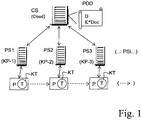
- Fig. 1 shows, to illustrate the invention, a system for reading and storing product data PD.
- the system includes a product data server or cloud server CS on which product data in a product data file PDD is stored in the cloud.
- the system further comprises several, here by way of example three, production stations PS1, PS2, PS3, at which a product P is to be processed.
- the product P is passed from station to station, in the example Fig. 1 in the order PS1, PS2, PS3, ....
- Each production station PSi performs processing steps on the product P and builds on operations performed by preceding production stations PSj, j ⁇ i.
- a computer system is included in each of the production stations PS1, PS2, PS3, a computer system is included.
- the Production station PSi equated with the computer system included therein.
- the functionalities of the production stations PSi provided for processing the product P are insignificant for the invention.
- the nature of the product P is not relevant to the invention.
- the individual production stations PSi read out product data Doc from the product data server CS and thereby determine which production steps are to be carried out.
- Each production station PSi logs the production steps it carries out by changing the product data Doc and stores the changed product data Doc at the product data server CS, for subsequent production stations.
- the product data Doc is stored in encrypted form Doc * in a product data file PDD on the product data server CS, as described in detail below.
- the production stations PS1, 2, 3 an asymmetric key pair comprising a private station key and a public station key KP is stored in each case.
- the production stations PSi further include encryption facilities.
- a contactless tag T is attached to the product P, in which an access information URL to the product data file PDD is stored on the product data server (cloud server) CS.
- the private tag key for the production stations PSi, i 1,2,3 (, ...) inaccessible.
- an encryption device is set up in the tag T.
- the product data Doc in the product data file PDD on the product data (cloud) server CS are encrypted with a document key KDoc, to D.
- the document key KDoc in turn is public Tag key KT encrypted and also stored as encrypted document key K * Doc in the product data file PDD.
- Fig. 2 shows a protocol scheme for storing product data Doc from a production station PSi in the product data server CS, according to a basic embodiment of the invention.
- the product data Doc is provided at the production station PSi.
- a document key KDoc is either self-generated or otherwise provided.
- the production station PSi reads the public day key KT from the day T. This reading can be done before or after the encryption of the product data Doc, the order is irrelevant.
- the production station PSi generates a product data file PDD comprising the product data D encrypted with the document key KDoc and the document key K * Doc encrypted with the public tag key KT.
- the production station PSi sends the product data file PDD to the product data server CS.
- the product data server CS stores the product data file PDD.
- the product data server CS generates access information (ie, a link) URL on the stored product data file PDD and sends it to the production station PSi.
- the production station PSi sends the access information URL to the tag T which stores the access information URL.
- the product data Doc is encrypted, stored as D, at the product data server CS, and in the tag T, access information URL is stored on the product data file PDD (including Doc).
- the authoritative keys to a Re-reading or decrypting the product data Doc are stored in the day T.
- Fig. 3 shows a protocol scheme on the reading of product data Doc from a product data server CS in a production station PSi, according to a basic embodiment of the invention.
- the production station PSi transmits the encrypted document key K * Doc and the own public station key KP to the tag T.
- the tag T re-encrypts the document key K * Doc from the public tag key KT to the public station key KP.
- the production station PSi decrypts the re-encrypted document key K ** Doc with the own private key of the production station PSi. With the document key KDoc thus obtained in clear text, the production station PSi decrypts the product data D back to Doc.
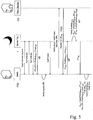
- Fig. 4 shows a detailed protocol scheme for storing product data Doc from a production station PS1 in the product data server CS, according to a more complex embodiment of the invention.
- the product data Doc is provided in a file.
- Authentication steps are provided at several positions of the procedure, as they are useful in the practical implementation of the method. More specifically, before transmitting the public tag key KT to the production station PS1, tag T and production station PS1, establish a secure communication channel. Initially, the production station PS1 (User1 / User1) authenticates itself to the day (Secure Tag) T, as indicated by the pseudo-code "Authenticate”. Thereafter, the tag T authenticates, also with "Authenticate", opposite the production station PS1.
- the exact time of generation of the document key KDoc is not decisive and may, in particular, lie before or after the generation of the signature SD.
- the production station PS1 requests an authentication token for the authentication against the product data server CS from the tag T and gets the authentication token from the tag T. By means of the authentication token, the production station PS1 authenticates itself to the product data server CS.
- the production station PS1 generates a product data file PDD which includes and sends the ciphers D and K * Doc, ie the encrypted product data Doc and the encrypted document key KDoc and a header with further information for managing the product data file PDD the product data server CS.
- the product data file PDD is stored.
- the product data server CS generates access information URL to the product data file PDD and sends it back to the production station PS1.
- a tag signature can be stored in the tag, in particular a tag signature derived from the signature SU, so that subsequent production stations that read the product data again do not have to trust the predecessor product station, but only the tag.
- the tag T now contains access information URL on encrypted product data PD on the product data server CS, as well as a signature SU and a public product station key KP, which enable a subsequent production station PSi to check if previously an authorized production station has stored data in the tag T and in the product data server CS.
- the production station PS2 (User2 / User2) authenticates itself to the day (Secure Tag) T, as indicated by the pseudo-code "Authenticate”. Thereafter, the tag T authenticates, also with "Authenticate", opposite the production station PS2.
- the tag responds with the signed access information URL of the product data file PDD at the product data server (cloud server) CS.
- the production station PS2 requests an authentication token for the authentication from the tag T against the product data server CS and gets the authentication token from the tag T. By means of the authentication token, the production station PS2 authenticates itself to the product data server CS.
- the tag sends the newly encrypted document key K ** Doc to the production station PS2 (User2).
- the production station PS2 decrypts with its own private station key PrivKey-User2 the newly encrypted document key K ** Doc to the document key KDoc in plain text and with this the product data Doc.
- the production station PS2 verifies the correctness of the document of the product data Doc.
- the second production station PS2 now has the decrypted and verified product data Doc in plain text, with all changes made by the previous production station PS1 to the product data Doc.
- Fig. 4 . 5 the method was described with two different, preferably successive production stations PS1, PS2.
- the method proceeds analogously when a single production station PSi twice accesses the product data file PDD on the product data server CS.
- An authentication of the production station PSi (user, user) compared to the day is carried out, so that no unauthorized attacker of product data Doc comes to manipulate or spy on her.
- Authentication of the tag T to the production station PS is performed so that a yet tampered tag T or a tag T provided by an attacker is no longer used.
- the steps of establishing a secure communication channel and authentication can be more or less separate from each other, or even implemented in a single process, for example in a protocol for authentication with key derivation.
- the mutual authentication between tag T and user PS can be done, for example, by means of asymmetric cryptographic methods.
- Each of the two partners has a public and private key pair, and the public key is certified by a generally recognized Certification Authority (CA) and can therefore be verified by the other partner.
- CA Certification Authority
- Each of the companies operates its own CA to certify its users PS, in addition, even Tag Issuer own CAs for the certification of their tags T operate.
- Cross-certification of CAs allows users of multiple companies to work with tags T provided by a single day's issuer.
- a secure communication channel can be dispensed with here if, instead, the necessary security is guaranteed by means of a special embodiment of the exchanged messages. How this can be implemented is shown in other patent applications filed or to be filed by the same Applicant. Alternatively, a secure channel can be established that only ensures the authenticity and integrity of the messages being exchanged, the confidentiality could be implemented via the special design of the exchanged messages.
- the document is signed with the product data Doc to ensure authenticity and integrity prior to being stored by the user / production station PSi.
- the user's signature, public key and certificate are encrypted together with the signed document and stored on the product data server / cloud server CS.
- the data record must first be decrypted before the signature can be checked. Only an authorized user / production station PSi is thus able to check the correctness of the document and also determine the identity of the author.
- the signature on the encrypted document D could be expected. Then the correctness of the record D stored on the product data server / cloud server CS could be checked without having to decrypt it. The identity of the author would then be detectable for unauthorized users.
- the signature can be calculated by the day T. Then the correctness of the document Doc can be verified, but the author remains anonymous. It would only make sure that the author was a legitimate user.
- a key can also authentically be made available to a partner by being transmitted over the secure communication channel upon the opening of which an authentication with another key has taken place.
- the signing of the link URL is not mandatory for the security of the system. All requirements for the security of the stored document D can also be achieved by other means. With a signed URL, however, some manipulations can be detected earlier. The correctness of the URL can also be ensured during the transmission through the secure channel between user and tag. In addition to the URL, the signature should also protect the tag ID and possibly further data.
- the secure channel between user / production station PSi and tag T also protects the confidentiality of the transmitted messages, in the case of use / reading the document D can be read during the transmission of the document key KDoc from the tag T to the user / production station PSi to waive the encryption with the public key KP of the user PSi.
- the tag T provides the authentication data (credentials) that the user PSi needs for authentication to the cloud provider CS.
- credentials may be static authentication data / credentials (e.g., name and password) or, better, dynamic authentication data (e.g., OTP, one-time token, challenge-response ).
Landscapes
- Engineering & Computer Science (AREA)
- Computer Security & Cryptography (AREA)
- Signal Processing (AREA)
- Computer Networks & Wireless Communication (AREA)
- Business, Economics & Management (AREA)
- Computing Systems (AREA)
- General Engineering & Computer Science (AREA)
- Computer Hardware Design (AREA)
- Economics (AREA)
- Theoretical Computer Science (AREA)
- Entrepreneurship & Innovation (AREA)
- Operations Research (AREA)
- Tourism & Hospitality (AREA)
- Physics & Mathematics (AREA)
- General Business, Economics & Management (AREA)
- General Physics & Mathematics (AREA)
- Quality & Reliability (AREA)
- Strategic Management (AREA)
- Marketing (AREA)
- Human Resources & Organizations (AREA)
- Development Economics (AREA)
- Finance (AREA)
- Accounting & Taxation (AREA)
- Storage Device Security (AREA)
Claims (14)
- Système destiné au traitement, en particulier à la mémorisation et à la lecture, de données produit (Doc), comprenant :- un serveur de données produit (CS) sur lequel un fichier de données produit (PDD) est mémorisé ou peut être mémorisé, dans lequel sont compris :- les données produit (Doc) sous forme cryptée (D) avec une clé de document (KDoc), et- la clé de document (KDoc) sous forme cryptée (K*Doc) avec une clé publique d'une paire de clés asymétrique ;- un produit (P) ;- une étiquette (T) placée sur le produit (P) et dans laquelle une information d'accès (URL) au fichier de données produit (PDD) sur le serveur de données produit (CS) est mémorisée ou peut être mémorisé ;- au moins un poste de production (PSi, i=1,2,3...), ou plusieurs postes de production (PS1, PS2, PS3 ...), lesquels sont équipés pour le traitement du produit (P) conformément aux données produit (PD) ;caractérisé en ce que- dans l'étiquette (T), une paire de clés asymétrique comprenant une clé privée d'étiquette et une clé publique d'étiquette (KT) est mémorisée, cependant que la clé privée d'étiquette est inaccessible au poste de production (PSi) ;- dans le poste de production (PSi), une paire de clés asymétrique comprenant une clé de poste privée et une clé publique de poste (KP) est mémorisée ;- dans l'étiquette (T), un équipement de cryptage est configuré ;- la clé de document (KDoc) est cryptée (K*Doc) dans le fichier de données produit (PDD) sur le serveur de données produit (CS) avec la clé publique d'étiquette (KT).
- Système selon la revendication 1, cependant que l'équipement de cryptage dans l'étiquette (T) est configuré pour :- à l'occasion d'une mémorisation de données produit (D) cryptées avec la clé de document (KDoc), par le poste de production (Psi), au serveur de données produit (CS): mettre à la disposition du poste de production (PSi) la clé publique d'étiquette (KT) pour le cryptage de la clé de document (KDoc) ;- à l'occasion d'une lecture du fichier de données produit (PDD) depuis le serveur de données produit (CS) dans le poste de production (PSi) en utilisant l'information d'accès (URL) issue de l'étiquette (T) : transcrypter la clé de document cryptée (K*Doc) de la clé publique d'étiquette (KT) à la clé publique de poste (KP) et mettre à la disposition du poste de production (PSi) la clé de document (K**Doc) ainsi transcryptée.
- Procédé d'établissement d'un fichier de données produit pour la mémorisation de données produit (Doc) par un poste de production (PSi) sur un serveur de données produit (CS), comprenant les étapes :- mise à disposition de données produit (Doc) au poste de production (PSi) ;- par le poste de production (PSi), génération ou mise à disposition d'une clé de document (KDoc) ;- par le poste de production (PSi), cryptage d'au moins les données produit (Doc) avec la clé de document (KDoc) de manière à obtenir des données produit cryptées (D) ;- par le poste de production (PSi), lecture de la clé publique d'étiquette (KT) depuis l'étiquette (T) ;- par le poste de production (PSi), cryptage de la clé de document (KDoc) avec la clé d'étiquette (KT) de manière à obtenir une clé cryptée de document (K*Doc) ;- par le poste de production (PSi), génération d'un fichier de données produit (PDD) comprenant les données produit cryptées (D) et la clé de document cryptée (K*Doc).
- Procédé selon la revendication 3, comprenant en outre :- à l'occasion de la lecture de la clé publique d'étiquette (KT) depuis l'étiquette (T) au poste de production (PSi), authentification mutuelle entre l'étiquette (T) et le poste de production (PSi).
- Procédé de mémorisation d'un fichier de données produit (PDD) sur un serveur de données produit (CS), comprenant les étapes :- par un poste de production (PSi) : envoi du fichier de données produit (PDD), comprenant des données produit cryptées et une clé de document cryptée avec une clé publique d'une étiquette, au serveur de données produit (CS) ;- au serveur de données produit (CS) : mémorisation du fichier de données produit (PDD) ;- par le serveur de données produit (CS) : génération d'une information d'accès (URL) au fichier de données produit (PDD) mémorisé ;- par le serveur de données produit (CS) : envoi de l'information d'accès (URL) au poste de production (PSi) ;- par le poste de production (PSi) : envoi de l'information d'accès (URL) à l'étiquette (T) ;- à l'étiquette (T) : mémorisation de l'information d'accès (URL).
- Procédé selon la revendication 5, comprenant en outre :- à l'occasion de l'envoi de l'information d'accès (URL) du serveur de données produit (CS) au poste de production (PSi), authentification mutuelle entre le serveur de données produit (CS) et le poste de production (PSi).
- Procédé selon la revendication 5 ou 6, cependant que, à l'occasion de l'envoi de l'information d'accès (URL) du poste de production (PSi) à l'étiquette (T), au moyen de la clé privée de poste, une signature de poste (SU) est générée et est envoyée à l'étiquette (T) avec l'information d'accès (URL), et que la signature de poste (SU) est mémorisée dans l'étiquette (T).
- Procédé selon la revendication 7, cependant que, dans l'étiquette (T), une signature d'étiquette est générée, en particulier dérivée de la signature de poste (SU), et est mémorisée dans l'étiquette (T).
- Procédé de lecture, par un poste de production (PSi), de données produit cryptées (D), comprenant les étapes :- par le poste de production (PSi), lecture d'une information d'accès (URL) depuis une étiquette (T) ;- par le poste de production (PSi), en utilisant l'information d'accès (URL) lue depuis l'étiquette (T), lecture du fichier de données produit (PDD), comprenant les données produit cryptées (D) et une clé de document (K*Doc) cryptée avec la clé publique d'étiquette, du serveur de données produit (CS).
- Procédé selon la revendication 9, comprenant en outre les étapes :- à l'occasion de la lecture de l'information d'accès (URL) depuis l'étiquette (T) : création d'un canal sécurisé de communication entre l'étiquette (T) et le poste de production (PSi), ou / et authentification mutuelle entre l'étiquette (T) et le poste de production (PSi) ; ou / et- après la lecture de l'information d'accès (URL) depuis l'étiquette (T) : par le poste de production (PSi), authentification de l'information d'accès (URL), en particulier par vérification d'une signature de poste jointe à l'information d'accès (URL) et générée avec une clé privée de poste, au moyen de la clé publique de poste (KP) correspondante, ou de la signature d'étiquette générée avec une clé privée d'étiquette, au moyen de la clé publique d'étiquette (KT) correspondante.
- Procédé de décryptage de données produit cryptées (D), par un poste de production (PSi), comprenant les étapes :- par le poste de production (PS), transmission d'une clé de document (K*Doc) cryptée avec la clé publique d'une étiquette et de la propre clé publique de poste (KP) à l'étiquette (T) ;- par l'étiquette (T), transcryptage de la clé de document (K*Doc) de la clé publique d'étiquette (KT) à la clé publique de poste (KP) de manière à obtenir une clé de document (K**Doc) transcryptée ;- par l'étiquette (T), envoi de la clé de document (K**Doc) transcryptée au poste de production (PSi) ;- par le poste de production (PSi), décryptage de la clé de document (K**Doc) transcryptée, avec la propre clé privée du poste de production (PSi) ;- par le poste de production (PSi), décryptage des données produit cryptées (D), avec la clé de document (KDoc) de manière à obtenir des données produit (Doc) en texte clair.
- Procédé selon la revendication 4 ou 10, cependant que l'authentification du poste de production (PSi) vis-à-vis du serveur de données produit (CS) étant effectuée lors de l'authentification mutuelle est réalisée au moyen d'un jeton d'authentification envoyé par l'étiquette (T) au poste de production (PSi) et au choix généré en outre par l'étiquette (T), en particulier au choix statique ou dynamique.
- Procédé selon une des revendications de 3 à 12, cependant qu'au moins certaines clés publiques (KP, KT), de préférence toutes les clés publiques, peuvent être vérifiées au moyen de l'étiquette (T), en particulier au moyen d'un certificat pour la clé publique (KP, KT) respective mémorisé dans l'étiquette (T).
- Etiquette, placée ou pouvant être placée à un produit (P), configurée pour permettre à un poste de production (PSi) un traitement, en particulier mémorisation et lecture, de données produit (D) cryptées provenant d'un serveur de données produit (CS) dans le poste de production (PSi) ;- cependant que, sur le serveur de données produit (CS), un fichier de données produit (PDD) est mémorisé ou peut être mémorisé, dans lequel sont compris :- des données produit (Doc) sous forme cryptée (D) avec une clé de document (KDoc), et- la clé de document (KDoc) sous forme cryptée (K*Doc) avec une clé publique d'une paire de clés asymétrique ;- cependant que, dans l'étiquette (T), une information d'accès (URL) au fichier de données produit (PDD) sur le serveur de données produit (CS) est mémorisée ou peut être mémorisée :
caractérisée en ce que- dans l'étiquette (T), une paire de clés asymétrique comprenant une clé privée d'étiquette et une clé publique d'étiquette (KT) est mémorisée, cependant que la clé privée d'étiquette est inaccessible au poste de production (PSi) ;- la clé de document (KDoc) est cryptée dans le fichier de données produit (PDD) sur le serveur de données produit (CS) avec la clé publique d'étiquette (KT) en tant que clé de document cryptée (K*Doc) ;dans l'étiquette (T), un équipement de cryptage est prévu, lequel est configuré pour :- à l'occasion d'une mémorisation de données produit (D) cryptées avec la clé de document (KDoc), par le poste de production (Psi), au serveur de données produit (CS), mettre à la disposition du poste de production (PSi) la clé publique d'étiquette (KT) pour le cryptage de la clé de document (KDoc) ;- à l'occasion d'une lecture du fichier de données produit (PDD) depuis le serveur de données produit (CS) dans le poste de production (PSi) en utilisant l'information d'accès (URL) issue de l'étiquette (T), transcrypter la clé de document cryptée (K*Doc) de la clé publique d'étiquette (KT) à la clé publique de poste (KP) et mettre à la disposition du poste de production (PSi) la clé de document (K**Doc) ainsi transcryptée.
Applications Claiming Priority (2)
| Application Number | Priority Date | Filing Date | Title |
|---|---|---|---|
| DE102015000895.1A DE102015000895B3 (de) | 2015-01-23 | 2015-01-23 | Verteiltes Bearbeiten von zentral verschlüsselt gespeicherten Daten |
| PCT/EP2016/000125 WO2016116282A1 (fr) | 2015-01-23 | 2016-01-22 | Traitement réparti d'un produit sur la base de données mémorisées centralement sous forme cryptée |
Publications (2)
| Publication Number | Publication Date |
|---|---|
| EP3248324A1 EP3248324A1 (fr) | 2017-11-29 |
| EP3248324B1 true EP3248324B1 (fr) | 2019-03-20 |
Family
ID=55237627
Family Applications (1)
| Application Number | Title | Priority Date | Filing Date |
|---|---|---|---|
| EP16701728.4A Active EP3248324B1 (fr) | 2015-01-23 | 2016-01-22 | Des operations decentralisés sur un produit en utilisant des données chiffrées dans un storage central |
Country Status (5)
| Country | Link |
|---|---|
| US (1) | US10764260B2 (fr) |
| EP (1) | EP3248324B1 (fr) |
| CN (1) | CN107409043B (fr) |
| DE (1) | DE102015000895B3 (fr) |
| WO (1) | WO2016116282A1 (fr) |
Families Citing this family (4)
| Publication number | Priority date | Publication date | Assignee | Title |
|---|---|---|---|---|
| EP3567798A1 (fr) * | 2018-05-07 | 2019-11-13 | Siemens Aktiengesellschaft | Procédé d'authentification |
| CN111465020A (zh) * | 2019-01-18 | 2020-07-28 | 中兴通讯股份有限公司 | 一种防伪基站方法及装置、计算机可读存储介质 |
| CN114357472B (zh) * | 2021-11-29 | 2023-07-25 | 上海欣兆阳信息科技有限公司 | 数据的打标签方法、系统、电子设备和可读存储介质 |
| CN115828290A (zh) * | 2023-02-24 | 2023-03-21 | 卓望数码技术(深圳)有限公司 | 一种基于分布式对象存储的加解密方法及装置 |
Family Cites Families (11)
| Publication number | Priority date | Publication date | Assignee | Title |
|---|---|---|---|---|
| EP1577824A1 (fr) * | 2004-03-16 | 2005-09-21 | Swisscom Mobile AG | Méthode de mise a disposition d'informations sur un produit |
| CN100375111C (zh) * | 2005-07-07 | 2008-03-12 | 复旦大学 | 一种基于射频识别技术的防伪验证方法及防伪系统 |
| DE102007045776A1 (de) * | 2007-09-25 | 2009-04-23 | Siemens Ag | Verfahren zum Schutz mindestens von Teilen von auf mindestens einem Server und/oder in mindestens einer Datenbank abgelegten, einem durch ein RFID-Tag identifizierten Produkt zugeordnete Produktdaten vor unberechtigtem Zugriff |
| US8214651B2 (en) * | 2008-07-09 | 2012-07-03 | International Business Machines Corporation | Radio frequency identification (RFID) based authentication system and methodology |
| US9054881B2 (en) * | 2010-05-14 | 2015-06-09 | Electronics And Telecommunications Research Institute | Radio frequency identification (RFID) tag and interrogator for supporting normal mode and secure mode, and operation method thereof |
| US8745370B2 (en) * | 2010-06-28 | 2014-06-03 | Sap Ag | Secure sharing of data along supply chains |
| US9792472B1 (en) * | 2013-03-14 | 2017-10-17 | Impinj, Inc. | Tag-handle-based authentication of RFID readers |
| WO2013020172A1 (fr) * | 2011-08-08 | 2013-02-14 | Mikoh Corporation | Technologie d'identification par radiofréquence comprenant des éléments cryptographiques |
| CN103404075B (zh) | 2012-01-25 | 2016-10-05 | 松下知识产权经营株式会社 | 密钥管理系统、密钥管理方法以及通信装置 |
| US8924720B2 (en) * | 2012-09-27 | 2014-12-30 | Intel Corporation | Method and system to securely migrate and provision virtual machine images and content |
| DE102013019487A1 (de) * | 2013-11-19 | 2015-05-21 | Giesecke & Devrient Gmbh | Verfahren, Vorrichtungen und System zur Online-Datensicherung |
-
2015
- 2015-01-23 DE DE102015000895.1A patent/DE102015000895B3/de active Active
-
2016
- 2016-01-22 US US15/545,393 patent/US10764260B2/en active Active
- 2016-01-22 EP EP16701728.4A patent/EP3248324B1/fr active Active
- 2016-01-22 WO PCT/EP2016/000125 patent/WO2016116282A1/fr not_active Ceased
- 2016-01-22 CN CN201680015178.0A patent/CN107409043B/zh active Active
Non-Patent Citations (1)
| Title |
|---|
| None * |
Also Published As
| Publication number | Publication date |
|---|---|
| DE102015000895B3 (de) | 2016-07-07 |
| US10764260B2 (en) | 2020-09-01 |
| CN107409043B (zh) | 2021-07-13 |
| US20170374041A1 (en) | 2017-12-28 |
| WO2016116282A1 (fr) | 2016-07-28 |
| EP3248324A1 (fr) | 2017-11-29 |
| BR112017015751A2 (pt) | 2018-03-13 |
| CN107409043A (zh) | 2017-11-28 |
Similar Documents
| Publication | Publication Date | Title |
|---|---|---|
| EP3732605B1 (fr) | Dépôt et accès sûrs à des fichiers au moyen d'une application web | |
| EP3447667B1 (fr) | Sécurité cryptographique pour un stockage de données réparti | |
| EP2765752B1 (fr) | Procédé destiné à pourvoir un terminal mobile d'un certificat d'authentification | |
| DE112018003825T5 (de) | Blockchain-berechtigungsprüfung mittels hard/soft-token-überprüfung | |
| DE102010027586B4 (de) | Verfahren zum kryptographischen Schutz einer Applikation | |
| DE112008001436T5 (de) | Sichere Kommunikation | |
| DE102018102608A1 (de) | Verfahren zur Benutzerverwaltung eines Feldgeräts | |
| DE102009027723A1 (de) | Verfahren zum Lesen von Attributen aus einem ID-Token | |
| DE102020205993B3 (de) | Konzept zum Austausch von kryptographischen Schlüsselinformationen | |
| EP4270863B1 (fr) | Reconstruction sécurisée de clés privées | |
| EP3248324B1 (fr) | Des operations decentralisés sur un produit en utilisant des données chiffrées dans un storage central | |
| DE102014204252A1 (de) | Sicherheitssystem mit Zugriffskontrolle | |
| EP3556047B1 (fr) | Module matériel de sécurité programmable et procédé pour un module matériel de sécurité programmable | |
| EP3321832B1 (fr) | Distribution de lecture d'attributs à partir d'un jeton d'identification | |
| EP3422234B1 (fr) | Image de conteneur, produit-programme informatique et procédé | |
| DE102022201339A1 (de) | Verfahren und Vorrichtungen zur gesicherten Zugriffssteuerung auf ein Datenspeichersystem und zur Datenarchivierung | |
| WO2008067575A1 (fr) | Procédé de transfert de messages codés | |
| EP3882796A1 (fr) | Authentification de l'utilisateur à l'aide de deux éléments de sécurité indépendants | |
| DE102013019487A1 (de) | Verfahren, Vorrichtungen und System zur Online-Datensicherung | |
| EP4138337A1 (fr) | Sécurisation des droits d'accès à un système d'installation de fermeture à l'aide d'un moyen électronique d'accès | |
| EP4242890B1 (fr) | Procédé d'identification sécurisée d'une personne par une instance de vérification | |
| EP4123960B1 (fr) | Procédé et dispositif de fourniture d'un secret utilisateur numérique associé à un objet de données protégé | |
| LU103094B1 (de) | Innovatives serverbasiertes verfahren zum management geheimer daten | |
| DE102015001817B4 (de) | Verfahren, Vorrichtungen und System zur Online-Datensicherung | |
| AT520170A1 (de) | Verfahren zum sicheren Administrieren eines Schlosses, insbesondere für einen Safe, mittels eines Computers |
Legal Events
| Date | Code | Title | Description |
|---|---|---|---|
| STAA | Information on the status of an ep patent application or granted ep patent |
Free format text: STATUS: THE INTERNATIONAL PUBLICATION HAS BEEN MADE |
|
| PUAI | Public reference made under article 153(3) epc to a published international application that has entered the european phase |
Free format text: ORIGINAL CODE: 0009012 |
|
| STAA | Information on the status of an ep patent application or granted ep patent |
Free format text: STATUS: REQUEST FOR EXAMINATION WAS MADE |
|
| 17P | Request for examination filed |
Effective date: 20170823 |
|
| AK | Designated contracting states |
Kind code of ref document: A1 Designated state(s): AL AT BE BG CH CY CZ DE DK EE ES FI FR GB GR HR HU IE IS IT LI LT LU LV MC MK MT NL NO PL PT RO RS SE SI SK SM TR |
|
| AX | Request for extension of the european patent |
Extension state: BA ME |
|
| DAV | Request for validation of the european patent (deleted) | ||
| DAX | Request for extension of the european patent (deleted) | ||
| GRAP | Despatch of communication of intention to grant a patent |
Free format text: ORIGINAL CODE: EPIDOSNIGR1 |
|
| STAA | Information on the status of an ep patent application or granted ep patent |
Free format text: STATUS: GRANT OF PATENT IS INTENDED |
|
| RIC1 | Information provided on ipc code assigned before grant |
Ipc: H04L 9/08 20060101AFI20180921BHEP Ipc: G06Q 10/08 20120101ALI20180921BHEP Ipc: H04L 9/30 20060101ALI20180921BHEP Ipc: H04L 29/06 20060101ALI20180921BHEP Ipc: H04L 9/14 20060101ALI20180921BHEP Ipc: H04L 9/32 20060101ALI20180921BHEP |
|
| INTG | Intention to grant announced |
Effective date: 20181017 |
|
| GRAS | Grant fee paid |
Free format text: ORIGINAL CODE: EPIDOSNIGR3 |
|
| GRAA | (expected) grant |
Free format text: ORIGINAL CODE: 0009210 |
|
| STAA | Information on the status of an ep patent application or granted ep patent |
Free format text: STATUS: THE PATENT HAS BEEN GRANTED |
|
| AK | Designated contracting states |
Kind code of ref document: B1 Designated state(s): AL AT BE BG CH CY CZ DE DK EE ES FI FR GB GR HR HU IE IS IT LI LT LU LV MC MK MT NL NO PL PT RO RS SE SI SK SM TR |
|
| REG | Reference to a national code |
Ref country code: GB Ref legal event code: FG4D Free format text: NOT ENGLISH |
|
| REG | Reference to a national code |
Ref country code: CH Ref legal event code: EP |
|
| REG | Reference to a national code |
Ref country code: DE Ref legal event code: R096 Ref document number: 502016003814 Country of ref document: DE |
|
| REG | Reference to a national code |
Ref country code: AT Ref legal event code: REF Ref document number: 1111628 Country of ref document: AT Kind code of ref document: T Effective date: 20190415 |
|
| REG | Reference to a national code |
Ref country code: IE Ref legal event code: FG4D Free format text: LANGUAGE OF EP DOCUMENT: GERMAN |
|
| REG | Reference to a national code |
Ref country code: NL Ref legal event code: MP Effective date: 20190320 |
|
| PG25 | Lapsed in a contracting state [announced via postgrant information from national office to epo] |
Ref country code: SE Free format text: LAPSE BECAUSE OF FAILURE TO SUBMIT A TRANSLATION OF THE DESCRIPTION OR TO PAY THE FEE WITHIN THE PRESCRIBED TIME-LIMIT Effective date: 20190320 Ref country code: FI Free format text: LAPSE BECAUSE OF FAILURE TO SUBMIT A TRANSLATION OF THE DESCRIPTION OR TO PAY THE FEE WITHIN THE PRESCRIBED TIME-LIMIT Effective date: 20190320 Ref country code: NO Free format text: LAPSE BECAUSE OF FAILURE TO SUBMIT A TRANSLATION OF THE DESCRIPTION OR TO PAY THE FEE WITHIN THE PRESCRIBED TIME-LIMIT Effective date: 20190620 Ref country code: LT Free format text: LAPSE BECAUSE OF FAILURE TO SUBMIT A TRANSLATION OF THE DESCRIPTION OR TO PAY THE FEE WITHIN THE PRESCRIBED TIME-LIMIT Effective date: 20190320 |
|
| REG | Reference to a national code |
Ref country code: LT Ref legal event code: MG4D |
|
| PG25 | Lapsed in a contracting state [announced via postgrant information from national office to epo] |
Ref country code: GR Free format text: LAPSE BECAUSE OF FAILURE TO SUBMIT A TRANSLATION OF THE DESCRIPTION OR TO PAY THE FEE WITHIN THE PRESCRIBED TIME-LIMIT Effective date: 20190621 Ref country code: NL Free format text: LAPSE BECAUSE OF FAILURE TO SUBMIT A TRANSLATION OF THE DESCRIPTION OR TO PAY THE FEE WITHIN THE PRESCRIBED TIME-LIMIT Effective date: 20190320 Ref country code: HR Free format text: LAPSE BECAUSE OF FAILURE TO SUBMIT A TRANSLATION OF THE DESCRIPTION OR TO PAY THE FEE WITHIN THE PRESCRIBED TIME-LIMIT Effective date: 20190320 Ref country code: LV Free format text: LAPSE BECAUSE OF FAILURE TO SUBMIT A TRANSLATION OF THE DESCRIPTION OR TO PAY THE FEE WITHIN THE PRESCRIBED TIME-LIMIT Effective date: 20190320 Ref country code: RS Free format text: LAPSE BECAUSE OF FAILURE TO SUBMIT A TRANSLATION OF THE DESCRIPTION OR TO PAY THE FEE WITHIN THE PRESCRIBED TIME-LIMIT Effective date: 20190320 Ref country code: BG Free format text: LAPSE BECAUSE OF FAILURE TO SUBMIT A TRANSLATION OF THE DESCRIPTION OR TO PAY THE FEE WITHIN THE PRESCRIBED TIME-LIMIT Effective date: 20190620 |
|
| PG25 | Lapsed in a contracting state [announced via postgrant information from national office to epo] |
Ref country code: CZ Free format text: LAPSE BECAUSE OF FAILURE TO SUBMIT A TRANSLATION OF THE DESCRIPTION OR TO PAY THE FEE WITHIN THE PRESCRIBED TIME-LIMIT Effective date: 20190320 Ref country code: ES Free format text: LAPSE BECAUSE OF FAILURE TO SUBMIT A TRANSLATION OF THE DESCRIPTION OR TO PAY THE FEE WITHIN THE PRESCRIBED TIME-LIMIT Effective date: 20190320 Ref country code: IT Free format text: LAPSE BECAUSE OF FAILURE TO SUBMIT A TRANSLATION OF THE DESCRIPTION OR TO PAY THE FEE WITHIN THE PRESCRIBED TIME-LIMIT Effective date: 20190320 Ref country code: RO Free format text: LAPSE BECAUSE OF FAILURE TO SUBMIT A TRANSLATION OF THE DESCRIPTION OR TO PAY THE FEE WITHIN THE PRESCRIBED TIME-LIMIT Effective date: 20190320 Ref country code: EE Free format text: LAPSE BECAUSE OF FAILURE TO SUBMIT A TRANSLATION OF THE DESCRIPTION OR TO PAY THE FEE WITHIN THE PRESCRIBED TIME-LIMIT Effective date: 20190320 Ref country code: SK Free format text: LAPSE BECAUSE OF FAILURE TO SUBMIT A TRANSLATION OF THE DESCRIPTION OR TO PAY THE FEE WITHIN THE PRESCRIBED TIME-LIMIT Effective date: 20190320 Ref country code: AL Free format text: LAPSE BECAUSE OF FAILURE TO SUBMIT A TRANSLATION OF THE DESCRIPTION OR TO PAY THE FEE WITHIN THE PRESCRIBED TIME-LIMIT Effective date: 20190320 Ref country code: PT Free format text: LAPSE BECAUSE OF FAILURE TO SUBMIT A TRANSLATION OF THE DESCRIPTION OR TO PAY THE FEE WITHIN THE PRESCRIBED TIME-LIMIT Effective date: 20190720 |
|
| PG25 | Lapsed in a contracting state [announced via postgrant information from national office to epo] |
Ref country code: PL Free format text: LAPSE BECAUSE OF FAILURE TO SUBMIT A TRANSLATION OF THE DESCRIPTION OR TO PAY THE FEE WITHIN THE PRESCRIBED TIME-LIMIT Effective date: 20190320 Ref country code: SM Free format text: LAPSE BECAUSE OF FAILURE TO SUBMIT A TRANSLATION OF THE DESCRIPTION OR TO PAY THE FEE WITHIN THE PRESCRIBED TIME-LIMIT Effective date: 20190320 |
|
| PG25 | Lapsed in a contracting state [announced via postgrant information from national office to epo] |
Ref country code: IS Free format text: LAPSE BECAUSE OF FAILURE TO SUBMIT A TRANSLATION OF THE DESCRIPTION OR TO PAY THE FEE WITHIN THE PRESCRIBED TIME-LIMIT Effective date: 20190720 |
|
| REG | Reference to a national code |
Ref country code: DE Ref legal event code: R097 Ref document number: 502016003814 Country of ref document: DE |
|
| PLBE | No opposition filed within time limit |
Free format text: ORIGINAL CODE: 0009261 |
|
| STAA | Information on the status of an ep patent application or granted ep patent |
Free format text: STATUS: NO OPPOSITION FILED WITHIN TIME LIMIT |
|
| PG25 | Lapsed in a contracting state [announced via postgrant information from national office to epo] |
Ref country code: DK Free format text: LAPSE BECAUSE OF FAILURE TO SUBMIT A TRANSLATION OF THE DESCRIPTION OR TO PAY THE FEE WITHIN THE PRESCRIBED TIME-LIMIT Effective date: 20190320 |
|
| 26N | No opposition filed |
Effective date: 20200102 |
|
| PG25 | Lapsed in a contracting state [announced via postgrant information from national office to epo] |
Ref country code: SI Free format text: LAPSE BECAUSE OF FAILURE TO SUBMIT A TRANSLATION OF THE DESCRIPTION OR TO PAY THE FEE WITHIN THE PRESCRIBED TIME-LIMIT Effective date: 20190320 |
|
| PG25 | Lapsed in a contracting state [announced via postgrant information from national office to epo] |
Ref country code: TR Free format text: LAPSE BECAUSE OF FAILURE TO SUBMIT A TRANSLATION OF THE DESCRIPTION OR TO PAY THE FEE WITHIN THE PRESCRIBED TIME-LIMIT Effective date: 20190320 |
|
| PG25 | Lapsed in a contracting state [announced via postgrant information from national office to epo] |
Ref country code: MC Free format text: LAPSE BECAUSE OF FAILURE TO SUBMIT A TRANSLATION OF THE DESCRIPTION OR TO PAY THE FEE WITHIN THE PRESCRIBED TIME-LIMIT Effective date: 20190320 |
|
| REG | Reference to a national code |
Ref country code: CH Ref legal event code: PL |
|
| GBPC | Gb: european patent ceased through non-payment of renewal fee |
Effective date: 20200122 |
|
| REG | Reference to a national code |
Ref country code: BE Ref legal event code: MM Effective date: 20200131 |
|
| PG25 | Lapsed in a contracting state [announced via postgrant information from national office to epo] |
Ref country code: GB Free format text: LAPSE BECAUSE OF NON-PAYMENT OF DUE FEES Effective date: 20200122 Ref country code: LU Free format text: LAPSE BECAUSE OF NON-PAYMENT OF DUE FEES Effective date: 20200122 |
|
| PG25 | Lapsed in a contracting state [announced via postgrant information from national office to epo] |
Ref country code: LI Free format text: LAPSE BECAUSE OF NON-PAYMENT OF DUE FEES Effective date: 20200131 Ref country code: BE Free format text: LAPSE BECAUSE OF NON-PAYMENT OF DUE FEES Effective date: 20200131 Ref country code: CH Free format text: LAPSE BECAUSE OF NON-PAYMENT OF DUE FEES Effective date: 20200131 |
|
| PG25 | Lapsed in a contracting state [announced via postgrant information from national office to epo] |
Ref country code: IE Free format text: LAPSE BECAUSE OF NON-PAYMENT OF DUE FEES Effective date: 20200122 |
|
| REG | Reference to a national code |
Ref country code: AT Ref legal event code: MM01 Ref document number: 1111628 Country of ref document: AT Kind code of ref document: T Effective date: 20210122 |
|
| PG25 | Lapsed in a contracting state [announced via postgrant information from national office to epo] |
Ref country code: AT Free format text: LAPSE BECAUSE OF NON-PAYMENT OF DUE FEES Effective date: 20210122 |
|
| PG25 | Lapsed in a contracting state [announced via postgrant information from national office to epo] |
Ref country code: MT Free format text: LAPSE BECAUSE OF FAILURE TO SUBMIT A TRANSLATION OF THE DESCRIPTION OR TO PAY THE FEE WITHIN THE PRESCRIBED TIME-LIMIT Effective date: 20190320 Ref country code: CY Free format text: LAPSE BECAUSE OF FAILURE TO SUBMIT A TRANSLATION OF THE DESCRIPTION OR TO PAY THE FEE WITHIN THE PRESCRIBED TIME-LIMIT Effective date: 20190320 |
|
| PG25 | Lapsed in a contracting state [announced via postgrant information from national office to epo] |
Ref country code: MK Free format text: LAPSE BECAUSE OF FAILURE TO SUBMIT A TRANSLATION OF THE DESCRIPTION OR TO PAY THE FEE WITHIN THE PRESCRIBED TIME-LIMIT Effective date: 20190320 |
|
| P01 | Opt-out of the competence of the unified patent court (upc) registered |
Effective date: 20230520 |
|
| REG | Reference to a national code |
Ref country code: DE Ref legal event code: R081 Ref document number: 502016003814 Country of ref document: DE Owner name: GIESECKE+DEVRIENT EPAYMENTS GMBH, DE Free format text: FORMER OWNER: GIESECKE+DEVRIENT MOBILE SECURITY GMBH, 81677 MUENCHEN, DE |
|
| PGFP | Annual fee paid to national office [announced via postgrant information from national office to epo] |
Ref country code: DE Payment date: 20260120 Year of fee payment: 11 |
|
| PGFP | Annual fee paid to national office [announced via postgrant information from national office to epo] |
Ref country code: FR Payment date: 20260121 Year of fee payment: 11 |