EP3248622B1 - Chirurgisches dichtungsmittel - Google Patents
Chirurgisches dichtungsmittel Download PDFInfo
- Publication number
- EP3248622B1 EP3248622B1 EP16740176.9A EP16740176A EP3248622B1 EP 3248622 B1 EP3248622 B1 EP 3248622B1 EP 16740176 A EP16740176 A EP 16740176A EP 3248622 B1 EP3248622 B1 EP 3248622B1
- Authority
- EP
- European Patent Office
- Prior art keywords
- gelatin
- cold
- surgical sealant
- groups
- agent
- Prior art date
- Legal status (The legal status is an assumption and is not a legal conclusion. Google has not performed a legal analysis and makes no representation as to the accuracy of the status listed.)
- Active
Links
Images





Classifications
-
- A—HUMAN NECESSITIES
- A61—MEDICAL OR VETERINARY SCIENCE; HYGIENE
- A61L—METHODS OR APPARATUS FOR STERILISING MATERIALS OR OBJECTS IN GENERAL; DISINFECTION, STERILISATION OR DEODORISATION OF AIR; CHEMICAL ASPECTS OF BANDAGES, DRESSINGS, ABSORBENT PADS OR SURGICAL ARTICLES; MATERIALS FOR BANDAGES, DRESSINGS, ABSORBENT PADS OR SURGICAL ARTICLES
- A61L24/00—Surgical adhesives or cements; Adhesives for colostomy devices
- A61L24/04—Surgical adhesives or cements; Adhesives for colostomy devices containing macromolecular materials
- A61L24/043—Mixtures of macromolecular materials
-
- A—HUMAN NECESSITIES
- A61—MEDICAL OR VETERINARY SCIENCE; HYGIENE
- A61L—METHODS OR APPARATUS FOR STERILISING MATERIALS OR OBJECTS IN GENERAL; DISINFECTION, STERILISATION OR DEODORISATION OF AIR; CHEMICAL ASPECTS OF BANDAGES, DRESSINGS, ABSORBENT PADS OR SURGICAL ARTICLES; MATERIALS FOR BANDAGES, DRESSINGS, ABSORBENT PADS OR SURGICAL ARTICLES
- A61L24/00—Surgical adhesives or cements; Adhesives for colostomy devices
-
- A—HUMAN NECESSITIES
- A61—MEDICAL OR VETERINARY SCIENCE; HYGIENE
- A61L—METHODS OR APPARATUS FOR STERILISING MATERIALS OR OBJECTS IN GENERAL; DISINFECTION, STERILISATION OR DEODORISATION OF AIR; CHEMICAL ASPECTS OF BANDAGES, DRESSINGS, ABSORBENT PADS OR SURGICAL ARTICLES; MATERIALS FOR BANDAGES, DRESSINGS, ABSORBENT PADS OR SURGICAL ARTICLES
- A61L24/00—Surgical adhesives or cements; Adhesives for colostomy devices
- A61L24/04—Surgical adhesives or cements; Adhesives for colostomy devices containing macromolecular materials
- A61L24/10—Polypeptides; Proteins
- A61L24/104—Gelatin
-
- A—HUMAN NECESSITIES
- A61—MEDICAL OR VETERINARY SCIENCE; HYGIENE
- A61L—METHODS OR APPARATUS FOR STERILISING MATERIALS OR OBJECTS IN GENERAL; DISINFECTION, STERILISATION OR DEODORISATION OF AIR; CHEMICAL ASPECTS OF BANDAGES, DRESSINGS, ABSORBENT PADS OR SURGICAL ARTICLES; MATERIALS FOR BANDAGES, DRESSINGS, ABSORBENT PADS OR SURGICAL ARTICLES
- A61L26/00—Chemical aspects of, or use of materials for, wound dressings or bandages in liquid, gel or powder form
- A61L26/0009—Chemical aspects of, or use of materials for, wound dressings or bandages in liquid, gel or powder form containing macromolecular materials
- A61L26/0028—Polypeptides; Proteins; Degradation products thereof
- A61L26/0038—Gelatin
-
- A—HUMAN NECESSITIES
- A61—MEDICAL OR VETERINARY SCIENCE; HYGIENE
- A61K—PREPARATIONS FOR MEDICAL, DENTAL OR TOILETRY PURPOSES
- A61K47/00—Medicinal preparations characterised by the non-active ingredients used, e.g. carriers or inert additives; Targeting or modifying agents chemically bound to the active ingredient
- A61K47/30—Macromolecular organic or inorganic compounds, e.g. inorganic polyphosphates
- A61K47/42—Proteins; Polypeptides; Degradation products thereof; Derivatives thereof, e.g. albumin, gelatin or zein
Definitions
- the present invention relates to a surgical sealant.
- a surgical sealant (hereinafter referred to as “sealant”) is a material that is applied after suturation of an affected part in a biological tissue (hereinafter referred to as "tissue”) such as blood vessel and skin and forms a membrane to thereby prevent emigration of blood and body fluid, oozing, leakage of gas, and the like.
- tissue biological tissue
- the scope of surgical applications includes respiratory surgery, digestive system surgery, cardiovascular surgery, oral cavity surgery and the like.
- For a surgical sealant (1) excellent application property, (2) high strength of a gel membrane formed from the sealant, and (3) a short gelation time, are required. Furthermore, it is preferable that (4) the gel membrane has high interfacial adhesion strength against a tissue, and (5) the gel membrane provides small change in water content and is excellent in flexibility.
- sealants that are mainly used are fibrin-based surgical sealants, and Bolheal (trade name, manufactured by Kaketsuken) is exemplified as a product.
- This surgical sealant is constituted by a component derived from a biological body, and thus has high biocompatibility, but has a problem that it has low adhesion strength.
- HSA Human Serum Albumin
- a crosslinker has high adhesion strength
- Non-patent Literature 1 Non-patent Literature 1
- HSA is a blood serum protein made from a blood product, and is a globular, negatively-charged acidic protein having a molecular weight of 69,000 and a diameter of about 10 nm.
- the crosslinker tartaric acid (Disuccinimidyl Tartarate: hereinafter DST) is used.
- DST tartaric acid
- the surgical sealant is classified into a medicament, and thus requires much labor in view of acceptation and approval.
- the history of use thereof should be continuously kept for 20 years after the approval, and thus there is a problem that much labor is required.
- Patent Literature 1 discloses a medical material prepared by crosslinking a gelatin with poly(L-glutamic acid) derivative with succinimdyl groups.
- Patent Literature 2 relates to a tissue adhesion film, and discloses a tissue adhesion film made from a gelatin or a collagen.
- these materials have a problem that their sealing strength, for which both membrane strength and interfacial adhesion strength are required, are insufficient.
- Patent Literature 3 relates to a tissue adhesion constitution, and discloses a tissue adhesion constitution in which a particulate synthesis and/or crosslinkable material and a particulate material are mixed.
- this tissue adhesion constitution also has a problem that it has insufficient sealing strength.
- Non-patent Literature 1 a method for derivatizing a gelatin
- Patent Literature 4 a tissue adhesive including said gelatin and a crosslinker
- Non-patent Literature 1 J. Bioact. Compact. Polym., 24, 546-559 (2009 )
- the above-mentioned tissue adhesive shows an excellent adhesion strength on a tissue.
- a sealant is required to have not only adhesion strength but also the strength of a membrane itself for withstanding a pressure from blood or body fluid (hereinafter referred to as "membrane strength"). Therefore, the present invention aims at further improving the above-mentioned adhesive in view of membrane strength to thereby provide an excellent sealant.
- the inventors have done various considerations, and found that excellent membrane strength, and thus excellent sealing strength can be achieved in the case when hydrophobic groups are aliphatic groups having a predetermined carbon number, and completed the present invention.
- a surgical sealant comprising:
- hydrophobically-modified gelatin derived from a cold-water fish for the surgical sealant of the present invention has linear chain aliphatic groups each having 8 to 18 carbon atoms, and thus shows a high membrane strength.
- an equivalent adhesion strength cannot be shown unless the substitution rate is considerably increased, since the adhesion strength is weaker than those in the cases when the gelatin has groups having lesser carbons and alicyclic groups.
- the surgical sealant having these groups have significantly higher membrane strength, which is more than make up for low adhesion strength even at a low substitution rate, and consequently shows high sealing strength.
- Said surgical sealant is very useful for a surgical operation for which prevention of leaking of blood and the like is important such as an anastomotic operation of blood vessels.
- Fig. 1 is a drawing showing the structure of pentaerythritol-poly(ethylene glycol) ether tetrasuccinimidyl glutalate (abbreviation: 4S-PEG) as an example of the water-soluble molecule for crosslinking in the second agent of in the surgical sealant of the present invention.
- n is a number at which the molecular weight (Mn) becomes about 8,000 to 12,000.
- 4S-PEG has active ester groups that react with a hydrophobically-modified gelatin at the terminals of the branched chains containing PEG residues. 4S-PEG has high biological safeness, and easily dissolves in water.
- the water-soluble molecule for crosslinking is at least one kind selected from the group consisting of polyethylene glycol disuccinimidyl succinate and pentaerythritol-poly (ethylene glycol) ether tetrasuccinimidyl glutalate. These groups react with the active esters and the reactive amino groups in the hydrophobically-modified gelatin to form a crosslinked structure.
- the above-mentioned active ester groups are preferably of one kind or a combination of two or more kinds of N-hydroxysuccinimidyl, or ester groups activated with N-hydroxysulfosuccinimidyl groups.
- Succinimide is a derivative of succinic acid, which is present in a metabolic pathway in a biological body, and has a good track record of use in surgical sealants that were approved by the U.S. Food and Drug Administration.
- Said crosslinker is used in an amount such that the active groups in said crosslinker, such as ester groups activated with N-hydroxysuccinimidyl groups becomes 0.2 to 3 equivalent amount, preferably 0.3 to 2 equivalent amount, more preferably 0.4 to 1.5 equivalent amount, the most preferably 0.5 to 1.2 equivalent amount with respect to one equivalent amount of the reactive amino groups in the hydrophobically-modified gelatin.
- a mixture of two or more kinds of crosslinkers may also be used, and in such case, the amount is set to an amount such that the total equivalent amount of those crosslinkers is within the above-mentioned range.
- the second agent is used in the form of an aqueous solution having a pH of 4 to 6.
- aqueous solvent for setting to said pH ultrapure water, saline, various buffer solutions, phosphate buffer saline (hereinafter referred to as "PBS") or mixtures thereof can be used.
- PBS phosphate buffer saline
- Fig. 2 is an explanation drawing showing an example of the hydrophobically-modified gelatin derived from a cold-water fish contained in the first agent for the surgical sealant of the present invention.
- Said hydrophobically-modified gelatin is a gelatin formed by substituting a part of the amino groups of the side chains of a gelatin derived from a cold-water fish with hydrophobic groups.
- a part of the amino groups of Lys which is one of the amino acids that constitute the gelatin derived from a cold-water fish, is substituted with hydrophobic groups.
- Lys is one of ⁇ -amino acids that constitute proteins, and has an ⁇ -amino group as a side chain.
- the hydrophobically-modified gelatin derived from a cold-water fish has a molecular weight (Mw) of preferably 10,000 to 150,000, more preferably 10,000 to 120,000, the most preferably 10,000 to 100,000.
- Mw molecular weight
- a membrane obtained from a gelatin having a molecular weight within the above-mentioned range and a crosslinker has high strength and fine handling property.
- the hydrophobically-modified gelatin derived from a cold-water fish has high solubility in aqueous solvents, is not gelled, and can be stored in a liquid form.
- the gelatin derived from a cold-water fish is not limited to cod gelatin, and may also be red snapper gelatin, tilapia gelatin, salmon gelatin or the like, or a genetically-engineered gelatin thereof. Natural cod gelatin is preferable.
- the gelatin derived from a cold-water fish is a polymer in which two or more amino acids are ligated in a linear manner, and has 190 or less molecules of imino acid, i.e., 80 or less molecules of hydroxyproline and 110 or less molecules of proline per 1,000 molecules of the constitutional amino acids. It is considered that the fluidity of the gelatin derived from a cold-water fish at an ordinary temperature is attributed to the number of hydroxyproline is 80 or less or the number of proline is 110 or less. It is considered that, when either of the conditions is satisfied, the denaturation temperature becomes approximately room temperature or less, and fluidity at an ordinary temperature is caused.
- Red snapper gelatin has a hydroxyproline number of 73, a proline number of 108 and a denaturation temperature of 302.5 K.
- Tilapia gelatin has a hydroxyproline number of 82, a proline number of 110 and a denaturation temperature of 309 K.
- porcine gelatin has a hydroxyproline number of 95, a proline number of 121, and a denaturation temperature of 316 K.
- the gelatin derived from a cold-water fish has a similar amino acid sequence to that of a gelatin derived from an animal, is easily decomposed by an enzyme, and has high biocompatibility.
- the first agent is used in the form of a solution having a pH of 9 to 11, and a pH of 9 to 10 is more preferable.
- a borate buffer solution can be used as an aqueous solvent for setting to said pH.
- concentration of the hydrophobized cold-water fish gelatin in the first agent aqueous solution is in the range of 10 to 40 w/v%, preferably 15 to 30 w/v%.
- the hydrophobic group has a substitution rate (mol%), i.e., (number of moles of hydrophobic groups / (total number of moles of hydrophobic groups and reactive amino groups in gelatin) ⁇ 100 of 3 to 20 mol%, preferably 3 to 12 mol%, more preferably 5 to 10 mol%.
- substitution rate i.e., (number of moles of hydrophobic groups / (total number of moles of hydrophobic groups and reactive amino groups in gelatin) ⁇ 100 of 3 to 20 mol%, preferably 3 to 12 mol%, more preferably 5 to 10 mol%.
- the hydrophobic group is a linear chain aliphatic group having 8 to 18 carbon atoms, preferably 8 to 14 carbon atoms. Said substituent is linked to the gelatin via an amide group or the like.
- Examples of the linear chain aliphatic group include an octanoyl group, a nonanoyl group, a decanoyl group, a dodecanoyl group, a tetradecanoyl group, a hexadecanoyl group, a hexadecenoyl group, an octadecanoyl group, an octadecenoyl group and the like.
- first agent aqueous solution and/or second agent aqueous solution may further contain various additives that are conventionally-used in surgical sealants, in an amount at which the purpose of the present invention is not inhibited.
- additives include colorant, pH adjusting agents, viscosity adjusting agents and the like.
- a colorant is added to the first agent or the second agent, more preferably, Brilliant Blue is added to the first agent at 0.001 to 0.1 wt% of the weight of the first agent, whereby a portion to be operated is clarified.
- the first agent and the second agent are individually prepared, and the two agents are mixed during or immediately before application.
- a gelatin as a starting material is dissolved in an organic solvent such as dimethylsulfoxide at an amount at which the gelatin becomes 5 to 50 wt/v%.
- a derivatized agent having a hydrophobic group is added to the gelatin solution obtained in Step (1), and a reaction is conducted by stirring for a predetermined time.
- an organic acid or acid chloride having the above-mentioned hydrophobic group can be used as said derivatized agent.
- the organic acid or acid chloride in an amount that gives an intended substitution rate is added to an organic solvent solution of the gelatin, and the mixture is heated under an inert gas atmosphere at 60 to 100°C, and stirred overnight.
- a poor solvent such as cold ethanol in a large excess amount is added to the reaction solution obtained in Step (2) to thereby precipitate a gelatin derivative. Said precipitate is filtered off, and washed with ethanol, ethyl acetate or the like to give a final product.
- the gelatin derivative obtained in Step (3) is dissolved in a borate buffer solution or the like at 10 to 40 w/v%, preferably 15 to 30 w/v to thereby set the pH to 9 to 11, preferably 9 to 10.
- a borate buffer solution or the like at 10 to 40 w/v%, preferably 15 to 30 w/v to thereby set the pH to 9 to 11, preferably 9 to 10.
- an underivatized gelatin, and other additives are added.
- a commercially available crosslinker may be used, and during the use thereof, the crosslinker is dissolved in an amount within the above-mentioned range in an aqueous solvent such as ultrapure water, PBS or a mixture thereof to thereby set the pH to 4 to 6.
- an aqueous solvent such as ultrapure water, PBS or a mixture thereof to thereby set the pH to 4 to 6.
- the pHs of the first agent aqueous solution and the second agent aqueous solution are adjusted so that the mixed solution of these aqueous solutions has a pH of 8 to 9.
- the pH can be set to 8 to 9 when the solutions are mixed at equivalent volumes.
- a borate buffer solution having a pH of 10 and an ion intensity of 0.05 to 0.1 may be used as the first agent aqueous solution and a phosphate buffer solution having a pH of 4 and an ion intensity of 0.01 to 0.07 may be used as the second agent aqueous solution.
- the surgical sealant of the present invention can be applied to ruptured parts of skin, blood vessel, tendon, nerve and tubular tissues such as lymph vessel, and organs such as liver, pancreas and heart.
- the surgical sealant is preferably applied to wet tissues such as blood vessel and lung.
- the first agent and the second agent may be mixed immediately before applying to a tissue an then applied to the tissue, or may be simultaneously applied by using various two-component type dispensers.
- Fig. 3 is a schematic view showing an example of a method for applying the surgical sealant by using a two-component type dispenser.
- a first agent aqueous solution 51 and a second agent aqueous solution 52 are simultaneously extruded from a double syringe injector 50 in which the two solutions 51 and 52 are stored and mixed in the double syringe injector 50, and a mixed solution 53 is applied onto the tissue 31 from a cylindrical part 50a.
- a first agent aqueous solution 51 and a second agent aqueous solution 52 are simultaneously extruded from a double syringe injector 50 in which the two solutions 51 and 52 are stored and mixed in the double syringe injector 50, and a mixed solution 53 is applied onto the tissue 31 from a cylindrical part 50a.
- a mixed solution 53 is applied onto the tissue 31 from a cylindrical part 50a.
- the two solutions are extruded, and then left for about 10 minutes, whereby a gel membrane 41 having a desired thickness can be formed.
- the solutions may also be sprayed by an air-assisted spray having a double syringe instead of the dispenser.
- a surgical sealant was prepared in a similar manner to Reference Example 1, except that 9.6Ste-cGltn was synthesized by replacing 9.6 mol% of the amino groups of the side chains of the cod-derived gelatin with hydrophobic groups (stearoyl group: abbreviated as Ste).
- a surgical sealant was prepared in a similar manner to Reference Example 1, except that 1.9Chol-cGltn was synthesized by replacing 1.9 mol% of the amino groups of the side chains of the cod-derived gelatin with hydrophobic groups (Choi).
- a surgical sealant was prepared in a similar manner to Reference Example 1, except that 12.2Chol-cGltn was synthesized by replacing 12.2 mol% of the amino groups of the side chains of the cod-derived gelatin with hydrophobic groups (Choi).
- a surgical sealant was prepared in a similar manner to Reference Example 1, except that 3.2Pro-cGltn was synthesized by replacing 3.2 mol% of the amino groups of the side chains of the cod-derived gelatin with hydrophobic groups (propanoyl groups: abbreviated as Pro).
- a surgical sealant was prepared in a similar manner to Reference Example 1, except that 6.4Pro-cGltn was synthesized by replacing 6.4 mol% of the amino groups of the side chains of the cod-derived gelatin with hydrophobic groups (Pro).
- a surgical sealant was prepared in a similar manner to Reference Example 1, except that 13.7Pro-cGltn was synthesized by replacing 13.7 mol% of the amino groups of the side chains of the cod-derived gelatin with hydrophobic groups (Pro).
- a surgical sealant was prepared in a similar manner to Reference Example 1, except that 2.1Hx-cGltn was synthesized by replacing 2.1 mol% of the amino groups of the side chains of the cod-derived gelatin with hydrophobic groups (hexanoyl groups: abbreviated as Hx).
- a surgical sealant was prepared in a similar manner to Reference Example 1, except that 8.5Hx-cGltn was synthesized by replacing 8.5 mol% of the amino groups of the side chains of the cod-derived gelatin with hydrophobic groups (Hx).
- a surgical sealant was prepared in a similar manner to Reference Example 1, except that 18.3Hx-cGltn was synthesized by substituting 18.3 mol% of the amino groups of the side chains of the cod-derived gelatin with hydrophobic groups (Hx).
- a surgical sealant was prepared in a similar manner to Reference Example 1, except that 3.8Lau-cGltn was synthesized by replacing 3.8 mol% of the amino groups of the side chains of the cod-derived gelatin with hydrophobic groups (lauroyl groups: abbreviated as Lau).
- a surgical sealant was prepared in a similar manner to Reference Example 1, except that 9.0Lau-cGltn was synthesized by replacing 9.0 mol% of the amino groups of the side chains of the cod-derived gelatin with hydrophobic groups (Lau).
- a surgical sealant was prepared in a similar manner to Reference Example 1, except that 19.0Lau-cGltn was synthesized by replacing 19.0 mol% of the amino groups of the side chains of the cod-derived gelatin with hydrophobic groups (Lau).
- a surgical sealant was prepared in a similar manner to Reference Example 1, except that 4.0Ste-cGltn was synthesized by replacing 4.0 mol% of the amino groups of the side chains of the cod-derived gelatin with hydrophobic groups (Ste).
- a surgical sealant was prepared in a similar manner to Reference Example 1, except that 18.7Ste-cGltn was synthesized by substituting 18.7 mol% of the amino groups of the side chains of the cod-derived gelatin with hydrophobic groups (Ste).
- a surgical sealant for comparison was prepared in a similar manner to Reference Example 1, except that a raw material cod gelatin (abbreviated as Org-cGltn) was used instead of the hydrophobically-modified gelatin.
- a raw material cod gelatin abbreviated as Org-cGltn
- Bolheal (trade name) was used as a fibrin sealant.
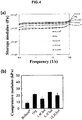
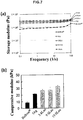
- Figs. 4 to 8 each indicate (a) a graph showing the angle frequency wave number-dependency of each disk gel and (b) a bar graph showing the compressive modulus. In either of the graphs, the data of a raw material gelatin (Comparative Example 1-G) and a fibrin sealant (Comparative Example 2-G) are also indicated for comparison.
- Figs. 4 (b) to 8 (b) it was found that either of the disk gels of Reference Examples and Examples had a higher compressive modulus as compared to that of the fibrin sealant (Comparative Example 2-G), and that, specifically, Examples 1 to 6 ( Figs. 7 (b) and 8 (b) ) had higher compressive moduluses than that of the raw material gelatin.
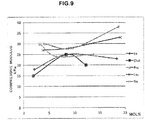
- Fig. 9 is a drawing showing the relationship between the substitution rate and the compressive modulus for every substituent.
- the hydrophobic groups having 12 carbon atoms (Lau) and 18 carbon atoms (Ste) had high compressive moduluses in a broad range at a substitution rate of from 4 mol% to about 19 mol%, and thus an excellent sealing strength can be achieved when the adhesion strengths of gelatins having these substituents are considered in combination.
- An air leak model of a lung extracted from a rat was prepared with referring to the method described in Non-patent Literature 5. Since an inflated state and a deflated state are significantly different in a rat lung, an air introduction tube was firstly connected to the throat part of a lung extracted from a rat and occluded by a braid, and the lung extracted from a rat was inflated by introducing air into the lung extracted from a rat.
- the surface of the lung extracted from a rat was pricked with an injection needle of 20 gauges (20G needle) to a depth of about 2 mm to form a defect part, whereby a defect model was prepared. Furthermore, the lung extracted from a rat was stabilized for 5 minutes with putting the atmospheric pressure in the lung and the outer atmospheric pressure into an equilibrium state. Subsequently, a silicone ring having a thickness of 0.5 mm, an inner diameter of 7.0 mm and an outer diameter of 20.0 mm was disposed on the surface of the lung extracted from a rat so that the above-mentioned defect part was positioned on the center part of the ring.
- Example 1 the surgical sealant of Example 1 (including an aqueous solution of 9.6Ste-cGltn and a 4S-PEG aqueous solution) was applied in a circular shape on the surface of the lung in the silicone ring and cured for 5 minutes to seal the defect part, and the silicone ring was removed to give a sample for measuring pressure resistance strength (Example 1-R).
- Example 1 (9.6Ste-cGltn) had a higher pressure resistance strength and a more excellent sealing strength than those of either of Reference Example 1 (8.3Chol-cGltn), Comparative Example 1 (Org) and Comparative Example 2 (fibrin).
- the disk gel was immersed in 2 ml of Milli Q water at 37°C for 24 hours and lyophilized for 48 hours, and the mass of the disk gel (mass after drying: Wd) was measured.
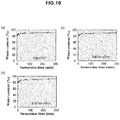
- Fig. 10 is a graph showing the change in the water content (calculated value) of each disk gel over time, wherein (a) represents Org-cGltn (Comparative Example 1-G), (b) represents 8.3Chol-cGltn (Reference Example 1-G), and (c) represents 9.6Ste-cGltn (Example 1-G).
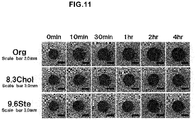
- Fig. 11 shows photographs showing the changes in swelling of the respective disk gels.
- the diameter slightly increased at the time of 10 minutes after the immersion. Thereafter, any significant change was not observed.
- the diameter slightly increased at after 30 minutes. Thereafter, any significant change was not observed. This is considered to be due to the effect of the hydrophobic groups.
- the surgical sealant of the present invention indicates a high sealing strength, and thus is very useful for anastomosis operations of blood vessels and the like.
Landscapes
- Health & Medical Sciences (AREA)
- Epidemiology (AREA)
- Life Sciences & Earth Sciences (AREA)
- Animal Behavior & Ethology (AREA)
- General Health & Medical Sciences (AREA)
- Public Health (AREA)
- Veterinary Medicine (AREA)
- Surgery (AREA)
- Chemical & Material Sciences (AREA)
- Engineering & Computer Science (AREA)
- Materials Engineering (AREA)
- Materials For Medical Uses (AREA)
Claims (7)
- Chirurgisches Dichtmittel, umfassend:ein erstes Agens, das eine von einem Kaltwasserfisch stammende hydrophob modifizierte Gelatine enthält, undein zweites Agens, das ein wasserlösliches Molekül zum Vernetzen enthält,wobei das wasserlösliches Molekül zum Vernetzen mindestens eine Art ist, die ausgewählt ist aus der Gruppe, bestehend aus Polyethylenglycoldisuccinimidylsuccinat und Pentaerythritolpoly(ethylenglycol)ethertetrasuccinimidylglutalat,die von einem Kaltwasserfisch stammende hydrophob modifizierte Gelatine eine Gelatine ist, in der mindestens ein Teil von Aminogruppen von Seitenketten einer von einem Kaltwasserfisch stammenden Gelatine mit hydrophoben Gruppen substituiert worden ist,die hydrophoben Gruppen linearkettige aliphatische Gruppen sind, die jeweils 8 bis 18 Kohlenstoffatome aufweisen, mit einer Substitutionsrate (Anzahl von Molekülen von hydrophoben Gruppen / (Gesamtanzahl von Molen von hydrophoben Gruppen und reaktiven Aminogruppen in Gelatine) x 100) von 3 bis 20 Mol-%, und das erste Agens in Form einer wässrigen Lösung, die einen pH-Wert von 9 bis 11 aufweist, verwendet wird,und das zweite Agens in Form einer wässrigen Lösung, die einen pH-Wert von 4 bis 6 aufweist, verwendet wird.
- Chirurgisches Dichtmittel nach Anspruch 1, wobei die von einem Kaltwasserfisch stammende hydrophob modifizierte Gelatine ein Molekulargewicht von 10.000 oder mehr und 150.000 oder weniger aufweist.
- Chirurgisches Dichtmittel nach Anspruch 1 oder 2, wobei die von einem Kaltwasserfisch stammende hydrophob modifizierte Gelatine eine Art oder eine Kombination von zwei oder mehr Arten von Gelatinen, die von Red Snapper, Tilapia, Kabeljau und Lachs stammen, oder gentechnisch erzeugte Kaltwasserfische davon ist.
- Chirurgisches Dichtmittel nach einem der Ansprüche 1 bis 3, wobei die von einem Kaltwasserfisch stammende Gelatine 190 oder weniger Iminosäuren pro 1.000 konstituierenden Aminosäuren enthält.
- Chirurgisches Dichtmittel nach einem der Ansprüche 1 bis 4, wobei die hydrophoben Gruppen mit einem Teil der Aminogruppen von Lys, die eine der konstituierenden Aminosäuren der von einem Kaltwasserfisch stammenden Gelatine ist, verknüpft sind.
- Chirurgisches Dichtmittel nach einem der Ansprüche 1 bis 5, wobei das wasserlösliche Molekül zum Vernetzen Pentaerythritolpoly(ethylenglycol)ethertetrasuccinimidylglutalat ist.
- Chirurgisches Dichtmittel nach einem der Ansprüche 1 bis 6, wobei das erste Agens in Form einer Boratpufferlösung verwendet wird und das zweite Agens in Form einer Phosphatpufferkochsalzlösung verwendet wird.
Applications Claiming Priority (2)
| Application Number | Priority Date | Filing Date | Title |
|---|---|---|---|
| JP2015008556 | 2015-01-20 | ||
| PCT/JP2016/051463 WO2016117569A1 (ja) | 2015-01-20 | 2016-01-19 | 外科用シーラント |
Publications (3)
| Publication Number | Publication Date |
|---|---|
| EP3248622A1 EP3248622A1 (de) | 2017-11-29 |
| EP3248622A4 EP3248622A4 (de) | 2018-11-14 |
| EP3248622B1 true EP3248622B1 (de) | 2020-08-19 |
Family
ID=56417110
Family Applications (1)
| Application Number | Title | Priority Date | Filing Date |
|---|---|---|---|
| EP16740176.9A Active EP3248622B1 (de) | 2015-01-20 | 2016-01-19 | Chirurgisches dichtungsmittel |
Country Status (4)
| Country | Link |
|---|---|
| US (1) | US10420855B2 (de) |
| EP (1) | EP3248622B1 (de) |
| JP (1) | JP6367979B2 (de) |
| WO (1) | WO2016117569A1 (de) |
Families Citing this family (4)
| Publication number | Priority date | Publication date | Assignee | Title |
|---|---|---|---|---|
| JP5995128B1 (ja) * | 2016-01-20 | 2016-09-21 | 国立研究開発法人物質・材料研究機構 | 外科用シーラント |
| EP3719057A1 (de) * | 2019-04-03 | 2020-10-07 | Tessenderlo Group NV | Gelatine und verwendungen davon |
| CN111057252B (zh) * | 2020-01-06 | 2022-11-25 | 陕西科技大学 | 一种可控去除的强粘附型水凝胶及其制备方法 |
| CN113876997B (zh) * | 2021-09-27 | 2022-09-20 | 广东省科学院健康医学研究所 | 一种白蛋白复合粘合剂及其制备方法 |
Family Cites Families (14)
| Publication number | Priority date | Publication date | Assignee | Title |
|---|---|---|---|---|
| JP3850905B2 (ja) | 1995-10-13 | 2006-11-29 | グンゼ株式会社 | 医用材料及びその製造法 |
| ATE455563T1 (de) | 2003-04-04 | 2010-02-15 | Tissuemed Ltd | Zusammensetzungen für die gewebeadhäsion |
| US7273896B2 (en) * | 2003-04-10 | 2007-09-25 | Angiotech Pharmaceuticals (Us), Inc. | Compositions and methods of using a transient colorant |
| US7129210B2 (en) * | 2003-07-23 | 2006-10-31 | Covalent Medical, Inc. | Tissue adhesive sealant |
| EP2136850B1 (de) * | 2007-04-13 | 2012-02-01 | Kuros Biosurgery AG | Polymergewebeversiegelung |
| JP2008284256A (ja) | 2007-05-21 | 2008-11-27 | Fujifilm Corp | 組織接着フィルム |
| US8314211B2 (en) * | 2009-04-07 | 2012-11-20 | George Falus | Tissue sealant for use in non compressible hemorrhage |
| EP2626087B1 (de) * | 2010-10-05 | 2016-08-17 | National Institute for Materials Science | Gewebehaftfilm und verfahren zu seiner herstellung |
| WO2012046717A1 (ja) * | 2010-10-05 | 2012-04-12 | 独立行政法人物質・材料研究機構 | 2成分系組織接着剤及びその製造方法 |
| JP6048811B2 (ja) | 2012-11-22 | 2016-12-21 | 国立研究開発法人物質・材料研究機構 | 組織接着膜及びその製造方法 |
| US10016454B2 (en) * | 2012-12-04 | 2018-07-10 | Cohera Medical, Inc. | Silane-containing moisture-curable tissue sealant |
| JPWO2014112208A1 (ja) | 2013-01-18 | 2017-01-19 | 国立研究開発法人物質・材料研究機構 | 組織接着剤及びその製造方法 |
| JP6112551B2 (ja) * | 2013-03-21 | 2017-04-12 | 国立研究開発法人物質・材料研究機構 | 細胞凝集塊形成剤及び細胞凝集塊 |
| WO2015076252A1 (ja) * | 2013-11-22 | 2015-05-28 | 独立行政法人物質・材料研究機構 | 組織接着性多孔質膜、その製造方法及び組織接着性多孔質膜テープ |
-
2016
- 2016-01-19 EP EP16740176.9A patent/EP3248622B1/de active Active
- 2016-01-19 WO PCT/JP2016/051463 patent/WO2016117569A1/ja not_active Ceased
- 2016-01-19 US US15/544,610 patent/US10420855B2/en active Active
- 2016-01-19 JP JP2016570661A patent/JP6367979B2/ja active Active
Non-Patent Citations (1)
| Title |
|---|
| None * |
Also Published As
| Publication number | Publication date |
|---|---|
| JPWO2016117569A1 (ja) | 2017-10-26 |
| US20180272028A1 (en) | 2018-09-27 |
| US10420855B2 (en) | 2019-09-24 |
| EP3248622A1 (de) | 2017-11-29 |
| WO2016117569A1 (ja) | 2016-07-28 |
| EP3248622A4 (de) | 2018-11-14 |
| JP6367979B2 (ja) | 2018-08-01 |
Similar Documents
| Publication | Publication Date | Title |
|---|---|---|
| Ding et al. | Designing self-healing hydrogels for biomedical applications | |
| EP2946795B1 (de) | Gewebeklebstoff und verfahren zur herstellung davon | |
| JP5594633B2 (ja) | 2成分系組織接着剤及びその製造方法 | |
| US10668181B2 (en) | Surgical sealant | |
| KR20010013105A (ko) | 콜라겐 겔 | |
| US10420855B2 (en) | Surgical sealant | |
| EP2626087B1 (de) | Gewebehaftfilm und verfahren zu seiner herstellung | |
| CN117244113B (zh) | 一种原位成型的可注射水凝胶材料及其在制备组织修复制剂中的应用 | |
| JP3850905B2 (ja) | 医用材料及びその製造法 | |
| CN110801528A (zh) | 一种硬脊膜封合水凝胶及其制备方法与应用 | |
| EP3848066B1 (de) | Haftverhindernder stoff | |
| JP3569311B2 (ja) | ゼラチンゲルおよびその製造方法並びにその用途 | |
| JP2023161851A (ja) | 接着剤、創傷被覆材、癒着防止材、止血材、シーラント、及び噴霧キット | |
| EP3903808B1 (de) | Hämostatische zusammensetzung und behälter damit | |
| US20240299615A1 (en) | Hydrogel including phenol derivative-modified cellulose and use thereof | |
| CN121490124A (zh) | 一种光敏组织封闭胶及其制备方法和应用 | |
| TW202506207A (zh) | 黏合劑組成物 | |
| CN121758597A (zh) | 一种类弹性蛋白及类弹性蛋白水凝胶的制备方法及应用 |
Legal Events
| Date | Code | Title | Description |
|---|---|---|---|
| STAA | Information on the status of an ep patent application or granted ep patent |
Free format text: STATUS: THE INTERNATIONAL PUBLICATION HAS BEEN MADE |
|
| PUAI | Public reference made under article 153(3) epc to a published international application that has entered the european phase |
Free format text: ORIGINAL CODE: 0009012 |
|
| STAA | Information on the status of an ep patent application or granted ep patent |
Free format text: STATUS: REQUEST FOR EXAMINATION WAS MADE |
|
| 17P | Request for examination filed |
Effective date: 20170820 |
|
| AK | Designated contracting states |
Kind code of ref document: A1 Designated state(s): AL AT BE BG CH CY CZ DE DK EE ES FI FR GB GR HR HU IE IS IT LI LT LU LV MC MK MT NL NO PL PT RO RS SE SI SK SM TR |
|
| AX | Request for extension of the european patent |
Extension state: BA ME |
|
| DAV | Request for validation of the european patent (deleted) | ||
| DAX | Request for extension of the european patent (deleted) | ||
| RIC1 | Information provided on ipc code assigned before grant |
Ipc: A61L 24/00 20060101AFI20181004BHEP |
|
| A4 | Supplementary search report drawn up and despatched |
Effective date: 20181012 |
|
| STAA | Information on the status of an ep patent application or granted ep patent |
Free format text: STATUS: EXAMINATION IS IN PROGRESS |
|
| 17Q | First examination report despatched |
Effective date: 20191016 |
|
| REG | Reference to a national code |
Ref country code: DE Ref legal event code: R079 Ref document number: 602016042282 Country of ref document: DE Free format text: PREVIOUS MAIN CLASS: A61L0024000000 Ipc: A61L0024040000 |
|
| RIC1 | Information provided on ipc code assigned before grant |
Ipc: A61L 24/10 20060101ALI20200327BHEP Ipc: A61L 24/04 20060101AFI20200327BHEP |
|
| GRAP | Despatch of communication of intention to grant a patent |
Free format text: ORIGINAL CODE: EPIDOSNIGR1 |
|
| STAA | Information on the status of an ep patent application or granted ep patent |
Free format text: STATUS: GRANT OF PATENT IS INTENDED |
|
| INTG | Intention to grant announced |
Effective date: 20200529 |
|
| GRAS | Grant fee paid |
Free format text: ORIGINAL CODE: EPIDOSNIGR3 |
|
| GRAA | (expected) grant |
Free format text: ORIGINAL CODE: 0009210 |
|
| STAA | Information on the status of an ep patent application or granted ep patent |
Free format text: STATUS: THE PATENT HAS BEEN GRANTED |
|
| AK | Designated contracting states |
Kind code of ref document: B1 Designated state(s): AL AT BE BG CH CY CZ DE DK EE ES FI FR GB GR HR HU IE IS IT LI LT LU LV MC MK MT NL NO PL PT RO RS SE SI SK SM TR |
|
| REG | Reference to a national code |
Ref country code: CH Ref legal event code: EP |
|
| REG | Reference to a national code |
Ref country code: DE Ref legal event code: R096 Ref document number: 602016042282 Country of ref document: DE |
|
| REG | Reference to a national code |
Ref country code: AT Ref legal event code: REF Ref document number: 1303213 Country of ref document: AT Kind code of ref document: T Effective date: 20200915 |
|
| REG | Reference to a national code |
Ref country code: IE Ref legal event code: FG4D |
|
| REG | Reference to a national code |
Ref country code: LT Ref legal event code: MG4D |
|
| REG | Reference to a national code |
Ref country code: NL Ref legal event code: MP Effective date: 20200819 |
|
| PG25 | Lapsed in a contracting state [announced via postgrant information from national office to epo] |
Ref country code: HR Free format text: LAPSE BECAUSE OF FAILURE TO SUBMIT A TRANSLATION OF THE DESCRIPTION OR TO PAY THE FEE WITHIN THE PRESCRIBED TIME-LIMIT Effective date: 20200819 Ref country code: SE Free format text: LAPSE BECAUSE OF FAILURE TO SUBMIT A TRANSLATION OF THE DESCRIPTION OR TO PAY THE FEE WITHIN THE PRESCRIBED TIME-LIMIT Effective date: 20200819 Ref country code: NO Free format text: LAPSE BECAUSE OF FAILURE TO SUBMIT A TRANSLATION OF THE DESCRIPTION OR TO PAY THE FEE WITHIN THE PRESCRIBED TIME-LIMIT Effective date: 20201119 Ref country code: BG Free format text: LAPSE BECAUSE OF FAILURE TO SUBMIT A TRANSLATION OF THE DESCRIPTION OR TO PAY THE FEE WITHIN THE PRESCRIBED TIME-LIMIT Effective date: 20201119 Ref country code: FI Free format text: LAPSE BECAUSE OF FAILURE TO SUBMIT A TRANSLATION OF THE DESCRIPTION OR TO PAY THE FEE WITHIN THE PRESCRIBED TIME-LIMIT Effective date: 20200819 Ref country code: LT Free format text: LAPSE BECAUSE OF FAILURE TO SUBMIT A TRANSLATION OF THE DESCRIPTION OR TO PAY THE FEE WITHIN THE PRESCRIBED TIME-LIMIT Effective date: 20200819 Ref country code: PT Free format text: LAPSE BECAUSE OF FAILURE TO SUBMIT A TRANSLATION OF THE DESCRIPTION OR TO PAY THE FEE WITHIN THE PRESCRIBED TIME-LIMIT Effective date: 20201221 Ref country code: GR Free format text: LAPSE BECAUSE OF FAILURE TO SUBMIT A TRANSLATION OF THE DESCRIPTION OR TO PAY THE FEE WITHIN THE PRESCRIBED TIME-LIMIT Effective date: 20201120 |
|
| REG | Reference to a national code |
Ref country code: AT Ref legal event code: MK05 Ref document number: 1303213 Country of ref document: AT Kind code of ref document: T Effective date: 20200819 |
|
| PG25 | Lapsed in a contracting state [announced via postgrant information from national office to epo] |
Ref country code: IS Free format text: LAPSE BECAUSE OF FAILURE TO SUBMIT A TRANSLATION OF THE DESCRIPTION OR TO PAY THE FEE WITHIN THE PRESCRIBED TIME-LIMIT Effective date: 20201219 Ref country code: NL Free format text: LAPSE BECAUSE OF FAILURE TO SUBMIT A TRANSLATION OF THE DESCRIPTION OR TO PAY THE FEE WITHIN THE PRESCRIBED TIME-LIMIT Effective date: 20200819 Ref country code: LV Free format text: LAPSE BECAUSE OF FAILURE TO SUBMIT A TRANSLATION OF THE DESCRIPTION OR TO PAY THE FEE WITHIN THE PRESCRIBED TIME-LIMIT Effective date: 20200819 Ref country code: RS Free format text: LAPSE BECAUSE OF FAILURE TO SUBMIT A TRANSLATION OF THE DESCRIPTION OR TO PAY THE FEE WITHIN THE PRESCRIBED TIME-LIMIT Effective date: 20200819 Ref country code: PL Free format text: LAPSE BECAUSE OF FAILURE TO SUBMIT A TRANSLATION OF THE DESCRIPTION OR TO PAY THE FEE WITHIN THE PRESCRIBED TIME-LIMIT Effective date: 20200819 |
|
| PG25 | Lapsed in a contracting state [announced via postgrant information from national office to epo] |
Ref country code: DK Free format text: LAPSE BECAUSE OF FAILURE TO SUBMIT A TRANSLATION OF THE DESCRIPTION OR TO PAY THE FEE WITHIN THE PRESCRIBED TIME-LIMIT Effective date: 20200819 Ref country code: CZ Free format text: LAPSE BECAUSE OF FAILURE TO SUBMIT A TRANSLATION OF THE DESCRIPTION OR TO PAY THE FEE WITHIN THE PRESCRIBED TIME-LIMIT Effective date: 20200819 Ref country code: SM Free format text: LAPSE BECAUSE OF FAILURE TO SUBMIT A TRANSLATION OF THE DESCRIPTION OR TO PAY THE FEE WITHIN THE PRESCRIBED TIME-LIMIT Effective date: 20200819 Ref country code: RO Free format text: LAPSE BECAUSE OF FAILURE TO SUBMIT A TRANSLATION OF THE DESCRIPTION OR TO PAY THE FEE WITHIN THE PRESCRIBED TIME-LIMIT Effective date: 20200819 Ref country code: EE Free format text: LAPSE BECAUSE OF FAILURE TO SUBMIT A TRANSLATION OF THE DESCRIPTION OR TO PAY THE FEE WITHIN THE PRESCRIBED TIME-LIMIT Effective date: 20200819 |
|
| REG | Reference to a national code |
Ref country code: DE Ref legal event code: R097 Ref document number: 602016042282 Country of ref document: DE |
|
| PG25 | Lapsed in a contracting state [announced via postgrant information from national office to epo] |
Ref country code: ES Free format text: LAPSE BECAUSE OF FAILURE TO SUBMIT A TRANSLATION OF THE DESCRIPTION OR TO PAY THE FEE WITHIN THE PRESCRIBED TIME-LIMIT Effective date: 20200819 Ref country code: AT Free format text: LAPSE BECAUSE OF FAILURE TO SUBMIT A TRANSLATION OF THE DESCRIPTION OR TO PAY THE FEE WITHIN THE PRESCRIBED TIME-LIMIT Effective date: 20200819 Ref country code: AL Free format text: LAPSE BECAUSE OF FAILURE TO SUBMIT A TRANSLATION OF THE DESCRIPTION OR TO PAY THE FEE WITHIN THE PRESCRIBED TIME-LIMIT Effective date: 20200819 |
|
| PLBE | No opposition filed within time limit |
Free format text: ORIGINAL CODE: 0009261 |
|
| STAA | Information on the status of an ep patent application or granted ep patent |
Free format text: STATUS: NO OPPOSITION FILED WITHIN TIME LIMIT |
|
| PG25 | Lapsed in a contracting state [announced via postgrant information from national office to epo] |
Ref country code: SK Free format text: LAPSE BECAUSE OF FAILURE TO SUBMIT A TRANSLATION OF THE DESCRIPTION OR TO PAY THE FEE WITHIN THE PRESCRIBED TIME-LIMIT Effective date: 20200819 |
|
| 26N | No opposition filed |
Effective date: 20210520 |
|
| PG25 | Lapsed in a contracting state [announced via postgrant information from national office to epo] |
Ref country code: IT Free format text: LAPSE BECAUSE OF FAILURE TO SUBMIT A TRANSLATION OF THE DESCRIPTION OR TO PAY THE FEE WITHIN THE PRESCRIBED TIME-LIMIT Effective date: 20200819 |
|
| PG25 | Lapsed in a contracting state [announced via postgrant information from national office to epo] |
Ref country code: SI Free format text: LAPSE BECAUSE OF FAILURE TO SUBMIT A TRANSLATION OF THE DESCRIPTION OR TO PAY THE FEE WITHIN THE PRESCRIBED TIME-LIMIT Effective date: 20200819 Ref country code: MC Free format text: LAPSE BECAUSE OF FAILURE TO SUBMIT A TRANSLATION OF THE DESCRIPTION OR TO PAY THE FEE WITHIN THE PRESCRIBED TIME-LIMIT Effective date: 20200819 |
|
| REG | Reference to a national code |
Ref country code: CH Ref legal event code: PL |
|
| GBPC | Gb: european patent ceased through non-payment of renewal fee |
Effective date: 20210119 |
|
| PG25 | Lapsed in a contracting state [announced via postgrant information from national office to epo] |
Ref country code: LU Free format text: LAPSE BECAUSE OF NON-PAYMENT OF DUE FEES Effective date: 20210119 |
|
| REG | Reference to a national code |
Ref country code: BE Ref legal event code: MM Effective date: 20210131 |
|
| PG25 | Lapsed in a contracting state [announced via postgrant information from national office to epo] |
Ref country code: CH Free format text: LAPSE BECAUSE OF NON-PAYMENT OF DUE FEES Effective date: 20210131 Ref country code: LI Free format text: LAPSE BECAUSE OF NON-PAYMENT OF DUE FEES Effective date: 20210131 Ref country code: GB Free format text: LAPSE BECAUSE OF NON-PAYMENT OF DUE FEES Effective date: 20210119 |
|
| PG25 | Lapsed in a contracting state [announced via postgrant information from national office to epo] |
Ref country code: IE Free format text: LAPSE BECAUSE OF NON-PAYMENT OF DUE FEES Effective date: 20210119 |
|
| PG25 | Lapsed in a contracting state [announced via postgrant information from national office to epo] |
Ref country code: IS Free format text: LAPSE BECAUSE OF FAILURE TO SUBMIT A TRANSLATION OF THE DESCRIPTION OR TO PAY THE FEE WITHIN THE PRESCRIBED TIME-LIMIT Effective date: 20201219 |
|
| PG25 | Lapsed in a contracting state [announced via postgrant information from national office to epo] |
Ref country code: BE Free format text: LAPSE BECAUSE OF NON-PAYMENT OF DUE FEES Effective date: 20210131 |
|
| PG25 | Lapsed in a contracting state [announced via postgrant information from national office to epo] |
Ref country code: HU Free format text: LAPSE BECAUSE OF FAILURE TO SUBMIT A TRANSLATION OF THE DESCRIPTION OR TO PAY THE FEE WITHIN THE PRESCRIBED TIME-LIMIT; INVALID AB INITIO Effective date: 20160119 |
|
| PG25 | Lapsed in a contracting state [announced via postgrant information from national office to epo] |
Ref country code: CY Free format text: LAPSE BECAUSE OF FAILURE TO SUBMIT A TRANSLATION OF THE DESCRIPTION OR TO PAY THE FEE WITHIN THE PRESCRIBED TIME-LIMIT Effective date: 20200819 |
|
| PG25 | Lapsed in a contracting state [announced via postgrant information from national office to epo] |
Ref country code: MK Free format text: LAPSE BECAUSE OF FAILURE TO SUBMIT A TRANSLATION OF THE DESCRIPTION OR TO PAY THE FEE WITHIN THE PRESCRIBED TIME-LIMIT Effective date: 20200819 |
|
| PG25 | Lapsed in a contracting state [announced via postgrant information from national office to epo] |
Ref country code: TR Free format text: LAPSE BECAUSE OF FAILURE TO SUBMIT A TRANSLATION OF THE DESCRIPTION OR TO PAY THE FEE WITHIN THE PRESCRIBED TIME-LIMIT Effective date: 20200819 |
|
| PG25 | Lapsed in a contracting state [announced via postgrant information from national office to epo] |
Ref country code: MT Free format text: LAPSE BECAUSE OF FAILURE TO SUBMIT A TRANSLATION OF THE DESCRIPTION OR TO PAY THE FEE WITHIN THE PRESCRIBED TIME-LIMIT Effective date: 20200819 |
|
| PGFP | Annual fee paid to national office [announced via postgrant information from national office to epo] |
Ref country code: DE Payment date: 20260121 Year of fee payment: 11 |
|
| PGFP | Annual fee paid to national office [announced via postgrant information from national office to epo] |
Ref country code: FR Payment date: 20260123 Year of fee payment: 11 |