EP3248765A2 - Ablagekopf eines bands aus imprägnierten fasern, und vorrichtung zum platzieren eines solchen bandes - Google Patents
Ablagekopf eines bands aus imprägnierten fasern, und vorrichtung zum platzieren eines solchen bandes Download PDFInfo
- Publication number
- EP3248765A2 EP3248765A2 EP17171444.7A EP17171444A EP3248765A2 EP 3248765 A2 EP3248765 A2 EP 3248765A2 EP 17171444 A EP17171444 A EP 17171444A EP 3248765 A2 EP3248765 A2 EP 3248765A2
- Authority
- EP
- European Patent Office
- Prior art keywords
- ribbon
- drawer
- head
- dispensing head
- impregnated
- Prior art date
- Legal status (The legal status is an assumption and is not a legal conclusion. Google has not performed a legal analysis and makes no representation as to the accuracy of the status listed.)
- Granted
Links
Images


Classifications
-
- B—PERFORMING OPERATIONS; TRANSPORTING
- B65—CONVEYING; PACKING; STORING; HANDLING THIN OR FILAMENTARY MATERIAL
- B65H—HANDLING THIN OR FILAMENTARY MATERIAL, e.g. SHEETS, WEBS, CABLES
- B65H37/00—Article or web delivery apparatus incorporating devices for performing specified auxiliary operations
- B65H37/02—Article or web delivery apparatus incorporating devices for performing specified auxiliary operations for applying adhesive
-
- B—PERFORMING OPERATIONS; TRANSPORTING
- B29—WORKING OF PLASTICS; WORKING OF SUBSTANCES IN A PLASTIC STATE IN GENERAL
- B29C—SHAPING OR JOINING OF PLASTICS; SHAPING OF MATERIAL IN A PLASTIC STATE, NOT OTHERWISE PROVIDED FOR; AFTER-TREATMENT OF THE SHAPED PRODUCTS, e.g. REPAIRING
- B29C70/00—Shaping composites, i.e. plastics material comprising reinforcements, fillers or preformed parts, e.g. inserts
- B29C70/04—Shaping composites, i.e. plastics material comprising reinforcements, fillers or preformed parts, e.g. inserts comprising reinforcements only, e.g. self-reinforcing plastics
- B29C70/28—Shaping operations therefor
- B29C70/30—Shaping by lay-up, i.e. applying fibres, tape or broadsheet on a mould, former or core; Shaping by spray-up, i.e. spraying of fibres on a mould, former or core
- B29C70/38—Automated lay-up, e.g. using robots, laying filaments according to predetermined patterns
- B29C70/386—Automated tape laying [ATL]
- B29C70/388—Tape placement heads, e.g. component parts, details or accessories
-
- B—PERFORMING OPERATIONS; TRANSPORTING
- B29—WORKING OF PLASTICS; WORKING OF SUBSTANCES IN A PLASTIC STATE IN GENERAL
- B29C—SHAPING OR JOINING OF PLASTICS; SHAPING OF MATERIAL IN A PLASTIC STATE, NOT OTHERWISE PROVIDED FOR; AFTER-TREATMENT OF THE SHAPED PRODUCTS, e.g. REPAIRING
- B29C70/00—Shaping composites, i.e. plastics material comprising reinforcements, fillers or preformed parts, e.g. inserts
- B29C70/04—Shaping composites, i.e. plastics material comprising reinforcements, fillers or preformed parts, e.g. inserts comprising reinforcements only, e.g. self-reinforcing plastics
- B29C70/28—Shaping operations therefor
- B29C70/54—Component parts, details or accessories; Auxiliary operations, e.g. feeding or storage of prepregs or SMC after impregnation or during ageing
- B29C70/545—Perforating, cutting or machining during or after moulding
-
- B—PERFORMING OPERATIONS; TRANSPORTING
- B65—CONVEYING; PACKING; STORING; HANDLING THIN OR FILAMENTARY MATERIAL
- B65H—HANDLING THIN OR FILAMENTARY MATERIAL, e.g. SHEETS, WEBS, CABLES
- B65H16/00—Unwinding, paying-out webs
- B65H16/005—Dispensers, i.e. machines for unwinding only parts of web roll
-
- B—PERFORMING OPERATIONS; TRANSPORTING
- B65—CONVEYING; PACKING; STORING; HANDLING THIN OR FILAMENTARY MATERIAL
- B65H—HANDLING THIN OR FILAMENTARY MATERIAL, e.g. SHEETS, WEBS, CABLES
- B65H35/00—Delivering articles from cutting or line-perforating machines; Article or web delivery apparatus incorporating cutting or line-perforating devices, e.g. adhesive tape dispensers
- B65H35/0006—Article or web delivery apparatus incorporating cutting or line-perforating devices
- B65H35/0073—Details
- B65H35/008—Arrangements or adaptations of cutting devices
- B65H35/0086—Arrangements or adaptations of cutting devices using movable cutting elements
-
- B—PERFORMING OPERATIONS; TRANSPORTING
- B65—CONVEYING; PACKING; STORING; HANDLING THIN OR FILAMENTARY MATERIAL
- B65H—HANDLING THIN OR FILAMENTARY MATERIAL, e.g. SHEETS, WEBS, CABLES
- B65H35/00—Delivering articles from cutting or line-perforating machines; Article or web delivery apparatus incorporating cutting or line-perforating devices, e.g. adhesive tape dispensers
- B65H35/04—Delivering articles from cutting or line-perforating machines; Article or web delivery apparatus incorporating cutting or line-perforating devices, e.g. adhesive tape dispensers from or with transverse cutters or perforators
- B65H35/06—Delivering articles from cutting or line-perforating machines; Article or web delivery apparatus incorporating cutting or line-perforating devices, e.g. adhesive tape dispensers from or with transverse cutters or perforators from or with blade, e.g. shear-blade, cutters or perforators
-
- B—PERFORMING OPERATIONS; TRANSPORTING
- B65—CONVEYING; PACKING; STORING; HANDLING THIN OR FILAMENTARY MATERIAL
- B65H—HANDLING THIN OR FILAMENTARY MATERIAL, e.g. SHEETS, WEBS, CABLES
- B65H41/00—Machines for separating superposed webs
-
- B—PERFORMING OPERATIONS; TRANSPORTING
- B29—WORKING OF PLASTICS; WORKING OF SUBSTANCES IN A PLASTIC STATE IN GENERAL
- B29L—INDEXING SCHEME ASSOCIATED WITH SUBCLASS B29C, RELATING TO PARTICULAR ARTICLES
- B29L2007/00—Flat articles, e.g. films or sheets
-
- B—PERFORMING OPERATIONS; TRANSPORTING
- B65—CONVEYING; PACKING; STORING; HANDLING THIN OR FILAMENTARY MATERIAL
- B65H—HANDLING THIN OR FILAMENTARY MATERIAL, e.g. SHEETS, WEBS, CABLES
- B65H2301/00—Handling processes for sheets or webs
- B65H2301/50—Auxiliary process performed during handling process
- B65H2301/51—Modifying a characteristic of handled material
- B65H2301/515—Cutting handled material
- B65H2301/5151—Cutting handled material transversally to feeding direction
-
- B—PERFORMING OPERATIONS; TRANSPORTING
- B65—CONVEYING; PACKING; STORING; HANDLING THIN OR FILAMENTARY MATERIAL
- B65H—HANDLING THIN OR FILAMENTARY MATERIAL, e.g. SHEETS, WEBS, CABLES
- B65H2701/00—Handled material; Storage means
- B65H2701/30—Handled filamentary material
- B65H2701/37—Tapes
- B65H2701/377—Adhesive tape
Definitions
- the present invention relates to a head for depositing a ribbon of impregnated fibers, and a device for placing such a ribbon of impregnated fibers.
- the invention is then in the technical field of manufacturing parts made of composite materials using a fiber ribbon impregnated by the fiber placement method.
- the fiber placement method is an alternative method to the winding of a continuous filament.
- Fiber placement is a method of depositing fibers, ribbons, rovings or other similar reinforcements, dry or pre-impregnated with resin, on surfaces of various shapes. This placement is achieved by implementing a device provided with a movable depositing head.
- the dispensing head thus ensures the positioning of the product used on a surface by direct mechanical contact on this surface.
- the depositing head is animated by a displacement system, of the robot or portal gantry type, whose degrees of freedom are controlled according to the geometry of the surface to be covered.
- the fiber placement method therefore makes it possible in particular to produce surfaces of large dimensions and of small thicknesses, within the limits of the bulk of the dispensing head.
- the fiber placement method makes it possible to automatically perform tape laying sequences.
- Each sequence includes priming, removal, and cutting operations.
- tackiness is the state of a "sticky" surface, namely a surface that has the property of adhering to itself or to another body by simple contact.
- the term “stickiness” is sometimes translated as “tack” in the English language.
- a ribbon of matrix impregnated fibers may be wet impregnated.
- This impregnation technique consists of impregnating, for example, carbon or glass fibers or basalt by soaking in a resin in the liquid state.
- Another technique consists in diluting the viscous resin in a solvent and then evaporating the solvents after impregnation of the fibers. This technique is called impregnation by dissolution or solvent route.
- the ribbons provided with fibers previously wet-impregnated generally have a higher stickiness at room temperature than previously impregnated ribbons. This low viscosity of the fiber ribbons previously impregnated by solvent is associated with greater rigidity which provides more fiber ribbon, greater stability. The fiber ribbon is thus less “sticky” and more "rigid” at room temperature than a ribbon of wet-impregnated fibers.
- Fiber ribbons with high tack tend to adhere to the guiding, peeling and driving surfaces of the placement devices, or even tend to foul such placement devices.
- the fiber ribbons used to produce parts by fiber placement are favorably impregnated by solvent because these solvent impregnated fiber ribbons are easier to convey and guide, and facilitate the superposition of the plies on each other .
- These solvent impregnated fiber ribbons also limit the transfer of resin on the placement device which reduces the risk of failure by fouling and cleaning operations of the placement device.
- a fiber placement sequence successively comprises a priming phase, a depositing phase and a cutting phase.
- the fiber ribbon is led to the dispensing surface.
- the fiber ribbon is deposited on the dispensing surface.
- the fiber ribbon is cut.
- a dispensing head then usually comprises a cutting system.
- a cutting system is constituted for example by a pneumatic cutter animating a metal blade in order to cut the fiber ribbon. Due to the size of the cutting system, a substantial transition distance separates the cutting plane of the fiber ribbon and the plane of removal of the fiber ribbon on the dispensing surface. During the priming phase, the fiber ribbon must therefore walk along this transition distance which can be tricky, especially with wet fiber ribbons inferior rigid.
- the document WO0196223 discloses a fiber towing head arranged on a storage roll.
- the dispensing head comprises a motorized wheel driving the displacement of the fiber tows towards compacting means via guide rollers.
- the fiber tows are directed towards a deposition roller.
- a cutting means is interposed between the compacting means and the deposition roller.
- the document GB 2492594 describes a dispensing head.
- This dispensing head comprises a first storage roll around which is wound a protective tape integral with a resin.
- the dispensing head has a second storage roll around which is wrapped a ribbon of fibers.
- the fiber ribbon is adhered to the resin and the protective tape by passing through a device comprising a heating roller and an adhesion roller. Therefore, the assembly comprising the protective tape, the fiber ribbon and the resin runs between a deposition roller and a peeling shoe.
- the protective tape rotates around the peeling shoe to be detached from the resin, the resin and the fiber ribbon being instead deposited on the dispensing surface.
- a compression shoe then compresses the fiber ribbon and the resin against the dispensing surface.
- This solution uses a protection tape.
- peeling a protective tape can be tricky. Fibers of a fiber ribbon can indeed in certain conditions remain attached to the protection tape.
- the document US5110395 has a fiber dispensing head for a fiber placement machine. Fibers impregnated individually with resin or "pre-impregnated tows" are fed at independent speeds from a set of reel carriers for applying fiber webs to a dispensing surface.
- the dispensing head has an applicator in the form of a pad or roller for applying the ribbon to the dispensing surface.
- the documents US6540000 and FR2785623 have a device provided with coils comprising ribbons. These ribbons are collected by return pulleys to form a sheet of several juxtaposed ribbons which passes through braking means to reach a depositing roller.
- the braking means comprise two jaws displaced by a jack, the sheet flowing between the two jaws.
- the return pulleys, the braking means and the depositing roller are arranged on a movable plate in elevation.
- the plate also carries a rotatable blade for cutting the web against an ultrasonic anvil of the dispensing head.
- the dispensing head does not use a protective tape to be finally peeled.
- the document FR 2982792 discloses an impregnated fiber ribbon dispensing head provided with a supply spool carrying a set of ribbons comprising the impregnated fiber ribbon disposed on a separator ribbon.
- the dispensing head comprises a separator ribbon recovery bobbin and a disassembling means of the impregnated fiber ribbon and the separator ribbon.
- the head comprises a smoother with a sharp edge or rounded and disposed following the disengaging means in the direction of travel of the impregnated fiber ribbon, the ribbon of impregnated fibers being only in contact with said edge.
- the document US 5480508 has a dispensing head with a peel roller vertically movable.
- the present invention therefore aims to provide a depositing head to allow to deposit impregnated fiber ribbons on a deposit surface.
- a deposition surface may be a mold, a mandrel or a fiber ribbon previously deposited on a surface, for example.
- the invention therefore relates to a dispensing head of a tape of impregnated fibers.
- the dispensing head is provided with a set of ribbons comprising the ribbon of impregnated fibers arranged on a protective ribbon, the depositing head comprising a reel for recovering the protective ribbon and a disunion means for separating the ribbon from the ribbon. impregnated fibers and the protective tape.
- the dispensing head comprises a spool and a displacement actuator connected to the spool for translating the spool from an upper position to a lower position, the spool bearing a peeling roller of the disengaging means, the protective tape extending on a circular arc against the peeling roller to join the recovery coil, the lower position being configured so that the peeling roller presses the impregnated fiber tape against a removal surface only in the lower position of the drawer, the arc a circle covering a first angle in the lower position of the drawer and a second angle in the upper position of the drawer, the first angle being greater than the second angle.
- roller designates a member that is free to rotate relative to the drawer.
- the roller may take the form of a wheel, a cylinder or even a hemispherical member or said “conch barrel” ..
- the dispensing head is provided with a set of ribbons comprising the ribbon of impregnated fibers arranged on a protective tape.
- This set can come from one or more reels carried by the deposition head or located outside this deposition head.
- displacement actuator designates an actuator capable of moving the spool in translation, for example a hydraulic or pneumatic jack possibly arranged in a cavity of the spool, or else an electric jack for example.
- the invention therefore provides to equip the depositing head with a mechanical support guided in translation, called "drawer”.
- This drawer can be qualified as a priming drawer and peeling because of the functions performed.
- This drawer is particularly movable to initiate a tape removal sequence of impregnated fibers.
- the drawer is moved from the upper position to the lower position to bring the impregnated fiber ribbon against the dispensing surface. As a result, a loosely impregnated fiber ribbon can be used.
- this drawer carries a peeling roller which separates the ribbon of impregnated fibers and the protection tape, in a particular configuration that can ensure the quality of the removal operation including limiting a risk of decohesion of the fiber ribbon fibers impregnated by fiber breakage and partial adhesion to the protective tape.
- the dispensing head is used to deposit on a dispensing surface a material in the form of a tape of impregnated fibers.
- a material in the form of a tape of impregnated fibers Such a ribbon may for example have a width of 20 to 90 millimeters.
- the fibers of the impregnated fiber ribbon may be carbon fibers, basalt, glass ...
- these fibers may be impregnated wet or solvent.
- the protective tape is for example a plastic film of the polyurethane or polyethylene type. This protection tape ensures the stability of the reel of material used during handling and storage operations, and also ensures correct unwinding without jamming and entanglement of fibers. During the removal operation, the protective tape facilitates guiding and driving of the impregnated fiber ribbon as it travels through the dispensing head by limiting the resin transfer to the mechanical parts of the dispensing head.
- the protective tape is favorably interposed between the impregnated fiber ribbon and the mechanical parts of the dispensing head.
- the impregnated fiber ribbon is separated from the protective tape during a peeling operation.
- the peeling operation consists in imposing on the ribbon of impregnated fibers a trajectory different from the trajectory followed by the protection tape.
- the peeling roller In order to control in space the point of separation of the protection tape and the impregnated fiber ribbon, the peeling roller is tangent to the trajectory followed by the assembly comprising the ribbon of impregnated fibers and the protection tape. This peeling roller requires the protection tape to follow a different direction at the exit of the peeling roller of the direction followed by the ribbon of impregnated fibers due to the different orientations of traction applied to each of the ends of the strands used.
- the protective tape co-operates with the impregnated fiber ribbon to the peeling roller and is then discharged to the recovery spool. Conversely, the ribbon of impregnated fibers can continue its path to the dispensing surface.
- a peeling operation of the protective tape can cause the fibers of the impregnated fiber ribbon to tear off and remain stuck to the protective tape after the peeling operation. Indeed, due to a partial transfer of resin on the protective tape, this protective tape has an adhesive nature which can therefore retain fibers of the ribbon of fibers impregnated during peeling. This tearing of fibers can ultimately lead to complete degradation of the impregnated fiber ribbon.
- the peeling tape describes a circular arc against the peeling roller which varies depending on the position of the drawer.
- the variation of the dimension of this circular arc makes it possible to optimize the peeling as a function of the speed of displacement of the depositing head, and therefore of the set of ribbons.
- angle of the circular arc described by the protection tape against the peeling roller must not exceed a certain value. This angle value decreases when the peel speed and therefore the advancement of the deposition head increases.
- angle of the arc of a circle represents the angular opening of this arc.
- the speed of movement can be limited to a low speed value, for example the order of less than 0.15 meters per second with a pebble having a radius of one to two centimeters.
- the speed of movement can reach a speed important, for example of the order of 2 meters per second.
- the second angle may be less than or equal to 60 degrees plus or minus five degrees.
- the first angle may instead be greater than or equal to 90 degrees, and in particular equal to 180 degrees.
- the length separating the protective tape at the exit of the peeling roller and another wheel of the deposition head is also favorably greater than or equal to 10 centimeters to promote the peeling operation.
- the movable drawer is used to initiate a tape laying sequence of impregnated fibers by being moved to the lower position.
- the dispensing head can be moved at low speed to unwind all the ribbons and deposit the impregnated fiber ribbon on the dispensing surface.
- the movable spool makes it possible to increase the speed of movement of the dispensing head by being moved to the upper position.
- the kinematics of the drawer makes it possible, during the removal phase, to obtain a geometrical configuration which ensures that the high-speed protection tape is peeled without damaging the ribbon of impregnated fibers.
- the drawer may also be positioned in an intermediate position between the lower position and the upper position to promote a cutting step.
- the dispensing head may further include one or more of the following features.
- the disengaging means may comprise at least one intermediate roller arranged between the peeling roller and the recovery coil facing the path followed by the protection tape towards the recovery coil.
- Each intermediate roller guides the protection tape to the recovery coil.
- Said at least one intermediate roller may include a first intermediate roller and a second intermediate roller, the first intermediate roller being disposed between the second intermediate roller and the recovery coil, the second intermediate roller opening on an opening of a cutting system.
- opening on an opening means that a tape in contact on the second intermediate roller passes through the opening without touching the edges of this opening.
- the second intermediate roller then prevents the protective tape from coming into destructive contact with the cutting system when the drawer is in its lower position.
- the first intermediate roller ensures the value of the second angle and its stability for the peeling operation in the upper position.
- the peeling roller may be arranged at one end of the drawer.
- the drawer extends along its length between two ends.
- the peeling roller is carried by the end of the drawer closest to the dispensing surface. Therefore, the peeling roller can easily exert pressure on the ribbon of impregnated fibers in the lower position of the drawer.
- the drawer may carry a clamp movable relative to the drawer, a pinch actuator being connected to the clamp for moving the clamp from a pinch position to a release position, the clamp securing the translation tape in translation. fibers impregnated in the drawer in the pinch position, the clamp not securing in translation the impregnated fiber ribbon to the drawer in the release position.
- pinch actuator designates an actuator adapted to move the clamp in rotation.
- the pinch actuator includes for example a hydraulic or pneumatic cylinder, or an electric cylinder.
- the drawer is equipped with an on-board mechanical clamp to block the ribbon of impregnated fibers against a surface specially adapted for this function on the drawer during the translation phase of the drawer from the upper position to the lower position in particular.
- the clamp secures in translation the ribbon of impregnated fibers and the drawer.
- the drawer can thus correctly bring the ribbon of impregnated fibers to the dispensing surface.
- the surface provided on the drawer to ensure the pinching of the ribbon may for example be flat, smooth and coated with a non-stick coating such as Teflon®.
- the clamp When the drawer reaches the lower position, the clamp then releases the impregnated fiber ribbon to allow movement of the dispensing head.
- the clamp may comprise a gripping surface parallel to a bearing surface of the drawer in the pinch position.
- This device optimizes the blocking of the ribbon of impregnated fibers against the bearing surface of the drawer.
- the clamp may be rotatable about a pinch axis parallel to an axis of rotation of the peeling roller.
- This feature makes it easy to move the clamp.
- the clamp is movable in translation, being driven by a suitable kinematics and an actuator.
- the slide can be rotatable about an axis of clearance parallel to an axis of rotation of the peeling roller.
- a release actuator is connected to the drawer to control a rotation of the drawer about the disengagement axis.
- release actuator designates an actuator capable of moving the spool in rotation.
- the actuator clearance includes for example a hydraulic or pneumatic cylinder, or an electric cylinder.
- the spool In order to ensure that the ribbon of impregnated fibers is pressurized on the dispensing surface, the spool is fixed to the frame of the dispensing head by means of a pivot joint parallel to the axis of rotation of the roller. peel.
- This pivot joint thus allows an angular displacement of the drawer which is reflected at the level of the pebble at the end of the drawer by a substantially vertical clearance allowing the pressurization of the tape of impregnated fibers against the deposition surface.
- the release actuator disposed between the spool and the pivot ensures the application of the pressurizing force.
- the drawer may carry a heating system.
- the drawer can be equipped with a regulated heating system and implanted in the body of the drawer near the peeling roller.
- the heating system has an electric heating resistor.
- the dispensing head may comprise a cutting system configured to cut the ribbon of impregnated fibers, the cutting system having an opening through which the peeling roller passes when the drawer is moved between the lower position and the upper position.
- This cutting system is used to cut a ribbon of impregnated fibers at the end of a removal sequence.
- the cutting system has a cutting plane and a blade driven by a pneumatic jack to cut the ribbon of impregnated fibers.
- the opening of the system cutout allows the drawer to pass between the blade and the cutting plane.
- the dispensing head may comprise a pressure means arranged upstream of the peeling roller in the lower position of the slide with regard to a direction of movement of the depositing head during removal of the fiber ribbon. impregnated on the dispensing surface.
- the pressure means may comprise a roller or a smoother having a sharp or rounded edge.
- the pressure means is connected to a compression actuator to be movable between a rest position and a compression position, the rest position being configured so that the pressure means does not press the impregnated fiber tape against the deposition surface, said compression position being configured so that the pressing means presses the impregnated fiber ribbon against the deposition surface.
- the pressure means is positioned in the rest position during the translation of the drawer from the lower position to the upper position. Then, the pressure means is lowered into its compression position to press the portion of the impregnated fiber tape deposited on the dispensing surface.
- the invention also relates to a device for placing a ribbon of impregnated fibers.
- This placement device is provided with a depositing head according to the invention, a displacement system adapted to move the depositing head, and a control means of the displacement system.
- the invention relates to a method for placing a ribbon of impregnated fibers with such a placement device.
- the drawer During the priming phase, the drawer then descends to its lower position to position the ribbon of impregnated fibers against the dispensing surface.
- the winding angle of the protective tape on the peeling roller is maximized, being of the order of 180 ° for example.
- the displacement system moves the dispensing head at a low speed of 0.1 m / s for example, over a small distance for example of the order of 7 to 10 centimeters to ensure a stapling surface of the ribbon fibers impregnated on the dispensing surface.
- the drawer During a rapid removal phase, the drawer then rises to its upper position.
- the winding angle of the protective tape on the peeling roller is minimized, being of the order of 60 ° for example.
- the displacement system can then move the dispensing head at high speed, for example 1 m / s.
- the clamp clamps the ribbon of impregnated fibers against the drawer.
- the drawer then moves down to its lower position to position the impregnated fiber ribbon against the dispensing surface.
- the winding angle of the protective tape on the peeling roller is maximized, being of the order of 180 ° for example.
- the displacement system can then move the dispensing head at a low speed.
- the method may comprise a step of moving the pressure means pressing the ribbon of impregnated fibers against the dispensing surface.
- the method may comprise a cutting phase of the impregnated fiber ribbon.
- the protective tape is not cut, especially to ensure the reboot after cutting.
- the drawer is moved to an intermediate position to be disposed closer to the cutting system.
- the drawer is moved in translation to position the peeling roller at a predetermined distance from the cutting plane.
- the clamp is closed if necessary.
- the cutting system then cuts the ribbon of impregnated fibers.
- the drawer can remain in the intermediate position.
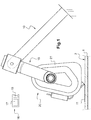
- the figure 1 has a fiber placement device 10 on a deposition surface 2, such as a surface of a mold 1.
- the device 10 makes it possible to arrange a ribbon of impregnated fibers 11 on this removal surface 2.
- the impregnated fiber ribbon 11 may comprise fibers impregnated with a wet resin for example to have a high adhesion capacity to a support.
- the impregnated fiber ribbon 11 is then a tacky ribbon having a high tack.
- the impregnated fiber ribbon 11 may comprise fibers impregnated with a resin by a solvent route.
- This device 10 includes a depositing head 20 and a moving system 15 of the dispensing head in space.
- the deposition head 20 comprises a frame 21 carried by the displacement system 15.
- This displacement system 15 may be a robot having articulated arms, or a gantry adapted to move the deposition head in several directions.
- the device 10 comprises a control means 16 of the depositing head 20 and the displacement system 15.
- the control means may be provided with a visual interface 17 and man / machine interfaces 18 manually operable by an operator to set control parameters of the device 10.
- these parameters are in particular relating to the movement of the head of the device. depositing 20, the possible cut of this ribbon of impregnated fibers 11, at a temperature prevailing in the dispensing head and any other parameter useful for the operation of the device 10.
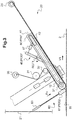
- the figure 2 shows a diagram of an embodiment of the depositing head 20.
- This dispensing head comprises a set 13 of ribbons running in the frame 21.
- This set 13 of ribbons comprises a ribbon of impregnated fibers 11 superimposed on a protective tape 12.
- the assembly 13 can be stored in a feeding system including in particular a supply reel, or even a return roller. Thus, the assembly 13 is wound around a core of a supply coil 25 called "feeder core".
- the supply reel may be housed in the deposition head 20, or outside this deposition head 20.
- a return roller is arranged to ensure that the path of the assembly 13 is well parallel to a support surface of the drawer described later, regardless of the variable diameter of the supply coil 25 during the unwinding phase of the set 13 of ribbons.
- the protective tape 12 makes it possible in particular to separate two successive layers of the impregnated fiber ribbon 11, for example to allow the unwinding of the impregnated fiber ribbon 11 out of the feed reel 25.
- the assembly 13 of ribbons tangentially runs along a bearing surface 400 of a slide 40.
- This slide 40 extends longitudinally from an upper end to a lower end.
- the drawer 40 carries a peeling roller 51 of a disengaging means 50.
- the peeling roller is free to rotate relative to the slide 40 about an axis of rotation AX1.
- This peeling roller 51 can thus be arranged around a rod integral with the lower end of the slide, the rod extending along the axis of rotation AX1.
- the drawer may comprise a heating system 85, such as a system provided with a heating resistor for example.
- the assembly 13 can follow a rectilinear trajectory.
- the protective tape 12 is interposed between the impregnated fiber ribbon 11 and the slide 40.
- the protection tape is directed towards a recovery bobbin 35 being pressed against a circular arc of the peeling roller 51.
- At least one intermediate roller 31, 32 guides the protection tape 12 to the recovery coil 35.
- Each intermediate roller 31, 32 is then interposed between the peeling roller 51 and said recovery coil 35 with regard to the path followed by the protection tape 12 towards the recovery coil 35.
- first intermediate roller 31 and a second intermediate roller 32 are provided.
- the first intermediate roller 31 is arranged functionally between the second intermediate roller 32 and the recovery coil 35.
- the second intermediate roller 32 is disposed near an opening of a cutting system described later to prevent the ribbon protection 12 comes into destructive contact with the cutting system 3 when the drawer is in its lower position PINF.
- the protective tape 12 may possibly pass permanently against the first intermediate roller 31, and possibly against the second intermediate roller 32 arranged between the first intermediate roller 31 and the peeling roller 51 under certain conditions.
- the ribbon passes against the second intermediate roller when the drawer is not in its upper position PSUP.
- the impregnated fiber ribbon 11 does not rotate around the second intermediate roller to reach the recovery coil 35 when the drawer is in its upper position PSUP.
- the disengaging means 50 comprises a peeling roller 51 guiding the protection tape 12 to a recovery coil 35 while not affecting the flow of the impregnated fiber ribbon 11.
- the protective tape 12 must make a change of direction so as to have an angle alpha with the ribbon of impregnated fibers 11. As a result, the protective tape 12 separates from the ribbon of impregnated fibers 11.
- an additional strip wound around an additional coil is furthermore interposed between, on the one hand, the protection strip 12 and, on the other hand, the drawer 40 and the disunion means 50.
- the coil additional is placed between the supply reel 25 and the drawer 40 with respect to the displacement of the assembly 13 of ribbons.
- the additional tape as well as the protective tape 12 and the impregnated fiber tape 11 are directed jointly to the slide 40, the additional tape and the protective tape being then guided to the recovery coil 35.
- a protective tape layer 12 is disposed between two layers of the impregnated fiber ribbon 11.
- the protective ribbons are made of a material that avoids strong adhesion with the fibers. impregnated, such as silicone paper or a structured plastic film for example.
- the face of the protective tape in contact with the organs of the dispensing head may retain traces of its winding around the supply core, and therefore traces of resin. The additional tape is then used to prevent fouling of the dispensing head.
- the impregnated fiber ribbon 11 is not deflected, and continues its path to the deposition surface 2 on which this ribbon of impregnated fibers 11 is to be deposited.
- the impregnated fiber ribbon 11 is then directed towards a pressure means 61, the pressure means 61 being in fact arranged downstream of the peeling roller 51 with regard to the direction of movement of the impregnated fiber ribbon in the frame 21 of the head of deposit. Therefore, the pressure means 61 is not in contact with the protective tape 12 or with the additional tape where appropriate.
- the pressure means 61 may for example comprise a wheel capable of exerting pressure on the ribbon of impregnated fibers deposited on the laying surface 2.
- the pressing means 61 may comprise a smoothing element 60 provided with a sharp or round edge 62 pressing on the ribbon of impregnated fibers 11 for its application against the laying surface 2. The smoother is then in contact with the ribbon of fibers impregnated only on a very limited surface, namely the surface of the edge 62.
- the dispensing head may comprise a compression actuator 63 capable of displacing the pressure means 61. Therefore, the compression actuator 63 can be fixed to the frame 21, the pressure means 61 being instead mobile with respect to the frame. For example, the pressure means 61 is displaced in translation substantially vertically in accordance with the double arrow F1.
- the compression actuator 63 can move the pressure means 61 from a position called “rest position POS1" to a position called “compression position". In the rest position POS1, the pressing means 61 can not press the ribbon of impregnated fibers 11 against the dispensing surface 2. On the contrary, in the compression position the pressing means 61 presses the impregnated fiber ribbon 11 against the dispensing surface 2 by exerting a smoothing pressure.
- the compression actuator 63 also makes it possible to accurately adjust the pressure exerted by the pressure means 61 on the ribbon of impregnated fibers 11 in the compression position. For example, an operator adjusts the pressure to be respected with the aid of the control means 16, this control means 16 slaving the compressive force of the pressure means 61 by means of non-represented sensors for example.
- the depositing head 20 may comprise a cutting system 70 for cutting the ribbon of impregnated fibers 11.
- the cutting system 70 is arranged, if appropriate, upstream of the pressure means 61 with respect to the direction of movement of the fiber ribbon impregnated into the frame 21 of the dispensing head 20.
- This cutting system 70 can have a housing 71 fixed to the frame 21.
- the cutting system 70 comprises a blade 73 cooperating with a jack 72.
- the jack 72 can move the blade 73 in translation in the housing to direct the blade 73 to a cutting plane 74.
- the cutting plane 74 then represents a wedge "martyr”.
- the cutting system 70 can thus cut the ribbon of impregnated fibers 11 at the request of the control means 16 by moving the blade 73 along the double arrow F2 against the cutting plane 74.
- the cutting system 70 also has an opening 75 allowing the slide 40 to traverse this cutting system 70 to approach the deposition surface 2.
- the drawer 40 is movable at least in translation of an upper position PSUP visible on the figure 2 at a lower position illustrated subsequently.
- the drawer In the upper position PSUP, the drawer is arranged upstream of the cutting system 70 with respect to the direction of movement of the impregnated fiber ribbon in the frame 21 of the deposition head 20.
- the slide then passes if necessary the opening 75 of the cutting system 70.
- a second intermediate roller 32 is positioned near the opening 75 to guide the protection tape 12 following the translation of the slide 40 towards the lower position.
- the removal head 20 comprises a displacement actuator 41 connected to the slide 40.
- the displacement actuator comprises a cavity 43 formed in the slide and a piston 42 disposed in the cavity.
- the piston 42 defines at least one variable volume chamber in the cavity 43, or two chambers disposed on either side of the piston 42.
- the pressure in at least one chamber is modified using a hydraulic system or pneumatic, the slide moves relative to the piston 42.
- the piston 42 is carried by the frame 21 and then supports the slide 40. In addition, the piston 42 guides the slide 40 in translation.
- the slide 40 can also be rotatable about a clearance axis AX3.
- This clearance axis AX3 is parallel to the axis of rotation AX1 of the peeling roller 51.
- release actuator 80 is connected to the spool 40 to control a rotation of this spool 40 about the disengagement axis AX3.
- the spool 40 and the piston 42 rotate around an axis of symmetry of the piston, this piston being articulated to the frame 21.
- the system comprises the piston 42 which is arranged in the cavity 43 to carry the drawer and guide the translation of this drawer.
- the displacement actuator may comprise an electric or hydraulic or pneumatic cylinder, for example, provided with a rod connected to the slide, the displacement actuator displacing the rod in translation or in rotation with respect to the frame 21.
- the piston 42 and the cavity 43 can form a ball slide mounted on a pivot arranged along the clearance axis AX3.
- the displacement actuator then also represents a release actuator 80 ensuring by its kinematics the displacement in translation and in rotation of the slide.
- said drawer 40 can carry a clamp 45.
- the clamp 45 is movable relative to the drawer 40.
- the clamp 45 is rotatable. Therefore, the clamp 45 is articulated to the slide by a pivot joint 46.
- the clamp 45 can be rotatable about an axis called "pinch axis AX2" which is parallel to the axis of rotation AX1 peeling roller 51 on itself.
- the clamp 45 comprises a first arm 48 hinged to the pivot joint 46, and a second arm 49 secured to of the first arm 48.
- the second arm 49 is then located opposite the bearing face 400 of the slide 40.
- the clamp 45, and for example the second arm 49 have a nip 490 substantially parallel to the bearing surface 400 of the drawer 40 in a position of pinching POSF illustrated on the figure 2 .
- the depositing head 20 comprises a pinch actuator 47.
- This pinch actuator 47 extends between the slide 40 and the clip 45, for example between the slide 40 and the first arm 48.
- This pinch actuator 47 is configured to move the clamp 45 from the POSF pinch position to a POSO release position.
- the clamp 45 In the POSF pinch position, the clamp 45 translates the impregnated fiber ribbon 11 in translation to the slide 40, by wedging a portion of the ribbon assembly 13 between its nip surface 490 and the bearing surface 400 of the slide.
- the clamp 45 does not immobilize in translation the set 13 of ribbons at the slide 40.
- the clamp 45 is movable in translation, driven by a suitable kinematics and an actuator.
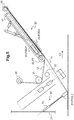
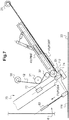
- the Figures 2 to 7 illustrate the operation of the dispensing head.
- the drawer 40 Prior to the start of a fiber-impregnated ribbon removal sequence 11 programmed in the control means 16, the drawer 40 is in its upper position PSUP or in its intermediate position. If necessary, the clamp 45 is brought into its POSF pinch position. The pressure means 61 is in its rest position POS1, and the blade 73 of the cutting system 70 is raised.
- the displacement actuator 41 moves the slide 40 in translation downwards.
- the displacement of the ribbon assembly 13 together with the slide 40 is facilitated by the clamp 45 which secures the assembly 13 to the slide. 40.
- the dispensing head is moved to the dispensing surface in an upward movement from top to bottom.
- the drawer then passes right through the cutting system 70 to reach its lower position PINF.
- the impregnated fiber ribbon 11 has a section 110 which then rests on the dispensing surface. This section 110 is held against the removal surface by the peeling roller 51.
- the protective tape then passes against the second intermediate roller 32.
- This second intermediate roller avoids undue contact between the cutting system and the protective tape 12 downstream of the peeling roller.
- the ribbon passes through a tangent to the second intermediate roller and the peeling roller which passes through the opening 70 in the lower position of the drawer.
- the compression actuator 63 moves in translation the pressure means 61 in its compression position POS2 along the arrow F4 to press on this section 110.
- the pinch actuator 47 rotates ROT1 to the clamp 45 to position the clamp 45 in its POSO release position.
- the protective tape 12 joins the recovery coil 35 passing successively around the peeling roller 51, the second intermediate roller 32 and the first intermediate roller 31.
- the depositing head 20 is moved by the displacement system on the order of the control means 16, at a first speed V1.
- the assembly 13 of ribbons is unrolled out of the supply reel 25, and the ribbon of impregnated fibers is spread against the dispensing surface.
- the protective tape 12 spreads against the peeling roller 51 on a circular arc 100 which extends over a first angle teta1.
- This first angle teta1 is of the order of 180 degrees.
- this control means immobilizes the depositing head 20 before starting a fast moving phase.
- control means 16 orders the displacement actuator 41 to translate the slide 40 in translation to its upper position PSUP. If necessary, the control means 16 orders the release actuator 80 to rotate the slide 40 around the disengagement axis AX3 by bringing the peeling roller 51 closer to the recovery reel 35.
- the protective tape 12 spreads against the peeling roller 51 on an arc 100 which extends over a second angle teta2.
- This second angle teta2 is smaller than the first angle teta1.
- This second angle teta2 is for example less than or equal to 60 degrees plus or minus five degrees. Such a second angle teta2 allows a correct peeling of the protective tape 12.
- the depositing head 20 can be moved at a second high speed V2 by the displacement system.
- control means 16 orders, if necessary, the release actuator 80 to move the slide 40 in rotation about the release axis AX3 in order to return the slide 40 to its previous position by aligning the slide with the opening 75 of the cutting system 70.
- control means 16 may instruct the displacement actuator 41 to translate the slide 40 in translation to its intermediate position PINT.
- control means 16 may instruct the pinch actuator 47 to rotate the clip 45 to position the clip 45 in its pinch position POSF.
- the cutting system 70 is then urged by the control means 16.
- the blade 73 moves in translation to cut the impregnated fiber ribbon 11.
- a first cut 111 end of the impregnated fiber ribbon is then disengaged from the drawer.
- a second end 112 cut from the ribbon of impregnated fibers protrudes from the peeling roller 51.
- the depositing head 20 is optionally displaced in translation so that the pressing means 61 presses this first cut end 111 of the impregnated fiber ribbon onto the depositing surface 2.
- the control means 16 may instruct the compression actuator 63 to raise the pressure means to its rest position POS1.
- the displacement actuator can return the drawer 40 to its upper position PSUP.
- the dispensing head can then be moved to initiate a new dispensing sequence.
Landscapes
- Engineering & Computer Science (AREA)
- Chemical & Material Sciences (AREA)
- Composite Materials (AREA)
- Mechanical Engineering (AREA)
- Robotics (AREA)
- Moulding By Coating Moulds (AREA)
- Reinforced Plastic Materials (AREA)
- Impression-Transfer Materials And Handling Thereof (AREA)
- Replacement Of Web Rolls (AREA)
Priority Applications (1)
| Application Number | Priority Date | Filing Date | Title |
|---|---|---|---|
| PL17171444T PL3248765T3 (pl) | 2016-05-24 | 2017-05-17 | Głowica do osadzania taśmy o zaimpregnowanych włóknach oraz urządzenie do umieszczania takiej taśmy |
Applications Claiming Priority (1)
| Application Number | Priority Date | Filing Date | Title |
|---|---|---|---|
| FR1600833A FR3051709B1 (fr) | 2016-05-24 | 2016-05-24 | Tete de depose d'un ruban de fibres impregnees, et dispositif de placement d'un tel ruban |
Publications (3)
| Publication Number | Publication Date |
|---|---|
| EP3248765A2 true EP3248765A2 (de) | 2017-11-29 |
| EP3248765A3 EP3248765A3 (de) | 2018-03-21 |
| EP3248765B1 EP3248765B1 (de) | 2021-06-23 |
Family
ID=56990472
Family Applications (1)
| Application Number | Title | Priority Date | Filing Date |
|---|---|---|---|
| EP17171444.7A Active EP3248765B1 (de) | 2016-05-24 | 2017-05-17 | Ablagekopf eines bands aus imprägnierten fasern, und vorrichtung zum platzieren eines solchen bandes |
Country Status (6)
| Country | Link |
|---|---|
| US (1) | US10399289B2 (de) |
| EP (1) | EP3248765B1 (de) |
| KR (1) | KR101926647B1 (de) |
| CA (1) | CA2968052C (de) |
| FR (1) | FR3051709B1 (de) |
| PL (1) | PL3248765T3 (de) |
Cited By (2)
| Publication number | Priority date | Publication date | Assignee | Title |
|---|---|---|---|---|
| CN111302108A (zh) * | 2020-03-16 | 2020-06-19 | 江苏奇一科技有限公司 | 单向预浸带材的自动布料设备及其工艺 |
| WO2022058703A1 (en) * | 2020-09-17 | 2022-03-24 | Icomat Limited | A tape laying head |
Families Citing this family (6)
| Publication number | Priority date | Publication date | Assignee | Title |
|---|---|---|---|---|
| US12083741B2 (en) * | 2020-09-11 | 2024-09-10 | Continous Composites Inc. | Print heads for additive manufacturing systems |
| US11919256B2 (en) * | 2021-04-28 | 2024-03-05 | The Boeing Company | System and method for manufacturing cross-ply pre-impregnated material |
| US20230249416A1 (en) * | 2022-02-04 | 2023-08-10 | Northrop Grumman Systems Corporation | Automated methods for manufacturing sheets of composite material and composite structures, pattern preparation and forming systems, and sheets of composite material |
| GB202216511D0 (en) * | 2022-11-07 | 2022-12-21 | Hexcel Composites Ltd | Ultrasonic welding of prepreg tape |
| WO2024100381A1 (en) * | 2022-11-07 | 2024-05-16 | Hexcel Composites Limited | Ultrasonic Welding of Prepreg Tape |
| CN119858334B (zh) * | 2025-03-25 | 2025-09-16 | 杭州艾美依航空制造装备有限公司 | 丝束转向装置及自动铺丝机 |
Citations (9)
| Publication number | Priority date | Publication date | Assignee | Title |
|---|---|---|---|---|
| EP0144927A2 (de) | 1983-12-05 | 1985-06-19 | Cincinnati Milacron Inc. | Verfahren und Vorrichtung zum Aufbringen von Bändern auf eine Form |
| US5110395A (en) | 1989-12-04 | 1992-05-05 | Cincinnati Milacron Inc. | Fiber placement head |
| US5480508A (en) | 1990-09-13 | 1996-01-02 | Toshiba Kikai Kabushiki Kaisha | Apparatus for manufacturing laminated prepreg members |
| FR2785623A1 (fr) | 1998-11-10 | 2000-05-12 | Aerospatiale | Procede et dispositif de depose au contact de fils de fibres pre-impregnees notamment pour la realisation de structures complexes en materiau composite polymerise par ionisation |
| WO2001096223A1 (en) | 2000-06-13 | 2001-12-20 | Isogrid Composites, Inc. | Method of placing fibers into channels of a mold and fiber placement head for accomplishing same |
| GB2492594A (en) | 2011-07-08 | 2013-01-09 | Univ Bristol | Tow placement apparatus and method |
| FR2982792A1 (fr) | 2011-11-23 | 2013-05-24 | Eurocopter France | Tete de depose d'un ruban de fibres impregnees, et dispositif de placement d'un tel ruban |
| DE102012017595A1 (de) | 2012-09-06 | 2014-03-06 | Premium Aerotec Gmbh | Ablegekopf und Ablegeverfahren zum automatisierten Ablegen von Zuschnitten eines flächigen Materials, insbesondere zur Herstellung von großflächigen Faserverbundbauteilen |
| WO2015068734A1 (ja) | 2013-11-06 | 2015-05-14 | 三菱重工業株式会社 | プリプレグシート自動積層装置、及びプリプレグシート積層方法 |
Family Cites Families (4)
| Publication number | Priority date | Publication date | Assignee | Title |
|---|---|---|---|---|
| GB2101519B (en) * | 1981-06-22 | 1986-03-19 | Vought Corp | Apparatus for tape laying and manufacture of composite structures |
| US4508584A (en) * | 1983-12-01 | 1985-04-02 | The Ingersoll Milling Machine Company | Tape-laying head |
| FR2915704B1 (fr) * | 2007-05-04 | 2009-07-10 | Forest Line Capdenac Soc Par A | Tete de drapage de composite avec dispositif escamotable de separation de preimpregne de son ruban de support. |
| US8900391B2 (en) * | 2011-06-26 | 2014-12-02 | The Boeing Company | Automated resin and fiber deposition for resin infusion |
-
2016
- 2016-05-24 FR FR1600833A patent/FR3051709B1/fr active Active
-
2017
- 2017-05-17 PL PL17171444T patent/PL3248765T3/pl unknown
- 2017-05-17 EP EP17171444.7A patent/EP3248765B1/de active Active
- 2017-05-18 CA CA2968052A patent/CA2968052C/fr active Active
- 2017-05-23 US US15/602,513 patent/US10399289B2/en not_active Expired - Fee Related
- 2017-05-24 KR KR1020170063870A patent/KR101926647B1/ko active Active
Patent Citations (10)
| Publication number | Priority date | Publication date | Assignee | Title |
|---|---|---|---|---|
| EP0144927A2 (de) | 1983-12-05 | 1985-06-19 | Cincinnati Milacron Inc. | Verfahren und Vorrichtung zum Aufbringen von Bändern auf eine Form |
| US5110395A (en) | 1989-12-04 | 1992-05-05 | Cincinnati Milacron Inc. | Fiber placement head |
| US5480508A (en) | 1990-09-13 | 1996-01-02 | Toshiba Kikai Kabushiki Kaisha | Apparatus for manufacturing laminated prepreg members |
| FR2785623A1 (fr) | 1998-11-10 | 2000-05-12 | Aerospatiale | Procede et dispositif de depose au contact de fils de fibres pre-impregnees notamment pour la realisation de structures complexes en materiau composite polymerise par ionisation |
| US6540000B1 (en) | 1998-11-10 | 2003-04-01 | Aerospatiale Societe Nationale Industrielle | Process and device for depositing in contact roving of pre-impregnated fibers particularly for the production of complex structures of composite material polymerized by ionization |
| WO2001096223A1 (en) | 2000-06-13 | 2001-12-20 | Isogrid Composites, Inc. | Method of placing fibers into channels of a mold and fiber placement head for accomplishing same |
| GB2492594A (en) | 2011-07-08 | 2013-01-09 | Univ Bristol | Tow placement apparatus and method |
| FR2982792A1 (fr) | 2011-11-23 | 2013-05-24 | Eurocopter France | Tete de depose d'un ruban de fibres impregnees, et dispositif de placement d'un tel ruban |
| DE102012017595A1 (de) | 2012-09-06 | 2014-03-06 | Premium Aerotec Gmbh | Ablegekopf und Ablegeverfahren zum automatisierten Ablegen von Zuschnitten eines flächigen Materials, insbesondere zur Herstellung von großflächigen Faserverbundbauteilen |
| WO2015068734A1 (ja) | 2013-11-06 | 2015-05-14 | 三菱重工業株式会社 | プリプレグシート自動積層装置、及びプリプレグシート積層方法 |
Cited By (2)
| Publication number | Priority date | Publication date | Assignee | Title |
|---|---|---|---|---|
| CN111302108A (zh) * | 2020-03-16 | 2020-06-19 | 江苏奇一科技有限公司 | 单向预浸带材的自动布料设备及其工艺 |
| WO2022058703A1 (en) * | 2020-09-17 | 2022-03-24 | Icomat Limited | A tape laying head |
Also Published As
| Publication number | Publication date |
|---|---|
| PL3248765T3 (pl) | 2021-12-20 |
| US20170341315A1 (en) | 2017-11-30 |
| EP3248765A3 (de) | 2018-03-21 |
| CA2968052C (fr) | 2018-08-14 |
| EP3248765B1 (de) | 2021-06-23 |
| US10399289B2 (en) | 2019-09-03 |
| KR101926647B1 (ko) | 2018-12-07 |
| KR20170132686A (ko) | 2017-12-04 |
| FR3051709A1 (fr) | 2017-12-01 |
| CA2968052A1 (fr) | 2017-11-24 |
| FR3051709B1 (fr) | 2019-01-25 |
Similar Documents
| Publication | Publication Date | Title |
|---|---|---|
| EP3248765B1 (de) | Ablagekopf eines bands aus imprägnierten fasern, und vorrichtung zum platzieren eines solchen bandes | |
| EP2414152B1 (de) | Verfahren und maschine zum aufbringen einer faserbahn auf konvexe und/oder geriffelte flächen | |
| EP2480400B1 (de) | Automatisierte drapiervorrichtung und drapierverfahren für verbundstoffe | |
| EP3492249B1 (de) | Verfahren und anlage zum wickeln eines vorimprägnierten stoffbands auf eine geneigte oberfläche | |
| EP1001066B1 (de) | Verfahren und Vorrichtung zum Kontaktauflegen eines Fadens aus vorimprägnierten Fasern insbesondere zur Herstellung eines Formteils aus einem ionisationspolymerisierten Kompositwerkstoff | |
| EP0846551B1 (de) | Bandlegekopf zur Herstellung von Verbundplatten | |
| EP3426452B1 (de) | Verfahren zur herstellung von vorformlingen mit anwendung eines bindemittels auf trockener faser und entsprechende maschine | |
| EP3307662B1 (de) | Gatter für faserspule | |
| EP2152500B1 (de) | Verbundauflagekopf mit ausziehbarer vorrichtung zur trennung eines prepregs von seinem trägerband | |
| EP3156356B1 (de) | Zuführung für verpackvorgänge mit schrumpffolie | |
| EP3277486A1 (de) | Faserauftragskopf mit spezieller auftragsrolle | |
| WO2014096562A2 (fr) | Procede de realisation de preformes a partir de fibres munies d'un liant, et machine correspondante | |
| FR3107001A1 (fr) | Têtes d'application de fibres avec bobines embarquées | |
| FR3046780A1 (fr) | Procede et dispositif d'acheminement, de mise a disposition et d'echange de rouleaux comportant du materiau d'emballage dans une machine d'emballage | |
| WO2019048744A1 (fr) | Procédé de réalisation de préformés avec application d'un liant sur fibre sèche formée de plusieurs fibres initiales | |
| FR3066720B1 (fr) | Module de decoupe pour une tete de placement d'un ruban de fibres impregnees, tete de placement et dispositif de placement d'un tel ruban de fibres | |
| FR2986178A1 (fr) | Systeme automatise d'alimentation d'un materiau | |
| EP1074497B1 (de) | Verfahren und Vorrichtung zum Verbinden der Enden von Materialbahnen, insbesondere Textilbahnen | |
| FR2982792A1 (fr) | Tete de depose d'un ruban de fibres impregnees, et dispositif de placement d'un tel ruban | |
| EP3423262B1 (de) | Faserapplikationsmaschine mit bandförderer und verfahren zur herstellung von teilen unter verwendung solch einer maschine | |
| WO2004067264A1 (fr) | Procede de depose sur un support de couches fibreuses inclinees | |
| EP3038963B1 (de) | Verfahren zum verschweissen zweier thermoschmelzbarer artikel in form von streifen oder schichten und spleissmodul zur durchführung dieses verfahrens | |
| FR2919518A1 (fr) | Dispositif de changement de bobine ou de cassette pour tete de nappage de preimpregne | |
| EP3170650A1 (de) | Herstellungsverfahren eines verbundstoffbandes und entsprechende herstellungsanlage für die herstellung eines segels eines segelbootes | |
| BE526103A (de) |
Legal Events
| Date | Code | Title | Description |
|---|---|---|---|
| PUAI | Public reference made under article 153(3) epc to a published international application that has entered the european phase |
Free format text: ORIGINAL CODE: 0009012 |
|
| STAA | Information on the status of an ep patent application or granted ep patent |
Free format text: STATUS: THE APPLICATION HAS BEEN PUBLISHED |
|
| AK | Designated contracting states |
Kind code of ref document: A2 Designated state(s): AL AT BE BG CH CY CZ DE DK EE ES FI FR GB GR HR HU IE IS IT LI LT LU LV MC MK MT NL NO PL PT RO RS SE SI SK SM TR |
|
| AX | Request for extension of the european patent |
Extension state: BA ME |
|
| PUAL | Search report despatched |
Free format text: ORIGINAL CODE: 0009013 |
|
| AK | Designated contracting states |
Kind code of ref document: A3 Designated state(s): AL AT BE BG CH CY CZ DE DK EE ES FI FR GB GR HR HU IE IS IT LI LT LU LV MC MK MT NL NO PL PT RO RS SE SI SK SM TR |
|
| AX | Request for extension of the european patent |
Extension state: BA ME |
|
| RIC1 | Information provided on ipc code assigned before grant |
Ipc: B29C 70/38 20060101AFI20180214BHEP Ipc: B29C 70/54 20060101ALI20180214BHEP |
|
| STAA | Information on the status of an ep patent application or granted ep patent |
Free format text: STATUS: REQUEST FOR EXAMINATION WAS MADE |
|
| 17P | Request for examination filed |
Effective date: 20180518 |
|
| RBV | Designated contracting states (corrected) |
Designated state(s): AL AT BE BG CH CY CZ DE DK EE ES FI FR GB GR HR HU IE IS IT LI LT LU LV MC MK MT NL NO PL PT RO RS SE SI SK SM TR |
|
| STAA | Information on the status of an ep patent application or granted ep patent |
Free format text: STATUS: EXAMINATION IS IN PROGRESS |
|
| 17Q | First examination report despatched |
Effective date: 20200422 |
|
| GRAP | Despatch of communication of intention to grant a patent |
Free format text: ORIGINAL CODE: EPIDOSNIGR1 |
|
| STAA | Information on the status of an ep patent application or granted ep patent |
Free format text: STATUS: GRANT OF PATENT IS INTENDED |
|
| INTG | Intention to grant announced |
Effective date: 20201202 |
|
| GRAJ | Information related to disapproval of communication of intention to grant by the applicant or resumption of examination proceedings by the epo deleted |
Free format text: ORIGINAL CODE: EPIDOSDIGR1 |
|
| GRAP | Despatch of communication of intention to grant a patent |
Free format text: ORIGINAL CODE: EPIDOSNIGR1 |
|
| GRAJ | Information related to disapproval of communication of intention to grant by the applicant or resumption of examination proceedings by the epo deleted |
Free format text: ORIGINAL CODE: EPIDOSDIGR1 |
|
| STAA | Information on the status of an ep patent application or granted ep patent |
Free format text: STATUS: EXAMINATION IS IN PROGRESS |
|
| GRAJ | Information related to disapproval of communication of intention to grant by the applicant or resumption of examination proceedings by the epo deleted |
Free format text: ORIGINAL CODE: EPIDOSDIGR1 |
|
| GRAP | Despatch of communication of intention to grant a patent |
Free format text: ORIGINAL CODE: EPIDOSNIGR1 |
|
| STAA | Information on the status of an ep patent application or granted ep patent |
Free format text: STATUS: GRANT OF PATENT IS INTENDED |
|
| GRAP | Despatch of communication of intention to grant a patent |
Free format text: ORIGINAL CODE: EPIDOSNIGR1 |
|
| INTG | Intention to grant announced |
Effective date: 20210122 |
|
| INTG | Intention to grant announced |
Effective date: 20210204 |
|
| INTG | Intention to grant announced |
Effective date: 20210212 |
|
| GRAS | Grant fee paid |
Free format text: ORIGINAL CODE: EPIDOSNIGR3 |
|
| GRAA | (expected) grant |
Free format text: ORIGINAL CODE: 0009210 |
|
| STAA | Information on the status of an ep patent application or granted ep patent |
Free format text: STATUS: THE PATENT HAS BEEN GRANTED |
|
| AK | Designated contracting states |
Kind code of ref document: B1 Designated state(s): AL AT BE BG CH CY CZ DE DK EE ES FI FR GB GR HR HU IE IS IT LI LT LU LV MC MK MT NL NO PL PT RO RS SE SI SK SM TR |
|
| REG | Reference to a national code |
Ref country code: GB Ref legal event code: FG4D Free format text: NOT ENGLISH |
|
| REG | Reference to a national code |
Ref country code: CH Ref legal event code: EP |
|
| REG | Reference to a national code |
Ref country code: DE Ref legal event code: R096 Ref document number: 602017040659 Country of ref document: DE Ref country code: AT Ref legal event code: REF Ref document number: 1403936 Country of ref document: AT Kind code of ref document: T Effective date: 20210715 |
|
| REG | Reference to a national code |
Ref country code: IE Ref legal event code: FG4D Free format text: LANGUAGE OF EP DOCUMENT: FRENCH |
|
| REG | Reference to a national code |
Ref country code: LT Ref legal event code: MG9D |
|
| PG25 | Lapsed in a contracting state [announced via postgrant information from national office to epo] |
Ref country code: HR Free format text: LAPSE BECAUSE OF FAILURE TO SUBMIT A TRANSLATION OF THE DESCRIPTION OR TO PAY THE FEE WITHIN THE PRESCRIBED TIME-LIMIT Effective date: 20210623 Ref country code: BG Free format text: LAPSE BECAUSE OF FAILURE TO SUBMIT A TRANSLATION OF THE DESCRIPTION OR TO PAY THE FEE WITHIN THE PRESCRIBED TIME-LIMIT Effective date: 20210923 Ref country code: FI Free format text: LAPSE BECAUSE OF FAILURE TO SUBMIT A TRANSLATION OF THE DESCRIPTION OR TO PAY THE FEE WITHIN THE PRESCRIBED TIME-LIMIT Effective date: 20210623 Ref country code: LT Free format text: LAPSE BECAUSE OF FAILURE TO SUBMIT A TRANSLATION OF THE DESCRIPTION OR TO PAY THE FEE WITHIN THE PRESCRIBED TIME-LIMIT Effective date: 20210623 |
|
| REG | Reference to a national code |
Ref country code: AT Ref legal event code: MK05 Ref document number: 1403936 Country of ref document: AT Kind code of ref document: T Effective date: 20210623 |
|
| PG25 | Lapsed in a contracting state [announced via postgrant information from national office to epo] |
Ref country code: NO Free format text: LAPSE BECAUSE OF FAILURE TO SUBMIT A TRANSLATION OF THE DESCRIPTION OR TO PAY THE FEE WITHIN THE PRESCRIBED TIME-LIMIT Effective date: 20210923 Ref country code: SE Free format text: LAPSE BECAUSE OF FAILURE TO SUBMIT A TRANSLATION OF THE DESCRIPTION OR TO PAY THE FEE WITHIN THE PRESCRIBED TIME-LIMIT Effective date: 20210623 Ref country code: RS Free format text: LAPSE BECAUSE OF FAILURE TO SUBMIT A TRANSLATION OF THE DESCRIPTION OR TO PAY THE FEE WITHIN THE PRESCRIBED TIME-LIMIT Effective date: 20210623 Ref country code: GR Free format text: LAPSE BECAUSE OF FAILURE TO SUBMIT A TRANSLATION OF THE DESCRIPTION OR TO PAY THE FEE WITHIN THE PRESCRIBED TIME-LIMIT Effective date: 20210924 Ref country code: LV Free format text: LAPSE BECAUSE OF FAILURE TO SUBMIT A TRANSLATION OF THE DESCRIPTION OR TO PAY THE FEE WITHIN THE PRESCRIBED TIME-LIMIT Effective date: 20210623 |
|
| REG | Reference to a national code |
Ref country code: NL Ref legal event code: MP Effective date: 20210623 |
|
| PG25 | Lapsed in a contracting state [announced via postgrant information from national office to epo] |
Ref country code: SM Free format text: LAPSE BECAUSE OF FAILURE TO SUBMIT A TRANSLATION OF THE DESCRIPTION OR TO PAY THE FEE WITHIN THE PRESCRIBED TIME-LIMIT Effective date: 20210623 Ref country code: SK Free format text: LAPSE BECAUSE OF FAILURE TO SUBMIT A TRANSLATION OF THE DESCRIPTION OR TO PAY THE FEE WITHIN THE PRESCRIBED TIME-LIMIT Effective date: 20210623 Ref country code: RO Free format text: LAPSE BECAUSE OF FAILURE TO SUBMIT A TRANSLATION OF THE DESCRIPTION OR TO PAY THE FEE WITHIN THE PRESCRIBED TIME-LIMIT Effective date: 20210623 Ref country code: PT Free format text: LAPSE BECAUSE OF FAILURE TO SUBMIT A TRANSLATION OF THE DESCRIPTION OR TO PAY THE FEE WITHIN THE PRESCRIBED TIME-LIMIT Effective date: 20211025 Ref country code: NL Free format text: LAPSE BECAUSE OF FAILURE TO SUBMIT A TRANSLATION OF THE DESCRIPTION OR TO PAY THE FEE WITHIN THE PRESCRIBED TIME-LIMIT Effective date: 20210623 Ref country code: ES Free format text: LAPSE BECAUSE OF FAILURE TO SUBMIT A TRANSLATION OF THE DESCRIPTION OR TO PAY THE FEE WITHIN THE PRESCRIBED TIME-LIMIT Effective date: 20210623 Ref country code: EE Free format text: LAPSE BECAUSE OF FAILURE TO SUBMIT A TRANSLATION OF THE DESCRIPTION OR TO PAY THE FEE WITHIN THE PRESCRIBED TIME-LIMIT Effective date: 20210623 Ref country code: CZ Free format text: LAPSE BECAUSE OF FAILURE TO SUBMIT A TRANSLATION OF THE DESCRIPTION OR TO PAY THE FEE WITHIN THE PRESCRIBED TIME-LIMIT Effective date: 20210623 Ref country code: AT Free format text: LAPSE BECAUSE OF FAILURE TO SUBMIT A TRANSLATION OF THE DESCRIPTION OR TO PAY THE FEE WITHIN THE PRESCRIBED TIME-LIMIT Effective date: 20210623 |
|
| REG | Reference to a national code |
Ref country code: DE Ref legal event code: R097 Ref document number: 602017040659 Country of ref document: DE |
|
| PG25 | Lapsed in a contracting state [announced via postgrant information from national office to epo] |
Ref country code: DK Free format text: LAPSE BECAUSE OF FAILURE TO SUBMIT A TRANSLATION OF THE DESCRIPTION OR TO PAY THE FEE WITHIN THE PRESCRIBED TIME-LIMIT Effective date: 20210623 |
|
| PLBE | No opposition filed within time limit |
Free format text: ORIGINAL CODE: 0009261 |
|
| STAA | Information on the status of an ep patent application or granted ep patent |
Free format text: STATUS: NO OPPOSITION FILED WITHIN TIME LIMIT |
|
| 26N | No opposition filed |
Effective date: 20220324 |
|
| PG25 | Lapsed in a contracting state [announced via postgrant information from national office to epo] |
Ref country code: AL Free format text: LAPSE BECAUSE OF FAILURE TO SUBMIT A TRANSLATION OF THE DESCRIPTION OR TO PAY THE FEE WITHIN THE PRESCRIBED TIME-LIMIT Effective date: 20210623 |
|
| REG | Reference to a national code |
Ref country code: DE Ref legal event code: R119 Ref document number: 602017040659 Country of ref document: DE |
|
| REG | Reference to a national code |
Ref country code: CH Ref legal event code: PL |
|
| REG | Reference to a national code |
Ref country code: BE Ref legal event code: MM Effective date: 20220531 |
|
| PG25 | Lapsed in a contracting state [announced via postgrant information from national office to epo] |
Ref country code: MC Free format text: LAPSE BECAUSE OF FAILURE TO SUBMIT A TRANSLATION OF THE DESCRIPTION OR TO PAY THE FEE WITHIN THE PRESCRIBED TIME-LIMIT Effective date: 20210623 Ref country code: LU Free format text: LAPSE BECAUSE OF NON-PAYMENT OF DUE FEES Effective date: 20220517 Ref country code: LI Free format text: LAPSE BECAUSE OF NON-PAYMENT OF DUE FEES Effective date: 20220531 Ref country code: CH Free format text: LAPSE BECAUSE OF NON-PAYMENT OF DUE FEES Effective date: 20220531 |
|
| PG25 | Lapsed in a contracting state [announced via postgrant information from national office to epo] |
Ref country code: IE Free format text: LAPSE BECAUSE OF NON-PAYMENT OF DUE FEES Effective date: 20220517 |
|
| PG25 | Lapsed in a contracting state [announced via postgrant information from national office to epo] |
Ref country code: DE Free format text: LAPSE BECAUSE OF NON-PAYMENT OF DUE FEES Effective date: 20221201 Ref country code: BE Free format text: LAPSE BECAUSE OF NON-PAYMENT OF DUE FEES Effective date: 20220531 |
|
| P01 | Opt-out of the competence of the unified patent court (upc) registered |
Effective date: 20230530 |
|
| PG25 | Lapsed in a contracting state [announced via postgrant information from national office to epo] |
Ref country code: HU Free format text: LAPSE BECAUSE OF FAILURE TO SUBMIT A TRANSLATION OF THE DESCRIPTION OR TO PAY THE FEE WITHIN THE PRESCRIBED TIME-LIMIT; INVALID AB INITIO Effective date: 20170517 |
|
| PG25 | Lapsed in a contracting state [announced via postgrant information from national office to epo] |
Ref country code: MK Free format text: LAPSE BECAUSE OF FAILURE TO SUBMIT A TRANSLATION OF THE DESCRIPTION OR TO PAY THE FEE WITHIN THE PRESCRIBED TIME-LIMIT Effective date: 20210623 Ref country code: CY Free format text: LAPSE BECAUSE OF FAILURE TO SUBMIT A TRANSLATION OF THE DESCRIPTION OR TO PAY THE FEE WITHIN THE PRESCRIBED TIME-LIMIT Effective date: 20210623 |
|
| PG25 | Lapsed in a contracting state [announced via postgrant information from national office to epo] |
Ref country code: TR Free format text: LAPSE BECAUSE OF FAILURE TO SUBMIT A TRANSLATION OF THE DESCRIPTION OR TO PAY THE FEE WITHIN THE PRESCRIBED TIME-LIMIT Effective date: 20210623 |
|
| PG25 | Lapsed in a contracting state [announced via postgrant information from national office to epo] |
Ref country code: MT Free format text: LAPSE BECAUSE OF FAILURE TO SUBMIT A TRANSLATION OF THE DESCRIPTION OR TO PAY THE FEE WITHIN THE PRESCRIBED TIME-LIMIT Effective date: 20210623 |
|
| PGFP | Annual fee paid to national office [announced via postgrant information from national office to epo] |
Ref country code: PL Payment date: 20250423 Year of fee payment: 9 |
|
| PGFP | Annual fee paid to national office [announced via postgrant information from national office to epo] |
Ref country code: GB Payment date: 20250527 Year of fee payment: 9 |
|
| PGFP | Annual fee paid to national office [announced via postgrant information from national office to epo] |
Ref country code: IT Payment date: 20250527 Year of fee payment: 9 |
|
| PGFP | Annual fee paid to national office [announced via postgrant information from national office to epo] |
Ref country code: FR Payment date: 20250528 Year of fee payment: 9 |