EP3249629A2 - Dispositif de traitement d'informations, procédé de traitement d'informations et véhicule - Google Patents
Dispositif de traitement d'informations, procédé de traitement d'informations et véhicule Download PDFInfo
- Publication number
- EP3249629A2 EP3249629A2 EP17157534.3A EP17157534A EP3249629A2 EP 3249629 A2 EP3249629 A2 EP 3249629A2 EP 17157534 A EP17157534 A EP 17157534A EP 3249629 A2 EP3249629 A2 EP 3249629A2
- Authority
- EP
- European Patent Office
- Prior art keywords
- information
- target object
- area
- target
- processing device
- Prior art date
- Legal status (The legal status is an assumption and is not a legal conclusion. Google has not performed a legal analysis and makes no representation as to the accuracy of the status listed.)
- Granted
Links
Images



Classifications
-
- G—PHYSICS
- G01—MEASURING; TESTING
- G01S—RADIO DIRECTION-FINDING; RADIO NAVIGATION; DETERMINING DISTANCE OR VELOCITY BY USE OF RADIO WAVES; LOCATING OR PRESENCE-DETECTING BY USE OF THE REFLECTION OR RERADIATION OF RADIO WAVES; ANALOGOUS ARRANGEMENTS USING OTHER WAVES
- G01S17/00—Systems using the reflection or reradiation of electromagnetic waves other than radio waves, e.g. lidar systems
- G01S17/02—Systems using the reflection of electromagnetic waves other than radio waves
- G01S17/06—Systems determining position data of a target
-
- G—PHYSICS
- G05—CONTROLLING; REGULATING
- G05D—SYSTEMS FOR CONTROLLING OR REGULATING NON-ELECTRIC VARIABLES
- G05D1/00—Control of position, course, altitude or attitude of land, water, air or space vehicles, e.g. using automatic pilots
- G05D1/02—Control of position or course in two dimensions
- G05D1/021—Control of position or course in two dimensions specially adapted to land vehicles
- G05D1/0268—Control of position or course in two dimensions specially adapted to land vehicles using internal positioning means
- G05D1/0274—Control of position or course in two dimensions specially adapted to land vehicles using internal positioning means using mapping information stored in a memory device
-
- G—PHYSICS
- G05—CONTROLLING; REGULATING
- G05D—SYSTEMS FOR CONTROLLING OR REGULATING NON-ELECTRIC VARIABLES
- G05D1/00—Control of position, course, altitude or attitude of land, water, air or space vehicles, e.g. using automatic pilots
-
- G—PHYSICS
- G05—CONTROLLING; REGULATING
- G05D—SYSTEMS FOR CONTROLLING OR REGULATING NON-ELECTRIC VARIABLES
- G05D1/00—Control of position, course, altitude or attitude of land, water, air or space vehicles, e.g. using automatic pilots
- G05D1/02—Control of position or course in two dimensions
- G05D1/021—Control of position or course in two dimensions specially adapted to land vehicles
- G05D1/0231—Control of position or course in two dimensions specially adapted to land vehicles using optical position detecting means
- G05D1/0238—Control of position or course in two dimensions specially adapted to land vehicles using optical position detecting means using obstacle or wall sensors
- G05D1/024—Control of position or course in two dimensions specially adapted to land vehicles using optical position detecting means using obstacle or wall sensors in combination with a laser
-
- G—PHYSICS
- G05—CONTROLLING; REGULATING
- G05D—SYSTEMS FOR CONTROLLING OR REGULATING NON-ELECTRIC VARIABLES
- G05D1/00—Control of position, course, altitude or attitude of land, water, air or space vehicles, e.g. using automatic pilots
- G05D1/02—Control of position or course in two dimensions
- G05D1/021—Control of position or course in two dimensions specially adapted to land vehicles
- G05D1/0231—Control of position or course in two dimensions specially adapted to land vehicles using optical position detecting means
- G05D1/0246—Control of position or course in two dimensions specially adapted to land vehicles using optical position detecting means using a video camera in combination with image processing means
- G05D1/0248—Control of position or course in two dimensions specially adapted to land vehicles using optical position detecting means using a video camera in combination with image processing means in combination with a laser
-
- G—PHYSICS
- G06—COMPUTING OR CALCULATING; COUNTING
- G06T—IMAGE DATA PROCESSING OR GENERATION, IN GENERAL
- G06T7/00—Image analysis
- G06T7/20—Analysis of motion
-
- G—PHYSICS
- G06—COMPUTING OR CALCULATING; COUNTING
- G06T—IMAGE DATA PROCESSING OR GENERATION, IN GENERAL
- G06T7/00—Image analysis
- G06T7/50—Depth or shape recovery
- G06T7/521—Depth or shape recovery from laser ranging, e.g. using interferometry; from the projection of structured light
-
- G—PHYSICS
- G06—COMPUTING OR CALCULATING; COUNTING
- G06T—IMAGE DATA PROCESSING OR GENERATION, IN GENERAL
- G06T7/00—Image analysis
- G06T7/50—Depth or shape recovery
- G06T7/55—Depth or shape recovery from multiple images
- G06T7/593—Depth or shape recovery from multiple images from stereo images
-
- G—PHYSICS
- G06—COMPUTING OR CALCULATING; COUNTING
- G06T—IMAGE DATA PROCESSING OR GENERATION, IN GENERAL
- G06T7/00—Image analysis
- G06T7/60—Analysis of geometric attributes
- G06T7/66—Analysis of geometric attributes of image moments or centre of gravity
-
- G—PHYSICS
- G06—COMPUTING OR CALCULATING; COUNTING
- G06T—IMAGE DATA PROCESSING OR GENERATION, IN GENERAL
- G06T7/00—Image analysis
- G06T7/70—Determining position or orientation of objects or cameras
- G06T7/73—Determining position or orientation of objects or cameras using feature-based methods
-
- G—PHYSICS
- G06—COMPUTING OR CALCULATING; COUNTING
- G06V—IMAGE OR VIDEO RECOGNITION OR UNDERSTANDING
- G06V20/00—Scenes; Scene-specific elements
- G06V20/50—Context or environment of the image
- G06V20/56—Context or environment of the image exterior to a vehicle by using sensors mounted on the vehicle
- G06V20/58—Recognition of moving objects or obstacles, e.g. vehicles or pedestrians; Recognition of traffic objects, e.g. traffic signs, traffic lights or roads
-
- G—PHYSICS
- G06—COMPUTING OR CALCULATING; COUNTING
- G06V—IMAGE OR VIDEO RECOGNITION OR UNDERSTANDING
- G06V20/00—Scenes; Scene-specific elements
- G06V20/60—Type of objects
- G06V20/64—Three-dimensional [3D] objects
- G06V20/653—Three-dimensional [3D] objects by matching three-dimensional models, e.g. conformal mapping of Riemann surfaces
-
- G—PHYSICS
- G08—SIGNALLING
- G08G—TRAFFIC CONTROL SYSTEMS
- G08G1/00—Traffic control systems for road vehicles
- G08G1/16—Anti-collision systems
- G08G1/165—Anti-collision systems for passive traffic, e.g. including static obstacles, trees
-
- G—PHYSICS
- G08—SIGNALLING
- G08G—TRAFFIC CONTROL SYSTEMS
- G08G1/00—Traffic control systems for road vehicles
- G08G1/16—Anti-collision systems
- G08G1/166—Anti-collision systems for active traffic, e.g. moving vehicles, pedestrians, bikes
-
- G—PHYSICS
- G06—COMPUTING OR CALCULATING; COUNTING
- G06T—IMAGE DATA PROCESSING OR GENERATION, IN GENERAL
- G06T2207/00—Indexing scheme for image analysis or image enhancement
- G06T2207/30—Subject of image; Context of image processing
- G06T2207/30248—Vehicle exterior or interior
- G06T2207/30252—Vehicle exterior; Vicinity of vehicle
-
- G—PHYSICS
- G06—COMPUTING OR CALCULATING; COUNTING
- G06T—IMAGE DATA PROCESSING OR GENERATION, IN GENERAL
- G06T2207/00—Indexing scheme for image analysis or image enhancement
- G06T2207/30—Subject of image; Context of image processing
- G06T2207/30248—Vehicle exterior or interior
- G06T2207/30252—Vehicle exterior; Vicinity of vehicle
- G06T2207/30261—Obstacle
Definitions
- the present disclosure relates to an information processing device, an information processing method, and a vehicle.
- an information processing device includes processing circuitry.
- the processors obtain target information that indicates at least one of a distance to a target object or a position of the target object.
- the processing circuitry generate, based on the target information, map information of a space including a plurality of areas, the map information indicating presence or absence of the target object in a first area included in the plurality of areas, and a detailed position of the target object in the first area.
- the information processing device generates map information that not only indicates the presence or absence of a target object (obstacle) in an area but also indicates the detailed position of the target object in that area. Hence, the movement of a mobile object can be controlled in a more appropriate manner.
- the information processing device is installed in a vehicle such as an automobile (an example of a mobile object).
- the information processing device refers to detailed positions, sets the areas to be avoided during the movement, and controls the movement of the vehicle. As a result, even if the roads are narrow, it becomes possible to move in a safer and more reliable manner.
- the mobile object is not limited to a vehicle, and other examples of the mobile object include a robot, a ship, and a flying object (such as an airplane or a drone). Moreover, the mobile object either can be an autonomous mobile object or can be a manned mobile object.
- FIG. 1 is a block diagram illustrating an exemplary configuration of an information processing device 100 according to the arrangement.
- the information processing device 100 includes a processing circuitry 110, a sensor 101, and a memory unit 121.
- the memory unit 121 and the sensor 101 are electrically connected to the processing circuitry 110.
- the sensor 101 is a sensor for detecting the surrounding target objects.
- Examples of the sensor 101 include an image sensor (a stereo camera) and a distance sensor such as a laser sensor.
- the sensor 101 outputs detection information to the processing circuitry 110.
- the memory unit 121 is used to store a variety of data.
- the memory unit 121 is used to store map information generated by a generation function 112.
- the memory unit can be implemented using a memory medium such as a hard disk drive (HDD), a solid state drive (SSD), a read only memory (ROM), or a memory card in which the information can be stored at least in a magnetic manner, or in an optical manner, or in an electrical manner.
- a single memory medium constituting the memory unit 121 there is no limitation to have only a single memory medium constituting the memory unit 121.
- the memory unit 121 can be configured using a plurality of memory media.
- the memory unit 121 can be substituted with an external memory device installed on the outside of the information processing device 100.
- the processing circuitry 110 has an obtaining function 111, the generation function 112, a setting function 113, and a control function 114.
- the obtaining function 111, the generation function 112, the setting function 113, and the control function 114 are examples of an obtaining unit, a generating unit, a setting unit, and a control unit, respectively. Regarding these processing functions, the explanation is given later.
- the processing functions implemented in the information processing device 100 are, for example, stored in the form of computer programs in the memory unit 121.
- the processing circuitry 110 represents a processor that reads a computer program from the memory unit 121 and executes the computer program so that the corresponding function is implemented. Thus, when the processing circuitry 110 has read all computer programs, the functions illustrated in the processing circuitry 110 in FIG. 1 are implementable.
- each processing function can be configured as a computer program that the processing circuitry 110 executes, or some or all of the processing functions can be installed in dedicated and independent execution circuits. That is, the processing functions can be implemented using software, or can be implemented using hardware, or can be implemented using a combination of software and hardware.
- processor in the explanation given above implies, for example, any of the following circuits: a central processing unit (CPU), a graphical processing unit (GPU), an application specific integrated circuit (ASIC), a programmable logic device (such as a simple programmable logic device (SPLD) or a complex programmable logic device (CPLD)), and a field programmable gate array (FPGA).
- CPU central processing unit
- GPU graphical processing unit
- ASIC application specific integrated circuit
- SPLD simple programmable logic device
- CPLD complex programmable logic device
- FPGA field programmable gate array
- the processor reads the computer programs stored in the memory unit 121 and implements the functions.
- the processor instead of storing the computer programs in the memory unit 121, it is alternatively possible to directly embed the computer programs in the processing circuitry. In that case, the processor reads the computer programs embedded in the circuitry and implements the functions.
- the obtaining function 111 obtains target information indicating at least one of the distances to target objects or the positions of the target objects.
- the obtaining function 111 detects feature points in the image received from the sensor 101, tracks the feature points in the image in chronological order, and obtains the distances to and the positions of the surrounding feature points of the concerned mobile object.
- the set of feature points obtained in this manner (for example, a three-dimensional point group) is used as the target information.
- the obtaining function 111 makes use of the phase difference with the reflected light at the time of laser irradiation or makes use of the time to reflection, and obtains the distances to or the positions of the points onto which the laser is irradiated.
- the set of points obtained in this manner (for example, a three-dimensional point group) is used as the target information.
- the senor 101 can be a laser sensor that performs two-dimensional laser irradiation (performs laser irradiation with the height fixed) or can be a laser sensor that performs three-dimensional laser irradiation (performs laser irradiation with the height not fixed).
- the target information represents a set of two-dimensional points (present on the plane with reference to the height of laser irradiation).
- the target information represents a set of three-dimensional points. In the following explanation, the points included in such a set of points are sometimes called target points.
- the generation function 112 generates map information based on the target information. For example, the generation function 112 generates map information indicating the presence or absence or a target object in a particular area (a first area), which is one of a plurality of areas formed by dividing the space surrounding the concerned mobile object, and indicating the detailed position of the target object in that particular area.
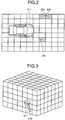
- FIGS. 2 and 3 are diagrams illustrating examples of map information.
- planar (two-dimensional) map information and rectangular divided areas are used.
- the map information need not be two-dimensional information, and the areas need not be rectangular in shape.
- non-planar steric map information and areas can be used.
- FIG. 2 is illustrated an example in which a mobile object 211 representing a vehicle moves rightward.
- FIG. 3 is illustrated an example in which a flyable mobile object 311 moves in a direction 312.
- the generation function 112 sets, in such areas from among a plurality of areas from which the target information is obtained, information indicating that a target object is present (for example, a flag indicating the presence or absence of a target object).
- information indicating that a target object is present for example, a flag indicating the presence or absence of a target object.
- the generation function 112 can set information indicating that a target object is present.
- FIG. 2 the areas in which a target object is present are illustrated with diagonal lines, while the areas in which no target object is present are illustrated in white.
- the method for determining whether or not a target object is present is not limited to the method in which the number of target points is compared with a threshold value.
- any conventional method can be implemented.
- a method can be implemented in which position information of such areas which were previously treated as target objects is used in chronological order and the presence or absence of target objects is determined by performing Bayes' estimation.
- the generation function 112 sets the detailed position of the target object in that area.
- Examples of the detailed position include: the coordinate values obtained by taking the average of the coordinate values of the target point group in the area; and the coordinate values of the target point at the shortest distance from the mobile object.
- positions 201, 202, and 203 represent the detailed positions that have been set.
- the detailed position to be set can be changed. For example, when the number of target points in an area is equal to or greater than a threshold value, the coordinate values obtained by taking an average of the coordinate values of the target point group can be set as the detailed position. On the other hand, when the number of target points in an area is smaller than the threshold value, the coordinate values of the target point at the shortest distance from the mobile object can be set as the detailed position.
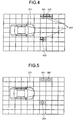
- FIG. 4 is a diagram illustrating another example of map information. As illustrated in FIG. 4 , the rectangular areas are further divided into smaller areas; and the gravity center coordinate values of small areas 401, which include the highest number of target points, can be used as the detailed positions. In FIG. 4 , positions 421, 422, and 423 represent the detailed positions that have been set.
- the generation function 112 outputs the map information, in which the information indicating the detailed positions is set, to the setting function 113.
- the setting function 113 sets, in the map information, information (surrounding information) indicating that the surrounding areas of the concerned area represent the surroundings of the target object.
- information indicating the areas that represent the surroundings of the target object such as a flag indicating whether or not an area is a surrounding area
- information indicating the range of surrounding areas can be set as the surrounding information.
- the surrounding information can be used in determining whether or not to avoid the movement (passing) of the mobile object through the corresponding areas.
- the setting function 113 calculates the representative position of that area.
- the representative position can be, for example, the position of the center of gravity of that area.
- positions 501, 502, and 503 represent representative positions.
- a representative position can be changed from the position of the center of gravity according to the velocity of the mobile object.
- FIG. 6 is a diagram illustrating an example of the changed representative positions.
- representative positions 601, 602, and 603 can be moved to positions that are separated from the respective positions of the center of gravity in the direction away from the mobile object and that are on the lines joining the respective positions of the center of gravity and the mobile object.
- the distance for separation either can be constant or can be kept variable according to the velocity.
- the detailed positions can also be changed. For example, when the velocity of the mobile object is high, the detailed positions can be changed in the directions toward the mobile object. In this way, when the velocity of the mobile object is equal to or greater than a threshold value, the setting function 113 can at least either move the representative positions in the directions away from the mobile object or move the detailed positions in the directions toward the mobile object.
- the setting function 113 sets the surrounding information according to the positional relationship between the representative positions, which are calculated in the abovementioned manner, and the detailed positions. For example, in each area, the setting function 113 compares a distance d between the mobile object and the representative position with a distance D between the mobile object and the detailed position. If D ⁇ d is satisfied, then the setting function 113 sets the surrounding information in the areas surrounding the concerned area. Meanwhile, the position serving as the starting point for measuring the distance (i.e., a particular position) is not limited to the mobile object. Alternatively, for example, the road centerline can be used.
- FIGS. 7 to 10 are diagrams illustrating examples of areas (surrounding areas) in which the surrounding information is set.
- the setting function 113 sets the surrounding information in the areas positioned at a certain distance from the position of the center of gravity of the area in which a target object is present.
- the distance D between the mobile object 211 and a detailed position 703 is equal to or smaller than the distance d between the mobile object 211 and the representative position.
- the surrounding information is set in surrounding areas 711.
- the set information can be set in the areas 711 that have the Manhattan distance from the position of the center of gravity to be equal to or smaller than one.
- FIG. 7 illustrates the set information in the areas 711 that have the Manhattan distance from the position of the center of gravity to be equal to or smaller than one.
- the surrounding information can be set in an area 811 that has the Euclidean distance from the position of the center of gravity to be equal to or smaller than a.
- FIG. 8 is illustrated an example in which an area independent of the areas included in the map information is set as the surrounding information.
- the surrounding information can be set in all surrounding areas 911 that are reachable from the position of the center of gravity at the distance a.
- the surrounding information can be set in an area 1011 that fits inside the circle having the radius equal to the distance a from the position of the center of gravity.
- the surrounding information can be set in only some of the surrounding areas from among the surrounding areas of the area in which a target object is present.
- the detailed positions are present at the upper left of the respective representative positions.
- the surrounding information can be set in the left-side area and the right-side area.
- the surrounding information in the circle centered on the representative position and having the radius a, the surrounding information can be set in some of the areas in the upper left portion.
- the setting function 113 can set the surrounding information in the surrounding areas of the concerned area. As a result, for example, even in the case in which it is not certain whether a target object is present; passing through that area can be avoided by referring to the surrounding information.
- the setting function 113 outputs the map information, which indicates the presence or absence of target objects along with the surrounding information, to the control function 114.
- the setting function 113 need not be used.
- the control function 114 performs a variety of control using the map information, which indicates the presence or absence of the target objects and the surrounding information. For example, the control function 114 controls the movement of the mobile object in such a way that the mobile object does not pass through the areas indicated to be the surroundings of the target objects in the surrounding information. In that case, the control function 114 calculates a route that neither passes through the areas in which a target object is present nor passes through the areas in which the surrounding information is set; and performs control to move the mobile object along that route. Alternatively, the control function 114 can perform control in which only the areas in which a target object is present are avoided and deceleration occurs in the areas in which the surrounding information is set.
- the control function 114 can perform control in such a way that, when the surrounding information is set, the detection method for detecting the target objects is changed. For example, when an image sensor (a camera) is used as the sensor 101, regarding each area having the surrounding information set in the corresponding surrounding areas (i.e., each area in which a target object is present), the control function 114 can perform control to take images at a higher resolution by zooming. Moreover, the control function 114 can further use another sensor different from the sensor 101 and detect the target objects.
- an image sensor a camera
- FIG. 11 is a flowchart for explaining an example of the information processing performed according to the arrangement.
- the obtaining function 111 obtains target information based on the information detected by the sensor 101 (Step S101). For example, the obtaining function 111 obtains, from the detected information, a set of target points surrounding the mobile object.
- the generation function 112 sets information (such as a flag) indicating that, from among a plurality of areas, the areas from which the target information is obtained have a target object present therein (Step S102). Regarding each area in which a target object is present, the generation function 112 calculates the detailed position of the target object in that area (Step S103).
- the setting function 113 calculates the representative position of that area (Step S104). Then, the setting function 113 determines whether or not there is any area in which the distance D from the mobile object (a particular position) to the detailed position is equal to or smaller than the distance d from the mobile object to the representative position (Step S105).
- Step S105 If such an area is present (Yes at Step S105), then the setting function 113 sets surrounding information in the areas surrounding the concerned area (Step S106). After the surrounding information is set or if there is no area in which the distance D is equal to or smaller than the distance d (No at Step S105), then the control function 114 refers to the map information and controls the movement of the mobile object (Step S107). For example, the control function 114 decides on a route that avoids the areas in which a target object is present as well as avoids the areas in which the surrounding information is set, and performs control to move the mobile object on the decided route.
- the explanation is given for an example in which the information processing device is installed in a mobile object such as a vehicle.
- the information processing device can be implemented as an external device on the outside of mobile objects.
- an information processing device generates map information by monitoring target objects (obstacles) and mobile objects from the outside, and provides the map information to the mobile objects.
- FIG. 12 is a diagram illustrating an example of an information processing system that includes the information processing device according to the modification example.
- the information processing system includes a roadside device 100-2 functioning as the information processing device and includes a vehicle 200-2.
- the number of each device is not limited to one, and it is possible to have an arbitrary number of each device.
- the roadside device 100-2 is installed in, for example, a traffic light on a road.
- the roadside device 100-2 includes a processing circuitry 110-2, the sensor 101, and the memory unit 121. Regarding the configuration and the functions identical to those illustrated in FIG. 1 according to the arrangement, the same reference numerals are used and the same explanation is not repeated.
- the processing circuitry 110-2 differs in the way of including a communication control function 115-2 in place of the control function 114.
- the communication control function 115-2 controls the communication with external devices such as the vehicle 200-2.
- the communication control function 115-2 controls wireless communication based on the IEEE 802.11p standard.
- the communication control function 115-2 sends, for example, map information to the vehicle 200-2 via wireless communication.
- the vehicle 200-2 includes a memory unit 221 and a processing circuitry 210.
- the memory unit 221 is used to store a variety of data.
- the memory unit 221 is used to store the map information received from the roadside device 100-2.
- the processing circuitry 210 includes the control function 114 and a communication control function 211-2.
- the processing circuitry 210 is configured using one or more processors in an identical manner to the processing circuitry 110.
- the communication control function 211-2 controls the communication with external devices such as the roadside device 100-2.
- the communication control function 211-2 controls the wireless communication based on the IEEE 802.11p standard.
- the communication control function 211-2 receives, for example, the map information from the roadside device 100-2 via wireless communication.
- control function 114 performs a variety of control using the map information.
- control function 114 can be configured to make use of the map information received from the roadside device 100-2.
- the information processing performed according to the modification example is identical to that explained with reference to FIG. 11 .
- the roadside device 100-2 performs the operations from Steps S101 to S106, and the vehicle 200-2 performs the operation at Step S107.
- the distribution of the functions between the roadside device 100-2 and the vehicle 200-2 is not limited to the example illustrated in FIG. 12 .
- the distribution can be done in the following ways.
- the vehicle the memory unit 221, the setting function 113, the control function 114, and the communication control function 211-2.
- the detailed positions of the target objects are further set.
- the movement of a mobile object can be controlled in an appropriate manner. For example, in the arrangement, whether or not to set areas to be avoided during the movement can be controlled according to the detailed positions. Hence, even if the road is narrow, the mobile object can be moved in a safe and reliable manner.
- a computer program executed in the information processing device according to the arrangement is stored in advance in a read only memory (ROM).
- ROM read only memory
- the computer program executed in the information processing device according to the arrangement can be recorded as an installable file or an executable file in a computer-readable recording medium such as a compact disk read only memory (CD-ROM), a flexible disk (FD), a compact disk recordable (CD-R), or a digital versatile disk (DVD); and can be provided as a computer program product.
- a computer-readable recording medium such as a compact disk read only memory (CD-ROM), a flexible disk (FD), a compact disk recordable (CD-R), or a digital versatile disk (DVD)
- the computer program executed in the information processing device according to the arrangement can be stored in a downloadable manner in a computer connected to a network such as the Internet. Still alternatively, the computer program executed in the information processing device according to the arrangement can be distributed over a network such as the Internet.
- the computer program executed in the information processing device can make a computer to function as the constituent elements described above.
- a central processing unit CPU
- CPU central processing unit
- the computer according to the arrangement executes the operations, which are explained in the arrangement, based on the computer program stored in a memory medium; and can be configured as a single device such as a personal computer or a microcomputer or can be configured as a system in which a plurality of devices is connected via a network.
- the term "computer" according to the arrangement is an all-inclusive term not only limited to a personal computer but also applicable to a device that includes a processor and a microcomputer of an information processing device and that is capable of implementing the functions according to the arrangement using computer programs.
Landscapes
- Engineering & Computer Science (AREA)
- Physics & Mathematics (AREA)
- General Physics & Mathematics (AREA)
- Theoretical Computer Science (AREA)
- Radar, Positioning & Navigation (AREA)
- Computer Vision & Pattern Recognition (AREA)
- Remote Sensing (AREA)
- Automation & Control Theory (AREA)
- Aviation & Aerospace Engineering (AREA)
- Multimedia (AREA)
- Electromagnetism (AREA)
- Optics & Photonics (AREA)
- Software Systems (AREA)
- Computer Networks & Wireless Communication (AREA)
- Geometry (AREA)
- Traffic Control Systems (AREA)
- Artificial Intelligence (AREA)
- Business, Economics & Management (AREA)
- Health & Medical Sciences (AREA)
- Evolutionary Computation (AREA)
- Game Theory and Decision Science (AREA)
- Medical Informatics (AREA)
- Control Of Position, Course, Altitude, Or Attitude Of Moving Bodies (AREA)
- Instructional Devices (AREA)
- Radar Systems Or Details Thereof (AREA)
Applications Claiming Priority (1)
| Application Number | Priority Date | Filing Date | Title |
|---|---|---|---|
| JP2016106481A JP6786264B2 (ja) | 2016-05-27 | 2016-05-27 | 情報処理装置、情報処理方法、および車両 |
Publications (3)
| Publication Number | Publication Date |
|---|---|
| EP3249629A2 true EP3249629A2 (fr) | 2017-11-29 |
| EP3249629A3 EP3249629A3 (fr) | 2018-03-21 |
| EP3249629B1 EP3249629B1 (fr) | 2022-07-20 |
Family
ID=58266836
Family Applications (1)
| Application Number | Title | Priority Date | Filing Date |
|---|---|---|---|
| EP17157534.3A Active EP3249629B1 (fr) | 2016-05-27 | 2017-02-23 | Dispositif de traitement d'informations, procédé de traitement d'informations et véhicule |
Country Status (3)
| Country | Link |
|---|---|
| US (2) | US10451735B2 (fr) |
| EP (1) | EP3249629B1 (fr) |
| JP (1) | JP6786264B2 (fr) |
Cited By (1)
| Publication number | Priority date | Publication date | Assignee | Title |
|---|---|---|---|---|
| US20220051034A1 (en) * | 2018-12-17 | 2022-02-17 | Nippon Telegraph And Telephone Corporation | Learning apparatus, estimation apparatus, learning method, estimation method, and program |
Families Citing this family (6)
| Publication number | Priority date | Publication date | Assignee | Title |
|---|---|---|---|---|
| JP6559535B2 (ja) * | 2015-10-22 | 2019-08-14 | 株式会社東芝 | 障害物マップ生成装置、その方法、及び、そのプログラム |
| US11535323B2 (en) * | 2018-05-18 | 2022-12-27 | Shimano Inc. | Telescopic apparatus for human-powered vehicle, height adjustable seatpost, and bicycle component control system |
| WO2020215198A1 (fr) * | 2019-04-23 | 2020-10-29 | 深圳市大疆创新科技有限公司 | Procédé, appareil et dispositif de traitement de données et plate-forme mobile |
| JP7393184B2 (ja) * | 2019-11-07 | 2023-12-06 | 東芝テック株式会社 | 点群データ処理装置 |
| CN111568213A (zh) * | 2020-02-28 | 2020-08-25 | 佛山市云米电器科技有限公司 | 饮水机控制方法、饮水机及计算机可读存储介质 |
| CN116027341B (zh) * | 2021-10-25 | 2024-05-03 | 珠海一微半导体股份有限公司 | 基于激光观测方向的栅格和体素定位方法、机器人及芯片 |
Family Cites Families (24)
| Publication number | Priority date | Publication date | Assignee | Title |
|---|---|---|---|---|
| US5555512A (en) * | 1993-08-19 | 1996-09-10 | Matsushita Electric Industrial Co., Ltd. | Picture processing apparatus for processing infrared pictures obtained with an infrared ray sensor and applied apparatus utilizing the picture processing apparatus |
| JPH07159236A (ja) | 1993-12-03 | 1995-06-23 | Murata Mfg Co Ltd | 熱源検知装置 |
| JP4328692B2 (ja) | 2004-08-11 | 2009-09-09 | 国立大学法人東京工業大学 | 物体検出装置 |
| JP2006239844A (ja) * | 2005-03-04 | 2006-09-14 | Sony Corp | 障害物回避装置、障害物回避方法及び障害物回避プログラム並びに移動型ロボット装置 |
| WO2007069721A1 (fr) | 2005-12-16 | 2007-06-21 | Ihi Corporation | Procede et dispositif de stockage/affichage de donnees de forme tridimensionnelle, et procede et dispositif de mesure de ladite forme |
| JP5112666B2 (ja) * | 2006-09-11 | 2013-01-09 | 株式会社日立製作所 | 移動装置 |
| JP4645601B2 (ja) * | 2007-02-13 | 2011-03-09 | トヨタ自動車株式会社 | 環境地図の生成方法及び移動ロボット |
| JP4576445B2 (ja) * | 2007-04-12 | 2010-11-10 | パナソニック株式会社 | 自律移動型装置および自律移動型装置用プログラム |
| JP4337929B2 (ja) * | 2007-12-25 | 2009-09-30 | トヨタ自動車株式会社 | 移動状態推定装置 |
| JP2009157735A (ja) * | 2007-12-27 | 2009-07-16 | Toyota Motor Corp | 移動体、及び車両用警告装置 |
| US8126642B2 (en) * | 2008-10-24 | 2012-02-28 | Gray & Company, Inc. | Control and systems for autonomously driven vehicles |
| KR101553654B1 (ko) * | 2009-02-13 | 2015-10-01 | 삼성전자 주식회사 | 이동 로봇 및 이동 로봇의 이동 방법 |
| JP5454695B2 (ja) * | 2010-09-08 | 2014-03-26 | トヨタ自動車株式会社 | 危険度算出装置 |
| US8736463B1 (en) * | 2012-01-30 | 2014-05-27 | Google Inc. | Object bounding box estimation |
| US9145140B2 (en) * | 2012-03-26 | 2015-09-29 | Google Inc. | Robust method for detecting traffic signals and their associated states |
| DE102012024878A1 (de) * | 2012-12-19 | 2014-06-26 | Connaught Electronics Ltd. | Verfahren zum Detektieren eines Zielobjekts anhand eines Kamerabilds durch Clusterbildung aus mehreren benachbarten Bildzellen, Kameraeinrichtung und Kraftfahrzeug |
| CN104885122B (zh) * | 2012-12-25 | 2017-06-23 | 本田技研工业株式会社 | 车辆周围监测装置 |
| CN104217208B (zh) * | 2013-06-03 | 2018-01-16 | 株式会社理光 | 目标检测方法和装置 |
| US9070023B2 (en) | 2013-09-23 | 2015-06-30 | Toyota Motor Engineering & Manufacturing North America, Inc. | System and method of alerting a driver that visual perception of pedestrian may be difficult |
| EP3855276A1 (fr) * | 2014-09-05 | 2021-07-28 | SZ DJI Technology Co., Ltd. | Cartographie environnementale à capteurs multiples |
| JP6260509B2 (ja) * | 2014-10-06 | 2018-01-17 | トヨタ自動車株式会社 | ロボット |
| JP6037468B2 (ja) * | 2014-11-14 | 2016-12-07 | インターナショナル・ビジネス・マシーンズ・コーポレーションInternational Business Machines Corporation | 移動体が特定領域に接近していることを通知する方法、並びに、その為のサーバ・コンピュータ及びサーバ・コンピュータ・プログラム |
| US20160217333A1 (en) * | 2015-01-26 | 2016-07-28 | Ricoh Company, Ltd. | Information processing apparatus and information processing system |
| US9916508B2 (en) * | 2015-03-12 | 2018-03-13 | Toyota Jidosha Kabushiki Kaisha | Detecting roadway objects in real-time images |
-
2016
- 2016-05-27 JP JP2016106481A patent/JP6786264B2/ja not_active Expired - Fee Related
-
2017
- 2017-02-21 US US15/438,059 patent/US10451735B2/en active Active
- 2017-02-23 EP EP17157534.3A patent/EP3249629B1/fr active Active
-
2019
- 2019-09-10 US US16/566,314 patent/US11536833B2/en active Active
Non-Patent Citations (1)
| Title |
|---|
| None |
Cited By (2)
| Publication number | Priority date | Publication date | Assignee | Title |
|---|---|---|---|---|
| US20220051034A1 (en) * | 2018-12-17 | 2022-02-17 | Nippon Telegraph And Telephone Corporation | Learning apparatus, estimation apparatus, learning method, estimation method, and program |
| US12039786B2 (en) * | 2018-12-17 | 2024-07-16 | Nippon Telegraph And Telephone Corporation | Learning apparatus, estimation apparatus, learning method, estimation method, and program |
Also Published As
| Publication number | Publication date |
|---|---|
| US20200003898A1 (en) | 2020-01-02 |
| US20170343669A1 (en) | 2017-11-30 |
| EP3249629A3 (fr) | 2018-03-21 |
| EP3249629B1 (fr) | 2022-07-20 |
| US10451735B2 (en) | 2019-10-22 |
| US11536833B2 (en) | 2022-12-27 |
| JP6786264B2 (ja) | 2020-11-18 |
| JP2017211934A (ja) | 2017-11-30 |
Similar Documents
| Publication | Publication Date | Title |
|---|---|---|
| US11536833B2 (en) | Information processing device, information processing method, and vehicle | |
| JP6804991B2 (ja) | 情報処理装置、情報処理方法、および情報処理プログラム | |
| CN113635894B (zh) | 用于确定可行驶区域的方法 | |
| JP7103359B2 (ja) | 制御装置、および制御方法、プログラム、並びに移動体 | |
| KR20220020804A (ko) | 정보 처리 장치 및 정보 처리 방법, 그리고 프로그램 | |
| CN110390240B (zh) | 自动驾驶车辆中的车道后处理 | |
| JP2015518600A5 (fr) | ||
| JP6808590B2 (ja) | 情報処理装置、情報処理方法、プログラムおよび移動体 | |
| JP2011175393A (ja) | 経路計画装置、自律移動ロボット、及び移動経路の計画方法 | |
| JP6485889B2 (ja) | 飛行制御装置、飛行制御方法、及びプログラム | |
| US20170263129A1 (en) | Object detecting device, object detecting method, and computer program product | |
| US20220374021A1 (en) | Trajectory planning device, trajectory planning method, and program | |
| US20230273621A1 (en) | Information processing apparatus, information processing method, and program | |
| JP2020038654A (ja) | インテリジェント路側ユニットおよびその制御方法 | |
| Liu et al. | The design of a fully autonomous robot system for urban search and rescue | |
| CN112861599B (zh) | 用于对道路上的对象进行分类的方法和设备、计算机程序及存储介质 | |
| US11403856B2 (en) | Group object-tracking | |
| US10628917B2 (en) | Information processing apparatus, information processing method, and computer program product | |
| US20240371172A1 (en) | Object detection method and electronic device for performing same method | |
| JP2013161433A (ja) | 車両の周辺監視装置 | |
| KR20230071937A (ko) | 객체 위치 추정 장치 및 방법 | |
| EP4549874A1 (fr) | Dispositif électronique, procédé de commande et programme de commande | |
| JP7302511B2 (ja) | 情報処理装置 | |
| KR20250074601A (ko) | 객체 검출을 위한 방법 및 그 장치 | |
| KR20250065445A (ko) | 무인비행체 라이다 데이터 실시간 전송을 통한 자율주행차 객체 인식 보완 방법 및 시스템 |
Legal Events
| Date | Code | Title | Description |
|---|---|---|---|
| PUAI | Public reference made under article 153(3) epc to a published international application that has entered the european phase |
Free format text: ORIGINAL CODE: 0009012 |
|
| STAA | Information on the status of an ep patent application or granted ep patent |
Free format text: STATUS: REQUEST FOR EXAMINATION WAS MADE |
|
| 17P | Request for examination filed |
Effective date: 20170223 |
|
| AK | Designated contracting states |
Kind code of ref document: A2 Designated state(s): AL AT BE BG CH CY CZ DE DK EE ES FI FR GB GR HR HU IE IS IT LI LT LU LV MC MK MT NL NO PL PT RO RS SE SI SK SM TR |
|
| AX | Request for extension of the european patent |
Extension state: BA ME |
|
| PUAL | Search report despatched |
Free format text: ORIGINAL CODE: 0009013 |
|
| AK | Designated contracting states |
Kind code of ref document: A3 Designated state(s): AL AT BE BG CH CY CZ DE DK EE ES FI FR GB GR HR HU IE IS IT LI LT LU LV MC MK MT NL NO PL PT RO RS SE SI SK SM TR |
|
| AX | Request for extension of the european patent |
Extension state: BA ME |
|
| RIC1 | Information provided on ipc code assigned before grant |
Ipc: G08G 1/16 20060101AFI20180213BHEP Ipc: G06T 7/00 20170101ALI20180213BHEP Ipc: G01S 17/00 20060101ALI20180213BHEP Ipc: G06K 9/00 20060101ALI20180213BHEP Ipc: G05D 1/02 20060101ALI20180213BHEP |
|
| STAA | Information on the status of an ep patent application or granted ep patent |
Free format text: STATUS: EXAMINATION IS IN PROGRESS |
|
| 17Q | First examination report despatched |
Effective date: 20200123 |
|
| GRAP | Despatch of communication of intention to grant a patent |
Free format text: ORIGINAL CODE: EPIDOSNIGR1 |
|
| STAA | Information on the status of an ep patent application or granted ep patent |
Free format text: STATUS: GRANT OF PATENT IS INTENDED |
|
| INTG | Intention to grant announced |
Effective date: 20211018 |
|
| RAP3 | Party data changed (applicant data changed or rights of an application transferred) |
Owner name: KABUSHIKI KAISHA TOSHIBA |
|
| GRAJ | Information related to disapproval of communication of intention to grant by the applicant or resumption of examination proceedings by the epo deleted |
Free format text: ORIGINAL CODE: EPIDOSDIGR1 |
|
| STAA | Information on the status of an ep patent application or granted ep patent |
Free format text: STATUS: EXAMINATION IS IN PROGRESS |
|
| INTC | Intention to grant announced (deleted) | ||
| GRAS | Grant fee paid |
Free format text: ORIGINAL CODE: EPIDOSNIGR3 |
|
| STAA | Information on the status of an ep patent application or granted ep patent |
Free format text: STATUS: GRANT OF PATENT IS INTENDED |
|
| GRAP | Despatch of communication of intention to grant a patent |
Free format text: ORIGINAL CODE: EPIDOSNIGR1 |
|
| INTG | Intention to grant announced |
Effective date: 20220322 |
|
| GRAA | (expected) grant |
Free format text: ORIGINAL CODE: 0009210 |
|
| STAA | Information on the status of an ep patent application or granted ep patent |
Free format text: STATUS: THE PATENT HAS BEEN GRANTED |
|
| AK | Designated contracting states |
Kind code of ref document: B1 Designated state(s): AL AT BE BG CH CY CZ DE DK EE ES FI FR GB GR HR HU IE IS IT LI LT LU LV MC MK MT NL NO PL PT RO RS SE SI SK SM TR |
|
| REG | Reference to a national code |
Ref country code: CH Ref legal event code: EP |
|
| REG | Reference to a national code |
Ref country code: DE Ref legal event code: R096 Ref document number: 602017059577 Country of ref document: DE |
|
| REG | Reference to a national code |
Ref country code: AT Ref legal event code: REF Ref document number: 1506046 Country of ref document: AT Kind code of ref document: T Effective date: 20220815 |
|
| REG | Reference to a national code |
Ref country code: IE Ref legal event code: FG4D |
|
| REG | Reference to a national code |
Ref country code: LT Ref legal event code: MG9D |
|
| REG | Reference to a national code |
Ref country code: NL Ref legal event code: MP Effective date: 20220720 |
|
| PG25 | Lapsed in a contracting state [announced via postgrant information from national office to epo] |
Ref country code: SE Free format text: LAPSE BECAUSE OF FAILURE TO SUBMIT A TRANSLATION OF THE DESCRIPTION OR TO PAY THE FEE WITHIN THE PRESCRIBED TIME-LIMIT Effective date: 20220720 Ref country code: RS Free format text: LAPSE BECAUSE OF FAILURE TO SUBMIT A TRANSLATION OF THE DESCRIPTION OR TO PAY THE FEE WITHIN THE PRESCRIBED TIME-LIMIT Effective date: 20220720 Ref country code: PT Free format text: LAPSE BECAUSE OF FAILURE TO SUBMIT A TRANSLATION OF THE DESCRIPTION OR TO PAY THE FEE WITHIN THE PRESCRIBED TIME-LIMIT Effective date: 20221121 Ref country code: NO Free format text: LAPSE BECAUSE OF FAILURE TO SUBMIT A TRANSLATION OF THE DESCRIPTION OR TO PAY THE FEE WITHIN THE PRESCRIBED TIME-LIMIT Effective date: 20221020 Ref country code: NL Free format text: LAPSE BECAUSE OF FAILURE TO SUBMIT A TRANSLATION OF THE DESCRIPTION OR TO PAY THE FEE WITHIN THE PRESCRIBED TIME-LIMIT Effective date: 20220720 Ref country code: LV Free format text: LAPSE BECAUSE OF FAILURE TO SUBMIT A TRANSLATION OF THE DESCRIPTION OR TO PAY THE FEE WITHIN THE PRESCRIBED TIME-LIMIT Effective date: 20220720 Ref country code: LT Free format text: LAPSE BECAUSE OF FAILURE TO SUBMIT A TRANSLATION OF THE DESCRIPTION OR TO PAY THE FEE WITHIN THE PRESCRIBED TIME-LIMIT Effective date: 20220720 Ref country code: FI Free format text: LAPSE BECAUSE OF FAILURE TO SUBMIT A TRANSLATION OF THE DESCRIPTION OR TO PAY THE FEE WITHIN THE PRESCRIBED TIME-LIMIT Effective date: 20220720 Ref country code: ES Free format text: LAPSE BECAUSE OF FAILURE TO SUBMIT A TRANSLATION OF THE DESCRIPTION OR TO PAY THE FEE WITHIN THE PRESCRIBED TIME-LIMIT Effective date: 20220720 |
|
| REG | Reference to a national code |
Ref country code: AT Ref legal event code: MK05 Ref document number: 1506046 Country of ref document: AT Kind code of ref document: T Effective date: 20220720 |
|
| PG25 | Lapsed in a contracting state [announced via postgrant information from national office to epo] |
Ref country code: PL Free format text: LAPSE BECAUSE OF FAILURE TO SUBMIT A TRANSLATION OF THE DESCRIPTION OR TO PAY THE FEE WITHIN THE PRESCRIBED TIME-LIMIT Effective date: 20220720 Ref country code: IS Free format text: LAPSE BECAUSE OF FAILURE TO SUBMIT A TRANSLATION OF THE DESCRIPTION OR TO PAY THE FEE WITHIN THE PRESCRIBED TIME-LIMIT Effective date: 20221120 Ref country code: HR Free format text: LAPSE BECAUSE OF FAILURE TO SUBMIT A TRANSLATION OF THE DESCRIPTION OR TO PAY THE FEE WITHIN THE PRESCRIBED TIME-LIMIT Effective date: 20220720 Ref country code: GR Free format text: LAPSE BECAUSE OF FAILURE TO SUBMIT A TRANSLATION OF THE DESCRIPTION OR TO PAY THE FEE WITHIN THE PRESCRIBED TIME-LIMIT Effective date: 20221021 |
|
| REG | Reference to a national code |
Ref country code: DE Ref legal event code: R097 Ref document number: 602017059577 Country of ref document: DE |
|
| PG25 | Lapsed in a contracting state [announced via postgrant information from national office to epo] |
Ref country code: SM Free format text: LAPSE BECAUSE OF FAILURE TO SUBMIT A TRANSLATION OF THE DESCRIPTION OR TO PAY THE FEE WITHIN THE PRESCRIBED TIME-LIMIT Effective date: 20220720 Ref country code: RO Free format text: LAPSE BECAUSE OF FAILURE TO SUBMIT A TRANSLATION OF THE DESCRIPTION OR TO PAY THE FEE WITHIN THE PRESCRIBED TIME-LIMIT Effective date: 20220720 Ref country code: DK Free format text: LAPSE BECAUSE OF FAILURE TO SUBMIT A TRANSLATION OF THE DESCRIPTION OR TO PAY THE FEE WITHIN THE PRESCRIBED TIME-LIMIT Effective date: 20220720 Ref country code: CZ Free format text: LAPSE BECAUSE OF FAILURE TO SUBMIT A TRANSLATION OF THE DESCRIPTION OR TO PAY THE FEE WITHIN THE PRESCRIBED TIME-LIMIT Effective date: 20220720 Ref country code: AT Free format text: LAPSE BECAUSE OF FAILURE TO SUBMIT A TRANSLATION OF THE DESCRIPTION OR TO PAY THE FEE WITHIN THE PRESCRIBED TIME-LIMIT Effective date: 20220720 |
|
| PLBE | No opposition filed within time limit |
Free format text: ORIGINAL CODE: 0009261 |
|
| STAA | Information on the status of an ep patent application or granted ep patent |
Free format text: STATUS: NO OPPOSITION FILED WITHIN TIME LIMIT |
|
| PG25 | Lapsed in a contracting state [announced via postgrant information from national office to epo] |
Ref country code: SK Free format text: LAPSE BECAUSE OF FAILURE TO SUBMIT A TRANSLATION OF THE DESCRIPTION OR TO PAY THE FEE WITHIN THE PRESCRIBED TIME-LIMIT Effective date: 20220720 Ref country code: EE Free format text: LAPSE BECAUSE OF FAILURE TO SUBMIT A TRANSLATION OF THE DESCRIPTION OR TO PAY THE FEE WITHIN THE PRESCRIBED TIME-LIMIT Effective date: 20220720 |
|
| 26N | No opposition filed |
Effective date: 20230421 |
|
| PG25 | Lapsed in a contracting state [announced via postgrant information from national office to epo] |
Ref country code: AL Free format text: LAPSE BECAUSE OF FAILURE TO SUBMIT A TRANSLATION OF THE DESCRIPTION OR TO PAY THE FEE WITHIN THE PRESCRIBED TIME-LIMIT Effective date: 20220720 |
|
| PG25 | Lapsed in a contracting state [announced via postgrant information from national office to epo] |
Ref country code: SI Free format text: LAPSE BECAUSE OF FAILURE TO SUBMIT A TRANSLATION OF THE DESCRIPTION OR TO PAY THE FEE WITHIN THE PRESCRIBED TIME-LIMIT Effective date: 20220720 |
|
| PG25 | Lapsed in a contracting state [announced via postgrant information from national office to epo] |
Ref country code: MC Free format text: LAPSE BECAUSE OF FAILURE TO SUBMIT A TRANSLATION OF THE DESCRIPTION OR TO PAY THE FEE WITHIN THE PRESCRIBED TIME-LIMIT Effective date: 20220720 |
|
| REG | Reference to a national code |
Ref country code: CH Ref legal event code: PL |
|
| REG | Reference to a national code |
Ref country code: BE Ref legal event code: MM Effective date: 20230228 |
|
| PG25 | Lapsed in a contracting state [announced via postgrant information from national office to epo] |
Ref country code: LU Free format text: LAPSE BECAUSE OF NON-PAYMENT OF DUE FEES Effective date: 20230223 Ref country code: LI Free format text: LAPSE BECAUSE OF NON-PAYMENT OF DUE FEES Effective date: 20230228 Ref country code: CH Free format text: LAPSE BECAUSE OF NON-PAYMENT OF DUE FEES Effective date: 20230228 |
|
| REG | Reference to a national code |
Ref country code: IE Ref legal event code: MM4A |
|
| PG25 | Lapsed in a contracting state [announced via postgrant information from national office to epo] |
Ref country code: IE Free format text: LAPSE BECAUSE OF NON-PAYMENT OF DUE FEES Effective date: 20230223 |
|
| PG25 | Lapsed in a contracting state [announced via postgrant information from national office to epo] |
Ref country code: BE Free format text: LAPSE BECAUSE OF NON-PAYMENT OF DUE FEES Effective date: 20230228 |
|
| PG25 | Lapsed in a contracting state [announced via postgrant information from national office to epo] |
Ref country code: IT Free format text: LAPSE BECAUSE OF FAILURE TO SUBMIT A TRANSLATION OF THE DESCRIPTION OR TO PAY THE FEE WITHIN THE PRESCRIBED TIME-LIMIT Effective date: 20220720 |
|
| PG25 | Lapsed in a contracting state [announced via postgrant information from national office to epo] |
Ref country code: BG Free format text: LAPSE BECAUSE OF FAILURE TO SUBMIT A TRANSLATION OF THE DESCRIPTION OR TO PAY THE FEE WITHIN THE PRESCRIBED TIME-LIMIT Effective date: 20220720 |
|
| PG25 | Lapsed in a contracting state [announced via postgrant information from national office to epo] |
Ref country code: BG Free format text: LAPSE BECAUSE OF FAILURE TO SUBMIT A TRANSLATION OF THE DESCRIPTION OR TO PAY THE FEE WITHIN THE PRESCRIBED TIME-LIMIT Effective date: 20220720 |
|
| PGFP | Annual fee paid to national office [announced via postgrant information from national office to epo] |
Ref country code: FR Payment date: 20241231 Year of fee payment: 9 |
|
| PGFP | Annual fee paid to national office [announced via postgrant information from national office to epo] |
Ref country code: DE Payment date: 20241231 Year of fee payment: 9 |
|
| PGFP | Annual fee paid to national office [announced via postgrant information from national office to epo] |
Ref country code: GB Payment date: 20250102 Year of fee payment: 9 |
|
| PG25 | Lapsed in a contracting state [announced via postgrant information from national office to epo] |
Ref country code: CY Free format text: LAPSE BECAUSE OF FAILURE TO SUBMIT A TRANSLATION OF THE DESCRIPTION OR TO PAY THE FEE WITHIN THE PRESCRIBED TIME-LIMIT; INVALID AB INITIO Effective date: 20170223 |
|
| PG25 | Lapsed in a contracting state [announced via postgrant information from national office to epo] |
Ref country code: HU Free format text: LAPSE BECAUSE OF FAILURE TO SUBMIT A TRANSLATION OF THE DESCRIPTION OR TO PAY THE FEE WITHIN THE PRESCRIBED TIME-LIMIT; INVALID AB INITIO Effective date: 20170223 |
|
| PG25 | Lapsed in a contracting state [announced via postgrant information from national office to epo] |
Ref country code: TR Free format text: LAPSE BECAUSE OF FAILURE TO SUBMIT A TRANSLATION OF THE DESCRIPTION OR TO PAY THE FEE WITHIN THE PRESCRIBED TIME-LIMIT Effective date: 20220720 |