EP3249877B1 - Kommunikationsverfahren, -vorrichtung und -system - Google Patents
Kommunikationsverfahren, -vorrichtung und -system Download PDFInfo
- Publication number
- EP3249877B1 EP3249877B1 EP16748715.6A EP16748715A EP3249877B1 EP 3249877 B1 EP3249877 B1 EP 3249877B1 EP 16748715 A EP16748715 A EP 16748715A EP 3249877 B1 EP3249877 B1 EP 3249877B1
- Authority
- EP
- European Patent Office
- Prior art keywords
- terminal
- server
- destination server
- certificate
- url
- Prior art date
- Legal status (The legal status is an assumption and is not a legal conclusion. Google has not performed a legal analysis and makes no representation as to the accuracy of the status listed.)
- Not-in-force
Links
- 238000000034 method Methods 0.000 title claims description 66
- 238000004891 communication Methods 0.000 description 22
- 238000010586 diagram Methods 0.000 description 14
- 238000004590 computer program Methods 0.000 description 7
- 230000006870 function Effects 0.000 description 7
- 238000012545 processing Methods 0.000 description 6
- 230000002093 peripheral effect Effects 0.000 description 4
- 238000012546 transfer Methods 0.000 description 4
- 238000013475 authorization Methods 0.000 description 2
- 230000005540 biological transmission Effects 0.000 description 2
- 238000000802 evaporation-induced self-assembly Methods 0.000 description 2
- 230000003993 interaction Effects 0.000 description 2
- 238000012986 modification Methods 0.000 description 2
- 230000004048 modification Effects 0.000 description 2
- 238000005516 engineering process Methods 0.000 description 1
- 230000003287 optical effect Effects 0.000 description 1
Images


Classifications
-
- H—ELECTRICITY
- H04—ELECTRIC COMMUNICATION TECHNIQUE
- H04L—TRANSMISSION OF DIGITAL INFORMATION, e.g. TELEGRAPHIC COMMUNICATION
- H04L63/00—Network architectures or network communication protocols for network security
- H04L63/08—Network architectures or network communication protocols for network security for authentication of entities
- H04L63/0823—Network architectures or network communication protocols for network security for authentication of entities using certificates
-
- H—ELECTRICITY
- H04—ELECTRIC COMMUNICATION TECHNIQUE
- H04L—TRANSMISSION OF DIGITAL INFORMATION, e.g. TELEGRAPHIC COMMUNICATION
- H04L63/00—Network architectures or network communication protocols for network security
- H04L63/16—Implementing security features at a particular protocol layer
- H04L63/166—Implementing security features at a particular protocol layer at the transport layer
-
- H—ELECTRICITY
- H04—ELECTRIC COMMUNICATION TECHNIQUE
- H04L—TRANSMISSION OF DIGITAL INFORMATION, e.g. TELEGRAPHIC COMMUNICATION
- H04L67/00—Network arrangements or protocols for supporting network services or applications
- H04L67/01—Protocols
- H04L67/02—Protocols based on web technology, e.g. hypertext transfer protocol [HTTP]
-
- H—ELECTRICITY
- H04—ELECTRIC COMMUNICATION TECHNIQUE
- H04L—TRANSMISSION OF DIGITAL INFORMATION, e.g. TELEGRAPHIC COMMUNICATION
- H04L67/00—Network arrangements or protocols for supporting network services or applications
- H04L67/14—Session management
- H04L67/146—Markers for unambiguous identification of a particular session, e.g. session cookie or URL-encoding
-
- H—ELECTRICITY
- H04—ELECTRIC COMMUNICATION TECHNIQUE
- H04L—TRANSMISSION OF DIGITAL INFORMATION, e.g. TELEGRAPHIC COMMUNICATION
- H04L67/00—Network arrangements or protocols for supporting network services or applications
- H04L67/50—Network services
- H04L67/56—Provisioning of proxy services
- H04L67/563—Data redirection of data network streams
Definitions
- the present invention relates to the field of communications technologies, and in particular, to a redirection method, apparatus, and system.
- BRAS Broadband Remote Access Server
- a destination address of the arbitrary website is not a web server (Web Server in English) of an operator.
- the access of the terminal is redirected by the BRAS to a web authentication page of the operator, that is, the web server of the operator performs web authentication on the terminal.
- the terminal outputs alarm information prompting of a certificate problem.
- a user who uses the terminal closes a page that includes the alarm information. Consequently, the access of the terminal cannot be successfully redirected by the BRAS to the web authentication page of the operator, and therefore, the terminal cannot implement a service corresponding to redirection.
- Embodiments of the present invention provide a redirection method, apparatus, and system, to help increase a redirection success rate.
- a redirection method including:
- the obtaining, by the BRAS, a URL of a destination server and a certificate of the destination server according to the identifier of the terminal includes:
- a second possible implementation of the first aspect is further provided, where the sending, by the BRAS, the URL of the destination server and the certificate of the destination server to the terminal includes: sending, by the BRAS, a second TLS handshake packet to the terminal, where the second TLS handshake packet carries the URL of the destination server and the certificate of the destination server.
- a third possible implementation of the first aspect is further provided, where the sending, by the BRAS, the URL of the destination server and the certificate of the destination server to the terminal includes:
- the first possible implementation of the first aspect, the second possible implementation of the first aspect, or the third possible implementation of the first aspect, a fourth possible implementation of the first aspect is further provided, where the method further includes:
- a redirection method including:
- the method further includes: outputting, by the terminal, second prompt information if the URL of the destination server does not match the certificate of the destination server, where the second prompt information is used to prompt that the certificate of the destination server is incorrect.
- a second possible implementation of the second aspect is further provided, where the receiving, by the terminal, a URL of a destination server and a certificate of the destination server that are sent by the BRAS includes:
- a third possible implementation of the second aspect is further provided, where the receiving, by the terminal, a URL of a destination server and a certificate of the destination server that are sent by the BRAS includes:
- a fourth possible implementation of the second aspect is further provided, where the method further includes:
- a BRAS is provided, where the BRAS includes:
- the obtaining module is specifically configured to obtain a preconfigured entry according to the identifier of the terminal, where the entry includes the identifier of the terminal, the URL of the destination server, and the certificate of the destination server; and the obtaining module is specifically configured to obtain the URL of the destination server and the certificate of the destination server from the entry.
- a second possible implementation of the third aspect is further provided, where the sending module is specifically configured to send a second TLS handshake packet to the terminal, where the second TLS handshake packet carries the URL of the destination server and the certificate of the destination server.
- a third possible implementation of the third aspect is further provided, where the sending module is specifically configured to send a server redirect packet to the terminal, where the server redirect packet carries the URL of the destination server; and the sending module is specifically configured to send a server certificate packet to the terminal, where the server certificate packet carries the certificate of the destination server.
- the receiving module is further configured to receive a first HTTPS packet sent by the terminal, where the first HTTPS packet is used to request redirection information from the BRAS, and the first HTTPS packet includes the identifier of the terminal;
- the obtaining module is further configured to obtain the URL of the destination server according to the identifier of the terminal;
- the sending module is further configured to send a second HTTPS packet to the terminal, where the second HTTPS packet includes the URL of the destination server.
- a terminal including:
- the output module is further configured to output second prompt information if the determining module determines that the URL of the destination server does not match the certificate of the destination server, where the second prompt information is used to prompt that the certificate of the target server is incorrect.
- a second possible implementation of the fourth aspect is further provided, where the receiving module is specifically configured to receive a second TLS handshake packet sent by the BRAS, where the second TLS handshake packet carries the URL of the destination server and the certificate of the destination server.
- a third possible implementation of the fourth aspect is further provided, where the receiving module is specifically configured to receive a server redirect packet sent by the BRAS, where the server redirect packet carries the URL of the destination server; and the receiving module is specifically configured to receive a server certificate packet sent by the BRAS, where the server certificate packet carries the certificate of the destination server.
- the terminal further includes a redirection module; the sending module is further configured to send a first HTTPS packet to the BRAS, where the first HTTPS packet is used to request redirection information from the BRAS, and the first HTTPS packet includes the identifier of the terminal; the receiving module is further configured to receive a second HTTPS packet sent by the BRAS, where the second HTTPS packet includes the URL of the destination server; and the redirection module is further configured to access the destination server according to the URL of the destination server after obtaining an instruction used to instruct that redirection is to be performed.
- a redirection system including the BRAS provided according to the third aspect or any possible implementation of the third aspect and the terminal provided according to the fourth aspect or any possible implementation of the fourth aspect.
- a BRAS determines whether a first TLS handshake packet of a terminal carries a flag, and after determining that the first TLS handshake packet carries the flag, determines that the terminal corresponding to the flag supports a URL-based redirection function. After determining that the terminal corresponding to the flag supports the URL-based redirection function, the BRAS may send a URL, corresponding to the terminal, of a destination server and a certificate of the destination server to the terminal. The terminal obtains and outputs first prompt information after determining that the URL of the destination server matches the certificate of the destination server.
- a terminal such as a personal computer (Personal Computer, PC) sends an access request to a BRAS.
- a destination address of the access request is an address of a server that the terminal requests to access.
- the server that the terminal requests to access may not be a web server of an operator.
- the BRAS may establish, in place of the server that the terminal requests to access, a Transmission Control Protocol (Transmission Control Protocol, TCP) connection to the terminal.
- TCP Transmission Control Protocol
- the BRAS After receiving a GET HTTP packet of the terminal or a POST HTTP packet of the terminal, the BRAS sends a redirect packet (Redirect Packet in English) to the terminal.
- the GET HTTP packet is used to request data from a specified resource.
- the POST HTTP packet is used to submit data to the specified resource.
- a URL of a destination server carried in the redirect packet is a URL of a web server.
- the destination server is a server that redirection is destined for.
- the BRAS may receive a Transport Layer Security (Transport Layer Security, TLS) packet sent by the terminal.
- TLS Transport Layer Security
- the BRAS may complete a TLS handshake with the terminal and receive, after completing the TCP handshake and the TLS handshake, an encrypted GET HTTPS packet or POST HTTPS packet sent by the terminal.
- the BRAS may send an encrypted redirect packet to the terminal.
- a certificate sent by the BRAS to the terminal in the process of the TLS handshake with the terminal is a certificate of the web server. That is, the destination server is the web server.
- the terminal when checking validity of the certificate at a TLS handshake stage, the terminal outputs alarm information because the certificate of the web server does not match a domain name of a website that the terminal requests to access. As a result, the terminal cannot display a correct authentication service page or arrears redirection page, or another related service page.
- a BRAS receives a first TLS handshake packet sent by a terminal, where the first TLS handshake packet carries a flag and an identifier of the terminal, and the flag is used to indicate that the terminal is capable of performing redirection according to a URL; the BRAS obtains a URL of a destination server and a certificate of the destination server according to the identifier of the terminal after determining that the first TLS handshake packet carries the flag, where the destination server is a server that redirection is destined for; and the BRAS sends the URL of the destination server and the certificate of the destination server to the terminal. After determining that the URL of the destination server matches the certificate of the destination server, the terminal may output prompt information used to indicate that redirection is to be performed.
- a server that the terminal requests to access is a first server, and a second server is a server that redirection is destined for.
- the first server and the second server are different servers.
- the redirection condition may be a web-related service, such as web authentication or arrears notification, provided by an operator.
- the BRAS may be preconfigured with a URL, corresponding to the terminal, of a second server and a certificate, corresponding to the terminal, of the second server.
- the BRAS may store a redirection-related entry, where the redirection-related entry includes an identifier of the terminal, the URL of the second server, and the certificate of the second server.
- the BRAS may obtain the URL of the second server and the identifier of the terminal from an Authentication, Authorization and Accounting (Authentication, Authorization and Accounting, AAA) server.
- the BRAS may obtain the certificate of the second server from the AAA server or another network device.
- the BRAS may generate the certificate of the second server according to information used to generate the certificate, provided by the AAA server or another network device.
- the certificate of the second server may include the URL of the second server.
- the BRAS may generate or update the redirection-related entry after obtaining the URL of the second server, the certificate of the second server, and the identifier of the terminal.
- a corresponding URL of a second server and a certificate of the second server may be configured for a terminal used by a user, according to an authentication domain to which the terminal belongs.
- web authentication may include a pre-authentication domain and an authentication domain.
- a URL of a web authentication server may be configured in the pre-authentication domain.
- the terminal on which web authentication needs to be performed first goes online via the pre-authentication domain.
- the BRAS redirects HTTP access of the terminal to a web authentication server corresponding to the URL of the web authentication server.
- the terminal goes online via the authentication domain, and HTTP access of the terminal is not redirected.
- the AAA server detects that the terminal needs a service with URL redirection, for example, arrears notification, the AAA server sends the URL, corresponding to the terminal, of the second server and the certificate of the second server to the BRAS, and the BRAS performs redirection processing related to the terminal.
- the redirection in the embodiments of the present invention may be: When the terminal accesses the first server via the BRAS, the BRAS sends the URL of the second server and the certificate of the second server to the terminal after determining that the terminal meets the redirection condition, so that the terminal accesses the second server and completes a service corresponding to the redirection condition.
- the terminal in the embodiments of the present invention may be a browser or a client installed on a mobile phone, a PC, a mobile terminal, or another device. Other terminal examples are not listed one by one herein.
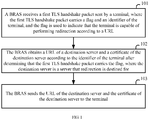
- a redirection method is described from a BRAS side. As shown in FIG. 1 , the redirection method in this embodiment of the present invention is as follows.
- a BRAS receives a first TLS handshake packet sent by a terminal, where the first TLS handshake packet carries a flag and an identifier of the terminal, and the flag is used to indicate that the terminal is capable of performing redirection according to a URL.
- the terminal is capable of performing redirection according to a URL may be that the terminal is capable of parsing a packet that carries the URL and capable of performing redirection by using the URL in the packet.
- the first TLS handshake packet sent by the terminal to the BRAS carries the flag, and this indicates that the terminal supports an HTTPS redirection function.
- the first TLS handshake packet sent by the terminal to the BRAS is client hello.
- the client hello may include an extension item, and the extension item may be used to carry the flag.
- a payload part of the client hello obtained by the terminal may carry the flag.
- an extension item is added to a part used for extension in the payload part of the client hello, and the extension item carries the flag.
- the identifier of the terminal may be a Media Access Control (Media Access Control, MAC) address of the terminal, an Internet Protocol (Internet Protocol, IP) address of the terminal, or other information used to identify the terminal.
- Media Access Control Media Access Control
- IP Internet Protocol
- the BRAS obtains a URL of a destination server and a certificate of the destination server according to the identifier of the terminal after determining that the first TLS handshake packet carries the flag, where the destination server is a server that redirection is destined for.
- the destination server may be a second server.
- a redirection-related entry may be preconfigured on the BRAS.
- the redirection-related entry includes the identifier of the terminal, a URL of the second server, and a certificate of the second server.
- the certificate of the second server may include the URL of the second server.
- the BRAS determines that the terminal supports redirection.
- the BRAS may perform local search according to the identifier of the terminal. For example, the BRAS may query whether a redirection-related entry that includes the identifier of the terminal exists. If such a redirection-related entry exists, the BRAS may obtain the URL of the second server and the certificate of the second server from the redirection-related entry.
- the certificate of the second server may be a certificate for which the second server applies to a certificate authority (certificate authority in English, CA for short).
- a method for generating the certificate of the second server may be a common certificate generation method, and details are not described herein.
- the BRAS is configured with a correspondence between the identifier of the terminal and the URL of the second server.
- the BRAS may generate, or obtain from another network device, the certificate of the second server according to the identifier of the terminal and the URL of the second server corresponding to the identifier of the terminal.
- the BRAS may obtain the URL of the second server according to the identifier of the terminal carried in the first TLS handshake packet.
- a manner in which the BRAS generates the certificate of the second server may be a common certificate generation manner, and details are not described herein.
- a process in which the BRAS obtains, by means of search according to the identifier of the terminal, the entry corresponding to redirection may be that the BRAS determines that the terminal meets the redirection condition, where a service corresponding to the redirection condition is a service, such as a web authentication service or an arrears notification service, provided by the second server.
- a service corresponding to the redirection condition is a service, such as a web authentication service or an arrears notification service, provided by the second server.
- the BRAS sends the URL of the destination server and the certificate of the destination server to the terminal.
- the BRAS may send the certificate of the second server at the same time when sending the URL of the second server to the terminal.
- the BRAS sends a second TLS handshake packet to the terminal, where the second TLS handshake packet may be a server hello packet, and the server hello carries the URL of the second server and the certificate of the second server.
- the BRAS may send the certificate of the second server to the terminal after sending the URL of the second server to the terminal.
- the BRAS sends a server redirect (Server Redirect in English) packet that carries the URL of the second server to the terminal, and then sends a server certificate (Server Certificate in English) packet that carries the certificate of the second server to the terminal.
- the method provided in this embodiment of the present invention may further include: receiving, by the BRAS, a first HTTPS packet sent by the terminal, where the first HTTPS packet is used to request redirection information from the BRAS, the first HTTPS packet may be a GET HTTPS packet or a POST HTTPS packet, and the first HTTPS packet includes the identifier of the terminal; and sending, by the BRAS, a second HTTPS packet to the terminal, where the second HTTPS packet may carry the redirection information, the redirection information may include the URL of the second server, and the second HTTPS packet may be a Redirect HTTPS packet.
- the BRAS may send the redirection information to the terminal by using the second HTTPS packet. This helps the terminal access the second server according to the redirection information.
- the terminal may access, after the TLS handshake with the BRAS, the second server according to the URL of the second server obtained from the BRAS during the TLS handshake, without a process of sending the first HTTPS packet to the BRAS.
- the redirection information in the second HTTPS packet may further include information used to complete web authentication.
- the information used to complete web authentication may include a MAC address of a user, physical location information of the user, and the like.
- the terminal may access the second server according to the redirection information, and send the information used to complete web authentication to the second server. This helps the second server perform web authentication on the terminal according to the information used to complete web authentication.
- a BRAS determines whether a first TLS handshake packet sent by a terminal carries a flag, where the flag is used to indicate that the terminal is capable of performing redirection according to a URL; after determining that the first TLS handshake packet carries the flag, the BRAS sends a URL, corresponding to the terminal, of a destination server and a certificate, corresponding to the terminal, of the destination server to the terminal. This helps increase a success rate of matching performed by the terminal between the URL of the destination server and the certificate of the destination server, and helps increase a redirection success rate.
- a redirection method is described from a terminal side. As shown in FIG. 2 , the redirection method in this embodiment of the present invention is as follows.
- a terminal sends a first TLS handshake packet to a BRAS, where the first TLS handshake packet carries a flag and an identifier of the terminal, and the flag is used to indicate that the terminal is capable of performing redirection according to a URL.
- the terminal is capable of performing redirection according to a URL may be that the terminal is capable of parsing a packet that carries the URL and capable of performing redirection by using the URL in the packet.
- the first TLS handshake packet sent by the terminal to the BRAS carries the flag may indicate that the terminal supports an HTTPS redirection function.
- the identifier of the terminal in this embodiment of the present invention may be the same as the identifier of the terminal in the embodiment corresponding to FIG. 1 , and details are not repeated herein.
- the first TLS handshake packet in this embodiment of the present invention may be the same as the first TLS handshake packet in the embodiment corresponding to FIG. 1 , and details are not repeated herein.
- the terminal sends the first TLS handshake packet to the BRAS in order to request to access a first server.
- the terminal receives a URL of a destination server and a certificate of the destination server that are sent by the BRAS, where the destination server is a server that redirection is destined for.
- the destination server may be a second server.
- the URL of the second server and the certificate of the second server may be corresponding content in the embodiment corresponding to FIG. 1 , and details are not repeated herein.
- the terminal receives a URL of a destination server and a certificate of the destination server that are sent by the BRAS includes: the terminal receives a server redirect packet sent by the BRAS, where the server redirect packet carries the URL of the second server; the terminal obtains the URL of the second server from the server redirect packet; the terminal receives a server certificate packet sent by the BRAS, where the server certificate packet carries the certificate of the second server; and the terminal obtains the certificate of the second server from the server certificate packet.
- the terminal receives a URL of a destination server and a certificate of the destination server that are sent by the BRAS includes: the terminal receives a second TLS handshake packet sent by the BRAS, where the second TLS handshake packet is a server hello packet, and the server hello packet carries the URL of the second server and the certificate of the second server; and the terminal obtains the URL of the second server and the certificate of the second server from the server hello packet.
- the terminal determines whether the URL of the destination server matches the certificate of the destination server, and performs 204 if the URL of the destination server matches the certificate of the destination server.
- the certificate of the second server carries at least the URL of the second server. If the URL of the second server carried in the certificate of the second server is the same as the URL of the second server received by the terminal, the terminal determines that the certificate of the second server matches the URL of the second server. If the URL of the second server carried in the certificate of the second server is different from the URL of the second server received by the terminal, the terminal determines that the certificate of the second server does not match the URL of the second server.
- the terminal outputs first prompt information, where the first prompt information is used to prompt that access is to be redirected, and the access is access of the terminal to a requested server.
- the server that the terminal requests to access is a first server.
- the access is access to the first server.
- the terminal may generate the first prompt information.
- the terminal may output the first prompt information to a user.
- a manner in which the terminal outputs the first prompt information to the user includes: the terminal generates a page that includes the first prompt information, and the terminal displays the page that includes the first prompt information.
- the method provided in this embodiment of the present invention further includes: outputting, by the terminal, second prompt information if the URL of the destination server does not match the certificate of the destination server, where the second prompt information is used to prompt that the certificate of the destination server is incorrect.
- the terminal may generate the second prompt information.
- the terminal may output the second prompt information to a user.
- a manner in which the terminal outputs the second prompt information to the user includes: the terminal generates a page that includes the second prompt information, and the terminal displays the page that includes the second prompt information.
- the method provided in this embodiment of the present invention further includes: completing, by the terminal, the TLS handshake process with the BRAS after obtaining an instruction that is input by the user according to the first prompt information, where the instruction that is input by the user is used to confirm continuing to access the URL of the second server; sending, by the terminal, a first HTTPS packet to the BRAS after the TLS handshake process, where the first HTTPS packet is used to request redirection information from the BRAS, and the first HTTPS packet includes the identifier of the terminal; receiving, by the terminal, a second HTTPS packet sent by the BRAS, where the second HTTPS packet includes the redirection information, and the redirection information includes the URL of the second server; and accessing, by the terminal according to the redirection information, a server corresponding to the URL of the second server.
- the method provided in this embodiment of the present invention further includes: ending, by the terminal, the TLS handshake process with the BRAS after obtaining an instruction that is input by the user according to the first prompt information, where the instruction is used to confirm continuing to access the URL of the second server; sending, by the terminal, a first HTTPS packet to the BRAS; receiving, by the terminal, a second HTTPS packet sent by the BRAS; and accessing, by the terminal according to the redirection information, a server corresponding to the URL of the second server.
- the method provided in this embodiment of the present invention further includes: ending, by the terminal, redirection if the terminal does not receive the second HTTPS packet sent by the BRAS.
- a terminal adds a flag to a first TLS handshake packet that is to be sent to a BRAS, so that the BRAS determines, according to the flag, that the terminal is capable of performing redirection according to a URL; the terminal receives a certificate of a destination server and a URL of the destination server that are sent by the BRAS, and performs matching between the certificate of the destination server and the URL of the destination server. This avoids a redirection failure that occurs because the certificate of the destination server does not match a URL of a server that the terminal requests to access, when the terminal checks validity of the certificate of the destination server, and helps increase a redirection success rate.
- FIG. 3 An HTTPS redirection process provided in a first embodiment is shown in FIG. 3 .
- a terminal such as a browser installed on a terminal, adds an extension item named redirect-url-enable and an identifier of the terminal to a generated client hello packet.
- Content of the extension item is used to indicate that the terminal is capable of parsing a packet that carries a URL and capable of performing redirection by using the URL in the packet.
- a BRAS After receiving the client hello packet of the terminal, a BRAS sends a server hello packet to the terminal if the BRAS determines that the client hello packet carries the extension item named redirect_url_enable, where the server hello is used for the BRAS and the terminal to negotiate an encryption manner and other information.
- the BRAS obtains a URL, corresponding to the terminal, of a second server and a certificate of the second server according to the identifier of the terminal carried in the client hello packet.
- the BRAS sends a server redirect packet to the terminal, where the server redirect packet carries the URL of the second server.
- the BRAS sends a server certificate packet to the terminal, where the server certificate packet includes the certificate of the second server.
- the terminal receives the server redirect packet sent by the BRAS, and obtains the URL of the second server from the server redirect packet.
- the terminal receives the server certificate packet sent by the BRAS, and obtains the certificate of the second server from the server certificate packet.
- the terminal determines whether the certificate of the second server matches the URL of the second server. If the certificate of the second server matches the URL of the second server, the terminal generates and outputs a first prompt page, where the first prompt page is used to prompt that access is to be redirected to the second server. If the certificate of the second server does not match the URL of the second server, the terminal generates and outputs a second prompt page, where the second prompt page is an alarm page used to prompt that the certificate is incorrect.
- the terminal If the terminal obtains an instruction to access the second server from a user, the terminal sends a GET HTTPS packet or a POST HTTPS packet to the BRAS after completing the TLS handshake interaction with the BRAS.
- the GET HTTPS packet or the POST HTTPS packet may carry the identifier of the terminal.
- the BRAS sends a Redirect HTTPS packet to the terminal according to the obtained identifier of the terminal after completing the TLS handshake interaction with the terminal and receiving the GRT HTTPS packet or the POST HTTPS packet, where the Redirect HTTPS packet carries at least the URL of the second server.
- the terminal If the terminal receives the Redirect HTTPS packet, the terminal starts a process of accessing the second server, that is, accessing the second server according to the URL of the second server in the Redirect HTTPS packet. If the terminal does not receive the Redirect HTTPS packet or the URL carried in the Redirect HTTPS packet is different from the URL carried in the server redirect packet, the terminal does not access the second server.
- FIG. 4 An HTTPS redirection process in a second specific embodiment is shown in FIG. 4 .
- a difference from the first specific embodiment is as follows:
- the terminal After obtaining the instruction to access the second server from the user, the terminal ends the TLS handshake process with the BRAS, and the terminal does not send a GET HTTPS packet or a POST HTTPS packet to the BRAS.
- the terminal may access the second server by using the URL of the second server that is obtained from the BRAS in the TLS handshake process.
- the extension item named redirect_url_enable in the client hello packet may be expressed as:
- the URL of the second server may be carried in a payload of the server redirect packet.
- a structure of the server redirect packet may be expressed as:
- An embodiment of the present invention further provides a BRAS.
- the BRAS may use the method used by the BRAS in the foregoing method embodiments, and repetition is omitted herein.
- the BRAS includes:
- the sending module 503 is specifically configured to send a server redirect packet that carries the URL of the destination server to the terminal, and the sending module is specifically configured to send a server certificate packet that carries the certificate of the destination server to the terminal.
- the sending module 503 is specifically configured to send a second TLS handshake packet to the terminal, where the second TLS handshake packet is a server hello packet, and the server hello packet carries the URL of the destination server and the certificate of the destination server.
- a BRAS determines whether a first TLS handshake packet sent by a terminal carries a flag, where the flag is used to indicate that the terminal is capable of performing redirection according to a URL; after determining that the first TLS handshake packet carries the flag, the BRAS sends a URL, corresponding to the terminal, of a destination server and a certificate, corresponding to the terminal, of the destination server to the terminal. This helps increase a success rate of matching performed by the terminal between the URL of the destination server and the certificate of the destination server, and helps increase a redirection success rate.
- An embodiment of the present invention further provides a BRAS.
- the BRAS may use the method used by the BRAS in the foregoing method embodiments, and repetition is omitted herein.
- the BRAS includes a processor 601, a memory 602, and a communications interface 603.
- the processor 601, the memory 602, and the communications interface 603 are connected to each other by using a bus 604.
- the bus 604 may be a peripheral component interconnect (peripheral component interconnect, PCI for short) bus, an extended industry standard architecture (extended industry standard architecture, EISA for short) bus, or the like.
- the bus may be classified into an address bus, a data bus, a control bus, and the like. For convenience of denotation, the bus is represented by one bold line in FIG. 6 . However, this does not indicate that there is only one bus or one type of bus.
- the memory 602 is configured to store a program.
- the program may include program code, where the program code includes a computer operation instruction.
- the memory 602 may include a random access memory (random access memory, RAM for short), and may further include a non-volatile memory (non-volatile memory), for example, at least one magnetic disk memory.
- the communications interface 603 is configured for communication with another device.
- the processor 601 obtains the program in the memory 602, and executes the following process according to the program:
- the terminal is capable of performing redirection according to a URL
- the terminal is capable of parsing a packet that carries the URL and capable of performing redirection by using the URL in the packet.
- the processor 601 sends a server redirect packet that carries the URL of the destination server to the terminal, and sends a server certificate packet that carries the certificate of the destination server to the terminal.
- the processor 601 sends a second TLS handshake packet to the terminal by using the communications interface 603, where the second TLS handshake packet is a server hello packet, and the server hello packet carries the URL of the destination server and the certificate of the destination server.
- the second TLS handshake packet is a server hello packet
- the server hello packet carries the URL of the destination server and the certificate of the destination server.
- a BRAS determines whether a first TLS handshake packet sent by a terminal carries a flag, where the flag is used to indicate that the terminal is capable of performing redirection according to a URL; after determining that the first TLS handshake packet carries the flag, the BRAS sends a URL, corresponding to the terminal, of a destination server and a certificate, corresponding to the terminal, of the destination server to the terminal. This helps increase a success rate of matching performed by the terminal between the URL of the destination server and the certificate of the destination server, and helps increase a redirection success rate.
- An embodiment of the present invention further provides a terminal.
- the terminal may use the method used by the terminal in the foregoing method embodiments, and repetition is omitted herein.
- the terminal includes:
- the output module 704 is further configured to output second prompt information if the determining module 703 determines that the URL of the destination server does not match the certificate of the destination server, where the second prompt information is used to prompt that the certificate of the target server is incorrect.
- the receiving module 702 is specifically configured to receive a second TLS handshake packet sent by the BRAS, where the second TLS handshake packet carries the URL of the destination server and the certificate of the destination server.
- the receiving module 702 may obtain the URL of the destination server and the certificate of the destination server from the second TLS handshake packet, or the determining module 703 may obtain the URL of the destination server and the certificate of the destination server from the second TLS handshake packet received by the receiving module 702.
- the receiving module 702 is specifically configured to receive a server redirect packet sent by the BRAS, where the server redirect packet carries the URL of the destination server, and receive a server certificate packet sent by the BRAS, where the server certificate packet carries the certificate of the destination server.
- the receiving module 702 or the determining module 703 may obtain the URL of the destination server from the server redirect packet, and the receiving module 702 or the determining module 703 may obtain the certificate of the destination server from the server certificate packet.
- a terminal adds a flag to a first TLS handshake packet that is to be sent to a BRAS, so that the BRAS determines, according to the flag, that the terminal is capable of performing redirection according to a URL; the terminal receives a certificate of a destination server and a URL of the destination server that are sent by the BRAS, and performs matching between the certificate of the destination server and the URL of the destination server. This avoids a redirection failure that occurs because the certificate of the destination server does not match a URL of a server that the terminal requests to access, when the terminal checks validity of the certificate of the destination server, and helps increase a redirection success rate.
- An embodiment of the present invention further provides a terminal.
- the terminal may use the method used by the terminal in the foregoing method embodiments, and repetition is omitted herein.
- the terminal includes a processor 801, a memory 802, and a communications interface 803.
- the processor 801, the memory 802, and the communications interface 803 are connected to each other by using a bus 804.
- the bus 804 may be a peripheral component interconnect (peripheral component interconnect, PCI for short) bus, an extended industry standard architecture (extended industry standard architecture, EISA for short) bus, or the like.
- the bus may be classified into an address bus, a data bus, a control bus, and the like. For convenience of denotation, the bus is represented by one bold line in FIG. 8 . However, this does not indicate that there is only one bus or one type of bus.
- the memory 802 is configured to store a program.
- the program may include program code, where the program code includes a computer operation instruction.
- the memory 802 may include a random access memory (random access memory, RAM for short), and may further include a non-volatile memory (non-volatile memory), for example, at least one magnetic disk memory.
- the communications interface 803 is configured for communication with another device.
- the processor 801 is configured to obtain the program in the memory 802, and executes the following process according to the program:
- the processor 801 outputs second prompt information if the processor 801 determines that the URL of the destination server does not match the certificate of the destination server, where the second prompt information is used to prompt that the certificate of the target server is incorrect.
- the processor 801 sends a first HTTPS packet to the BRAS by using the communications interface 803, where the instruction is used to confirm continuing to access the URL of the destination server, the first HTTPS packet carries the identifier of the terminal, and the first HTTPS packet is used to request redirection information from the BRAS.
- the processor 801 receives, by using the communications interface 803, a second HTTPS packet sent by the BRAS, where the second HTTPS packet carries the redirection information.
- the processor 801 If the processor 801 successfully receives, by using the communications interface 803, the second HTTPS packet sent by the BRAS, the processor 801 accesses, according to the redirection information, a server corresponding to the URL of the destination server. If the processor 801 does not receive, by using the communications interface 803, the second HTTPS packet sent by the BRAS, the terminal does not access the destination server.
- the processor 801 may end the TLS handshake process with the BRAS before sending the first HTTPS packet to the BRAS by using the communications interface 803.
- the processor 801 receives, by using the communications interface 803, a second TLS handshake packet sent by the BRAS, where the second TLS handshake packet carries the URL of the destination server and the certificate of the destination server.
- the processor 801 receives a server redirect packet sent by the BRAS, where the server redirect packet carries the URL of the destination server, and receives a server certificate packet sent by the BRAS, where the server certificate packet carries the certificate of the destination server.
- a terminal adds a flag to a first TLS handshake packet that is to be sent to a BRAS, so that the BRAS determines, according to the flag, that the terminal is capable of performing redirection according to a URL; the terminal receives a certificate of a destination server and a URL of the destination server that are sent by the BRAS, and performs matching between the certificate of the destination server and the URL of the destination server. This avoids a redirection failure that occurs because the certificate of the destination server does not match a URL of a server that the terminal requests to access, when the terminal checks validity of the certificate of the destination server, and helps increase a redirection success rate.
- FIG. 9 is a schematic diagram of a redirection system according to an embodiment of the present invention.
- the system shown in FIG. 9 may include a BRAS 901 and a terminal 902.
- the BRAS may be the BRAS provided in the embodiment corresponding to FIG. 5 or FIG. 6 , and details are not repeated herein.
- the terminal may be the terminal provided in the embodiment corresponding to FIG. 7 or FIG. 8 , and details are not repeated herein.
- the embodiments of the present invention may be provided as a method, a system, or a computer program product. Therefore, the present invention may use a form of hardware-only embodiments, software-only embodiments, or embodiments with a combination of software and hardware. Moreover, the present invention may use a form of a computer program product that is implemented on one or more computer-usable storage media (including but not limited to a magnetic disk memory, an optical memory, and the like) that include computer-usable program code.
- computer-usable storage media including but not limited to a magnetic disk memory, an optical memory, and the like
- These computer program instructions may be provided for a general-purpose computer, a dedicated computer, an embedded processor, or a processor of any other programmable data processing device to generate a machine, so that the instructions executed by a computer or a processor of any other programmable data processing device generate an apparatus for implementing a specific function in one or more processes in the flowcharts and/or in one or more blocks in the block diagrams.
- These computer program instructions may be stored in a computer readable memory that can instruct the computer or any other programmable data processing device to work in a specific manner, so that the instructions stored in the computer readable memory generate an artifact that includes an instruction apparatus.
- the instruction apparatus implements a specified function in one or more processes in the flowcharts and/or in one or more blocks in the block diagrams.
- These computer program instructions may also be loaded onto a computer or another programmable data processing device, so that a series of operations and steps are performed on the computer or the another programmable device, thereby generating computer-implemented processing. Therefore, the instructions executed on the computer or the another programmable device provide steps for implementing a specific function in one or more processes in the flowcharts and/or in one or more blocks in the block diagrams.
Landscapes
- Engineering & Computer Science (AREA)
- Computer Networks & Wireless Communication (AREA)
- Signal Processing (AREA)
- Computer Security & Cryptography (AREA)
- Computer Hardware Design (AREA)
- Computing Systems (AREA)
- General Engineering & Computer Science (AREA)
- Information Transfer Between Computers (AREA)
Claims (15)
- Umleitungsverfahren, wobei das Verfahren die folgenden Schritte umfasst:Empfangen (101), durch einen Breitbandfernzugriffsserver, BRAS, eines durch ein Endgerät gesendeten ersten Transportschichtsicherheit-Handshakepakets bzw. TLS-Handshakepakets, wobei das erste TLS-Handshakepaket ein Flag und eine Kennung des Endgeräts führt und das Flag verwendet wird zum Anzeigen, dass das Endgerät in der Lage ist zum Durchführen einer Umleitung gemäß einer "Uniform Resource Locator", URL;Erhalten (102), durch den BRAS, einer URL eines Zielservers und eines Zertifikats des Zielservers gemäß der Kennung des Endgeräts nach Bestimmen, dass das erste TLS-Handshakepaket das Flag führt, wobei der Zielserver ein Server ist, für den die Umleitung zugedacht ist; undSenden (103), durch den BRAS, der URL des Zielservers und des Zertifikats des Zielservers an das Endgerät.
- Verfahren nach Anspruch 1, wobei das Erhalten (102), durch den BRAS, einer URL eines Zielservers und eines Zertifikats des Zielservers gemäß der Kennung des Endgeräts die folgenden Schritte umfasst:Erhalten, durch den BRAS, eines vorkonfigurierten Eintrags gemäß der Kennung des Endgeräts, wobei der Eintrag die Kennung des Endgeräts, die URL des Zielservers und das Zertifikat des Zielservers umfasst; undErhalten, durch den BRAS, der URL des Zielservers und des Zertifikats des Zielservers aus dem Eintrag.
- Verfahren nach Anspruch 1 oder 2, wobei das Senden (103), durch den BRAS, der URL des Zielservers und des Zertifikats des Zielservers an das Endgerät den folgenden Schritt umfasst:
Senden, durch den BRAS, eines zweiten TLS-Handshakepakets an das Endgerät, wobei das zweite TLS-Handshakepaket die URL des Zielservers und das Zertifikat des Zielservers führt. - Verfahren nach Anspruch 1 oder 2, wobei das Senden (103), durch den BRAS, der URL des Zielservers und des Zertifikats des Zielservers an das Endgerät die folgenden Schritte umfasst:Senden, durch den BRAS, eines Serverumleitungspakets an das Endgerät, wobei das Serverumleitungspaket die URL des Zielservers führt; undSenden, durch den BRAS, eines Serverzertifikatpakets an das Endgerät, wobei das Serverzertifikatpaket das Zertifikat des Zielservers führt.
- Umleitungsverfahren, wobei das Verfahren die folgenden Schritte umfasst:Senden (201), durch ein Endgerät, eines ersten Transportschichtsicherheit-Handshakepakets bzw. TLS-Handshakepakets an einen Breitbandfernzugriffsserver, BRAS, wobei das erste TLS-Handshakepaket ein Flag und eine Kennung des Endgeräts führt und das Flag verwendet wird zum Anzeigen, dass das Endgerät in der Lage ist zum Durchführen einer Umleitung gemäß einer "Uniform Resource Locator", URL;Empfangen (202), durch das Endgerät, einer URL eines Zielservers und eines Zertifikats des Zielservers, die durch den BRAS gesendet wurden, wobei der Zielserver ein Server ist, für den die Umleitung zugedacht ist;Bestimmen (203), durch das Endgerät, ob die URL des Zielservers mit dem Zertifikat des Zielservers übereinstimmt; undAusgeben (204), durch das Endgerät, von ersten Hinweisinformationen, wenn die URL des Zielservers mit dem Zertifikat des Zielservers übereinstimmt, wobei die ersten Hinweisinformationen verwendet werden zum Hinweisen, dass ein Zugriff umgeleitet werden soll und der Zugriff ein Zugriff des Endgeräts auf einen angeforderten Server ist.
- Verfahren nach Anspruch 5, wobei das Verfahren ferner den folgenden Schritt umfasst:
Ausgeben, durch das Endgerät, von zweiten Hinweisinformationen, wenn die URL des Zielservers nicht mit dem Zertifikat des Zielservers übereinstimmt, wobei die zweiten Hinweisinformationen verwendet werden zum Hinweisen, dass das Zertifikat des Zielservers inkorrekt ist. - Verfahren nach Anspruch 5 oder 6, wobei das Empfangen (202), durch das Endgerät, einer URL eines Zielservers und eines Zertifikats des Zielservers, die durch den BRAS gesendet wurden, die folgenden Schritte umfasst:Empfangen, durch das Endgerät, eines durch den BRAS gesendeten zweiten TLS-Handshakepakets, wobei das zweite TLS-Handshakepaket die URL des Zielservers und das Zertifikat des Zielservers führt; undErhalten, durch das Endgerät, der URL des Zielservers und des Zertifikats des Zielservers aus dem zweiten TLS-Handshakepaket.
- Verfahren nach Anspruch 5 oder 6, wobei das Empfangen (202), durch das Endgerät, einer URL eines Zielservers und eines Zertifikats des Zielservers, die durch den BRAS gesendet wurden, die folgenden Schritte umfasst:Empfangen, durch das Endgerät, eines durch den BRAS gesendeten Serverumleitungspakets, wobei das Serverumleitungspaket die URL des Zielservers führt;Erhalten, durch das Endgerät, der URL des Zielservers aus dem Serverumleitungspaket;Empfangen, durch das Endgerät, eines durch den BRAS gesendeten Serverzertifikatpakets, wobei das Serverzertifikatpaket das Zertifikat des Zielservers führt; undErhalten, durch das Endgerät, des Zertifikats des Zielservers aus dem Serverzertifikatpaket.
- Breitbandfernzugriffsserver, BRAS, wobei der BRAS Folgendes umfasst:ein Empfangsmodul (501), das ausgelegt ist zum Empfangen eines durch ein Endgerät gesendeten ersten Transportschichtsicherheit-Handshakepakets bzw. TLS-Handshakepakets, wobei das erste TLS-Handshakepaket ein Flag und eine Kennung des Endgeräts führt und das Flag verwendet wird zum Anzeigen, dass das Endgerät in der Lage ist zum Durchführen einer Umleitung gemäß einer "Uniform Resource Locator", URL;ein Erhaltemodul (502), das ausgelegt ist zum Erhalten einer URL eines Zielservers und eines Zertifikats des Zielservers gemäß der Kennung des Endgeräts nachdem bestimmt wurde, dass das erste TLS-Handshakepaket das Flag führt, wobei der Zielserver ein Server ist, für den die Umleitung zugedacht ist; undein Sendemodul (503), das ausgelegt ist zum Senden der URL des Zielservers und des Zertifikats des Zielservers an das Endgerät.
- BRAS nach Anspruch 9, wobei das Erhaltemodul (502) insbesondere ausgelegt ist zum Erhalten eines vorkonfigurierten Eintrags gemäß der Kennung des Endgeräts, wobei der Eintrag die Kennung des Endgeräts, die URL des Zielservers und das Zertifikat des Zielservers umfasst; und
das Erhaltemodul (502) insbesondere ausgelegt ist zum Erhalten der URL des Zielservers und des Zertifikats des Zielservers aus dem Eintrag. - BRAS nach Anspruch 9 oder 10, wobei:das Sendemodul (503) insbesondere ausgelegt ist zum Senden eines Serverumleitungspakets an das Endgerät, wobei das Serverumleitungspaket die URL des Zielservers führt; unddas Sendemodul (503) insbesondere ausgelegt ist zum Senden eines Serverzertifikatpakets an das Endgerät, wobei das Serverzertifikatpaket das Zertifikat des Zielservers führt.
- Endgerät, wobei das Endgerät Folgendes umfasst:ein Sendemodul (701), das ausgelegt ist zum Senden eines ersten Transportschichtsicherheit-Handshakepakets bzw. TLS-Handshakepakets an einen Breitbandfernzugriffsserver, BRAS, wobei das erste TLS-Handshakepaket ein Flag und eine Kennung des Endgeräts führt und das Flag verwendet wird zum Anzeigen,dass das Endgerät in der Lage ist zum Durchführen einer Umleitung gemäß einer "Uniform Resource Locator", URL;ein Empfangsmodul (702), das ausgelegt ist zum Empfangen einer URL eines Zielservers und eines Zertifikats des Zielservers, die durch den BRAS gesendet wurden, wobei der Zielserver ein Server ist, für den die Umleitung zugedacht ist;ein Bestimmungsmodul (703), das ausgelegt ist zum Bestimmen, ob die durch das Empfangsmodul (702) empfangene URL des Zielservers mit dem durch das Empfangsmodul (702) empfangenen Zertifikat des Zielservers übereinstimmt; undein Ausgabemodul (704), das ausgelegt ist zum Ausgeben von ersten Hinweisinformationen, wenn das Bestimmungsmodul (703) bestimmt, dass die URL des Zielservers mit dem Zertifikat des Zielservers übereinstimmt, wobei die ersten Hinweisinformationen verwendet werden zum Hinweisen, dass ein Zugriff umgeleitet werden soll und der Zugriff ein Zugriff des Endgeräts auf einen angeforderten Server ist.
- Endgerät nach Anspruch 12, wobei:
das Ausgabemodul (704) ferner ausgelegt ist zum Ausgeben von zweiten Hinweisinformationen, wenn das Bestimmungsmodul (703) bestimmt, dass die URL des Zielservers nicht mit dem Zertifikat des Zielservers übereinstimmt, wobei die zweiten Hinweisinformationen verwendet werden zum Hinweisen, dass das Zertifikat des Zielservers inkorrekt ist. - Endgerät nach Anspruch 12 oder 13, wobei:das Empfangsmodul (702) insbesondere ausgelegt ist zum Empfangen eines durch den BRAS gesendeten Serverumleitungspakets, wobei das Serverumleitungspaket die URL des Zielservers führt; unddas Empfangsmodul (702) insbesondere ausgelegt ist zum Empfangen eines durch den BRAS gesendeten Serverzertifikatpakets, wobei das Serverzertifikatpaket das Zertifikat des Zielservers führt.
- Umleitungssystem, wobei das System Folgendes umfasst:
den Breitbandfernzugriffsserver, BRAS, nach einem der Ansprüche 9 bis 11 und das Endgerät nach einem der Ansprüche 12 bis 14.
Applications Claiming Priority (2)
| Application Number | Priority Date | Filing Date | Title |
|---|---|---|---|
| CN201510080975.4A CN105991589B (zh) | 2015-02-13 | 2015-02-13 | 一种用于重定向的方法、装置及系统 |
| PCT/CN2016/073507 WO2016127914A1 (zh) | 2015-02-13 | 2016-02-04 | 一种用于重定向的方法、装置及系统 |
Publications (3)
| Publication Number | Publication Date |
|---|---|
| EP3249877A1 EP3249877A1 (de) | 2017-11-29 |
| EP3249877A4 EP3249877A4 (de) | 2018-01-17 |
| EP3249877B1 true EP3249877B1 (de) | 2018-09-19 |
Family
ID=56614125
Family Applications (1)
| Application Number | Title | Priority Date | Filing Date |
|---|---|---|---|
| EP16748715.6A Not-in-force EP3249877B1 (de) | 2015-02-13 | 2016-02-04 | Kommunikationsverfahren, -vorrichtung und -system |
Country Status (4)
| Country | Link |
|---|---|
| US (1) | US10721320B2 (de) |
| EP (1) | EP3249877B1 (de) |
| CN (1) | CN105991589B (de) |
| WO (1) | WO2016127914A1 (de) |
Families Citing this family (32)
| Publication number | Priority date | Publication date | Assignee | Title |
|---|---|---|---|---|
| US10430894B2 (en) | 2013-03-21 | 2019-10-01 | Khoros, Llc | Gamification for online social communities |
| US20210234832A1 (en) * | 2014-05-12 | 2021-07-29 | Tocmail Inc | Computer Security System and Method Based on User-Intended Final Destination |
| US20170262279A1 (en) * | 2016-03-12 | 2017-09-14 | Wipro Limited | Methods and systems for developing user customizable web application frameworks |
| CN106453675B (zh) | 2016-09-19 | 2022-07-08 | 网宿科技股份有限公司 | 302跳转方法、url生成方法及系统、域名解析方法及系统 |
| US11184318B2 (en) | 2016-09-19 | 2021-11-23 | Wangsu Science & Technology Co., Ltd. | 302 redirecting method, URL generating method and system, and domain-name resolving method and system |
| CN106572123A (zh) * | 2016-12-30 | 2017-04-19 | 哈尔滨安天科技股份有限公司 | 基于数据重定向的勒索软件防御系统及方法 |
| US10902462B2 (en) | 2017-04-28 | 2021-01-26 | Khoros, Llc | System and method of providing a platform for managing data content campaign on social networks |
| US11470161B2 (en) * | 2018-10-11 | 2022-10-11 | Spredfast, Inc. | Native activity tracking using credential and authentication management in scalable data networks |
| US10785222B2 (en) | 2018-10-11 | 2020-09-22 | Spredfast, Inc. | Credential and authentication management in scalable data networks |
| US10346449B2 (en) | 2017-10-12 | 2019-07-09 | Spredfast, Inc. | Predicting performance of content and electronic messages among a system of networked computing devices |
| US11050704B2 (en) | 2017-10-12 | 2021-06-29 | Spredfast, Inc. | Computerized tools to enhance speed and propagation of content in electronic messages among a system of networked computing devices |
| US10999278B2 (en) | 2018-10-11 | 2021-05-04 | Spredfast, Inc. | Proxied multi-factor authentication using credential and authentication management in scalable data networks |
| US11570128B2 (en) | 2017-10-12 | 2023-01-31 | Spredfast, Inc. | Optimizing effectiveness of content in electronic messages among a system of networked computing device |
| US10601937B2 (en) | 2017-11-22 | 2020-03-24 | Spredfast, Inc. | Responsive action prediction based on electronic messages among a system of networked computing devices |
| US10594773B2 (en) | 2018-01-22 | 2020-03-17 | Spredfast, Inc. | Temporal optimization of data operations using distributed search and server management |
| US11061900B2 (en) | 2018-01-22 | 2021-07-13 | Spredfast, Inc. | Temporal optimization of data operations using distributed search and server management |
| US10855657B2 (en) | 2018-10-11 | 2020-12-01 | Spredfast, Inc. | Multiplexed data exchange portal interface in scalable data networks |
| US10931540B2 (en) | 2019-05-15 | 2021-02-23 | Khoros, Llc | Continuous data sensing of functional states of networked computing devices to determine efficiency metrics for servicing electronic messages asynchronously |
| WO2020228968A1 (en) * | 2019-05-16 | 2020-11-19 | Telefonaktiebolaget Lm Ericsson (Publ) | Over-the-top management in a communication network |
| CN113972988B (zh) * | 2020-07-06 | 2026-03-24 | 西安西电捷通无线网络通信股份有限公司 | 数字证书获取方法及装置 |
| US12120078B2 (en) | 2020-09-18 | 2024-10-15 | Khoros, Llc | Automated disposition of a community of electronic messages under moderation using a gesture-based computerized tool |
| US11128589B1 (en) | 2020-09-18 | 2021-09-21 | Khoros, Llc | Gesture-based community moderation |
| US11438289B2 (en) | 2020-09-18 | 2022-09-06 | Khoros, Llc | Gesture-based community moderation |
| US11627100B1 (en) | 2021-10-27 | 2023-04-11 | Khoros, Llc | Automated response engine implementing a universal data space based on communication interactions via an omnichannel electronic data channel |
| US12158903B2 (en) | 2020-11-06 | 2024-12-03 | Khoros, Llc | Automated response engine to implement internal communication interaction data via a secured omnichannel electronic data channel and external communication interaction data |
| US12197875B2 (en) | 2021-07-31 | 2025-01-14 | Khoros, Llc | Automated predictive response computing platform implementing adaptive data flow sets to exchange data via an omnichannel electronic communication channel independent of data source |
| US11438282B2 (en) | 2020-11-06 | 2022-09-06 | Khoros, Llc | Synchronicity of electronic messages via a transferred secure messaging channel among a system of various networked computing devices |
| US11924375B2 (en) | 2021-10-27 | 2024-03-05 | Khoros, Llc | Automated response engine and flow configured to exchange responsive communication data via an omnichannel electronic communication channel independent of data source |
| US11714629B2 (en) | 2020-11-19 | 2023-08-01 | Khoros, Llc | Software dependency management |
| US12332934B2 (en) | 2023-04-11 | 2025-06-17 | Khoros, Llc | Automated response engine implementing a universal data space based on communication interactions via an omnichannel electronic data channel |
| US11936511B2 (en) * | 2022-05-18 | 2024-03-19 | Dell Products L.P. | Payload template generator for an information handling system |
| US12261844B2 (en) | 2023-03-06 | 2025-03-25 | Spredfast, Inc. | Multiplexed data exchange portal interface in scalable data networks |
Family Cites Families (21)
| Publication number | Priority date | Publication date | Assignee | Title |
|---|---|---|---|---|
| US10255445B1 (en) * | 2006-11-03 | 2019-04-09 | Jeffrey E. Brinskelle | Identifying destinations of sensitive data |
| US8549157B2 (en) * | 2007-04-23 | 2013-10-01 | Mcafee, Inc. | Transparent secure socket layer |
| US8429734B2 (en) | 2007-07-31 | 2013-04-23 | Symantec Corporation | Method for detecting DNS redirects or fraudulent local certificates for SSL sites in pharming/phishing schemes by remote validation and using a credential manager and recorded certificate attributes |
| US8645696B2 (en) * | 2008-11-26 | 2014-02-04 | Red Hat, Inc. | Notifying users of server changes via SSL |
| US8613072B2 (en) * | 2009-02-26 | 2013-12-17 | Microsoft Corporation | Redirection of secure data connection requests |
| US20120174196A1 (en) * | 2010-12-30 | 2012-07-05 | Suresh Bhogavilli | Active validation for ddos and ssl ddos attacks |
| US9015469B2 (en) * | 2011-07-28 | 2015-04-21 | Cloudflare, Inc. | Supporting secure sessions in a cloud-based proxy service |
| US20130061281A1 (en) * | 2011-09-02 | 2013-03-07 | Barracuda Networks, Inc. | System and Web Security Agent Method for Certificate Authority Reputation Enforcement |
| WO2013088101A1 (en) * | 2011-12-16 | 2013-06-20 | British Telecommunications Public Limited Company | Proxy server operation |
| US8738902B2 (en) * | 2012-01-27 | 2014-05-27 | Microsoft Corporation | Implicit SSL certificate management without server name indication (SNI) |
| CN102710667B (zh) * | 2012-06-25 | 2015-04-01 | 杭州华三通信技术有限公司 | 实现Portal认证服务器防攻击的方法及宽带接入服务器 |
| CN103701760A (zh) * | 2012-09-28 | 2014-04-02 | 中国电信股份有限公司 | 无线局域网Portal认证方法、系统及Portal服务器 |
| CN102868758B (zh) * | 2012-09-29 | 2016-12-21 | 华为技术有限公司 | 门户推送的方法和网络设备 |
| WO2014089816A1 (zh) * | 2012-12-14 | 2014-06-19 | 华为技术有限公司 | 用户设备访问网页的重定向方法、网关以及服务器 |
| CN103051626B (zh) * | 2012-12-21 | 2016-09-28 | 华为技术有限公司 | 一种认证方法及网络设备 |
| EP2979420B1 (de) * | 2013-03-28 | 2019-07-03 | InterDigital CE Patent Holdings | Netzwerksystem mit einem sicherheitsmanagementserver und einem heimnetzwerk sowie verfahren zur aufnahme einer vorrichtung in das netzwerksystem |
| US9160718B2 (en) * | 2013-05-23 | 2015-10-13 | Iboss, Inc. | Selectively performing man in the middle decryption |
| US9419942B1 (en) * | 2013-06-05 | 2016-08-16 | Palo Alto Networks, Inc. | Destination domain extraction for secure protocols |
| WO2015121617A1 (en) * | 2014-02-14 | 2015-08-20 | British Telecommunications Public Limited Company | Methods, apparatus and systems for processing service requests |
| CN104270405A (zh) * | 2014-08-29 | 2015-01-07 | 小米科技有限责任公司 | 基于路由器的联网控制方法及装置 |
| US9930067B1 (en) * | 2014-12-18 | 2018-03-27 | Amazon Technologies, Inc. | Techniques for secure session reestablishment |
-
2015
- 2015-02-13 CN CN201510080975.4A patent/CN105991589B/zh not_active Expired - Fee Related
-
2016
- 2016-02-04 WO PCT/CN2016/073507 patent/WO2016127914A1/zh not_active Ceased
- 2016-02-04 EP EP16748715.6A patent/EP3249877B1/de not_active Not-in-force
-
2017
- 2017-08-11 US US15/675,661 patent/US10721320B2/en not_active Expired - Fee Related
Non-Patent Citations (1)
| Title |
|---|
| None * |
Also Published As
| Publication number | Publication date |
|---|---|
| US10721320B2 (en) | 2020-07-21 |
| EP3249877A1 (de) | 2017-11-29 |
| US20170366636A1 (en) | 2017-12-21 |
| CN105991589A (zh) | 2016-10-05 |
| EP3249877A4 (de) | 2018-01-17 |
| WO2016127914A1 (zh) | 2016-08-18 |
| CN105991589B (zh) | 2019-04-26 |
Similar Documents
| Publication | Publication Date | Title |
|---|---|---|
| EP3249877B1 (de) | Kommunikationsverfahren, -vorrichtung und -system | |
| US9887999B2 (en) | Login method and apparatus | |
| CN103609090B (zh) | 身份登录方法及设备 | |
| EP3457627B1 (de) | Automatisches anmeldeverfahren und -vorrichtung zwischen mehreren websites | |
| CN106790194B (zh) | 一种基于ssl协议的访问控制方法及装置 | |
| US9369286B2 (en) | System and methods for facilitating authentication of an electronic device accessing plurality of mobile applications | |
| US20150310194A1 (en) | Authentication Using Device ID | |
| US9887997B2 (en) | Web authentication using client platform root of trust | |
| US9805185B2 (en) | Disposition engine for single sign on (SSO) requests | |
| US20100043065A1 (en) | Single sign-on for web applications | |
| US20160330172A1 (en) | Secure proxy to protect private data | |
| US10419431B2 (en) | Preventing cross-site request forgery using environment fingerprints of a client device | |
| CN106779716B (zh) | 基于区块链账户地址的认证方法、装置及系统 | |
| CN106375348B (zh) | 一种Portal认证方法和装置 | |
| CN108259457B (zh) | 一种web认证方法及装置 | |
| JP2018504677A (ja) | フィッシングページの検出方法及びシステム | |
| CN110826049A (zh) | 基于智慧企业门户的单点登录实现系统 | |
| CN110036615A (zh) | 经由参数传递认证信息 | |
| CN105991640B (zh) | 处理http请求的方法及装置 | |
| US20220377064A1 (en) | Method and system for managing a web security protocol | |
| CN109495362B (zh) | 一种接入认证方法及装置 | |
| US9565210B2 (en) | Appliance for processing a session in network communications | |
| EP3772697B1 (de) | Kryptographisch sichere, dynamische drittparteiressourcen | |
| CN110830493B (zh) | 基于智慧企业门户的单点登录实现方法 | |
| WO2013098925A1 (ja) | 情報処理装置、情報処理システム、情報処理方法およびプログラム |
Legal Events
| Date | Code | Title | Description |
|---|---|---|---|
| STAA | Information on the status of an ep patent application or granted ep patent |
Free format text: STATUS: THE INTERNATIONAL PUBLICATION HAS BEEN MADE |
|
| PUAI | Public reference made under article 153(3) epc to a published international application that has entered the european phase |
Free format text: ORIGINAL CODE: 0009012 |
|
| STAA | Information on the status of an ep patent application or granted ep patent |
Free format text: STATUS: REQUEST FOR EXAMINATION WAS MADE |
|
| 17P | Request for examination filed |
Effective date: 20170822 |
|
| AK | Designated contracting states |
Kind code of ref document: A1 Designated state(s): AL AT BE BG CH CY CZ DE DK EE ES FI FR GB GR HR HU IE IS IT LI LT LU LV MC MK MT NL NO PL PT RO RS SE SI SK SM TR |
|
| AX | Request for extension of the european patent |
Extension state: BA ME |
|
| A4 | Supplementary search report drawn up and despatched |
Effective date: 20171215 |
|
| RIC1 | Information provided on ipc code assigned before grant |
Ipc: H04L 29/08 20060101ALI20171211BHEP Ipc: H04L 29/06 20060101AFI20171211BHEP |
|
| GRAP | Despatch of communication of intention to grant a patent |
Free format text: ORIGINAL CODE: EPIDOSNIGR1 |
|
| STAA | Information on the status of an ep patent application or granted ep patent |
Free format text: STATUS: GRANT OF PATENT IS INTENDED |
|
| DAV | Request for validation of the european patent (deleted) | ||
| DAX | Request for extension of the european patent (deleted) | ||
| INTG | Intention to grant announced |
Effective date: 20180329 |
|
| GRAS | Grant fee paid |
Free format text: ORIGINAL CODE: EPIDOSNIGR3 |
|
| GRAA | (expected) grant |
Free format text: ORIGINAL CODE: 0009210 |
|
| STAA | Information on the status of an ep patent application or granted ep patent |
Free format text: STATUS: THE PATENT HAS BEEN GRANTED |
|
| AK | Designated contracting states |
Kind code of ref document: B1 Designated state(s): AL AT BE BG CH CY CZ DE DK EE ES FI FR GB GR HR HU IE IS IT LI LT LU LV MC MK MT NL NO PL PT RO RS SE SI SK SM TR |
|
| REG | Reference to a national code |
Ref country code: GB Ref legal event code: FG4D |
|
| REG | Reference to a national code |
Ref country code: CH Ref legal event code: EP |
|
| REG | Reference to a national code |
Ref country code: DE Ref legal event code: R096 Ref document number: 602016005784 Country of ref document: DE |
|
| REG | Reference to a national code |
Ref country code: AT Ref legal event code: REF Ref document number: 1044606 Country of ref document: AT Kind code of ref document: T Effective date: 20181015 |
|
| REG | Reference to a national code |
Ref country code: IE Ref legal event code: FG4D |
|
| REG | Reference to a national code |
Ref country code: NL Ref legal event code: MP Effective date: 20180919 |
|
| PG25 | Lapsed in a contracting state [announced via postgrant information from national office to epo] |
Ref country code: NO Free format text: LAPSE BECAUSE OF FAILURE TO SUBMIT A TRANSLATION OF THE DESCRIPTION OR TO PAY THE FEE WITHIN THE PRESCRIBED TIME-LIMIT Effective date: 20181219 Ref country code: SE Free format text: LAPSE BECAUSE OF FAILURE TO SUBMIT A TRANSLATION OF THE DESCRIPTION OR TO PAY THE FEE WITHIN THE PRESCRIBED TIME-LIMIT Effective date: 20180919 Ref country code: LT Free format text: LAPSE BECAUSE OF FAILURE TO SUBMIT A TRANSLATION OF THE DESCRIPTION OR TO PAY THE FEE WITHIN THE PRESCRIBED TIME-LIMIT Effective date: 20180919 Ref country code: RS Free format text: LAPSE BECAUSE OF FAILURE TO SUBMIT A TRANSLATION OF THE DESCRIPTION OR TO PAY THE FEE WITHIN THE PRESCRIBED TIME-LIMIT Effective date: 20180919 Ref country code: FI Free format text: LAPSE BECAUSE OF FAILURE TO SUBMIT A TRANSLATION OF THE DESCRIPTION OR TO PAY THE FEE WITHIN THE PRESCRIBED TIME-LIMIT Effective date: 20180919 Ref country code: GR Free format text: LAPSE BECAUSE OF FAILURE TO SUBMIT A TRANSLATION OF THE DESCRIPTION OR TO PAY THE FEE WITHIN THE PRESCRIBED TIME-LIMIT Effective date: 20181220 Ref country code: BG Free format text: LAPSE BECAUSE OF FAILURE TO SUBMIT A TRANSLATION OF THE DESCRIPTION OR TO PAY THE FEE WITHIN THE PRESCRIBED TIME-LIMIT Effective date: 20181219 |
|
| REG | Reference to a national code |
Ref country code: LT Ref legal event code: MG4D |
|
| PG25 | Lapsed in a contracting state [announced via postgrant information from national office to epo] |
Ref country code: AL Free format text: LAPSE BECAUSE OF FAILURE TO SUBMIT A TRANSLATION OF THE DESCRIPTION OR TO PAY THE FEE WITHIN THE PRESCRIBED TIME-LIMIT Effective date: 20180919 Ref country code: LV Free format text: LAPSE BECAUSE OF FAILURE TO SUBMIT A TRANSLATION OF THE DESCRIPTION OR TO PAY THE FEE WITHIN THE PRESCRIBED TIME-LIMIT Effective date: 20180919 Ref country code: HR Free format text: LAPSE BECAUSE OF FAILURE TO SUBMIT A TRANSLATION OF THE DESCRIPTION OR TO PAY THE FEE WITHIN THE PRESCRIBED TIME-LIMIT Effective date: 20180919 |
|
| REG | Reference to a national code |
Ref country code: AT Ref legal event code: MK05 Ref document number: 1044606 Country of ref document: AT Kind code of ref document: T Effective date: 20180919 |
|
| PG25 | Lapsed in a contracting state [announced via postgrant information from national office to epo] |
Ref country code: PL Free format text: LAPSE BECAUSE OF FAILURE TO SUBMIT A TRANSLATION OF THE DESCRIPTION OR TO PAY THE FEE WITHIN THE PRESCRIBED TIME-LIMIT Effective date: 20180919 Ref country code: EE Free format text: LAPSE BECAUSE OF FAILURE TO SUBMIT A TRANSLATION OF THE DESCRIPTION OR TO PAY THE FEE WITHIN THE PRESCRIBED TIME-LIMIT Effective date: 20180919 Ref country code: AT Free format text: LAPSE BECAUSE OF FAILURE TO SUBMIT A TRANSLATION OF THE DESCRIPTION OR TO PAY THE FEE WITHIN THE PRESCRIBED TIME-LIMIT Effective date: 20180919 Ref country code: ES Free format text: LAPSE BECAUSE OF FAILURE TO SUBMIT A TRANSLATION OF THE DESCRIPTION OR TO PAY THE FEE WITHIN THE PRESCRIBED TIME-LIMIT Effective date: 20180919 Ref country code: NL Free format text: LAPSE BECAUSE OF FAILURE TO SUBMIT A TRANSLATION OF THE DESCRIPTION OR TO PAY THE FEE WITHIN THE PRESCRIBED TIME-LIMIT Effective date: 20180919 Ref country code: CZ Free format text: LAPSE BECAUSE OF FAILURE TO SUBMIT A TRANSLATION OF THE DESCRIPTION OR TO PAY THE FEE WITHIN THE PRESCRIBED TIME-LIMIT Effective date: 20180919 Ref country code: RO Free format text: LAPSE BECAUSE OF FAILURE TO SUBMIT A TRANSLATION OF THE DESCRIPTION OR TO PAY THE FEE WITHIN THE PRESCRIBED TIME-LIMIT Effective date: 20180919 Ref country code: IT Free format text: LAPSE BECAUSE OF FAILURE TO SUBMIT A TRANSLATION OF THE DESCRIPTION OR TO PAY THE FEE WITHIN THE PRESCRIBED TIME-LIMIT Effective date: 20180919 Ref country code: IS Free format text: LAPSE BECAUSE OF FAILURE TO SUBMIT A TRANSLATION OF THE DESCRIPTION OR TO PAY THE FEE WITHIN THE PRESCRIBED TIME-LIMIT Effective date: 20190119 |
|
| PG25 | Lapsed in a contracting state [announced via postgrant information from national office to epo] |
Ref country code: PT Free format text: LAPSE BECAUSE OF FAILURE TO SUBMIT A TRANSLATION OF THE DESCRIPTION OR TO PAY THE FEE WITHIN THE PRESCRIBED TIME-LIMIT Effective date: 20190119 Ref country code: SK Free format text: LAPSE BECAUSE OF FAILURE TO SUBMIT A TRANSLATION OF THE DESCRIPTION OR TO PAY THE FEE WITHIN THE PRESCRIBED TIME-LIMIT Effective date: 20180919 Ref country code: SM Free format text: LAPSE BECAUSE OF FAILURE TO SUBMIT A TRANSLATION OF THE DESCRIPTION OR TO PAY THE FEE WITHIN THE PRESCRIBED TIME-LIMIT Effective date: 20180919 |
|
| REG | Reference to a national code |
Ref country code: DE Ref legal event code: R097 Ref document number: 602016005784 Country of ref document: DE |
|
| PLBE | No opposition filed within time limit |
Free format text: ORIGINAL CODE: 0009261 |
|
| STAA | Information on the status of an ep patent application or granted ep patent |
Free format text: STATUS: NO OPPOSITION FILED WITHIN TIME LIMIT |
|
| PG25 | Lapsed in a contracting state [announced via postgrant information from national office to epo] |
Ref country code: DK Free format text: LAPSE BECAUSE OF FAILURE TO SUBMIT A TRANSLATION OF THE DESCRIPTION OR TO PAY THE FEE WITHIN THE PRESCRIBED TIME-LIMIT Effective date: 20180919 |
|
| 26N | No opposition filed |
Effective date: 20190620 |
|
| REG | Reference to a national code |
Ref country code: CH Ref legal event code: PL |
|
| PG25 | Lapsed in a contracting state [announced via postgrant information from national office to epo] |
Ref country code: MC Free format text: LAPSE BECAUSE OF FAILURE TO SUBMIT A TRANSLATION OF THE DESCRIPTION OR TO PAY THE FEE WITHIN THE PRESCRIBED TIME-LIMIT Effective date: 20180919 Ref country code: SI Free format text: LAPSE BECAUSE OF FAILURE TO SUBMIT A TRANSLATION OF THE DESCRIPTION OR TO PAY THE FEE WITHIN THE PRESCRIBED TIME-LIMIT Effective date: 20180919 Ref country code: LU Free format text: LAPSE BECAUSE OF NON-PAYMENT OF DUE FEES Effective date: 20190204 |
|
| REG | Reference to a national code |
Ref country code: BE Ref legal event code: MM Effective date: 20190228 |
|
| REG | Reference to a national code |
Ref country code: IE Ref legal event code: MM4A |
|
| PG25 | Lapsed in a contracting state [announced via postgrant information from national office to epo] |
Ref country code: LI Free format text: LAPSE BECAUSE OF NON-PAYMENT OF DUE FEES Effective date: 20190228 Ref country code: CH Free format text: LAPSE BECAUSE OF NON-PAYMENT OF DUE FEES Effective date: 20190228 |
|
| PG25 | Lapsed in a contracting state [announced via postgrant information from national office to epo] |
Ref country code: IE Free format text: LAPSE BECAUSE OF NON-PAYMENT OF DUE FEES Effective date: 20190204 |
|
| PG25 | Lapsed in a contracting state [announced via postgrant information from national office to epo] |
Ref country code: FR Free format text: LAPSE BECAUSE OF NON-PAYMENT OF DUE FEES Effective date: 20190228 Ref country code: BE Free format text: LAPSE BECAUSE OF NON-PAYMENT OF DUE FEES Effective date: 20190228 |
|
| PG25 | Lapsed in a contracting state [announced via postgrant information from national office to epo] |
Ref country code: TR Free format text: LAPSE BECAUSE OF FAILURE TO SUBMIT A TRANSLATION OF THE DESCRIPTION OR TO PAY THE FEE WITHIN THE PRESCRIBED TIME-LIMIT Effective date: 20180919 |
|
| PG25 | Lapsed in a contracting state [announced via postgrant information from national office to epo] |
Ref country code: MT Free format text: LAPSE BECAUSE OF NON-PAYMENT OF DUE FEES Effective date: 20190204 |
|
| PG25 | Lapsed in a contracting state [announced via postgrant information from national office to epo] |
Ref country code: CY Free format text: LAPSE BECAUSE OF FAILURE TO SUBMIT A TRANSLATION OF THE DESCRIPTION OR TO PAY THE FEE WITHIN THE PRESCRIBED TIME-LIMIT Effective date: 20180919 |
|
| PG25 | Lapsed in a contracting state [announced via postgrant information from national office to epo] |
Ref country code: HU Free format text: LAPSE BECAUSE OF FAILURE TO SUBMIT A TRANSLATION OF THE DESCRIPTION OR TO PAY THE FEE WITHIN THE PRESCRIBED TIME-LIMIT; INVALID AB INITIO Effective date: 20160204 |
|
| REG | Reference to a national code |
Ref country code: DE Ref legal event code: R079 Ref document number: 602016005784 Country of ref document: DE Free format text: PREVIOUS MAIN CLASS: H04L0029060000 Ipc: H04L0065000000 |
|
| PG25 | Lapsed in a contracting state [announced via postgrant information from national office to epo] |
Ref country code: MK Free format text: LAPSE BECAUSE OF FAILURE TO SUBMIT A TRANSLATION OF THE DESCRIPTION OR TO PAY THE FEE WITHIN THE PRESCRIBED TIME-LIMIT Effective date: 20180919 |
|
| PGFP | Annual fee paid to national office [announced via postgrant information from national office to epo] |
Ref country code: GB Payment date: 20221230 Year of fee payment: 8 |
|
| PGFP | Annual fee paid to national office [announced via postgrant information from national office to epo] |
Ref country code: DE Payment date: 20221230 Year of fee payment: 8 |
|
| REG | Reference to a national code |
Ref country code: DE Ref legal event code: R119 Ref document number: 602016005784 Country of ref document: DE |
|
| GBPC | Gb: european patent ceased through non-payment of renewal fee |
Effective date: 20240204 |
|
| PG25 | Lapsed in a contracting state [announced via postgrant information from national office to epo] |
Ref country code: DE Free format text: LAPSE BECAUSE OF NON-PAYMENT OF DUE FEES Effective date: 20240903 |
|
| PG25 | Lapsed in a contracting state [announced via postgrant information from national office to epo] |
Ref country code: GB Free format text: LAPSE BECAUSE OF NON-PAYMENT OF DUE FEES Effective date: 20240204 |
|
| PG25 | Lapsed in a contracting state [announced via postgrant information from national office to epo] |
Ref country code: GB Free format text: LAPSE BECAUSE OF NON-PAYMENT OF DUE FEES Effective date: 20240204 Ref country code: DE Free format text: LAPSE BECAUSE OF NON-PAYMENT OF DUE FEES Effective date: 20240903 |