EP3250237B1 - Dérivés d'hémiasterline pour conjugaison et thérapie - Google Patents
Dérivés d'hémiasterline pour conjugaison et thérapie Download PDFInfo
- Publication number
- EP3250237B1 EP3250237B1 EP16705387.5A EP16705387A EP3250237B1 EP 3250237 B1 EP3250237 B1 EP 3250237B1 EP 16705387 A EP16705387 A EP 16705387A EP 3250237 B1 EP3250237 B1 EP 3250237B1
- Authority
- EP
- European Patent Office
- Prior art keywords
- compound
- group
- conjugate
- pharmaceutically acceptable
- solvate
- Prior art date
- Legal status (The legal status is an assumption and is not a legal conclusion. Google has not performed a legal analysis and makes no representation as to the accuracy of the status listed.)
- Active
Links
- 0 CN*S1N(*)C1 Chemical compound CN*S1N(*)C1 0.000 description 50
- UMVLETGLBSLSAG-VBYXZWIESA-N CC(C)[C@@H](/C=C(\C)/C(O)=O)N(C)C([C@H](C(C)(C)C)NC(C(C(C)(C)[AlH][IH]NC)NC)=O)=O Chemical compound CC(C)[C@@H](/C=C(\C)/C(O)=O)N(C)C([C@H](C(C)(C)C)NC(C(C(C)(C)[AlH][IH]NC)NC)=O)=O UMVLETGLBSLSAG-VBYXZWIESA-N 0.000 description 2
- QUAJRDXXFWHIKG-FAMVBUEOSA-N CC(C)[C@@H](/C=C(\C)/C(O)=O)N(C)C([C@H](C(C)(C)C)NC(CC(C)(C)c1cc(N)ccc1)=O)=O Chemical compound CC(C)[C@@H](/C=C(\C)/C(O)=O)N(C)C([C@H](C(C)(C)C)NC(CC(C)(C)c1cc(N)ccc1)=O)=O QUAJRDXXFWHIKG-FAMVBUEOSA-N 0.000 description 2
- ZNILYRZATCUNPI-KVLWQBRYSA-N CC(C)(C)[C@@H](C(N(C)[C@@H](C=C)/C=C(\C)/C(O)=O)=O)NC(CNC)=O Chemical compound CC(C)(C)[C@@H](C(N(C)[C@@H](C=C)/C=C(\C)/C(O)=O)=O)NC(CNC)=O ZNILYRZATCUNPI-KVLWQBRYSA-N 0.000 description 1
- PSGJYFMVFGKTST-VBYXZWIESA-N CC(C)[C@@H](/C=C(\C)/C(O)=O)N(C)C([C@H](C(C)(C)C)NC(C(C(C)(C)[AlH][IH]N[IH]#C)NC)=O)=O Chemical compound CC(C)[C@@H](/C=C(\C)/C(O)=O)N(C)C([C@H](C(C)(C)C)NC(C(C(C)(C)[AlH][IH]N[IH]#C)NC)=O)=O PSGJYFMVFGKTST-VBYXZWIESA-N 0.000 description 1
- RGHIAFRTXMOPNC-FOFRJMEESA-N CC(C)[C@@H](/C=C(\C)/C(O)=O)N(C)C([C@H](C(C)(C)C)NC(C(C(C)(C)c1c[n](C)c2cc(N[I]=C=C)ccc12)NC)=O)=O Chemical compound CC(C)[C@@H](/C=C(\C)/C(O)=O)N(C)C([C@H](C(C)(C)C)NC(C(C(C)(C)c1c[n](C)c2cc(N[I]=C=C)ccc12)NC)=O)=O RGHIAFRTXMOPNC-FOFRJMEESA-N 0.000 description 1
- JMRZBXJFXQDIOI-OYZOYWHASA-N CC(C)[C@@H](/C=C(\C)/C(O)=O)N(C)C([C@H](C(C)(C)C)NC(C(C(C)(C)c1c[n](C)c2ccc(CNC(OCc(cc3)ccc3NC([C@H](CCCNC(N)=O)NC([C@H](C(C)C)NC(CCC(N3c4ccccc4C#Cc4ccccc4C3)=O)=O)=O)=O)=O)cc12)NC)=O)=O Chemical compound CC(C)[C@@H](/C=C(\C)/C(O)=O)N(C)C([C@H](C(C)(C)C)NC(C(C(C)(C)c1c[n](C)c2ccc(CNC(OCc(cc3)ccc3NC([C@H](CCCNC(N)=O)NC([C@H](C(C)C)NC(CCC(N3c4ccccc4C#Cc4ccccc4C3)=O)=O)=O)=O)=O)cc12)NC)=O)=O JMRZBXJFXQDIOI-OYZOYWHASA-N 0.000 description 1
- TZHKFZAVOXNIBP-IFIQNINVSA-N CC(C)[C@@H](/C=C(\C)/C(O)=O)N(C)C([C@H](C(C)(C)C)NC(C(C(C)(C)c1cc(NC(OCc(cc2)ccc2NC([C@H](C)NC([C@H](C(C)C)NCC(CCCC(N(C2)c3ccccc3C=Cc3c2cccc3)=O)C=O)=O)=O)=O)ccc1)NC)=O)=O Chemical compound CC(C)[C@@H](/C=C(\C)/C(O)=O)N(C)C([C@H](C(C)(C)C)NC(C(C(C)(C)c1cc(NC(OCc(cc2)ccc2NC([C@H](C)NC([C@H](C(C)C)NCC(CCCC(N(C2)c3ccccc3C=Cc3c2cccc3)=O)C=O)=O)=O)=O)ccc1)NC)=O)=O TZHKFZAVOXNIBP-IFIQNINVSA-N 0.000 description 1
- PVWCEOFUUFAOGJ-JZWJRPOYSA-N CC(C)[C@@H](/C=C(\C)/C(O)=O)N(C)C([C@H](C(C)(C)C)NC(C(C(C)(C)c1cc(NC(OCc(cc2)ccc2NC([C@H](CCCNC(N)=O)NC([C@H](C(C)C)NC(CCC(N2c(cccc3)c3C=Cc3ccccc3C2)=O)=O)=O)=O)=O)ccc1)NC)=O)=O Chemical compound CC(C)[C@@H](/C=C(\C)/C(O)=O)N(C)C([C@H](C(C)(C)C)NC(C(C(C)(C)c1cc(NC(OCc(cc2)ccc2NC([C@H](CCCNC(N)=O)NC([C@H](C(C)C)NC(CCC(N2c(cccc3)c3C=Cc3ccccc3C2)=O)=O)=O)=O)=O)ccc1)NC)=O)=O PVWCEOFUUFAOGJ-JZWJRPOYSA-N 0.000 description 1
- HRFGLKQFPLVVDX-MGUVICMXSA-N CC(C)[C@@H](/C=C(\C)/C(O)=O)N(C)C([C@H](C(C)(C)C)NC(C(C(C)(C)c1ccc(CNC(OCc(cc2)ccc2NC([C@H](CCCNC(N)=O)NC([C@H](C(C)C)NC(CCC(N(C2)c3ccccc3C#Cc3c2cccc3)=O)=O)=O)=O)=O)cc1)NC)=O)=O Chemical compound CC(C)[C@@H](/C=C(\C)/C(O)=O)N(C)C([C@H](C(C)(C)C)NC(C(C(C)(C)c1ccc(CNC(OCc(cc2)ccc2NC([C@H](CCCNC(N)=O)NC([C@H](C(C)C)NC(CCC(N(C2)c3ccccc3C#Cc3c2cccc3)=O)=O)=O)=O)=O)cc1)NC)=O)=O HRFGLKQFPLVVDX-MGUVICMXSA-N 0.000 description 1
- UNXINENMRXYANW-URTOUOILSA-N CC(C)[C@@H](/C=C(\C)/C(O)=O)N(C)C([C@H](C(C)(C)C)NC(C(C(C)(C)c1cccc(N)c1)[Ne](C)C(OC(C)(C)C)=O)=O)=O Chemical compound CC(C)[C@@H](/C=C(\C)/C(O)=O)N(C)C([C@H](C(C)(C)C)NC(C(C(C)(C)c1cccc(N)c1)[Ne](C)C(OC(C)(C)C)=O)=O)=O UNXINENMRXYANW-URTOUOILSA-N 0.000 description 1
- FPPGUPJCQIWSPR-FOJWYENTSA-N CC(C)[C@@H](/C=C(\C)/C(O)=O)N(C)C([C@H](C(C)(C)C)NC(C(C(C)(C)c1cccc(NC([C@H](C)NC([C@H](C(C)C)NC(CCCCC(N2c(cccc3)c3C=C(C)c3ccccc3C2)=O)=O)=O)=O)c1)NC)=O)=O Chemical compound CC(C)[C@@H](/C=C(\C)/C(O)=O)N(C)C([C@H](C(C)(C)C)NC(C(C(C)(C)c1cccc(NC([C@H](C)NC([C@H](C(C)C)NC(CCCCC(N2c(cccc3)c3C=C(C)c3ccccc3C2)=O)=O)=O)=O)c1)NC)=O)=O FPPGUPJCQIWSPR-FOJWYENTSA-N 0.000 description 1
- JQZQOPLCDRPAFX-LHZKNECUSA-N CC(C)[C@@H](/C=C(\C)/C(O)=O)N(C)C([C@H](C(C)(C)C)NC(CC(C)(C)[AlH][IH]NC)=O)=O Chemical compound CC(C)[C@@H](/C=C(\C)/C(O)=O)N(C)C([C@H](C(C)(C)C)NC(CC(C)(C)[AlH][IH]NC)=O)=O JQZQOPLCDRPAFX-LHZKNECUSA-N 0.000 description 1
- WRYDTQKNPGPRCR-AMWPYFQMSA-N CC(C)[C@@H](/C=C(\C)/C(O)=O)N(C)C([C@H](C(C)(C)C)NC(CNC)=O)=O Chemical compound CC(C)[C@@H](/C=C(\C)/C(O)=O)N(C)C([C@H](C(C)(C)C)NC(CNC)=O)=O WRYDTQKNPGPRCR-AMWPYFQMSA-N 0.000 description 1
- UMVLETGLBSLSAG-ITJIJHHESA-N CC(C)[C@@H](/C=C(\C)/C(O)=O)N(C)C([C@H](C(C)(C)C)NC([C@H](C(C)(C)[AlH][IH]NC)NC)=O)=O Chemical compound CC(C)[C@@H](/C=C(\C)/C(O)=O)N(C)C([C@H](C(C)(C)C)NC([C@H](C(C)(C)[AlH][IH]NC)NC)=O)=O UMVLETGLBSLSAG-ITJIJHHESA-N 0.000 description 1
- JIFMORXIDUPOER-BDPCSREDSA-N CC(C)[C@@H](/C=C(\C)/C(O)=O)N(C)C([C@H](C(C)(C)C)NC([C@H](C(C)(C)c1c[n](C)c2cc(CN[I]=C)ccc12)NC)=O)=O Chemical compound CC(C)[C@@H](/C=C(\C)/C(O)=O)N(C)C([C@H](C(C)(C)C)NC([C@H](C(C)(C)c1c[n](C)c2cc(CN[I]=C)ccc12)NC)=O)=O JIFMORXIDUPOER-BDPCSREDSA-N 0.000 description 1
- PWLIKQYGOMPWMY-JWIIERKLSA-N CC(C)[C@@H](/C=C(\C)/C(O)=O)N(C)C([C@H](C(C)(C)C)NC([C@H](C(C)(C)c1cc(CNC(OCc(cc2)ccc2NC([C@H](CCCNC(N)=O)NC([C@H](C(C)C)NC(CCC(N(C2)c3ccccc3C#Cc3c2cccc3)=O)=O)=O)=O)=O)ccc1)NC)=O)=O Chemical compound CC(C)[C@@H](/C=C(\C)/C(O)=O)N(C)C([C@H](C(C)(C)C)NC([C@H](C(C)(C)c1cc(CNC(OCc(cc2)ccc2NC([C@H](CCCNC(N)=O)NC([C@H](C(C)C)NC(CCC(N(C2)c3ccccc3C#Cc3c2cccc3)=O)=O)=O)=O)=O)ccc1)NC)=O)=O PWLIKQYGOMPWMY-JWIIERKLSA-N 0.000 description 1
- ILRXQTICSGMLFH-ZYRIPLEJSA-N CC(C)[C@@H](/C=C(\C)/C(O)=O)N(C)C([C@H](C(C)(C)C)NC([C@H](C(C)(C)c1cc(N)ccc1)NC)=O)=O Chemical compound CC(C)[C@@H](/C=C(\C)/C(O)=O)N(C)C([C@H](C(C)(C)C)NC([C@H](C(C)(C)c1cc(N)ccc1)NC)=O)=O ILRXQTICSGMLFH-ZYRIPLEJSA-N 0.000 description 1
- OKXNSXDAZZRQJN-NALFIARHSA-N CC(C)[C@@H](/C=C(\C)/C(O)=O)N(C)C([C@H](C(C)(C)C)NC=O)=O Chemical compound CC(C)[C@@H](/C=C(\C)/C(O)=O)N(C)C([C@H](C(C)(C)C)NC=O)=O OKXNSXDAZZRQJN-NALFIARHSA-N 0.000 description 1
- JDZNKRQURNFBGE-CBAPKCEASA-N CC(C)[C@@H](C(N[C@@H](C)C(C)=O)=O)NC Chemical compound CC(C)[C@@H](C(N[C@@H](C)C(C)=O)=O)NC JDZNKRQURNFBGE-CBAPKCEASA-N 0.000 description 1
- AXWLYOXVJQUUEJ-JTQLQIEISA-N CC([C@H](CCCCN)NC(CCNC)=O)=O Chemical compound CC([C@H](CCCCN)NC(CCNC)=O)=O AXWLYOXVJQUUEJ-JTQLQIEISA-N 0.000 description 1
- BXIXSVVGLXEOHZ-NITQIEIISA-N CCC(C(N[C@@H](C(C)(C)C)C(N(C)[C@@H](C)/C=C(\C)/C(O)=O)=O)=O)NC Chemical compound CCC(C(N[C@@H](C(C)(C)C)C(N(C)[C@@H](C)/C=C(\C)/C(O)=O)=O)=O)NC BXIXSVVGLXEOHZ-NITQIEIISA-N 0.000 description 1
- OWHULSHKLRULCE-WRGUOINPSA-N CCOC(/C(/C)=C/[C@H](C(C)C)N(C)C([C@H](C(C)(C)C)NC(C(C(C)(C)c1cc(N)ccc1)N(C)C(OC(C)(C)C)=O)=O)=O)=O Chemical compound CCOC(/C(/C)=C/[C@H](C(C)C)N(C)C([C@H](C(C)(C)C)NC(C(C(C)(C)c1cc(N)ccc1)N(C)C(OC(C)(C)C)=O)=O)=O)=O OWHULSHKLRULCE-WRGUOINPSA-N 0.000 description 1
- KPPQZMCJRGCCJU-UHFFFAOYSA-N CCc1c[n](C)c2ccc(CNC)cc12 Chemical compound CCc1c[n](C)c2ccc(CNC)cc12 KPPQZMCJRGCCJU-UHFFFAOYSA-N 0.000 description 1
- RBFQLJPSQXQDTK-VMESQJNGSA-N C[C@H](C(C)(C)[AlH][IH]NC)NC Chemical compound C[C@H](C(C)(C)[AlH][IH]NC)NC RBFQLJPSQXQDTK-VMESQJNGSA-N 0.000 description 1
- DDPMDDSMHZELAL-UHFFFAOYSA-N C[n]1nnc(-c2ccccc2N(C)C2)c1-c1c2cccc1 Chemical compound C[n]1nnc(-c2ccccc2N(C)C2)c1-c1c2cccc1 DDPMDDSMHZELAL-UHFFFAOYSA-N 0.000 description 1
Images


Classifications
-
- C—CHEMISTRY; METALLURGY
- C07—ORGANIC CHEMISTRY
- C07K—PEPTIDES
- C07K5/00—Peptides containing up to four amino acids in a fully defined sequence; Derivatives thereof
- C07K5/04—Peptides containing up to four amino acids in a fully defined sequence; Derivatives thereof containing only normal peptide links
- C07K5/08—Tripeptides
- C07K5/0802—Tripeptides with the first amino acid being neutral
- C07K5/0804—Tripeptides with the first amino acid being neutral and aliphatic
- C07K5/0808—Tripeptides with the first amino acid being neutral and aliphatic the side chain containing 2 to 4 carbon atoms, e.g. Val, Ile, Leu
-
- C—CHEMISTRY; METALLURGY
- C07—ORGANIC CHEMISTRY
- C07K—PEPTIDES
- C07K5/00—Peptides containing up to four amino acids in a fully defined sequence; Derivatives thereof
- C07K5/04—Peptides containing up to four amino acids in a fully defined sequence; Derivatives thereof containing only normal peptide links
- C07K5/06—Dipeptides
- C07K5/06086—Dipeptides with the first amino acid being basic
-
- A—HUMAN NECESSITIES
- A61—MEDICAL OR VETERINARY SCIENCE; HYGIENE
- A61K—PREPARATIONS FOR MEDICAL, DENTAL OR TOILETRY PURPOSES
- A61K47/00—Medicinal preparations characterised by the non-active ingredients used, e.g. carriers or inert additives; Targeting or modifying agents chemically bound to the active ingredient
- A61K47/50—Medicinal preparations characterised by the non-active ingredients used, e.g. carriers or inert additives; Targeting or modifying agents chemically bound to the active ingredient the non-active ingredient being chemically bound to the active ingredient, e.g. polymer-drug conjugates
- A61K47/51—Medicinal preparations characterised by the non-active ingredients used, e.g. carriers or inert additives; Targeting or modifying agents chemically bound to the active ingredient the non-active ingredient being chemically bound to the active ingredient, e.g. polymer-drug conjugates the non-active ingredient being a modifying agent
- A61K47/68—Medicinal preparations characterised by the non-active ingredients used, e.g. carriers or inert additives; Targeting or modifying agents chemically bound to the active ingredient the non-active ingredient being chemically bound to the active ingredient, e.g. polymer-drug conjugates the non-active ingredient being a modifying agent the modifying agent being an antibody, an immunoglobulin or a fragment thereof, e.g. an Fc-fragment
- A61K47/6801—Drug-antibody or immunoglobulin conjugates defined by the pharmacologically or therapeutically active agent
- A61K47/6803—Drugs conjugated to an antibody or immunoglobulin, e.g. cisplatin-antibody conjugates
- A61K47/6811—Drugs conjugated to an antibody or immunoglobulin, e.g. cisplatin-antibody conjugates the drug being a protein or peptide, e.g. transferrin or bleomycin
- A61K47/6817—Toxins
-
- A—HUMAN NECESSITIES
- A61—MEDICAL OR VETERINARY SCIENCE; HYGIENE
- A61K—PREPARATIONS FOR MEDICAL, DENTAL OR TOILETRY PURPOSES
- A61K47/00—Medicinal preparations characterised by the non-active ingredients used, e.g. carriers or inert additives; Targeting or modifying agents chemically bound to the active ingredient
- A61K47/50—Medicinal preparations characterised by the non-active ingredients used, e.g. carriers or inert additives; Targeting or modifying agents chemically bound to the active ingredient the non-active ingredient being chemically bound to the active ingredient, e.g. polymer-drug conjugates
- A61K47/51—Medicinal preparations characterised by the non-active ingredients used, e.g. carriers or inert additives; Targeting or modifying agents chemically bound to the active ingredient the non-active ingredient being chemically bound to the active ingredient, e.g. polymer-drug conjugates the non-active ingredient being a modifying agent
- A61K47/68—Medicinal preparations characterised by the non-active ingredients used, e.g. carriers or inert additives; Targeting or modifying agents chemically bound to the active ingredient the non-active ingredient being chemically bound to the active ingredient, e.g. polymer-drug conjugates the non-active ingredient being a modifying agent the modifying agent being an antibody, an immunoglobulin or a fragment thereof, e.g. an Fc-fragment
- A61K47/6835—Medicinal preparations characterised by the non-active ingredients used, e.g. carriers or inert additives; Targeting or modifying agents chemically bound to the active ingredient the non-active ingredient being chemically bound to the active ingredient, e.g. polymer-drug conjugates the non-active ingredient being a modifying agent the modifying agent being an antibody, an immunoglobulin or a fragment thereof, e.g. an Fc-fragment the modifying agent being an antibody or an immunoglobulin bearing at least one antigen-binding site
- A61K47/6851—Medicinal preparations characterised by the non-active ingredients used, e.g. carriers or inert additives; Targeting or modifying agents chemically bound to the active ingredient the non-active ingredient being chemically bound to the active ingredient, e.g. polymer-drug conjugates the non-active ingredient being a modifying agent the modifying agent being an antibody, an immunoglobulin or a fragment thereof, e.g. an Fc-fragment the modifying agent being an antibody or an immunoglobulin bearing at least one antigen-binding site the antibody targeting a determinant of a tumour cell
- A61K47/6855—Medicinal preparations characterised by the non-active ingredients used, e.g. carriers or inert additives; Targeting or modifying agents chemically bound to the active ingredient the non-active ingredient being chemically bound to the active ingredient, e.g. polymer-drug conjugates the non-active ingredient being a modifying agent the modifying agent being an antibody, an immunoglobulin or a fragment thereof, e.g. an Fc-fragment the modifying agent being an antibody or an immunoglobulin bearing at least one antigen-binding site the antibody targeting a determinant of a tumour cell the tumour determinant being from breast cancer cell
-
- A—HUMAN NECESSITIES
- A61—MEDICAL OR VETERINARY SCIENCE; HYGIENE
- A61P—SPECIFIC THERAPEUTIC ACTIVITY OF CHEMICAL COMPOUNDS OR MEDICINAL PREPARATIONS
- A61P35/00—Antineoplastic agents
-
- C—CHEMISTRY; METALLURGY
- C07—ORGANIC CHEMISTRY
- C07K—PEPTIDES
- C07K16/00—Immunoglobulins [IG], e.g. monoclonal or polyclonal antibodies
- C07K16/18—Immunoglobulins [IG], e.g. monoclonal or polyclonal antibodies against material from animals or humans
- C07K16/28—Immunoglobulins [IG], e.g. monoclonal or polyclonal antibodies against material from animals or humans against receptors, cell surface antigens or cell surface determinants
- C07K16/30—Immunoglobulins [IG], e.g. monoclonal or polyclonal antibodies against material from animals or humans against receptors, cell surface antigens or cell surface determinants from tumour cells
-
- C—CHEMISTRY; METALLURGY
- C07—ORGANIC CHEMISTRY
- C07K—PEPTIDES
- C07K16/00—Immunoglobulins [IG], e.g. monoclonal or polyclonal antibodies
- C07K16/40—Immunoglobulins [IG], e.g. monoclonal or polyclonal antibodies against enzymes
-
- C—CHEMISTRY; METALLURGY
- C07—ORGANIC CHEMISTRY
- C07K—PEPTIDES
- C07K19/00—Hybrid peptides, i.e. peptides covalently bound to nucleic acids, or non-covalently bound protein-protein complexes
-
- C—CHEMISTRY; METALLURGY
- C07—ORGANIC CHEMISTRY
- C07K—PEPTIDES
- C07K5/00—Peptides containing up to four amino acids in a fully defined sequence; Derivatives thereof
- C07K5/02—Peptides containing up to four amino acids in a fully defined sequence; Derivatives thereof containing at least one abnormal peptide link
- C07K5/0205—Peptides containing up to four amino acids in a fully defined sequence; Derivatives thereof containing at least one abnormal peptide link containing the structure -NH-(X)3-C(=0)-, e.g. statine or derivatives thereof
-
- C—CHEMISTRY; METALLURGY
- C07—ORGANIC CHEMISTRY
- C07K—PEPTIDES
- C07K5/00—Peptides containing up to four amino acids in a fully defined sequence; Derivatives thereof
- C07K5/02—Peptides containing up to four amino acids in a fully defined sequence; Derivatives thereof containing at least one abnormal peptide link
- C07K5/0215—Peptides containing up to four amino acids in a fully defined sequence; Derivatives thereof containing at least one abnormal peptide link containing natural amino acids, forming a peptide bond via their side chain functional group, e.g. epsilon-Lys, gamma-Glu
-
- C—CHEMISTRY; METALLURGY
- C07—ORGANIC CHEMISTRY
- C07K—PEPTIDES
- C07K5/00—Peptides containing up to four amino acids in a fully defined sequence; Derivatives thereof
- C07K5/04—Peptides containing up to four amino acids in a fully defined sequence; Derivatives thereof containing only normal peptide links
- C07K5/06—Dipeptides
- C07K5/06008—Dipeptides with the first amino acid being neutral
- C07K5/06078—Dipeptides with the first amino acid being neutral and aromatic or cycloaliphatic
-
- C—CHEMISTRY; METALLURGY
- C07—ORGANIC CHEMISTRY
- C07K—PEPTIDES
- C07K5/00—Peptides containing up to four amino acids in a fully defined sequence; Derivatives thereof
- C07K5/04—Peptides containing up to four amino acids in a fully defined sequence; Derivatives thereof containing only normal peptide links
- C07K5/06—Dipeptides
- C07K5/06139—Dipeptides with the first amino acid being heterocyclic
-
- C—CHEMISTRY; METALLURGY
- C07—ORGANIC CHEMISTRY
- C07K—PEPTIDES
- C07K9/00—Peptides having up to 20 amino acids, containing saccharide radicals and having a fully defined sequence; Derivatives thereof
- C07K9/001—Peptides having up to 20 amino acids, containing saccharide radicals and having a fully defined sequence; Derivatives thereof the peptide sequence having less than 12 amino acids and not being part of a ring structure
- C07K9/003—Peptides being substituted by heterocyclic radicals, e.g. bleomycin, phleomycin
-
- A—HUMAN NECESSITIES
- A61—MEDICAL OR VETERINARY SCIENCE; HYGIENE
- A61K—PREPARATIONS FOR MEDICAL, DENTAL OR TOILETRY PURPOSES
- A61K38/00—Medicinal preparations containing peptides
-
- C—CHEMISTRY; METALLURGY
- C07—ORGANIC CHEMISTRY
- C07K—PEPTIDES
- C07K2317/00—Immunoglobulins specific features
- C07K2317/70—Immunoglobulins specific features characterized by effect upon binding to a cell or to an antigen
- C07K2317/76—Antagonist effect on antigen, e.g. neutralization or inhibition of binding
Definitions
- hemiasterlin derivatives, conjugates thereof, compositions comprising the derivatives or conjugates thereof, methods of producing the derivatives and conjugates thereof, and methods of using the derivatives, conjugates, and compositions for the treatment of cell proliferation are useful in methods of treatment and prevention of cell proliferation and cancer, methods of detection of cell proliferation and cancer, and methods of diagnosis of cell proliferation and cancer.
- Hemiasterlins are a class of tripeptides modified from the original natural product hemiasterlin. Hemiasterlin is isolated from marine sponges Cymbastela sp., Hemiasterella minor, Siphonochalina sp., and Auletta sp. ( Talpir et al., Tetrahedron Letters, vol. 35, no. 25, pp. 4453-4456, 1994 ).
- Hemiasterlins are pseudopeptides which are inhibitors of tubulin polymerization, sharing an antimitotic mechanism of action with dolastatins and cryptophycins. Noncompetitive binding at the vinblastine site on tubulin has been demonstrated. Hemiasterlins are in general poor permeability glycoprotein (pGP) substrates, rendering them effective against tumors that overexpress pGP as a resistance mechanism. ( Loganzo et al., Cancer Research, vol 63, pp. 1838-1845, 15 April 2003 ).
- US 2014/0315954 A1 is concerned with compounds which are described as having cytotoxic and/or anti-mitotic activity.
- hemiasterlin derivatives, conjugates thereof, compositions comprising the derivatives or conjugates thereof, methods of producing the derivatives and conjugates thereof, and methods of using the derivatives, conjugates, and compositions for the treatment of cell proliferation are useful in methods of treatment and prevention of cell proliferation and cancer, methods of detection of cell proliferation and cancer, and methods of diagnosis of cell proliferation and cancer.
- a compound according to Formula 1000 or a pharmaceutically acceptable salt, solvate, stereoisomer, or tautomer thereof, wherein:
- a conjugate comprising a compound described herein linked to a second compound via a linker.
- composition comprising:
- a compound, conjugate, or composition comprising a compound or conjugate, as described herein, for use in a method of treating cell proliferation or cancer in a subject in need thereof.
- a method of producing a conjugate comprising contacting a compound selected from the group consisting of: with a second compound under conditions suitable for conjugating the second compound with the compound of any one of formulas (101)-(111) with the second compound; wherein the second compound comprises an azide.
- compositions comprising the compounds or conjugates thereof, methods of producing the compounds and conjugates thereof, and methods of using the compounds, conjugates, and compositions.
- the compounds, conjugates, and compositions are useful in methods of treatment and prevention of cell proliferation and cancer, methods of detection of cell proliferation and cancer, and methods of diagnosis of cell proliferation and cancer.
- alkyl refers to a saturated straight or branched hydrocarbon which can be substituted with halo groups.
- the alkyl group is a primary, secondary, or tertiary hydrocarbon.
- the alkyl group includes one to ten carbon atoms, i.e., C 1 to C 10 alkyl.
- the alkyl group is, for example, methyl, CF 3 , CCl 3 , CFCl 2 , CF 2 Cl, ethyl, CH2CF3, CF2CF3, propyl, isopropyl, butyl, isobutyl, secbutyl, t -butyl, pentyl, isopentyl, neopentyl, hexyl, isohexyl, 3-methylpentyl, 2,2-dimethylbutyl, or 2,3-dimethylbutyl.
- the term includes both substituted and unsubstituted alkyl groups, including halogenated alkyl groups.
- the alkyl group is a fluorinated alkyl group.
- the alkyl group can be substituted with at least one (in another example with 1, 2, 3, 4, or 5) halogen (fluoro, chloro, bromo or iodo), oxo, epoxy, hydroxyl, alkylcarbonyl, cycloalkylcarbonyl, arylcarbonyl, cycloalkyl, aralkyl, sulfanyl, alkylsulfanyl, cycloalkylsulfanyl, arylsulfanyl, alkylsulfonyl, cycloalkylsulfonyl, arylsulfonyl, aminocarbonyl, carbamoyl, sulfonamido, amino (as defined herein, e.g.
- alkylamino, dialkylamino, arylamino, etc. alkoxy, aryloxy, nitro, cyano, sulfonic acid, sulfate, sulfonate, phosphonic acid, phosphate, or phosphonate, either unprotected, or protected as necessary, as known to those skilled in the art, for example, as taught in Greene, et al., Protective Groups in Organic Synthesis, John Wiley and Sons, Second Edition, 1991 .
- lower alkyl refers to a saturated straight or branched hydrocarbon having one to six carbon atoms, i.e ., C 1 to C 6 alkyl.
- the lower alkyl group is a primary, secondary, or tertiary hydrocarbon. The term includes both substituted and unsubstituted moieties.
- upper alkyl refers to a saturated straight or branched hydrocarbon having seven to thirty carbon atoms, i.e., C 7 to C 30 alkyl.
- the upper alkyl group is a primary, secondary, or tertiary hydrocarbon. The term includes both substituted and unsubstituted moieties.
- alkylcarbonyl refers to the group -C(O)(alkyl) where alkyl is as defined herein.
- alkylsulfanyl refers to the group -S(alkyl) where alkyl is as defined herein.
- Carboxylene refers to a -C(O)O- or -OC(O)- group.
- cycloalkylsulfanyl refers to the group -S(cycloalkyl) where cycloalkyl is as defined herein.
- arylsulfanyl refers to the group -S(aryl) where aryl is as defined herein.
- alkylsulfonyl refers to the group -S(O) 2 (alkyl) where alkyl is as defined herein.
- cycloalkylsulfonyl refers to the group -S(O) 2 (cycloalkyl) where cycloalkyl is as defined herein.
- arylsulfonyl refers to the group -S(O) 2 (aryl) where aryl is as defined herein.
- cycloalkyl refers to a saturated monocyclic or polycyclic hydrocarbon.
- cycloalkyl includes fused, bridged, and spiro ring systems.
- the cycloalkyl group includes three to ten carbon atoms, i.e., C 3 to C 10 cycloalkyl.
- the cycloalkyl has from 3 to 15 (C 3-15 ), from 3 to 10 (C 3-10 ), or from 3 to 7 (C 3-7 ) carbon atoms.
- the cycloalkyl group is, for example, cyclopropyl, cyclobutyl, cyclopentyl, cyclohexyl, cyclohexylmethyl, cycloheptyl, bicyclo[2.1.1]hexyl, bicyclo[2.2.1]heptyl, decalinyl or adamantyl.
- the term includes both substituted and unsubstituted cycloalkyl groups, including halogenated cycloalkyl groups.
- the cycloalkyl group is a fluorinated cycloalkyl group.
- the cycloalkyl group can be substituted with at least one (in another example with 1, 2, 3, 4, or 5) halogen (fluoro, chloro, bromo or iodo), oxo, epoxy, hydroxyl, alkylcarbonyl, cycloalkylcarbonyl, arylcarbonyl, sulfanyl, alkylsulfanyl, cycloalkylsulfanyl, arylsulfanyl, alkylsulfonyl, cycloalkylsulfonyl, arylsulfonyl, aminocarbonyl, carbamoyl, sulfonamido, amino (as defined herein, e.g.
- alkylamino dialkylamino, arylamino, etc.
- alkoxy alkoxy, aryloxy, nitro, cyano, sulfonic acid, sulfate, sulfonate, phosphonic acid, phosphate, or phosphonate, either unprotected, or protected as necessary.
- cycloalkylalkyl refers to an alkyl group as defined herein substituted with at least one (in some examples, one or two) cycloalkyl groups as defined herein.
- cycloalkylcarbonyl refers to the group -C(O)(cycloalkyl) where cycloalkyl is as defined herein.
- Alkylene refers to divalent saturated aliphatic hydrocarbon groups, including those having from one to eleven carbon atoms which can be straight-chained or branched. In certain examples, the alkylene group contains 1 to 10 carbon atoms. The term includes both substituted and unsubstituted moieties. In certain examples, alkylene is, for example, methylene (-CH 2 -), ethylene (-CH 2 CH 2 -) or the propylene isomers ( e.g ., -CH 2 CH 2 CH 2 - and -CH(CH 3 )CH 2 -). The term includes halogenated alkylene groups. In certain examples, the alkylene group is a fluorinated alkylene group.
- the alkylene group can be substituted with at least one (in another example with 1, 2, 3, 4, or 5) halogen (fluoro, chloro, bromo or iodo), oxo, epoxy, hydroxyl, alkylcarbonyl, cycloalkylcarbonyl, arylcarbonyl, sulfanyl, alkylsulfanyl, cycloalkylsulfanyl, arylsulfanyl, alkylsulfonyl, cycloalkylsulfonyl, arylsulfonyl, aminocarbonyl, carbamoyl, sulfonamido, amino (as defined herein, e.g.
- alkylamino dialkylamino, arylamino, etc.
- alkylaryl alkoxy, aryloxy, nitro, cyano, sulfonic acid, sulfate, sulfonate, phosphonic acid, phosphate, and phosphonate, either unprotected, or protected as necessary.
- alkenyl refers to monovalent olefinically unsaturated hydrocarbon groups, in certain examples, having up to about 11 carbon atoms, including from 2 to 8 carbon atoms, or from 2 to 6 carbon atoms, which can be straight-chained or branched and having at least 1, including from 1 to 2, site of olefinic unsaturation. The term includes both substituted and unsubstituted moieties.
- the term includes halogenated alkenyl groups.
- the alkenyl group is a fluorinated alkenyl group.
- the alkenyl group can be substituted with at least one (in another example with 1, 2, 3, 4, or 5) halogen (fluoro, chloro, bromo or iodo), oxo, epoxy, hydroxyl, alkylcarbonyl, cycloalkylcarbonyl, arylcarbonyl, sulfanyl, alkylsulfanyl, cycloalkylsulfanyl, arylsulfanyl, alkylsulfonyl, cycloalkylsulfonyl, arylsulfonyl, aminocarbonyl, carbamoyl, sulfonamido, amino (as defined herein, e.g.
- alkylamino dialkylamino, arylamino, etc.
- alkoxy alkoxy, aryloxy, nitro, cyano, sulfonic acid, sulfate, sulfonate, phosphonic acid, phosphate, or phosphonate, either unprotected, or protected as necessary.
- cycloalkenyl refers to an unsaturated (but not aromatic) cyclic hydrocarbon.
- cycloalkenyl refers to mono- or multicyclic ring systems that include at least one double bond.
- cycloalkyl includes fused, bridged, and spiro ring systems.
- the cycloalkyl group includes at least three carbon atoms, including three to ten carbon atoms, i.e ., C 3 to C 10 cycloalkyl.
- the cycloalkenyl has from 3 to 10 (C 3-10 ), or from 4 to 7 (C 4-7 ) carbon atoms.
- the term includes both substituted and unsubstituted cycloalkenyl groups, including halogenated cycloalkenyl groups.
- the cycloalkenyl group is a fluorinated cycloalkenyl group.
- the cycloalkenyl group can be substituted with at least one (in another example with 1, 2, 3, 4, or 5) halogen (fluoro, chloro, bromo or iodo), oxo, epoxy, hydroxyl, alkylcarbonyl, cycloalkylcarbonyl, arylcarbonyl, sulfanyl, alkylsulfanyl, cycloalkylsulfanyl, arylsulfanyl, alkylsulfonyl, cycloalkylsulfonyl, arylsulfonyl, aminocarbonyl, carbamoyl, sulfonamido, amino (as defined herein, e.g.
- alkylamino dialkylamino, arylamino, etc.
- alkoxy alkoxy, aryloxy, nitro, cyano, sulfonic acid, sulfate, sulfonate, phosphonic acid, phosphate, or phosphonate, either unprotected, or protected as necessary.
- alkenylene refers to divalent olefinically unsaturated hydrocarbon groups, in certain examples, having up to about 11 carbon atoms or from 2 to 6 carbon atoms which can be straight-chained or branched and having at least 1 or from 1 to 2 sites of olefinic unsaturation.
- the term includes both substituted and unsubstituted alkenylene groups, including halogenated alkenylene groups.
- the alkenylene group is a fluorinated alkenylene group.
- alkylamino dialkylamino, arylamino, etc.
- alkoxy alkoxy, aryloxy, nitro, cyano, sulfonic acid, sulfate, sulfonate, phosphonic acid, phosphate, or phosphonate, either unprotected, or protected as necessary.
- Alkynyl refers to acetylenically unsaturated hydrocarbon groups, in certain examples, having up to about 11 carbon atoms or from 2 to 6 carbon atoms which can be straight-chained or branched and having at least 1 or from 1 to 2 sites of alkynyl unsaturation.
- alkynyl is, for example, acetylenic, ethynyl (-C ⁇ CH) or propargyl (-CH 2 C ⁇ CH).
- the term includes both substituted and unsubstituted alkynyl groups, including halogenated alkynyl groups.
- the alkynyl group is a fluorinated alkynyl group.
- the alkynyl group can be substituted with at least one (in another example with 1, 2, 3, 4, or 5) halogen (fluoro, chloro, bromo or iodo), oxo, epoxy, hydroxyl, alkylcarbonyl, cycloalkylcarbonyl, arylcarbonyl, sulfanyl, alkylsulfanyl, cycloalkylsulfanyl, arylsulfanyl, alkylsulfonyl, cycloalkylsulfonyl, arylsulfonyl, aminocarbonyl, carbamoyl, sulfonamido, amino (as defined herein, e.g.
- alkylamino dialkylamino, arylamino, etc.
- alkoxy alkoxy, aryloxy, nitro, cyano, sulfonic acid, sulfate, sulfonate, phosphonic acid, phosphate, or phosphonate, either unprotected, or protected as necessary.
- aryl refers to a monovalent six- to fourteen-membered, mono-, bi-, or tri-carbocyclic ring, wherein the monocyclic ring is aromatic and at least one of the rings in the bicyclic and tricyclic ring is aromatic.
- the aryl group can be bonded to the rest of the molecule through any carbon in the ring system.
- an aryl group is a C 6 -C 12 aryl group.
- an aryl group is phenyl, indanyl, or naphthyl. The term includes both substituted and unsubstituted moieties.
- an aryl group can be substituted with one or more (for example 1, 2, 3, 4, or 5) moieties independently selected from the group halogen (fluoro, chloro, bromo or iodo), alkyl, haloalkyl, hydroxyl, alkylcarbonyl, cycloalkylcarbonyl, arylcarbonyl, sulfanyl, alkylsulfanyl, cycloalkylsulfanyl, arylsulfanyl, alkylsulfonyl, cycloalkylsulfonyl, arylsulfonyl, aminocarbonyl, carbamoyl, sulfonamido, amino (as defined herein, e.g.
- alkylamino, dialkylamino, arylamino, etc. alkoxy, aryloxy, nitro, cyano, sulfonic acid, sulfate, sulfonate, phosphonic acid, phosphate, and phosphonate, either unprotected, or protected as necessary, as known to those skilled in the art, for example, as taught in Greene, et al., Protective Groups in Organic Synthesis, John Wiley and Sons, Second Edition, 1991 .
- arylcarbonyl refers to the group -C(O)(aryl) where aryl is as defined herein.
- aryloxy refers to the group -OR' where R' is aryl, as defined herein.
- aryloxyalkyl refers to an alkyl group as defined herein substituted with at least one (in some examples one or two) aryloxy groups as defined herein.
- alkoxy and alkoxyl refer to the group -OR' where R' is alkyl or cycloalkyl as defined herein.
- alkoxy and alkoxyl groups include, by way of example, methoxy, ethoxy, n-propoxy, isopropoxy, cyclopropoxy, n-butoxy, tert-butoxy, sec-butoxy, n-pentoxy, n-hexoxy, or 1,2-dimethylbutoxy.
- alkoxyalkyl refers to an alkyl group substituted with at least one (in another example, one or two) alkoxy groups as defined herein.
- Alkoxycarbonyl refers to a radical -C(O)-alkoxy where alkoxy is as defined herein.
- Alkoxycarbonylalkyl refers to an alkyl group substituted with at least one, in another example 1 or 2, alkoxycarbonyl groups, as defined herein.
- Amino refers to the group -NR 1' R 2' or -NR 1' -, wherein R 1' and R 2' are independently hydrogen, alkyl, alkenyl, alkynyl, cycloalkyl, cycloalkenyl, heterocyclic, aryl, or heteroaryl, each of which is as defined herein.
- R 1' and R 2' are independently hydrogen, alkyl, alkenyl, alkynyl, cycloalkyl, cycloalkenyl, heterocyclic, aryl, or heteroaryl, each of which is as defined herein.
- “Amino” is -NH 2 or -NH-.
- Carboxyl or “carboxy” refers to the radical -C(O)OH.
- alkylamino or “arylamino” refers to an amino group that has one alkyl or aryl substituent, respectively, e.g. -NHCH 3 , and -NH(phenyl).
- the alkyl substituent is lower alkyl.
- the alkyl or lower alkyl is unsubstituted.
- dialkylamino refers to an amino group that has two alkyl substituents, e.g. -N(CH 3 ) 2 .
- the alkyl substituent is lower alkyl.
- the alkyl or lower alkyl is unsubstituted.
- diarylamino refers to an amino group that has two aryl substituents.
- Halogen or halo refers to chloro, bromo, fluoro, or iodo.
- Thioalkoxy refers to the group -SR' where R' is alkyl or cycloalkyl.
- heterocyclo refers to a monovalent monocyclic non-aromatic ring system and/or multicyclic ring system that contains at least one non-aromatic ring, wherein one or more of the non-aromatic ring atoms are heteroatoms independently selected from O, S, or N and the remaining ring atoms are carbon atoms and where the multicyclic ring system further comprises a carbocyclic or heterocyclic, aromatic or nonaromatic ring.
- the heterocyclo or heterocyclic group has from 3 to 20, from 3 to 15, from 3 to 10, from 3 to 8, from 4 to 7, or from 5 to 6 ring atoms.
- Heterocyclo groups are bonded to the rest of the molecule through a non-aromatic ring.
- the heterocyclo is a monocyclic, bicyclic, tricyclic, or tetracyclic ring system, which may include a fused, spirocyclic, or bridged ring system, and in which the nitrogen or sulfur atoms may be optionally oxidized, the nitrogen atoms may be optionally quaternized, and some rings may be partially or fully saturated, or aromatic.
- the heterocyclo may be attached to the main structure at any heteroatom or carbon atom of the non-aromatic ring which results in the creation of a stable compound.
- heterocyclic is azepinyl, benzodioxanyl, benzodioxolyl, benzofuranonyl, benzopyranonyl, benzopyranyl, benzotetrahydrofuranyl, benzotetrahydrothienyl, benzothiopyranyl, benzoxazinyl, ⁇ -carbolinyl, chromanyl, chromonyl, cinnolinyl, coumarinyl, decahydroisoquinolinyl, dihydrobenzisothiazinyl, dihydrobenzisoxazinyl, dihydrofuryl, dihydroisoindolyl, dihydropyranyl, dihydropyrazolyl, dihydropyrazinyl, dihydropyridinyl, dihydropyrimidinyl, dihydropyrrolyl, dioxolanyl, 1,4-dithianyl, furanonyl,
- heterocyclic may also be optionally substituted as described herein.
- the heterocyclic group can be substituted with at least one (in another example with 1, 2, 3, 4, or 5) halogen (fluoro, chloro, bromo or iodo), oxo, epoxy, hydroxyl, alkylcarbonyl, cycloalkylcarbonyl, arylcarbonyl, alkoxycarbonyl, alkoxycarbonylalkyl, sulfanyl, alkylsulfanyl, cycloalkylsulfanyl, arylsulfanyl, alkylsulfonyl, cycloalkylsulfonyl, arylsulfonyl, aminocarbonyl, carbamoyl, sulfonamido, amino (as defined herein, e.g., alkylamino, dialkylamino, arylamino, etc.), alkoxy, aryloxy,
- heteroaryl refers to a monovalent monocyclic aromatic group and/or multicyclic group that contains at least one aromatic ring, wherein the monocyclic ring contains one or more heteroatoms independently selected from O, S and N in the ring and where the multicyclic ring system comprises at least one aromatic ring and further comprises a carbocyclic or heterocyclic, aromatic or nonaromatic ring and where one or more of the ring atoms in the multicyclic ring system is a heteroatom independently selected from O, S and N. Heteroaryl groups are bonded to the rest of the molecule through an aromatic ring.
- Each ring of a heteroaryl group can contain one or two O atoms, one or two S atoms, and/or one to four N atoms, provided that the total number of heteroatoms in each ring is four or less and each ring contains at least one carbon atom.
- the heteroaryl has from 5 to 20, from 5 to 15, or from 5 to 10 ring atoms.
- monocyclic heteroaryl groups include, but are not limited to, furanyl, imidazolyl, isothiazolyl, isoxazolyl, oxadiazolyl, oxadiazolyl, oxazolyl, pyrazinyl, pyrazolyl, pyridazinyl, pyridyl, pyrimidinyl, pyrrolyl, thiadiazolyl, thiazolyl, thienyl, tetrazolyl, triazinyl and triazolyl.
- bicyclic heteroaryl groups include, but are not limited to, benzofuranyl, benzimidazolyl, benzoisoxazolyl, benzopyranyl, benzothiadiazolyl, benzothiazolyl, benzothienyl, benzotriazolyl, benzoxazolyl, furopyridyl, imidazopyridinyl, imidazothiazolyl, indolizinyl, indolyl, indazolyl, isobenzofuranyl, isobenzothienyl, isoindolyl, isoquinolinyl, isothiazolyl, naphthyridinyl, oxazolopyridinyl, phthalazinyl, pteridinyl, purinyl, pyridopyridyl, pyrrolopyridyl, quinolinyl, quinoxalinyl, quinazolinyl, thiadiazolo
- tricyclic heteroaryl groups include, but are not limited to, acridinyl, benzindolyl, carbazolyl, dibenzofuranyl, perimidinyl, phenanthrolinyl, phenanthridinyl, phenarsazinyl, phenazinyl, phenothiazinyl, phenoxazinyl and xanthenyl.
- the heteroaryl group can be substituted with at least one (in another example with 1, 2, 3, 4, or 5) group halogen (fluoro, chloro, bromo or iodo), alkyl, haloalkyl, hydroxyl, alkylcarbonyl, cycloalkylcarbonyl, arylcarbonyl, sulfanyl, alkylsulfanyl, cycloalkylsulfanyl, arylsulfanyl, alkylsulfonyl, cycloalkylsulfonyl, arylsulfonyl, aminocarbonyl, carbamoyl, sulfonamido, amino (as defined herein, e.g.
- alkylamino dialkylamino, arylamino, etc.
- alkoxy alkoxy, aryloxy, nitro, cyano, sulfonic acid, sulfate, sulfonate, phosphonic acid, phosphate, and phosphonate, either unprotected, or protected as necessary.
- alkylaryl refers to an aryl group with an alkyl substituent, wherein aryl and alkyl are as defined herein.
- aralkyl or arylalkyl refers to an alkyl group with an aryl substituent, wherein aryl and alkyl are as defined herein.
- phenylene refers to a divalent phenyl group and includes both substituted and unsubstituted moieties.
- phenylene group can be substituted with one or more (for example 1, 2, 3, 4, or 5) moieties independently selected from the group halogen (fluoro, chloro, bromo or iodo), alkyl, haloalkyl, hydroxyl, alkylcarbonyl, cycloalkylcarbonyl, arylcarbonyl, sulfanyl, alkylsulfanyl, cycloalkylsulfanyl, arylsulfanyl, alkylsulfonyl, cycloalkylsulfonyl, arylsulfonyl, aminocarbonyl, carbamoyl, sulfonamido, amino (as defined herein, e.g.
- alkylamino, dialkylamino, arylamino, etc. alkoxy, aryloxy, nitro, cyano, sulfonic acid, sulfate, sulfonate, phosphonic acid, phosphate, and phosphonate, either unprotected, or protected as necessary, as known to those skilled in the art, for example, as taught in Greene, et al., Protective Groups in Organic Synthesis, John Wiley and Sons, Second Edition, 1991 .
- phenylene When phenylene is used in the context of an EG group, the phenylene is substituted with 1, 2, 3, or 4 R EG groups, as defined herein, and/or with 1 or 2 -O-[ RT ] groups, and/or with 1 or 2 -CH 2 OC(O)[ RT ] groups, where RT is as defined herein.
- protecting group refers to a group that is added to an oxygen, nitrogen or phosphorus atom to prevent its further reaction or for other purposes.
- oxygen and nitrogen protecting groups are known to those skilled in the art of organic synthesis.
- “Pharmaceutically acceptable salt” refers to any salt of a compound provided herein which retains its biological properties and which is not toxic or otherwise undesirable for pharmaceutical use. Such salts may be derived from a variety of organic and inorganic counter-ions well known in the art.
- Such salts include, but are not limited to: (1) acid addition salts formed with organic or inorganic acids such as hydrochloric, hydrobromic, sulfuric, nitric, phosphoric, sulfamic, acetic, trifluoroacetic, trichloroacetic, propionic, hexanoic, cyclopentylpropionic, glycolic, glutaric, pyruvic, lactic, malonic, succinic, sorbic, ascorbic, malic, maleic, fumaric, tartaric, citric, benzoic, 3-(4-hydroxybenzoyl)benzoic, picric, cinnamic, mandelic, phthalic, lauric, methanesulfonic, ethanesulfonic, 1,2-ethane-disulfonic, 2-hydroxyethanesulfonic, benzenesulfonic, 4-chlorobenzenesulfonic, 2-naphthalenesulfonic, 4-to
- Pharmaceutically acceptable salts further include, by way of example only and without limitation, sodium, potassium, calcium, magnesium, and ammonium, tetraalkylammonium, and when the compound contains a basic functionality, salts of nontoxic organic or inorganic acids, such as hydrohalides, e.g.
- acyl refers to a group of the formula -C(O)R', wherein R' is alkyl (including lower alkyl); cycloalkyl; cycloalkylalkyl; cycloalkenyl; aryl; arylalkyl (including benzyl); substituted alkyl (including lower alkyl and for example alkoxyalkyl and aryloxyalkyl); heterocyclo; heterocycloalkyl; heteroaryl; and heteroarylalkyl; where the cycloalkyl, cycloalkenyl, aryl, heterocyclo, and heteroaryl may be substituted.
- aryl groups in the acyl or esters comprise a phenyl group.
- acyl groups include, for example, acetyl, trifluoroacetyl, methylacetyl, cyclopropylacetyl, propionyl, butyryl, hexanoyl, heptanoyl, octanoyl, neo-heptanoyl, phenylacetyl, 2-acetoxy-2-phenylacetyl, diphenylacetyl, ⁇ -methoxy- ⁇ -trifluoromethyl-phenylacetyl, bromoacetyl, 2-nitro-benzeneacetyl, 4-chloro-benzeneacetyl, 2-chloro-2,2-diphenylacetyl, 2-chloro-2-phenylacetyl, trimethylacetyl, chlorodifluoroacetyl, perfluoroacetyl, fluoroacetyl, bromodifluoroacetyl, methoxyacety
- amino acid refers to naturally occurring and synthetic ⁇ , ⁇ , ⁇ , or ⁇ amino acids, and includes but is not limited to, amino acids found in proteins, i.e. glycine, alanine, valine, leucine, isoleucine, methionine, phenylalanine, tryptophan, proline, serine, threonine, cysteine, tyrosine, asparagine, glutamine, aspartate, glutamate, lysine, arginine and histidine.
- the amino acid is in the L-configuration.
- the amino acid is in the D-configuration.
- the amino acid is provided as a substituent of a compound described herein, wherein the amino acid is a residue selected from alanyl, valinyl, leucinyl, isoleuccinyl, prolinyl, phenylalaninyl, tryptophanyl, methioninyl, glycinyl, serinyl, threoninyl, cysteinyl, tyrosinyl, asparaginyl, glutaminyl, aspartoyl, glutaroyl, lysinyl, argininyl, histidinyl, ⁇ -alanyl, ⁇ -valinyl, ⁇ -leucinyl, ⁇ -isoleuccinyl, ⁇ -prolinyl, ⁇ -phenylalaninyl, ⁇ -tryptophanyl, ⁇ -methioninyl, ⁇ -glycinyl, ⁇ -serin
- amino acid derivative refers to a group derivable from a naturally or non-naturally occurring amino acid, as described and exemplified herein.
- Amino acid derivatives are apparent to those of skill in the art and include, but are not limited to, ester, amino alcohol, amino aldehyde, amino lactone, and N-methyl derivatives of naturally and non-naturally occurring amino acids.
- a compound described herein comprises an amino acid derivative, wherein the amino acid derivative is -NR X -G(S C )-C(O)-Q 1 -, wherein Q 1 is -S-, -NR Y -, or -O-, R Y is hydrogen or alkyl, S C is a side chain of a naturally occurring or non-naturally occurring amino acid, G is C 1 -C 2 alkylene, and R X is hydrogen or R X and S C , together with the atoms to which they are attached, combine to form a five-membered heterocyclic ring.
- an amino acid derivative is provided as a substituent of a compound described herein, wherein the substituent is -O-C(O)- G ( S C )-NH- Q 2 -, wherein Q 2 is a single bond or -O-, S C is a side chain of a naturally occurring or non-naturally occurring amino acid and G is C 1 -C 2 alkylene.
- Q 2 and S C together with the atoms to which they are attached, combine to form a five-membered heterocyclic ring.
- G is C 1 alkylene and S C is hydrogen, alkyl, arylalkyl, heterocycloalkyl, carboxylalkyl, heteroarylalkyl, aminoalkyl, hydroxylalkyl, aminoiminoaminoalkyl, aminocarbonylalkyl, sulfanylalkyl, carbamoylalkyl, alkylsulfanylalkyl, or hydroxylarylalkyl.
- an amino acid derivative is provided as a substituent of a compound described herein, wherein the amino acid derivative is in the D-configuration.
- an amino acid derivative is provided as a substituent of a compound described herein, wherein the amino acid derivative is in the L-configuration.
- alkylheterocyclo refers to a heterocyclo group with an alkyl substituent.
- heterocycloalkyl refers to an alkyl group with a heterocyclo substituent.
- carboxylalkyl refers to an alkyl substituted with at least 1, in another example 1 or 2, carboxy, where alkyl is as described herein.
- alkylheteroaryl refers to a heteroaryl group with an alkyl substituent.
- heteroarylalkyl refers to an alkyl group with a heteroaryl substituent.
- aminoalkyl refers to an alkyl group substituted with at least 1, in another example 1 or 2, amino substituent(s), where alkyl and amino are as described herein.
- hydroxylalkyl and “hydroxyalkyl” refer to an alkyl group substituted with at least 1, in another example 1 or 2, hydroxyl, where alkyl is as described herein.
- aminoiminoaminoalkyl refers to an alkyl substituted with at least 1, in another example 1 or 2, -amino-C(NH)-amino, where alkyl and amino are as described herein.
- aminocarbonyl refers to the group -C(O)(amino) where amino is as defined herein.
- aminocarbonylalkyl refers to an alkyl substituted with at least 1, in another example 1 or 2, -C(O)-amino, where alkyl and amino are as described herein.
- sulfanylalkyl refers to an alkyl substituted with at least 1, in another example 1 or 2, -SH, where alkyl is as described herein.
- carbamoyl refers to a -NRC(OR', where R is hydrogen or alkyl and R' is alkyl, cycloalkyl, heterocyclo, heteroaryl, or aryl, as defined herein.
- carbamoylalkyl refers to an alkyl substituted with at least 1, in another example 1 or 2, carbamoyl groups, as defined herein.
- alkylsulfanylalkyl refers to an alkyl substituted with at least 1, in another example 1 or 2, -S-alkyl, where alkyl is as described herein.
- hydroxylarylalkyl refers to the group -alkyl-aryl-OH, where alkyl and aryl are as described herein.
- sulfonic acid refers to the group -S(O) 2 OH.
- sulfate refers to the group -OS(O) 2 OR where R is alkyl or arylalkyl.
- sulfonate refers to the group -S(O) 2 OR where R is alkyl or arylalkyl.
- sulfonamido refers to the group -S(O) 2 NRR' where R is hydrogen or alkyl and R' is alkyl, cycloalkyl, heterocyclo, heteroaryl, or aryl, as defined herein.
- phosphate refers to the group -OP(O)(OR) 2 where each R is independently alkyl or arylalkyl.
- phosphonic acid refers to -P(O)(OH) 2 .
- phosphonate refers to the group -P(O)(OR) 2 where each R is independently alkyl or arylalkyl.
- polypeptide refers to a polymer of amino acid residues. That is, a description directed to a polypeptide applies equally to a description of a peptide and a description of a protein, and vice versa. The terms apply to naturally occurring amino acid polymers as well as amino acid polymers in which one or more amino acid residues is a modified amino acid. Additionally, such "polypeptides,” “peptides” and “proteins” include amino acid chains of any length, including full length proteins, wherein the amino acid residues are linked by covalent peptide bonds.
- stereochemistry is identified with R and S notation for each chiral center, from left to right as depicted in formula 1000, 1001, 1002, and (I), etc. or formula (C1), F1, and G1, etc.
- R,S,S indicates R, S and S stereochemistry at the chiral centers of formula (I) from left to right, beginning with the methylamino substituent position and ending with the isopropyl substituent position.
- the notation [S,S,S] indicates S, S and S stereochemistry at the chiral centers of formula (I) from left to right.
- the notation racemic [R/S,S,S] indicates a mixture of [R,S,S] and [S,S,S] compounds.
- the notation can be applied to corresponding structures.
- substantially free of' or “substantially in the absence of,” when used in connection with an article (including a compound, a salt thereof, a solvate thereof, and a solid form thereof), refers to the article that includes at least 85% or 90% by weight, in certain examples, 95%, 98%, 99%, or 100% by weight, of the designated article.
- the term “substantially free of' or “substantially in the absence of' with respect to a composition can refer to a composition that includes at least 85% or 90% by weight, in certain examples, 95%, 98%, 99%, or 100% by weight, of a designated stereoisomer of a compound.
- the compounds are substantially free of undesignated stereoisomers or other compounds.
- the term “substantially free of' or “substantially in the absence of' with respect to a solid form can refer to a solid form that includes at least 85% or 90% by weight, in certain examples, 95%, 98%, 99%, or 100% by weight, of the designated solid form.
- the solid form is substantially free of other solid forms.
- the term “isolated” with respect to a composition refers to a composition that includes at least 85%, 90%, 95%, 98%, or 99% to 100% by weight, of a designated compound, the remainder comprising other chemical species or stereoisomers.
- the term “isolated” with respect to a solid form of a compound refers to a solid that includes at least 85%, 90%, 95%, 98%, or 99% to 100% by weight, of such solid form of the compound, the remainder comprising other solid forms of the compound, other compounds, solvents, and/or other impurities.
- Solvate refers to a compound provided herein or a salt thereof, that further includes a stoichiometric or non-stoichiometric amount of solvent bound by non-covalent intermolecular forces. Where the solvent is water, the solvate is a hydrate.
- Isotopic composition refers to the amount of each isotope present for a given atom
- naturally occurring isotopic composition refers to the naturally occurring isotopic composition or abundance for a given atom.
- Atoms containing their natural isotopic composition may also be referred to herein as "non-enriched" atoms. Unless otherwise designated, the atoms of the compounds recited herein are meant to represent any stable isotope of that atom. For example, unless otherwise stated, when a position is designated specifically as “H” or “hydrogen,” the position is understood to have hydrogen at its natural isotopic composition.
- Isotopic enrichment refers to the percentage of incorporation of an amount of a specific isotope at a given atom in a molecule in the place of that atom's natural isotopic abundance. For example, deuterium enrichment of 1% at a given position means that 1% of the molecules in a given sample contain deuterium at the specified position. Because the naturally occurring distribution of deuterium is about 0.0156%, deuterium enrichment at any position in a compound synthesized using non-enriched starting materials is about 0.0156%.
- the isotopic enrichment of the compounds provided herein can be determined using conventional analytical methods known to one of ordinary skill in the art, including mass spectrometry and nuclear magnetic resonance spectroscopy.
- “Isotopically enriched” refers to an atom having an isotopic composition other than the natural isotopic composition of that atom. “Isotopically enriched” may also refer to a compound containing at least one atom having an isotopic composition other than the natural isotopic composition of that atom.
- alkyl As used herein, “alkyl,” “cycloalkyl,” “alkenyl,” “cycloalkenyl,” “alkynyl,” “aryl,” “alkoxy,” “alkoxycarbonyl,” “amino,” “carboxyl,” “alkylamino,” “arylamino,” “thioalkyoxy,” “heterocyclyl,” “heteroaryl,” “alkylheterocyclyl,” “alkylheteroaryl,” “acyl,” “aralkyl,” “alkaryl,” “purine,” “pyrimidine,” “carboxyl” and “amino acid” groups optionally comprise deuterium at one or more positions where hydrogen atoms are present, and wherein the deuterium composition of the atom or atoms is other than the natural isotopic composition.
- alkyl cycloalkyl
- alkenyl cycloalkenyl
- alkynyl aryl
- alkoxy alkoxycarbonyl
- carbboxyl alkylamino
- arylamino thioalkyoxy
- heterocyclyl heteroaryl
- alkylheterocyclyl alkylheteroaryl
- acyl amino acid
- amino acid amino acid
- EC 50 refers to a dosage, concentration or amount of a particular test compound that elicits a dose-dependent response at 50% of maximal expression of a particular response that is induced, provoked or potentiated by the particular test compound.
- the IC 50 refers to an amount, concentration or dosage of a particular test compound that achieves a 50% inhibition of a maximal response in an assay that measures such response.
- “Cancer” refers to cellular-proliferative disease states, including: Cardiac: sarcoma (angiosarcoma, fibrosarcoma, rhabdomyosarcoma, liposarcoma), myxoma, rhabdomyoma, fibroma, lipoma and teratoma; Lung: bronchogenic carcinoma (squamous cell, undifferentiated small cell, undifferentiated large cell, adenocarcinoma), alveolar (bronchiolar) carcinoma, bronchial adenoma, sarcoma, lymphoma, chondromatous hanlartoma, inesothelioma; Gastrointestinal: colon (colon carcinoma, colon adenocarcinoma, colorectal adenocarcinoma), esophagus (squamous cell carcinoma, adenocarcinoma, leiomyosarcoma, lymphoma), stomach
- the term “cancerous cell” as provided herein includes a cell afflicted by any one of the above-identified conditions.
- the terms “subject” and “patient” are used interchangeably herein.
- the terms “subject” and “subjects” refer to an animal, such as a mammal including a non-primate (e.g ., a cow, pig, horse, cat, dog, rat, and mouse) and a primate (e.g., a monkey, a chimpanzee, and a human), and for example, a human.
- the subject is refractory or non-responsive to current treatments for cell proliferation and/or cancer.
- the subject is a farm animal (e.g., a horse, a cow, a pig, etc.) or a pet ( e.g., a dog or a cat). In certain examples, the subject is a human.
- terapéutica agent refers to any agent(s) which can be used in the treatment or prevention of a disease or condition, or one or more symptoms thereof.
- therapeutic agent includes a compound provided herein.
- a therapeutic agent is an agent which is known to be useful for, or has been or is currently being used for the treatment or prevention of a or condition, or one or more symptoms thereof.
- “Therapeutically effective amount” refers to an amount of a compound or composition that, when administered to a subject for treating a disease or condition, is sufficient to effect such treatment for the disease or condition.
- a “therapeutically effective amount” can vary depending on, inter alia, the compound, the disease or condition and its severity, and the age, weight, etc., of the subject to be treated.
- Treating” or “treatment” of any disease or condition may refer to ameliorating a disease or condition that exists in a subject.
- “treating” or “treatment” may include ameliorating at least one physical parameter, which may be indiscernible by the subject.
- “treating” or “treatment” may include modulating the disease or condition, either physically (e.g ., stabilization of a discernible symptom) or physiologically (e.g ., stabilization of a physical parameter) or both.
- “treating” or “treatment” may include delaying the onset of the disease or condition.
- prophylactic agent and “prophylactic agents” as used refer to any agent(s) which can be used in the prevention of a disease or condition, or one or more symptoms thereof.
- the term “prophylactic agent” includes a compound provided herein.
- the term “prophylactic agent” does not refer a compound provided herein.
- a prophylactic agent is an agent which is known to be useful for, or has been or is currently being used to prevent or impede the onset, development, progression and/or severity of a disease or condition.
- prophylactically effective amount refers to the amount of a therapy (e.g., prophylactic agent) which is sufficient to result in the prevention or reduction of the development, recurrence or onset of one or more symptoms associated with a disease or condition, or to enhance or improve the prophylactic effect(s) of another therapy (e.g., another prophylactic agent).
- a therapy e.g., prophylactic agent
- another therapy e.g., another prophylactic agent
- antibody refers to any macromolecule that would be recognized as an antibody by those of skill in the art. Antibodies share common properties including binding and at least one polypeptide chain that is substantially identical to a polypeptide chain that can be encoded by any of the immunoglobulin genes recognized by those of skill in the art.
- the immunoglobulin genes include, but are not limited to, the ⁇ , ⁇ , ⁇ , ⁇ (IgG1, IgG2, IgG3, and IgG4), ⁇ , ⁇ and ⁇ constant region genes, as well as the immunoglobulin variable region genes.
- the term includes full-length antibodies and antibody fragments recognized by those of skill in the art, and variants thereof.
- antibody fragment refers to any form of an antibody other than the full-length form.
- Antibody fragments herein include antibodies that are smaller components that exist within full-length antibodies, and antibodies that have been engineered.
- Antibody fragments include but are not limited to Fv, Fc, Fab, and (Fab')2, single chain Fv (scFv), diabodies, triabodies, tetrabodies, bifunctional hybrid antibodies, CDR1, CDR2, CDR3, combinations of CDR's, variable regions, framework regions, and constant regions ( Maynard & Georgiou, 2000, Annu. Rev. Biomed. Eng. 2:339-76 ; Hudson, 1998, Curr. Opin. Biotechnol. 9:395-402 ).
- immunoglobulin refers to a protein consisting of one or more polypeptides substantially encoded by one of the immunoglobulin genes, or a protein substantially identical thereto in amino acid sequence. Immunoglobulins include but are not limited to antibodies. Immunoglobulins may have a number of structural forms, including full-length antibodies, antibody fragments, and individual immunoglobulin domains including V H , C ⁇ 1, C ⁇ 2, C ⁇ 3, V L , and C L .
- immunoglobulin domain refers to a protein domain consisting of a polypeptide substantially encoded by an immunoglobulin gene. Ig domains include but are not limited to V H , C ⁇ 1, C ⁇ 2, C ⁇ 3, V L , and C L .
- variable region of an antibody refers to a polypeptide or polypeptides composed of the V H immunoglobulin domain, the V L immunoglobulin domains, or the V H and V L immunoglobulin domains. Variable region may refer to this or these polypeptides in isolation, as an Fv fragment, as a scFv fragment, as this region in the context of a larger antibody fragment, or as this region in the context of a full-length antibody or an alternative, non-antibody scaffold molecule.
- variable refers to the fact that certain portions of the variable domains differ extensively in sequence among antibodies and are responsible for the binding specificity of each particular antibody for its particular antigen. However, the variability is not evenly distributed through the variable domains of antibodies. It is concentrated in three segments called Complementarity Determining Regions (CDRs) both in the light chain and the heavy chain variable domains. The more highly conserved portions of the variable domains are called the framework regions (FR).
- CDRs Complementarity Determining Regions
- FR framework regions
- the variable domains of native heavy and light chains each comprise four FR regions, largely adopting a ⁇ -sheet configuration, connected by three or four CDRs, which form loops connecting, and in some cases forming part of, the ⁇ -sheet structure.
- the CDRs in each chain are held together in close proximity by the FR regions and, with the CDRs from the other chain, contribute to the formation of the antigen binding site of antibodies (see Kabat et al., Sequences of Proteins of Immunological Interest, 5th Ed. Public Health Service, National Institutes of Health, Bethesda, Md. (1991 )).
- the constant domains are not typically involved directly in binding an antibody to an antigen, but exhibit various effector functions.
- antibodies or immunoglobulins can be assigned to different classes. There are five major classes of immunoglobulins: IgA, IgD, IgE, IgG and IgM, and several of these may be further divided into subclasses (isotypes), e.g. IgG1, IgG2, IgG3, and IgG4; IgA1 and IgA2.
- the heavy chain constant regions that correspond to the different classes of immunoglobulins are called ⁇ , ⁇ , ⁇ , ⁇ , and ⁇ , respectively.
- human immunoglobulin classes only human IgG1, IgG2, IgG3 and IgM are known to activate complement.
- conjugate refers to any compound that can be formed by conjugating a compound described herein to a second compound.
- the second compound can be a small molecule or a macromolecule.
- the second compound is a bioactive molecule including a protein, a peptide, a nucleic active or a hybrid thereof.
- the second compound is a polymer such as polyethylene glycol.
- the second compound is a therapeutic agent, including a commercially available drug.
- the second compound is a label that can recognize and bind to specific targets, such as a molecular payload that is harmful to target cells or a label useful for detection or diagnosis.
- the compound described herein is connected to the second compound via a linker.
- the compound described herein is directly connected to the second compound without a linker.
- the second compound is a small molecule; a macromolecule; bioactive molecule including a protein, a peptide, a nucleic active or a hybrid thereof; a polymer such as polyethylene glycol; a therapeutic agent, including a commercially available drug; or a label that can recognize and bind to specific targets, such as a molecular payload that is harmful to target cells or a label useful for detection or diagnosis.
- the second compound comprises a modified amino acid comprising an alkyne, strained alkene, tetrazine, thiol, maleimide, carbonyl, oxyamine, or azide.
- variant protein sequence refers to a protein sequence that has one or more residues that differ in amino acid identity from another similar protein sequence.
- Said similar protein sequence may be the natural wild type protein sequence, or another variant of the wild type sequence.
- Variants include proteins that have one or more amino acid insertions, deletions or substitutions.
- Variants also include proteins that have one or more post-translationally modified amino acids.
- parent antibody refers to an antibody known to those of skill in the art that is modified according to the description provided herein.
- the modification can be physical, i.e., chemically or biochemically replacing or modifying one or more amino acids of the parent antibody to yield an antibody within the scope of the present description.
- the modification can also be conceptual, i.e ., using the sequence of one or more polypeptide chains of the parent antibody to design an antibody comprising one or more site-specific modified amino acids according to the present description.
- Parent antibodies can be naturally occurring antibodies or antibodies designed or developed in a laboratory. Parent antibodies can also be artificial or engineered antibodies, e.g ., chimeric or humanized antibodies.
- conservatively modified variant refers to a protein that differs from a related protein by conservative substitutions in amino acid sequence.
- conservative substitutions are individual substitutions, deletions or additions to a peptide, polypeptide, or protein sequence which alters, adds or deletes a single amino acid or a small percentage of amino acids in the encoded sequence.
- Conservative substitution tables providing functionally similar amino acids are well known in the art.
- conservatively modified variants are in addition to and do not exclude polymorphic variants, interspecies homologs, and alleles.
- sequences or subsequences refer to two or more sequences or subsequences that are the same. Sequences are “substantially identical” if they have a percentage of amino acid residues or nucleotides that are the same (i.e., about 60% identity, optionally about 65%, about 70%, about 75%, about 80%, about 85%, about 90%, or about 95% identity over a specified region), when compared and aligned for maximum correspondence over a comparison window, or designated region as measured using one of the following sequence comparison algorithms or by manual alignment and visual inspection.
- the identity can exist over a region that is at least about 50 amino acids or nucleotides in length, or over a region that is 75-100 amino acids or nucleotides in length, or, where not specified, across the entire sequence or a polypeptide. In the case of antibodies, identity can be measured outside the variable CDRs.
- Optimal alignment of sequences for comparison can be conducted including by the local homology algorithm of Smith and Waterman (1970) Adv. Appl. Math. 2:482c, by the homology alignment algorithm of Needleman and Wunsch (1970) J. Mol. Biol. 48:443 , by the search for similarity method of Pearson and Lipman (1988) Proc. Nat'l. Acad. Sci.
- Examples of algorithms that are suitable for determining percent sequence identity and sequence similarity include the BLAST and BLAST 2.0 algorithms, which are described in Altschul et al. (1977) Nuc. Acids Res. 25:3389-3402 , and Altschul et al. (1990) J. Mol. Biol. 215:403-410 , respectively.
- Software for performing BLAST analyses is publicly available through the National Center for Biotechnology Information.
- the BLAST algorithm parameters W, T, and X determine the sensitivity and speed of the alignment.
- the BLAST algorithm is typically performed with the "low complexity” filter turned off. In some examples, the BLAST algorithm is typically performed with the "low complexity” filter turned on.
- the BLAST algorithm also performs a statistical analysis of the similarity between two sequences (see, e.g., Karlin and Altschul (1993) Proc. Natl. Acad. Sci. USA 90:5873-5787 ).
- One measure of similarity provided by the BLAST algorithm is the smallest sum probability (P(N)), which provides an indication of the probability by which a match between two nucleotide or amino acid sequences would occur by chance.
- P(N) the smallest sum probability
- a nucleic acid is considered similar to a reference sequence if the smallest sum probability in a comparison of the test nucleic acid to the reference nucleic acid is less than about 0.2, in another example less than about 0.01, and in another example less than about 0.001.
- amino acid refers to naturally occurring and non-naturally occurring amino acids, as well as amino acids such as proline, amino acid analogs and amino acid mimetics that function in a manner similar to naturally occurring amino acids.
- Naturally encoded amino acids are the proteinogenic amino acids known to those of skill in the art. They include the 20 common amino acids (alanine, arginine, asparagine, aspartic acid, cysteine, glutamine, glutamic acid, glycine, histidine, isoleucine, leucine, lysine, methionine, phenylalanine, proline, serine, threonine, tryptophan, tyrosine, and valine) and the less common pyrrolysine and selenocysteine.
- Naturally encoded amino acids include post-translational variants of the 22 naturally occurring amino acids such as prenylated amino acids, isoprenylated amino acids, myrisoylated amino acids, palmitoylated amino acids, N-linked glycosylated amino acids, O-linked glycosylated amino acids, phosphorylated amino acids and acylated amino acids.
- modified amino acid refers to an amino acid that is not a proteinogenic amino acid, or a post-translationally modified variant thereof.
- the term refers to an amino acid that is not one of the 20 common amino acids or pyrrolysine or selenocysteine, or post-translationally modified variants thereof.
- strained alkene refers to a molecule comprising an alkene moiety that is capable of reacting with tetrazine in a tetrazine ligation.
- exemplary tetrazine ligations are described in Blackman et al., 2008, J. Am. Chem. Soc. 130:13518-13519 . Examples include trans -cyclooctenes and norbornenes.
- Useful compounds include, but are not limited to, trans- cyclooctene, ( E )-cyclooct-4-enol, ( E )-cyclooct-4-enyl 2,5-dioxo-1-pyrrolidinyl carbonate, 5-norbornene-2-acetic acid succinimidyl ester, and 5-norbornene-2-endo-acetic acid.
- tetrazine refers to a compound or group comprising the following structure: wherein R 201 is lower alkyl.
- R 201 can be methyl, ethyl, or propyl.
- R 201 may be methyl.
- the compound may not be of formula (101), (101a), or (101b) and the conjugate may not comprise the compound of formula (101), (101a), or (101b).
- the compound may not be of formula (101a), and the conjugate may not comprise the compound of formula (101a).
- X is the compound may not be the compound of formula (101), (101a), or (101b) and the conjugate may not comprise the compound of formula (101), (101a), or (101b).
- X is or the compound may not be the compound of formula (101a), and the conjugate may not comprise the compound of formula (101a).
- the compound may not be of formula (101), (101a), or (101b).
- the compound may not be of formula (101a).
- the compound may not be the compound of formula (101), (101a), or (101b). Where X is or the compound may not be the compound of formula (101a).
- the conjugate may not comprise the compound of formula (101), (101a), or (101b).
- the conjugate may not comprise the compound of formula (101a). Where X is the conjugate may not comprise the compound of formula (101), (101a), or (101b). Where X is or the conjugate may not comprise the compound of formula (101a).
- I-XIXb-2 When a range of formula are used, for example I-XIXb-2, each formula within that range is included and is as if it were explicitly listed, including where the roman numeral is followed by, for example, "a,” “-1,” etc.
- I-XIXb-2 includes Va, XIV, and XIXa-1, etc.
- a conjugating group can be used to conjugate a modified Hemiasterlin as described herein (e.g., according to any of Formulas 1000-1000b, 1001-1001b, 1002-1002b, and I-XIXb-2, 101-111b, or 1-8b) to any molecular entity capable of reacting with the conjugating group to form the conjugate.
- the conjugating group may be designated R herein.
- the conjugating group can be directly or indirectly linked to the modified Hemiasterlin as described herein (e.g ., according to any of Formulas 1000-1000b, 1001-1001b, 1002-1002b, and I-XIXb-2, 101-111b, or 1-8b) via one or more attaching groups, eliminator groups, release trigger groups, hydrophobic groups, and/or spacer groups.
- Attaching groups facilitate incorporation of eliminator groups, release trigger groups, hydrophobic groups, spacer groups, and/or conjugating groups into a compound, such as a modified Hemiasterlin as described herein (e.g., according to any of Formulas 1000-1000b, 1001-1001b, 1002-1002b, and I-XIXb-2, 101-111b, or 1-8b).
- Useful attaching groups are known to, and are apparent to, those of skill in the art. Examples of useful attaching groups are provided herein. In certain examples, attaching groups are designated W 1 , W 2 , W 3 , W 4 , or W 5 .
- an attaching group can comprise a divalent ester, divalent ether, divalent amide, divalent amine, alkylene, arylene, sulfide, disulfide, -C(O)-, or a combination thereof.
- an attaching group can comprise -C(O)-, -O-,-C(O)O-, -OC(O)-, -C(O)NH-, -C(O)NH-alkyl-, -OC(O)NH-, -SC(O)NH-, -NH-,-N(alkyl)-, -N(R)-alkylene-N(R)- (where each R is independently H or alkyl),-N(CH 3 )CH 2 CH 2 N(CH 3 )-, -CH 2 -, -CH 2 CH 2 -, -CH(CH 3 )-, -C(CH 3 ) 2 -, -CH 2 CH 2 CH 2 -, phenylene, -NHCH 2 CH 2 C(O)-, -C(O)CH 2 CH 2 NH-, -S-, -S-S-, -OCH 2 CH 2 O-, or the reverse (e.g. -NHC(
- Eliminator groups facilitate separation of a biologically active portion of a compound or conjugate described herein from the remainder of the compound or conjugate in vivo and/or in vitro. Eliminator groups can also facilitate separation of a biologically active portion of a compound or conjugate described herein in conjunction with a release trigger group. For example, the eliminator group and the release trigger group can react in a Releasing Reaction to release a biologically active portion of a compound or conjugate described herein from the compound or conjugate in vivo and/or in vitro.
- the eliminator group cleaves the biologically active moiety, or a prodrug form of the biologically active moiety, and forms a stable, nontoxic entity that has no further effect on the activity of the biologically active moiety.
- the eliminator group is designated EG herein.
- Useful eliminator groups include those described herein.
- the eliminator group comprises a phenylene, a -C(O)-, an amino, or a combination thereof
- the eliminator group is: wherein each R EG is independently selected from the group consisting of hydrogen, alkyl, biphenyl, -CF 3 , -NO 2 , -CN, fluoro, bromo, chloro, alkoxyl, alkylamino, dialkylamino, alkyl-C(O)O-, alkylamino-C(O)- and dialkylamino-C(O)-.
- each R EG is independently selected from the group consisting of hydrogen, alkyl, biphenyl, -CF3, alkoxyl, alkylamino, dialkylamino, alkyl-C(O)O-, alkylamino-C(O)- and dialkylamino-C(O)-.
- each R EG is independently selected from the group consisting of hydrogen, -NO 2 , -CN, fluoro, bromo, and chloro.
- release trigger groups facilitate separation of a biologically active portion of a compound or conjugate described herein from the remainder of the compound or conjugate in vivo and/or in vitro.
- release trigger groups can also facilitate separation of a biologically active portion of a compound or conjugate described herein in conjunction with an eliminator group.
- the eliminator group and the release trigger group can react in a Releasing Reaction to release a biologically active portion of a compound or conjugate described herein from the compound or conjugate in vivo and/or in vitro.
- the release trigger can act through a biologically-driven reaction with high tumor:nontumor specificity, such as the proteolytic action of an enzyme overexpressed in a tumor environment.
- the release trigger group is designated RT herein.
- RT is divalent and bonded within the backbone of formula (I) or 1000.
- RT is monovalent and bonded to EG as depicted above.
- Useful release trigger groups include those described herein.
- the release trigger group comprises a residue of a natural or non-natural amino acid or residue of a sugar ring.
- the release trigger group comprises a residue of a natural or non-natural amino acid or residue of a sugar ring.
- the release trigger group is derived from a linker precursor selected from the group consisting of dipeptides, tripeptides, tetrapeptides, and pentapeptides, each of which comprises one citrulline.
- exemplary dipeptides include, but are not limited to, valine-citrulline (vc or val-cit), and N-methyl-valine-citrulline (Me-val-cit).
- exemplary tripeptides include, but are not limited to, glycine-valine-citrulline (gly-val-cit).
- the release trigger group is derived from a linker precursor selected from the group consisting of valine-citrulline, N-methyl-valine-citrulline, and glycine-valine-citrulline, In certain examples, the release trigger group is: Those of skill will recognize that the first structure is divalent and can be bonded within the backbone of formula (I) or 1000, and that the second structure is monovalent and can be bonded to EG as depicted in formula (I) and 1000 above.
- Cleavable linkers facilitate separation of a biologically active portion of a compound or conjugate described herein from the remainder of the compound or conjugate in vivo and/or in vitro.
- the release trigger can act through a biologically-driven reaction with high tumor:nontumor specificity, such as the proteolytic action of an enzyme overexpressed in a tumor environment.
- the cleavable linker is designated RT 1 herein.
- Useful cleavable linkers include those described herein.
- the cleavable linker is derived from a linker precursor selected from the group consisting of dipeptides, tripeptides, tetrapeptides, and pentapeptides.
- the linker can be cleaved by a protease.
- exemplary dipeptides include, but are not limited to, valine-alanine (VA or Val-Ala); valine-glutamic acid (Val-Glu); alanine-phenylalanine (AF or Ala-Phe); phenylalanine-lysine (FK or Phe-Lys); and phenylalanine-homolysine (Phe-homoLys).
- Exemplary tripeptides include, but are not limited to glycine-glycine-glycine (Gly-Gly-Gly).
- the cleavable linker is derived from a linker precursor selected from the group consisting of dipeptides and tripeptides. In certain examples, the cleavable linker is derived from a dipeptide. In certain examples, the cleavable linker is derived from a tripeptide. In certain examples the cleavable linker is derived from a linker precursor derived from valine-alanine, valine-glutamic acid, phenylalanine-homolysine, phenylalanine-lysine, phenylalanine-homolysine, or glycine-glycine-glycine.
- the cleavable linker is derived from a linker precursor selected from the group consisting of dipeptides, tripeptides, tetrapeptides, and pentapeptides; or is or is where aa is a natural or non-natural amino acid residue; or is where the ring is a 4-7 membered heterocyclic ring comprising 3-6 carbon atoms.
- the cleavable linker is derived from a linker precursor selected from the group consisting of dipeptides and tripeptides; or is or is where aa is a natural or non-natural amino acid residue; or is where the ring is a 4-7 membered heterocyclic ring comprising 3-6 carbon atoms.
- the cleavable linker is derived from a linker precursor selected from valine-alanine, valine-glutamic acid, alanine-phenylalanine; phenylalanine-lysine; phenylalanine-homolysine; and glycine-glycine-glycine (Gly-Gly-Gly); or is or is where aa is a natural or non-natural amino acid residue; or is where the ring is a 4-7 membered heterocyclic ring comprising 3-6 carbon atoms.
- the cleavable linker is N-(2-aminoethyl)-2-aminoethyl-N-(2-aminoethyl)-2-aminoethyl-N-(2-aminoethyl)-2-aminoethyl-N-(2-aminoethyl)-2-aminoethyl-N-(2-aminoethyl)-2-avable linker
- Hydrophilic groups facilitate increasing the hydrophilicity of the compounds described herein. It is believed that increased hydrophilicity allows for greater solubility in aqueous solutions, such as aqueous solutions found in biological systems. Hydrophilic groups can also function as spacer groups or substituents, which are described in further detail herein.
- the hydrophilic group is designated HP and HP 1 herein.
- Useful hydrophilic groups include those described herein.
- the HP hydrophilic group is a divalent poly(ethylene glycol).
- the HP hydrophilic group is a divalent poly(ethylene glycol) according to the formula: wherein m is an integer from 1 to 12, optionally 1 to 4, optionally 2 to 4.
- the HP 1 hydrophilic group is a divalent hydrophilic group or a where R SG is a monovalent hydrophilic group.
- R SG is a monovalent poly(ethylene glycol).
- R SG is a monovalent poly(ethylene glycol) according to the formula: wherein R is -H or -CH 3 and m is an integer from 1 to 12, optionally 1 to 4, optionally 2 to 4. In certain examples, R SG is a monovalent poly(ethylene glycol) according to the formula: wherein R is -H or -CH 3 and m is an integer from 1 to 12, optionally 1 to 4, optionally 2 to 4; R SG or is -C 1 -C 6 -alkylene-S(O) 3 - .
- R SG is a monovalent poly(ethylene glycol) according to the formula: wherein R is -H or -CH 3 and m is 2 to 4; or is -CH 2 CH 2 -S(O) 3 - .
- R SG is a monovalent poly(ethylene glycol) according to the formula: or R SG is -CH 2 CH 2 -S(O) 3 - .
- R SG is -C 1 -C 6 -alkylene-S(O) 3 - .
- R SG is -CH 2 CH 2 -S(O) 3 - .
- Spacer groups facilitate spacing of the conjugating group from the other groups of the compounds described herein. This spacing can lead to more efficient conjugation of the compounds described herein to a second compound.
- the spacer group can also stabilize the conjugating group.
- the spacer group is designated SG herein.
- Useful spacer groups include those described herein.
- the spacer group is:
- SG, W 4 , and the HP or HP 1 group combine to form a divalent poly(ethylene glycol) according to the formula: wherein m is an integer from 1 to 12, optionally 1 to 4, optionally 2 to 4.
- Conjugating groups facilitate conjugation of the compounds described herein to a second compound, such as a targeting moiety.
- the conjugating group is designated R herein.
- Conjugating groups can react via any suitable reaction mechanism known to those of skill in the art.
- a conjugating group may react through a [3+2] alkyne-azide cycloaddition reaction.
- the conjugating group is:
- a divalent residue of the conjugating group is formed and is bonded to the residue of a second compound.
- the structure of the divalent residue is determined by the type of conjugation reaction employed to form the conjugate.
- the divalent residue of the conjugating group may comprise a triazole ring or fused cyclic group comprising a triazole ring.
- the divalent residue of the conjugating group may be:
- EG comprises phenylene, carboxylene, amino, or a combination thereof.
- EG is: wherein each R EG is independently selected from the group consisting of hydrogen, alkyl, biphenyl, -CF3, -NO 2 , -CN, fluoro, bromo, chloro, alkoxyl, alkylamino, dialkylamino, alkyl-C(O)O-, alkylamino-C(O)- and dialkylaminoC(O)-.
- each R EG may be independently selected from the group consisting of hydrogen, alkyl, biphenyl, -CF3, alkoxyl, alkylamino, dialkylamino, alkyl-C(O)O-, alkylamino-C(O)- and dialkylaminoC(O)-.
- Each R EG may be independently selected from the group consisting of hydrogen, -NO 2 , -CN, fluoro, bromo, and chloro.
- RT comprises a residue of a natural or non-natural amino acid or a residue of a sugar.
- RT is present in the formula, or a pharmaceutically acceptable salt, solvate, stereoisomer, or tautomer thereof; wherein RT is:
- SG is:
- W 1 , W 2 , W 3 , W 4 , and W 5 are each independently a single bond, absent, or comprise -C(O)-, -O-, -C(O)NH-, -C(O)NH-alkyl-, -OC(O)NH-, -SC(O)NH-, -NH-, -NH-alkyl-, -N(CH 3 )CH 2 CH 2 N(CH 3 )-, -S-, -S-S-, -OCH 2 CH 2 O-, or a combination thereof.
- a compound according to Formula 1000a or Formula 1000b or a pharmaceutically acceptable salt, solvate, stereoisomer, or tautomer thereof; wherein X, EG, RT, HP, SG, W 1 , W 2 , W 3 , W 4 , W 5 , R, L, and Ar are as described in the context of Formula 1000 and/or any of the examples described herein.
- a compound according to Formula Ia or Formula Ib or a pharmaceutically acceptable salt, solvate, stereoisomer, or tautomer thereof; wherein EG , RT, HP, SG , W 1 , W 2 , W 3 , W 4 , W 5 , R, L, and Ar are as described in the context of Formula I and/or any of the examples described herein.
- a compound according to Formula 1001a or Formula 1001b or a pharmaceutically acceptable salt, solvate, stereoisomer, or tautomer thereof; wherein EG, RT 1 , HP 1 , SG, W 1 , W 2 , W 3 , W 4 , W 5 , R, L, and Ar are as described in the context of Formula 1001 and/or any of the examples described herein.
- a compound according to Formula 1002a or Formula 1002b or a pharmaceutically acceptable salt, solvate, stereoisomer, or tautomer thereof; wherein EG , RT 1 , HP 1 , SG, W 1 , W 2 , W 3 , W 4 , W 5 , R, L, and Ar are as described in the context of Formula 1002 and/or any of the examples described herein.
- a compound according to any of Formulas II-IX-1 or a pharmaceutically acceptable salt, solvate, stereoisomer, or tautomer thereof; wherein EG, RT, HP, RT 1 , HP 1 , SG, W 1 , W 2 , W 3 , W 4 , W 5 , and R are as described in the context of Formula 1000, I, 1001, and/or any of the examples described herein.
- a compound according to any of Formulas IIa-IXa-1 or a pharmaceutically acceptable salt, solvate, stereoisomer, or tautomer thereof; wherein EG, RT, HP, RT 1 , HP 1 , SG, W 1 , W 2 , W 3 , W 4 , W 5 , and R are as described in the context of Formula 1000, I, 1001, and/or any of the examples described herein.
- a compound according to any of Formulas IIb-IXb-1 or a pharmaceutically acceptable salt, solvate, stereoisomer, or tautomer thereof; wherein EG, RT, HP, RT 1 , HP 1 , SG , W 1 , W 2 , W 3 , W 4 , W 5 , and R are as described in the context of Formula 1000, I, 1001, and/or any of the examples described herein.
- the compound of Formula 1000 or 1001 may be where X is is and RT 1 is a release trigger group, or a cleavable linker; or HP 1 is absent and RT 1 is a cleavable linker; and all other groups are as defined for Formula 1000, 1001, and/or any examples described herein.
- the compound of Formula 1000 or 1001 may be that where X is and RT 1 is a release trigger group, or a cleavable linker; or HP 1 is absent and RT 1 is a cleavable linker; EG is and all other groups are as defined for Formula 1000, 1001, and/or any examples described herein.
- the compound of Formula 1000 or 1001 may be that where X is and RT 1 is a release trigger group, or a cleavable linker; or HP 1 is absent and RT 1 is a cleavable linker; EG is W 1 -W 5 are absent; and all other groups are as defined for Formula 1000, 1001, and/or any examples described herein. L may be absent.
- the compound is that where X is -HP 1 -RT 1 -EG-, -HP 1 -RT 1 - where RT 1 is a release trigger group, -HP 1 -RT 1 - where RT 1 is a cleavable linker, -HP 1 -RT 1 - where RT 1 is a release trigger group, -RT 1 -, -RT-, -RT-EG-, RT 1 -EG-, or -EG(RT)-; and all other groups are as defined in any of the Formula and/or examples described herein.
- the compound is that where X is -HP 1 -RT 1 -EG-, -HP 1 -RT 1 - where RT 1 is a release trigger group, -HP 1 -RT 1 - where RT 1 is a cleavable linker, -HP 1 -RT 1 - where RT 1 is a release trigger group, -RT 1 -, -RT-, -RT-EG-, RT 1 -EG-, or -EG(RT)-; the release trigger group facilitates separation of a biologically active portion of a compound or conjugate in conjunction with an eliminator group; and all other groups are as defined in any of the Formula and/or examples described herein.
- the compound is that where X is -HP 1 -RT 1 -EG-, -HP 1 -RT 1 - where RT 1 is a release trigger group, -HP 1 -RT 1 - where RT 1 is a cleavable linker, -HP 1 -RT 1 - where RT 1 is a release trigger group, -RT 1 -, -RT-, -RT-EG-, RT 1 -EG-, or -EG(RT)-; W 1 , W 4 , W 5 , and L are independently a single bond or absent; the release trigger group facilitates separation of a biologically active portion of a compound or conjugate in conjunction with an eliminator group; and all other groups are as defined in any of the Formula and/or examples described herein.
- the compound is that where X is -HP 1 -RT 1 -EG-, -HP 1 -RT 1 - where RT 1 is a release trigger group, -HP 1 -RT 1 -where RT 1 is a cleavable linker, -HP 1 -RT 1 - where RT 1 is a release trigger group, -RT 1 -,-RT-, -RT-EG-, RT 1 -EG-, or -EG(RT)-; W 1 , W 4 , W 5 , and L are independently a single bond or absent; SG is the release trigger group facilitates separation of a biologically active portion of a compound or conjugate in conjunction with an eliminator group; and all other groups are as defined in any of the Formula and/or examples described herein.
- the compounds described herein e.g., a compound according to any of Formulas 1000-1000b, 1001-1001b, 1002-1002b, and I-XIXb-2, 101-111b, or 1-8b, or a pharmaceutically acceptable salt, solvate, stereoisomer, or tautomer thereof
- a second compound e.g., a polypeptide or antibody
- the second compound can be any compound known to be useful for conjugation to the compounds described herein (e.g., a compound according to any of Formulas 1000-1000b, 1001-1001b, 1002-1002b, and I-XIXb-2, 101-111b, or 1-8b, or a pharmaceutically acceptable salt, solvate, stereoisomer, or tautomer thereof).
- Useful second compounds include polypeptides and antibodies.
- a conjugate comprising a compound described herein (e.g., a compound according to any of Formulas 1000-1000b, 1001-1001b, 1002-1002b, and I-XIXb-2, 101-111b, or 1-8b, or a pharmaceutically acceptable salt, solvate, stereoisomer, or tautomer thereof) linked to a second compound.
- a compound described herein e.g., a compound according to any of Formulas 1000-1000b, 1001-1001b, 1002-1002b, and I-XIXb-2, 101-111b, or 1-8b, or a pharmaceutically acceptable salt, solvate, stereoisomer, or tautomer thereof
- the conjugate is according to the following Formula E1: or a pharmaceutically acceptable salt, solvate, stereoisomer, or tautomer thereof, wherein:
- the conjugate is according to the following Formula C1: or a pharmaceutically acceptable salt, solvate, stereoisomer, or tautomer thereof, wherein:
- EG is: wherein each R EG is independently selected from the group consisting of hydrogen, alkyl, biphenyl, -CF 3 , -NO 2 , -CN, fluoro, bromo, chloro, alkoxyl, alkylamino, dialkylamino, alkyl-C(O)O-, alkylamino-C(O)- and dialkylaminoC(O)-.
- each R EG is independently selected from the group consisting of hydrogen, alkyl, biphenyl, -CF3, alkoxyl, alkylamino, dialkylamino, alkyl-C(O)O-, alkylamino-C(O)- and dialkylaminoC(O)-.
- each R EG is independently selected from the group consisting of hydrogen, -NO 2 , -CN, fluoro, bromo, and chloro.
- RT comprises a residue of a natural or non-natural amino acid or a residue of a sugar.
- first structure is divalent and can be bonded within the backbone of formula 1000 or (I)
- second structure is monovalent and can be bonded to EG as depicted in formula (I) and 1000 above.
- W 1 , W 2 , W 3 , W 4 , and W 5 are each independently a single bond, absent, or comprise -C(O)-, -O-,-C(O)NH-, -C(O)NH-alkyl-, -OC(O)NH-, -SC(O)NH-, -NH-, -NH-alkyl-,-N(CH 3 )CH 2 CH 2 N(CH 3 )-, -S-, -S-S-, -OCH 2 CH 2 O-, or a combination thereof.
- COMP is a residue of any compound known to be useful for conjugation to the modified Hemiasterlin compounds described herein (e.g., a compound according to any of Formulas 1000-1000b, 1001-1001b, 1002-1002b, and I-XIXb-2, 101-111b, or 1-8b, or a pharmaceutically acceptable salt, solvate, stereoi
- polypeptide conjugate comprising a compound described herein (e.g., a compound according to any of Formulas 1000-1000b, 1001-1001b, 1002-1002b, and I-XIXb-2, 101-111b, or 1-8b, or a pharmaceutically acceptable salt, solvate, stereoisomer, or tautomer thereof) linked to a polypeptide, wherein the polypeptide conjugate is according to any of Formulas C1-C17b, E1, F1-F17b, and G1-G17b, or a pharmaceutically acceptable salt, solvate, stereoisomer, or tautomer thereof, wherein COMP is a residue of the polypeptide.
- a compound described herein e.g., a compound according to any of Formulas 1000-1000b, 1001-1001b, 1002-1002b, and I-XIXb-2, 101-111b, or 1-8b, or a pharmaceutically acceptable salt, solvate, stereoisomer, or tautomer thereof
- polypeptide conjugate according to any of Formulas C1-C13b, E1, F1-F13b, and G1-G13b, or a pharmaceutically acceptable salt, solvate, stereoisomer, or tautomer thereof, wherein: COMP is a residue of the polypeptide; and R is:
- an antibody conjugate comprising a compound described herein (e.g., a compound according to any of Formulas 1000-1000b, 1001-1001b, 1002-1002b, and I-XIXb-2, 101-111b, or 1-8b, or a pharmaceutically acceptable salt, solvate, stereoisomer, or tautomer thereof) linked to an antibody according to any of Formulas C1-C17b, E1, F1-F17b, and G1-G17b, or a pharmaceutically acceptable salt, solvate, stereoisomer, or tautomer thereof, wherein COMP is a residue of the antibody.
- a compound described herein e.g., a compound according to any of Formulas 1000-1000b, 1001-1001b, 1002-1002b, and I-XIXb-2, 101-111b, or 1-8b, or a pharmaceutically acceptable salt, solvate, stereoisomer, or tautomer thereof
- COMP is a residue of the antibody.
- an antibody conjugate according to any of Formulas C1-C13b, E1, F1-F13b, and G1-G13b, or a pharmaceutically acceptable salt, solvate, stereoisomer, or tautomer thereof, wherein: COMP is a residue of the antibody; and R is:
- an antibody chain conjugate comprising a compound described herein (e.g., a compound according to any of Formulas 1000-1000b, 1001-1001b, 1002-1002b, and I-XIXb-2, 101-111b, or 1-8b, or a pharmaceutically acceptable salt, solvate, stereoisomer, or tautomer thereof) linked to an antibody chain according to any of Formulas C1-C17b, E1, F1-F17b, and G1-G17b, or a pharmaceutically acceptable salt, solvate, stereoisomer, or tautomer thereof, wherein COMP is a residue of the antibody chain.
- a compound described herein e.g., a compound according to any of Formulas 1000-1000b, 1001-1001b, 1002-1002b, and I-XIXb-2, 101-111b, or 1-8b, or a pharmaceutically acceptable salt, solvate, stereoisomer, or tautomer thereof
- COMP is a residue of the antibody chain.
- an antibody chain conjugate according to any of Formulas C1-C13b, E1, F1-F13b, and G1-G13b, or a pharmaceutically acceptable salt, solvate, stereoisomer, or tautomer thereof, wherein: COMP is a residue of the antibody chain; and R is:
- a conjugate according to Formula C1a or Formula C1b or a pharmaceutically acceptable salt, solvate, stereoisomer, or tautomer thereof, wherein COMP, R, SG, HP, RT, EG, W 1 , W 2 , W 3 , W 4 , W 5 , L, and Ar are a described in the context of Formulas C1 and I- XVIb.
- a method of producing a conjugate comprising contacting a compound described herein (e.g., a compound according to any of Formulas I-XVIIIb, 101-111b, or 1-8b) with a second compound under conditions suitable for conjugating the compound described herein with the second compound; wherein the second compound comprises a modified amino acid comprising an alkyne, strained alkene, tetrazine, thiol, maleimide, carbonyl, oxyamine, or azide.
- the second compound is a polypeptide.
- the second compound is an antibody.
- the compounds described herein comprising a terminal conjugating alkyne group or an azide group facilitate selective and efficient reactions with a second compound comprising a complementary azide group or alkyne group. It is believed the azide and alkyne groups react in a 1,3-dipolar cycloaddition reaction to form a 1,2,3-triazolylene moiety which links the compound described herein comprising an alkyne group or an azide group to the second compound.
- This reaction between an azide and alkyne to form a triazole is generally known to those in the art as a Huisgen cycloaddition reaction or a [3+2] alkyne-azide cycloaddition reaction.
- azide and alkyne functional groups make them useful for the selective modification of polypeptides and other biological molecules.
- Organic azides, particularly aliphatic azides, and alkynes are generally stable toward common reactive chemical conditions.
- both the azide and the alkyne functional groups are inert toward the side chains of the 20 common amino acids found in naturally-occurring polypeptides. It is believed that, when brought into close proximity, the "spring-loaded" nature of the azide and alkyne groups is revealed and they react selectively and efficiently via a [3+2] alkyne-azide cycloaddition reaction to generate the corresponding triazole.
- Cycloaddition reactions involving azide or alkyne-containing compounds can be carried out at room temperature under aqueous conditions by the addition of Cu(II) (including in the form of a catalytic amount of CuSO 4 ) in the presence of a reducing agent for reducing Cu(II) to Cu(I), in situ, in catalytic amount. See, e.g., Wang, Q., et al., J. Am. Chem. Soc.
- Exemplary reducing agents include ascorbate, metallic copper, quinine, hydroquinone, vitamin K, glutathione, cysteine, Fe 2+ , Co 2+ , and an applied electric potential.
- the compounds comprising a terminal tetrazine or strained alkene group provided herein facilitate selective and efficient reactions with a second compound comprising a strained alkene or tetrazine group. It is believed that the tetrazine and strained alkene react in an inverse-demand Diels-Alder reaction followed by a retro-Diels-Alder reaction which links the compounds comprising a terminal tetrazine or strained alkene group provided herein to the second compound. The reaction is believed to be specific, with little to no cross-reactivity with functional groups that occur on biomolecules. The reaction may be carried out under mild conditions, for example at room temperature and without a catalyst. This reaction between a tetrazine and a strained alkene is generally known to those in the art as a tetrazine ligation reaction.
- the compounds comprising a terminal thiol group or suitable electrophilic or disulfide-forming group facilitate selective and efficient reactions with a second compound comprising a complementary electrophilic or disulfide-forming group or thiol group. These reactions are believed to be selective with little to no cross-reactivity with functional groups that occur on biomolecules.
- the thiol reaction does not include reaction of a maleimide group.
- the compounds comprising a terminal carbonyl or oxyamine group facilitate selective and efficient reactions with a second compound comprising an oxyamine or carbonyl group. It is believed that the carbonyl and oxyamine react to form an oxime linkage. The reaction is believed to be specific, with little to no cross-reactivity with functional groups that occur on biomolecules.
- Releasing Reactions are reactions that act to release a biologically active portion of a compound or conjugate described herein from the compound or conjugate in vivo and/or in vitro.
- the released biologically active portion is a compound according to any of Formulas 1-8b, or a pharmaceutically acceptable salt, solvate, stereoisomer, or tautomer thereof.
- One example of a releasing reaction is an intramolecular reaction between an eliminator group and a release trigger group of a compound or conjugate described herein to release a biologically active portion of a compound or conjugate described herein.
- the eliminator group may itself devolve into two reactive components, as exemplified in these reactions where X- is a drug having a heteroatom N or O for linkage. Exemplary Releasing Reactions are depicted in the schemes below:
- the compounds and conjugates described herein can be formulated into compositions using methods available in the art and those disclosed herein. Any of the compounds and conjugates described herein can be provided in an appropriate pharmaceutical composition and be administered by a suitable route of administration.
- composition comprising:
- the pharmaceutical compositions provided herein further comprise a pharmaceutically acceptable carrier.
- the carrier can be a diluent, excipient, or vehicle with which the pharmaceutical composition is administered.
- Such pharmaceutical carriers can be sterile liquids, such as water and oils, including those of petroleum, animal, vegetable or synthetic origin, such as peanut oil, soybean oil, mineral oil, and sesame oil. Saline solutions and aqueous dextrose and glycerol solutions can also be employed as liquid carriers, particularly for injectable solutions.
- Suitable pharmaceutical excipients include starch, glucose, lactose, sucrose, gelatin, malt, rice, flour, chalk, silica gel, sodium stearate, glycerol monostearate, talc, sodium chloride, dried skim milk, glycerol, propylene, glycol, water, and ethanol.
- the pharmaceutical composition if desired, can also contain minor amounts of wetting or emulsifying agents, or pH buffering agents.
- the pharmaceutical compositions can take the form of solutions, suspensions, emulsions, tablets, pills, capsules, powders, and sustained-release formulations.
- Oral formulations can include standard carriers such as pharmaceutical grades of mannitol, lactose, starch, magnesium stearate, sodium saccharine, cellulose, magnesium carbonate, etc. Examples of suitable pharmaceutical carriers are described in E.W. Martin, 1990, Remington's Pharmaceutical Sciences, Mack Publishing Co.
- the pharmaceutical composition is provided in a form suitable for administration to a human subject.
- the pharmaceutical composition will contain a prophylactically or therapeutically effective amount of the polypeptide together with a suitable amount of carrier so as to provide the form for proper administration to the patient.
- the formulation should suit the mode of administration.
- the pharmaceutical composition is provided in a form suitable for intravenous administration.
- compositions suitable for intravenous administration are solutions in sterile isotonic aqueous buffer.
- the composition may also include a solubilizing agent and a local anesthetic such as lignocaine to ease pain at the site of the injection.
- Such compositions may be administered by a route other than intravenous administration.
- the pharmaceutical composition is suitable for subcutaneous administration.
- the pharmaceutical composition is suitable for intramuscular administration.
- Components of the pharmaceutical composition can be supplied either separately or mixed together in unit dosage form, for example, as a dry lyophilized powder or water free concentrate. Where the composition is to be administered by infusion, it can be dispensed with an infusion bottle containing sterile pharmaceutical grade water or saline. Where the composition is administered by injection, an ample of sterile water for injection or saline can be provided so that the ingredients may be mixed prior to administration.
- the pharmaceutical composition is supplied as a dry sterilized lyophilized powder that is capable of being reconstituted to the appropriate concentration for administration to a subject.
- polypeptides are supplied as a water free concentrate.
- the polypeptide is supplied as a dry sterile lyophilized powder at a unit dosage of at least 0.5 mg, at least 1 mg, at least 2 mg, at least 3 mg, at least 5 mg, at least 10 mg, at least 15 mg, at least 25 mg, at least 30 mg, at least 35 mg, at least 45 mg, at least 50 mg, at least 60 mg, or at least 75 mg.
- the pharmaceutical composition is supplied in liquid form.
- the pharmaceutical composition is provided in liquid form and is substantially free of surfactants and/or inorganic salts.
- the polypeptide is supplied as in liquid form at a unit dosage of at least 0.1 mg/ml, at least 0.5 mg/ml, at least 1 mg/ml, at least 2.5 mg/ml, at least 3 mg/ml, at least 5 mg/ml, at least 8 mg/ml, at least 10 mg/ml, at least 15 mg/ml, at least 25 mg/ml, at least 30 mg/ml, or at least 60 mg/ml.
- the pharmaceutical composition is formulated as a salt form.
- Pharmaceutically acceptable salts include those formed with anions such as those derived from hydrochloric, phosphoric, acetic, oxalic, tartaric acids, etc., and those formed with cations such as those derived from sodium, potassium, ammonium, calcium, ferric hydroxides, isopropylamine, triethylamine, 2-ethylamino ethanol, histidine, procaine, etc.
- doses are from about 1 to about 1000 mg per day for an adult, or from about 5 to about 250 mg per day or from about 10 to 50 mg per day for an adult. In certain examples, doses are from about 5 to about 400 mg per day or 25 to 200 mg per day per adult. In certain examples, dose rates of from about 50 to about 500 mg per day are also contemplated.
- Certain compounds, conjugates, polypeptides, and antibodies provided herein can be used for the treatment or prevention of any disease or condition deemed suitable to the practitioner of skill in the art.
- a method of treatment or prevention encompasses the administration of a therapeutically or prophylactically effective amount of a compound, conjugate, polypeptide, antibody, or pharmaceutical composition comprising the same to a subject in need thereof to treat or prevent the disease or condition.
- a method of inhibiting tubulin polymerization in a subject in need thereof comprising administering an effective amount of a compound (e.g., a compound according to any of Formulas 1000-1000b, 1001-1001b, 1002-1002b, and I-XIXb-2, 101-111b, or 1-8b), conjugate (e.g., a conjugate according to any of Formulas C1-C17b, E1, F1-F17b, and G1-G17b), or composition comprising the compound or conjugate, as described herein, to the subject.
- a compound e.g., a compound according to any of Formulas 1000-1000b, 1001-1001b, 1002-1002b, and I-XIXb-2, 101-111b, or 1-8b
- conjugate e.g., a conjugate according to any of Formulas C1-C17b, E1, F1-F17b, and G1-G17b
- composition comprising the compound or conjugate, as described here
- a method of treating cell proliferation or cancer in a subject in need thereof comprising administering an effective amount of a compound (e.g., a compound according to any of Formulas 1000-1000b, 1001-1001b, 1002-1002b, and I-XIXb-2, 101-111b, or 1-8b), conjugate (e.g., a conjugate according to any of Formulas C1-C17b, E1, F1-F17b, and G1-G17b), or composition comprising the compound or conjugate, as described herein, to the subject.
- a compound e.g., a compound according to any of Formulas 1000-1000b, 1001-1001b, 1002-1002b, and I-XIXb-2, 101-111b, or 1-8b
- conjugate e.g., a conjugate according to any of Formulas C1-C17b, E1, F1-F17b, and G1-G17b
- composition comprising the compound or conjugate, as described herein, to
- a therapeutically effective amount of the compound, conjugate, polypeptide, antibody, or pharmaceutical composition comprising the same is an amount that is effective to reduce the severity, the duration and/or the symptoms of a particular disease or condition.
- the amount of the compound, conjugate, polypeptide, antibody, or pharmaceutical composition comprising the same that will be therapeutically effective in the prevention, management, treatment and/or amelioration of a particular disease can be determined by standard clinical techniques.
- the precise amount of the compound, conjugate, polypeptide, antibody, or pharmaceutical composition comprising the same to be administered with depend, in part, on the route of administration, the seriousness of the particular disease or condition, and should be decided according to the judgment of the practitioner and each subject's circumstances.
- the effective amount of the compound, conjugate, polypeptide, antibody, or pharmaceutical composition comprising the same provided herein is between about 0.025 mg/kg and about 1000 mg/kg body weight of a human subject.
- the compound, conjugate, polypeptide, antibody, or pharmaceutical composition comprising the same is administered to a human subject at an amount of about 1000 mg/kg body weight or less, about 950 mg/kg body weight or less, about 900 mg/kg body weight or less, about 850 mg/kg body weight or less, about 800 mg/kg body weight or less, about 750 mg/kg body weight or less, about 700 mg/kg body weight or less, about 650 mg/kg body weight or less, about 600 mg/kg body weight or less, about 550 mg/kg body weight or less, about 500 mg/kg body weight or less, about 450 mg/kg body weight or less, about 400 mg/kg body weight or less, about 350 mg/kg body weight or less, about 300 mg/kg body weight or less, about 250 mg/kg body weight or less, about
- the effective amount of compound, conjugate, polypeptide, antibody, or pharmaceutical composition comprising the same provided herein is between about 0.025 mg/kg and about 60 mg/kg body weight of a human subject. In some examples, the effective amount of a compound, conjugate, polypeptide, antibody, or pharmaceutical composition comprising the same of the pharmaceutical composition provided herein is about 0.025 mg/kg or less, about 0.05 mg/kg or less, about 0.10 mg/kg or less, about 0.20 mg/kg or less, about 0.40 mg/kg or less, about 0.80 mg/kg or less, about 1.0 mg/kg or less, about 1.5 mg/kg or less, about 3 mg/kg or less, about 5 mg/kg or less, about 10 mg/kg or less, about 15 mg/kg or less, about 20 mg/kg or less, about 25 mg/kg or less, about 30 mg/kg or less, about 35 mg/kg or less, about 40 mg/kg or less, about 45 mg/kg or less, about 50 mg/kg or about 60 mg/kg or less.
- the pharmaceutical composition of the method can be administered using any method known to those skilled in the art.
- the pharmaceutical composition can be administered intramuscularly, intradermally, intraperitoneally, intravenously, subcutaneously administration, or any combination thereof.
- the pharmaceutical composition is administered subcutaneously.
- the composition is administered intravenously.
- the composition is administered intramuscularly.
- Cancers which can be treated using a compound, conjugate, polypeptide, antibody, or pharmaceutical composition disclosed herein include cancers where Her2 is overexpressed, CD7 is overexpressed, Her2 is not overexpressed, and CD7 is not overexpressed,
- the cancer is small cell lung cancer, non-small cell lung cancer, ovarian cancer, platinum-resistant ovarian cancer, ovarian adenocarcinoma, endometrial cancer, breast cancer, breast cancer which overexpresses Her2, triple-negative breast cancer, a lymphoma, large cell lymphoma, diffuse mixed histiocytic and lymphocytic lymphoma, follicular B cell lymphoma, colon cancer, colon carcinoma, colon adenocarcinoma, colorectal adenocarcinoma, melanoma, prostate, or multiple myeloma.
- the cancer is breast cancer, lung cancer, ovarian cancer, endometrial cancer, prostate cancer. colon cancer, colorectal
- Compounds, conjugates, polypeptides, antibodies, and pharmaceutical composition comprising the same described herein can be assayed for their expected activity, or for a new activity, according to any assay apparent to those of skill in the art.
- the compound, conjugate, polypeptide, antibody, or pharmaceutical composition comprising the same can be assayed for activity in a functional assay or by quantitating the amount of protein present in a non-functional assay, e.g. immunostaining, ELISA, quantitation on Coomasie or silver stained gel, etc ., and determining the ratio of biologically active protein to total protein.
- the amount of protein produced in a translation reaction can be measured in various fashions.
- One method relies on the availability of an assay which measures the activity of the particular protein being translated.
- An example of an assay for measuring protein activity is a luciferase assay system, or chloramphenical acetyl transferase assay system. These assays measure the amount of functionally active protein produced from the translation reaction. Activity assays will not measure full length protein that is inactive due to improper protein folding or lack of other post translational modifications necessary for protein activity.
- Another method of measuring the amount of protein produced in coupled in vitro transcription and translation reactions is to perform the reactions using a known quantity of radiolabeled amino acid such as 35 S-methionine, 3 H-leucine or 14 C-leucine and subsequently measuring the amount of radiolabeled amino acid incorporated into the newly translated protein. Incorporation assays will measure the amount of radiolabeled amino acids in all proteins produced in an in vitro translation reaction including truncated protein products.
- the radiolabeled protein may be further separated on a protein gel, and by autoradiography confirmed that the product is the proper size and that secondary protein products have not been produced.
- the compounds provided herein can be prepared, isolated or obtained by any method apparent to those of skill in the art.
- Compounds provided herein can be prepared according to the General Preparation Scheme provided herein. Reaction conditions, steps and reactants not provided in the General Preparation Scheme would be apparent to, and known by, those skilled in the art in light of the Examples provided herein.
- Oxazolone A1 (31 g, 117 mmol, 1.0 eq) in 1.0 N NaOH (175 mL, 175 mmol, 1.5 eq) was stirred at 85 °C until a translucent reddish solution was obtained.
- the reaction was cooled down to room temperature and acidified to pH 1.0 with 5 N HCl to precipitate a brown solid.
- Concentrated HCl (30 mL) was added to the flask, and the reaction solution diluted to about 500 mL. A reflux was maintained for another 5 hr. The solids were collected by filtration and washed with water twice, and dried under high vacuum to deliver the crude material A2 (23 g, 81%) which was used without further purification.
- Linkers synthesized from the aryl amine Compound 1 give rise to cleavable Compound 101 which releases the novel aniline parent compounds as a diastereomeric pair.
- N-protected acid of A11 (5 mg, 0.004) was dissolved in CH 2 Cl 2 (1 mL) and the solution was cooled to 0 °C. To this was added a 0.2 M solution of HCO 2 H in CH 2 Cl 2 (0.039 mL) and the reaction mixture allowed to stir at ambient temperature overnight.
- the free amino acid was purified by reverse phase-high performance liquid chromatography (RP-HPLC) using Ultro 120 (7 ⁇ m), 150x20 mm ID column (water-acetonitrile (10 mm NH 4 OAc) solvent system, gradient mode from 10% ACN to 100% ACN in 50 min, 15 ml/min) to give 3 mg (0.0025 mmol, 65%) compound 101 as white solid.
- RP-HPLC reverse phase-high performance liquid chromatography
- Linkers synthesized from the aryl amine Compound 1 give rise to cleavable Compound 101 which releases the novel aniline parent compounds as a diastereomeric pair.
- Oxazolidinone compound D13 (8.4 g, 22.8 mmol) was dissolved in THF (100 ml) under an argon atmosphere, and cooled to -78 °C. Potassium bis(trimethylsilyl)amide (25.1 ml, 1 M in THF, 25.1 mmol) was added and the resulting solution was stirred at -78 °C for 1 h and 20 min.
- Oxazolidinone Compound D15 (4.1 g, 8.48 mmol) was dissolved in a mixture of 4:1 THF:H 2 O (50 mL). The solution was cooled to 0 °C. Hydrogen peroxide (2.7 ml, 30% aqueous, 25.44 mmol) and lithium hydroxide (610 mg, 25.44 mmol) were then added to the oxazolidinone solution and stirred at room temperature overnight. The excess peroxide was quenched by the slow addition of sodium hydrogen sulfite and stirring was continued for 1 hr.
- Compound 101a is produced from compound A9a according to Scheme 8.
- the N-protected acid of A11a (5 mg, 0.004) is dissolved in CH 2 Cl 2 (1 mL) and the solution is cooled to 0 °C. To this is added a 0.2 M solution of HCO 2 H in CH 2 Cl 2 (0.039 mL) and the reaction mixture is allowed to stir at ambient temperature overnight. After the volatiles are removed in vacuo, the free amino acid is purified by reverse phase-high performance liquid chromatography (RP-HPLC) using Ultro 120 (7 ⁇ m), 150x20 mm ID column (water-acetonitrile (10 mm NH 4 OAc) solvent system, gradient mode from 10% ACN to 100% ACN in 50 min, 15 ml/min) to give compound 101a.
- RP-HPLC reverse phase-high performance liquid chromatography
- Solvent system used Solvent A: water containing 10 mm NH 4 OAc; Solvent B: acetonitrile containing 10 mm NH 4 OAc; Gradient mode from 10% Solvent B to 90% solvent B, over 20 minutes, 10 mL/min), pure fractions were collected and lyophilized to give the free amine A20a (51 mg, 0.074 mmol, 85%) as a white solid.
- A22 was prepared by a straightforward adaptation of literature methods. (See, for example, Florent et al 1998, J Med Chem 41, 3572 ; and Jeffrey et al 2006, Biocong Chem 17, 831 ). LC-MS: T R 9.21 min. m / z 763 (M+H) + .
- Solvent system used Solvent A: water containing 10 mm NH 4 OAc; Solvent B: acetonitrile containing 10 mm NH 4 OAc., Gradient mode from 10% Solvent B to 90% solvent B, over 20 minutes, 10 mL/min), pure fractions were collected and lyophilized to give the free amine A24 (164 mg, 0.177 mmol, 85%) as a white solid.
- Antibodies were expressed in a Xpress CFTM reaction using procedures know to one of skill in the art. (See, for example, Cai et al. Biotechnol. 2015, 31(3), 823 ; and Zimmerman et al. Bioconjugate Chem. 2014, 25, 351 .)
- the cell free extract for this work were created from an OmpT sensitive RF1 attenuated E. coli strain engineered to overexpress E. coli DsbC and FkpA as well as an orthogonal tRNA containing the CUA anti-codon for decoding the Amber Stop Codon.
- Extract was treated with 75 ⁇ M iodoacetamide for 45 min at RT (20°C) and added to a premix containing all other components, except for IgG heavy and light chain DNA.
- the final concentration in the protein synthesis reaction was 30%(v/v) cell extract, 2 mM para-azidomethylphenylalanine (pAMF) (RSP Amino Acids), 5uM engineered pAMF-specific amino-acyl tRNA synthetase (FRS variant), 2 mM GSSG, 8 mM magnesium glutamate, 10 mM ammonium glutamate, 130 mM potassium glutamate, 35 mM sodium pyruvate, 1.2 mM AMP, 0.86 mM each of GMP, UMP, and CMP, 2 mM amino acids (except 0.5 mM for Tyrosine and Phenylalanine), 4 mM sodium oxalate, 1 mM putrescine, 1.5 mM sper
- Site directed mutagenesis was used to introduce an amber stop codon (TAG) into the nucleotide sequence to encode for the pAMF non-natural amino acid at positions S7 and F404 (light and heavy chains respectively, kabat numbering).
- TAG amber stop codon
- the cell free reactions were clarified by centrifugation at 10,000 rpm's for 30 minutes.
- the clarified supernatant was applied to Protein A MabSelect SuRe (GE Healthcare) with standard wash and low pH elution.
- Impurities such as aggregates were removed via preparative SEC (Sepax SRT-10C) equilibrated in 50 mM sodium phosphate, 200 mM arginine, pH 6.5.
- Final formulation of the sample was done in Dulbecco's Phosphate Buffered Saline (1x DPBS).
- Purified IgGs containing pAMF were conjugated to a cytotoxic test compound using copper-free click chemistry with strained cyclooctyne reagent (SpAAC, strain-promoted alkyne azide cycloaddition).
- SpAAC strained cyclooctyne reagent
- test compounds were dissolved in DMSO to a final concentration of 5 mM. Each compound was added to 1 mg/mL purified protein in PBS at a drug-linker to antibody molar ratio of 12 to 1. The reaction mixture was incubated at RT (20 °C) for 17 hours. Excess free drug was removed by Zeba plate (Thermo Scientific) equilibrated in PBS.
- DAR analysis was done by MALDI-TOF (Bruker AutoFlex Speed).
- the conjugated protein was reduced for 10 min at 37 °C with 10 mM TCEP in water and diluted to a final concentration of 50 ⁇ g/mL in 30% acetonitrile, 0.1% trifluoroacetic acid.
- Samples were combined 1:1 with S-DHB MALDI matrix (50 mg/mL in 50% acetonitrile, 0.1% trifluoroacetic acid) and 1 ⁇ L was applied to the MALDI target and dried under vacuum.
- Each MALDI spectra was accumulated for 5000 shots at full laser power in linear mode and the final DAR analysis was calculated by comparing the relative peak intensity for conjugated and unconjugated species.
- Compound 101 or 101a was dissolved in DMSO to a concentration of 5 mM. The solution was added to purified C225 HC C-term antibody in PBS buffer to a final compound concentration of 200 ⁇ M and a final antibody concentration of 3 mg/mL (20 ⁇ M) for a 10:1 molar ratio of compound: antibody. The mixture was incubated at ambient temperature (25 °C) for 16 h. The excess compound was removed using zeba plates (Thermo Scientific) equilibrated in 1X PBS.
- This procedure was used to conjugate compounds 101 and 101a to trastuzumab HC at F404 and to trastuzumab LC at S7.
- trastuzumab containing a reactive azide group for conjugation, DNA encoding the molecule's, heavy and light chains were cloned into pUG expression vector. A TAG codon was inserted at the indicated positions by overlapping PCR. Stop codon TAA was used to terminate translation.
- the antibodies containing non-natural amino acids were purified by MabSelect and polished by Capto adhere and stored in PBS buffer before use.
- the anti-CD74 cell free reactions were clarified by centrifugation at 10,000 rpm's for 30 minutes.
- the clarified supernatant was applied to Protein A MabSelect SuRe (GE Healthcare) with standard wash and low pH elution.
- Impurities such as aggregates were removed via preparative SEC (Sepax SRT-10C) equilibrated in 50 mM sodium phosphate, 200 mM arginine, pH 6.5.
- Final formulation of the sample was done in Dulbecco's Phosphate Buffered Saline (1x DPBS).
- Antibodies were expressed in an Xpress CFTM reaction as described previously with the following modifications.
- the cell free extract for this work were created from an OmpT sensitive RF1 attenuated E. coli strain engineered to overexpress E. coli DsbC and FkpA as well as an orthogonal tRNA containing the CUA anti-codon for decoding the Amber Stop Codon. Extract was treated with 75 ⁇ M iodoacetamide for 45 min at RT (20°C) and added to a premix containing all other components, except for IgG heavy and light chain DNA.
- the final concentration in the protein synthesis reaction was 30%(v/v) cell extract, 2 mM para-azidomethylphenylalanine (pAMF) (RSP Amino Acids), 5uM engineered pAMF-specific amino-acyl tRNA synthetase (FRS variant), 2 mM GSSG, 8 mM magnesium glutamate, 10 mM ammonium glutamate, 130 mM potassium glutamate, 35 mM sodium pyruvate, 1.2 mM AMP, 0.86 mM each of GMP, UMP, and CMP, 2 mM amino acids (except 0.5 mM for Tyrosine and Phenylalanine), 4 mM sodium oxalate, 1 mM putrescine, 1.5 mM spermidine, 15 mM potassium phosphate, 100 nM T7 RNAP, 1 ⁇ g/mL antiCD74 light chain DNA, and 4 ⁇ g/mL antiCD74 heavy chain DNA.
- Site directed mutagenesis was used to introduce an amber stop codon (TAG) into the nucleotide sequence to encode for the pAMF non-natural amino acid at positions S7 and F404 (light and heavy chains respectively, kabat numbering).
- TAG amber stop codon
- the anti-CD74 cell free reactions were clarified by centrifugation at 10,000 rpm's for 30 minutes.
- the clarified supernatant was applied to Protein A MabSelect SuRe (GE Healthcare) with standard wash and low pH elution.
- Impurities such as aggregates were removed via preparative SEC (Sepax SRT-10C) equilibrated in 50 mM sodium phosphate, 200 mM arginine, pH 6.5.
- Final formulation of the sample was done in Dulbecco's Phosphate Buffered Saline (1x DPBS).
- Each antibody was expressed at a total yield of at least 400 mg/L as shown in FIG.2A , and intact IgG were detected by SDS-PAGE as shown in FIG. 2B .
- Purified anti-CD74 IgG containing modified amino acid residue 30 (i.e. para-azido-methyl-L-phenylalanine, or pAMF) at EU position 404 in its heavy chains was obtained according to Example 2.
- the anti-CD74 IgG was conjugated to a hemiasterlin, using a strained cyclooctyne reagent to yield Conjugate A.
- DBCO-val-cit-pAB-hemiasterlin according to the following: was dissolved in DMSO to a final concentration of 5 mM. The compound was added to 1 mg/mL purified protein in PBS at a drug to antibody molar ratio of 12 to 1. The reaction mixture was incubated at RT (20°C) for 17 hours. Excess free drug was removed by Zeba plate (Thermo Scientific) equilibrated in PBS.
- DAR analysis was done by MALDI-TOF (Bruker AutoFlex Speed).
- the conjugated protein was reduced for 10 min at 37°C with 10 mM TCEP in water and diluted to a final concentration of 50 ⁇ g/mL in 30% acetonitrile, 0.1% trifluoroacetic acid.
- Samples were combined 1:1 with S-DHB MALDI matrix (50 mg/mL in 50% acetonitrile, 0.1% trifluoroacetic acid) and 1 ⁇ L was applied to the MALDI target and dried under vacuum.
- Each MALDI spectra was accumulated for 5000 shots at full laser power in linear mode and the final DAR analysis was calculated by comparing the relative peak heights for conjugated and unconjugated masses for both the heavy and light chains.
- Her2 expressing cell lines included SKBR3, MDA-MB-453, and MDA-MB-468 which are respectively high-, medium-, and low-Her2 expressing.
- CD74 expressing and non-expressing cell lines included SU-DHL6 and OPM2, which are respectively CD74 expressing and non-expressing.
- CD30 expressing and non-expressing cell lines included L540 and Raji cells, which are respectively CD30 expressing and non-expressing.
- Adherent cancer cell lines (SKBR3, MDA-MB435, MDA-MB-468, HCT116, HT29, Skco1, and MDA-MB-453) were obtained from ATCC and maintained in high glucose DMEM/F12 (50/50) medium (Cellgro-Mediatech; Manassas, VA) supplemented with 10% heat-inactivated fetal bovine serum (Hyclone; Thermo Scientific; Waltham, MA), 2mM glutamax (Invitrogen; Carlsbad, CA) and 1x Pencillin/streptomycin (Cellgro-Mediatech; Manassas, VA).
- Suspension cell lines were obtained from ATCC and maintained in high glucose RPMI medium (Cellgro-Mediatech; Manassas, VA) supplemented with 20% heat-inactivated fetal bovine serum (Hyclone; Thermo Scientific; Waltham, MA), 2mM glutamax (Invitrogen; Carlsbad, CA) and 1x Pencillin/streptomycin (Cellgro-Mediatech; Manassas, VA).
- a total of 1000 cells in a volume of 40 ⁇ L were seeded in a 96-well half area flat bottom white polystyrene plate the day before the assay.
- a total of 20000 cells in a volume of 40 ⁇ L were seeded in a 96-well half area flat bottom white polystyrene plate on the day of assay.
- Testing compounds were formulated at 2x concentration in culture medium and filtered through MultiScreen HTS 96-Well Filter Plates (Millipore; Billerica, MA). Filter sterilized compounds were serial diluted in culture medium and 40 ⁇ L of the compounds were added into treatment wells. For adherent cells, plates were cultured at 37 °C in a CO 2 incubator for 96 hours. For suspension cells, the incubation time was 72 hours. For cell viability measurements, 80 ⁇ L of Cell Titer-Glo® reagent (Promega Corp.; Madison, WI) was added into each well, and plates processed as per product instructions.
- Relative luminescence was measured on an ENVISION® plate reader (Perkin-Elmer; Waltham, MA). Relative luminescence readings were converted to percent viability using untreated cells as controls. Data was fitted with non-linear regression analysis, using log(inhibitor) vs. response, variable slope, 4 parameter fit equation using GraphPad Prism (GraphPad v 5.00, Software; San Diego, CA). Data was expressed as percent relative cell viability vs. dose of compounds in nM. Cell killing IC50 calculated by Prism was used to evaluate the potency of each compound on each cell line.
- [S,S,S] Compound 1 (cell killing IC50 ranged from 0.74 nM to 9.18 nM) was found to be 10 to 20-fold more potent when compared to [R,S,S] Compound 1 (cell killing IC50 ranged from 12.21 nM to 91.53 nM).
- Results for trastuzumab conjugates are provided in Figure 1 and Table 1.
- Results for hemiasterlin derivatives [S,S,S] and [R,S,S] Compound 1 are provided in Figures 2a-c and Table 2.
- Table 1 Tumor Cell Line Assay with Trastuzumab Conjugates Test Conjugate IC50 (nM) Span (%) Trastuzumab 10.0 66 Trastuzumab F404 [S,S,S] Compound 1, Conjugate 0.2 91 Trastuzumab heavy chain F404 racemic [R/S,S,S] Compound 1 conjugate 0.4 87 Trastuzumab light chain S7 racemic [R/S,S,S] Compound 1 conjugate 0.4 86 Trastuzumab heavy chain F404 MMAF Conjugate 0.1 88
- Table 2 Tumor Cell Line Assay with Hemiasterlin Derivatives Origin Cell Line Markers Cell Killing IC50 (nM) [S
- Tumor cell lines were obtained from American Type Culture Collection (ATCC) and maintained in Ham's F-12: high glucose DMEM (50:50) glucose medium supplemented with 10% heat-inactivated fetal bovine serum, 1% Penicillin/Streptomcin and 2 mmol/L L-glutamax.
- Target positive and negative cells (a total of 625 cells per well) were seeded in a volume of 25 ⁇ L in a 384-well flat bottom white polystyrene plate. The cells were allowed to adhere overnight at 37 °C in a CO 2 incubator.
- ADC variants were formulated at 2x concentration in DMEM/F12 medium and filtered through MultiScreen HTS 96-Well Filter Plates. Filter sterilized ADCs were serial diluted (1:3) and 25 ⁇ L of diluted samples were added into each treatment wells. Plates were then cultured at 37 °C in a CO 2 incubator for 120 hrs. For cell viability measurement, 30 ⁇ L of Cell Titer-Glo® reagent (Promega Corp) was added into each well, and plates processed as per product instructions. Relative luminescence was measured on an ENVISION® plate reader (Perkin-Elmer; Waltham, MA). Relative luminescence readings were converted to % viability using untreated cells as controls.
- Conjugate A was evaluated for the ability to bind and kill cells expressing CD74 by the methods below.
- Cell lines tested included B-lymphoma, multiple myeloma, and leukemia cells. Controls included unconjugated anti-CD74 antibody.
- Cell lines were maintained in RPMI, high glucose (Cellgro-Mediatech; Manassas, VA) supplemented with 20% heat-inactivated fetal bovine serum (Hyclone; Thermo Scientific; Waltham, MA), 2mM glutamax (Invitrogen; Carlsbad, CA) and 1x Pencillin/streptomycin (Cellgro-Mediatech; Manassas, VA). Cells were harvested and resuspended in FACS buffer (DPBS buffer supplemented with 1% bovine serum albumin). A total of 200,000 cells per well were incubated on ice with serial dilutions of anti-CD74 lead SP7919 without conjugation for 60 minutes.
- FACS buffer DPBS buffer supplemented with 1% bovine serum albumin
- Cytotoxicity effects of the free drug linkers and conjugates were measured with a cell proliferation assay.
- a total of 12500 cells in a volume of 25 ⁇ l were seeded in a 384-well flat bottom white polystyrene plate on the day of assay.
- Free drug-linkers and conjugates were formulated at 2x starting concentration (1000nM for free drug linkers and 100nM for ADCs) in RPMI medium and filtered through MultiScreen HTS 96-Well Filter Plates (Millipore). Filter sterilized conjugated leads were serial diluted (1:3) under sterile conditions and added into treatment wells. Plates were cultured at 37°C in a CO 2 incubator for 72hrs.
- Conjugate A was evaluated for the ability to bind and kill cells expressing CD74.
- Cell lines tested included B-lymphoma, multiple myeloma, and leukemia cells. Controls included unconjugated anti-CD74 antibody. The results are summarized in the following table: Disease Cell Lines Tested Cell Binding Cell Killing Activity anti-CD74 Conjugate A Bmax Kd (nM) IC50 (nM) Span (%) B-Lymphoma RPMI-6666 (HL) 3879 2.3 0.9 84 SU-DHL-6 (NHL) 1565 2.0 0.3 97 Multiple Myeloma ARD (MM) 190 2.6 26.0 74 ARP (MM) 7.6 87 RPMI-8226 (MM) 119 3.6 17.0 43 OPM-2 (MM) NB NB NK NK Leukemia BDCM (AML) 3059 4.5 1.1 89 SUP-B15 (ALL) 680 3.5 2.8 68 JVM-13 (CLL) 4
Landscapes
- Chemical & Material Sciences (AREA)
- Health & Medical Sciences (AREA)
- Organic Chemistry (AREA)
- Life Sciences & Earth Sciences (AREA)
- General Health & Medical Sciences (AREA)
- Medicinal Chemistry (AREA)
- Molecular Biology (AREA)
- Proteomics, Peptides & Aminoacids (AREA)
- Biochemistry (AREA)
- Genetics & Genomics (AREA)
- Biophysics (AREA)
- Immunology (AREA)
- Bioinformatics & Cheminformatics (AREA)
- Engineering & Computer Science (AREA)
- Public Health (AREA)
- Animal Behavior & Ethology (AREA)
- Pharmacology & Pharmacy (AREA)
- Veterinary Medicine (AREA)
- Cell Biology (AREA)
- Epidemiology (AREA)
- Toxicology (AREA)
- Crystallography & Structural Chemistry (AREA)
- Chemical Kinetics & Catalysis (AREA)
- General Chemical & Material Sciences (AREA)
- Nuclear Medicine, Radiotherapy & Molecular Imaging (AREA)
- Oncology (AREA)
- Pharmaceuticals Containing Other Organic And Inorganic Compounds (AREA)
- Medicinal Preparation (AREA)
- Peptides Or Proteins (AREA)
- Medicines That Contain Protein Lipid Enzymes And Other Medicines (AREA)
- Medicines Containing Antibodies Or Antigens For Use As Internal Diagnostic Agents (AREA)
- Acyclic And Carbocyclic Compounds In Medicinal Compositions (AREA)
Claims (27)
- Composé selon la Formule 1000 :
 Ar est un aryle monocyclique bivalent, à six chaînons, substitué ou non substitué ; un hétéroaryle monocyclique divalent, à cinq ou six chaînons, substitué ou non substitué ; un aryle bicyclique fusionné divalent, à neuf ou dix chaînons, substitué ou non substitué ; un hétéroaryle bicyclique fusionné divalent, à huit, neuf ou dix chaînons, substitué ou non substitué ;L est absent ou -CH2- ;

 W1, W2, W3, W4 et W5 sont chacun indépendamment une simple liaison, absents ou un groupe de liaison divalent ;EG est absent ou un groupe éliminateur ;chaque RT est un groupe déclencheur de libération, dans le squelette de Formule 1000 ou relié à EG, chaque RT étant optionnel ;RT1 est un groupe déclencheur de libération, ou un lieur clivable, ou RT1 est absent ;HP est une simple liaison, absent ou un groupe hydrophile divalent ;HP1 est une simple liaison, absent ou un groupe hydrophile divalent, ou
 SG est une simple liaison, absent ou un groupe espaceur divalent ; etR est
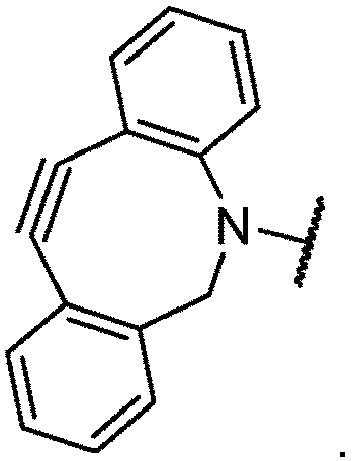
- Composé de la revendication 1 selon la Formule I :

- Composé de l'une quelconque des revendications 1 à 2, dans lequel EG est :


- Composé de l'une quelconque des revendications 1 à 3, dans lequel RT comprend un résidu d'un acide aminé naturel ou non naturel ou un résidu d'un sucre, éventuellement dans lequel RT est :

- Composé de l'une quelconque des revendications 1 à 4, où RT1 est un groupe déclencheur de libération ou un lieur clivable ; éventuellement dans lequel RT1 est absent ;


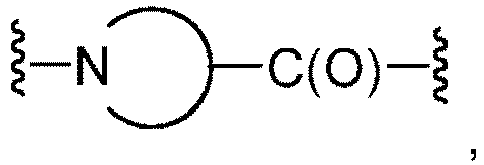

- Composé de l'une quelconque des revendications 1 à 6, dans lequel SG comprend alkylène en C1-C10, -C(O)- ou une combinaison de ceux-ci ; éventuellement dans lequel SG est :

- Composé de l'une quelconque des revendications 1 à 6, dans lequel HP comprend du poly(éthylène glycol) ; éventuellement dans lequel HP est :
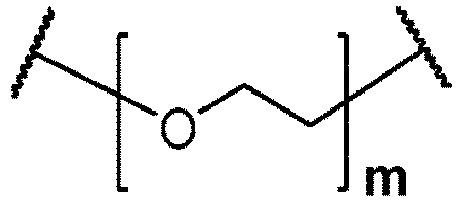
- Composé de l'une quelconque des revendications 1 à 7, dans lequel HP1 est absent ou


- Composé de l'une quelconque des revendications 1 à 8, dans lequel W1, W2, W3, W4 et W5 sont chacun indépendamment une simple liaison, absents, ou comprennent -C(O)-, -O-, -C(O)NH-, -C(O)NH-alkyle-, -OC(O)NH-, -SC(O)NH-, -NH-, -NH-alkyle-, -N(CH3)CH2CH2N(CH3)-, -S-, -S-S-, -OCH2CH2O-, ou une combinaison de ceux-ci.
- Composé de l'une quelconque des revendications 1 à 9, dans lequel W1, W2, W3, W4 et W5 sont indépendamment absents ou une liaison ; ou un sel, solvate ou tautomère pharmaceutiquement acceptable de celui-ci.
- Composé de l'une quelconque des revendications 1 à 10, dans lequel Ar est un aryle monocyclique divalent, à six chaînons, substitué ou non substitué, ou un hétéroaryle monocyclique divalent, à six chaînons, substitué ou non substitué.
- Composé de l'une quelconque des revendications 1 à 10, dans lequel Ar est un hétéroaryle bicyclique fusionné divalent, à neuf chaînons, substitué ou non substitué.
- Composé de l'une quelconque des revendications 1 à 10, dans lequel Ar est :

- Composé de l'une quelconque des revendications 1 à 13, dans lequel L est absent.
- Composé de la revendication 1, selon l'une quelconque des Formules suivantes :


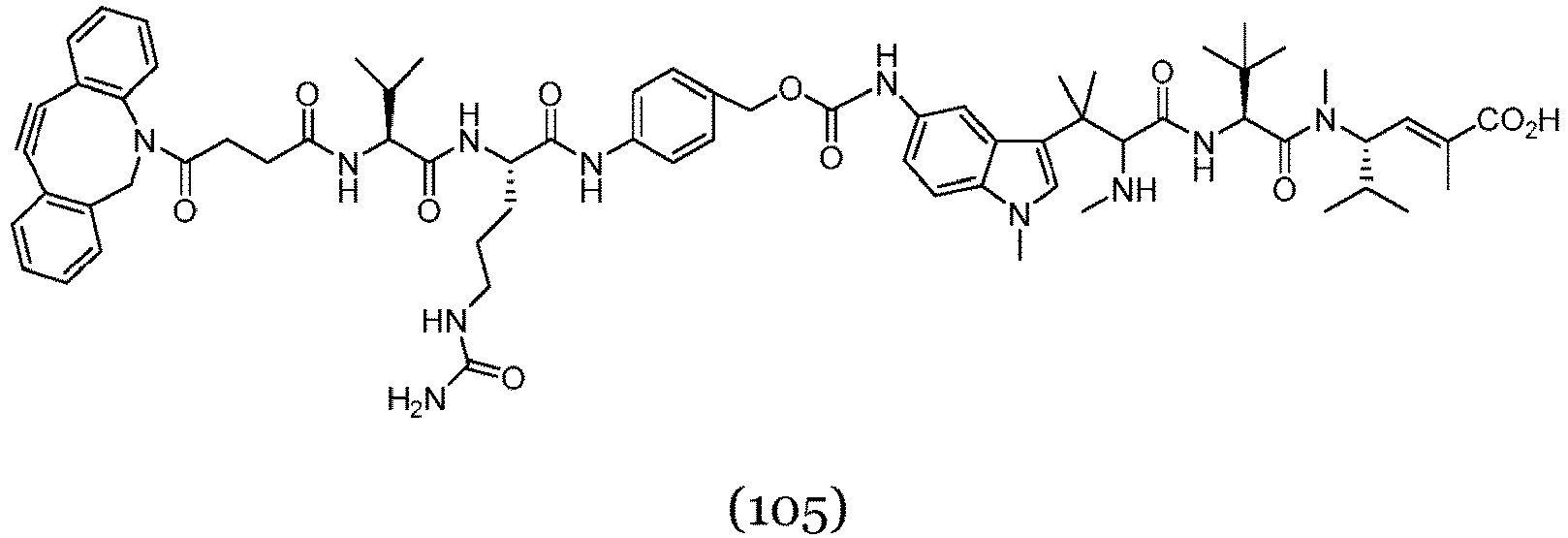


- Composé de la revendication 1, qui est

- Composé qui est

- Conjugué comprenant un composé de l'une quelconque des revendications 1 à 17, relié à un deuxième composé par le biais d'un lieur.
- Conjugué de la revendication 18, dans lequel le deuxième composé est un résidu d'un polypeptide ou d'un anticorps.
- Conjugué sélectionné dans le groupe constitué par :


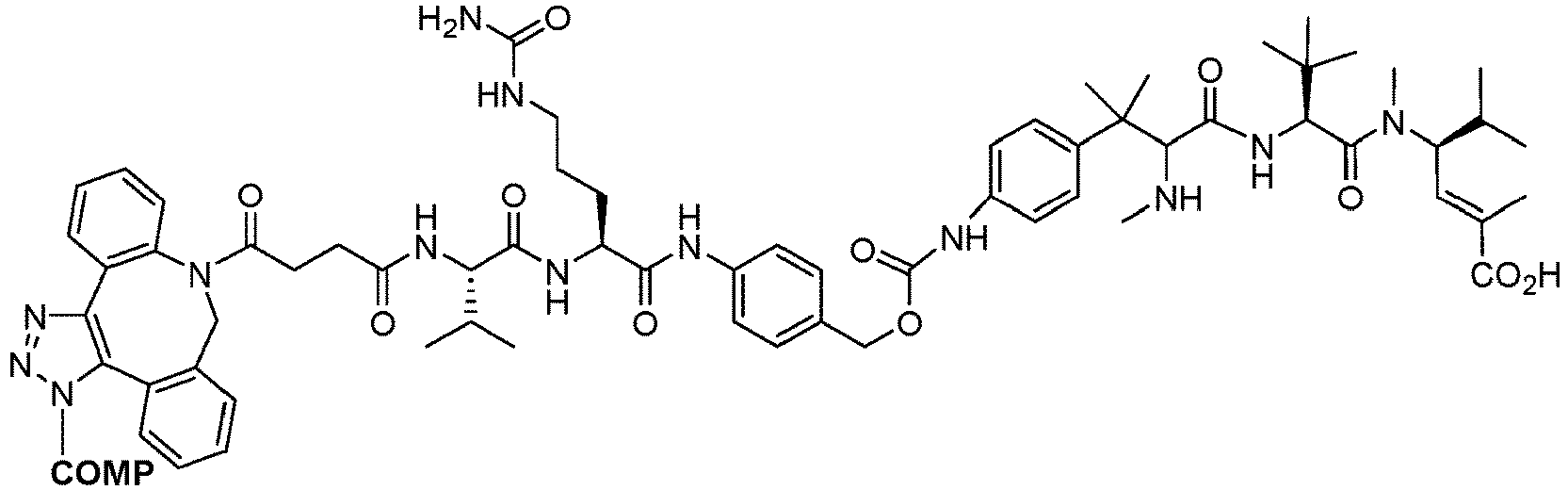


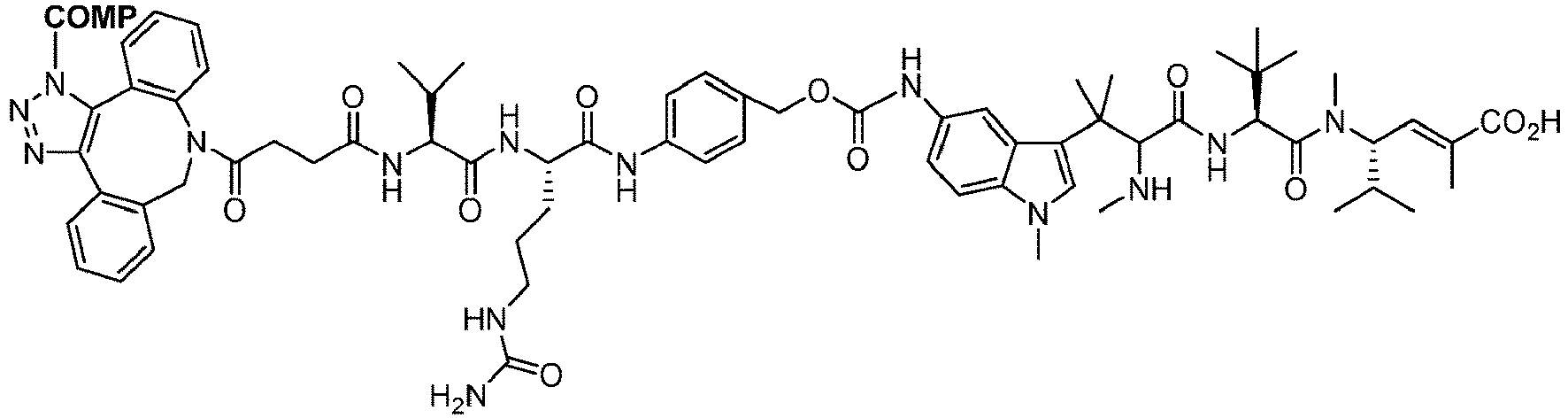


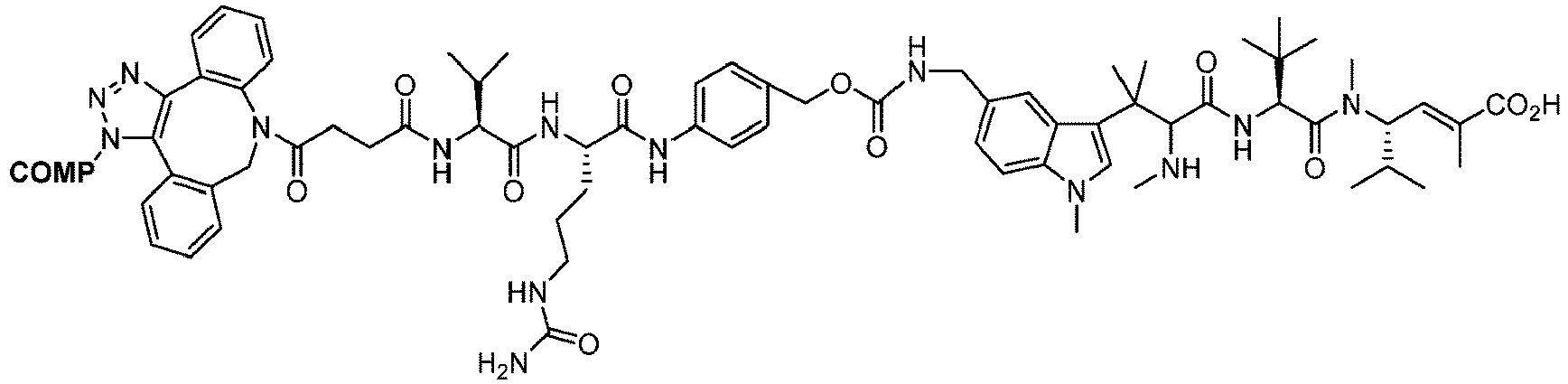
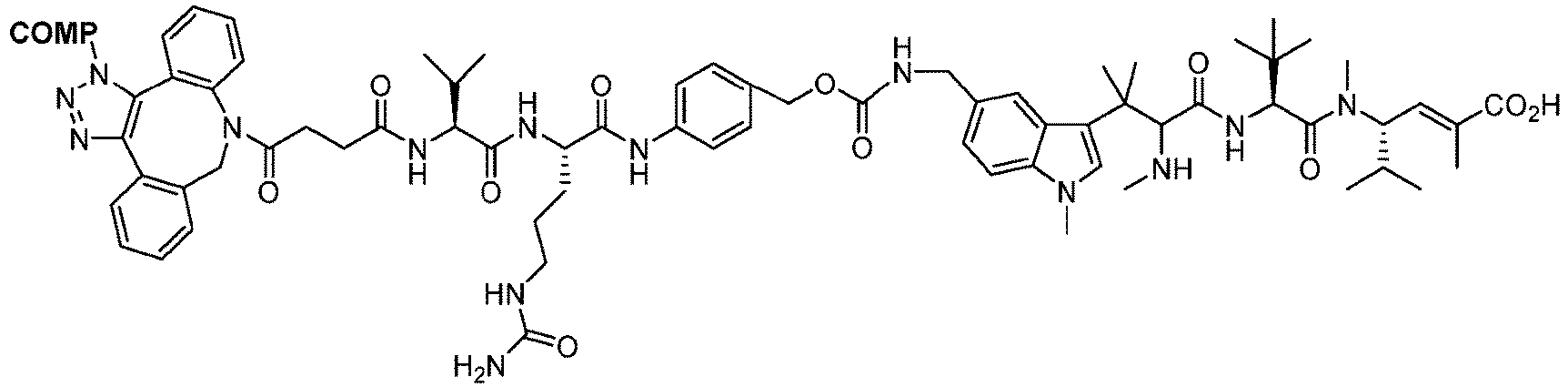


- Conjugué de la revendication 20, qui est :


- Conjugué de l'une quelconque des revendications 18 à 21, dans lequel COMP est un résidu d'un polypeptide ; ou COMP est un résidu d'un anticorps ; ou COMP est un résidu d'une chaîne d'anticorps.
- Composition pharmaceutique comprenant le composé de l'une quelconque des revendications 1 à 17 ou le conjugué de l'une quelconque des revendications 18 à 22 ; et un excipient, véhicule ou diluant pharmaceutiquement acceptable.
- Composé de l'une quelconque des revendications 1 à 17, conjugué de l'une quelconque des revendications 18 à 22, ou composition pharmaceutique de la revendication 23 pour une utilisation en thérapie.
- Quantité effective du composé de l'une quelconque des revendications 1 à 17, du conjugué de l'une quelconque des revendications 18 à 22, ou de la composition pharmaceutique de la revendication 23 pour une utilisation dans un procédé d'inhibition de la polymérisation de tubuline chez un sujet en ayant besoin ; ou pour une utilisation dans un procédé de traitement d'une prolifération cellulaire ou d'un cancer chez un sujet en ayant besoin, éventuellement où le cancer est un cancer du poumon à petites cellules, un cancer du poumon non à petites cellules, un cancer ovarien, un cancer ovarien résistant au platine, un adénocarcinome ovarien, un cancer de l'endomètre, un cancer du sein, un cancer du sein qui surexprime Her2, un cancer du sein triple négatif, un lymphome, un lymphome à grandes cellules ; un lymphome histiocytaire et lymphocytaire mixte diffus ; un lymphome folliculaire à cellules B, un cancer du côlon, un carcinome du côlon, un adénocarcinome du côlon, un adénocarcinome colorectal, un mélanome, un cancer de la prostate, ou un myélome multiple.
- Procédé de production d'un conjugué, comprenant la mise en contact d'un composé sélectionné dans le groupe constitué par :

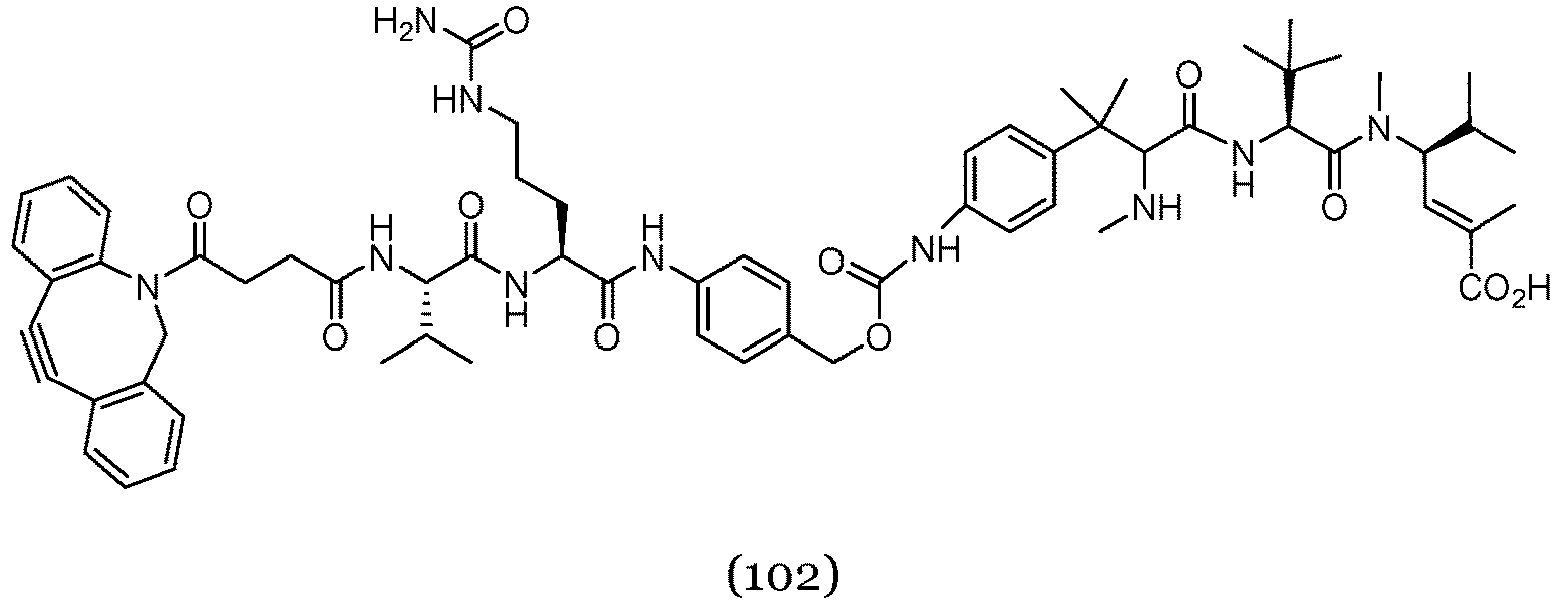
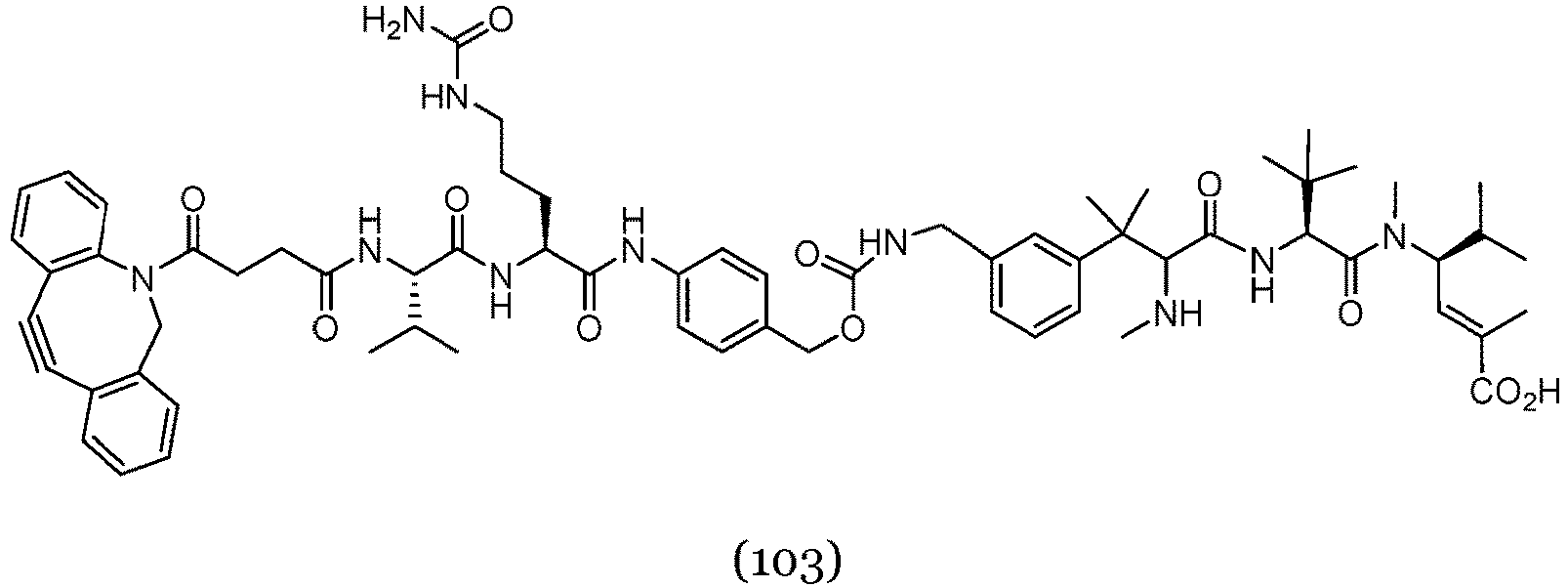


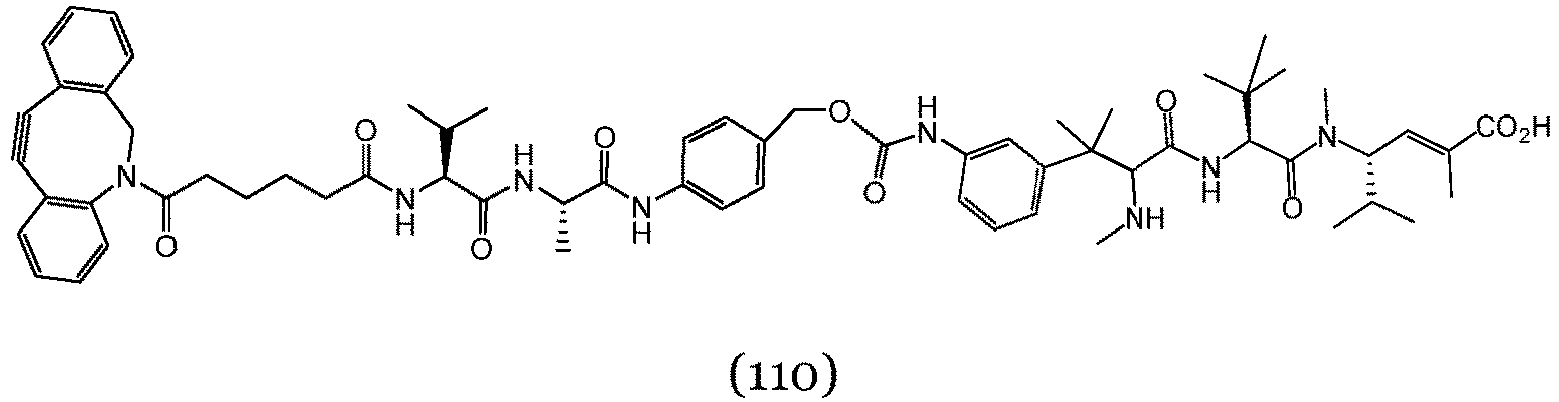

- Procédé de la revendication 26, dans lequel le composé (101) est mis en contact avec le deuxième composé comprenant un azoture.
Priority Applications (4)
| Application Number | Priority Date | Filing Date | Title |
|---|---|---|---|
| HRP20211164TT HRP20211164T1 (hr) | 2015-01-30 | 2016-01-29 | Derivati hemiasterlina za konjugaciju i terapiju |
| EP21175538.4A EP3892305A1 (fr) | 2015-01-30 | 2016-01-29 | Dérivés d'hémiasterline pour conjugaison et thérapie |
| SI201631257T SI3250237T1 (sl) | 2015-01-30 | 2016-01-29 | Derivati hemiasterlina za konjugacijo in terapijo |
| PL16705387T PL3250237T3 (pl) | 2015-01-30 | 2016-01-29 | Pochodne hemiasterliny do koniugacji i terapii |
Applications Claiming Priority (2)
| Application Number | Priority Date | Filing Date | Title |
|---|---|---|---|
| US201562110390P | 2015-01-30 | 2015-01-30 | |
| PCT/US2016/015844 WO2016123582A1 (fr) | 2015-01-30 | 2016-01-29 | Dérivés d'hémiasterline pour conjugaison et thérapie |
Related Child Applications (1)
| Application Number | Title | Priority Date | Filing Date |
|---|---|---|---|
| EP21175538.4A Division EP3892305A1 (fr) | 2015-01-30 | 2016-01-29 | Dérivés d'hémiasterline pour conjugaison et thérapie |
Publications (2)
| Publication Number | Publication Date |
|---|---|
| EP3250237A1 EP3250237A1 (fr) | 2017-12-06 |
| EP3250237B1 true EP3250237B1 (fr) | 2021-05-26 |
Family
ID=55398448
Family Applications (2)
| Application Number | Title | Priority Date | Filing Date |
|---|---|---|---|
| EP16705387.5A Active EP3250237B1 (fr) | 2015-01-30 | 2016-01-29 | Dérivés d'hémiasterline pour conjugaison et thérapie |
| EP21175538.4A Pending EP3892305A1 (fr) | 2015-01-30 | 2016-01-29 | Dérivés d'hémiasterline pour conjugaison et thérapie |
Family Applications After (1)
| Application Number | Title | Priority Date | Filing Date |
|---|---|---|---|
| EP21175538.4A Pending EP3892305A1 (fr) | 2015-01-30 | 2016-01-29 | Dérivés d'hémiasterline pour conjugaison et thérapie |
Country Status (18)
| Country | Link |
|---|---|
| US (4) | US10844090B2 (fr) |
| EP (2) | EP3250237B1 (fr) |
| JP (2) | JP6883518B2 (fr) |
| KR (1) | KR102587808B1 (fr) |
| CN (2) | CN114716506A (fr) |
| AU (1) | AU2016211165B2 (fr) |
| CA (1) | CA2971766A1 (fr) |
| DK (1) | DK3250237T3 (fr) |
| ES (1) | ES2878023T3 (fr) |
| HR (1) | HRP20211164T1 (fr) |
| HU (1) | HUE055644T2 (fr) |
| IL (1) | IL253712B (fr) |
| LT (1) | LT3250237T (fr) |
| PL (1) | PL3250237T3 (fr) |
| PT (1) | PT3250237T (fr) |
| SG (1) | SG11201704976VA (fr) |
| SI (1) | SI3250237T1 (fr) |
| WO (1) | WO2016123582A1 (fr) |
Families Citing this family (45)
| Publication number | Priority date | Publication date | Assignee | Title |
|---|---|---|---|---|
| US9738724B2 (en) | 2012-06-08 | 2017-08-22 | Sutro Biopharma, Inc. | Antibodies comprising site-specific non-natural amino acid residues, methods of their preparation and methods of their use |
| EP3135690A1 (fr) | 2012-06-26 | 2017-03-01 | Sutro Biopharma, Inc. | Proteines fc modifiees contenant des residus specifiques d'acides amines non naturels, leurs conjugues, leurs procedes de preparation et leurs procedes d'utilisation |
| WO2015006555A2 (fr) | 2013-07-10 | 2015-01-15 | Sutro Biopharma, Inc. | Anticorps comprenant plusieurs résidus d'acides aminés non naturels site-spécifiques, des procédés permettant leur préparation et leurs méthodes d'utilisation |
| KR101628872B1 (ko) | 2014-05-28 | 2016-06-09 | 주식회사 레고켐 바이오사이언스 | 자가-희생 기를 포함하는 화합물 |
| WO2017051254A1 (fr) | 2015-09-25 | 2017-03-30 | Legochem Biosciences, Inc. | Compositions et méthodes associées à des conjugués anticorps anti-egfr-médicaments |
| WO2017051249A1 (fr) * | 2015-09-25 | 2017-03-30 | Legochem Biosciences, Inc. | Compositions et méthodes associées à des conjugués anticorps anti-cd19-médicaments |
| CN107847605B (zh) | 2015-11-25 | 2021-12-24 | 乐高化学生物科学股份有限公司 | 包含分支接头的抗体-药物缀合物及其相关方法 |
| JP7120765B2 (ja) | 2015-11-25 | 2022-08-17 | レゴケム バイオサイエンシズ, インク. | ペプチド基を含む複合体及びそれに関連する方法 |
| HUE067016T2 (hu) | 2015-11-25 | 2024-09-28 | Ligachem Biosciences Inc | Önfeláldozó csoportokat tartalmazó konjugátumok és ezekkel kapcsolos eljárások |
| AU2017212739B2 (en) | 2016-01-27 | 2024-03-21 | Sutro Biopharma, Inc. | Anti-CD74 antibody conjugates, compositions comprising anti-CD74 antibody conjugates and methods of using anti-CD74 antibody conjugates |
| US11299509B2 (en) * | 2017-02-10 | 2022-04-12 | The Board Of Trustees Of The University Of Illinois | Trigger-activatable sugar conjugates for cancer-selective labeling and targeting |
| JP7664680B2 (ja) | 2017-03-29 | 2025-04-18 | リガケム バイオサイエンシズ, インク. | ピロロベンゾジアゼピン二量体前駆体及びそのリガンド-リンカーコンジュゲート化合物 |
| CN111051329B (zh) * | 2017-08-10 | 2024-07-30 | 住友制药株式会社 | 哈米特林衍生物及它们的抗体药物复合物 |
| CA3072153A1 (fr) * | 2017-08-10 | 2019-02-14 | Sumitomo Dainippon Pharma Co., Ltd. | Conjugues anticorps-medicament comprenant un derive d'hemiasterline |
| MA50265A (fr) | 2017-09-18 | 2020-07-29 | Sutro Biopharma Inc | Conjugués anticorps-récepteur alpha anti-folate et leurs utilisations |
| EP3765516A2 (fr) * | 2018-03-14 | 2021-01-20 | Elstar Therapeutics, Inc. | Molécules multifonctionnelles et utilisations associées |
| US11827703B2 (en) | 2018-05-09 | 2023-11-28 | Legochem Biosciences, Inc. | Compositions and methods related to anti-CD19 antibody drug conjugates |
| JP2022500454A (ja) | 2018-09-17 | 2022-01-04 | ストロ バイオファーマ インコーポレーテッド | 抗葉酸受容体抗体コンジュゲートによる併用療法 |
| CN113412271B (zh) * | 2019-02-13 | 2024-10-22 | 住友制药株式会社 | 具有半胱氨酸残基的哈米特林衍生物 |
| JP7560255B2 (ja) * | 2019-02-13 | 2024-10-02 | 住友ファーマ株式会社 | ヘミアスタリン誘導体を含む抗体薬物複合体を含有する医薬 |
| US12178879B2 (en) | 2019-02-13 | 2024-12-31 | Sumitomo Pharma Co., Ltd. | Hemiasterlin derivative and antibody-drug conjugate thereof |
| KR20240104214A (ko) | 2019-03-29 | 2024-07-04 | 메디뮨 리미티드 | 화합물 및 이의 접합체 |
| US20220362394A1 (en) | 2019-05-03 | 2022-11-17 | Sutro Biopharma, Inc. | Anti-bcma antibody conjugates |
| EP3980423A1 (fr) | 2019-06-10 | 2022-04-13 | Sutro Biopharma, Inc. | Composés 5h-pyrrolo[3,2-d]pyrimidine-2,4-diamino et conjugués d'anticorps associés |
| EP3980080A1 (fr) * | 2019-06-10 | 2022-04-13 | Sutro Biopharma, Inc. | Conjugués anticorps-médicament immunomodulateurs et utilisations associées |
| KR20210028544A (ko) | 2019-09-04 | 2021-03-12 | 주식회사 레고켐 바이오사이언스 | 인간 ror1에 대한 항체를 포함하는 항체 약물 접합체 및 이의 용도 |
| CN111117966A (zh) * | 2020-03-02 | 2020-05-08 | 南通大学 | 一种利用乳酸的体外细胞培养方法 |
| KR102986821B1 (ko) | 2020-04-22 | 2026-07-06 | 머크 샤프 앤드 돔 엘엘씨 | 인터류킨-2 수용체 베타 감마c 이량체에 대해 편향되고 비펩티드성 수용성 중합체에 접합된 인간 인터류킨-2 접합체 |
| CA3185458A1 (fr) * | 2020-06-03 | 2021-12-09 | Merck Patent Gmbh | Conjugues anticorps bispecifiques-medicament ciblant egfr et muc1 et leurs utilisations |
| CN117396231A (zh) | 2021-04-30 | 2024-01-12 | 新基公司 | 使用抗BCMA抗体药物缀合物(ADC)与γ分泌酶抑制剂(GSI)的组合的组合疗法 |
| EP4340876A1 (fr) | 2021-05-19 | 2024-03-27 | Sutro Biopharma, Inc. | Polythérapie à conjugué de récepteur anti-folate avec du bévacizumab |
| JP2024544058A (ja) | 2021-12-01 | 2024-11-27 | ストロ バイオファーマ インコーポレーテッド | 抗葉酸受容体コンジュゲートがん治療法 |
| EP4543494A1 (fr) * | 2022-06-27 | 2025-04-30 | Sutro Biopharma, Inc. | Charges utiles de lieur bêta-glucuronide, leurs conjugués protéiques et méthodes associées |
| IL317782A (en) | 2022-06-30 | 2025-02-01 | Sutro Biopharma Inc | Anti-ROR1 antibodies and conjugates thereof, compositions containing anti-ROR1 antibodies or conjugates thereof, and methods for preparing and using anti-ROR1 antibodies and conjugates thereof |
| WO2025005765A1 (fr) * | 2023-06-29 | 2025-01-02 | 주식회사 피노바이오 | Nouveau dérivé d'hémiasterline et son utilisation |
| CN117304071B (zh) * | 2023-09-07 | 2026-02-03 | 西安瑞联新材料股份有限公司 | 一种手性n-烷基氨基酸衍生物的合成方法 |
| IL327670A (en) | 2023-10-11 | 2026-06-01 | Antikor Biopharma Ltd | Antibodies, conjugates, and uses thereof |
| US12540197B2 (en) | 2023-10-13 | 2026-02-03 | Sutro Biopharma, Inc. | Anti-tissue factor antibodies and antibody conjugates, compositions comprising anti-tissue factor antibodies or antibody conjugates, and methods of making and using anti-tissue factor antibodies and antibody conjugates |
| TW202613130A (zh) | 2024-05-30 | 2026-04-01 | 日商安斯泰來製藥股份有限公司 | Sting促效劑免疫刺激性抗體藥物結合物 |
| WO2025250825A1 (fr) | 2024-05-30 | 2025-12-04 | Sutro Biopharma, Inc. | Anticorps anti-trop2, compositions comprenant des anticorps anti-trop2 et méthodes de fabrication et d'utilisation d'anticorps anti-trop2 |
| WO2026080688A1 (fr) | 2024-10-09 | 2026-04-16 | Sutro Biopharma, Inc. | Conjugués anticorps-médicament à charge utile à double mécanisme d'action |
| WO2026080697A1 (fr) | 2024-10-09 | 2026-04-16 | Sutro Biopharma, Inc. | Conjugués d'anticorps à rapports élevés charge utile/anticorps, compositions les comprenant, et leurs procédés d'utilisation |
| WO2026165196A1 (fr) | 2025-01-29 | 2026-08-06 | Astellas Pharma Inc. | Conjugués anticorps-médicament immunomodulateurs à double charge utile anti-b7-h3 |
| WO2026165269A1 (fr) | 2025-01-29 | 2026-08-06 | Sutro Biopharma, Inc. | Anticorps anti-b7-h3, compositions comprenant des anticorps anti-b7-h3 et procédés de fabrication et méthodes d'utilisation d'anticorps anti-b7-h3 |
| WO2026162763A1 (fr) * | 2025-01-31 | 2026-08-06 | Astrazeneca Ab | Conjugués comprenant des liants clivables |
Family Cites Families (9)
| Publication number | Priority date | Publication date | Assignee | Title |
|---|---|---|---|---|
| US5661175A (en) | 1995-06-20 | 1997-08-26 | Kashman; Yoel | Hemiasterlin and geodiamolide TA |
| CA2225325A1 (fr) * | 1997-12-19 | 1999-06-19 | The University Of British Columbia | Substances hemiasterlines analogues |
| WO2003072754A2 (fr) | 2002-02-27 | 2003-09-04 | The Government Of The United States Of America, Represented By The Secretary, Department Of Health And Human Services | Conjugues de ligand, adaptateur et agent cytotoxique, compositions associees et procedes d'utilisation relatifs |
| WO2003082268A2 (fr) * | 2002-03-22 | 2003-10-09 | Eisai Co. Ltd | Derives de l'hemiasterline et leurs utilisations |
| US7064211B2 (en) * | 2002-03-22 | 2006-06-20 | Eisai Co., Ltd. | Hemiasterlin derivatives and uses thereof |
| US20040121965A1 (en) | 2002-09-20 | 2004-06-24 | Wyeth Holdings Corporation | Method of treating resistant tumors |
| US7390910B2 (en) | 2003-08-08 | 2008-06-24 | Wyeth | Compounds for treating tumors |
| HK1220626A1 (zh) * | 2013-03-15 | 2017-05-12 | The Centre For Drug Research And Development | 具细胞毒性和抗有丝分裂的化合物以及其使用方法 |
| MX2016008448A (es) | 2013-12-27 | 2017-01-09 | Zymeworks Inc | Conjugados de var2csa-farmaco. |
-
2016
- 2016-01-29 CN CN202210281131.6A patent/CN114716506A/zh active Pending
- 2016-01-29 SG SG11201704976VA patent/SG11201704976VA/en unknown
- 2016-01-29 US US15/011,388 patent/US10844090B2/en active Active
- 2016-01-29 HR HRP20211164TT patent/HRP20211164T1/hr unknown
- 2016-01-29 EP EP16705387.5A patent/EP3250237B1/fr active Active
- 2016-01-29 SI SI201631257T patent/SI3250237T1/sl unknown
- 2016-01-29 HU HUE16705387A patent/HUE055644T2/hu unknown
- 2016-01-29 LT LTEP16705387.5T patent/LT3250237T/lt unknown
- 2016-01-29 PT PT167053875T patent/PT3250237T/pt unknown
- 2016-01-29 DK DK16705387.5T patent/DK3250237T3/da active
- 2016-01-29 CN CN201680007822.XA patent/CN107428801B/zh active Active
- 2016-01-29 WO PCT/US2016/015844 patent/WO2016123582A1/fr not_active Ceased
- 2016-01-29 EP EP21175538.4A patent/EP3892305A1/fr active Pending
- 2016-01-29 ES ES16705387T patent/ES2878023T3/es active Active
- 2016-01-29 CA CA2971766A patent/CA2971766A1/fr active Pending
- 2016-01-29 PL PL16705387T patent/PL3250237T3/pl unknown
- 2016-01-29 JP JP2017540065A patent/JP6883518B2/ja active Active
- 2016-01-29 KR KR1020177023820A patent/KR102587808B1/ko active Active
- 2016-01-29 AU AU2016211165A patent/AU2016211165B2/en active Active
-
2017
- 2017-07-28 IL IL253712A patent/IL253712B/en unknown
-
2020
- 2020-11-02 US US17/087,597 patent/US20210261611A1/en active Pending
- 2020-11-02 US US17/087,594 patent/US11866515B2/en active Active
-
2021
- 2021-05-10 JP JP2021079604A patent/JP2021138706A/ja active Pending
-
2023
- 2023-11-20 US US18/515,100 patent/US20240254163A1/en active Pending
Non-Patent Citations (2)
| Title |
|---|
| PIERRIK LASSALAS ET AL: "Structure Property Relationships of Carboxylic Acid Isosteres", JOURNAL OF MEDICINAL CHEMISTRY, vol. 59, no. 7, 30 March 2016 (2016-03-30), US, pages 3183 - 3203, XP055632960, ISSN: 0022-2623, DOI: 10.1021/acs.jmedchem.5b01963 * |
| TONI LASSILA ET AL: "Toxicity of Carboxylic Acid-Containing Drugs: The Role of Acyl Migration and CoA Conjugation Investigated", CHEMICAL RESEARCH IN TOXICOLOGY, vol. 28, no. 12, 11 November 2015 (2015-11-11), US, pages 2292 - 2303, XP055632962, ISSN: 0893-228X, DOI: 10.1021/acs.chemrestox.5b00315 * |
Also Published As
Similar Documents
| Publication | Publication Date | Title |
|---|---|---|
| US20240254163A1 (en) | Hemiasterlin derivatives for conjugation and therapy | |
| JP2018508490A5 (fr) | ||
| WO2024006272A9 (fr) | CHARGES UTILES DE LIEUR β-GLUCURONIDE, LEURS CONJUGUÉS PROTÉIQUES ET MÉTHODES ASSOCIÉES | |
| KR20230028325A (ko) | 튜불리신 및 단백질-튜불리신 접합체 | |
| CN114728075B (zh) | 与分子缀合相关的组合物和方法 | |
| KR20210106467A (ko) | 튜불리신 및 단백질-튜불리신 접합체 | |
| CN119855820A (zh) | 喜树碱类化合物及其制备方法和用途 | |
| NO334096B1 (no) | Nye antitumorale derivater avledet fra aplidin | |
| CA3051038A1 (fr) | Derives de calicheamicine et conjugues anticorps-medicaments de ceux-ci | |
| KR101223158B1 (ko) | 6,11-다리걸친 바이아릴 매크로라이드 | |
| KR20250138214A (ko) | 엑티나시딘 유도체 항체 약물 접합체 | |
| KR20230137295A (ko) | 접합체 및 이의 용도 | |
| HK40063945A (en) | Hemiasterlin derivatives for conjugation and therapy | |
| BR112017016122B1 (pt) | Composto, conjugado, composição farmacêutica, uso de um composto, conjugado ou composição farmacêutica, e, método para produção de um conjugado | |
| EP4039331A1 (fr) | Dérivé d'azépane | |
| WO2010073009A2 (fr) | Composés, compositions et utilisation | |
| WO2024131843A1 (fr) | Conjugué anticorps-médicament, son procédé de préparation et son utilisation | |
| EA041670B1 (ru) | Соединение, фармацевтическая композиция, содержащая его, и способ лечения или профилактики инфекции вируса гепатита в |
Legal Events
| Date | Code | Title | Description |
|---|---|---|---|
| STAA | Information on the status of an ep patent application or granted ep patent |
Free format text: STATUS: THE INTERNATIONAL PUBLICATION HAS BEEN MADE |
|
| PUAI | Public reference made under article 153(3) epc to a published international application that has entered the european phase |
Free format text: ORIGINAL CODE: 0009012 |
|
| STAA | Information on the status of an ep patent application or granted ep patent |
Free format text: STATUS: REQUEST FOR EXAMINATION WAS MADE |
|
| 17P | Request for examination filed |
Effective date: 20170620 |
|
| AK | Designated contracting states |
Kind code of ref document: A1 Designated state(s): AL AT BE BG CH CY CZ DE DK EE ES FI FR GB GR HR HU IE IS IT LI LT LU LV MC MK MT NL NO PL PT RO RS SE SI SK SM TR |
|
| AX | Request for extension of the european patent |
Extension state: BA ME |
|
| DAV | Request for validation of the european patent (deleted) | ||
| DAX | Request for extension of the european patent (deleted) | ||
| STAA | Information on the status of an ep patent application or granted ep patent |
Free format text: STATUS: EXAMINATION IS IN PROGRESS |
|
| 17Q | First examination report despatched |
Effective date: 20181203 |
|
| 17Q | First examination report despatched |
Effective date: 20181203 |
|
| REG | Reference to a national code |
Ref country code: DE Ref legal event code: R079 Ref document number: 602016058355 Country of ref document: DE Free format text: PREVIOUS MAIN CLASS: A61K0047500000 Ipc: C07K0005065000 |
|
| GRAP | Despatch of communication of intention to grant a patent |
Free format text: ORIGINAL CODE: EPIDOSNIGR1 |
|
| STAA | Information on the status of an ep patent application or granted ep patent |
Free format text: STATUS: GRANT OF PATENT IS INTENDED |
|
| RIC1 | Information provided on ipc code assigned before grant |
Ipc: A61K 38/00 20060101ALI20201112BHEP Ipc: A61P 35/00 20060101ALI20201112BHEP Ipc: C07K 5/02 20060101ALI20201112BHEP Ipc: C07K 5/065 20060101AFI20201112BHEP Ipc: A61K 47/68 20170101ALI20201112BHEP |
|
| INTG | Intention to grant announced |
Effective date: 20201201 |
|
| GRAS | Grant fee paid |
Free format text: ORIGINAL CODE: EPIDOSNIGR3 |
|
| GRAA | (expected) grant |
Free format text: ORIGINAL CODE: 0009210 |
|
| STAA | Information on the status of an ep patent application or granted ep patent |
Free format text: STATUS: THE PATENT HAS BEEN GRANTED |
|
| AK | Designated contracting states |
Kind code of ref document: B1 Designated state(s): AL AT BE BG CH CY CZ DE DK EE ES FI FR GB GR HR HU IE IS IT LI LT LU LV MC MK MT NL NO PL PT RO RS SE SI SK SM TR |
|
| REG | Reference to a national code |
Ref country code: GB Ref legal event code: FG4D |
|
| REG | Reference to a national code |
Ref country code: CH Ref legal event code: EP |
|
| REG | Reference to a national code |
Ref country code: AT Ref legal event code: REF Ref document number: 1396151 Country of ref document: AT Kind code of ref document: T Effective date: 20210615 |
|
| REG | Reference to a national code |
Ref country code: DE Ref legal event code: R096 Ref document number: 602016058355 Country of ref document: DE |
|
| REG | Reference to a national code |
Ref country code: IE Ref legal event code: FG4D |
|
| REG | Reference to a national code |
Ref country code: PT Ref legal event code: SC4A Ref document number: 3250237 Country of ref document: PT Date of ref document: 20210630 Kind code of ref document: T Free format text: AVAILABILITY OF NATIONAL TRANSLATION Effective date: 20210624 |
|
| REG | Reference to a national code |
Ref country code: FI Ref legal event code: FGE |
|
| RAP4 | Party data changed (patent owner data changed or rights of a patent transferred) |
Owner name: SUTRO BIOPHARMA, INC. |
|
| REG | Reference to a national code |
Ref country code: HR Ref legal event code: TUEP Ref document number: P20211164T Country of ref document: HR |
|
| REG | Reference to a national code |
Ref country code: DK Ref legal event code: T3 Effective date: 20210720 |
|
| REG | Reference to a national code |
Ref country code: NL Ref legal event code: FP |
|
| REG | Reference to a national code |
Ref country code: SE Ref legal event code: TRGR |
|
| REG | Reference to a national code |
Ref country code: NO Ref legal event code: T2 Effective date: 20210526 |
|
| PG25 | Lapsed in a contracting state [announced via postgrant information from national office to epo] |
Ref country code: BG Free format text: LAPSE BECAUSE OF FAILURE TO SUBMIT A TRANSLATION OF THE DESCRIPTION OR TO PAY THE FEE WITHIN THE PRESCRIBED TIME-LIMIT Effective date: 20210826 |
|
| REG | Reference to a national code |
Ref country code: HR Ref legal event code: T1PR Ref document number: P20211164 Country of ref document: HR |
|
| REG | Reference to a national code |
Ref country code: ES Ref legal event code: FG2A Ref document number: 2878023 Country of ref document: ES Kind code of ref document: T3 Effective date: 20211118 |
|
| PG25 | Lapsed in a contracting state [announced via postgrant information from national office to epo] |
Ref country code: RS Free format text: LAPSE BECAUSE OF FAILURE TO SUBMIT A TRANSLATION OF THE DESCRIPTION OR TO PAY THE FEE WITHIN THE PRESCRIBED TIME-LIMIT Effective date: 20210526 Ref country code: GR Free format text: LAPSE BECAUSE OF FAILURE TO SUBMIT A TRANSLATION OF THE DESCRIPTION OR TO PAY THE FEE WITHIN THE PRESCRIBED TIME-LIMIT Effective date: 20210827 |
|
| PG25 | Lapsed in a contracting state [announced via postgrant information from national office to epo] |
Ref country code: SK Free format text: LAPSE BECAUSE OF FAILURE TO SUBMIT A TRANSLATION OF THE DESCRIPTION OR TO PAY THE FEE WITHIN THE PRESCRIBED TIME-LIMIT Effective date: 20210526 Ref country code: SM Free format text: LAPSE BECAUSE OF FAILURE TO SUBMIT A TRANSLATION OF THE DESCRIPTION OR TO PAY THE FEE WITHIN THE PRESCRIBED TIME-LIMIT Effective date: 20210526 Ref country code: EE Free format text: LAPSE BECAUSE OF FAILURE TO SUBMIT A TRANSLATION OF THE DESCRIPTION OR TO PAY THE FEE WITHIN THE PRESCRIBED TIME-LIMIT Effective date: 20210526 Ref country code: CZ Free format text: LAPSE BECAUSE OF FAILURE TO SUBMIT A TRANSLATION OF THE DESCRIPTION OR TO PAY THE FEE WITHIN THE PRESCRIBED TIME-LIMIT Effective date: 20210526 Ref country code: RO Free format text: LAPSE BECAUSE OF FAILURE TO SUBMIT A TRANSLATION OF THE DESCRIPTION OR TO PAY THE FEE WITHIN THE PRESCRIBED TIME-LIMIT Effective date: 20210526 |
|
| REG | Reference to a national code |
Ref country code: HR Ref legal event code: ODRP Ref document number: P20211164 Country of ref document: HR Payment date: 20220126 Year of fee payment: 7 |
|
| REG | Reference to a national code |
Ref country code: DE Ref legal event code: R097 Ref document number: 602016058355 Country of ref document: DE |
|
| REG | Reference to a national code |
Ref country code: HU Ref legal event code: AG4A Ref document number: E055644 Country of ref document: HU |
|
| PLBE | No opposition filed within time limit |
Free format text: ORIGINAL CODE: 0009261 |
|
| STAA | Information on the status of an ep patent application or granted ep patent |
Free format text: STATUS: NO OPPOSITION FILED WITHIN TIME LIMIT |
|
| 26N | No opposition filed |
Effective date: 20220301 |
|
| REG | Reference to a national code |
Ref country code: HR Ref legal event code: ODRP Ref document number: P20211164 Country of ref document: HR Payment date: 20230113 Year of fee payment: 8 |
|
| PGFP | Annual fee paid to national office [announced via postgrant information from national office to epo] |
Ref country code: MC Payment date: 20231228 Year of fee payment: 9 |
|
| PGFP | Annual fee paid to national office [announced via postgrant information from national office to epo] |
Ref country code: IS Payment date: 20231218 Year of fee payment: 9 |
|
| REG | Reference to a national code |
Ref country code: HR Ref legal event code: ODRP Ref document number: P20211164 Country of ref document: HR Payment date: 20231212 Year of fee payment: 9 |
|
| PGFP | Annual fee paid to national office [announced via postgrant information from national office to epo] |
Ref country code: LU Payment date: 20240112 Year of fee payment: 9 |
|
| PG25 | Lapsed in a contracting state [announced via postgrant information from national office to epo] |
Ref country code: CY Free format text: LAPSE BECAUSE OF FAILURE TO SUBMIT A TRANSLATION OF THE DESCRIPTION OR TO PAY THE FEE WITHIN THE PRESCRIBED TIME-LIMIT Effective date: 20210526 |
|
| PGFP | Annual fee paid to national office [announced via postgrant information from national office to epo] |
Ref country code: MT Payment date: 20240122 Year of fee payment: 9 |
|
| REG | Reference to a national code |
Ref country code: HR Ref legal event code: ODRP Ref document number: P20211164 Country of ref document: HR Payment date: 20241210 Year of fee payment: 10 |
|
| PG25 | Lapsed in a contracting state [announced via postgrant information from national office to epo] |
Ref country code: MC Free format text: LAPSE BECAUSE OF NON-PAYMENT OF DUE FEES Effective date: 20250131 Ref country code: LU Free format text: LAPSE BECAUSE OF NON-PAYMENT OF DUE FEES Effective date: 20250129 |
|
| REG | Reference to a national code |
Ref country code: AT Ref legal event code: UEP Ref document number: 1396151 Country of ref document: AT Kind code of ref document: T Effective date: 20210526 |
|
| PGFP | Annual fee paid to national office [announced via postgrant information from national office to epo] |
Ref country code: LT Payment date: 20251218 Year of fee payment: 11 Ref country code: GB Payment date: 20251211 Year of fee payment: 11 |
|
| PGFP | Annual fee paid to national office [announced via postgrant information from national office to epo] |
Ref country code: MK Payment date: 20251203 Year of fee payment: 11 |
|
| PGFP | Annual fee paid to national office [announced via postgrant information from national office to epo] |
Ref country code: FI Payment date: 20251230 Year of fee payment: 11 |
|
| PGFP | Annual fee paid to national office [announced via postgrant information from national office to epo] |
Ref country code: HR Payment date: 20251208 Year of fee payment: 11 Ref country code: NL Payment date: 20251215 Year of fee payment: 11 Ref country code: FR Payment date: 20251208 Year of fee payment: 11 |
|
| PGFP | Annual fee paid to national office [announced via postgrant information from national office to epo] |
Ref country code: SE Payment date: 20251210 Year of fee payment: 11 |
|
| PGFP | Annual fee paid to national office [announced via postgrant information from national office to epo] |
Ref country code: IE Payment date: 20251209 Year of fee payment: 11 |
|
| PGFP | Annual fee paid to national office [announced via postgrant information from national office to epo] |
Ref country code: LV Payment date: 20251203 Year of fee payment: 11 |
|
| PGFP | Annual fee paid to national office [announced via postgrant information from national office to epo] |
Ref country code: PL Payment date: 20251212 Year of fee payment: 11 |
|
| PGFP | Annual fee paid to national office [announced via postgrant information from national office to epo] |
Ref country code: SI Payment date: 20251215 Year of fee payment: 11 |
|
| REG | Reference to a national code |
Ref country code: HR Ref legal event code: ODRP Ref document number: P20211164 Country of ref document: HR Payment date: 20251208 Year of fee payment: 11 |
|
| REG | Reference to a national code |
Ref country code: CH Ref legal event code: U11 Free format text: ST27 STATUS EVENT CODE: U-0-0-U10-U11 (AS PROVIDED BY THE NATIONAL OFFICE) Effective date: 20260201 |
|
| PGFP | Annual fee paid to national office [announced via postgrant information from national office to epo] |
Ref country code: HU Payment date: 20260112 Year of fee payment: 11 |
|
| PGFP | Annual fee paid to national office [announced via postgrant information from national office to epo] |
Ref country code: ES Payment date: 20260213 Year of fee payment: 11 |
|
| PGFP | Annual fee paid to national office [announced via postgrant information from national office to epo] |
Ref country code: DE Payment date: 20251203 Year of fee payment: 11 Ref country code: NO Payment date: 20260109 Year of fee payment: 11 Ref country code: DK Payment date: 20260113 Year of fee payment: 11 |
|
| PGFP | Annual fee paid to national office [announced via postgrant information from national office to epo] |
Ref country code: AT Payment date: 20251230 Year of fee payment: 11 |
|
| PGFP | Annual fee paid to national office [announced via postgrant information from national office to epo] |
Ref country code: IT Payment date: 20251219 Year of fee payment: 11 Ref country code: BE Payment date: 20260106 Year of fee payment: 11 |
|
| PGFP | Annual fee paid to national office [announced via postgrant information from national office to epo] |
Ref country code: TR Payment date: 20260128 Year of fee payment: 11 |
|
| PGFP | Annual fee paid to national office [announced via postgrant information from national office to epo] |
Ref country code: PT Payment date: 20260127 Year of fee payment: 11 Ref country code: CH Payment date: 20260201 Year of fee payment: 11 |
|
| PGFP | Annual fee paid to national office [announced via postgrant information from national office to epo] |
Ref country code: AL Payment date: 20260120 Year of fee payment: 11 |
|
| PG25 | Lapsed in a contracting state [announced via postgrant information from national office to epo] |
Ref country code: IS Free format text: LAPSE BECAUSE OF NON-PAYMENT OF DUE FEES Effective date: 20250805 |