EP3250703B1 - Essais de ligature en phase liquide - Google Patents
Essais de ligature en phase liquide Download PDFInfo
- Publication number
- EP3250703B1 EP3250703B1 EP16744000.7A EP16744000A EP3250703B1 EP 3250703 B1 EP3250703 B1 EP 3250703B1 EP 16744000 A EP16744000 A EP 16744000A EP 3250703 B1 EP3250703 B1 EP 3250703B1
- Authority
- EP
- European Patent Office
- Prior art keywords
- region
- sequence
- ligation
- target
- sample
- Prior art date
- Legal status (The legal status is an assumption and is not a legal conclusion. Google has not performed a legal analysis and makes no representation as to the accuracy of the status listed.)
- Active
Links
Images





Classifications
-
- C—CHEMISTRY; METALLURGY
- C12—BIOCHEMISTRY; BEER; SPIRITS; WINE; VINEGAR; MICROBIOLOGY; ENZYMOLOGY; MUTATION OR GENETIC ENGINEERING
- C12Q—MEASURING OR TESTING PROCESSES INVOLVING ENZYMES, NUCLEIC ACIDS OR MICROORGANISMS; COMPOSITIONS OR TEST PAPERS THEREFOR; PROCESSES OF PREPARING SUCH COMPOSITIONS; CONDITION-RESPONSIVE CONTROL IN MICROBIOLOGICAL OR ENZYMOLOGICAL PROCESSES
- C12Q1/00—Measuring or testing processes involving enzymes, nucleic acids or microorganisms; Compositions therefor; Processes of preparing such compositions
- C12Q1/68—Measuring or testing processes involving enzymes, nucleic acids or microorganisms; Compositions therefor; Processes of preparing such compositions involving nucleic acids
- C12Q1/6813—Hybridisation assays
- C12Q1/6816—Hybridisation assays characterised by the detection means
-
- C—CHEMISTRY; METALLURGY
- C12—BIOCHEMISTRY; BEER; SPIRITS; WINE; VINEGAR; MICROBIOLOGY; ENZYMOLOGY; MUTATION OR GENETIC ENGINEERING
- C12Q—MEASURING OR TESTING PROCESSES INVOLVING ENZYMES, NUCLEIC ACIDS OR MICROORGANISMS; COMPOSITIONS OR TEST PAPERS THEREFOR; PROCESSES OF PREPARING SUCH COMPOSITIONS; CONDITION-RESPONSIVE CONTROL IN MICROBIOLOGICAL OR ENZYMOLOGICAL PROCESSES
- C12Q1/00—Measuring or testing processes involving enzymes, nucleic acids or microorganisms; Compositions therefor; Processes of preparing such compositions
- C12Q1/68—Measuring or testing processes involving enzymes, nucleic acids or microorganisms; Compositions therefor; Processes of preparing such compositions involving nucleic acids
- C12Q1/6813—Hybridisation assays
- C12Q1/6827—Hybridisation assays for detection of mutation or polymorphism
-
- C—CHEMISTRY; METALLURGY
- C12—BIOCHEMISTRY; BEER; SPIRITS; WINE; VINEGAR; MICROBIOLOGY; ENZYMOLOGY; MUTATION OR GENETIC ENGINEERING
- C12Q—MEASURING OR TESTING PROCESSES INVOLVING ENZYMES, NUCLEIC ACIDS OR MICROORGANISMS; COMPOSITIONS OR TEST PAPERS THEREFOR; PROCESSES OF PREPARING SUCH COMPOSITIONS; CONDITION-RESPONSIVE CONTROL IN MICROBIOLOGICAL OR ENZYMOLOGICAL PROCESSES
- C12Q1/00—Measuring or testing processes involving enzymes, nucleic acids or microorganisms; Compositions therefor; Processes of preparing such compositions
- C12Q1/68—Measuring or testing processes involving enzymes, nucleic acids or microorganisms; Compositions therefor; Processes of preparing such compositions involving nucleic acids
- C12Q1/6876—Nucleic acid products used in the analysis of nucleic acids, e.g. primers or probes
-
- C—CHEMISTRY; METALLURGY
- C12—BIOCHEMISTRY; BEER; SPIRITS; WINE; VINEGAR; MICROBIOLOGY; ENZYMOLOGY; MUTATION OR GENETIC ENGINEERING
- C12Q—MEASURING OR TESTING PROCESSES INVOLVING ENZYMES, NUCLEIC ACIDS OR MICROORGANISMS; COMPOSITIONS OR TEST PAPERS THEREFOR; PROCESSES OF PREPARING SUCH COMPOSITIONS; CONDITION-RESPONSIVE CONTROL IN MICROBIOLOGICAL OR ENZYMOLOGICAL PROCESSES
- C12Q2521/00—Reaction characterised by the enzymatic activity
- C12Q2521/30—Phosphoric diester hydrolysing, i.e. nuclease
- C12Q2521/307—Single strand endonuclease
-
- C—CHEMISTRY; METALLURGY
- C12—BIOCHEMISTRY; BEER; SPIRITS; WINE; VINEGAR; MICROBIOLOGY; ENZYMOLOGY; MUTATION OR GENETIC ENGINEERING
- C12Q—MEASURING OR TESTING PROCESSES INVOLVING ENZYMES, NUCLEIC ACIDS OR MICROORGANISMS; COMPOSITIONS OR TEST PAPERS THEREFOR; PROCESSES OF PREPARING SUCH COMPOSITIONS; CONDITION-RESPONSIVE CONTROL IN MICROBIOLOGICAL OR ENZYMOLOGICAL PROCESSES
- C12Q2521/00—Reaction characterised by the enzymatic activity
- C12Q2521/50—Other enzymatic activities
- C12Q2521/501—Ligase
-
- C—CHEMISTRY; METALLURGY
- C12—BIOCHEMISTRY; BEER; SPIRITS; WINE; VINEGAR; MICROBIOLOGY; ENZYMOLOGY; MUTATION OR GENETIC ENGINEERING
- C12Q—MEASURING OR TESTING PROCESSES INVOLVING ENZYMES, NUCLEIC ACIDS OR MICROORGANISMS; COMPOSITIONS OR TEST PAPERS THEREFOR; PROCESSES OF PREPARING SUCH COMPOSITIONS; CONDITION-RESPONSIVE CONTROL IN MICROBIOLOGICAL OR ENZYMOLOGICAL PROCESSES
- C12Q2565/00—Nucleic acid analysis characterised by mode or means of detection
- C12Q2565/10—Detection mode being characterised by the assay principle
- C12Q2565/101—Interaction between at least two labels
- C12Q2565/1015—Interaction between at least two labels labels being on the same oligonucleotide
Definitions
- This invention relates to molecular biology, and more particularly to assays for detecting nucleic acid sequences in samples.
- This invention provides a method for detecting target nucleic acid sequences in a sample according to claim 1 and a kit according to claim 17 for performing this method. Also disclosed herein are methods for detecting target sequences of nucleic acid sequences of interest in a sample, and also provides kits for performing the method.
- the sample is contacted with a pool of detector oligos, where a downstream detector ( DD ) and an upstream detector ( UD ) are provided for each target sequence.
- a portion ( DR' ) of the DD is complementary to a region of the target sequence designated as a downstream region ( DR ).
- the upstream detector has a portion ( UR' ) complementary to an upstream region ( UR ) of the target sequence.
- the downstream and upstream detectors are contacted with the sample and allowed to hybridize to the corresponding regions of target sequence present in the sample.
- the detectors When the detectors are specifically hybridized to a target sequence, they can be ligated at the junction between adjacent detectors, whether directly or after an optional extension step. Formation of a ligation product thus serves as evidence that the target sequence was present in the sample, and the ligation product can be detected by various methods such as detectable labels, microarrays, qPCR, flow-through counters, and sequencing.
- WO 2014/149599 discloses a technique of tandem ligation -, e.g. the ligation of two or more fixed sequence oligonucleotides and one or more bridging oligonucleotides complementary to a region between the fixed sequence oligonucleotides - combined with detection of levels of particular genomic regions using array hybridization.
- WO 2011/041411 discloses a method of detecting a single nucleotide polymorphism which includes providing a first template polynucleotide, a second polynucleotide comprising a first and second sequence (complementary to a first portion of the first polynucleotide), and a third polynucleotide (complementary to a second portion of the first polynucleotide). The first, second and third polynucleotides are annealed, ligated and optionally, these steps are repeated.
- EP1975254 A1 discloses a nucleotide sequence detecting method.
- WO 2006/071582 discloses ligation and amplification reactions that generate self-complementary polynucleotide products. Ligation reactions are performed with probes that result in the formation a self-complementary ligation product. Ligation of a hairpin linker to the self-complementary ligation product can form a loop ligation product.
- WO 2014/036743 discloses a method for multiplex nucleic acid analysis. The method includes steps of hybridizing sets of probes to target nucleic acids in a sample, ligating the hybridized probes, amplifying the ligated probes, and assaying the amplification products to determining the presence, absence, or quantity of the target nucleic acids in the sample.
- WO 2012/158967 discloses compositions, apparatuses and methods for detecting one or more nucleic acid targets present in a sample. Methods include utilizing two or more ligation probes that reversibly bind a target nucleic acid in close proximity to each other and possess complementary reactive ligation moieties.
- EP150007710 discloses a method of detecting target nucleic acids.
- WO 2008/094902 discloses compositions and methods for generating a signal indicative of the presence of a target nucleic acid in a sample utilizing a primer-probe duplex.
- the present disclosure provides assays where one or more nucleases are provided during steps in the method to selectively degrade unused or excess detectors, or detectors that are not specifically hybridized to target sequences. Accordingly, the detectors and other components of the assay are configured in a number of examples to resist the nucleases while detecting target sequences.
- the configurations enable sensitive detection of nucleic acids, such as mRNAs and miRNAs, at whole-transcriptome or -miRNome multiplexing and at the level of single cells.
- the steps can be performed in a single well or container without the need for transfers, separation, or solid-phase immobilization, and are therefore ideal for microfluidic platforms.
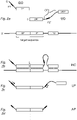
- a typical ligation assay is illustrated schematically in Figure 1 , which is discussed in more detail in Example 1.
- a sample that may contain target sequences is contacted with a pool of detector oligonucleotide probes ("probes” or “detectors”).
- a pair of detectors is provided: a downstream detector (DD) and an upstream detector (UD).
- a downstream detector can have a portion (DR') that is complementary to a region of the target sequence designated as a downstream region (DR).
- An upstream detector can have a portion ( UR ') that is complementary to a region of the target sequence designated as the upstream region ( UR ).
- the terms “downstream” and "upstream” are used relative to the 5'-to-3' direction of transcription when the target sequence is a portion of an mRNA, and for convenience the regions designated as upstream are often shown underlined .
- the DR' of the DD and the UR' of the UD for each target sequence are allowed to hybridize to the corresponding DR and UR of the target sequence, if present in the sample.
- the adjacent detectors DD and UD can be ligated.
- formation of a DD- UD ligation product serves as evidence that the target sequence (DR- UR ) was present in the sample.
- the ligation step can be preceded by (b0) extending the DR' using the sample as a template so the extended DR' and UR' become adjacent and can be ligated.
- the ligation product can then be detected by a variety of means; if desired, the products can be amplified prior to detection.
- the present disclosure provides methods where hybridization complexes are exposed at one or more steps to at least one nuclease that can degrade single strands of nucleic acid.
- the disclosure provides detectors and other components of the assay that are configured to selectively resist the nucleases when detecting target sequences.
- the nucleases can degrade excess or unused detectors, or detectors that are nonspecifically or nonproductively bound to components in the sample that are not of interest.
- the strategic use of nucleases enables the ligation assay to be performed by adding one reagent after another in a single reaction container, starting with the sample.
- the samples used in the method can be any substance where it is desired to detect whether a target sequence of a nucleic acid of interest is present.
- Such substances are typically biological in origin, but can be from artificially created or environmental samples.
- Biological samples can be from living or dead animals, plants, yeast and other microorganisms, prokaryotes, or cell lines thereof.
- animals include human, primates, dog, rat, mouse, zebrafish, fruit flies (such as Drosophila melanogaster ) , various worms (such as Caenorhabditis elegans ) and any other animals studied in laboratories or as animal models of disease.
- the samples can be in the form of whole organisms or systems, tissue samples, cell samples, or samples that are cell-free.
- samples can be provided in liquid phase, such as cell-free homogenates or liquid media from tissue cultures, or nonadherent cells in suspension, tissue fragments or homogenates, or in solid phase, such as when the sample is mounted on a slide or in the form of formalin-fixed paraffin-embedded (FFPE) tissue or cells, or when cells are grown on or in a surface, as long as detectors can be put into contact for potential hybridization with the sample nucleic acids.
- liquid phase such as cell-free homogenates or liquid media from tissue cultures, or nonadherent cells in suspension, tissue fragments or homogenates, or in solid phase, such as when the sample is mounted on a slide or in the form of formalin-fixed paraffin-embedded (FFPE) tissue or cells, or when cells are grown on or in a surface, as long as detectors can be put into contact for potential hybridization with the sample nucleic acids.
- FFPE formalin-fixed paraffin-embedded
- the nucleic acids of interest to be detected in samples include the genome, transcriptome, and other functional sets of nucleic acids, and subsets and fractions thereof.
- the nucleic acids of interest can be DNA, such as nuclear or mitochondrial DNA, or cDNA that is reverse transcribed from RNA.
- the sequence of interest can also be from RNA, such as mRNA, rRNA, tRNA, siRNAs ( e.g ., small interfering RNAs, small inhibitory RNAs, and synthetic inhibitory RNAs), antisense RNAs, circular RNAs, or long noncoding RNAs.
- the nucleic acid of interest can be a microRNA (miRNA) at any stage of processing, such as a primary microRNA (pri-miRNA), precursor microRNA (pre-miRNA), a hairpin-forming microRNA variant (miRNA ⁇ ), or a mature miRNA. Detection of microRNAs is discussed in
- Relatively short nucleic acids of interest can be lengthened to enhance hybridization to the detectors.
- many microRNAs are phosphorylated at one end, and can be lengthened by chemical or enzymatic ligation with a supplementary oligo.
- the supplemental oligo can be single-stranded, double-stranded, or partially double-stranded, depending on the ligation method to be used. If desired, the supplemental oligo can be unique to each target sequence, or can be generic to some or all of the target sequences being ligated.
- the detectors can then be designed with extended DR' and/or UR' regions that include a portion that hybridizes to the supplemental sequence.
- a target sequence can also be supplemented by adding nucleotides, such as by polyadenylation, where the extended detectors include at least a portion to hybridize to the supplemental polyA tail. Detection of a family of mature miRNA sequences using extended detectors is discussed in Example 3b and illustrated in Figure 2j .
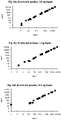
- the amount of nucleic acid in the sample will vary on the type of sample, the complexity, and relative purity of the sample. Because of the sensitivity of the assay, the sample can be taken from a small number of cells, for example from fewer than 100,000, 10,000, 1000, 100, 50, 20, 10, 5, or even from a single cell. The total amount of nucleic acid in the sample can also be quite small: less than 100, 50, 20, 10, 5, 2, 1 micrograms, 500, 200, 100, 50, 20, 10, 5, 2, 1, 0.5, 0.2, 0.1 nanogram, 50, 20, 10, 5, 2, 1 picogram or less of nucleic acid (see Figure 6d ).
- the copy number of a particular target sequence can be less than 100,000, 10,000, 1000, 100, 50, 20, 10, 5, or even a single copy present in the sample, particularly when coupled with representative amplification of the ligation product for detection.
- the amount of input nucleic acid will also vary, of course, depending on the complexity of the sample and the number of target sequences to be detected.
- the disclosure provides pools of detector oligos where a target sequence has a pair of upstream and downstream detectors (UD and DD) that correspond to DR and UR, which are typically subsequences of the entire nucleic acid sequence of interest.
- Detectors can be provided to detect targets that contain mutations including individual single-nucleotide polymorphisms (SNPs), gene fusions, and exon-splicing variants.
- An individual target sequence can have more than one set of DRs and URs, which can be selected by the user to optimize the performance of the assay.
- Multiple sets of DRs and URs can provide multiple measurements of the same target sequence or of different portions of the target sequence, such as different exons or exon junctions, or provide measurement of a portion of sequence that is not mutated versus a portion of sequence that may harbor a mutation.
- the target sequences can be selected from any combination of sequences or subsequences in the genome or transcriptome of a species or an environment.
- the set can be specific for a sample type, such as a cell or tissue type.
- the number of target sequences can range in any combination of upper and lower limits of 1, 2, 5, 10, 20, 50, 100, 200, 500, 1000, 2000, 5000, 10,000, 20,000, 23,000, 30,000, 38,000, 40,000, 50,000, or more.
- the number of target sequences can also be expressed as a percentage of the total number of a defined set of sequences, such as the RNAs in the human transcriptome or genes in the human genome, ranging in any combination of upper and lower limits of 0.1%, 0.2%, 0.5%, 1%, 2%, 5%, 10%, 20%, 25%, 30%, 35%, 40%, 45%, 50%, 65%, 60%, 70%, 75%, 80%, 85%, 90%, 95%, and 100%.
- the detector oligos themselves can be DNA, RNA, or a mixture or hybrid of both. If desired, they can have a modified nucleotide such as dideoxy nucleotides, deoxyUridine (dU), 5-methylCytosine (5mC), 5-hydroxymethylCytosine (5hmC), 5-formylCytosine (5fC), 5-carboxylCytosine (5caC), and Inosine. Yet other modifications to detector oligos include modified bases such as 2,6-diaminopurine, 2-aminopurine, 2-fluro bases, 5-bromoUracil, or 5-nitroindole. Other detector oligos can have a modified sugar-phosphate backbone at one or more positions.
- LNA locked nucleic acid
- PNA peptide nucleic acid
- a downstream detector has a complementary downstream region (DR'), which can be at least 4, 6, 8, 10, 12, 14, 16, 18, 20, 22, 24, 26, 28, 30, 35, 40, 45, or 50 nucleotides in length.
- an upstream detector has a complementary upstream region (UR'), which can be at least 4, 6, 8, 10, 12, 14, 16, 18, 20, 22, 24, 26, 28, 30, 35, 40, 45, or 50 nucleotides in length.
- the DR' and UR' need not be exactly the same length, but will typically be similar so they can hybridize to the target under similar conditions and stringency.
- the detectors can be optimized for ligation, such as by providing a 5'-phosphate on the UD, although this is not necessary, depending on the selection of ligase or other ligation methods.
- Ribonucleotides can also be substituted at the ligatable ends of the DD and UD to increase the specificity and efficiency of ligation, as when an RNA ligase is used.
- either or both detectors can be designed to be labeled appropriately for detection.
- the detector can be labeled with a color or fluorescent dye, latex bead, quantum dots, or nanodots.
- the label can also take the form of an additional nucleotide sequence that serves to enable detection and identification, such as a barcode sequence.
- a useful barcode sequence can uniquely identify the specific gene or target sequence, or a group of select genes or target sequences within the sample that are being measured. Such sequences can be positioned between the UR' and P2' sequence, and/or between the DR' and P1 sequence, so they are amplified when using flanking primers.
- This sequence can also be a random sequence, useful for identifying the number of copies of the target gene in the sample, independent of the particular efficiency of any amplification step.
- the detectors are provided so that they contact the sample to allow the detectors to hybridize specifically to the target nucleic acids.
- Hybridization conditions can be selected by the skilled artisan to allow and optimize for hybridization between the polynucleotides with the desired degree of specificity or mismatches, and such conditions will vary with the lengths and compositions of sequences present in the hybridization reaction, the nature of any modifications, as well as conditions such as the concentrations of the polynucleotides and ionic strength.
- Particular hybridization temperatures include 30°, 32.5°, 35°, 37.5°, 40°, 42.5°, 45°, 47.5°, 50°, 52.5°, 55°, 57.5°, 60°, 62.5°, 65°, 67.5°, 70°, 72.5°, 75°, 77.5°, 80°, 82.5°, 85°, 87.5°, and/or 90°.
- Particular hybridization temperatures can be achieved by ramping the temperature up or down at various rates and profiles, such as timed temperature plateaus, one or more incremental increases or decreases of 5C°, 10C°, or 15C°, and repeated cycling between two or more temperatures.
- Ions such as Li + , Na + , K + , Ca 2+ , Mg 2+ and/or Mn 2+ can also be present from 0, 1, 2, 5, 10, 20, 50, 100, 200, and 500 mM, and such ions can affect the selection of the other hybridization conditions. Hybridization is also affected by steric crowding components such as branched polysaccharides, glycerol, and polyethylene glycol.
- Further additives can be present in the hybridization (and subsequent) reactions, such as DMSO, non-ionic detergents, betaine, ethylene glycol, 1,2-propanediol, formamide, tetramethyl ammonium chloride (TMAC), and/or proteins such as bovine serum albumin (BSA), according to the desired specificity.
- DMSO non-ionic detergents
- betaine ethylene glycol
- 1,2-propanediol 1,2-propanediol
- formamide tetramethyl ammonium chloride
- TMAC tetramethyl ammonium chloride
- BSA bovine serum albumin
- the conditions for hybridization can be adjusted or fine-tuned to permit other steps to be performed in the same environment.
- the same buffers used for hybridization can be used for lysing cells in a sample, promoting hybridization of certain cell types, facilitating removal or permeation of cell walls, cell membranes, or subcellular fractions, as desired.
- hybridization conditions can be selected to be compatible with conditions for ligation as is, or with the addition of one or more components and preferably without requiring a change of the reaction container when transitioning from hybridization to ligation steps.
- the ligation reaction can occur by chemical ligation or by using a ligase enzyme or a ligation-facilitating co-factor.
- a variety of nick-repairing ligases are commercially available to catalyze the formation of a phosphodiester bond between adjacent single-stranded polynucleotides when hybridized to another single-stranded template, such as to join DNA to RNA when hybridized to template.
- An example is bacteriophage T4 DNA ligase, which is generally understood to use ATP as a co-factor. The ATP can be supplied during the ligase reaction. In other reactions, the ligase can be pre-adenylated.
- the UD In yet other reactions, the UD must be pre-adenylated at the 5' end, as with a 5' App DNA/RNA ligase.
- the UD in a typical reaction will have a 5'-phosphate to facilitate ligation to the DD, although this is not necessary, depending on the selection of ligase and ligation conditions.
- Preferred ligation conditions include 10, 25, 50, 100 mM Tris-HCl (pH 7.5, 8.0, or 8.5); at least 10mM, 5mM, 2mM, 1mM MgCl 2 ; at least 2mM, 1 mM, 0.7mM, 0.5mM, 0.2mM, 0.1mM, 0.05 mM ATP; or at least 10mM, 7 mM, 5 mM, 2 mM, 1 mM, 0.5 mM DTT or other antioxidant.
- T3 DNA ligase can also be used, which can ligate a broader range of substrates and has a wider tolerance for salt concentration.
- the temperature can be selected according to the characteristics of the reaction components and conditions such as ionic strength.
- the ligation step can be preceded by an optional extension step, as in Figure 1 , step (b0).
- the ligation step can also be preceded by an optional cleavage step, such as by a nuclease, to remove any overhangs.
- a portion of the DD can overlap with the UR sequence to which the UD hybridizes, so that after hybridization of the UD and the DD, there is an overhang sequence of 1, 2, 3, or more bases.
- a useful enzyme for removing an overhang is a Flap endonuclease, such as Fen-1.
- the ligation product can be amplified (for example by PCR or qPCR) to facilitate detection.
- Amplification methods and instruments are commercially available, including PCR plate and droplet formats, and the amplification enzymes (such as Taq and its commerical variants) and reaction conditions can be selected and tailored to the particular platform.
- the polymerase selected for amplification can have strand-displacing activity.
- the detectors can have additional sequences ("tails") including primer hybridization sequences (e.g . P1, P2') or complements thereof, that serve as amplification sequences, so that after ligation, the ligation product can be amplified with a pair of amplification primers ( P1, P2).
- An exemplary downstream amplification sequence ( P1 ) is 5 ' -CAAGCAGAAGACGGCATACGAG-3 ' (SEQ ID NO: 1), which can be used with a primer having the same sequence (P1).
- An exemplary upstream amplification sequence (P2') is 5' -ATC TCGGTGGTCGCCGTATCATT-3' (SEQ ID NO:2), which can be used with primer P2 (shown in 3'-to-5' orientation): 3'- TAG AGCCACCAGCGGCATAGTAA-5' (SEQ ID NO:3).
- the amplification primer can incorporate a barcode sequence, for example a barcode sequence that uniquely identifies the sample in a multi-sample experiment, and optionally has redundant and/or error-correction features.
- a barcode sequence for example a barcode sequence that uniquely identifies the sample in a multi-sample experiment, and optionally has redundant and/or error-correction features.
- different sample barcodes can be used for 96, 384, 1536, or more generally 2 n or 4 n different samples that are prepared with different barcodes separately for some steps, such as hybridization, ligation, and amplification, and combined for others, such as detection.
- the barcode sequence can be incorporated into the primer, such as 3' to the amplification sequence, so that the barcode becomes part of the amplified strand.
- the amplification sequence of the primer can be extended by an additional sequence to provide a primer hybridization sequence that can be used for use in subsequent sequencing steps.
- the barcode may also be interposed between the amplification sequence, and if desired, the extended amplification sequence, and another sequence that can be used for capture, such as capture onto a surface as part of a sequencing process, and/or for yet another primer hybridization sequence that is used for sequencing.
- the barcode will be amplified with the rest of the detector sequences, for instance forming a single amplified, elongated molecule that contains sequencing primer hybridization sequences, sample barcode, and a gene-specific sequence, which may include a gene-specific barcode or a target molecule-specific barcode as well as sequence or complement to the sequence of the target gene.
- a gene-specific sequence or a sample-specific sequence can be added as part of the primer used for reverse transcription, and be a part of the sequence targeted by the UD and DD.
- methods known in the art can be used to amplify the ligated DD and UD sequences, such as by repetitive cycles of (1) ligation, (2) heating to melt off the ligated product, (3) cooling to permit hybridization of DD and UD to the target, (4) ligation, then repeating the heating (2), cooling (3), and ligation (4) steps. These additional amplification steps can be performed before amplification step (c), during which the sample barcodes and other sequences are added to the ligated UD and DD sequence.
- the target of the UD and DD hybridization may also be amplified by whole transcriptome amplification of RNA or amplification of cDNA.
- the ligation product (or its amplicons) can optionally be detected by methods such as sequencing, qPCR, or labeling for detection on an array or other molecule detection.
- Other detection methods include flow-through systems for counting labeled molecules.
- the skilled user will be able to modify the design of the detectors and amplification primers to include functional features that are appropriate, such as for bridge amplification on a sequencing flow cell.
- the experimental resources used for amplification and detection can be limited and are often among the most expensive, and their consumption can be optimized by reducing the number of non-informative assay components present at various stages of the assay.
- the disclosure provides nucleases and assay components that are configured to resist degradation to enable more efficient use of resources and more sensitive detection.
- the invention enables a simpler assay workflow that can be performed in a single reaction container or entirely in liquid phase.
- the nuclease can be an enzyme that digests or degrades single strands of nucleic acids. Preferably the nuclease does not digest (or has significantly less activity on) double strands, including DNA:RNA hybrids. For example, the nuclease can have less than 10%, 5%, 2%, 1%, 0.5%, 0.2%, or 0.1% the activity on double strands compared to single-strands on a molar substrate ratio under the same conditions. Similarly, the nuclease can be selected so it does not appreciably digest at single-stranded nicks in a double-strand.
- the nuclease can be an endonuclease that degrades single strands, such as mung bean nuclease under certain conditions.
- the nuclease can also be an exonuclease that degrades single strands, which can be single strands of DNA.
- a nuclease having single-stranded 3'-to-5' exonuclease (3' exo) activity includes Exonuclease I from E. coli (exo I) and T3 exonuclease.
- Enzymes such as exonuclease T (RNase T), which has 3' exo activity on DNA and RNA single strands, can be used as long as the detectors have been ligated and the RNA strands are no longer needed in the assay.
- Nucleases having single-stranded 5'-to-3' exonuclease activity include exonuclease VIII and RecJf.
- the nuclease can be an enzyme that digests 5' overhangs or flaps, such as Flap endonuclease 1.
- Nucleases can be used singly or in a cocktail of nucleases, such as a pair of 3' and 5' exonucleases.
- the nucleases can be used at various stages of the assay. For example, a nuclease can be provided (b2) after the ligation step (b1) to remove unligated or excess detectors, as in Figure 2e . The nuclease can also degrade detectors that are only partially or nonspecifically hybridized to target sequences, as in Figure 2f . If compatible with the ligation conditions used, the nuclease can also be provided during the ligation step (b1 and b2 together), or even before the ligation step (b2, then b1) as long as it does not interfere with the intended detection of target sequences.
- the nuclease can be provided before, during, or after the optional (b0) extension and (d) amplification steps, or at multiple steps to effect the desired purpose of removing undesired target, detectors, other oligos, or any products.
- nucleases can be removed or inactivated, such as after the ligation step. Nucleases can be inactivated by methods selected for a particular nuclease but will not substantially interfere with the rest of the assay. For some nucleases, a nuclease inhibitor (as in Figure 4 , lower right) or chelating agent, such as EDTA, can be added as long as it does not interfere with (or can be removed prior to) a subsequent step that may require Mg ++ for example.
- a nuclease inhibitor as in Figure 4 , lower right
- chelating agent such as EDTA
- nucleases can be inactivated by heat, for example single or repeated incubation at 70°C, 75°C, 80°C, 85°C, 90°C, 95°C or 98°C, for 1, 2, 5, 10, 15, 20, 25, 30, 45 minutes, or 1 hour. If more than one nuclease is used, either or both may be inactivated individually or by the same means.
- components of the assay are provided by the invention in various configurations that permit detection of target sequences. Selection of the configuration method will depend, of course, on the particular nuclease being used.
- the upstream detector has a second region (UR2') that is complementary to a second region of the target sequence (UR2), as illustrated in Figure 2a . Because the tail of the UD can hybridize to a separate portion of the target, this configuration can be described as an "anchored" detector, as in Figure 2b .
- the anchor at the 3' end of the UD hybridizes with the target to form a double-strand and is thus configured to resist digestion to nucleases that degrade single strands, such as 3' exonucleases like exo I.
- the anchor UR2' can be used to provide additional discrimination between similar sequences, such as isoforms of a family of genes where sequence differences between isoforms are found beyond the range of the DR and UR target sequence.
- the UR2' can be at least 4, 6, 8, 10, 12, 14, 16, 18, 20, 22, 24, 26, 28, 30, 35, 40, 45, or 50 nucleotides in length.
- the UR2' can be separated from the UR' by a noncomplementary region (CP1), which can be at least 8, 10, 12, 14, 16, 18, 20, 22, 24, 26, 28, 30, 35, 40, 45, 50, 60, 70, 80, 90, or 100 nucleotides in length.
- CP1 noncomplementary region
- the UR2' will be upstream relative to the UR'.
- an amplification region (such as P2') is present, it can be upstream of the UR', such as within the CP1 or part of UR2' to allow amplification of the UR' portion as shown in Figure 2c to generate the amplification products (AP) in Figure 2d .
- DR2' the anchor region
- the DR2' anchor hybridizes to a DR2 on the target so that the configuration resists the action of 5' ss-exonucleases.
- the UR2' of the DD will generally be downstream relative to the UR'. If an amplification region (such as PI) is present, it can be downstream of the DR' to allow amplification of the DR' after ligation.
- Anchored DDs and UDs can be used separately or in combination to resist a cocktail of nucleases.
- compositions and relative lengths of the DR2', CP1(s), DR', UR' and UR2' can be tuned to optimize target selectivity between the detector pair and among the pairs of the detector pool.
- Detectors that are not used in the ligation reaction can be degraded as shown in Figure 2e .
- incompletely bound detectors such as those in Figure 2f , can also be degraded, for example when the UR' of a UD binds to the UR of a target, but the UR2' does not bind, whether because the UR' is bound to a non-target sequence or to a target that was related to the intended target UR but lacked a UR2.
- an anchored DD that binds a DR2 but not the DR of a target will be susceptible to a 3' ss-exonuclease (or will not generate a valid ligation product with a corresponding UD).
- detectors will fail to be amplified, for example detectors in excess of target sequence in the sample or detectors that are bound nonspecifically to nontarget sequences.
- the use of anchored detectors can therefore increase the specificity of the ligation assay for target sequences while allowing nucleases to degrade excess or unused detectors.
- FIG. 2h shows a DD, having a 5'-blocking group, that can be used in combination with a 5' exonuclease. Also shown is a UD having a 3'-blocking group for use with a 3' exonuclease.
- a 5' or 3' exonuclease is used where there are multiple targets and pairs of detectors, all of the downstream or upstream detectors have a 5' or 3' block, respectively.
- Useful configurations for resisting nucleases include termination with an inverted nucleotide such as deoxythymidine (idT), a dideoxynucleotide such as dideoxythymidine (ddT or iddT), or 2'/3'-O-acetyation of the terminal nucleotide.
- idT deoxythymidine
- ddT or iddT dideoxythymidine
- 2'/3'-O-acetyation of the terminal nucleotide Depending on the substrate preferences of the nuclease selected, one or more of the other modified nucleotides described earlier can be used as a blocking group.
- one or more of the terminal nucleotides are attached to the rest of the oligo via one or more phosphorothioate bonds instead of naturally occurring phosphodiester bonds.
- a hairpin loop or other secondary structure on the detector can serve as the nuclease-blocking group for a detector.
- One end of the hairpin can have a blocking group.
- a protein or other component prior to hybridization, can be bound the 5' end of a DD or the 3' end of a UD, such as a sequence-specific single-strand-binding protein like a far upstream element (FUSE) binding protein (FUBP) via a ssFUSE sequence incorporated into a detector.
- FUSE far upstream element binding protein
- the solid phase itself can serve as a block against nuclease activity on the detector. It can be useful to combine any of the preceding features in a single detector or both detectors to resist the action of the nuclease selected and to provide other advantages, such as stability and hybridization properties.
- Yet another configuration provides one or more oligos that protect the detectors by hybridizing to the DD or UD at a region that will not interfere with hybridization of the DR' or UR' regions complementary to the target sequence.
- a DR2 protector oligo is provided to hybridize to a DR2' region at the 5' end of the DD, forming a double-stranded configuration (indicated by a brace) that is resistant to 5' exonucleases. If a 3' exonuclease is to be used, then a UR2 protector can be provided to form a double-strand at the 3' end of the UD.
- the protector oligos can themselves be protected from exonuclease activity by a blocking group or bond as described above.
- a 3'-blocked UR2 protector is shown in Figure 2i
- a 5'-blocked DR2 protector is shown in Figure 2j . If a cocktail of 5' and 3' exonucleases is to be used, then both DR2 and UR2 protectors can be provided, optionally with 5'- or 3'-blocking groups, respectively.
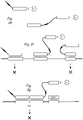
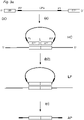
- the upstream complementary region (UR') and downstream complementary region (DR') are on a single, circularizable detector oligo (DO), as shown in Figure 3a .
- the DO can have in the 5'-to-3' direction:
- An alternate circularizable configuration with two detectors has a DD with a CS portion at the 5' end, and an UD with a reverse complementary CS' portion at the 3' end, so that the DD and UD are partially hybridized to each other via the CS and CS' portions.
- Another circularizable configuration has three oligos: two detectors and a bridge oligo: the DD has a CS1 portion at the 5' end; the bridge oligo has a CS1' portion and a CS2' portion; and the UD has a CS2 portion at the 3' end.
- the bridge oligo optionally has blocking groups at the 5' end and/or the 3' end.
- the circularizable detector(s) can (a) circularize on the target, forming a hybridization complex (HC) that is resistant to single-stranded exonucleases and that can be (b2) ligated.
- HC hybridization complex
- the ligation product (LP) can be (c) amplified with P1 and P2 primers to form amplification product (AP) that contains the joined DR' and UR' regions.
- DOs that are not specifically hybridized to the target or are bound incompletely to the target are susceptible to degradation by nucleases ( Figure 3d ) or the P1 and P2' amplification regions will not be in the correct orientations for primer amplification, as illustrated in Figure 3b or 3c .
- the detector may be amplified, but it will be amplified linearly, rather than exponentially. In such cases, the minor sequences can be detected and discounted or removed from the detection results computationally.
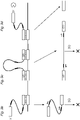
- Still another configuration provides a single-stranded DNA oligonucleotide (2S) to hybridize to the single-stranded portion of the detector to form a double-stranded hybridization complex, as illustrated in Figure 4 .
- the 2S oligo can be complementary to the CP1 so that the entire structure becomes double-stranded.
- the same 2S can be used generically to form the circular structure since it does not rely on hybridization to target sequences.
- the structure can then be ligated, completing the circular, double-stranded structure and resistant to exonucleases, ss-endonucleases, and nick-endonucleases.
- the circular structure can be deliberately nicked or cut, for example by a nicking endonuclease.
- the DO can have a restriction endonuclease recognition site so the circular structure can be linearized if desired.
- the recognition site selected for CP1 can be a relatively rare site such as for Asc I , Fse I , Asi SI. If desired, linearized structures can be separated from circular structures by conventional methods.
- the circularizable DO can be configured so that it has a (A) a noncomplementary region (CP5) in the 5' direction of the UR' and (G) an optional noncomplementary region (CP3) in the 3' direction of the DR', as shown in Figure 5a and discussed in Example 4.
- a second strand can be provided that has, in the 5'-to-3' direction: P2, CP2', P1' so that, together, the target nucleic acid, a detector oligo, and the second strand form a hybridization complex having a 5' flap.
- a nuclease, such as Fen-1 can be used to remove the 5' flap ( Figure 5b ).
- the 5' end of the circularizable detector can be phosphorylated ( Figure 5c ).
- the optional CP3 region can then hybridize to the target sequence, forming a 3' terminus that can be ligated ( Figure 5d ) to the adjacent UR' to form a ligated product ( Figure 5e ).
- the hybridization, ligation, or extension steps can be performed while the target sequence is in situ. This can be particularly useful, for example, when the sample is on a histological slide, so that the ligation is known to occur at a recordable location and can be compared to similar reactions at other locations on the slide.
- the ligated probes can remain at the location while other steps are performed, such as imaging or detection of other analytes at or near the location.
- the ligated probes can remain in situ more securely by a variety of chemical or enzymatic methods for cross-linking to the site, which can be permanent or reversible, such as by a photocleavable link as with using a cyanovinylcarbazole nucleoside analog ( CNV K).
- the ligation products can be eluted from the sample in situ for collection and further processing, preferably eluting from small areas to preserve the location information and morphological context of the ligation reaction products.
- one or more of the steps can be performed in liquid phase, such as in a microfluidic system, so that one or more of the steps does not involve capture to a solid phase, such as to a bead or a plate surface.
- a solid phase such as to a bead or a plate surface.
- a solid phase can be used to immobilize one or more of the sample, the detector oligos, the hybridization complex, the extension product, the ligation product, or the amplification product.
- the target nucleic acid can be attached to a solid surface during the hybridization step, the ligation step, or both.
- the solid surface can be a bead, such as a magnetic, nonmagnetic, polymeric, reversible immobilization, or latex bead, or compound beads thereof, or a relatively flat surface such as a plate or flowcell surface, optionally with coatings of similar materials.
- the mixed phase format allows the components to be transferred from one reaction environment to another, or the conditions to be changed as the components remain in one container.
- the reactions can be optimized so that at least one of steps is performed by adding reagent, such as an enzyme or buffer component, successively, so that a reaction takes place in the same container as the preceding step, optionally without requiring an intervening wash or transfer step.
- reagent such as an enzyme or buffer component
- the sequence of additions does not require significant additions of liquid volumes to dilute the components for the next reaction, for example no more than 1-, 1.5-, 2-, 2.5-, 3-, 5-, 10-, 15-, or 20-fold dilution between the initial sample and preparation for detection.
- the components to be added can be provided in a kit, as described below.
- a detection assay will have sufficient dynamic range to measure the presence of the different target sequences quantitatively in a single experiment.
- the range of abundance for various target sequences can span several orders of magnitude.
- HATs highly abundant target sequences
- HATs can include sequences encoding what are generally referred to as housekeeping genes.
- HATs include sequences that encode all or a portion of myoglobins, actins, tubulins, ubiquitins, heat-shock proteins (HSPs), ribosomal proteins, ribosomal RNAs (rRNAs), micro-RNAs (miRNAs), or small nuclear RNAs (snRNAs).
- HATs can encode all or a portion of cytochrome c, glyceraldehyde 3-phosphate dehydrogenase (GAPDH), ribosomal protein L7 (RPL7), ribosomal protein S6 (rpS6), snRNA RNUs, phosphoglycerokinase (PGK), tyrosine 3-monooxygenase / tryptophan 5-moonoxygenase activation protein zeta (YWHAZ), ⁇ -actin, or ⁇ -tubulin.
- Further examples include sequences encoding all or a portion of ⁇ -2-microglobulin, vimentin, and fibronectins.
- HATs encode all or part of a cytochrome such as mitochondrially encoded cytochrome b (MT-CYB), outer mitochondrial membrane cytochrome b 5 type B, microsomal cytochrome b 5 type A (ACYB5A), and ascorbate-dependent cytochrome b 3 (CYBASC3).
- a cytochrome such as mitochondrially encoded cytochrome b (MT-CYB), outer mitochondrial membrane cytochrome b 5 type B, microsomal cytochrome b 5 type A (ACYB5A), and ascorbate-dependent cytochrome b 3 (CYBASC3).
- MT-CYB mitochondrially encoded cytochrome b
- ACYB5A microsomal cytochrome b 5 type A
- CYBASC3 ascorbate-dependent cytochrome b 3
- Attenuators can be used to attenuate the overall number of HAT-related ligation products to be detected. Some attenuators are provided that can to provide positive detection of the HAT in the sample, but at a lower level of signal.
- FIG. 2g An attenuator useful in the invention is shown in Figure 2g , where a UR2' oligo is provided to hybridize to UR2 targets in competition with detectors.
- UR2, DR2', and DR2 oligos can be provided to compete with the binding of portions of anchored detectors to HATs, thereby attenuating the total number of detectors that form HAT-related ligation products.
- Particularly useful attenuators can have a portion of DR2 and a portion of DR; or have a portion of UR and a portion of UR2, thereby competing for two portions of the same anchored detector.
- an attenuator can be an oligonucleotide that has a portion that is identical or complementary to UR or DR, or both. Attenuators can also take the form of oligos that fill a gap, such as shown in Figure 5b , but are blocked from yielding a ligatable product.
- a detector oligo can contain one or other modifications that can be selectively cleaved by treatment after the ligation or optional amplification step.
- a detector oligo can have a dU located so that it will not interfere with hybridization or ligation steps. After ligation, however, products incorporating the dU oligo can then be cleaved by dU-specific enzymes, such as uracil-DNA glycosylase followed by endonuclease VIII.
- Another selectively cleavable site can be a restriction enzyme cleavage site that is not present in the target sequences to be detected.
- kits for performing the methods described above comprising detector oligos, and optionally a nuclease, a ligase, and/or a polymerase.
- the kits can further provide reaction buffers for the enzymes in the kit or buffer components to be added to reactions suitable for the enzymes.
- the component can be suitable for addition to a container for an enzyme reaction to prepare a suitable reaction buffer for the enzyme.
- the component can also be selected to be compatible with the reaction buffer for the preceding step of the method so that the component can be added to the same container to form a reaction buffer for the next enzyme to be used.
- the components can be selected to enable an "add-add-add" strategy for multiple steps of the assay to minimize transfers of sample, oligos, enzymes and/or solutions between separate containers.
- kits can also have eluent solutions suitable for removing oligonucleotides, such as ligated oligonucleotides, from a tissue sample for further analysis.
- the kits can further have amplification primers suitable for use with the detectors of the kit.
- RNA expression products were detected in a sample of cells using a multiplex assay format.
- the assay was designed to detect one or more target sequences within the full sequence of the product.
- a GAPDH gene of interest encodes the enzyme glyceraldehyde 3-phosphate dehydrogenase; three different portions within the RNA transcript of the GAPDH gene were independently detected as target sequences.
- RNA target sequence identified here as GAPDH_2
- GAPDH_2 5'- CGACCACUUUGUCAAGCUCAUU UCC UGG UAUGACAACGAAUUUGGCUACA-3' (SEQ ID NO:4) where a 5' end was designated “upstream” (underlined) and the 3' end was designated “downstream” for the direction of transcription and translation.
- GAPDH_2 target sequence can be shown in the 3'-to-5' direction for later convenience of discussion: 3'-ACAUCGGUUUAAGCAACAGUAU GGU CCU UUACUCGAACUGUUUCACCAGC -5' (SEQ ID NO:5)
- a downstream region (DR) was defined as the downstream 25 bases of GAPDH_2: 3'-ACAUCGGUUUAAGCAACAGUAU GGU -5' (SEQ ID NO:6) which has a complementary DNA sequence of DR': 5 ' -TGTAGCCAAATTCGTTGTCATA CCA -3 ' (SEQ ID NO:7)
- the upstream region was defined as the upstream 25 bases of GAPDH_2: 3'- CCU UUACUCGAACUGUUUCACCAGC -5' (SEQ ID NO:8) which has a complementary DNA sequence of UR': 5'- GGA AATGAGCTTGACAAAGTGGTCG -3' (SEQ ID NO:9)
- a pair of detectors was designed: a downstream detector (DD) having the DR' sequence, and an upstream detector (UD) having the UR' sequence. Similar pairs were designed for each of the target sequences to provide a pool of detectors for the assay. In this example, all the upstream detectors were phosphorylated at the 5' end.
- an amplification step was to be performed later in the experiment using two primers, P1 and P2, so all UDs in the experiment included a primer sequence (P1) and all URs included a complementary primer sequence (P2'). Because amplification is not necessary to the practice of the invention, however, the sequence of the specific primers and primer sequences is a matter of selection to suit the particular amplification method, if used.
- RNA isolated from human kidney or liver cell lines was placed in a well of a microtiter plate for each assay experiment.
- 2X Binding Cocktail which contained 5 nM of each detector (providing a final input of 0.1 pmoles per oligo), 100 nM biotinylated oligo(dT) 25 , and 5 ⁇ L streptavidin-coated magnetic beads in a Wash Buffer (40 mM Tris-Cl pH 7.6, 1 M NaCl, 2 mM EDTA disodium, 0.2% SDS).
- the plate was heated for 10 min at 65°C to denature the RNA, then the temperature was ramped down over 40 min to 45°C to allow the detectors to anneal to the target sequences in the RNA sample.
- the plate was then transferred to a magnetic base to immobilize the beads, allowing the supernatant, containing unbound and excess detectors, to be aspirated from the wells.
- the beads were washed at least three times with 50 ⁇ L Wash Buffer.
- amplification step 5 ⁇ L of the supernatant, containing the ligation products, was transferred to a well of a PCR plate. Then 10 ⁇ L of a PCR cocktail was added, containing 0.45 U Taq polymerase, 0.6 ⁇ M P1 primer, 0.6 ⁇ M P2 primer, 1.5 mM MgCl 2 , and 200 ⁇ M dNTPs.
- the thermocycler used the following program: 10 min at 94°C, followed by 20 to 25 cycles of 30 sec at 94°C, 30 sec at 58°C, and 30 sec at 72°C. The amplification products were then sequenced according to manufacturer's instructions.
- This representative ligation assay can be modified as in the following examples.
- Upstream and downstream detector probe oligonucleotides were prepared as in Figure 2a and 3a for 24 target sequences identified as breast cancer targets: ACTB_1, TFF1_1, GATA3_3, GAPDH 3, CDH1_1, KRT19 2, TIMP1_2, NFKBIA 1, ESR1_1, VEGFA_3, LAMP1 2, MUC1_3, BAD_3, PTEN_1, BRCA2_1, BCAT2_3, ICAM1 2, IGF2_3, BRCA1 2, EGFR_1, BMP4_1, KIT_3, WNT1_1, and EGF_3 (in descending order of expected counts).
- the targets were selected for a range of expression covering 6 orders of magnitude from ACTB_1 to EGF_3.
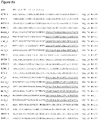
- the target sequences used for the DRs and URs are shown in Figure 6a .
- the assay was performed in triplicate with 100, 10, 1, and 0.1 and 0 (control) nanograms of MCF7 total RNA as sample.
- the detectors were added to the sample in a volume of 1 or 2 ⁇ L and allowed to hybridize by incubating at 65°C for 10 minutes, ramping down over 20 minutes from 65° to 45°C, then held for 20 minutes at 45°C.
- Exonuclease I E. coli
- T4 ligase was added to the mixture in 6 ⁇ L of 5 Units and incubated for 1 hour at 37°C.
- a heat step was performed for 30 minutes at 80°C.
- the mixture was amplified by adding 2X PCR master mix.
- the amplification products corresponding to the target sequences were detected and quantificated by qPCR and sequencing.
- the results are provided in Figures 6b-6g .
- Example 3a Circularizable Detector Design for microRNAs
- Circularizable DO detectors were designed for the Let-7 family of miRNAs. These miRNAs are initially transcribed as relatively long transcripts (pri-miRNAs), but are processed into pre-miRNAs, and subsequently processed into a relatively short mature form. In mature form, the highly homologous Let-7 family is shown 5'-to-3', with variants from the let-7a sequence bolded).
- the DR' was 5 '-AACTATACAAC-3' (SEQ ID NO:18) and the UR' was 5'-CTACTACCTCA-3' (SEQ ID NO: 19).
- a single-stranded DNA oligonucleotide (2S) is provided to hybridize to the single-stranded portion of the DO to form a double-stranded hybridization complex, as illustrated in Figure 4 .
- the region of the DR and UR can be represented as
- the portion shown forms a double-stranded structure without any nicks 3'-... ATTCTC -uugauauguug- gaugauggagu - GCCTTG . ..-5' SEQ ID NO:23 which is resistant to attack by exonucleases.
- the complex which contains a mismatch, can be nicked with a variety of enzymes, such as T4 endonuclease VII, T7 endonuclease I, or in combinations of exonuclease I and E. coli exonuclease III, S1 nuclease, or nuclease BAL-31.
- the nicked complex can then be degraded by treatment with a nuclease in step (b1) so that no ligation product is formed.
- the covalently circularized, double-stranded structure can be linearized by treatment with a restriction endonuclease, if desired, where the 2S contains an appropriate restriction site.
- the linearized product can be amplified with primers.
- Example 3b Extended Detector Design for microRNAs
- Extended detectors were designed for Let-7 family microRNAs that have been polyadenylated.
- the microRNAs are extended using polynucleotide adenylyltransferase to add a 3' polyadenine tail.
- SEQ ID NO:10 a polyadenylated sequence is shown below (SEQ ID NO:28) in italics.
- An upstream detector is provided having SEQ ID NO:27 and an extended downstream detector is provided having SEQ ID NO:26, which has an italicized poly-T region (usually poly-dT if the detector is DNA).
- the combination of the supplemental 3' polyadenine tail and the extended poly-T region provides a longer complementary region for hybridization of the target to the detector, and allows greater freedom of designing DRs and URs for the target.
- the lengths of the complementary regions for the DD and UD can be more similar in length.
- a DD or UD can be used to detect more than one family member (a "generic detector").
- a DD or UD can be used to detect more than one family member (a "generic detector”).
- the same upstream detector can be used to detect let-7a and let-7b (and let-7c), since the 14 bases in the 5' direction are identical.
- Skilled artisans will be able to design various combinations of specific and generic detectors for related sequences, such as the let-7 family, depending on the number of detectors and hybridization properties desired.
- the detectors are ligated to form the ligation product for detection or optional amplification. If the number of supplemental adenosines added is fewer than the number of dTs in the DD, this does not interfere with the ligation and subsequent steps. If the number of supplemental As is greater, then excess portion of the 3' tail need not hybridize entirely to the remaining 5' portion of the DD for specific and target-valid ligation to occur.
- Circularizable detector oligos were designed as in Example 3a, but where the UD has an additional poly-A CP5 sequence at the 5' end:
- the UR' (underlined above) of the DO is hybridized to the target UR, but the poly-A sequence remains an unhybridized flap, as shown in Figure 5a .
- the complex can be treated with a flap endonuclease, such as Fen-1, to remove the poly-A and the adjacent hybridized base.
- a DR' hybridized to an adjacent DR can be extended as in step (b0) of Figure 1 and then ligated to the UR' region.
- the DR' can have a noncomplementary portion (CP3), such as the single C underlined below: that can hybridize and fill the gap left by the endonuclease, as shown in Figure 5d .
- CP3 noncomplementary portion
- a nickless double-stranded complex is formed as in Figure 5e .
- the circularized structure can be linearized, if desired, and amplified, as illustrated earlier in Figure 4 .
Landscapes
- Chemical & Material Sciences (AREA)
- Life Sciences & Earth Sciences (AREA)
- Organic Chemistry (AREA)
- Proteomics, Peptides & Aminoacids (AREA)
- Zoology (AREA)
- Health & Medical Sciences (AREA)
- Engineering & Computer Science (AREA)
- Wood Science & Technology (AREA)
- Analytical Chemistry (AREA)
- Microbiology (AREA)
- Physics & Mathematics (AREA)
- Molecular Biology (AREA)
- Immunology (AREA)
- Biotechnology (AREA)
- Biophysics (AREA)
- Biochemistry (AREA)
- Bioinformatics & Cheminformatics (AREA)
- General Engineering & Computer Science (AREA)
- General Health & Medical Sciences (AREA)
- Genetics & Genomics (AREA)
- Measuring Or Testing Involving Enzymes Or Micro-Organisms (AREA)
- Investigating Or Analysing Materials By Optical Means (AREA)
Claims (26)
- Procédé de détection de séquences d'acides nucléiques cibles dans un échantillon, une séquence cible ayant une région en aval (DR) et une région en amont (UR), et l'acide nucléique cible ayant au moins une région DR2 ou UR2, le procédé comprenant les étapes suivantes :(a) la mise en contact de l'échantillon avecun oligo détecteur en aval (DD) ayant une région en aval complémentaire (DR') etun oligo détecteur en amont (UD) ayant une région en amont complémentaire (UR'),au moins l'un des DD ou UD ayant une seconde région complémentaire (DR2' ou UR2') séparée du DR' ou UR' par une région non complémentaire (CP1), permettant ainsi au DR' et UR', et à au moins un des DR2' ou UR2' des détecteurs de s'hybrider spécifiquement au DR et UR et à au moins un des DR2 et UR2 des acides nucléiques cibles ;(b1) la ligature du DR' et de l'UR' si les deux sont spécifiquement hybridés au DR et à l'UR d'une séquence cible ; et(b2) l'exposition des complexes d'hybridation à au moins une nucléase qui dégrade des simples brins mais ne dégrade pas significativement des doubles brins, de sorte que les DD et les UD non spécifiquement hybrides sont dégradés par la nucléase ;moyennant quoi le produit de ligature indique la présence de la séquence cible dans l'échantillon.
- Procédé selon la revendication 1, l'échantillon étant un échantillon de tissu, une cellule unique, monté sur une lame, ou provenant d'un échantillon fixé au formol et inclus dans la paraffine (FFPE).
- Procédé selon l'une quelconque des revendications 1 à 2, l'acide nucléique cible étant un ARN, éventuellement un ARN circulaire, un petit ARN, un ARN antisens, un long ARN non codant ou un microARN ou une partie de celui-ci, éventuellement le microARN étant 3'-polyadénylé avant l'étape (a) et le DD ayant une région poly-T à proximité du DR'.
- Procédé selon l'une quelconque des revendications 1 à 3, le DD ayant une première région d'amplification (P1) en aval du DR', et l'UD ayant une seconde région d'amplification (P2') en amont de l'UR'.
- Procédé selon la revendication 4, l'étape (b2) dégradant les régions P1 ou P2' simple brin.
- Procédé selon l'une quelconque des revendications 1 à 4, des ensembles de DD et UD, ayant différents DR ou UR, fournissant une mesure de différentes parties de la séquence cible.
- Procédé selon l'une quelconque des revendications 1 à 5, la nucléase ayant une activité 3' à 5' ; ou ayant une activité 5' à 3'.
- Procédé selon l'une quelconque des revendications 1 à 7, (i) le DD ayant un groupe bloquant 5'-exonucléase, (ii) l'UD ayant un groupe bloquant 3'-exonucléase, ou à la fois (i) et (ii).
- Procédé selon la revendication 8, le groupe bloquant comprenant un nucléotide inversé, un didésoxynucléotide, une liaison phosphorothioate ou une phase solide.
- Procédé selon l'une quelconque des revendications 1 à 9, un oligo détecteur ayant, au niveau d'une ou de plusieurs positions, une chaîne principale d'acide nucléique verrouillé (LNA) ou d'acide nucléique peptidique (PNA).
- Procédé selon l'une quelconque des revendications 1 à 10, (i) DD ayant une région DR2' 5'-terminale qui est hybridée à un oligo protecteur DR2 ; ou (ii) l'UD ayant une séquence 3'-terminale UR2' qui est hybridée à un oligo protecteur UR2.
- Procédé selon l'une quelconque des revendications 1 à 11, (i) l'étape (b2) étant réalisée avant l'étape (b1) ; (ii) l'étape (b2) étant réalisée pendant l'étape (b1) ; ou (iii) l'étape (b2) étant réalisée après l'étape (b1).
- Procédé selon l'une quelconque des revendications 1 à 12, l'étape (a) et/ou l'étape (b1) et/ou l'étape (b2) étant réalisées en phase liquide ; alors que l'acide nucléique cible est attaché à une surface solide ; ou alors que la séquence cible est in situ.
- Procédé selon l'une quelconque des revendications 1 à 13, la présence de produit de ligature ou de produits d'amplification de celui-ci étant détectée par séquençage, qPCR ou un système à flux continu pour compter les molécules marquées.
- Procédé selon l'une quelconque des revendications 1 à 14, le procédé comprenant en outre l'une quelconque parmi(a0) la perméabilisation des parois cellulaires, des membranes cellulaires ou des structures subcellulaires ;(c)l'inactivation de la nucléase ;(d)l'élution du produit de ligature ;(e)l'amplification des produits de ligature ; oules DR et UR étant séparés par au moins un nucléotide,(b0) l'extension du DR' à l'aide de l'échantillon comme modèle.
- Procédé selon l'une quelconque des revendications 1 à 15, un oligonucléotide atténuateur étant en outre fourni qui a une séquence qui est complémentaire d'une partie d'un ou plusieurs parmi DR2, DR2', UR2, UR2', DR ou UR d'une séquence cible à forte abondance (HAT).
- Kit destiné à la réalisation du procédé selon la revendication 1, comprenant des détecteurs pour des séquences cibles qui ont une région en aval (DR) et une région en amont (UR), pour chaque séquence cible,un oligo détecteur en aval (DD) ayant une région en aval complémentaire (DR') etun oligo détecteur en amont (UD) ayant une région en amont complémentaire (UR'), de sorte que le DD et l'UD peuvent s'hybrider à une séquence cible, formant un complexe d'hybridation (HC), fournissant ainsi un substrat pour la ligature à la jonction (L) entre DR' et UR',au moins l'un des DD ou UD ayant une seconde région complémentaire (DR2' ou UR2') séparée du DR' ou UR' par une région non complémentaire (CP1),et au moins une exonucléase qui dégrade les simples brins mais ne dégrade pas significativement les doubles brins ;et comprenant en outre un réactif chimique de ligature, une enzyme ligase ou un cofacteur facilitant la ligature.
- Kit selon la revendication 17, le DD ayant une première région d'amplification (P1) en aval du DR', et l'UD ayant une seconde région d'amplification (P2') en amont de l'UR'.
- Kit selon l'une quelconque des revendications 17 à 18, comprenant en outre des ensembles de DD et UD, ayant différents DR ou UR, correspondant à différentes parties de la séquence cible.
- Kit selon l'une quelconque des revendications 17 à 19, l'exonucléase ayant une activité 3' à 5' ; ou ayant une activité 5' à 3'.
- Kit selon l'une quelconque des revendications 17 à 20, (i) le DD ayant un groupe bloquant 5'-exonucléase, (ii) l'UD ayant un groupe bloquant 3'-exonucléase, ou à la fois (i) et (ii).
- Kit selon l'une quelconque des revendications 21, le groupe bloquant comprenant un nucléotide inversé, un didésoxynucléotide, une liaison phosphorothioate ou une phase solide.
- Kit selon l'une quelconque des revendications 17 à 22, un oligo détecteur ayant, au niveau d'une ou de plusieurs positions, une chaîne principale d'acide nucléique verrouillé (LNA) ou d'acide nucléique peptidique (PNA).
- Kit selon l'une quelconque des revendications 17 à 23, le DD ayant une région DR2' 5'-terminale ou l'UD ayant une séquence UR2' 3'-terminale ; le kit comprenant en outre un oligo protecteur DR2 ou un oligo protecteur UR2.
- Kit selon l'une quelconque des revendications 17 à 24, comprenant en outre (i) un inhibiteur de la nucléase, (ii) une polymérase ou (iii) une solution éluante pour éliminer les oligonucléotides d'un échantillon de tissu.
- Kit selon l'une quelconque des revendications 17 à 25, ledit kit comprenant en outre un oligonucléotide atténuateur qui a une séquence qui est complémentaire d'une partie d'un ou plusieurs parmi DR2, DR2', UR2, UR2', DR ou UR d'une séquence cible à forte abondance (HAT).
Priority Applications (1)
| Application Number | Priority Date | Filing Date | Title |
|---|---|---|---|
| EP22173117.7A EP4134441A1 (fr) | 2015-01-27 | 2016-01-26 | Essais de ligature en phase liquide |
Applications Claiming Priority (3)
| Application Number | Priority Date | Filing Date | Title |
|---|---|---|---|
| US201562108161P | 2015-01-27 | 2015-01-27 | |
| US14/788,670 US9856521B2 (en) | 2015-01-27 | 2015-06-30 | Ligation assays in liquid phase |
| PCT/US2016/014999 WO2016123154A1 (fr) | 2015-01-27 | 2016-01-26 | Essais de ligature en phase liquide |
Related Child Applications (1)
| Application Number | Title | Priority Date | Filing Date |
|---|---|---|---|
| EP22173117.7A Division EP4134441A1 (fr) | 2015-01-27 | 2016-01-26 | Essais de ligature en phase liquide |
Publications (3)
| Publication Number | Publication Date |
|---|---|
| EP3250703A1 EP3250703A1 (fr) | 2017-12-06 |
| EP3250703A4 EP3250703A4 (fr) | 2018-08-01 |
| EP3250703B1 true EP3250703B1 (fr) | 2022-06-08 |
Family
ID=56544256
Family Applications (2)
| Application Number | Title | Priority Date | Filing Date |
|---|---|---|---|
| EP16744000.7A Active EP3250703B1 (fr) | 2015-01-27 | 2016-01-26 | Essais de ligature en phase liquide |
| EP22173117.7A Pending EP4134441A1 (fr) | 2015-01-27 | 2016-01-26 | Essais de ligature en phase liquide |
Family Applications After (1)
| Application Number | Title | Priority Date | Filing Date |
|---|---|---|---|
| EP22173117.7A Pending EP4134441A1 (fr) | 2015-01-27 | 2016-01-26 | Essais de ligature en phase liquide |
Country Status (12)
| Country | Link |
|---|---|
| US (1) | US9856521B2 (fr) |
| EP (2) | EP3250703B1 (fr) |
| JP (1) | JP6768706B2 (fr) |
| CN (1) | CN108112258A (fr) |
| AU (1) | AU2016211632B9 (fr) |
| CA (1) | CA2975088A1 (fr) |
| DK (1) | DK3250703T3 (fr) |
| ES (1) | ES2922645T3 (fr) |
| GB (2) | GB2547369A (fr) |
| PT (1) | PT3250703T (fr) |
| SG (1) | SG11201706086XA (fr) |
| WO (1) | WO2016123154A1 (fr) |
Families Citing this family (57)
| Publication number | Priority date | Publication date | Assignee | Title |
|---|---|---|---|---|
| WO2013106807A1 (fr) | 2012-01-13 | 2013-07-18 | Curry John D | Caractérisation échelonnable d'acides nucléiques par séquençage parallèle |
| EP4592400A3 (fr) | 2012-10-17 | 2025-10-29 | 10x Genomics Sweden AB | Procédés et produits pour optimiser la detection localisée ou spatiale de l'expression génique dans un échantillon de tissu |
| US11091810B2 (en) * | 2015-01-27 | 2021-08-17 | BioSpyder Technologies, Inc. | Focal gene expression profiling of stained FFPE tissues with spatial correlation to morphology |
| US12590334B2 (en) * | 2014-09-08 | 2026-03-31 | BioSpyder Technologies, Inc. | Methods for nucleic acid sequence detection |
| US10683534B2 (en) | 2015-01-27 | 2020-06-16 | BioSpyder Technologies, Inc. | Ligation assays in liquid phase |
| EP3901282B1 (fr) | 2015-04-10 | 2023-06-28 | Spatial Transcriptomics AB | Analyse de plusieurs acides nucléiques spatialement différenciés de spécimens biologiques |
| US11118216B2 (en) * | 2015-09-08 | 2021-09-14 | Affymetrix, Inc. | Nucleic acid analysis by joining barcoded polynucleotide probes |
| EP3565906B1 (fr) | 2017-01-05 | 2021-01-27 | Tervisetehnoloogiate Arenduskeskus AS | Quantification de séquences d'adn |
| US11519033B2 (en) | 2018-08-28 | 2022-12-06 | 10X Genomics, Inc. | Method for transposase-mediated spatial tagging and analyzing genomic DNA in a biological sample |
| AU2019397371B2 (en) * | 2018-12-10 | 2025-09-18 | Combinati Incorporated | Microfluidic array for sample digitization |
| WO2020123316A2 (fr) | 2018-12-10 | 2020-06-18 | 10X Genomics, Inc. | Procédés de détermination d'un emplacement d'un analyte biologique dans un échantillon biologique |
| US12529094B2 (en) | 2018-12-10 | 2026-01-20 | 10X Genomics, Inc. | Imaging system hardware |
| US11649485B2 (en) | 2019-01-06 | 2023-05-16 | 10X Genomics, Inc. | Generating capture probes for spatial analysis |
| US11926867B2 (en) | 2019-01-06 | 2024-03-12 | 10X Genomics, Inc. | Generating capture probes for spatial analysis |
| WO2020236939A2 (fr) | 2019-05-23 | 2020-11-26 | Paradigm Diagnostics | Préparation de tissu à l'aide d'une nucléase |
| WO2020243579A1 (fr) | 2019-05-30 | 2020-12-03 | 10X Genomics, Inc. | Procédés de détection de l'hétérogénéité spatiale d'un échantillon biologique |
| WO2021092433A2 (fr) | 2019-11-08 | 2021-05-14 | 10X Genomics, Inc. | Amélioration de la spécificité de la liaison d'un analyte |
| ES2982420T3 (es) | 2019-12-23 | 2024-10-16 | 10X Genomics Inc | Métodos para el análisis espacial mediante el uso de la ligazón con plantilla de ARN |
| EP4081656A1 (fr) | 2019-12-23 | 2022-11-02 | 10X Genomics, Inc. | Compositions et méthodes d'utilisation d'échantillons biologiques fixés dans des dosages basés sur des compartiments |
| CN115135984B (zh) | 2019-12-23 | 2025-12-23 | 10X基因组学有限公司 | 可逆固定试剂及其使用方法 |
| US12365942B2 (en) | 2020-01-13 | 2025-07-22 | 10X Genomics, Inc. | Methods of decreasing background on a spatial array |
| US12405264B2 (en) | 2020-01-17 | 2025-09-02 | 10X Genomics, Inc. | Electrophoretic system and method for analyte capture |
| US11732299B2 (en) | 2020-01-21 | 2023-08-22 | 10X Genomics, Inc. | Spatial assays with perturbed cells |
| US11702693B2 (en) | 2020-01-21 | 2023-07-18 | 10X Genomics, Inc. | Methods for printing cells and generating arrays of barcoded cells |
| US20210230681A1 (en) | 2020-01-24 | 2021-07-29 | 10X Genomics, Inc. | Methods for spatial analysis using proximity ligation |
| US12076701B2 (en) | 2020-01-31 | 2024-09-03 | 10X Genomics, Inc. | Capturing oligonucleotides in spatial transcriptomics |
| US12110541B2 (en) | 2020-02-03 | 2024-10-08 | 10X Genomics, Inc. | Methods for preparing high-resolution spatial arrays |
| US11898205B2 (en) | 2020-02-03 | 2024-02-13 | 10X Genomics, Inc. | Increasing capture efficiency of spatial assays |
| US11732300B2 (en) | 2020-02-05 | 2023-08-22 | 10X Genomics, Inc. | Increasing efficiency of spatial analysis in a biological sample |
| WO2021158925A1 (fr) | 2020-02-07 | 2021-08-12 | 10X Genomics, Inc. | Évaluation quantitative et automatisée de la performance de perméabilisation pour la transcriptomique spatiale |
| US12281357B1 (en) | 2020-02-14 | 2025-04-22 | 10X Genomics, Inc. | In situ spatial barcoding |
| US11891654B2 (en) | 2020-02-24 | 2024-02-06 | 10X Genomics, Inc. | Methods of making gene expression libraries |
| EP4139485B1 (fr) | 2020-04-22 | 2023-09-06 | 10X Genomics, Inc. | Procédés d'analyse spatiale utilisant un appauvrissement d'arn ciblée |
| EP4153776B1 (fr) | 2020-05-22 | 2025-03-05 | 10X Genomics, Inc. | Analyse spatiale pour détecter des variants de séquence |
| EP4414459B1 (fr) | 2020-05-22 | 2025-09-03 | 10X Genomics, Inc. | Mesure spatio-temporelle simultanée de l'expression génique et de l'activité cellulaire |
| WO2021242834A1 (fr) | 2020-05-26 | 2021-12-02 | 10X Genomics, Inc. | Procédé de réinitialisation d'un réseau |
| US12031177B1 (en) | 2020-06-04 | 2024-07-09 | 10X Genomics, Inc. | Methods of enhancing spatial resolution of transcripts |
| EP4421186B1 (fr) | 2020-06-08 | 2025-08-13 | 10X Genomics, Inc. | Procédés de détermination d'une marge chirurgicale et procédés d'utilisation de ceux-ci |
| EP4165207B1 (fr) | 2020-06-10 | 2024-09-25 | 10X Genomics, Inc. | Methode pour determiner la position d'un analyte dans un echantillon biologique |
| ES2994976T3 (en) | 2020-06-25 | 2025-02-05 | 10X Genomics Inc | Spatial analysis of dna methylation |
| US11761038B1 (en) | 2020-07-06 | 2023-09-19 | 10X Genomics, Inc. | Methods for identifying a location of an RNA in a biological sample |
| US11981960B1 (en) | 2020-07-06 | 2024-05-14 | 10X Genomics, Inc. | Spatial analysis utilizing degradable hydrogels |
| US12209280B1 (en) | 2020-07-06 | 2025-01-28 | 10X Genomics, Inc. | Methods of identifying abundance and location of an analyte in a biological sample using second strand synthesis |
| US11981958B1 (en) | 2020-08-20 | 2024-05-14 | 10X Genomics, Inc. | Methods for spatial analysis using DNA capture |
| US11926822B1 (en) | 2020-09-23 | 2024-03-12 | 10X Genomics, Inc. | Three-dimensional spatial analysis |
| US11827935B1 (en) | 2020-11-19 | 2023-11-28 | 10X Genomics, Inc. | Methods for spatial analysis using rolling circle amplification and detection probes |
| EP4729631A2 (fr) | 2020-12-21 | 2026-04-22 | 10X Genomics, Inc. | Procédés, compositions et systèmes de capture de sondes et/ou de codes à barres |
| DK4060050T3 (da) * | 2021-03-18 | 2023-03-27 | Genomill Health Oy | Meget følsomme fremgangsmåder til nøjagtig parallelkvantificering af nukleinsyrer |
| ES2960777T3 (es) * | 2021-03-18 | 2024-03-06 | Genomill Health Oy | Métodos para la cuantificación paralela precisa de ácidos nucleicos en muestras diluidas o no purificadas |
| EP4305196B1 (fr) | 2021-04-14 | 2025-04-02 | 10X Genomics, Inc. | Procédés de mesure d'une mauvaise localisation d'un analyte |
| EP4320271B1 (fr) | 2021-05-06 | 2025-03-19 | 10X Genomics, Inc. | Procédés pour augmenter la résolution d'une analyse spatiale |
| WO2022256503A1 (fr) | 2021-06-03 | 2022-12-08 | 10X Genomics, Inc. | Procédés, compositions, kits et systèmes pour améliorer la capture d'analytes pour une analyse spatiale |
| WO2023034489A1 (fr) | 2021-09-01 | 2023-03-09 | 10X Genomics, Inc. | Procédés, compositions et kits pour bloquer une sonde de capture sur un réseau spatial |
| WO2023086880A1 (fr) | 2021-11-10 | 2023-05-19 | 10X Genomics, Inc. | Procédés, compositions et kits pour déterminer l'emplacement d'un analyte dans un échantillon biologique |
| WO2023102118A2 (fr) | 2021-12-01 | 2023-06-08 | 10X Genomics, Inc. | Procédés, compositions et systèmes pour la détection améliorée d'analytes in situ et analyse spatiale |
| EP4215619A1 (fr) * | 2022-01-21 | 2023-07-26 | Genomill Health Oy | Procédés de quantification parallèle, sensible et précise d'acides nucléiques |
| EP4482979B1 (fr) | 2022-11-09 | 2025-10-01 | 10X Genomics, Inc. | Procédés, compositions et kits pour déterminer l'emplacement de plusieurs analytes dans un échantillon biologique |
Citations (1)
| Publication number | Priority date | Publication date | Assignee | Title |
|---|---|---|---|---|
| WO1995022623A1 (fr) * | 1994-02-16 | 1995-08-24 | Ulf Landegren | Circularisation d'une sonde d'acice nucleique capable de se fixer a une sequence cible par enchainement |
Family Cites Families (39)
| Publication number | Priority date | Publication date | Assignee | Title |
|---|---|---|---|---|
| US5225324A (en) * | 1987-04-24 | 1993-07-06 | Bioscience International, Inc. | Diagnostics for mycobacteria in public health, medical, and veterinary practice |
| US4988617A (en) * | 1988-03-25 | 1991-01-29 | California Institute Of Technology | Method of detecting a nucleotide change in nucleic acids |
| US7045289B2 (en) * | 1991-09-09 | 2006-05-16 | Third Wave Technologies, Inc. | Detection of RNA Sequences |
| AU693023B2 (en) * | 1995-05-05 | 1998-06-18 | Applied Biosystems, Llc | Methods and reagents for combined PCR amplification and hybridization probing assay |
| CA2239683A1 (fr) * | 1995-12-22 | 1997-07-03 | Dade Behring Marburg Gmbh | Amplification et detection homogenes des acides nucleiques |
| EP2369007B1 (fr) | 1996-05-29 | 2015-07-29 | Cornell Research Foundation, Inc. | Détection de différences entre des séquences d'acides nucléiques faisant appel à la réaction de détection par ligation en chaîne couplée à la réaction de polymérisation en chaîne |
| US20030083273A1 (en) * | 1999-04-20 | 2003-05-01 | Tod M. Woolf | Antisense oligomers |
| US7585632B2 (en) * | 1999-10-29 | 2009-09-08 | Hologic, Inc. | Compositions and methods for the detection of a nucleic acid using a cleavage reaction |
| US6368801B1 (en) * | 2000-04-12 | 2002-04-09 | Molecular Staging, Inc. | Detection and amplification of RNA using target-mediated ligation of DNA by RNA ligase |
| US7361489B2 (en) * | 2001-10-15 | 2008-04-22 | Mount Sinai School Of Medicine Of New York University | Nucleic acid amplification methods |
| WO2003100095A1 (fr) * | 2002-05-08 | 2003-12-04 | Arkray, Inc. | Procede de detection d'un acide nucleique cible |
| US7727720B2 (en) * | 2002-05-08 | 2010-06-01 | Ravgen, Inc. | Methods for detection of genetic disorders |
| US20070065816A1 (en) * | 2002-05-17 | 2007-03-22 | Affymetrix, Inc. | Methods for genotyping |
| CN1506471A (zh) | 2002-12-09 | 2004-06-23 | 核酸检测方法 | |
| EP1633888B1 (fr) * | 2003-06-17 | 2009-03-25 | Keygene N.V. | Moyens et procede de detection de sequences nucleotidiques cibles, utilisant des melanges de ligation avec des paires de sondes oligonucleotidiques |
| WO2005092038A2 (fr) * | 2004-03-22 | 2005-10-06 | The Johns Hopkins University | Procedes de detection de differences d'acides nucleiques |
| US7169561B2 (en) * | 2004-12-29 | 2007-01-30 | Applera Corporation | Methods, compositions, and kits for forming self-complementary polynucleotides |
| EP1838880A2 (fr) | 2005-01-21 | 2007-10-03 | Third Wave Technologies, Inc. | Procédés et compositions pour détection à plage dynamique augmentée de molécules d'acide nucléique |
| WO2006095941A1 (fr) * | 2005-03-05 | 2006-09-14 | Seegene, Inc. | Oligonucleotide a double specificite et processus l'utilisant |
| US7368242B2 (en) * | 2005-06-14 | 2008-05-06 | Affymetrix, Inc. | Method and kits for multiplex hybridization assays |
| WO2007083766A1 (fr) * | 2006-01-20 | 2007-07-26 | Olympus Corporation | Procédé de détection d'une séquence d'acide nucléique en utilisant une sonde intramoléculaire |
| US8314220B2 (en) * | 2007-01-26 | 2012-11-20 | Agilent Technologies, Inc. | Methods compositions, and kits for detection of microRNA |
| CA2622649C (fr) * | 2007-03-09 | 2018-04-24 | Riken | Methode d'amplification d'acide nucleique au moyen d'un amorceur presentant un effet d'exciton |
| US8034568B2 (en) * | 2008-02-12 | 2011-10-11 | Nugen Technologies, Inc. | Isothermal nucleic acid amplification methods and compositions |
| US9487839B2 (en) * | 2009-09-29 | 2016-11-08 | Case Western Reserve University | Method for detecting single nucleotide polymorphisms |
| WO2011143659A2 (fr) * | 2010-05-14 | 2011-11-17 | Fluidigm Corporation | Méthodes d'isolement de l'acide nucléique |
| US20130261003A1 (en) * | 2010-08-06 | 2013-10-03 | Ariosa Diagnostics, In. | Ligation-based detection of genetic variants |
| ES2597032T3 (es) | 2011-05-04 | 2017-01-13 | HTG Molecular Diagnostics, Inc | Mejoras en un ensayo cuantitativo de protección contra la nucleasa (qNPA) y secuenciación (qNPS) |
| US9745616B2 (en) * | 2011-05-17 | 2017-08-29 | Dxterity Diagnostics Incorporated | Methods and compositions for detecting target nucleic acids |
| GB201116131D0 (en) * | 2011-09-19 | 2011-11-02 | Epistem Ltd | Probe |
| SG11201404899VA (en) * | 2012-02-14 | 2014-10-30 | Univ Cornell | Method for relative quantification of nucleic acid sequence, expression, or copy changes, using combined nuclease, ligation, and polymerase reactions |
| WO2013192292A1 (fr) * | 2012-06-21 | 2013-12-27 | Justin Lamb | Analyse de séquence d'acide nucléique spécifique d'un locus multiplexe massivement parallèle |
| JP6234463B2 (ja) * | 2012-09-10 | 2017-11-22 | ジーンスカイ ダイアグノスティクス(スーツォウ) インコーポレーテッドGenesky Diagnostics (Suzhou) Inc. | 核酸の多重分析の方法 |
| KR101984700B1 (ko) * | 2012-11-19 | 2019-05-31 | 삼성전자주식회사 | 폴리뉴클레오티드 및 그의 용도 |
| US9708658B2 (en) * | 2013-03-19 | 2017-07-18 | New England Biolabs, Inc. | Enrichment of target sequences |
| WO2014197805A2 (fr) | 2013-06-07 | 2014-12-11 | Athena Diagnostics, Inc. | Codage par codes à barres moléculaires pour séquençage multiplex |
| US9938566B2 (en) | 2014-09-08 | 2018-04-10 | BioSpyder Technologies, Inc. | Profiling expression at transcriptome scale |
| US10683534B2 (en) | 2015-01-27 | 2020-06-16 | BioSpyder Technologies, Inc. | Ligation assays in liquid phase |
| US9957550B2 (en) | 2014-09-08 | 2018-05-01 | BioSpyder Technologies, Inc. | Attenuators |
-
2015
- 2015-06-30 US US14/788,670 patent/US9856521B2/en active Active
-
2016
- 2016-01-26 GB GB1707052.5A patent/GB2547369A/en not_active Withdrawn
- 2016-01-26 ES ES16744000T patent/ES2922645T3/es active Active
- 2016-01-26 EP EP16744000.7A patent/EP3250703B1/fr active Active
- 2016-01-26 DK DK16744000.7T patent/DK3250703T3/da active
- 2016-01-26 SG SG11201706086XA patent/SG11201706086XA/en unknown
- 2016-01-26 GB GB1614871.0A patent/GB2542929B/en active Active
- 2016-01-26 WO PCT/US2016/014999 patent/WO2016123154A1/fr not_active Ceased
- 2016-01-26 PT PT167440007T patent/PT3250703T/pt unknown
- 2016-01-26 JP JP2017558365A patent/JP6768706B2/ja active Active
- 2016-01-26 CA CA2975088A patent/CA2975088A1/fr active Pending
- 2016-01-26 AU AU2016211632A patent/AU2016211632B9/en active Active
- 2016-01-26 EP EP22173117.7A patent/EP4134441A1/fr active Pending
- 2016-01-26 CN CN201680018676.0A patent/CN108112258A/zh active Pending
Patent Citations (1)
| Publication number | Priority date | Publication date | Assignee | Title |
|---|---|---|---|---|
| WO1995022623A1 (fr) * | 1994-02-16 | 1995-08-24 | Ulf Landegren | Circularisation d'une sonde d'acice nucleique capable de se fixer a une sequence cible par enchainement |
Also Published As
| Publication number | Publication date |
|---|---|
| GB201614871D0 (en) | 2016-10-19 |
| WO2016123154A1 (fr) | 2016-08-04 |
| PT3250703T (pt) | 2022-09-19 |
| GB2542929A (en) | 2017-04-05 |
| DK3250703T3 (da) | 2022-06-27 |
| GB2547369A (en) | 2017-08-16 |
| EP3250703A1 (fr) | 2017-12-06 |
| JP6768706B2 (ja) | 2020-10-14 |
| AU2016211632A1 (en) | 2017-08-24 |
| EP4134441A1 (fr) | 2023-02-15 |
| CA2975088A1 (fr) | 2016-08-04 |
| AU2016211632B9 (en) | 2021-03-25 |
| US20160222447A1 (en) | 2016-08-04 |
| JP2018503403A (ja) | 2018-02-08 |
| GB201707052D0 (en) | 2017-06-14 |
| SG11201706086XA (en) | 2017-08-30 |
| GB2542929B (en) | 2017-08-02 |
| EP3250703A4 (fr) | 2018-08-01 |
| ES2922645T3 (es) | 2022-09-19 |
| US9856521B2 (en) | 2018-01-02 |
| AU2016211632A2 (en) | 2017-08-31 |
| CN108112258A (zh) | 2018-06-01 |
| AU2016211632B2 (en) | 2021-03-11 |
Similar Documents
| Publication | Publication Date | Title |
|---|---|---|
| EP3250703B1 (fr) | Essais de ligature en phase liquide | |
| US12534754B2 (en) | Attenuators | |
| US11072819B2 (en) | Methods of constructing small RNA libraries and their use for expression profiling of target RNAs | |
| US9957550B2 (en) | Attenuators | |
| US20080194416A1 (en) | Detection of mature small rna molecules | |
| US11149303B2 (en) | Methods of depleting a target nucleic acid in a sample and kits for practicing the same | |
| WO2013192292A1 (fr) | Analyse de séquence d'acide nucléique spécifique d'un locus multiplexe massivement parallèle | |
| US10683534B2 (en) | Ligation assays in liquid phase | |
| WO2009101193A1 (fr) | Microréseau pour l'analyse de séquences nucléotidiques | |
| WO2014134320A1 (fr) | Procédés, compositions et systèmes pour l'analyse de molécules d'acide nucléique | |
| JP2006508677A (ja) | 遺伝子発現のオリゴヌクレオチド誘導分析 | |
| EP4012029B1 (fr) | Procédé de capture d'une molécule d'acide nucléique, procédé de préparation d'une banque d'acides nucléiques et procédé de séquençage | |
| WO2018176007A1 (fr) | Modulation de cibles dans des voies cellulaires identifiées par résolution d'expression génique stochastique |
Legal Events
| Date | Code | Title | Description |
|---|---|---|---|
| STAA | Information on the status of an ep patent application or granted ep patent |
Free format text: STATUS: THE INTERNATIONAL PUBLICATION HAS BEEN MADE |
|
| PUAI | Public reference made under article 153(3) epc to a published international application that has entered the european phase |
Free format text: ORIGINAL CODE: 0009012 |
|
| STAA | Information on the status of an ep patent application or granted ep patent |
Free format text: STATUS: REQUEST FOR EXAMINATION WAS MADE |
|
| 17P | Request for examination filed |
Effective date: 20170828 |
|
| AK | Designated contracting states |
Kind code of ref document: A1 Designated state(s): AL AT BE BG CH CY CZ DE DK EE ES FI FR GB GR HR HU IE IS IT LI LT LU LV MC MK MT NL NO PL PT RO RS SE SI SK SM TR |
|
| AX | Request for extension of the european patent |
Extension state: BA ME |
|
| DAV | Request for validation of the european patent (deleted) | ||
| DAX | Request for extension of the european patent (deleted) | ||
| A4 | Supplementary search report drawn up and despatched |
Effective date: 20180628 |
|
| RIC1 | Information provided on ipc code assigned before grant |
Ipc: C12P 19/34 20060101AFI20180622BHEP Ipc: C12Q 1/68 20060101ALI20180622BHEP |
|
| STAA | Information on the status of an ep patent application or granted ep patent |
Free format text: STATUS: EXAMINATION IS IN PROGRESS |
|
| 17Q | First examination report despatched |
Effective date: 20190926 |
|
| REG | Reference to a national code |
Ref country code: DE Ref legal event code: R079 Ref document number: 602016072691 Country of ref document: DE Free format text: PREVIOUS MAIN CLASS: C12P0019340000 Ipc: C12Q0001682700 |
|
| GRAP | Despatch of communication of intention to grant a patent |
Free format text: ORIGINAL CODE: EPIDOSNIGR1 |
|
| STAA | Information on the status of an ep patent application or granted ep patent |
Free format text: STATUS: GRANT OF PATENT IS INTENDED |
|
| RIC1 | Information provided on ipc code assigned before grant |
Ipc: C12Q 1/6827 20180101AFI20210528BHEP |
|
| INTG | Intention to grant announced |
Effective date: 20210702 |
|
| GRAJ | Information related to disapproval of communication of intention to grant by the applicant or resumption of examination proceedings by the epo deleted |
Free format text: ORIGINAL CODE: EPIDOSDIGR1 |
|
| STAA | Information on the status of an ep patent application or granted ep patent |
Free format text: STATUS: EXAMINATION IS IN PROGRESS |
|
| GRAS | Grant fee paid |
Free format text: ORIGINAL CODE: EPIDOSNIGR3 |
|
| STAA | Information on the status of an ep patent application or granted ep patent |
Free format text: STATUS: GRANT OF PATENT IS INTENDED |
|
| GRAP | Despatch of communication of intention to grant a patent |
Free format text: ORIGINAL CODE: EPIDOSNIGR1 |
|
| INTC | Intention to grant announced (deleted) | ||
| INTG | Intention to grant announced |
Effective date: 20211207 |
|
| GRAA | (expected) grant |
Free format text: ORIGINAL CODE: 0009210 |
|
| STAA | Information on the status of an ep patent application or granted ep patent |
Free format text: STATUS: THE PATENT HAS BEEN GRANTED |
|
| RAP3 | Party data changed (applicant data changed or rights of an application transferred) |
Owner name: BIOSPYDER TECHNOLOGIES, INC. |
|
| AK | Designated contracting states |
Kind code of ref document: B1 Designated state(s): AL AT BE BG CH CY CZ DE DK EE ES FI FR GB GR HR HU IE IS IT LI LT LU LV MC MK MT NL NO PL PT RO RS SE SI SK SM TR |
|
| REG | Reference to a national code |
Ref country code: GB Ref legal event code: FG4D |
|
| REG | Reference to a national code |
Ref country code: AT Ref legal event code: REF Ref document number: 1496956 Country of ref document: AT Kind code of ref document: T Effective date: 20220615 Ref country code: CH Ref legal event code: EP |
|
| REG | Reference to a national code |
Ref country code: DE Ref legal event code: R096 Ref document number: 602016072691 Country of ref document: DE |
|
| REG | Reference to a national code |
Ref country code: DK Ref legal event code: T3 Effective date: 20220624 |
|
| REG | Reference to a national code |
Ref country code: FI Ref legal event code: FGE |
|
| REG | Reference to a national code |
Ref country code: IE Ref legal event code: FG4D |
|
| REG | Reference to a national code |
Ref country code: SE Ref legal event code: TRGR |
|
| REG | Reference to a national code |
Ref country code: NL Ref legal event code: FP |
|
| REG | Reference to a national code |
Ref country code: PT Ref legal event code: SC4A Ref document number: 3250703 Country of ref document: PT Date of ref document: 20220919 Kind code of ref document: T Free format text: AVAILABILITY OF NATIONAL TRANSLATION Effective date: 20220908 Ref country code: ES Ref legal event code: FG2A Ref document number: 2922645 Country of ref document: ES Kind code of ref document: T3 Effective date: 20220919 |
|
| REG | Reference to a national code |
Ref country code: LT Ref legal event code: MG9D |
|
| REG | Reference to a national code |
Ref country code: GR Ref legal event code: EP Ref document number: 20220401764 Country of ref document: GR Effective date: 20221010 |
|
| PG25 | Lapsed in a contracting state [announced via postgrant information from national office to epo] |
Ref country code: LT Free format text: LAPSE BECAUSE OF FAILURE TO SUBMIT A TRANSLATION OF THE DESCRIPTION OR TO PAY THE FEE WITHIN THE PRESCRIBED TIME-LIMIT Effective date: 20220608 Ref country code: HR Free format text: LAPSE BECAUSE OF FAILURE TO SUBMIT A TRANSLATION OF THE DESCRIPTION OR TO PAY THE FEE WITHIN THE PRESCRIBED TIME-LIMIT Effective date: 20220608 Ref country code: BG Free format text: LAPSE BECAUSE OF FAILURE TO SUBMIT A TRANSLATION OF THE DESCRIPTION OR TO PAY THE FEE WITHIN THE PRESCRIBED TIME-LIMIT Effective date: 20220908 |
|
| REG | Reference to a national code |
Ref country code: NO Ref legal event code: T2 Effective date: 20220608 |
|
| PG25 | Lapsed in a contracting state [announced via postgrant information from national office to epo] |
Ref country code: RS Free format text: LAPSE BECAUSE OF FAILURE TO SUBMIT A TRANSLATION OF THE DESCRIPTION OR TO PAY THE FEE WITHIN THE PRESCRIBED TIME-LIMIT Effective date: 20220608 Ref country code: LV Free format text: LAPSE BECAUSE OF FAILURE TO SUBMIT A TRANSLATION OF THE DESCRIPTION OR TO PAY THE FEE WITHIN THE PRESCRIBED TIME-LIMIT Effective date: 20220608 |
|
| PG25 | Lapsed in a contracting state [announced via postgrant information from national office to epo] |
Ref country code: SM Free format text: LAPSE BECAUSE OF FAILURE TO SUBMIT A TRANSLATION OF THE DESCRIPTION OR TO PAY THE FEE WITHIN THE PRESCRIBED TIME-LIMIT Effective date: 20220608 Ref country code: SK Free format text: LAPSE BECAUSE OF FAILURE TO SUBMIT A TRANSLATION OF THE DESCRIPTION OR TO PAY THE FEE WITHIN THE PRESCRIBED TIME-LIMIT Effective date: 20220608 Ref country code: RO Free format text: LAPSE BECAUSE OF FAILURE TO SUBMIT A TRANSLATION OF THE DESCRIPTION OR TO PAY THE FEE WITHIN THE PRESCRIBED TIME-LIMIT Effective date: 20220608 Ref country code: EE Free format text: LAPSE BECAUSE OF FAILURE TO SUBMIT A TRANSLATION OF THE DESCRIPTION OR TO PAY THE FEE WITHIN THE PRESCRIBED TIME-LIMIT Effective date: 20220608 Ref country code: CZ Free format text: LAPSE BECAUSE OF FAILURE TO SUBMIT A TRANSLATION OF THE DESCRIPTION OR TO PAY THE FEE WITHIN THE PRESCRIBED TIME-LIMIT Effective date: 20220608 |
|
| PG25 | Lapsed in a contracting state [announced via postgrant information from national office to epo] |
Ref country code: PL Free format text: LAPSE BECAUSE OF FAILURE TO SUBMIT A TRANSLATION OF THE DESCRIPTION OR TO PAY THE FEE WITHIN THE PRESCRIBED TIME-LIMIT Effective date: 20220608 |
|
| REG | Reference to a national code |
Ref country code: DE Ref legal event code: R097 Ref document number: 602016072691 Country of ref document: DE |
|
| PG25 | Lapsed in a contracting state [announced via postgrant information from national office to epo] |
Ref country code: AL Free format text: LAPSE BECAUSE OF FAILURE TO SUBMIT A TRANSLATION OF THE DESCRIPTION OR TO PAY THE FEE WITHIN THE PRESCRIBED TIME-LIMIT Effective date: 20220608 |
|
| PLBE | No opposition filed within time limit |
Free format text: ORIGINAL CODE: 0009261 |
|
| STAA | Information on the status of an ep patent application or granted ep patent |
Free format text: STATUS: NO OPPOSITION FILED WITHIN TIME LIMIT |
|
| 26N | No opposition filed |
Effective date: 20230310 |
|
| PG25 | Lapsed in a contracting state [announced via postgrant information from national office to epo] |
Ref country code: SI Free format text: LAPSE BECAUSE OF FAILURE TO SUBMIT A TRANSLATION OF THE DESCRIPTION OR TO PAY THE FEE WITHIN THE PRESCRIBED TIME-LIMIT Effective date: 20220608 |
|
| P01 | Opt-out of the competence of the unified patent court (upc) registered |
Effective date: 20230514 |
|
| REG | Reference to a national code |
Ref country code: AT Ref legal event code: UEP Ref document number: 1496956 Country of ref document: AT Kind code of ref document: T Effective date: 20220608 |
|
| PG25 | Lapsed in a contracting state [announced via postgrant information from national office to epo] |
Ref country code: MC Free format text: LAPSE BECAUSE OF FAILURE TO SUBMIT A TRANSLATION OF THE DESCRIPTION OR TO PAY THE FEE WITHIN THE PRESCRIBED TIME-LIMIT Effective date: 20220608 |
|
| PG25 | Lapsed in a contracting state [announced via postgrant information from national office to epo] |
Ref country code: MC Free format text: LAPSE BECAUSE OF FAILURE TO SUBMIT A TRANSLATION OF THE DESCRIPTION OR TO PAY THE FEE WITHIN THE PRESCRIBED TIME-LIMIT Effective date: 20220608 |
|
| PG25 | Lapsed in a contracting state [announced via postgrant information from national office to epo] |
Ref country code: BG Free format text: LAPSE BECAUSE OF FAILURE TO SUBMIT A TRANSLATION OF THE DESCRIPTION OR TO PAY THE FEE WITHIN THE PRESCRIBED TIME-LIMIT Effective date: 20220608 |
|
| PG25 | Lapsed in a contracting state [announced via postgrant information from national office to epo] |
Ref country code: BG Free format text: LAPSE BECAUSE OF FAILURE TO SUBMIT A TRANSLATION OF THE DESCRIPTION OR TO PAY THE FEE WITHIN THE PRESCRIBED TIME-LIMIT Effective date: 20220608 |
|
| PG25 | Lapsed in a contracting state [announced via postgrant information from national office to epo] |
Ref country code: CY Free format text: LAPSE BECAUSE OF FAILURE TO SUBMIT A TRANSLATION OF THE DESCRIPTION OR TO PAY THE FEE WITHIN THE PRESCRIBED TIME-LIMIT; INVALID AB INITIO Effective date: 20160126 |
|
| PG25 | Lapsed in a contracting state [announced via postgrant information from national office to epo] |
Ref country code: HU Free format text: LAPSE BECAUSE OF FAILURE TO SUBMIT A TRANSLATION OF THE DESCRIPTION OR TO PAY THE FEE WITHIN THE PRESCRIBED TIME-LIMIT; INVALID AB INITIO Effective date: 20160126 |
|
| PG25 | Lapsed in a contracting state [announced via postgrant information from national office to epo] |
Ref country code: TR Free format text: LAPSE BECAUSE OF FAILURE TO SUBMIT A TRANSLATION OF THE DESCRIPTION OR TO PAY THE FEE WITHIN THE PRESCRIBED TIME-LIMIT Effective date: 20220608 |
|
| REG | Reference to a national code |
Ref country code: CH Ref legal event code: U11 Free format text: ST27 STATUS EVENT CODE: U-0-0-U10-U11 (AS PROVIDED BY THE NATIONAL OFFICE) Effective date: 20260201 |
|
| PGFP | Annual fee paid to national office [announced via postgrant information from national office to epo] |
Ref country code: LU Payment date: 20260122 Year of fee payment: 11 Ref country code: NL Payment date: 20260122 Year of fee payment: 11 |
|
| PGFP | Annual fee paid to national office [announced via postgrant information from national office to epo] |
Ref country code: SE Payment date: 20260126 Year of fee payment: 11 |
|
| PGFP | Annual fee paid to national office [announced via postgrant information from national office to epo] |
Ref country code: GB Payment date: 20260126 Year of fee payment: 11 |
|
| PGFP | Annual fee paid to national office [announced via postgrant information from national office to epo] |
Ref country code: ES Payment date: 20260210 Year of fee payment: 11 |
|
| PGFP | Annual fee paid to national office [announced via postgrant information from national office to epo] |
Ref country code: NO Payment date: 20260126 Year of fee payment: 11 Ref country code: DE Payment date: 20260127 Year of fee payment: 11 Ref country code: DK Payment date: 20260123 Year of fee payment: 11 Ref country code: IE Payment date: 20260127 Year of fee payment: 11 |
|
| PGFP | Annual fee paid to national office [announced via postgrant information from national office to epo] |
Ref country code: AT Payment date: 20260126 Year of fee payment: 11 |
|
| PGFP | Annual fee paid to national office [announced via postgrant information from national office to epo] |
Ref country code: BE Payment date: 20260123 Year of fee payment: 11 Ref country code: FI Payment date: 20260122 Year of fee payment: 11 Ref country code: IT Payment date: 20260123 Year of fee payment: 11 |
|
| PGFP | Annual fee paid to national office [announced via postgrant information from national office to epo] |
Ref country code: IS Payment date: 20260128 Year of fee payment: 11 Ref country code: FR Payment date: 20260126 Year of fee payment: 11 |
|
| PGFP | Annual fee paid to national office [announced via postgrant information from national office to epo] |
Ref country code: PT Payment date: 20260120 Year of fee payment: 11 Ref country code: CH Payment date: 20260201 Year of fee payment: 11 |
|
| PGFP | Annual fee paid to national office [announced via postgrant information from national office to epo] |
Ref country code: GR Payment date: 20260129 Year of fee payment: 11 |