EP3250738B1 - Tricot destiné à être utilisé dans des revêtements d'étanchéité - Google Patents
Tricot destiné à être utilisé dans des revêtements d'étanchéité Download PDFInfo
- Publication number
- EP3250738B1 EP3250738B1 EP15805226.6A EP15805226A EP3250738B1 EP 3250738 B1 EP3250738 B1 EP 3250738B1 EP 15805226 A EP15805226 A EP 15805226A EP 3250738 B1 EP3250738 B1 EP 3250738B1
- Authority
- EP
- European Patent Office
- Prior art keywords
- stitch
- yarns
- pattern
- knit fabric
- yarn
- Prior art date
- Legal status (The legal status is an assumption and is not a legal conclusion. Google has not performed a legal analysis and makes no representation as to the accuracy of the status listed.)
- Active
Links
Images




Classifications
-
- D—TEXTILES; PAPER
- D04—BRAIDING; LACE-MAKING; KNITTING; TRIMMINGS; NON-WOVEN FABRICS
- D04B—KNITTING
- D04B21/00—Warp knitting processes for the production of fabrics or articles not dependent on the use of particular machines; Fabrics or articles defined by such processes
- D04B21/20—Warp knitting processes for the production of fabrics or articles not dependent on the use of particular machines; Fabrics or articles defined by such processes specially adapted for knitting articles of particular configuration
-
- D—TEXTILES; PAPER
- D04—BRAIDING; LACE-MAKING; KNITTING; TRIMMINGS; NON-WOVEN FABRICS
- D04B—KNITTING
- D04B21/00—Warp knitting processes for the production of fabrics or articles not dependent on the use of particular machines; Fabrics or articles defined by such processes
- D04B21/14—Fabrics characterised by the incorporation by knitting, in one or more thread, fleece, or fabric layers, of reinforcing, binding, or decorative threads; Fabrics incorporating small auxiliary elements, e.g. for decorative purposes
-
- D—TEXTILES; PAPER
- D06—TREATMENT OF TEXTILES OR THE LIKE; LAUNDERING; FLEXIBLE MATERIALS NOT OTHERWISE PROVIDED FOR
- D06M—TREATMENT, NOT PROVIDED FOR ELSEWHERE IN CLASS D06, OF FIBRES, THREADS, YARNS, FABRICS, FEATHERS OR FIBROUS GOODS MADE FROM SUCH MATERIALS
- D06M15/00—Treating fibres, threads, yarns, fabrics, or fibrous goods made from such materials, with macromolecular compounds; Such treatment combined with mechanical treatment
- D06M15/19—Treating fibres, threads, yarns, fabrics, or fibrous goods made from such materials, with macromolecular compounds; Such treatment combined with mechanical treatment with synthetic macromolecular compounds
- D06M15/21—Macromolecular compounds obtained by reactions only involving carbon-to-carbon unsaturated bonds
- D06M15/244—Macromolecular compounds obtained by reactions only involving carbon-to-carbon unsaturated bonds of halogenated hydrocarbons
- D06M15/248—Macromolecular compounds obtained by reactions only involving carbon-to-carbon unsaturated bonds of halogenated hydrocarbons containing chlorine
-
- E—FIXED CONSTRUCTIONS
- E04—BUILDING
- E04D—ROOF COVERINGS; SKY-LIGHTS; GUTTERS; ROOF-WORKING TOOLS
- E04D5/00—Roof covering by making use of flexible material, e.g. supplied in roll form
- E04D5/10—Roof covering by making use of flexible material, e.g. supplied in roll form by making use of compounded or laminated materials, e.g. metal foils or plastic films coated with bitumen
-
- D—TEXTILES; PAPER
- D04—BRAIDING; LACE-MAKING; KNITTING; TRIMMINGS; NON-WOVEN FABRICS
- D04B—KNITTING
- D04B21/00—Warp knitting processes for the production of fabrics or articles not dependent on the use of particular machines; Fabrics or articles defined by such processes
- D04B21/10—Open-work fabrics
- D04B21/12—Open-work fabrics characterised by thread material
-
- D—TEXTILES; PAPER
- D10—INDEXING SCHEME ASSOCIATED WITH SUBLASSES OF SECTION D, RELATING TO TEXTILES
- D10B—INDEXING SCHEME ASSOCIATED WITH SUBLASSES OF SECTION D, RELATING TO TEXTILES
- D10B2403/00—Details of fabric structure established in the fabric forming process
- D10B2403/01—Surface features
- D10B2403/012—Alike front and back faces
- D10B2403/0122—Smooth surfaces, e.g. laminated or coated
-
- D—TEXTILES; PAPER
- D10—INDEXING SCHEME ASSOCIATED WITH SUBLASSES OF SECTION D, RELATING TO TEXTILES
- D10B—INDEXING SCHEME ASSOCIATED WITH SUBLASSES OF SECTION D, RELATING TO TEXTILES
- D10B2403/00—Details of fabric structure established in the fabric forming process
- D10B2403/02—Cross-sectional features
- D10B2403/024—Fabric incorporating additional compounds
- D10B2403/0241—Fabric incorporating additional compounds enhancing mechanical properties
- D10B2403/02411—Fabric incorporating additional compounds enhancing mechanical properties with a single array of unbent yarn, e.g. unidirectional reinforcement fabrics
-
- D—TEXTILES; PAPER
- D10—INDEXING SCHEME ASSOCIATED WITH SUBLASSES OF SECTION D, RELATING TO TEXTILES
- D10B—INDEXING SCHEME ASSOCIATED WITH SUBLASSES OF SECTION D, RELATING TO TEXTILES
- D10B2403/00—Details of fabric structure established in the fabric forming process
- D10B2403/02—Cross-sectional features
- D10B2403/024—Fabric incorporating additional compounds
- D10B2403/0241—Fabric incorporating additional compounds enhancing mechanical properties
- D10B2403/02412—Fabric incorporating additional compounds enhancing mechanical properties including several arrays of unbent yarn, e.g. multiaxial fabrics
-
- D—TEXTILES; PAPER
- D10—INDEXING SCHEME ASSOCIATED WITH SUBLASSES OF SECTION D, RELATING TO TEXTILES
- D10B—INDEXING SCHEME ASSOCIATED WITH SUBLASSES OF SECTION D, RELATING TO TEXTILES
- D10B2505/00—Industrial
- D10B2505/18—Outdoor fabrics, e.g. tents, tarpaulins
Definitions
- the present disclosure relates generally to roofing membranes containing a knit fabric.
- membranes such as membranes used as roofing, contain a fabric layer embedded into a polymer. It has been found that having a thinner fabric layer within the membrane gives certain performance benefits. Thus, there is a need for a thinner a fabric layer.
- US 7,013,681 B1 relates to an edgecomb resistant weft insertion warp knit fabric.
- a fabric construction is described, utilizing a tying yarn knitting arrangement wherein the tying yarns are threaded to engage needles so as to form two stitches with one on either side of the inlay warp yarn at rows of stitch formation.
- Each pair of stitch yarns comprises a first stitch yarn and a second stitch yarn, where the first stitch yarn has a two bar first stitch pattern comprising repeating pattern of at least one tricot stitch optionally followed by at least one pillar stitch and the second stitch pattern comprises a mirror image to the first stitch pattern.
- the first stitch yarn and the second stitch yarn within each pair of stitch yarns are interlinked together, but the first stitch yarn and second stitch yarn of one pair of stitch yarns are not interlinked with first stitch yarn and second stitch yarn of adjacent pairs of stitch yarns.
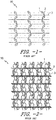
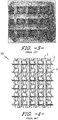
- Figures 1-3 illustrate some prior art knit fabrics 10 used for roofing membranes.
- the knit fabric contains an in-lay warp yarns 1, a stitching yarns 2, and a weft inserted yarns 3.
- the stitching yarns 2 are in a chain stitch configuration and the in-lay warp yarns 1 are in a round stitch configuration.
- the stitching yarns 2 are in a tricot open stitch configuration and the in-lay warp yarns 1 are in a round stitch configuration.
- Figure 3 is a photograph of the fabric of Figure 2 .
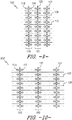
- the stitching yarns 2 are in a tricot open stitch configuration and the in-lay warp yarns 1 are in a flat stitch configuration.
- Figure 5 is a photograph of the fabric of Figure 4 .
- the chain stitches of the stitching yarn 2 wrap around the in-lay warp yarn 1 increasing the thickness of the fabric.
- the knit fabric of Figures 1 and 2 may need to be calendared (before or after being embedded into polymer) to become thinner to be more usable in applications such as roofing membranes. Additionally, the knit fabric shown in Figure 1 tends to have higher elongations than the knit patterns of the invention.
- How the stitching yarns 2 and the in-lay warp yarns 1 are configured in Figure 4 results in a fabric where the stitching yarns 2 cross over the open areas formed by the in-lay warp yarns 1 crossing with the weft inserted yarns 3. This can be seen in photograph of the fabric of Figure 5 .
- Knitting involves the interlooping or stitching of yarn into vertical columns (wales) and horizontal rows (courses) of loops to form the knitted fabric structure.
- the loops are formed along the textile length, i.e., in the wale or warp direction of the textile.
- the knit of Figure 6 is thinner and has less elongation than the knits of Figures 1 and 2 .
- An illustration of the fabric of Figure 6 is shown in Figure 7 and a photograph of the fabric is shown in Figure 8 .
- the fabric of Figure 6 is a three bar knit fabric with two of the bars used for the stitching yarns and one of the bars used for the in-lay warp yarns.
- the knit fabric of Figure 1 would be a two bar knit fabric with one of the bars used for the stitch yarn and one bar used for the in-lay warp yarns.
- the knit fabric 100 contains a stitch yarn set, a warp yarn set and a weft yarn set.
- the stitch yarn set contains pairs of stitch yarns 110, where each pair of stitch yarns 110 contains a first stitch yarn 111 and a second stitch yarn 113, forming together a two bar stitch pattern.
- the first stitch yarn 111 has a two bar first stitch pattern comprising repeating pattern of at least one tricot stitch optionally followed by at least one pillar stitch. In Figure 6 , the first stitch yarn 111 has a two bar first stitch pattern comprising a repeating pattern of tricot stitches (and no pillar stitches).
- the second stitch yarn 113 has a two bar second stitch pattern which is a mirror image to the first stitch pattern. This means that the second stitch pattern is the same as the first stitch pattern but reversed or mirrored along the warp axis of a warp yarn 121.
- the stitches of the first stitch yarn 111 and the second stitch yarn 113 are in the same courses and wales.
- the stitches of the first stitch yarn 111 and the second stitch yarn 113 are in a first wale and a second wale.
- the first stitch yarn 111 and the second stitch yarn 113 are interlinked together.
- Stitching yarn 111 becomes interlinked with stitch yarn 113 after it has moves from its needles column to the needle column of yarn 113 (underlaps), the two yarns (111 & 113 become interlinked because they are stitching on the same needle.
- Stitching yarns 111, 113 within one pair of stitching yarns 110 are not interlinked with the stitching yarns 111, 113 from other pairs of stitching yarns 110.
- the first stitch yarn 111 and the second stitch yarn 113 of one pair of stitch yarns 110 are not interlinked with the first stitch yarn 111 and the second stitch yarn 113 of adjacent pairs of stitch yarns 110.
- An adjacent pair of stitch yarns means the pair of stitch yarns nearest to the original pair of stitch yarns. Pairs of stitching yarns are adjacent if they do not have another set of stitching yarns between them. The pairs of stitching yarns do not have to be touching or right next to one another, they may be several wales away and even up to an inch or many inches away from one another.
- two adjacent pairs of stitching yarns 110 are separated by a space having a width defined to be the distance between the first wale and the second wale of the first stitch pattern. This configuration may be seen in Figure 9 .
- two adjacent pairs of stitch yarns 110 are separate by a space having a width defined to be about twice the distance between the first wale and the second wale of the first stitch pattern.
- two adjacent pairs of stitch yarns 110 are separate by a space having a width defined to be about three times the distance between the first wale and the second wale of the first stitch pattern.
- two adjacent pairs of stitch yarns 110 are separate by a space having a width defined to be at least about four times the distance between the first wale and the second wale of the first stitch pattern. In another embodiment, two adjacent pairs of stitch yarns 110 are separate by a distance of at least about 0.25 inches. In another embodiment, two adjacent pairs of stitch yarns 110 are separate by a distance of at least about 0.5 inches, more preferably at least about 1 inch. In another embodiment, two adjacent pairs of stitch yarns 110 are separate by a distance of at least about 3 inches, more preferably at least about 5 inches. How large the distance between the pairs of stitch yarns 110 controls how open the fabric is (how much of the surface area of the fabric is open or without any yarns). The spacing of the pairs of stitch yarns 110 is determined by the desired properties of the knit fabric and its end use.
- the first stitch yarn 111 has a two bar first stitch pattern comprising repeating pattern of at least one tricot stitch optionally followed by at least one pillar stitch.
- the pattern contains only tricot stitches.
- the pattern contains a repeating pattern of 1 tricot stitch followed by a chain stitch.
- the pattern contains a repeating pattern of 2 tricot stitches followed by 2 chain stitches or a repeating pattern of 2 tricot stitches followed by 1 chain stitch.
- Other possible patterns include (but are not limited to) repeating patterns of 3 tricot stitches followed by 2 chain stitches, 4 tricot stitches followed by 2 chain stitches, 3 tricot stitches followed by 3 chain stitches, and 5 tricot stitches followed by 2 chain stitches.
- the pattern comprises a repeating pattern of at least 1 tricot stitch followed by at least 1 chain stitch.
- the pattern does not necessarily have the same number of tricot stitches and chain stitches repeated over and over again, but may have a pattern such as 1 tricot stitch, 1 chain stitch, 3 tricot stitches, 2 chain stitches, 4 tricot stitches, 1 chain stitch, etc.
- the number of tricot stitches followed by the number of chain stitches is random and not in a defined pattern.
- the pattern contains a repeating pattern of a large number (greater than 10) tricot stitches followed by at least 1 chain stitch. The percentage by number of tricot stitches and china stitches in the pattern is dictated by the desired end result. Additionally, how the tricot or chain stitches are grouped together (the number of the same type of stitches in a row) is also dictated by the desired end result.
- the first stitch pattern and the second stitch pattern may also contain any other suitable stitch within the pattern.
- Figure 11 illustrates one embodiment of the lapping pattern of the stitching yarns 111, 113 where the first stitching pattern comprises a repeating pattern of tricot stitches with a closed stitch and the second stitching pattern comprise a mirror of the first stitching pattern.
- Figure 12 illustrates one embodiment of the lapping pattern of the stitching yarns 111, 113 where the first stitching pattern comprises a repeating pattern of tricot stitches with an open stitch and the second stitching pattern comprise a mirror of the first stitching pattern.
- Figure 13 illustrates one embodiment of the lapping pattern of the stitching yarns 111, 113 where the first stitching pattern comprises a repeating pattern of 1 tricot stitches followed by 2 pillar stitches with a mixture of closed and open stitches and the second stitching pattern comprise a mirror of the first stitching pattern.
- Figure 14 illustrates one embodiment of the lapping pattern of the stitching yarns 111, 113 where the first stitching pattern comprises a repeating pattern of 2 tricot stitches followed by 2 pillar stitches with a mixture of closed and open stitches and the second stitching pattern comprise a mirror of the first stitching pattern.
- Figure 15 illustrates one embodiment of the lapping pattern of the stitching yarns 111, 113 where the first stitching pattern comprises a repeating pattern of 3 tricot stitches followed by 2 pillar stitches with a mixture of closed and open stitches and the second stitching pattern comprise a mirror of the first stitching pattern.
- Figure 16 illustrates one embodiment of the lapping pattern of the stitching yarns 111, 113 where the first stitching pattern comprises a repeating pattern of 2 tricot stitches followed by 3 pillar stitches with a mixture of closed and open stitches and the second stitching pattern comprise a mirror of the first stitching pattern.
- the fabric also contains a warp yarn set comprising in-lay warp yarns 121 located between the first wale and second wale of at least a portion of the pairs of stitch yarns 110.
- the lay warp yarns 121 are located between the first wale and second wale of each pair of stitch yarns 110.
- the in-lay warp yarn 110 is inserted such that it lays between the two columns (two wales) of stitches formed by the pair of stitch yarns 110.
- the illustration of Figure 7 and the photograph of Figure 8 illustrate the position of the in-lay warp yarn 120 to the first and second stitching yarns 111, 113.
- the stitches from the stitching yarns 111, 113 form on the sides of the in-lay warp yarns 120 versus some prior art knit patterns where the stitches would lay on the warp yarns 120. This enables a thinner knit fabric 100.
- the knit fabric of the invention is thinner than some prior art knits such as shown in Figures 1 and 2 .
- the knit fabric has a thickness of between about 0.2 to 0.5 mm, more preferably between about 0.25 and 0.45 mm, more preferably between about 0.28 and 0.32 mm. This enables the knit fabric to be used without calendaring in a roofing membrane which saves a costly manufacturing step.
- the knit fabric of Figure 6 also contains a weft yarn set.
- the weft yarn set contains weft inserted yarns 131 which are inserted in at least a portion of the courses in the fabric 100.
- the weft inserted yarns are inserted into courses between the stitches of the stitching yarns 111, 113.
- the weft inserted yarns can also be seen in Figures 7 and 8 .
- the stitches by the first stitching yarn 111 and the second stitching yarn 113 within the knit fabric may be open loops and/or closed loops.
- open loops refer to interlacing yarns where a front or a back yarn does not cross over itself in forming the loop.
- closed loops refer to interlacing yarns where a front or a back yarn crosses over itself in forming the loop.
- the knit fabric is an open loop construction meaning that the stitches are open. This construction is sometimes preferred as it may produce the lightest weight and most open knit fabric.
- the knit fabric is a closed loop construction meaning that the stitches are closed.
- the stitches of the knit fabric are closed.
- the turning stitches of the knit fabric are open.
- the stitches in the knit fabric may be a mixture of open and closed.
- the movement between stitches is an underlap movement, and in other embodiments, the movement between stitches is an overlap movement.
- the yarns used in the knit fabric may be any suitable yarn, including but not limited to a spun staple yarn, a multifilament yarn, and/or a monofilament yarn and are formed of a material which will restrain the belt plies 230.
- "Yarn”, in this application, as used herein includes a monofilament elongated body, a multifilament elongated body, ribbon, strip, fiber, tape, and the like.
- yarn includes a plurality of any one or combination of the above.
- the yarns include polyamide, aramids (including meta and para forms), rayon, PVA (polyvinyl alcohol), polyester, polyolefin, polyvinyl, nylon (including nylon 6, nylon 6, 6, and nylon 4, 6), polyethylene naphthalate (PEN), cotton, steel, carbon, fiberglass, steel, polyacrylic or any other suitable artificial or natural fiber.
- the yarns are preferably rayon, polyester or nylon.
- the yarns may be single monofilament or multifilaments yarns (twisted and/or cabled cords) made with any of the prior listed materials, also including hybrid yarns, or film-tape yarns.
- the yarns may be hybrid yarns.
- These hybrid yarns are made up of at least 2 fibers of different fiber material (for example, cotton and nylon). These different fiber materials can produce hybrid yarns with different chemical and physical properties.
- Hybrid yarns are able to change the physical properties of the final product they are used in.
- Some preferred hybrid yarns include an aramid fiber with a nylon fiber, an aramid fiber with a rayon fiber, and an aramid fiber with a polyester fiber.
- the stitching yarns 111, 113 comprise PA, PET, PE, PP multifilament or monofil from 22 dtex to 280 dtex
- the warp yarns 120 comprise PA,PET,PE,PP multifilament or monofilament from 80 dtex to 6600 dtex
- the weft yarns 130 comprise PA,PET,PE,PP multifilament or monofilament from 80 dtex to 6600 dtex.
- the knit fabric may be treated with any suitable composition and the treatment may be applied to the yarns before knitting or to the knit fabric.
- Some treatments may include adhesion promoters, anti-wicking chemistries, colorants, anti-microbial chemistries, abrasion resistance, UV stabilizers, and the like.
- the knit fabric may be used in any suitable product such as roofing, tires, concrete reinforcement, as house wrap. It is particularly advantageous to use in applications where a thinner reinforcement is desired.
- the knit fabric may be used without calendaring due to its construction, but may also be calendared to further reduce its thickness.
- the knit fabric 100 of the invention is at least partially embedded into a polymer to form a membrane 400 (such as for a roofing membrane).
- the fabric is fully embedded into the polymer 300.
- the polymer 300 may be any suitable polymer and its selection is dependent on the desired properties of the finished membrane.
- the polymer 300 contains polyvinyl chloride (PVC).
- the polymer 300 contains a thermoplastic olefin (TPO). These polymers have been found to produce roofing membrane with good properties and cost effectiveness.
- the polymer layer(s) 130 have a thickness of between about 0.5 and 10 mm, more preferably between about 1 and 5 mm, more preferably between about 1.2 and 2.2 mm.
- the polymer 300 may be applied to the knit fabric 100 in any suitable manner such as coating, extruding, and lamination. In one preferred embodiment, the polymer 300 is laminated onto the knit fabric 100. A polymer 300 is delivered to the knit fabric 100 as a free standing film that is then adhered to the fabric 100 using heat and/or pressure and/or adhesive. The polymer 300 may be applied to only one side of the knit fabric 100 or may be applied to both sides of the knit fabric sequentially or simultaneously.
- the polymer 300 is extruded onto the knit fabric 100.
- a polymer 300 is delivered to the knit fabric 100 in a molten state on one or both sides of the fabric 100.
- the membrane 400 may be subjected to additional processing steps such as coatings, surface treatments, adhering the membrane to additional components, and calendaring. Calendaring further compresses the polymer 300 and the fabric 100 to deliver a thinner membrane 400. Calendaring may be part of the process of coating the knit fabric 100 with the polymer 300 such as in the lamination process or a separate operation.
Landscapes
- Engineering & Computer Science (AREA)
- Textile Engineering (AREA)
- Architecture (AREA)
- Civil Engineering (AREA)
- Structural Engineering (AREA)
- Chemical & Material Sciences (AREA)
- Chemical Kinetics & Catalysis (AREA)
- Knitting Of Fabric (AREA)
Claims (13)
- Tissu tricoté (100) présentant des colonnes de mailles et des rangées de mailles comprenant :un ensemble de fils de maille comprenant des paires de fils de maille (110), dans lequel chaque paire de fils de maille (110) comprend un premier fil de maille (111) et un second fil de maille (113), formant ensemble un motif de maille à deux barres ;dans lequel le premier fil de maille (111) présente un premier motif de maille à deux barres comprenant la répétition d'un motif d'au moins une maille tricot facultativement suivie d'au moins une maille chaînette, dans lequel les mailles du premier motif de maille sont situées dans une première colonne de mailles et une seconde colonne de mailles du tissu (100), avec une seule maille ayant été formée dans la première colonne de mailles ou la seconde colonne de mailles de chaque rangée de mailles de formation de maille, dans lequel le second fil de maille (113) présente un second motif de maille à deux barres, dans lequel le second motif de maille comprend une image miroir du premier motif de maille, et dans lequel les mailles du second motif de maille sont situées dans la première colonne de mailles et la seconde colonne de mailles du tissu avec seulement une maille ayant été formée dans la seconde colonne de mailles ou la première colonne de mailles dans chaque rangée de mailles de formation de maille ;dans lequel le premier fil de maille (111) et le second fil de maille (113) au sein de chaque paire de fils de maille (110) sont entrelacés ensemble, et dans lequel le premier fil de maille (111) et le second fil de maille (113) d'une paire de fils de maille (110) ne sont pas entrelacés avec le premier fil de maille (111) et le second fil de maille (113) de paires adjacentes de fils de maille (110),un ensemble de fils de chaîne comprenant des fils de chaîne d'incrustation (121) situés entre la première rangée de mailles et la seconde rangée de mailles d'au moins une partie des paires de fils de maille (110) ; et,un ensemble de fils de trame comprenant des fils de trame insérés (131), dans lequel les fils de trame insérés sont insérés dans au moins une partie des rangées de mailles du tissu (100).
- Tissu tricoté selon la revendication 1, dans lequel deux paires adjacentes de fils de maille (110) sont séparées par un espace présentant une largeur définie pour être la distance entre la première colonne de mailles et la seconde colonne de mailles du premier motif de maille.
- Tissu tricoté selon la revendication 1, dans lequel deux paires adjacentes de fils de maille (110) sont séparées par un espace présentant une largeur définie pour être deux fois la distance entre la première colonne de mailles et la seconde colonne de mailles du premier motif de maille.
- Tissu tricoté selon la revendication 1, dans lequel deux paires adjacentes de fils de maille (110) sont séparées par un espace présentant une largeur définie pour être au moins quatre fois la distance entre la première colonne de mailles et la seconde colonne de mailles du premier motif de maille.
- Tissu tricoté selon la revendication 1, dans lequel le premier motif de maille à deux barres comprend la répétition d'un motif de mailles tricot.
- Tissu tricoté selon la revendication 1, dans lequel le premier motif de maille à deux barres comprend la répétition d'un motif d'une maille tricot suivie d'une maille chaînette.
- Tissu tricoté selon la revendication 1, dans lequel le premier motif de maille à deux barres comprend la répétition d'un motif de deux mailles tricot suivies de deux mailles chaînettes.
- Tissu tricoté selon la revendication 1, dans lequel le premier motif de maille à deux barres comprend la répétition d'un motif de trois mailles tricot suivies de deux mailles chaînettes.
- Tissu tricoté selon la revendication 1, dans lequel le tissu tricoté (100) est calandré.
- Tissu tricoté selon la revendication 1, dans lequel le tissu tricoté (100) est au moins partiellement intégré à l'intérieur d'un polymère.
- Tissu tricoté selon la revendication 10, dans lequel le polymère est le polychlorure de vinyle.
- Membrane (400) comprenant le tissu tricoté (100) selon l'une quelconque des revendications 1 à 8 au moins partiellement intégré à l'intérieur d'un polymère.
- Membrane (400) selon la revendication 12, dans laquelle le tissu tricoté (100) est entièrement intégré dans le polymère.
Priority Applications (1)
| Application Number | Priority Date | Filing Date | Title |
|---|---|---|---|
| PL15805226T PL3250738T3 (pl) | 2015-01-29 | 2015-12-08 | Dzianina do stosowania w membranach dachowych |
Applications Claiming Priority (2)
| Application Number | Priority Date | Filing Date | Title |
|---|---|---|---|
| US14/608,289 US9863071B2 (en) | 2015-01-29 | 2015-01-29 | Knit fabric for use in roofing membranes |
| PCT/EP2015/078969 WO2016119960A1 (fr) | 2015-01-29 | 2015-12-08 | Tricot destiné à être utilisé dans des revêtements d'étanchéité |
Publications (2)
| Publication Number | Publication Date |
|---|---|
| EP3250738A1 EP3250738A1 (fr) | 2017-12-06 |
| EP3250738B1 true EP3250738B1 (fr) | 2020-06-17 |
Family
ID=54783626
Family Applications (1)
| Application Number | Title | Priority Date | Filing Date |
|---|---|---|---|
| EP15805226.6A Active EP3250738B1 (fr) | 2015-01-29 | 2015-12-08 | Tricot destiné à être utilisé dans des revêtements d'étanchéité |
Country Status (5)
| Country | Link |
|---|---|
| US (1) | US9863071B2 (fr) |
| EP (1) | EP3250738B1 (fr) |
| ES (1) | ES2814153T3 (fr) |
| PL (1) | PL3250738T3 (fr) |
| WO (1) | WO2016119960A1 (fr) |
Cited By (1)
| Publication number | Priority date | Publication date | Assignee | Title |
|---|---|---|---|---|
| EP4074873A1 (fr) | 2021-04-16 | 2022-10-19 | Engtex AB | Tissu tricoté en chaîne et membrane comprenant un tel tissu tricoté en chaîne |
Families Citing this family (3)
| Publication number | Priority date | Publication date | Assignee | Title |
|---|---|---|---|---|
| KR101863899B1 (ko) | 2017-07-07 | 2018-05-31 | 박태수 | 트리코트 경위편 원단의 제조방법 |
| DE102019110909B4 (de) * | 2019-04-26 | 2020-12-10 | Müller Textil GmbH | Abstandsgewirke |
| CN110777475B (zh) * | 2019-11-11 | 2020-09-18 | 常州市宏发纵横新材料科技股份有限公司 | 一种单向织物及其经编工艺和应用方法 |
Family Cites Families (10)
| Publication number | Priority date | Publication date | Assignee | Title |
|---|---|---|---|---|
| US4615934A (en) * | 1985-11-22 | 1986-10-07 | Peabody Abc Corporation | Warp knit weft insertion fabric and plastic sheet reinforced therewith |
| US5399419A (en) | 1989-09-07 | 1995-03-21 | Bay Mills Limited | Reinforced film and method of manufacturing same |
| US5057172A (en) | 1989-09-07 | 1991-10-15 | Bay Mills Limited | Method of manufacturing a reinforced film |
| US5549776A (en) | 1991-02-20 | 1996-08-27 | Indian Head Industries | Self-supporting impact resistant laminate |
| US5474838A (en) | 1994-02-22 | 1995-12-12 | Milliken Research Corporation | Roofing membrane comprising fiberglass scrim stitched to a polyester mat |
| JP3707982B2 (ja) | 2000-03-08 | 2005-10-19 | Ykk株式会社 | 経編組織からなるスライドファスナー用テープ |
| US20040185734A1 (en) | 2003-03-21 | 2004-09-23 | Gray Hugh Douglas | Reinforced fabric substrate and method for making the same |
| US7013681B1 (en) | 2004-11-19 | 2006-03-21 | Milliken & Company | Edgecomb resistant weft insertion warp knit fabric |
| US7549303B2 (en) | 2007-11-21 | 2009-06-23 | Milliken & Company | Textile-reinforced composites with high tear strength |
| EP2739489B1 (fr) | 2011-08-02 | 2018-02-28 | Milliken & Company | Pneu avec flanc renforcé à tissu à mailles |
-
2015
- 2015-01-29 US US14/608,289 patent/US9863071B2/en active Active
- 2015-12-08 PL PL15805226T patent/PL3250738T3/pl unknown
- 2015-12-08 ES ES15805226T patent/ES2814153T3/es active Active
- 2015-12-08 EP EP15805226.6A patent/EP3250738B1/fr active Active
- 2015-12-08 WO PCT/EP2015/078969 patent/WO2016119960A1/fr not_active Ceased
Non-Patent Citations (1)
| Title |
|---|
| None * |
Cited By (1)
| Publication number | Priority date | Publication date | Assignee | Title |
|---|---|---|---|---|
| EP4074873A1 (fr) | 2021-04-16 | 2022-10-19 | Engtex AB | Tissu tricoté en chaîne et membrane comprenant un tel tissu tricoté en chaîne |
Also Published As
| Publication number | Publication date |
|---|---|
| US9863071B2 (en) | 2018-01-09 |
| EP3250738A1 (fr) | 2017-12-06 |
| ES2814153T3 (es) | 2021-03-26 |
| WO2016119960A1 (fr) | 2016-08-04 |
| PL3250738T3 (pl) | 2020-10-19 |
| US20160222556A1 (en) | 2016-08-04 |
Similar Documents
| Publication | Publication Date | Title |
|---|---|---|
| US7549303B2 (en) | Textile-reinforced composites with high tear strength | |
| EP1981723B1 (fr) | Enveloppe pneumatique avec nappe sommet comportant un tissu a mailles jetees avec insertion de trame | |
| EP2432923B1 (fr) | Tricot | |
| US9863071B2 (en) | Knit fabric for use in roofing membranes | |
| US20130295812A1 (en) | Modified Jersey Knit Fabric and Methods of Making the Same | |
| US12203199B2 (en) | Automatic textile winding system with multi-stranded rotatable yarn feed | |
| CN106110599B (zh) | 运动类球的球胎件 | |
| RU2557632C1 (ru) | Шина, армированная трикотажным полотном в зоне боковин | |
| EP3688214B1 (fr) | Procédés pour la réalisation des produits auto-grippants tricotés | |
| RU2012155083A (ru) | Гибкий шланг с армирующей оплеткой и способ его изготовления | |
| US10266973B2 (en) | Composite material comprising a warp-knitted textile panel having first and second opposing faces, said first face being coated with a layer consisting of at least one polymer material, and a method for the production thereof | |
| RU2505420C1 (ru) | Узорчатое покрытие с материалом, повышающим клейкость | |
| EP1628607A1 (fr) | Bandage elastique et adhesif a insertion de trame et procede associe | |
| CA2669525A1 (fr) | Materiau en feuille | |
| US20100255744A1 (en) | Textile-reinforced composites with High Tear Strength | |
| CN111479964A (zh) | 密封幅材 | |
| EP3559325B1 (fr) | Tuyau renforcé flexible, le procédé pour son obtention et une chaîne de production dudit tuyau | |
| US20130032268A1 (en) | Tire having knit fabric in sidewall area | |
| EP4074873A1 (fr) | Tissu tricoté en chaîne et membrane comprenant un tel tissu tricoté en chaîne | |
| JPH08337949A (ja) | たて編組織の構造 |
Legal Events
| Date | Code | Title | Description |
|---|---|---|---|
| STAA | Information on the status of an ep patent application or granted ep patent |
Free format text: STATUS: THE INTERNATIONAL PUBLICATION HAS BEEN MADE |
|
| PUAI | Public reference made under article 153(3) epc to a published international application that has entered the european phase |
Free format text: ORIGINAL CODE: 0009012 |
|
| STAA | Information on the status of an ep patent application or granted ep patent |
Free format text: STATUS: REQUEST FOR EXAMINATION WAS MADE |
|
| 17P | Request for examination filed |
Effective date: 20170731 |
|
| AK | Designated contracting states |
Kind code of ref document: A1 Designated state(s): AL AT BE BG CH CY CZ DE DK EE ES FI FR GB GR HR HU IE IS IT LI LT LU LV MC MK MT NL NO PL PT RO RS SE SI SK SM TR |
|
| AX | Request for extension of the european patent |
Extension state: BA ME |
|
| DAV | Request for validation of the european patent (deleted) | ||
| DAX | Request for extension of the european patent (deleted) | ||
| GRAP | Despatch of communication of intention to grant a patent |
Free format text: ORIGINAL CODE: EPIDOSNIGR1 |
|
| STAA | Information on the status of an ep patent application or granted ep patent |
Free format text: STATUS: GRANT OF PATENT IS INTENDED |
|
| INTG | Intention to grant announced |
Effective date: 20200325 |
|
| GRAS | Grant fee paid |
Free format text: ORIGINAL CODE: EPIDOSNIGR3 |
|
| GRAA | (expected) grant |
Free format text: ORIGINAL CODE: 0009210 |
|
| STAA | Information on the status of an ep patent application or granted ep patent |
Free format text: STATUS: THE PATENT HAS BEEN GRANTED |
|
| AK | Designated contracting states |
Kind code of ref document: B1 Designated state(s): AL AT BE BG CH CY CZ DE DK EE ES FI FR GB GR HR HU IE IS IT LI LT LU LV MC MK MT NL NO PL PT RO RS SE SI SK SM TR |
|
| REG | Reference to a national code |
Ref country code: GB Ref legal event code: FG4D |
|
| REG | Reference to a national code |
Ref country code: CH Ref legal event code: EP |
|
| REG | Reference to a national code |
Ref country code: DE Ref legal event code: R096 Ref document number: 602015054463 Country of ref document: DE |
|
| REG | Reference to a national code |
Ref country code: IE Ref legal event code: FG4D |
|
| REG | Reference to a national code |
Ref country code: AT Ref legal event code: REF Ref document number: 1281414 Country of ref document: AT Kind code of ref document: T Effective date: 20200715 |
|
| REG | Reference to a national code |
Ref country code: SE Ref legal event code: TRGR |
|
| REG | Reference to a national code |
Ref country code: NO Ref legal event code: T2 Effective date: 20200617 |
|
| REG | Reference to a national code |
Ref country code: SK Ref legal event code: T3 Ref document number: E 34691 Country of ref document: SK |
|
| PG25 | Lapsed in a contracting state [announced via postgrant information from national office to epo] |
Ref country code: GR Free format text: LAPSE BECAUSE OF FAILURE TO SUBMIT A TRANSLATION OF THE DESCRIPTION OR TO PAY THE FEE WITHIN THE PRESCRIBED TIME-LIMIT Effective date: 20200918 Ref country code: LT Free format text: LAPSE BECAUSE OF FAILURE TO SUBMIT A TRANSLATION OF THE DESCRIPTION OR TO PAY THE FEE WITHIN THE PRESCRIBED TIME-LIMIT Effective date: 20200617 Ref country code: FI Free format text: LAPSE BECAUSE OF FAILURE TO SUBMIT A TRANSLATION OF THE DESCRIPTION OR TO PAY THE FEE WITHIN THE PRESCRIBED TIME-LIMIT Effective date: 20200617 |
|
| REG | Reference to a national code |
Ref country code: LT Ref legal event code: MG4D |
|
| REG | Reference to a national code |
Ref country code: NL Ref legal event code: MP Effective date: 20200617 |
|
| PG25 | Lapsed in a contracting state [announced via postgrant information from national office to epo] |
Ref country code: HR Free format text: LAPSE BECAUSE OF FAILURE TO SUBMIT A TRANSLATION OF THE DESCRIPTION OR TO PAY THE FEE WITHIN THE PRESCRIBED TIME-LIMIT Effective date: 20200617 Ref country code: RS Free format text: LAPSE BECAUSE OF FAILURE TO SUBMIT A TRANSLATION OF THE DESCRIPTION OR TO PAY THE FEE WITHIN THE PRESCRIBED TIME-LIMIT Effective date: 20200617 Ref country code: LV Free format text: LAPSE BECAUSE OF FAILURE TO SUBMIT A TRANSLATION OF THE DESCRIPTION OR TO PAY THE FEE WITHIN THE PRESCRIBED TIME-LIMIT Effective date: 20200617 Ref country code: BG Free format text: LAPSE BECAUSE OF FAILURE TO SUBMIT A TRANSLATION OF THE DESCRIPTION OR TO PAY THE FEE WITHIN THE PRESCRIBED TIME-LIMIT Effective date: 20200917 |
|
| REG | Reference to a national code |
Ref country code: AT Ref legal event code: MK05 Ref document number: 1281414 Country of ref document: AT Kind code of ref document: T Effective date: 20200617 |
|
| PG25 | Lapsed in a contracting state [announced via postgrant information from national office to epo] |
Ref country code: NL Free format text: LAPSE BECAUSE OF FAILURE TO SUBMIT A TRANSLATION OF THE DESCRIPTION OR TO PAY THE FEE WITHIN THE PRESCRIBED TIME-LIMIT Effective date: 20200617 Ref country code: AL Free format text: LAPSE BECAUSE OF FAILURE TO SUBMIT A TRANSLATION OF THE DESCRIPTION OR TO PAY THE FEE WITHIN THE PRESCRIBED TIME-LIMIT Effective date: 20200617 |
|
| PG25 | Lapsed in a contracting state [announced via postgrant information from national office to epo] |
Ref country code: PT Free format text: LAPSE BECAUSE OF FAILURE TO SUBMIT A TRANSLATION OF THE DESCRIPTION OR TO PAY THE FEE WITHIN THE PRESCRIBED TIME-LIMIT Effective date: 20201019 Ref country code: CZ Free format text: LAPSE BECAUSE OF FAILURE TO SUBMIT A TRANSLATION OF THE DESCRIPTION OR TO PAY THE FEE WITHIN THE PRESCRIBED TIME-LIMIT Effective date: 20200617 Ref country code: RO Free format text: LAPSE BECAUSE OF FAILURE TO SUBMIT A TRANSLATION OF THE DESCRIPTION OR TO PAY THE FEE WITHIN THE PRESCRIBED TIME-LIMIT Effective date: 20200617 Ref country code: EE Free format text: LAPSE BECAUSE OF FAILURE TO SUBMIT A TRANSLATION OF THE DESCRIPTION OR TO PAY THE FEE WITHIN THE PRESCRIBED TIME-LIMIT Effective date: 20200617 Ref country code: AT Free format text: LAPSE BECAUSE OF FAILURE TO SUBMIT A TRANSLATION OF THE DESCRIPTION OR TO PAY THE FEE WITHIN THE PRESCRIBED TIME-LIMIT Effective date: 20200617 Ref country code: SM Free format text: LAPSE BECAUSE OF FAILURE TO SUBMIT A TRANSLATION OF THE DESCRIPTION OR TO PAY THE FEE WITHIN THE PRESCRIBED TIME-LIMIT Effective date: 20200617 |
|
| PG25 | Lapsed in a contracting state [announced via postgrant information from national office to epo] |
Ref country code: IS Free format text: LAPSE BECAUSE OF FAILURE TO SUBMIT A TRANSLATION OF THE DESCRIPTION OR TO PAY THE FEE WITHIN THE PRESCRIBED TIME-LIMIT Effective date: 20201017 |
|
| REG | Reference to a national code |
Ref country code: DE Ref legal event code: R097 Ref document number: 602015054463 Country of ref document: DE |
|
| REG | Reference to a national code |
Ref country code: ES Ref legal event code: FG2A Ref document number: 2814153 Country of ref document: ES Kind code of ref document: T3 Effective date: 20210326 |
|
| PLBE | No opposition filed within time limit |
Free format text: ORIGINAL CODE: 0009261 |
|
| STAA | Information on the status of an ep patent application or granted ep patent |
Free format text: STATUS: NO OPPOSITION FILED WITHIN TIME LIMIT |
|
| PG25 | Lapsed in a contracting state [announced via postgrant information from national office to epo] |
Ref country code: DK Free format text: LAPSE BECAUSE OF FAILURE TO SUBMIT A TRANSLATION OF THE DESCRIPTION OR TO PAY THE FEE WITHIN THE PRESCRIBED TIME-LIMIT Effective date: 20200617 |
|
| 26N | No opposition filed |
Effective date: 20210318 |
|
| PG25 | Lapsed in a contracting state [announced via postgrant information from national office to epo] |
Ref country code: SI Free format text: LAPSE BECAUSE OF FAILURE TO SUBMIT A TRANSLATION OF THE DESCRIPTION OR TO PAY THE FEE WITHIN THE PRESCRIBED TIME-LIMIT Effective date: 20200617 |
|
| REG | Reference to a national code |
Ref country code: CH Ref legal event code: PL |
|
| PG25 | Lapsed in a contracting state [announced via postgrant information from national office to epo] |
Ref country code: MC Free format text: LAPSE BECAUSE OF FAILURE TO SUBMIT A TRANSLATION OF THE DESCRIPTION OR TO PAY THE FEE WITHIN THE PRESCRIBED TIME-LIMIT Effective date: 20200617 |
|
| PG25 | Lapsed in a contracting state [announced via postgrant information from national office to epo] |
Ref country code: LU Free format text: LAPSE BECAUSE OF NON-PAYMENT OF DUE FEES Effective date: 20201208 Ref country code: IE Free format text: LAPSE BECAUSE OF NON-PAYMENT OF DUE FEES Effective date: 20201208 |
|
| PG25 | Lapsed in a contracting state [announced via postgrant information from national office to epo] |
Ref country code: CH Free format text: LAPSE BECAUSE OF NON-PAYMENT OF DUE FEES Effective date: 20201231 Ref country code: LI Free format text: LAPSE BECAUSE OF NON-PAYMENT OF DUE FEES Effective date: 20201231 |
|
| PG25 | Lapsed in a contracting state [announced via postgrant information from national office to epo] |
Ref country code: TR Free format text: LAPSE BECAUSE OF FAILURE TO SUBMIT A TRANSLATION OF THE DESCRIPTION OR TO PAY THE FEE WITHIN THE PRESCRIBED TIME-LIMIT Effective date: 20200617 Ref country code: MT Free format text: LAPSE BECAUSE OF FAILURE TO SUBMIT A TRANSLATION OF THE DESCRIPTION OR TO PAY THE FEE WITHIN THE PRESCRIBED TIME-LIMIT Effective date: 20200617 Ref country code: CY Free format text: LAPSE BECAUSE OF FAILURE TO SUBMIT A TRANSLATION OF THE DESCRIPTION OR TO PAY THE FEE WITHIN THE PRESCRIBED TIME-LIMIT Effective date: 20200617 |
|
| PG25 | Lapsed in a contracting state [announced via postgrant information from national office to epo] |
Ref country code: MK Free format text: LAPSE BECAUSE OF FAILURE TO SUBMIT A TRANSLATION OF THE DESCRIPTION OR TO PAY THE FEE WITHIN THE PRESCRIBED TIME-LIMIT Effective date: 20200617 |
|
| P01 | Opt-out of the competence of the unified patent court (upc) registered |
Effective date: 20230509 |
|
| PGFP | Annual fee paid to national office [announced via postgrant information from national office to epo] |
Ref country code: GB Payment date: 20251229 Year of fee payment: 11 |
|
| PGFP | Annual fee paid to national office [announced via postgrant information from national office to epo] |
Ref country code: NO Payment date: 20251231 Year of fee payment: 11 |
|
| PGFP | Annual fee paid to national office [announced via postgrant information from national office to epo] |
Ref country code: IT Payment date: 20251219 Year of fee payment: 11 |
|
| PGFP | Annual fee paid to national office [announced via postgrant information from national office to epo] |
Ref country code: FR Payment date: 20251226 Year of fee payment: 11 |
|
| PGFP | Annual fee paid to national office [announced via postgrant information from national office to epo] |
Ref country code: BE Payment date: 20251229 Year of fee payment: 11 |
|
| PGFP | Annual fee paid to national office [announced via postgrant information from national office to epo] |
Ref country code: SE Payment date: 20251227 Year of fee payment: 11 |
|
| PGFP | Annual fee paid to national office [announced via postgrant information from national office to epo] |
Ref country code: PL Payment date: 20251119 Year of fee payment: 11 |
|
| PGFP | Annual fee paid to national office [announced via postgrant information from national office to epo] |
Ref country code: SK Payment date: 20251119 Year of fee payment: 11 |
|
| PGFP | Annual fee paid to national office [announced via postgrant information from national office to epo] |
Ref country code: ES Payment date: 20260102 Year of fee payment: 11 |
|
| PGFP | Annual fee paid to national office [announced via postgrant information from national office to epo] |
Ref country code: DE Payment date: 20251229 Year of fee payment: 11 |